Williams – Jordan Wedding

Perhaps there is something intimidating about writing your own thoughts. Sometimes those creative juices flow, but usually I sit down thinking I need to write something and nothing is really there. I find life fascinating so I know it is not because nothing is happening around me or in my own life. I write in my journal every night, for the most part, and do not feel like rehashing the same stories. My journals will be available to my family and others probably for a long time to come. However, I do have hundreds of photographs that I think I have learned some stories on which probably are not recorded.

Therefore, as a hope of continuing family history by preserving the stories with some of these photos, I start my new goal. To start posting pictures with my thoughts, perspective, musing, and whatever else I might feel to include.  So, here we go.  A sort of a picture is worth a thousand words expose.  I think part of me hopes I might find further clarification and other answers for the unknown bits of the stories I might present.  Please feel free to share.

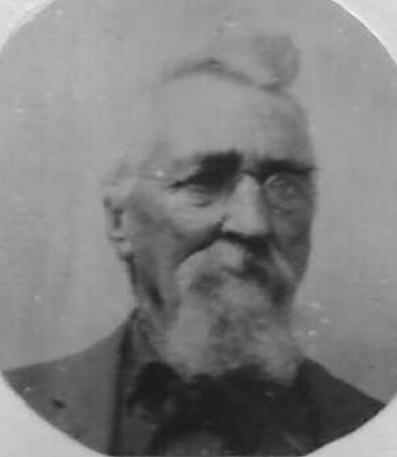
Here is a portrait of David D Williams and Gwenllian Jordan (There was a photo here, but we found out the photo was of Joseph and Erma Horsley, not David and Gwenllian Jordan).  I do not know what the D stands for.  Still hoping I will find that out at some point.
021ee826-3133-4f1f-9e20-f08793ff82d9

David was born 12 November 1832 in Pembrey, Carmarthenshire, Wales to John Williams and Frances Henneys.  His father was a Collier (coal miner).  On the 1841 Census, John is then listed as a farmer in Pembrey.  David joined the LDS church 12 July 1849.  His father joined in 1851, and siblings John in 1837, Joseph in 1853, and Richard in 1855.  John Haines moved to Pennsylvania in 1855.

In 1864, David immigrated through Liverpool and New York to America. He met Gwenllian Jordan in Liverpool, probably with the other Saints waiting to immigrate to the Zion.  They embarked on the “General McClellan”  on 21 May 1864 with a shipload of Mormon converts.  The two married on the ship 22 May 1864.  David and Gwenllian married while the ship was still in the Bramley-Moore dock of Liverpool Harbour.  Gwenllian’s sister, Mary Jordan, was also on the boat and married William Evans the same day on the River Mersey as they left Liverpool.  Thomas Jeremy, the presiding Elder on the ship married both couples.  These four disembarked together at Castle Gardens, New York (both Gwenllian and Mary using the Jordan name) on 23 June 1864.  I do not know if any other siblings of either David or Gwenllian were on the ship.  None of the others on the ship appear related.

The company of Saints from the ship were met by Joseph and Brigham Young Jr, sons of Brigham Young.  They then took the “”St. John” to Albany.  From there they took a train to Rochester, St. Joseph, and then Chicago where Parley P Pratt Jr met them.  From Chicago they took the “West Wind” to Wyoming, Nebraska Territory.  There a wagon train awaited and provided transportation to Utah.  The train arrived on 4 October 1864 (depending on which wagon train they traveled).

Gwenlliam was born 2 August 1842 in Merthyr-Tydfil, Glamorganshire, Wales to Margret Watkins and David Jordan.  She joined the LDS church on New Years Day (in probably cold baptismal waters) in 1851.  Her parents joined a few years before and I don’t know if any of her other siblings besides Mary joined the LDS church.  I believe Thomas did.  Her parents immigrated to Utah in 1872.

I am guessing the photograph of David and Gwenllian was taken while they were in the 40’s.  That is, of course, assuming the photograph is really of them.  This is a photograph in my Great Great Grandmother’s, Mary Elizabeth Williams, possessions.  She was the third child of David and Gwenllian so I have little reason to suspect the authenticity of the people in the photograph.  The photo was probably taken in Ogden since they settled and remained there the  rest of their lives.

David and Gwenllian had 10 children, 5 who lived to adulthood. I list the children below.  David worked as a farmer.  He passed away while sitting in his chair 27 November 1911 in Ogden.  Nobody was around when he passed but it seems to have been peaceful.  He had suffered from some heart problems and senility that came with his age.  Gwenllian apparently died in Slaterville from what her death certificate indicates as paralysis of the brain.

The 1870, 1880, and 1910 Censuses have David and Gwenllian in Ogden.  The 1900 has the family in Slaterville which is where Gwenllian passed away.

I really do not know anything more about the lives of David and Gwenllian.  If you have anything more, please share.

The five who died as children are as follows:

David Moiah Williams – 15 August 1866 – 15 January 1867 both in Ogden.

Margaret Ann Williams – 22 June 1867 – 4 March 1868 both in Ogden.

Sarah Jane Williams – 4 June 1874 – 4 January 1880 both in Ogden.

Katherine Williams – 15 June 1876 – 22 July 1877 both in Ogden.

Rosa Bell Williams – 15 June 1878 – 15 September 1879 both in Ogden.

The children who lived to adulthood are as follows:

Mary Elizabeth Williams – 7 April 1869 – 29 Mar 1951 both in Ogden.  Married William Scott Donaldson (Link to their marriage post here: Donaldson-Williams Wedding).  Five years after his death, she married Anthon Edward Peterson.  Three years after his death, she married Thomas William Stoker. This is my Great Great Grandmother.

John Haines Williams – 14 May 1871 – 29 October 1954 both in Ogden.  Married Bernice Cowan.  He married a Charlotte and Pamela, but I do not know if the information I have is correct so I will not include it.

Joseph Williams – 10 March 1880 in Slaterville – 25 October 1960 in Ogden.  He married Charlotte Dinsdale.

Louisa May Williams – 16 October 1881 in Slaterville – 1 February 1960 in Ogden.  She married Louis Jackson.  Twenty-five years after his death, she married Thomas Wilson Laymon.

Thomas Hyrum Williams – 1 July 1885 in Slaterville – 21 May 1967 in Ogden.  He married Ethel Peterson.  Five years after her death, he married Erma Amanda Carlisle.

Gratitude to Grandpa Ross

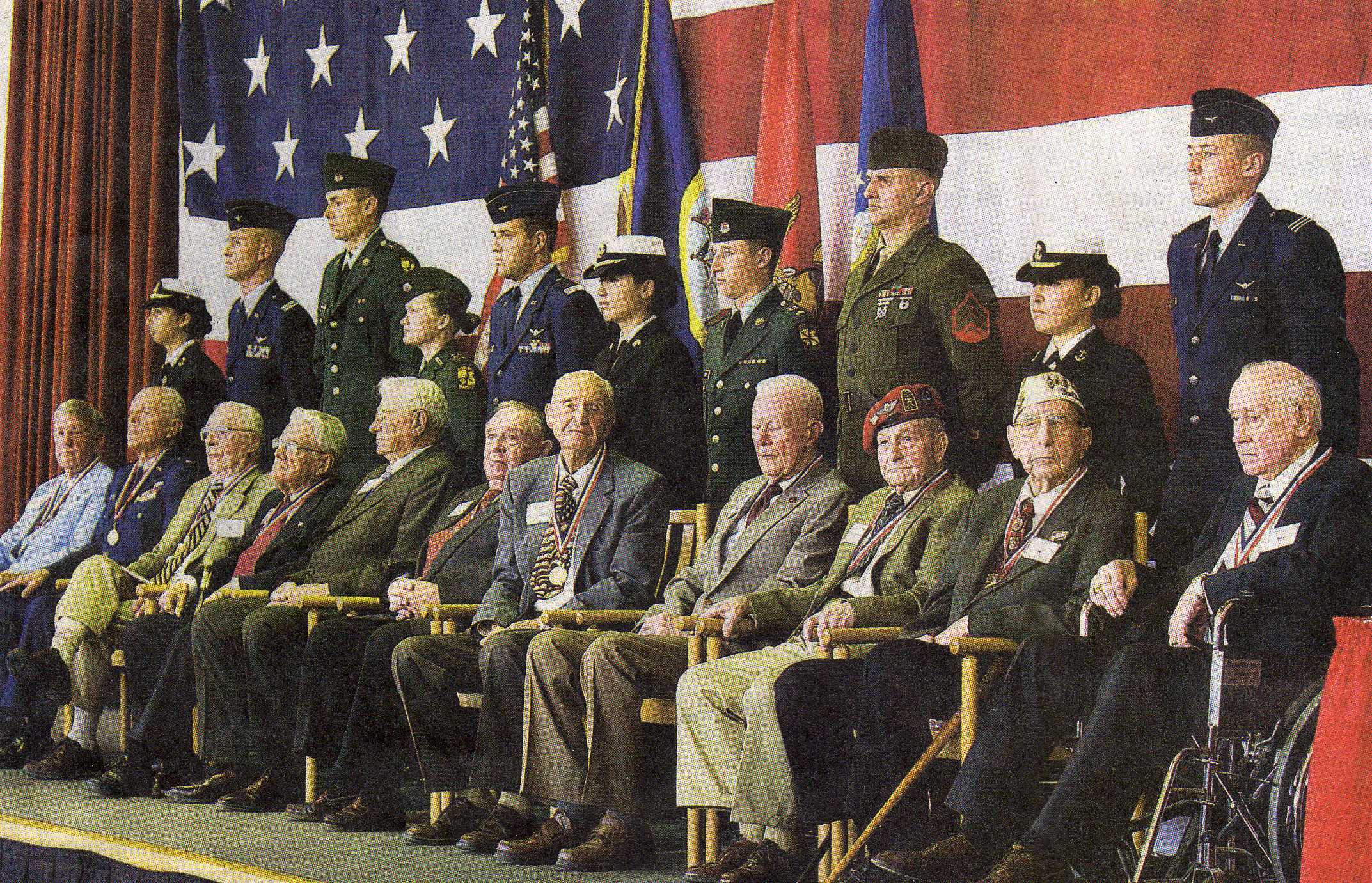
I thought I would share a couple of thoughts about my Grandpa.  He has lived a long, hard life.  He is amazingly humble despite some of the experiences he has endured.  While I would not know how to handle losing my family as a 4-year-old, he appears to have handled it well.  I do not think I would handle well the hardship of war, but he dealt with it and moved on with his life.  He struggled to provide for a family, especially the needs of a daughter with physical and mental handicaps, but spent over 50 years in her service.  Now he has lost his wife (6 years ago) and he still manages to keep a full garden, serve in the temple, and regularly visit individuals in the hospital, in his community, and old-folks homes.  I hope I am going just as strong when I am 90 (in February 2011).Somebody noticed his life of service and rewarded him for it.  Here are a couple of pictures from an award ceremony at the University of Utah last November.

Somebody also noticed in Plain City and Farr West and both cities recognized him as an Honorary Citizen.  These are some pictures from the 4th of July Parade for Plain City.  Farr West honored him at the 24th of July Parade.
Honorary Citizen
Keep up the great work Grandpa.  You are a great example and my hero.


Shaving Expedition

I thought I would share one of my latest experiments in my life.  My Mach 3 razors are so expensive so I have been looking for a good alternative for several months now.  I tried the cheapy razors from CVS that are 3 bladed, but they are poorly designed.  They just don’t rinse out well and seemed to go dull very quickly.  My Mach 3 razors will last me about 2 weeks per each refill.  There must be an alternative out there that is just as good but will cost only a fraction of the cost.  Well, I am happy to report that I think I found it.

It is true, sometimes you just cannot improve upon the past.  Not long after we moved into our home, the neighbors both passed away.  We purchased a few things at the auction of their estate.  We purchased a couple of lots and included was this old antique razor.  It came with a lot, I did not have the heart to throw it away and it sat on a shelf for almost two years.  One day I read an internet posting about how the old single blade razors give the closest shave and were very inexpensive.  The only draw back is you have to be careful as you can cut yourself easily.  I looked up these razors that were mentioned and recognized I had one in my own home!  The one I am using is a Gillette Gold from about 1938-1939.


I went and found it sitting on the shelf.  I found a packet of 10 Merkur blades online for $6.00!  These are double-sided blades, which means I get twice as much per each blade.

If one side of a blade only lasts me a week, I get the other side for the other week.  Hence I get my two-week shave for roughly 60 cents.  Much less expensive than the $2.26 for each Mach 3 razor refill.  Neither of these include shipping and handling, if I purchased both on the internet.  But the Merkur are cheaper for shipping as well.

So far, I am on the right time table.  About one week per side of the Merkur blades.  I do have to be a bit more careful, I put a nice gash in my ear this past Sunday because I was in a hurry.  It was the side of the blade sticking out the end, not the shaving side.  The other bonus to the whole situation though, the Merkur blades are made in Solingen, Germany.  Which is an ancestral town for my Jonas, Breuer, and Behsenich lines. 

Fun Bankruptcy Case

MEMORANDUM AND ORDER

MERRITT S. DEITZ, Jr., Bankruptcy Judge.

Is a bus a bus, or is it a car?
Reluctantly we conclude that it is a car.
Bankruptcy petitioner, Theodore Roosevelt Johnson, Sr., has claimed as exempt his 1969 Dodge bus. The bus has a seating capacity of 60 passengers. Upon it are occasionally transported members of Johnson’s church congregation.
The trustee vehemently objects. He points to the state exemption statute, KRS 427.010, which in pertinent part permits the exemption of “one motor vehicle and its necessary accessories, including one spare tire, not exceeding $2,500 in value…”
The trustee patiently explains that the legislature intended the term “motor vehicle” to be synonymous with “automobile”.
Enacted in 1980, the statute excluded earlier statutory limits upon the uses to which a motor vehicle might be put, so we must cast altogether aside the trustee’s concern with the voluminous seating capacity of the behemoth. The record is silent on the size of the petitioner’s family and their transportation needs.
Is a Moped a motor vehicle? What would the licensing arm of the state Department of Transportation say to the contention that a bus is not a motor vehicle? What would Gertrude Stein have to say about what a motor vehicle is?
Such rhetorical questions having been considered, we are bold to say that a bus is a motor vehicle.
In our dialectic, during this era of motorized evolution, we are inclined to regard the “bus” and the “automobile” as species of  the genus, “motor vehicle”.
This Bankruptcy Court is answerable to an appellate forum of literal bent. That is good, for it gives us guidance and certainty in ascribing to the legislature the ability to express its intent in clear, simple, precise English.
As this trustee will recall, District Judge Thomas Ballantine, in reviewing a decision of this court, recently held that a statutory 15-day limitation upon the recording of chattel mortgages imposed a recording limitation not of indeterminate length, as was contended, but a limitation of 15 days.
Guided by that clarity of perception, we find with conviction that a motor vehicle is a motor vehicle, and not necessarily an automobile. We expressly reserve, until it is properly presented, any consideration of the reverse proposition that an automobile is neither a bus nor a motor vehicle.
Abundantly confident that this opinion will find its way alongside Marbury v. Madison and McCulloch v. Maryland in the  lasting library of legal logic, it is hereby
ORDERED that Theodore Roosevelt Johnson, Sr. is entitled to the claimed exemption, and the trustee shall comport his activities accordingly in administration of the estate.

Bkr. Ky. 1981.
In re Johnson
14 B.R. 14

There was another case about whether a tractor-lawnmower could be classified as ‘household furniture”.  But the judge doesn’t have as much fun with it as the above judge did.  Check it out.  169 B.R. 732

Urine and the Sabbath

A couple of fun things going on in my life right now.  Wednesday I will be sworn in by the Chief Justice of the Oklahoma Supreme Court as a Licensed Legal Intern.  I am pretty pumped about that.  That same day I am picking up a vehicle to drive to the J. Reuben Clark National Conference in Salt Lake City, Utah.  We will be there Thursday, Friday, and Saturday.  Sunday morning we will leave to drive back here to Oklahoma City and be ready for classes on Monday.  Please keep us in your prayers for safe travels!  Now I just have to figure out how I am going to work out Valentines Day, without me here until late at night.

School continues along and I think this definitely has to be my most boring semester.  Administration, Agency, Corporation, and Constitutional Law are all very dry.  Some of the professors don’t help the situation a whole lot either.  Administration Law holds some interest for me, probably because I am most familiar with it of all the classes.  But hands down, my favorite class of law school is Debtor and Creditor Law, aka Consumer Bankruptcy.  While the material is interesting, the professor just makes it come alive.  He is there to help us become lawyers and it is manifest.  Other professors pontificate, alienate, and other motives which make it less than the best learning atmosphere.  Professor Vaughn comes speaking to us of personal experience and walks us through the adventure of consumer law.  Oh that all professors were just as good.  After one of the classes, I told him how much I appreciated his style.  He remarked that he initially thought about how smart he could look, and how he was going to make us all grovel at his knowledge.  He then realized that benefits nobody and the best approach is to make the material come alive and to make it interesting.  Boy am I glad he does.  We have some good laughs too.  Our Con Law professor enjoys himself too, but he does all the talking and it turns into a long class period.

Some exciting news on the home.  We had some friends who replaced some appliances.  We jumped at the opportunity to replace our dishwasher with a much newer version.  It is now in place and the old one is listed on Craig’s List, ready to go out to the highest bidder.

We have a squirrel living in the attic in which he marks his territory and we live with the intoxicating smell of a dehydrated squirrel.  I loaned a book in exchange for a squirrel trap, so here is for hoping (s)he falls for peanut butter crackers.  I cannot wait to get rid of him.  I patched the hole he made several weeks ago.  I am surprised he lived this long.  Unfortunately, we have a roof leak which probably replentished him with moisture.  At least he didn’t die between our new ceilings and the old lathe and plaster ones.  Come summer time we would be enduring something far worse than the once a week or so urine smell.  I would have to rip up some of those old ceilings to find him, and in cramped spaces, I can see me vomiting over the rotting corpse of a squirrel while we are both covered in insulation, dust, and plaster.

A couple of thoughts from the Old Testament reading before I stop tonight.  I hear from time to time that the only sacrifices to the Lord were blood sacrifices.  Those individuals need to read the Old Testament a little closer.  There are flour, bread, fruits, and all sorts of other things that were part of the law of sacrifices.  “Then ye shall bring a sheaf of the firstfruits of your harvest unto the priest; and he shall wave the sheaf before the Lord…the meat offering thereof shall be two tenth deals of fine flour mingled with oil, an offering made by fire unto the Lord for a sweet savour: and the drink offering thereof shall be of wine…two wave loaves” and more!  Leviticus 23:10, 13, 17.

The thing that has fascinated me about Leviticus has always been Chapter 25.  The implications of this chapter in the modern world have always made me think.  What if we did this now?  It relates particularly to the Sabbath.  Today we celebrate and honor the Sabbath Day.  Why don’t we celebrate the Sabbath Year?  Why don’t we hold Jubilee?  It would completely revolutionize our economic system and all the ways we look at our society.  I mean, if we keep the Sabbath Day now, it would revolutionize our country.

“Six years thou shalt sow thy field, and six years thou shalt prune thy vineyard, and gather in the fruit thereof; But in the seventh year shall be a sabbath of rest unto the land, a sabbath for the Lord: thou shalt neither sow thy field, nor prune thy vineyard.  That which groweth of its own accord of thy harvest thou shalt not reap, neither gather the grapes of thy vine undressed: for it is a year of rest unto the land.  And the sabbath of the land shall be meat for you; for thee, and for thy servant, and for thy maid, and for thy hired servant, and for thy stranger that sojourneth with thee, and for thy cattle, and for the beast that are in thy land, shall the increase thereof be meat.”  Leviticus 25:4-8.

What if we took the entire 7th year off and dedicated it unto the Lord?  Serve missions?  Focus only on our families?  Travel a little?  The possibilities are endless.  Does that mean the whole country would have to take the same year off?  I don’t know what the ancient practice was, nor do I know if we could all take it off at the same time.  A GDP of 0 for a year?  Geez could we complain?  Sunday is a day off, and the 7th entire year.  Much better deal than any of us get now.  Go to school for a year, is that upholding the Sabbath?

Ah, and then the Jubile!  “And ye shall hallow the fiftieth year, and proclaim liberty throughout all the land unto all the inhabitants thereof: it shall be a jubile unto you: and ye shall return every man unto his possession, and ye shall return every man unto his family.”  Leviticus 25:10.

So the thought comes, how in the world shall I ever make it through that year?  How in the world can I afford to do what is being asked for me.  To save up, prepare, and to endure that 7th year.  Well, the Lord has an answer for us.  “Then I will command my blessings upon you in the sixth year, and it shall bring forth fruit for three years.”  Leviticus 25:21.  How is that for a blessing.  Not only will we have enough for that one year, but we will have enough for 3 years.  Talk about a great return.  Some of that would have to go to restarting that new year, but wow, there will still be plenty left over.

Anyhow, I won’t go on anymore, but there is an economic system in Leviticus 25!  What if we were to live it today?  How fundamentally different would we be.  Forgiving everyone’s debts every 7 years would be beautiful.  No more house payment.  No usury.  It even talks about the suburbs in Leviticus 25:34!

There are many great things in the Old Testament.  Unfortunately we are all too smart and intelligent to consider giving another chance to the Spirit of the old ways.  We are more knowledgeable today, things are different.  So far, I doubt that, especially when I see our pride in knowing things are certainly different for us now when we seem to keep falling to the same old sins.

Laws and ordinances forever?

A day off from school from a snow storm that would not give much pause to those of more mountainous regions.  But I shall not complain of the wimpy Okies, after all, I have been relieved of a day of law school classes.  Last semester just about killed me from the sheer amount of information I was reviewing and trying to keep in my head.  This semester the amount has decreased, but the problem is how incredibly dry this semester’s classes are.  Tell me if this doesn’t sound like a snore: Corporations Law, Debtor and Creditor Law, Administration Law, Agency Law, and Constitutional Law II.  My rear fell asleep just from having to type it.  How shall I ever endure?

We work again on Saturday at the temple.  This will be our second go of it.  It has been interesting for me to think about the administering of the temple, rather than just the receiving of the ordinances and that which takes place in the temple.  This Tuesday, a couple from our ward received their endowments and were sealed right after.  It was beautiful.  There is a certain spirit that comes from it when it is for somebody live.

Here are a couple of thoughts as we have been reading.  We have just completed Exodus and are plowing our way through Leviticus.  Some of them are very interesting and fascinating, others just wear and you have to skim read.

“And thou shalt bring Aaron and his sons unto the door of the tabernacle of the congregation, and wash them with water.  And thou shalt put upon Aaron the holy garments, and anoint him, and sanctify him; that he may minister unto me in the priest’s office.”  Exodus 40:12-13.  “And Moses brought Aaron and his sons, and washed them with water.  And he put upon him the coat, and girded him with the girdle, and clothed him with the robe, and put the ephod upon him, and he girded him with the curious girdle of the ephod, and bound it unto him therewith.  And he put the breastplate upon him: also he put in the breastplate the Urim and Thummim.  And he put the mitre upon his head; also upon the mitre, even upon his forefront, did he put the golden plate, the holy crown; as the Lord commanded Moses.”  Leviticus 8:6-9.

So the sons of Aaron are to be presented at the tabernacle to be washed with water, anointed with oil, and clothed in the holy garments.  All this to be done to sanctify him and that he may minister.  So this is the line of Aaron, or descendants of Levi, that have this privilege.  Why was this privilege confined only to the sons of Aaron in his time?  Was it available to all before Moses and Aaron?  When would it be restored to all worthy lines?

What exactly do all these emblems, or parts of clothing mean?  What was their symbolism then, and how does that translate to you and me?

I guess the other question I have is what degree of the Mosaic Law was done away with?  Nobody seems to argue that the 10 Commandments were done away with by Jesus Christ.  Sure, the higher law technically is in force, but the lesser law, or the school master it was still pointed to the higher law.  The whole Mosaic Law was pointing to that last a great blood sacrifice, namely the atonement of Jesus Christ.

“Therefore, it is expedient that there should be a great and last sacrifice, and then shall there be, or it is expedient there should be, a stop to the shedding of blood; then shall the law of Moses be fulfilled; yea, it shall be all fulfilled, every jot and tittle, and none shall have passed away.”  Alma 34:13.

I always found the idea of the law being fulfilled, not passing away, to be an interesting though.  It shall be fulfilled, but not pass away.  Does that mean the spirit of the law still applies, but the actual outward ordinances done away.  I believe that is precisely what is meant.

The whole Mosaic Law was not something that was new.  It also was something that just disappeared overnight.  “Wherefore the law was our schoolmaster to bring us unto Christ that we might be justified by faith.  But after that faith is come, we are no longer under a schoolmaster.”  Galatians 3:24-25.

“Yea, and they did keep the law of Moses: for it was expedient that they should keep the law of Moses as yet, for it was not all fulfilled.  But notwithstanding the law of Moses, they did look forward to the coming of Christ, considering that the law of Moses was a type of his coming, and believing that they must keep those outward performances until the time that he should be revealed unto them.  Now they did not suppose that salvation came by the law of Moses: but the law of Moses did serve to strengthen their faith in Christ; and thus they did retain a hope through faith, unto eternal salvation, relying upon the spirit of prophecy, which spake of those things to come.”  Alma 25:15-16 (Between 90-77 BC).

The Law of Moses is the underpinning, and outward manifestation of our current law.  I would supplement your understanding of our law, a good study of the Law of Moses can be insightful.  After all, it was a schoolmaster for thousands of years.

“Their anointing shall surely be an everlasting priesthood throughout their generations.”  Exodus 40:15.

Murmuring Israel

I am supposed to be finishing up my Corporations reading (but I cannot bring myself to do it on a Sunday).  But I thought to share a few ideas before reading our scriptures and going to bed.

Today was a first for me.  Initially I had been asked to stand in for a priesthood ordination and I was happy to do that.  Well, the other two people who had been asked to stand in forgot.  It felt bad for the man being ordained since this was something that was very important to him.  Last minute, I was offered the privilege of conferring the Melchizedek Priesthood and ordained him to the office of an Elder.  It was an honour and a privilege.  It was the first time for me to have ever ordained somebody to any office in any priesthood.  In typing up the priesthood lineage, I almost felt like I had gained a son.  From here on out, at least as an Elder, I will be a part of his lineage and that will bind us throughout eternity.  Somehow I felt like a part of me went out and into him.  I don’t know if he feels or recognizes that, but I sure do.  Anyhow, I am glad the method for the ordination was clear in my head, and there was one right before for a refresher in verbiage and procedure.

Stake Conference last night and today were powerful.  I am impressed by how humble and simple our Stake Presidency is.  I have to admit, President Curtis Crane is a man I want to be like.  I see in him a type of person I want to be like.  I hope there is time.  The meetings included our Temple President speaking last night and our Mission President speaking today.  Of course the Stake Presidency also spoke.  It was good.  Something about hearing a large group of people singing together that always impresses me.  Powerful.

I know I had commented I would give some thoughts about the scriptures as we have been reading along.  Amanda has joined me in the reading and it has been good.  We will be starting in Exodus 32 tonight.  But the last few nights have held a couple of impressions I thought I would share.

The constant view of God to the people continues to amaze me.  The plagues that were taking place in Egypt were surely not unknown to Israel.  Furthermore, the fact that they were spared from the plagues would also be obvious.  While the magicians were able to reproduce some of the early signs (I cannot imagine they were weak reproductions) the power and magnitude became greater and greater.  Each miracle was more recognizable.  Finally, Israel finds themselves crossing through the Red Sea and headed towards a promised land.

“And the Lord went before them by day in a pillar of a cloud, to lead them the way, and by night in a pillar of fire, to give them light; to go by day and night.  He took not away the pillar of the cloud by day, nor the pillar of fire by night, from before the people.”  Exodus 13:21-22.  I find this thought simply beyond comprehension.  Then I wonder if it is so obvious to the people of Israel what is really going on.

The people didn’t seem to recognize what power was leading them.  “Because there were no graves in Egypt, hast thou taken us away to die in the wilderness?  wherefore hast thou dealt thus with us, to carry us out of Egypt?  Is not this the word that we did tell thee in Egypt, saying, Let us alone that we may serve the Egyptians?  For it had been better for us to serve the Egyptians, than that we should die in the wilderness.”  Id. at 14:11-12.

Then in the next breath, “And Israel saw that great work which the Lord did upon the Egyptians: and the people feared the Lord, and believed the Lord, and his servant Moses.”  Id. at 14:31.

Right afterward, “the people murmured against Moses, saying, What shall we drink?”  Id. at 15:24.  “[T]he whole congregation of the children of Israel murmured against Moses and Aaron in the wilderness.”  Id. at 16:2.

The Lord responds to their pleas.  “Then said the Lord unto Moses, Behold, I will rain bread from heaven for you; and the people shall go out and gather a certain rate every day, that I may prove them, whether they will walk in my law, or no.”  Id. at 16:4.

“How long refuse ye to keep my commandments and my laws?”  Id. at 16:28.

“Why chide ye with me?  wherefore do ye tempt the Lord?”  Id. at 17:2.

“And the people murmured against Moses, and said, Wherefore is this that thou hast brought us up out of Egypt, to kill us and our children and our cattle with thirst?  Id. at 17:4.

“Is the Lord among us, or not?”  Id. at 17:7.

“Ye have seen what I did unto the Egyptians, and how I bare you on eagles’ wings, and brought you unto myself.  Now therefore, if ye will obey my voice indeed, and keep my covenant, then ye shall be a peculiar treasure unto me above all people; for all the earth is mine.  And ye shall be unto me a kingdom of priests, and an holy nation.”  Id. at 19:4-6.

“Speak thou (Moses) with us, and we will hear: but let not God speak with us, lest we die.”  Id. at 20:19.

Anyhow, this is only Exodus, but we see this exchange going back and forth between Israel and the Lord (through Moses).  When will we ever learn to just be obedient and quit expecting the Lord to coddle us?  The next chapter (32) shows where Israel got themselves into quite a bit of trouble for their inability to be constant.  I hope I can be more constant.  I always remember the verse from 1 Nephi 2:12, “And they did murmur because they knew not the dealings of that God who had created them.”  Hopefully we can all find that relationship with God so that we learn his ways, and his dealings, and we don’t end up like murmuring Israel.

Entertaining heavenly guests, marriage, and Lot

I feel like I want to write after one of my favorite chapters in the entire Old Testament.  (Nehemiah 8 is my favorite, fyi).  I don’t know how often I will get to write once school starts up, even if I will get to read regularly like I want.  So I might as well share a few thoughts before school gets too deep in session.

Genesis 18 has always been a favorite of mine.  There is something of this hopeful scenario we find ourselves in.  I guess it is sort of like winning the lottery, you just don’t know when it will happen.  However, if you are faithful, it most likely will occur, whether we recognize it or not.  I guess in that sense, I guess the odds are much better than the lottery, it is just a matter of when.  After all, the promise is given that those who are faithful shall receive of the Father.  Most Christian religions put it as after this life, but my faith places it as a possibility even within this life.  That good things come to those who are willing to receive.

Here we have Abraham out scratching a living out of the plains of Mamre.  While in the heat of the day, the long existence we sometimes find life to be, three guests appear.  It appears he recognizes them since he runs to them and bows before them.  He calls him “My Lord” and then asks the men to stay for a while, to wash their feet, and to rest themselves.  He prepares a meal for them from freshly prepared cakes and even a calf plucked for the occasion.

It is then in this conversation that we learn that these are messengers of the Lord.  It is then that they begin to bestow blessings upon Abraham and Sarah.  Sarah even laughs at the promises given.  I can imagine a giddy, quizzical, perhaps even non-believing laugh.  But she quickly dismisses the blessing whether she intended to or not.  Then comes the ultimate rebuke, “Is any thing too hard for the Lord?”

Sarah then denies that she laughed, probably in shame and fear, for such an insult, especially to the Lord.  The blessings continue and the story goes on.

The part that I have always loved about the story is that in the middle of the day, on a very hot day, the blessings of heaven were bestowed.  Other versions of the story, most notably of the Midrash tell of how Abraham was actually worried that some traveler might be stranded out in the heat of the day and sends his servants out to bring in any such travelers who might be perishing in the heat.  His faithfulness was rewarded all the more.

How does this apply in my life?  I am reminded of Hebrews 13:1-2, “Let brotherly love continue.  Be not forgetful to entertain strangers: for thereby some have entertained angels unawares.”  Abraham did entertain angels, but he was not unaware.  It appears his faithfulness was such that he recognized the Lord immediately, probably from past interactions.  It would have to be this type of personal interactions to follow the dictates to later offer up Isaac.  It would take some pretty serious personal experience for me to heed such a directive, despite its complete variance with standing gospel law.

The beauty of the whole scenario is that all who are faithful can receive the same blessings as Abraham.  “He that hath my commandments, and keepeth them, he it is that loveth me: and he that loveth me shall be loved of my Father, and I will love him, and will manifest myself unto him.”  “If a man love me, he will keep my words: and my Father will love him, and we will come unto him, and make our abode with him.”  John 14:21, 23.

Whether the Lord himself, or by his angels, it is the same.  “For behold, [angels] are subject unto him, to minister according to the word of his command, showing themselves unto them of strong faith and a firm mind in every form of godliness.”  Moroni 7:30.  The callings of angels are further defined.  But if in full divine investiture of authority, we would not know the difference whether it was the Father and Son, or angels sent to act in their behalf.

All I know is that Abraham, a mortal man, entertained angels, perhaps Jehovah himself.  Either way, it is beautiful.  If Abraham can do it, certainly I have that same hope.  If Cain can speak with the Lord even in his worst sins; surely I, one attempting to follow him can speak and hear the voice of the Lord.

In other thoughts, more of questions since I have no clue.  At what point was what we call ‘incest’ no longer part of the plan.  I am not suggesting or proposing the idea, just curious when the Lord stopped it.  The Mosaic Law speaks against it, but obviously it was permitted for the children of Adam to procreate.  I know there are the believe that God created other individuals for the procreation of the race, even though the scriptures don’t mention it.

Lot’s daughters wanted to keep the commandment of producing seed (multiplying and replentishing the earth) but don’t seem to give much heed to any rules concerning incest.  Marriage is an eternal law dating clear to Adam and Eve.  But at what point was ‘incest’ not allowed.  The daughters of Lot sleeping with him smacks in the face of Adultery/Fornication whatever it would have been called at that point.  Abraham married his own half-sister.

I really don’t know the answer to these questions.  I don’t believe what Lot’s daughters do is right, certainly not by the commandments the Lord laid out for us since.  But what was the state of the the law then?  Then again, these daughters grew up in Sodom, so can we subscribe the false, ungodly actions to their surroundings?  Judah doesn’t fare much better in sleeping with family later.  Who knows?  The laws of marriage seemed much more loose to them, after all, how did we end up with concubines?  Especially where the Lord seems to approve of them?  So many questions!