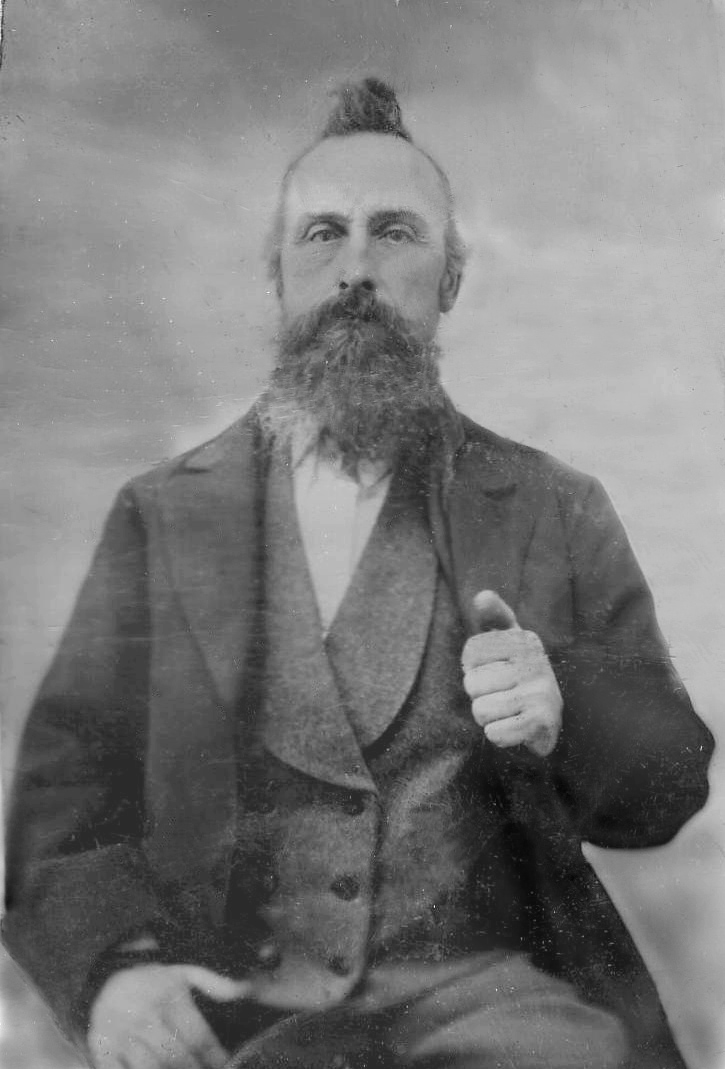
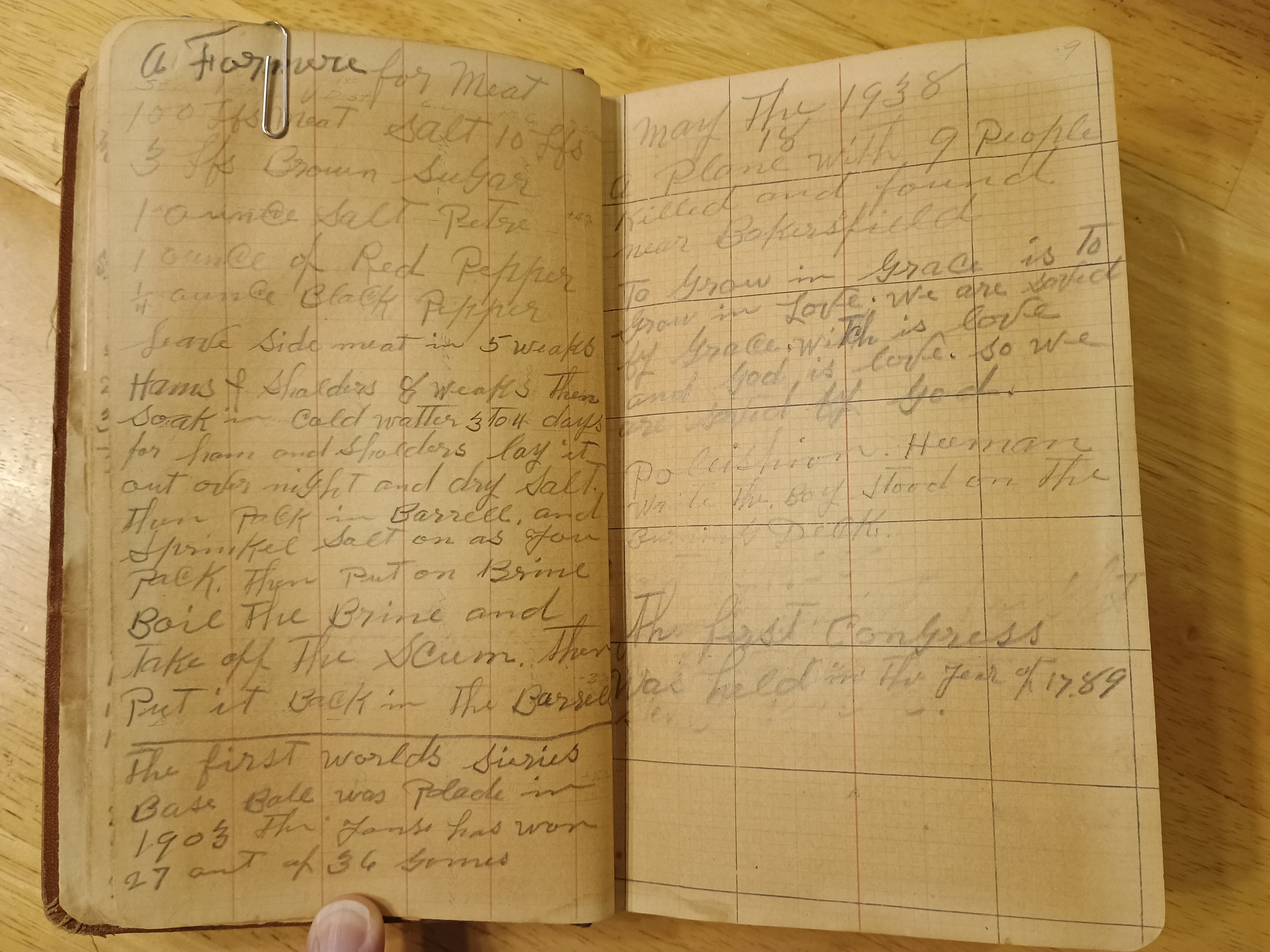
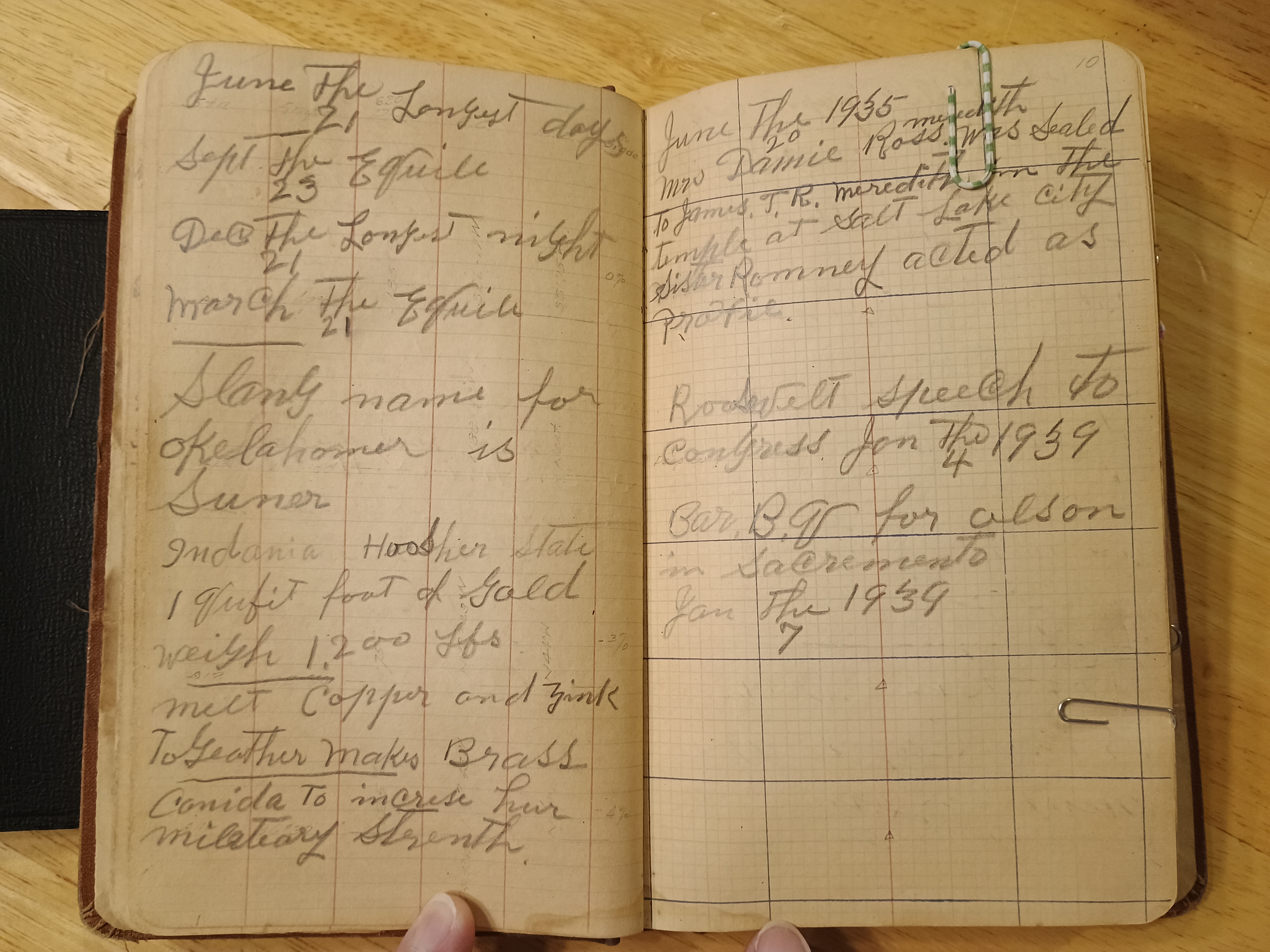
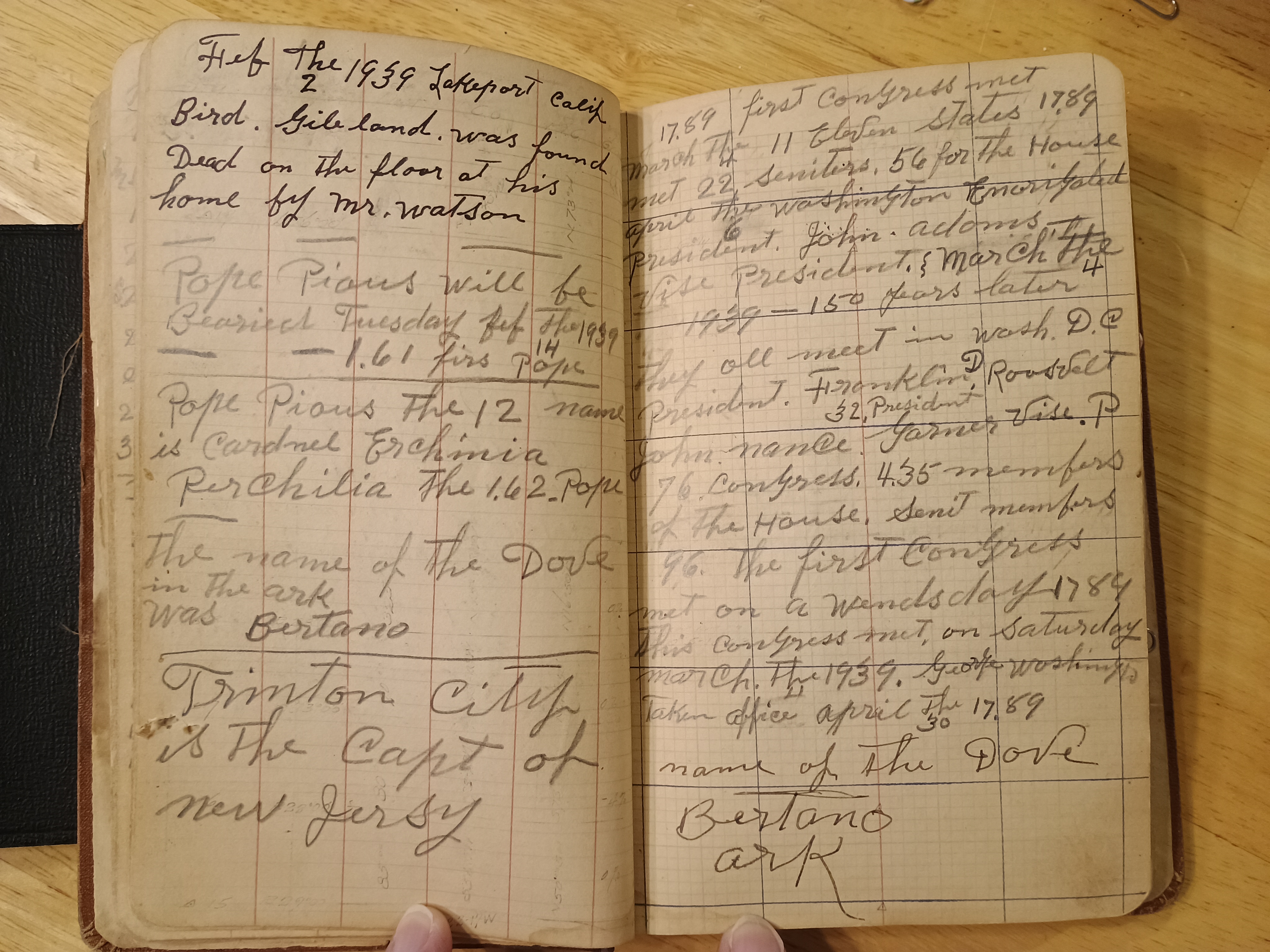
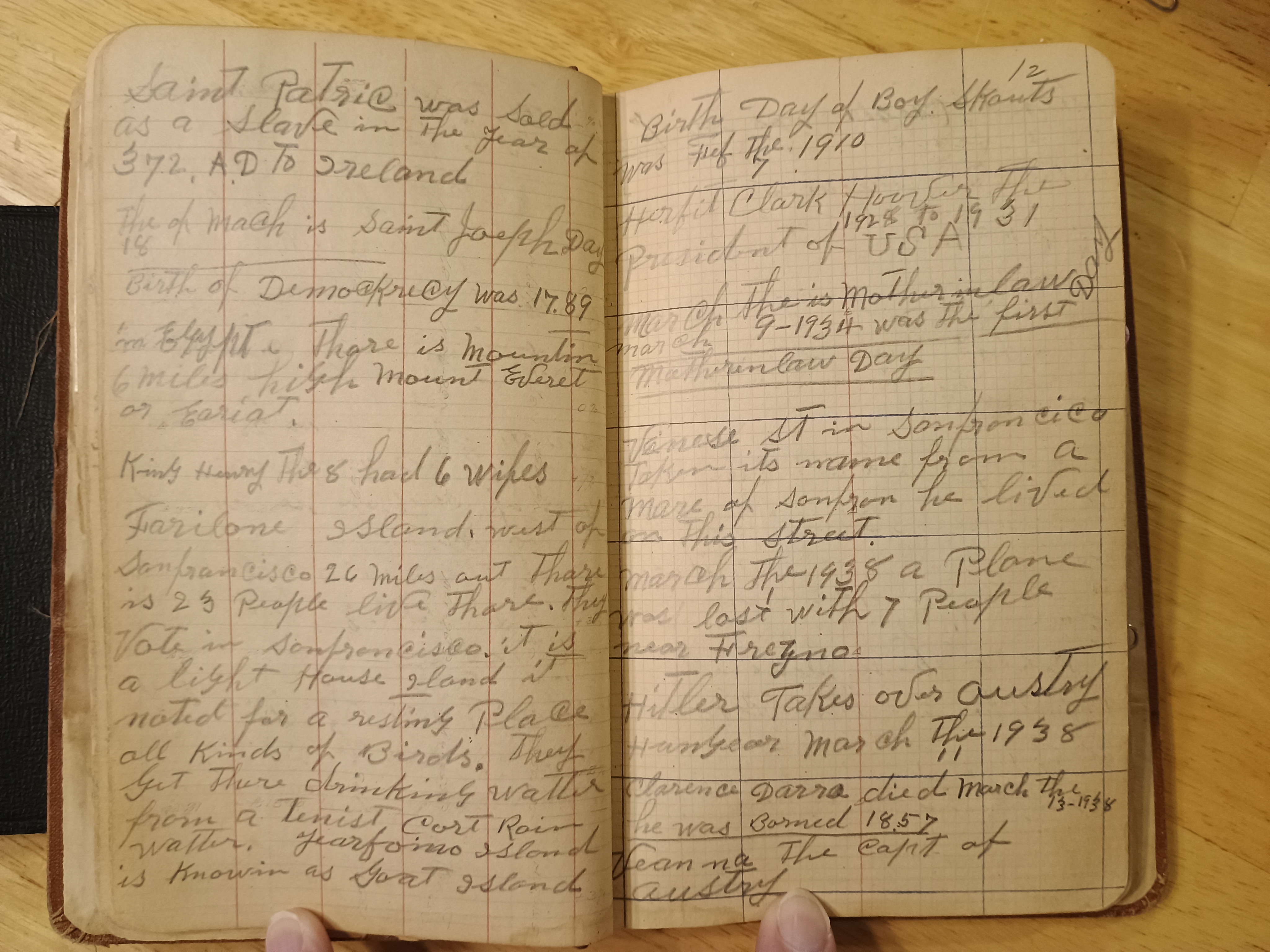
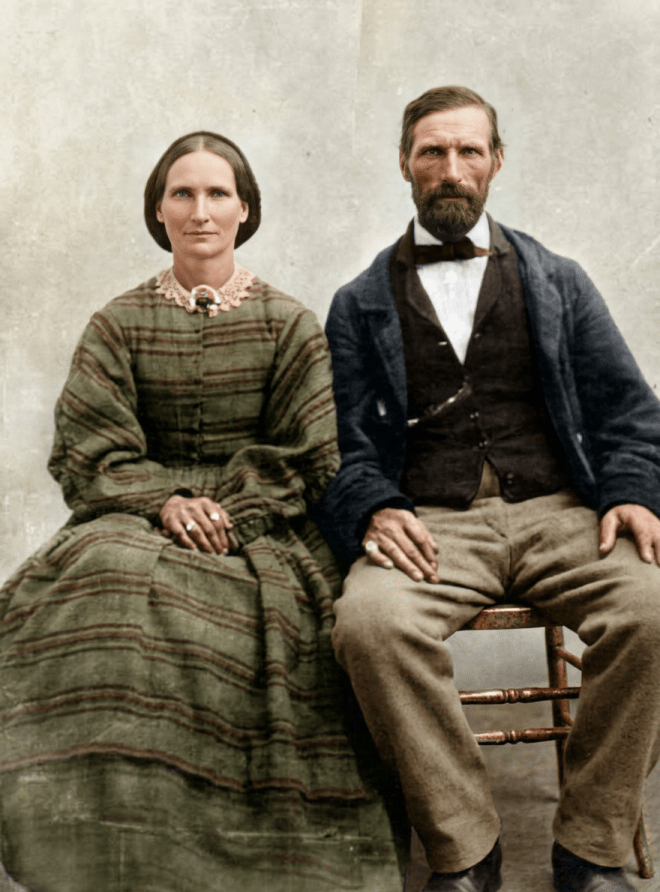
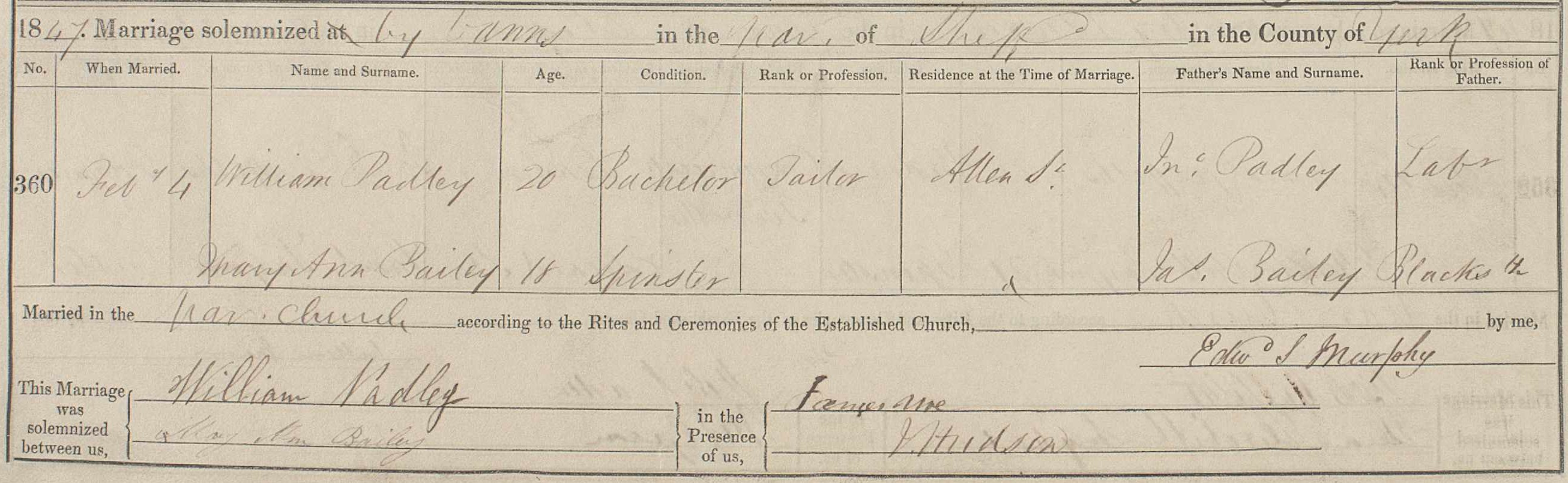
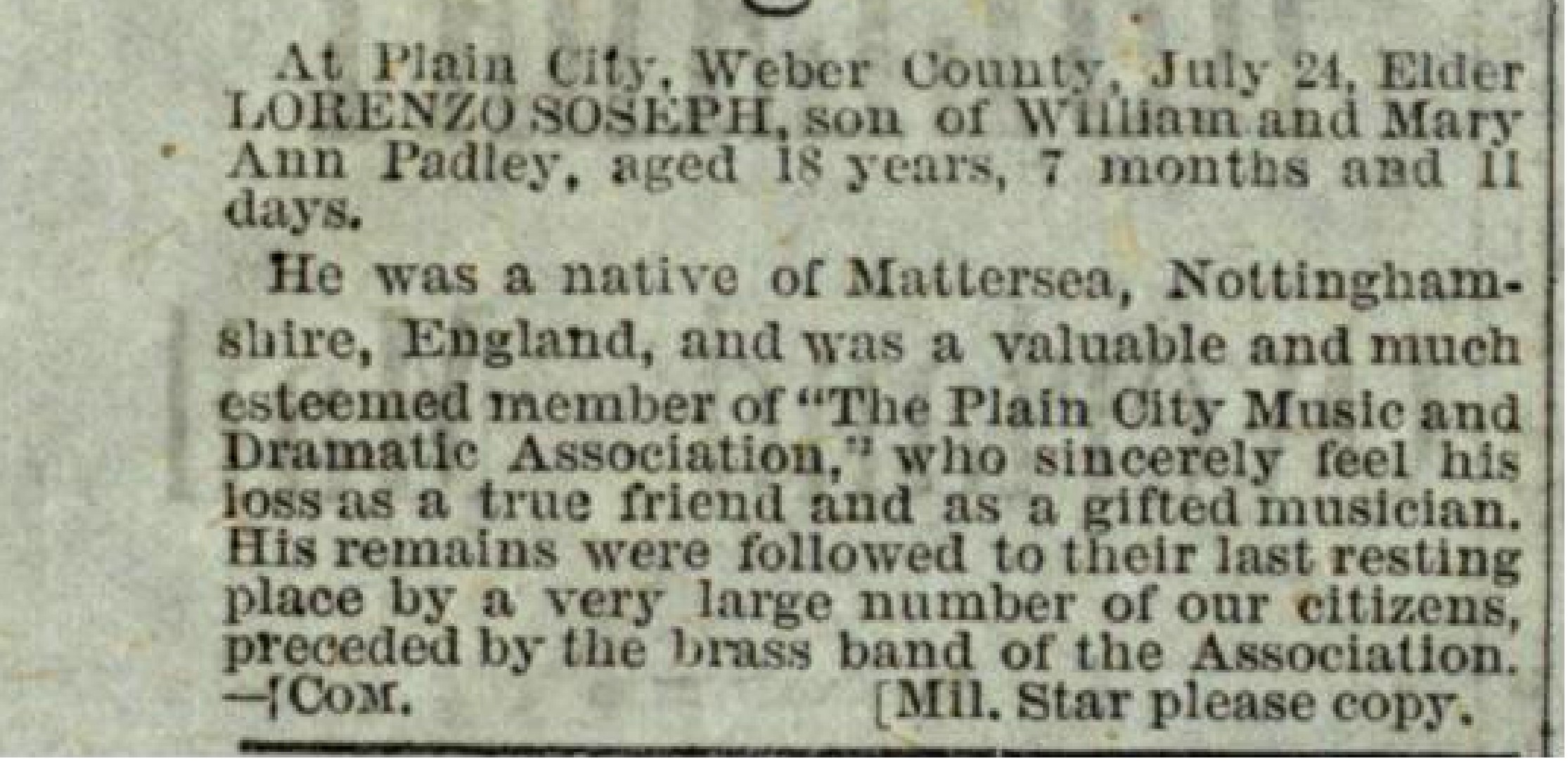
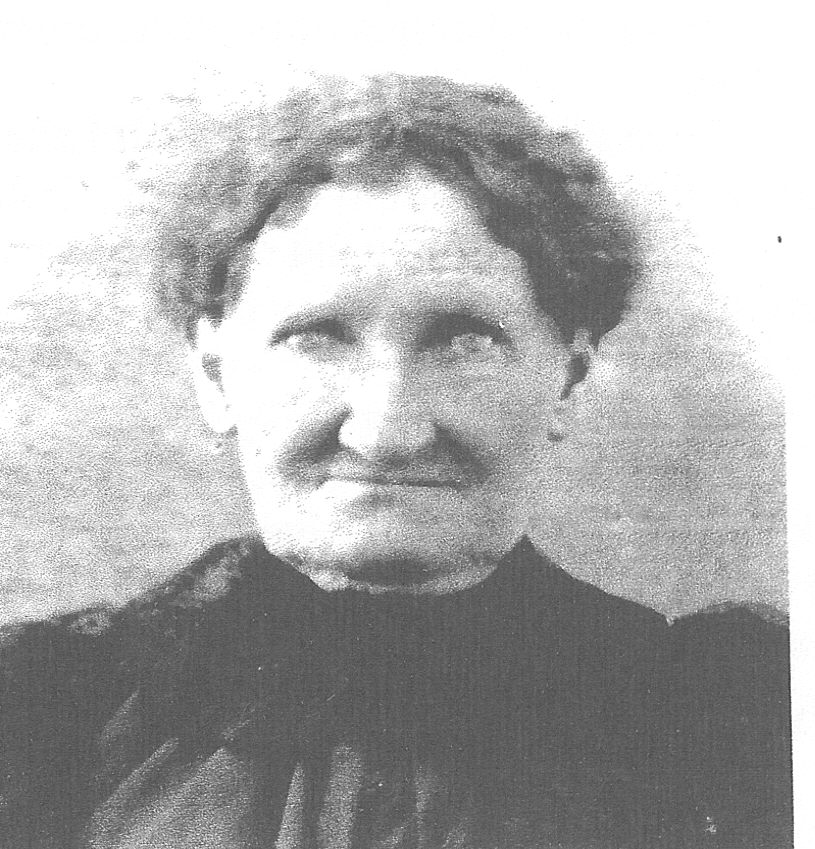
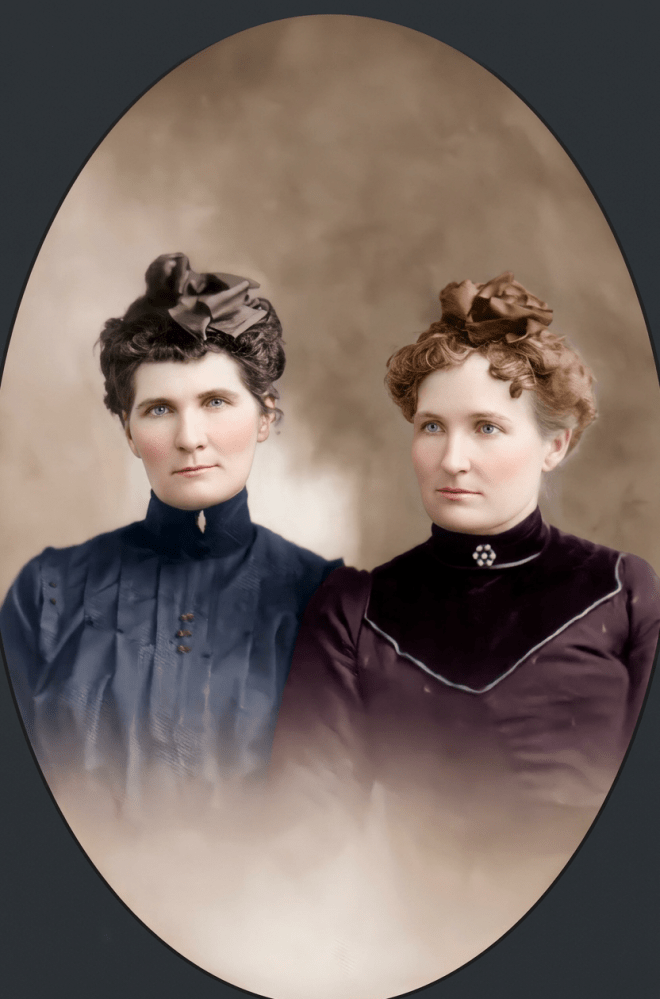
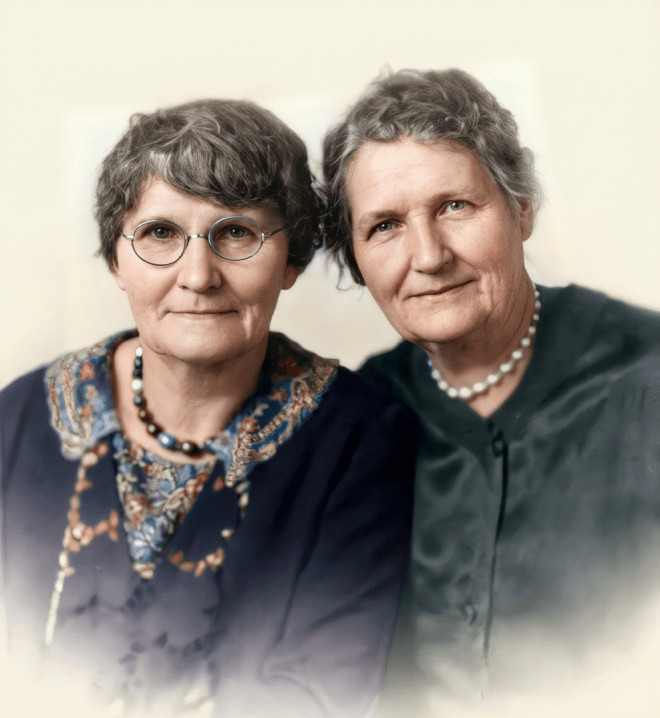
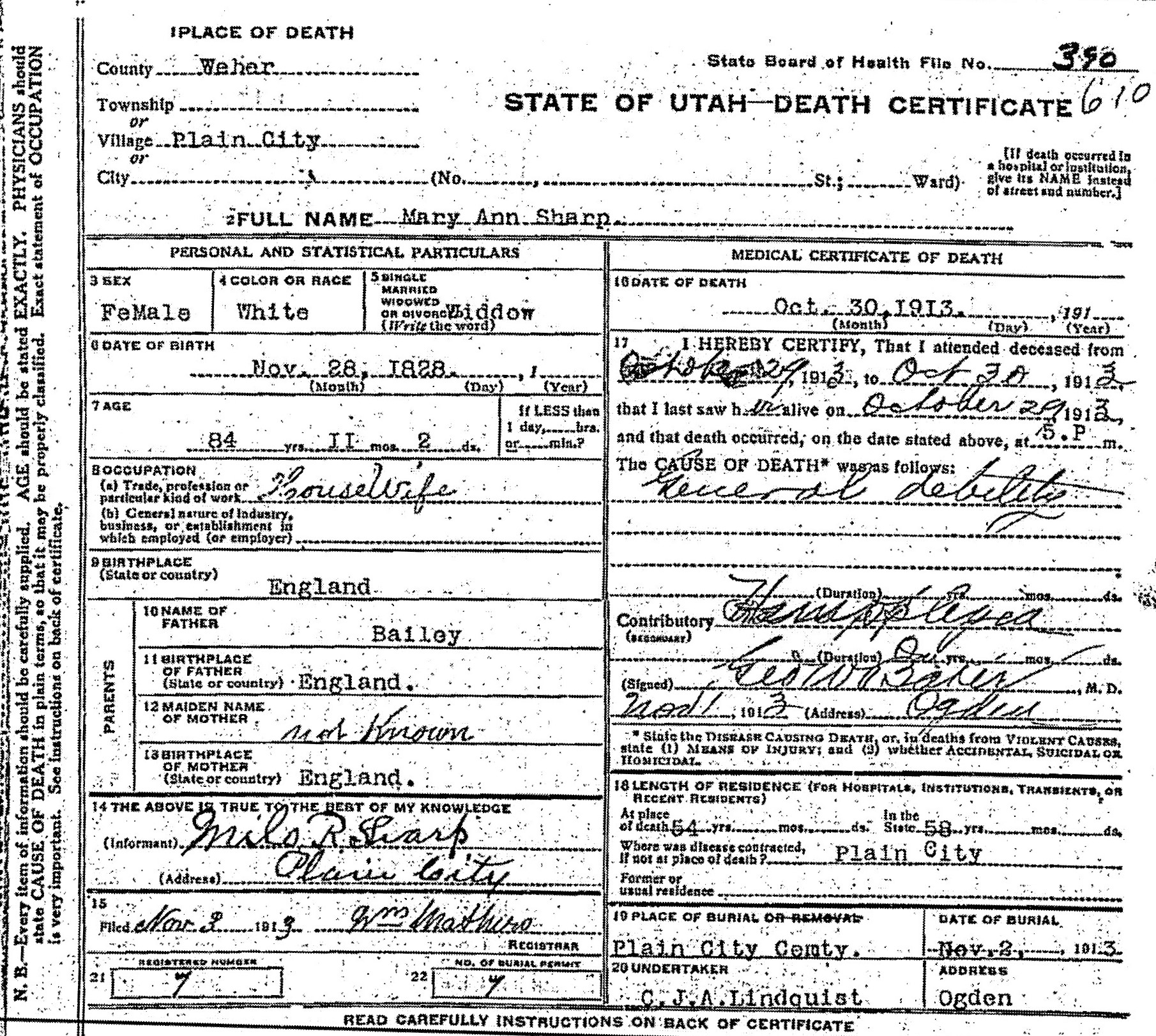
Mary Ann (Bailey) and William Sharp — son of Thomas Sharp and Elizabeth Cartwright
George and Ann (Matthews) Cartwright of Misson, Nottinghamshire, and Thomas and Anne (Stennett) Sharp of Misson, Nottinghamshire, announce the marriage of their daughter Elizabeth Cartwright to Thomas Sharp on 29 December 1823 at the parish church of St John the Baptist, Misson. The witnesses were Sarah Hunt and John Parkin.
The Cartwrights and the Sharps were both Misson families. The Cartwrights had been there for generations, Elizabeth’s grandfather John Cartwright (1730–1814) and grandmother Mary Amcoats (1742–1790) had married in Misson in 1761. Her father George Cartwright was baptized there on 3 February 1774. Her mother Ann Matthews was christened 14 September 1783 in Everton, Nottinghamshire, a village approximately eight miles southeast of Misson. Ann was the daughter of Edmund Matthews of Everton and his wife Hannah Broads, a widow who had previously been married to William Wilson of Everton. Edmund and Hannah had married in Everton on 21 May 1782. George Cartwright was nine years older than Ann Matthews. Their marriage banns were published on 23 January 1803 and they married on 1 February 1803, Elizabeth was born and baptized ten months later, on 20 December 1803. Ann Matthews Cartwright does not appear in subsequent census or other records. Her death date and burial place remain unknown.
The ties between the Sharp and Cartwright families ran deep in Misson. On the same day Thomas married Elizabeth, his brother William Sharp married Mary Cartwright, Elizabeth’s first cousin. A week earlier, on 22 December 1823, their brother John Sharp had married Ann Rather. Three Sharp brothers married in the same month of December 1823, two of them to first cousins from the same Cartwright family, all in the village of Misson.
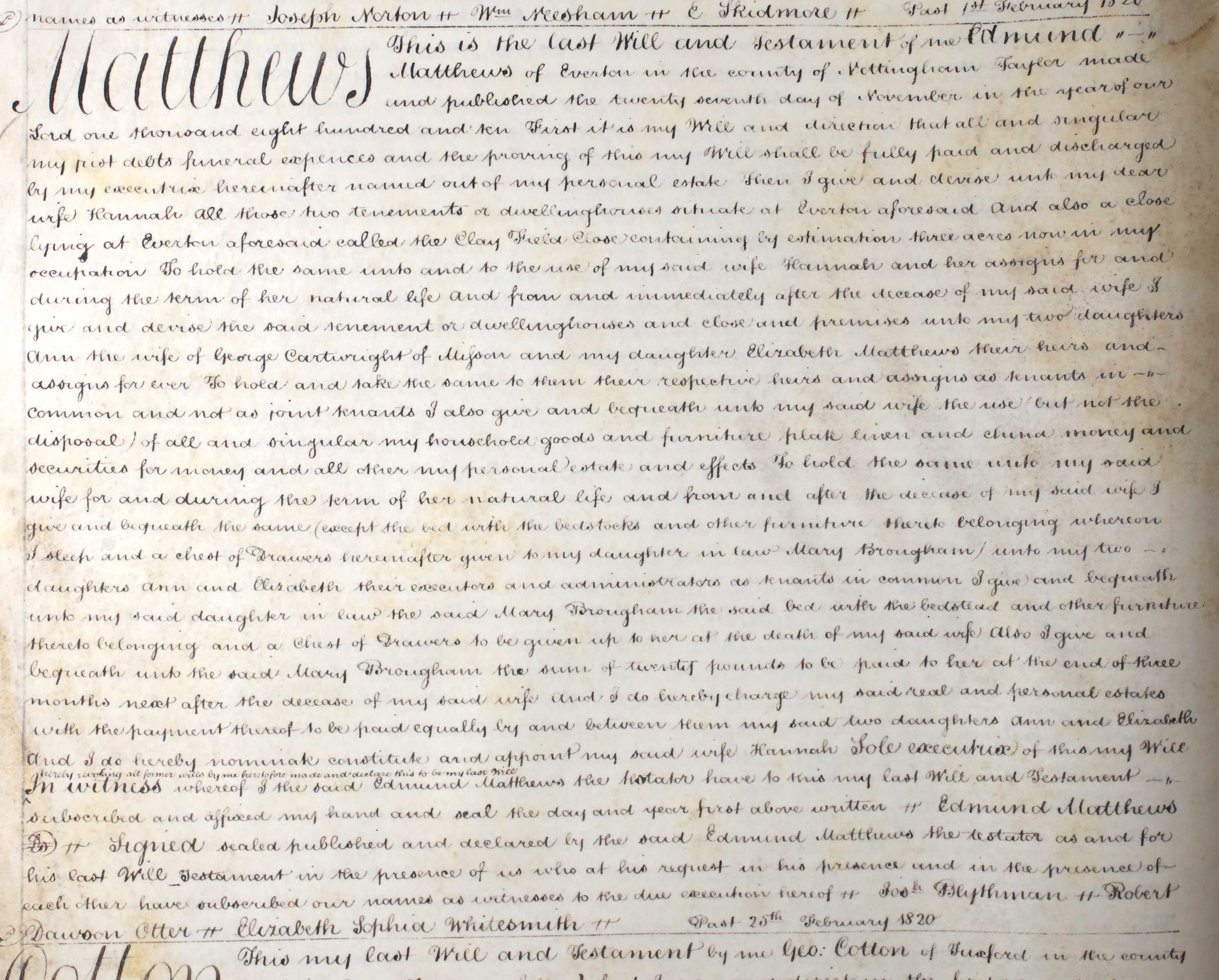
Edmund Matthews’s will, made 27 November 1810 and proved 25 February 1820, names “Ann the wife of George Cartwright of Misson” as one of his two daughters and heirs. The estate included two tenements and dwellinghouses at Everton and a close called the Clay Field Close of approximately three acres. The will also left twenty pounds and a chest of drawers to Mary Brougham, Hannah’s daughter from her first marriage to William Wilson and Ann Matthews’s half-sister, just two years her senior. Mary Wilson had been a witness at Ann’s marriage to George Cartwright on 1 February 1803, and had married John Brougham in the years between that wedding and the writing of Edmund’s will in 1810. Under the will, Hannah received the life interest in the property. Only after Hannah’s death in September 1835 would Ann and her sister Elizabeth Matthews inherit their shares. Elizabeth Matthews had married William Brown in 1814. When William Brown died in 1846, Elizabeth returned to Everton, and her children maintained connections between Misson and Everton across the following generations. Annie Thompson records that George Beighton, whom Ann married in June 1823, gambled away her money at the Doncaster races. The timing is suggestive: Ann’s inheritance from the Matthews Everton estate would have arrived in 1835, twelve years after the Beighton marriage. If Beighton dissipated that inheritance at Doncaster, Elizabeth Cartwright Sharp, then 31 years old, would have witnessed it directly. The will is the source of the “wealth and refinement” tradition in Annie Thompson’s account, the Matthews family owned real property in Everton, modest but substantial for a labouring community.
Will of Edmund Matthews of Everton, Nottinghamshire, made 27 November 1810, proved 25 February 1820. Names “Ann the wife of George Cartwright of Misson” as heir.
The Sharps had traveled a longer road to Misson. Thomas Sharp’s father, Thomas Sharp Sr., was born on 18 September 1768 in Armthorpe, Yorkshire, a village three miles east of Doncaster. Thomas Sr was the son of John Edward Sharp (1730–1806) and Frances Fretwell (1733–1809). He married Anne Stennett on 3 November 1788 at Ewerby, Lincolnshire, approximately thirty-five miles southeast of Armthorpe. Anne had been born there on 30 July 1769, the daughter of John Barber Stennett and Lettice Housley. The family’s first children were born in Lincolnshire: Elizabeth at Ewerby on 9 July 1790, and Ann at Ewerby on 13 May 1792. The family then moved northward toward Yorkshire at some point in the 1790s, with the next confirmed records placing them in Cantley, Yorkshire by 1799.
Some researchers have linked a Thomas Sharp christened 1 November 1794 and an Elizabeth Sharp christened 5 December 1795, both in Stamford, Lincolnshire, to this family. However the connection is uncertain and unlikely. Stamford is approximately 30 miles from Ewerby and 65 miles from Cantley, a significant distance for a labouring family to travel. The Stamford Thomas was buried just seven days after his christening, on 8 November 1794, and the Stamford Elizabeth died in Stamford on 23 October 1799, age 4. Multiple Sharp families lived in Stamford at this period, making misidentification likely. Researcher Leanne Maynes, who has examined these records carefully, has noted the timeline does not fit comfortably with the family’s confirmed movements and has not incorporated these children into the family line. The records are noted here but not included in the family line pending further research.
How Thomas Sharp Sr. came to be in Ewerby, Lincolnshire, fifty-four miles from Armthorpe, is an open question. Agricultural labourers typically found work through hiring fairs held at Martinmas in local market towns, where employers hired workers for the coming season. Movement of two to three miles between hirings was typical for a day labourer. A farm servant who lived in with his employer could travel further, up to thirty miles from his home parish, but fifty-four miles was exceptional. Whether Thomas traveled by foot, by water along the River Don and Trent, or through some family or employer connection to Lincolnshire is not known. One possibility worth noting is that Elizabeth Sharp, who married William Duffin in Ewerby in June 1788, just months before Thomas married Ann Stennett there in November 1788, was also described as of that parish. Whether Elizabeth was a relative of Thomas who had preceded him to Ewerby, and whether a family connection brought Thomas there, remains an open question that further research into Lincolnshire records may eventually resolve.
The Misson parish register notes local agricultural disasters that give context to labour movement in the region. In the 1740s the cattle herds in the area suffered severely from the cattle distemper, a murrain that ravaged England between 1745 and 1757 and killed at least half a million cattle nationally. Parliament passed multiple acts attempting to contain the outbreak, and preachers of the period described it as a national judgment. Repeated outbreaks followed in later decades, and in 1866 a cattle plague destroyed over 200 head of cattle in the Misson area alone. Whether this pattern of agricultural disruption influenced the Sharp family’s movement between Yorkshire, Lincolnshire, and Nottinghamshire is not documented, but the regional context is worth noting.
By approximately 1797 the family had returned northward toward Yorkshire. The Cantley parish register, held at Doncaster Archives, reference P12-1-A3, confirms Thomas Sharp Sr. and Anne in Cantley, Yorkshire by October 1799, when their daughter Mary was baptized there on 20 October 1799. Cantley lies five miles east of Doncaster, neighboring Armthorpe where Thomas Sharp Sr. had been born. George Sharp was born in Cantley on 9 May 1804 and baptized there on 22 July 1804. A Cantley christening of 5 March 1797 is almost certainly this Thomas. The family was in Cantley throughout this period, and the dates and geography align. By 1810 the family had settled in Misson, approximately ten miles south of Cantley, where Ann Sharp was baptized on 11 March 1810 and James Sharp on 7 March 1813.
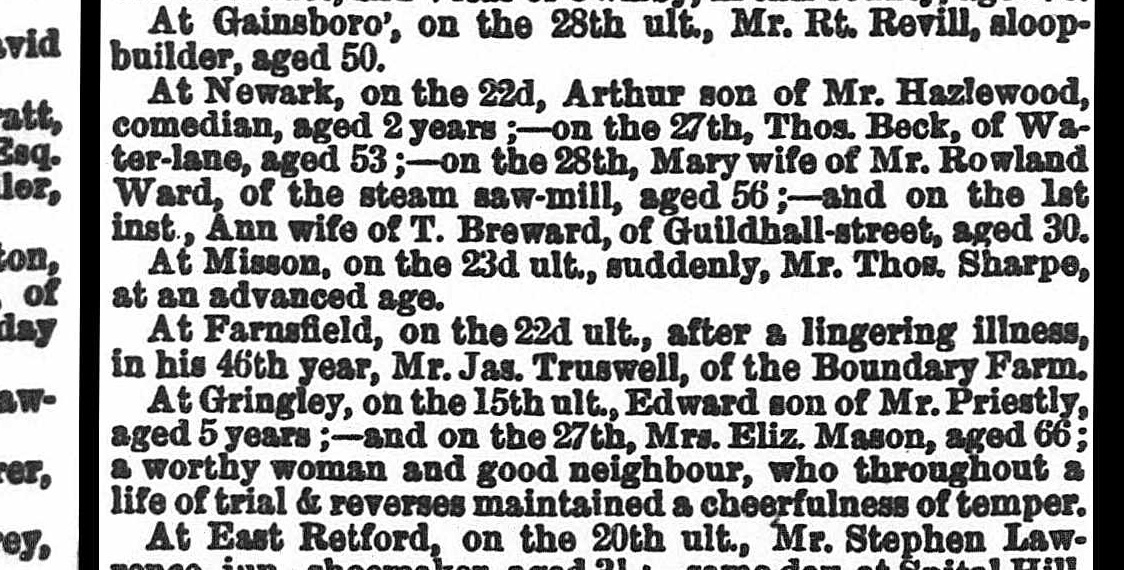
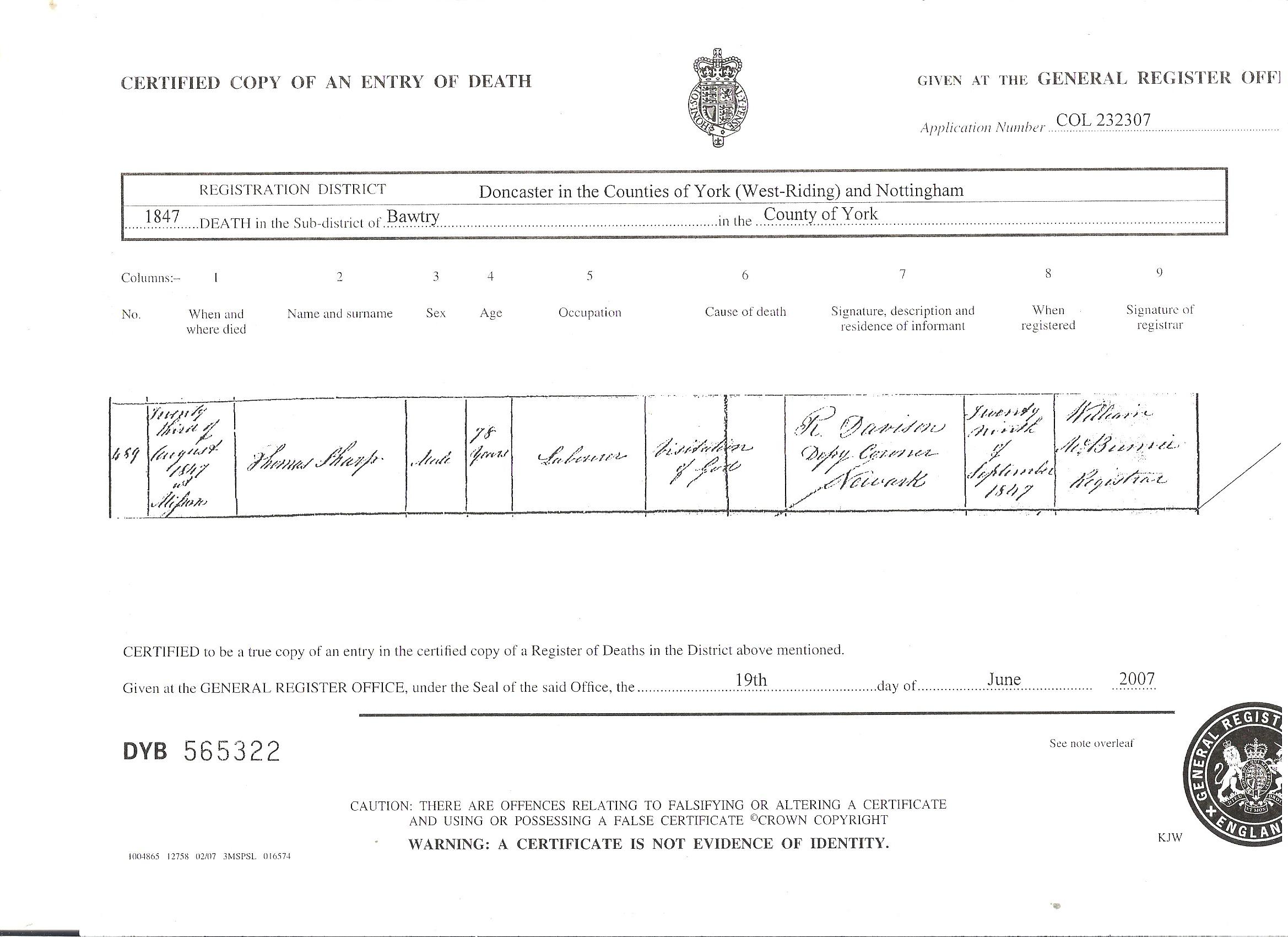
Thomas Sharp Sr. died in Misson on 23 August 1847, age 78, found lying in the street by a neighbor named Elizabeth Orton. She thought he was having a fit, obtained the assistance of William Mason and John Hobson, but he died immediately. The inquest verdict was visitation of God. The inquest notice appeared in the Lincoln Rutland and Stamford Mercury on 3 September 1847.
Inquest notice for Thomas Sharpe, Lincoln Rutland and Stamford Mercury, 3 September 1847, p. 3
Death certificate for Thomas Sharp Sr., died 23 August 1847, Misson. GRO DYB565322.
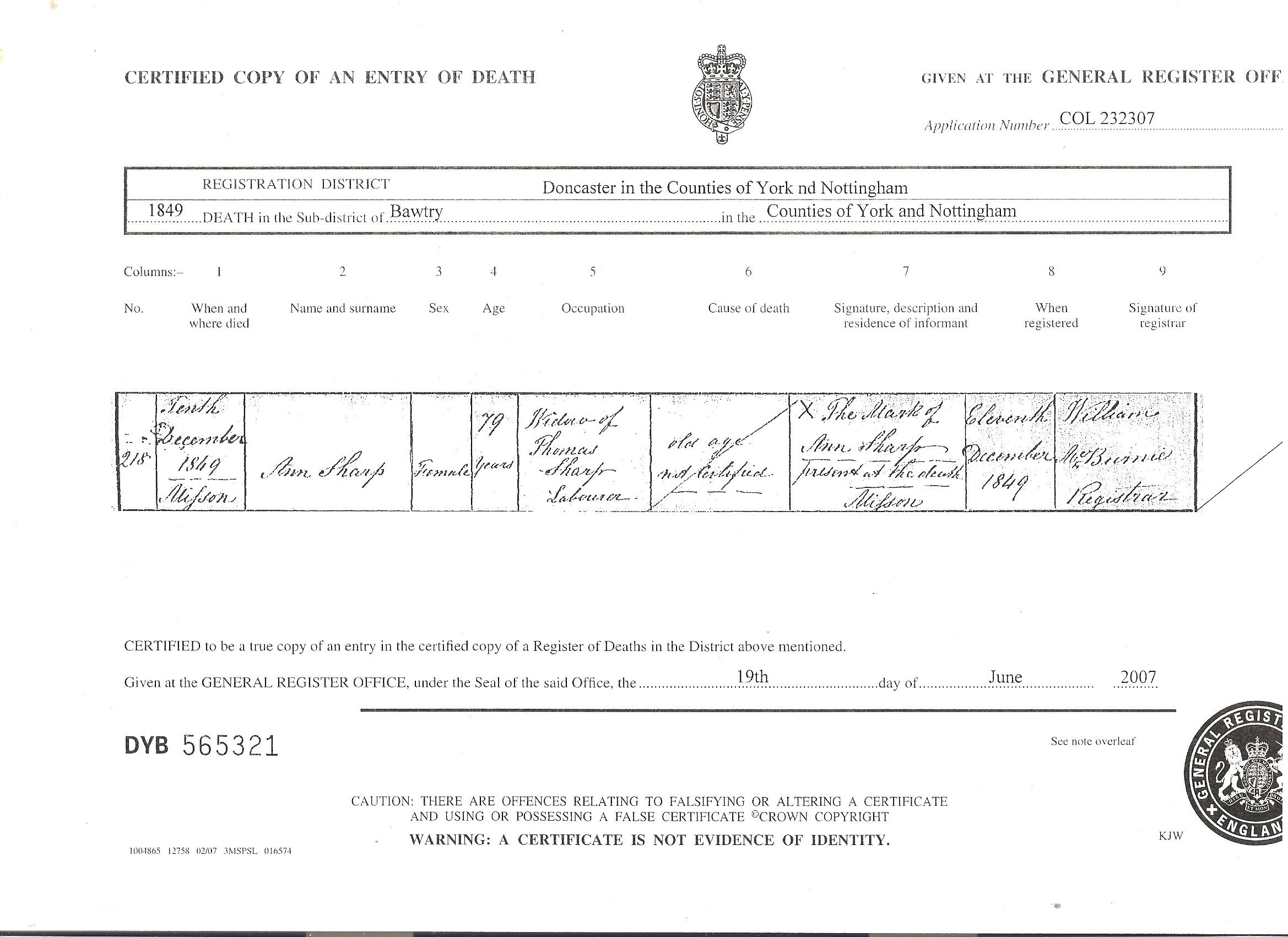
His wife Anne died in Misson on 10 December 1849, age approximately 79, from a fall, and was buried three days later. Their death notices appeared in the same Lincolnshire newspaper, the family had maintained connections across sixty years and three counties.
Death certificate for Ann Sharp (née Stennett), widow of Thomas Sharp Sr., died 10 December 1849, Misson. GRO DYB565321.
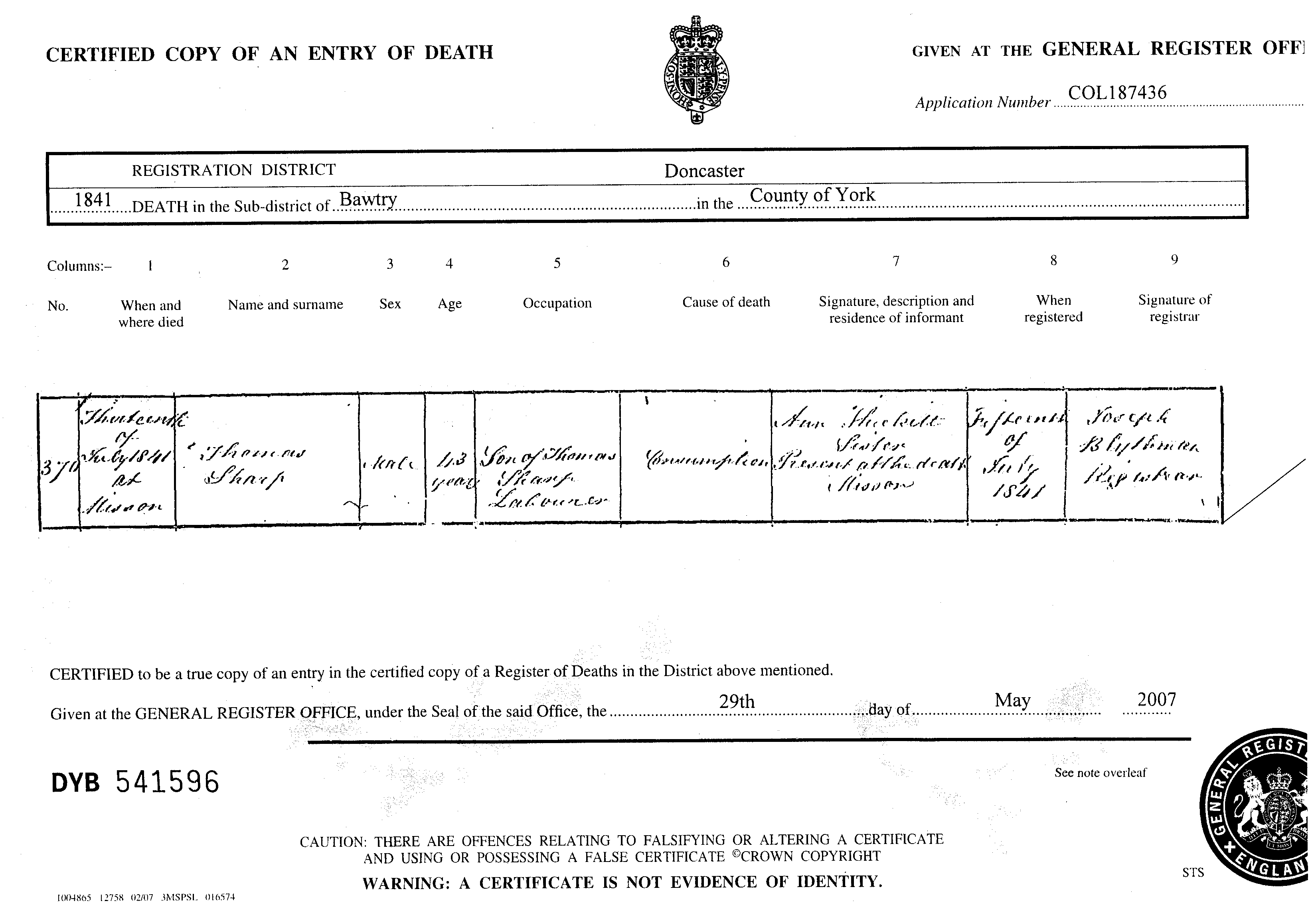
Thomas Sharp’s younger brother James had died of Consumption on 5 June 1839, with Elizabeth as the informant at his death. Six months later, on 7 January 1840, Thomas and Elizabeth named their newborn son James. Whether the name was chosen in memory of the brother lost that summer is not known, but the timing is suggestive. Consumption, known colloquially as the white death, is the historical name for tuberculosis, a contagious airborne disease caused by Mycobacterium tuberculosis. In 1815, one in four deaths in England was due to Consumption. In a labouring family’s small home in Misson, the disease would have moved freely through the household. Thomas Sharp, born approximately 1797, probably in Cantley, was a Labourer, as recorded on his children’s birth certificates and his own death certificate. The death certificate gives his age at death as 43 years, the burial record as 45. This two-year spread likely reflects the imprecision natural to a family where neither parent could write and where exact ages were not always known. Thomas died of the same Consumption that had killed his brother just two years before, on 13 July 1841 at Misson, just weeks after the June 1841 Census recorded him in the household. His sister Ann Thickett, wife of Thomas Thickett of Blyth, Yorkshire, four miles north of Misson, was present at his death and registered it. He was buried at Misson on 15 July 1841.
The disease continued through the family. Ann Thickett, who had been present at Thomas’s death in 1841, died of Consumption on 6 April 1846, age 36, just five years after registering her brother’s death from the same disease. George Sharp, another brother, died of Consumption on 8 August 1846, age 47, four months after Ann. Between 1839 and 1846, four of Thomas Sharp Sr. and Anne Stennett’s children died of tuberculosis. Thomas Sharp Sr. survived all four, dying in August 1847. Anne survived until December 1849. They outlived four of their children to the same disease.
Death certificate for Thomas Sharp, died 13 July 1841, Misson, of Consumption. GRO DYB541596.
Annie Thompson, writing from family tradition in 1957, describes Elizabeth as having grown up “a tall young lady, reared in an atmosphere of wealth and refinement.” Her father George Cartwright was buried at Misson on 27 February 1820, age 46, when Elizabeth was sixteen years old. Three years later, on 4 June 1823, her mother Ann remarried a widower named George Beighton at the Misson parish church, by banns, witnessed by John Robinson and John Cartwright, confirmed in the Bishop’s Transcripts in the Nottinghamshire Archives. Six months after her mother’s remarriage, Elizabeth married Thomas Sharp.
Elizabeth could not write. On both her daughter Ann’s birth certificate in 1838 and her son James’s birth certificate in 1840, she signed with an X mark.
Thomas and Elizabeth had eight children, all baptized in the Misson parish church and recorded in the Bishop’s Transcripts at the Nottinghamshire Archives. The dates below give the christening date from the Bishop’s Transcripts, the birth dates held in family tradition are noted separately where they differ, representing the difference between the event remembered by the family and the event recorded by the church.
George Sharp, christened 11 November 1824, died 15 November 1824, four days old.
Mary Sharp, baptized 27 November 1825, died in infancy and was buried approximately two days after her christening, as noted in the Misson Parish Register.
William Sharp, christened 7 January 1827, family tradition gives his birth as 10 December 1826. He would go on to help found Plain City, Utah. See Sharp-Bailey Wedding and the William Sharp Personal History.
George Sharp, baptized 13 May 1829, died 23 December 1833, age four years and seven months, buried at Misson. The Misson Parish Register notes his cause of death as burns. Burns were tragically common among small children in this period, when open hearths were the only source of heat and cooking in labouring family homes. Whether his clothing caught fire near an open flame or the death resulted from a structure fire is not known, and no newspaper account of the event has been located.
Isabella Sharp, christened 15 January 1832, family tradition gives her birth as 22 December 1831. She would emigrate with William to Utah and settle in Mill Creek, Salt Lake County. See Sons of Joseph and Isabella Carlisle.
Elizabeth Sharp, baptized 11 June 1834, she remained in St. Louis and married John Quayle. See John and Elizabeth Quayle.
Ann Sharp, born 8 July 1838, baptized 29 July 1838, died 2 September 1838, eight weeks old, of convulsions. Convulsions in infants of this period were typically caused by uncontrolled fever from bacterial or viral infections, untreatable before the development of antibiotics and fever-reducing medications. Elizabeth registered her birth with an X mark on 10 July 1838. A neighbor, Mary Laister, registered her death, Elizabeth was not the informant.
Birth certificate for Ann Sharpe, born 8 July 1838, Misson. Elizabeth signed with her X mark.
Death record for Ann Sharpe, died 2 September 1838, Misson, age 8 weeks, of Convulsions.
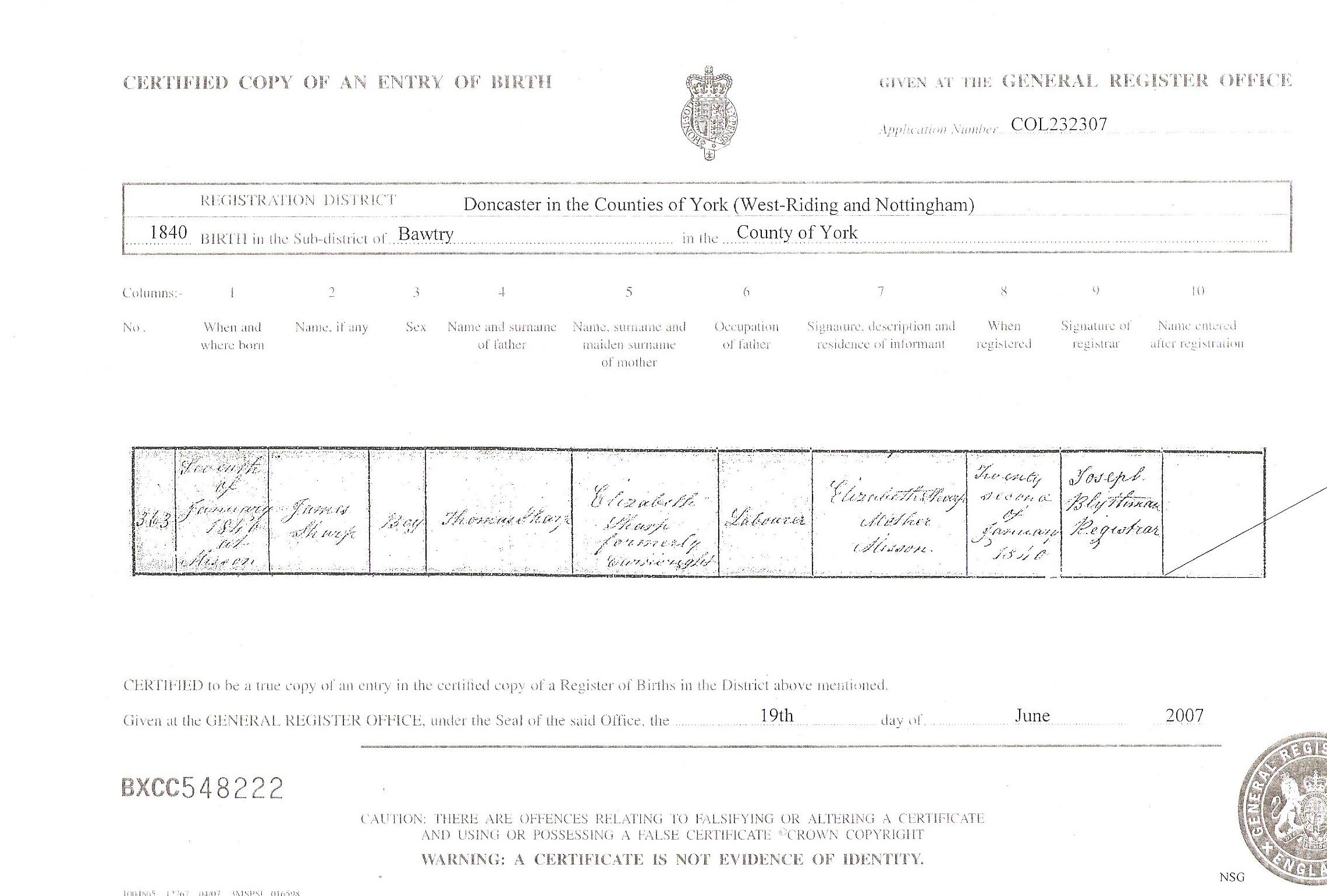
James Sharp, born 7 January 1840, confirmed by GRO birth certificate (BXCC548222), with Elizabeth signing as informant with her X mark on 22 January 1840. See James Sharp.
Birth certificate for James Sharp, born 7 January 1840, Misson. GRO BXCC548222. Elizabeth signed with her X mark.
By the time Thomas died in July 1841, the family had buried four children. George at four days, Mary in infancy, the second George at four and a half years, and Ann at eight weeks. The 1841 Census, taken just weeks before Thomas’s death, records the household: Thomas (40), Elizabeth (37), William (14), Isabella (9), Elizabeth (5), and James (1). Thomas Sharp Sr. was living just a few households away in the same village.
Milo Riley Sharp, grandson of Thomas Sharp and Elizabeth Cartwright
Conversion and Emigration
William Sharp was the first family member baptized into the LDS Church, or formally The Church of Jesus Christ of Latter-day Saints, on 20 June 1848. His mother Elizabeth followed on 11 August 1849, and Isabella on 16 September 1849. The Misson History Hub records that “In 1848 LDS Missionaries visited the village and several conversions apparently took place” and notes that the converted “travelled to the USA, crossed the continent and made new lives and families there.” Among the elders who lodged at Elizabeth’s home was Elder George Emery.
Elizabeth decided to emigrate with her family to Utah. Annie Thompson records the family’s resistance: “her folks tried hard to discourage her from taking the hazardous trip; they told her if you leave for the West, ‘A red Indian will eat ye.’” The ticket cost twenty-five pounds sterling. On 2 October 1850 Elizabeth (age 45), William (age 24), Isabella (age 19), Elizabeth (age 26), and James (age 10) sailed from Liverpool on the ship James Pennell, under the direction of Church leader Christopher Layton. There were 254 Latter-day Saint emigrants on board, the Fiftieth Company.
The voyage nearly ended in disaster. As the James Pennell approached the mouth of the Mississippi River, a terrible storm drove the ship back into the Gulf of Mexico, breaking the main and mizzen masts and washing part of the rigging overboard. The crippled vessel drifted for several days with provisions nearly exhausted before a pilot boat found it and guided it to the river mouth on 20 November. The Millennial Star reported simply that the James Pennell “had lost her main and mizen masts, which is all the information given of her.” The ship arrived in New Orleans on 22 November 1850, towed alongside the Joseph Badger, which had sailed from Liverpool two weeks after the Pennell. The full dramatic account is preserved in the William Sharp Personal History. The voyage is documented at Saints by Sea (BYU), where the Sharp family passengers are listed.
From New Orleans the family traveled by river to St. Louis, Missouri. Shortly after arriving, Elizabeth fell ill. She died on 17 February 1851 in St. Louis, never reaching Utah. She was 47 years old. Her burial place in St. Louis has not been located. Annie Thompson gives her death as “probably late in the year 1850.” The 17 February 1851 date comes from other sources and is consistent with a November 1850 arrival and a short illness through that winter. Her children were left on their own in an unfamiliar city. Elizabeth Sharp married John Quayle and remained in St. Louis. James, aged eleven, tried to arrange passage west but the company he was to travel with turned back; he stayed in St. Louis and eventually became a partner in a meat packing business. William married the widowed Mary Ann Bailey Padley in St. Louis, and in 1853 he and Isabella, now married to Joseph Carlisle, traveled west in the Moses Clawson Company, arriving in Salt Lake Valley between 15 and 20 September 1853.
Temple Work
In December 1881 Isabella Sharp Carlisle traveled from Mill Creek, Salt Lake County, to the St. George Utah Temple, at that time the only operating temple in the world, to perform proxy ordinances for her deceased daughter Elizabeth Ann Carlisle. While there, between 20 and 23 December 1881, ordinances were completed for her father Thomas Sharp and her paternal grandfather Thomas Sharp Sr., and the sealings of both men to their wives. Ordinances were also completed for her maternal grandmother Ann Matthews Cartwright, baptism, confirmation, and sealing to George Cartwright, with the St. George Temple record identifying Ann Matthews Cartwright by name and marriage details, confirming the family connection across three generations. Ordinances were completed for six people across four generations in four days.
Thomas Sharp’s sealing to Elizabeth Cartwright was completed 30 April 1920.
Of the children of Thomas Sharp Sr. and Anne Stennett who survived to adulthood, John Sharp died on 29 July 1866 in Misson of Bronchitis and Emphysema, the last of the siblings to remain in the village. William Sharp died on 27 October 1867 in Canada, having emigrated there with his family around the same time Elizabeth Cartwright Sharp, Thomas Jr.’s widow, left England for America in 1850. The emigrations of brother and sister in law, in the same decade, from the same small village, to different continents, closes the Misson chapter of the Sharp family story.
Sources
Primary documents: Thomas Sharp death certificate (GRO DYB541596, 13 July 1841); Thomas Sharp burial, Bishop’s Transcripts, Nottinghamshire Archives (15 July 1841); Elizabeth Cartwright baptism, Bishop’s Transcripts, Nottinghamshire Archives, FHL film #503793 (20 December 1803); Thomas Sharp and Elizabeth Cartwright marriage, Bishop’s Transcripts, Nottinghamshire Archives, page 14 (29 December 1823); Ann Sharp birth certificate (GRO, 8 July 1838); Ann Sharp death record (GRO, 2 September 1838); James Sharp birth certificate (GRO BXCC548222, 7 January 1840); 1841 Census of England and Wales, Misson, household 1612123; children’s christenings confirmed in Bishop’s Transcripts, Nottinghamshire Archives, pages 34 (George 1824), 37 (Mary 1825), 42 (William 1827), 50 (second George 1829), 60 (Isabella 1832), 69 (Elizabeth 1834); second George Sharp burial, Bishop’s Transcripts, Nottinghamshire Archives, page 32 (23 December 1833); Thomas Sharp Sr. christening, Bishop’s Transcripts, Borthwick Institute for Archives (18 September 1768, Armthorpe); Thomas Sharp Sr. death certificate (GRO DYB565322, 23 August 1847); Ann Sharp Sr. death certificate (GRO DYB565321, 10 December 1849); George Cartwright baptism and burial, Bishop’s Transcripts, Nottinghamshire Archives; Ann Matthews christening, Bishop’s Transcripts, Nottinghamshire Archives (14 September 1783); Will of Edmund Matthews of Everton, proved 25 February 1820; Death Duty Register IR27/174, The National Archives; Ann Matthews and George Cartwright marriage, Bishop’s Transcripts, Nottinghamshire Archives (1 February 1803); Ann Matthews and George Beighton marriage, Bishop’s Transcripts, Nottinghamshire Archives, page 13 (4 June 1823); Thomas Sharp Sr. christening (Armthorpe) and Thomas Sharp Sr. and Anne Stennett marriage (Ewerby, Lincolnshire), Lincolnshire Parish Registers; James Sharp (brother) death record, Misson Parish Register (5 June 1839); Mary Sharp burial, Misson Parish Register (approximately 29 November 1825); George Sharp (1829) cause of death, Misson Parish Register (burns, 23 December 1833); Ann Thickett death record, Misson area (6 April 1846); George Sharp death record (8 August 1846); John Sharp death record, Misson (29 July 1866).
Secondary sources: Annie Thompson, Life History of Elizabeth Cartwright Sharp, 27 August 1957; William Sharp Personal History; Kent Nielsen (1931–2020), a great grandson of Joseph and Isabella Sharp Carlisle and thus of Thomas Sharp and Elizabeth Cartwright, contributed extensive primary source research to the FamilySearch Collaborate record for this family between 2011 and 2014. His careful documentation of the Cantley, Yorkshire connection, the GRO certificates, and the census evidence forms the foundation of the genealogical record presented here. FamilySearch Collaborate notes on Thomas Sharp (KWJ5-679) and Thomas Sharp Sr. (KP7V-4HL), 2011–2014; Leanne Maynes, a great great granddaughter of Joseph and Isabella Sharp Carlisle and thus of Thomas Sharp and Elizabeth Cartwright, whose ongoing research into the Sharp and related families has contributed additional primary source analysis, including the Misson Parish Register details on infant burials and causes of death, the identification of the Stamford records as a likely misattribution, and the TB deaths among Thomas Sharp Sr.’s children in the 1840s; Saints by Sea, BYU, James Pennell voyage 2 October–23 November 1850; Misson History Hub, Written History.
For more on the Sharp family and Plain City’s founding generation, see:
My grandfather, Wilburn Norwood Jonas, was born in Lewiston, Cache County, Utah on 15 May 1924. His great grandparents, Stephen and Hannah Coley are buried in Lewiston. When I stumbled on this short history, I thought I would share it. This history was compiled by M. R. Hovey for the Logan Chamber of Commerce in 1923, a year before Grandpa was born.
James and Aliza Ross at the grave of Hannah and Stephen Coley – 14 August 2026 – their fourth great grandparents
“After Richmond was settled in 1859, Franklin in 1860, and Clarkston in 1864, “All the most desirable locations on the streams in Richmond and in the other settlements of the Valley, had been taken. Naturally (the new settlers) were forced to take lands in the center of the Valley and get their irrigation water wherever they could. This was difficult to do.”
“In July 1870, a scouting party went out to locate some new lands for settlers. They searched the north end of Cache Valley from Oxford to Mink Creek. (When) “the scouting party returned (it was) decided that the ‘Flat’ where Lewiston is located, was the best place to locate..”
“Used by early Richmond settlers as a herding ground, “It was covered with buffalo and bluegrass. It had also been used in the past by the Indians as a place for their pow-wows, where they had horse races and other games. As there were no trees or vegetation the sand drifted considerably.”
“Houses were built of logs and lumber. Some made dugouts. The community grew. Among the first group of settlers were the families of P. N. Van Orden, Sr., Everett Van Orden, Robert Wall and John M. Bernhisel, Jr.” (When) “the townsite was staked out, it was decided to (make the blocks) a mile square. At first the settlement was called Cub Hill.”
“In 1872, William H. Lewis was sustained as the (LDS Branch’s) presiding elder and later, the bishop. The settlement was named “Lewiston” after Bishop William H. Lewis.
Bio of William H. Lewis
“William H. Lewis married Martha Petty in November of 1856. In 1858 his wagons left Fort Harrison, Utah, to settle in Cache Valley. The Lewises arrived in Richmond October 31, 1859, building a small cabin in an area known as “Poverty Flats.” In 1873 Brother Lewis was called as Presiding Elder of the fledgling Lewiston Branch at Poverty Flat. “After serving for a year, Lewis approached the Richmond Bishop, M.W. Merrill, asking to be released from the calling. He stated ‘he would not trade his small farm in Richmond for the whole of Lewiston.'”
“”Bishop Merrill informed him that it was the Lord that had called him to that position and he would not be a partner in releasing him. The bishop advised William to go back to Lewiston and the Lord would bless him on this land that looked so barren. He also told Brother Lewis that Brigham Young had said that Lewiston would be the granary of the valley and that the potential possibilities of that wasteland were many and great.” Staying in Lewiston, Lewis eventually became one of the wealthiest farmers in the area.
“After serving as Presiding Elder over the branch for five years, Lewis was named the Lewiston Ward’s first bishop. After serving for seven years, he was named Stake President of Benson Stake. The town was eventually named ‘Lewiston,’ after William H. Lewis.
“”In the beginning the little settlement had some serious handicaps. They had no irrigation water, no trees and very little vegetation. The sand drifted badly in places. The winters were severe and bad frosts were common. The drought brought many crickets, grasshoppers and other pests. The winter of 1871-1872 was very cold and severe. In November 1871, two feet of snow fell and it did not leave until April of the next year. At certain times during the winters the fences were covered with snow and the settlers traveled over the tops of the fences with their sleighs. During the summer time there were hot, dry winds, and killing frosts. For three successive years the grain was frozen in July. The settlement was referred to as ‘Poverty Flat,’ ‘Starvation Corner’ and ‘The Last Chance.'”
“When Church President Brigham Young visited Richmond, “the discouraged settlers reported these unfavorable conditions… the settlers (were advised) to return to their homes promising them that Lewiston should yet become one of the garden spots of Cache Valley & the Territory.”
“If the settlers were to remain they had to have irrigation water. “(Since) Bear River to the west was too low to take out a canal and bring it upon the flat…In 1873 a small irrigation ditch northeast of Lewiston was built from Worm Creek…In 1874 a site for a canal was located on Cub River in the Cub River Basin.” Though a tremendous undertaking… it saved the settlement. For drinking water, wells were used.” In later years, “a large irrigation company was formed and a pumping plant and its diversions was established on the Bear River.”
“Lewiston has continued to grow and is considered one of the best farming communities in the state. The promise made years ago by President Brigham Young, ‘that someday Lewiston would become one of the garden spots of the Valley and the Territory, has verily been fulfilled. In 1904, the town was incorporated by Brigham Pond, Lewiston’s first mayor.
Compiled by M. R. Hovey, Secretary, Logan Chamber of Commerce. January 1, 1923 to January 1, 1925. Also as printed in the Logan Journal, beginning August 4, 1923.
34 – 2024-2025 Discover North Cache • DiscoverAreaGuides.comOutdoor Recreation.” Thanks to Jack Johnson for the compiling of these DiscoverAreaGuides.
In recent discussions with some members from England, I shared a number of photos I had taken/received while serving in their Ward. It dawned on me and they supported the idea of writing some histories regarding each of the Wards I served in. Also, as time passes, my memory will not remember all the people or my interactions. This is the first of those posts.
This post turned out to be terribly time consuming. I pulled out my planners and worked through them week by week. I was interested in the addresses we visited and the people we taught. Interestingly, I can remember most of these streets, even tracting them. But unless the people advanced to our teaching pool, I don’t generally remember them. Which really is not surprising as many of them were one or two contacts. But, the planners told me who we had appointments with, including tea/dinner appointments. For being 1998-1999, I am astonished at how much I remember from day to day. Some were simply unforgettable, even now, like the young lady who answered the door nude (read below).
Also, as part of this process, I read through the related journal for the time period. I have quoted whole sections that I located related to this time and these people. On a personal note, this was a very trying companionship and district to serve in. Jet lag, sickness, frustration with the breakdown between mission ideals and what was actually happening, personality conflicts, and immaturity (very much on my side, but also other missionaries), 6 missionaries in a confined space, all contribute to the refiners fire Moreton Ward proved to be for me. I have mostly removed all the whining from the journal posts. As reading, don’t think I am a model of optimism or enthusiasm. I was more coy at the beginning of writing this post than I was later. I didn’t quote as much from the journal to begin with, but more and more as I got more comfortable in writing about weeks. At the beginning I give overviews, later I do more quoting and let the voice of the journal speak. Moreton ward covers 119 pages of my journal #5, 36 pages of my journal #6.
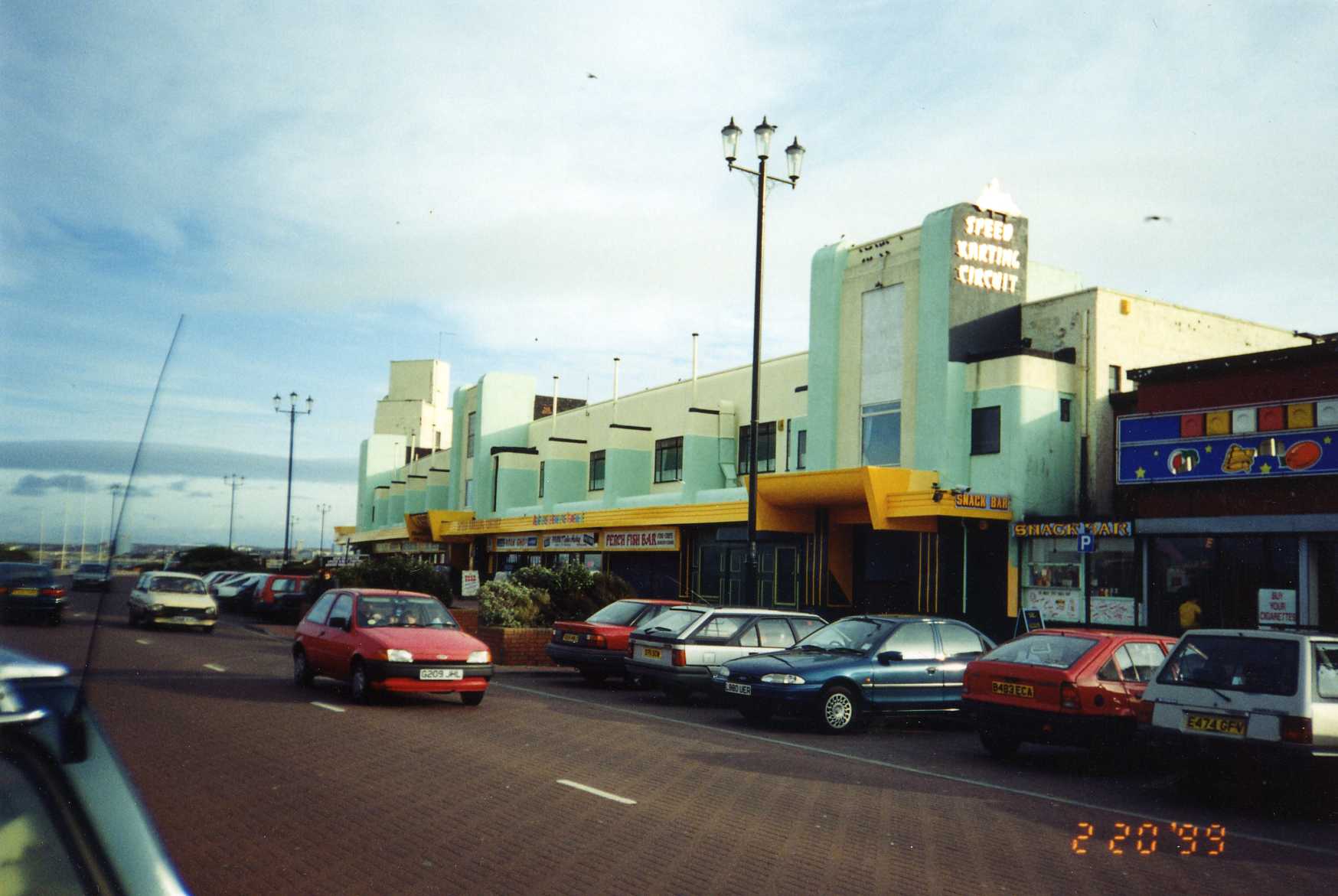
The first Ward I served in as a missionary was in the Moreton Ward of the Chester England Stake. I believe it was a newly created ward, only a few months old. At some point the Birkenhead Ward(s) were in the Liverpool Stake and I remember there being multiple ties and connections to Liverpool. I recollect Moreton was created from one or both of the Birkenhead Wards. We met in an old college bar pub, I recall, in West Kirby. We lived in Liscard. I wrote a post previously about the houses I lived in as a missionary. In those days cameras were clunky and still film, so you did not take many pictures. But I do have a few I attribute to the Moreton Ward. Six missionaries covered the Moreton Ward. A year or two later, the Ward received their own ward building. It is my understanding these ward still exists, but was merged with the two Birkenhead wards, now all just two wards.
Since this is my first area, I am also including some of the arrival in the mission from the Missionary Training Center, or MTC, and the mission home.
On 21 December 1998, I flew out from Salt Lake City to the England Manchester Mission, connecting through Atlanta, Georgia. I had just spent two and a half weeks in the missionary training center in Provo, Utah. On that flight I sat next to a woman named Madge Fillingim, age 79, from Vernal, Utah. I hadn’t caught the spelling of her name at the time, and wrote it in my journal as “Marge Flitteringum.” She was born in 1920 and passed away in 2023 at 102.5 years old! I linked her obituary.
As I wrote that day: “On the left was Marge Flitteringum or that last name is close. I don’t remember how she spelled it exactly. …Marge from Vernal at 79. Through our conversations Marge agreed to start taking piano lessons and to become active again in church. Am I a missionary or what? Her son wants her to start going to church again, and with the brand new temple in Vernal, she wants to get her endowment. We talked about music and told her about grandma’s start late in life. I got her to committ.”
In further research, three years later, on 29 December 2001, Madge received her endowment at the Vernal Utah Temple. I don’t know whether she ever picked up playing the piano.
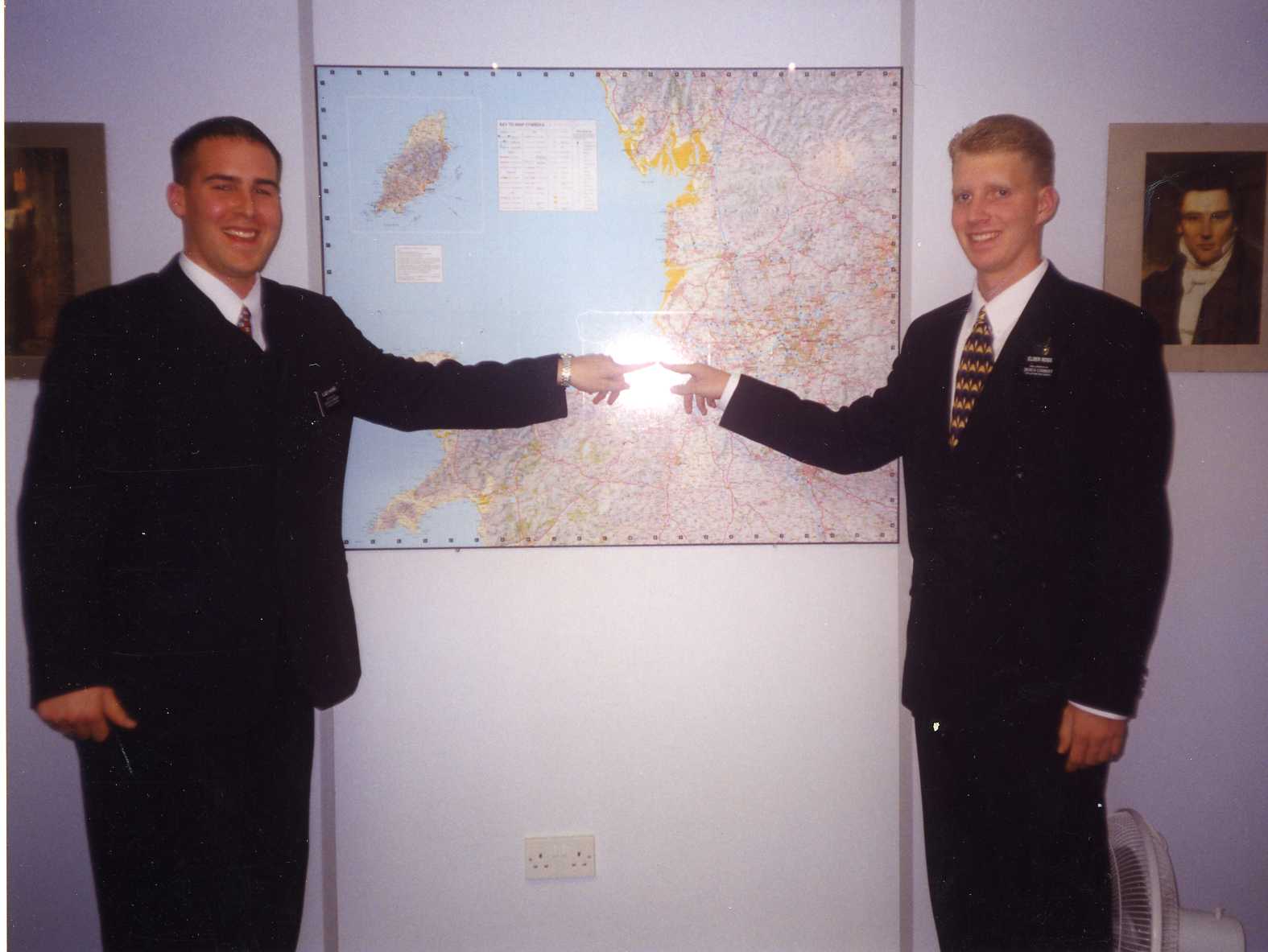
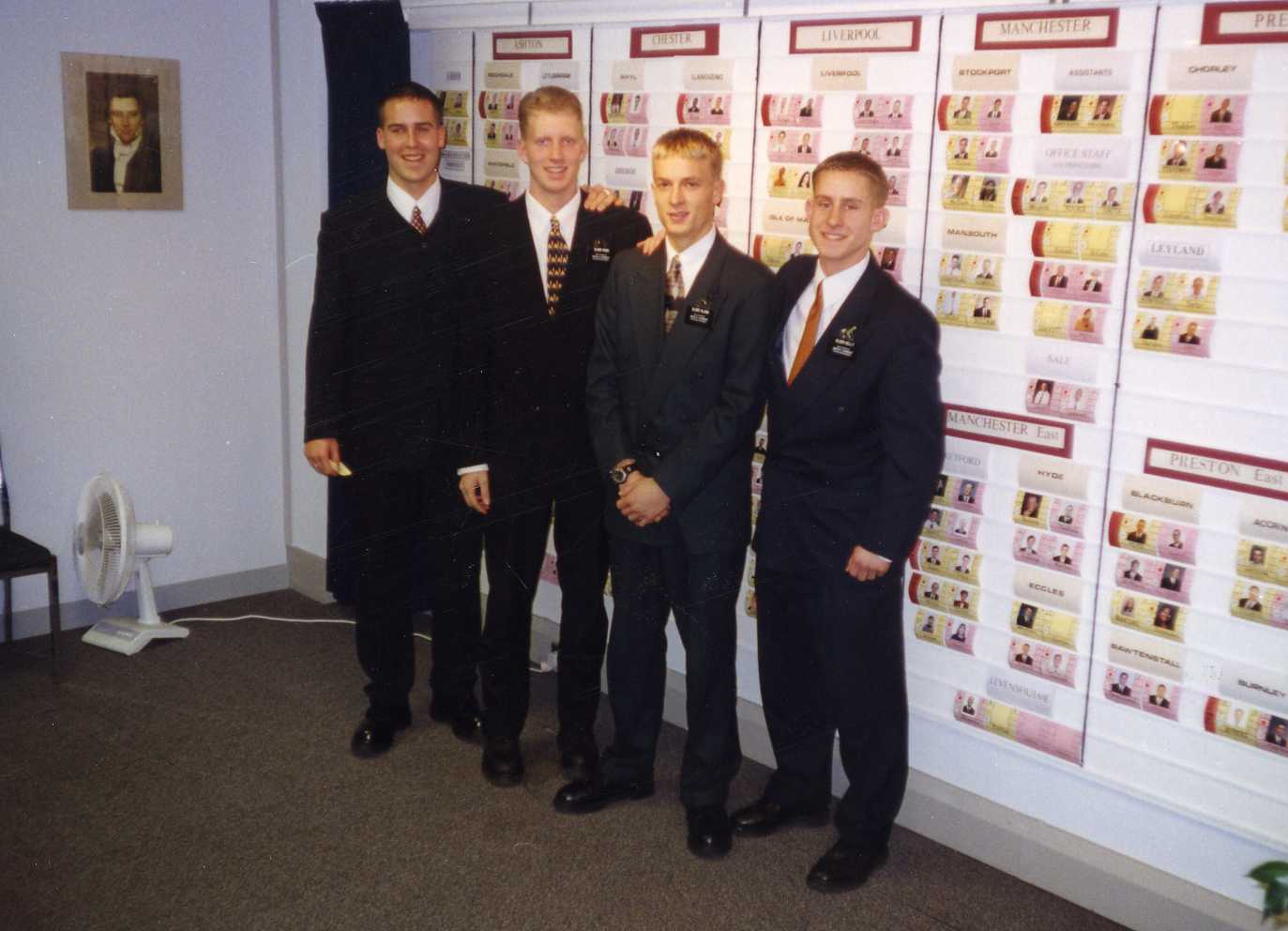
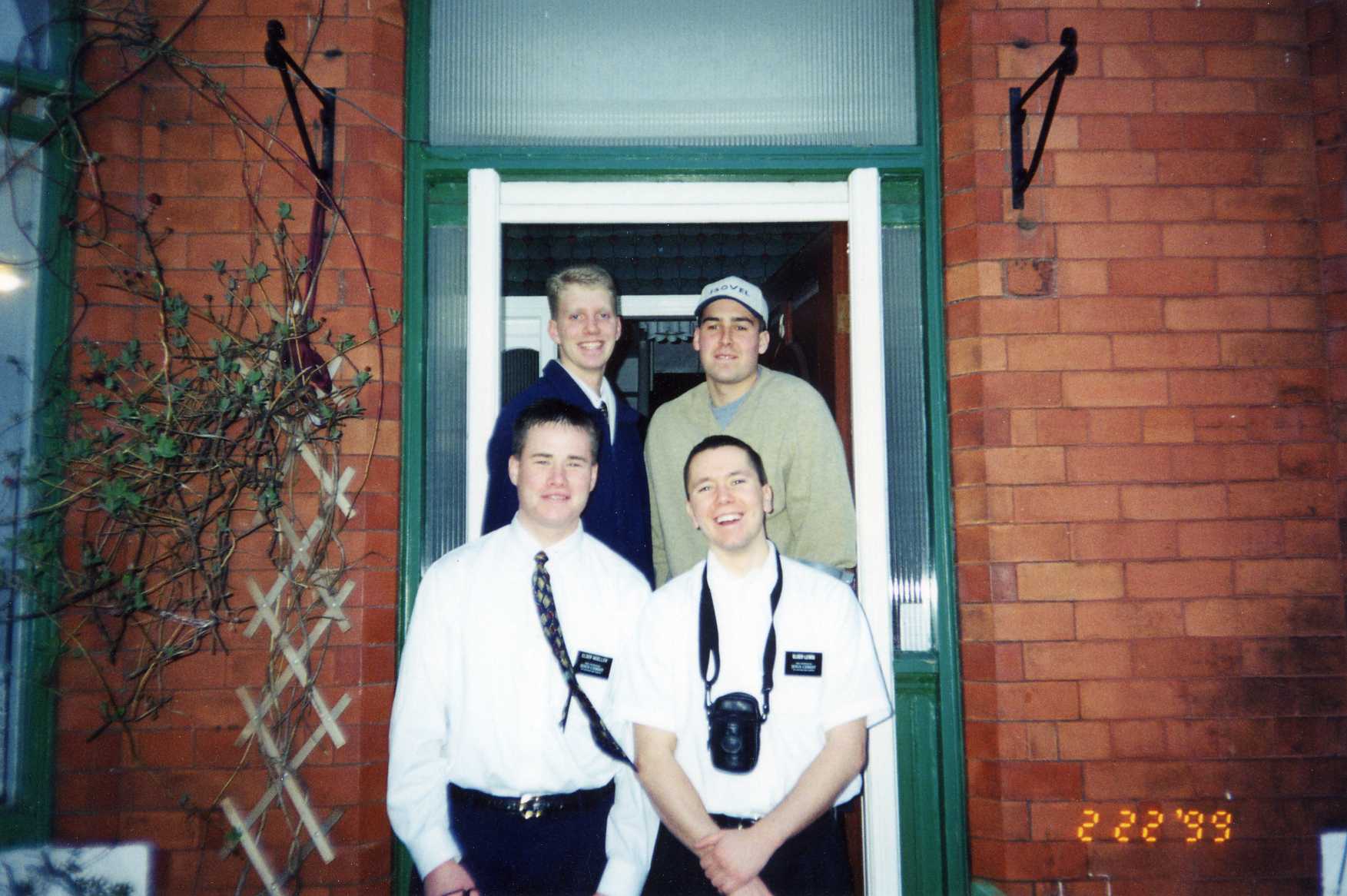
23 December 1998 – Elder Harris and Elder Ross assigned as companions at mission office, Altrincham, Cheshire
I arrived at Manchester airport on 22 December 1998. We stayed that night at the mission home in Altrincham. The next day, 23 December, I did my first street contacting in Altrincham not far from the mission home. That door is seared into my memory. I can still see it. After lunch that day, we were assigned missionary companions. Elder Jeremy Harris became my first companion in the mission field (Elder Kody Young had been my companion at the MTC). Elder Olson was assigned to Elder Paul Kelley that same day. Moreton wasn’t a surprise to Elder Harris, since he was already serving there.
23 December 1998 – Newly assigned companionships – Elder Harris and Elder Ross, Elder Olson and Elder Kelley
That evening we did some tracting and went to the Counsells’ for dinner, which in England is called tea. Researching, this was Grant and Helen Counsell. Our flat address was 6 Belgrave Street, right on the corner of Trinity Road.
22 December 1998 – President H Bruce and Cheryl Stucki, and Elder Paul Ross
Writing the next day about that evening, I recorded: “We live in a 3 level flat on Trinity Street. So small and in great disrepair. Humble though. I am afraid the steps will break. We left and headed to our flat. Some guy ran up to us and pointed a gun directly at me. We drove off. It scared me to death. We come back to the flat and put on our whites and went and sang in the centre. I didn’t think we sounded good at all. Some members stopped by the flat when we got back. We received presents and 4 of us ran to do some street contacting while the rest went to deliver presents.”
25 December 1998 – Christmas Eve caroling, Elders Llewelyn, Lewis, Harris, Mueller, Ross, Knight
On 24 December, we had dinner with the McKenna’s. In my records I record it as McKenna, McKinnon, and MacKinnon. I don’t know which is right and so far the two members I have contact with do not appear to remember this family. Oddly, I remember this meal. We sat at a little kitchen table for two in the kitchen itself. The McKinnon’s did not eat with us. It was fairly dark in the kitchen. The soup was a chicken, pea, carrot soup. It was not a creamy soup, but it was oily or something and was amazing. None of the rest of the home was heated except the front room with a little gas heater (where the coal fireplace once was). My first introduction to the idea that people would only heat one or two rooms of a home, not the whole house. We left a spiritual thought and left. I don’t know that they were elderly, maybe 70s. But my soul was warmed. I understand the McKinnons moved away from the area.
This highlights another surprise for me in England. Their latitude is considerably higher than that of most of the United States. As such, in winter time, the sun would disappear about 4 pm. It would reappear about 8 am. The days are short. So this dinner appointment at 6 pm would have been in the dark. Many missionaries struggled with depression due to shortened daylight hours. In the converse, summer would have the sun going down at like 9:30 pm and coming up at 5:00 am.
Christmas Day, the 25th, I wrote: “All of us went to play footy, or soccer. I am not a soccer fan anymore. Since I hurt my foot in high school I am not supposed to do any kicking with it… I sat watching them played and I read scriptures while there. I sat some time looking across the Mersey River at Liverpool. What an impressive sight. One building reminded me a ton of the Salt Lake Temple. Dingy white with the 6 big towers but the building was full of windows. It had a big clock in the one end. Instead of an angel Moroni on the end, it had giant pelicans on both center towers.”
That building was the Royal Liver Building. The “pelicans” were actually the famous Liver Birds. Built between 1908 and 1911 for the Royal Liver Assurance company, it was designed by local architect Walter Aubrey Thomas in the Edwardian Baroque style and was, for its time, one of the first large buildings anywhere constructed with a full reinforced-concrete frame, engineering that let it rise to 322 feet and briefly stand as the tallest building in Europe. Its twin clock towers carry two copper birds, nicknamed Bella and Bertie, one facing inland toward the city and the other out to sea. Legend holds that if they ever flew away, Liverpool itself would cease to exist. The birds themselves were carved by Carl Bernard Bartels, a German woodcarver. Along with the Cunard Building and the Port of Liverpool Building, the Royal Liver Building and others form Liverpool’s famous “Three Graces” on the Pier Head waterfront. All fully visible from across the Mersey in Seacombe and Wallasey.
That same day, I visited with family on the phone, including my Dad, sister, Grandma, and Duncan family.
I wrote about my Grandma: “She told me how bad she felt about missing me at the airport. I wished I could have seen her too. It was really good to talk to all of them again. We shall see each other soon enough.”
Grandma died the next year, sooner than either of us expected that Christmas Day. My flight was originally supposed to leave from one gate in Salt Lake City and that is where she went. Later they realized what was going on and they raced over to the new gate. They got there in time to get a package on the flight to me, but no opportunity to physically say good-bye as we were already loaded.
26 December 1998 – My end of the bedroom at Liscard flat, Merseyside
On 26 December, dinner was with Steve and Linda Pitt. That day I also wrote: “I found out that the river and docks I was talking about was where all the immigrants from England left.” At some point, I probably should do a post, like I did with the Mormon Trail, of all my ancestors who came through Liverpool.
27 December 1998 was my first time at church in Moreton. Attendance didn’t reach 100. I confirmed into The Church of Jesus Christ of Latter-day Saints Ann Marie Brumfitt that day. She’d been baptized the Sunday before I arrived. I don’t recall the Elder’s name I replaced. I wrote, “It was a cool experience.” I also gave a priesthood blessing that day to a young boy, Thomas Michael Plemford, Gaynor Plimley’s son. That same day, jet lag and the whirlwind of the first week were catching up with me.
I wrote: “I am having such a hard time. I am so dead tired it is pitiful. If only I could go to bed earlier but that really isn’t possible… I will finish my mission but I will sleep for a week when I return, I am sure of it. Help me endure. These 16 1/2 hour days are killing me. I hope p-day they let me sleep in. I think the jet lag is not helping.”
Even so, I closed the day looking forward rather than back: “There is so much to learn. If I have acquired a percent of a fraction, I will count my life as something more than a waste. I will know it wasn’t all at naught. So much to gain, so little to lose. I pray my senses be toughed, my facilities enlightened to gain but a portion of the awesome amount. I please to learn and not have any tolerance in ignorance. Whatever principle of intelligence we attain to in this life will rise with us in the resurrection. And if a person gains more knowledge and intelligence in this life through his diligence and obedience than another, he will have so much the advantage in the world to come. D&C 130:18-19.”
This picture of the house across the street is a mirror of the house we lived in. The bricked in window is the one I am looking out and taking the picture from in our flat.
27 December 1998 – House across the street from our flat, our room on 3rd floor, 6 Belgrave St, Liscard, Merseyside
28 December 1998 – 3 January 1999
This was my first week in the mission with a planner of my own. The week before, Elder Harris had kept track for the both of us while I was still finding my feet. P-day, 28 December, we went to West Kirby to play squash, my first time ever seeing or playing the game. I wrote: “It was great. It is alot like raquetball. I love it, I will have to do it more and when I get home.”
I’ve loved squash ever since. Roy McKee was a member there that day. His aunt and uncle, John and Audrey McKee, were also in the Ward. I can’t say for certain which McKee household we had tea with each week, Roy and Carol (who I recall held a US citizenship), or John and Audrey, unless a specific journal entry says so. But squash was my love in Richmond, Virginia; Oklahoma City, Oklahoma; Logan, Utah; I wish there was somewhere closer to play to Burley, Idaho.
We kept a heavy teaching schedule all week, working discussions in with Malcolm and Mrs Robson, Jeff and Allen, and Jocelyn and Jamie on P-day evening alone.
Tuesday, the 29th, brought a companionship exchange along with tracting and a discussion with Lisa and Thorn, and a follow-up visit with Ann Marie Brumfitt, whom we’d confirmed on Sunday. Later that day we went tracting and got some callbacks on Royston Road. After doing some running we went back to teach Bobby Topham, a new contact. Writing about it the next day, I recorded (which is overly personal to Bobby):
“He really listened. His one wife joined the church but died soon after so Robert never found out why she joined. He has been a drug addict to like cocaine and marijuana. Heroin, everything. He is an artist, wonderful, wasted all his money from it on drugs. He is wasting away. He has been legally dead 3 times. His out of body experiences sound much like the ones I have heard before from good righteous people. He won’t live probably over a year. He agreed to be baptized. He also wanted a blessing. He told us why he left the other churches. What a wonderful experience that was. I fell totally in love with missionary work. He will be baptized on the 10th. We need to finish all 6 discussions with him. How exciting. The Lord is wonderful.”
Wednesday was one of our fullest days of discussions: Sharon, Olga and Vernon, Chris, Karen and Carl, and Margaret and Carol all in a single day, wrapped up with tea at the Counsells’.
New Year’s Eve found us in service most of the morning, then more tracting and discussions with Carol and Lewis and Margaret and Jon. We also had to go find Bobby Topham for his appointment that day, and taught him the 2nd discussion.
As I wrote: “He really listens to all the message. He went from 80 cigarettes to having his 2nd all day right as we were leaving. He is a really good artist. He is going to do portraits of us. He is so excited to get baptized. He explained us as glowing. Also when we gave him a blessing, he said he saw light. This guy is really open to the Spirit. What a wonderful soul. Through him we could pull quite a few more people in. He has 6 children all but 2 by different mothers. Two of the mothers are mother and daughter themselves. If the daughter and him got married he would be a brother-in-law to his own child. What a lifestyle. No hope. All sorrow. He has found the light. It is so exciting. I hope I get the honor of baptizing him.”
We closed the night with tea at the Hankins’ and home on time. I understand this was Brenda Hankins with her daughters, Emma is the one I remember most.
New Year’s Day started with a moment of reflection. As I wrote:
“Oh, what a year. What tremendous strides in all aspects of life. One definitely for spirituality. Institute in Logan, a mission, trials over the summer. My life has been a great growing experience. Physically, I have gained around an inch or two. Now around 6’1″ or 6’2″ I stand. Probably 35 pounds heavier. I am now around 175. I am pretty healthy and have a high metabolism. Mentally, this grows with spiritual but also being in college broadened my horizons. I learned and try to learn from every aspect of life. Emotionally has been the same as the rest, leaps and bounds. Especially with Duncan’s and on the mission, much of my life is being healed. I can cry, feel joy, laugh, feel others sorry, and connect. I am much healthier as a being now. This year has been especially trying from all that I have endured. I pray that I will always progress in every aspect. I thank God for all the wonderful people I have met and pray that they count me as a blessing in their lives.”
The day continued with our District Development Meeting and closed with tea at Jackie Laing’s, a standing weekly Sunday appointment that would carry on for the time I was there.
Sunday closed the week with church. Elder Mueller and I walked to picked up Bobby Topham and a boy whose name I don’t recall, and walked them to church together. We arrived a quarter hour late, going in after the sacrament had already started, though we did still receive it. A baptism was held at 2:00 that day. That evening included tea at Jackie Laing’s, a 6:30 appointment with Sonya, and, in another companion exchange, this time with Elder Llewellyn, a stop by the Todd’s, where we played with the kids and gave a spiritual thought. I tried to answer some of his questions; he wouldn’t let the children be baptized, but I think we did some good that evening.
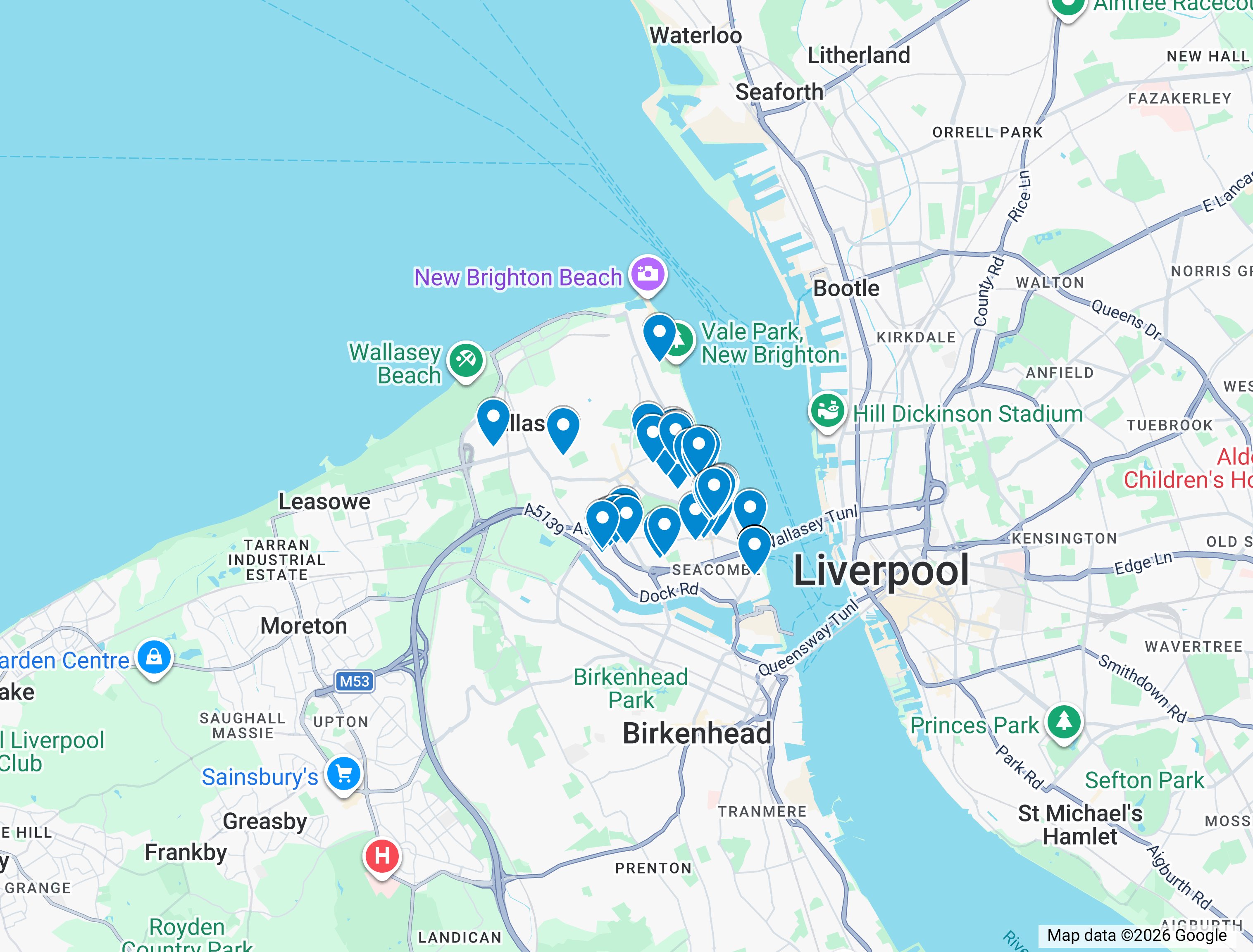
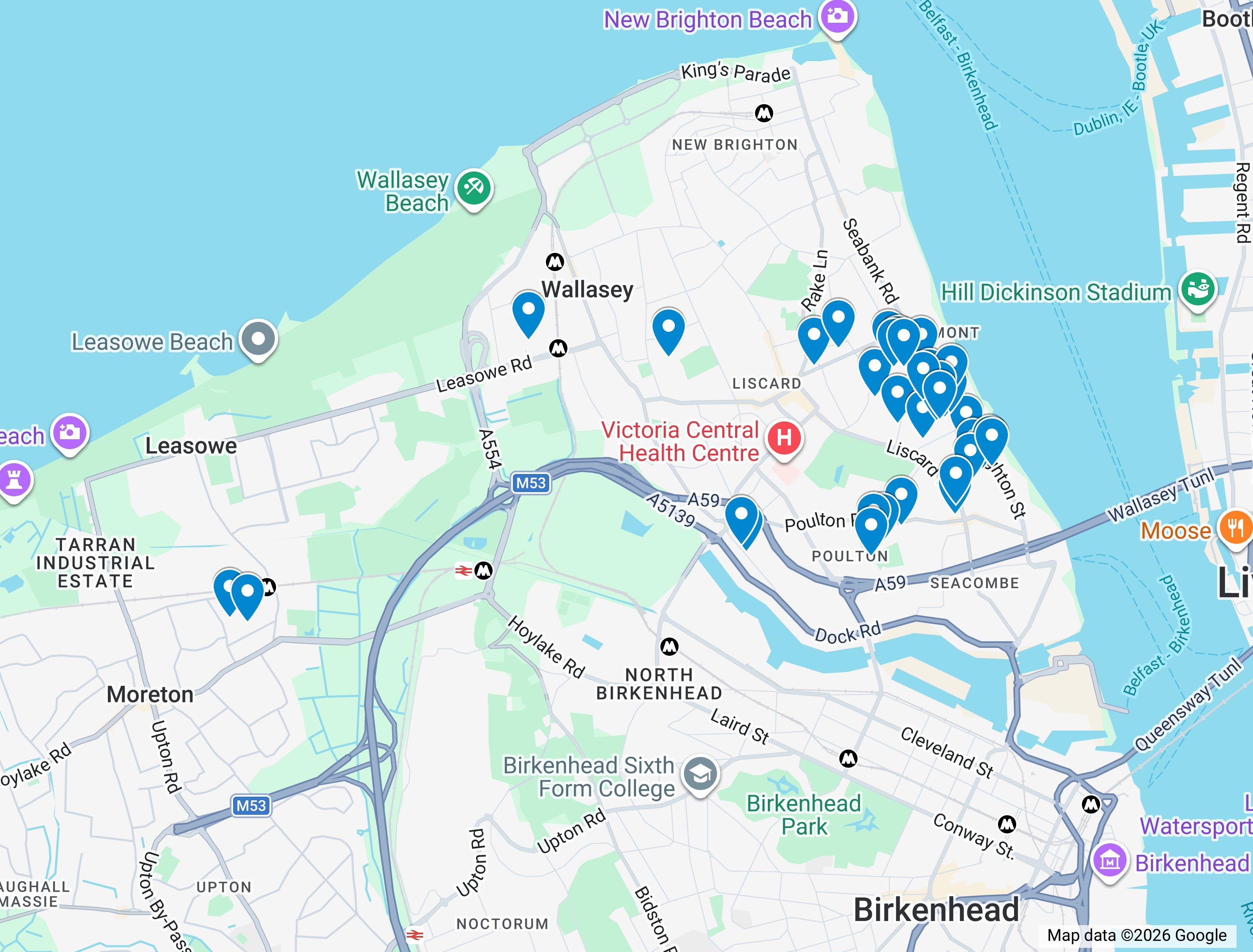
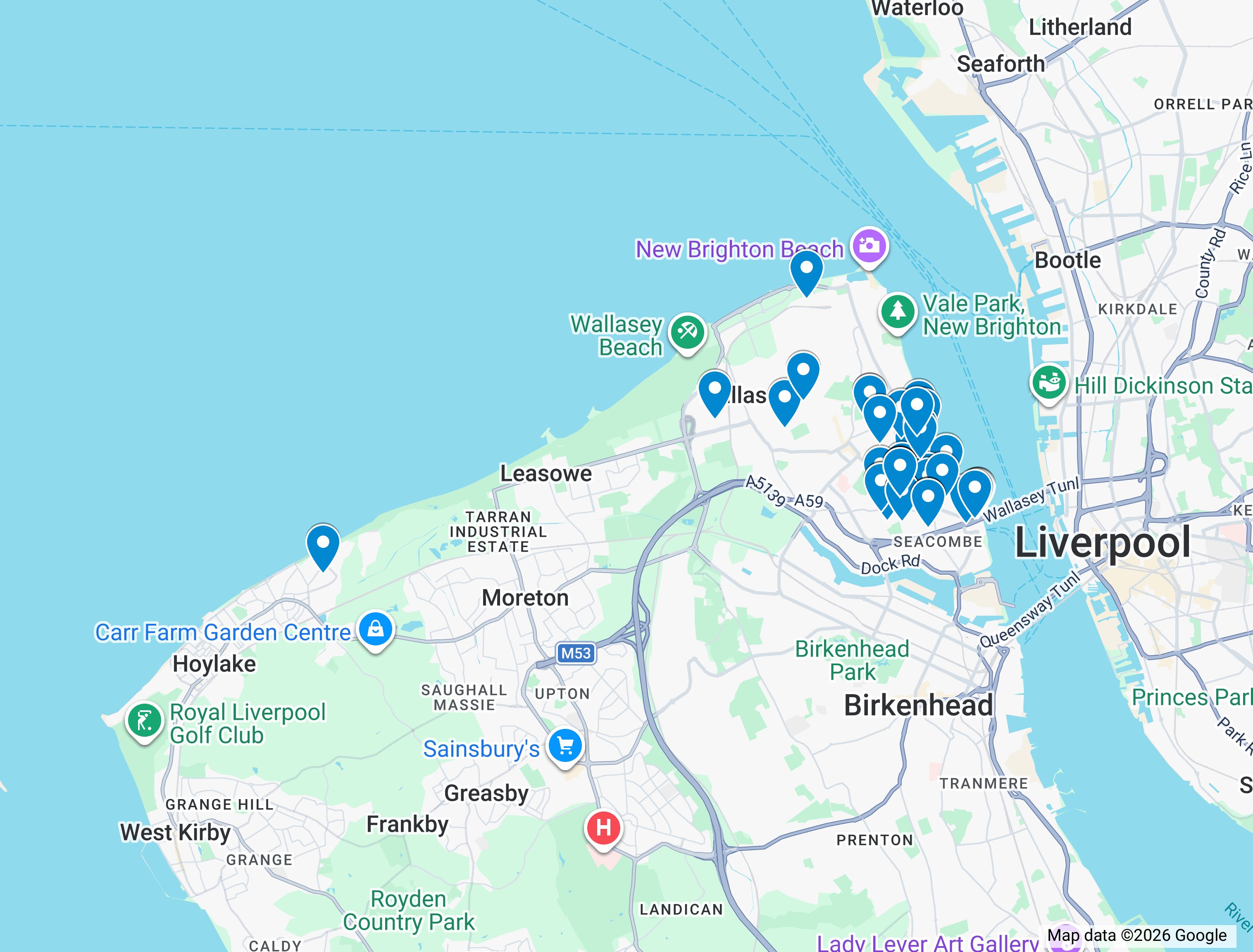
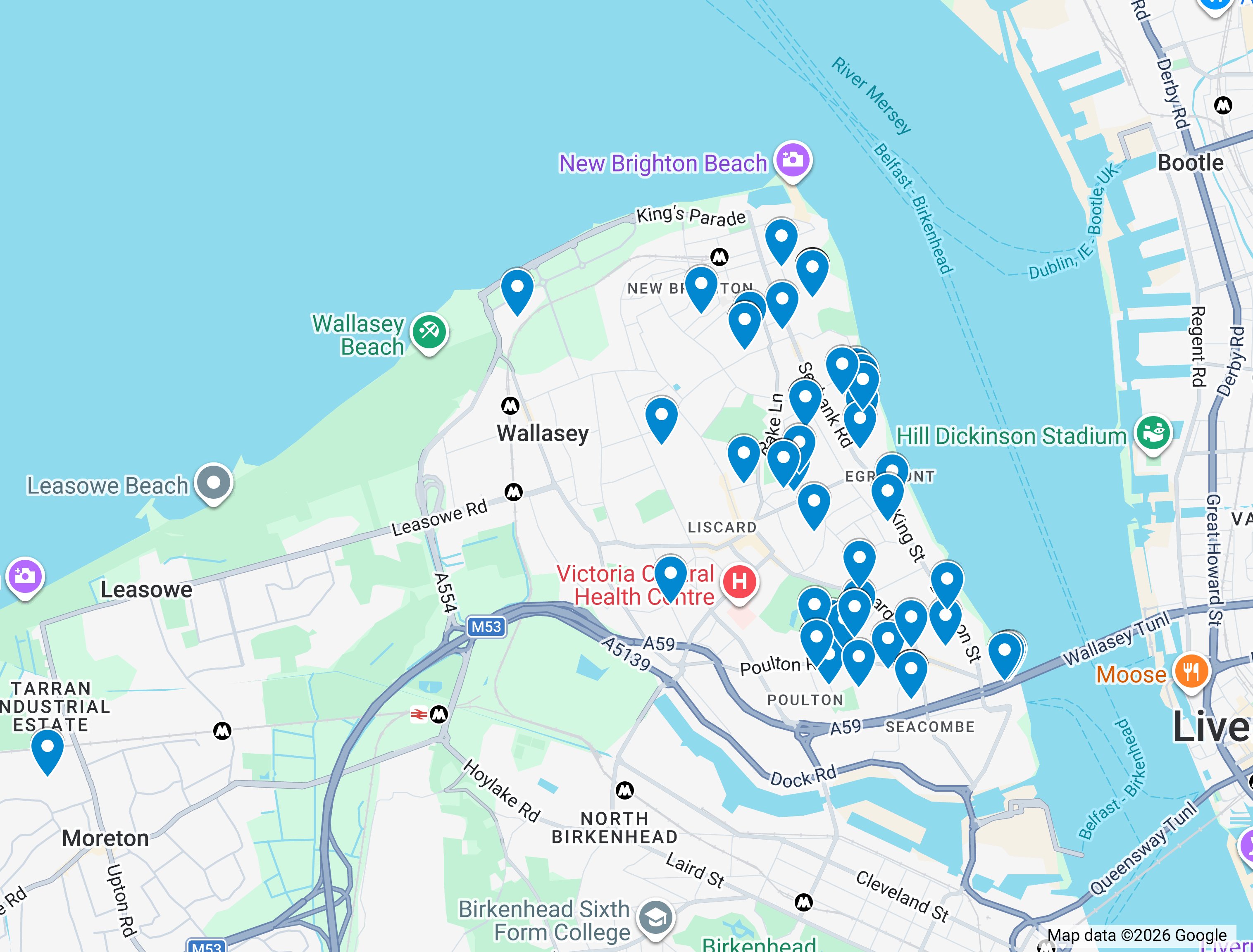
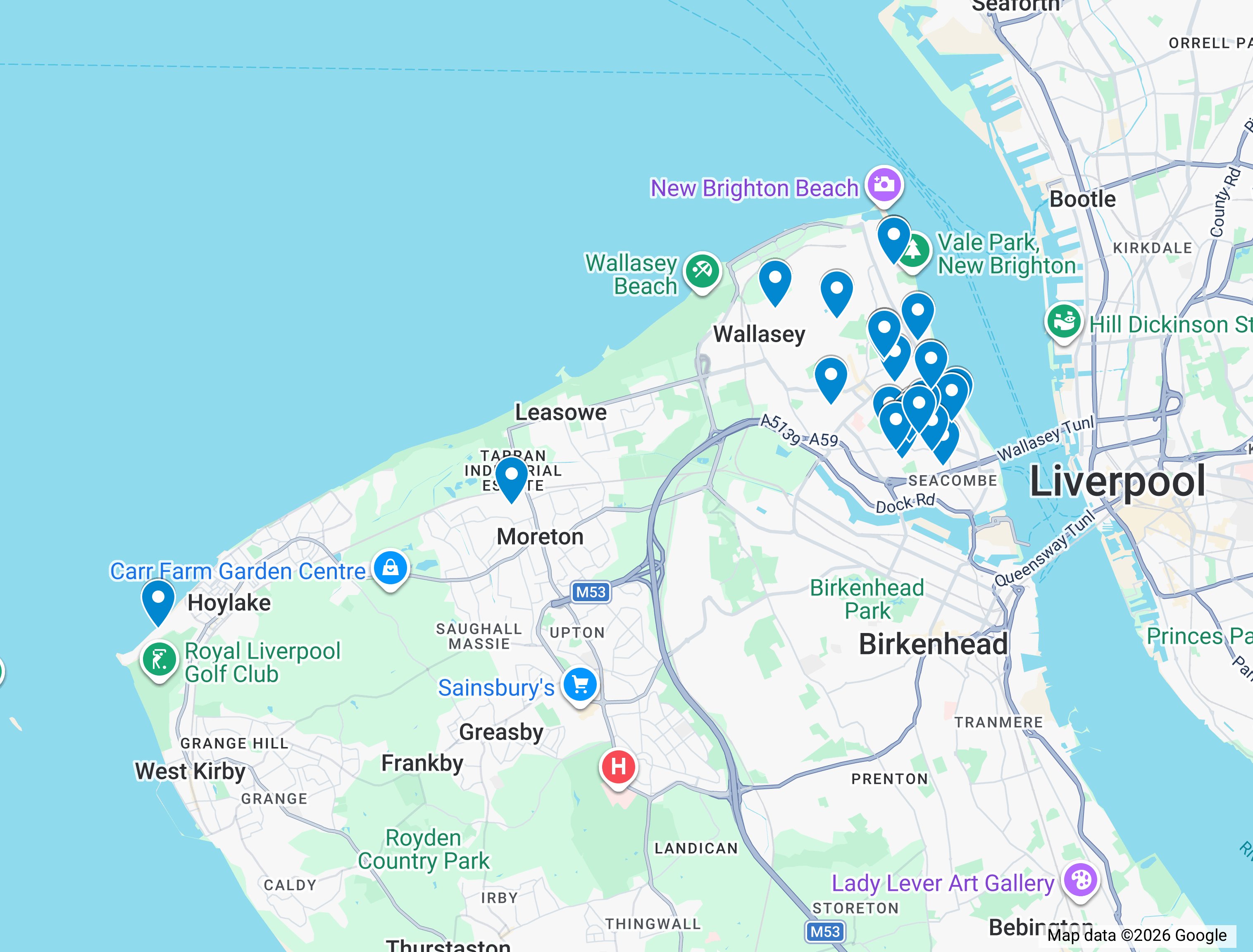
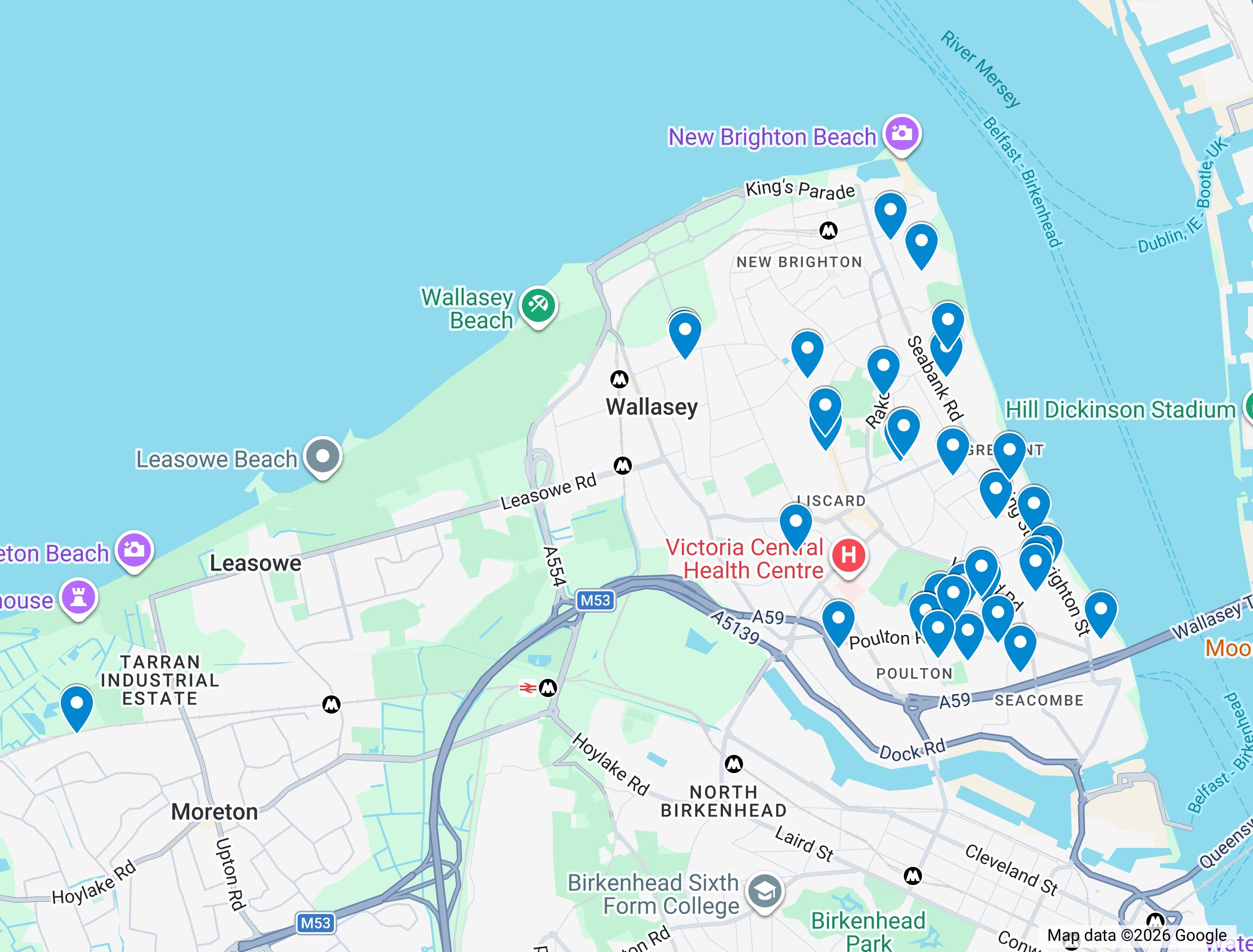
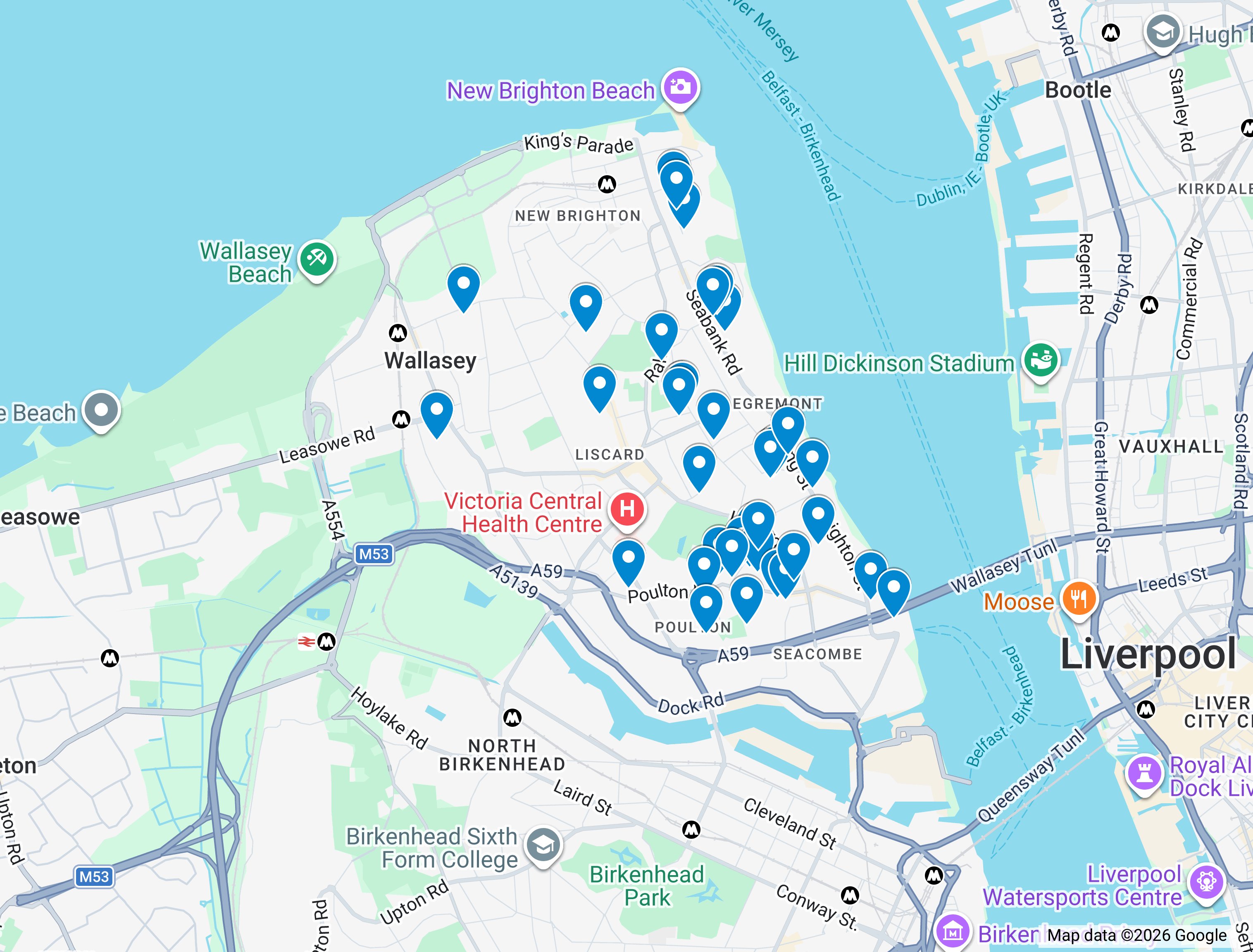
Below is a map of every home we visited, taught, or contacted that week, pulled from the Teaching Pool, Less Active list, Finding Pool, and Contacts recorded on the back of that week’s planner page.
Teaching appointments from 28 December 1998 to 3 January 1999
Teaching Pool
Karen Reeves & LeeAnn Reeves — 53 Limekiln
Reece Buck — 40 Greenwood
Pete Murray — 8/A Poulton
Less Active
June Oden — 25 Sedbergh Rd
Julie Patterson — Lancaster Ave
Finding Pool
Ean James — 21 Serpentine Rd
Sharon — 49 Oxford St
Olga & Vernon — 17C Rice Ln
Chris — 100 Woodland Dr
Louis Clarkson — 22 Sherlock Dr
Les — 38 Sherlock Ln
Malcolm Patterson — 20 Lancaster Ln
Ron Fugg — 8 Claughton Dr
Lee — Rice Ln
Mike — 61 Rice Ln
Mick — 14 Rice Ln
Contacts
Mohan — 7 Edisbury
Mr. Robbison — 13 Ivor
Jill — 24 Ivor
Sheila — 12 Ivor
Mr. Doulan — 12C Rice Ln
Carol — 2 Norwood
Dawn — 17 Sterling
Carl — 15 Kendal
Gwen Climo — 29 Priory
Chris & Daniel — Rycroft Rd
Tracy — 6 Beechcroft
Eric — 69A #3 Poulton Rd
Jon — 75 Rice Ln
Margaret — 8 Lynncroft
Dave — 6 York Ave
Helen — 35 Royston
Margaret — 26 Royston
(unnamed) — 10 Rice
Les — 9 Upper Rise
(unnamed) — 34 Rice
Mike & Tony — 11 Royston
Melissa — 3 Woodhall
Laura — 19 Bell Rd
Andrew — 27 Bell Rd
Yvonne — 35 Bell Rd
Bill & Sue — 67 Bell Rd
Kerwin — 94 Bell Rd
Jane — 84 Bell Rd
(unnamed) — 60 Bell Rd
Lisa — 15 Windham Rd
(unnamed, 9 addresses) — 48, 54, 58, 70, 72, 78, 82, 86, 90 East St
4 January 1999 – 10 January 1999
P-day, 4 January, we went to Birkenhead and did some shopping. I wrote: “We went to Birkenhead and shopping. I bought a suit jacket/coat. Double breasted with 4 buttons up the front. I like it. I felt bad pulling out 70 pound from home.”
I still have that jacket, and still wear it for special occasions.
That evening we taught Bobby a lesson. As I wrote: “We went and taught Bobby a lesson. We changed his baptism to the 17th of January.”
5 January, I wrote: “I was listening to Johann Liszt’s Die Forelle and was very moved. It is so beautiful.”
That afternoon: “This afternoon we saw a body being taken out of a home and put into a car in a body bag. So moving. Haunting, yet joyful; painful, yet wonderful. Death is the last great adventure. So much lies beyond. I wish I new a farthing of what lay beyond. To grasp a microscopic portion would be an achievement.”
Also that day: “We taught a gypsy today. If we treat it right he will come around.”
6 January, I wrote: “We went out and I got to drive to West Kirby. My first experience driving here. It was quite different. I did well. I drive better than Elder Harris.”
That evening: “We had tea at Counsels or the Bishop’s. They told me of all the great experiences in Rhodes, Athens, Greece, Tunsia, and in the Sahara. I wish to travel these places. I hope to learn so much.”
8 January, I wrote: “We went out to tea at the Hankins. It is such an honor to eat there. …Such love, respect, and honor towards the missionaries.”
9 January, I wrote: “Oh, we went and taught Bobbie the 4th discussion. We skipped the 3rd because Elder Harris felt it needed to be covered. The chastity part was mine and was not fun. He wouldn’t talk about it. We are going to talk about it where no one is around tomorrow. I hope he will live it, or get married.”
That same day: “We went and taught grandma after. …She is a miracle. Mrs. Walker is her name. She is mostly blind and mostly deaf but in really good shape for 93. At one point we read to her 2 Nephi 31. She will read it some more. At one point, I commented and was bearing my testimony to her, she stopped me and commented, I mistook you for Jesus. You are His messenger. I shed tears right then. She doesn’t feel baptism is right yet but she will through prayer. Her love is so great. She is so close to the Lord. She says she feels so close. She says the Book of Mormon has brought her closer to the throne. It has. I am so filled with joy. I love her. Absolutely astounding. …We suggested we get her a big huge print book, she thought we were going to take away the one she has till we got the other. The pain and fear she expressed through her looks wanted me to give her a 100 more.”
That evening: “We went to tea at Jackie’s again. Really good chicken curry.”
10 January, I wrote: “Church was great. I think that all the talks spoke directly to Bobbie. They talked on food storage and other important stuff. The hymns was better today. I felt the Spirit strongly today. We went to gospel principles after. I taught half the lesson with Gayna on keeping the Sabbath Day Holy. It was great. The church is so true. Bobbie, Elder Mueller, + I went to another room and discussed the law of chastity and other concerns he had. I said some stuff that I didn’t know where I was going. When I wrapped it up it made complete sense and I learned so much about baptism. Pure intelligence right then. I had no idea where I was going with the conversation, it turned out, I said exactly what he needed to hear. WE said a closing prayer and Bobbie + I shed tears.”
That evening: “We went to tea at Jackie’s.”
Also that day: “We gave a blessing on Elizabeth MacKinnon. She is ill.”
Below is a map of every home we visited, taught, or contacted that week, pulled from the Teaching Pool, Less Active list, Finding Pool, and Contacts recorded on the back of that week’s planner page.
Teaching appointments from 4 January 1999 to 10 January 1999
Teaching Pool
Bobbie Topham — 9 Royston
Mike — 35 Manor Rd
Karen Reeves & LeeAnn Reeves — 53 Limekiln
Rhys Buck — 40 Greenwood
Chris — 5a Rycroft
Danielle — St Rycroft
Robert — 4 Stourton St
Less Active
Joe — 23 Trafalgar
June Oden — 25 Sedbergh
Julie — (no address)
Finding Pool
Janet Jones — 22 Bell Rd
Sue — 1 Bell Rd
Tracy & Andrew — 23 Falkland Rd
Tony — 40 Buchanan Rd
Lee — 59 Rice Ln
Malcolm Patterson — 20 Lancaster Ln
Shanon — 49 Oxford St
Ean James — 21 Serpentine Rd
Mr. Addict — 36 Water St
Lisa — 15 Windham Rd
Skip — 28 Water St
Cliff — 44 Union St
Gene Lockley — 24F Union St
Jeff — 22 Union St
Steve — 4b Union St
Andy — 44 Eastcroft
Contacts
Paul & Tom — 4 Bell Rd
Paula — 65 Bell Rd
Vicki — 1 Bell Rd
John — 57 King St
Lizzie — 7 Ilchester Rd
Joe — 3 Ilchester Rd
Kathy — 28 Ilchester Rd
Melissa — 3 Woodhall Ave
Helen — 35 Royston Ave
Margaret — 8 Lynncroft
John — 75 Rice Ln
Jill — 24 Ivor
Sheila — 12 Ivor
Larry — 37 Limekiln
Shirley — 36 Union St
Betty — 34 Exeter Rd
Jill — Yew Tree Rd
Sam — 34 Saxon Rd
Stacey — 79 Robinson/Robbins St
11 January 1999 – 19 January 1999
12 January, I wrote: “Mail always makes my day.”
That same day, Carol and Tanya McKee, came up in conversation assisting the missionaries in many ways. Elder Harris and I went and helped Bobbie that day. I wrote: “Elder Harris + I went and helped Bobbie with troubles. Satan is working so hard on him. We taught him a 6th too. We will teach him the 5th later. Elder Harris said I will probably get to baptize him. Wow, what an honor.”
While tracting that same day: “We were walking down the street when I had a thought to go visit this one house. We went and she listened, took the Book of Mormon, and agreed to have us back. She is Jew too.”
That evening: “We had tea at the Counsell’s. It was good. We had a good productive conversation over dinner. It was really good cornbeef hash. He showed me Gospelink, it was on the computer. Looked interesting, I wanted to dig through it.”
Also that day, we visited Grandma Walker again. As I wrote: “Oh, we visited grandma today. She won’t be baptized because of what it would do to her family. She prayed and cried all night. She admitted she knew the church is true. If she continues to read the Book of Mormon, she will find that she and them will be blessed. I hope I get to see her enter the waters. It is just a matter of time now I believe. I don’t know but pretty sure.”
I have tried to hunt down and locate Grandma Walker’s first name and other information. No luck so far. 93 in 1999, born about 1903. Lived at 5 Stanford Avenue, New Brighton, Wallasey CH45 5AP. But without her first name or her husband’s name, I think I am at a dead end.
1999 – Elders Harris and Ross on Seacombe Promenade, Liverpool in background
14 January, I wrote: “Today had to be one of the longest days. So cold I haven’t felt my feet since 10:00 this morning. My eye is killing me. Swollen and every time I blink it hurts.”
Also that day: “I was so upset with Bobbie for having a cigarette. That is not me. Today the refiner fire has been hard to endure.”
15 January, I wrote: “At the mission office they sent me GQing with Elder Simion and Elder Wretham.” I would later serve with Elder Simion, in Wigan. I had to go to the mission office due to an eye infection. I had been sick for a while. As I continued: “We had a great time out even though we came back soaked. We were out for 2 hours in the rain. We come back and we ate. Dr. Turnbull saw me too. He looked at my eye and back. Eye is okay, just swollen from whatever was in it.”
14 January 1999 – Liverpool from Seacombe Promenade
Also that day: “We went to Bobbie’s and had his bishop’s interview and talk. The Spirit was so strong. We had pictures and first a great conversation.”
16 January, I wrote: “I am so excited for Bobby. I set him straight on prayer, no excuses for smoking or drugs after baptism, and so he must repent. I tried to set him straight on everything. Now, I can baptism him, now he cannot plead I haven’t done my job, I taught him. He accepted it all really well too. There is alot of good stuff going on too.”
Also that day: “We got our dinner cancelled yesterday so we got KFC. I got chicken strips. We come back here and some lady ragged out Elder Harris for parking in the way of the sidewalk. She asked him if he was just going to stand there looking stupid. His response was just that. He looked around, looked stupid, looked at her and said, ‘I am not looking stupid.’ I laughed and the lady walked on mad.”
At 9:00 that morning, District Development Meeting. As I wrote: “Now Birkenhead is doing great. They have 5 baptisms this Sunday.”
17 January, I wrote: “Elder Johnson and I went all over and absolutely no one was home. …We got back here at the flat at 12:30. We went with Elder Lewis to Bobbie’s house in Oxton. He wasn’t there. I called him and rescheduled for 7:00. We went to this family in Birkenhead and had a good conversation. They fed us some and then we had interviews in Pensley. The 5 they are going to baptize tomorrow. It took forever to interview them all.” I have no recollection or clue to who Elder Johnson is or why I was on exchanges with him.
That evening: “Elder Mueller and I ate at the Billington’s.” This was Lawrence “Lol” Billington (1928–2000) and Sheila Maureen Billington, née Connolly (1936–2020), both of Wallasey.
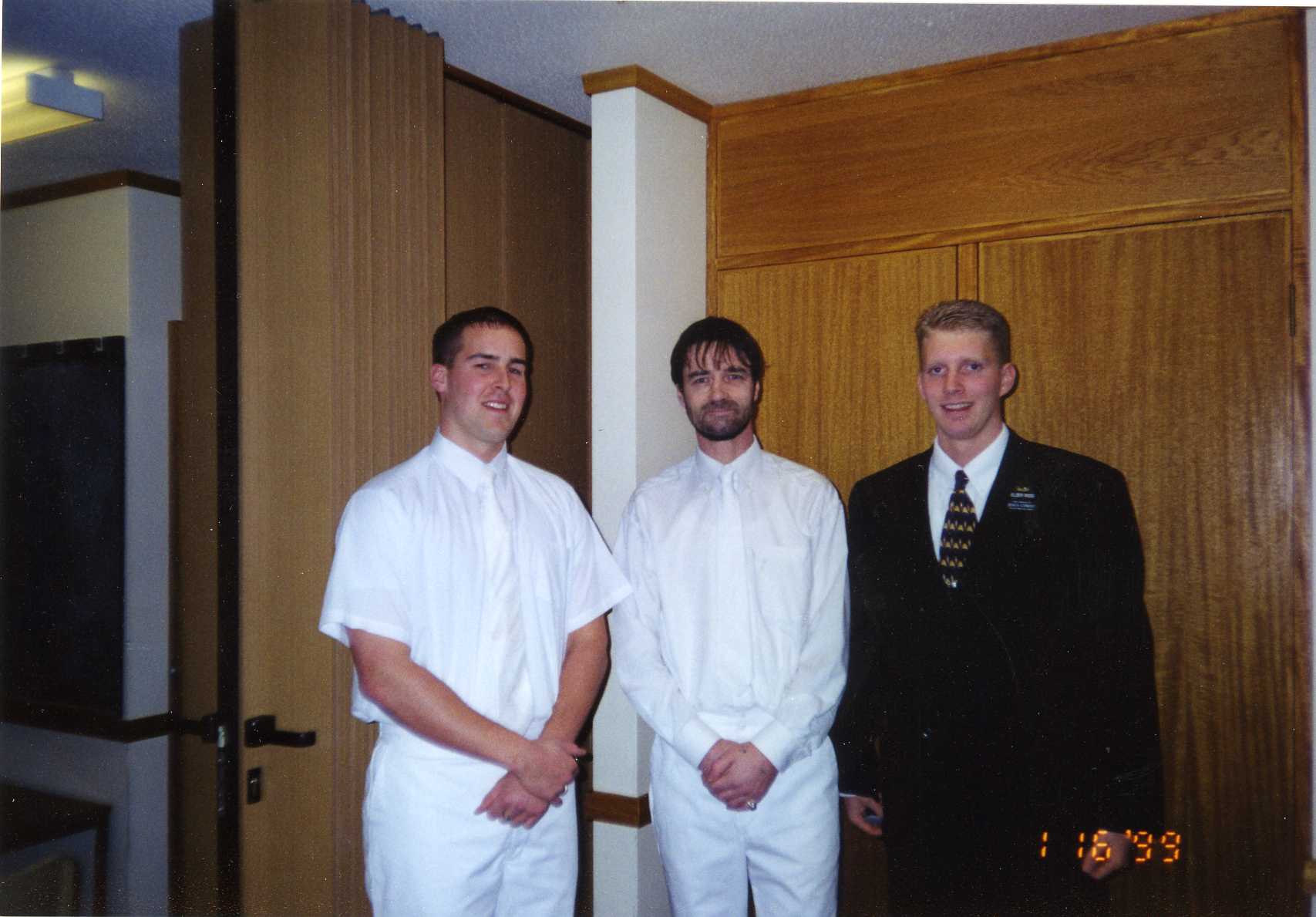
16 January 1999 – Bishop Grant Counsell, Robert “Bobby” Topham, Elder Ross
Sitting in sacrament meeting that same day, I wrote: “I am sitting in sacrament meeting here in the Moreton ward. They just finished talking on family history. I don’t think I have ever realized how important it really is. There is so much I have wanted to do. But that is one of the other things that will have to stay on hold till I return home. It is so exciting to do missionary work for the live, after my mission, I will get to do missionary work for the dead. Brother Cliff Roberts is a wonderful man. He gave the talk on family history. Many people joke that he is one of the three Nephites. I don’t think so, but I want to talk to him to make sure. Either way, there is a lot I can learn from him.”
I understand Cliff Roberts passed away from cancer a few years ago.
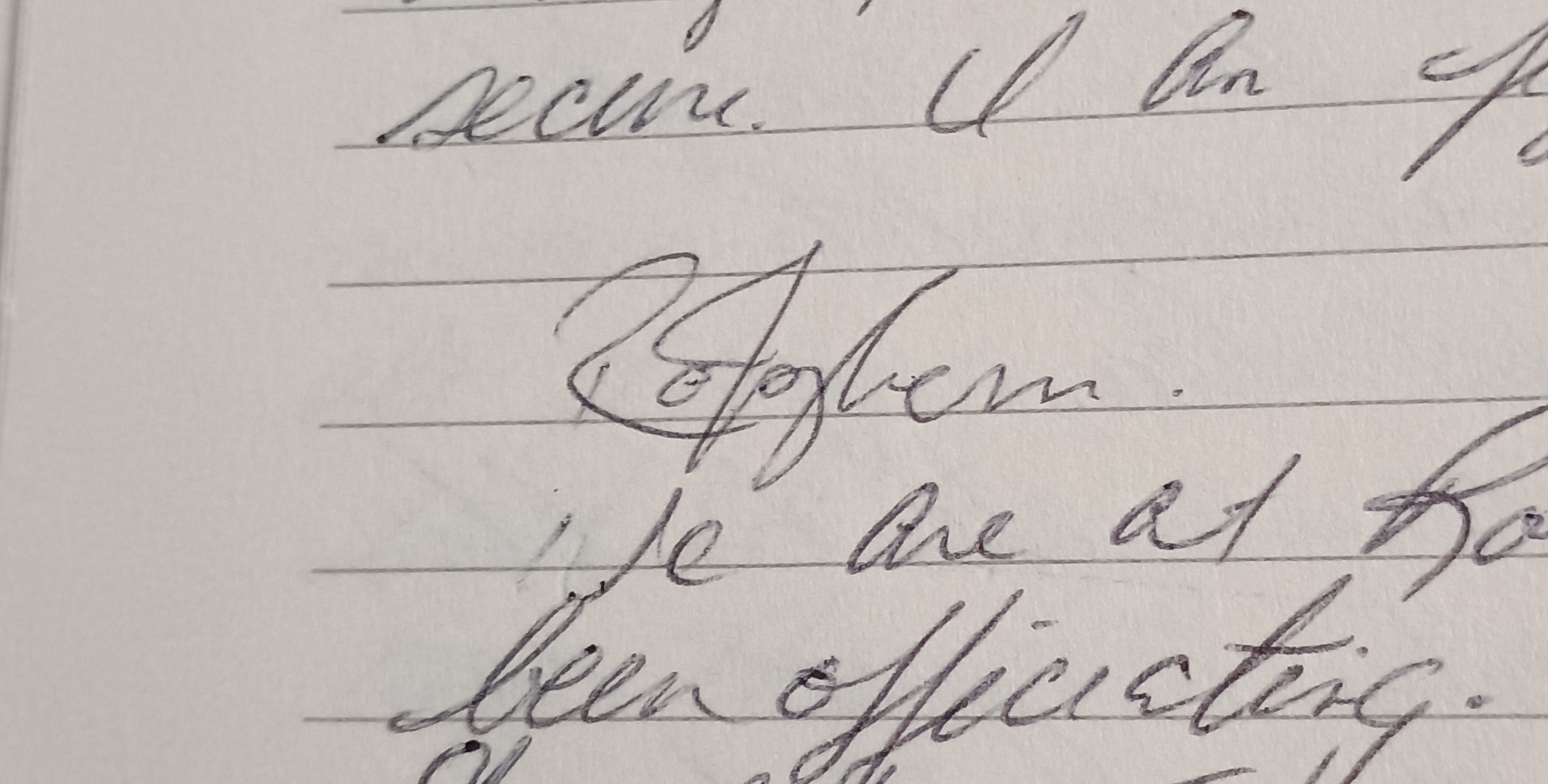
Also that day, at Bobby’s own baptism: “We are at Robert Topham’s baptism. Roy McKee has been officiating. Roy gave a great talk on Baptism. His daughter Tonya McKee gave a great talk on the Holy Ghost.” “Kathy Dunford gave the opening prayer.” “I now have a firm testimony of baptism. Not that I didn’t, it is just reaffirmed.” “Robert signed the other page. That is his signature. Bishop is talking on following the commandments. He is talking on how we need to endure.”
16 January 1999 – Baptism of Robert “Bobby” Topham with Elders Harris and Ross
18 January, morning, I wrote: “Elder Llewelyn and I walked to the McKee’s. Not Roy but his uncle. We had a great conversation. Very spiritually uplifting. I look forward to more.”
Robert “Bobbie” Topham’s signature in my journal
19 January 1999 – 25 January 1999
20 January, 6:10 AM, I wrote: “We met this other guy named mike. He was one of the first surfers in Great Britain. A great guy. That was during the late 60’s. He still travels to Australia every couple of years. Never surfed California or Hawaii. Great guy but he doesn’t believe in God at all.”
Also that day, tea with Roy and Carol McKee: “We went to tea at the McKee’s. She is a really good cook. We played piano some and some snooker. We ate a good dinner and had a good conversation.”
Also that day: “Even though another lady answered the door in the nude, we went back because she said we could. We taught her the first. I forgot her first name. I think she will accept the gospel.”
And: “We went and talked to Bobbie and we caught him smoke a cigarette. We talked to him and about smoking. He says he is trying. He needs to do.”
At 10:06 PM that same day, I wrote: “We got fish and chips for lunch. I got back and had 11 letters in the post. Yes, ELEVEN LETTERS. Can you imagine my joy. It took over an hour to read all of them. The fish and chips was great too. We had tea at Counsell’s. It was homemade pizza. It was really good. WE had a really good time. Oh last night we gave Isabell MacKinnon a blessing. I got to give it to her. It was exciting. I love this church.”
22 January, 6:11 AM, I wrote: “We went with Elder Knight + Llewelyn to see grandma. We gave her the 4th discussion. She is really torn between her family and joining. I hope her family will soften their hearts and tell her it would be okay to join. We don’t know how much time she has. It is so sad. She says her family is really upset with her. We taught a 1st to Bobby’s son, Steve. I hope his mother and him will come to embrace it. It will keep Bobby on his toes too. We had fish and chips for dinner because we didn’t have a tea scheduled. I went out with Victor Wise to do home teaching. We went from down by the church on Norwood Road to New Brighton on Wellington Road. And clear back. That was a long walk and Vic walks fast. He even keeps me on my toes. I talked to his wife and him for a while. Neither the people we went to visit were home. How sad. We have to try again.”
Victor Charles Wise (1923–2004) married Brenda Tingle (22 February 1933, Sheffield – 22 December 1999, Upton, Cheshire) on 9 December 1977; both have since passed.
23 January, 8:45 AM, I wrote: “One thing, grandma is having such a hard time choosing between family and faith. We had dinner at the Pitts. The bishop’s father-in-law died, another member of our ward. Hopefully it gets better for this ward.”
“Elder Knight + Elder Llewelyn are leaving us. It will become a 4 more flat. Elder L to Liverpool Elder Knight to Leland up by the temple.”
“Oh, the joy of giving truth.”
24 January, 6:10 AM, I wrote: “I cannot believe I have been in England a month already.”
“We went to do a street meeting after DDM. I thought it was quite unsuccessful. Everyone went to Burger King after. It felt good to eat a decent burger, but it wasn’t my way, right away. We don’t get options of what we get on the burger. Basically you get the burger or you don’t, that is the only options.”
“We went to Leasowe and nothing happened. We didn’t teach anyone and it went slow. We met at Jackie’s for tea but Elder Llewelyn + I were told to go to the Ryan’s. We went. It was a nice huge house. Dinner was great. We got on this joke that Sister Ryan is a translated being and she started Sara Lee and owned Standard Oil, Ford, and a ton of other things like that. It was such a blast.” This was Liz and Mike Ryan.
24 January, 2:12 PM, I wrote: “We are at Irene Jame’s baptism. We just sang hymn #300, Families Can Be Together Forever. I get to be the chorister, and Roy McKee is officiating. His daughter, Tonya McKee is the organist. Emma Hall is giving the 1st talk. It is on baptism. Baptism is such an important step. Gayna now, probably on Holy Ghost.”
Mary Irene Thomas (12 April 1930, Wallasey – 21 June 2014, Birkenhead) married Harry James (1923–1987) in March 1956, Wallasey.
“Now John McKee, Roy’s uncle. This should be good. I remember how he told me about the giardian angel at the foot of his bed in the hospital. We were told a story on how when a guardian angel wants you to know he is there he will leave a white feather.”
John Huddleston McKee (1928 in Liverpool to 2025 in Wallasey).
Writing early on the 26th about Sunday night, I recorded: “Sunday night we went to tea after the baptism and they had Elder Llewelyn and I walk back again. We walked all the way from Morton through Leasowe and to Wallasey. We stopped at John and Audry McKee. Elder Llewelyn and I had a really good conversation. We discussed Doctrine + Covenants section 4 verse 6. …John and Audry McKee are like my adopted grandparents. They are so wonderful. They gave us a ride to Irene James, the newly baptized lady. We talked there for quite a while and went over to Gayna’s. We talked for a while and ended up running all the way back to the flat. We got in at 10 seconds after 9:30. We were late.”
Monday, 25 January (P-day), I wrote: “We come back and changed and headed to Liverpool. I love Liverpool. It was all so big and beautiful. Huge but grand buildings. These buildings have class. It seemed like another country. The styles they wear and the music. The stores are so much different. We went to Pizza Hut and had the buffet. It was all you could eat. I love Pizza Hut. The pizza was better here than in America. The crust was so soft, greasy, and yet with that crunch. Elder Llewelyn and Elder Knight transferred away. …We walked through Liverpool town center and went to the car and come back to Wallasey. The Kingsman Tunnel is cool too.”
Below is a map of every home we visited, taught, or contacted that week, pulled from the Teaching Pool, Less Active list, Finding Pool, and Contacts recorded on the back of that week’s planner page.
Teaching appointments from 19 January 1999 to 25 January 1999
Teaching Pool
Bobby Topham — 8 Royston
Colin & Tracy — 28 Water
Sandra Corbert — 166 King
Less Active
Joe — 73 Trafalgar
June — 25 Sedbergh
Paul — 98 King
Mike — 1 Fell
Julie — 20 Lancaster
Ann Shane — 10 Tudor Ave
Brenda Reynolds — (no address)
Finding Pool
Chevon — 61 Hampstead
David Evans — 7 Annesley
Lisa — 15 Windham Rd
Stan & Helen — 42 Hampstead
Malcolm — 20 Lancaster
Andy — 44 Eastcroft
Veronica — 60 Harvest
Contacts
Emma — 7 Hampstead
Lynn — 1 Hampstead
Caroline — 27 Annesley
Jan — 53 Annesley
Sue — 1 Bell Rd
Kathy — 28 Ilchester
Joe — 3 Ilchester
Helen — 35 Royston
Maz — 15 Knowsley
Sue — 54 Albemarle Rd
Shirley — 36 Union
Jon — 17 Summit
Conesta — 35 Greencroft
Linda — 69 Rycroft
Sharon — 71 Rycroft
Margaret Quinn — 47 Rycroft
Anita — 35 Rycroft
Olwin — 46 Hampstead
Tim — 54 Hampstead
Chris Walsh — 62 Hampstead
Chris — 66 Hampstead
Gordan — 33 Greencroft
Wendy — 8 Tudor
Alan — 14 Tudor
Lawrence — 22 Tudor
Paula — 8 Lucerne
Teresa — 49 Lucerne
Mr. Partridge — 16 Centurion Close
Joyce — 11 Lucerne
Shelly Thomas — 20 Rudgrave Square
Enid Hill — 50 Wellington
26 January 1999 – 1 February 1999
27 January I wrote: “I am so tired. I hope one of these days I get over this feeling. We went to Birkenhead for service. We went to the chapel up there and the sisters made us breakfast. It was not good at all. We put all our plans together for flight 401. It will be the 4th discussion acted out by 12 missionaries. I get to be the missionary on the plan who tries to convert the high jackers. I spelled that wrong. They blow up the plane and they take the people through all the different glories and stuff like that. I get to play all the time on the piano in the chapel or celestial room. Missionary straight to celestial. That is cool, they didn’t mean to do that. We came back here and changed. I forgot my coat at Birkenhead so I don’t get any money till I get it back. Also, my letter home is sitting in the pocket. I might not get it back till Fri, Sat, or Sun. All those at home are going to have quite the wait. Unless the Birkenhead Elders took the coat with them and if they did, Elder Harris will have them mail my letter.”
1999 – Riding train to Birkenhead
Also that day: “We went out proselyting after in Elder Knight’s area. I like New Brighton more than Wallasey. I hope we work that alot. It rained hard the whole time. The coat of Elder Lewis I borrowed wasn’t rainproof so I got drenched. Even the stuff in my bag got pretty wet. We come back and dried out.”
Later that day: “We went back out and met a ton of people. We had tea at the McKee’s again. It was a good dinner like usual. We found out Carol plays the guitar. Roy has an office to die for. That thing is loaded with just about everything. Tonya is quite into music too.”
Also that day: “We went to Irene James or Clinton’s nan and she asked me to confirm her. This will be my 3rd Confirmation, no baptisms. I mean performed by me.”
28 January, 9:57 PM, I wrote: “I have to admit, these past few days have been different. I have gotten so into the other things that I have not had time to write. The Spirit has taught me much over the past day. I look forward with great anticipation to the future. I have become much more calm and open through the Spirit. Love has increased as has humility and insight. I do hope that it continues. I can tell now even in my writing a unworrisom feeling and appreciative attitude. Flowing and loveing, oh, how great is our Lord. For I do know that he lives. It was testified to me more.”
Also that day: “We had tea at the Wise’s where we were given many referrals. Things continue to lok up. Elder Harris + I are being blessed for enduring and continuing in diligence.”
Later that evening: “Later we watched Ensign to the Nations with Bobby at Gayna’s. So very moving it was. The last 15 minutes of the show moved me to my very core. It was once again reaffirmed to me by the Spirit of the truthfulness of this gospel. If only I had the words to describe it.” “Faith in Every Footstep with all the temples and angelic voices singing rocked my very core. Bobby too felt that presence.”
“We (Elder Harris + I) left and headed to Chester. We stayed the night and I went on splits with Elder Dixon. We tracted quite a bit and only got two call backs. Something was wrong. Elder Dixon seemed so unsure of the work. I hope he can become strengthened.” This visit to Chester was just overnight, and we didn’t even go downtown.
“We had tea at John McKee’s. Oh how great it is to share time with such righteous people. It is so exhilarating to the soul. It is so moving to be around them. Now I call them my adopted grandparents.”
“We had the flight 747 tonight. We act out a plane crash and then take all the people through the separate kingdoms. It worked out really well.”
I cannot imagine doing a Flight 401/747 post 9/11…
30 January, 9:50 PM, I wrote: “Today has been a phenomenal day. I started reading my book that dad sent to me. It is called Drawing on the Powers of Heaven. Wonderful book. I will be glad when I can understand all of it and apply it.”
“At 9:00 we left for the funeral of James Jones. That is Bishop Counsell’s father-in-law. James’ wife Audry was the one I thought made a perfect grandma. The funeral was absolutely stunning. Singing and the Spirit was great. Bishop Counsell got up and talked on [James’] life. This man was a perfect example of Christ. I hope to be like this man someday, who was so much like Jesus. …Bishop told of how when they found out he had cancer, that before returning to bed, the asked either to take him so he wouldn’t have to suffer or to let him endure happily. He now rests in peace. The Spirit touched me phenomenally strong. I cried. They sang O my father, I was streaming. Tonya McKee sat in front of us. She was sobbing. I was so touched by the Spirit. There was the closing prayer and we all went to the crematorium. There was a little service where The Stake President spoke, and we said our good-byes. I knew not this man but he has touched my life.”
Also that day: “After I talked to Cliff Roberts, the one everyone things is a Nephite, he isn’t. He did reveal some fantastic and great knowledge to me that I have been looking forward to. He was a 2nd witness today. I told him how he quickened and excited my soul by how great of an example and by his righteousness. He thanked me. I hope he remembers I look up to him.”
“The high point was we taught Bridgette tonight. The lady with green hair. She is so in tune with the Spirit. She taught us most of the plan of salvation but she knew not that it was divine. We explained the light of Christ. She totally accepted it all and agreed but she is so use to having herself. She finds it hard to acknowledge her conscience as the gift given from God. She uses cards for answers and prayers. Interesting. She totally believes in Spirits. She communicates through them. Dangerous, a bad one could get in there. I think she will come around.”
“A poem given today: ‘Time is, Too slow for those who wait, Too swift for those who fear, Too long for those who grieve, Too short for those who rejoice, But for those who love, Time is Eternity!’ So true.” The poem is “Time Is” by Henry Van Dyke, from his 1904 collection Music and Other Poems, originally written as an inscription for a sundial in a friend’s garden, and later read at Princess Diana’s funeral in 1997. Van Dyke’s original last line was “Time is not,” though the “Time is Eternity” ending recorded here has become the more commonly quoted version.
“I had a memory of a dream this summer. The entire dream followed tonights sequence of events at tea. Everything down to the number of donuts and the cool little fry fork. The past, present, and future are all one in the Lord. All present.”
31 January, 10:34 AM, I wrote: “We are now in Sacrament Meeting. It has been a great meeting so far. We started singing hymn #60. I love that hymn. His truth is marching on and I am helping that it goes forth. I confirmed Irene Mary James. What an honor to bestow the gift of the Holy Ghost, not just the gift but thee Holy Ghost. It was great.” “There was a talk given on the windows of light. She commented on how Joseph Smith looked for the light and found it.”
Also in that meeting: “Jackie Laing tells her conversion story. She was…searching for the truth. She said nothing captivated [her]. The Born-again Christians she went towards. She joined with them. She found a member and went to church. She later had the discussions. It is true, she could find no fault. She had an experience with the Book of Mormon.” “She commented on the excitement of hearing an answer for a prayer or having a revelation or inspiration. Such excitement.”
“We are now in combined Relief Society and Priesthood. Roy McKee commented that if anything goes wrong, we weren’t prepared. That is so true. Nothing can go wrong if we are prepared. We should be prepared for anything. That is one of the reasons we work and learn from the past.” “Cliff Robert commented to me that price is any opposition to that which is good. The father of all lies, the author of blackness, or the pride. We are all equal, God is no respecter of persons. What a thought.”
“We went to Moe Jones’ after. There were talked with Lois and Moe. Lois might get baptized.”
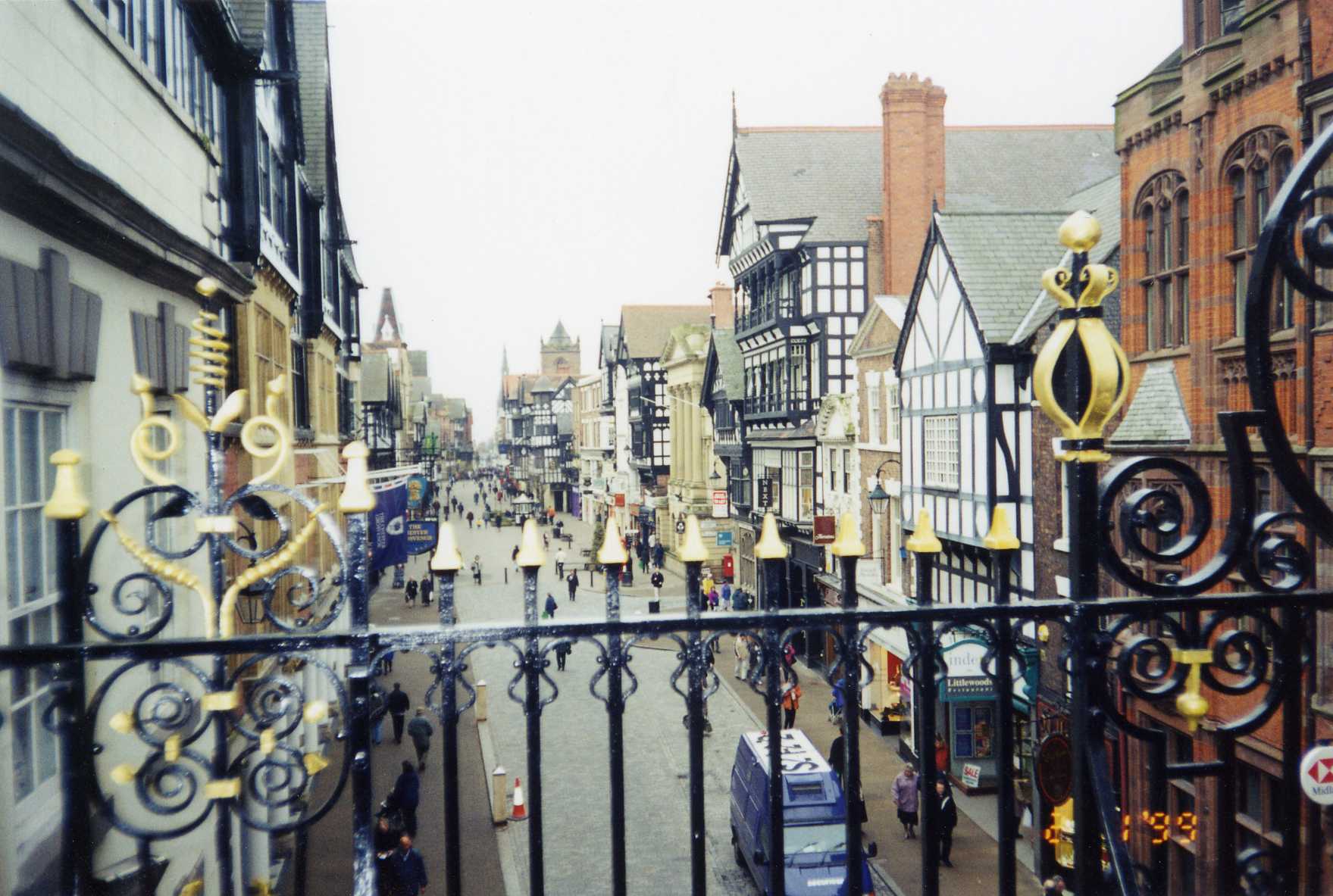
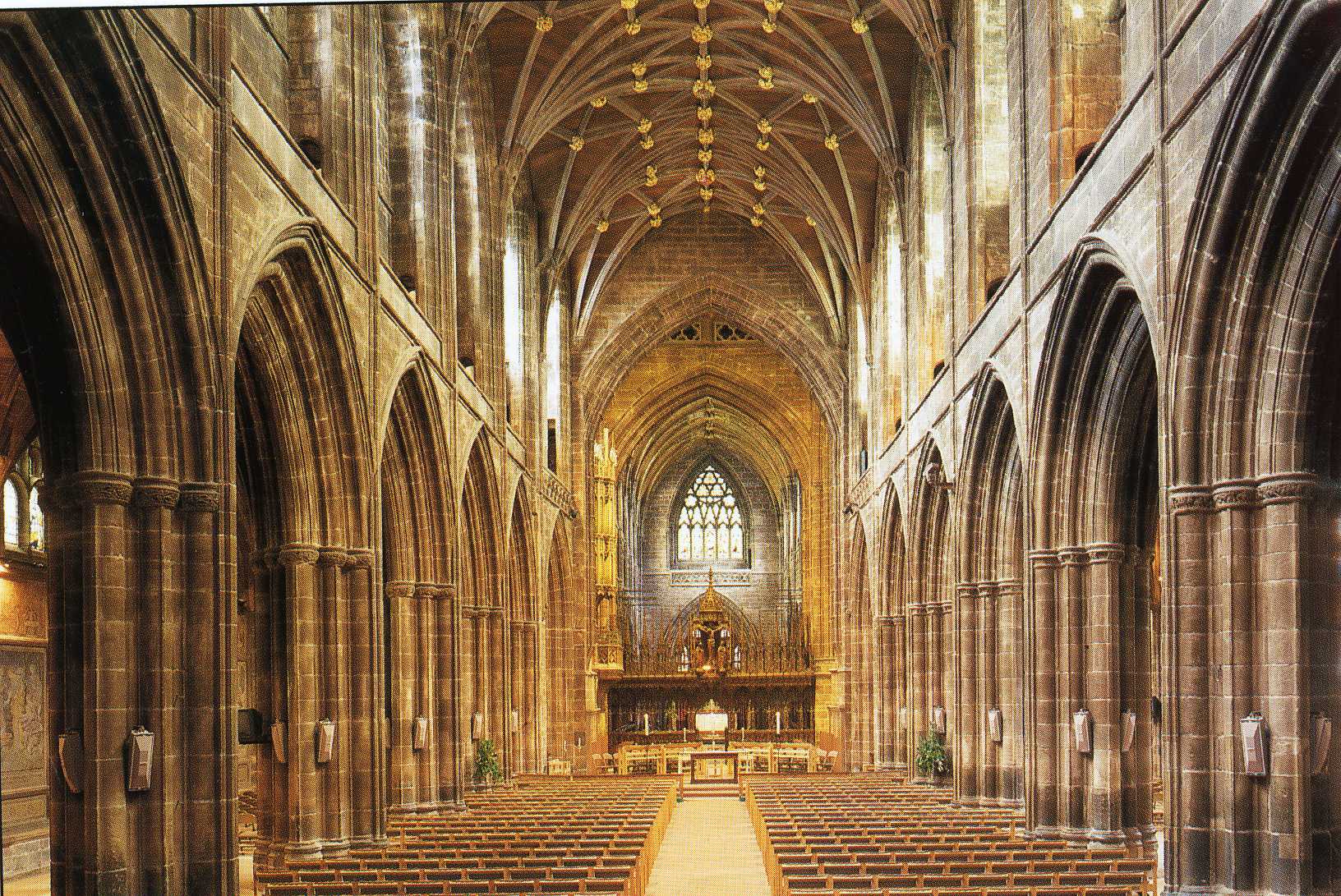
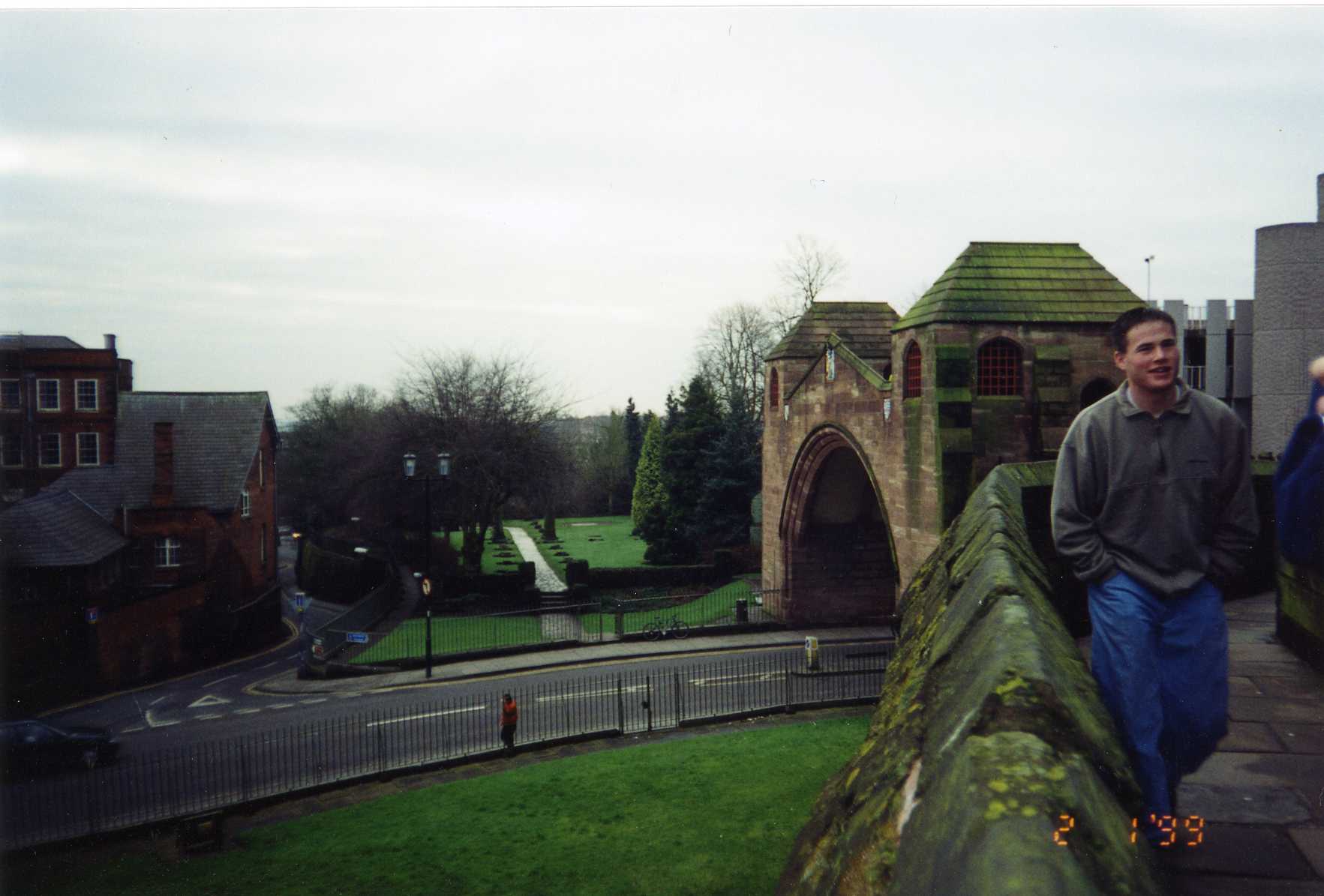
Written 2 February, relating to 1 February: “Yesterday was quite the interesting day. We went to Chester, walked the wall, pigged out at Pizza Hut, and came back. I got pictures and I wrote about it in the letter home.”
1 February 1999 – Chester Town Center from Wall
Scan of Chester Cathedral postcard
1 February 1999 – Falls on River Dee, Chester, Cheshire
1 February 1999 – Elder Mueller walking on Chester Wall
Below is a map of every home we visited, taught, or contacted that week, pulled from the Teaching Pool, Finding Pool, and Contacts recorded on the back of that week’s planner page. This week’s page had no separate Less Active section.
Teaching appointments from 26 January 1999 to 1 February 1999
Teaching Pool
Sandra Corbert — 166 King
Irene James — 6 York Ave
David Evans — 7 Annesley
Jamie — 5 Dalmorton
Joyce & Carol — 19 Caithness
Grandma Walker — 5 Stanford
Sandy & John — 5A Caithness
Debbie White — 35 Gorsehill
Finding Pool
Olive — 26 Lucring
Casgy — 42 Lucring
Veronica — 40 Harvest
Malcolm — 20 Lancaster
Stan & Helen — 42 Hampstead
Chevon — 61 Hampstead
Unis — 1A Dalmorton
Kevin Paul Shawn — 31 Dalmorton
Mrs. Williams — 34 Hereford
Jane & Fancie — 73 Dalmorton
Mike & Liz — 8 Imperial
Sue — 23 Imperial
Christine Walker — 14 Elgin
Sandra — 3 Grosvenor
Paul — 50 Radnor
Shic — 90 Liscard
Dennis — The Channel
Rhona — 12 Sutton
Joan — 5 Coronation
Andy — 44 Eastcroft
Roy — 78 Urmson
Pam — 81 Urmson
Ian — 4 Warwick
Contacts
Paul — 17 Dalmorton
Mrs. Kathrel — 25 Imperial
Mrs. Nuttal — 30 Elgin
Joe — 13 Denton
Ria — 5 Coronation
Mike — 13 Edinburgh
Terry McCormick — 13 Station
Daisy & Becky — 22 Beach
Sharon — 58 Lusging
Georgia — 51 Albemarle
Wendy — 8 Tudor
Alan — 14 Tudor
Lawrence — 22 Tudor
Gordon — 23 Greencroft
Kangsta — 35 Greencroft
Doug — 62 Lusging
Mrs. Williams — 35 (unclear)
John — 17 The Summit
Emma — 7 Hampstead
Jan — 53 Annesley
Sue — 1 Bell
Kathy — 28 Ilchester
Maz — 15 Knowsley
Conesta — 35 Greencroft
Margaret Quinn — 47 Rycroft
Chris Walsh — 62 Hampstead
Chris — 66 Hampstead
Paula — 8 Lucerne
Joyce — 11 Lucerne
Shelly Thomas — 20 Rudgrave
Angela — 25 Lancaster
Gordan — 75 Withers Ln
Mrs. Buely — 100 Urmson
Jackie — 77 Urmson
2 February 1999 – 9 February 1999
Written 3 February, about the night before: “Last night we had tea at the McKee’s again. It was a great dinner but afterwards, Carol, her mother, Elder Mueller, and I had a great conversation. I don’t remember all what about, but it was great.”
2 February 1999 – Elder Harris walking below promenade at New Brighton, Merseyside
Also that day: “We taught David Evans today. He is really intellectualizing all of it. I tried to explain it to him that way. The same was to Bridgette a couple of nights ago.”
Also that day: “Earlier today, we went to the Ryan’s. She took us to another house and wanted us to bless it. It has Poltergeists. Those are ghosts that move things. She showed us the rooms with the problems and when we walked in, it was so cold. I jumped when I walked in the room. Weird noises, weird feelings. I prayed, Elder Harris blessed it. I hope we did it right. We don’t have anything written on how we are supposed to do it. I felt better afterwards. Sister Ryan and the two of us talked for quite some time. We had tea at the Annals. It was a riot. It was absolutely great. They are a wonderful family.”
This was Mike and Liz Ryan.
Reading the letters I sent home to family, there is more detail there too. The first time we blessed the home, nothing happened. It went even more cold. Like they were staring at us. The second time we blessed the home, it was confrontational. Like they were staring us down and snickering at us. The last time we prayed again before we blessed the home. This time, everything was different. The light and warmth came back into the room and we were at peace. But after the second time, we were afraid and had to huddle in prayer before trying yet again. Very humbling.
4 February, I wrote: “I just realized that today is the day dad gets sealed to his parents in the Ogden Temple. A joyous day indeed. I believe that on the 7th Bud [Lloyd] gets the Priesthood. What joy and happiness have come into this family. I can say I had a small part in it. My joy will be full when mom comes around. We have all tasted such sorrow and bitter. Dad’s patriarchal states he will be sealed in the temple yet in this life.”
“My family, wife on down will be a eternal family. My children shall know the gospel and its divinity.”
“Bud and grandma will be sealed later this month or in March. Another outstanding year this will be. As was last, a year for the books.”
“President talked to me and gave some words and advice. He is most definitely a servant of the Lord. He told me that it is too bad we can’t put the head of a 40 year old on that of a 19 year old. But, we can’t so let them learn. Some are further than others.”
“He commented on the repentance process. We talked about rules, but a higher law. He commented on individuals not the law. The Lord cares on serving others, not keeping rules for self. Try to lead (live) the laws but put others first. He commented on sanctification and working towards perfection. Oh what joy. Righteous people invigorate and energize the soul. Follow the Spirit. It is so enlightening. You learn so much more on watching and seeing how it relates to the gospel. All things apply. Everything is of a spiritual sense. Such excitement in Christ.”
5 February, I wrote: “Yesterday was a phenomenal day for the Moreton Ward.”
“We had tea at the wises. It was good. Chips, pork, beans, with rhubarb crumble. We left the Wise’s and went to Jackie Brooks. There we all talked and had a really good time for a half hour. There were 8 people in the room, all of baptismal age. We Built Relationships of Trust and moved into the discussion. The Spirit was strong. Four of the Eight agreed to baptism and I believe all the other 4 will too. One of the 4 is Robert Topham’s son, Robbie Williams. I think he will come around. Alex, a friend of Cassie (one of Jackies) wants a book and I believe she will committ. Jackie didn’t say yes or no. The four committed are Jackie’s 4, Cassie, Rebecca, Gary, Mike. Jackie will if all four of her children do. Jackie’s friend Angela will too I believe and have faith in. Angela’s husband stole her book and is reading it. Angela has 5 children. I don’t know anything about Alex’s family, she could be the key there. Robbie + Robert could be the key to Robbie’s family. Robbie was amazed that it was Elder Harris and I that converted his father. It is a small world. Overall we are moving toward the goal…on the mission. This is a good start. All praise to God. What a privilege to be an instrument and in this work.”
Also that day: “We have been invited to teach at a mothers meeting at St. Joseph’s. If we can get the Spirit there and teach, this could swing a gate wide open. If one or two listen at the meeting today, it will be worth it. I hope so much we can see this to come to pass. I can hope so much that if this is a trap, we can still hold the honor and respect and catch them. All will go fine.”
“Oh, and a thing about Jackie Brooks. I had a ton of incidences there that I have seen before, de ja vous as they call it, but I can’t spell it. It is right we teach her. It is all so exciting. In my interview with President Stucki yesterday he commented, you watch the pennies and the dollars will take care of themselves. Take care of the details and there will be no problems.”
7 February, I wrote: “I have come to see that evil spirits exist so much more than ever expected. I am so grateful for the Priesthood and to be able to force them to leave but they must not return. What a blessing. The story of Elders in Barrow and having to cast out evil spirits. They did it wrong and they could hear all the laughter at them. Finally they got it right.”
“Sister Liz Ryan is great. The Ryan’s and I get along great.”
Writing on the 7th about the day before: “We taught the Brooks family and taught them a 3rd yesterday. We went bowling (10 pin) after. We had two games. I did horrible. Didn’t even break 100 either game. They are a great family. We had fun. We picked up the other Elders and went to tea at the Hankins. Elder Mueller and I ate there.”
“We taught Bridgett the rest of the 4th with Catchya. They refuse to live the law of chastity. We found out they are bi-sexual. We visited Fraziers and came home.”
7 February, I wrote: “Today I have to admit was a day full of new and exciting things. I awoke and read about 1/3 of 2 Nephi. Such exciting things in there. So much to be applied. It is definitely written for our day. Elder Mueller and I left. We walked Gayna, Irene, and Clinton all to church. It took a while but we arrived. The Moreton Ward had a full house today. It was good to see Jackie Brooks and all of her family there. It was fast and testimony meeting today. I got to bear my testimony. I love this church so much. I know it is true.”
“Gospel Principles was taught by Elder Mueller and I. It was great.”
“After was Priesthood… Mind maps. I never knew they existed… I use mind maps and associative reasoning all the time. Roy McKee is a genius. Oh, howe everything makes sense… Mind maps only work for the person who makes them.”
“Cliff Roberts constantly impresses me. He isn’t one of the Nephites but he might as well be. Priesthood was phenomenal. Robert Topham got the Aaronic Priesthood as a Priest. That was good too.”
“After, E Mueller and I walked Gayna and Clinton home. Gayna and I had a really good conversation.”
“E Mueller and I went to Clinton’s to offer his mom the Sacrament. She kicked out Clinton last Sunday. He has been living in a wayward home… We comforted her and went to tea.”
“We had a good tea at Jackie’s. We taught Jaime the 3rd. After we left and went to Gregory’s. We gave them the Sacrament. We were there about half an hour. After we went to the Wilson’s. We sat there and talked a while… Sister Wilson commented on Elder Mueller and my lesson. She said she really enjoyed it. I love the Spirit so much… Oh, Elizabeth Wilson has changed so much since I first got here. The gospel makes such a difference in peoples lives… We left there and went to Jones’. At Jones’ we had a good conversation with Moe and the family. Kelly is the one in love with Donny Osmond. She is a really good girl… After we came home.”
This entry also marks the end of Journal #5. Some closing quotes I’d recorded at the end of that journal:
“You can’t be brave if you’ve only had wonderful things happen to you.” — Mary Tyler Moore
“We are all in the gutter, but some of us are looking at the stars.” — Oscar Wilde (spoken by the character Lord Darlington, Act III of Lady Windermere’s Fan)
“Wisdom is knowing who you are. Once you know who you are, the rest just follows right after.” — Pam, in Saturday’s Warrior
“What you get in the Hereafter, depends on what you’re after here.”
“Keep your eye on the whole forest, not just the trees.”
9 February marks the first entry of Journal #6, which opens with a quote given to me by Tanya McKee:
“The gift of the Holy Ghost quickens all the intellectual faculties, increases, enlarges, expands, and purifies all the natural passions and affections, and adapts them, by the gift of wisdom, to their lawful use. It inspires, develops, cultivates, and matures all the fine-toned sympathies, joys, tastes, kindred feelings, and affections of our nature. It inspires virtue, kindness, goodness, tenderness, gentleness, and charity. It develops beauty of person, form and features. It tends to health, vigor, animation, and social feeling. It invigorates all the faculties of the physical and intellectual man. It strengthens and gives tone to the nerves. In short, it is, as it were, marrow to the bone, joy to the heart, light to the eyes, music to the ears, and life to the whole being.” — Parley P. Pratt, Key to the Science of Theology
I was very moved by it, kept it, and quoted from it the rest of my mission.
10 February, writing about Monday’s P-day, I recorded: “We went and played Squash for 2 hours that I loved. I played so hard my face went bright red. Now, every muscle in my body is sore. It was really good exercise. We played 2 on 2 which was an absolute riot. We went and got our groceries at ASDA and come home and showered – changed. We went to Birkenhead and looked around the market. It is just that, a ton of merchants have little shops up where you can by just about anything. We went and got fish and chips down by the bowling alley and promenade. We played some pool after too. My personal favorite is air hockey. We come back to the flat and I wrote my letters.”
“We got ready and Elder Harris and I went to Jackie Brooks. We talked for quite a while and and gave the 4th discussion. It went really well… But time went on and we got a story where Carrie had a dream a couple of months ago where she dreamed I had tried to kill her. Then they got out how they knew their were spirits in the house. One with dreams and visions that were not inspired of God. Another where Jackie’s ex-husband had a visitation and other stuff. Even Jackie didn’t think they were alone. Many people had also died in the home, all by heart attacks. I’ll bet it had to do with fright. One person hung themselves in the attic. Mike, the boy, has problems where he jumps up, does something, and returns to normal. He cut off his mother’s finger once, broke her toes, took a golf club to his sister, beats his head to a bloody pulp and sits down like nothing happened. Best of all, when asked why, he says, ‘God told him to.’ First thing that popped into my head was Moses 1:19. That is where Satan tries to deceive Moses and says he is God. I explained that verse and I was enveloped by a feeling of evil. I knew I was okay but what about them. I continued with the feeling that was so strong. I kept catching things out of the corner of my eye in the back room. I could tell something was there. We kept talking, I explained the blessing on the Ryans neighbors, I also explained on how baptism brought the Holy Ghost which would protect them from such events in the future. I kept catching glimpses of someone in the back room and when I would look, I couldn’t see them. We brought Bobbie to be there as a fellowshipper and because of his son Robbie who was there. We had to leave because we needed to get in. We left. I felt so sorry for that family because of experiences I had exactly like that when I was real young. Bobbie informed us right on the street before we parted. He told us of a gift he had to see Spirits. He told us there was someone back there. I wasn’t just imagining. That made missionary work so much more important to me. I have another mission, not only to convert, but to free from the bands of Satan’s army… I told [Elder Harris], ‘if we are real, so are they.’”
I have more I can share regarding this story. It is still vivid in my mind all these years later.
Below is a map of every home we visited, taught, or contacted that week, pulled from the Teaching Pool, Less Active list, Finding Pool, and Contacts recorded on the back of that week’s planner page.
Teaching appointments from 2 February 1999 to 8 February 1999
Teaching Pool
David Evans — 7 Annesley
Malcolm Patterson — 20 Lancaster
Jamie Laing — 102 Anlew
Less Active
Sheryl — 2 Keswick
Adam — (no address)
Elizabeth — 30 Kinnard
Cooles — (no address)
Finding Pool
Chris — 7 Devereux
Pam — 81 Urmson
Roy — 78 Urmson
Jackie — 77 Urmson
Angela — (no address)
Stan & Helen — 42 Hampstead
Veronica — 60 Harvest
Olive — 26 Lucerne
Kevin — 31 Dalmorton
Paul — 17 Dalmorton
Cain — (no address)
Frieda — Lincoln
Ian — 4 Warwick
Contacts
Becky — 7 Littledale
Tony — 40 Buchanan
Mrs. Stevenson — 26 Eastcroft
Emma — 7 Hampstead
John — 17 Summit
Mrs. Williams — 35 Marlowe
Kangsta — 35 Greencroft
Gordon — 23 Greencroft
Daisy — 22 Beach
Gena — 4 York
(unnamed) — 3 Rivington
Dave — 32 Barrington
Julie — 17 Mossy Bank
John — 1 Mossy Bank
9 February 1999 – 16 February 1999
Written 13 February about Wednesday (10 February), I recorded: “Wednesday, I spent the day with Elder Mueller. We didn’t have that much time in our area. We tracted a road in New Brighton and then went to Elder Mueller’s area. We did really quite well. We ran out of Book of Mormon’s. We taught some good people. Mueller and I had tea at Counsells. It was sweet and sour curry on rice. It was so good. Bishop and I had a really good conversation. We were there for two hours and really all of it was at the dinner table. It was a great conversation.”
Also written on the 13th, about Thursday (11 February): “One thing I remember is we met E. Lewis + E Mueller at the Billington’s. E Mueller and I went to the Ried’s for tea. …what an honor to be there. …cornbeef hash and beans, it was a sacrifice for them. That little girl told us how much she loves Elders and Jesus and Joseph Smith. …What an honor to eat in the home of such righteous people.” This was Judith and Tony Reid.
13 February, writing about the day before (Friday, 12 February), I recorded: “Yesterday was a great day. I loved all the time I had with Elder Olson. Elder Harris went with Elder Meehan to Altrincham so I got E. Olson till 2:00. We went down along the promenade and we just had a blast. We taught 4 and gave away 3 BOM. …Not only that, we fellowshipped 2 new-members, did two call-backs…and scheduled 2nd discussions, and got a few more call-backs. …The best thing, Elder Olson and I enjoyed it. We weren’t racing all over and even stopped to sit and talk a couple of times. We just had good conversations on how we could be better missionaries. We got out our gripes which was good. I did my complaining and he did his about our trainers. I am so excited for the work once again. Gayna even enjoyed Elder Olson. She commented on the temple made everything better for her. She said she felt much better after it.”
“I wish everyone understood how great this is. They wouldn’t take things so lightly, the would find less worldly fun. …My joy is full beyond measure. I can say I know god lives with full truth.”
On 13 February I wrote: “We have assembled for our weekly DDM. I am glad to have this opportunity to learn and see other people views. I learn so much, as I hope other people do at these DDM’s. The Spirit is so exciting.”
14 February I wrote: “We are now in church having a great feast. There was a talk on the divinity of our leaders. That is so true. It was good. She commented that we should always follow our leaders in the Spirit in which they acted. I think so many times that is forgotten.”
“We are now in gospel essentials talking on the Word of Wisdom. The Word of Wisdom is obviously inspired. It is hard for people. If people find the Spirit they can overcome it, the Lord will help us. Why do people always ask what is wrong with tea. It is a commandment from the Lord. It might be caffiene, tannin acid, or anything else, it is a commandment. Joseph Smith was a prophet of God. Don’t worry about decaffinated, just avoid all appearance of evil. Be an example. We are to eat healthy wholesome food. That is so true. There is a path, straight and narrow. Eat meat, but don’t eat alot or don’t eat it at all.”
“Gayna, just come in and told me that Elder Harris + Elder Mueller just went to the hospital. She thinks he broke his ankle. I hope not…”
“Priesthood now. Brother Pitt is teaching the lesson looks really good. But the soul that receives and relishes truth, the more noble a soul, the more noble, the more responsible and Christlike is the person overall.”
“We got to Arrow Park Hospital. Elder Harris leg or ankle was just sprained. Nothing serious.”
“We come back and went to Elizabeth’s after. We talked with her and she wanted a blessing. Elder Lewis gave her that. We come home and Elder Harris burn a pair of pants on the 18 month anniversary.”
15 February, in the evening, I wrote: “I am so excited for the next two years of my life. I am so happy to have a reconfirmation of the divinity of this church. I feel so calmed and serene. We left to go teach at the Brooks. We taught the 6th discussion. It went really well. I will hurry and learn and memorize the discussions. I feel so dumb looking out of the book. Oh well. Carrie + Michael we will baptize on Thursday, go to the temple on Friday, go bowling on Saturday, and confirm them on Sunday. It will be a busy week for them. I pray the Spirit will touch Jackie…, Rebecca and Gary. They are meeting alot of opposition. I hope things go better. I love this work.”
Below is a map of every home we visited, taught, or contacted that week, pulled from the Teaching Pool, Less Active list, Finding Pool, and Contacts recorded on the back of that week’s planner page.
Teaching appointments from 9 February 1999 to 15 February 1999
Teaching Pool
David Evans — 7 Annesley
Jamie Laing — 102 Curlew Way
Brooks — 77 Urmson
Less Active
Sheryl — 2 Keswick
Elizabeth — 30 Kinnard
Joe Wadron — 7 Hertford
Annal — (phone number only)
Finding Pool
Julie & Emma — 17 Mossy Bank
Mark Story — 11 Mossy Bank
Ron Cullinan — 20 Withington
Irene Lewis — 6 King
Frieda — Lincoln
Pam — 17 Dalmorton
Olive — 26 Lucerne
Stan & Helen — 42 Hampstead
Roy — 78 Urmson
Pam — 81 Urmson
Margaret — 42 Rycroft
Contacts
John Taylor — 1 Mossy Bank
Jaime — 40 Rivington
Gina — 2 York
Conesta — 35 Greencroft
Gordan — 23 Greencroft
Emma — 7 Hampstead
Becky — 7 Littledale
Tony — 40 Buchanan
Mrs. Williams — 35 Marlowe
Mrs. Stevenson — 26 Eastcroft
Laura — 5 Straughough
Scott — 46 Massey Park
Sue — 8 Keswick
Sue — 2 Holland
Cola — 33 Grosvenor
Dorothy — 44 Bell
Graham / Blu / Stewart / Chubb — 9 Demesne
(unnamed) — 10 Norwood
Mrs. Latham — 28 Seaview
John — 90 Greenwood
Alice — 83 King
Mrs. Parsons — 112 Rake Lane
Helen — 14 Longlane
Edward — 8 Arkle
16 February 1999 – 21 February 1999
16 February, I wrote: “This morning has been short and cold. Elder Mueller + I went out and taught but one. I just finished reading Gene R Cook’s book Receiving Answers to Our Prayers. It is a great book. Didn’t go into detail like I wished it to but I did learn from it.”
17 February, I wrote: “We are moving and assembling here in Birkenhead once again for Zone Conference. It doesn’t seem possible that I have been here for 2 months already. I hope I have one more month here in Moreton. I am so amazed at how full my joy is. It continues to grow and my bliss is complete. What more can I ask for. …I am so glad to be a part of this work. I am working on self-actualization in hope of becoming a better person. To be a blessing to everyone I come in contact to. I need to accept everyone for who they are and then will they change to become better. Love them is so important.”
“There will be an Easter Media Campaign.”
“Such a spiritual high today.”
“We blessed Gayna’s house. I did it and had the worst time.”
“They sent Elder Mueller + I out quite a bit. We worked wonders. We had tea at the Annals. It was good. It is a riot over there. We taught 6 and gave away 3 BOM’s in but 2 hours.”
Around this time, I recorded a few quotes I’d been reading, including several from Stephen R. Covey’s The 7 Habits of Highly Effective People, which I finished around this stretch of the mission:
“The inside-out approach says that private victories precede public victories, that making and keeping promises to ourselves precedes making and keeping promises to others. It says it is futile to put personality ahead of character, to try to improve relationships with others before improving ourselves.” — Stephen R. Covey, The 7 Habits of Highly Effective People
“That which we obtain too easily, we esteem too lightly. It is dearness only which gives everything its value. Heaven knows how to put a proper price on its goods!!!!!!!!”
That line originates with Thomas Paine, from The American Crisis, No. 1 (1776) — written to rally the Continental Army during the darkest days of the Revolutionary War — but I most likely encountered it secondhand through Covey’s book, which I’d just finished reading around this time.
“Reactive people are affected by their physical environment. If the weather is good, they feel good. If it isn’t, it affects their attitude and their performance. Proactive people can carry their own weather with them. Whether it rains or shines makes no difference to them. They are value driven… People (proactive) are still influenced by external stimuli whether physical, social, or psychological. But their response to the stimuli, conscious or unconscious, is a value-based choice or response… It’s not what happens to us, but our response to what happens to us that hurts us.” — Stephen R. Covey, The 7 Habits of Highly Effective People, pp. 71–72
“In the great literature of all progressive, love is a verb. Reactive people make it a feeling. They’re driven by feelings… If our feelings control our actions, it is because we have abdicated our responsibility and impowered them to do so. Proactive people make love a verb. Love is something you do: the sacrifices you make, the giving of self, like a mother bringing a newborn into the world.” — Stephen R. Covey, The 7 Habits of Highly Effective People, p. 80
“What lies behind us and what lies before us are tiny matters compared to what lies within us.” — attributed to Oliver Wendell Holmes (as commonly cited, including in Covey’s book), though the line most likely originates with Henry Stanley Haskins in his 1940 book Meditations in Wall Street
“People can’t live with change if there’s not a changeless core inside them. They key to the ability to change is a changeless sense of who you are, what you are about, and what you value.” — Stephen R. Covey, The 7 Habits of Highly Effective People, p. 108
20 February, I wrote: “I cannot believe I haven’t written since Wednesday night. I have been so into the Covey book because I have to finish it before Monday. Elder Harris did break his ankle. We went back in and it was broken. Plus, I have been waiting on him for everything so that doesn’t give me much time. Also, we had a baptism last night which has made me a slave to ironing and planning things out.”
“Thursday we had tea at Wise’s and I enjoyed it. …We had tea and I went home teaching with Victor Wise to Enid Hill. Enid is a great lady. She is an author of like 10 books and she had a manuscript to another.”
“I was with Elder Mueller Friday so we taught some. We had tea at the Billington’s and headed to the baptism. I got to baptize Carrie Ana and Michael Raymond Brooks. The Spirit was great. I stepped into the water and it was as if someone else took over. It was cool. I really enjoyed it. Elder Harris had his cast so he couldn’t do it. I enjoyed and loved it.”
19 February 1999 – Baptism of Michael and Kerry Brooks at Birkenhead Chapel with Elder Harris and Jackie Brooks
I am confused after this entry. Mom is Jackie Brooks. Kids are Carrie/Kerry, Rebecca (Becky), Gary, and Michael. Here and now I thought I had baptized Kerry and Gary, but this entry has Carrie and Michael. M Brooks wrote in my journal about me baptizing him below. Kerry also wrote in my book and signed Kerry. Not sure how that translates to Carrie. Maybe some day I can locate one of the Brooks family and flesh this out. I have tried to find one, but no luck to this point. I understand Kerry is a nurse/doctor not far from home, maybe in Chester?
“Oh, we got transfers last night. I am headed to Hyde and will be companions with Elder Peters. I guess Elder Peters is an army like man who served on the Isle of Mann. That is what Elder Harris said, so this could be really interesting.”
“I heard we are going out to breakfast with the Brooks so I can hope.”
21 February, my last night in Moreton, I wrote: “This is my last night in Moreton. I transfer to Hyde in the morning. I feel times march.”
“It is nearly impossible to imagine 3 months passage. Time is an interesting concept. It is relative only to those who focus on it. When you focus on the principles and values we embrace, life is easier, more laid back, and time disappears. When dwelling in the Spirit, being nearer to light in mortality truly does make time + space loose its grasp. Today will be remembered. Another day of good-byes. Another passage of time.”
“We went to church. Sacrament was great. We confirmed Kerry Brooks and Michael Brooks. Mike got the Priesthood in Elders quorum. Such an outpouring of love towards us.”
“Many expressing love, gratitude, and shedding tears. We said good-bye to Bobby and he was in tears. He cried fowl and it isn’t fair. Leaving the Wilsons is a scene to not forget. I standing at the end of the walk, the moon high. Their silhouettes, saying good bye and shaking hands. The spirit of love and tears not seen but felt. Going to Gayna’s and saying good-bye. She gave me an old copy of the Book of Mormon. It is timeless. Having tea at Jackie’s one last time. Going to the Jones. A good typical of Sunday but marked by tears. These are the days of mortality.”
“I will miss John + Audry McKee, Liz & Mike Ryan, Roy & Carol; and Tanya McKee. Cliff Roberts. Such a great ward. Tomorrow is another era of new sights, sounds. A new life. Great things lie in the future. Miracles are awaiting.”
Below is a map of every home we visited, taught, or contacted that week, pulled from the Teaching Pool, Less Active list, Finding Pool, and Contacts recorded on the back of that week’s planner page.
Teaching appointments from 16 February 1999 to 22 February 1999
Teaching Pool
Brooks — 77 Urmson
Jaime — (phone number only)
David — 7 Annesley
Less Active
Joe — 7 Hertford
Elizabeth — 30 Kinnard
Finding Pool
Dave Keatley — 8 Holland
Sue — 8 Keswick
Pam — 81 Urmson
Roy — 78 Urmson
Paul — 17 Dalmorton
Ron — 20 Withington
Mark — 11 Mossy Bank
Julie — 17 Mossy Bank
Laura — 5 Straighbargh
Scott — 46 Massey Park
Sue/Dorothy — 44 Bell
Graham — 9 Demesne
John — 1 Mossy Bank
Irene — 6 King
Stan — 42 Hampstead
Margaret — 42 Rycroft
Contacts
Nice Lady — 24 Martins
Alice — 83 King
Sue — 2 Holland
John — 90 Greenwood
Helen — 14 Long Lane
Michelle — 14 Park
Emma — 7 Hampstead
Conesta — 35 Greencroft
Gina — 2 York
Jamie — 40 Rivington
Cola — 33 Grosvenor
Mrs. Parsons — 112 Rake Lane
Tracy — 4 Beechcroft
Tunde — 49 Grosvenor
Laura — 18B Ferryside
Dave — 12 Clarence
Pat — 16 Bulkeley
Domini — 9 Claughton
Mr. More — 10 Russell
20 February 1999 – Arcade, West Kirby, Merseyside
20 February 1999 – Elders Mueller, Ross, Harris, and Lewis by River Mersey
22 February 1999 – Transfer day from Moreton to Hyde, Elders Ross, Harris, Mueller, and Lewis
Farewell
In my journal I kept a number of notes people wrote me as I prepared to leave Moreton. I’ve included them here, exactly as written. Elizabeth Cosgrove, whose note is first below, is now married and known as Liz Murphy.
“Elder Ross, hey you – I love you. I’ll never forget you + though I’ll miss you – I’ll think of you often + smile. Remember Prayer? Just do it! Ether 12:6. Hey face a fear and the death of that fear is certain! When people get you down or your past catches up with you remember – ‘Why should I pay for a debt that I never owed’ – helps leave the baggage behind dude. Hope you keep in touch when you finish your mission. Goodbye, Good luck till we meet again. Elizabeth Cosgrove. Matthew 7:7 It’s true!”
“Ross, I’m gonna miss you man! you baptized me and blessed me with the holy Spirit from God and I’ll never forget you. You gave me a gift that no-one else ever could! Your influence on me is unimaginable. I’ll love you always. Kerry Brooks. P.S. Please don’t forget me.”
“Hey Ross, I hope you wont forget me I am gonna Have to try and Be good on my own now. I now I will miss you and I will still pray for you I hope I can see you when you go home and write me and tell me when you leave cause I will see ya off OK Rember you always Clinton”
“hey man, I was the first person you’ve ever babtized so I sure hope you will remember me because I’ll sure remember you. M. BROOKS”
“Elder Ross, I can’t believe that you’re going I don’t fee like I got to know you well enough. I’ll write though. Be prepared because you know what I’m like I’ll just rabbit on about David. You be sure to tell him how great I am! I’m so humble aren’t I? Anyway thanks for everything! Kelly Jones.”
“Dear Elder Ross, Time has gone so fast, (too fast). I have learnt so much from you in such a short time, and I know that what I have learnt, I will apply it to my life. You have strengthned my testimony a great deal. I am eternally grateful for you! Carry on progressing the way you have been and carry on towards your eternal goal. You are a wonderful person, and never let anybody try to change you! I know that the church is true, even though I have been sent some trials I still know its true. I am grateful that I have had a chance to return into the fold. I know that the lord lives, and through him I know that we can return to live with him in great glory, love and fulness of joy. Amen. Thank you Elder Ross. Keep well have fun and smile always. Love you! and miss you! Gaynor”
Gaynor Plimley and Elder Ross
Gaynor came to visit after the mission. I drove to Salt Lake and picked her up and brought her to Idaho. We went and traveled and visited around. Something happened in church on Sunday. I just remember she sat with my Dad and I ended up in the back doing the doors. She was upset that I didn’t sit with her in Sacrament. The rest of the trip was a bit strained after that. Haven’t heard from her since. I am not sure what happened or why, I am sad about it.
“To, Elder Ross. Thanks for being a friend and I really am Glad I got the chance to meet a Good elder – You’ve alot of people Happy as always – I wish you could of stayed longer – But you must move on. Anyway, Hopefully you’ll have a Good laugh as much as You had here. Keep Smiling and I’ll always remember you. Love Emma Hankin (moreton Ward)”
“To Elder Ross, I’l like to wish you good luck on your next misson you’re a good elder I’ll miss you alot I’ll keep reading the b.o.m. so I can try + be good see ya Ann-Marie”
“Elder Ross – Too bad your going so soon! I think you’re a great missionary w/ lots of potential. Keep up the singing – you sound really good but I know you think you’ve got far to go. Maybe you’re closer than you think. Look out for Chris Devaney + Tim Preston from Ashton Stake – they rock too. I’m trying to think of original things here. Hmm… focus. There, that’s original. See you in the spirit world, if not before. love Tanya McKee.”
I will note that I think I referred to Tanya as Tonya throughout my journal entries. Since she signed it Tanya, joke is on me for using Tonya the whole time while in Moreton.
“Elder Ross, I can’t believe we’re all leaving. Time goes way, way too fast on a mission. It seems like I just met you, but 2 months have Gone by that Fast. I Really am Glad that I Got to Meet you, you have opened my Eyes to somethings. Elder Ross, I want to tell you that you’re going to be a dang good missionary. You are here for the right reasons, and you will be an amazing asset to the EMM. I just want to thank you for all that you’ve done for me. You Really have taught me alot & Given me alot to think about. You have helped me Realize the importance of Sincerety seeking out the Truth. Thanks For Putting Up with me. I hope you Know that I think you’re a good man & have so much to offer the Lord’s Kingdom. I know that the Church is True. The Book of Mormon has so much to teach us & I know it’s true. I love this work & I love being able to serve with missionaries like you! I’m sure I’ll see ya again. Take care of yourself & Always Be Yourself. Love ya Man, Elder Nate Mueller.”
“Dear Elder Ross, Wow son what I say, it’s been an amazing experience, we saw many mighty miracles in this land of Moreton, it was hard at first, but it turned out so good, I loved our last month together, the Brooks family is so cool, I really love them, it was so good to see you baptize Mike and Carry and hear you confirm all those people, it was great. I hope you enjoyed our little greenie joke also, thanks for everything it’s been so good getting to know you, ha mate I know this church is true, it is the kingdom of god on earth and I love it, I love you too man and I do respect you, so no hard feelings ha man. Remember Alma 43:32 and 1 Nephi 20:18 it’s time to labor and our rightousness will be as the waves of the sea. Take care, ha I’ll see you in Idaho sometime but California is the best. Adios Brother. Love Elder Jeremy R Harris.”
President H. Bruce Stucki (1 December 1937 – 29 May 2019) served as President of the England Manchester Mission from 1997 to 1999. Just a few months after this entry, he was called as a General Authority Seventy at the April 1999 General Conference, serving in that capacity until 2006. He later served as President of the Las Vegas Nevada Temple from 2006 to 2009. As a boy, he once lost an arrow while hunting rabbits near his childhood home in Santa Clara, Utah; unable to find it, he knelt to pray, and said he saw it the moment he opened his eyes — the first of what he described as many times the Lord answered his prayers. He is survived by his wife, Cheryl Cox Stucki, and their family.
This is the year of the Semiquincentennial of the United States of America. I have wondered multiple times about this moment in time. I am fortunate to be alive to experience this year. I have heard others tell of their experiences with the Bicentennial and what a special occasion it was. I don’t recall reading much of the 1926, 1876, or 1826 celebrations. Although I know there were some in 1826, as there are references to them especially trying to get Thomas Jefferson and John Adams to attend events for that occasion.
Massachusetts State House – April 2026
From all I have read and reviewed for this year, I have a profound sense of achievement and pride in how these things have come to be and how we mostly still are as we should be. I feel that much since Independence has also been inspired. Earlier this year, I was fortunate to go to Boston. For the Semiquincentennial, I was excited. In the evenings after classes, I would walk all over Boston, with friends, to see the sights.
It is with that, I share this address from the April 1976 General Conference. This was given by N. Eldon Tanner for the Bicentennial. What he spoke of on that date seems as timeless as it fully applies even today. He took his title from the Book of Ether, given to the Jaredites as they first reached this continent:
“Behold, this is a choice land, and whatsoever nation shall possess it shall be free from bondage, and from captivity, and from all other nations under heaven, if they will but serve the God of the land, who is Jesus Christ.” (Ether 2:12)
“This being the first general conference in the bicentennial year of the United States of America, I have been doing much pondering and contemplating of this event as it relates to the gospel and the great plan of life and salvation. We are all reading and hearing much concerning the events connected with the founding of this country, and with the modern devices available to us today, the news media reach throughout the world, and we are all aware of our interrelationship with one another’s countries.
“We would expect every man to be loyal to his native land—the land in which he was born, the land in which he lives, works, and rears his family. I think of the words of Sir Walter Scott in “The Lay of the Last Minstrel”:
“Breathes there the man, with soul so dead,
“Who never to himself hath said,
“This is my own, my native land!
“Whose heart hath ne’er within him burn’d
“As home his footsteps he hath turn’d
“From wandering on a foreign strand!
Old State House – Boston – April 2026
“During the last few weeks I, with President Kimball and others of the official party, have had the privilege of attending area conferences in New Zealand, Australia, and the beautiful islands of the South Seas. New Zealand claims to be a choice land and favored by the Lord, and the night before we left Tahiti, one of the Brethren said, “Well, tomorrow we will be driven out of the Garden of Eden.”
“We were most favorably impressed by the beauties of the countries wherever we went. Sister Tanner said, “We surely live in a beautiful world.” Yes, all countries are greatly blessed by the Lord, and each is uniquely different in its beauties, its people, customs, and traditions.
“Today, however, I should like to confine my remarks to a discussion concerning the Western Hemisphere, and particularly to the United States of America, and to point out the destiny of America in the Lord’s eternal plan. The discovery of the Americas was not an accident. The event had been foreordained in the eternal councils. The prophets of old had it in view. Jacob foresaw it when he blessed his son Joseph, calling him “a fruitful bough by a well, whose branches run over the wall … unto the utmost bound of the everlasting hills.” (Gen 49:22, 26.)
“Moses too made promises to the tribe of Joseph, whose land, America, was to be precious for the things of heaven and of earth, and who would “push the people together to the ends of the earth.” (See Deut 33:13-17.) These are just some of the biblical prophecies, and we have the Book of Mormon record which tells of the Jaredites who were the first to come to America. They came at the time of the confusion of languages during the building of the tower of Babel.
“Just as Noah was directed, these people too were instructed to build ships to carry them on the waters. When all was in readiness, they boarded their vessels and “set forth into the sea, commending themselves unto the Lord their God.” (Ether 6:4.)
“The account states, “And when they had set their feet upon the shores of the promised land they bowed themselves down upon the face of the land, and did humble themselves before the Lord, and did shed tears of joy before the Lord, because of the multitude of his tender mercies over them.” (Ether 6:12.)
“Then, six hundred years before the birth of Christ, a prophet by the name of Lehi, who had been crying repentance unto the inhabitants of Jerusalem, was commanded by the Lord to depart with his family into the wilderness. Because of the things which he had testified concerning the wickedness of the people and the pending destruction of Jerusalem, he was mocked and scorned, and the people sought to take his life. In obedience to the Lord’s instructions, he departed with his family and others, and after a period in the wilderness, they too were instructed to build a ship and sail for the promised land. We read, “And it came to pass that after we had sailed for the space of many days we did arrive at the promised land; and we went forth upon the land, and did pitch our tents; and we did call it the promised land.” (1 Ne. 18:23.)
“While in the wilderness Nephi, the son of Lehi, was permitted to see in vision the things that would transpire concerning the destiny of America—the promised land. He said, “And I looked and beheld a man among the Gentiles, who was separated from the seed of my brethren by the many waters; and I beheld the Spirit of God, that it came down and wrought upon the man; and he went forth upon the many waters, even unto the seed of my brethren, who were in the promised land.” (1 Ne. 13:12.)
“This, as we know, refers to Christopher Columbus, who was impelled by the Spirit of God to cross the ocean for the rediscovery of America, thus assisting in the furthering of God’s purposes.
“Columbus himself, in a letter to the Spanish hierarchy, wrote, “Our Lord unlocked my mind, sent me upon the sea, and gave me fire for the deed. Those who heard of my emprise called it foolish, mocked me, and laughed. But who can doubt but that the Holy Ghost inspired me?” (Quoted in Mark E. Petersen, The Great Prologue, Deseret Book Co., 1975, p. 26.)
“During the voyage, after weeks of sailing with no sign of land, mutiny raised its head. Finally, Columbus promised the captains of the Pinta and the Niña, both of whom wanted to turn back, that if no land was sighted in forty-eight hours, they would turn back. Then he went to his cabin and, in his words, “prayed mightily to the Lord.” On October 12, the very next day, they sighted land.
“Nephi saw in vision also the coming of the Pilgrims, who came to escape religious persecution. He foresaw the coming to America of peoples from many nations, their wars and contentions. As Nephi said, they did humble themselves before the Lord and “the power of God was with them, and also that the wrath of God was upon all those that were gathered together against them to battle.
““And I, Nephi, beheld that the Gentiles that had gone out of captivity were delivered by the power of God out of the hands of all other nations.” (1 Ne. 13:18-19.)
“Thus the American colonies attained their independence and set up the government of the United States, all under the divine intervention of God in preparing this land for its divine destiny.
“At this point we pay tribute to those great men who accepted and met the great challenge to establish a constitution for the government of this so-called new land. That this too was divinely inspired is attested by the word of the Lord when he said, “According to the laws and constitution of the people, which I have suffered to be established, and should be maintained for the rights and protection of all flesh, according to just and holy principles;
““That every man may act in doctrine and principle pertaining to futurity, according to the moral agency which I have given unto him, that every man may be accountable for his own sins in the day of judgment.
““Therefore, it is not right that any man should be in bondage one to another.
““And for this purpose have I established the Constitution of this land, by the hands of wise men whom I raised up unto this very purpose, and redeemed the land by the shedding of blood.” (D&C 101:77-80.)
Old North Church – Boston – April 2026
“No constitution on earth has endured longer than this one. We seek, and usually find, the answers to today’s questions in this document of yesterday. It was and is a miracle. Both Washington and Madison referred to it as such. It is an inspired document written under the guidance of the Lord. James Madison, commonly called the father of the Constitution, recognized this inspiration and gave the credit to “the guardianship and guidance of the Almighty Being whose power regulates the destiny of nations, whose blessings have been so conspicuously dispensed to this rising republic.” (Petersen, Prologue, p. 95.)
“We believe that the Constitution was brought about by God to ensure a nation where liberty could abound and where his gospel could flourish. Joseph Smith said, “The Constitution of the United States is a glorious standard—it is founded in the wisdom of God—it is a heavenly banner.” (Petersen, Prologue, p. 75.)
“Among other things, the Constitution guaranteed the religious freedom that allowed the Reformation to continue and flourish. Many of these great reformers stated that their effort was to reassert the basic Christian teachings of the Bible—but they acknowledged that they possessed no authority to administer the ordinances of the Church, or to reestablish the original church of Jesus Christ. Luther said, “Christianity has ceased to exist among those who should have preserved it.”
“Roger Williams, founder of the Baptist Church in America, said, “There is no regularly constituted church on earth, nor any person qualified to administer any church ordinances.” (LeGrand Richards, A Marvelous Work and a Wonder, Deseret Book Co., 1973, p. 29.)
“We believe that both freedom and the continuing reformation that flourished here occurred in preparation for a restoration from heaven of the full gospel of Jesus Christ. That restoration began in the United States of America in the 1820s through the instrumentality of the Prophet Joseph Smith, who was chosen by the Lord and who, through personal manifestations from heavenly messengers, received pertinent records which contained the authentic record of early American peoples and God’s dealings with them. He received the priesthood and authority to reestablish the church of Jesus Christ in these latter days.
Paul Ross and Paul Revere statue – Boston – Old North Church in background – April 2026
“At the time of this restoration, God the Father and his Son Jesus Christ actually appeared to Joseph Smith, as they had appeared to leaders of previous dispensations. They announced to him that Christ’s church would be reestablished upon the earth, with a restoration of the same principles and ordinances and organization which existed in the primitive church, from which there had been an apostasy as documented by irrefutable evidence. This restoration was the greatest event in the history of mankind since the birth, death, and resurrection of our Savior, Jesus Christ.
“Significantly, the early Americans to whom we have referred were aware of the birth, death, and resurrection of the Savior because they saw the same signs and wonders as those in the Old World foretelling the coming of the Lord, his life, mission, and subsequent death and resurrection.
“Referring to these same early Americans, the Lord said, as recorded in the New Testament, “And other sheep I have, which are not of this fold: them also I must bring and they shall hear my voice; and there shall be one fold, and one shepherd.” (1 John 10:16.)
“In the Book of Mormon we have a beautiful account of Christ’s visit to these “other sheep” following his resurrection, when they heard his voice and recognized him as he showed the nail prints in his hands and feet. We know these were the “other sheep” because he said, “Ye are they of whom I said: Other sheep I have which are not of this fold.” (3 Ne. 15:21.) He taught them the gospel. He instituted the sacrament and ordained disciples. He gave authority to confer the Holy Ghost, healed the sick, and blessed the little children. He prayed unto the Father for them.
“We read, “The eye hath never seen, neither hath the ear heard, before, so great and marvelous things as we saw and heard Jesus speak unto the Father;
““… and no one can conceive of the joy which filled our souls at the time we heard him pray for us unto the Father.” (3 Ne. 17:16-17.)
“Now, what of America’s future? How can we best show our appreciation to God for these marvelous blessings of freedom, of a place where his true and everlasting gospel was restored, of the preparation and divine guidance in every event leading to that most significant event? We must remember what the Lord told the Jaredites when they were first brought to this land: “Behold, this is a choice land, and whatsoever nation shall possess it shall be free from bondage, and from captivity, and from all other nations under heaven, if they will but serve the God of the land, who is Jesus Christ, who hath been manifested by the things which we have written.” (Ether 2:12; italics added.)
“Many years ago in a volume entitled Beacon Lights of History, Dr. John Lord, referring to the discovery of America, said, after speaking of her great potential, “The world has witnessed many powerful empires which have passed away and left ‘not a track behind.’ What remains of the antediluvian world? … What remains of Nineveh, of Babylon, of Thebes, of Tyre, of Carthage—those great centers of wealth and power? What remains of Roman greatness even, except in laws and literature and renovated statues? … What is the simple story of all the ages?—industry, wealth, corruption, decay, and ruin. What conservative power has been strong enough to arrest the ruin of the nations of antiquity?
““Now if this is to be the destiny of America—an unbounded material growth, followed by corruption and ruin—then Columbus has simply extended the realm for men to try material experiments. Make New York a second Carthage, and Boston a second Athens, and Philadelphia a second Antioch, and Washington a second Rome, and we simply repeat the old experiments.
““But has America no higher destiny than to repeat the old experiments and improve upon them and become rich and powerful? Has she no higher and nobler mission? If America has a great mission to declare and to fulfil, she must put forth altogether new forces, and these not material. And these alone will save her and save the world. … The real glory of America is to be something entirely different from that of which the ancients boasted. And this is to be moral and spiritual—that which the ancients lacked.”
“We are all a part of America’s future. Our job is to learn and benefit from the past and to go forward in righteousness, keeping the commandments of God. In this connection the prophet Lehi said, “Wherefore, this land is consecrated unto him whom he shall bring. And if it so be that they shall serve him according to the commandments which he hath given, it shall be a land of liberty unto them; wherefore, they shall never be brought down into captivity; if so, it shall be because of iniquity; for if iniquity shall abound cursed shall be the land for their sakes, but unto the righteous it shall be blessed forever.” (2 Ne. 1:7.)
“As we pray daily to God for guidance, we should all make the same plea as George Washington did in his prayer for our country:
““Almighty God, who has given us this good land for our heritage, we humbly beseech Thee that we may always prove ourselves a people mindful of Thy favor and glad to do Thy will.
““Bless our land with honorable industry, sound learning and pure manners.
““Save us from violence, discord and confusion; from pride and arrogancy, and from every evil way.
““Defend our liberties, and fashion into one united people the multitudes brought out of many kindreds and tongues.
““Endue with the spirit of wisdom those whom in Thy name we entrust the authority of government, that there may be peace and justice at home, and that through obedience to Thy law, we may show forth Thy praise among the nations of the earth.
““In the time of prosperity, fill our hearts with thankfulness, and in the day of trouble, suffer not our trust in Thee to fail.
““All of which we ask through Jesus Christ, our Lord. Amen.”
“We encourage our people to be good, loyal, law-abiding citizens. “We believe in being subject to kings, presidents, rulers, and magistrates, in obeying, honoring, and sustaining the law.” (A of F 1:12.)
William Prescott statue – Bunker Hill Monument – April 2026
“Also, it is our duty to seek diligently for and support and uphold good, honest, honorable, and wise representatives to govern us. Let me reiterate the message left with the Saints nearly sixty years ago at the general conference in April 1917 when Elder Anthony W. Ivins, after discussing religious liberty and the Constitution, said, “I feel authorized to say, here this afternoon, that these liberties which have come to men, both religious and civil, have not been established by the Lord to be destroyed, but that they are here to remain until liberty shall prevail from the rivers to the ends of the earth, until God’s kingdom shall be established among men, and his will done upon earth as it is done in heaven. Until the universal Fatherhood of God, and brotherhood of man shall be recognized, and the kingdoms of this world become the kingdoms of Christ, who shall reign as Prince of Peace.” (Conference Reports, April 1917, pp. 54–55.)
“And I bear testimony that The Church of Jesus Christ of Latter-day Saints is the kingdom of God here upon the earth, with the Lord directing the work through our prophet, President Spencer W. Kimball. May I urge everyone everywhere to help bring to pass righteousness, in whatever country you may reside, by obedience to the laws and ordinances of the gospel. If you are active members of the Church you will know what they are. If you are not, may I invite you to avail yourselves of the opportunity to investigate and gain a knowledge and testimony for yourselves that the gospel in its fulness has been restored, with the authority to administer the ordinances thereof, and is here upon the earth.
“Only as we accept and live the teachings of the gospel can the destiny which God planned for America be realized and the world united in peace and brotherhood. That this may speedily come to pass I humbly pray in the name of Jesus Christ. Amen.
Union Oyster House – Boston – April 2026
Oysters at Union Oyster House – Boston – April 2026 – Holly Sutherland – Tecla Druffel
I thought it would be important to share the story of one of the ships that traveled to America in 1863. Among the millions of family history records preserved of the LDS western migration is an entry for one family among the thousands who sailed for Zion that year.
William Stoker and children: Thomas Alice Janet Alfred Mary A. Sailed on the Amazon.
On 4 June 1863, the Amazon, a packet ship departed London with 895 Latter-day Saint emigrants, the 126 Company. William Edward Stoker, a journeyman saddler born in Crateford, Staffordshire, England, was 36 years old. His wife, Emma Eames Stoker, had died of tuberculosis just five weeks earlier, on 28 April 1863, at their home at 18 Albert Street, St. Mary’s Parish, Reading, Berkshire. Their youngest child, Mary Ann, had been born on 24 February 1863. Emma had lived only two months after her daughter’s birth. William boarded the Amazon as a widower with five children, the youngest not yet four months old.
William Edward Stoker
That infant, Mary Ann Stoker, later raised by an adopted family and known all her life as Lillie, grew up in Utah. She was raised by George and Victorine Musgrave of Plain City, and married Milo Riley Sharp on 11 May 1879 in the Episcopal Church in Plain City, Weber County, Utah. She is my 2nd great grandmother. William Edward Stoker is my 3rd great grandfather.
The Voyage
The Millennial Star, the official publication of the LDS Church’s British Mission, reported the Amazon’s departure as follows:
“The splendid packet ship “Amazon,” Captain H.K. Hevey, sailed from London, England June 4, 1863, with a company of 895 souls of Saints on board, under the presidency of Elder Wm. Bramwell, who acted with Elder Edward L. Sloan and Richard Palmer as counselors.
“On the 3rd the company passed the government emigration officer, who eulogized the order and general appearance of the emigrants. After this President George Q. Cannon, accompanied by other Elders from various parts of the British Mission, held a meeting in which the organization took place the officers of the ship. The cabin passengers and visitors on board listened with marked attention. A brass band from South Wales, the performers being members of the Church on their way to Zion on the “Amazon,” discoursed sweet music on the poop deck before and after the meeting. The Presidency having been appointed and Elder Wm. McLachlin nominated as clerk, President Cannon dedicated the ship.
“It is worth of note that the departure of the ship “Amazon” from London laden with Saints is another instance of the fulfillment, in some years ago, while Elder Eli B. Kelsey was laboring in London, he predicted in a public meeting in that city that the ships should yet leave that port filled with Saints emigrating to Zion. It was with no intention of bringing about the fulfillment of the prophecy that we chartered the “Amazon,” for we were entirely ignorant of the utterance of such a prediction until we heard it stated at a meeting of the Saints held on Sunday the first instructions three days before she sailed. Indeed the chartering of this vessel was not a matter of choice, but of necessity. We could not obtain a vessel in the port of Liverpool suitable to our purpose — vessels of this description being almost unprecedentedly scarce this spring, and we were therefore compelled to go to London. Thus were the circumstances over ruled to bring to pass the word of a servant of God.
“Of the Elders who sailed on the “Amazon” four were Utah Elders, namely Wm. Bramwell, Richard Palmer, Edward P. Edwards and A.W. Van Der Moulde. Among the Elders who emigrated to Zion as passengers were Edward L. Sloan, Thomas Crawley, John Berrett and Joseph Morgan.
“Before sailing from Liverpool the company was fully organized. The emigrants were divided into fifteen wards under the supervision of the following officers: 1— John Wells; 2— James Poulton; 3— Joseph Wilson; 4— A. Cox; 5— J. Kimber; 6— S. Liddiard; 7— S. Evans; 8— D. Williams; 9— A. Sutherland; 10— W. Fowler; 11— W. Van Der Moulde; 12— J.W. Morgan; 13— J. Berrett; 15— E.T. Edwards. E. Larkin was appointed Sergeant of the Guard and George Braithwaite, lamp lighter and trimmer.
The Ship and Its Passengers
George Q. Cannon, who dedicated the Amazon before departure, was at the time president of the British Mission. He would later serve as a counselor in the First Presidency under four Church presidents, one of the most influential figures in nineteenth-century Latter-day Saint history. His presence at the ship’s dedication was a mark of the importance the Church placed on the emigration program.
The Amazon carried some remarkable passengers. George Sutherland, later an Associate Justice of the United States Supreme Court, appointed by President Warren G. Harding in 1922, was among the emigrants. George William Larkin also traveled with the company; after arriving in Utah he was appointed by Brigham Young to oversee the Ogden cemetery, and in 1885 he began the family tradition that grew into Larkin Mortuary. Also aboard was Elijah Larkin, whose journal notes that on 16 and 20 June, Thomas Stoker, William’s eldest son, then thirteen years old, was administered to because of a sickness since leaving Liverpool.
The Amazon’s departure also caught the attention of Charles Dickens, who visited the ship before it sailed and wrote of the Mormon emigrants in his essay collection The Uncommercial Traveller. Dickens had expected to find the kind of misfit and desperate crowds he associated with emigrant ships, instead he found something that surprised him entirely. He described the Mormon emigrants not as misfits and scoundrels but as the “pick and flower” of England, orderly, healthy, purposeful people. William Stoker and his five children, traveling in grief just weeks after Emma’s death, were among those Dickens observed.
Stoker Sisters — l-r: Mary Ann Stoker Sharp, Jeanette Stoker Rogers, Henrietta Stoker Weston. Three of the five children who sailed on the Amazon.
The Journey West
The Amazon landed at Castle Gardens, New York, on 18 July 1863. From there the company traveled by rail to Albany, then through Detroit to Florence, Nebraska — the traditional jumping-off point for the overland journey to Utah. From Florence they traveled by wagon the remaining distance across the plains.
The company arrived in Salt Lake City on 3 and 4 October 1863 — just in time for General Conference. Several members of the company recorded that Brigham Young came out to greet them and offer counsel. The journey from London had taken exactly four months.
William moved almost immediately to Ogden, Weber County, Utah, where he set up his leather and saddlery trade. He remarried Eliza Sinfield in Ogden on 18 May 1864. The five children from his first marriage were distributed among other Plain City families. Mary Ann with George and Victorine Musgrave, who called her Lillian/Lillie and raised her as their own. It is through the Musgraves that she came to know the Sharp family, and through that connection to Plain City’s Episcopal congregation that she met Milo Riley Sharp.
Mary Ann Stoker Sharp
William, Mary Ann, and their overland journey through Devil’s Gate and Independence Rock are part of the larger story I told in Casper Wyoming Temple Open House — where I counted ten of my own ancestors who crossed the Mormon Trail through that same ground. William Edward Stoker and infant Mary Ann were among them.
For the full story of the Stoker family — William and Emma, the five children, and what became of each of them — see Stoker-Eames Wedding. For Lilly’s life in Plain City and her marriage to Milo Riley Sharp, see Sharp-Stoker Wedding. For Emma’s brother Thomas and the Eames family in Alperton, Middlesex, see T. Eames Grocery and Provision Store.
The morning of 29 November 2025 began at the Orem Utah Temple. That afternoon I visited Provo to document something Dr. James “Jim” T. Ross held in his possession I had never seen. Jim holds two journals that belonged to James Thomas Ross/Meredith, my Great Great Grandfather. On that Thanksgiving break afternoon I photographed all of those two books/journals. More than two hundred photographs in all. This post works through the first of those journals, page by page. Jim’s son, Dane, now holds the journals in his possession. Thank you to Jim and Dane for meeting with me on that occasion and letting me impose to document this important book.
A. Lietz Co. Field Book No. 704 — the journal cover
The journal is an A. Lietz Co. Field Book No. 704, a brown hardcover surveyor’s field book manufactured in San Francisco. It is worn at the corners, age-stained, and was a working document. The A. Lietz Company appears to have been the premier supplier of surveying instruments and field books in the western United States. James came upon one at some point and repurposed it as a personal journal and scrapbook during his later California years. The traverse data, angles, and station distances running down the margins of many pages almost certainly predate his use of the book. He appears to have acquired and repurposed it, writing his own notes in the spaces between and beside the pre-existing contents and data.
One essential note before turning the pages: this is not a sequential journal. James did not fill it page by page from front to back. He appears to have opened it wherever he found space and written whatever was on his mind that day — current events, family records, financial accounts, scripture, geography, obituaries, trivia. A single page spread may contain entries from five different years, written months or years apart. Some pages are pure pre-existing surveyor’s data that James left entirely untouched. Others carry his own entries on every available line. Reading the journal requires understanding that it does not move chronologically.
—
The story of how James Thomas Ross/Meredith came to live in Lake County, California, in the late 1930s has been told on this website across a number of posts. The short version: he was born in Pulaski County, Virginia in 1869, the son of Nancy Adelene Shepherd Ross and James Meredith. He spent his early adult years in West Virginia, married Damey Catherine Graham in 1893, and by 1917 had moved his family to the Snake River Plain in Idaho. He was in Paul Idaho in 1925 when their daughter in law, Ethel Sharp Ross died. Jack and Edith’s children, and Jim and Damey’s grandchildren, were with them in Paul until 1926. The attempts at farming and employment in Idaho failed. The 1930 Census shows they relocated to Bend, Oregon. Damey died 3 February 1933 in Marysville, Yuba, California. Jim remarried to Etta Fountain on 6 June 1936 in Sacramento, Sacramento, California. Etta died 21 February 1946 visiting Phoenix, Maricopa, Arizona. He remarried to Martha Elnora Brewer on 14 July 1947 in Fresno, Fresno, California. He died 13 April 1951 in Fresno. His death certificate reads James R. Meredith.
—
Jim Ross in Provo
Jim Ross is the son of Eugene Dale Ross Sr. (1915–1986) and the great-grandson of James Thomas Ross/Meredith. Jim is a retired podiatrist and longtime Provo resident. Eugene served in the 1st Cavalry Division in World War II. He worked as a lathing and plastering contractor in California for forty years. Jim has maintained the family records in FamilySearch for many years.
—
The Field Book:
Transit table page with Evlin photographs and Patterson campaign card tucked in
Transcription: Patterson campaign card: For Efficiency in Office — Retain W.M. Patterson Incumbent For County Clerk Lake County — Election August 30 1938. Written on photograph: Evlin.
Notes: Three photographs are tucked into this page showing Evelyn Adaway Phibbs Collier — James’s granddaughter, the daughter of Fanny Elizabeth Ross Phibbs. “Evlin” is James’s phonetic rendering. The Patterson campaign card places James in Lakeport during the August 1938 primary election, if he received it personally. William Merrol Patterson (1904–1977) served as Lake County Clerk.
Dockweiler campaign card and Gertrude Coogan portrait tucked in the field book
Transcription: Left page — Dockweiler campaign card: Live and Let Live — Elect Congressman John F. Dockweiler (Candidate for Democratic Nomination) For Governor — Let’s Elect a California Man. Left page — Coogan portrait label: Gertrude M. Coogan — B.S., M.B.A. — Money Creators. Right page — Oregon has 61 precinks — Ill has 102 Countys — General Pershin[g] Age 80 Years Sept the 13 1940 — in 1860 thanks Given came on Nov the 30 — J.R. Meredith 3. wife or was To be, — Mrs. Marthey E. Brewer Fresno 4 Thesta St. Calif
Notes: John Francis Dockweiler (1895–1943) sought the Democratic gubernatorial nomination in August 1938, losing to Culbert Olson. Gertrude Margaret Coogan (1898–1986) was best known for her 1935 book Money Creators. Her monetary reform arguments appear in James’s own handwriting later in the journal. The bottom entry records Martha Elnora Brewer’s address — James’s future third wife, whom he married 14 July 1947 in Fresno.
—
The Pages
Field Book No. 704, pages 1–2
Transcription: Left page — Lake View Road [surveyor’s header] — The first factory and where. ans is a Glass fact in James Town. in Va — Lincoln 16 President he Chose William H Seward as Secretary of State. Assassinated April the 15 1865 Vice Pres Johnson become President. — Robert R. Livingstone Swor in George Washing[ton] to US President. — Flag Day is June the 14 Right page — Fought in Court — Petioner is Miss Tess Maria Saline of Los Angeles She calles it a Trick. Pension Plan in July the 22 1938 in Chronicle on Page 2, Col 3 — James R. Meredith Put in 120 — hundred & Twenty dollars to buy a Car to Mrs Etta Meredith July the 1939
Notes: American history jottings on the left — Jamestown glassworks, Lincoln, Robert R. Livingston, Flag Day. The right page records a pension dispute in the San Francisco Chronicle on 22 July 1938, and James putting $120 toward a car for Etta in July 1939.
Field Book No. 704, pages 3–4
Transcription: Left page — For Paint — Birth day Present P 3.50 — Paid by J.R.M. — Joe Louis won his heavy weight Title from James Braddock — Canifear[r]y is the Capte of Austrailia Right page — J.R. Meredith Signed Papers To Frank Elkins in the same name as his children That is Ross. and they was Excepted the Same papers that was Signed by the name of James R. Meredith Elkins and the attorney Knew Ross and Meredith was the same man. — King George Birth Day. June the 15 1940 — Willington is the Capit of New Zeelion
Notes: The right page carries a legally significant entry in the journal: James records signing papers to Frank Elkins using the name Ross, and that those papers were accepted the same as papers signed James R. Meredith, because Elkins and the attorney knew Ross and Meredith were the same man. This is James himself documenting the dual-surname situation that has complicated the genealogical record.
Field Book No. 704, pages 5–6
Transcription: Left page — For Rheumatism — Potassium. Ioddie — 1. oz in one Pinte of Water and one T Spoon full. 2. Pr. day — the Second world War Broke out Sept 1939 Right page — Succed Pope Pius the 11 — is Pope Pius the 12 from China — Cardmel Perchilie age 63. he is the 2.62 Pope Sence Saint Peter. — Chamberlin Resined as Prime minst of Inglin May the 10 1940 — Churchill Takes his Place as Prime Min in Inglin May the 10 1940
Notes: A home remedy for rheumatism, then the Second World War broke out in September 1939. The right page tracks Pope Pius XII succeeding Pius XI, and Chamberlain resigning on 10 May 1940, the same day Churchill took his place.
Field Book No. 704, pages 7–8
Transcription: Left page — James R. Meredith was Borned 1869 or 1868 in Pulaski County V.a. — The Yanks and the Cin. Reds World Series — Enings: 1 no R / 2 no R / 3 no R / 4 no R / 5 no Runs / 6 no Runs / 7 H. Celler R. one Homer / Dickey Homer 3–1 / 8 0 / 9 0 — Yanks 7 Reds 4 — Hitler Birth Day. April the 20 1940 he is 51 years of age. Right page — Feb the 1938 Lakeport Calif — J. Meredith and Son Ugene. came. and left at Merced. Feb the 22 1938 — Contatution Signed 1787 — Jessie James was Shot April the 3 1882 — Abe Lincoln was shot April the 15 1864 — 74 years ago — The Sun Runs 66000 miles per Hour. — Mount Eariat is 25,000 feet — Robert Hunt Sade the first Prayer at James Town V.a.
Notes: A critical genealogical entry: James recording his own birth in 1869 or 1868 in Pulaski County, Virginia. Below that the 1939 World Series inning by inning, Yankees 7 Reds 4. The right page records Eugene Dale Ross Sr, Jim Ross’s father, visiting James in Lakeport in February 1938.
Field Book No. 704, pages 9–10
Transcription: Left page — Dec the 25 1937. Lakeport Calif — R.L.R. left here. C.R. Lowell Taken him to Hopland. he was here 18 days. Came the 11 of Dec 1937 — Mary Ball was George Washington’s Mother. — Afram Turhune was Washington Gran Father. Martha Vestis was his wife a widow with 4 Children — Vern got drunk and had a fight with Mr. Russell Jan the 15 1938 — Bord met Jan the 10 and met again the 13 — Sent a letter To Florence Turner Jan the 7 1938 — Visited as wells Sunday the 1938 — Earth Quake Jan the 10 1938 — Jan the 16 1938 Rained all day Right page — Franklin Delano Roosevelt President U.A. — Jan the 14 1938 James R. Meredith recieved his first old age help. in Lakeport Calif. $35.00 — Clipper plane took on the sea Captain Edward C. Musick Jan the 11 1938. No of men last of 7 aBoard — Plane Held Jan the 16 1938 men last was No 10 at Bozman Mont — Plane fell off the Coast of Calif Coming Clone. Crue of 7 Jan the 6 1938
Notes: Robert Leonard Ross, James’s oldest son, born 1888, left Lakeport on Christmas Day 1937 after an 18-day visit. Charles Raymond Lowell (24 May 1888 — September 1967) drove him to Hopland. Lowell was Etta Fountain’s son by her first husband Charles Henry Lowell, born in Sacramento, a traveling salesman in Chicago during World War I, moving through Seattle, Honolulu, and Ellis Island in the early 1920s, in San Francisco by 1935 and San Mateo County by 1940. James refers to him throughout this journal as Dr. C.R. Lowell. The December 1935 entry records James borrowing $125 from him. C.R. loaned money, hosted Christmas dinners, and employed James as a day laborer. When Etta died 21 February 1946 in Phoenix while visiting Charles Raymond, he returned her remains to Sacramento for burial in the Fountain family plot. James gave him money for a wreath. Charles Raymond died in Phoenix in September 1967.
The right page records James’s first old age assistance payment of $35 on 14 January 1938. The remaining entries track the loss of the Samoan Clipper, piloted by Captain Edwin C. Musick, which disappeared on 11 January 1938 near Pago Pago.
Field Book No. 704, pages 11–12
Transcription: Left page — Jan the 14 1938 Lakeport Calif — James R. Meredith bought a Jersey Cow for $50.00 from Mr. Harper. — Jan the 23 1938 Butter Sald to Mrs McCutchon 18¢ — Phillywine has bin a Teritory for 37 years to U.S. — The first Crop of wheat was Raised in Canires in 1870 — Cattle Ship was Sunk by the US navey — March the 1938 Los Angeles Flood — March 5 flood at Fresno — March the Plane lost with 9 People. Right page — Jan the 21 1938 Lakeport Calif — Hyman Droped Joe. at 11 P.M. Dancing with Mrs Bogudons. at Kelsivelle. Bohoc us — Mr. Martin Feb the 25 1938 — 25 milk 10 cts / 26 10 / 27 10 / 28 10 / 28 40 — March 1938: 10 / 10 / 10 / 10 / 10 — Total 90
Notes: James bought a Jersey cow for $50 from Mr. Harper on 14 January 1938 and ten days later was selling butter to Mrs. McCutchon for 18 cents. The March 1938 California flood entries. The right page records dancing at Mrs. Bogudons’ in Kelseyville and a milk account with Mr. Martin totaling 90 cents.
Field Book No. 704, pages 13–14
Transcription: Left page — Jan the 17 1938 milk to Mrs Russell — 17 2 qts cream ½ P 80 — 19 1 lb of Butter 20 — ½ P. cream 35 — 21 M 2 qts 10 — 22 Cream 1.P 20 — milk 20 — 26 milk 20 — 27 milk 20 — 29 20 — 31 Cream milk 80 — Total 23 5[0] — Feb the 1938: 2 milk 2 qts Butter 1 lb Cream 50 — 4 milk cream 20 — 6 M and Cream 20 — 8 M Cream 20 — 10 M 40 — 12 M cream 20 — 14 Cream 4 85 — 16 M 20 — 18 M 20 — 20 M Cream 40 — 22 M 20 — 24 M Cream 30 Right page — 26 M 20 cts — 28 M 20 — March 1938: 20 ct / 30 / 40 / 20 — Total 49 50 / 30 20 — Jan. The 1 1940 — James R. Meredith and wife Etta was home all day. it is a raining it has bin raining 2 days and nights. We spent Xmas in San Francisco 7 days and went to Dr. Lowells in Sacramento 2 days.
Notes: Detailed milk, cream, and butter sales to Mrs. Russell through January and February 1938. The right page jumps to New Year’s Day 1940: James and Etta home all day in the rain, having spent Christmas in San Francisco for seven days then two days at Dr. Lowell’s in Sacramento.
Field Book No. 704, pages 15–16
Transcription: Left page — A Formula for Meat — 100 lbs meat Salt 10 lbs — 3 lbs Brown Sugar — 1 ounce Salt Petre — 1 ounce of Red Pepper — ½ ounce Black Pepper — Leave Side meat in 5 weeks — Hams and Shoulders 6 weeks then Soak in Cold water 3 to 4 days — lay it out over night and dry Salt. Then Pack in Barrell. Sprinkle Salt on as you Pack. Then Put on Brine Boil the Brine and Take off the Scum. Then Put it back in the Barrell — The first worlds Series Base Ball was Played in 1903 The Yanks has won 27 out of 34 Series Right page — May The 15 1938 — A Plane with 9 People Crashed and found killed near Bakersfield — To Grow in Grace is To Grow in Love. We are saved By Grace. This is Love and God is Love. So we are saved by God. — Politician. Henman wrote the boy Stood on the Burning Deck. — The first Congress was held in the year of 1789
Notes: A full meat-curing formula — hog-butchering knowledge from his Virginia and West Virginia roots. The right page opens with the 15 May 1938 Bakersfield plane crash, then a passage of religious reflection. “The boy stood on the burning deck” is the opening line of Felicia Hemans’s 1826 poem Casabianca, misattributed by James to a politician named Henman.
Field Book No. 704, pages 17–18
Transcription: Left page — June the 21 Longest day — Sept the 23 Equile — Dec the 21 Longest night — March the 21 Equile — Slang name for Oklahoma is Suner — Indiana Hoosier State — 1 cubic foot of Gold weigh 1,200 lbs — melt Copper and Zinc Together makes Brass — Canada to increase her military Strength Right page — June The 20 1935 meredith — Mrs Damie Ross was Sealed to James T.R. meredith in the temple at Salt Lake City Sister Romney acted as Proxie. — Roosevelt Speech To Congress Jan the 4 1939 — Bar B.Q. for Olson in Sacramento Jan The 7 1939
Notes: Solstices, equinoxes, state nicknames, metallurgy, Canada’s military buildup on the left. The right page contains a significant genealogical entry: on 20 June 1935, James records that Damie Ross was sealed to him at the Salt Lake City Temple, with Sister Romney acting as proxy. FamilySearch confirms both James and Damey’s initiatory and endowment were performed the same day. The sealing was posthumous. Damey had died 3 February 1933. James was sixty-five and would marry Etta Fountain the following year, in June 1936.
Field Book No. 704, pages 19–20
Transcription: Left page — Feb the 2 1939 Lakeport Calif — Bird. Gileland. was found Dead on the floor at his home by Mr. Watson — Pope Pious will be Bearied Tuesday Feb the 14 1939 — 1.61 first Pope — Pope Pious the 12 name is Cardnel Erchinia Perchilia the 1.62 Pope — The name of the Dove in the ark was Bertano — Trinton City is the Capt of new Jersy Right page — 1789 first Congress met March the 11 Eleven States 1789 met 22 Seniters. 56 for the House — Washington Emourifated President. John Adams Vice President. March the 4 1939 — 150 years later they all meet in Wash. D.C. — President J. Franklin D Roosevelt 32 President. Vice P John. Nance. James Vice P — 76 Congress. 435 members of the House. Senit members 96 — the first Congress met on a Wedndsday 1789 this Congress met on Saturday March the 1939. Geo Washington Taken office april the 30 1789 — name of the Dove Bertano ark
Notes: Bird James Gilliland was found dead on the floor of his home by Mr. Watson on 2 February 1939 in Lakeport. Gilliland had been born 15 January 1873 in Mount Ayr, Iowa, and was buried in Lakeport on 8 February 1939. The right page compares the First Congress of 1789 with the 76th Congress of 1939 at the 150th anniversary.
Field Book No. 704, pages 21–22
Transcription: Left page — Saint Patric was Sold as a Slave in the year of 372. A.D. To Ireland — The 16 of March is Saint Joseph Day — Birth of Democracy was 1789 — In Egypt. There is Mountain 6 miles high Mount Everet or Eariat. — King Henry the 8 had 6 Wifes — Farilone Island. west of San Francisco 26 miles out There is 23 People live There. They Vote in San Francisco. it is a Light House Island noted for a resting Place all Kinds of Birds. They Get There Drinking water from a Tenist Court Rain water. Fearforino Island is Knowin as Goat Island Right page — Birth Day of Boy Skauts was Feb the 1910 — Hubert Clark Hoover 1928 to 1931 President of USA — March the 9 1934 is Mother inlaw Day was the first Mother in law Day March 1934 was the first Mother inlaw Day — Venise St in San Francisco Taken its name from a mare at Sampson he lived on This Street. — March the 9 1934 was the first Mother in law Day — March the 1938 a Plane was lost with 7 People near Frezno. — Hitler Takes over Austry Hungear March the 11 1938 — Clarence Darro died March the 13 1938 he was Borned 1857 — Vienna the Capit of Austry
Notes: The Farallon Islands 26 miles west of San Francisco, drinking water collected from a tennis court. Yerba Buena Island identified as Goat Island. Boy Scouts founded February 1910. Mother-in-Law Day on 9 March 1934 recorded twice. Venise Street in San Francisco named for a mare at Sampson’s. Hitler annexing Austria on 11 March 1938 with Hungary also noted. Clarence Darrow died 13 March 1938.
Field Book No. 704, pages 23–24
Transcription: Left page — Madam Chants Ki Sheck is 40 years of age March the 25 1938 She was Educated U.S.A. — Appaily won the decision over Lee April the 1 1938 — Joe Louis won over Thomas in the 5 Round. April the 1938 — President Franklin D Roosevelt Spoke 45 min April the 15 1938 — James R. Meredith Got a letter Stating he would have to be in the State 15 years to be Eligible for old age Pension. April the 21 1938 Right page — The Democratic Party founded by Thomas Jefferson in 1790 — a man named Decader Created the cross on Top of the hill in San Francisco. 1920 Blue Mountain Davis Park James. Decader — Cherlie Temple was 9 years of age April the 23 1938 — unidisit is a wife tapattle William. Bada is the name of Buffalo Bill
Notes: James received a letter in April 1938 stating he would need 15 years of California residency for the full old age pension. This explains the modest $35 assistance payment recorded earlier. Shirley Temple was 9 years old on 23 April 1938, James writes Cherlie.
Field Book No. 704, pages 25–26
Transcription: Left page — The Wage Hour law became law Oct the 25 at mid night. — Robert C. Leonard was operated on at Napa Calif Oct the 18 1938 — A woman named was Eleecia. was used by Nero to Poison People that he did not like — Abe Lincoln’s wife name was Mary Todd. Right page — Montreo the largest City in Conida — Otiwa the Capt of Conida — the Goverment of the People by the People For the People afe Speech at Linton Burg. 1863 Pennilvania — Dals Oregon is in Wasco County Oregon grove. Population. July the 1938 first Boat to arive at Bonivell and to the Dals are. — Suris River runs out of Conidy in To Iowa and Back into Conidy
Notes: The Fair Labor Standards Act became effective midnight 25 October 1938. The right page mixes Canadian geography with the Gettysburg Address paraphrased from memory, Oregon geography including The Dalles and Bonneville Dam, and the Missouri River running out of Canada into Iowa.
Field Book No. 704, pages 27–28
Transcription: Left page — Mr. Water Alen first To Speak on the Talkies. Moving Picture — Augustis Seizer was Borned 2000 years ago. Sept the 25 1938 — Oct the 12 is Columbus Day 1492 — John D. Rockerfellow left about 26 and ½ million Dolars Estate — Earth treamer No the 8 1938 Right page — Life Payment Act Reorganised No the 9 1938 — The Banking Sistem cuts 95 83 9 interest on Every single Dol a year — meredith I believe in working in Sted of weeping Take Things as they Come with a Smile. Do all the Good you Can to others. and you will be happy. — Pope Gragger Changed Xmas from Jan the 6 To Dec the 25
Notes: The right page contains a more personal entry in the journal, James writing in his own voice: I believe in working in Sted of weeping. Take Things as they Come with a Smile. Do all the Good you Can to others. and you will be happy. Seems like a good motto.
Field Book No. 704, pages 29–30
Transcription: Left page — President Wilson’s Wife name is Mrs Edith Bolling Wilson. Wilson died 1924 — Oct the 27 1940 is Navy Day — Franklin D. Roosevelt was Elected for the 3 Time. by 449 Electoral Votes Nov the 1940 — Wilftie Got 82 Electoral Votes Right page — Charls Dickens wrote the Xmas Carol — J.R. Meredith and Mrs Etta Meredith went To San Francisco Dec the 25 To Mr. C.R. Lowells for Xmas Dinner. and back to Lakeport the 26 1938 had a nice time. received lots of Presents. Xmas Came on Sunday and the new year on Sunday. — John Brown. was Hanged on a tree in Johnstown
Notes: Roosevelt’s third election with 449 electoral votes over Wendell Willkie’s 82. The right page records James and Etta traveling to San Francisco on Christmas Day 1938 to Charles Raymond Lowell’s for Christmas dinner, returning on the 26th. Christmas and New Year’s both fell on Sunday. This entry, combined with the New Year’s Day 1940 entry on pages 13–14, establishes a pattern of James and Etta spending Christmas with Charles Raymond Lowell each year. John Brown was actually hanged at Charles Town, Virginia in 1859, not Johnstown.
Field Book No. 704, pages 31–32
Transcription: Left page — [Surveyor’s data only] Right page — Nov the 5 1940 — Pres Franklin D. Roosevelt was reelected to the Presidency of the USA the only man to be Elected for the 3 term he was Elected in 1932 1936 — 1940 — James. R. Meredith — and Reelected in 1944. for the 4 term [crossed out]. Died April the 12 1945 Warm Springs Gorga
Notes: The left page is pure surveyor’s data. The right page tracks Roosevelt’s career across two writing sessions, November 1940 recording his third election, then in different ink his 1944 fourth-term reelection and death on 12 April 1945 at Warm Springs, Georgia.
Field Book No. 704, pages 33–34
Transcription: Left page — [Surveyor’s data only] Right page — April the 6 1941 — the Jermons flew over invasion at 5. A.M. fake alarm
Notes: On 6 April 1941, James recorded that the Germans flew over in an invasion at 5 A.M. — then added it was a false alarm. Almost certainly a reference to an air raid alert that swept the California coast during the anxious early months of American war preparedness.
Field Book No. 704, pages 35–36
Transcription: Left page — [Surveyor’s data only] Right page — Saint Ann. was the mother of. Mary The Gran Mother. of Christ. She was Past the age to Bare Children. when Christ was Born
Notes: James records the apocryphal tradition that Saint Anne was the mother of the Virgin Mary and grandmother of Christ, and was past childbearing age when Mary was born.
Field Book No. 704, pages 37–38
Transcription: Left page — Harry R. Bell Was Called first his no was 158 in the Draft Oct the 29 1940 Right page — Sep the 3 the Athenia Ship with 400 People Sank by Germany — Tom Wells left the the for Itly 1940 17 — the 4 of July Came on Thursday 1940 — Tomas Jeferson. 2. Pres John. Adams. 3. Pres Bothe Died the Same Day. July the 4 [crossed out] only not the Same Year
Notes: Harry R. Bell was called first in the draft, number 158 drawn on 29 October 1940, the first peacetime draft lottery in American history. The right page records the sinking of the Athenia on 3 September 1939; Tom Wells leaving for Italy on 17 July 1940; and Jefferson and Adams both dying on 4 July. James noting “only not the Same Year,” though they died the same year, 1826.
Field Book No. 704, pages 39–40
Transcription: Left page — Senitor Glass from Va age 83 Jan the 5 1941 Died may the 1945 87 of the 1946 88 Right page — The Berma Road in China was opened Oct the 17 1940 news Direct from China — Presiden Roosvelt Speech May The 27 1941
Notes: Senator Carter Glass of Virginia (1858–1946), a fellow Virginian James was tracking, noting his age as 83 in January 1941 and his death in 1946 at age 88. Carter Glass was a prominent Virginia Democrat and co-author of the Federal Reserve Act. The right page records the reopening of the Burma Road on 17 October 1940 and Roosevelt’s unlimited national emergency speech of 27 May 1941.
Field Book No. 704, pages 41–42
Transcription: Left page — J. R. Meredith went to work for C.R. Lowell Aug the 1944 — 24 one Day Per Day $3.33 — 25 one Day 3.33 — 26 one Day 3.33 — 27 one Day 3.33 — 28 one Day for 5 Days 3.33 — 29 one Day 3.33 — 30 one Day Received Cash $25.00 3.33 — 31 one Day Aug the 31. 1944 — Sept The 1 1944 $25.00 — [days 1–20 continuing at $3.33 then $3.95 then $3.93 per day with weekly totals] — new mana[gement] Right page — J. R. Meredith went to work for Walden Sept the 11 — 1944 — Sept. 1944 — 21 one Day $3.93 — 22 one Day 3.93 — 23 one Day Birthday 3.90 — 24 one Day 27.5[1] — [days 25–30 continuing] — OCT the 1 Sunday one Day [days trailing off]
Notes: These pages contain the most detailed employment record in the journal. In August 1944 James went to work for C.R. Lowell, at $3.33 per day, recording each day worked through the end of August and into September, receiving $25 cash on 31 August. The daily rate shifted to $3.95 and then $3.93, possibly reflecting a change in management noted at the bottom of the left page. Then on 11 September 1944 James went to work for someone named Walden, continuing the daily record through the rest of September. The 23 September entry is noted as his birthday. James was 74 years old in September 1944 and still working as a day laborer, recording each day carefully in his surveyor’s field book.
Field Book No. 704, pages 43–44
Transcription: Left page — Oct The 2 1944 — [dates 2–17 listed with no entries beside them] Right page — Galileiro invented the Penilum. Clock
Notes: The left page is a continuation of the October 1944 work record. James listing the days of the month but leaving the entries blank. The daily employment record simply stops. The right page holds a single isolated entry: Galileo invented the pendulum clock. James’s spelling is characteristic — Galileiro and Penilum. Galileo did discover the isochronous properties of the pendulum around 1602, and his work laid the foundation for the pendulum clock, though the first practical pendulum clock was built by Christiaan Huygens in 1656.
Field Book No. 704, pages 45–46
Transcription: Left page — Joseph Taken mary and the Child and fled into Egypt. be matthew C. 61 V. 14, 15, 19, 21, 23 — but Luke C. 2, V. 22, 39 Says he was Taken To Jerusalem. — There was one woman at the Sepulcher. John C 20 V. 1 but matthew C. 28. V. 1 Says it was 2 woman. and mark C. 16 V. 1 Says it was. 3. and Luke C. 24. V. 10 Says it was more Then. 3. — matthew C 12 V. 40 Says Christ was 3 Days and 3 nights in the Grave. but it was only 2 Days and 2 nights in the Grave. Count it your Self. — be mark C. 15 and C. 16 Right page — God Dwells in Light first Timothy. C. 6. V. 16 — God Dwells in Darkness first Kings C. 8 V. 12. and C. 18 V. 11 — Psalms C. 97 V. 2 God is Satisfide with his workes — Genesis C. 1 V. 31 God is not Satisfide with his workes — Genesis C. 6 V. 6 God is not the other of Evil. Psalms 5. 19 V. 7 8 — first Corin. C. 14 V. 33 — James C. 1 V. 13. God is the other of Evil. Thus Saith the Lord I frame Evil. Jeremiah C. 18 V. 11 and Isaiah C. 45. V. 7 and Amos C. 3 V. 6 — Ezekiel C. 20. V. 25 God Deceives the People — Jeremiah C. 4 V. 10 be first Kings C. 22 V. 22. 23 Judges C. 9 V. 23 and Ezek. C. 14 V. 9 The Lord Told Israel To Borrow Every thing the Could from Egyptian — Exodus C. 3 V. 21. 22 thou Shal not Rob the neighbor. Lev. C. 15 V. 2 3
Notes: These pages reveal a side of James not seen before in the journal, a biblical student working through apparent contradictions with chapter and verse. The left page examines the flight into Egypt versus Luke’s account of the presentation in Jerusalem, the number of women at the sepulcher across the four Gospels, and the calculation of days and nights Christ was in the grave. The right page lists contradictions about the nature of God, whether God dwells in light or darkness, is satisfied with his works or not, is the author of evil. Each claim paired with its citation. Serious theological inquiry, not casual note-taking.
Field Book No. 704, pages 47–48
Transcription: Left page — The Mollie. Maguires was Cole miners in Penn[sylvania] — Carson City Nevada The Smallis Capital in U.S.A. — Miss. Mary. Tod. was The wife of Abe Lincoln — We are forbiden to Put our interpretation on the Bible. Second Peter C. 1. V. 20 So we must Except it as it Says men of old wrote it as they were Directed by God. Right page — There was 800 000 of Israel. and 500 000 of Juda. Second Sam. C 24 V. 9 but first Chron. C. 21 V. 5 Says there was 1.100 000 of Israel. and 4.70 000 of Juda. God Knew his figures Dont you Think. or Did he — Christ mission was not Peace. matthew C. 10 V. 34 and Luke C. 12. V. 49 — hear is Some of the Laws. how would you like to live by Them. Exodus C. 31 V. 14 15 and C. 34. V. 19 20. and C. 35 V. 2. 3 Read Leviticus C. 12 V. 1 to 8. C. 24 V. 16. 23 Numbers C. 8 V. 17. 18. C. 15. V. 32 to 36 C. 25 V. 1 to 4 and C. 31 — Deuteronomy C. 13 V. 6 to 10. C. 14. V. 21 C. 17. V. 12. 13 — Read C. 21. C 22. V. 21 Dent C. 25. V. 11. 12 and a law to Kill your own Son and Sell your Daughter.
Notes: The Mollie Maguires were Irish-American coal miners in Pennsylvania, hanged in the 1870s. Carson City as the smallest state capital. Mary Todd Lincoln. James writes we are forbidden to put our own interpretation on the Bible (Second Peter 1:20), and must accept it as written by men directed by God. The right page lists Old Testament laws from Exodus, Leviticus, Numbers, and Deuteronomy, asking whether the reader would want to live by them. The tension with his left-page statement is worth noting: he insists the Bible must be taken as written, then works through passages that raise questions. He lets the citations speak for themselves.
Field Book No. 704, pages 49–50
Transcription: Left page — Jeremiah C. 20 V. 7 Says God Deceived him — Now you Read this law. Dent C. 13. V. 6. 8. 10 and C. 17. V. 2 to V. 12 — and C. 27 V. 14 to 26 and C. 28 and C. 29 God made Slaves of his People. Read Exodus C. 21 V. 3 6 V. 26 27 Levitus C. 25. V. 44. 45 and Exodus C. 13. V. 1. 2 and V. 12 and Levitus C. 27 V. 29 Numbers C. 13 V. 3 Judges C. 11. V. 39 Dent C. 27. and Numbers C. 30 and Dent C. 23. V. 21 Second Sam C. 21. V. 8 to 14 and Read Levit C. 26. V. 14 to 28 Dent C. 28. V. 53 58 Jeremiah C. 19 V. 9 Ezek C. 5. V. 10 Read the whole Chapter. Dent C. 7. V. 1. 2. 10 and Dent. C. 20. V. 13. 14 and C. 21. V. 10 to 16 and numbers C. 31. V. 14 to 18 Some 60.000 the women and Children was murdered. Dent. C. 22. V. 13 to 21 Numbers C. 15. V. 32 to 36 Dent C. 23. V. 1 Some laws. Dont you agree — Right page — you Can Take the Bible and Prove a lie to be the truth and Prove the truth to be a lie. in matthew C. 2 V. 13 14 Says Joseph was warned of God to Take the Child Jesus and his mother and flee into Egypt but Luke C. 2. V. 21. 22 and V. 39. Says they Taken him To Jerusalem V. 38 and they returned to there own City Galilee city of Nazareth. is Both those Prophes the Truth. Luke Says the Gentiles Put Christ to Death C. 18 V. 32. 33 but John C. 19 Says it was the Jews. are they Both Correct.? Luke C. 23. V. 44 Says it was about the 6. Hour. but mark Says C. 15 V. 25 it was the 3 Hour. Who is Correct.? Second Kings C. 2. V. 1 and V. 11 Says Elijah went up to heaven. but John C. 3. V. 13 Says no man Ever went up to heaven. if you Think Jehovah was a merciful
Notes: The left page is a dense catalogue of Old Testament passages, ending: Some laws. Dont you agree. The right page opens with: you Can Take the Bible and Prove a lie to be the truth and Prove the truth to be a lie. James works through contradictions, the flight into Egypt versus Jerusalem, who put Christ to death, what hour of crucifixion, whether Elijah ascended to heaven. The page ends mid-sentence, if you Think Jehovah was a merciful, concluded on the next page.
Field Book No. 704, pages 51–52
Transcription: Left page — God. Read numbers C. 31 how he Taught moses To Kill and Rob. and how he taught moses in Exodus C. 12 Isac the Hebrews To Borrow from the Egyptian and never paid any thing Back. and how he Deceived the People Read Jeremiah C. 4. V. 10 and C. 20. V. 7 and C. 13 V. 13. 14 and how he Put a lying Spirit in the Prophets mouth To Deceive Read Second Kings C. 22. V. 22. 23 and Read Isaiah C. 45. V. 7 Read C. 61. V. 8. 9 he Dont Believe in Robbing Read C. 63. V. 4. 5. 6. and V. 17 Read Amos C. 3. V. 6 Ezek C. 20. V. 25 Read Jeremiah C. 18. V. 11 Read Isaiah. C. 13. V. 16. 17. 18 Right page — [Surveyor’s data only]
Notes: The sentence from page 50, if you Think Jehovah was a merciful, is completed here with God. James continues his catalogue: God commanding Moses to kill and rob, teaching the Hebrews to borrow from the Egyptians without repaying, deceiving the people, putting a lying spirit in the mouths of prophets. He ends with Isaiah 13:16–18. This is the most intellectually sustained writing in the journal, seven pages of biblical inquiry. The right page is surveyor’s data only.
Field Book No. 704, pages 53–54
Transcription: Left page — [Surveyor’s data only] Right page — The Corner Stone of the Lifeone at Hides Park was Laid. Nov the 19 1939 — Thomas. Woodro the Willson 28 President
Notes: The right page records the laying of the cornerstone of the Roosevelt Library and Museum at Hyde Park, New York on 19 November 1939. James writing Lifeone for Library and Hides Park for Hyde Park. Roosevelt himself laid the cornerstone before nearly 1,000 people. The second entry notes Woodrow Wilson as the 28th President.
Field Book No. 704, pages 55–56
Transcription: Left page — Jan The 15 1939 Mr. attorney Brady Sade to day that he would not Put any thing in the way of Gov. Olson m[aking] granting Tom Mooney a Pardon. for he Sad he had Knew for 14 years that the Evidence that Put Mooney in Prison was with out Foundations. Why then did they Keep him Thare. is the Corts always Corect Right page — Nov the 1938 the Dolar liner Changed its name to American President — A Deckade is 10 years — Carl Marks was the Founder of Comanist — Britain has 2 Parties the Conservitas and the Lifeones. The USA has the Democrat and the Republican
Notes: The Tom Mooney case, one of the most famous wrongful convictions in American labor history. Mooney had been convicted of the 1916 Preparedness Day Bombing and imprisoned for over two decades. On 15 January 1939 attorney Brady stated he would not oppose Governor Olson granting a pardon, having known for 14 years the evidence was without foundation. Olson pardoned Mooney on 7 January 1939. James’s question is pointed: Why then did they Keep him Thare. is the Corts always Corect.
The right page notes the Dollar Steamship Line changing its name to American President Lines in November 1938. Karl Marx as founder of Communism, James writes Carl Marks and Comanist. Britain’s two parties, the Conservatives and the Liberals, James writing Lifeones for Liberals, the same phonetic rendering as Lifeone for Library on pages 53–54, compared with America’s Democrats and Republicans.
Field Book No. 704, pages 57–58
Transcription: Left page — Humidy is High Jan Swet the most Humidy is Judged by the moisture in the Air — Henry Ford was 75 yrs of age July the 29 1938 — Joe Rasen Brought Will Rogers and his Pardner Back to USA after the Crash 1935 — Will Rodgers was a indian Right page — [Surveyor’s data — Honeymoon Cove] — a Man Can Get on First base 4 diferent ways with out Hitting the Ball. first by a walk. Second Catcher. Enumerating the Strike. Third by a hit Ball. forth by a droped Ball. — in the White Cap Crime killing a man. Will Perso. was Convicted for a crime he never Commited. 2 years later the forman of the Jury Confest the Crime — California admitted to USA in 1850
Notes: Humidity measured by moisture in the air. Henry Ford turned 75 on 29 July 1938. Will Rogers, the Cherokee humorist and actor, died in a plane crash near Point Barrow, Alaska on 15 August 1935 along with aviator Wiley Post; James notes he was an Indian. The four ways a batter can reach first base without hitting the ball. The White Cap crime entry records a man named Will Perso convicted of a killing he never committed, with the jury foreman confessing two years later. California admitted to the USA in 1850.
Field Book No. 704, pages 59–60
Transcription: Left page — Chamberlin from Ingland visited Hitler Sept the 15 — 1938 — 17 — Saint Johns day is Oct the 23 — Saint Joseph day is March the 19 the Birds that is Swallows leave the west Oct the 23 the 19 of March they return Right page — Finger Printing first Started in China and finished in France. Fish do here. they have ears under there Skull. — 1789 the Contution was writen James Madison wrote in free Speech free Esemily free Religion — Robert E. Lee Run his race 200 Miles in 18.72 — Albert Dier was hanged Friday Sept the 15 — 1938
Notes: Chamberlain visited Hitler on 15 September 1938, the first of three meetings leading to the Munich Agreement. Saint John’s Day on 23 October and Saint Joseph’s Day on 19 March, with swallows leaving on 23 October and returning on 19 March. The right page covers fingerprinting originating in China, fish having ears under their skulls, the Constitution written in 1789 with James Madison credited for free speech, free assembly (James writes Esemily), and free religion. Robert E. Lee running a 200-mile race in 1872, details unclear. Albert Dier hanged on Friday 15 September 1938.
Field Book No. 704, pages 61–62
Transcription: Left page — The Grange was instituted 1884 — Frankfooter. aded to the Supream Cort bench Jan the 5 1939 by Roosevelt — Rome is Called The Everlasting City because never bin Destroied — a man by the name of Shampain is the Father of Canida. as George Washington is the Father of USA — Emma Goleman Died may the 14 1940 She was the age of 70 years Right page — There is 796 Langies Spoken in the world. — Nov the 24 164 years ago the Decleration of Independance was Signed — Gosnor Bradford Sent out Some men for Some Birds and they Brought back Turkeys. and he Called it Thanks Given day 16 21
Notes: The Grange instituted in 1884. Felix Frankfurter added to the Supreme Court bench by Roosevelt on 5 January 1939. Rome as the Eternal City. Samuel de Champlain as the father of Canada, paralleled with George Washington as the father of the USA. Emma Goleman died 14 May 1940 at age 70. The right page records 796 languages spoken in the world. The Declaration of Independence signed 164 years ago, placing this entry around 1940. Governor Bradford sent men for birds, they returned with turkeys, and he called it Thanksgiving Day in 1621.
Field Book No. 704, pages 63–64
Transcription: Left page — The Govner Called Thanks Givin July the 30 in 1623 — Prs Madison had one Thanks Givin in Dec and one in April. — Abe Lincoln the First President to make Thanks Givin national holiday in 1863. Right page — the Distance to the moon is 238000 — Italians Joined the War on Jan the 10 — 1940 — The 284 Day of the war Italion warned the USA in the Speech — Bulgeary went over to the Axes. March 1 — 1941
Notes: The left page continues the Thanksgiving origin story from pages 61–62. Governor Bradford called it Thanks Giving on 30 July 1623. President Madison had one Thanksgiving in December and one in April. Abraham Lincoln made Thanksgiving a national holiday in 1863. The right page records the distance to the moon as 238,000 miles. On the 284th day of the war, Italy warned the USA in a speech. Bulgaria went over to the Axis on 1 March 1941.
Field Book No. 704, pages 65–66
Transcription: Left page — Dec The 19 1938 — Rash is Russia. Meshech is Moscow. Tubal is Tofalsk. — Anti Christ is Political Leader Mussalini. — 8000 Treaties has bin Signed witch was to last for Ever but avarised only 2 years. — The True Church Col. 1.18 the Harlet Rev 17. 9. 18 the Pope in Hebrew Spells 6.66 in Greek it means the Latin King. and Spells 6.66 The Pope Wears no 666 on the Lapel of his Coat Has history will Conker the Vatican Rome is in Right page — Vaticins Fili Dei all Popes has D 500 this name of V 5 Honor C 100 V 5 L 50 666 — Germany Taken Paris France June the 14 1940 She will Take Every Thing they Can Get look out U.S.A. — J. R. Meredith
Notes: James identifies Rosh as Russia, Meshech as Moscow, and Tubal as Tobolsk, a dispensationalist reading of Ezekiel 38. He identifies the Anti-Christ as Mussolini, and notes 8,000 treaties signed to last forever but averaging only two years. The right page works out the calculation that the papal title Vicarius Filii Dei yields 666 in Roman numerals (D=500, V=5, C=100, V=5, L=50) — a common anti-Catholic argument in Protestant prophecy literature. Germany taking Paris on 14 June 1940 follows with, James’s warning: will Take Every Thing they Can Get. look out U.S.A. The page closes with his signature: J. R. Meredith.
Field Book No. 704, pages 67–68
Transcription: Left page — Henry Ford July the 30 was 77 years of age 1940 — Speaker. W.B. Bank Head Died Sept the 15 1940 — President Pierce 1853 — 1856 — Zachiran Taylor 1847 — To 1851 — Lincoln 1860 Right page — [Surveyor’s data — Honeymoon Cove] — Windel. Wilkie’s old home where he was Born. Elwood Ind. now Candidate for Pres as Republican 1940 he was Born Feb the 18 92 he Accepts the Candidacy of President of the Republican Party 1940 he was Excepted Aug the 17 — 1940 — Van Cooter was Bomed June the 20 1942 Oregon Coast was Bomed June the 21 — 1942
Notes: Henry Ford turned 77 on 30 July 1940. Speaker William Brockman Bankhead died 15 September 1940. Presidential terms: Franklin Pierce 1853–1856, Zachary Taylor 1847–1851, Lincoln elected 1860. Wendell Willkie’s birthplace, Elwood, Indiana, and his acceptance of the Republican presidential nomination on 17 August 1940, born 18 February 1892. Then two World War II entries: Vancouver bombed June 20 1942, and the Oregon Coast bombed June 21 1942, referring to the Japanese submarine shelling of Fort Stevens, Oregon on 21 June 1942, the only attack on a US military installation on the continental United States during the war.
Field Book No. 704, pages 69–70
Transcription: Left page — Joseph Dill Died June the 22 1943 6.71 — 4 St San Rafael Calif he was a nephew. Boot Black. Right page — Feb 9 1941 Death Come to Reed Smute in Floridy Funeral Serv held in Salt Lake Feb the 14 1941 — Mr Blake Said that MC ather Knew what was Going on in Mas Co. but MC ather Says he was not informed of what was Going on. Mr Foster give this over the Radio and he Said this was a Contradiction Then why isent St John C. 5. V. 31 and John C. 8. V. 14 a Contradiction Christ Said John was Elias but John Says he was not Elias. John C. 1. V. 21 is this a Contradiction.?
Notes: Joseph Dill was born 1 January 1899 in Spurger, Texas, to Nathaniel Ervin Dill and Leticia Barlow. He grew up in East Texas, lived in Louisiana in the 1920s, and settled in San Rafael, Marin County by 1935. He died 22 June 1943 at 671 4th Street, San Rafael, and was buried in Silsbee, Texas. He had registered for the military draft in San Rafael in February 1942. James notes he was a boot black and calls him a nephew — the nature of any connection is not established by available records.
The right page opens with the death of Reed Smoot on 9 February 1941 in Florida, the longtime Utah Senator and LDS apostle, with his funeral held in Salt Lake City on 14 February 1941. The remainder continues the biblical inquiry, using contradictory radio testimony about McArthur as a launching point for further scriptural contradictions about John and Elias.
Field Book No. 704, pages 71–72
Transcription: Left page — man in San Rafael that was 25 miles to San Francisco but one other Pertbalman Said it only 18 miles. was this a Contradiction? — Aaron was 83 years of age when he Stept in to help moses lead the Hebrews out of Egypt. he hadent Sun made for 40 years. Moses was 80 years of age. They had quite a Plan. to live off of the People mose had bin with Jethro and Yahweh Witch after was named Jehovah. Jethro was a Priest for Yahweh for he was a Canmonite God and Changed it to Jhodah When he and Moses Adopted the Hebrews. Right page — and he Said if they would be to him a People he would be To them a God — yet he was only a man. Ruler of all local Gods in Cannan. Read the Egyptian history. but he was not as honest as was To Jo. he was Japans God but Dec the 30 1945 he Told the People at Japan that it was not So. it was a fake if Jhodah had bin that honest There would not bin so many People fooled. No To Told the People he was God for Gone. So Did Jehovah and moses and Aaron. Pries Craft
Notes: The left page opens with another contradiction, two men giving different distances from San Rafael to San Francisco, then moves into an analysis of Moses and Aaron: their ages (Aaron 83, Moses 80), their plan to lead and live off the people, and the identification of Yahweh as a Canaanite god that Jethro, a Midianite priest, introduced to Moses, later renamed Jehovah when he and Moses adopted the Hebrews.
The right page continues: Jehovah promised to be their God if they would be his people, but James argues he was simply a man, ruler of local gods in Canaan. He draws a parallel with the Japanese Emperor Hirohito, who told the Japanese people on 30 December 1945 that he was not divine. Both Jehovah and Hirohito claimed divine status. He closes with Pries Craft, a term used in both Protestant and LDS traditions for the corrupt use of religion for personal gain.
Field Book No. 704, pages 73–74
Transcription: Left page — [Blank] Right page — June the 20 1941 — The Submarene 0.9 went under 440 fee of water. and never came up. with 34 men it went down 5 miles from where the Squalais went down in 1939
Notes: The USS O-9 (SS-70) sank during a test dive on 20 June 1941 off the Isle of Shoals, New Hampshire. James records 440 feet and 34 men, and notes it went down 5 miles from where the Squalus sank in 1939, the USS Squalus (SS-192) had sunk on 23 May 1939 during a test dive off Portsmouth, New Hampshire. James connecting the two disasters across two years.
Field Book No. 704, pages 75–76
Transcription: Left page — Sept the 2 1940 — U.S.A. Traded 50 Ships to Britton for Brittons Islands for Air Bases. for U.S.A. This is agreifle with Wilkia — Key Pitman Died Nov the 10 1940 age 68 years — Lundon Prime Minister Neferlin Chamberlan Died Nov the 10 1940 Church Hill is Prime Minster now. now it is ately Right page — Oct the [?] 1940 [faint/largely illegible entries]
Notes: The Destroyers for Bases Agreement of September 1940, the USA trading 50 destroyers to Britain in exchange for 99-year leases on British bases. James notes this was agreeable to Willkie, who had supported the deal. Key Pittman, Nevada Senator, died 10 November 1940 at age 68. Neville Chamberlain also died on 9 November 1940. Churchill is noted as Prime Minister, James writing Church Hill, followed by now it is ately, likely referring to Clement Attlee who became Prime Minister in July 1945, added later.
Field Book No. 704, pages 77–78
Transcription: Left page — Jan The 21 1939 Lakeport Calif — The Cavalear Plain Tha[t] Sank in the Atlantic 3 was lost. and 10 Saved. it Sank at 1.30 after noon Saturday Jan the 21 1939 — The Senet and Congress Past the new trade repele of arms imbar Go F.D.R. will Signe it tomoro the 4 Nov the 4 1939 — F.D. Rossevelt Elected for the 4 Term 1944 nov the Thanks for That. but he Died April the 12 1945 — General Patton Died Dec the 28 1945 in Jeremany. Right page — There was 56 men Signed the Declations of Independace 35 of Thom was Lawers — 1829 Denis notorious Contious Andrew Jackson John Quincey Adams was Elected — Americans all Emigrants all Washington D.C.
Notes: The Cavalier sinking in the Atlantic on 21 January 1939, 3 lost and 10 saved. The Senate and Congress passing the Neutrality Act revision on 4 November 1939. Later additions: Roosevelt elected to the 4th term in 1944, dying 12 April 1945. General Patton died 28 December 1945 in Germany. The right page notes 56 men signed the Declaration of Independence, 35 of them lawyers. The 1829 entry records the contested election between Andrew Jackson and John Quincy Adams as notorious and contentious. Americans are all emigrants, all Washington D.C.
Field Book No. 704, pages 79–80
Transcription: Left page — [Blank] Right page — A. Monyement on Saint Peters Cathendale. in Rome is an inCription it Reads as follows. Jesus Rules and Rains. So Doo the Catholick want to Doo — King Henry the 8 had 6 Wifes 3 of Thom. Given names was Catherine — J.R. Meredith. Gave Mrs Maple Root for Birth Day 1945 five Dolars Cash $5.00 one Dol for Xmas. 1945
Notes: A monument at Saint Peter’s Cathedral in Rome carries the inscription: Jesus Rules and Rains. So Do the Catholics want to Do. King Henry VIII had 6 wives, three of whom were named Catherine, Catherine of Aragon, Catherine Howard, and Catherine Parr. James gave Mrs. Maple a root for her birthday in 1945, five dollars cash, and one dollar for Christmas 1945.
Field Book No. 704, pages 81–82
Transcription: Left page — [Surveyor’s data only] Right page — [Surveyor’s data only]
Notes: Both pages are pure surveyor’s data, including a small sketch diagram showing traverse lines with elevations. James left these pages entirely untouched.
Field Book No. 704, pages 83–84
Transcription: Left page — [Surveyor’s data only] Right page — Feb The 1935 [largely illegible — faint pencil entries over surveyor’s data]
Notes: The right page has a date header of February 1935 with faint pencil entries largely illegible in this photograph. A February 1935 date would make this among the earliest dated entries in the journal, predating the first clearly legible entry of December 1935.
Field Book No. 704, pages 85–86
Transcription: Left page — Nov the 4 1937 — James. R. Meredith Turned in his old age Papers. They was Signed by George. Rusell. and by George. Held. Seald by Mr. Hazle. — I James. R. Meredith came to Lakeport Sept the 13 1936 from Merced County Calif — came to Calif Nov the 1930 — was borned and raised in Pulaski County. Va — was allways. Known as James. Ross. Meredith — my name at first was James Thomas. Ross — when I was adopted. To my Farther the cort made my name James. Ross. Meredith or James. R. Meredith Right page — I Think I is on reckard James. R. Meredith. but was after Known in as after James Ross. Every Body Called me. Ross. — My Fathers Name was. James. Meredith Borne 1803 Died Feb the 17 1889. Pulaski County. Va — my Mothers name was Nancy adline. Ross Born March the 27 1818 in Pulaski County Va Died the year of 1924 in Radford. Montgu mary County. Va at John Paines — Mary An Tod was afe Lincoln
Notes: These two pages are among the most genealogically significant in the entire journal. James writing his autobiography with his own hand. On 4 November 1937 he filed his old age papers, witnessed by George Russell and George Held, sealed by Mr. Hazle. He came to Lakeport on 13 September 1936 from Merced County; came to California in November 1930; born and raised in Pulaski County, Virginia. His name at birth was James Thomas Ross, and when adopted by his father, the court made his name James Ross Meredith or James R. Meredith. He was always known as James Ross Meredith, but everybody called him Ross.
His father’s name was James Meredith, born 1803, died 17 February 1889, Pulaski County, Virginia. His mother’s name was Nancy Adline Ross, born July 1843 in Newbern, Pulaski, Virginia, died in 1924 in Radford, Montgomery, Virginia at John Paine’s. The final entry, Mary Ann Todd was wife of Lincoln, is a stray trivia note on the same page.
Field Book No. 704, pages 87–88
Transcription: Left page — [Surveyor’s data only] Right page — Sept the 27 1940 — Japan and Jermony Italian Goverments Jinded hands aganced the world — Rushia Sold Alaska To U.S.A. 1867 — [several lines largely illegible] — this war is not over yet
Notes: The right page opens with the Tripartite Pact of 27 September 1940, Japan, Germany, and Italy joining hands against the world. Russia selling Alaska to the USA in 1867. The lower portion has faint entries largely illegible, with one readable phrase: this war is not over yet.
Field Book No. 704, pages 89–90
Transcription: Left page — April The 12 1945 — President Franklin D. Roosevelt Past out 3.35 P.M. at warm Springs Ga. his Vice Hary S Truman Takes over — This makes 7 Vice Presidents Taken over. after Death of The Prsident. first was John Tyler 1840 Death of William henry Harrison and Second Millard Fillmore Taken over in 1850 Death of Zachary Taylor. Third was Andrew Johnson 1865 Taken over by Death of Abraham Lincoln — Fourth Chester. H. Aarthur in 1881 on the Death of James. A. Garfield The fifth was Theodore Roosevelt in 1901 Death of William McKinley. Sixth was Calvin Coolidge 1923 on Death of Warren G Harding Seventh was Hary S Truman. on Death of F.D. Roosevelt 1945 — Death Came in the 3 month of his 4 term 12 years 3 months 8 Days. The Good Right page — thing he has Don for the People will EVriel all the good things that all the Presidents has Don. a wonderful good man. a man of feeling. I place him at the head of all Presidents before him. I am 76 years of age and I hade Prest Taft for quit a while — Signed James. R. Meredith April the 13 1945 San Rafael. Calif — Hary S Truman Served as Vice under F.D. Roosevelt for 3 months 8 Days. Roosevelt Taken office March the 19 32 and Served 3 full terms and 3 months and 8 Days in the 4 term.
Notes: On 12 April 1945 he records Roosevelt’s death at 3:35 P.M. at Warm Springs, Georgia, and Truman taking over. He lists all seven Vice Presidents who assumed the presidency on the death of the sitting president — Tyler, Fillmore, Johnson, Arthur, Theodore Roosevelt, Coolidge, and Truman — correctly in order.
The right page is a personal eulogy for Roosevelt, signed by James R. Meredith on 13 April 1945 in San Rafael, California. He was 76 years old. He places Roosevelt at the head of all presidents before him, calls him a wonderful good man, a man of feeling. He mentions having known President Taft for a while. The page closes with a careful accounting of Roosevelt’s time in office: three full terms and three months and eight days into the fourth.
Field Book No. 704, pages 91–92
Transcription: Left page — Oct The 3 — is the Jerus Christmas. a knew year — The Mexican President now is a Catheleck the first in 90 years Sept 29 — 1940 — William McAdoo was Bearied Feb the 3 1941 — Hary S. Trumans Mother 93 years of age Nov the 25 1945 Right page — James R. Meredith and Etta. Meredith had Xmas Diner by Thom Selves in San Rafael Calif 1945 and what you Know. We had Turkey. the last Xmas Diner we Every had with Each other. She Died Feb the 21 1946 in Phoenix Ariz — She was Bearied in the City Cemitory Sacramento Calif. may the 30 J.R. Meredith had affe willer to Place a Wreath on hur Grave for him. — James R. Meredith we was married June the 6 1936 lived to gather 9 years. and 7. Monthes.
Notes: 3 October as Jerusalem Christmas and New Year, the Jewish New Year (Rosh Hashanah) falls in late September or early October. The Mexican President becoming Catholic for the first time in 90 years on 29 September 1940. William McAdoo, California senator and son-in-law of Woodrow Wilson, buried 3 February 1941. Harry Truman’s mother was 93 years old on 25 November 1945.
The right page is one of the most moving in the journal. James records that he and Etta had Christmas dinner by themselves in San Rafael in 1945 and had turkey, then notes it was the last Christmas dinner they would ever have together. Etta died 21 February 1946 in Phoenix, Arizona, and was buried in the City Cemetery in Sacramento. James gave money to have a wreath placed on her grave. He closes with their marriage date, 6 June 1936, and notes they lived together 9 years and 7 months.
Field Book No. 704, pages 93–94
Transcription: Left page — King Henry the was Quene Elisifath farther. and Anie Balden was hur Mother — Astralia impire felonys to England — Senetar. Harrison Died June the 22 1941 — States Mane and Vermont was Carried by Landon. Right page — he was a batchlor James. Bucanon. President 1856 he was a Democrat Thy was a Whig and Tory. those Days. — I Pledge allegiance to the flag of the united States of america. and the Republic for whitch it Stands. one nation indivisible with liberty and Justis for all.
Notes: Queen Elizabeth’s father was King Henry VIII, and Anne Boleyn was her mother, correct for Elizabeth I. Australia’s imperial ties to England. Senator Harrison died 22 June 1941. Maine and Vermont were the only two states carried by Landon in the 1936 election. James Buchanan was a bachelor president, correct, the only US president never to marry. The parties of that era were Whig and Democrat. The page closes with James writing out the Pledge of Allegiance from memory, notably without under God, which was not added until 1954, more than a decade after James would have written this.
Field Book No. 704, pages 95–96
Transcription: Left page — Jack Dempsey Fight with Carpentier Drew $1.600.000 — Bradalk and Far Jan the 21 1938 10 Rounds. Bradalk won — Madona is a Picture of the Virgin Mary. [faint illegible entries below] Right page — Jan the 19 1938 Mr. Vanchuson Butter 1 ff paid $35 — [daily milk account entries at 10 cents] — Total 100 — Apr the 1938 [continuing daily entries through 28th] — Total 70
Notes: The Jack Dempsey vs. Georges Carpentier fight of 2 July 1921, the first million-dollar gate in boxing history, drawing $1,600,000. A fight involving Bradalk on 21 January 1938, 10 rounds, Bradalk winning. The Madonna entry: a Madonna is a picture of the Virgin Mary. The right page is a milk account with Mr. Vanchuson beginning 19 January 1938, recording daily milk and butter sales at 10 cents per day. This account runs parallel to the Mrs. Russell account on pages 13–14, confirming James was running a small dairy with multiple customers in early 1938.
Field Book No. 704, pages 97–98
Transcription: Left page — March the 1 — 1938 Mr. Vandudon — [daily 10-cent milk entries days 1–31] — Total 100 — April The 1938 — [daily 10-cent entries days 1–28] Right page — Feb the 8 1938 milk 1 qt — [daily entries] — 17 1938 Vandudon — may the 1938 — [continuing daily milk entries through May] — Total $1.10
Notes: Both pages continue the milk account with Mr. Vandudon, James’s phonetic spelling varying between Vanchuson and Vandudon, recording daily 10-cent milk sales through March, April, and into May 1938. The March account totals $1.00 for 31 days. This is an extensive daily financial record in the journal, confirming James was operating a consistent small dairy in Lakeport through the first half of 1938.
Field Book No. 704, pages 99–100
Transcription: Left page — Feb The 1938 Milk to Mr. Harper — [daily 10-cent entries days 19–28] — Total $1.00 Pd — March 1938 — [daily entries continuing through the month] Right page — George Washington was related To Franklin D. Rooservelt. — John Adams the President was related to F.D. Roosevelt — James. Madison 4 President was his relations. — John Quiney Adams the 6 President was his relations. — Martin Van Bruen the 8 President was his relation — William Henry Harrison 9 President was related to F.D.R. — Zachary Taylor 12 Pres. was related to him. — U.S. Grant 18 Pres. was his relation. — Benjamin Harrison 23 Pres. was his relations over
Notes: The left page continues the milk account with Mr. Harper, the same Mr. Harper from whom James bought his Jersey cow in January 1938, now also a milk customer. The right page lists presidents James believed were related to Franklin D. Roosevelt: Washington, John Adams, James Madison, John Quincy Adams, Martin Van Buren, William Henry Harrison, Zachary Taylor, Ulysses Grant, and Benjamin Harrison. Roosevelt did have documented connections to several of these families. The page continues onto the next.
Field Book No. 704, pages 101–102
Transcription: Left page — Theodore Roosevelt the 26 Pres. was his relation — William Howard Taft the 27. Pres was related Franklin. D. Roosevelt the only one to be Elected the 4 turn his wife the only one to be the 4 lady of the Land — McKinley was the 25. Pres Vice was Garrett A Hafort. of New Jersey making Second term in 1900 with Theodore Roosevelt Vice Right page — in 1946 Samial. Brannon Hotel San Francisco Brannon St was named after Sam Brannan. — Died. 55 in April 1945 — Hitler was 52. April the 20. 1941 — June the 21 1941. Hitler has Declaired war on Rushia — The world Series 1942 was won by St Luis. Mo — President Grant of the Latter Day Saints Died May the 14 1945 in Salt Lake City Utah he was age 88
Notes: The left page continues the Roosevelt family connections from page 100, adding Theodore Roosevelt (26th) and William Howard Taft (27th) to the list of presidents related to FDR. James notes Franklin D. Roosevelt as the only president elected to a fourth term, and his wife as the only woman to be First Lady four times. McKinley was the 25th president; his vice president was Garret Augustus Hobart of New Jersey for his first term, and Theodore Roosevelt for his second term in 1900, Roosevelt succeeding upon McKinley’s assassination in 1901.
The right page opens with a 1946 entry about the Samuel Brannon Hotel in San Francisco and Brannan Street being named after Sam Brannan, the prominent early California settler and first millionaire of the Gold Rush. Then Hitler turning 52 on 20 April 1941 and declaring war on Russia on 21 June 1941. The 1942 World Series was won by St. Louis. President Grant of the Latter Day Saints, Heber J. Grant, seventh President of the LDS Church, died 14 May 1945 in Salt Lake City at age 88.
Field Book No. 704, pages 103–104
Transcription: Left page — Mussoleni was Killed April 1945 — A. God — Christ Says he made Every Thing. Read John C. 1 and he Says he Gave the laws. Then he was Jehovah. if he made Every Thing. then he made Space. Then where was he before he made Space. There was no where for him to be. and at that time he was a Ghost. and I guess they Can be nowhere. So he made Every Thing out of nothing. all but man. and he made him out of Dust. and he found a God with all Power. but Still was Killed by man witch he made.<br>Right page — why Did he make man So bad and as he Says. So Sinfull. if you Think he is a Just God Read the laws he Gave in Exodus and Levit. and numbers C. 31 — well if he made Every Thing. he made Satan. What for. if he is all Powfull why Didont he Contrate Satan. or why Didnt he make all men Good and Keep Thom that way. Well Judges. C. 1 V. 19 Says he is not allpowerfull. he Cound not Drive out the People in the Valley. for they had Charets made of iron. it must Release the Bible. what about this. C. 1 V. 19. must we beleve it. That would Do away with
Notes: The left page opens with a brief news note, Mussolini was killed in April 1945, then returns immediately to theological inquiry. James works through a cosmological argument: if God made everything (John 1), then he made space; but where was he before space existed? He was a Ghost, and a ghost can be nowhere. So God made everything out of nothing, except man, whom he made from dust. And yet this all-powerful God was killed by the very man he made.
The right page continues the argument: if God made everything, he made Satan, so why did he not control Satan, or simply make all men good? Then James cites Judges 1:19, the passage recording that God could not drive out the people of the valley because they had chariots of iron, as evidence that God is not all-powerful. The page ends mid-sentence: “That would Do away with” continuing on the next page.
Field Book No. 704, pages 105–106
Transcription: Left page — all Powerfull God. a God that is invisible. That Kind of a God never was heard or seen. Read Exodus C. 33 V. 20 and John. C. 5 V. 37 and first Jimathey C. 6. V. 16 and John C. 1 V. 18 but Se what Jehovah Says. Read Exodus C. 33 V. 23 — and Gen C. 32 V. 30 — and Exodus C 24 V. 9 Do you Se Eny Contradiction hear. — Peter Says men of old Spake as they were Directed by the Haly Ghost. So we can not put our interpation on it To make it mean Eny Thing only what it Says. Read Second Peter C. 1 V. 20 — Second Sam C. 6 V. 23 Says Michal the Daughter of Saul. and the Wife of David had no<br>Right page — Child unto the Day of hur Death. but C 2 1 V. 8 hur had 5 Sons. — Christ Says John was Elias Se matthew C. 11. V. 14 but John Says he was not Elias Se John C. 1 V. 21 — matthew Says Jacob was Josephs father C. 1 V. 6 but Luke Says not So. his father was Heli. C. 3 V. 23 — John Says the Jews Killed Christ C. 11. but matthew Says it was the Gentiles C 2 0 V. 19. John Says he Died about the 6 Hour. C. 19 but mark Says it was the 3 Hour mark C. 15 V. 25 — and V. 23 Says the Gave him wine mingled with myrrh. to Drink but matthew Say the Gave him Vinager mingled with Gall to Drink C. 27 V. 34 — mathew C. 5 V. 16 let men see your Good workes. but C. 6 V. 1. 2. 3. 4. Did Judas keep the buch and Did the Priests buy the Peters field with the money. Se matthew C. 27 V. 5 to 8. Se matthew C. 1 V. 18 Judas now Se acts C. 1 V. 18 Judas bought the field. and Died
Notes: The left page continues from page 104, the argument that an all-powerful invisible God was never heard or seen, citing multiple scriptures supporting this, then contrasting them with passages where God is seen directly (Exodus 33:23, Genesis 32:30, Exodus 24:9). James asks: do you see any contradiction? He then returns to Second Peter 1:20, that men spoke as directed by the Holy Ghost so we cannot put our own interpretation on scripture, then closes with a contradiction: Second Samuel 6:23 says Michal daughter of Saul had no child unto her death, but the page ends mid-sentence.
The right page opens with the contradiction completed: 2 Samuel 21:8 says she had five sons. James then continues his list of Gospel contradictions, whether John was Elias, who was Joseph’s father (Jacob or Heli), who killed Christ (Jews or Gentiles), what hour Christ died (6th or 3rd), what he was given to drink (wine with myrrh or vinegar with gall), whether Judas kept the money or the priests used it to buy a field, and whether Judas bought the field himself. These are among the most frequently cited textual contradictions in Gospel scholarship. The page ends mid-sentence.
Field Book No. 704, pages 107–108
Transcription: Left page — by falling in a Pit. then he Did not hang himself. Whear was Christ taken up. acts C. 1 V. 12. it was at olivet but Luke C. 24 V. 50. 51 Says it was at Bethany. and mark Says it was Whil the Eleven was at meat. Se mark C. 16 V. 14 to 19 — matthew C. 9 V. 13 we will not Know the Day the Lord Came. but first Thesilions C. 5 V. 1. 2. 3. 4 Says we will not be in the Dark as to this Day. Peter Says God is no Respecter of Persons. acts C. 10 V. 34 but Read Romans C. 9 V. 10 to 13 and V. 18 — well They Could not beleve. Elias Says God hardened there Hearts. Blinded there Eyes. Could not understand with there hearts. and be Converted. John C. 12 V. 39. 40 — if God Knows all Things. why Didnt<br>Right page — Ancara the Capt of Turkey — Hitler marched in Athens April the 27 1941 — he Know they would have there Children Pass Through the fire Read Jeremiah C. 32 V. 35. the bottom of the Sea is out of Sight of God. Read Amos C. 9 V. 3 the Lord Sturs up Trouble — Se Second Chron C. 36 V. 22 Se Isaiah C. 13 V. 16. 17. 18 Read C. 28 V. 7. 8. Then Se Jirmiah C. 13 — V. 13. 14 — God makes Them Drunk. — God Says — V. 14 C. 14 They Prophets Tell lies. well why Did he Put a lying Spirit in there mouth Se first Kings C. 22 V. 22. 23. Second Sam C. 24 V. 1 Say the lord Provoked David to Say the number Israel. but first number Israel. but first number C. 21 V. 1 Says it was Satan — Second C. 21 V. 1 Says it was both the Same more.
Notes: The left page continues the biblical contradiction catalogue from page 106, completing the Judas entry, Judas died by falling in a pit, not hanging himself. Then the question of where Christ ascended: Acts says Olivet, Luke says Bethany, Mark says while the Eleven were at meat. Matthew 9:13 says we will not know the day the Lord came, but First Thessalonians says we will not be in the dark about it. God is no respecter of persons (Acts 10:34) but Romans 9 contradicts this. God hardened hearts so people could not believe — then why are they blamed for not believing? The page ends mid-sentence.
The right page opens with Ankara as the capital of Turkey and Hitler marching into Athens on 27 April 1941. James then returns to theology: God knowing children would be passed through fire yet allowing it; the bottom of the sea being out of God’s sight (Amos 9:3); God stirring up trouble; God making prophets drunk and causing them to tell lies, then why did he put a lying spirit in their mouths? The page closes with a contradiction between Second Samuel 24:1 (God provoked David to number Israel) and First Chronicles 21:1 (it was Satan), a classic biblical contradiction James noted earlier in the journal.
Field Book No. 704, pages 109–110
Transcription: Left page — matthew C. Say Christ Road through Jerusalem. on an ass and a colt how could he ride 2 at once. C. 21 V. 7. But mark C. 11 V. 4 to 8 Says it was Just a Colt. now What I want to know is Did he Go Through on his ass. or did he Go Through on a Colt without his ass. — Second Kings C. 2 V. 1 and V. 11 Says Elijah went up to heaven. but John C. 3 V. 13 Says no man Ever went up but Christ — first Chron C. 21 V. 25 Say David Paid 600 Shekels of Gold not Silver for the Thrashing floor. but Second Sam C. 24 V. 24 Says he only Paid 50 Shekels of Silver not Gold and Got the Open Thresher in. Did a God Dictate the Bible — Second Kings C. 8 V. Ahaziah. was 22. years of age when he began To Reign King. but Second Chron C. 22 V. 2 Says he was 42<br>Right page — Read Second Kings C. 18 V. 27 Read Ezek C. 4 what God Gave Them to ate. — Se Second Chron C. 21 V. 17 Jehoahaz was the youngest Son. but C. 22 V. 1 it was Ahaziah was the youngest Son. — Did Jehovah Ever tell a lie Read Exodus. C. 6 V. 8 hear. he Read Exodus. C. 6 V. 8 hear. he Swore a lie. he Swore he would Give this land to Abraham and Jacob. but they never Set foot on it Read acts. C. 7 V. 4. 5 — John C. 19 Say Christ Died on a Cross. but Peter Says they hanged him on a Tree Se acts C. 5 V. 30 Se acts C. 10 V. 39 Read C. 13 V. 30 Read Galatians C. 3 V. 13 — Did moses and Aaron and 70 Elders See God Exodus C. 24 V. 9 10 John C. 1 V. 18 Says no man Ever Seen God. if he is invisible no one Can Se him. God or Jehovah hardened Thoms heart To Cause all the Trouble. if God Knows all why Put The Blood on the Doors of all Israel He Says So he Could Pass
Notes: Both pages continue James’s sustained biblical inquiry. The left page focuses on contradictions about physical facts: how Christ rode both an ass and a colt simultaneously; Elijah ascending to heaven when John says no man ever went up; David paying 600 shekels of gold or 50 shekels of silver for the threshing floor; Ahaziah being 22 or 42 when he began to reign. Each contradiction is cited. James’s central question, did a God dictate the Bible, is stated plainly.
The right page continues with Jehoahaz versus Ahaziah as the youngest son; God swearing to give Abraham and Jacob the land of Canaan but they never set foot on it; Christ dying on a cross (John) versus being hanged on a tree (Peter/Acts/Galatians); Moses and Aaron and 70 elders seeing God (Exodus 24) versus no man ever seeing God (John 1:18). The page closes mid-sentence on one of the most famous questions in Exodus, if God knows all things, why did he need blood on the doors of Israel to know which houses to pass over?
Field Book No. 704, pages 111–112
Transcription: Left page — Thom up when he Killed all the first Born in Egypt. and if he Knows all how Could Adam and Eve hide from him. and why Did the Sun Stand Still when it is not the Sun that Runs. it is the Earth. Why beleve There is a God when no one has Ever Seen him what Proof have we That There is a God?. You Say the Bible Well if There is no other Proof Then the Bible we have none. you Can Proove Eny all Things by the bible Even That white is BLACK. — I wont Take it for Proof of a God. or a Son of God.<br>Right page — act C. 22 V. 9 Says The Peope heard not The Voice. but C. 9 V. 7 Says they Did hear The Voice. and That They Stood Speechless but C. 20 V. 14 Says they Did not Stand Speechless they were all fallen to the Earth when they heard the Voice. — is This what Paul lied about Se Romans. C. 3 V. 7. The fitle Says There is to be a Resirection but Job Says when we Go to the Grave we Come up no more Read Job C. 10 V. 21 and C. 7 V. 9. 10 God Destroys the Perfect and the wicked. C. 9 V. 22 The only Diference of the Living and the Dead. The Living know they have To Die. but The Dead Dont Know Eny Thing neither Do They have Eny Reward Ecclesiastes C. 9 V. 5 — Read John C. 5 V. 31 and C. 8 V. 14 Se if Christ Contradicts him Self. his Recard is True and it is not True. he Says.
Notes: The left page brings James’s extended biblical inquiry to its conclusion. The final question, if God knows all things, why did he need blood on the doors, is completed with: so he could pass over when he killed all the firstborn in Egypt. Then: if God knows all, how could Adam and Eve hide from him? And why did the sun stand still when it is the earth that moves, not the sun? The argument reaches its summit: what proof do we have that there is a God? If the only proof is the Bible, that proves nothing, you can prove anything by the Bible, even that white is black. James’s conclusion is stated plainly and without apology: “I wont Take it for Proof of a God. or a Son of God.”
The right page continues with Paul’s companions on the road to Damascus hearing or not hearing the voice (Acts 9:7 vs. 22:9), and standing speechless or falling to the earth (another contradiction). Paul lying about it (Romans 3:7). Whether there is a resurrection (the title says yes) but Job says when we go to the grave we come up no more (Job 10:21, 7:9-10). God destroying both the perfect and the wicked alike. The only difference between the living and the dead: the living know they will die, but the dead know nothing and have no reward (Ecclesiastes 9:5). The page closes with Christ contradicting himself, John 5:31 says his record is not true, John 8:14 says it is.
Field Book No. 704, pages 113–114
Transcription: Left page — July the 4 1941 — Senitor Repur and Senitor Wheear Spoke on the war. — President Franklin Roosevelt Speake at 1. oclock the 4 of July 1941<br>Right page — Bulgeary March the 4 of July 15 — X Fals Prophet — Burnard Shaw Saying Hitler would not atact Rushia he was a fals Prophet — Sen this in a morning Picture Show in San Francisco 1941 — Comele Said There was Prophet besides Joseph Smith — 7
Notes: The left page records the 4th of July 1941: two senators, Pepper and Wheeler, spoke on the war, and President Franklin Roosevelt spoke at 1 o’clock. Senator Claude Pepper of Florida was a strong interventionist; Senator Burton Wheeler of Montana was a prominent isolationist, two opposing voices on the war James was following.
The right page opens with Bulgaria and a date reference. Then a marked entry, James puts an X beside “Fals Prophet” recording that George Bernard Shaw had predicted Hitler would not attack Russia. Since Hitler invaded Russia on 22 June 1941, Shaw was proved wrong. James saw this in a morning picture show (newsreel) in San Francisco in 1941 and marked Shaw as a false prophet accordingly. The final entry records someone named Comele saying there was a prophet besides Joseph Smith, a reference to LDS prophetic succession or a discussion James had or heard. The number 7 at the bottom may be a page count or unrelated notation.
Field Book No. 704, pages 115–116
Transcription: Left page — Aug the 1 1940 at 11 5/12 min 7 min late — The first Carmushel air Liner to land in Red Bluff Passengers 21. a Crue of 5 — Capt. Cart. Stevens the main Pilot. — The Plain has a wing Speed of 95 feet flys at Speed of 190 miles Per Hour — Rhundalf. Hess. landed his Plain May the 10 1941 and Died Dec the 10 20 1945 he was hanged.<br>Right page — Congress meets in the 77 Congress Jan the 3 on Friday 1941 — The China wall is 1400 miles long. — Vicinitiers in Mexico is Cue Boys. — Mothers Day 1942 will be the 11 — in 17.76 The Population was 4.000.000 in 1941 is 1.30[0.000?]
Notes: The left page opens with a precise local entry: on 1 August 1940, the first commercial airliner landed in Red Bluff, California, 7 minutes late, at 11:05 A.M., with 21 passengers and a crew of 5, piloted by Captain Cart. Stevens. The plane had a 95-foot wingspan and flew at 190 miles per hour. James recorded this local aviation milestone with characteristic precision.
Then Rudolf Hess, James writes “Rhundalf Hess” who landed his plane in Scotland on 10 May 1941 in a solo unauthorized flight, apparently attempting to negotiate peace. James notes he died 10 December 1945 and was hanged, though Hess was actually sentenced to life imprisonment at Nuremberg and died in 1987. James may have confused him with other Nazi leaders executed at Nuremberg.
The right page records the 77th Congress convening on Friday 3 January 1941. The Great Wall of China is 1,400 miles long. Vaqueros in Mexico are cowboys. Mother’s Day 1942 will be the 11th. The US population was 4,000,000 in 1776 and 130,000,000 in 1941, James tracking the population growth of the nation across 165 years.
Field Book No. 704, pages 117–118
Transcription: Left page — [Surveyor’s data only], Right page — [Surveyor’s data only]
Notes: Both pages are dense surveyor’s data, station numbers, bearings, latitudes, departures, sines, cosines, and distances. James left these pages entirely untouched.
Field Book No. 704, pages 119–120
Transcription: Left page — [Surveyor’s data only — faint/largely illegible]<br>Right page — May the 11 1940 1938 — The New Yorks Worlds Fair opened may the 11 1940 — Doctor. Cook who Claimed he found the North Pole in 1908 Died aug the 6 1940 — George Washington maried. mistres Mary H. Cruster She was a widdow
Notes: The left page has faint surveyor’s data largely illegible in this photograph. The right page has three distinct entries. The New York World’s Fair opened 11 May 1940, this was actually the second season of the 1939–1940 World’s Fair, which reopened on 11 May 1940 after its inaugural 1939 season; the date at the top also shows 1938 which may be a separate earlier notation. Dr. Frederick Cook, who claimed to have reached the North Pole in 1908, a claim disputed by Robert Peary and largely discredited, died 6 August 1940. George Washington married widow Martha Dandridge Custis, James writes her name as Mary H. Cruster, a phonetic approximation of Martha Custis.
Field Book No. 704, pages 121–122
Transcription: Left page — Feb the 5 1938 — Mr. James R. Meredith Paid to Mrs. James R. Meredith the Sum of five Dol $5.00 — April the 3 five Dal $5.00 — June the 4 Seven Dal $7.00 — aug. the 4 Seven Dal $7.00 — Nov the 5 five Dal $5.00 — Jan the 4 1939. five Dal $5.00 — March the 5 five Dal $5.00 — May the 5 five Dal $5.00 — July the 6 Seven Dal $7.00 — Sept the 6 Eight Dal $8.00 — Dec the 4 five Dal $5.00 — This Paid on one Wedding Ring. — Etta Meredith<br>Right page — [1941 — Etta Meredith — faint account entries largely illegible — butter and cream entries] 12. / 12. / 60 / [further entries illegible]
Notes: The left page has personal financial records. Beginning 5 February 1938, James records installment payments to Mrs. Etta Meredith, his own wife, ranging from $5 to $8, made every two months through December 1939. The total comes to $64. The final line reveals the purpose: “This Paid on one Wedding Ring.” Signed Etta Meredith. James was paying for Etta’s wedding ring on an installment plan, recording each payment carefully in the surveyor’s field book, with Etta’s own signature as acknowledgment. They had married in June 1936; he was still paying for her ring two years later.
The right page has a 1941 account header for Etta Meredith with faint entries for butter and cream, suggesting Etta was keeping her own small dairy account in the same journal, but the entries are largely illegible in this photograph.
Field Book No. 704, pages 123–124
Transcription: Left page — [Blank]<br>Right page — D. M. Bennett — 141 Eighth Street — New York
Notes: The left page is blank. The right page has a single address entry: D. M. Bennett, 141 Eighth Street, New York. DeRobigne Mortimer Bennett (1818–1882) was a prominent American freethinker, publisher of the freethought journal “The Truth Seeker,” and founder of the National Liberal League. He was imprisoned under the Comstock Laws for distributing freethought literature. Given James’s sustained theological inquiry throughout the journal, his methodical questioning of biblical authority, divine omnipotence, and institutional religion, it is entirely possible he was familiar with Bennett’s freethought tradition. However, Bennett died decades before James would have been writing in this journal, so this may be a publisher’s address James copied from a publication rather than a personal contact.
Field Book No. 704, pages 125–126
Transcription: Left page — March the 6 1941 X — J. R. Meredith Paid Jan the 8 5.00 Feb the Paid 10.00 — March the 7 Paid 5 to Stores — Roffuck and Cash 2.29 cts — Tattle $. 1729 — March the 20 1941 Paid $5.00 with Cooper to Corneal. Lowell paid $B3429 — April the 6 Cash 500 — Ticket to San Rafael 39.29 — 1.80 — 41.09 — 37.58 — 4.59<br>Right page — Oct the 1940 — Mrs Etta Meredith is Mr J. R. Meredith — Dent for Sept Tanks $10.00 — Nov the Cash — Paid on Roofing $12.00 — To wattenberger. — March the 3 Lowell — Etta Meredith $20.00 — $32.00 — The Whilgs was Repuflints — the Torys was Democrats
Notes: The left page is a personal financial account from early 1941. James records payments through January, February, and March, to stores, to someone named Roffuck, and on 20 March 1941 paying $5 with Cooper to Corneal (Charles Raymond Lowell, paying $34.29 total). A ticket to San Rafael cost $39.29, with running totals showing James carefully tracking his finances. The page is marked with an X at the top, suggesting it was later reviewed or settled.
The right page opens with an October 1940 account in Etta’s name. Payments recorded include $10 for September tanks (likely fuel or water), $12 paid on roofing to someone named Wattenberger, and $20 to Lowell, total $32. The final two lines return to political history: the Whigs were Republicans, the Tories were Democrats, James noting the evolution of American party names from the colonial and early republic era.
Field Book No. 704, pages 127–128
Transcription: Left page — The Republican Party was Whig Party up to 1852 Then was James Bucanon the first Republican President — The Democrats was Known as Tory Party. — The Liberty Bell was made in London in the year of 1752 — William Boothe was the founder of the Salvation army in East End Lundon<br>Right page — James R. Meredith’s Father was Born in the year of 1803 in Shanicory Valy V.a his name was James. Meredith — 1941 finds me well and I am very Thankfull. I am in Lakeport Calif.
Notes: The left page continues the party history notes from page 126, the Republican Party was the Whig Party until 1852, with James Buchanan as the first Republican president (actually Buchanan was a Democrat; Abraham Lincoln was the first Republican president, but James may be conflating the transition period). The Democrats were known as the Tory Party. The Liberty Bell was made in London in 1752, correct, it was cast at the Whitechapel Bell Foundry in London. William Booth founded the Salvation Army in the East End of London, correct, in 1865.
The right page is one of the a revealing entry in the journal. James records his father’s birth in 1803 in Shanicory Valley, Virginia, his name was James Meredith, consistent with the autobiography recorded on pages 85–86. Then a quiet personal statement: “1941 finds me well and I am very Thankfull. I am in Lakeport Calif.” James writing in his seventies, in the middle of a world war, grateful to be alive and well.
Field Book No. 704, pages 129–130
Transcription: Left page — March the 1940 — Mrs Lowell is Due — J.R. Meredith Cash $15.00 — Eggs 21. Doz 16.75 — Chicken 6.00 — 75[cents] — Convention at Pa — Windel Louis Wilke was anominated for the Republican President in Chigo Ill The Democrat Convention anominated Pres Roosevelt for Pres. See walis for Vice July the 18 1940<br>Right page — Sacramento Calif one Hundred years old aug the 7 1939 — 17 of Sept 1787 Constitution — China’s 4 of July is Oct the 10 1940 — Old Xmas is Jan the 6 Comes on Sunday Jan the 5 1941
Notes: The left page opens with a March 1940 financial account: Mrs. Lowell is due, James received $15 cash, sold 21 dozen eggs for $16.75 and chicken for 75 cents. Then the 1940 Republican convention in Philadelphia nominated Wendell Lewis Willkie, while the Democratic convention in Chicago nominated Roosevelt for president with Wallace (James writes “walis”) for vice president on 18 July 1940.
The right page records Sacramento, California celebrating its centennial on 7 August 1939, the city was founded in 1839. The Constitution was signed 17 September 1787, correct. China’s national day is 10 October, the anniversary of the 1911 Wuchang Uprising that launched the Republic of China; James dates this to 1940. Old Christmas falls on 6 January, the traditional Epiphany date, and James notes it falls on Sunday in 1941.
Field Book No. 704, pages 131–132
Transcription: Left page — May the 23 1939 USA — Submarene went down and the Cause was a Stuck Valve. 59 men in it. The Squalais may the 24 first men Brought up 7 men — Second 9 — 3 — 9 — 48 Total Saved 33. Lost 26 — Britten sub went down lost 63 men — French Sub Frenett went down losing all men — This in Portsmouth New Hampshire in the Atlantic Ocean. the first Rescue from a Submareen. [bottom] 32 — 27 missing<br>Right page — Jan the 15 1938 Lakeport Calif — James R. Meredith has 4 Children — 27 Gran Children — 29 Grate Gran Children — Se on the other Side. — Langley the first to try a air Plain — the Write Boys first to fly in a motor Plane.
Notes: The left page records the sinking of the USS Squalus on 23 May 1939, the same disaster James referenced on pages 73–74 when recording the loss of the O-9. Here he gives the fuller account: the cause was a stuck valve, 59 men aboard, the first men brought up on the 24th, total saved 33, lost 26 — accurate figures. He also notes a British submarine losing 63 men and a French submarine (the Phenix) going down with all hands, all in Portsmouth, New Hampshire waters, though the British and French losses were separate incidents. James calls this the first rescue from a submarine, the Squalus rescue was indeed a landmark in submarine rescue history.
The right page is another significant personal entry dated 15 January 1938 in Lakeport: James R. Meredith has 4 children, 27 grandchildren, and 29 great-grandchildren. Then two aviation pioneers: Samuel Langley, who was first to attempt powered flight, and the Wright Brothers, who were first to successfully fly a motor plane, James correctly distinguishing between the attempt and the achievement.
Field Book No. 704, pages 133–134
Transcription: Left page — Jan the 16 1938 Lakeport Calif — R.L.R.’s Gran Children — Bulah has Boys Mary has 4 — anny has 6 — Edith has 2 — Orson has 2 — R.L.R has Children 5 — Total 14 — Jack. R. Children — Hobert. Milo is one Paul is Hairs and Baby Jack — 1 / 1 / 1 / 1 / 1 — Total 5 — Tom. R. Children — Virginia 1 Wborn 1 Jala 1 Sydney 1 Carma 1 Howard 1 — Total 6 — Fanny. R. has Florence Tillim. Cathuren. Jimmie Virginia. Billie. Arvil albert arthur Fillis — Total 10 — R.L.R. has Children no. 5<br>Right page — The Pilgrims Came over may 16.20 — Life PAYMENTS ACT — was Presented to God above 1000000 Peticions asking for a Special Election May the 18 1939 in Sacramento Calif — independence Signed July the 4 in 17.76 — Wiley Post was Killed with Will Rogers
Notes: The left page is a detailed family census in the journal, dated 16 January 1938. James is counting his grandchildren through his children Robert Leonard Ross (R.L.R.), Jack Ross, Tom Ross, and Fanny Ross. Bulah has boys, Mary has 4, Anny has 6, Edith has 2, Orson has 2, totaling 14 grandchildren through Robert’s line. Jack’s children include Hobert, Milo, Paul, and Baby Jack, 5 total. Tom’s children: Virginia, one born, Jala, Sydney, Carma, Howard, 6 total. Fanny’s children: Florence, Tillim, Catherine, Jimmie, Virginia, Billie, Arvil, Albert, Arthur, Fillis, 10 total. This cross-references the 27 grandchildren recorded on the previous page.
The right page notes the Pilgrims came over in May 1620. The Life Payments Act, the Townsend Plan, a Depression-era old age pension scheme, gathered over one million petition signatures calling for a special election on 18 May 1939 in Sacramento. Independence signed 4 July 1776. Wiley Post was killed with Will Rogers, in the plane crash at Point Barrow, Alaska on 15 August 1935, noted elsewhere in the journal.
Field Book No. 704, pages 135–136
Transcription: Left page — Amelia ahart dropped out of Sight in 1937 — X X X — McDonald Purgied testimony Sent Mooney to Prison 4 years later on his Death Bed. Said he had Swore falce on Mooney — Chamberlin went to Rome Jan the 10 1939 was there 4 days — Hitler Taken Che[c]ko Slovsack March the 14 1939<br>Right page — King. the George and Elisebeth Come Home to U.S.A June the 8 1939 the first Ever To tour the U.S.A. — Churchhill is a Singles Jew. — Ma[?] M[?] on the Toom of the unknown Soldier at Arlington Va
Notes: The left page opens with Amelia Earhart dropping out of sight in 1937, her disappearance over the Pacific on 2 July 1937 during her attempted circumnavigation. The three X marks suggest James found this entry significant. Then the McDonald/Mooney entry, connecting to the Tom Mooney case recorded on pages 55–56: McDonald purified his testimony, having sent Mooney to prison, and on his deathbed confessed he had sworn falsely against Mooney. Chamberlain went to Rome on 10 January 1939 and was there four days, one of his diplomatic missions. Hitler took Czechoslovakia on 14 March 1939, the occupation of the Czech state.
The right page records King George VI and Queen Elizabeth visiting the United States in June 1939, the first reigning British monarchs ever to tour the USA. Churchill is called a Singles Jew, James apparently heard or read a claim about Churchill’s ancestry. The bottom entries mention a tomb or ceremony at Arlington, Virginia, apparently at the Tomb of the Unknown Soldier, but the entries are partially cut off.
Field Book No. 704, pages 137–138
Transcription: Left page — Eggs Sold $3 — Doz 3 66cts 2.70 — Feb the 20 1940 — Plowing $20 — 1 day — 21 1 day — 22 — 23 — 24 — Roy Williams was Killed July the 15 1940 in a Car Mishap<br>Right page — the 7 King Edward Give up his King Ship To his Bro. King George the 6 — Will Lowell Due J.R. Meredith Cash — $15.00 — Eggs march the 16 1940 3.00 — Doz 21. 15 Ch. Ro. Doz 18.75 — one Chicken 75 — 21 / 15 / 105 / 215 / 3.15 / 75 — Due yet 3.90 — Joe Louis’s wife name is Marvy. Trater
Notes: The left page records egg sales, 3 dozen at 66 cents, total $2.70, and plowing work on 20 and 21 February 1940 at $20 per day. Roy Williams was killed in a car accident on 15 July 1940, a local community member James was tracking.
The right page opens with King Edward VIII abdicating, giving up his kingship to his brother King George VI. Then a financial account: C.R. Lowell owed James $15 cash, plus egg and chicken sales on 16 March 1940, with a running total showing $3.90 still due. The final entry records Joe Louis’s wife’s name as Marvy Trater, Joe Louis married Marva Trotter in 1935; James renders her name phonetically as Marvy Trater.
Field Book No. 704, pages 139–140
Transcription: Left page — Aug the 15 1939 9.30 PM — Train Reck in Nevada Killing 23 injured 108 — Hitler’s army Struck at Poland. Sept the 1 1939 — Sept the 2 in Poland — France Started in war 2 PM Sept the 3 1939 and England Too — The longest word in the Dictionary Smiles. the first is S. the last is S and a mile in the Middle<br>Right page — The Whigs was what is now Republicans — the Torys was what is now Democrats. — F. H. Shoemaker. Spoke for Ham and Eggs — Thomas B Shoemaker was the Gov. Lawyer against Bridges in San Francisco — The first Thanks Given Day was aug 16 1621 — F.D. Roosevelt Changed it from The last Thursday to nov. 23 30
Notes: The left page opens with a Nevada train wreck on 15 August 1939 at 9:30 PM, killing 23 and injuring 108. Then James records the opening of World War II in real time: Hitler struck Poland 1 September 1939, France entered the war at 2 PM on 3 September 1939, and England too. Then a well-known wordplay joke, the longest word in the dictionary is smiles because there is a mile between the first and last letter.
The right page continues the party history notes. F.H. Shoemaker spoke for Ham and Eggs, the California Ham and Eggs pension initiative that appeared on the 1938 and 1939 ballots. Thomas B. Shoemaker was the government lawyer against Harry Bridges in San Francisco, the longshore union leader whose deportation trial was a major labor and political event of the era. The first Thanksgiving was 16 August 1621, James has the date slightly off. Roosevelt changed Thanksgiving from the last Thursday to the 23rd or 30th of November, James recording the Thanksgiving date controversy of 1939–1941 when Roosevelt moved the holiday to the third Thursday to extend the Christmas shopping season.
Field Book No. 704, pages 141–142
Transcription: Left page — Districts — Congressional 1 st — Assembly 5 st — Senatorial the 14 — Mount Whitney is the Highest Point in USA — John Wickleft first Translated the Bible — Birth of the Constitution of the USA 1788 June the 21 — Huse Flew to Paris in 16 38 Min Hours 16 min 38 Landed July the 11 — 1938<br>Right page — Lin Burg was 33 Hours 30 min There was no air mail until 1918 — June the 29 1939 — Mr. Willis Owens was Killed by a Car as he Stept off a Street Car — Mrs. Hanna Willson is the wife of Jack. Dempsy — The natshinial flaur is the Golden Rod
Notes: The left page opens with James’s voting districts, Congressional 1st, Assembly 5th, Senatorial 14th, placing him in Lake County’s electoral precincts. Mount Whitney is the highest point in the USA, correct. John Wycliffe first translated the Bible, correct, in the 14th century. The Constitution was born 21 June 1788, the date New Hampshire became the ninth state to ratify, making it official. Then someone named Huse flew to Paris in 16 hours 38 minutes, landing 11 July 1938.
The right page notes Lindbergh’s transatlantic flight took 33 hours 30 minutes, and there was no airmail until 1918. On 29 June 1939, Mr. Willis Owens was killed by a car as he stepped off a streetcar, a local or regional news item James recorded. Mrs. Hanna Wilson is the wife of Jack Dempsey, Dempsey’s second wife was Estelle Taylor, and his third was Hannah Williams; James writes her as Hanna Willson. The national flower is the Golden Rod, goldenrod was a popular candidate for national flower in this era though never officially adopted.
Field Book No. 704, pages 143–144
Transcription: Left page — Jan the 1938 Etta Bill of Grub — pan cake 60 Mush 29 Tumble 15 — 22 — 25 — [totals] 60 / 29 / 15 / 104 / 100 / 44 — 2.48 — Work for Mr. Russell — April the 25 1938 — 26 Hours 7 — 26 Hours 7 — 27 Hours 5 — 29 Hours 6 — May the 17 1938 — 2 Hours 4 $10. — Mr. Hazle — May the 16 1934 — 6 Hours 9 — 9 Hours 9 / 10 — 10 — 11 Hours 10 — $13.30 — Total 14.90<br>Right page — Jan the 1938 Grub Bill — Jan the 11 Bacon 39 ct Bred 10 Sugar 8 — 17 — Lard 67 — 19 Bread Bacon 33 — 10 / 16 — 25 Tilley Paper — 6 — 29 Bread Soda buter warts — 25 / 39 — 1.56 — multon — 105 — 11 — 100 — The State of Nebraska is State midway between Atlantic ocean and To Pacific — [account totals] 35 / 29 / 40 / 315 / 1065 / 15 — 1330 / 10 15 — 147
Notes: The left page records Etta’s grocery bill from January 1938, pancakes, mush, and tumble (possibly a baked good) totaling $2.48. Then James’s work record for Mr. Russell in April–May 1938, logging hours each day at approximately $10 total. Then work for Mr. Hazle in May 1934, notably an earlier date, confirming James was using the book non-sequentially, logging hours from the 6th through the 11th, totaling $13.30 and then $14.90.
The right page is Etta’s detailed January 1938 grocery bill: bacon, bread, sugar, lard, bread, bacon again, toilet paper, bread, soda, butter, mutton, a window into their weekly household expenses in Lakeport. The total works out to approximately $1.56 plus additional items. Then a geographical fact: Nebraska is the state midway between the Atlantic and Pacific oceans, followed by more account totals.
Field Book No. 704, pages 145–146
Transcription: Left page — Jan the 22 1938 — Joe Hyman — 22 — he droped dead. That night — Flud no 3 Feb the 13 1938 — Presidents droped their first names — President Willson name was Herman. Willson — John. Calvin. Coolidge — Mr. and Mrs. James R. Meredith Spent Thanks Givin at Home alone. Lakeport Calif 1938 — Nov the 25 — Evelyn Collier 710 L St Sac<br>Right page — [Printed surveyor’s reference table — Tangents and Externals to a 1° Curve — pre-printed in the field book, not James’s writing]
Notes: The left page opens with Joe Hyman dropping dead on 22 January 1938, a local Lakeport community member. Flood No. 3 on 13 February 1938, the third in the series of California floods James tracked that winter. Then a note on presidents dropping their first names, Woodrow Wilson’s full name was Thomas Woodrow Wilson, and James correctly notes John Calvin Coolidge used his middle name Calvin. A personal entry: James and Etta spent Thanksgiving 1938 at home alone in Lakeport on 25 November, a quiet counterpoint to the Christmas entries showing them with C.R. Lowell. Finally Evelyn Collier’s address, 710 L Street, Sacramento, confirming the address recorded in the photographs tucked into the front of the journal.
The right page is the pre-printed Tangents and Externals to a 1° Curve reference table, printed in the field book by the A. Lietz Company. This is manufacturer’s content, not James’s writing.
James Thomas Ross/Meredith acquired a surveyor’s field book sometime in the mid-1930s and used it for the rest of his life. He was not a surveyor. The traverse data, bearings, and station distances already filling many pages when he got it were none of his doing. He simply opened the book wherever he found space and wrote whatever was on his mind. The result is one of the most complete portraits of a working-class American mind in the Depression and World War II era that a family archive is likely to yield.
The journal spans roughly 1934 to 1946, with the heaviest concentration of entries from 1937 to 1942. James was living in Lakeport, California for most of this period, having come to California in November 1930 after decades in West Virginia, Idaho, and Oregon. He was in his late sixties and seventies. He received his first old age assistance payment, $35, on 14 January 1938, the same month he bought a Jersey cow for $50 and began selling milk and butter to neighbors. He operated a small dairy with multiple customers through much of 1938, recording every transaction: 10 cents a quart to Mrs. Russell, 10 cents a day to Mr. Vandudon, butter to Mrs. McCutchon at 18 cents a pound. He worked as a day laborer for C.R. Lowell in August and September 1944 at $3.33 per day, recording each day in the same careful columns. He was 74 years old.
The journal is also a family record. On page 7 James wrote down his own birth year, 1869 or 1868, Pulaski County, Virginia, hedging even on that. Pages 85 and 86 contain his autobiography in miniature: his name at birth was James Thomas Ross; when adopted by his father James Meredith, the court made his name James Ross Meredith; everyone called him Ross. His mother was Nancy Adline Ross, born July 1843 in Newbern, Pulaski, Virginia, died 1924 in Radford, Montgomery County. His father James Meredith was born 1803 and died 17 February 1889. He confirmed the dual-surname situation that had puzzled the family genealogy for generations, recording that he signed papers as Ross and as Meredith and both were accepted, because the attorney knew the two names belonged to the same man.
The family entries accumulate across dozens of pages. On 16 January 1938 James counted: four children, 27 grandchildren, 29 great-grandchildren. He listed the grandchildren by family line, Robert’s five children had 14 grandchildren between them, Fanny’s ten children appear by name. He recorded Robert Leonard Ross leaving after an 18-day Christmas visit in December 1937, Eugene Dale Ross Sr. visiting in February 1938. He noted Evelyn Collier’s Sacramento address, 710 L Street, the same Evelyn whose photographs he had tucked into the front of the book. He paid for Etta’s wedding ring on installment, $5 to $8 every two months from February 1938 through December 1939, a total of $64, with Etta signing in acknowledgment. They had been married since June 1936. He was still paying.
The war years run through nearly every page. James followed the news with the attention of a man who had lived through the Spanish-American War, the First World War, and the Depression and knew that history happened to ordinary people. He recorded the sinking of the Squalus in May 1939, the fall of Poland in September 1939, the fall of France and Paris in June 1940, Hitler’s invasion of Russia in June 1941, Pearl Harbor implied in the shift in tone of subsequent entries, the shelling of Fort Stevens on the Oregon Coast in June 1942, the Italian armistice, Roosevelt’s death in April 1945, Patton’s death in December 1945, Hirohito’s renunciation of divinity on 30 December 1945. He tracked the Tripartite Pact, Bulgaria joining the Axis, the Destroyers for Bases Agreement, Wendell Willkie’s nomination, Roosevelt’s four elections and death. He noted Reed Smoot’s death in Florida in February 1941. He recorded his own age, 76, in his eulogy for Roosevelt, signed 13 April 1945 in San Rafael, California, calling him a wonderful good man, a man of feeling, and placing him at the head of all presidents.
The theological inquiry running from pages 45 through 113 is the most unexpected and sustained writing in the journal. James worked through the Bible the way he worked through everything, methodically, with citations, inviting the reader to draw their own conclusions. He catalogued contradictions between the Gospels on nearly every major event: the flight into Egypt versus the presentation in Jerusalem, the number of women at the sepulcher, the hour of the crucifixion, what Christ was given to drink, who killed him, where he ascended. He listed Old Testament laws on slavery, human sacrifice, and the killing of children and asked whether the reader would want to live under them. He argued that if God made everything he made Satan, and if he is all-powerful why did he not simply make all men good. He cited Judges 1:19, God could not drive out the people of the valley because they had chariots of iron, as proof that God is not omnipotent. He compared Jehovah to the Japanese Emperor Hirohito, who admitted his divinity was a fake. He closed with Pries Craft. And yet he had declared at the outset, on page 47, that we are forbidden to put our own interpretation on scripture, we must accept it as written by men directed by God. He was not rejecting the Bible. He was reading it exactly as written, and asking what it actually said.
The journal ends where it began, with pre-printed surveyor’s tables, the manufacturer’s content that gave the book its original purpose. In between are Etta’s grocery bills, a recipe for curing meat, the World Series inning by inning, the day Chamberlain flew to see Hitler, the day James first received his old age pension, his philosophy stated plainly: I believe in working in stead of weeping. Take Things as they Come with a Smile. Do all the Good you Can to others. and you will be happy. The last Christmas dinner he and Etta had together was in San Rafael in 1945. They had turkey. She died 21 February 1946 in Phoenix. They had lived together 9 years and 7 months.
It is a working man’s record. But it is his voice, in his hand, and it is more than this researcher has ever had before.
I served as a missionary for the church from 1998-2000 in the Manchester England Mission. I am still an Elder, but my missionary work is more limited in scope, venue, and time.
Recently, an investigator was asking why the need for authority. He felt his baptism was just as valid as the LDS baptism.
It reminded me of a portion of a talk I carried around as a missionary. The talk was given by Boyd K. Packer at Brigham Young University in Provo, Utah, 3 February 1980. The talk has many good points, but I focus on the copy I carried when discussing the priesthood.
Our MTC District, I only know four of the 11. From l-r, #5 is Elder Olson, #9 Elder Scow, #10 Elder Young, #11 Elder Ross. The rest were going to Peoria, Illinois if I remember correctly.
“Consider this illustration.
“Suppose an agent came to you with a real bargain in insurance. He claims that his policy offers complete protection. He talks of generous coverage, very low premiums, no penalties for making a claim—even a heavy claim. Other features make the policy look better than any you have considered before. He tells you of the company he claims to represent. You know it to be very reputable. You study the policy and find more offered to you, with less required of you, than any policy you have looked at before. You check carefully on the company and come away satisfied that they are indeed reputable. They do stand behind their policies. Some of your friends have dealt with them for years and have always been satisfied. You, it appears, have found a real bargain.
“But in this imaginary account there is one thing that you did not discover, one hitch. This agent was never hired by that company. They have not authorized him to represent them. The company is not even aware that he is using their name. He obtained copies of the policy and adjusted it to give it a little wider appeal. He had some forms and letterheads printed and set himself up in business. When he writes a policy and collects the premiums, they do not go to the head office. The policy goes into a drawer somewhere, and the premium money into his pocket. Chances are, he figures, there will be no claim against the policy anyway, at least not while he is around. And since it is life insurance, certainly there will be no claim while the policyholder is around.
“You have, as the expression goes, been sold a bill of goods. For all you know, you are well insured. You feel content and suppose that when the day comes, as it surely will, your claim will be paid.
“Too bad for you! No doubt the company will reject your claim. They cannot be compelled to honor policies except those written by authorized agents whom they have hired and certified, no matter how convinced you were that this man was a bona fide agent.
“Will you get sympathy? Oh yes. Full value of the policy? Not a chance! Would you not receive anything? Well, for as long as you didn’t know the difference you felt secure, for whatever that is worth.
…
“If you had been sold the insurance policy we talked about, you might be quite complacent, thinking you were well insured. But oh my, how that gets reversed. Somewhere in later conversations would come the sermon, “You ought to have been more careful about where you put your trust. You should have checked more carefully.”
After reading the parable, we would often turn to Hebrews 5:4, “And no man taketh this honour unto himself, but he that is called of God, as was Aaron.”
James and Sarah Goodlad Bailey are pleased to announce the marriage of their daughter Mary Ann Bailey to William Sharp, son of Thomas and Elizabeth Cartwright Sharp. William and Mary Ann were married at Loup Fork, Howard, Nebraska on 10 July 1853. (Loup Fork appears to have been a crossing of the Loup River, somewhere between Fullerton and Palmer Nebraska, in order to go turn south to rejoin trail along the Platte River.)
William is mason and farmer. They will make their home wherever they are called to settle once they arrive in the Utah Territory.
Due to the circumstances of this family, it is pretty unlikely an announcement would have ever been written. Everything about these families was in motion. Family members on both sides were strewn all over two continents and their lives were still recovering from a number of personal blows. While this was probably a high point, they knew there was a long road still ahead of them. All four of their parents had passed before their marriage.
William was born the third of eight children born to Thomas and Elizabeth Cartwright Sharp 10 December 1826 in Misson, Nottinghamshire, England. His baptism is recorded on 7 January 1827 at Misson Anglican church, confirmed by the Bishop’s Transcripts at Nottinghamshire Archives. He spent his life as a mason but kept a farm. We do not know where or how he learned how to be a mason. His father, Thomas, is listed as “Ag Lab”, which is probably an agricultural laborer on the 1841 English Census. Thomas died in 1841 after the census was taken.
In 1848, the LDS missionaries came to visit in Misson. William was the first in his family, that we know, to join the church on 20 June 1848. His mother followed 11 August 1849 and his sister Isabella 16 September 1849. The records available do not show that William’s siblings, Elizabeth and James joined the church, but they came with the family to the United States on their way to Zion. The family story tells the family was friendly and open towards the missionaries. One of the missionaries was a George Emery (the only potential George Emery I could find appears to have lived 1792 – 1867).
Elizabeth Sharp was determined to emigrate with her family to Utah. Her family attempted to discourage her by warning her about the dangers of the American Indians. Nevertheless, she departed with William, Isabella, Elizabeth, and James. The other four children had died as infants before leaving England. The family purchased tickets at 25 pounds sterling in Liverpool. The family set sail on the “James Pennell” on 2 October 1850 commanded by Captain James Fullerton. The LDS leaders on board were Christopher Layton (1821–1898) and William Lathrop Cutler (1821–1851) leading the company all the way to Zion. Right before hitting the waters of the Mississippi the ship encountered a storm where the masts were broken and the ship drifted for a couple of days. Luckily, a pilot boat found them and another ship (that left two weeks later from Liverpool) tugged them to New Orleans, Louisiana. The ship arrived at dock on 22 November 1850. The family struggled with sea sickness and chills and fevers that beset them in New Orleans and St. Louis. From there the entire group boarded the “Pontiac” and continued to St. Louis, Missouri where they found work and spent the winter. Despite having crossed the Atlantic, Elizabeth, the mother of the family, died 17 February 1851 in St. Louis and was buried in Bellefontaine Cemetery.
Among the fellow passengers on the James Pennell were the Singleton family of Misson. The Singletons were neighbors in Nottinghamshire. William Singleton (1793–1850) sailed with his children, including Thomas Singleton (1825–1885) and Charles Singleton (1838–1907). Tragically, William Singleton died in St. Louis on 16 December 1850, just three weeks after the ship docked. His son Thomas pressed on, becoming one of Plain City’s 1859 founding pioneers, where he worked as a carpenter and band leader alongside William Sharp. Thomas Singleton is listed among those excommunicated alongside William Sharp on 31 January 1879. Generations later, Thomas’s grandson Bert Elmer Singleton (1918–1995), born and raised in Plain City, became one of Utah’s most celebrated baseball players, pitching in the major leagues over 28 seasons. The Sharps and Singletons, neighbors in Misson, remained neighbors in Plain City across the generations.
Elizabeth’s death left the four siblings to fend for themselves. William and Isabella both still desired to move on with the Saints to Utah. William became fast friends with Mary Ann Bailey Padley, a widow who had lost her husband before leaving England. They were such good friends that Anne Elizabeth Padley (she went by Sharp her whole life though) was born 31 October 1852. Isabella married Joseph Carlisle, who had arrived two years earlier, 18 May 1853, in St. Louis. That same day the Moses Clawson Company, “St. Louis Company,” departed from St. Louis. Joseph and Isabella Carlisle, along with William Sharp and Mary Padley (with her son Lorenzo Padley and new infant Anne), left with the company. Joseph and William were well respected because they were apparently very good athletes and challenged anyone to a wrestling match.
The Sharps and Carlisles drove a wagon for William Jennings, a Salt Lake City merchant and freighter. The outfitting was done in Keokuk, Iowa. The company for traveling over the plains was formally organized in Kanesville, Iowa. On the trail, William and Mary Ann Padley were married 10 July 1853 in Loup Fork, Nebraska. The company arrived in Salt Lake City between the 15th and 20th of September the same year.
Mary Ann was born the first of seven children born to James and Sarah Goodlad Bailey on 28 November 1828 in Mattersey, Nottinghamshire, England. Her baptism is recorded on 8 December 1828 at Mattersey Anglican church, confirmed by the Bishop’s Transcripts at Nottinghamshire Archives. James was a blacksmith. The Bailey family were practicing members of the Church of England, described by a later family history as “very sincere and devout in their religion.” Mary Ann attended school and obtained training in millinery and sewing. Sarah died in 1843 and James remarried to a lady named Harriet. We don’t have a death date for James at this time.
Shortly before her 18th birthday, Mary Ann met missionaries of The Church of Jesus Christ of Latter-day Saints and converted. She was baptized 20 October 1846. Her father and Harriet dismissed her from the home for becoming a Mormon. She soon met William Padley, another LDS member and a tailor who lived on Allen Street in Sheffield, and married him on 4 February 1847 at the Church of St Peter and St Paul (now a cathedral) in Sheffield.
Padley – Bailey marriage record
William Padley was born 22 September 1826 in Morton, Lincolnshire, just across the River Trent from Mattersey, and they may well have known each other from their home area before both moved to Sheffield. They had a son, Lorenzo Joseph Padley, born in December 1847. William became ill when Lorenzo was born and died 22 February 1850 in Morton, Lincolnshire. Left alone with a new son, Mary Ann went back to her parents, who would have nothing to do with her unless she gave up her religion. She would not, and instead decided to join the Saints in Utah.
Mary Ann and Lorenzo sailed from Liverpool on 8 January 1851 on the “Ellen” with James Willard Cummings (1819–1883) as the leader of the company. The ship had a difficult passage with measles and what others thought was whooping cough. She arrived in New Orleans 14 March 1851. On the 19th they left for St. Louis on the “Alleck Scott” and arrived on the 26th. Mary Ann and Lorenzo stayed in St. Louis while the company moved on, and it was there that she met William Sharp and his family.
William and Mary Ann grew close during their time in St. Louis. A daughter, Anne Elizabeth, was born to them on 31 October 1852. Both were still determined to join the Saints in Utah. They arranged to drive a freight wagon west for William Jennings, a Salt Lake City merchant and freighter, as the means of joining the Moses Clawson Company. On the trail, William and Mary Ann were married on 10 July 1853 at the crossing of Loup Fork in present-day Howard County, Nebraska. The company arrived in Salt Lake City between the 15th and 20th of September that year.
They settled in Lehi, Utah, Utah for a couple of years but had a number of issues with range for the cattle and some other minor squabbles. Water was also not found to be very dependable in the Lehi area. During this time, William and Mary Ann gave birth to two children, William and Isabella in 1854 and 1856, but both died as infants. Milo Riley was born in Lehi 23 July 1857. I have written of Milo and his family previously at this link: Sharp-Stoker Wedding.
William learned of land north near Ogden, Weber, Utah that was going to be opened up from some of the Saints passing through Lehi (abandoning Salt Lake City before the arrival of Johnson’s Army). These Lehi Saints were told of ample land and good water that was available west of Ogden. A scouting expedition went to search out the area in the fall of 1858 and visited with Lorin Farr (1820–1909) who told them of the available plain to the west.
The Sharp family left with other Lehi Saints on 10 March 1859 to travel to this new area. The group of about 100 arrived 17 March 1859 at what is present day Plain City, Weber, Utah. The company arrived at about 5 PM during the middle of a snowstorm. The company lined up the wagons to protect them from the wind and dug a hole in the ground for the campfire. Reports indicate that snow was deep and conditions uncomfortable. Plain City apparently lived up to its name with sagebrush that rose over 4 feet tall from the high water table beneath the soil.
William Sharp put his carpentry and masonry skills to work making adobe brick and helping build the first homes in Plain City. William and Mary Ann lived in one of these homes. William served in the Plain City band, on the Plain City Z.C.M.I. board, acting as a builder, and also serving as a city leader. William and Mary Ann’s daughter, Evelyn, was the first girl born in Plain City, on 12 October 1859. Victorine Mary was born 8 April 1862 and was their last child. Mary Ann kept busy sewing and making suits, coats, and other jobs. Each of her daughters learned to become dressmakers.
William and Mary Ann each received their initiatory and endowment on 17 August 1861 at the Endowment House. On the same day, Mary Ann was sealed by proxy to her deceased first husband William Padley, with William Sharp himself standing proxy for the man Mary Ann had first married. As a woman already sealed to another man, she could not be sealed to William Sharp during their marriage, as the church did not permit women to be sealed to more than one husband at that time. The Sharp children’s sealing situation caused considerable family angst as all children born to Mary Ann after the 1861 sealing were born in the covenant to William Padley rather than William Sharp.
Lorenzo Joseph Padley died 24 July 1866 at Plain City, aged 18 years, 7 months and 11 days, putting his birth approximately 13 December 1847 in Mattersey, Nottinghamshire, England. He had grown up to become a valued member of the Plain City Music and Dramatic Association, which mourned him as a true friend and gifted musician. His remains were followed to their last resting place by a very large number of citizens, preceded by the brass band of the Association. The notice requested the Millennial Star in England to copy — a reminder that Mary Ann’s roots, and Lorenzo’s birthplace, lay in Nottinghamshire. The photo we have of him is pretty scratched, but here is a cleaned up photo, but it is not perfect. It is hard to tell what is his nose and what was deformities in the photo.
Anne Elizabeth married Daniel Claiborne Thomas Jr. on 29 January 1872 in Salt Lake City at the Endowment House, where they also received their initiatory, endowment, and sealing the same day. Daniel had been born 14 July 1850 on the Platte River in Nebraska on the trail to Utah. His father, Daniel Claiborne Thomas Sr., had been converted to the church by his brother Preston while on a mission to the Southern States, and the family had come to Utah in 1850, settling in Sulphur Springs (later named Lehi) among the earliest settlers there, before joining the Plain City founding group in March 1859. They settled in Plain City and had six children: Claiborne William (1872), Francis Milo (1875), LeRoy Bertrand (1878), Estella Inez (1884), Delbert (1888), and Elizabeth La Vieve (1889). Anne Elizabeth died 29 July 1891 in Plain City at thirty-eight, leaving six children ranging in age from two to nineteen. Daniel outlived her by thirty-eight years, dying in Ogden on 2 September 1929, and was buried beside her in Plain City Cemetery.
After several instances of desertion, Mary Ann moved out of their home on Christmas Eve 1875 and utterly refused to go back to William. William sued for divorce and Franklin Dewey Richards (1821–1899) granted the divorce (in probate court) on 19 May 1876.
At this time, it is possible that Bishop Lewis Warren Shurtleff (1835–1922), branch president 1870–1877, bishop 1877–1883, extended himself beyond what the members felt was right — going so far as to dictate how much everyone should pay in tithing — and some families were very vocal in expressing their discontent. William Sharp began construction on St. Paul’s Episcopal Church in 1877, and many disaffected members found a religious haven in this new faith. The building still stands today, owned by the Lions Club in Plain City. A significant group of members were excommunicated on 31 January 1879, including William Sharp, Mary Ann Sharp (listed separately because of the divorce), William Skeen, Edwin Dix, George Musgrave (father of their future daughter-in-law), Thomas Musgrave, Thomas Singleton, Thomas Davis, George W Harris, Jonathan Moyes, John Moyes, Winfield Spiers, James Wadman, Robert Davis, John Davis, and Thomas Robson. These lists also have “and wife” as well as “and family” which seems to indicate that spouses and families were included. Many of these families returned to the church after time away, some individuals never did. Milo Ross’s 1997 oral history interview offers one family perspective on the causes of the split.
This same year, William remarried to the widow of Charles McGary, Charlotte Elizabeth Earl, about 1879. We do not know exactly when or where.
Milo Riley married Mary Ann Stoker (aka Lillian or Lilly Musgrave) 11 May 1879 in Plain City in the little church William built. He died in 1916 in Plain City. Read about them here.
Evelyn Carlisle married James Henry Taylor 16 January 1881 in Plain City. She died in 1941 in Oregon.
Victorine Mary married Robert Edward Maw on 8 April 1883 in Plain City, her twenty-first birthday. Robert had been born in Plain City on 15 October 1859, the son of Robert Maw, one of Plain City’s founding pioneers who had consecrated his Lehi property in January 1857 and arrived in Plain City on 17 March 1859, the same day as the Sharp family. William Sharp had built the elder Robert Maw’s adobe house in those early Plain City years and had played cornet alongside Abraham Maw in Plain City’s first band. The marriage of Victorine Sharp and Robert Edward Maw united two of Plain City’s founding families. They had seven children: Ruby Ada (1884), Alice (1885), Jessie (1886), Florence Eveline (1888), Grace (1890), Edith Louise (1893), and Edward Clyde (1896). On the morning of 23 April 1897, a snow slide struck the Consolidated Mining and Smelting Company’s Garfield Mine in Gibbs Canyon, four miles north of Brigham City. Robert was killed. The Brigham City Bugler reported the disaster that week, noting that he was a married man who left a widow and seven children. Victorine was thirty-four years old. Her youngest child, Edward Clyde, was barely a year old. She did not remarry, living in Plain City and later Ogden until her death on 18 March 1945. She is buried in Plain City Cemetery.
Mary Ann Bailey Sharp
Mary Ann continued to work as a dressmaker until she could not do so any more due to age. She lived with her Granddaughter Elizabeth Taylor from before 1900 and even moved with her to Baker City, Baker, Oregon. Mary Ann moved back to Plain City not long after Beth married.
Evelyn & Victorine Sharp
~
Evelyn and Victorine Sharp
William died at 950 Washington Ave in Ogden on 22 December 1900 at 74 years and was buried two days later in the Ogden cemetery. Mary Ann died 30 October 1913 in Plain City at 84 years and was buried there three days later.
Mary Ann Bailey Sharp death certificate
William and Mary Ann both died outside the church.
In December 1933, fifty-four years after the excommunication, three of Isabella Sharp Carlisle’s sons — Joseph Carlisle, James Carlisle, and Harvey Carlisle — wrote to LDS Church President Heber J. Grant requesting proxy reinstatement for their Uncle William and his former wife Mary Ann. Their letter described William as “honest, virtuous and kind” and was addressed care of Mrs. James S. Thompson — Annie Thompson, who would later write the 1957 history of Elizabeth Cartwright Sharp, and who was the daughter of James Carlisle. The letter explicitly identified William as “born 10 Dec. 1826, Misson, Notts., England, and later settled in Plain City, Utah.”
President Grant responded on 16 December 1933, consenting to proxy baptism for both William and Mary Ann. He noted that since they had previously received their endowments on 17 August 1861, those ordinances would need to be restored by proxy as well, and authorized Elder George F. Richards, President of the Salt Lake Temple, to officiate. On 3 February 1934, proxy baptism and confirmation were performed for both William and Mary Ann at the Salt Lake Temple, with William’s sealing to parents following on 2 July 1934. The restoration of William Sharp and his wife to the church, by the hands of his sister Isabella’s sons, closed that chapter.