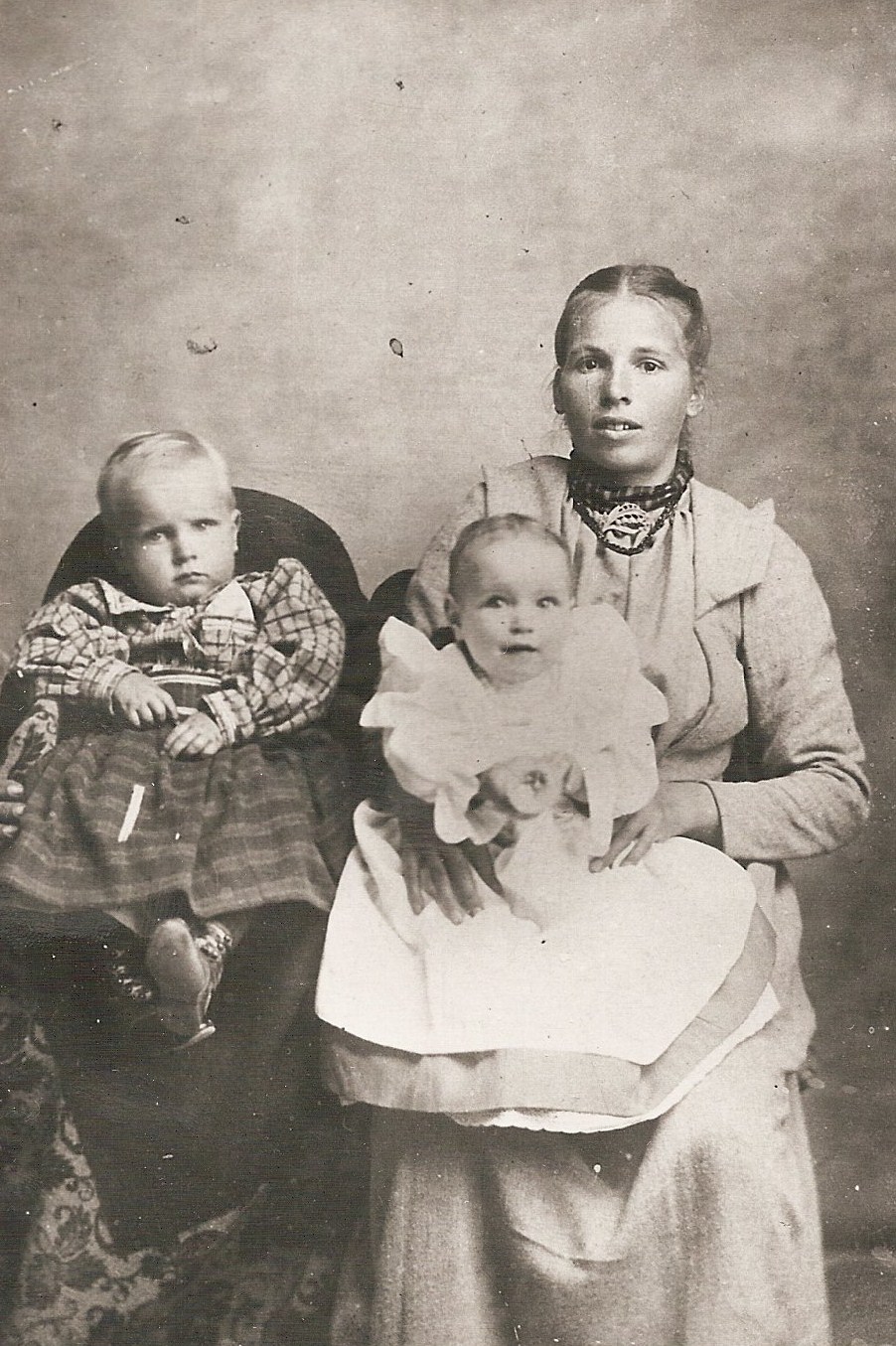
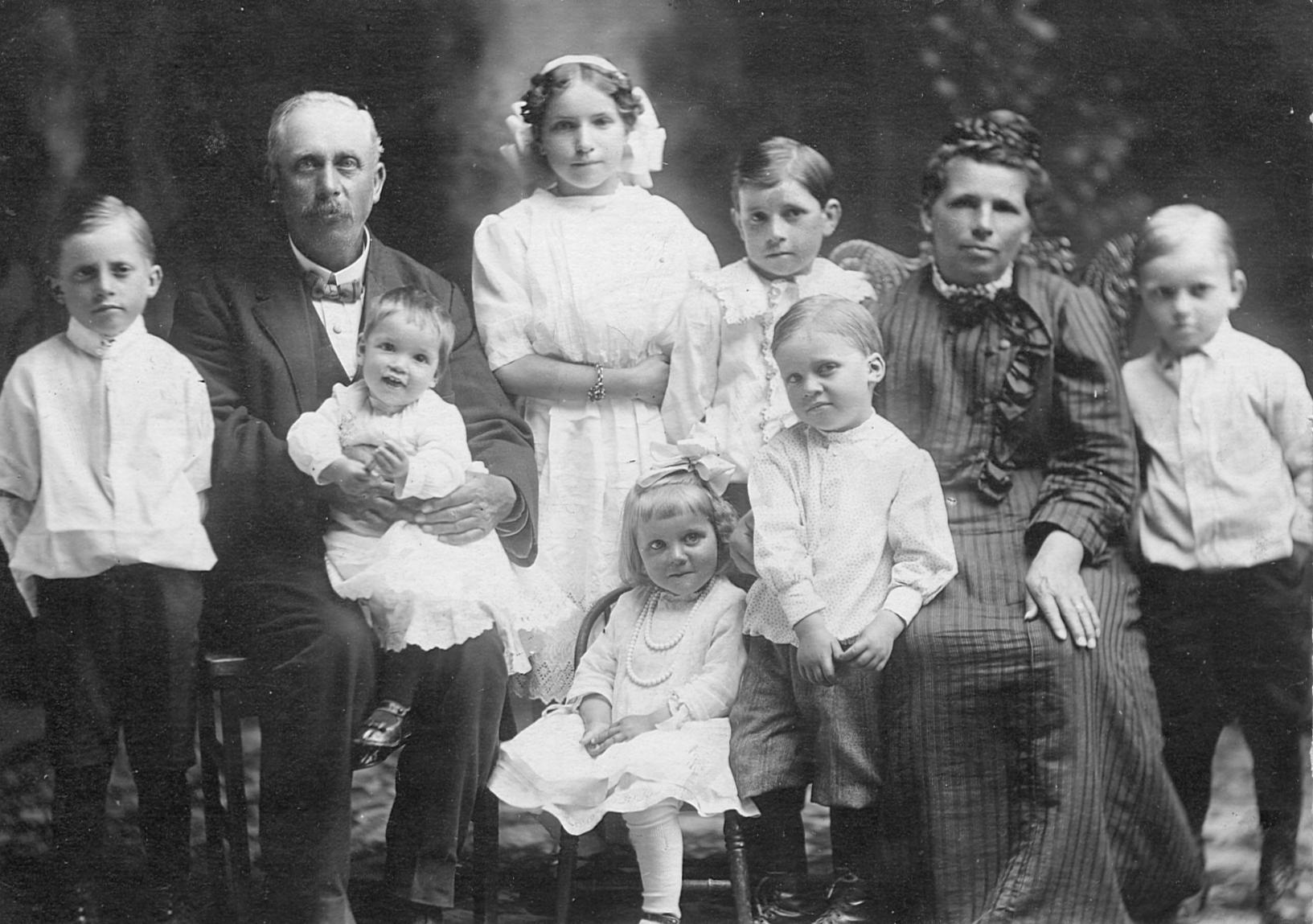
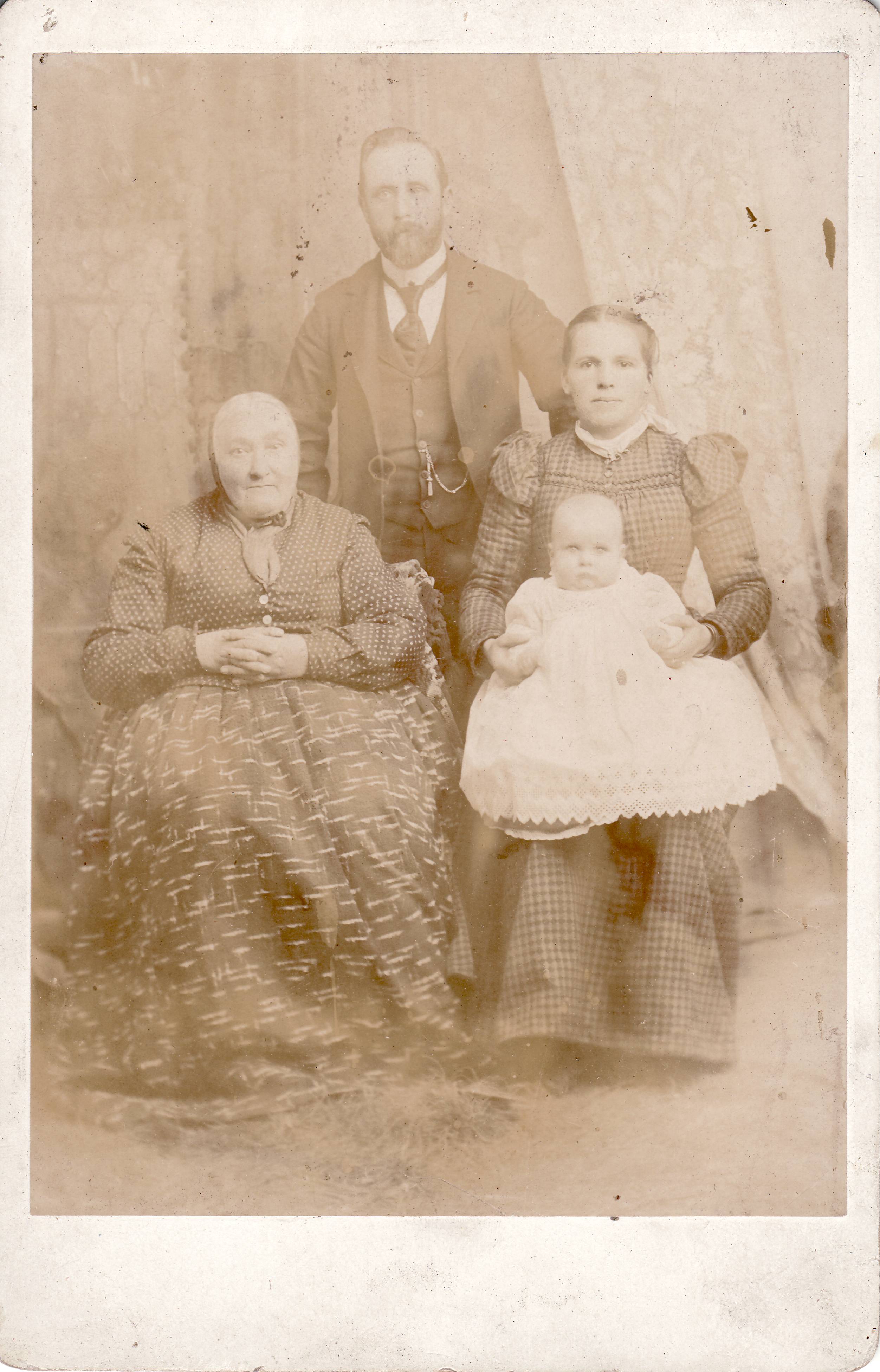
The morning of 29 November 2025 began at the Orem Utah Temple. That afternoon I visited Provo to document something Dr. James “Jim” T. Ross held in his possession I had never seen. Jim holds two journals that belonged to James Thomas Ross/Meredith, my Great Great Grandfather. On that Thanksgiving break afternoon I photographed all of those two books/journals. More than two hundred photographs in all. This post works through the first of those journals, page by page. Jim’s son, Dane, now holds the journals in his possession. Thank you to Jim and Dane for meeting with me on that occasion and letting me impose to document this important book.
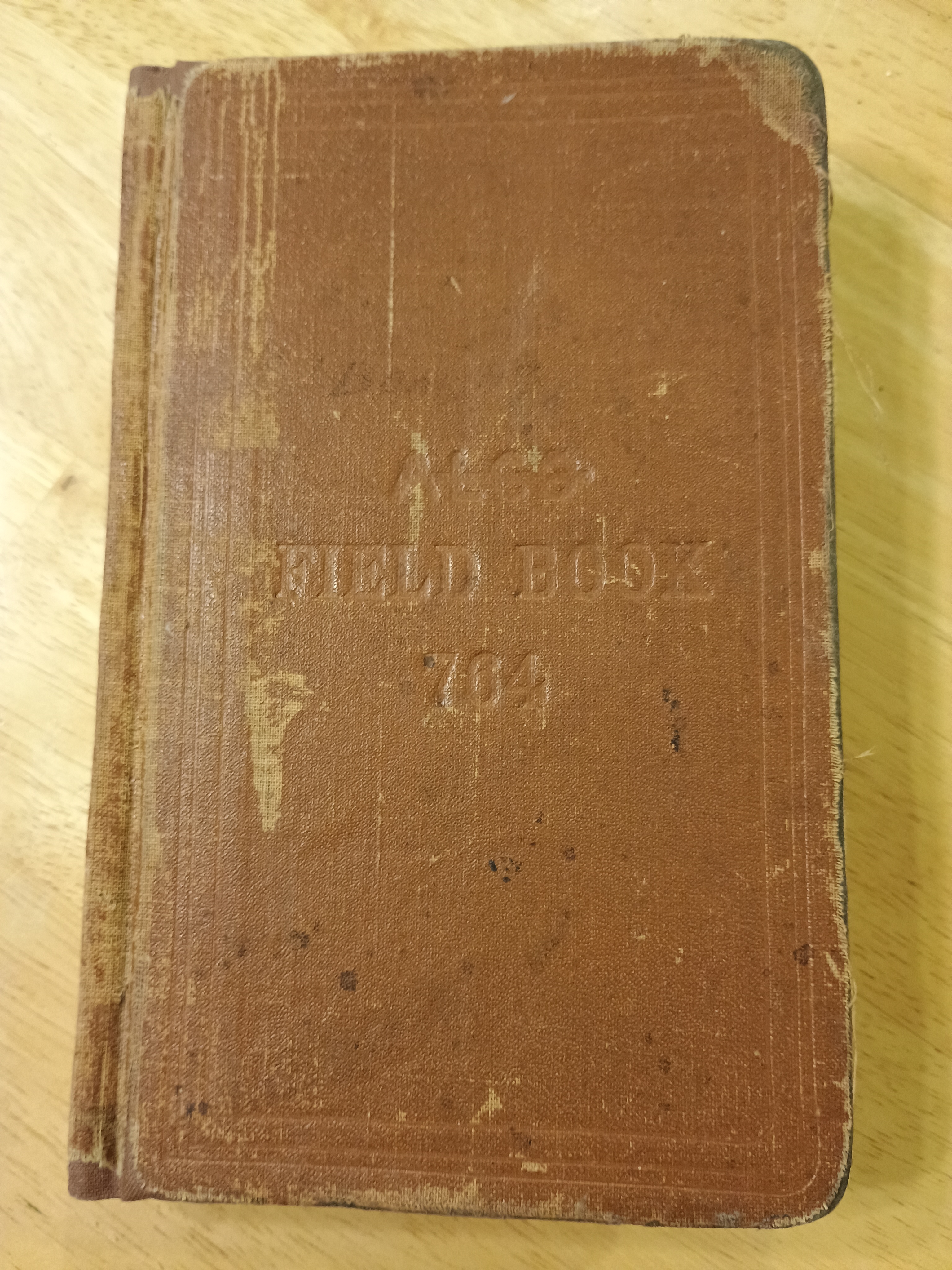
The journal is an A. Lietz Co. Field Book No. 704, a brown hardcover surveyor’s field book manufactured in San Francisco. It is worn at the corners, age-stained, and was a working document. The A. Lietz Company appears to have been the premier supplier of surveying instruments and field books in the western United States. James came upon one at some point and repurposed it as a personal journal and scrapbook during his later California years. The traverse data, angles, and station distances running down the margins of many pages almost certainly predate his use of the book. He appears to have acquired and repurposed it, writing his own notes in the spaces between and beside the pre-existing contents and data.
One essential note before turning the pages: this is not a sequential journal. James did not fill it page by page from front to back. He appears to have opened it wherever he found space and written whatever was on his mind that day — current events, family records, financial accounts, scripture, geography, obituaries, trivia. A single page spread may contain entries from five different years, written months or years apart. Some pages are pure pre-existing surveyor’s data that James left entirely untouched. Others carry his own entries on every available line. Reading the journal requires understanding that it does not move chronologically.
—
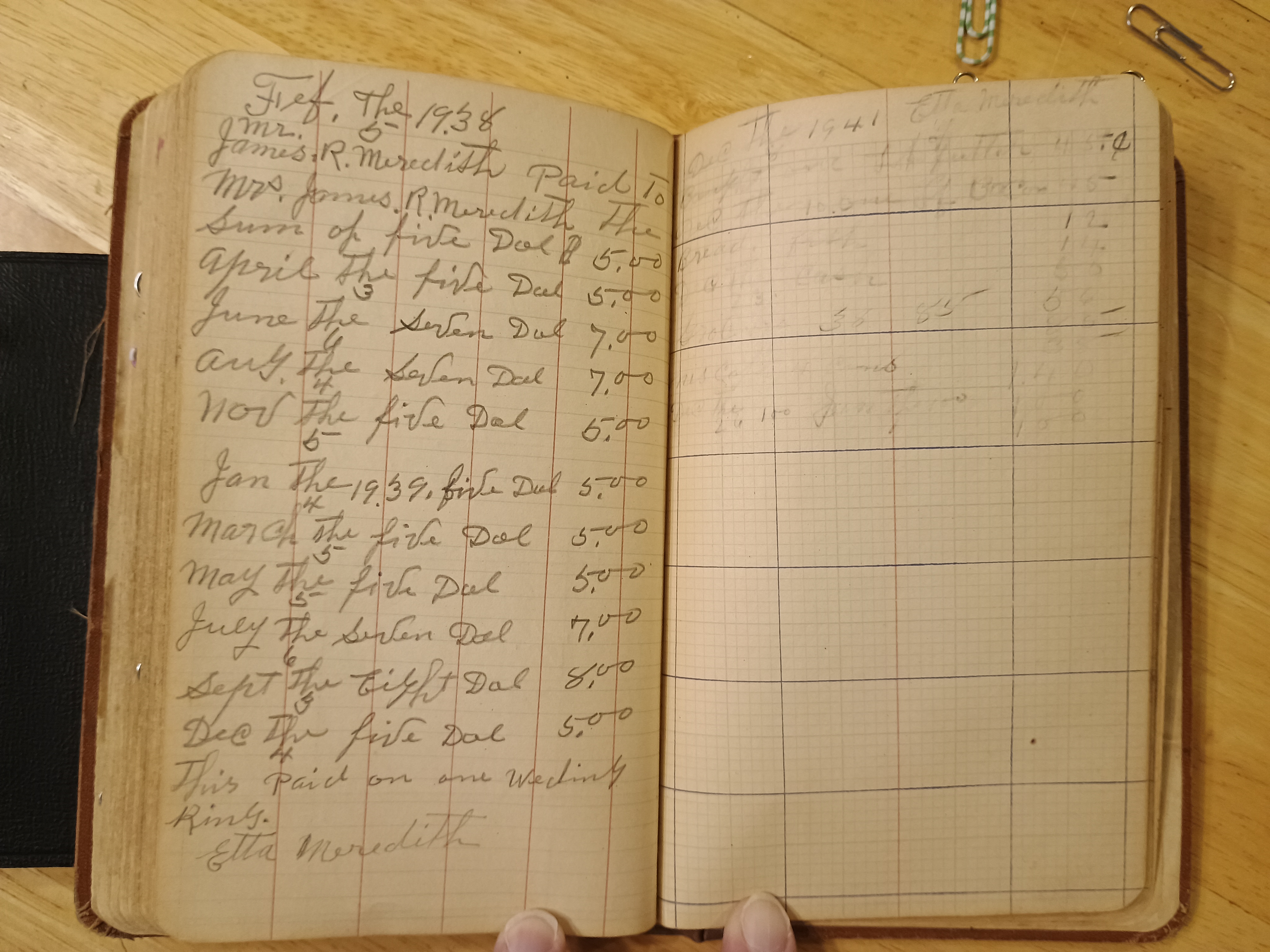
The story of how James Thomas Ross/Meredith came to live in Lake County, California, in the late 1930s has been told on this website across a number of posts. The short version: he was born in Pulaski County, Virginia in 1869, the son of Nancy Adelene Shepherd Ross and James Meredith. He spent his early adult years in West Virginia, married Damey Catherine Graham in 1893, and by 1917 had moved his family to the Snake River Plain in Idaho. He was in Paul Idaho in 1925 when their daughter in law, Ethel Sharp Ross died. Jack and Edith’s children, and Jim and Damey’s grandchildren, were with them in Paul until 1926. The attempts at farming and employment in Idaho failed. The 1930 Census shows they relocated to Bend, Oregon. Damey died 3 February 1933 in Marysville, Yuba, California. Jim remarried to Etta Fountain on 6 June 1936 in Sacramento, Sacramento, California. Etta died 21 February 1946 visiting Phoenix, Maricopa, Arizona. He remarried to Martha Elnora Brewer on 14 July 1947 in Fresno, Fresno, California. He died 13 April 1951 in Fresno. His death certificate reads James R. Meredith.
—
Jim Ross in Provo
Jim Ross is the son of Eugene Dale Ross Sr. (1915–1986) and the great-grandson of James Thomas Ross/Meredith. Jim is a retired podiatrist and longtime Provo resident. Eugene served in the 1st Cavalry Division in World War II. He worked as a lathing and plastering contractor in California for forty years. Jim has maintained the family records in FamilySearch for many years.
—
The Field Book:

Transcription:
Patterson campaign card: For Efficiency in Office — Retain W.M. Patterson Incumbent For County Clerk Lake County — Election August 30 1938.
Written on photograph: Evlin.
Notes:
Three photographs are tucked into this page showing Evelyn Adaway Phibbs Collier — James’s granddaughter, the daughter of Fanny Elizabeth Ross Phibbs. “Evlin” is James’s phonetic rendering. The Patterson campaign card places James in Lakeport during the August 1938 primary election, if he received it personally. William Merrol Patterson (1904–1977) served as Lake County Clerk.
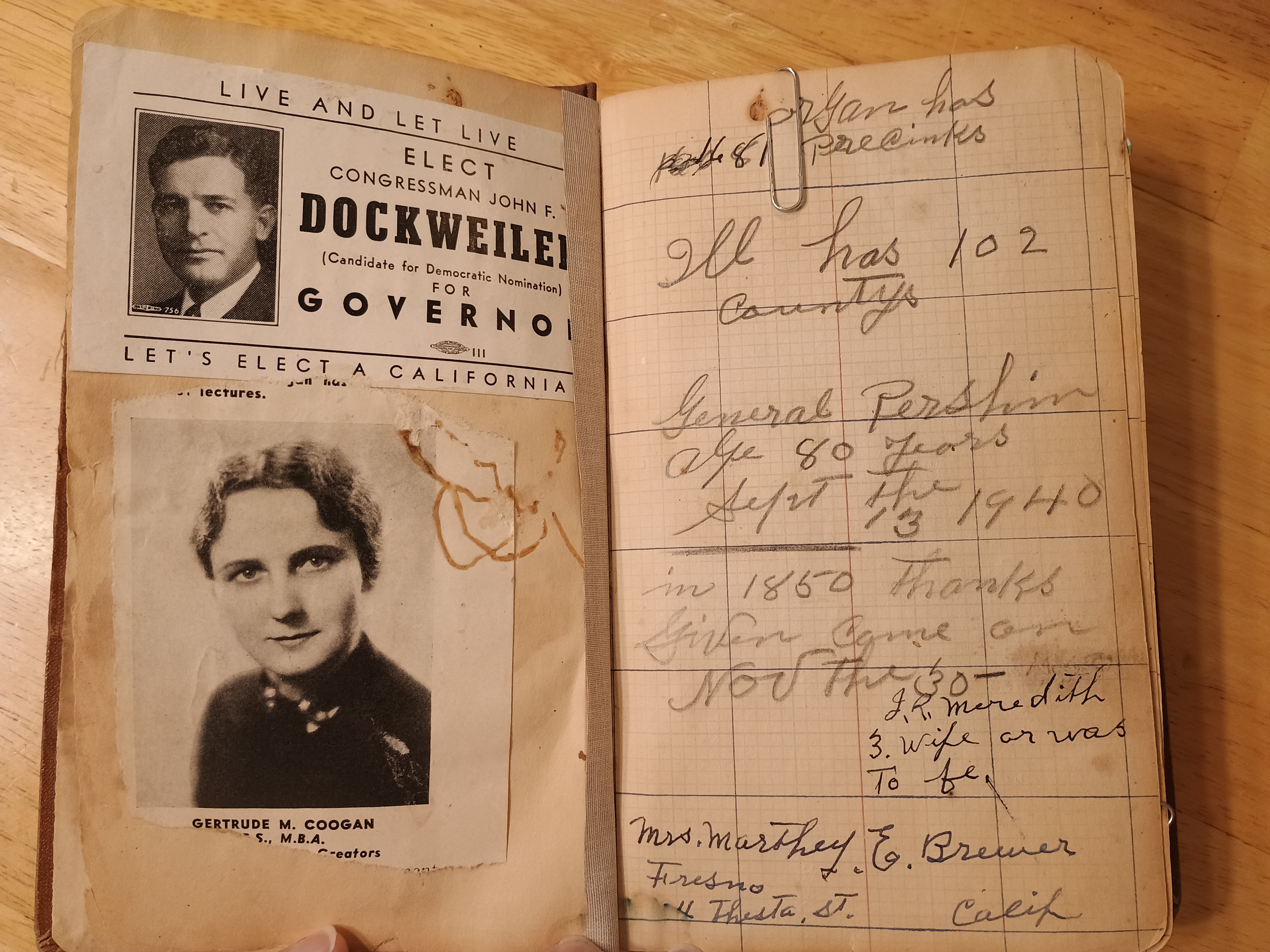
Transcription:
Left page — Dockweiler campaign card: Live and Let Live — Elect Congressman John F. Dockweiler (Candidate for Democratic Nomination) For Governor — Let’s Elect a California Man.
Left page — Coogan portrait label: Gertrude M. Coogan — B.S., M.B.A. — Money Creators.
Right page — Oregon has 61 precinks — Ill has 102 Countys — General Pershin[g] Age 80 Years Sept the 13 1940 — in 1860 thanks Given came on Nov the 30 — J.R. Meredith 3. wife or was To be, — Mrs. Marthey E. Brewer Fresno 4 Thesta St. Calif
Notes:
John Francis Dockweiler (1895–1943) sought the Democratic gubernatorial nomination in August 1938, losing to Culbert Olson. Gertrude Margaret Coogan (1898–1986) was best known for her 1935 book Money Creators. Her monetary reform arguments appear in James’s own handwriting later in the journal. The bottom entry records Martha Elnora Brewer’s address — James’s future third wife, whom he married 14 July 1947 in Fresno.
—
The Pages

Transcription:
Left page — Lake View Road [surveyor’s header] — The first factory and where. ans is a Glass fact in James Town. in Va — Lincoln 16 President he Chose William H Seward as Secretary of State. Assassinated April the 15 1865 Vice Pres Johnson become President. — Robert R. Livingstone Swor in George Washing[ton] to US President. — Flag Day is June the 14
Right page — Fought in Court — Petioner is Miss Tess Maria Saline of Los Angeles She calles it a Trick. Pension Plan in July the 22 1938 in Chronicle on Page 2, Col 3 — James R. Meredith Put in 120 — hundred & Twenty dollars to buy a Car to Mrs Etta Meredith July the 1939
Notes:
American history jottings on the left — Jamestown glassworks, Lincoln, Robert R. Livingston, Flag Day. The right page records a pension dispute in the San Francisco Chronicle on 22 July 1938, and James putting $120 toward a car for Etta in July 1939.
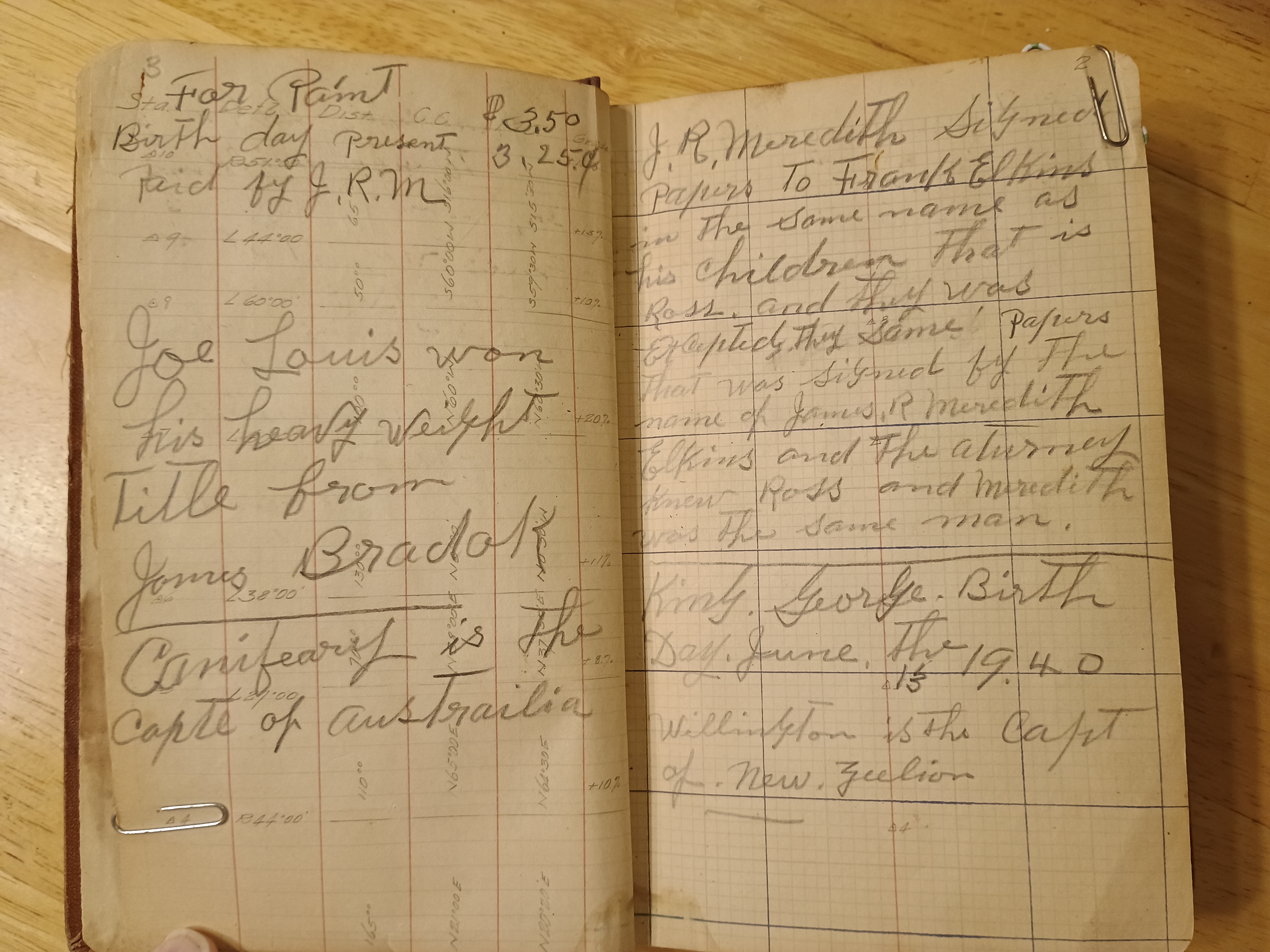
Transcription:
Left page — For Paint — Birth day Present P 3.50 — Paid by J.R.M. — Joe Louis won his heavy weight Title from James Braddock — Canifear[r]y is the Capte of Austrailia
Right page — J.R. Meredith Signed Papers To Frank Elkins in the same name as his children That is Ross. and they was Excepted the Same papers that was Signed by the name of James R. Meredith Elkins and the attorney Knew Ross and Meredith was the same man. — King George Birth Day. June the 15 1940 — Willington is the Capit of New Zeelion
Notes:
The right page carries a legally significant entry in the journal: James records signing papers to Frank Elkins using the name Ross, and that those papers were accepted the same as papers signed James R. Meredith, because Elkins and the attorney knew Ross and Meredith were the same man. This is James himself documenting the dual-surname situation that has complicated the genealogical record.
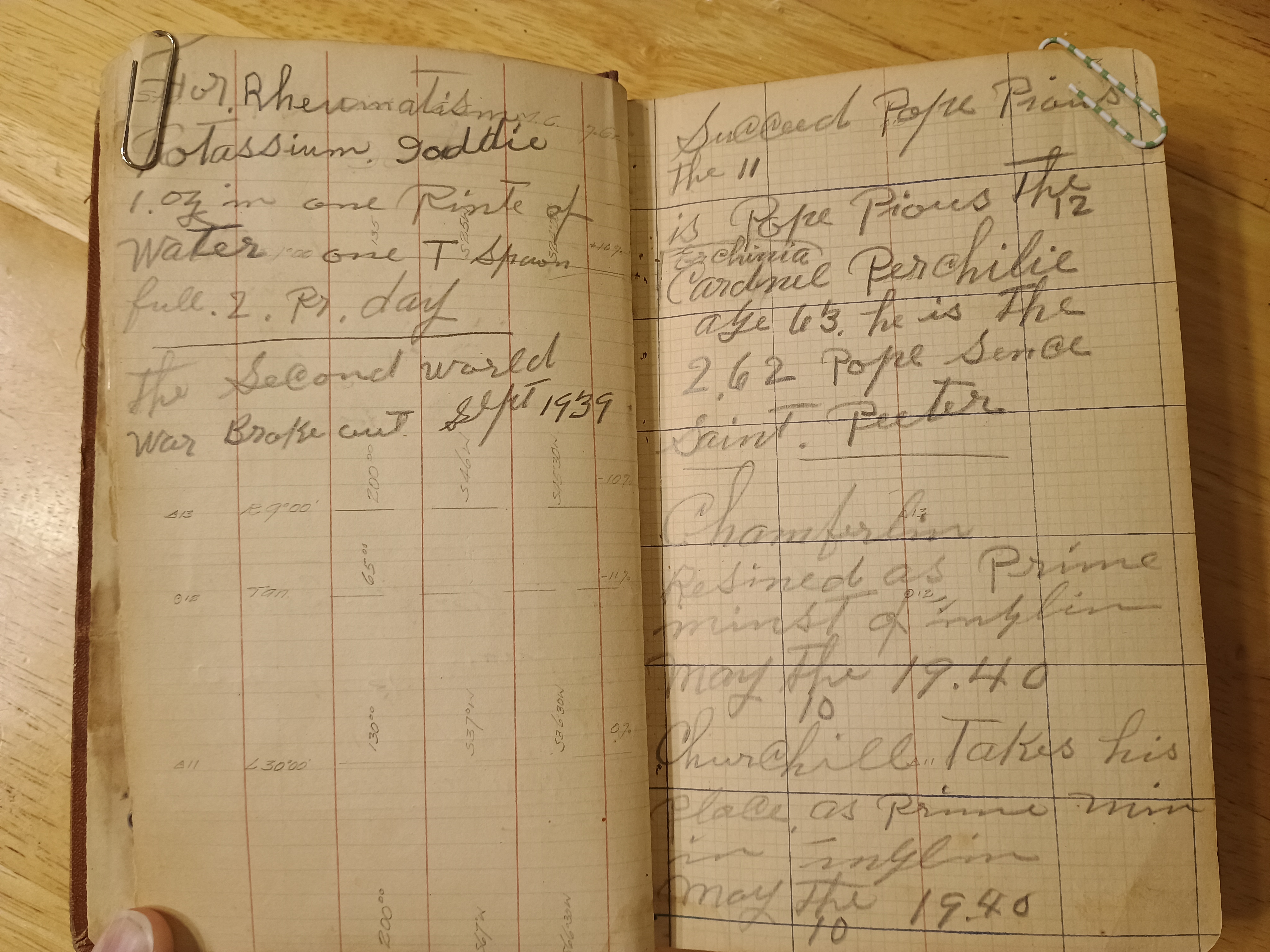
Transcription:
Left page — For Rheumatism — Potassium. Ioddie — 1. oz in one Pinte of Water and one T Spoon full. 2. Pr. day — the Second world War Broke out Sept 1939
Right page — Succed Pope Pius the 11 — is Pope Pius the 12 from China — Cardmel Perchilie age 63. he is the 2.62 Pope Sence Saint Peter. — Chamberlin Resined as Prime minst of Inglin May the 10 1940 — Churchill Takes his Place as Prime Min in Inglin May the 10 1940
Notes:
A home remedy for rheumatism, then the Second World War broke out in September 1939. The right page tracks Pope Pius XII succeeding Pius XI, and Chamberlain resigning on 10 May 1940, the same day Churchill took his place.
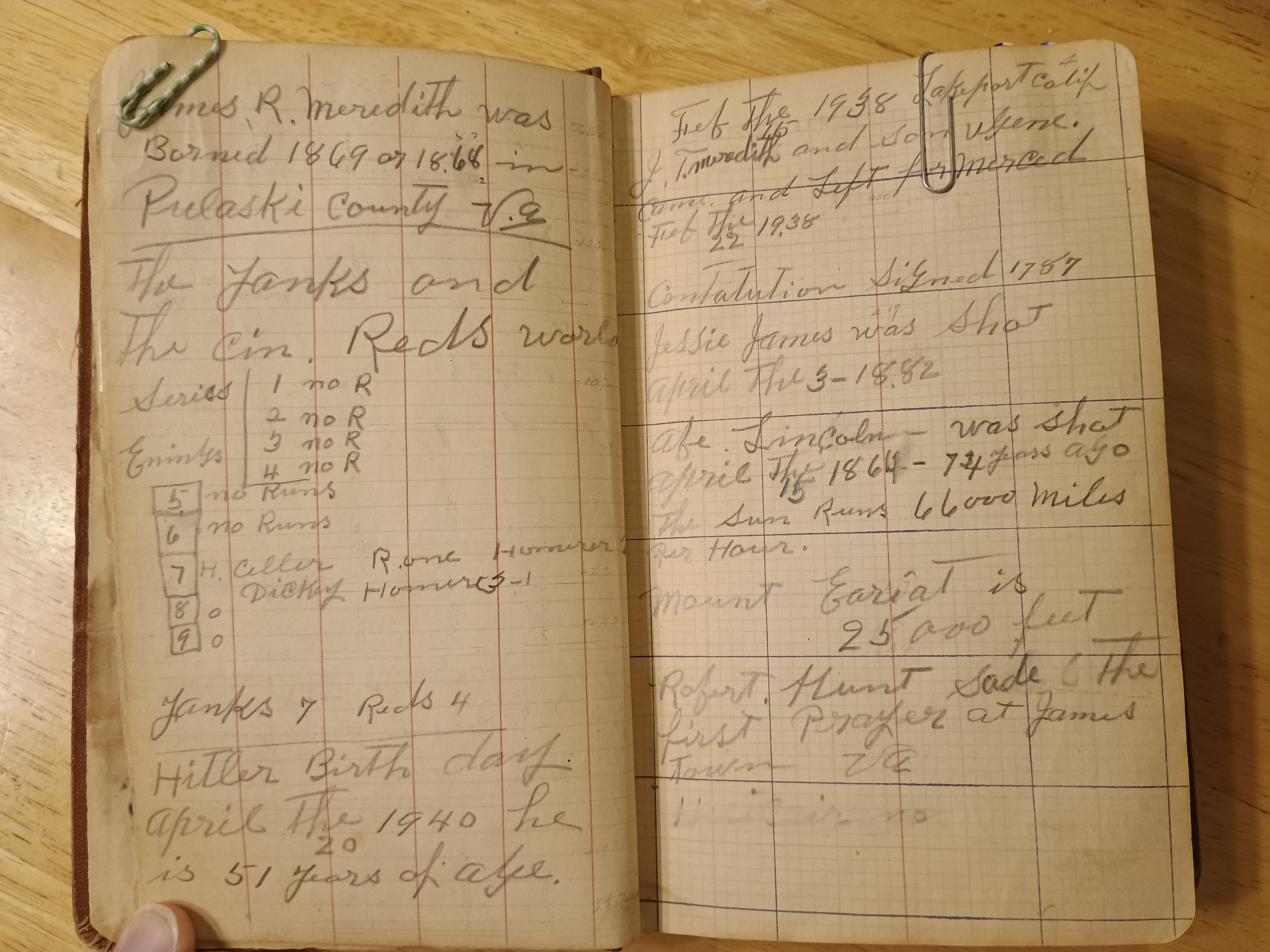
Transcription:
Left page — James R. Meredith was Borned 1869 or 1868 in Pulaski County V.a. — The Yanks and the Cin. Reds World Series — Enings: 1 no R / 2 no R / 3 no R / 4 no R / 5 no Runs / 6 no Runs / 7 H. Celler R. one Homer / Dickey Homer 3–1 / 8 0 / 9 0 — Yanks 7 Reds 4 — Hitler Birth Day. April the 20 1940 he is 51 years of age.
Right page — Feb the 1938 Lakeport Calif — J. Meredith and Son Ugene. came. and left at Merced. Feb the 22 1938 — Contatution Signed 1787 — Jessie James was Shot April the 3 1882 — Abe Lincoln was shot April the 15 1864 — 74 years ago — The Sun Runs 66000 miles per Hour. — Mount Eariat is 25,000 feet — Robert Hunt Sade the first Prayer at James Town V.a.
Notes:
A critical genealogical entry: James recording his own birth in 1869 or 1868 in Pulaski County, Virginia. Below that the 1939 World Series inning by inning, Yankees 7 Reds 4. The right page records Eugene Dale Ross Sr, Jim Ross’s father, visiting James in Lakeport in February 1938.
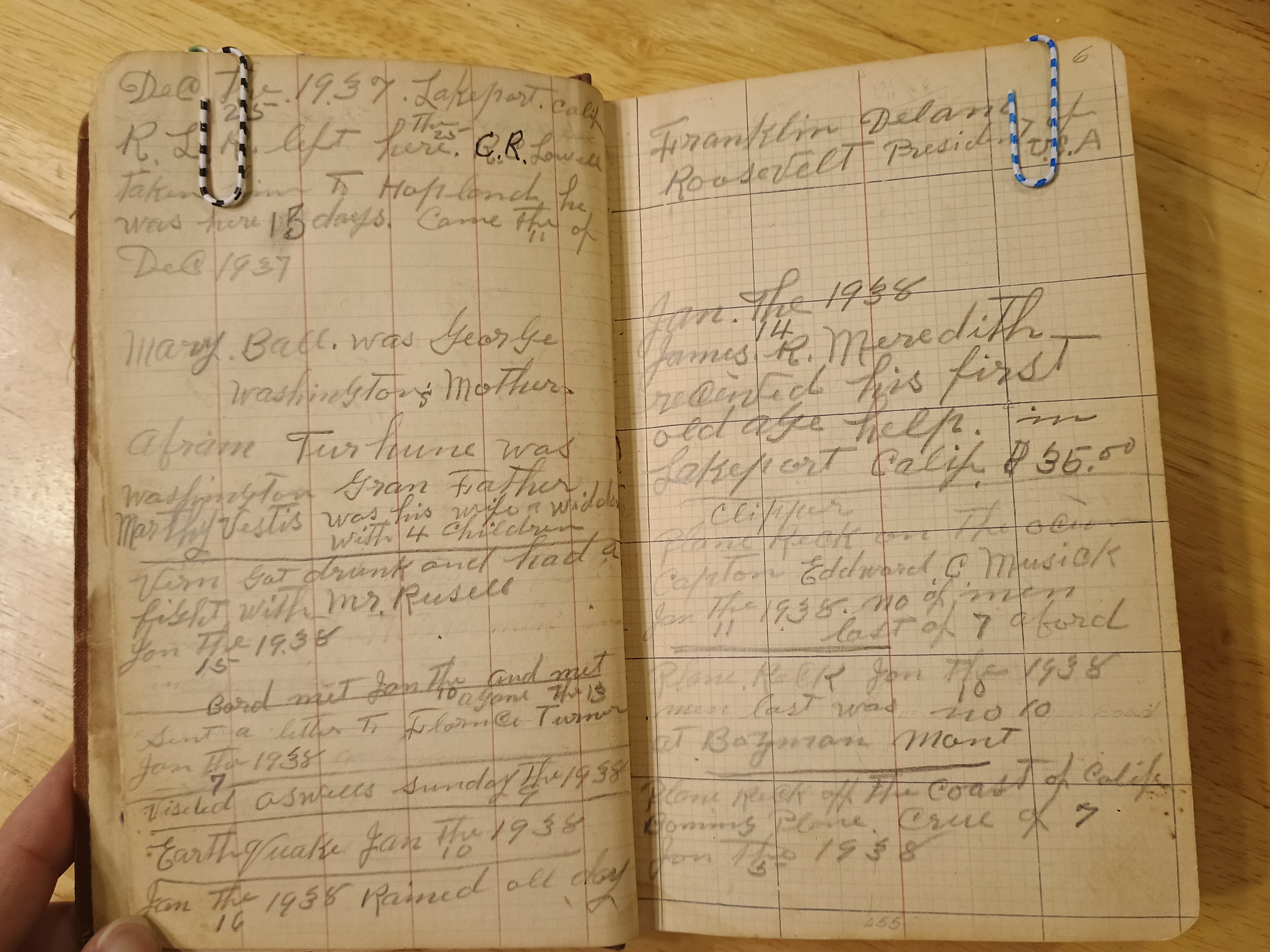
Transcription:
Left page — Dec the 25 1937. Lakeport Calif — R.L.R. left here. C.R. Lowell Taken him to Hopland. he was here 18 days. Came the 11 of Dec 1937 — Mary Ball was George Washington’s Mother. — Afram Turhune was Washington Gran Father. Martha Vestis was his wife a widow with 4 Children — Vern got drunk and had a fight with Mr. Russell Jan the 15 1938 — Bord met Jan the 10 and met again the 13 — Sent a letter To Florence Turner Jan the 7 1938 — Visited as wells Sunday the 1938 — Earth Quake Jan the 10 1938 — Jan the 16 1938 Rained all day
Right page — Franklin Delano Roosevelt President U.A. — Jan the 14 1938 James R. Meredith recieved his first old age help. in Lakeport Calif. $35.00 — Clipper plane took on the sea Captain Edward C. Musick Jan the 11 1938. No of men last of 7 aBoard — Plane Held Jan the 16 1938 men last was No 10 at Bozman Mont — Plane fell off the Coast of Calif Coming Clone. Crue of 7 Jan the 6 1938
Notes:
Robert Leonard Ross, James’s oldest son, born 1888, left Lakeport on Christmas Day 1937 after an 18-day visit. Charles Raymond Lowell (24 May 1888 — September 1967) drove him to Hopland. Lowell was Etta Fountain’s son by her first husband Charles Henry Lowell, born in Sacramento, a traveling salesman in Chicago during World War I, moving through Seattle, Honolulu, and Ellis Island in the early 1920s, in San Francisco by 1935 and San Mateo County by 1940. James refers to him throughout this journal as Dr. C.R. Lowell. The December 1935 entry records James borrowing $125 from him. C.R. loaned money, hosted Christmas dinners, and employed James as a day laborer. When Etta died 21 February 1946 in Phoenix while visiting Charles Raymond, he returned her remains to Sacramento for burial in the Fountain family plot. James gave him money for a wreath. Charles Raymond died in Phoenix in September 1967.
The right page records James’s first old age assistance payment of $35 on 14 January 1938. The remaining entries track the loss of the Samoan Clipper, piloted by Captain Edwin C. Musick, which disappeared on 11 January 1938 near Pago Pago.
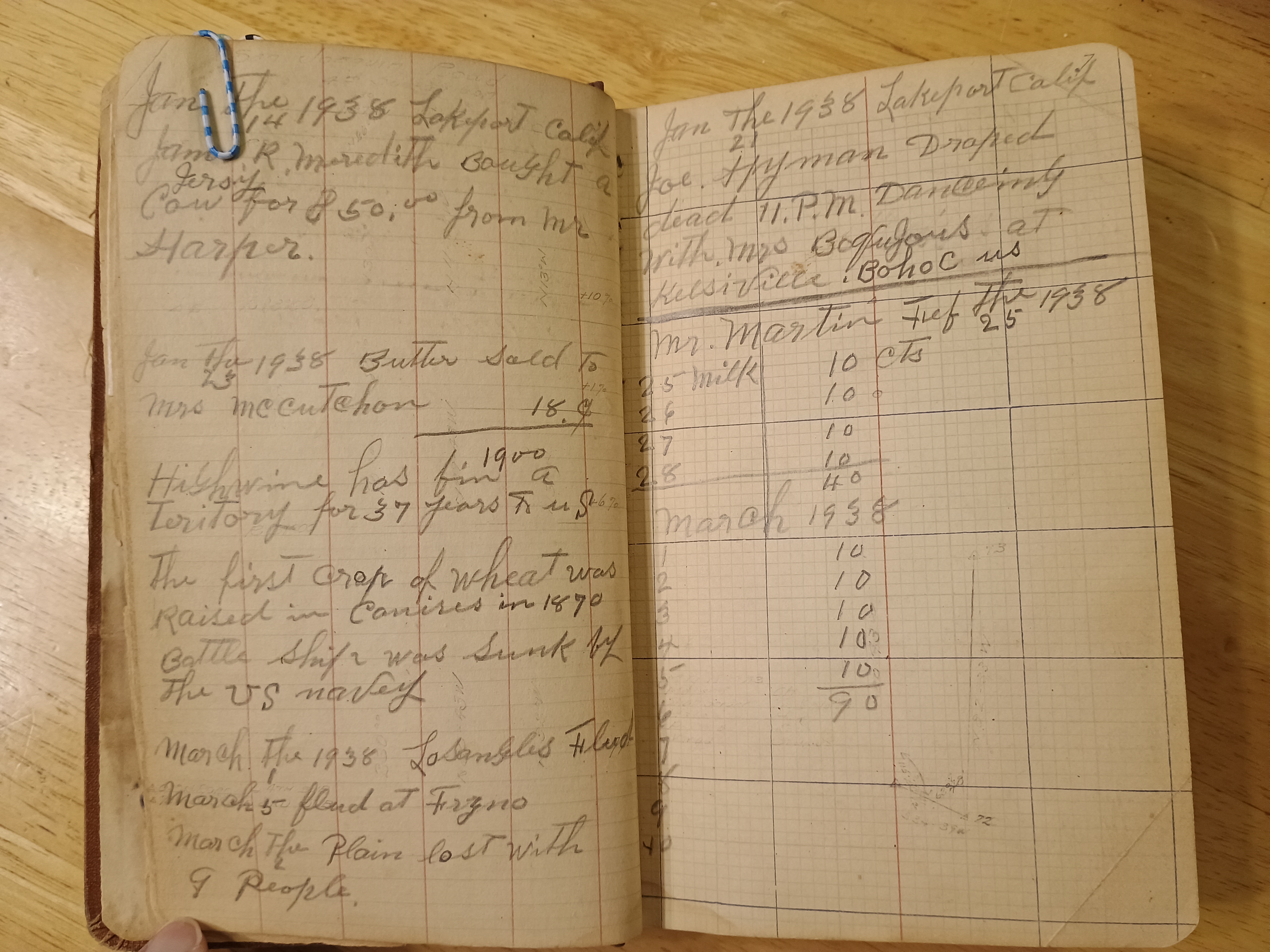
Transcription:
Left page — Jan the 14 1938 Lakeport Calif — James R. Meredith bought a Jersey Cow for $50.00 from Mr. Harper. — Jan the 23 1938 Butter Sald to Mrs McCutchon 18¢ — Phillywine has bin a Teritory for 37 years to U.S. — The first Crop of wheat was Raised in Canires in 1870 — Cattle Ship was Sunk by the US navey — March the 1938 Los Angeles Flood — March 5 flood at Fresno — March the Plane lost with 9 People.
Right page — Jan the 21 1938 Lakeport Calif — Hyman Droped Joe. at 11 P.M. Dancing with Mrs Bogudons. at Kelsivelle. Bohoc us — Mr. Martin Feb the 25 1938 — 25 milk 10 cts / 26 10 / 27 10 / 28 10 / 28 40 — March 1938: 10 / 10 / 10 / 10 / 10 — Total 90
Notes:
James bought a Jersey cow for $50 from Mr. Harper on 14 January 1938 and ten days later was selling butter to Mrs. McCutchon for 18 cents. The March 1938 California flood entries. The right page records dancing at Mrs. Bogudons’ in Kelseyville and a milk account with Mr. Martin totaling 90 cents.
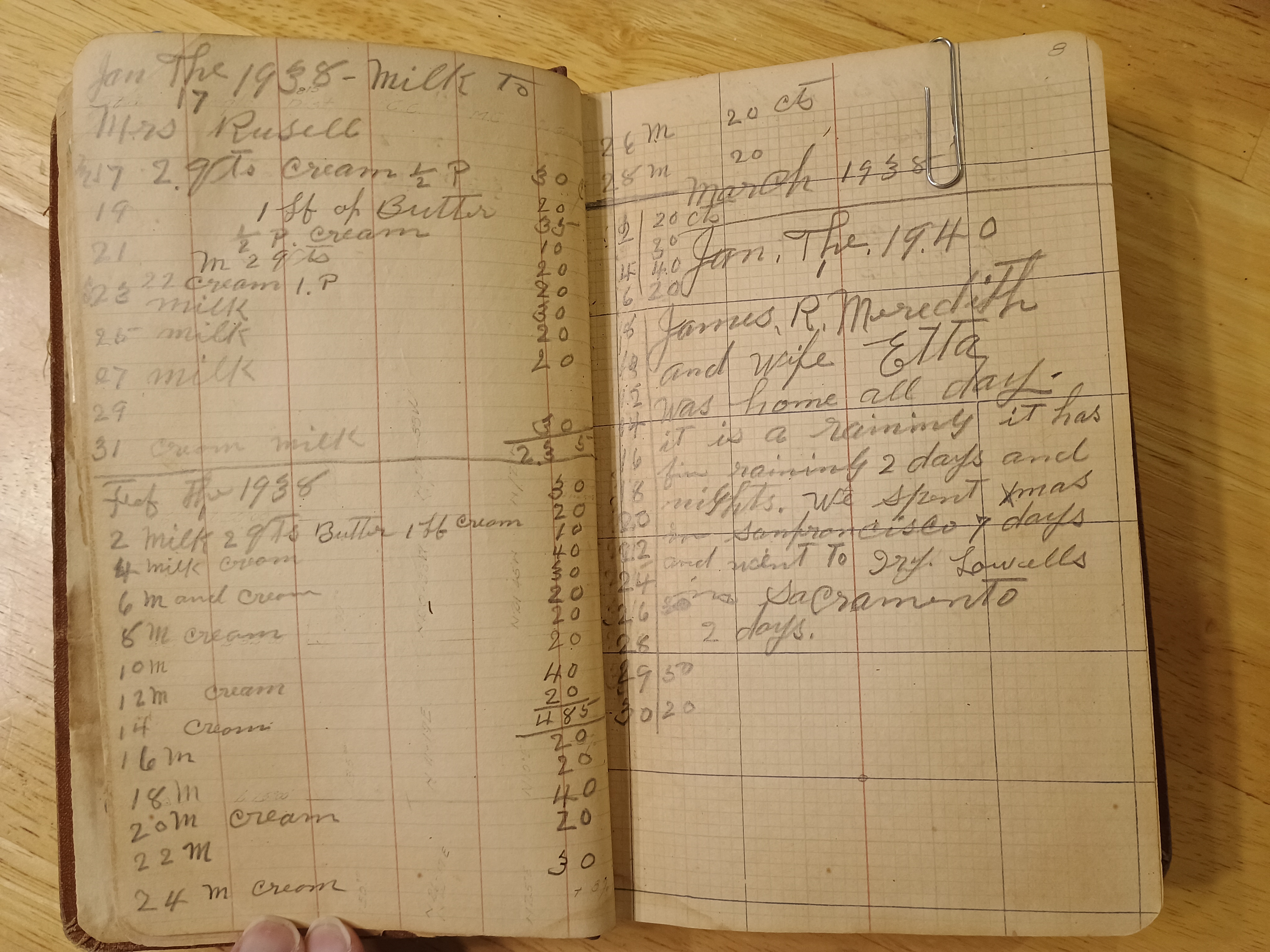
Transcription:
Left page — Jan the 17 1938 milk to Mrs Russell — 17 2 qts cream ½ P 80 — 19 1 lb of Butter 20 — ½ P. cream 35 — 21 M 2 qts 10 — 22 Cream 1.P 20 — milk 20 — 26 milk 20 — 27 milk 20 — 29 20 — 31 Cream milk 80 — Total 23 5[0] — Feb the 1938: 2 milk 2 qts Butter 1 lb Cream 50 — 4 milk cream 20 — 6 M and Cream 20 — 8 M Cream 20 — 10 M 40 — 12 M cream 20 — 14 Cream 4 85 — 16 M 20 — 18 M 20 — 20 M Cream 40 — 22 M 20 — 24 M Cream 30
Right page — 26 M 20 cts — 28 M 20 — March 1938: 20 ct / 30 / 40 / 20 — Total 49 50 / 30 20 — Jan. The 1 1940 — James R. Meredith and wife Etta was home all day. it is a raining it has bin raining 2 days and nights. We spent Xmas in San Francisco 7 days and went to Dr. Lowells in Sacramento 2 days.
Notes:
Detailed milk, cream, and butter sales to Mrs. Russell through January and February 1938. The right page jumps to New Year’s Day 1940: James and Etta home all day in the rain, having spent Christmas in San Francisco for seven days then two days at Dr. Lowell’s in Sacramento.
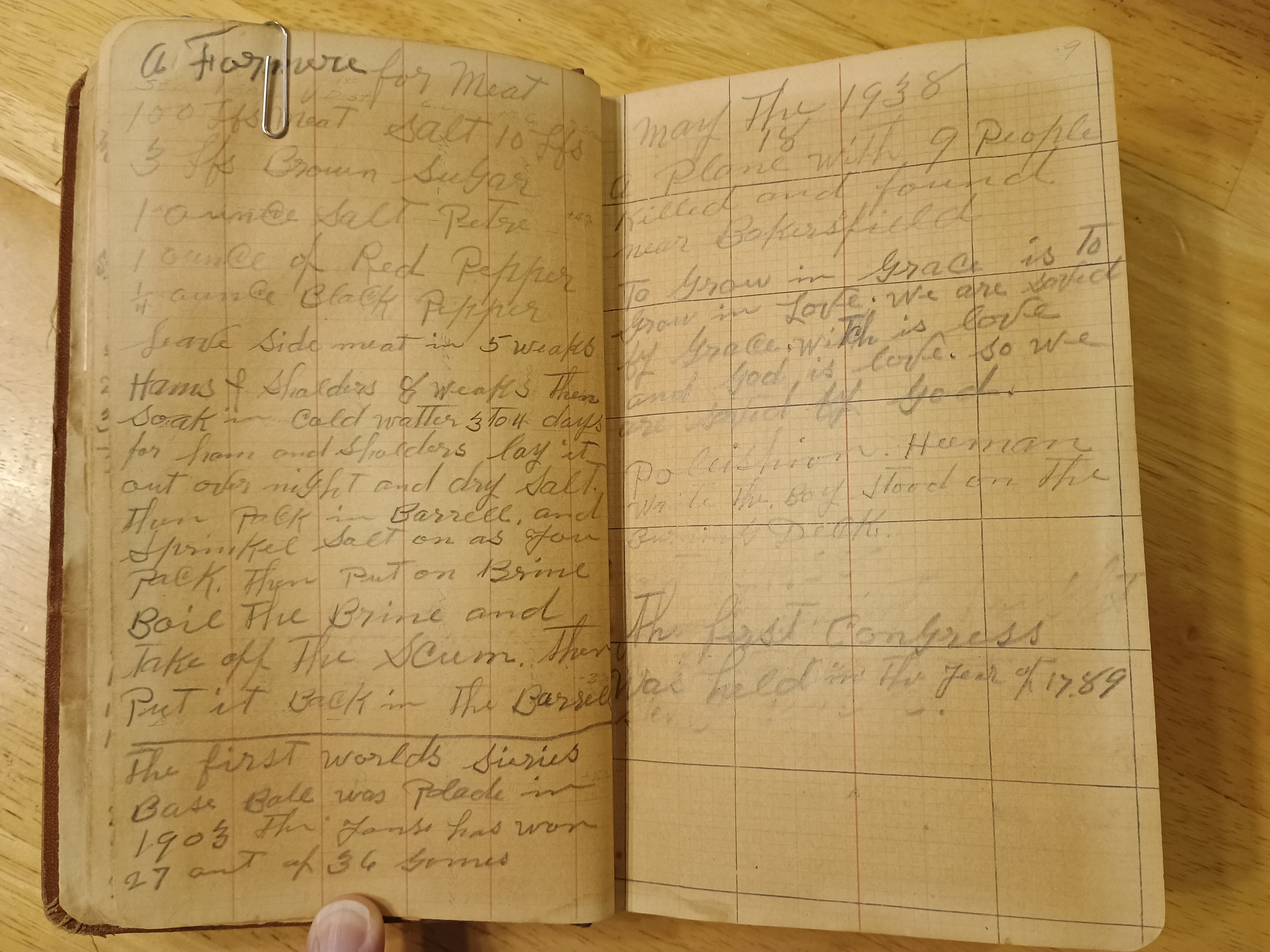
Transcription:
Left page — A Formula for Meat — 100 lbs meat Salt 10 lbs — 3 lbs Brown Sugar — 1 ounce Salt Petre — 1 ounce of Red Pepper — ½ ounce Black Pepper — Leave Side meat in 5 weeks — Hams and Shoulders 6 weeks then Soak in Cold water 3 to 4 days — lay it out over night and dry Salt. Then Pack in Barrell. Sprinkle Salt on as you Pack. Then Put on Brine Boil the Brine and Take off the Scum. Then Put it back in the Barrell — The first worlds Series Base Ball was Played in 1903 The Yanks has won 27 out of 34 Series
Right page — May The 15 1938 — A Plane with 9 People Crashed and found killed near Bakersfield — To Grow in Grace is To Grow in Love. We are saved By Grace. This is Love and God is Love. So we are saved by God. — Politician. Henman wrote the boy Stood on the Burning Deck. — The first Congress was held in the year of 1789
Notes:
A full meat-curing formula — hog-butchering knowledge from his Virginia and West Virginia roots. The right page opens with the 15 May 1938 Bakersfield plane crash, then a passage of religious reflection. “The boy stood on the burning deck” is the opening line of Felicia Hemans’s 1826 poem Casabianca, misattributed by James to a politician named Henman.
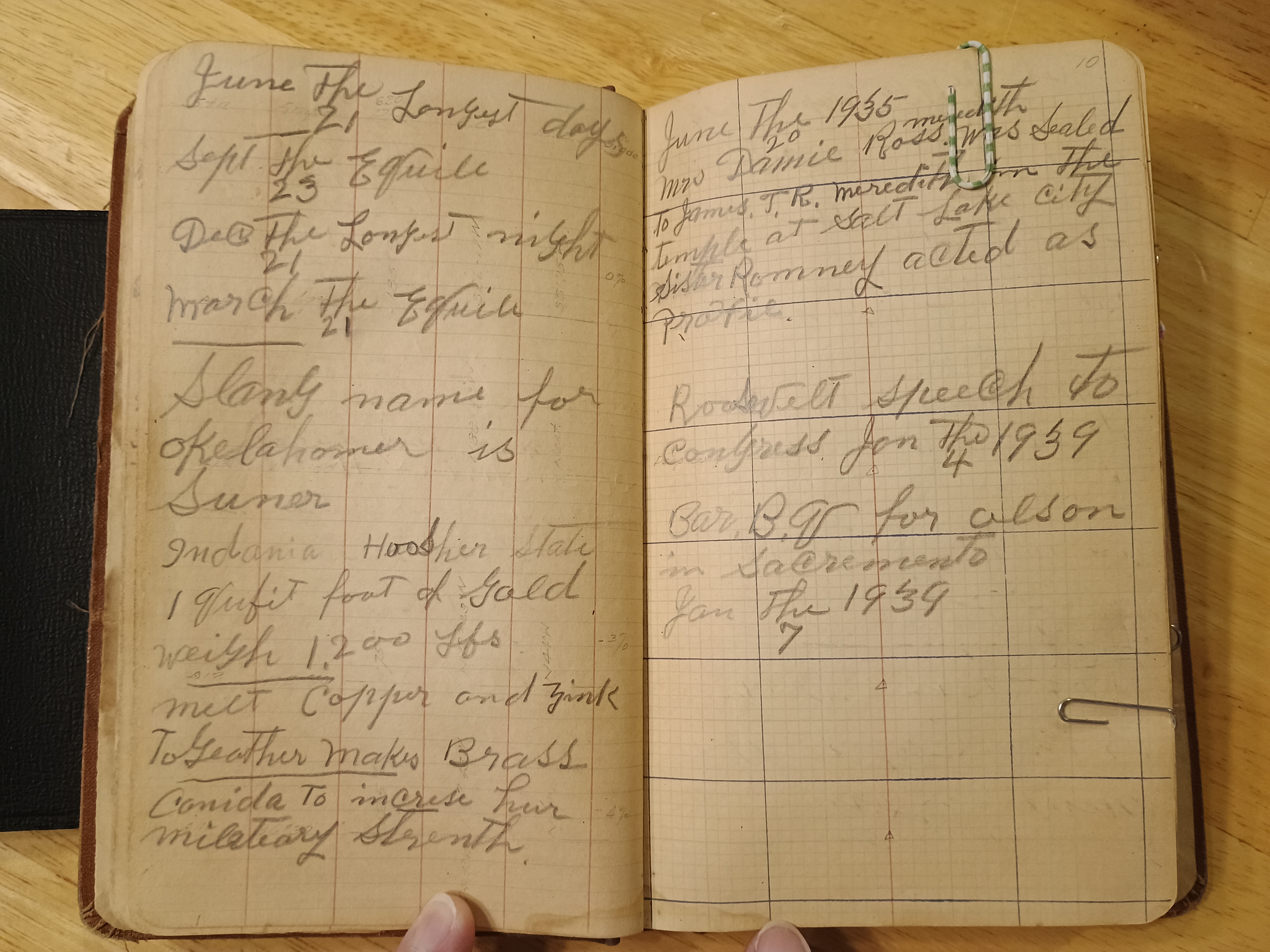
Transcription:
Left page — June the 21 Longest day — Sept the 23 Equile — Dec the 21 Longest night — March the 21 Equile — Slang name for Oklahoma is Suner — Indiana Hoosier State — 1 cubic foot of Gold weigh 1,200 lbs — melt Copper and Zinc Together makes Brass — Canada to increase her military Strength
Right page — June The 20 1935 meredith — Mrs Damie Ross was Sealed to James T.R. meredith in the temple at Salt Lake City Sister Romney acted as Proxie. — Roosevelt Speech To Congress Jan the 4 1939 — Bar B.Q. for Olson in Sacramento Jan The 7 1939
Notes:
Solstices, equinoxes, state nicknames, metallurgy, Canada’s military buildup on the left. The right page contains a significant genealogical entry: on 20 June 1935, James records that Damie Ross was sealed to him at the Salt Lake City Temple, with Sister Romney acting as proxy. FamilySearch confirms both James and Damey’s initiatory and endowment were performed the same day. The sealing was posthumous. Damey had died 3 February 1933. James was sixty-five and would marry Etta Fountain the following year, in June 1936.
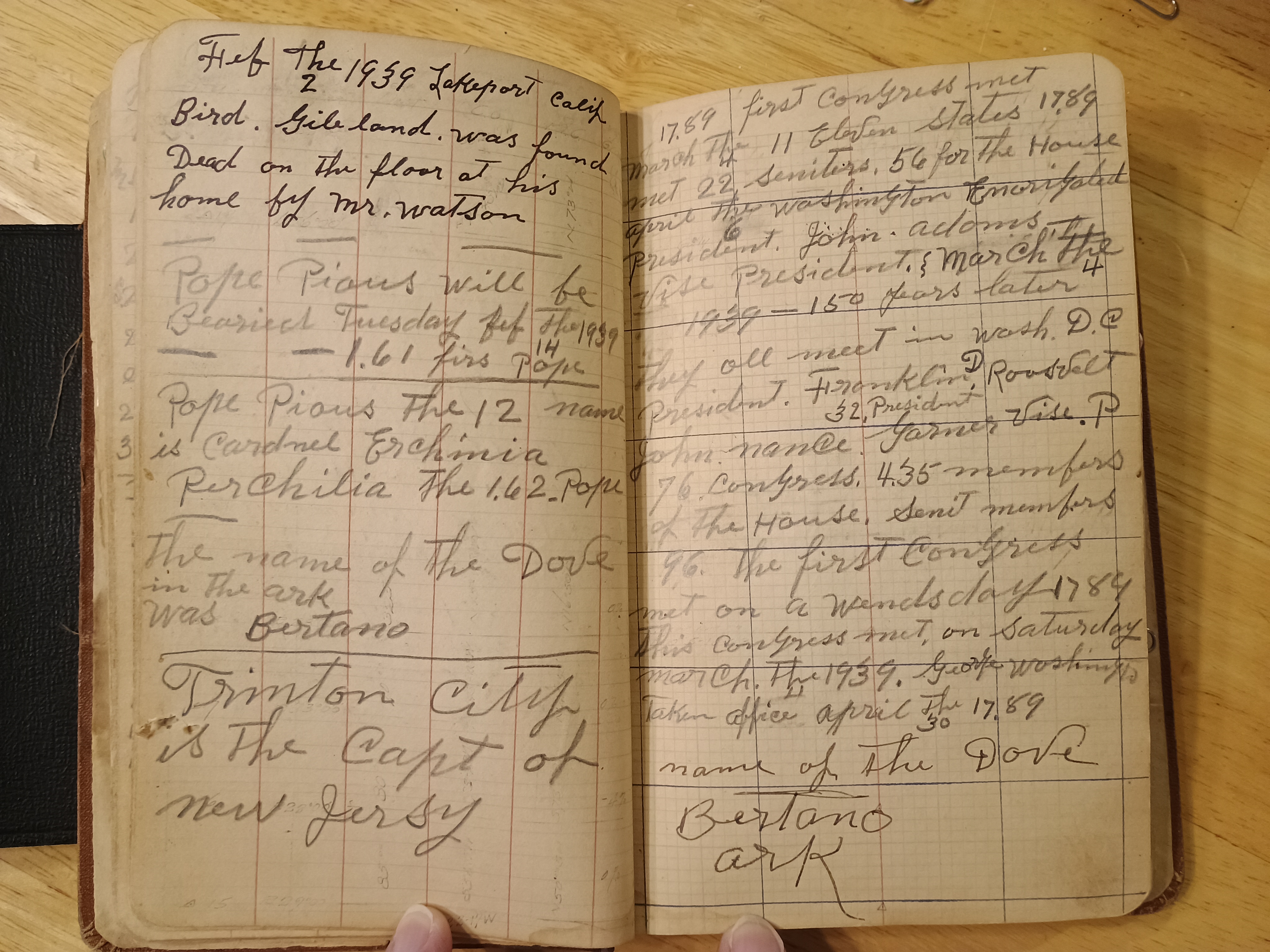
Transcription:
Left page — Feb the 2 1939 Lakeport Calif — Bird. Gileland. was found Dead on the floor at his home by Mr. Watson — Pope Pious will be Bearied Tuesday Feb the 14 1939 — 1.61 first Pope — Pope Pious the 12 name is Cardnel Erchinia Perchilia the 1.62 Pope — The name of the Dove in the ark was Bertano — Trinton City is the Capt of new Jersy
Right page — 1789 first Congress met March the 11 Eleven States 1789 met 22 Seniters. 56 for the House — Washington Emourifated President. John Adams Vice President. March the 4 1939 — 150 years later they all meet in Wash. D.C. — President J. Franklin D Roosevelt 32 President. Vice P John. Nance. James Vice P — 76 Congress. 435 members of the House. Senit members 96 — the first Congress met on a Wedndsday 1789 this Congress met on Saturday March the 1939. Geo Washington Taken office april the 30 1789 — name of the Dove Bertano ark
Notes:
Bird James Gilliland was found dead on the floor of his home by Mr. Watson on 2 February 1939 in Lakeport. Gilliland had been born 15 January 1873 in Mount Ayr, Iowa, and was buried in Lakeport on 8 February 1939. The right page compares the First Congress of 1789 with the 76th Congress of 1939 at the 150th anniversary.
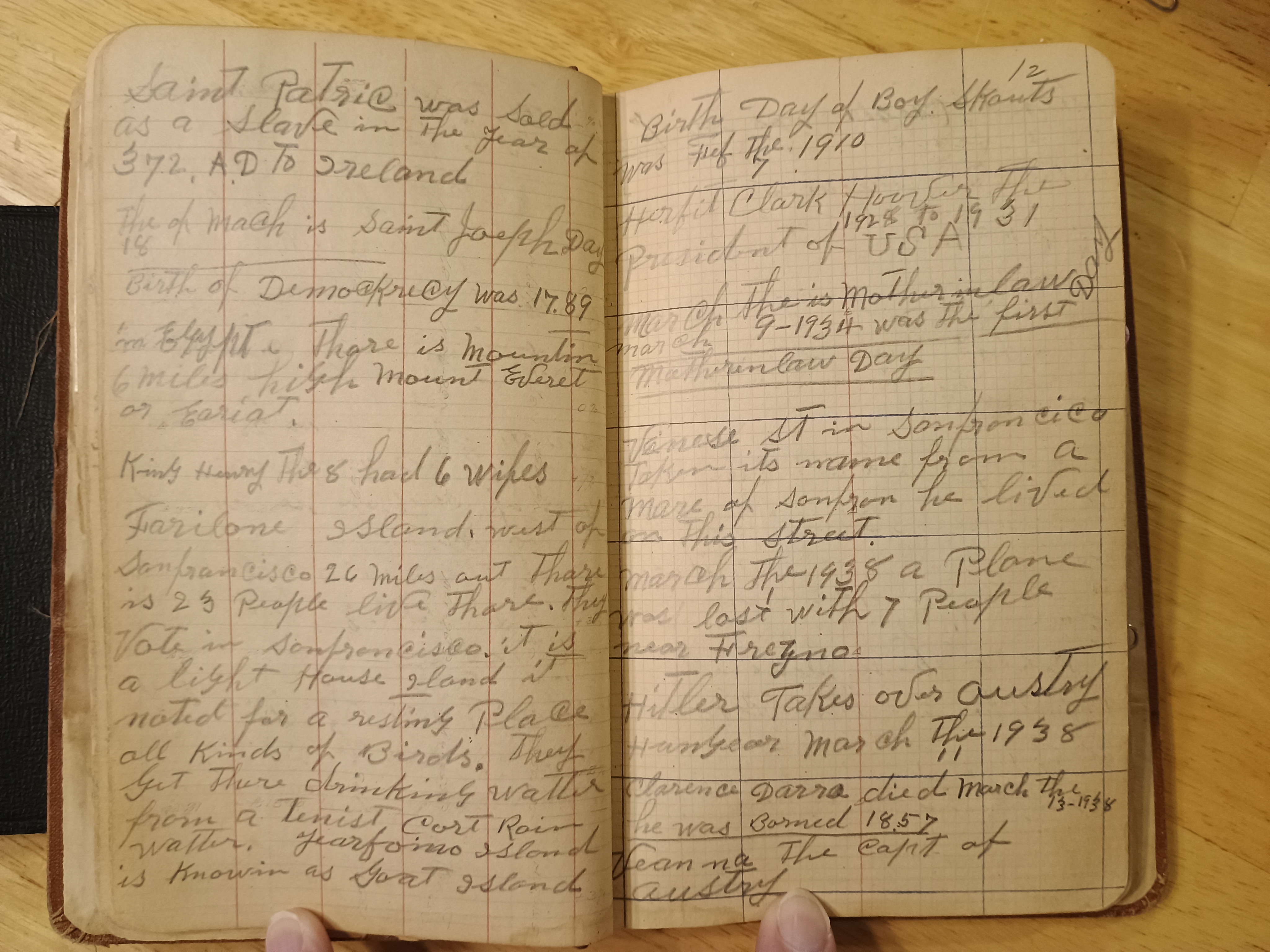
Transcription:
Left page — Saint Patric was Sold as a Slave in the year of 372. A.D. To Ireland — The 16 of March is Saint Joseph Day — Birth of Democracy was 1789 — In Egypt. There is Mountain 6 miles high Mount Everet or Eariat. — King Henry the 8 had 6 Wifes — Farilone Island. west of San Francisco 26 miles out There is 23 People live There. They Vote in San Francisco. it is a Light House Island noted for a resting Place all Kinds of Birds. They Get There Drinking water from a Tenist Court Rain water. Fearforino Island is Knowin as Goat Island
Right page — Birth Day of Boy Skauts was Feb the 1910 — Hubert Clark Hoover 1928 to 1931 President of USA — March the 9 1934 is Mother inlaw Day was the first Mother in law Day March 1934 was the first Mother inlaw Day — Venise St in San Francisco Taken its name from a mare at Sampson he lived on This Street. — March the 9 1934 was the first Mother in law Day — March the 1938 a Plane was lost with 7 People near Frezno. — Hitler Takes over Austry Hungear March the 11 1938 — Clarence Darro died March the 13 1938 he was Borned 1857 — Vienna the Capit of Austry
Notes:
The Farallon Islands 26 miles west of San Francisco, drinking water collected from a tennis court. Yerba Buena Island identified as Goat Island. Boy Scouts founded February 1910. Mother-in-Law Day on 9 March 1934 recorded twice. Venise Street in San Francisco named for a mare at Sampson’s. Hitler annexing Austria on 11 March 1938 with Hungary also noted. Clarence Darrow died 13 March 1938.
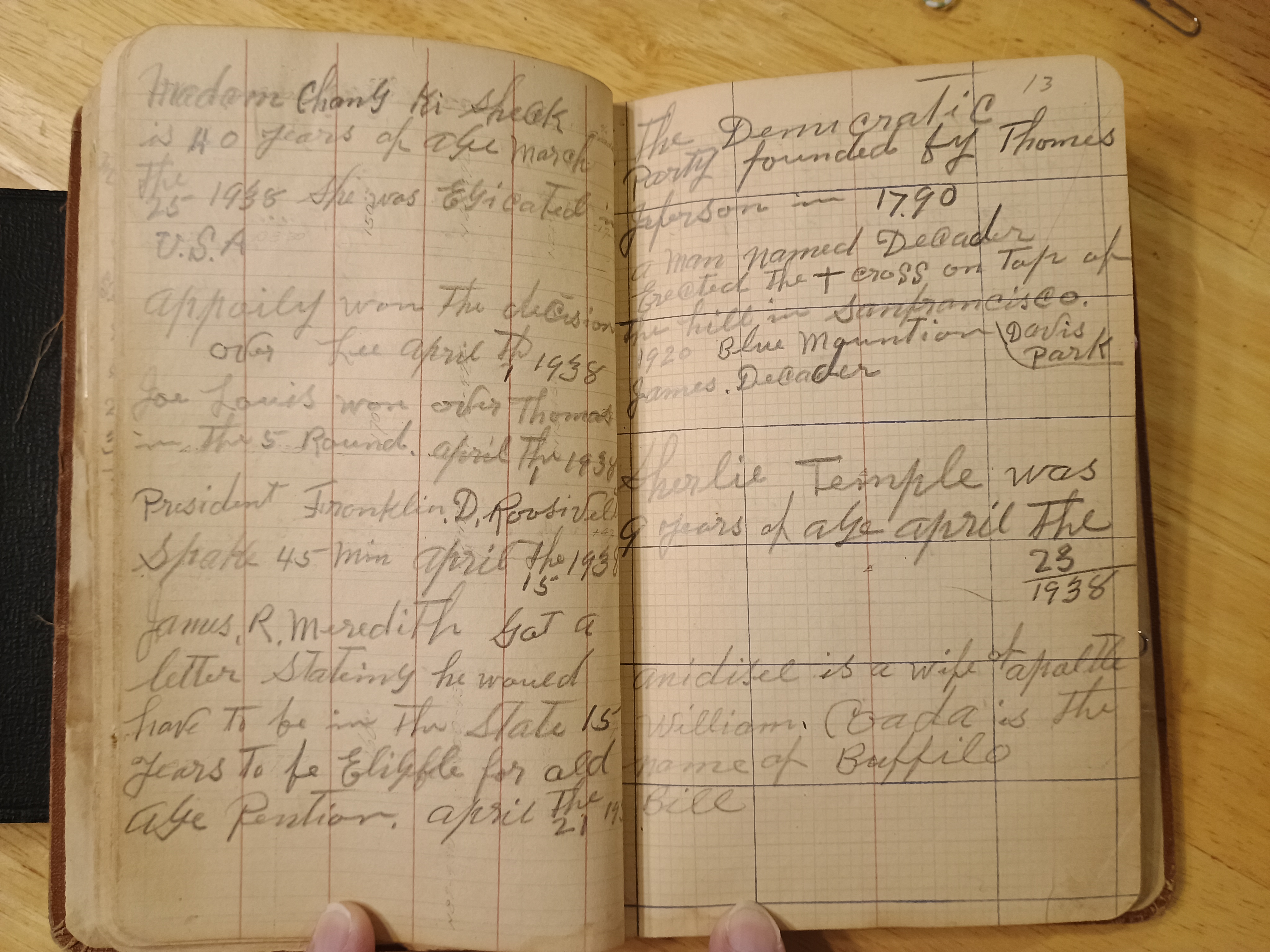
Transcription:
Left page — Madam Chants Ki Sheck is 40 years of age March the 25 1938 She was Educated U.S.A. — Appaily won the decision over Lee April the 1 1938 — Joe Louis won over Thomas in the 5 Round. April the 1938 — President Franklin D Roosevelt Spoke 45 min April the 15 1938 — James R. Meredith Got a letter Stating he would have to be in the State 15 years to be Eligible for old age Pension. April the 21 1938
Right page — The Democratic Party founded by Thomas Jefferson in 1790 — a man named Decader Created the cross on Top of the hill in San Francisco. 1920 Blue Mountain Davis Park James. Decader — Cherlie Temple was 9 years of age April the 23 1938 — unidisit is a wife tapattle William. Bada is the name of Buffalo Bill
Notes:
James received a letter in April 1938 stating he would need 15 years of California residency for the full old age pension. This explains the modest $35 assistance payment recorded earlier. Shirley Temple was 9 years old on 23 April 1938, James writes Cherlie.
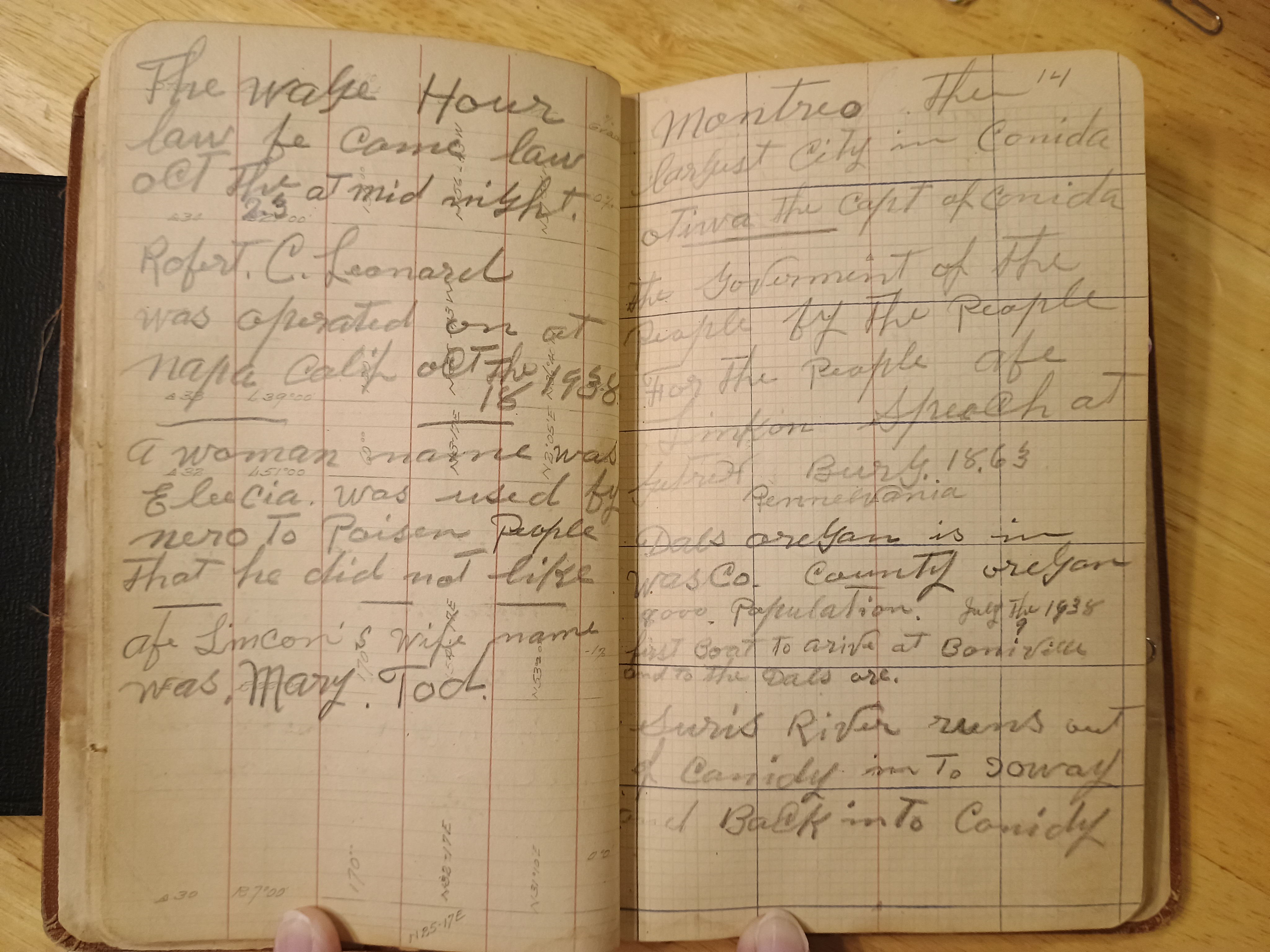
Transcription:
Left page — The Wage Hour law became law Oct the 25 at mid night. — Robert C. Leonard was operated on at Napa Calif Oct the 18 1938 — A woman named was Eleecia. was used by Nero to Poison People that he did not like — Abe Lincoln’s wife name was Mary Todd.
Right page — Montreo the largest City in Conida — Otiwa the Capt of Conida — the Goverment of the People by the People For the People afe Speech at Linton Burg. 1863 Pennilvania — Dals Oregon is in Wasco County Oregon grove. Population. July the 1938 first Boat to arive at Bonivell and to the Dals are. — Suris River runs out of Conidy in To Iowa and Back into Conidy
Notes:
The Fair Labor Standards Act became effective midnight 25 October 1938. The right page mixes Canadian geography with the Gettysburg Address paraphrased from memory, Oregon geography including The Dalles and Bonneville Dam, and the Missouri River running out of Canada into Iowa.
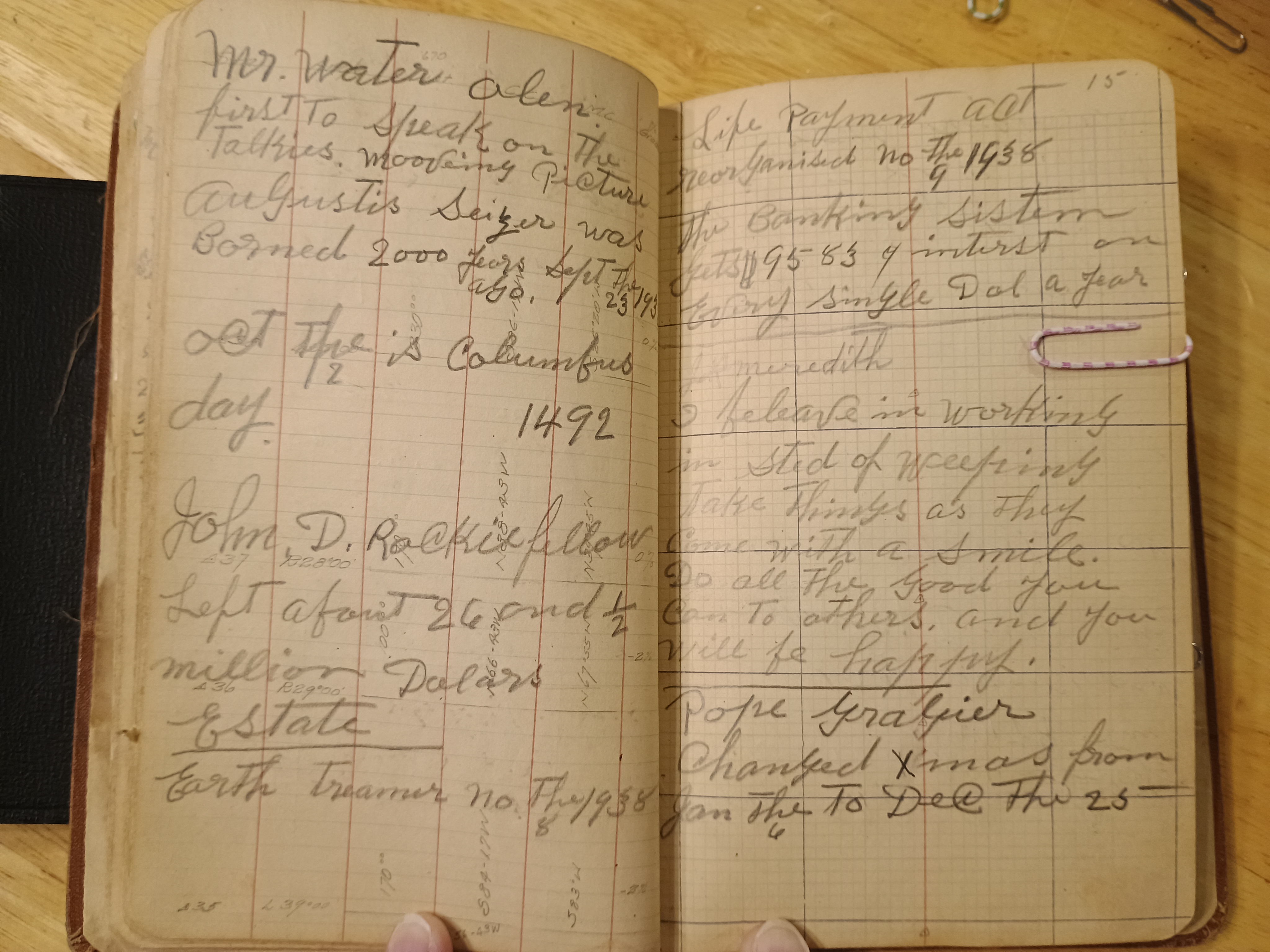
Transcription:
Left page — Mr. Water Alen first To Speak on the Talkies. Moving Picture — Augustis Seizer was Borned 2000 years ago. Sept the 25 1938 — Oct the 12 is Columbus Day 1492 — John D. Rockerfellow left about 26 and ½ million Dolars Estate — Earth treamer No the 8 1938
Right page — Life Payment Act Reorganised No the 9 1938 — The Banking Sistem cuts 95 83 9 interest on Every single Dol a year — meredith I believe in working in Sted of weeping Take Things as they Come with a Smile. Do all the Good you Can to others. and you will be happy. — Pope Gragger Changed Xmas from Jan the 6 To Dec the 25
Notes:
The right page contains a more personal entry in the journal, James writing in his own voice: I believe in working in Sted of weeping. Take Things as they Come with a Smile. Do all the Good you Can to others. and you will be happy. Seems like a good motto.
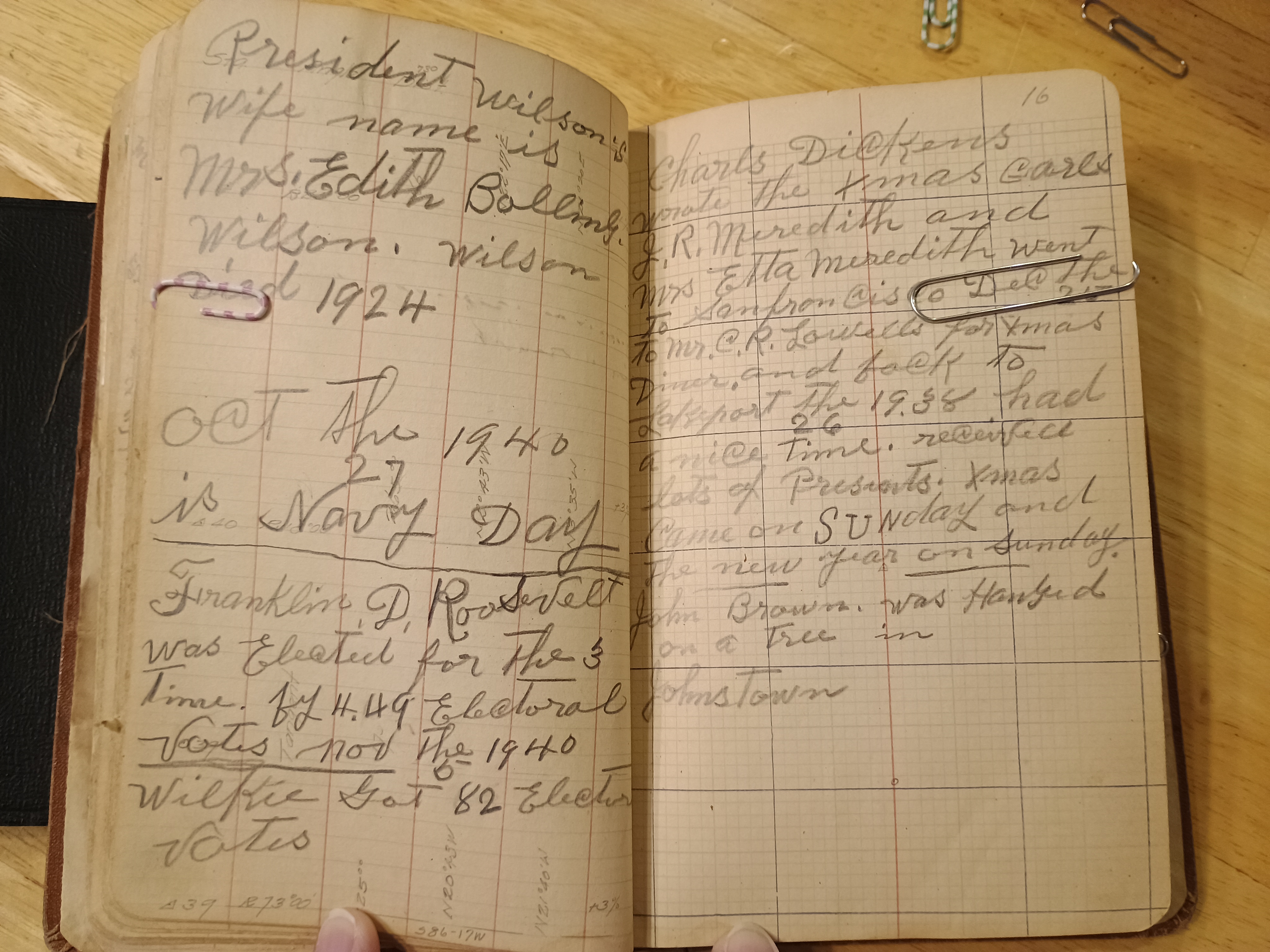
Transcription:
Left page — President Wilson’s Wife name is Mrs Edith Bolling Wilson. Wilson died 1924 — Oct the 27 1940 is Navy Day — Franklin D. Roosevelt was Elected for the 3 Time. by 449 Electoral Votes Nov the 1940 — Wilftie Got 82 Electoral Votes
Right page — Charls Dickens wrote the Xmas Carol — J.R. Meredith and Mrs Etta Meredith went To San Francisco Dec the 25 To Mr. C.R. Lowells for Xmas Dinner. and back to Lakeport the 26 1938 had a nice time. received lots of Presents. Xmas Came on Sunday and the new year on Sunday. — John Brown. was Hanged on a tree in Johnstown
Notes:
Roosevelt’s third election with 449 electoral votes over Wendell Willkie’s 82. The right page records James and Etta traveling to San Francisco on Christmas Day 1938 to Charles Raymond Lowell’s for Christmas dinner, returning on the 26th. Christmas and New Year’s both fell on Sunday. This entry, combined with the New Year’s Day 1940 entry on pages 13–14, establishes a pattern of James and Etta spending Christmas with Charles Raymond Lowell each year. John Brown was actually hanged at Charles Town, Virginia in 1859, not Johnstown.
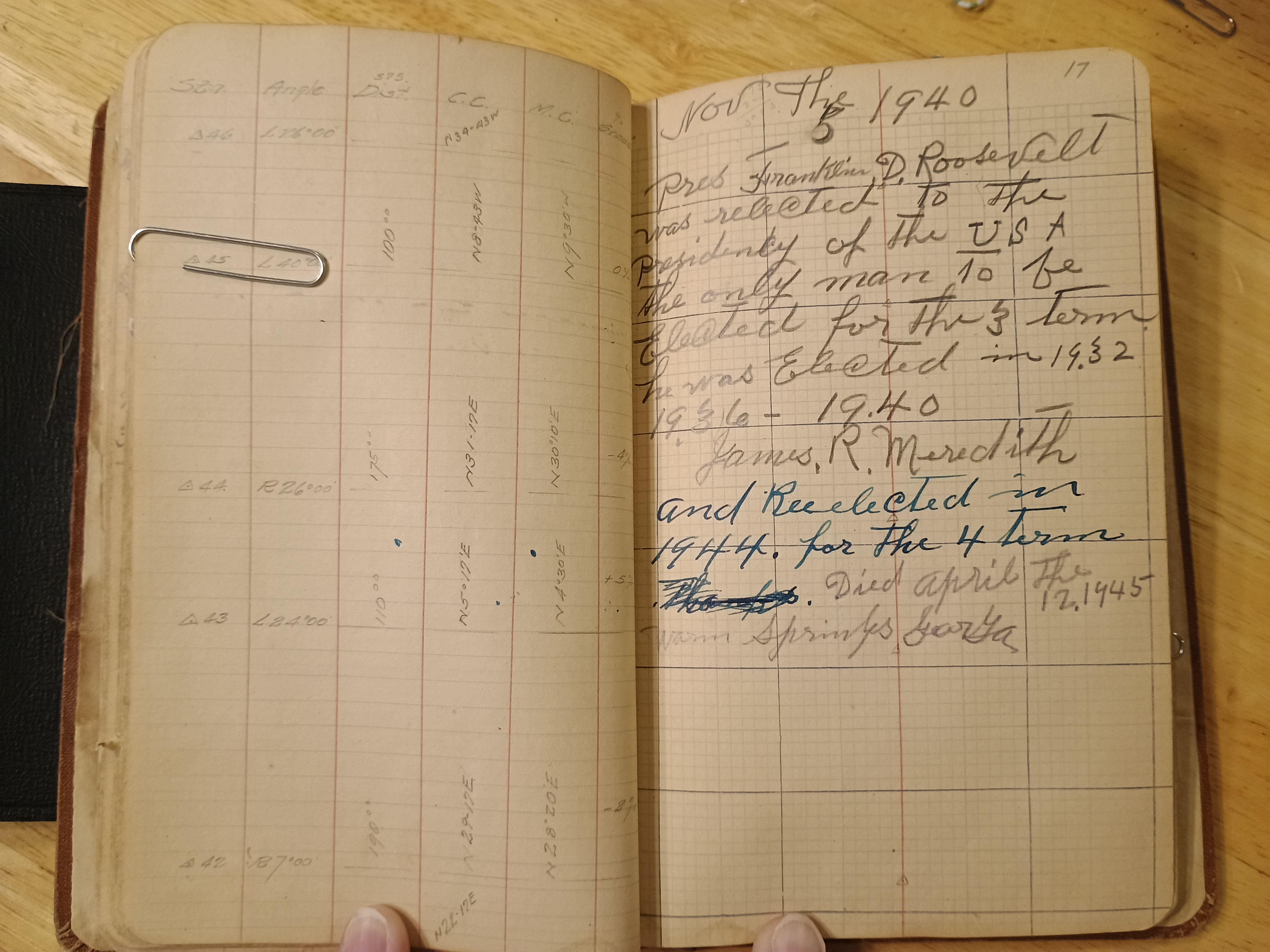
Transcription:
Left page — [Surveyor’s data only]
Right page — Nov the 5 1940 — Pres Franklin D. Roosevelt was reelected to the Presidency of the USA the only man to be Elected for the 3 term he was Elected in 1932 1936 — 1940 — James. R. Meredith — and Reelected in 1944. for the 4 term [crossed out]. Died April the 12 1945 Warm Springs Gorga
Notes:
The left page is pure surveyor’s data. The right page tracks Roosevelt’s career across two writing sessions, November 1940 recording his third election, then in different ink his 1944 fourth-term reelection and death on 12 April 1945 at Warm Springs, Georgia.
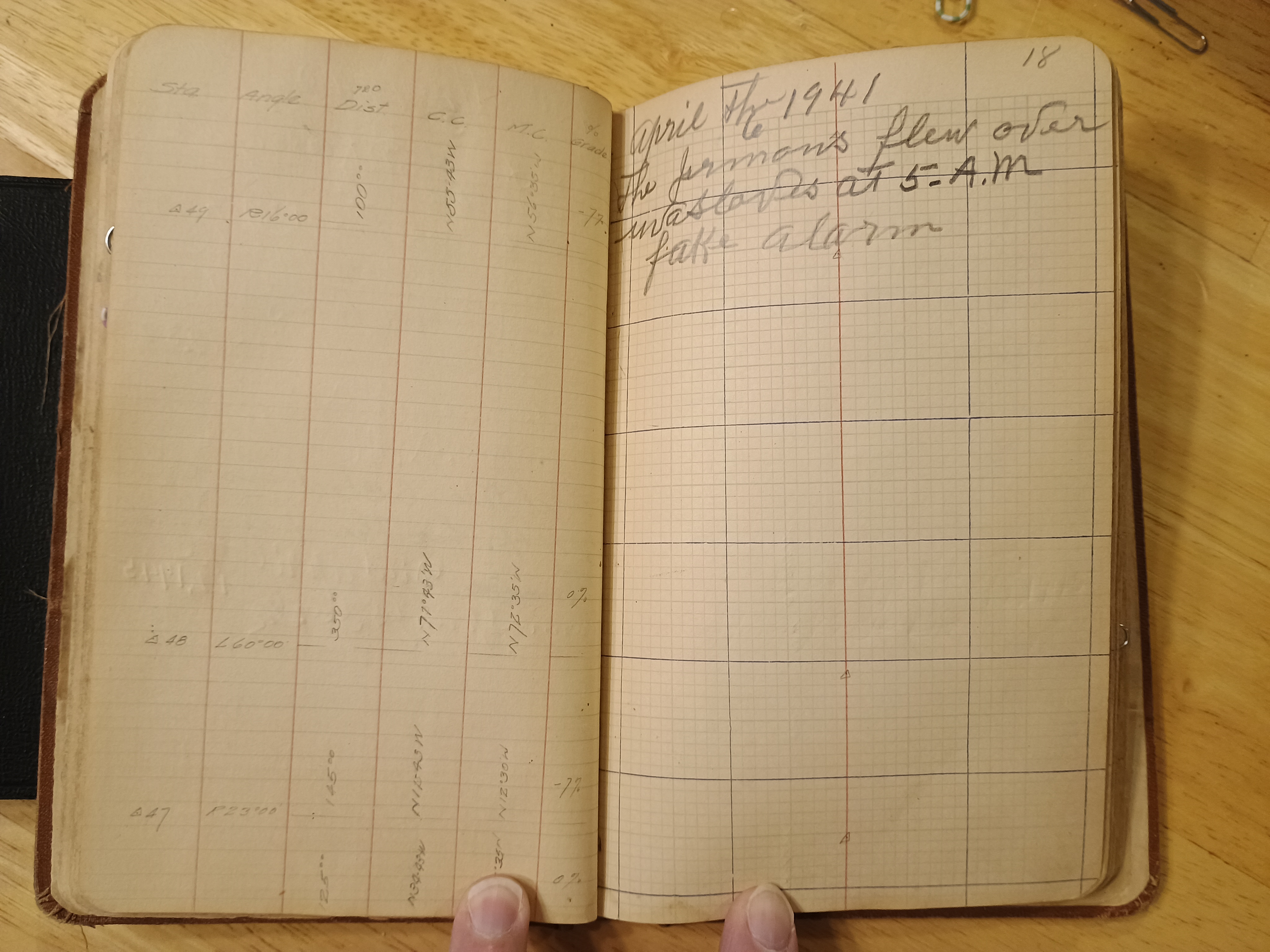
Transcription:
Left page — [Surveyor’s data only]
Right page — April the 6 1941 — the Jermons flew over invasion at 5. A.M. fake alarm
Notes:
On 6 April 1941, James recorded that the Germans flew over in an invasion at 5 A.M. — then added it was a false alarm. Almost certainly a reference to an air raid alert that swept the California coast during the anxious early months of American war preparedness.
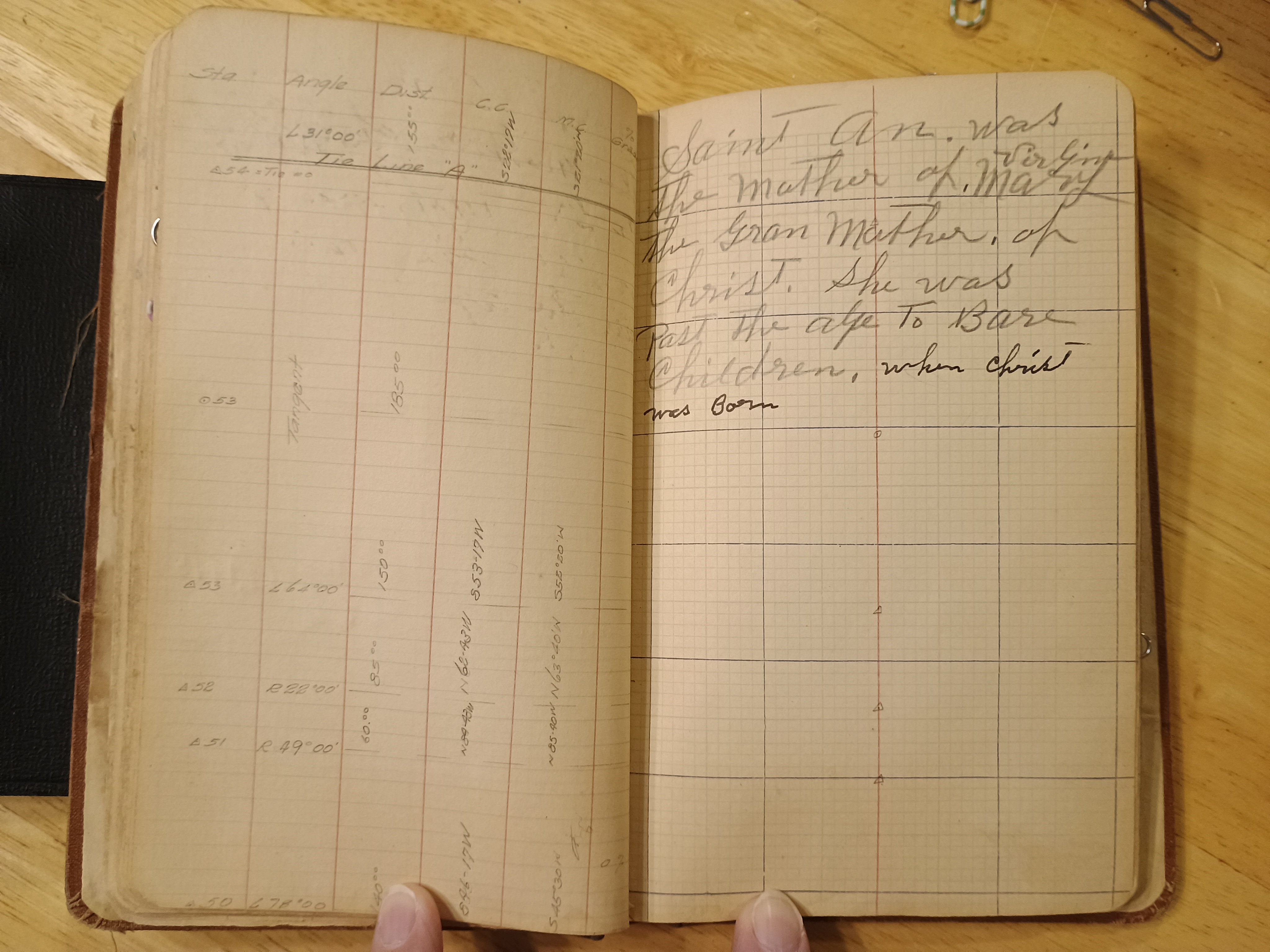
Transcription:
Left page — [Surveyor’s data only]
Right page — Saint Ann. was the mother of. Mary The Gran Mother. of Christ. She was Past the age to Bare Children. when Christ was Born
Notes:
James records the apocryphal tradition that Saint Anne was the mother of the Virgin Mary and grandmother of Christ, and was past childbearing age when Mary was born.
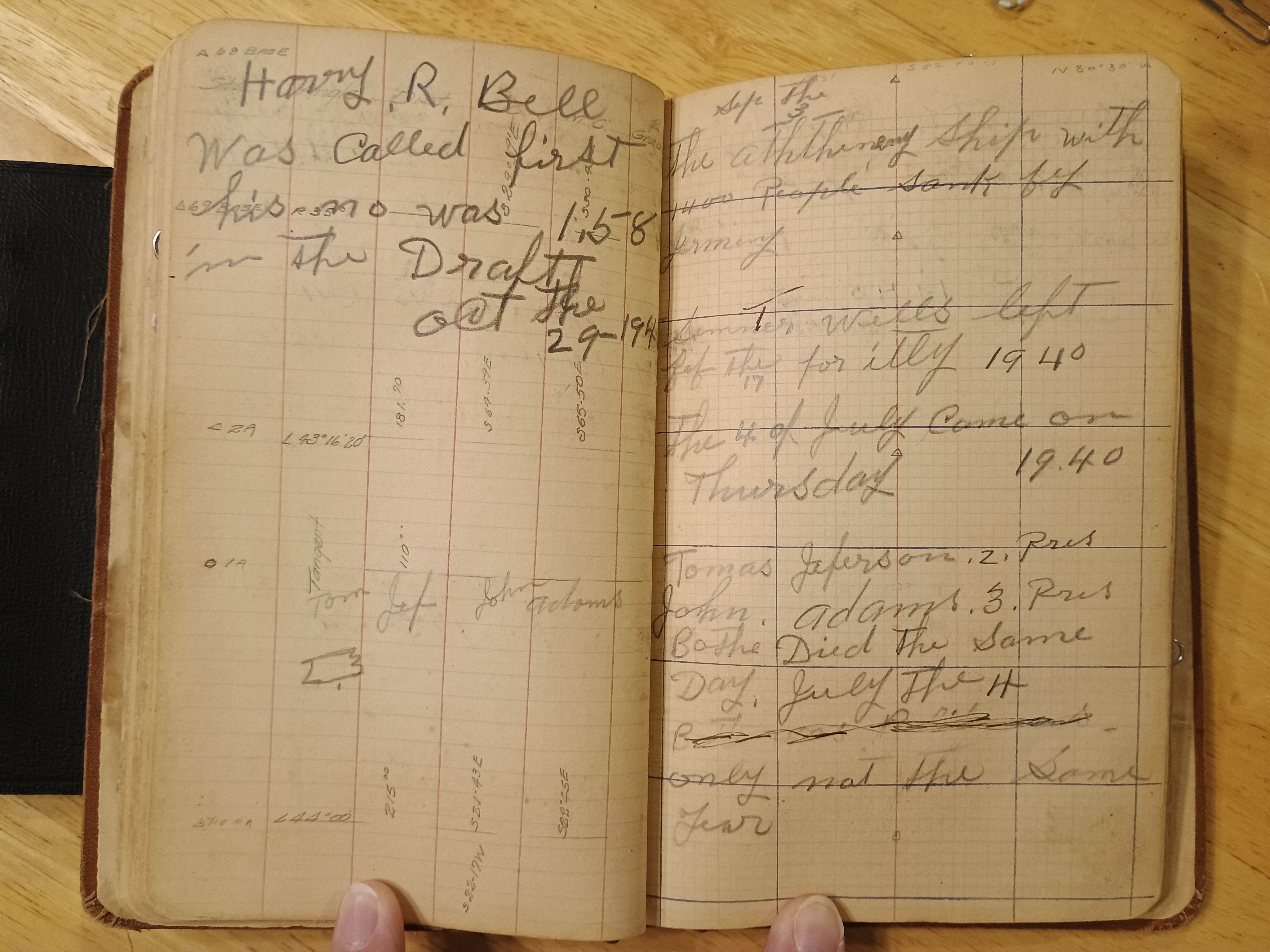
Transcription:
Left page — Harry R. Bell Was Called first his no was 158 in the Draft Oct the 29 1940
Right page — Sep the 3 the Athenia Ship with 400 People Sank by Germany — Tom Wells left the the for Itly 1940 17 — the 4 of July Came on Thursday 1940 — Tomas Jeferson. 2. Pres John. Adams. 3. Pres Bothe Died the Same Day. July the 4 [crossed out] only not the Same Year
Notes:
Harry R. Bell was called first in the draft, number 158 drawn on 29 October 1940, the first peacetime draft lottery in American history. The right page records the sinking of the Athenia on 3 September 1939; Tom Wells leaving for Italy on 17 July 1940; and Jefferson and Adams both dying on 4 July. James noting “only not the Same Year,” though they died the same year, 1826.
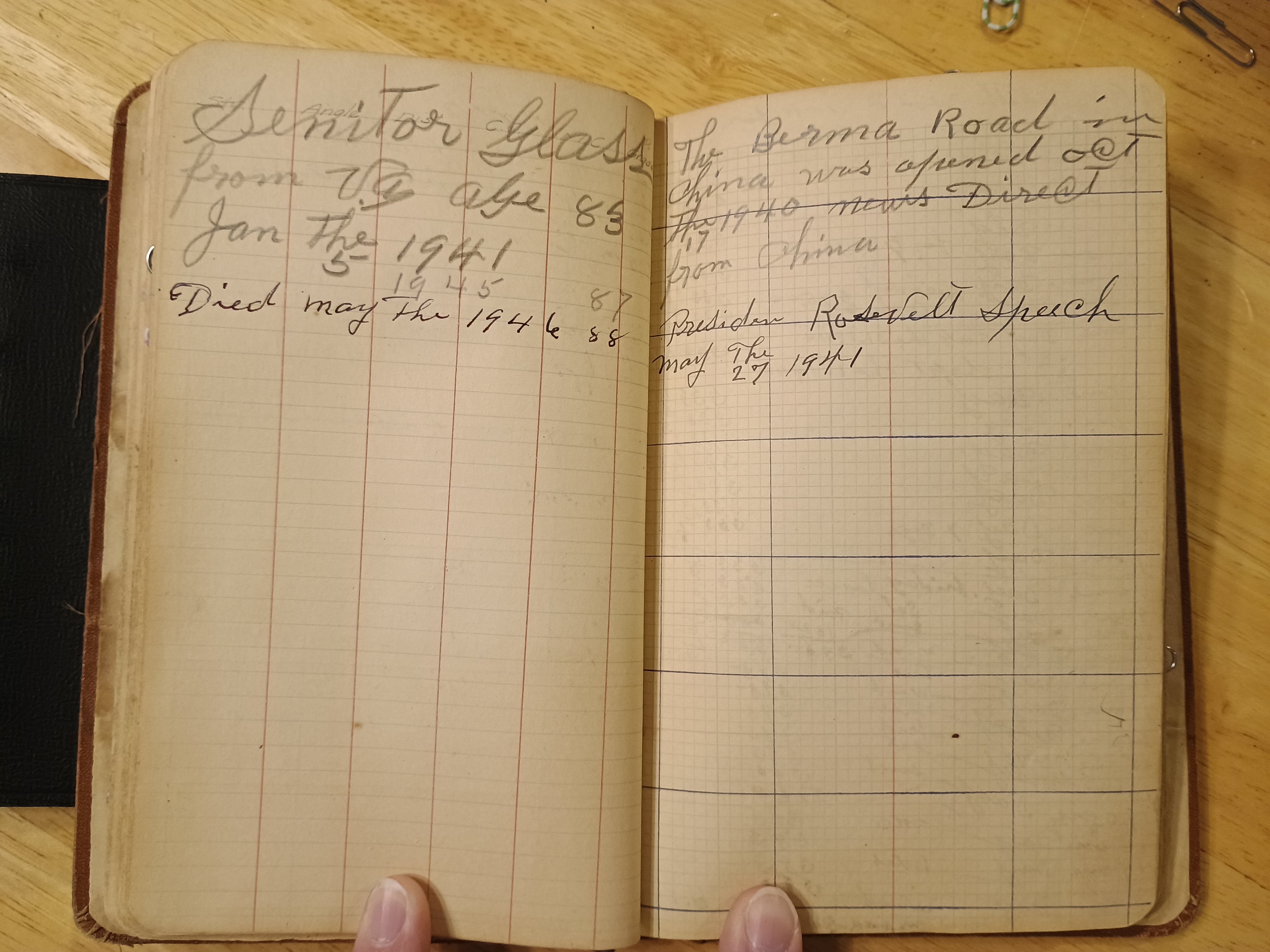
Transcription:
Left page — Senitor Glass from Va age 83 Jan the 5 1941 Died may the 1945 87 of the 1946 88
Right page — The Berma Road in China was opened Oct the 17 1940 news Direct from China — Presiden Roosvelt Speech May The 27 1941
Notes:
Senator Carter Glass of Virginia (1858–1946), a fellow Virginian James was tracking, noting his age as 83 in January 1941 and his death in 1946 at age 88. Carter Glass was a prominent Virginia Democrat and co-author of the Federal Reserve Act. The right page records the reopening of the Burma Road on 17 October 1940 and Roosevelt’s unlimited national emergency speech of 27 May 1941.
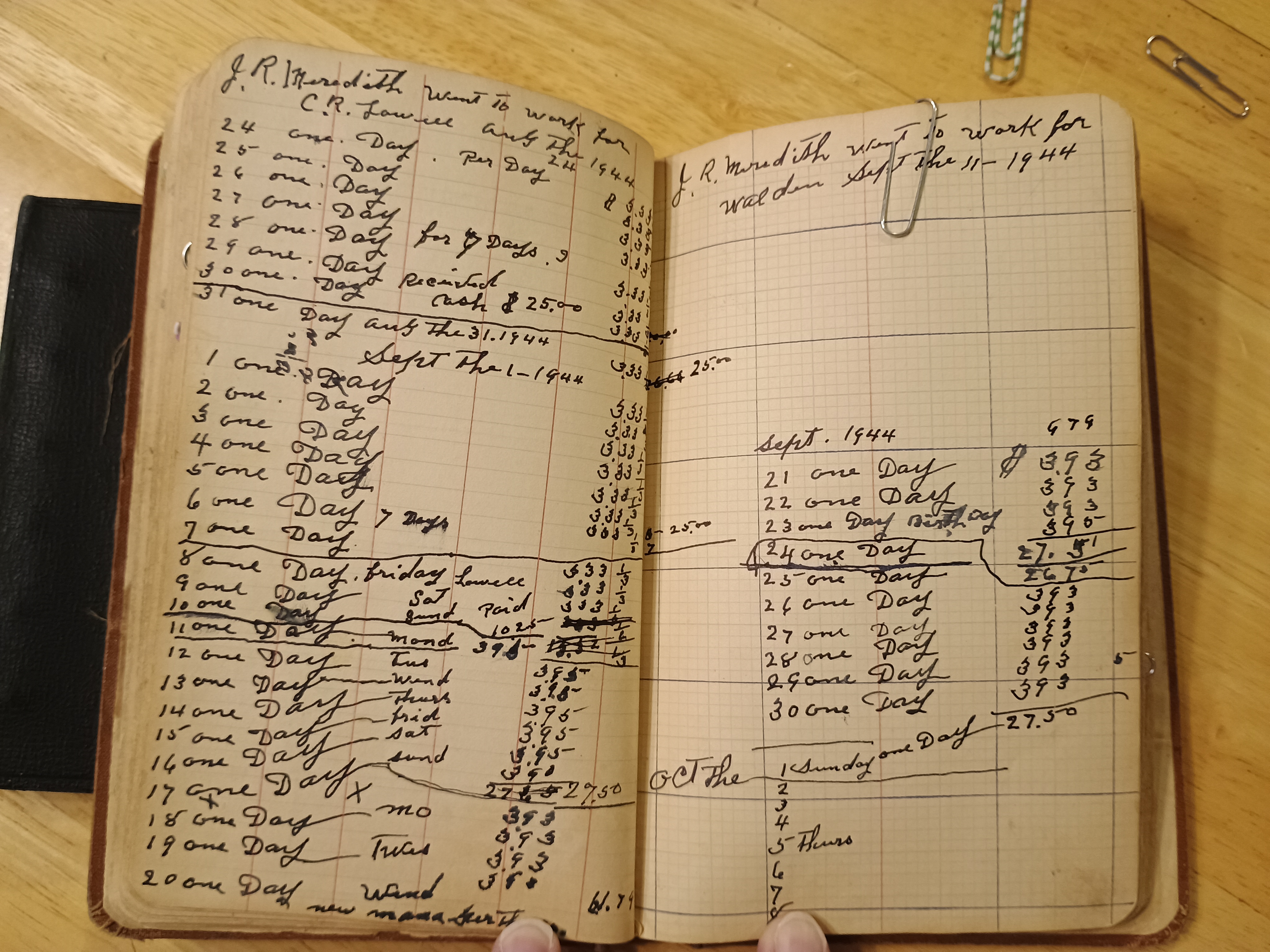
Transcription:
Left page — J. R. Meredith went to work for C.R. Lowell Aug the 1944 — 24 one Day Per Day $3.33 — 25 one Day 3.33 — 26 one Day 3.33 — 27 one Day 3.33 — 28 one Day for 5 Days 3.33 — 29 one Day 3.33 — 30 one Day Received Cash $25.00 3.33 — 31 one Day Aug the 31. 1944 — Sept The 1 1944 $25.00 — [days 1–20 continuing at $3.33 then $3.95 then $3.93 per day with weekly totals] — new mana[gement]
Right page — J. R. Meredith went to work for Walden Sept the 11 — 1944 — Sept. 1944 — 21 one Day $3.93 — 22 one Day 3.93 — 23 one Day Birthday 3.90 — 24 one Day 27.5[1] — [days 25–30 continuing] — OCT the 1 Sunday one Day [days trailing off]
Notes:
These pages contain the most detailed employment record in the journal. In August 1944 James went to work for C.R. Lowell, at $3.33 per day, recording each day worked through the end of August and into September, receiving $25 cash on 31 August. The daily rate shifted to $3.95 and then $3.93, possibly reflecting a change in management noted at the bottom of the left page. Then on 11 September 1944 James went to work for someone named Walden, continuing the daily record through the rest of September. The 23 September entry is noted as his birthday. James was 74 years old in September 1944 and still working as a day laborer, recording each day carefully in his surveyor’s field book.
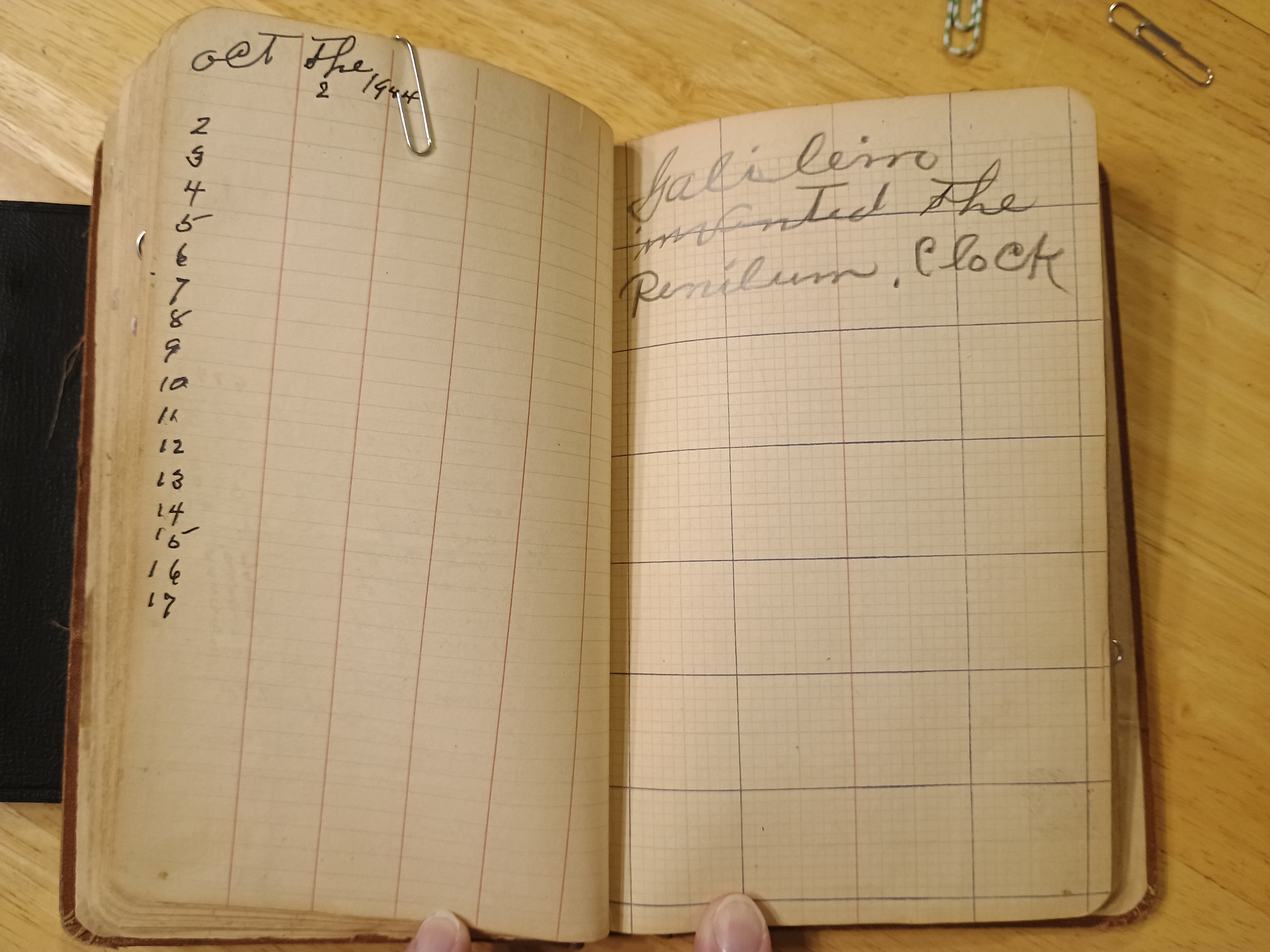
Transcription:
Left page — Oct The 2 1944 — [dates 2–17 listed with no entries beside them]
Right page — Galileiro invented the Penilum. Clock
Notes:
The left page is a continuation of the October 1944 work record. James listing the days of the month but leaving the entries blank. The daily employment record simply stops. The right page holds a single isolated entry: Galileo invented the pendulum clock. James’s spelling is characteristic — Galileiro and Penilum. Galileo did discover the isochronous properties of the pendulum around 1602, and his work laid the foundation for the pendulum clock, though the first practical pendulum clock was built by Christiaan Huygens in 1656.
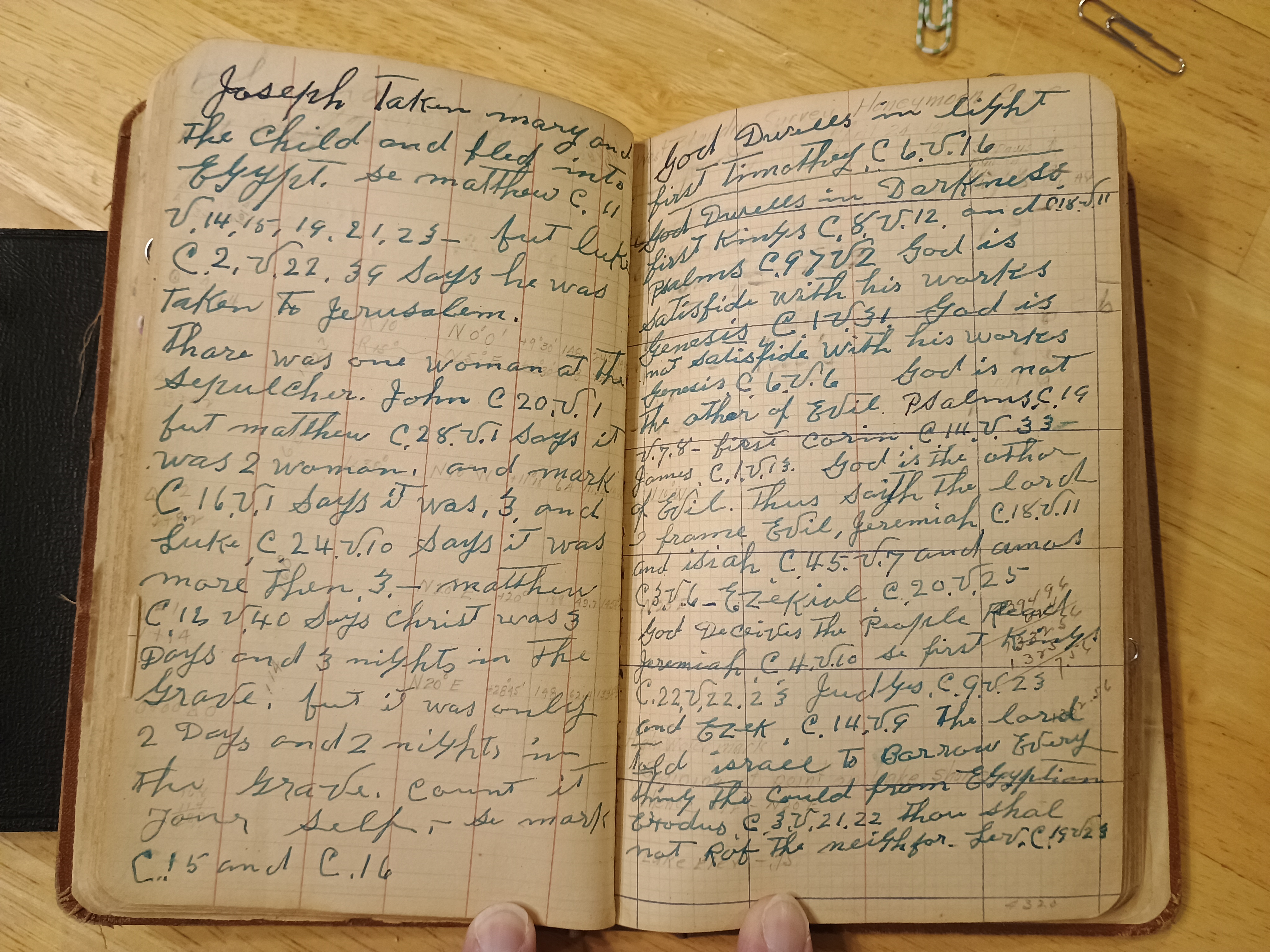
Transcription:
Left page — Joseph Taken mary and the Child and fled into Egypt. be matthew C. 61 V. 14, 15, 19, 21, 23 — but Luke C. 2, V. 22, 39 Says he was Taken To Jerusalem. — There was one woman at the Sepulcher. John C 20 V. 1 but matthew C. 28. V. 1 Says it was 2 woman. and mark C. 16 V. 1 Says it was. 3. and Luke C. 24. V. 10 Says it was more Then. 3. — matthew C 12 V. 40 Says Christ was 3 Days and 3 nights in the Grave. but it was only 2 Days and 2 nights in the Grave. Count it your Self. — be mark C. 15 and C. 16
Right page — God Dwells in Light first Timothy. C. 6. V. 16 — God Dwells in Darkness first Kings C. 8 V. 12. and C. 18 V. 11 — Psalms C. 97 V. 2 God is Satisfide with his workes — Genesis C. 1 V. 31 God is not Satisfide with his workes — Genesis C. 6 V. 6 God is not the other of Evil. Psalms 5. 19 V. 7 8 — first Corin. C. 14 V. 33 — James C. 1 V. 13. God is the other of Evil. Thus Saith the Lord I frame Evil. Jeremiah C. 18 V. 11 and Isaiah C. 45. V. 7 and Amos C. 3 V. 6 — Ezekiel C. 20. V. 25 God Deceives the People — Jeremiah C. 4 V. 10 be first Kings C. 22 V. 22. 23 Judges C. 9 V. 23 and Ezek. C. 14 V. 9 The Lord Told Israel To Borrow Every thing the Could from Egyptian — Exodus C. 3 V. 21. 22 thou Shal not Rob the neighbor. Lev. C. 15 V. 2 3
Notes:
These pages reveal a side of James not seen before in the journal, a biblical student working through apparent contradictions with chapter and verse. The left page examines the flight into Egypt versus Luke’s account of the presentation in Jerusalem, the number of women at the sepulcher across the four Gospels, and the calculation of days and nights Christ was in the grave. The right page lists contradictions about the nature of God, whether God dwells in light or darkness, is satisfied with his works or not, is the author of evil. Each claim paired with its citation. Serious theological inquiry, not casual note-taking.
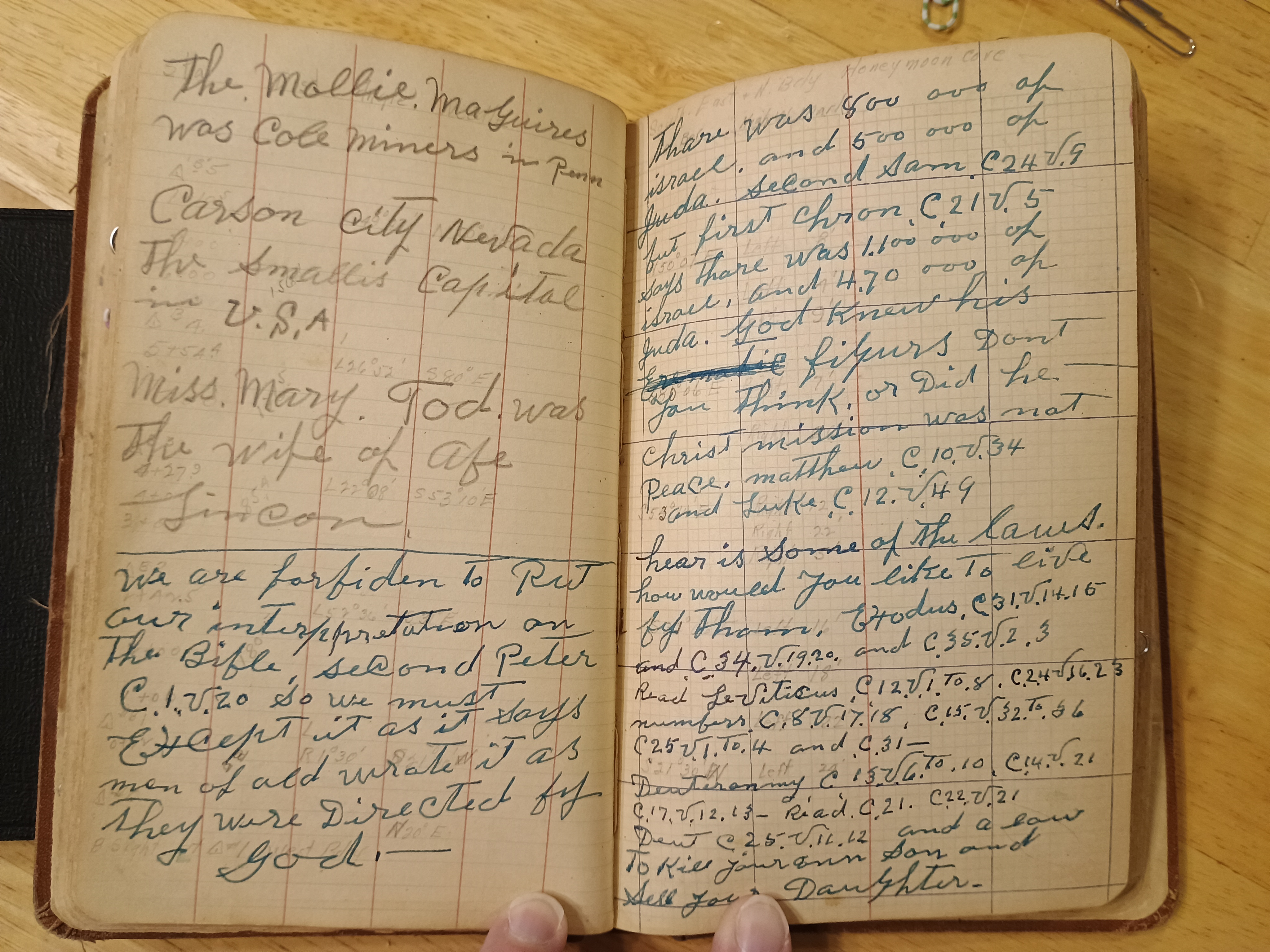
Transcription:
Left page — The Mollie. Maguires was Cole miners in Penn[sylvania] — Carson City Nevada The Smallis Capital in U.S.A. — Miss. Mary. Tod. was The wife of Abe Lincoln — We are forbiden to Put our interpretation on the Bible. Second Peter C. 1. V. 20 So we must Except it as it Says men of old wrote it as they were Directed by God.
Right page — There was 800 000 of Israel. and 500 000 of Juda. Second Sam. C 24 V. 9 but first Chron. C. 21 V. 5 Says there was 1.100 000 of Israel. and 4.70 000 of Juda. God Knew his figures Dont you Think. or Did he — Christ mission was not Peace. matthew C. 10 V. 34 and Luke C. 12. V. 49 — hear is Some of the Laws. how would you like to live by Them. Exodus C. 31 V. 14 15 and C. 34. V. 19 20. and C. 35 V. 2. 3 Read Leviticus C. 12 V. 1 to 8. C. 24 V. 16. 23 Numbers C. 8 V. 17. 18. C. 15. V. 32 to 36 C. 25 V. 1 to 4 and C. 31 — Deuteronomy C. 13 V. 6 to 10. C. 14. V. 21 C. 17. V. 12. 13 — Read C. 21. C 22. V. 21 Dent C. 25. V. 11. 12 and a law to Kill your own Son and Sell your Daughter.
Notes:
The Mollie Maguires were Irish-American coal miners in Pennsylvania, hanged in the 1870s. Carson City as the smallest state capital. Mary Todd Lincoln. James writes we are forbidden to put our own interpretation on the Bible (Second Peter 1:20), and must accept it as written by men directed by God. The right page lists Old Testament laws from Exodus, Leviticus, Numbers, and Deuteronomy, asking whether the reader would want to live by them. The tension with his left-page statement is worth noting: he insists the Bible must be taken as written, then works through passages that raise questions. He lets the citations speak for themselves.
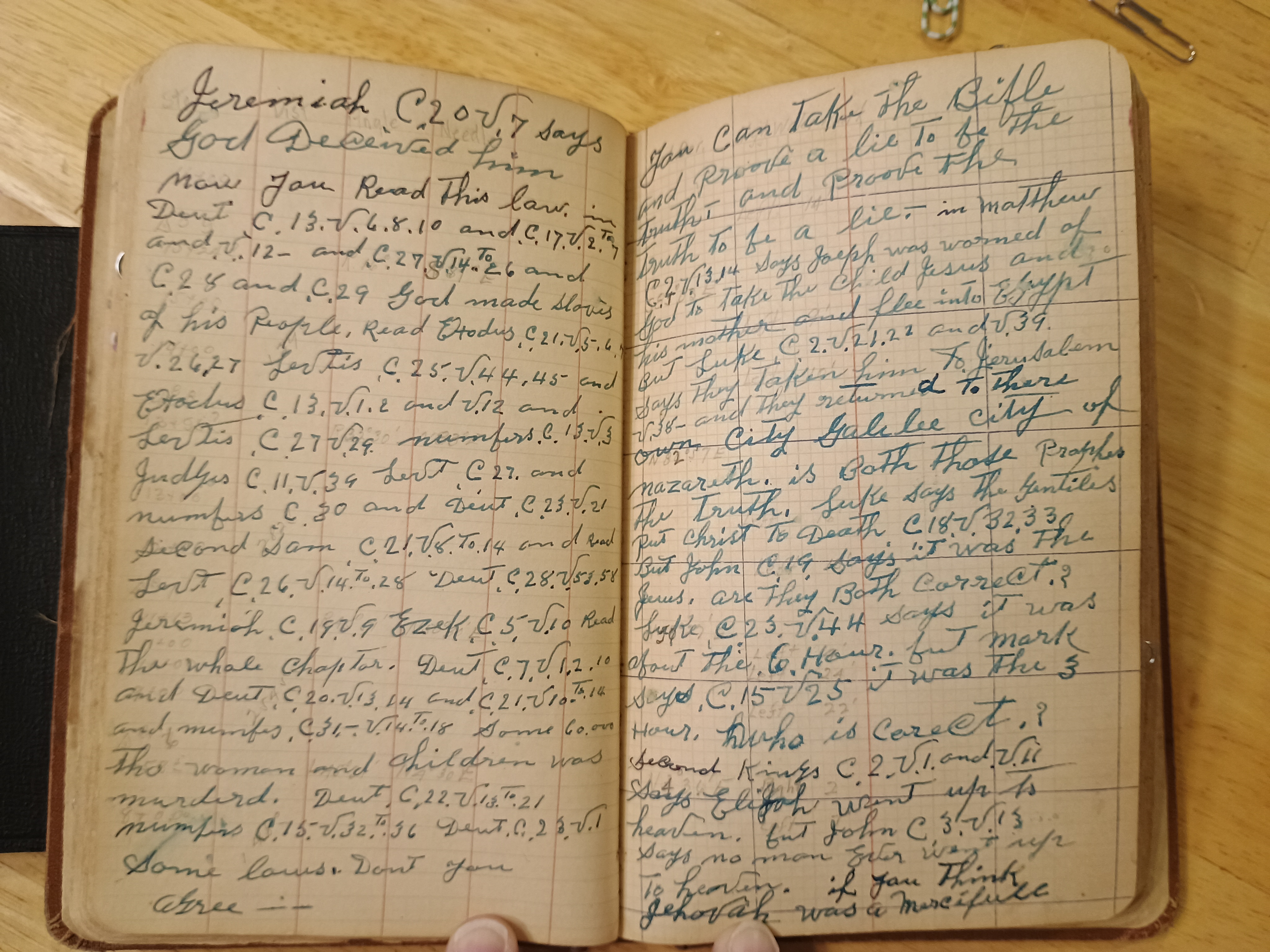
Transcription:
Left page — Jeremiah C. 20 V. 7 Says God Deceived him — Now you Read this law. Dent C. 13. V. 6. 8. 10 and C. 17. V. 2 to V. 12 — and C. 27 V. 14 to 26 and C. 28 and C. 29 God made Slaves of his People. Read Exodus C. 21 V. 3 6 V. 26 27 Levitus C. 25. V. 44. 45 and Exodus C. 13. V. 1. 2 and V. 12 and Levitus C. 27 V. 29 Numbers C. 13 V. 3 Judges C. 11. V. 39 Dent C. 27. and Numbers C. 30 and Dent C. 23. V. 21 Second Sam C. 21. V. 8 to 14 and Read Levit C. 26. V. 14 to 28 Dent C. 28. V. 53 58 Jeremiah C. 19 V. 9 Ezek C. 5. V. 10 Read the whole Chapter. Dent C. 7. V. 1. 2. 10 and Dent. C. 20. V. 13. 14 and C. 21. V. 10 to 16 and numbers C. 31. V. 14 to 18 Some 60.000 the women and Children was murdered. Dent. C. 22. V. 13 to 21 Numbers C. 15. V. 32 to 36 Dent C. 23. V. 1 Some laws. Dont you agree —
Right page — you Can Take the Bible and Prove a lie to be the truth and Prove the truth to be a lie. in matthew C. 2 V. 13 14 Says Joseph was warned of God to Take the Child Jesus and his mother and flee into Egypt but Luke C. 2. V. 21. 22 and V. 39. Says they Taken him To Jerusalem V. 38 and they returned to there own City Galilee city of Nazareth. is Both those Prophes the Truth. Luke Says the Gentiles Put Christ to Death C. 18 V. 32. 33 but John C. 19 Says it was the Jews. are they Both Correct.? Luke C. 23. V. 44 Says it was about the 6. Hour. but mark Says C. 15 V. 25 it was the 3 Hour. Who is Correct.? Second Kings C. 2. V. 1 and V. 11 Says Elijah went up to heaven. but John C. 3. V. 13 Says no man Ever went up to heaven. if you Think Jehovah was a merciful
Notes:
The left page is a dense catalogue of Old Testament passages, ending: Some laws. Dont you agree. The right page opens with: you Can Take the Bible and Prove a lie to be the truth and Prove the truth to be a lie. James works through contradictions, the flight into Egypt versus Jerusalem, who put Christ to death, what hour of crucifixion, whether Elijah ascended to heaven. The page ends mid-sentence, if you Think Jehovah was a merciful, concluded on the next page.
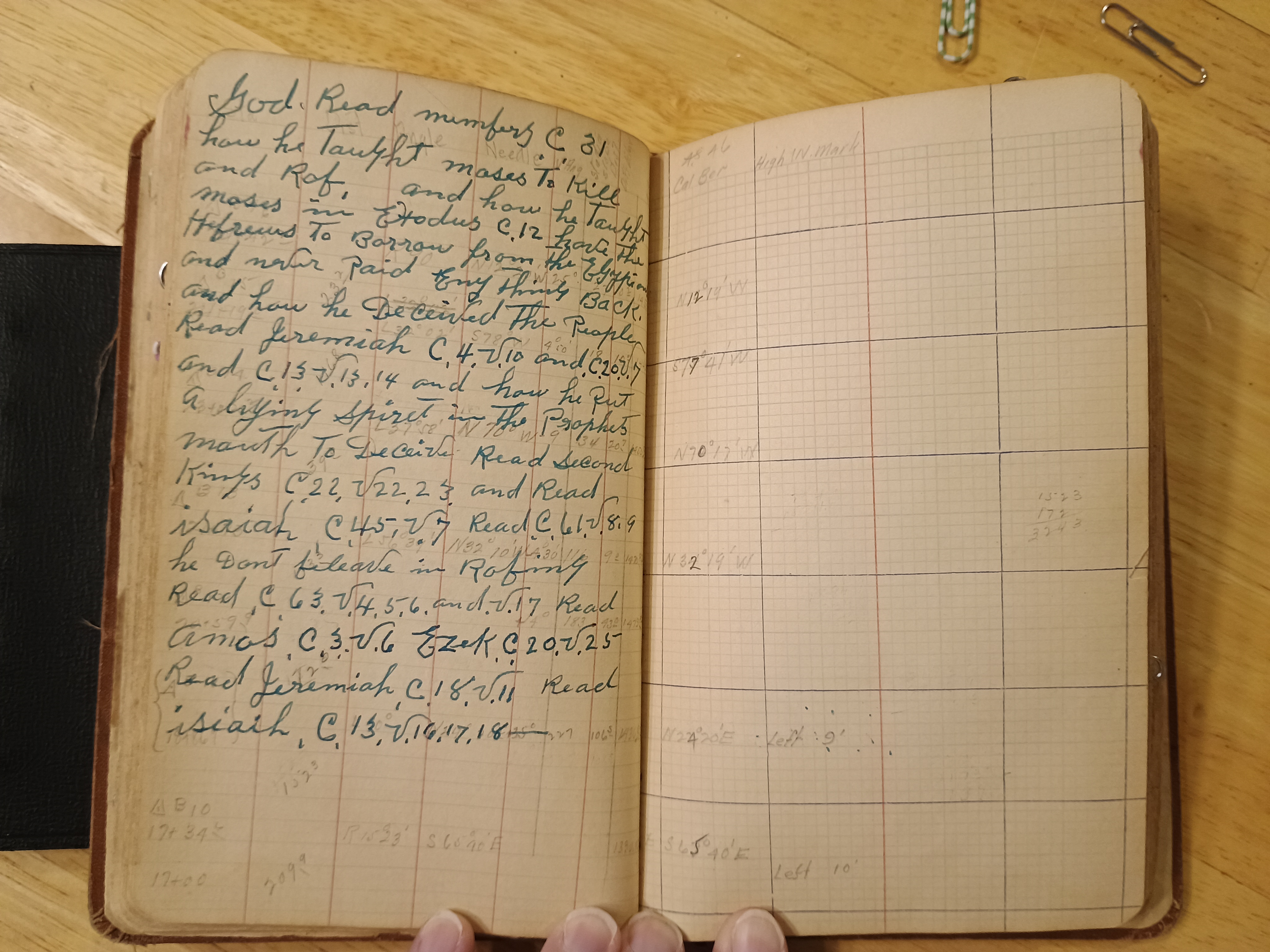
Transcription:
Left page — God. Read numbers C. 31 how he Taught moses To Kill and Rob. and how he taught moses in Exodus C. 12 Isac the Hebrews To Borrow from the Egyptian and never paid any thing Back. and how he Deceived the People Read Jeremiah C. 4. V. 10 and C. 20. V. 7 and C. 13 V. 13. 14 and how he Put a lying Spirit in the Prophets mouth To Deceive Read Second Kings C. 22. V. 22. 23 and Read Isaiah C. 45. V. 7 Read C. 61. V. 8. 9 he Dont Believe in Robbing Read C. 63. V. 4. 5. 6. and V. 17 Read Amos C. 3. V. 6 Ezek C. 20. V. 25 Read Jeremiah C. 18. V. 11 Read Isaiah. C. 13. V. 16. 17. 18
Right page — [Surveyor’s data only]
Notes:
The sentence from page 50, if you Think Jehovah was a merciful, is completed here with God. James continues his catalogue: God commanding Moses to kill and rob, teaching the Hebrews to borrow from the Egyptians without repaying, deceiving the people, putting a lying spirit in the mouths of prophets. He ends with Isaiah 13:16–18. This is the most intellectually sustained writing in the journal, seven pages of biblical inquiry. The right page is surveyor’s data only.
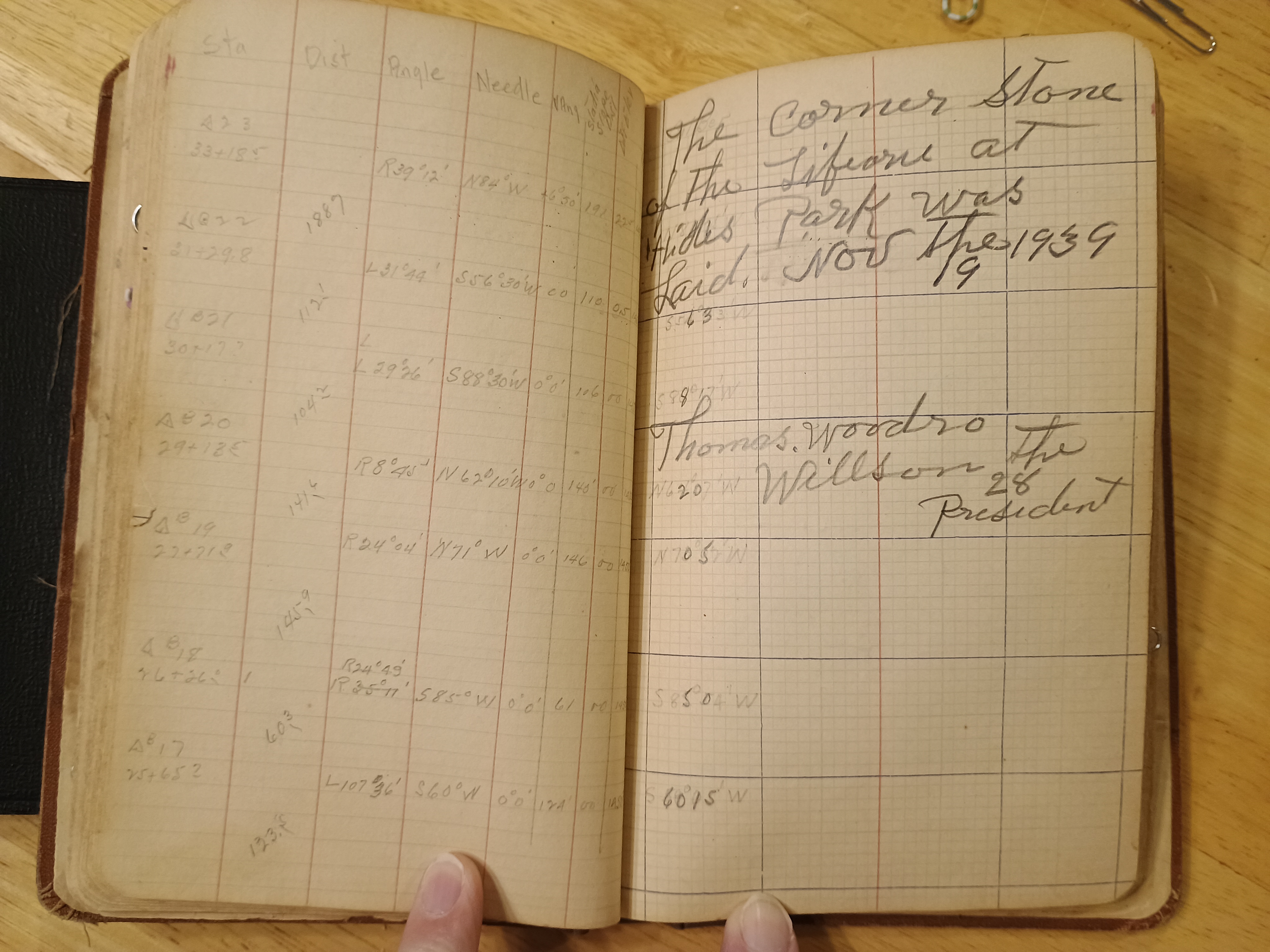
Transcription:
Left page — [Surveyor’s data only]
Right page — The Corner Stone of the Lifeone at Hides Park was Laid. Nov the 19 1939 — Thomas. Woodro the Willson 28 President
Notes:
The right page records the laying of the cornerstone of the Roosevelt Library and Museum at Hyde Park, New York on 19 November 1939. James writing Lifeone for Library and Hides Park for Hyde Park. Roosevelt himself laid the cornerstone before nearly 1,000 people. The second entry notes Woodrow Wilson as the 28th President.
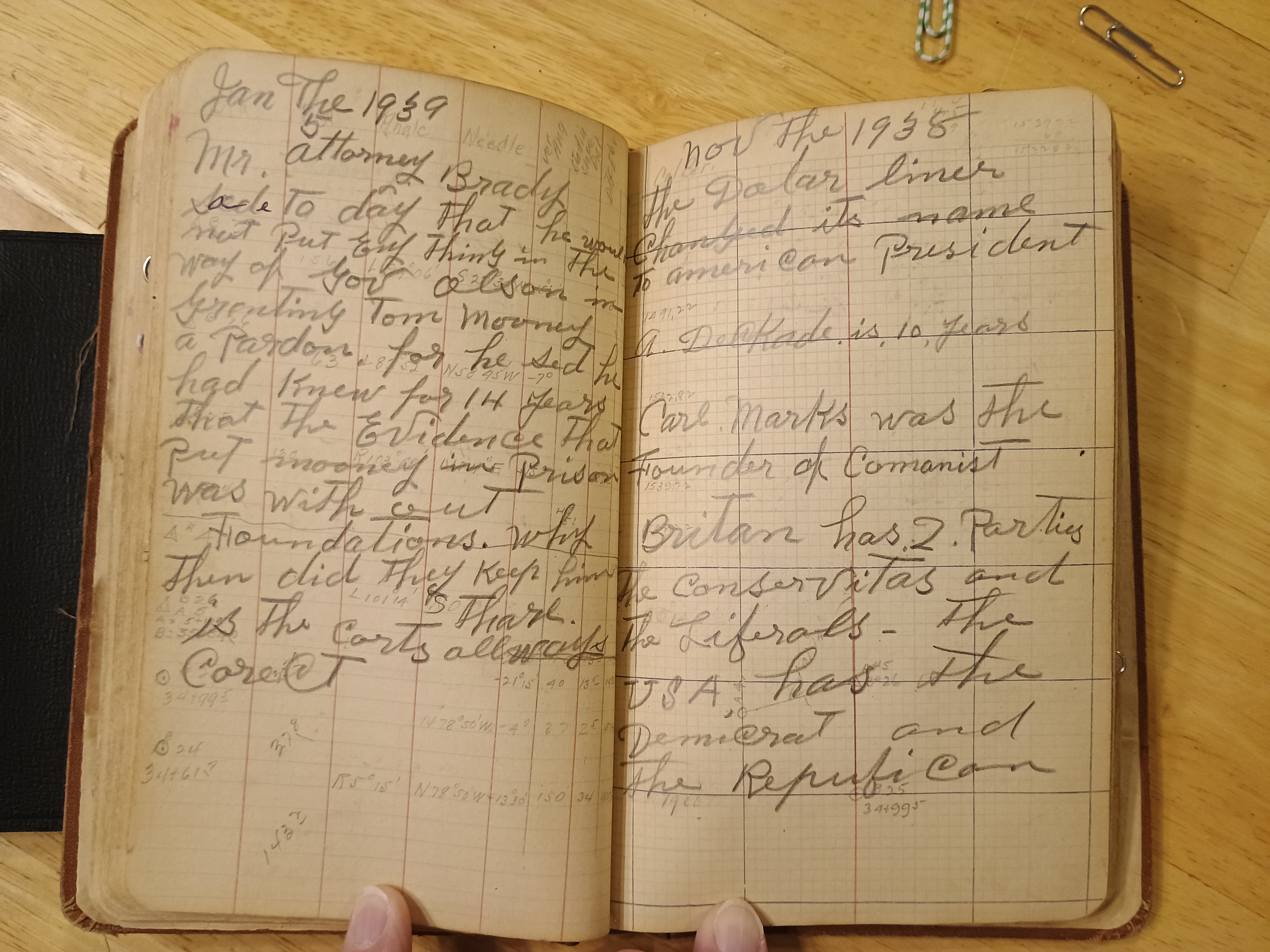
Transcription:
Left page — Jan The 15 1939 Mr. attorney Brady Sade to day that he would not Put any thing in the way of Gov. Olson m[aking] granting Tom Mooney a Pardon. for he Sad he had Knew for 14 years that the Evidence that Put Mooney in Prison was with out Foundations. Why then did they Keep him Thare. is the Corts always Corect
Right page — Nov the 1938 the Dolar liner Changed its name to American President — A Deckade is 10 years — Carl Marks was the Founder of Comanist — Britain has 2 Parties the Conservitas and the Lifeones. The USA has the Democrat and the Republican
Notes:
The Tom Mooney case, one of the most famous wrongful convictions in American labor history. Mooney had been convicted of the 1916 Preparedness Day Bombing and imprisoned for over two decades. On 15 January 1939 attorney Brady stated he would not oppose Governor Olson granting a pardon, having known for 14 years the evidence was without foundation. Olson pardoned Mooney on 7 January 1939. James’s question is pointed: Why then did they Keep him Thare. is the Corts always Corect.
The right page notes the Dollar Steamship Line changing its name to American President Lines in November 1938. Karl Marx as founder of Communism, James writes Carl Marks and Comanist. Britain’s two parties, the Conservatives and the Liberals, James writing Lifeones for Liberals, the same phonetic rendering as Lifeone for Library on pages 53–54, compared with America’s Democrats and Republicans.

Transcription:
Left page — Humidy is High Jan Swet the most Humidy is Judged by the moisture in the Air — Henry Ford was 75 yrs of age July the 29 1938 — Joe Rasen Brought Will Rogers and his Pardner Back to USA after the Crash 1935 — Will Rodgers was a indian
Right page — [Surveyor’s data — Honeymoon Cove] — a Man Can Get on First base 4 diferent ways with out Hitting the Ball. first by a walk. Second Catcher. Enumerating the Strike. Third by a hit Ball. forth by a droped Ball. — in the White Cap Crime killing a man. Will Perso. was Convicted for a crime he never Commited. 2 years later the forman of the Jury Confest the Crime — California admitted to USA in 1850
Notes:
Humidity measured by moisture in the air. Henry Ford turned 75 on 29 July 1938. Will Rogers, the Cherokee humorist and actor, died in a plane crash near Point Barrow, Alaska on 15 August 1935 along with aviator Wiley Post; James notes he was an Indian. The four ways a batter can reach first base without hitting the ball. The White Cap crime entry records a man named Will Perso convicted of a killing he never committed, with the jury foreman confessing two years later. California admitted to the USA in 1850.
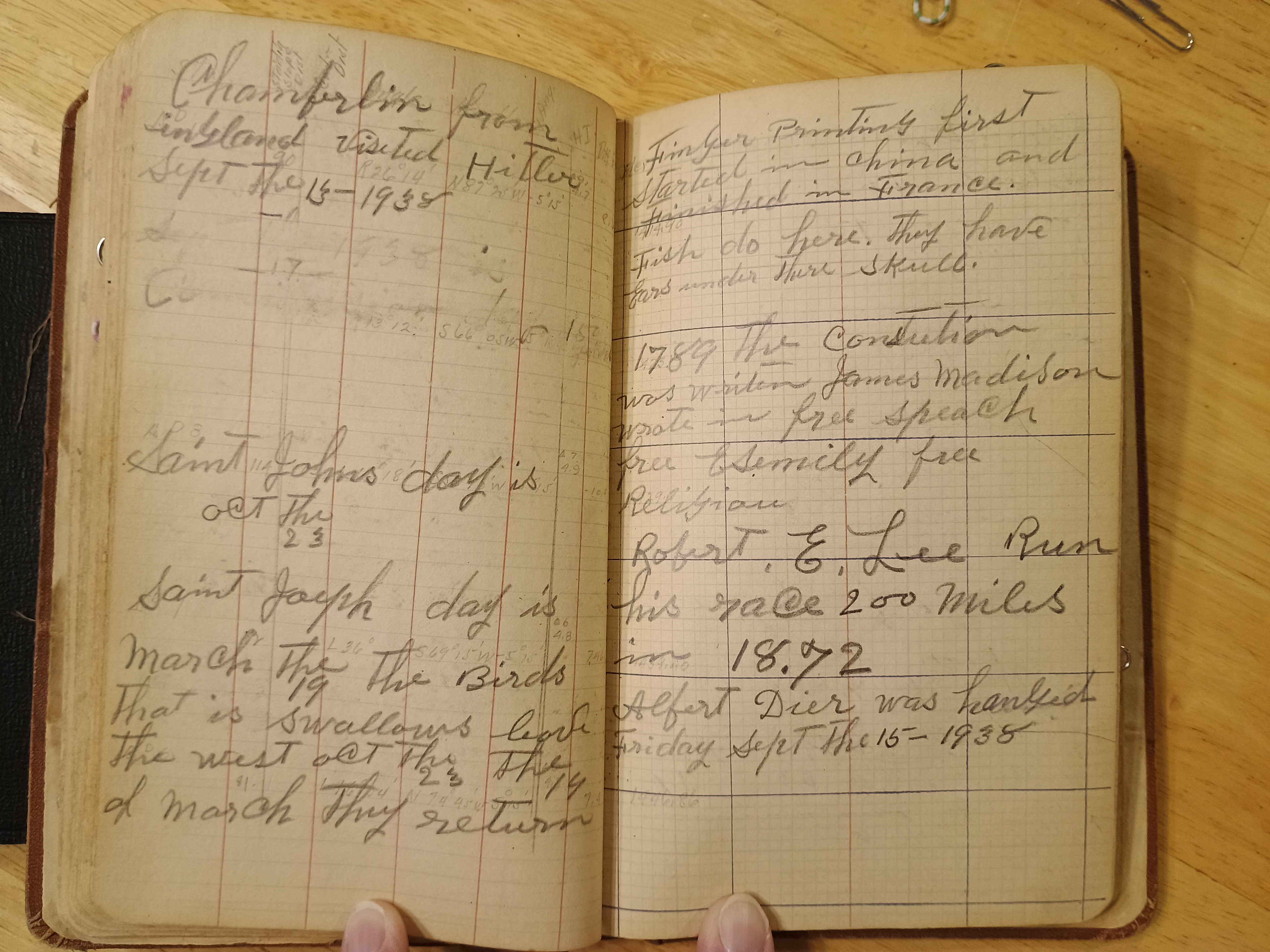
Transcription:
Left page — Chamberlin from Ingland visited Hitler Sept the 15 — 1938 — 17 — Saint Johns day is Oct the 23 — Saint Joseph day is March the 19 the Birds that is Swallows leave the west Oct the 23 the 19 of March they return
Right page — Finger Printing first Started in China and finished in France. Fish do here. they have ears under there Skull. — 1789 the Contution was writen James Madison wrote in free Speech free Esemily free Religion — Robert E. Lee Run his race 200 Miles in 18.72 — Albert Dier was hanged Friday Sept the 15 — 1938
Notes:
Chamberlain visited Hitler on 15 September 1938, the first of three meetings leading to the Munich Agreement. Saint John’s Day on 23 October and Saint Joseph’s Day on 19 March, with swallows leaving on 23 October and returning on 19 March. The right page covers fingerprinting originating in China, fish having ears under their skulls, the Constitution written in 1789 with James Madison credited for free speech, free assembly (James writes Esemily), and free religion. Robert E. Lee running a 200-mile race in 1872, details unclear. Albert Dier hanged on Friday 15 September 1938.
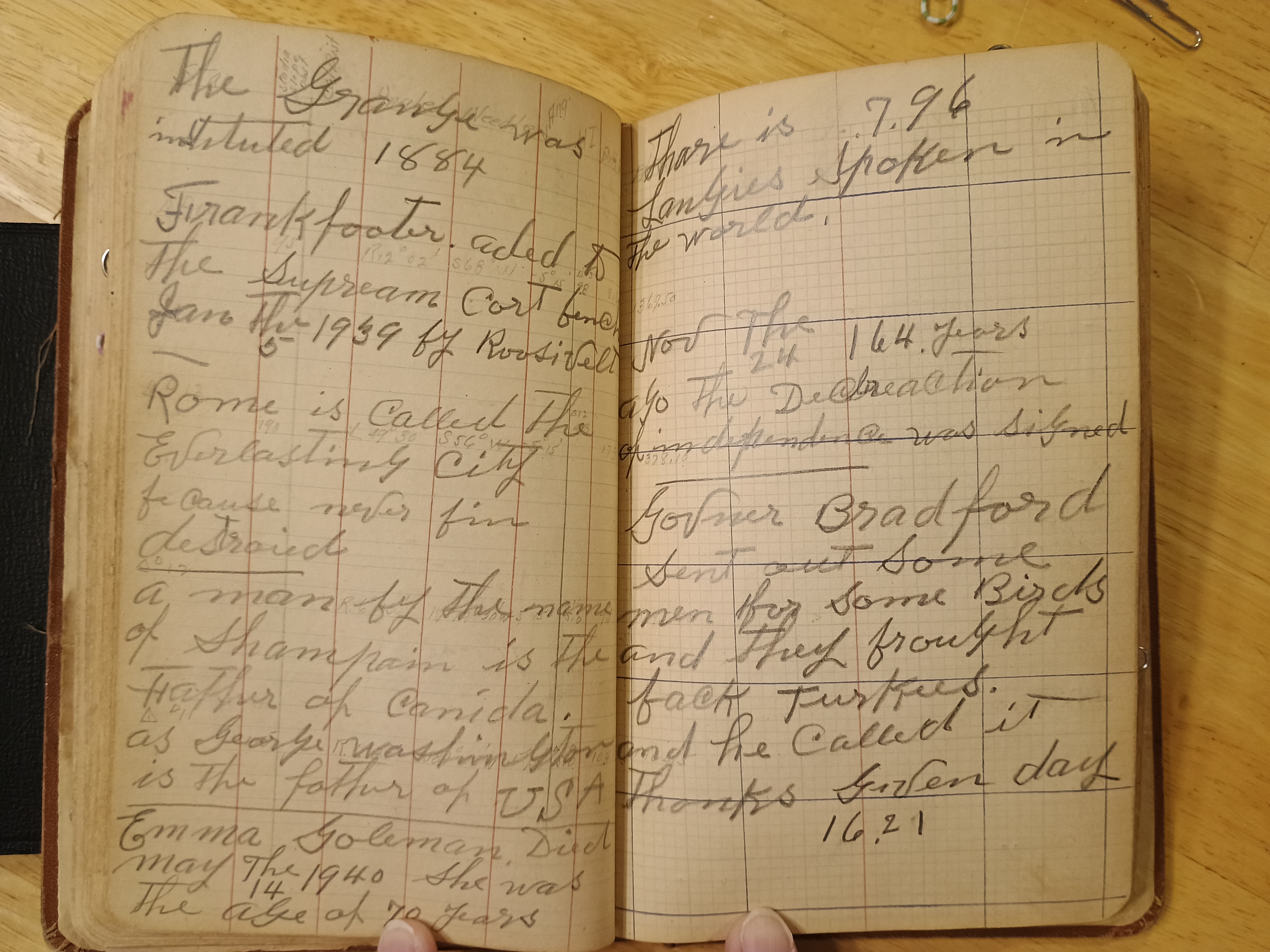
Transcription:
Left page — The Grange was instituted 1884 — Frankfooter. aded to the Supream Cort bench Jan the 5 1939 by Roosevelt — Rome is Called The Everlasting City because never bin Destroied — a man by the name of Shampain is the Father of Canida. as George Washington is the Father of USA — Emma Goleman Died may the 14 1940 She was the age of 70 years
Right page — There is 796 Langies Spoken in the world. — Nov the 24 164 years ago the Decleration of Independance was Signed — Gosnor Bradford Sent out Some men for Some Birds and they Brought back Turkeys. and he Called it Thanks Given day 16 21
Notes:
The Grange instituted in 1884. Felix Frankfurter added to the Supreme Court bench by Roosevelt on 5 January 1939. Rome as the Eternal City. Samuel de Champlain as the father of Canada, paralleled with George Washington as the father of the USA. Emma Goleman died 14 May 1940 at age 70. The right page records 796 languages spoken in the world. The Declaration of Independence signed 164 years ago, placing this entry around 1940. Governor Bradford sent men for birds, they returned with turkeys, and he called it Thanksgiving Day in 1621.
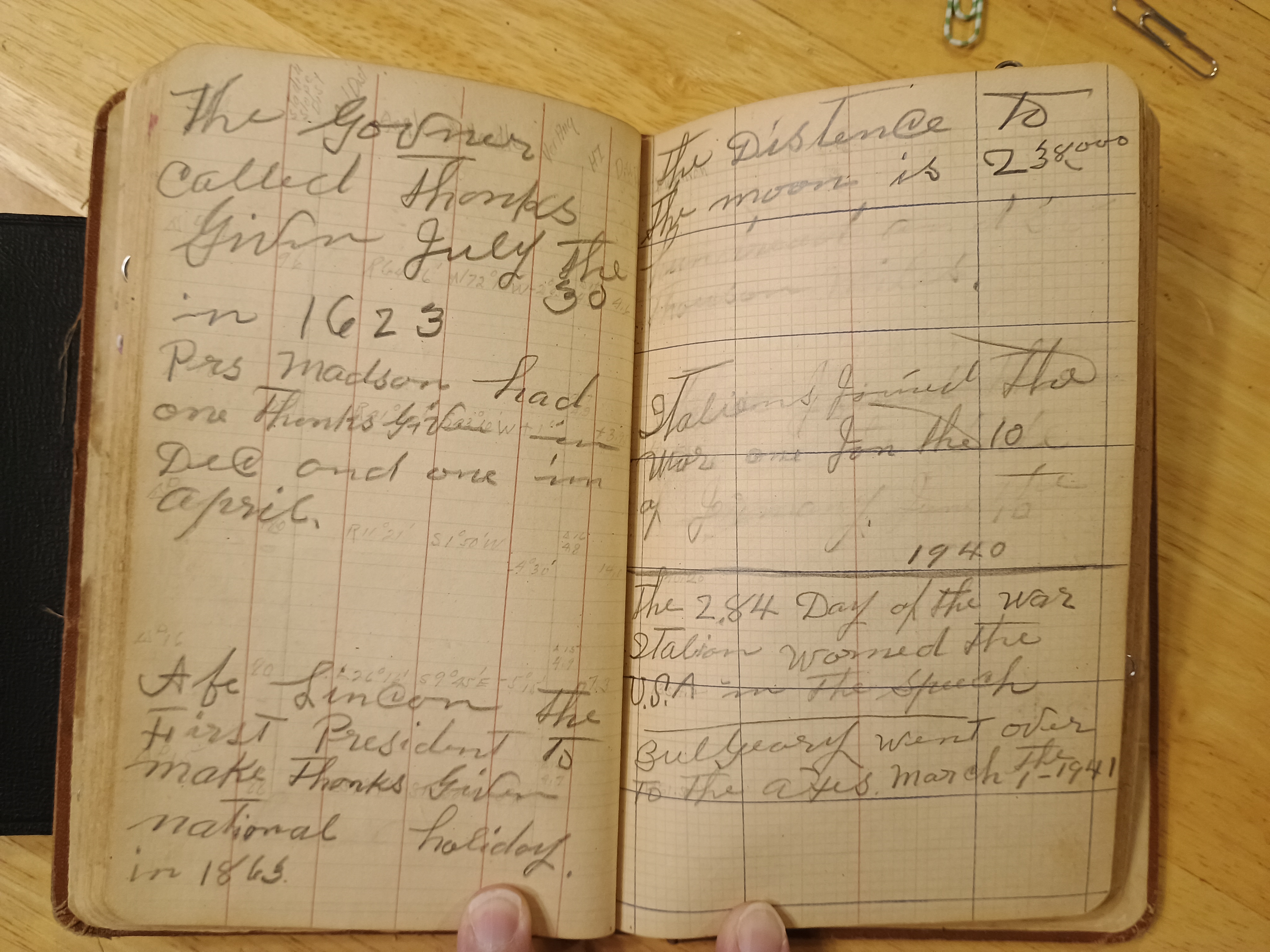
Transcription:
Left page — The Govner Called Thanks Givin July the 30 in 1623 — Prs Madison had one Thanks Givin in Dec and one in April. — Abe Lincoln the First President to make Thanks Givin national holiday in 1863.
Right page — the Distance to the moon is 238000 — Italians Joined the War on Jan the 10 — 1940 — The 284 Day of the war Italion warned the USA in the Speech — Bulgeary went over to the Axes. March 1 — 1941
Notes:
The left page continues the Thanksgiving origin story from pages 61–62. Governor Bradford called it Thanks Giving on 30 July 1623. President Madison had one Thanksgiving in December and one in April. Abraham Lincoln made Thanksgiving a national holiday in 1863. The right page records the distance to the moon as 238,000 miles. On the 284th day of the war, Italy warned the USA in a speech. Bulgaria went over to the Axis on 1 March 1941.
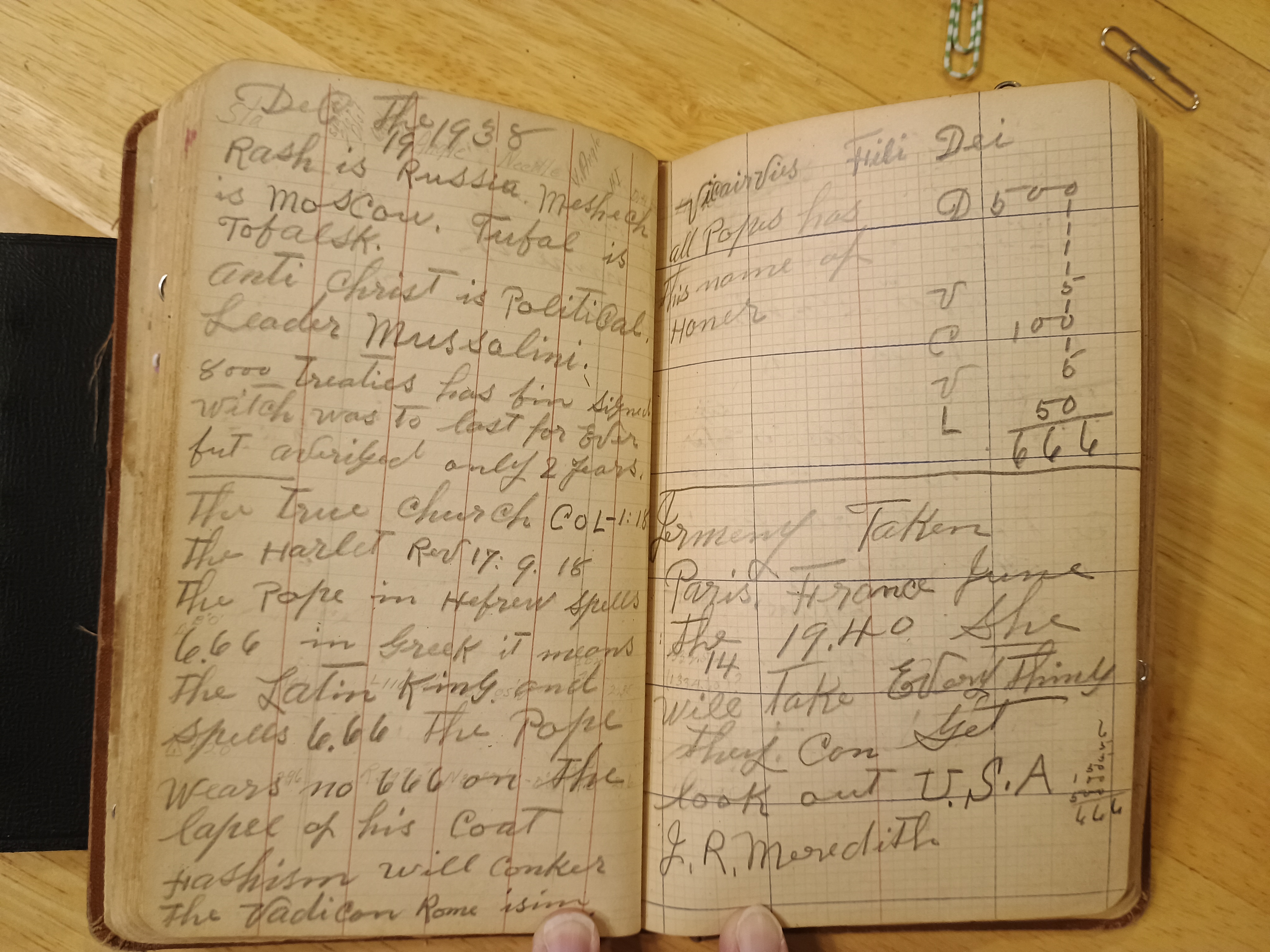
Transcription:
Left page — Dec The 19 1938 — Rash is Russia. Meshech is Moscow. Tubal is Tofalsk. — Anti Christ is Political Leader Mussalini. — 8000 Treaties has bin Signed witch was to last for Ever but avarised only 2 years. — The True Church Col. 1.18 the Harlet Rev 17. 9. 18 the Pope in Hebrew Spells 6.66 in Greek it means the Latin King. and Spells 6.66 The Pope Wears no 666 on the Lapel of his Coat Has history will Conker the Vatican Rome is in
Right page — Vaticins Fili Dei all Popes has D 500 this name of V 5 Honor C 100 V 5 L 50 666 — Germany Taken Paris France June the 14 1940 She will Take Every Thing they Can Get look out U.S.A. — J. R. Meredith
Notes:
James identifies Rosh as Russia, Meshech as Moscow, and Tubal as Tobolsk, a dispensationalist reading of Ezekiel 38. He identifies the Anti-Christ as Mussolini, and notes 8,000 treaties signed to last forever but averaging only two years. The right page works out the calculation that the papal title Vicarius Filii Dei yields 666 in Roman numerals (D=500, V=5, C=100, V=5, L=50) — a common anti-Catholic argument in Protestant prophecy literature. Germany taking Paris on 14 June 1940 follows with, James’s warning: will Take Every Thing they Can Get. look out U.S.A. The page closes with his signature: J. R. Meredith.
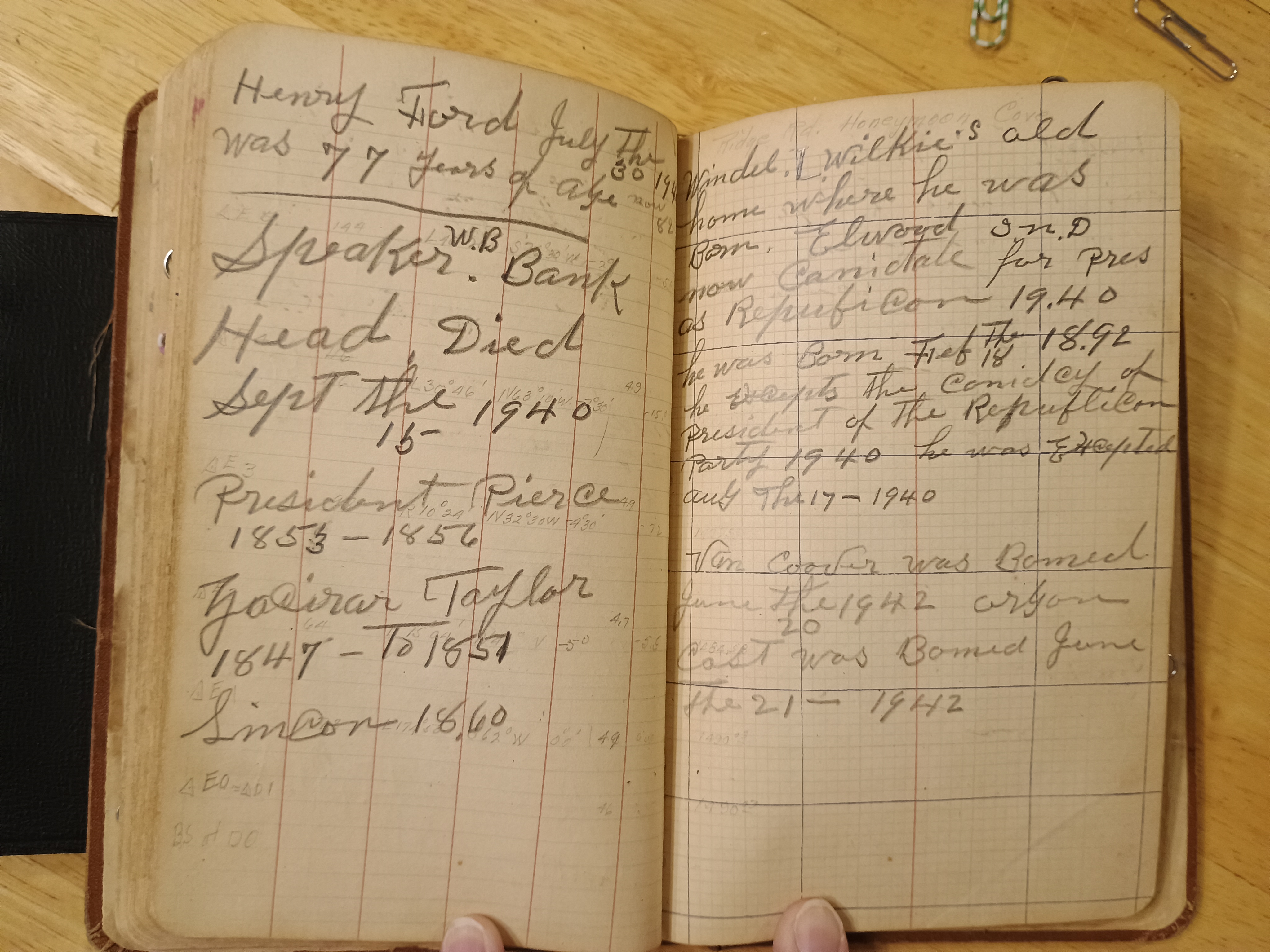
Transcription:
Left page — Henry Ford July the 30 was 77 years of age 1940 — Speaker. W.B. Bank Head Died Sept the 15 1940 — President Pierce 1853 — 1856 — Zachiran Taylor 1847 — To 1851 — Lincoln 1860
Right page — [Surveyor’s data — Honeymoon Cove] — Windel. Wilkie’s old home where he was Born. Elwood Ind. now Candidate for Pres as Republican 1940 he was Born Feb the 18 92 he Accepts the Candidacy of President of the Republican Party 1940 he was Excepted Aug the 17 — 1940 — Van Cooter was Bomed June the 20 1942 Oregon Coast was Bomed June the 21 — 1942
Notes:
Henry Ford turned 77 on 30 July 1940. Speaker William Brockman Bankhead died 15 September 1940. Presidential terms: Franklin Pierce 1853–1856, Zachary Taylor 1847–1851, Lincoln elected 1860. Wendell Willkie’s birthplace, Elwood, Indiana, and his acceptance of the Republican presidential nomination on 17 August 1940, born 18 February 1892. Then two World War II entries: Vancouver bombed June 20 1942, and the Oregon Coast bombed June 21 1942, referring to the Japanese submarine shelling of Fort Stevens, Oregon on 21 June 1942, the only attack on a US military installation on the continental United States during the war.
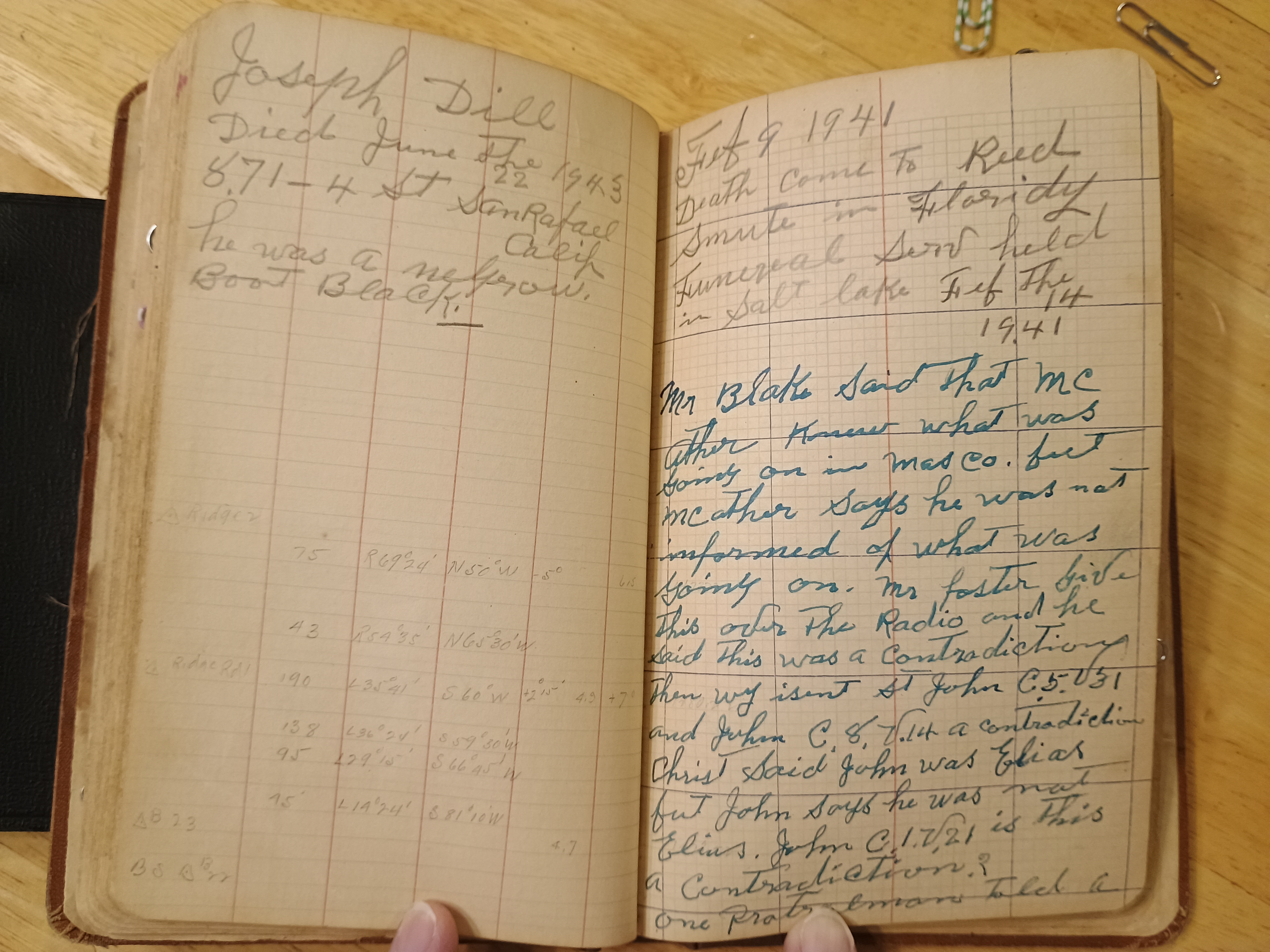
Transcription:
Left page — Joseph Dill Died June the 22 1943 6.71 — 4 St San Rafael Calif he was a nephew. Boot Black.
Right page — Feb 9 1941 Death Come to Reed Smute in Floridy Funeral Serv held in Salt Lake Feb the 14 1941 — Mr Blake Said that MC ather Knew what was Going on in Mas Co. but MC ather Says he was not informed of what was Going on. Mr Foster give this over the Radio and he Said this was a Contradiction Then why isent St John C. 5. V. 31 and John C. 8. V. 14 a Contradiction Christ Said John was Elias but John Says he was not Elias. John C. 1. V. 21 is this a Contradiction.?
Notes:
Joseph Dill was born 1 January 1899 in Spurger, Texas, to Nathaniel Ervin Dill and Leticia Barlow. He grew up in East Texas, lived in Louisiana in the 1920s, and settled in San Rafael, Marin County by 1935. He died 22 June 1943 at 671 4th Street, San Rafael, and was buried in Silsbee, Texas. He had registered for the military draft in San Rafael in February 1942. James notes he was a boot black and calls him a nephew — the nature of any connection is not established by available records.
The right page opens with the death of Reed Smoot on 9 February 1941 in Florida, the longtime Utah Senator and LDS apostle, with his funeral held in Salt Lake City on 14 February 1941. The remainder continues the biblical inquiry, using contradictory radio testimony about McArthur as a launching point for further scriptural contradictions about John and Elias.
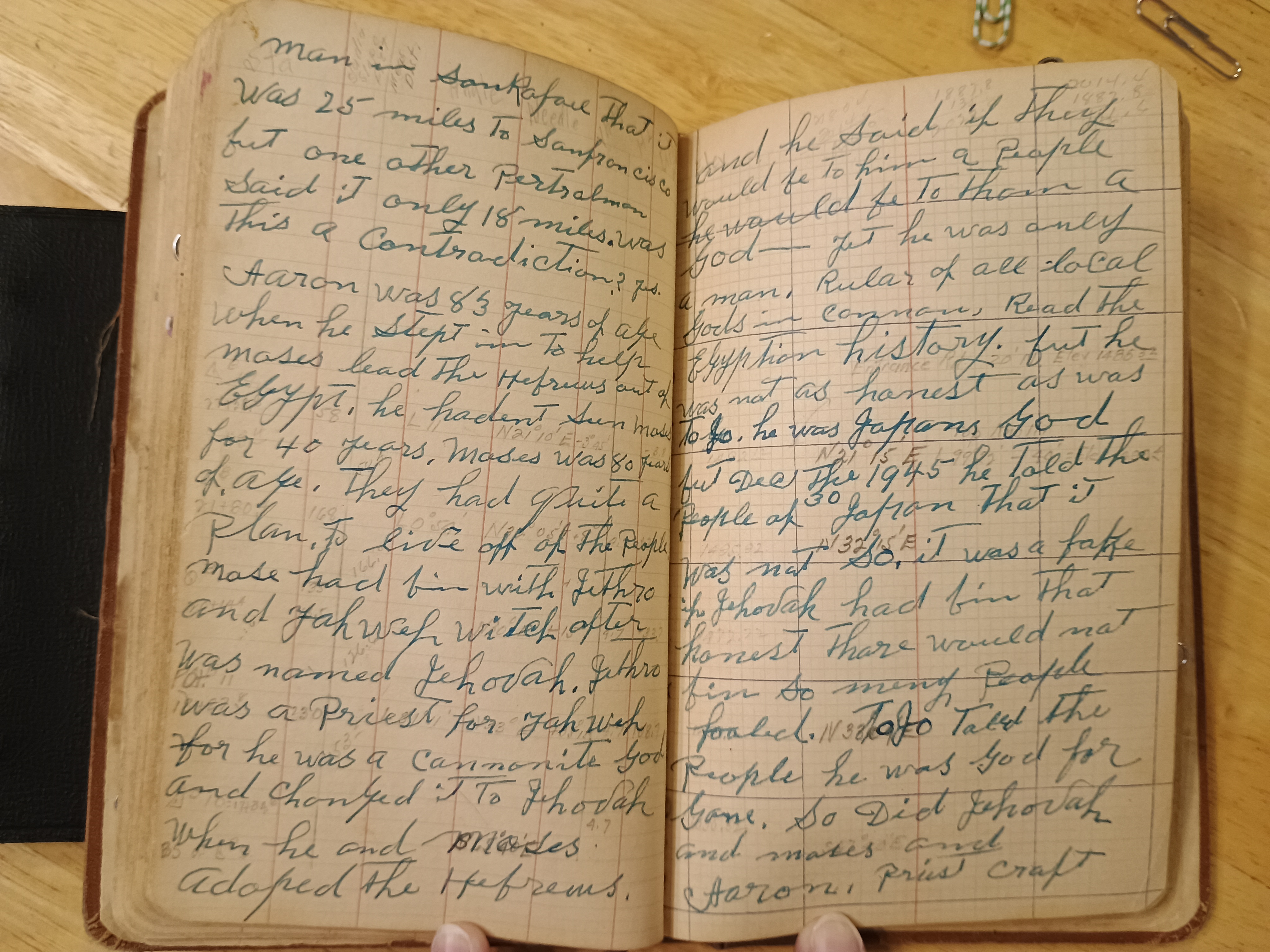
Transcription:
Left page — man in San Rafael that was 25 miles to San Francisco but one other Pertbalman Said it only 18 miles. was this a Contradiction? — Aaron was 83 years of age when he Stept in to help moses lead the Hebrews out of Egypt. he hadent Sun made for 40 years. Moses was 80 years of age. They had quite a Plan. to live off of the People mose had bin with Jethro and Yahweh Witch after was named Jehovah. Jethro was a Priest for Yahweh for he was a Canmonite God and Changed it to Jhodah When he and Moses Adopted the Hebrews.
Right page — and he Said if they would be to him a People he would be To them a God — yet he was only a man. Ruler of all local Gods in Cannan. Read the Egyptian history. but he was not as honest as was To Jo. he was Japans God but Dec the 30 1945 he Told the People at Japan that it was not So. it was a fake if Jhodah had bin that honest There would not bin so many People fooled. No To Told the People he was God for Gone. So Did Jehovah and moses and Aaron. Pries Craft
Notes:
The left page opens with another contradiction, two men giving different distances from San Rafael to San Francisco, then moves into an analysis of Moses and Aaron: their ages (Aaron 83, Moses 80), their plan to lead and live off the people, and the identification of Yahweh as a Canaanite god that Jethro, a Midianite priest, introduced to Moses, later renamed Jehovah when he and Moses adopted the Hebrews.
The right page continues: Jehovah promised to be their God if they would be his people, but James argues he was simply a man, ruler of local gods in Canaan. He draws a parallel with the Japanese Emperor Hirohito, who told the Japanese people on 30 December 1945 that he was not divine. Both Jehovah and Hirohito claimed divine status. He closes with Pries Craft, a term used in both Protestant and LDS traditions for the corrupt use of religion for personal gain.
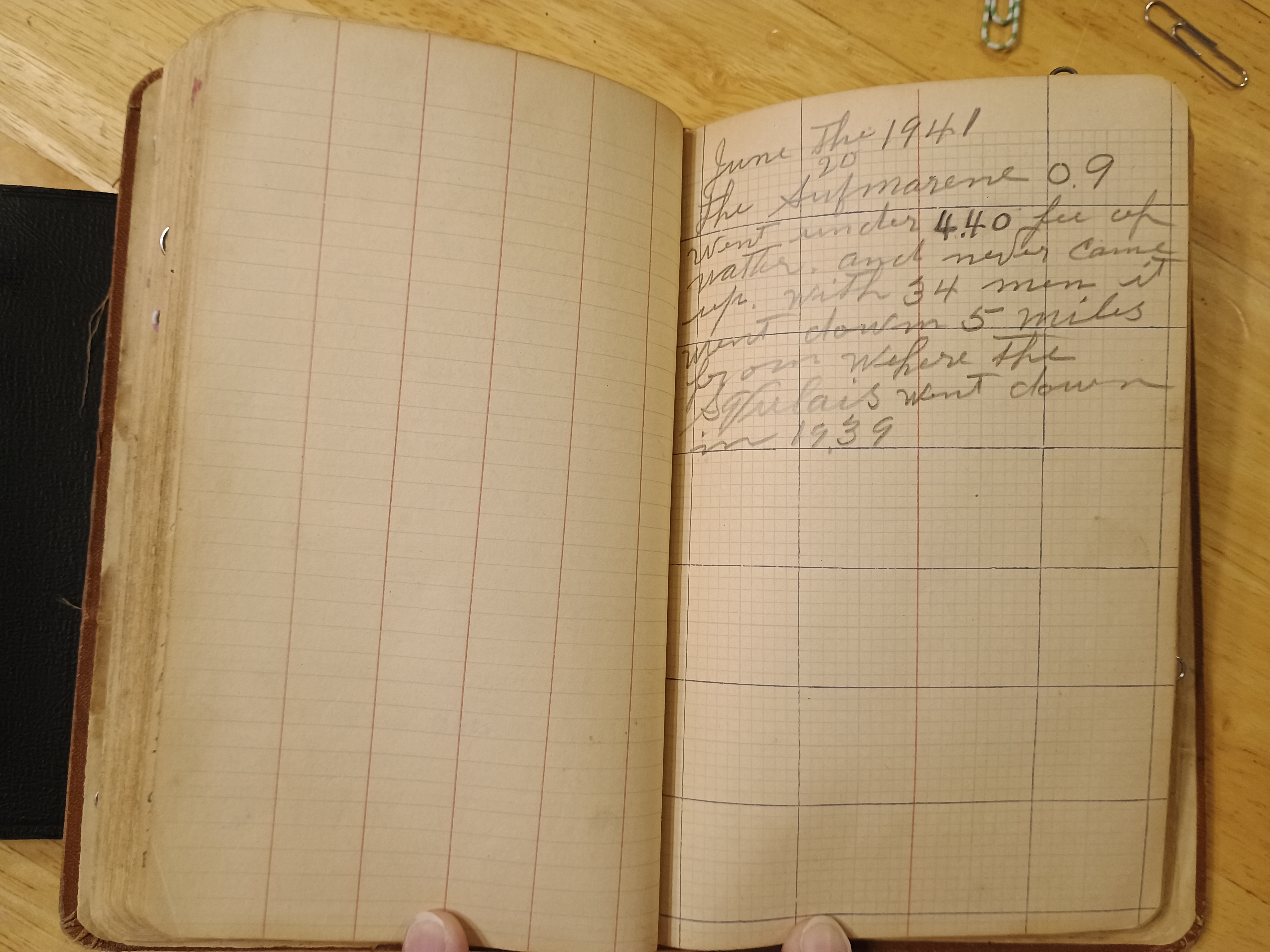
Transcription:
Left page — [Blank]
Right page — June the 20 1941 — The Submarene 0.9 went under 440 fee of water. and never came up. with 34 men it went down 5 miles from where the Squalais went down in 1939
Notes:
The USS O-9 (SS-70) sank during a test dive on 20 June 1941 off the Isle of Shoals, New Hampshire. James records 440 feet and 34 men, and notes it went down 5 miles from where the Squalus sank in 1939, the USS Squalus (SS-192) had sunk on 23 May 1939 during a test dive off Portsmouth, New Hampshire. James connecting the two disasters across two years.
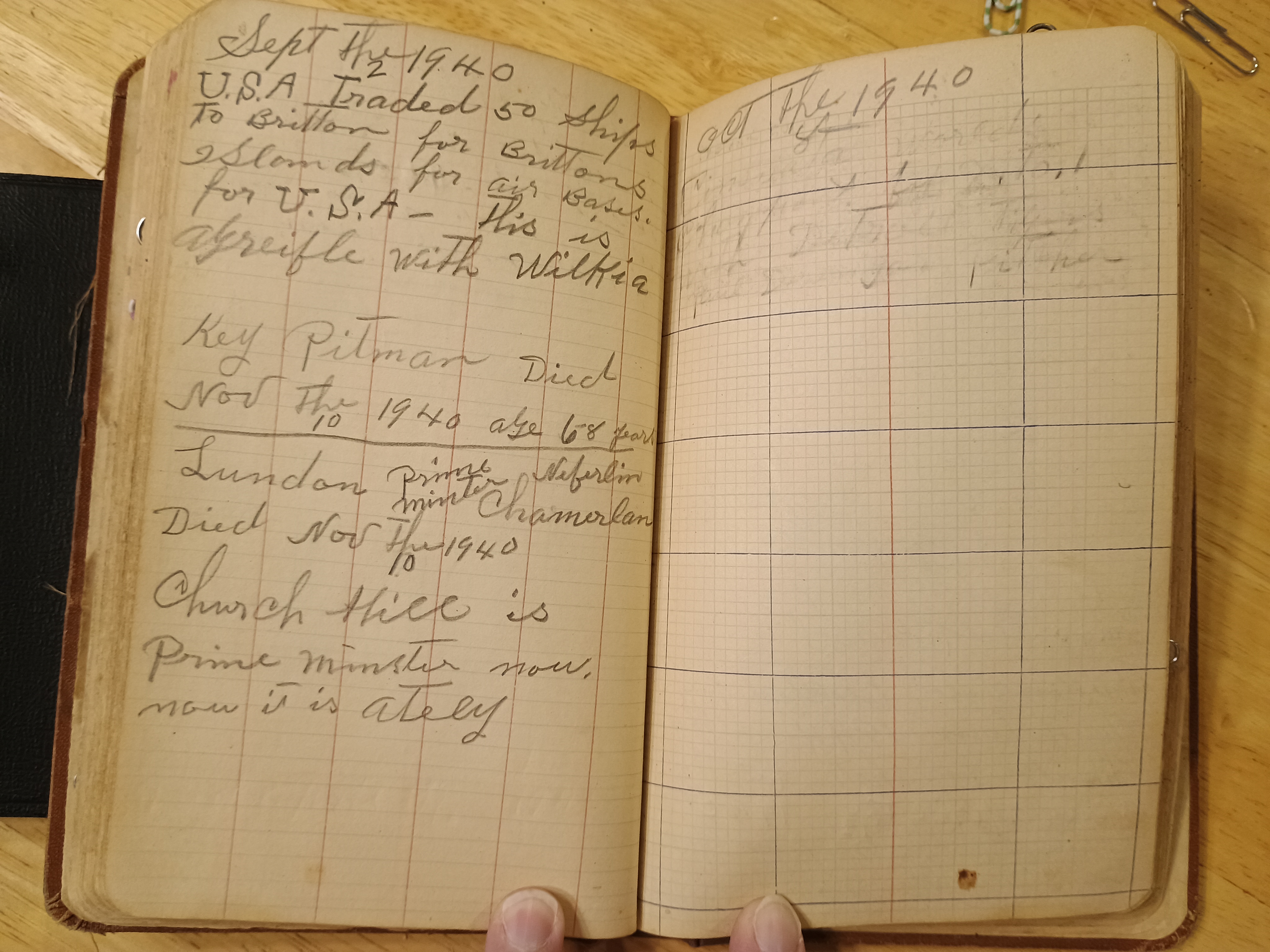
Transcription:
Left page — Sept the 2 1940 — U.S.A. Traded 50 Ships to Britton for Brittons Islands for Air Bases. for U.S.A. This is agreifle with Wilkia — Key Pitman Died Nov the 10 1940 age 68 years — Lundon Prime Minister Neferlin Chamberlan Died Nov the 10 1940 Church Hill is Prime Minster now. now it is ately
Right page — Oct the [?] 1940 [faint/largely illegible entries]
Notes:
The Destroyers for Bases Agreement of September 1940, the USA trading 50 destroyers to Britain in exchange for 99-year leases on British bases. James notes this was agreeable to Willkie, who had supported the deal. Key Pittman, Nevada Senator, died 10 November 1940 at age 68. Neville Chamberlain also died on 9 November 1940. Churchill is noted as Prime Minister, James writing Church Hill, followed by now it is ately, likely referring to Clement Attlee who became Prime Minister in July 1945, added later.
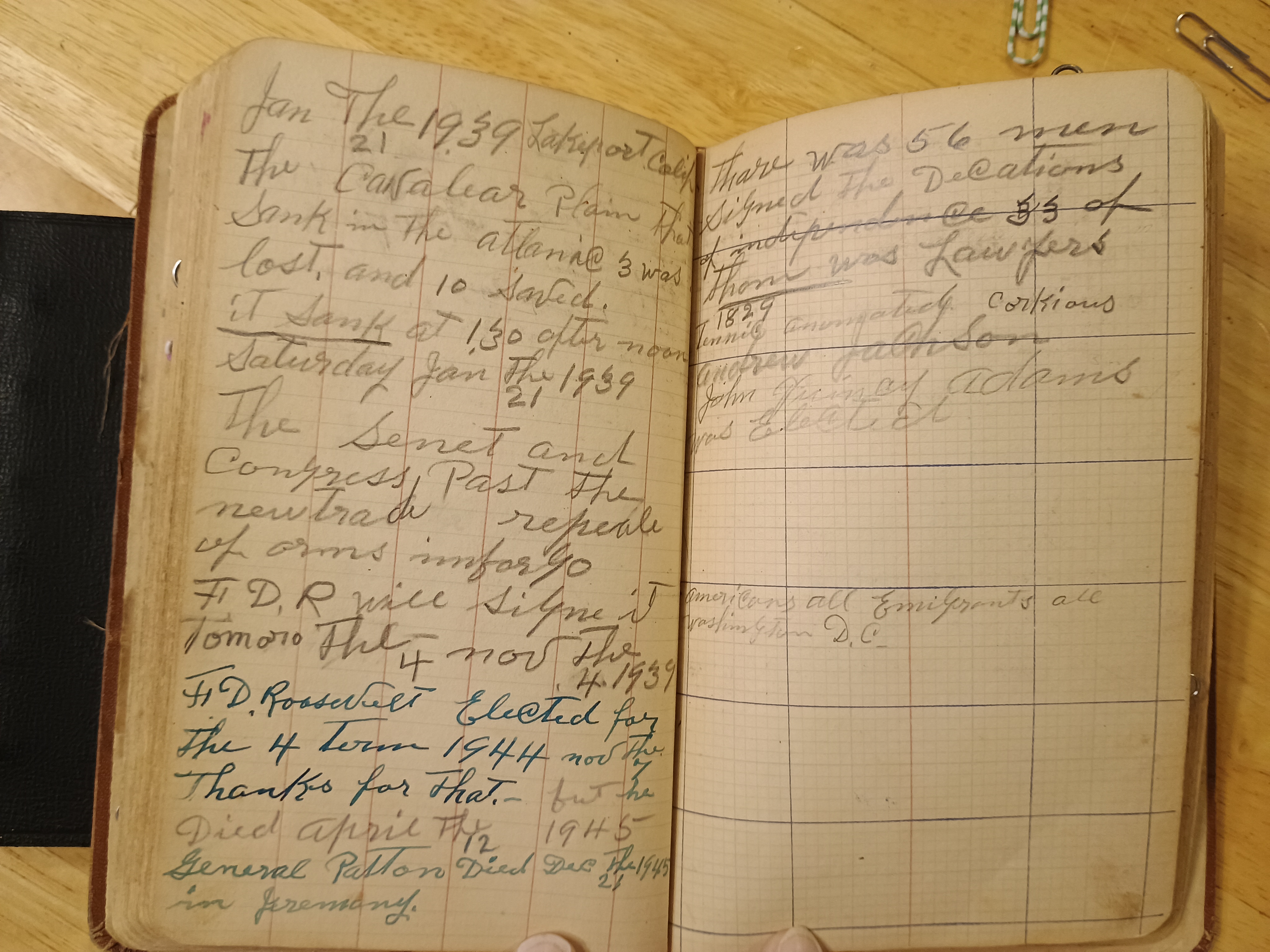
Transcription:
Left page — Jan The 21 1939 Lakeport Calif — The Cavalear Plain Tha[t] Sank in the Atlantic 3 was lost. and 10 Saved. it Sank at 1.30 after noon Saturday Jan the 21 1939 — The Senet and Congress Past the new trade repele of arms imbar Go F.D.R. will Signe it tomoro the 4 Nov the 4 1939 — F.D. Rossevelt Elected for the 4 Term 1944 nov the Thanks for That. but he Died April the 12 1945 — General Patton Died Dec the 28 1945 in Jeremany.
Right page — There was 56 men Signed the Declations of Independace 35 of Thom was Lawers — 1829 Denis notorious Contious Andrew Jackson John Quincey Adams was Elected — Americans all Emigrants all Washington D.C.
Notes:
The Cavalier sinking in the Atlantic on 21 January 1939, 3 lost and 10 saved. The Senate and Congress passing the Neutrality Act revision on 4 November 1939. Later additions: Roosevelt elected to the 4th term in 1944, dying 12 April 1945. General Patton died 28 December 1945 in Germany. The right page notes 56 men signed the Declaration of Independence, 35 of them lawyers. The 1829 entry records the contested election between Andrew Jackson and John Quincy Adams as notorious and contentious. Americans are all emigrants, all Washington D.C.
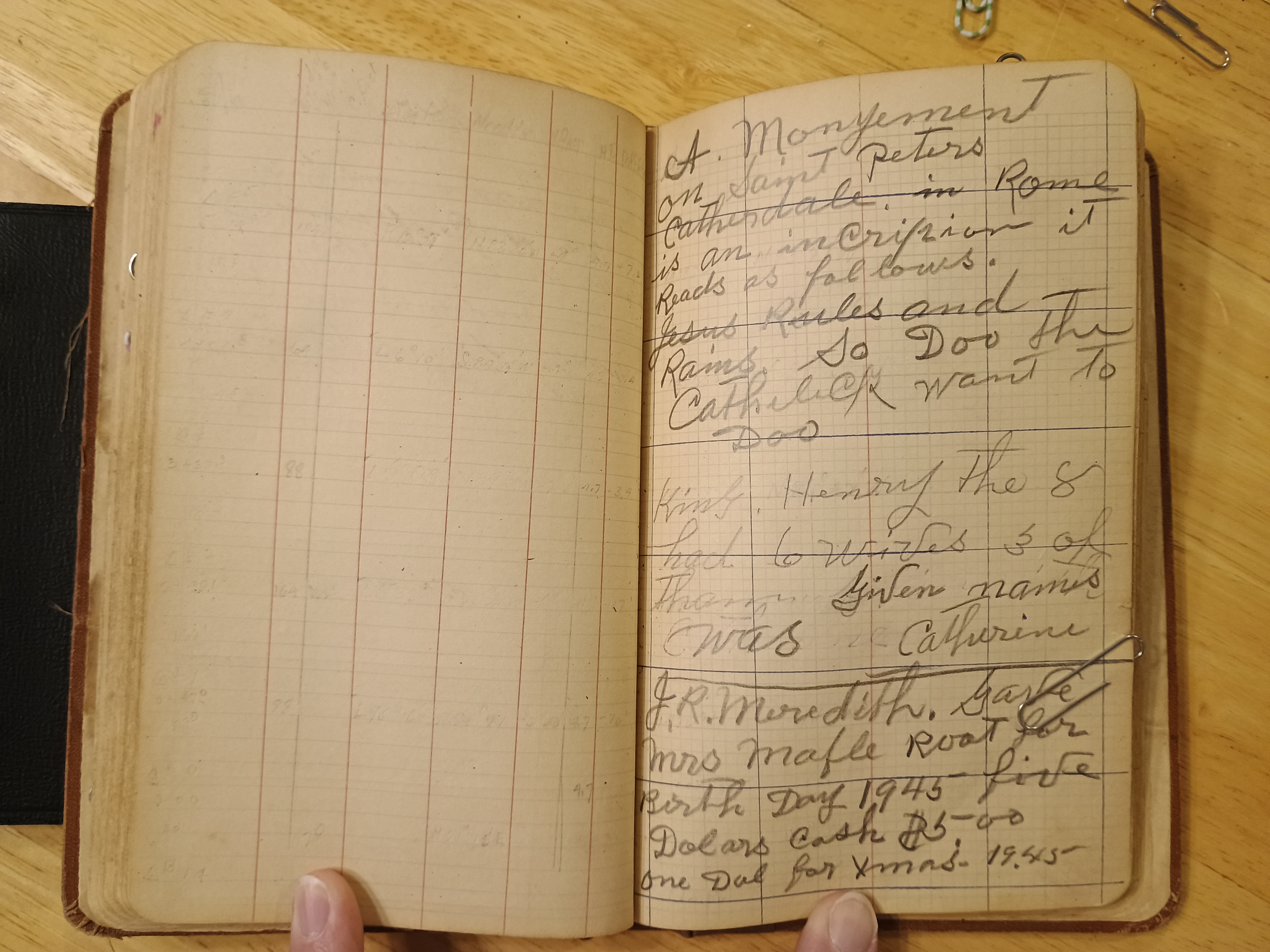
Transcription:
Left page — [Blank]
Right page — A. Monyement on Saint Peters Cathendale. in Rome is an inCription it Reads as follows. Jesus Rules and Rains. So Doo the Catholick want to Doo — King Henry the 8 had 6 Wifes 3 of Thom. Given names was Catherine — J.R. Meredith. Gave Mrs Maple Root for Birth Day 1945 five Dolars Cash $5.00 one Dol for Xmas. 1945
Notes:
A monument at Saint Peter’s Cathedral in Rome carries the inscription: Jesus Rules and Rains. So Do the Catholics want to Do. King Henry VIII had 6 wives, three of whom were named Catherine, Catherine of Aragon, Catherine Howard, and Catherine Parr. James gave Mrs. Maple a root for her birthday in 1945, five dollars cash, and one dollar for Christmas 1945.
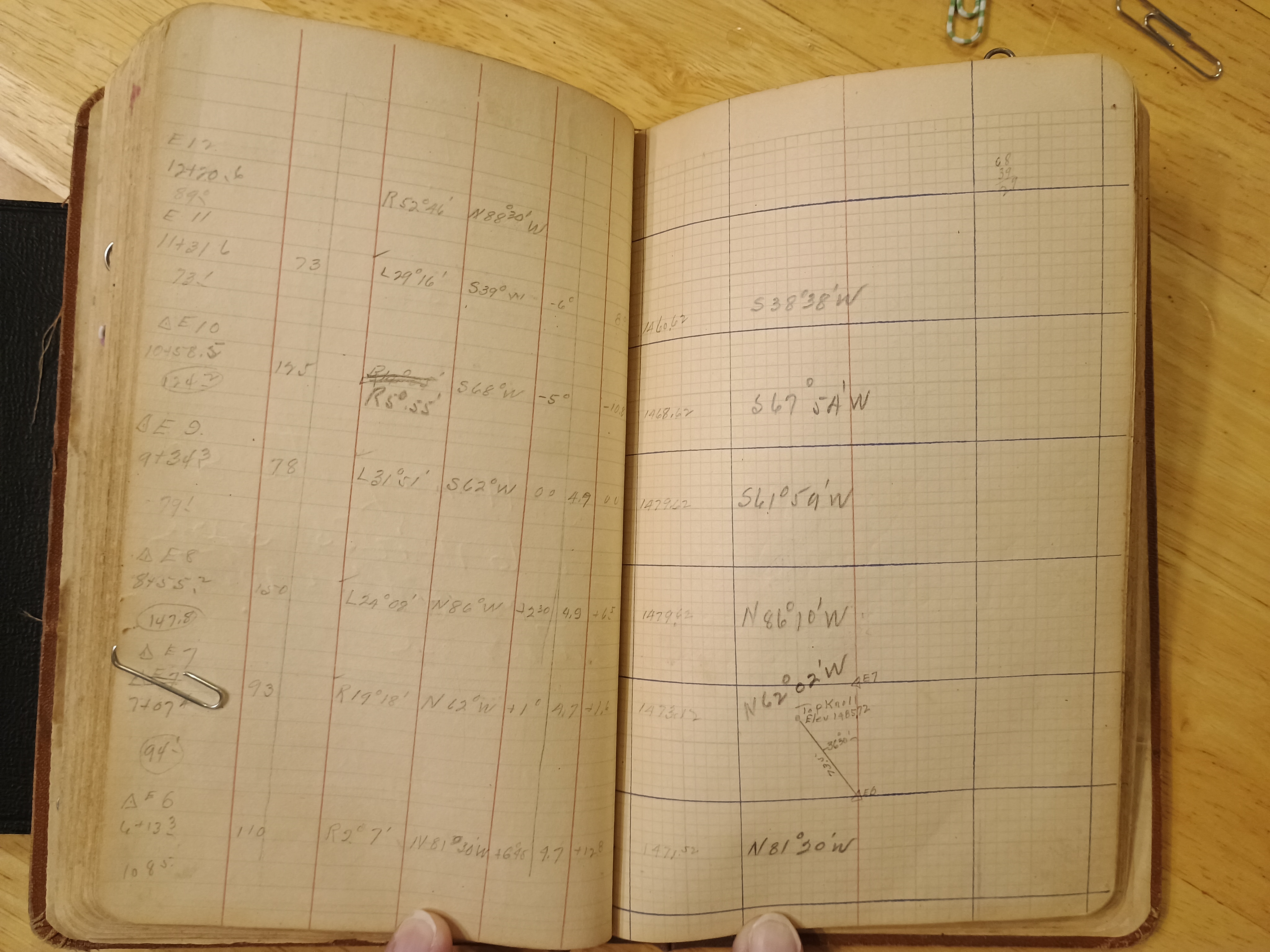
Transcription:
Left page — [Surveyor’s data only]
Right page — [Surveyor’s data only]
Notes:
Both pages are pure surveyor’s data, including a small sketch diagram showing traverse lines with elevations. James left these pages entirely untouched.
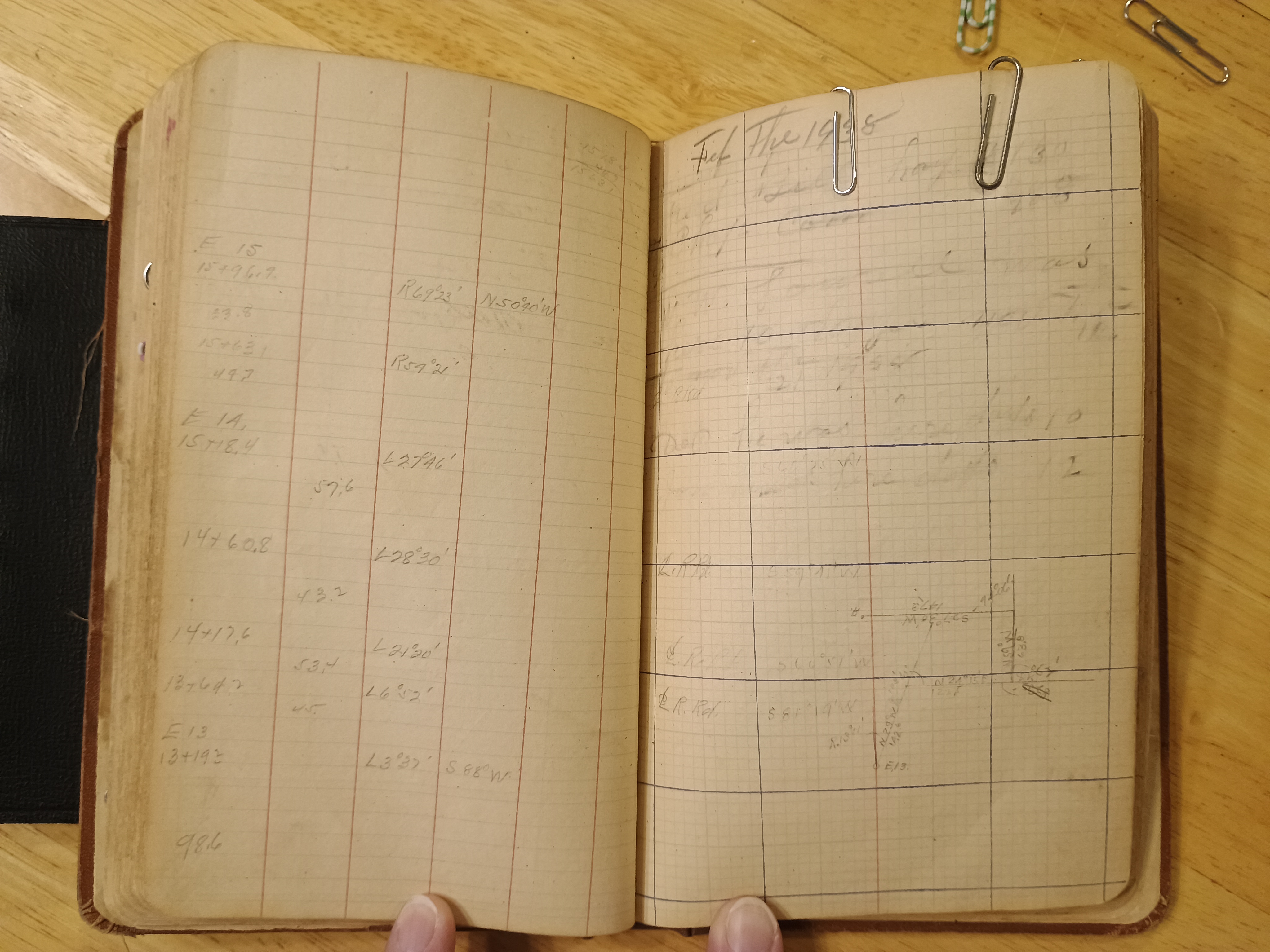
Transcription:
Left page — [Surveyor’s data only]
Right page — Feb The 1935 [largely illegible — faint pencil entries over surveyor’s data]
Notes:
The right page has a date header of February 1935 with faint pencil entries largely illegible in this photograph. A February 1935 date would make this among the earliest dated entries in the journal, predating the first clearly legible entry of December 1935.
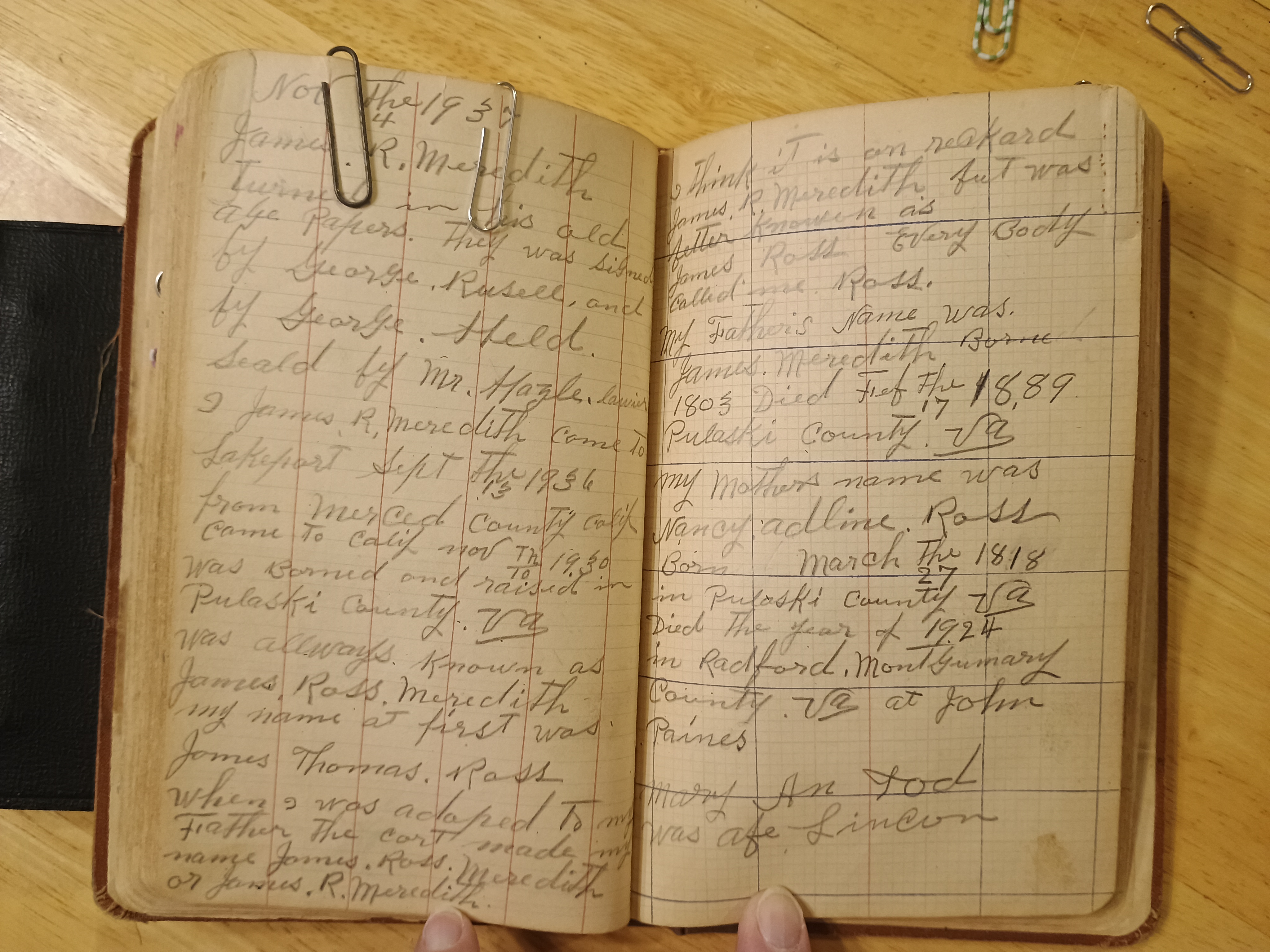
Transcription:
Left page — Nov the 4 1937 — James. R. Meredith Turned in his old age Papers. They was Signed by George. Rusell. and by George. Held. Seald by Mr. Hazle. — I James. R. Meredith came to Lakeport Sept the 13 1936 from Merced County Calif — came to Calif Nov the 1930 — was borned and raised in Pulaski County. Va — was allways. Known as James. Ross. Meredith — my name at first was James Thomas. Ross — when I was adopted. To my Farther the cort made my name James. Ross. Meredith or James. R. Meredith
Right page — I Think I is on reckard James. R. Meredith. but was after Known in as after James Ross. Every Body Called me. Ross. — My Fathers Name was. James. Meredith Borne 1803 Died Feb the 17 1889. Pulaski County. Va — my Mothers name was Nancy adline. Ross Born March the 27 1818 in Pulaski County Va Died the year of 1924 in Radford. Montgu mary County. Va at John Paines — Mary An Tod was afe Lincoln
Notes:
These two pages are among the most genealogically significant in the entire journal. James writing his autobiography with his own hand. On 4 November 1937 he filed his old age papers, witnessed by George Russell and George Held, sealed by Mr. Hazle. He came to Lakeport on 13 September 1936 from Merced County; came to California in November 1930; born and raised in Pulaski County, Virginia. His name at birth was James Thomas Ross, and when adopted by his father, the court made his name James Ross Meredith or James R. Meredith. He was always known as James Ross Meredith, but everybody called him Ross.
His father’s name was James Meredith, born 1803, died 17 February 1889, Pulaski County, Virginia. His mother’s name was Nancy Adline Ross, born July 1843 in Newbern, Pulaski, Virginia, died in 1924 in Radford, Montgomery, Virginia at John Paine’s. The final entry, Mary Ann Todd was wife of Lincoln, is a stray trivia note on the same page.
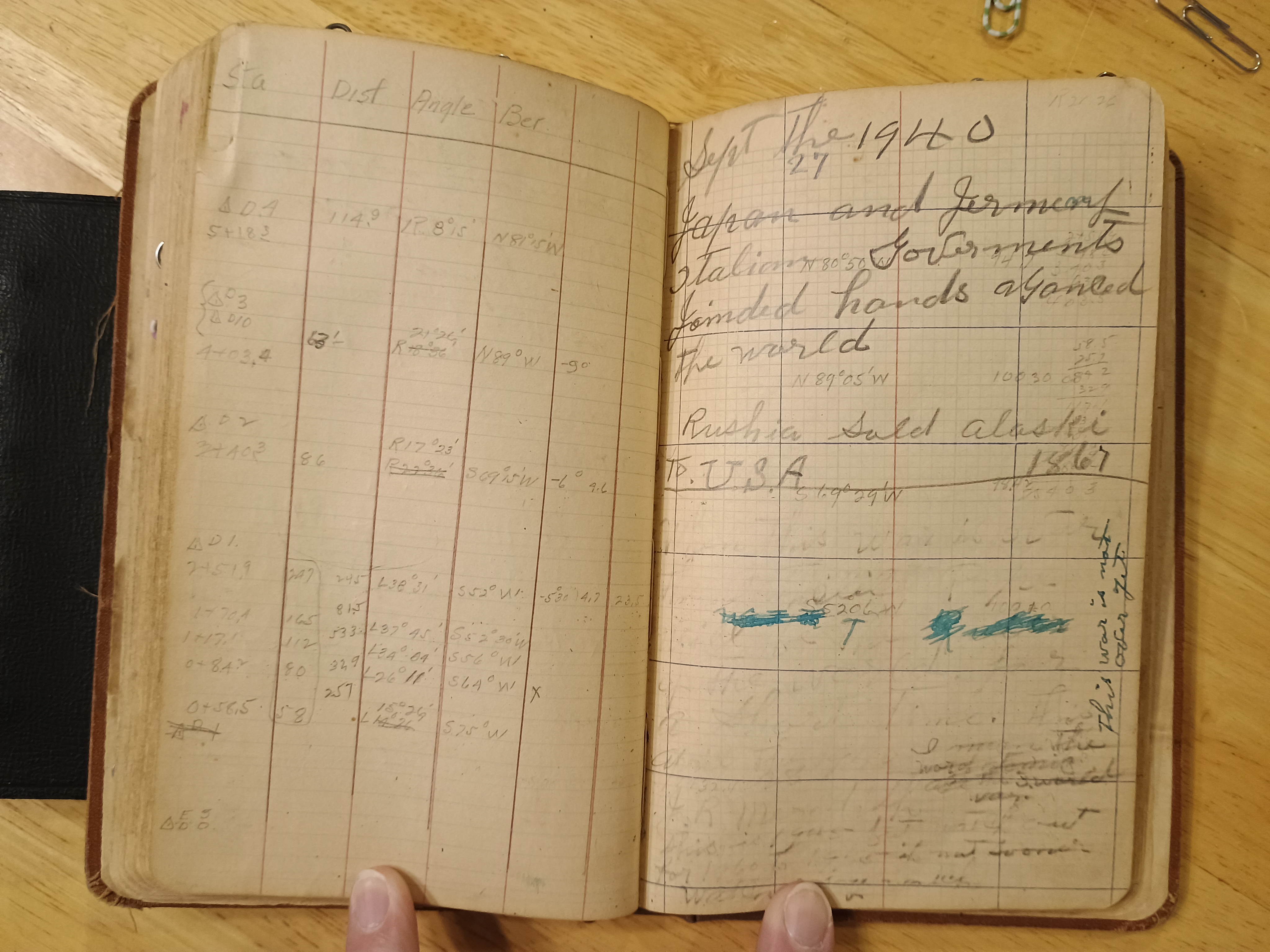
Transcription:
Left page — [Surveyor’s data only]
Right page — Sept the 27 1940 — Japan and Jermony Italian Goverments Jinded hands aganced the world — Rushia Sold Alaska To U.S.A. 1867 — [several lines largely illegible] — this war is not over yet
Notes:
The right page opens with the Tripartite Pact of 27 September 1940, Japan, Germany, and Italy joining hands against the world. Russia selling Alaska to the USA in 1867. The lower portion has faint entries largely illegible, with one readable phrase: this war is not over yet.
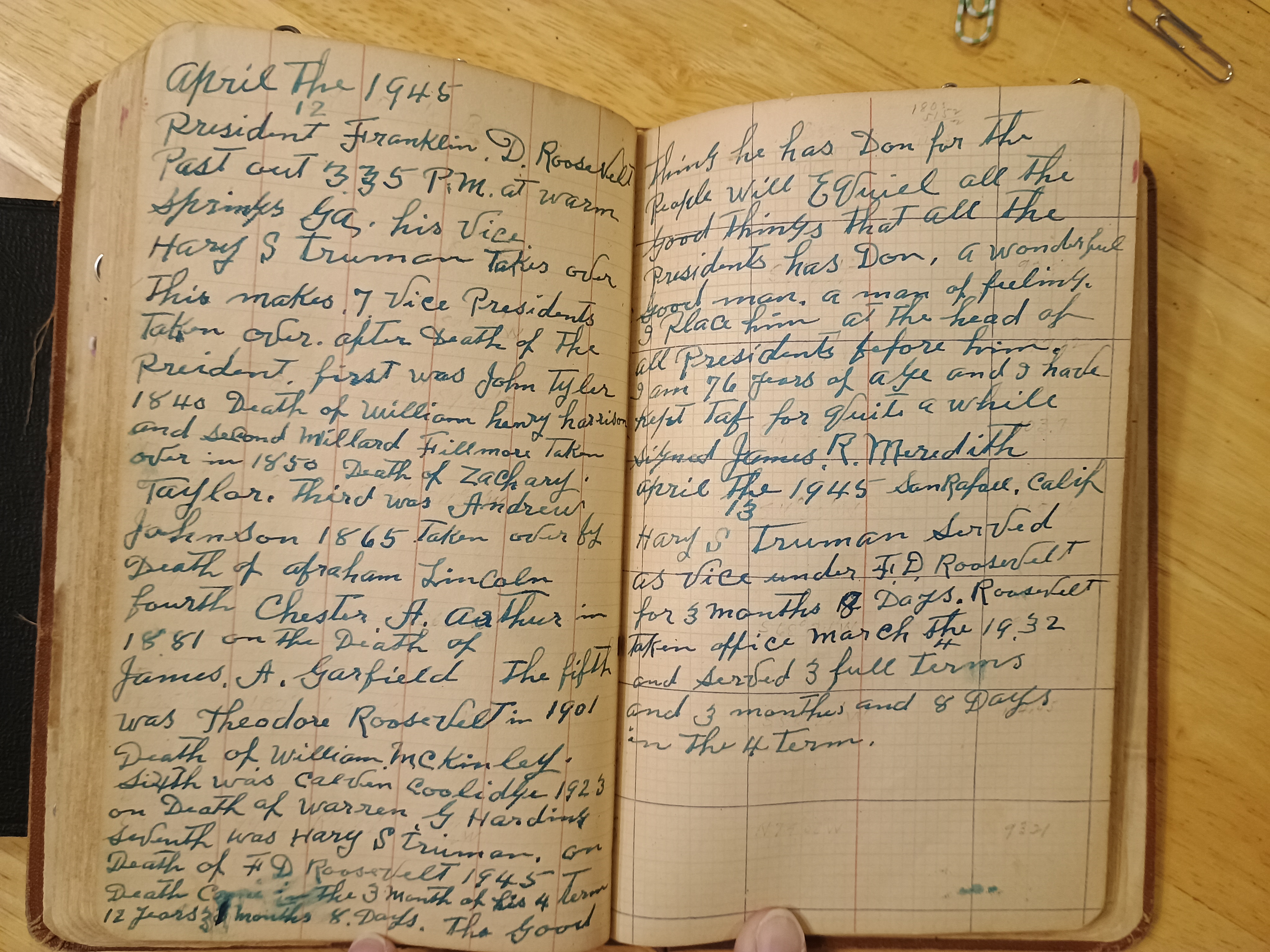
Transcription:
Left page — April The 12 1945 — President Franklin D. Roosevelt Past out 3.35 P.M. at warm Springs Ga. his Vice Hary S Truman Takes over — This makes 7 Vice Presidents Taken over. after Death of The Prsident. first was John Tyler 1840 Death of William henry Harrison and Second Millard Fillmore Taken over in 1850 Death of Zachary Taylor. Third was Andrew Johnson 1865 Taken over by Death of Abraham Lincoln — Fourth Chester. H. Aarthur in 1881 on the Death of James. A. Garfield The fifth was Theodore Roosevelt in 1901 Death of William McKinley. Sixth was Calvin Coolidge 1923 on Death of Warren G Harding Seventh was Hary S Truman. on Death of F.D. Roosevelt 1945 — Death Came in the 3 month of his 4 term 12 years 3 months 8 Days. The Good
Right page — thing he has Don for the People will EVriel all the good things that all the Presidents has Don. a wonderful good man. a man of feeling. I place him at the head of all Presidents before him. I am 76 years of age and I hade Prest Taft for quit a while — Signed James. R. Meredith April the 13 1945 San Rafael. Calif — Hary S Truman Served as Vice under F.D. Roosevelt for 3 months 8 Days. Roosevelt Taken office March the 19 32 and Served 3 full terms and 3 months and 8 Days in the 4 term.
Notes:
On 12 April 1945 he records Roosevelt’s death at 3:35 P.M. at Warm Springs, Georgia, and Truman taking over. He lists all seven Vice Presidents who assumed the presidency on the death of the sitting president — Tyler, Fillmore, Johnson, Arthur, Theodore Roosevelt, Coolidge, and Truman — correctly in order.
The right page is a personal eulogy for Roosevelt, signed by James R. Meredith on 13 April 1945 in San Rafael, California. He was 76 years old. He places Roosevelt at the head of all presidents before him, calls him a wonderful good man, a man of feeling. He mentions having known President Taft for a while. The page closes with a careful accounting of Roosevelt’s time in office: three full terms and three months and eight days into the fourth.
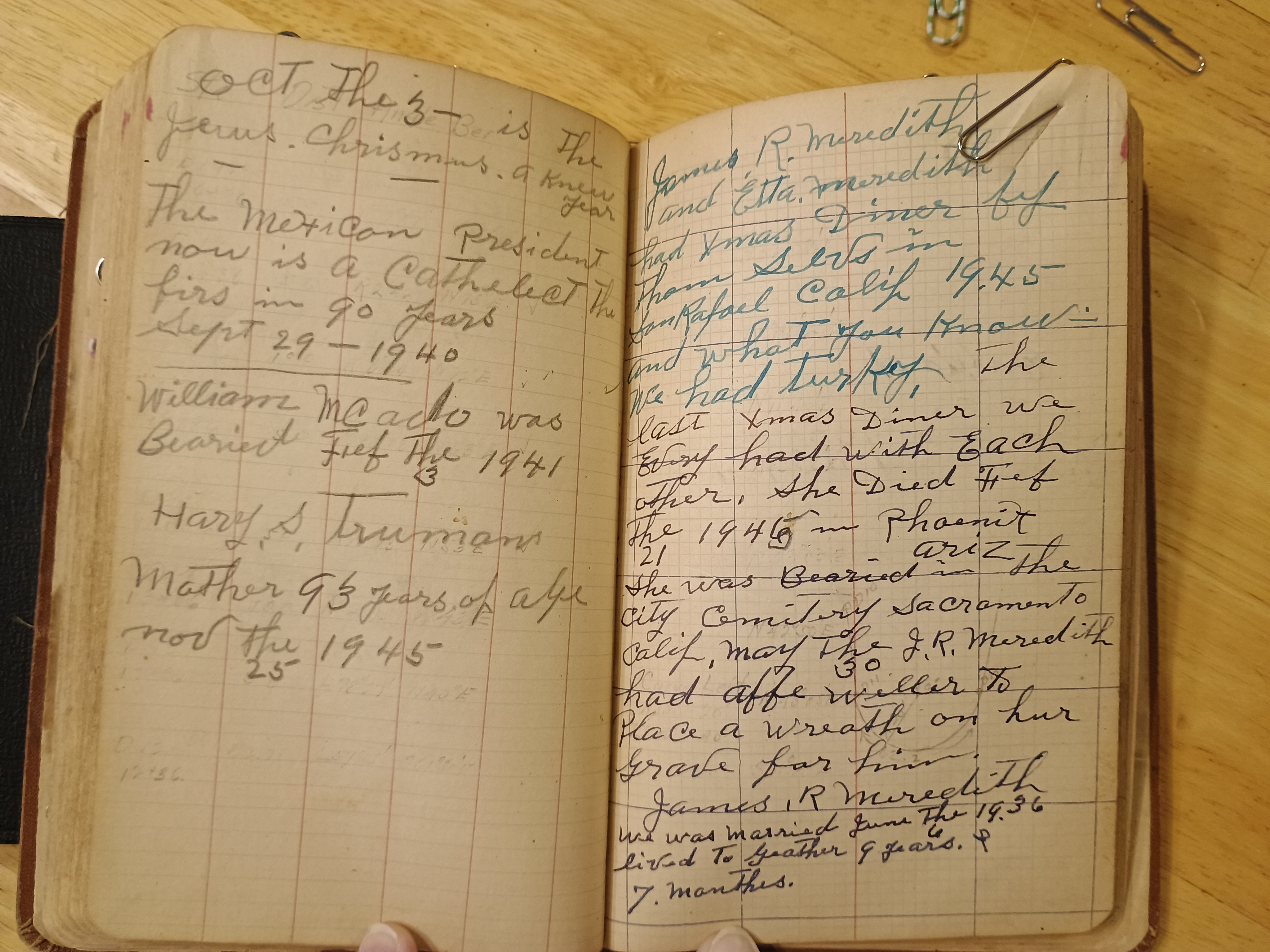
Transcription:
Left page — Oct The 3 — is the Jerus Christmas. a knew year — The Mexican President now is a Catheleck the first in 90 years Sept 29 — 1940 — William McAdoo was Bearied Feb the 3 1941 — Hary S. Trumans Mother 93 years of age Nov the 25 1945
Right page — James R. Meredith and Etta. Meredith had Xmas Diner by Thom Selves in San Rafael Calif 1945 and what you Know. We had Turkey. the last Xmas Diner we Every had with Each other. She Died Feb the 21 1946 in Phoenix Ariz — She was Bearied in the City Cemitory Sacramento Calif. may the 30 J.R. Meredith had affe willer to Place a Wreath on hur Grave for him. — James R. Meredith we was married June the 6 1936 lived to gather 9 years. and 7. Monthes.
Notes:
3 October as Jerusalem Christmas and New Year, the Jewish New Year (Rosh Hashanah) falls in late September or early October. The Mexican President becoming Catholic for the first time in 90 years on 29 September 1940. William McAdoo, California senator and son-in-law of Woodrow Wilson, buried 3 February 1941. Harry Truman’s mother was 93 years old on 25 November 1945.
The right page is one of the most moving in the journal. James records that he and Etta had Christmas dinner by themselves in San Rafael in 1945 and had turkey, then notes it was the last Christmas dinner they would ever have together. Etta died 21 February 1946 in Phoenix, Arizona, and was buried in the City Cemetery in Sacramento. James gave money to have a wreath placed on her grave. He closes with their marriage date, 6 June 1936, and notes they lived together 9 years and 7 months.
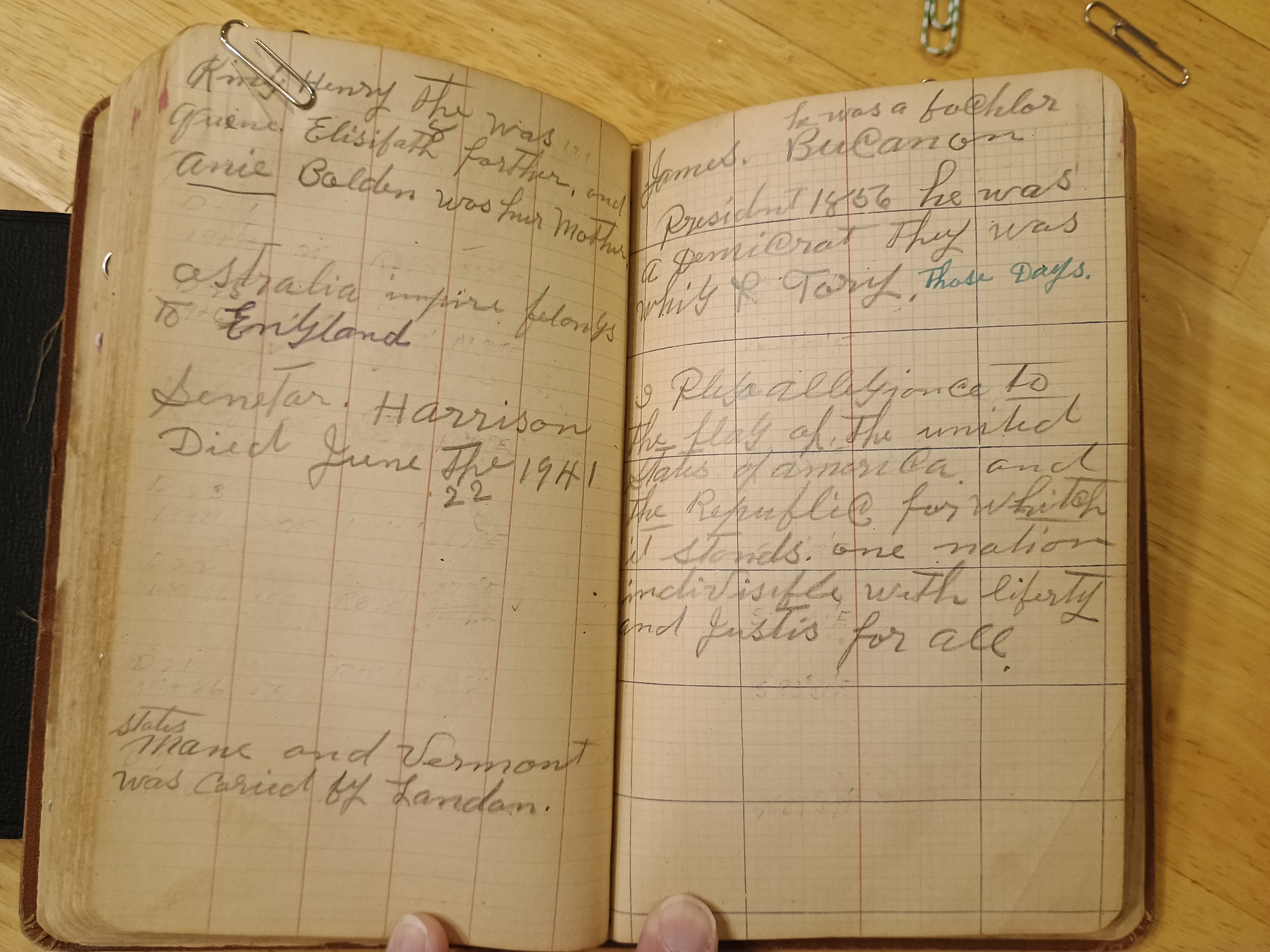
Transcription:
Left page — King Henry the was Quene Elisifath farther. and Anie Balden was hur Mother — Astralia impire felonys to England — Senetar. Harrison Died June the 22 1941 — States Mane and Vermont was Carried by Landon.
Right page — he was a batchlor James. Bucanon. President 1856 he was a Democrat Thy was a Whig and Tory. those Days. — I Pledge allegiance to the flag of the united States of america. and the Republic for whitch it Stands. one nation indivisible with liberty and Justis for all.
Notes:
Queen Elizabeth’s father was King Henry VIII, and Anne Boleyn was her mother, correct for Elizabeth I. Australia’s imperial ties to England. Senator Harrison died 22 June 1941. Maine and Vermont were the only two states carried by Landon in the 1936 election. James Buchanan was a bachelor president, correct, the only US president never to marry. The parties of that era were Whig and Democrat. The page closes with James writing out the Pledge of Allegiance from memory, notably without under God, which was not added until 1954, more than a decade after James would have written this.
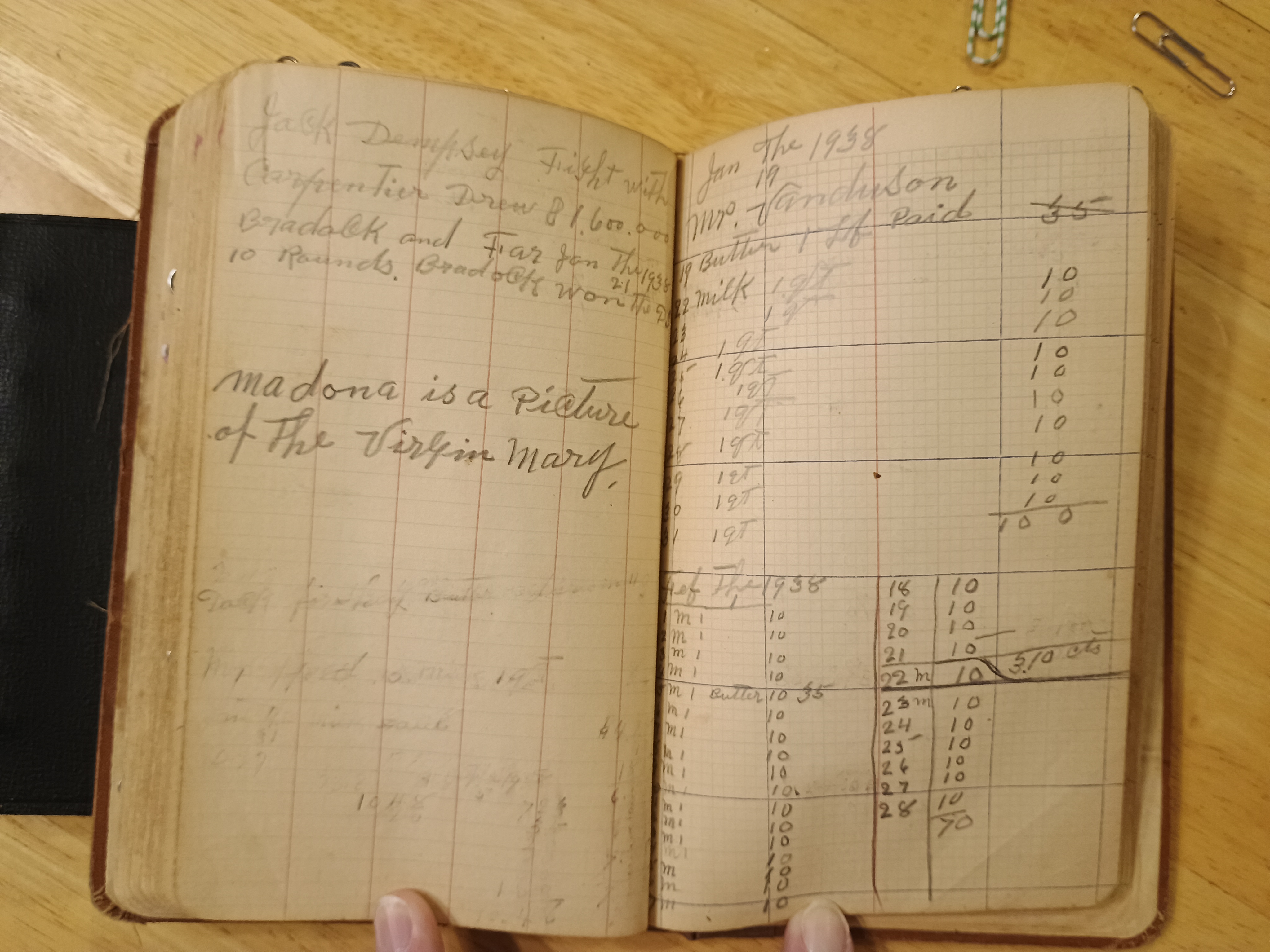
Transcription:
Left page — Jack Dempsey Fight with Carpentier Drew $1.600.000 — Bradalk and Far Jan the 21 1938 10 Rounds. Bradalk won — Madona is a Picture of the Virgin Mary. [faint illegible entries below]
Right page — Jan the 19 1938 Mr. Vanchuson Butter 1 ff paid $35 — [daily milk account entries at 10 cents] — Total 100 — Apr the 1938 [continuing daily entries through 28th] — Total 70
Notes:
The Jack Dempsey vs. Georges Carpentier fight of 2 July 1921, the first million-dollar gate in boxing history, drawing $1,600,000. A fight involving Bradalk on 21 January 1938, 10 rounds, Bradalk winning. The Madonna entry: a Madonna is a picture of the Virgin Mary. The right page is a milk account with Mr. Vanchuson beginning 19 January 1938, recording daily milk and butter sales at 10 cents per day. This account runs parallel to the Mrs. Russell account on pages 13–14, confirming James was running a small dairy with multiple customers in early 1938.
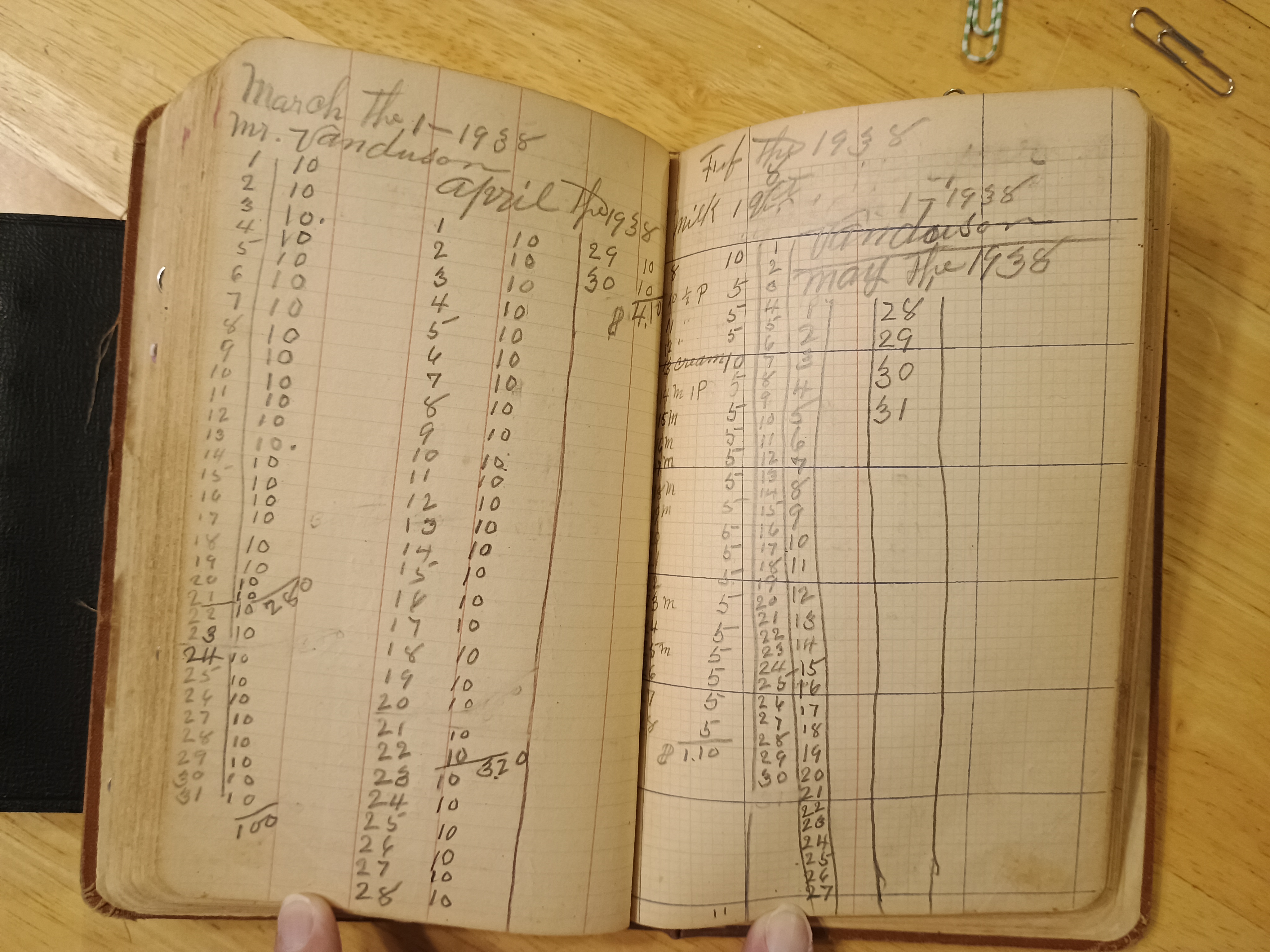
Transcription:
Left page — March the 1 — 1938 Mr. Vandudon — [daily 10-cent milk entries days 1–31] — Total 100 — April The 1938 — [daily 10-cent entries days 1–28]
Right page — Feb the 8 1938 milk 1 qt — [daily entries] — 17 1938 Vandudon — may the 1938 — [continuing daily milk entries through May] — Total $1.10
Notes:
Both pages continue the milk account with Mr. Vandudon, James’s phonetic spelling varying between Vanchuson and Vandudon, recording daily 10-cent milk sales through March, April, and into May 1938. The March account totals $1.00 for 31 days. This is an extensive daily financial record in the journal, confirming James was operating a consistent small dairy in Lakeport through the first half of 1938.
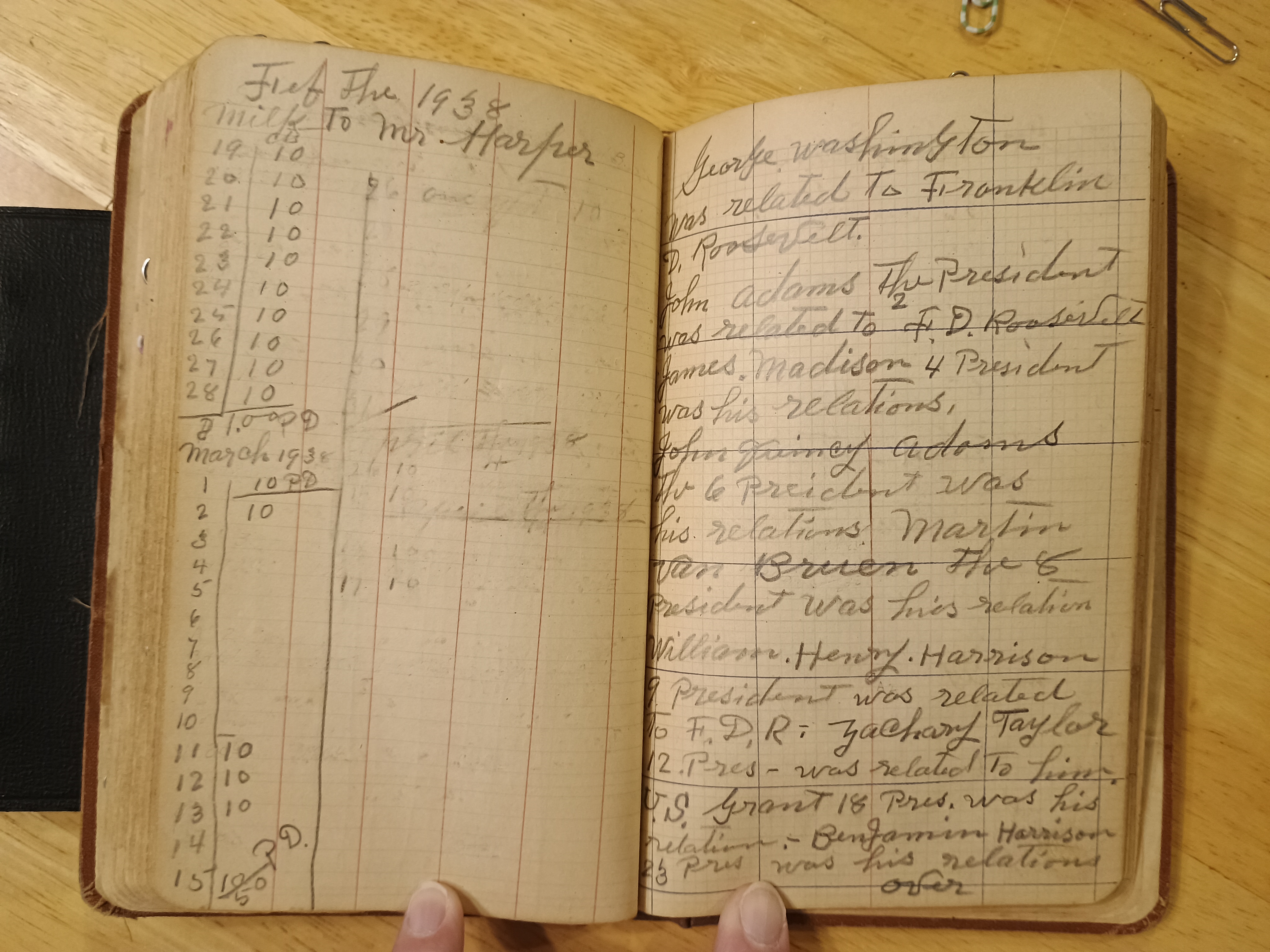
Transcription:
Left page — Feb The 1938 Milk to Mr. Harper — [daily 10-cent entries days 19–28] — Total $1.00 Pd — March 1938 — [daily entries continuing through the month]
Right page — George Washington was related To Franklin D. Rooservelt. — John Adams the President was related to F.D. Roosevelt — James. Madison 4 President was his relations. — John Quiney Adams the 6 President was his relations. — Martin Van Bruen the 8 President was his relation — William Henry Harrison 9 President was related to F.D.R. — Zachary Taylor 12 Pres. was related to him. — U.S. Grant 18 Pres. was his relation. — Benjamin Harrison 23 Pres. was his relations over
Notes:
The left page continues the milk account with Mr. Harper, the same Mr. Harper from whom James bought his Jersey cow in January 1938, now also a milk customer. The right page lists presidents James believed were related to Franklin D. Roosevelt: Washington, John Adams, James Madison, John Quincy Adams, Martin Van Buren, William Henry Harrison, Zachary Taylor, Ulysses Grant, and Benjamin Harrison. Roosevelt did have documented connections to several of these families. The page continues onto the next.
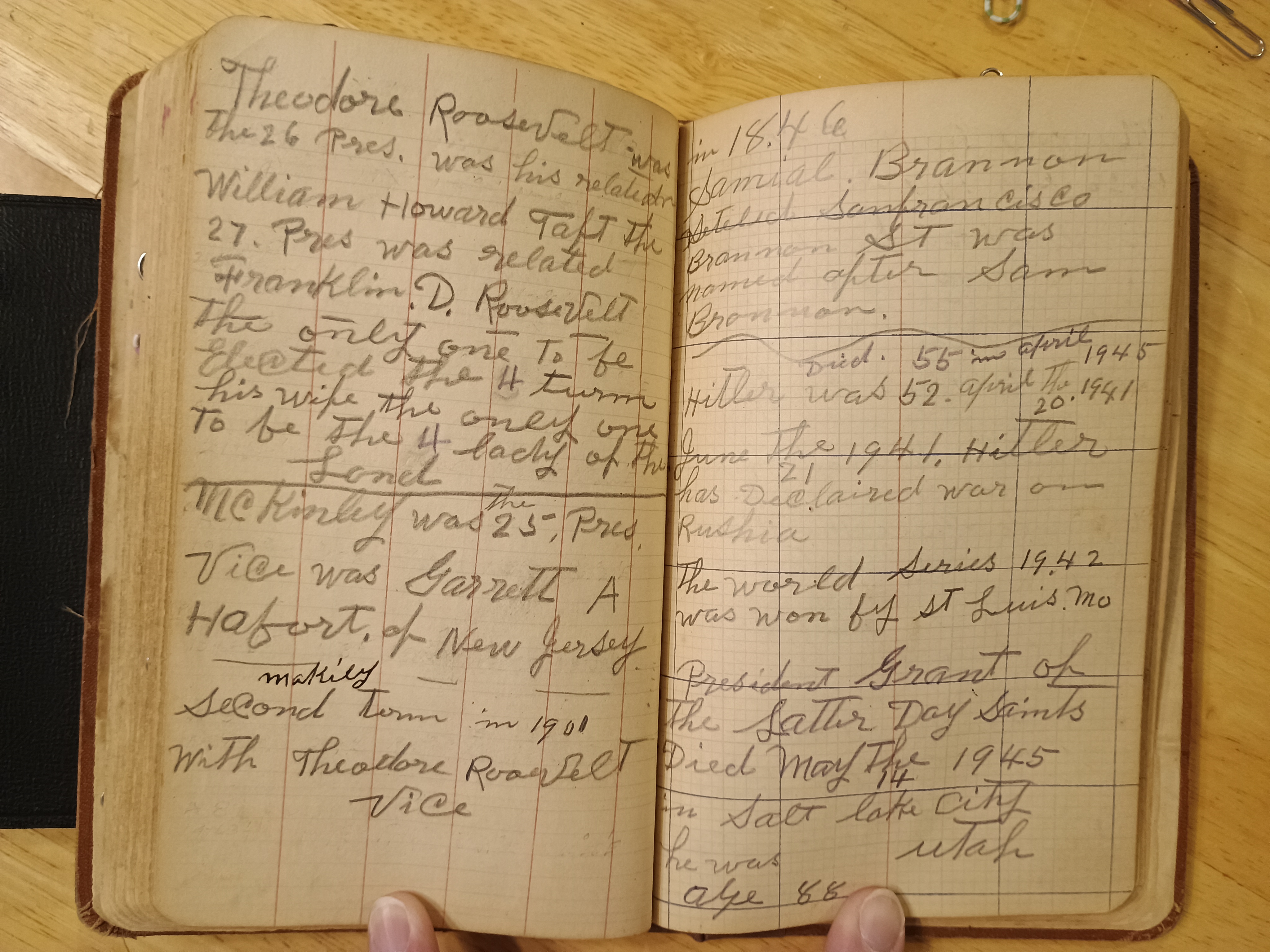
Transcription:
Left page — Theodore Roosevelt the 26 Pres. was his relation — William Howard Taft the 27. Pres was related Franklin. D. Roosevelt the only one to be Elected the 4 turn his wife the only one to be the 4 lady of the Land — McKinley was the 25. Pres Vice was Garrett A Hafort. of New Jersey making Second term in 1900 with Theodore Roosevelt Vice
Right page — in 1946 Samial. Brannon Hotel San Francisco Brannon St was named after Sam Brannan. — Died. 55 in April 1945 — Hitler was 52. April the 20. 1941 — June the 21 1941. Hitler has Declaired war on Rushia — The world Series 1942 was won by St Luis. Mo — President Grant of the Latter Day Saints Died May the 14 1945 in Salt Lake City Utah he was age 88
Notes:
The left page continues the Roosevelt family connections from page 100, adding Theodore Roosevelt (26th) and William Howard Taft (27th) to the list of presidents related to FDR. James notes Franklin D. Roosevelt as the only president elected to a fourth term, and his wife as the only woman to be First Lady four times. McKinley was the 25th president; his vice president was Garret Augustus Hobart of New Jersey for his first term, and Theodore Roosevelt for his second term in 1900, Roosevelt succeeding upon McKinley’s assassination in 1901.
The right page opens with a 1946 entry about the Samuel Brannon Hotel in San Francisco and Brannan Street being named after Sam Brannan, the prominent early California settler and first millionaire of the Gold Rush. Then Hitler turning 52 on 20 April 1941 and declaring war on Russia on 21 June 1941. The 1942 World Series was won by St. Louis. President Grant of the Latter Day Saints, Heber J. Grant, seventh President of the LDS Church, died 14 May 1945 in Salt Lake City at age 88.

Transcription:
Left page — Mussoleni was Killed April 1945 — A. God — Christ Says he made Every Thing. Read John C. 1 and he Says he Gave the laws. Then he was Jehovah. if he made Every Thing. then he made Space. Then where was he before he made Space. There was no where for him to be. and at that time he was a Ghost. and I guess they Can be nowhere. So he made Every Thing out of nothing. all but man. and he made him out of Dust. and he found a God with all Power. but Still was Killed by man witch he made.<br>Right page — why Did he make man So bad and as he Says. So Sinfull. if you Think he is a Just God Read the laws he Gave in Exodus and Levit. and numbers C. 31 — well if he made Every Thing. he made Satan. What for. if he is all Powfull why Didont he Contrate Satan. or why Didnt he make all men Good and Keep Thom that way. Well Judges. C. 1 V. 19 Says he is not allpowerfull. he Cound not Drive out the People in the Valley. for they had Charets made of iron. it must Release the Bible. what about this. C. 1 V. 19. must we beleve it. That would Do away with
Notes:
The left page opens with a brief news note, Mussolini was killed in April 1945, then returns immediately to theological inquiry. James works through a cosmological argument: if God made everything (John 1), then he made space; but where was he before space existed? He was a Ghost, and a ghost can be nowhere. So God made everything out of nothing, except man, whom he made from dust. And yet this all-powerful God was killed by the very man he made.
The right page continues the argument: if God made everything, he made Satan, so why did he not control Satan, or simply make all men good? Then James cites Judges 1:19, the passage recording that God could not drive out the people of the valley because they had chariots of iron, as evidence that God is not all-powerful. The page ends mid-sentence: “That would Do away with” continuing on the next page.
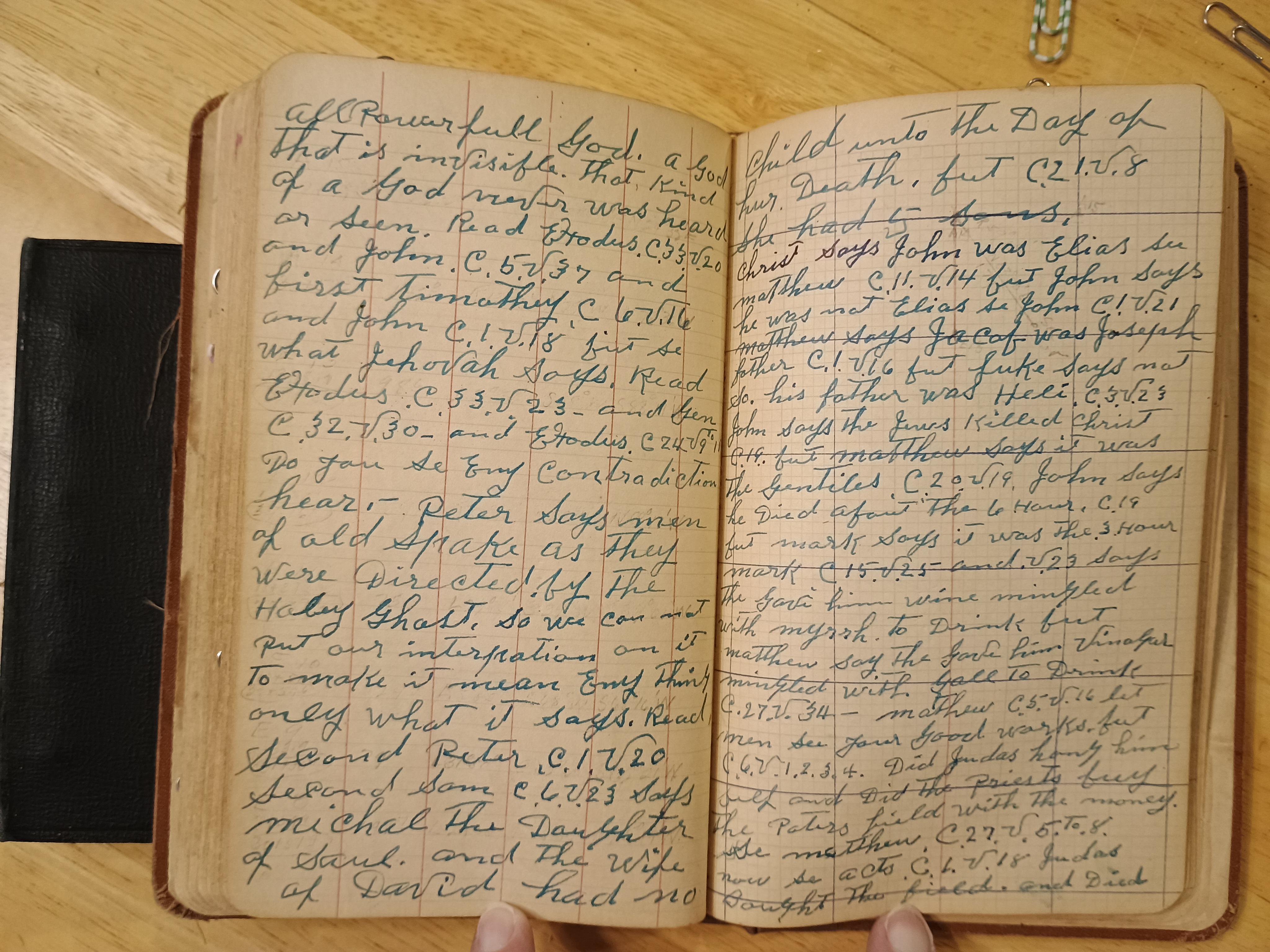
Transcription:
Left page — all Powerfull God. a God that is invisible. That Kind of a God never was heard or seen. Read Exodus C. 33 V. 20 and John. C. 5 V. 37 and first Jimathey C. 6. V. 16 and John C. 1 V. 18 but Se what Jehovah Says. Read Exodus C. 33 V. 23 — and Gen C. 32 V. 30 — and Exodus C 24 V. 9 Do you Se Eny Contradiction hear. — Peter Says men of old Spake as they were Directed by the Haly Ghost. So we can not put our interpation on it To make it mean Eny Thing only what it Says. Read Second Peter C. 1 V. 20 — Second Sam C. 6 V. 23 Says Michal the Daughter of Saul. and the Wife of David had no<br>Right page — Child unto the Day of hur Death. but C 2 1 V. 8 hur had 5 Sons. — Christ Says John was Elias Se matthew C. 11. V. 14 but John Says he was not Elias Se John C. 1 V. 21 — matthew Says Jacob was Josephs father C. 1 V. 6 but Luke Says not So. his father was Heli. C. 3 V. 23 — John Says the Jews Killed Christ C. 11. but matthew Says it was the Gentiles C 2 0 V. 19. John Says he Died about the 6 Hour. C. 19 but mark Says it was the 3 Hour mark C. 15 V. 25 — and V. 23 Says the Gave him wine mingled with myrrh. to Drink but matthew Say the Gave him Vinager mingled with Gall to Drink C. 27 V. 34 — mathew C. 5 V. 16 let men see your Good workes. but C. 6 V. 1. 2. 3. 4. Did Judas keep the buch and Did the Priests buy the Peters field with the money. Se matthew C. 27 V. 5 to 8. Se matthew C. 1 V. 18 Judas now Se acts C. 1 V. 18 Judas bought the field. and Died
Notes:
The left page continues from page 104, the argument that an all-powerful invisible God was never heard or seen, citing multiple scriptures supporting this, then contrasting them with passages where God is seen directly (Exodus 33:23, Genesis 32:30, Exodus 24:9). James asks: do you see any contradiction? He then returns to Second Peter 1:20, that men spoke as directed by the Holy Ghost so we cannot put our own interpretation on scripture, then closes with a contradiction: Second Samuel 6:23 says Michal daughter of Saul had no child unto her death, but the page ends mid-sentence.
The right page opens with the contradiction completed: 2 Samuel 21:8 says she had five sons. James then continues his list of Gospel contradictions, whether John was Elias, who was Joseph’s father (Jacob or Heli), who killed Christ (Jews or Gentiles), what hour Christ died (6th or 3rd), what he was given to drink (wine with myrrh or vinegar with gall), whether Judas kept the money or the priests used it to buy a field, and whether Judas bought the field himself. These are among the most frequently cited textual contradictions in Gospel scholarship. The page ends mid-sentence.
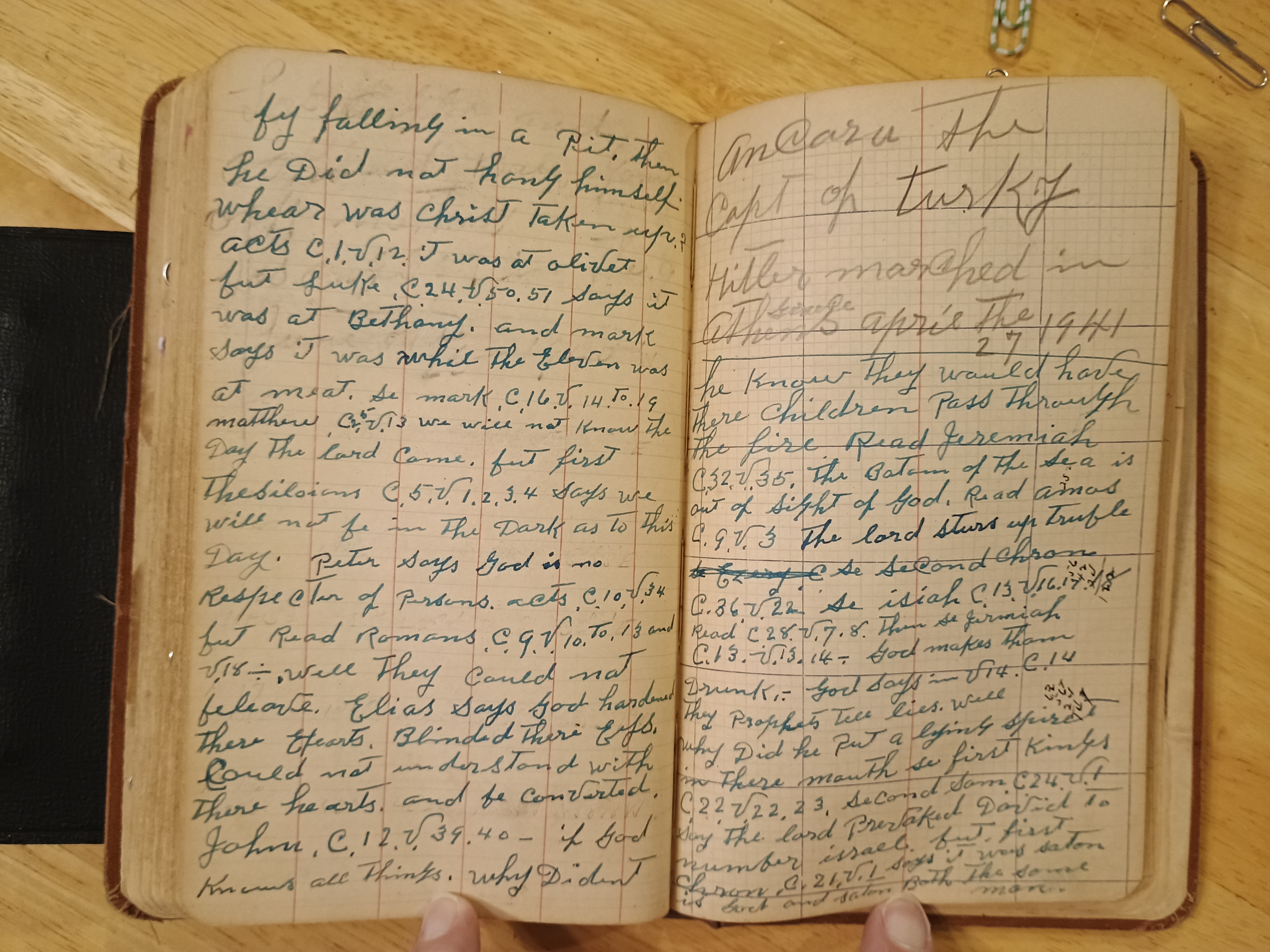
Transcription:
Left page — by falling in a Pit. then he Did not hang himself. Whear was Christ taken up. acts C. 1 V. 12. it was at olivet but Luke C. 24 V. 50. 51 Says it was at Bethany. and mark Says it was Whil the Eleven was at meat. Se mark C. 16 V. 14 to 19 — matthew C. 9 V. 13 we will not Know the Day the Lord Came. but first Thesilions C. 5 V. 1. 2. 3. 4 Says we will not be in the Dark as to this Day. Peter Says God is no Respecter of Persons. acts C. 10 V. 34 but Read Romans C. 9 V. 10 to 13 and V. 18 — well They Could not beleve. Elias Says God hardened there Hearts. Blinded there Eyes. Could not understand with there hearts. and be Converted. John C. 12 V. 39. 40 — if God Knows all Things. why Didnt<br>Right page — Ancara the Capt of Turkey — Hitler marched in Athens April the 27 1941 — he Know they would have there Children Pass Through the fire Read Jeremiah C. 32 V. 35. the bottom of the Sea is out of Sight of God. Read Amos C. 9 V. 3 the Lord Sturs up Trouble — Se Second Chron C. 36 V. 22 Se Isaiah C. 13 V. 16. 17. 18 Read C. 28 V. 7. 8. Then Se Jirmiah C. 13 — V. 13. 14 — God makes Them Drunk. — God Says — V. 14 C. 14 They Prophets Tell lies. well why Did he Put a lying Spirit in there mouth Se first Kings C. 22 V. 22. 23. Second Sam C. 24 V. 1 Say the lord Provoked David to Say the number Israel. but first number Israel. but first number C. 21 V. 1 Says it was Satan — Second C. 21 V. 1 Says it was both the Same more.
Notes:
The left page continues the biblical contradiction catalogue from page 106, completing the Judas entry, Judas died by falling in a pit, not hanging himself. Then the question of where Christ ascended: Acts says Olivet, Luke says Bethany, Mark says while the Eleven were at meat. Matthew 9:13 says we will not know the day the Lord came, but First Thessalonians says we will not be in the dark about it. God is no respecter of persons (Acts 10:34) but Romans 9 contradicts this. God hardened hearts so people could not believe — then why are they blamed for not believing? The page ends mid-sentence.
The right page opens with Ankara as the capital of Turkey and Hitler marching into Athens on 27 April 1941. James then returns to theology: God knowing children would be passed through fire yet allowing it; the bottom of the sea being out of God’s sight (Amos 9:3); God stirring up trouble; God making prophets drunk and causing them to tell lies, then why did he put a lying spirit in their mouths? The page closes with a contradiction between Second Samuel 24:1 (God provoked David to number Israel) and First Chronicles 21:1 (it was Satan), a classic biblical contradiction James noted earlier in the journal.
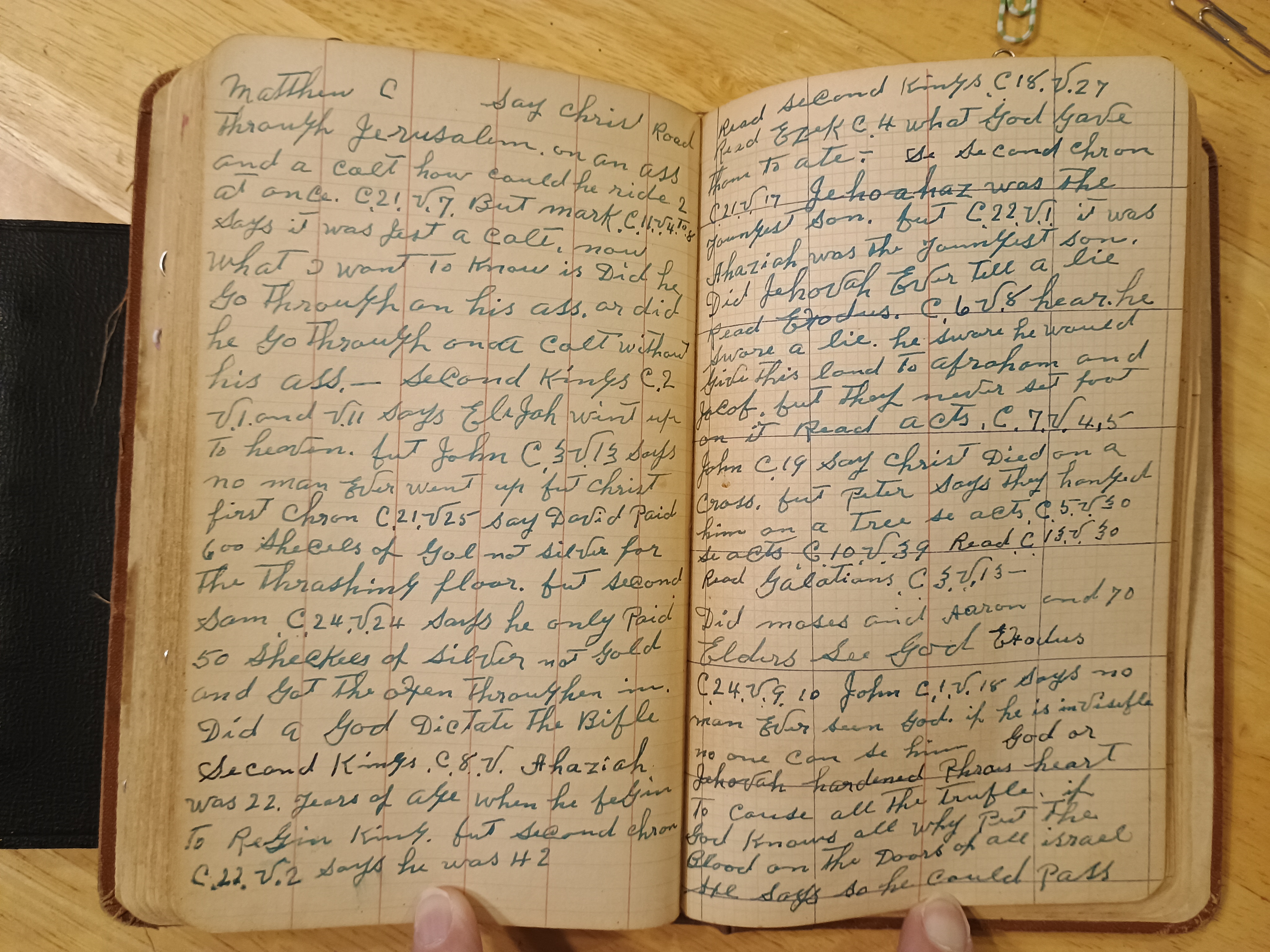
Transcription:
Left page — matthew C. Say Christ Road through Jerusalem. on an ass and a colt how could he ride 2 at once. C. 21 V. 7. But mark C. 11 V. 4 to 8 Says it was Just a Colt. now What I want to know is Did he Go Through on his ass. or did he Go Through on a Colt without his ass. — Second Kings C. 2 V. 1 and V. 11 Says Elijah went up to heaven. but John C. 3 V. 13 Says no man Ever went up but Christ — first Chron C. 21 V. 25 Say David Paid 600 Shekels of Gold not Silver for the Thrashing floor. but Second Sam C. 24 V. 24 Says he only Paid 50 Shekels of Silver not Gold and Got the Open Thresher in. Did a God Dictate the Bible — Second Kings C. 8 V. Ahaziah. was 22. years of age when he began To Reign King. but Second Chron C. 22 V. 2 Says he was 42<br>Right page — Read Second Kings C. 18 V. 27 Read Ezek C. 4 what God Gave Them to ate. — Se Second Chron C. 21 V. 17 Jehoahaz was the youngest Son. but C. 22 V. 1 it was Ahaziah was the youngest Son. — Did Jehovah Ever tell a lie Read Exodus. C. 6 V. 8 hear. he Read Exodus. C. 6 V. 8 hear. he Swore a lie. he Swore he would Give this land to Abraham and Jacob. but they never Set foot on it Read acts. C. 7 V. 4. 5 — John C. 19 Say Christ Died on a Cross. but Peter Says they hanged him on a Tree Se acts C. 5 V. 30 Se acts C. 10 V. 39 Read C. 13 V. 30 Read Galatians C. 3 V. 13 — Did moses and Aaron and 70 Elders See God Exodus C. 24 V. 9 10 John C. 1 V. 18 Says no man Ever Seen God. if he is invisible no one Can Se him. God or Jehovah hardened Thoms heart To Cause all the Trouble. if God Knows all why Put The Blood on the Doors of all Israel He Says So he Could Pass
Notes:
Both pages continue James’s sustained biblical inquiry. The left page focuses on contradictions about physical facts: how Christ rode both an ass and a colt simultaneously; Elijah ascending to heaven when John says no man ever went up; David paying 600 shekels of gold or 50 shekels of silver for the threshing floor; Ahaziah being 22 or 42 when he began to reign. Each contradiction is cited. James’s central question, did a God dictate the Bible, is stated plainly.
The right page continues with Jehoahaz versus Ahaziah as the youngest son; God swearing to give Abraham and Jacob the land of Canaan but they never set foot on it; Christ dying on a cross (John) versus being hanged on a tree (Peter/Acts/Galatians); Moses and Aaron and 70 elders seeing God (Exodus 24) versus no man ever seeing God (John 1:18). The page closes mid-sentence on one of the most famous questions in Exodus, if God knows all things, why did he need blood on the doors of Israel to know which houses to pass over?
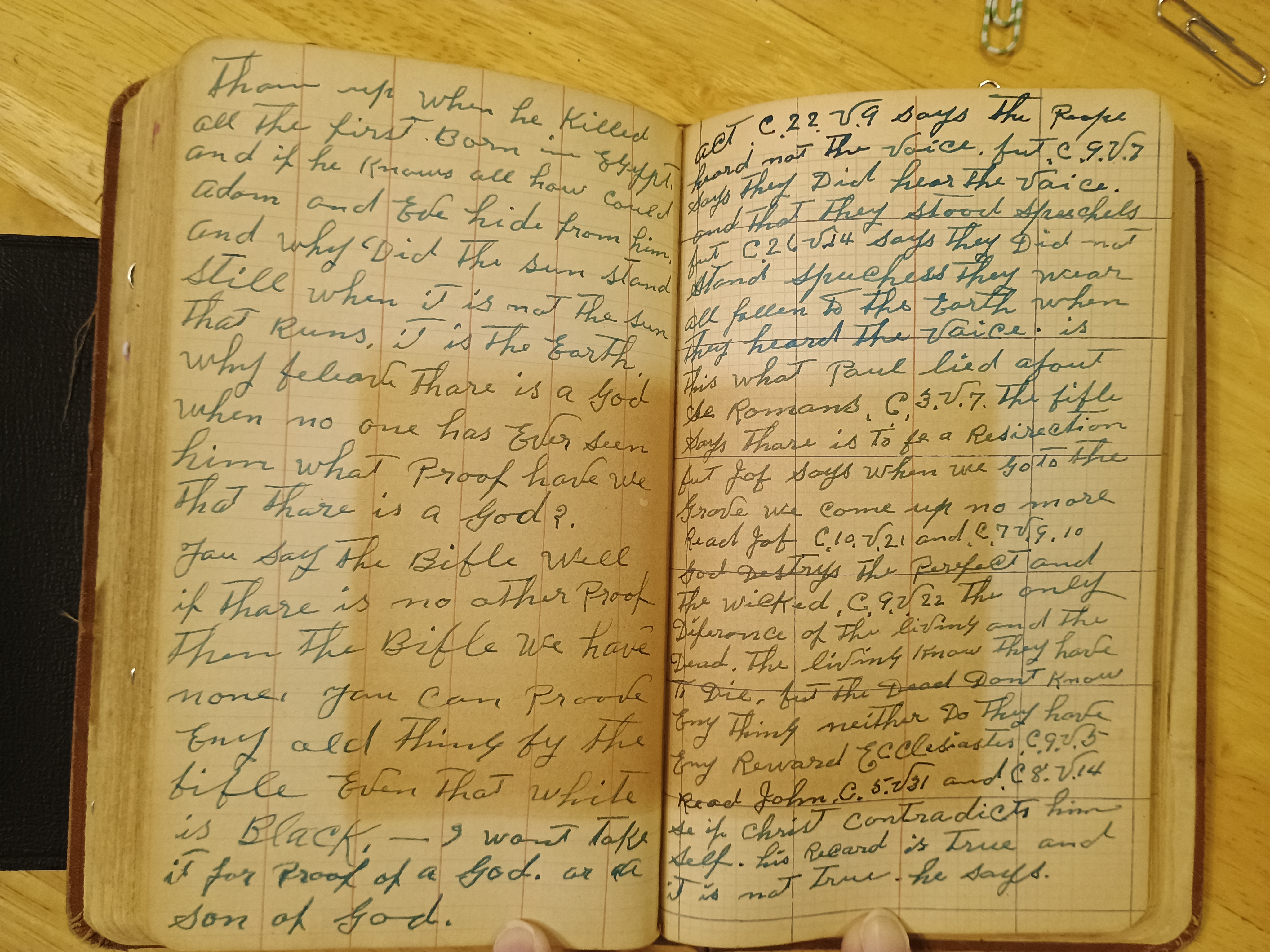
Transcription:
Left page — Thom up when he Killed all the first Born in Egypt. and if he Knows all how Could Adam and Eve hide from him. and why Did the Sun Stand Still when it is not the Sun that Runs. it is the Earth. Why beleve There is a God when no one has Ever Seen him what Proof have we That There is a God?. You Say the Bible Well if There is no other Proof Then the Bible we have none. you Can Proove Eny all Things by the bible Even That white is BLACK. — I wont Take it for Proof of a God. or a Son of God.<br>Right page — act C. 22 V. 9 Says The Peope heard not The Voice. but C. 9 V. 7 Says they Did hear The Voice. and That They Stood Speechless but C. 20 V. 14 Says they Did not Stand Speechless they were all fallen to the Earth when they heard the Voice. — is This what Paul lied about Se Romans. C. 3 V. 7. The fitle Says There is to be a Resirection but Job Says when we Go to the Grave we Come up no more Read Job C. 10 V. 21 and C. 7 V. 9. 10 God Destroys the Perfect and the wicked. C. 9 V. 22 The only Diference of the Living and the Dead. The Living know they have To Die. but The Dead Dont Know Eny Thing neither Do They have Eny Reward Ecclesiastes C. 9 V. 5 — Read John C. 5 V. 31 and C. 8 V. 14 Se if Christ Contradicts him Self. his Recard is True and it is not True. he Says.
Notes:
The left page brings James’s extended biblical inquiry to its conclusion. The final question, if God knows all things, why did he need blood on the doors, is completed with: so he could pass over when he killed all the firstborn in Egypt. Then: if God knows all, how could Adam and Eve hide from him? And why did the sun stand still when it is the earth that moves, not the sun? The argument reaches its summit: what proof do we have that there is a God? If the only proof is the Bible, that proves nothing, you can prove anything by the Bible, even that white is black. James’s conclusion is stated plainly and without apology: “I wont Take it for Proof of a God. or a Son of God.”
The right page continues with Paul’s companions on the road to Damascus hearing or not hearing the voice (Acts 9:7 vs. 22:9), and standing speechless or falling to the earth (another contradiction). Paul lying about it (Romans 3:7). Whether there is a resurrection (the title says yes) but Job says when we go to the grave we come up no more (Job 10:21, 7:9-10). God destroying both the perfect and the wicked alike. The only difference between the living and the dead: the living know they will die, but the dead know nothing and have no reward (Ecclesiastes 9:5). The page closes with Christ contradicting himself, John 5:31 says his record is not true, John 8:14 says it is.

Transcription:
Left page — July the 4 1941 — Senitor Repur and Senitor Wheear Spoke on the war. — President Franklin Roosevelt Speake at 1. oclock the 4 of July 1941<br>Right page — Bulgeary March the 4 of July 15 — X Fals Prophet — Burnard Shaw Saying Hitler would not atact Rushia he was a fals Prophet — Sen this in a morning Picture Show in San Francisco 1941 — Comele Said There was Prophet besides Joseph Smith — 7
Notes:
The left page records the 4th of July 1941: two senators, Pepper and Wheeler, spoke on the war, and President Franklin Roosevelt spoke at 1 o’clock. Senator Claude Pepper of Florida was a strong interventionist; Senator Burton Wheeler of Montana was a prominent isolationist, two opposing voices on the war James was following.
The right page opens with Bulgaria and a date reference. Then a marked entry, James puts an X beside “Fals Prophet” recording that George Bernard Shaw had predicted Hitler would not attack Russia. Since Hitler invaded Russia on 22 June 1941, Shaw was proved wrong. James saw this in a morning picture show (newsreel) in San Francisco in 1941 and marked Shaw as a false prophet accordingly. The final entry records someone named Comele saying there was a prophet besides Joseph Smith, a reference to LDS prophetic succession or a discussion James had or heard. The number 7 at the bottom may be a page count or unrelated notation.
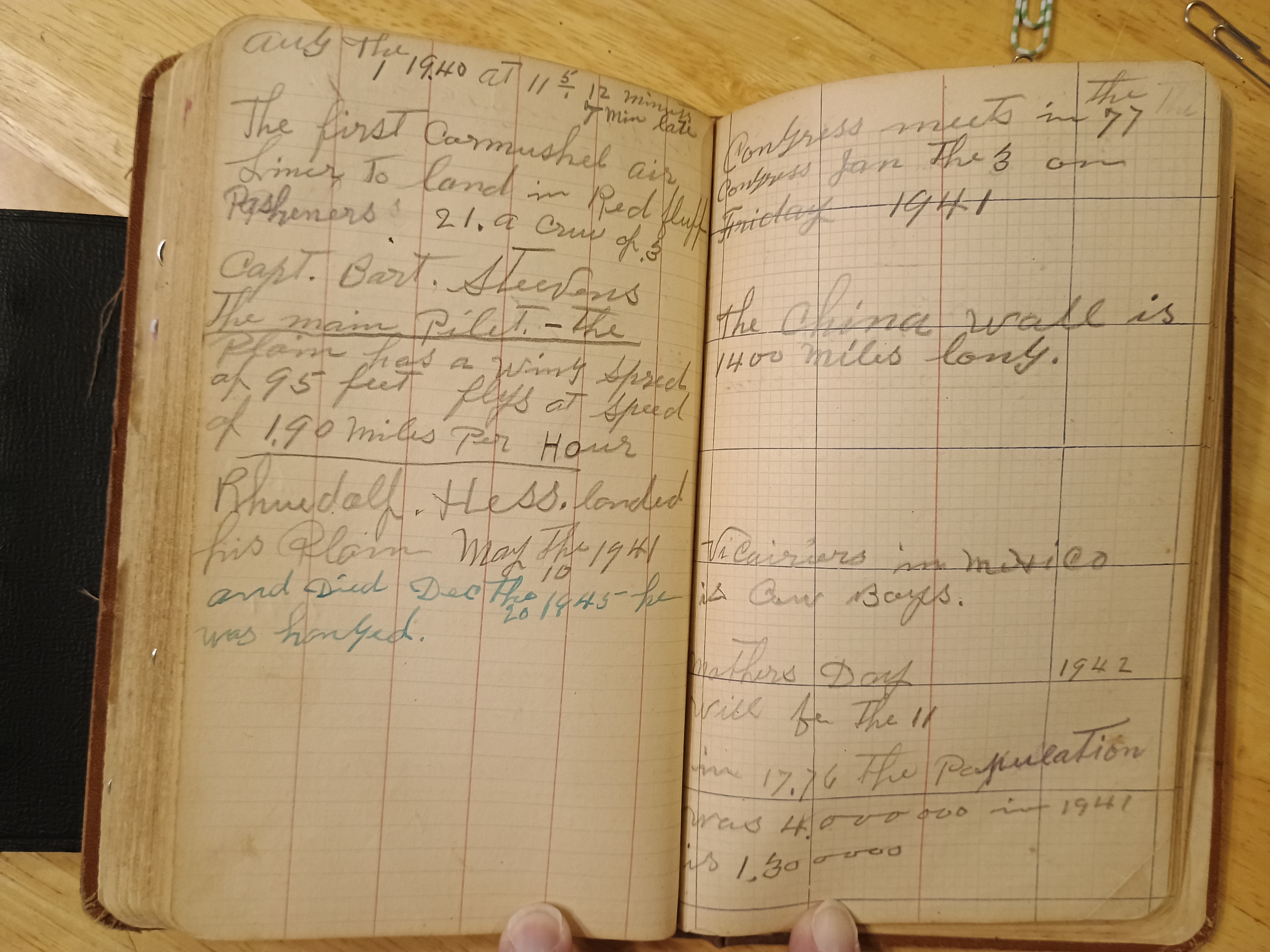
Transcription:
Left page — Aug the 1 1940 at 11 5/12 min 7 min late — The first Carmushel air Liner to land in Red Bluff Passengers 21. a Crue of 5 — Capt. Cart. Stevens the main Pilot. — The Plain has a wing Speed of 95 feet flys at Speed of 190 miles Per Hour — Rhundalf. Hess. landed his Plain May the 10 1941 and Died Dec the 10 20 1945 he was hanged.<br>Right page — Congress meets in the 77 Congress Jan the 3 on Friday 1941 — The China wall is 1400 miles long. — Vicinitiers in Mexico is Cue Boys. — Mothers Day 1942 will be the 11 — in 17.76 The Population was 4.000.000 in 1941 is 1.30[0.000?]
Notes:
The left page opens with a precise local entry: on 1 August 1940, the first commercial airliner landed in Red Bluff, California, 7 minutes late, at 11:05 A.M., with 21 passengers and a crew of 5, piloted by Captain Cart. Stevens. The plane had a 95-foot wingspan and flew at 190 miles per hour. James recorded this local aviation milestone with characteristic precision.
Then Rudolf Hess, James writes “Rhundalf Hess” who landed his plane in Scotland on 10 May 1941 in a solo unauthorized flight, apparently attempting to negotiate peace. James notes he died 10 December 1945 and was hanged, though Hess was actually sentenced to life imprisonment at Nuremberg and died in 1987. James may have confused him with other Nazi leaders executed at Nuremberg.
The right page records the 77th Congress convening on Friday 3 January 1941. The Great Wall of China is 1,400 miles long. Vaqueros in Mexico are cowboys. Mother’s Day 1942 will be the 11th. The US population was 4,000,000 in 1776 and 130,000,000 in 1941, James tracking the population growth of the nation across 165 years.
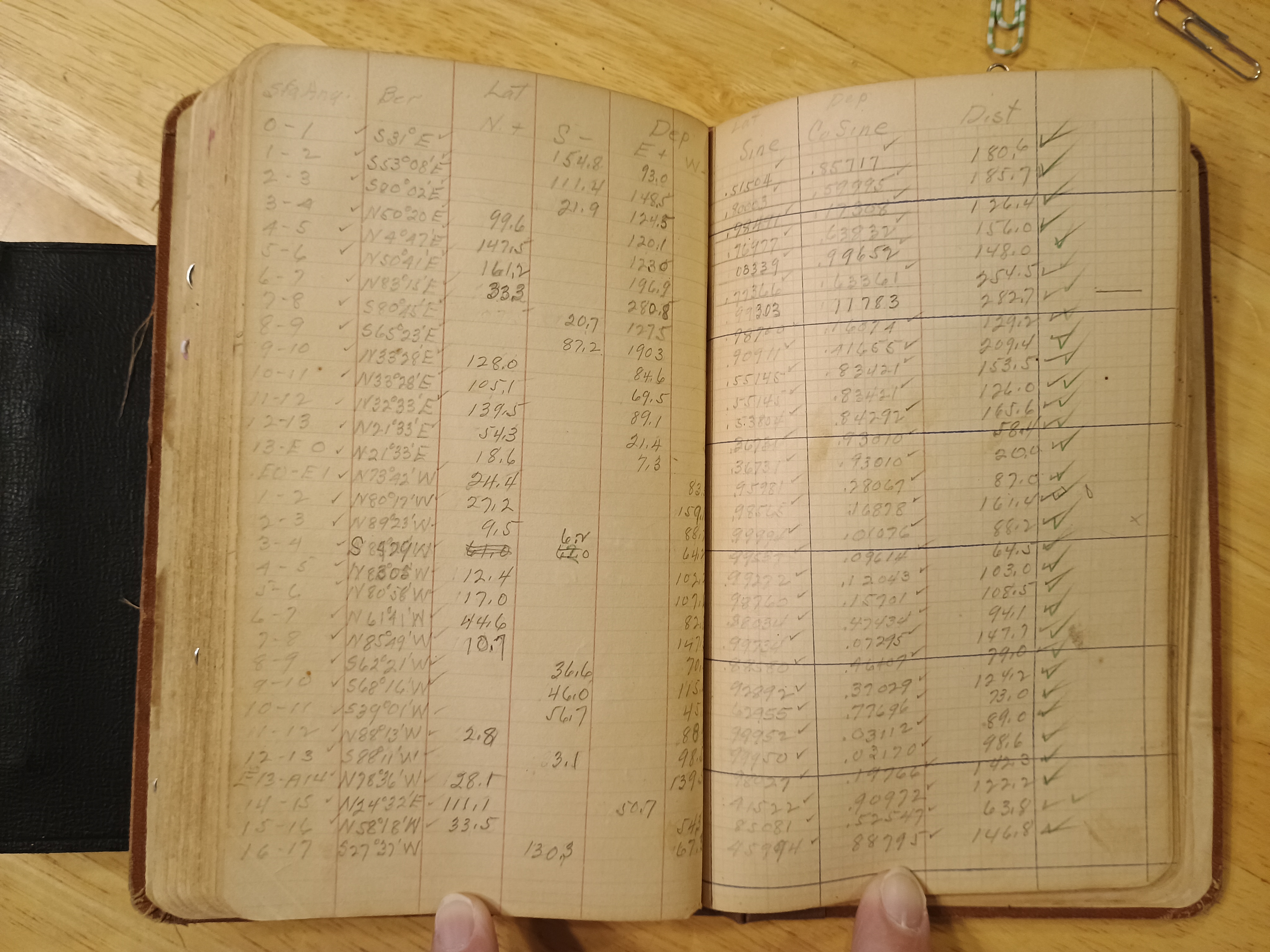
Transcription:
Left page — [Surveyor’s data only], Right page — [Surveyor’s data only]
Notes:
Both pages are dense surveyor’s data, station numbers, bearings, latitudes, departures, sines, cosines, and distances. James left these pages entirely untouched.
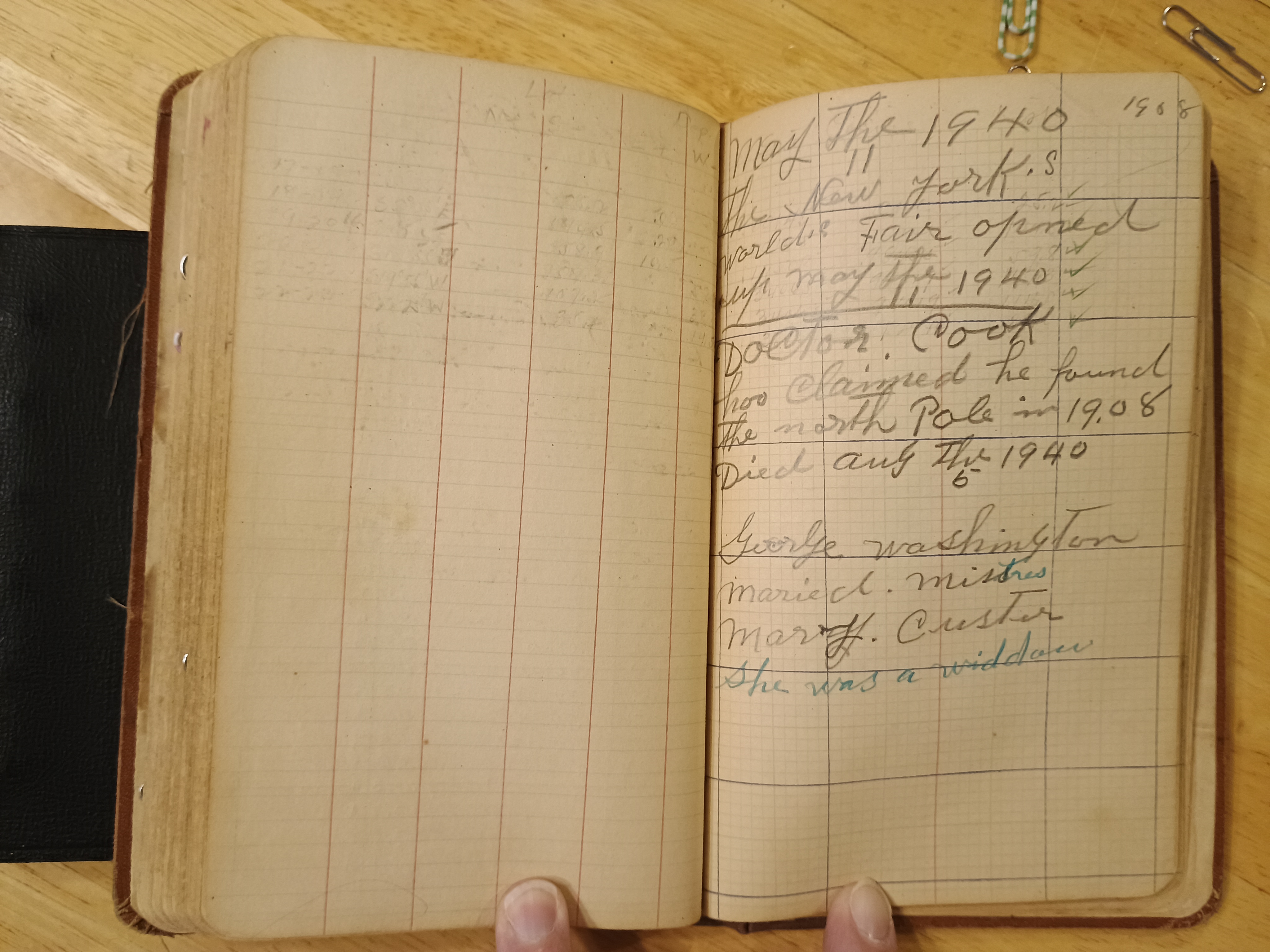
Transcription:
Left page — [Surveyor’s data only — faint/largely illegible]<br>Right page — May the 11 1940 1938 — The New Yorks Worlds Fair opened may the 11 1940 — Doctor. Cook who Claimed he found the North Pole in 1908 Died aug the 6 1940 — George Washington maried. mistres Mary H. Cruster She was a widdow
Notes:
The left page has faint surveyor’s data largely illegible in this photograph. The right page has three distinct entries. The New York World’s Fair opened 11 May 1940, this was actually the second season of the 1939–1940 World’s Fair, which reopened on 11 May 1940 after its inaugural 1939 season; the date at the top also shows 1938 which may be a separate earlier notation. Dr. Frederick Cook, who claimed to have reached the North Pole in 1908, a claim disputed by Robert Peary and largely discredited, died 6 August 1940. George Washington married widow Martha Dandridge Custis, James writes her name as Mary H. Cruster, a phonetic approximation of Martha Custis.
Transcription:
Left page — Feb the 5 1938 — Mr. James R. Meredith Paid to Mrs. James R. Meredith the Sum of five Dol $5.00 — April the 3 five Dal $5.00 — June the 4 Seven Dal $7.00 — aug. the 4 Seven Dal $7.00 — Nov the 5 five Dal $5.00 — Jan the 4 1939. five Dal $5.00 — March the 5 five Dal $5.00 — May the 5 five Dal $5.00 — July the 6 Seven Dal $7.00 — Sept the 6 Eight Dal $8.00 — Dec the 4 five Dal $5.00 — This Paid on one Wedding Ring. — Etta Meredith<br>Right page — [1941 — Etta Meredith — faint account entries largely illegible — butter and cream entries] 12. / 12. / 60 / [further entries illegible]
Notes:
The left page has personal financial records. Beginning 5 February 1938, James records installment payments to Mrs. Etta Meredith, his own wife, ranging from $5 to $8, made every two months through December 1939. The total comes to $64. The final line reveals the purpose: “This Paid on one Wedding Ring.” Signed Etta Meredith. James was paying for Etta’s wedding ring on an installment plan, recording each payment carefully in the surveyor’s field book, with Etta’s own signature as acknowledgment. They had married in June 1936; he was still paying for her ring two years later.
The right page has a 1941 account header for Etta Meredith with faint entries for butter and cream, suggesting Etta was keeping her own small dairy account in the same journal, but the entries are largely illegible in this photograph.
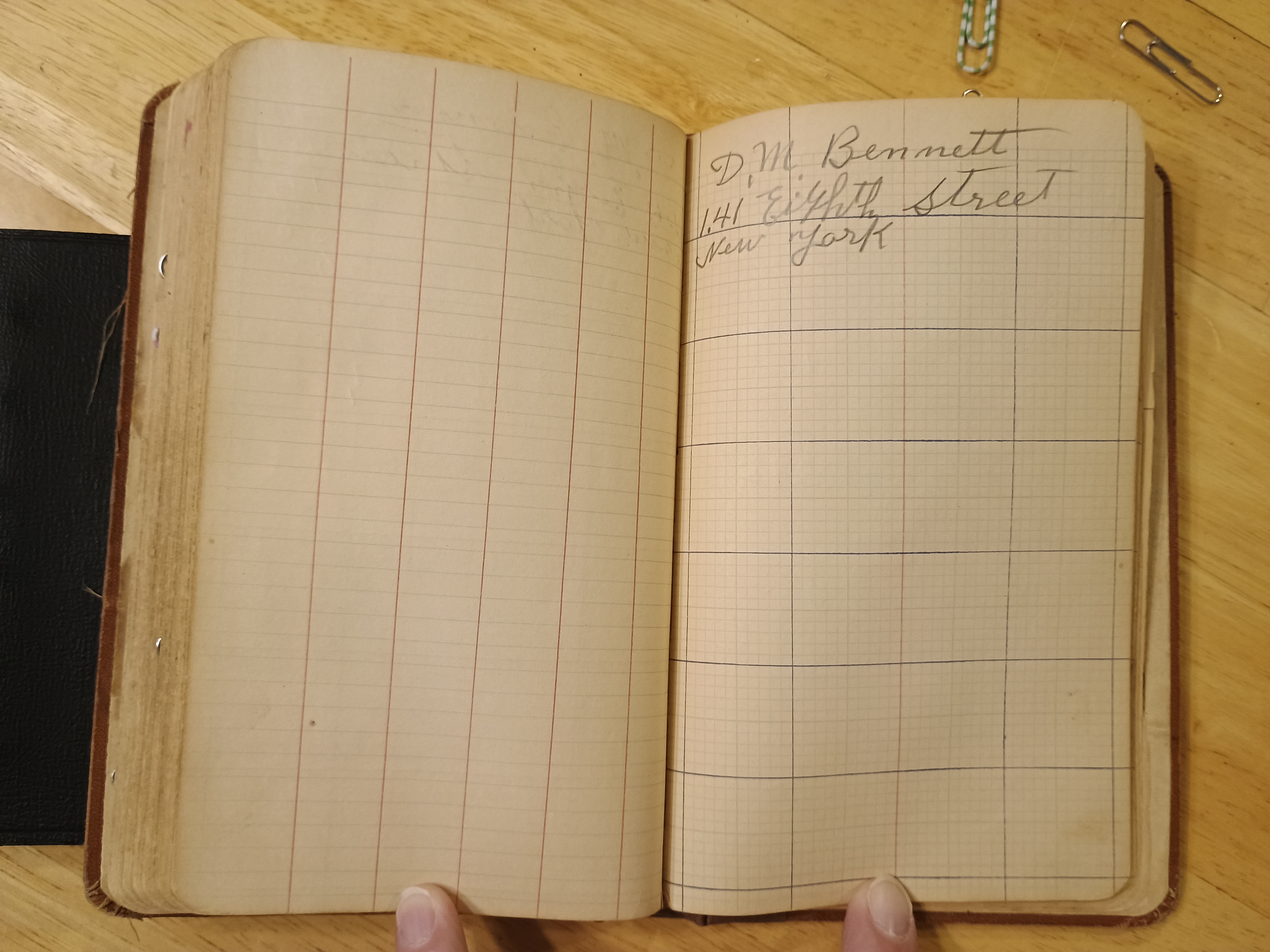
Transcription:
Left page — [Blank]<br>Right page — D. M. Bennett — 141 Eighth Street — New York
Notes:
The left page is blank. The right page has a single address entry: D. M. Bennett, 141 Eighth Street, New York. DeRobigne Mortimer Bennett (1818–1882) was a prominent American freethinker, publisher of the freethought journal “The Truth Seeker,” and founder of the National Liberal League. He was imprisoned under the Comstock Laws for distributing freethought literature. Given James’s sustained theological inquiry throughout the journal, his methodical questioning of biblical authority, divine omnipotence, and institutional religion, it is entirely possible he was familiar with Bennett’s freethought tradition. However, Bennett died decades before James would have been writing in this journal, so this may be a publisher’s address James copied from a publication rather than a personal contact.
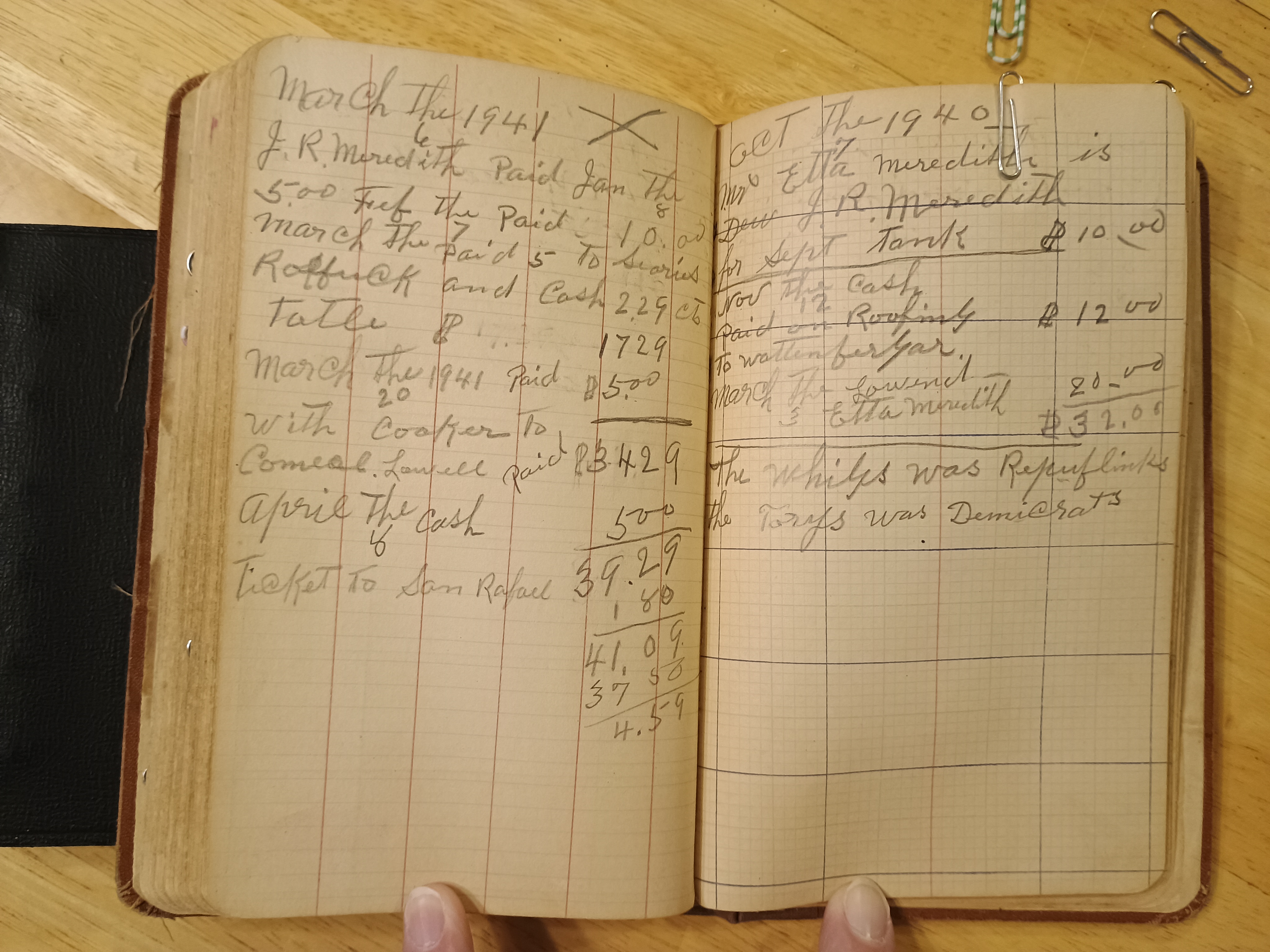
Transcription:
Left page — March the 6 1941 X — J. R. Meredith Paid Jan the 8 5.00 Feb the Paid 10.00 — March the 7 Paid 5 to Stores — Roffuck and Cash 2.29 cts — Tattle $. 1729 — March the 20 1941 Paid $5.00 with Cooper to Corneal. Lowell paid $B3429 — April the 6 Cash 500 — Ticket to San Rafael 39.29 — 1.80 — 41.09 — 37.58 — 4.59<br>Right page — Oct the 1940 — Mrs Etta Meredith is Mr J. R. Meredith — Dent for Sept Tanks $10.00 — Nov the Cash — Paid on Roofing $12.00 — To wattenberger. — March the 3 Lowell — Etta Meredith $20.00 — $32.00 — The Whilgs was Repuflints — the Torys was Democrats
Notes:
The left page is a personal financial account from early 1941. James records payments through January, February, and March, to stores, to someone named Roffuck, and on 20 March 1941 paying $5 with Cooper to Corneal (Charles Raymond Lowell, paying $34.29 total). A ticket to San Rafael cost $39.29, with running totals showing James carefully tracking his finances. The page is marked with an X at the top, suggesting it was later reviewed or settled.
The right page opens with an October 1940 account in Etta’s name. Payments recorded include $10 for September tanks (likely fuel or water), $12 paid on roofing to someone named Wattenberger, and $20 to Lowell, total $32. The final two lines return to political history: the Whigs were Republicans, the Tories were Democrats, James noting the evolution of American party names from the colonial and early republic era.

Transcription:
Left page — The Republican Party was Whig Party up to 1852 Then was James Bucanon the first Republican President — The Democrats was Known as Tory Party. — The Liberty Bell was made in London in the year of 1752 — William Boothe was the founder of the Salvation army in East End Lundon<br>Right page — James R. Meredith’s Father was Born in the year of 1803 in Shanicory Valy V.a his name was James. Meredith — 1941 finds me well and I am very Thankfull. I am in Lakeport Calif.
Notes:
The left page continues the party history notes from page 126, the Republican Party was the Whig Party until 1852, with James Buchanan as the first Republican president (actually Buchanan was a Democrat; Abraham Lincoln was the first Republican president, but James may be conflating the transition period). The Democrats were known as the Tory Party. The Liberty Bell was made in London in 1752, correct, it was cast at the Whitechapel Bell Foundry in London. William Booth founded the Salvation Army in the East End of London, correct, in 1865.
The right page is one of the a revealing entry in the journal. James records his father’s birth in 1803 in Shanicory Valley, Virginia, his name was James Meredith, consistent with the autobiography recorded on pages 85–86. Then a quiet personal statement: “1941 finds me well and I am very Thankfull. I am in Lakeport Calif.” James writing in his seventies, in the middle of a world war, grateful to be alive and well.

Transcription:
Left page — March the 1940 — Mrs Lowell is Due — J.R. Meredith Cash $15.00 — Eggs 21. Doz 16.75 — Chicken 6.00 — 75[cents] — Convention at Pa — Windel Louis Wilke was anominated for the Republican President in Chigo Ill The Democrat Convention anominated Pres Roosevelt for Pres. See walis for Vice July the 18 1940<br>Right page — Sacramento Calif one Hundred years old aug the 7 1939 — 17 of Sept 1787 Constitution — China’s 4 of July is Oct the 10 1940 — Old Xmas is Jan the 6 Comes on Sunday Jan the 5 1941
Notes:
The left page opens with a March 1940 financial account: Mrs. Lowell is due, James received $15 cash, sold 21 dozen eggs for $16.75 and chicken for 75 cents. Then the 1940 Republican convention in Philadelphia nominated Wendell Lewis Willkie, while the Democratic convention in Chicago nominated Roosevelt for president with Wallace (James writes “walis”) for vice president on 18 July 1940.
The right page records Sacramento, California celebrating its centennial on 7 August 1939, the city was founded in 1839. The Constitution was signed 17 September 1787, correct. China’s national day is 10 October, the anniversary of the 1911 Wuchang Uprising that launched the Republic of China; James dates this to 1940. Old Christmas falls on 6 January, the traditional Epiphany date, and James notes it falls on Sunday in 1941.

Transcription:
Left page — May the 23 1939 USA — Submarene went down and the Cause was a Stuck Valve. 59 men in it. The Squalais may the 24 first men Brought up 7 men — Second 9 — 3 — 9 — 48 Total Saved 33. Lost 26 — Britten sub went down lost 63 men — French Sub Frenett went down losing all men — This in Portsmouth New Hampshire in the Atlantic Ocean. the first Rescue from a Submareen. [bottom] 32 — 27 missing<br>Right page — Jan the 15 1938 Lakeport Calif — James R. Meredith has 4 Children — 27 Gran Children — 29 Grate Gran Children — Se on the other Side. — Langley the first to try a air Plain — the Write Boys first to fly in a motor Plane.
Notes:
The left page records the sinking of the USS Squalus on 23 May 1939, the same disaster James referenced on pages 73–74 when recording the loss of the O-9. Here he gives the fuller account: the cause was a stuck valve, 59 men aboard, the first men brought up on the 24th, total saved 33, lost 26 — accurate figures. He also notes a British submarine losing 63 men and a French submarine (the Phenix) going down with all hands, all in Portsmouth, New Hampshire waters, though the British and French losses were separate incidents. James calls this the first rescue from a submarine, the Squalus rescue was indeed a landmark in submarine rescue history.
The right page is another significant personal entry dated 15 January 1938 in Lakeport: James R. Meredith has 4 children, 27 grandchildren, and 29 great-grandchildren. Then two aviation pioneers: Samuel Langley, who was first to attempt powered flight, and the Wright Brothers, who were first to successfully fly a motor plane, James correctly distinguishing between the attempt and the achievement.
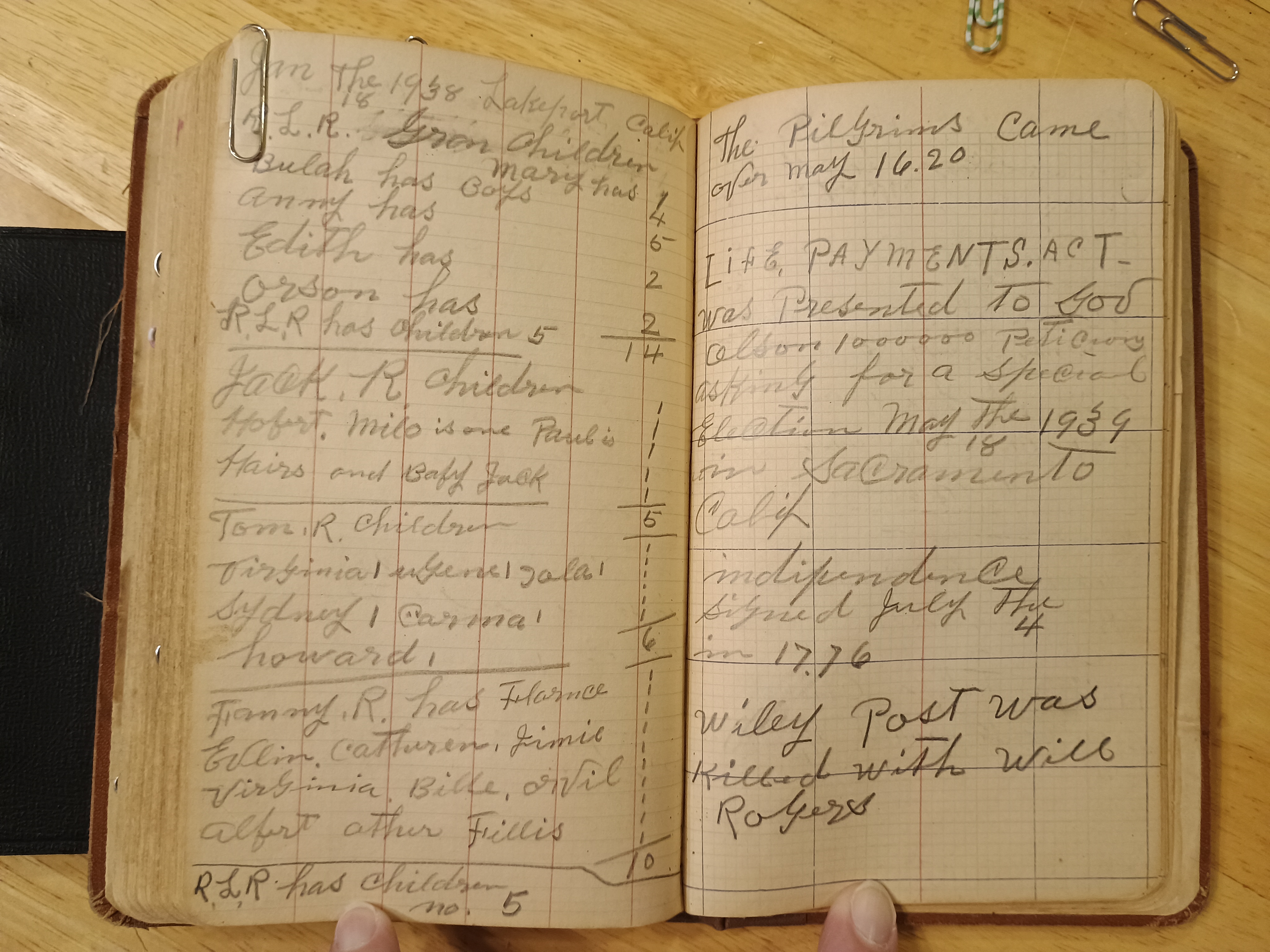
Transcription:
Left page — Jan the 16 1938 Lakeport Calif — R.L.R.’s Gran Children — Bulah has Boys Mary has 4 — anny has 6 — Edith has 2 — Orson has 2 — R.L.R has Children 5 — Total 14 — Jack. R. Children — Hobert. Milo is one Paul is Hairs and Baby Jack — 1 / 1 / 1 / 1 / 1 — Total 5 — Tom. R. Children — Virginia 1 Wborn 1 Jala 1 Sydney 1 Carma 1 Howard 1 — Total 6 — Fanny. R. has Florence Tillim. Cathuren. Jimmie Virginia. Billie. Arvil albert arthur Fillis — Total 10 — R.L.R. has Children no. 5<br>Right page — The Pilgrims Came over may 16.20 — Life PAYMENTS ACT — was Presented to God above 1000000 Peticions asking for a Special Election May the 18 1939 in Sacramento Calif — independence Signed July the 4 in 17.76 — Wiley Post was Killed with Will Rogers
Notes:
The left page is a detailed family census in the journal, dated 16 January 1938. James is counting his grandchildren through his children Robert Leonard Ross (R.L.R.), Jack Ross, Tom Ross, and Fanny Ross. Bulah has boys, Mary has 4, Anny has 6, Edith has 2, Orson has 2, totaling 14 grandchildren through Robert’s line. Jack’s children include Hobert, Milo, Paul, and Baby Jack, 5 total. Tom’s children: Virginia, one born, Jala, Sydney, Carma, Howard, 6 total. Fanny’s children: Florence, Tillim, Catherine, Jimmie, Virginia, Billie, Arvil, Albert, Arthur, Fillis, 10 total. This cross-references the 27 grandchildren recorded on the previous page.
The right page notes the Pilgrims came over in May 1620. The Life Payments Act, the Townsend Plan, a Depression-era old age pension scheme, gathered over one million petition signatures calling for a special election on 18 May 1939 in Sacramento. Independence signed 4 July 1776. Wiley Post was killed with Will Rogers, in the plane crash at Point Barrow, Alaska on 15 August 1935, noted elsewhere in the journal.
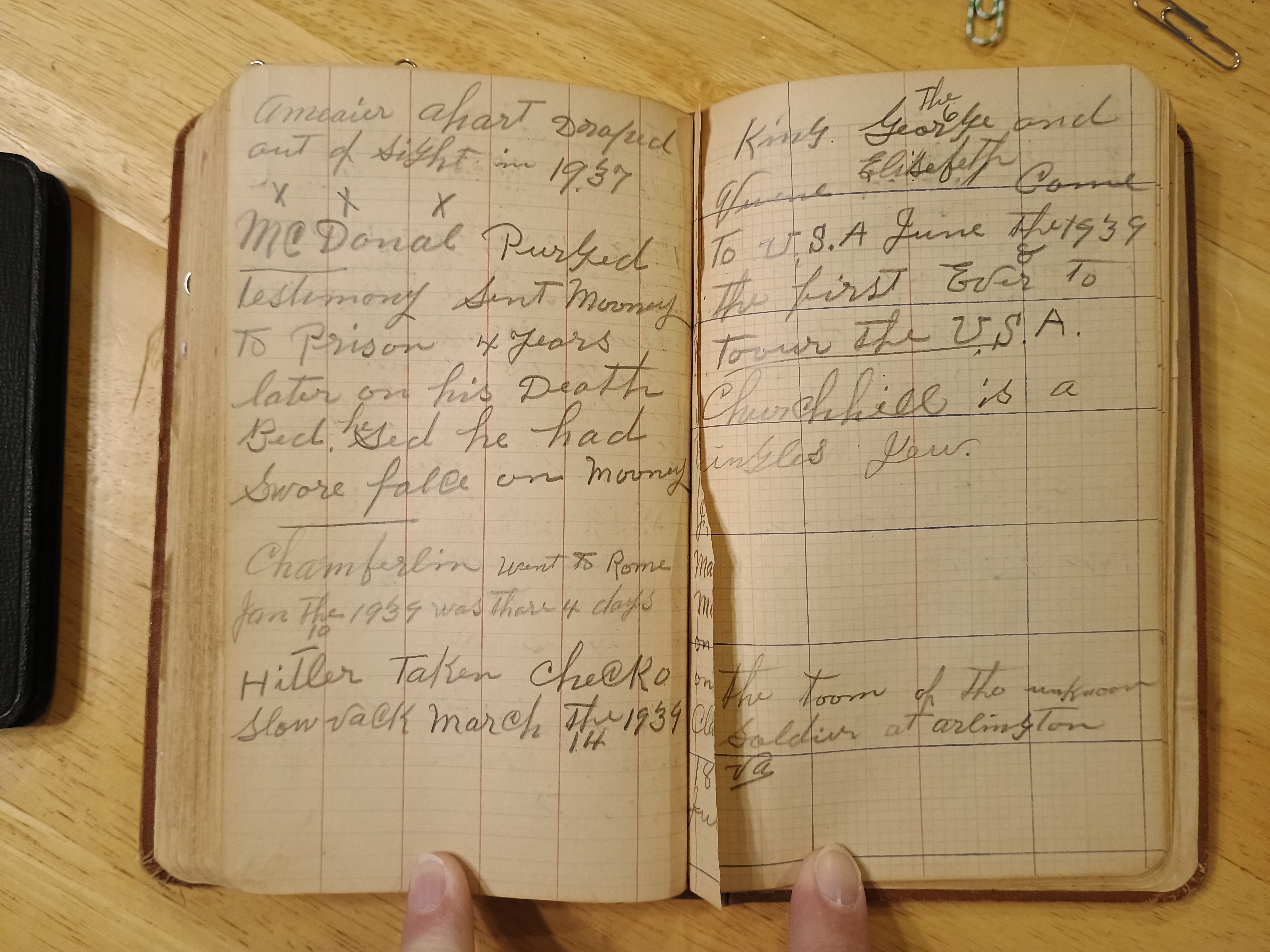
Transcription:
Left page — Amelia ahart dropped out of Sight in 1937 — X X X — McDonald Purgied testimony Sent Mooney to Prison 4 years later on his Death Bed. Said he had Swore falce on Mooney — Chamberlin went to Rome Jan the 10 1939 was there 4 days — Hitler Taken Che[c]ko Slovsack March the 14 1939<br>Right page — King. the George and Elisebeth Come Home to U.S.A June the 8 1939 the first Ever To tour the U.S.A. — Churchhill is a Singles Jew. — Ma[?] M[?] on the Toom of the unknown Soldier at Arlington Va
Notes:
The left page opens with Amelia Earhart dropping out of sight in 1937, her disappearance over the Pacific on 2 July 1937 during her attempted circumnavigation. The three X marks suggest James found this entry significant. Then the McDonald/Mooney entry, connecting to the Tom Mooney case recorded on pages 55–56: McDonald purified his testimony, having sent Mooney to prison, and on his deathbed confessed he had sworn falsely against Mooney. Chamberlain went to Rome on 10 January 1939 and was there four days, one of his diplomatic missions. Hitler took Czechoslovakia on 14 March 1939, the occupation of the Czech state.
The right page records King George VI and Queen Elizabeth visiting the United States in June 1939, the first reigning British monarchs ever to tour the USA. Churchill is called a Singles Jew, James apparently heard or read a claim about Churchill’s ancestry. The bottom entries mention a tomb or ceremony at Arlington, Virginia, apparently at the Tomb of the Unknown Soldier, but the entries are partially cut off.
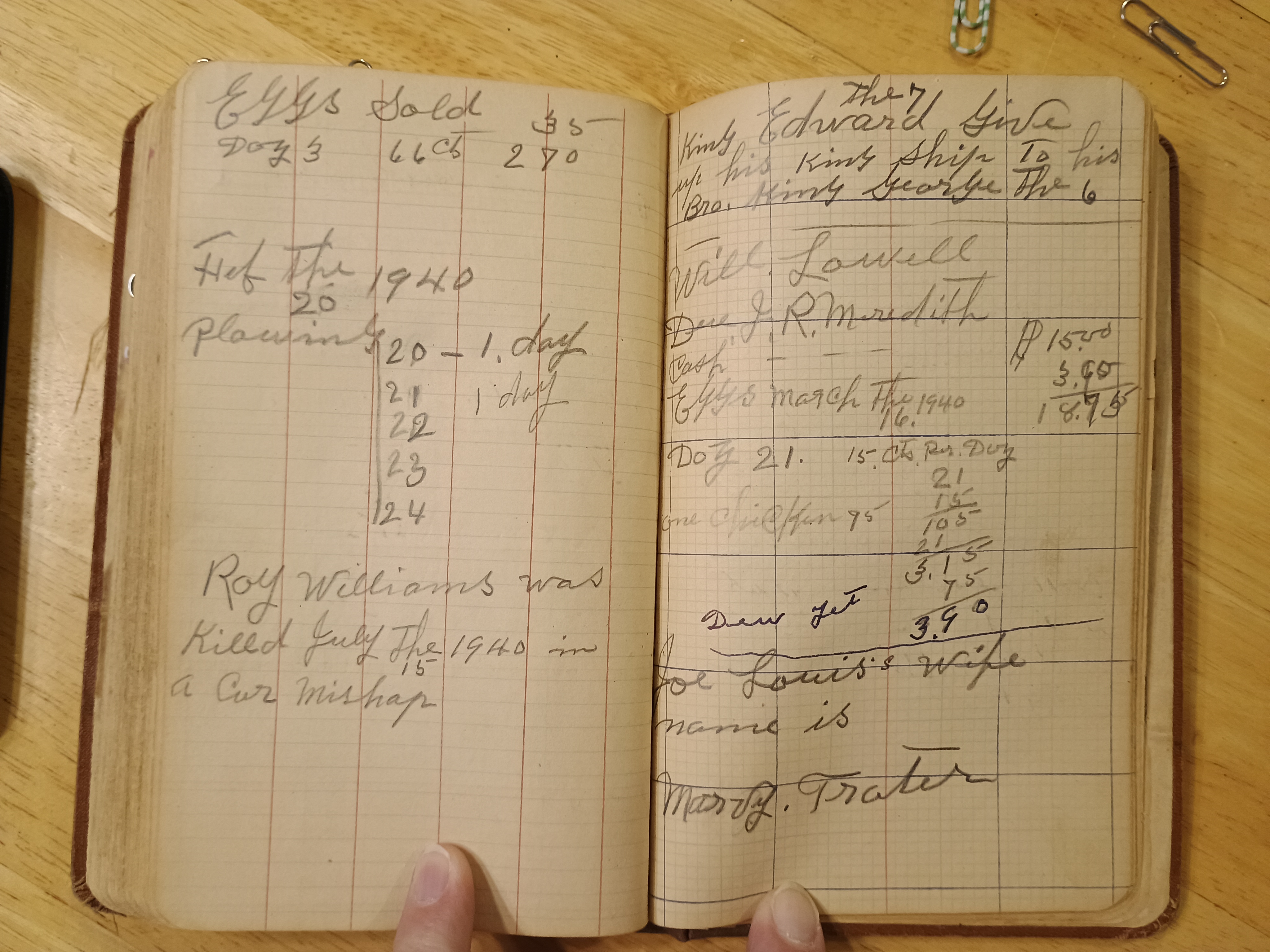
Transcription:
Left page — Eggs Sold $3 — Doz 3 66cts 2.70 — Feb the 20 1940 — Plowing $20 — 1 day — 21 1 day — 22 — 23 — 24 — Roy Williams was Killed July the 15 1940 in a Car Mishap<br>Right page — the 7 King Edward Give up his King Ship To his Bro. King George the 6 — Will Lowell Due J.R. Meredith Cash — $15.00 — Eggs march the 16 1940 3.00 — Doz 21. 15 Ch. Ro. Doz 18.75 — one Chicken 75 — 21 / 15 / 105 / 215 / 3.15 / 75 — Due yet 3.90 — Joe Louis’s wife name is Marvy. Trater
Notes:
The left page records egg sales, 3 dozen at 66 cents, total $2.70, and plowing work on 20 and 21 February 1940 at $20 per day. Roy Williams was killed in a car accident on 15 July 1940, a local community member James was tracking.
The right page opens with King Edward VIII abdicating, giving up his kingship to his brother King George VI. Then a financial account: C.R. Lowell owed James $15 cash, plus egg and chicken sales on 16 March 1940, with a running total showing $3.90 still due. The final entry records Joe Louis’s wife’s name as Marvy Trater, Joe Louis married Marva Trotter in 1935; James renders her name phonetically as Marvy Trater.
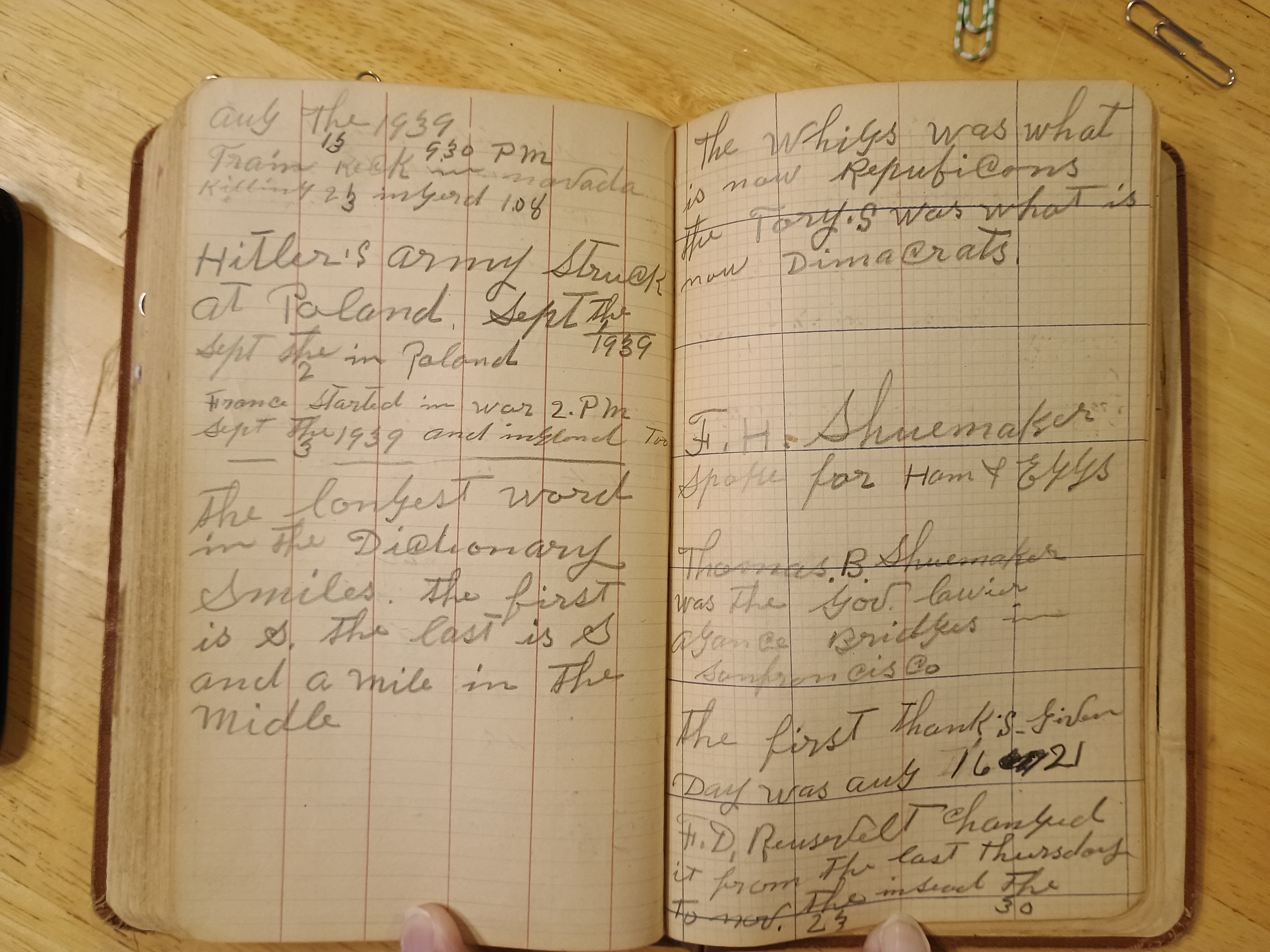
Transcription:
Left page — Aug the 15 1939 9.30 PM — Train Reck in Nevada Killing 23 injured 108 — Hitler’s army Struck at Poland. Sept the 1 1939 — Sept the 2 in Poland — France Started in war 2 PM Sept the 3 1939 and England Too — The longest word in the Dictionary Smiles. the first is S. the last is S and a mile in the Middle<br>Right page — The Whigs was what is now Republicans — the Torys was what is now Democrats. — F. H. Shoemaker. Spoke for Ham and Eggs — Thomas B Shoemaker was the Gov. Lawyer against Bridges in San Francisco — The first Thanks Given Day was aug 16 1621 — F.D. Roosevelt Changed it from The last Thursday to nov. 23 30
Notes:
The left page opens with a Nevada train wreck on 15 August 1939 at 9:30 PM, killing 23 and injuring 108. Then James records the opening of World War II in real time: Hitler struck Poland 1 September 1939, France entered the war at 2 PM on 3 September 1939, and England too. Then a well-known wordplay joke, the longest word in the dictionary is smiles because there is a mile between the first and last letter.
The right page continues the party history notes. F.H. Shoemaker spoke for Ham and Eggs, the California Ham and Eggs pension initiative that appeared on the 1938 and 1939 ballots. Thomas B. Shoemaker was the government lawyer against Harry Bridges in San Francisco, the longshore union leader whose deportation trial was a major labor and political event of the era. The first Thanksgiving was 16 August 1621, James has the date slightly off. Roosevelt changed Thanksgiving from the last Thursday to the 23rd or 30th of November, James recording the Thanksgiving date controversy of 1939–1941 when Roosevelt moved the holiday to the third Thursday to extend the Christmas shopping season.
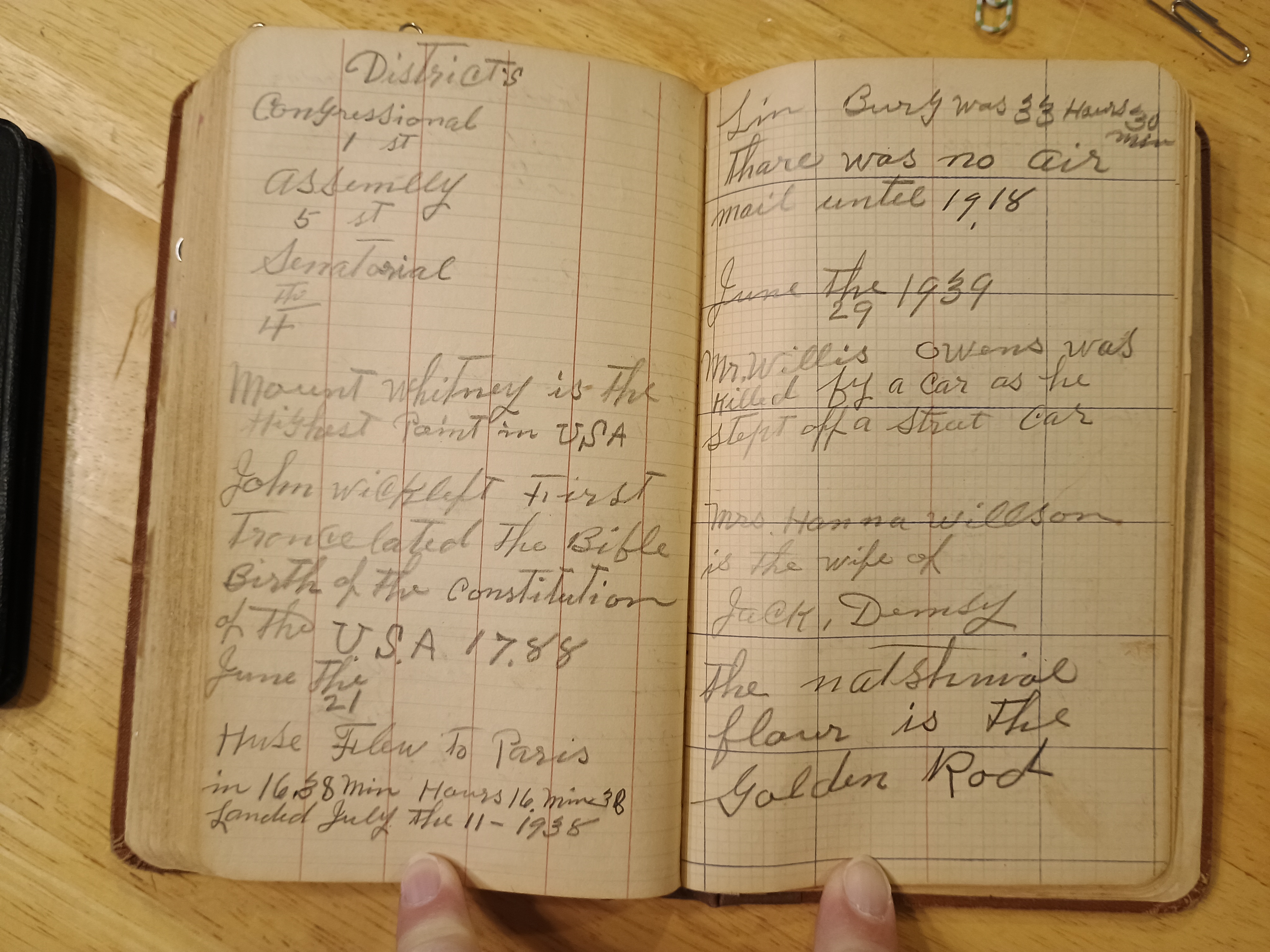
Transcription:
Left page — Districts — Congressional 1 st — Assembly 5 st — Senatorial the 14 — Mount Whitney is the Highest Point in USA — John Wickleft first Translated the Bible — Birth of the Constitution of the USA 1788 June the 21 — Huse Flew to Paris in 16 38 Min Hours 16 min 38 Landed July the 11 — 1938<br>Right page — Lin Burg was 33 Hours 30 min There was no air mail until 1918 — June the 29 1939 — Mr. Willis Owens was Killed by a Car as he Stept off a Street Car — Mrs. Hanna Willson is the wife of Jack. Dempsy — The natshinial flaur is the Golden Rod
Notes:
The left page opens with James’s voting districts, Congressional 1st, Assembly 5th, Senatorial 14th, placing him in Lake County’s electoral precincts. Mount Whitney is the highest point in the USA, correct. John Wycliffe first translated the Bible, correct, in the 14th century. The Constitution was born 21 June 1788, the date New Hampshire became the ninth state to ratify, making it official. Then someone named Huse flew to Paris in 16 hours 38 minutes, landing 11 July 1938.
The right page notes Lindbergh’s transatlantic flight took 33 hours 30 minutes, and there was no airmail until 1918. On 29 June 1939, Mr. Willis Owens was killed by a car as he stepped off a streetcar, a local or regional news item James recorded. Mrs. Hanna Wilson is the wife of Jack Dempsey, Dempsey’s second wife was Estelle Taylor, and his third was Hannah Williams; James writes her as Hanna Willson. The national flower is the Golden Rod, goldenrod was a popular candidate for national flower in this era though never officially adopted.
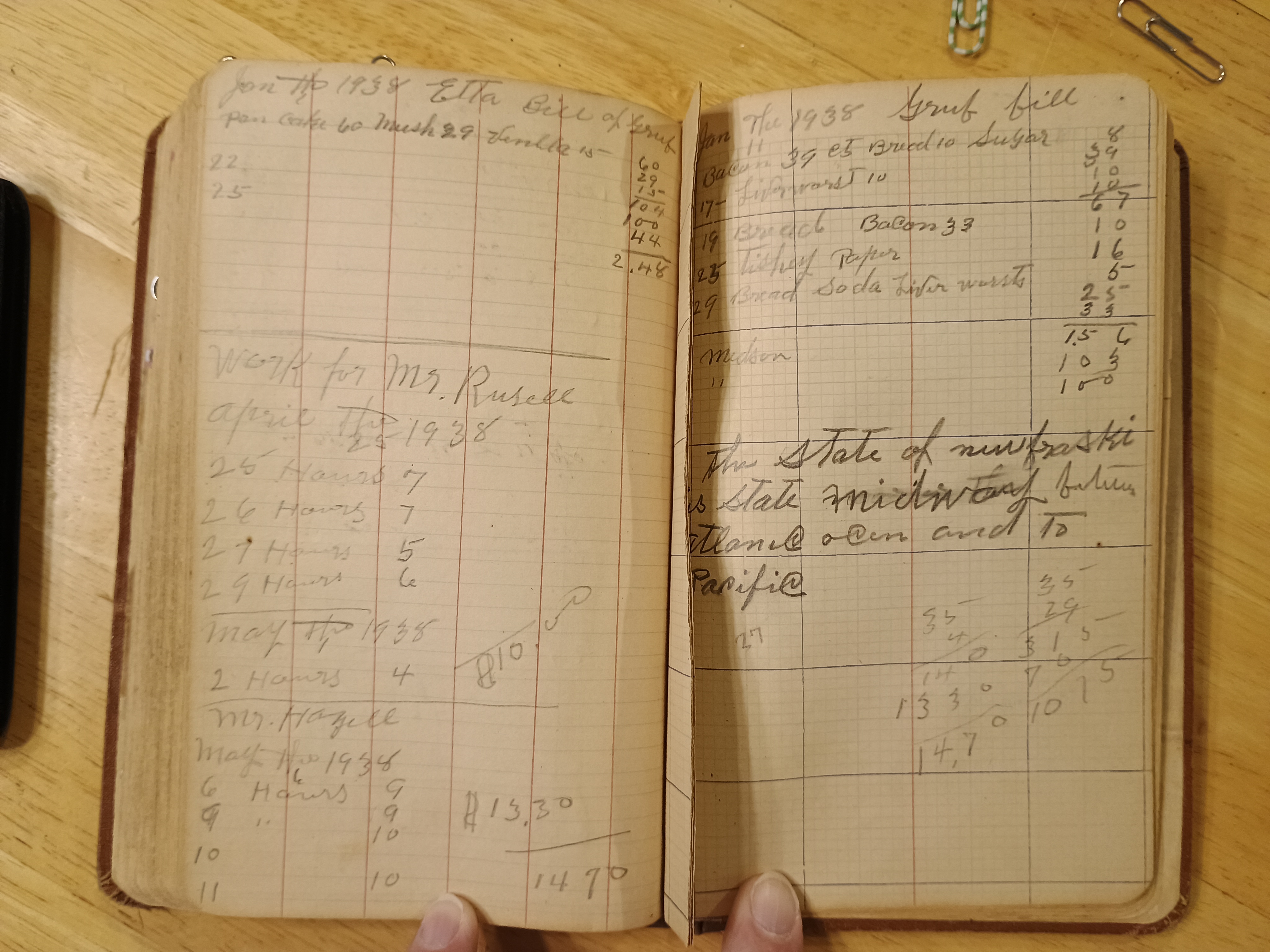
Transcription:
Left page — Jan the 1938 Etta Bill of Grub — pan cake 60 Mush 29 Tumble 15 — 22 — 25 — [totals] 60 / 29 / 15 / 104 / 100 / 44 — 2.48 — Work for Mr. Russell — April the 25 1938 — 26 Hours 7 — 26 Hours 7 — 27 Hours 5 — 29 Hours 6 — May the 17 1938 — 2 Hours 4 $10. — Mr. Hazle — May the 16 1934 — 6 Hours 9 — 9 Hours 9 / 10 — 10 — 11 Hours 10 — $13.30 — Total 14.90<br>Right page — Jan the 1938 Grub Bill — Jan the 11 Bacon 39 ct Bred 10 Sugar 8 — 17 — Lard 67 — 19 Bread Bacon 33 — 10 / 16 — 25 Tilley Paper — 6 — 29 Bread Soda buter warts — 25 / 39 — 1.56 — multon — 105 — 11 — 100 — The State of Nebraska is State midway between Atlantic ocean and To Pacific — [account totals] 35 / 29 / 40 / 315 / 1065 / 15 — 1330 / 10 15 — 147
Notes:
The left page records Etta’s grocery bill from January 1938, pancakes, mush, and tumble (possibly a baked good) totaling $2.48. Then James’s work record for Mr. Russell in April–May 1938, logging hours each day at approximately $10 total. Then work for Mr. Hazle in May 1934, notably an earlier date, confirming James was using the book non-sequentially, logging hours from the 6th through the 11th, totaling $13.30 and then $14.90.
The right page is Etta’s detailed January 1938 grocery bill: bacon, bread, sugar, lard, bread, bacon again, toilet paper, bread, soda, butter, mutton, a window into their weekly household expenses in Lakeport. The total works out to approximately $1.56 plus additional items. Then a geographical fact: Nebraska is the state midway between the Atlantic and Pacific oceans, followed by more account totals.
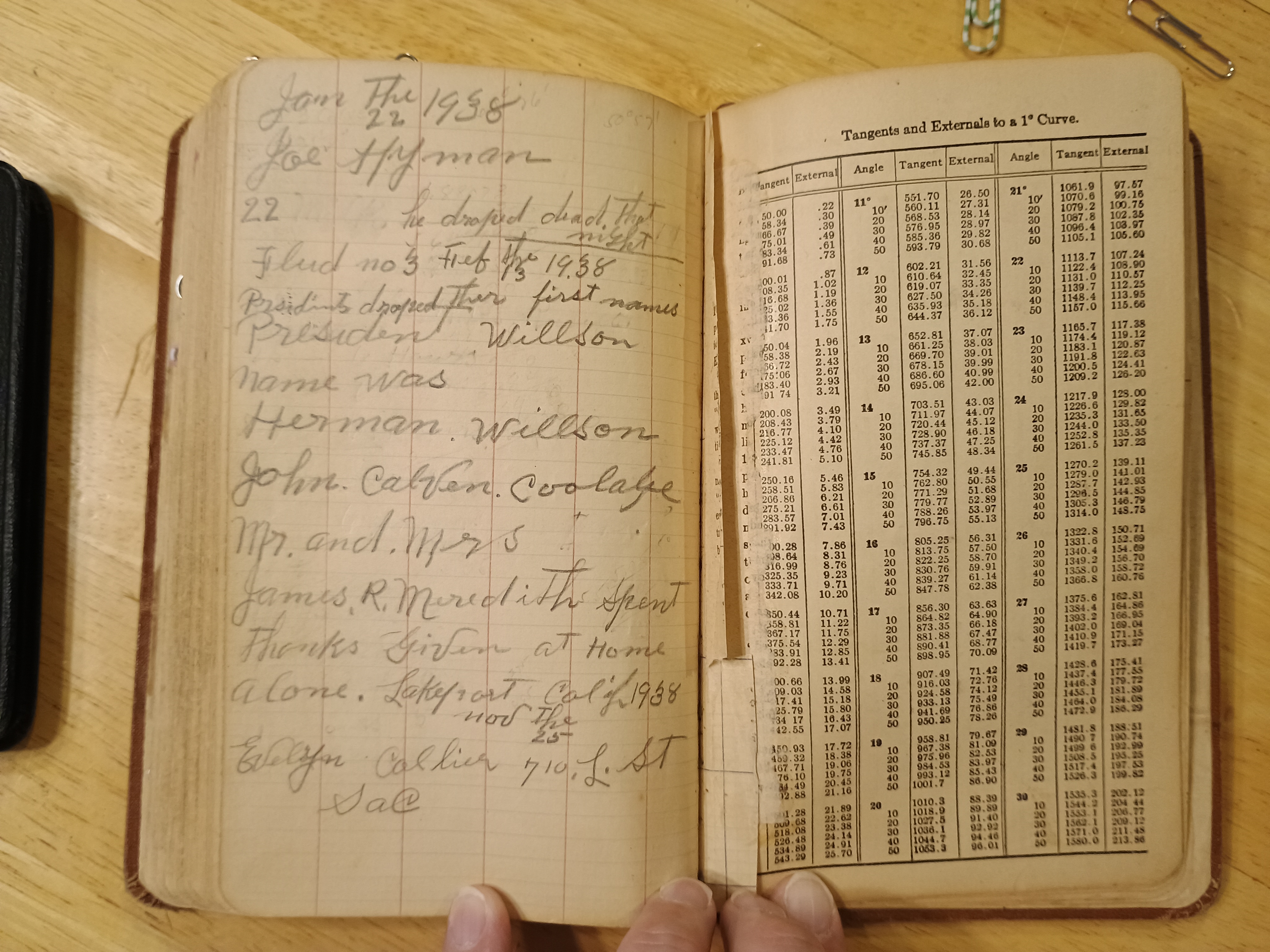
Transcription:
Left page — Jan the 22 1938 — Joe Hyman — 22 — he droped dead. That night — Flud no 3 Feb the 13 1938 — Presidents droped their first names — President Willson name was Herman. Willson — John. Calvin. Coolidge — Mr. and Mrs. James R. Meredith Spent Thanks Givin at Home alone. Lakeport Calif 1938 — Nov the 25 — Evelyn Collier 710 L St Sac<br>Right page — [Printed surveyor’s reference table — Tangents and Externals to a 1° Curve — pre-printed in the field book, not James’s writing]
Notes:
The left page opens with Joe Hyman dropping dead on 22 January 1938, a local Lakeport community member. Flood No. 3 on 13 February 1938, the third in the series of California floods James tracked that winter. Then a note on presidents dropping their first names, Woodrow Wilson’s full name was Thomas Woodrow Wilson, and James correctly notes John Calvin Coolidge used his middle name Calvin. A personal entry: James and Etta spent Thanksgiving 1938 at home alone in Lakeport on 25 November, a quiet counterpoint to the Christmas entries showing them with C.R. Lowell. Finally Evelyn Collier’s address, 710 L Street, Sacramento, confirming the address recorded in the photographs tucked into the front of the journal.
The right page is the pre-printed Tangents and Externals to a 1° Curve reference table, printed in the field book by the A. Lietz Company. This is manufacturer’s content, not James’s writing.
James Thomas Ross/Meredith acquired a surveyor’s field book sometime in the mid-1930s and used it for the rest of his life. He was not a surveyor. The traverse data, bearings, and station distances already filling many pages when he got it were none of his doing. He simply opened the book wherever he found space and wrote whatever was on his mind. The result is one of the most complete portraits of a working-class American mind in the Depression and World War II era that a family archive is likely to yield.
The journal spans roughly 1934 to 1946, with the heaviest concentration of entries from 1937 to 1942. James was living in Lakeport, California for most of this period, having come to California in November 1930 after decades in West Virginia, Idaho, and Oregon. He was in his late sixties and seventies. He received his first old age assistance payment, $35, on 14 January 1938, the same month he bought a Jersey cow for $50 and began selling milk and butter to neighbors. He operated a small dairy with multiple customers through much of 1938, recording every transaction: 10 cents a quart to Mrs. Russell, 10 cents a day to Mr. Vandudon, butter to Mrs. McCutchon at 18 cents a pound. He worked as a day laborer for C.R. Lowell in August and September 1944 at $3.33 per day, recording each day in the same careful columns. He was 74 years old.
The journal is also a family record. On page 7 James wrote down his own birth year, 1869 or 1868, Pulaski County, Virginia, hedging even on that. Pages 85 and 86 contain his autobiography in miniature: his name at birth was James Thomas Ross; when adopted by his father James Meredith, the court made his name James Ross Meredith; everyone called him Ross. His mother was Nancy Adline Ross, born July 1843 in Newbern, Pulaski, Virginia, died 1924 in Radford, Montgomery County. His father James Meredith was born 1803 and died 17 February 1889. He confirmed the dual-surname situation that had puzzled the family genealogy for generations, recording that he signed papers as Ross and as Meredith and both were accepted, because the attorney knew the two names belonged to the same man.
The family entries accumulate across dozens of pages. On 16 January 1938 James counted: four children, 27 grandchildren, 29 great-grandchildren. He listed the grandchildren by family line, Robert’s five children had 14 grandchildren between them, Fanny’s ten children appear by name. He recorded Robert Leonard Ross leaving after an 18-day Christmas visit in December 1937, Eugene Dale Ross Sr. visiting in February 1938. He noted Evelyn Collier’s Sacramento address, 710 L Street, the same Evelyn whose photographs he had tucked into the front of the book. He paid for Etta’s wedding ring on installment, $5 to $8 every two months from February 1938 through December 1939, a total of $64, with Etta signing in acknowledgment. They had been married since June 1936. He was still paying.
The war years run through nearly every page. James followed the news with the attention of a man who had lived through the Spanish-American War, the First World War, and the Depression and knew that history happened to ordinary people. He recorded the sinking of the Squalus in May 1939, the fall of Poland in September 1939, the fall of France and Paris in June 1940, Hitler’s invasion of Russia in June 1941, Pearl Harbor implied in the shift in tone of subsequent entries, the shelling of Fort Stevens on the Oregon Coast in June 1942, the Italian armistice, Roosevelt’s death in April 1945, Patton’s death in December 1945, Hirohito’s renunciation of divinity on 30 December 1945. He tracked the Tripartite Pact, Bulgaria joining the Axis, the Destroyers for Bases Agreement, Wendell Willkie’s nomination, Roosevelt’s four elections and death. He noted Reed Smoot’s death in Florida in February 1941. He recorded his own age, 76, in his eulogy for Roosevelt, signed 13 April 1945 in San Rafael, California, calling him a wonderful good man, a man of feeling, and placing him at the head of all presidents.
The theological inquiry running from pages 45 through 113 is the most unexpected and sustained writing in the journal. James worked through the Bible the way he worked through everything, methodically, with citations, inviting the reader to draw their own conclusions. He catalogued contradictions between the Gospels on nearly every major event: the flight into Egypt versus the presentation in Jerusalem, the number of women at the sepulcher, the hour of the crucifixion, what Christ was given to drink, who killed him, where he ascended. He listed Old Testament laws on slavery, human sacrifice, and the killing of children and asked whether the reader would want to live under them. He argued that if God made everything he made Satan, and if he is all-powerful why did he not simply make all men good. He cited Judges 1:19, God could not drive out the people of the valley because they had chariots of iron, as proof that God is not omnipotent. He compared Jehovah to the Japanese Emperor Hirohito, who admitted his divinity was a fake. He closed with Pries Craft. And yet he had declared at the outset, on page 47, that we are forbidden to put our own interpretation on scripture, we must accept it as written by men directed by God. He was not rejecting the Bible. He was reading it exactly as written, and asking what it actually said.
The journal ends where it began, with pre-printed surveyor’s tables, the manufacturer’s content that gave the book its original purpose. In between are Etta’s grocery bills, a recipe for curing meat, the World Series inning by inning, the day Chamberlain flew to see Hitler, the day James first received his old age pension, his philosophy stated plainly: I believe in working in stead of weeping. Take Things as they Come with a Smile. Do all the Good you Can to others. and you will be happy. The last Christmas dinner he and Etta had together was in San Rafael in 1945. They had turkey. She died 21 February 1946 in Phoenix. They had lived together 9 years and 7 months.
It is a working man’s record. But it is his voice, in his hand, and it is more than this researcher has ever had before.