Joseph and Ann Reed Wayment

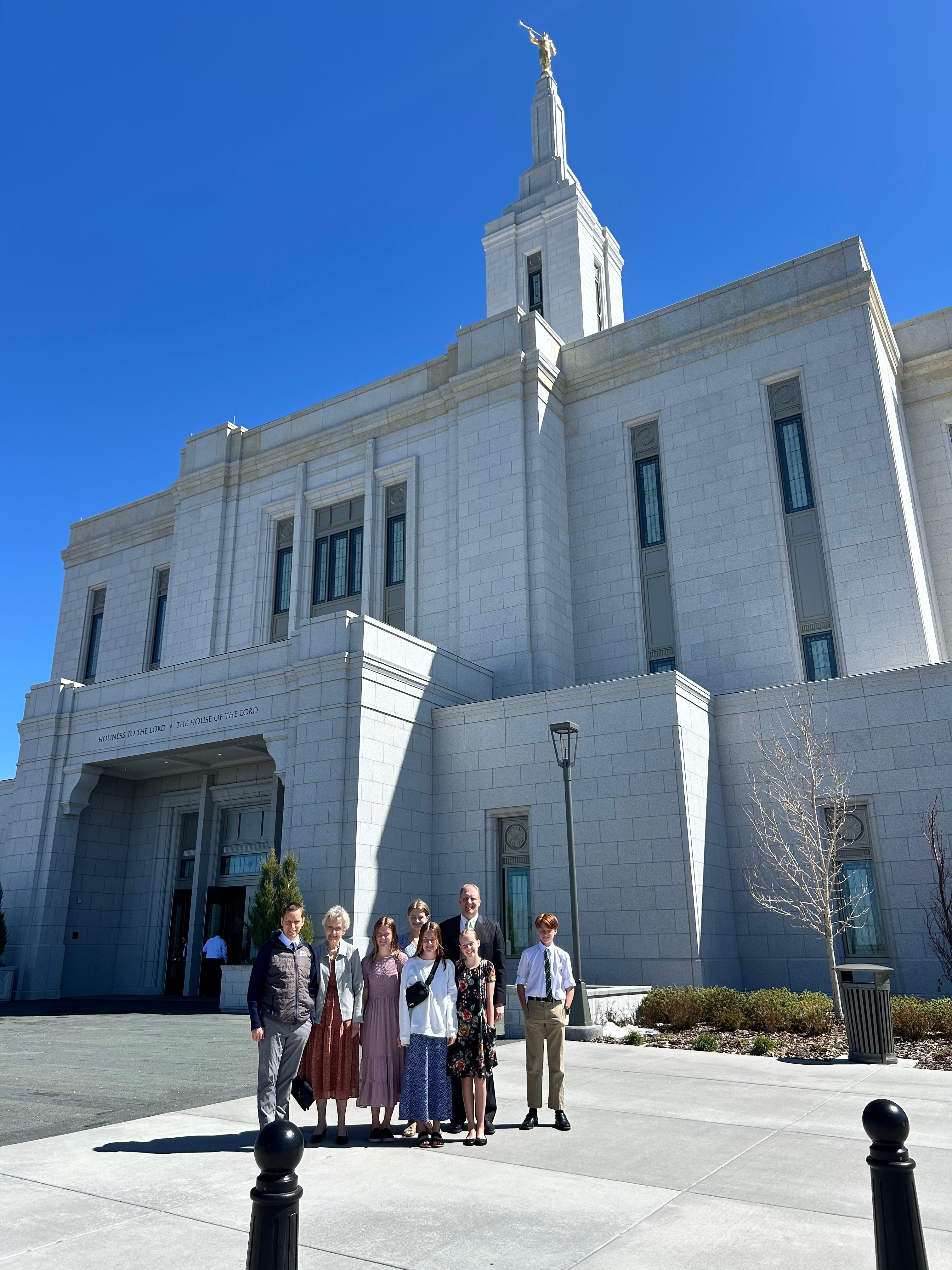
In September 2020, Amanda and I took our family out to Golden Spike National Historic Park at Promontory Summit, Utah. I have written about that visit previously. What drew us there, in part, was the knowledge that Amanda’s 3rd great-grandfather Joseph Wayment had been present on 10 May 1869 when the last spike was driven completing the transcontinental railroad — and that Andrew J. Russell’s famous photograph had captured him standing in the crowd. I promised in that post to tell more of Joseph and Ann Reed Wayment’s story another time. This is that time.
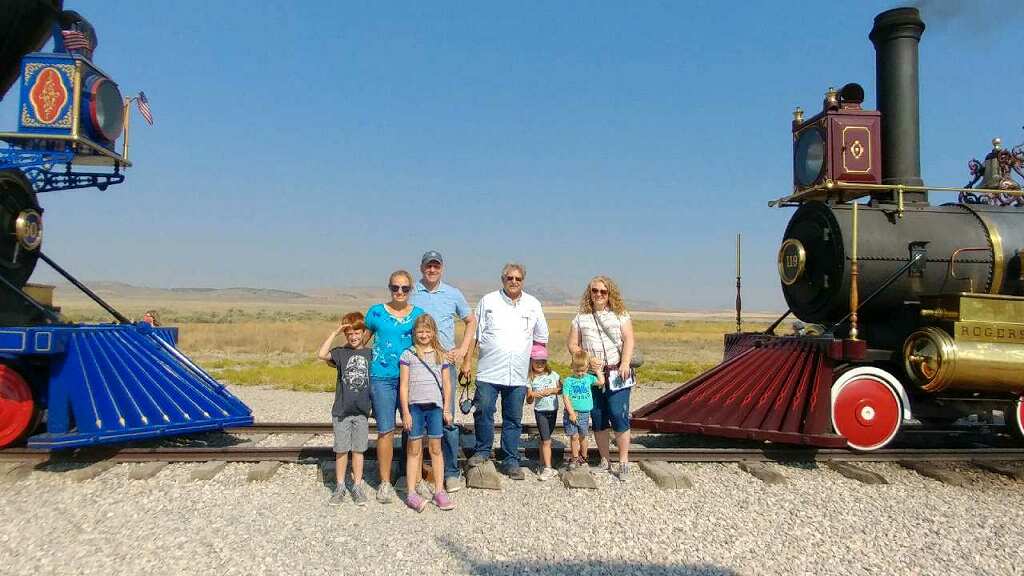
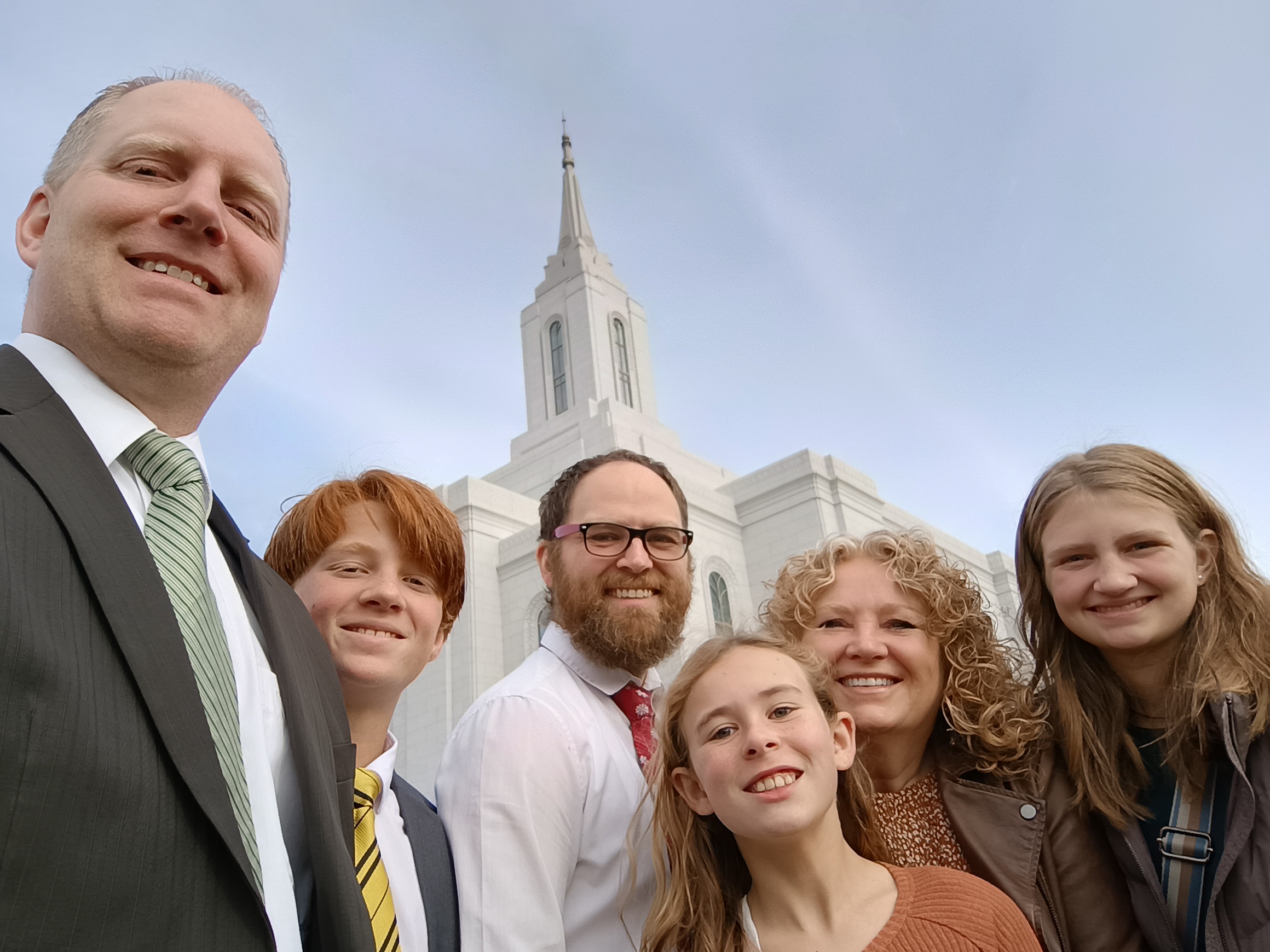
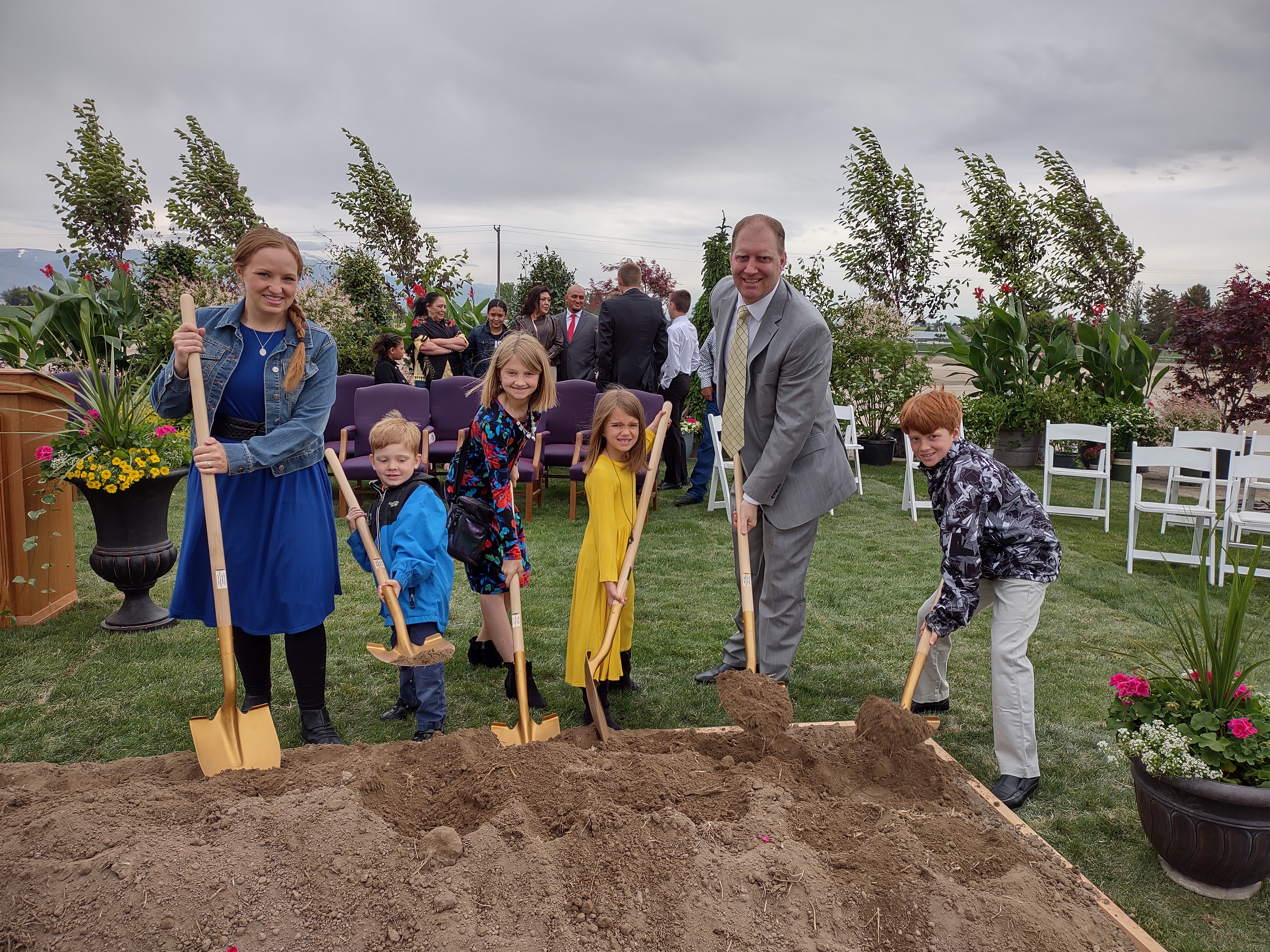
Hiram, Amanda, Aliza, and Paul Ross, Bryan Hemsley, Lillian and James Ross, and Jill Hemsley at Golden Spike National Historic Park, September 2020
Hiram, Amanda, Aliza, and Paul Ross, Bryan Hemsley, Lillian and James Ross, and Jill Hemsley at Golden Spike National Historic Park, 7 September 2020.
East and West Shaking Hands at the Laying of the Last Rail, Promontory Summit, Utah, 10 May 1869. Photograph by Andrew J. Russell.
East and West Shaking Hands at the Laying of the Last Rail, Promontory Summit, Utah, 10 May 1869. Photograph by Andrew J. Russell. Joseph Wayment stands in the crowd on the left side of the image. Find the man standing below the Union Pacific’s No. 119 locomotive light with his jacket open and white shirt, then find the man whose head is in front of that man’s right thigh, behind the fellow with the partially raised hat. That is Joseph Wayment, age 25.

Andrew J. Russell, the official photographer of the Union Pacific Railroad who took this photograph, wrote of that moment: “The continental iron band now permanently unites the distant portions of the Republic, and opens up to Commerce, Navigation, and Enterprise the vast unpeopled plains and lofty mountain ranges that now divide the East from the West. Standing amid ‘The Antres vast and Desert wild,’ surrounded with the representative men of the nation, an epoch in the march of civilization was recorded, and a new era in human progress was ushered in.”

Joseph Wayment was one of the men in that crowd — a twenty-five-year-old English convert who had crossed the Atlantic seasick on the Amazon, walked the plains behind an ox team, survived Montana winters so cold the dishwater froze before it hit the snow, and was now building a life in a patch of Utah desert he would spend the next six decades transforming into a home, a farm, and a community. Would he have fathomed that 151 years later his great-great-great-granddaughter, and her children, would stand at that same spot.

Origins in Whaddon
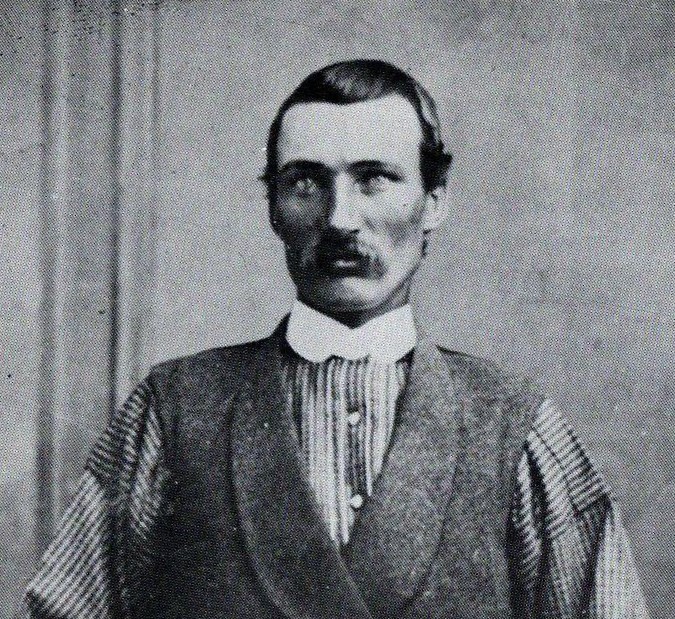
Joseph Wayment, circa 1874.

I used AI to colorize and sharpen the images. If you click on them, you should be able to see the original black and white. AI took a bit of liberty on the photos regarding clothes.
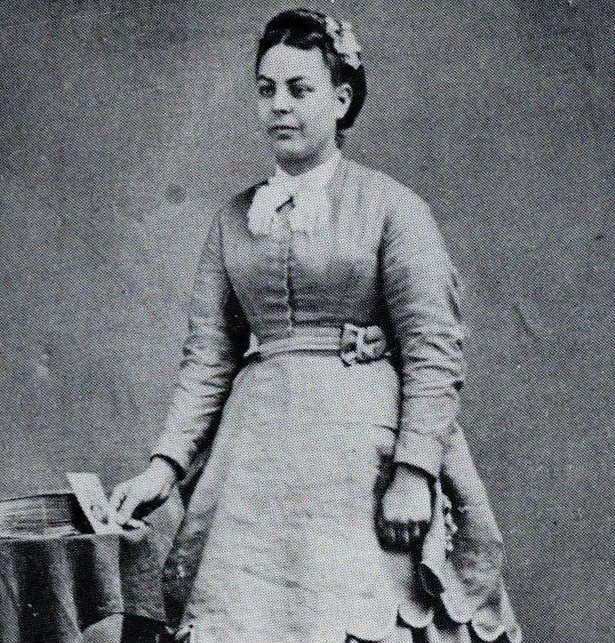
Ann Reed, circa 1874.

Joseph Wayment was born 7 February 1844 in Whaddon, Cambridgeshire, England, the second son of William and Martha Brown Wayment. His older brother Aaron had lived only one day, so as far as the family was concerned, Joseph was the eldest. I have written previously about his parents in my post on William and Martha Wayment.

Ann Reed was born 1 January 1852 in the same small village — the fifth child and second daughter of James and Sarah East Reed. Whaddon was a tight community, a small village in the district of Royston, County of Cambridge, gathered around the ancient stone church of St. Mary the Virgin. Whaddon appears to have been somewhere around 400-500 people. The Wayments and the Reeds were neighbors in every sense of the word. Their children attended the same meetings, worked the same fields, and children would be baptized in the same river/brook.

Ann’s early life was marked by tragedy. When she was two years old, she slipped into a deep ditch near their home. No one else was nearby. Her mother, Sarah East Reed, then heavy with child, jumped in after her. Ann was saved, but the ordeal brought on labor. The baby girl was born 13 July 1854 and died the same day. Three days later, Sarah also died from complications, and mother and infant were buried together in the same casket. Ann’s father James Reed did his best to keep the family together, but he too died on 2 February 1858, leaving five orphans — the oldest fourteen, Ann just five years old.

Their mother’s sister, Hannah East, came to Whaddon to keep house for the children. Hannah was herself from Whaddon — born there on 24 August 1828, the sister of Sarah East Reed and of George East Sr., who would later become a familiar figure in Warren, Utah. Hannah was baptized LDS 3 June 1848. She stayed with the Reed orphans for several years before emigrating to Zion, where she eventually settled in Lehi, Utah, married Thomas Karren in 1865, and lived until 2 May 1907. It is a quiet thread of continuity that Hannah — who held Ann’s orphaned family together in Whaddon — ended her days in the same territory where Ann built her life, just a day’s journey away in Lehi.

After Hannah left England, the children were kept by the Parish until they could earn their own living. Ann went out to service at age eleven. She endured difficult conditions in several positions before finally working David and Mary Hide Grieg (the histories state it was Grigg), where she stayed nearly five years and carefully saved her wages toward passage to America. The Grieg family lived in nearby Melbourn, a family that was not LDS.

The Gospel Comes to Whaddon

I wrote in the William and Martha Wayment post about how the Wayment home had become a gathering place for LDS missionaries since William’s baptism in March 1850 — how despite community hostility, meetings were held in different houses and baptisms conducted at night to avoid mobs. The gospel took hold in Whaddon. On the night of 7 May 1860, Joseph Wayment, age sixteen, was baptized in Whaddon Brook along with his brother Samuel and sister Emily. Ann Reed, age eight, was baptized and confirmed the same night.

They shared the same waters. They would share a life.

Joseph worked in the peat bogs with his father from his early teens, fossil digging to earn enough for his passage to Zion. He had one more memorable appearance in Whaddon before he left: shortly before his departure, he sang a solo at a church meeting that deeply impressed those present. His voice was described as a clear and beautiful bass. Ann Reed, then twelve years old, was in that congregation. Decades later she would tell her grandchildren with deep feeling how thrilled she had been sitting in that meeting listening to Joseph sing.

The Voyage of the Amazon, 1863

On 1 June 1863, Joseph left Whaddon for Liverpool. Three days later, on 4 June, he booked passage on the sailing vessel Amazon — listed on the manifest as “Joseph Waymound,” age 19 — and sailed from Liverpool with 881 fellow Saints bound for Zion. As I wrote in my Stoker family post, the Amazon was a famous voyage. It was this crossing that Charles Dickens observed and wrote about, describing the Mormon emigrants not as misfits and scoundrels but as the “pick and flower” of England. Future U.S. Supreme Court Justice George Sutherland was also aboard (whose family was LDS). George Q. Cannon dedicated the ship. My own Stoker ancestors were on this same vessel — an extraordinary coincidence that ties our two family lines together. Since Warren and Plain City were small communities, they likely knew each other.

Joseph was seasick nearly the entire six-week crossing. The Amazon landed in New York around the middle of July 1863. He traveled by train to a point on the Missouri River, then by boat up to Florence, Nebraska. From there he walked and drove an ox team across the plains in Captain Dan McCarty’s company — a new experience for him, as he later told his grandsons, having learned to handle horses in England but never oxen. He arrived in Salt Lake City on 3 October 1863, four months and two days after leaving his father’s home.

The very next day the October General Conference of the Church began, held in the Bowery. Joseph stood near the speakers’ platform. Brigham Young was one of the speakers, and Joseph later said it was one of the most inspiring sermons he ever heard — that Brigham Young seemed to be surrounded by a bright light. Part of that sermon Joseph remembered all his life.

The Freighting Years, 1864–1866

After a winter in Lehi, Joseph went to work in the spring of 1864 for a freighting company — probably the Toponce Freighting Company — hauling goods to Montana. He stayed with the outfit until the fall of 1866. Those were hard and consequential years.

The winter of 1864 was brutal. The freighters were snowbound on a Montana river for several weeks. Joseph served as camp cook. He later told his family that when he threw out the dishwater, it froze to ice before it hit the snow. Some of the cattle froze to death. One day the lot fell to Joseph to fetch wood. His hands were tender from cooking and dishwashing, but he went out and cut an armful. As he was picking up the last piece of wood, he felt his whole body beginning to freeze. He stumbled back toward the cabin, but before he reached it his whole body had gone numb. The men rubbed him with coal oil and did everything they could to revive him. One of them said, “Joe Wayment gets no more wood this winter — I’ll get it for him.”

During the freighting years two confrontations became family legend. In the first, a stranger from another company approached the camp and asked if there were any Mormons present. He was directed to Joseph. The man told him he had helped mob the Saints in Missouri and Illinois, then pulled open his shirt to his chest and said, “Now shoot me.” He had lived such a miserable life since helping the mob, he said, that he wanted a Mormon to shoot him. Joseph replied: “No Mormon will ever stain his hands with your blood.”

In the second, the freighters encountered soldiers who had been in Johnston’s Army making their way north into Washington. Learning that some of the freighters were from Utah, they asked to hear the song that had been made up about Johnston’s Army coming to Utah. Joseph was the best singer in camp. He refused at first, knowing it would anger them. When they promised not to get angry, he relented and sang. One soldier became so furious he drew his pistol and threatened to kill the singer. The captain of the soldiers, quick as a flash, drew his own pistol on the angry man and said he would kill him if he harmed the singer. The other soldiers took the man away.

A third incident, at a freighters’ stop near Oxford, Idaho, demonstrated that Joseph was a man of both faith and action. He and his longtime friend and fellow teamster William Butler had pulled in for the night after a long drive. Other freighters already there greeted them with jeers — “There’s those Mormons” — and tried to force them to move on. Joseph and Butler had weary teams and held their ground. When words grew heated, Joseph walked briskly to his wagon, took the green willow switch he used to urge his team, walked thirty paces to some soft ground, and with one swing left it standing upright. Then he walked back, drew his pistol, turned, and split the willow with one shot. The heckling stopped immediately.

In the fall of 1866 Joseph had a strong feeling come over him that he should return to Utah. The company he was working with was a rough and irreligious crowd. He found a secluded spot in the timber, knelt, and asked the Lord for guidance. The next morning his mind was made up. He saddled his horse, gathered his belongings — three buffalo robes and his working clothes — and started for Utah.

Settling Salt Creek

He came first to Layton or Kaysville, then went to Call’s Fort near present Honeyville where he worked for a man named Barnard and helped build the first schoolhouse there. He bought a piece of land at Call’s Fort but eventually sold it. In 1872 he moved to what was then called Salt Creek, southwest of Plain City, and bought the land he would own until his death — purchasing it from H. H. Wadman, making him the second family to settle on Salt Creek. He kept “Bachelor’s Hall” there for about two years. His brother John B. Wayment, who arrived from England in July 1873, lived with him for part of that time.
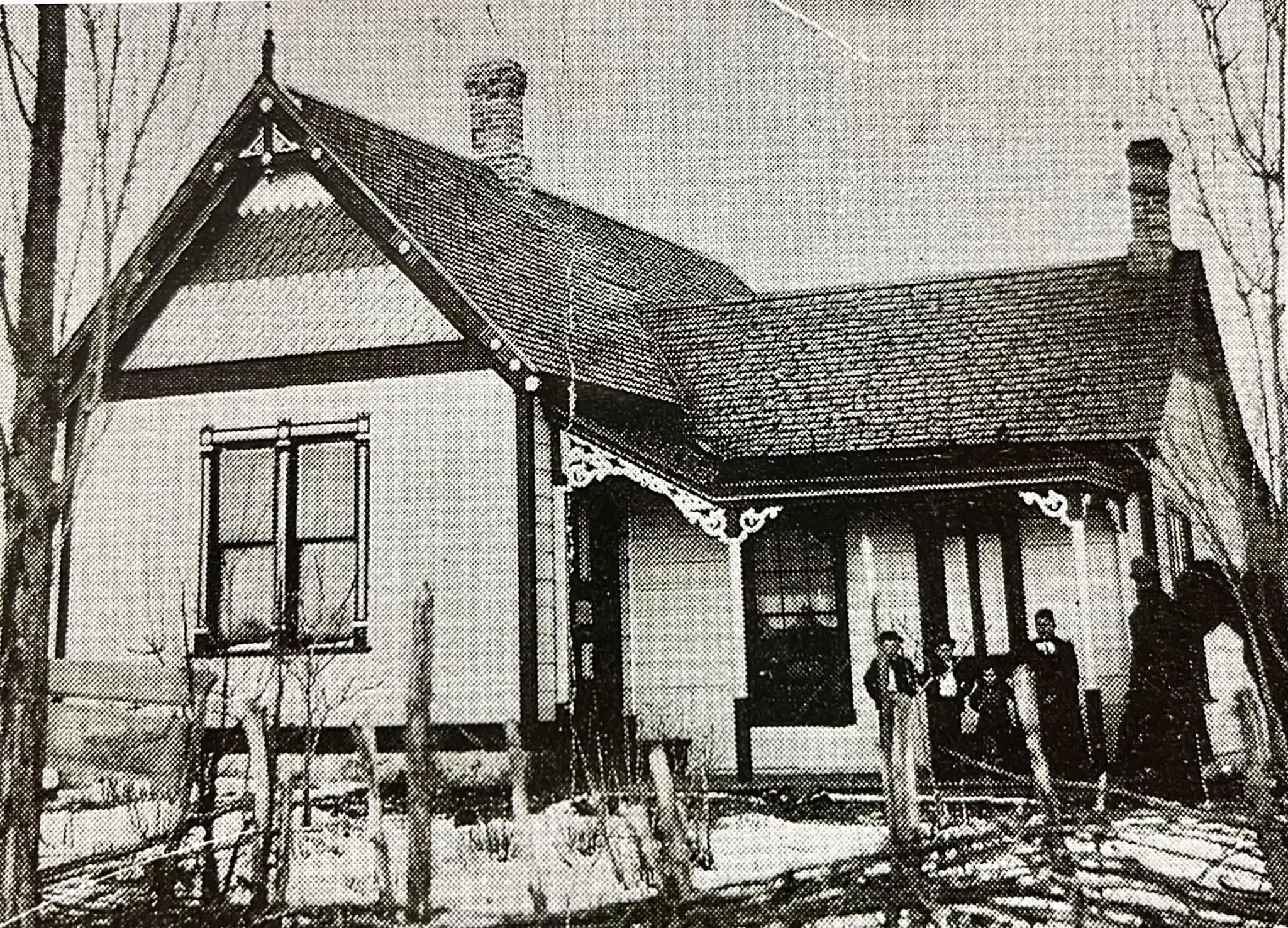
The home of Bishop William Thomas Wayment and his wife Maud at 662 N. 5900 W. in Warren. Joseph Wayment appears at far right with a horse.

About 1872, Joseph began writing letters to a young woman of his boyhood acquaintance back in Whaddon — Ann Reed. She had grown up, gone out to service, endured difficult years, and was now working for the Greig family, carefully saving her wages. She accepted his invitation to come to Utah and be his wife.

Ann Comes to America, 1874

Ann left her place of work on 2 June 1874 and sailed from Liverpool on 24 June 1874 aboard the steamship Idaho. The Idaho carried 903 passengers on that voyage, arriving in New York on 6 July 1874. Ann traveled overland by rail and arrived in Ogden about the middle of July.

Joseph met her in Ogden — likely taking her to his brother Samuel’s home. On the way they crossed a stream of clear running water. Joseph stopped the horses to let them drink, cupped his hat, dipped it in, and offered Ann the first drink. She couldn’t bring herself to drink water out of a hat from a river like that. Joseph enjoyed the cool drink regardless.

On 7 August 1874, Joseph Wayment and Ann Reed were married by Louis Warren Shurtliff at Joseph’s home in Salt Creek — ending, as Alma Hansen later wrote, the era of “Bachelor’s Hall.” On 29 June 1876, Joseph and Ann traveled to the Endowment House in Salt Lake City, where they were endowed and sealed to each other for time and all eternity. Joseph had been ordained an Elder by Alonzo Knight ten days earlier, on 19 June 1876, in preparation for that ordinance.

The First Years in Salt Creek
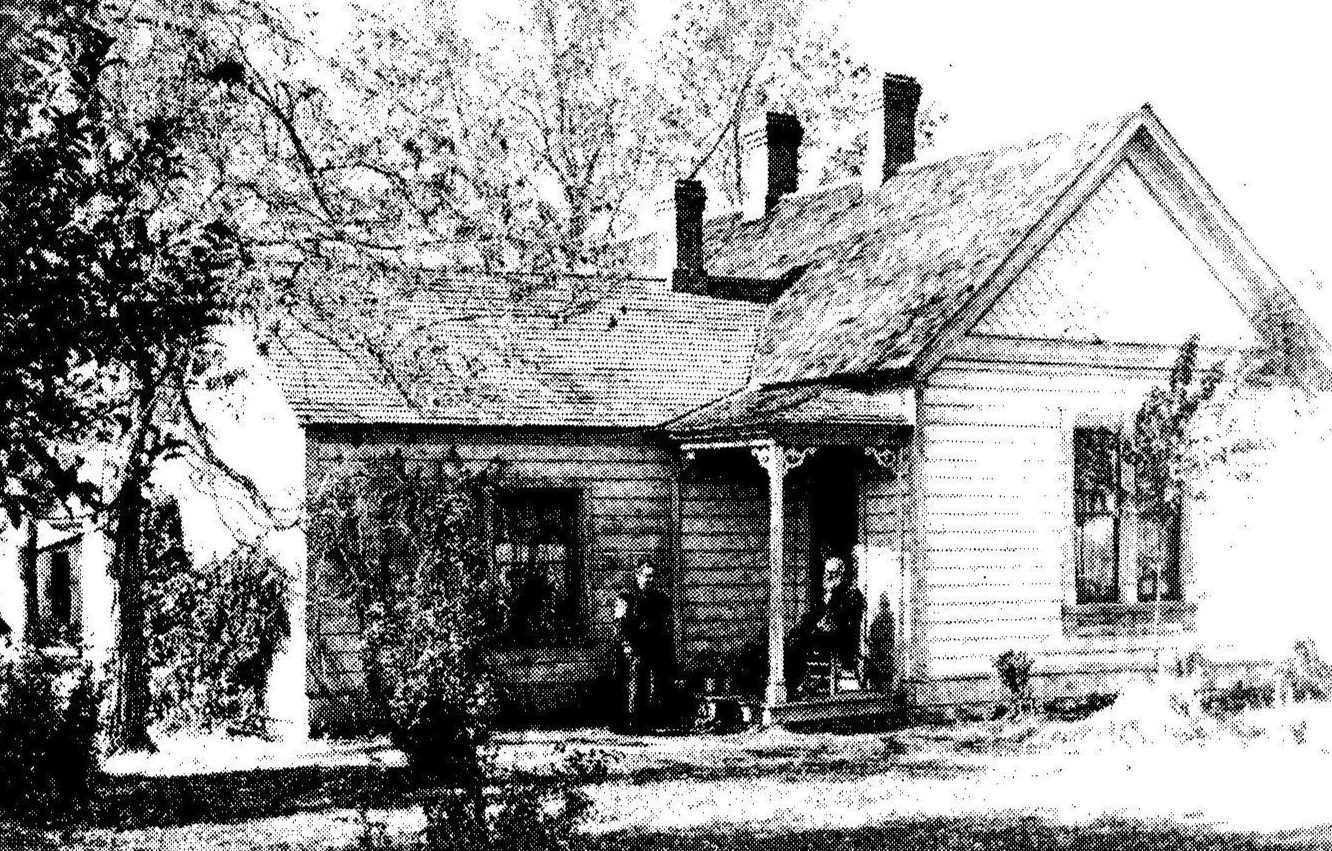
The Joseph and Ann Reed Wayment home in Warren, photographed June 1928. Joseph is likely the seated figure visible on the front porch.

Their first child, Sarah, was born 29 October 1875 — one of the first white children born in the Salt Creek area. In the spring of 1876 the Weber River overflowed its banks and covered much of the country where Warren now stands. The first time it came up, it stayed two weeks. The crops survived. But the river flooded again, higher than before, and stayed six weeks. The crops were completely destroyed. Joseph’s house was just high enough to keep the water from running under it — but it came right to the doorstep. He kept a rowboat in which he and Ann traveled to the sandhill in Plain City to do business. His horses broke loose just before the flood and were later found on meadows west of Brigham City. The other cattle and horses in the area lived on the high knolls until the water subsided.

Joseph planted the first fruit and shade trees in the Warren area. He watered them by hand from a well he dug himself, using a long pole with a hook and a bucket because he didn’t have a rope. Later he had a windmill built over the well and irrigated some of his crops with it. About 1880 the residents of Salt Creek organized together and built a ditch up to Four-Mile in the southern part of Plain City to run water to their crops. Part of that original ditch can still be seen near the north side of the bench in Warren.

In March 1881 Joseph was appointed secretary and assistant superintendent of the Salt Creek Sunday School, offices he held for many years. In 1883 he was chairman of the board of trustees for the first schoolhouse built in Warren — a one-room brick building on the bench. His sister Martha Wayment, now Mrs. David East, was the first teacher.

About 1877 Joseph was appointed the first road supervisor in the Warren district, a position he held for ten years. The road supervisor received no pay for his services other than to apply his labor toward his poll taxes, as did all the other men. About the first work done was to fill up some of the creek crossings. He also hauled salt from the creek banks west of Plain City up to the Hot Springs — a full day’s work per load for which he received fifty cents. The salt was used in the smelting of silver ore in Montana.

Six more children followed Sarah: Martha Ann (2 June 1877), Leonard Joseph (12 September 1878), Mary Jane (8 May 1880), Walter Hyrum (14 November 1881), Hannah Alberta (23 August 1883), and Amelia Brown (29 July 1890).
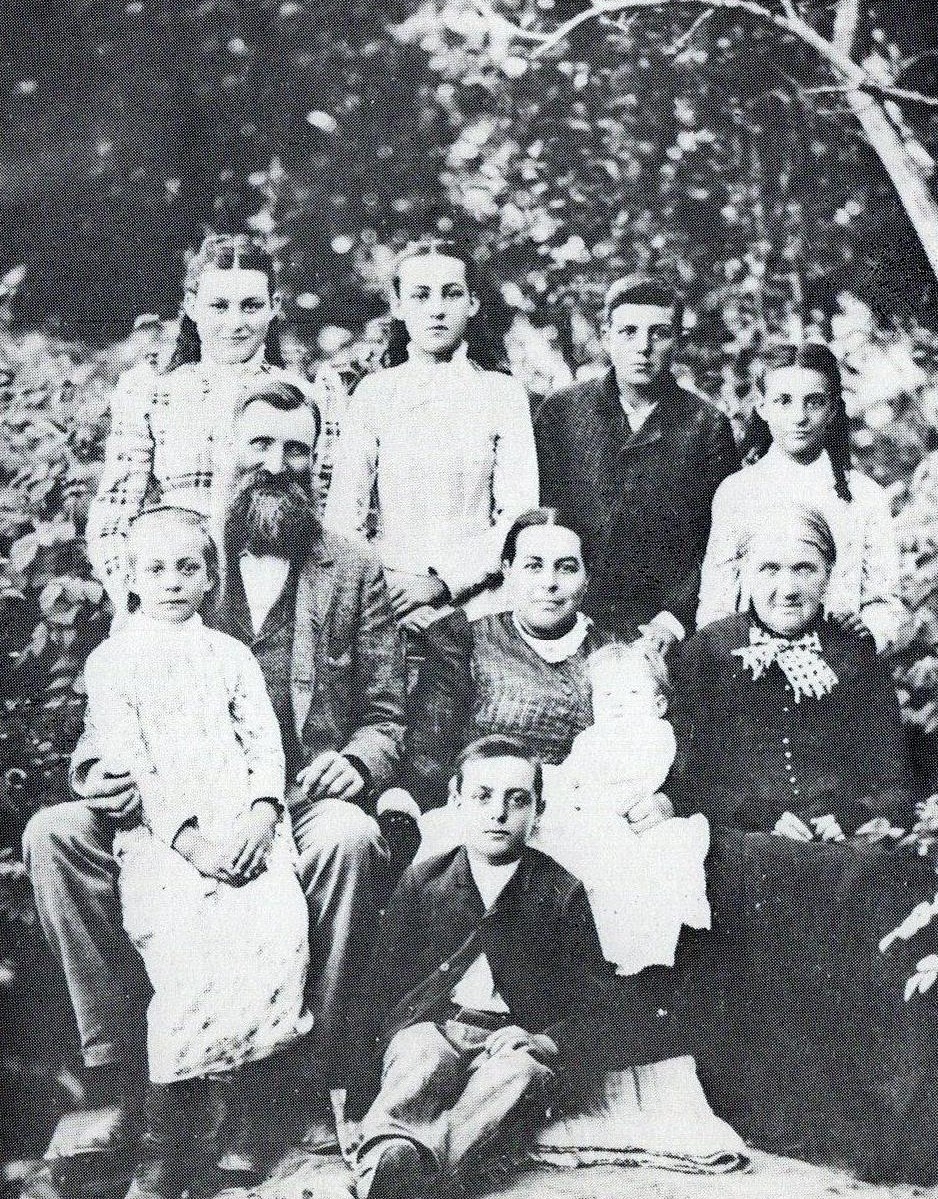
Back row, left to right: Sarah Wayment, Martha Ann Wayment, Leonard Joseph Wayment, Mary Jane Wayment. Middle row: Hannah Alberta Wayment, Joseph Wayment, Ann Reed Wayment holding Amelia Brown Wayment, Martha Brown Wayment (Joseph’s mother). Seated in front: Walter Hyrum Wayment. Photograph circa 1890–1891.

The family portrait above, taken around 1890–1891 when Amelia was an infant, captures all seven children in a single frame. Four generations are present — including Joseph’s mother Martha Brown Wayment at far right, who had herself made the journey from Whaddon in 1878. I wrote about her in the William and Martha Wayment post.

The Flood of 1884 and Ann’s Heroism

In the spring of 1884 the Weber River flooded again — not as severe as 1876, but severe enough to kill all the crops, many fruit trees, and berry bushes. Joseph moved his family into his brother John’s house on the brow of the hill north of the Arthur Marriott home — a one-room house, not large enough for all the family to sleep in. Some of the children slept in a wagon under the shed.

A day or two after they moved, a heavy rain set in. The children’s bedding became soaked. In trying to provide for his family, Joseph was exposed to the rain, cold, and mosquitoes, and he took down with malaria fever. The house was too small for any comfort, and some of the men of the locality moved the family back into their own house — even though it was surrounded by water.

For six weeks Joseph lay near death. Many did not expect him to recover. During this time Ann would walk — and sometimes wade, in water up to her knees — a quarter to half a mile west on the bench to where their cow was pastured. She milked the cow and carried the milk back to feed her husband. For a while he was so weak he could not feed himself, and Ann would have to feed him by hand. He sent for elders from Plain City to administer to him. While they were visiting, he asked to be propped up in bed and talked with them at length. From that time he continued to improve, though he was not entirely well for several years. That fall he was well enough to work on the threshing machine.

Of all the incidents in the long life of Joseph and Ann Wayment, this one — Ann wading flood water to milk the cow and hand-feed her dying husband — speaks most directly to the character of their partnership. The memorial card at their graves in West Warren says it plainly: “Ann Reed Wayment gave loyal and loving support to her husband. No problem arose that they did not find a place of adjustment and agreement.”

Firsts in Warren

The 1902 Portrait, Genealogical and Biographical Record of the State of Utah described Joseph as “one of nature’s noblemen” and enumerated his contributions to the community. He planted the first fruit and shade trees. He was the first road supervisor, serving ten years. When the first schoolhouse was built he served as school board chairman, assessor, and collector. He was one of the first stockholders and directors of the Slaterville Creamery. He raised one hundred tons of sugar beets annually for the Ogden sugar factory.

By 1888 Joseph had shifted his main occupation from general farming to dairying. He kept as many as fourteen milk cows at once. His children did much of the work — milking the cows, putting the milk in cans under cool water until the cream gathered to the top, then skimming and churning it to butter. They sold as many as 2,000 pounds of their own butter in a single year. Later the milk went to the Slaterville creamery, of which Joseph was a founding director.

In November 1910 Joseph was elected Justice of the Peace of the Warren Precinct — a fitting civic capstone for the man who had been among the first to settle Salt Creek and had spent decades building its institutions.

In 1896 Salt Creek was officially named Warren, after Lewis Warren Shurtliff, the stake president who organized the new ward — the same Louis Warren Shurtliff who had married Joseph and Ann in 1874.

Ann in Warren
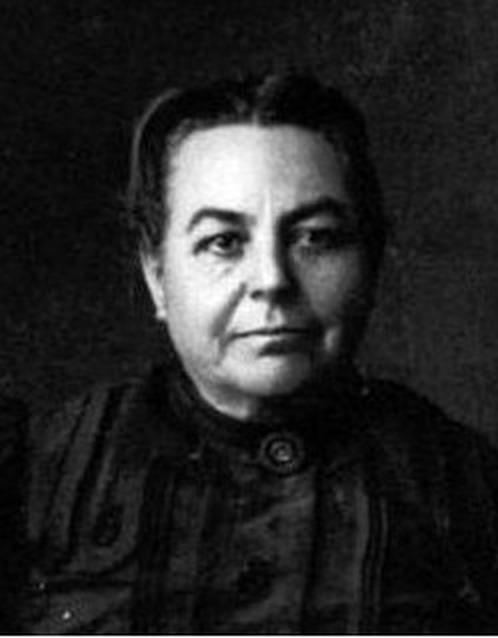
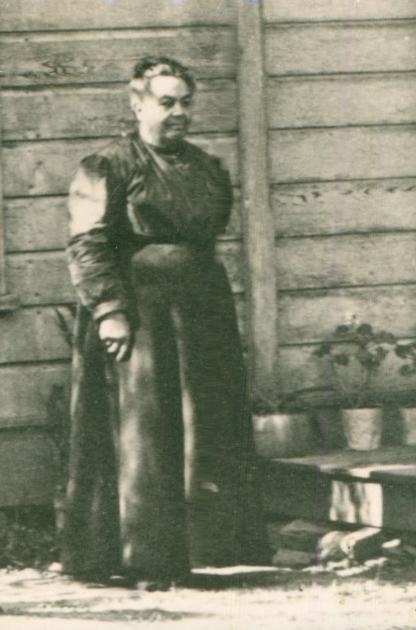
Ann Reed Wayment.
Ann Reed Wayment at her home in Warren.

Ann Reed Wayment was a woman of quiet and enduring strength. Her daughter Mary Jane wrote of her: “She was an energetic worker in Relief Society, holding and filling many offices in it. She was very useful among the sick, exercising great faith as her best healing art. She was a kind, loving, very thoughtful mother to her family. She lived a useful life, impressing her children and those who mingled with her what a wonderful mother and woman she really was.”

The Warren Ward Relief Society was organized on 30 November 1902. Ann was sustained as its Treasurer — her sister-in-law Castina Wayment, wife of Joseph’s brother Samuel, served as First Counselor. Ann was not present at the organization meeting but was set apart as Treasurer on 5 February 1903. At the first Relief Society meeting held at the home of President Jane Stewart on 18 December 1902, Ann bore her testimony and gave the benediction. She served as Secretary and Treasurer of the Warren Relief Society from 1902 to 1916.

Alma Hansen, who knew both his grandparents personally and compiled their biography from firsthand family accounts, described Ann in a single memorable sentence: “She was short of stature but stood ten feet tall in her loving service.”

A February Week in Logan, 1893
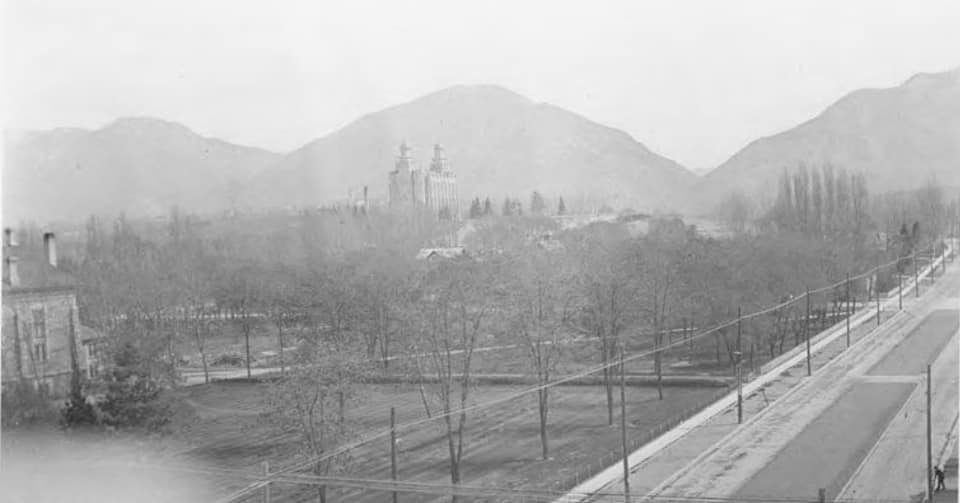
Logan, Utah, with the Logan Temple visible in the background, circa 1890s. Digital Image © 2001 Utah State Historical Society. All rights reserved. Used for non-commercial, educational purposes.

In February 1893, Joseph and Ann made an extended trip to the Logan Temple — a journey that had been years in the making. In careful sequence over eight days, they completed ordinance work for ancestors in their lineage and sealed their families together for eternity.

On 16 February 1893, Joseph was sealed to his parents, William and Martha Brown Wayment, in the Logan Utah Temple.

On 21 February, proxy baptism and confirmation were performed for James Reed and Sarah East Reed — Ann’s parents — in the Logan Temple.

On 22 February, the proxy endowment was performed for Sarah East Reed in the Logan Temple. Almost certainly the same was done for James Reed that day, though that record was later lost and the ordinance was repeated at the Manti Temple in 1938.

On 23 February 1893, Ann was sealed to her parents, James and Sarah East Reed, in the Logan Temple.

For a woman who had grown up an orphan at age five — whose mother died saving her life in 1854 and whose father died in 1858 — this February week in the Logan Temple completed a covenant that no earthly circumstance had been able to make. The parents she had barely known were now bound to her forever.

A Mission at Fifty-Six
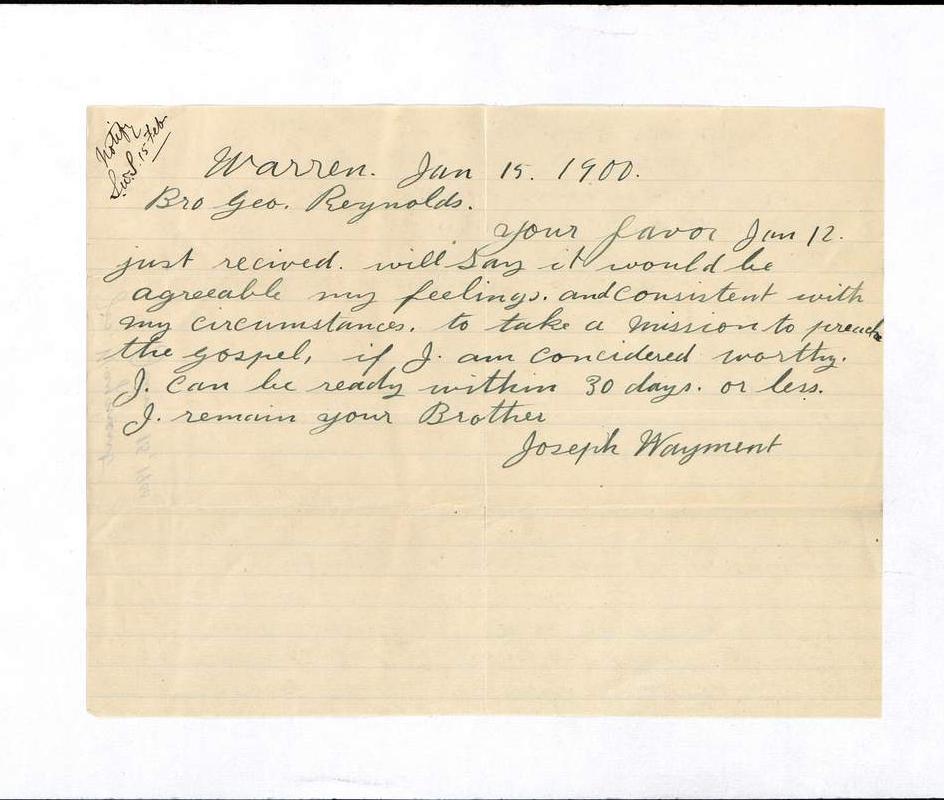
Joseph Wayment’s handwritten mission acceptance letter to Brother George Reynolds, Warren, 15 January 1900. “It would be agreeable my feelings, and consistent with my circumstances, to take a mission to preach the gospel, if I am considered worthy. I can be ready within 30 days, or less. I remain your Brother, Joseph Wayment.”

On Christmas Day 1899, Joseph was asked to fill a mission for the Church. He was fifty-five years old, a grandfather, and still carrying the kidney effects of a severe malaria attack from fifteen years earlier. His response, written in his own hand on 15 January 1900 to Brother George Reynolds of the First Council of the Seventies, occupies four plain lines: it would be agreeable to his feelings and consistent with his circumstances; he could be ready within thirty days, or less. He remained the reader’s Brother, Joseph Wayment.

On 19 January 1900 he received his formal call from President Lorenzo Snow to labor in the Southwestern States. He was set apart on 14 February 1900 by Apostle George Teasdale in the Temple Annex in Salt Lake City — the same day his Seventy’s License was formally issued, signed by Seymour B. Young, President of the First Seven Presidents of the Seventies.
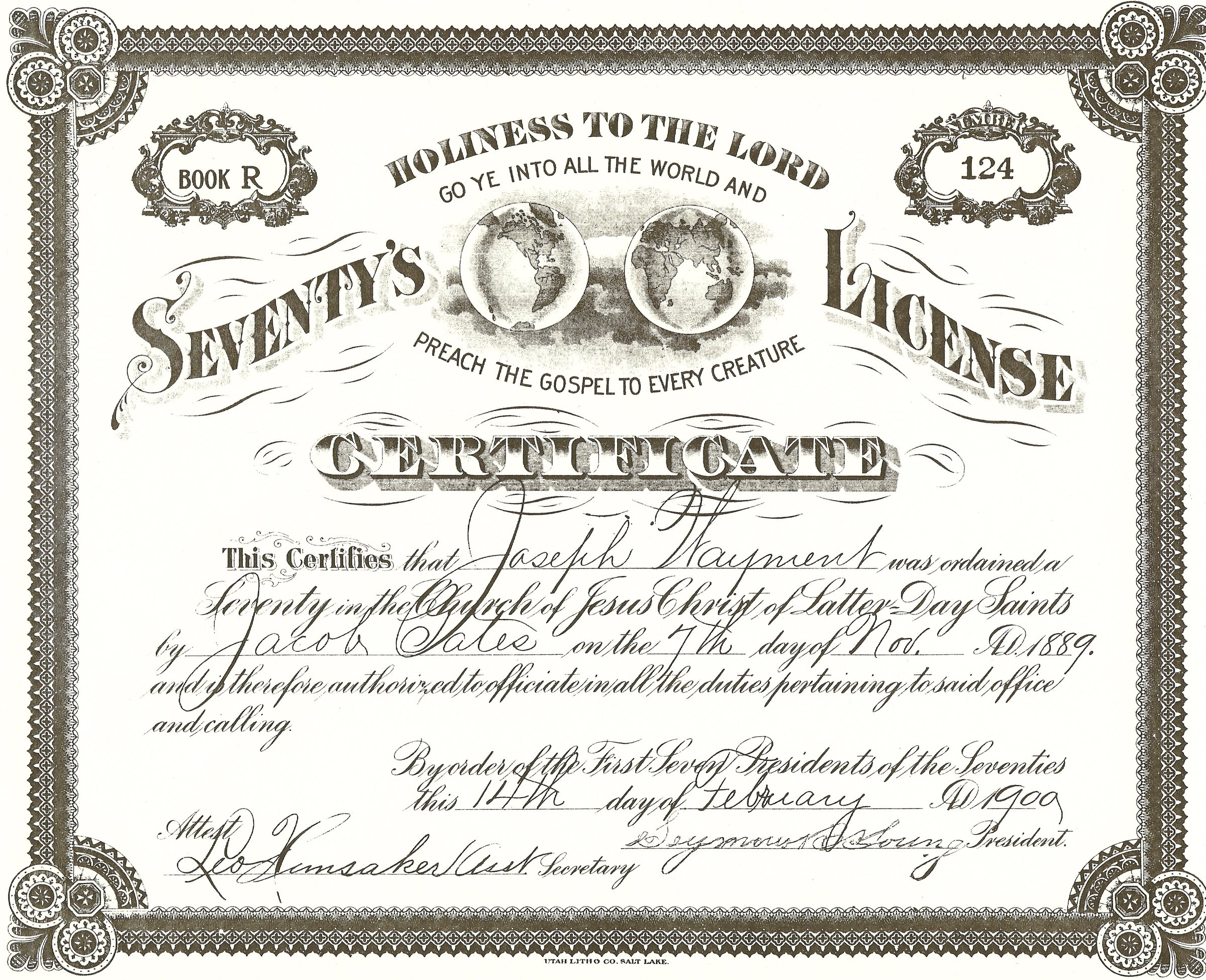
Joseph Wayment’s Seventy’s License Certificate, issued 14 February 1900, certifying his ordination as a Seventy by Jacob Gates on 7 November 1889. Signed by Seymour B. Young.

His Missionary Certificate bore the signatures of the entire First Presidency: President Lorenzo Snow, First Counselor George Q. Cannon, and Second Counselor Joseph F. Smith. That Joseph’s mission call passed through the hands of George Reynolds — historically notable as the defendant in the landmark U.S. Supreme Court case Reynolds v. United States (1879) — places it squarely in the living history of the Church.

He left the next day for Kansas, laboring first in Elk County under Elder H. E. Harrison, then for nearly four months in Greenwood County, until he was taken very sick with malaria again. In his own words: “I left my field of labor on the 4th of July for St. John and arrived home on the 7th, three days later. I was sick for three or four months.” The malaria affected his kidneys, an effect he felt until his death.

While Joseph was away on his mission and then ill at home, Ann kept the farm, the animals, and the household organized. When he returned, she nursed him back to health.

The Children

Of their seven children, three preceded them in death. Martha Ann, their firstborn daughter, married Louis Alma Hansen on 23 November 1898. She died on 19 October 1908 at age 31 of acute nephritis, leaving four children and her husband. Her loss was a grief Joseph and Ann carried quietly for the rest of their lives. Leonard Joseph married Sarah Naomi Hodson in 1902, was called to the British Mission in November 1915, labored in Belfast, Ireland, took sick, and arrived home 19 July 1916. He passed away the next morning, leaving a wife and three children.

The four who outlived their parents were Sarah (married Joseph Emelius Hansen), Mary Jane (married Samuel Bagley Willis, later Orson Francis Waldram), Walter Hyrum (married Iva Dell Wade), Hannah Alberta (married Thomas LeRoy White), and Amelia Brown (married George James Lythgoe).

The 70th Birthday, 1914
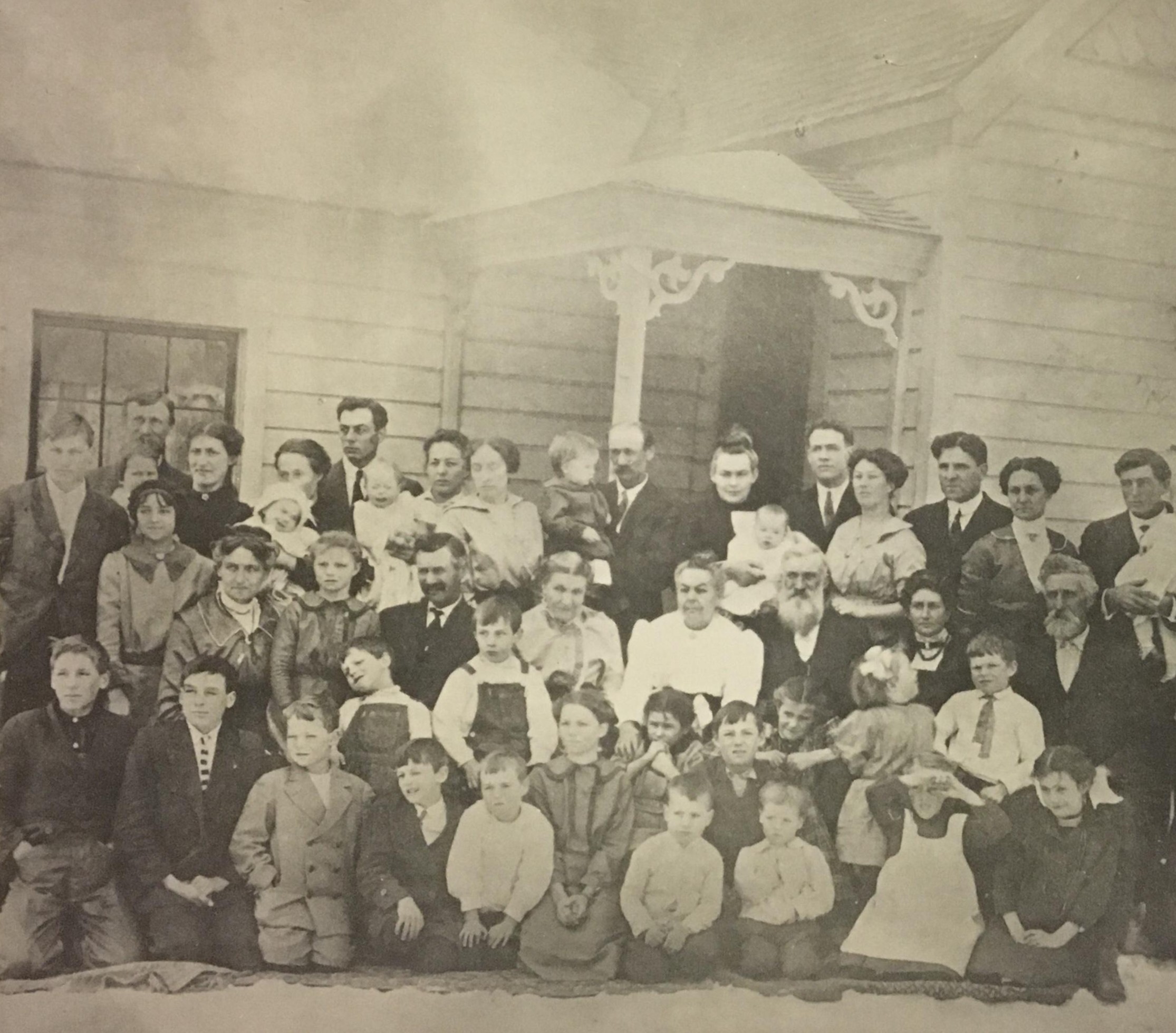
Family portrait honoring Joseph Wayment’s 70th birthday, 7 February 1914, Warren, Weber, Utah. Third row center: Ann Reed Wayment and Joseph Wayment, flanked by siblings John Brown Wayment and William Thomas Wayment and sister Martha East.

On 7 February 1914 the extended Wayment family gathered at the Warren home for Joseph’s 70th birthday — a family portrait captured four rows of family: children, grandchildren, siblings, their spouses and children, and young Alma Wayment Hansen himself, visible as a boy in the second row, who would later compile a biography of his grandparents. At the center of the third row sit Joseph and Ann, flanked by his brothers John Brown and William Thomas Wayment and his sister Martha East. By this gathering all the children had married.

The Grasshoppers

One incident from Joseph’s later years became a touchstone story in the family, attested to by his daughter Sarah. A summer or two after his first malaria attack, he had planted wheat in the field north of the house. The crop grew abundantly, had headed out full, and was beginning to turn yellow when the children noticed one evening that a great horde of grasshoppers had descended on the grain. They went in and told their father. He was not well, still weakened from the malaria. He arose, took his cane, and walked out into the field.

The grasshoppers were large and so thick they were bending the stalks almost to the ground. What once looked like a bounteous harvest now seemed doomed. Then right there in the midst of the grain and the grasshoppers, Joseph knelt and made a most fervent appeal to his Heavenly Father for aid. Night came on. The family retired — but not without family prayer. The next morning not a grasshopper could be found on the grain. There were no traces of where they had been.

The Golden Wedding, 1924
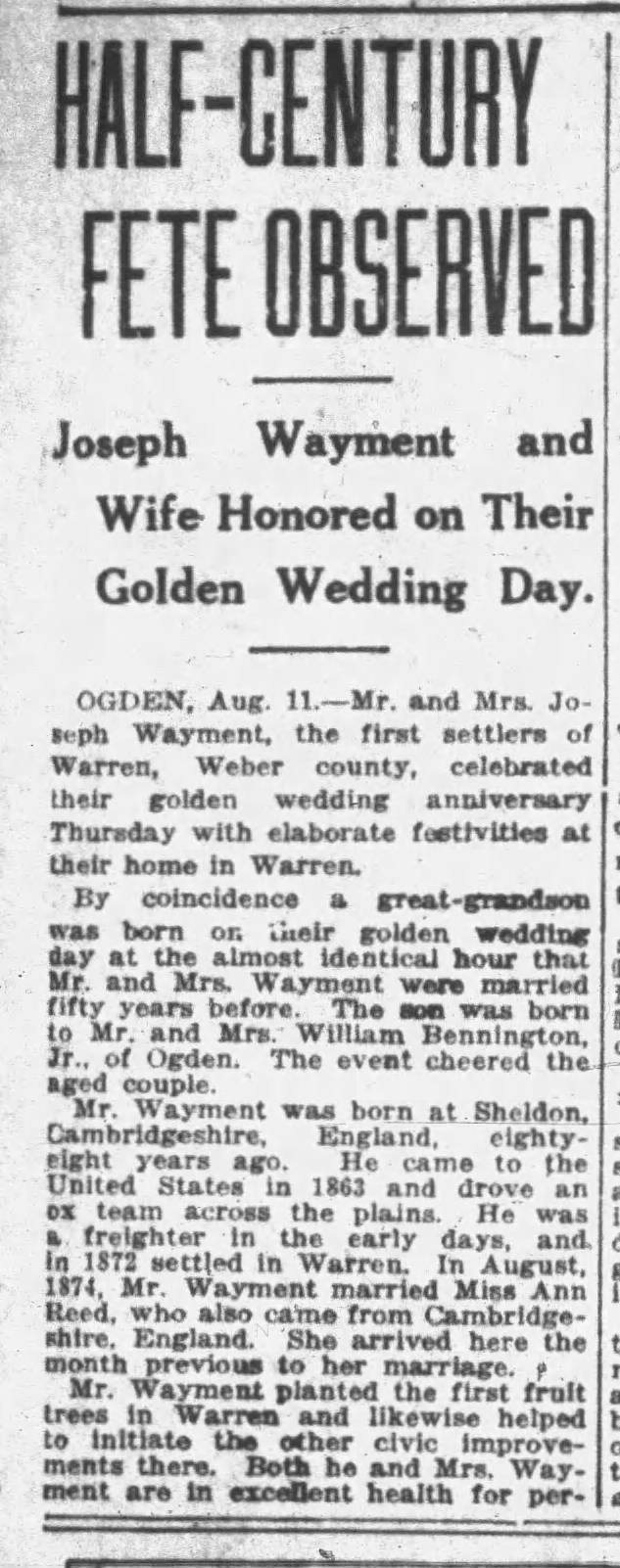
Salt Lake Tribune, 12 August 1924. Joseph Wayment and Wife Honored on Their Golden Wedding Day.
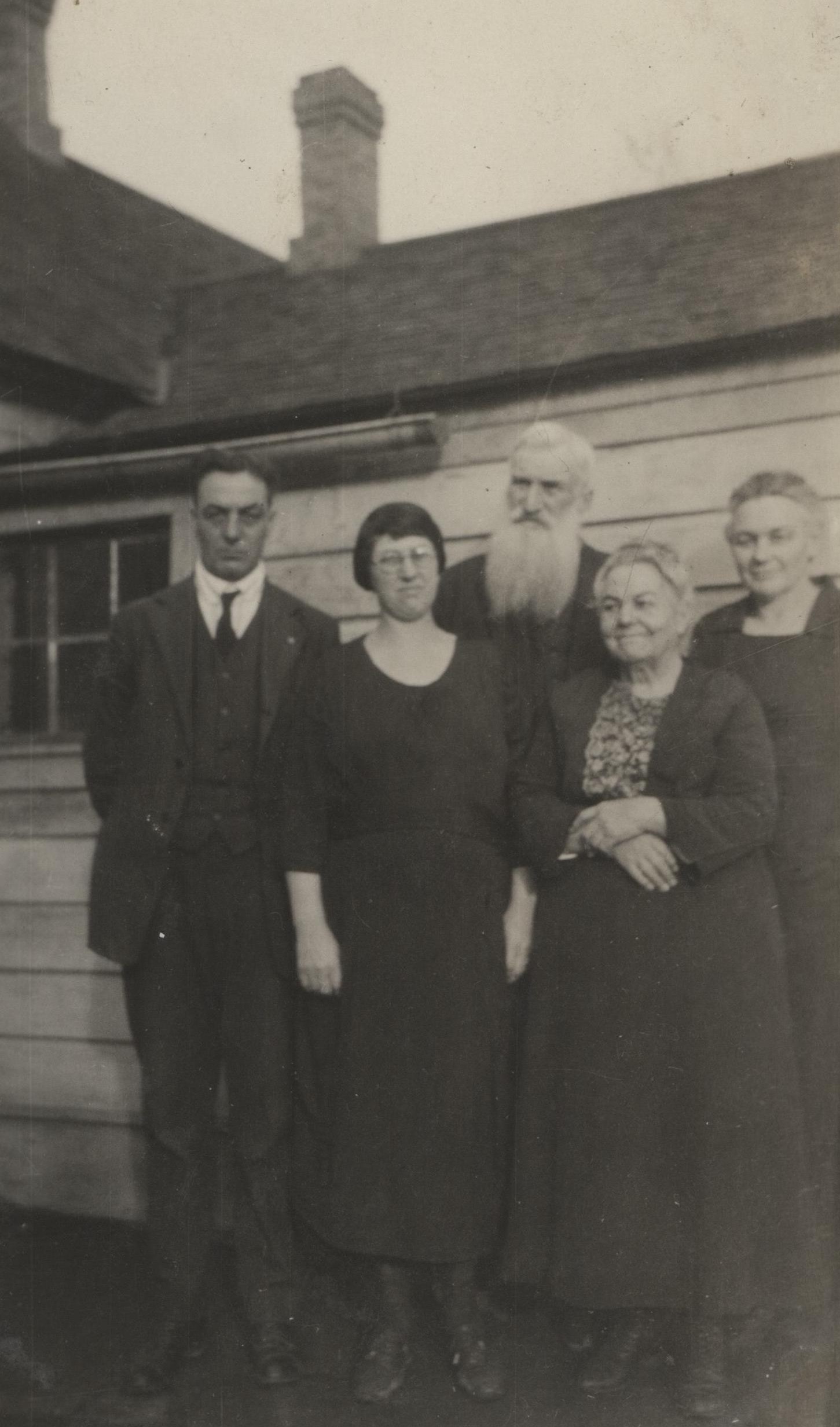
Left to right: Walter Hyrum Wayment, Amelia Brown Wayment Lythgoe, Joseph Wayment, Ann Reed Wayment, Sarah Wayment. Photograph taken at the Warren home, circa 1924.

On Thursday, 7 August 1924, Joseph and Ann celebrated their golden wedding anniversary with elaborate festivities at their Warren home. The Salt Lake Tribune reported the occasion. By remarkable coincidence, a great-grandson was born that same day at nearly the identical hour that Joseph and Ann had married fifty years before — a son born to Mr. and Mrs. William Bennington Jr. of Ogden. The event, as the paper noted, cheered the aged couple considerably.

The celebration drew family from across Weber County. Among those present were Joseph’s siblings — his sisters Mrs. Martha East of Warren and Mrs. Emily Mullen of Ogden, and his brother Bishop William T. Wayment of Warren — along with four daughters, one son, and twenty-six grandchildren.

The photograph captures something of what fifty years in Warren had built. Joseph stands center-rear, his great white beard the same beard his doctor had prescribed after the 1884 malaria — protection for his throat and chest from the cold. Ann stands center-front, hands folded, short of stature. Sarah, their eldest — the first white child born in Warren — stands at the right. Walter Hyrum, their only surviving son, is at the far left with his wife Amelia Lythgoe beside him.

Final Years
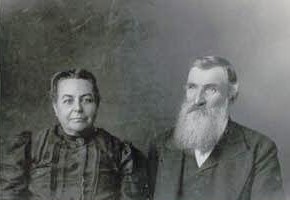
Ann Reed and Joseph Wayment.
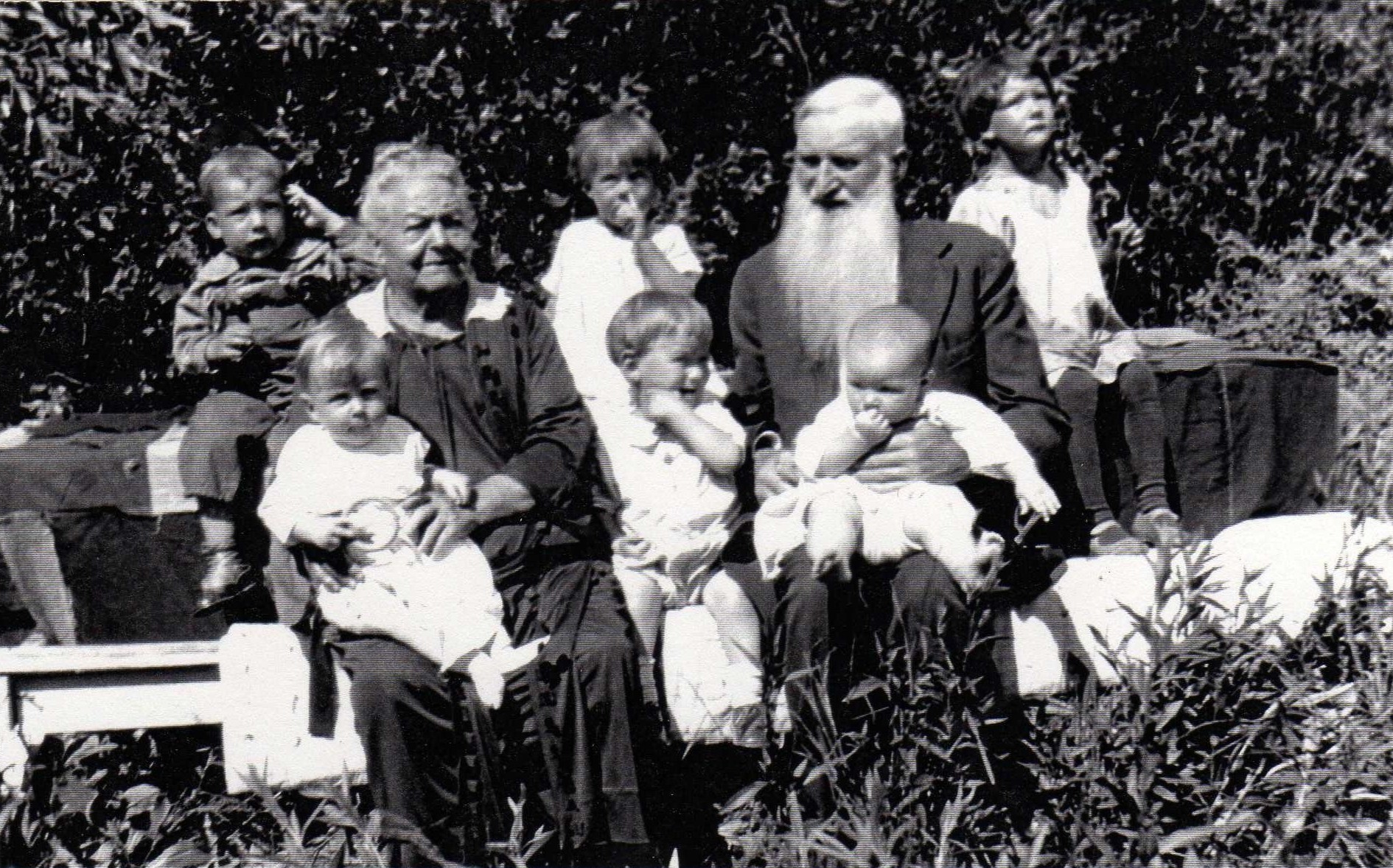
Left to right: Verlan Hansen, Ann Reed Wayment holding Donald Peterson, Eulail Peterson (back), Robert Hansen (front), Joseph Wayment holding Elaine Hansen, Irene Hansen. Joseph and Ann were the great-grandparents of the children in this picture.

Joseph bought his first automobile in 1912, just past his 68th birthday. About 1922 his eyesight became too poor to read. From that time until his death, someone had to read all news to him. He lived at his own home in Warren until the very end, cared for by his daughter Sarah. He delighted in bearing his testimony and seemed never to tire of talking about and explaining the principles of the gospel. His last public appearance was at a fast and testimony meeting on 11 October 1931, where he bore a strong testimony to the truthfulness of the Gospel and to the fact that Joseph Smith was a true prophet of God.

Ann did not live to see it. She died on the morning of 14 June 1931, at 8:10 a.m., at their Warren home after a three months’ illness — her cause of death recorded on her death certificate as chronic myocarditis with arteriosclerosis as a contributing factor. She had lived in Warren for 57 years without interruption. Her brother-in-law Bishop William T. Wayment was among the speakers at her funeral. A sextet of nephews and nieces sang. Mrs. Jessie Wayment sang a solo. Grandsons served as pallbearers. Granddaughters took charge of the flowers. She was buried in the Warren Cemetery on 17 June 1931.

Joseph took sick on the afternoon of Thursday, 17 December 1931. He passed away very peacefully on Sunday evening, 20 December 1931, at Dee Hospital in Ogden, of bronchopneumonia — the chronic malaria that had plagued him since 1884 listed as a contributing condition. He was 87 years old.
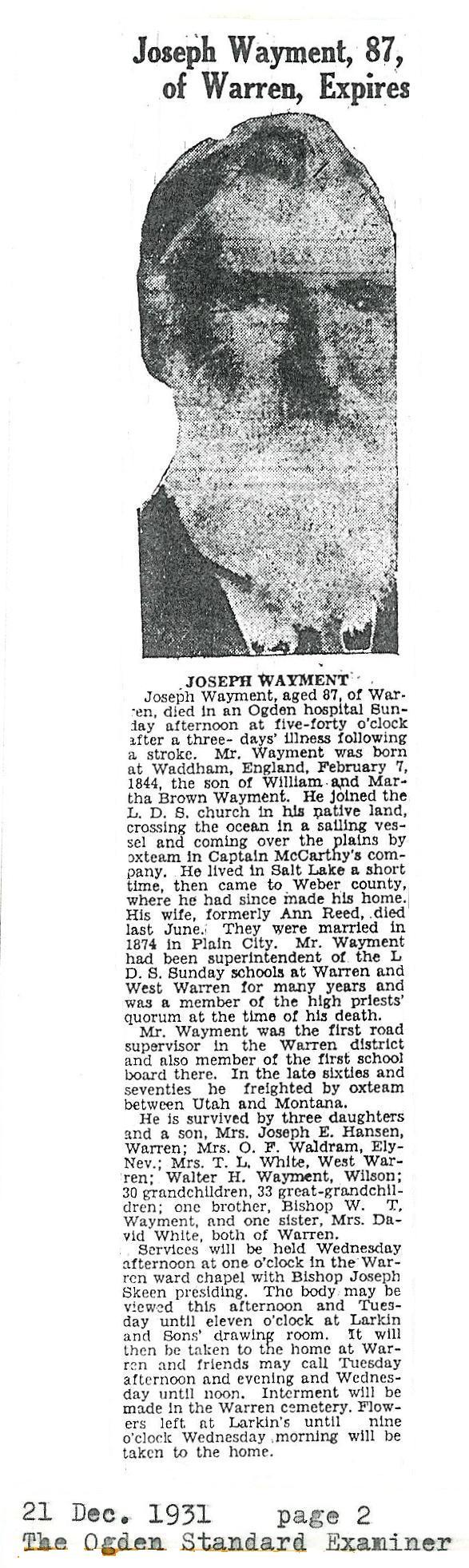
Obituary of Joseph Wayment, Ogden Standard Examiner, 21 December 1931.

He was buried on 23 December 1931 in the Warren Cemetery, beside Ann, who had preceded him six months and six days. They had been married 56 years, 10 months, and 7 days.

Legacy
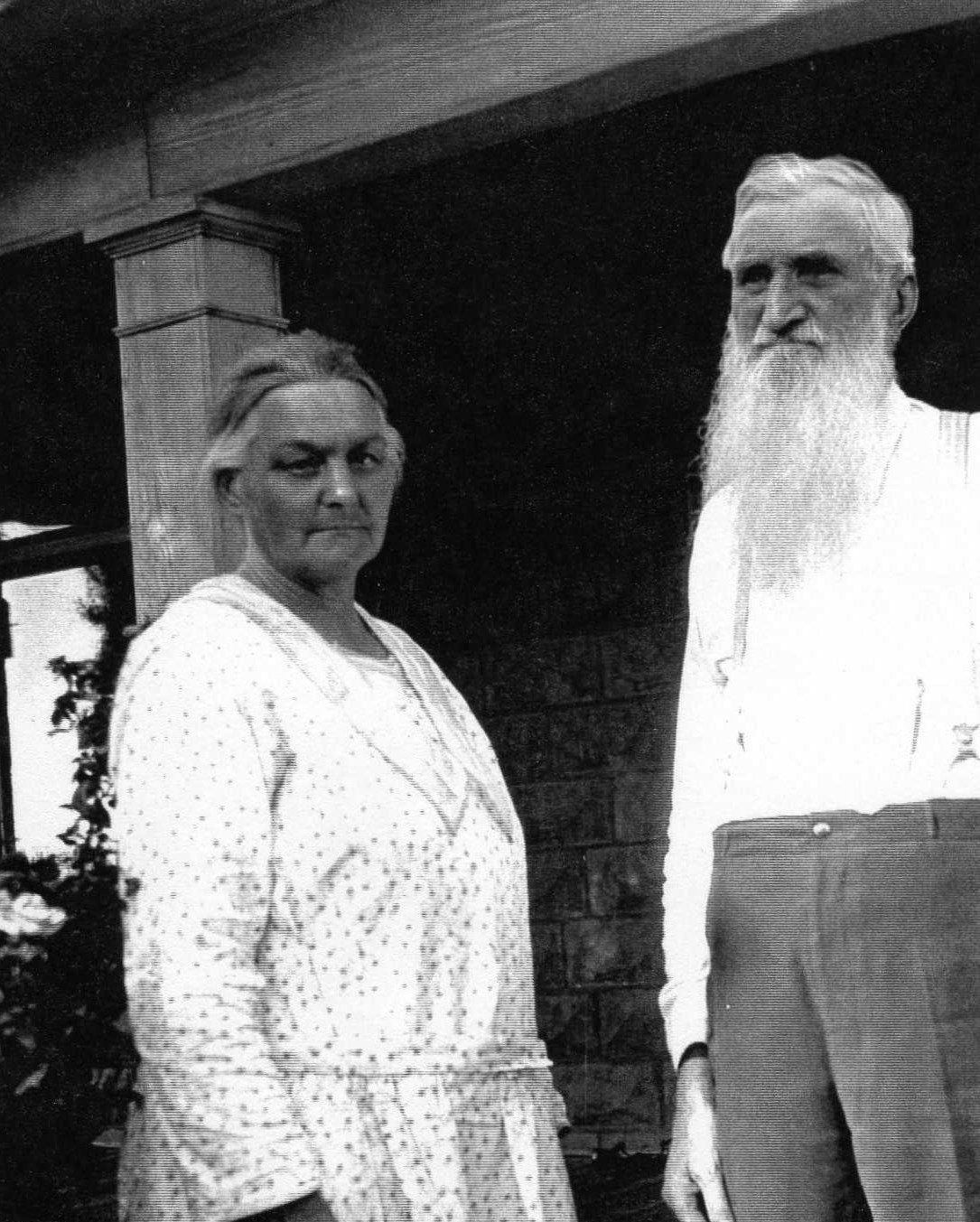
Sarah Ann Wayment Hansen and her father Joseph Wayment in his final years. Sarah cared for Joseph at home until his death in December 1931.

When Joseph and Ann Wayment arrived in Salt Creek in the early 1870s, there was almost nothing there. When they died in 1931, Warren was a community with a church, a school, a creamery, roads, canals, orchards — many of the first of each having been planted, built, or organized by Joseph himself. They lived to see 32 grandchildren and 37 great-grandchildren. Two of their children served missions; one granddaughter and five grandsons also served missions, all returning safely.

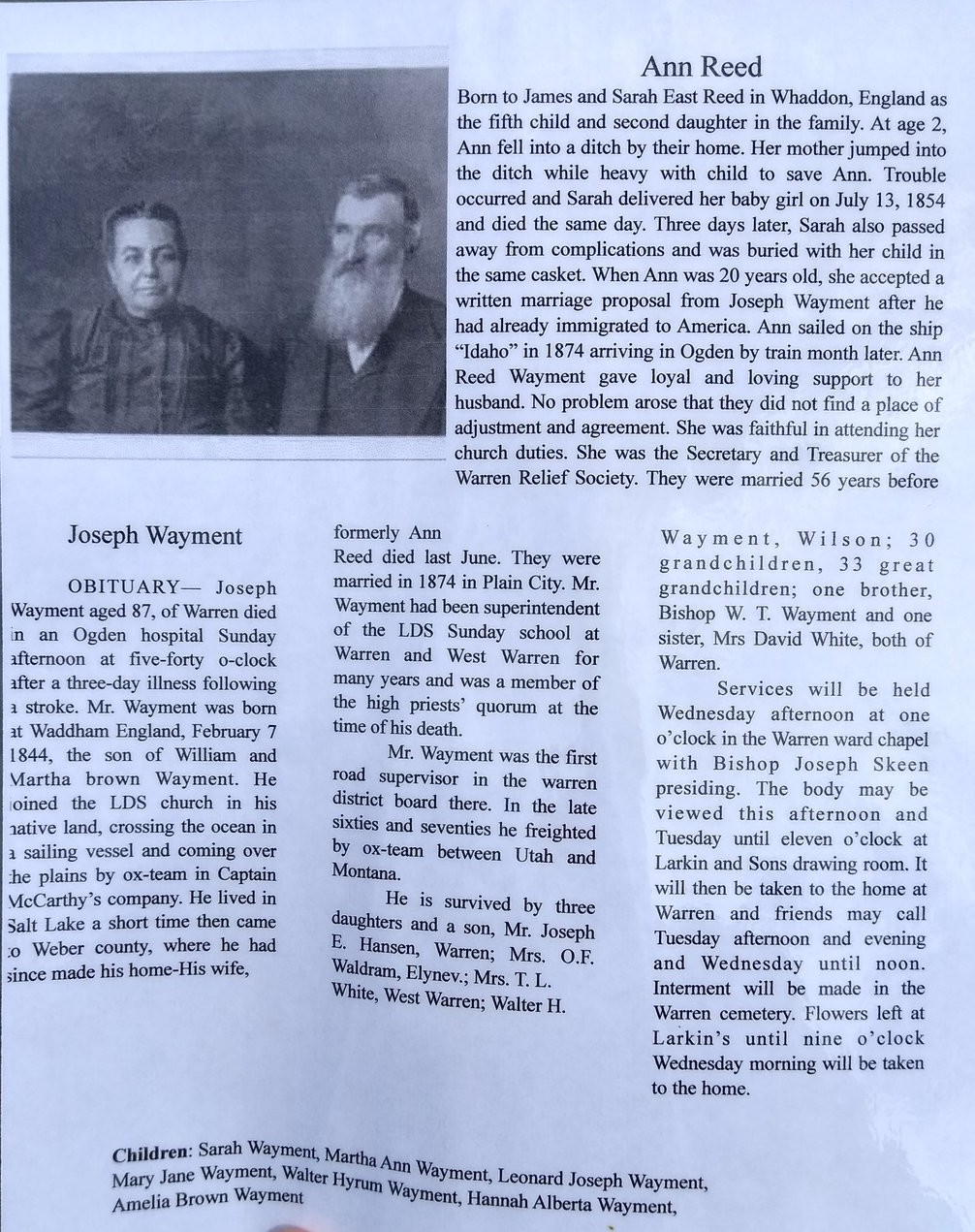
Amanda and I visited their graves in the West Warren Cemetery on 24 May 2020. The memorial card at their headstones — the laminated display that prompted much of this research — was photographed that day. Amanda is their 3rd great-granddaughter through the line: Joseph and Ann Wayment → Martha Ann Wayment Hansen → Walter Wayment Hansen → Bryan Hemsley → Amanda Ross.
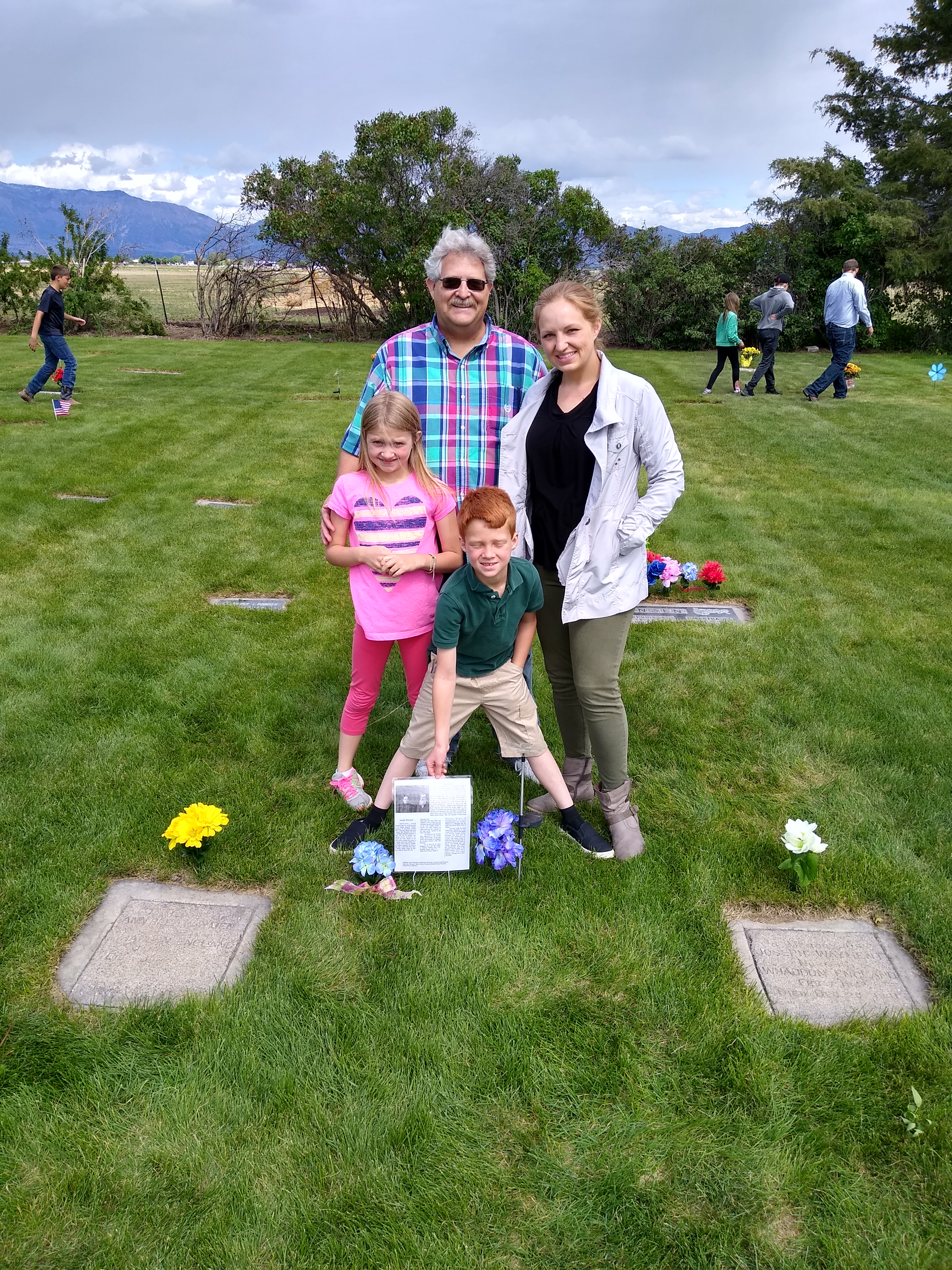
Bryan Hemsley, Amanda, Aliza, and Hiram Ross with the tombstones of Joseph Wayment and Ann Reed Wayment, West Warren Cemetery, 24 May 2020.
Bryan Hemsley, Amanda, Aliza, and Hiram Ross with the tombstones of Ann Reed (1852–1931) and Joseph Wayment (1844–1931), West Warren Cemetery, 24 May 2020.
The memorial card displayed at the graves of Joseph and Ann Reed Wayment, West Warren Cemetery.

Source Documents

The following family histories are available for download:

Life Sketch of Joseph Wayment – copied from a record belonging to Ida H. Johnson (granddaughter), transcribed by Hollis R. Johnson, 1956

Emily Wayment and William Negus – compiled by Alma W. and Martha M. Hansen, 1979

John Brown Wayment and Sarah East – compiled by Alma W. Hansen, 1980

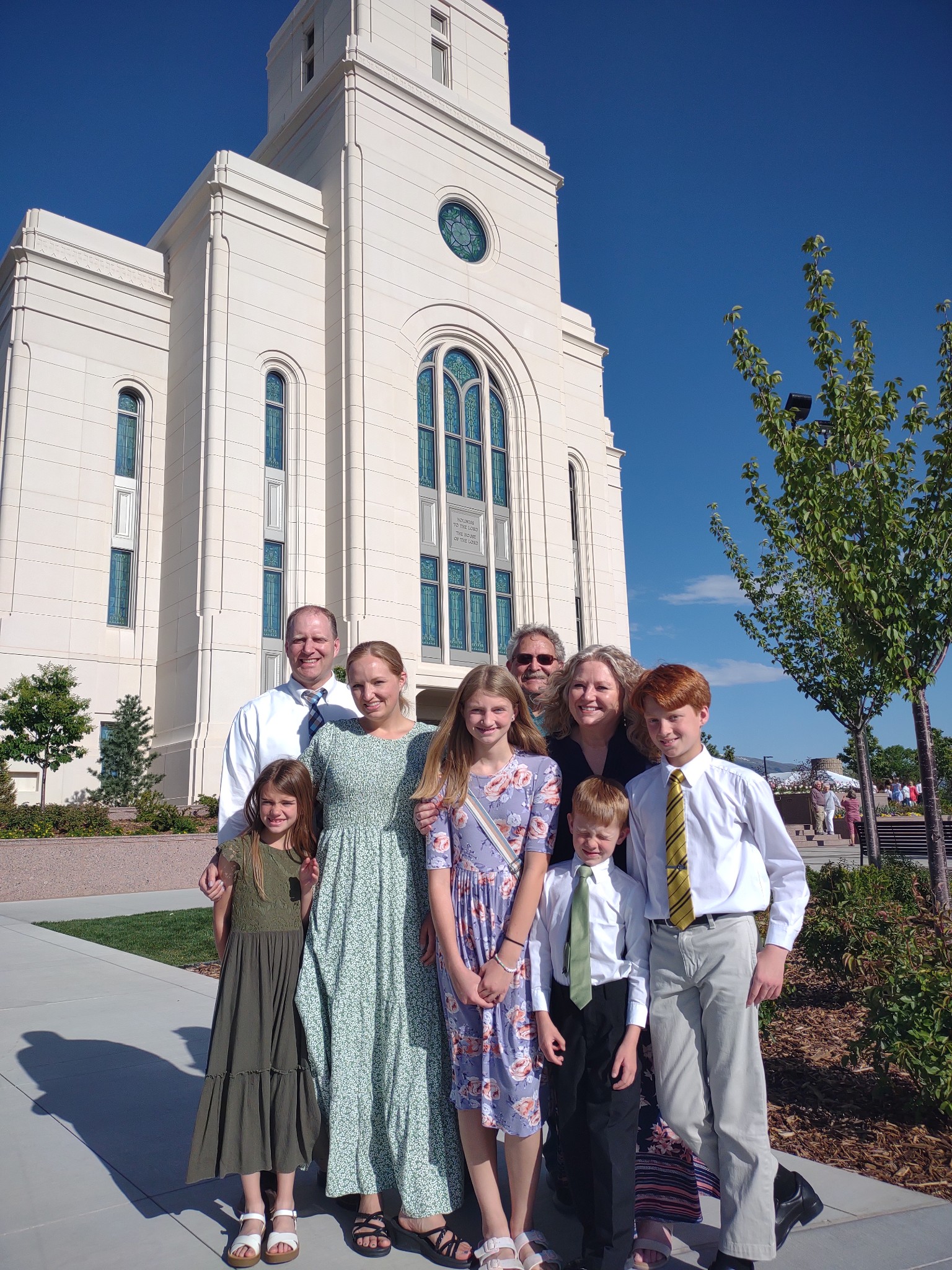
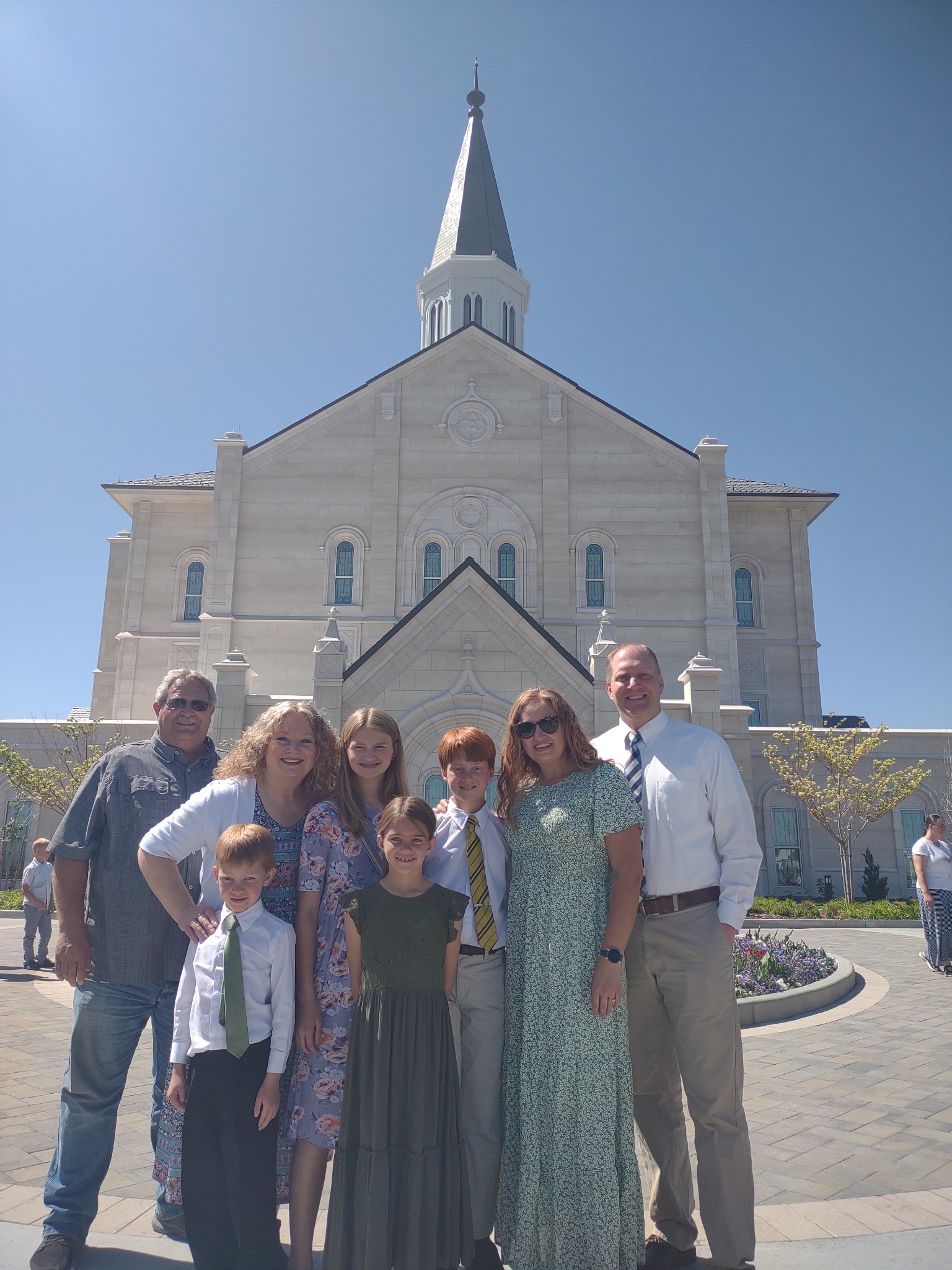
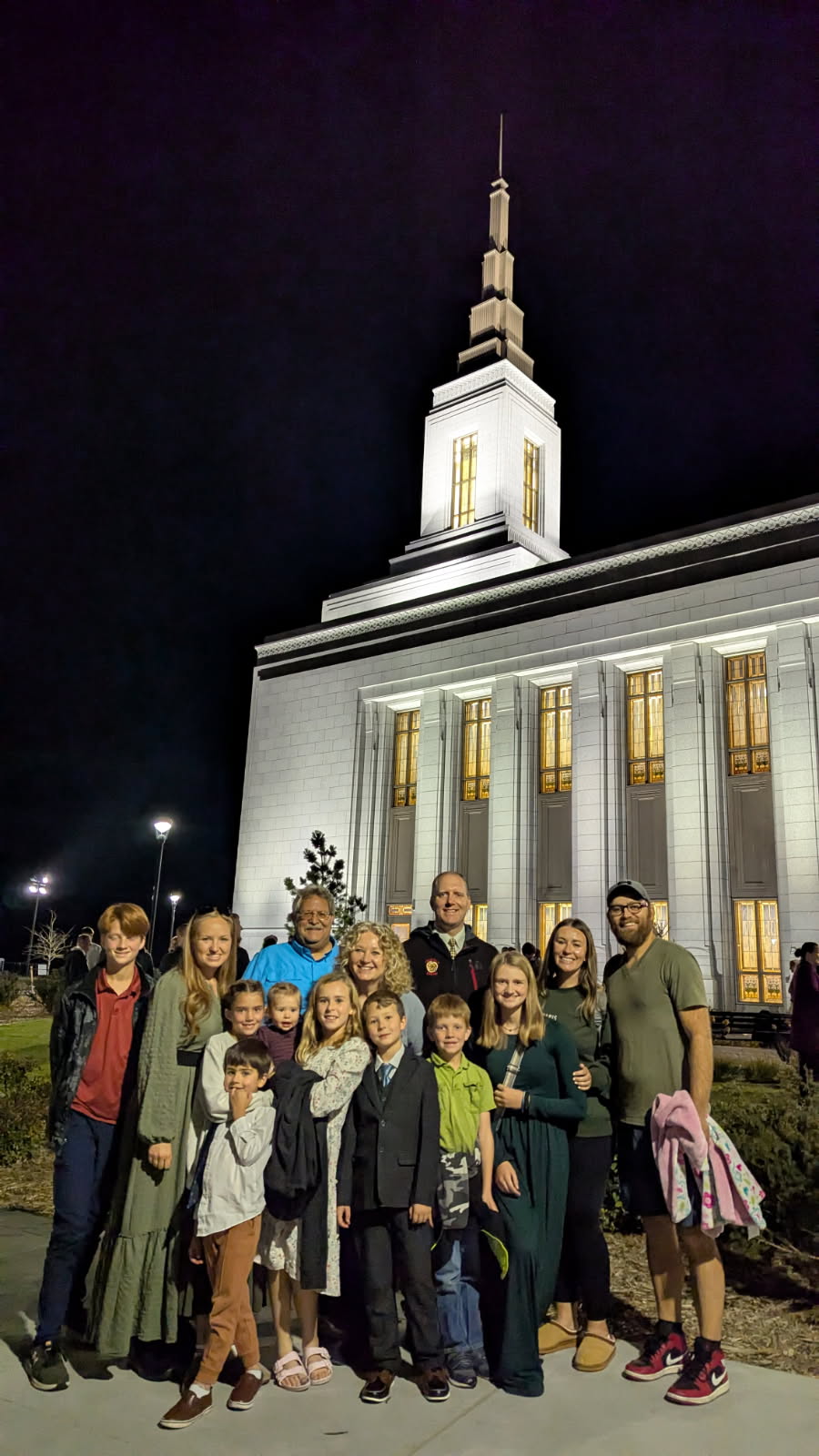
Burley Idaho Temple Open House

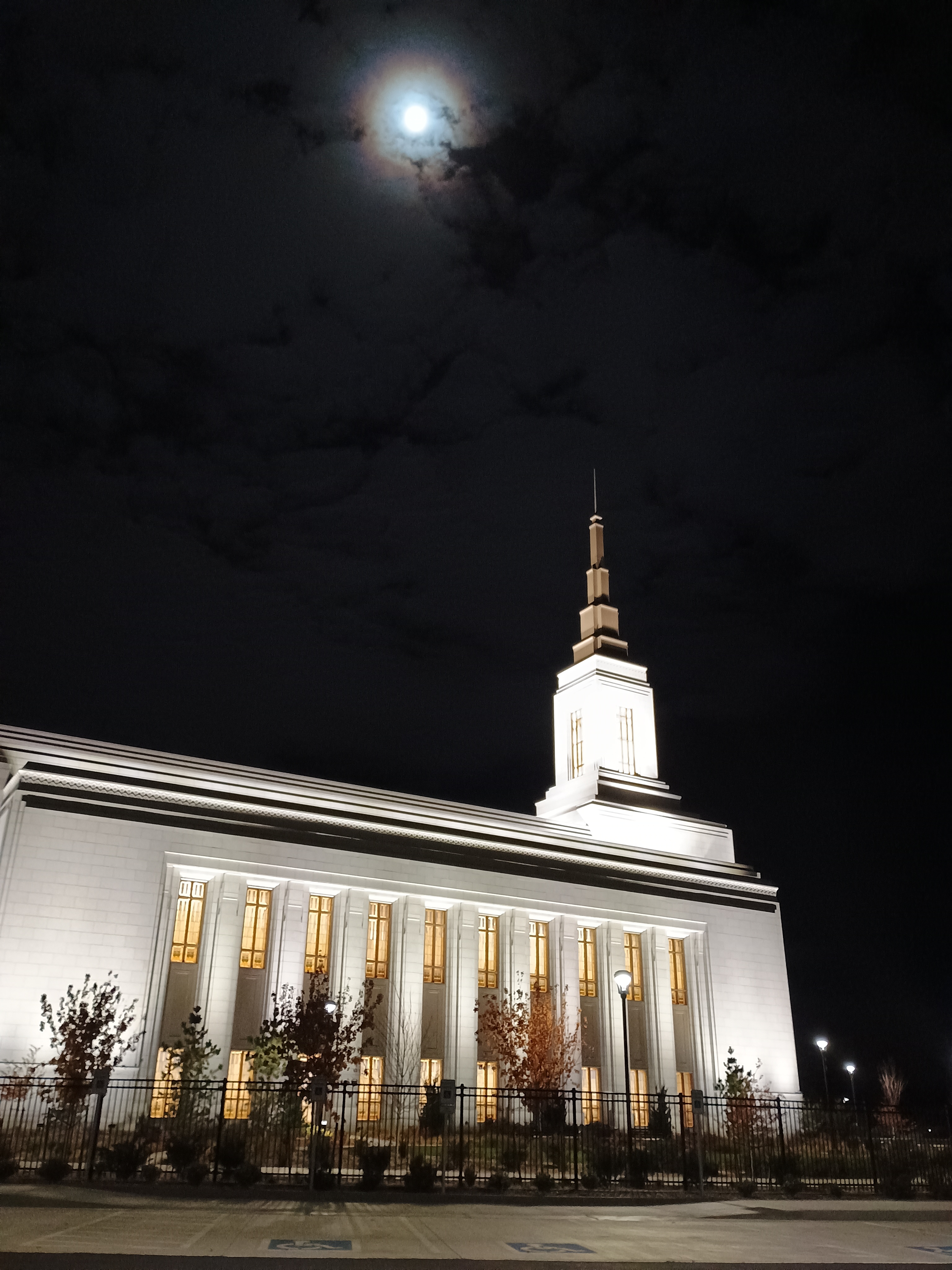
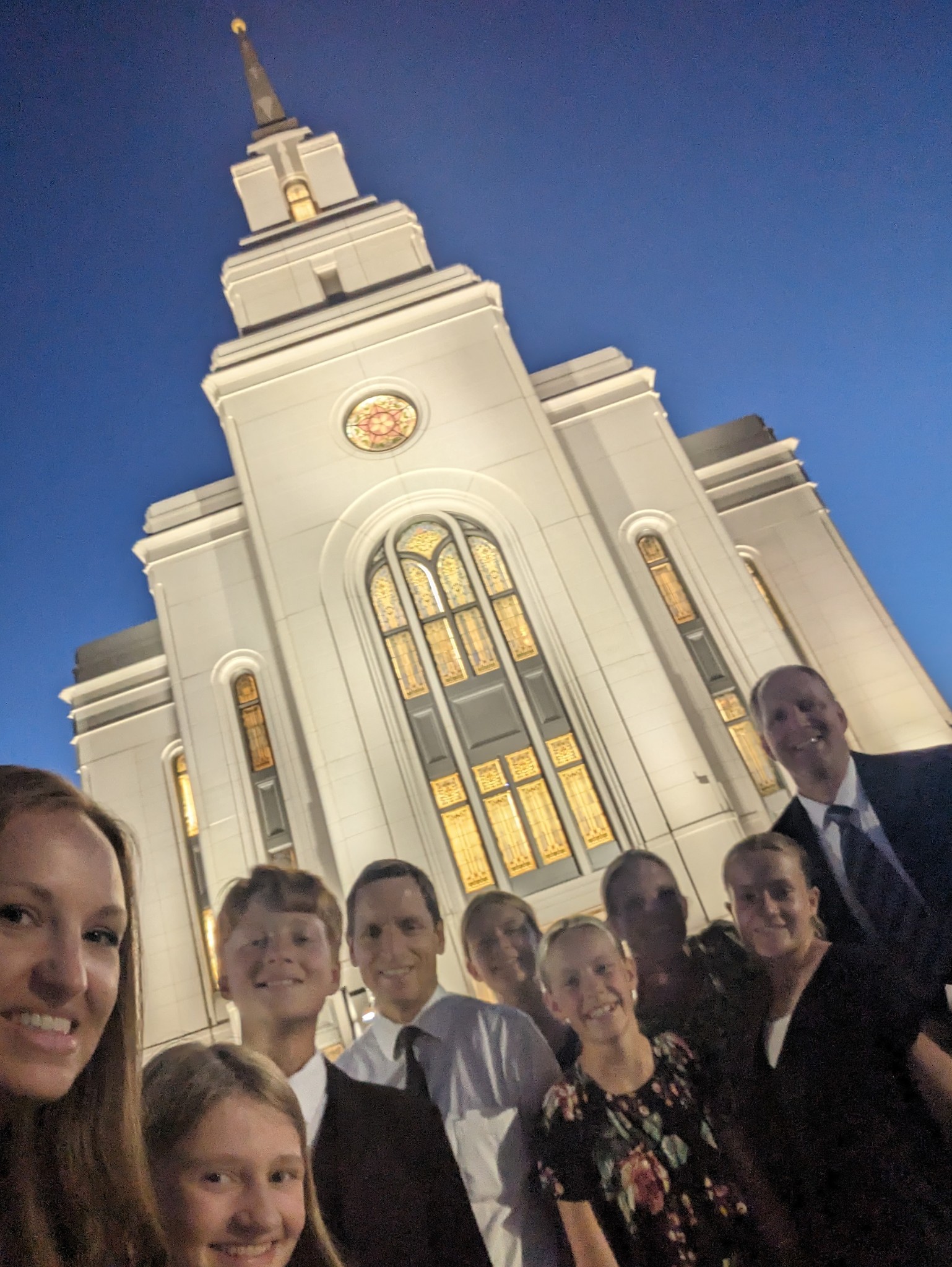
The Burley Idaho Temple Open House ran 3 November 2025 to 22 November 2025. It was an amazing opportunity to invite the local and broader community to walk through a pinnacle of our worship. I attended 5 of the much more individual and personal tours on the 3rd through 5th with public leaders and distinguished guests. I wish everyone could attend these tours, which would often take 45 minutes to 60 minutes for the full tour. Some of these were guided by General Authorities, including Elders Steven R. Bangerter, Karl D. Hirst, and K. Brett Nattress.

On Thursday, the general public was welcome to attend open tours. Our first tour tried to do a small introduction in each room, but about half-way through that was abandoned to keep the lines moving. Every tour I attended afterward did not have any attempted presentations, other than to remind individuals to not take photos and to speak softly.

Amanda sneaked over and caught a personal tour on the 6th.

6 November 2025 – Amanda Ross attended individually

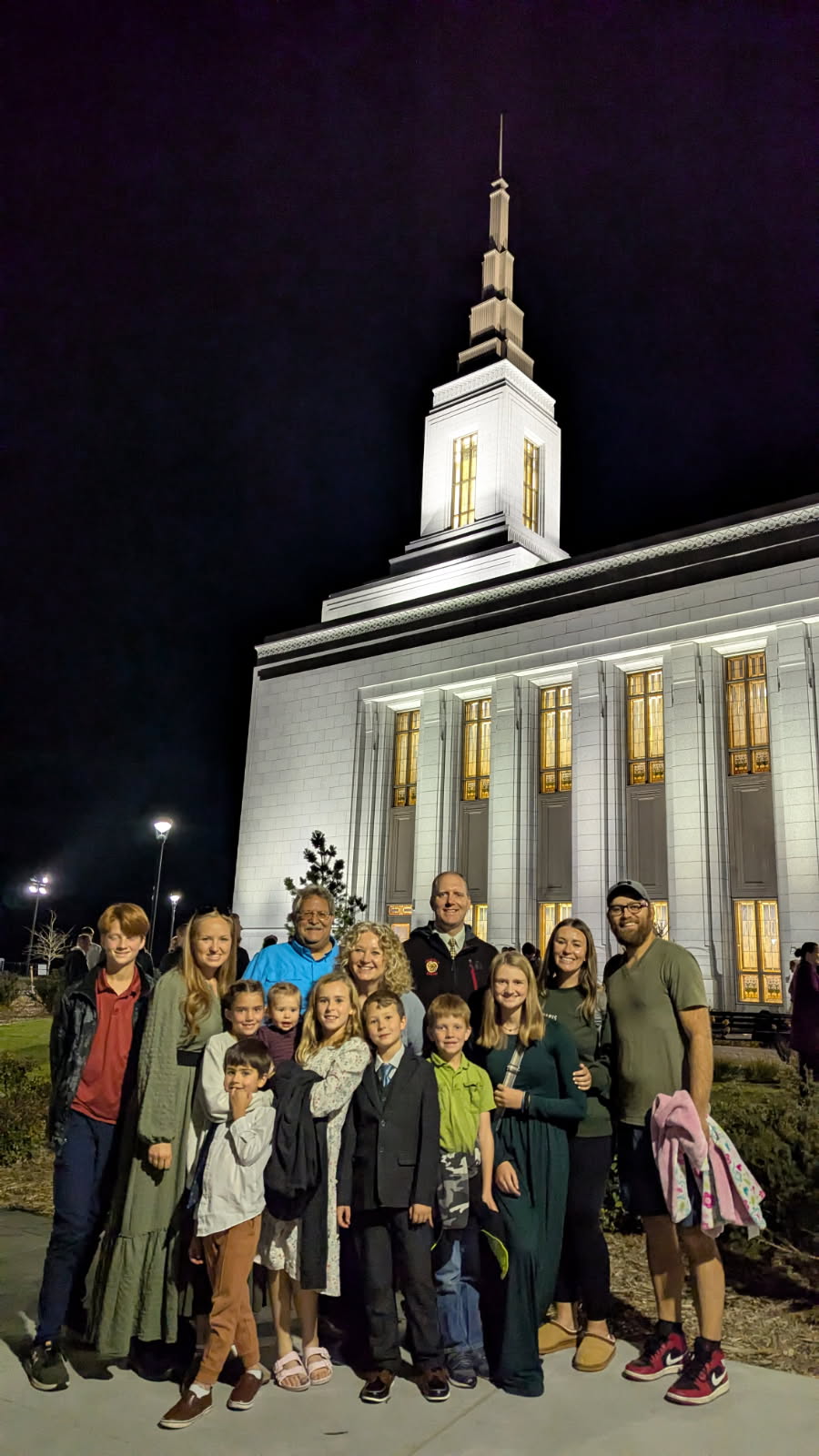
Amanda and I took our family on Friday 7 November 2025.

Saturday morning we attended with some friends. This was my 7th tour that first week!

8 November 2025 – Bud and Karen Marie Whiting, Amanda Ross, James Ross, Aliza Ross, Lea Pierucci Izama, Audra Hales, Aleah Hales, Anson Hales, Brad Hales, Paul Ross

The next weekend, Amanda had a bunch of family come to town and also attend. This Friday night was my 4th tour of the second week.

14 November 2025 – Hiram Ross, Amanda Ross, Lillian Ross, Rowan Hemsley, Margo Hemsley, Bryan Hemsley, Olivia Hemsley, Jill Hemsley, Jack Hemsley, James Ross, Paul Ross, Aliza Ross, Jordan Hemsley, Derek Hemsley

I also got to attend some more times the third week. But my 4th tour in the third week was with my sister and brother-in-law.

22 November 2025 – Paul Ross, Andra and Wes Herbst

That makes 15 trips through the temple for the open house. I was also privileged to do temple security on 5 different occasions, all for the 9:00 PM to 1:00 AM shift. Here are some photos from that opportunity.

4 November 2025
4 November 2025
5 November 2025 – Paul Ross and Kevin Mower for the graveyard shift
10 November 2025 – Paul Ross and Tyson Smith for the graveyard shift

Amanda also got to do a security shift, parking shift, and foot covering (booty) shift.

12 November 2025 – Amanda Ross Parking Shift
12 November 2025 – Amanda Ross Security Shift

Some of the late night security shifts were great opportunities to reflect on the blessings we are now achieving with the ease and access of a temple so close.

When I received my first temple recommend for my own endowment, Paul Idaho Stake President, M. Gene Hansen, invited me to make a commitment to attend the temple every month at a minimum. I took that commitment. I agreed.

In Hazelton, Idaho, it took me roughly 2 1/4 hours to get to the Boise Idaho Temple (speed limits have increased since then); Idaho Falls Idaho Temple was just under 2 hours; Logan Utah Temple was about 2 1/2 hours, and Ogden Utah Temple was 2 1/2 hours. I was endowed in Logan in September 1998 with my Dad. I attended Logan and Boise before going on the mission. But it was at least half a day planning to attend the temple before the mission.

Within the Manchester England Mission is found the Preston England Temple. Attending the temple in the mission required coordination with members as the temple isn’t near public transportation and we relied on members to take us. We could only go on Preparation Day, which was Tuesday. That took some work, but I was able to attend every month of the mission (except for some months where some missionaries had abused the privilege and all missionaries lost temple attendance options for three months). Getting to the temple was within 1 hour for every area in which I served.

I lived in Branson Missouri for a couple of years. Our closest temple for Branson was the St. Louis Missouri Temple. That drive was at least 4 hours one way, often 4 1/2 hours. That required an entire day to be set aside and planned to drive, attend, and return home. Never missed a month in Branson. I sealed my Jonas grandparents together in St. Louis Missouri Temple. The Bentonville Arkansas Temple has been constructed much closer at about 2 hours. The Springfield Missouri Temple will be less than an hour away from Branson.

Amanda and I lived in Richmond Virginia for a couple of years. Our closest temple for Richmond was the Washington D.C. Temple. That drive was between 4 and 5 hours away, depending on beltway traffic. We would often go up and spend Friday night with family, attend the temple that night or in the morning, and then make our way back home. Washington D.C. Temple was closed for a bit, so to make the monthly trip, we had to go to the Raleigh North Carolina Temple. That was almost a 4 hour drive one direction. The new Richmond Virginia Temple is just outside the first neighborhood we lived in and within 10 minutes of the second neighborhood we lived.

When we moved back to Idaho, the Twin Falls Idaho Temple had been dedicated. That dropped the 2 to 2 1/2 hour drive time for all those temples to less than an hour, usually between 50-60 minutes. But it still takes time and planning to ensure I get there every month. This is double now that we also have a commitment to see that Aliza and Hiram are able to attend at least monthly.

Now, with the dedication of the Burley Idaho Temple in January, the temple will be between 5 to 6 minutes away.

Now I have to reevaluate. It seems the once a month commitment is not enough. I think that will remain the absolute minimum going forward for the rest of my life. It also seems I have no reason to not attend to at least one ordinance in the temple at least every week.

To show my gratitude to our Father and our Savior, I intend to attend the Burley Idaho Temple at least daily for the first 30 days it is open after dedication. Which isn’t as much as it seems if you consider it is not open on Sunday, Monday, or Thursday. Still working out what happens after the first 30 days.

For the last three weeks I have found myself regularly humming The Spirit of God and also muttering the Hosanna Shout under my breath. I am looking forward to the dedication of the Burley Idaho Temple on 11 January 2026!

Milo P Ross Elementary Class Pictures

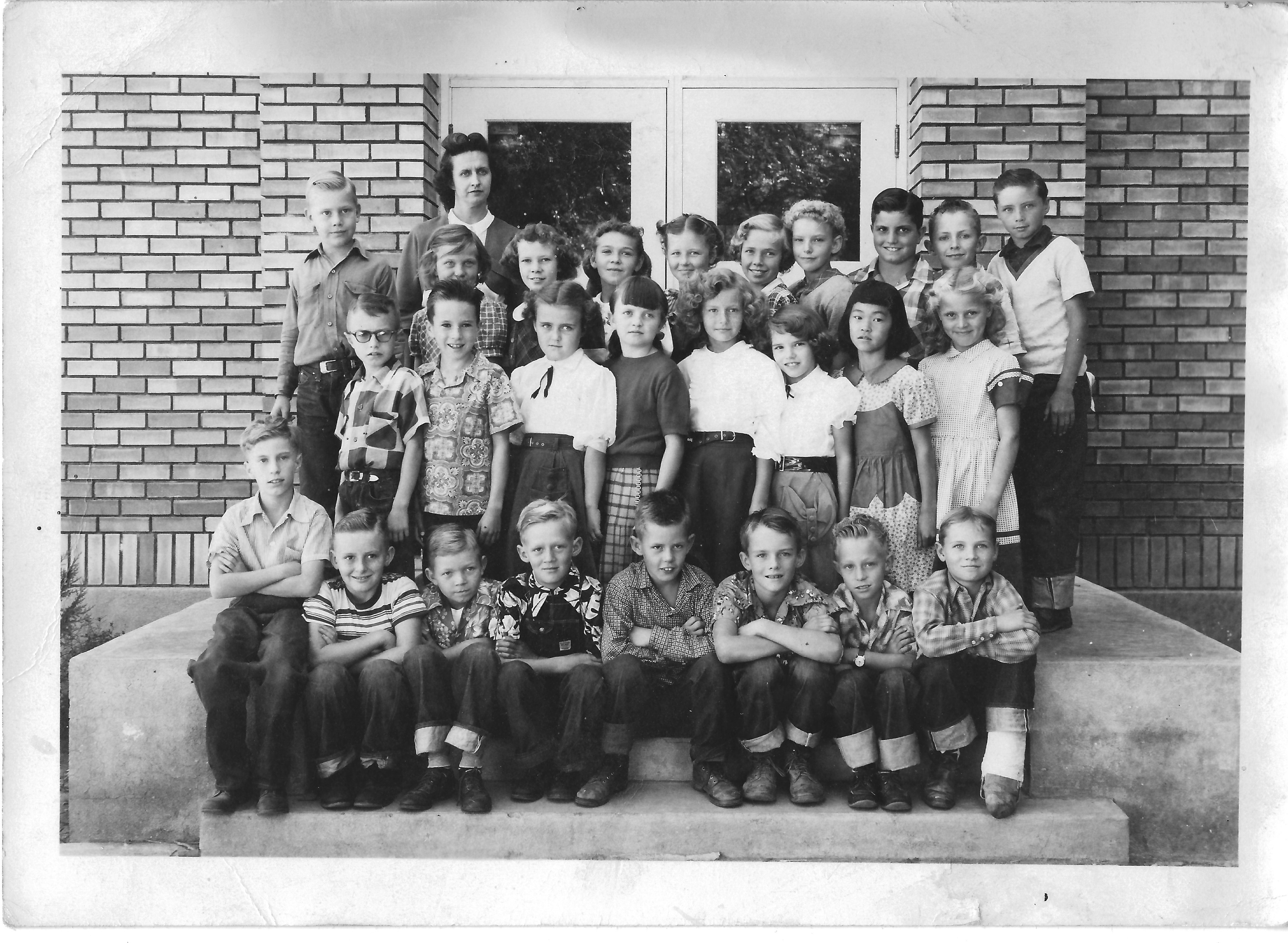
In honor of Dad’s 82nd birthday, I am sharing these photos.

After Dad’s first wife, Vicki, passed away, most of her photos and other documents were scanned. Found in those documents were these two class pictures for Dad. These are for his 1952 and 1953 class years. Since he graduated in 1961, these are likely his 3rd and 4th grade pictures. He attended Plain City Elementary in Plain City, Utah.

Back (l-r): Gary Butler, Frances Rochell, (unknown teacher behind Frances), Linda Knight, unknown, unknown, unknown, unknown, Kenneth Clark, unknown, Kenneth Wayment; Middle: unknown, Kent Hodson, Elaine Rogers, Connie Poulsen, Kay East, Carole Carver, May Endow, unknown; Front: Dean Allred, Fred Coy, unknown, Ernest Hansen, Leon Taylor, Milo Ross, unknown, unknown.
Back (l-r): Carol Wheatley, Connie Poulsen, Austin McWilliams, Mr. Leslie Gerald Bundy, Kenneth Wayment, Kenneth Clark, unknown, Cleora Meyerhoffer, unknown, Gary Butler, Donna Mae Jensen; Middle: Elgie Post, Elayne Rogers, May Endow, unknown, Frances Rochell, Linda Knight, Carole Carver, Kay East, Deanna Slater; Front: Kent Hodson, Larry, Dean Allred, Fred Coy, Leon Taylor, Milo Ross, unknown, Jeff East, Ernest Hansen

Mr. Leslie Gerald “Jerry” Bundy (1929 – 1999)

Ms. Emma Walker Munson (1918 – 1992)

Dean Allred (1943 – alive)

Ilene Bingham (1943 – alive)

Gary Butler (1943 – alive)

Carole Carver (1943 – alive)

Kenneth Clark (1943 – alive)

Fred Coy (1943 – alive)

Jeff East (1943 – alive)

Kay East (1943 – alive)

Maye Endow (1943 – alive) married Bothwell

Ernest Walter Hansen (1943 – 2010)

John Kent Hodson (1943 – 2022)

Donna Mae Jensen (1943 – alive)

Linda Knight (1943 – alive) married Charlton

Austin McWilliams (1943 – alive)

Cleora Mae Meyerhoffer (1943 – 2013) married Oliver

Connie Poulsen (1943 – alive) married Esplin

Frances Rochell (1943 – alive)

Elayne Rogers (1943 – alive) married Cliften

Milo Paul Ross (1943 – alive)

Deanna Kay Slater (1943 – 2006) married Hart

Leon Everett Taylor (1943 – 2000)

Linda “Cookie” Thompson (1943 – alive)

Kenneth Wayment (1943 – alive)

Carol Wheatley (1943 – alive)

Aliza and Hiram at the Temple

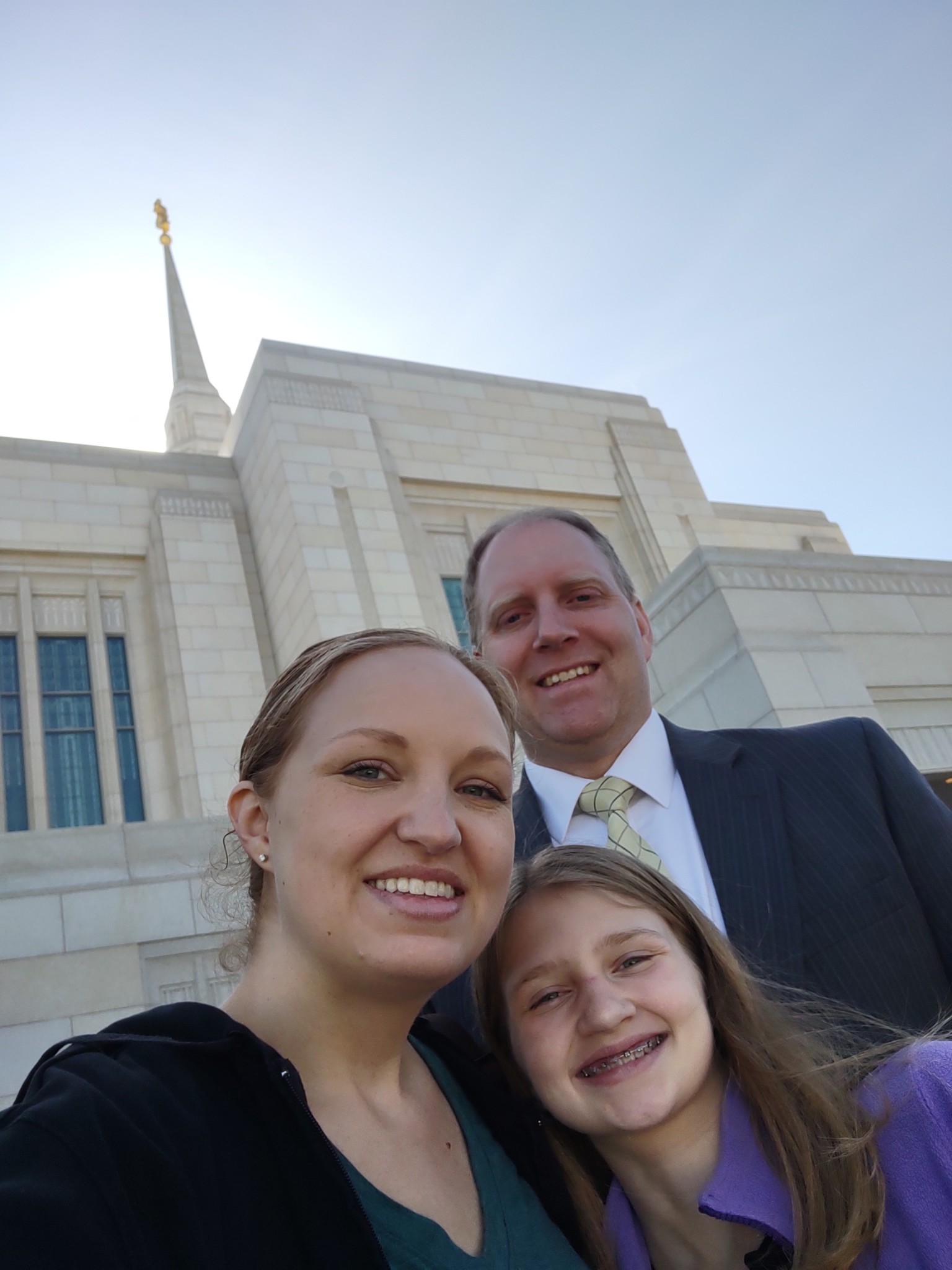
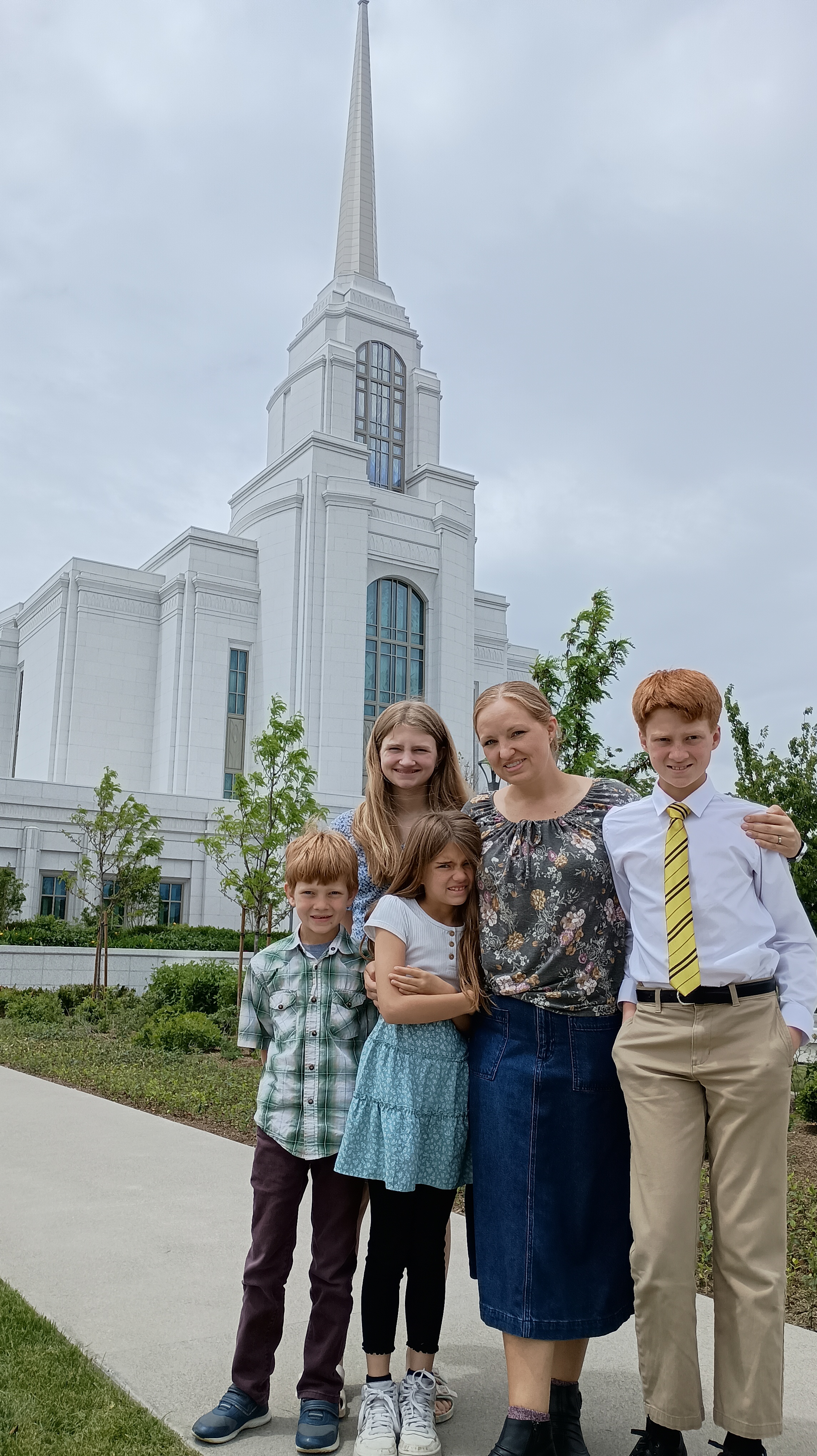
I am afraid the Ross household are temple tourists. Anyone who knows me knows that I have a couple of quirks. One of which, I like to drive by temples. The more distant a location, the greater likelihood I will plan visiting a temple. Even if it is just to drive past and snap a picture. Now that my children are old enough to attend the temple, my unwritten goal is to attend various temples. In visiting with Aliza and Hiram, they have not been keeping much of a record. Here I am, trying to re-create a list of temples they both have attended 2022 to present. I can cheat because we often take a picture while there.

Aliza could start attending the temple in January 2022. We did not have any goals for attendance, usually just whenever our Burley 11 Ward would go to the temple.

12 February 2022 – Twin Falls Idaho Temple
6 March 2022 – Twin Falls Idaho Temple
16 April 2022 – Pocatello Idaho Temple – Bill Teal, Mary Lou Teal, Amanda Ross, Aliza Ross, Paul Ross, Eliza Hales, Brad Hales, Aleah Hales
14 May 2022 – Logan Utah Temple – Paul and Aliza Ross with Aleah, Brad, and Eliza Hales
31 December 2022 – Brigham City Utah Temple – Paul Ross, Aleah Hales, Eliza Hales, Brad Hales, Aliza Ross, Amanda Ross
28 April 2023 – Ogden Utah Temple
27 May 2023 – Bountiful Utah Temple – Paul and Aliza Ross, Brad, Aleah, and Eliza Hales, Marianne Christensen
19 August 2023 – Twin Falls Idaho Temple – Paul Ross, Brad Hales, Aliza Ross, Aleah Hales, Eliza Hales

Hiram could start attending the temple in January 2024. That year the Burley 8 Ward (we moved houses) asked that we set a goal of attending monthly in 2024. We fulfilled that goal.

12 January 2024 – Pocatello Idaho Temple – Amanda, Aliza, Milo, Hiram, and Paul Ross

17 February 2024 – Twin Falls Temple – Burley 8 Ward Temple Trip

8 March 2024 – Bountiful Utah Temple – Bryan Hemsley, Amanda Ross, Aliza Ross, Jill Hemsley, Hiram Ross, Paul Ross
27 March 2024 – Vernal Utah Temple

5 April 2024 – Twin Falls Idaho Temple – Burley 8 Ward Temple Trip

17 May 2024 – Ogden Utah Temple
5 July 2024 – Oquirrh Mountain Utah Temple
17 August 2024 – Logan Utah Temple
23 August 2024 – Meridian Idaho Temple – Aliza only
22 September 2024 – Layton Utah Temple – Amanda Ross, Aliza Ross, Hiram Ross, Brad Hales, Aleah Hales, Elise Hales, Rachel Hales, Eliza Hales, Paul Ross

Funny story, Layton was the first time I actually took a dead person to the temple. My Great Aunt June Streeter Stout. Ask me for the story.

4 October 2024 – Boise Idaho Temple

9 November 2024 – Twin Falls Temple – Burley 8 Ward Temple Trip

28 December 2024 – Bountiful Utah Temple – Burley 8 Ward Temple Trip

The Ward did not ask us to continue the monthly attendance for 2025, but as a family we have continued the monthly attendance goal.

4 January 2025 – Meridian Idaho Temple

1 February 2025 – Twin Falls Temple

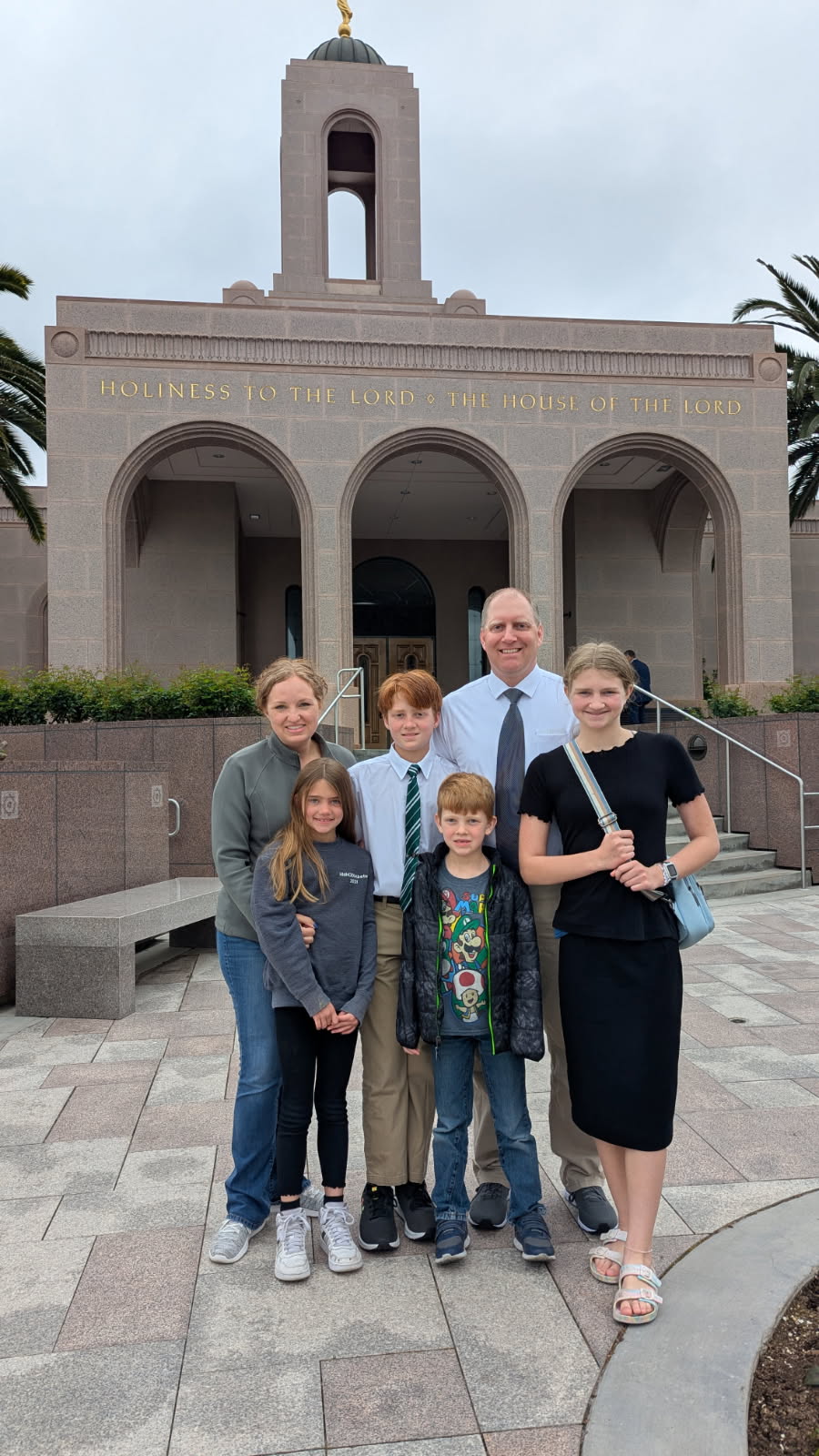
26 March 2025 – Newport Beach California Temple
19 April 2025 – Pocatello Idaho Temple – Brad Hales, Janet Hales, Eliza Hales, Aliza Ross, Aleah Hales, Elise Hales, Paul Ross, Hiram Ross
19 April 2025 – Idaho Falls Idaho Temple
16 May 2025 – Brigham City Utah Temple
17 June 2025 – Twin Falls Idaho Temple
6 July 2025 – Twin Falls Idaho Temple – Derek Hemsley, Paul Ross, Hiram Ross, Aliza Ross, Olivia Hemsley
16 August 2025 – Logan Utah Temple – Paul, Aliza, and Hiram Ross
6 September 2025 – Twin Falls Temple – Paul, Aliza, and Hiram Ross
24 October 2025 – Twin Falls Temple – Paul, Aliza, and Hiram Ross
29 November 2025 – Orem Utah Temple – Paul Ross, Hiram Ross, Derek Hemsley, Olivia Hemsley, Jill Hemsley, Aliza Ross
19 December 2025 – Syracuse Utah Temple – Paul, Aliza, and Hiram Ross

In addition to attending the temple for ordinances for 2024-2025, we also attended some temple open houses.

26 May 2023 – Saratoga Springs Utah Temple – Front (l-r): Jordan Hemsley, Hiram Ross, Jill Hemsley; Standing: Amanda Ross, Aliza Ross, Rowan Hemsley, Derek Hemsley, Olivia Hemsley, Lillian Ross, Paul Ross, James Ross, Jack Hemsley, Bryan Hemsley
6 August 2023 – Moses Lake Washington Temple
3 November 2023 – St George Utah Temple
23 March 2024 – Manti Utah Temple – Amanda, Paul, Hiram, James, Lillie, and Aliza Ross with Jill Hemsley
17 May 2024 – Layton Utah Temple – Lillian Ross, Paul Ross, Amanda Ross, Aliza Ross, Bryan Hemsley, Jill Hemsley, James Ross, Hiram Ross
18 May 2024 – Taylorsville Utah Temple – Bryan Hemsley, James Ross, Jill Hemsley, Aliza Ross, Lillian Ross, Hiram Ross, Amanda Ross, Paul Ross
11 October 2024 – Deseret Peak Utah Temple – Paul Ross, James Ross, Amanda Ross, Hiram Ross, Aliza Ross, Jill Hemsley, Lillie Ross, Bryan Hemsley, Shanna Thompson
16 May 2025 – Syracuse Utah Temple
30 August 2025 – Elko Nevada Temple – Brad and Rachel Hales Family with Ross Family with Lea Pierucci Izama (exchange student from Germany, staying with Hales family)
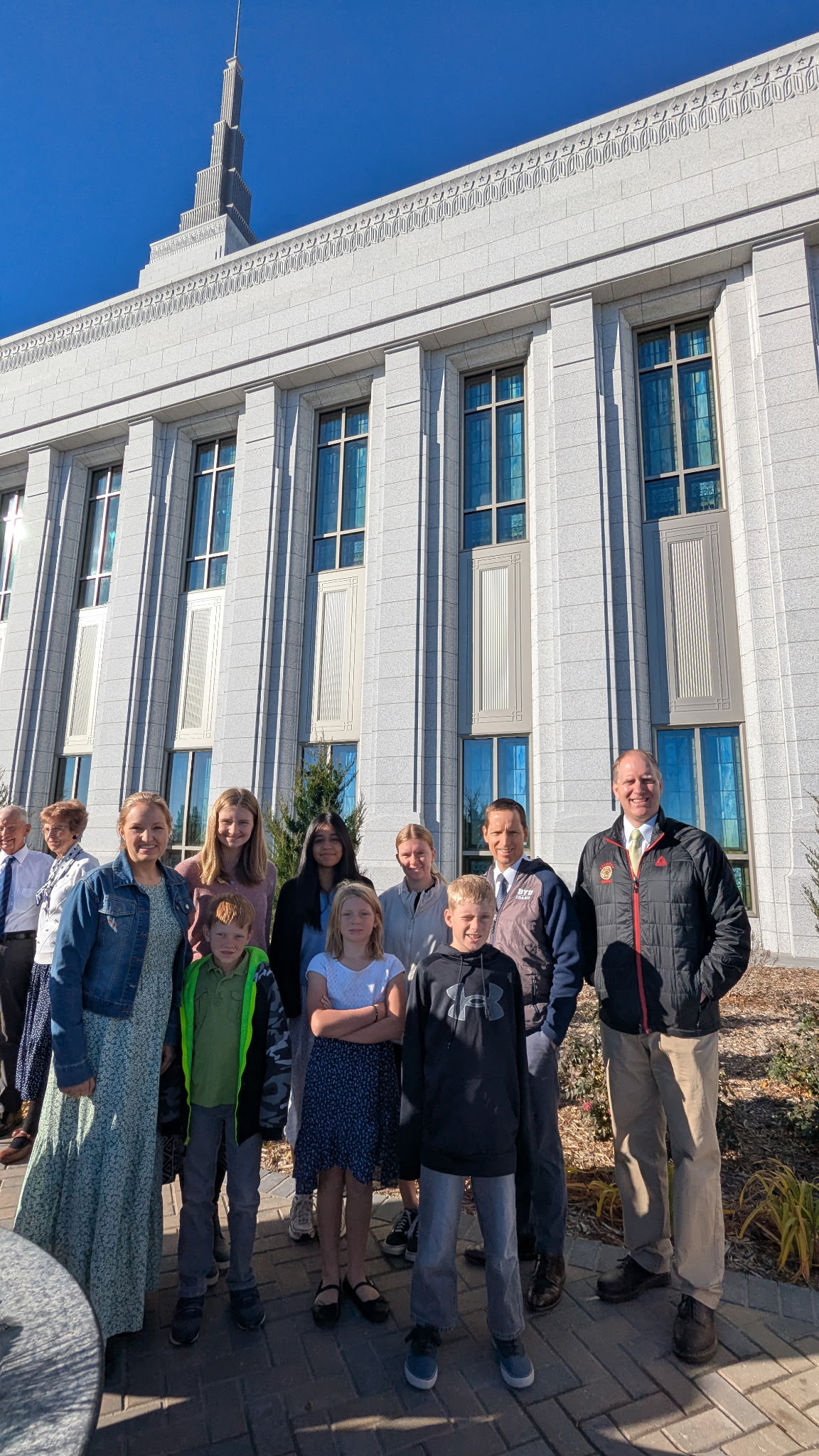
8 November 2025 – Burley Idaho Temple, Amanda Ross, Brad Hales, Anson Hales, Aleah Hales, James Ross (front), Lea Pierucci Izama (back), Paul Ross, Audra Hales, Aliza Ross

This was a fun visit. Some of the kids commented about where under the temple, in the foundations, might their rocks be found? We all submitted rocks with thoughts and our names on them that were placed before the foundations were poured.

14 November 2025 – Burley Idaho Temple – Hiram Ross, Amanda Ross, Lillie Ross, Rowan Hemsley (arm around), Margo Hemsley, Bryan Hemsley, Olivia Hemsley, Jill Hemsley, Jack Hemsley, James Ross, Paul Ross, Aliza Ross, Jordan Hemsley, Derek Hemsley

And other drive by shootings related to temples in 2022-2025.

4 June 2022Burley Idaho Temple Groundbreaking
6 August 2023 – Columbia River Washington Temple
28 August 2023 – Los Angeles California Temple
1 September 2023 – San Diego California Temple
26 March 2025 – Los Angeles California Temple
29 March 2025 – Oakland California Temple
29 November 2025 – Provo City Utah Temple – Paul, Aliza, and Hiram Ross with Jill Hemsley
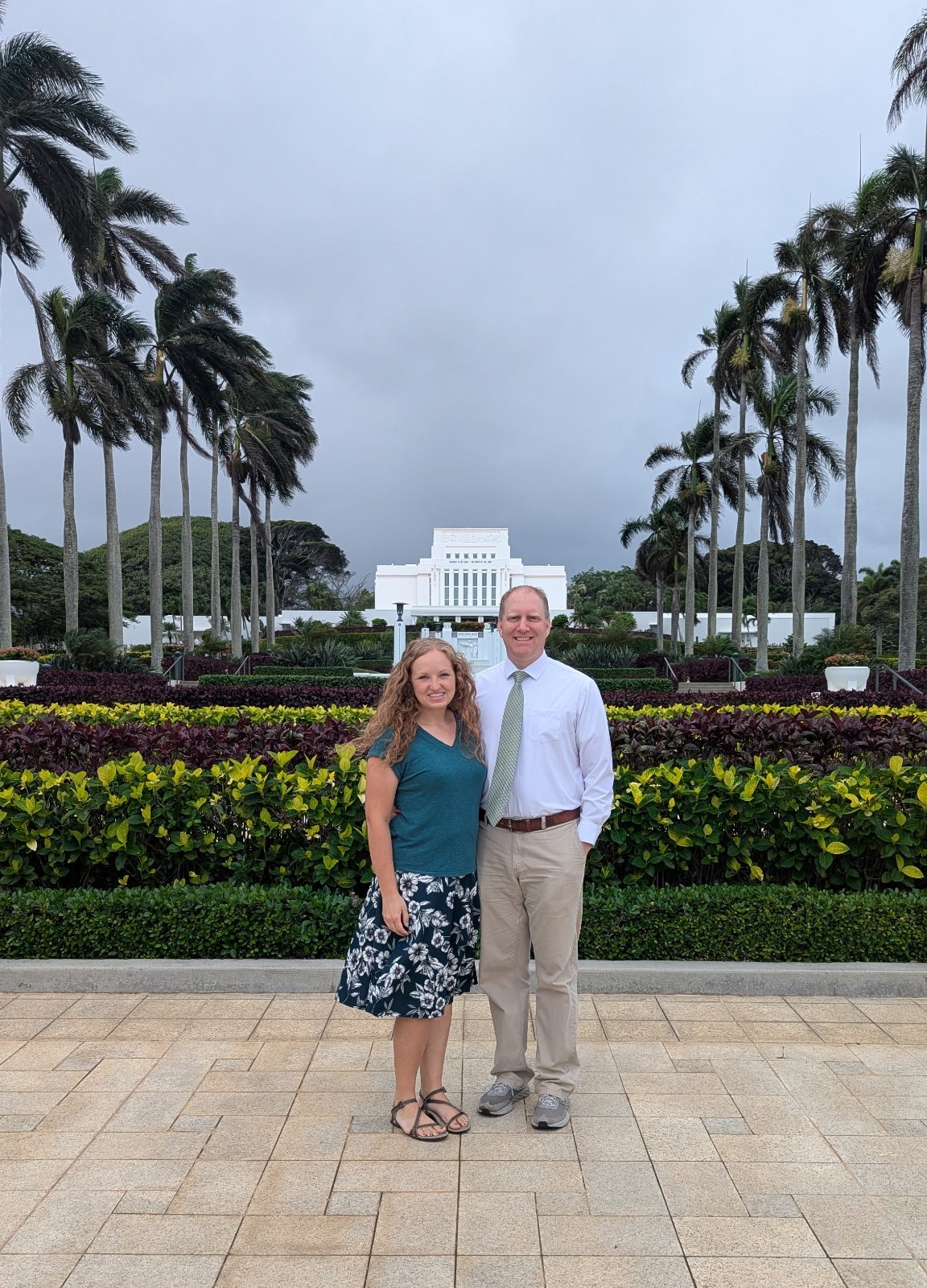
23 December 2025 – Laie Hawaii Temple – Amanda and Paul Ross

This is only a record of attending the temple for Aliza and Hiram. Many know I have had my own personal goal for monthly attending the temple from September 1998 to the present.

Casper Wyoming Temple Open House

We took the opportunity to attend the Casper Wyoming Temple Open House on 31 August 2024. We planned the weekend to do some sightseeing and visit some church and family history sites. I am reposting as this has updates on 3 additional ancestors that also came through the Overland Trail.

We left on the Friday morning with the hope of making it all the way to Casper before nightfall. We took old US Highway 30 through Soda Springs and Montpelier. We made a stop to visit the grave of my Grandmother in Dingle.

Aliza, Lillian, Paul, James, and Hiram Ross at the graves of Bud and Colleen Lloyd

We drove through Cokeville and reminded the kids of the story of the Cokeville miracle. As we drove along the old highway, I pointed out the old railroad Y that used to go to the Stauffer mine that was located in Leefe, Wyoming. I spent the first summer or two of my life at Leefe while my dad was tasked with tearing down and removing the mine with Circle A Construction. We stopped in Kemmerer to refuel and also drive past the first J. C. Penney store. We made a quick stop at the Parting of the Ways along the California, Mormon, and Oregon trails.

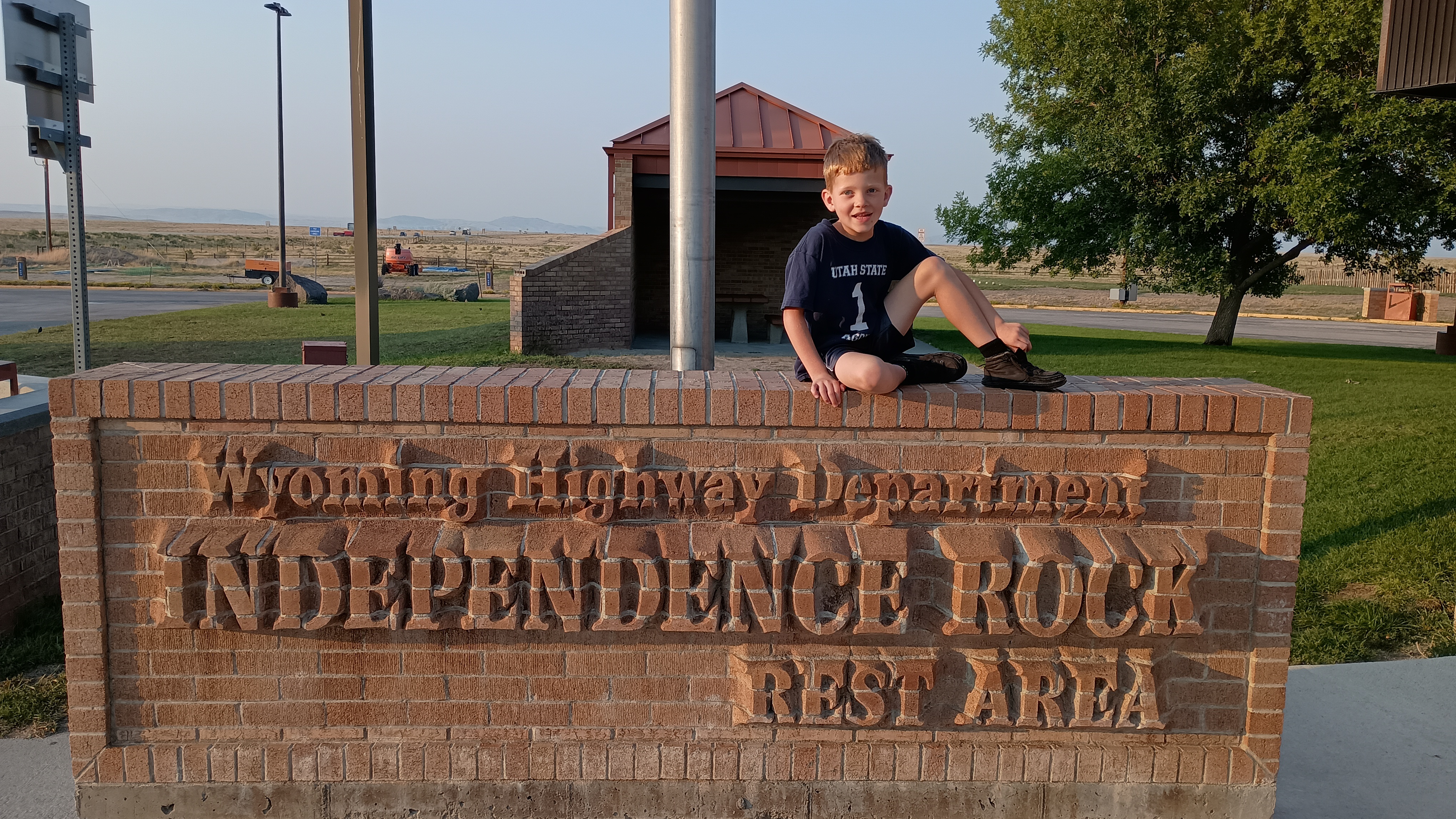
James Ross at Independence Rock

With four kids, we often stop at rest areas. As you can see above, we stopped at the one at Independence Rock. The rock is nearby and doubles as the parking location to visit the rock.

We finally made it to Casper about sunset. We ate an amazing Italian meal at Racca’s Pizzeria Napoletana and checked into our hotel.

Casper Wyoming Temple

We got up early, dressed appropriately, and headed out to visit the Casper Wyoming Temple. It was beautiful. Much smaller than I had anticipated. It is definitely one of the smallest temples, but that is because of the population and distance to other temples. It will supposedly have five stakes in its temple district, some of which will still come from a long distance to attend. Don’t let size fool you, it still has all the distinct parts of a temple and related quality. I think I may very much prefer the intimacy of the smaller temples. It actually reminded me of the Helena Montana Temple on size and flow.

Ross family at the Casper Wyoming Temple Open House

The temple does not have an adjoining chapel, but it does have a distribution/visitor center. We watched the video, enjoyed waiting in the line, and got to see the whole temple. If I were asked, there are a couple of design changes I would make for flow, but this temple will not regularly see these types of crowds or have those issues.

Ross family with the Casper Wyoming Temple

We hurried back to our hotel, changed, loaded up the car, checked out, and headed off to our next stop: The National Historic Trails Interpretive Center in Casper. I did not take any pictures there, but it was very well done. I enjoyed the visit, helped the kids with their junior ranger activities, and learned a few things. Part of the museum had its own little room and video dedicated to the Martin and Willie Handcart Companies.

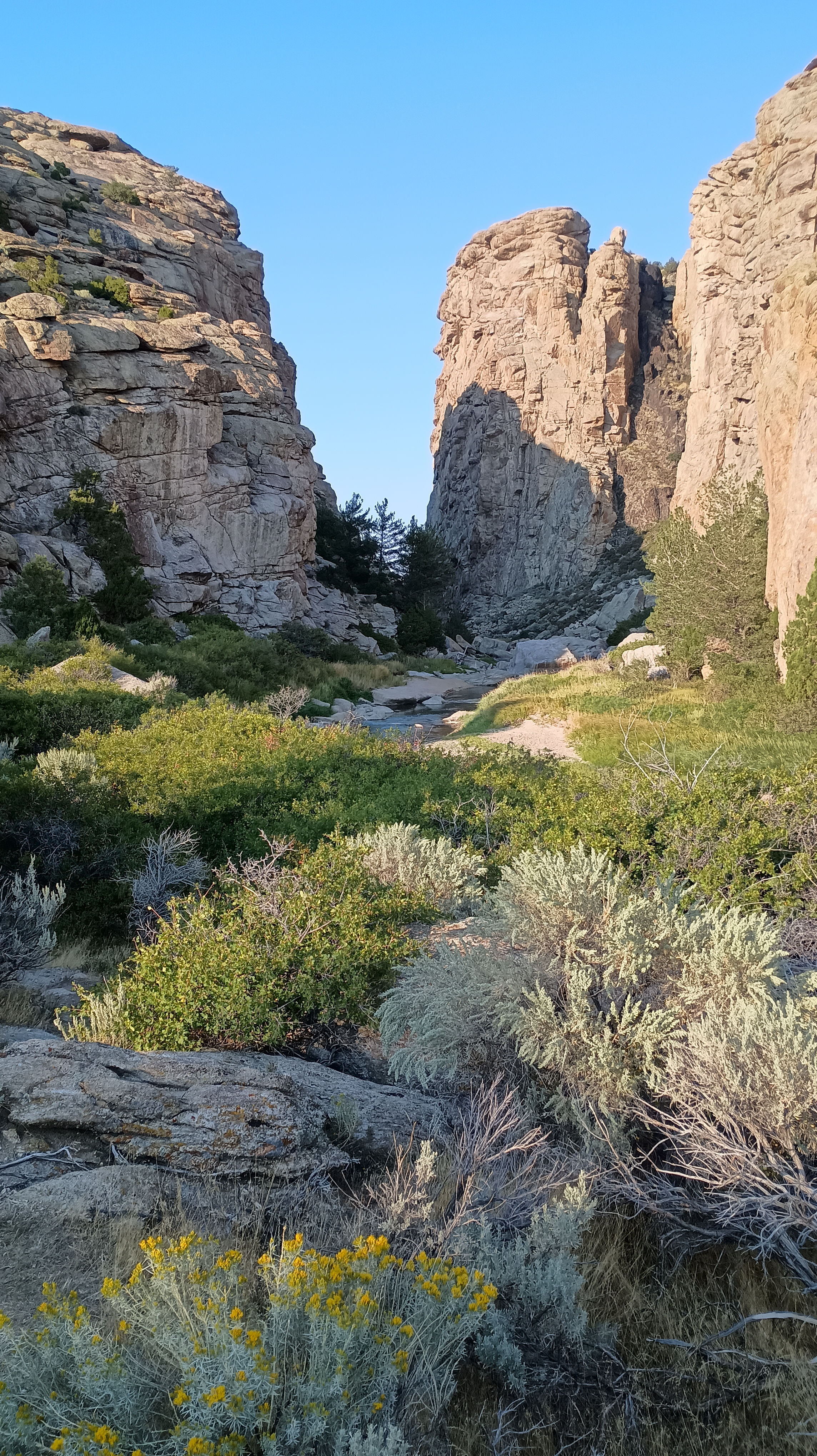
We stopped at Independence Rock again on our way headed west. We walked around the massive rock and looked at a number of the signatures carved into stone from over 160 years ago. It was hot and we needed to get our little doggies along to Devil’s Gate.

I will write about this more in a bit, but Devil’s Gate was a major landmark on the trail going west for all pioneers on the trails. But Devil’s Gate became more than a landmark and became a historical site in the tragic fall of 1856. Fort Seminoe was based there on the west side of Devil’s Gate, but it had been abandoned earlier that same year. It was that fall that the Martin Handcart Company found itself stranded in the snow. Days later the stranded handcart company moved into a nearby cove to get away from the wind, snow, and cold. That cove is now known as Martin’s Cove.

The Sun Ranch from Devil’s Gate, now The Martin’s Cove: Mormon Trail Site

We found the visitor’s center much more hospitable than some of our ancestors. As I worked through my family history, I had some of my own ancestors who passed through this very Devil’s Gate and area. Here are my ancestral lines that came across on the Mormon Trail. I had counted only 3 while in Casper, but hadn’t realized the Williams clan came over in two separate trips.

William and Mary Ann Sharp in 1853. Wagon train. Moses Clawson Company. William and Mary Ann met in the wagon train and married in Nebraska in 1853. William and Mary are my 3rd Great Grandparents.

John Williams in 1860. Wagon train. John Smith Company. John came over with his two sons John Haines (1829) and Richard (1838). I don’t know why his son David went separately in 1864. I am a descendant of John through David. John is my 4th Great Grandfather.

Johanna Benson in 1862. Wagon train. Joseph Horne Company. Johanna came over with some of her children and their families, her daughter Agneta, came over in 1864 with her family. Johanna is my 4th Great Grandmother.

William Edward Stoker in 1863. Wagon train. Unknown Company. William was traveling with his family, including the baby Mary Ann. William is my 3rd Great Grandfather, Mary Ann is my 2nd Great Grandmother.

John and Agneta Nelson in 1864. Wagon train. William Preston Company. Agneta is the daughter of Johanna Benson who came over in 1862. John and Agneta are my 3rd Great Grandparents.

David D and Gwenllian Williams in 1864. David is the son of John mentioned above. Wagon train. William S Warren Company. Gwenllian came with her sister Mary. Both married on the ship in Liverpool before setting sail for Utah. Gwenllian and Mary’s parents, David and Margaret Jordan, came over in 1872 crossing the plains by rail. David and Gwenllian are my 3rd Great Grandparents.

That gives me 10 ancestors that crossed the plains by wagon, none by handcart that I can tell. The unknown companies were all wagon trains as there were not handcarts those years.

Devil’s Gate – 2024

Every single one of these seven ancestors of mine who came west on the trail would have passed through Devil’s Gate. Here I stood on this sacred ground and snapped this photo of my daughter, my descendant and their descendant, at Devil’s Gate.

Aliza Ross at Devil’s Gate

It took me a bit more work, as I am not as familiar, to find those family lines of Amanda’s that also would have passed along the Mormon Trail to the west before the railroad made it much, much faster and safer. It took me several occasions over a couple of weeks to spend the time to research all these lines.

Henry and Ann Jackson in 1852. Wagon train. James C Snow Company. This is Amanda’s 4th Great Grandparents.

Regina Hansen in 1853. Wagon train. John E Forsgren Company. Her son, Hans Hansen, also accompanied her on the trip. Regina’s husband stayed behind. Regina is Amanda’s 4th Great Grandmother, Hans is Amanda’s 3rd Great Grandfather.

Grave of Hans Hansen in Plain City, Utah. Edith Sharp Ross’ stone is the stone at 10 o’clock from the top of this stone, my Great Grandmother.

David Buttar in 1854. Wagon train. William Empey Company. He appears to have traveled alone. Amanda’s 3rd Great Grandfather.

Birthe Jacobson in 1854. Unknown if wagon train or handcart company. Birthe’s daughter, Maria Jacobson, also accompanied her on the trip. Her husband Jorgen died in Missouri as part of the trip. Birthe is Amanda’s 5th Great Grandmother, Maria is Amanda’s 4th Great Grandmother.

Harriet Housley in 1856. Handcart company. Edward Martin Company. Harriet’s son, George Housley, also accompanied her on the trip. Two other children came later. Harriet is Amanda’s 5th Great Grandmother, George is Amanda’s 4th Great Grandfather.

Richard and Christine Hemsley (1836 – 1915) in 1857. Handcart company. Israel Evans Company. This is Amanda’s 4th Great Grandparents.

Ole and Anne Jensen in 1861. Likely wagon train. Unknown company. Amanda’s 5th Great Grandparents.

John Crompton in 1862. Wagon train. Joseph Horne Company. John also had his daughter, Hannah Crompton, with him. John is Amanda’s 4th Great Grandfather, Hannah is Amanda’s 3rd Great Grandmother.

Anna Nielsen in 1862. Wagon train. Christian Madsen Company. She traveled alone. Amanda’s 3rd Great Grandmother.

Joseph and Penelope Thompson in 1862. Wagon train. John Riggs Murdock Company. Their son, Joseph Thompson, also accompanied the family. Amanda’s 4th Great Grandparents, Joseph is Amanda’s 3rd Great Grandfather.

Joseph Wayment in 1863. Wagon train. Unknown Company. Appears to have come alone. Although his parents and most of his siblings would come later by rail. Amanda’s 3rd Great Grandfather.

Axel Boyer in 1866. Wagon train. Abner Lowry Company. Amanda’s 4th Great Grandfather. Also traveled with the Keeps, other ancestors of Amanda.

James and Ann Keep in 1866. Wagon train. Abner Lowry Company. Their daughter, Sarah Keep, also accompanied the family. James and Ann are Amanda’s 4th Great Grandparents, Sarah is Amanda’s third great Grandmother. Also traveled with Axel Boyer, other ancestor of Amanda.

Richard Hemsley (1801 – 1866) and his later wife Sarah in 1866. Wagon train. William Henry Chipman Company. Amanda’s 5th Great Grandfather.

Peter Peterson in 1866. Wagon train. Joseph Sharp Rawlins Company. Peter is Amanda’s 4th Great Grandfather.

That is the Hemsley line alone, Amanda’s Dad. I count 26 ancestors of Amanda’s Dad that came through Devil’s Gate.

James, Lillian, Hiram, and Aliza Ross at Devil’s Gate Mormon Handcart Visitor Center

Amanda’s Mom’s line, the Holden family, has the following:

Edwin and Ruia Holden in 1852. Wagon train. Uriah Curtis Company. Their son, Henry Holden, also accompanied the family. Edwin and Ruia are Amanda’s 4th Great Grandparents, Henry is Amanda’s 3rd Great Grandfather.

Jesse and Temperance McCauslin in 1851. Wagon train. Unknown Company. Temperance passed away in Council Bluffs, Iowa. She did not make the trail in Wyoming or Devil’s Gate. Their daughter, Louisa McCauslin, also accompanied the family. Jesse is Amanda’s 4th Great Grandfather, Louisa is Amanda’s 3rd Great Grandmother.

John and Adelaide Roberts in 1863. Wagon train. Thomas Ricks Company. Their son, Hyrum Roberts, also accompanied the family. John and Adelaide are Amanda’s 3rd Great Grandparents, Hyrum is Amanda’s 2nd Great Grandfather.

Thomas and Mary Ashton in 1851. Wagon train. Morris Phelps Company. Mary also passed away in Iowa. She did not make the trail in Wyoming or Devil’s Gate. Their son, Joseph Ashton, also accompanied the family. Thomas is Amanda’s 4th Great Grandfather, Joseph is Amanda’s 3rd Great Grandfather.

Sarah Jarvis in 1854. Wagon train. Job Smith Company. She came with some of her family, but not with her son, Amanda’s ancestor, George Jarvis. Sarah is Amanda’s 4th Great Grandmother.

George and Ann Jarvis in 1853. Wagon train. Unknown Company. George and Ann are Amanda’s 3rd Great Grandparents. George is the son of Sarah Jarvis mentioned above.

William and Rebecca Finch in 1854. Wagon train. Daniel Garn Company. William and Rebecca are Amanda’s 3rd Great Grandparents.

Joseph Finch in 1853. Wagon train. Joseph Young Company. Joseph is the son of William and Rebecca Finch mentioned above.

John and Hannah Davis in 1851. Wagon train. Eaton Kelsey Company. Their daughter, Mary Jane, also accompanied the family. The family also has Davies listed for their last name sometimes. John and Hannah are Amanda’s 4th great grandparents, Mary Jane is Amanda’s 3rd Great Grandmother.

John Evans in 1866. Wagon train. William Henry Chipman Company (same company as Amanda’s Richard Hemsley above). His wife, Sarah, died on the trip from the United Kingdom in New York. His son, John Evans, also accompanied his father and brother. John is Amanda’s 3rd Great Grandfather, John is Amanda’s 2nd Great Grandfather.

James and Elizabeth Boyack in 1855. Wagon train. Milo Andrus Company. James and Elizabeth are Amanda’s 4th Great Grandparents.

James Boyack in 1853. Wagon train. Appleton Harmon Company. James is Amanda’s 3rd Great Grandfather. James is the son of James and Elizabeth Boyack above that came in 1855 across the plains.

Margary Waterhouse in 1855. Wagon train. Milo Andrus Company. Margary is Amanda’s 3rd Great Grandmother. She came across with the same train as James Boyack’s parents, presumably that is how she met her future husband. The Company arrived 24 October 1855 in Utah, James and Margary married 23 November 1855 in Springville, Utah.

That is the Holden line alone, Amanda’s Mom. I count 26 of ancestors of Amanda’s Mom that came through Devil’s Gate. As an aside, I also looked at her biological line (as she is adopted), and not a single one of her biological ancestors passed through Devil’s Gate.

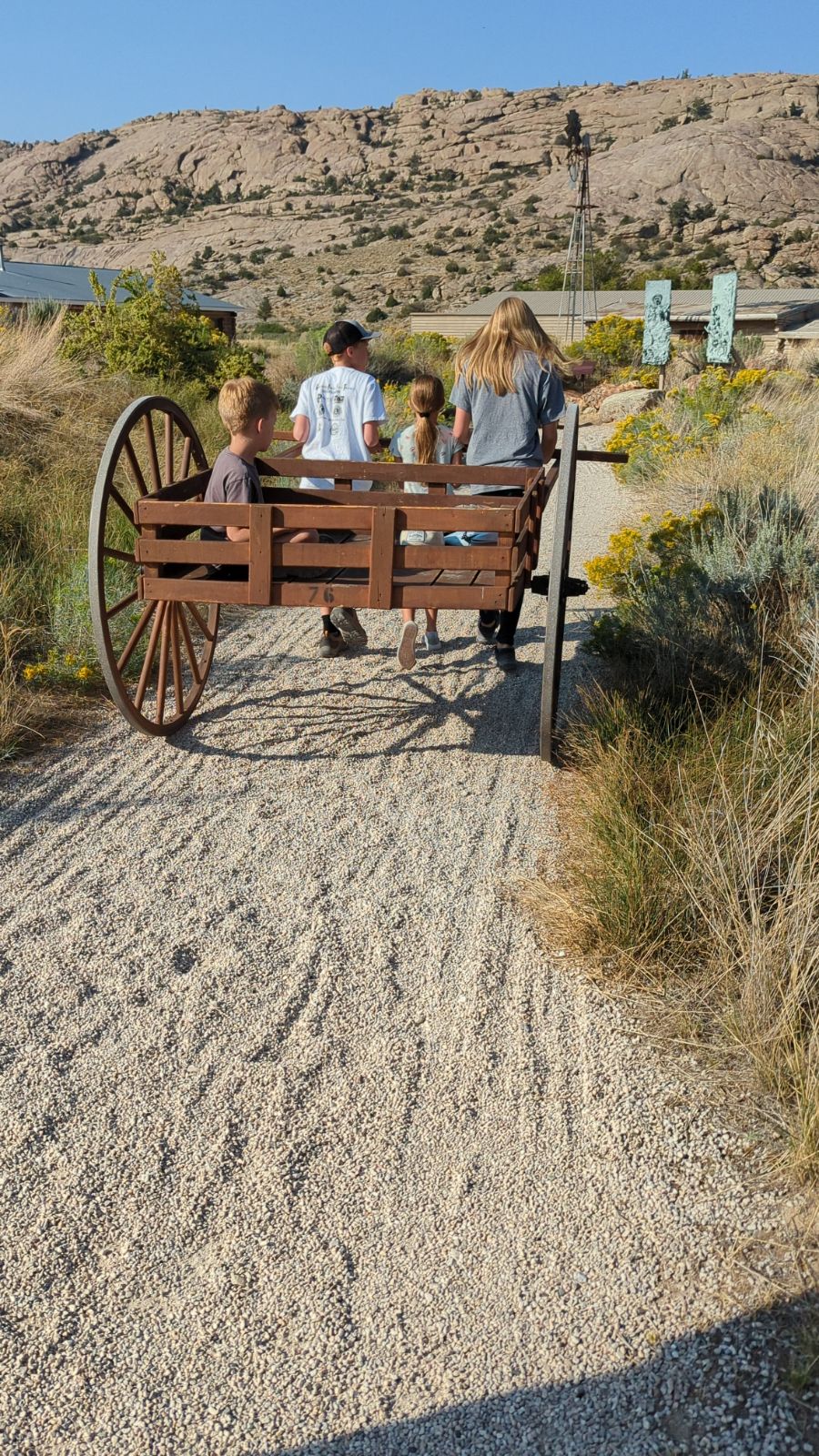
James riding while Hiram, Lillian, and Aliza Ross pull a handcart at Devil’s Gate Mormon Handcart Visitors Center

We also stopped and visited with the sixth crossing of the Sweetwater River. This was the location where, like the Martin Handcart Company, the Willie Handcart Company also got stuck in wind, snow, and cold in 1856. Their rescue occurred here.

The next day, on our way to Grand Teton National Park, we made a stop at Fort Washakie, Wyoming. This is one of the alleged graves of Sacagawea. We stopped and remembered her, whether her final resting place or not.

All in all, I was surprised by my own connection to the Mormon Trail. I had never considered that I have 7 ancestors who had literally came this way. Or that my children have 59 ancestors that literally come this way. They passed by Independence Rock, through Devil’s gate, and two of those 59 suffered with the Martin Handcart Company. I will write more on the Housleys later as there have been other interesting interactions with that clan since our marriage.

3rd Grade, Paul Elementary, Paul, Idaho

Back(b-r): Mrs. Ella Suhr, Shane Ball, Kaleb Winn, Scott Torix, Genevive Olivas, Kevin Orton, Jamie Mingo, Kristi Jensen; Middle: Jeff Hayden, Karlene Hansen, Jacob Timmons, Jalene Woodward, Paul Ross, Adrianne Neibaur, Archie Winnett, Nathan Jones; Front: Shaun Bettazza, Alfonso Jaramillo, Nicole Catmull, Emmy Mendoza, Erin Zemke, Kelli Osterhout, Cody Strunk, and Michael Thompson.

I have mentioned before when I shared class pictures from Paul Elementary for Kindergarten, 1st, 2nd, 4th, and 5th Grades, that I was glad to have other classmates who allowed me to scan the class photos. All mine were lost due to a flood in our basement while I was on my mission in 1998-2000. I am happy to report that the missing 3rd and 6th Grade pictures have been provided, thanks to Erin Zemke.

This is our 3rd grade class picture from Paul Elementary, Paul, Idaho. This was the 1987 – 1988 school year.

Normally I organized photos with married names and dates. Since all are still alive, I will forgo any of the dates. I have added the married last name for the ones I know. If you have corrections, please let me know.

Ella Lucille Senften Suhr (1927-2005)

Shane Ball

Shaun Bettazza

Nicole Catmull married Manning

Karlene Hansen married Ashcraft

Jeff Hayden

Michael Hollis now Thompson

Alfonso Jaramillo

Kristi Jensen married Rich

Nathan Jones

Emmy Mendoza married Deal (interesting side note, I remember coming back from a field trip at Craters of the Moon and dropping her off at home out near Kimima, our whole group of busses stopped)

Jamie Mingo married Harman

Adrianne Neibaur

Genevive Olivas

Kevin Orton

Kelli Osterhout married Bates

Paul Ross

Cody Strunk

Jacob Timmons

Scott Torix

Kaleb Winn

Archie Winnett

Jalene Woodward married Richman

Erin Zemke married McKindree

Hans Petersen

This is another story from the family history books of Golden Rulon Andra. This is the father of Annie Christine Petersen that I wrote about previously. This is an ancestor of Golden’s wife, Utahna Bird Andra.

Hans, Christian, and Kirsten Petersen

“Family History – HANS PETERSEN

“Born: 11 February 1837 at Salgelse, Sjaelland, Denmark

“Died: 7 July 1923 at Salt Lake City, Salt Lake, Utah

“Hans Petersen was born on February 11, 1837 at Slagelse, Sjaelland, Denmark, the son of Peter Jensen and Karen Jakobsen. His name became Petersen instead of Jensen, due to the Scandinavian custom that the child of a man should take that man’s first name and add the suffix “sen” so the son of a man named Peter became Petersen. Incidentally, the Danish law put an end to this custom during the life of Hans Petersen, so that he became the first Petersen in the Petersen genealogy of our family.

“Hans Petersen’s father, Peter Jensen, operated a small farm and it was the small farm house here in which Hans was born. The family belonged to the Lutheran Church, the state religion of Denmark. Peter Jensen, father of Hans, was a very short man in stature. Hans grew taller than his father, but was himself only a little over five feet tall. Then Han’s children grew taller than he himself and his grandsons are nearly all tall men.

“He went to the regular country elementary schools in Denmark in his youth and then worked on this father’s farm until he was 21 years of age, when he had to serve in the army according to the custom of the country. He was summoned to Copenhagen for training and it was there that he met Kirsten Jeppesen, who later became his wife. While still in his first year of army training, he married Kirsten. That was while he was still 21 years old. Incidentally, he was gray headed at that time, having gone gray early. As a boy his hair was black.

“Following his release from active army service, he and his wife went to the little tow of Lindeborg, Denmark, and there started burning charcoal for a living. After he had been married several years, and had three little children, a war broke out between Denmark and Germany, and since he was still a member of the reserve he was called into active service to fight Germany. Being a small man he was put into the front lines with all of the other small men, according to the custom. When his company was sent to the front he prayed to God that he would not have to shoot a man. When the battled started and he began to fire his gun, he noticed that it had jambed and would not fire. Then almost immediately he was shot through one side and fell, was taken with the other wounded soldiers, placed on a large lumber wagon with no springs (the only ambulance available) and taken to an old barn behind the lines which had been converted into a field hospital. He had only been there about ten minutes when German shells set fire to this improvised hospital and the doctors had to move all of the wounded 20 miles further black. They were again loaded on the lumber wagons and had to suffer the tortures of bad roads and the crude wagons during the journey.

“When the second hospital was reached and his wounds were examined by the doctors it was decided that an immediate operation was necessary to save his life. There was no anaesthetic of any kind and the patient just had to life and suffer during the operation. He afterward said that making the incision did not cause so much pain but while they were cleansing the wound and closing it, he chewed much of the sheet covering him into small bits the pain was so intensen. After he recovered, he was sent back to Copenhagen to recuperate and there he and the other wounded soldiers were highly feted by the populace.

“It was almost six months before he was released from the Army and permitted to return home. During most of this time, his wife knew nothing of his trouble but shortly before his return home, one of the family friends informed her that Hans had been killed in the war. It was a most joyous meeting when he returned home.

“In Lindeborg, where he armed and burned charcoal, he rented a home from a man named Sorensen, whose father was a Mormon elder laboring in that area. He had emigrated to America, and had been sent back to his native land as a missionary. The father’s name was Soren Christophersen. He had sought to hold a cottage meeting in his son’s home but was refused, although the son did permit his father to live at the home. While Elder Christophersen told Hans Petersen of his inability to find a place in which to hold a cottage meeting, Hans invited him to his own home, which was rented from around the area inviting people to the meeting.

“A large crowd gathered for the meeting, but in mob formation. They threatened to tar and feather Elder Christophersen. Hans nailed the front door and stood guard at the back door with a large club in his hand. He invited any of the mobbers to entered if they dared but none came. Instead, they remained outside shouting and hammering upon the doors and windows, saying they would get the Elder when he came out of the meeting. Hans told them that the missionary would remain in the house until the mob left if he had to remain all night. The mob did not leave until 2:00 a.m., and then Hans, armed with his club, accompanied the Elder to the Sorensen home where he was to spend the night. This affair started the Hans Petersen family to investigate Mormonism and was followed by subsequent cottage meetings. After much study and prayer, Hans and his wife decided to join the Church. His wife was especially well read in the Bible. The two were baptized in the middle of the night in a large hole which had been dug into the ground by farmers seeking rich soil to cover their land with. These holes filled with water, like wells, and it was in this water they were baptized by the Elder.

“Han’s wife became quite a preacher of Mormonism. Hans himself became president of the local branch and did much preaching although his wife did the scriptural speaking. They both gave freely of their time and means to the Church and often financially assisted the elders who traveled without purse or scrip. In those days they had to travel miles to attend each meeting because the area was sparsely settled.

“When the family decided to come to Utah to be with the Saints, transportation became a serious problem. The entire family could not come together so it was decided that the eldest daughter, Annie, should emmigrate first. She went to Arizona first, to the home of some other earlier emmigrants. Two years later the next sister, Minnie, went direct to Salt Lake City, and two years later again, Emma, the third daughter came to Salt Lake City. One year later the girls put their funds together for their sister Sophia to come. A little later Hans, his wife, and their only living son, Christian, came together, going first to Arizona to the home of George Hansen Newman. This man had taken the name of Newman after his arrival in America. The Arizona heat was too severe for the Petersens so they went by wagon team up through St. George to Salt Lake City where they made their home, first at 475 West Sixth South Street, in the old Fifth Ward and later moving to a house on Genesee Street, between Seventh and Eighth West, in what became the 26th Ward after the Fifth Ward was divided.

“Hans did labor work for a living, helping in the beautification of Liberty Park and in the construction of several canal systems. His wife died at the Genessee Street home on 20 November 1908, and was buried in the Salt Lake City Cemetery. Hans lived alone most of the time after this and he died in Salt Lake City 7 July 1923, and was buried at the side of his wife.

Hans Petersen

History of Plain City Pt 9

I have two copies of the History of Plain City, Utah. The front indicates it is from March 17th 1859 to present. As far as I can tell, the book was written in 1977. At least that is the latest date I can find in the book.

One copy belonged to my Grandparents Milo and Gladys Ross. My Grandpa has written various notes inside the history which I intend to include in parenthesis whenever they appear. They add to the history and come from his own experience and hearing. 

I will only do a number of pages at a time. I will also try to include scanned copies of the photos in the books. These are just scanned copies of these books, I have not tried to seek out originals or better copies.

History of Plain City March 17th 1859 to present, pages 141 through 149.

BONA VISTA IMPROVEMENT DISTRICT

SUBMITTED BY FLOYD PALMER

              This most important new culinary water system has made life a little more pleasant in this community and surrounding areas. It was turned into the lines just a century after sturdy pioneer families first put together temporary shelters and tapped several sweet water springs which they found in the area.

              It replaces old flowing wells, bringing precious waster from the depths of the earth. In early days many deep and surface wells dug, covered over, and fenced off to keep children from falling in. They were first fitted with “pitcher” pumps, a short-handled affair which were the “pumper” out in a short time. Even the farm animals had to depend on well water pumped to the surface by hand.

              Later, the easier to work, long-handled pumps were installed. These were followed by power pumps connected to a small storage tank. This was the ultimate in a private water supply.

              In 1955, a Weber County man, Linn C. Baker, was a member of the State legislature. He is the one who sponsored the bill to create special improvement districts. The reason he was the sponsor of this bill was due to his work in the Health Department for the State of Utah. As he studied samples of water sent to him from the outlying towns, he became aware of the amount of contamination there was in the drinking water in certain areas, Plain City was among the highest on the list. This was traceable to shallow surface wells being used, also septic tanks with poor drainage.

              Soon after the Weber Basin Conservancy District was organized, Plain City wanted to purchase one-thousand-acre feet of water. Their request was held in abeyance until a line could be built from Ogden Canyon. This, however, was never done.

              Elmer Carver was on the executive committee of Weber Basin Project. Through the encouragement of Commissioner Carver, Mr. Ezra Fjeldsted, manager of Weber basin Project, and Linn Baker, all met with the Plain City Town Board to get something started. Floyd A. Palmer, a member of the Town Board, was asked to represent Plain City on a committee of surrounding towns in Weber and Davis counties. Mr. Ezra Fjeldsted acted as chairman of this group and several meetings were held in both counties which Mr. Palmer attended.

              Following this, a public meeting was held in Plain city. Farr West, and Harrisville were asked to join in. This was for the purpose of starting a culinary water system. The results of this meeting, from all groups attending, were to go ahead, also to contact other nearby towns and get their feelings about joining in.

              A series of meetings were held in Farr West, Harrisville, Slaterville, Marriott, Wilson Lane, and Plain City. Other towns were invited to attend. Ezra Fjeldsted represented Weber Basin, Floyd A. Palmer represented Plain City, Dick Groberg represented Farr West, Kenneth Brown represented Harrisville, Clifford Blair represented Marriott and Slaterville, and Arthur W. Sorensen represented Wilson Lane. The meetings were all met with a great deal of enthusiasm and interest.

              Plain City Town Board consisted of Lee Olsen, President, Floyd A. Palmer, Elvin H. Maw, Merrill Jenkins, Blair Simpson, as members. A culinary water system was a prime item of the agenda in 1956. The town board along with several local residents were well organized to promote the need for a water supply to replace the surface wells and pumps.

              On July 19, 1956, Elmer Carver, Chairman of the Board of County Commissioners of Weber County, State of Utah, signed a certified documents that there be and is hereby created within Weber County, Utah, a Water Improvement District to be known and designated as the BONA VISTA WATER IMPROVEMENT DISTRICT, the same to embrace and include all real property lying within the following boundaries, to-wit: (SETS FORTH DETAILED LEGAL DESCRIPTION OF DISTRICT BOUNDARIES WHICH BOUNDARIES EMBRACE LANDS HEREIN ABSTRACTED – Abstracter)

              That the following-named persons are appointed as the Board of Trustees of said Bon Vista Water Improvement District:

                               Floyd A. Palmer, Plain City

                               Richard Groberg, Farr West

                               Kenneth Brown, Harrisville

                               Clifford Blair, Marriott-Slaterville

                               Arthur Sorensen, Wilson Lane

              This resolution shall take effect immediately and shall be recorded in the office of the Weber County Clerk. Recorded August 22, 1956.

Following this appointment from the Weber County Commission, the board held a short meeting. It was necessary to elect a chairman, after a discussion of each of the board members. Kenneth Brown was appointed as chairman.

              The first order of business was to secure professional and legal help. Mr. Jack Richards was appointed attorney. Jack Reeves, of the firm of Nelson, Reeves and Maxwell, was appointed engineer. They were appointed to do the field work and present the plans and drawings back to the board.

              When the plans were completed, the board spent much time deciding the most feasible and economical areas to run the lines in. Also, to give each town a fair share of the project. Following this, it was necessary to project estimated costs. The board spent many months getting costs and deciding on types and kinds of pipes and materials to use on the project. The overall plans had to look attractive and feasible in order to get a bonding company to handle the bonds.

              The first step made to secure the bond issue was to get signed pledge cards with an agreement to pay $250.00 for a waster connection. This was a requirement. Committees were organized with Floyd A. Palmer, Richard Groberg, Kenneth Brown, Clifford Blair, and Arthur Sorensen acting as chairman in each of their respective towns. The result was very successful, all those serving on these committee are deserving of much credit for their untiring effort and accomplishments.

              On August 20, 1957, a bond election was held to see if the residents would approve a $900,000.00 bond issue. The vote was 490 yes and 82 no. Edward L. Burton Company was retained as Fiscal Agent, and $698,000.00 was sold in General Obligation Bonds, and the system was under way.

              On April 14, 1958, a contract was awarded to Smith-Scott Pipe Company to furnish cement mortar-lined steel pipe for the main lines.

              Also, on April 14, 1958, a contract was awarded to Knudson Construction Company to install water mains in the Harrisville-Randall area which was Phase I of the project.

              Also, on April 14, 1958, a contract was awarded to Chicago Bridge & Iron Company to furnish and erect a 250,000.00 gallon elevated storage tank in Plain City.

              On April 28, 1958, Theron Palmer was hired as General Superintendent to oversee construction and to get it ready to serve and operated as a system.

              On May 27, 1958, an office was rented from the E. B. Stone Estate on the corner of 9th and Washington. The district still maintains its offices here. The building was purchased by the district in 1969 and has been remodeled.

              On May 27, 1958, negotiations were begun with the State Department of Welfare of obtain ownership of a spring located in Garner’s Canyon in North Ogden. The spring was used at the time by the welfare department at the Industrial School property for culinary use and irrigation use.

              On May 27, 1958, Weber Basin let a contract to Statewide Construction Company to build the 16-inch transmission line from 4000 South on U-84, down into the district where Bona Vista could connect to it.

              Also, on May 27, 1958, a piece of property located at 4100 West on 2200 North in Plain city, was purchased from Vern Palmer to construct the elevated tank.

Bona Vista Water Storage Tank

              Raymond Concrete Title Company moved in and drove concrete pilings 80 feet into the ground to support the tank.
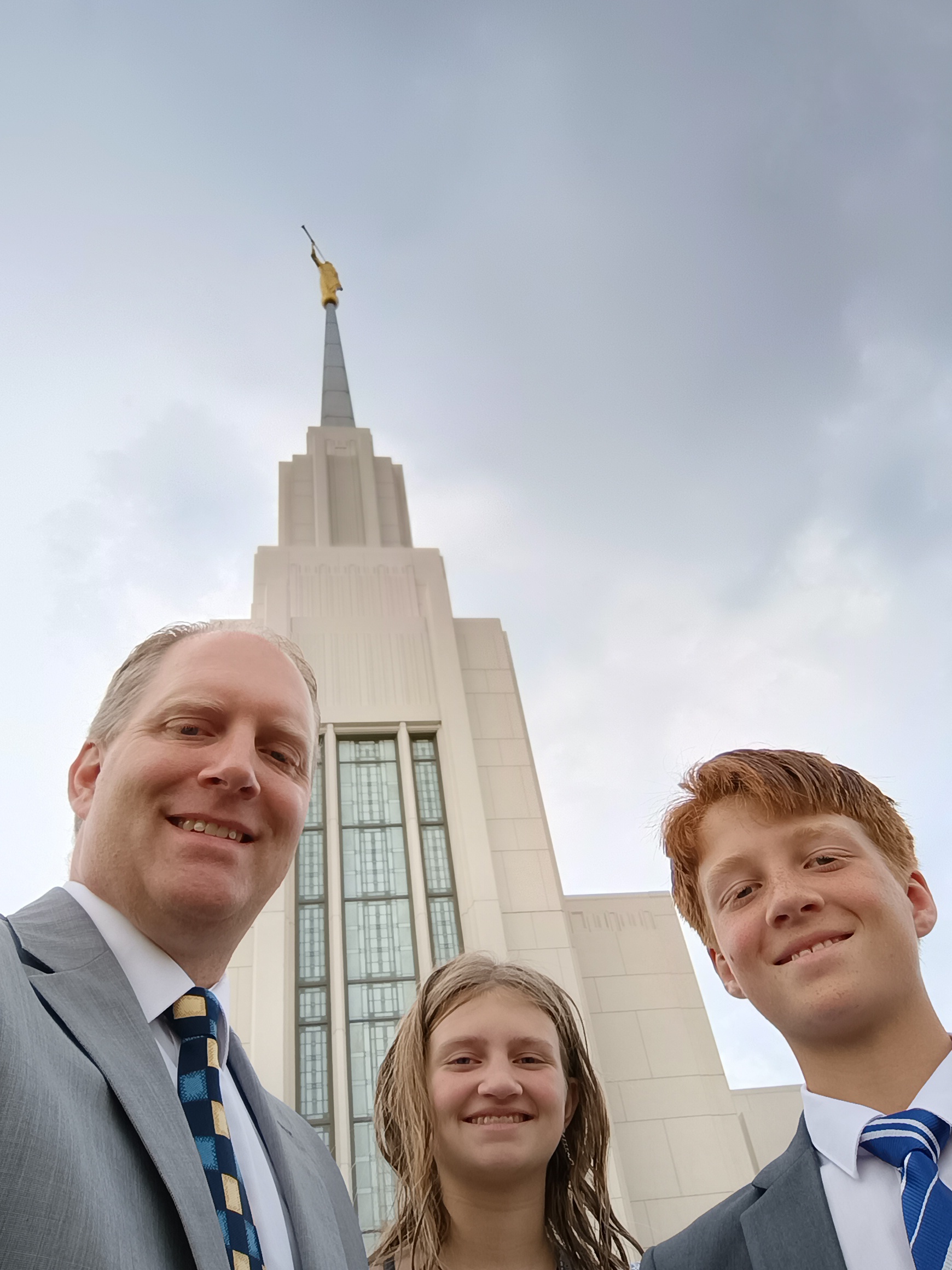
              Gerald Larkin was then awarded a contract to construct a foundation so Chicago Bridge and iron could begin erection.

              On July 3, 1958, a contract was awarded to Bert Robinson Construction Company to build lines in the Farr West and Plain City.

              Also, on July 3, 1958, Standard Plumbing Supply Company was awarded a contract to furnish materials for service lines.

              On July 17, 1958, the Weber County Commission agreed to purchase 60 fire hydrants to go on the system to be located by the Weber County Fire Chief.

              On July 17, 1958, Smedley construction Company was awarded a bid to construct lines in the Slaterville, Marriott, and Wilson area for $44,975.00. The same day Mac Construction Company of Salt Lake City was awarded the bid to construct our North Ogden Reservoir for $16,911.00. This is a concrete underground reservoir.

              On August 11, 1958, an agreement was reached with the Welfare Department to obtain full use of the spring in North Ogden. Weber-Box Elder water was purchased to replace the Welfare Department’s share of the spring.

              On February 11, 1959, work began on the plans and site for a reservoir in the Roy area.

              On March 23, 1959, it was decided to run a line on the North Plain City Road.

              On August 27, 1959, it was decided to either buy or condemn the Hansen property for a reservoir.

              A bid to build a tank in Roy was awarded to Wehyer Construction Company for #31,403.80 on September 23, 1959.

              Negotiations began to buy an eight-foot well from the Farr West Stake for $31,403.80 on September 23, 1959.

              Linn C. Baker resigned as Secretary on January 1, 1961. He had been with the district since it began.

              On December 6, 1961, it was decided to construct extensions to existing mains in the amount of $90,000.00 General Obligation Bonds were sold to finance these extensions. Waterfall Construction Company did the job.

              All though the summer of 1961, the Farr West well was tested to see if it would hold up.

              On February 28, 1962, President Wimmer signed the Warranty Deed on the Farr West well and property. On January 16, 1963, it was decided to put heat lights on our Roy tank. This was the first such installation in this area and it drew a lot of attention.

              The Utah State Health Department studied the plans for use of the plans for use of the existing well in Farr West and decided against allowing it to be used because of its depth. A change application was then filled with the State Engineer to drill the well to a deeper depth.

              On May 10, 1963, a contract with Wesley Stoddard was made to drill a well in Farr West for $21,632.00 plus $4,700.00 for the test hole to see how deep the well would have to go.

              A meeting was held at the Farr West Pump House building on January 20, 1964. This building was contracted by the Bona Vista Water employees. The piping was also done by employees of Bona Vista.

              R. W. Coleman Company was awarded a contract for $18,877.50 to change some lines under the interstate highway on November 22, 1965.

              Negotiations began on March 28, 1966, with Weber Basin on the North Ogden Well, which was later drilled and is used in the system now.

              Water meters were deemed necessary and were bought by bid from Waterworks Equipment Company and E. C. Olsen Company on October 28, 1968.

New Plain City Canal

BEGINNING OF PLAIN CITY IRRIGATION WATER

              1859 Before the summer was over some water had been brought in their new ditch from Four Mile Creek to Plain City. In 1860, the Canal was completed to Mill Creek, the following year to Broom’s Creek and in 1862 to the Ogden River. The Right of Way in Weber River was purchased in 1873 at a cost of $2000.

              In 1899 Samuel Wayment drilled an Artesian Well 249 feet deep producing additional water for the settlers. He also was in charge of the iron work and the building of the Chief Canning Factory in Plain City.

PLAIN CITY IRRIGATION-CEMENTING OF THE MAIN CANAL

SUBMITTED BY Wayne Skeen

              For many years the Plain City Irrigation Company received it’s water from the Weber River. The diversion point into the canal was just north of the old American Packing Plant that was later called the Swift Meat Packaging Plant. The Irrigation Company had a large Plank Head Gate in the Weber River that forced the water into the Plain City Irrigation Company Canal because of high waters in the spring this gate would wash out and it was necessary to make a gravel and dirt dam each year using horses, scrapers, and even large bulldozers. In recent years this became a major problem.

              The government began planning the Willard Project in 1960. This project would interfere to a certain extent with the existing canal used by the Irrigation Company because big Willard Bay Canal would be built in part of our existing canal and would also cross it in part of our existing canal and would also cross it in other areas. The leaders of this project wanted to provide a turn out from the big canal into the Plain City Irrigation Canal. The corporation of our company was necessary to give them the right to use the area affected by the construction of the Willard Bay Canal. The logical point of diversion would be west of the Farr West Church House. This meant that some new construction would be necessary to get the water into the old canal. It was in need of some repairs and it was at this time that the idea of a new cement lined canal was entertained.

              Directors who served during this period of construction were as followed:

              President                               Abram Maw                1959-60

              President                               Alvin J. Robson           1961-65

              Vice President                       Walt Christensen        1959-64

              Vice President                       Carl Taylor                  1965

                                                            Bert Hunt

                                                            Charles Heslop

                                                            Keith Blanch

                                                            Mike Panunzio

              Secretary                               Wayne Skeen              1959-65

              High lights of the minutes of the meetings during the construction period are as follow:

August 11, 1959

              Ogden City had extra water for sale this year which was allocated out to various canal companies. A motion was made by Alvin Robson that this water be purchased to see them through the current season. It would be paid by those stock holders who subscribed for the extra water.

April 4, 1960

              The meeting was called to discuss the new canal. Charles Heslop was assigned to work on interested free money from the Utah Water & Power board for the construction. Alvin Robson was assigned to work with the Soil Conservation on the completion of the surveying of the canal, and additional monies.

July 12, 1960

              A meeting was held to discuss a possible shortage of water for the remainder of the year. Time was changed from 20 shares per hour to 25 shares per hour.

January 9, 1961

              A priority was established with the Utah Water an Power board for interest free money and application made for $100,000.00

              A survey showed that there was a 10% loss of water between the River turn out and the Point of use.

March 8, 1961

              The Irrigation Company received a $10,000.00 cash settlement for their rights in the old canal from the O.U.R.D. Railroad Company that passes through their yards.

              Alvin Robson, Carl Taylor, and Walt Christensen was to secure information regarding tiling of the canal from Victor Lund’s corner up to the Jesse Singleton property where the canal leaves the road and runs back into the fields.

April 20, 1961

              A report was given by Alvin Robson regarding the tiling of the lower part of the canal. There were mixed emotions about tiling this section of the canal because of the fall and the amount of water to be delivered. “Alvin Robson commented as the discussion went on concerning the piping verses the cement lining. The stockholders are residents of this town and should have some concern towards the improvements and beautification of the community and that an open cement lined canals to greet the people entering the town is not very inviting and once it was constructed it would never be changed in our life time.”

              Keith Blanch speaking as a town board member expressed his opinion regarding the beautification and eliminating hazards in the community and felt that it was worth while and the tax payers should help with the construction of the Irrigation Company in piping this section of the canal.

              Glen Charlton and Lee Olsen from the town board were present. An opinion was asked from the town board members. Mr. Charlton felt it was a worth while project as long as it was right. Mr. Olsen commented that it was a good thing as long as it was sufficient to meet the needs of the water users.

              The town board members agreed to cover the pipe that was laid with dirt. It was agreed that 2880 feet of 36 inch tile would be laid this spring from the old beet dump corner to Victor Lund’s corner.

April 27, 1961

              The Town board members present: Dee Cook, Glen Charlton, Kent Jenkins, and Lee Olsen. Mr. Covey from Utah State University was also present.

              Further discussion concerning cost of construction of the concrete pipe continued. Keith Blanch made a motion that the town board and property owners should join with the Irrigation Company in the cost of the 36 inch tile to be laid. Motion seconded by Carl Taylor

              Mr. Robson suggested the property owners who would benefit from the lining of the canal pay $1.25 per foot frontage towards the pipe. The Town Board said they could only participate within the city limits and they would contribute $4,000.00 over a 10 year period. The bids were to be sent to Secretary Wayne Skeen by March 30, 1961.

April 30, 1961

              The purpose of this meeting was to open bids. Utah Concrete Pipe Company received bids for 36 inch concrete pipe at $8.75 per foot. Waterfall Construction Company was awarded the laying of the pipe at $1.55 per foot.

              Abram Maw made the motion that the project not be stopped at the beet dump corner but continue up to the up to the weir east of the water tower (where the pipe portion of the canal now starts) if the property owners will contribute $1.25 per foot. Motion seconded by Keith Blanch.

              Charles Heslop ad Elvin Maw were asked to approach these property owners and get their approval to pay the $1.25 and also contact all stock holders and get their signature for government participation thru the Soil Conservation.

              Charles and Elvin were successful in getting all the names except Jesse Singleton who would not accept any government monies and would not pay the $1.25 per foot to tile in front of his property.

              Alvin Robson contracted Howard Singleton, Jesse’s boy and he agreed to pay the $1.25 but only up to the old house that sat in the field and that is where the concrete pipe starts today. Alvin Robson tried to convince the Director’s that they should at the company’s cost tile the remainder of the ditch along the road because any future expansion of the community would by hampered by open ditch reducing the width of the road. This motion turned down.

              Walter Christensen made the motion that Alvin Robson meet with the Soil Conservation to discuss details of cost and tiling and lining the canal.

April 31, 1961

              Alvin East, Maurice Skeen, and Owen Wayment from the Warren Irrigation Company met with the directors to discuss details and sign a contract for the exchange of Ogden and Weber River which would benefit both companies. The contract was signed.

              Mr. Daniel Lawrence from the Utah Water & Power Board attended the meeting. Keith Blanch made the motion that Alvin Robson and Wayne Skeen be given the power to enter into a contract with the Utah Water & Power Board for the total cost of $1,300.000.00 and formulate all details.

May 3, 1961

              Junior Taylor was appointed as Water Master of the year.

May 15, 1961

              The purpose of this meeting was to discuss the Weber Basin Project with E.J. Feldstead and commissioner Wilmer Carver. They needed additional votes to finish construction of the Willard Bay. A proposed addition would cost seventeen million dollars.

June 5, 1961

              The purpose of the meeting was to see what should be done because it appeared that there would be a water shortage before the end of the year. It was proposed that we only run off water until the stream reached a point that we could not water properly and then start to use our shortage water and put turns on 1/3 basis.

September 27, 1961

              The new project was discussed and it was recommended that the company hire an engineer and begin construction on the upper end of the new canal.

              There were many problems that came out of the construction of this canal. It would be necessary to get some dirt to construct the pad for the canal. The company purchased some ground at the upper end of the canal from Max Stander. Then got the dirt that was necessary to build the upper end of the canal and then leveled the ground and gave it back to Mr. Stander. They also purchased additional dirt from Robert Penman. This dirt was trucked from his property just south of the Weber River and west of the main road. The dirt was hauled by farmers using their beet trucks, etc.. The new pad was made in the old canal banks where possible, but there was some trading of land etc. to straighten out the canal. There was also a problem in getting someone to dig out the canal to the size and shape required to allow 50 seconds feet of water at one time. The company asked for bids, but they only received one because the equipment needed to shape the canal was not available. In order to get the project moving Alvin Robson caught a bus on Ogden and went to the Fuller Forms Company in Arizona to see if they had some type of equipment that could be used. He purchased a right to one of their slip forms that could be used in forming and pouring the concrete. He returned to Ogden and worked with the Ogden Iron Works on 23rd Street and Grant Avenue where the construction of the slip forms took place. The next problem was to begin the construction of the project. Dean Hadley of Taylor was hired to do most of the big equipment work. Local farmers also helped with their equipment. The Soil Conservation furnished the engineering on the project. Herbert Issackson of Pleasant View was the surveyor. One of the major problems that existed and is still a yearly discussion is the amount of water delivered from the existing head gates. The government required that curtained head gates must be varied in size for them to participate financially.

Oct 1962

              There was much contention and personal feelings during the construction of how it should be done. Some people left the jobs and never came back, but the project was finally finished. The construction created problems for some but most of the inconveniences were ratified by the Irrigation Company. New bridges were built, land was leveled, damages to property was crops were paid for during the construction. The Company paid for fencing materials with the property owners installing the fences. Cattle that used to walk across the stream would fall into the new lined canal and couldn’t get out. The Company paid for some of the cattle that were lost before the agreement to install fencing was made.

              The total cost of the project was $199,754.08. The amount of $122,918.61 was borrowed from Utah Water & Power Board. This money was interest free if a yearly payment was made by November 30th each year. The last payment of $8.257.06 will be paid on November 30, 1977. Other cost not being paid by the stockholders come from the Soil Conservation and the sale of pieces of the old canal, and the town board. Vice President Bill Hatch of the First Security bank was also an asset in the financing of the canal.

              We borrowed monies from the First Security Bank as construction went on to pay for cost on a daily basis. On December 31, 1974, the company owed the First Security bank $60,000.00 Alvin Robson and Wayne Skeen met with Mr. Hatch in May regarding this bill. Mr. Hatch said that the bank needed some type of security for this loan. There was nothing to give him because out rights to the canal had been given to the Utah Water and Power Board. Alvin Robson and Wayne Skeen then approached Mr. Lawrence of the Utah Water and Power Board asking them for more money for the project explaining the situation with the bank. Alvin Robson explained that they might just as well take over the ownership of the canal because the bill had to be paid. There was nothing to offer as security because the Utah Water and Power board had everything that the company owned. Later, Mr. Lawrence of the Utah Water and Power Board gave the Irrigation Company an additional $30,000 which helped to delete that note at the First Security Bank.

*********

Canal after completion