
This history came into my hands from Golden Andra’s collection. A received a large stack of family history from his family. I am reviewing and making them available in this format. I typed this one about Pauline as typed, misspellings and errors too.
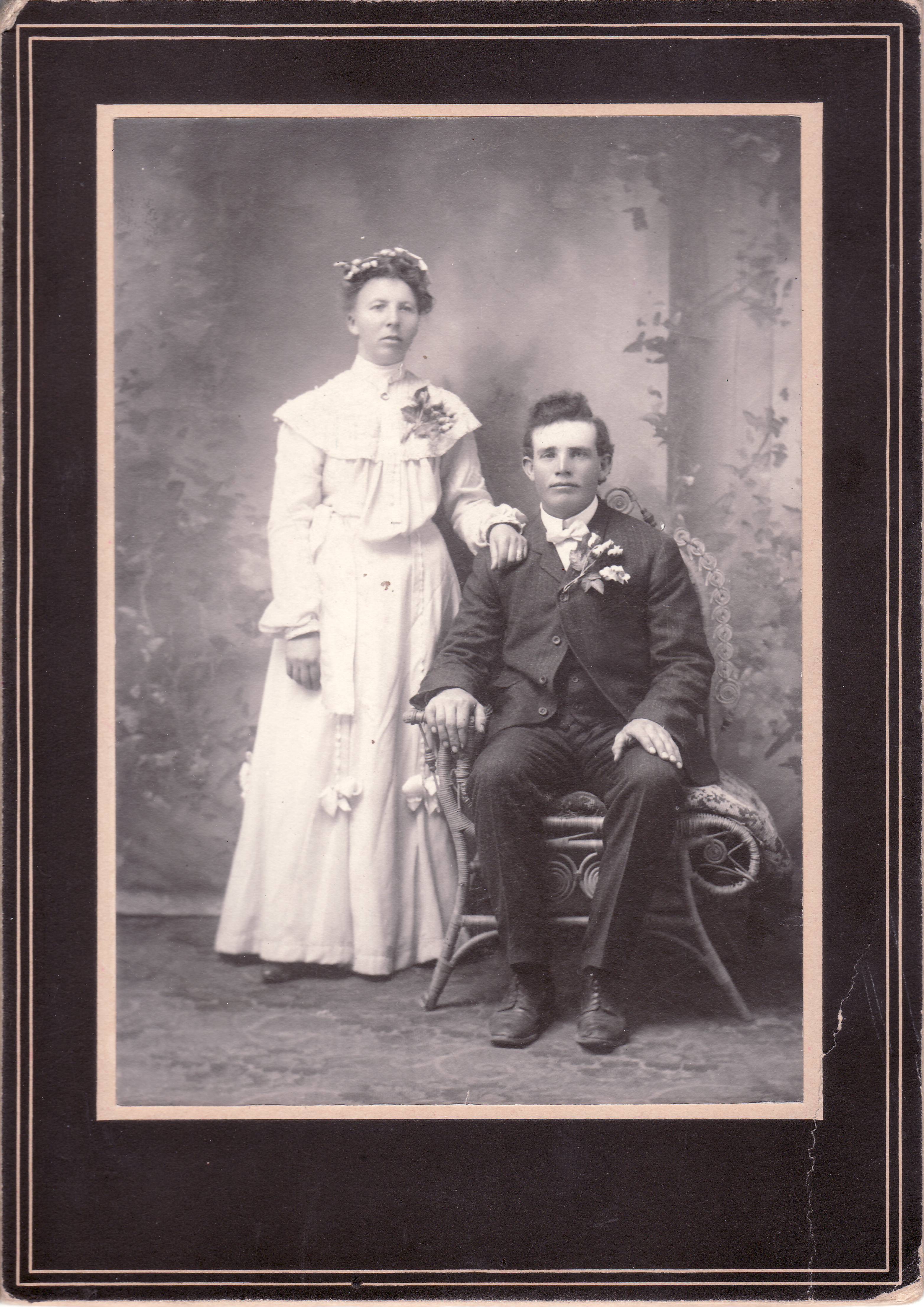
“This history was compiled August 3, 1993, by J. Allyne Kemp Crossley from two seperate histories, a story written by her son, Richard and information obtained from various family members, at a special request for he 1993 Wanner Reunion, which celebrates the 123rd year of the Wanner family.
“Pauline Wanner Crossley, daughter of Johann George and Ann Maria Schmid Wanner, was born in Atzenweiler, Neckarkreis, Wuertthemberg, Germany on April 1, 1884. Wuertthemberg, being one of the states of the divided nation of Germany. At the time of her birth, she joined a family of seven brothers and sisters, she being the eigth child. Following her birth two more children came to the family making a total of ten children: five boys and five girls, two of which died at an early age, while the family was still in Germany.
“Pauline and her brothers and sisters were very fortunate to have had parents who were honorable, upright, and hard-working people, who loved their children and worked very hard to see that they got the very best that they could provide. Both parents believed in God and had a strong faith that their prayers would be answered in providing them with the blessings they needed. They belonged to the Lutheran Church, and tried to teach their children correct principles.
“Sometime during the year of 1891, Johann, Pauline’s father, brought some missionaries to their home. These missionaries were representing the Church of Jesus Christ of Latter-day Saints, they were Jacob Zollinger [1845-1942] from Providence, Utah; John Hassenfritz, from the Bear Lake area, and John Federly of Salt Lake City, Utah.
“After the missionaries had been teaching them the Gospel for some time, the family became very interested and decided they would join the Church. Some of the family were old enough to be baptized and they became members of the Church of Jesus Christ of Latter-day Saints, in October 1891. Pauline waited until after the family arrived in America to be baptized on January 7th 1897, just three months before her 13th birthday. Joining the Church brought peace to their minds and joy to their hearts. It did not take long for the family to decide that they wanted to leave their native land, and come to the United States, where they could have religious freedom and better opportunities for their families, and to provide for their wants and needs.
“Not long after their baptism, some of the missionaries were preparing to return to their homes in the U.S. and Johann and Maria decided to send their older son, George to America with them, he’d be the first member of the family, to come to this country.
“In the Spring of 1893, Pauline’s parents began making the preparations to take the rest of their family to America, saying “Good-bye” to all their relatives, friends, and their native land.
“They had to ride the train for one day, afterwhich they took a boat up the Rhine River which took three of four days, then they took another train for another day, which took them to the North Sea. Here they got on another boat which was larger than the first, which would take them to Liverpool, England. The sea was very rough and the weather stormy, so it took another day before they reached Liverpool, where they boarded a big ship to sail to America.
“They were on the ocean for about 2 weeks, before they finally reached New York, where they stayed for two or three days. From New York, they took the train once again, and started their journey across the American Continent, for Salt Lake City, Utah, having to stop in Chicago, Illinois for one day and night. After arriving in Salt Lake City, they then continued their long and tedious journey to Franklin, Idaho where they arrived on the 18th of June 1893, all being very happy, and anxious, to get settled in their newly adopted homeland.
“They were met by their brother, and son, George and Mr. Fred Nuffer. Mr. Nuffer invited George, and all of his family to stay at his home, until they could find a place of their own, which was about one week.
“The Sunday following their arrival in Franklin, they all went to church, traveling to Glendale, where they had their membership records moved to, from the Branch in Germany.
“Grandpa Wanner soon bought the home and farm of John Nuffer’s in Glendale and the family lived there for a number of years before buying a home in Logan, Utah.
“Pauline worked hard on the farms that her father had bought – he bought several for his family to run. The members of Pauline’s family were all good workers and they all strived very hard to make a go of it, in this new land. Each of them was also very diligent in working for their beliefs, for their church, and for their Savior, Jesus Christ – including Pauline – she was a member of the Relief Society Presidency, while her children were still young she would take the “Black-top” and make many trips down to Thatcher.
“Not too much is known about Pauline’s romances, as a young lady, but her daughter, Annie, remembers hearing Pauline talk about a young man that she was engaged to, prior to Pauline’s engagement to her Dad, who was killed in an avalanche – Pauline only talked about it a few times.
“Pauline Wanner and William Henry Crossley, were married in the Logan Temple on December 14th 1904; Pauline was 20 and Will was 26 at the time, they both had dark brown hair but Will’s was curly.
“Will’s parents were John and Eliza Clements Crossley, he was born the 16th of October 1878 at Weston, Idaho and was baptized May 7th 1887. He had only one older brother, named Emanuel; one half brother, Levi, also lived with them while they were at home.
“To Pauline & Will were born four girls and five boys. Their first child, a beautiful baby girl, whom they named Florence, was born about 1905, she lived for about one year, then died in a very tragic fire. About one year later, another little girl was born whom they named Violet, she lived only two weeks; a third little baby girl, named Fern, was born on May 25th 1908 and she lived for only a few hours. Pauline was out helping to put up hay when a load tipped over on top of her, bringing the baby too soon. A 4th little baby girl, Annie Laurie, who’d be their only living daughter, was then born on April 30th 1909. *(According to Annie’s birth certif., she was born in March).
“Following the birth of Annie Laurie, the family grew with the addition of the boys, each arriving about two years apart from one another. Joseph Henry, arrived on April 14th 1911; Richard Wanner on January 27th 1913; Albert John was born June 28th 1915; Clarence William, who everyone knew as “Virgil” was born March 18th 1917; he died September 6th 1984, and is buried in McCammon; and then Cyril Chester was born on October 28th 1919. These children brought lots of joy to their mother, and I’m sure that had she have lost Annie, her only living girl, she would have just laid down and died right then —
“The Pioneer immigrants had to make many sacrifices and endure many tragidies in order that they could live their faith and belief in the Gospel of Jesus Christ – many having to leave their homeland and their families, worldly goods, even suffering sicknesses and surviving near starvation and freezing temperatures – But I can’t imagine the pain and heartache of having to watch a home that I’d help build with my own hands, be destroyed in a fire, along with a very precious baby daughter – Florence, when she was only about a year old.
“Pauline and Will had both dropped-off to sleep, forgetting to turn off their coal-oil lamp, and since the wick was bad, it filled the room with smoke as it burned – which woke Will up. He was so sick from the smoke, he couldn’t stand up to talk, he had to crawl about one block, or more to the neighbors, who ran back and were able to get Pauline out of the house – but because of all the excitement and all the turmoil, they forgot about Baby Florence. When Pauline came to all she said was, “The Baby! The Baby!” But it was too late!
“The folks said that another fire happened on the homestead, in Thatcher, at the middle place, because the children decided to build a bon-fire behind the stove in the kitchen – they said it was because the fire had ruined everything so bad, that that was their reason for building their last home, on the homestead, and also a reservoir.
“Will’s older brother, Emanuel, had moved to Thatcher on a homestead, about two years before he and Pauline decided to move – He was finally persuaded and he moved his family to Thatcher, where they homesteaded the place which adjoined his brother’s.
“All of Pauline’s children had a hard “row to hoe” while they were growing up – some made sure that they got a small education and others didn’t but all-in-all nothing was easy for them –
“The children would go barefooted a lot when they were little. One day their Dad noticed that the cows were down in the “stubble” so he instructed the children to go and get them, (they were barefooted, as usual). Annie’s little feet were so tender that with each step she took, the stubble scratched them, and caused them to bleed and each added step brought more scratches, and more bleeding, so she tried to take her time, being as careful as she could so that the rough stubble wouldn’t hurt her feet anymore than they were already hurting. Her Dad got really upset that she took so long to go and help get the cows (he didn’t realize her suffering).
“Then, there were the times when the children would get lost, even on their own place – One day the children were up in the pasture, watching their Dad put in fence posts for a fence, so he could fence-off the pasture. (The children were probably helping as well). One of the boys got tired, so he wandered away from the rest and laid down in the BIG, TALL brush and went to sleep. The whole family hunted and called – but he wasn’t found until sometime after dark.
“Earlier, when the family lived by the “WHEEL GATE”, Joe and Annie went wandering in the TALL Sage Brushes, east of their place. Most of the neighbors must have hunted all over, until the “wee” hours of the morning before they finally found them – the Sage Brushes were so HUGE, that they were just right for the children to make their own little “houses” in them.
“Pauline and Will were strict parents, and living on a farm wasn’t an easy life, to be sure, and everyone needed to work to help: the children even had their responsibilities on the farm —
“Joe and Annie, for example, had to go after the cows, on the hilly pasture land, (there were lots of trees and vegetation). One day, they had just got the cows going along the “cow-trail” through the hills and a bobcat began to follow them and they were scared to death!! After running the cows for awhile, Joe was right behind the cows, Annie next, and then their dog – the dog finally tangled with the bobcat and he took off through the trees – were they ever glad to get back home!
“Another time, Annie went out to take her brother, Richard, a sandwich, when a big buck decided to turn on her and Joe – the only one that could control him was Richard – the buck wouldn’t hurt him.
“Besides his farming – Will also had a “Threshing machine” and he’d go out and do threshing for other farmers, which gave his family a little added means for flour and cereal – He’d always take a load of wheat, by wagon, down to Preston, to have ground into flour and cereal.
That was the end of page 4. It seemed to be an abrupt end, but I cannot tell if there were more pages to the history or not.
 Sagacity