
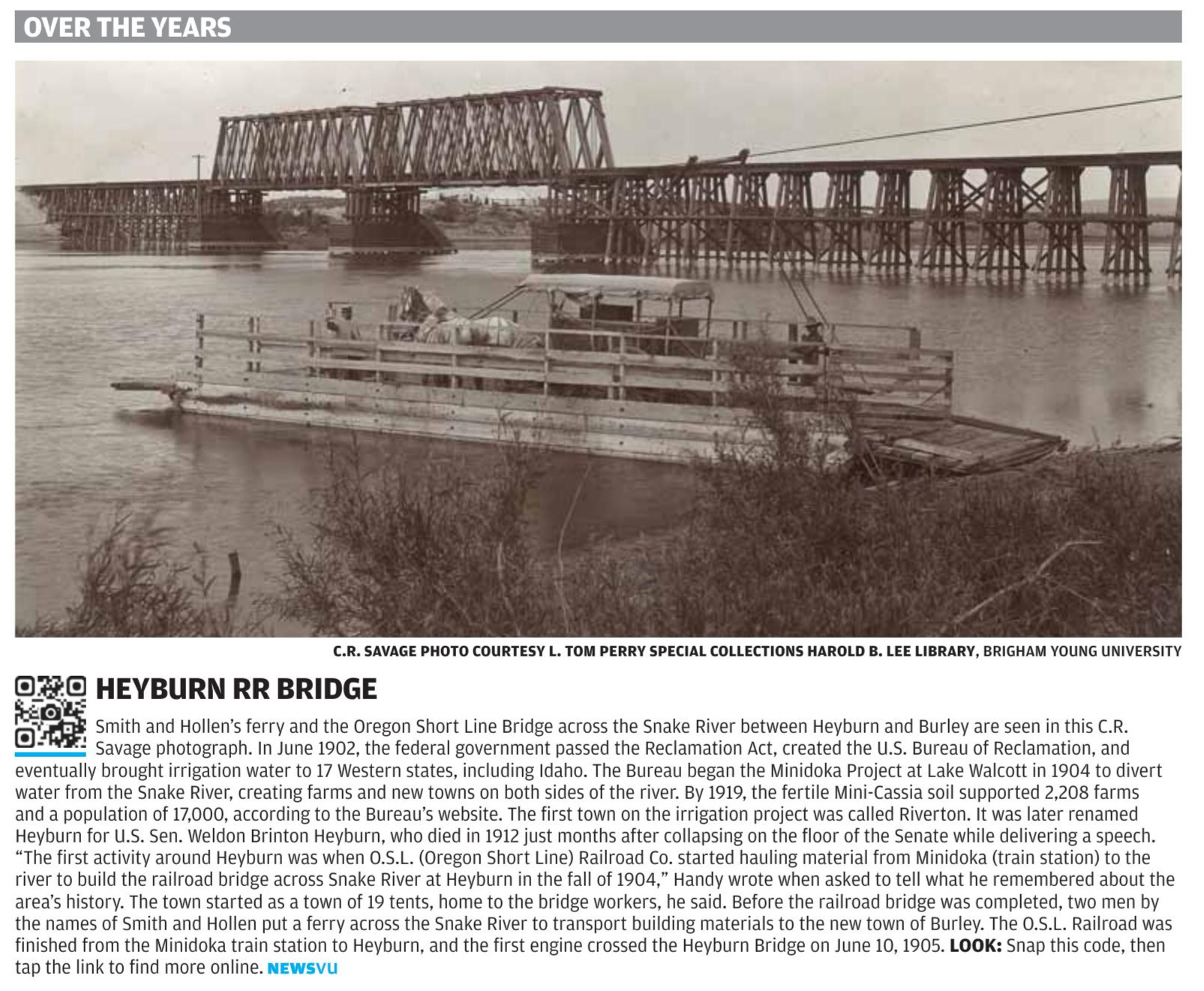
Smith and Hollen’s ferry and the Oregon Short Line Bridge across the Snake River between Heyburn and Burley are seen in this C.R. Savage photograph. In June 1902, the federal government passed the Reclamation Act, which created the U.S. Bureau of Reclamation, and eventually brought irrigation water to 17 Western states, including Idaho. The Bureau began the Minidoka Project at Lake Wolcott in 1904 to divert water from the Snake River, creating farms and new towns on both sides of the river. By 1919, the fertile Mini-Cassia soil supported 2,208 farms and a population of 17,000, according to the Bureau’s website. The first town on the irrigation project was called Riverton. It was later renamed Heyburn for U.S. Sen. Weldon Brinton Heyburn, who died in 1912 just months after collapsing on the floor of the Senate while delivering a speech. “The first activity around Heyburn was when O.S.L. (Oregon Short Line Railroad Co. started hauling material from Minidoka (train station) to the river to build the railroad bridge across Snake River at Heyburn in the fall of 1904,” Handy wrote when asked to tell what he remembered about the area’s history. The town started as a twon of 19 tents, home to the bridge workers, he said. Before the railroad bridge was completed, two men by the names of Smith and Hollen put a ferry across the Snake River to transport building materials to the new town of Burley. The O.S.L. Railroad was finished from the Minidoka train station to Heyburn, and the first engine cross the Heyburn Bridge on June 10, 1905.
 Sagacity