A Defense of the Imperial System of Measurement in Law

I read this article in the Utah Bar Journal. It struck me as accurate. Enough so that I wanted to share it with others! I thought the metric system in the United Kingdom was not intuitive, especially where most things had metric and imperial side by side.

In 1975, the United States enacted the Metric Conversion Act, amended by the Omnibus Trade Act of 1988, attempting to compel American citizenry to adopt the modern metric system as their official system of measurement (i.e., the International System of Units). The United States later directed all U.S. agencies to “take all appropriate measures within their authority” to convert to the metric system. Exec. Order No. 12770, 56 FR 35801, at 393 (July 29, 1991). Less than fifty years earlier, the consensus view of the U.S. Congress had been that “the metric system is inferior to the English.” Congressional Hearing Relative to the Compulsory Introduction of the Metric System, on H.R. 10, Cong. 237 (1926) (statement of Samuel S. Dale to the Committee on Coinage, Weights and Measures).

Questions about whether weights and measures should be expressed in the imperial system or the metric system in evidence, statutes, and case law have never been fully resolved. In many states, legislation arbitrarily reverts from the imperial system to metric system within subsections of the same statute. See, e.g., Utah Code Ann. § 58-37c-19 (outlawing distribution and possession of methamphetamines in ounces); id. § 58-37c-20.5 (outlawing purchase of pseudoephedrine in grams); see also, e.g., 18 V.S.A. § 4231(a)(3), (outlawing possession of cocaine measured in ounces); 18 V.S.A. § 4231(a)(2) (outlawing possession of cocaine measured in grams). The Supreme Court also appears to have vacillated about how best to express weights and measures. See, e.g., Whole Woman’s Health v. Hellerstedt, 579 U.S. 582 (2016) (expressing distance in miles using the imperial system); Massachusetts v. EPA, 549 U.S. 497 (2007) (converting evidence presented in the imperial system to metric system units). And although the U.S. Patent and Trademark Office (USPTO) technically requires applicants to use the metric system, it does not enforce this requirement.

Academics have long advocated for adoption of the metric system as a way of resolving this conflict, while blue-collar American works have resisted the same. Emerging evidence further discussed below appears supportive of the blue-collar workers’ reluctance.

Historical Controversy

Pressure from continental Europe to adopt the metric system began when the metric system was invented in 1791 during the French Revolution by Pierre-Simon Laplace. Thomas Jefferson rejected European pressure to convert, predicting the metric system would fail. U.S. Dep. Of Comm., A History of the Metric System Controversy in the United States, Nat’l Bur. Stand. Spec. Publ. 345–10. John Quincy Adams was forced to write a 117-page report in 1821 on weights and measures, concluding that the metric system was unnaturally contrived. He said, “[o]f all the nations of European origin, ours is that which least requires any change in the system of their weights and measures.” John Quincy Adams, Report Upon Weights and Measures, p. 93: U.S. Senate (1821). Even Napoleon himself ridiculed the metric system and prohibited its use in the First French Empire, which had created it. “Napoleon didn’t personally admire the metric system that Laplace invented, saying, ‘I can understand the twelfth part of an inch, but not the thousandth part of a metre.’” Andrew Roberts, Napoleon: A Life (Viking 2014). Following enactment of the Metric Conversion Act in the United States in 1975, the USPTO issued a directive requiring that weights and measures submitted in U.S. Patent applications be presented in the metric system and codified this directive in the Manual of Patent Examining Procedure § 608.01. As a result of these laws and regulations intended to “metricate” the American people, nothing changed. Patent attorneys simply ignored § 608.01 and courts in our system of jurisprudence have largely done the same.

Laymen across the country have resisted pressure to adopt the metric system whenever it is applied. The National Cowboy Hall of Fame director sued the National Bureau of Standards in 1981 for spending $2.5 million per year to promote the metric system but had certiorari denied by the U.S. Supreme Court when he lost the case on standing. The Supreme Court Today Rejected an Effort by Two Champions, U. Press Int’l (Nov. 30, 1981), available at https://www.upi.com/Archives/1981/11/30/The-Supreme-Courttoday-rejected-an-effort-by-two/8345375944400/ (commenting on case No. 81-780). The Ford Motor Company refused to switch to the metric system and authorized articles critical of the metric system. Henry Ford, Moving Forward (1931). Francis Dugan, representing the U.S construction industry on the U.S. Metric Board, promised that U.S. construction would “be the very last sector [in the U.S.] to implement conversion to metric measurement – if at all.” U.S. Metric Board, Summary Report (Jul. 1982). To counter the popular resistance to the metrification of the United States, the National Institute for Standards and Technology established the U.S. Metric Program and the U.S. Metric Board for metricating America in the 1970s. The U.S. Metric Board was disbanded by Ronald Reagan in 1982 while the U.S. Metric Program employed one person from 1982 until 2013. In 2013, when the sole employee of the U.S. Metric Program retired and was asked why nothing had been accomplished in thirty years, he blamed the failure of the U.S. to convert to the metric system on incorrigible semi-truck drivers whom he alleged were incapable of understanding overpass heights and prone to ramming their trailers into overpasses across the country. Carrie Swiggum, Meet the Sole Employee of the U.S. Metric Program, Mental Floss

(Mar. 20, 2013), https://www.mentalfloss.com/article/50160/years-ken-butcher-was-sole-employee-us-metric-program.

While singling out truck drivers for ridicule, actual confusion was taking its toll among America’s more educated demographics. NASA’s Mars Climate Orbiter was lost in 1999 because NASA scientists misconverted feet to meters. An Air Canada plane crashed in 1983 after its pilots misconverted pounds to kilograms, and a patient died in 1999 when given 0.5 grams of Phenobarbital instead of 0.5 grains.

Modern Chaos

Progressive thinkers continue to demand that the U.S. convert. Hollywood’s Cate Blanchet asked on Jimmy Kimmel live in 2018, “Explain to me how the country that can send a man to the moon is still in gallons and inches?” Jimmy Kimmel Live, Cate Blanchett Thinks Americans Should Use the Metric System, YouTube (Sept. 14, 2018), https://www.youtube.com/watch?v=f1FBYgk3svU.

In spite of the Metric Conversion Act and a directive in 1984 from the Department of Transportation that the Federal Aviation Administration (FAA) switch to the metric system, the FAA largely failed to transition, insisting pilots could estimate runway lengths and approach speeds better in customary imperial units. The National Transportation Safety Board switched to the metric system in the 1980s, then abruptly switched back – actually printing interstate speed limit signs in the metric system for several months. The FAA’s refusal to switch Federal Aviation Regulations, airworthiness directives, and traffic control practices to the metric system forced the rest of the world to switch their avionics and traffic control systems back to the imperial system and continue calculating altitude in feet, speed in knots, and distance in miles and knots, rather than in kilometers. To the chagrin of its detractors, the imperial system

is adopted by every country in the world for aviation-related functions as a result of U.S. dominance. Additionally, U.S. dominance in aviation resulted in the worldwide adaption of English as the exclusive language of communication between pilots and air traffic control towers.

Is the Imperial System Illogical?

What are we to make of this chaos? Is the United States acting illogically in resisting metrification that reformists insist is inevitable? The imperial system bases its units of measurement on organically evolved common artefacts thought to be common to human observation and intuitively understood, whereas the derived units of metric system are defined as arbitrary fractions of scientific constants. For instance, a foot in the imperial system is about the length of a human foot. The meter, on the other hand, is defined as being 1/299,792,458 of the distance light travels in a second. In the imperial system, a cup is about a cup. The volume of a barrel of oil is, it turns out, about a barrel. An acre is about the amount of land a farmer can till in a day using an ox. A mile is 2,000 paces (i.e., 1,000 left and right steps). An inch is the width of a human thumb. The same intuitive observations underlie the units of teaspoons, tablespoons, bushels, grains, lightyears, and candlepower. Even the Fahrenheit temperature scale of the imperial system was created roughly to define zero degrees as the freezing point of seawater and 100 degrees as body temperature (while Kelvin defines zero as the temperature at which molecular motion ceases for any adiabatic process). We must ask ourselves whether it is easier to understand the power of your car in horsepower or in kilogram force in meters per second.

Scientists say that the metric system has more “coherence” than the imperial system because the derived units of the metric system are directly related to the base units without the need for intermediate conversion factors. In layman’s terms, scientists say the metric units makes more sense because you simply multiply everything by ten. They do not think anyone can remember there are sixteen ounces in a pound or twelve inches in a foot. But if you times nonsense by ten, don’t you simply end up with ten times as much nonsense? Do we not use the imperial system of weights and measures for the same reason we speak an organically derived language? Despite its irregular verb conjugations and spelling, most of the world would consider English to be preferable to contrived languages such as Esperanto. Why are some units of measurement, common to both the imperial system and the metric system, indivisibly correlated to human observation – for instance measuring time using twelve months to a year and thirty days to a month, corresponding to the phases of the moon and seasons?

Evidence Supportive of American Claims

Preliminary results of studies being done for the first time only in 2022 seem to confirm that because the base units in the imperial system are intuitively derived, those who use the imperial system are better able to estimate distance, temperature, speed, volume, and weight than those who use the metric system. This finding holds true for layman and scientists alike. According to one study, even among those with degrees in hard sciences, baccalaurei educated using the imperial system were better able to estimate distance in feet than their counterparts educated using the metric system could in meters – by nearly an entire standard deviation. See Steven Rinehart, Cross-Sectional Study on the Ability of Those Educated Using the Imperial System of Measurement to Estimate Weights and Measures Relative to those Educations Using the Metric System, Auctores (Aug. 10, 2022), https://www.auctoresonline.org/article/cross-sectionalstudy-of-the-ability-of-those-educated-using-the-imperial-systemof-measurement-to-estimate-weights-and-measures-relative-to-those-educated-using-the-metric-system. Study participants were also better able to estimate temperature and speed in the imperial system. With the exception of physicians’ ability to estimate small units of volume, every demographic estimated weights and measures more accurately in the imperial system than the metric system. See id. This is of consequence in the law where juries are tasked with interpreting and understanding evidentiary data presented to them. It is also important where witnesses, such as law enforcement officers, are regularly tasked with estimating distance, speed, and other measurements in the courts of the land.

Metrification Justification

The two justifications perpetually advanced for 250 years for converting to the metric system have always been: (1) that because Europe, as the center of scientific and economic power in the Western world, uses it, the U.S. must also use it or fall behind economically and scientifically; and, (2) that the metric system is easier to understand for the unlearned masses because it defines every unit as consisting of exactly ten of the units smaller than it.

A review of editorial opinions published by major news outlines and scientific journals from 1996 to 2015 shows that of 1,110 cited publications during this period about metrification of the United States, essentially all advocated American transition to the metric system by relying on these two arguments. Published Articles about the Metric System, Metrication, and Related Standards, U.S. Metric Assoc. (Aug. 10, 2022), https://usma.org/publishedarticles-about-the-metric-system-metrication-and-related-standards.

Since the arguments upon which proponents of the metric system rely were originally formulated, however, America has grown to overshadow Europe in economic and scientific power; and emerging studies seem to support the claim that the imperial system may be the more intuitive and readily understood of the two systems. Consequently, rather than being moot, both arguments exclusively advanced over two centuries for converting to the metric system would appear now to prescribe the opposite course of action than that for which they were proposed (and Cate Blanchett has her answer). Is it possible that Jefferson, Adams, Reagan, and Napolean were right all along? Do the proponents of the metric system bely ulterior motives in their insistence the U.S. convert? Is there an element of academic snobbery in the hype about the metric system? Is it even possible that the metric system itself comes to us as some kind of political artifice born in protest of British imperialism? Has the time come to repeal the Metric Conversion Act?

Conclusions

There may be reason for judges and attorneys crafting local rules – or even the rules of civil procedure – to require that weights and measures in evidence be converted into customary units when supplied to juries. Could verdicts rendered by juries presented evidence in the metric system be collaterally attacked on the basis the metrics were not converted? In fact, it appears they have been. See Commonwealth v. Rivera, 918 N.E.2d 871, 874 (Mass. App. Ct. 2009) (finding non-harmless error where jury required to apply metric system without testimony about metric unit conversions). Despite all the advocacy over the years in favor of the metric system and denouncement of the imperial system as anachronistic, the belief in the superiority of the metric system might still be argued to be a large-scale example of groupthink. Perhaps there is still wisdom in the old Latin maxim, via antiqua via est tuta (the old way is the safe way).

STEVEN RINEHART is a patent attorney employed by the firm Vested Law LLP.

He regularly deals with questions of weights and measures in preparing patent applications.

Weber High School

Weber High School, Ogden, Utah

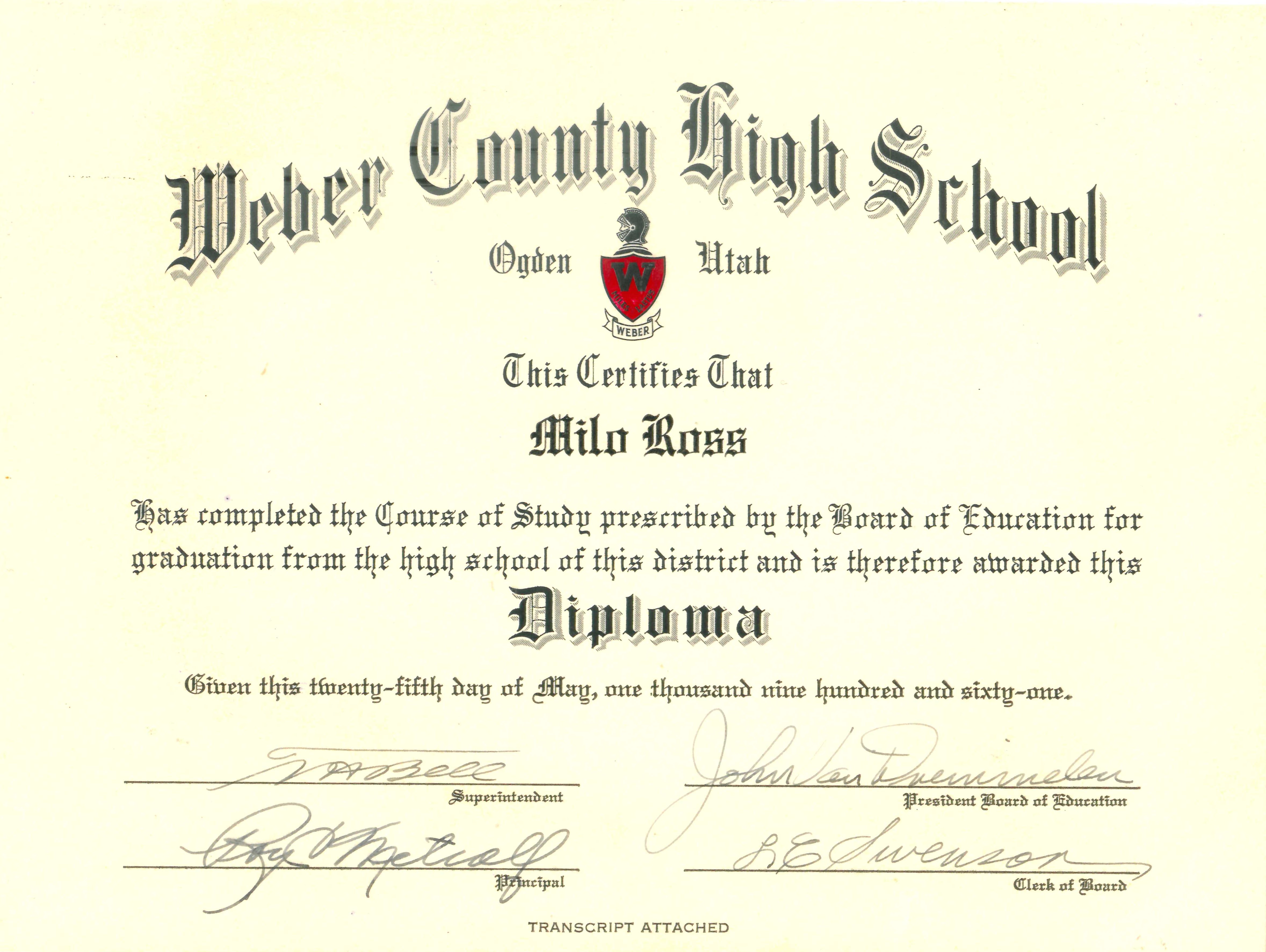
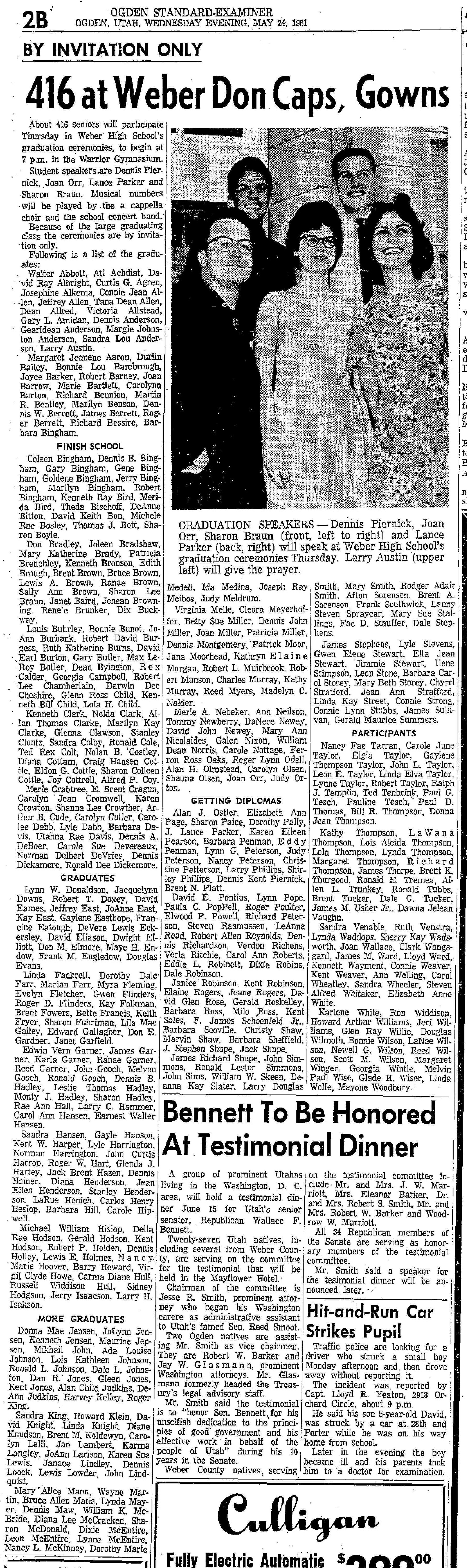
My father, Milo Paul Ross, graduated from Weber County High School 25 May 1961. A bond was passed in 1926 to build a county high school and construction began that same year and completed the next. The photo above is from 1927. The high school had an addition in 1953-1954. Weber County High School was located on the east side of Washington Boulevard between 11th and 12th Street. Weber County built a new high school in Pleasant View in 1972. The old building was abandoned and apparently tore down in the 1980s. Attached is the sketch that came with Dad’s Diploma.

West Weber County High School
Milo Ross Diploma from Weber County High School in Ogden, Utah

I will not be sharing his transcript as the Diploma indicates is/was attached. As Dad mentioned, he did not get to take any electives since he was retaking classes. GPA of 2.00, 359 of a class of 415. The newspaper indicated there were 416.

I am also attaching a copy of Dad’s Certificate of Graduation from Wahlquist Junior High School.

Milo Paul Ross Certificate of Gradulation from Wahlquist Junior High School in Ogden, Utah

Both Diplomas include the name of T. H. Bell, which caught my attention. Terrel Howard Bell (1921 – 1996) might ring familiar to some as he was an Education Secretary under President Reagan. Terrel graduated from Lava Hot Springs in 1940, from Albion State Normal College in 1946, and Superintendent of the Weber County School District from 1958 to 1962. Which is why his name shows on both of these Diplomas.

Orwell’s 1984 and Today

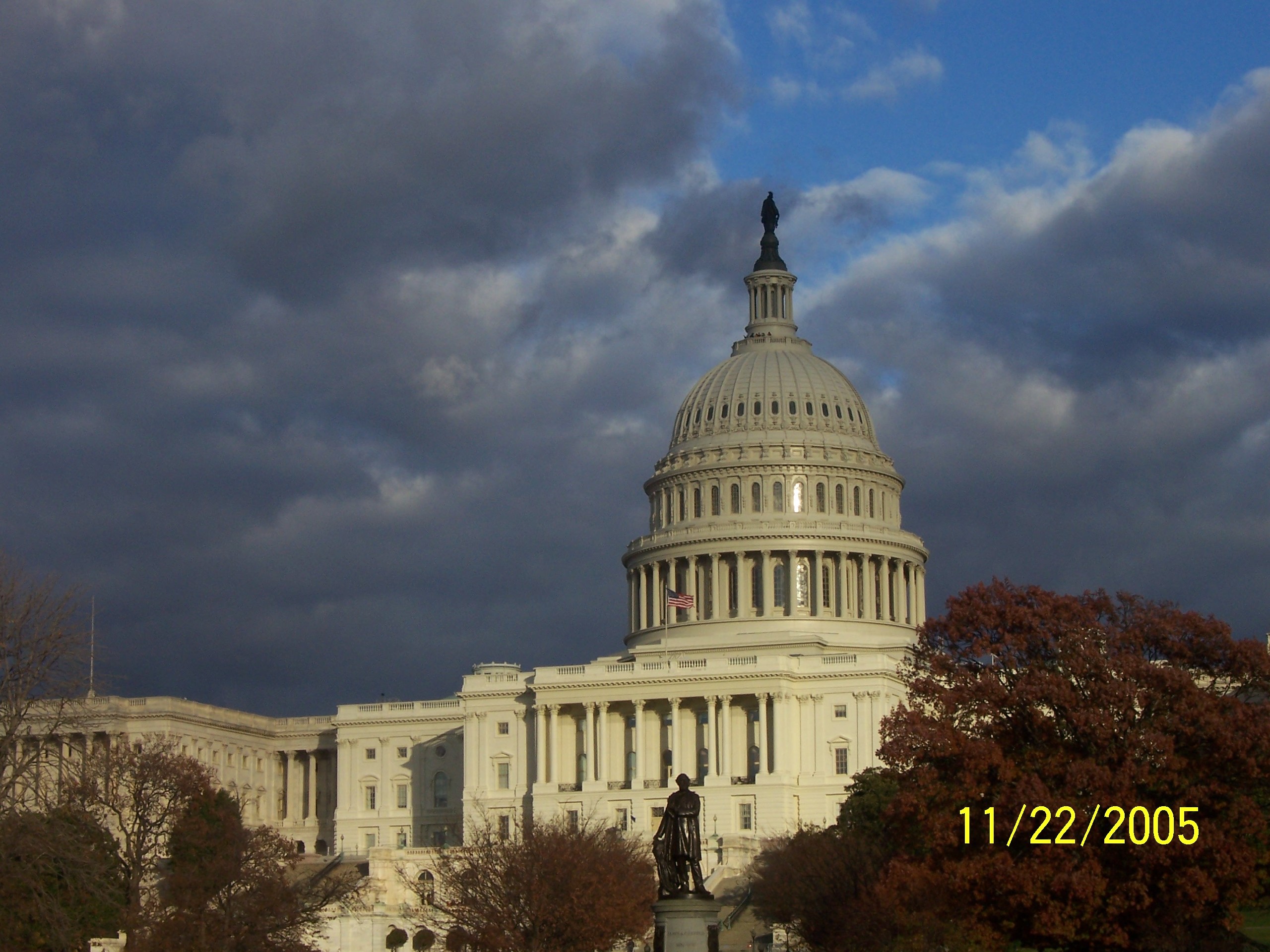
United States Capitol

There have been many things on my mind lately. Watching the ongoing bickering in the District of Columbia for the past 20 years I often think of 1984, Brave New World, and Fahrenheit 451. The Trump world often made me thing of 1984 with the inability to rely on truth and the often shifting positions from day to day. The Democrats declare the need for truth, for which I agree. The Republicans declare the need for unity, again, I agree. Both are doing it for limited self-serving purposes though. While I am not that old, I long for the America I recall learning about in school and wonder if she will ever reappear. I weary of our rewriting history, not of addition or giving more context, but contriving it into something it is not. I love Thomas Jefferson and find great frustration in our undermining his phenomenal influence that continues to today. We are now seeing it also in the religious side with Brigham Young. Based upon those musings, I read this Imprimis talk and found it reiterating my thoughts of the past years in words. I could not help but share.

The following is adapted from a speech delivered by Larry Arnn at a Hillsdale College reception in Rogers, Arkansas, on November 17, 2020.

“On September 17, Constitution Day, I chaired a panel organized by the White House. It was an extraordinary thing. The panel’s purpose was to identify what has gone wrong in the teaching of American history and to lay forth a plan for recovering the truth. It took place in the National Archives—we were sitting in front of the originals of the Declaration of Independence and the Constitution—a very beautiful place. When we were done, President Trump came and gave a speech about the beauty of the American Founding and the importance of teaching American history to the preservation of freedom. 

“This remarkable event reminded me of an essay by a teacher of mine, Harry Jaffa, called “On the Necessity of a Scholarship of the Politics of Freedom.” Its point was that a certain kind of scholarship is needed to support the principles of a nation such as ours. America is the most deliberate nation in history—it was built for reasons that are stated in the legal documents that form its founding. The reasons are given in abstract and universal terms, and without good scholarship they can be turned astray. I was reminded of that essay because this event was the greatest exhibition in my experience of the combination of the scholarship and the politics of freedom. 

“The panel was part of an initiative of President Trump, mostly ignored by the media, to counter the New York Times’ 1619 Project. The 1619 Project promotes the teaching that slavery, not freedom, is the defining fact of American history. President Trump’s 1776 Commission aims to restore truth and honesty to the teaching of American history. It is an initiative we must work tirelessly to carry on, regardless of whether we have a president in the White House who is on our side in the fight. 

“We must carry on the fight because our country is at stake. Indeed, in a larger sense, civilization itself is at stake, because the forces arrayed against the scholarship and the politics of freedom today have more radical aims than just destroying America. 

***

“I taught a course this fall semester on totalitarian novels. We read four of them: George Orwell’s 1984, Arthur Koestler’s Darkness at Noon, Aldous Huxley’s Brave New World, and C.S. Lewis’s That Hideous Strength

“The totalitarian novel is a relatively new genre. In fact, the word “totalitarian” did not exist before the 20th century. The older word for the worst possible form of government is “tyranny”—a word Aristotle defined as the rule of one person, or of a small group of people, in their own interests and according to their will. Totalitarianism was unknown to Aristotle, because it is a form of government that only became possible after the emergence of modern science and technology.

“The old word “science” comes from a Latin word meaning “to know.” The new word “technology” comes from a Greek word meaning “to make.” The transition from traditional to modern science means that we are not so much seeking to know when we study nature as seeking to make things—and ultimately, to remake nature itself. That spirit of remaking nature—including human nature—greatly emboldens both human beings and governments. Imbued with that spirit, and employing the tools of modern science, totalitarianism is a form of government that reaches farther than tyranny and attempts to control the totality of things. 

“In the beginning of his history of the Persian War, Herodotus recounts that in Persia it was considered illegal even to think about something that was illegal to do—in other words, the law sought to control people’s thoughts. Herodotus makes plain that the Persians were not able to do this. We today are able to get closer through the use of modern technology. In Orwell’s 1984, there are telescreens everywhere, as well as hidden cameras and microphones. Nearly everything you do is watched and heard. It even emerges that the watchers have become expert at reading people’s faces. The organization that oversees all this is called the Thought Police. 

“If it sounds far-fetched, look at China today: there are cameras everywhere watching the people, and everything they do on the Internet is monitored. Algorithms are run and experiments are underway to assign each individual a social score. If you don’t act or think in the politically correct way, things happen to you—you lose the ability to travel, for instance, or you lose your job. It’s a very comprehensive system. And by the way, you can also look at how big tech companies here in the U.S. are tracking people’s movements and activities to the extent that they are often able to know in advance what people will be doing. Even more alarming, these companies are increasingly able and willing to use the information they compile to manipulate people’s thoughts and decisions.

“The protagonist of 1984 is a man named Winston Smith. He works for the state, and his job is to rewrite history. He sits at a table with a telescreen in front of him that watches everything he does. To one side is something called a memory hole—when Winston puts things in it, he assumes they are burned and lost forever. Tasks are delivered to him in cylinders through a pneumatic tube. The task might involve something big, like a change in what country the state is at war with: when the enemy changes, all references to the previous war with a different enemy need to be expunged. Or the task might be something small: if an individual falls out of favor with the state, photographs of him being honored need to be altered or erased altogether from the records. Winston’s job is to fix every book, periodical, newspaper, etc. that reveals or refers to what used to be the truth, in order that it conform to the new truth. 

“One man, of course, can’t do this alone. There’s a film based on 1984 starring John Hurt as Winston Smith. In the film they depict the room where he works, and there are people in cubicles like his as far as the eye can see. There would have to be millions of workers involved in constantly re-writing the past. One of the chief questions raised by the book is, what makes this worth the effort? Why does the regime do it?

“Winston’s awareness of this endless, mighty effort to alter reality makes him cynical and disaffected. He comes to see that he knows nothing of the past, of real history: “Every record has been destroyed or falsified,” he says at one point, “every book has been rewritten, every picture has been repainted, every statue and street and building has been renamed, every date has been altered. And that process is continuing day by day and minute by minute. . . . Nothing exists except an endless present in which the Party is always right.” Does any of this sound familiar?

“In his disaffection, Winston commits two unlawful acts: he begins writing in a diary and he begins meeting a woman in secret, outside the sanction of the state. The family is important to the state, because the state needs babies. But the women are raised by the state in a way that they are not to enjoy relations with their husbands. And the children—as in China today, and as it was in the Soviet Union—are indoctrinated and taught to spy and inform on their parents. Parents love their children but live in terror of them all the time. Think of the control that comes from that—and the misery.

“There are three stratums in the society of 1984. There is the Inner Party, whose members hold all the power. There is the Outer Party, to which Winston belongs, whose members work for—and are watched and controlled by—the Inner Party. And there are the proles, who live and do the blue collar work in a relatively unregulated area. Winston ventures out into that area from time to time. He finds a little shop there where he buys things. And it is in a room upstairs from this shop where he and Julia, the woman he falls in love with, set up a kind of household as if they are married. They create something like a private world in that room, although it is a world with limitations—they can’t even think about having children, for instance, because if they did, they would be discovered and killed. 

“In the end, it turns out that the shopkeeper, who had seemed to be a kindly old man, is in fact a member of the Thought Police. Winston and Julia’s room contained a hidden telescreen all along, so everything they have said and done has been observed. In fact, it emerges that the Thought Police have known that Winston has been having deviant thoughts for twelve years and have been watching him carefully. When the couple are arrested, they have made pledges that they will never betray each other. They know the authorities will be able to make them say whatever they want them to say—but in their hearts, they pledge, they will be true to their love. It is a promise that neither is finally able to keep. 

“After months of torture, Winston thinks that what awaits him is a bullet in the back of the head, the preferred method of execution of both the Nazis and the Soviet Communists. In Koestler’s Darkness at Noon, the protagonist walks down a basement hallway after confessing to crimes that he didn’t commit, and without any ceremony he is shot in the back of the head—eradicated as if he were vermin. Winston doesn’t get off so easy. He will instead undergo an education, or more accurately a re-education. His final stages of torture are depicted as a kind of totalitarian seminar. The seminar is conducted by a man named O’Brien, who is portrayed marvelously in the film by Richard Burton. As he alternately raises and lowers the level of Winston’s pain, O’Brien leads him to knowledge regarding the full meaning of the totalitarian regime.

“As the first essential step of his education, Winston has to learn doublethink—a way of thinking that defies the law of contradiction. In Aristotle, the law of contradiction is the basis of all reasoning, the means of making sense of the world. It is the law that says that X and Y cannot be true at the same time if they’re mutually exclusive. For instance, if A is taller than B and B is taller than C, C cannot be taller than A. The law of contradiction means things like that.

“In our time, the law of contradiction would mean that a governor, say, could not simultaneously hold that the COVID pandemic renders church services too dangerous to allow, and also that massive protest marches are fine. It would preclude a man from declaring himself a woman, or a woman declaring herself a man, as if one’s sex is simply a matter of what one wills it to be—and it would preclude others from viewing such claims as anything other than preposterous.

“The law of contradiction also means that we can’t change the past. What we can know of the truth all resides in the past, because the present is fleeting and confusing and tomorrow has yet to come. The past, on the other hand, is complete. Aristotle and Thomas Aquinas go so far as to say that changing the past—making what has been not to have been—is denied even to God. Because if something both happened and didn’t happen, no human understanding is possible. And God created us with the capacity for understanding.

“That’s the law of contradiction, which the art of doublethink denies and violates. Doublethink is manifest in the fact that the state ministry in which Winston is tortured is called the Ministry of Love. It is manifest in the three slogans displayed on the state’s Ministry of Truth: “War is peace. Freedom is slavery. Ignorance is strength.” And as we have seen, the regime in 1984 exists precisely to repeal the past. If the past can be changed, anything can be changed—man can surpass even the power of God. But still, to what end?

“”Why do you think you are being tortured? O’Brien asks Winston. The Party is not trying to improve you, he says—the Party cares nothing about you. Winston is brought to see that he is where he is simply as the subject of the state’s power. Understanding having been rendered meaningless, the only competence that has meaning is power. 

““Already we are breaking down the habits of thought which have survived from before the Revolution,” O’Brien says.

“”We have cut the links between child and parent, and between man and man, and between man and woman. No one dares trust a wife or a child or a friend any longer. But in the future there will be no wives and no friends. Children will be taken from their mothers at birth, as one takes eggs from a hen. The sex instinct will be eradicated. Procreation will be an annual formality like the renewal of a ration card. . . . There will be no loyalty, except loyalty toward the Party. There will be no love, except the love of Big Brother. There will be no laughter, except the laugh of triumph over a defeated enemy. . . . All competing pleasures will be destroyed. But always—do not forget this Winston—always there will be the intoxication of power, constantly increasing and constantly growing subtler. Always, at every moment, there will be the thrill of victory, the sensation of trampling on an enemy who is helpless. If you want a picture of the future, imagine a boot stamping on a human face—forever.

“Nature is ultimately unchangeable, of course, and humans are not God. Totalitarianism will never win in the end—but it can win long enough to destroy a civilization. That is what is ultimately at stake in the fight we are in. We can see today the totalitarian impulse among powerful forces in our politics and culture. We can see it in the rise and imposition of doublethink, and we can see it in the increasing attempt to rewrite our history.

***

““An informed patriotism is what we want,” Ronald Reagan said toward the end of his Farewell Address as president in January 1989. “Are we doing a good enough job teaching our children what America is and what she represents in the long history of the world?” 

“Then he issued a warning.

“Those of us who are over 35 or so years of age grew up in a different America. We were taught, very directly, what it means to be an American. And we absorbed, almost in the air, a love of country and an appreciation of its institutions. If you didn’t get these things from your family you got them from the neighborhood, from the father down the street who fought in Korea or the family who lost someone at Anzio. Or you could get a sense of patriotism from school. And if all else failed you could get a sense of patriotism from the popular culture. The movies celebrated democratic values and implicitly reinforced the idea that America was special. TV was like that, too, through the mid-sixties.

“But now, we’re about to enter the [1990s], and some things have changed. Younger parents aren’t sure that an unambivalent appreciation of America is the right thing to teach modern children. And as for those who create the popular culture, well-grounded patriotism is no longer the style. . . . We’ve got to do a better job of getting across that America is freedom—freedom of speech, freedom of religion, freedom of enterprise. And freedom is special and rare. It’s fragile; it needs protection.

“So, we’ve got to teach history based not on what’s in fashion but what’s important—why the Pilgrims came here, who Jimmy Doolittle was, and what those 30 seconds over Tokyo meant. You know, four years ago on the 40th anniversary of D-Day, I read a letter from a young woman writing to her late father, who’d fought on Omaha Beach. . . . [S]he said, “we will always remember, we will never forget what the boys of Normandy did.” Well, let’s help her keep her word. If we forget what we did, we won’t know who we are. I’m warning of an eradication of the American memory that could result, ultimately, in an erosion of the American spirit

“American schoolchildren today learn two things about Thomas Jefferson: that he wrote the Declaration of Independence and that he was a slaveholder. This is a stunted and dishonest teaching about Jefferson. 

“What do our schoolchildren not learn? They don’t learn what Jefferson wrote in Notes on the State of Virginia: “I tremble for my country when I reflect that God is just,” he wrote in that book regarding the contest between the master and the slave. “The Almighty has no attribute which can take side with us in such a contest.” If schoolchildren learned that, they would see that Jefferson was a complicated man, like most of us. 

“They don’t learn that when our nation first expanded, it was into the Northwest Territory, and that slavery was forbidden in that territory. They don’t learn that the land in that territory was ceded to the federal government from Virginia, or that it was on the motion of Thomas Jefferson that the condition of the gift was that slavery in that land be eternally forbidden. If schoolchildren learned that, they would come to see Jefferson as a human being who inherited things and did things himself that were terrible, but who regretted those things and fought against them. And they would learn, by the way, that on the scale of human achievement, Jefferson ranks very high. There’s just no question about that, if for no other reason than that he was a prime agent in founding the first republic dedicated to the proposition that all men are created equal. 

“The astounding thing, after all, is not that some of our Founders were slaveholders. There was a lot of slavery back then, as there had been for all of recorded time. The astounding thing—the miracle, even, one might say—is that these slaveholders founded a republic based on principles designed to abnegate slavery. 

“To present young people with a full and honest account of our nation’s history is to invest them with the spirit of freedom. It is to teach them something more than why our country deserves their love, although that is a good in itself. It is to teach them that the people in the past, even the great ones, were human and had to struggle. And by teaching them that, we prepare them to struggle with the problems and evils in and around them. Teaching them instead that the past was simply wicked and that now they are able to see so perfectly the right, we do them a disservice and fit them to be slavish, incapable of developing sympathy for others or undergoing trials on their own.

“Depriving the young of the spirit of freedom will deprive us all of our country. It could deprive us, finally, of our humanity itself. This cannot be allowed to continue. It must be stopped.