Aliza’s Four Generations

Maybe it is a product of our day where people live longer, but Aliza is fortunate to have 3 of her great grandparents living at this time.  For family history purposes, I thought I might post these pictures of Aliza with her great grandparents.  Further, I thought I would post a picture or two that Amanda and I have with our great grandparents.

Here is a picture of Aliza with Amanda’s paternal grandfather, DeLece (“D”) Hemsley. This picture was taken at a party in Kaysville, Utah for Amanda’s brother, Derek, upon coming home from his two-year mission in July.  We took the opportunity for a couple of photos with family.

(l-r): DeAnne, D, and Bryan Hemsley with Aliza and Amanda

This is Amanda’s paternal grandmother, Shanna Thompson.  This photo was also at Derek’s party.

(l-r): Mel and Shanna Thompson; Paul, Aliza, and Amanda; Bryan and Jill Hemsley

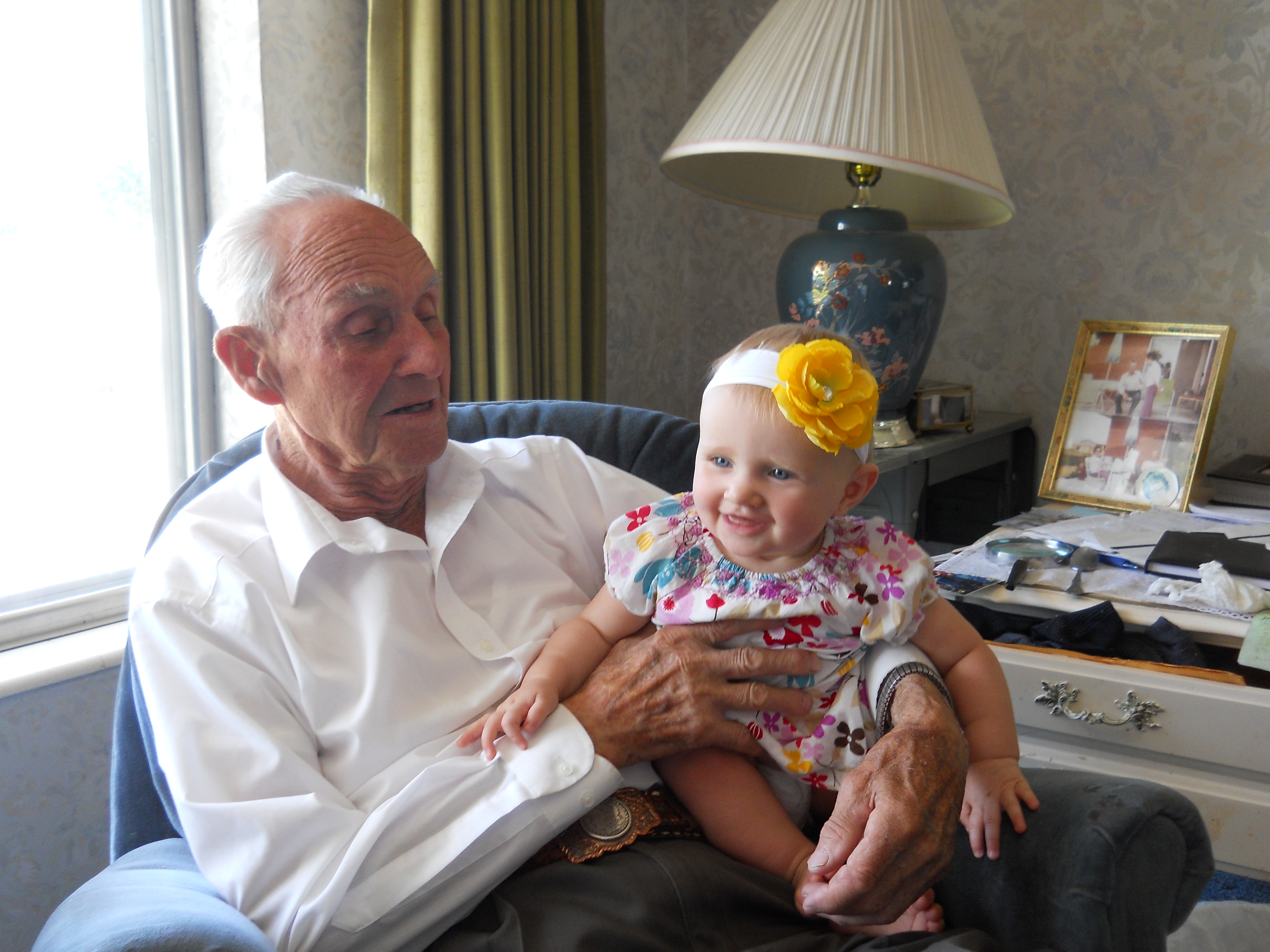
Lastly, here is my paternal grandfather, Milo Ross.  We took these pictures, the day after at Derek’s homecoming party, at Grandpa’s house in Plain City, Utah.  I will post three pictures because I think they are good photos.  This first one shows a great smile on Grandpa, Aliza, and Amanda.  I also like the profile of Grandpa.

Grandpa’s first sight of Aliza

I like this one because Aliza looks as cute as she always does.  For being 90, Grandpa can sure pick her up and throw her in the air with ease.

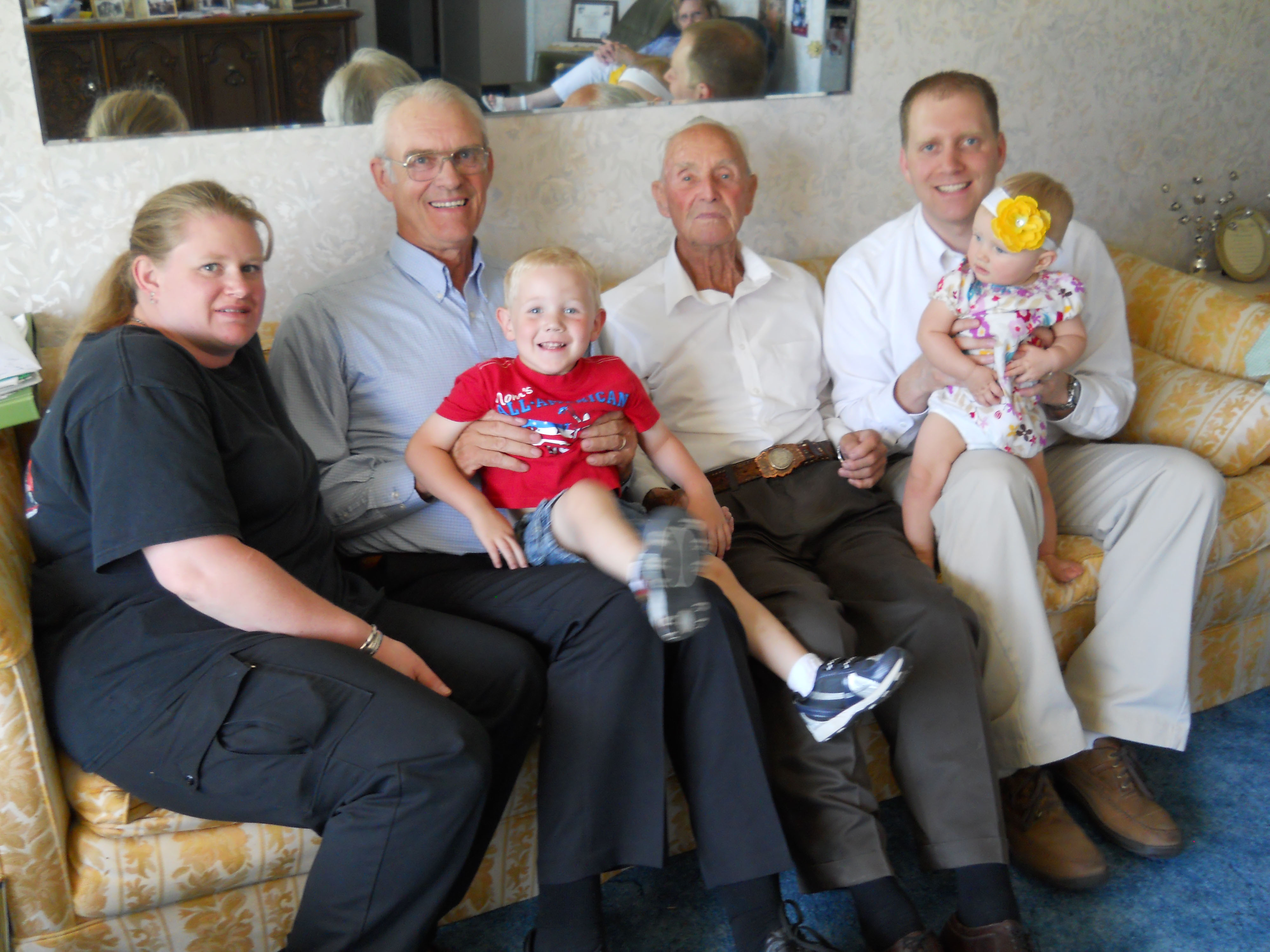
Here is one we took of the four generations with my sister, Andra, and her son, Daniel. Grandpa has two of his great grandchildren in this picture (and Dad has two of his grandchildren).

Andra, Milo (Jr), Daniel, Milo (Sr), Paul, Aliza

Fortunately, Aliza has now had her photo taken with all of her living Great Grandparents.  Amanda was also fortunate to have such a photograph with all of her living Grandparents and Great Grandparents.  Even more, ALL great grandparents and grandparents are in the same photo!  Here is that photo from the day of her baby blessing in Kaysville.  LeRoy, D, Shanna, and Clara are all Amanda’s Grandparents.  Belle is D’s mother.  Walter and June are Shanna’s father and step-mother.

Back (l-r): LeRoy Holden, D Hemsley, Bryan, Jill, and Amanda Hemsley, Mel and Shanna Thompson. Front: Clara Holden, Belle Hemsley, June and Walter Hansen.

I had three Great Grandparents who were alive when I was born.  Unfortunately, I do not seem to have a photo in my possession with my Andra Great Grandparents despite the fact that I was 10 and 11 years old when they passed.  Oddly, I have pictures of my Great Grandpa and Grandma Andra that I was present when the photo was taken, like the one below.  This is my mother’s maternal grandparents about 1989.

Mary and Bill Andra

This is my mother’s paternal grandmother and some of the rest of the family at her sister’s funeral, Edna Coley Neilson.  My Great Grandma Lillian Bowcutt (remarried in 1953 after her husband Joseph Jonas died in 1932) is in the center of this photo and is the mother to the two ladies beside her and the four men in front.  I am more of a footnote in the photo, but at least I have one with Great Grandma Bowcutt in the same picture.

Far back (l-r): Unknown, Larry Talbot, Unknown (completely unseen), and Unknown. Middle: Jimmie Jonas, Hilma Jonas, Lillian Talbot, Lillian Bowcutt, LeReta Andersen, Lona Jonas, Colleen Elliott.  Front: Spencer Jonas, Joseph Jonas, Ellis Jonas, Evan Jonas, Paul Ross, Jackie Jonas, Andra Ross.

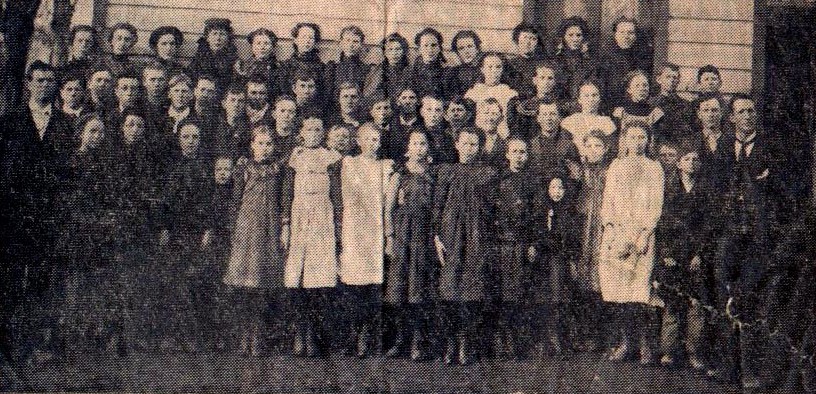
1895 Plain City Student Body

Back (l-r): Eva Edwards, Ada Skeen, Isabell Skeen, Unknown Rogers, Cecile Richardson, Grace Draney, Aseal Ipson, Beatrice Cottle, Ethel Garner, Josie Bramwell, Edna Garner, Unknown Rogers, Amanda Olsen, Rachel Garner, Freda Wheeler, Murald Hodson, Alfred Skeen. Middle: Frank Vause, William Knight, Clarence Richardson, Grant Hansen, James Hunt, Delwin Sharp, William Skeen, Chester Davis, Ace Draney, Lee Boyd, Eli Lund, Richard Bates, Alfred Coy, Parley Hansen, Edward Folkman, Jesse Lund, Charles Bramwell, Stella Hodson, Etta Lund, Ella Hodson, Luman Green, Walter Maw. Front: Charles Maw, Ruby Stoker, Annie Cottle, Edna Hansen, Susie Boyd, Gertrude Knight, Hazel Spiers, Rose Liljenquist, Nellie Maw, Martha Hansen, Mabel Ipsen, Maude Marriott, Daisy Coy, Alminda Lund, Joseph Skeen.

Here is a picture of the Plain City, Weber, Utah school student body in 1895.  Apparently this was the entire student body and this photo was reproduced in the 15 March 1959 copy of the Ogden Standard-Examiner.  I have a couple of relatives in the picture and that is probably why my Grandpa and Grandma Ross pulled it from the paper and have kept it with their possessions.  The names all come from that same paper caption although both of the unknown Rogers just have Miss.  If anyone knows where to get a clearer scan of the photo, I would appreciate it as this 60 year old paper isn’t the best version.  I do not think the school in Plain City had another name besides the Plain City School.

I looked up the information for each individual.  I found most of them, except for a couple whose names were just not in Plain City or they must have only been there a short time.  Sometimes with those old clippings whoever gave them the names might have put a married last name rather than a maiden.  Hopefully someone can correct the rest of the names.  The two principals I could not nail down because of the difference in age I could not define and there were so many with the same name within 30 years of the age of most of these students.  I put the one I think is most likely but welcome corrections.

Eva Edwards (?-?)

Ada Myrtle Skeen (1885-1977) married Daniel Popple Williams (1881-1919) and Edsin Byrum Allred (1881-1960).

Isabell Electa Skeen (1889-1963) married Thomas Etherington Charlton (1887-1956).

Unknown Rogers (?-?)

Cecile May Richardson (1888-1975) married Robert Clyde Hellewell (1887-1967).

Grace Elizabeth Draney (1887-1972) married James Burt Atkinson (1880-1935).

Aseal Andrew Ipson (1889-1981) married Lucy Isabell Knight (1883-1989).

Mary Lew Beatrice Cottle (1887-1971) married Claud Leslie Kimball (1885-1958).

Ethel Garner (1886-1968) married Ephraim William Manning (1884-1970).

Josephine “Josie” Trena Bramwell (1887-1973) married Joseph Herman McCowan (1886-1964).

Mary Edna Garner (1888-1948) married Horace William Wayment (1885-1969).

Unknown Rogers (?-?)

Amanda Christine Olsen (1888-1968) married George Daniel Moyes (1889-1958).

Rachel Ann Garner (1889-1980) married George Leo Sandberg (1887-1949).

Freda Wheeler (?-?)

Murald Vinson Hodson (1887-1970) married Elda Herriot Barnett (1895-1979).

David Alfred Skeen (1885-1969) married Bertha Kerr (1885-1976).

Francis “Frank” Freedom Vause (1883-1974) married Vera Jaquetta Child (1885-1961).

William Thomas Knight (1881-1973) married Eliza Alzina Taylor (1886-1963).

Clarence Richardson (1883-1976) married Louie Marie Rawson (1881-1982).

Martin Grant Hansen (1883-1925) married Alice Maud King (1881-1951).

James Hunt (?-?)

Delwin Sharp (1884-1969) married Violet Grieve (1881-1964).  Obviously related to my Sharp line.

William Delbert Skeen (1884-1940).  Not sure this is the right William Skeen, but pretty sure.

Chester Davis (1883-1948) married Nellie Clark (1891-1950).

William “Ace” Hamilton Draney (1885-1979) married Ethel Skeen (1883-1979) and Vera Ann Toombs (1895-1977).

Levi “Lee” Alfred Boyd (1883-1972).

Eli Edgar Lund (1884-1955) married Mary Millie Hutchins (1882-1947).

Thomas Richard Bates (1884-1969) married Dora Evaline Taylor (1885-1981)

Alfred Jonathan Coy (1882-1957) married Mabel Adella Ipsen (1885-1954).

George Parley Hansen (1886-1968) married Criesta Zenobia Anderson (1889-1979).

George Edward Folkman (1885-1914) married Florence Evaline Maw (1888-1969).  Florence’s mother was a Sharp.

Jesse Leander Lund (1886-1918) married Myrtle John Hawkley (1895-1960).

Charles Bramwell (1885-1971) married Annie Myrtle Shupe (1888-1968).

Estella Dora Hodson (1887-1981) married Parley Paul Taylor (1886-1974).

Etta Letitia Lund (1887-1968) married Robert Alfred Witten (1873-1937).

Ella Doris Hodson (1887-1968) married James Earl McFarland (1889-1951).

Luman Peter Green (1886-1980) married Veda Jane Walker (1888-1981).

Walter Maw (1887-1912) married Della Neal (1888-1961).

Charles Maw, I think this is Charles Edward Maw (1875-1950).  Principal.

Ruby Stoker (1885-1965) married George Angus Spears (1878-1943).  She is a relative through our Stoker line.

Annie Jane Cottle (1881-1974) married Joseph Pierce Stock (1878-1954).

Edna Rebecca Hansen (1884-1958) married John Elmer Robson (1884-1930).

Susan “Susie” Emma Boyd (1885-1969) married August Steiner (1874-1949).

Gertrude Knight (1886-1970) married Hyrum Ezra Richardson (1886-1962).

Hazel Spiers (1885-1941) married Austin Tracy Wintle (1884-1977).

Rose Liljenquist (?-?)

Millie Maw (1884-1951) married Charles Joseph Buckley (1884-1959).

Martha Catherine Hansen (1887-1963) married Henry Merwin Thompson (1885-1976).

Mabel Adella Ipsen (1885-1954) married Alfred Jonathan Coy (1882-1957).

Maude Marriott (1880-1972) married Wallace Ridgeway Bell (1881-1947).

Daisy Louise Coy (1884-1968) married Hyrum Parley Hogge (1883-1941).

Alminda Drucella Lund (1881-1966) married Harold Waldermar Johnson (1888-1967).

Joseph Skeen, I think this is Joseph Lawrence Skeen (1857-1915).  Assistant Teacher.

Grant Bagley’s Class

Back (l-r): Richard Thompson, Dallin Bell, Lowell Andersen, Lenard Christofferson, Dale Andrus.  Third: Earl Egan, Robert Anderson, Gilda Grey, Tess Carlson, Joan Atkinson, Phyllis Christensen, Nancy Traveller, Joyce Whittle, Edward Johnson, Burt Erickson, Grant Bagley.  Second: Afton Bright, Elaine Thompson, Shirley Spackman, Shirley Albiston, Norma Hunt, Beverly Thompson, Ludean Burbank, Renee Murray, Lillian Jonas.  Front: Monte Merrill, LaVar Spackman, Dick Skidmore, Gerald Larsen, Richard Lewis, Claine Skidmore.

Here is another photograph from Park Elementary in Richmond, Cache, Utah.  Fortunately, with the help of several we have been able to name all the individuals of this 7th Grade Class of Mr. Grant Lyle Bagley.  I believe the list is correct, hopefully with correct spelling of names.  This photo was roughly the spring of 1943.  The ones without dates I assume are all still living because the databases I check do not show anything on them.  Although some have common names which does not help.  If I have it, I have provided additional information after the names.  I am happy to add more if anyone should know more.

Richard Thompson

Dallin Ray Bell (1931-1988) married Elaine Blanche Tew (1930-2005).

Lowell Andersen (1930-Alive) married LeRita Mary Jonas (1932-Alive).

Lenard Christofferson

Joseph Dale Andrus (1931-1986)

Earl Delbert Egan (1931-1990)

Robert Henry Anderson (1931-1990) married Julia Corinne Cowger (1924-2004).

Gilda Grey

Tess Carlson married Wade Christensen

Joan Atkinson

Phyllis Christensen

Nancy Traveller

Joyce Whittle (1931-2019) married John Rees (1929-1999)

Edward Johnson

Burt Erickson married Ardell.

Grant Lyle Bagley (1903-1949) married Nellie Adelaide Cartwright (1908-2009).  Poor lady was widowed for 60 years!

Afton May Bright (1931-1994) married  John Cleve Olson (1929-2018).

Elaine Thompson

Shirley Spackman married Darwin Rawlings (1919-2011).

Shirley Albiston married Gary H Larsen (1931-2005).

Norma Hunt

Beverly Thompson (1930-1970)

Ludean Burbank married Christensen.

Renee Murray (1931-1996) married Harry Lawrence Holloway (1929-1996).

Lillian Jonas (1930-2009) married Ray Laurence Talbot (1926-1980).

Monte L Merrill married Eunice Tidwell.

LaVar Hadley Spackman (1930-2011) (Backwards with Dick Skidmore??) married Kathryn Bell and Theola Newman Buttars.

Dick Skidmore  (Backwards with LaVar Spackman??)

Gerald “Jerry” Larsen

Richard Lewis

Claine Bullen Skidmore (1931-2012)

Oral Ballam’s Class

Back (l-r): Gerald Larson, Claine Skidmore, Richard Thompson, Lowell Andersen, Lenard Christofferson, Dale Andrus, Dallin Bell, LeVar Spackman, Richard Lewis. Third: Renee Murray, Lillian Jonas, Afton Bright, Ludean Burbank, Shirley Spackman, Tess Carlson, Phyllis Christensen, Elaine Thompson, Nancy Traveller.  Second: Joan Atkinson, Beverly Thompson, Norma Hunt, Oral Ballam, Shirley Albiston, Joyce Whittle, Edith Smith.  Front: Edward Johnson, Dick Skidmore, Monte Merrill, Burt Erickson, Melvin Hodges, Robert Anderson, Earl Egan.

Here is a photograph from Park Elementary in Richmond, Cache, Utah.  These names were given to me by one person with some clarification and correction from a couple of more.  I believe the list is overall correct, I hope the spelling of the names are all right.  I presume this photo was taken about 1944.  I do not know anything more about the teacher, Oral Lynn Ballam, either.  I could not find anything on the rest of the individuals so I assume they are still all living.  If I have it, I provide more information after the names.

Gerald “Jerry” Larson

Claine Bullen Skidmore (1931-2012) married Beth Stoddard.

Richard Thompson

Lowell Andersen (1930-2016) married LeRita Mary Jonas (1932-2018).

Lenard Christofferson

Joseph Dale Andrus (1931-1986)

Dallin Ray Bell (1931-1988) married Elaine Blanche Tew (1930-2005).

LaVar Hadley Spackman (1930-2011) married Kathryn Bell and Theola Newman Buttars.

Richard Lewis

Renee Murray (1931-1996) married Harry Lawrence Holloway (1929-1996).

Lillian Jonas (1930-2009) married Ray Laurence Talbot (1926-1980).

Afton May Bright (1931-1994) married  John Cleve Olson (1929-2018).

Ludean Burbank married Christensen.

Shirley Ann Spackman (1931-1976) married Darwin Rawlings (1919-2011).

Tess Carlson married Wade Christensen.

Phyllis Christensen

Elaine Thompson

Nancy Traveller

Joan Atkinson

Beverly Thompson (1930-1970)

Norma Hunt

Oral Lynn Ballam (1901-1993) married Delis Lamb (1901-1981).

Shirley Albiston married Gary H Larsen (1931-2005).

Joyce Whittle (1931-2019) married John Rees (1929-1999)

Edith Elizabeth Smith (1930-1950) married Roy Ariel Sorenson Jr (1924-1998)

Edward Johnson

Dick Skidmore

Monte O Merrill  married Eunice Tidwell.

Burt Erickson married Ardell.

Melvin “Dell” Abraham Hodges (1930-1979)

Robert Henry Anderson (1931-1990) married Julia Corinne Cowger (1924-2004).

Earl Delbert Egan (1931-1990)

The Last Wagon

"To Them of the Last Wagon" by Lynn Fausett

In honor of Pioneer Day, here is a talk given in 1947 by J. Reuben Clark that has always touched me.  I think of it fairly regularly, especially when I find myself in a position of following others whose opinions or ideas just do not seem to make much sense to me.  I am reminded of my duty not to murmur and to do what I can and have the faith that the rest will just work out.  I just need to do the very best I can in the realm I life.  The caravan/wagon train moves on.

“At the near close of this one hundredth year of the entering into these valleys of your fathers and your mothers, some of yours and mine, I wish to speak a few further words of humble tribute and thanksgiving to them, and especially to the meekest and lowliest of them, those great souls, majestic in the simplicity of their faith and in their living testimony of the truth of the restored gospel, to those souls in name unknown, unremembered, unhonored in the pages of history, but lovingly revered round the hearthstones of their children and their children’s children who pass down from generation to generation the story of their faith and their mighty works, and the righteousness of their lives and living, those souls who worked and worked, and prayed and followed, and wrought so gloriously.

“I would not take away one word of praise or gratitude, honor or reverence from the great men who led these humble ones of ours. They were mighty men in brain and brawn, in courage and valor, in honesty and in love of truth, living near the Lord—Brothers Brigham and Heber and Wilford and Willard and Charles, the two Orsons and Parley, and John and George and Erastus and Lorenzo and Daniel and Joseph and Jedediah, and a host of other giants, each and all richly blessed with the Lord’s divine love and with that gift of the Holy Ghost that made them leaders truly like unto Moses of old. I yield, we yield, to no one in our gratitude for them and for their work of directing the conquest of the wilderness and of saving men’s souls. Their names shine lustrously on those pages of history which record only the doings of the makers of epochs—those choice spirits, chosen before the foundation of the world, to be the leaders and builders of dispensations of God’s dealings with men; and these leaders of ours to be the builders of that dispensation which of old was named the Dispensation of the Fulness of Time. Unnumbered eternities will remember and honor them.

“But I should like now and here to say a few words about those who trod after where those giants led, some in the same companies that the Brethren piloted, some in later companies following that year and the years after, some in the fateful handcarts with their unexcelled devotion, heroism, and faith, all trickling forward in a never-failing, tiny stream, till they filled the valley they entered and then flowed out at the sides and ends, peopling this whole wilderness-waste which they fructified, making it to fulfil the ancient prophecy that the desert should blossom as the rose.

I would like to say something about the last wagon in each of the long wagon trains that toiled slowly over the plains, up mountain defiles, down steep, narrow canyons, and out into the valley floor that was to be home—this last wagon: last, because the ox team that pulled it was the smallest and leanest and weakest, and had the tenderest feet of any in the train; it was slow starting, and slow moving; last, because worn and creaking, it took more time to fix and to grease, for young Jimmy generally had trouble in getting the wagon jack under the “ex”; last, because its wind-rent cover was old and patched and took hours to mend and tie up to keep out the storm; last, because the wife, heavy with child, must rest till the very moment of starting; last, because sickly little Bill, the last born, poorly nourished, must be washed and coaxed to eat the rough food, all they had; last, because with all his tasks—helping little Bill, cooking and cleaning up the breaksfast,—Mother was not able to help much—Father took a little longer to yoke his cattle and to gird himself for the day’s labor; last, because his morning prayers took a few more minutes than the others spent—he had so many blessings to thank the Lord for and some special blessings to ask the Lord to grant, blessings of health and strength, especially for his wife, and for little Bill, and for the rest, and then the blessings for himself that his own courage would not fail, but most of all for the blessing of faith, faith in God and in the Brethren who sometimes seemed so far away. For they were out in front where the air was clear and clean and where they had unbroken vision of the blue vault of heaven. The Brethren had really visioned the glory of the Lord, who walked near them, put his thoughts into their minds; his spirit guided and directed them, petitioned thereto by the thousands of Saints who were back in Winter Quarters, back in Iowa, back in the States, and beyond, even across the waters, for the faithful poured out their souls in fervent prayer to Almighty God that the Brethren should be inspired. The Saints buoyed up the Brethren out in front with encouragement, with praise, and sometimes even with adulation. Knowing the Brethren were prophets of God, the Saints gave them full confidence, daily, almost hourly, expressed. The Brethren lived in a world of commendation from friends and the tried and true Saints. Rarely was their word or their act questioned by the faithful Saints. This was as it should be and had to be to carry out the Lord’s purposes.

“But back in the last wagon, not always could they see the Brethren way out in front, and the blue heaven was often shut out from their sight by heavy, dense clouds of the dust of the earth. Yet day after day, they of the last wagon pressed forward, worn and tired, footsore, sometimes almost disheartened, borne up by their faith that God loved them, that the restored gospel was true, and that the Lord led and directed the Brethren out in front. Sometimes, they in the last wagon glimpsed, for an instant, when faith surged strongest, the glories of a celestial world, but it seemed so far away, and the vision so quickly vanished, because want and weariness and heartache and sometimes discouragement were always pressing so near. When the vision faded, their hearts sank. But they prayed again and pushed on, with little praise, with not too much encouragement, and never with adulation. For there was nearly always something wrong with the last wagon or with its team—the off ox was a little lame in the right front shoulder; the hub of the left front wheel was often hot; the tire of the hind wheel on the same side was loose. So corrective counsel, sometimes strong reproof, was the rule, because the wagon must not delay the whole train.

“But yet in the last wagon there was devotion and loyalty and integrity, and above and beyond everything else, faith in the Brethren and in God’s power and goodness. For had not the Lord said that “not even a sparrow falleth unnoticed by the Father, and were they not of more value than sparrows?” And then they had their testimony burning always like an eternal fire on a holy altar, that the restored gospel was true, and that Joseph was a prophet of God, and that Brigham was Joseph’s chosen successor.

“When the train moved forward in the early morning sun and the oxen with a swinging pull that almost broke the tongue got that last wagon on the move, the dust in the still morning air hung heavy over the road. Each wagon from the first stirred up its own cloud, till when the last wagon swung into line, that dust was dense and suffocating. It covered the last wagon and all that was in it; it clung to clothes; it blackened faces; it filled eyes already sore, and ears. The wife, soon to be a mother, could hardly catch her breath in the heavy, choking dust, for even in the pure air she breathed hard from her burden. Each jolt of the wagon, for those ahead had made wagon ruts almost “ex” deep, wrung from her clenched lips a half-groan she did her best to keep from the ears of the anxious, solicitous husband plodding slowly along, guiding and goading the poor dumb cattle, themselves weary from the long trek. So through the long day of jolting and discomfort and sometimes pain, sometimes panting for breath, the mother, anxious only that the unborn babe should not be injured, rode, for she could not walk; and the children walked, for the load was too heavy and big for them to ride; and the father walked sturdily alongside and prayed.

“When in the evening the last wagon creaked slowly into its place in the circle corral, and the Brethren came to inquire how the day had gone with the mother, then joy leaped in their hearts, for had not the Brethren remembered them? New hope was born, weariness fled, fresh will to do was enkindled; gratitude to God was poured out for their knowledge of the truth, for their testimony that God lived, that Jesus was the Christ, that Joseph was a prophet, that Brigham was his ordained successor, and that for the righteous a crown of glory awaited that should be theirs during the eternities of the life to come. Then they would join in the songs and dancing in the camp, making the camp’s gaiety their own, as much as Mother’s condition would permit.

“Then the morning came when from out that last wagon floated the la-la of the newborn babe, and mother love made a shrine, and Father bowed in reverence before it. But the train must move on. So out into the dust and dirt the last wagon moved again, swaying and jolting, while Mother eased as best she could each pain-giving jolt so no harm might be done her, that she might be strong to feed the little one, bone of her bone, flesh of her flesh. Who will dare to say that angels did not cluster round and guard her and ease her rude bed, for she had given another choice spirit its mortal body that it might work out its God-given destiny?

“My mother was one of those babes so born in 1848, ninety-nine years ago.

Another morning came, when courageous little Bill, who, with a hero’s heart, had trudged through long days of hot sun and through miles of soggy mud in the rain, his little body drenched, little Bill, weak and wan, must be crowded in to ride with Mother, for he was sick from a heavy cold. Months before, on that cold winter’s night when they had fled Nauvoo for their lives to escape the fiendish wrath of a wild mob, Bill became dangerously ill with pneumonia, which left him with weak lungs. This old illness now returned. He grew worse and worse. The elders came and prayed he might get well. But the Lord wanted little Bill with him. So a few mornings later a weeping mother and a grief-stricken father and that last wagon swung into place in the line, leaving beside the road, under some scrub brush a little mound, unmarked save for heaped-up rocks to keep out the wolves, a mound that covered another martyr to the cause of truth.

“So through dust and dirt, dirt and dust, during the long hours, the longer days—that grew into weeks and then into months, they crept along till, passing down through its portals, the valley welcomed them to rest and home. The cattle dropped to their sides, wearied almost to death; nor moved they without goading, for they too sensed they had come to the journey’s end.

“That evening was the last of the great trek, the mightiest trek that history records since Israel’s flight from Egypt, and as the sun sank below the mountain peaks of the west and the eastern crags were bathed in an amethyst glow that was a living light, while the western mountainsides were clothed in shadows of the rich blue of the deep sea, they of the last wagon, and of the wagon before them, and of the one before that, and so to the very front wagon of the train, these all sank to their knees in the joy of their souls, thanking God that at last they were in Zion. “Zion, Zion, lovely Zion, beautiful Zion, Zion, City of our God.” They knew there was a God, for only he could have brought them triumphant, militant, through all the scorn, the ridicule, the slander, the tarrings and featherings, the whippings, the burnings, the plunderings, the murderings, the ravishings of wives and daughters, that had been their lot, the lot of their people since Joseph visioned the Father and the Son.

“But hundreds of these stalwart souls of undoubting faith and great prowess, were not yet at their journey’s end.

“Brother Brigham again called them to the colors of the kingdom of God, and sent them to settle the valleys, near and remote, in these vast mountains of refuge. So again they yoked their oxen and hitched up their teams, and putting their all in the covered wagon, this time willingly, unwhipped by the threat of mob cruelty and outrage, they wended their slow way to new valleys, again trusting with implicit faith in the wisdom and divine guidance of their Moses. The very elements obeyed their faith, faith close kin to that which made the world.

“These tens of thousands who so moved and so built were the warp and the woof of Brother Brigham’s great commonwealth. Without them Brother Brigham had failed his mission. These were the instruments—the shovelers, the plowers, and sowers and reapers, the machinists, the architects, the masons, the wood-workers, the organ builders, the artisans, the mathematicians, the men of letters, all gathered from the four corners of the earth, furnished by the Lord to Brother Brigham and the prophet leaders who came after, that he and they might direct the working out of His purposes. These wrought as God inspired Brother Brigham and the other prophets to plan, all to the glory of God and the upbuilding of his kingdom.

“Upright men they were, and fearless, unmindful of what men thought or said of them, if they were in their line of duty. Calumny, slander, derision, scorn left them unmoved, if they were treading the straight and narrow way. Uncaring they were of men’s blame and censure, if the Lord approved them. Unswayed they were by the praise of men, to wander from the path of truth. Endowed by the spirit of discernment, they knew when kind words were mere courtesy, and when they betokened honest interest. They moved neither to the right nor to the left from the path of truth to court the good favor of men.

“So for a full hundred years, urged by the spirit of gathering and led by a burning testimony of the truth of the restored gospel, thousands upon tens of thousands of these humble souls, one from a city, two from a family, have bidden farewell to friends and homes and loved ones, and with sundered heartstrings, companioned with privation and with sacrifice even to life itself, these multitudes have made their way to Zion, to join those who were privileged to come earlier, that all might build up the kingdom of God on earth—all welded together by common hardship and suffering, neverending work and deep privation, tragic woes and heart-eating griefs, abiding faith and exalting joy, firm testimony and living spiritual knowledge—a mighty people, missioned with the salvation, not only of the living, but of the dead also, saviors not worshipers of their ancestors, their hearts aglow with the divine fire of the spirit of Elijah, who turns the hearts of the fathers to the children and of the children to the fathers.

“And thousands upon thousands of these tens of thousands, from the first till now, all the elect of God, measured to their humble calling and to their destiny as fully as Brother Brigham and the others measured to theirs, and God will so reward them. They were pioneers in word and thought and act and faith, even as were they of more exalted station. The building of this intermountain empire was not done in a corner by a select few but by this vast multitude flowing in from many nations, who came and labored and wrought, faithfully following their divinely called leaders.

“In living our lives let us never forget that the deeds of our fathers and mothers are theirs, not ours; that their works cannot be counted to our glory; that we can claim no excellence and no place, because of what they did, that we must rise by our own labor, and that labor failing we shall fail. We may claim no honor, no reward, no respect, nor special position or recognition, no credit because of what our fathers were or what they wrought. We stand upon our own feet in our own shoes. There is no aristocracy of birth in this Church; it belongs equally to the highest and the lowliest; for as Peter said to Cornelius, the Roman centurion, seeking him:

“… Of a truth I perceive that God is no respecter of persons: But in every nation he that feareth him, and worketh righteousness, is accepted with him.” (Acts 10:34-35)

“So to these humble but great souls, our fathers and mothers, the tools of the Lord, who have, for this great people, hewed the stones and laid the foundations of God’s kingdom, solid as the granite mountains from which they carved the rocks for their temple, to these humble souls, great in faith, great in work, great in righteous living, great in fashioning our priceless heritage, I humbly render my love, my respect, my reverent homage. God keep their memories ever fresh among us, their children, to help us meet our duties even as they met theirs, that God’s work may grow and prosper till the restored gospel of Jesus Christ rules all nations and all peoples, till peace, Christ’s peace, shall fill the whole earth, till “righteousness shall cover the earth even as the waters cover the mighty deep.” Let us here and now dedicate all that we have and all that we are to this divine work.

Benson Stake Recognition

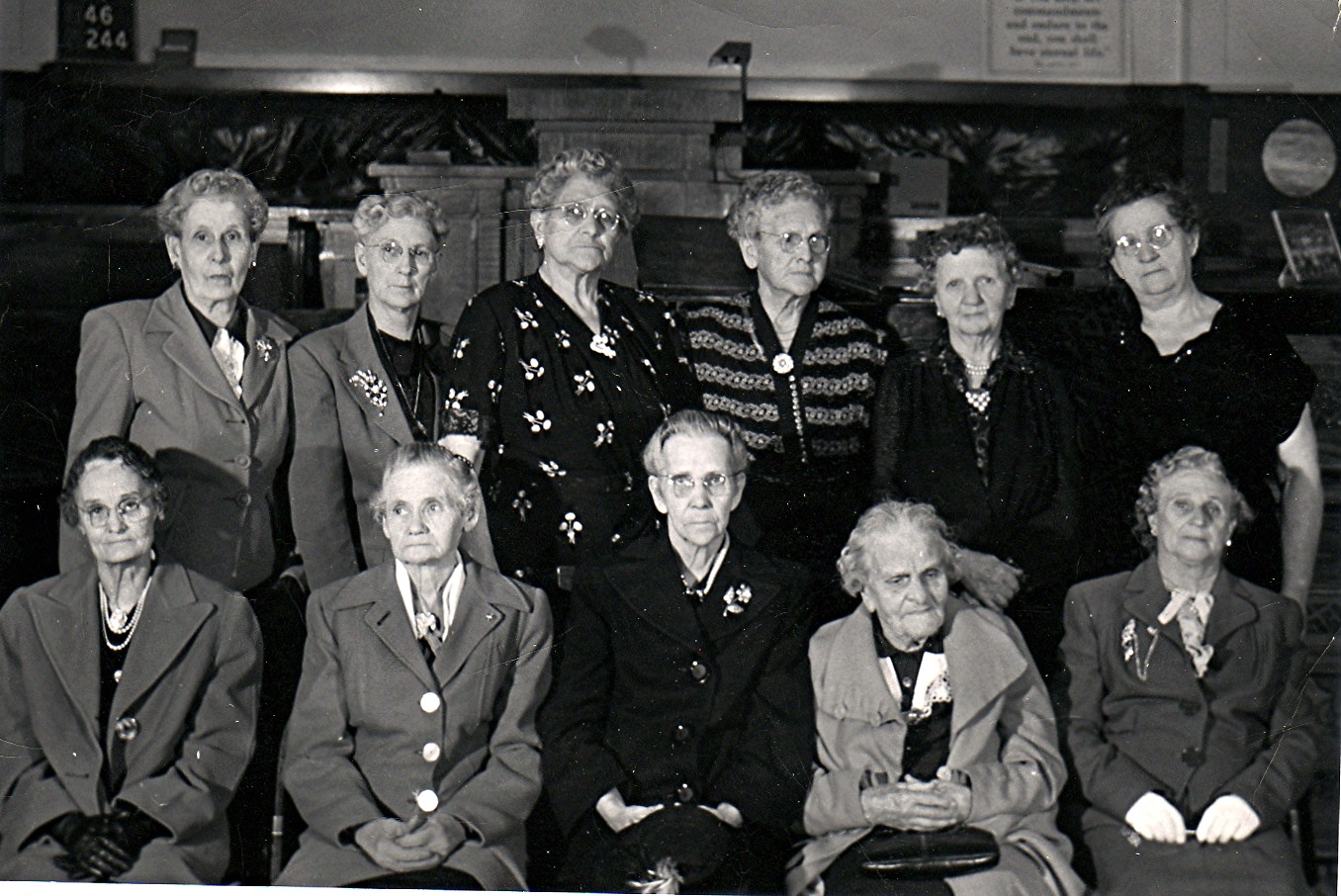
Back (l-r): Lydia Leavitt, Estella Blair, Sarah Preece, Susanna Allen, Livinia Wilcox, Clara Wheeler. Front: Lavina Poulsen, Christensia Hansen, Martha Coley, Martha Lewis, Sarah Snelgrove.

Here is a photograph I thought I would share.  It tells its own story.  This photo was taken on 25 April 1948 in the Benson Stake Tabernacle.  The photo is honoring those Visiting Teachers who have been faithful in going out for 40+ years in the Benson Stake.  The Benson Stake was headquartered in Richmond, Cache, Utah (later renamed to Richmond Stake), not Benson.

Mind you, at that time, this was not just an organization you automatically became a member of when you joined the church.  This was a separate membership with dues requirements for the organization.  You even received a membership card.  Not only are these women faithful in Visiting Teaching for 40 years, but they had volunteered to be a member of the Relief Society for that many years and actively participated.  Martha Coley in the front middle is my Great, Great Grandmother.  How many Visiting Teachers today qualify for faithful Visiting Teaching for 40 years?

Here is Martha Christiansen Coley’s daughter’s Relief Society membership card.  Lillian Coley married Joseph Nelson Jonas and after his death remarried to Lorenzo (Ren) Bowcutt.

Here is some more information I could find on the individuals in the photo.

Lydia Elnora Karren (1879-1959) married Edward Leavitt (1876-1957).  They probably lived in Lewiston, Cache, Utah.

Estella Nora Glover (1883-1952) married Ephraim Isaac Blair (1882-1943).  They probably lived in Lewiston.

Sarah () married Preece ().  Cannot find records, either have the name wrong or she moved from Cache Valley.

Susanna “Susie” Elizabeth Preece (1863-1953) married Andrew Bickmore Allen (1859-1941).  They probably lived in Cove, Cache, Utah.

Livinia Merriam Henson (1871-1950) married James Franklin Wilcox (1869-1951), previously married to an Levi Knapp Allen (1842-1928).  They probably lived in Cove.

Clara Deseret Stephenson (1880-1951) married Joseph Henry Wheeler (1882-1963).  They probably lived in Lewiston or Trenton, Cache, Utah.

Lavina Ellen Hawkeswood (1877-1954) married John James Poulsen (1871-1948).  They lived in Lewiston.  Interesting note, Martha Christiansen Coley’s husband, Herbert Coley, and Lavina are 1st cousins once removed!  Do you think these two ladies sitting on the front row knew of that relationship?

Christensia () married Hansen ().  Cannot find records, either have the name wrong or she moved from Cache Valley.

Martha Christiansen (1879-1961) married Herbert Coley (1864-1942).  They lived in Richmond.

Martha Ann Kingsbury (1850-1950) married William Crawford Lewis (1830-1908).  She was 98 years old in this picture!  They probably lived in Richmond.

Sarah Ann Gaunt (1878-1963) married Owen Elmo Snelgrove (1880-1973).  They probably lived in Richmond.

How to write an Obituary

I have done genealogy long enough that I have read thousands of obituaries.  Let me give you an idea about a few things you should include in an obituary and some things you should not.  This is my idea on how to write a proper obituary.

First and foremost, an obituary is a public service announcement.  You will say good-bye, or bid farewell, to your loved one at a funeral or grave-side service.  But an obituary is not just for you, it is an opportunity to put the public and creditors on notice about the death of an individual.  Next, it is an opportunity to invite friends, community, and distant family to grieve with you.  This is not just for people to come to the funeral, but for the community and others to rally around and give some service, emotional or pecuniary, to the deceased’s estate and to the family.  I have noticed the western United States tends to do better at their obituary writing where the east skimps on this important information.  Additionally, the more famous, the less vital information that is shared (I am unconvinced by their reasoning, but may be for good reasons).

Each week I roll through the obituaries of a half-dozen newspapers looking for names that catch my eye.  I am fortunate enough to have some fairly rare family names.  But I do have some family who marry into more common names so I often will look at an obituary to see if the individual is related or not.  Then I scan to see if they really are related, or just a similar name to an individual I know.

I also worked for a law firm at one time that had me keep an eye on obituaries to see if a client with a will had passed away.  Another firm dealing with public relations had me search the obituaries for family members of clients and we would send cards to the client if one appeared.  Lastly, in a service position, I often tried to track members of an organization who had disappeared and I looked first for the older people in the obituaries of the state in which they last lived before attempting other means.

I am just indicating that obituaries have a valid purpose beyond some sweet, potentially selfish, family reason to share their love of the decedent with others.

Therefore, here are a few items to include in every obituary.  These are the items the disinterested public wants to learn in an obituary.  I have included a copy of a good obituary below.

  • What is the individual’s full name?

Please include the full name, spell out the middle name.  You do not need to put the maiden name as the name will be listed with the parents.

  • What is the individual’s parent’s names?

Please include the full name of both parents.  This is where you do want to include the maiden name of the mother.  Usually, I will write the mother’s name first as a maiden name, and then the father’s name to not worry about determining what the real last name is.  Hence, something like, “Richard was the second son born to the marriage of Jane Ethel Jones and Harvey John Smith.”  Mention the marriage if it exists.  If one of the parents are dead, put ‘late’ in front of the parents name (if both are dead, you will mention that farther down and can drop the late).  If the deceased was adopted, please state this in the obituary.  You do not have to give the biological parents, if you know them, but just show, “Jane Ethel Jones and Harvey John Smith adopted Richard when he was 17 months old.”

  • What is the individual’s birth date?

Please include the entire birth date of the deceased.  This is especially important if it is a common name like John Henry Smith.  Even if it is not a common name, include it because uncommon names tend to repeat names in their families which could still muddy the waters.

  • Where was the individual born?

It is not uncommon for individuals to move in our society.  This is even more true of couples who retire to Florida or Arizona.  An obituary is published in Queen Creek, Arizona and not in their home in Montana, and the next thing we know we are searching for an obituary for someone and an apparent match appears in Arizona but we having nothing to confirm the connection.

  • Who did the individual marry?

I completely understand if you want to maintain some privacy to the spouse of an individual, especially if they are still living.  If so, just list the first name.  No matter how much you might hate that first wife, list them.  If you really want to spite them, put their whole name.  Just make a reference to their divorce and put the next marriage.  But please list it, some states still leave property to a spouse after death, even after divorce.  Do not cut yourself short.  If there are other children from such a marriage, list them.  This is a common courtesy if you are not on speaking terms to let them know of the death.  If a spouse has predeceased, just write something like, “Jim married Belinda Carlisle on 4 February 1920, she predeceased him on 23 March 1984.”

  • When and where did the individual marry?

These items too can be useful for genealogy and legal research.  If married in a community property state, or even a state where family does not know of additional property, there can be implications.  An obituary may be one of the only ways this information will be out in the world on a free basis.  Working from obituaries, if a marriage date or location is not given, then a presumption arises that they were not or the family does not even know this information.

  • When did the individual die?

You would think an obituary might make this obvious.  However, let me tell you where this can become a problem.  Imagine you cut out an obituary and place it in a book somewhere.  20, 30, or even 100 years later someone is looking for that death date.  They do not want to walk down to the local library in another part of the world where the newspaper was published to spend a long time to find the exact page on which the obituary was located to figure out when exactly “last Friday” was on the calendar.  In our day and age with government records, it is much easier to ascertain the day that someone died.  But if you have John Henry Smith, with a hundred or so born in the US in a given year, that obituary with a date will be much more pleasing.

  • Where did the individual die?

This one might sound odd, but it also applies.  Let’s say I am a 2nd cousin who has not been in contact with Uncle George since 1978.  The last mailing address I have is in one town but I do not know if they still live there and I would like to search for their current address or a phone number.  Well, if they moved over just a few towns I will not find them, if they have a common name.  Most people die at a location fairly close to their home.  This will make it easier for the lawyer, governmental entity, or family member to contact you should they want to.  They will find you, but not listing it will just delay the inevitable.  Also, government entities often will list the location of last benefit, but that is not the same as death location for genealogical purposes.

  • When and where is the funeral?

This is one that many obituaries do not forget.  After all, we want people to come bearing love, condolences, and love.  Some even measure how great a person was by the number of individuals at a funeral.  However, I make mention because a few obituaries do not list this information.  I have read an obituary or two that I am left wondering where the funeral is at to send flowers or a card.  I only find out on the day of the service when the newspaper publishes it.  By that point it is too late to send flowers.  While cheaper for me, some people probably would not have minded attending the funeral.

Lastly, I do not mean to indicate that other things should not be included.  Military service, favorite hobbies, and special thanks should probably be included.  If a person has dedicated their lives to the Masons, a community, a church, or employment, that should probably be listed.  Please do not spend too much time on it though.  Some newspapers charge over a certain amount of lines too.

One last item that I would highly recommend, but understand for privacy reasons if you do not wish to do this.  List all the children of the decedent.  A little hint about the daughters, list them with the husband (if still alive) and married name.  Hence, “Jim is survived by 2 children, Molly (Kevin) Jenkins of Sacramento and Richard (Karen) Schmidt of San Francisco.  Jim was also predeceased by his daughter, Diane (Gary) Warner”

It is also common to list out the number of grandchildren and great-grandchildren.  Please do not name them.  Usually it takes space and the usual reader cannot tell which child belongs to whom, so it is just type we skim over.  Close family know who they are, the less-interested public will skim.  I read an obituary once that had like 11 children and they listed out all 42 grandchildren!!  They did not even give the last name of the grandchildren so even a person who does family history would have found the list useless (and if all the same last name, still just as useless).  List them in the funeral program, not the obituary.

Here I have to put in a note regarding our current society and identity theft.  The theft of a decedent’s information is somewhat limited in use.  First and foremost, report to the government immediately the death so that the Social Security Number and other relevant identification routes are stopped and that the government will be put on notice if someone attempts to use it later.  The probate court should take care of the rest.  Even if the hospital or funeral home is supposed to take care of it, make sure you check it out and report it yourself to both the state and federal government offices.  The information is not often independently valuable unless the government benefits are available.  Too often the family does not report it in time and the next thing they know someone else is using the information and even filing taxes under the decedent’s name and government identification numbers.  If you want closure with your loved one, do what you can to keep others from perpetuating their identity!  It will save you loads of heart ache to do a little effort immediately, like when you are writing the obituary!

I hope this helps some on how to write an obituary.  Keep it simple and do not put too much affection in.  After all, most of the public just wants the facts to determine if we know the person.  If we want sappy, we will come to the family, or send a card/flowers.  Or, if we have business, we now know we need to watch out for the probate notice.

Van Leeuwen – Weenig Wedding

Christiaan Frederik and Everdina Kamphuis Weenig are pleased to announce the marriage of their daughter Elsebina Maria Catharina Weenig to Gerrit van Leeuwen, son of the late Hendrik and late Maria Elizabeth Catharina de Kok van Leeuwen.  Gerrit and Elsebina were married 22 August 1849 in Leiden, Zuid-Holland, Netherlands.

We really do not know a whole lot about this couple.  The only reason I am really writing this entry is not because we have a history, but because we do have photos of these two individuals!  I will give what little we know and make the photos available.

Gerrit likely met his future wife Elsebina through her brother Christiaan Frederik Everdinus Weenig.  Gerrit van Leeuwen and Christiaan Frederik Everdinus Weenig were the same age and had gone into business together as early as 1846 building and selling organs and pianos. Elsebina’s father Christiaan Frederik Weenig was the organist at the Waalse Kerk in Leiden.

Gerrit was a organ builder by trade.  He traveled building and installing large pipe organs in churches and cathedrals in Netherlands and other locations throughout Europe.  Apparently he also played the piano, organ, and accordion.  We really know nothing of their lives, personalities, or characteristics.

Gerrit van Leeuwen was born the 6th of 8 children to Hendrik van Leeuwen and Maria Elizabeth Catharina de Kok on 12 April 1823 in Leiden.  Here is the only picture I am aware that exists of him.  He is obviously quite a bit older and I have no clue what book he is holding, perhaps the Bible?

Elsebina Maria Catharina Weenig was born 4th of 5 children to Christiaan Frederik Weenig and Everdina Kamphuis on 15 November 1826 in Leiden. Elsebina was a seamstress. While living in Leiden in the early years of her marriage she designed, manufactured, and sold hats.  Of interest, Elsebina was the granddaughter of Jacobus Kamphuis, an acclaimed silversmith in Leiden.  Here is a link to some of his pieces that have sold on Christie’s.  Bisquit Boxes, Spoons and Forks, Salt Cellars, Bisquit Box, and Fish Slice.  The family cannot have been hurting too bad for cash with a profession like that.  At any rate, here is the only photo we have of Elsebina.

Gerrit and Elsebina would have 9 children born to them.  Two would die as children and we have records of 6 of those marrying.

Maria Everdina van Leeuwen was born 14 July 1850 in Leiden and died 23 May 1919 in Arnhem, Gelderland, Netherlands.  She married Hendrik Jansen 19 February 1873 in Arnhem.

Christina Elsebina van Leeuwen was born 31 May 1852 in Leiden and died 4 January 1914 probably in Rosario, Santa Fe, Argentina.  She married Frans Homkes 22 August 1874 in Oldenzaal, Overijssel, Netherlands.

Elsebina Jacoba van Leeuwen was born 21 April 1854 in Utrecht, Utrecht, Netherlands and died 17 November 1933 in Arnhem.  She married Dirk Potharst 24 July 1878 in Arnhem.

Gerhardus Hendrik van Leeuwen was born 16 October 1856 in Oldenzaal and died 5 January 1932 in Provo, Utah, Utah.  He married Hermina Janzen 31 March 1880 in Arnhem.  I have written of their family at this link: Van Leewen – Janzen Wedding.

Hendrik Christiaan van Leeuwen was born 1 December 1859 in Oldenzaal and died 4 May 1904 in Arnhem.  We do not have a record of a marriage for him.  He served in the military and appears to have died unmarried.

Everdina van Leeuwen was born 15 May 1862 in Oldenzaal and died 16 February 1863 in Oldenzaal.

Everdina Johanna van Leeuwen was born 27 October 1864 in Oldenzaal.  We do not have a death date or marriage for her.  Apparently she married Jan Hendrik Stros from her father’s probate probate record.  We have more research to do.

Johanna van Leeuwen was born 1 September 1867 in Oldenzaal and died 24 February 1963 in Long Beach, Los Angeles, California.  She was buried 27th February 1963 in Inglewood, Los Angeles, California.  She married Pieter Willem te Groen 5 March 1890 in Arnhem.  This family lived in Pretoria, Gauteng, South Africa and then moved to Annapolis, Anne Arundel, Maryland, before eventually moving to California.

The last child, a boy, was not named as far as we can tell.  He was born 1 October 1870 in Oldenzaal and died the same day.

Elsebina died 22 March 1884 in Arnhem.  Someone in the family made a ‘hair art’ portrait of her tombstone wherever it is/was located.  Here is a photograph taken in 1960’s of the portrait (I am hoping to get an updated photograph of it from its present owner).

The family must not have been hurting too badly to be able to afford a tombstone such as the one in the picture.

Gerrit passed away 19 February 1906 in Arnhem.

Unfortunately, the story ends there.  Maybe someday we will know more about this family or some of the other Weenig, Kamphuis, or Van Leeuwen cousins.