
29 June 1897 – 25 July 1918
Wilhelm Allgaier was born 130 years ago next year. He was 21 when he died, a cigar-maker’s son from a small village in Württemberg, killed in a war that ended less than four months later. He deserved more of a life than he was given. This is, at least, some accounting of the one he had. We just had Veterans Day and have Thanksgiving this week. Considering Wilhelm’s life makes me all the more thankful for the one I am blessed to have today.
I stumbled on Wilhelm Allgaier as a distant cousin. He is my 6th cousin four times removed. His father, Johann Georg Allgaier (1859-1935), son of Jakob Allgaier (1827-1907), son of Maria Catharina Mutschler (1797-1837), daughter of Catharina Heinkel (1772-unknown), daughter of Friedrich Heinckel (1732-1805), son of Anna Maria Loew (1697-1776), brother of Johann Georg Loew (1683-1750). I am a descendent of Johann Georg Loew. Anna and Johann are the children of Johann Loew (1658-1717) and Rosina Dreyschnitz (1661-1742). Johann George Loew had a daughter named Eva Maria Loew/Low (1709-1786), with a son Jacob Friderich Vollmer (1742-1812), with a daughter Margaretha Dorothea Vollmer (1777-1850), with a daughter Maria Magdalena Kauber (1806-1860), with a daughter Eva Katharina Greiner (1835-1893), with a daughter Regina Friederike Nuffer (1869-1942), with a daughter Mary Louise Wanner (1901-1991), with a daughter Colleen Mary Andra (1928-1999), who is my Grandmother.
Brucken Village
Wilhelm Allgaier was born 29 June 1897 in Brucken, a small village in the Oberamt (district) of Kirchheim, in the Kingdom of Württemberg. He was christened just five days later, on 4 July 1897, at the Marienkirche in Owen, the parish church that had served his mother’s home village since the Middle Ages. He was the seventh of thirteen children born to Johann Georg Allgaier, a laborer, and Rosine Katharine Kiedaisch. Theirs was a large rural family typical of the region and the era, rooted in two neighboring villages: his father’s people from Schopfloch and Brucken, his mother’s from Owen, just up the valley.
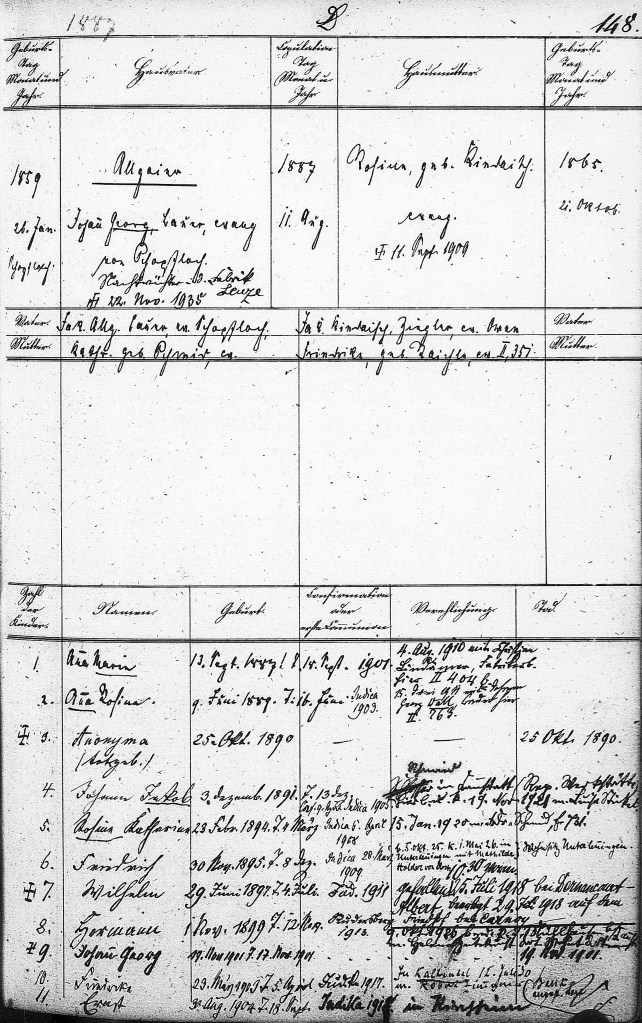
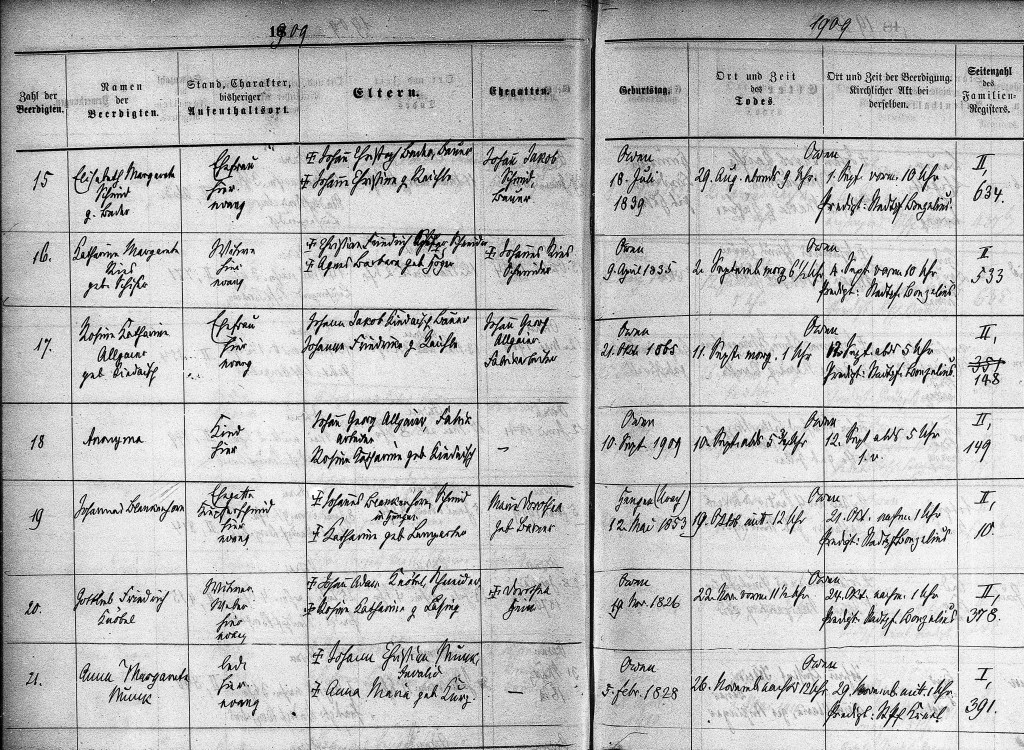
Wilhelm’s childhood was not an easy one, even by the standards of the day. Of his mother’s thirteen children, three died in infancy: an unnamed sister in 1890, a brother who lived only two days in 1901, and another unnamed sister in 1909. That last loss struck particularly close: parish burial records show the infant girl was born and died on the same day, 10 September 1909, and Wilhelm’s mother, Rosine Katharine, died the very next morning, at one o’clock, from complications of that same birth. Wilhelm was twelve years old. He had lost a mother and a newborn sister within a night.
By the time he was a young man, Wilhelm had gone to work as a Zigarrenarbeiter, a cigar-factory worker, one of the common trades in the region at the time. He was, by all appearances, an ordinary young Swabian workman with an ordinary life ahead of him.
Then came the war.
World War I
On 21 September 1916, at not quite nineteen years old, Wilhelm was inducted at Kirchheim into the Königlich Württembergisches Reserve-Infanterie-Regiment Nr. 248, a Württemberg reserve infantry regiment that had been fighting on the Western Front since the earliest weeks of the war. He was assigned to the regiment’s 6th Company and given the rank of Musketier, an infantry private in the Württemberg service.
His regiment, part of the 108th Reserve Infantry Brigade of the 54th (Württemberg) Reserve Division, had already been through nearly the entire war by the time Wilhelm joined it: the Race to the Sea, the Battle of the Yser, the Second Battle of Ypres, the terrible fighting on the Somme in 1916, action at Verdun, the Second Battle of the Aisne, and a return to Verdun in 1917 to meet a French offensive there.
Wilhelm’s own service record shows he was sent into this grinding war and, at some point during his division’s long stretch of duty in Flanders, likely during or after the division’s participation in the Battle of Passchendaele in late 1917, he was wounded in the leg. He recovered, and rather than being sent home, he went back into the field a second time.
The Last Push
In the spring of 1918, Germany launched its last great gamble of the war, the Kaiserschlacht, the spring offensive intended to win the war before American troops could arrive on the Western Front in force. Wilhelm’s division was swept into it, fighting in what became known as the First Battle of the Somme of 1918. The offensive pushed the front line deep into territory the Allies had spent years fighting to hold, and for a few months that summer, the villages around Albert and Dernancourt, hard-won Australian and British ground since 1916, were back in German hands.
It was in that sector, in the quieter but still deadly weeks between the failed spring offensive and the Allied counterstrike that would break the German army for good. It was here that Wilhelm’s war ended. On 25 July 1918, during what his parish’s burial register describes as a Sturmangriff, a storming attack, near Dernancourt and Albert, Wilhelm Allgaier was shot in the chest and killed. He was 21 years old.
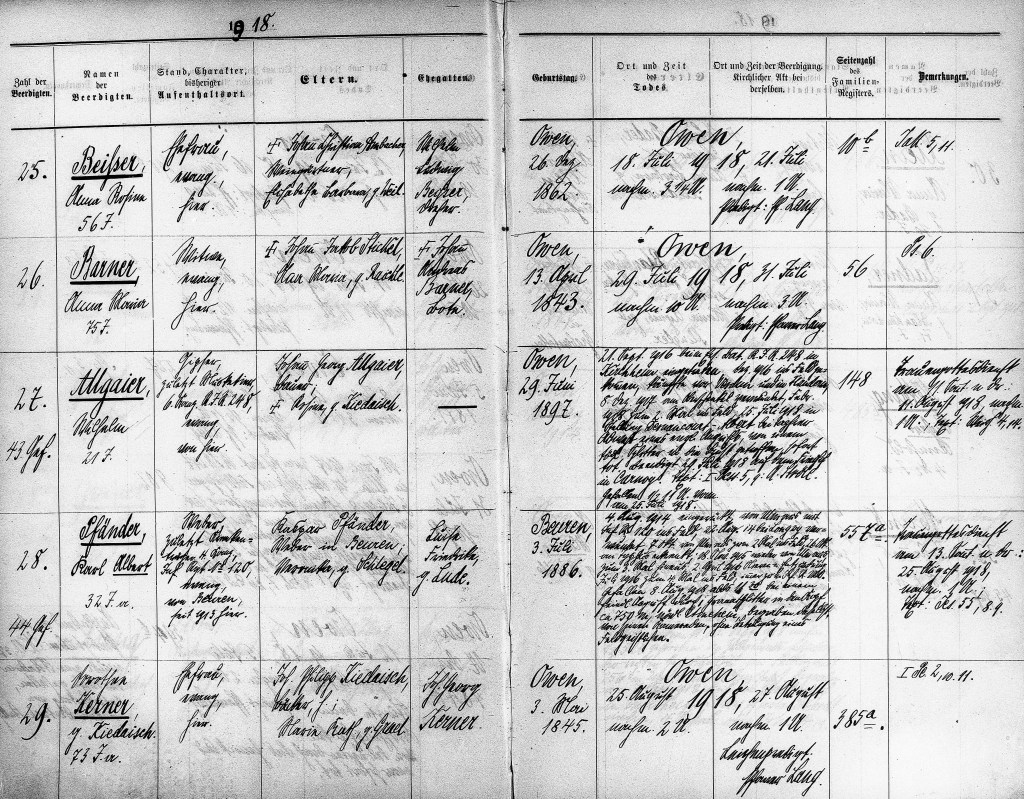
He was first buried on 29 July 1918 at Carnoy, a village on the Somme battlefield that was, at that time, still in German hands. A memorial service for him was held back home in Brucken on 11 August 1918, word of his death reaching his family and village community even as the war ground on toward its final, chaotic months.
His body was later moved, along with those of tens of thousands of other German war dead gathered from the surrounding countryside, to the Fricourt German Military Cemetery, where he rests today among more than 17,000 soldiers of the Kaiser’s army. Most of them, like Wilhelm, ordinary young men from ordinary villages, killed in a war whose ending they never saw. His grave, like the vast majority at Fricourt, has no individual marker; most of the cemetery’s dead lie in shared or communal graves, their names recorded but their exact resting place within the ground indistinguishable from their fellow soldiers.
By the time the 54th Reserve Division was disbanded that September, its ranks so depleted after four years of continuous fighting that it could no longer function as a fighting force, Wilhelm had already been dead for nearly two months.
Less than four months after his death, the war he had given his life to ended in armistice.
A Family Left Behind
Wilhelm was the only one of the thirteen Allgaier children to die in the war, though at least two of his brothers, Johann Jakob, born in 1891, and Friedrich, known as Fritz, born in 1895, were also of military age throughout the conflict and, in all likelihood, served as well. Both survived to marry in the 1920s. His father, Johann Georg, outlived him by seventeen years, dying in Brucken in 1935, long enough to see most of his surviving children grown, married, and starting families of their own, and long enough, one has to imagine, to carry the grief of a son who never came home from France.
What drew me to Wilhelm’s story, beyond the discovery of his name on a family tree, is exactly what makes so many of the fallen of the First World War difficult to know: he left very little behind. No letters survive that I have found. No photograph. Not even, as far as any record shows, a sweetheart or a fiancée. What I have of him is what the state and the church recorded: a birth, a christening, an induction, a wound, a death, a burial. The bureaucratic skeleton of a life that was cut short before it could put on any more flesh than that. He is in a shared grave among more than 17,000 others at the German military cemetery in Fricourt, France. The young man who never had a chance to grow old due to war. I share some of his story for him, just so he is remembered.
I have tried, in researching him, to give that skeleton back something of its shape. The cigar factory where he likely worked before the war, the mother and sister he lost as a boy, the regiment he marched with across some of the worst battlefields of the Western Front, the wound that should perhaps have kept him out of the fighting that killed him, and the single sentence in a parish register, “shot in the chest, near Dernancourt,” that is the only account found to date of how he died.
It felt important, too, to do something more than write about him. Wilhelm Allgaier died before he had the chance to marry, to have children, or, as a matter that matters deeply to me and to my faith, to receive the ordinances of the gospel for himself. I submitted his name for temple work, and his baptism was completed on his behalf at the Provo City Center Temple, followed by his confirmation at the Indianapolis Indiana Temple. I performed his initiatory in the Boise Idaho Temple. I then performed his endowment and sealing to parents both in the Burley Idaho Temple. His temple work is now finished on his behalf. The lost son soldier in World War I is not lost or forgotten. He did not get to make those choices for himself in life. I hope, whatever his answer, that he has the chance now, and I hope he accepts what has been offered.

