That poem seemed to fit as I work through more photos that belonged to my Great Grandparents. These photos found their way to my (Great) Uncle Dave and (Great) Aunt Betty. I scanned and worked through these photos, in some cases over 100 years later. I wonder what thoughts or emotions my own family’s photos might evoke in 100 years. The little minutes add up.
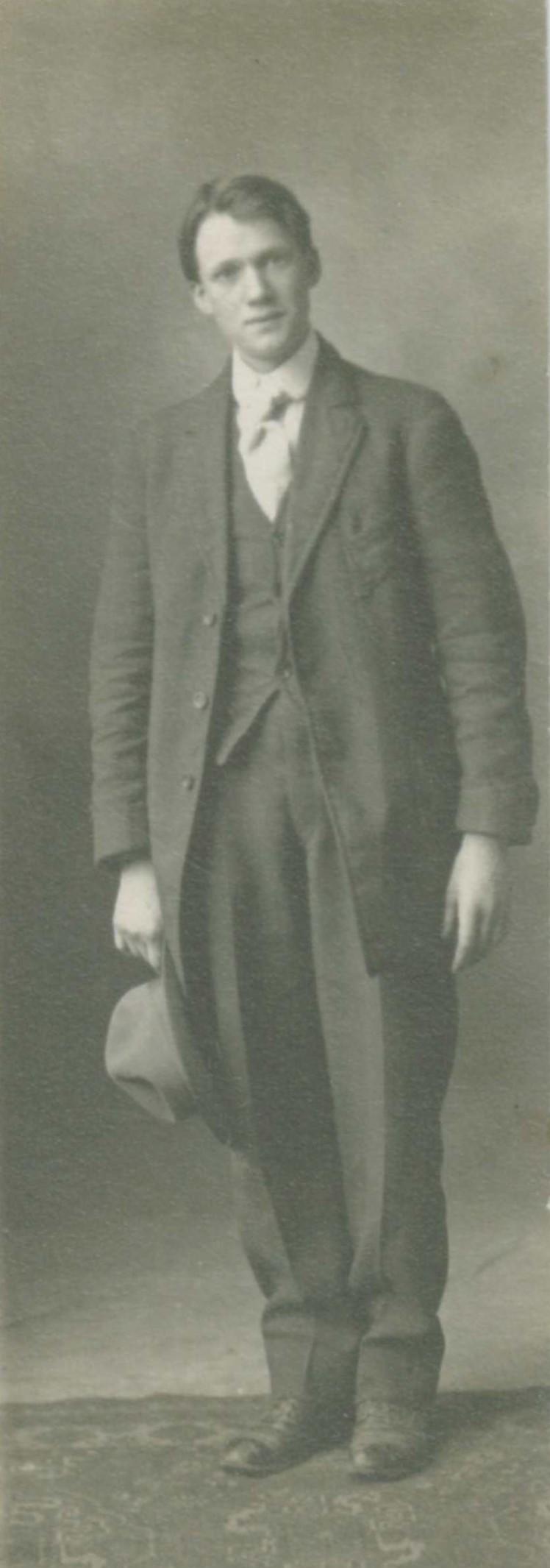
Young David Delos Donaldson
David Donaldson was born in 1894. If this photo were taken at 18 years old, then it would be 1912.
David Donaldson
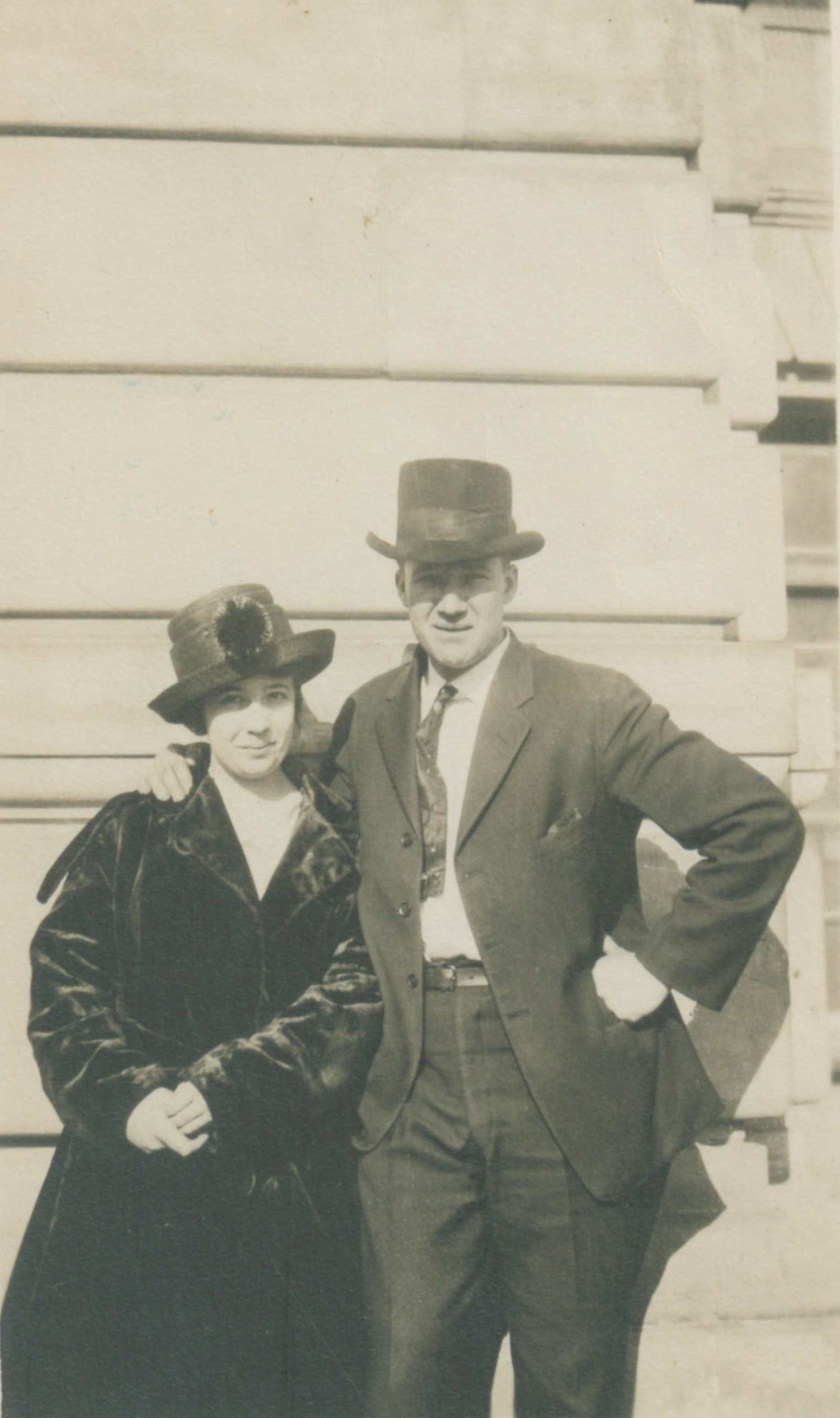
Delos Donaldson and unknown woman
Unknown woman and Delos Donaldson
These are the two same women from the separate photos above, probably the same day. No clue if related or some other occasion.
David certainly appears older in this photo than the prior one. His 20s or 30s?
“Delas, Dena, Ms. Berry, Alvin, and g”
I can recognize Dena and David on the left, along with David’s mother Mary. I would have been guessing on Alvin, but his age and size appear to match. Who is Ms. Berry? There are so many Berry/Barry/Beery ladies in Ogden in 1920, even within a mile and half of the house, that I cannot make any identification. The Donaldson family in 1920 were living at 2270 Ogden Ave, Ogden, Utah. I have written a biography about my Great Grandparents, David Delos Donaldson and Berendena Van Leeuwen.
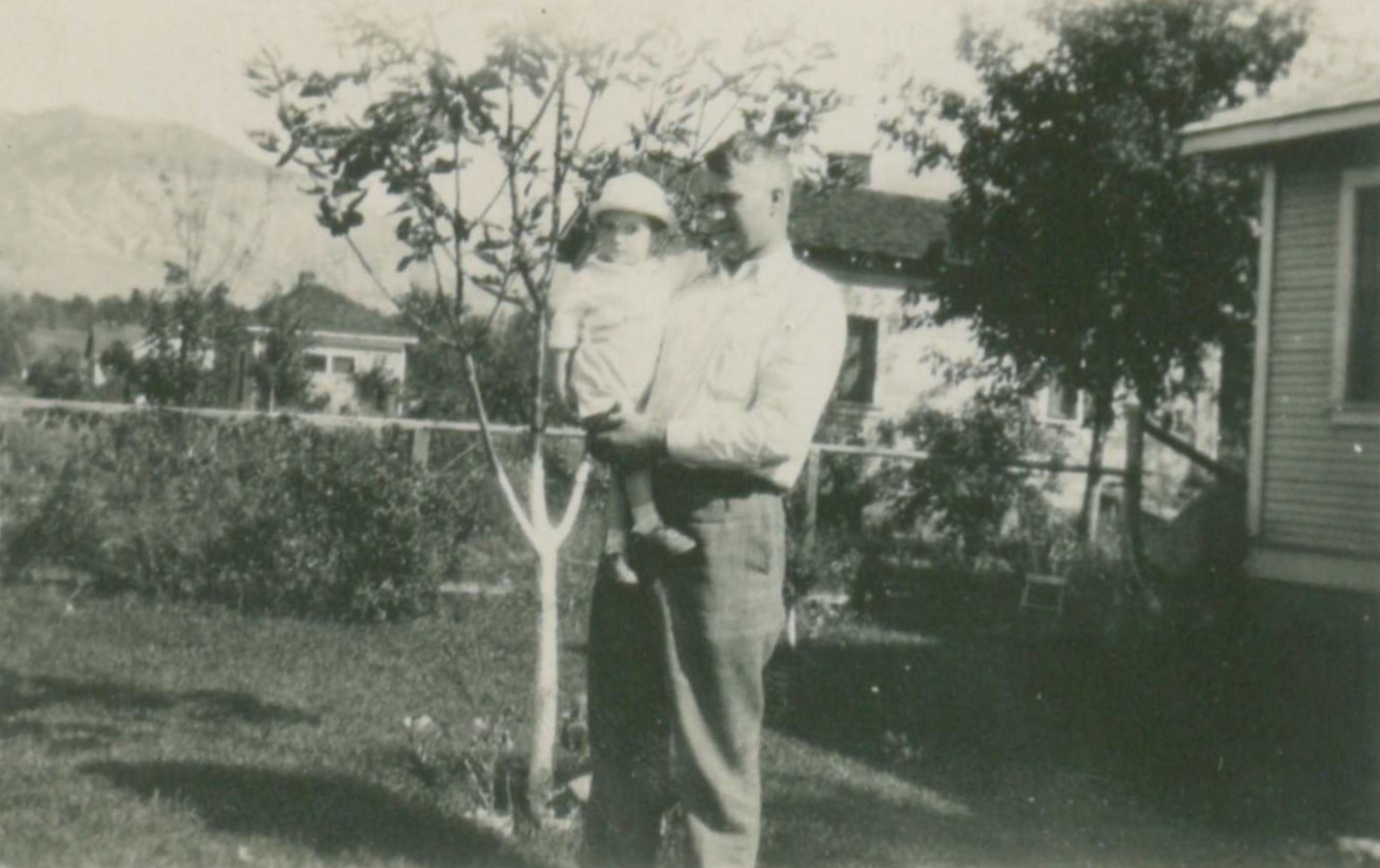
David Delos Donaldson holding little girl
This photo has a couple of interesting pieces. I don’t immediately recognize the little girl as one of David’s children. The family lived in Ogden. The mountains seem to line up. But I generally think it is early 1920s. Interesting note, I appreciate that the baby clothing between boys and girls were somewhat interchangeable. Perhaps this is actually David William Donaldson and the same day as this photo:
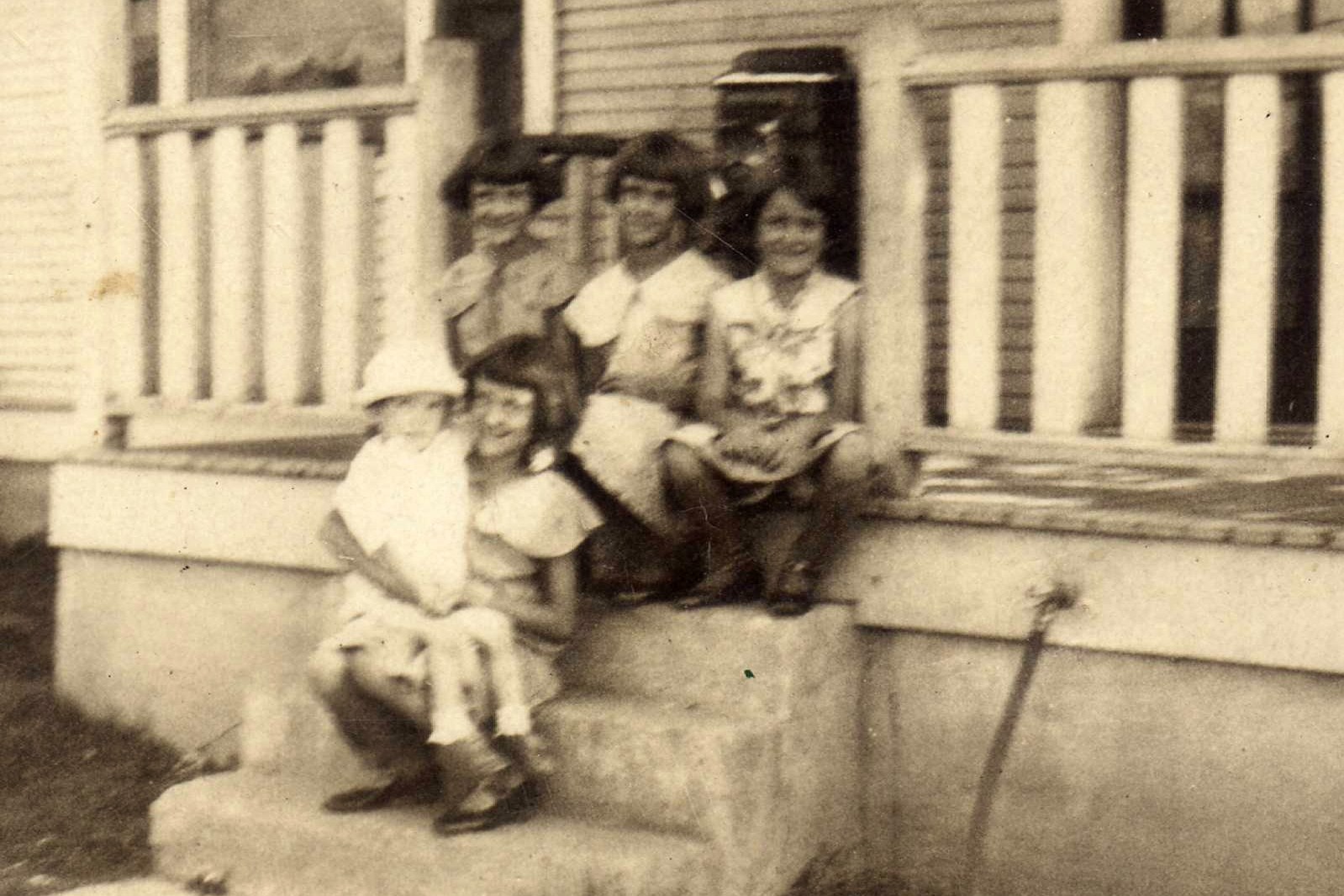
Donaldson Children about 1930
Berendena Van Leeuwen Donaldson holding child
This photo is interesting to me as I don’t see Dena as quite as young as when her first kids were born in 1920. I cannot tell if it is a boy or girl she is holding, but if it is David/Dave, then this could be around 1929-1930. Dena was born in 1898, so 1930 would put her at 32 years old.
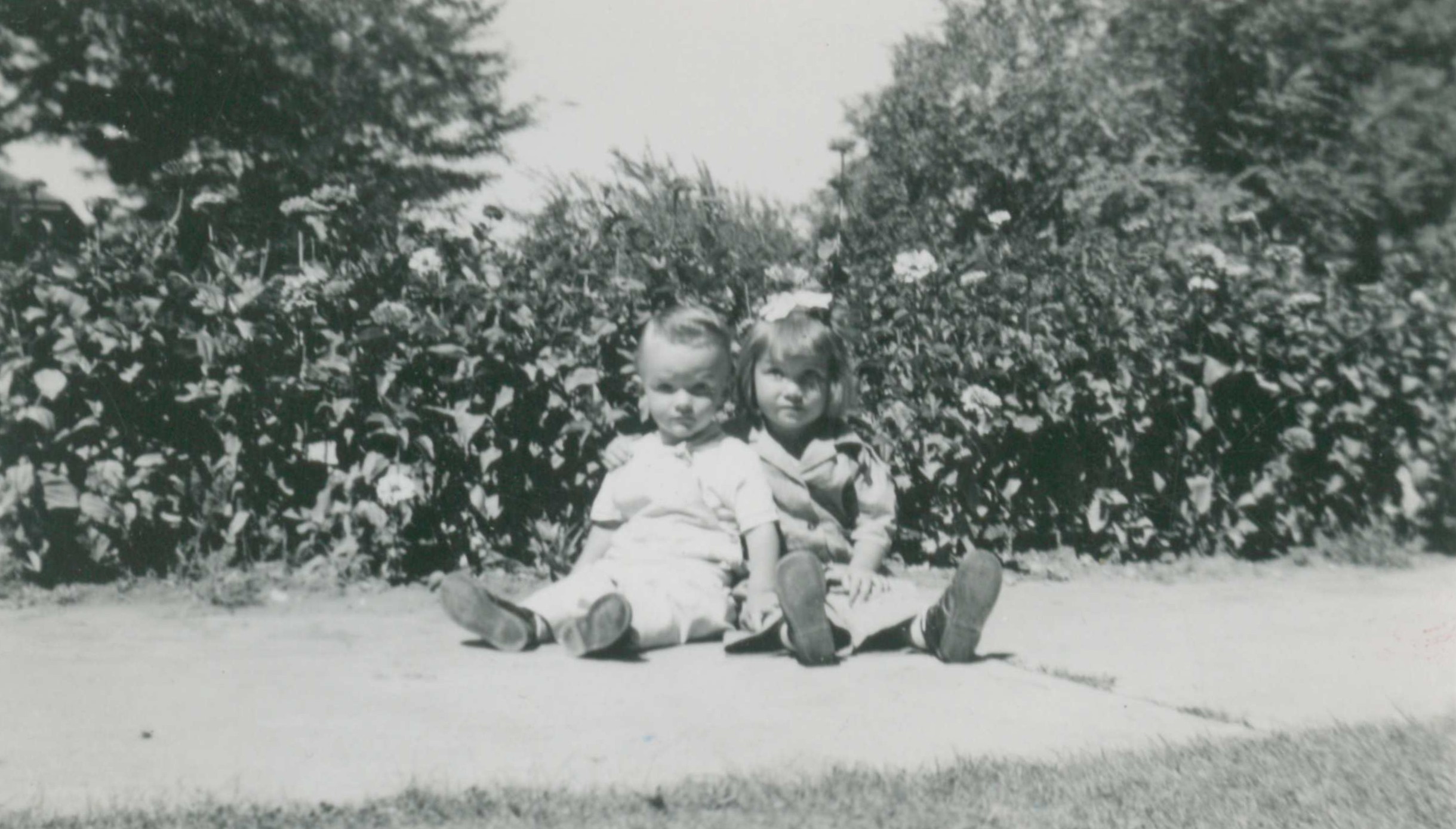
Milo Ross and unknown girl
Berendena Van Leeuwen Donaldson with the three Ross grandchildren, Milo, Caroline, and Judy
Milo was born in 1943, Judy in 1946, and Caroline in 1948. This photo seems it could have taken place in 1950 to 1951.
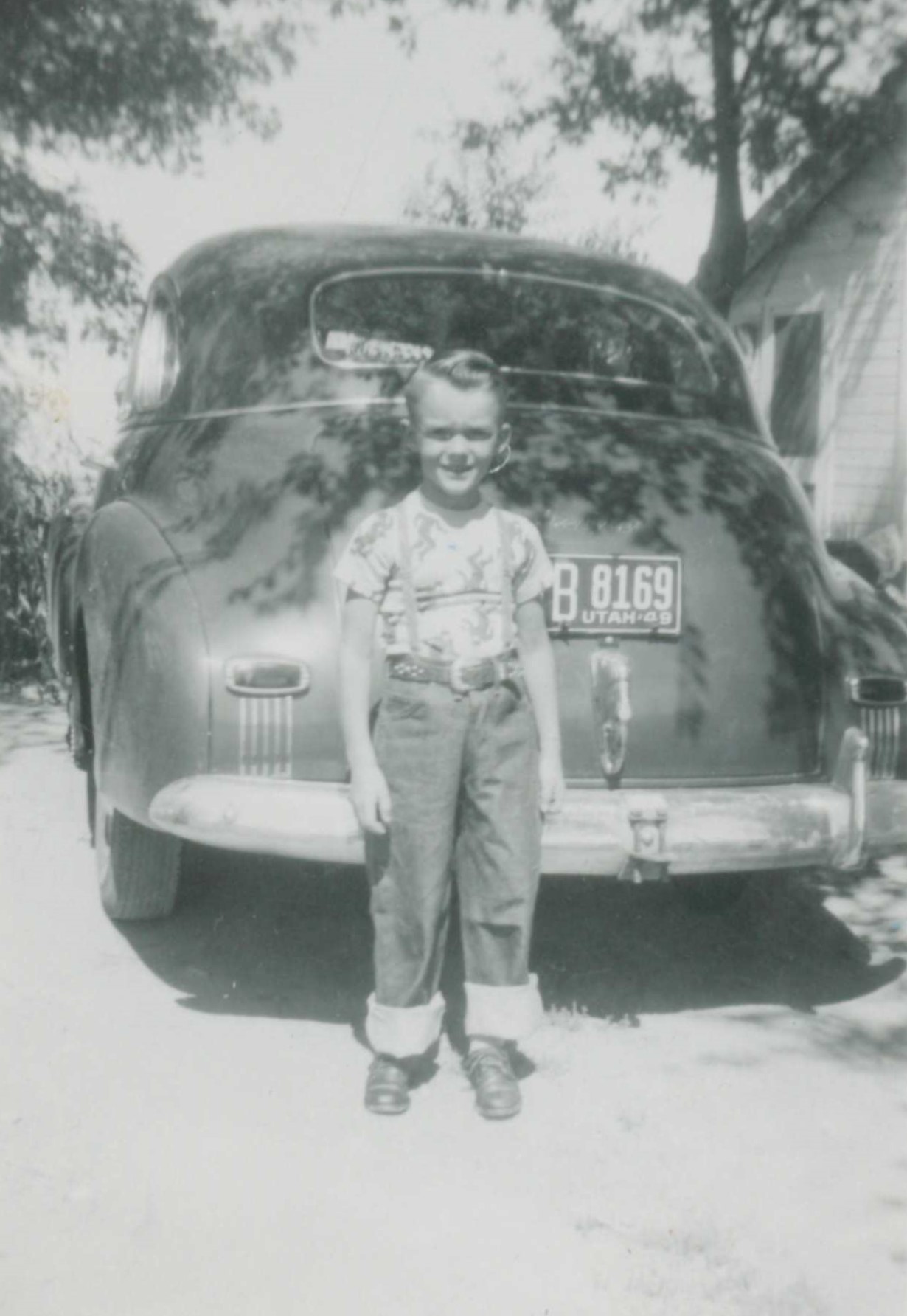
Milo Ross
I don’t know whose car it is, or the make and model. The plate says 1949. I don’t know if plates had to be replaced every year, or if they were longer time increments. If they are only one year, then this would appear to place the photo and the one above in 1949 or 1950.
Dena and Gladys Donaldson – 1940
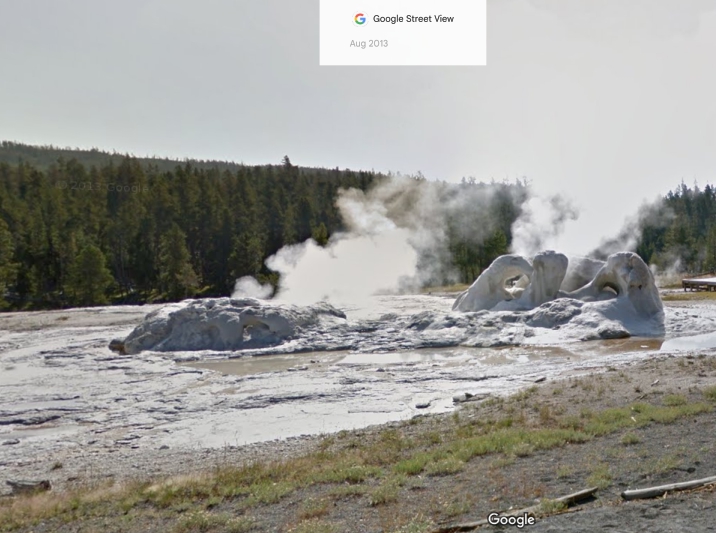
This photo is interesting. It had 1940 written on it, so my Grandma turned 19 that year. She married in 1942. Doing an AI search, it showed one of the locations near Grotto Geyser. The small piece of the sign to the right appears to begin with the letter G. Here is a modern shot from Google Maps from 2013. It really does not look like the Grotto Geyser features have changed much in 85 years.
2013 picture of Grotto Geyser
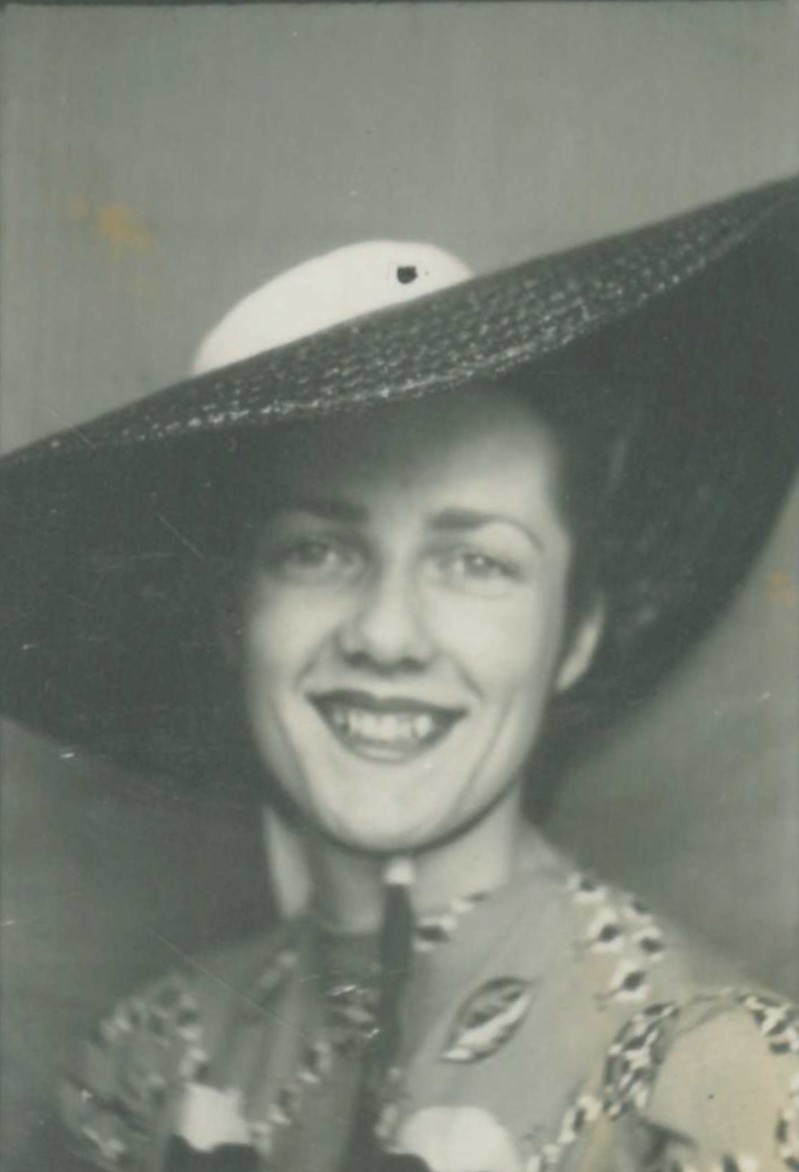
Gladys Maxine Donaldson Ross
This photo was a fun photo of Grandma. Her teeth in the picture are different than I remember. Going back through all the photos I have of her and Grandpa, I don’t have many pictures of her full-toothed smile. Having her tongue in her teeth distorts how her teeth look.
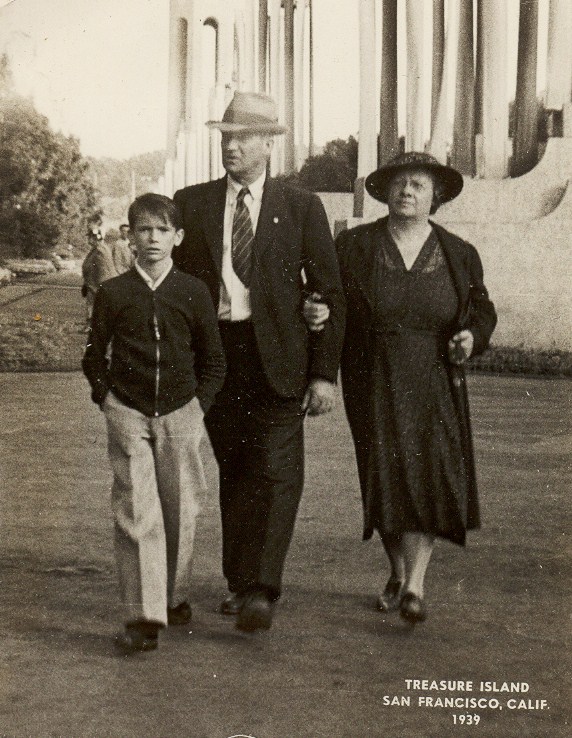
28 June 1939 – Napa, California
This photo is interesting in that the back says it was taken 28 June 1939 in Napa, California. The only explanation for the photo must be while they were in California for the 1939 World Fair. Here is a photo from that occasion.
Dave, Delos, and Dena Donaldson
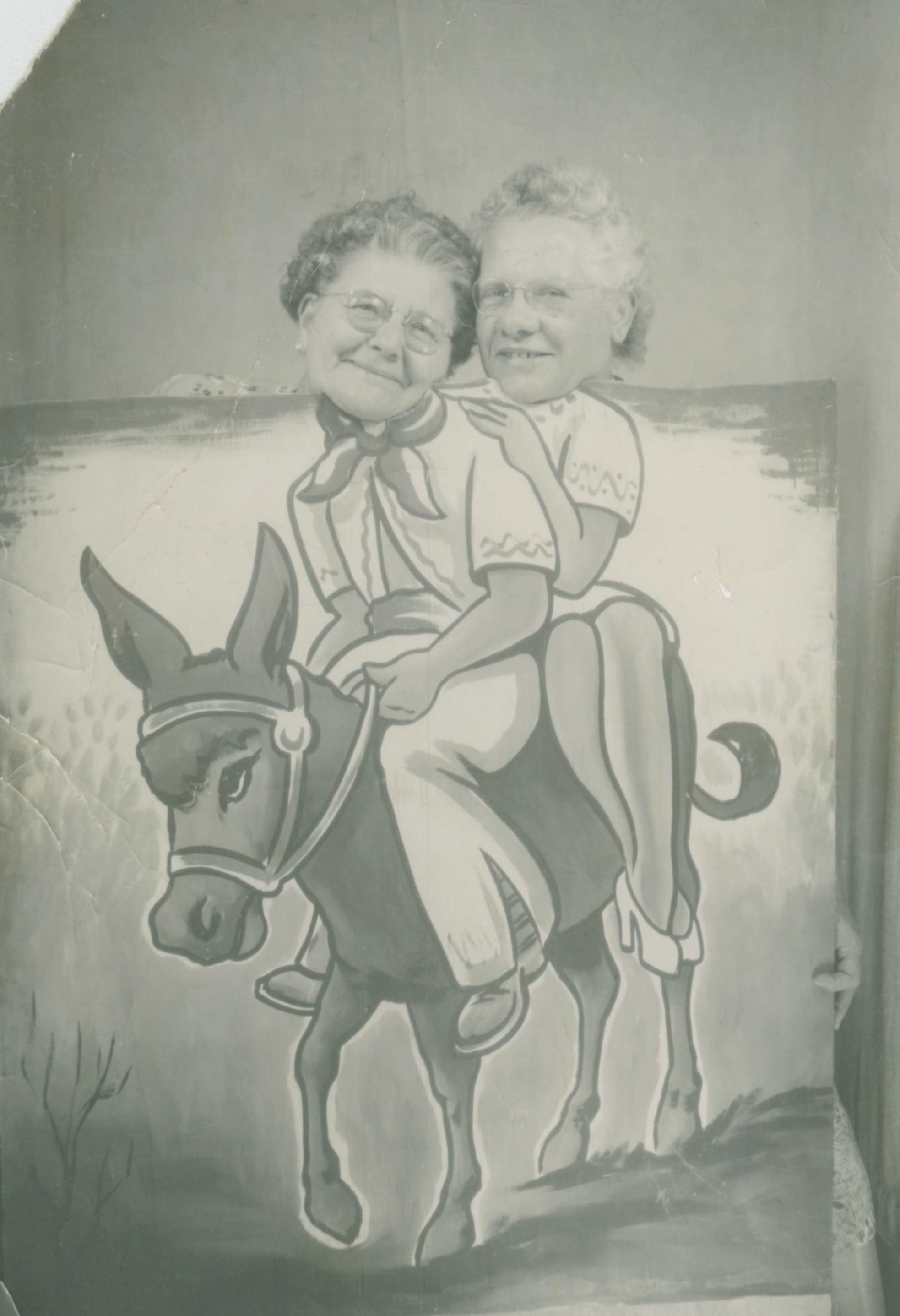
Kate Collins and Dena Donaldson
Here is another fun photo. Berendena Van Leeuwen Donaldson and Catharina Johanna Van Leeuwen Collins are sisters. Dena was born in 1898, Kate in 1902. Dena passed away in 1959 and spent the last 4 years of her life in a wheelchair, so this is before that. You can see she is standing on the right and holding on to the side of the image. Guessing, this is probably early to middle 1950s.
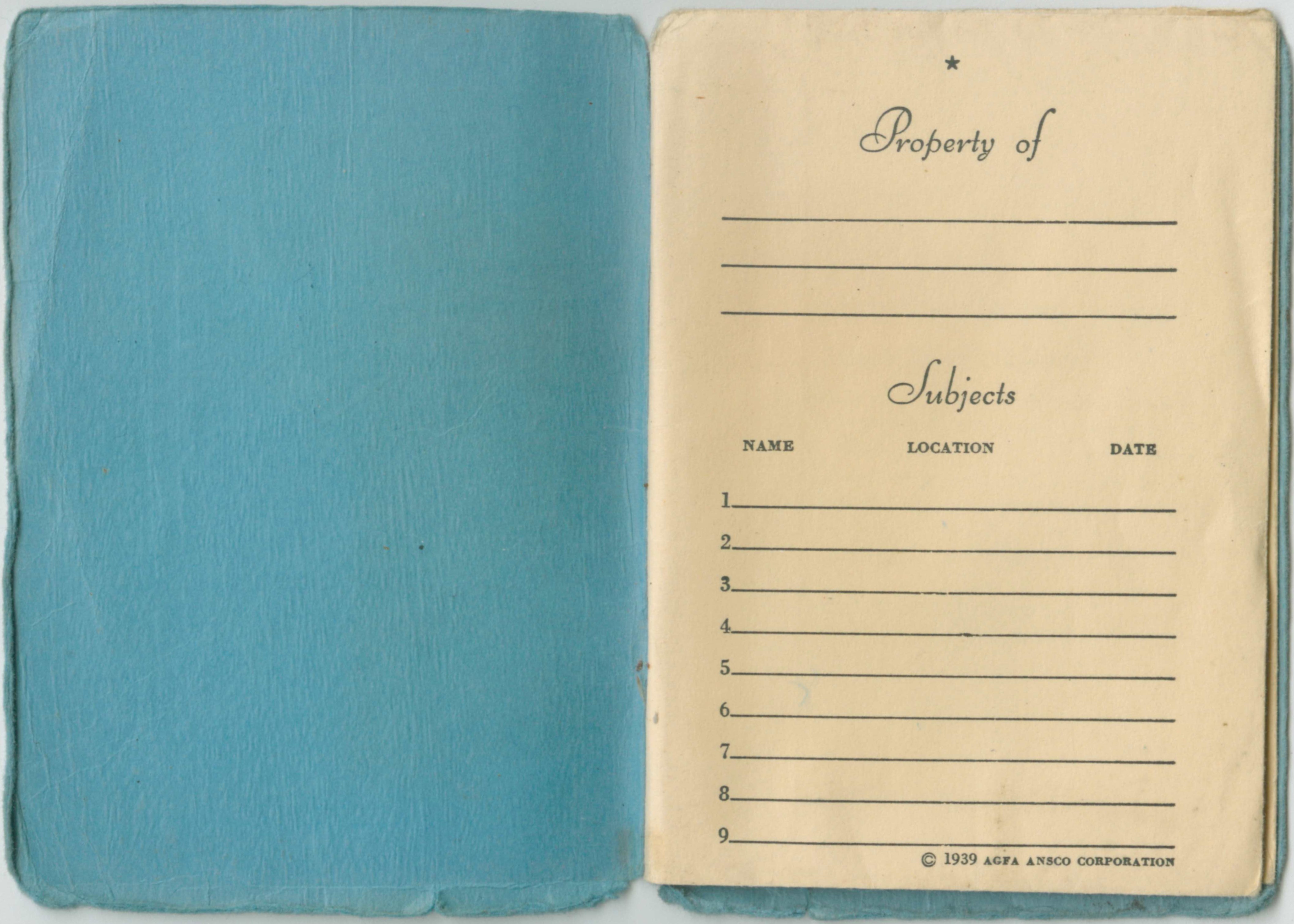
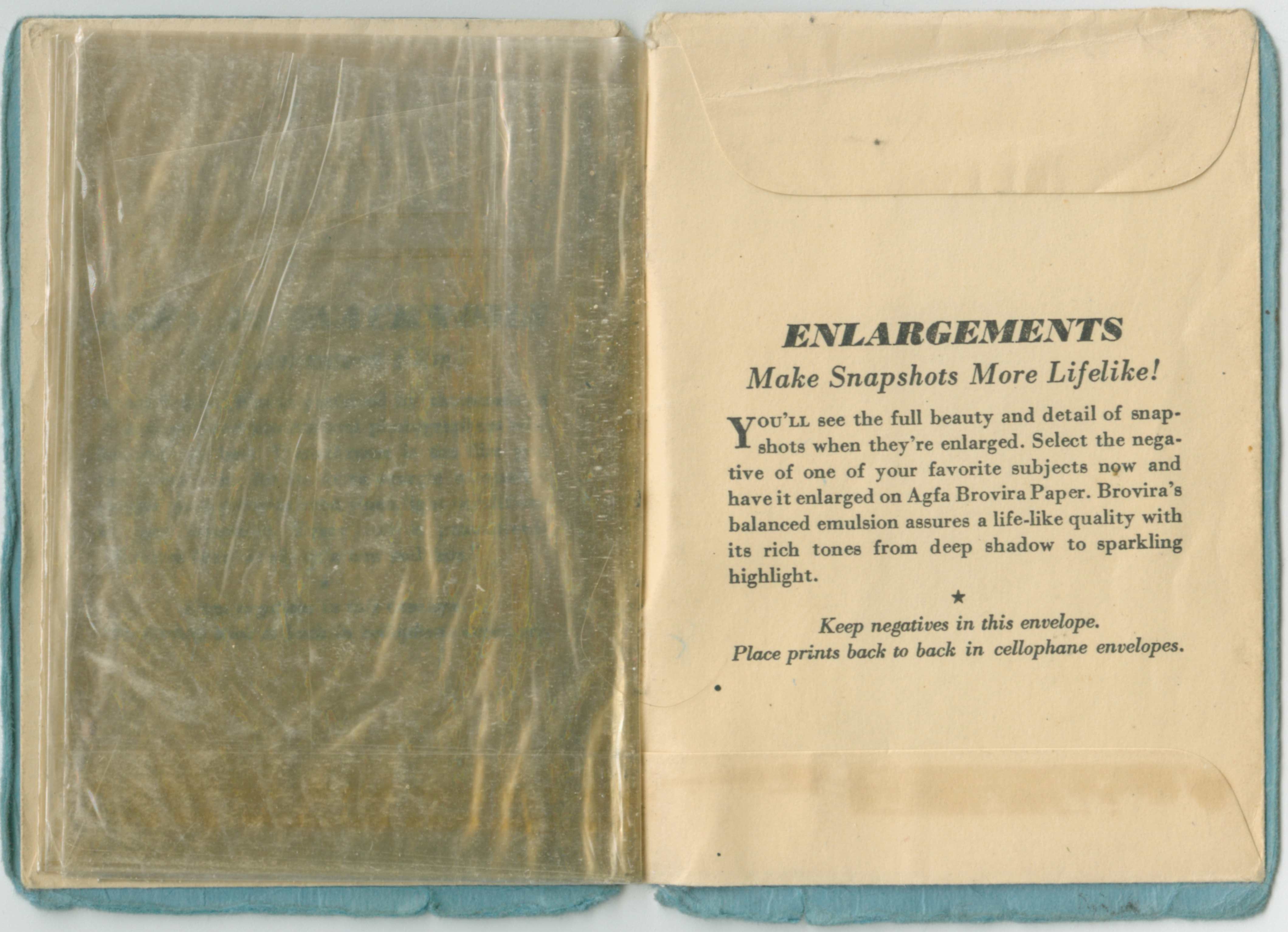
I continue to work through the massive box/crate of photos and documents that were given to Dad after Aunt Betty Donaldson passed away. Much of it was garbage, some of it was interesting, but I have been getting to some really good stuff lately. One little such item was hit pocket album that belonged to my Great Grandmother, Berendena Van Leeuwen Donaldson. I pulled all the photos out and scanned them. But first, here is the pocket album.
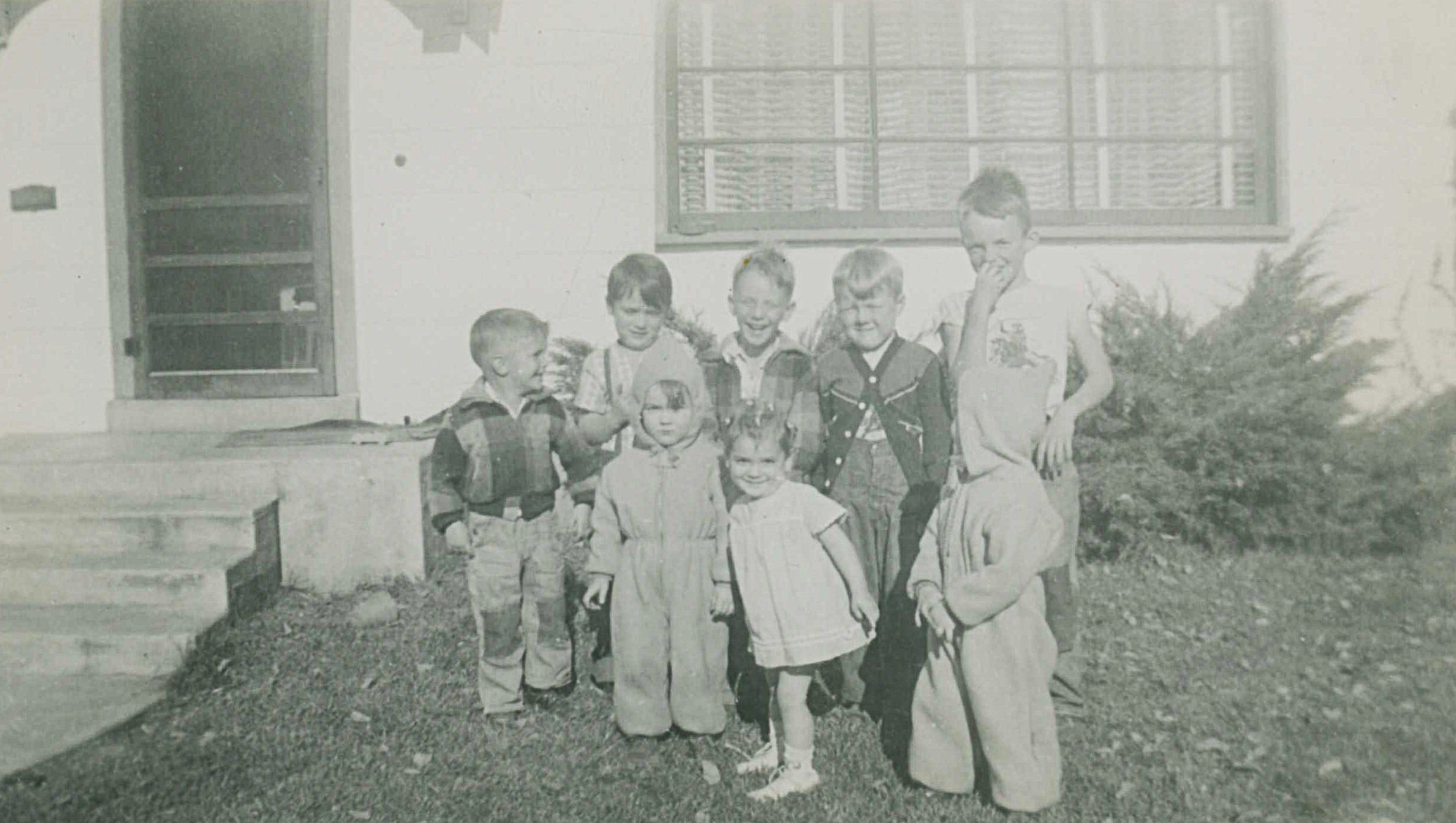
The first photo in the album was that of her grandchildren. This photo was taken in 1951. The names and dates are on the back.
Back (l-r): Ed Telford, Jan Birch, John Telford, Richard Michaelson, Milo Ross; Front: Caroline Ross, Mary Telford, Judy Ross
Berendena went by Dena her whole life. But since her daughter was also named Dena, I usually go with her full name. The next picture is of her and the two Ross girl grandchildren.
Caroline Ross, Berendena Donaldson, Judy Ross
Then a picture of her and her husband, David Delos Donaldson.
Dena and David Donaldson
Then a picture of her daughter Dora.
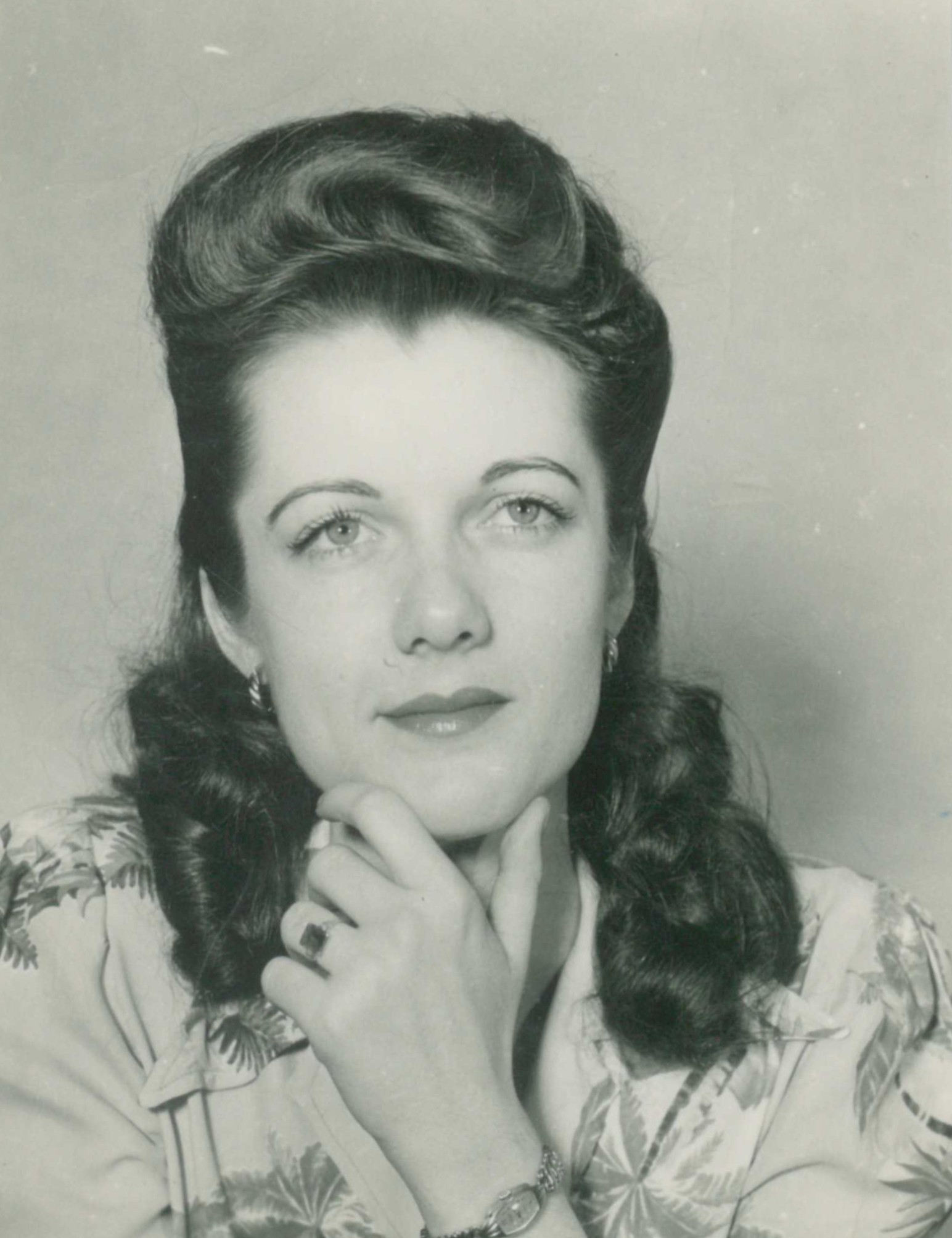
Dora Mary Donaldson Michaelson
Then her son David “Dave” Donaldson.
David William Donaldson
Last picture was of her and all give of her children.
Dena Dorothy Birch, David William Donaldson, Dora Mary Michaelson, Maxine Telford, Dena Donaldson, Gladys Maxine Ross
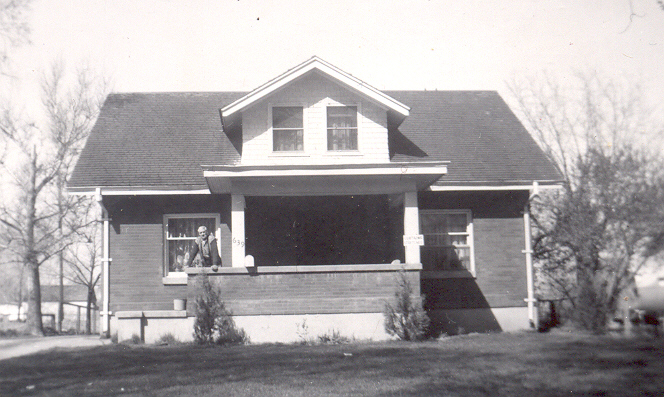
Several of these photos were taken at 639 Wall Avenue in Ogden, Weber, Utah. This photo was not in her pocket album.
David Donaldson on porch of their home on Wall Ave
Our time in The Netherlands is coming to a close. Today was our last day in Amsterdam. Tomorrow we begin the trek across Germany to Dresden. We have to be on the train about 7 AM and will find ourselves winding to Berlin. From Berlin, after some quick touring, we will make the final leg to Dresden. It should be an interesting day.
Morning flowers in Amsterdam
Today was fascinating.
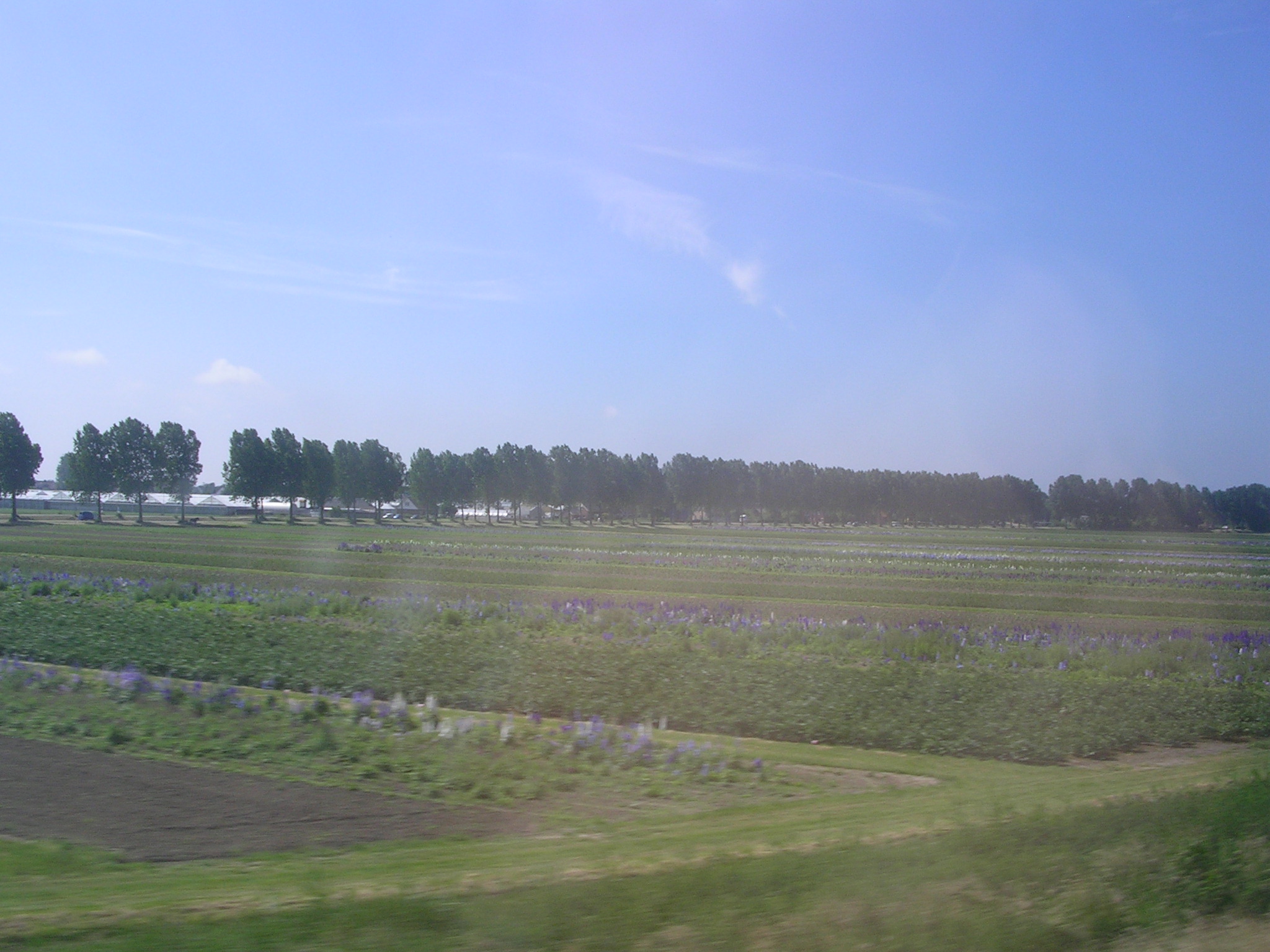
Dutch countryside, flowers!
We made our way to Den Haag or as we know it, The Hague.
Dutch windmill in the wild!
What a pretty little city.
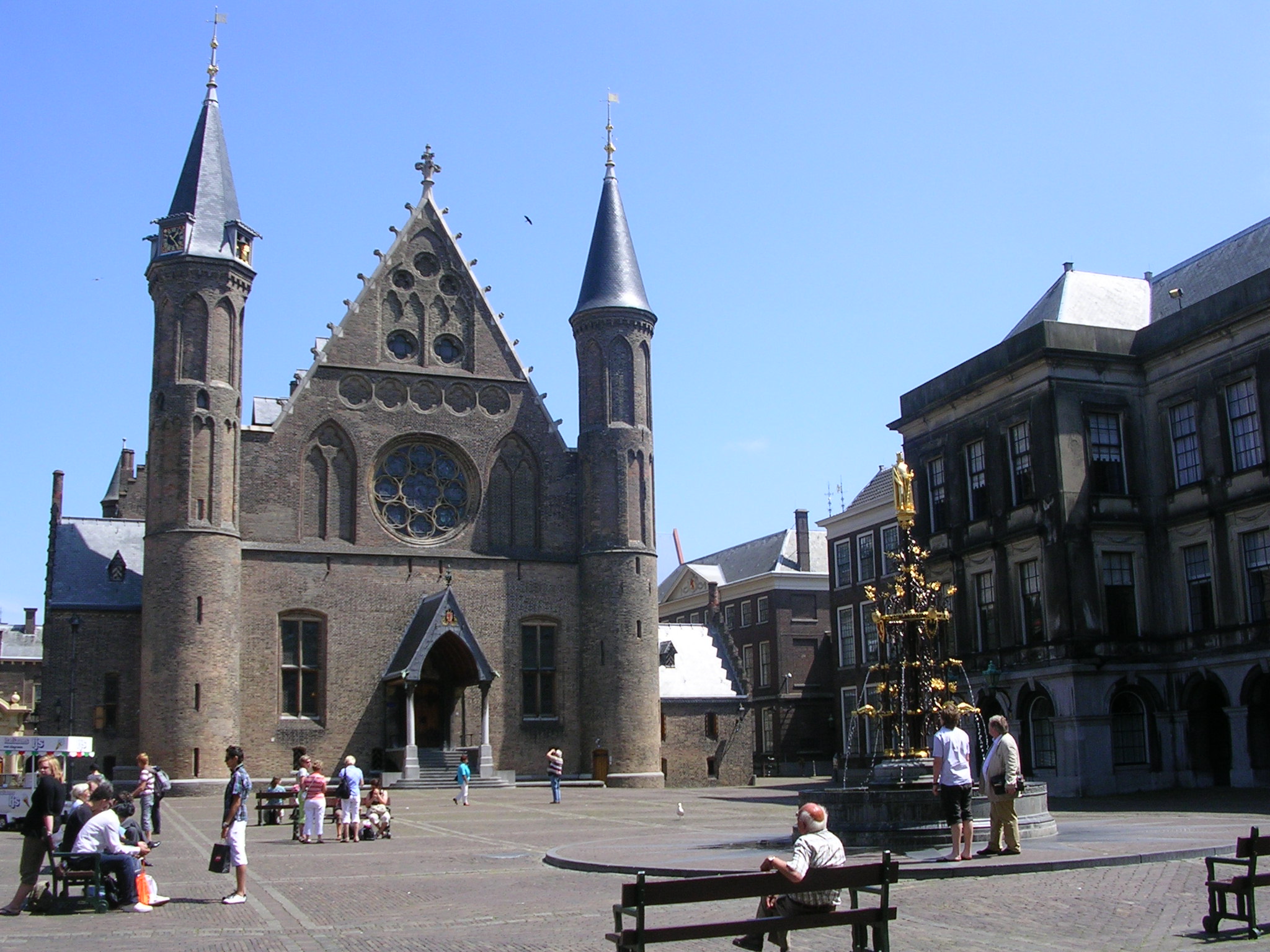
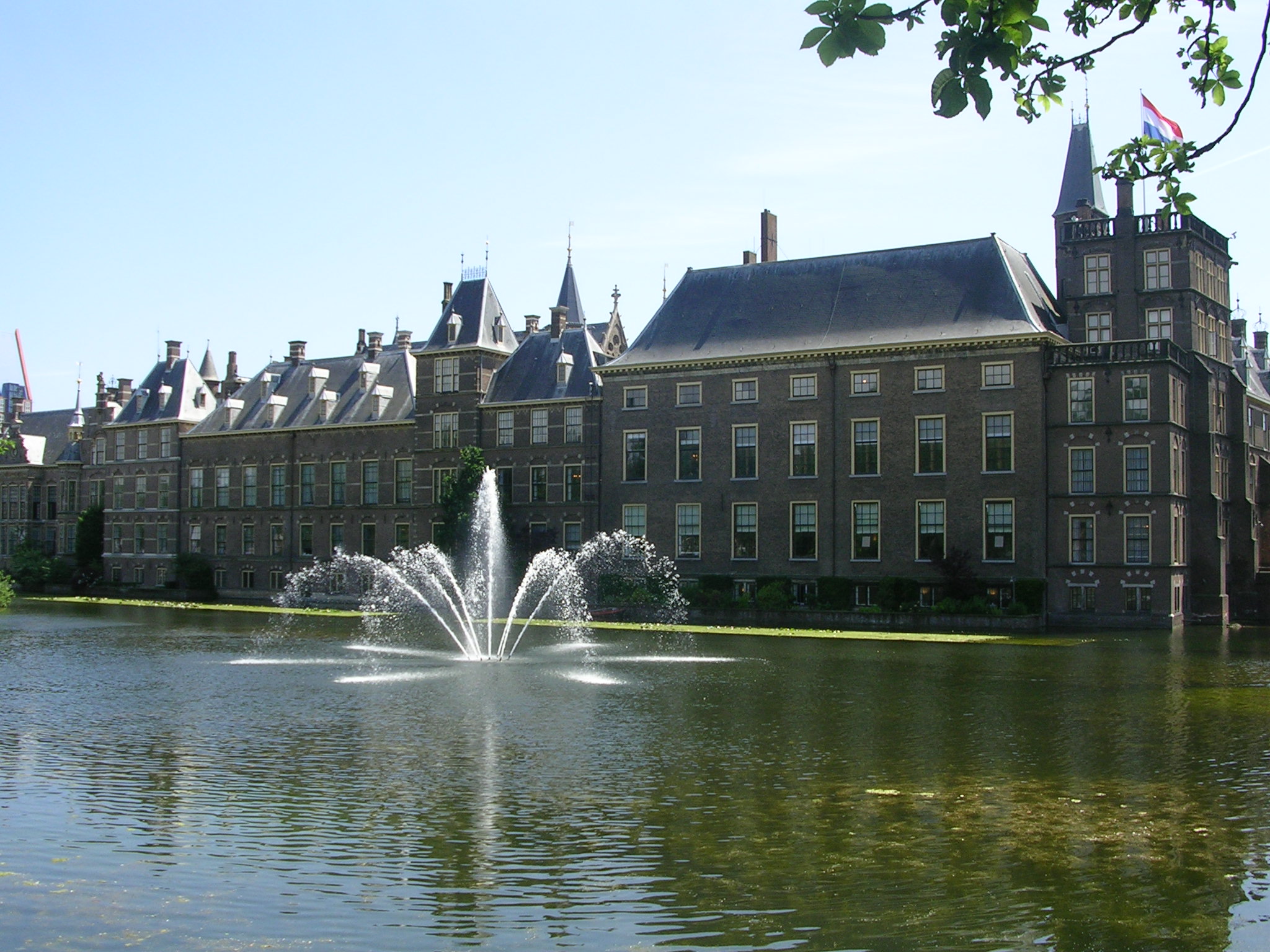
Ridderzaal, Den Haag (The Hague)
We walked around the Dutch Parliament Buildings.
Voormalige hofkapel, Den Haag
We got some pictures with the UN Justice Building.
Internationaal Hof van Justitie, Den Haag
We went to see the Prison Gate Prison.
There we got to see the old ways of torture.
This was more Amanda’s bag than anything else.
I was along for the ride.
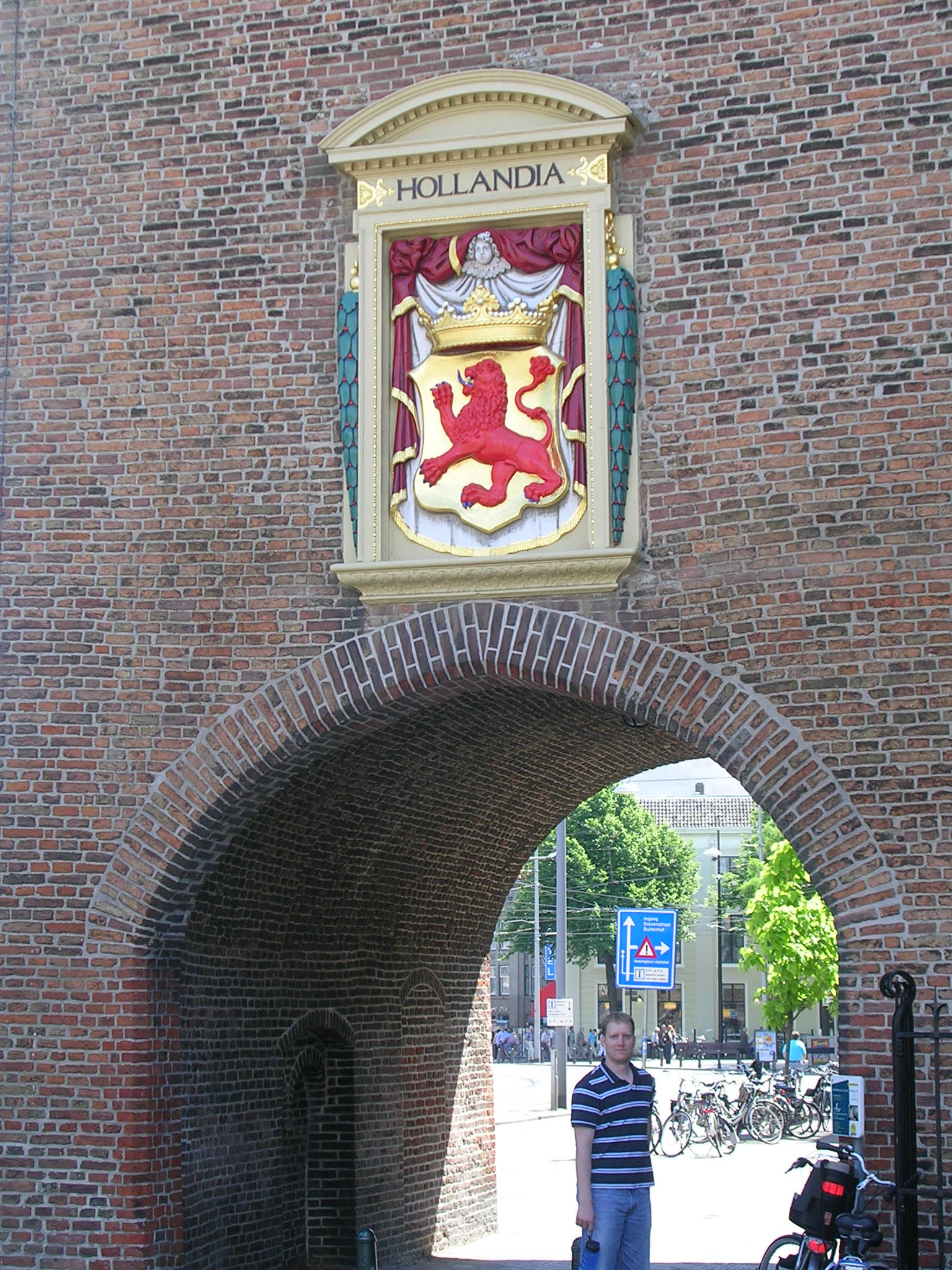
Walking through Den Haag, I saw this store front. My Great Grandmother was a van Leeuwen, Berendena van Leeuwen Donaldson (1898 – 1959).
I really didn’t mind.
We are on our way out.
Canal back in Amsterdam
Have a great day!
Rijksmuseum in Amsterdam
Look forward to Dresden.
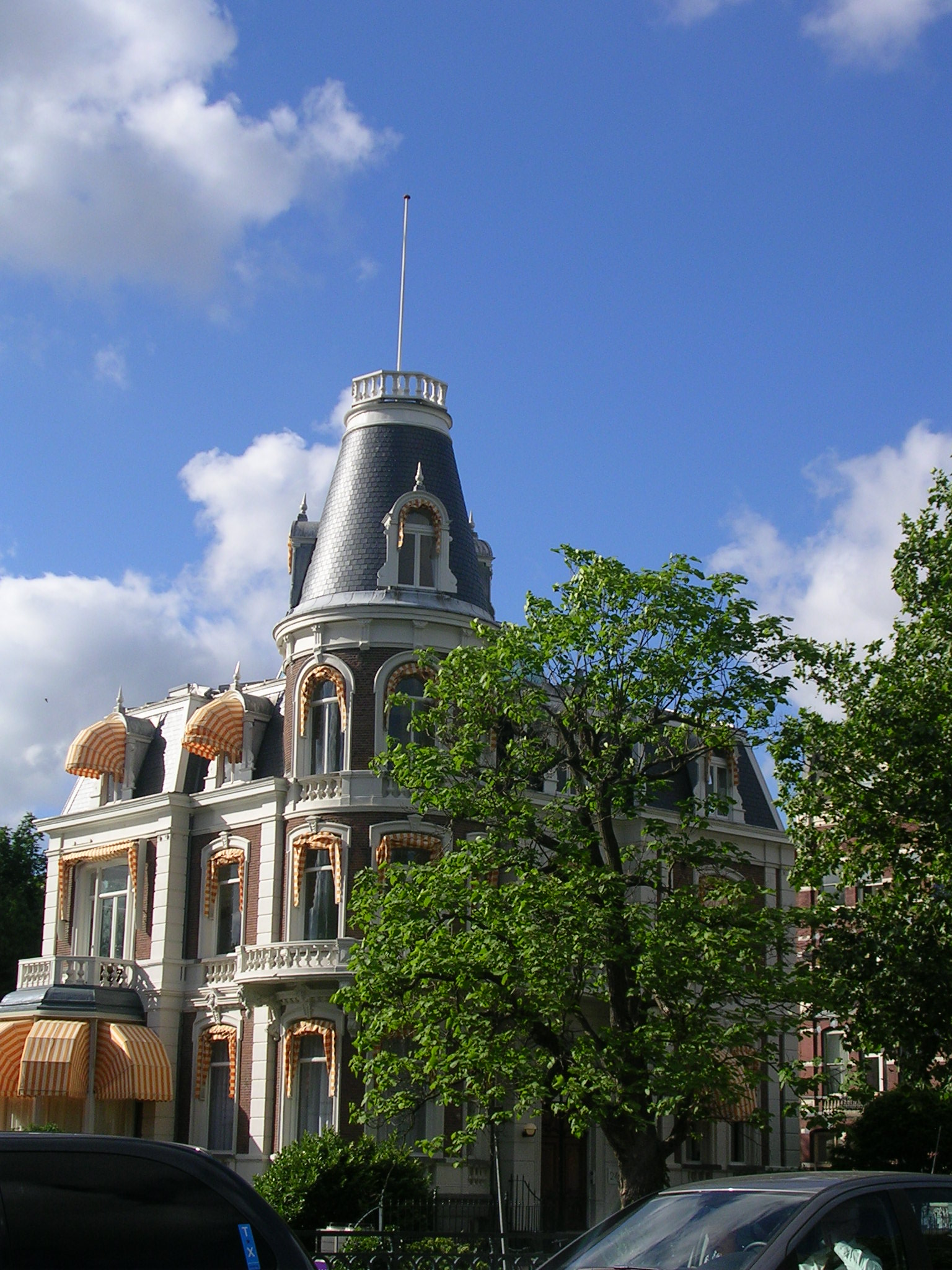
Pretty little house in Amsterdam
Exhausted. Time to climb the narrow stairs to our hostel.
A funny story about our hostel. The bathroom was small, we were on the top floor. The entire bathroom was a shower. When taking a shower, it would fully douse the sink, toilet, etc. Nothing was protected. You could relieve yourself and shower and bidet all at the same time. And no lock on the door! Amanda was horrified. I had to stand guard so nobody dared enter while she was in there!
Time continues to march forward. It does not care what we think about it. Some want it faster, others want it slower, others want it to stop.
In preparation for Memorial Day, I was trying to think of something that would show that I truly hold in memory those who served in the military and especially those who died in that service. Hopefully here are a few things that show a more human side. I am not aware that I have any ancestor who has died in a war, especially in the service of the United States of America. I guess for that I am lucky and honored. But I have many who have served in the military.
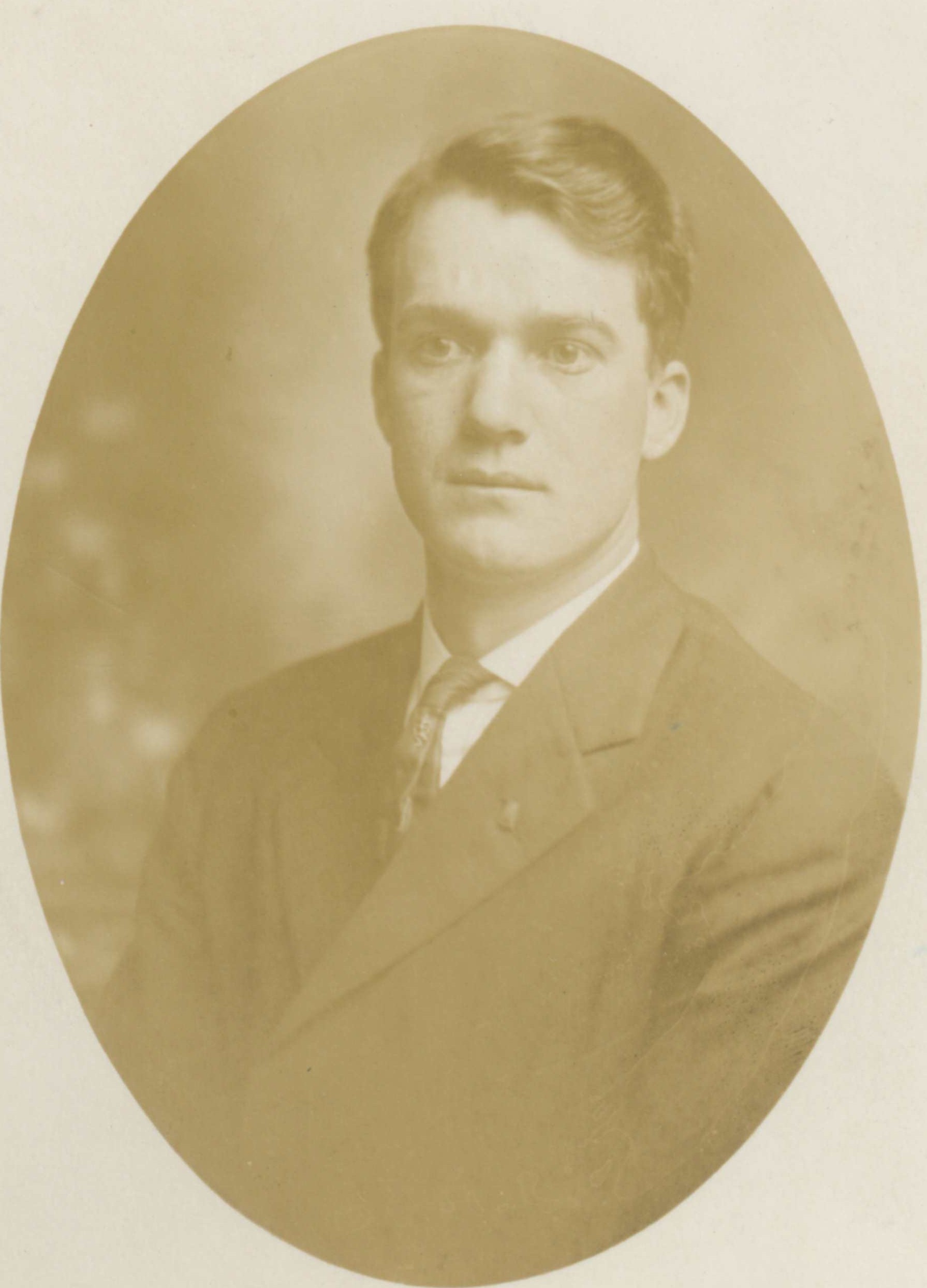
Portrait of David Delos Donaldson after WWI
David Delos Donaldson is my paternal grandmother’s father. I tried to get a copy of his military records many years ago, but they were destroyed in a St. Louis, Missouri, fire long ago. I only know a few things. He worked in California as a pipe fitter/plumber at some point, but I believe that was for WWII. He went through basic training and ended up learning signaling. At some point he was allegedly in France and was exposed to the dreaded mustard gas, which injured his lungs. He smoked to settle his lungs as prescribed by doctors. He ended up dying from complications due to his lungs.
Here are some notes I have from 2006.
“I stumbled upon a registration form for my great grandfather, David Delos Donaldson, and WWI. He was working in Twin Falls, Idaho. The best part is, we never knew he went to Idaho, ever. Not only that, he was working there, and was exempted because he was working to support his younger siblings and mother. He did later enter the war, we don’t know when or how, but went to France in the Argonne and was gassed there. He suffered his whole life and eventually died from the mustard.
“With this information, I went to visit my Uncle Dave Donaldson because my Dad did not know anything. I picked his brain. We know little about my Great Grandfather before he married. Now we know he was working for Ballantyne Plumbing in Twin Falls in roughly April 1917. He served in WWI with two brothers. As mentioned, he was hit with mustard, spent some time in hospital, and he wasn’t getting better, so they sent him home. He married my Great Grandmother in 1919, Berendena Van Leeuwen. They had 5 children. During the great depression he worked down south as a plumber. Dave did not know where, but there was a possibility it was at the Hoover. When they went on a trip to Los Angeles, he insisted on stopping at Boulder City and the dam on the way home. Oh, we do know that before they got married, he worked as a plumber in Phoenix. How long we don’t know, but he could not bear the heat down there. During the depression when he worked down south, the family stayed in Ogden. Dave was young enough that he did remember his father coming home, but not where from. Again during WWII, the whole family moved to Napa, California and Great Grandpa was a plumber at the naval yard there, he made it sound like Oceanside. I do not know if there were any other naval bases down there. Then they moved back. The family must not have stayed down there, or he did not work the entire war, as my Grandpa and Grandma met in 1941-1942 at the Berthana on 24th street Ogden at a dance. They were married in April 1942, shortly before he left for war. Great Grandpa was a plumber by trade. He worked up until the 1950’s when his health failed him. He picked up smoking because it soothed his lungs. It sounds like the mustard burned his lungs the rest of his life. He would smoke to deaden the nerves. Dave told me this increased until he died. Even the last few years of his life, he had oxygen when he went places and when he slept. But he kept smoking. Dad told me of one of the few memories he had of his Grandpa. He went to visit him in Ogden, Grant Ave if I remember right, and he was laying in bed. There were newspapers all over the floor. He got into a coughing fit and coughed a big thing of phlegm up and it went on the floor. It was the combination of the irritation to the lungs from mustard and the smoking. It was what eventually killed him.
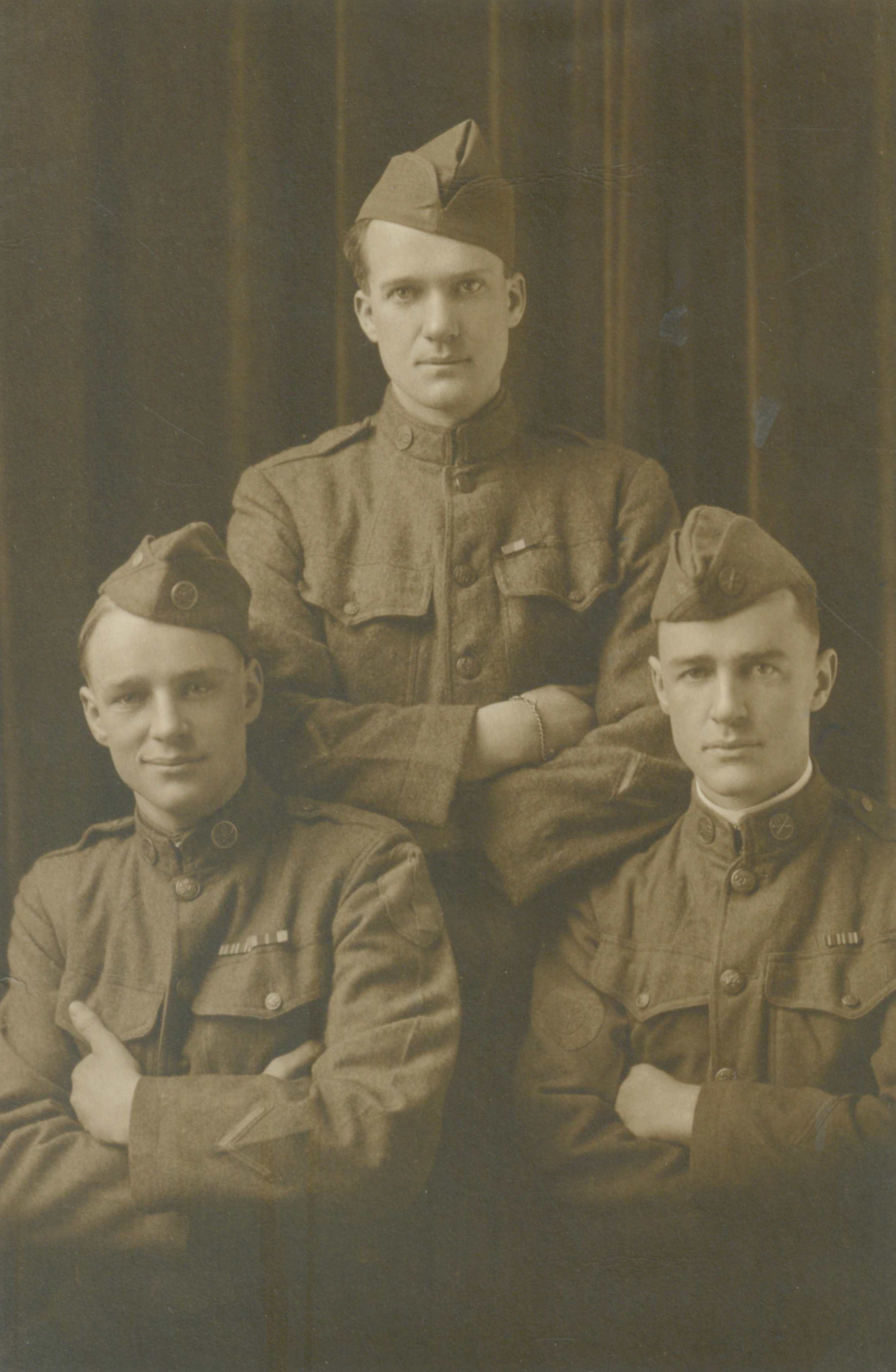
David Delos Donaldson (back), John Edmund Donaldson (left), and William George Donaldson
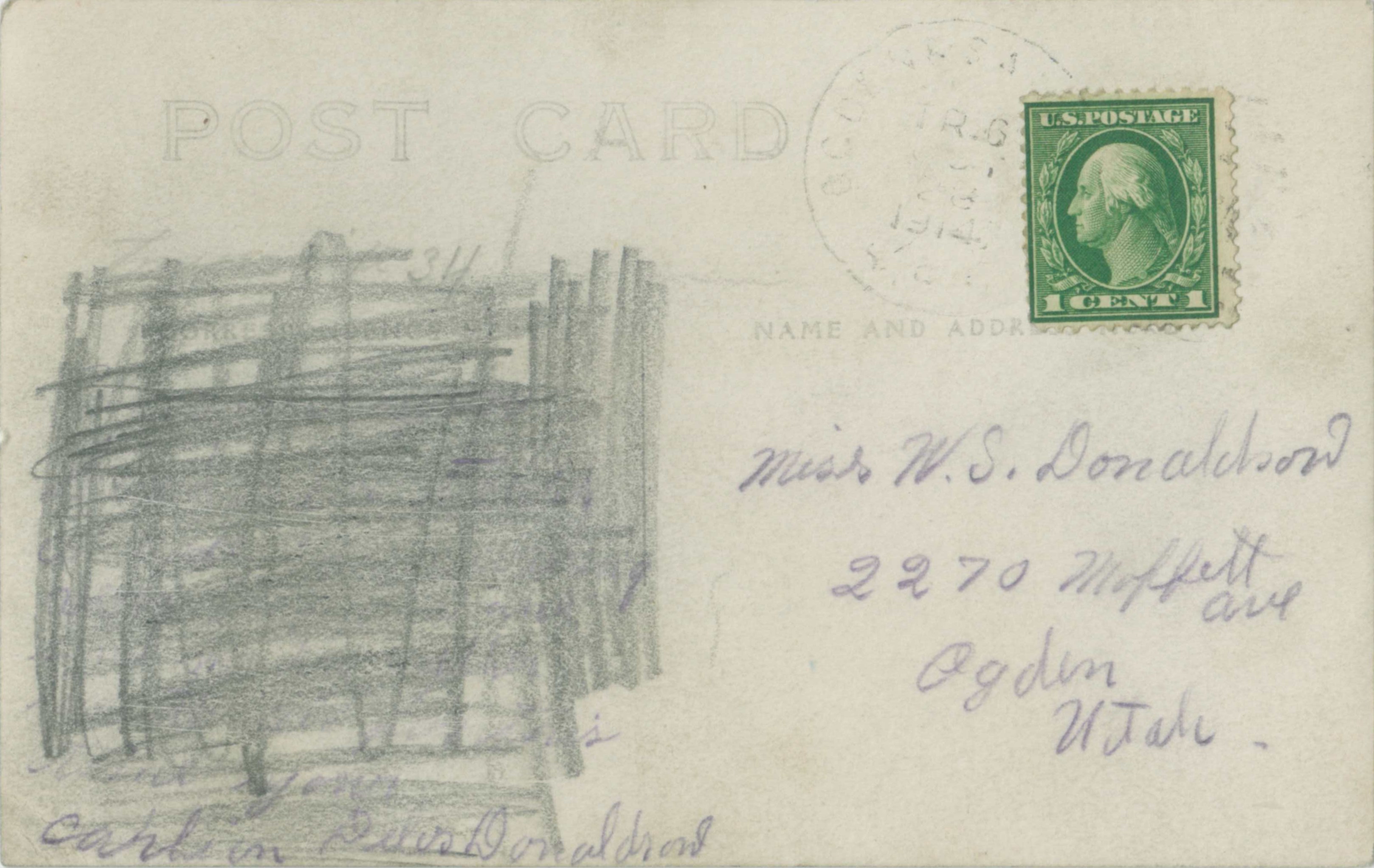
Here are some postcards David sent home to his mother. His father, William Scott Donaldson, died of cancer in 1913.
“Part of Carlin, Nev.”
I am not sure why the writing on the left is crossed out. But you can see Miss W. S. Donaldson 2270 Moffett Ave Ogden Utah. It says Carlin and Delos Donaldson. It might say “Yours” above it. The postmark is dated 1914, but I cannot make out the rest of it.
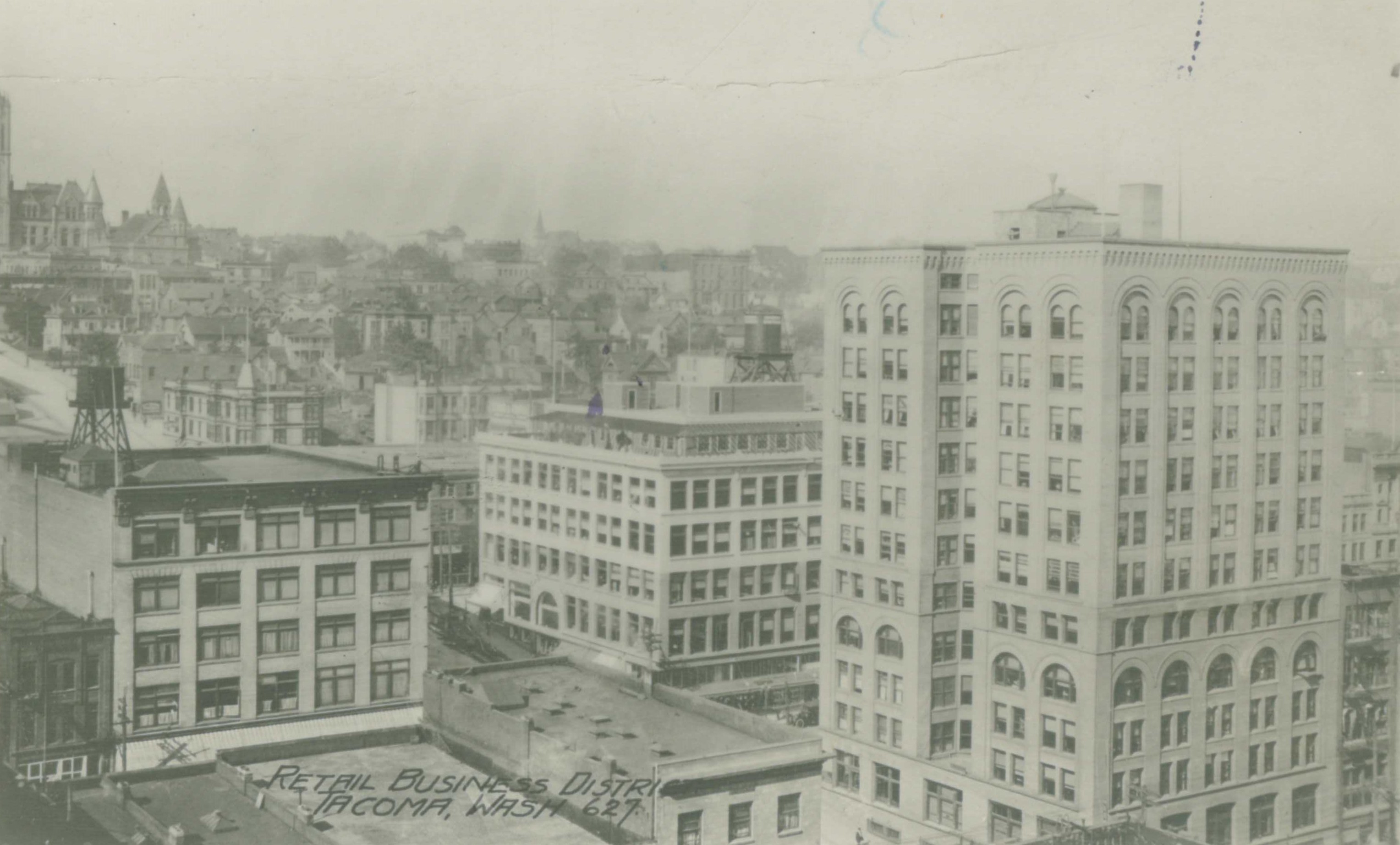
Retail Business District, Tacoma, Washington 1918
Dated 2 April 1918. “Dear mother got here all ok like it fine Write me as Private David D Donaldson 20th Co., 5th Bn., 166th Dep Brig. Camp Lewis, America Lake, Wn. Mrs. W.S. Donaldson 2270 Moffett Ave Ogden Utah”
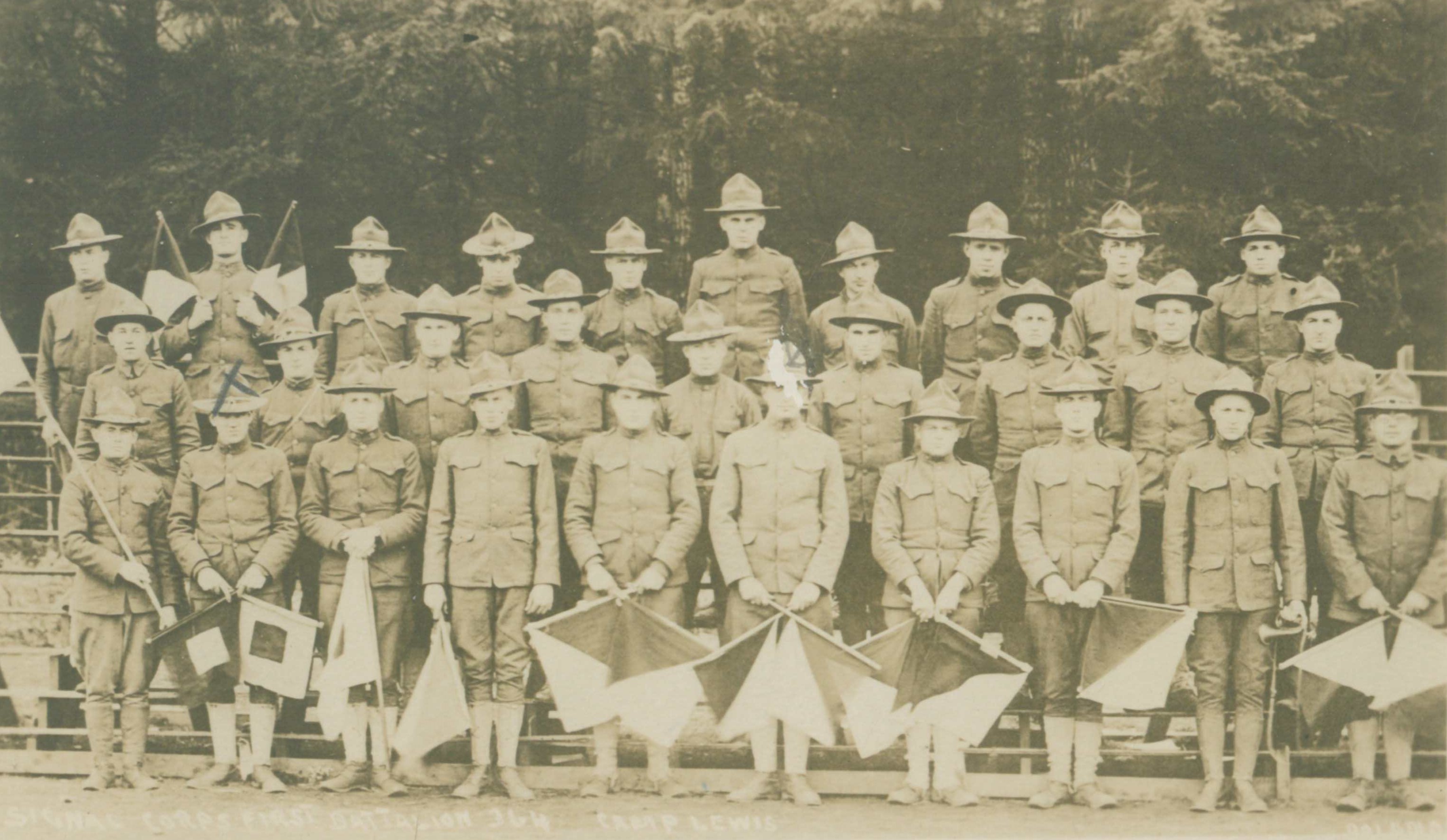
Front and back
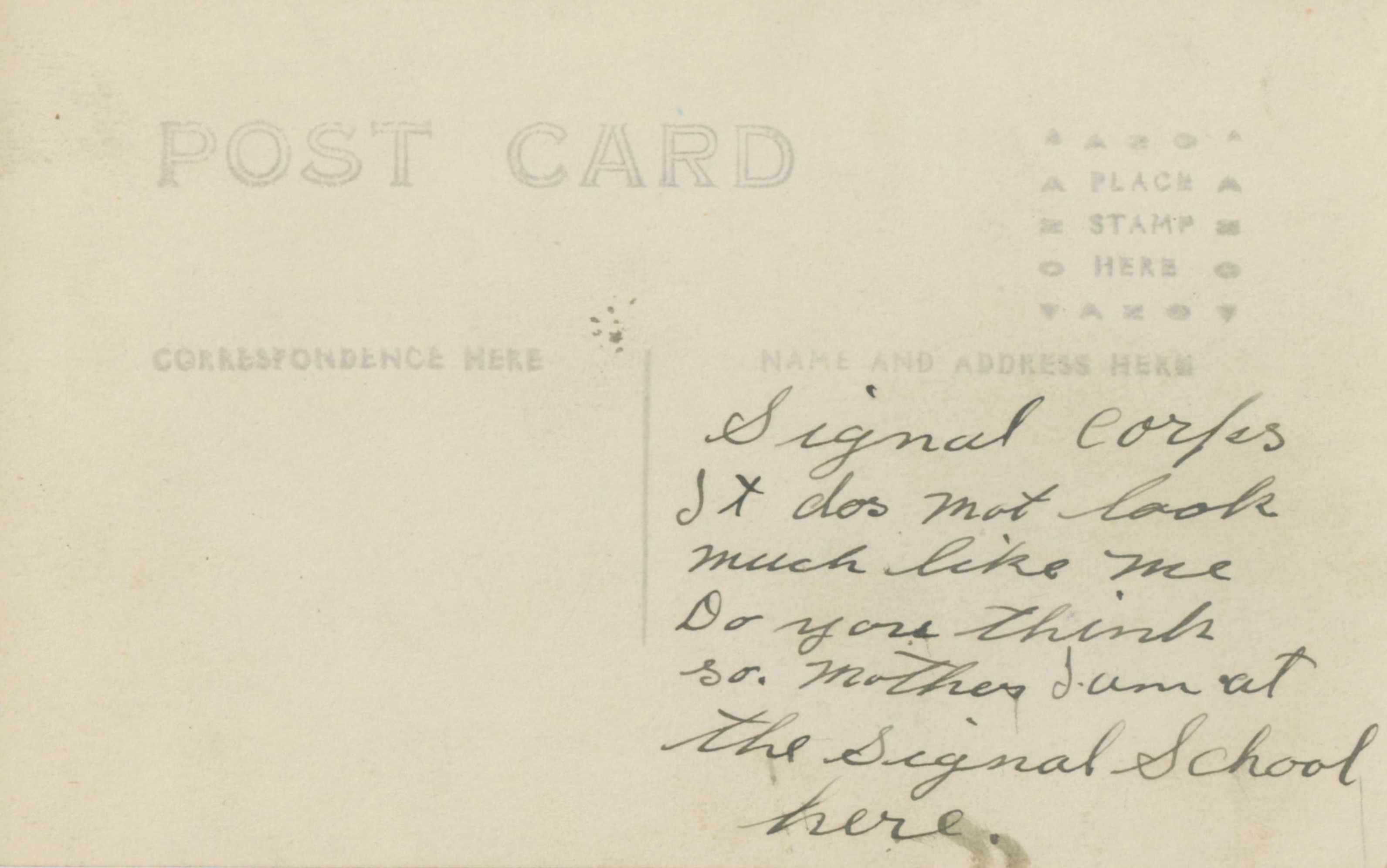
“Signal Corps It does not look much like me Do you think so. Mother I am at the Signal School here.”
Front and back
Dated 28 June 1918. “Dear Mother just a line to say I am well and fair when I got in New York all for this time your son DDD. Written to Mrs. W. S. Donaldson 2270 Moffett Ave Ogden Utah
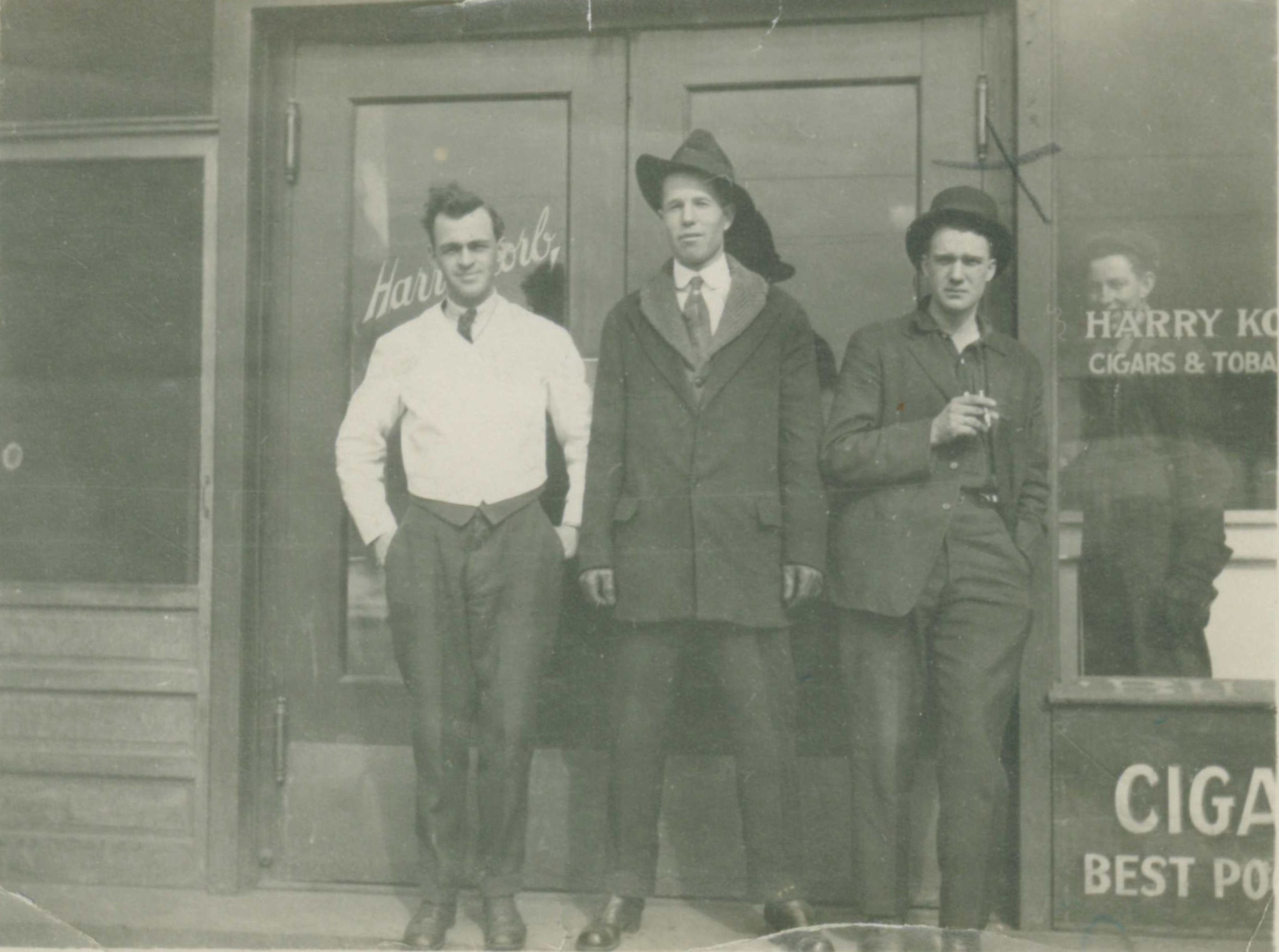
Harry Korb Cigars & Tobacco, known location with David standing in front of the store. Other three are unknown.
We might think it, but none of us are truly bullet-proof. This boy’s health was affected for the rest of his life by war. He did live to be 59 years old.
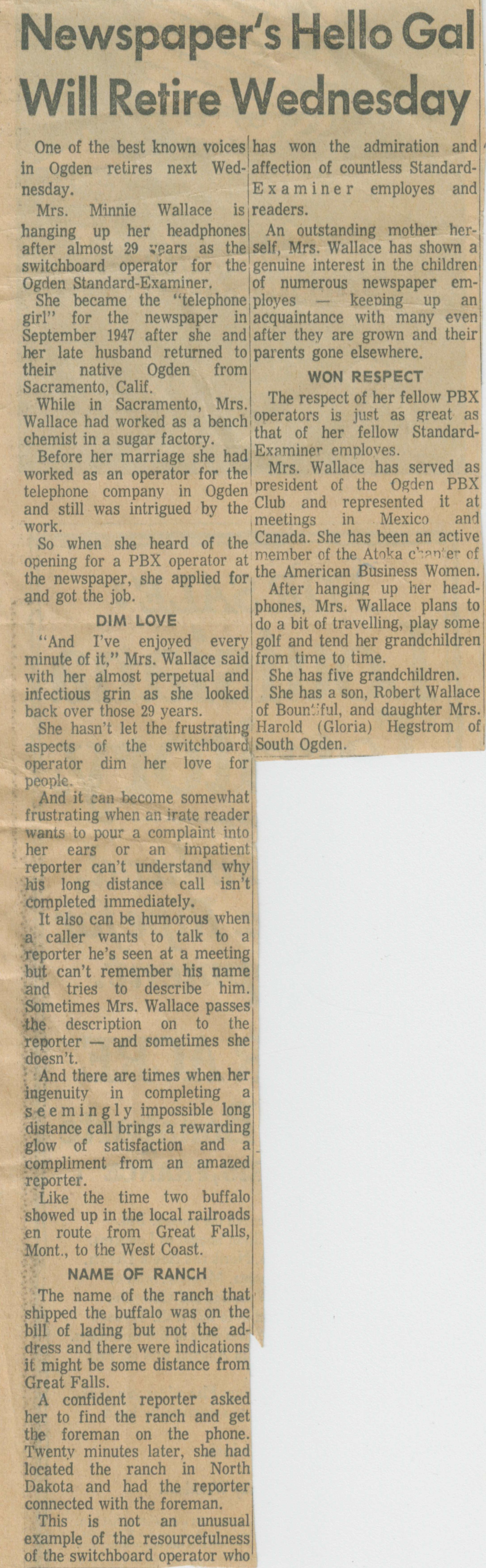
Another photo clipping from those of my grandmother, Gladys Maxine Donaldson Ross. This one is more apparent to me why it was clipped. Minnie Wallace is Glady’s first cousin. Minnie’s mother is Johanna Hermina Van Leeuwen Edsinga (1884-1958), sister to my Grandmother’s mother, Berendena Van Leeuwen Donaldson (1898-1959). Johanna Hermina also went by Minnie.
“The voice of Mrs. Minnie Wallace will be missing from the Ogden Standard-Examiner after the veteran PBX operator retires Wednesday. The date at the top shows 8 March 1976.
Minnie Van Leeuwen Edsinga
“One of the best known voices in Ogden retires next Wednesday.
“Mrs. Minnie Wallace is hanging up her headphones after almost 29 years as the switchboard operator for the Ogden Standard-Examiner.
“She becamse the “telephone girl” for the newspaper in September 1947 after she and her late husband returned to their native Ogden from Sacramento, Calif.
“While in Sacramento, Mrs. Wallace had worked as a bench chemist in a sugar factory.
“Before her marriage she had worked as an operator for the telephone company in Ogden and still was intrigued by the work.
“So when she heard of the opening for a PBX operator at the newspaper, she applied for and got the job.
DIM LOVE
“”And I’ve enjoyed every minute of it,” Mrs. Wallace said with her almost perpetual infectious grin as she looked back over those 29 years.
“She hasn’t let the frustrating aspects of the switchboard operator dim her love for people.
“And it can become somewhat frustrating when an irate reader wants to pour a complaint into her ears or an impatient reporter can’t understand why his long distance call isn’t completed immediately.
“It can also be humorous when a caller wants to talk to a reporter he’s seen at a meeting but can’t remember his name and tries to describe him. Sometimes Mrs. Wallace passes the description on to the report – and sometimes she doesn’t.
“And there are times when her ingenuity in completing a seemingly impossible long distance calls brings a rewarding glow of satisfaction and a compliment from an amazed reporter.
“Like the time two buffalo showed up in the local railroads en route from Great Falls, Mont., to the West Coast.
NAME OF RANCH
“The name of the ranch that shipped the buffalo was on the bill of lading but not the address and there were indications it might be some distance from Great Falls.
“A confident reporter asked her to find the ranch and get the foreman on the phone. Twenty minutes later, she had located the ranch in North Dakota and had the reporter connected with the foreman.
“This is not an unusual example of the resourcefulness of a switchboard operator who has won the admiration and affection of countless Standard-Examiner employes and readers.
“An outstanding mother herself, Mrs. Wallace has shown a genuine interest in the children of numerous newspaper employes – keeping up an acquaintance with many even after they are grown and their parents gone elsewhere.
WON RESPECT
“The respect of her fellow PBX operators is just as great as that of her fellow Standard-Examiner employes.
“Mrs. Wallace has served as president of the Ogden PBX Club and represented it at meetings in Mexico and Canada. She has been an active member of the Atoka chapter of the American Business Women.
“After hanging up her headphones, Mrs. Wallace plans to do a bit of travelling, play some golf and tend her grandchildren from time to time.
“She has five grandchildren.
“She has a son, Robert Wallace of Bountiful, and daughter Mrs. Harold (Gloria) Hegstrom of South Ogden.
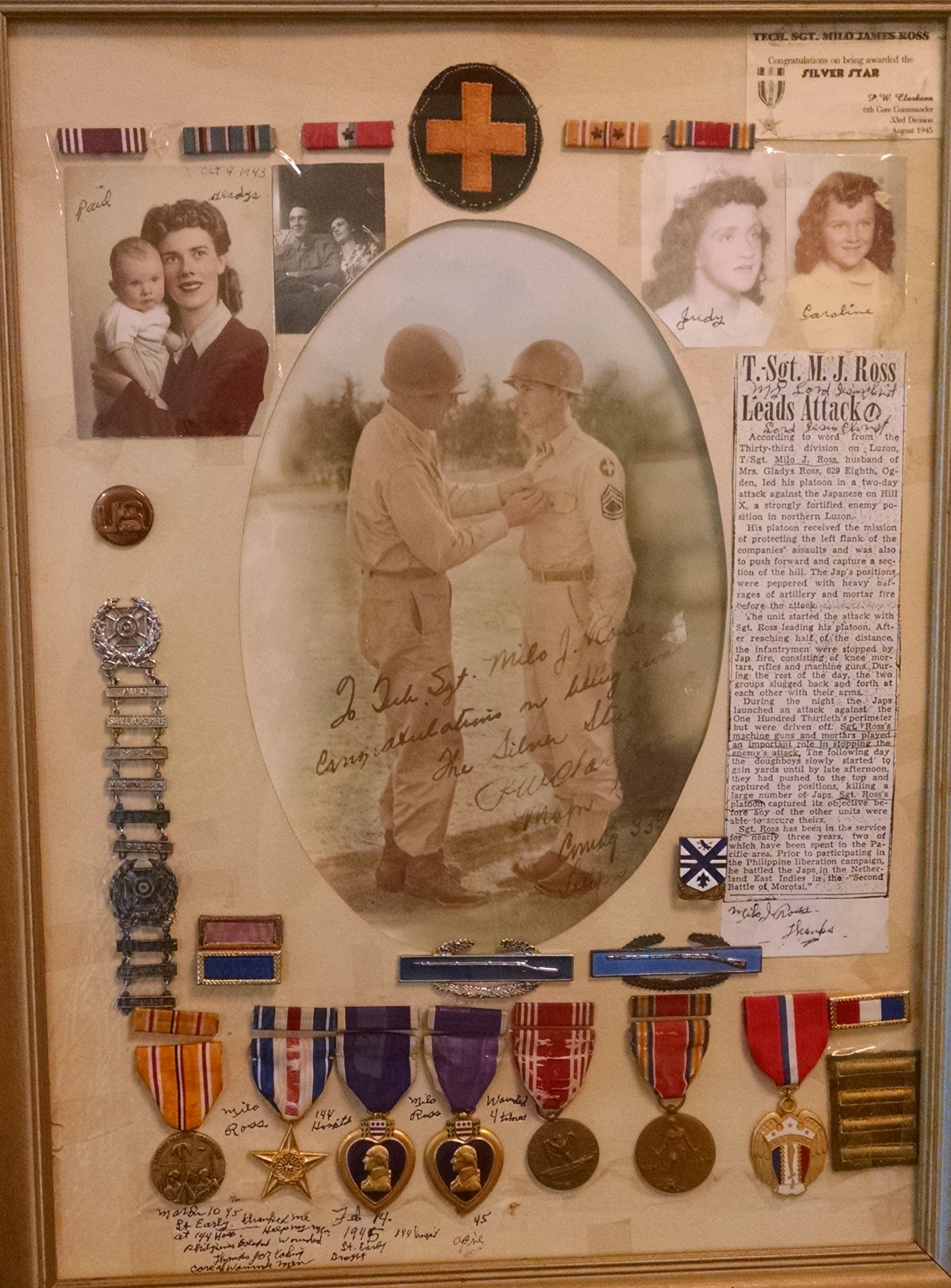
I previously wrote about the plaque that hung on my Grandparents’ wall in Plain City, Utah. The photo in the center of the plaque showed Milo James Ross receiving the Silver Star by Major General Clarkson.
Milo James Ross WWII medals, clippings, and photo
Before Grandpa passed away, the Army was gearing up to do a more formal presentation of his medals as some of them were just given to him without much fanfare. Apparently some of them deserved a bit more formal recognition. Initially, we were gearing up for Independence Day 2014. However, some things grind slowly forward. We were then talking about some dates in August 2014 and September 2014. Unfortunately, Grandpa passed away 17 July 2014.
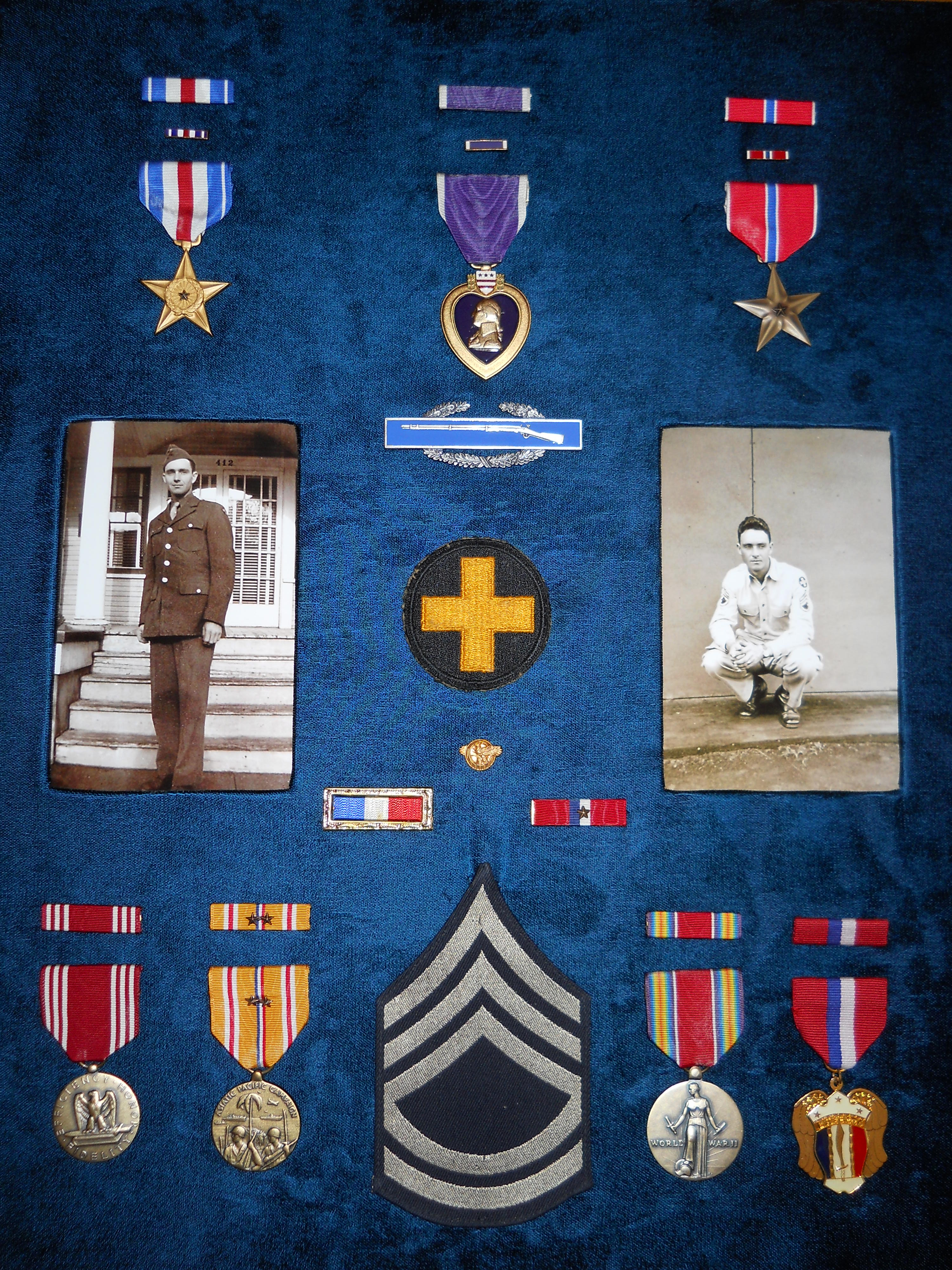
In preparation for the more formal presentation, the military gave new copies of some of the medals he had already received and the others he had not yet received. We took those and put them in a shadow box for his funeral. Here is a photo we took of the box before putting it behind glass.
I am not clear on the medals and what they each mean. His obituary lists a number of his medals that were awarded to him.
His obituary included this Army service information:
“Milo enlisted in the Army in October 1942. He served in the 33 rd Infantry Division, 130 th Regiment, Company C. He trained in weapons and earned his expert ranking. He arrived in Hawaii in July 1943 and received the announcement that his son, Milo Paul, had been born. He served as part of the Philippine invasion force and they fought through the jungles and liberated Baguio City. He was injured five times, one while tending to other soldiers awaiting medical attention.
“He was present at the Japanese surrender at Luzon as a Technical Sergeant in June 1945. He received two purple hearts and the Silver Star for his service at the end of World War II. His Company received a Presidential Citation for outstanding performance during armed conflict with the enemy in efforts to seize Hill X in Bilbil Mountain Province. At the time of Milo’s death, the military was preparing to award him another Purple Heart, another Silver Star, Bronze Star, Good Conduct Medal, Asiatic-Pacific Campaign Medal & Bronze Star, World War II Victory Medal, Combat Infantry Badge 1 st Award, Philippine Liberation Ribbon and Bronze Star, Honorable Service Button for World War II. He was also to be awarded the Philippine Liberation Medal and Republic of the Philippines Presidential Unit Citation Badge from the Philippine Government.
The UofU Commemoration placard for Grandpa in 2009
The 2009 University of Utah Veterans Commemoration included this excerpt about Grandpa:
“Milo James Ross was drafted into the army shortly after the attack on Pearl Harbor. He was sent to Fort Douglas and shipped out that same day to Fort Lewis, Washington. For the next two months, he went through a weapons platoon crash course. He trained on machine guns, mortars, and hand launchers. Ross quickly earned expert ranking on these weapons. Following basic training, Ross’s unit was sent to Barstow, California. Their training focused on digging fox holes.
“Ross soon shipped out to the Hawaiian Islands, leaving behind his young pregnant wife. As his unit landed on the big island of Hawaii on July 4, 1942, a voice on the loud speaker said, “Sergeant Ross, congratulations. Your wife and son are doing well, and, one more thing, before you get off the ship you and your men have guard duty for the next four hours. Welcome to Hawaii.”
“After a long training in Hawaii, Ross’s unit, “C” Company, 130 Infantry Regiment, 33rd Infantry Division, became part of the Philippine invasion force. They hit the beach in Lingayen Gulf and intensely fought their way through jungles and mountains to the inland city of Baguio.
“Ross was wounded while tending other soldiers who were awaiting medical attention. He spent two months in a hospital while recovering from shrapnel wounds all over his body.
“The day after Ross returned to his unit, they jumped into three months of fighting that only ended with the Japanese surrender at Luzon in June, 1945.
“Company C, 130th Infantry Regiment was awarded a Presidential Unit Citation for outstanding performance of duty and superb courage during armed conflict with the enemy in their efforts to seize Hill X in the Bilbil Mountain Province in the Philippines. For his service, Ross was awarded the Purple Heart and the Silver Star.
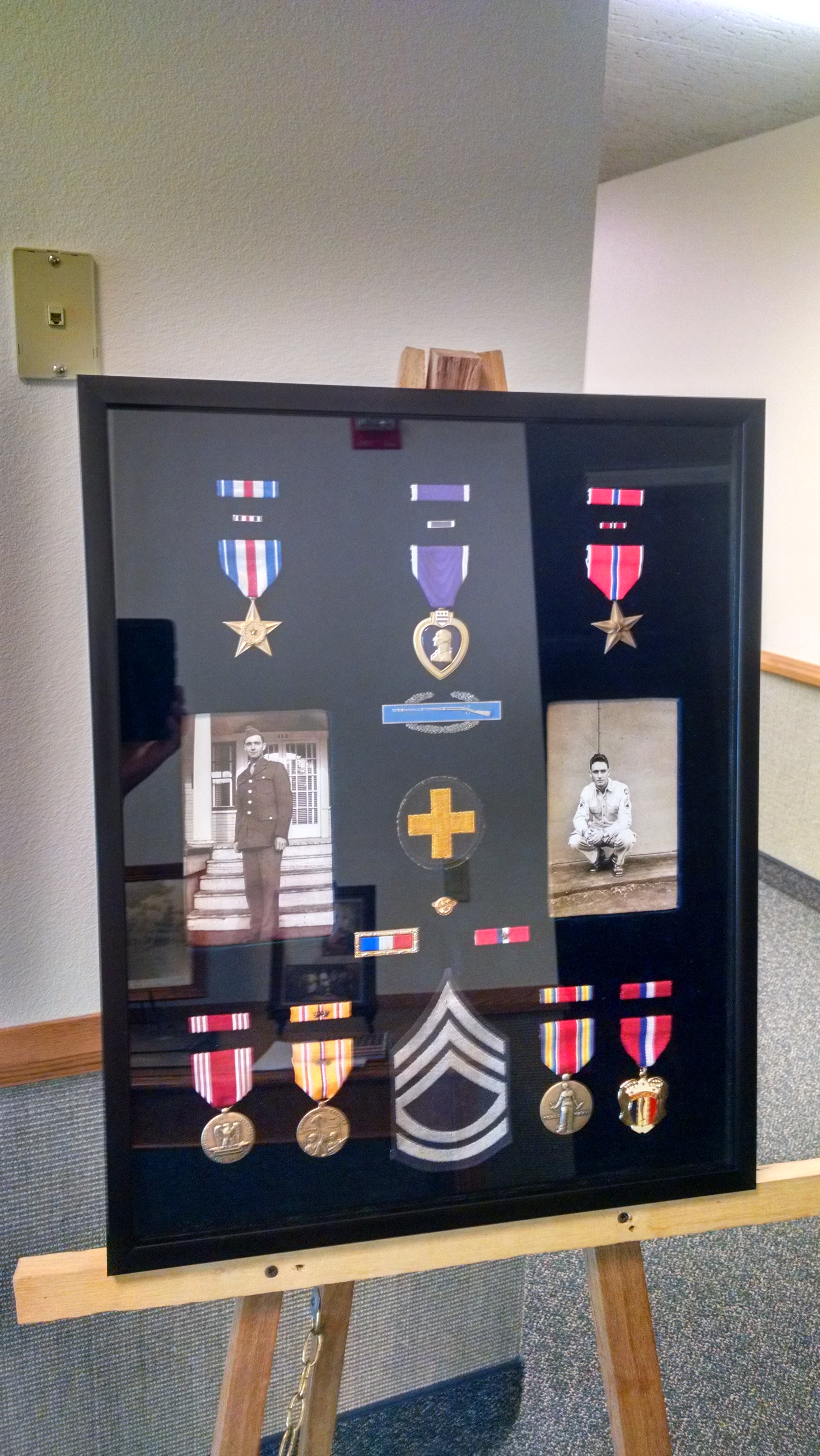
The same shadowbox on display at his funeral
BYU Library – Special Collections has this biography and reference citation of Grandpa:
“Milo James Ross (1921-2014) was a World War II veteran who fought in the Pacific battles.
“Milo Ross was born February 4, 1921 just north of Plain City, Utah to John Jack William Ross and Ethel Sharp Ross. When Milo was barely four, his mother passed away in childbirth. Milo and his siblings were cared for by their maternal grandparents until financial strains forced Milo to be raised by his uncle, Edward Sharp, in Plain City, Utah. He grew up farming with his cousins and attended the local schools, eventually graduating from Weber High in 1939. In 1940, at a Plain City celebration, Milo met Gladys Maxine Donaldson and two years later, on April 4, 1942, they were married in her parents’ home in Ogden, Utah. The October of that same year, Milo enlisted in the United States Army at Fort Douglas, Utah, becoming a member of the 33rd Infantry Division, 130th Regiment, Company C. After training they were sent to Needles, California handling freight, setting up tents and digging trenches and then on to Hawaii for further training. When they arrived in Hawaii, on July 4, 1943, Ross was informed his son, Milo Paul, had been born that very same day. Ross’s company was assigned to become part of the Philippine invasion force where they fought in New Guinea and Luzon. They fought through the jungles, liberated Baguio City, was present at the Japanese surrender in Luzon in June 1945, and left Ross injured on five separate occasions.
“Milo Ross was honorably discharged in September of 1945. He was honored with two Purple Hearts, the Silver Star, and the Presidential Citation for outstanding performance. Returning home, Milo worked remodeling homes. He also had two daughters: Judy Ethel and Caroline. Gladys and Milo solemnized their marriage July 2, 1976 in the Ogden Temple of the Church of Jesus Christ of Latter-day Saints. Gladys died in 2004.
“Milo James Ross died in Plain City, Utah on July 17, 2014 at the age of 93.
Citation:
“Standard examiner, via WWW, March 2, 2018 (Milo James Ross; born February 4, 1921 in a log cabin north of Plain City to John Jack William Ross and Ethel Sharp Ross; mother tragically died from childbirth in 1925; Milo and his siblings lived with Ross grandparents until the costs proved too great and his Uncle Edward Sharp raised Milo in Plain City until adulthood; He attended schools in Plain City and graduated from Weber High in 1939; farmed with sharp cousins; Gladys Maxine Donaldson at a Plain City celebration in 1940; married April 4, 1942 in her parent’s home on 8th Street in Ogden; enlisted in the Army in October 1942; 33rd Infantry Division, 130th Regiment, Company C; Philippine invasion force and they fought through the jungles and liberated Baguio City; injured five times; present at the Japanese surrender at Luzon as a Technical Sergeant in June 1945; two Purple Hearts and the Silver Star; Presidential Citation for outstanding performance; He returned home in 1945 and worked remodeling homes; children Milo Paul, Judy Ethel and Caroline; solemnized their marriage July 2, 1976 in the Ogden LDS Temple; died in Plain City on July 17, 2014)
“UPB files, March, 2, 2018 (Milo James Ross; born Feb. 4, 1921 in Plain City, Utah; Joined army Oct. 1942 at Fort Douglas, Utah; fought in new Guinea and Luzon; sent to Needles, California handling freight, setting up tents and digging trenches; sent to Hawaii and landed July 4, 1943 where he received news his son had been born that very same day; wife passed away in 2004 and daughter on 1998)
The new medals shadowbox on display at his funeral
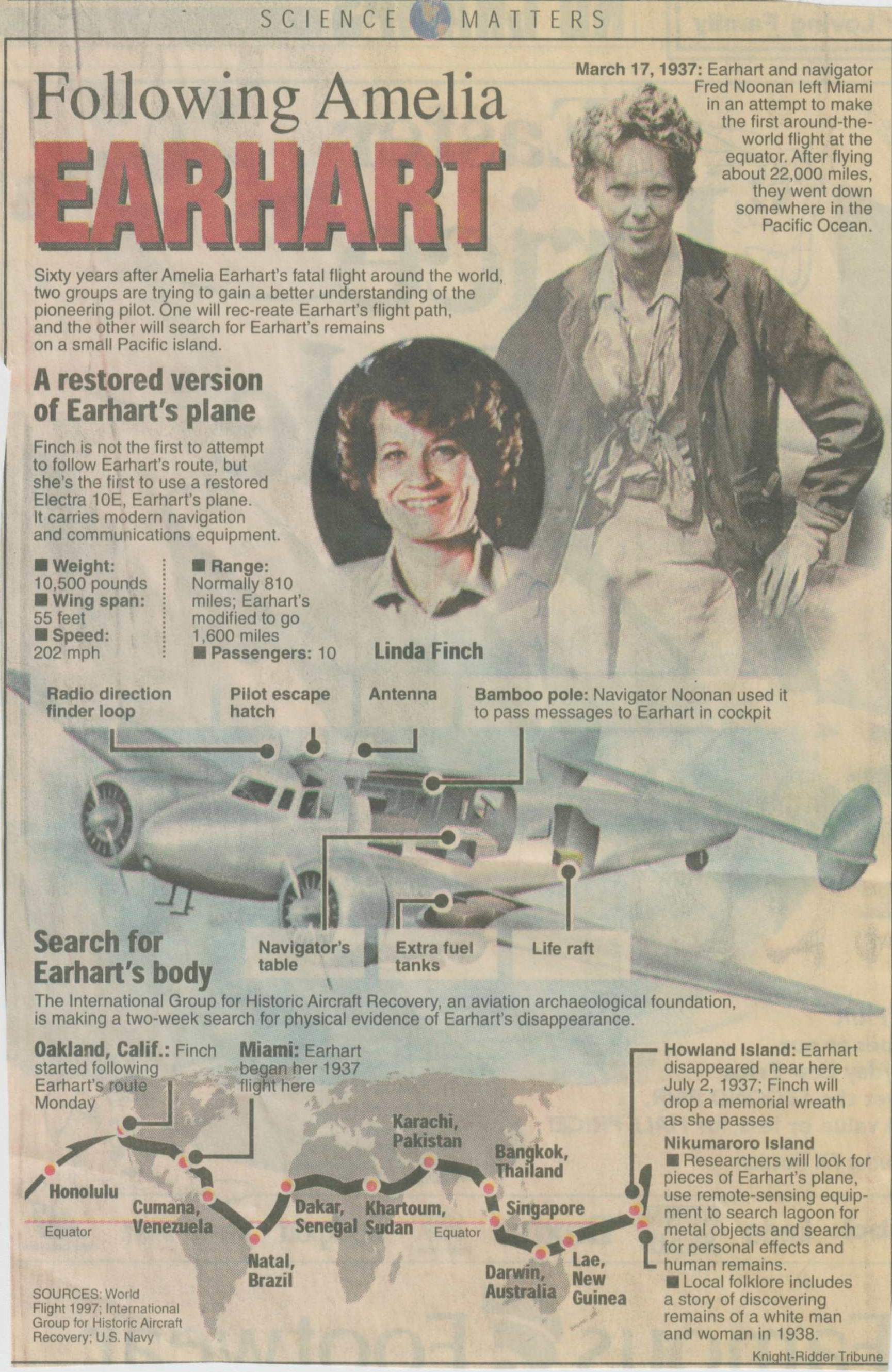
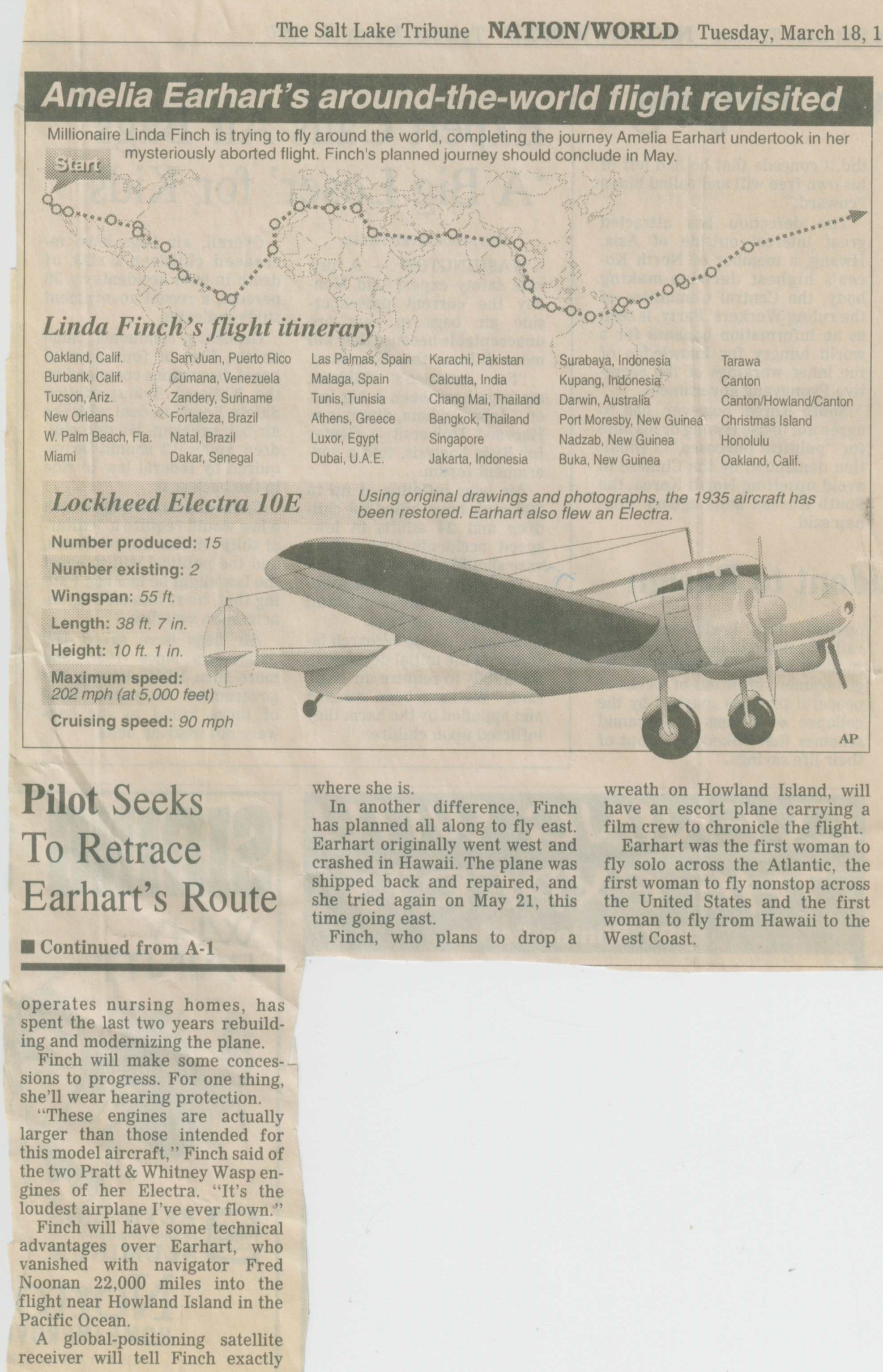
I wanted to share these clippings my Grandmother, Gladys Donaldson Ross. Not sure if they were all the same time, likely. I don’t know if Amelia was a role-model for my Grandmother. I do recall her mentioning Amelia Earhart in at least one conversation with her, but do not recall the context. Grandma would have been 15 at the time Amelia went missing. Whatever the reason, Grandma clipped these and kept them. I am posting these in honour of what would have been her 103rd birthday this week, 20 September 1921 to 20 September 2024.


































 Sagacity