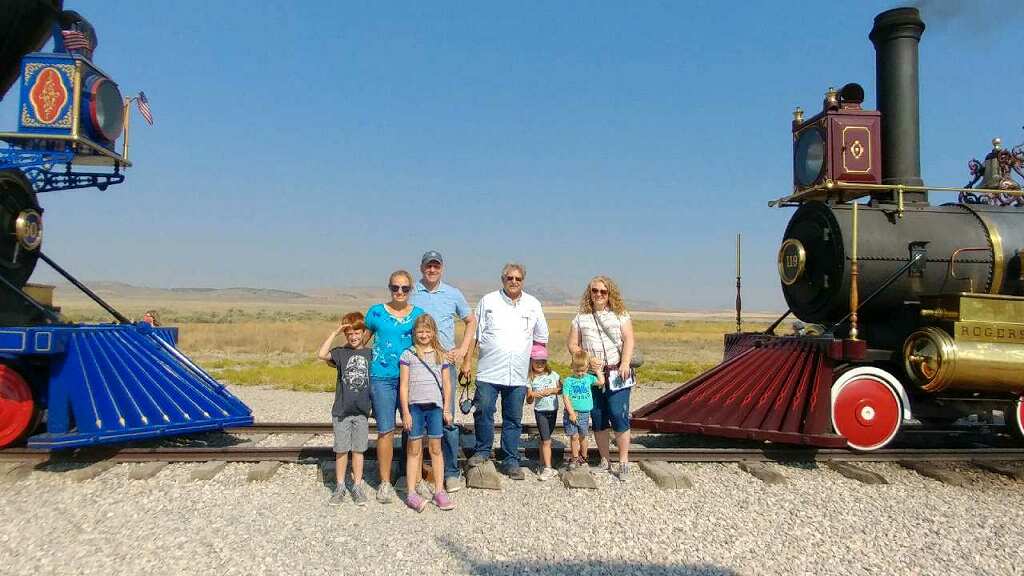
Jupiter at Golden Spike National Historic Park Sep 2020
We took a trip to Golden Spike in September 2020 for the kids to experience some Utah history. It was well worth the drive out to Promontory, Utah.
The Golden Spike has some significance on Amanda’s line. Her ancestor, Joseph Wayment, is standing in the photo taken 10 May 1869 on that momentous occasion. Below is a copy of the photo. You can see him with the hat and long beard. Look at the train on the left and the man standing right below the train light with his jacket open and white shirt; the man whose head is in front of that man’s right thigh (behind the guy with the partially raised hat). That is Joseph Wayment. Joseph Wayment was born 7 February 1844 in Whaddon, Cambridgeshire, England and passed 20 December 1931 in Ogden, Weber, Utah. He is buried in Warren. I wrote of his parents William and Martha Wayment previously.
Another interesting bit of history is that Joseph Wayment came to the United States on the ship “Amazon.” This is the same ship that my Stoker ancestors came to the United States. Not only is it the same ship, it is the same trip of the ship. Here is part of the history I wrote for William and Emma Stoker.
Joseph Wayment departed from London on a ship called “Amazon” 4 June 1863 (His parents and some siblings traveled later on “Nevada” in 1878). George Q Cannon dedicated the ship which was entirely of Saints (880+) headed for Zion. It was this same ship that Charles Dickens wrote that the Mormons were not taking misfits and scoundrels, but the “pick and flower” of England. Even George Sutherland, future U.S. Supreme Court Justice was on this ship. Here is a link to the story by Charles Dickens: The Uncommercial Traveller. The LDS church also tells of the story that day at this link: Amazon Departure. The ship sailed to Liverpool before finally heading out for America.
The “Amazon” landed at Castle Gardens, New York, New York on 18 July 1863. The Saints took rail to Albany, Albany, New York and then to Florence, Douglas, Nebraska through Detroit, Wayne, Michigan. From there they hoofed it on to Salt Lake City, Salt Lake, Utah Territory arriving 3 and 4 October 1863 (depending on which of the two companies), just in time for General Conference. Several of the company wrote of Brigham Young coming out to greet them and giving them advice. Brigham sent Joseph to Salt Creek (now Warren) to settle. He later was the first road supervisor and the father of the first born white child of Warren, Sarah Wayment in 1875.
I will have to spend some time telling more of Joseph and Ann Reed Wayment’s story another time.
My own limited tie to Promontory is just the fact the Sharps, taking my Grandpa Milo Ross, used to drive past the site out to harvest salt.
Hiram, James, Paul, and Aliza Ross on 7 September 2020
Hiram, Amanda, Aliza, and Paul Ross, Bryan Hemsley, Lillian and James Ross, and Jill Hemsley
Someone once observed, “The universe is composed of stories, not atoms.” The Star of Bethlehem is certainly a story, as is most of the Bible, first and foremost. It is also a mystery, involving not only theology and astronomy but also history and even astrology. What do we know about the Star of Bethlehem? The popular conception is summarized in the Christmas carol:
We three kings of Orient are Bearing gifts we traverse afar, Field and fountain, moor and mountain, Following yonder star.
O star of wonder, star of night, Star of royal beauty bright, Westward leading, still proceeding, Guide us to thy perfect light.
We all know this carol as the story of the Star, which is fine—except for the fact that almost everything in it is wrong. The actual New Testament account of the Star of Bethlehem comes from the second chapter of the Gospel of Matthew:
Jesus was born at Bethlehem in Judaea during the reign of Herod. After his birth astrologers [Magi] from the East arrived in Jerusalem, asking, “Where is the newborn king of the Jews? We observed the rising of his star, and we have come to pay him homage.” King Herod was greatly perturbed when he heard this, and so was the whole of Jerusalem. He called together the chief priests and scribes of the Jews and asked them where the Messiah was to be born. “At Bethlehem in Judaea,” they replied, “for this is what the prophet wrote: ‘Bethlehem in the land of Judah, you are by no means least among the rulers of Judah; for out of you shall come a ruler to be the shepherd of my people Israel.’”
Then Herod summoned the astrologers to meet him secretly, and ascertained from them the exact time when the star had appeared. He sent them to Bethlehem, and said, “Go and make a careful search for the child, and when you have found him, bring me word, so that I may go myself and pay him homage.”
After hearing what the king had to say they set out; there before them was the star they had seen rising, and it went ahead of them until it stopped above the place where the child lay. They were overjoyed at the sight of it and, entering the house, they saw the child with Mary his mother and bowed low in homage to him; they opened their treasure chests and presented gifts to him: gold, frankincense, and myrrh. Then they returned to their own country by another route, for they had been warned in a dream not to go back to Herod.
This is not a fabulous tale. It does not conjure up fantastic details or images, and it is told in a rather mundane fashion, not at all like a fable. It is also the only account we have of the Star in our Bible. Admittedly, later non-canonical sources like the Protovangelium of James and an epistle of Ignatius did elaborate on the story, calling the Star the brightest star in the sky, brighter than all other stars combined, even including the sun and the moon, which bowed down before it. But Matthew is very matter-of-fact. It has also been suggested that this is a commentary by Matthew, always fond of referring to Old Testament prophecies, on Balaam’s oracle in the Book of Numbers that “a star shall come forth out of Jacob and a scepter shall rise out of Israel.” But it would be uncharacteristic of Matthew to refrain from pointing out this prophecy explicitly, had he had it in mind.
The Historical Perspective
To understand this story, we must view it in the context of its time. Who were these Magi? Where did they come from? Magi is the plural of Magus, the root of our word magic, and “court astrologers” is probably the best translation, although “wise men” is also a good term, descriptive of the esteem in which they were widely held. The group of Magi in question came “from the East.” They might have been Zoroastrians, Medes, Persians, Arabs, or even Jews. They probably served as court advisors, making forecasts and predictions for their royal patrons based on their study of the stars, about which they were quite knowledgeable. Magi often wandered from court to court, and it was not unusual for them to cover great distances in order to attend the birth or crowning of a king, paying their respects and offering gifts. It is not surprising, therefore, that Matthew would mention them as validation of Jesus’ kingship, or that Herod would regard their arrival as a very serious matter.
When might these Magi have appeared in Judaea? Obviously, determining the story’s date is important if we are to look for astronomical connections. We might assume that it was around 1 B.C. or 1 A.D., since that is when, by conventional reckoning, Jesus was born. But the calendar on which these dates are based was set by the Roman monk Dionysius Exiguus in the year 525 A.D., long after the fact. Scholars writing in the first and second centuries A.D. asserted that Jesus was born between what we now call 4 B.C. and 1 B.C. They were living much closer to the event and had access to thousands of historical records in many excellent libraries, and their opinions probably should be given much more weight than has been common.
How about the time of the year? The best clue is a passage in the Book of Luke:
And there were in the same country shepherds abiding in the fields, keeping watch over their flock by night.
If the reference to “fields” is accurate—not pastures or holding pens—we might guess at a date in late summer or early fall, for it was customary for farmers to allow sheep and cattle to graze the stubble in the fields following the harvest. This clue is suggestive, but hardly definitive.
One difficulty in seeking a precise date is the fact that Matthew reports two different sightings, possibly separated by a substantial time. First, the Magi saw the Star rising en anatole, best translated as “rising in the East,” the ancient technical term for an acronical rising, when an object rises at sunset and is visible all night. After they come to Jerusalem—we do not know how long that took, and there is no indication that the Star was in any way involved with the journey—they see the Star again as they travel the few miles to Bethlehem:
There before them was the star they had seen rising, and it went ahead of them until it stopped above the place where the child lay.
There was no need for a bright or supernatural guiding light to find Bethlehem from Jerusalem; it lies just five miles south on the main road. There is a reference not to the “house” of an infant (brephos in the Greek) but of a paidion, or toddler, indicating that some months may have elapsed since the birth itself.
What are the astronomical possibilities? This question has been asked many times since the Christian apologist Origen first raised it around 250 A.D. It is safe to say that every astronomical event known to have occurred during, say, the decade of interest has at some point been proposed as the Star of Bethlehem. The key point to answering this question is to note that it is not just any astronomical event that is of interest. We can restrict our inquiry to those appearances that would have had astrological significance to the Magi, who declared:
“We observed the rising of his star, and we have come to pay him homage.”
An astrological event may not have been very obvious at all; certainly it was not obvious to Herod. Had it been an incomparably bright object, as later writers thought, there would be numerous written records of it. It is much more plausible that the Star of Bethlehem went unnoticed by all but a few experts such as the Magi.
The Death of Herod
A major key to the chronology is the date of the death of Herod the Great, the father of another Herod—Herod Antipas, who executed John the Baptist and who ruled at the time of the Crucifixion. Herod the Great was alive when the Star of Bethlehem appeared, and the commonly quoted date for his death is 4 B.C. Thus dates of 7 B.C. through 4 B.C. are often given for the birth of Jesus. The political events of this period are best known from the writings of Josephus Flavius, the Jewish historian who lived from 37 A.D. to about 95 A.D. His testimony has always been considered vital in determining these dates. But the accounts of Josephus and the entire history of this period have been reassessed recently, with important new results, by Ernest Martin, whose book, The Star that Astonished the World (ASK Publications, 1991), has become the authoritative source on the subject.
According to Josephus, on the night of a lunar eclipse Herod executed two rabbis. They were accused of inciting some young men to climb up on the wall and tear down the golden eagle that the king had ordered placed on the gate to the Temple in Jerusalem. This eagle was, of course, an abomination to the Jews because it was a graven image. Soon after this incident, Herod died and was buried. One of his sons inherited his throne shortly before Passover was celebrated. It was long believed that the lunar eclipse in question occurred on March 13 in 4 B.C. But this was only a partial eclipse (40 percent total) and fairly hard to detect. And it occurred only 29 days before Passover. Here is what would have had to happen in those 29 days:
Herod was sick at the time of the execution of the rabbis, and his condition worsened almost immediately. He was treated for a time by his physicians, to no avail. He then decided to pack up the royal household and move to Jericho to take the baths. He tried the baths unsuccessfully for some days and then returned to Jerusalem. Believing that he soon would die, Herod came up with a diabolical plan to insure that all of Israel would mourn his death, in spite of his unpopularity. He commanded the leading men from around the country to come to Jerusalem; there he imprisoned them in the Hippodrome and ordered the army to execute them as soon as he was dead. Israel would indeed mourn, he vowed. (Fortunately, the order was not carried out.)
In the meantime, word arrived from Rome that Herod finally had the Emperor’s permission to execute his rebellious son Antipater, and he promptly complied. Five days later Herod died, but not before decreeing that his was to be the largest funeral ever held in the history of the world. His body was embalmed. The army was assembled to carry his body in the funeral procession to a burial site some 25 miles away. The soldiers walked in bare feet, as was required when in mourning, traveling one mile a day. A legate from Rome, where word of Herod’s death had been received, arrived to protect the royal treasury. Finally, Herod’s son Archelaus was crowned king and had time to issue a few decrees prior to the celebration of Passover.
The 29 days between the eclipse of 4 B.C. and the following Passover simply did not allow enough time for all of this to have happened. A minimum of ten weeks would have been required. But on January 10, 1 B.C., there was a total lunar eclipse visible in Palestine, and it occurred twelve and a half weeks before Passover.
As Martin points out, there are other compelling reasons to regard 1 B.C. as the true date of Herod’s death. For example, the War of Varus, known to have followed Herod’s death, can be redated to 1 B.C., where it fits the other known facts perfectly. As a clincher, it has recently been discovered that Josephus himself dated Herod’s death to 1 B.C.; a sixteenth century copyist’s error is responsible for the incorrect date, which has been propagated to modern editions of Josephus.
If we conclude that Herod did die in the spring of 1 B.C., we are free to add the years 3 B.C. and 2 B.C. to our search for the Star of Bethlehem. What was happening then? The year 2 B.C. marked the 25th anniversary of Caesar Augustus’s rule and the 750th anniversary of the founding of Rome. Huge celebrations were planned. The whole empire was at peace. The doors of the temple of Janus were closed for only the third time in Roman history. To honor their emperor, the people were to rise as one and name him pater patriae, or “Father of the Country.” Now, getting the people of an empire to do something “spontaneously” requires a great deal of organization. And so an enrollment, or census, was ordered:
In those days, a decree went out from Caesar Augustus that all the world should be enrolled…And all went to be enrolled, each to his own city.
This enrollment, described in the Book of Luke, which brought Joseph and Mary to Bethlehem, has always been a mystery since no regular census occurred at this time. But the pater patriae enrollment fits perfectly.
The Astronomical Perspective
What astronomical events, possibly in the years 3 or 2 B.C., might have been related to the Star of Bethlehem? A nova—the unexpected, sudden brightening of a star from invisibility into a bright object for a period of days or weeks—has been suggested. But there is no historical record of such a nova, nor is it clear what a nova’s astrological significance would be. Origen himself suggested a comet, for comets appear sporadically, move, and can even seem to point down to the earth. But the recorded comets around this time, even Halley’s Comet in 12 B.C., were not very impressive; astrologically, they were considered ominous. Meteors and fireballs are even less likely candidates.
Conjunctions of planets have also long been considered good possibilities. A conjunction is a close apparent approach between two celestial objects. Technically speaking, a conjunction occurs at the moment when both objects have the same celestial longitude; one is due north of the other. The closer the objects, the more visually impressive the event and the more significant astrologically. In 3 B.C. and 2 B.C., there was a series of close conjunctions involving Jupiter, the planet that represented kingship, coronations, and the birth of kings. In Hebrew, Jupiter was known as Sedeq or “Righteousness,” a term also used for the Messiah.
In September of 3 B.C., Jupiter came into conjunction with Regulus, the star of kingship, the brightest star in the constellation of Leo. Leo was the constellation of kings, and it was associated with the Lion of Judah. The royal planet approached the royal star in the royal constellation representing Israel. Just a month earlier, Jupiter and Venus, the Mother planet, had almost seemed to touch each other in another close conjunction, also in Leo. Then the conjunction between Jupiter and Regulus was repeated, not once but twice, in February and May of 2 B.C. Finally, in June of 2 B.C., Jupiter and Venus, the two brightest objects in the sky save the sun and the moon, experienced an even closer encounter when their disks appeared to touch; to the naked eye they became a single object above the setting sun. This exceptionally rare spectacle could not have been missed by the Magi.
In fact, we have seen here only the highlights of an impressive series of planetary motions and conjunctions fraught with a variety of astrological meanings, involving all the other known planets of the period: Mercury, Mars, and Saturn. The astrological significance of these impressive events must surely have been seen by the Magi as the announcement of the impending birth of a great king of Israel.
September 11, 3 B.C., is perhaps the most interesting date of all. Not only was Jupiter very close to Regulus in the first of their conjunctions, but the sun was in the constellation of Virgo (of obvious symbolism), together with the new moon, in a configuration that fits a plausible interpretation of a passage in the Book of Revelation describing the birth of a male child who is to be the ruler of the universe. Significantly, September 11, 3 B.C., also marked the beginning of the Jewish New Year, traditionally regarded as the anniversary of Noah’s landing after the Great Flood.
But if the planet Jupiter was the Star of Bethlehem, or was a component of the events that triggered the visit by the Magi, how do we view the final appearance of the Star on their journey to Bethlehem? It would have been in the southern sky, though fairly high above the horizon. Could the Star have stopped over Bethlehem? The answer is yes. The word “stop” was used for what we now call a planet’s “stationary point.” A planet normally moves eastward through the stars from night to night and month to month, but regularly exhibits a “retrograde loop.” After it passes the opposite point in the sky from the sun, it appears to slow, come to a full stop, and move backward (westward) through the sky for some weeks. Again it slows, stops, and resumes its eastward course.
It seems plausible that the Magi were “overjoyed” at again seeing before them, as they traveled southward, “his star,” Jupiter, which at its stationary point was standing still over Bethlehem. We do know for certain that Jupiter performed a retrograde loop in 2 B.C. and that it was stationary on December 25, interestingly enough, during Hanukkah, the season for giving presents.
What Room for God?
Where has this search for the Star of Bethlehem taken us? There has been much discussion in recent years about the “God of the gaps”—finding God in the gaps between the portions of some subject that we feel we understand scientifically. It seems to me that this is a dangerous position, for science by definition cannot admit to such gaps and must search continually to fill them with its understanding, and it often will succeed in so doing. Here the situation is different. The question is: What meaning, what room for God, do we find in the events that we know to have occurred?
If we have correctly identified the Star of Bethlehem, the science is clear and simple. Johannes Kepler (1571-1630) was the German astronomer who discovered the physical laws describing planetary orbits. These orbits are so predictable that we can deduce quite accurately what the sky looked like two thousand years ago. Even the ancient Magi understood apparent planetary motions quite well. Predictions of the conjunction of 3 and 2 B.C. were made 400 years prior to the birth of Christ, and they were in error by only a few days. There is no need to invoke God or divine miracles to explain what happened in the heavens above Judaea. Natural laws are sufficient.
But is this kind of sufficiency really enough for us? The significant question raised here is not what happened, but why it happened. What does it mean? Was Matthew right in seeing this event as divine confirmation of a central moment in God’s plan for mankind? What room is left for God, not as an agent filling in the gaps between what we can understand as physical causes, but as the creator of purpose? Was God’s purpose fulfilled by the great celestial dance that we call the Star of Bethlehem?
These are examples of the kind of questions we are faced with daily. No theologian can say, in a way convincing to a scientist, that some event required an act of God outside natural law. Similarly, no scientist can say that some event was merely (a dangerous word) an act of natural law working itself out with no other meaning. That is, no one is forced to believe that what happened in the heavens two thousand years ago was a simple, natural event devoid of meaning. The Star of Bethlehem was an excellent example of an event that occurs right at the intersection of Christianity and science, in a world created by a God who chose to institute natural laws but who nevertheless continues to carry out His own purposes.
Imprimus, December 1996, Volume 25, Number 12 – Craig Chester
This is another chapter of the Jonas history book compiled by Carvel Jonas. “The Joseph Jonas clan of Utah (including – early Jonas family history; early Nelson family history)”
“Our Jonas descendants from Utah can all trace their genealogy to the Rheinland in Germany to, so far, the early 1700’s. This is the area where all of our great grandfathers and great grandmothers lived. The Jonas last name can be traced to a little town called Kirchheim. All the Jonas; we know of originated from Kirchheim, including Hubert Jonas who is the first, and as far as we know, the only member of the Jonas clan who sailed to America. Hubert’s wife was born in Oberdrees, a little town near Kirchheim. Her name was Maria Catharina Schumacher. She went by the name of Mary. Mary’s mother was also from Oberdrees, and her mother’s family as far back as we can go were also from Oberdrees. Mary’s father was Johann Peter Schumacher. The Schumacher’s came from Schweinheim, another town near Kirchheim. Maria Catharina Schumacher was born 13 Sep 1815. All of our ancestors from Joseph Jonas, born 10 Jan 1859, back to the early 1700’s belonged to the Roman Catholic Church, and were Prussian until they came to America. Many of our records past the year 1800 come from parish records and give only christening dates instead of birthdays. Mary is the only child we can find born to Johann Peter Schumacher, born 4 Jun 1793, and Anna Maria Schmitz born 1 Oct 1792. Mary’s record of birth was not found under the Schumacher last name, but under her mother’s last name, Schmitz. Mary’s parents were not married until she was 18 years old. They were married 31 Jan 1834. Fortunately they were married and left us a record, or our genealogical would end without knowing who Mary’s father’s family were. Johann Petrus Schumacher’s parents were Hubert Schumacher, a farmer, and Elisabeth Nuecken. They had three children. Our great grandfather, John Peter, was the middle child. Anna Maria Schmitz’s parents were Christian Schmitz and Anna Christina Siep. They had two children, our great grandmother was the oldest.
“Joseph Jonas’ father was Hubert Jonas, born 8 Oct 1816 at Kirchheim, Rheinland, Germany. Hubert’s parents were Wilhelm Jonas, Chr 23 Jul 1773 and died 27 May 1843, and Anna Catharina Breuer, Chr 21 Jun 1782 and died 5 Feb 1855. Wilhelm and Anna were married 19 Jul 1802 in Kuchenheim. They were parents of eleven children, 6 girls and 5 boys. Our great grandfather, Hubert, was the fifth child and second son. Wilhelm was a farmer and a weaver by trade. Hubert was also a weaver, and mostly a farmer.
“Hubert Jonas was 43 years old when our great grandfather, Joseph was born. Huber’s father, Wilhelm Jonas, was also 43 years old when Hubert was born. Wilhelm’s father, another Hubert Jonas Chr 7 Nov 1728, was over 45 years old when Wilhelm was born. So in our genealogy line about 131 years pass in time before a fourth generation was born, he being Joseph Jonas who was born 10 January 1859. To continue the Jonas genealogy line Hubert Jonas, Chr 7 Nov 1728 and died Apr 1785 was married to a Gertrud Hartzheim. They had five children, 2 boys and 3 girls. Our great grandfather, Wilhelm, was their youngest child. Huber’s father was Jacob Jonas. We do not have Jacob’s birthday yet. We do know that he married Catharina Zimmermann and they had seven children. Jacob remarried and had two more sons. A death date for Catharina Zimmermann has not been found, but we can assume it is between 14 Jun 1735, the birthdate of her last child, and 28 Nov 1741, the date Jacob remarried. Records for a third man named Hubert Jonas were also found. He was a few years younger than Jacob Jonas, and was also found on the same church records from Kirchheim. It is the opinion of the author that these two were brothers. Because of their similar last names, both living in the same small town, and Jacob was a witness to Huber’s first child’s baptism. Also, the name Hubert was given to Jacob’s second child. It is estimated that Jacob Jonas was born about 1699-1706. The significance of finding these two brothers is that it assures us the Jonas last name continues back farther in time, even though known records may not. Anna Catharina Breuer, Chr 19 Jul 1782, father’s name was Johannes Breuer. He married Christina Neuenheim the 22 Jul 1777. Both had been married before and had lost their first companions to death as both were widowed. Johanne’s first wife, Margaretha Reuter, died Jan 1777 after almost twelves years of marriage. Seven months later he married our great great grandmother, Christine Neuenheim. Her first husband had died about nine years before she remarried. They had two daughters, our great grandmother being the youngest. Johannes Breuer had had three sons before his first wife died. Johannes Breuer’s parents were Christian Breuer who died 7 Sep 1757, and Barbara Bessenich who died 16 Jul 1761. Christian and Barbara had four children, two boys and two girls. Johannes Breuer and his twin brother, Petrus, were the oldest children of the family.
“Now for the more specific history of Hubert Jonas, born 8 Oct 1816 at Kirchheim, Rheinland, Germany; his wife and children. Hubert was the 6th child and second son of Wilhelm and Anna Jonas. He was taught in the trade of a weaver as his father was, but records in America show that he mostly farmed. He married Mary Catharina Schumacher 25 Jan 1844 at Rheinbach. He was 27 years old when he married and she was 28 years old. They had three children born to them in Germany. They were all sons. Peter Jonas born 13 Feb 1845; Johann Wilhelm born 24 Jun 1848; Johann born 17 Nov 1849. They were all born in Rheinbach, and it is very likely that Hubert and Mary lived in Rheinbach after they were married. All of these three sons died before marrying. Our family didn’t have any knowledge of Johann Wilhelm, who must have died as a very young infant. Since no record was found for his death in Germany he must have died sailing to America or shortly after arriving. The only death record we have of these three son’s which has been found is for Johann Jonas. He died 7 Aug 1870 at Frenchtown, Michigan. He was a single, 20 year old who had worked as a farmer with his father. He died of consumption, which is the archaic term for tuberculosis. Peter, the oldest son is believed to have died from the same sickness. According to cousin Verla both boys caught a disease from the horses they loved to work with. The county records for Monroe county only go back to 1867, so it is believed that Peter died a few years before 1867. Peter’s brother took his older brother’s name of Peter when he was confirmed at the local perish in 1866. Peter’s name is recorded on the 1860 general census, but is missing on the 1870 general census. So we can reasonable deduct that Peter died between 1860 and 1866. This is consistent with what members of the family remembered. Rosa told her daughter, Verla, that Peter and John were both in their early 20’s when they died.
“After arriving in America, Hubert and Mary had three more son’s born to them. They were Wilhelm (William), who was most likely named after his grandfather. William was born Sep 1851. Francis, who was born to them about 1854. Joseph who was born 10 Jan 1859. The exact date of immigration is not know to date. But we know they came between 17 Nov 1849 when Johann was born in Germany, and Sep 1851 when Wilhelm was born in America. It is very likely they came during the summer month’s of either 1850 of 1851. If they immigrated in 1850 Hubert would have been 33 years old and Mary would have been 34 years old, unless they left after Sep 1850. If they left after Sep then we would need to add one more year to their ages. Even though we don’t have the exact date of immigration we have it isolated to only two different years. Also, Hubert and Mary never naturalized after coming to America according to the Michigan records. Some speculation has been given by the author about the reason or reasons Hubert took his young children who were only about 6, 2, and 1 years of age across the Atlantic to America. Hubert’s father had died before the immigration. But his mother, and some of his brothers and sisters were still alive. In researching it is noted that beginning in 1844 harvests were poor in Germany and business decreased Many Germans were hungry and out of work. There were also many revolts in almost all the German capitals in 1848 against the existing government and debate about the united Germany. Perhaps these events influenced Hubert to leave and find new opportunities in America.
“Hubert and Mary first bought land on the 1 Mar 1858. It was about 20 acres in Frenchtown, Monroe county, Michigan and cost them $300.00 dollars. Frenchtown was in south east Michigan. Hubert lived on land that is now called Woodland Beach. They went to St. Michael’s parish, which is in Monroe City. This was a parish organized specifically for the German immigrants. The church has recorded on the death register Johannes Jonas in the year of 1870 which date matches the vital county records. The county record has Hubert and Mary Jonas as parents. The parish also has confirmation for Johannes Jonas the 26 May 1864. He took the name Antonius. They also have a confirmation of Johannes Jonas 16 Jun 1870 who took the name of Franciscus (Frances) which was one of the children of Hubert and Mary. Also, the confirmation of Wilhelm Jonas 30 Sep 1866 who took the name of Peter-which was the name of the oldest child who died before 1867. The second confirmation of Johannes Jonas was performed less than two months before his death.
“Hubert bought land for the second time 21 Jan 1865. He bought about 40 acres for $800.00. On 19 Nov 1867 he bought about 13 acres for $125.00. 28 Jul 1868 he bought one undivided 6th part of a certain piece of land for $200.00. By 4 Mar 1871 Hubert and Mary sold all of their 46 acres in Frenchtown township for $1,000.00. There may have been a transaction or two which we don’t know about because the acres don’t add up to 46. These land records tell us a little about Hubert. For example, the record of 1865 the clerk wrote Hubert Unos and that he was called Jonas. The name was probabaly misspelled because Hubert would have said Jonas with the German pronunciation which give the letter J a Y sound as in the word you. Also, when they sold all their land in Frenchtown they reserved the wheat now growing on said land, and privilege of harvesting and removing the same. So we learn that Hubert grew wheat that year. His son, Wilhelm, was growing wheat about 1900, so it is possible that wheat was the main crop Hubert grew during his farming career.
“On 4 Mar 1871, the same day Hubert sold his 46 acres for $1,000, he bought 72 acres for $1,000 in another town. This time the family moved to Ash Township. This new land was about 6 miles northwest of their land in Frenchtown. On a 1876 atlas for Ash Township there is in sec 29, 70 acres for H. Jonas with the Little Swan Creek running thru the property at the north end. On the other side of this creek is the village of Grafton, and it’s post office and store on the remaining 10 acres (which Hubert did not own). The name of the owners around this area were mostly English and Irish. The old Wayne and Monroe Railroad (now the Chesapeake and Ohio) formed the east border of the property. The land to the south and west was farm land. A Stoney creek was not on Hubert’s property, but ran westerly 1 mile or south of his land, and this same river was very close to his property in Frenchtown.
“A land record recorded 4 Feb 1879 gives the date Hubert and Mary sold their 72 acres and moved from the state of Michigan. Census records for 1860 and 1870 have been found for Hubert and Mary. They show the family members names and indicate that Hubert and his son’s were all farmers. The 1880 general census tell us that Hubert was living in Nebraska. We learn that Hubert was 63 years and 10 months old when he first became a grandfather. Hubert, his son Wilhelm, Wilhelm’s wife and their daughter, Anna, were living with another family whose surname was also Jonas. Joseph, our great grandfather, was also found on the 1880 census, which was recorded Jun 23-24 of that year. However Joseph was living in Columbus, Nebraska, working on the railroad. It was first believed that this other Jonas family was a branch of our Jonas family. But it proved incorrect. It was coincidental that these two Jonas families met. They belonged to the same religion, and were also Prussian. The 1880 census also recorded the death of Hubert’s wife, Mary. She died in Mar of 1880 of consumption. This year coincides with the family history which was recorded in a history of Central Washington which states that Mary died in America in 1880. The place that they lived at in Nebraska was called Pleasant Valley, which was in existence for only a year before our family arrived. Today it is called St. Bernard, and was named after the parish that Hubert and Mary went to. St. Bernard was a German settlement established in Jun 1878. This is were our great grandmother, Mary, is buried, although the exact spot is not known. The Platte County vital records have the marriage of Hubert’s oldest living son, Wilhelm. When he was 26 years old he married Emma Schriber. She was 22 years old. They were married 20 May 1879. It was only 11 months after Hubert sold his land in Michigan that his wife died in Nebraska. Hubert stayed in Pleasant Valley from Feb or Mar of 1879 until a little after the 20 Jan 1883. On this last date the following was reported in the local newspaper, “The Democrate”, under court proceedings. Below will be found the disposition made in all the cases on the docket for the term just closed. Hubert Jonas vs Peter Lonsbert passed. This information lets us know that Hubert was still living in Pleasant Valley the first part of 1883. Hubert stayed in this area for about 4 years. Then the Jonas family moved west in 1883. When the author was in Spokane, Washington doing some research he found a land record. It was known that Huber’s son, Francis, lived in Spokane County, but no records were found of him. Instead, a land record was found for Hubert Jonas. bought 25 Sep 1883, 8 a.m. for $65.00, Hubert bought some land in the town of Sprague. In the land record the words premises are used, and it is likely that Hubert bought a home and that Francis lived with him for a short time. The selling of this property was not found. Now the town of Sprague is in Lincoln County. By 1885 Hubert and his two son’s William and Joseph were all found on the census in Ellensburg, Kittitas County, Washington. Joseph and William had bought land together and all farmed for a while. A census of 1887 shows Hubert still alive. This same year all three of Huber’s son’s were living in Ellensburg. Francis baptized a boy in the St. Andrew church in town who was born 5 Sep 1887. At least for a little while Hubert had all three of his living children in one place living with him before his death. There isn’t an official record of Hubert’s death do to poor record keeping at the local parish, and a fire which destroyed many of the civil records at the county building. The Holy Cross Cemetery in Ellensburg is Hubert’s final resting place. The church records only have record of where his body was buried, but not the exact date of death. We believe it was in 1889. Hubert’s granddaughter, Rosa, remembered that she was about 3 years old when he died. So we estimated the year of death.
“An important article was discovered in the history of Central Washington from a book entitled “History of Klickitah, Yakima, and Kittitas counties.” It is quoted here in it’s entirety. Note that some of the information is incorrect and the correct information has been provided inside the brackets. “William Jonas, one of Kittitas County’s successful farmers, lives two miles north and a mile and a quarter east of Ellensburg, Washington. His father, Hubert Jonas, was born in Germany, in 1814 (8 Oct 1816), and came to the United States when thirty-six years old, and farmed in Michigan, Nebraska, and Washington. His mother, Katherine Shoemaker (Maria Catharina Schumacher) Jonas, was born in Germany, in 1815 (13 Sep 1815), and died in America, in 1880 (Mar). Their other sons are: Frank, who lives in Spokane County, and Joseph, a resident of Thorp, Washington.”
“Mr. Jonas, of this articles, was educated in the schools of Michigan, and followed farming in that state until he was twenty-seven. Then he operated a farm in Nebraska for five years and beginning in 1885, he was engaged in railroad work for one year. In 1886 he came to Washington and took up one hundred and twenty acres as a homestead, and later bought one hundred and sixty acres, which he has since farmed. He was married in Nebraska in March, (20 May), 1879, to Emma Schner (Schriber), who was born in Germany (Austria) in 1855. She is now deceased. The children which survive her are: Anna, born August 15, 1881 (1880); Hubert, born Nov 13 (4) 1883; Lizzie, born Apr 15 (3) 1885 (1886); Katie, born Jun 11 (6 Nov) 1892; George, born March 8 (3) 1898, all of whom are living at home.”
“Mr. Jonas is a member of the Catholic church. He takes an active interest in political affairs, affiliating with the Democratic Party. His holdings consist of two hundred and eighty acres of land, which he farms admirably, forty-five head of cattle and five head of horses. He devotes about twenty acres to clover, the rest of his cultivated land to grain.” The above article was published in 1904.
“On 22 Jul 1905 William sold some of his land to all his children for a dollar. On 29 Jul 1905 he sold what was probably the rest of his land to a local company. About three months later William died, 11 Oct 1905. He is buried in the Holy Cross Cemetery, Ellensburg, in an unmarked grave near his wife who has a beautiful marker.
“It is not the intention of the author to give a life history of William and Emma’s nine children. Some information has been collected and will be given as a partial history. Also, five of their children’s pictures are included in this history book.
“After William died the children stayed on the family farm. Many land records told how some land was sold and other parts of the land had an option to sell by a certain date. By 19 Feb 1912 all the land was finally sold.
“Emma, who changed her name to Erma, William (Bill) Jr., Kate and Anna never had any children, although they had all been married at one time. Elizabeth (Lizzie) had two girls, Clydeen and Francis. Clydeen was killed in a car wreck and the family lost track of Francis. Hubert had two children. A boy who died in World War II, and a girl named Mabel. Hubert and Elizabeth both had a daughter who made them grandparents. Hubert’s and Elizabeth’s family lines continue today, but there are no Jonas last names passed on anymore from William and Emma’s side of the family.
“Emma or Erma died in her sleep on the Oregon Coast. She and her husband retired there operating a motel and he did plumbing on the side. Katherine (Katie) died in the fire. The newspaper article is quoted here. “Trapped by flames which swept swiftly through her small apartment at 311 Deermount, Mrs. Kate (Jonas) Helgeson and Gustav Remset, 63, fisherman, were burned to death early this morning as rescuers, beaten back by smoke and fire, attempted in vain to save them.”
“Firemen, who said the cause of the fire has not been officially determined, reported the telephone alarm was turned in at 1:14 a.m..”
“Coast Guardsmen, William Kendred, machinist’s mate first class, driving by on their way to the bases when they noticed the fire. Stopped they spoke to three women standing on the sidewalk and found no alarm had been turned in. The Coast Guardmen broke in a window and discovered the man’s body, but efforts to pull him out were thwarted by flames and smoke.”
“Mrs. Helgeson, wife of William Helgeson, fisherman now on the fishing grounds on the vessel Attu, occupied the upper apartment of the house. Louis Jacobsen lives in the lower one. Jacobsen told police he came home about 11 last night and everything was dark upstairs.”
“The two-story frame house was shambles, firemen said, although the lower floor was still intact. Damage is estimated at $3,500.00. Coroner P. J. Gilmore ordered an autopsy performed this afternoon by Dr. Dwight Cramer to determine the cause of death of the woman and man. Mr. Remset, a member of the Deep Sea Fishermen’s union, registered in Seattle, was a halibut fisherman.”
“Mrs. Helgeson, at one time a resident of Petersburg, had lived here for many years, and at one time operated what is now the Up and Up cafe.”
“Kates death record has the following information. She was 5’6” tall 225 lbs, and had a ruddy complexion with dark hair. Cousin Verla Lythgoe, who did the LDS Temple work for Katie, said that she couldn’t stop crying during the time she was in the temple. She knew that Katie was overjoyed that her temple work was being done for her.
“A short note should be made for Frank or Francis Jonas, who was a brother to William and Joseph Jonas. We do not have very much information about him.. Neither Joseph’s or William’s children know much about him or his possible children. I was told that he was the “black sheep” of the family and moved away from his brothers and their families. I discovered that he married a Louise Andrews and in 1887 baptized a son in Ellensburg. He wrote to his brother, Joseph, before Joseph died in 1917, so he probably lived longer than any of his brothers. Merlin Jonas Andersen met a son of Frank’s in Idaho in 1937, but he wouldn’t have anything to do with his Utah cousins. One day we will be able to add Frank’s family to this history.
Many years ago, I obtained a copy of Carvel Lee Jonas’ book that he wrote on our particular Jonas family. I cannot seem to find my copy of the book now, but about 10 years ago I typed up most of it. I am going to make it available with full credit to him. Hopefully we can build off his research. I removed Carvel’s home address and phone number off this preface. If you wish to contact him, please contact me. Further, I hope you will take the spirit of his preface to heart. If you have stories to add, documents to share, or corrections, please make them know. The sooner the better as time is our enemy when it comes to history.
“The Joseph Jonas clan of Utah (including – early Jonas family history; early Nelson family history)”
“After more than four years of research and compiling I am thrilled to offer this Jonas family history book to family members. The more family members distribute this history book to other members, the more likely the history will survive into the future. This is your book! Use it to create greater family unity. When thoughtfully read the reader will discover a wonderful spirit which is associated with this history. To get that feeling it may need to be read more than once.
“This history book was no easy task! Information was collected from all over Utah, and also from Washington, Nebraska, Michigan, and Germany. We are blessed as a family to have the Jonas family pedigree from Germany, which was finally discovered in 1985. A feeling came to me that the records were in existence, and it was possible to trace the family surname back to Europe. In the process of looking for clues to extend that pedigree, I discovered that I had collected a considerable amount of information. Land records, church records, county records, census records, etc. The idea came to me that since I had so much information I might as well collect all that I could and make a history book. I collected more information and talked to older members of the family so that I could get to know the personal stories about different members of the family. I’d write down everything that I was told. When I finally had enough information I put it all into one story. Then I would get more information and rewrite the story again. Finally I added my research and some logical conclusions which would feel correct to the stories and rewrite them again. A special thank you to Verla Jonas Andersen Lythgoe for her willingness to answer my questions and tell me stories about Joseph and Annette Josephine Nelson Jonas. She is the main reason we have a story for them. When she was younger she would get my grandfather, William Nelson Jonas, and her mother, Rosa Nelson Jonas, together in the same room and quiz them about Joseph and Annie Jonas. Because she asked questions and because of her good memory we now have a wonderful story about Joseph and Annie Jonas. I remember taking all the letters that cousin Verla had sent to me, and putting all the information into a short story. Then I went to cousin Verla with the story and asked her what her opinion was. She corrected a part and eventually added more to the story. I added my personal impressions and finally typed the last revision. That is how the story of Joseph and Annie Jonas came into existence.
“The following persons gave information to me so I could write the individual life stories found in this book.
“Verla Jonas Anderson Lythgoe; Merlin Jonas Andersen; Lillian Jonas Talbot; Joseph H. Jonas; Spencer Jonas; Carvel Thompson Jonas; Vaughn Thompson Jonas; Annette Nelson Brown; Mabel Jonas Parvi; Mr. And Mrs. Otto Hansen; Armina Jonas Farnes; Calvin Andersen Jonas. Also, the autobiography of August Nelson and the biography of Christian Andersen were used and quoted when they applied to our direct family line. It should be noted that the life stories were written by a person who had never met anyone he wrote about. I never even met my grandfather, William Nelson Jonas, except as a small child. I relied on the documents which I found and the memories of the above mentioned family members. If there is a comment about something you read it is up to you to take the responsibility and let me know about it. This is not intended to be the last edition of this history. It is hoped that when more information comes from you, the family member, that there will be a future edition.
“This history was reproduced in an inexpensive way to assure that a copy may be given to every member of the family regardless of their financial situation. Perhaps a future edition will be professionally bound. Also, this book is designed so that you may add your personal history to this book. An attempt was not made, and will not be made by me, to write stories for those who are still living. Their stories would be better stories if you wrote them yourselves. I’ve left the responsibility for your own personal histories to you.
This photo appeared in a number of photos I have been scanning. Since there is additional information on the back of this photo that I do not particularly care to go through the effort to document elsewhere, I thought I would make it available here.
Arthur Christiansen Coley (1921-2004) is my Great Grandmother’s brother. This photo was in his possession.
The back has written for Mr. Willis. “Gordon P Willis, West Main St, Petersburg, Ind.”
I believe this is Gordon Prentice Willis (1919-1976), son of Walter and Ida Willis, husband of Thelma Willis.
The back has written for Mr. Briggin. “L.F. Briggin, R. 5, Midland, Mich.”
This is Lawrence Frederick Briggin (1924-still alive), son of Thomas and Henrietta Briggin, husband of Billie Briggin. I visited with his daughter-in-law Muriel Briggin who I e-mailed a copy of the photo. She confirmed this was Lawrence Briggin and he is still alive in Midland, Michigan.
Today I sent my wife back across the country. Seems a bit out of odds that I am sending off my wife for another month or so. It seems more like she should be sending me away. A mission? Military? Work travel? I could not help but think of Engelbert Humperdink’s, “There Goes My Everything” as we said adios again. As President Stucki would say, “There is no such thing as a good bye in the gospel.” I believe it is true. No matter what happens, we will meet up again.
I find myself even further from her now. I am now in The Dalles, Oregon. She is in Richmond, Virginia. That puts us about 2,800 miles of separation in one day. Don’t we live in a day of miracles? I can visit with her without any more cost than my cell phone plan. I spoke to her in Detroit, Minneapolis, Richmond, and a host of other places in the past month. I am always impressed when I send out a dozen letters in one day all to different regions on the United States, or even the world, and know they will arrive there. Most of them within 2 or 3 days. That is a miracle to me. As I type this up, on a free internet signal, in a hotel room, my computer connects to the internet and will make it available worldwide within seconds of my pressing the send button. Every person in the world could read it if they wanted. That is a miracle.
If you cannot tell, I have thought about miracles today. I listened to some of Harold B Lee’s stories about miracles. I thought about the miracles in my own life. I even wrote of the miracle of the Book of Mormon in a recent blog. They are all about us. Somehow though, I get so busy in my life not to recognize them.
This leads me to the scripture I have thought about from the recent reading of the Book of Mormon. This is another one of those scriptures I memorized that summer but have not been able to retain.
“And there are many among us who have many revelations, for they are not all stiffnecked. And as many as are not stiffnecked and have faith, have communion with the Holy Spirit, which maketh manifest unto the children of men, according to their faith.” (Jarom 1:4)
Far too often, I think I fall on the side of the stiffnecked. In fact, I know I do. I am just proud enough to miss so many of the blessings which could be easily obtained. In some instances, more recognized.
There are plenty of ways in which I still need to repent and rise above the natural man. Without beating up on myself too much, I do completely recognize that I am just humble and faithful enough to have some personal revelations of my own. I end up with one or two in each journal, but they are there. Meaning, I know that the Lord speaks to even me in my weakness. Even in my weakness, I am abundantly blessed and am just humble enough to see some of those blessings and miracles all about me.
Hillsdale, Mich. – From the first days of federal aid to higher education, instinct told us such aid would carry with it obligations that, in the words of Bill Buckley, “a free university ought not to undertake.” Over the past 50 years a few private colleges and universities across America, including Hillsdale College, where I am president, have paid the price to keep their independence.
No part of the billions from federal taxpayers that go annually to our competitors comes to us. In the past, our families were even prevented from taking the limited tax deductions available for college tuition. We face the annual challenge of keeping up with the rapid growth of subsidies to higher education.
Today we watch with trepidation an attempt to establish federal control over all colleges and universities, including our campus. Secretary of Education Margaret Spellings wants to extend the testing and standards requirements of the No Child Left Behind Act to colleges. The specific details of what these testing an standards would entail are unclear, but are likely to be determined by education department regulators over the next several months.
President Bush and Ms. Spellings have brought a new approach to education reform at the federal level. They have good motives and a fair appraisal of the situation, at least in K-12 education. But national standards and testing in higher education will only strengthen a bureaucracy that already plagues an otherwise highly competitive system.
Mr. Bush and Ms. Spellings will not be around long enough to write the rules of this new program. They will leave behind them a much larger department, now armed with the tools to influence education to a much greater extent. Ms. Spellings often uses the language of Lyndon Johnson’s Great Society in her speeches. Since Sept. 11, 2001, spending on higher education has grown at rates greater than, say, the Defense Department.
National standards are unnecessary in higher education. There are already plenty of accountability tools available to students and their parents – starting with the ability to pick up and go elsewhere. There are more than 2,000 accredited four-year colleges in the country. At Hillsdale we have long survived by attracting private capital and good students to our campus, so we are well aware that universities compete for students, donations and top-notch professors every year. We also know that those institutions that allow their standards to slip will soon find their best students and faculty members migrating elsewhere.
These facts notwithstanding, Ms. Spelling’s efforts to impose nationalized college testing began in earnest last fall when her National Commission on the Future of Higher Education issued its final report and recommended the new testing mandate. Republicans – had they maintained control of Congress – might have gone along. Instead Ms. Spellings is now attempting to impose the mandate through the backdoor by forcing college accreditation agencies to start demanding that the tests be imposed.
The accrediting agencies are now almost 100 years old, and colleges use them to learn about themselves and to demonstrate competence by third-part testimony. The accrediting agencies have for the most part respected the mission and purpose of the institutions they review. But since the federal government became a major funder of colleges, the accrediting agencies are the gateway to that money. This makes them, as much as the recipient colleges, creates of federal policy.
Several weeks of tense “negotiated rule-making” between the department and the accrediting agencies have just ended without agreement. The department has invited a representative of the largest accrediting agency to step down from the consulting panel because of her recalcitrance. Meanwhile the department threatens to impose common standards in accrediting without agreement from the accreditors. This is the opposite of competition and diversity.
Reform is certainly needed in higher education. But we should be discussing tax credits not uniform standards. We should be thinking about tax-free saving accounts for college rather than rules and subsidies.
Here in south central Michigan, we are used to being recalcitrant. Living by private resources for more than a century and a half, we have supported the principles of “civil and religious liberty and intelligent piety” that have been the core of our public mission since the founding day. We succeed today by the requirement of a tough core curriculum, recruitment of a talented student body committed to an honor code, and by remembering the relationship between liberal education and a free society.
It has come time for the information regarding the Jonas Album. There are a couple of generations in there, but like the Andra line, I will not include much information on the living individuals. Only those familiar with the line will find those photos interesting or of much value. However, you may be able to figure some of them out by their names.
Some of this information has been given in previous posts. Particularly in relation to the Coley album and the Lost Trunk. I do have quite a bit more information in relation to some of these families. I have told some of the stories previously as well. I will have to post more later.
Joseph Jonas 10 Jan 1859 – Frenchtown, Monroe, Michigan 23 Jun 1917 – Richmond, Cache, Utah
Married Nov 1883 – Logan, Cache, Utah
Annetta Josephine Nelson 18 Nov 1864 – Logan, Cache, Utah 23 Dec 1907 – Provo, Utah, Utah
Children Margaret Jonas 17 Jun 1884 – Logan, Cache, Utah 17 Sep 1904 – Thorpe, Kittitas, Washington Mary Nelson Jonas 17 Jul 1885 – Ellensburg, Kittitas, Washington 21 Sep 1899 – Ellensburg, Kittitas, Washington Rosa Nelson Jonas 5 Sep 1886 – Ellensburg, Kittitas, Washington 20 Feb 1951 – Preston, Franklin, Idaho John Nelson Jonas 14 Aug 1888 – Ellensburg, Kittitas, Washington 19 Dec 1918 – Richmond, Cache, Utah (Influenza) William Nelson Jonas 2 Dec 1889 – Ellensburg, Kittitas, Washington 14 Apr 1972 – Murray, Salt Lake, Utah Joseph Nelson Jonas 19 Nov 1893 – 19 Nov 1893 – Ellensburg, Kittitas, Washington 6 Sep 1932 – Ogden, Weber, Utah (electrocuted) Annetta Josephine Jonas 12 Aug 1896 – Ellensburg, Kittitas, Washington 12 Aug 1896 – Ellensburg, Kittitas, Washington
Christian Andersen (married previously to Caroline Mathilde Halverson) 9 Oct 1873 –Christiania, Akershus, Norway 9 Aug 1957 – Ogden, Weber, Utah
Married 29 Jun 1904 – Salt Lake City, Salt Lake, Utah
Rosa Nelson Jonas Information listed above
Children Rosetta Mabel Andersen (married Vordis Rio Cazier) 23 Oct 1905 – Richmond, Cache, Utah 9 Jun 1981 – Townsend, Broadwater, Montana Christian Cyrus Andersen (married Florence Zelnora Child) 21 Dec 1907 – Richmond, Cache, Utah 7 Jul 1980 – Ogden, Weber, Utah Annetta Cleone Andersen (married Christian S Miller) 24 Nov 1909 – Richmond, Cache, Utah 19 Jun 1981 – Ogden, Weber, Utah Merlin Andersen (married Ruby Harris) 20 Sep 1913 – Richmond, Cache, Utah 30 Dec 1998 – Westpoint, Davis, Utah Verla Jonas Andersen (married Howard Wayment Lythgoe) 16 Mar 1917 – Richmond, Cache, Utah 22 Jun 1999 – Ogden, Weber, Utah Arvie Jonas Andersen (married Dorothy Dean Hobbs) 30 May 1921 – Lewiston, Cache, Utah 22 May 1990 – Ogden, Weber, Utah
Nellie Armina Jonas 26 Jul 1889 – Richmond, Cache, Utah 11 Dec 1953 – Salt Lake City, Salt Lake, Utah
Children Calvin Anderson Jonas (married Viola Florance Chapman) 6 Aug 1913 – Richmond, Cache, Utah 17 Jun 1991 – Richmond, Cache, Utah Melvin Anderson Jonas (married Doris Everts) 31 Mar 1917 – Richmond, Cache, Utah 16 Jul 1944 – San Marcos, Hays, Texas (drowned, married Doris Everts) Armina Anderson Jonas (married Don Farnes) 5 Mar 1919 – Richmond, Cache, Utah 30 Mar 2011 – St George, Washington, Utah
William Nelson Jonas Information listed above
Married 6 Jan 1921 – Logan, Cache, Utah
Karen Marie Thompson 31 Oct 1892 – Richmond, Cache, Utah 13 Jun 1980 – Murray, Salt Lake, Utah
Children Delwyn Thompson Jonas (married Myrna Mae Bowman) 4 Jan 1922 – Logan, Cache, Utah 10 Dec 2003 – Murray, Salt Lake, Utah Maynard Thompson Jonas (married Lois Rae Lemmon) 9 Apr 1923 – Thatcher, Franklin, Idaho 31 Jan 1997 – Salt Lake City, Salt Lake, Utah Gaylen Thompson Jonas 14 Mar 1925 – Logan, Cache, Utah 19 Sep 1944 – Peleliu, Palau Islands Vaughn Thompson Jonas (married Dorothy Wiley) 7 Sep 1926 – Salt Lake City, Salt Lake, Utah 8 Aug 1991 – Salt Lake City, Salt Lake, Utah Carvel Thompson Jonas (married Beverly Clayton and Barbara Williams) 17 Sep 1934 – Sandy, Salt Lake, Utah Still living William Thompson Jonas 22 Oct 1937 – Murray, Salt Lake, Utah 23 Oct 1937 – Murray, Salt Lake, Utah
Lillian Coley 26 Aug 1898 – Lewiston, Cache, Utah 11 Feb 1987 – Layton, Davis, Utah
Children Joseph Herbert Jonas (married Hilma Grace Erickson) 14 Aug 1917 – Richmond, Cache, Utah 23 Jun 1993 – Ogden, Weber, Utah Spencer Gilbert Jonas (married Viola Amelia Cole) 10 Dec 1920 – Burley, Cassia, Idaho 26 Aug 1996 – Ogden, Weber, Utah Irwin John Jonas (married Mary Elizabeth Popwitz) 2 Sep 1921 – Thatcher, Franklin, Idaho 11 Jul 1944 – Lowe, France Wilburn Norwood Jonas (married Colleen Mary Andra) 15 May 1924 – Lewiston, Cache, Utah 14 Mar 1975 – Burley, Cassia, Idaho Ellis Seth Jonas (married Geraldine Pitcher) 6 Sep 1926 – Lewiston, Cache, Utah 12 Aug 2012 – Smithfield, Cache, Utah Evan Reed Jonas (married Lona Rae Jensen) 4 Sep 1928 – Ogden, Weber, Utah 4 Feb 1999 – Salt Lake City, Salt Lake, Utah Lillian Annetta Jonas (married Ray Laurence Talbot) 15 Jul 1930 – Ogden, Weber, Utah 20 Feb 2009 – Layton, Davis, Utah LeReta Mary Jonas (married Lowell Hansen Andersen) 1 Aug 1932 – Ogden, Weber, Utah Still living