The Personal Story of Louise S. Bodrero

Another history in the records of Golden Rulon Andra.

“(Elsie Wagstaff Coleman read this history of Aunt Louise at our Reunion 21 June 1980)

“(Louise Sophie Wanner was born March 30, 1879.) I was born in Gruenkraut Germany. I can remember as little kids we stayed home. When we were I guess seven years old, we had to go to the Catholic school. There were no other schools around in those days. My Mother and Father didn’t always live in Gruenkraut. My father, John George Wanner was born in Hildritzhausen, Wuerttemburg, Germany, on October 18, 1845. His father was Johann Friederich Wanner, and his mother was Anna Maria Marquardt. My mother Anna Maria Schmid was born January 21, 1849 in Holzgerlingen, Wuerttemburg, Germany. Her father was Jacob Friederich Schmid and her mother was Salome Notter. In 1870 my father went to Russia to fight in the war. My parents were married the 6th. of June 1870. My Father died February 16, 1922 in Logan, Utah. My mother died December 9, 1929 in Logan Utah. The last days of their lives they lived in the 4th. Ward, and they are buried in the Logan Cemetery. My brother John George and sister Christena were born in Holzgerlingen, and my brothers, Johannes, Johannes Friederich, Frederich, Gottlob, and sisters Mary Magdalina, Pauline and Wilhelmina were all born in Gruenkraut, Germany.
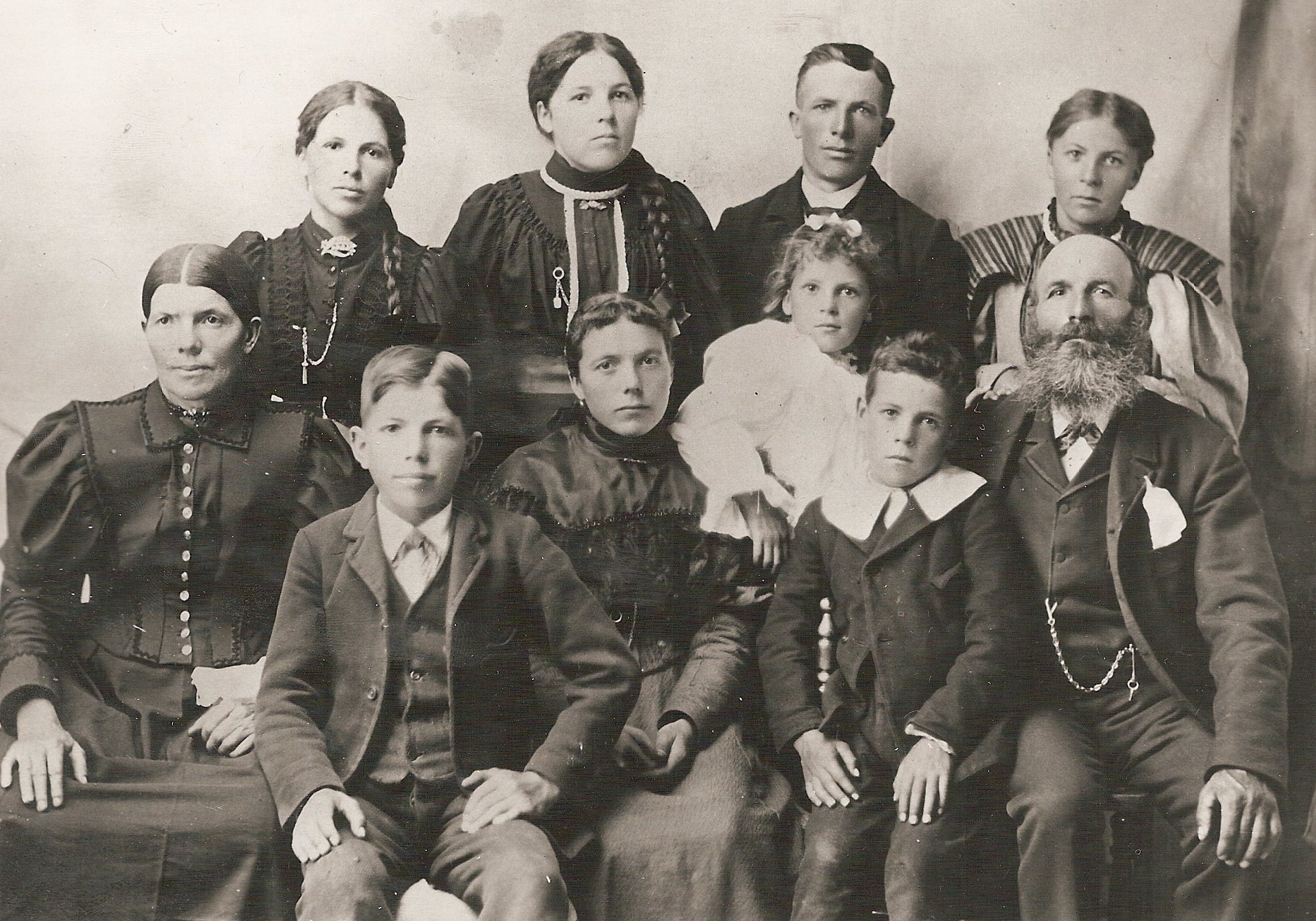
Wanner Family about 1895, back (l-r): Mary, Christine, George, and Pauline; front: Anna, Fred, Louisa, Wilhelmina, Gottlob, and John Wanner.

“To continue with my story- – we did so many things in life. First of all we were poor and had not much to live on. The folks had to move from Holzgerlingen to the new place in Gruenkraut. I remember we didn’t have much land. Father got a job working on the street. The grass grew high on the side of the road and we had to help gather the grass for the cows. We had to do this everyday before father went to work.

“We were poor in those days. We had to be up at 5 o’clock in the morning when we were big enough to work for other people. We worked every day in our lives to make a dollar. I would go out and work for other people whenever there was work. Some people had lots of land and we got plenty work there. They would come and get us to work when I was seven years old. I remember we never wasted any time. I remember when we had to go to a place to get vaccinated. I know I sure suffered a long time because my arm was so sore. They do this so that it will last a lifetime in the old country against disease.

“I remember how we got warm for the winter. Father would buy a yard of wood in the forest and we had to cut it down ourselves and haul that wood home with the cows and wagon. Some were long trees too and we would haul all the limbs and everything home. I am telling you, we had the yard so full of wood that we had no room for anything else till we had it shaped down and sawed up and put in its place. You know that was a job and we had to do all this before winter set in. We had a little wagon and we went to the woods in the summertime too, to get some dry wood. We did this many times and would always take home a wagonfull.

“In the old country they had fences in the lucerne fields. We had to put them up so we could hing the hay on them to dry after it got wet from the rain, so it would not mold. When it was dry we hauled it home. I remember we did all the farming with cows, they had them work all day and then milk them at night. Father worked on the street job for many years and mother and us children did most of the farming and in the fall we went picking hops. We never failed to make a little money in them. They have fields of hops in the old country. We always earned our winter’s money there. They have acres of hops there. We never wasted our time in the field.

“Another thing we did was go to the forest and pick fruit and go and sell it in the city. The people would sure buy it because the city was a long ways from the country where we lived. We had to walk all the way to the city. We raised hemp and mother would spin half the night making it into balls. She would take it to the factory and they made clothes out of it. We used to have many yards and would stretch it out on the grass in the summertime. It would go white and thats the way mother made our sheets and everything. We have in the old country the shoemaker, and he come to the house and make shoes for us. We also had the dressmaker come to the house. Sometimes they would stay at the house a week or more.

“When the grain was but, we had to out and clean the heads of the wheat. We cleaned sacks full each day for flour and one time right in the middle of the summer, the soldiers came in with their horses on some maneuvers or something. The horses mashed the grain and trampled all our crops up. I knew there was a big field of grand and they went right through it. They stayed around about a month or more. It sure was terrible.

“After a few years father bought a new farm and house about two miles away from the old one. It was a bigger house and more land and that’s where we lived until we came to America. Our house was a long house. We had four rooms and an upstairs. In the farmhouses of the old country we had everything under one roof– the pig pen and the hay loft. There was a big place in the floor where we threshed the wheat and other grain and we pulled all the hay up in the loft towards the roof. For a long time we threshed the wheat on this hard floor below with a stick and using a big klap, four or five of us would thresh the wheat and then would sieve the wheat from the chafe. But later, I can remember that we hired a thashmachine and the cows pulled it after that.

“I remember one time a wagon run over me. I believe it went over my arm. I don’t know how bad I got hurt, but it was plenty bad enough.

“Well, later on in that place not far away they built a Lutheran church and a school, too; and there we learned to knit our own stockings and do all kinds of sewing and crocheting. Yes, they built a nice church and school. They were very strict in those schools. If you were late a few minutes you would have to hold out your hand and the teacher would hit you so hard that your hand could feel it for a long time. It was one of those hard wood sticks. It wasn’t always our fault because we had to take the milk to the creamery in the morning in the snow and ice, and we could not go very fast, but there was no excuse at all. We had a lot to do before school, and if we didn’t have the lesson ready we were scared to go to school, ’cause if we were late we would sure get hit, and when you held out your hand they would do just what they wanted to do and it didn’t hurt them any.

“In the old country they sure celebrated Christmas. We had two Christmas trees every year and nice ones at that. We had applies tied from the bottom to the top and the step and the tree sure looked pretty every year. We only had white bread for Christmas and Holidays. I can remember how good that white bread was. We never saw it very often. it was only the rich who could buy that. There was only one bakery in Gruenkraut that had good bread and cakes, but we could never buy any. This is how we made our bread: We had a box of wood. Of course, it was clean. Father worked the dough and made enough for two or three weeks. It was mostly rye bread. It was hard and dark but we had to eat it. When Valentine’s Day came around, Mother made up cakes and they sure tasted good.

“We all the time raised our own meat. We raised pigs and salted and smoked the meat. We had our own grease. Mother made her own noodles all the time. She used lots of eggs–they were sure good. We had our cellar so full of potatoes, apples of all kinds and barrels of cider and barrels of sauerkraut. I can remember our cellar was full of all kinds of good things to eat.

“Well, about our garden. We had the prettiest garden you ever saw in the old country. The garden was laid out in a square and we had a path around all over with the vegetables in the background and flowers in front and we could walk all over the paths with flowers on each side. We didn’t need any ditches, but had to pack water when it didn’t rain. We always had a beautiful garden with flowers of all kinds.

“On Saturday we always had to clean the shoes for the whole family — shine them up for Sunday. We always went to church on Sunday. We never worked on Sunday. We were not allowed to work on Sunday, because in those days they would fine you if you did. You could not even get your hay in on Sunday, even when you could see rain coming.

“Well, I guess about in the year 1890, in the summertime, the Lord sent a man along that street in Gruenkraut where my father worked, who was a missionary from the Church of Jesus Christ of Latter Day Saints. He talked to my father a long time and he told father of the new and true Gospel and about Joseph Smith and showed him the Book of Mormon. This man talked to my father in German as he was a missionary to German. Well, it was dinnertime and father took this missionary to our home and father told him–“We’ll see mother”–and from that very day on this missionary stayed at our place. His name was Zollinger from Providence, Utah. When his time came to go home, the missionary took my brother George to America with him. After that we had three more missionaries–one from Bear Lake, one from Providence, and another one from Salt Lake City, who couldn’t speak the language, so we helped him learn the language. He would tell us English words and we would tell him German words. There wasn’t anybody who would listen to the missionaries for miles around–just one other family from Ravensburg–and they were the only ones that believed the message like us. We had room for them everytime they came. There was no place else for them to go and we were glad to have them.

“The missionary from Salt Lake–his name was Hubbard–decided to go tracting one day. It was his first time tracting. He didn’t come home for so late that we thought maybe he fell into one of the wells with water that were here and there. It was late in the evening and dark, so mother decided to put a candle in the window. He soon came back and told us that he had been lost for a long time until he saw the light in the window. There weren’t many houses when I lived there, but in seventy years since, I guess it is built up all over.

“(About this same time Grandma was writing her history, Mrs. Herbert Wagstaff and son came to visit her from California. Herbert Wagstaff was the son of sister Mary Magdaline. The son had recently returned from a mission to Germany, where he had taken colored slides of the big house in Gruenkraut as it stands today. Of this evening of reminising Grandma said:) “It was sure nice to see my old home again and see it still stand in Gruenkraut. It was nice to see it again after seventy years.”)

“Well, I lived in that community for 14 years. That’s when I graduated. We started to this country when I was fifteen, in May of 1893, and got here the 15th of June, 1893. We came by ship and docked first in Amsterdam, Holland, and then in London, England. And then from London, to New York City, where we went to a big high hotel. WE were 12 days on the ocean. We had a good time on the ship where we danced. One day there was a terrible storm which throwed water up on the dock and nobody could dance after that. From New York we boarded the train for Idaho. We were 6 days on the train. On the train we sang all across the United States. We couldn’t speak any English then nor for a long time. We got off the train on the 15th of June, 1893, in Franklin, Idaho, and my brother George was there to meet us. He had a wagon with three spring seats. Well, we never were so worried on our whole trip as we were in that wagon. That day the road was so bad–open ditches with water in, and the horses danced around before they would cross. I never say such a rough road in my life–hills and hollows, and then we saw a bunch of Indians. They were hanging dead squirrels on a line to dry. That was something new to us. Well, we got to the place where we were to stay. But father was as worried that he got off the wagon and walked all the way back to Franklin. Mother and the rest of us were so worried, because he didn’t come back for a few days. We stayed with some folks for about two months, then father built a place in Glendale, Idaho, and there we lived the rest of the summer.

“Towards fall there was a man who wanted to sell his place in Glendale and father bought that place. My father farmed in Glendale. Glendale had only a little meetinghouse and also a school. I went to school there that winter to learn the English language. From then on I worked wherever I could get a job. I worked washing, cleaning house and tending children. In a place where I worked their children got mumps and I got mumps too, and I suffered so much that I could never get better for a long time. When I got better I went to work again. One time in the winter I rode a horse to Preston, and I got the toothache so bad that I had to have it pulled out right there. I soon learned to ride a horse a lot–something I’d never done in the old country.

“I worked for Matthias Cowley in Preston one winter. I guess it was the year 1895. He used to take trips and travel in a buggy–he helped organize the Northwestern States Mission. Then I worked in Whitney, Idaho. They had plenty of sickness in homes there. In 1897 we moved down to Logan and to the 5th Ward. Then I worked in Millville and went to school there at the same time learning the language. After that I went to work in Logan. It was in the 3rd Ward one night in church I met Jeffrey Bodrero. We were married in the Logan Temple, March 16, 1898. My sister Wilhelmina married Jeffrey’s brother, Moses Bodrero, December 18, 1907. Jeffrey’s father was Domenico Marsiano Bodrero, and his mother was Maria Caterina Margherita Frank Bodrero. After we were married I went to work for Dominic Bodrero that summer, who lived by the courthouse, where I walked everyday from the 9th Ward and did washing by hand on a board up until the time of my first child. Later that year I tended to beets, but they didn’t grow very well because of too many wild oats. Jeffrey went to the canyon about every day to get lumber and to make a dollar. These are the years when I lived: Gruenkraut, German: 14 years; Glendale, Idaho: 5 years; Logan 9th Ward: 30 years; Logan 4th Ward–where I became a relief society teacher. I also did a lot of temple work.

“In the old country we had known a family names Speth for a long time. We used to go back and forth to each others homes all the time. There was a big dark forest between our two places, and we were sometimes afraid to go through it because it was dark, even in the day time. Father would send us kids over in the evenings too. Sometimes we went twice a week to see them. We always had to walk of course. We had no car. I can see it now and I will never forget it. They were really friends to us. The old people never joined the church, but the boys came over to America and settled in Providence and then joined the church. My granddaughter married a Speth grandson.

“My children’s names are: [Rosalie] Marie, John George, David Wanner, Eva Margaret, William Jeffrey, Parley Lorenzo, Louise Mary, Edward Theodore, Llewellyn Grant and Evelyn Jane.

Bodrero Family (l-r): Louisa, Louise, John, Parley, Rosalie, Jeffery, Jeffery, David, Eva

“My folks went to conference everytime there was one. We never had the chance to go because children had to stay home and do the work. I remember it was in the winter once and it was so cold my parents couldn’t go to the conference. They sure liked this Mormon Gospel from the first day my father met the missionary.

Wanner Reunion, Anna Schmid Wanner sitting, standing (l-r) Mary Carter Wanner, Wilhelmina Wanner Bodrero, Mary Wanner Wagstaff, Regina Nuffer Wanner, Louisa Wanner Bodrero, Christine Wanner Nuffer, and Rebecca Hicks Wanner

“(Louise Sophie Wanner Bodrero died February 1, 1967 in Logan, Utah)

Van Leeuwen Occasion

Hermiena (Minnie), Berendina (Dena), Jantjen (Jane), Catharina (Kate), Maria (Mary), Hermanus (Herman), and Harmina (Minnie) Van Leeuwen

Working through and scanning more of the Bremer photos, this photo and two others matched up and caught my attention. I don’t have many photos of my Great Great Grandma Van Leeuwen so this one was a great find. I have written previously of the Van Leeuwen family.

Harmina was born in 1860 in Gorssel, Gelderland, Netherlands. She married Gerhardus Hendrik (George Henry) Van Leeuwen in 1880 in Arnhem, Gelderland, Netherlands. He was born in 1856 in Oldenzaal, Overijssel, Netherlands. Minnie passed away in 1921 in Ogden, 102 years ago. This photo obviously predates her passing. George isn’t in the photo, so it may be after his commitment.

Dena was born in 1898, Kate in 1902, so four years between them. I am guessing Kate is somewhere around 12 and Dena somewhere around 16. That would put Herman at 18, Mary at 21, Jane at 23, and Minnie at 24. George isn’t in the picture and had married in 1908. Jane married in 1913, Minnie and Mary married in 1915, and Herman married in 1916.

So, if Kate is 11 or 12, this photo would be about 1913 to 1914. They appear to be dressed up, but no clues to the occasion, whether church or a wedding.

Minnie, Jane, Mary Van Leeuwen

Here is the second of the three photos. This one captures the three sisters together with Jane and Mary smiling. Then the last photo adds some additional context.

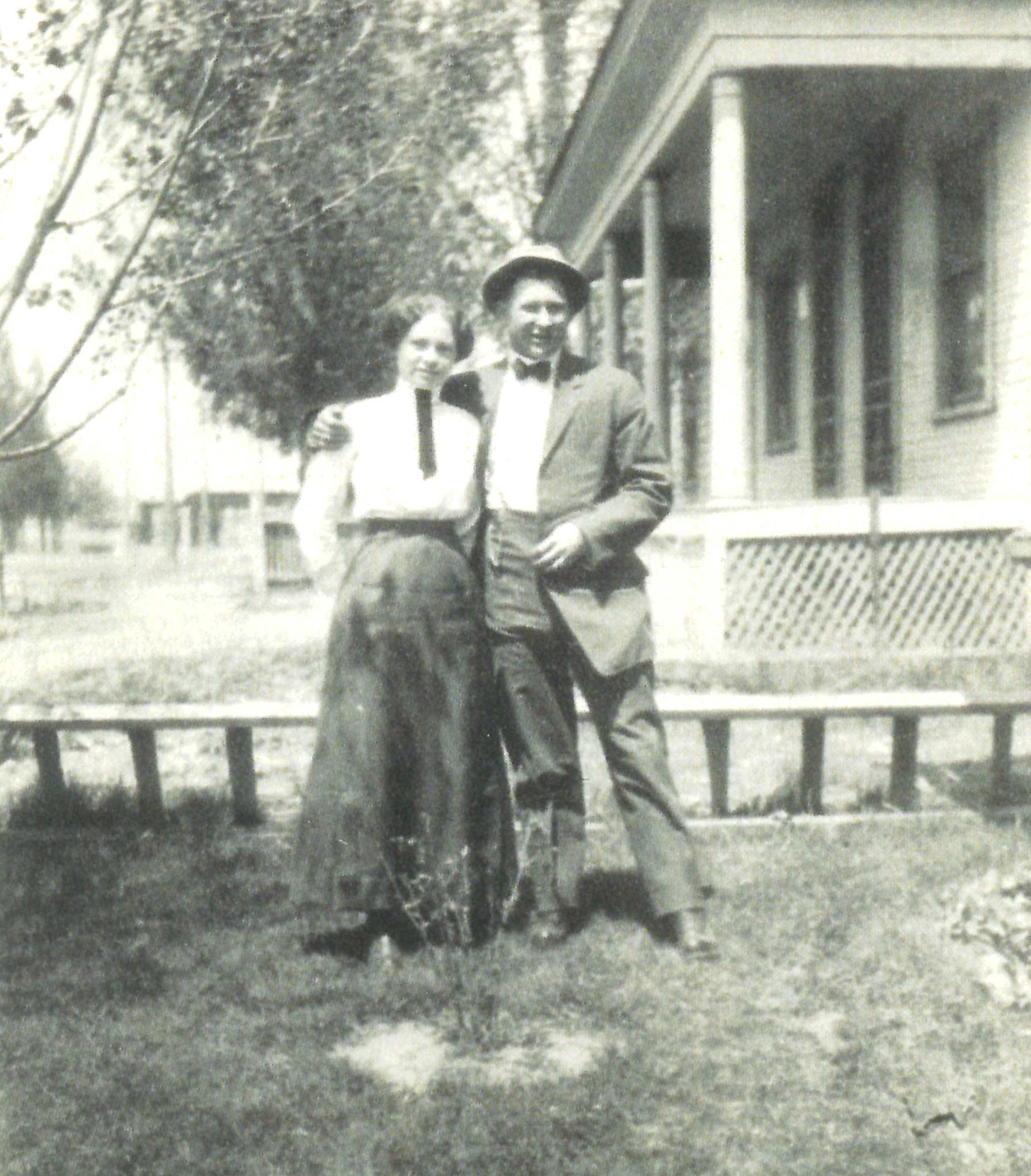
Jane Van Leeuwen and Fred Bremer

This photo seems to help pin it down a little bit more. Fred and Jane married 10 December 1913 in Ogden. There is grass on the ground and leaves on the trees. The tree on the left behind appears to have leaves coming out, as well as the bush or whatever is in front of the individuals. So, this appears to be a springtime photo. Since these photos came from photos passed down to the Bremer children, I am going to suggest this after Fred and Jane had married and they were visiting the family. If this is 1914, none of Jane’s siblings were married and may have been living at home still.

This house located at 3282 Wall Ave, Ogden, Utah was built by Gerhardus Hendrik Van Leeuwen. His wife, Hermiena Jansen Van Leeuwen, is standing on the front porch. This was their home.

In each of the photos, you can see the round pillars of the house next door. But in the first picture, you can see the square column of the house in which the family stands in front of. You can also see the brick, or concrete work, under the porch column. That square column also matches this photo of their home from the front.

As such, I believe this photo was taken at the Van Leeuwen home at 3282 Wall Avenue, Ogden, Utah in the spring of 1914. Minnie passed away in 1921, so the photo with her home is before 1921.

50 Years te Groen

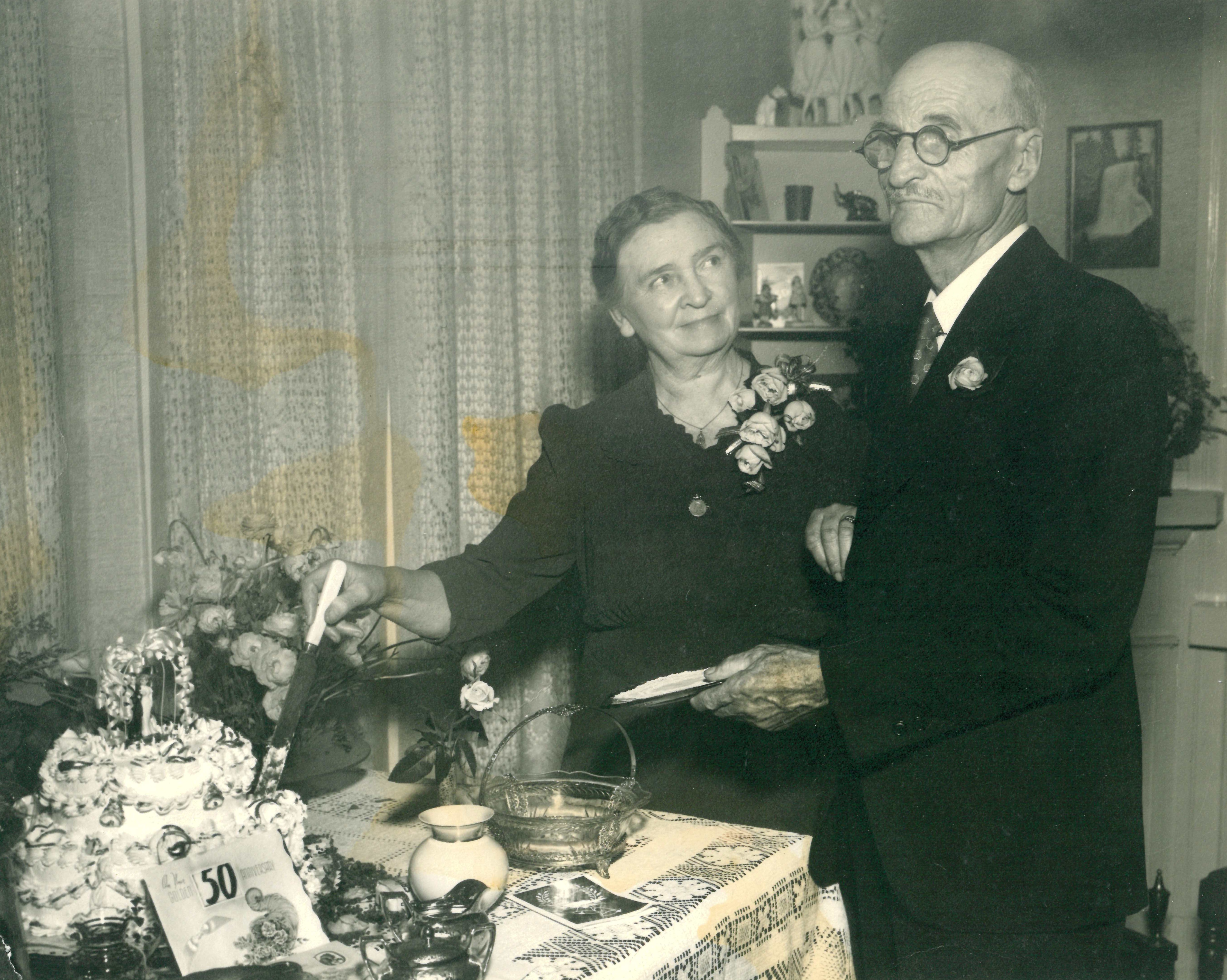
Johanna and Pieter te Groen at their 50th Wedding Anniversary

I have previously written of Pieter and Johanna te Groen. This is only the second photo I have seen of them. The first I shared in the history I wrote before and is included below. They were married 5 March 1890 in a Lutheran church in Arnhem, Gelderland, Netherlands. The photo above, as you can tell by the decorations, is to celebrate their 50th Wedding Anniversary.

The back of the photo says this:

“Your Imele and Annie. Long Beach. Calif. Daisy ave.

“Pieter Willem te Groen en Johanna te Groen van Leeuwen

“the Golden wedding day. March 5. 1890 March 5. 1940

The photo was written to Ibele and Johanna “Annie” Hermina Van Leeuwen Edsinga. Annie is Johanna’s niece.

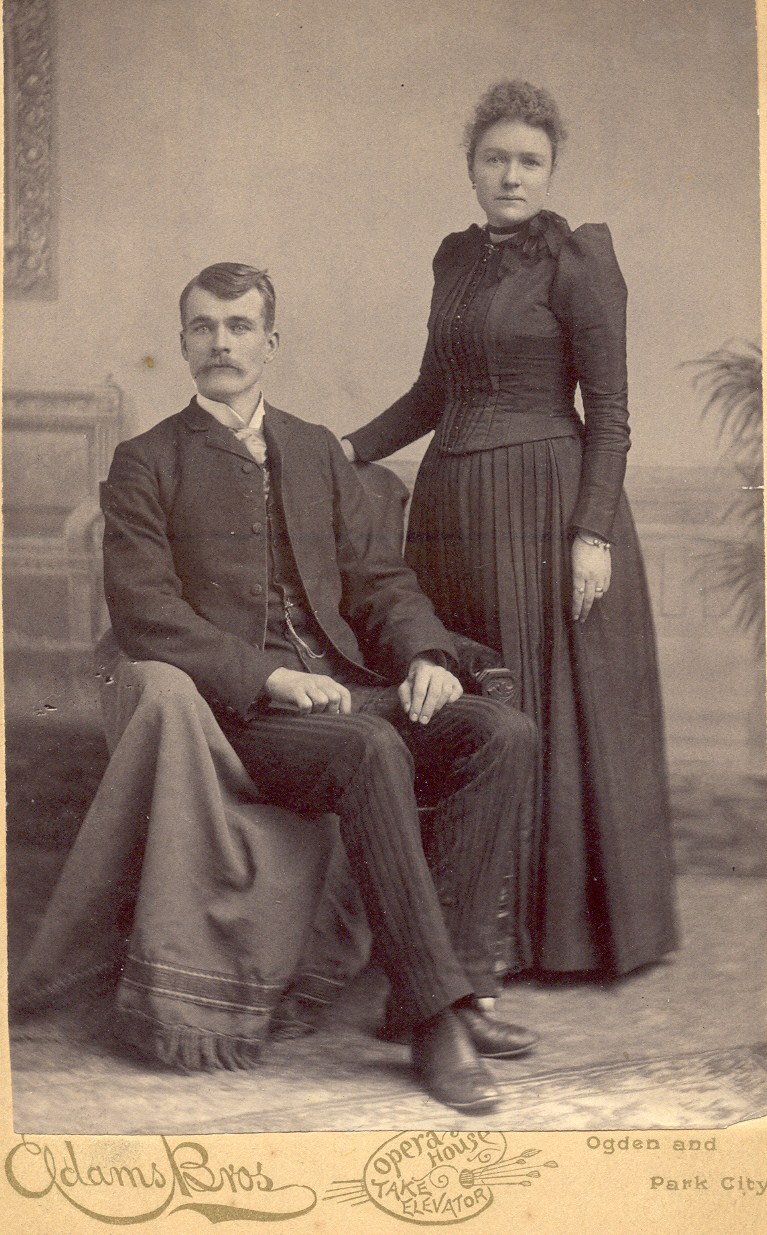
Johanna and Pieter te Groen

I don’t know if the above photo is a wedding picture or not. The fact they were married in Arnhem and the photography studio on the photo is Pretoria, Gauteng, South Africa would indicate it is not. Pieter and Johanna lived in South Africa from 1890 to about 1907. Perhaps it was that they were married in March and the first child was born in December. Perhaps he was in the military. Who knows? Either way, we have another photo of them in 1940 and I am happy to share.

Gerhardus Hendrik Van Leeuwen

George Henry Van Leeuwen

I have previously written of George and Minnie Van Leeuwen. In that post, I shared a copy of the photo I received from the records of the Utah State Hospital. That photo was not dated, so I don’t know when it was taken. Here is the photo I received from their records. It was a photostatic copy and not very high quality.

Photo from George’s Utah State Hospital file

Now I am happy to report that a family member obtained access to the Utah State Hospital file directly and obtained a copy of the photograph in the file. As you can see, the quality is 100 times better than the photostatic copy of the photograph that was provided to me by mail. The personality, the life, the lines, are much more able to be seen than before.

Here is some of what I wrote before.

Gerhardus Hendrik Van Leeuwen (who went by George Henry in English) was born the fourth of nine children to Gerrit van Leeuwen and Elsebina Maria Catharina Weenig on 16 October 1856 in Oldenzaal, Overijssel, Netherlands.  I have written of them at this link: Van Leeuwen-Weenig Wedding.  He was a carpenter by trade, on the finishing side.  He would also tune and service organs.  After moving to the United States, he worked as a finishing carpenter.

You can read more of his family at the link above. But some additional notes.

Five children in back (l-r): Minnie, Annie, Elsie, George and Jane. Second row: George, Dena, Hermina. Front: Mary and Herman.

It was about 1885-1886 when George incurred a head injury. My Great Grandmother, his daughter Dena Donaldson, indicated he fell from a ladder. Other siblings reported to descendants that he was struck in the head with a board. This is believed to be the reason why the family moved back to Arnhem, that due to his inability to work, this may be the reason they returned to Arnhem to be near family and rely on them for help.

The family then moved back to Amsterdam perhaps in pursuit of employment again. It was in Amsterdam that the Van Leeuwens met with missionaries of The Church of Jesus Christ of Latter-day Saints. George and Minnie were both baptized 4 June 1887. The story goes that George saw some men running down the street with people chasing them. Concerned for their safety, he pulled them into his home. He learned they were Elders of The Church of Jesus Christ of Latter-day Saints. The missionaries taught the Van Leeuwen the gospel and helped them convert leading to their baptism.

A sponsor from Ogden, was to meet the family at the train depot in Ogden. But no one was there when they arrived. A man by the name of Mr. Dalbout, saw their plight, and he invited the family to go home with him. There was no place to stay for a long period, so they converted a chicken coop into living quarters. This is where the family waited until George could join them. She took in laundry from other families to support themselves until he arrived.

According to George’s 1932 death certificate, he suffered from epilepsy with psychosis for 45 years. That would predate his immigration to the United States. His mental health could have become an issue when immigrating, and it may have been easier if Minnie and the children had gone first and established their new home. That may have enabled George to follow the next spring without risk of having the family turned back. Epilepsy had a stigma of illness that the family had to deal with, everything from wickedness to a contagious disease. This way, only he could potentially be turned away from entering the county. The plan was that with the family already in Utah, he would be permitted to join them in Utah. George arrived 21 March 1889 in New York City, New York on the S.S. Veendam having left Rotterdam.

George’s head and mental injuries continued to worsen as the years passed. The family either had to keep him safe during a fit and keep him calm to keep from inducing a fit. By the time 1911 rolled around, the family could no longer deal with his mental condition on their own. Dena referred to her “Daddy” as tender and sweet and then at the switch he would become angry and threatening. He had made enough threats and raised enough raucous that neighbors called the police. George was committed to the Utah State Mental Hospital in Provo, Utah, Utah in 1911. The family tried to get him out and succeeded. Unfortunately, he lost control again and ended up spending the rest of his life in the mental hospital. The family would drive down nearly every weekend to pick up “Daddy” and keep him for the weekend before taking him back. By the mid 1920’s, they could not even take him home on the weekends his condition was that poor and uncontrollable.

George died 5 January 1932 in Provo, Utah, Utah. He was buried 3 days later beside his wife.

Ogden Cemetery 2018

We attended the Jonas Reunion near Huntsville, Utah earlier this month.  After playing for a couple of days, we headed home.  My poor family knows no trip is complete without a stop at a cemetery.  Here are some photos for our Ogden City Cemetery stop.

William Scott Donaldson and Mary Elizabeth Donaldson graves; Paul, Hiram, Aliza, and Lillie Ross

The first set of graves in this picture above are of William Scott Donaldson and Mary Elizabeth Williams Donaldson.  I have previously written part of their story.  William Scott Donaldson was born 18 June 1865 in Joyceville, Frontenac, Ontario, Canada and died 12 September 1913 in Ogden of cancer.  Mary Elizabeth Williams was born 7 April 1869 in Ogden and died 29 March 1951 in Ogden.  They married 2 October 1890 in Slaterville, Utah.  Their son, David Delos Donaldson, is my Great Grandfather.


David Delos Donaldson and Berendena Donaldson graves; Paul, Lillie, Aliza, and Hiram Ross

The second set of graves in this picture above are of David Delos Donaldson and Berendena “Dena” Van Leeuwen Donaldson.  I have previously written part of their history.  David Delos Donaldson was born 26 March 1894 in Evanston, Uinta, Wyoming and died 24 September 1953 in Salt Lake City of emphysema.  Dena Van Leeuwen was born 28 December 1898 in Ogden and died 5 March 1959 in Ogden.  They married 16 July 1919 in Salt Lake City, Utah.  Their daughter, Gladys Maxine Donaldson, is my Grandmother.

Gerhardus Hendrik Van Leeuwen and Hermina Janzen Van Leeuwen; Paul, Hiram, Aliza, and Lillie Ross

The third set of graves in this picture above are of Gerhardus Hendrik Van Leeuwen and Hermina Janzen Van Leeuwen.  I have previously written part of their account.  Gerhardus Hendrik Van Leeuwen was born 16 October 1856 in Oldenzaal, Overijssel, Netherlands and died 5 January 1932 in Provo, Utah.  Hermina Janzen was born 19 August 1860 in Gorssel, Gelderland, Netherlands and died 9 June 1921 in Ogden.  They married 31 March 1880 in Arnhem, Gelderland, Netherlands.  Their daughter, Berendena Van Leeuwen, is my Great Grandmother.

Gerrit and Elsebina van Leeuwen

Gerrit and Elsebina van Leeuwen

Gerrit and Elsebina van Leeuwen

Thanks again to my cousin Carol Mann for providing the above photo.  I had not seen it before and am happy to have it in my collection.  It appears doctored so I have asked for a scan of the original that has not been altered.

I have written of Gerrit van Leeuwen and Elsebina Maria Catharina Weenig before (at this link).  I had a younger picture of Elsebina and another picture of Gerrit in his older years.  But this is one of Elsebina older and you can see the resemblance from her other picture.

Gerrit was born 12 April 1823 in Leiden, Zuid-Holland, Netherlands and died 19 February 1906 in Arnhem, Gelderland, Netherlands.  He was an organ builder and seller.  He went into business with Christiaan Frederik Everdinus Weenig as an organ builder and seller, they also sold pianos.  He later married Christiaan’s younger sister, Elsebina.  Christiaan and Elsebina were children of an organist, Christiaan Frederik Weenig.  Gerrit and Elsebina married 22 August 1849 in Leiden.

Elsebina was born 15 November 1826 in Leiden and died 22 March 1884 in Arnhem.  That places this photo pre-1884.  She died at age 57.  Gerrit died at 82.  I don’t know what year they moved to Arnhem (the city on the photo), but that would give us a narrower window in which the photo was taken.

If I get a better copy of the photo, I will provide it.  Apparently Carol Mann has an original of this photo.

te Groen family

Johanna and Pieter to Groen

Johanna and Pieter te Groen

I have been corresponding with a distant cousin of mine, Carol Mann, in California.  She provided a couple of pictures, one of which is of my great, great, great grandparents.  It is washed out so I hope she has the original or knows where she can get a better copy.

Among the other photos she provided is the one above.  This is of her grandparents Pieter Willem te Groen and Johanna van Leeuwen.  I have written of Johanna’s parents, Gerrit and Elsebina (Weenig) van Leeuwen, my great, great, great grandparents.  Johanna is the sister to my Gerhardus Hendrik van Leeuwen.

Pieter Willem to Groen was born 4 September 1865 in Arnhem, Gelderland, Netherlands and died 27 August 1942 in Long Beach, Los Angeles, California.  His parents are Derk Meindert to Groen and Jannetje Maria (Duverni) te Groen.

He married Johanna van Leeuwen 5 March 1890 in Arnhem in the Lutheran Church.

Johanna was born 1 September 1867 in Oldenzaal, Overijssel, Netherlands and died 24 February 1963 in Long Beach.

Together Pieter and Johanna had 10 children that I am aware.

Johanna Maria te Groen born 7 December 1890 supposedly in Transvaal, although that did not exist until 1902, so it was likely the South African Republic.  She died 2 January 1891 in Pretoria, Gauteng, South Africa.

Johanna Maria to Groen born 3 December 1891 in Transvaal, again likely South African Republic.  She died 10 January 1899 in Pretoria.

Gerhardus Hendrick te Groen born 19 February 1894 in Pretoria and died 5 May 1955 in Los Angeles, Los Angeles, California.

Willem Pieter te Groen born 14 September 1895 in Pretoria and died 4 May 1967 in Santa Ana, Orange, California.

Dirk Meindert te Groen born 27 January 1898 in Pretoria and died 20 July 1988 in Laguna Hills, Orange, California.

Paul Johannes Stofanas te Groen born 1 June 1900 in Pretoria and died January 1987 in Crescent City, Del Norte, California.

Elsebinia Maria te Groen born 17 October 1902 in Pretoria and died 5 February 1904 in Pretoria.

Jan Hendrick te Groen born 7 December 1904 in Pretoria and died 10 September 1999 in Honolulu, Oahu, Hawaii.

Leendert te Groen born 14 October 1908 in Annapolis, Anne Arundel, Maryland and died 3 July 2003 in Laguna Hills.

Emil Fredrick te Groen born 27 November 1911 in Annapolis and died 27 November 2000 in Palo Alto, Santa Clara, California.

I have no idea what took te Groens to South Africa.  It was a time of change and turmoil in South Africa and the Dutch were active in Southe Africa.  It would be interesting to know if it was military or some other purpose for which they went there.  Maybe they left as the Dutch were losing influence and British were gaining more and more influence.  Hopefully someone can shed more light on the moves.

Van Leeuwen – Weenig Wedding

Christiaan Frederik and Everdina Kamphuis Weenig are pleased to announce the marriage of their daughter Elsebina Maria Catharina Weenig to Gerrit van Leeuwen, son of the late Hendrik and late Maria Elizabeth Catharina de Kok van Leeuwen.  Gerrit and Elsebina were married 22 August 1849 in Leiden, Zuid-Holland, Netherlands.

We really do not know a whole lot about this couple.  The only reason I am really writing this entry is not because we have a history, but because we do have photos of these two individuals!  I will give what little we know and make the photos available.

Gerrit likely met his future wife Elsebina through her brother Christiaan Frederik Everdinus Weenig.  Gerrit van Leeuwen and Christiaan Frederik Everdinus Weenig were the same age and had gone into business together as early as 1846 building and selling organs and pianos. Elsebina’s father Christiaan Frederik Weenig was the organist at the Waalse Kerk in Leiden.

Gerrit was a organ builder by trade.  He traveled building and installing large pipe organs in churches and cathedrals in Netherlands and other locations throughout Europe.  Apparently he also played the piano, organ, and accordion.  We really know nothing of their lives, personalities, or characteristics.

Gerrit van Leeuwen was born the 6th of 8 children to Hendrik van Leeuwen and Maria Elizabeth Catharina de Kok on 12 April 1823 in Leiden.  Here is the only picture I am aware that exists of him.  He is obviously quite a bit older and I have no clue what book he is holding, perhaps the Bible?

Elsebina Maria Catharina Weenig was born 4th of 5 children to Christiaan Frederik Weenig and Everdina Kamphuis on 15 November 1826 in Leiden. Elsebina was a seamstress. While living in Leiden in the early years of her marriage she designed, manufactured, and sold hats.  Of interest, Elsebina was the granddaughter of Jacobus Kamphuis, an acclaimed silversmith in Leiden.  Here is a link to some of his pieces that have sold on Christie’s.  Bisquit Boxes, Spoons and Forks, Salt Cellars, Bisquit Box, and Fish Slice.  The family cannot have been hurting too bad for cash with a profession like that.  At any rate, here is the only photo we have of Elsebina.

Gerrit and Elsebina would have 9 children born to them.  Two would die as children and we have records of 6 of those marrying.

Maria Everdina van Leeuwen was born 14 July 1850 in Leiden and died 23 May 1919 in Arnhem, Gelderland, Netherlands.  She married Hendrik Jansen 19 February 1873 in Arnhem.

Christina Elsebina van Leeuwen was born 31 May 1852 in Leiden and died 4 January 1914 probably in Rosario, Santa Fe, Argentina.  She married Frans Homkes 22 August 1874 in Oldenzaal, Overijssel, Netherlands.

Elsebina Jacoba van Leeuwen was born 21 April 1854 in Utrecht, Utrecht, Netherlands and died 17 November 1933 in Arnhem.  She married Dirk Potharst 24 July 1878 in Arnhem.

Gerhardus Hendrik van Leeuwen was born 16 October 1856 in Oldenzaal and died 5 January 1932 in Provo, Utah, Utah.  He married Hermina Janzen 31 March 1880 in Arnhem.  I have written of their family at this link: Van Leewen – Janzen Wedding.

Hendrik Christiaan van Leeuwen was born 1 December 1859 in Oldenzaal and died 4 May 1904 in Arnhem.  We do not have a record of a marriage for him.  He served in the military and appears to have died unmarried.

Everdina van Leeuwen was born 15 May 1862 in Oldenzaal and died 16 February 1863 in Oldenzaal.

Everdina Johanna van Leeuwen was born 27 October 1864 in Oldenzaal.  We do not have a death date or marriage for her.  Apparently she married Jan Hendrik Stros from her father’s probate probate record.  We have more research to do.

Johanna van Leeuwen was born 1 September 1867 in Oldenzaal and died 24 February 1963 in Long Beach, Los Angeles, California.  She was buried 27th February 1963 in Inglewood, Los Angeles, California.  She married Pieter Willem te Groen 5 March 1890 in Arnhem.  This family lived in Pretoria, Gauteng, South Africa and then moved to Annapolis, Anne Arundel, Maryland, before eventually moving to California.

The last child, a boy, was not named as far as we can tell.  He was born 1 October 1870 in Oldenzaal and died the same day.

Elsebina died 22 March 1884 in Arnhem.  Someone in the family made a ‘hair art’ portrait of her tombstone wherever it is/was located.  Here is a photograph taken in 1960’s of the portrait (I am hoping to get an updated photograph of it from its present owner).

The family must not have been hurting too badly to be able to afford a tombstone such as the one in the picture.

Gerrit passed away 19 February 1906 in Arnhem.

Unfortunately, the story ends there.  Maybe someday we will know more about this family or some of the other Weenig, Kamphuis, or Van Leeuwen cousins.