The Personal Story of Louise S. Bodrero

Another history in the records of Golden Rulon Andra.

“(Elsie Wagstaff Coleman read this history of Aunt Louise at our Reunion 21 June 1980)

“(Louise Sophie Wanner was born March 30, 1879.) I was born in Gruenkraut Germany. I can remember as little kids we stayed home. When we were I guess seven years old, we had to go to the Catholic school. There were no other schools around in those days. My Mother and Father didn’t always live in Gruenkraut. My father, John George Wanner was born in Hildritzhausen, Wuerttemburg, Germany, on October 18, 1845. His father was Johann Friederich Wanner, and his mother was Anna Maria Marquardt. My mother Anna Maria Schmid was born January 21, 1849 in Holzgerlingen, Wuerttemburg, Germany. Her father was Jacob Friederich Schmid and her mother was Salome Notter. In 1870 my father went to Russia to fight in the war. My parents were married the 6th. of June 1870. My Father died February 16, 1922 in Logan, Utah. My mother died December 9, 1929 in Logan Utah. The last days of their lives they lived in the 4th. Ward, and they are buried in the Logan Cemetery. My brother John George and sister Christena were born in Holzgerlingen, and my brothers, Johannes, Johannes Friederich, Frederich, Gottlob, and sisters Mary Magdalina, Pauline and Wilhelmina were all born in Gruenkraut, Germany.
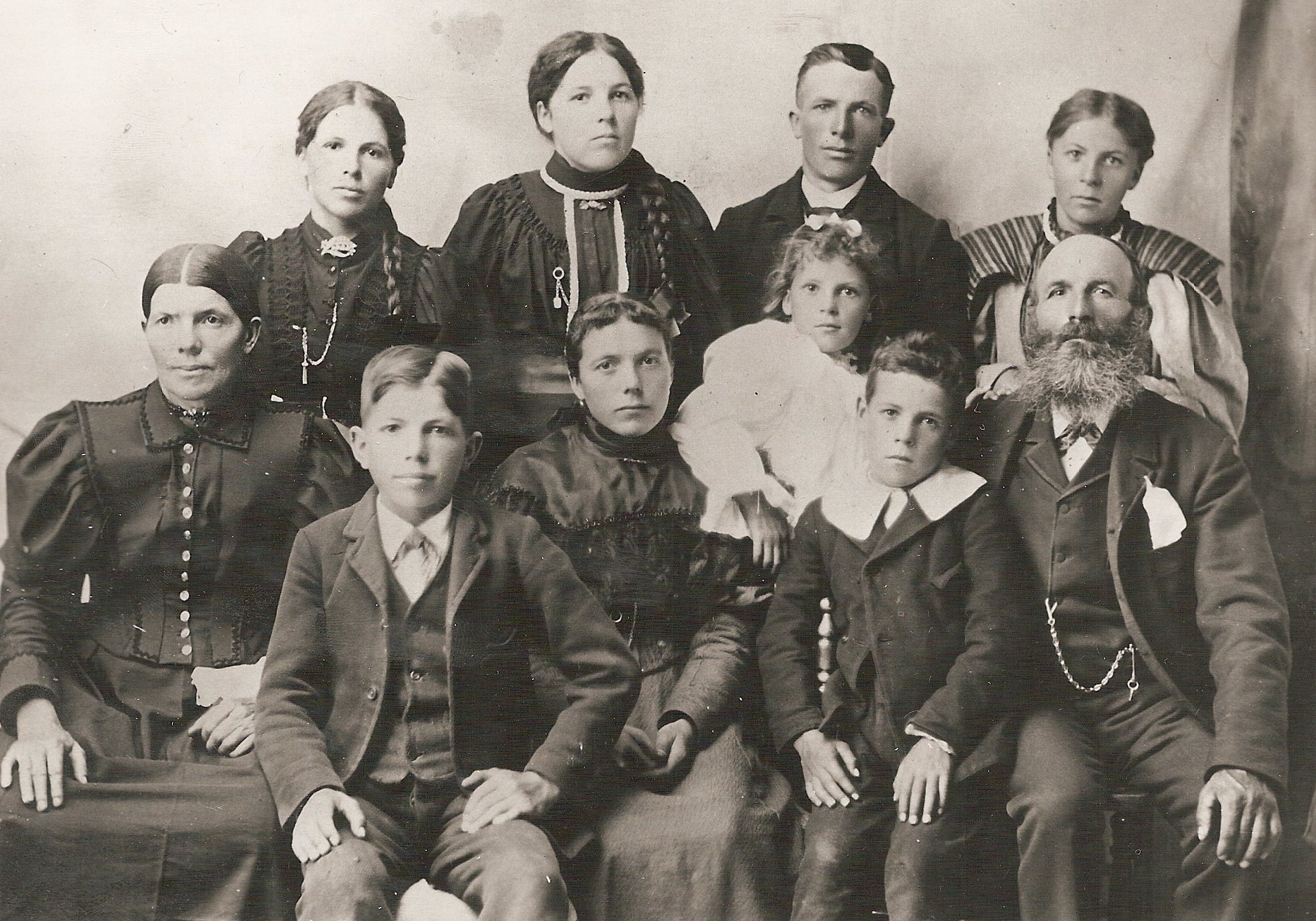
Wanner Family about 1895, back (l-r): Mary, Christine, George, and Pauline; front: Anna, Fred, Louisa, Wilhelmina, Gottlob, and John Wanner.

“To continue with my story- – we did so many things in life. First of all we were poor and had not much to live on. The folks had to move from Holzgerlingen to the new place in Gruenkraut. I remember we didn’t have much land. Father got a job working on the street. The grass grew high on the side of the road and we had to help gather the grass for the cows. We had to do this everyday before father went to work.

“We were poor in those days. We had to be up at 5 o’clock in the morning when we were big enough to work for other people. We worked every day in our lives to make a dollar. I would go out and work for other people whenever there was work. Some people had lots of land and we got plenty work there. They would come and get us to work when I was seven years old. I remember we never wasted any time. I remember when we had to go to a place to get vaccinated. I know I sure suffered a long time because my arm was so sore. They do this so that it will last a lifetime in the old country against disease.

“I remember how we got warm for the winter. Father would buy a yard of wood in the forest and we had to cut it down ourselves and haul that wood home with the cows and wagon. Some were long trees too and we would haul all the limbs and everything home. I am telling you, we had the yard so full of wood that we had no room for anything else till we had it shaped down and sawed up and put in its place. You know that was a job and we had to do all this before winter set in. We had a little wagon and we went to the woods in the summertime too, to get some dry wood. We did this many times and would always take home a wagonfull.

“In the old country they had fences in the lucerne fields. We had to put them up so we could hing the hay on them to dry after it got wet from the rain, so it would not mold. When it was dry we hauled it home. I remember we did all the farming with cows, they had them work all day and then milk them at night. Father worked on the street job for many years and mother and us children did most of the farming and in the fall we went picking hops. We never failed to make a little money in them. They have fields of hops in the old country. We always earned our winter’s money there. They have acres of hops there. We never wasted our time in the field.

“Another thing we did was go to the forest and pick fruit and go and sell it in the city. The people would sure buy it because the city was a long ways from the country where we lived. We had to walk all the way to the city. We raised hemp and mother would spin half the night making it into balls. She would take it to the factory and they made clothes out of it. We used to have many yards and would stretch it out on the grass in the summertime. It would go white and thats the way mother made our sheets and everything. We have in the old country the shoemaker, and he come to the house and make shoes for us. We also had the dressmaker come to the house. Sometimes they would stay at the house a week or more.

“When the grain was but, we had to out and clean the heads of the wheat. We cleaned sacks full each day for flour and one time right in the middle of the summer, the soldiers came in with their horses on some maneuvers or something. The horses mashed the grain and trampled all our crops up. I knew there was a big field of grand and they went right through it. They stayed around about a month or more. It sure was terrible.

“After a few years father bought a new farm and house about two miles away from the old one. It was a bigger house and more land and that’s where we lived until we came to America. Our house was a long house. We had four rooms and an upstairs. In the farmhouses of the old country we had everything under one roof– the pig pen and the hay loft. There was a big place in the floor where we threshed the wheat and other grain and we pulled all the hay up in the loft towards the roof. For a long time we threshed the wheat on this hard floor below with a stick and using a big klap, four or five of us would thresh the wheat and then would sieve the wheat from the chafe. But later, I can remember that we hired a thashmachine and the cows pulled it after that.

“I remember one time a wagon run over me. I believe it went over my arm. I don’t know how bad I got hurt, but it was plenty bad enough.

“Well, later on in that place not far away they built a Lutheran church and a school, too; and there we learned to knit our own stockings and do all kinds of sewing and crocheting. Yes, they built a nice church and school. They were very strict in those schools. If you were late a few minutes you would have to hold out your hand and the teacher would hit you so hard that your hand could feel it for a long time. It was one of those hard wood sticks. It wasn’t always our fault because we had to take the milk to the creamery in the morning in the snow and ice, and we could not go very fast, but there was no excuse at all. We had a lot to do before school, and if we didn’t have the lesson ready we were scared to go to school, ’cause if we were late we would sure get hit, and when you held out your hand they would do just what they wanted to do and it didn’t hurt them any.

“In the old country they sure celebrated Christmas. We had two Christmas trees every year and nice ones at that. We had applies tied from the bottom to the top and the step and the tree sure looked pretty every year. We only had white bread for Christmas and Holidays. I can remember how good that white bread was. We never saw it very often. it was only the rich who could buy that. There was only one bakery in Gruenkraut that had good bread and cakes, but we could never buy any. This is how we made our bread: We had a box of wood. Of course, it was clean. Father worked the dough and made enough for two or three weeks. It was mostly rye bread. It was hard and dark but we had to eat it. When Valentine’s Day came around, Mother made up cakes and they sure tasted good.

“We all the time raised our own meat. We raised pigs and salted and smoked the meat. We had our own grease. Mother made her own noodles all the time. She used lots of eggs–they were sure good. We had our cellar so full of potatoes, apples of all kinds and barrels of cider and barrels of sauerkraut. I can remember our cellar was full of all kinds of good things to eat.

“Well, about our garden. We had the prettiest garden you ever saw in the old country. The garden was laid out in a square and we had a path around all over with the vegetables in the background and flowers in front and we could walk all over the paths with flowers on each side. We didn’t need any ditches, but had to pack water when it didn’t rain. We always had a beautiful garden with flowers of all kinds.

“On Saturday we always had to clean the shoes for the whole family — shine them up for Sunday. We always went to church on Sunday. We never worked on Sunday. We were not allowed to work on Sunday, because in those days they would fine you if you did. You could not even get your hay in on Sunday, even when you could see rain coming.

“Well, I guess about in the year 1890, in the summertime, the Lord sent a man along that street in Gruenkraut where my father worked, who was a missionary from the Church of Jesus Christ of Latter Day Saints. He talked to my father a long time and he told father of the new and true Gospel and about Joseph Smith and showed him the Book of Mormon. This man talked to my father in German as he was a missionary to German. Well, it was dinnertime and father took this missionary to our home and father told him–“We’ll see mother”–and from that very day on this missionary stayed at our place. His name was Zollinger from Providence, Utah. When his time came to go home, the missionary took my brother George to America with him. After that we had three more missionaries–one from Bear Lake, one from Providence, and another one from Salt Lake City, who couldn’t speak the language, so we helped him learn the language. He would tell us English words and we would tell him German words. There wasn’t anybody who would listen to the missionaries for miles around–just one other family from Ravensburg–and they were the only ones that believed the message like us. We had room for them everytime they came. There was no place else for them to go and we were glad to have them.

“The missionary from Salt Lake–his name was Hubbard–decided to go tracting one day. It was his first time tracting. He didn’t come home for so late that we thought maybe he fell into one of the wells with water that were here and there. It was late in the evening and dark, so mother decided to put a candle in the window. He soon came back and told us that he had been lost for a long time until he saw the light in the window. There weren’t many houses when I lived there, but in seventy years since, I guess it is built up all over.

“(About this same time Grandma was writing her history, Mrs. Herbert Wagstaff and son came to visit her from California. Herbert Wagstaff was the son of sister Mary Magdaline. The son had recently returned from a mission to Germany, where he had taken colored slides of the big house in Gruenkraut as it stands today. Of this evening of reminising Grandma said:) “It was sure nice to see my old home again and see it still stand in Gruenkraut. It was nice to see it again after seventy years.”)

“Well, I lived in that community for 14 years. That’s when I graduated. We started to this country when I was fifteen, in May of 1893, and got here the 15th of June, 1893. We came by ship and docked first in Amsterdam, Holland, and then in London, England. And then from London, to New York City, where we went to a big high hotel. WE were 12 days on the ocean. We had a good time on the ship where we danced. One day there was a terrible storm which throwed water up on the dock and nobody could dance after that. From New York we boarded the train for Idaho. We were 6 days on the train. On the train we sang all across the United States. We couldn’t speak any English then nor for a long time. We got off the train on the 15th of June, 1893, in Franklin, Idaho, and my brother George was there to meet us. He had a wagon with three spring seats. Well, we never were so worried on our whole trip as we were in that wagon. That day the road was so bad–open ditches with water in, and the horses danced around before they would cross. I never say such a rough road in my life–hills and hollows, and then we saw a bunch of Indians. They were hanging dead squirrels on a line to dry. That was something new to us. Well, we got to the place where we were to stay. But father was as worried that he got off the wagon and walked all the way back to Franklin. Mother and the rest of us were so worried, because he didn’t come back for a few days. We stayed with some folks for about two months, then father built a place in Glendale, Idaho, and there we lived the rest of the summer.

“Towards fall there was a man who wanted to sell his place in Glendale and father bought that place. My father farmed in Glendale. Glendale had only a little meetinghouse and also a school. I went to school there that winter to learn the English language. From then on I worked wherever I could get a job. I worked washing, cleaning house and tending children. In a place where I worked their children got mumps and I got mumps too, and I suffered so much that I could never get better for a long time. When I got better I went to work again. One time in the winter I rode a horse to Preston, and I got the toothache so bad that I had to have it pulled out right there. I soon learned to ride a horse a lot–something I’d never done in the old country.

“I worked for Matthias Cowley in Preston one winter. I guess it was the year 1895. He used to take trips and travel in a buggy–he helped organize the Northwestern States Mission. Then I worked in Whitney, Idaho. They had plenty of sickness in homes there. In 1897 we moved down to Logan and to the 5th Ward. Then I worked in Millville and went to school there at the same time learning the language. After that I went to work in Logan. It was in the 3rd Ward one night in church I met Jeffrey Bodrero. We were married in the Logan Temple, March 16, 1898. My sister Wilhelmina married Jeffrey’s brother, Moses Bodrero, December 18, 1907. Jeffrey’s father was Domenico Marsiano Bodrero, and his mother was Maria Caterina Margherita Frank Bodrero. After we were married I went to work for Dominic Bodrero that summer, who lived by the courthouse, where I walked everyday from the 9th Ward and did washing by hand on a board up until the time of my first child. Later that year I tended to beets, but they didn’t grow very well because of too many wild oats. Jeffrey went to the canyon about every day to get lumber and to make a dollar. These are the years when I lived: Gruenkraut, German: 14 years; Glendale, Idaho: 5 years; Logan 9th Ward: 30 years; Logan 4th Ward–where I became a relief society teacher. I also did a lot of temple work.

“In the old country we had known a family names Speth for a long time. We used to go back and forth to each others homes all the time. There was a big dark forest between our two places, and we were sometimes afraid to go through it because it was dark, even in the day time. Father would send us kids over in the evenings too. Sometimes we went twice a week to see them. We always had to walk of course. We had no car. I can see it now and I will never forget it. They were really friends to us. The old people never joined the church, but the boys came over to America and settled in Providence and then joined the church. My granddaughter married a Speth grandson.

“My children’s names are: [Rosalie] Marie, John George, David Wanner, Eva Margaret, William Jeffrey, Parley Lorenzo, Louise Mary, Edward Theodore, Llewellyn Grant and Evelyn Jane.

Bodrero Family (l-r): Louisa, Louise, John, Parley, Rosalie, Jeffery, Jeffery, David, Eva

“My folks went to conference everytime there was one. We never had the chance to go because children had to stay home and do the work. I remember it was in the winter once and it was so cold my parents couldn’t go to the conference. They sure liked this Mormon Gospel from the first day my father met the missionary.

Wanner Reunion, Anna Schmid Wanner sitting, standing (l-r) Mary Carter Wanner, Wilhelmina Wanner Bodrero, Mary Wanner Wagstaff, Regina Nuffer Wanner, Louisa Wanner Bodrero, Christine Wanner Nuffer, and Rebecca Hicks Wanner

“(Louise Sophie Wanner Bodrero died February 1, 1967 in Logan, Utah)

Biography of Anna Maria Schmid Wanner

Wanner Family about 1895

This biography of Anna Maria Schmid Wanner was in a family history book that belonged to Golden Rulon Andra and was given to me by his daughter. I did not have this biography and am happy to share it.

“Anna Maria Schmid Wanner, my grandmother, was born in [Holzgerlingen], [Württemberg], Germany on the 21 of January 1849. She was the daughter of Jacob Friedrich Schmid and Solome Notter. Her mother died when she was two years old. She then had a stepmother who was very cruel to her. They were very poor, and she would go to her grandmothers place and pick over potato peelings for the want of food. She ate the potato peelings for food.

“She started school at the age of six. For years the people in Germany couldn’t grow a thing, and the schools had to feed the children soup in school.

“She was a member of the Protestant church.

“Her father was a linen weaver, and grandmother would walk miles and miles at night through the dark woods to deliver the linen to different people. She had to carry it on her head. She often would be afraid, but she always prayed, and never was harmed.

“She married John George Wanner on the 6th of June 1870. From this union was born to them 5 sons and 5 daughters. They buried 2 sons in Germany. They were married only a short time when her husband called to go to war.

“It was the custom for the women to do the farm work, cutting the hay with the scythe and putting it up by hand.

“When the children needed shoes or dresses the shoemaker and the dressmaker would come to the home.

“Early in the year 1873, the family moved to Greenkraut [Grünkraut], [Württemberg], Germany.

“In 1891, she and her family were converted to the Morman or Latter-Day-Saint church. In her home she had a large room where she would accommodate the missionaries with food and beds, and help them learn the German language.

“In May 1893, she with her husband and family of seven children left Germany to come to America. They arrived at Franklin County [then Oneida County], Idaho on Sunday the 18th of June 1893.

“She left a brother and sister and father in Germany when she came to America. She had a brother named Carl and a sister, Louise Sophia. Grandmother was the youngest child. She was the only one of her fathers family that joined the Latter-Day-Saint church.

“They lived in Glendale, Whitney, and Preston, Idaho and in 1910 they moved to Logan, Utah. She and her husband did lots of Tempel work for their own dead ancestors as well as considerable donation work in the Tempel for other people.

“She obtained many names from Germany which was promised in her Patriarchal blessing, and the work was done for all of them before her death.

“She took sick in December, and died on the 9th of December 1929 of Pneumonia. Her funeral services were held in the 4th ward of Logan, Utah in which she was a member. She was buried by her husband in the cemetery at Logan, Utah.

“NOTE: Her oldest son preceded the family to America. He came over 1 and 1/2 years before the rest of the family. Thus — they only brought 7 children with them.

“This biography was copied from a letter received from Clara Bodrero, 495 W. 5th No., serveral years ago. She does not remember who sent it to her. Logan, Utah.

Researcher’s Story of Germany and our Ancestors

This is a story that was included with the documents I received from Golden Andra’s family. I thought I would share and preserve it for whatever value it might have. It appears to jump between multiple writers.

“Dear Cousins:

“At our reunion last year 16 June 1979

“William Andra Jr. President of the Wanner – Schmid Family Organization, introduced Trudy Schenk as our new genealogy researcher, Trudy says “guten-tag,” which means “good-day,” in german. William ask his wife Edith to ask her Norwegian researcher if she knew a german researcher, she said yes her name is Trudy Schenk. So William & Edith met Trudy, was very impressed with her, so they called Jess Wagstaff and told him they were coming up to see me. They took me out to dinner and told me about Trudy, and ask me to come to Salt and meet her, so I did this was the 26 Feb 1979, and after having a nice talk with her we hired her to be our researcher that same day. We pay Trudy $5.00 per hour, which is very reasonable as researcher’s wages go.

“Trudy was born in the next county west and a little north of Atzenweiter (which is near Gruenkraut) where our Grandparents lived. They moved there after Uncle George and aunt Christenia were born at Holzgerlingen. Trudy was born at Kenzingen, Baden, Wuert. and came to Utah when she was 20 yrs. old. So she knows the German Language as well as the Country.

“Trudy attended our reunion 16 June 1979 in Logan, Utah and told us about the history of our Ancestors.

“Trudy says: once again I wish to emphasize to you how hard working Jess and Edith are. Edith types your Family Group Sheets clear into the night, sometimes when William is away with his work she types all night, to keep your genealogy work going. I think I’m really blessed to work on the WANNER – SCHMID genealogy, very, very blessed. I feel these films of the Wuerttemburg records was filmed by the Church, because of a certain reason, those People was waiting, up there, to have their Temple Work done for them. These are the only Lutheran records we have of the whole state of Wuerttemberg and others are not to come until a year or more or maybe never before the Church may get back to filming there, they just don’t let people come in and take films, so anyway I feel you are a very blessed people and your Ancestors who have gone on will love you for the money you spend in putting Their Names into the Temple.

“You have heard of the new Extraction Program that the Church is doing I’m sure, and that the Prophet is telling us that we should do four generations, Well! he has also told us to lengthen our stride, I ask someone who is in charge of the Extraction Program down there and they told me, that Wuerttemburg isn’t even on the list, hasn’t even been approved yet for Extraction, your Ancestors would have to wait for years yet, until that work could be done by the Church. Of course the Church is still depending on the people that have family organizations like yours. There are not many of them among the Mormons in Utah or any where, that have a organization like you do and you ought to be contratulated for this. but anyway because of this you have been able to do many, many, names I think thousands of names that you have been able to do, to get the Temple Work done.

“I have made a copy of an original map of Germany. I have made a little circle for my home town which is Kenzingen, (its on the west, up from Freiburg.) I have made a little square for Gruenkraut and Atzenweiler, where your family came from to America. And a little cross by Isny, the original place where the Wanner family originated in the 1200 A.D. 1200 century and then I underlined the little towns where the people came from in the 1500 century on. The 1500 century is how far the records go back in Germany. These little towns are Holzgerlingen Breitenstein, all the villages where your people come from.


“The Pastors keep very good records even in those yrs. and yet sometimes they are very difficult to read, you set there and pray, so that you don’t make a mistake because some of these records are very hard to decipher, some are dark, spilled ink over them, soe of them have burned edges, some of them have gone through wards, some of them through many wars, so those people like you are very lucky that those records are still available.

“There is a larger scale map and all the little towns are underlined where your Ancestors on the Pedigree came from. Here is the 15 Generation Pedigree Chart that shows the Pedigree of the Wanner line we have gone across the front and the back can be filled up also as we have gone that far back and even more, there is just that information here in Salt Lake. Trudy Had Bill and Jess hold up this chart so it could be seen. Maria Catharina Schweitzer is our Grandmother’s Grandmother. This is where Trudy started working.

“If you would go to Germany and do the research there, you would have to go from Village to village, you would have to make appointments with the Pastors to get into the church to read the books you could only go when they were available, usually the Pastors teach school or religion classes after school, so you would have to wait until they were available or their secretaries were available and its much harder to do the research over there than it is here where if I want to go to a different Village I just get a different film if I need to know more.

“William Andra says when Trudy first started we just had the first two rows on the chart done, now in four months Trudy has done all the rest, plus some on the back. Jess Wagstaff says Trudy started with our Grandmother’s Grandmother. And that we can get the 15 generation charts for 50¢, and you will never get any fun out of doing your genealogy unless you get a 15 generation pedigree chart and fill in the names as you get the sheets. Down at the library the other day this sign hit me right in the eye, it says, “The Greatest responsibility in this World that the Lord has Laid Upon Us is to Seek after Our Dead.” by Joseph Smith.

“Now Trudy says – – I agree with Jess, its really the greatest responsibility – and the only reason they started the four generation program is because many people didn’t want to do anything, so they thought if they made it easy on them and just given them four generation to do they would do it, and you would be surprised how many people don’t have anything done yet. Yes we were told this is part of Our SALVATION, this is what we were told YOU CAN NOT GET THERE UNLESS THIS WORK IS DONE.

“I have made up a little history of the Wanner and Schmid Families, that I have found in books in the records the Pastors have keep, Now the Pastors usually didn’t give much information about private things the only things you can find is He was born he died, they were married and where, on such and such a date and that is about it. Only if something special happened to one of the members of these people then maybe you can find they died a certain death or if something happened, there, was an illegitimate child or somebody made a mistake, then you could be sure it was written there. They were a very religious people and they believed in excommunication, you might not believe this, if someone did something wrong they were excommunicated, from the Lutheran church, this was very interesting to me.

“I made a couple of copies of this little history of the Wanner’s, I wanted you to know that in Germany the Wanners were known as tub makers, in the Germany language a tub is known as “wanne,” and don’t laugh at my “W” I have to say Vanners like they do in Germany. The wanne is a bath tub, not only a bath tub but a wooden tub, they used them to make wine, they used them in bakeries, they used them to wash their laundry, or anything like that, thats where the Wanners got their name from, because they were the first people to make these tubs. “Jess wanted to know if they bath the same day after making their wine?” Ha! Ha! I tell you when they bath, none of them had bath rooms, they maybe bath once a week, they brought the tub into the kitchen, they had to heat the water on the stove, with wood they got by themselves out of the woods, and so they had it much harder than we did. But they had more time then we do. “Jess said thats exactly the way we did it when I was a kid,” and then someone spoke up and said “all seven or eight.”

“I found a “Coat of Arms,” of the Wanners, and I found it actually in some of your pedigree line in a book that was printed, I don’t know by who, but the reference is all there. There is a Coat of Arms, of the Wanners and one of the Hillers, there also on the pedigree line, and this tells you that the Wanners were tub makers. That they came also from a tiny little place of ISNY, that is also on the map, and went up after the reformation to the Lutheran church to help the Baptist Lutheran church in Holzgerlingen and other villages around there. The little man on the “Coat of Arms” is holding a yellow tub in his hands, it is a wanne in Germany therefore they were called the WANNERS.

“Now Jerry Wagstaff has done of the research earlier and he had done it out of the family registers, family registers have been put together by some of the Pastors later than when the actual deaths, birthers, or marriages happened and sometimes the Pastors made mistakes because they went by the original books and made up these families, so if you find a sheet now that has two more Names on, then Jerry did before, it wasn’t that Jerry made the mistake it was the Pastors that made a mistake earlier maybe two hundred years ago, I wanted you to know that. “Than Jess thanks Trudy and said that when Jerry copied some of the first sheets he had to pay the Pastors secretary to be with him while he made the copies.” Trudy said I’ve done research before, it isn’t easy to do research over there.

“Yet you have two lines that we don’t have records on here in Salt Lake they have not been able to be filmed and these will have to be done from Germany, if you want to go on with the NOTTERS and the NONNENMACHERS and I went to the officials to see if they were going to do them, and they said no, they didn’t have any cameras right there now and we don’t know when we will have them, so maybe later on I’ll have to go to Germany to finish them or engage someone over there, if I go to Germany I can sleep in my home town and won’t have to pay anything.

“O.K two little instances that has happened to the Wanners, the Pastor wrote in that I thought was interesting, the Wanner of your pedigree had gone to another village with his horse and on his way home he went into a Inn to eat something and he had his youngest son on back of his horse and when he went out of th eInn to get back on his horse shome how the horse got scared it jumped and he fell down and was killed right there. In another little instance the Pastor wrote down one of the Wanners went with another man to help cut down trees and wasn’t careful enough and when the tree fell he was in the way and killed by the tree, another that was interesting one of the children was born blind, I had never seen that in a record before, I thought that was interesting that the Pastor made a special point to put that down.

“I wanted you to know that these people were a very religious people because of it they joined the reformed church, the Lutheran church, they were all Catholic or something else by then but when the Lutheran church become the state church they joined them and one instance I read that they believed in the Millennium, this was in the 1520 and it was quite interesting to find out that they did not know what the Millennium was but they new that the Lord had something in store for them and it was called the Millennium and they didn’t know what it was. One made the remark, I want the Pastors to preach without getting any money for it, I want there to be Apostles like they were in the time of Jesus. I thought that was interesting so you can see they were always Truth Seekers they waned to find something better than what they had.

“Now you can look on the Wanner lines lots of them were Mayors, of the town, they were Janitors, they were city Counselors, and always in every family there was one or two of them that would have something to do on the city council and be leaders of the town, some Weavers, Shoemakers, sheep herders, there was a Doctor, there was two Ministers, School Teachers, and I found in a book of those early years it had pictures of people in their shops, it showed how they used to do it and I made a copy so you can look at them. The pictures don’t come out very good, pictures of these and the “Coat of Arms” and the history can be made of the Wanners.

“Now if you want you can ask me something you would like to know about or you can make comments: William Andra Sr was born in east Germany and he said it sometimes it rain so much that they had to hang the hay on the fence to dry. Trudy said also the grain and corn. Edna W. Owen said that her mother used to tell about the Black Forest, Trudy said there was two Black Forest and she lived between them.

“Then someone said they took brooms and swept the paths in the forest. Trudy said yes and that they had paths all through the forest but over here one has to follow the roads. She said also that on Saturday they would sweep the streets so they would be clean for Sunday. That last year when she came home from Germany the streets and yars around their place were so dirty, she said to her husband whats the matter with people? Don’t they live their country and homes? She was disgusted with them!

“Now I’m sorry but this is as much as I have where Trudy is answering your questions. If you can remember more, please write it down and mail it to me and I’ll write it up for everyone. THANK YOU. Jess.

THIS HAPPENED TO TRUDY IN 1980

“Trudy says as she was working in the Library one day she went to get some tapes, she picked out one looked at it and said I don’t want this one, so she set it aside, picked out three she wanted went to leave and noticed the first tape and said to herself well I’ll take it along. After she got what she wanted off of the three taps, she went to get up and noticed that first tape, so she said I wonder whats on it, so she put it on the machine turned it on and had just gone a little ways and to her surprise – there was her Grandmother’s record – before her Mother died she had looked for three years for her Mother’s record and could not find it, she had been looking in the wrong area for it. Trudy said she cried – she went to Relief Society and told the ladies what had happened and they all cried with her. THIS WAS A WONDERFUL EXPERIENCE TO TRUDY! She told me to tell you about it. Jess.

Wanner-Schmid Wedding

Jakob and Salome Schmid are pleased to announce the marriage of their daughter Anna Maria to Johann, son of Johann and Anna Wanner.  Johann and Anna were married 6 June 1870 in Holzgerlingen, Böblingen, Württemberg.

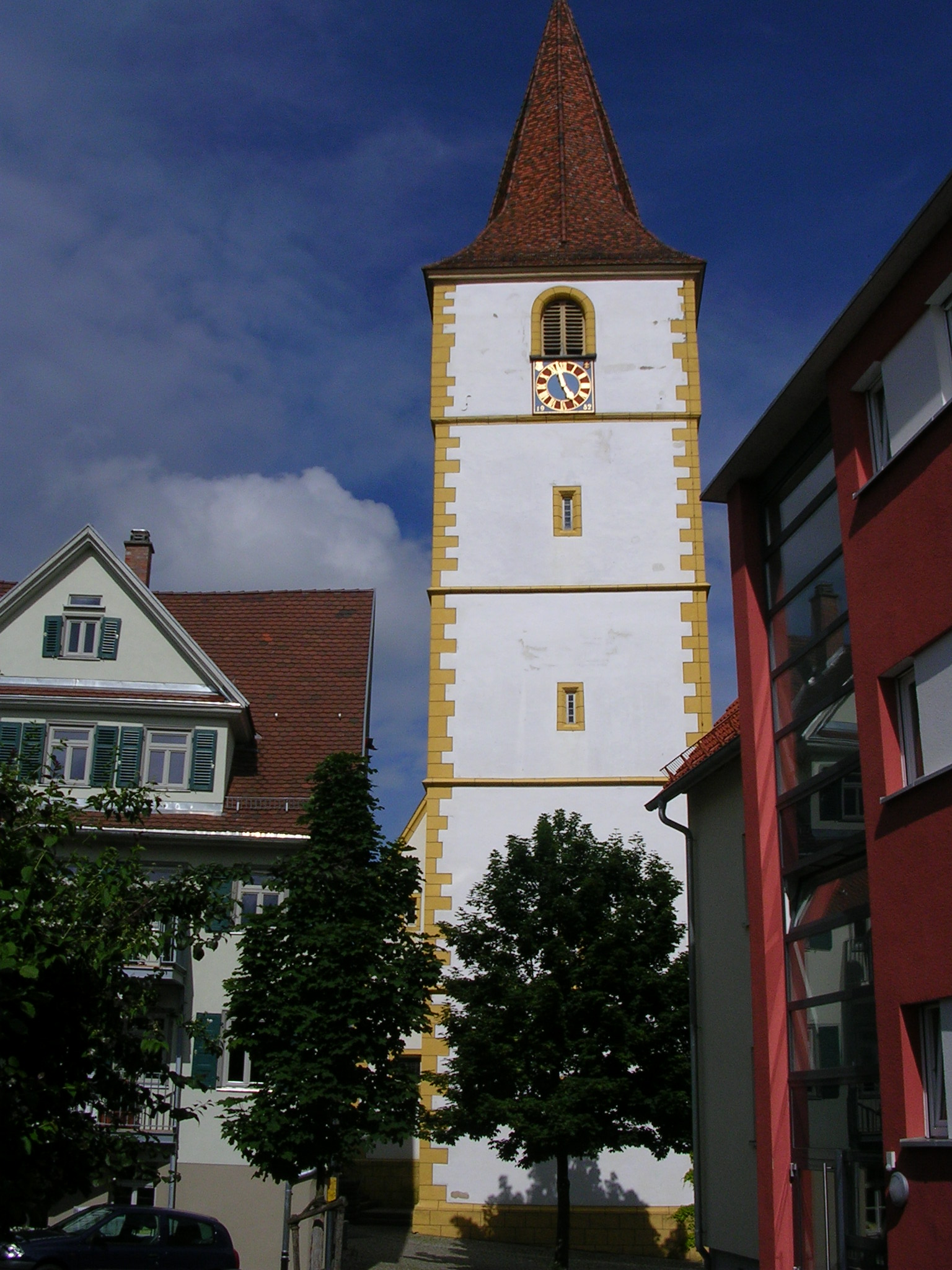
Anna Maria Schmid was the third child of three born to the marriage of Jakob Frederick Schmid (he went by Frederick) and Salome Notter on 21 January 1849 in Holzgerlingen.  Solome was 38 years old when Anna was born and died two and a half years later in Holzgerlingen.  Anna’s father, Jakob, then remarried to Agnes Margarete Hasenmaier in 1852.  Unfortunately, Agnes passed away a year and half later when Anna was barely over 3 years old.  Jakob remained single as far as we know and raised the two girls and boy on his own afterward.  Jakob was a weaver.  Anna likely had few if any memory of either of her mothers.  Anna was christened the same day she was born.  Below is a picture of St. Mauritius’ tower in Holzgerlingen where Anna was christened.  This tower has been there since the eleventh century.

St. Mauritius Church in Holzgerlingen where Anna Schmid was christened

Johann Georg Wanner was the fourth child of five born to the marriage of Johann Friedrich Wanner and Anna Maria Marquardt on 18 October 1845 also in Holzgerlingen.  He was christened the next day in the same church as Anna.

St. Mauritius

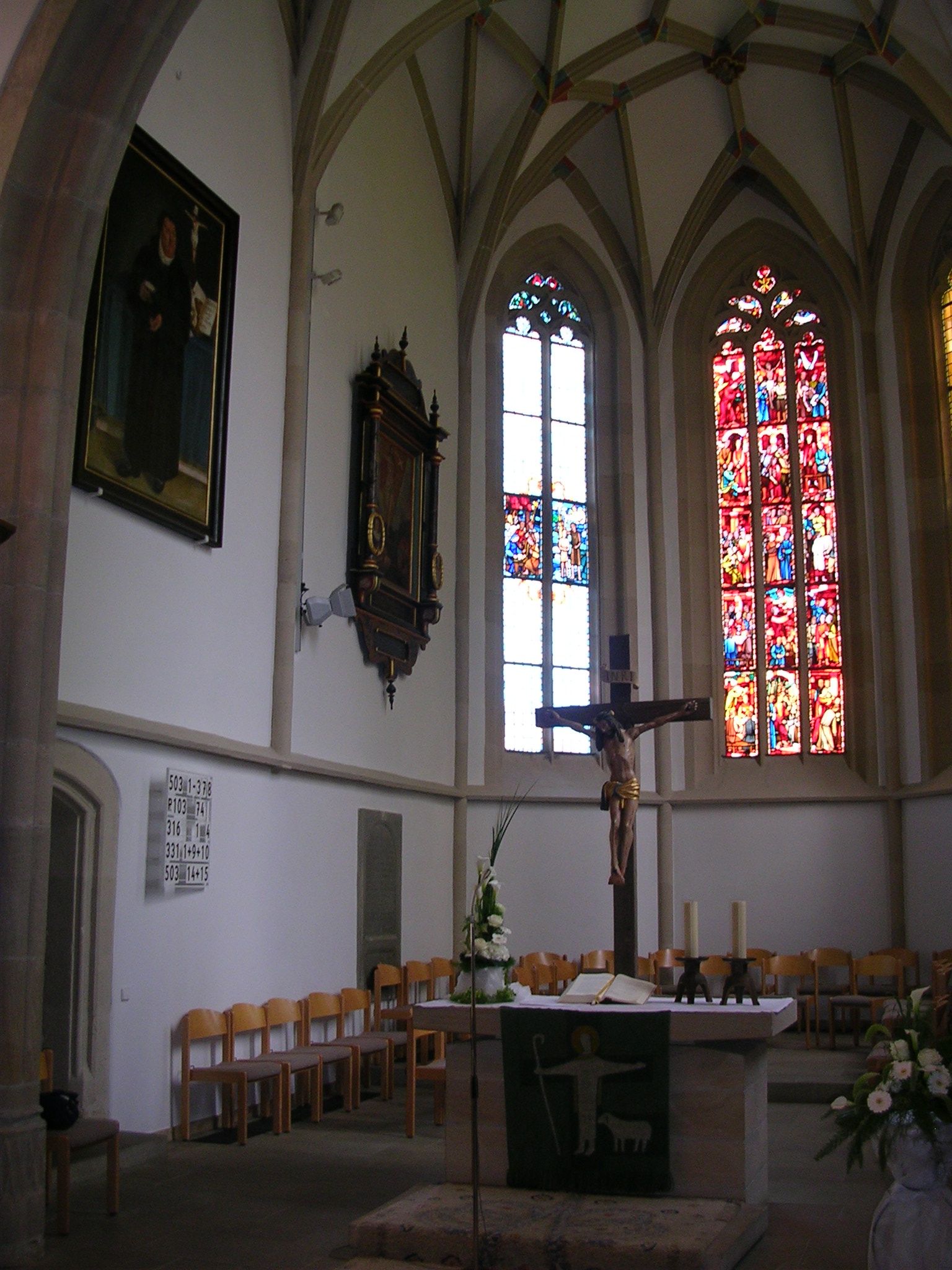
St. Mauritius from the nave looking toward the chancel.  Inside this church is where Johann Wanner was christened

Holzgerlingen is a small town and it is very likely that Johann and Anna knew of each other growing up if not more personally.  Johann and Anna were married 6 June 1870 in the same church in which they were christened.

The altar of St. Mauritius in Holzgerlingen where Johann and Anna were likely married

The altar of St. Mauritius in Holzgerlingen before which Johann and Anna were likely married

Johann and Anna welcomed a baby boy named after his father on 29 October 1870.  Young Johann Georg was christened the next day in the same church, likely before a congregation seated in the below nave.

The chapel/nave of St. Mauritius where family sat for generations if not hundreds of years attending church

The chapel/nave of St. Mauritius where family sat for generations if not hundreds of years attending church

Johann and Anna welcomed Christina Wanner 30 March 1872 in Holzgerlingen.  She was christened on 1 April 1872.

The train platform at Holzgerlingen

The train platform at Holzgerlingen

Between 1872 and 1873 Johann and Anna moved to Grünkraut, Ravensburg, Württemburg.  This is about 50 miles to the south.  We don’t know why they moved to this tiny town.  It was in Grünkraut that Maria Magdalena Wanner was born 12 September 1873.  She was christened 14 September 1873 but I do not know which church the family used in Grünkraut.

Johannas Wanner was born 23 June 1875 and christened the same day in Grünkraut.  He died later that year on 5 November 1875.  He was buried at Atzenweiler according to family records, but I cannot find this place so it must be an area nearby Grünkraut.

Johannas Frederick Wanner came 28 July 1878 and was christened on 3 August 1878.  He died 12 November 1878 and is also apparently buried at Atzenweiler.

On 30 March 1879 Johann and Anna welcomed Luise Sophia Wanner.  Christening followed 6 April 1879 in Grünkraut.

Jakob Frederick Wanner appeared 14 January 1881 with christening 23 January 1881.

Fred told a couple of stories I think proper to share here.  I cannot verify accuracy or the time frame.  “They left the farm work to Grandfather and the children.  They used the milk cows to do the farm work and then would milk them morning and night.  They also got wood from the forest for fuel.  It rained a lot in Germany so the out buildings were connected to the house.  One time Grandma went downstairs to get some fruit.  She reached over and touched something hairy and she thought it was the devil!  It was a cow that had wandered down from the barn.  Dad didn’t talk much about his life as a child but he did say he got a drum for Christmas and then it would disappear about New Years Day and he would get it for Christmas again the next year.  He may have been joking.  The family belonged to the Lutheran Church and was very religious.”

Pauline Wanner arrived 1 April 1884 in Atzenweiler and was christened 10 April 1884 in Atzenweiler.

Gottlop Wanner showed up 18 June 1886 in Kronhalden with christening 29 June 1886 in Atzenweiler.

Lastly, Wilhelmina ended the caravan on 12 September 1887 in Atzenweiler and was christened 19 September 1887 in Atzenweiler.

During the summer of 1890 LDS missionaries visited Grünkraut.  The missionaries apparently visited with Jakob, Anna’s father.  The missionary showed Jakob the Book of Mormon and Jakob took the missionaries home with him.  The missionaries lived with the family for a time and the Wanner family was converted.  Johann Georg Jr was the first to join the LDS Church on 11 July 1891.  Johann Sr, Anna, Christina, and Maria were all baptized 16 October 1891.  Jakob, Anna’s father, joined 22 February 1892.

Johann Jr emigrated to America with Elder Theurer.  They went to his home in Providence, Cache, Utah.  We don’t know who Elder Theurer is, but he helped Johann Georg, now John George, find employment with Fred Nuffer who lived in Mapleton, Franklin, Idaho.  Elder John Theurer had converted the Nuffer family in Germany, so it was likely a sibling of John who helped find John Jr his employment.

In 1893, the family emigrated from Germany.  John, Anna, Christina, Maria, Luise, Fredrick, Pauline, Gottlop, and Wilhelmina all departed Liverpool, England on 3 June 1893 on the Arizona.  They arrived on 13 June 1893 at Ellis Island in New York, New York, New York.  Immediately, the family caught multiple trains through Chicago and Salt Lake with the last stop at Franklin, Franklin, Idaho near where John Jr met them with a wagon.  The family arrived at Franklin on 18 June 1893 where John took them in to Preston.  It was in Preston that Luise, Fred, and Pauline, were baptized 7 June 1894.  Gottlob followed on 6 June 1895 with Wilhelmina 6 August 1896, all in Preston.

The family immediately began to integrate with society.  Christina married Charles August Nuffer 1 February 1894 in the Logan LDS Temple.  John Jr married Eliza Stirland 14 November 1894 in the Logan Temple.

Wanner Family about 1895,

Wanner Family about 1895.  Standing (l-r): Maria (Mary), Christina, Johann (John but went by George), Pauline.  Sitting (l-r): Anna, Jakob (Fred), Luise (Louise), Wilhelmina, Gottlop, Johann (John).

Maria, now Mary, married William Addison Wagstaff 17 June 1896 in the Logan Temple.  Luise, now Louise, married Jeffery Marcelin Bodrero 16 March 1898 in the Logan Temple.  John Jr remarried after divorce to Regina Frederike Nuffer 31 August 1898 in the Logan Temple.  Jakob, now Fred, married Mary Elizabeth Carter 30 September 1903 in the Logan Temple.  Pauline married William Henry Crossley 14 December 1904 in the Logan Temple.  Wilhelmina married Moses Bodrero 18 December 1907 in the Logan Temple.  Gottlop married Rebecca Hicks 16 November 1908 in Preston.

The Wanner family purchased a farm from John Nuffer, a brother to Charles and Regina, near Glendale, Franklin, Idaho.  Fred purchased the farm from them around 1910.  John Sr and Anna moved to Logan where they were living at 791 North 500 East when the 1910 Census was taken (the whole family was in Preston city limits for the 1900 Census).  On the 1920 Census I believe they lived at 304 East 500 North, but the census is unclear exactly what street 304 is on, but going from the pattern of the census taker I believe it is the address I have listed.

Johann Georg Wanner 1921

John died 16 February 1922 of pneumonia in Logan.  Anna listed their address as 272 East 400 North in Logan.  He was buried on the 19th in the Logan Cemetery.  She also died of pneumonia but on 9 December 1929.  She was living at the same address when she passed away.  She was buried 12 December 1929 next to her husband.

Anna Schmid Wanner