
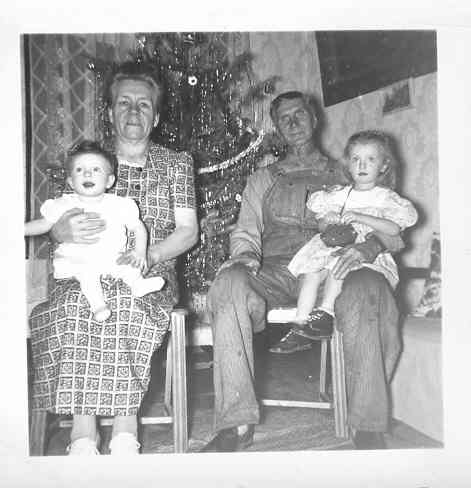
Christian & Rosa Andersen
This is another chapter of the Jonas history book compiled by Carvel Jonas. “The Joseph Jonas clan of Utah (including – early Jonas family history; early Nelson family history)” This chapter relates to Rosa Nelson Jonas. Reviewing this information in FamilySearch shows some changes and updates to some of the information presented.
The following story was written by Rosa and is typed from a hand-written copy in the possession of her daughter, Verla Jonas Andersen Lythgoe.
“The story of Mrs. Rosa Jonas Andersen. Miss Rosa Nelson Jonas was born in Ellensburg, Kittitas County, Washington, on 5 Sep 1886, the third daughter of Annie Josephine Nelson Jonas and Joseph Jonas on a farm.
“Being Catholic, when about two months old, mother took me to church to be baptized, which was done by mother holding me in her arms, while the priest poured a few drops of water on my forehead. (St. Andrew church records this date 26 Sep 1886) In the meantime two persons stood by her side, one on each side of her, a man and a woman, they are called the God mother and father, they are to become your guardian in case anything happens to your parents.
“When I was about four years old, I followed a cousin of mine to school. Not understanding the rules of school, I would talk out loud and go from one seat to another, so the teacher asked me if I hadn’t better go home, my mother may need me. I told him oh, no she has got some more kids home. I said it so loud the whole room began to laugh. That got me, I was so hurt at being laughed at I never went back.
“The fall of 1895, we went to Yakima to pick hops. Although only nine years of age, it was a very interesting trip. People came from all parts of the country.
“One family in particular which attracted my attention was a family traveling in a covered wagon, which had on the outside “Olympia, Washington or bust.” While picking hops they turned their chickens loose, and every night they would go to roost in the back of the wagon, they had a place fixed just on the outside of the end gate. They stayed during the hop season, which lasts about a month or six weeks.
“We were paid one dollar a box and it took four, forty gallon barrels or what they called flour barrels to make a box of hops. The hops were grown in large fields like we grow beets which was one of the prettiest sights I ever seen, to see the way the hops grew. The rows were far enough apart to cultivate between with a cultivation horse. Large poles were even so far apart with strong wire over the top to which a strong cord was tied and fastened to a peg driven in the ground, the hop vine would wrap around this string as it grew. The hops were between six and nine inches long. The most interesting part of this occasion was the Indians, whose camp was just across from where we made our camp.
“We were afraid to go too close so we stood off at a distance and watched them put up their tents. The women or squaws as we call them, did all the work.

Rosa Nelson Jonas
“After we had been in camp about a week, while strolling through the bushes we came upon a squaw making a bed for a new baby, she dug a great big place in the ground, put a layer of rocks in it and made a fire on the rocks. Of course, we didn’t know what she was making but I did know she didn’t want us standing around watching her, and would make motions with her hands for us to go away. I told Mother and she said for us not to go around there any more, because the poor woman was sick.
“Well, we didn’t but one morning before sun up and the ground was white with frost, my sister and I went down to the river and to our great surprise we saw that same squaw that was sick with a tiny baby. We watcher her undress her baby and in the cold water she dipped it. We run home and told mother to come quick that an Indian was drowning her baby. She laughed and told us she was giving her baby its morning bath.
“Now in the Catholic Church the Sunday School has two classes, one that they call the catechism and the other the Bible. They are not allowed to go to Communion or partake of what we call the sacrament, until they graduate from the catechism (spelled Katakismn in her story) class. The day before you go to communion the whole class has to go to confession, which is quite an affair. I’ll try and describe how it is done. They is say, a large closet with a partition running through the center making two average sized closets, with dark maroon draperies hanging in each door way. You go to the right little room, and you’ll find a small bench, to the left, you kneel on it and you find a hole in the partition wall, that comes about to your chin, looking through that you see the Priest sitting in his nice comfortable overstuffed chair waiting to hear you confess your sins, which is done by your saying, “Father forgive me for telling a lie,” or whatever you done that was wrong since you went to confession last. Your punishment is if you haven’t a rosary to get one. It has from 25 to 20 beads each having a different design, each bead means a certain prayer. I had to get one of those beads and say six hail Mary’s every night before retiring and every morning before dressing and two Apostle Creeds so I must have been one of the worst, I thought well, I’ll just show you Priest-I’m not going to freeze my toes saying that while I was kneeling by the bed side, so I’d get up in the center of the bed, cover the quits over my head and bury my face in the pillow and start praying just as fast as I could, sometimes I’d skip a bead and sometimes two, but that did not make any difference because I was covered and no one could see me, and that old Apostle Creed it was too long to say once, say nothing about saying it twice, not me, I didn’t see any sense in learning prayers out of a book when I wanted something because I thought the Lord wouldn’t understand what I wanted.
“Well the next day at Communion all the girls wore white dresses with veils and wreaths on their heads, and boys in black. Up to the altar or railing covered in white you kneel down, put your hands under this white cover that goes over the railing, close your eyes, put your head back, open your mouth, put out your tongue and the priest will put this Communion on your tongue, don’t let it touch your teeth, close your mouth, bow your head. When he had given each one in the class a Communion you all arise and go to your seat. This Communion is about as large as a small sop cracker, I guess that is what it is from what I could see just partly closing my eyes. I wanted to see what he was going to give me anyway and I did. He took it out of a goblet with his forefinger and thumb and layed it on my tongue and stood there and drank the wine it was soaked in.
“In the year of 1901 July 3, I came to Utah. Feb 6, 1902 I was baptized into The Church of Jesus Christ of Latter-day Saints, by N[els]. A[ugust]. Nelson who took a pick and broke the ice in the Jordan River in South Jordan, Salt Lake County, and was confirmed the same day by Bishop James P. Jensen. In the year of 1903 I spent a week in the Salt Lake Temple being baptized for relatives and had my endowments and went through for those I was baptized for and had them sealed. This made me sixteen years of age when I had my endowments.
“In April 1902 I had my patriarchal blessing which (is) a great comfort and help to me because of the wonderful promise of temple work, and of the great relief it would be for those I did work for. It sure is a great comfort to go and read it and reread it. The more you read it, the more it means to you. “So girls, don’t miss getting your Patriarchal Blessing.”
“The following is Rosa’s blessing.
“A blessing given to Rosa Jonas, daughter of Joseph and Josephine Nelson Jonas born in Ellensburg, Kittitas Co, State of Washington.
“Sister Jonas in the name of the Lord Jesus Christ and by the power of the priesthood conferred upon me, I confer upon your a patriarchal blessing. In as much as you desire to know what God requires of you. If you are faithful you shall never be deceived. You have a knowledge that God lives and your prayer will be answered in those things that will be for your good.
“You are of Israel and are entitled to the blessings which the gospel imparts, and although young, God will increase your testimony. If you are humble, your heart will be fully satisfied. Be careful of the company that you keep. Be modest and careful in the selection of your companionship or you may be deceived. There is much for you to do in the Temples of the Lord, and many of your ancestors names will be presented to you and they will bless you for the labor that you performed for them in the flesh.
“God will give you judgement to select a man of God for a companion, who will lead you back into the presence of God from whence you came.
“Cherish virtue more than your life. Never allow yourself to step from the paths of truth and virtue for I seal this blessing upon you with all your born blessing and I seal you up unto Eternal Life, promising you that none of these blessings shall fail if humble on your part in the name of Jesus Christ, Amen.”
“Rosa lived with her Uncle August Nelson and did housework for her room and board. She wasn’t very tall and some of her children have said she would measure to their arms if their arms were held out horizontal with the ground. A guess she would be a few inches above five feet tall. She had thin brown hair and brown eyes. When she was young she had white hair, until it grew darker as she became a young woman. All her siblings had white hair when they were children. Her hair was probably thinned because of the typhoid epidemic which killed her older sister, Mary. At that time Rosa’s hair fell out by the hand full. Since Mary died 21 Sep 1899, Rosa would have been 13 years old when she lost her hair. Rosa was the only left handed sibling. I am told that Rosa would argue about religious doctrines with her brothers and would hit the stove with a pan to give emphasis to her point of view. Apparently these siblings would argue and defend their point of view vigorously for a few hours at a time. However, after their debates they were affectionate with each other and were able to be good friends after any discussions. They were very loyal to each other.
“A land record in Logan tells us that on the 8 Nov 1905 Rosa and her husband, Christian Andersen, first bought their house in Richmond, Utah. It was located at 137 East 1st South. They bought lots 2 and 3 for $500.00. They lived there until 2 Jun 1920 when they sold their house for $2400.00 and then moved to Thatcher, Idaho. While they were living in Richmond two of her brothers would live with them from time to time. William and Joseph would stay at her home when they came back from the Brigham Young College at Logan. She also lived within about a block of her other brother, John, who had bought a home. She was very helpful to her brothers by washing their clothes and given them a place to sleep when they came home during the weekends. Joseph, her youngest brother, often sought her for advise, and often would take the advice of his sister in substitute of the parental advice he missed. She lived in Thatcher, Idaho, with her two brothers on a far and after a short few years moved back to Richmond, Utah. Later (about 1922) the family moved to Preston, Idaho at 295 West 4th South, where she died years after. The following is quoted in the life story of her husband, Christian Andersen, and was written by their daughter, Mabel.
“Father met my mother, Rosa Nelson Jonas, about a year before they were married. One night (Christian) was singing and playing a lively song and mother and Aunt Delia walked into the dance hall and there sat father playing the accordion and singing this song. Mother took one look at him and said to Aunt Delia, “I should think he would be ashamed of himself.” She thought him repulsive at first. But later on in years she rocked his little kids to sleep and he sang these very same songs to us. Mother did not mind in the least. Aunt Delia and Grandma Andersen decided that Christian and Rosa were meant for each other, so Aunt Delia gave a party and invited the Andersen boys. They were a lively bunch and had a good time that night.”
“…Rosa made a nice cream cake with plenty of whipped cream on it. (Christian) came to see her that evening in his rubber tired buggy so he could eat it, batched by himself… On the way home father put the cake on the floor of the wagon so it would be safe. The high spirited horse became frightened and started to run away. Father pulled back on the lines and raised his foot up and set it down right in the middle of the cream cake! When he got home he cut around his foot print and ate what he could of the cake. As a result of these meetings father and mother were married on 29 Jun 1904 in the Salt Lake Temple.”
“Rosa wrote a letter to her oldest sister, Margaret, to apologize for not writing her until after she was married about her marriage. Joseph Jonas, her father, wrote back and said that Margaret would forgive her because she had died.
“Rosa became the mother of Christian’s two children, Pearl and Ivy, who were from Christian’s first marriage. “Rosa was strict and so was Christian.”
“Rosa and Christian moved into a house in Richmond, Utah. Christian added one room downstairs and two rooms upstairs and a bath. He made a stairway and maintained a “well groomed house and yard.” “We had a shanty or summer kitchen where “Rosa and her daughters” did the canning of fruit and washing. The shanty was a couple of rods from the backdoor. We had a cement sidewalk and a big stone rock for a step…” Their “home had the first running water in it to come out of the wall hot… We had the first electric light in Richmond.”
“Rosa and Christian had six children. The first five were born in Richmond. The last was born in Lewiston. They are the following children: Mabel Rosetta, born 23 Oct 1905; Cyrus Christian, born 21 Dec 1907; Cleone Annetta, born 24 Nov 1909; Merlin Jonas, born 19 Sep 1913; Verla Jonas, born 16 Mar 1917; Arvie Jonas, born 31 May 1921.
“I remember moving from the ranch at Thatcher to Lewiston. Mother was expecting Arvie and she rode in the back of the wagon on some hay. The meager furniture was loaded into the wagon drawn by Jupiter and a bay horse named Sailor. Verla was bundled up in blankets and quilts, also Merlin and I (Mabel). Snow was on the ground, it was cold. While we were pulling the dugway by Riverdale where it was icy and slick, ol’ Jupiter fell on his right front shoulder. This turned the front wheels of the wagon causing it to tip. But quick as a flash Jupiter was on his feet and gave a lunge throwing the wagon the other way. Sailor pulled his line and up the dugway we went. I always felt that I owed my life to Jupiter because if the wagon had gone over it would have dumped the stove on top of me…” Another night during the trip they stayed at a range house and they fixed breakfast for them. Joseph Nelson Jonas was driving the wagon.
“Rosa and Christian had one of the most beautiful homes. (They) had a beautiful garden bed of tulips; and beds of gladiolas…(their) lawns were nice and green with no weeds…In Richmond and Preston they used to have large raspberry patches. We girl used to get up at four in the morning and pick the berries before it would get too hot. Then again at five in the afternoon when it was cooler we would again go into the patch and pick berries. (Rosa) sold many of the berries to people living near.”

Rosa & Christian Andersen
“In the winter when the snow was deep a group of people would get together and decide to have a surprise on some member. The women would open the door and yell SURPRISE!!! In they would go and take all the furniture out of their room and take up the rug or carpet and start to dance. Christian would be there with the accordion. He would take a chair and sit in the corner and play all night. About midnight they ladies would give the rest of the people lunch. They would eat and dance some more. After the dance was over the men would carry the furniture back into the house again.”
“The following information was taken from the obituary of Rosa Nelson Jonas. “Preston-Mrs. Rosa Jonas Andersen, 64, died in a Preston hospital at midnight Tuesday. She served as president of the Young Women’s Mutual Improvement Association in the Preston Sixth Ward, as a Primary teacher, and for eight years was captain of the Hiawatha Camp, Daughters of Utah Pioneers. Funeral services will be conducted on Saturday noon in the Preston Sixth Ward Chapel by Bishop A.C. Lundgreen. Friends may call at the family home Friday evening and Sat. until time of the services. Burial will be in the Ogden Cemetery under the direction of the Webb Mortuary of Preston.”


 Sagacity