As state loses small towns, Minidoka fights to stay alive

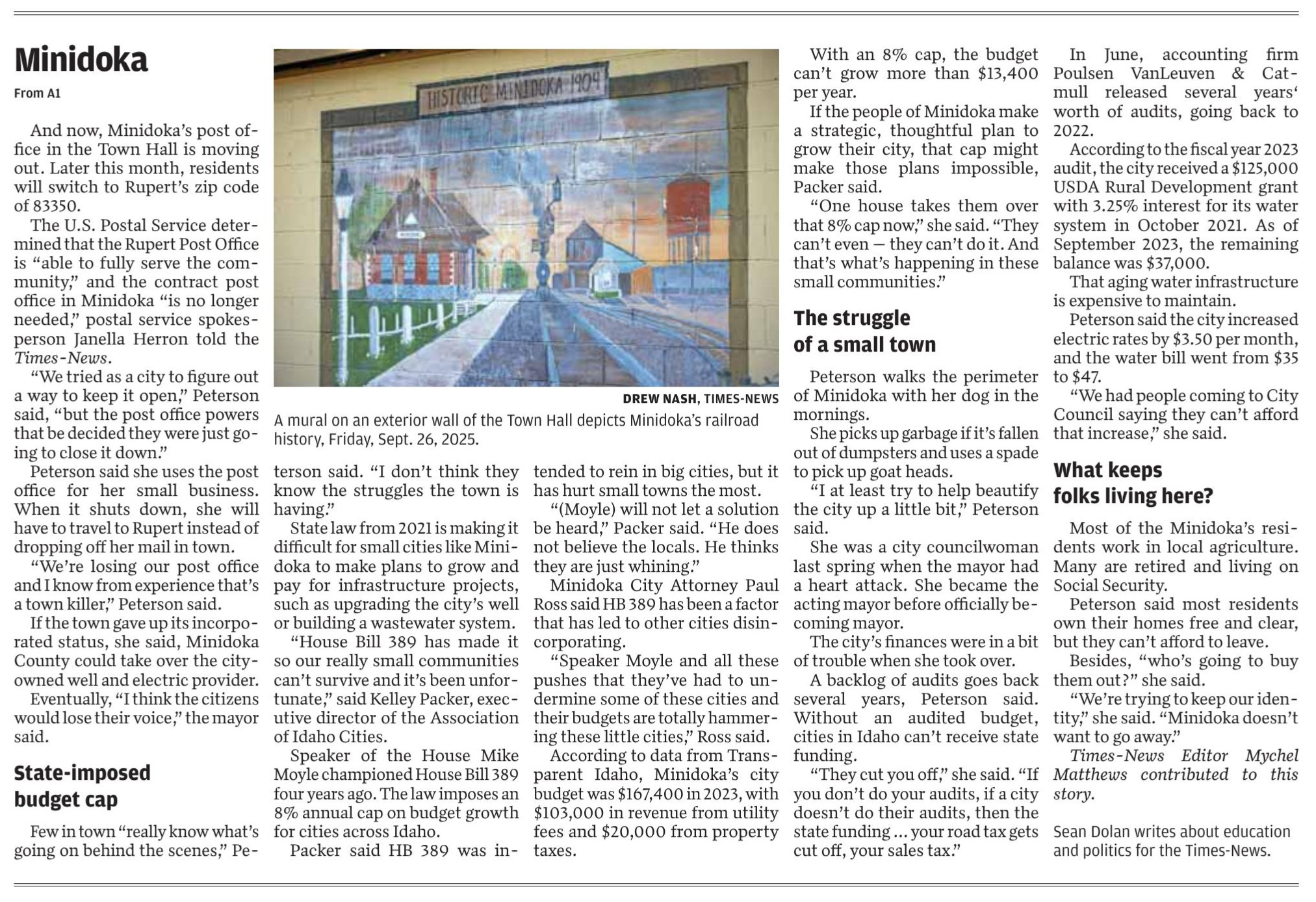
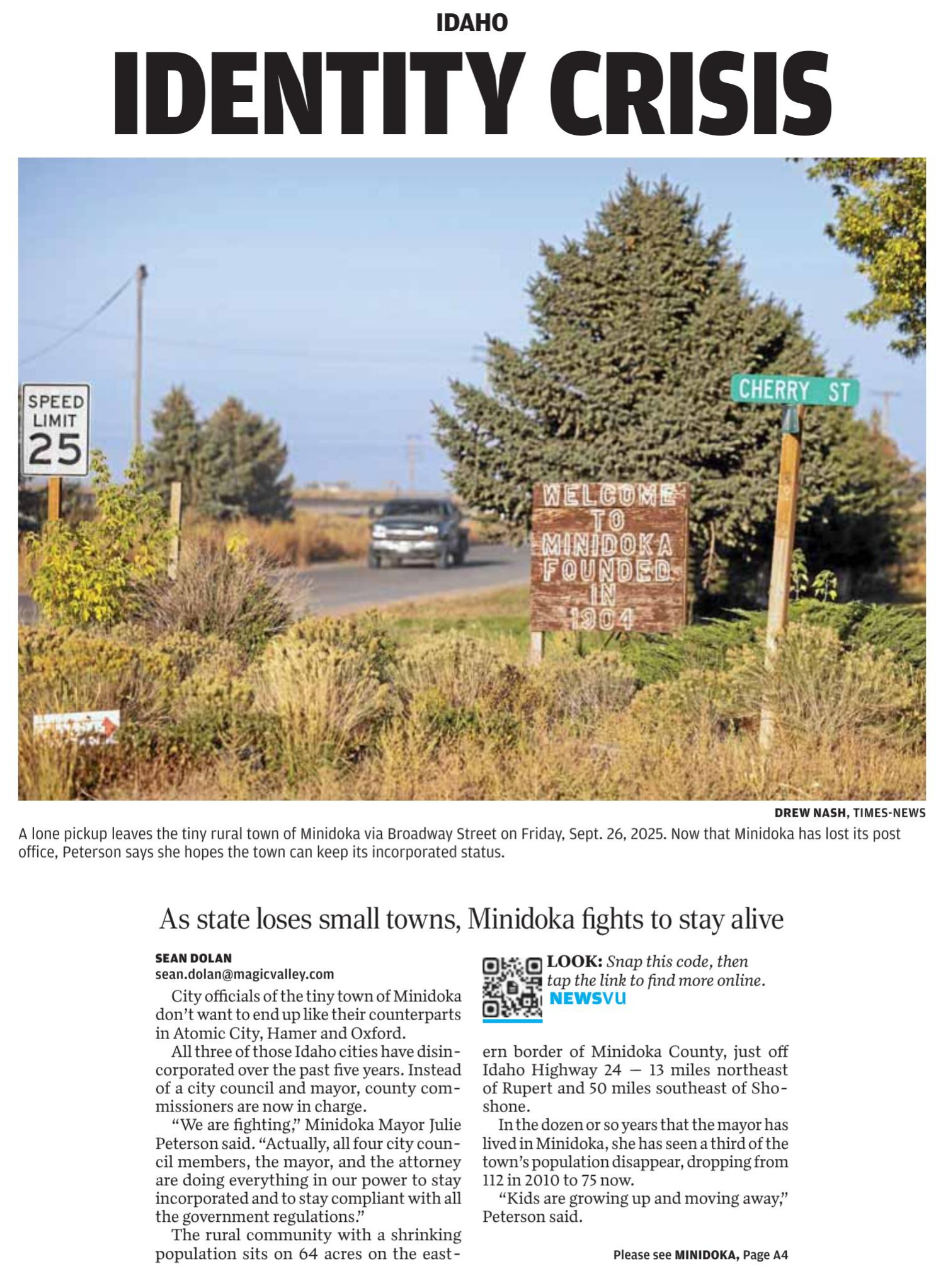
A lone pickup leaves the tiny rural town of Minidoka via Broadway Street on Friday, Sept. 26, 2025. “The only time we get a crowd is at a city council meeting,” Mayor Julie Peterson told the Times-News.” Now that Minidoka has lost its post office, Peterson says she hopes the town can keep its incorporated status.

DREW NASH, TIMES-NEWS

City officials of the tiny town of Minidoka don’t want to end up like their counterparts in Atomic City, Hamer and Oxford.

All three of those Idaho cities have disincorporated over the past five years. Instead of a city council and mayor, county commissioners are now in charge.

“We are fighting,” Minidoka Mayor Julie Peterson said. “Actually, all four city council members, the mayor, and the attorney are doing everything in our power to stay incorporated and to stay compliant with all the government regulations.”

The rural community with a shrinking population sits on 64 acres on the eastern border of Minidoka County, just off Idaho Highway 24 — 13 miles northeast of Rupert and 50 miles southeast of Shoshone.
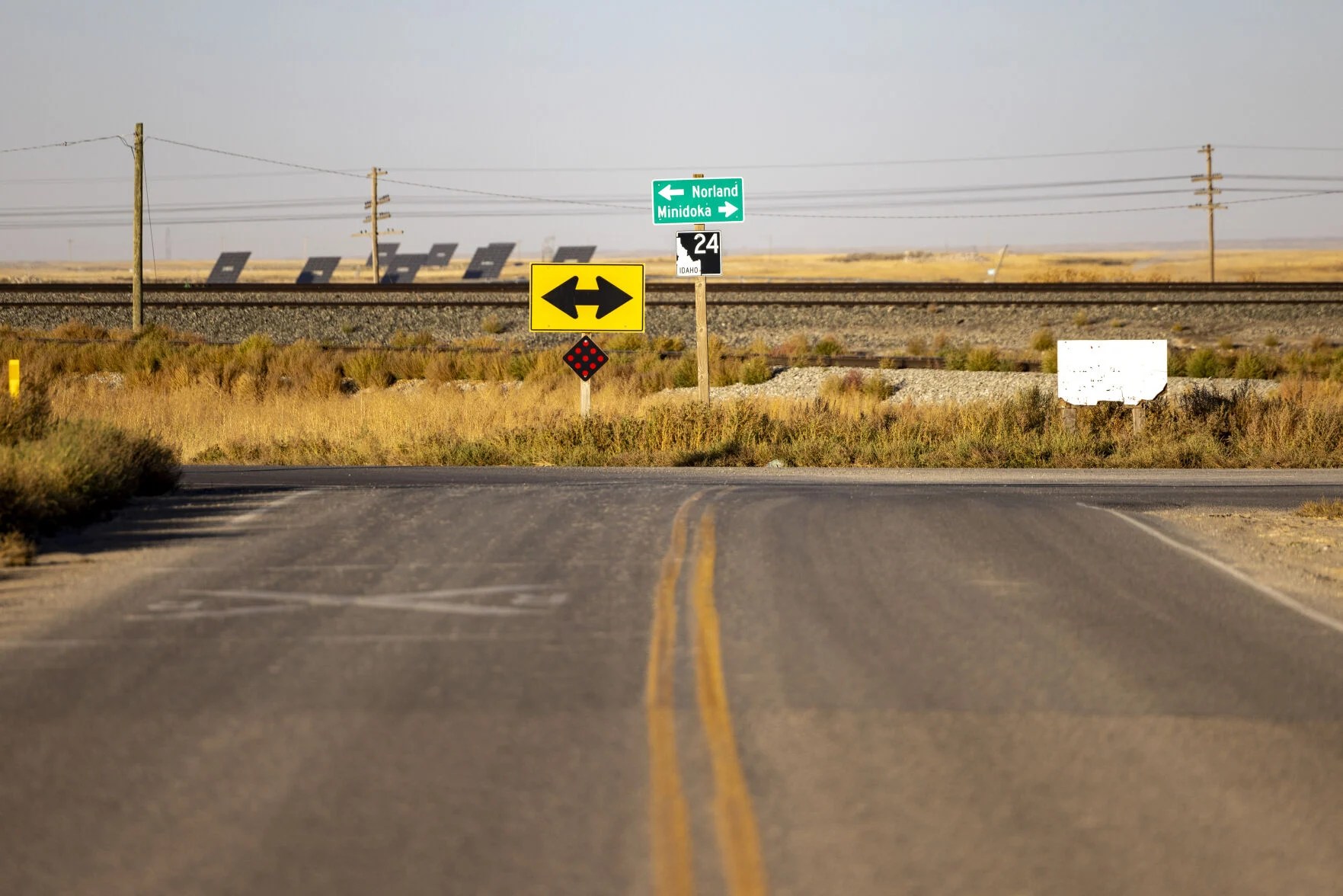
Idaho Highway 24 near Minidoka is seen Friday, Sept. 26, 2025, in Minidoka County. Travelers turn right onto Broadway to go into town or left to stay on Highway 24 to go to Shoshone, 50 miles away.

In the dozen or so years that the mayor has lived in Minidoka, she has seen a third of the town’s population disappear, dropping from 112 in 2010 to 75 now.

“Kids are growing up and moving away,” Peterson said.

And now, Minidoka’s post office in the Town Hall is moving out. Later this month, residents will switch to Rupert’s zip code of 83350.

The U.S. Postal Service determined that the Rupert Post Office is “able to fully serve the community,” and the contract post office in Minidoka “is no longer needed,” postal service spokesperson Janella Herron told the Times-News.

“We tried as a city to figure out a way to keep it open,” Peterson said, “but the post office powers that be decided they were just going to close it down.”

The Minidoka Town Hall is seen Friday, Sept. 26, 2025, in Minidoka County. Until later this month, the Town Hall serves as the tiny community’s post office.

Peterson said she uses the post office for her small business. When it shuts down, she will have to travel to Rupert instead of dropping off her mail in town.

“We’re losing our post office and I know from experience that’s a town killer,” Peterson said.

If the town gave up its incorporated status, she said, Minidoka County could take over the city-owned well and electric provider.

A water tower is seen Friday, Sept. 26, 2025, near Cherry and Broadway streets in the tiny town of Minidoka.

Eventually, “I think the citizens would lose their voice,” the mayor said.

State-imposed budget cap

Few in town “really know what’s going on behind the scenes,” Peterson said. “I don’t think they know the struggles the town is having.”

State law from 2021 is making it difficult for small cities like Minidoka to make plans to grow and pay for infrastructure projects, such as upgrading the city’s well or building a wastewater system.

“House Bill 389 has made it so our really small communities can’t survive and it’s been unfortunate,” said Kelley Packer, executive director of the Association of Idaho Cities.

Speaker of the House Mike Moyle championed House Bill 389 four years ago. The law imposes an 8% annual cap on budget growth for cities across Idaho.

Packer said HB 389 was intended to rein in big cities, but it has hurt small towns the most.

“(Moyle) will not let a solution be heard,” Packer said. “He does not believe the locals. He thinks they are just whining.”

Minidoka City Attorney Paul Ross said HB 389 has been a factor that has led to other cities disincorporating.

“Speaker Moyle and all these pushes that they’ve had to undermine some of these cities and their budgets are totally hammering these little cities,” Ross said.

According to data from Transparent Idaho, Minidoka’s city budget was $167,400 in 2023, with $103,000 in revenue from utility fees and $20,000 from property taxes.

With an 8% cap, the budget can’t grow more than $13,400 per year.

If the people of Minidoka make a strategic, thoughtful plan to grow their city, that cap might make those plans impossible, Packer said.

“One house takes them over that 8% cap now,” she said. “They can’t even — they can’t do it. And that’s what’s happening in these small communities.”

The struggle of a small town

Peterson walks the perimeter of Minidoka with her dog in the mornings.

She picks up garbage if it’s fallen out of dumpsters and uses a spade to pick up goat heads.

“I at least try to help beautify the city up a little bit,” Peterson said.

She was a city councilwoman last spring when the mayor had a heart attack. She became the acting mayor before officially becoming mayor.

The city’s finances were in a bit of trouble when she took over.

A backlog of audits goes back several years, Peterson said. Without an audited budget, cities in Idaho can’t receive state funding.

“They cut you off,” she said. “If you don’t do your audits, if a city doesn’t do their audits, then the state funding … your road tax gets cut off, your sales tax.”

In June, accounting firm Poulsen VanLeuven & Catmull released several years‘ worth of audits, going back to 2022.

According to the fiscal year 2023 audit, the city received a $125,000 USDA Rural Development grant with 3.25% interest for its water system in October 2021. As of September 2023, the remaining balance was $37,000.

That aging water infrastructure is expensive to maintain.

Peterson said the city increased electric rates by $3.50 per month, and the water bill went from $35 to $47.

“We had people coming to City Council saying they can’t afford that increase,” she said.
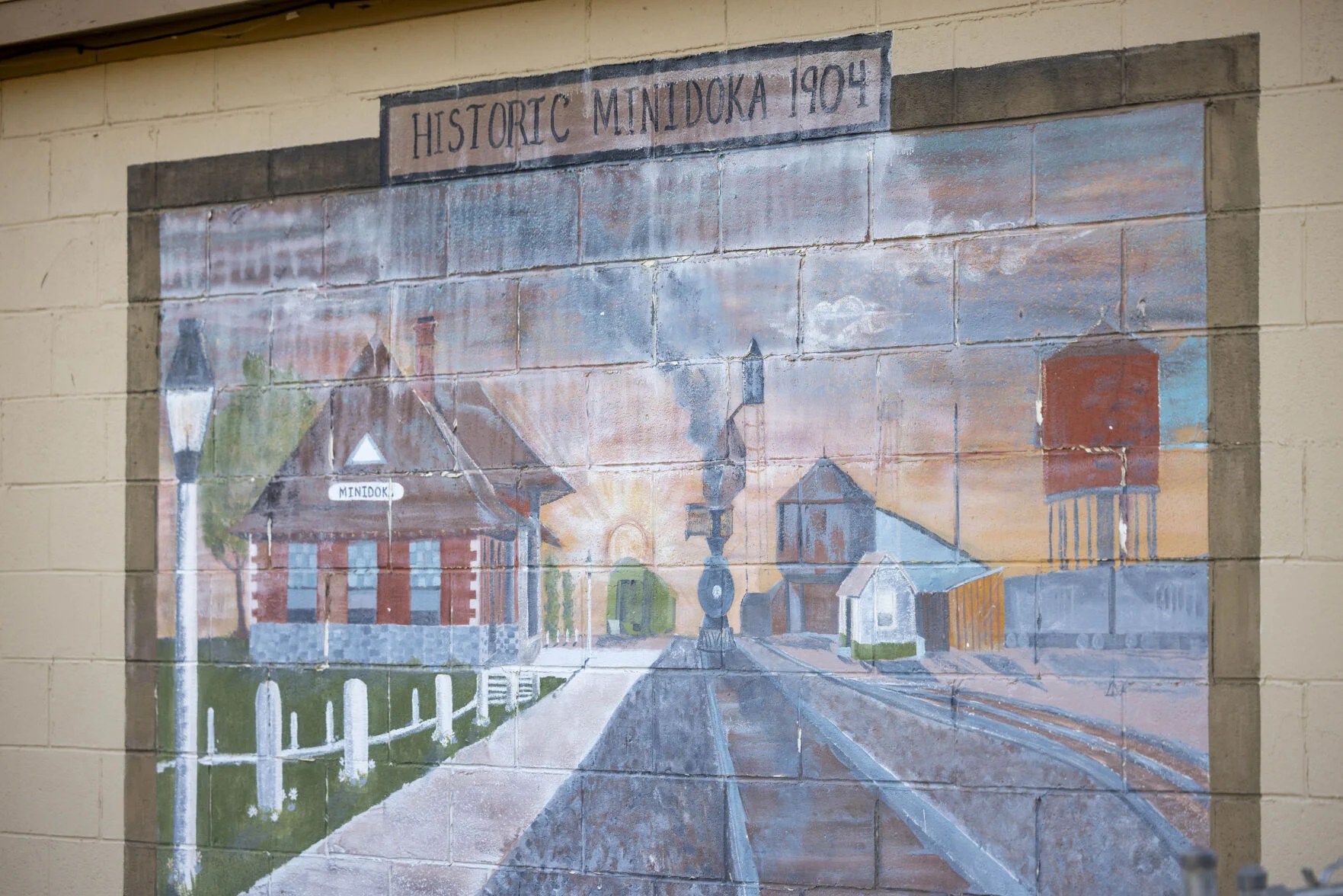
A mural on an exterior wall of the Town Hall depicts Minidoka’s railroad history, Friday, Sept. 26, 2025.

What keeps folks living here?

Most of the Minidoka’s residents work in local agriculture. Many are retired and living on Social Security.

Peterson said most residents own their homes free and clear, but they can’t afford to leave.

Besides, “who’s going to buy them out?” she said.

“We’re trying to keep our identity,” she said. “Minidoka doesn’t want to go away.”

Times-News Editor Mychel Matthews contributed to this story.
Chapter notes

I wanted to add a few little notes to the closing chapter.  Since it is too late to enter the thoughts in the chapter, I can surely append them, can’t I?  Well, with permission or not, I am.
The last response on the blog was one a bit sober for me.  After all, I tend to take hard critical words that they hint at a grain of truth, if not more.  So, I attempt the thorough examination of whether or not that bit of truth was of size or consequence.
But first, I must recognize how prized some of your e-mails and comments have been to me.  Thank you for your support.  I love good people like you!
I must report that as I went back out into the field that day, to finish up my week, I felt that a whole burden had lifted.  Perhaps that is my whole qualm with the sales industry.  The pressure exerted on its sales people.
It must be reported that I very much enjoyed working with Marc Summers.  While he is cocky, certainly boastful, I found that he had an air about himself that I enjoyed.  Saying that, in his position he is dealing with increasing pressure from above.
That is what used to make Combined beautiful.  The people loved working there because it was fun and the job was great.  Combined Insurance Company of America has turned into an ugly monster.  Having gone the way of all Babylon, they now have retreated to force and pressure.  My Grandmother loved Mr. Clement Stone and the company because they had a product to sell, and according to your wishes and desires, you went and did what you wanted.  You were rewarded accordingly.  Now they have become another vicious machine, where it is no longer the individual that counts, but the program and results.
Mr. Neil Pehrson the Regional was of hope to me.  A relic of another age.  I sure like him, as I do Marc.  Both remind me of what the company used to be like.  But in company’s changes, they are exerting force down the line.  The change has increased even in the months since I have been present.  That is where I bucked.  I don’t allow for that force in my life, especially when it is voluntary.  The same reason I have some issues with the changes government is making, but that is another subject.
I even feel a bit of sadness tonight.  My heart aches for the loss.  Marc has taken this pretty hard.  He was very upset, but now I can sense a longing.  I admit, I became quite attached to the company as well.
At least once a week, I was reminded of a moment in my childhood in doing the travels with my Grandmother.  I miss her more than my heart could ever tell.  Even now I want to weep from the separation that seems to be present.  I think Combined has brought much of the past to life again for me.  I literally have relived the summers when I was growing up.  I think often of President Packer’s talk “In the light of thy childhood” and the pure chords it still resonates with me.  The classic line of Field of Dreams, heaven is where dreams come true….  Anyhow, I think I shall stop there, I don’t feel these are sentiments I should be sharing here.
Next, I had the opportunity of sharing the gospel with Mr. Marc.  He had questions.  He was curious.  I could not get him to keep his commitments, so I wonder his intentions, but I hope they were pure.  I sure enjoyed that experience.  It gave me a great measure of hope and that too provided a certain reliving of the mission.  The questions, the answers, the promptings of the Spirit.  Oh how much I loved those days.  It broke my heart for me to go into checkout today and he gave me back all the various things I had given him.  He gave me back the Book of Mormon, the Bible, the Restoration Video, and other various things.  That was hard for me.  Then again, I suppose a missionary is not totally surprised when this happens the rest of their life.
This job provided a reattachment to previous times in my life.  I don’t wish you to think I am surreal and living in the past.  I very much look forward to the future.  My past is past, but the foundation of my life must not be forgotten.  How can I hope a superstructure if I neglect the foundation.  Surely, these things must not be.
Somehow, despite the release of pressure, I feel a sad detachment.  It is like I am not only leaving my job, but my past.  I know this is not true.  There were attachments beyond just it being a ‘job’ for me.
I vow that if I ever come to lead an organization of any type, that pressure will not be the means.  People must find their own motivation.  They must be on board with the community, or business.  That motivation must come from within, from whatever source.  When it comes from without, it is so terrible and undermining.  Love unfeigned, hope, and pure knowledge are the keys to successful leadership.  Any organization would do well to take a page from the gospel of Christ.
Well, having now discarded the wagon I had for the moving of me and my family to Zion, I now have to find another means of moving through the next phase of travel.  After all, that wagon was too much of a struggle to drive.  We are now on foot, which is a terrible way to travel.  One can make out alright, but it sure makes it hard to help others.  The saddening part is those with autos don’t offer help.  Where will the means come?  Church?  I think family is too far to aid.  We will see what God will do to reveal his arm.  Until then, we wade on.
Shall we not go on in so great a cause?  Go forward and not backward.  Courage, brethren; and on, on to the victory!  Let your hearts rejoice, and be exceedingly glad.