Sandy and Jackie Jonas, 142 State St, Richmond, Utah, 1968
I stumbled on this photo working through and scanning more photos from my Aunt Jackie. This may be the only color photo I have of my Mom in Richmond. That was the first thing that jumped out at me. I believe most of the photos from Richmond are black and white. The photo indicates it was developed in January 1969, which tells me it is from 1968. Good chance it is later in the summer or fall, trees, grass, and shrubs are in full greenery and there appears to be dead grass clippings on the sidewalk.
1968 would also put my Mom at 14 years old, Jackie at 8. Which could very well be. I would be somewhat tempted to suggest 1967. That same year they moved to 2652 Fairmont Avenue in Burley, Idaho. I have written about that move before. But that post also has a photo of Jackie very early on as well that appears to be similar age. Here is that photo again.
Jackie Jonas dancing on Fairmont Ave
Either way, the photo of my Mom about 14 caught my attention. I thought I would share it here to give it some context.
This postcard was among a number of photos related to my Jonas family.
The Richmond Community Building was built under the Public Works Administration in 1936 and completed in 1937. The trees were probably planted with the building’s construction, so I am guessing they are about 10 years old, or this would be late 1940s.
I can see that the right side of the building is the US Post Office. The left side was the theater, which is the sandwich board in the middle. I simply cannot read or make out enough of the board to see what was playing.
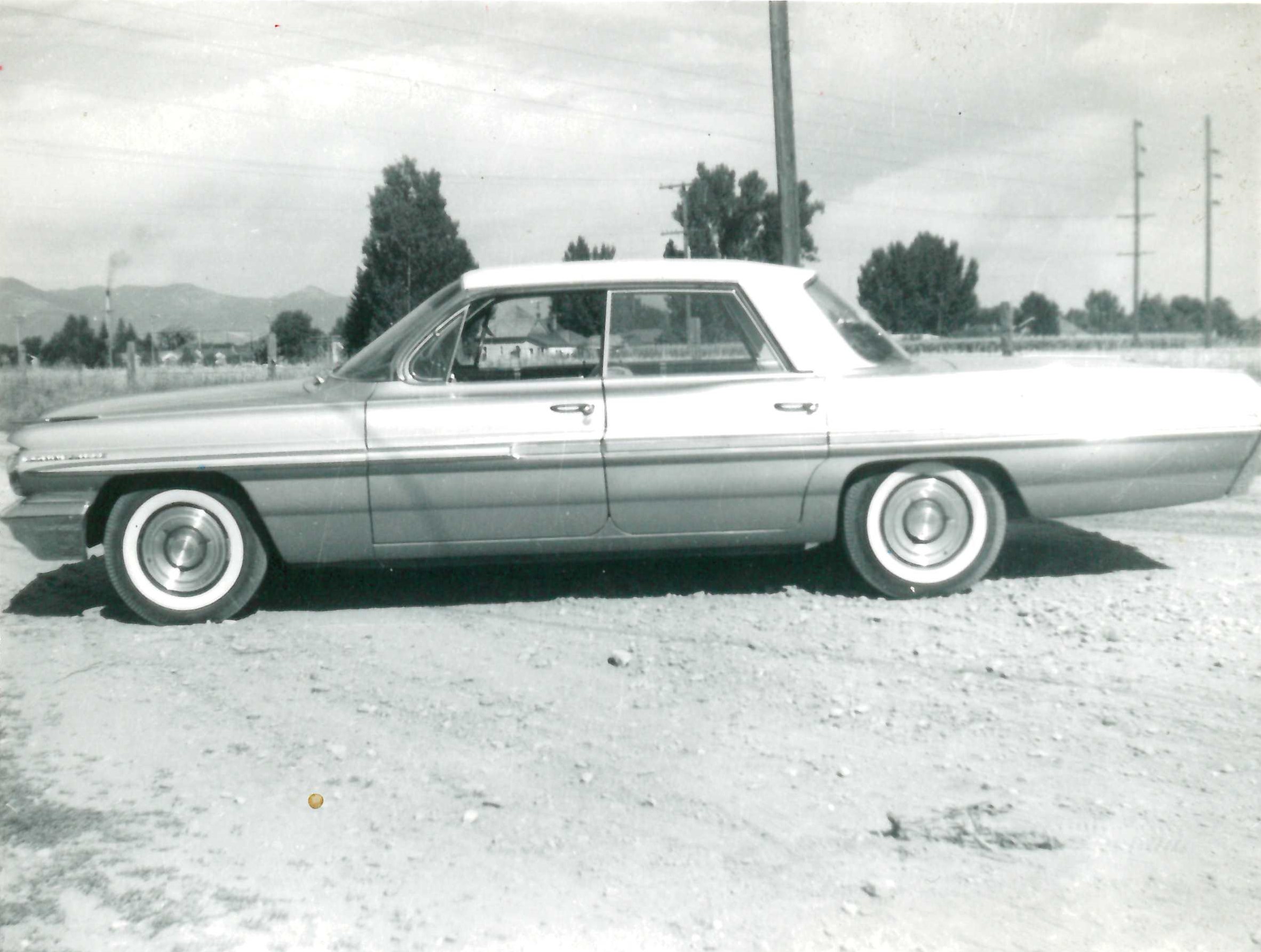
1962 Pontiac Bonneville in Richmond, Utah July 1963
I previously wrote about a 1958 Pontiac Bonneville in Preston, Idaho. That car belonged to Donald and Phyllis. Fast forward a few years to July 1963 (at least that is when the photos were developed) and you have this car.
This car was new to the Norwood and Colleen Jonas family. I recall seeing these photos when I was a young kid and that my Grandma mentioned that she loved this car. But that is the extent of my memories. I don’t know how long they had it, when it went away, why, or what replaced it.
Ole and Constance Christiansen are pleased to announce the marriage of their daughter Martha to Herbert Coley, son of Stephen and Hannah Coley. They were married in 1874 in Norway. While I normally like to start these historical posts as a wedding announcement, I trip up there. We do not have any histories that give us an actual marriage date and location. Knowing the period, it is not imagined they were not actually married. Their first child was born in 1875. Curiously, after their immigration to the United States due to their conversion to The Church of Jesus Christ of Latter-day Saints, they not only went to the Logan Utah Temple to be sealed, but also applied to be married. As such, they were married and sealed in the Logan Utah Temple on 26 April 1893.
Martha was born the second of eleven children to Constance Josephine Eliza Jorgensen and Ole Christiansen on 16 April 1879 in Fredrickstad, Ostfold, Norway. I have not written their history yet, but as linked above, I wrote some limited information on Constance when we visited her grave first in 2018 and again in 2020. Ole was born in Trogstad, Norway and Constance in Drammen, Norway. Both Ole and Constance were baptized and confirmed into The Church of Jesus Christ of Latter-day Saints on 26 January 1876 in Norway.
What happens for the next few years is unclear on the reasons. Martha’s older sister, Walborg, was born 24 December 1875 in Fredrickstad, then Martha in 1879. We really have no records during this period and so I am unclear if there was another child, or two, in that period of time. Eivelda was born 20 October 1881 in Melbourne, Victoria, Australia. I have no clue why or what took the family to Australia. Their next child, Constance, was born 9 November 1883 also in Collingwood, then a suburb of Melbourne. Apparently Walborg and Martha were left in Norway while their parents went to Australia. Alice, Martha’s granddaughter recalls Martha telling of her sitting on the mountainside overlooking the fjord waiting for her parents to return and her missing them terribly. Martha’s first brother, Henry Owen, was then born 27 March 1887 back in Fredrickstag, Norway. Ole and Constance were back in Fredrickstag by March 1887.
I have been unable to find the immigration records for the Christiansen family between Norway to Australia and back. But the family was in Australia for at least 3 years, maybe as long as 6 years. They were not back in Norway very long as Rhoda was born in Richmond, Cache, Utah on 18 September 1890. Martha moved with her family to Richmond in the late 1880s. One record has it in 1887, another 1889, Martha was listed in the 1900 Census as immigrated in 1888. Either way, we now are in the vicinity of where she would have met Herbert Coley. Of Martha’s remaining 6 siblings, 5 were born in Richmond and 1 in Hyde Park.
Herbert was born the 5th of 9 known children to Hannah Maria Rogers and Stephen Coley on 12 February 1864 in Lutley, Worcestershire, England. It was while living in Lutley that the LDS missionaries first made a visit. We do not know the conversion story but Herbert and his siblings joined the church. Martha joined 23 August 1867, Herbert 1 June 1881, George 22 August 1881, and Frank 2 June 1882. The 1871 English Census has the family still living in Lutley and Herbert listed as a scholar. The call to gather in Utah was strong enough that these four children made the venture. We don’t know if Stephen and Hannah came begrudgingly or not, but they joined some of their children in Utah. Unfortunately, the other children left in England we do not know where they went or what happened to them.
Herbert shows on the 1881 English Census in Dudley, Worcestershire, England as farm labor for the Doorbar family. Herbert appears to have boarded the Nevada in Liverpool arriving 3 July 1882 in New York City, New York. I cannot see that any siblings went with him on the trip. Stephen, Hannah, and Martha all traveled in 1890 (with Letitia Lea Willetts and her daughter Clara, and two known Frank and Mary Coleys). Stephen Coley was baptized 5 January 1892 and Hanna 26 October 1892 (same day she was endowed in the temple, so either that date is wrong or the prior record could not be found and the ordinance was duplicated. Hannah died 22 October 1894 in Franklin, then Oneida County, Idaho and was buried in Lewiston.
I don’t know any of the details of how they met, but the stars seem to have aligned in Richmond. However it happened, Herbert and Martha were married and sealed 1 December 1896 in Logan at the Temple. Herbert was a diligent laborer who would acquire full ownership in their home by 1910. Martha was a strict and involved homemaker and mother.
Herbert and Martha maintained their home, large garden, and raised 10 children. Lillian was born 26 August 1898 in Lewiston (listed in the Coveville Precinct, which is now the area of Cove). The 1900 Census on 9 June 1900 lists Herbert as a farm laborer with his immigration in 1881 and Martha’s in 1888. By 1910, the Census finds the family in Wheeler (about six miles west of Lewiston) where the home was owned outright. We don’t know exactly where the family lived. Edna was born 23 November 1900, Wilford Herbert 1 Mar 1903, Carrie 20 April 1906, and Hannah Marie 3 June 1909. Ole Christiansen passed away 27 February 1900 in Richmond and was buried there. Carrie is listed as born in Richmond, but we do not know the circumstances how she was born there instead of Wheeler/Lewiston. Hannah’s birth certificate lists Herbert as a farmer and Martha as housewife. The 1910 Census on 26 May 1910 shows Herbert as a Laborer and that he “Works Out.” Whatever that meant in 1910.
All the remaining children were born in Richmond. As such, it is likely at this time the family moved to the cabin south and east of Richmond estimated about 2016 E and 9000 N. I have tried to pinpoint where the cabin remains are still located. Here is a photo of the cabin from the 1980s. The 1920 Census on 16 January 1920 lists Herbert as a Farmer and Teamster with the additional insight of “Hauls Milk & Farms.” This same Census also lists Wilford as having his own Farm, but still living with his parents.
Coley Cabin near Richmond, Utah
It was in this house that the remaining children were born. Ivan Stephan on 26 June 1912, Roland Charles on 20 July 1915, Oley Lloyd on 11 February 1918, Arthur Christiansen on 15 July 1921, and William Golden on 22 January 1924. In 2012 the home had collapsed to a pile of rubble. It was after Ellis Jonas’ funeral we visited as family (Ellis is Lillian’s son). Ellis had taken me there about 2002. Stephen Coley died 22 October 1913 in Lewiston and was buried by his wife.
The 1930 Census taker showed up 15 April 1930 and shows the family in Richmond with Roland, Lloyd, Art, and Golden still in the home. The 1940 Census on 8 April 1940 has the family still in Richmond with Art and Golden the only two remaining.
Herbert and Martha Coley in the garden
Over the years, the family kept busy with marriages. Lillian married Joseph Nelson Jonas on 6 September 1917 in the Logan Temple. Edna married Gerald Andrus 17 April 1921 in Richmond and after a short marriage, divorced, and remarried to Olof Alma Neilson 23 July 1923 in Logan, sealed 30 July 1924 at the Logan Temple. Wilford married Edith Dagmar Cammack 15 May 1924 in Logan, sealed 3 June 1946 in Logan Temple. Carrie married Joseph Lorus McMurdie 21 July 1924 in Logan, sealed 21 October 1926 in Logan Temple. Hannah married William Surgeoner Thomson 2 July 1927 in Logan, sealed 14 June 1972 in Salt Lake Temple. Ivan married Clara McMurdie 22 October 1930 in Buhl, Twin Falls, Idaho, sealed 10 February 1932 in Logan Temple. Joseph Jonas passed away 6 September 1932 in Ogden, Weber, Utah. Constance Christiansen passed away 10 December 1932 in Portland, Multnomah, Oregon and was buried there. Roland married Veda Anderson 5 May 1937 in Logan Temple. Lloyd married Verda Anderson (twin sister to Veda) 23 November 1938 in Logan Temple. Arthur married Gladys Bernice McMurdie (his niece!) 10 September 1940 in Preston, Franklin, Idaho, that marriage lasted a short time for hopefully obvious reasons. Arthur remarried to Mary Elizabeth Popwitz (his nephew’s WWII widow) 3 May 1946 in Evanston, Uinta, Wyoming. Golden married Shirley Mae Hall 15 March 1946 in Elko, Elko, Nevada, sealed 11 May 1965 in Logan. Many grandchildren were born in these years as well for Herbert and Martha.
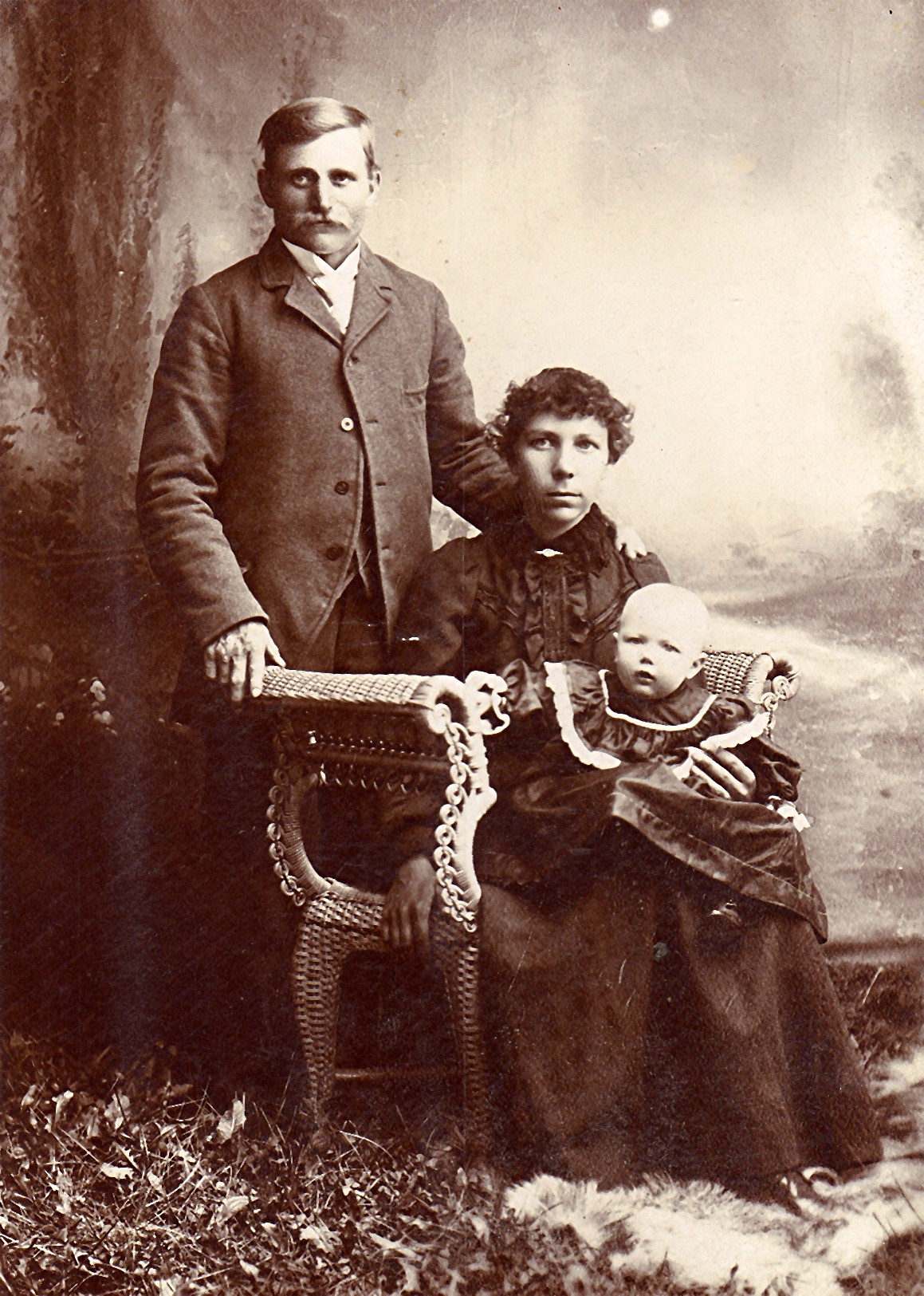
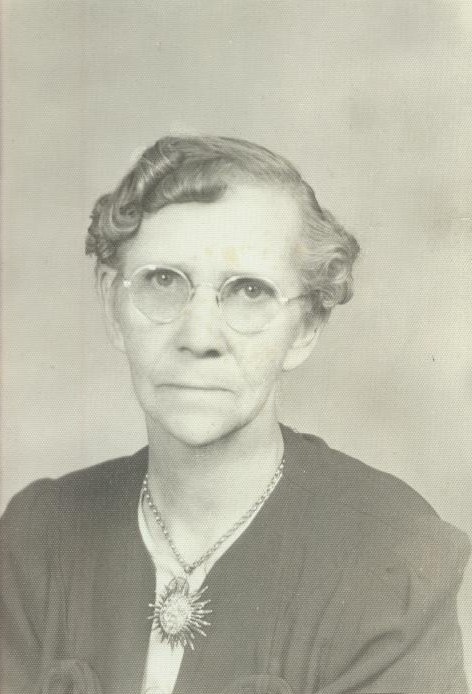
Herbert and Martha Coley (I have the original of Martha, but not of Herbert, so I know it is still out there)
Recorded family stories are fairly scant. Nobody wrote much down and that generation was gone before many were asking questions. Ivan Coley told his daughter Colleen that Herbert was a short, very English man. Apparently Herbert met Wild Bill Hickok at one point and shared that fact regularly.
In 1942, Herbert went to visit Ivan and Clara in Buhl. I will have to find out if Martha was there as well. While out in the yard, I have been told by a well, or a trough, he slipped and broke his hip. There was not really much to do for someone in that condition then. He was in terrible pain. He was taken back to Richmond and passed away later of pneumonia. He died 7 September 1942 at age 78 (obituaries all have 75) and was buried in Richmond Cemetery 9 September 1942.
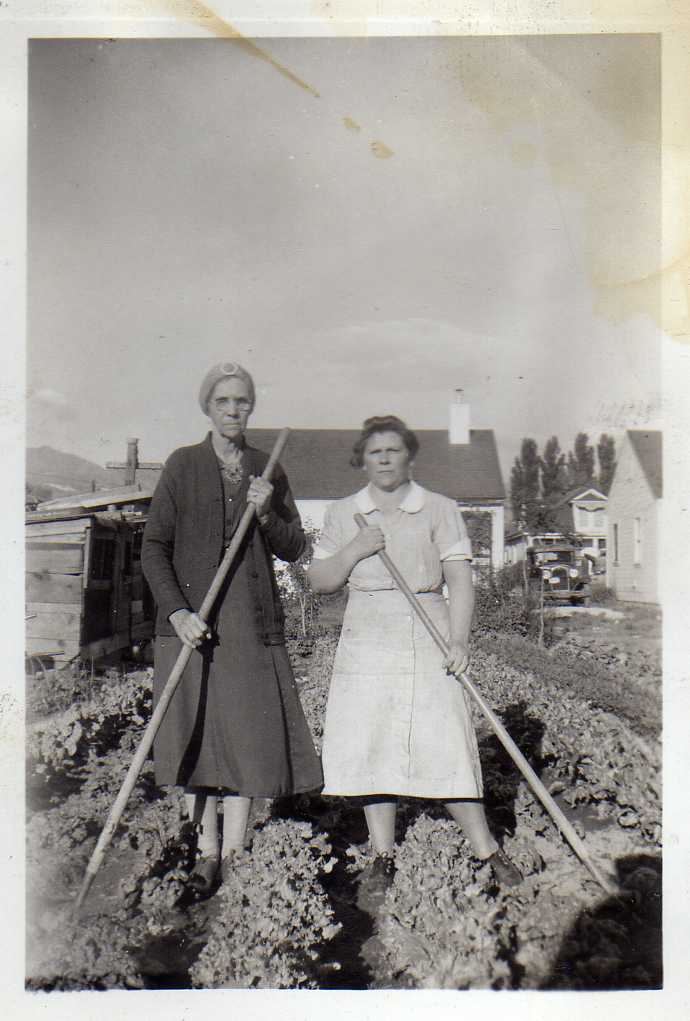
Martha Coley and Hannah Thomson in a garden, dresses and even a brooch
Martha moved into town shortly afterward. Various family members lived in the cabin when they started out their marriages. Martha’s new home was somewhere near 400 South and 200 East. With the new homes I cannot tell as well, but I have tried to pinpoint the spot. She lived in this home until she needed assistance and went to live with Lloyd and Veda in Salt Lake City. When they could not care for her any more, she then lived in a care facility in Logan the last months of her life.
5 generations about 1959, Lillian Coley Bowcutt, Martha Christiansen Coley, Joseph Hebert Jonas, Robert Lee Jonas, Joseph Leland Jonas.
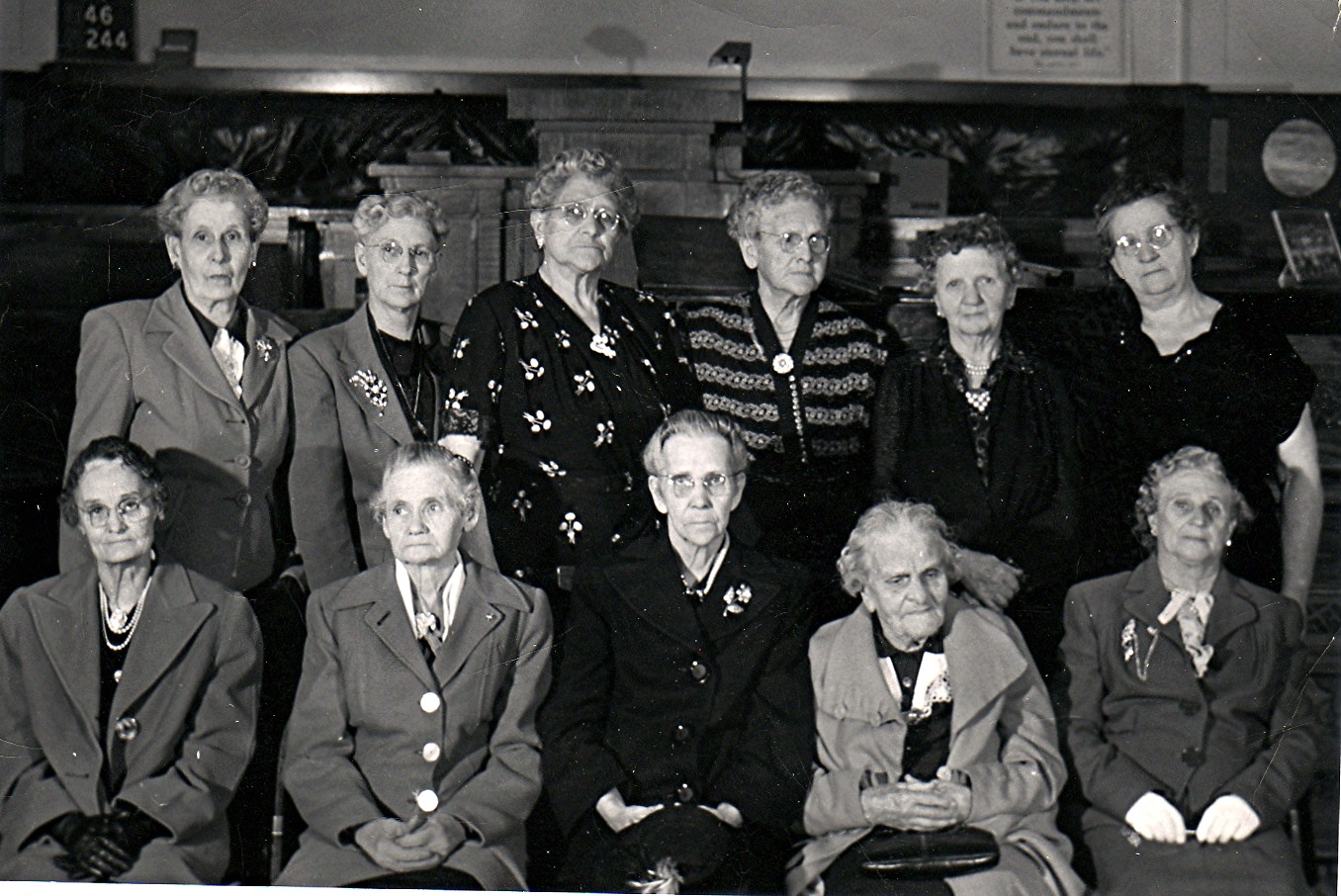
In 1948, Martha was honored for successfully Relief Society Teaching for more than 40 years. Here is a photo from that occasion. You can find more detail here.
Back (l-r): Lydia Leavitt, Estella Blair, Sarah Preece, Susanna Allen, Livinia Wilcox, Clara Wheeler. Front: Lavina Poulsen, Christensia Hansen, Martha Coley, Martha Lewis, Sarah Snelgrove.
Unfortunately I do not have a many more stories. But I do have a few more photos. We have these two photos of a gathering about 1950.
Back(l-r): Doreen Neilson, Martha Coley, Golden Coley, Edna Neilson, Unknown, Gloria Neilson holding unknown child, Olof Neilson. Middle: Shirley Coley, Joy Coley (baby), Mary Coley,
Mary (holding Joy), Shirley, Doreen, Unknown, Martha, Edna, Gloria
This wonderful family reunion picture from 1955. I have linked the other post sharing the other photo. That link also names everyone in the photo. Martha is sitting surrounded by her grandchildren and children.
1955 Coley Reunion, Richmond, Utah
Herbert’s obituary in the Salt Lake Telegram on 8 September 1942 reads:
“Richmond, Cache County – Funeral Services for Herbert Coley, 75, who died at his home in Richmond Monday at 7:45 a.m. following a brief illness will be conducted Wednesday at 1:30 p.m. in the Richmond South L.D.S. ward chapel by E. M. Hicken, Bishop.
“Mr. Coley was born in England on February 12, 1867, a son of Stephen and Hannah Rogers Coley. In 1885, at the age of 16, he immigrated to the United States.
“On December 1, 1896, he married Martha Christiansen in the Logan L.D.S. temple. He was a prominent farmer in the Richmond district.
“Surviving are his widow of Richmond, 10 sons and daughters, Mrs. Lillian Jonas, Ms. Edna Nielsen and William Golden Coley of Richmond, Wilford Herbert Coley of Logan, Ms. Hannah Thomson and Lloyd Coley of Salt Lake City, Ms. Carrie McMurdie, Ivan, Roland and Arthur Coley, all of Buhl, Idaho, 37 grandchildren, three great grandchildren, and a sister, Mrs. Martha France of Richmond.
Lillian, Edna, Martha (sitting) Coley in the 1940’s
“Friends Pay Tribute to Richmond Man
“Funeral Services for Herbert Coley, 75, prominent Richmond farmer who died at his home in Richmond, Monday at 7:45 a.m. following a brief illness, were conducted Wednesday at 1:30 p.m. in the Richmond South ward chapel by Bishop E. M. Hicken.
The rest of the article follows nearly verbatim what the Salt Lake obituary listed, then this line.
“Burial was in the Richmond cemetery under direction of the W. Loyal Hall mortuary.
Martha Christiansen Coley very small picture enlarged
Martha Coley and Scotty
Martha Coley serious
Martha Coley smile
Martha passed away in Logan at age 82 on 14 August 1961. Here is the language from her obituary and an article of the funeral. She was buried in Richmond 17 August 1961.
“Richmond – Martha Christensen Coley, 82, died at a rest home in Logan Monday of causes incident to age. “She was born April 16, 1879 in Norway to Ole and Constance Josephine Eliza Jorgensen Christensen. When she was eight years old she came with her parents to America. “On December 1, 1896 in Logan she married Herbert Coley. The marriage was solemnized in the Logan LDS Temple in 1900. They made their home in Lewiston and Richmond. She was always active in the LDS church, especially as a Relief Society block teacher. Mr. Coley died September 7, 1942. “Surviving are Mrs. Lorenzo (Lillian) Bowcutt and Mrs. Edna Neilsen, Richmond; Wilford H. Coley, Logan; Mrs. William (Hannah) Thompson and Lloyd O. Coley, Salt Lake City; Mrs. Lars (Carrie) McMurdie and Ivan S. Coley, Buhl, Idaho; Roland Coley, Mesa, Arizona; Arthur C. Coley, Ogden; William G. Coley, Hyrum; a number of grandchildren and great grandchildren. “Funeral services will be held Thursday at 1 p.m. in the Richmond South Ward with Bishop Oral Ballam in charge. “Friends may call at Hall Mortuary in Logan Wednesday from 7 to 9 p.m. and at the South Ward chapel Thursday from 11:30 a.m. until time of services. Burial will be in the Richmond Cemetery.
“Funeral services were held in the Richmond South Ward chapel Thursday for Mrs. Martha C. Coley with Counselor Quentin Peart conducting. Lloyd Coley gave the family prayer. “Prelude and postlude music was played by Reese Murray. The ward chorus directed by Mrs. Florence Lewis with Mrs. Billie Lou Bagley as accompanist sang “The Lord’s Prayer.” Ila Rae Richman and company sang “That Wonderful Mother of Mine.” Mrs. Florence Lewis and Mrs. Rebecca Lewis sang “In the Garden,” and Ronnie Lewis sang “Beyond the Sunset.” “Prayers were by William Thomson and Larus McMurdie. Speakers were Mrs. Leona McCarrey who read the obituary, Noel Stoddard and Counselor Peart. Pallbearers were her six sons, Wilford, Ivan, Roland, Lloyd, Arthur and Golden Coley. The grave in Richmond Cemetery was dedicated by Joseph Jonas. Flowers were cared for by the Relief Society.
~
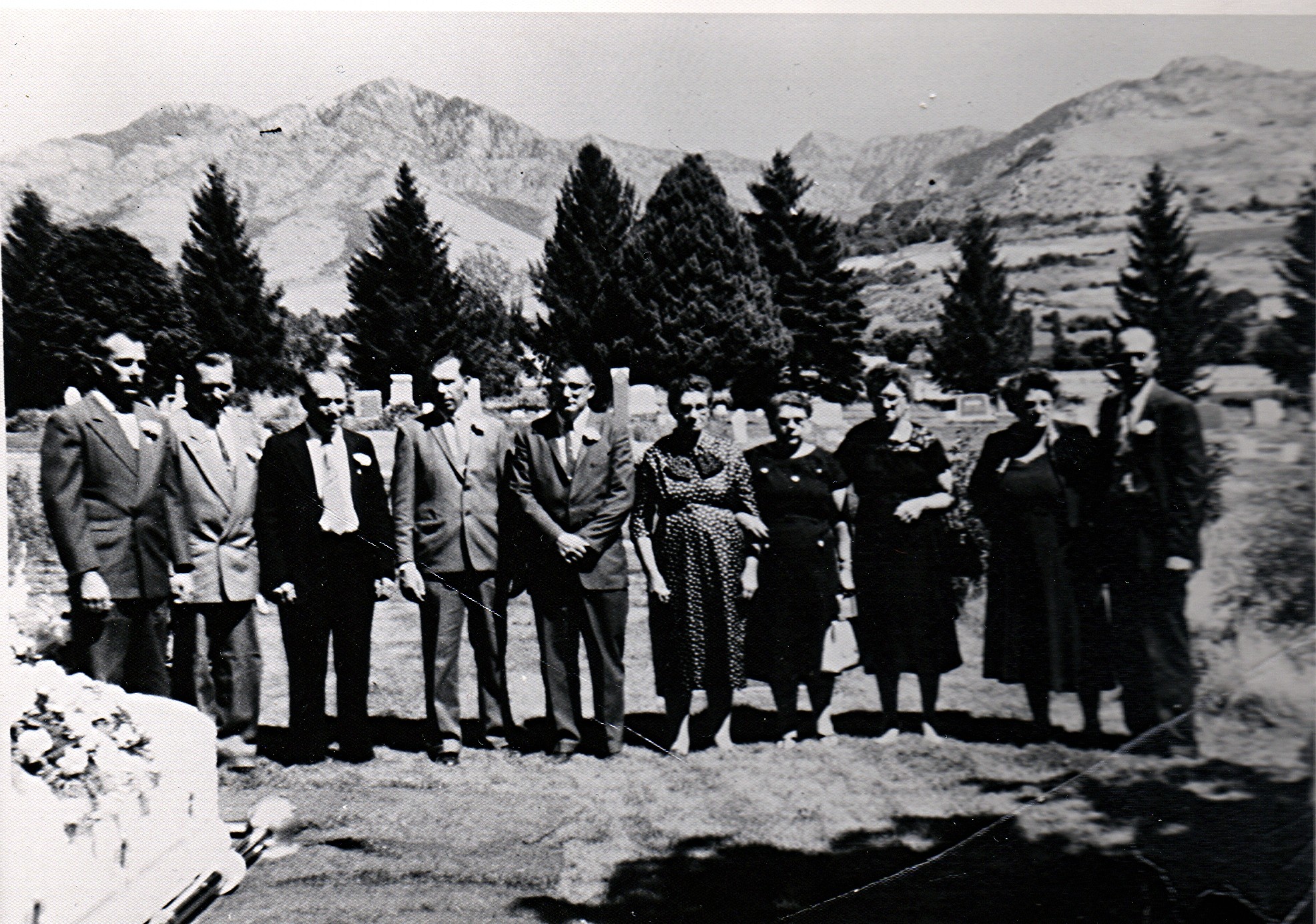
I have written previously about the video that came from the funeral and graveside service of Martha. In that post I walk through the video and the identified individuals. It also scans the 10 children standing in the cemetery. This photo below is of the same instant.
Art, Golden, Wilfred, Roland, Lloyd, Edna, Hannah, Carrie, Lillian, Ivan at their mother’s grave in Richmond, Utah
I hope some day I obtain more photos to share of Herbert and Martha.
This is another chapter of the Jonas history book compiled by Carvel Jonas. “The Joseph Jonas clan of Utah (including – early Jonas family history; early Nelson family history)” This one is on William Nelson Jonas.
John, Joseph, and William Jonas
“William had the same name as his great grandfather, William Jonas, although he never knew it in his life. Most likely he was named after his Uncle William Jonas. William Nelson Jonas, the second son and fifth child of Joseph Jonas and Annette Josephine Nelson, was born 2 December 1889, He was called “Bill” by his friends at church and “Willie” by his family at his home. His parents had, two years before his birth in 1887, sold their property 3 miles south of Ellensburg, Kittitas County, Washington State. But the family must have stayed in the area because William went to the public school in Ellensburg his 1st, 2nd, and 3rd elementary grades. The family then moved to a little town named Bristol, which is northwest of Ellensburg. When he was in his 4th grade the family was living in another town named Thorpe and he attended the school at Thorpe. Thorpe is another town northwest of Bristol. Sometime during this time William and his two brothers went to a neighbor’s place and swiped some apples. The kids also helped themselves to their cousin’s watermelon patch. in 1895, he went with his family to pick hops in Yakima. The 1900 census tells us that William and his family lived in another town which also is northwest of all the other towns mentioned. It is called Cle Elum. The family was renting a house in this western city. As far as we know the family always rented.
“William arrived in Crescent, Utah with his entire family 3 July 1901. He attended the public school in Jordan School District for the 5th, 6th, 7th, and 8th grades. He graduated 8 grade in Sandy. He was baptized a member of The Church of Jesus Christ of Latter-day Saints 10 January 1902, the same day his two brothers were baptized. When he was baptized he had just turned 12 years old by a little over a month. Up to that time he had been raised a Catholic. He was baptized in the Jordan River in South Jordan by his Uncle, Nels August Nelson. He was confirmed a member the same day by William Fairfard. There were no records found for William at the St. Andrew church in Ellensburg, so it is likely that his baptism was performed elsewhere. Shortly after he was baptized he was ordained a deacon in the Aaronic Priesthood. He remained a deacon until 6 January 1908 when he was ordained an Elder in the Melchizedek Priesthood by Bishop James P. Jensen. He was never ordained a Teacher or a Priest, which are the two offices traditionally held by young people in the Mormon Church before they are ordained an Elder. While he was a deacon he was called to be the secretary of the quorum. He was also the President of the deacons quorum for a few years. Perhaps after being raised in another church it was good training for William to remain a Deacon a little longer than usual. He belonged to the 7th Quorum of Elders in the Crescent Ward in Salt Lake County.
“During his stay in Crescent from 1901 to 1908 when he moved to Richmond, Utah, William helped his Uncle August on the family farm. According to August’s life story William and his brothers worked hard. It was understood that William and his brothers were to be given some land for the work they did on the Nelson farm. But the farm wasn’t given to anyone else because much of it was sold.
“William knew many of his cousins on his father’s side of the family until he was 12 years old. After July of 1901 he became familiar with all of his cousins on his mother’s side of the family by living with the Nelson family. William’s mother and this Uncle were the only two siblings in the Nelson family who had children of their own. One of his cousins from his mother’s side, Virgil Homer Nelson, wrote in his autobiography, “They (Rosa, John, William, and Joseph) gave me plenty of companionship. Our chief amusements were swimming, playing baseball, and skating.”
“William had a lot of farm land to discover. Virgil, August’s son, wrote that their farm, “…extended a mile along the east side of State Street and far to the east…a thousand acres of land in East Crescent and into the hill there.” On one occasion when William was in the area he found a dead man laying in a ditch.
“In the school year 1907 William went to the L.D.S. College, his first year in High School before moving to Richmond, Utah. William and his two brothers left Crescent and went to live with their only living sister, Rosa Jonas Andersen. When William had just turned 19 years he made this trip. One cold, snowing day in 1908 the three boys finally arrived at their sister’s home in Richmond, Utah. William worked four years for an August Larson in the summer and went to Brigham Young College at Logan for five years. Each year he received a sports letter in baseball.
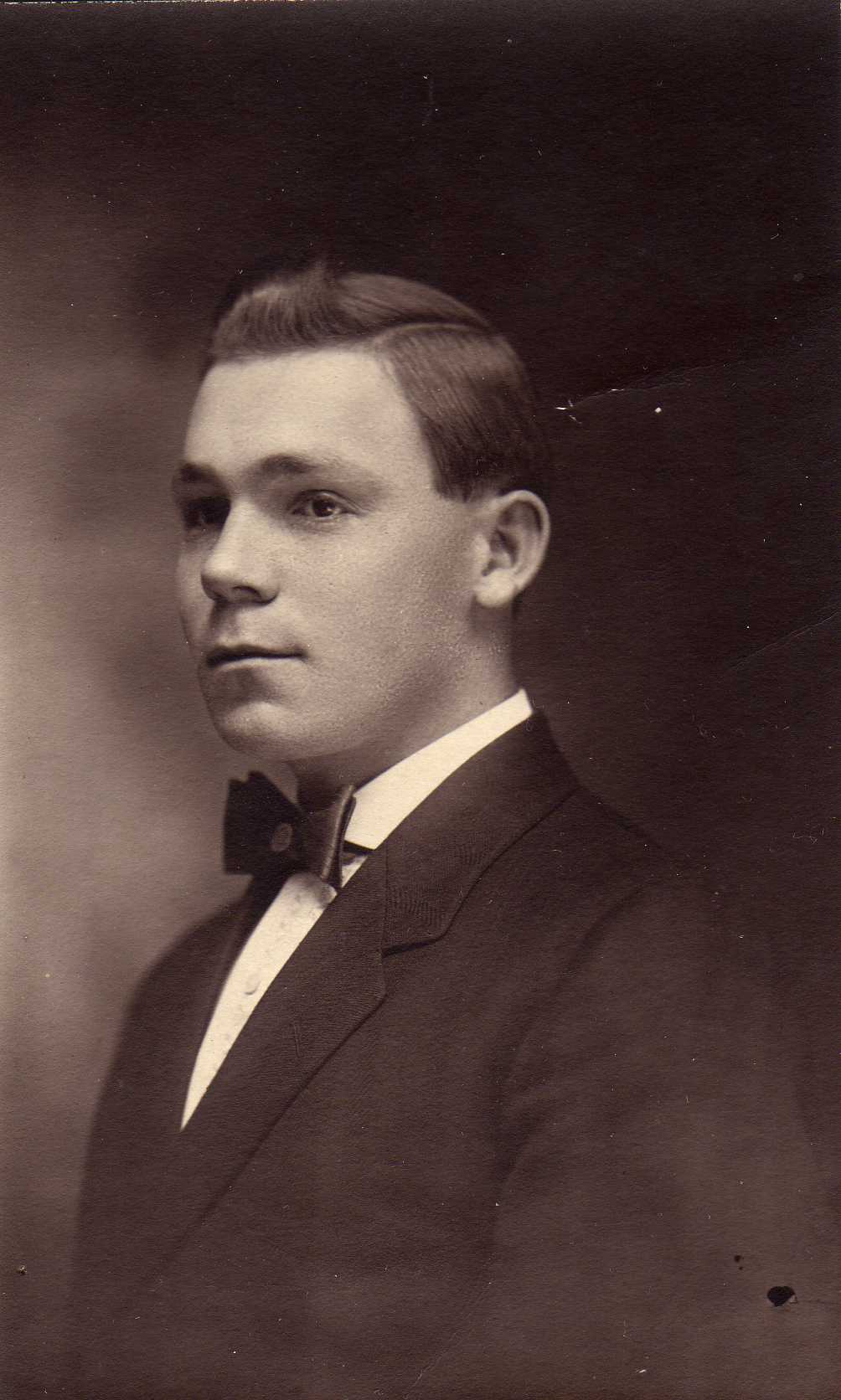
Loretta Merrill, William Nelson Jonas
“On 19 September 1909 he was ordained a Seventy by Charles H. Hart, the same day his brother, John, was also ordained a Seventy. He remained a Seventy for over 40 years. On 1 May 1908 he received a Normal Diploma at Logan, Utah, Brigham Young College. 2 June 1911 he graduated from the BYU College and received a General High School Diploma. Two years later he received a college diploma. On 4 September 1913 he received a Grammar Grade County Teacher’s Certificate for Public Schools of Utah. His graduation diploma states that he “passed an examination satisfactory in writing, arithmetic, pedagogy, physiology, reading, drawing, orthography, English, grammar, U.S. History, geography, nature study, psychology, and history of Education.”
William Jonas “To Father”
“The following post cards have survived since 1912. This is the year prior to his graduation from the college and gives a few insights into his personal feelings and activities. All the cards are written to Karen Marie Thompson whom he later married.
“Logan, 4 October 1912 “Dear friend, The first dance will be given Friday night. It was announced in chapel this morning. I do wish you could be here. I’ll be up Sat. noon and we’ll go, if not say so. I have a fine place to stay, with aunt Felelia and my cousins. With best wishes Wm. N. Jonas.”
“Logan 240 E. 3rd North. Oct 11. 1912 “Dear friend: School is fine and full of life. How is work, school and everything in particular? There will be an oration given this morning, you ought to hear it. I’ll not be up Sat. would certainly like to, but– Wishing you an enjoyable time. Your Friend William”
“Logan240 E. 3rd N Oct 18, 1912 “Dear Friend: I would like to come up Sat. but as I have work and a class entertainment Sat. It is impossible. Then too I’ll be up a week from tonight. I wish you could be down here tonight, a lecture and a dance. Work Sat. and have a dance. Have a good time, Don’t be angry. With best regards and wishes as ever, your friend, Wm”
“Logan, Oct 30, 1912 “Dear friend, Hoping you a most happy birthday and many good wishes. There is a dance tonight, a lecture Thur. night and another dance Fri. Always something doing in Logan. Tell everybody hello. as ever your friend Wm. N.”
“Logan, Nov 7, 1912 “Dear friend, Congratulation on Nilson and the De. We had a good conference here Sun. Joseph F. and his son Hyrum will speak. How are all the folks? We are all fine. How is the candy mouse? Well, how is school life and activities…as good as ever here. With best wishes from Wm. N”
“Nov 19, 1912 “Dear Friend, your card was only rec’d. Hope the best of health for your Pa. I won a quarter on the game between 1st and 2nd yrs R.H.S. Sat or Fri. We have a couple of excellent Musical recitals the last week at the Logan Tab and Nibley Hall. Wm N. How do you like the house work for a change or are you a hallo kid?”
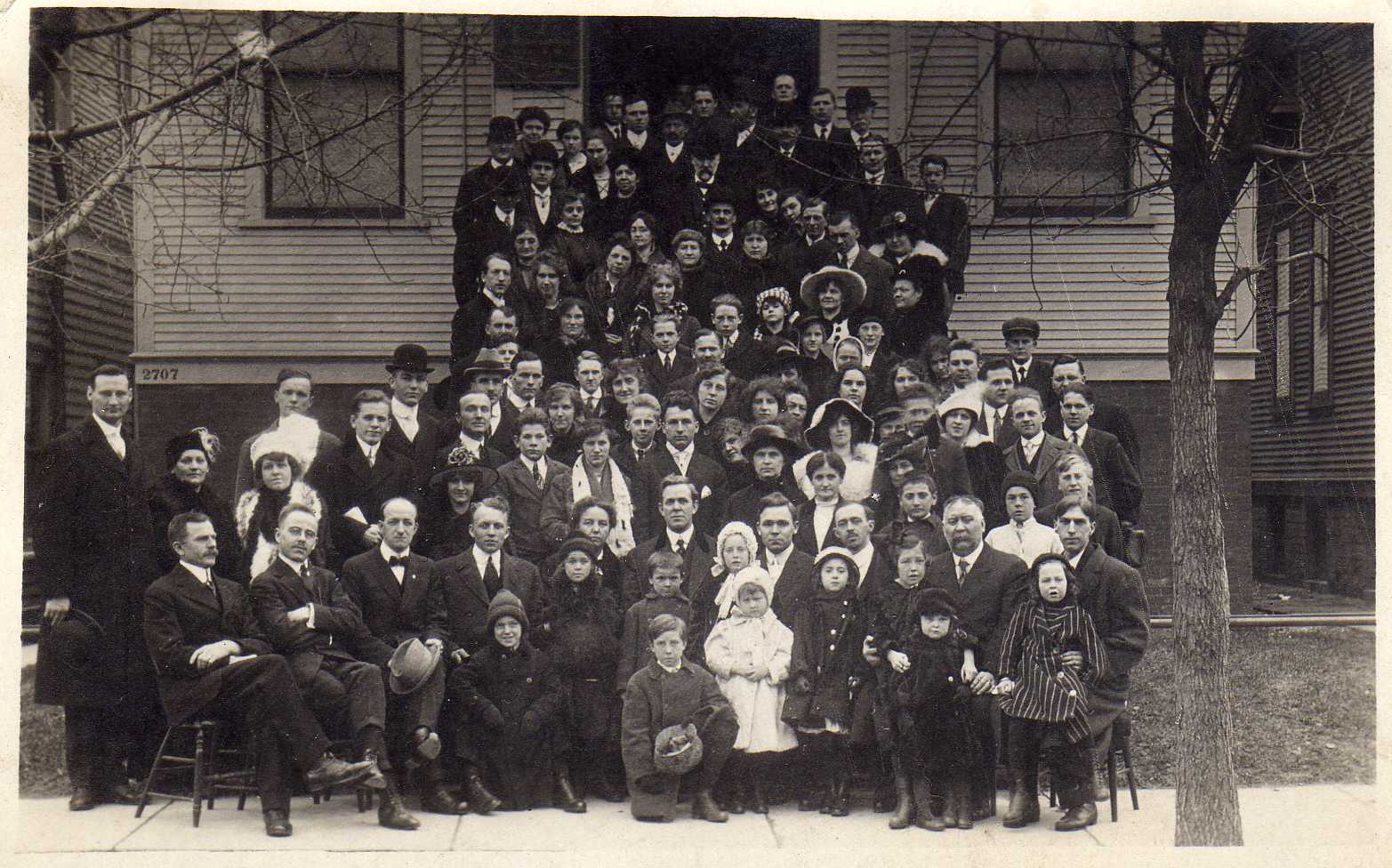
William Nelson Jonas, sitting middle, President of Wisconsin or Minnesota Conference, 1915 or 1916.
“William graduated from college soon after the above post cards were written, when he was 23 years old. 4 September 1913 when he received a Grammar Grade County Teacher’s Certificate for Public Schools. During 1913 he taught school at Lewiston and was principal of Wheeler School District. During this first year of teaching he received his endowments 22 May 1914, in the Logan Temple. After teaching for one year he was called on a mission for The Church of Jesus Christ of Latter-day Saints. He served for 27 months in the Northern States Mission. His only grandson who served a full time mission was called to the same mission about 60 years later. The mission was called the Minnesota-Wisconsin Mission in 1973. William was first given a minister’s certificate which was dated 2 June 1914 and was signed by the First Presidency of the Church. Several months earlier 16 April 1914, he had been called to the Switzerland and Germany Mission. He was to prepare to leave by 1 July 1914 and had a meeting with the Prophet at 9:00 A.M. that first day. However, he never went to Europe on his mission because of the First World War. He was then reassigned to the Northern States Mission, which had it’s mission headquarters in Chicago, Illinois. While he was on his mission he was called to preside over the Wisconsin Conference, 23 September 1915. He was next called to preside over the Minnesota Conference. 10 January 1916. While serving on his mission he lived at 2707 Clarke St. Milwaukee, Wisconsin; 31 South 5th Street La Crosse, Wisconsin; 247 North Gretto Street, St. Paul, Minnesota, and no doubt visited the mission home at 2555 North Sawyer Ave, Chicago, Illinois. He was released from his missionary service 20 August 1916.
William Jonas, seated with girl in white standing in front of him.
“After his mission he went to Cowley, Wyoming and served as a school principal. There were 18 graduates from the school that year. During the summer of 1917 he went to Provo, Utah, for 12 weeks of summer school. About this same time William went to Richmond, Utah for his father’s funeral. William was the person who gave the information for Joseph Jonas’ death certificate. He then went back to Wyoming and on the 28 February 1917 he registered in Big Horn County to teach school. Soon after that in the beginning of the school year of 1917 he accepted an offer to become coach of baseball and basketball teams at Dixie Normal College in St. George, Washington County, Utah. We have several pictures from the Dixie College School yearbook which was called “The Dixie”. Also, the following tributes from the same book. “Drafted (Class 1 A) It was under Coach Jonas that Cedar met their match in the Dixie basketball team. Favors the “Windsor Tie”.” And this one which was entitled “First Years”. “In September 1917, the D.N.C. found on hundred and five First Year’s invading it’s halls, with bewildered excitement. We did not remain in this state of unrest, however, for Father Jonas and Mother Watson soon had us under their protecting care. With their willing aid and the help of every Freshie, we came off the field on Founder’s Day, flying one blue ribbon and two red ones. The loyalty of our First Year Class was made evident by our purchase of a $100.00 Liberty Loan Bond and $75.00 in Thrift Stamps. We are justly proud of a Freshie lad who is a member of the D.N.C. debating team. Our class part early in December was very successful. If you do not believe us, As Jonas, Jr., and his partners.”
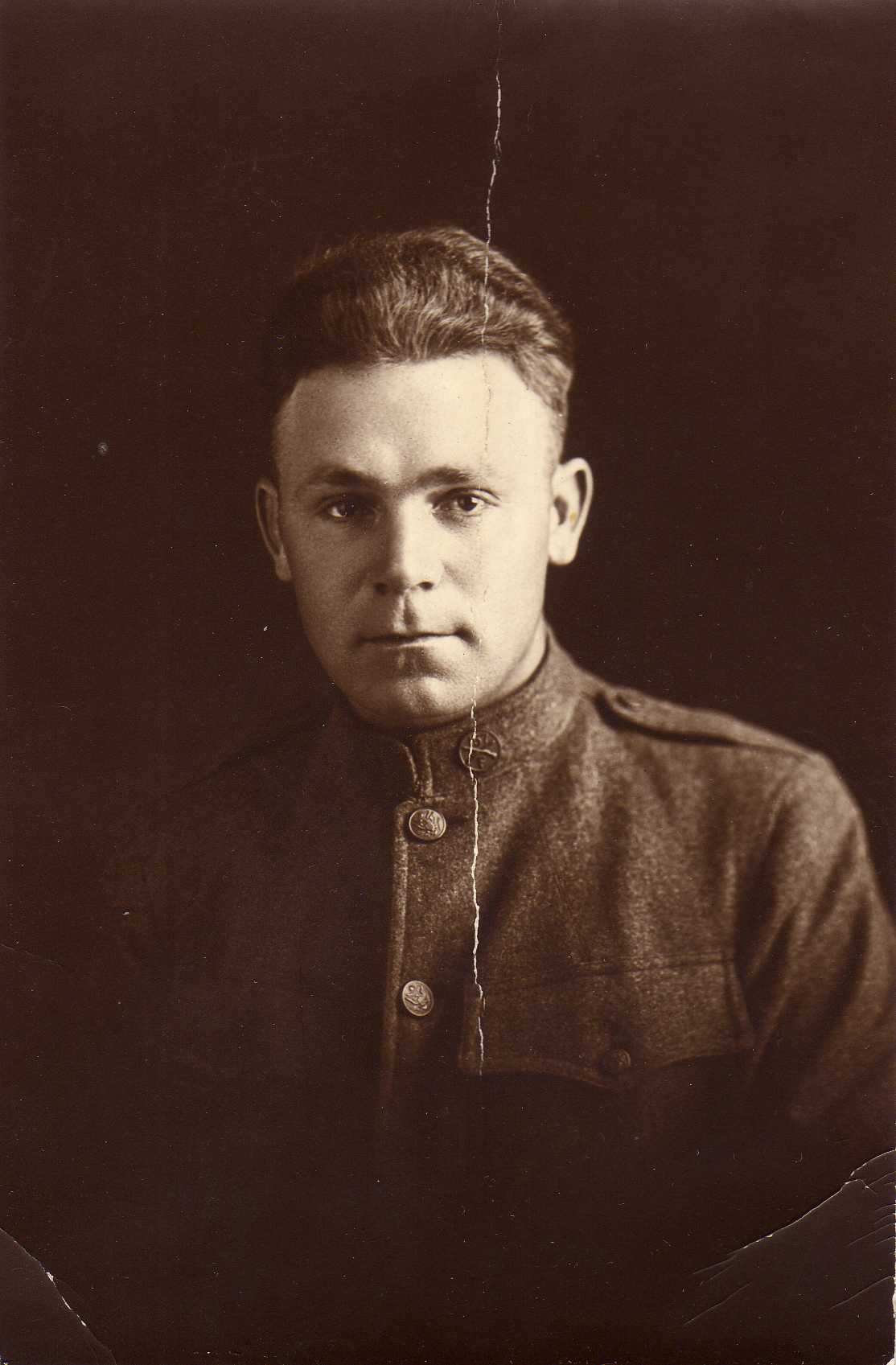
William Nelson Jonas WWI uniform
“The following 20 May 1918 William was inducted by the draft into the Army. On 25 May 1918 he was in a training camp. He went to camp Louise and then to Camp Kearney in California. On August 16, 1918 he left for France. Before he left he expressed to members of his family that he wouldn’t mind serving in the service if he didn’t have to kill people. To his relief he was a member of the medical detachment 145 artillery. He stayed five months in France. His army serial number was 3,127,617. He was a resident of St. George, but was inducted in Cache County. He was in Btry A 145 Fa by July 15, 1918. He went overseas from August 16, 1918 to January 4, 1919. He was honorable discharged January 24, 1919. He remained a private during his short stay. His Military records tell us that he was 28 8/12 years of age when he was inducted. He had brown eyes, brown hair and medium complexion. He was 5 feet 8 1/2 inches tall. He received paratyphoid shots 10 June 1918 for typhoid and was not wounded while he was gone. He is character was considered excellent. He was paid 24 dollars and 40 cents 24 January 1919 and was given travel pay back to Logan. During the voyage home William was so sick that he thought he might die. So he promised the Lord he would do whatever He wanted if his life would be spared. And he was faithful to that promise all his life.
“While William was in France he sent letters and post cards. One that still survives was sent to his cousin, Hubert Jonas, who lived in Washington State. The following is quoted from that card. “Camp DeSavage, France November 24, 1918. “Dear Cousin and Family, A Joyous Christmas from France. notice our gun ‘4 point 7’. 1898 date. The Regiment was organized 1916 on the Mexican border. 1918 France from the Beehive State Utah. had six weeks work in the hospital, am well near Bordeaux. Expect to move soon may be ‘over there’ too. Sure tickled. Best wishes and Love W. N. Jonas Sanitary Det. 145 FA Am. Ex. France.”
“While William was gone to war his older brother, John Jonas, died. John died 19 December 1918 and William arrived in New York 4 Feb 1915. He missed seeing his older brother for the last time by a little less than two months.
William Nelson Jonas and Karen Marie Thompson
“Two years after he got back from the Army he married Karen Marie Thompsen, 6 January 1921. They were married in the Logan Temple. Karen Marie was born 31 October 1892. She went to school in Richmond for eight years. She started when she was 8 years old and graduated at 15 years old. She had passed the sixth, seventh, and eight grades in two years. She worked in the Utah Condensory called Sego Mile, which canned milk. She worked for 13 years. Part of the time in the factory and part in the office. The company had an office in Logan in which she worked most of her 13 years. While she was working at Logan she also went to New Jersey Sewing Academy for nine weeks at night. On 9 March 1920 she received a patriarchal blessing. While she lived in the Murray area she was the quilt chairman in Relief Society for many years and went visiting teaching for many years. She loved flowers and had a flower garden most of the time.
“Mary, as she was called, was blessed by William G. Plonallsen 5 Jan 1893. She was baptized by Clarence L. Funk 1 September 1901. She was confirmed by Wallace K. Burnham 1 September 1901.
“Mary’s mother was named Jensine Caroline Christensen. She was born 11 April 1864 in Aarhus, Denmark. She joined The Church of Jesus Christ of Latter-day Saints in 1890 and came to America 6 July 1891. While she was sailing she met her husband, James Thomassen, who later changed his last name to Thompsen. They were married 24 December 1891. James Thompsen was never a member of the Church. He was immigrating to Richmond, Utah, to be with his older brother, John, and his younger sister, Johane Caroline. His brother, John Thomassen had joined The Church of Jesus Christ of Latter-day Saints 10 February 1869. He later immigrated to Utah to join the Saints. He was endowed 12 October 1875. John must have immigrated to America about that same year. It took his brother, James, about 16 years to follow his older brother to Utah. Caroline was converted to the Church by August S. Schow who was from Richmond Utah. That is one very important reason she moved to Richmond. Their children were the following: Karen Marie born 31 October 1892 ; Ebba born 31 April 1894; James born 6 September 1896; Alta born 12 August 1902; Leland and Stella were both still born April 1898; Michael born 13 July 1906. Caroline was a milliner in Denmark. She sold her hat shop and paid her ticket across the Atlantic to America. James was a carpenter and died at the age of 59. He was bitten by a pig and was poisoned. He suffered a great deal for four years before his death. James was born 19 August 1854 in Vildmose, Denmark and died 8 January 1913 in Richmond, Utah. Caroline died 17 July 1951 at 4:30 A.M. at daybreak on a Tuesday in Salt Lake City.
Vaughn, Gaylen, Karen, Maynard, William, and Delwyn Jonas with Alta, James, and Caroline Thompson
“William and Mary lived in Richmond, Utah, when they were first married. They went to the Benson Stake of the L.D.S. Church. In August of the same year (1921) they moved to Franklin, Idaho, so William could teach school. Mary worked checking ledgers for the Milk Condensory in Franklin, Logan, Richmond, and Hyrum during her life. By September of 1921 they moved to Thatcher, Idaho. They went to the Thatcher 2nd Ward in the Bannock Stake of the L.D.S. Church. William, his brother Joseph and his sister, Rosa with their families tried farming. William tried farming from Sept 1921 to Jun 1923 when they moved back to Logan. Apparently discouraged with farming William went to Park Valley, Utah, so he could teach school for one year. After school was over they moved back to Logan for a short while and then to Avon, Utah, for another teaching assignment. September 1924 William took an examination at West High School for the Post Office. He rated 3rd in his class with 93% – he got 5% for being a veteran. In August 1925 he started work for the post office. He worked there for 33 years and accumulated many days for not being sick. He worked the afternoon shift and would take the trolley car to town. He retired in 1958. His work consisted of being a supervisor and worked with the public weighing packages. His hours were from 3:00 P.M. to 11:00 P.M.
“L.D.S. Church records show that they moved into their home at 120 West Burton Ave in Salt Lake City the same month he was hired at the post office, August 1925. Mary’s mother also lived on Burton Ave. They were in the Burton Ward, Grant Stake. After they had lived on Burton Ave. where their son, Vaughn, was born they moved to 1854 East Clayborne in Salt Lake City in 1928. About 1931 they moved to 906 East 39th South in the Murray area. Then the family moved to 2964 South 9th East (where Carvel was born) in 1933. They lived there from 1933 to about 1942-43. Then they moved into the new home next door at 3974 South 9th East. When William first bought land in the Murray area he purchased 6 1/4 acres. William and his brother-in-law, Christian Andersen, built the home at 3974. Then they moved again to 3954 South 9th East in 1951. All three of the homes on 9th East were next door to each other. The home at 3954 was originally an Army barracks which was moved from Kearns and later remodeled by their son, Maynard. On 29 April 1962 they then moved to 1005 East 4025 South which was still in the Murray area. There they lived until each passed from this life to the next.
“William and Mary were the parents of 6 sons. The last son, William Thompson Jonas, was born what has been called a “blue baby”, and lived only 31 1/2 hours. He weighed 6 1/2 pounds and is buried in the Elysian Burial Grounds in Murray, Utah. He was blessed by his father the 22 October 1937. Their 3rd son, Gaylon Thompson Jonas, was killed 19 September 1944 on Peleliu Island in the Pacific Ocean. He had enlisted 19 August 1942 with the 2nd Mormon Battalion. He was awarded the Bronze Star, Purple Heart, Navy Citation Award, Pres. Citation, Navy Unit Cit., American Theater, Pac. with 3 stars. He was killed by a Japanese sniper’s bullet while removing a wounded man. He was killed while he was helping the fourth man that he helped that day. He had volunteered for the assignment.
“William blessed all six of his sons. He also confirmed 5 of them after they were baptized. Delwyn was blessed 2 April 1922 and confirmed 1 February 1931. Maynard was blessed 14 March 1925 and confirmed 3 December 1933. Vaughn was blessed 7 November 1926 and confirmed 4 November 1934. Carvel was blessed 17 September 1934 and confirmed 2 May 1943. William also ordained several of his sons to different offices in the Priesthood. Gaylen was ordained a Teacher 29 January 1940. Carvel a Deacon the 22 September 1944 and a Teacher 30 October 1949.
“William was actively involved in work for his Church all his life. He was Superintendent of the Sunday School of the Mill Creek Ward for 2 1/2 years. He served as Stake Supervisor of the gospel doctrine classes. During his gospel doctrine classes he would compare Catholic point of view with the L.D.S. view quite often according to his neighbor who attended his class. He also served as one of the Seven Presidents of the Seventy in his stake. He was a leader of the cottage meetings. And taught the genealogy class for many years and became one of the senior teachers of these genealogy classes. He was baptized for some of his dead ancestors and his wife’s dead ancestors. He served as a ward teacher for many years. He did all of the above including serving a full time mission for the Church before he was 50 years old (1940). After that on 20 Mary 1943 he received a missionary call from the Mill Creek Ward, Cottonwood Stake for a stake mission. He was set apart 26 March 1943 in the stake office at about 8:00 P.M. Afterwards he received another stake mission calling (this was his third mission). He and his wife Mary, were both called. William was set apart 12 May 194?. One of grandpa’s neighbors said that grandpa was considered a scriptorian by those who knew him in their ward, and that he had a hard time understanding why people didn’t recognize the truth in the scriptures. He was set apart Wednesday May 18, 1944 in the stake office at 176 Vine Street for this third mission. While William was on this stake mission his son, Gaylen, who was killed in World War II appeared to him twice requesting that his temple work be completed. His wife, Mary, was set apart 31 August 1949 so they could serve on a mission together. They received honorable releases from their stake missions 3 June 1951.
“When William was called on his second mission he wrote a letter which was printed in the Millcreek Courier, which was the ward paper. The following is quoted from that letter written March 1943, the same month he was called on his second mission. “Faith Unshaken Greetings to the boys in the service from Mill Creek; Recent events have not shaken my faith in the ultimate triumph of freedom and justice, for I was reared in a church where faith in God and belief that right will triumph eventually is too deeply ingrained in me to doubt its final victory. As long as we have faith at all in God, we must know that his is All-Powerful. That his will for the world is Justice and Right, and that eventually His purposes will be established here on earth. Good emerges slowly, but we must not doubt its victory.”
“”As to our country, my faith is our America, in its people, and in the American Way of Life, is unwavering. The United States is the greatest country on the earth, not because it is our country, but by comparison. It’s founding I believe to have been divinely ordained and that God had a mighty mission for the United States among the nations of the world.”
“”America was founded by our forefathers in prayer, in faith, and in the heroic spirit of sacrifice. Lives of comparative ease in their old country might have been theirs had they been willing to surrender their convictions. They chose the Hard Right rather than the Easy Wrong, and were ready to lay down their lives for freedom to worship God according to the dictates of their conscience. No matter what lies ahead, we must carry on to the best of our ability, doing our utmost from day to day, each in his own niche.”
“”After the Hard War No. I was over and the happy Peach had come, I experienced the most wonderful day of my life. February 4, 1919 we first saw the light reflections in the distance, then the lights, buildings, the land. Oh the shouts, “America”, “God’s country”, “Zion”, “Home Sweet Home”, ect. Believe me the statue of Liberty certainly faced the right way–in fact everything we saw was just O.K.”
“”I am now praying for a second great day to come soon, when this Hard War No. II is over and happy Peace is declared and my sons, Delwyn of the Army, Maynard of the Navy, and Gaylon of the Marines come marching home. Parents, fill in the names of your sons, and my God grant the day soon. Sincerely, William N. Jonas.”
“On 17 December 1950 William was ordained an High Priest making little over 40 years that he was a Seventy. He was ordained by Verl F. McMillian of the Mill Creek 2nd Ward in the Cottonwood Stake. After he was ordained an High Priest he was asked to teach the High Priest class for many years. He also became interested in doing the Jonas genealogical line. Around 1960-65 he wrote to places where his grandparents, Hubert and Mary Jonas lived after arriving in America. On 26 October 1960 he received a returned letter from the research department of the L.D.S. Church. He had paid people to help in the research. From this letter we were able to learn about the 1880 census of Nebraska where the family had lived. Another letter was received 13 April 1961 from the Register of Deeds, Monroe County, Michigan, written by the Genealogical Society research department. In behalf of William many land records for Hubert and Mary were then found. William wrote to the Texas State Department and Historical Society of Wisconsin hoping to find more information about our family. Also, he had driven to his place of birth, Ellensburg, Washington for some research and visited his cousin-in-law, Regina Jonas who was living in Vancouver at the time. The following is a quote from a letter he had written which shows the sincerity of his desires. “…this seems to be asking a lot. However, I will be glad to pay for services. Have you someone who is available for such work? I shall try to come to Ellensburg this summer if necessary. I thank you. William N. Jonas.” Many attempts were made to find out where the Jonas family had lived in Germany. Unfortunately, William never was able to discover that genealogy. But because of his efforts there were many clues for the author to use in what eventually lead to the discovery of the Jonas genealogy pedigree, and also this history book.
“The following are some observations about William that his children and friends have told me. William liked to garden. During hard economic times, and especially during the Great Depression, they always had a large vegetable garden. Although we don’t have the exact figures it was close to an half acre. They were able to provide for their family and also provided for a neighbor and his family who were experiencing financial difficulty. He enjoyed excellent, physical health all his life. He was in a car accident when he was older, about 1953-54. During the car accident the gear shifting know of a late model Cadillac punched his side. The knob was shaped like a tear drop. He was a passenger and had slid across the seat with his left side hitting the knob.
“After some of his children got back from their military service they thought they were in better physical shape than their father, who was in his 50’s. They oldest thought he could out arm wrestle his dad now. But William won the match.
“While he worked for the post office he played for the baseball team on the Industrial League. He was a good baseball player and had large knuckles on his left hand from catching baseballs.
“William was instrumental in helping his oldest son to get a job at the post office. He also helped his younger brother, Joseph, financially so he could go to college. William paid for the first month rent for his son, Carvel, when he was first married. Also, William and his wife, Mary, both visited Mr. and Mrs. Virgil Clayton and took pictures on several occasions of their grandson, Carvel Lee Jonas.
“William, when he lived on 9th East raised chickens, pigs, had a cow and an horse. Their children had pigeons and also dogs. They had an orchard of mostly apples, and grew hay and grain; potatoes and lots of vegetables. They had a chicken coop that was heated with a kerosene heater. On one occasion the chicken coop burned down and they lost all the chickens (perhaps as many as an hundred). While the chicken coop was burning William and his son, Maynard, tried to removed the heater and William was burned.
“One time William had bought a new pitch fork. He was able to carry so much hay at one time that the weight of the hay broke the handle of the new pitch fork.
“When William would read or study a book he would read with a pen or pencil and underline and make notes in the margins.
“A neighbor of William’s for over 25 years, Otto Hansen, said the William was very helpful in getting him a job for the post office. William had told him about the civil service test, and encouraged him to try and pass. This neighbor and his wife said that William and Mary were good neighbors and would do anything they could to give a helping hand to someone in need. They considered them to be very honest people. A story that they remember was when William was teaching the gospel doctrine class. Apparently, for a practical joke Mary would remove William’s notes that he had prepared to teach class with from his book. They said that they remember Bill saying, “Mary’s done it again.” Then he was left to use the scriptures and rely on memory and past study to make up a lesson on the spot.
“William died 14 April 1972. He suffered from senility for a few years before he died. Grandma had a neighbor put locks on the doors to keep grandpa Jonas from leaving without knowing where he was going. Even when he wasn’t at his best at the end of his life his thoughts were to go to the Church welfare farm and work. William had received an award for doing over 100 hours of volunteer work for the Church welfare farm in one year (1962), which made him 72-73 years of age.
“Even with the differences in personality of his sons, the one thing that they all agree on is that they had a very good father. Gaylen before he was killed in the war told his friend, “Blondy, I want you to (meet) my folks when we get a furlough, they are the best parents a guy could want.” His sons don’t agree on many things, but they all agree about how lucky they were to have such a wonderful father. That in itself is one of the finest tributes that a man could have.
“Merlin Andersen told me that he always had admired William’s language. William spoke as an educated man who had a firm grasp of the English language. William loved kids.
“Once William and Merlin were walking and they came to a creek. Merlin was wondering how he was going to cross because he didn’t feel like he could jump across and make the other side. Merlin was a young boy, but he remembers that William grabbed him and threw him easily to the other side of the creek.
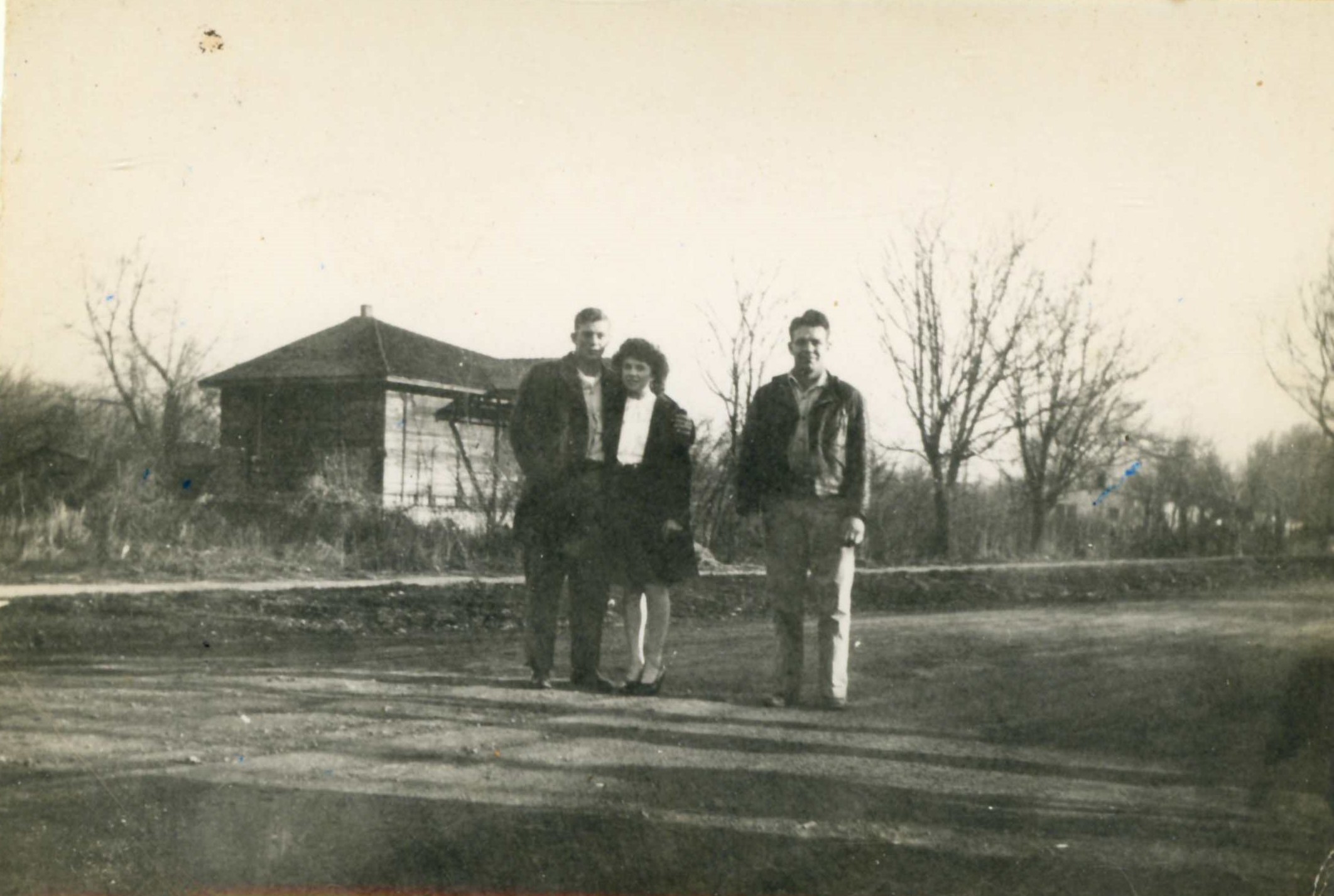
This photo I have sat on for a while. I simply did not know enough about it and probably won’t find out much more as time passes.
This is my Grandparents, Norwood and Colleen Jonas. I have been told the other man is Norwood’s brother, Joseph. I don’t dispute it, but I am just not certain.
I am told this photo is in Richmond, Utah, but nobody can quite pin down what the building is in the background or the road/grade in which they stand. The building does look like a granary, but seems too large. I wouldn’t think a granary would have a chimney. One told me there is a railroad track in the grade behind that I think simply looks like a great sidewalk next to an unpaved road. It is all a mystery.
Why would Grandpa and Grandma be out walking with brother Joe? Is this a new paving project? State Street? State Highway?
This is another chapter of the Jonas history book compiled by Carvel Jonas. “The Joseph Jonas clan of Utah (including – early Jonas family history; early Nelson family history)” This one is on Joseph Nelson Jonas. I have written a biography of Joseph and Lillian previously.
Joseph and Margaret Jonas about 1899
“Joseph Nelson Jonas was born 19 March 1893 at or near Ellensburg, Kittitas, Washington State. He was the 6th child and 3rd son of Joseph Jonas and Annetta Josephine Nelson. He became the youngest of the family (a younger sister was born after Joseph, but she died a few hours after birth). Joseph was about three years old when his mother left the family and went to the Washington State Hospital in 1896. Joseph lived in the Ellensburg area with his father and siblings until he was 8 years old. On 3 July 1901 the family moved to Crescent, Utah. He was baptized a member of The Church of Jesus Christ of Latter-day Saints 10 Jan 1902 by Aug Nelson. His two older brothers were also baptized that same day.
John, Joseph, and William Jonas
“He worked on his Uncle August Nelson’s farm until he moved to Richmond, Utah, to live with his older sister, Rosa, in 1908 when he was 15 years old. He traveled the same day with his two older brothers. When he was 23 years old he married Lillian Coley. They were married 6 September 1916 in the Logan Temple. That same day they were each endowed with the temple ordinances for the first time. Joseph met his wife while he was living in Richmond. His wife’s family had a farm in Richmond where Joseph had hired on as a far laborer to help the family harvest hay.
“About 6 months after they met they were married. His wife was 18 years old and Joseph was five years older than his wife, age 23. They became the parents of eight children, the first six were boys and the last two were girls. Joseph went to work for the sugar factory in Lewiston, Utah. By about 1920 Joseph had moved to Thatcher, Idaho with his brother, William and his sister, Rosa. They operated a dry farm which grew grain. Joseph had a wooden red house which had a front room, bedroom and a kitchen. His sister lived about a mile away in her own home and William lived in Thatcher teaching school. At the farm Joseph and others operated a combine which was pulled by horses and had blades that were taller than the men. The animals were kept in a barn which was about a block from the house. They had five horses, a cow, pigs, chickens, domestic animals and a vegetable garden. One horse was white and was named “dime.” To mail letters and receive letters the boys would need to ride Dime. This horse, while carrying his son, Joseph H., ran as fast as it could go all the way from getting the mail one day. This experience scared the young boy who was about 5 or 6 years old, and he had to hold on for fear of his life. About 1924 or 1925 Joseph moved from Thatcher to Lewiston, Utah. Joseph drove the wagon which carried some of his sister’s children. He began working for the Utah-Idaho Central Railroad. This was an electric inter-urban trolley railroad that had 94 miles of track and went from Ogden, Utah north to Preston, Idaho. Joseph began working on a section gang, the same type of job his father, Joseph, had had. Joseph worked keeping the track in operating condition by repairing rotten timbers, hammering spikes or tightening the bolts which kept the track together. He worked seven days a week, some of the work was all night, but he was able to come home after a shift was over. While the family lived in Lewiston they lived in a train box car, which had the wheels removed. There were two box cars which were used by the family. They were close together and a ditch ran under their box car. One car was used as a storage shed, the other one was used as the family home. Once there was a tub of gas which was stored in the shed. This gas caught on fire, which started the shed to burn. Joseph went to his wife and told her to leave because the shed was on fire and it may cause the house to burn down (the two structures were close together). She didn’t believe him, but there was little time to convince her so he picked her up and carried her outside. The best way to stop the fire was to remove the burning tub of gas–Joseph must have thought. So he went into the shed, picked up the burning tub of gas and took it outside. Joseph’s brave act saved his home from burning, but they lost the shed and it’s contents. Joseph spent about two weeks in the Ogden Hospital with 2nd and 3rd degree burns.
Joseph and some friends at work after a game of shoes
“About 1927 Joseph was promoted to Section Foreman and moved to Ogden with his family. His father, Joseph, had been a section foreman in a leadership position, too. Joseph worked on the railroad line that went from Ogden to Huntsville, and also a line that went to Plain City. Joseph worked at one time on the Quinney Railroad Line. Except for the Thatcher home the family rented their homes until Joseph died. They lived at 17th St. and Wall Ave. in an apartment complex owned by the railroad called a section house. This was a long, wooden building that was divided into rooms. Joseph’s family was the only one that had a porch, a special privilege given to Joseph because he was the foreman. Joseph had a vegetable garden when he lived in Ogden. He was a very generous host and his visitors were always given a lot to eat when they visited their home. Joseph was active in the L.D.S. Church. He was a strict father and was not afraid to “switch” his children when they got into trouble. He stood about 5’6″ tall and was muscular. His nephew, Merlin Andersen, said that Joseph told him “I want to show you what a good wrestler is!” Next thing Merlin knew was that he was on the ground. Joseph was on the wrestling team at Brigham Young College (Logan), the school he graduated from. Joseph and his brother, William, went to college some of the same time together.
Joseph Nelson Jonas’ Brigham Young College yearbook picture
“Joseph liked to discuss religion. He would argue with his siblings his point of view with determination. After the discussion all the siblings would talk nice to each other and gave each other hugs and handshakes. They family moved to 103 17th Street in Ogden. On 1 Aug 1932 Joseph last child was born. He was very glad to have two daughters after having six sons in a row. September 6, 1932, a little over a month later, Joseph and Lillian had their 16th wedding anniversary. Joseph had gone to work as usual that day. He was welding some train track on the corner of Lincoln and 20th East in Ogden. One week before, while Joseph was working in front of the American Cannery, he had been shocked by electricity and landed on the ground. He got up and went right back to work that day. But it was a week later when Norwood, Joseph’s son, was bringing his father something to eat. Norwood saw his father welding when someone started to move the trolley car. Joseph was welding a ground wire. Grounds were put into the track to the electricity would go harmlessly into the earth. This time the electricity, cause by the trolley being moved, went to the ground which Joseph was touching. Joseph was killed Sept 6, 1932 on his 16th wedding anniversary. The Ogden City paper, dated Sept 8, 1932 carried the following obituary. “Ogden-Funeral services for Joseph Jonas, 39 of 103 Seventeenth Street, section foreman for the Utah-Idaho Central Railroad Company, who was electrocuted Tuesday afternoon, will be held Friday, at 10 A.M., in the Lindquist’s Chapel, with Bishop Huggins of the Tenth ward in charge. Investigations into the death of Mr. Jonas are being conducted by the railroad company.” He was buried in Richmond Cemetery where two of his sons, his wife, his brother, John, and his father, Joseph are also buried.
“Merlin Andersen gave me the following tidbits about his uncle, Joseph. “Joe always had cows so he could have enough milk for all his kids. He was an ambitious person-he had a way to get things done.”
“Lillian told me the following story. One day we went to the movies. This was when Lillian was about 5 months pregnant. When they had both decided to cross the road near the movie theater a car ran over both of her legs. Her legs weren’t broken, but were badly bruised. The other family felt so badly that the mother of the boy who was driving the car became good friends with Lillian. This mother visited and gave Lillian comfort during her recovery.
“Joseph Nelson Jonas had read the Bible so much that he could quote scriptures and could back up his knowledge by finding the scripture and showing it to people.
Jonas Family Home at 142 North State Street, Richmond, Utah in 1960
If this picture doesn’t conjure late 1950’s Americana, I don’t know what does. Norwood and Colleen Jonas built this home. The house still stands at 142 North State Street, Richmond, Utah. Colleen stands with her bicycle near the front door.
My mother, Sandy, stands holding the bike upright while Doug is crouched behind it for some purpose. Since Jackie was born in 1960 and Grandma is in maternity clothes, this would have been the spring or summer leading up to August 1960. Doug couldn’t remember which Beck boy this was with the bike in the front. Gary Beck was born in 1947, Kenny in 1949. I am guessing this looks more like a 13 year old than a 11 year old, so probably Gary Beck.
The Cadillac in the driveway is interesting. I don’t recall ever being told the family owning a Cadillac, I heard about Plymouths and Buicks, but never a 1953 Cadillac. In doing more research and a call from my Uncle Doug, the plates on the Cadillac are from 2C. While outsiders consider this unique, Idaho still follows this model. 2C is Canyon County. Vance and Millie Beck, Colleen’s sister, lived in Nampa in Canyon County. Doug also let me know that Becks did own a Cadillac like this and it eventually went to Preston to my Great Grandparents and roamed around Preston and the farm for a few years. Doug told me that he remembers this particular date and instance like it was yesterday!
The bicycle Mom holds is also interesting. It looks similar to an old bicycle I rode around Paul, Idaho in my youth.
















 Sagacity