Jonas History: William Nelson Jonas

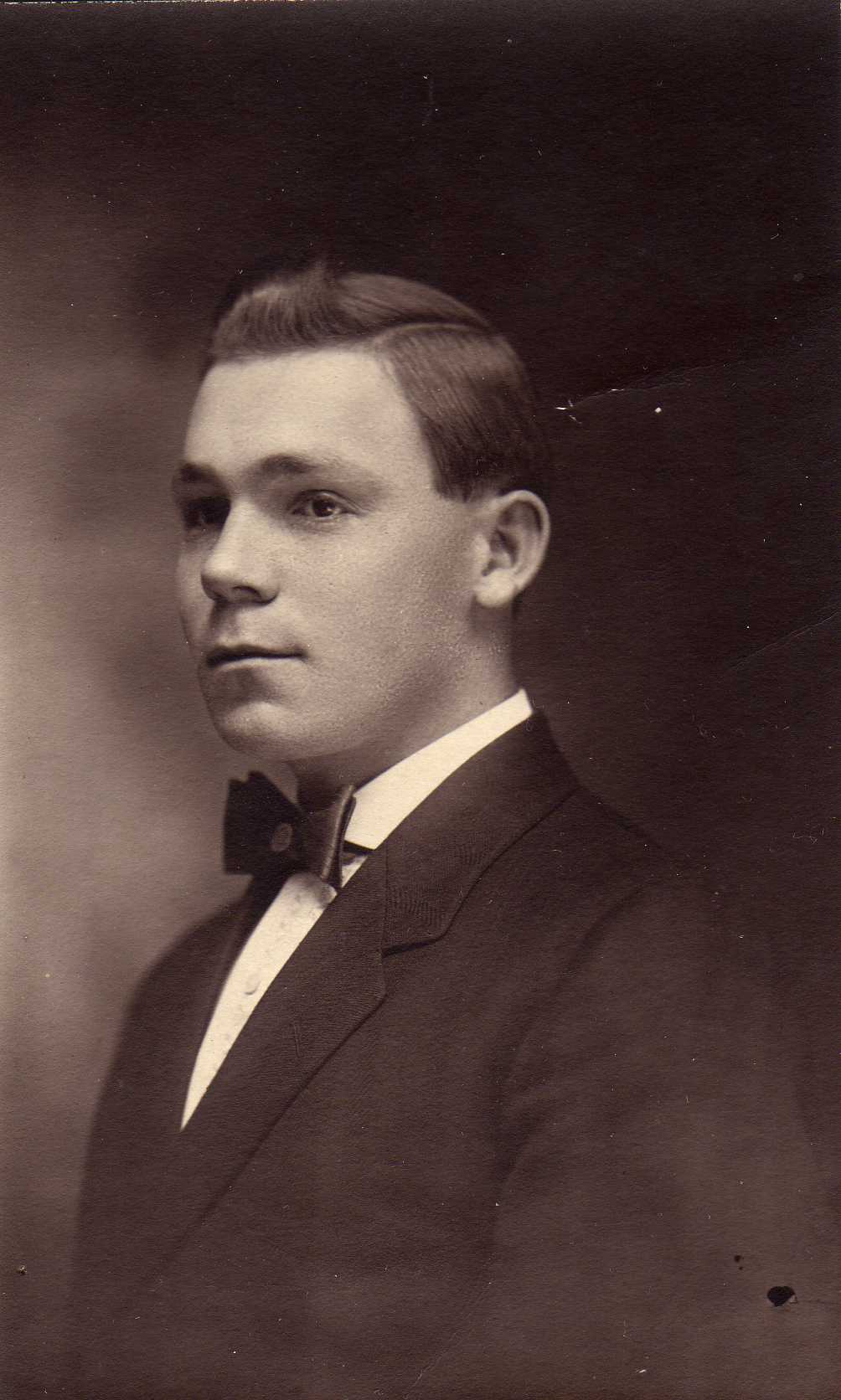
William Nelson Jonas

This is another chapter of the Jonas history book compiled by Carvel Jonas. “The Joseph Jonas clan of Utah (including – early Jonas family history; early Nelson family history)” This one is on William Nelson Jonas.

John, Joseph, and William Jonas

“William had the same name as his great grandfather, William Jonas, although he never knew it in his life.  Most likely he was named after his Uncle William Jonas.  William Nelson Jonas, the second son and fifth child of Joseph Jonas and Annette Josephine Nelson, was born 2 December 1889, He was called “Bill” by his friends at church and “Willie” by his family at his home.  His parents had, two years before his birth in 1887, sold their property 3 miles south of Ellensburg, Kittitas County, Washington State.  But the family must have stayed in the area because William went to the public school in Ellensburg his 1st, 2nd, and 3rd elementary grades.  The family then moved to a little town named Bristol, which is northwest of Ellensburg.  When he was in his 4th grade the family was living in another town named Thorpe and he attended the school at Thorpe.  Thorpe is another town northwest of Bristol.  Sometime during this time William and his two brothers went to a neighbor’s place and swiped some apples.  The kids also helped themselves to their cousin’s watermelon patch.  in 1895, he went with his family to pick hops in Yakima.  The 1900 census tells us that William and his family lived in another town which also is northwest of all the other towns mentioned.  It is called Cle Elum.  The family was renting a house in this western city.  As far as we know the family always rented. 

“William arrived in Crescent, Utah with his entire family 3 July 1901.  He attended the public school in Jordan School District for the 5th, 6th, 7th, and 8th grades.  He graduated 8 grade in Sandy.  He was baptized a member of The Church of Jesus Christ of Latter-day Saints 10 January 1902, the same day his two brothers were baptized.  When he was baptized he had just turned 12 years old by a little over a month.  Up to that time he had been raised a Catholic.  He was baptized in the Jordan River in South Jordan by his Uncle, Nels August Nelson.  He was confirmed a member the same day by William Fairfard.  There were no records found for William at the St. Andrew church in Ellensburg, so it is likely that his baptism was performed elsewhere.  Shortly after he was baptized he was ordained a deacon in the Aaronic Priesthood.  He remained a deacon until 6 January 1908 when he was ordained an Elder in the Melchizedek Priesthood by Bishop James P. Jensen.  He was never ordained a Teacher or a Priest, which are the two offices traditionally held by young people in the Mormon Church before they are ordained an Elder.  While he was a deacon he was called to be the secretary of the quorum.  He was also the President of the deacons quorum for a few years.  Perhaps after being raised in another church it was good training for William to remain a Deacon a little longer than usual.  He belonged to the 7th Quorum of Elders in the Crescent Ward in Salt Lake County.   

“During his stay in Crescent from 1901 to 1908 when he moved to Richmond, Utah, William helped his Uncle August on the family farm.  According to August’s life story William and his brothers worked hard.  It was understood that William and his brothers were to be given some land for the work they did on the Nelson farm.  But the farm wasn’t given to anyone else because much of it was sold.     

“William knew many of his cousins on his father’s side of the family until he was 12 years old.  After July of 1901 he became familiar with all of his cousins on his mother’s side of the family by living with the Nelson family.  William’s mother and this Uncle were the only two siblings in the Nelson family who had children of their own.  One of his cousins from his mother’s side, Virgil Homer Nelson, wrote in his autobiography, “They (Rosa, John, William, and Joseph) gave me plenty of companionship.  Our chief amusements were swimming, playing baseball, and skating.”   

“William had a lot of farm land to discover.  Virgil, August’s son, wrote that their farm, “…extended a mile along the east side of State Street and far to the east…a thousand acres of land in East Crescent and into the hill there.”  On one occasion when William was in the area he found a dead man laying in a ditch.   

“In the school year 1907 William went to the L.D.S. College, his first year in High School before moving to Richmond, Utah.  William and his two brothers left Crescent and went to live with their only living sister, Rosa Jonas Andersen.  When William had just turned 19 years he made this trip.  One cold, snowing day in 1908 the three boys finally arrived at their sister’s home in Richmond, Utah.  William worked four years for an August Larson in the summer and went to Brigham Young College at Logan for five years.  Each year he received a sports letter in baseball.   

Loretta Merrill, William Nelson Jonas

“On 19 September 1909 he was ordained a Seventy by Charles H. Hart, the same day his brother, John, was also ordained a Seventy.  He remained a Seventy for over 40 years.  On 1 May 1908 he received a Normal Diploma at Logan, Utah, Brigham Young College.  2 June 1911 he graduated from the BYU College and received a General High School Diploma.  Two years later he received a college diploma.  On 4 September 1913 he received a Grammar Grade County Teacher’s Certificate for Public Schools of Utah.  His graduation diploma states that he “passed an examination satisfactory in writing, arithmetic, pedagogy, physiology, reading, drawing, orthography, English, grammar, U.S. History, geography, nature study, psychology, and history of Education.”   

William Jonas “To Father”

“The following post cards have survived since 1912.  This is the year prior to his graduation from the college and gives a few insights into his personal feelings and activities.  All the cards are written to Karen Marie Thompson whom he later married.   

“Logan, 4 October 1912  “Dear friend, The first dance will be given Friday night.  It was announced in chapel this morning.  I do wish you could be here.  I’ll be up Sat. noon and we’ll go, if not say so.  I have a fine place to stay, with aunt Felelia and my cousins.  With best wishes Wm. N. Jonas.”   

“Logan 240 E. 3rd North.  Oct 11. 1912 “Dear friend: School is fine and full of life.  How is work, school and everything in particular?  There will be an oration given this morning, you ought to hear it.  I’ll not be up Sat. would certainly like to, but–  Wishing you an enjoyable time.  Your Friend William”   

“Logan240 E. 3rd N Oct 18, 1912 “Dear Friend: I would like to come up Sat. but as I have work and a class entertainment Sat.  It is impossible.  Then too I’ll be up a week from tonight.  I wish you could be down here tonight, a lecture and a dance.  Work Sat. and have a dance.  Have a good time, Don’t be angry.  With best regards and wishes as ever, your friend, Wm”   

“Logan, Oct 30, 1912  “Dear friend, Hoping you a most happy birthday and many good wishes.  There is a dance tonight, a lecture Thur. night and another dance Fri.  Always something doing in Logan.  Tell everybody hello.  as ever your friend Wm. N.”   

“Logan, Nov 7, 1912  “Dear friend, Congratulation on Nilson and the De.  We had a good conference here Sun.  Joseph F. and his son Hyrum will speak.  How are all the folks?  We are all fine.  How is the candy mouse?  Well, how is school life and activities…as good as ever here.  With best wishes from Wm. N”   

“Nov 19, 1912  “Dear Friend, your card was only rec’d.  Hope the best of health for your Pa.  I won a quarter on the game between 1st and 2nd yrs R.H.S. Sat or Fri.  We have a couple of excellent Musical recitals the last week at the Logan Tab and Nibley Hall.  Wm N.  How do you like the house work for a change or are you a hallo kid?”   

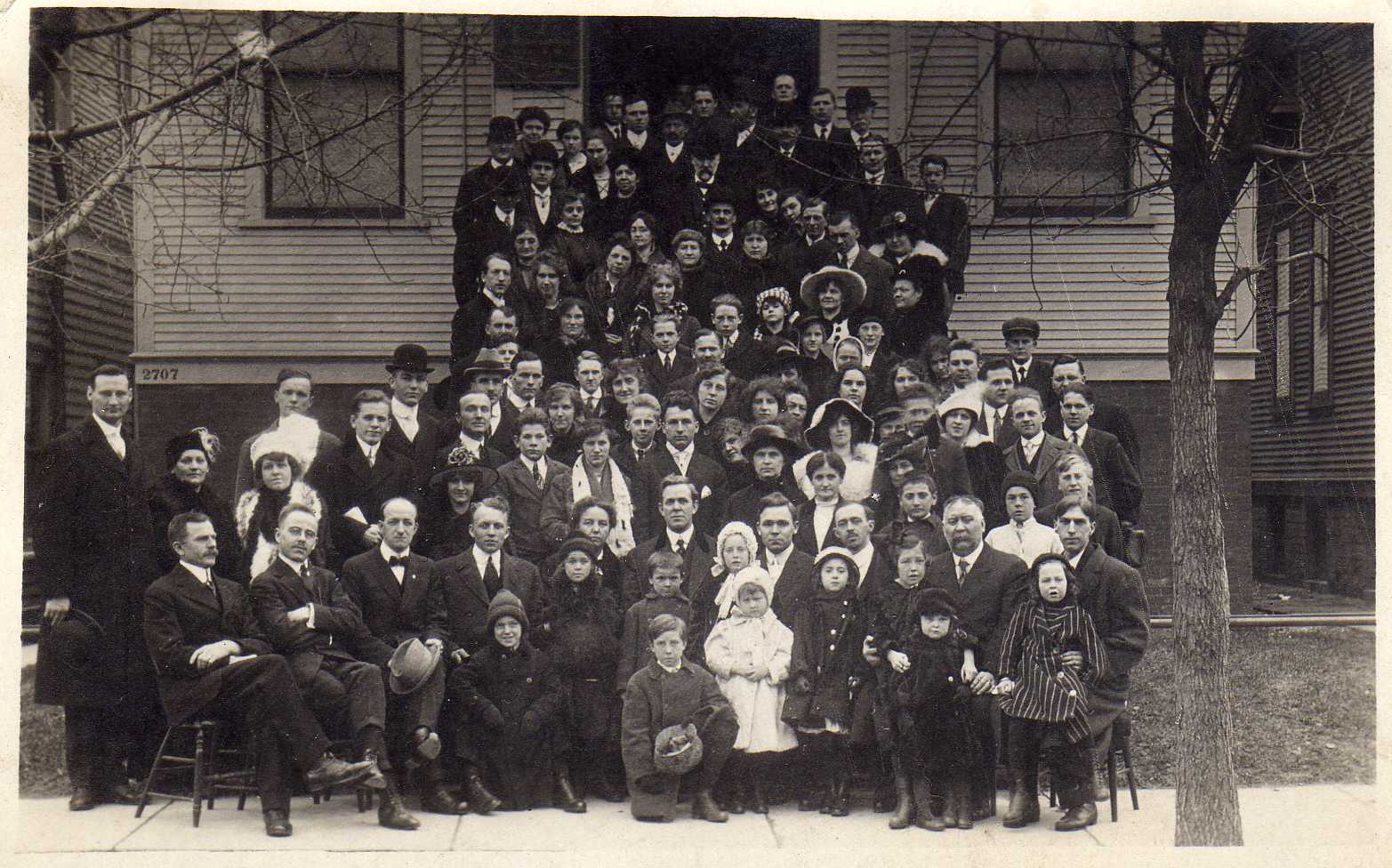
William Nelson Jonas, sitting middle, President of Wisconsin or Minnesota Conference, 1915 or 1916.

“William graduated from college soon after the above post cards were written, when he was 23 years old.  4 September 1913 when he received a Grammar Grade County Teacher’s Certificate for Public Schools.  During 1913 he taught school at Lewiston and was principal of Wheeler School District.  During this first year of teaching he received his endowments 22 May 1914, in the Logan Temple.  After teaching for one year he was called on a mission for The Church of Jesus Christ of Latter-day Saints.  He served for 27 months in the Northern States Mission.  His only grandson who served a full time mission was called to the same mission about 60 years later.  The mission was called the Minnesota-Wisconsin Mission in 1973.  William was first given a minister’s certificate which was dated 2 June 1914 and was signed by the First Presidency of the Church.  Several months earlier 16 April 1914, he had been called to the Switzerland and Germany Mission.  He was to prepare to leave by 1 July 1914 and had a meeting with the Prophet at 9:00 A.M. that first day.  However, he never went to Europe on his mission because of the First World War.  He was then reassigned to the Northern States Mission, which had it’s mission headquarters in Chicago, Illinois.  While he was on his mission he was called to preside over the Wisconsin Conference, 23 September 1915.  He was next called to preside over the Minnesota Conference.  10 January 1916.  While serving on his mission he lived at 2707 Clarke St. Milwaukee, Wisconsin; 31 South 5th Street  La Crosse, Wisconsin; 247 North Gretto Street, St. Paul, Minnesota, and no doubt visited the mission home at 2555 North Sawyer Ave, Chicago, Illinois.  He was released from his missionary service 20 August 1916. 
William Jonas, seated with girl in white standing in front of him.

“After his mission he went to Cowley, Wyoming and served as a school principal.  There were 18 graduates from the school that year.  During the summer of 1917 he went to Provo, Utah, for 12 weeks of summer school.  About this same time William went to Richmond, Utah for his father’s funeral.  William was the person who gave the information for Joseph Jonas’ death certificate.  He then went back to Wyoming and on the 28 February 1917 he registered in Big Horn County to teach school.  Soon after that in the beginning of the school year of 1917 he accepted an offer to become coach of baseball and basketball teams at Dixie Normal College in St. George, Washington County, Utah.  We have several pictures from the Dixie College School yearbook which was called “The Dixie”.  Also, the following tributes from the same book.  “Drafted (Class 1 A) It was under Coach Jonas that Cedar met their match in the Dixie basketball team.  Favors the “Windsor Tie”.”  And this one which was entitled “First Years”.  “In September 1917, the D.N.C. found on hundred and five First Year’s invading it’s halls, with bewildered excitement.  We did not remain in this state of unrest, however, for Father Jonas and Mother Watson soon had us under their protecting care.  With their willing aid and the help of every Freshie, we came off the field on Founder’s Day, flying one blue ribbon and two red ones.  The loyalty of our First Year Class was made evident by our purchase of a $100.00 Liberty Loan Bond and $75.00 in Thrift Stamps.  We are justly proud of a Freshie lad who is a member of the D.N.C. debating team.  Our class part early in December was very successful.  If you do not believe us, As Jonas, Jr., and his partners.”   
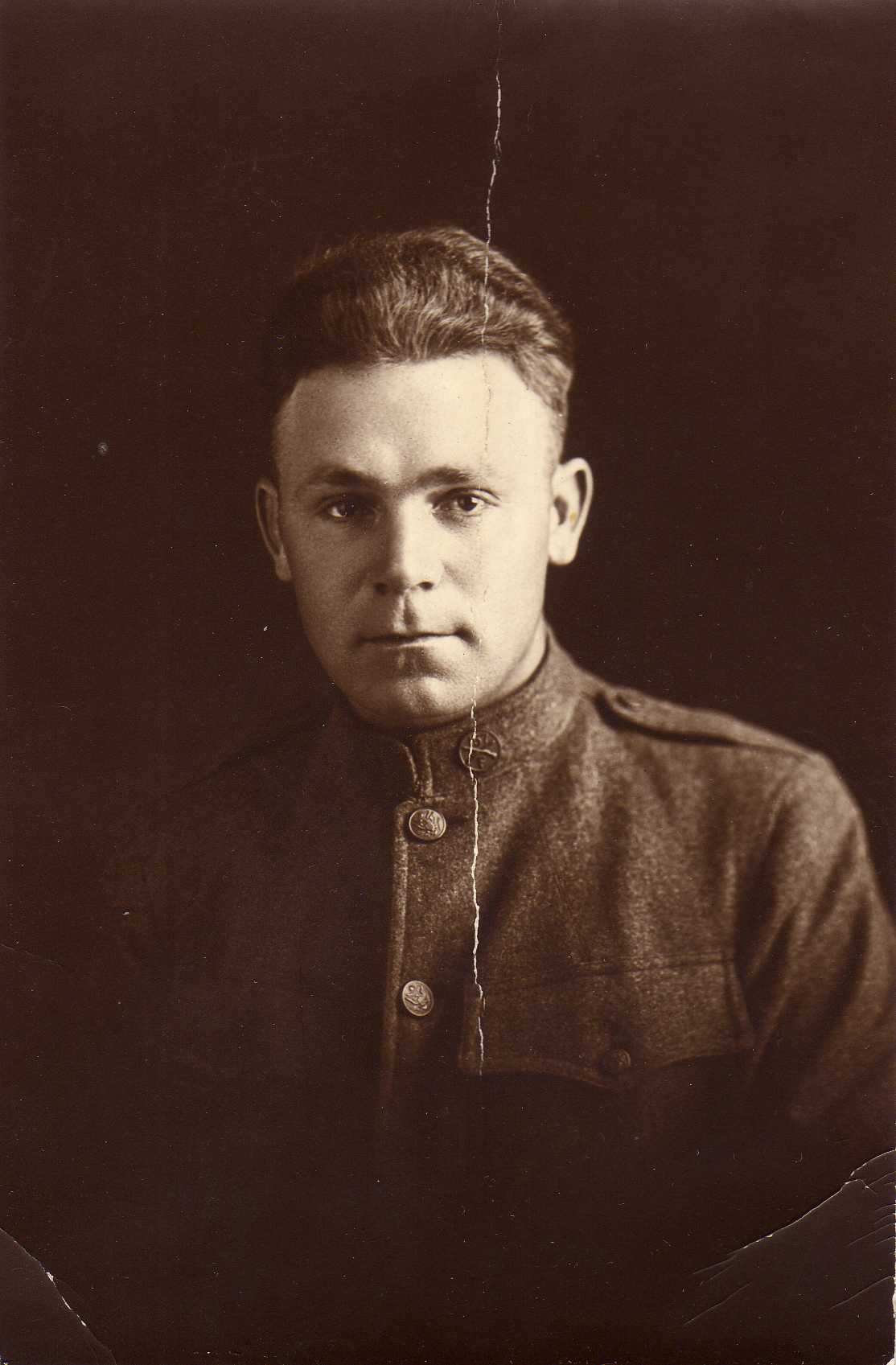
William Nelson Jonas WWI uniform

“The following 20 May 1918 William was inducted by the draft into the Army.  On 25 May 1918 he was in a training camp.  He went to camp Louise and then to Camp Kearney in California.  On August 16, 1918 he left for France.  Before he left he expressed to members of his family that he wouldn’t mind serving in the service if he didn’t have to kill people.  To his relief he was a member of the medical detachment 145 artillery.  He stayed five months in France.  His army serial number was 3,127,617.  He was a resident of St. George, but was inducted in Cache County.  He was in Btry A 145 Fa by July 15, 1918.  He went overseas from August 16, 1918 to January 4, 1919.  He was honorable discharged January 24, 1919.  He remained a private during his short stay.  His Military records tell us that he was 28 8/12 years of age when he was inducted.  He had brown eyes, brown hair and medium complexion.  He was 5 feet 8 1/2 inches tall.  He received paratyphoid shots 10 June 1918 for typhoid and was not wounded while he was gone.  He is character was considered excellent.  He was paid 24 dollars and 40 cents 24 January 1919 and was given travel pay back to Logan.  During the voyage home William was so sick that he thought he might die.  So he promised the Lord he would do whatever He wanted if his life would be spared.  And he was faithful to that promise all his life.   

“While William was in France he sent letters and post cards.  One that still survives was sent to his cousin, Hubert Jonas, who lived in Washington State.  The following is quoted from that card.  “Camp DeSavage, France November 24, 1918.  “Dear Cousin and Family, A Joyous Christmas from France.  notice our gun ‘4 point 7’.  1898 date.  The Regiment was organized 1916 on the Mexican border.  1918 France from the Beehive State Utah.  had six weeks work in the hospital, am well near Bordeaux.  Expect to move soon may be ‘over there’ too.  Sure tickled.  Best wishes and Love W. N. Jonas Sanitary Det. 145 FA Am. Ex. France.”   

“While William was gone to war his older brother, John Jonas, died.  John died 19  December 1918 and William arrived in New York 4 Feb 1915.  He missed seeing his older brother for the last time by a little less than two months.   

William Nelson Jonas and Karen Marie Thompson

“Two years after he got back from the Army he married Karen Marie Thompsen, 6 January 1921.  They were married in the Logan Temple.  Karen Marie was born 31 October 1892.  She went to school in Richmond for eight years.  She started when she was 8 years old and graduated at 15 years old.  She had passed the sixth, seventh, and eight grades in two years.  She worked in the Utah Condensory called Sego Mile, which canned milk.  She worked for 13 years.  Part of the time in the factory and part in the office.  The company had an office in Logan in which she worked most of her 13 years.  While she was working at Logan she also went to New Jersey Sewing Academy for nine weeks at night.  On 9 March 1920 she received a patriarchal blessing.  While she lived in the Murray area she was the quilt chairman in Relief Society for many years and went visiting teaching for many years.  She loved flowers and had a flower garden most of the time.   

“Mary, as she was called, was blessed by William G. Plonallsen 5 Jan 1893.  She was baptized by Clarence L. Funk 1 September 1901.  She was confirmed by Wallace K. Burnham 1 September 1901.   

“Mary’s mother was named Jensine Caroline Christensen.  She was born 11 April 1864 in Aarhus, Denmark.  She joined The Church of Jesus Christ of Latter-day Saints in 1890 and came to America 6 July 1891.  While she was sailing she met her husband, James Thomassen, who later changed his last name to Thompsen.  They were married 24 December 1891.  James Thompsen was never a member of the Church.  He was immigrating to Richmond, Utah, to be with his older brother, John, and his younger sister, Johane Caroline.  His brother, John Thomassen had joined The Church of Jesus Christ of Latter-day Saints 10 February 1869.  He later immigrated to Utah to join the Saints.  He was endowed 12 October 1875.  John must have immigrated to America about that same year.  It took his brother, James, about 16 years to follow his older brother to Utah.  Caroline was converted to the Church by August S. Schow who was from Richmond Utah.  That is one very important reason she moved to Richmond.  Their children were the following: Karen Marie born 31 October 1892 ; Ebba born 31 April 1894; James born 6 September 1896; Alta born 12 August 1902; Leland and Stella were both still born April 1898; Michael born 13 July 1906.  Caroline was a milliner in Denmark.  She sold her hat shop and paid her ticket across the Atlantic to America.  James was a carpenter and died at the age of 59.  He was bitten by a pig and was poisoned.  He suffered a great deal for four years before his death.  James was born 19 August 1854 in Vildmose, Denmark and died 8 January 1913 in Richmond, Utah.  Caroline died 17 July 1951 at 4:30 A.M. at daybreak on a Tuesday in Salt Lake City.   
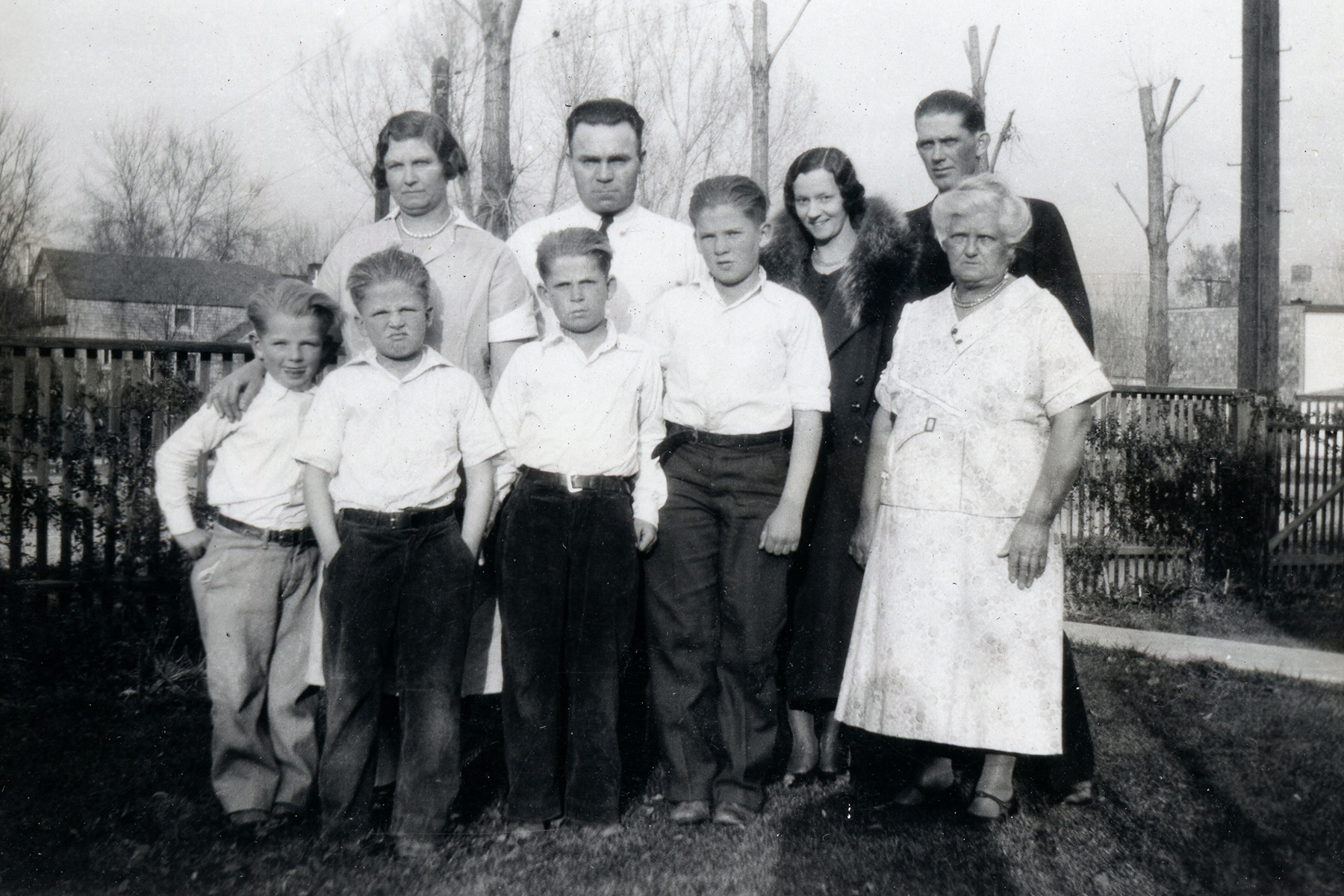
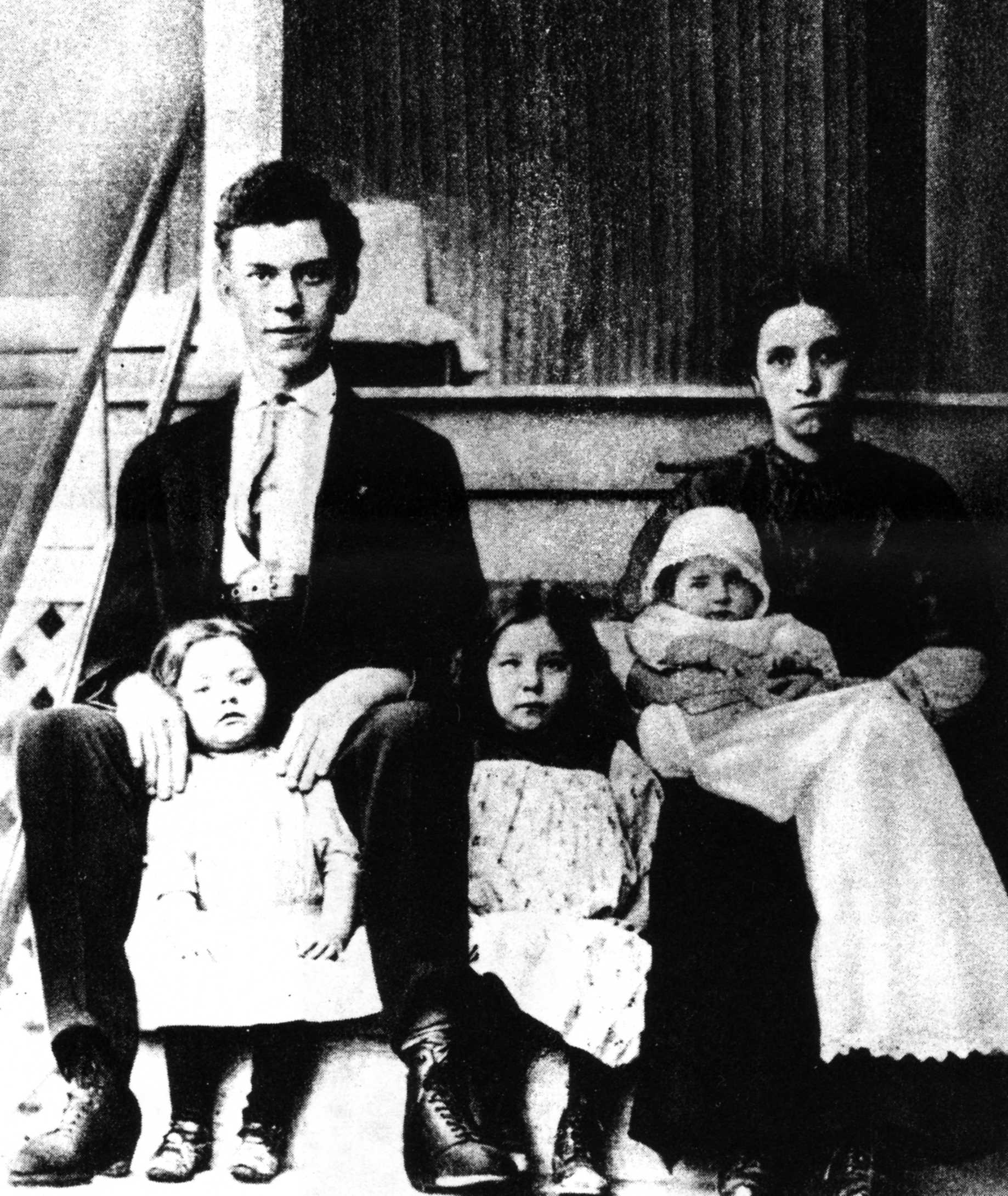
Vaughn, Gaylen, Karen, Maynard, William, and Delwyn Jonas with Alta, James, and Caroline Thompson

“William and Mary lived in Richmond, Utah, when they were first married.  They went to the Benson Stake of the L.D.S. Church.  In August of the same year (1921) they moved to Franklin, Idaho, so William could teach school.  Mary worked checking ledgers for the Milk Condensory in Franklin, Logan, Richmond, and Hyrum during her life.  By September of 1921 they moved to Thatcher, Idaho.  They went to the Thatcher 2nd Ward in the Bannock Stake of the L.D.S. Church.  William, his brother Joseph and his sister, Rosa with their families tried farming.  William tried farming from Sept 1921 to Jun 1923 when they moved back to Logan.  Apparently discouraged with farming William went to Park Valley, Utah, so he could teach school for one year.  After school was over they moved back to Logan for a short while and then to Avon, Utah, for another teaching assignment.  September 1924 William took an examination at West High School for the Post Office.  He rated 3rd in his class with 93% – he got 5% for being a veteran.  In August 1925 he started work for the post office.  He worked there for 33 years and accumulated many days for not being sick.  He worked the afternoon shift and would take the trolley car to town.  He retired in 1958.  His work consisted of being a supervisor and worked with the public weighing packages.  His hours were from 3:00 P.M. to 11:00 P.M.   

“L.D.S. Church records show that they moved into their home at 120 West Burton Ave in Salt Lake City the same month he was hired at the post office, August 1925.  Mary’s mother also lived on Burton Ave.  They were in the Burton Ward, Grant Stake.  After they had lived on Burton Ave. where their son, Vaughn, was born they moved to 1854 East Clayborne in Salt Lake City in 1928.  About 1931 they moved to 906 East 39th South in the Murray area.  Then the family moved to 2964 South 9th East (where Carvel was born) in 1933.  They lived there from 1933 to about 1942-43.  Then they moved into the new home next door at 3974 South 9th East.  When William first bought land in the Murray area he purchased 6 1/4 acres.  William and his brother-in-law, Christian Andersen, built the home at 3974.  Then they moved again to 3954 South 9th East in 1951.  All three of the homes on 9th East were next door to each other.  The home at 3954 was originally an Army barracks which was moved from Kearns and later remodeled by their son, Maynard.  On 29 April 1962 they then moved to 1005 East 4025 South which was still in the Murray area.  There they lived until each passed from this life to the next.    

“William and Mary were the parents of 6 sons.  The last son, William Thompson Jonas, was born what has been called a “blue baby”, and lived only 31 1/2 hours.  He weighed 6 1/2 pounds and is buried in the Elysian Burial Grounds in Murray, Utah.  He was blessed by his father the 22 October 1937.  Their 3rd son, Gaylon Thompson Jonas, was killed 19 September 1944 on Peleliu Island in the Pacific Ocean.  He had enlisted 19 August 1942 with the 2nd Mormon Battalion.  He was awarded the Bronze Star, Purple Heart, Navy Citation Award, Pres. Citation, Navy Unit Cit., American Theater, Pac. with 3 stars.  He was killed by a Japanese sniper’s bullet while removing a wounded man.  He was killed while he was helping the fourth man that he helped that day.  He had volunteered for the assignment.   

“William blessed all six of his sons.  He also confirmed 5 of them after they were baptized.  Delwyn was blessed 2 April 1922 and confirmed 1 February 1931.  Maynard was blessed 14 March 1925 and confirmed 3 December 1933.  Vaughn was blessed 7 November 1926 and confirmed 4 November 1934.  Carvel was blessed 17 September 1934 and confirmed 2 May 1943.  William also ordained several of his sons to different offices in the Priesthood.  Gaylen was ordained a Teacher 29 January 1940.  Carvel a Deacon the 22 September 1944 and a Teacher 30 October 1949.   

“William was actively involved in work for his Church all his life.  He was Superintendent of the Sunday School of the Mill Creek Ward for 2 1/2 years.  He served as Stake Supervisor of the gospel doctrine classes.  During his gospel doctrine classes he would compare Catholic point of view with the L.D.S. view quite often according to his neighbor who attended his class.  He also served as one of the Seven Presidents of the Seventy in his stake.  He was a leader of the cottage meetings.  And taught the genealogy class for many years and became one of the senior teachers of these genealogy classes.  He was baptized for some of his dead ancestors and his wife’s dead ancestors.  He served as a ward teacher for many years.  He did all of the above including serving a full time mission for the Church before he was 50 years old (1940).  After that on 20 Mary 1943 he received a missionary call from the Mill Creek Ward, Cottonwood Stake for a stake mission.  He was set apart 26 March 1943 in the stake office at about 8:00 P.M.  Afterwards he received another stake mission calling (this was his third mission).  He and his wife Mary, were both called.  William was set apart 12 May 194?.  One of grandpa’s neighbors said that grandpa was considered a scriptorian by those who knew him in their ward, and that he had a hard time understanding why people didn’t recognize the truth in the scriptures.  He was set apart Wednesday May 18, 1944 in the stake office at 176 Vine Street for this third mission.  While William was on this stake mission his son, Gaylen, who was killed in World War II appeared to him twice requesting that his temple work be completed.  His wife, Mary, was set apart 31 August 1949 so they could serve on a mission together.  They received honorable releases from their stake missions 3 June 1951.   

“When William was called on his second mission he wrote a letter which was printed in the Millcreek Courier, which was the ward paper.  The following is quoted from that letter written March 1943, the same month he was called on his second mission.  “Faith Unshaken  Greetings to the boys in the service from Mill Creek; Recent events have not shaken my faith in the ultimate triumph of freedom and justice, for I was reared in a church where faith in God and belief that right will triumph eventually is too deeply ingrained in me to doubt its final victory.  As long as we have faith at all in God, we must know that his is All-Powerful.  That his will for the world is Justice and Right, and that eventually His purposes will be established here on earth.  Good emerges slowly, but we must not doubt its victory.”   

“”As to our country, my faith is our America, in its people, and in the American Way of Life, is unwavering.  The United States is the greatest country on the earth, not because it is our country, but by comparison.  It’s founding I believe to have been divinely ordained and that God had a mighty mission for the United States among the nations of the world.”   

“”America was founded by our forefathers in prayer, in faith, and in the heroic spirit of sacrifice.  Lives of comparative ease in their old country might have been theirs had they been willing to surrender their  convictions.  They chose the Hard Right rather than the Easy Wrong, and were ready to lay down their lives for freedom to worship God according to the dictates of their conscience.  No matter what lies ahead, we must carry on to the best of our ability, doing our utmost from day to day, each in his own niche.”   

“”After the Hard War No. I was over and the happy Peach had come, I experienced the most wonderful day of my life.  February 4, 1919 we first saw the light reflections in the distance, then the lights, buildings, the land.  Oh the shouts, “America”, “God’s country”, “Zion”, “Home Sweet Home”, ect.  Believe me the statue of Liberty certainly faced the right way–in fact everything we saw was just O.K.”   

“”I am now praying for a second great day to come soon, when this Hard War No. II is over and happy Peace is declared and my sons, Delwyn of the Army, Maynard of the Navy, and Gaylon of the Marines come marching home.  Parents, fill in the names of your sons, and my God grant the day soon.  Sincerely, William N. Jonas.”   

“On 17 December 1950 William was ordained an High Priest making  little over 40 years that he was a Seventy.  He was ordained by Verl F. McMillian of the Mill Creek 2nd Ward in the Cottonwood Stake.  After he was ordained an High Priest he was asked to teach the High Priest class for many years.  He also became interested in doing the Jonas genealogical line.  Around 1960-65 he wrote to places where his grandparents, Hubert and Mary Jonas lived after arriving in America.  On 26 October 1960 he received a returned letter from the research department of the L.D.S. Church.  He had paid people to help in the research.  From this letter we were able to learn about the 1880 census of Nebraska where the family had lived.  Another letter was received 13 April 1961 from the Register of Deeds, Monroe County, Michigan, written by the Genealogical Society research department.  In behalf of William many land records for Hubert and Mary were then found.  William wrote to the Texas State Department and Historical Society of Wisconsin hoping to find more information about our family.  Also, he had driven to his place of birth, Ellensburg, Washington for some research and visited his cousin-in-law, Regina Jonas who was living in Vancouver at the time.  The following is a quote from a letter he had written which shows the sincerity of his desires.  “…this seems to be asking a lot.  However, I will be glad to pay for services.  Have you someone who is available for such work?  I shall try to come to Ellensburg this summer if necessary.  I thank you.  William N. Jonas.”  Many attempts were made to find out where the Jonas family had lived in Germany.  Unfortunately, William never was able to discover that genealogy.  But because of his efforts there were many clues for the author to use in what eventually lead to the discovery of the Jonas genealogy pedigree, and also this history book.   

“The following are some observations about William that his children and friends have told me.  William liked to garden.  During hard economic times, and especially during the Great Depression, they always had a large vegetable garden.  Although we don’t have the exact figures it was close to an half acre.  They were able to provide for their family and also provided for a neighbor and his family who were experiencing financial difficulty.  He enjoyed excellent, physical health all his life.  He was in a car accident when he was older, about 1953-54.  During the car accident the gear shifting know of a late model Cadillac punched his side.  The knob was shaped like a tear drop.  He was a passenger and had slid across the seat with his left side hitting the knob.   

“After some of his children got back from their military service they thought they were in better physical shape than their father, who was in his 50’s.  They oldest thought he could out arm wrestle his dad now.  But William won the match.   

“While he worked for the post office he played for the baseball team on the Industrial League.  He was a good baseball player and had large knuckles on his left hand from catching baseballs.   

“William was instrumental in helping his oldest son to get a job at the post office.  He also helped his younger brother, Joseph, financially so he could go to college.  William paid for the first month rent for his son, Carvel, when he was first married.  Also, William and his wife, Mary, both visited Mr. and Mrs. Virgil Clayton and took pictures on several occasions of their grandson, Carvel Lee Jonas.   

“William, when he lived on 9th East raised chickens, pigs, had a cow and an horse.  Their children had pigeons and also dogs.  They had an orchard of mostly apples, and grew hay and grain; potatoes and lots of vegetables.  They had a chicken coop that was heated with a kerosene heater.  On one occasion the chicken coop burned down and they lost all the chickens (perhaps as many as an hundred).  While the chicken coop was burning William and his son, Maynard, tried to removed the heater and William was burned.   

“One time William had bought a new pitch fork.  He was able to carry so much hay at one time that the weight of the hay broke the handle of the new pitch fork.   

“When William would read or study a book he would read with a pen or pencil and underline and make notes in the margins.   

“A neighbor of William’s for over 25 years, Otto Hansen, said the William was very helpful in getting him a job for the post office.  William had told him about the civil service test, and encouraged him to try and pass.  This neighbor and his wife said that William and Mary were good neighbors and would do anything they could to give a helping hand to someone in need.  They considered them to be very honest people.  A story that they remember was when William was teaching the gospel doctrine class.  Apparently, for a practical joke Mary would remove William’s notes that he had prepared to teach class with from his book.  They said that they remember Bill saying, “Mary’s done it again.”  Then he was left to use the scriptures and rely on memory and past study to make up a lesson on the spot.   

“William died 14 April 1972.  He suffered from senility for a few years before he died.  Grandma had a neighbor put locks on the doors to keep grandpa Jonas from leaving without knowing where he was going.  Even when he wasn’t at his best at the end of his life his thoughts were to go to the Church welfare farm and work.  William had received an award for doing over 100 hours of volunteer work for the Church welfare farm in one year (1962), which made him 72-73 years of age.     

“Even with the differences in personality of his sons, the one thing that they all agree on is that they had a very good father.  Gaylen before he was killed in the war told his friend, “Blondy, I want you to (meet) my folks when we get a furlough, they are the best parents a guy could want.”  His sons don’t agree on many things, but they all agree about how lucky they were to have such a wonderful father.  That in itself is one of the finest tributes that a man could have.   

“Merlin Andersen told me that he always had admired William’s language.  William spoke as an educated man who had a firm grasp of the English language.  William loved kids.   

“Once William and Merlin were walking and they came to a creek.  Merlin was wondering how he was going to cross because he didn’t feel like he could jump across and make the other side.  Merlin was a young boy, but he remembers that William grabbed him and threw him easily to the other side of the creek.
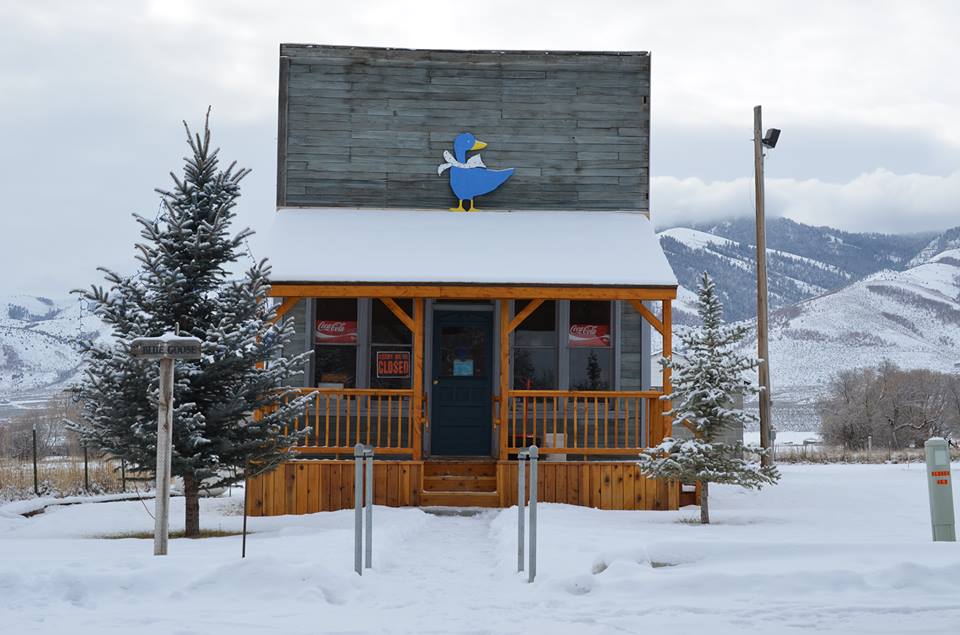
The Blue Goose

This article was shared with me in 2010.  I downloaded it in 2011 with the intent to share it.  Finally I get around to it 9 years later!

Here is a history of Samaria, Idaho on the Malad City website.  http://www.maladidaho.org/samaria.html

Be aware, as of today, The Blue Goose is open for business, although limited hours.  https://www.facebook.com/thebluegooseSamaria/  The Facebook page has a number of historical photos of The Blue Goose.

The Blue Goose, Samaria, Idaho

This is the Historical Sketch shared with me regarding The Blue Goose.

“Historical sketch of The Blue Goose by Sherrie Daniels

“Until recently this building, owned by Merrill Price, had been a thriving business of one sort or another since its construction just before the turn of the century.  Most remember it as The Blue Goose, a local hot spot of Samaria, Idaho.

“Charming and unique, the structure was originally built for living quarters and a furniture store by Isaac Ike Evans.  Organs, rockers, bureaus and other fine wood furnishings could be purchased there and the only furniture store in Samaria at that time also served as a post office to a population of over 800 people.

“Later on, the furniture store was converted into a candy kitchen.  The new owner, D.D. Williams, sold pop and confectionaries, and had a pool table.  Many remember stopping as youngsters on their way to Mutual to share a soda and socialize.  They were always reminded not to be late for their church meeting by Mrs. Williams, who would usher them out the door at ten minutes till.  Later the teenagers would reunite there to pick up where they had left off.

“A barber chair was also in the south corner of the candy kitchen.  The late Ernest Williams recalled to me many a lazy afternoon spent indulging in second hand gossip and of yesterdays bygone.

“A 1936 calendar hung on the abandoned building’s wall when around 1945 David Bronc Jenkins and Muddy Waters (a nickname – no one seems to remember his real name) took over the building to open it as the local saloon and pool hall.  Card games were a favorite past time and a nickel a cue could buy a splendid time of pool hustling.

“Since then, the lease of the Goose slid through many hands.  To name a few, Ralph Hughes, Waldorf Morse, who gave it up to become Samaria’s school teacher, Ariel Jones, Wally Nicholas, Ralph Williams, Arthur Doc Smith, Ted Loomis and finally Bill Thorpe, the last owner of the lease.

“Many names have been pegged on it since that time such as The Samaria Bar, The Nugget, The Second Ward, The Bucket of Blood, and most everyone’s favorite, The Blue Goose.

“Often, as a little girl, I would trod barefoot down the hot oil road to stand hesitantly outside its door, then almost recklessly make my pretense début.  My father would be too involved in his card game of Cassino to raise an eyelid in acknowledgment of my statement, The cows are in their stalls waitin to be milked, Dad.

“Can’t leave now, would be the mumble that came from lips which were also juggling his Pall Malls.  Got one more hand to play.  Wait on the porch and Spug will bring you a soda.

“Now, to a child who is just learning her A.B.C.’ s and how to count, one became the most versatile number in our numerical system for although I know at least five hands had been played, can of soda, two packages of peanut M&M’s and one bellyache later, my father always swore to my mother (who by this time had already started the milking), Jest had to play that one last hand.

“Today the Goose stands empty.  Weeds grow where once was smooth trodden earth.  No dim light slithers out into the night to say a friendly Hello, I’m open to passersby.   No more tales absorb into the paint-thirsty woodwork on lazy summer afternoons.  No smoke curls out from the chimney ascending to a stark winter’s sky.  No more ringing of the cash register to signal the sale of an ice cream, a soda, or a beer.  But it stands, a structure representing people past and a memory for us in the present.

Spring City, Utah

Manti Temple, Paul & Amanda Ross

Last weekend was Amanda’s sister’s wedding in Manti, Sanpete, Utah.  We went down to attend the wedding for Zachary & Alyssa Smart.  It was a wonderful trip, time to get away, celebrate the wedding and reception, and enjoy ourselves.

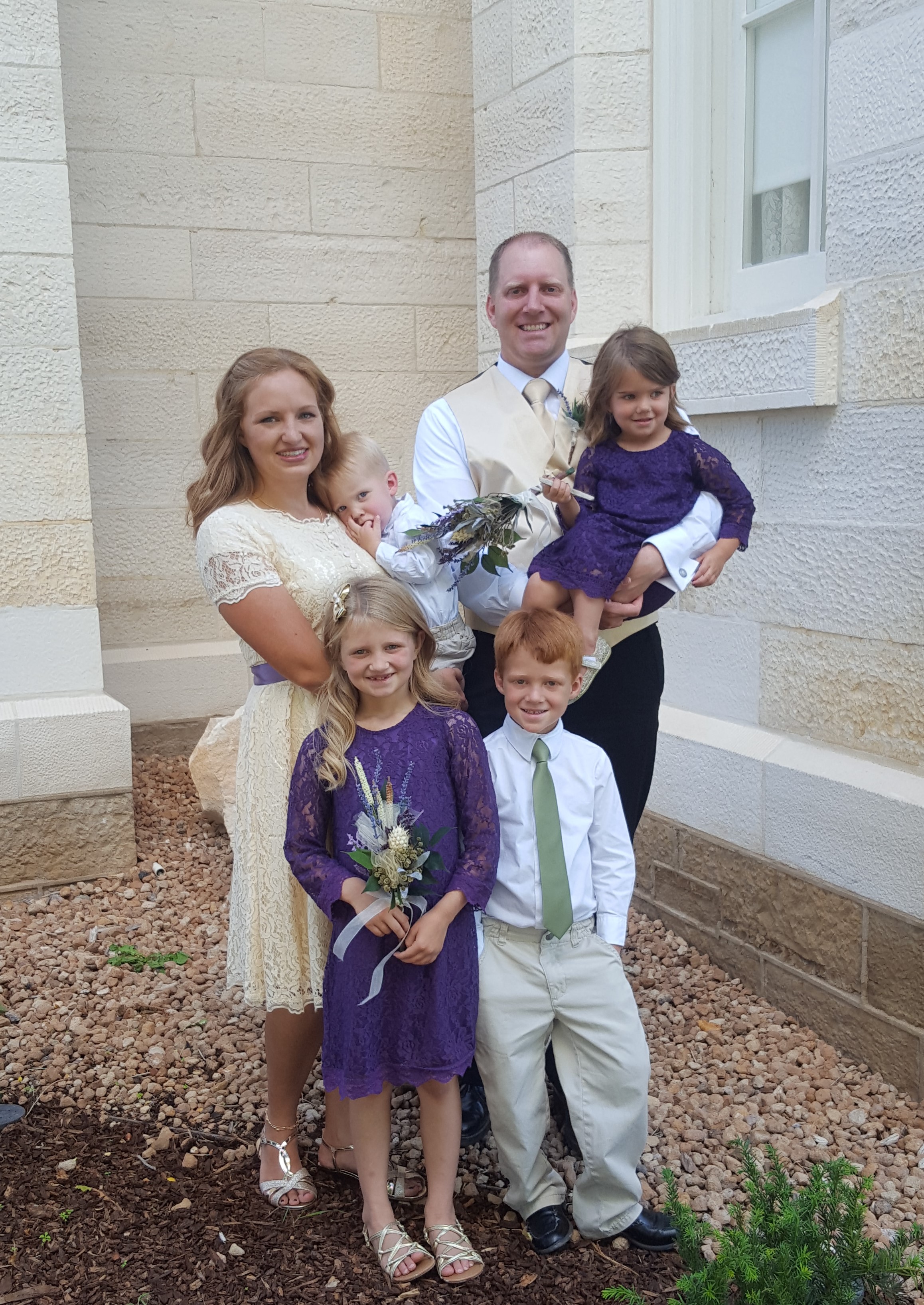
Paul, Amanda, Aliza, Hiram, Lillian, and James Ross at Manti Temple

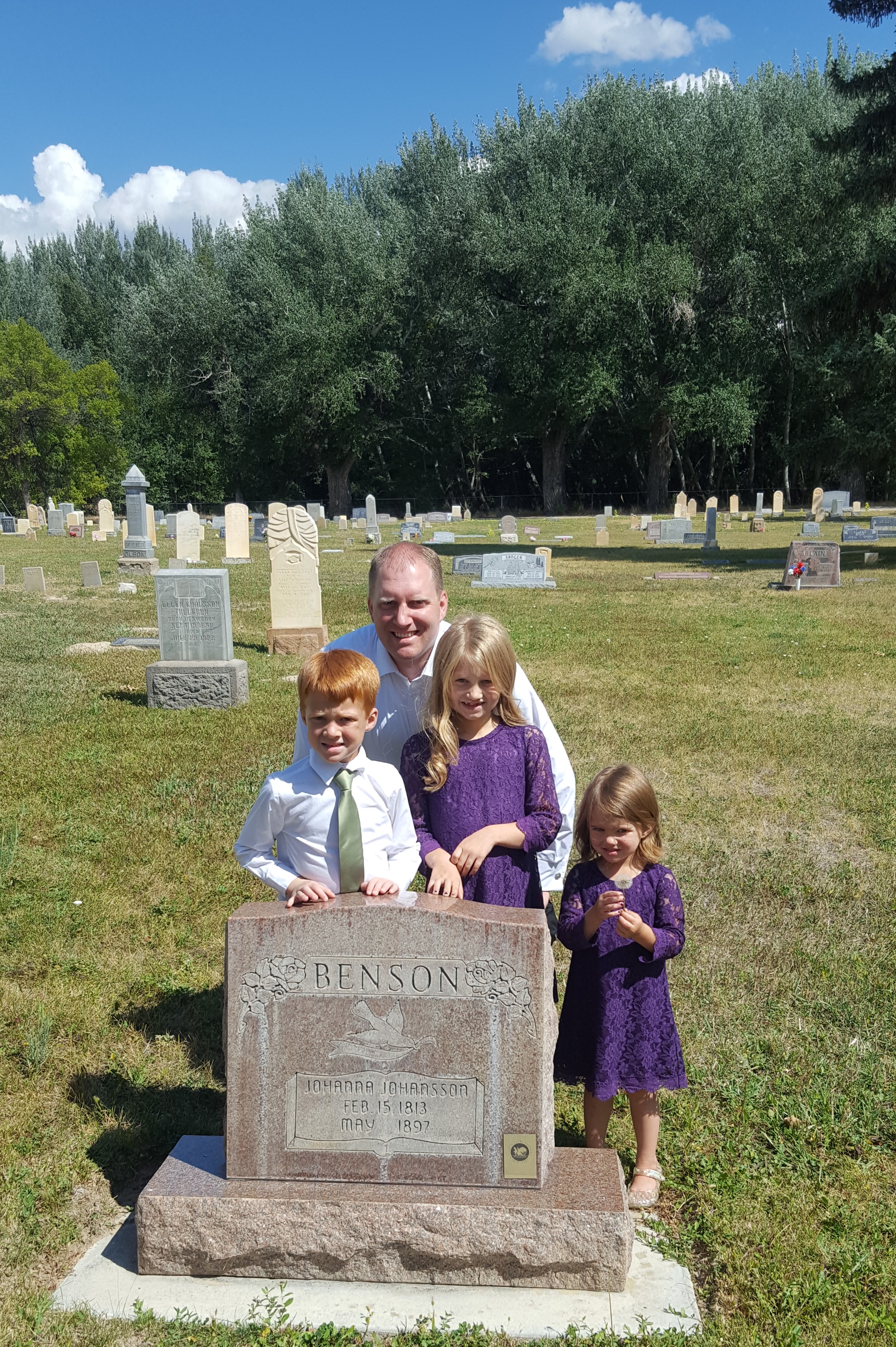
I have done enough family history that I knew my 4th Great Grandmother is buried in Spring City.  Like other locations, if I am in Sanpete County, I make an effort to stop and visit her grave.  I think the last time I was able to stop was about 2003, so it had been about 15 years.

Paul, Aliza, Hiram, and Lillian Ross at the grave of Johanna Johannsson Benson (Bengtsson)

Here is how we are related.

My mother’s name is Sandra Jonas.

Her father was Wilburn Norwood Jonas (1924 – 1975).

His father was Joseph Nelson Jonas (1893 – 1932).

His mother was Annetta Josephine Nelson (she went by Annie) (1864 – 1907).

Her mother was Agnetta Benson (she went by Annie) (anglicized from Bengtsson) (1832 – 1873).

Her mother was Johanna Johansdotter (which shows up on the tombstone as Johansson) (1813 – 1897), who was married to Nils Benson (anglicized from Bengtsson).

I really don’t know tons about Johanna.  Nels August Nelson makes only passing reference to his grandmother.  I have been unable to find when she immigrated to the United States.

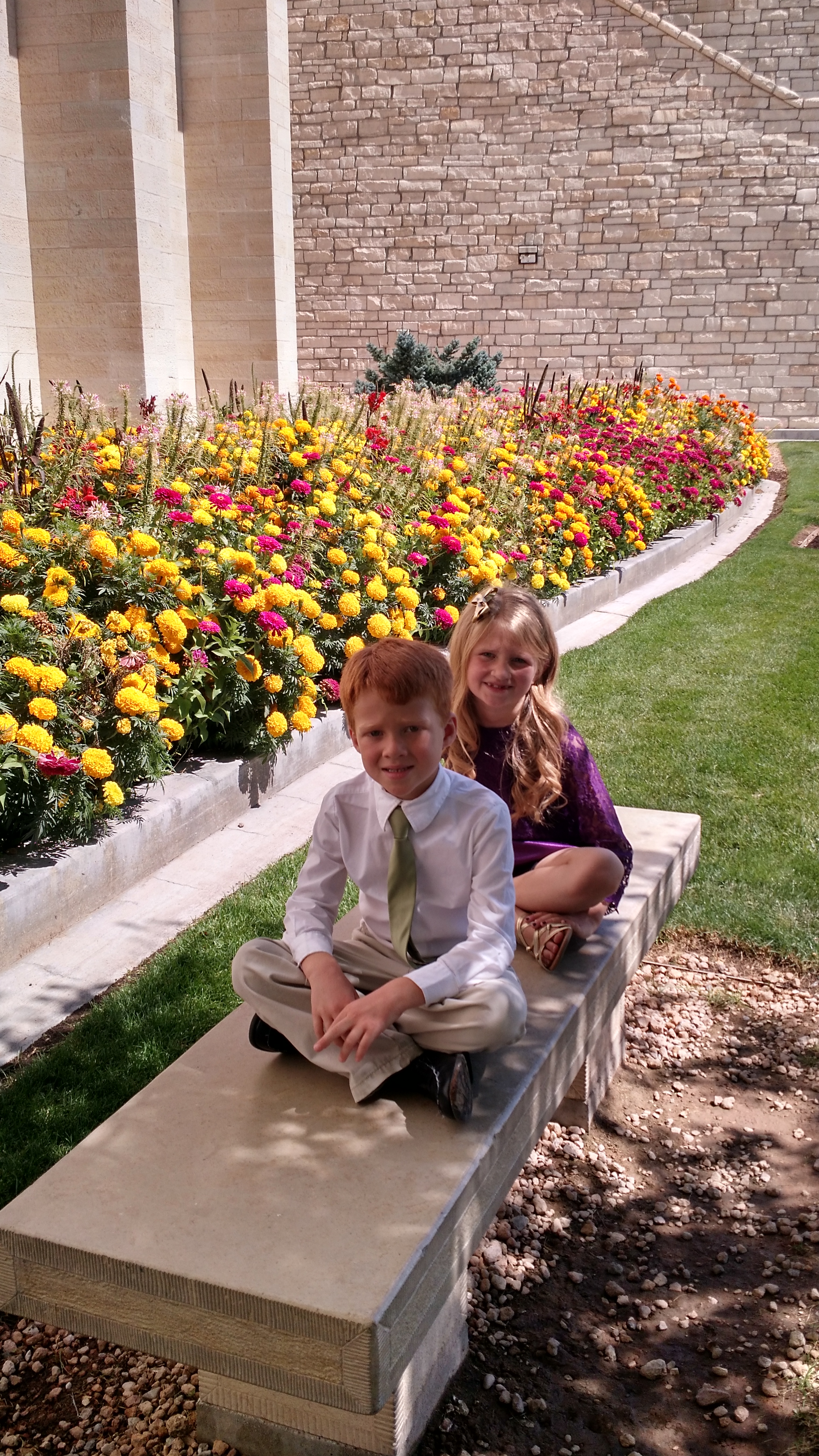
Hiram and Aliza Ross waiting for a hummingbird to land on them

Johanna Johansdotter was born 15 February 1813 in Öringe, Veinge, Halland, Sweden.  She met and married Nils Bengtsson on 4 July 1830 in Veinge, Halland, Sweden.  Nils was born 1 August 1802 in Brunskog, Tönnersjö, Halland, Sweden.  Together they had 8 children together.

Agnetta Nilsdotter born 9 Dec 1832.

Lars Nilsson born 11 May 1835.

Ingjard Nilsdotter born 17 February 1839.

Christina Nilsdotter born 21 June 1841.

Bengta Nilsdotter born 19 March 1843.

Nils (Nels) Nilsson born 23 August 1846.

Borta Nilsdotter born 6 April 1849.

Johan Petter Nilsson born 31 August 1855.

Nils passed away 12 March 1859.

Johanna was baptized a member of The Church of Jesus Christ of Latter-day Saints on 11 May 1861.  Agnetta was baptized 10 November 1863, Lars 5 May 1860, Ingjard 5 May 1861, Christina 4 February 1866, and Nils Jr 5 May 1860.  Johann joined 7 September 1893 after immigration to Utah.  The other two were after their deaths.  Bengta and Borta did not join or immigrate to Utah.

Johanna’s daughter Agnetta (Annie) traveled with her husband Johan Nilsson from Halmstadt, Sweden through Liverpool, England docking in New York City, New York on 3 June 1864.  I cannot tell that Johanna traveled with Johan and Agnetta.

Most of the children upon traveling to the United States were given the last name of Benson instead of Nilsson.

The children spread.  Agnetta went with her husband to Logan, Utah.  Lars went with his family to what is now Sandy, Utah.  Ingjard to what is now Sandy.  Christina to Vernon, Utah.  Nils to Spring City, Utah.  John also to Sandy.  For whatever reason Johanna went with Nils to Spring City and remained there the rest of her days.  She passed away May 1897, we do not have an exact date.  Nils served a mission from 1892 to 1894 back to the Scandinavia mission.

Manti Temple 2018

An interesting tidbit about our trip to Manti.  We stayed in a restored home of James Marks Works.  He was the brother-in-law to Brigham Young.  It was an early home with various additions, modifications, and ultimate restoration.  James Marks Works and Phebe Jones had a daughter named Mary Ann Angel Works.  Mary Ann is the second wife to Nils Benson and they had 9 children together.  The home in Manti we stayed may very well have been visited by my 3rd Great Grand Uncle and his 9 children, all of which were grandchildren of James Marks Works.  James Marks Works died in 1889 and the first of the 9 children were born in 1892, but James’ son James Marks Works (Jr) kept the home and continued working the sawmill behind the home.

Here is a picture of the Manti Temple from James Marks Works’ home.

Manti Temple from James Marks Works’ home

Another interesting side note that I remembered from the last time I walked around the Spring City Cemetery.  Orson Hyde is also buried there.  I walked the kids over to Elder Hyde’s grave and we snapped a picture there as well.  I explained his role as an Apostle, President of the Quorum of the Twelve Apostles, Dedication of Palestine for the return of the Jews, clerk to Joseph Smith, lawyer, Justice on Utah Supreme Court.  The kids didn’t seem to care much…

Hiram, Lillian, and Aliza Ross at the grave of Orson Hyde

Here is Orson’s short biography from the Joseph Smith papers.

8 Jan. 1805 – 28 Nov. 1878.  Laborer, clerk, storekeeper, teacher, editor, businessman, lawyer, judge.  Born at Oxford, New Haven Co., Connecticut.  Son of Nathan Hyde and Sally Thorpe.  Moved to Derby, New Haven Co., 1812.  Moved to Kirtland, Geauga Co., Ohio, 1819.  Joined Methodist church, ca. 1827.  Later affiliated with reformed Baptists (later Disciples of Christ or Campbellites).  Baptized into LDS church by Sidney Rigdon and ordained an elder by JS and Sidney Rigdon, Oct. 1831, at Kirtland.  Ordained a high priest by Oliver Cowdery, 26 Oct. 1831.  Appointed to serve mission to Ohio, Nov. 1831, in Orange, Cuyahoga Co., Ohio.  Baptized many during proselytizing mission with Samuel H. Smith to eastern U.S., 1832.  Attended organizational meeting of School of the Prophets, 22–23 Jan. 1833, in Kirtland.  Appointed clerk to church presidency, 1833.  Appointed to serve mission to Jackson Co., Missouri, summer 1833.  Served mission to Pennsylvania and New York, winter and spring 1834.  Member of Kirtland high council, 1834.  Participated in Camp of Israel expedition to Missouri, 1834.  Married to Marinda Nancy Johnson by Sidney Rigdon, 4 Sept. 1834, at Kirtland.  Ordained member of Quorum of the Twelve by Oliver Cowdery, David Whitmer, and Martin Harris, 15 Feb. 1835, in Kirtland.  Served mission to western New York and Upper Canada, 1836.  Served mission to England with Heber C. Kimball, 1837–1838.  Moved to Far West, Caldwell Co., Missouri, summer 1838.  Sided with dissenters against JS, 1838.  Lived in Missouri, winter 1838–1839.  Removed from Quorum of the Twelve, 4 May 1839.  Restored to Quorum of the Twelve, 27 June 1839, at Commerce (later Nauvoo), Hancock Co., Illinois.  Served mission to Palestine to dedicate land for gathering of the Jews, 1840–1842.  Member of Nauvoo Masonic Lodge, 1842.  Member of Nauvoo City Council, 1843–1845.  Admitted to Council of Fifty, 13 Mar. 1844.  Presented petition from JS to U.S. Congress, 1844.  Participated in plural marriage during JS’s lifetime.  Departed Nauvoo during exodus to the West, mid-May 1846.  Served mission to Great Britain, 1846–1847.  Presided over Latter-day Saints in Iowa before migrating to Utah Territory.  Appointed president of Quorum of the Twelve, 1847.  Published Frontier Guardian at Kanesville (later Council Bluffs), Pottawattamie Co., Iowa, 1849–1852.  Appointed to preside over church east of Rocky Mountains, 20 Apr. 1851, at Kanesville.  Migrated to Utah Territory, 1852.  Appointed associate judge of U.S. Supreme Court for Utah Territory, 1852.  Elected to Utah territorial legislature, 27 Nov. 1852, 1858.  Presided over church in Carson Co., Utah Territory (later the Nevada Territory), 1855–1856.  Served colonizing mission to Sanpete Co., Utah Territory, by 1860; presided as ecclesiastical authority there, beginning 1860.  Died at Spring City, Sanpete Co.


Calvin and Fanny Phibbs

Calvin and Fanny Phibbs with (l-r) Evelyn, Florence, and Catherine in Idaho in 1912.

I had heard a rumor a couple of years ago that Calvin Phibbs had taken his own life but could not confirm the story.  Now that I am back in Idaho, I stopped by the Rupert Library to see if they had some old newspapers.  Sure enough, I found the following obituary which reads more like the local gossip column.  I will include some of the family history after the obituary.

“Judge Phibbs Ends Life; Ill Health Cause
“Well Known Rupert Attorney Meets Instant Death By Own Hand at Home Thursday.
“Four months of sleeplessness, a body racked with pain and mind grown despondent through belief of the utter hopelessness of physical recovery, led to the tragic, but carefully planned suicide of Judge C. D. Phibbs, well known Rupert attorney who ended his life at his home Thursday.
Seated before a mirror in his bedroom at three o’clock in the afternoon, when no one was in the house but his wife and himself, the distraught man placed the muzzle of a 22-caliber hammerless revolver to his right temple, and with a firm unswerving hand sent a bullet through his brain, death being instantaneous.  The leaden missile passed through the head and lodged in the wall, near the ceiling.
“Startled by the sharp explosion of the gun, Mrs. Phibbs rushed in from an adjoining room to find her husband’s body crumpled on the floor with his life extinct.
“That the rash act was premeditated and carried out as planned is shown by excerpts from a letter written the previous Saturday, addressed to his wife and left where she could not fail to find it.
“I do not feel that I can get well.  I have suffered for four months.  So much that I cannot endure it.  If anything happens to me, know that I love you and have never loved anyone but you.  Tell the children to be good children, as it is best for them.  It is the only way to be happy.  I have failed to do as much for them as I wanted to but have not been able.”
“Following the introductory explanation foreshadowing the tragedy that was to take place, the letter continued with detailed instructions of what to do in regard to business that would arise, told where his life insurance policies were, how to plan the funeral, left words of encouragement to the children to continue their education and even advised about planting a garden.
“After a farewell sent the children and the brief words of assurance for their future, the final paragraph concludes: “God bless you all till we meet again.  I do not believe God will blame me for what I am doing for there is no other way.”
“The letter was found by Mrs. Phibbs soon after the tragic shooting occurred.  It was dated March 20.  Although she knew he suffered much from stomach trouble for many weeks and was discouraged over his health, no hint of self-destruction was ever suggested by her husband, she said, and in the past week it seemed to be somewhat improved, and had been to his office only a few days before the appalling act.  He had suffered intensely from stomach trouble and it is thought he believed himself a victim of cancer.
“When a youth of 13 years, while in the mountains of Virginia, at Fancy Gap, Carroll county where he was reared, in 1899 Calvin D. Phibbs, whose father worked in the mines there, hopped on a coal car and received injury to his left leg that later caused infection, making amputation necessary and left him crippled for life.
“In 1906 when twenty years of age he married Fanny Elizabeth Ross in Welch, West Virginia, and on March 21, 1913, they came to Idaho and to Rupert, making there [sic] home here since then.
“Although he had little opportunity for attending school, he received his education by private study.  Securing books and texts of the International Correspondence school he studied law and was admitted to the Idaho state bar in 1919.
“For ten years he held the position of probate judge of Minidoka county, being elected on the Republican ticket and served in that capacity until four years ago.  He served also as justice of the peace for two years and in 1918 was city clerk of Rupert.
“His friends and business associates, of whom he had many, were shocked and grieved at his tragic act.  He had a kindly disposition and a cheerfulness of manner that in no way can be reconciled with his fatal deed.  At the time of his death he was engaged in the practice of law but since last November had been unable to be in his office much of the time.
“Besides his grief-stricken wife he is survived by eleven children, five boys and six girls, their father being the first of the family to pass away.  The children in order of their ages are Mrs. Florence Biles, 23, of Gridley, California; Mrs. Evelyn Collier, Rupert; Mrs. Catherine Beachell, of Filer, Idaho; Virginia, James, Viola, William, Orville, Arthur, Albert and Phyllis, the youngest, age three, all of whom live at home.
Three brothers, Frank Phibbs of Twin Falls, Robert of Oakland, California, and John of Salt Lake City, and twin sisters, Mrs. Ardena Christensen, San Francisco and Mrs. Mary Hiatt of Paul, also survive.
“Largely attended funeral service were conducted Monday at one o’clock in the Second ward L.D.S. church with Albert Harrison, first counselor to Bishop O. J. Bateman in charge.
“Speakers included David J Borup, former bishop of the Second ward, who came from Boise where he now resides to be present at the funeral.  Judge Hugh A. Baker, an attorney friend, and David Hyde and A. H. Jensen, churchmen and friends of the deceased.
“Music was rendered by a chorus of nine voices under direction of Arthur Humphries, singing three selections “I Need Thee Every Hour,” “Sometime We’ll Understand” and “Oh, My Father.”
“Prayers were offered by L.D. Hyde and R.C. May.  Interment was in Rupert cemetery with Goodman Mortuary in charge.

Here is a biography of Judge Phibbs from an old Idaho directory of prominent people.

“Judge Calvin Dickerson Phibbs. since 1912 a resident of Rupert, where in 1918 he was elected judge of the probate court of Minidoka county, was born at Hillsville, Virginia, June 12, 1886, a son of James and Elizabeth (Bolt) Phibbs. The parents are also natives of the Old Dominion, where they were reared and educated. Subsequent to his marriage the father there followed farming and stock raising and during his early life also engaged in the profession of teaching. In 1910 he removed westward to Rupert, Idaho, and purchased a farm northeast of the town, becoming owner of eighty acres. At times he has owned various farms, but his holdings at the present time embrace just eighty acres. He and his wife have become members of the Church of Jesus Christ of Latter-day Saints and in his political views Mr. Phibbs is a republican.

“Calvin D. Phibbs spent his boyhood in his native state and pursued his education in Fairview Academy. He was reared to the occupation of farming, early becoming familiar with the best methods of tilling the soil and caring for the crops. Later he took up electrical engineering and worked along that line until he came to Rupert, Idaho, in 1912. Here he entered the real estate field and after a time he was called upon for public service, being made city clerk of Rupert, which position he filled for a brief period. In 1918 he was elected to the office of probate judge of Minidoka county, which position he is now acceptably filling, being most careful, prompt, systematic and accurate in the discharge of his official duties. On the 15th of December, 1919, he was admitted as an attorney at law in the supreme court of the state of Idaho.

“In 1907 Judge Phibbs was united in marriage to Miss Elizabeth Ross, a native of Pulaski, Virginia, and a daughter of J. T. and Catherine (Graham) Ross, the former a farmer and stockman. Judge and Mrs. Phibbs have become parents of six children: Florence, Evelyn, Catherine, Virginia, James and Viola. The religious belief of the family is that of the Church of Jesus Christ of Latter-day Saints and in politics Judge Phibbs is a stalwart republican, giving unfaltering allegiance to the party and its principles. He stands for advancement and improvement in all things that have to do with citizenship and is among that class who are putting forth every effort to spread the principles of true democracy and make one hundred per cent Americanism the rule of this land.

I do not usually place that much quoted material in my histories, but there is so much extra information I probably would not otherwise include, I thought I better just leave them how they were printed.

Calvin Dickerson Phibbs was born 12 June 1886 in Hillsville, Carroll, Virginia.  He died 30 March 1933 in Rupert, Minidoka, Idaho.  He was buried 4 days later on 3 April 1933 in the Rupert Cemetery.

Now that I have given so much on Calvin, I probably should fill out the life of Fanny a little more, my Great Great Aunt.

Fanny Elizabeth Ross was born 18 November 1893 in Reed Island, Pulaski, Virginia to James Thomas and Damey Catherine Graham Ross.  Read more about here parents and family here.  She married Calvin Phibbs 22 December 1906 in Welch, McDowell, West Virginia.  As mentioned 11 children were born to the marriage.  I believe she moved fairly quickly to California after Calvin’s death.  While in Rupert, the Phibbs family lived at 96 B Street (unless the streets have been renumbered, this home does not exist any more.  Grandpa, Milo Ross, visited her in Salt Lake City before World War II.  I do not know if she was living there or just visiting, he does not remember either.  She died 23 January 1943 in Daly City, San Francisco, California.  She is buried at Cypress Law in Colma, San Francisco, California in an unmarked grave.

Calvin and Fanny’s children are as follows, without spouses.

Florence Geneva Phibbs born 21 June 1907 in Gary, McDowell, West Virginia and died 9 February 1987 in Gridley, Butte, California.

Evelyn Adaway Phibbs born 8 October 1909 in Eckman, McDowell, West Virginia and died 7 January 1961 in San Francisco, San Francisco, California.

Catherine Elizabeth Phibbs born 1 January 1912 in Thorpe, McDowell, West Virginia and died 7 September 1989 in Fall River Mills, Shasta, California.

Virginia Ardena Phibbs born 3 March 1914 in Rupert and died 25 September 1969 in San Francisco County, California.

James Calvin Phibbs born 22 April 1916 in Rupert and died 10 July 1977 in San Francisco.

Viola Belle Phibbs born 21 July 1918 in Rupert and died 11 June 2008.

William Robert Phibbs born 3 October 1920 in Rupert and died 16 September 2010 in Redding, Shasta, California.

Orville Leonard Phibbs born 20 October 1922 in Rupert and died 25 December 1985 in Santa Rosa, Sonoma, California.

Arthur Lee Phibbs born 12 October 1925 in Rupert and died 22 June 1983 in San Francisco.

Richard Albert Phibbs born 25 December 1927 in Rupert and died 27 January 1993 in Clearlake, Lake, California.

Phyllis Elaine Phibbs born 24 February 1930 in Rupert and died 6 July 1972 in Los Angeles, Los Angeles, California.

Of course I am always looking for more information on the family since we do not have contact with any of the descendants.

Pulaski Roots

Speaking of roots, I had a dental appointment on Friday.  Due to Measles as a baby, I have ameliogenesis imperfecta with several of my teeth.  Basically, some of my teeth have deformities.  One of which is that the nerve in one tooth reaches quite a bit higher than normal.  Also linked with the deformity of the drugs (legal!) I took in the early 80’s, those teeth are weaker and more susceptible to problems.  Many, many years ago I had a filling put in the tooth that touched on that high reaching nerve.  Over the years that nerve touching the filling, in addition to a slight tapping from the tooth having moved (from squash racket trauma about 2000), and just normal advancement of time that root has decided to pass away.  Yes, I am the owner of a slowly dying tooth.  I have been placed on antibiotics to keep the nerve from getting infected as it decays.  In the next few weeks I will experience my first root canal. 

On an interesting note, once Dr. Spitzer saw my x-ray of the teeth he quickly noted how long the roots are on my teeth.  Amanda confirmed to me later that during the freak show discussion that ensued my teeth roots were measured at 25 mm long.  Amanda tells me that the normal individual has roots approximately 15 mm long.  The dentist commented how he may have to order some longer tools to work on the tooth.  Whether it was in jest or not, I have come to appreciate how different I really am.  Deep down inside I always knew I was special.  Now I know it is a good 10 mm deeper why I am special.
So we have frantically tried to figure out how we would pay for what a root canal and crown would cost without insurance.  When in the mail today I received an invitation to join the insurance for my work.  As generous as they are, I will now have dental insurance.  Now I just have to find how long of a waiting period I will have with a tooth that has become highly sensitive to hot and cold with slight throbbing from time to time.
Anyhow, on to the story of Pulaski County, Virginia.  My Ross line left Pulaski County about 1912 and headed to settle in Rupert, Idaho.  The daughter, Fannie had married a Phibbs from Pulaski and Carroll County and moved out previously.  Her husband was the Minidoka County Judge in Rupert.  With the opening of the new Sugar Factory at Paul, the rapid expansion of irrigateable farm land, and an economic downturn in Pulaski it was time to move.  James Thomas Meredith Ross who I have written about before followed his daughter Fannie.  His other three children would follow to the west.  James would later settle in the Vernal area.  The Phibbs would eventually end up north of Sacramento, California.  John would roam for many years marrying in West Virginia, Colorado, and Wyoming.  He would die in Alameda County, California.  Robert we don’t really know what happened to other than he died in California about 1944.
While I have written about all of that previously, James Thomas Meredith Ross would leave behind his half brother William Andrew Ross.  William would marry and move to West Virginia.  He lived in Gary, WV most of his life and raised his family there.  He worked in the mines coal mines.  He and Sarah (Sallie) had 12 children.  The youngest of which is Howard Ross born in 1925.
It was Howard we went to visit this weekend.
Howard is the only remaining individual of his family.  He was born in Thorpe, West Virginia and moved to Bluefield, West Virginia many years ago.  He lives in a home perched on the side of a hill on Essex St.  He had 3 children, and a step child he helped raised.  He worked in or with the mines all his life.  His wife past away a few years back and he lives in the home with his grandson and future granddaughter-in-law.
I knew of Howard because he had spent so much of his life pursuing family history.  Grandpa gave me a copy of one of his books he had written about 1972 on the Ross family.  That is how I knew who he was and that he was related.  By the time I came home from my mission I did not expect him to be alive anymore until one day in Twin Falls I was visiting with a missionary who had served in the West Virginia Mission.  I told him of Howard (I knew he was LDS) and the missionary not only knew of Howard, he had his address and phone number.  He gave it to me and I called Howard.
I have looked forward to meeting Howard for several years and of visiting the famous Pulaski County.  The valleys surrounding Pulaski County had already been home to the Graham and other families for over a hundred years by the time Pulaski County was formed in 1839.  There Meredith, Martin, Booth, Shepherd, and other families were well entrenched.  But my main interest was in going to the area where my family left before heading west.
Friday we drove out to Pulaski County and arrived after dark.  We spent the night in a hotel at Claytor Lake just over the border into the county.  The next morning we drove into Pulaski and just got a feel for the town and then headed for the hour and half drive to Bluefield to see Howard.
Bluefield turned out to be what you would imagine a town 50 years ago.  The little streets, little yards, flags on every house, and a good percentage of people sitting on their porch.  It was a lazy, hazy, day in summer.  We wound through the streets of Bluefield following our directions to Essex St.  Wow, as if we were not impressed.  One side of the street was wood and the other side of the street were homes perched on the side of a hill probably 75 to 100 feet up.  This hillside was probably at a 45 degree angle.  We found the home and climbed the steep stairs to the rickety old porch.
I don’t mean to sound negative, but we had entered what you joke about with rednecks.  These homes sat precariously sitting on the side of this hill and had not had any care in the last 40 years.  There was a hand made 2X4 railing up this terribly steep hike and at the top the porch wood buckled with every step.  Howard met us in the open door and invited us in.  We sat there in a relic of the 1930’s with only the television and sofa to remind us we were actually not in the mid 20th century.
Howard sat there talking with us in a most happy manner with his eye patch and asking for us to repeat often what we said.  Moreover, he spoke with that thick gentleman manner which so permeates the old confederate ideal.  His joking ways were jovial and we had quite the good conversation.
I took him with my computer through all the descendants of William Andrew Ross and he updated quite a bit of my information.  We also showed him a number of pictures I thought he would be interested in from my side of the family.  He then told us a few stories.
Uncle Jim (my great great grandfather who went west) had come to visit in the 1930’s where they lived in Gary, West Virginia.  It was the late 1930’s because the family had all gone to attend a Conference of the church in Grundy County, Tennessee.  One of the speakers that morning was Jim Ross, Howard’s Uncle.  The children did not attend but afterward all these people kept coming to his mother and commenting about how powerful Mr. Ross had been in his preaching.  Howard’s mother had to set them all straight that it was not her husband but her brother-in-law.  Howard remembers the day because it was the day he was baptized.  They would meet for the morning meetings and then have a big meal and baptisms in the middle, and go back to conference in the afternoon.
They went back home after the conference and Uncle Jim came and stayed for a spell.  Howard remembers Uncle Jim taking the wash basin out to the fields and coming back with a huge amount of corn.  He then told Howard’s mother to cook all the corn and they would eat it for dinner.  When Uncle Jim found out they did not have any milk, he went out and purchased a milk cow and brought it back for them to have milk.  (This isn’t necessarily all the same night).  Howard remembers that he was so thoroughly struck by how much Uncle Jim could eat.  Howard swears Uncle Jim must have pushed near 300 pounds and that man could eat.  Howard laughs and laughs about how when Uncle Jim left he went and sold the cow and they didn’t have milk for years afterward.
Howard remembers Uncle Jim was missing a finger.  He doesn’t remember which one, but he did ask how he lost it.  Apparently he had been bitten by a spider and as the finger started to rot and decay he finally just cut it off.  The Dr. apparently told him he had saved his life by taking the finger off.
That was about all he remembered of Uncle Jim.  He knew he moved to California after Idaho and Oregon.  While in Fresno he served as a Bishop of an LDS ward for quite a few years.  Uncle Jim was always a Ross to him even though he took the Meredith name back after moving to California.  The timeline in relation to the name I have told previously.
John Ross, or Jack as he was known, also made a trip out to West Virginia to visit.  He came out after his second wife had passed away (my great grandmother) and tried to convince his first wife to marry him again.  She wasn’t having any of that and Jack left empty handed.  Howard never met Hobart Day, Jack’s oldest child with his first wife.
Howard doesn’t remember ever meeting any of the rest of the family.  Donna Phibbs Beachell came out to visit in the 1970’s and spent quite a bit of time with Howard.  They wrote often over the years, some of which letters I mentioned were sent to me in the papers of Howard from John Ross.
Howard was very interested in what I had found out on the Meredith family and I told him what I was pretty sure to be correct.  He related to me more of the stories of what he believed happened to his grandfather but until further information comes out to prove the James Meredith story of the Harvy Ross story, we still really don’t know for sure.  I think mine is pinpointed quite a bit more firmly than his.
Howard then gave us a bit of the history of the LDS church in West Virginia.  He had us drive him down to the Bluefield Ward Building over the border in Bluefield, Tazewell County, Virginia.  He gave us a tour of the building.  We met the Bishop and a few other people.
We went back to the house and he asked that I give a blessing to his daughter, Sarah who lives next door.  She has MS and various other problems that come with smoking, MS, and the redneck lifestyle.  I will tell you now, I was alarmed that 82 year old Howard regularly climbs and descends those stairs out front.  They were so steep I didn’t feel safe especially with an old man struggling up them.  I gave a blessing to a woman who didn’t want it but whose father insisted.  Talk about a little awkward of a position.  We then went next door where he asked I give his future granddaughter-in-law a blessing.  Not only did he want a blessing for her, but the unborn child as well.  That was my first experience I remember blessing a baby in the womb.  Both turned out to be special events.  I enjoyed them and Howard became choked up after the second of the two.  My oil holder had become cracked and did not stay together any more and so we had to make due with a tablespoon of vegetable oil in a small glass bowl.  Under the circumstances it was the best we could do and we were richly blessed on the occasion.
Interestingly, the kitchen is exactly how you would have found it in the 1940’s.  The sink, the ironator, cupboards, and more were all of proper vintage.  Sadly, that was probably the last time they were cleaned.  It was quite humbling to see the faith of this man in such humble circumstances.
We left with my promising to do the ordinance work for his son and him after he had passed away.  He joked, part seriously, that through family history he had prepared the way for hundreds to enter heaven despite his own lack of achieving the same goal.
Amanda and I left and wound our way back to Pulaski County.  There we wound our way through the desolate parts of county roads trying to cross the New River.  We found our way across and went through the little towns of Allisonia, Hiwassie, and Snowville.  All towns of which were heavily populated by those of my ancestry.  It was interesting to drive along and recognize names on mailboxes and say to Amanda, “They are probably related.”
We drove back across the river up to Newbern, past Dublin, and back to Pulaski.  There we enjoyed our dinner, as we had our breakfast, at the Sonic Drive-In with gift cards that had been given to us for helping a lady move into the ward.
Afterward we hit the road to try and make Tennessee for some souvenirs and then across Southern Virginia to other ancestral locations.  We realized we were too far from Tennessee too late in the day to make it so at Rural Retreat (how is that for a name?) we turned and headed east.  We drove through Independence (Grayson County) and crashed for the night in Galax (Carroll County).  Both counties are heavily tied to me as well.  Sunday morning we awoke and made our way to Hillsville (Carroll County Seat), Martinsville (home of the Martins of which I am related), over to Danville, north to Keysville and Farmville, and home to Richmond.
It was a long weekend but very worthwhile.  I really enjoyed getting to see Allisonia, Hiwassie, and Snowville.  Maybe someday we will get to go back.  Maybe Howard will be around when it comes time for us to head back west in a year.