Moreton Ward, Chester Stake

In recent discussions with some members from England, I shared a number of photos I had taken/received while serving in their Ward. It dawned on me and they supported the idea of writing some histories regarding each of the Wards I served in. Also, as time passes, my memory will not remember all the people or my interactions. This is the first of those posts.

This post turned out to be terribly time consuming. I pulled out my planners and worked through them week by week. I was interested in the addresses we visited and the people we taught. Interestingly, I can remember most of these streets, even tracting them. But unless the people advanced to our teaching pool, I don’t generally remember them. Which really is not surprising as many of them were one or two contacts. But, the planners told me who we had appointments with, including tea/dinner appointments. For being 1998-1999, I am astonished at how much I remember from day to day. Some were simply unforgettable, even now, like the young lady who answered the door nude (read below).

Also, as part of this process, I read through the related journal for the time period. I have quoted whole sections that I located related to this time and these people. On a personal note, this was a very trying companionship and district to serve in. Jet lag, sickness, frustration with the breakdown between mission ideals and what was actually happening, personality conflicts, and immaturity (very much on my side, but also other missionaries), 6 missionaries in a confined space, all contribute to the refiners fire Moreton Ward proved to be for me. I have mostly removed all the whining from the journal posts. As reading, don’t think I am a model of optimism or enthusiasm. I was more coy at the beginning of writing this post than I was later. I didn’t quote as much from the journal to begin with, but more and more as I got more comfortable in writing about weeks. At the beginning I give overviews, later I do more quoting and let the voice of the journal speak. Moreton ward covers 119 pages of my journal #5, 36 pages of my journal #6.

The first Ward I served in as a missionary was in the Moreton Ward of the Chester England Stake. I believe it was a newly created ward, only a few months old. At some point the Birkenhead Ward(s) were in the Liverpool Stake and I remember there being multiple ties and connections to Liverpool. I recollect Moreton was created from one or both of the Birkenhead Wards. We met in an old college bar pub, I recall, in West Kirby. We lived in Liscard. I wrote a post previously about the houses I lived in as a missionary. In those days cameras were clunky and still film, so you did not take many pictures. But I do have a few I attribute to the Moreton Ward. Six missionaries covered the Moreton Ward. A year or two later, the Ward received their own ward building. It is my understanding these ward still exists, but was merged with the two Birkenhead wards, now all just two wards.

Since this is my first area, I am also including some of the arrival in the mission from the Missionary Training Center, or MTC, and the mission home.

On 21 December 1998, I flew out from Salt Lake City to the England Manchester Mission, connecting through Atlanta, Georgia. I had just spent two and a half weeks in the missionary training center in Provo, Utah. On that flight I sat next to a woman named Madge Fillingim, age 79, from Vernal, Utah. I hadn’t caught the spelling of her name at the time, and wrote it in my journal as “Marge Flitteringum.” She was born in 1920 and passed away in 2023 at 102.5 years old! I linked her obituary.

As I wrote that day: “On the left was Marge Flitteringum or that last name is close. I don’t remember how she spelled it exactly. …Marge from Vernal at 79. Through our conversations Marge agreed to start taking piano lessons and to become active again in church. Am I a missionary or what? Her son wants her to start going to church again, and with the brand new temple in Vernal, she wants to get her endowment. We talked about music and told her about grandma’s start late in life. I got her to committ.”

In further research, three years later, on 29 December 2001, Madge received her endowment at the Vernal Utah Temple. I don’t know whether she ever picked up playing the piano.
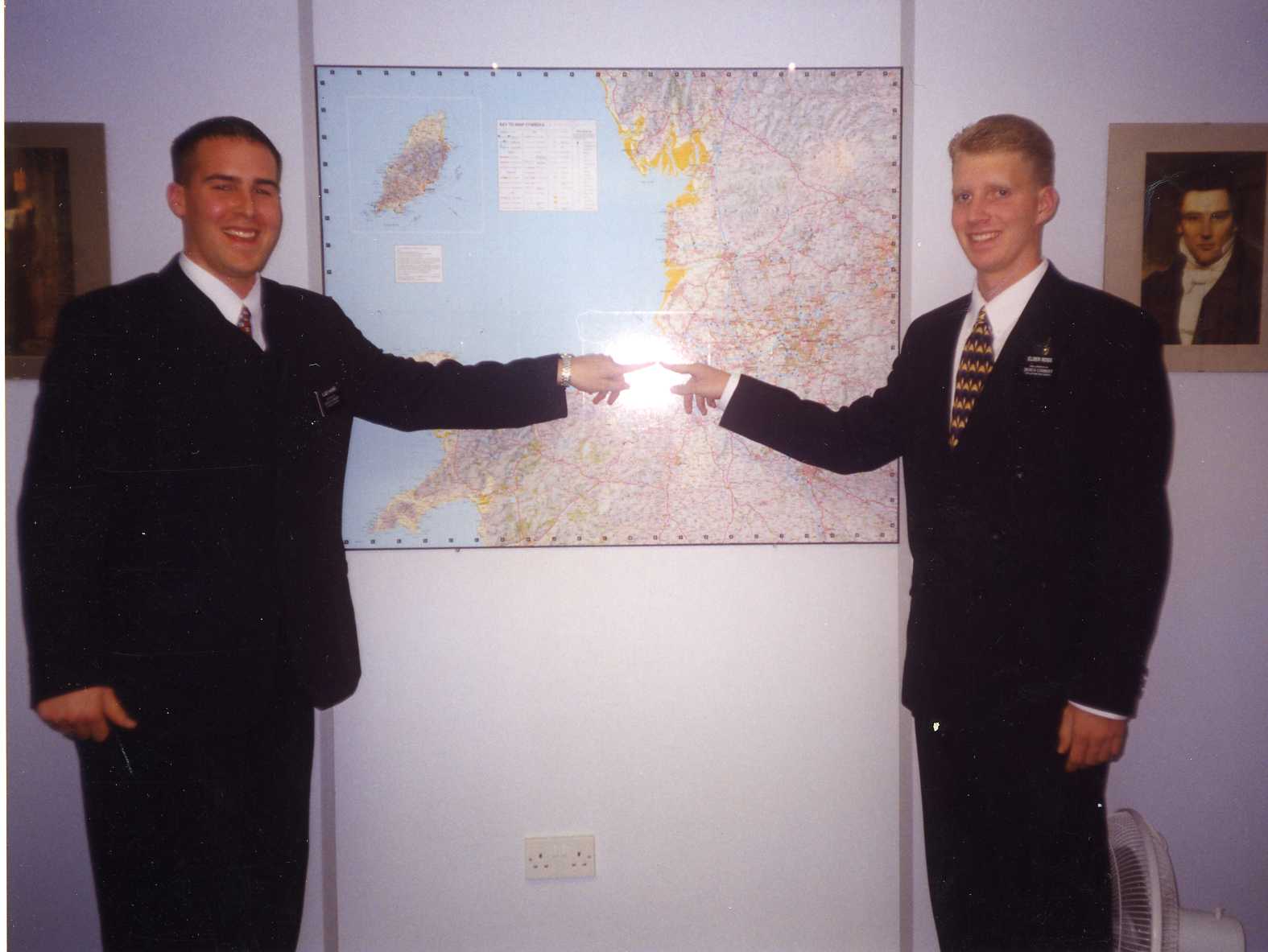
23 December 1998 – Elder Harris and Elder Ross assigned as companions at mission office, Altrincham, Cheshire

I arrived at Manchester airport on 22 December 1998. We stayed that night at the mission home in Altrincham. The next day, 23 December, I did my first street contacting in Altrincham not far from the mission home. That door is seared into my memory. I can still see it. After lunch that day, we were assigned missionary companions. Elder Jeremy Harris became my first companion in the mission field (Elder Kody Young had been my companion at the MTC). Elder Olson was assigned to Elder Paul Kelley that same day. Moreton wasn’t a surprise to Elder Harris, since he was already serving there.
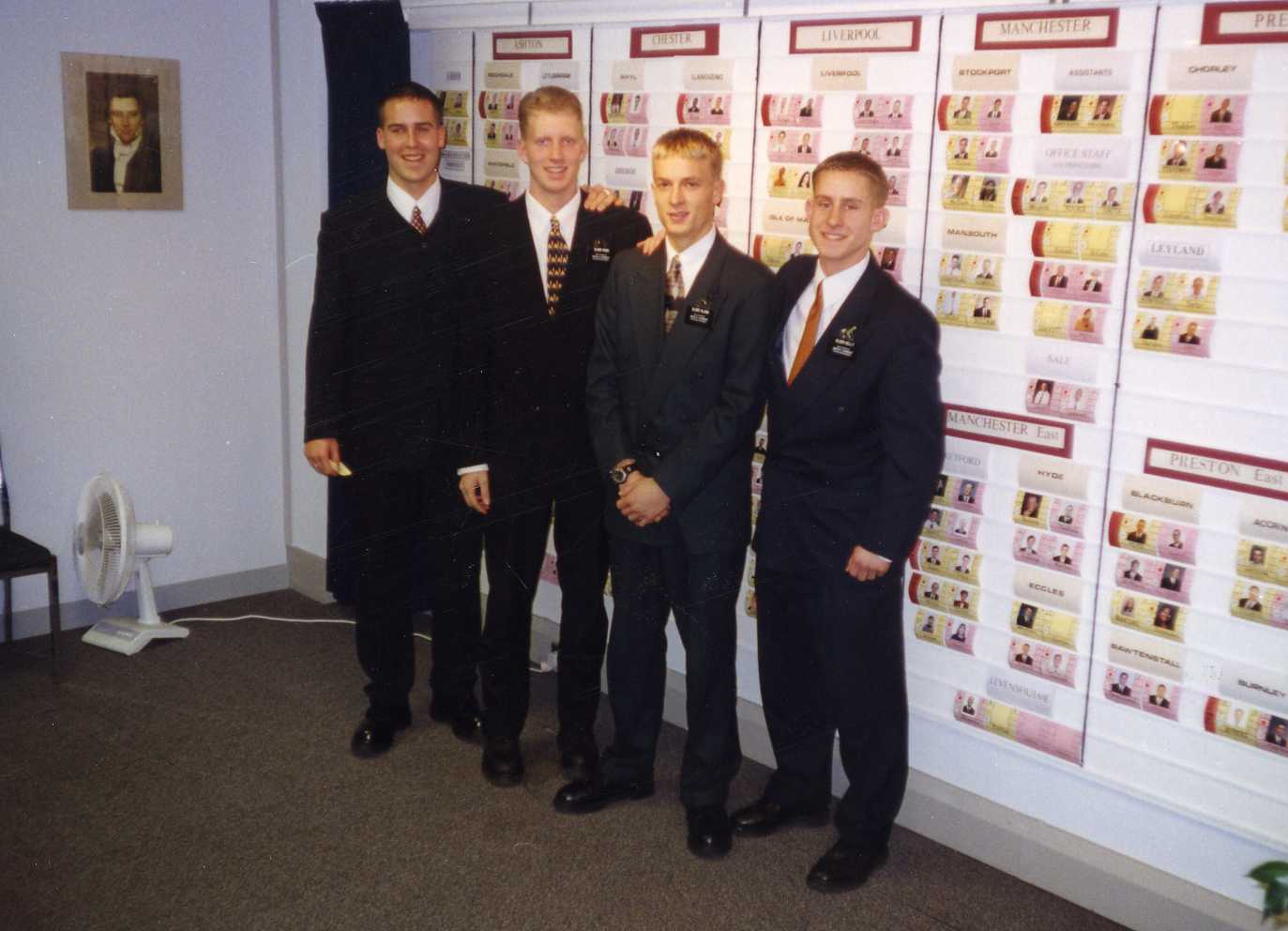
23 December 1998 – Newly assigned companionships – Elder Harris and Elder Ross, Elder Olson and Elder Kelley

That evening we did some tracting and went to the Counsells’ for dinner, which in England is called tea. Researching, this was Grant and Helen Counsell. Our flat address was 6 Belgrave Street, right on the corner of Trinity Road.

22 December 1998 – President H Bruce and Cheryl Stucki, and Elder Paul Ross

Writing the next day about that evening, I recorded: “We live in a 3 level flat on Trinity Street. So small and in great disrepair. Humble though. I am afraid the steps will break. We left and headed to our flat. Some guy ran up to us and pointed a gun directly at me. We drove off. It scared me to death. We come back to the flat and put on our whites and went and sang in the centre. I didn’t think we sounded good at all. Some members stopped by the flat when we got back. We received presents and 4 of us ran to do some street contacting while the rest went to deliver presents.”

25 December 1998 – Christmas Eve caroling, Elders Llewelyn, Lewis, Harris, Mueller, Ross, Knight

On 24 December, we had dinner with the McKenna’s. In my records I record it as McKenna, McKinnon, and MacKinnon. I don’t know which is right and so far the two members I have contact with do not appear to remember this family. Oddly, I remember this meal. We sat at a little kitchen table for two in the kitchen itself. The McKinnon’s did not eat with us. It was fairly dark in the kitchen. The soup was a chicken, pea, carrot soup. It was not a creamy soup, but it was oily or something and was amazing. None of the rest of the home was heated except the front room with a little gas heater (where the coal fireplace once was). My first introduction to the idea that people would only heat one or two rooms of a home, not the whole house. We left a spiritual thought and left. I don’t know that they were elderly, maybe 70s. But my soul was warmed. I understand the McKinnons moved away from the area.

This highlights another surprise for me in England. Their latitude is considerably higher than that of most of the United States. As such, in winter time, the sun would disappear about 4 pm. It would reappear about 8 am. The days are short. So this dinner appointment at 6 pm would have been in the dark. Many missionaries struggled with depression due to shortened daylight hours. In the converse, summer would have the sun going down at like 9:30 pm and coming up at 5:00 am.

Christmas Day, the 25th, I wrote: “All of us went to play footy, or soccer. I am not a soccer fan anymore. Since I hurt my foot in high school I am not supposed to do any kicking with it… I sat watching them played and I read scriptures while there. I sat some time looking across the Mersey River at Liverpool. What an impressive sight. One building reminded me a ton of the Salt Lake Temple. Dingy white with the 6 big towers but the building was full of windows. It had a big clock in the one end. Instead of an angel Moroni on the end, it had giant pelicans on both center towers.”

That building was the Royal Liver Building. The “pelicans” were actually the famous Liver Birds. Built between 1908 and 1911 for the Royal Liver Assurance company, it was designed by local architect Walter Aubrey Thomas in the Edwardian Baroque style and was, for its time, one of the first large buildings anywhere constructed with a full reinforced-concrete frame, engineering that let it rise to 322 feet and briefly stand as the tallest building in Europe. Its twin clock towers carry two copper birds, nicknamed Bella and Bertie, one facing inland toward the city and the other out to sea. Legend holds that if they ever flew away, Liverpool itself would cease to exist. The birds themselves were carved by Carl Bernard Bartels, a German woodcarver. Along with the Cunard Building and the Port of Liverpool Building, the Royal Liver Building and others form Liverpool’s famous “Three Graces” on the Pier Head waterfront. All fully visible from across the Mersey in Seacombe and Wallasey.

That same day, I visited with family on the phone, including my Dad, sister, Grandma, and Duncan family.

I wrote about my Grandma: “She told me how bad she felt about missing me at the airport. I wished I could have seen her too. It was really good to talk to all of them again. We shall see each other soon enough.”

Grandma died the next year, sooner than either of us expected that Christmas Day. My flight was originally supposed to leave from one gate in Salt Lake City and that is where she went. Later they realized what was going on and they raced over to the new gate. They got there in time to get a package on the flight to me, but no opportunity to physically say good-bye as we were already loaded.

26 December 1998 – My end of the bedroom at Liscard flat, Merseyside

On 26 December, dinner was with Steve and Linda Pitt. That day I also wrote: “I found out that the river and docks I was talking about was where all the immigrants from England left.” At some point, I probably should do a post, like I did with the Mormon Trail, of all my ancestors who came through Liverpool.

27 December 1998 was my first time at church in Moreton. Attendance didn’t reach 100. I confirmed into The Church of Jesus Christ of Latter-day Saints Ann Marie Brumfitt that day. She’d been baptized the Sunday before I arrived. I don’t recall the Elder’s name I replaced. I wrote, “It was a cool experience.” I also gave a priesthood blessing that day to a young boy, Thomas Michael Plemford, Gaynor Plimley’s son. That same day, jet lag and the whirlwind of the first week were catching up with me.

I wrote: “I am having such a hard time. I am so dead tired it is pitiful. If only I could go to bed earlier but that really isn’t possible… I will finish my mission but I will sleep for a week when I return, I am sure of it. Help me endure. These 16 1/2 hour days are killing me. I hope p-day they let me sleep in. I think the jet lag is not helping.”

Even so, I closed the day looking forward rather than back: “There is so much to learn. If I have acquired a percent of a fraction, I will count my life as something more than a waste. I will know it wasn’t all at naught. So much to gain, so little to lose. I pray my senses be toughed, my facilities enlightened to gain but a portion of the awesome amount. I please to learn and not have any tolerance in ignorance. Whatever principle of intelligence we attain to in this life will rise with us in the resurrection. And if a person gains more knowledge and intelligence in this life through his diligence and obedience than another, he will have so much the advantage in the world to come. D&C 130:18-19.”

This picture of the house across the street is a mirror of the house we lived in. The bricked in window is the one I am looking out and taking the picture from in our flat.

27 December 1998 – House across the street from our flat, our room on 3rd floor, 6 Belgrave St, Liscard, Merseyside

28 December 1998 – 3 January 1999

This was my first week in the mission with a planner of my own. The week before, Elder Harris had kept track for the both of us while I was still finding my feet. P-day, 28 December, we went to West Kirby to play squash, my first time ever seeing or playing the game. I wrote: “It was great. It is alot like raquetball. I love it, I will have to do it more and when I get home.”

I’ve loved squash ever since. Roy McKee was a member there that day. His aunt and uncle, John and Audrey McKee, were also in the Ward. I can’t say for certain which McKee household we had tea with each week, Roy and Carol (who I recall held a US citizenship), or John and Audrey, unless a specific journal entry says so. But squash was my love in Richmond, Virginia; Oklahoma City, Oklahoma; Logan, Utah; I wish there was somewhere closer to play to Burley, Idaho.

We kept a heavy teaching schedule all week, working discussions in with Malcolm and Mrs Robson, Jeff and Allen, and Jocelyn and Jamie on P-day evening alone.

Tuesday, the 29th, brought a companionship exchange along with tracting and a discussion with Lisa and Thorn, and a follow-up visit with Ann Marie Brumfitt, whom we’d confirmed on Sunday. Later that day we went tracting and got some callbacks on Royston Road. After doing some running we went back to teach Bobby Topham, a new contact. Writing about it the next day, I recorded (which is overly personal to Bobby):

“He really listened. His one wife joined the church but died soon after so Robert never found out why she joined. He has been a drug addict to like cocaine and marijuana. Heroin, everything. He is an artist, wonderful, wasted all his money from it on drugs. He is wasting away. He has been legally dead 3 times. His out of body experiences sound much like the ones I have heard before from good righteous people. He won’t live probably over a year. He agreed to be baptized. He also wanted a blessing. He told us why he left the other churches. What a wonderful experience that was. I fell totally in love with missionary work. He will be baptized on the 10th. We need to finish all 6 discussions with him. How exciting. The Lord is wonderful.”

Wednesday was one of our fullest days of discussions: Sharon, Olga and Vernon, Chris, Karen and Carl, and Margaret and Carol all in a single day, wrapped up with tea at the Counsells’.

New Year’s Eve found us in service most of the morning, then more tracting and discussions with Carol and Lewis and Margaret and Jon. We also had to go find Bobby Topham for his appointment that day, and taught him the 2nd discussion.

As I wrote: “He really listens to all the message. He went from 80 cigarettes to having his 2nd all day right as we were leaving. He is a really good artist. He is going to do portraits of us. He is so excited to get baptized. He explained us as glowing. Also when we gave him a blessing, he said he saw light. This guy is really open to the Spirit. What a wonderful soul. Through him we could pull quite a few more people in. He has 6 children all but 2 by different mothers. Two of the mothers are mother and daughter themselves. If the daughter and him got married he would be a brother-in-law to his own child. What a lifestyle. No hope. All sorrow. He has found the light. It is so exciting. I hope I get the honor of baptizing him.”

We closed the night with tea at the Hankins’ and home on time. I understand this was Brenda Hankins with her daughters, Emma is the one I remember most.

New Year’s Day started with a moment of reflection. As I wrote:

“Oh, what a year. What tremendous strides in all aspects of life. One definitely for spirituality. Institute in Logan, a mission, trials over the summer. My life has been a great growing experience. Physically, I have gained around an inch or two. Now around 6’1″ or 6’2″ I stand. Probably 35 pounds heavier. I am now around 175. I am pretty healthy and have a high metabolism. Mentally, this grows with spiritual but also being in college broadened my horizons. I learned and try to learn from every aspect of life. Emotionally has been the same as the rest, leaps and bounds. Especially with Duncan’s and on the mission, much of my life is being healed. I can cry, feel joy, laugh, feel others sorry, and connect. I am much healthier as a being now. This year has been especially trying from all that I have endured. I pray that I will always progress in every aspect. I thank God for all the wonderful people I have met and pray that they count me as a blessing in their lives.”

The day continued with our District Development Meeting and closed with tea at Jackie Laing’s, a standing weekly Sunday appointment that would carry on for the time I was there.

Sunday closed the week with church. Elder Mueller and I walked to picked up Bobby Topham and a boy whose name I don’t recall, and walked them to church together. We arrived a quarter hour late, going in after the sacrament had already started, though we did still receive it. A baptism was held at 2:00 that day. That evening included tea at Jackie Laing’s, a 6:30 appointment with Sonya, and, in another companion exchange, this time with Elder Llewellyn, a stop by the Todd’s, where we played with the kids and gave a spiritual thought. I tried to answer some of his questions; he wouldn’t let the children be baptized, but I think we did some good that evening.

Below is a map of every home we visited, taught, or contacted that week, pulled from the Teaching Pool, Less Active list, Finding Pool, and Contacts recorded on the back of that week’s planner page.
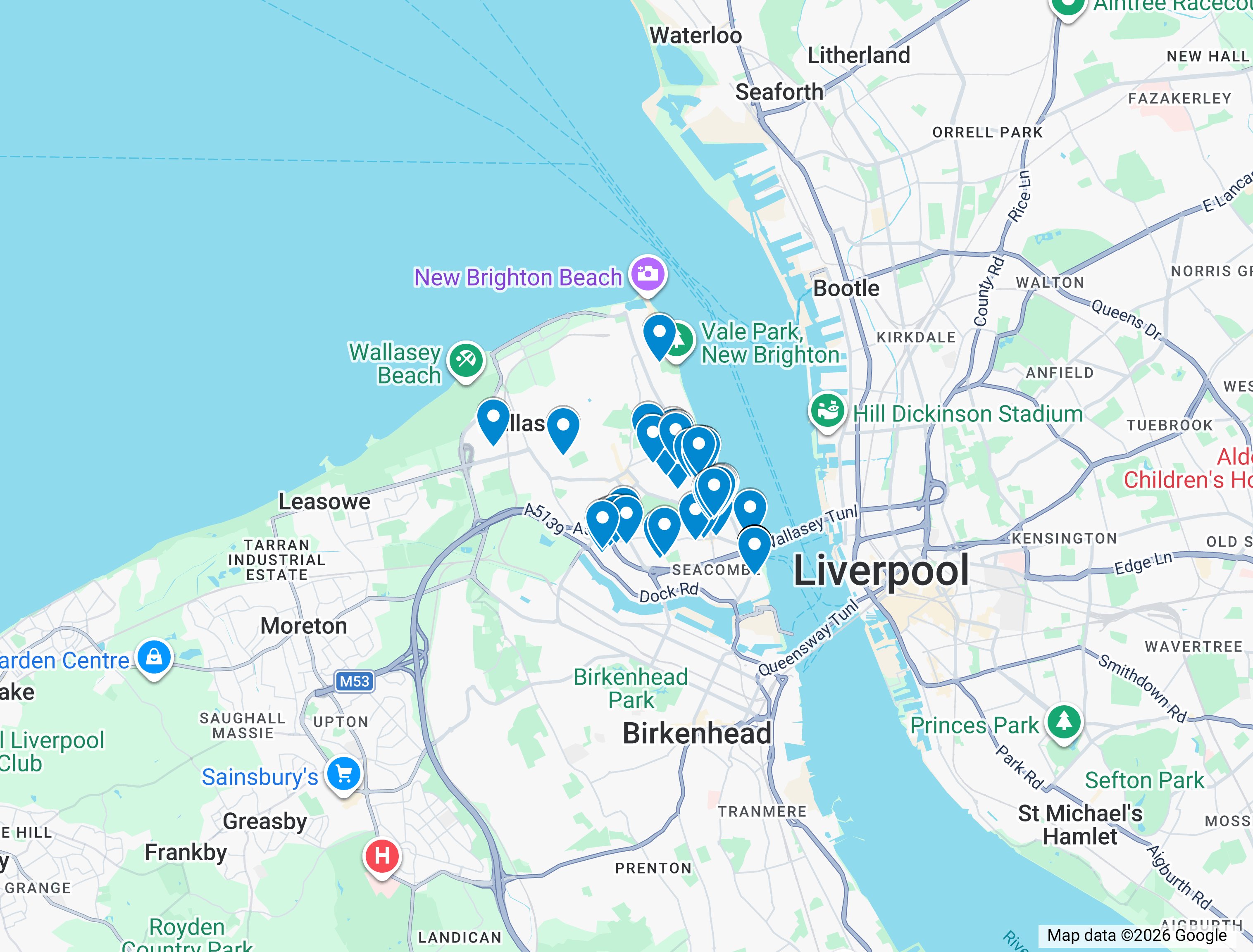
Teaching appointments from 28 December 1998 to 3 January 1999

Teaching Pool

  • Karen Reeves & LeeAnn Reeves — 53 Limekiln
  • Reece Buck — 40 Greenwood
  • Pete Murray — 8/A Poulton

Less Active

  • June Oden — 25 Sedbergh Rd
  • Julie Patterson — Lancaster Ave

Finding Pool

  • Ean James — 21 Serpentine Rd
  • Sharon — 49 Oxford St
  • Olga & Vernon — 17C Rice Ln
  • Chris — 100 Woodland Dr
  • Louis Clarkson — 22 Sherlock Dr
  • Les — 38 Sherlock Ln
  • Malcolm Patterson — 20 Lancaster Ln
  • Ron Fugg — 8 Claughton Dr
  • Lee — Rice Ln
  • Mike — 61 Rice Ln
  • Mick — 14 Rice Ln

Contacts

  • Mohan — 7 Edisbury
  • Mr. Robbison — 13 Ivor
  • Jill — 24 Ivor
  • Sheila — 12 Ivor
  • Mr. Doulan — 12C Rice Ln
  • Carol — 2 Norwood
  • Dawn — 17 Sterling
  • Carl — 15 Kendal
  • Gwen Climo — 29 Priory
  • Chris & Daniel — Rycroft Rd
  • Tracy — 6 Beechcroft
  • Eric — 69A #3 Poulton Rd
  • Jon — 75 Rice Ln
  • Margaret — 8 Lynncroft
  • Dave — 6 York Ave
  • Helen — 35 Royston
  • Margaret — 26 Royston
  • (unnamed) — 10 Rice
  • Les — 9 Upper Rise
  • (unnamed) — 34 Rice
  • Mike & Tony — 11 Royston
  • Melissa — 3 Woodhall
  • Laura — 19 Bell Rd
  • Andrew — 27 Bell Rd
  • Yvonne — 35 Bell Rd
  • Bill & Sue — 67 Bell Rd
  • Kerwin — 94 Bell Rd
  • Jane — 84 Bell Rd
  • (unnamed) — 60 Bell Rd
  • Lisa — 15 Windham Rd
  • (unnamed, 9 addresses) — 48, 54, 58, 70, 72, 78, 82, 86, 90 East St

4 January 1999 – 10 January 1999

P-day, 4 January, we went to Birkenhead and did some shopping. I wrote: “We went to Birkenhead and shopping. I bought a suit jacket/coat. Double breasted with 4 buttons up the front. I like it. I felt bad pulling out 70 pound from home.”

I still have that jacket, and still wear it for special occasions.

That evening we taught Bobby a lesson. As I wrote: “We went and taught Bobby a lesson. We changed his baptism to the 17th of January.”

5 January, I wrote: “I was listening to Johann Liszt’s Die Forelle and was very moved. It is so beautiful.”

That afternoon: “This afternoon we saw a body being taken out of a home and put into a car in a body bag. So moving. Haunting, yet joyful; painful, yet wonderful. Death is the last great adventure. So much lies beyond. I wish I new a farthing of what lay beyond. To grasp a microscopic portion would be an achievement.”

Also that day: “We taught a gypsy today. If we treat it right he will come around.”

6 January, I wrote: “We went out and I got to drive to West Kirby. My first experience driving here. It was quite different. I did well. I drive better than Elder Harris.”

That evening: “We had tea at Counsels or the Bishop’s. They told me of all the great experiences in Rhodes, Athens, Greece, Tunsia, and in the Sahara. I wish to travel these places. I hope to learn so much.”

8 January, I wrote: “We went out to tea at the Hankins. It is such an honor to eat there. …Such love, respect, and honor towards the missionaries.”

9 January, I wrote: “Oh, we went and taught Bobbie the 4th discussion. We skipped the 3rd because Elder Harris felt it needed to be covered. The chastity part was mine and was not fun. He wouldn’t talk about it. We are going to talk about it where no one is around tomorrow. I hope he will live it, or get married.”

That same day: “We went and taught grandma after. …She is a miracle. Mrs. Walker is her name. She is mostly blind and mostly deaf but in really good shape for 93. At one point we read to her 2 Nephi 31. She will read it some more. At one point, I commented and was bearing my testimony to her, she stopped me and commented, I mistook you for Jesus. You are His messenger. I shed tears right then. She doesn’t feel baptism is right yet but she will through prayer. Her love is so great. She is so close to the Lord. She says she feels so close. She says the Book of Mormon has brought her closer to the throne. It has. I am so filled with joy. I love her. Absolutely astounding. …We suggested we get her a big huge print book, she thought we were going to take away the one she has till we got the other. The pain and fear she expressed through her looks wanted me to give her a 100 more.”

That evening: “We went to tea at Jackie’s again. Really good chicken curry.”

10 January, I wrote: “Church was great. I think that all the talks spoke directly to Bobbie. They talked on food storage and other important stuff. The hymns was better today. I felt the Spirit strongly today. We went to gospel principles after. I taught half the lesson with Gayna on keeping the Sabbath Day Holy. It was great. The church is so true. Bobbie, Elder Mueller, + I went to another room and discussed the law of chastity and other concerns he had. I said some stuff that I didn’t know where I was going. When I wrapped it up it made complete sense and I learned so much about baptism. Pure intelligence right then. I had no idea where I was going with the conversation, it turned out, I said exactly what he needed to hear. WE said a closing prayer and Bobbie + I shed tears.”

That evening: “We went to tea at Jackie’s.”

Also that day: “We gave a blessing on Elizabeth MacKinnon. She is ill.”

Below is a map of every home we visited, taught, or contacted that week, pulled from the Teaching Pool, Less Active list, Finding Pool, and Contacts recorded on the back of that week’s planner page.
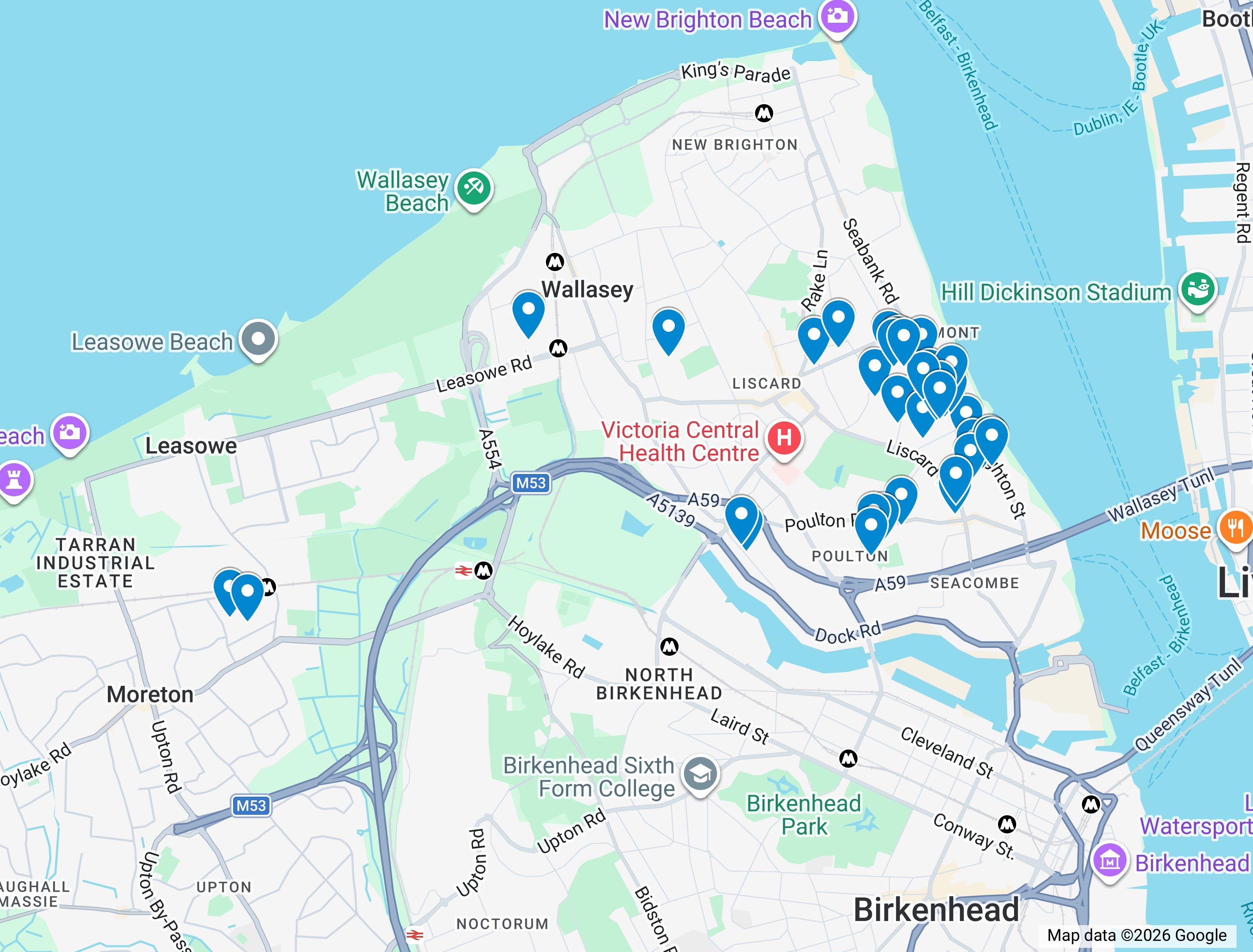
Teaching appointments from 4 January 1999 to 10 January 1999

Teaching Pool

  • Bobbie Topham — 9 Royston
  • Mike — 35 Manor Rd
  • Karen Reeves & LeeAnn Reeves — 53 Limekiln
  • Rhys Buck — 40 Greenwood
  • Chris — 5a Rycroft
  • Danielle — St Rycroft
  • Robert — 4 Stourton St

Less Active

  • Joe — 23 Trafalgar
  • June Oden — 25 Sedbergh
  • Julie — (no address)

Finding Pool

  • Janet Jones — 22 Bell Rd
  • Sue — 1 Bell Rd
  • Tracy & Andrew — 23 Falkland Rd
  • Tony — 40 Buchanan Rd
  • Lee — 59 Rice Ln
  • Malcolm Patterson — 20 Lancaster Ln
  • Shanon — 49 Oxford St
  • Ean James — 21 Serpentine Rd
  • Mr. Addict — 36 Water St
  • Lisa — 15 Windham Rd
  • Skip — 28 Water St
  • Cliff — 44 Union St
  • Gene Lockley — 24F Union St
  • Jeff — 22 Union St
  • Steve — 4b Union St
  • Andy — 44 Eastcroft

Contacts

  • Paul & Tom — 4 Bell Rd
  • Paula — 65 Bell Rd
  • Vicki — 1 Bell Rd
  • John — 57 King St
  • Lizzie — 7 Ilchester Rd
  • Joe — 3 Ilchester Rd
  • Kathy — 28 Ilchester Rd
  • Melissa — 3 Woodhall Ave
  • Helen — 35 Royston Ave
  • Margaret — 8 Lynncroft
  • John — 75 Rice Ln
  • Jill — 24 Ivor
  • Sheila — 12 Ivor
  • Larry — 37 Limekiln
  • Shirley — 36 Union St
  • Betty — 34 Exeter Rd
  • Jill — Yew Tree Rd
  • Sam — 34 Saxon Rd
  • Stacey — 79 Robinson/Robbins St

11 January 1999 – 19 January 1999

12 January, I wrote: “Mail always makes my day.”

That same day, Carol and Tanya McKee, came up in conversation assisting the missionaries in many ways. Elder Harris and I went and helped Bobbie that day. I wrote: “Elder Harris + I went and helped Bobbie with troubles. Satan is working so hard on him. We taught him a 6th too. We will teach him the 5th later. Elder Harris said I will probably get to baptize him. Wow, what an honor.”

While tracting that same day: “We were walking down the street when I had a thought to go visit this one house. We went and she listened, took the Book of Mormon, and agreed to have us back. She is Jew too.”

That evening: “We had tea at the Counsell’s. It was good. We had a good productive conversation over dinner. It was really good cornbeef hash. He showed me Gospelink, it was on the computer. Looked interesting, I wanted to dig through it.”

Also that day, we visited Grandma Walker again. As I wrote: “Oh, we visited grandma today. She won’t be baptized because of what it would do to her family. She prayed and cried all night. She admitted she knew the church is true. If she continues to read the Book of Mormon, she will find that she and them will be blessed. I hope I get to see her enter the waters. It is just a matter of time now I believe. I don’t know but pretty sure.”

I have tried to hunt down and locate Grandma Walker’s first name and other information. No luck so far. 93 in 1999, born about 1903. Lived at 5 Stanford Avenue, New Brighton, Wallasey CH45 5AP. But without her first name or her husband’s name, I think I am at a dead end.
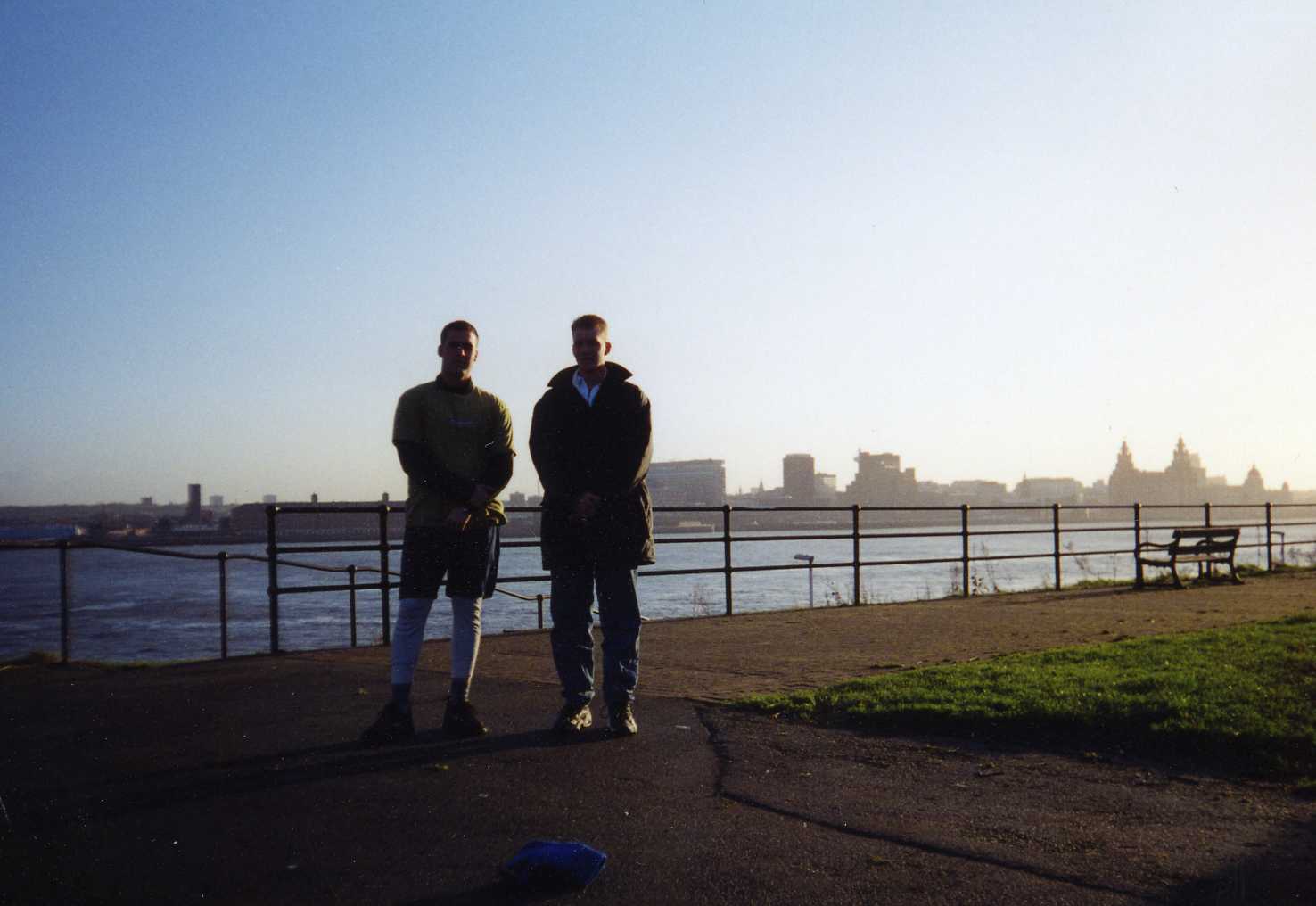
1999 – Elders Harris and Ross on Seacombe Promenade, Liverpool in background

14 January, I wrote: “Today had to be one of the longest days. So cold I haven’t felt my feet since 10:00 this morning. My eye is killing me. Swollen and every time I blink it hurts.”

Also that day: “I was so upset with Bobbie for having a cigarette. That is not me. Today the refiner fire has been hard to endure.”

15 January, I wrote: “At the mission office they sent me GQing with Elder Simion and Elder Wretham.” I would later serve with Elder Simion, in Wigan. I had to go to the mission office due to an eye infection. I had been sick for a while. As I continued: “We had a great time out even though we came back soaked. We were out for 2 hours in the rain. We come back and we ate. Dr. Turnbull saw me too. He looked at my eye and back. Eye is okay, just swollen from whatever was in it.”
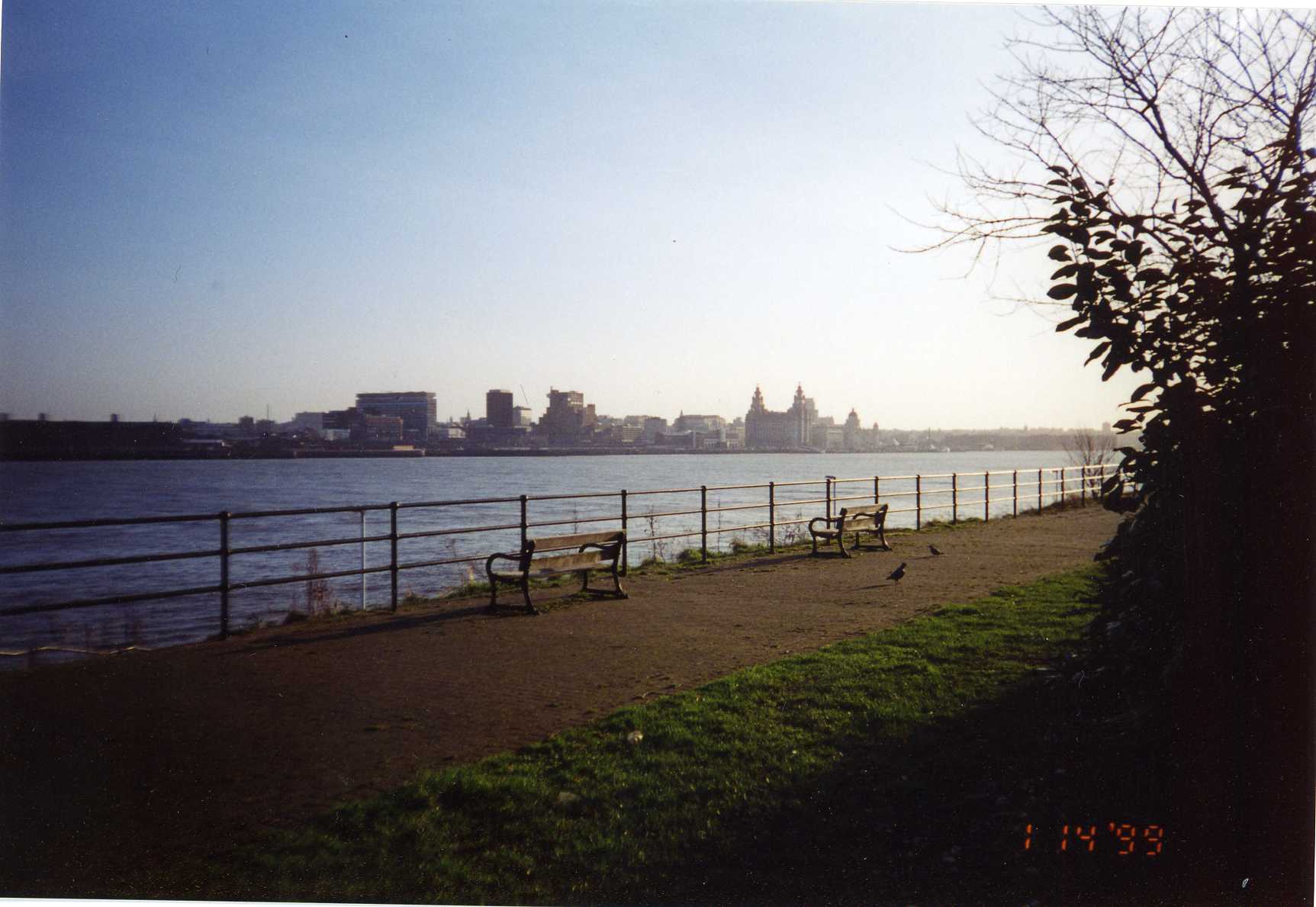
14 January 1999 – Liverpool from Seacombe Promenade

Also that day: “We went to Bobbie’s and had his bishop’s interview and talk. The Spirit was so strong. We had pictures and first a great conversation.”

16 January, I wrote: “I am so excited for Bobby. I set him straight on prayer, no excuses for smoking or drugs after baptism, and so he must repent. I tried to set him straight on everything. Now, I can baptism him, now he cannot plead I haven’t done my job, I taught him. He accepted it all really well too. There is alot of good stuff going on too.”

Also that day: “We got our dinner cancelled yesterday so we got KFC. I got chicken strips. We come back here and some lady ragged out Elder Harris for parking in the way of the sidewalk. She asked him if he was just going to stand there looking stupid. His response was just that. He looked around, looked stupid, looked at her and said, ‘I am not looking stupid.’ I laughed and the lady walked on mad.”

At 9:00 that morning, District Development Meeting. As I wrote: “Now Birkenhead is doing great. They have 5 baptisms this Sunday.”

17 January, I wrote: “Elder Johnson and I went all over and absolutely no one was home. …We got back here at the flat at 12:30. We went with Elder Lewis to Bobbie’s house in Oxton. He wasn’t there. I called him and rescheduled for 7:00. We went to this family in Birkenhead and had a good conversation. They fed us some and then we had interviews in Pensley. The 5 they are going to baptize tomorrow. It took forever to interview them all.” I have no recollection or clue to who Elder Johnson is or why I was on exchanges with him.

That evening: “Elder Mueller and I ate at the Billington’s.” This was Lawrence “Lol” Billington (1928–2000) and Sheila Maureen Billington, née Connolly (1936–2020), both of Wallasey.
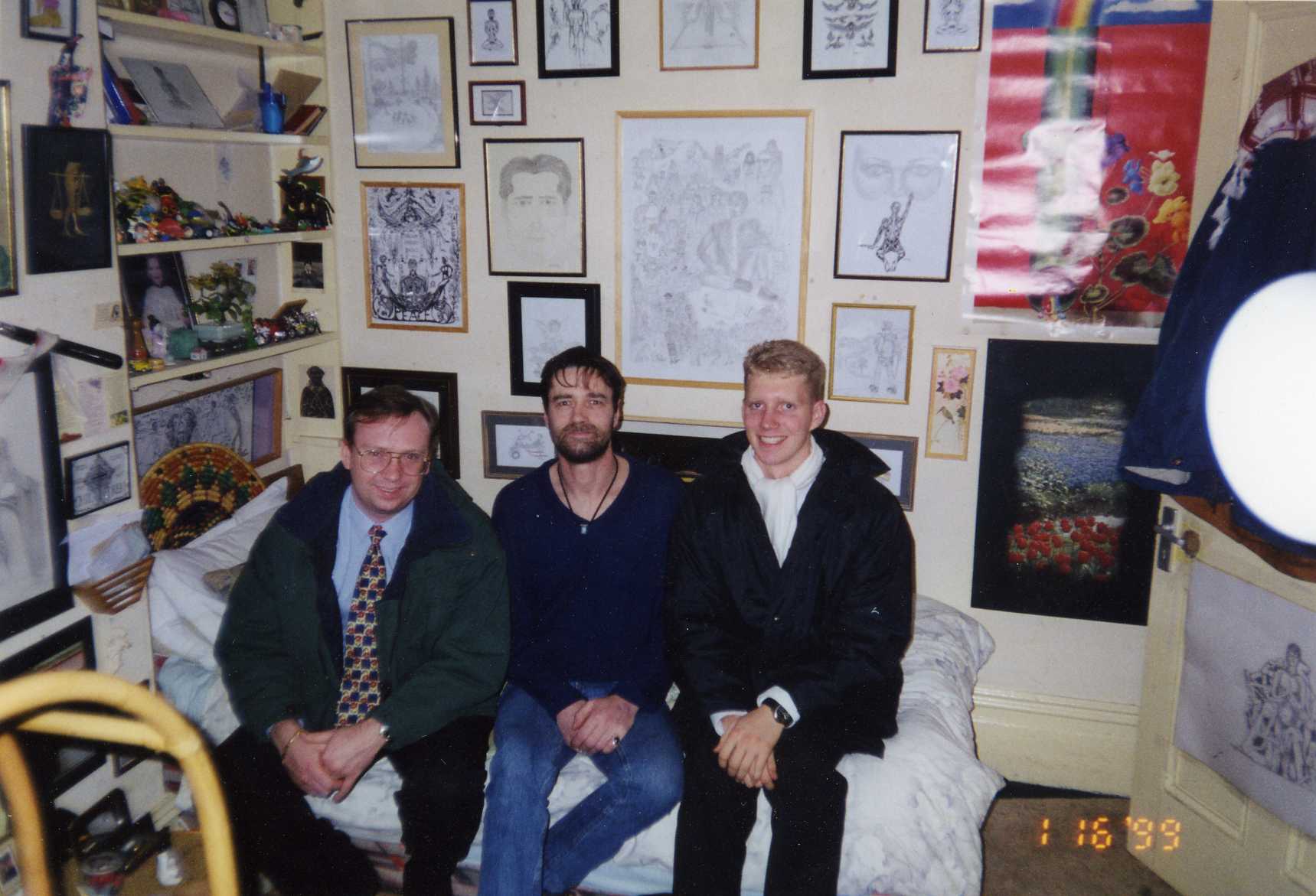
16 January 1999 – Bishop Grant Counsell, Robert “Bobby” Topham, Elder Ross

Sitting in sacrament meeting that same day, I wrote: “I am sitting in sacrament meeting here in the Moreton ward. They just finished talking on family history. I don’t think I have ever realized how important it really is. There is so much I have wanted to do. But that is one of the other things that will have to stay on hold till I return home. It is so exciting to do missionary work for the live, after my mission, I will get to do missionary work for the dead. Brother Cliff Roberts is a wonderful man. He gave the talk on family history. Many people joke that he is one of the three Nephites. I don’t think so, but I want to talk to him to make sure. Either way, there is a lot I can learn from him.”

I understand Cliff Roberts passed away from cancer a few years ago.

Also that day, at Bobby’s own baptism: “We are at Robert Topham’s baptism. Roy McKee has been officiating. Roy gave a great talk on Baptism. His daughter Tonya McKee gave a great talk on the Holy Ghost.” “Kathy Dunford gave the opening prayer.” “I now have a firm testimony of baptism. Not that I didn’t, it is just reaffirmed.” “Robert signed the other page. That is his signature. Bishop is talking on following the commandments. He is talking on how we need to endure.”
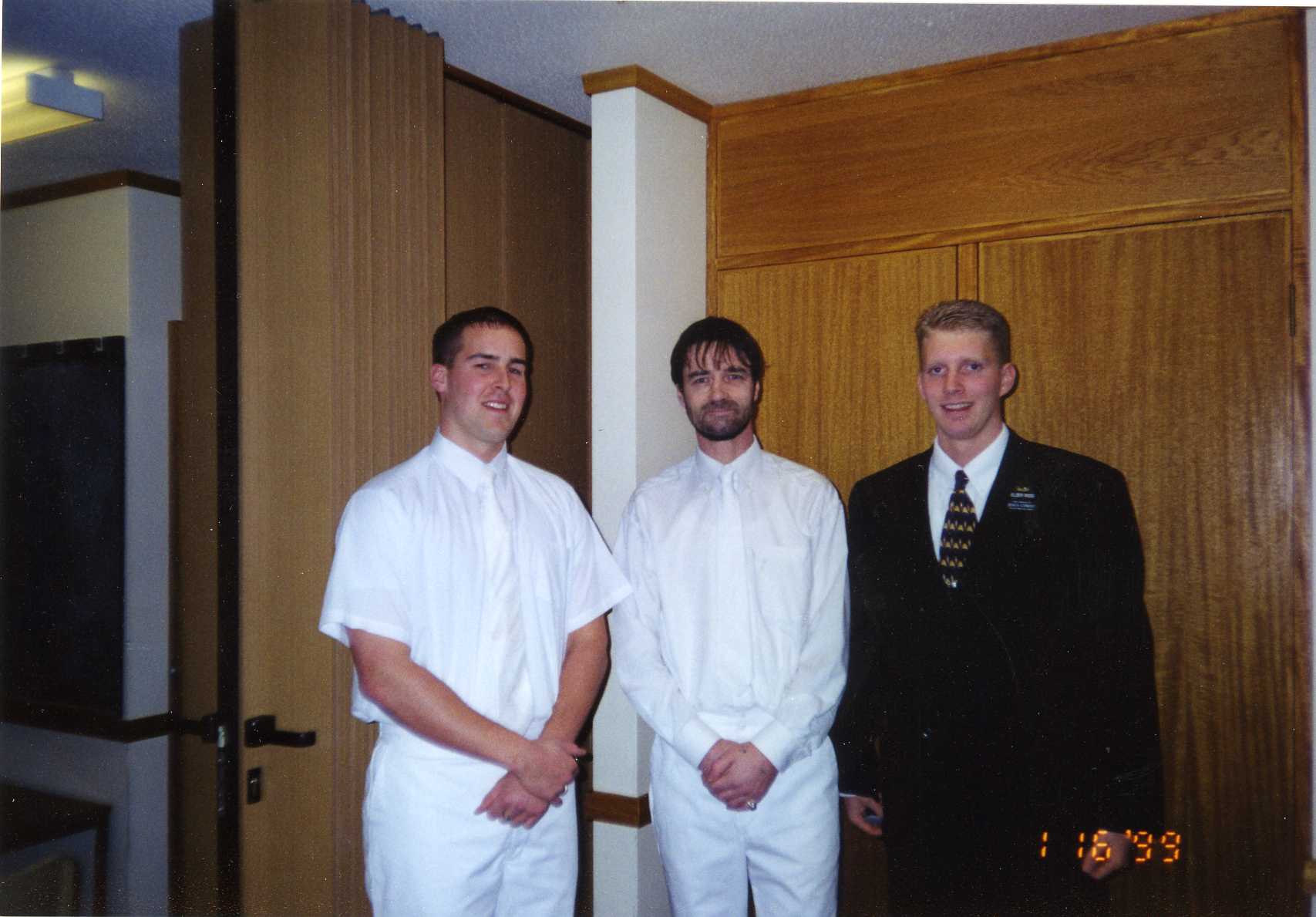
16 January 1999 – Baptism of Robert “Bobby” Topham with Elders Harris and Ross

18 January, morning, I wrote: “Elder Llewelyn and I walked to the McKee’s. Not Roy but his uncle. We had a great conversation. Very spiritually uplifting. I look forward to more.”
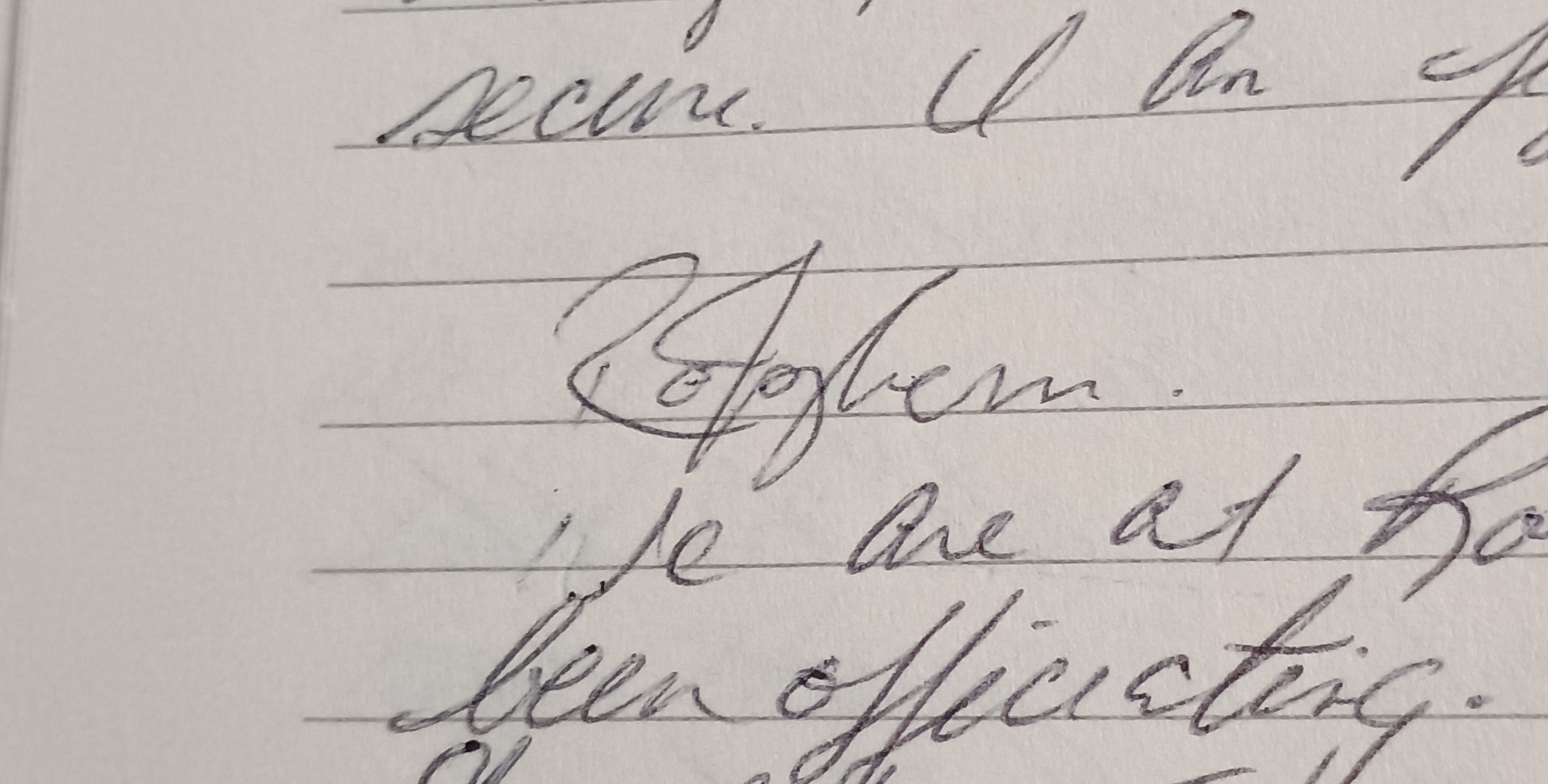
Robert “Bobbie” Topham’s signature in my journal

19 January 1999 – 25 January 1999

20 January, 6:10 AM, I wrote: “We met this other guy named mike. He was one of the first surfers in Great Britain. A great guy. That was during the late 60’s. He still travels to Australia every couple of years. Never surfed California or Hawaii. Great guy but he doesn’t believe in God at all.”

Also that day, tea with Roy and Carol McKee: “We went to tea at the McKee’s. She is a really good cook. We played piano some and some snooker. We ate a good dinner and had a good conversation.”

Also that day: “Even though another lady answered the door in the nude, we went back because she said we could. We taught her the first. I forgot her first name. I think she will accept the gospel.”

And: “We went and talked to Bobbie and we caught him smoke a cigarette. We talked to him and about smoking. He says he is trying. He needs to do.”

At 10:06 PM that same day, I wrote: “We got fish and chips for lunch. I got back and had 11 letters in the post. Yes, ELEVEN LETTERS. Can you imagine my joy. It took over an hour to read all of them. The fish and chips was great too. We had tea at Counsell’s. It was homemade pizza. It was really good. WE had a really good time. Oh last night we gave Isabell MacKinnon a blessing. I got to give it to her. It was exciting. I love this church.”

22 January, 6:11 AM, I wrote: “We went with Elder Knight + Llewelyn to see grandma. We gave her the 4th discussion. She is really torn between her family and joining. I hope her family will soften their hearts and tell her it would be okay to join. We don’t know how much time she has. It is so sad. She says her family is really upset with her. We taught a 1st to Bobby’s son, Steve. I hope his mother and him will come to embrace it. It will keep Bobby on his toes too. We had fish and chips for dinner because we didn’t have a tea scheduled. I went out with Victor Wise to do home teaching. We went from down by the church on Norwood Road to New Brighton on Wellington Road. And clear back. That was a long walk and Vic walks fast. He even keeps me on my toes. I talked to his wife and him for a while. Neither the people we went to visit were home. How sad. We have to try again.”

Victor Charles Wise (1923–2004) married Brenda Tingle (22 February 1933, Sheffield – 22 December 1999, Upton, Cheshire) on 9 December 1977; both have since passed.

23 January, 8:45 AM, I wrote: “One thing, grandma is having such a hard time choosing between family and faith. We had dinner at the Pitts. The bishop’s father-in-law died, another member of our ward. Hopefully it gets better for this ward.”

“Elder Knight + Elder Llewelyn are leaving us. It will become a 4 more flat. Elder L to Liverpool Elder Knight to Leland up by the temple.”

“Oh, the joy of giving truth.”

24 January, 6:10 AM, I wrote: “I cannot believe I have been in England a month already.”

“We went to do a street meeting after DDM. I thought it was quite unsuccessful. Everyone went to Burger King after. It felt good to eat a decent burger, but it wasn’t my way, right away. We don’t get options of what we get on the burger. Basically you get the burger or you don’t, that is the only options.”

“We went to Leasowe and nothing happened. We didn’t teach anyone and it went slow. We met at Jackie’s for tea but Elder Llewelyn + I were told to go to the Ryan’s. We went. It was a nice huge house. Dinner was great. We got on this joke that Sister Ryan is a translated being and she started Sara Lee and owned Standard Oil, Ford, and a ton of other things like that. It was such a blast.” This was Liz and Mike Ryan.

24 January, 2:12 PM, I wrote: “We are at Irene Jame’s baptism. We just sang hymn #300, Families Can Be Together Forever. I get to be the chorister, and Roy McKee is officiating. His daughter, Tonya McKee is the organist. Emma Hall is giving the 1st talk. It is on baptism. Baptism is such an important step. Gayna now, probably on Holy Ghost.”

Mary Irene Thomas (12 April 1930, Wallasey – 21 June 2014, Birkenhead) married Harry James (1923–1987) in March 1956, Wallasey.

“Now John McKee, Roy’s uncle. This should be good. I remember how he told me about the giardian angel at the foot of his bed in the hospital. We were told a story on how when a guardian angel wants you to know he is there he will leave a white feather.”

John Huddleston McKee (1928 in Liverpool to 2025 in Wallasey).

Writing early on the 26th about Sunday night, I recorded: “Sunday night we went to tea after the baptism and they had Elder Llewelyn and I walk back again. We walked all the way from Morton through Leasowe and to Wallasey. We stopped at John and Audry McKee. Elder Llewelyn and I had a really good conversation. We discussed Doctrine + Covenants section 4 verse 6. …John and Audry McKee are like my adopted grandparents. They are so wonderful. They gave us a ride to Irene James, the newly baptized lady. We talked there for quite a while and went over to Gayna’s. We talked for a while and ended up running all the way back to the flat. We got in at 10 seconds after 9:30. We were late.”

Monday, 25 January (P-day), I wrote: “We come back and changed and headed to Liverpool. I love Liverpool. It was all so big and beautiful. Huge but grand buildings. These buildings have class. It seemed like another country. The styles they wear and the music. The stores are so much different. We went to Pizza Hut and had the buffet. It was all you could eat. I love Pizza Hut. The pizza was better here than in America. The crust was so soft, greasy, and yet with that crunch. Elder Llewelyn and Elder Knight transferred away. …We walked through Liverpool town center and went to the car and come back to Wallasey. The Kingsman Tunnel is cool too.”

Below is a map of every home we visited, taught, or contacted that week, pulled from the Teaching Pool, Less Active list, Finding Pool, and Contacts recorded on the back of that week’s planner page.
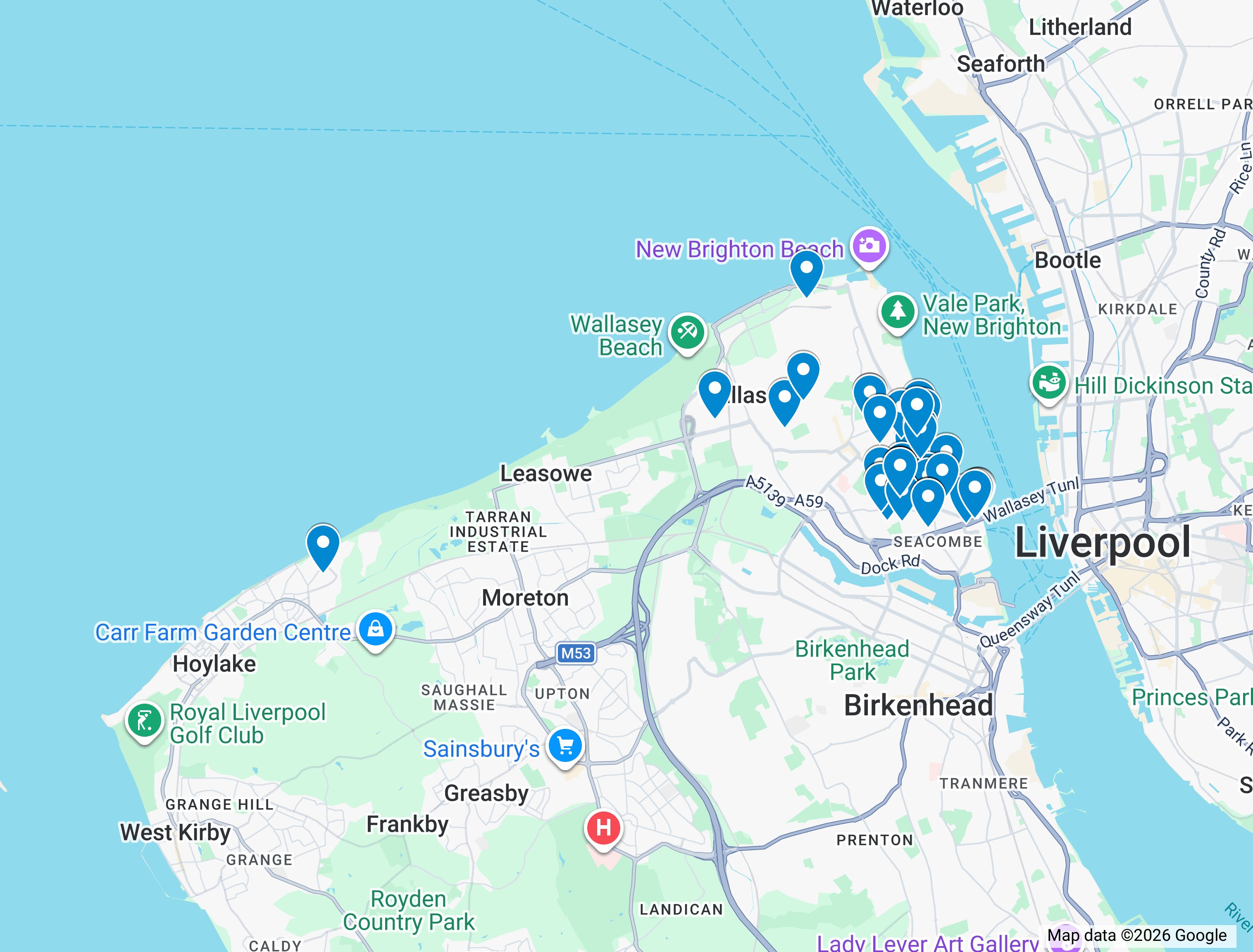
Teaching appointments from 19 January 1999 to 25 January 1999

Teaching Pool

  • Bobby Topham — 8 Royston
  • Colin & Tracy — 28 Water
  • Sandra Corbert — 166 King

Less Active

  • Joe — 73 Trafalgar
  • June — 25 Sedbergh
  • Paul — 98 King
  • Mike — 1 Fell
  • Julie — 20 Lancaster
  • Ann Shane — 10 Tudor Ave
  • Brenda Reynolds — (no address)

Finding Pool

  • Chevon — 61 Hampstead
  • David Evans — 7 Annesley
  • Lisa — 15 Windham Rd
  • Stan & Helen — 42 Hampstead
  • Malcolm — 20 Lancaster
  • Andy — 44 Eastcroft
  • Veronica — 60 Harvest

Contacts

  • Emma — 7 Hampstead
  • Lynn — 1 Hampstead
  • Caroline — 27 Annesley
  • Jan — 53 Annesley
  • Sue — 1 Bell Rd
  • Kathy — 28 Ilchester
  • Joe — 3 Ilchester
  • Helen — 35 Royston
  • Maz — 15 Knowsley
  • Sue — 54 Albemarle Rd
  • Shirley — 36 Union
  • Jon — 17 Summit
  • Conesta — 35 Greencroft
  • Linda — 69 Rycroft
  • Sharon — 71 Rycroft
  • Margaret Quinn — 47 Rycroft
  • Anita — 35 Rycroft
  • Olwin — 46 Hampstead
  • Tim — 54 Hampstead
  • Chris Walsh — 62 Hampstead
  • Chris — 66 Hampstead
  • Gordan — 33 Greencroft
  • Wendy — 8 Tudor
  • Alan — 14 Tudor
  • Lawrence — 22 Tudor
  • Paula — 8 Lucerne
  • Teresa — 49 Lucerne
  • Mr. Partridge — 16 Centurion Close
  • Joyce — 11 Lucerne
  • Shelly Thomas — 20 Rudgrave Square
  • Enid Hill — 50 Wellington

26 January 1999 – 1 February 1999

27 January I wrote: “I am so tired. I hope one of these days I get over this feeling. We went to Birkenhead for service. We went to the chapel up there and the sisters made us breakfast. It was not good at all. We put all our plans together for flight 401. It will be the 4th discussion acted out by 12 missionaries. I get to be the missionary on the plan who tries to convert the high jackers. I spelled that wrong. They blow up the plane and they take the people through all the different glories and stuff like that. I get to play all the time on the piano in the chapel or celestial room. Missionary straight to celestial. That is cool, they didn’t mean to do that. We came back here and changed. I forgot my coat at Birkenhead so I don’t get any money till I get it back. Also, my letter home is sitting in the pocket. I might not get it back till Fri, Sat, or Sun. All those at home are going to have quite the wait. Unless the Birkenhead Elders took the coat with them and if they did, Elder Harris will have them mail my letter.”
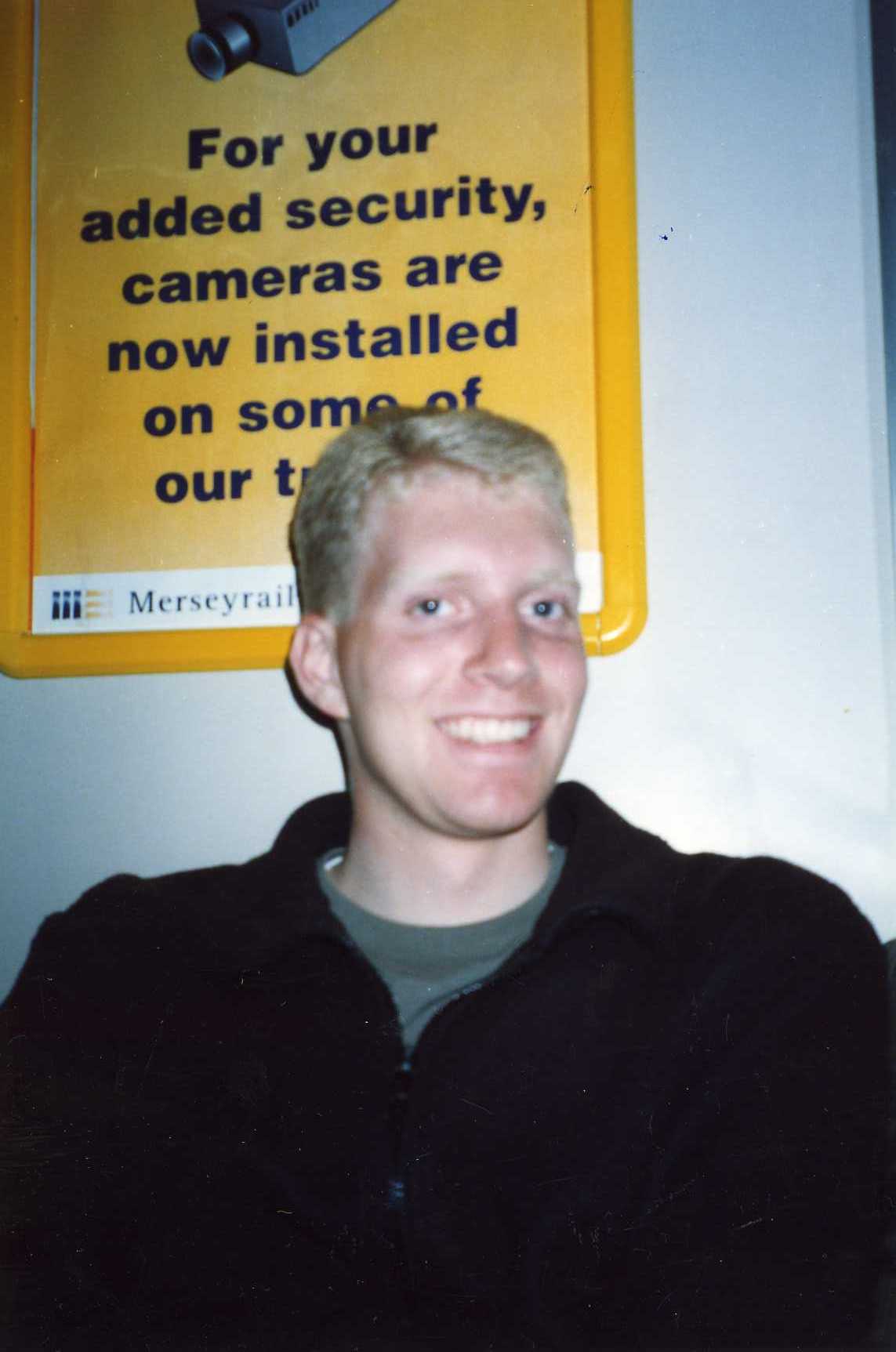
1999 – Riding train to Birkenhead

Also that day: “We went out proselyting after in Elder Knight’s area. I like New Brighton more than Wallasey. I hope we work that alot. It rained hard the whole time. The coat of Elder Lewis I borrowed wasn’t rainproof so I got drenched. Even the stuff in my bag got pretty wet. We come back and dried out.”

Later that day: “We went back out and met a ton of people. We had tea at the McKee’s again. It was a good dinner like usual. We found out Carol plays the guitar. Roy has an office to die for. That thing is loaded with just about everything. Tonya is quite into music too.”

Also that day: “We went to Irene James or Clinton’s nan and she asked me to confirm her. This will be my 3rd Confirmation, no baptisms. I mean performed by me.”

28 January, 9:57 PM, I wrote: “I have to admit, these past few days have been different. I have gotten so into the other things that I have not had time to write. The Spirit has taught me much over the past day. I look forward with great anticipation to the future. I have become much more calm and open through the Spirit. Love has increased as has humility and insight. I do hope that it continues. I can tell now even in my writing a unworrisom feeling and appreciative attitude. Flowing and loveing, oh, how great is our Lord. For I do know that he lives. It was testified to me more.”

Also that day: “We had tea at the Wise’s where we were given many referrals. Things continue to lok up. Elder Harris + I are being blessed for enduring and continuing in diligence.”

Later that evening: “Later we watched Ensign to the Nations with Bobby at Gayna’s. So very moving it was. The last 15 minutes of the show moved me to my very core. It was once again reaffirmed to me by the Spirit of the truthfulness of this gospel. If only I had the words to describe it.” “Faith in Every Footstep with all the temples and angelic voices singing rocked my very core. Bobby too felt that presence.”

“We (Elder Harris + I) left and headed to Chester. We stayed the night and I went on splits with Elder Dixon. We tracted quite a bit and only got two call backs. Something was wrong. Elder Dixon seemed so unsure of the work. I hope he can become strengthened.” This visit to Chester was just overnight, and we didn’t even go downtown.

“We had tea at John McKee’s. Oh how great it is to share time with such righteous people. It is so exhilarating to the soul. It is so moving to be around them. Now I call them my adopted grandparents.”

“We had the flight 747 tonight. We act out a plane crash and then take all the people through the separate kingdoms. It worked out really well.”

I cannot imagine doing a Flight 401/747 post 9/11…

30 January, 9:50 PM, I wrote: “Today has been a phenomenal day. I started reading my book that dad sent to me. It is called Drawing on the Powers of Heaven. Wonderful book. I will be glad when I can understand all of it and apply it.”

“At 9:00 we left for the funeral of James Jones. That is Bishop Counsell’s father-in-law. James’ wife Audry was the one I thought made a perfect grandma. The funeral was absolutely stunning. Singing and the Spirit was great. Bishop Counsell got up and talked on [James’] life. This man was a perfect example of Christ. I hope to be like this man someday, who was so much like Jesus. …Bishop told of how when they found out he had cancer, that before returning to bed, the asked either to take him so he wouldn’t have to suffer or to let him endure happily. He now rests in peace. The Spirit touched me phenomenally strong. I cried. They sang O my father, I was streaming. Tonya McKee sat in front of us. She was sobbing. I was so touched by the Spirit. There was the closing prayer and we all went to the crematorium. There was a little service where The Stake President spoke, and we said our good-byes. I knew not this man but he has touched my life.”

Also that day: “After I talked to Cliff Roberts, the one everyone things is a Nephite, he isn’t. He did reveal some fantastic and great knowledge to me that I have been looking forward to. He was a 2nd witness today. I told him how he quickened and excited my soul by how great of an example and by his righteousness. He thanked me. I hope he remembers I look up to him.”

“The high point was we taught Bridgette tonight. The lady with green hair. She is so in tune with the Spirit. She taught us most of the plan of salvation but she knew not that it was divine. We explained the light of Christ. She totally accepted it all and agreed but she is so use to having herself. She finds it hard to acknowledge her conscience as the gift given from God. She uses cards for answers and prayers. Interesting. She totally believes in Spirits. She communicates through them. Dangerous, a bad one could get in there. I think she will come around.”

“A poem given today: ‘Time is, Too slow for those who wait, Too swift for those who fear, Too long for those who grieve, Too short for those who rejoice, But for those who love, Time is Eternity!’ So true.” The poem is “Time Is” by Henry Van Dyke, from his 1904 collection Music and Other Poems, originally written as an inscription for a sundial in a friend’s garden, and later read at Princess Diana’s funeral in 1997. Van Dyke’s original last line was “Time is not,” though the “Time is Eternity” ending recorded here has become the more commonly quoted version.

“I had a memory of a dream this summer. The entire dream followed tonights sequence of events at tea. Everything down to the number of donuts and the cool little fry fork. The past, present, and future are all one in the Lord. All present.”

31 January, 10:34 AM, I wrote: “We are now in Sacrament Meeting. It has been a great meeting so far. We started singing hymn #60. I love that hymn. His truth is marching on and I am helping that it goes forth. I confirmed Irene Mary James. What an honor to bestow the gift of the Holy Ghost, not just the gift but thee Holy Ghost. It was great.” “There was a talk given on the windows of light. She commented on how Joseph Smith looked for the light and found it.”

Also in that meeting: “Jackie Laing tells her conversion story. She was…searching for the truth. She said nothing captivated [her]. The Born-again Christians she went towards. She joined with them. She found a member and went to church. She later had the discussions. It is true, she could find no fault. She had an experience with the Book of Mormon.” “She commented on the excitement of hearing an answer for a prayer or having a revelation or inspiration. Such excitement.”

“We are now in combined Relief Society and Priesthood. Roy McKee commented that if anything goes wrong, we weren’t prepared. That is so true. Nothing can go wrong if we are prepared. We should be prepared for anything. That is one of the reasons we work and learn from the past.” “Cliff Robert commented to me that price is any opposition to that which is good. The father of all lies, the author of blackness, or the pride. We are all equal, God is no respecter of persons. What a thought.”

“We went to Moe Jones’ after. There were talked with Lois and Moe. Lois might get baptized.”

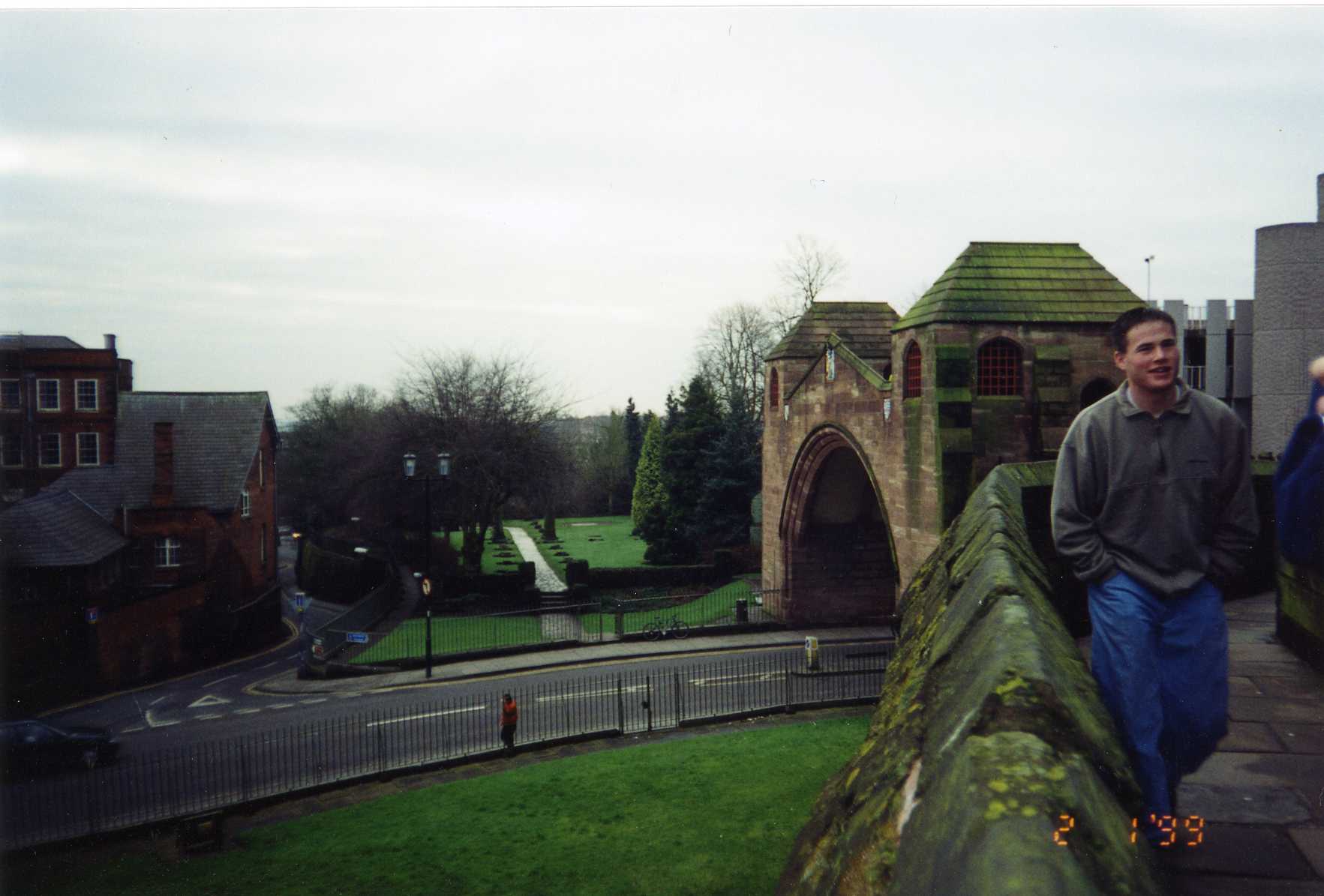
Written 2 February, relating to 1 February: “Yesterday was quite the interesting day. We went to Chester, walked the wall, pigged out at Pizza Hut, and came back. I got pictures and I wrote about it in the letter home.”
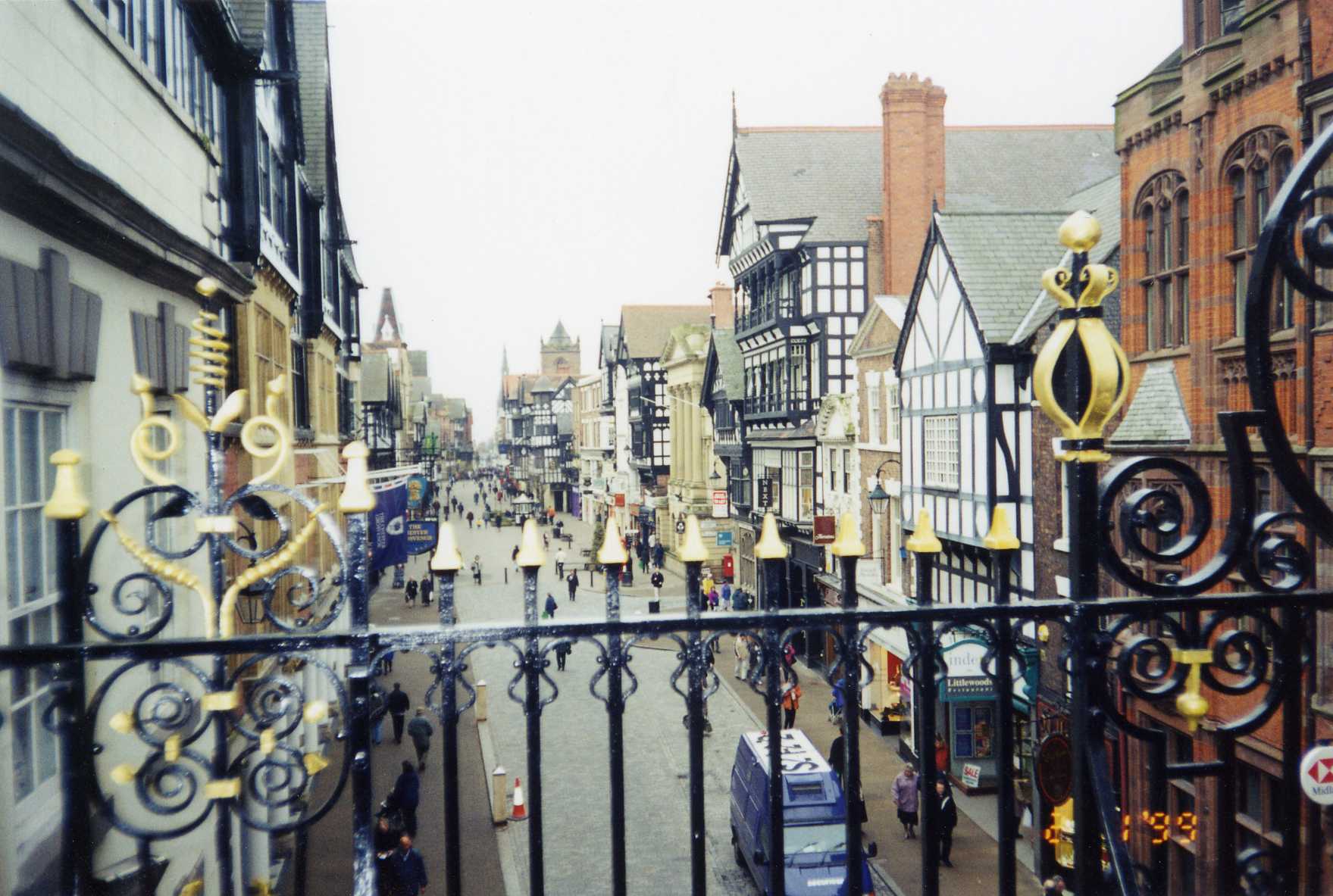
1 February 1999 – Chester Town Center from Wall
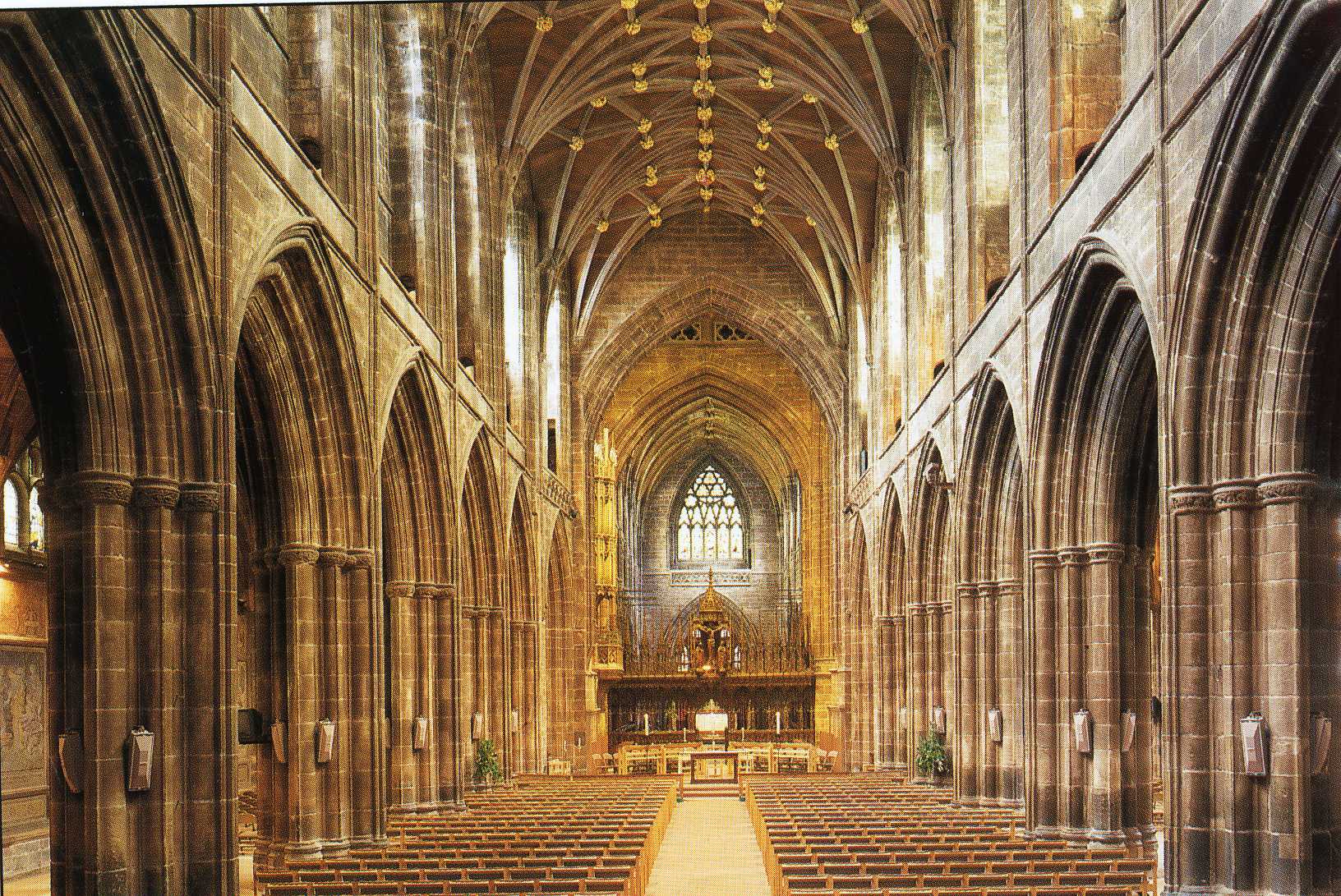
Scan of Chester Cathedral postcard
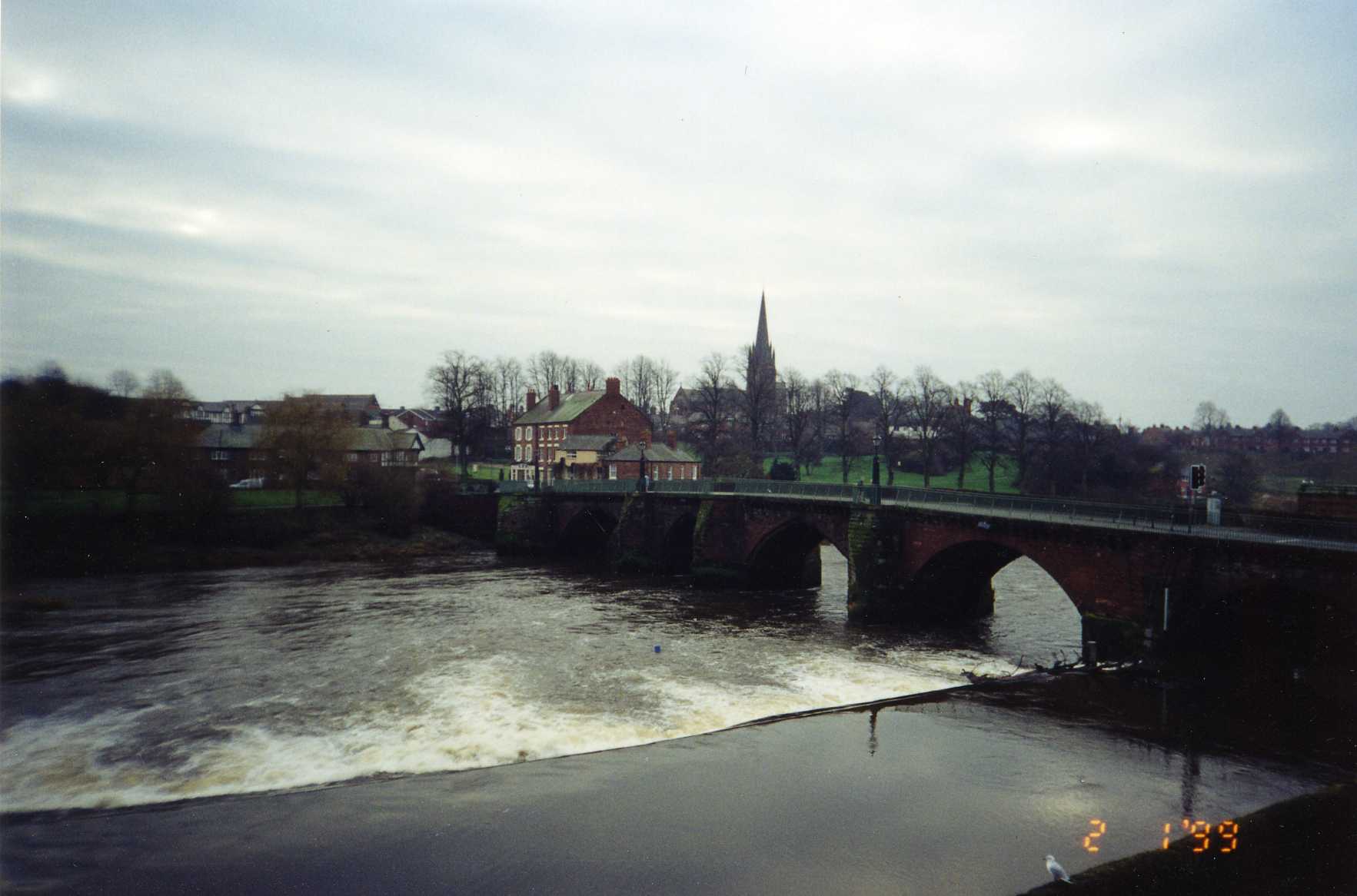
1 February 1999 – Falls on River Dee, Chester, Cheshire
1 February 1999 – Elder Mueller walking on Chester Wall

Below is a map of every home we visited, taught, or contacted that week, pulled from the Teaching Pool, Finding Pool, and Contacts recorded on the back of that week’s planner page. This week’s page had no separate Less Active section.
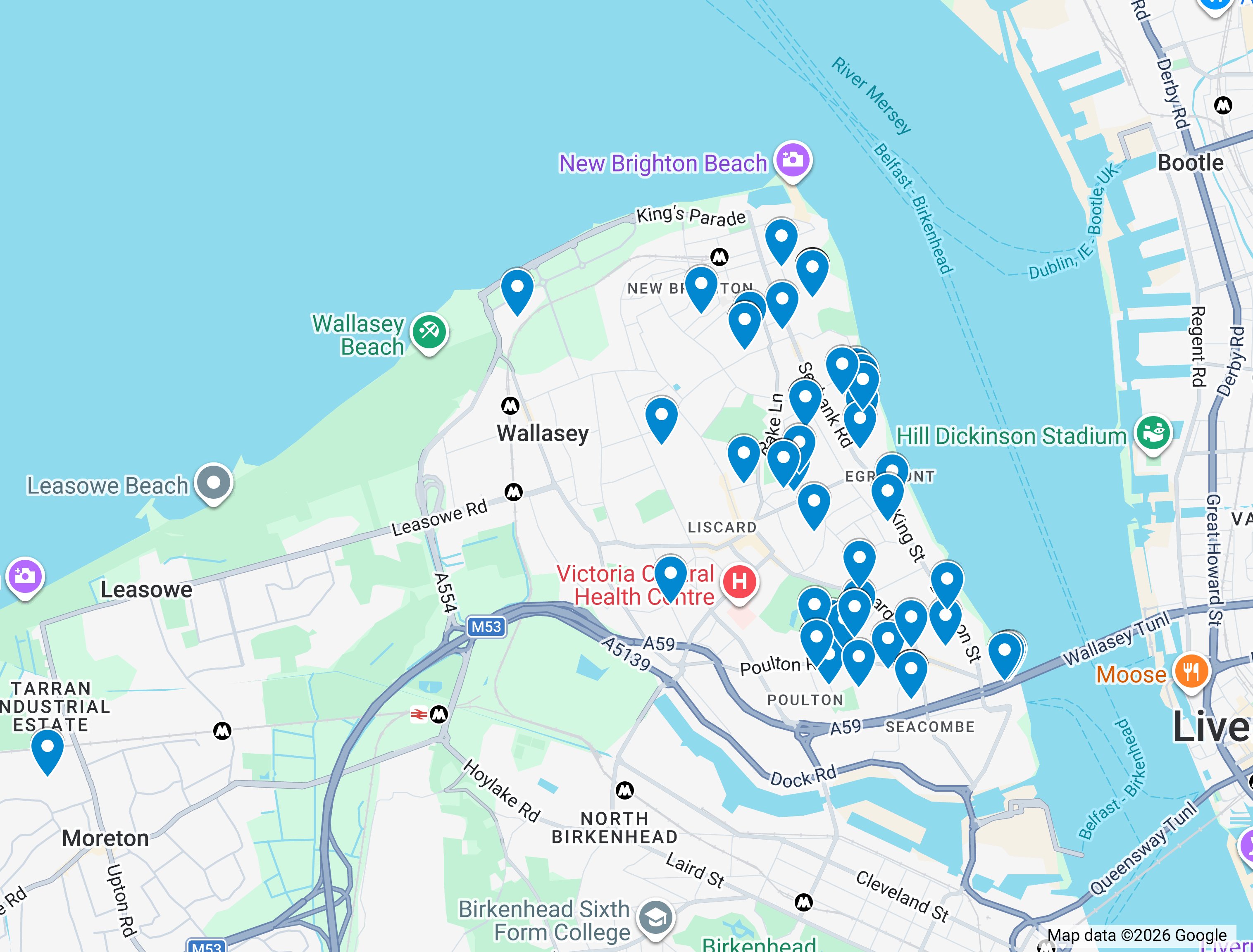
Teaching appointments from 26 January 1999 to 1 February 1999

Teaching Pool

  • Sandra Corbert — 166 King
  • Irene James — 6 York Ave
  • David Evans — 7 Annesley
  • Jamie — 5 Dalmorton
  • Joyce & Carol — 19 Caithness
  • Grandma Walker — 5 Stanford
  • Sandy & John — 5A Caithness
  • Debbie White — 35 Gorsehill

Finding Pool

  • Olive — 26 Lucring
  • Casgy — 42 Lucring
  • Veronica — 40 Harvest
  • Malcolm — 20 Lancaster
  • Stan & Helen — 42 Hampstead
  • Chevon — 61 Hampstead
  • Unis — 1A Dalmorton
  • Kevin Paul Shawn — 31 Dalmorton
  • Mrs. Williams — 34 Hereford
  • Jane & Fancie — 73 Dalmorton
  • Mike & Liz — 8 Imperial
  • Sue — 23 Imperial
  • Christine Walker — 14 Elgin
  • Sandra — 3 Grosvenor
  • Paul — 50 Radnor
  • Shic — 90 Liscard
  • Dennis — The Channel
  • Rhona — 12 Sutton
  • Joan — 5 Coronation
  • Andy — 44 Eastcroft
  • Roy — 78 Urmson
  • Pam — 81 Urmson
  • Ian — 4 Warwick

Contacts

  • Paul — 17 Dalmorton
  • Mrs. Kathrel — 25 Imperial
  • Mrs. Nuttal — 30 Elgin
  • Joe — 13 Denton
  • Ria — 5 Coronation
  • Mike — 13 Edinburgh
  • Terry McCormick — 13 Station
  • Daisy & Becky — 22 Beach
  • Sharon — 58 Lusging
  • Georgia — 51 Albemarle
  • Wendy — 8 Tudor
  • Alan — 14 Tudor
  • Lawrence — 22 Tudor
  • Gordon — 23 Greencroft
  • Kangsta — 35 Greencroft
  • Doug — 62 Lusging
  • Mrs. Williams — 35 (unclear)
  • John — 17 The Summit
  • Emma — 7 Hampstead
  • Jan — 53 Annesley
  • Sue — 1 Bell
  • Kathy — 28 Ilchester
  • Maz — 15 Knowsley
  • Conesta — 35 Greencroft
  • Margaret Quinn — 47 Rycroft
  • Chris Walsh — 62 Hampstead
  • Chris — 66 Hampstead
  • Paula — 8 Lucerne
  • Joyce — 11 Lucerne
  • Shelly Thomas — 20 Rudgrave
  • Angela — 25 Lancaster
  • Gordan — 75 Withers Ln
  • Mrs. Buely — 100 Urmson
  • Jackie — 77 Urmson

2 February 1999 – 9 February 1999

Written 3 February, about the night before: “Last night we had tea at the McKee’s again. It was a great dinner but afterwards, Carol, her mother, Elder Mueller, and I had a great conversation. I don’t remember all what about, but it was great.”
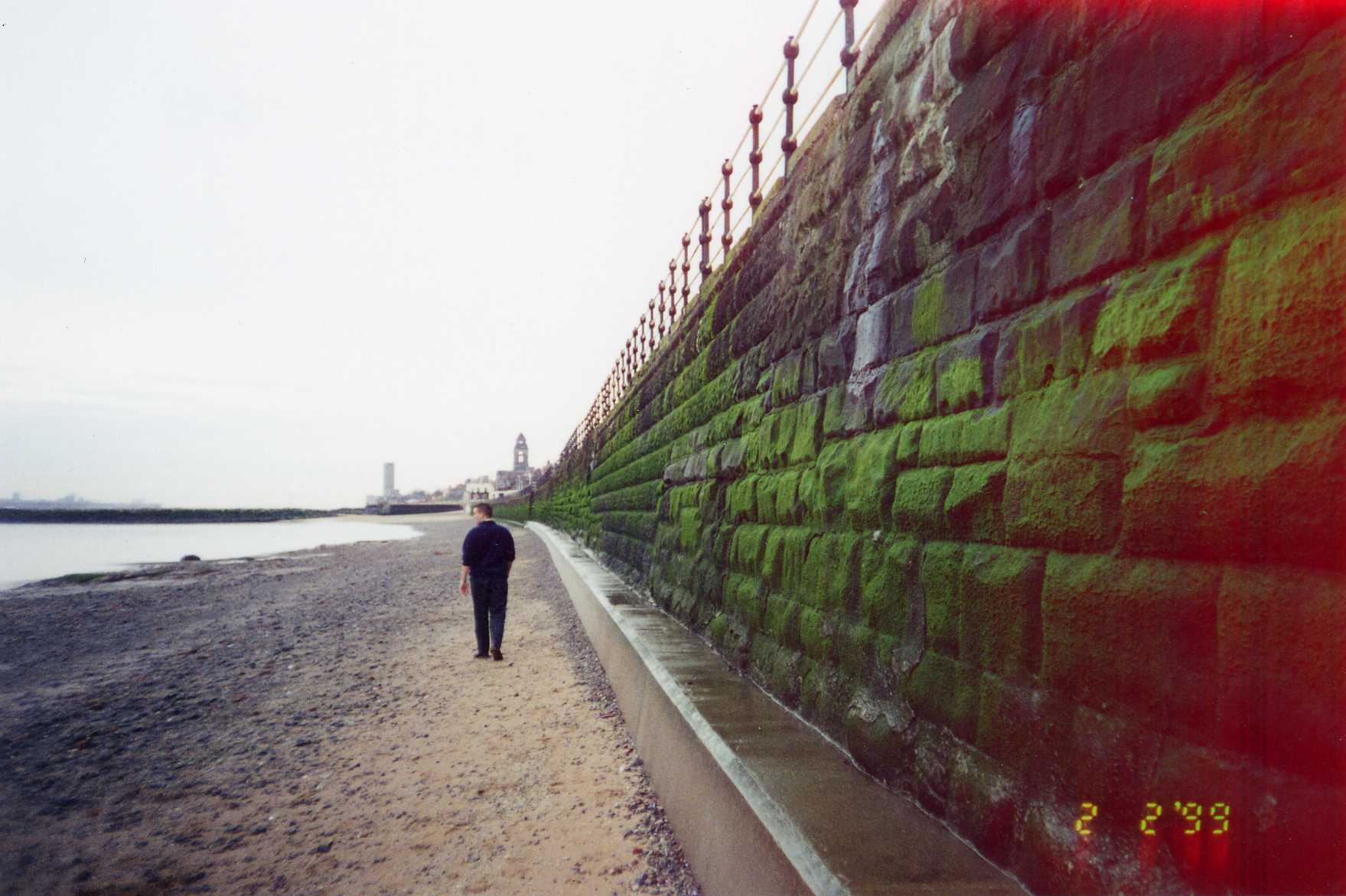
2 February 1999 – Elder Harris walking below promenade at New Brighton, Merseyside

Also that day: “We taught David Evans today. He is really intellectualizing all of it. I tried to explain it to him that way. The same was to Bridgette a couple of nights ago.”

Also that day: “Earlier today, we went to the Ryan’s. She took us to another house and wanted us to bless it. It has Poltergeists. Those are ghosts that move things. She showed us the rooms with the problems and when we walked in, it was so cold. I jumped when I walked in the room. Weird noises, weird feelings. I prayed, Elder Harris blessed it. I hope we did it right. We don’t have anything written on how we are supposed to do it. I felt better afterwards. Sister Ryan and the two of us talked for quite some time. We had tea at the Annals. It was a riot. It was absolutely great. They are a wonderful family.”

This was Mike and Liz Ryan.

Reading the letters I sent home to family, there is more detail there too. The first time we blessed the home, nothing happened. It went even more cold. Like they were staring at us. The second time we blessed the home, it was confrontational. Like they were staring us down and snickering at us. The last time we prayed again before we blessed the home. This time, everything was different. The light and warmth came back into the room and we were at peace. But after the second time, we were afraid and had to huddle in prayer before trying yet again. Very humbling.

4 February, I wrote: “I just realized that today is the day dad gets sealed to his parents in the Ogden Temple. A joyous day indeed. I believe that on the 7th Bud [Lloyd] gets the Priesthood. What joy and happiness have come into this family. I can say I had a small part in it. My joy will be full when mom comes around. We have all tasted such sorrow and bitter. Dad’s patriarchal states he will be sealed in the temple yet in this life.”

“My family, wife on down will be a eternal family. My children shall know the gospel and its divinity.”

“Bud and grandma will be sealed later this month or in March. Another outstanding year this will be. As was last, a year for the books.”

“President talked to me and gave some words and advice. He is most definitely a servant of the Lord. He told me that it is too bad we can’t put the head of a 40 year old on that of a 19 year old. But, we can’t so let them learn. Some are further than others.”

“He commented on the repentance process. We talked about rules, but a higher law. He commented on individuals not the law. The Lord cares on serving others, not keeping rules for self. Try to lead (live) the laws but put others first. He commented on sanctification and working towards perfection. Oh what joy. Righteous people invigorate and energize the soul. Follow the Spirit. It is so enlightening. You learn so much more on watching and seeing how it relates to the gospel. All things apply. Everything is of a spiritual sense. Such excitement in Christ.”

5 February, I wrote: “Yesterday was a phenomenal day for the Moreton Ward.”

“We had tea at the wises. It was good. Chips, pork, beans, with rhubarb crumble. We left the Wise’s and went to Jackie Brooks. There we all talked and had a really good time for a half hour. There were 8 people in the room, all of baptismal age. We Built Relationships of Trust and moved into the discussion. The Spirit was strong. Four of the Eight agreed to baptism and I believe all the other 4 will too. One of the 4 is Robert Topham’s son, Robbie Williams. I think he will come around. Alex, a friend of Cassie (one of Jackies) wants a book and I believe she will committ. Jackie didn’t say yes or no. The four committed are Jackie’s 4, Cassie, Rebecca, Gary, Mike. Jackie will if all four of her children do. Jackie’s friend Angela will too I believe and have faith in. Angela’s husband stole her book and is reading it. Angela has 5 children. I don’t know anything about Alex’s family, she could be the key there. Robbie + Robert could be the key to Robbie’s family. Robbie was amazed that it was Elder Harris and I that converted his father. It is a small world. Overall we are moving toward the goal…on the mission. This is a good start. All praise to God. What a privilege to be an instrument and in this work.”

Also that day: “We have been invited to teach at a mothers meeting at St. Joseph’s. If we can get the Spirit there and teach, this could swing a gate wide open. If one or two listen at the meeting today, it will be worth it. I hope so much we can see this to come to pass. I can hope so much that if this is a trap, we can still hold the honor and respect and catch them. All will go fine.”

“Oh, and a thing about Jackie Brooks. I had a ton of incidences there that I have seen before, de ja vous as they call it, but I can’t spell it. It is right we teach her. It is all so exciting. In my interview with President Stucki yesterday he commented, you watch the pennies and the dollars will take care of themselves. Take care of the details and there will be no problems.”

7 February, I wrote: “I have come to see that evil spirits exist so much more than ever expected. I am so grateful for the Priesthood and to be able to force them to leave but they must not return. What a blessing. The story of Elders in Barrow and having to cast out evil spirits. They did it wrong and they could hear all the laughter at them. Finally they got it right.”

“Sister Liz Ryan is great. The Ryan’s and I get along great.”

Writing on the 7th about the day before: “We taught the Brooks family and taught them a 3rd yesterday. We went bowling (10 pin) after. We had two games. I did horrible. Didn’t even break 100 either game. They are a great family. We had fun. We picked up the other Elders and went to tea at the Hankins. Elder Mueller and I ate there.”

“We taught Bridgett the rest of the 4th with Catchya. They refuse to live the law of chastity. We found out they are bi-sexual. We visited Fraziers and came home.”

7 February, I wrote: “Today I have to admit was a day full of new and exciting things. I awoke and read about 1/3 of 2 Nephi. Such exciting things in there. So much to be applied. It is definitely written for our day. Elder Mueller and I left. We walked Gayna, Irene, and Clinton all to church. It took a while but we arrived. The Moreton Ward had a full house today. It was good to see Jackie Brooks and all of her family there. It was fast and testimony meeting today. I got to bear my testimony. I love this church so much. I know it is true.”

“Gospel Principles was taught by Elder Mueller and I. It was great.”

“After was Priesthood… Mind maps. I never knew they existed… I use mind maps and associative reasoning all the time. Roy McKee is a genius. Oh, howe everything makes sense… Mind maps only work for the person who makes them.”

“Cliff Roberts constantly impresses me. He isn’t one of the Nephites but he might as well be. Priesthood was phenomenal. Robert Topham got the Aaronic Priesthood as a Priest. That was good too.”

“After, E Mueller and I walked Gayna and Clinton home. Gayna and I had a really good conversation.”

“E Mueller and I went to Clinton’s to offer his mom the Sacrament. She kicked out Clinton last Sunday. He has been living in a wayward home… We comforted her and went to tea.”

“We had a good tea at Jackie’s. We taught Jaime the 3rd. After we left and went to Gregory’s. We gave them the Sacrament. We were there about half an hour. After we went to the Wilson’s. We sat there and talked a while… Sister Wilson commented on Elder Mueller and my lesson. She said she really enjoyed it. I love the Spirit so much… Oh, Elizabeth Wilson has changed so much since I first got here. The gospel makes such a difference in peoples lives… We left there and went to Jones’. At Jones’ we had a good conversation with Moe and the family. Kelly is the one in love with Donny Osmond. She is a really good girl… After we came home.”

This entry also marks the end of Journal #5. Some closing quotes I’d recorded at the end of that journal:

“You can’t be brave if you’ve only had wonderful things happen to you.” — Mary Tyler Moore

“We are all in the gutter, but some of us are looking at the stars.” — Oscar Wilde (spoken by the character Lord Darlington, Act III of Lady Windermere’s Fan)

“Wisdom is knowing who you are. Once you know who you are, the rest just follows right after.” — Pam, in Saturday’s Warrior

“What you get in the Hereafter, depends on what you’re after here.”

“Keep your eye on the whole forest, not just the trees.”

9 February marks the first entry of Journal #6, which opens with a quote given to me by Tanya McKee:

“The gift of the Holy Ghost quickens all the intellectual faculties, increases, enlarges, expands, and purifies all the natural passions and affections, and adapts them, by the gift of wisdom, to their lawful use. It inspires, develops, cultivates, and matures all the fine-toned sympathies, joys, tastes, kindred feelings, and affections of our nature. It inspires virtue, kindness, goodness, tenderness, gentleness, and charity. It develops beauty of person, form and features. It tends to health, vigor, animation, and social feeling. It invigorates all the faculties of the physical and intellectual man. It strengthens and gives tone to the nerves. In short, it is, as it were, marrow to the bone, joy to the heart, light to the eyes, music to the ears, and life to the whole being.” — Parley P. Pratt, Key to the Science of Theology

I was very moved by it, kept it, and quoted from it the rest of my mission.

10 February, writing about Monday’s P-day, I recorded: “We went and played Squash for 2 hours that I loved. I played so hard my face went bright red. Now, every muscle in my body is sore. It was really good exercise. We played 2 on 2 which was an absolute riot. We went and got our groceries at ASDA and come home and showered – changed. We went to Birkenhead and looked around the market. It is just that, a ton of merchants have little shops up where you can by just about anything. We went and got fish and chips down by the bowling alley and promenade. We played some pool after too. My personal favorite is air hockey. We come back to the flat and I wrote my letters.”

“We got ready and Elder Harris and I went to Jackie Brooks. We talked for quite a while and and gave the 4th discussion. It went really well… But time went on and we got a story where Carrie had a dream a couple of months ago where she dreamed I had tried to kill her. Then they got out how they knew their were spirits in the house. One with dreams and visions that were not inspired of God. Another where Jackie’s ex-husband had a visitation and other stuff. Even Jackie didn’t think they were alone. Many people had also died in the home, all by heart attacks. I’ll bet it had to do with fright. One person hung themselves in the attic. Mike, the boy, has problems where he jumps up, does something, and returns to normal. He cut off his mother’s finger once, broke her toes, took a golf club to his sister, beats his head to a bloody pulp and sits down like nothing happened. Best of all, when asked why, he says, ‘God told him to.’ First thing that popped into my head was Moses 1:19. That is where Satan tries to deceive Moses and says he is God. I explained that verse and I was enveloped by a feeling of evil. I knew I was okay but what about them. I continued with the feeling that was so strong. I kept catching things out of the corner of my eye in the back room. I could tell something was there. We kept talking, I explained the blessing on the Ryans neighbors, I also explained on how baptism brought the Holy Ghost which would protect them from such events in the future. I kept catching glimpses of someone in the back room and when I would look, I couldn’t see them. We brought Bobbie to be there as a fellowshipper and because of his son Robbie who was there. We had to leave because we needed to get in. We left. I felt so sorry for that family because of experiences I had exactly like that when I was real young. Bobbie informed us right on the street before we parted. He told us of a gift he had to see Spirits. He told us there was someone back there. I wasn’t just imagining. That made missionary work so much more important to me. I have another mission, not only to convert, but to free from the bands of Satan’s army… I told [Elder Harris], ‘if we are real, so are they.’”

I have more I can share regarding this story. It is still vivid in my mind all these years later.

Below is a map of every home we visited, taught, or contacted that week, pulled from the Teaching Pool, Less Active list, Finding Pool, and Contacts recorded on the back of that week’s planner page.
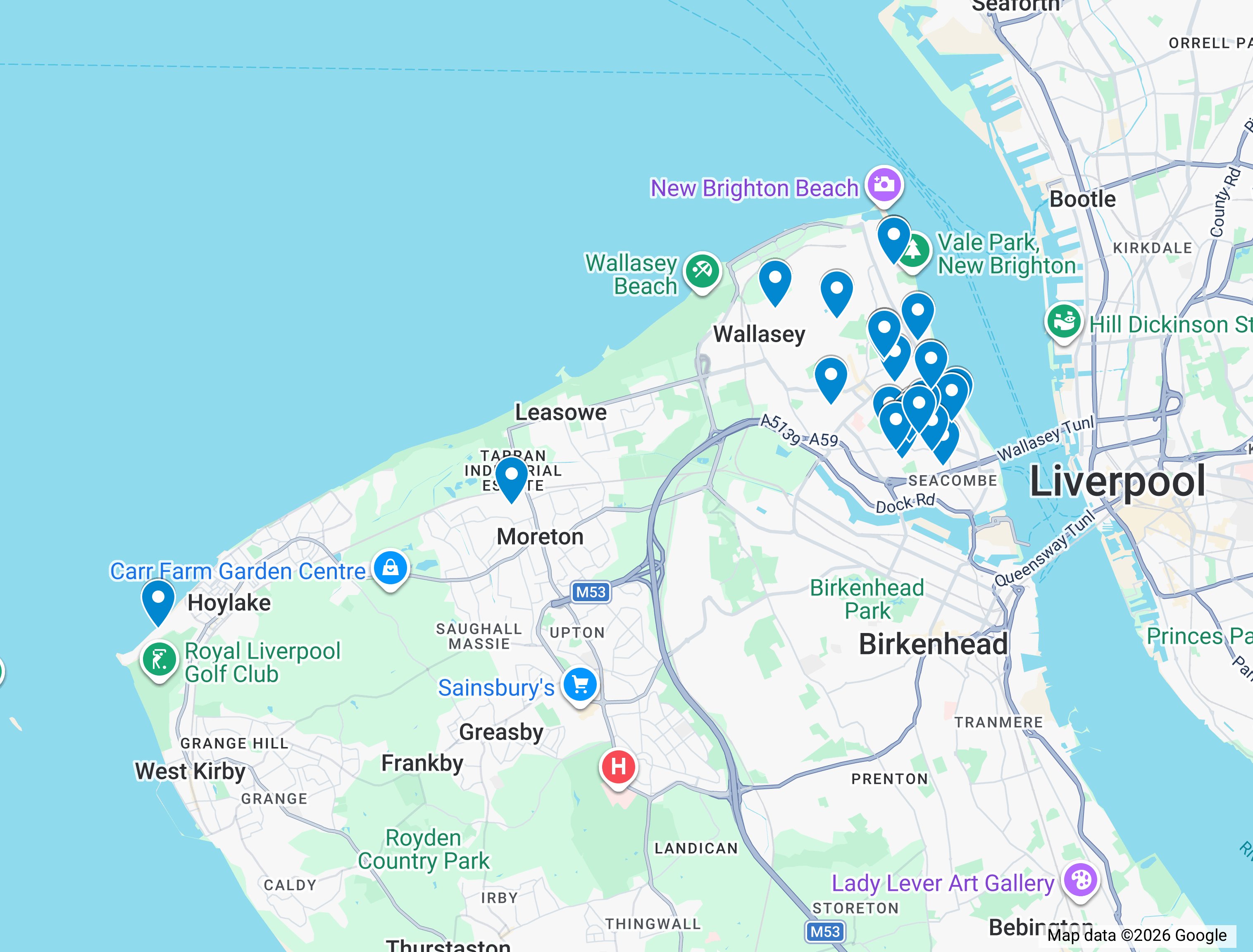
Teaching appointments from 2 February 1999 to 8 February 1999

Teaching Pool

  • David Evans — 7 Annesley
  • Malcolm Patterson — 20 Lancaster
  • Jamie Laing — 102 Anlew

Less Active

  • Sheryl — 2 Keswick
  • Adam — (no address)
  • Elizabeth — 30 Kinnard
  • Cooles — (no address)

Finding Pool

  • Chris — 7 Devereux
  • Pam — 81 Urmson
  • Roy — 78 Urmson
  • Jackie — 77 Urmson
  • Angela — (no address)
  • Stan & Helen — 42 Hampstead
  • Veronica — 60 Harvest
  • Olive — 26 Lucerne
  • Kevin — 31 Dalmorton
  • Paul — 17 Dalmorton
  • Cain — (no address)
  • Frieda — Lincoln
  • Ian — 4 Warwick

Contacts

  • Becky — 7 Littledale
  • Tony — 40 Buchanan
  • Mrs. Stevenson — 26 Eastcroft
  • Emma — 7 Hampstead
  • John — 17 Summit
  • Mrs. Williams — 35 Marlowe
  • Kangsta — 35 Greencroft
  • Gordon — 23 Greencroft
  • Daisy — 22 Beach
  • Gena — 4 York
  • (unnamed) — 3 Rivington
  • Dave — 32 Barrington
  • Julie — 17 Mossy Bank
  • John — 1 Mossy Bank

9 February 1999 – 16 February 1999

Written 13 February about Wednesday (10 February), I recorded: “Wednesday, I spent the day with Elder Mueller. We didn’t have that much time in our area. We tracted a road in New Brighton and then went to Elder Mueller’s area. We did really quite well. We ran out of Book of Mormon’s. We taught some good people. Mueller and I had tea at Counsells. It was sweet and sour curry on rice. It was so good. Bishop and I had a really good conversation. We were there for two hours and really all of it was at the dinner table. It was a great conversation.”

Also written on the 13th, about Thursday (11 February): “One thing I remember is we met E. Lewis + E Mueller at the Billington’s. E Mueller and I went to the Ried’s for tea. …what an honor to be there. …cornbeef hash and beans, it was a sacrifice for them. That little girl told us how much she loves Elders and Jesus and Joseph Smith. …What an honor to eat in the home of such righteous people.” This was Judith and Tony Reid.

13 February, writing about the day before (Friday, 12 February), I recorded: “Yesterday was a great day. I loved all the time I had with Elder Olson. Elder Harris went with Elder Meehan to Altrincham so I got E. Olson till 2:00. We went down along the promenade and we just had a blast. We taught 4 and gave away 3 BOM. …Not only that, we fellowshipped 2 new-members, did two call-backs…and scheduled 2nd discussions, and got a few more call-backs. …The best thing, Elder Olson and I enjoyed it. We weren’t racing all over and even stopped to sit and talk a couple of times. We just had good conversations on how we could be better missionaries. We got out our gripes which was good. I did my complaining and he did his about our trainers. I am so excited for the work once again. Gayna even enjoyed Elder Olson. She commented on the temple made everything better for her. She said she felt much better after it.”

“I wish everyone understood how great this is. They wouldn’t take things so lightly, the would find less worldly fun. …My joy is full beyond measure. I can say I know god lives with full truth.”

On 13 February I wrote: “We have assembled for our weekly DDM. I am glad to have this opportunity to learn and see other people views. I learn so much, as I hope other people do at these DDM’s. The Spirit is so exciting.”

14 February I wrote: “We are now in church having a great feast. There was a talk on the divinity of our leaders. That is so true. It was good. She commented that we should always follow our leaders in the Spirit in which they acted. I think so many times that is forgotten.”

“We are now in gospel essentials talking on the Word of Wisdom. The Word of Wisdom is obviously inspired. It is hard for people. If people find the Spirit they can overcome it, the Lord will help us. Why do people always ask what is wrong with tea. It is a commandment from the Lord. It might be caffiene, tannin acid, or anything else, it is a commandment. Joseph Smith was a prophet of God. Don’t worry about decaffinated, just avoid all appearance of evil. Be an example. We are to eat healthy wholesome food. That is so true. There is a path, straight and narrow. Eat meat, but don’t eat alot or don’t eat it at all.”

“Gayna, just come in and told me that Elder Harris + Elder Mueller just went to the hospital. She thinks he broke his ankle. I hope not…”

“Priesthood now. Brother Pitt is teaching the lesson looks really good. But the soul that receives and relishes truth, the more noble a soul, the more noble, the more responsible and Christlike is the person overall.”

“We got to Arrow Park Hospital. Elder Harris leg or ankle was just sprained. Nothing serious.”

“We come back and went to Elizabeth’s after. We talked with her and she wanted a blessing. Elder Lewis gave her that. We come home and Elder Harris burn a pair of pants on the 18 month anniversary.”

15 February, in the evening, I wrote: “I am so excited for the next two years of my life. I am so happy to have a reconfirmation of the divinity of this church. I feel so calmed and serene. We left to go teach at the Brooks. We taught the 6th discussion. It went really well. I will hurry and learn and memorize the discussions. I feel so dumb looking out of the book. Oh well. Carrie + Michael we will baptize on Thursday, go to the temple on Friday, go bowling on Saturday, and confirm them on Sunday. It will be a busy week for them. I pray the Spirit will touch Jackie…, Rebecca and Gary. They are meeting alot of opposition. I hope things go better. I love this work.”

Below is a map of every home we visited, taught, or contacted that week, pulled from the Teaching Pool, Less Active list, Finding Pool, and Contacts recorded on the back of that week’s planner page.
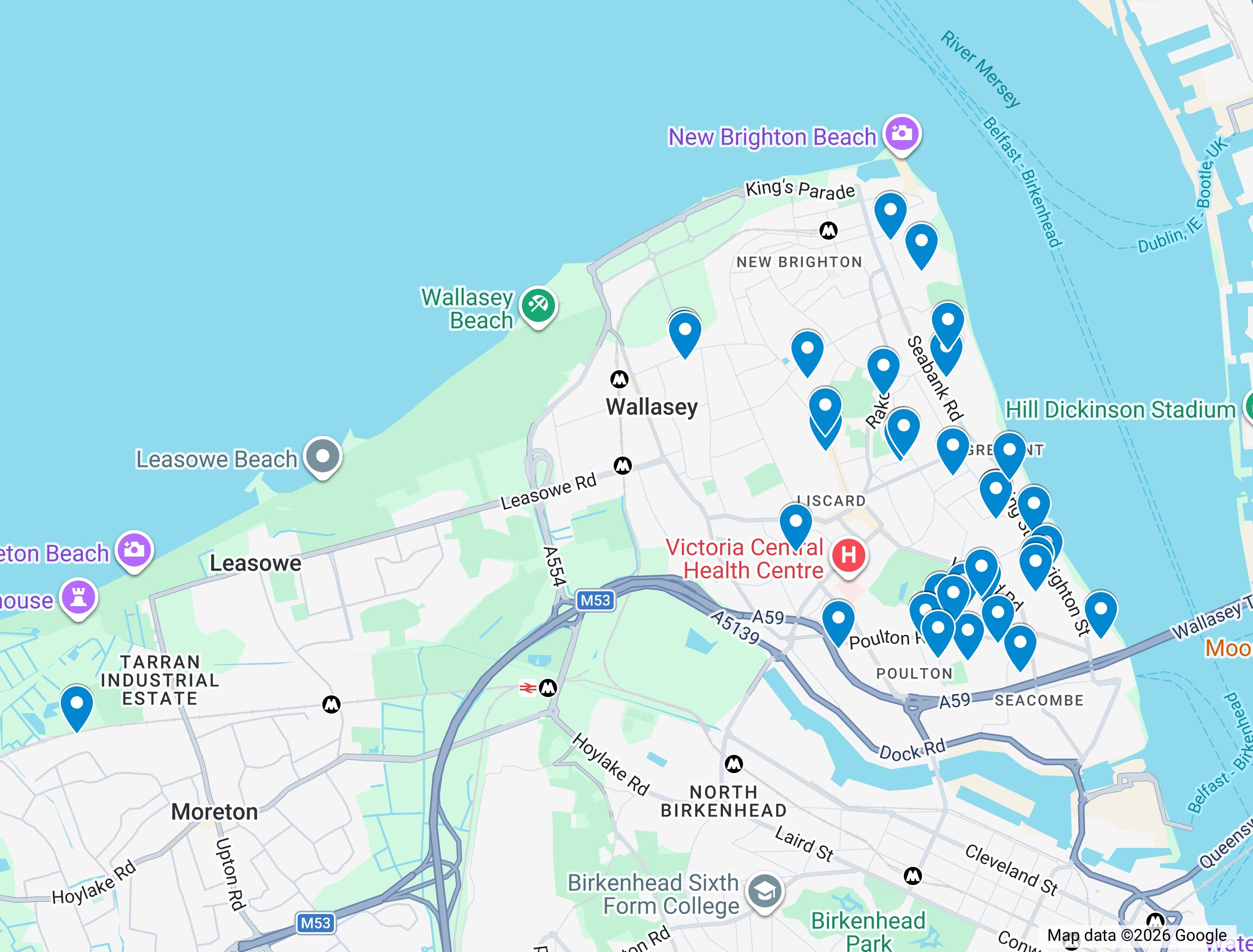
Teaching appointments from 9 February 1999 to 15 February 1999

Teaching Pool

  • David Evans — 7 Annesley
  • Jamie Laing — 102 Curlew Way
  • Brooks — 77 Urmson

Less Active

  • Sheryl — 2 Keswick
  • Elizabeth — 30 Kinnard
  • Joe Wadron — 7 Hertford
  • Annal — (phone number only)

Finding Pool

  • Julie & Emma — 17 Mossy Bank
  • Mark Story — 11 Mossy Bank
  • Ron Cullinan — 20 Withington
  • Irene Lewis — 6 King
  • Frieda — Lincoln
  • Pam — 17 Dalmorton
  • Olive — 26 Lucerne
  • Stan & Helen — 42 Hampstead
  • Roy — 78 Urmson
  • Pam — 81 Urmson
  • Margaret — 42 Rycroft

Contacts

  • John Taylor — 1 Mossy Bank
  • Jaime — 40 Rivington
  • Gina — 2 York
  • Conesta — 35 Greencroft
  • Gordan — 23 Greencroft
  • Emma — 7 Hampstead
  • Becky — 7 Littledale
  • Tony — 40 Buchanan
  • Mrs. Williams — 35 Marlowe
  • Mrs. Stevenson — 26 Eastcroft
  • Laura — 5 Straughough
  • Scott — 46 Massey Park
  • Sue — 8 Keswick
  • Sue — 2 Holland
  • Cola — 33 Grosvenor
  • Dorothy — 44 Bell
  • Graham / Blu / Stewart / Chubb — 9 Demesne
  • (unnamed) — 10 Norwood
  • Mrs. Latham — 28 Seaview
  • John — 90 Greenwood
  • Alice — 83 King
  • Mrs. Parsons — 112 Rake Lane
  • Helen — 14 Longlane
  • Edward — 8 Arkle

16 February 1999 – 21 February 1999

16 February, I wrote: “This morning has been short and cold. Elder Mueller + I went out and taught but one. I just finished reading Gene R Cook’s book Receiving Answers to Our Prayers. It is a great book. Didn’t go into detail like I wished it to but I did learn from it.”

17 February, I wrote: “We are moving and assembling here in Birkenhead once again for Zone Conference. It doesn’t seem possible that I have been here for 2 months already. I hope I have one more month here in Moreton. I am so amazed at how full my joy is. It continues to grow and my bliss is complete. What more can I ask for. …I am so glad to be a part of this work. I am working on self-actualization in hope of becoming a better person. To be a blessing to everyone I come in contact to. I need to accept everyone for who they are and then will they change to become better. Love them is so important.”

“There will be an Easter Media Campaign.”

“Such a spiritual high today.”

“We blessed Gayna’s house. I did it and had the worst time.”

“They sent Elder Mueller + I out quite a bit. We worked wonders. We had tea at the Annals. It was good. It is a riot over there. We taught 6 and gave away 3 BOM’s in but 2 hours.”

Around this time, I recorded a few quotes I’d been reading, including several from Stephen R. Covey’s The 7 Habits of Highly Effective People, which I finished around this stretch of the mission:

“The inside-out approach says that private victories precede public victories, that making and keeping promises to ourselves precedes making and keeping promises to others. It says it is futile to put personality ahead of character, to try to improve relationships with others before improving ourselves.” — Stephen R. Covey, The 7 Habits of Highly Effective People

“That which we obtain too easily, we esteem too lightly. It is dearness only which gives everything its value. Heaven knows how to put a proper price on its goods!!!!!!!!”

That line originates with Thomas Paine, from The American Crisis, No. 1 (1776) — written to rally the Continental Army during the darkest days of the Revolutionary War — but I most likely encountered it secondhand through Covey’s book, which I’d just finished reading around this time.

“Reactive people are affected by their physical environment. If the weather is good, they feel good. If it isn’t, it affects their attitude and their performance. Proactive people can carry their own weather with them. Whether it rains or shines makes no difference to them. They are value driven… People (proactive) are still influenced by external stimuli whether physical, social, or psychological. But their response to the stimuli, conscious or unconscious, is a value-based choice or response… It’s not what happens to us, but our response to what happens to us that hurts us.” — Stephen R. Covey, The 7 Habits of Highly Effective People, pp. 71–72

“In the great literature of all progressive, love is a verb. Reactive people make it a feeling. They’re driven by feelings… If our feelings control our actions, it is because we have abdicated our responsibility and impowered them to do so. Proactive people make love a verb. Love is something you do: the sacrifices you make, the giving of self, like a mother bringing a newborn into the world.” — Stephen R. Covey, The 7 Habits of Highly Effective People, p. 80

“What lies behind us and what lies before us are tiny matters compared to what lies within us.” — attributed to Oliver Wendell Holmes (as commonly cited, including in Covey’s book), though the line most likely originates with Henry Stanley Haskins in his 1940 book Meditations in Wall Street

“People can’t live with change if there’s not a changeless core inside them. They key to the ability to change is a changeless sense of who you are, what you are about, and what you value.” — Stephen R. Covey, The 7 Habits of Highly Effective People, p. 108

20 February, I wrote: “I cannot believe I haven’t written since Wednesday night. I have been so into the Covey book because I have to finish it before Monday. Elder Harris did break his ankle. We went back in and it was broken. Plus, I have been waiting on him for everything so that doesn’t give me much time. Also, we had a baptism last night which has made me a slave to ironing and planning things out.”

“Thursday we had tea at Wise’s and I enjoyed it. …We had tea and I went home teaching with Victor Wise to Enid Hill. Enid is a great lady. She is an author of like 10 books and she had a manuscript to another.”

“I was with Elder Mueller Friday so we taught some. We had tea at the Billington’s and headed to the baptism. I got to baptize Carrie Ana and Michael Raymond Brooks. The Spirit was great. I stepped into the water and it was as if someone else took over. It was cool. I really enjoyed it. Elder Harris had his cast so he couldn’t do it. I enjoyed and loved it.”
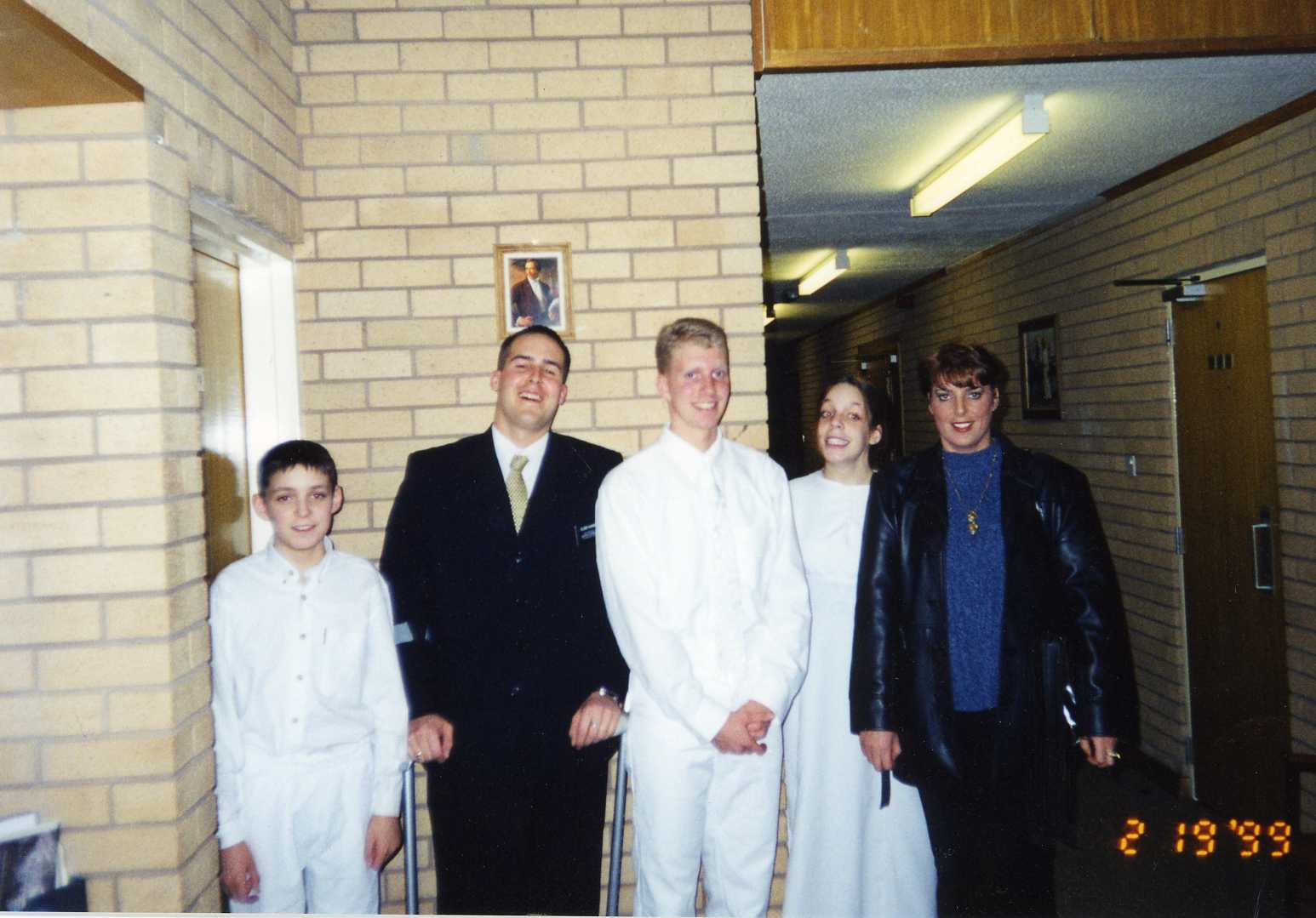
19 February 1999 – Baptism of Michael and Kerry Brooks at Birkenhead Chapel with Elder Harris and Jackie Brooks

I am confused after this entry. Mom is Jackie Brooks. Kids are Carrie/Kerry, Rebecca (Becky), Gary, and Michael. Here and now I thought I had baptized Kerry and Gary, but this entry has Carrie and Michael. M Brooks wrote in my journal about me baptizing him below. Kerry also wrote in my book and signed Kerry. Not sure how that translates to Carrie. Maybe some day I can locate one of the Brooks family and flesh this out. I have tried to find one, but no luck to this point. I understand Kerry is a nurse/doctor not far from home, maybe in Chester?

“Oh, we got transfers last night. I am headed to Hyde and will be companions with Elder Peters. I guess Elder Peters is an army like man who served on the Isle of Mann. That is what Elder Harris said, so this could be really interesting.”

“I heard we are going out to breakfast with the Brooks so I can hope.”

21 February, my last night in Moreton, I wrote: “This is my last night in Moreton. I transfer to Hyde in the morning. I feel times march.”

“It is nearly impossible to imagine 3 months passage. Time is an interesting concept. It is relative only to those who focus on it. When you focus on the principles and values we embrace, life is easier, more laid back, and time disappears. When dwelling in the Spirit, being nearer to light in mortality truly does make time + space loose its grasp. Today will be remembered. Another day of good-byes. Another passage of time.”

“We went to church. Sacrament was great. We confirmed Kerry Brooks and Michael Brooks. Mike got the Priesthood in Elders quorum. Such an outpouring of love towards us.”

“Many expressing love, gratitude, and shedding tears. We said good-bye to Bobby and he was in tears. He cried fowl and it isn’t fair. Leaving the Wilsons is a scene to not forget. I standing at the end of the walk, the moon high. Their silhouettes, saying good bye and shaking hands. The spirit of love and tears not seen but felt. Going to Gayna’s and saying good-bye. She gave me an old copy of the Book of Mormon. It is timeless. Having tea at Jackie’s one last time. Going to the Jones. A good typical of Sunday but marked by tears. These are the days of mortality.”

“I will miss John + Audry McKee, Liz & Mike Ryan, Roy & Carol; and Tanya McKee. Cliff Roberts. Such a great ward. Tomorrow is another era of new sights, sounds. A new life. Great things lie in the future. Miracles are awaiting.”

Below is a map of every home we visited, taught, or contacted that week, pulled from the Teaching Pool, Less Active list, Finding Pool, and Contacts recorded on the back of that week’s planner page.
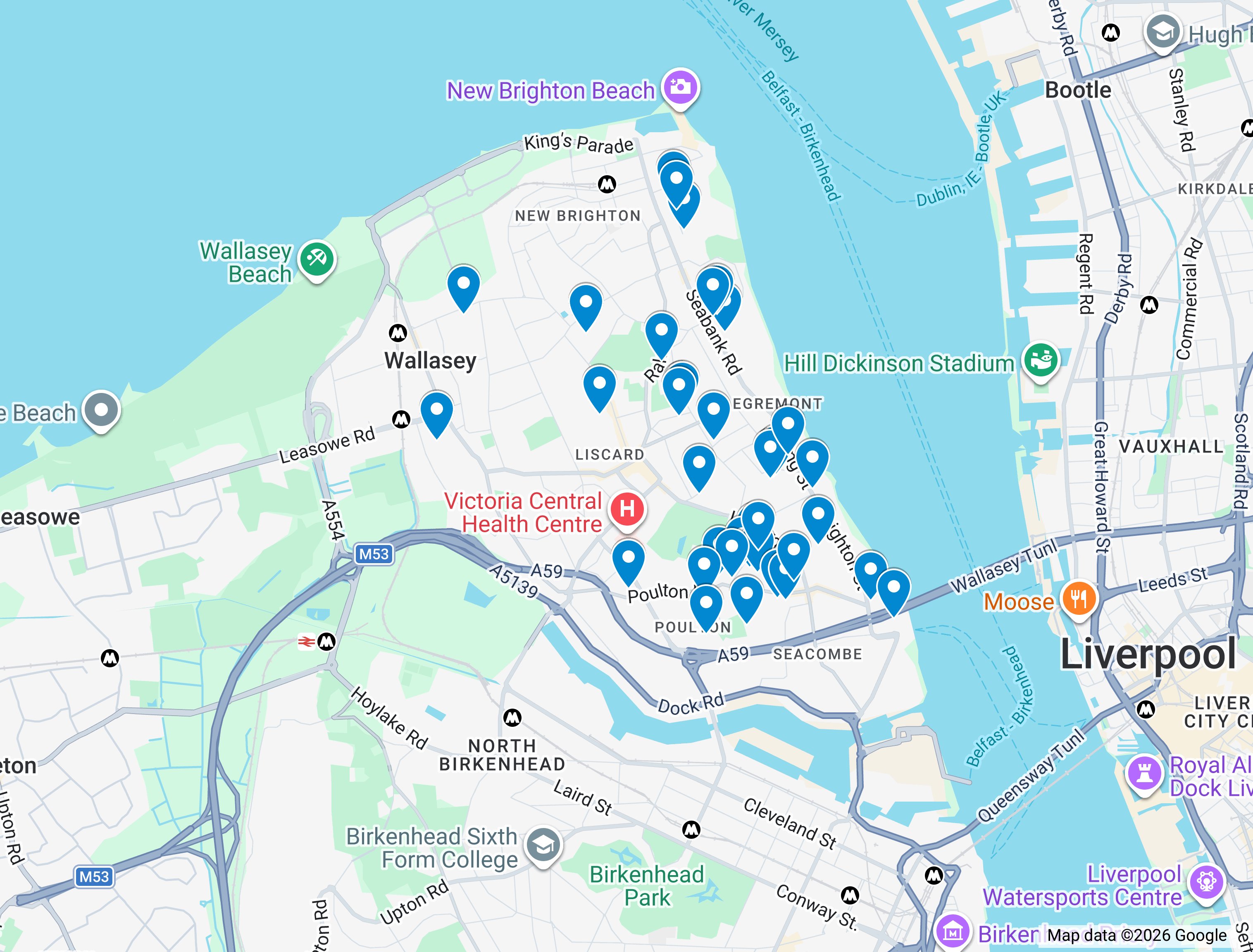
Teaching appointments from 16 February 1999 to 22 February 1999

Teaching Pool

  • Brooks — 77 Urmson
  • Jaime — (phone number only)
  • David — 7 Annesley

Less Active

  • Joe — 7 Hertford
  • Elizabeth — 30 Kinnard

Finding Pool

  • Dave Keatley — 8 Holland
  • Sue — 8 Keswick
  • Pam — 81 Urmson
  • Roy — 78 Urmson
  • Paul — 17 Dalmorton
  • Ron — 20 Withington
  • Mark — 11 Mossy Bank
  • Julie — 17 Mossy Bank
  • Laura — 5 Straighbargh
  • Scott — 46 Massey Park
  • Sue/Dorothy — 44 Bell
  • Graham — 9 Demesne
  • John — 1 Mossy Bank
  • Irene — 6 King
  • Stan — 42 Hampstead
  • Margaret — 42 Rycroft

Contacts

  • Nice Lady — 24 Martins
  • Alice — 83 King
  • Sue — 2 Holland
  • John — 90 Greenwood
  • Helen — 14 Long Lane
  • Michelle — 14 Park
  • Emma — 7 Hampstead
  • Conesta — 35 Greencroft
  • Gina — 2 York
  • Jamie — 40 Rivington
  • Cola — 33 Grosvenor
  • Mrs. Parsons — 112 Rake Lane
  • Tracy — 4 Beechcroft
  • Tunde — 49 Grosvenor
  • Laura — 18B Ferryside
  • Dave — 12 Clarence
  • Pat — 16 Bulkeley
  • Domini — 9 Claughton
  • Mr. More — 10 Russell
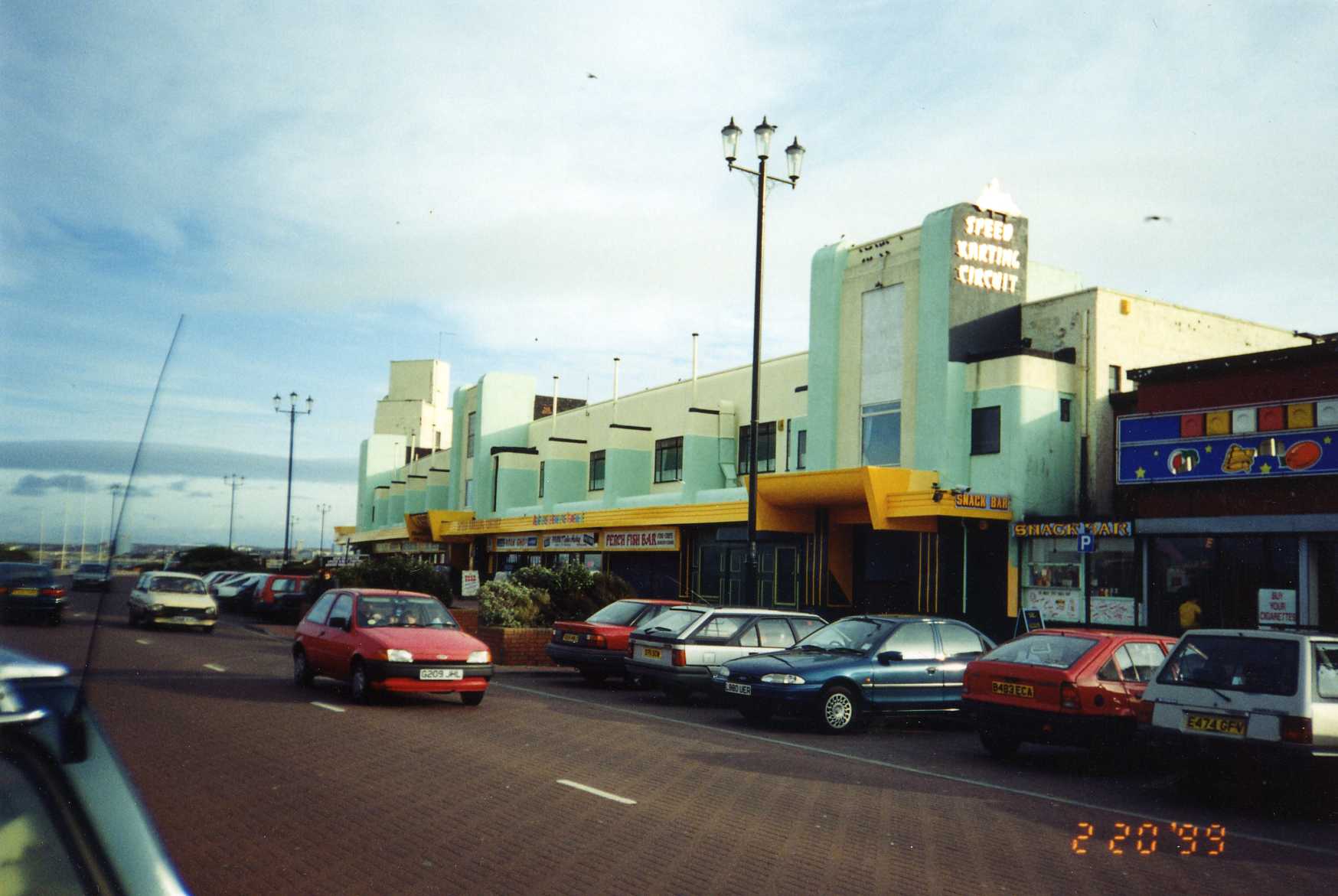
20 February 1999 – Arcade, West Kirby, Merseyside
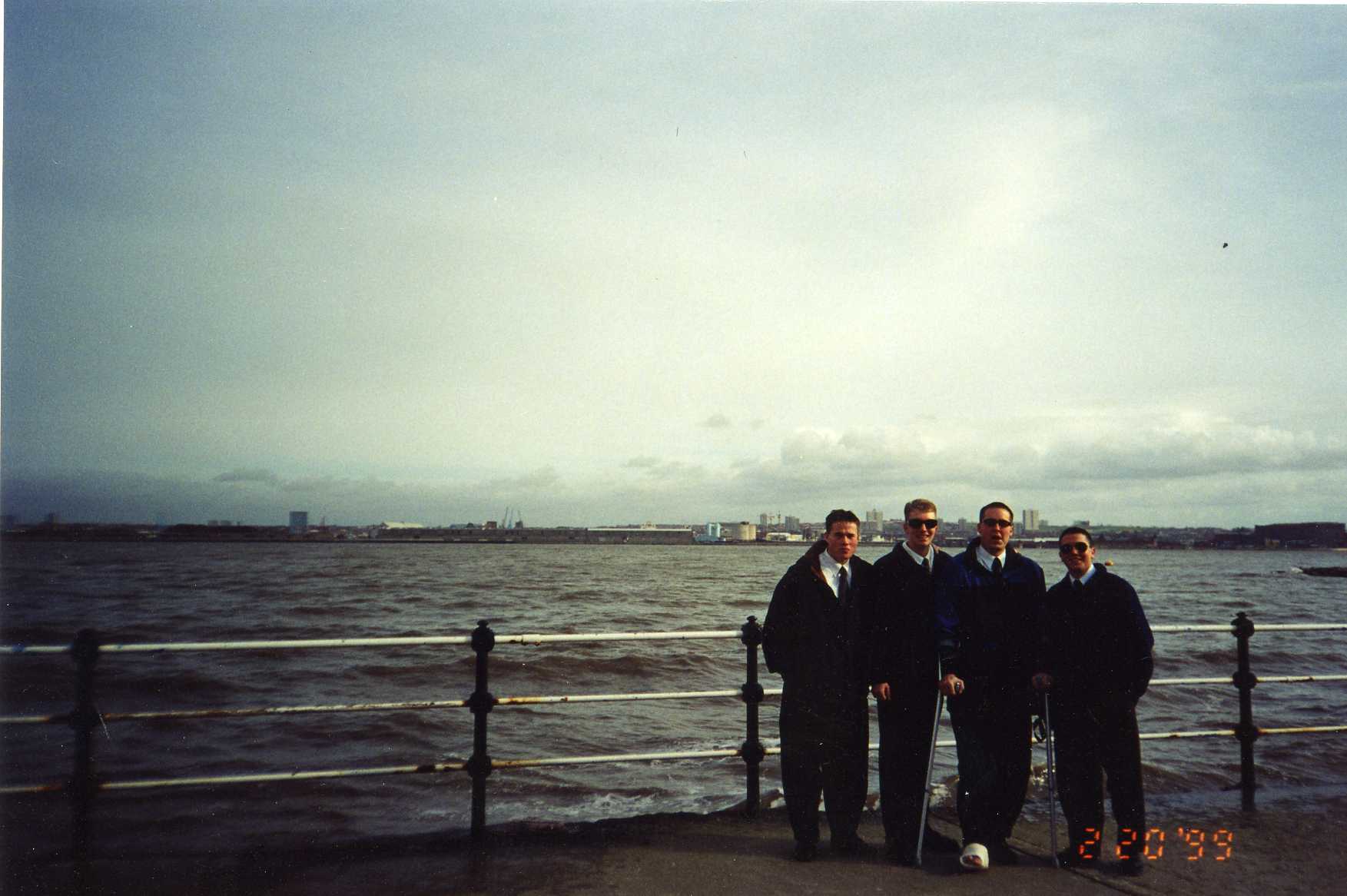
20 February 1999 – Elders Mueller, Ross, Harris, and Lewis by River Mersey
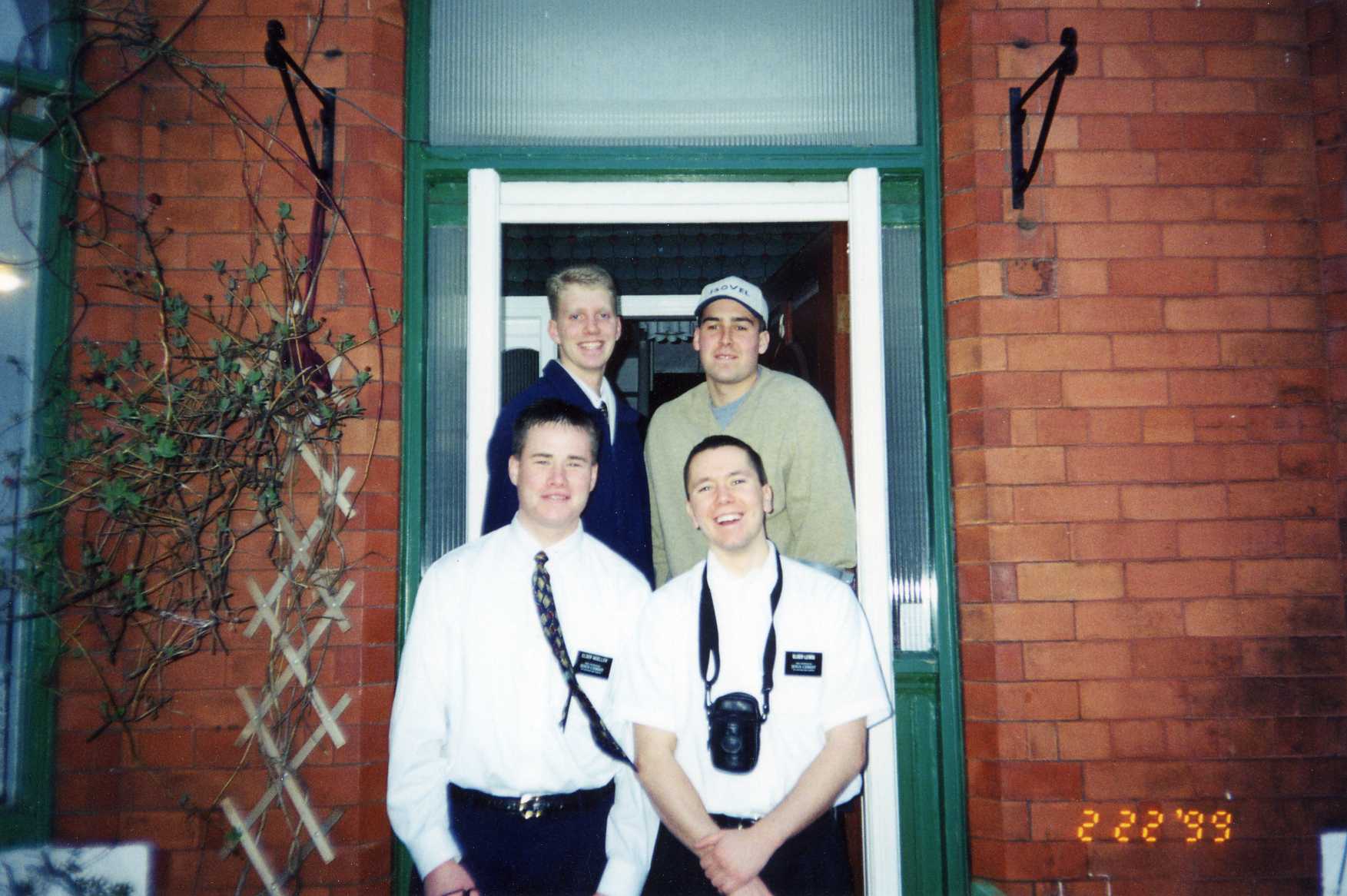
22 February 1999 – Transfer day from Moreton to Hyde, Elders Ross, Harris, Mueller, and Lewis

Farewell

In my journal I kept a number of notes people wrote me as I prepared to leave Moreton. I’ve included them here, exactly as written. Elizabeth Cosgrove, whose note is first below, is now married and known as Liz Murphy.

“Elder Ross, hey you – I love you. I’ll never forget you + though I’ll miss you – I’ll think of you often + smile. Remember Prayer? Just do it! Ether 12:6. Hey face a fear and the death of that fear is certain! When people get you down or your past catches up with you remember – ‘Why should I pay for a debt that I never owed’ – helps leave the baggage behind dude. Hope you keep in touch when you finish your mission. Goodbye, Good luck till we meet again. Elizabeth Cosgrove. Matthew 7:7 It’s true!”

“Ross, I’m gonna miss you man! you baptized me and blessed me with the holy Spirit from God and I’ll never forget you. You gave me a gift that no-one else ever could! Your influence on me is unimaginable. I’ll love you always. Kerry Brooks. P.S. Please don’t forget me.”

“Hey Ross, I hope you wont forget me I am gonna Have to try and Be good on my own now. I now I will miss you and I will still pray for you I hope I can see you when you go home and write me and tell me when you leave cause I will see ya off OK Rember you always Clinton”

“hey man, I was the first person you’ve ever babtized so I sure hope you will remember me because I’ll sure remember you. M. BROOKS”

“Elder Ross, I can’t believe that you’re going I don’t fee like I got to know you well enough. I’ll write though. Be prepared because you know what I’m like I’ll just rabbit on about David. You be sure to tell him how great I am! I’m so humble aren’t I? Anyway thanks for everything! Kelly Jones.”

“Dear Elder Ross, Time has gone so fast, (too fast). I have learnt so much from you in such a short time, and I know that what I have learnt, I will apply it to my life. You have strengthned my testimony a great deal. I am eternally grateful for you! Carry on progressing the way you have been and carry on towards your eternal goal. You are a wonderful person, and never let anybody try to change you! I know that the church is true, even though I have been sent some trials I still know its true. I am grateful that I have had a chance to return into the fold. I know that the lord lives, and through him I know that we can return to live with him in great glory, love and fulness of joy. Amen. Thank you Elder Ross. Keep well have fun and smile always. Love you! and miss you! Gaynor”
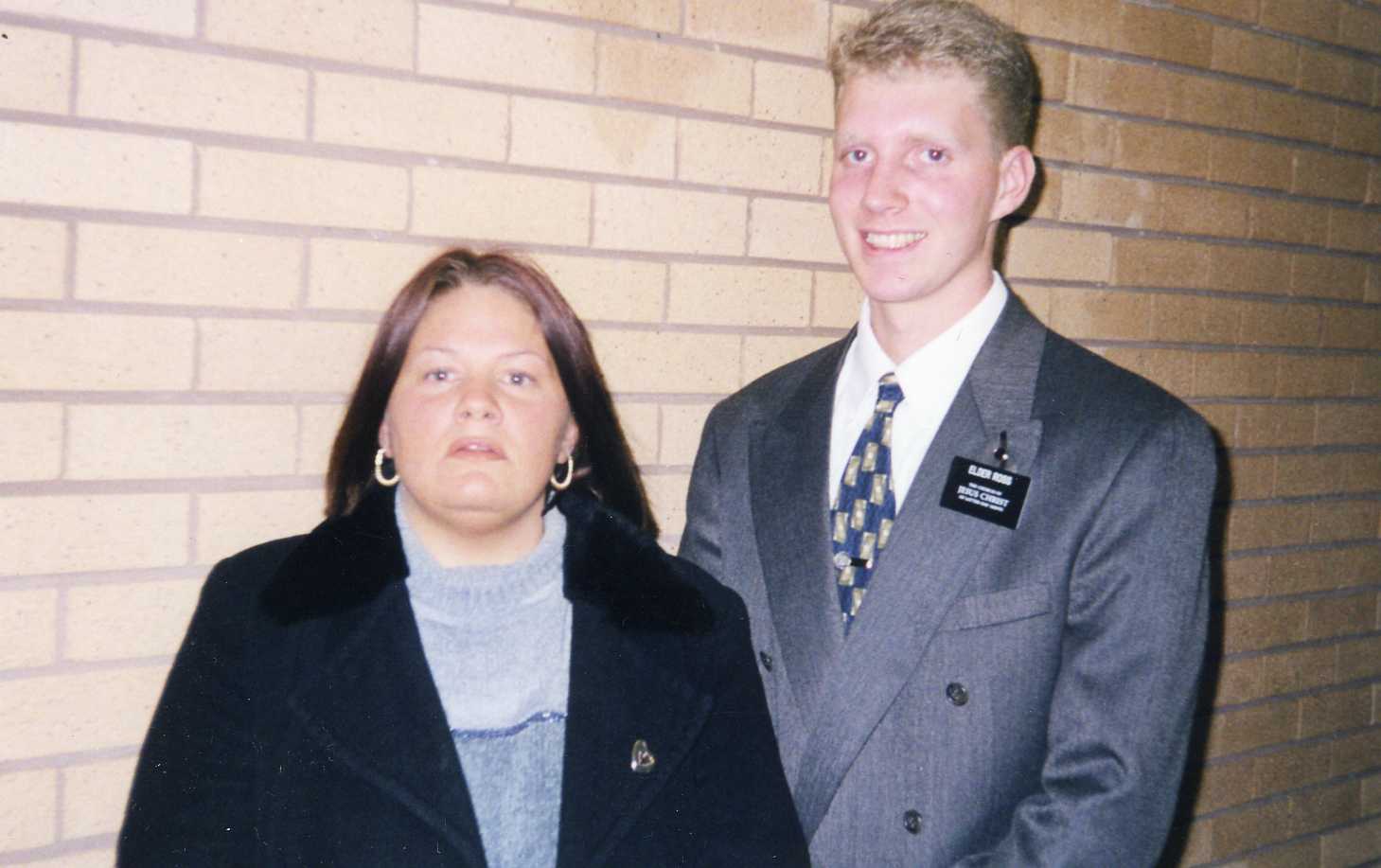
Gaynor Plimley and Elder Ross

Gaynor came to visit after the mission. I drove to Salt Lake and picked her up and brought her to Idaho. We went and traveled and visited around. Something happened in church on Sunday. I just remember she sat with my Dad and I ended up in the back doing the doors. She was upset that I didn’t sit with her in Sacrament. The rest of the trip was a bit strained after that. Haven’t heard from her since. I am not sure what happened or why, I am sad about it.

“To, Elder Ross. Thanks for being a friend and I really am Glad I got the chance to meet a Good elder – You’ve alot of people Happy as always – I wish you could of stayed longer – But you must move on. Anyway, Hopefully you’ll have a Good laugh as much as You had here. Keep Smiling and I’ll always remember you. Love Emma Hankin (moreton Ward)”

“To Elder Ross, I’l like to wish you good luck on your next misson you’re a good elder I’ll miss you alot I’ll keep reading the b.o.m. so I can try + be good see ya Ann-Marie”

“Elder Ross – Too bad your going so soon! I think you’re a great missionary w/ lots of potential. Keep up the singing – you sound really good but I know you think you’ve got far to go. Maybe you’re closer than you think. Look out for Chris Devaney + Tim Preston from Ashton Stake – they rock too. I’m trying to think of original things here. Hmm… focus. There, that’s original. See you in the spirit world, if not before. love Tanya McKee.”

I will note that I think I referred to Tanya as Tonya throughout my journal entries. Since she signed it Tanya, joke is on me for using Tonya the whole time while in Moreton.

“Elder Ross, I can’t believe we’re all leaving. Time goes way, way too fast on a mission. It seems like I just met you, but 2 months have Gone by that Fast. I Really am Glad that I Got to Meet you, you have opened my Eyes to somethings. Elder Ross, I want to tell you that you’re going to be a dang good missionary. You are here for the right reasons, and you will be an amazing asset to the EMM. I just want to thank you for all that you’ve done for me. You Really have taught me alot & Given me alot to think about. You have helped me Realize the importance of Sincerety seeking out the Truth. Thanks For Putting Up with me. I hope you Know that I think you’re a good man & have so much to offer the Lord’s Kingdom. I know that the Church is True. The Book of Mormon has so much to teach us & I know it’s true. I love this work & I love being able to serve with missionaries like you! I’m sure I’ll see ya again. Take care of yourself & Always Be Yourself. Love ya Man, Elder Nate Mueller.”

“Dear Elder Ross, Wow son what I say, it’s been an amazing experience, we saw many mighty miracles in this land of Moreton, it was hard at first, but it turned out so good, I loved our last month together, the Brooks family is so cool, I really love them, it was so good to see you baptize Mike and Carry and hear you confirm all those people, it was great. I hope you enjoyed our little greenie joke also, thanks for everything it’s been so good getting to know you, ha mate I know this church is true, it is the kingdom of god on earth and I love it, I love you too man and I do respect you, so no hard feelings ha man. Remember Alma 43:32 and 1 Nephi 20:18 it’s time to labor and our rightousness will be as the waves of the sea. Take care, ha I’ll see you in Idaho sometime but California is the best. Adios Brother. Love Elder Jeremy R Harris.”

President H. Bruce Stucki (1 December 1937 – 29 May 2019) served as President of the England Manchester Mission from 1997 to 1999. Just a few months after this entry, he was called as a General Authority Seventy at the April 1999 General Conference, serving in that capacity until 2006. He later served as President of the Las Vegas Nevada Temple from 2006 to 2009. As a boy, he once lost an arrow while hunting rabbits near his childhood home in Santa Clara, Utah; unable to find it, he knelt to pray, and said he saw it the moment he opened his eyes — the first of what he described as many times the Lord answered his prayers. He is survived by his wife, Cheryl Cox Stucki, and their family.
The Amazon, 126 Company

I thought it would be important to share the story of one of the ships that traveled to America in 1863. Among the millions of family history records preserved of the LDS western migration is an entry for one family among the thousands who sailed for Zion that year.

William Stoker and children:
Thomas
Alice
Janet
Alfred
Mary A.
Sailed on the Amazon.

On 4 June 1863, the Amazon, a packet ship departed London with 895 Latter-day Saint emigrants, the 126 Company. William Edward Stoker, a journeyman saddler born in Crateford, Staffordshire, England, was 36 years old. His wife, Emma Eames Stoker, had died of tuberculosis just five weeks earlier, on 28 April 1863, at their home at 18 Albert Street, St. Mary’s Parish, Reading, Berkshire. Their youngest child, Mary Ann, had been born on 24 February 1863. Emma had lived only two months after her daughter’s birth. William boarded the Amazon as a widower with five children, the youngest not yet four months old.

William Edward Stoker

That infant, Mary Ann Stoker, later raised by an adopted family and known all her life as Lillie, grew up in Utah. She was raised by George and Victorine Musgrave of Plain City, and married Milo Riley Sharp on 11 May 1879 in the Episcopal Church in Plain City, Weber County, Utah. She is my 2nd great grandmother. William Edward Stoker is my 3rd great grandfather.

The Voyage

The Millennial Star, the official publication of the LDS Church’s British Mission, reported the Amazon’s departure as follows:

“The splendid packet ship “Amazon,” Captain H.K. Hevey, sailed from London, England June 4, 1863, with a company of 895 souls of Saints on board, under the presidency of Elder Wm. Bramwell, who acted with Elder Edward L. Sloan and Richard Palmer as counselors.

“On the 3rd the company passed the government emigration officer, who eulogized the order and general appearance of the emigrants. After this President George Q. Cannon, accompanied by other Elders from various parts of the British Mission, held a meeting in which the organization took place the officers of the ship. The cabin passengers and visitors on board listened with marked attention. A brass band from South Wales, the performers being members of the Church on their way to Zion on the “Amazon,” discoursed sweet music on the poop deck before and after the meeting. The Presidency having been appointed and Elder Wm. McLachlin nominated as clerk, President Cannon dedicated the ship.

“It is worth of note that the departure of the ship “Amazon” from London laden with Saints is another instance of the fulfillment, in some years ago, while Elder Eli B. Kelsey was laboring in London, he predicted in a public meeting in that city that the ships should yet leave that port filled with Saints emigrating to Zion. It was with no intention of bringing about the fulfillment of the prophecy that we chartered the “Amazon,” for we were entirely ignorant of the utterance of such a prediction until we heard it stated at a meeting of the Saints held on Sunday the first instructions three days before she sailed. Indeed the chartering of this vessel was not a matter of choice, but of necessity. We could not obtain a vessel in the port of Liverpool suitable to our purpose — vessels of this description being almost unprecedentedly scarce this spring, and we were therefore compelled to go to London. Thus were the circumstances over ruled to bring to pass the word of a servant of God.

“Of the Elders who sailed on the “Amazon” four were Utah Elders, namely Wm. Bramwell, Richard Palmer, Edward P. Edwards and A.W. Van Der Moulde. Among the Elders who emigrated to Zion as passengers were Edward L. Sloan, Thomas Crawley, John Berrett and Joseph Morgan.

“Before sailing from Liverpool the company was fully organized. The emigrants were divided into fifteen wards under the supervision of the following officers: 1— John Wells; 2— James Poulton; 3— Joseph Wilson; 4— A. Cox; 5— J. Kimber; 6— S. Liddiard; 7— S. Evans; 8— D. Williams; 9— A. Sutherland; 10— W. Fowler; 11— W. Van Der Moulde; 12— J.W. Morgan; 13— J. Berrett; 15— E.T. Edwards. E. Larkin was appointed Sergeant of the Guard and George Braithwaite, lamp lighter and trimmer.

The Ship and Its Passengers

George Q. Cannon, who dedicated the Amazon before departure, was at the time president of the British Mission. He would later serve as a counselor in the First Presidency under four Church presidents, one of the most influential figures in nineteenth-century Latter-day Saint history. His presence at the ship’s dedication was a mark of the importance the Church placed on the emigration program.

The Amazon carried some remarkable passengers. George Sutherland, later an Associate Justice of the United States Supreme Court, appointed by President Warren G. Harding in 1922, was among the emigrants. George William Larkin also traveled with the company; after arriving in Utah he was appointed by Brigham Young to oversee the Ogden cemetery, and in 1885 he began the family tradition that grew into Larkin Mortuary. Also aboard was Elijah Larkin, whose journal notes that on 16 and 20 June, Thomas Stoker, William’s eldest son, then thirteen years old, was administered to because of a sickness since leaving Liverpool.

The Amazon’s departure also caught the attention of Charles Dickens, who visited the ship before it sailed and wrote of the Mormon emigrants in his essay collection The Uncommercial Traveller. Dickens had expected to find the kind of misfit and desperate crowds he associated with emigrant ships, instead he found something that surprised him entirely. He described the Mormon emigrants not as misfits and scoundrels but as the “pick and flower” of England, orderly, healthy, purposeful people. William Stoker and his five children, traveling in grief just weeks after Emma’s death, were among those Dickens observed.

Stoker Sisters — l-r: Mary Ann Stoker Sharp, Jeanette Stoker Rogers, Henrietta Stoker Weston. Three of the five children who sailed on the Amazon.

The Journey West

The Amazon landed at Castle Gardens, New York, on 18 July 1863. From there the company traveled by rail to Albany, then through Detroit to Florence, Nebraska — the traditional jumping-off point for the overland journey to Utah. From Florence they traveled by wagon the remaining distance across the plains.

The company arrived in Salt Lake City on 3 and 4 October 1863 — just in time for General Conference. Several members of the company recorded that Brigham Young came out to greet them and offer counsel. The journey from London had taken exactly four months.

William moved almost immediately to Ogden, Weber County, Utah, where he set up his leather and saddlery trade. He remarried Eliza Sinfield in Ogden on 18 May 1864. The five children from his first marriage were distributed among other Plain City families. Mary Ann with George and Victorine Musgrave, who called her Lillian/Lillie and raised her as their own. It is through the Musgraves that she came to know the Sharp family, and through that connection to Plain City’s Episcopal congregation that she met Milo Riley Sharp.

Mary Ann Stoker Sharp

William, Mary Ann, and their overland journey through Devil’s Gate and Independence Rock are part of the larger story I told in Casper Wyoming Temple Open House — where I counted ten of my own ancestors who crossed the Mormon Trail through that same ground. William Edward Stoker and infant Mary Ann were among them.

For the full story of the Stoker family — William and Emma, the five children, and what became of each of them — see Stoker-Eames Wedding. For Lilly’s life in Plain City and her marriage to Milo Riley Sharp, see Sharp-Stoker Wedding. For Emma’s brother Thomas and the Eames family in Alperton, Middlesex, see T. Eames Grocery and Provision Store.

William Edward Stoker older

Some Early Settlers from Lehi to Plain City, Utah

A Personal Note

This document found its way into my family history files for good reason. Settler no. 68 — William Sharp (1826–1900) — is my ancestor. William was born 10 December 1826 in Misson, Nottinghamshire, England. He married Mary Ann Padley and the couple crossed the plains in the Moses Clawson Company, arriving in Salt Lake City on 15 September 1853. They went first to Lehi, but as the Plain City History records, “the land was not too good and there was no good grazing for their cattle.” They consecrated their Lehi property to the Church on 8 January 1857 — the same day as William Clark himself — before joining the group that would found Plain City.

The Daughters of Utah Pioneers history of Plain City describes William Sharp simply as “the first stone mason in Plain City.” That understates it considerably. He built the Episcopal Church in 1877, the old Singleton home, and Robert Maw’s adobe house — that last detail connecting two Lehi consecrators (nos. 68 and 47) in the work of building their new community. He played the cornet in Plain City’s first band alongside Abraham Maw. He made adobe bricks with Joseph Skeen, Joseph Robinson, and Jeppe G. Folkman — all men who appear on Clark’s consecration list. He worked with Thomas Singleton constructing many of Plain City’s early houses. His daughter Victorine Mary Sharp married Robert Edward Maw, connecting the two founding families by marriage as well as by community. His son Milo Riley Sharp played first base on Plain City’s founding baseball team, and Milo’s wife Lillie Stoker Sharp performed in Plain City’s second dramatic association. Milo served as school trustee beginning in 1897. Across generations, W. Albert Sharp served as a founding trustee of both the town board and the cemetery district when Plain City incorporated in 1944.

The Sharps were not alone in making that journey north from Lehi. The consecration list reads almost like a founding roster for Plain City — and the primary sources confirm it. Robert Maw (no. 47) left his own first-person account: “I Robert Maw, say that I was one of the first pioneers who came to Plain City on March 17, 1859. We left Lehi on the 10th of March.” The fall 1858 scouting party that selected the Plain City site included Daniel Collett (no. 14), Joseph Skeen (no. 69), William Wallace Raymond (no. 64), Joseph Robinson (no. 67), Joseph Folkman and Jeppe Folkman (no. 28), and Thomas Ashton — men who had consecrated their Lehi properties just months before. When Plain City Branch was organized in May 1859, William Wallace Raymond was appointed the first Presiding Elder, with Daniel Collett and Jeppe G. Folkman as counselors. Joseph Skeen — who built Plain City’s first log cabin and is credited with introducing adobe making to Utah — was appointed the first water master. His wife Alice Booth Robinson was recorded as the first white woman to set foot on Plain City soil.

Jeppe Jorgen Folkman (no. 28) managed Plain City’s cooperative ZCMI store from its founding in 1869 and operated one of the settlement’s first stores from his home. The Folkman family remained central to Plain City’s commercial and civic life for generations. Robert Maw (no. 47) founded the Maw family line in Plain City — his descendants produced three generations of ward bishops, a commercial dynasty in the Maw store and canning operations, and civic leaders serving on the town board and irrigation company board well into the twentieth century. William Van Dyke (no. 78) operated one of Plain City’s earliest merchant stores, confirmed as a living pioneer at the 1909 50th anniversary celebration. The Raymond family (nos. 63–64) provided the first Presiding Elder, first Relief Society president, and LDS Sunday School assistant superintendent.

The Lehi fort of the 1850s was, in a very real sense, the nursery of Plain City. Clark’s consecration list and the Plain City founding history are two windows into the same group of people, two years apart.

The following is a transcription of Clark’s paper, with the three original images and footnotes collected at the end.

Wayne E. Clark, a Lehi native and retired Auburn University professor of entomology, spent years examining the consecration deeds signed by early Lehi settlers, comparing them against Utah County property records, the 1860 Federal Census, Sanborn Fire Insurance Maps, and family history sources. His 2017 paper, part of the Wayne E. Clark Collection at the Lehi Historical Society and Archives (lehihistory.com), has been cited by the University of Utah’s Century of Black Mormons project and published in the Lehi Free Press. The underlying deeds are held in the Utah County Office of Land Records and at the BYU L. Tom Perry Special Collections.

Early Mormon Settlers in Lehi, Utah Territory, Consecrated Their Properties to Their Church

Wayne E. Clark
Lehi, Utah, 2017

The Lehi Pioneer Monument was erected in 1908 on the Northeast corner of First North and First West Streets in Lehi, Utah. A photographer pointing his lens toward the Southeast captured a portion of a small adobe home in an early photograph of the monument. That home stood on First North Street on the block on which the Lehi Memorial Building would come to stand in a few years. In pioneer times the block on which it stood was the northeastern-most of sixteen city blocks that were enclosed within a twelve-foot-high mud wall erected as protection against the fear of hostile Indians. The monument was constructed on the site of the last crumbling remnants of the old wall.

Things have changed in Lehi since the little adobe home stood across the street from the monument. The wall is gone and forgotten. The old Lehi High School/Junior High School athletic field that came to occupy the site on which the monument and the adobe house in the background is gone, if not entirely forgotten. Instead of the athletic field, chairs and umbrellas surround a small wading pool on a deck that extends south of the swimming pool that’s part of the large Lehi Legacy Center complex on the ground on which the monument stood, and a large parking lot covers the ground on which the house once stood. Today, if one stands on the spot where the photographer stood in 1908, or some time not long afterward, automobiles that carry people to and from the Lehi Legacy Center occupy a prominent portion of the scene. The Memorial Building can be seen along the photographer’s line of site in the background.

The owner of the home was my second great grandfather, English Mormon immigrant William Clark (1825–1910). He and at least 84 other heads of families in Lehi did what he did between 11 April 1856 and 30 January 1858. A little more than three years later he consecrated his little adobe house to the church.

Feramorz Young Fox provides an explanation of the “Consecration Movement” of the 1850s.2 He writes that the movement was church-wide. Hundreds of documents he calls “deeds of consecration” were generated in the Utah Territory between 1855 and 1862.3 The first public announcement of the Consecration Movement was given at general conference in April 1854, but the implementation was delayed until a proper form compliant with the laws of the Territory could be developed and printed. He writes that Brigham Young’s consecration deed4 is dated 11 April 1855, but notes the existence of an earlier deed recorded in Millard County on 1 January 1855.

Fox presents a table5 in which the numbers of deeds by county are listed, along with the population of each county between the years 1855 and 1857. The total for the fourteen counties in the table is given as 2,747. This must be the figure used by Leonard Arrington to calculate that about forty percent of the 7,000 heads of families in the Utah Territory deeded all their property to the church during the period in which the program was in effect.6 Fox gives the following numbers for Utah County: 69 (1855), 147 (1856), and 92 (1857) for a total of 922.

William Clark’s consecration deed is representative.

Be it known by these presents that I, William Clark, of Lehi City, in the county of Utah, and Territory of Utah, for and in consideration of the good will which I have for the Church of Jesus Christ of Latter Day Saints, give and convey unto Brigham Young, Trustee in Trust for said Church, his successors in office, and assigns, all my claim to and ownership of the following described property, to wit:

One lot in the City of Lehi with buildings thereon and improvements: Lot no. 6 in Block 16 containing 50/160 of an improvement.

Also Lot 9 in Block 7 of Plat B in the American Creek Survey of Farm Land containing 5 acres … $25.00
Also Lots 12 & 13 in Block 5 Containing 2 acres in the Lehi Garden Lot Survey … $20.00
Also Lot 15 in Block 10 Containing 10 acres in Plat B, American Creek Survey of Farm Land … $30.00
Also outstanding account in land … $200.00
1 yoke of oxen, 1 horse … $140.00
1 wagon, $45, 1 rifle, $10 … $55.00
2 cows @ $30.00 each, 1 two year old, $25 … $55.00
1 yearling heifer, $15, 1 hog, $17 … $32.00
Farming tools, $10. Mechanics tool, $2.50 … $12.50
Household furniture … $50.00
35 Bu. of Wheat @ $2 per Bushel … $70.00
10 Bu. of Corn @ $1.5 per Bushel … $15.00
30 Bu. of Oats @ $1 per Bushel … $30.00
30 Bu. of Potatoes @ $1 per Bushel … $30.00
Garden Vegetable $6, Hay $24 … $30.00
120 lbs of Pork at 20¢ per lb … $24.00

Total Amount of William Clark’s property … $1048.508

Together with all the rights privileges and appurtenances thereunto belonging or pertaining. I also covenant and agree that I am the lawful claimant and owner of said property and will warrant and forever defend the same unto the said Trustee in Trust, his successors in office and assigns, against the claims of our heirs and assigns, against the claims of any heirs, assigns, or any person whosoever.

[signed] William Clark his x mark

Witnesses:
Thomas Taylor
George A. Leslie
Thomas Ashton

Territory of Utah, County of Utah. I Lucius N. Scovill, Recorder of the aforesaid County, certify that the signer of the above transfer, personal known to me, appeared this 8th day of January AD 1857, and acknowledged that he of his own choice executed the foregoing transfer.

Lucius N. Scovill
Recorder of Utah Co. UT.

The property William Clark and his neighbors in Lehi consecrated to the church included title to land. This falls into three categories for Clark and for the others: farm land, garden plots and lots on city blocks. The farm land is defined in what the deeds refer to as the “American Creek Survey of Farm Land.” This survey has not been located.9 Likewise, the survey for the Garden Plots referred to on the consecration deeds has not been located.10 The third category of property in land recorded on the consecration deeds refers to a “Lehi Survey of Building Lots.” The survey was evidently done in 1853 by Bishop Evans, as described in the consecration deeds.

The sixteen blocks inside the fort were numbered beginning with the block on the Southeast corner as Block 1 and continuing east to west with Blocks 2 through 4, then switching to east on the second tier of blocks and so forth to Block 16 on the Northeast corner of the fort.

Although the blocks inside the fort had to be re-numbered, this numbering system is consistent with one in use today. The current system apparently dates from 1861. According to Gardner,13 on April 27, 1861, the council received a numerously signed petition asking that the city be enlarged. This unmistakable sign of growth occasioned much discussion. For one, Bishop Evans seriously objected to any such extension of the city, giving as his reason the lack of water in Dry Creek to supply any considerable addition to the population of Lehi. Finally, however, all objections were satisfactorily adjusted, and the City Council ordered that a tier of blocks be surveyed around the wall. These did not supply the unexpected demand for building lots, so a tier each on the North and South was subsequently surveyed and sold to home builders.

Gardner included a diagrammatic depiction of the fort, surrounded by the wall, in his history,14 with four gates for ingress and egress, four guard towers, and the locations and layouts of each of the blocks, as well as the layout of the building lots on the blocks, are depicted. The numbers of blocks 1–16 are shown, with the corresponding numbers of the same blocks in the later surveys and continuing to this date, in parentheses. The lot and block numbers are listed on 71 of the 85 1856/1858 Lehi consecration deeds.15 The building lots on the diagram as assigned to the individual settlers are identified by the following numbers. Some of the homes listed on the consecration deeds are still standing. The house nearest current addresses of these are listed. The apparent location of houses no longer standing are also given below.
The Settler Lists

Note: Seventy-two of the 85 examined consecration deeds list the block number and the lot number of property in the city. All of the blocks listed are inside the fort. A few deeds list portions of additional lots, and some list two or more complete building lots. Thirteen deeds list no city lots. Presumably those individuals did not own their own homes. Thirty-two deeds list an adobe house and one lists a “mud house.” These are valued from $150.00 to $1,100.00. Two individuals, Abram Hatch and John Riggs Murdock, specified that their adobe houses had four rooms and one cellar. Joseph Skeen listed a 6-room adobe house. Eight log houses (on 7 lots), with values ranging from $60.00 to $200.00, are listed on the deeds. Eighteen deeds list a lot number and a block number but specify only that the property was “with improvements,” without describing the type of house. Fourteen of the 85 deeds have no lot or block numbers or houses. Presumably these individuals did not own their own homes. Lehi settler’s consecrations ranged from $127.75 to $3,075.00, for a total of $93,128.70.

South, 400 West
1. Andrew Anderson (1833–1909). Lehi, Lot 4, Block 12, with adobe house, $400.00, $1,203.00 total consecration. 17 November 1856. BK C, 1855, p. 83. 37 South, 400 West

South, 200 West
2. Thomas Ashton (1813–1903). Lehi, Lot 8, Block 11, with log house, $200.00, $1,543.00 total consecration. 9 January 1857. BK F, p. 109. 36 South, 200 West

140 South, 200 West
3. Charles Barnes Jr. (1827–1911). Lehi, Lot 2, Block 7, with adobe house, $300.00, $1,008.00 total consecration. 10 January 1857. BK F, p. 129.

69 South, 300 West
4. Alfred Bell (1794–1874). Lehi, Lot 4, Block 11, with adobe house, $400.00, $1,201.00 total consecration. 10 January 1857. BK F, p. 123.

5. Jens Peter Ipsen Benson [Peter Benson] (1831–1898). Lehi, no city lot, $135.00 total consecration. 16 January 1857. BK F, p. 177.

6. Yeppa Benson [Jeppe Bendtsen] (1795–1872). Lehi, no city lot, $168.00 total consecration. 16 January 1857. BK F, p. 177.

West, 300 South
7. Samuel Briggs (1826–1898). Lehi, Lot 3, Block 4, with adobe house, $150.00, $997.00 total consecration. 10 January 1857. BK F, p. 131. 382

West Main Street
8. George Brough (1823–1914). Lehi, Lot 7, Block 16, with adobe home, $150.00, $421.00 total consecration. 16 January 1857. BK F, p. 180. 55 North Center Street

North Center Street
9. Abram Brown [Abraham Brown] (1808–1891). Lehi, Lot 9, Block 12, with adobe house, $250.00, $608.00 total consecration. 26 January 1857. BK F, p. 208. 333 West Main Street

West Main Street
10. John Brown (1820–1896). Lehi, Lot 7, Block 9, with improvements, $150.00, $3,083.00 total consecration. 8 January 1857. BK F, p. 81. 45 West Main Street

15 West, 100 South
11. Martin Bushman (1802–1870). Lehi, Lot 6, Block 8, with improvements, $300.00, $1,032.00 total consecration. 16 January 1857. BK F, p. 167.

284 West, 200 South
12. David Clark (1816–1889). Lehi, Lot 2, Block 6, with adobe house, $600.00, $1,520.00 total consecration. 5 February 1857. BK G, p. 71.

100 West, 100 North
13. William Clark (1825–1910). Lehi, Lot 6, Block 16, with adobe house, $200.00, $1,048.50 total consecration. 8 January 1857. BK F, p. 91. 45 West, 100 North

West Main Street
14. Daniel Collett (1807–1894). Lehi, Lot 4, Block 15, with improvements, $200.00, $1,313 total consecration. 10 January 1857. BK F, p. 126. 188 West Main Street

West Main Street
15. Sylvanus Collett (1835–1901). Lehi, Lot 6, Block 10, with adobe house, $150.00, $360.00 total consecration. 9 January 1857. BK F, p.

104, 115 West Main Street
16. Sarah Couzens [Sarah Jaque] (widow of Joseph Couzens [Joseph William Cousins (1809–1856)], deceased). Lehi, Lot 4, Block 13, with improvements, $150.00, $927.20 total consecration. 9 March 1857. BK H, p. 40.

206, 389 West, 100 South
17. Daniel William Cox (1801–1858). Lehi, Lot 5, Block 5, with adobe house, $450.00, $2,225.50 total consecration. 20 January 1857. BK F, p.

West Main Street
18. William Taylor Dennis (1810–1894). Lehi, no city lot, $4,115.50 total consecration. 9 January 1857. BK F, p. 111.

West Main Street
19. Joseph Dobson (1804–1872). Lehi, Lot 2, Block 15, with mud house, $200.00, $721.00 total consecration. 8 January 1857. BK F, p. 83. 130

86 North, 400 West
20. James Downs (1815–1882). Lehi, Lot 6 and W1/2 of Lot 7, Block 13, with adobe house, $250.00, $1,813.00 total consecration. 9 March 1857. BK H, p. 46.16

North, 100 West
21. Robert Dunn (1818–1885). Lehi, Lot 5, Block 16, with improvements, $250.00, $1,085 total consecration. 20 January 1857. BK F, p. 272.17 86 North, 100 West

North, 100 West
22. Shadrack Empy (1822–1892). Lehi, Lot 7, Block 14, with adobe house, $200.00, $820.00 total consecration. 10 January 1857. BK F, p. 130. 229

West, 100 North
23. Abel Evans (1812–1866). Lehi, Lot 5, Block 14, except NE Quarter of lot, with house, $150.00, $528.00 total consecration. 31 December 1856. BK F, p. 40.18 90 North, 300 West

Main Street
24. David Evans (1804–1883). Lehi, Lots 2 and 6, Block 14, $1,100.00, $3,075.00 total consecration. 10 May 1856. BK C, p. 39.19 288 West Main Street

Main Street
25. Henry Beck Evans (1830–1911). Lehi, no city lot, $180.00 total consecration. 28 January 1857. BK F, p. 284.

200 West
26. Joseph Field (1831–1911). Lehi, Lot 4, Block 10, with improvements, $200.00, $489.00 total consecration. 16 January 1857. BK F, p. 178. 49

200 West, South
27. John Folker (1814–1884). Lehi, Lot 8, Block 6, with adobe house, $200.00, $984.00 total consecration. 8 January 1857. BK F, p. 94. 166

South, 200 West
28. Jeppe George Folkmann [Jeppe Jorgen Folkman] (1824–1916).20 Lehi, Lot 6, Block 1, with improvements, $65.00, $394.00 total consecration. 28 January 1857. BK F, p. 285. 65 West, 200 South

200 West, South
29. William Fotheringham (1826–1913). Lehi, Lot 3, Block 1, with two log houses, $100.00, $1,845 total consecration. 4 November 1856. BK C, p.

73, 66 West, 300 South
30. Charles Wesley Gallup. Lehi, no city lot, $438.50 total consecration. 16 January 1857. BK F, p. 170.

31. John Henry Glines (1831–1897). Lehi, no city lot, $387.00 total consecration. 31 March 1857. BK H p. 90.

Block 6, Lot 6, 6 North
32. Abram Hatch [Abraham Chase Hatch] (1830–1911). Lehi, Lot 6, Block 4, with adobe house, $750.00, $2,891.00 total consecration. 10 January 1857. BK F, np. 132.21

100 South
33. Lorenzo Hill Hatch (1826–1910), and Sylvia S. Hatch. Lehi, Lot 2, Block 13, with buildings and improvements, $800.00, $1,608.00 total consecration. 11 April 1856. BK C 1855, p. 41.22 212 South, 300 West

125 West
34. John Joseph Hayes (1825–1899). Lehi, E1/2 Lot 7, Block 7, $100.00, $311.00 total consecration. 9 January 1857. BK F, p. 105. 125 West, 100 South

96 North, 200 West
35. William Brown Hill (1836–1883). Lehi, Lot 5, Block 15, with improvements, $150.00, $931.75 total consecration. 29 December 1856. BK F, p. 30. 96 North, 200 West

93 North, 100 West
36. William Hyde (1818–1874). Lehi, Lot 8, Block 15, $150.00, $1,040.00 total consecration. 23 December 1857. BK H, p. 106.

187 West Main Street
37. Ezekiel Hopkins (1801–1872), or his son, Ezekiel Hopkins (1839–1911). Lehi, Lot 5, Block 10, with log house, $200.00, $610.00 total consecration. 10 January 1857. BK F, p. 120.23 187 West Main Street

87 North, 300 West
38. Daniel James (1807–1880). Lehi, E1/2 Lot 7, and N1/2 Lot 8, Block 13, with adobe house, $200.00, $871.00 total consecration. 28 February 1857. BK H, p. 21. 87 North, 300 West

South, 300 West
39. Samuel James (1825–1893). Lehi, Lot 7, Block 12, with adobe house, $150.00, $490.00 total consecration. 28 January 1857. BK F, p. 278. 24

West Main Street
40. John Karren (1834–1905). Lehi, Lot 7, Block 11, with adobe house, $150.00, $441.00 total consecration. 28 January 1857. BK F, p. 181. 231

West Main Street
41. Thomas Karren (1810–1876). Lehi, Lot 2 & the E1/2 of Lot 3, in Block 12, with log house, $150.00, $1,766.00 total consecration. 8 January 1857. BK F, p. 92. 390 West, 100 South

217 South, 100 West
42. Henry Kearns (1778–1859). Lehi, Lot 5, Block 1, with improvements, $350.00, $1,049.00 total consecration. 10 January 1857. BK F, p. 128.

West Main Street
43. Suel Lamb (1833–1913). Lehi, Lot 5, Block 9, with adobe house, $150.00, $652.00 total consecration. 10 January 1857. BK F, p. 127. 95 West Main Street

261 South, 200 West
44. John Irvin Lawson [John Lawson] (1805–1884). Lehi, N1/2 Lot 3, Block 3, with improvements, $50.00, $145.00 total consecration. 10 January 1857. BK F, p. 117.

290 South, 200 West
45. Abraham Losee (1814–1887). Lehi, Lot 1, Block 3, with improvements, $150.00, $1,153.00 total consecration. 9 January 1857. BK F, p. 115.

290 South, 200 West
46. John Smiley Lott (1826–1894) and Permelia Darrow Lott (widow of Cornelius P. Lott, deceased) and Peter Lott (1805–1882). Lehi, Lot 1, Block 3, $150.00, $1,153.00 total consecration. 9 January 1857. BK F, p. 115.

[Peter] Lyman Lott (1842–1906). Lehi, Lots 6 and 7, Block 3, with improvements, $600.00, $2,226.00 total consecration. 8 January 1857. BK F, p. 100. 241 West, 200 South

47. Robert Maw (1834–1920). Lehi, no city lot, $285.00 total consecration. 19 January 1857. BK F, p. 182. PC

45 West, 100 North
48. James McGaw (1824–1872) & Elias Bassett.24 Lehi, Lot 6, Block 16, with adobe house, $400.00, $2,255.00 total consecration. 23 December 1857. BK H, p. 108.

100 North
49. Ephraim Mecham (1808–1891). Lehi, no city lot, $392.50 total consecration. 28 January 1857. BK F, p. 280.

50. John Miller (1846–1939). Lehi, no city lot, $127.75 total consecration. 28 January 1857. BK F, p. 280.

300 West
51. John Murdock (1792–1871). Lehi, Lot 5, Block 3, with house, $100.00, $295.00 total consecration. 31 December 1856. BK F, p. 38. 209 South

300 West
52. John Riggs Murdock (1826–1913). Lehi, Lot 4, Block 3, also 3/8 of Lot 3, Block 4, Lehi, with 4-room adobe house with cellar, $800.00, $5,097.00 total consecration. 9 January 1857. BK F, p. 114. 269 South, 300 West

238 West, 300 South
53. Orrice Clapp Murdock (1824–1915). Lehi, Lot 2 and 2 rods of the E side of Lot 3, Block 3, with house, $500.00, $1,665.50 total consecration. 8 January 1857. BK F, p. 95. 238 West, 300 South

South Center Street
54. Jens Nelson [Jens Nielsen] (1796–1875). Lehi, N1/2 of Lot 7, Block 8, $50.00, $306.00 total consecration. 16 January 1857. BK F, p. 171. 140

South Center Street
55. Henry Elliot Norton (1826–1913). Lehi, no city lot, $460.00 total consecration. 7 May 1856. BK C, p. 42.

74 West, 100 South
56. Peter Madsen Peel [Peder Madsen Pihl] (1820–1900). Lehi, Lot 3, Block 9, with log house, $100.00, $537.00 total consecration. 28 January 1857. BK F, p. 279. 74 West, 100 South

140 South Center Street
57. Hans Peterson [Hans Pederson] (1823–1881). Lehi, S1/2 of Lot 7, Block 8, with log house, $60.00, $537.00 total consecration. 28 January 1857. BK F, p. 286. 140 South Center Street

88 South, 300 West
58. Canute Peterson (1824–1902). Lehi, Lot 1, Block 12, with improvements, $150.00, $1,957.00 total consecration. 8 January 1857. BK F, p. 85.

59. Peter Peterson (1821–1901). Lehi, no city lot, $307.50 total consecration. 28 January 1857. BK F, p. 283.

290 South, 100 West
60. Stephen Howard Pierce (1816–Deceased). Lehi, Lot 1, Block 2, with improvements, $466.00, $761.00 total consecration. 28 January 1857. BK F, p. 275.

290 South, 100 West
61. Charles Price (1800–1873). Lehi, no city lot, $680.00 total consecration. 27 November 1856. BK C, p. 104.

South Center Street
62. Tunis Rappley (1808–1883). Lehi, Lot 8, Block 1, with adobe house, $200.00, $772.00 total consecration. 28 January 1857. BK F, p. 282. 220 South Center Street

260 South, 100 West
63. Alonzo Pearls Raymond (1821–1904). Lehi, Lot 8,25 Block 2, with adobe house, $300.00, $2,305.00 total consecration. 9 January 1857. BK F, p. 108. 260 South, 100 West

215 South, 100 West
64. William Wallace Raymond (1824–1881). Lehi, Lot 5, Block 2, with log house, $200.00, $2,020.00 total consecration. 31 March 1857. BK H, p.

88 West, 215 South
65. William Reid (1805–1858). Lehi, Lot 5, Block 13, with improvements, $23.00, $450.50 total consecration. 16 January 1857. BK F, p. 179.

86 North, 400 West
66. Alonzo Donnell Rhodes (1824–1893). Lehi, E1/2 of Lot 1, Block 10, with house, $200.00, $1,164.00 total consecration. 9 January 1857. BK F, p. 102. 90 South, 100 West

125 West, 100 South
67. Joseph Robinson (1814–1891). Lehi, W1/2 Lot 7, Block 7, with improvements, $100.00, $521.00 total consecration. 28 January 1857.26 BK F, p. 281. 125 West, 100 South

100 South
68. William Sharp ([1826]–1900). Lehi, no city lot, $235.00 total consecration. 8 January 1857. BK F, p. 86.

86 West, 125 South
69. Joseph Skeen (1816–1882). Lehi, Lot 5, Block 4, with 6-room adobe house, $1,000.00, $2,764.00 total consecration. 8 January 1857. BK F, p. 99. 377 West, 200 South

205, 390 West Main Street
70. Joseph Johnson Smith (1821–1902). Lehi, Lot 3, Block 13, with adobe house, $500.00, $1,804.00 total consecration. 20 January 1857. BK F, p.

89, 267 South, 400 West
71. Samuel Thomas Smith (1823–1890). Lehi, Lot 4, Block 4, with adobe house, $150.00, $507.50 total consecration. 8 January 1857. BK F, p.

West Main Street
72. James Taylor [James Whitehead Taylor] (1819–1891) and Ann Taylor. Lehi, Lot 8, Block 7, $700.00, $1,300.00 total consecration. no date, no month,27 1856. BK C 1855, p. 40. 110 South, 100 West

382 West, 300 South
73. Thomas Taylor (1826–1900). Lehi, Lot 2, Block 2, with adobe house, $300.00, $932.00 total consecration. 9 January 1857. BK F, p. 106–107.

65 South, 100 West
74. William Taylor [William Whitehead Taylor] (1828–1907). Lehi, Lot 3, Block 10, adobe house, $200.00, total consecration $625.00. [no date]. BK C 1855, p. 81. April 1856. 65 South, 100 West

186 South, 300 West
75. Daniel Stillwell Thomas (1803–1878). Lehi, Lot 5, Block 12, with adobe house, $300.00, $842.50 total consecration. 26 February 1857. BK G, p. 204. 405 West Main Street

West Main Street
76. Preston Thomas (1814–1877). Lehi, Lot 5, Block 11, with log houses, $200.00, $2,207.00 total consecration. 8 January 1857. BK F, p. 97. 281 West Main Street

186 South, 300 West
77. John Titcomb (1800–1858). Lehi, Lot 1, Block 5, with adobe house, $300.00, $1,150.00 total consecration. 10 January 1857. BK F, p. 122.

37 West, 200 South
78. William Van Dyke (1830–1901). Lehi, Lot 7, Block 1, with adobe house, $200.00, $523.75 total consecration. 30 January 1858. Not found in Utah County book.28

11 West, 200 South
79. Andrew Vince [Moses Andrews Vince] (1809–1859). Lehi, Lot 8, Block 8, $450.00 total consecration. 8 January 1857. BK F, p. 88. 11 West Main Street

216 South, 200 West
80. William Sidney Smith Willes (1819–1871). Lehi, Lot 8, Block 3, with improvements, $700.00, $2,020.00 total consecration. 9 January 1857. BK F, p. 112–113.

168 West, 200 South
81. Thomas Griffin Winn (1829–1904). Lehi, Lot 3, Block 7, with adobe house, $200.00, $666.50 total consecration. 7 January 1857. BK F, p.

80 West, 168 South
82. William Henry Winn (1833–1884). Lehi, no lot or block, $148.00 total consecration. 9 April 1857. BK H, p. 84.

240 South, 100 West
83. Solomon Wixom (1809–1879).29 Lehi, Lot 7 and N1/2 of Lot 8, Block 2, with adobe house, $400.00, $1,308.50 total consecration. 28 January 1857. BK H, p.

36 West, 100 South
84. Georg Gottlieb Zimmermann (1781–1866). Lehi, Lot 2, Block 9, with improvements, $125.00, $443.00 total consecration. 16 January 1857. BK F, p. 169.

88 South, Center Street
85. John Zimmerman (1820–1908). Lehi, Lot 1, Block 9, $125.00, $1,873.00 total consecration. 16 January 1857. BK F, p. 176.
Fort Cabin Occupants

The cabins were arranged end-to-end to form a hollow square in the first of two phases of the fort. Van Wagoner says nearly three hundred settlers occupied sixty cabins, but he names only fifty-three individuals31 on the list corresponding to the numbers (1–85) of the diagram.

East Side (7)North Side (12)West Side (18)South Side (16)
William Goates2. Thomas AshtonJohn AndreasonOrrace Murdock
81. George Zimmerman4. Alfred Bell17. Daniel Cox51. John R. Murdock Sen.
John Zimmerman22. Abel EvansSamuel James50. John Murdock
John Spires23. David Evans38. Samuel James31. Abram Hatch
61. Tunis Rappley14. William Dobson75. Luke Titcomb45. Mrs. Pamelia Lott
Martin BushmanPhilip OlmsteadCharles Partridge45. John S. Lott
John BrownPrime Coleman7. Samuel BriggsIra J. Willes
William ColemanWilliam Goates77. W. S. S. Willes
George Coleman70. Samuel T. Smith44. Abraham Losee
William Burgess12. David ClarkMrs. Lydia Losee
Jehial McConnell57. Canute Peterson68. Joseph Skeens
Joel W. White9. Abraham Brown40. Thomas Skeens
Israel EvansJohn MercerAlonzo D. Rhodes
David Evans69. Joseph J. SmithThomas Karren
Riley Judd84. Daniel S. ThomasJohn Winn
David JuddSamuel HarwoodSilas P. Barnes
John W. NortonDaniel Cox61. Tunis Rappley
Henry NortonOley Ellingson
J. Wiley Norton
David Norton

Closing Notes

Some of the settlers remained in Lehi after their 1856/1857 consecrations were accepted and recorded. The locations of the homes of several of them in later years have been located in other studies.32 Some moved from Lehi. Some moved from the fort in Lehi to other property in Lehi. For example, William Clark moved from the Lot 6 property on Block 16(40) to a home on Lot 4 of the same block some time before he received title to both lots in 1871.

Some of the names absent from the cabins list are absent from the consecration deeds. This could reflect the fact that the individuals left Lehi before the consecration movement began, or that the individuals did not consecrate their property, or that their consecration deeds have not yet been located.

Sixty-eight of the 128 building lots on the sixteen blocks in the fort are represented on the consecration deeds. If 40% of the men in the Lehi settlement consecrated their property, as Arrington says was the estimated percentage of the participation of the men in the Territory, 51 lots should have been claimed on the deeds. It appears that participation in the consecration movement was higher in Lehi than in other parts of the Territory.
Notes

1 This, and similar documents by Wayne E. Clark, are posted at the Lehi Historical Society and Historical Archive Indexes, https://www.lehihistory.com. Thanks to John Knollin Haws Jr. and the other volunteers at the Lehi Historical Society and Archives for encouragement and support, and to Dan Olds for heartily pushing for the search for consecration deeds and for other important historical information. Corrections or additions welcome. wayneeldenclark@gmail.com.

2 Fox, Feramorz Y. (March 1944). The Consecration Movement of the Middle ‘Fifties,’ Improvement Era, 47 (2) February, March 1944: 80–81, 120–21, 124–25, 146–47, 185, 187–88.

3 He wrote that the recorded deeds were to have been sent to the office of the Trustee-in-Trust of the church in Great Salt Lake City. These must include the deeds now preserved in the LDS Church History Library, in Salt Lake City. Consecration Deeds, 1854–1867. One book, Consecration book, circa 1857–1858, Call Number CR 5 53, Identifier CR 5 53/b0001. No. 233, has a list of deeds from throughout the Territory. The original deeds on the printed forms of many are accessible from CR 5 53: Consecration Deeds 1854–1867. For example, the original consecration deed of John Brown is accessed from Deeds, B, #271–288. Fox mentions the existence of two deeds in possession of a man who found them in a rubbish pile.

4 Found in “Book A of Deeds” in the church historians office, and in “Pioneer Records, Salt Lake County Recorder’s Office, p. 249.”

5 p. 120

6 Leonard J. Arrington, Great Basin Kingdom: An Economic History of the Latter-day Saints, 1830–1900, p. 146–147. See also James Naylor Jones, The Utah Valley Home, https://familysearch.org/photos/artifacts/987726. Accessed 15 February, 2017, and Willing Hands: A Biography of Lorenzo Hill Hatch (1826–1910), http://www.b13family.com/html/journal-lorenzo_hatch.htm. Accessed 15 February, 2017.

7 Fox notes that this is an exact count, taken from records in office of the county recorder. He must have seen the copies of the deeds preserved in LDS Conveyance books in the Utah County Office of Land Records, 100 East Center Street, Suite 1300, Provo, Utah 84606. The contents of the books are indexed for electronic searching. Consecration deeds of early Lehi settlers are found in books labelled LDS Church Conveyances, BK C, BK F, and BK H.

8 His consecration was twenty cents below the average, $1,048.70.

9 Ownership and numbers of Lots and Blocks and acreage on various surveys throughout the county are contained in Webb Access to Utah County Land Records – Abstract Images — LDS Church Conveyance. Included are “American Creek Survey 1851,” “American Creek Survey of Farm Land,” 1853–1855, “Upper Dry Creek Survey of Farming Land,” 1853, and “Lake Farm Land.”

10 Presumably the garden plots in 1855/1856 were the same as the ones on later records. The earliest entry in the Utah County abstract book for garden plots for Lehi is for 1 December 1879.

11 Hamilton Gardner, 1913, History of Lehi, Including a Biographical Section, https://archive.org/stream/historyoflehiinc

12 Lehi: Portraits of a Utah Town, https://dcms.lds.org/delivery/DeliveryManagerServlet?dps_pid=IE1023732&from=fnd, accessed 17 November 2016.

13 Hamilton Gardner, 1913, History of Lehi, Including a Biographical Section, p. 158–159.

14 Hamilton Gardner, 1913, History of Lehi, Including a Biographical Section, https://archive.org/stream/historyoflehiinc.

15 Webb Access to Utah County Land Records – Abstract Images — LDS Church Conveyances BK C, BK F, and BK H.

16 Original in LDS Church History Library, CR 5 53, box 2, fd. 16

17 Original in CR 5 53, box 2, fd. 16

18 Original in LDS Church History Library, CR 5 53, box 3, fd. 1

19 Immediately follows the deed of David Evans, dated 10 May 1856, and of Henry C. Norton, dated 7 May [1856].

20 A brother, Jens Peter Folkman (1829–1911), has a son born in Lehi in 1858.

21 Original in LDS Church History Library CR 5 53 box 3, fd. 3

22 Original in LDS Church History Library, CR 5 53, box 3, fd. 3. See also Willing Hands: A Biography of Lorenzo Hill Hatch, 1826–1910, http://www.b13family.com/html/journal-lorenzo_hatch.htm

23 Original in LDS Church History Library, CR 5 53, box 3, fd. 3

24 James McGaw, age 34, was in Ogden, Utah, in the 1860 Census. His wife, Mary Matilda Bassett (1800–1878), age 56, was with him, as was Mary’s mother, Matilda Salter Bassett (1800–1878), age 56, (1837–1906), age 23, and Elias Bassett, age 40. Elias must have been James’s brother in law.

25 This may be listed in error for Lot 6. Lot 8 of Block 2 is also recorded as having been claimed by Solomon Wixom on 28 January 1857. Alternatively Raymond and Wixom could each have occupied 1/2 of Lot 6 in 1857.

26 Immediately follows the deed of David Evans, dated 10 May 1856, and precedes the deeds of Lorenzo Hill Hatch, dated 11 April 1856, and of Henry C. Norton, dated 7 May [1856].

27 See Mormon Pioneer Overland Travel, Joseph Robinson, https://history.lds.org/overlandtravel/pioneers/17621923085049108012/joseph-robinson. Accessed 1 March 2017.

28 See Biography of Joseph Morgan Wixom, https://familysearch.org/photos/artifacts/999379. Accessed 1 March 2017.

29 This figure includes $1000.00 listed by John Brown for his wife’s slave girl. See Consecration, Reformation, and “One African Servant Girl” in Lehi, Utah, https://drive.google.com/file/d/0B5wDxipAGQN2a0libjFK1d2VEME0/view?usp=sharing

31 Lehi: Portraits of a Utah Town, https://dcms.lds.org/delivery/DeliveryManagerServlet?dps_pid=IE1023732&from=fnd, accessed 17 November 2016, p. 4–5, citing Andrew Field, “Notes.” Courtesy Leona Noyes, Lehi Library/Archives. Tunis Rappley is listed on both the East and South sides of the fort.

32 A subsequent study of the consecration deeds combined with the 1860 Census and other sources of information resulted in a more complete picture of the Lehi City fort in the years following the issuance of the deeds. Mormon Pioneers in Lehi, Utah Territory, 1854–1871, https://drive.google.com/file/d/0B5wDxipAGQN2YzRBczAxMjlhsVFU/view?usp=sharing

33 The Old Fort Wall, a Herd of Cows, and a Near and Dear Neighbor in Lehi, Utah, https://drive.google.com/file/d/0B5wDxipAGQN2a0libjFK1d2VEME0/view?usp=sharing


~

For more on William Sharp and his descendants, and on the Plain City families whose Lehi roots are documented in Clark’s consecration list, see:

Sharp-Bailey Wedding — William and Mary Ann’s story
Sharp-Stoker Wedding — Milo Riley Sharp and his family
History of Plain City — a multi-part series on Plain City’s founding families and history
1895 Plain City Student Body — the children of Plain City’s founding generation, including Delwin Sharp and the Skeen, Maw, and Folkman families
Sharp Family History Outreach — the broader Sharp family history and connections

Wayne E. Clark, Lehi, Utah, 2017. Part of the Wayne E. Clark Collection at the Lehi Historical Society and Archives, https://www.lehihistory.com. Contact: wayneeldenclark@gmail.com. Corrections or additions welcome.

Riverton Classical Academy secures land donation in Heyburn

Casper Wyoming Temple Open House

We took the opportunity to attend the Casper Wyoming Temple Open House on 31 August 2024. We planned the weekend to do some sightseeing and visit some church and family history sites. I am reposting as this has updates on 3 additional ancestors that also came through the Overland Trail.

We left on the Friday morning with the hope of making it all the way to Casper before nightfall. We took old US Highway 30 through Soda Springs and Montpelier. We made a stop to visit the grave of my Grandmother in Dingle.

Aliza, Lillian, Paul, James, and Hiram Ross at the graves of Bud and Colleen Lloyd

We drove through Cokeville and reminded the kids of the story of the Cokeville miracle. As we drove along the old highway, I pointed out the old railroad Y that used to go to the Stauffer mine that was located in Leefe, Wyoming. I spent the first summer or two of my life at Leefe while my dad was tasked with tearing down and removing the mine with Circle A Construction. We stopped in Kemmerer to refuel and also drive past the first J. C. Penney store. We made a quick stop at the Parting of the Ways along the California, Mormon, and Oregon trails.

James Ross at Independence Rock

With four kids, we often stop at rest areas. As you can see above, we stopped at the one at Independence Rock. The rock is nearby and doubles as the parking location to visit the rock.

We finally made it to Casper about sunset. We ate an amazing Italian meal at Racca’s Pizzeria Napoletana and checked into our hotel.

Casper Wyoming Temple

We got up early, dressed appropriately, and headed out to visit the Casper Wyoming Temple. It was beautiful. Much smaller than I had anticipated. It is definitely one of the smallest temples, but that is because of the population and distance to other temples. It will supposedly have five stakes in its temple district, some of which will still come from a long distance to attend. Don’t let size fool you, it still has all the distinct parts of a temple and related quality. I think I may very much prefer the intimacy of the smaller temples. It actually reminded me of the Helena Montana Temple on size and flow.

Ross family at the Casper Wyoming Temple Open House

The temple does not have an adjoining chapel, but it does have a distribution/visitor center. We watched the video, enjoyed waiting in the line, and got to see the whole temple. If I were asked, there are a couple of design changes I would make for flow, but this temple will not regularly see these types of crowds or have those issues.

Ross family with the Casper Wyoming Temple

We hurried back to our hotel, changed, loaded up the car, checked out, and headed off to our next stop: The National Historic Trails Interpretive Center in Casper. I did not take any pictures there, but it was very well done. I enjoyed the visit, helped the kids with their junior ranger activities, and learned a few things. Part of the museum had its own little room and video dedicated to the Martin and Willie Handcart Companies.

We stopped at Independence Rock again on our way headed west. We walked around the massive rock and looked at a number of the signatures carved into stone from over 160 years ago. It was hot and we needed to get our little doggies along to Devil’s Gate.

I will write about this more in a bit, but Devil’s Gate was a major landmark on the trail going west for all pioneers on the trails. But Devil’s Gate became more than a landmark and became a historical site in the tragic fall of 1856. Fort Seminoe was based there on the west side of Devil’s Gate, but it had been abandoned earlier that same year. It was that fall that the Martin Handcart Company found itself stranded in the snow. Days later the stranded handcart company moved into a nearby cove to get away from the wind, snow, and cold. That cove is now known as Martin’s Cove.

The Sun Ranch from Devil’s Gate, now The Martin’s Cove: Mormon Trail Site

We found the visitor’s center much more hospitable than some of our ancestors. As I worked through my family history, I had some of my own ancestors who passed through this very Devil’s Gate and area. Here are my ancestral lines that came across on the Mormon Trail. I had counted only 3 while in Casper, but hadn’t realized the Williams clan came over in two separate trips.

William and Mary Ann Sharp in 1853. Wagon train. Moses Clawson Company. William and Mary Ann met in the wagon train and married in Nebraska in 1853. William and Mary are my 3rd Great Grandparents.

John Williams in 1860. Wagon train. John Smith Company. John came over with his two sons John Haines (1829) and Richard (1838). I don’t know why his son David went separately in 1864. I am a descendant of John through David. John is my 4th Great Grandfather.

Johanna Benson in 1862. Wagon train. Joseph Horne Company. Johanna came over with some of her children and their families, her daughter Agneta, came over in 1864 with her family. Johanna is my 4th Great Grandmother.

William Edward Stoker in 1863. Wagon train. Unknown Company. William was traveling with his family, including the baby Mary Ann. William is my 3rd Great Grandfather, Mary Ann is my 2nd Great Grandmother.

John and Agneta Nelson in 1864. Wagon train. William Preston Company. Agneta is the daughter of Johanna Benson who came over in 1862. John and Agneta are my 3rd Great Grandparents.

David D and Gwenllian Williams in 1864. David is the son of John mentioned above. Wagon train. William S Warren Company. Gwenllian came with her sister Mary. Both married on the ship in Liverpool before setting sail for Utah. Gwenllian and Mary’s parents, David and Margaret Jordan, came over in 1872 crossing the plains by rail. David and Gwenllian are my 3rd Great Grandparents.

That gives me 10 ancestors that crossed the plains by wagon, none by handcart that I can tell. The unknown companies were all wagon trains as there were not handcarts those years.

Devil’s Gate – 2024

Every single one of these ten ancestors of mine who came west on the trail would have passed through Devil’s Gate. Here I stood on this sacred ground and snapped this photo of my daughter, my descendant and their descendant, at Devil’s Gate.

Aliza Ross at Devil’s Gate

It took me a bit more work, as I am not as familiar, to find those family lines of Amanda’s that also would have passed along the Mormon Trail to the west before the railroad made it much, much faster and safer. It took me several occasions over a couple of weeks to spend the time to research all these lines.

Henry and Ann Jackson in 1852. Wagon train. James C Snow Company. This is Amanda’s 4th Great Grandparents.

Regina Hansen in 1853. Wagon train. John E Forsgren Company. Her son, Hans Hansen, also accompanied her on the trip. Regina’s husband stayed behind. Regina is Amanda’s 4th Great Grandmother, Hans is Amanda’s 3rd Great Grandfather.

Grave of Hans Hansen in Plain City, Utah. Edith Sharp Ross’ stone is the stone at 10 o’clock from the top of this stone, my Great Grandmother.

David Buttar in 1854. Wagon train. William Empey Company. He appears to have traveled alone. Amanda’s 3rd Great Grandfather.

Birthe Jacobson in 1854. Unknown if wagon train or handcart company. Birthe’s daughter, Maria Jacobson, also accompanied her on the trip. Her husband Jorgen died in Missouri as part of the trip. Birthe is Amanda’s 5th Great Grandmother, Maria is Amanda’s 4th Great Grandmother.

Harriet Housley in 1856. Handcart company. Edward Martin Company. Harriet’s son, George Housley, also accompanied her on the trip. Two other children came later. Harriet is Amanda’s 5th Great Grandmother, George is Amanda’s 4th Great Grandfather.

Richard and Christine Hemsley (1836 – 1915) in 1857. Handcart company. Israel Evans Company. This is Amanda’s 4th Great Grandparents.

Ole and Anne Jensen in 1861. Likely wagon train. Unknown company. Amanda’s 5th Great Grandparents.

John Crompton in 1862. Wagon train. Joseph Horne Company. John also had his daughter, Hannah Crompton, with him. John is Amanda’s 4th Great Grandfather, Hannah is Amanda’s 3rd Great Grandmother.

Anna Nielsen in 1862. Wagon train. Christian Madsen Company. She traveled alone. Amanda’s 3rd Great Grandmother.

Joseph and Penelope Thompson in 1862. Wagon train. John Riggs Murdock Company. Their son, Joseph Thompson, also accompanied the family. Amanda’s 4th Great Grandparents, Joseph is Amanda’s 3rd Great Grandfather.

Joseph Wayment in 1863. Wagon train. Unknown Company. Appears to have come alone. Although his parents and most of his siblings would come later by rail. Amanda’s 3rd Great Grandfather.

Axel Boyer in 1866. Wagon train. Abner Lowry Company. Amanda’s 4th Great Grandfather. Also traveled with the Keeps, other ancestors of Amanda.

James and Ann Keep in 1866. Wagon train. Abner Lowry Company. Their daughter, Sarah Keep, also accompanied the family. James and Ann are Amanda’s 4th Great Grandparents, Sarah is Amanda’s third great Grandmother. Also traveled with Axel Boyer, other ancestor of Amanda.

Richard Hemsley (1801 – 1866) and his later wife Sarah in 1866. Wagon train. William Henry Chipman Company. Amanda’s 5th Great Grandfather.

Peter Peterson in 1866. Wagon train. Joseph Sharp Rawlins Company. Peter is Amanda’s 4th Great Grandfather.

That is the Hemsley line alone, Amanda’s Dad. I count 26 ancestors of Amanda’s Dad that came through Devil’s Gate.

James, Lillian, Hiram, and Aliza Ross at Devil’s Gate Mormon Handcart Visitor Center

Amanda’s Mom’s line, the Holden family, has the following:

Edwin and Ruia Holden in 1852. Wagon train. Uriah Curtis Company. Their son, Henry Holden, also accompanied the family. Edwin and Ruia are Amanda’s 4th Great Grandparents, Henry is Amanda’s 3rd Great Grandfather.
Jesse and Temperance McCauslin in 1851. Wagon train. Unknown Company. Temperance passed away in Council Bluffs, Iowa. She did not make the trail in Wyoming or Devil’s Gate. Their daughter, Louisa McCauslin, also accompanied the family. Jesse is Amanda’s 4th Great Grandfather, Louisa is Amanda’s 3rd Great Grandmother.
John and Adelaide Roberts in 1863. Wagon train. Thomas Ricks Company. Their son, Hyrum Roberts, also accompanied the family. John and Adelaide are Amanda’s 3rd Great Grandparents, Hyrum is Amanda’s 2nd Great Grandfather.

Thomas and Mary Ashton in 1851. Wagon train. Morris Phelps Company. Mary also passed away in Iowa. She did not make the trail in Wyoming or Devil’s Gate. Their son, Joseph Ashton, also accompanied the family. Thomas is Amanda’s 4th Great Grandfather, Joseph is Amanda’s 3rd Great Grandfather.
Sarah Jarvis in 1854. Wagon train. Job Smith Company. She came with some of her family, but not with her son, Amanda’s ancestor, George Jarvis. Sarah is Amanda’s 4th Great Grandmother.
George and Ann Jarvis in 1853. Wagon train. Unknown Company. George and Ann are Amanda’s 3rd Great Grandparents. George is the son of Sarah Jarvis mentioned above.

William and Rebecca Finch in 1854. Wagon train. Daniel Garn Company. William and Rebecca are Amanda’s 3rd Great Grandparents.

Joseph Finch in 1853. Wagon train. Joseph Young Company. Joseph is the son of William and Rebecca Finch mentioned above.

John and Hannah Davis in 1851. Wagon train. Eaton Kelsey Company. Their daughter, Mary Jane, also accompanied the family. The family also has Davies listed for their last name sometimes. John and Hannah are Amanda’s 4th great grandparents, Mary Jane is Amanda’s 3rd Great Grandmother.

John Evans in 1866. Wagon train. William Henry Chipman Company (same company as Amanda’s Richard Hemsley above). His wife, Sarah, died on the trip from the United Kingdom in New York. His son, John Evans, also accompanied his father and brother. John is Amanda’s 3rd Great Grandfather, John is Amanda’s 2nd Great Grandfather.

James and Elizabeth Boyack in 1855. Wagon train. Milo Andrus Company. James and Elizabeth are Amanda’s 4th Great Grandparents.

James Boyack in 1853. Wagon train. Appleton Harmon Company. James is Amanda’s 3rd Great Grandfather. James is the son of James and Elizabeth Boyack above that came in 1855 across the plains.

Margary Waterhouse in 1855. Wagon train. Milo Andrus Company. Margary is Amanda’s 3rd Great Grandmother. She came across with the same train as James Boyack’s parents, presumably that is how she met her future husband. The Company arrived 24 October 1855 in Utah, James and Margary married 23 November 1855 in Springville, Utah.

That is the Holden line alone, Amanda’s Mom. I count 26 of ancestors of Amanda’s Mom that came through Devil’s Gate. As an aside, I also looked at her biological line (as she is adopted), and not a single one of her biological ancestors passed through Devil’s Gate.

James riding while Hiram, Lillian, and Aliza Ross pull a handcart at Devil’s Gate Mormon Handcart Visitors Center

We also stopped and visited with the sixth crossing of the Sweetwater River. This was the location where, like the Martin Handcart Company, the Willie Handcart Company also got stuck in wind, snow, and cold in 1856. Their rescue occurred here.

The next day, on our way to Grand Teton National Park, we made a stop at Fort Washakie, Wyoming. This is one of the alleged graves of Sacagawea. We stopped and remembered her, whether her final resting place or not.

All in all, I was surprised by my own connection to the Mormon Trail. I had never considered that I have 10 ancestors who had literally came this way. Or that my children have 59 ancestors that literally come this way. They passed by Independence Rock, through Devil’s gate, and two of those 59 suffered with the Martin Handcart Company. I will write more on the Housleys later as there have been other interesting interactions with that clan since our marriage.

Colorado Springs, Colorado

The National Association of Consumer Bankruptcy Attorneys held their 2024 national convention in Colorado Springs, Colorado. This works out really well for me to attend these types of conferences that help me obtain continuing education credits in both Idaho and Utah. Most of the time I go alone, but Amanda was able to go with me this year.

The Broadmoor in Colorado Springs

The NACBA convention was held at The Broadmoor. We were pretty spoiled for the trip. We also rented a vehicle for our use while in Colorado along with Andrew and Willow Curtis. Willow and Amanda went to goof off while Andrew and I were attending the convention.

The convention hall gearing up for one of the sessions

I always appreciate when Idaho gets some air time in these events. Shows me Idaho attorneys are also doing their jobs and advocating for their clients.

In re Evans is an Idaho case appealed to the 9th Circuit and United States Supreme Court

The Broadmoor also had a bottle of Scotland’s Oldest Whiskey, Young’s Gold Medal Mountain Dew. The real original as sold prior to 1834! I had to take a picture as I do have a limited affinity for Mountain Dew. Just not as potent as this version!

Young’s Mountain Dew at The Broadmoor

We enjoyed some pretty amazing meals at The Broadmoor. Except for the cost, I would definitely recommend the meals.

Manitou Cliff Dwellings

Here is a picture I took at the Manitou Cliff Dwellings. We also attempted to drive to the summit of Pike’s Peak, but it was closed due to a snow storm the day before.

Pike’s Peak in the distance from the Garden of the Gods

Andrew and I went to law school together in Oklahoma City. Amanda and I became friends with Andrew and Willow and have enjoyed various meals and trips together with them since then. We were thrilled to spend some time with them in Colorado.

Amanda Ross, Willow and Andrew Curtis, Paul Ross at Garden of the Gods

We took some other photos of the Garden of the Gods. We also went to visit Amanda’s brother, Scott and Victoria, in Fountain while we were there. They treated us to dinner at their place.

The Garden of the Gods reminded me quite a bit of Idaho’s City of Rocks, just a different color of rocks.

I also met up with Tom Duchen for dinner in Colorado Springs. He has done legal work for City of Heyburn and it was a good opportunity to catch up and visit again. Always good to see someone personally on their own turf rather than just all work.

History of Plain City Pt 4

I have two copies of the History of Plain City, Utah. The front indicates it is from March 17th 1859 to present. As far as I can tell, the book was written in 1977. At least that is the latest date I can find in the book.

One copy belonged to my Grandparents Milo and Gladys Ross. My Grandpa has written various notes inside the history which I intend to include in parenthesis whenever they appear. They add to the history and come from his own experience and hearing.

I will only do a number of pages at a time. I will also try to include scanned copies of the photos in the books. These are just scanned copies of these books, I have not tried to seek out originals or better copies.

History of Plain City March 17th 1859 to present, pages 44 through 57.

THE LIFE STORY OF MARY ANN CARVER GEDDES

SUBMITTED BY HER GRANDDAUGHTER

SELMA GEDDES SUMMERS

“SAND IN HER SHOES”

            This is a task I have always wanted to do yet now I sit down to write the facts of my Grandmother’s life, I feel quite inadequate to do justice to her story.

            There are some things about her life that even she has forgotten. There are other things I am sure she would ask me not to write just now. There are many things that should be written but that are difficult to put into this account. I will do then the best I can from my memory of her stories and from accounts written by others who have seen fit to write of her life.

            “It’s a good world, but it takes a lot of grit to get along in it. Sometimes you just have to put a little sand in your shoes.”

            Have you ever had Aunt Min tell you this? Then you are one of the lucky ones, for that means you are one of the lucky ones whose paths has crossed the path of a woman whose influenced must have made you a little better.

            Perhaps you were fortunate enough to spend some time in her friendly old kitchen. Were you tired when you came, or blue, or a little discouraged? Even the sight of the old adobe house with its trim neat lawns and bright flowers must have mad you feel a little better and when her white head appeared (it’s been white so long) and both hands were stretched out to greet you, whatever burden you were bearing must have felt a little lighter. And while you were rested or unburdened yourself, Aunt Min bustled about and soon you found yourself sitting at a table loaded down with large pink slices of the most delicious ham you ever tested, tiny new potatoes cooked in milk with sprinkles of parsley and crusty slices of bread fresh from the oven and juicy thick wedges of black currant pie. One’s troubles are never as bad when the stomach is full she often said. And then she listened if you wanted to talk or she told you of experiences that were similar to yours that would help solve your own problems, then she told you of God and you left with a loaf of warm bread under the other, knowing that truly you been helped by a good woman.

            And when you had gone, more than likely, she out her old blue sun bonnet on her white head, tied a bucket round her waist and went out into the hot sun to pick more currants and strawberries or apples, so that the next time you came she would be ready for you.

            This remarkable woman was born on October 2, 1857, in Kaysville, Davis County, a daughter of John and Mary Ann Eames Carver. Her parents were deeply religious who left England and came to America because of love of the Church of Jesus Christ of Latter-day Saints.

            Her only recollection of her Kaysville home was her nightly prayer when she asked God to bless “the Weavers, the Carvers, and stubby legged Jones.”

            When she was two years old, the family moved to Plain City. Here they lived in a dirt cellar furnished with furniture made by the father’s own hands—table, beds and even a little chair for little Minnie. The cupboards were a ledge dug in the dirt wall. At the side of a four-poster bed made of posts set upright and rawhide strips crosswise to support the tick was Minnies bed. Two poles placed horizontally one end resting on edge of Mother’s bed, one end driven in the dirt wall and rawhide strips on which the straw tick was placed. The blue and white calico valance was quite stylish as it hung in folds from the high posts and hid the boys’ trundle bed which was pulled out at night and hidden in the daytime.

            She loves to tell the stories of her childhood, especially those she remembers of a beloved mother who passed away far too young. She tells of how her mother reared in England by parents who were considered in those days to be financially fairly well off, had the grit and determination to make a good life for her husband and children out in the wilderness. She likes to tell how her mother sold her beautiful dresses that she had brought from England to obtain food for her children and how her mother crawled to the cabin door to milk a cow to obtain milk for her children when she had a new baby, when the father had been delayed. Yet one of the strongest recollections in her life was the suffering of her mother during frequent child birth and it was one of the things which influenced her entire life.

            Her early girlhood was spent much as all pioneer children. She helped make soap, starch, candles, she learned to spin cord and knit besides there was milking, churning, sewing, shoe making and cooking to be done. Most of the water was carried from the spring below the hill, but sometimes she would carry water from the well driven by Thomas Singleton because it made better tea than the spring water.

            With the other children she helped gather greasewood for soap because ashes from this bush had more lye content that sagebrush.

            From Aunt Rachel, her father’s second wife, she learned much of knitting and crocheting. Years later her children and many of her grandchildren’s clothes were made prettier and fancier by her spinner – it was always lumpy, but she knit her own stockings when she was ten years old. Her first crochet hook was made from the hard inner core of sagebrush, scraped with a piece of glass. Lucky too are her children and grandchildren who own one of the beautiful hand made quilts she has made.

            Along with the other children she went to school under Mr. McQuire and took turns with what few books and smooth boards to write on that were available. In the winter there were shoes to wear made from leather from hides her father took to worn, but in the summer she and her brothers ad sisters went barefoot to save the shoes.

            Her first pair of button shoes were purchased at a store owned by Jappa Folkman. It was in an adobe house that has since been destroyed. It was there too she tasted her first piece of peppermint candy which Mr. Folkman broke up and passed around for all to taste.

            Some of her earliest recollections are of the days when the railroad first came in 1869. The school children saw the smoke rising from the engine stationed at the Utah Hot Springs. They mad one bound out of school, ran across to the Hansen’s and stood upon a shed to get a better view. On the way back, Mr. McQuire waited at the door and as the children filed past each received a crack on the hand. Next day, however, school was dismissed so that all could go to the Springs and see this new wonder.

            Another exciting event was the day the smoke could be seen at Promontory where the railroads met and the golden spike driven.

            She also likes to tell how the grasshoppers came and she says, “sharpened their teeth on the fence at night to be ready in the morning”. The grasshoppers plague lasted for about seven years. She says, “We drove grasshoppers when they were little, we drove them when they were big—from morning until evening with the exception of a few hours during the middle of the day at which time hoppers would rise, circle about in the air with a humming sound much like the noise of the airplanes you now hear overhead. They were in such numbers they shadowed the sun making a shady spot on the ground below. At night the group would light on fences covering boards until it looked black with their bodies. The settlers tried to plant fruit trees and bushes, currants, gooseberries and such to replace the natural shade the hoppers destroyed but it seemed almost a losing battle. She remembers covering a lone strawberry plant almost ready to bear in the morning the grasshoppers had crawled under the pan and eaten the entire plant. Broken-hearted she went to her mother who told her not to worry, God would take care of things and sure enough He did, she says.

            When she was 12 years of age her mother died, leaving John, George, Minnie, Willard, Joseph, Parley and Nancy. Nancy passed away when she was 11 years old with inflammation of the bowels or appendicitis. Although Aunt Rachel was very good to the children it seemed that her brothers turned more and more to sister Minnie and continued to do so all the days of her life and she has lived to see them all pass to their reward.

            At 15 years of age, she began her public career as a teacher in the Sunday School. John Spires was the First Superintendent, Mr. Boothe Assistant. The Bible, Testament, 1st and 2nd Reader were the text books used. She remembers her Father going to Salt Lake to buy books. He took with him a big barrel of molasses, corn and wheat which had been donated by townspeople to be exchanged for books. She taught Sunday School from 1872 until 1879, teach Book of Mormon and Arithmetic.

            In 1875 the M.I.A. was organized in Plain City and she was among its first members. By this time she was a lovely young lady of 18 years and she had a great dramatic talent. The best entertainment of the day was the dramas enacted by the young people and in these she always had a leading part. Her eyes still sparkle when she gives small excerpts from these old plays. Another popular form of entertainment was the band concerts and the young neighbor of the Carvers, William Geddes took a leading part in these, William was a steady quiet boy who paid court to her in great seriousness. But there were other young men who took sought her hand and it wasn’t until she was almost 20 years old she decided that William was the man to whom she wanted to entrust her life. She married him in August of 1877 and went to live in Salt Lake where her husband was working as a stone cutter on the L.D.S. temple. This was a special mission and the men who received their call from President Brigham Young were required to stay there and only return home on special occasions. Her husband became an expert stone cutter. It was particular work done with a chopping knife and dust blown away until the desired shape was obtained. Some of the balls on the outside of the temple were made by William Geddes.

            It was in Salt Lake that her first baby Elizabeth was born and in a few short months died. This too was another experience that was to have a direct influence on the activities of her entire life. Because of her mother’s difficulties in child bearing and her own difficult time at Elizabeth’s birth, she was always and forever trying to find ways and means of helping at the time of birth. It became a common thing in Plain City to “run for Aunt Min when a new baby was coming to town.” How many times she helped at the coming of a new life would be impossible to estimate. It has been said that she helped at the birth of children in practically every family in Plain City.

            She was familiar to all the early doctors of Ogden and they came to rely on her to such an extent that many times before a doctor would make the long trip to Plain City from Ogden with horse and buggy, they would instruct patients to have Aunt Min come and see if the services of a doctor was necessary and then if she said it was essential, the doctor came.

            After a short time in Salt Lake, she returned to Plain City to the two room adobe house her husband had built for her and here she has spent nearly three quarters of a century. Her home was built on the spot which had once been the camping ground of an Indian tribe, but the Indians gave them very little trouble now.

            In 1879 she became Secretary of the Y.L.M.I.A. She was editor of the paper known as the “Enterprise” which was read at Conjoint meetings. After this position she became First Counselor in the same organization. In 1906 she became Superintendent of the Religion Class for one year and then became President of the Plain City Relief Society from September 5, 1907 until December 2, 1911.

            At this time the Relief Society was an organization which was primarily interested in taking care of the sick and those unable to do for themselves. Aunt Min was one of the first women to see in this organization an opportunity for women to, as she said “improve their minds and further their education that they could become better wives and mothers”, and she was one of those who were instrumental in planning and beginning classwork in Relief Society.

            In 1911, she was released from the Presidency of the Relief Society that she might spend more time with her ailing father.

            In February 1912, she became an aid in the Stake Board of the North Weber Stake which position she held for 12 years.

            In 1882 her husband was called to fulfill a mission for the church in Scotland. She was happy that he had this opportunity to serve the church and she took care of their home and little family while he was gone in cheerfulness and love. He returned in 1884.

            If there were hardship in her married life or moments of discouragement, never have you heard her speak of them. Nothing but words of deep devotion, love and respect for every member of the entire family have ever passed her lips.

            Fiercely loyal she has been to every one who bears the Geddes name, yet her own family would be the first to tell you that if they needed correction or chastisement they need look no further than home to receive it, for she has been one to council and advice, instruct and scold if need be, every member of her family even down to the third generation. Wise has been her council and direction. Never has she discussed the problems or imperfections of any member of her family with any other member.

            She has had an almost Christ-life virtue of seeing some good in the worst of us. Intensely religious herself, she was always tolerant when she sought to understand the other fellows point of view.

            After the death of her husband in 1891 leaving her five children and another little soul on the way, her need for the grit and determination she was born with was greater than ever, for it was not easy for a woman to make a living for a family in those early days.

            She did much hard work and early trained her children that it was by the sweat of the brow that there was bread to be eaten. More and more she turned to the kind of work for which she was a natural and it became a common sight on the dusty roads of Plain City to see Aunt Min—in summer a blue sun bonnet on her head, in winter a knitted shawl around her shoulders—tramping from one end of town to the other, tending the sick, the dying, and the new born. Usually under one arm was a loaf of fresh bread, in her hand a pot of warm gruel, in her apron —– from a hot water bottle to a bottle of Castro Oil. Down the middle of the dusty road she trotted to bring comfort and aid to those who needed her. Morning, noon, or the dead of night, cold or heat, snow or rain made no difference to her and Aunt min became and “Angel of Mercy” to a whole community.

            She labored long and hard to get the money necessary for her children’s living yet money for moneys’ sake has never meant a thing to her. She was as proud of the home her husband built her as had it been Buckingham Palace. The new things her children brought her in her later life meant more to her for the thoughtfulness in their hearts than the convenience it meant to her. She gave of her means as freely as she gave of her times and talents.

              She has always been an admirer of others life herself who could take adversity and make of it a triumph, and she has always had an open heart and in any moral or spiritual sickness as well as physical illness.

            Her natural sunny disposition has been lightened by a ready wit and a quick tongue. As a girl she was vivacious and her quick wit is best described by a story she tells of a conversation between she and her husband. He once said to her, “Minnie—You’ll have to admit I’ve been a good husband to you, I’ve never said a cross word to you in my entire life”. And then she answered, “Well, I’ve been a better wife than you have a husband then, for I’ve had to say lots of cross words to you”.

            Nearly a century of living has dimmed her eyes and slowed her feet, but for you who would still find the time from the hectic living of this day and age to sit at her feet for but a few moments, you would find that you came away from her more akin with the Lamb for didn’t He say Himself, “Even as ye have done it unto the least of Mine, Ye have done it unto Me.”

            So pause for a moment and lend an ear for there is much you can learn from she who has lived with—

                                    Sand in her shoes,

                                    Healing in her hands,

                                    Wisdom in her head and

                                    The love of God in her heart.

Second log cabin built in Plain City. Built by John Carver Sr. Restored [have to search for Carver Cabin in 1997 history] by Daughters of Utah Pioneers, Plain City Camp. 
Plaque on front of John Carver‘s cabin.

EARLY SETTLERS

SUBMITTED BY NORA POULSEN

            Andrew Peter Poulsen one of the early settlers of Plain City, Utah was born June 12, 1842 at Ronne, Bornholm, Denmark. In his late twenties, he was converted to the Church of Jesus Christ of Latter Day Saints and with his brother Hans left their beautiful land of Denmark and came to Utah in 1869.

            They worked on the railroad from the mouth of Weber Canyon to Ogden and then on west of Hot Springs and north to Promontory Point.

            Late in the fall of 1869, Andrew married Sena Henson and their first home was a sod hut at the northwest part of Plain City. They lived there until they bought land east of the center of town and built an adobe house. This was a project that relatives and friends helped with as all the adobe bricks were made by hand.

            This house still stands today having been remodeled and extra rooms built after World War I by his son Hans Peter Poulsen. Today a grandson Bernard H. Poulsen lives in the home.

            Andrew Peter Poulsen loved horses and took great pride in keeping them well groomed. He had two fine teams of horses, one a white team and the other one a dark pair. For years, he was active in church and community work and used his “long back” surrey and fine white team of horses to carry the deceased to the church and cemetery. He gave freely of his time and money for the building up of the church and the community. He died September 20, 1922 at his home of stomach cancer.

            Andrew’s parents, Pedra Poulsen and his wife Karen Kirstine Rettrup also came to Utah from their native Denmark and settled in Plain City in the late fall of 1869. They brought their daughter Andrea Marie Poulsen with them. She later married Christine Olsen in 1872.

Andrew Peter Poulsen’s team of white horses pulling the “long-back” surrey.

               Hans Peter Poulsen was born April 19, 1875, in Plain City, Utah a son of Andrew Peter Poulsen and Sena Benson. He was the second oldest and only son in a family of four children, three of whom lived to adulthood. He was educated in the Weber County schools and also attended Brigham Young Academy where he was on the first football team at that school. He fulfilled an L.D.S. mission to Denmark from June 26, 1901 to October 3, 1903. He left his wife and young son at home with her mother in Ogden, Utah.

            Hans Peter or H. Poulsen, as he went by to distinguish himself from his Uncle Hans was a farmer and dairyman. He was one of the charter members and a director of the Weber Central Dairy Association. For years, he was a director in the Farm Bureau Association. Most of is life he was active in church and community work. He was a loving and devoted father and husband. For over 50 years, he was married to Ellen K. Maw and they were the parents of seven children.

            Hans Peter Poulsen was the first constable of Plain City, from 1916 to 1920, and was also a Deputy Sheriff of Weber County. While he was constable one of his first jobs was to round up several young men for stealing cattle from the towns people and selling them to the slaughter house in West Ogden.

            Traveling in those days by horse and buggy was much slower than the fast cars of today but within a short time, the young men were taken into custody and placed in the Weber County Jail which was located in Ogden between Washington Blvd. and Adams Avenue on 24th Street.

White team of horses owned by Hans’ father, Andrew Peters Poulsen

HISTORY OF THE DUMMY

Submitted by Ivy Skeen Carver

            Between 1897 and 1910 one could buy a round-trip ticket from Ogden to hot Springs for 30 cents on a train called “The Dummy”. It left Washington Blvd. and 19th Street to Hot Springs via North Ogden.

            This “Dummy” train line was extended to Plain City via Harrisville, in 1909. There was quite a celebration; Royal Carver remembered his uncle, Jim Carver, standing on the platform around the engine, pulling the whistle and ringing the bell. One of the engineers was William Clark, the conductor was “Moonie” Holmes, and other engineers were Charles Tracy of William Lane, Charles Lunt and others.

            The “Dummy” would start grass fires along the line, with its twice a day trips. One fire was started in the grass on Charles Taylor’s home on the 4th of July, 1915, which burned his barn sheds, pig-pens the old sow and her brood. This disrupted the celebration in Plain City center as the ball team and other men went to Poplar Lane to fight the fire and save the house. The railroad was held negligent and they paid Charles Taylor $1500. After the fire in 1915, and before 1918, they electrified the “dummy” as a precaution to prevent other fires. One amusing tale of the Taylor fire was the Milkman, George Moyes, coming from the dairy with some of his cans full of sour milk and his using this milk along with water from the slough to pour on the fire.

            Along the Railroad line from Harrisville to Plain City there were several wooden platforms for loading and unloading freight. There were two newspapers, Morning and Evening, which the “dummy” brought out to be delivered by boys on horses such as Royal Craver, Vern Palmer, Edward Kerr and Charles (Chuck) Skeen and others. The train was so slow that kids would out-run the train on their farm horses and even on foot, running until they gave out.

            The “Dummy” worked as a freight engine. The road-bed was laid and rails set by residents along the line. They were paid by Script, which was good for a ride on the train.

More History of the “Dummy”

Submitted by Irene Skeen

            In 1909 John Maw, Lyman Skeen and Mr. Skeen and Mr. Eccles, then head of Utah-Idaho Railroad company, negotiated for a railroad to Plain City. On Nov. 15, 1909, the first railroad was built into Plain City.

            A big celebration was held in the adobe school, on the north east corner of the town square.

            The tracks came along the side of the road through Harrisville and down Plain City to the cemetery, then north to the square. This railroad was used for produced, beet-hauling, lumber, coal and transportation. It was known as the “Dummy” by everybody in Plain City. It was one car pulled with the engine. The inside had a coal stove and kerosene lamps. The car was divided by a partition; one end for the men and the other for ladies. However, it was not restricted as such.

            A foggy morning, in 1915, as they were on their way to Ogden and traveling on the old Harrisville road, the “Dummy” ran head-on into an engine pulling railroad cars full of coal. Naturally, everyone was thrown from their seats and some were injured, however, not seriously.

            There were two houses nearly where the people went to keep warm. The ladies at the homes bandaged the cuts, where needed, and the people were returned to their homes on bob-sleighs.

            Most of the passengers were students going to Weber Academy or to Ogden high School. The “Dummy” stopped at the depot located about one-half block west of the Post Office on 24th Street and the passengers walked to their destination or to Washington Blvd and caught a city street-car.

England’s Store

***

ENGLAND STORE

Merlin England’s grandfather, his mothers father, had a store in Logan. Mrs. Ellen England persuaded her husband to go into the business in Plain City. The store was located west of the England home. Mr. England left for L.D.S. Mission early in 1896, and left the store, coal-yard and farm for Mrs. England to supervise. Merlin England was 3 months at that time.

AGENDA OF THE 50TH CELEBRATION OF THE SETTLEMENT OF PLAIN CITY

MARCH 17, 1909

            The citizens of Plain City met in the L.D.S. Church on March 17, 1909, at 10:00 am to celebrate the 50th anniversary of the settlement of Plain City.

Masters of ceremony: Bishop Henry J. Garner, Josiah B. Carver, James L. Robson

Singing by Choir:         “Let the Mountains Shout for Joy”

                                    Fred Kenley directing, Bertha Robson organist.

Prayer: Alonzo Knight

Ladies Quartet:           Ruby Ipson, Pearl Taylor, Jessie Kenley, Sylvia Richardson

Speech of Welcome:   Bishop Henry J. Garner

Speech:           Pioneer, John Carver

Song:               Evelyn Harding Christensen

Recitation:      Martha Hansen

Speech:           Lewis W. Shurtliff, First Bishop of Plain City

Song:   Willard Lund

 Reading of Poem:      Peter M. Folkman, composed by David Booth

Speech:           George W. Bramwell, Past Bishop

Josiah B. Carver announced that today work was begun on the railroad for Plain City.

Humor Speech:           Charles H. Greenwell of Ogden

Singing by Choir:

Prayer: Charles Weatherston

            All of the people went it the Adobe Hall to the banquet, the first day for the old people, and the second day for the children. About 1000 people were fed.

            The following is a list of living pioneers:

  • John Carver                             * George H. Carver
  • Christopher O. Folkman         * Minnie Carver Geddes
  • Jens P Folkman                       * Victoria Musgrave
  • Charles Neal                           * Alonzo Knight
  • Lyman Skeen                           * Catherine Knight
  • Caroline Skeen                        * William Knight
  • Susanna Booth                       * Isabell Draney Bramwell
  • George P. Folkman     * John K. Spiers
  • Jeppa Folkman       * Edwin Dix
  • John Davis         * Winfield Spiers
  • Robert L. Davis       * William L. Stewart
  • Robert Maw        * Mrs. Thomas Singleton
  • Joseph S. Geddes      * William Sharp
  • Aggie Peterson       * Emma (Singleton) Richardson
  • John Carver Jr        * William Van Dyke
  • Milo R. Sharp
  • Present at this celebration.

NEWSPAPER ARTICLE THAT APPEARED IN THE OGDEN STANDARD EXAMINER IN 1930 ENTITLED:

“HOMECOMING OF PLAIN CITY IS WELL ATTENDED”

ONLY SURVIVORS OF ORIGINAL SETTLERS IS GUEST OF HONOR

            Twelve annual homecoming of Plain City, celebrating the seventy- first anniversary of the settlement of the town held Tuesday, proved to be a very enjoyable affair and was attended by a large gathering of residents and former residents from other Utah towns and Idaho and Oregon.

            Lyman Skeen, 79, only survivor of the original settlers, was guest of honor and gave a brief talk. Mr. Skeen is a son of Joseph Skeen who built the first log cabin in Plain city. Other early residents of Plain City, now residents of Smithfield, who attended the celebration, were Mrs. Tillie Collette Merrill, 81, and her sister, Mrs. Julia Collette Cantrell, 79.

            Plain City was founded on March 17, 1859, by a group of people from Lehi. A history of the founding of the town and many interesting incidents connected therewith were given by P.M Folkman.

            A tribute to the pioneers of the town and to the pioneers of Utah was given by Miss May Taylor. A talk on community loyalty was given by Lawrence Jenkins. Wilmer Maw presided at the morning session. Invocation was given by Gilbert Thatcher.

            March 17, the date on which Plain City was founded, was also the date on which the Relief Society of the L.D.S Church was organized in Nauvoo by the Prophet Joseph Smith and this subject was discussed by Mrs. Sarah Larkin of the North Weber Stake Relief Society Presidency.

            Mayor Ora Bundy, City Commissioners Fred E. Williams and W. J. Rackham, and County Commissioners F. W. Stratford, Harvey P. Randell and I. A. Norris were among the distinguished guests.

            Luncheon was served at noon. Dancing was enjoyed at night. Music and readings and other features were on the program which continued throughout the day.

Lyman Skeen

Lyman Skeen came to Plain City with his father Joseph Skeen with the original settlers on March 17, 1959 at the age of nine on his pony. He was the last living original pioneer of Plain City. He died in 1933.

ANNE CATHERINE HEDEVIG RASMUSSEN HANSEN

SUBMITTED BY HER GRANDDAUGHTER

LAVINA TELFORD THOMPSON

            Anne Catherine Hedevig Rasmussen Hansen was the first wife of Hans Christian Hansen and was born October 1, 1823, in Millinge, Cavanninge, Svendborg, Denmark.

            On October 7, 1849, she married Hans Christian Hansen in the Parrish of Horne.

            Hedevig and her husband were among the first people in their community, Helsinger, to give willing ears to the gospel of Jesus Christ. They were baptized October 25, 1851. She supported her husband in preparation for leaving their homeland and families and their immigration to America. They left Demark, December 20, 1852, and sailed for Utah on January 16, 1853 on the “Forest Monarch”.

            Pioneering in Utah was not easy, particularly to one who has experienced the upper middle class level of circumstances since her marriage. After living a pioneer life in Utah for a little over a year, Hedevig was thrilled with the birth of her child and first daughter, Josephine.

            During the next three years, they moved several times, first in Ogden, then to Bingham’s Fort and finally to Harrisville. It was there that her third son, Nephi, was born.

            August 28, 1857 became a special day in their lives. They were sealed together in the Endowment House. The first born in the covenant and her second daughter, Anne Margarethe, arrived April 6, 1859, in Harrisville.

            Early in 1869, a great challenge came into the home, when Hedevig’s husband was called to fill a mission in his native Denmark. Hedevig made a shirt for her husband from material of one of her petticoats. She dyed it in juice from bark and roots, and Hans wore it as he left for his mission.

            The following was taken from Josephine’s writing:

            It was known that mother could wait upon women in confinement cases. It was a natural gift with her. They came for her to go to Plain City to care for a lady there. This was four miles away. She did her work so well that the woman paid her $2.00 in silver. Her career was established and they kept coming for her to go around nursing. Two bushel of wheat was the price usually charged. Then the Bishop came to our place from Plain City and wanted mother to move down there so she would be nearer to wait on women in their confinement cases. They tore our log house down, moved it to Plain City, and put it up again. They also built us a dugout, and now we lived in a settlement and could go to school. Two or more children blessed Hedevig’s home in Plain City. Hans Christian was born August 14, 1863, and Chauney Ephrian was born May 8, 1866.

            Hedevig lived a full life and was taken in death March 31, 1899, being buried in Plain City.

HISTORY OF PLAIN CITY FROM THE LIFE OF

CHARLES NEAL

            I, Charles Neal, son of Job Neal and Harriet Smith Neal, was born September 7, 1834, in Stratford-on-Avon, Warwickshire, England. I was baptized August 10, 1849, at Stratford-on-Avon by George Smith, and confirmed by Elder John Freeman. About 1853, I was ordained a Teacher by Elder Weeks.

            I, with other immigrants left England on the 22nd day of March 1857 on the ship George Washington with Captain Cummings in command. We arrived in Boston about April 12, then proceeded on our journey to Iowa City, which was the Western terminus of the railroad. There we had to wait about three weeks for the handcarts to be finished before we could start our journey across the plains. There were about 125 handcarts and 275 men, women, and children in the company. Israel Evans was Captain, and Benjamin Ashley, Assistant Captain. I was teamster most of the way. After a long and tedious journey on the plains, our food supply became exhausted so that we had to live four days on buffalo meat without salt. We arrived in Salt Lake City on September 11, 1857, from which I further continued my journey to Lehi.

            On the 24th of September I returned to Salt Lake City and found Miss Annie England who came across the sea and plains with me. We were married the same day by Elder Israel Evans., Captain of our company and then returned to Lehi and went to work for him.

             On March 10, 1859, a small company left Lehi in search of a new home. We were in that company which settled in the place now known as Plain City.

            Upon arriving on March 17, we took up the arduous labors of fencing in the Big Field and making Plain City Irrigation Canal, besides fencing in our own lots and planting them. Being of an ambitious character, I carried stakes from the Weber River and fenced in the first lot.

            The first year we lost our crop. I then went in search of work and got a job from President Brigham Young on the wall around the Eagle Gate in Salt Lake City. Two weeks later, my wife, Annie England Neal, followed me on foot to Salt Lake, and learning I was working for President Young, she obtained work in the Lion House in Brigham Young’s family where she remained for eighteen months.

            When we were about to return to Plain City, Sister Eliza R. Snow, recommended that we have our endowments. Accordingly, before leaving, we were endowed and sealed by President Brigham Young on October 24, 1860. On the same day I was ordained an Elder by Elders J. V. Long and George D. Watt.

            We then returned to Plain City where I was appointed with a company of three to oversee the water ditches, in which capacity I served about three years. I was then appointed watermaster in Plain City. I served one year with credit and satisfaction.

            I was one of the first appointed Sunday School teachers in Plain City, and at the Sunday School Jubilee held in Salt Lake City in 1899, I received my badge for having been a Sunday School worker for thirty-five years.

            From 1864 to 1899, I served as organist in the Sunday School and Ward.

            In 1860, I helped to build the first school house, which was adobe. I also helped to build the second school house which was fifty by twenty-five feet. I was Chairman of the committee to construct the present meeting house. I was one of the school trustees for eight years and road supervisor for about nine years.

            In 1866, I was called to go to the Missouri River with four yolk of oxen to bring some immigrants, which made my third trip across the plains. While at the Missouri River I met the two orphan children of my sister, Ellen Eggerson, who died and was buried at sea on July 4. Her infant baby died on the 21st of July in Nebraska and was buried there. I returned and brought with me my sister’s little son, two and one-half year old. When about four days out from the Missouri River, I was taken very sick and was not expected to live; in fact Captain Harden was about to leave me there with provisions that should I recover, I would be brought in on the stage. But I begged the Captain to bring me along with them, telling him if he would, I should recover. So they brought me along and after traveling for about three hundred miles, with good care, I was able to drive my own team and get back all right.

            When home again, I assisted in starting the first martial and brass band in Plain City. We purchased a second-hand set of brass band instruments from the old Camp Floyd Band in Salt Lake.

I was Postmaster in Plain City for many years. The following was published by the President of Ogden in 1903.

“Charles Neal, the retiring Postmaster of Plain City, has a most enviable record of service. The post office at Plain City was discontinued today and that town will be furnished with rural delivery. Charles Neal, who has been Postmaster in Plain City for the past twenty-five years, retires from service with an enviable record. He has served continuously under five Presidential administrations and that is sufficient evidence of his ability. He has a record in the Government of which he may feel proud”

            My first wife, Annie England Neal, died November 5, 1900. She was a faithful and devoted wife, and endured many hardships and privations in our pioneer days in this, our mountain home. She was a true and faithful Latter Day Saint. Having no children of her own, she raised my sister’s child, Emily Neal Eggerson, from two and a half years old until about nineteen. We raised my brother, Willard, from eight years old until he married at the age of twenty, and Sophia England, her niece, from three months old to about fifteen years old; also Ella Jerimah Neal, my niece, from nine until she was about nineteen. We also raised William Neal, my nephew, from two and a half years to about twelve when he went away with his sister, Ella, who married Thomas H. Cottle.

            In 1901, I married Miss Myra Swingwood. About 1907, my wife’s sister, Annie Swingwood Brown, died, leaving two children-a boy and an infant baby girl. We adopted Myra, the baby girl, who is now six years old.

            At present, I am the oldest handcart pioneer in Weber County.

            (Dictated shortly before his death)

Thomas Singleton’s home now owned by Elmer Singleton