
In October 2015 I copied three items from the local news while following the Heyburn municipal election. Two were articles from the Times-News and one was a paid political advertisement. Six years later I photographed four pieces of campaign literature from the November 2021 Heyburn mayoral election. All seven documents have sat in folders. I am publishing them now because the people in them should be remembered and the documents together tell a story of a small city working through hard years.
The 2015 Election
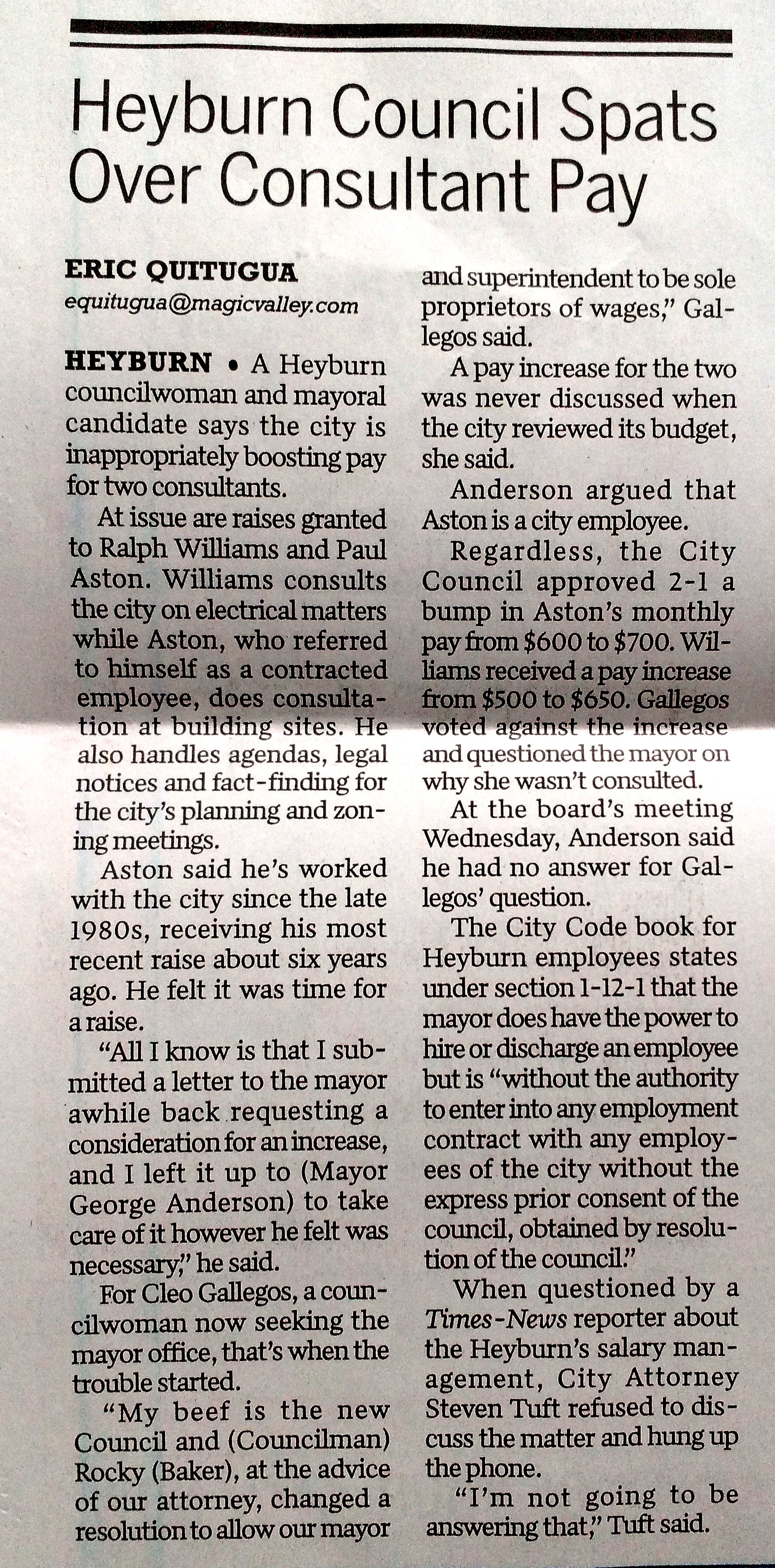
The first article, by Eric Quitugua of the Times-News, concerned a dispute over pay raises granted to two city consultants — Ralph Williams, who advised on electrical matters, and Paul Aston, who handled building site consultation, agendas, legal notices, and fact-finding for planning and zoning meetings. Aston had worked with the city since the late 1980s and asked Mayor George Anderson for a raise. The council approved the raises 2-1. Councilwoman Cleo Gallegos, who was running for mayor against businessman Mark Rosa, voted against and questioned why she had not been consulted. Anderson said at the board meeting he had no answer for her. The article cited Heyburn City Code § 1-12-1, which provides that while the mayor has power to hire or discharge employees, the mayor is “without the authority to enter into any employment contract with any employees of the city without the express prior consent of the council, obtained by resolution of the council.” When a reporter asked City Attorney Steven Tuft about the matter, Tuft refused to discuss it and hung up the phone.
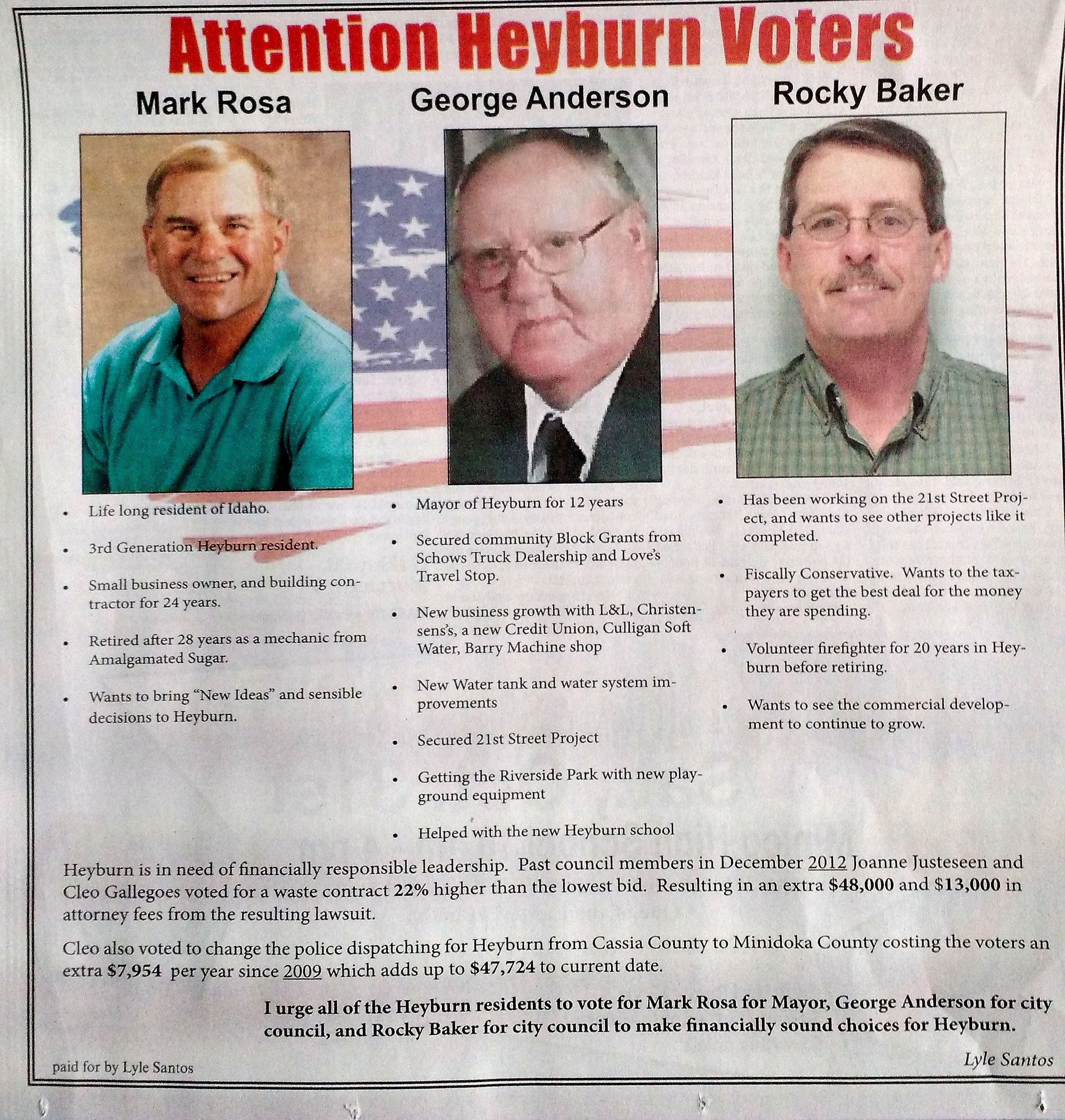
The campaign flyer, paid for by Lyle Santos, urged support for Rosa for mayor, Anderson for city council, and Rocky Baker for city council. It listed credentials and accomplishments for each, and charged that Gallegos and former councilwoman Joanne Justesen had voted in December 2012 for a waste contract 22% above the lowest bid, costing the city $48,000 plus $13,000 in attorney fees from the resulting lawsuit, and that Gallegos had voted to shift police dispatching from Cassia County to Minidoka County at an added cost of $7,954 per year since 2009.
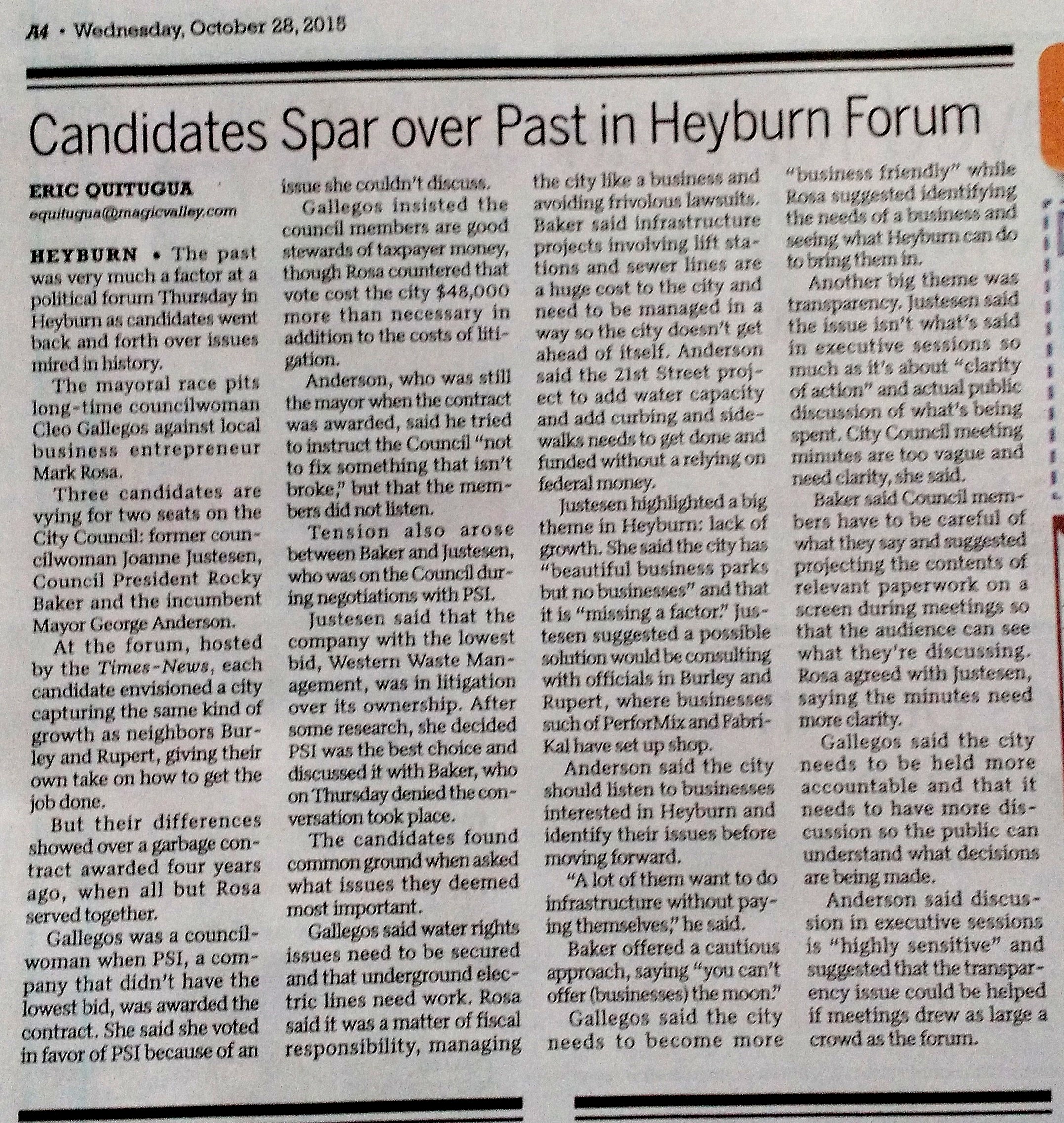
The second article, also by Quitugua, covered a candidates forum hosted by the Times-News on 23 October 2015. All five candidates attended: Gallegos and Rosa for mayor, and Justesen, Baker, and Anderson for two council seats. The garbage contract was the dominant source of friction. Gallegos said she had voted for the higher bid because of an issue she could not discuss. Rosa countered that the vote had cost the city $48,000 more than necessary plus litigation costs. Anderson said he had tried to instruct the council not to fix something that wasn’t broken, but the members had not listened. Justesen said the lowest bidder had been in litigation over its ownership and she had concluded the other company was the better choice; she said she discussed it with Baker, who at the forum denied the conversation had taken place.
On the substantive questions the candidates found more common ground. Gallegos emphasized water rights and underground electric lines. Rosa spoke of fiscal responsibility and running the city like a business. Baker highlighted lift stations and sewer infrastructure costs and cautioned against the city getting ahead of itself. Anderson pointed to the 21st Street water project. Justesen raised the theme of growth, noting the city had “beautiful business parks but no businesses” and was “missing a factor.”
Transparency was the other main theme. Justesen said council minutes were too vague. Baker suggested projecting meeting paperwork on a screen for the public. Rosa agreed the minutes needed clarity. Gallegos said the city needed more public discussion of its decisions. Anderson said executive sessions were “highly sensitive” and suggested transparency would be helped if regular meetings drew crowds as large as the forum had.
Background on the Garbage Contract
The garbage contract dispute that dominated the 2015 forum had a longer history worth understanding.
In December 2012 the Heyburn City Council voted to award the city’s garbage service contract to PSI Environmental Systems at $5.65 per residential customer per month — 21 percent above the lowest bid of $4.46 submitted by Western Waste Services. Total Waste Management had also bid lower, at $4.50. The council additionally designated PSI as the city’s sole commercial garbage contractor, requiring businesses using other providers to switch. Rocky Baker was the sole dissenting vote on both motions. He called it “the worst business decision made by Heyburn in the more than 10 years he’s served on the City Council” and objected to forcing businesses away from their current providers. “We didn’t have a system that was broke,” he said.
The contract’s path to approval was itself contentious. The council heard public opposition at its regular meeting on 28 March and declined to vote. The following day it convened an emergency meeting — invoking an Idaho Open Meeting Law exemption allowing cities facing immediate financial loss to meet without the usual 24-hour posted notice — and approved the contract. Gallegos and Justesen voted yes. Baker voted no. City Attorney Tuft defended the emergency meeting: “They would have had a loss if they didn’t have a garbage contract in place today. I think it’s legitimate, personally.”
Lyle Santos, co-owner of Total Waste Management, was not informed the council would vote until about an hour before the meeting and was not allowed to address the council. He faced a 20 percent loss of his Heyburn commercial accounts and said he would have to lay off a Heyburn employee. Total Waste Management subsequently sued the city. In response, the council voted to terminate the PSI contract. The $48,000 figure cited in the 2015 campaign flyer and at the candidates forum reflected the cost difference between PSI’s contract and the lowest bid over the contract period, plus the $13,000 in attorney fees from the resulting lawsuit.
Lyle Santos was the same man who paid for the October 2015 campaign flyer attacking Gallegos and Justesen over that vote. Every figure on the flyer was accurate. The context it did not supply was that Santos had a direct financial interest in the outcome of the election. Baker, the sole vote against the contract in December 2012, appeared on that same flyer as a candidate to be supported.
Background on Heyburn and Mini-Cassia
Heyburn sits in Minidoka County on the north bank of the Snake River, across from Burley in Cassia County. The two counties together are known as Mini-Cassia, and their relationship has always been complicated — by sports rivalries, by water and land disputes, by the question of who gets to control shared resources. The J.R. Simplot Company’s departure from Heyburn is still discussed. Simplot had operated a potato-processing plant in Heyburn; after a years-long legal battle over electrical rates, the company closed the plant and gave the property to the city of Burley, which developed it into what became the Burley-Heyburn Industrial Park. “Simplot’s gift to Burley was a hard slap,” Gallegos told the Associated Press in 2018. Meanwhile, when Burley sought a site for a new airport, Heyburn annexed 320 acres into its impact zone to keep Burley from acquiring the land. Each county had its grievances and its retaliations, and they accumulated over generations.
George Anderson had been Heyburn’s mayor for twelve years by the time of the 2015 election. Cleo Gallegos had been on the city council since around 2000. Dick Galbraith had served on the Minidoka County Planning and Zoning board for nineteen years, including as its chairman, before joining the city council, where he had served for several years. Rocky Baker had served on the Heyburn Fire Department for twenty years, fourteen as assistant chief, before becoming a fire commissioner and then council president. These were not newcomers. They were people who had watched Heyburn’s struggles with infrastructure, growth, and its larger neighbor across the river for a long time.
The wastewater system was a live problem throughout this period. Heyburn’s treatment plant dated from the 1960s and had been upgraded in 1991 and 2008. The city’s collection system comprised 25 miles of pipe and 18 lift stations. By the mid-2010s the plant was falling out of EPA compliance and facing fines that threatened to bankrupt the city. Baker’s comment at the forum about lift stations and sewer lines being “a huge cost to the city” was not abstract campaign language.
What Happened: 2015–2021
Cleo Gallegos won the November 2015 mayoral election. George Anderson’s bid for a council seat was unsuccessful. Rocky Baker won a council seat.
On 6 December 2016, thirteen months after the forum, Clarence Lanier “Rocky” Baker died from injuries sustained in a motor vehicle accident. He was 62. He had been born on 27 October 1954 — the candidates forum the day after his sixty-first birthday. He had married Georgia Schneider on 8 March 1975 at the Emerson Ward Building west of Paul, built a house in Heyburn in 1976, and never left. He had started at Ore-Ida in 1971 and worked his way up to maintenance supervisor at what became McCain Foods. His family wrote that he collected heart-shaped rocks to give to the people he loved. He was buried at the Riverside Cemetery in Heyburn. His funeral was held at the Burley United Methodist Church.
Meanwhile Gallegos was working on the wastewater problem. Through a judicial confirmation process — used because the scope of work required it — the city bonded for $12.4 million and arranged a financing package that brought the taxpayer burden down to $5.5 million through grants from the Army Corps of Engineers, USDA, and a Community Development Block Grant, saving Heyburn taxpayers $3.1 million against the total $9.6 million project cost. A $5.7 million construction contract was signed in November 2019. “I am excited for Heyburn to be moving in the right direction,” Gallegos said. “And I have nothing but pride in the direction it is going.”
In 2017, Dick Galbraith defended his council seat in one of the more unusual elections in Heyburn’s history. His race ended in a 112-112 tie. A coin toss was held per state guidelines; Galbraith called heads, and the coin fell tails. He contested the result and requested a recount. During the recount, officials discovered one ballot marked too lightly to be read by the machine, and Galbraith won 113-112. The story was picked up by CNN. “I was on City Council for 16 years and mayor for two, and I’ve never seen it,” Gallegos told CNN. “Every vote counts, especially in your small city elections.”
In November 2019 Mark Rosa defeated Gallegos for mayor and took office in January 2020. His administration was immediately contentious. At his first council meeting — a session lasting nearly three hours — Rosa requested the council restore his executive authority over city personnel, which Gallegos had delegated to the city administrator. The council tabled the request. Councilman Galbraith observed that the administrator was “here with boots on the ground, day in and day out all day long.” Councilwoman Rose Schmitt told Rosa: “I don’t know why you want all the power.” The question of mayoral authority over city employees — the same structural question at the heart of the 2015 consultant pay dispute — had not gone away.
In August 2020 a recall petition bearing more than the required 230 signatures was filed against Rosa. The petition charged that he had created a bullying culture at city offices and a hostile work environment for city employees, council members, and the city attorney; that he had refused to listen to citizens; that he had overstepped his financial authority by seeking to add funds to the budget to cover personal attorney fees to sue the city; and that he had tried to impede the city’s sewer projects. Rosa refused to resign. “I absolutely will not resign,” he told the Times-News. “All of these allegations are simply not true.”
On 3 November 2020 Heyburn voters recalled Mark Rosa by a vote of 748 to 440 — 62.96 percent in favor of recall. Rosa had won the office the prior year with 199 votes. “It’s too bad for Heyburn,” he said on election night. “But it is what it is. I feel like I never had a chance to do anything for Heyburn.”
One week later the City Council unanimously appointed Dick Galbraith as mayor and unanimously elected Joanne Justesen as council president. Galbraith said he hoped for “some healing in the city of Heyburn” and accepted the appointment as part of the responsibility he had taken on when he ran for his council seat.
The 2021 Election
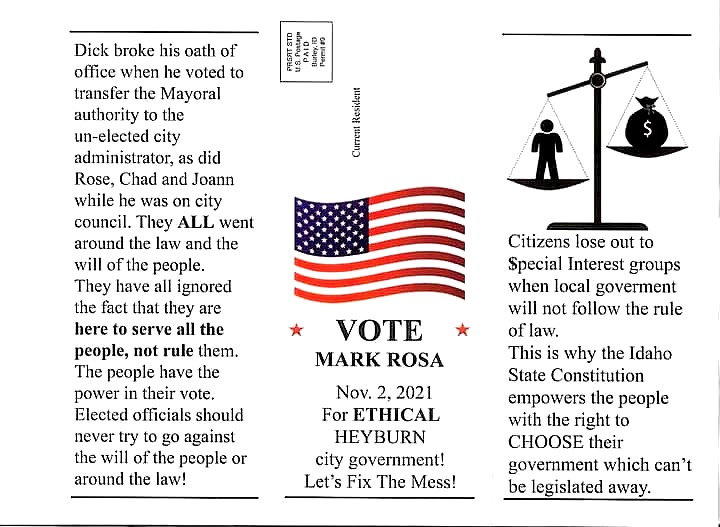
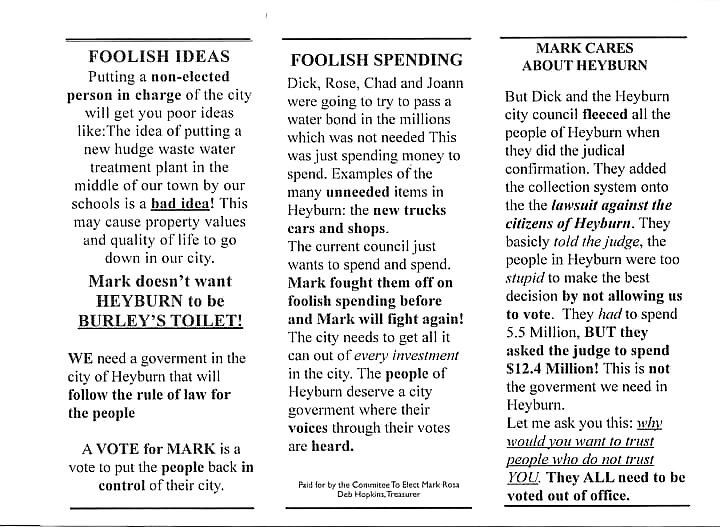
Mark Rosa ran again in November 2021, as he had promised on the night of his recall. His campaign flyer attacked Galbraith and the council directly. It charged that “Dick broke his oath of office when he voted to transfer the Mayoral authority to the un-elected city administrator, as did Rose, Chad and Joann while he was on city council.” It called the judicial confirmation bond process a betrayal of the voters: “They basically told the judge, the people in Heyburn were too stupid to make the best decision by not allowing us to vote. They had to spend 5.5 Million, BUT they asked the judge to spend $12.4 Million!” It called the wastewater treatment plant location a “bad idea” and warned: “Mark doesn’t want HEYBURN to be BURLEY’S TOILET!” The flyer was paid for by the Committee to Elect Mark Rosa, Deb Hopkins, Treasurer.
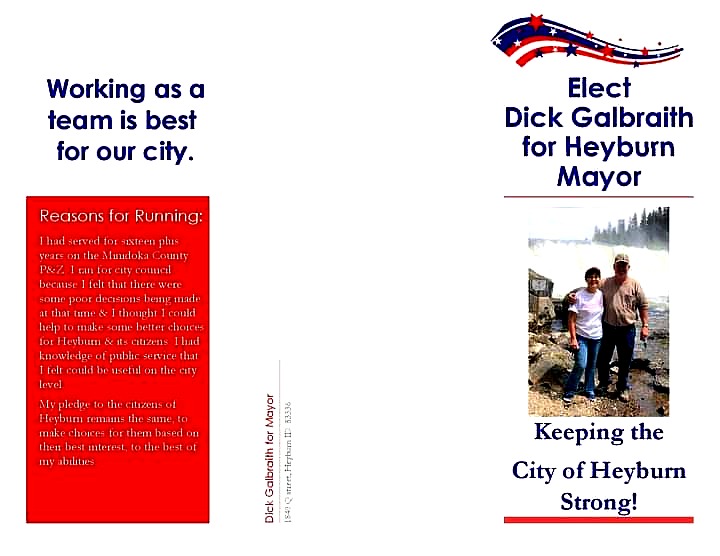
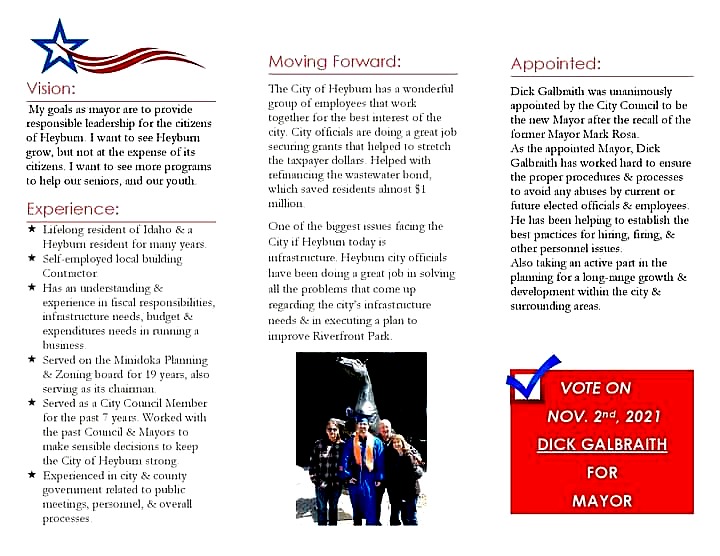
Dick Galbraith’s campaign flyer offered a quieter contrast. It noted his nineteen years on the Minidoka County Planning and Zoning board, seven years on the city council, and his appointment as mayor after Rosa’s recall. It credited his tenure with establishing “proper procedures and processes to avoid any abuses by current or future elected officials and employees” and noted his work on the wastewater bond refinancing, which “saved residents almost $1 million.” His stated vision: “to provide responsible leadership for the citizens of Heyburn. I want to see Heyburn grow, but not at the expense of its citizens.” His closing line: “Working as a team is best for our city.”
Dick Galbraith won the November 2021 election. Cleo Gallegos also won a seat, returning to the mayor’s office. Mark Rosa did not prevail.
After 2021
George Anderson, who had served as Heyburn’s mayor for twelve years and whose name appeared on the 2015 opposition flyer, died on 20 September 2024 at the age of 87. He had been born in Burley on 21 June 1937. A neighbor remembered him as “a good friend, neighbor, and a great mayor.” His funeral was held at the Paul Stake Center.
These documents are offered as a record of two moments in the life of a small Idaho city — the people who served it, the questions they argued about, and what became of them afterward.
Rocky Baker collected heart-shaped rocks. George Anderson served his city for twelve years. The sewer plant got built. The city went on.
Sources: Times-News (Twin Falls), Eric Quitugua reporting, October 2015; Times-News, staff reporting, 2012–2013; paid political advertisement, Lyle Santos, October 2015; KMVT, Amy Reid reporting, December 2016 (link); Baker family obituary, December 2016; Times-News, Laurie Welch reporting, 2018–2020; Associated Press, Laurie Welch reporting, April 2018; CNN, Ryan Struyk reporting, December 2017 (link); campaign materials, Committee to Elect Mark Rosa and Dick Galbraith for Mayor, November 2021; Echovita, George A. Anderson obituary, 2024 (link).

