
I remember Grandpa, Milo James Ross, telling the story of his arrival in Hawaii. He often shared that, upon arriving, he heard over the loudspeakers that he was the father of a new baby boy. Somehow in my mind, I always equated Dad’s birth as the same date Grandpa arrived in Hawaii. Now knowing communications and technology available in 1943, the birth would not have been communicated to Hawaii the same day. The story suggests the birth and related information arrived before Grandpa to Hawaii. But by how much time?
First, Grandpa’s obituary (which I helped write) indicates he enlisted in the Army in October 1942. In the 1997 interview, Grandpa says he went in on “the first draft” shortly after Pearl Harbor (December 1941). He says he was sent to Fort Douglas and shipped out to Fort Lewis the same day. Grandpa also gave me the date for the photo below as 1942, which is almost a year after Pearl Harbor. He was pretty clear to tell me that when he enlisted, he was not aware that Grandma was pregnant. The first draft after Pearl Harbor, whatever that means, seems fairly immediate to me placing enlistment in 1941.

The University of Utah Veterans Support Center states Grandpa landed in Hawaii on 4 July 1942. That seems to collaborate the 1997 interview with him enlisting right after Pearl Harbor. I wondered if that was a typo or if they had some records I was not aware. Was he in the army a whole year and just happened to be in Hawaii when the birth was announced?
There had to be some records out there to help clarify or pin down the dates. Military records give the insight needed. It was years since I did this search, and fortunately more records and information are now available. I try to link to them as they are referenced.
The 33rd Infantry Division arrived in Hawaii on 12 July 1943. Multiple independent military history sources — the U.S. Army Center of Military History, Army Divisions records, and others — all confirm this same date. As a reminder, Grandpa was in the 33rd Infantry Division, 130th Regiment, Company C.
The Division’s timeline shows it moved to Fort Lewis in August 1942. In March 1943, after Grandpa arrived in October 1942, the Division moved to Camp Young, California. There it conducted Desert Training Center maneuvers from April to June 1943 and then shipped to Hawaii in July 1943. This follows the pattern in Grandpa’s 1997 interview. (We have many photos of Grandma’s visit to Grandpa at Fort Lewis, I should share some of those.)
Dad was born on 4 July 1943, and the birth announcement came over the loudspeaker as the ship arrived in Hawaii. The official arrival date of 12 July 1943 means the ship would have been at sea on July 4th. “Sergeant Ross, congratulations. Your wife and son are doing well, and, one more thing, before you get off the ship you and your men have guard duty for the next four hours. Welcome to Hawaii.”
Additionally, a detailed record of another soldier, Staff Sergeant Charles Greer, in Company B of the 130th Infantry Regiment confirms the division’s movements through Fort Lewis in September 1942, Camp Clipper/Desert Training Center in early 1943, and onward — matching exactly what Grandpa described in his 1997 interview.
After settling the year, the next question for me was, where did they land in Hawaii and how long were they there? This took some more research to flesh out. I am grateful for those who continue to expand and make available these stories on the internet.
After arrival of the 123rd and 130th Regiments on Oahu in July 1943, the 123rd Regiment was sent to Kauai almost immediately. The 130th Regiment was sent to the Big Island almost immediately and later joined the 123rd on Kauai in December 1943.
Grandpa’s ship likely docked at a port on Oahu, almost certainly Honolulu Harbor. Honolulu was the primary army troop arrival port, rather than Pearl Harbor which was a naval base.
The primary Army installation area on the Big Island was Waikoloa Maneuver Area, near Waimea. Waimea is on the northern part of the island. Waikoloa Maneuver Area, located south of Waimea on Parker Ranch land, was used for live fire exercises in 1943. Camp Tarawa, also in Waimea, was also a major training ground used in late 1943, but primarily by Marines.
Grandpa’s 130th Regiment was almost certainly stationed in the Waimea/Waikoloa before transferring to Kauai in December 1943. I wasn’t able to find a specific named camp for the Army’s 130th Regiment there.
After the 130th joined the 123rd Regiment on Kauai in December 1943, both regiments completed their training and shipped out April 1944 to New Guinea. This comes from the Greer profile, linked above, which noted that on 21 April 1944, the 130th Infantry Regiment sailed from Honolulu to Finschhafen, New Guinea. It took two weeks to get from Honolulu to Finschhafen. Apparently, the 130th traveled on the S.S. Lurline.
The story of Sergeant Philip Beaman matches what Grandpa told in his 1997 interview. During the following months, the men worked to build up the outpost and conducted more amphibious operation training. They were even put to work unloading supplies at the port due to a shortage of stevedores. Grandpa’s account of unloading ships, digging drainage ditches, and building gravel walkways at Finschhafen matches Beaman. According to Beaman, morale suffered badly. According to the division’s own history, The Golden Cross, most men began to feel the division was “World War II’s forgotten unit.” The Division started calling themselves the “4F Division” — the Finschhafen Freight Forward Force.”
The Division arrived at Finschhafen on 11 May 1944 and remained there engaged in jungle and amphibious training. Later in 1944, the Division moved to Morotai Island arriving on 18 December 1944. The Division landed on the west coast without opposition. Grandpa also described in his interview arriving at Morotai, a PT boat mission, the bank robbery incident, booby trap explosion, and guarding the airstrip.
Dexter Kerstetter also served in Company C, 130th Infantry Regiment, with Grandpa. The Japanese had landed a regiment on the island, which lacked heavy weapons but had fortified the thick jungle around Hill 40.
On 10 February 1945, the 33rd Infantry Division landed at Lingayen Gulf, Luzon, Philippines. After Lingayen Gulf, Beaman describes combat in the foothills of the Caraballo mountain range, in areas nicknamed Bench Mark and Question Mark. From 19 February onward, there is the drive into the Caraballo Mountains toward Baguio.
Kerstetter’s history continues, that on 13 April 1945, during a battle he advanced ahead of his squad. The forward movement had been halted by intense fire that inflicted casualties. Kerstetter advanced beyond his squad and worked his way up the ridge where Japan’s defenses were located. Japan’s soldiers had the ridgeline defended with machine guns, mortars, and infantry in spider holes. He systematically took out enemy defenses with well-aimed rifle fire and grenades. Climbing above the defenses, he dropped down the ridgeline to destroy a cave entrance defense and its four defenders. He resumed his advance on the ridgeline defenses and next encountered a machine gun position, which he destroyed with accurate rifle fire and a grenade, killing four enemy soldiers. Kerstetter then fired on about 20 of Japan’s soldiers behind the main line of defense, scattering them. Out of ammunition, he returned to his squad for resupply. Having good knowledge concerning the locations of Japanese defenses, he led a platoon to the ridgeline and on the way took out a rifle position. The platoon was able to secure the ridgeline. Kerstetter killed 16 Japanese soldiers that day. Company C then held the hill, deterring Japanese counterattacks. During a counterattack two days later on 15 April 1945, Kerstetter was wounded in the leg by sniper fire and sent to a field hospital. He was promoted to sergeant and recommended for the Medal of Honor.
Grandpa being in the same Company was likely involved in some way with much of Kerstetter’s history. The Greer article places the 1st Battalion of the 130th Infantry fighting on Hill 1802 in the Labayug-Alibeng area from 23-25 February 1945. That is just two weeks after landing. The book about the 33rd Division places Hills X and Y in the Kennon Road fighting of late February to March 1945. It was Hill X that gave Grandpa the Silver Star and the whole Unit received the Presidential Citation. Shortly after Hill X Grandpa was wounded while tending to other soldiers who were awaiting medical attention. All this brutal mountain fighting took place on the approaches to Baguio.
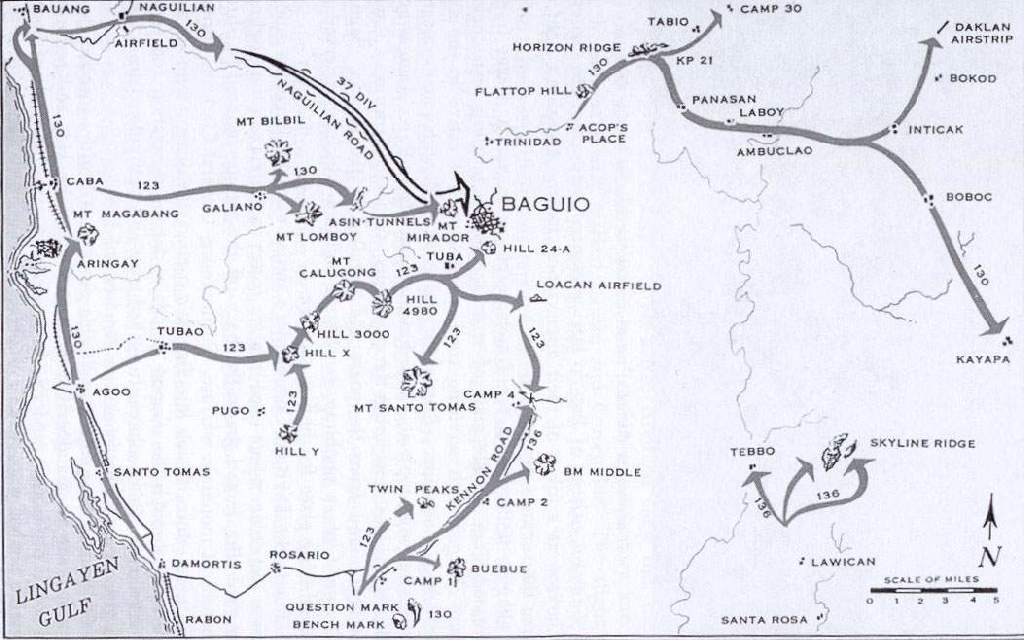
Grandpa spent several weeks in recovery. University of Utah says two months, but that cannot be accurate. By mid April 1945 the 130th Infantry Regiment called in air support to help rifle companies get through a network of fortified hills. The fighter-bombers broke Japanese resistance and the 130th finally got across the river. The 33rd Infantry Division liberated what was left of Baguio on 26 April 1945. Grandpa indicates he was present for that liberation, which puts his recovery time at only a couple of weeks, not a full two months.
After Baguio, there was plenty of mopping up work required. The Division mopped up isolated pockets of Japanese troops around Baguio and captured the San Nicholas–Tebbo–Itogon route on 12 May 1945. Fighting continued and on 6 June 1945, Company I of the 130th Regiment was given a Medal of Honor for their activities near Tabio, Luzon. Grandpa indicates he was present at the Japanese surrender at Luzon in June 1945.
On 30 June 1945, all elements of the 33rd Division went to rest and rehabilitation areas. The division then landed on Honshū Island, Japan on 25 September 1945 and performed occupation duties until it was deactivated in early 1946. While the Division performed occupation duties, Grandpa had been honorably discharged 30 September 1945 and shipped home.
I am posting this article ahead of the 81st anniversary of the liberation of Baguio City.

