John Carver Cabin – Plain City

Milo Ross in front of John Carver Cabin, Plain City, Utah

Here is a photo that Grandpa shared regularly. He was pleased to have helped with the restoration of the John Carver home in Plain City, Weber, Utah. As you can see, he also liked to write notes on photos and things to preserve his thoughts. “Milo J. Ross, Number 1 Shop, P. Calvert. Harold Carver family – money. First Ward. Restored Carver Log Home – President Calvert Plain City. Thanks to Milo Ross and Harold Carver family – Money. Milo did the carpenter work free – and supplied also.”

It was a great source of pride that he helped restore this cabin and preserve part of Plain City’s history for future generations. It had the canopy over it before and obviously another was put up. I am not sure if it went without a canopy for a while, or if this photo was just taken before it was reinstalled.

I could not really find anything on the cabin otherwise. I found this website that has photos.

1959 Article on John Carver Cabin

John Carver was born 6 August 1822 in Clifford, Herefordshire, England. He joined The Church of Jesus Christ of Latter-day Saints in 1842, immigrated in 1850. He met and married Mary Ann Eames on the ship, marrying 10 March 1850 on the Atlantic Ocean. He had a farm at Kay’s Creek which he gave up when he moved to Plain City in the fall of 1859 (according to Plain City history). John built this cabin in 1860.

2018 photo by Jacob Barlow of John Carver cabin

John died 11 January 1912 in Plain City and was buried on the 14th in Plain City. Mary Ann died 18 June 1870 in Plain City. John took another wife, Rachel Fredrica Tellefsen, in 1864. He took another wife, Sarah Ann Eames, in 1871. Rachel died in 1903 in Plain City, Sarah died in 1909 in Eden, Weber, Utah.

Daughters of the Utah Pioneers plague on John Carver cabin in Plain City, Utah

John had 10 children with Mary, 5 children with Rachel, and 7 children with Sarah.

Note by Milo Ross regarding the Carver Cabin
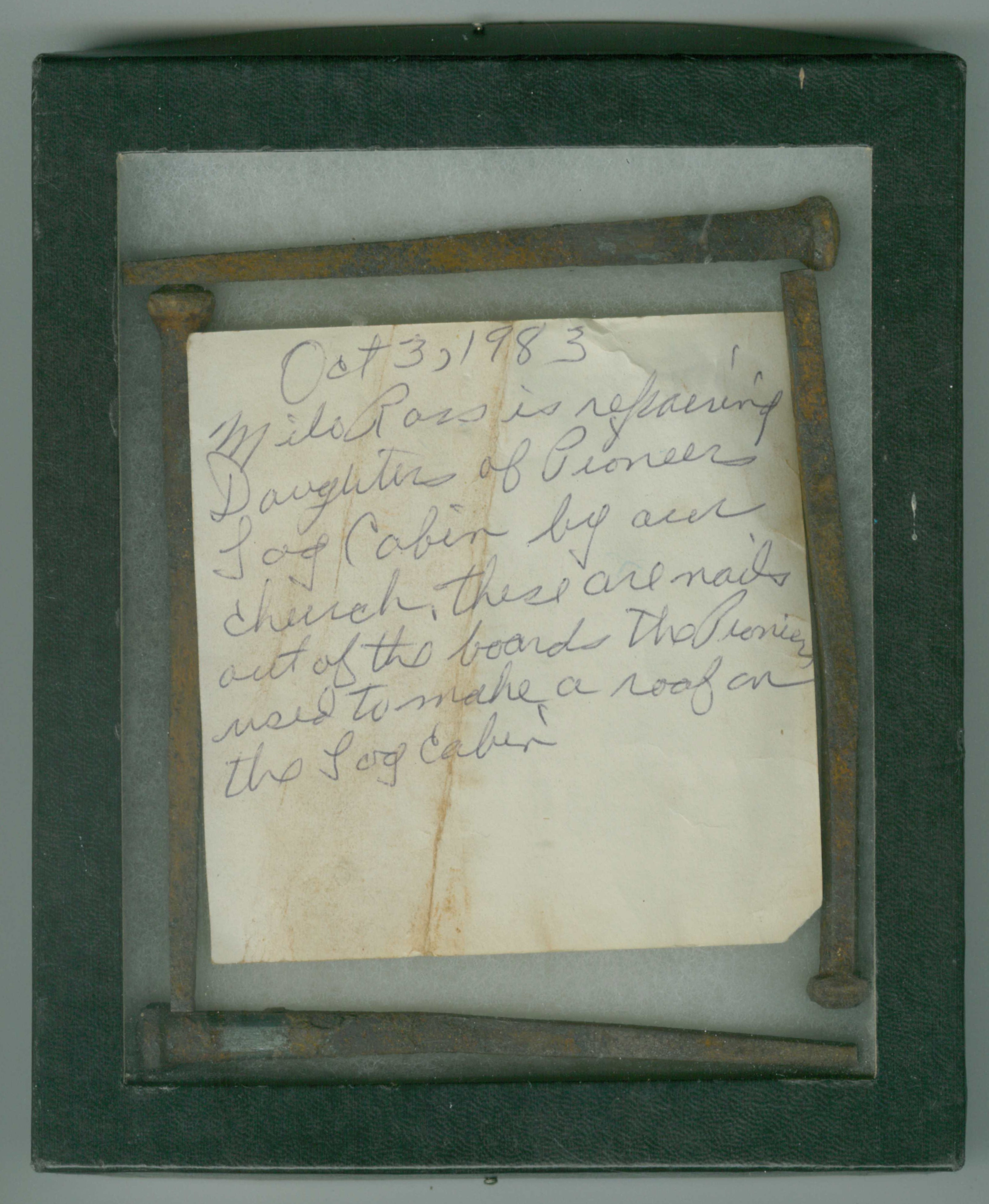
Little framed box Grandpa put together with nails from the cabin roof.

October 3, 1983

Milo Ross is repairing Daughters of Pioneers Log Cabin by our church. These are nails out of the boards the Pioneers used to make the roof on the Log Cabin.

Secretary of State preparing arguments on open primaries

Biography of Anna Maria Schmid Wanner

Wanner Family about 1895

This biography of Anna Maria Schmid Wanner was in a family history book that belonged to Golden Rulon Andra and was given to me by his daughter. I did not have this biography and am happy to share it.

“Anna Maria Schmid Wanner, my grandmother, was born in [Holzgerlingen], [Württemberg], Germany on the 21 of January 1849. She was the daughter of Jacob Friedrich Schmid and Solome Notter. Her mother died when she was two years old. She then had a stepmother who was very cruel to her. They were very poor, and she would go to her grandmothers place and pick over potato peelings for the want of food. She ate the potato peelings for food.

“She started school at the age of six. For years the people in Germany couldn’t grow a thing, and the schools had to feed the children soup in school.

“She was a member of the Protestant church.

“Her father was a linen weaver, and grandmother would walk miles and miles at night through the dark woods to deliver the linen to different people. She had to carry it on her head. She often would be afraid, but she always prayed, and never was harmed.

“She married John George Wanner on the 6th of June 1870. From this union was born to them 5 sons and 5 daughters. They buried 2 sons in Germany. They were married only a short time when her husband called to go to war.

“It was the custom for the women to do the farm work, cutting the hay with the scythe and putting it up by hand.

“When the children needed shoes or dresses the shoemaker and the dressmaker would come to the home.

“Early in the year 1873, the family moved to Greenkraut [Grünkraut], [Württemberg], Germany.

“In 1891, she and her family were converted to the Morman or Latter-Day-Saint church. In her home she had a large room where she would accommodate the missionaries with food and beds, and help them learn the German language.

“In May 1893, she with her husband and family of seven children left Germany to come to America. They arrived at Franklin County [then Oneida County], Idaho on Sunday the 18th of June 1893.

“She left a brother and sister and father in Germany when she came to America. She had a brother named Carl and a sister, Louise Sophia. Grandmother was the youngest child. She was the only one of her fathers family that joined the Latter-Day-Saint church.

“They lived in Glendale, Whitney, and Preston, Idaho and in 1910 they moved to Logan, Utah. She and her husband did lots of Tempel work for their own dead ancestors as well as considerable donation work in the Tempel for other people.

“She obtained many names from Germany which was promised in her Patriarchal blessing, and the work was done for all of them before her death.

“She took sick in December, and died on the 9th of December 1929 of Pneumonia. Her funeral services were held in the 4th ward of Logan, Utah in which she was a member. She was buried by her husband in the cemetery at Logan, Utah.

“NOTE: Her oldest son preceded the family to America. He came over 1 and 1/2 years before the rest of the family. Thus — they only brought 7 children with them.

“This biography was copied from a letter received from Clara Bodrero, 495 W. 5th No., serveral years ago. She does not remember who sent it to her. Logan, Utah.

Red Rock Pass 2020

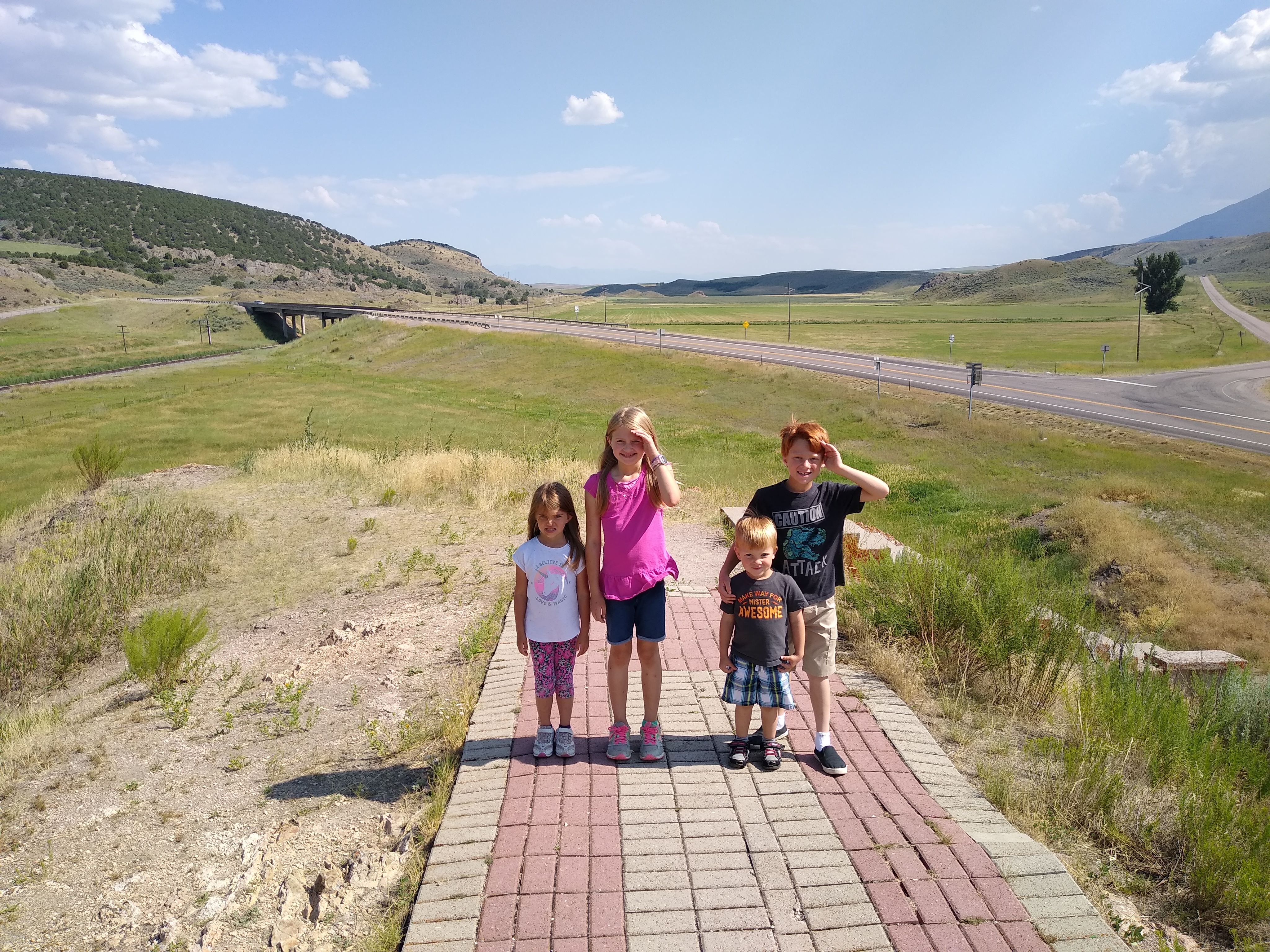
Four years ago, I took the kids on a trip. As was tradition for me as a kid, we always stop at Red Rock Pass when driving past. I shared that story and history in a previous post from 2018. That post also had photos of a younger Aliza and Hiram. Now I share these photos from two years later on 26 July 2020. I will have to take more pictures as time pass to show the timelessness of the pass and the marching of time on growing children.

James, Lillie, Hiram, and Aliza Ross climbing Red Rock Pass.
Lillie, Aliza, James, and Hiram Ross

In the background, you can see the road on the right headed to Oxford, Clifton, Dayton, and Weston, Idaho. On the left, the state highway continues on to Swanlake, Winder, and Preston.

Can’t Loan Equipment for Cleanup

Another article clipped by my Grandmother, Gladys Donaldson Ross. This references a fire of a home that belonged to Harold and Jennie Ross. Jennie is a Van Leeuwen cousin of my Grandma, Harold is the brother to my Grandpa. Jennie told me at one point, she may have thought the fire was intentionally set to get back at her by Harold. She lost some of her prized Charlie Russell paintings in the fire.

“Pleasant View – Although they would have liked to, city officials here voted against loaning city equipment to help clean up after a recent house fire.

“City councilman and Mayor Richard Diamond said they feared such an act would set a precedent that may be difficult to live with as the years come and go.

“In addition, a group of citizens appearing before them on other matters felt the same way.

“Voiced Sympathy

“Mayor Diamond asked the group how they felt about granting such a request involving the home of Harold Ross at 975 W. 3800 N., that was gutted by fire.

“Several of the people responded. They also expressed sympathy for the cause, but said it would not be wise for the city to loan the front-end loader.

“A couple cited other examples in which such requests could have been made and said there would be no place to “draw the line.”

“Debris left over by the fire was being cleared by volunteers, mostly neighbors and friends.

“The front-end loader, it was explained, would have come in handy to scoop up the debris and load it into waiting trucks.

“In further illustrating the problem such an act would create, Councilman Leonard Cevering mentioned an experience at his own home.

“He said he came home at 10:30 one evening to find his basement half full of water.

“”I would have been great if I could have called the city and had them bring over a piece of equipment to dig down and drain the water out,” he said.

“As it was, he added, the task involved considerable time and expense on his part. He said there could be a number of such problems in the future.

“City officials, however, did not rule out the use of city equipment during emergency situations when lives or property might be threatened.