This is another chapter of the Jonas history book compiled by Carvel Jonas. “The Joseph Jonas clan of Utah (including – early Jonas family history; early Nelson family history)” This one is on Joseph Nelson Jonas. I have written a biography of Joseph and Lillian previously.
Joseph and Margaret Jonas about 1899
“Joseph Nelson Jonas was born 19 March 1893 at or near Ellensburg, Kittitas, Washington State. He was the 6th child and 3rd son of Joseph Jonas and Annetta Josephine Nelson. He became the youngest of the family (a younger sister was born after Joseph, but she died a few hours after birth). Joseph was about three years old when his mother left the family and went to the Washington State Hospital in 1896. Joseph lived in the Ellensburg area with his father and siblings until he was 8 years old. On 3 July 1901 the family moved to Crescent, Utah. He was baptized a member of The Church of Jesus Christ of Latter-day Saints 10 Jan 1902 by Aug Nelson. His two older brothers were also baptized that same day.
John, Joseph, and William Jonas
“He worked on his Uncle August Nelson’s farm until he moved to Richmond, Utah, to live with his older sister, Rosa, in 1908 when he was 15 years old. He traveled the same day with his two older brothers. When he was 23 years old he married Lillian Coley. They were married 6 September 1916 in the Logan Temple. That same day they were each endowed with the temple ordinances for the first time. Joseph met his wife while he was living in Richmond. His wife’s family had a farm in Richmond where Joseph had hired on as a far laborer to help the family harvest hay.
“About 6 months after they met they were married. His wife was 18 years old and Joseph was five years older than his wife, age 23. They became the parents of eight children, the first six were boys and the last two were girls. Joseph went to work for the sugar factory in Lewiston, Utah. By about 1920 Joseph had moved to Thatcher, Idaho with his brother, William and his sister, Rosa. They operated a dry farm which grew grain. Joseph had a wooden red house which had a front room, bedroom and a kitchen. His sister lived about a mile away in her own home and William lived in Thatcher teaching school. At the farm Joseph and others operated a combine which was pulled by horses and had blades that were taller than the men. The animals were kept in a barn which was about a block from the house. They had five horses, a cow, pigs, chickens, domestic animals and a vegetable garden. One horse was white and was named “dime.” To mail letters and receive letters the boys would need to ride Dime. This horse, while carrying his son, Joseph H., ran as fast as it could go all the way from getting the mail one day. This experience scared the young boy who was about 5 or 6 years old, and he had to hold on for fear of his life. About 1924 or 1925 Joseph moved from Thatcher to Lewiston, Utah. Joseph drove the wagon which carried some of his sister’s children. He began working for the Utah-Idaho Central Railroad. This was an electric inter-urban trolley railroad that had 94 miles of track and went from Ogden, Utah north to Preston, Idaho. Joseph began working on a section gang, the same type of job his father, Joseph, had had. Joseph worked keeping the track in operating condition by repairing rotten timbers, hammering spikes or tightening the bolts which kept the track together. He worked seven days a week, some of the work was all night, but he was able to come home after a shift was over. While the family lived in Lewiston they lived in a train box car, which had the wheels removed. There were two box cars which were used by the family. They were close together and a ditch ran under their box car. One car was used as a storage shed, the other one was used as the family home. Once there was a tub of gas which was stored in the shed. This gas caught on fire, which started the shed to burn. Joseph went to his wife and told her to leave because the shed was on fire and it may cause the house to burn down (the two structures were close together). She didn’t believe him, but there was little time to convince her so he picked her up and carried her outside. The best way to stop the fire was to remove the burning tub of gas–Joseph must have thought. So he went into the shed, picked up the burning tub of gas and took it outside. Joseph’s brave act saved his home from burning, but they lost the shed and it’s contents. Joseph spent about two weeks in the Ogden Hospital with 2nd and 3rd degree burns.
Joseph and some friends at work after a game of shoes
“About 1927 Joseph was promoted to Section Foreman and moved to Ogden with his family. His father, Joseph, had been a section foreman in a leadership position, too. Joseph worked on the railroad line that went from Ogden to Huntsville, and also a line that went to Plain City. Joseph worked at one time on the Quinney Railroad Line. Except for the Thatcher home the family rented their homes until Joseph died. They lived at 17th St. and Wall Ave. in an apartment complex owned by the railroad called a section house. This was a long, wooden building that was divided into rooms. Joseph’s family was the only one that had a porch, a special privilege given to Joseph because he was the foreman. Joseph had a vegetable garden when he lived in Ogden. He was a very generous host and his visitors were always given a lot to eat when they visited their home. Joseph was active in the L.D.S. Church. He was a strict father and was not afraid to “switch” his children when they got into trouble. He stood about 5’6″ tall and was muscular. His nephew, Merlin Andersen, said that Joseph told him “I want to show you what a good wrestler is!” Next thing Merlin knew was that he was on the ground. Joseph was on the wrestling team at Brigham Young College (Logan), the school he graduated from. Joseph and his brother, William, went to college some of the same time together.
Joseph Nelson Jonas’ Brigham Young College yearbook picture
“Joseph liked to discuss religion. He would argue with his siblings his point of view with determination. After the discussion all the siblings would talk nice to each other and gave each other hugs and handshakes. They family moved to 103 17th Street in Ogden. On 1 Aug 1932 Joseph last child was born. He was very glad to have two daughters after having six sons in a row. September 6, 1932, a little over a month later, Joseph and Lillian had their 16th wedding anniversary. Joseph had gone to work as usual that day. He was welding some train track on the corner of Lincoln and 20th East in Ogden. One week before, while Joseph was working in front of the American Cannery, he had been shocked by electricity and landed on the ground. He got up and went right back to work that day. But it was a week later when Norwood, Joseph’s son, was bringing his father something to eat. Norwood saw his father welding when someone started to move the trolley car. Joseph was welding a ground wire. Grounds were put into the track to the electricity would go harmlessly into the earth. This time the electricity, cause by the trolley being moved, went to the ground which Joseph was touching. Joseph was killed Sept 6, 1932 on his 16th wedding anniversary. The Ogden City paper, dated Sept 8, 1932 carried the following obituary. “Ogden-Funeral services for Joseph Jonas, 39 of 103 Seventeenth Street, section foreman for the Utah-Idaho Central Railroad Company, who was electrocuted Tuesday afternoon, will be held Friday, at 10 A.M., in the Lindquist’s Chapel, with Bishop Huggins of the Tenth ward in charge. Investigations into the death of Mr. Jonas are being conducted by the railroad company.” He was buried in Richmond Cemetery where two of his sons, his wife, his brother, John, and his father, Joseph are also buried.
“Merlin Andersen gave me the following tidbits about his uncle, Joseph. “Joe always had cows so he could have enough milk for all his kids. He was an ambitious person-he had a way to get things done.”
“Lillian told me the following story. One day we went to the movies. This was when Lillian was about 5 months pregnant. When they had both decided to cross the road near the movie theater a car ran over both of her legs. Her legs weren’t broken, but were badly bruised. The other family felt so badly that the mother of the boy who was driving the car became good friends with Lillian. This mother visited and gave Lillian comfort during her recovery.
“Joseph Nelson Jonas had read the Bible so much that he could quote scriptures and could back up his knowledge by finding the scripture and showing it to people.
Biography of John George Wanner taken from a hand written history which was in a box of Genealogy material of Clara Bodrero, now in possession of Elaine Ricks (unknown dates), author unknown.. I have written a history of John George Wanner Sr previously. I updated location and names to their proper spelling.
“John George Wanner, son of John Frederick and Anna Maria Marquardt, was born Oct. 18, 1845, at Holzgerlingen, Germany. He had two brothers, namely Michal and Conrad. Grandfather was the youngest child. [He wasn’t a very large man about 5 feet 6 inches tall. He always looked well dressed, clean and very nice.]
“He was member of the Protestant Church. At this church the members graduated from Sunday School at the age of 18.
“In those days children didn’t get very much schooling and grandfather was no exception.
“Grandpa while in Germany worked on the roads and was the road overseer. he also worked in the Black Forest and fought in the Civil War in Germany in 1865 and the War of 1870-71.
“He was married to Anna Maria Schmidt on June 6, 1870. [She was about 5 feet 4 inches and had a good shape. She always fixed her hair so beautiful, she looked nice and well dressed. I can remember this beautiful black knit winter dress she had and she always wore gloves] From this union was born to them five sons and five daughters. Before his marriage he served in the Civil War in Germany and again after his marriage in 1870 & 71 for quite a while.
“After his marriage he worked in the woods. In 1873 they moved from Holzgerlingen to Gruenkraut, Wuerttemberg, where they bought a little home and farm. He also worked in the gravel and woods on this side. In 1880 he got a job on a big highway and worked on it until he came to America in 1893.
“In the month of May 1891 while working on the Highway two men came along and talked to him, giving him a Tract. They were members and missionaries of The Church of Jesus Christ of Latter-day Saints. They visited his home telling him and his family of the gospel and the Lord’s work. They made their visits often, and in July 1891, John George, the oldest son was baptized and came to America with a missionary by the name of Terrell from Providence, Utah.
“In October 1891, grandfather, his wife and some of their children were baptized by the Elders. (Grandfather was the only member of his father’s family that joined the Latter Day Saint church.
“In May 1893, they prepared to come to America. [They rode the train for a day and then got on a ship and went up the Rhine River. This took them three or four days. They then rode the train another day and got on a ship on the North Sea that took them to England; the sea was very turbulent and they had a rough voyage.
“They went to Liverpool, England from Germany on a small ship. From Liverpool to New York they came on a big ship and were on the ocean 13 days. They arrived at New York City and stayed in a Hotel 20 stories up for 1 or 2 nights. They took the train to Chicago where they stayed 1 or 2 nights. Then they took a train and came to Franklin, Idaho arriving on Sunday June 18, 1893. They were met by their son George and Brother Fred Nuffer, the man George was working for. They met them with a one seated buggy and a wagon. Grandfather Wanner asked for a drink of water after getting off the train. “You’ll have to be on your stomach by that stream”, George spoke up. This made Grandfather Wanner so discussed that he walked back to Logan over 20 miles, with a determination to go back to Germany if he had to drink from ditches. The next day he reconsidered and again returned to Franklin, Idaho. They went to Cub River to Fred Nuffer’s place where they stayed for almost one week Then they purchased the farm of John Nuffer in Glendale, Idaho. [It was during this week that Grandpa took his daughter Mary and they walked to Bear Lake County seeking a farm and a home and to see what was available there. They slept on the ground at nights and saved some of their read to feed the bears so they wouldn’t bother them. They had to take off their shoes as they forged streams. It as a rough trip.
“[The first Sunday they were in Glendale, Grandpa and Grandma went to church with these five beautiful daughters and two sons. One day, William Addison Wagstaff was the ward clerk and mother, Mary, had on a red dress; dad looked down at her and winked. You see, dad was well past 30 and not married. I bet he though here is my chance. Of course there were other nice gals available, but he hadn’t married and we were happy he chose mother.]
“[Grandma soon joined the Relief Society and in the minutes of the meetings that I have, tell of her bearing her testimony often and donating eggs, wheat, calico or whatever, when asked to do so. They had a strong testimony and remained true to the Church and were ardent Temple Workers till their last days on earth. ]
“John Wanner took up more land after a few years and built a log cabin to claim the land. Cleared quaken aspens from his farm to have more land. One day his All slipped from a stump and cut a deep space i his hand. It was necessary for the doctor to put in several ditches as the farm work advanced he built a barn and bought addition cows.
“Mother Wanner made and sold many pounds of butter a week to George Benson Store in Whitney, Idaho.
“The Wanners also picked and sold number quarts of currants, gooseberries and raspberries. Gooseberries were about 20 quarts for a dollar, the raspberries sold for about 10 or 12 quarts for a dollar. These were delivered price.
“About that time 2 additional rooms were added to a rock house that was on the place.
“They bought the John Nuffer’s farm at Glendale, Idaho, now Franklin County. Later he bought the Jed M. Blair farms in Whitney and started to raise sugar beets.
“[They later moved in 1910 to Logan, Utah and ] while living at Logan, Utah [to be near the Logan Temple where they could go often. In Logan, they lived at two or three different places, but I wasn’t able to find out for sure. The places I distinctly remember was their home on 3rd North and two or so blocks East and their last home in Logan was a lovely home they built located on 4th North and two blocks East. they did a great deal of Temple work for the dead having got many names from Germany. They also did a lot of work for other people. While in Logan, Grandpa always had a lively horse, a good looking single black buggy and a real snazzy buggy whip. This one place they lived on in Logan had an extra lot where he grew hay for his horse and he’d cut it with the scythe. They also always had a nice garden and beautiful flowers. As I remember this home was on 3rd North and a few blocks East.]
“[They were hard working, thrifty people and handled their affairs very well. They really made hay while the sun shone and were able to retire at a reasonable age and had enough to live on plus an estate they left. ]
“February 16, 1922 after a short illness of pneumonia he died and was buried in the cemetery at Logan, Utah.
I have thought of this poem a number of times recently. Both in my personal life and watching the national issues play out before us. I wanted to share it and make it available in my own history and records.
I believe the first time I heard this poem was by our Mission President, H. Bruce Stucki (1937-2019). I don’t know how many times I heard it, but President Stucki had this poem memorized (with some tweaks). It became a somewhat unofficial poem of the England Manchester Mission, at least while we were there.
The Upward Reach by Sadie Tiller Crawley
He stood at the crossroads all alone,
The sunlight in his face;
He had no thought for an evil course
He was set for a manly race.
But the road stretched east, and the road stretched west,
And he did not know which road was best,
So he took the wrong road and it led him down,
And he lost the race and the victor’s crown.
He was caught at last in an angry snare
Because no one stood at the crossroads there
To show him the better road.
Another day, at the selfsame place,
A boy with high hopes stood.
He, too, was set for a manly race —
He was seeking the things that were good.
And one was there who the roads did know,
And that one showed him the way to go,
So he turned away from the road leading down,
And he won the race and the victor’s crown.
He walks today the highway fair
Because one stood at the crossroads there
To show him the better road.
The official hymn of our mission was Jerusalem, I believe it still is to this day. William Blake wrote the words.
And did those feet in ancient time,
Walk upon England’s mountains green:
And was the holy Lamb of God,
On England’s pleasant pastures seen!
And did the Countenance Divine,
Shine forth upon our clouded hills?
And was Jerusalem builded here,
Among these dark Satanic Mills?
Bring me my Bow of burning gold:
Bring me my Arrows of desire:
Bring me my Spear: O clouds unfold:
Bring me my Chariot of fire!
I will not cease from Mental Fight,
Nor shall my Sword sleep in my hand:
Till we have built Jerusalem,
In England’s green & pleasant Land.
It is in light of those two poems that I share this photo. While I served in Hyde, Kenny Miles, did this painting. We helped Kenny with service and quite a few various projects. I was very, very surprised when he presented me with this painting. It shows me at the crossroads with the Savior. It also quotes part of the poem Jerusalem.
After reviewing the painting at the apartment in Hyde, at the time, I was not enamored by it because I felt like it looked like I was trying to encourage people to go on the other road away from the Savior. But as time has passed, it is a pretty picture. I am impressed, Brother Miles’ talents are much more than anything I could offer. But now, I feel like I am the one at the crossroads. Now it means so much more.
Miracles still happen! This is proof. The fact that these three photos traveled together without being separated, that there were hints as to their identity written on them, that some lady picked them up in Pennsylvania, and then spent the time to research them and found enough information to link to me, is phenomenal. Joseph, Sarah, and Hattie wanted to be found and the stars aligned with heaven. May there be many more such miracles in the future!
I had a lady who e-mailed me regarding three photos. They were found in an old store in Pennsylvania. The back of this photo above had written on it, “W.S. Donaldson, Evanston.” This lady traced that down to William Scott Donaldson, who did live in Evanston, Wyoming at from about 1890 to 1895. My Great Grandfather, William’s son, David Delos Donaldson was born in Evanston in 1894.
I knew it was not William Scott Donaldson. William, who I have written on before, was born in 1865 and died in Ogden, Utah in 1913 of cancer. A photo taken not too long before his passing does not have him as grey and not looking like this man.
William Scott Donaldson (1865-1913)
But I did have this photograph also in my records of William Scott Donaldson’s father, Joseph Russell Donaldson (1836-1925).
Unknown, Joseph and Agnes Donaldson, Hattie Lovell, Unknown
I have a couple of photos of Joseph Russell Donaldson, who I have also written on before. That nose, the double lines down the cheek, and that bushy goatee seemed to point me where I needed to go next. Here is another photo I have of Joseph Russell Donaldson.
Sitting (l-r): Joseph Russell Donaldson and George Donaldson. Standing: Unknown.
The next photo the lady had in the three-pack tied Joseph Russell to the mix. Here is the second photo.
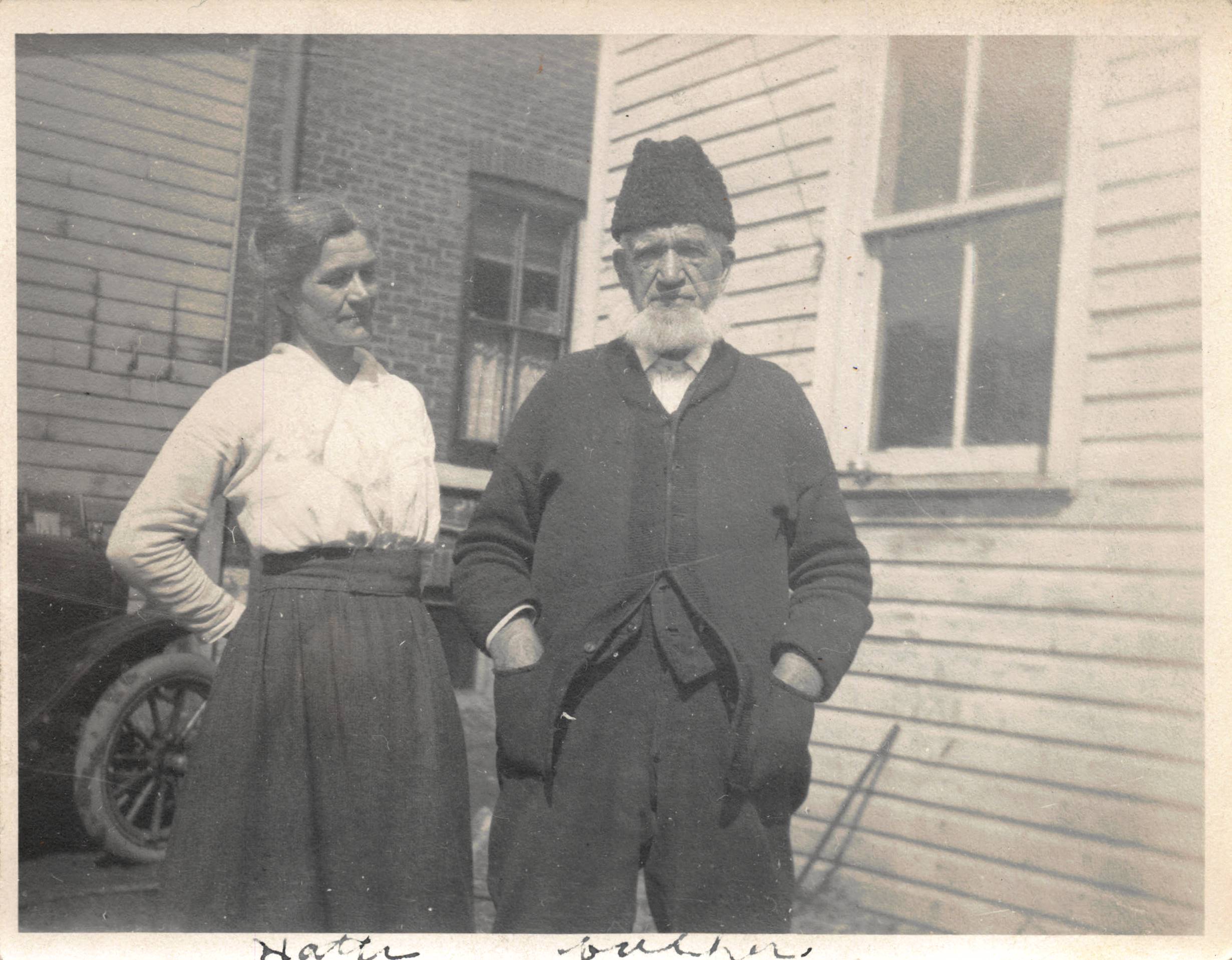
Hattie Lovell and Joseph Russell Donaldson
This photo had written on the front “Hattie – Father.” As you can see from the photo above, Hattie is the same one as this Hattie, the sister to William Scott Donaldson, Harriet Edith Donaldson Lovell (1875-1961). On the back of this photo is written, “Grandpa Donaldson and Hattie Donaldson – Kingston, Canada.” Again, the tie between W.S. Donaldson and Hattie with “Grandpa.” William Scott was born in Joyceville, Ontario, Canada, but Joseph Russell lived in Kingston from at least 1901 until his death in 1925. Things were tying in nicely with each other.
Then there is this third photo. This one had written on the front, “Sarah Armina Donaldson, Papa’s mother.” The interesting part is the photo paper is of a photographer in Reading, Pennsylvania. So this must be a photograph of a photograph, and looking at it that does seem to be the case.
Sarah Armina Todd
That ties in nicely with Joseph Russell Donaldson and William Scott Donaldson as Sarah Armina Todd (1839-1880) is the wife of Joseph and mother of William. She died a little over 41 years old for what the death record states as “hemorrhage of lungs,” whatever that might be. I have an old, tiny photocopy of this photo but of poor enough condition I did not scan and upload to FamilySearch. This one isn’t necessarily a whole lot better but more complete.
Which then takes us back to the first photo at the top. The more I looked at it, it became apparent it was a younger version of Joseph Russell Donaldson. The way the goatee grows although trimmed, the facial lines, the lips (and the familiarity I recognize in my own father), and the eyes all match. Plus, the writing on the back probably indicates it was taken before or at the time that W.S. Donaldson lived in Evanston (1890-1895). Very happy to have found another photo of another ancestor. He is a handsome man too, nearly or at 60 years of age.
Someone once observed, “The universe is composed of stories, not atoms.” The Star of Bethlehem is certainly a story, as is most of the Bible, first and foremost. It is also a mystery, involving not only theology and astronomy but also history and even astrology. What do we know about the Star of Bethlehem? The popular conception is summarized in the Christmas carol:
We three kings of Orient are Bearing gifts we traverse afar, Field and fountain, moor and mountain, Following yonder star.
O star of wonder, star of night, Star of royal beauty bright, Westward leading, still proceeding, Guide us to thy perfect light.
We all know this carol as the story of the Star, which is fine—except for the fact that almost everything in it is wrong. The actual New Testament account of the Star of Bethlehem comes from the second chapter of the Gospel of Matthew:
Jesus was born at Bethlehem in Judaea during the reign of Herod. After his birth astrologers [Magi] from the East arrived in Jerusalem, asking, “Where is the newborn king of the Jews? We observed the rising of his star, and we have come to pay him homage.” King Herod was greatly perturbed when he heard this, and so was the whole of Jerusalem. He called together the chief priests and scribes of the Jews and asked them where the Messiah was to be born. “At Bethlehem in Judaea,” they replied, “for this is what the prophet wrote: ‘Bethlehem in the land of Judah, you are by no means least among the rulers of Judah; for out of you shall come a ruler to be the shepherd of my people Israel.’”
Then Herod summoned the astrologers to meet him secretly, and ascertained from them the exact time when the star had appeared. He sent them to Bethlehem, and said, “Go and make a careful search for the child, and when you have found him, bring me word, so that I may go myself and pay him homage.”
After hearing what the king had to say they set out; there before them was the star they had seen rising, and it went ahead of them until it stopped above the place where the child lay. They were overjoyed at the sight of it and, entering the house, they saw the child with Mary his mother and bowed low in homage to him; they opened their treasure chests and presented gifts to him: gold, frankincense, and myrrh. Then they returned to their own country by another route, for they had been warned in a dream not to go back to Herod.
This is not a fabulous tale. It does not conjure up fantastic details or images, and it is told in a rather mundane fashion, not at all like a fable. It is also the only account we have of the Star in our Bible. Admittedly, later non-canonical sources like the Protovangelium of James and an epistle of Ignatius did elaborate on the story, calling the Star the brightest star in the sky, brighter than all other stars combined, even including the sun and the moon, which bowed down before it. But Matthew is very matter-of-fact. It has also been suggested that this is a commentary by Matthew, always fond of referring to Old Testament prophecies, on Balaam’s oracle in the Book of Numbers that “a star shall come forth out of Jacob and a scepter shall rise out of Israel.” But it would be uncharacteristic of Matthew to refrain from pointing out this prophecy explicitly, had he had it in mind.
The Historical Perspective
To understand this story, we must view it in the context of its time. Who were these Magi? Where did they come from? Magi is the plural of Magus, the root of our word magic, and “court astrologers” is probably the best translation, although “wise men” is also a good term, descriptive of the esteem in which they were widely held. The group of Magi in question came “from the East.” They might have been Zoroastrians, Medes, Persians, Arabs, or even Jews. They probably served as court advisors, making forecasts and predictions for their royal patrons based on their study of the stars, about which they were quite knowledgeable. Magi often wandered from court to court, and it was not unusual for them to cover great distances in order to attend the birth or crowning of a king, paying their respects and offering gifts. It is not surprising, therefore, that Matthew would mention them as validation of Jesus’ kingship, or that Herod would regard their arrival as a very serious matter.
When might these Magi have appeared in Judaea? Obviously, determining the story’s date is important if we are to look for astronomical connections. We might assume that it was around 1 B.C. or 1 A.D., since that is when, by conventional reckoning, Jesus was born. But the calendar on which these dates are based was set by the Roman monk Dionysius Exiguus in the year 525 A.D., long after the fact. Scholars writing in the first and second centuries A.D. asserted that Jesus was born between what we now call 4 B.C. and 1 B.C. They were living much closer to the event and had access to thousands of historical records in many excellent libraries, and their opinions probably should be given much more weight than has been common.
How about the time of the year? The best clue is a passage in the Book of Luke:
And there were in the same country shepherds abiding in the fields, keeping watch over their flock by night.
If the reference to “fields” is accurate—not pastures or holding pens—we might guess at a date in late summer or early fall, for it was customary for farmers to allow sheep and cattle to graze the stubble in the fields following the harvest. This clue is suggestive, but hardly definitive.
One difficulty in seeking a precise date is the fact that Matthew reports two different sightings, possibly separated by a substantial time. First, the Magi saw the Star rising en anatole, best translated as “rising in the East,” the ancient technical term for an acronical rising, when an object rises at sunset and is visible all night. After they come to Jerusalem—we do not know how long that took, and there is no indication that the Star was in any way involved with the journey—they see the Star again as they travel the few miles to Bethlehem:
There before them was the star they had seen rising, and it went ahead of them until it stopped above the place where the child lay.
There was no need for a bright or supernatural guiding light to find Bethlehem from Jerusalem; it lies just five miles south on the main road. There is a reference not to the “house” of an infant (brephos in the Greek) but of a paidion, or toddler, indicating that some months may have elapsed since the birth itself.
What are the astronomical possibilities? This question has been asked many times since the Christian apologist Origen first raised it around 250 A.D. It is safe to say that every astronomical event known to have occurred during, say, the decade of interest has at some point been proposed as the Star of Bethlehem. The key point to answering this question is to note that it is not just any astronomical event that is of interest. We can restrict our inquiry to those appearances that would have had astrological significance to the Magi, who declared:
“We observed the rising of his star, and we have come to pay him homage.”
An astrological event may not have been very obvious at all; certainly it was not obvious to Herod. Had it been an incomparably bright object, as later writers thought, there would be numerous written records of it. It is much more plausible that the Star of Bethlehem went unnoticed by all but a few experts such as the Magi.
The Death of Herod
A major key to the chronology is the date of the death of Herod the Great, the father of another Herod—Herod Antipas, who executed John the Baptist and who ruled at the time of the Crucifixion. Herod the Great was alive when the Star of Bethlehem appeared, and the commonly quoted date for his death is 4 B.C. Thus dates of 7 B.C. through 4 B.C. are often given for the birth of Jesus. The political events of this period are best known from the writings of Josephus Flavius, the Jewish historian who lived from 37 A.D. to about 95 A.D. His testimony has always been considered vital in determining these dates. But the accounts of Josephus and the entire history of this period have been reassessed recently, with important new results, by Ernest Martin, whose book, The Star that Astonished the World (ASK Publications, 1991), has become the authoritative source on the subject.
According to Josephus, on the night of a lunar eclipse Herod executed two rabbis. They were accused of inciting some young men to climb up on the wall and tear down the golden eagle that the king had ordered placed on the gate to the Temple in Jerusalem. This eagle was, of course, an abomination to the Jews because it was a graven image. Soon after this incident, Herod died and was buried. One of his sons inherited his throne shortly before Passover was celebrated. It was long believed that the lunar eclipse in question occurred on March 13 in 4 B.C. But this was only a partial eclipse (40 percent total) and fairly hard to detect. And it occurred only 29 days before Passover. Here is what would have had to happen in those 29 days:
Herod was sick at the time of the execution of the rabbis, and his condition worsened almost immediately. He was treated for a time by his physicians, to no avail. He then decided to pack up the royal household and move to Jericho to take the baths. He tried the baths unsuccessfully for some days and then returned to Jerusalem. Believing that he soon would die, Herod came up with a diabolical plan to insure that all of Israel would mourn his death, in spite of his unpopularity. He commanded the leading men from around the country to come to Jerusalem; there he imprisoned them in the Hippodrome and ordered the army to execute them as soon as he was dead. Israel would indeed mourn, he vowed. (Fortunately, the order was not carried out.)
In the meantime, word arrived from Rome that Herod finally had the Emperor’s permission to execute his rebellious son Antipater, and he promptly complied. Five days later Herod died, but not before decreeing that his was to be the largest funeral ever held in the history of the world. His body was embalmed. The army was assembled to carry his body in the funeral procession to a burial site some 25 miles away. The soldiers walked in bare feet, as was required when in mourning, traveling one mile a day. A legate from Rome, where word of Herod’s death had been received, arrived to protect the royal treasury. Finally, Herod’s son Archelaus was crowned king and had time to issue a few decrees prior to the celebration of Passover.
The 29 days between the eclipse of 4 B.C. and the following Passover simply did not allow enough time for all of this to have happened. A minimum of ten weeks would have been required. But on January 10, 1 B.C., there was a total lunar eclipse visible in Palestine, and it occurred twelve and a half weeks before Passover.
As Martin points out, there are other compelling reasons to regard 1 B.C. as the true date of Herod’s death. For example, the War of Varus, known to have followed Herod’s death, can be redated to 1 B.C., where it fits the other known facts perfectly. As a clincher, it has recently been discovered that Josephus himself dated Herod’s death to 1 B.C.; a sixteenth century copyist’s error is responsible for the incorrect date, which has been propagated to modern editions of Josephus.
If we conclude that Herod did die in the spring of 1 B.C., we are free to add the years 3 B.C. and 2 B.C. to our search for the Star of Bethlehem. What was happening then? The year 2 B.C. marked the 25th anniversary of Caesar Augustus’s rule and the 750th anniversary of the founding of Rome. Huge celebrations were planned. The whole empire was at peace. The doors of the temple of Janus were closed for only the third time in Roman history. To honor their emperor, the people were to rise as one and name him pater patriae, or “Father of the Country.” Now, getting the people of an empire to do something “spontaneously” requires a great deal of organization. And so an enrollment, or census, was ordered:
In those days, a decree went out from Caesar Augustus that all the world should be enrolled…And all went to be enrolled, each to his own city.
This enrollment, described in the Book of Luke, which brought Joseph and Mary to Bethlehem, has always been a mystery since no regular census occurred at this time. But the pater patriae enrollment fits perfectly.
The Astronomical Perspective
What astronomical events, possibly in the years 3 or 2 B.C., might have been related to the Star of Bethlehem? A nova—the unexpected, sudden brightening of a star from invisibility into a bright object for a period of days or weeks—has been suggested. But there is no historical record of such a nova, nor is it clear what a nova’s astrological significance would be. Origen himself suggested a comet, for comets appear sporadically, move, and can even seem to point down to the earth. But the recorded comets around this time, even Halley’s Comet in 12 B.C., were not very impressive; astrologically, they were considered ominous. Meteors and fireballs are even less likely candidates.
Conjunctions of planets have also long been considered good possibilities. A conjunction is a close apparent approach between two celestial objects. Technically speaking, a conjunction occurs at the moment when both objects have the same celestial longitude; one is due north of the other. The closer the objects, the more visually impressive the event and the more significant astrologically. In 3 B.C. and 2 B.C., there was a series of close conjunctions involving Jupiter, the planet that represented kingship, coronations, and the birth of kings. In Hebrew, Jupiter was known as Sedeq or “Righteousness,” a term also used for the Messiah.
In September of 3 B.C., Jupiter came into conjunction with Regulus, the star of kingship, the brightest star in the constellation of Leo. Leo was the constellation of kings, and it was associated with the Lion of Judah. The royal planet approached the royal star in the royal constellation representing Israel. Just a month earlier, Jupiter and Venus, the Mother planet, had almost seemed to touch each other in another close conjunction, also in Leo. Then the conjunction between Jupiter and Regulus was repeated, not once but twice, in February and May of 2 B.C. Finally, in June of 2 B.C., Jupiter and Venus, the two brightest objects in the sky save the sun and the moon, experienced an even closer encounter when their disks appeared to touch; to the naked eye they became a single object above the setting sun. This exceptionally rare spectacle could not have been missed by the Magi.
In fact, we have seen here only the highlights of an impressive series of planetary motions and conjunctions fraught with a variety of astrological meanings, involving all the other known planets of the period: Mercury, Mars, and Saturn. The astrological significance of these impressive events must surely have been seen by the Magi as the announcement of the impending birth of a great king of Israel.
September 11, 3 B.C., is perhaps the most interesting date of all. Not only was Jupiter very close to Regulus in the first of their conjunctions, but the sun was in the constellation of Virgo (of obvious symbolism), together with the new moon, in a configuration that fits a plausible interpretation of a passage in the Book of Revelation describing the birth of a male child who is to be the ruler of the universe. Significantly, September 11, 3 B.C., also marked the beginning of the Jewish New Year, traditionally regarded as the anniversary of Noah’s landing after the Great Flood.
But if the planet Jupiter was the Star of Bethlehem, or was a component of the events that triggered the visit by the Magi, how do we view the final appearance of the Star on their journey to Bethlehem? It would have been in the southern sky, though fairly high above the horizon. Could the Star have stopped over Bethlehem? The answer is yes. The word “stop” was used for what we now call a planet’s “stationary point.” A planet normally moves eastward through the stars from night to night and month to month, but regularly exhibits a “retrograde loop.” After it passes the opposite point in the sky from the sun, it appears to slow, come to a full stop, and move backward (westward) through the sky for some weeks. Again it slows, stops, and resumes its eastward course.
It seems plausible that the Magi were “overjoyed” at again seeing before them, as they traveled southward, “his star,” Jupiter, which at its stationary point was standing still over Bethlehem. We do know for certain that Jupiter performed a retrograde loop in 2 B.C. and that it was stationary on December 25, interestingly enough, during Hanukkah, the season for giving presents.
What Room for God?
Where has this search for the Star of Bethlehem taken us? There has been much discussion in recent years about the “God of the gaps”—finding God in the gaps between the portions of some subject that we feel we understand scientifically. It seems to me that this is a dangerous position, for science by definition cannot admit to such gaps and must search continually to fill them with its understanding, and it often will succeed in so doing. Here the situation is different. The question is: What meaning, what room for God, do we find in the events that we know to have occurred?
If we have correctly identified the Star of Bethlehem, the science is clear and simple. Johannes Kepler (1571-1630) was the German astronomer who discovered the physical laws describing planetary orbits. These orbits are so predictable that we can deduce quite accurately what the sky looked like two thousand years ago. Even the ancient Magi understood apparent planetary motions quite well. Predictions of the conjunction of 3 and 2 B.C. were made 400 years prior to the birth of Christ, and they were in error by only a few days. There is no need to invoke God or divine miracles to explain what happened in the heavens above Judaea. Natural laws are sufficient.
But is this kind of sufficiency really enough for us? The significant question raised here is not what happened, but why it happened. What does it mean? Was Matthew right in seeing this event as divine confirmation of a central moment in God’s plan for mankind? What room is left for God, not as an agent filling in the gaps between what we can understand as physical causes, but as the creator of purpose? Was God’s purpose fulfilled by the great celestial dance that we call the Star of Bethlehem?
These are examples of the kind of questions we are faced with daily. No theologian can say, in a way convincing to a scientist, that some event required an act of God outside natural law. Similarly, no scientist can say that some event was merely (a dangerous word) an act of natural law working itself out with no other meaning. That is, no one is forced to believe that what happened in the heavens two thousand years ago was a simple, natural event devoid of meaning. The Star of Bethlehem was an excellent example of an event that occurs right at the intersection of Christianity and science, in a world created by a God who chose to institute natural laws but who nevertheless continues to carry out His own purposes.
Imprimus, December 1996, Volume 25, Number 12 – Craig Chester
Jonas Family Home at 142 North State Street, Richmond, Utah in 1960
If this picture doesn’t conjure late 1950’s Americana, I don’t know what does. Norwood and Colleen Jonas built this home. The house still stands at 142 North State Street, Richmond, Utah. Colleen stands with her bicycle near the front door.
My mother, Sandy, stands holding the bike upright while Doug is crouched behind it for some purpose. Since Jackie was born in 1960 and Grandma is in maternity clothes, this would have been the spring or summer leading up to August 1960. Doug couldn’t remember which Beck boy this was with the bike in the front. Gary Beck was born in 1947, Kenny in 1949. I am guessing this looks more like a 13 year old than a 11 year old, so probably Gary Beck.
The Cadillac in the driveway is interesting. I don’t recall ever being told the family owning a Cadillac, I heard about Plymouths and Buicks, but never a 1953 Cadillac. In doing more research and a call from my Uncle Doug, the plates on the Cadillac are from 2C. While outsiders consider this unique, Idaho still follows this model. 2C is Canyon County. Vance and Millie Beck, Colleen’s sister, lived in Nampa in Canyon County. Doug also let me know that Becks did own a Cadillac like this and it eventually went to Preston to my Great Grandparents and roamed around Preston and the farm for a few years. Doug told me that he remembers this particular date and instance like it was yesterday!
The bicycle Mom holds is also interesting. It looks similar to an old bicycle I rode around Paul, Idaho in my youth.
Okay, it was maybe more than a kite on a string. For Christmas last year I gave the kids and Amanda an airplane ride. I had coordinated it with my cousin to try and make it happen. Calendars, health, and a number of things had to be considered. But we made it happen. Here are some photos of our flying trip.
I want my children to experience new things. I want them to consider more of the world around them and the options that are available. The kids had made a numbber of observations in 2019 regarding birds, Hiram at one point talking about The Sword in the Stone. He referenced Wart and Merlin getting to fly and all he learned. It triggered a thought for an experience.
First we had to drive to the Twin Falls, Idaho airport, Joslin Field. We met up with family and made our way to the airport. We made it through the security gate and found our way to the hangar. Inside was this beauty waiting for us, a 2006 Van’s Aircraft RV-10.
We had to move another plane out of the way in the hangar in order to get this one out. We moved it out of the hangar and did all the checks necessary. Here we did a picture before loading up. Due to limited size inside, we had to make two trips for the entire family to make a flight. Amanda and I went up with the boys first, then with the girls.
The Ross Family getting read to start up and fly away to make some memories.
Here are a couple of photos of the inside of the plane before I get to some of what we captured outside the plane.
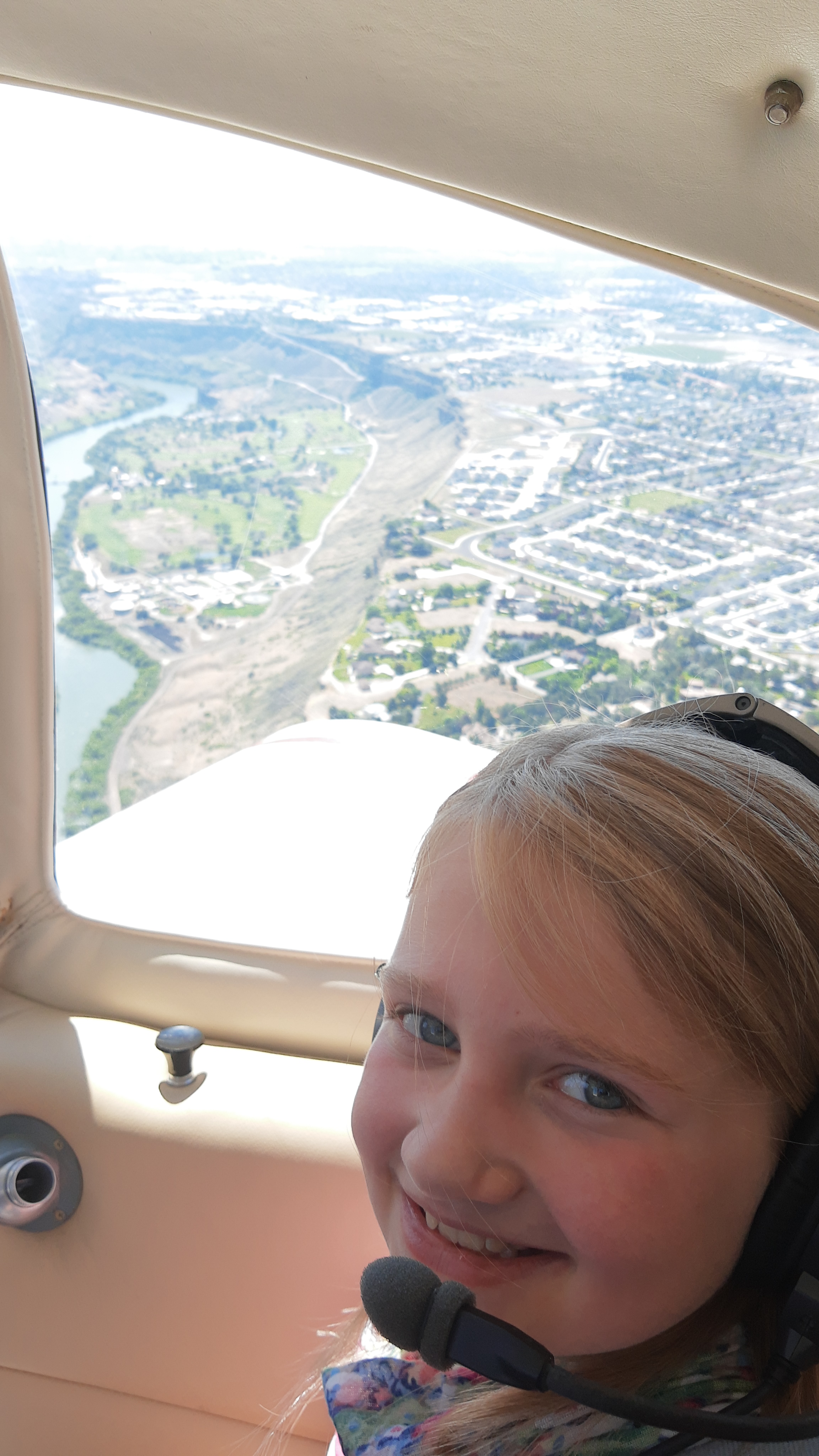
Hiram, James, and Amanda Ross waiting to get into the air.Hiram Ross loving this flight.Proof I was present, Paul Ross, in the front of the plane with Darrell Schmidt, pilot. We are very grateful for Darrell letting us impose on his time to go flying. Having passed 40, the hair is getting mighty thin up there, and that was not due to altitude.Aliza, Lillian, and Amanda Ross waiting for the next turn in the air.Aliza Ross loving her flight, Twin Falls, Idaho, in the background.Amanda and Lillian Ross did not put their electronic devices away during the flight!
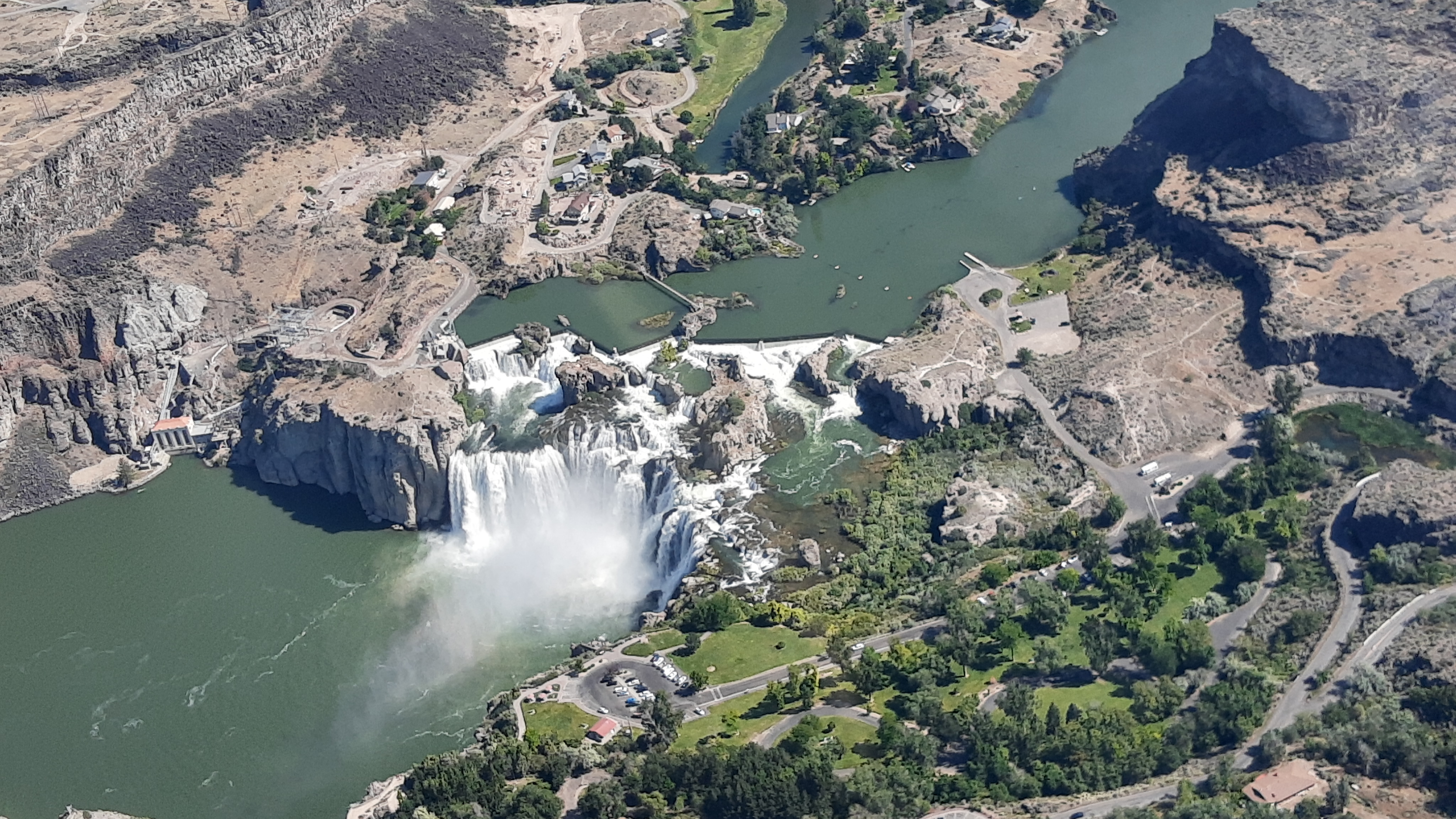
Here are a couple of highlights of what we saw flying over Twin Falls and Jerome Counties, Idaho.
The confluence of Rock Creek and Snake River at the junction of Rock Creek Canyon and the Snake River Canyon.Beautiful Blue Lakes Country Club, Snake River, Perrine Bridge, and the mighty Shoshone Falls up the Snake River Canyon.Shoshone FallsTwin Falls Temple

















 Sagacity