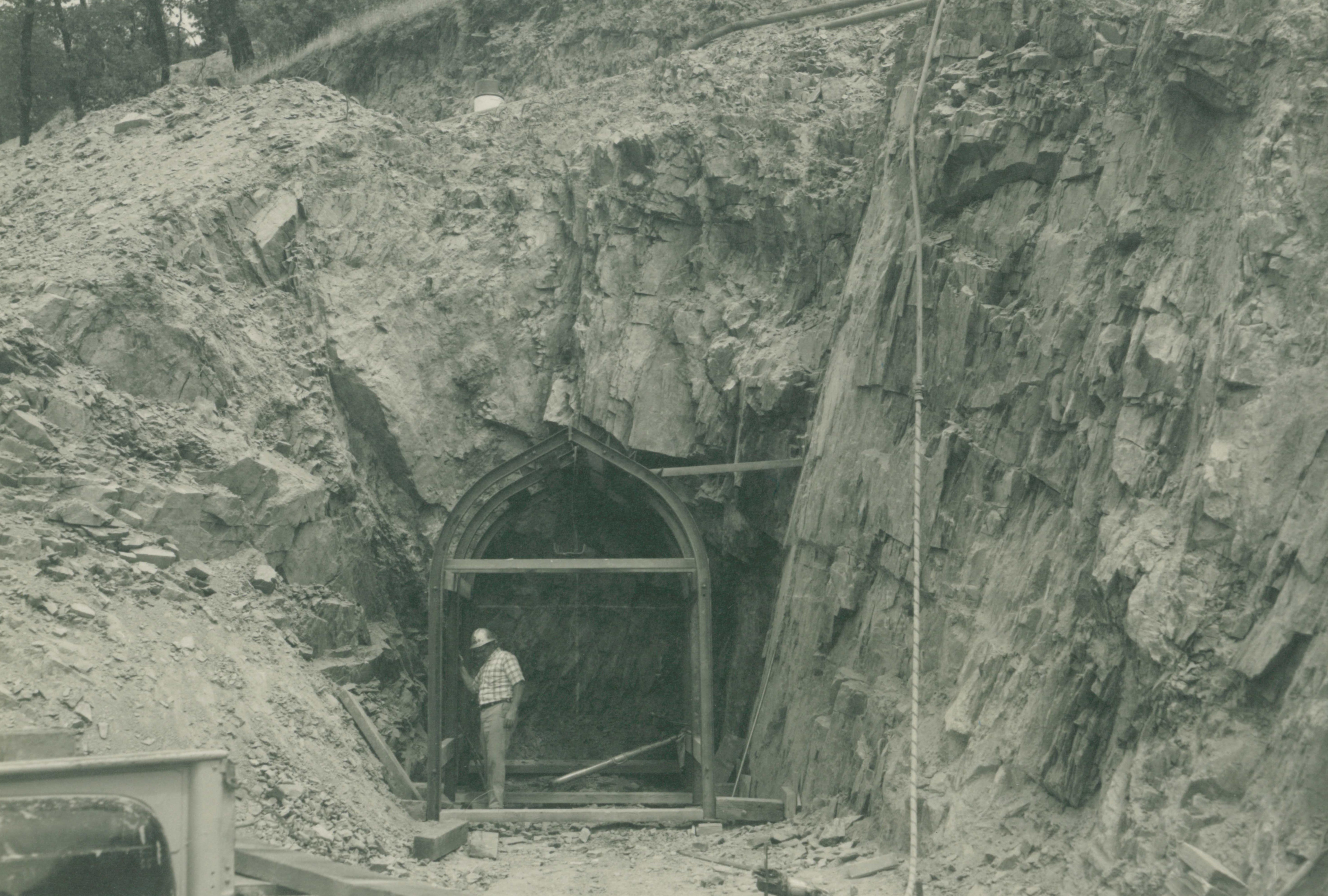
Eisenhower Lock

“HELP BUILD LOCK. These foremen and supervisors are working on the Eisenhower lock in placement of concrete. They hail from various parts of the country. Shown are Ward Turner, supervisor, from Arkansas; Manuel Martinez, vibrator, from Mexico; Golden Andra, general foreman, from Idaho; John Catera, foreman, from Utica.

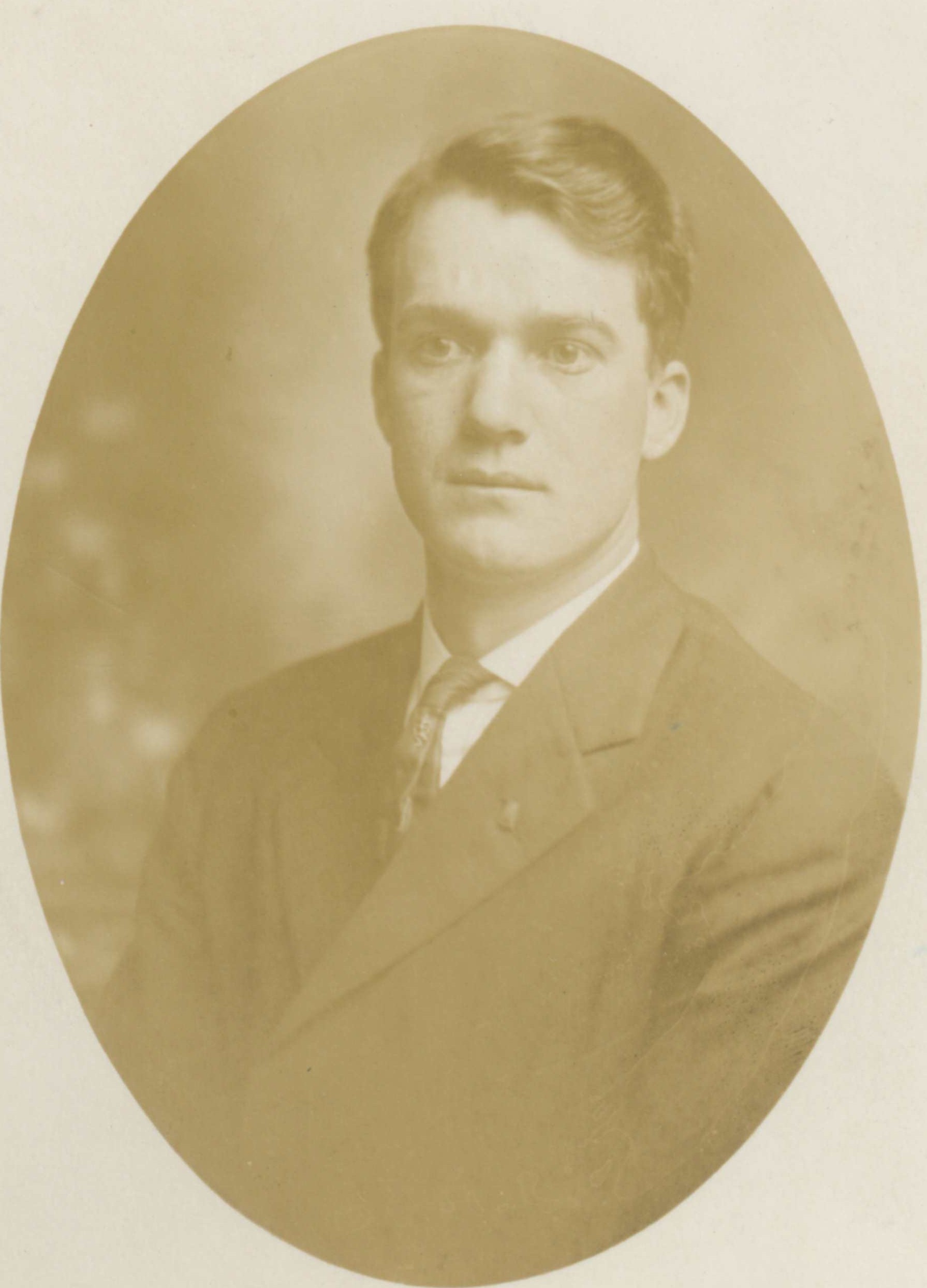
This newspaper article and photo were in the records of Golden Andra. Golden is named in the newspaper, I don’t know/think the second photo is of Golden. It says it came from the Department of Interior, he kept it for some reason unknown to me.

I know this was a significant time in the life of the Andra family. Golden worked and is shown as a general foreman. But I also know that Golden’s brothers Donald and Ross both also worked on the St. Lawrence Seaway. I believe they both worked on the Eisenhower Lock as well.

Golden and Utahna adopted a boy born in 1957 at Bombay, Franklin, New York.

Donald married in 1957 at Hogansburg, Franklin, New York.

Ross told me multiple stories of New York. Unfortunately, I don’t remember any to share.

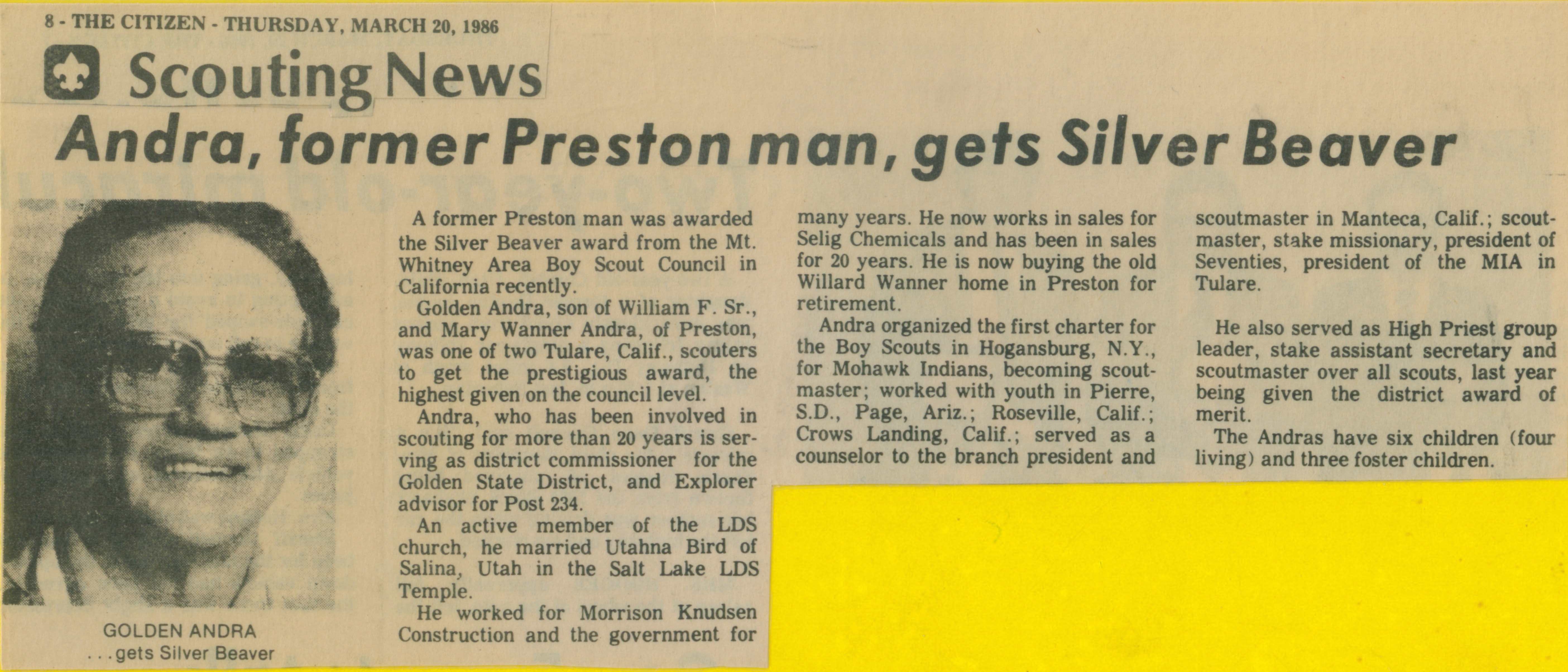
Since this is Golden, and this article also shares some information in New York, I share it here as well.

“Andra, former Preston man, gets Silver Beaver. The Citizen (Preston, Idaho) 20 March 1986.

“A former Preston man was awarded a Silver Beaver award from the Mt. Whitney Area Boy Scout Council in California recently.

“Golden Andra, son of William F. Sr., and Mary Wanner Andra, of Preston, was one of the two Tulare, Calif., scouters to get the prestigious award, the highest given on the council level.

“Andra, who has been involved in scouting for more than 20 years is serving as district commissioner for the Golden State District, and Explorer advisor for Post 234.

“An active member of the LDS church, he married Utahna Bird of Salina, Utah in the Salt Lake LDS Temple.

“He worked for Morrison Knudsen Construction and the government for many years. He now works in sales for Selig Chemicals and has been in sales for 20 years. He is now buying the old Willard Wanner home in Preston for retirement.

“Andra organized the first charter for the Boy Scouts in Hogansburg, N.Y., for Mohawk Indians, becoming scoutmaster; worked with youth in Pierre, S.D.; Page, Ariz.; Roseville, Calif.; Crows Landing, Calif.; served as a counselor to a branch president and scoutmaster in Manteca, Calif.; scoutmaster, stake missionary, president of the Seventies, president of the MIA in Tulare.

“He also served as High Priest group leader, stake assistant secretary and scoutmaster over all scouts, last year being given the district award of merit.

“The Andras have six children (four living) and three foster children.

William Andra Ordinations

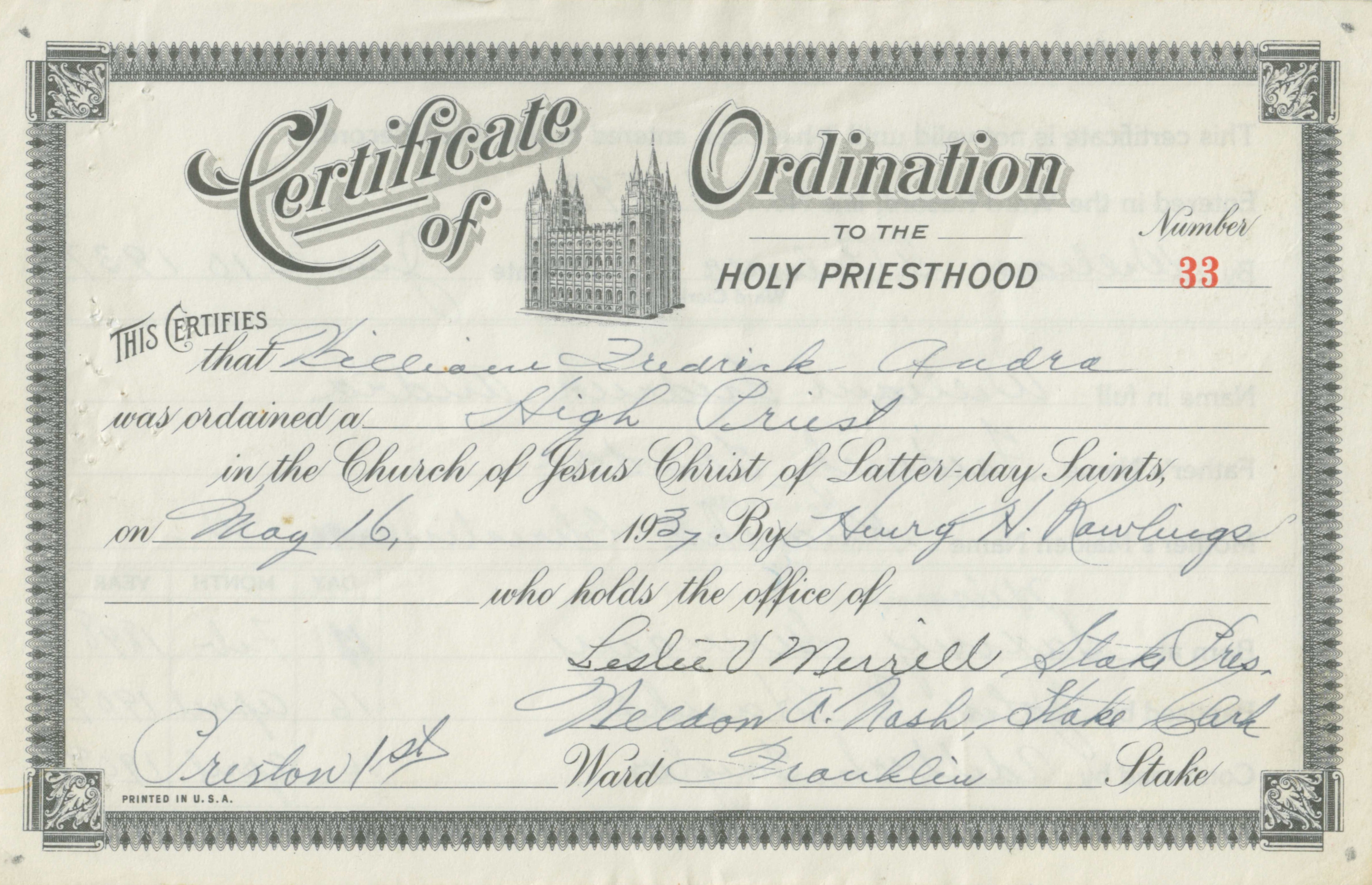
Working through the family history book of Golden Andra that was given to me, I opened a page to scan some photos and found a surprise. Behind that photo were some ordination certificates. These are originals. I thought I better get them scanned and preserved. I also uploaded them to FamilySearch and got them linked with the names in the documents.

I think they are valuable for family history. They are also a peek into church history. This gives us the missionaries who baptized and confirmed my Great Grandfather in Germany. I have provided some limited biographies at the end.

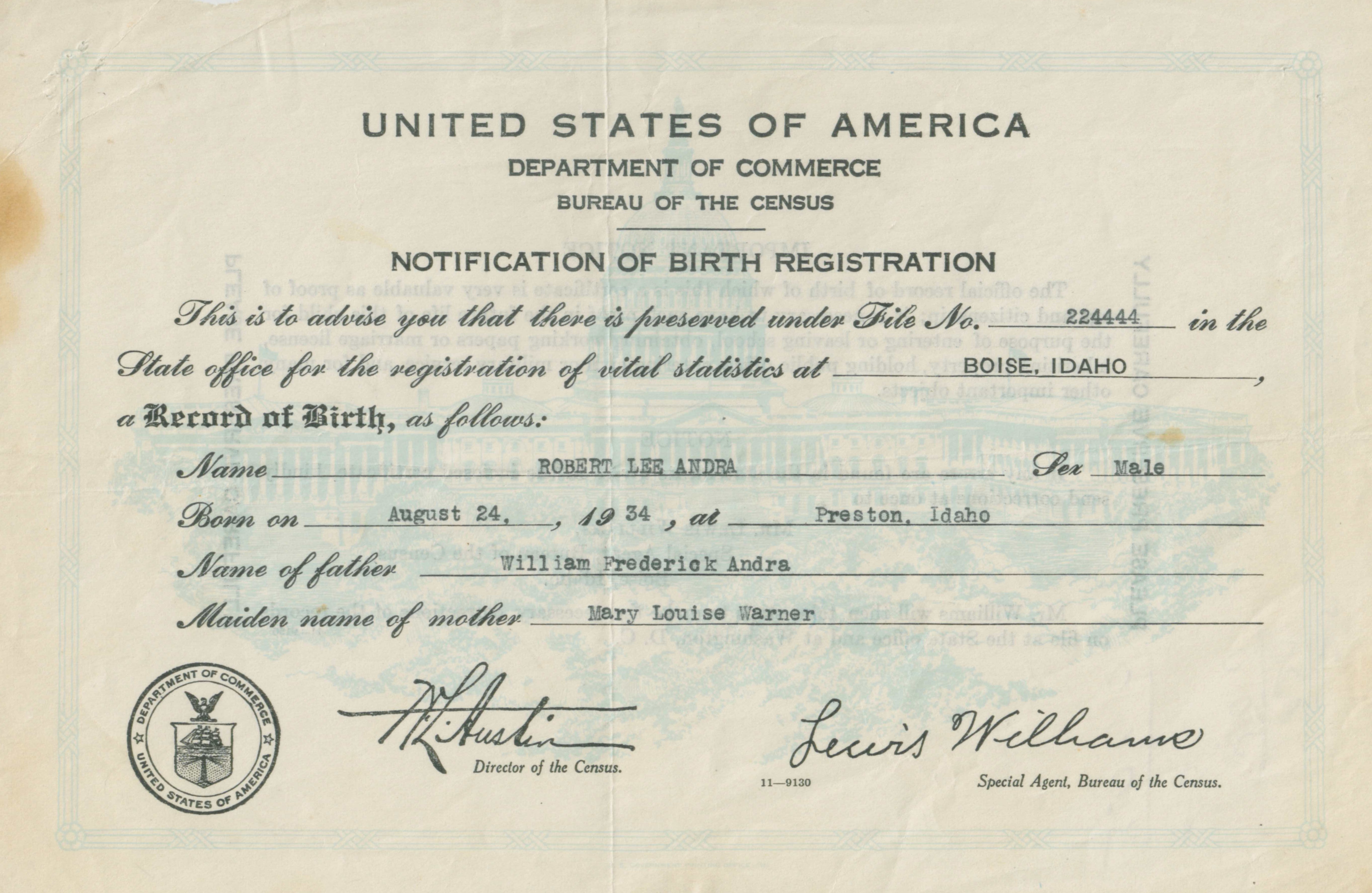
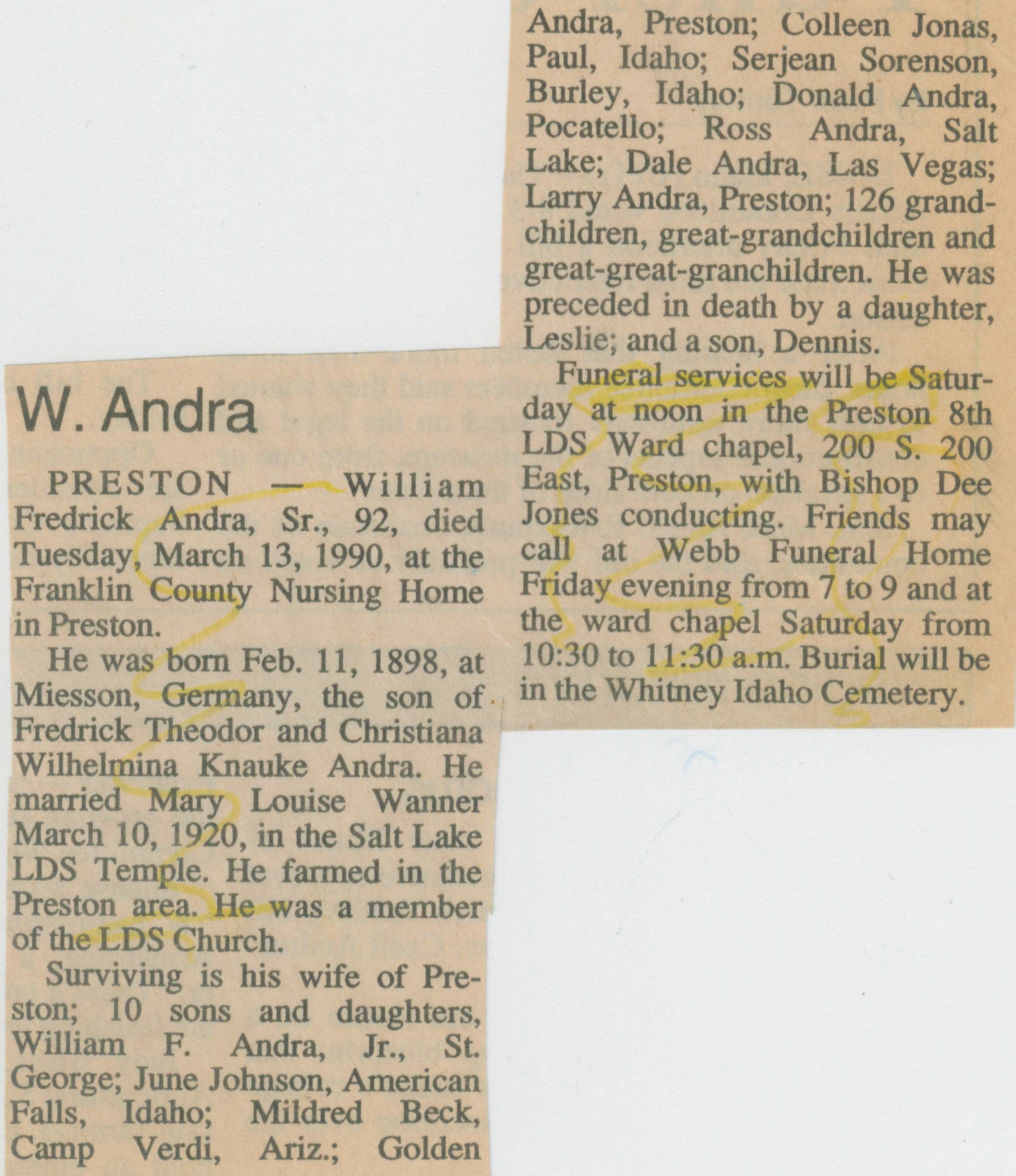
Also an original Notification of Birth Registration for Robert Lee Andra, son of William and Mary, who died at birth. I am not sure why the United States Department of Commerce is issuing this Notification, or the Bureau of the Census. There is some history behind this I am not aware. Last, a copy of William’s obituary.

Priest Ordination Certificate (Front)
Priest Ordination Certificate (Back)
Elder Ordination Certificate (Front)
Elder Ordination Certificate (Back)
High Priest Ordination Certificate (Front)
High Priest Ordination Certificate (Back)
Robert Andra Birth Certificate

I had to do some history on individuals listed on the certificates. Some fascinating individuals, obviously some of them local church leaders.

James Richard Bodily – born 11 February 1872 in Hyde Park, Cache, Utah – died 12 April 1967 in Preston, Franklin, Idaho

Wilford Woodruff Emery – born 16 October 1880 in Salt Lake City, Salt Lake, Utah – died 10 September 1954 in Salt Lake City.

John Edward Hanks – born 30 August 1877 in Salem, Utah, Utah – died 5 July 1970 in Salt Lake City.

William Gibson Palmer – born 16 July 1884 in Croydon, Morgan, Utah – died 15 May 1977 in Preston.

Henry Helaman Rawlings – born 8 April 1893 in Fairview, Oneida, Idaho – died 14 February 1984 in Fairview.

Adelbert Augustine Taylor – born 9 April 1883 in Springerville, Apache, Arizona – died 15 November 1948 in San Felipe de Híjar, San Sebastián del Oeste, Jalisco, Mexico.

Luther Hovey Twitchell – born 17 October 1878 in Salt Lake City – died 15 April 1962 in Bountiful, Davis, Utah.

Memorial Day 2025

Time continues to march forward. It does not care what we think about it. Some want it faster, others want it slower, others want it to stop.

In preparation for Memorial Day, I was trying to think of something that would show that I truly hold in memory those who served in the military and especially those who died in that service. Hopefully here are a few things that show a more human side. I am not aware that I have any ancestor who has died in a war, especially in the service of the United States of America. I guess for that I am lucky and honored. But I have many who have served in the military.

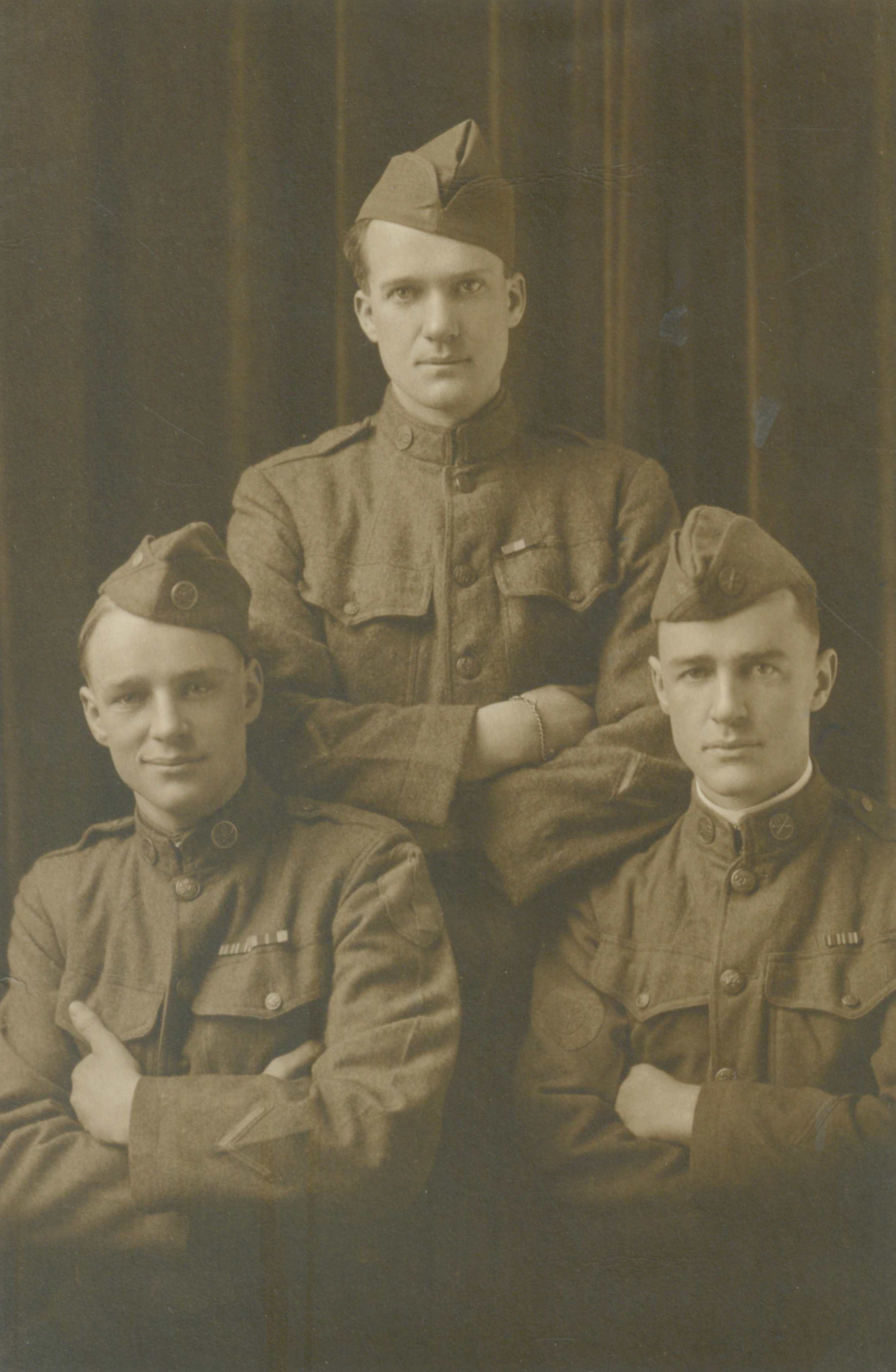
Portrait of David Delos Donaldson after WWI

David Delos Donaldson is my paternal grandmother’s father. I tried to get a copy of his military records many years ago, but they were destroyed in a St. Louis, Missouri, fire long ago. I only know a few things. He worked in California as a pipe fitter/plumber at some point, but I believe that was for WWII. He went through basic training and ended up learning signaling. At some point he was allegedly in France and was exposed to the dreaded mustard gas, which injured his lungs. He smoked to settle his lungs as prescribed by doctors. He ended up dying from complications due to his lungs.

Here are some notes I have from 2006.

“I stumbled upon a registration form for my great grandfather, David Delos Donaldson, and WWI.  He was working in Twin Falls, Idaho.  The best part is, we never knew he went to Idaho, ever.  Not only that, he was working there, and was exempted because he was working to support his younger siblings and mother.  He did later enter the war, we don’t know when or how, but went to France in the Argonne and was gassed there.  He suffered his whole life and eventually died from the mustard.

“With this information, I went to visit my Uncle Dave Donaldson because my Dad did not know anything.  I picked his brain.  We know little about my Great Grandfather before he married.  Now we know he was working for Ballantyne Plumbing in Twin Falls in roughly April 1917.  He served in WWI with two brothers.  As mentioned, he was hit with mustard, spent some time in hospital, and he wasn’t getting better, so they sent him home.  He married my Great Grandmother in 1919, Berendena Van Leeuwen.  They had 5 children.  During the great depression he worked down south as a plumber.  Dave did not know where, but there was a possibility it was at the Hoover.  When they went on a trip to Los Angeles, he insisted on stopping at Boulder City and the dam on the way home.  Oh, we do know that before they got married, he worked as a plumber in Phoenix.  How long we don’t know, but he could not bear the heat down there.  During the depression when he worked down south, the family stayed in Ogden.  Dave was young enough that he did remember his father coming home, but not where from.  Again during WWII, the whole family moved to Napa, California and Great Grandpa was a plumber at the naval yard there, he made it sound like Oceanside.  I do not know if there were any other naval bases down there.  Then they moved back.  The family must not have stayed down there, or he did not work the entire war, as my Grandpa and Grandma met in 1941-1942 at the Berthana on 24th street Ogden at a dance.  They were married in April 1942, shortly before he left for war.  Great Grandpa was a plumber by trade.  He worked up until the 1950’s when his health failed him.  He picked up smoking because it soothed his lungs.  It sounds like the mustard burned his lungs the rest of his life.  He would smoke to deaden the nerves.  Dave told me this increased until he died.  Even the last few years of his life, he had oxygen when he went places and when he slept.  But he kept smoking.  Dad told me of one of the few memories he had of his Grandpa.  He went to visit him in Ogden, Grant Ave if I remember right, and he was laying in bed.  There were newspapers all over the floor.  He got into a coughing fit and coughed a big thing of phlegm up and it went on the floor.  It was the combination of the irritation to the lungs from mustard and the smoking.  It was what eventually killed him.

David Delos Donaldson (back), John Edmund Donaldson (left), and William George Donaldson

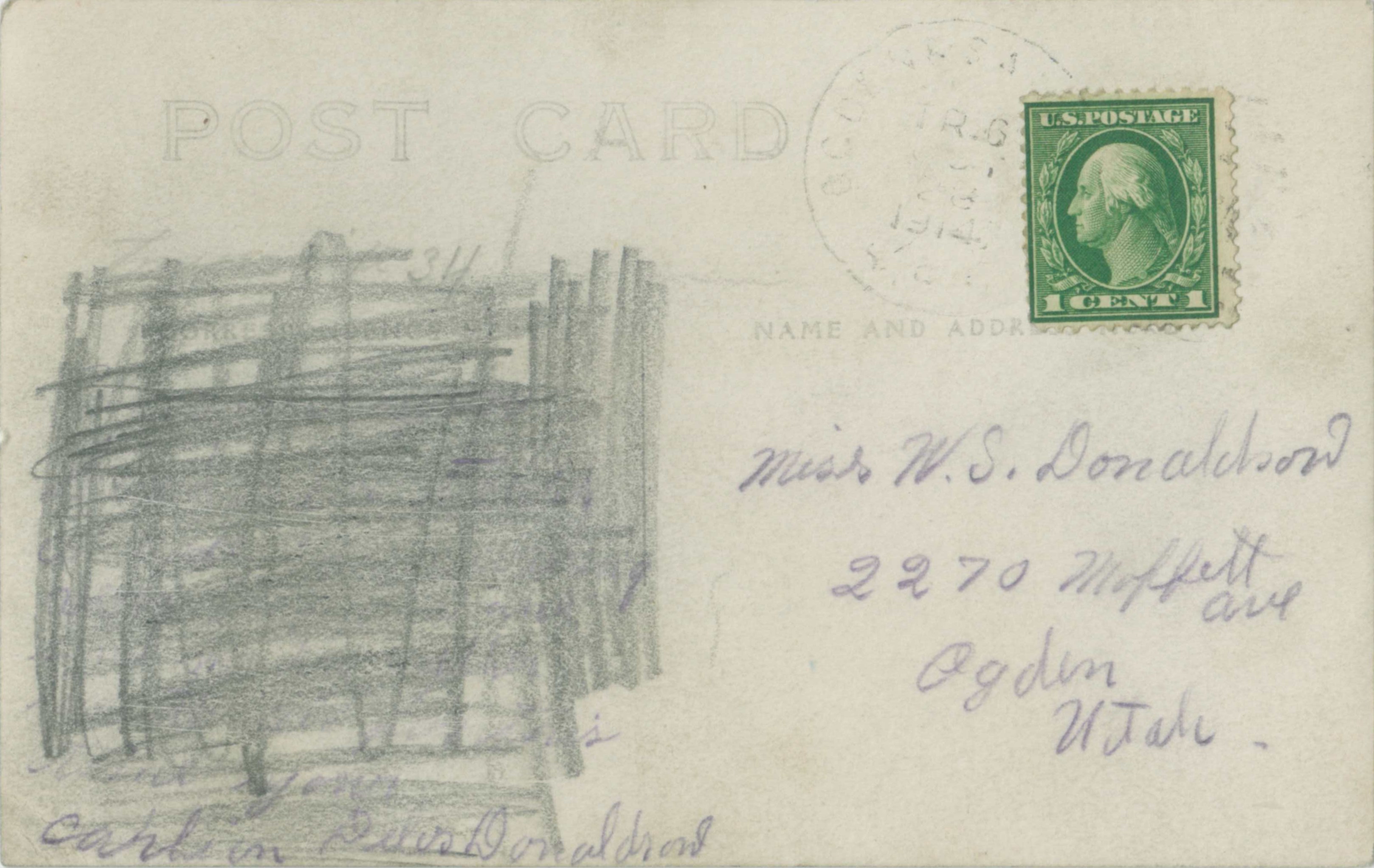
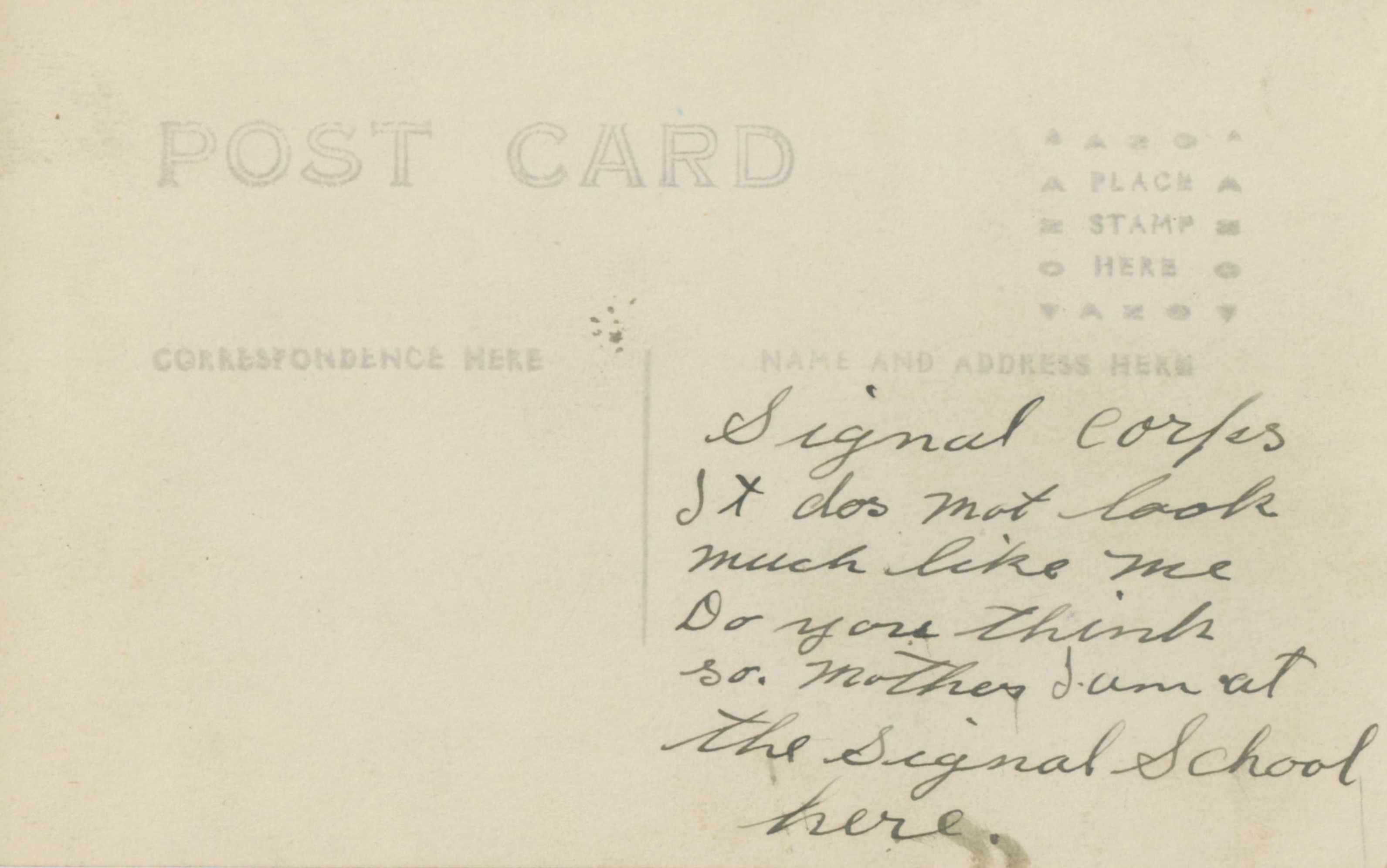
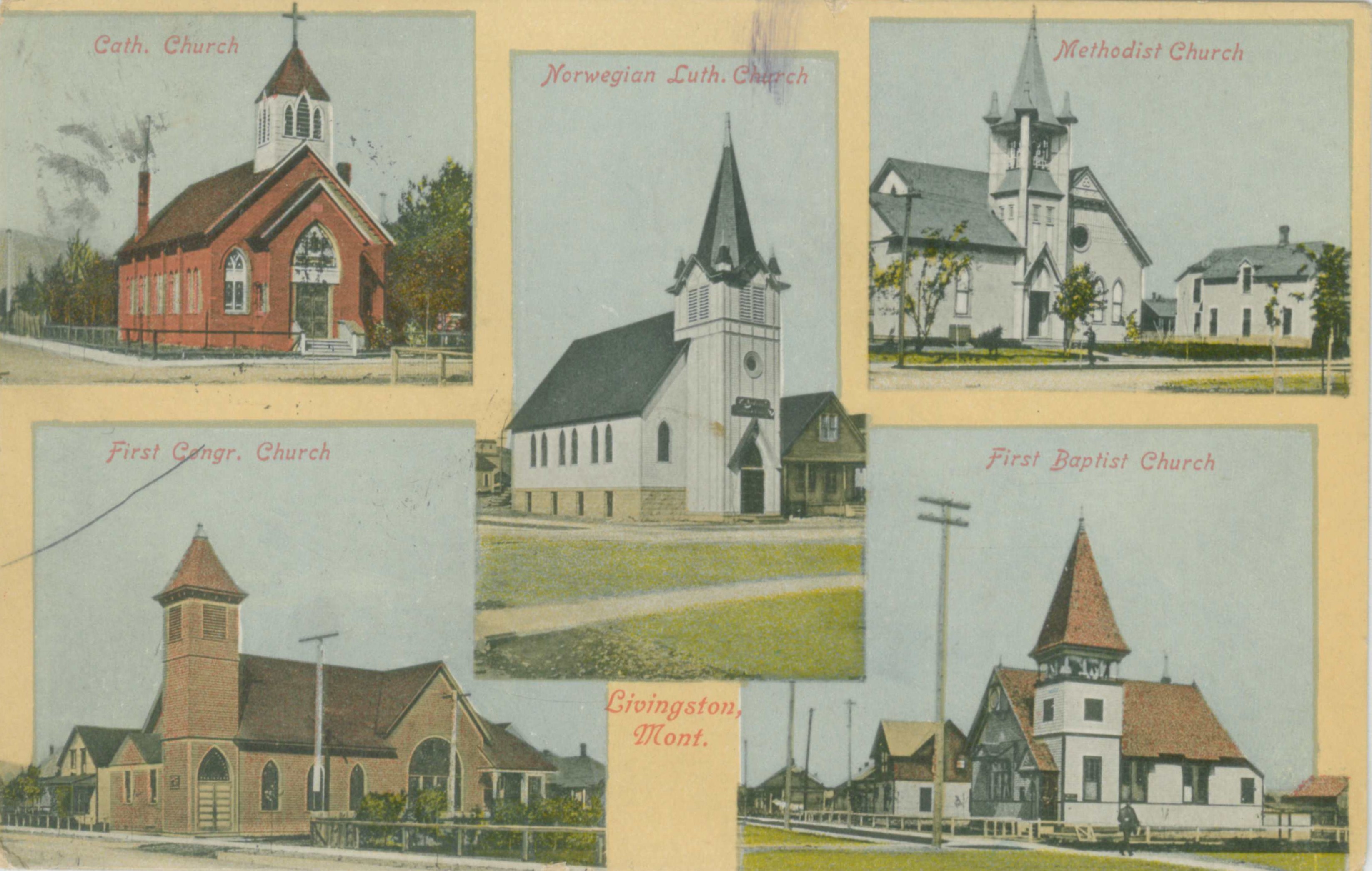
Here are some postcards David sent home to his mother. His father, William Scott Donaldson, died of cancer in 1913.

“Part of Carlin, Nev.”

I am not sure why the writing on the left is crossed out. But you can see Miss W. S. Donaldson 2270 Moffett Ave Ogden Utah. It says Carlin and Delos Donaldson. It might say “Yours” above it. The postmark is dated 1914, but I cannot make out the rest of it.

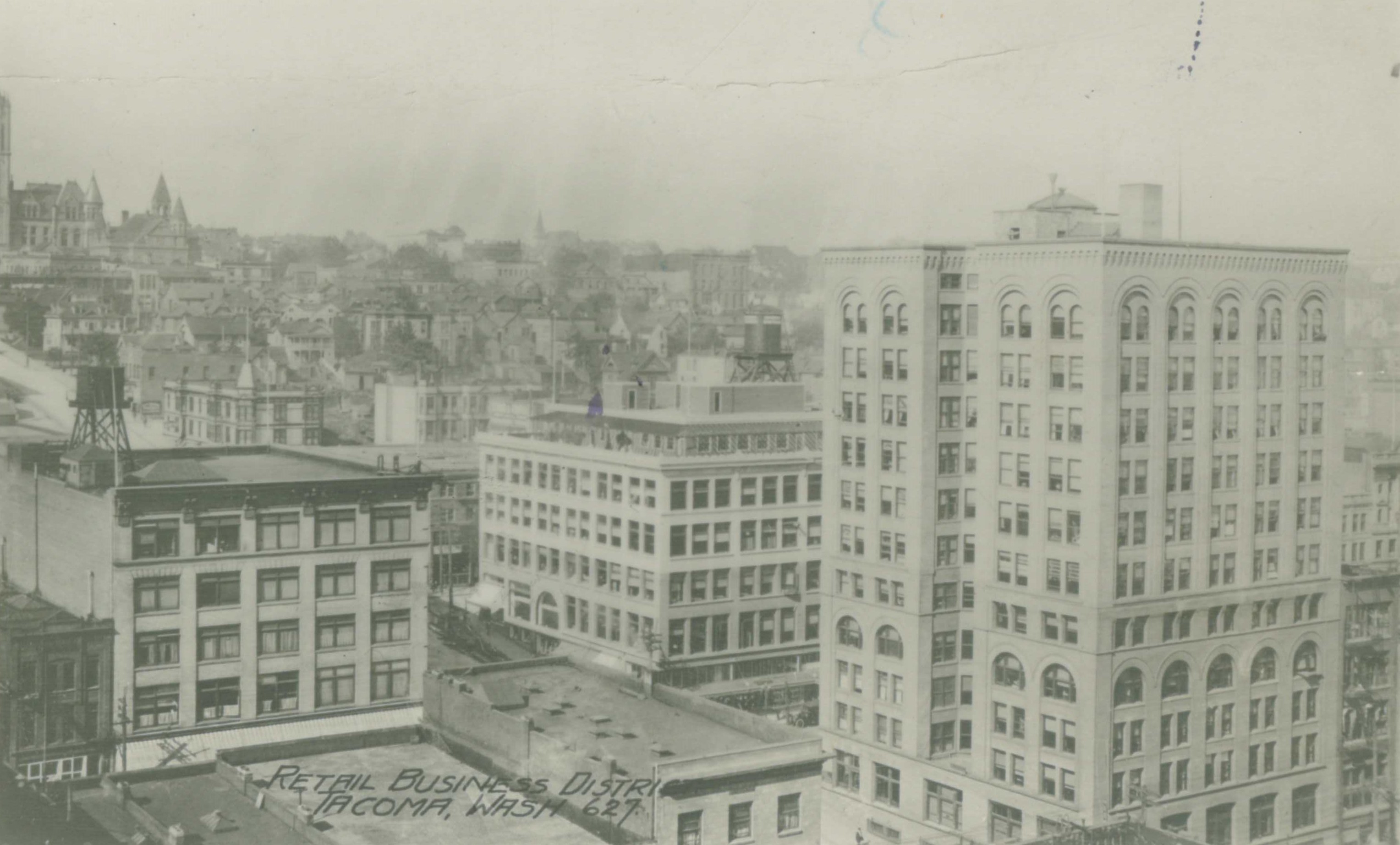
Retail Business District, Tacoma, Washington 1918

Dated 2 April 1918. “Dear mother got here all ok like it fine Write me as Private David D Donaldson 20th Co., 5th Bn., 166th Dep Brig. Camp Lewis, America Lake, Wn. Mrs. W.S. Donaldson 2270 Moffett Ave Ogden Utah”

Front and back

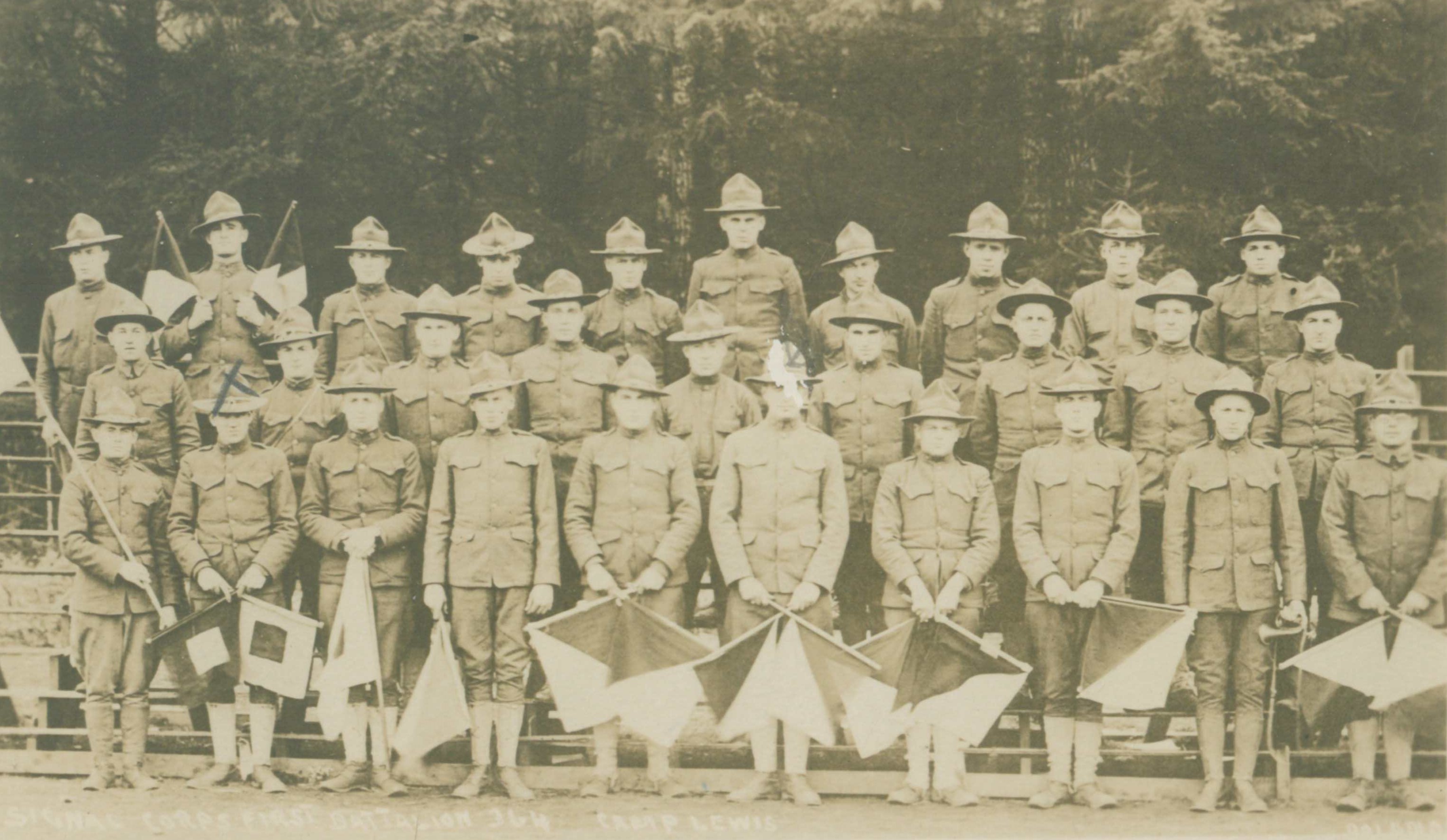
“Signal Corps It does not look much like me Do you think so. Mother I am at the Signal School here.”

Front and back

Dated 28 June 1918. “Dear Mother just a line to say I am well and fair when I got in New York all for this time your son DDD. Written to Mrs. W. S. Donaldson 2270 Moffett Ave Ogden Utah

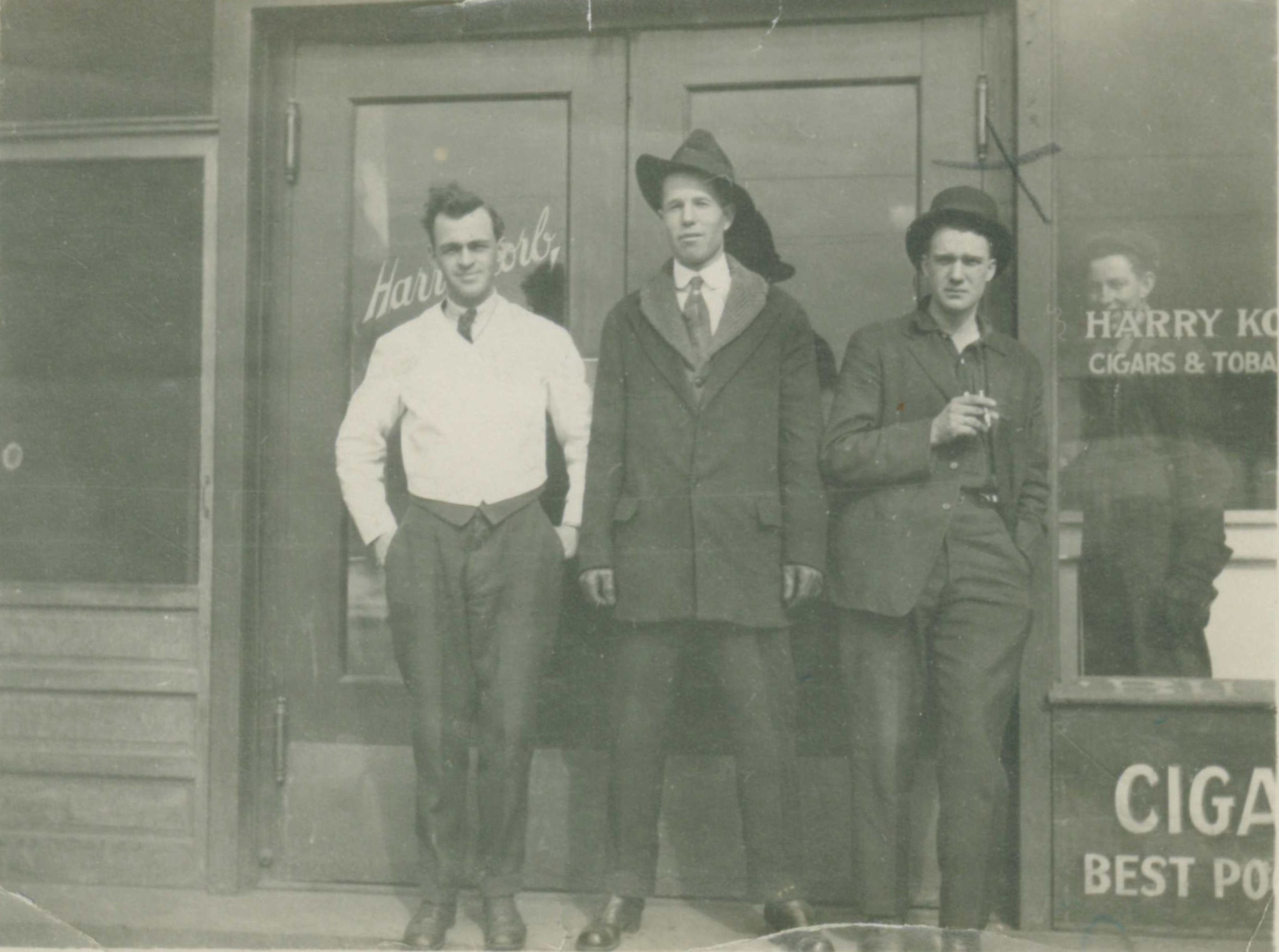
Harry Korb Cigars & Tobacco, known location with David standing in front of the store. Other three are unknown.

We might think it, but none of us are truly bullet-proof. This boy’s health was affected for the rest of his life by war. He did live to be 59 years old.

He did marry and had five children.

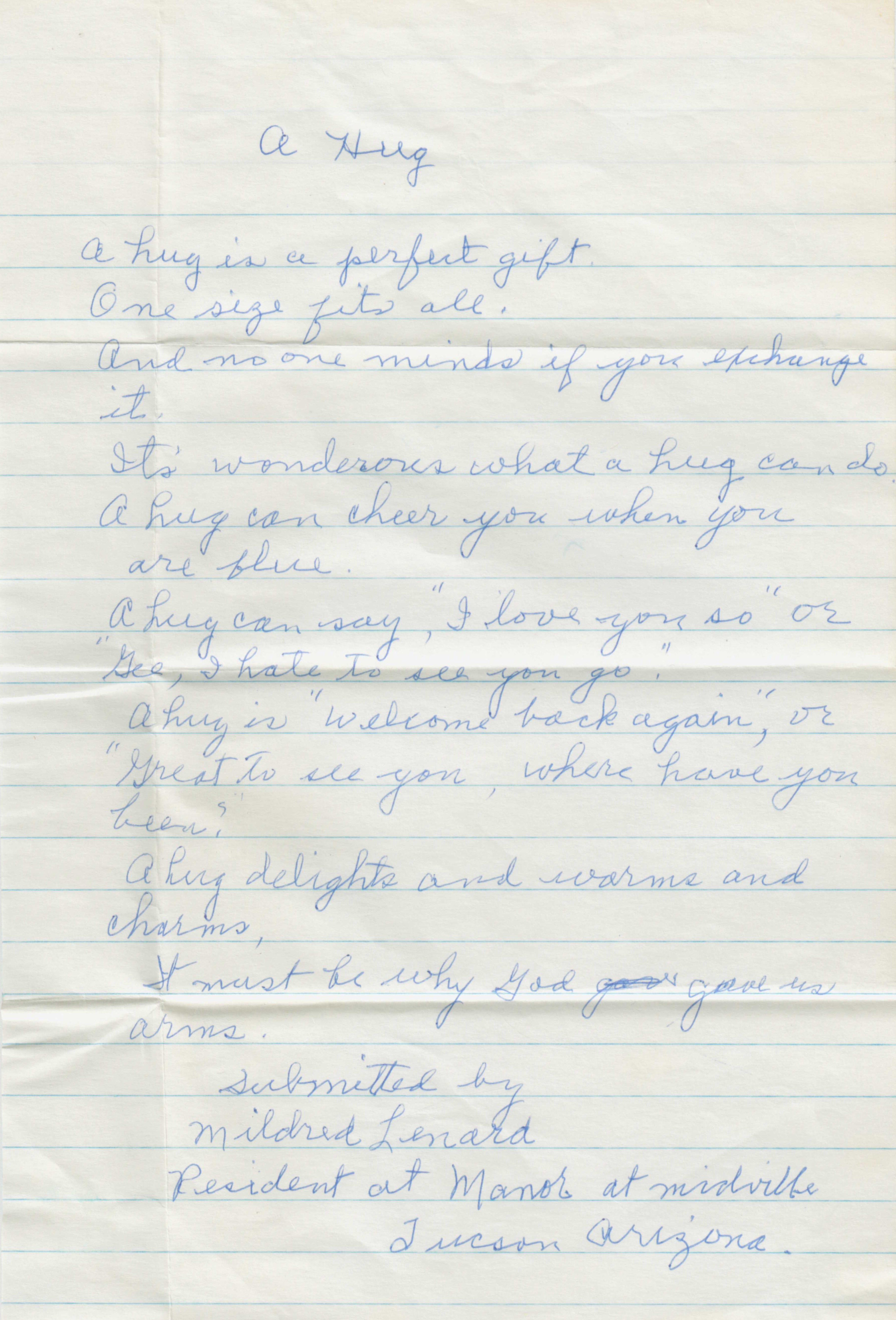
A Hug

This poem was in photos belonging to my Great Uncle and Aunt Dave and Betty Donaldson. It is handwritten.

“A hug is a perfect gift.

“One size fits all.

“And no one minds if you exchange it.

“It’s wonderous what a hug can do.

“A hug can cheer you when you are blue.

“A hug can say, “I love you so” or “Gee, I hate to see you go.”

“A hug is “welcome back again,” or “Great to see you, where have you been?”

“A hug delights and warms and charms,

“It must be why Got gave us arms.

“Submitted by Mildred Lenard

“President at Manor at Midville [Midvale]

“Tuscon Arizona.

Bill Andra: Good Character Pays Dividends

This article was found in Golden Andra’s family history book. I haven’t seen it before. The top of the pages simply say “LDS NAVAL CHAPLAINS” and the next page has “FOR GOD AND COUNTRY” which I expect is probably the name. I couldn’t find one that seemed to quite fit. This article shows on pages 39 and 40.

“One must learn in life to accept personal responsibility and the consequences of the decisions one makes. One LDS marine on Guam did just that, and, by doing so, shored his character. Chaplain A. Gifford Jackson had the following experience.

“During 1944 on Guam, Chaplain Gifford Jackson met Bill Andra, a very devoted Latter-day Saint. During Bill’s spare time, he would go to headquarters and look through the service records of the men of the 3rd Marine Division. He would list the names and units of all those who came from Utah, Idaho, and Arizona. He would then seek them out to find out if they were members of the Church, his purpose being to get all Mormons to the 3rd Marine Division LDS Services.

“One evening, Bill received the assignment to police the mess line. During each meal, enlisted personnel policed the “chow line” to insure that there was no fighting or breaking into line. Usually, there were no problems, but on that particular evening a fight broke out in the line causing a great commotion. Because of the disturbance, Bill’s commanding officer got involved and wanted to see the man who had been assigned to police the line. He learned that Bill Andra had not reported for duty that evening. He proceeded to investigate the matter by calling Bill to his office to get the facts.

“”Bill, why weren’t you on duty policing the “chow line” last night?”

“”I’m sorry sir, I was at headquarters looking through some records and became so involved I didn’t realize the time.”

“”I’m going to have to punish you, Bill, for not reporting to duty. You are going to have to spend some time in the Brig.”

“Bill went to the brig, but while there got a call to report to the commanding general. In the deivision Bill was a barber and he always cut the general’s hair. He reported to the general and as he cut his hair, the general said, “Bill, why didn’t you tell me you were in trouble? I would have helped you.”

“”Well, General, I made a mistake, and a person has to pay for his mistakes. I wasn’t where I ought to have been and for that I was punished. I got exactly what I deserved.

“Bill’s honesty impressed the general so much that he made Bill Andra his orderly, the best assignment in the division.

The page then goes on with a story of Merrill Bickmore: Life after Death. Since it is not complete, I won’t include it as well.

The Life Story of Annie Christine Petersen (Staley) Jorgensen

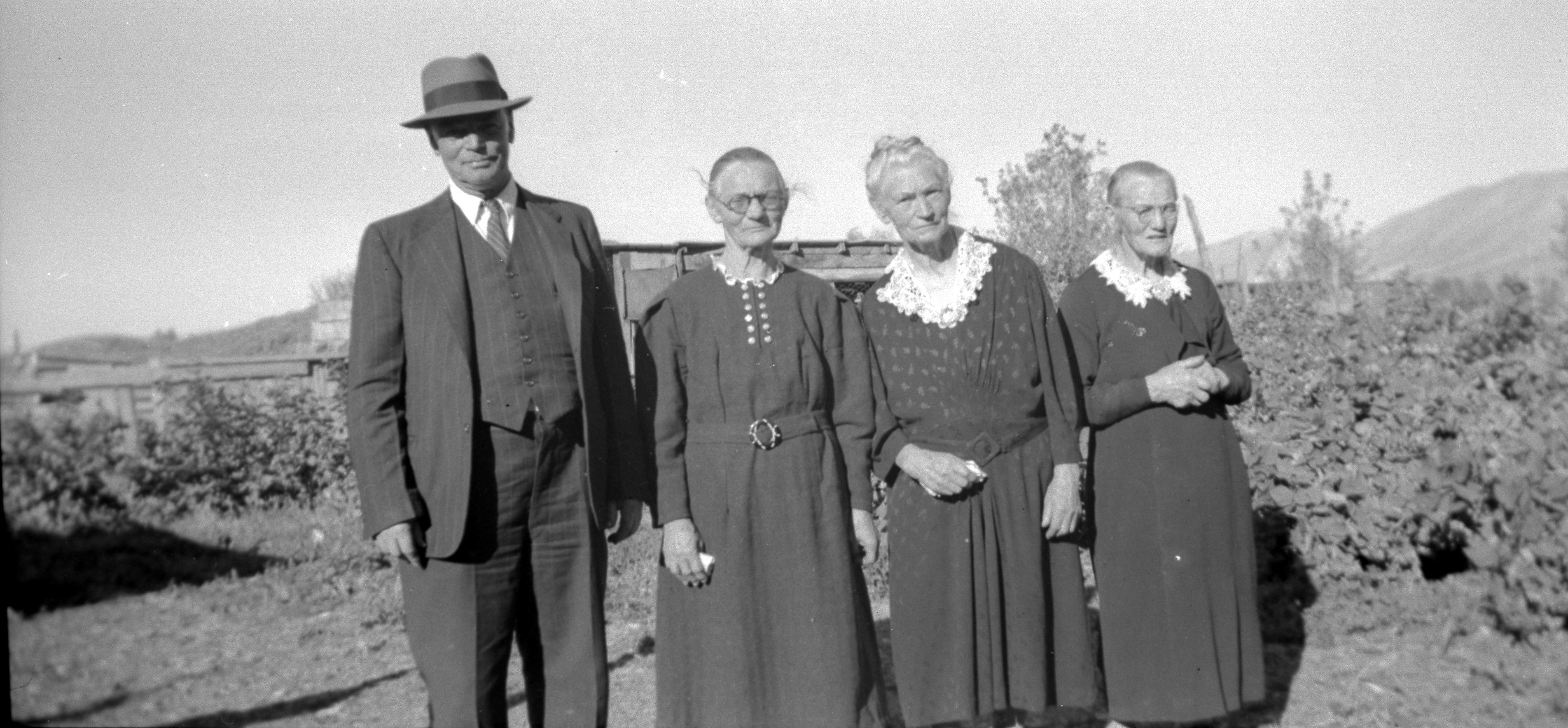
Christian Petersen, Maren Sophie Pedersen, Rasmine Hansina Pedersen, Annie Christine Petersen

Another history found in the records of Golden Rulon Andra. This is the grandmother of his wife, Utahna Bird Andra (1927-2001). Archie and Emma Bird are Utah’s parents, Emma is the daughter of Annie.

“Annie Petersen was born at Lindberg Denmark on October 9, 1862. Her father was Hans Petersen and her mother was Kjirstin Jeppesen. They were a poor family as her father was a tenant farmer. Most of his time was spent working for a landlord to pay rent for a small piece of ground that he would call home. They lived in a small thatched roof house and as is recalled there were but two rooms. The landlords brother having come to America at a previous time had been sent to Denmark on a mission from Utah. The landlord was very bitter against the Mormons and forbid his brother to even come on his land but being a very sincere man with no fear the man held meetings at several places. One night he was at Annies fathers home in spite of all the mob warnings to her father. After the people came her brother Chris stood at the door with ax in hand to keep intruders out; at another time while the missionaries were at their home some of the non members climbed on the house and stuffed old rags in the stove pipe and smoked them out. Annie was the oldest of four girls and one boy Christian. When she was about fifteen years old she joined the Morman Church. At that time men of Zion were sending money to women and girls for them to come to America. She was sixteen at the time. As none of her family was able to come at the time, her parents gave her a gallon of butter and a feather pillow and she came alone. It was a rather rough and stormy all the way across the sea. Many were seasick and some died. The day she could see land a big storm came up and blew the ship back to sea and it was a week before she could land. Later her mother, brother and sisters were converted and came to America. Her father later came to America and joined his family. Brother Chris is the father of Mark E. Petersen who is now an Apostle. The family came to Mesa Arizona because that is where the missionary lived and no one was at the station to meet them so since they could speak no English they stayed in the station overnight. They were met in the morning. It took the family 3 years to earn enough to get to Salt Lake where all but Annie settled. Upon her arrival previous to theirs she had been met by Mr. Staley in Kanab, Utah and then went to St. George, Utah where they were married. By covered wagon they went to Old Mexico where she was to live in pologamy with the first family of Mr. Staley. He had children as old as she was at the time and she lived in an adobe house. The first Mrs. Staley was good to her in her way but the life of a pioneer isn’t too easy and she didn’t know the language very well. When she had four children Chester, William, Vermina, and Dicey Ann her husband died and left her 5 months pregnant with her fifth child Maryett (Marie). She gleaned fields, washed, worked in a store and was given the siftings of sugar that were in the bottom of the sacks. She did almost anything to keep the little ones fed. After Maryetta or Marie was born it really was a struggle. The boys helped what they could. With the first money that Chester earned he bought an oil lamp and a small white kettle for her. About 1896 she met Jorgen Jorgensen. He had two teenage sones. His wife had been dead for sometime. They were married and at the time they only place they could find to live was an old cow shed. They worked hard cleaning it up and fixing it to be liveable. She cooked over a campfire. They were later able to find an adobe house which seemed like a mansion. Her husband Jorgen was a miller by trade but because there was no mill there he farmed. While living in Mixico there ware five children born to them. Annie, Ephraim, Pernellie (nell), Emma and Clara. In 1911 there was a mixican uprising and all white people were driven out of the country. One of Jorgens sons had stayed in Arizona and when the uprising came the other stayed behind in Mexico. Minnie had married a Moroni Feen and they had stayed in Arizona. Dicey was married to William Chestnut and they came to the United States with their parents. Before leaving they made a lot of soft soap and made their own yeast cakes of hops and cornmeal dried in the sun. They had two wagons and a load of children. Hyrum Jorgensen and wife stayed in Airzona also. It was a long tireing trip. They stopped on Sundays to rest and when they came to water they stopped to wash and bake bread. Near Moab, Utah one of the mares foaled and they had to wait two weeks before the colt could travel. They settled in Ferron Utah and then moved to Blue Valley to farm. It was a beautiful place; very lush and fertile, but the dirty devil or Fremont river ran threw it and befor long lived up to its name and becuase of the floods in the river they couldn’t keep their dams in the river so they couldn’t keep water on their farms. The last few years they lived there they hauled water in barrels on a sled behind a horse to water their garden. Before long the Blue Valley settlers had to leave their homes and settle elsewhere. Annie and Jorgen moved to Fruita, Wayne Co. Utah in 1914 and had a Fruit Farm. Eph was getting old enough to help so he peddled the fruit during the summers and the smaller children picked fruit and had other jobs. Thus their children grew up. Annie married Floyd Pendelton, Pernellie, George Dewey Gifford: Emma, Archie Bird; Clair, Lamar Nielsen; Eph May Lerwill.

In 1929 they sold out to Nell and Dewey and moved to Salina, Sevier, Utah. There Jorgen died Oct. 1929. Annie lived along as long as she could take care of herself and then lived with her children. She died Aug 1953 age 91 at Salina, Utah.

Jorgen and Annie Jorgensen family, kids (l-r) Annie, Pernelle, Clara (sitting), Emma, Ephraim
Archie and Emma Bird

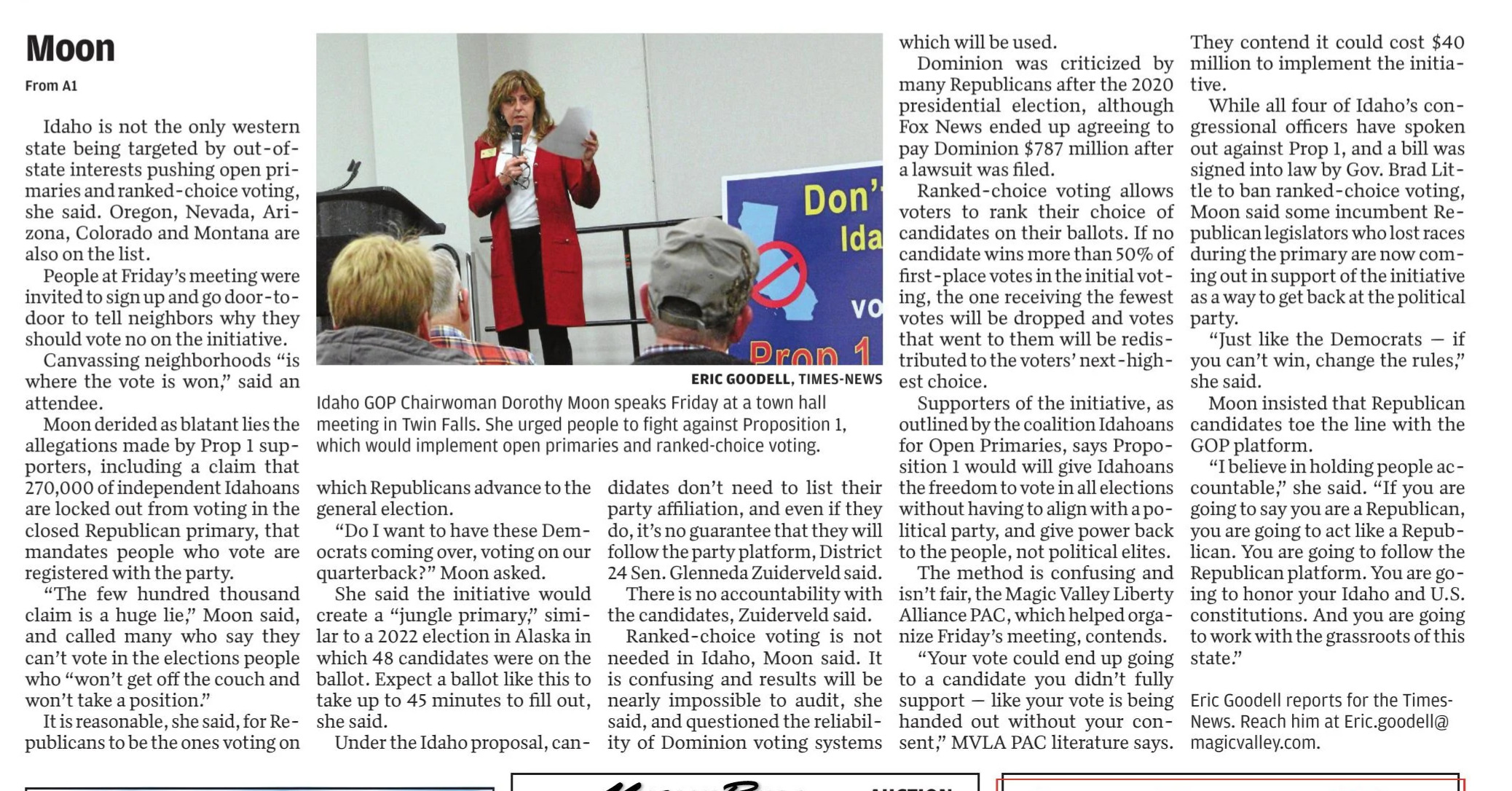
Moon warns Republicans of Proposition 1

Hans Petersen

This is another story from the family history books of Golden Rulon Andra. This is the father of Annie Christine Petersen that I wrote about previously. This is an ancestor of Golden’s wife, Utahna Bird Andra.

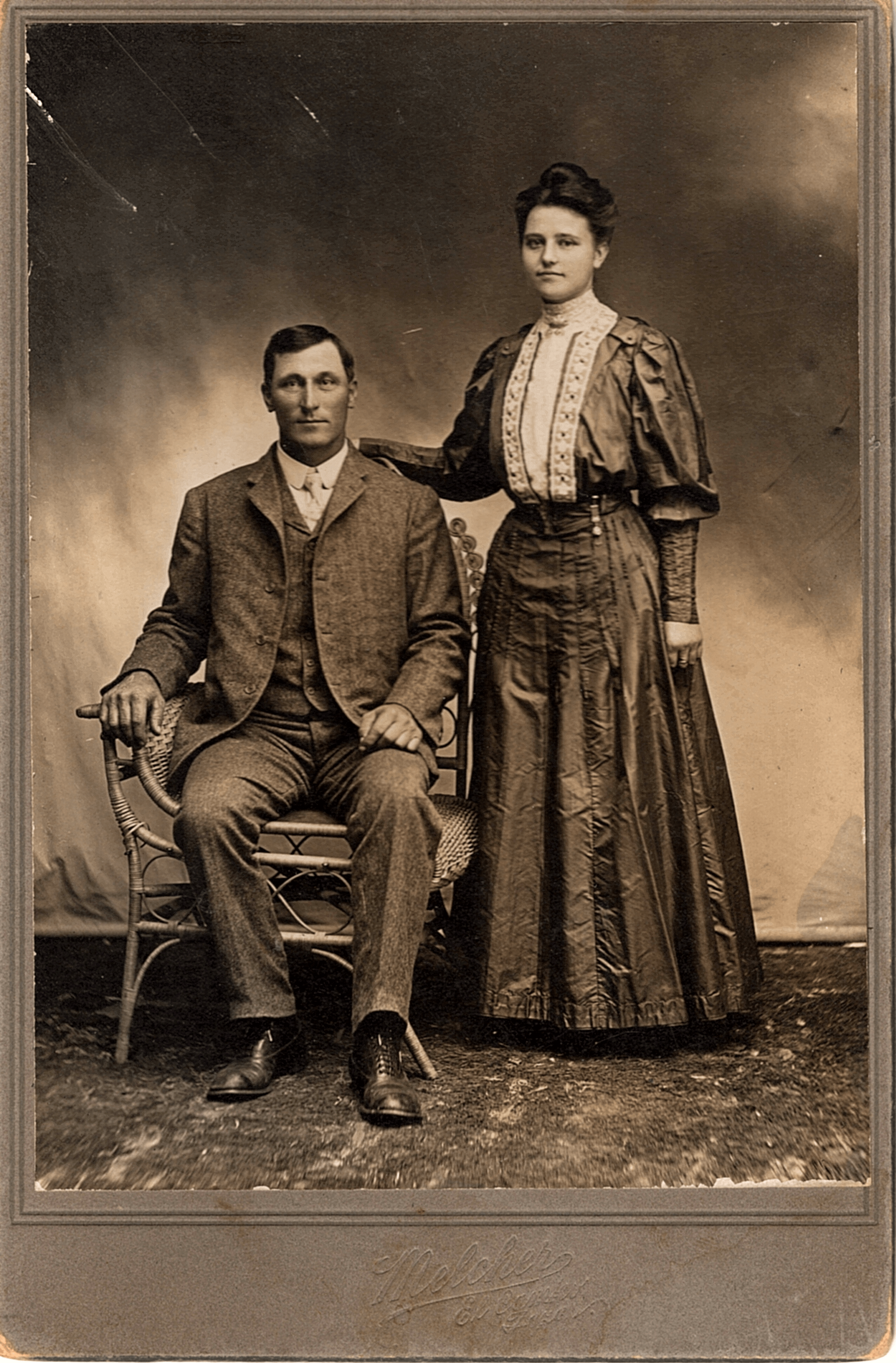
Hans, Christian, and Kirsten Petersen

“Family History – HANS PETERSEN

“Born: 11 February 1837 at Salgelse, Sjaelland, Denmark

“Died: 7 July 1923 at Salt Lake City, Salt Lake, Utah

“Hans Petersen was born on February 11, 1837 at Slagelse, Sjaelland, Denmark, the son of Peter Jensen and Karen Jakobsen. His name became Petersen instead of Jensen, due to the Scandinavian custom that the child of a man should take that man’s first name and add the suffix “sen” so the son of a man named Peter became Petersen. Incidentally, the Danish law put an end to this custom during the life of Hans Petersen, so that he became the first Petersen in the Petersen genealogy of our family.

“Hans Petersen’s father, Peter Jensen, operated a small farm and it was the small farm house here in which Hans was born. The family belonged to the Lutheran Church, the state religion of Denmark. Peter Jensen, father of Hans, was a very short man in stature. Hans grew taller than his father, but was himself only a little over five feet tall. Then Han’s children grew taller than he himself and his grandsons are nearly all tall men.

“He went to the regular country elementary schools in Denmark in his youth and then worked on this father’s farm until he was 21 years of age, when he had to serve in the army according to the custom of the country. He was summoned to Copenhagen for training and it was there that he met Kirsten Jeppesen, who later became his wife. While still in his first year of army training, he married Kirsten. That was while he was still 21 years old. Incidentally, he was gray headed at that time, having gone gray early. As a boy his hair was black.

“Following his release from active army service, he and his wife went to the little tow of Lindeborg, Denmark, and there started burning charcoal for a living. After he had been married several years, and had three little children, a war broke out between Denmark and Germany, and since he was still a member of the reserve he was called into active service to fight Germany. Being a small man he was put into the front lines with all of the other small men, according to the custom. When his company was sent to the front he prayed to God that he would not have to shoot a man. When the battled started and he began to fire his gun, he noticed that it had jambed and would not fire. Then almost immediately he was shot through one side and fell, was taken with the other wounded soldiers, placed on a large lumber wagon with no springs (the only ambulance available) and taken to an old barn behind the lines which had been converted into a field hospital. He had only been there about ten minutes when German shells set fire to this improvised hospital and the doctors had to move all of the wounded 20 miles further black. They were again loaded on the lumber wagons and had to suffer the tortures of bad roads and the crude wagons during the journey.

“When the second hospital was reached and his wounds were examined by the doctors it was decided that an immediate operation was necessary to save his life. There was no anaesthetic of any kind and the patient just had to life and suffer during the operation. He afterward said that making the incision did not cause so much pain but while they were cleansing the wound and closing it, he chewed much of the sheet covering him into small bits the pain was so intensen. After he recovered, he was sent back to Copenhagen to recuperate and there he and the other wounded soldiers were highly feted by the populace.

“It was almost six months before he was released from the Army and permitted to return home. During most of this time, his wife knew nothing of his trouble but shortly before his return home, one of the family friends informed her that Hans had been killed in the war. It was a most joyous meeting when he returned home.

“In Lindeborg, where he armed and burned charcoal, he rented a home from a man named Sorensen, whose father was a Mormon elder laboring in that area. He had emigrated to America, and had been sent back to his native land as a missionary. The father’s name was Soren Christophersen. He had sought to hold a cottage meeting in his son’s home but was refused, although the son did permit his father to live at the home. While Elder Christophersen told Hans Petersen of his inability to find a place in which to hold a cottage meeting, Hans invited him to his own home, which was rented from around the area inviting people to the meeting.

“A large crowd gathered for the meeting, but in mob formation. They threatened to tar and feather Elder Christophersen. Hans nailed the front door and stood guard at the back door with a large club in his hand. He invited any of the mobbers to entered if they dared but none came. Instead, they remained outside shouting and hammering upon the doors and windows, saying they would get the Elder when he came out of the meeting. Hans told them that the missionary would remain in the house until the mob left if he had to remain all night. The mob did not leave until 2:00 a.m., and then Hans, armed with his club, accompanied the Elder to the Sorensen home where he was to spend the night. This affair started the Hans Petersen family to investigate Mormonism and was followed by subsequent cottage meetings. After much study and prayer, Hans and his wife decided to join the Church. His wife was especially well read in the Bible. The two were baptized in the middle of the night in a large hole which had been dug into the ground by farmers seeking rich soil to cover their land with. These holes filled with water, like wells, and it was in this water they were baptized by the Elder.

“Han’s wife became quite a preacher of Mormonism. Hans himself became president of the local branch and did much preaching although his wife did the scriptural speaking. They both gave freely of their time and means to the Church and often financially assisted the elders who traveled without purse or scrip. In those days they had to travel miles to attend each meeting because the area was sparsely settled.

“When the family decided to come to Utah to be with the Saints, transportation became a serious problem. The entire family could not come together so it was decided that the eldest daughter, Annie, should emmigrate first. She went to Arizona first, to the home of some other earlier emmigrants. Two years later the next sister, Minnie, went direct to Salt Lake City, and two years later again, Emma, the third daughter came to Salt Lake City. One year later the girls put their funds together for their sister Sophia to come. A little later Hans, his wife, and their only living son, Christian, came together, going first to Arizona to the home of George Hansen Newman. This man had taken the name of Newman after his arrival in America. The Arizona heat was too severe for the Petersens so they went by wagon team up through St. George to Salt Lake City where they made their home, first at 475 West Sixth South Street, in the old Fifth Ward and later moving to a house on Genesee Street, between Seventh and Eighth West, in what became the 26th Ward after the Fifth Ward was divided.

“Hans did labor work for a living, helping in the beautification of Liberty Park and in the construction of several canal systems. His wife died at the Genessee Street home on 20 November 1908, and was buried in the Salt Lake City Cemetery. Hans lived alone most of the time after this and he died in Salt Lake City 7 July 1923, and was buried at the side of his wife.

Hans Petersen