History of Wilhelmina Wanner Bodrero

Another history given to me from the collection of Golden Rulon Andra. “History of Wilhelmina Wanner Bodrero” with the subheading “Our Mother” by Laura Bodrero Nungesser.
LaMont Call, Wilhelmina Wanner Bodrero, Barbara Bodrero Call

“Our mother, Wilhelmina Wanner Bodrero, was born in the last summer of 1887 on September 12th in Atzenweiler Neckarkreis Wuerttemberg, Germany.

“Wilhelmina is a daughter of Johann George Wanner and Anna Maria Schmid. Mother was the tenth child of the ten children born to the family of five boys and five girls.

Wanner Family about 1895, Wilhelmina is the youngest.

“A small baby, mother was told that during her first year of life she was continually sick. A neighbor lady also had a little girl about the same age as mother. Her baby was always healthy. Each day the neighbor lady would come to see how mother was doing and each visit she would tell mother Wanner that her baby would never live. But sadly, the neighbor’s child died when she was about a year old, while at this time mother is still well and healthy at the young age of ninety-five.

“It is difficult for mother to remember her life in Germany because she was very young, but she remembers what her mother has told her. Mother’s father was a road supervisor and owned a little land. He also acquired a few chickens and some cattle in which the whole family had to tend to. Their life in Germany was very hard, and they were also poor.

“Mother was nearly four years of age when the missionaries came to their small home in Germany one day. it was not too long after being taught by the missionaries that the family, grasping the truthfulness of the gospel, became converted. Her brother, George, was the first to be baptized and soon after came to America with two missionaries. Nearly two years later the rest of the family was able to come to America. Mother was baptized in America August 1896.

“Mother remembers the journey to America. The first experience was riding for some time on an open train, then boarding a small boat. This small boat transported their family and whatever few possessions they held with them to a large ship, accommodating a very large deck. During the long watery voyage, mother and a young brother, Gottlob, would play on the huge deck and one day they found big, heavy barrels filled with juicy cherries. These were the first cherries she remembers eating.

“Mother was told that the journey on the ship lasted two weeks before the shores of New York finally brimmed the horizon. They stayed in New York City two days and nights before boarding a train for Chicago. When they arrived in Chicago, they lodged for a day and night, then journeyed by train westward until they reached the small f arming community of Franklin, Idaho. It was at this place, the final end of their migration, where mother’s brother George, along with horse and buggy, met them at the train stop. Accompanied by George’s employer, Fred Nuffer, they loaded into the wagon and drove off toward the Idaho community known as Glendale. Since George knew a lot of people such as the Nuffer family in Glendale, they too decided to establish their residency there.

“Within a short time they were able to purchase a little land with a small rock home. The rock home had one large room. Adjoining the house was a root cellar with a floor on top of it. This is where the children slept under the roof made of dirt. The large room in the rock home served as living quarters for the family and also as a bedroom for mother and father Wanner. Mother’s brother George worked in the rock quarry and as time went on, he helped his father add two more rooms to the rock house. This was a welcomed addition indeed!

“As the youngest child in the family, mother had a lot of time to play for the first two or three years in Glendale. Gradually, though, she had to start helping more around the house and farm. Father Wanner would cut and rack the hay and afterwards mother would follow the wagon and gather up the hay that the rack hadn’t caught.

“Mother attended school in a one room school house in Glendale. As with many schools in the early 1900’s, children of many ages met together and were taught by one teacher. Very little individual help was given. Every day mother would walk to and from school. At times in the winter, her father would take her to school by horse and buggy. Mother and her family also attended school in Glendale.

“For a couple of years, mother helped her father trap squirrels. In the mornings, her father would set ten to twelve traps in the brush bordering the fields. The government, upon seeing the ears for proof, would pay so much per pelt. One year they made $14.00.

“Life was hard on the farm. They had no refridgerator so a small addition to the rock home was built for the purpose of keeping things as cool as possible. Water was packed from the spring nearby in every season. The milk was also carried into the house and poured into large pans. While other chores were attended to the milk would set and later the cream skimmed off and churned into butter. The butter and the eggs gathered from the hens, were taken tot he market store in Preston and exchanged for other food. Later, mother Wanner bought a separator to separate the milk and cream. The separator had to be turned by hand everytime the milking was done. It was mother’s job to help turn the separator and churn the cream into butter. Mother also picked red raspberries from their raspberry patch. These juicy, plump berries were also taken to market and sold for a dime a quart.

“When mother was eleven years old, her sister Christine gave birth to another baby. mother walked two miles every day to help care for Christine and the tiny newborn. She would bathe the baby as well as feed and tend the other children. Each day she recalls running fear past badger holes along side the road, for everyone she knew had said badgers were very mean. To her relief, the badgers remained in their deep, dark caves each time she quickly passed. For two weeks she cared for her sister Christine and her new baby. For this sweet service she was given a tiny china cup.

“Father Wanner bought a farm in Whitney, Idaho when mother was in her early teens. She rode a horse to Whitney from Glendale, a seven mile trip, to help in the sugar beets and to lead the horse on the hay derrick. Then she would return to Glendale to do her given chores. Once, while herding the cows, she was riding a bridled horse without a saddle. The horse jumped a big ditch and mother fell off, hitting the ground hard. She law there a long time before she could regain her strength. The horse, sensing her helplessness, did not move but stood by her side until she could manage to get up onto his back and ride him home. This terrible fall hurt her hip severely and has given her a lot of trouble and pain for many years.

“When mother was around seventeen her father sold the Glendale farm to her brother Fred and the Whitney farm to her older brother George. She and her family moved to Preston where her father had a new home built and waiting for them.

“While living in Preston, mother attended the Oneida Academy for one year and took a sewing class. Every Sunday, her family and other German families met in each other’s homes to hold their church meetings. During the week, mother did house work for several neighbors. She did her best and worked hard. Before too long, mother was asked by a certain man from Logan, who had helped plaster their new home in Preston, to come and care for his wife when their baby was born. She did; and also worked for Mrs. Beech, who had a grocery store on Center and 4th West (by the canal) in Logan. It was later known as the Canal Grocery.

“One day the circus was coming to Logan and father Wanner decided he would like to see it very much. So mother and her parents boarded the train and traveled to Logan to see the circus. It was during this holiday that she formally met Moses Bodrero, whom she had seen a couple of times, as her sister Louise was married to his brother Jeffery. Not until this time, however, had they been properly introduced. Moses went to the circus with mother and her family, and after this first meeting they began to date. Mother continued to live and work in Logan for two or three months until she was called home to Preston when mother Wanner became very ill and needed her. mother and Moses corresponded with each other. Moses even rode the Bamberger to Preston several times to see mother. Their courtship lasted almost a year, and then on a cold winter day, December 18, 1907, they were married for time and eternity in the Logan Temple.

“They established their home with father’s parents on 3rd North and 5th West in Logan. This home was very small. It did not have any electricity or indoor plumbing. It was hard work caring for father’s parents as well as her other household demands. A very special occasion was near that would also keep mother busier than ever. A year after their marriage, they were blessed with a newborn son. They named him Earl. Their next baby was a healthy girl and they decided to call her Mae. As years followed, they were again blessed with two more sons, Floyd and Kenneth. During this time, father and mother continued living in their father’s parents and taking care of them, but when Earl was a year old, Father’s dad passed away. This was a sorrowful event and mother Bodrero remained in the home with them for she needed special love and care.

“After living in the little old home for twelve years, father decided to tear the home down and build a larger one. Before the new home was finished, mother was expecting her fifth baby. Since the new home was not completed in time for her delivery, she gave birth to their little daughter int he shanty (a small shed). Father and mother named this new baby daughter, Hazel.

“This long-awaited new home was larger and modernized with electricity and indoor plumbing. Life was easier and better for mother and her growing family. Sometimes mother would have a neighbor, by the name of Millie Shaw, come and help her take care of the babies. Following her little girl, Hazel, two more daughters were born, Clara and Laura. And later still, another sweet daughter and son joined their family. They named this new baby girl Barbara and their son was blessed and given the name Ivan. This made a total of nine children they happily received into their loving care.

“In the year 1910, mother and father Wanner moved from their home in Preston, to a home in Logan. Mother was now able to see her parents more often and they, in turn, became better acquainted with their grandchildren. Sadly though, int he year 1922, during the cold month of February, father Wanner passed away.

“When our sister, Clara, was six years old, she came down with Diphtheria and was not expected to live. However, with the good, faithful love and care from mother and father, she overcame the disease. Meanwhile, the older children stayed with their grandmother Wanner so they could continue going to school.

“Mother and father were one of the first in Logan to purchase a table radio and it was enjoyed a lot by the family. Together they would sit at night listening to the programs and music.

“After working seventeen years at the sugar factory, father had acquired by this time some land. So he left the sugar factory and became dedicated to the farm with the help of mother and the children.

“Mother recalls having a couple of sleeping babies in the baby buggy and helping father in the farm when a loud whistle suddenly blew, announcing to everyone the end of World War I. It was a happy day for all!

“Mother worked very hard in those early years, helping on the farm, caring for the children, cooking meals and caring for the house and mother Bodrero. Mother Bodrero had lived with them for twelve years following the death of her husband but then decided to move in with father’s sister. She was cared for by father’s sister a few months and then quietly passed away.

“When the new home was built, chicken coops were also constructed and each spring mother and father would order hundreds of baby chicks. Often mother would be found late into the night and early morning caring for these little chicks. Mother also loved to work in the vegetable and flower garden. She would gain joy and satisfaction through bottling a lot of fruits and making jams and jellies. For many summers, she and father and the smaller children would pile into the Essex (the family car) and go to Honeyville or Deweyville to pick or purchase ripe melons and other fruits.

“Among the other activities mother loved doing were sewing strips of rags together and making throw rugs. She was constantly quilting in her spare moments. The quits were framed and set in the dining room ready for her eager handiwork throughout each day.

“Mother also had made many friends around the neighborhood and she would visit them often. One family in particular, by the name of Mr. and Ms. Fred Speth, had come from Germany and had settled in College Ward. Mother and father became close friends with them and would visit them frequently.

“Mother was a dedicated visiting teacher in the ward and she, father and the children would attend all meetings on Sunday. She and father also attended the temple periodically, doing the work for the dead.

“Mother remembers in those days there was not a variety of events to attend, but they did go to some silent movies and German socials. They would visit heir relatives as often as possible. Mother’s sister, Mary lived in Ogden, Louise resided in Logan, Fred in Glendale, George and Christine in Preston and her youngest brother, Gottlob, lived in Inkom, Idaho.

“These good years swiftly flew by and when Earl turned twenty-one, he was called on a mission to the mid-western states. He served three years in the mission field. Missionaries served two and a half years at the time he was called, but he was given the duties of District President, therefore he continued to serve an extra six months. When he was released, he wrote to mother and father asking them to arrange things so he could meet him in Denver, Colorado. From there they would take a little tour through the Black Hills of Dakota, and on through Yellowstone Park and then home. They were able to do this, taking their youngest child Ivan with them.

“Father was able to buy a piece of land two blocks north of their home on Fifth North and Fifth West. He began making plans to build a new home on part of this land. In the spring of 1942 this dream was accomplished and mother and father moved into their second new home. At the time of this move, most of the children were married and had moved into homes of their own.

“Mother had more time to do other things so she became interested in embroidery. She would spend many hours embroidering pillowcases, scarfs, and quit blocks and soon became very good at this hobby. The handiwork is beautiful, and much of the work has been given as gifts to her children and grandchildren.

“Inspite of the fact that mother was very sickly as a child, she has enjoyed a very healthy life. There was a time in her early sixties, however, that an operation was needed, and during this trying illness her life was nearly taken. Our comforting Lord was with her as well as the faith and prayers of her loved ones and her life was spared.

“A few years later, when most people mother and father’s age would be retiring, they instead decided to be adventurous and investigate the possibilities of buying some land in the state of Washington that the government was issuing. This territory is situated near a small rural community called George; also not far from the little town named Quincy.

“Taking along their son, Ivan, they took a trip to Washington and purchased enough land for a productive farm. During the next few years they would spend the summers in Washington and winters in Logan. This was a very happy time for mother and father. Suddenly though, during the winter of 1962, father became very ill and passed away on December 19, 1962, one day following their fifty-fifth anniversary.

Bodrero Family in 1957, Front (l-r): Moses, Wilhelmina, Clara; Back: Laura, Mae, Floyd, Kenneth Ivan, Earl, Hazel, Barbara

“Mother became very fond of the farm and land in Washington, and decided to continue the work there with the help of Ivan and Clara. A circumstance in the fall of 1967, however, took the life of Clara, another sorrowful event in mother’s life. To keep herself busy, she decided to stay on the farm in Washington and help Ivan around the home and care for a small garden. For the next few years she would occasionally visit her sons and daughters and their families in Utah. These visits were always a great pleasure for her and them as well.

“Fourteen years following the death of her dear mate and nine years after the passing away of Clara, she again bereaved the loss of her eldest son Earl, who was taken from this life on December 10, 1976. Because of her strong testimony in the Lord, Jesus Christ, and in the hereafter, she remained very faithful and upheld her strength during these difficult experiences, and therefore has continued with her life. Mother has had a very strong testimony of the Gospel and faith in the Lord, Jesus Christ, and in there hereafter all of her life.

“At this time, mother is fairly well. her interest in life never diminishing, she spends most of her time embroidering quilt blocks and has also joined a lapidary (rock collecting and polishing) club. The club has monthly meetings and annual festivals that she attends. She still gardens and cares for a thriving strawberry patch. These are a few of the activities she enjoys most.

“Mother still owns the home in Logan on 5th North and 5th West, but she spends more of her time in George, Washington. mother’s brothers and sisters have passed away many years ago, but she remembers them through her many nieces and nephews. Along with her 7 surviving children, she is a grandmother to 43 grandchildren, 110 great grandchildren, and 4 great great grandchildren.

“In loving tribute, Mother exemplifies in her pioneer spirit an indominable character who loves to be doing something all of the time. True to her faith, she honors the Lord and His commandments. Alert, busy, and enjoying the work she does; this is how we will always remember our Mother.

Mary Andra, Unknown Couple, Verna Wanner, Bill Andra, Willard Wanner, Norma and Kenneth Bodrero, Wilhelmina Bodrero

Betty Donaldson Obituary

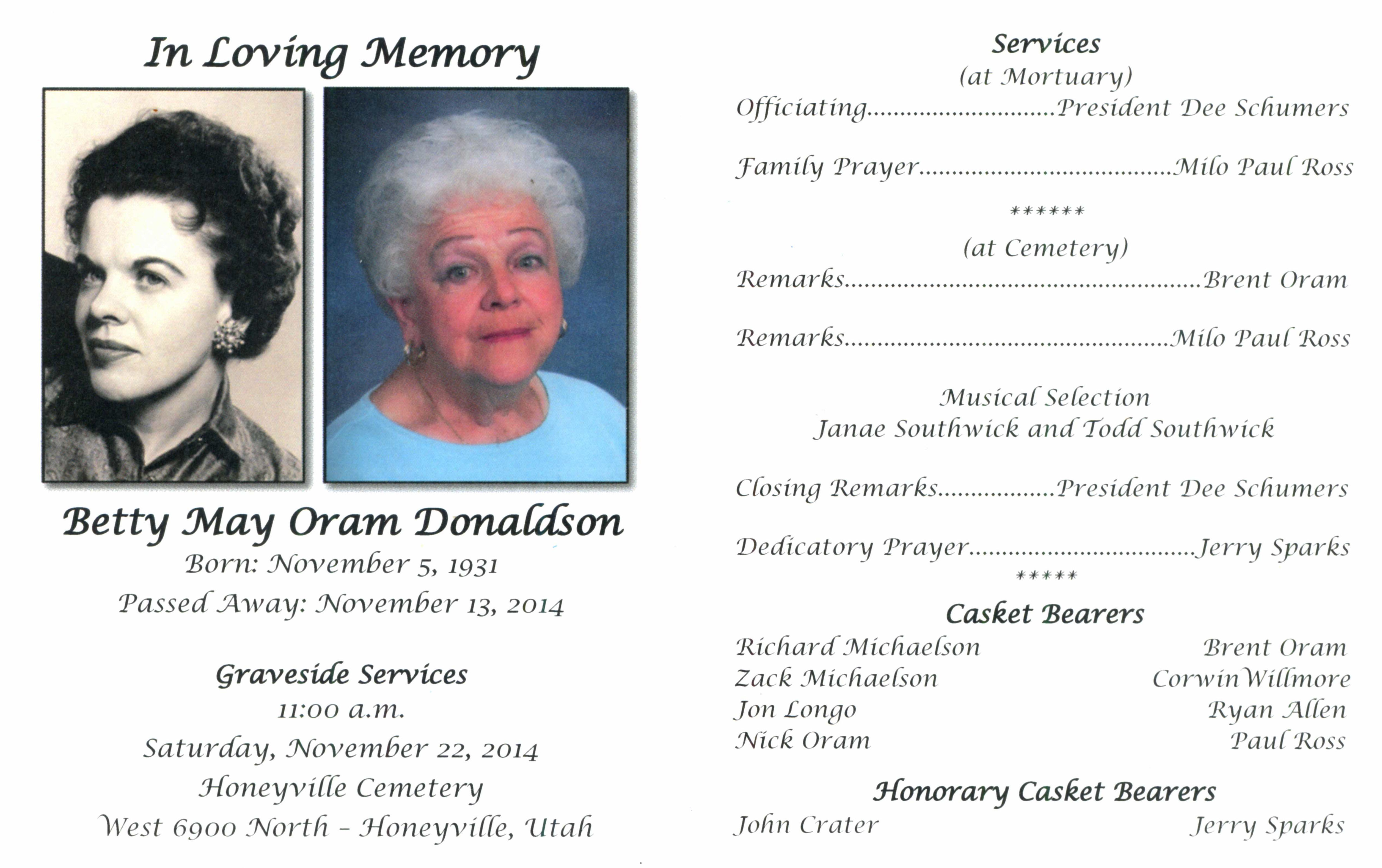
Betty May Oram Donaldson, 83, passed away peacefully surrounded by many dear friends on November 13, 2014. She was born November 5, 1931 to Gloyd Hyrum Oram and Rosabelle Grant Oram in Ogden, Utah.

Betty Oram Toddler

Betty Oram as a toddler

She attended schools in Honeyville and Ogden. She met and married David William Donaldson on April 12, 1953 (in Las Vegas) and their marriage was later solemnized in the Ogden LDS Temple (2008). They enjoyed traveling, camping and fishing. After 54 years together, David died in 2007.

Gloyd and Betty Oram

Gloyd and Betty Oram

Betty loved her dogs, cooking, crocheting, listening to books on tape and visiting with friends and family. She worked as a medical record and lab technician. She was a member of the LDS Church Plain City 7th Ward.

Betty Oram

Betty Oram

She is survived by her sister, Marilyn Keyes of Williamsburg, Virginia, many cousins, nieces and nephews and lots of friends. She will be missed very much.

LaPriel Gailey and Betty Oram

LaPriel Gailey and Betty Oram

She was preceded in death by her parents and brother Donald Oram.

Betty with cup

A viewing for family and friends will be held on Friday, November 21, 2014 from 6 to 8 p.m. at Myers Ogden Mortuary, 845 Washington Blvd and Saturday from 9 to 10 a.m. at the mortuary. Graveside services will be held at 11 a.m. on Saturday, November 22, 2014 at the Honeyville Cemetery, 6900 North 2500 West.

Betty and David (Dave) Donaldson

Betty and David (Dave) Donaldson

We would like to thank the Lotus Park Assisted Living personnel and Intermountain Homecare (especially Vickie, Launi and Misty) for their excellent care of Betty. We are very grateful for the assistance of Betty’s ward family during her last few weeks.

~

That is her obituary as found in the newspaper with two additions by me (in parenthesis).  I thought I would add a couple more side notes.

I have mentioned Betty and Dave in the history for Dave’s parents found at this link.

I am not sure the reasons, but it sounds like Betty was pretty much raised by her grandparents, Jedediah Mill Grant and Annie Kaziah Bowcutt.  Interestingly, Annie’s brother, Lorenzo, married my great grandmother Lillian Coley Jonas years after my great grandfather had passed away.  Betty had some interesting stories about Ren as he was known.  You can see pictures of Ren and his obituary at the link for Lillian.  She adored her Grandmother Annie Bowcutt Grant.  As I mentioned, I did not think to ask why, but she never told me much about her parents.  But she told me loads about her grandparents.  She even gave me a number of photos to scan of them, which I will likely post next week.

I liked to go and visit Aunt Betty.  Since she lived next to Grandpa and Grandma it was easy and convenient to go.  Sometimes though after spending a few hours with Grandpa and Grandma I wanted to get on the road but Grandpa would send me to Betty’s with something to give her and Dave (when he was still alive).  Grandma would even walk over with me sometimes.

doc20150207162904_001

Betty May Oram Donaldson Funeral Program

Jonas – Coley Wedding

Herbert and Martha Coley are pleased to announce the marriage of their daughter Lillian to Joseph Nelson Jonas, son of Joseph and Annie Jonas.  They were married 6 September 1916 in Logan, Cache, Utah at the LDS Temple.  The photo above we think was taken around 1930 or so and is not a wedding photo.

Lillian was born the first child of ten to Martha Christiansen and Herbert Coley 26 August 1898 in Lewiston, Cache, Utah.  Both Herbert and Martha were Mormon immigrants to Utah in the 1880’s.  Herbert and Martha both had native land accents from England and Norway respectively.  Herbert was a diligent laborer who would acquire full ownership in their home by 1910.  Martha was a strict and involved homemaker and mother.
Lillian grew up assisting her mother in maintaining the home, large garden, and raising younger siblings.  By the the time she married, she had six younger children who were in the home (three more were yet to be born).  When Lillian was born, the family lived in Lewiston.  By 1910, the family had moved to Wheeler, Cache, Utah (or the 1900 Census did not have Wheeler broken from Lewiston).  The Wheeler area is almost 6 miles directly to the west from Richmond, Cache, Utah as indicated by the link.  We do not know where they lived in Wheeler.

By the time Lillian married Joseph, the family lived at roughly 1950 E 9000 N to the south and east of Richmond.  The remainder of the cabin built by Herbert Coley was still in the middle of a cow pen in fall 2012 on the south side of the road, but was in pretty poor condition.  Ellis Jonas took me there about 2002 and indicated the home to me as where they lived when he was a little boy.  Martha moved in to town, Richmond, after Herbert passed away in 1946.

Joseph Nelson Jonas was the sixth of seven child born to Annetta Josephine Nelson and Joseph Jonas 19 November 1893 in or near Ellensburg, Kittitas, Washington.  About 1896, Joseph’s mother, Annie, went to the Eastern Washington Hospital for the Insane in Fancher, Spokane, Washington (she is listed as Ann J Jonas).  She was in and out of hospitals throughout her life but as Joseph was one of the younger children, he would not have known his mother a little better.

Joseph and Margaret Jonas about 1899

Annie got out of the Eastern Washington Hospital 31 October 1899 and went home to Ellensburg and continued to be a handful for the family.  The family on the 1900 Census in Cle Elum, Kittitias, Washington does not include Annie though and the census that year has Joseph Sr in both Cle Elum and Spokane about two weeks apart in June 1900.  Annie’s sister, Charlotte, visited in 1901.  Due to Annie’s mental and emotional state, and with Joseph Sr’s approval, the whole Jonas family went to Utah to stay temporarily with Annie’s brother, Nels August Nelson.  Uncle August lived in Crescent, Salt Lake, Utah and the Jonas party arrived 3 July 1901 from Washington.

John, Joseph, and William Jonas probably right before moving to Utah in 1901.  The photo is stamped with Ellensburg on the matting.

Joseph Sr for one reason or another went back to Washington with the youngest child Margaret.  Nels suggested it was legal issues, it might have just been the farm that needed attention.  Annie’s issues were such that August and his wife, Fidelia, signed an affidavit of insanity and had her admitted to the Utah State Hospital 1 November 1901.

Joseph Sr had been raised as a Catholic and Annie Nelson had been raised LDS.  Annie decided she did not like LDS men and wanted to marry a Gentile and did so.  The children were raised Catholic in Washington.  Now in Utah, Uncle August made sure the children learned about the LDS faith.  The three boys elected to be baptized LDS on 10 January 1902 in Crescent by their Uncle August in an ice covered Jordan River.  All three were confirmed 12 January 1902 by Jaime P Jensen.  Rosa joined 6 February 1902, also in Crescent under the hand of Uncle August in a hole chipped in the Jordan River.  Margaret did not join as she stayed near her father in Washington.

In 1904, Rosa married a boy, Christian Andersen, from Richmond.  They married in Salt Lake City, Salt Lake, Utah.  They moved to 137 E 100 S in Richmond.  Joseph and his brothers resided with Uncle August until after their mother passed in 1907, then they would regularly and for prolonged periods stay with Rosa in Richmond.  The 1910 Census lists Joseph at home in Crescent.  Read more of Brother John Jonas.

Joseph Nelson Jonas’ Brigham Young College yearbook picture

Joseph attended Brigham Young College in Logan and graduated with his diploma 3 June 1915.  We don’t know much about his time at Brigham Young College but the story goes he wrestled with their team and did so very effectively.  William, Joseph’s brother, was apparently here at school during some overlapping periods.  Joseph became well known for his love of gospel conversations.  He was known for regularly discussing and even arguing the gospel with extra determination.  No hard feelings developed due to his ardor in arguing since others would always agree to a handshake after a good debate.

Joseph Jonas graduation diploma from Brigham Young College in Logan, Utah

Below is a copy of a picture believed to be from his graduation at BYC.  I have not been able to find the original of this photo or a copy at Utah State University’s archives where the Brigham Young College limited records are located (which are less than cooperative on letting me rummage through all the unknown photos).

In Richmond Joseph and Lillian met when Lillian’s father, Herbert, hired Joseph to help harvest hay.  It was within six months, according to the story, that they were married.  The two were married 6 September 1916 in the Logan LDS Temple.

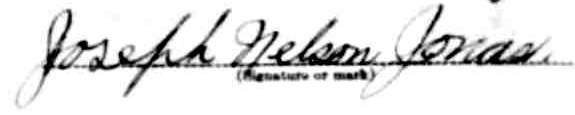
Joseph registered for the draft of World War I on 5 June 1917.  When he registered, he indicated he was a laborer working for Olaf Neilson, the man who would later become a brother-in-law.  He indicated he was taking care of his wife and father.  He also indicated that his eyes were brown and his hair was brown.  He is listed as short and stout.  Here is his signature from that registration.  According to his family, he stood about 5’6″ and was very muscular.

Joseph’s father passed in Richmond in June 1917.  Lillian gave birth to Joseph Herbert Jonas 14 August 1917 in Richmond.

In 1919, Joseph and his two siblings, Rosa and William, had all moved to Idaho.  They operated a dry farm raising grain in Cleveland, Franklin, Idaho.  Christian and Rosa, along with Joseph, did most of the work on the farm and lived about a mile apart.  William taught at the school in Thatcher, Franklin, Idaho.  The Andersen and Jonas families also kept cows, pigs, chickens, and a sizable garden.  This is the only home Joseph and Lillian Jonas would together own.  Joseph arrived with the cows in Thatcher on 1 April 1919.  Lillian stayed in Richmond due to her pregnancy and while Joseph established the farm.  Communications were slow because mail was held at Thatcher.  Joseph and Lillian only heard from each other when Joseph made it in to Thatcher to pick up the mail or send a letter.

Spencer Gilbert Jonas was born 1 September 1919 in Richmond.  Lillian and the two boys joined Joseph in Cleveland.

The 1920 Census found the Jonas family on 26 January 1920 living on the Cleveland Road outside of Thatcher.

Irwin John Jonas was born 2 September 1921 in Cleveland, but listed as Thatcher.

In 1923 or early 1924, the family then moved to Lewiston, Cache, Utah.  The farm was not working out and he was able to obtain employment with the Utah-Idaho Central Railroad.  Joseph worked on a section gang, just like his father had.  The gang’s job was to repair rotten timbers, hammering in spikes, tightening bolts, and maintaining the rail line.  He worked 7 days a week, sometimes all night, coming home only after a shift was over.

The family lived in a boxcar that had its wheels removed.  A ditch ran under a portion of their home.  Another boxcar nearby was used as a storage shed.  It was here 15 May 1924 that Wilburn Norwood Jonas was born.  Ellis Seth Jonas arrived in this home 6 September 1926, their 10 year wedding anniversary.

Joseph kept a tub of furnace oil in the shed.  It accidentally caught on fire and and Joseph immediately announced to Lillian that the storage shed would burn down and probably their home too.  Joseph, known for being a bit of a prankster, was not believed by Lillian despite his insistence.  Joseph ran back to the shed and picked up the burning tub of fuel and carried it outside the shed.  While he saved the shed and his home, he found himself in Ogden for several weeks with 2nd and 3rd degree burns.  A 9 February 1927 newspaper mention in the Ogden Standard Examiner tells of his being brought to the Dee Hospital on Tuesday the 8th for treatment of burns to the face.

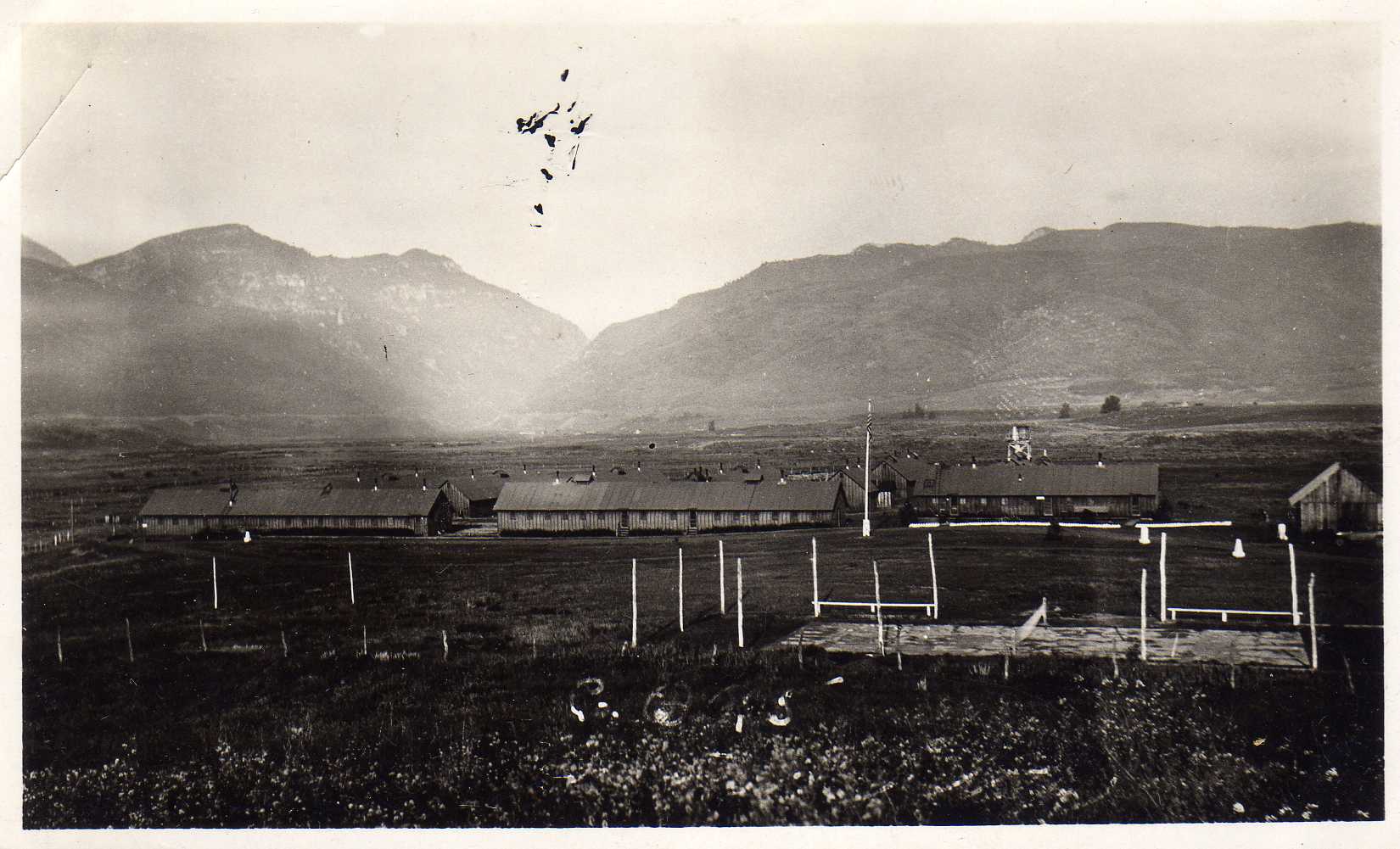
In 1927, Joseph was promoted foreman and oversaw the Quinney line through Wheeler, Thaine, and ending at Quinney (now Amalga).  Later, he accepted another foreman job and moved to the railroad town of Uintah, Weber, Utah where he lived in row housing.  Here is a picture taken while living there.

Picture from Uintah Railroad Camp toward Weber Canyon about 1927

Joseph filed for divorce 2 March 1929 claiming Lillian had deserted him.  The article in the paper indicates they had not lived together since 20 February 1928.  It was during this time on 4 September 1928 that Evan Reed Jonas was born in Ogden.  The divorce was dismissed on 9 March 1929 due to the party’s stipulation.  Joseph again sued on 8 April 1929.  He was ordered to pay $75 a month until the case was resolved.  Joseph and Lillian had the case dismissed after they worked out their issues.

The family later moved into a comfortable home owned by the railroad at 102 17th Street in Ogden, Weber, Utah.  It was a row house, but since he was Section Foreman, the only one with a porch.  Joseph’s father, Joseph, had also served as Section Foreman.  Joseph’s main responsibility dealt with the Huntsville and Plain City/Warren lines.  During this time Joseph and Lillian became known as generous hosts where all visitors were always given more than enough to eat.  Joseph prided himself on the vegetable garden they grew at this home.

On 6 November 1929 Lillian was hit and ran over by an automobile driven by Jack Mobley.  It knocked her unconscious but she quickly regained consciousness.  She spent the night in the hospital and was pretty seriously bruised and lacerated but suffered no broken bones.  Joseph and Lillian admitted they were walking in the middle of the road when the accident occurred.

Joseph and Lillian continued active in the LDS church.  Joseph regularly debated and discussed religion with others.  He was also known to be strict in adherence to principles and expected his children to do the same.  He was not afraid to “switch” his children when they got in trouble or disobeyed.  One thing family members always commented about Joseph was his ability to remember and recall scripture in a conversation and discussion.  Not only that, but when questioned to prove it, he was familiar enough with the book that within moments he could find the chapter and verse.  His familiarity with the bible surprised many people, especially from a railroad laborer.

Joseph and some friends at work after a game of shoes

Lillian Annetta Jonas was born 15 July 1930 in Ogden.  The 1930 Census found Joseph and Lillian at their home on 9 April 1930.  The family was fairly comfortable, they could even afford some of the best appliances.

Joseph Jonas Maytag Warranty Certificate

Joseph was especially glad to have a girl after six sons in a row.

Joseph stands on the back row, second from the left. This is his Section Gang in Ogden.

joseph-nelson-jonas

Joseph and Lillian had a scare in 1931 when their son, Joseph, disappeared for a couple of weeks.  He had been kidnapped by a Mr. J J Nelson and taken to Pocatello, Bannock, Idaho.  He was finally recovered on 20 June 1931.  The man was arrested after he beat young Joseph in public and the police determined Joseph was the missing boy from Ogden.

LeReta Mary Jonas was born 1 August 1932 in Ogden.

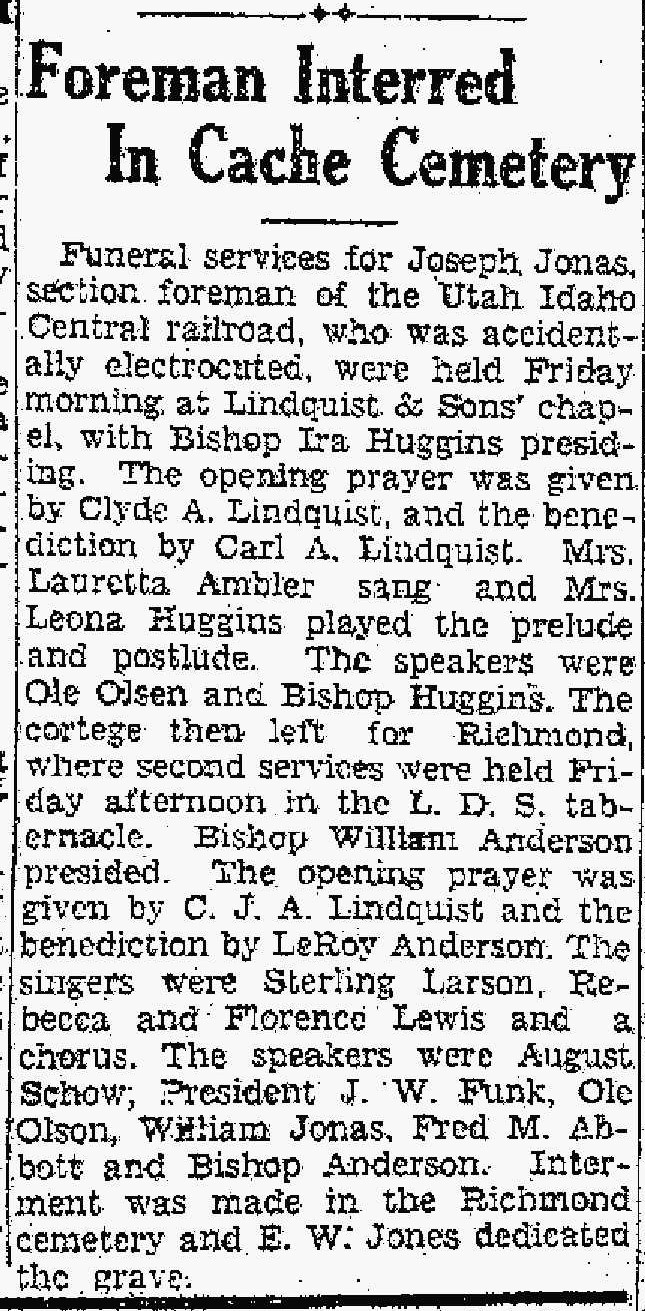
On Tuesday, 6 September 1932, a month after LeReta was born and on his 16th wedding anniversary, Joseph went to work as usual.  Joseph knew the dangers of working on the railroad.  It was near lunch time and his son, Norwood, was taking Joseph his lunch. Joseph saw Norwood and got down off a trolley near Lincoln and 20th Street, near the American Can Company plant.  After getting off the trolley, he turned and walked toward Norwood and hit his head on a wire Mr. Child had strung down to do some welding.  (Mr. Child was haunted by this episode the rest of his life because Joseph had warned him about the way he had hung the wire.)  The shock knocked Joseph on his back unconscious and not breathing.  Joseph died immediately but doctors worked on Joseph for over an hour.  Lillian said Norwood was forever affected by the event.  Joseph died at roughly 1:00 PM.

Joseph Jonas Death Cert

Here is a copy of the newspaper notice.

Here is the burial notice.

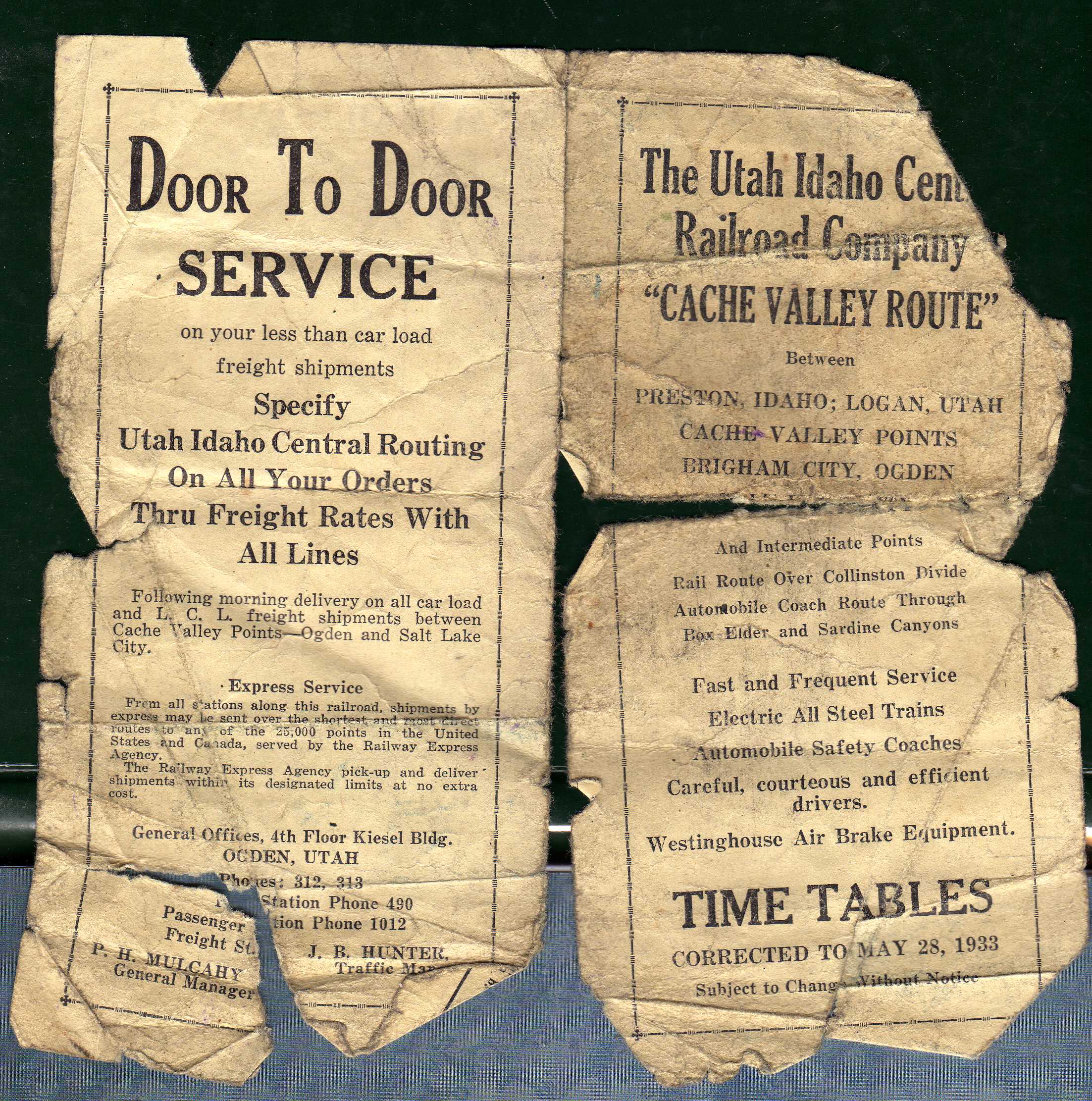
As a historical side note, here is the front of the train schedule Joseph had in his wallet at the time of his death.

Utah Idaho Central Railroad Company Time Table from 1932-1933

jonas-family

The loss of Joseph dealt the family a hard blow not only with losing a family member, but it also lost them the company housing in which they were living.  Lillian, at the mercy of family, moved immediately back to Richmond to be near her family.  Lillian’s father, Herbert Coley, was appointed administrator for Joseph’s estate.  The railroad paid out roughly $1,200 to Joseph’s estate.  The funeral, transport, and burial of the family cost Lillian $150.  The estate did not begin making regular payments to Lillian until 1934.  Until then, Lillian wrote to the railroad for assistance and help.  The railroad was happy to provide passes for the family to travel.  Unfortunately, the company quit handling company coal so they could not fulfill her requests but allowed the boys to have all the used railroad ties they wanted for firewood.

Lillian’s signature from the back of one of the estate checks written to her.

Fortunately, the money from the estate was enough to purchase a home for Lillian in Richmond from a Melvin & Bernetta Smith for $500.  This gave Lillian a home to raise her children and less worry about providing for her family.  The home was located on the north side of the road at roughly 65 E 400 S in Richmond, Utah.  Herbert and Martha, Lillian’s parents, lived across the street, but their home was a good couple hundred feet from the road.

Lillian made good effort to raise six unruly, now fatherless, boys and two girls.  At Joseph’s death, the children were ages 15, 13, 11, 8, 6, 4, 2, and 1 month.  The Jonas brood were known for being a bit coarse and boisterous as the years went on.  Only a few years would pass before the children would start marrying.

Joseph married Hilma Grace Erickson 17 June 1936 in Logan.

Spencer married Viola “Jimmie” Amelia Cole 5 August 1938 in Farmington, Davis, Utah.

Irwin joined the army 6 July 1939 and immediately left for training.  He eventually married Mary Elizabeth Popwitz 17 June 1943 in Rochester, Olmsted, Minnesota.

Lillian’s portrait after the death of son Irwin in World War II

Evan married Lona Rae Jensen 15 March 1946 in Elko, Elko, Nevada.

Norwood married Colleen Mary Andra 27 September 1946 in Elko.

Ellis married Geraldine Pitcher 17 August 1947 in Elko.

Lillian Driver’s License photo

LeReta married Lowell Hansen Andersen 19 March 1948 in Logan.

Lillian married Ray Laurence Talbot 16 August 1948 in Ogden.

Jimmie, Lillian, and Lona Jonas with Norene and little Spence about 1948 (Lillian has a beet knife in hand, must have been fall)

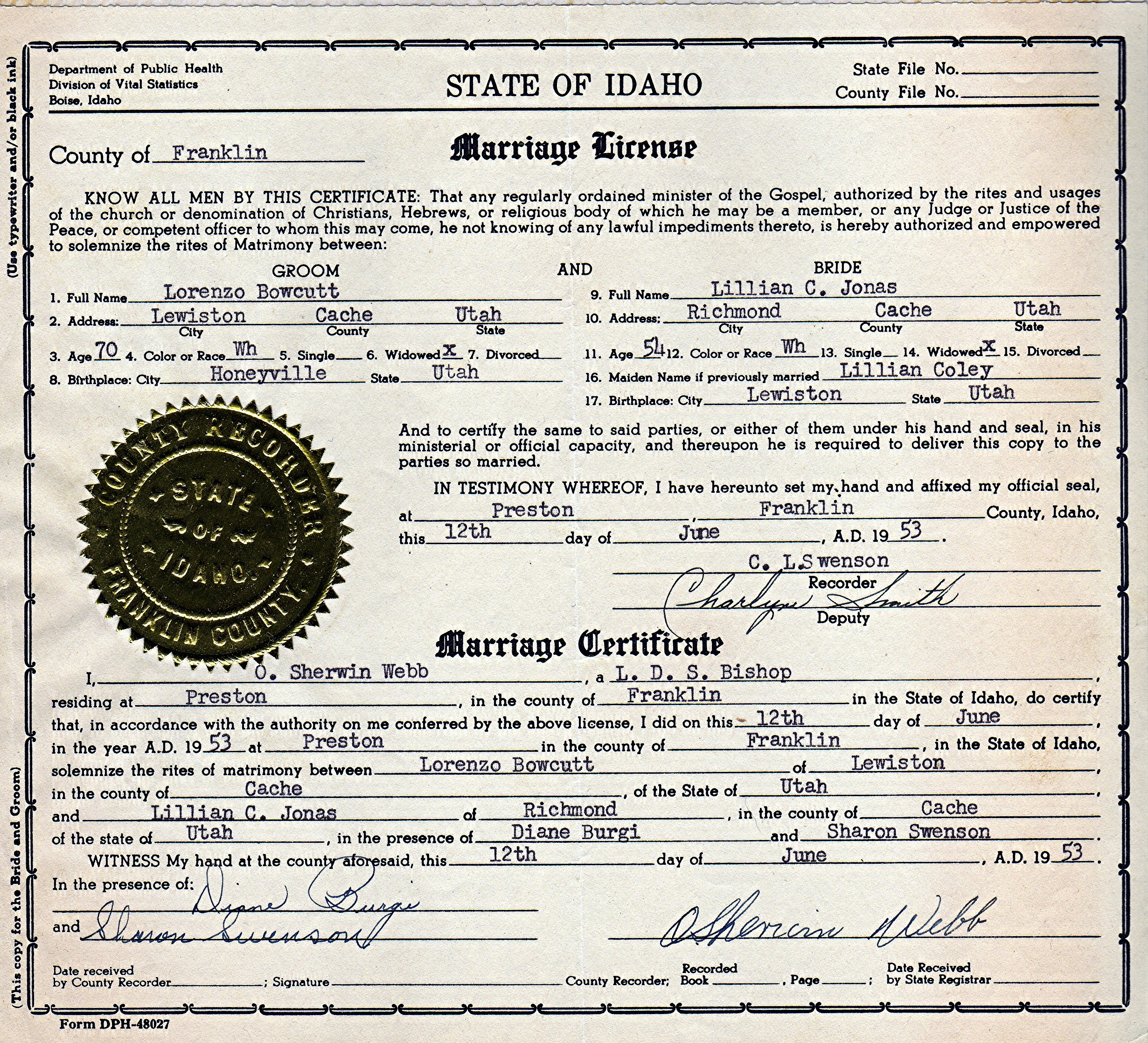
Lillian spent the new few years in an empty home.  She knew Lorenzo “Ren” Bowcutt over the years.  She accepted his offer of marriage and they were married 12 June 1953 in Preston, Franklin, Idaho.

1953 Marriage License

Lillian and Ren Bowcutt

At the time of her marriage to Ren, she had 22 grandchildren, 21 living.

Lillian Bowcutt in 1959

5 generations about 1959, Lillian Coley Bowcutt, Martha Christiansen Coley, Joseph Hebert Jonas, Robert Lee Jonas, Joseph Leland Jonas

Ren passed away 5 April 1966 in Logan (born 12 May 1883 in Honeyville, Box Elder, Utah).  Ren was buried in Riverside, Box Elder, Utah.

Lorenzo Bowcutt

Lorenzo Bowcutt obituary

Lona and Evan Jonas visiting Lillian in the late 1960’s

Lillian in 1978

She lived in the same home until the early 1980’s when she moved in with her daughter Lillian in Layton.

Front (l-r): Spence, Joe, Ellis, Evan, Paul Ross, Jackie Jonas, Andra Ross. Standing: Jimmie, Hilma, Lillian, Lillian, LeReta, Lona, Colleen. Back: Dan Jonas, Larry Talbot, Unknown hidden, Unknown hidden in 1982

4 generations, Sherlean Talbot Collier, Rebecca Collier, Lillian Jonas Talbot, Lillian Coley Jonas about 1984

Lillian portrait about 1986

Spence, Lillian, Joe, Lillian, Ellis, LeReta, Evan

Lillian died 11 February 1987 in Davis Medical Center, Layton, Utah.  She was almost 88.5 years old.  She was buried beside her husband (55 years later) in Richmond 16 February 1987.