The England Fire of 1974

Plain City, Weber County, Utah is not a place that conjures images of billion-dollar industries. Its name suggests modesty, and its streets deliver on that promise — quiet fields, small farms, and houses set back from roads that run straight and flat through Weber County. There is substantial residential development in the past two decades. Even then, this small town produced a remarkable concentration of American transportation entrepreneurial energy. At the center of it stands one man: Chester Rodney England.

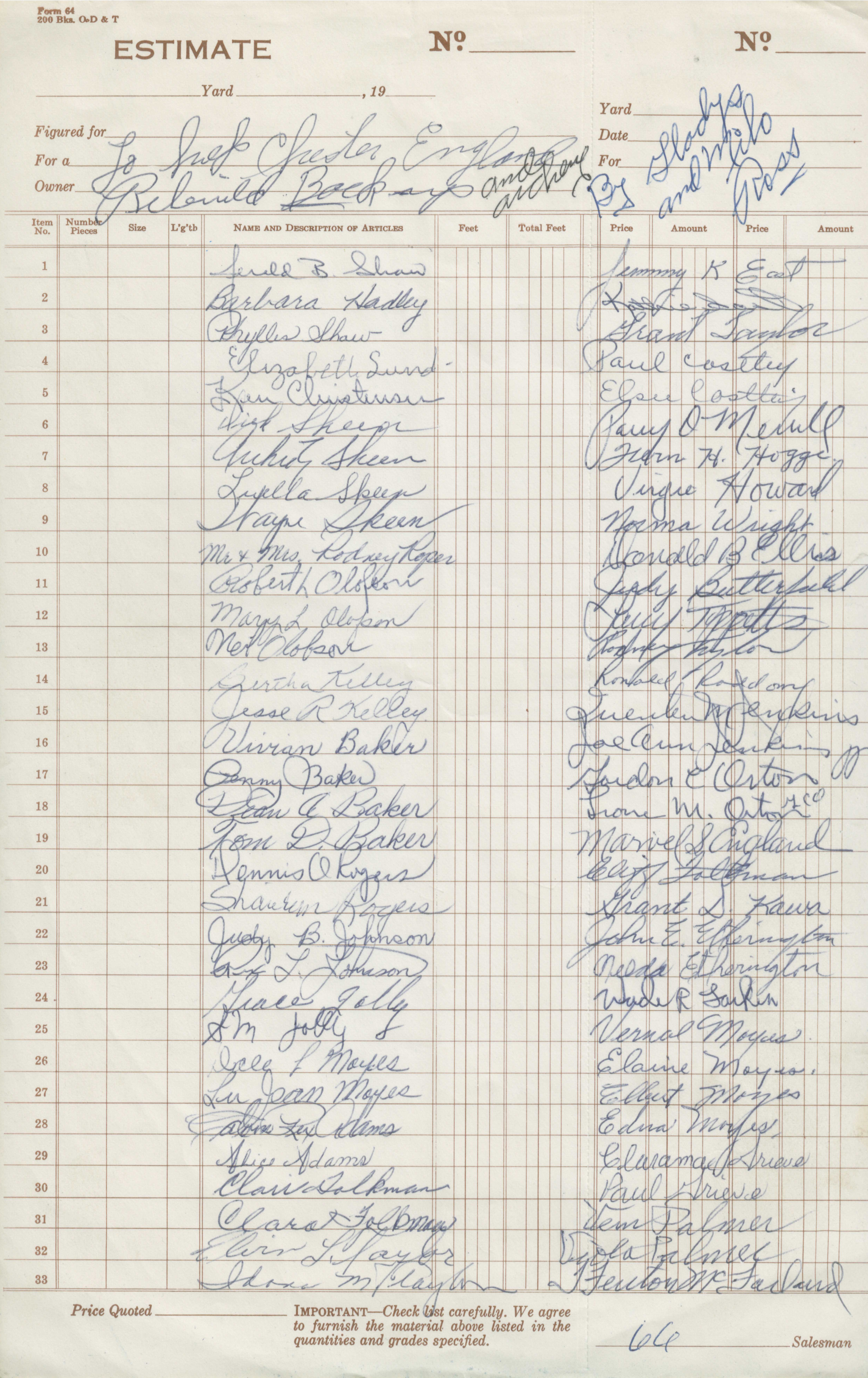
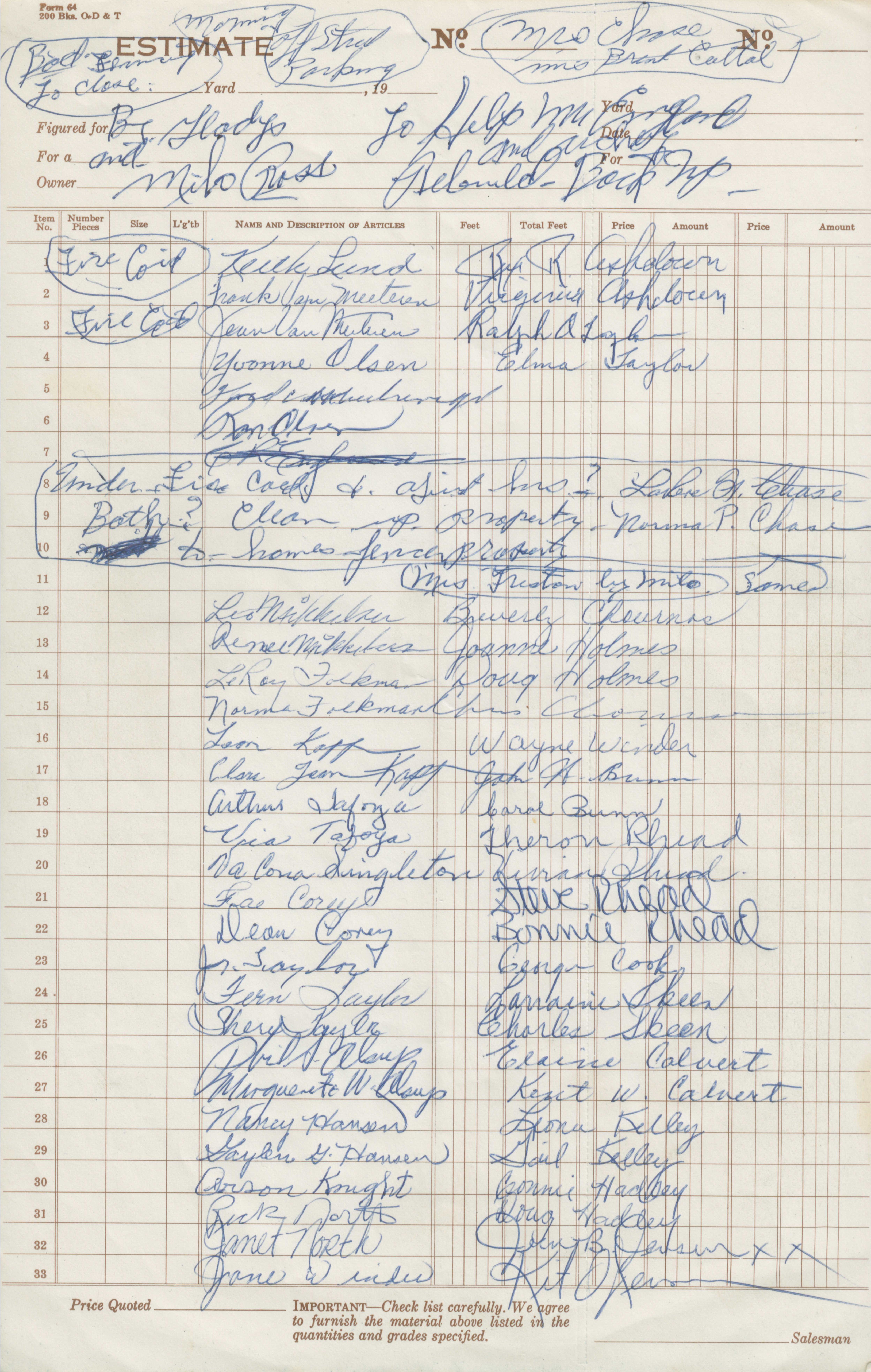
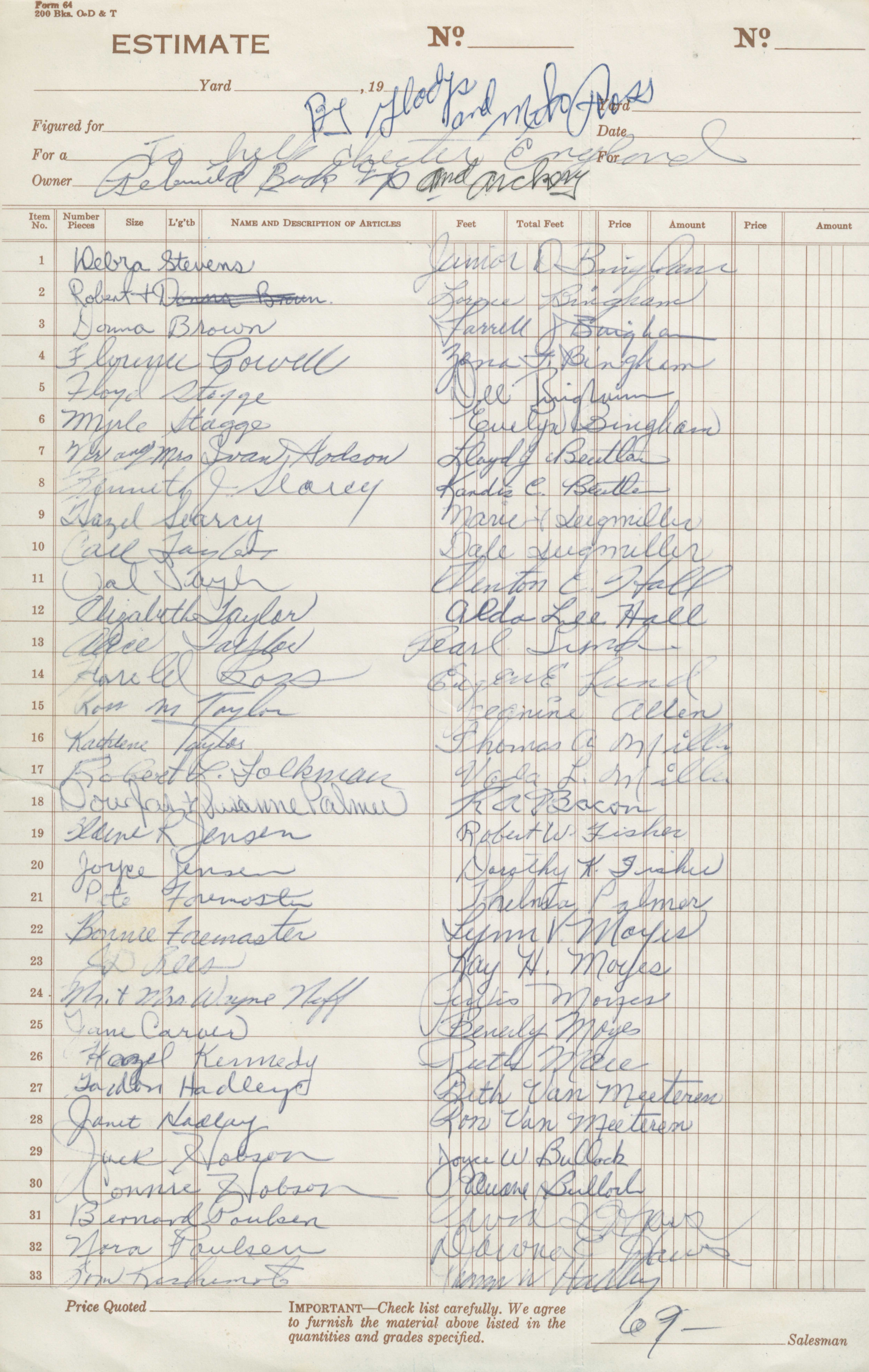
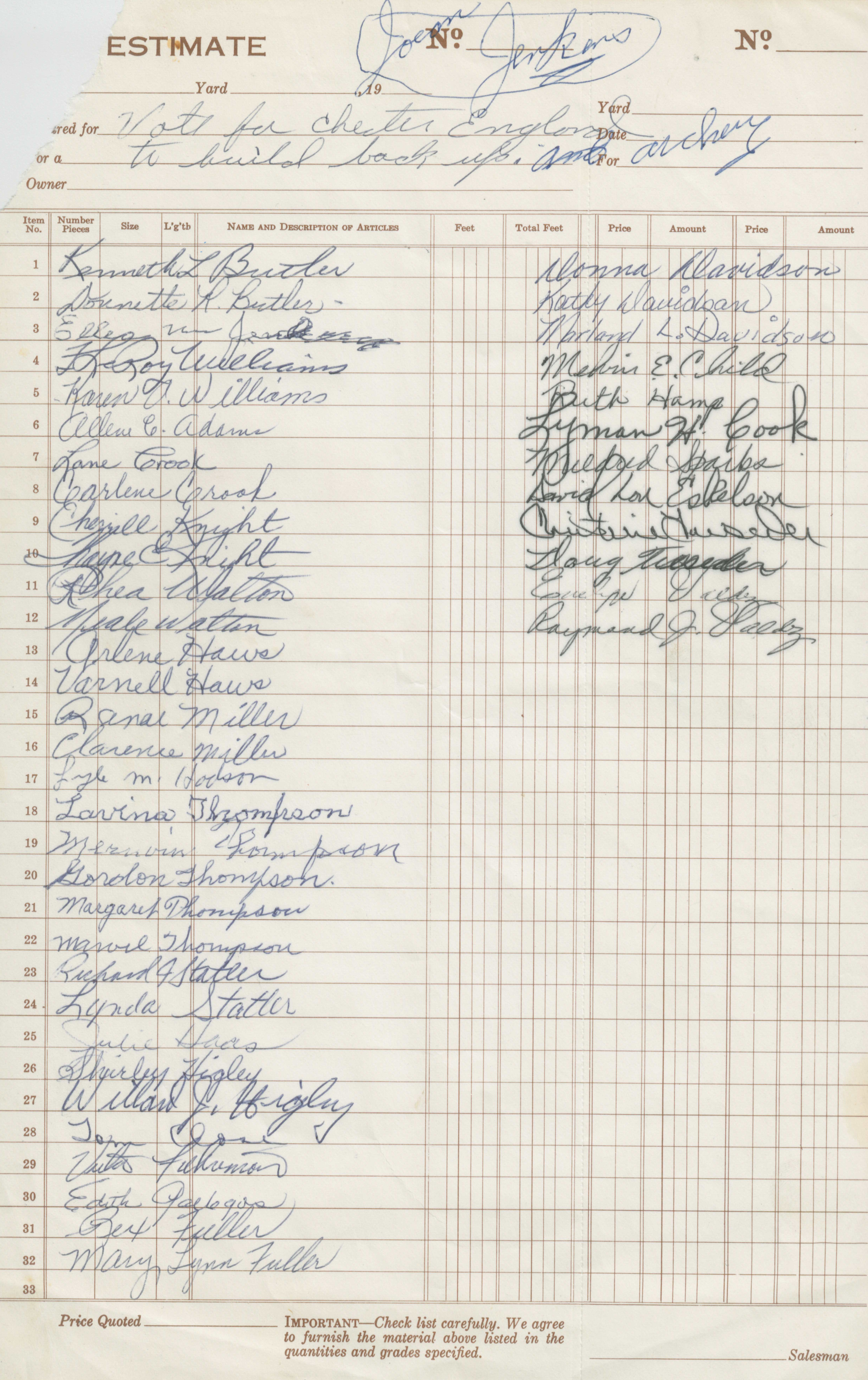
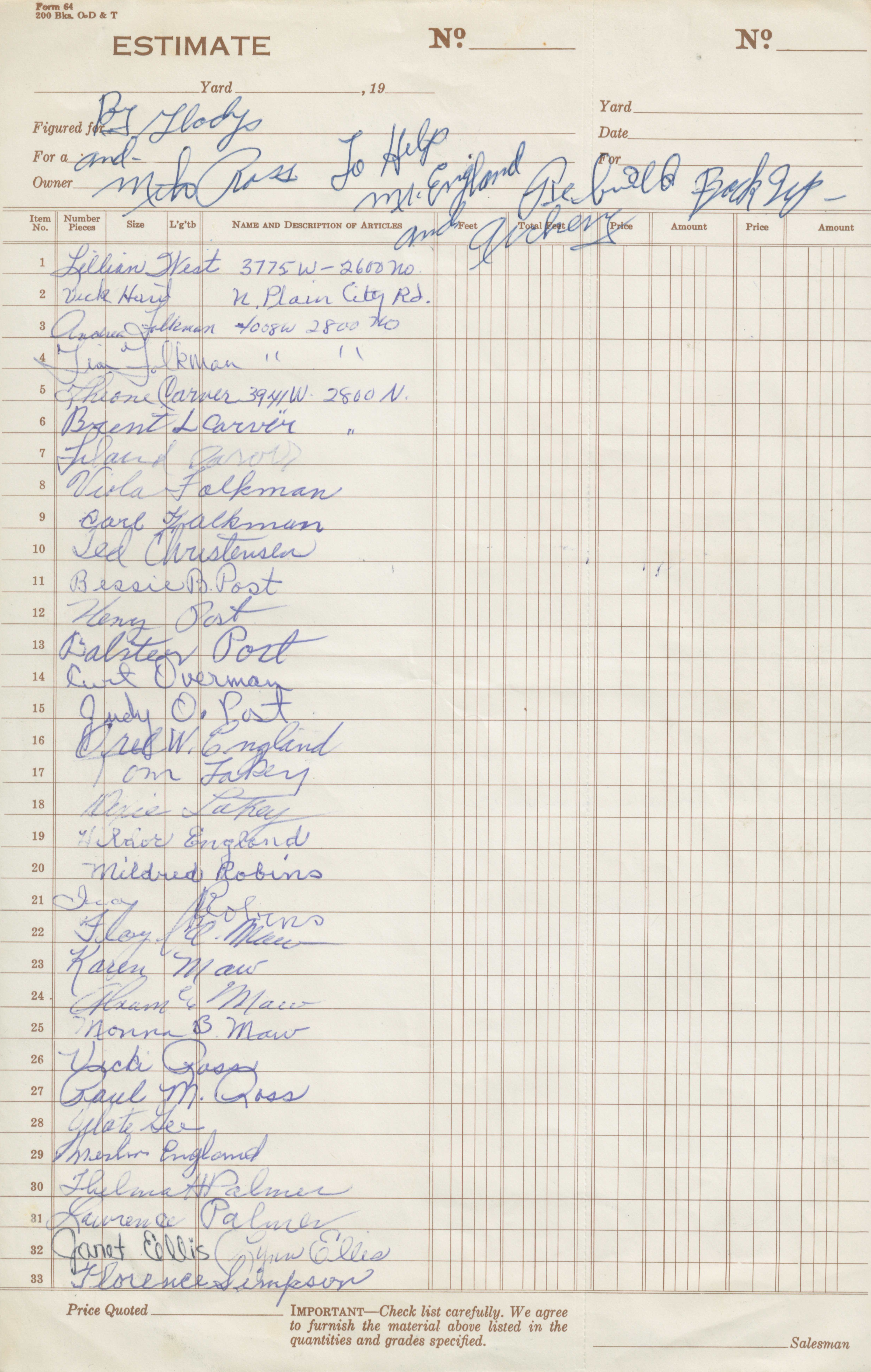
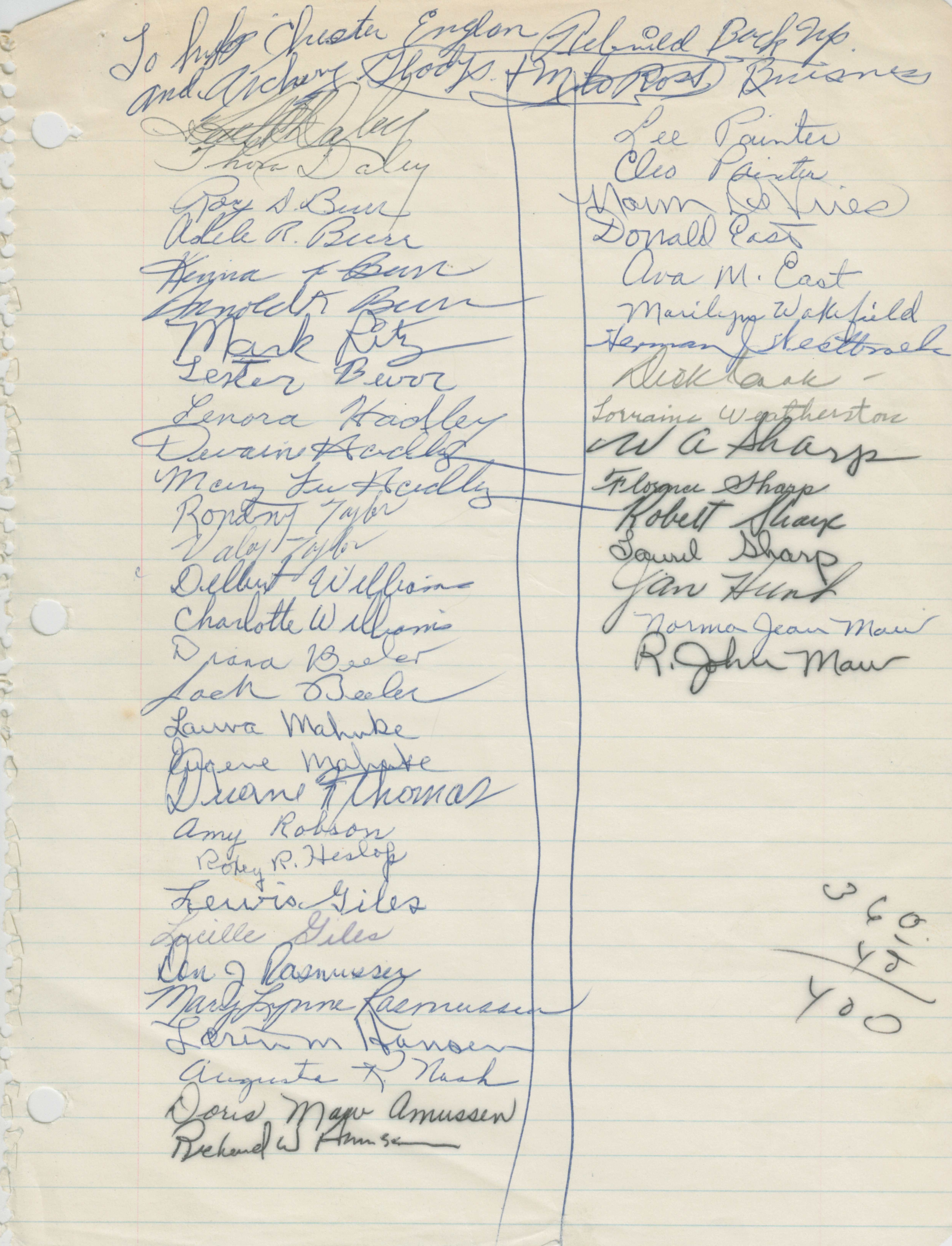
When a fire consumed Chester’s lumber yard on the evening of 6 April 1974, his neighbors rose to defend him to allow him to rebuild. Among those neighbors were my grandparents, Milo and Gladys Ross. What they did in the weeks that followed is documented below — eight pages of signatures collected on lumber yard estimate forms, a newspaper clipping, and a typed petition text. This post tells the story behind those pages.

Chester and Maude

Chester Rodney England was born 12 November 1896 in Plain City to William and Ismelda Thueson England. He grew up there, attended Weber Academy, and in 1916 married Maude Vivian Knight — a Plain City girl herself, born in August 1897. One month after their marriage, Chester received a mission call to the Southern States. He was set apart on 5 December 1916 by Apostle Anthony W. Ivins and left his new bride on 6 December 1916, serving for two years. He returned to find Utah in the grip of the 1918 influenza epidemic, his wife under quarantine, and her sister Elizabeth Knight Ericson dead. His mother was also ill, and he spent a week with his aunt Laura England before he could be with his family.

Chester wrote his own history late in life, and his voice is direct. After the mission he worked at the Amalgamated Sugar factory, farmed through the winters, bought a small Ford truck, and began hauling produce to the stores up through Cache Valley. “I found I could make more money doing this than farming,” he wrote, “so I turned the farm back to my father.” On 24 October 1919, his first son, Eugene Knight England, was born in Ogden. On 6 March 1923, his second son, William Knight England, followed. Two daughters, Rosemary and Carol, completed the family.

Milo James Ross
Milo James Ross (1921–2014)

In 1924 the Weber Central Dairy Association organized and asked for bids to truck milk from the dairymen into the dairy on 19 Washington Boulevard in Ogden. Chester submitted his bid, was accepted, and trucked the first load. He delivered milk in the morning and hauled potatoes up through Cache Valley in the afternoon. Gene and Bill grew up in the business. During summers Chester took them along on the long hauls, building a shelf of boxes out from the cab seat so they could nap on the road. He made sure they always had a bottle of pop at each stop.

During World War II, while Gene and Bill served in the military, Chester hauled Mexican bananas coming into the country at El Paso, Texas, distributing them throughout Utah. Gene served in the 77th Infantry Division at Okinawa, earning the Bronze Star for crawling under fire to drag a wounded soldier to safety — 129 men went up to the escarpment, 27 came back after 72 hours. Bill served in the Air Force in the Philippine Islands from 1943 to 1946. The two brothers found each other on Cebu using a coded letter — Gene had written his middle initial as “B” to signal his location — and Bill arrived with a mattress, making Gene the only man in his division sleeping on something other than a canvas cot. A letter written from the Hotel Keystone in San Diego in May 1946 — Chester on the road at age 49 — gives a picture of those years on the home front. He writes to his wife about a load of bananas, his plans to buy a semi-trailer, and his satisfaction that Gene and Bill are doing well.

Shortly after their return from service, Gene and Bill joined Chester hauling produce. Their first postwar hauls included lumber from Oregon back to Utah, and it was that trade that gave the family firsthand knowledge of the lumber market. The first diesel truck — a used 1940 Kenworth conventional — was purchased during this period. As the business grew, the company also ran two packing sheds and a storage facility for Idaho potatoes at its peak. Around 1957, an unforeseen change in the potato hauling market prompted Gene and Bill to file applications for ICC licenses to haul all kinds of freight, opening an entirely new range of products and geographic lanes. That same year, C.R. England offered 72-hour coast-to-coast service, the first such offering available to American shippers. The first trip east was made by driver Robert Gould in a new 1959 Kenworth, tractor number 17, hauling produce from California to Philadelphia.

In the 1950s Chester stepped back from trucking, leaving Gene and Bill to run what had become C.R. England & Sons. He returned his attention to Plain City. As he wrote: “Our sons retired me from C.R. England & Sons so I started building homes on our property in Plain City. I soon decided I needed a lumber yard if I was going to continue to build. In 1960 I built a lumber yard on the property just west of the home we had sold.” The family’s years hauling lumber from Oregon had given Chester intimate knowledge of the lumber trade, and that knowledge informed the decision. He built three homes on adjacent property and sold them to Keith Lund, Ray Cottle, and Blaine Gibson. He built 25 homes in Plain City and many others throughout Weber County. He built a 12-unit apartment complex in Roy. He took second mortgages from young couples who could not otherwise buy. “It was a great satisfaction to have young couples come and tell me they would never have bought their homes without my help,” he wrote.

Maude was with him through all of it. Born in Plain City in August 1897, she never really left. She served as president of the Plain City Primary, held positions in the Relief Society throughout her life, and attended the Ogden Temple with Chester twice a week when they could manage it. She died in Plain City on 12 February 1982, having lived there her entire 84 years. Chester moved to Salt Lake City after her death and died there on 5 January 1989. He is buried beside her in Plain City Cemetery.

The Sugar Factory

The sugar factory was woven into both families long before the fire. The Amalgamated Sugar Company plant at Wilson Lane, just south of Plain City, was one of the economic anchors of Weber County from the early twentieth century onward. Plain City farmers hauled beets to the rail dumps each fall for decades; the railroad that came to Plain City in 1909 arrived largely to move beet cars to that factory. Chester England worked at the sugar factory himself after returning from his mission in late 1918, spending two winters there before he turned to farming and then trucking.

Milo’s father, John “Jack” Ross, worked for Amalgamated Sugar much of his adult life, following the company between its Ogden, Burley, and Paul, Idaho plants as work demanded. That movement accounts for the geography of the Ross children: Milo was born in Plain City in 1921, his brother Paul born in the town of Paul, Idaho in 1922, and Harold born in Burley in 1924. Amalgamated Sugar built its Paul factory in 1917, and families from the Plain City area followed the work north. The factory experienced difficult early years — a postwar agricultural depression after World War I, and then the beet leafhopper blight that devastated crops through the 1920s and into the 1930s — but it survived to become, in time, the largest sugarbeet processing facility in the world. Chester England and Jack Ross were contemporaries who had worked for the same company in the same corner of northern Utah before either of them had settled into the lives their families would remember them by. For more on the sugar factory’s role in Plain City’s history, see History of Plain City Pt. 1.

The Cradle of American Trucking

Chester England’s 1920 Model T purchase was the seed of something considerably larger than one family’s business. Four major American trucking companies trace their origins directly to Plain City, and all four connect back to Chester. The Standard-Examiner and C.R. England’s own history have documented this story in detail.

C.R. England & Sons grew steadily through the postwar decades into one of the largest refrigerated carriers in the United States, eventually operating a fleet approaching 4,000 trucks and headquartered in Salt Lake City. Gene England served as president of the company well into his later years, still coming into the office daily at age 88. He died on 13 November 2024 at the age of 105. Bill England, who married Fern Hadley — a Plain City Hadley, the same family that signed the petition — died on 28 March 2018 at age 95. He spent his last ten years without sight but maintained, as his family recorded, an extraordinary optimism throughout. He entitled his life history “It Is As Good As It Gets.”

Carl Moyes had driven trucks for C.R. England in his younger years. In the late 1950s, Carl and his wife Betty started B&C Truck Leasing in Plain City. In 1966, when their son Jerry graduated from Weber State College, the family moved to Phoenix, Arizona and formed the company that would eventually become Swift Transportation — for many years the largest truckload carrier in the United States. Jerry Moyes later observed that he liked to say there was “diesel in the water” in Plain City, and that the people there were conceived in sleeper cabs.

In 1990, brothers Kevin and Keith Knight and their cousins Randy and Gary Knight left Swift to found Knight Transportation. All four had grown up in Plain City and gotten their start working for the Moyes family’s Swift Transportation. The Knights were also related to Maude Knight, who had married Chester England in 1916, making them family to the man who started the Plain City trucking tradition. Knight Transportation started with five trucks; four years after going public the company had between 250 and 300. Knight and Swift announced a merger in April 2017, creating Knight-Swift Transportation, valued at an estimated $5 billion with approximately 23,000 tractors and 77,000 trailers.

In 1976, Jeff England — Gene’s oldest son and Chester’s grandson — bought his first truck while still working at C.R. England as an owner-operator, initially under the name “Pride of England Enterprises.” In 1979, with three trucks and a haul contract moving produce from California to New York, he left the family firm to go fully independent. His wife Pat was his partner from the beginning. In the early 1980s he assembled a group of investors, purchased ten more trucks, and rebranded as Pride Transport Inc. By 2017 the company operated a fleet of 500 trucks. In 2012 Jeff passed ownership to his son Jay England. Jeff England said of his decision to leave: “I felt that I needed to do my own thing.” He was 76 at the time of that interview and still driving a truck a couple of times a month.

The fuel infrastructure serving these fleets also has roots in this region. O. Jay Call, who came to Willard, Utah in the mid-1960s, founded Flying J in 1968, naming it for his love of flying, and built it into the largest retailer of diesel fuel in North America. His uncle, Reuel Call, had founded Maverik convenience stores in 1928 in Afton, Wyoming. FJ Management acquired Maverik in 2012. The Call family’s fuel network and the England-Moyes-Knight trucking empire developed in the same northern Utah environment across the same decades.

In September 2022, representatives of all four trucking firms gathered at Peery’s Egyptian Theater in Ogden for the premiere of a documentary about their shared origins. Gene England, then 102 years old, was present on stage alongside Jeff and Dan England, Jerry Moyes, and Kevin Knight.

The Fire

On the evening of 6 April 1974, Chester England went over to open up the lumber yard. He was 77 years old.

He described what followed in his own autobiography:

As I opened the office door, the place exploded and was engulfed with flames. It had been smoldering during the night. We do not know what caused it but it burned everything. I ran in to get the invoices but the ceiling began falling and burned holes in my jacket so I could have lost my life. This was a terrible experience watching everything you have worked hard for go up in flames. I was down in bed for 10 days from shock. We had insurance on it but I had been buying so much merchandise that the insurance didn’t begin to pay for the loss. I appreciated the fire department and the ward members who worked so hard to help. It took many weeks after to clean up. My family thought I should retire and not build it up again. However, I knew I wouldn’t be happy without something to do so I started rebuilding as soon as I could.

The 1977 History of Plain City records the fire at “England Builder’s Lumber Company” and gives the date as April 6, 1975. That date appears to be a transcription error in the town history; Chester’s own autobiography gives 6 April 1974, and that account is the primary source. The fire also destroyed the adjacent Leigh Archery Company, operated by LeGrande Leigh and Robert Jones. The insurance fell short. Chester was 77 and his family urged him to retire. He refused.

Plain City Will Consider Future of the Lumberyard

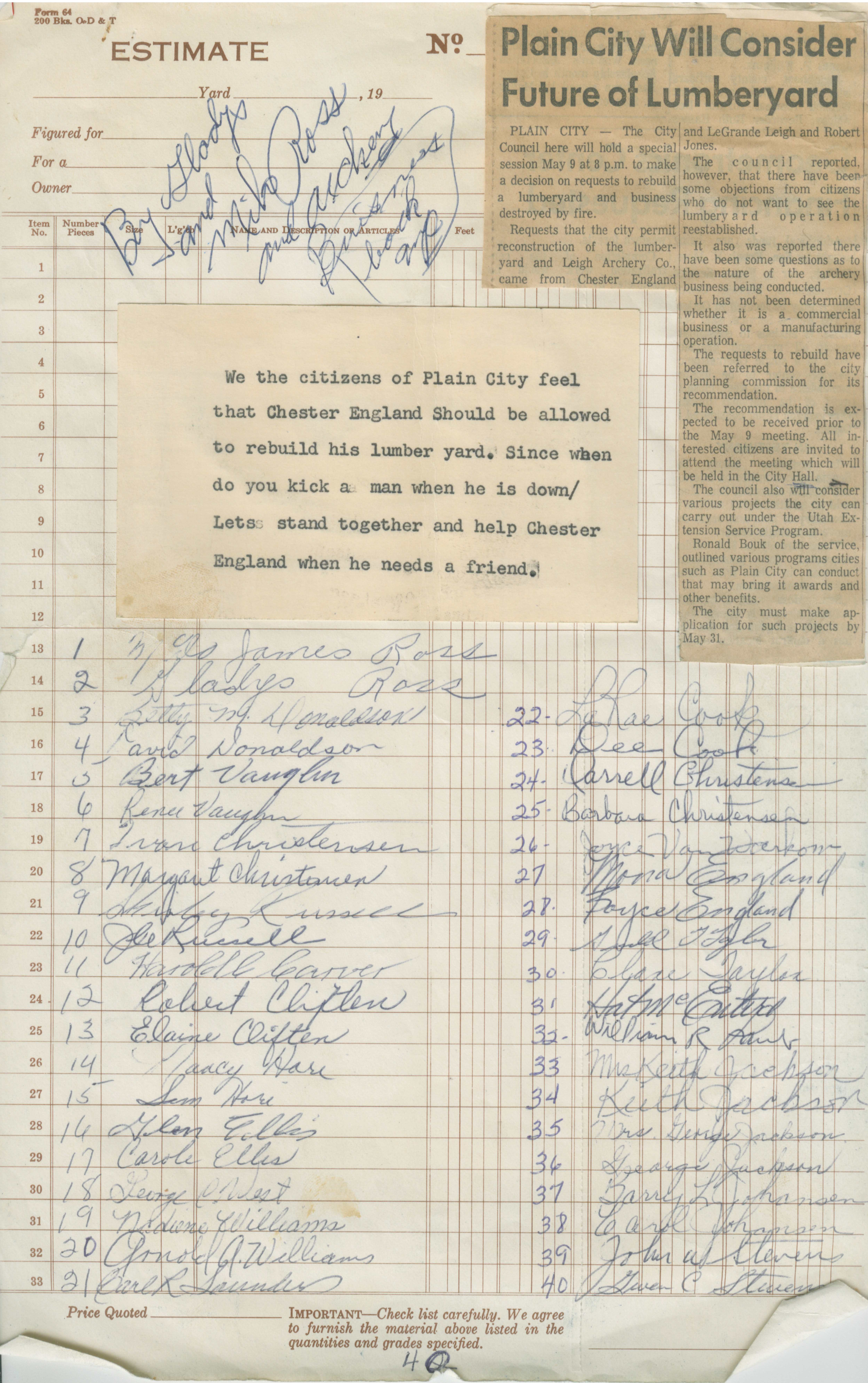
A newspaper clipping, attached to the first petition page, reported what happened next:

PLAIN CITY — The City Council here will hold a special session May 9 at 8 p.m. to make a decision on requests to rebuild a lumberyard and business destroyed by fire.

Requests that the city permit reconstruction of the lumberyard and Leigh Archery Co. came from Chester England and LeGrande Leigh and Robert Jones.

The council reported, however, that there have been some objections from citizens who do not want to see the lumber operation reestablished.

It also was reported there have been some questions as to the nature of the archery business being conducted. It has not been determined whether it is a commercial business or a manufacturing operation.

The requests to rebuild have been referred to the city planning commission for its recommendation. The recommendation is expected to be received prior to the May 9 meeting. All interested citizens are invited to attend the meeting which will be held in the City Hall.

The council also will consider various projects the city can carry out under the Utah Extension Service Program. Ronald Bouk of the service outlined various programs cities such as Plain City can conduct that may bring it awards and other benefits. The city must make application for such projects by May 31.

Some citizens did not want Chester to rebuild. And so his neighbors organized.

Milo and Gladys Ross

Milo and Gladys Ross
Milo and Gladys Ross, 30 May 1942

Milo James Ross (1921–2014) was born 4 February 1921 in a log cabin just north of Plain City. His mother, Ethel Sharp Ross, died of puerperal septicemia in August 1925 when Milo was four years old, leaving three surviving boys. Milo went to live with his Uncle Ed Sharp, Harold with Uncle Dale Sharp. They were raised in separate homes within a few blocks of one another in Plain City, the extended Sharp family absorbing the loss. For more on the Sharp family’s tragedies, see Sharp Tragedies.

Milo grew up working Ed Sharp’s farm — tending onions, hauling salt from the flats at Promontory, doing whatever needed doing. He played baseball with the Plain City Farm Bureau team and attended Weber High School.
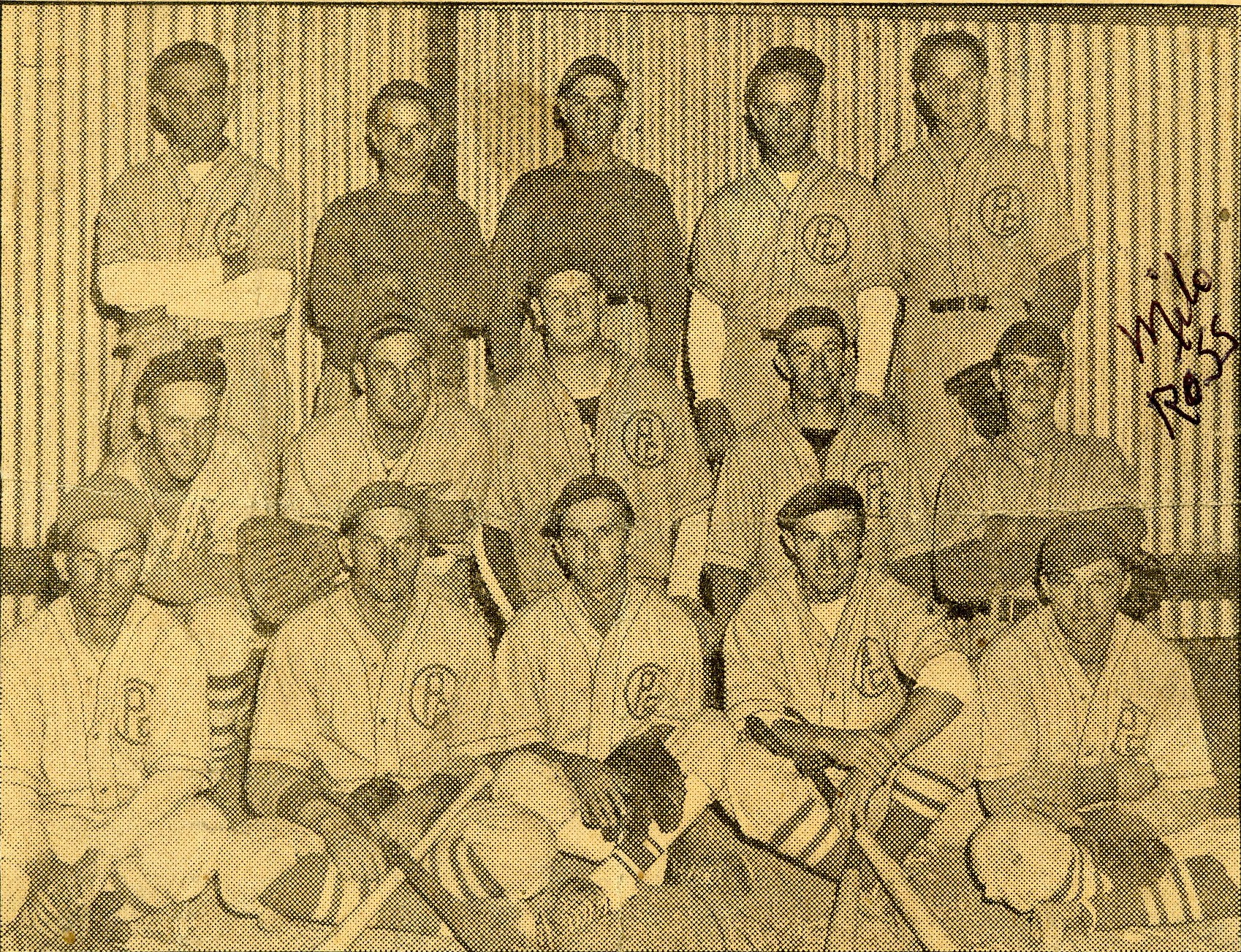
Plain City baseball team
Plain City baseball team. Back (l-r): William Freestone (manager), Norman Carver, Glen Charlton, Fred Singleton, Elmer Singleton (1918–1996). Middle: Clair Folkman, Dick Skeen, Albert Sharp, Abe Maw, Milo Ross. Front: F. Skeen, Walt Moyes, Arnold Taylor, Lynn Stewart, Theron Rhead. See also: Plain City Hurler.
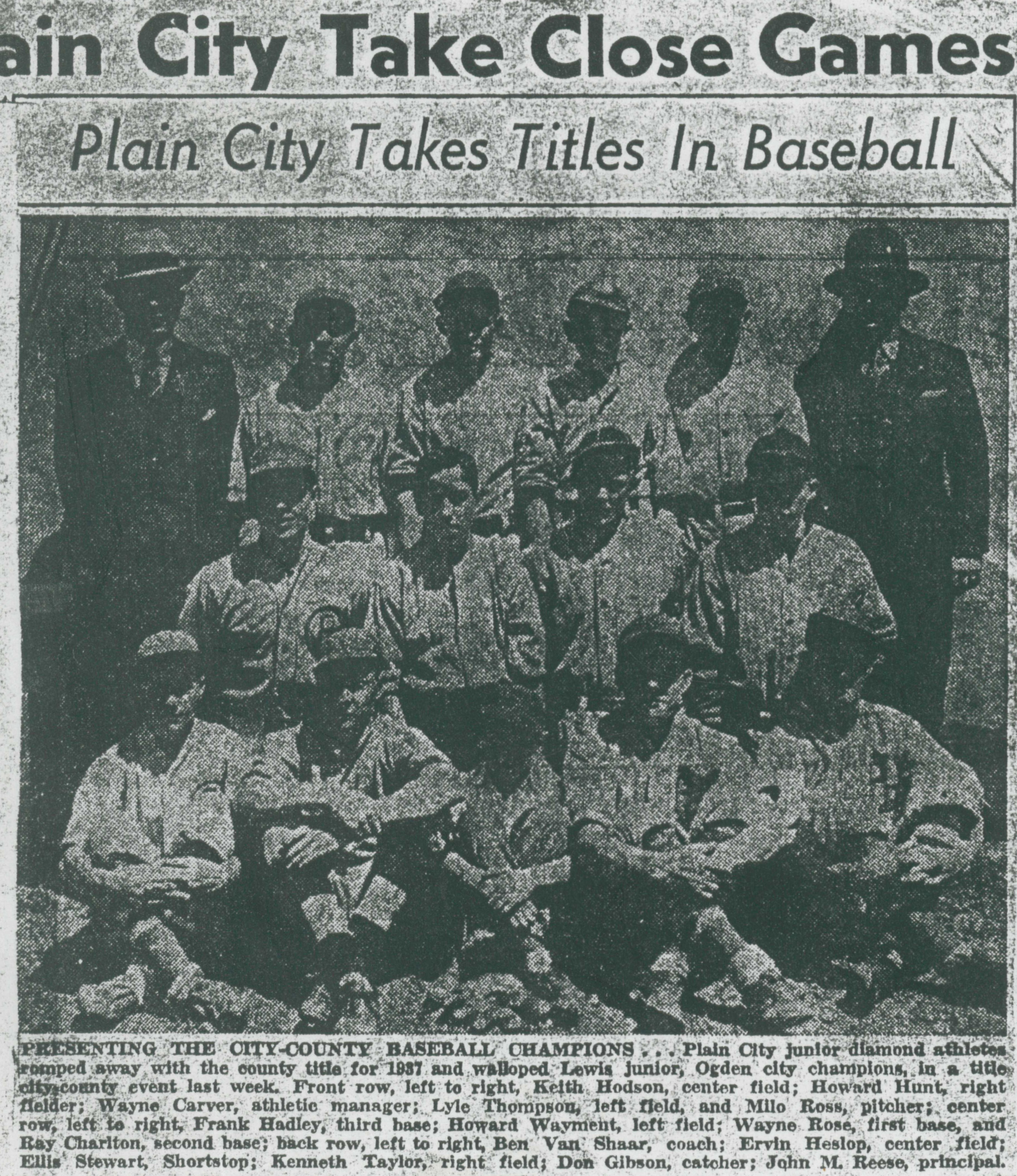
1937 Plain City Baseball Champions
1937 Plain City Baseball Champions. Back (l-r): Ben Van Shaar, Ervin Heslop, Ellis Stewart, Kenneth Taylor, Don Gibson, John Reese. Middle: Frank Hadley, Howard Wayment, Wayne Rose, Ray Charlton. Front: Keith Hodson, Howard Hunt, Wayne Carver, Lyle Thompson, Milo Ross.

In 1940 Milo met Gladys Maxine Donaldson (1921–2004) at a Plain City celebration. They married on 4 April 1942. Six months later Milo enlisted in the Army. He served in the 33rd Infantry Division, 130th Regiment, Company C, trained in weapons and earned expert ranking. He arrived in Hawaii on 4 July 1943 — the same day his son, Milo Paul, was born in Utah, a son he would not meet for three years. He fought through the jungles of New Guinea and the Philippines and was present at the Japanese surrender at Luzon in June 1945. He received two Purple Hearts and the Silver Star. His company received a Presidential Citation for outstanding performance during the seizure of Hill X in the Bilbil Mountain Province. For more on Milo’s military service, see Milo James Ross Military Medals and his 1997 oral history interview.
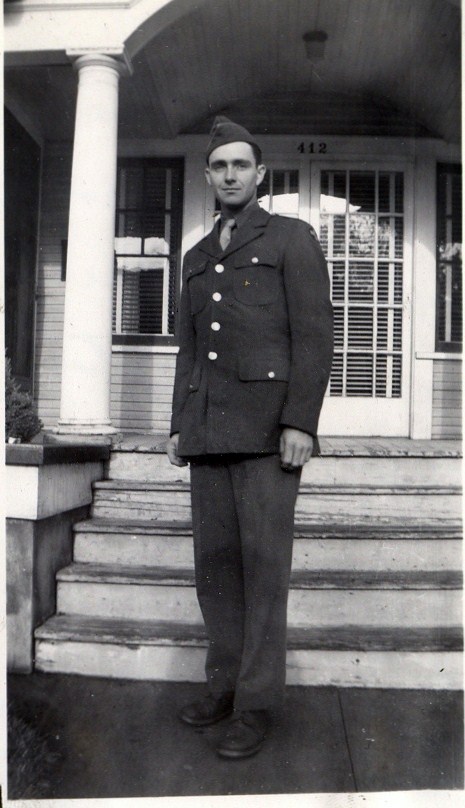
Milo Ross in uniform
Milo Ross in uniform at Fort Lewis, Washington

He came home and went to work as a contractor and builder, eventually building and remodeling hundreds of homes throughout Utah, mostly in Weber County. That work is why, when the time came to gather signatures for Chester England, he had a pad of lumber yard estimate forms at hand. They were his working tools. He pressed them into service as petition pages.

Milo knew Chester England personally. A childhood photograph survives showing Milo alongside Harold Ross, Howard Hunt, Josephine Sharp, and Janelle England on horseback — the England and Ross and Sharp children together in the neighborhood as naturally as their parents moved among one another. In his 1997 oral history interview, Milo recalled Chester among the Plain City men who had struggled during the Depression years, when banks failed and farms were lost. Chester was woven into Milo’s memory of Plain City going back to his earliest years.

On Horse l-r: Harold Ross, Howard Hunt, Milo Ross, Josephine Sharp (arm only), Janelle England, Eddie Sharp. In front l-r: Ruby Sharp, Lucille Maw, and Milo Riley Sharp.

The Petition

The typed text at the center of the petition read:

We the citizens of Plain City feel that Chester England should be allowed to rebuild his lumber yard. Since when do you kick a man when he is down/ Lets stand together and help Chester England when he needs a friend.

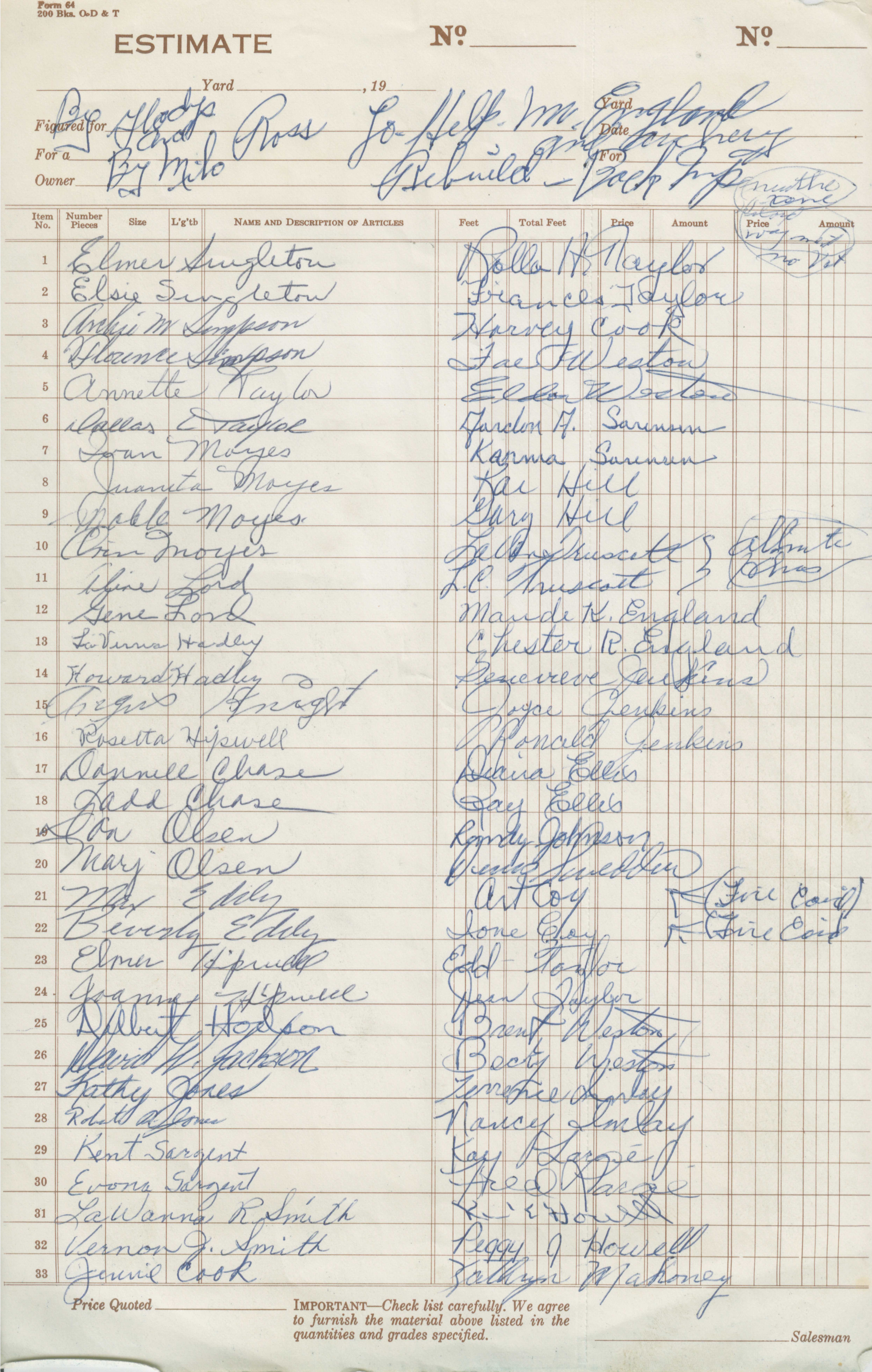
The headers on the petition pages identify the organizers: “By Gladys and Milo Ross — To Help Mr. England — Rebuild Back Up.” The forms were passed through the community in the weeks leading up to the May 9 city council meeting. One page was circulated by Joan Jenkins.

My father, Milo Paul Ross, had worked for Chester England as a teenager. He and his first wife, Victoria “Vicki” Feldtman (1945–2018) — married 5 March 1963 — both signed the petition. For more on Vicki, see Vicki’s Class Pictures. My grandfather Harold Ross also signed. The Sharp cousins — W.A. Sharp and Florence Sharp, children of the family that had raised Milo and Harold — signed as well. Maude K. England and Chester R. England signed the petition themselves.

Among the more than 340 signers, the connections to Plain City’s history run deep. The Moyes family signed in force — the same family whose son Carl had driven trucks for Chester England and whose grandson Jerry would found Swift Transportation. The Knights signed — relatives of Maude Knight England and future founders of Knight Transportation. Elmer Singleton (1918–1996), the Plain City baseball legend who pitched in the major leagues for five teams over fifteen years, signed with his wife Elsie. Cherrill Palmer Knight (1931–2021), who had served as Plain City City Recorder and was the daughter of Vern and Viola Palmer — also signers — added her name alongside her husband Thayne (1931–2018). Roxey R. Heslop, who contributed the school and cemetery histories to the 1977 Plain City history book, also signed. Hildor England (1896–1983), born Johnson, who married into the England family, signed as well. Gordon C. Orton (1924–2008), a Plain City general contractor and World War II veteran who served in the Philippines, New Guinea, and Okinawa, signed with his wife Leone. Vernal Moyes, who had served as a Plain City councilman, signed alongside his family.

The 1977 History of Plain City records the outcome: “Builders Bargain Center, formerly England’s Builders. This business was started and run by Chester England for many years.” Chester rebuilt. The community’s voice prevailed. For more on Plain City’s history, see the Plain City series on Sagacity.

Circle A Construction

Milo Paul Ross and Larry Aslett

My father’s career at Circle A Construction was built substantially on the same industry that had shaped the England and Ross families in Plain City. Circle A, founded in 1952 in Jerome, Idaho by Marvin Aslett, hauled sugar beets for Amalgamated Sugar for most of its operating history. For roughly 34 years, from around 1971 until Circle A transferred the Paul operations to AgExpress in 2004, my father supervised beet hauls across the Magic Valley, from the fields to the Amalgamated dumps at Paul and elsewhere across southern Idaho — the same plants Jack Ross had worked in a generation before.

Marvin Aslett and Milo Paul Ross
Marvin Aslett and Milo Paul Ross at Milo’s 20-year service recognition, 1990. See: Circle A Construction Honors.
Circle A truck in Paul parade
Circle A Construction truck in the Paul, Idaho parade, about 1985. See: Circle A Construction Trucks.

Marvin’s sons Larry and Steve Aslett ran the company alongside my father for decades. We called Larry “Uncle Larry” growing up. The Asletts took us to roundups in Mackay, to ranch country above White Knob. I worked for Circle A myself from 1993 through 1998. My first job in 1994 was washing and waxing trucks at the old Hynes beet dump in Paul after harvest. Jack Ross had worked for Amalgamated Sugar in Paul in the 1920s. My father hauled beets to Amalgamated in Paul for three decades. Circle A’s beet hauls fed the same company in the same town across three generations of this family’s working life.
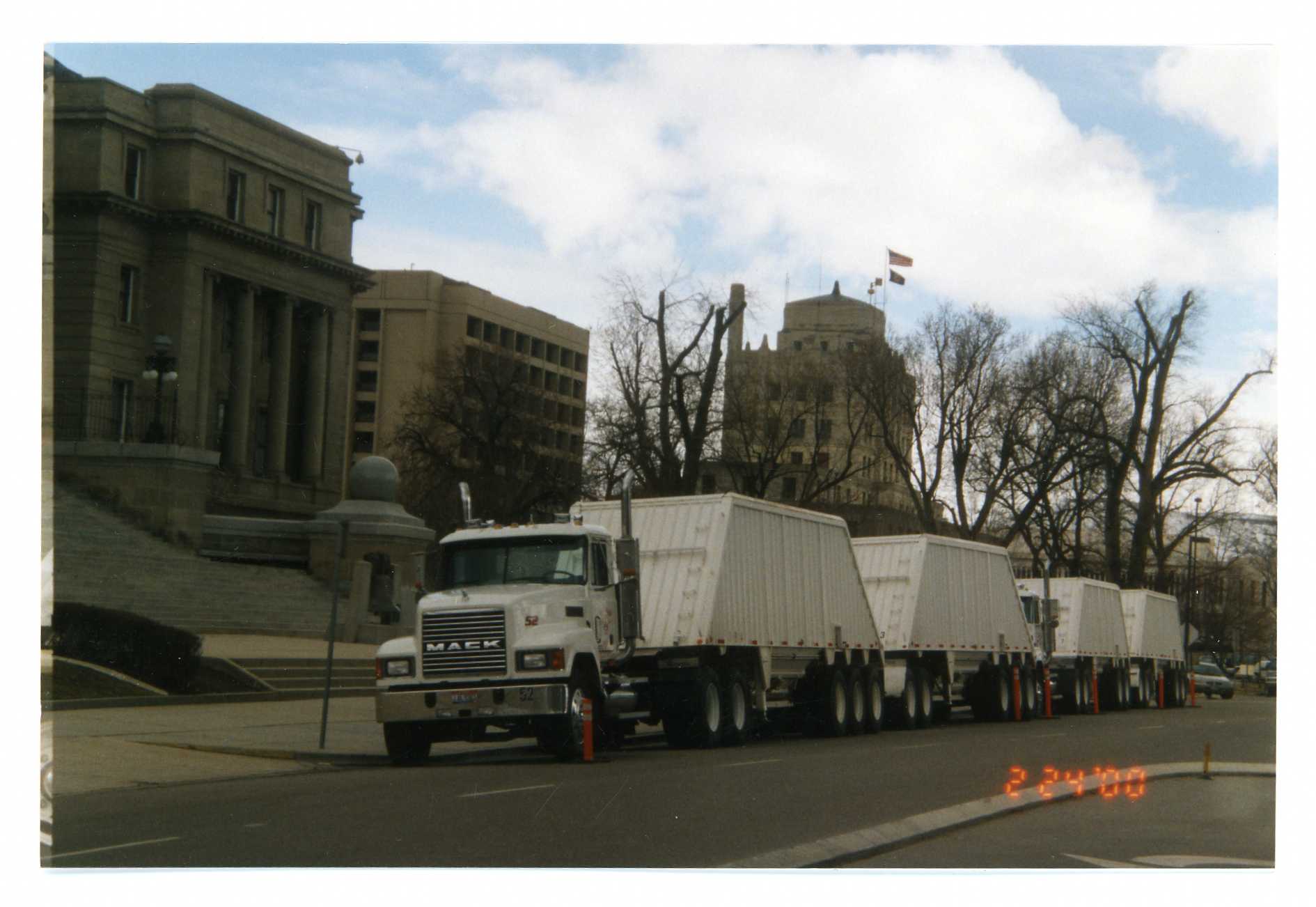
Circle A trucks in front of Idaho Capitol
Circle A Construction trucks in front of the Idaho State Capitol, 2000

The Petition Pages

Below are all eight pages of the petition as collected by Milo and Gladys Ross in the spring of 1974.
Complete List of Signers

Names marked with an asterisk (*) represent uncertain readings of the cursive originals. Dates are given where confirmed through research. This list was transcribed from handwritten signatures; corrections and additions are welcome.

Adams, Alice
Adams, Allene C.
Adams, Calvin Rex
Allen, Jeanine
Alsup, Marguerete W.*
Alsup, Phil S.
Amussen, Doris Maw
Amussen, Richard W.
Ashdown, Rex R.
Ashdown, Virginia
Bacon, R.A.
Baker, Dean A.
Baker, Penny
Baker, Tom D.
Baker, Vivian
Beeler, Diana
Beeler, Jack
Beutler, Kandis C.
Beutler, Lloyd J.
Bingham, Dee
Bingham, Evelyn
Bingham, Farrell J.
Bingham, Junior D.
Bingham, Lorene
Bingham, Zona F.
Brown, Donna
Brown, Robert
Bullock, Duane
Bullock, Joyce W.
Bunn, Carol
Bunn, John H.
Burr, Adle R.
Burr, Arnold K.
Burr, Kenna F.
Burr, Lester
Burr, Roy D.
Butler, Donnette R.
Butler, Kenneth L.
Butterfield, Judy*
Calvert, Elaine
Calvert, Kent W.
Carver, Brent
Carver, Harold C.
Carver, Jane
Carver, Liland
Carver, Theone
Chase, Dannell
Chase, Ladd
Chase, LaRene G.
Chase, Norma P.
Child, Melvin E.
Chournas, Beverly*
Chournas, Chris*
Christensen, Barbara
Christensen, Darrell
Christensen, Ivan
Christensen, Ken
Christensen, Margaret
Christensen, Ted
Cliften, Elaine
Cliften, Robert
Close, Tom*
Cook, Dee
Cook, George
Cook, Harvey
Cook, Jennie
Cook, LaRae
Cook, Lyman H.
Corey, Dean
Corey, Fae
Costley, Elsie
Costley, Paul
Cowell, Florence
Crook, Carlene
Crook, Lane
Daley, Kenneth*
Daley, Thora
Dall, Kathie*
Davidson, Donna
Davidson, Kathy
Davidson, Marland L.
DeVries, Norm
Donaldson, Betty M.
Donaldson, David
East, Ava M.
East, Donald
East, Jimmy K.
Eddy, Beverly
Eddy, Max
Ellis, Carole
Ellis, Diana
Ellis, Donald B.
Ellis, Glen
Ellis, Janet
Ellis, Lynn
Ellis, Ray
England, Boyce
England, Chester R. (1896–1989)
England, Hildor (1896–1983)
England, Marvel S.
England, Maude K. (1897–1982)
England, Merlin
England, Mona
England, Orel W.
Eskelson, David Lon
Etherington, John E.
Etherington, Nelda
Fisher, Dorothy K.
Fisher, Robert W.
Folkman, Andrea
Folkman, Carl
Folkman, Clair
Folkman, Clara
Folkman, Cliff
Folkman, Jim
Folkman, LeRoy
Folkman, Norma
Folkman, Robert L.
Folkman, Viola
Foremaster, Bonne*
Foremaster, Pete
Fuller, Mary Lynn
Fuller, Rex
Fuhriman, Viola
Gallegos, Edith
Gee, Vilate
Giles, Lewis
Giles, Lucille
Grieve, Claramae
Grieve, Paul
Haas, Julie
Hadley, Barbara
Hadley, Connie
Hadley, Devaine
Hadley, Doug
Hadley, Gordon
Hadley, Howard
Hadley, Janet
Hadley, Karma W.*
Hadley, LaVirra*
Hadley, Lenora
Hadley, Mary Fee*
Hamp, Beth
Hansen, Gaylen G.
Hansen, Loren M.
Hansen, Nancy
Havseler/Tesseder, Christine*
Haws, Arlene
Haws, Darwin C.
Haws, Varnell
Heslop, Roxey R.
Higley, Shirley
Higley, Willard J.
Hill, Gary
Hill, Kae
Hipwell, Elmer
Hipwell, Joanne
Hipwell, Rosetta
Hobson, Connie
Hobson, Jack
Hodson, Delbert
Hodson, Lyle M.
Hodson, Mr. Ivan
Hodson, Ms. Ivan
Holmes, Doug
Holmes, Joanne
Hori, Nancy
Hori, Sam
Howard, Virgie
Howell, Kent*
Howell, Peggy J.
Hunt, Jan
Hurst, Vick*
Imlay, Nancy
Imlay, Terrence
Jackson, David W.
Jackson, George
Jackson, Mrs. George
Jackson, Mrs. Keith
Jackson, Keith
Jenkins, Ellen W.
Jenkins, Genevieve
Jenkins, Joan
Jenkins, JoAnn
Jenkins, Joyce
Jenkins, Quentin M.
Jenkins, Ronald
Jensen, Blaine R.
Jensen, Joyce
Jensen, June B.*
Jensen, Kit O.
Johansen, Barry L.
Johansen, Carol
Johnson, Judy B.
Johnson, Randy
Johnson, Rex L.
Jolly, Grace
Jolly, L.M.*
Jones, Kathy
Jones, Robert
Kapp, Clara Jean
Kapp, Leon
Kawa, Grant D.
Kelley, Bertha
Kelley, Gail
Kelley, Jesse R.
Kelley, Leona
Kennedy, Hazel
Kishimoto, Lorn
Knight, Argus*
Knight, Arson*
Knight, Cherrill (1931–2021)
Knight, Thayne E. (1931–2018)
Lakey, Dixie
Lakey, Tom
Large, Fred*
Large, Kay*
Larkin, Wade R.
Laub, William R.
Lord, Clarendon “Gene” (1929–2015)
Lord, Cline
Lund, Elizabeth
Lund, Eugene
Lund, Keith
Lund, Pearl
Mace, Rieths*
Mahoney, Kathryn
Mahnke, Eugene
Mahnke, Laura
Maw, Abram E.
Maw, Floy A.
Maw, Karen
Maw, Monna B.
Maw, Norma Jean
Maw, R. John
McFarland, Fenton
McMillan, Nola L.*
McMillan, Thomas A.*
Merrill, Paul O.*
Mikkelsen, Leo
Mikkelsen, Renee
Miller, Clarence
Miller, Ranae
Miller, Thomas A.
Miller, Veda L.
Moyes, Beverly
Moyes, Dale L.
Moyes, Edna
Moyes, Elaine
Moyes, Elbert
Moyes, Fentis*
Moyes, Ivan
Moyes, Juanita
Moyes, Kay H.
Moyes, LuJean
Moyes, Lynn V.
Moyes, Mable
Moyes, Orin
Moyes, Vernal
Nash, Augusta R.
Neff, Mr. Wayne
Neff, Ms. Wayne
North, Janet
North, Rick
Olofson, Mary L.
Olofson, Robert L.
Olsen, Ian*
Olsen, Mary
Olsen, Ron
Olsen, Yvonne
Orton, Gordon C. (1924–2008)
Orton, Leone
Overman, Curt
Painter, Cleo
Painter, Lee
Palmer, Douglas
Palmer, Lawrence
Palmer, Susanne
Palmer, Thelma H.
Palmer, Vern
Palmer, Viola (1908–2009)
Post, Bessie
Post, Judy O.
Poulsen, Bernard
Poulsen, Nora
Rasmussen, Don J.
Rasmussen, MaryLynn
Reese, J.D.
Rhead, Bonnie
Rhead, Steve
Rhead, Theron
Rhead, Vivian
Ritz, Mark
Robins, Jay*
Robins, Mildred
Robson, Amy
Roddomy, Ronald*
Rogers, Dennis O.
Rogers, Shareen
Roper, Mr. Rodney
Roper, Mrs. Rodney
Ross, Gladys (1921–2004) — organizer
Ross, Harold
Ross, Milo James (1921–2014) — organizer
Ross, Paul M.
Ross, Vicki (1945–2018)
Russell, Joe
Russell, Shirley
Sargent, Evona
Sargent, Kent
Saunders, Carl R.
Searcy, Hazel
Searcy, Kenneth J.
Seegmiller, Dale
Seegmiller, Marie F.
Sharp, Florence
Sharp, Laurel
Sharp, W.A.
Shaw, Jerrell B.
Shaw, Phyllis
Simpson, Archie W.*
Simpson, Florence
Singleton, Elmer (1918–1996)
Singleton, Elsie (–1988)
Singleton, VaCona
Skeen, Archie
Skeen, Charles
Skeen, Dick
Skeen, Lorraine
Skeen, Luella
Skeen, Wayne
Smith, LaWanna R.
Smith, Vernon J.
Sneddon, Dennis
Sorensen, Gordon A.
Sorensen, Karma
Sparks, Mildred
Stagge, Floyd
Stagge, Myrle
Statler, Lynda
Statler, Richard
Stevens, Debra
Stevens, Gwen C.
Stevens, John W.
Tafoya, Arthur
Tafoya, Via
Taylor, Alice
Taylor, Annette
Taylor, Call
Taylor, Clare
Taylor, Edna
Taylor, Elma
Taylor, Elvin L. (1920–2004)
Taylor, Elizabeth
Taylor, Fern
Taylor, Frances
Taylor, Gerald J.*
Taylor, Grant
Taylor, Idona Maw
Taylor, Jr.*
Taylor, Kathlene
Taylor, Kathy
Taylor, Ralph A.
Taylor, Rodney
Taylor, Rolla H.
Taylor, Ross M.
Taylor, Sheri
Taylor, Val
Taylor, Valoy (1932–2024)
Tesseder, Doug*
Thomas, Duane F.
Thompson, Gordon
Thompson, Lavina
Thompson, Margaret
Thompson, Marvel
Thompson, Merrvin*
Tippetts, Larry*
Truscott, L.C.
Truscott, LaVona
Valdez, Evelyn
Valdez, Raymond J.
Van Meeteren, Beth
Van Meeteren, Frank
Van Meeteren, Jean
Van Meeteren, Ron
Van Workom, Joyce*
Vaughn, Bert
Vaughn, Renee
Wakefield, Marilyn
Walton, Neale
Walton, Rhea
Weatherstone, Lorraine
West, George C.
West, Lillian
Westbrook, Herman
Weston, Becky
Weston, Brent
Weston, Eldon
Weston, Fae
Weston, Jae H.
Williams, Arnold A.
Williams, Charlotte
Williams, Delbert
Williams, F. LeRoy
Williams, Karen A.
Williams, Nadiene
Winder, Jane
Winder, Wayne
Wright, Norma
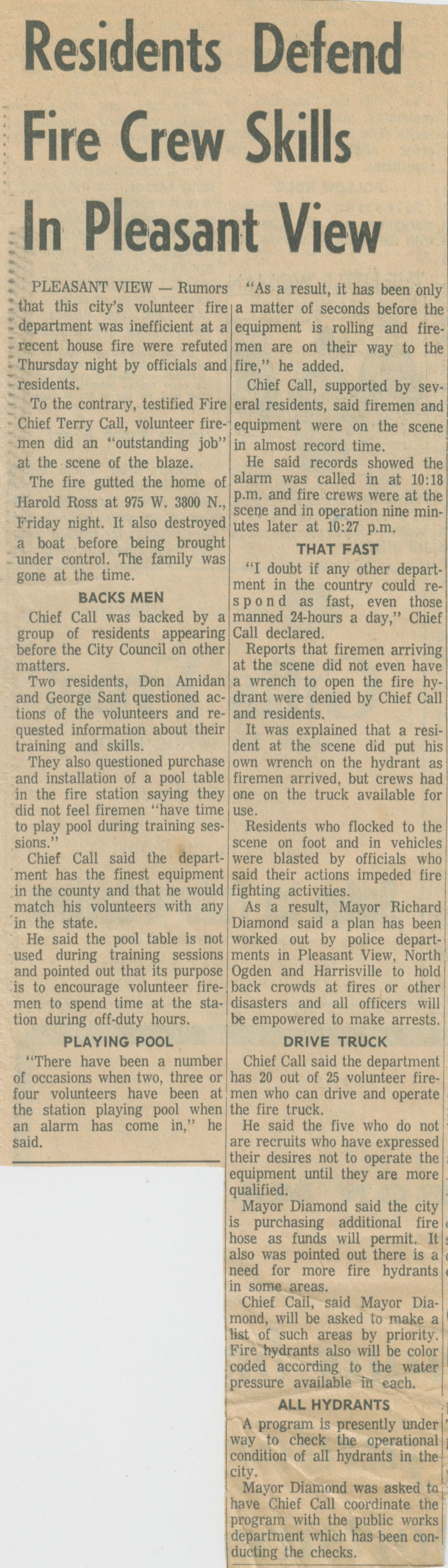
Residents Defend Fire Crew Skills In Pleasant View

PLEASANT VIEW – Rumors that this city’s volunteer fire department was inefficient at a recent house fire were refuted Thursday night by officials and residents.

To the contrary, testified Fire Chief Terry Call, volunteer firemen did an “outstanding job” at the scene of the blaze.

The fire gutted the home of Harold Ross at 975 W. 3800 N., Friday night. It also destroyed a boat before being brought under control. The family was gone at the time.

BACKS MEN

Chief Call was backed by a group of residents appearing before the City Council on other matters.

Two residents, Don Amidan and George Sant questioned actions of the volunteers and requested information about their training and skills.

They also questioned purchase and installation of a pool table in the fire station saying they did not feel firemen “have time to play pool during training sessions.”

Chief Call said the department has the finest equipment in the county and that he would match his volunteers with any in the state.

He said the pool table is not used during training sessions and pointed out that its purpose is to encourage volunteer firemen to spend time at the station during off-duty hours.

PLAYING POOL

“There have been a number of occasions when two, three or four volunteers have been at the station playing pool when an alarm has come in,” he said.

“As a result, it has been only a matter of seconds before the equipment is rolling and firemen are on their way to the fire,” he added.

Chief Call, supported by several residents, said firemen and equipment were on the scene in almost record time.

He said records showed the alarm was called in at 10:18 p.m. and fire crews were at the scene and in operation nine minutes later at 10:27 p.m.

THAT FAST

“I doubt if any other department in the country could respond as fast, even those manned 24-hours a day,” Chief Call declared.

Reports that firemen arriving at the scene did not even have a wrench to open the fire hydrant were denied by Chief Call and residents.

It was explained that a resident at the scene did put his own wrench on the hydrant as firemen arrived, but crews had one on the truck available for use.

Residents who flocked to the scene on foot and in vehicles were blasted by officials who said their actions impeded fire fighting activities.

As a result, Mayor Richard Diamond said a plan has been worked out by police departments in Pleasant View, North Ogden and Harrisville to hold back crowds at fires or other disasters and all officers will be empowered to make arrests.

DRIVE TRUCK

Chief Call said the department has 20 out of 25 volunteer firemen who can drive and operate the fire truck.

He said the five who do not are recruits who have expressed their desires not to operate the equipment until they are more qualified.

Mayor Diamond said the city is purchasing additional fire hose as funds will permit. It also was pointed out there is a need for more fire hydrants in some areas.

Chief Call, said Mayor Diamond, will be asked to make a list of such areas by priority. Fire hydrants also will be color coded according to the water pressure available in each.

ALL HYDRANTS

A program is presently under way to check the operational condition of all hydrants in the city.

Mayor Diamond was asked to have Chief Call coordinate the program with the public works department which has been conducting the checks.

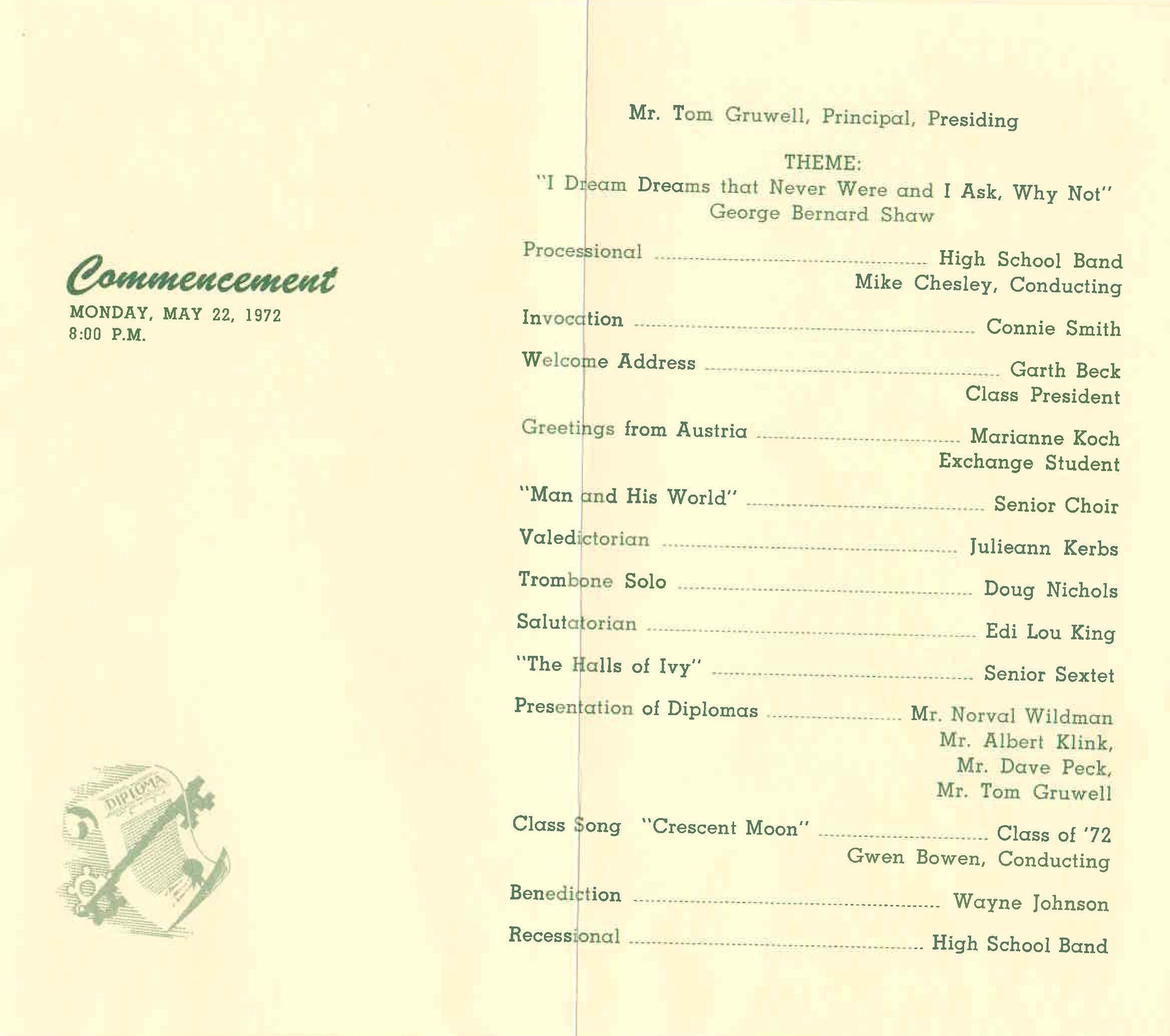
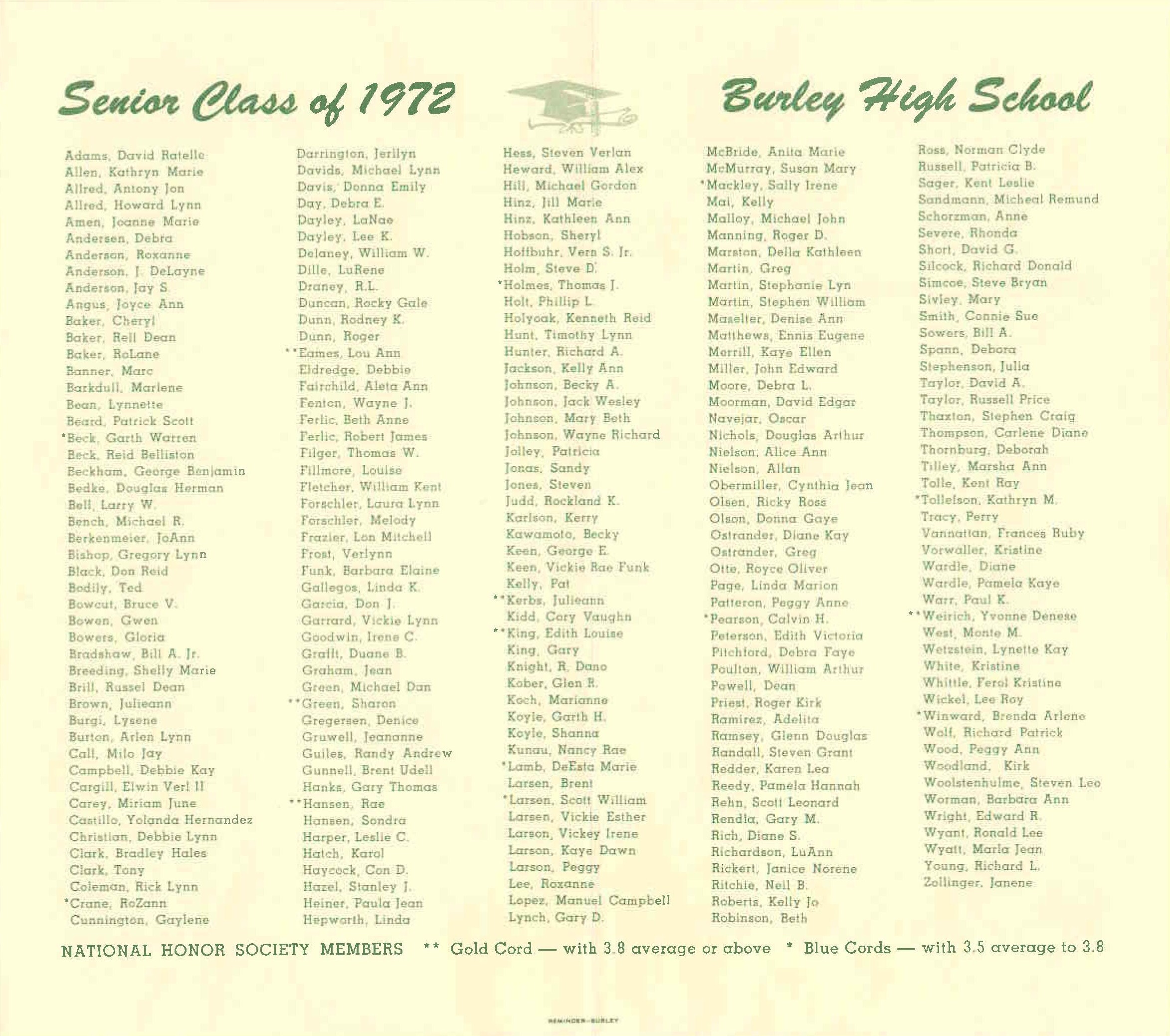
1972 Burley High School Commencement

I was trying to find some photos and stumbled upon my Mom’s graduation pamphlet I had scanned a few years ago. Thought maybe it was time to share it, especially where I have seen some of her classmates have passed away recently.

1972 Baccalaureate and Commencement – Burley High School – Burley Idaho

These programs courtesy of the following Public Spirited Business Concerns

Amalgamated Sugar Co.

Burley Processing Co.

Burley Reminder

Cassia National Bank

First Federal Savings & Loan Assn., Burley Branch

First Security Bank

Guys ‘N Dolls

Idaho Bank & Trust Co.

Idaho First National Bank Burley Office

McCaslins

Ponderosa Inn

J. R. Simplot Food Processing Division

South Idaho Press

Class Officers

President Garth Beck

Vice President Bud Hoffbuhr

Secretary Jill Hinz

Executives Peggy Wood, Peggy Larson, Kaye Dawn Larson, Jeananne Gruwell, Jean Graham

Class Adviser Mr. David Peck

Baccalaureate Sunday, May 21, 1972 2:30 P.M.

Mr. Tom Gruwell , Principal, Presiding

Processional High School Band Mike Chesley, Conducting

Welcome Garth Beck Class President

Invocation Bud Hoffbuhr

Special Number Bel Canto Choir Elden Wood, Conducting “Battle Hymn of the Republic”

Address Dr. Walter R. Peterson

Cherubim Song Senior Octet

Benediction Calvin Pearson

Recessional High School Band

Commencement Monday, May 22, 1972 8:00 P.M.

Mr. Tom Gruwell, Principal, Presiding

THEME: “I Dream Dreams that Never Were and I Ask, Why Not” – George Bernard Shaw

Processional – High School Band – Mike Chesley, Conducting

Invocation – Connie Smith

Welcome Address – Garth Beck, Class President

Greetings from Austria – Marianne Koch – Exchange Student

“Man and His World” – Senior Choir

Valedictorian – Julieann Kerbs

Trombone Solo – Doug Nichols

Salutatorian – Edi Lou King

“The Halls of Ivy” – Senior Sextet

Presentation of Diplomas – Mr. Norval Wildman, Mr. Albert Klink, Mr. Dave Peck, Mr. Tom Gruwell

Class Song “Crescent Moon” – Class of ’72 – Gwen Bowen, Conducting

Benediction – Wayne Johnson

Recessional – High School Band

Adams, David Ratelle

Allen, Kathryn Marie

Allred, Anthony Jon

Allred, Howard Lynn

Amen, Joanne Marie

Andersen, Debra

Anderson, Roxanne

Anderson, Jerald DeLayne (1954 – 2017)

Anderson, Jay S

Anderson, Todd Michael (1953 – 1972)

Angus, Joyce Ann

Baker, Cheryl

Baker, Rell Dean

Banner, Marc

Barkdull, Marlene

Bewan, Lynnette

Beard, Patrick Scott

* Beck, Garth Warren (1953 – 2002)

Beck, Reid Belliston

Beckham, George Benjamin

Bedke, Douglas Herman

Bell, Larry W

Bench, Michael R

Berkenmeier, JoAnn

Bishop, Gregory Lynn

Black, Don Reid

Bodily, Ted O (1954 – 2019)

Bowcut, Bruce V

Bowen, Gwen

Bowers, Gloria

Bradshaw, Bill A Jr

Breeding, SHelly Marie

Briggs, Larry

Brill, Russel Dean

Brown, Julieann

Burgi, Lysene (1953 – 2016)

Burton, Arlen Lynn (1954 – 2014)

Call, Milo Jay

Campbell, Debra “Debbie” Kay (1954 – 2019) Johnson

Cargill, Elwin Verl II

Carey, Mirian June

Castillo, Yolanda Hernandez

Christian, Debbie Lynn

Clark, Bradley Hales

Clark, Antone “Tony” Lee (1954 -2015)

Coleman, Rick Lynn

* Crane, RoZann

Cunnington, Gaylene

Darrington, Jerilyn

Davids, Michael Lynn (1953 – 2020)

Davis, Donna Emily

Day, Debra E

Dayley, LaNae

Dayley, Lee K

Delaney, William W

Dille, LuRene

Draney, Rex Leonard (1953 – 2007)

Duncan, Rocky Gale (1954 – 2020)

Dunn, Rodney K

Dunn, Roger

** Eames, Lou Ann

Eldredge, Debbie

Farwell, Albert Michael (1952 – 2023)

Fairchild, Aleta Ann

Fenton, Wayne J

Ferlic, Beth Anne

Ferlic, Robert James

Filger, Thomas W

Fillmore, Louise

Fletcher, William Kent

Forschler, Laura Lynn

Forschler, Melody

Frazier, Lon Mitchell

Frost, Verlynn

Funk, Barbara Elaine

Gallegos, Linda K

Garcia, Don J

Garrard, Vickie Lynn

Goodwin, Irene Cecilia

Goold, Gary

Graf, Becky Ann (1954 – 2011) Moats, Kloer

Grafft, Duane Brian (1953 – 2006)

Graham, Jean

Green, Michael Dan

** Green, Sharon

Gregersen, Denice

Gruwell, Jeananne

Guiles, Randy Andrew (1953 – 2015)

Gunnell, Brent Udell

Hanks, Gary Thomas

** Hansen, Rae

Hansen, Sondra

Harper, Leslie C

Hatch, Karol (1953 – 2004) Kerr

Haycock, Con D

Hazel, Stanley Jarvis (1953 – 2008)

Heiner, Paula Jean

Hepworth, Linda

Hess, Steven Lerlan

Heward, William Alex

Hill, Michael Gordon

Hinz, Jill Marie

Hinz, Kathleen Ann

Hobson, Sheryl

Hoffbuhr, Vernard “Bud” Standley Jr (1954 – 1997)

Holm, Steve D

* Holmes, Thomas J

Holt, Phillip L

Holyoak, Kenneth Reid

Hunt, Timothy Lynn

Hunter, Richard A

Jackson, Kelly Ann

Johnson, Becky A

Johnson, Jack Wesley

Johnson, Mary Beth

Johnson, Wayne Richard (1953 – 2008)

Jolley, Patricia

Jonas, Sandy (1954 – alive)

Jones, Steven

Judd, Rockland K (1953 – 2012)

Karlson, Kerry

Kawamoto, Becky

Keen, George E

Keen, Vickie Rae Funk

Kelly, Pat

** Kerbs, Julieann

Kidd, Cory Vaughn

** King, Edith Louise

King, Gary

Knight, Robin Daniel (1953 – 2014)

Kober, Glen R

Koch, Marianne

Koyle, Garth H

Koyle, Shanna

Kunau, Nancy Rae

* Lamb, DeEsta Marie

Larsen, Brent

* Larsen, Scott William

Larsen, Vickie Esther

Larson, Vickey Irene

Larson, Kaye Dawn (1954 – 2019) Silcock

Larson, Peggy (1954 – 2016) Stirland

Lee, Roxanne

Lopez, Manuel Campbell

Loveland, Cynthia (1954 – 1981)

Loveland, Kevin R (1954 – 2008)

Lynch, Gary D

McBride, Anita Marie

McMurray, Susan Mary

* Mackley, Sally Irene

Mai, Kelly

Malloy, Michael John

Manning, Roger D

Marston, Della Kathleen

Martin, Gregory Max (1954 – 1975)

Martin, Stephanie Lyn

Martin, Stephen William

Maselter, Denise Ann (1954 – 2022) Rollins

Matthews, Ennis Eugene

Merrill, Kaye Ellen

Miller, John Edward

Moore, Debra Lynn (1954 – 2002)

Moorman, David Edgar (1953 – 1997)

Navejar, Oscar

Newcomb, Kathy Lorene (1954 – 2020) Bailey

Nichols, Doulgas Arthur

Nielson, Alice Ann

Nielson, Allan (1954 – 2020)

Obermiller, Cynthia Jean

Olsen, Ricky Ross

Olson, Donna Gaye

Ostrander, Diane Kay

Ostrander, Greg

Osterhout, Rex Dale (1954 – 2017)

Otte, Royce Oliver

Page, Linda Marion

Patteron, Peggy Ann

* Pearson, Calvin H

Peterson, Edith Victoria

Pitchford, Debra Faye

Poulton, William Arthur

Powell, Leslie Dean (1953 – 2005)

Priest, Roger Kirk

Ramirez, Adelita

Ramsey, Glenn Douglas

Randall, Steven Grant

Redder, Karen Lea

Reedy, Pamela Hannah

Rehn, Scott Leonard (1954 – 1994)

Rendla, Gary M

Rich, Diane S

Richardson, LuAnn

Rickert, Janice Norene

Ritchie, Neil B

Roberts, Kelly Jo

Robinson, Beth

Ross, Norman Clyde

Russell, Patricia B

Sager, Kent Leslie

Sandmann, Michael Remund

Schorzman, Anne

Severe, Rhonda

Short, David G

Silcock, Richard Donald

Simcoe, Steve Bryan

Sivley, Mary

Smith, Connie Sue

Sowers, Bill A

Spann, Debora

Stephenson, Julia

Taylor, David A (1953 – 2009)

Taylor, Russell Price (? – alive)

Thaxton, Stephen Craig

Thompson, Carlene Diane

Thornburg, Deborah

Telley, Marsha Ann

Tolle, Kent Ray

* Tollefson, Kathryn M

Tracy, Perry Alan (1953 – 2005)

Vannatian, Frances Ruby

Vorwaller, Kristine

Wardle, Diane

Wardle, Pamela Kaye

Warr, Dee Ann (1954 – 2013)

Warr, Paul K

** Weirich, Yvonne Denese

West, Monte M

Wetzstein, Lynette Kay

White, Kristine

Whittle, Ferol Kristine

Wickel, Lee Roy

* Winward, Brenda Arlene

Wolf, Richard Patrick

Wood, Peggy Ann

Woodland, Kirk

Woolstenhulme, Steven Leo

Worman, Barbara Ann

Wright, Edward R

Wyant, Ronald Lee

Wyatt, Marla Jean

Young, Richard LeRoy (1953 – 2022)

Zollinger Janene

National Honor Society Members

** Gold Cord – with 3.8 average or above

* Blue Cords – with 3.5 average to 3.8

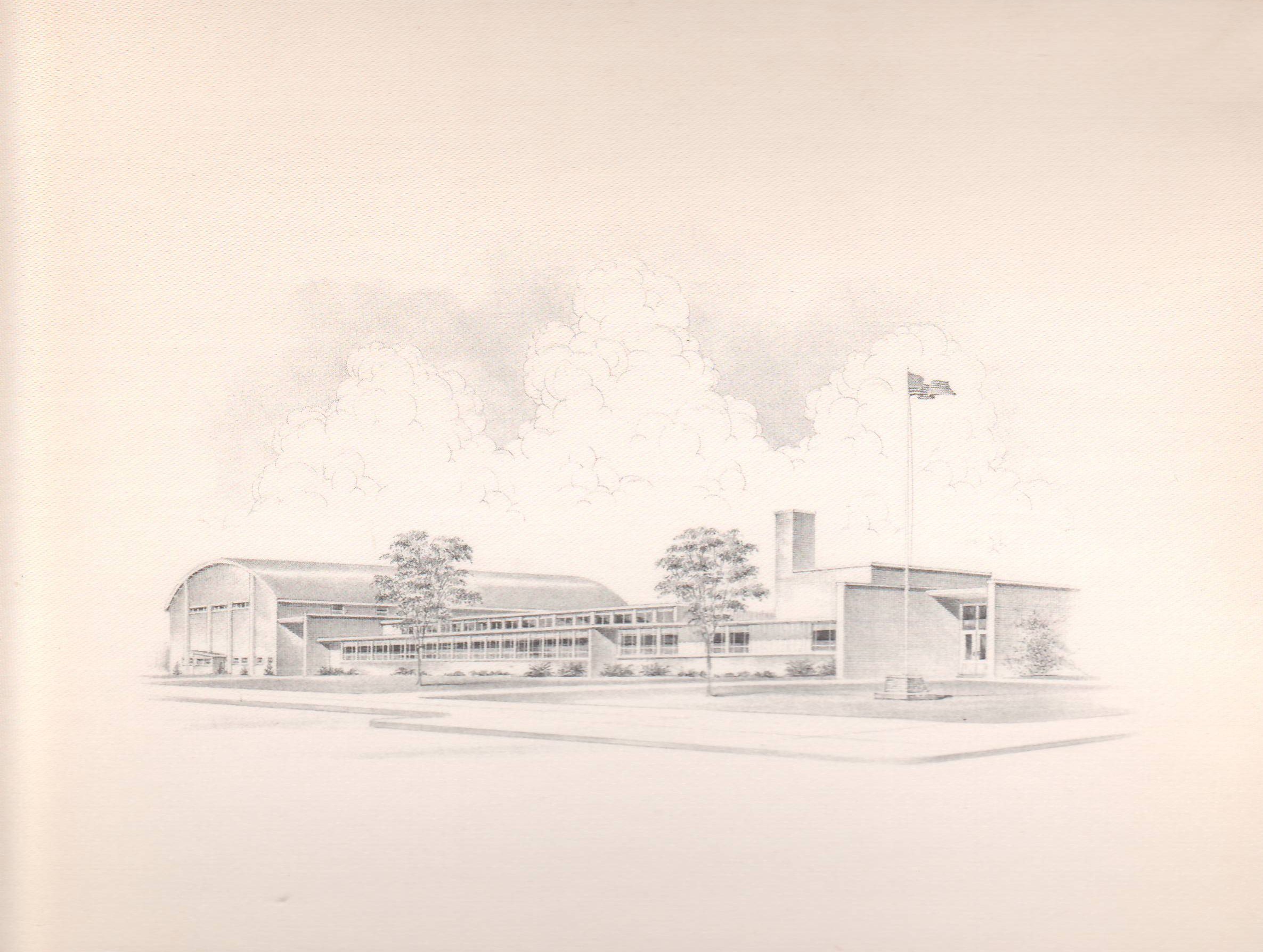
The sketch of the Burley High School on the front of the Diploma case.

Sandy Jonas Burley High School Diploma

Mom’s actual Diploma.

Burley High School – Burley, Idaho

This Certifies That Sandy Jonas has satisfactorily completed a Course of Study prescribed for Graduation from this School and is therefore awarded this Diploma.

Given in the month of May, nineteen hundred and seventy-two

Tom Gruwell – Principal

Harold W Blauer – Superintendent

W B Whiteley – Chairman Board of Education

Here is a copy of Mom’s Senior picture – 1972

Plain City Stake Center Dedicatory Service

In Grandpa and Grandma’s possessions were two pamphlets from the 1979 and 1954 dedications of the church buildings in Plain City, Utah. Here is the 1979. Grandpa helped work on this building. He also helped extensively on the 1954 building. As I previously wrote, Grandpa also had a hand in obtaining the land for the construction of the 2, 7, and 8 Ward building. I will share the 1954 pamphlet at a later date.

Dedicatory Program for Plain City Stake Center 20 September 1979

Dedicatory Service

Plain City Utah Stake Center and Plain City Third & Fourth Wards

The Church of Jesus Christ of Latter-day Saints

2120 North 4575 West

September 30, 1979

2:00 PM

Dedicated under the direction of Bernard P. Brockbank

Member – First Quorum of Seventy

Stake Presidencies

Plain City Utah Stake

Samuel S Lower – 1st Counselor

President Kent W Calvert

R. Alton Griffin – 2nd Counselor

Ogden Utah Farr West Stake

Robert E Jennings – 1st Counselor

President H Orvil Holley

Shirl K Fadel – 2nd Counselor

Bishoprics in Plain City Utah Stake

Plain City Third Ward

Robert Ewer – 2nd Counselor

Bishop Layne S Thompson

Dennis Carlson – 1st Counselor

Plain City Fourth Ward

Ronald L Larsen – 2nd Counselor

Bishop Harold O Hadley

Theodore G Balderree – 1st Counselor

Farr West First Ward

E Robert Rauzi – 1st Counselor

Bishop Dale John Chugg

Sheldon W Taylor – 2nd Counselor

Farr West Second Ward

Val Stratford – 1st Counselor

Bishop Harvey W Higley

Paul W Bryner – 2nd Counselor

Plain City First Ward

Alvin G Foremaster – 1st Counselor

Bishop Darwin J Taylor

Gary L Thompson – 2nd Counselor

Plain City Second Ward

Ronald H Olsen – 1st Counselor

Bishop Robert L Sharp

William A Van Hulten – 2nd Counselor

Program

Organ Prelude – Marjorie Westergard

Prayer Hymn “Abide With Me” Dedicatory Choir Donna Vause Conducting, Marjore Westergard, Organist

Welcome and Acknowledgements – President Kent W Calvert

Hymn “The Spirit of God Like a Fire is Burning” Choir and Congregation

Invocation – President J Raymond Johnson

Hymn “Oh How Lovely Was the Morning” (Jesus Lover of My Soul)

Multi-Media Presentation – Ward Conference Committee, Carl R Saunders, Rober Ewer, Harold Westergard, Photographer and Sound Technician Larry Hansen

Remarks – President H Orvil Holley

Remarks – President Kent W Calvert

Hymn “Song of Dedication”

Address and Dedicator Prayer – Bernard P Brockbank

Closing Hymn “Come Come Ye Saints” arr. by J Spencer Cornwall

Benediction – President Wayne Cottle

Organ Postlude – Marjorie Westergard

FLowers – McEntire’s Bachelor Bouquets

Historical Contributions – Plain City, Lyman Cook, Farr West, Helena Watson

Ushers – High Council & Assistants

Carl R Saunders, Boyd B Call, Ronald W Jenkins, F Leroy Williams, Owen C Garlick, R Kent Jenkins, Gary L Jackson, Steven F Smith, Dennis W Moss, Alan Yorganson, Rodney A Roper, Alan S Hadley, E Lionel Brady, Don H Wade, Robert A Ewer, Carl C White, Harold A Westergard, Ross C Moore, Duane Bullock, Scott K Jenkins, Sterling Mayhew, Lloyd Beutler

Stake Patriarch – Charles A Groberg

Dedicatory Program for Plain City Stake Center 20 September 1979

History of the Church in Plain City

A history of the Church in Plain City is and was directly related to the restoration of the Gospel in this dispensation and the organization of the Church in 1830. The conversion to Mormonism of many of the eventual settlers of Plain City and their testimonies of the truthfulness of this knowledge enabled the early saints to endure the physical hardships and the migration of modern Israel into the Salt Lake Valley.

A group of early saints, numbering about one hundred people, of neighbors, friends, and converts from Lehi, Utah, who found the water there had already been claimed, came north to Plain City on March 17, 1859 to make their new home, Their first homes were dugouts in the hill with a grass and dirt roof, and a dirt floor. Many of these dug-outs were used for meetings. Meetings were held outdoors and in a large tent.

One July 24, 1859, a dance was held on the barrens, near the dump to celebrate the saints arrival into the Salt Lake Valley. The music was furnished by a comb band, and many danced barefoot.

The first church and school was built in 1859 of adobe which was eighteen by twenty-four feet, and located on the south side of the square. In 1863 a twelve by eighteen foot split log addition was added. It was shingled at this time. A bowery of willows was constructed near the meeting house to be used in the summer. In 1874 a new building was built of adobe on the northeast corner of the square. In 1889 a brick chapel was dedicated which was across the street from the south side of the square. A kitchen, recreation all, upstairs, and classrooms were added in 1914. This building was born down in 1953. 1953-54 the present three-ward chapel was built and dedicated. This same building was remodeled and additions added. The dedication of the new remodeled building was February 14, 1971. 1978-79 the new Plain City Stake Center on 2125 North was built and dedicated September 30, 1979.

1859-1877 Plaint City was a branch with four different Presiding Elders. 1877-1960 Plain City was one ward with 12 different Bishops. 1960 the Plain City II Ward was created. 1974 the Plain City III Ward was created. 1977 the Plain City Stake was created. July 1979 the Plain City IV and V Wards were created.

History of Farr West Wards

On November 30, 1890, Harrisville and West Harrisville were divided and the west section was named Farr West. This name was selected to honor Lorin Farr, the first mayor of Ogden and former president of the Weber Stake, and Chauncy W West who prior to 1870 was presiding bishop of Weber County.

William Andrew Taylor Sr was chosen as the first bishop of the Farr West Ward (1890-1892), followed by William F McEntire (1892-1897), James Martin Sr (1898-1909), Moroni Chugg (1909-1928), Lorenzo Taylor (1928-1938), Almon D Brown (1959-1964), Brian L Taylor (1964-1971), Owen C Garlick (1971-1977). In 1972 the Farr West Ward was divided into Farr West First and Farr West Second Wards. Owen C Garlick remained bishop of Farr West First Ward and Jay A Davis became first bishop of the Farr West Second Ward (1972-1975), followed by Harold A Westergard (1975-1978), and Harvey W Higley (1978-present). Dale J Chugg followed Bishop Garlick as bishop of Farr West First (1977-present).

In 1873 the first building for church and school was built across from the present chapel. It was used until 1880 when the Ward Hall was built at the cost of $1,500. In 1926 the present chapel was dedicated by President Heber J Grant. This building cost $19,700. In 1958 an additional was built costing $142,000 and was dedicated by Richard L Evans.

In 1945 the Farr West Ward purchased 10 1/4 acres of land. This became the first welfare farm in the Farr West Stake.

The ward population listed for 1900 was 231; in 1931, 325; 1960, 577; in 1979, about 471 for Farr West First and about 670 for Farr West Second.

The Far West Wards have been in four different stakes; namely, Weber, North Weber, Farr West, and now Plain City.

Dedicatory Program for Plain City Stake Center 20 September 1979

“And that thou mayest more fully keep thyself unspotted from the world, thou shalt go to the house of prayer and offer up thy sacraments upon my holy day” D&C 59:9

Sterling R Lyon – Architect

John L Wadman – General Contractor

Dedicatory Program for Plain City Stake Center 20 September 1979

Logan, Utah

Logan Tabernacle July 2020

The morning of 26 July 2020 I awoke at a motel in Logan, Utah, with my four children. We were on the last day of a trip where Amanda had the weekend to pamper herself. Since we were in Logan, I took the kids around to some of the sites that were important to me. I am not including any of the graveyard pictures that I have shared earlier in visiting the resting sites of family members. This was the same trip we stopped to visit the Paris Tabernacle.

Hiram, Aliza, Lillian, and James Ross on the steps of the Logan Tabernacle in July 2020

The Logan Tabernacle is where I attended Stake Conference for all the years I attended Utah State University. I graduated from Logan Institute of Religion in this building. I recall Dad pointing out that my hair was getting thin from his vantage point on the balcony. I was sustained in this building and spoke at a Stake Conference. I sat at the feet and heard the teachings of H. David Burton and Vaughn J. Featherstone, as well as our own Stake Presidency, Thomas Cherrington, James Jenkins, and Roger McEvoy. I still remember some of their talks. I recall entertaining visiting British guests, like the Byroms and Gores, in this building. Moreover, this building had historical significance to the area and my own ancestors in the valley. In those years, I had numerous councilors, including David Ackerman, Tyler Buswell, David Moss, Jon Phillips, and Guy Schauerhamer. Secretaries were the amazing Kalynne Call (now Jensen) and Jessica Pollard (now Westerberg).

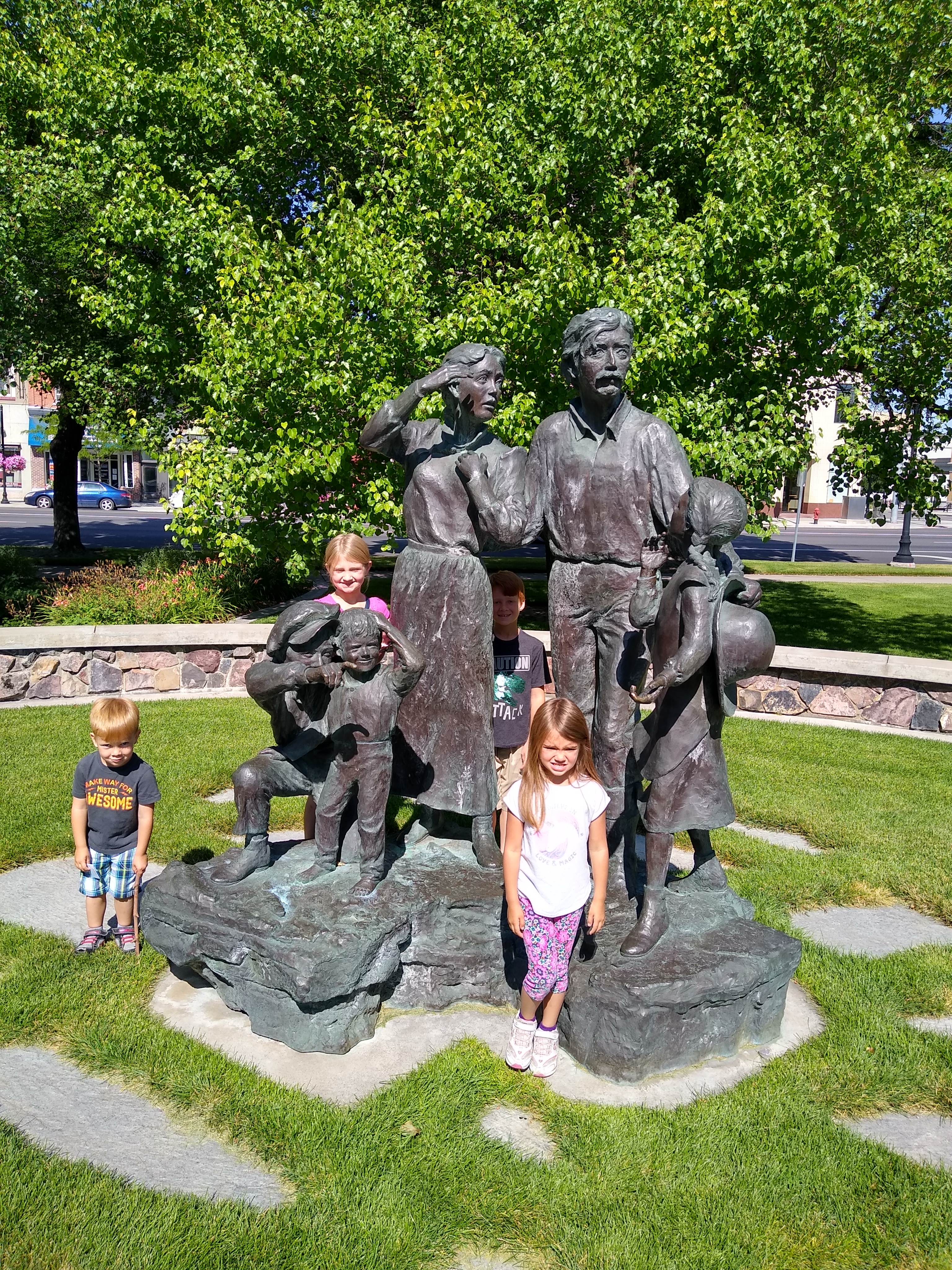
“Family and the Covenant” sculpture at Logan Tabernacle with James, Aliza, Hiram, and Lillian Ross in July 2020

Of course we had to stop at Dentist Office. 655 Darwin Avenue #6, Logan, Utah 84321, was my apartment for several years. That upper right room window was above my bed for those years. I shared a photo of it from 2012 previously. I also listed some of the poor unfortunate souls who also had to reside in close proximity to me!

Hiram, Aliza, Lillie, and James Ross in front of the Dentist Office on Darwin Avenue.

The next stop included the Logan Institute of Religion. This building is harder to capture in a picture with all the new apartment complexes so near the front of it. What was known then as the oldest and largest Institute of The Church of Jesus Christ of Latter-day Saints. I don’t know if that still holds true. I attended the Institute before my mission and when my Mom disowned me, I knuckled down and took a dozen or so Institute credits. I can attribute much of my religious underpinnings and knowledge to this time. Some of the teachers that profoundly touched me included John Fowles, Rhett James, and Michael Cooley. After the mission, various teachers, including Gene Van Shaar (who I also knew in Springfield, Missouri at what was then Southwest Missouri State University).

Aliza and Hiram Ross at Logan LDS Institute

Of course we had to make a stop at the David B. Haight Alumni House. The history of this location I have shared before. Suffice it to say, I kissed my future wife for the first time here and also asked her to marry me in this same spot. The large painting of David B. Haight is no longer hanging in the lobby inside these doors.

Hiram, Lillian, James, and Aliza Ross at David B. Haight Alumni House in July 2020

Having jumped from the Dentist Office, to the Institute, to the Alumni House, it was obviously easy to jump to Old Main. On the walk over, I snapped this picture of the Logan Temple. Since it was Sunday, we couldn’t get inside the fence so we just drove by it.

Logan Temple in July 2020

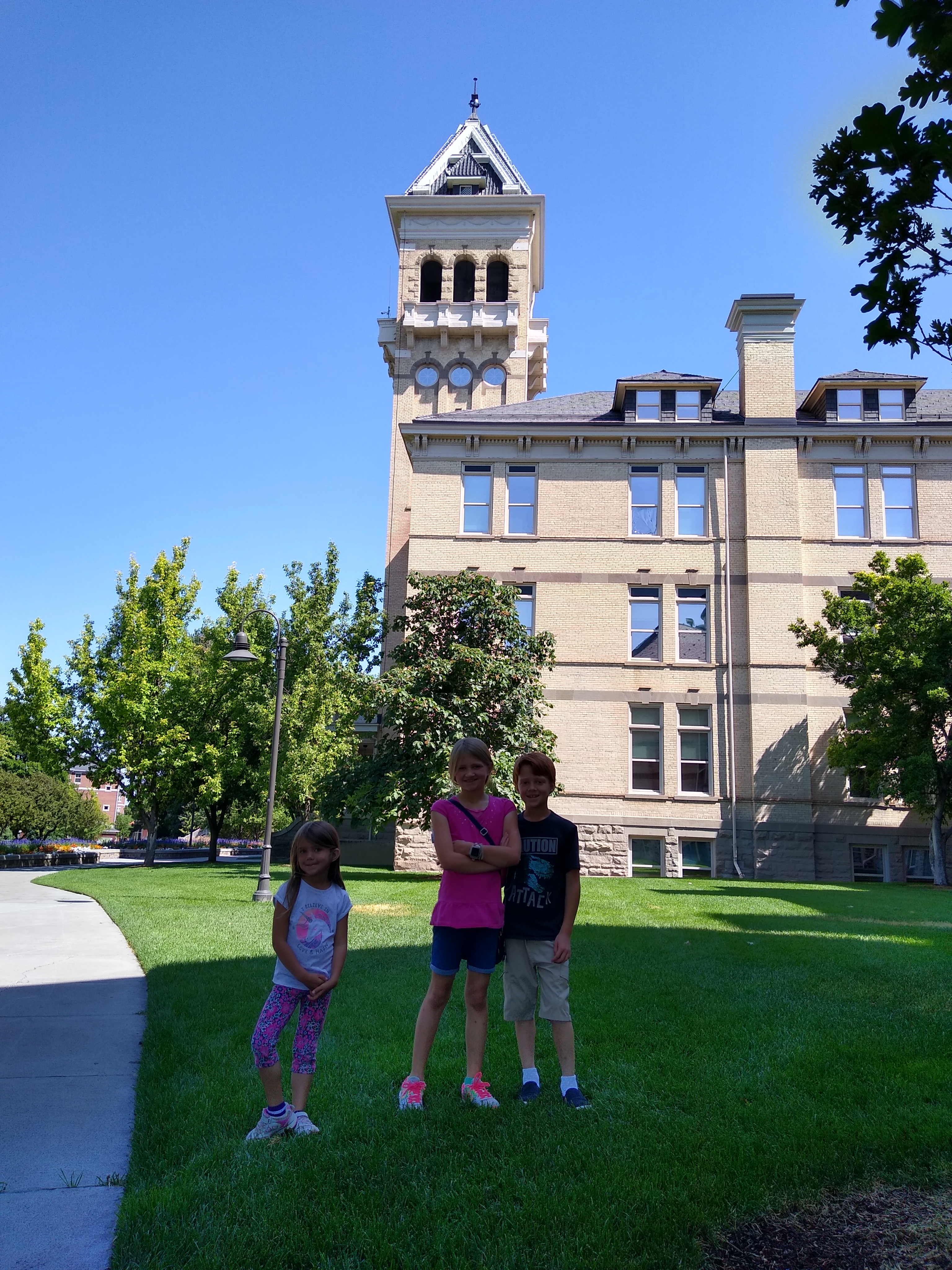
Old Main was the home of my college, then the College of Humanities, Arts, and Social Sciences (HASS). I attended most of my major classes in this building. I knew this building like the back of my hand.

Lillian, Aliza, and Hiram Ross at Old Main of Utah State University in July 2020

I have stood in that tower overlooking the valley a number of times, usually a locked door confines you to the round windows. I have shared some historical photos of the building.

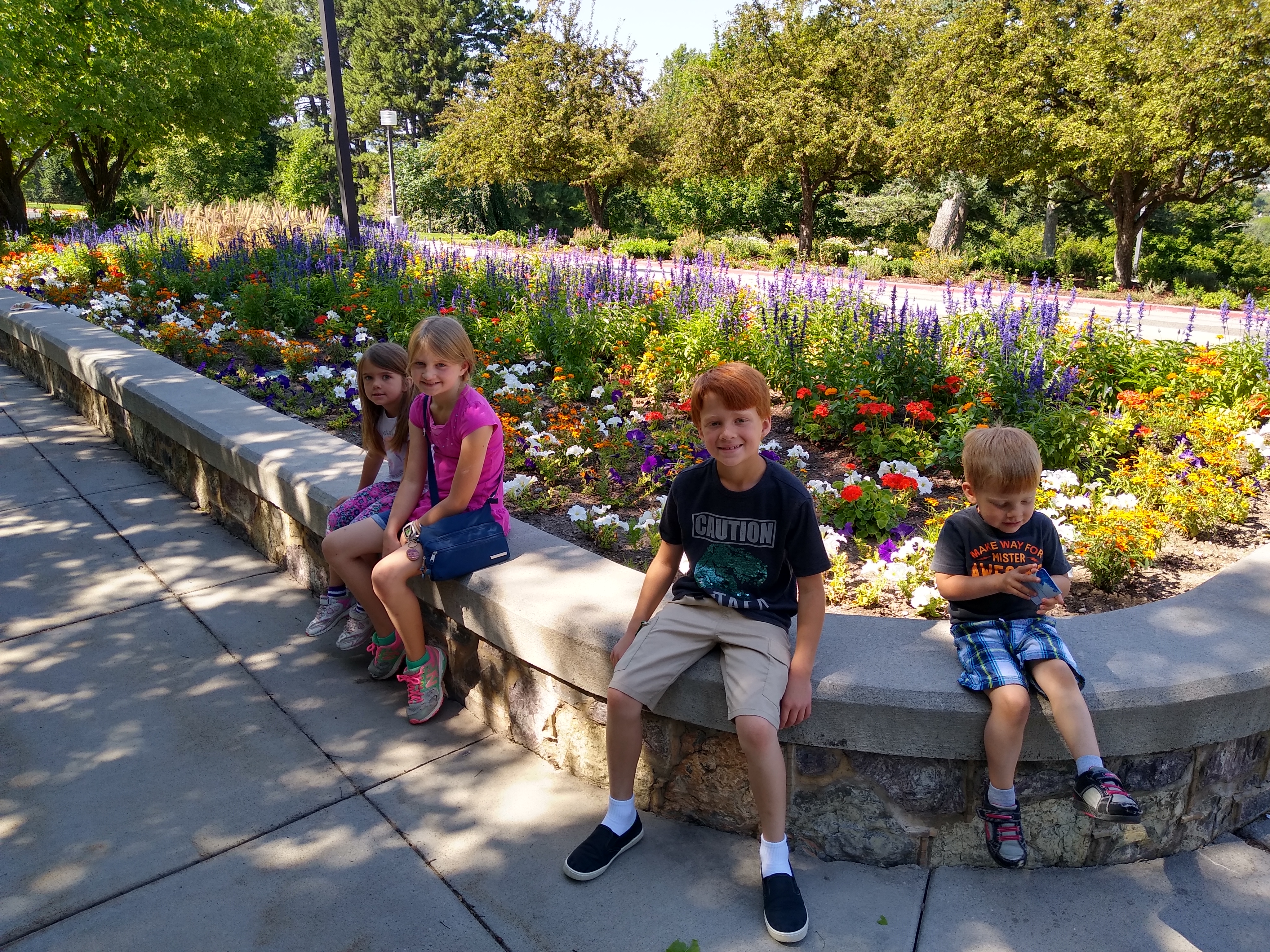
Lillie, Aliza, Hiram, and James Ross at the flower beds in front of Old Main.

I have also shared how my own family contributed to the building of this iconic building.

Lillie, Aliza, Hiram, and James Ross on west steps of south Old Main in July 2020

The photo above is interesting due to the silly children, but also the red sandstone that came from the Nuffer Quarry near Mapleton, Idaho. Both the pillar and stones in and under the brick. Of course, a visit to Old Main Hill for a child would not be complete without rolling down the hill. I also noticed how many of the old huge trees have now left the hill.

Old Main Hill in July 2020

The trip to Logan was memorable for the kids and I recalled many memories from my time attending. Maybe Amanda can attend at a future time. Logan holds fondness and great memories for me. Now we have some more.

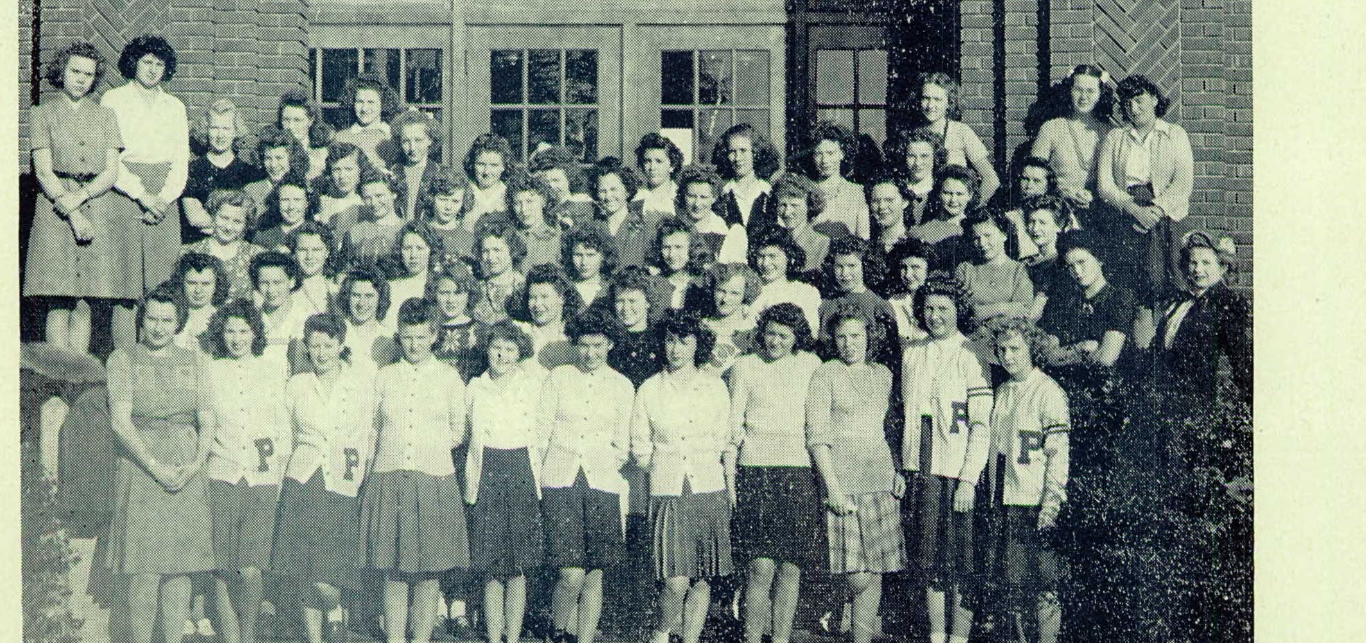
Preston High School Girls Athletic Association – 1945

Preston Girls Athletic Association from 1945 Yearbook

Looking through the Preston High School yearbook for 1945, I found my Grandmother, Colleen Mary Andra. The rest of the photos in the book are unnamed as to the individuals. As I looked through, I found this photo with her on the farthest right of the photo in the black.

Here is the writing on the same page related to the photo.

“The Girls’ Athletic Association is a club sponsoring a more active interest in athletics. During the past year the club has sponsored a softbal tournament and a game tournament. In the G.A.A. there are now more than eighty-seven paid up members, fourteen who have earned their letters. The faculty advisor is Mrs. June Larsen. The president is Carol Greaves.

I believe the June Larsen mentioned is June Call Larson (1919-1995). I cannot tell if she is in the picture.

Also mentioned is Carol Greaves, who I believe married Wayne Brown and still lives in Preston.

Colleen Mary Andra (1928 – 1999)

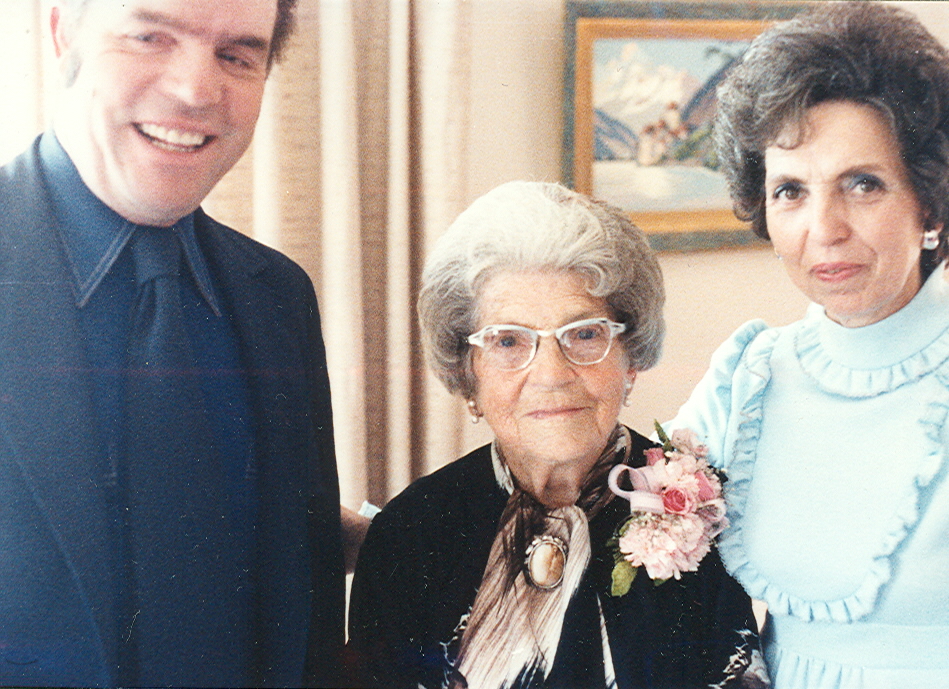
History of Wilhelmina Wanner Bodrero

Another history given to me from the collection of Golden Rulon Andra. “History of Wilhelmina Wanner Bodrero” with the subheading “Our Mother” by Laura Bodrero Nungesser.

LaMont Call, Wilhelmina Wanner Bodrero, Barbara Bodrero Call

“Our mother, Wilhelmina Wanner Bodrero, was born in the last summer of 1887 on September 12th in Atzenweiler Neckarkreis Wuerttemberg, Germany.

“Wilhelmina is a daughter of Johann George Wanner and Anna Maria Schmid. Mother was the tenth child of the ten children born to the family of five boys and five girls.

Wanner Family about 1895, Wilhelmina is the youngest.

“A small baby, mother was told that during her first year of life she was continually sick. A neighbor lady also had a little girl about the same age as mother. Her baby was always healthy. Each day the neighbor lady would come to see how mother was doing and each visit she would tell mother Wanner that her baby would never live. But sadly, the neighbor’s child died when she was about a year old, while at this time mother is still well and healthy at the young age of ninety-five.

“It is difficult for mother to remember her life in Germany because she was very young, but she remembers what her mother has told her. Mother’s father was a road supervisor and owned a little land. He also acquired a few chickens and some cattle in which the whole family had to tend to. Their life in Germany was very hard, and they were also poor.

“Mother was nearly four years of age when the missionaries came to their small home in Germany one day. it was not too long after being taught by the missionaries that the family, grasping the truthfulness of the gospel, became converted. Her brother, George, was the first to be baptized and soon after came to America with two missionaries. Nearly two years later the rest of the family was able to come to America. Mother was baptized in America August 1896.

“Mother remembers the journey to America. The first experience was riding for some time on an open train, then boarding a small boat. This small boat transported their family and whatever few possessions they held with them to a large ship, accommodating a very large deck. During the long watery voyage, mother and a young brother, Gottlob, would play on the huge deck and one day they found big, heavy barrels filled with juicy cherries. These were the first cherries she remembers eating.

“Mother was told that the journey on the ship lasted two weeks before the shores of New York finally brimmed the horizon. They stayed in New York City two days and nights before boarding a train for Chicago. When they arrived in Chicago, they lodged for a day and night, then journeyed by train westward until they reached the small f arming community of Franklin, Idaho. It was at this place, the final end of their migration, where mother’s brother George, along with horse and buggy, met them at the train stop. Accompanied by George’s employer, Fred Nuffer, they loaded into the wagon and drove off toward the Idaho community known as Glendale. Since George knew a lot of people such as the Nuffer family in Glendale, they too decided to establish their residency there.

“Within a short time they were able to purchase a little land with a small rock home. The rock home had one large room. Adjoining the house was a root cellar with a floor on top of it. This is where the children slept under the roof made of dirt. The large room in the rock home served as living quarters for the family and also as a bedroom for mother and father Wanner. Mother’s brother George worked in the rock quarry and as time went on, he helped his father add two more rooms to the rock house. This was a welcomed addition indeed!

“As the youngest child in the family, mother had a lot of time to play for the first two or three years in Glendale. Gradually, though, she had to start helping more around the house and farm. Father Wanner would cut and rack the hay and afterwards mother would follow the wagon and gather up the hay that the rack hadn’t caught.

“Mother attended school in a one room school house in Glendale. As with many schools in the early 1900’s, children of many ages met together and were taught by one teacher. Very little individual help was given. Every day mother would walk to and from school. At times in the winter, her father would take her to school by horse and buggy. Mother and her family also attended school in Glendale.

“For a couple of years, mother helped her father trap squirrels. In the mornings, her father would set ten to twelve traps in the brush bordering the fields. The government, upon seeing the ears for proof, would pay so much per pelt. One year they made $14.00.

“Life was hard on the farm. They had no refridgerator so a small addition to the rock home was built for the purpose of keeping things as cool as possible. Water was packed from the spring nearby in every season. The milk was also carried into the house and poured into large pans. While other chores were attended to the milk would set and later the cream skimmed off and churned into butter. The butter and the eggs gathered from the hens, were taken tot he market store in Preston and exchanged for other food. Later, mother Wanner bought a separator to separate the milk and cream. The separator had to be turned by hand everytime the milking was done. It was mother’s job to help turn the separator and churn the cream into butter. Mother also picked red raspberries from their raspberry patch. These juicy, plump berries were also taken to market and sold for a dime a quart.

“When mother was eleven years old, her sister Christine gave birth to another baby. mother walked two miles every day to help care for Christine and the tiny newborn. She would bathe the baby as well as feed and tend the other children. Each day she recalls running fear past badger holes along side the road, for everyone she knew had said badgers were very mean. To her relief, the badgers remained in their deep, dark caves each time she quickly passed. For two weeks she cared for her sister Christine and her new baby. For this sweet service she was given a tiny china cup.

“Father Wanner bought a farm in Whitney, Idaho when mother was in her early teens. She rode a horse to Whitney from Glendale, a seven mile trip, to help in the sugar beets and to lead the horse on the hay derrick. Then she would return to Glendale to do her given chores. Once, while herding the cows, she was riding a bridled horse without a saddle. The horse jumped a big ditch and mother fell off, hitting the ground hard. She law there a long time before she could regain her strength. The horse, sensing her helplessness, did not move but stood by her side until she could manage to get up onto his back and ride him home. This terrible fall hurt her hip severely and has given her a lot of trouble and pain for many years.

“When mother was around seventeen her father sold the Glendale farm to her brother Fred and the Whitney farm to her older brother George. She and her family moved to Preston where her father had a new home built and waiting for them.

“While living in Preston, mother attended the Oneida Academy for one year and took a sewing class. Every Sunday, her family and other German families met in each other’s homes to hold their church meetings. During the week, mother did house work for several neighbors. She did her best and worked hard. Before too long, mother was asked by a certain man from Logan, who had helped plaster their new home in Preston, to come and care for his wife when their baby was born. She did; and also worked for Mrs. Beech, who had a grocery store on Center and 4th West (by the canal) in Logan. It was later known as the Canal Grocery.

“One day the circus was coming to Logan and father Wanner decided he would like to see it very much. So mother and her parents boarded the train and traveled to Logan to see the circus. It was during this holiday that she formally met Moses Bodrero, whom she had seen a couple of times, as her sister Louise was married to his brother Jeffery. Not until this time, however, had they been properly introduced. Moses went to the circus with mother and her family, and after this first meeting they began to date. Mother continued to live and work in Logan for two or three months until she was called home to Preston when mother Wanner became very ill and needed her. mother and Moses corresponded with each other. Moses even rode the Bamberger to Preston several times to see mother. Their courtship lasted almost a year, and then on a cold winter day, December 18, 1907, they were married for time and eternity in the Logan Temple.

“They established their home with father’s parents on 3rd North and 5th West in Logan. This home was very small. It did not have any electricity or indoor plumbing. It was hard work caring for father’s parents as well as her other household demands. A very special occasion was near that would also keep mother busier than ever. A year after their marriage, they were blessed with a newborn son. They named him Earl. Their next baby was a healthy girl and they decided to call her Mae. As years followed, they were again blessed with two more sons, Floyd and Kenneth. During this time, father and mother continued living in their father’s parents and taking care of them, but when Earl was a year old, Father’s dad passed away. This was a sorrowful event and mother Bodrero remained in the home with them for she needed special love and care.

“After living in the little old home for twelve years, father decided to tear the home down and build a larger one. Before the new home was finished, mother was expecting her fifth baby. Since the new home was not completed in time for her delivery, she gave birth to their little daughter int he shanty (a small shed). Father and mother named this new baby daughter, Hazel.

“This long-awaited new home was larger and modernized with electricity and indoor plumbing. Life was easier and better for mother and her growing family. Sometimes mother would have a neighbor, by the name of Millie Shaw, come and help her take care of the babies. Following her little girl, Hazel, two more daughters were born, Clara and Laura. And later still, another sweet daughter and son joined their family. They named this new baby girl Barbara and their son was blessed and given the name Ivan. This made a total of nine children they happily received into their loving care.

“In the year 1910, mother and father Wanner moved from their home in Preston, to a home in Logan. Mother was now able to see her parents more often and they, in turn, became better acquainted with their grandchildren. Sadly though, int he year 1922, during the cold month of February, father Wanner passed away.

“When our sister, Clara, was six years old, she came down with Diphtheria and was not expected to live. However, with the good, faithful love and care from mother and father, she overcame the disease. Meanwhile, the older children stayed with their grandmother Wanner so they could continue going to school.

“Mother and father were one of the first in Logan to purchase a table radio and it was enjoyed a lot by the family. Together they would sit at night listening to the programs and music.

“After working seventeen years at the sugar factory, father had acquired by this time some land. So he left the sugar factory and became dedicated to the farm with the help of mother and the children.

“Mother recalls having a couple of sleeping babies in the baby buggy and helping father in the farm when a loud whistle suddenly blew, announcing to everyone the end of World War I. It was a happy day for all!

“Mother worked very hard in those early years, helping on the farm, caring for the children, cooking meals and caring for the house and mother Bodrero. Mother Bodrero had lived with them for twelve years following the death of her husband but then decided to move in with father’s sister. She was cared for by father’s sister a few months and then quietly passed away.

“When the new home was built, chicken coops were also constructed and each spring mother and father would order hundreds of baby chicks. Often mother would be found late into the night and early morning caring for these little chicks. Mother also loved to work in the vegetable and flower garden. She would gain joy and satisfaction through bottling a lot of fruits and making jams and jellies. For many summers, she and father and the smaller children would pile into the Essex (the family car) and go to Honeyville or Deweyville to pick or purchase ripe melons and other fruits.

“Among the other activities mother loved doing were sewing strips of rags together and making throw rugs. She was constantly quilting in her spare moments. The quits were framed and set in the dining room ready for her eager handiwork throughout each day.

“Mother also had made many friends around the neighborhood and she would visit them often. One family in particular, by the name of Mr. and Ms. Fred Speth, had come from Germany and had settled in College Ward. Mother and father became close friends with them and would visit them frequently.

“Mother was a dedicated visiting teacher in the ward and she, father and the children would attend all meetings on Sunday. She and father also attended the temple periodically, doing the work for the dead.

“Mother remembers in those days there was not a variety of events to attend, but they did go to some silent movies and German socials. They would visit heir relatives as often as possible. Mother’s sister, Mary lived in Ogden, Louise resided in Logan, Fred in Glendale, George and Christine in Preston and her youngest brother, Gottlob, lived in Inkom, Idaho.

“These good years swiftly flew by and when Earl turned twenty-one, he was called on a mission to the mid-western states. He served three years in the mission field. Missionaries served two and a half years at the time he was called, but he was given the duties of District President, therefore he continued to serve an extra six months. When he was released, he wrote to mother and father asking them to arrange things so he could meet him in Denver, Colorado. From there they would take a little tour through the Black Hills of Dakota, and on through Yellowstone Park and then home. They were able to do this, taking their youngest child Ivan with them.

“Father was able to buy a piece of land two blocks north of their home on Fifth North and Fifth West. He began making plans to build a new home on part of this land. In the spring of 1942 this dream was accomplished and mother and father moved into their second new home. At the time of this move, most of the children were married and had moved into homes of their own.

“Mother had more time to do other things so she became interested in embroidery. She would spend many hours embroidering pillowcases, scarfs, and quit blocks and soon became very good at this hobby. The handiwork is beautiful, and much of the work has been given as gifts to her children and grandchildren.

“Inspite of the fact that mother was very sickly as a child, she has enjoyed a very healthy life. There was a time in her early sixties, however, that an operation was needed, and during this trying illness her life was nearly taken. Our comforting Lord was with her as well as the faith and prayers of her loved ones and her life was spared.

“A few years later, when most people mother and father’s age would be retiring, they instead decided to be adventurous and investigate the possibilities of buying some land in the state of Washington that the government was issuing. This territory is situated near a small rural community called George; also not far from the little town named Quincy.

“Taking along their son, Ivan, they took a trip to Washington and purchased enough land for a productive farm. During the next few years they would spend the summers in Washington and winters in Logan. This was a very happy time for mother and father. Suddenly though, during the winter of 1962, father became very ill and passed away on December 19, 1962, one day following their fifty-fifth anniversary.

Bodrero Family in 1957, Front (l-r): Moses, Wilhelmina, Clara; Back: Laura, Mae, Floyd, Kenneth Ivan, Earl, Hazel, Barbara

“Mother became very fond of the farm and land in Washington, and decided to continue the work there with the help of Ivan and Clara. A circumstance in the fall of 1967, however, took the life of Clara, another sorrowful event in mother’s life. To keep herself busy, she decided to stay on the farm in Washington and help Ivan around the home and care for a small garden. For the next few years she would occasionally visit her sons and daughters and their families in Utah. These visits were always a great pleasure for her and them as well.

“Fourteen years following the death of her dear mate and nine years after the passing away of Clara, she again bereaved the loss of her eldest son Earl, who was taken from this life on December 10, 1976. Because of her strong testimony in the Lord, Jesus Christ, and in the hereafter, she remained very faithful and upheld her strength during these difficult experiences, and therefore has continued with her life. Mother has had a very strong testimony of the Gospel and faith in the Lord, Jesus Christ, and in there hereafter all of her life.

“At this time, mother is fairly well. her interest in life never diminishing, she spends most of her time embroidering quilt blocks and has also joined a lapidary (rock collecting and polishing) club. The club has monthly meetings and annual festivals that she attends. She still gardens and cares for a thriving strawberry patch. These are a few of the activities she enjoys most.

“Mother still owns the home in Logan on 5th North and 5th West, but she spends more of her time in George, Washington. mother’s brothers and sisters have passed away many years ago, but she remembers them through her many nieces and nephews. Along with her 7 surviving children, she is a grandmother to 43 grandchildren, 110 great grandchildren, and 4 great great grandchildren.

“In loving tribute, Mother exemplifies in her pioneer spirit an indominable character who loves to be doing something all of the time. True to her faith, she honors the Lord and His commandments. Alert, busy, and enjoying the work she does; this is how we will always remember our Mother.

Mary Andra, Unknown Couple, Verna Wanner, Bill Andra, Willard Wanner, Norma and Kenneth Bodrero, Wilhelmina Bodrero