I wrote of Amanda’s great catch of a deal in 2021 that took the Ross family to Alaska. I shared in that post, last year, that we caught a flight to Fairbanks and made our way to Denali National Park. I also wrote about staying with my Uncle and Aunt Doug and Linda Jonas in Anchorage. While I shared photos with Doug and Linda, Brook and Caitlin, Elle and Blye, I thought I better share some more photos of Anchorage itself.
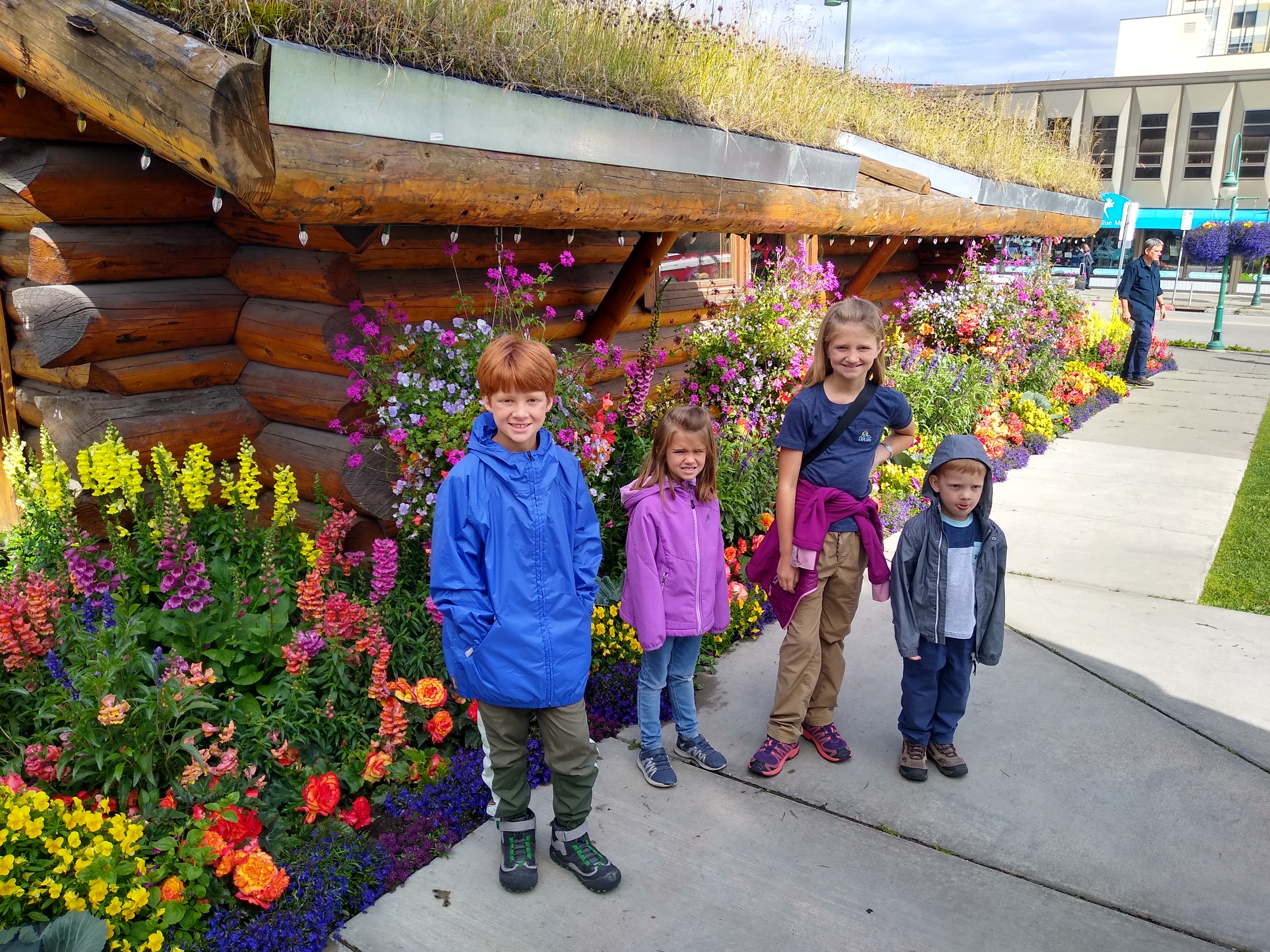
Hiram, Lillie, Aliza, and James at the Anchorage Visitor Information Center
The visitor center stands out in downtown Anchorage as a log cabin reminder of its past. The amazing part was the flowers. Alaska has long daylight hours with mild temperatures. Due to that, the flowers grow large and pretty. You can definitely see that in these flowers.
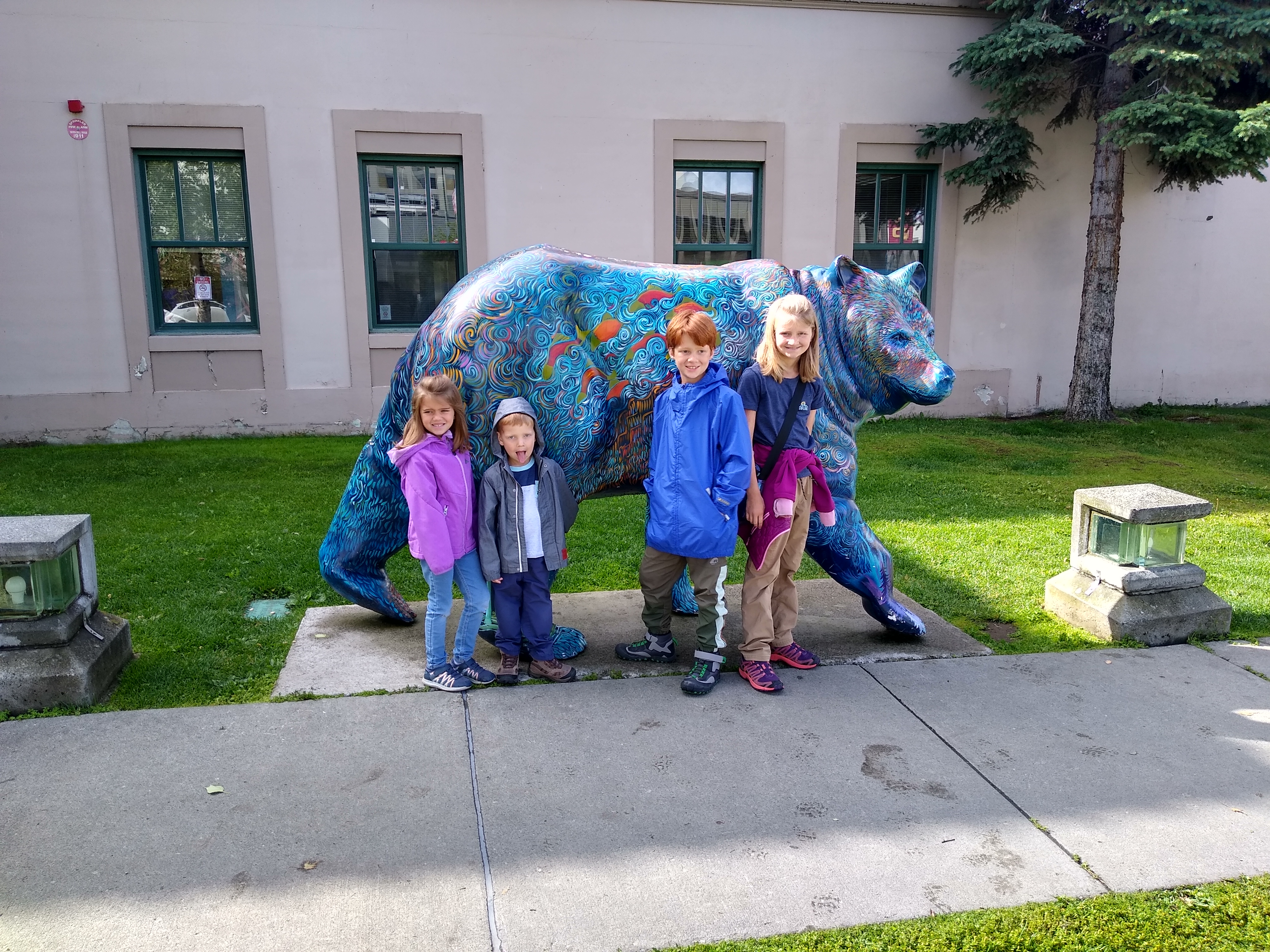
Lillie, James, Hiram, and Aliza Ross with bear statue in front of Anchorage City Hall
We wandered around the downtown area to get a feel for the town and its sights.
Lillie, Paul, Aliza, and Hiram Ross in front of downtown Anchorage Federal Building
This Federal Building is not where the Federal Courts are housed. We had to track that building down about four or five blocks away. Here is a picture we snapped there.
Paul and Aliza Ross at Anchorage’s Federal Courthouse
Classic lawyer nerd taking a picture with a Federal Courthouse!
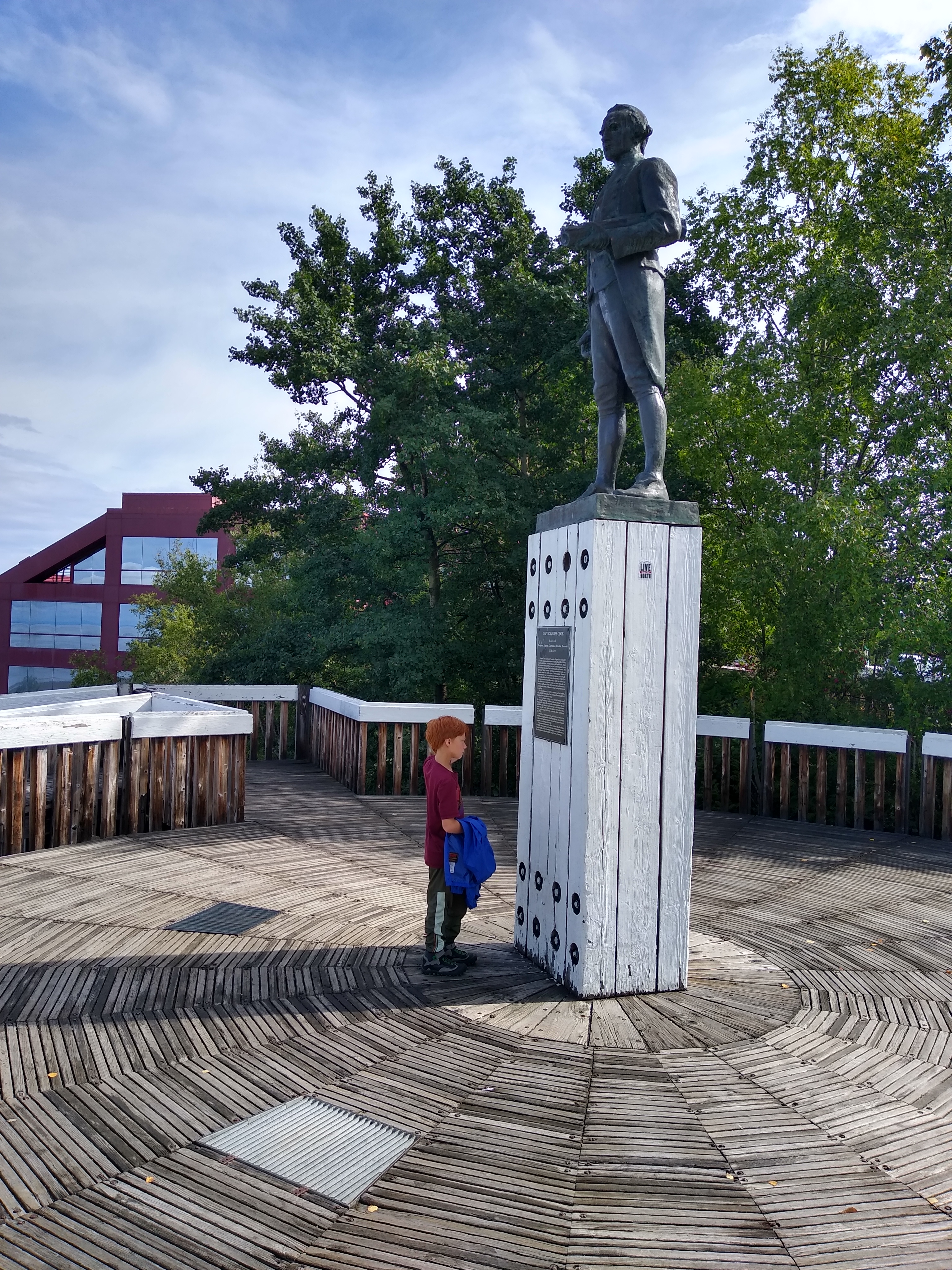
Hiram reading the James Cook Monument
We walked down to Resolution Park. We read about Captain Cook. The monument was installed as part of the 1976 Bicentennial Celebrations.
James Cook was born in Yorkshire, England, on October 27, 1728. He was apprenticed to serve on sailing ships built in Whitby, near his birth-place, to carry coal along the English coast. At age 26, he joined the Royal Navy, took part in actions against France and, through his natural flair for mathematics and science, was promoted “King’s Surveyor” and given command of vessels performing survey work on the coast of Newfoundland.
Chosen as commander to lead an expedition of discovery to the Pacific Ocean, he sailed on his first voyage of exploration (1768-71) to find the continent of Australia as well as Tahiti, New Zealand and New Guinea where he charted coasts and waters previously unknown to the Western World. On his return, he was honoured by a grateful nation, made a Fellow of the Royal Society, and received by the King.
His second voyage (1772-75) to Antarctic and the South Pacific added the Friendly Isles, New Caledonia, Easter Island, Cook Island and New Georgia to the map. In 1776, Captain Cook set out on his third voyage, aboard his flagship “Resolution”, to find a north-west passage from the Pacific to the Atlantic. He surveyed the coast of northwest America and Alaska, but, failing to find the passage to the Atlantic, turned south from the Bering Strait and sailed to the Sandwich Isles where, on the Island of Hawaii, he met his death on February 14, 1779.
James Cook, a farm hand’s son who became a Captain in the Royal Navy and gold medalist of the Royal Society, lives in history as the greatest explorer-navigator the world has known. His real memorial is on the map of the world.
This monument, created by Derek Freeborn after the statue in Whitby, where James Cook began his career as seaman, was donated by The British Petroleum Company as a contribution to the Bicentennial celebration of the United States of America.
Amanda, Aliza, James, and Lillie Ross at Eisenhower Statehood Monument with their flowers
President Dwight D Eisenhower signed Alaska into existence as the 49th State. This monument memorializes that act. It was a culmination of many years of work and something that President Eisenhower took very seriously.
The Alaska Railroad from the Eisenhower Statehood Monument
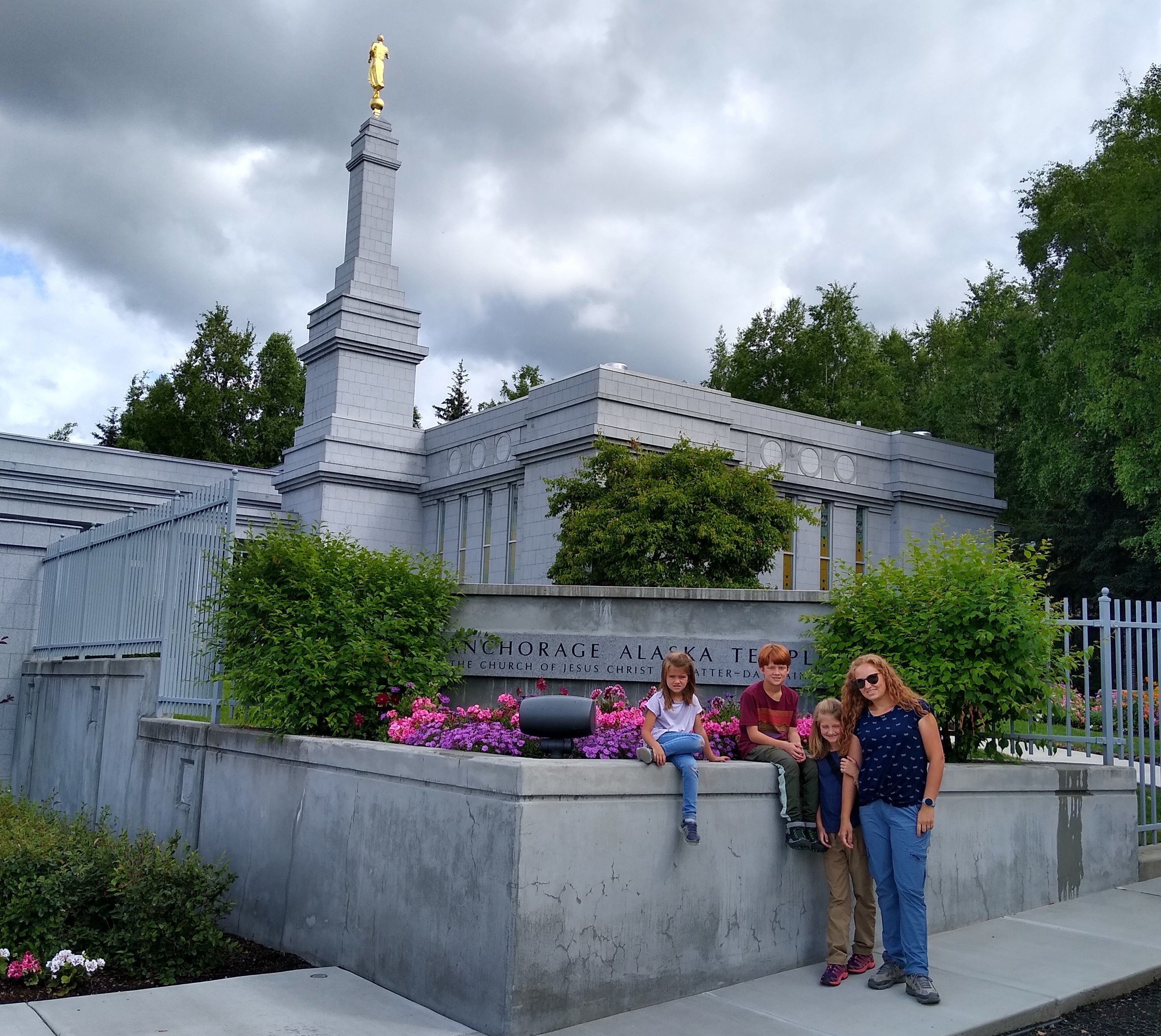
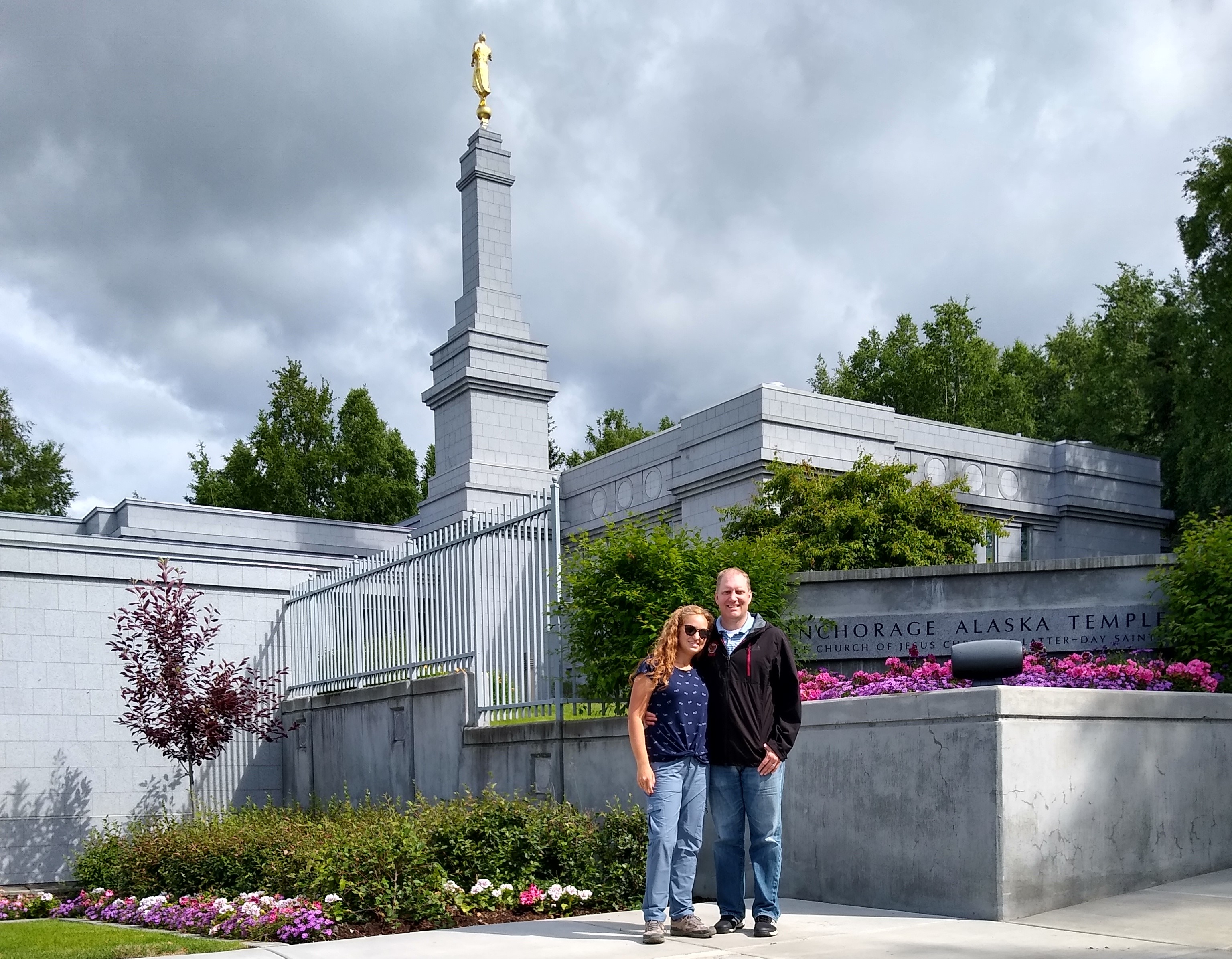
Lillie, Hiram, Aliza, and Amanda Ross at the Anchorage Alaska Temple
We drove past the temple a couple of times going to and from various places. We had to stop and take some pictures. This temple is being replaced, so it will not be there much longer. The new temple is being built where the Stake Center was next to this Temple. When completed, this will be removed and I believe the new Stake Center will be built. I believe this is the first time in the church where a temple will be formally replaced not on the same footprint.
Amanda and Paul Ross at Anchorage Alaska Temple
Lillie and James with Smokey the Bear at Begich, Boggs Visitor Center
We saw multiple glaciers while in Alaska. We stopped and went through the Begich, Boggs Visitor Center. It was interesting to see how close the center once was near glaciers. Now you cannot even see the Portgage Glacier from it. We went and hiked up the Byron Glacier Trail.
Portage Lake
Hanging glaciers up Byrom Glacier Trail
Lillie Ross near melting snow with glaciers in the background
Byron Glacier Trail looking back toward Portage Lake
As you can see, the glaciers have heavily retreated. More of just an alpine trail now with some blue snow/ice above.
Hiram, Aliza, and Lillie Ross on Byron Glacier Trail
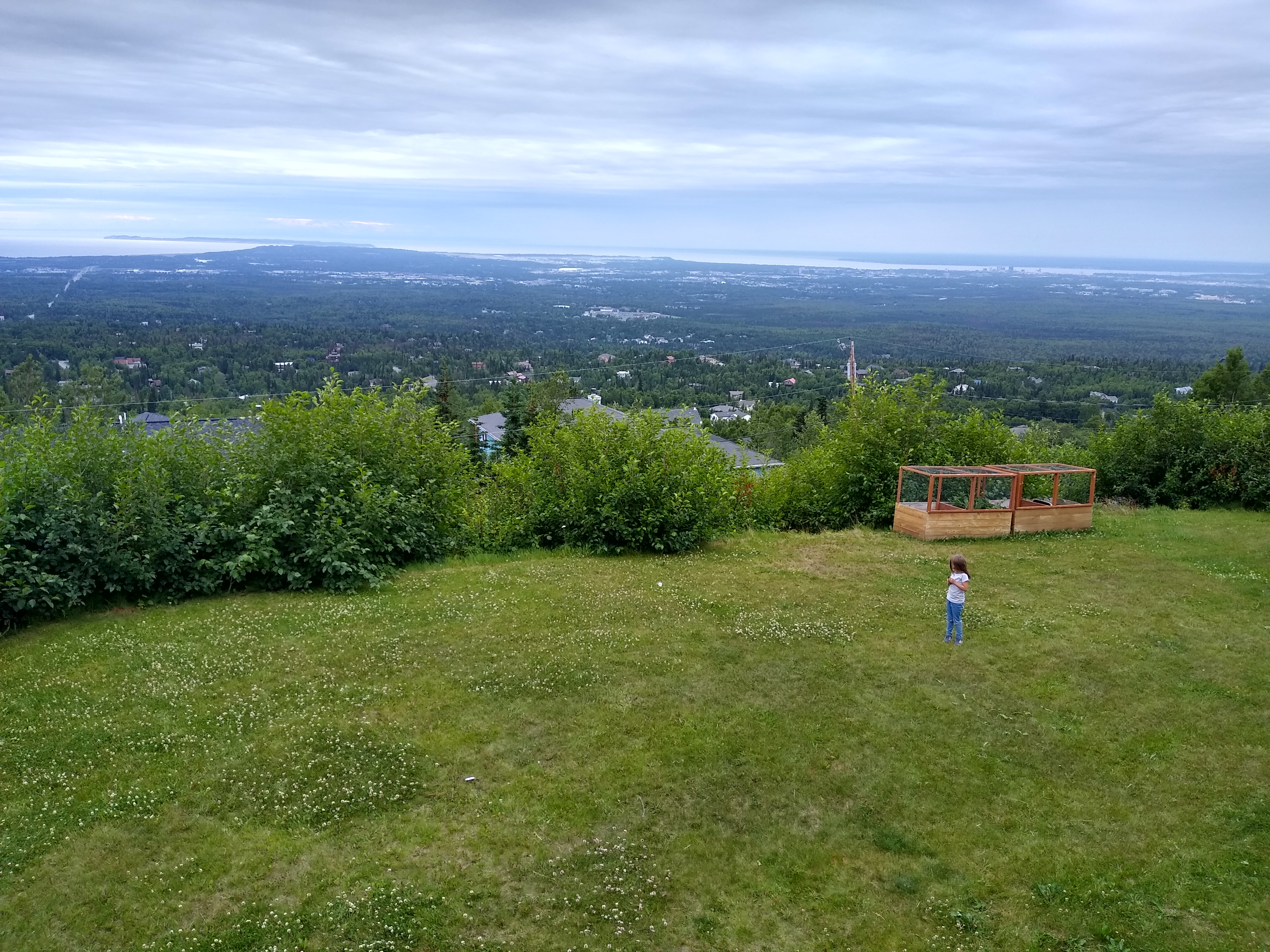
Lillie Ross at Brook and Caitlin Jonas’ home in Anchorage
My cousin Brook Jonas lives in this home on the foothills west of Anchorage. If you look closely, above Lillie you can see downtown Anchorage. You can also see Fire Island straight out and what is beyond Anchorage.
At a later time, I will have to write of our trips to Kenai Fjords National Park, Seward, and Whittier.
Salt Lake Temple, Revelations 14:6, And I saw another angel fly in the midst of heaven, having the everlasting gospel to preach unto them that dwell on the earth, and to every nation, and kindred, and tongue, and people,
This is an insightful article that came out with the Spring 2021 Clark Memorandum. I found myself enlightened by the introspection suggested. Enough that I was moved and want to share it with others. The author is Melissa Wei-Tsing Inouye, Senior Lecturer, University of Auckland, and Historian, Church History Department of The Church of Jesus Christ of Latter-day Saints.
Recently President Russell M. Nelson has called on the Latter-day Saints “to lead out in abandoning attitudes and actions of prejudice” and has pleaded with us “to promote respect for all of God’s children.” Additionally, President Dallin H. Oaks has challenged us to “root out racism.” These directives make some things very clear: We are part of the problem. We wouldn’t have to abandon “attitudes and actions of prejudice” if we didn’t have them already. And uprooting will be a long, hard project. I offer three perspectives I hope my fellow Church members will find helpful. First, the problem of racism is a social reality that affects all human beings. Second, the restored gospel provides us with tools and frameworks for dealing with racism: confess and forsake and turn weaknesses to strengths through humility. Third, we all need to ask the Lord, “What lack I yet?” How do we get to work?
1. We All Have Blind Spots
As an Asian American growing up in diverse Southern California, I rarely felt the sting of racism. Now that I live in Utah, I notice racism much more frequently. Some of my friends and family have experienced ugly, malicious barbs, but the racism I most frequently encounter in Utah is in the form of condescension. White people compliment me on my English. In other words, when they see me, they assume I am foreign and I don’t belong. Then they hear me, and they are surprised. Then they decide to tell me about this surprise: “Oh, you speak English very well!” They don’t say, “I hate Asians,” but their words say, “I consider people who look like me to be ‘normal’ and expect people who look like you to be ‘different than normal.’”
One BYU student, whose family emigrated from Uruguay and who, along with all of her siblings, has fair skin and blue eyes, reported that, in their new Utah ward, someone came up to her parents and said, “Oh, look, the Lamanite curse is already coming off from her! You must be blessed!” Sometimes the racism is about as explicit as it gets, like the swastika and racial slurs that appeared recently on a fence along the bike path my children ride to school.
Biologically speaking, racial categorizations have no basis in objective reality. They are figments of the human imagination and are an example of our weakness for sweeping generalities. Humans beings share 99.9 percent of their DNA with each other. Skin color, eye color, and hair texture and color are a pinch of that tiny 0.1 percent of difference that people arbitrarily use to make consequential guesses about each other’s hearts, minds, capacity, safety, and so on. We might as well link judgments about intelligence to people’s earlobe shape or language-learning ability to toe circumference. Yet over and over again, in every place, many people treading the same crooked ways for centuries creates ruts so deep and so wide it is hard for them to imagine other paths. As President Oaks has said, “Racism is probably the most familiar source of prejudice today, and we are all called to repent of that.” “All” means you and me. I have become increasingly aware of the perpetual need to work hard to not be inadvertently unkind as I have lived in places such as the United States, Germany, the People’s Republic of China, Taiwan, Hong Kong, and New Zealand. No one is immune to prejudice because no one can spend their life becoming embedded within every place and human circumstance in this wide world.
When I moved to New Zealand to take an academic position at the University of Auckland, I had some rough patches in my interactions with students and fellow professors. I discovered that the cultural traits Americans see in themselves of being friendly and optimistic can come off to New Zealanders as shallow and transactional, especially when the American (me) isn’t listening carefully to others around them. I remember sitting in my office when a Māori professor told me, kindly but candidly, how I had completely ignored his expertise and failed to acquire the level of cultural competence necessary for a university event I was planning. I remember thinking, “What do you mean I’m disrespecting people from marginalized groups? I’m Brown! I’m a woman!” Because of my past experiences receiving racism and ethnocentrism, I thought I was “exempt” from perpetuating them. But I was wrong.
Rooting out racism is a process of becoming aware of our blind spots and our great power to cause harm to others, especially to others on the margins. Unfortunately, unlike a pack of manufactured Toyotas and Fords on a highway, human blind spots are unique and change depending on who is around us. In the worst-case scenario, our cars are so big and heavy and fast that we don’t even notice when we knock small cars or pedestrians off the road.
Where are your blind spots? If you don’t know, you haven’t been looking.
2. The Racism in Our Past and Present Need Not Be in Our Future
Latter-day Saint theology explains that we came to mortal life, with its hardship and temptation, in order to learn and grow. Making mistakes and repenting is part of the plan. We have to be careful: a sin like racism is toxic enough to kill us spiritually. In the past, we have been affected by this illness. But if we heal from it, we can become stronger.
When I was experiencing cancer recurrence for a second time, some friends put me in touch with Dr. Mark Lewis. Even though he had never met me before, Dr. Lewis was kind enough to call to discuss my treatment. In the first few seconds of the call, he mentioned that he, too, was a cancer patient. He said, “I just had a scan the other day, and I’m waiting for the results.” In that moment, my confidence in Dr. Lewis took a giant leap.
No matter how knowledgeable, a doctor who has not had cancer cannot understand what it is like to feel in your body the pain, the shortness of breath, the needles and tubes and powerful medications, what it is like to walk past the open door of death on your way to the kitchen. Discovering Dr. Lewis was a cancer patient made me instantly trust him.
On a spiritual level, it is also true that some of the greatest healers are those who have known illness. Kylie Nielson Turley’s study of the Book of Alma points out that we have tended to see Alma’s story as the familiar tale of a rebellious teenager who eventually mellows out. However, the term “Alma the Younger” actually never appears in the Book of Mormon text. This label, along with some other things, has led us to believe he was young and rebellious. But Turley’s study shows it is actually probable that he was a mature adult, perhaps even in his 40s or 50s, when he repented and was born again. Alma may have been a full-fledged bad guy. But he became converted and began calling people to repentance. Because he had personally experienced the corrosive effects of sin, he had powerful authority to call others to repent.
This gives new meaning to Alma’s teaching about Christ: that He would
go forth, suffering pains and afflictions and temptations of every kind; and this that the word might be fulfilled which saith he will take upon him the pains and the sicknesses of his people. . . . [A]nd he will take upon him their infirmities, that his bowels may be filled with mercy, according to the flesh, that he may know according to the flesh how to succor his people.
According to this passage, Christ inhabited our infirmities in order to understand how to heal us. It wasn’t enough for Jesus to stop up others’ wounds and lift others’ sorrows. It was necessary for Him to feel wounds in His own flesh, to experience despair and injustice and life gone horribly wrong.
In summary, patients make trustworthy doctors. Repented sinners make compelling prophets. The experience of mortal weakness is what turned the popular rabbi Jesus into the Savior of all. We believe suffering from mistakes in mortality is necessary for growth and for becoming as God is.
Our imperfections on this issue of racism and prejudice are clear to anyone who studies Latter-day Saint history. The Church’s essay on race and the priesthood states:
In 1852, President Brigham Young publicly announced that men of black African descent could no longer be ordained to the priesthood. . . . Over time, Church leaders and members advanced many theories to explain the priesthood and temple restrictions. None of these explanations is accepted today as the official doctrine of the Church.
These “theories” and “explanations” by Latter-day Saint leaders and members included the idea that all Black people were descended from Cain and inherited the curse God placed upon him in the Book of Genesis; the teaching that interracial marriage was sinful, akin to letting a “wicked virus” into your system; and the notion that Black people were less valiant in the premortal life. Some who promulgated these theories also made other painful claims that Black people were “uncouth, uncomely, . . . wild,” and inferior to White people.
These statements, which sound so ugly to us today, reflect to a great extent the social and cultural assumptions with which these Latter-day Saint leaders were raised in 19th and 20th-century America. Comparable statements to those of Church leaders in the past were made by the great American president Abraham Lincoln and many others. In the same year that Bruce R. McConkie first published Mormon Doctrine, a popular book containing numerous theories and explanations, the Virginia couple Mildred and Richard Loving were arrested (and eventually sentenced to one year in prison) because their marriage violated a law banning interracial marriage in that state. At the time, similar laws existed in 24 other states, including Utah. No one is immune to culture. We must have empathy for those whom the passage of time turns into moral strangers, because someday, surely, those people will be us.
But significantly, as historian Paul Reeve has pointed out, throughout the 19th and 20th centuries there were people, including Latter-day Saints, who had done the intellectual and spiritual work to see beyond the evils of their day and cultivate knowledge of other people’s humanity and divinity. Over the course of his tenure as president of the Church, Joseph Smith evolved from supporting the enslavement of Black people based on Biblical passages about Canaan—a common Biblical interpretation of the day—to asking how the United States could claim “that all men are created equal” while “two or three millions of people are held as slaves for life, because the spirit in them is covered with a darker skin than ours.” During his presidency, Black men such as Elijah Able and Walker Lewis were ordained to the priesthood as elders and represented the Church as missionaries. In Nauvoo, Joseph and Emma developed a close relationship with Jane Manning, a Black Latter-day Saint. Jane lived and worked in their home, and at one point Joseph and Emma invited Jane to be eternally sealed to their family through adoption. Jane’s own words reflect her esteem for the Prophet, which must have in some part reflected his esteem for her. “I did know the Prophet Joseph,” she later testified. “He was the finest man I ever saw on earth.”
In the early 1850s, the apostle Orson Pratt opposed legalizing slavery in Utah and supported Black voting rights. “[T]o bind the African because he is different from us in color,” he said, “[is] enough to cause the angels in heaven to blush.”19 In May 1968, a month after the death of Martin Luther King Jr. sparked racial tensions around the United States, Hugh B. Brown of the First Presidency taught BYU students, “[A]void those who preach evil doctrines of racism. . . . Acquire tolerance and compassion for others and for those of a different political persuasion or race or religion.”
This gives us hope that we are not trapped in our cultures and times. It is possible to overcome the moral and cultural blinders of the societies in which we live. We will never escape them completely, but we can see more clearly.
Acknowledging the Latter-day Saints’ past racism is painful because it feels so wrong and because it did such harm. But, as laid out in Doctrine and Covenants 58:43, acknowledging wrongdoing is the first, essential step to leaving it behind: first, confess; then, forsake.
In this spirit, the Church’s essay on race and the priesthood declares:
Today, the Church disavows the theories advanced in the past that black skin is a sign of divine disfavor or curse, or hat it reflects unrighteous actions in a premortal life; that mixed-race marriages are a sin; or that blacks or people of any other race or ethnicity are inferior in any way to anyone else. Church leaders today unequivocally condemn all racism, past and present, in any form.
Our current Church leaders have taken increasingly bolder steps to lead out against racism. In 2018 they hosted the “Be One” celebration commemorating the 1978 end of the priesthood and temple ban and honoring the contributions of Black Latter-day Saint pioneers. In June 2020, President Nelson joined the national conversation on race in the wake of George Floyd’s death. He coauthored a joint op-ed with Derrick Johnson, Leon Russell, and the Reverend Amos Brown, three leaders of the National Association for the Advancement of Colored People (NAACP), calling for “government, business, and educational leaders at every level to review processes, laws, and organizational attitudes regarding racism and root them out once and for all.” This attention to “processes, laws, and organizational attitudes” called attention to the need for structural change.
In early October 2020, numerous speakers in general conference—including President Nelson, President Oaks, Sister Sharon Eubank, Elder Gerrit W. Gong, Elder Quentin L. Cook, and Elder Dale G. Renlund—condemned racism and presented the Latter-day Saints with a vision for a diverse, multiracial, multinational Church.
Finally, two weeks later in a BYU devotional, President Oaks delivered a comprehensive address on combating racism. Reiterating President Nelson’s recent charge to the Latter-day Saints to abandon “attitudes and actions of prejudice,” he said, “[W]e condemn racism by any group toward any other group worldwide,” and urged, “Now, with prophetic clarification, let us all heed our prophet’s call to repent, to change, and to improve.”
In asking us “to repent, to change, and to improve,” to “root out racism,” and to “clear away the bad as fast as the good can grow,” our current leaders are sending us a strong message: get rid of the bad stuff (i.e., do the work of anti-racism) and get on with the good stuff (i.e., work to establish Zion around the world).
Our leaders have made it clear that we each need to repent. Saying, “We are all good! No need for repentance here!” is disrespecting the Savior’s offer of atoning grace. We cannot “be saved in ignorance.” But if we humble ourselves and seek Christ’s help in moving forward, the errors and lack of knowledge in our past can turn to wisdom. Our stumbling because of racism in the past can be converted into eagerness to lead out in the future. Like Dr. Lewis, Alma, and Christ Himself, our memory of sickness can become a capacity to heal.
3. What Lack I Yet?
Here some might be thinking, “But I’m not racist. I don’t hate anyone.” It is a common misconception that racism means hate. Hate, along with fear, is a common symptom of racism, just like a cough or a sore throat is a symptom of covid-19. But hate is not all of what racism is.
At its core, racism is ignorance. It was ignorance that prompted those “You speak English so well!” people to say something to me—a stranger with brown eyes and dark skin—that they would not say to a stranger with blue eyes and light skin. It was ignorance that led Latter-day Saints in the past to find facile, speculative explanations for the priesthood and temple ban, like the “fence-sitters in the pre-existence” theory. The handy thing about this explanation was that it required no change in Church members’ existing worldview. The problem was that it also required ignoring Christ’s basic teachings, the second Article of Faith, the historical precedent set by Joseph Smith, and the fundamental implications of the phrase “children of God.”
Looking back at history, we wonder: How could a Latter-day Saint bishop like Abraham O. Smoot have enslaved Tom, a member of the Sugar House Ward over which he presided in Salt Lake City in the 1850s? How could the people of the United States in 1942 have approved of depriving my American-born grandparents Charles Inouye and Bessie Murakami of their civil rights, their property, and their livelihoods and imprisoning them behind barbed wire at Heart Mountain, Wyoming? In the UK, in Germany, in China, in Rwanda, in South Africa—throughout history, over and over again—we see people failing to see each other as fully human like themselves.
The frightening thing is that in all of these examples in the past, good-hearted people who strove to be morally upstanding were unaware of their stunning, reprehensible ignorance. How can we know we are not making the same mistakes?
On the score of racism, at least, history teaches us plenty of ways to avoid ignorance, if we are willing to put in the work. History can be our friend. If we study how ignorance looked in the past, we can better identify it in the present. If we can understand its potential to wound others and poison the worldviews of well-meaning people, we, as disciples of Christ, can develop the capacity and authority to heal.
Overcoming ignorance is not a simple matter of reading five blog posts and three conference talks and having a conversation with a Brown friend. We need to strive to know as God knows, see as God sees. Seeking learning that will show us the heart and mind of God involves hard work, radical humility, and perpetual self-improvement. But we believe in work, humility, and improvement. It is part of the plan.
If you do not have personal experience with how it feels to be regularly disrespected because of your skin color or how it feels to be constantly dismissed because you are a cultural minority, or if you don’t have peers outside your racial and cultural demographic, I humbly suggest you may lack wisdom.
I certainly know I do. Like me, you may need to ask for God’s help in filling this critical gap in your spiritual education. We, as Latter-day Saints around the world, have made sacred covenants to be one people, “bear[ing] one another’s burdens” and “mourn[ing] with those that mourn.” How can we keep these covenants if we ignore the burdens others bear or if we dismiss others’ mourning and deny that they have reason to grieve?
In a recent blog post, James C. Jones, a Black Latter-day Saint, explained that going out of our way for those “few” who are marginalized in society was what Jesus taught us to do. He wrote, “I’d like to go to church one day knowing that the people I worship Christ with—the same Christ who left the ninety-nine to find the one—won’t say ‘all sheep matter’ when I go to find the one.”
The fundamental equality of all before God the Creator dictates that Latter-day Saints do not dismiss others’ experiences of racism simply because we have not lived through these experiences ourselves. Jones also wrote:
Our very church is founded on the lived experience, revelatory as it is, of Joseph Smith. To devalue the lived experience of others is to desecrate the body-temple in which we all, prophet and prostitute alike, move about and understand this earthly life.
It is no sin to be born in a place where everyone looks the same, nor to be born into a culture in which certain assumptions about whole groups of people are taken for granted. But once we have grown to adulthood and come into the fold of God, which encompasses seven and a half billion sheep—all precious—we must put away the self-centered assumption that my view is always the best, my experience is universal, and it is only a problem if it is happening to me as one more childish thing.
If only I had joined the Church of Jesus Christ of Bald Generation X Asian Women Historians Raised in Orange County California, USA! How daunting is Christ’s charge in the great intercessory prayer, when He said that those who truly follow Him and testify of His divinity are those who will “be one” with each other! How daunting is the baptismal covenant given at the waters of Mormon to follow Christ! This covenant language wasn’t “we will bear the burdens of people in our neighborhood only” or “we will only bear burdens we, too, have personally experienced.”
Most people don’t think of it this way, but the most lasting outcome of successful missionary work is not having more people in the pews but inheriting more of the world’s thorniest problems. Missionary work is not about “claiming more people for our club” but about wiggling our shoulders into more yokes to pull many heavy loads.
The story of the young man in the gospels of Matthew and Mark is instructive. When the lifelong righteous, commandment-keeping, wealthy young man asked Jesus, “[W]hat good thing shall I do . . . ?” and “[W]hat lack I yet?” he was probably thinking Jesus would suggest another pious practice to slot into his “I’m-a-good-person” crown. Instead the Lord told him to give away all of his privilege. He asked the young man to seek parity with strangers at the very bottom rung of society. And the young man—who stood in front of the bona fide, miracle-working, in-the-flesh Jesus and in that instant received the Savior’s love—found he couldn’t do it. He didn’t want to do it.
The moral of the story is clear: no matter how awesome we think we are, the main question is still “What lack I yet?” (The more common question “What do they lack?” is beyond the scope of our agency.) Would we who yearn to see the Savior’s face be willing to literally stand before Him and hear Him say, “Come, follow me,” if it meant giving away our homes, our cars, our children’s college tuition fund, our dinner, our running water, our toothbrushes, and our family’s safety and becoming one with the poorest of the world’s poor? This is a troubling question. I am ashamed to say that I am not sure what I would do. But Jesus’s call to action is clear: even people who have eagerly kept the commandments all their lives may be holding something back. If we truly want to follow Him, we will dare ask, “What lack I yet?” and expect a difficult answer.
In the October 2020 general conference, Michelle D. Craig, first counselor in the Young Women General Presidency, cited the parable of the priest, the Levite, and the Samaritan (a classic blind spot story) and called on us to ask God for help overcoming our limited vision. She said: “Ask to see others as He does—as His true sons and daughters with infinite and divine potential. Then act by loving, serving, and affirming their worth and potential as prompted.”
In sum, we should stop thinking, “Racism is hate, and I don’t hate anyone, so I can sit this one out.” Instead, we should ask, “What lack I yet?” To root out racism, we must go beyond simply avoiding racial slurs or ignorantly repeating discredited theories and explanations. We must proactively seek opportunities to understand how our sisters and brothers have experienced racism and how we can start doing some things differently.
4. What Can We Actually Do?
The day after President Oaks called us to repent and do more to root out racism, I tried to think of something concrete that I could do immediately. I decided to find images of the Savior that do not depict Him with White, European features. Clearly, Jesus was a Middle Easterner; He looked like someone from the Middle East. He was a person of color. Over centuries, as Christianity spread to Europe, many European artists painted Jesus—quite understandably, as artists in Ethiopia and Japan and New Zealand and all places have done—as someone from their part of the world. They wanted to imagine a Savior who did not look like a foreigner (especially since for centuries many people from Europe feared and hated people from the Middle East). From a practical standpoint, the painters could only find local European models. One image I love, of Christ and the rich young man, was painted by German artist Heinrich Hofmann and has this European character.
In the globalized world of the 21st century, it is not difficult to imagine Jesus in His actual historical and geographic context. Now that I understand that the real Jesus looked like a Middle Eastern person, why would I want only images of Jesus as a White person of European descent? Therefore, the day after President Oaks’s talk, I went to Deseret Book and found an abundance of scenes of Jesus in the Bible and the Book of Mormon painted by Jorge Cocco Santángelo, a Latter-day Saint painter whose geometric, slightly abstract style depicts Christ without a specific set of “racial” features. Together, my family members picked out one of these beautiful images to display in our home. I subsequently came across a beautiful image of Christ and the rich young man painted by a Chinese artist in the first half of the 20th century and had it mounted on canvas. Now I am always on the lookout for other diverse ways artists have depicted the Savior of the world.
Here are some additional tips, developed in consultation with some fellow Latter-day Saints who have experienced racism in a Church setting.
5. Stop.
Please stop repeating harmful theories and explanations for the priesthood and temple ban that the Church has disavowed. If you are not sure what the Church’s current positions are, read the 2013 essay on race and the priesthood carefully; watch the First Presidency’s 2018 “Be One” celebration and pay attention to the history presented. Don’t invent new theories and explanations.
Please stop denying the racism of people in your family tree or national history who expressed racial supremacist views or enslaved others. Racism is a common historical detail, like the pattern of a bonnet or the construction of a wagon wheel. Whitewashing over this aspect of ancestors’ lives is refusing to accept them unless they conform to 21st-century expectations. I am sure all of these ancestors are now watching from the spirit world, having progressed beyond their mortal myopia, and rejoicing as their descendants use hindsight to avoid the same serious mistakes they made.
One beautiful example of “redeeming the dead” is the current work of Christopher Jones, a professor at BYU, to recover the history of Tom, the Black member of the Sugar House Ward in the 1850s. Tom was enslaved and brought to Utah by Hayden Thomas Church. Later, Church sold Tom to Abraham O. Smoot, Tom’s Bishop. Church is Jones’s ancestor. How better to participate in our ancestors’ salvation than to work on their behalf to repair broken things?
Please stop asking the question “Where are you from?” to people you have just met. Racial minorities get asked this question all the time by total strangers who are trying to figure out their ethnic and racial background because it seems so “different” and “unusual.” Know that if you ask this question right off the bat of someone from a racial minority group, you are presenting yourself as someone who is fixated on that person’s body as opposed to their character, experience, sense of humor, and so on. If you are curious about this question and get to know someone well, eventually they will tell you on their own.
6. Start.
Please start looking for the sin of racism in your life with the same eagle eyes you use to look out for pornography, violations of religious freedom, emergency preparedness situations, and other problems Church leaders have called to our attention. Apply the skill set you have already developed to spot problematic images, defend civil rights, and educate yourself about complex, largescale problems.
Please start speaking up without hesitation when someone uses racist, prejudiced, or ignorant speech, whether or not someone who will be personally hurt by this speech is in the room. Martin Luther King Jr. memorably pointed out the harm done by “the appalling silence of the good people.” In the case of racial slurs, of course, you would respond as with any foul and unacceptable language. To prepare for encountering racism in more general conversations, you can practice some ready responses ahead of time. For example:
“Whoa!” “That’s not funny.” “What point were you trying to make by saying that?” “Tell me what you mean by that?” “What I heard you say was _.”
Please start educating yourself about the experiences and viewpoints of people who are from a racial, ethnic, national, or class “group” with which you have little personal understanding. You can ask people to recommend resources that have been helpful to them or to their friends. The other day, for instance, I saw Isabel Wilkerson’s prizewinning books The Warmth of Other Suns and Caste on the shelves of Deseret Book. The digital Gospel Library on the Church’s website and app also has many resources.
Recently I heard the compelling interpretation that fasting is a form of collective mourning. By a little suffering and want in our bodies, we unite ourselves with those who experience suffering and want. By refusing self-satisfaction, we open ourselves to the experiences of those who do not have enough. As Jesus invited the rich young man to do, by giving away some of our power and security, we become closer to His people and therefore closer to Him.
Collective mourning is the work that lies ahead of us as Latter-day Saints as we seek to be one people—not just once a month but in everyday life. Perhaps in our daily study, or in a new five-minute “children of God” lesson segment of family home evening, we can grapple with the challenge of finding unity in diversity. For one great starting resource, see the rapidly expanding Global Histories page in the Church History section of the Gospel Library, which relates the stories of Latter-day Saints all over the world.
When we seek new light and knowledge, God will give liberally. May we heed our leaders’ calls to find unity with Saints around the world—not by expecting everyone “out there” to change their cultures to be like us but by realizing every one of us has a culture that is different from Christ’s “gospel culture” and that we are all shaped by assumptions indigenous to the neighborhood, county, and country in which we live. From Damascus to Draper, not one of us is “normal.” We are all deeply “ethnic,” with our own blind spots. We must all ask the Lord, “What lack I yet?” and step out to build the bridges of Zion.
This is a tall order, but this audacious, all-inclusive ambition to unite the whole human family in the present and in the past is what sets the Latter-day Saints apart. As we seek to honor our covenants, God will bear us up and make us equal to this task, I testify, in the name of Jesus Christ, amen.
John and Eva Nuffer are pleased to announce the marriage of their daughter Regina Friederike to John George, son of John and Anna Wanner. John and Regina were married 31 August 1898 in the Logan LDS Temple, Logan, Cache, Utah.
John & Regina Wanner
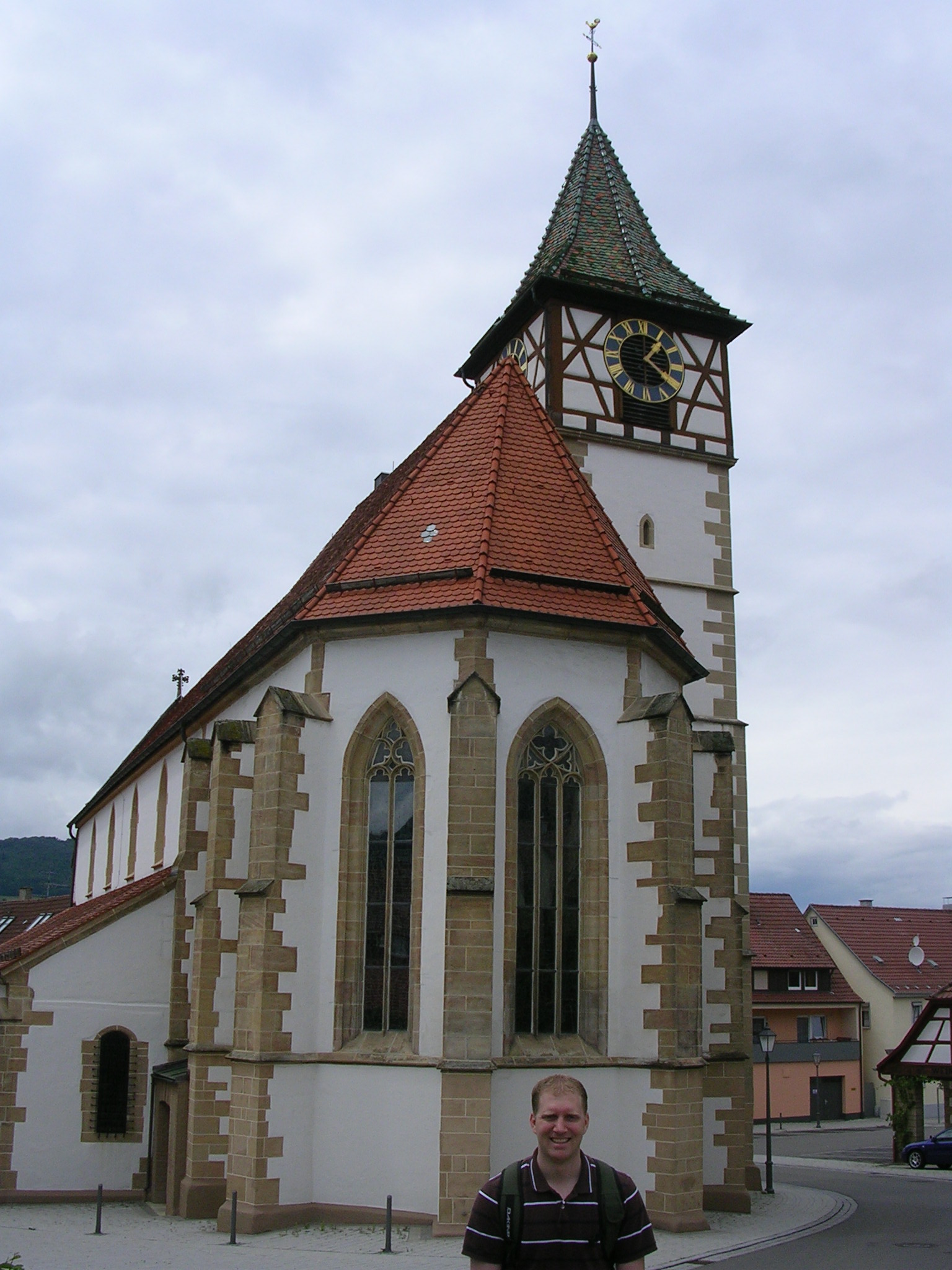
Regina Friederike Nuffer was the first child of four born to the marriage of John Christoph Nuffer and Eva Katharina Greiner on 26 January 1869 in Neuffen, Esslingen, Wurttemberg. John was a widower when he married Eva endowing Regina with two older half brothers and sister, John (1862), Georg Friedrich (1864, Fred), and Christiane (1865, who lived less than a year). John and Eva were married 25 July 1867 in Neuffen. Regina had three younger siblings, Charles August (1871), Adolph (1875), and Mary (1881). Regina was christened 7 February 1869 in Evangelische Kirche, Neuffen.
Evangelische Kirche, Neuffen and Paul Ross. The Nuffer family attended this church and Regina was christened here.
When Regina was about 9 years old, she heard the Mormon Elders preach in town. One of those Elders was John Jacob Theurer (1837 – 1914) of Providence, Cache, Utah. She was converted to the LDS church and was baptized 1 January 1880. Her parents were baptized 12 April 1880 in the mill race behind their home in the very early morning to avoid others in the community knowing. Other siblings followed later.
Overlooking Neuffen, 2008
The family applied to immigrate to North America in April 1880. They left for Stuttgart, then to Mannheim on a boat to Holland, over the North Sea to Hull, England where they left on the Wisconsin for New York. From Castle Garden they went by train to Utah, finally arriving in Logan. The family moved to Providence, Cache, Utah where Elder Theurer had connections. Mary, Regina’s sister, was born in Providence in 1881. John Jr worked in Montana, Salt Lake, and on the Logan Temple. After the Logan Temple stonework was completed, the Nuffers sold their home in Providence and moved in 1883 to Preston, Franklin (then Oneida), Idaho. Eventually they moved around until John and Eva purchased property up Cub River near Mapleton (then St. Joseph), Franklin (then Oneida), Idaho.
Regina Nuffer
I don’t know the details of how or when, but Regina met Jacob Scheibel and married him 15 July 1889 in Salt Lake City, Salt Lake, Utah. Alma Katherine (“Kate”) Scheibel was born 27 September 1889 in Pleasant Valley, Carbon, Utah to Jacob and Regina. In 1890, Jacob and Regina separated and she moved back to Mapleton. She helped as a nurse and midwife while her mom helped tend little Kate. It was during this time she met a young man named John George Wanner Jr who was working for her brother Fred Nuffer, also in Mapleton.
Regina Nuffer and Alma Katherine Scheibel
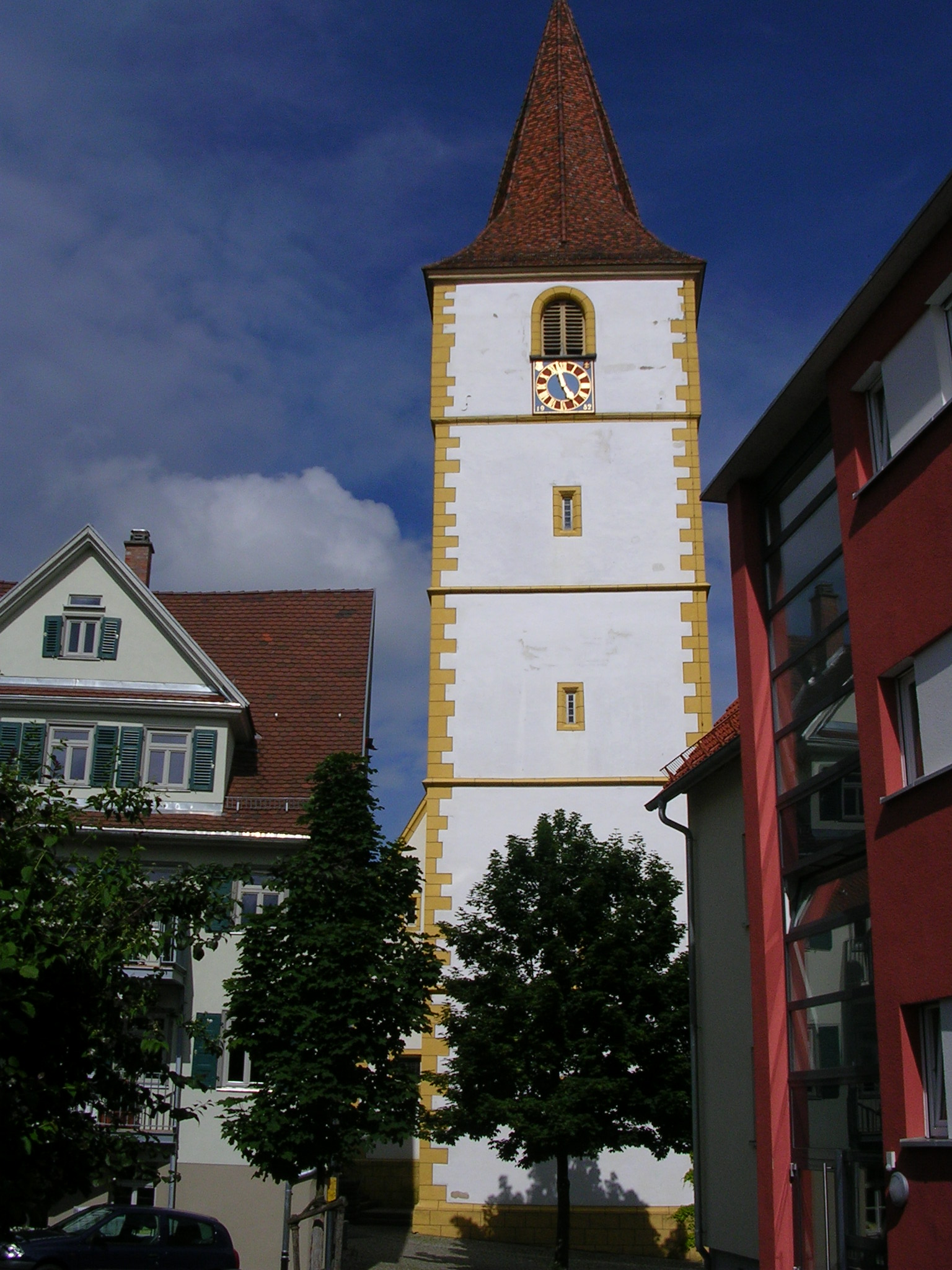
John George (anglicized from Johann Georg but called George by the family) was the first child born to the marriage of John George (also anglicized from Johann Georg) and Anna Maria Schmid on 29 October 1870 in Holzgerlingen, Böblingen, Württemberg. To keep them separate, younger John George went by George. He was christened 30 October 1870 in Holzgerlingen. He grew up in Holzgerlingen and during the summer of 1890 met the LDS missionaries. He was the first of the family to join the new church on 11 July 1891 and was baptized by Jacob Zollinger (1845 – 1942) of Providence, Utah.
St. Mauritius Church in Holzgerlingen, the church where the Wanner’s attended and where John was christened.
George apparently emigrated to America with an Elder Theurer in 1891. We don’t know who Elder Theurer is, but he was also from Providence although likely a relative of John Theurer who converted the Nuffer family. The LDS missionary records do not show an Elder Theurer out in 1890 – 1892. I wonder if this wasn’t meant to be Elder Zollinger in the family histories. But this Elder helped John find employment with Fred Nuffer. The rest of the Wanner family followed to Mapleton in 1893. Mary, George’s daughter, indicates it was an Elder Terrell who brought John to America (Theurer sounds like Tire, and Terrell isn’t that far off, so maybe a misspelling?)
George met Eliza Stirland of Providence and married her 14 November 1894 in the Logan LDS Temple. Two children were born, Earl Wayne Wanner born 31 October 1895 in Providence and George Phineas Wanner on 22 September 1897 in Glendale. The unhappy marriage ended in divorce. Nobody seems to know what happened to these two sons either.
Regina received her Patriarchal Blessing 13 September 1897 from John Smith.
George and Regina fell in love and married in the Logan Temple 13 August 1898.
William Christoph and Willard John were born 9 November 1899 in Mapleton.
Mary Louise was born 5 March 1901 in Mapleton.
George was called and set apart as a missionary to Germany on 1 October 1901 .
Acceptance Letter from John to Lorenzo Snow, President of The Church of Jesus Christ of Latter-day Saints.
Golden was born 4 September 1902 in Mapleton while John was on his mission to Germany.
George safely arrived home 7 October 1903.
Eva Virtue was born 24 February 1904 in Mapleton.
Rulon was born 6 November 1905 in Mapleton.
About this time, George Wanner had John Nuffer build him a home on East Oneida Street in Preston.
George was then called to serve a second mission in the fall of 1907, again leaving pregnant Regina and six children. He was set apart by Orson F. Whitney on 29 October 1907 to serve in the Swiss and German mission. Interestingly, the missionary record says he was plurally married, but no records or history show another marriage. I suspect it is a mistake.
Serge Nuffer was born 8 March 1908 in Preston. Again, another child born while John was on a mission.
Regina with William and Willard in the back and then Golden, Mary in the middle, holding Serge, then Rulon, then Eva. This picture was taken and sent to George on his mission.
George left Europe sailing on the Southwark from Liverpool, England on 9 December 1909.
1909 Southwark Manifest
George returned home on Christmas day 1909. It was during this mission that George taught the Christiana Wilhelmina Andra family. The Andras immigrated to Preston. William Andra, Christiana’s daughter, would later marry George’s daughter, Mary.
In 1910, George and Regina purchased the Wanner farm (John’s parents) in Whitney (which the Wanners had purchased from the Nuffer family). His parents moved to Logan.
Sadly, things started to change their idyllic world.
Golden died 26 November 1918 in Salt Lake City at age 16. His death certificate says he was a student, Regina is the informant, but I don’t know where he was going to school. I was told he died from influenza, but the death certificate just says natural death.
William died 1 December 1918 at Camp Genicart, Gironde, France from influenza. He enlisted with the army 5 August 1917. I don’t have anything to back it up, but I suspect the photo above is in preparation for his enlistment. He left Salt Lake City for Camp Kearney on October 11, 1917. He served in the Supply Company, 145th Field Artillery, American Expeditionary Forces. The war did not kill him, disease did (as was common then with influenza). His body was brought home 11 November 1920, and interred in the Whitney Idaho Cemetery.
Mary married William Andra 10 March 1920 in the Salt Lake City LDS Temple.
Willard was set apart as a missionary 7 January 1921 to New Zealand by Melvin J Ballard and left for the mission 8 January 1921. He successfully completed his mission and ended his service 18 October 1922.
Willard John Wanner
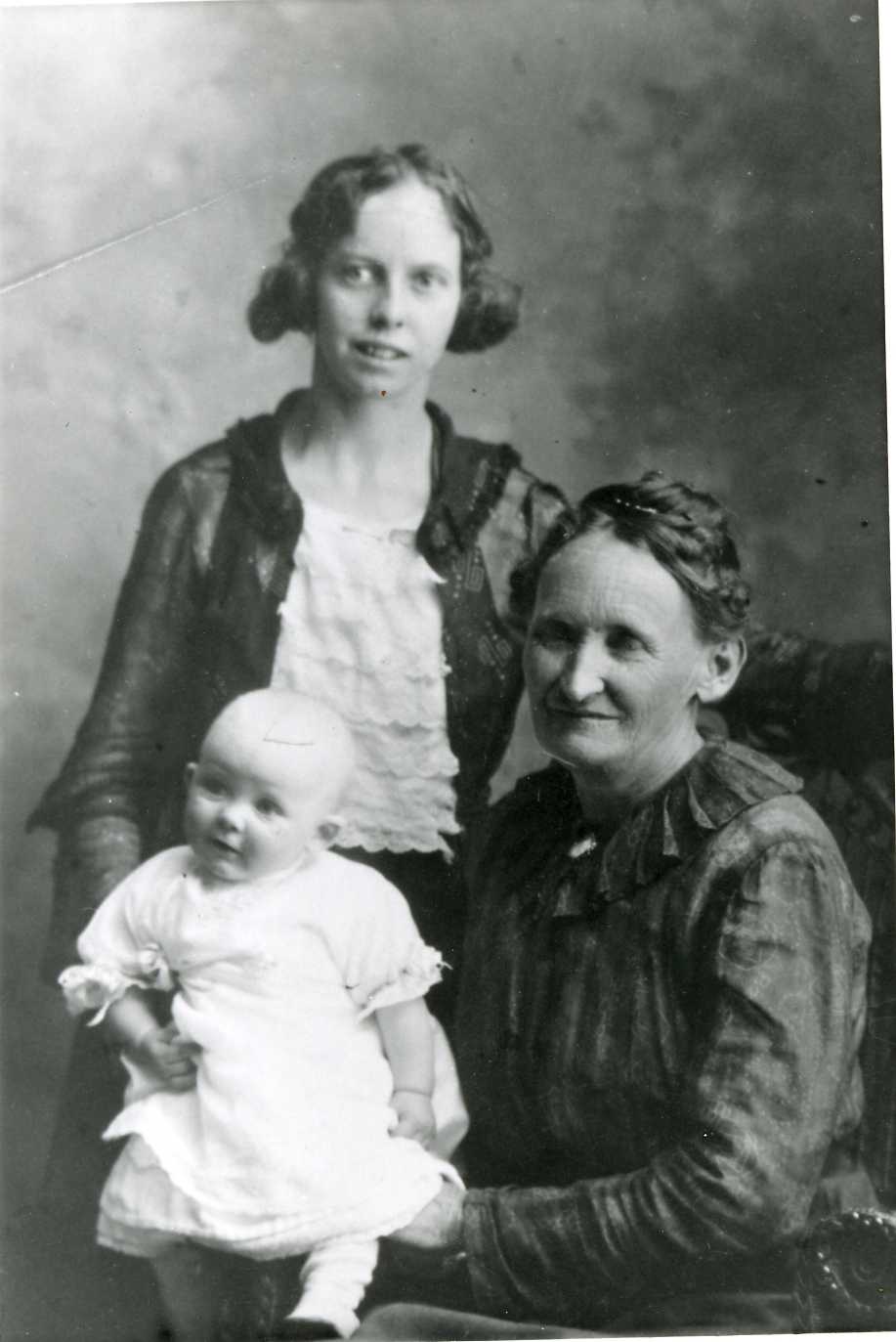
Mary Andra, Regina Wanner, holding William Andra Jr in 1921
Willard married Gladys Laverna Thompson 15 November 1923 in the Logan LDS Temple.
Rulon was a student in Logan when he caught a cold. It developed into acute meningitus caused by acute otitis media. He died 25 February 1924 at the age of 18. George is the informant.
George was called to serve a third mission to the Southern States Mission. He was set apart 15 December 1925 by Joseph Fielding Smith and departed 16 December 1925. He returned home 8 June 1926.
On 4 July 1926, George received his Patriarchal Blessing under the hand of William M Daines.
Serge was set apart as a missionary 24 April 1928 to New Zealand by Orson F Whitney and left for the mission on 28 April 1928. He arrived in New Zealand 20 May 1928. He served in the Bay, of Island, Whangerei, and Wellington districts, and on the South Island. He cut himself while shaving and died from blood poisoning 4 October 1929. His body was brought home for burial in Whitney with the funeral held in the Preston opera house. Four sons were now deceased.
Eva was set apart as a missionary 16 April 1930 to California by George F Richards and left for the mission 17 April 1930. She completed her service 6 June 1932.
George was called to serve a fourth mission to California. He was set apart by Reed Schmid on 1 December 1933 and left for the mission the same day. He arrived back home 6 April 1934.
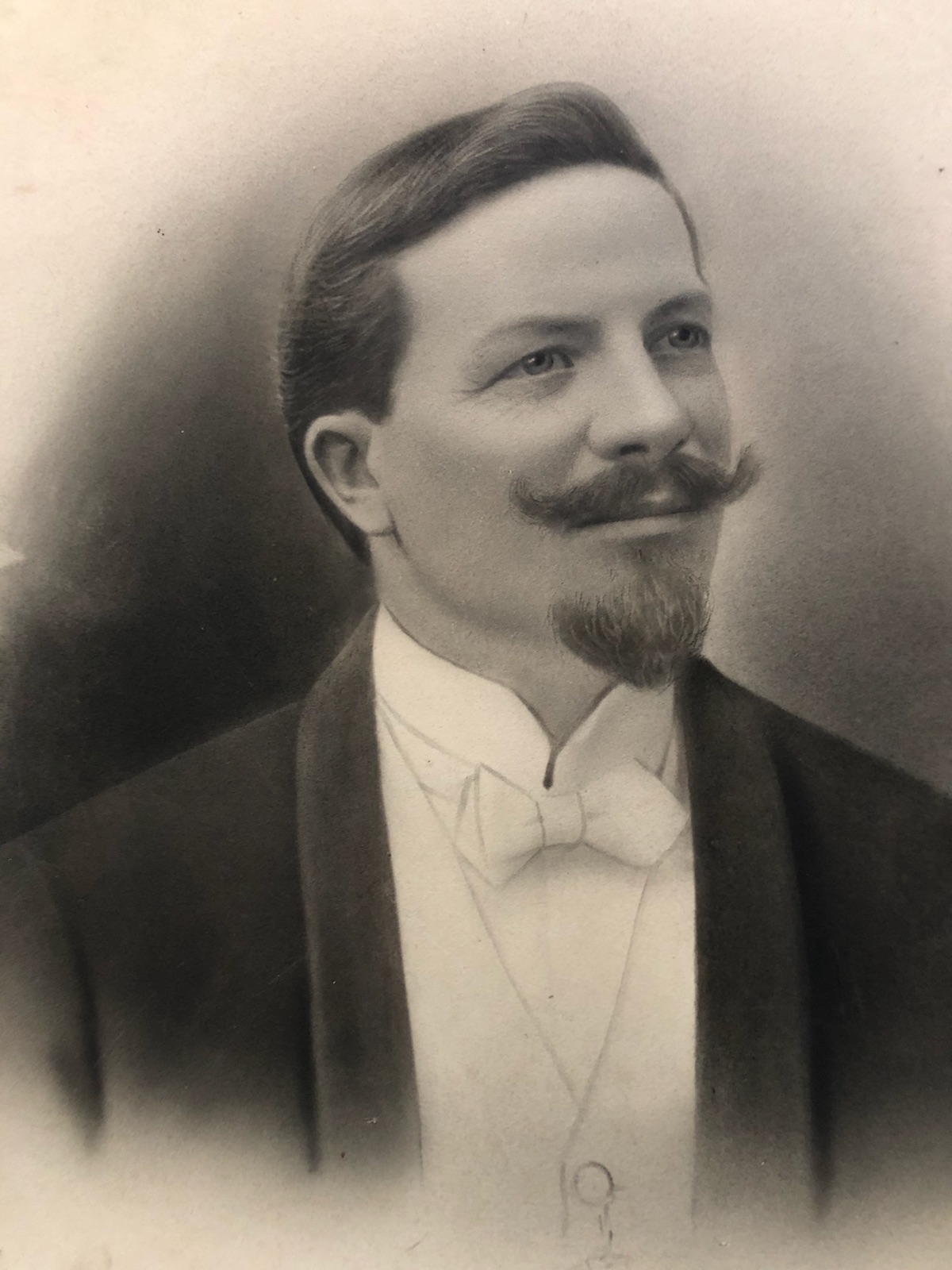
John George Wanner Jr
Eva married Adolf Ernest Spatig 29 January 1936 in the Logan LDS Temple.
Regina, Kate Naef, Carmen Cole, and Ladean Cole
George was known for his ability to work hard. He worked hard, raised his crops, and took exceptional care of his farm animals. He took great price in having things looking neat and clean around the farm and yard.
George usually was out working when the sun came up. The story is told that he was usually the first to get to the beet dump in the morning. Apparently one morning some of the neighbors decided to beat him to the dump. They got up early to get a head start. Before they got to the dump, the could hear George Wanner already going down the road ahead of them. It was still dark but they could tell it was him by the way he was talking to his horses, “Gid up – gid up – gid up.”
George and Regina sold the Whitney farm and purchased 40 acres nearer to Preston and built a home on it. Oakwood Elementary and Preston Junior High sit on what was part of this farm. When he retired, it was this farm he sold to William and Mary Andra.
George had a knack for being successful in the various undertakings he engaged in. He was one of the first in Preston to have an automobile. When he brought it home he hadn’t quite got the knack of stopping it. He yelled “whoa” when he got in the garage, but before he got it stopped he had gone through the end of the garage.
Grandma Wanner
Regina Wanner
George built two little homes on the west side of 2nd east and 1st south in Preston. He also built three homes on 1st south and the south side of the street in Preston. George and Regina lived in one of those homes until she died. Regina passed away 10 March 1942 in Preston. She was buried in Whitney.
She was ill for quite a while before she passed away. George would care for her the best he could and regularly took her for rides in the car. She was unable to walk and George would carry her on his back from place to place as they went visiting.
George remarried a few months later Grace Irene Frasure (1893 – 1980) on 3 Jun 1942 in the Salt Lake City LDS Temple. Their marriage dissolved in divorce.
John George Wanner Jr
George was having a number of health issues and had heard that Florida would help him. He moved to Florida. It was there he met Annie Jane Metts (1873 – 1961). They were married 4 May 1945 in Fort Myers, Lee, Florida. This marriage also dissolved in divorce.
George and Annie Metts Wanner in Florida
George remained in Florida until he became ill enough that he knew the end was coming. His daughter, Mary, sent her son, William Andra, out to Florida to bring George back by train. When William and George arrived in Chicago, Cook, Illinois, he was quite ill and taken to the hospital. It was there that George passed away 5 January 1947. William brought George’s body back to Preston. George was buried beside Regina in Whitney.
Phyllis Andra, Utahna Andra, Sergene Sorenson, Mary Andra, Colleen Jonas, Millie Beck, Edith Andra
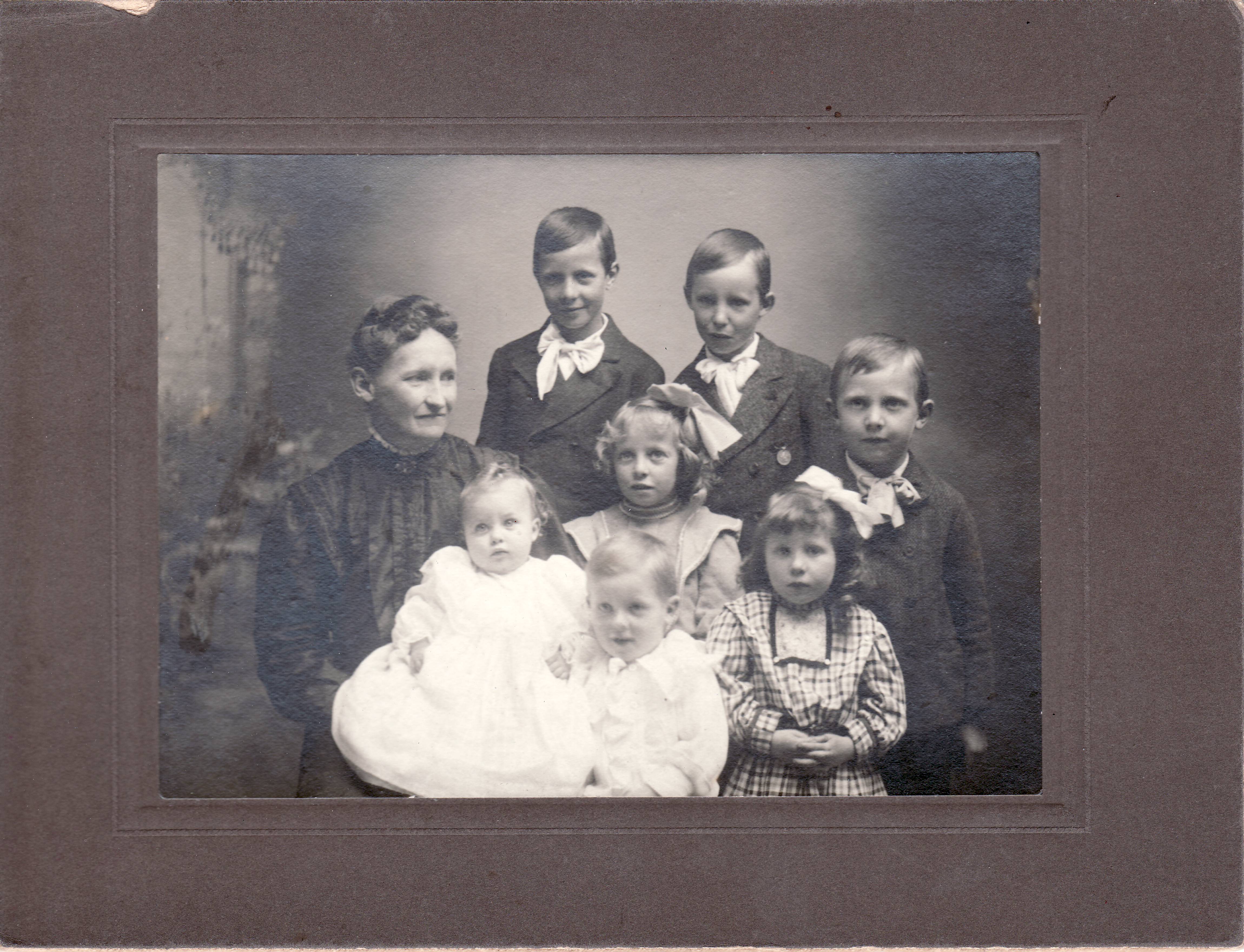
Autobiography given Nov 1961″I, Mary Louise Wanner Andra was born the 5th of March 1901 in Cub River, Idaho. My father is John George Wanner, Jr. and my mother is Regina Nuffer. I have five brothers and one sister, Eva. The oldest were twin boys: William C. and Willard. The other three boys were Golden, Rulon, and Serge. I came sixteen months later after the twins, so Mother had three in diapers.
“In the fall of 1907 my father was called on a two year mission to Germany because he spoke the German language. We didn’t have much while father was gone, but we were happy.
“He returned in the fall of 1909 and we moved back to Cub River and in the spring of 1910 we moved to Whitney, Idaho where my father bought an eighty acre irrigated farm and a one-hundred-sixty-nine acre dry farm. This farm was owned by my Grandfather Wanner. My father planted beets, potatoes, grain and hay. He also had a herd of cows and there was plenty to do! Father was very strict and we all had to toe the mark. I remember the twin boys and Golden, just younger than myself, and I had to thin the beets. The first two or three years the mustard weeds were so thick you could hardly see the beets.
“We kids went to grade school and had to walk three miles. Sometimes we would ride horseback in the winter when the snow was so deep. When it got cold enough to freeze a crust on the snow, we would walk on top and cut through the fields because the snow was above the fences. We sure thought that was a lot of fun.
“Our farm was just across the road from George Benson and their daughter, Margaret was in the same grade as myself.
“In the 8th grade, I was chosen to take the part of Snow White in the school play. In school, during the recess, we would jump the rope. There was no one who could turn it fast enough for me. I could outrun all my girl friends. I even used to catch the boys and wash their faces with snow.
“We also had a girl’s baseball team. We would play Franklin and the surrounding little towns.
“In the summer after school was out, I would ride horses. I would go up to the dry farm and get the cows. One time I took my little sister, Eva and as we passed a brush, Eva fell off and broke her arm.
“After I graduated from the 8th grade, I wanted to take sewing course in Logan at the A.C. (Agricultural College). After coaxing my father for several days, he finally decided to let me go. Inez Wallace and I went to Logan on the train. I had been down to Logan for three days when my father came and got me to work on the dry farm, getting the land ready to plant.
“In 1918, my brother, William C. died in France. He was in the 145th infantry. Three days later, my brother, Golden died in Salt Lake with double leakage of the heart. Soon after, my father sold the farm and we moved to Preston, Idaho. My father bought the Parkinson Farm (4th South and 4th East). Then my father planted beets again and I still had a job of thinning beets. We lived in an old home while my father was having the new one built.
“In the early fall and winter of 1918, I went around to different homes taking care of the sick. There was a flu epidemic at that time. I was taking care of my cousin, Emma Nelson (George Nelson’s wife). He was a wrestler. Emma died of the flu.
“In the spring of 1918, I went to work for Roy and Alabell Hull. I cared for the twins, did the washing, ironing, and all the cooking. They had seven in their family and three hired men.
“At that time I was going with a young man by the name of William Andra. He was born in Germany. While my father was on his mission, he used to go to the Andra home. My father baptized his oldest sister, Frieda.
“I met William and his mother while living in Whitney. I was still going to school. He and his mother came by train and my father met them at the train. After a few days, William’s mother went back to Salt Lake and William started working for my father on the farm. I guess that is when the romance began. I was 16 years old.
“While working at the Hull’s, William would come and get me with his new buggy and horse. We would to go Preston to a show. At this time William was working for Jim Bodily. Jim Bodily was the man who bought my father’s farm. I worked all that summer for Roy Hull for $6.00 per week.
“That fall of 1919, I went to Logan to the County Fair and rode race horses for Joe Perkins. I was offered a job of being a jockey, but I didn’t desire that kind of a career, although I loved to ride horses.
“In March 1920, William and I were married in the Salt Lake Temple. We made our home in Whitney, Idaho on the Jim Bodily farm (where Lorin Bodily lives, only north in an old house). I even helped thin some of Jim Bodily’s beets. Our closest neighbors were George & Kate Poole. Kate and I spent many hours together sewing.
“I joined the Relief Society right after I was married. I was asked to lead the singing. Sister Barbara Ballif was the President at the time.
“We lived there a few months, then we moved to the home where Bishop Morris Poole now lives. My husband quit Bodily’s and he and his brother, Otto thinned beets for different farmers. In the fall, these two would top beets at the sugar factory. I would go out and hitch up the horses in the morning while they ate their breakfast.
“November 25th, Thanksgiving, our first son was born. My husband thought he had more time before the baby came. He didn’t have the stove put up in the front room. He got all excited and really sweat trying to get that stove up. Will and Laura Dunkley were our closest neighbors. Laura was with me when the baby was born. Dr. Bland delivered the baby. We named him William, Jr.. After William Jr. was about six months old, each Sunday when we went to church, as we got out of the buggy, all the young girls would come running to take little Jr.. They called him the ward baby.
“Towards fall, we moved again down in the Joe Dunkley home, back of where the store now stands. My husband got the janitor job for the church and the school house. He was getting $30.00 a month and we were paying $18.00 in rent. In the spring of 1922 we moved to Preston on my father’s farm. William helped my father with the crops and after the crops were up, in the fall, we moved to Salt Lake City, out in Sugarhouse. My husband got a job at the Royal Bakery hauling bread to the little adjoining towns.
“On the 22nd of June 1923 our second child was born. She was an eight month baby, only weighed 4 1/2 pounds. We named her June. Mrs. Hymas came down from Preston to take care of me. Brother LeGrand Richards was the Bishop of Sugarhouse Ward where we lived, so we had him bless our baby.
“The next fall, my husband’s brother, Walt coaxed him to go into the cafe business at Preston, so we moved back to Preston. They had a good business. In fact, the business picked up after my husband started working there. The young folks as well as the older ones took to him. I didn’t like the cafe business because the children’s father seldom saw the children with their eyes open. William was always used to the outdoors. He was really a farmer at heart.
“On February 6th, 1925 our third child came along. Another little girl and we named her Mildred.
“In the fall of the second year in the cafe, my father wanted to sell his farm, and we bought all the land on the south and my brother, Willard bought the land on the north of the road. There wasn’t much money in raising beets, and it was hard for us to make payments on the farm with the interest being so high the first few years. My husband had to do extra work outside the farm work. He dug basements for new homes, hauled sand, gravel, also beets from the beet pile to the sugar factory, any job he could get to make the payments on the farm.
“On August 5, 1926 another son came along. We named him Golden Rulon after my two brothers. When he was two and a half years old, Golden fell out of a swing and was paralyzed (all of his right side except his arm). At that time we had a Dr. Milford who brought him into the world. For one whole year, every day, except Sunday, I took him to town to Dr. Milford’s for treatment. His office was upstairs in the old Greaves building.
“On the 27th of May 1928 I had a little red headed girl and we named her Colleen Mary after me.
“Later on, after a few years, we started to raise peas and the pea crops were real good. One year the peas went to four tons per acre. No farmer beat that crop. I helped in the fields all I could. We couldn’t afford to hire anyone. We didn’t have tractors at that time. This was the year we bought our first car, a Ford. The Doctor said it was too far to walk to town.
“In the year of 1932 another little blond girl joined our family. We named her Sergene. I guess I wanted her to be a boy so I could name him Serge after my youngest brother who died in New Zealand on a mission. Dr.Orvid Cutler brought her into the world. When she was six months old, they were having a contest at the Grand Theatre for the healthiest baby. Out of one-hundred-ninety babies, little Sergene took the first prize and we were surely proud of her.
“On July 15, 1933 another son came along. We named him Donald Wanner after my maiden name. Seemed like all the boys had curly hair and they would pass for girls. I had a niece from Downey, Idaho who came to help do the house work. She was crazy about Donald and I heard her say many times that he was the cutest thing this side of heaven.
“In 1934 I was six and one-half months along, but just didn’t have the strength to carry my baby the nine months. The doctor said he wouldn’t live and for us to give him a name, so we named him Robert Lee. He lived four hours. By this time I was plenty busy with taking care of the children, but the older ones were big enough to help.
“On the 2nd of December 1936 another son came along. We named him Ross Leslie after Dr. L.V. Merrill. I was also made Relief Society Visiting teacher that year.
“On the 28th of February 1940 another son joined our family circle and we called him Dale. I used to take these last two little boys, hook the team to the beet puller and put one on each horse. They thought it was fun.
“My husband would do the hauling, the older boys and girls would do the topping. We all had to get out and work hard. We still didn’t have a tractor at this time, but got one shortly after. My husband used the tractor to harvest the potato crop.
“In June 1942 another little fellow came along. We named him Dennis Willard, after my brother, and April 9, 1943 our number twelve, a son was born. His name was Larry. When you would see these three little boys in the yard, you could hardly tell which was who, they looked so much alike.
“William Jr. was in the Spanish American Mission when Dennis was born. Dennis died when three years old. Since this time I was put in as Relief Society Chorister.
“It is 1961 and they have divided the ward and put me in as Secretary of the Young Ladies Mutual. Our second missionary, Ross filled a mission in Brazil and the third son to go on a mission ins in the Western States. His name is Dale and he has one more year to serve.
“I am proud of my husband, sons, and daughters.
“This is a story of my life and I would like to pass it on to my posterity.
“Prepared and arranged November 25, 1961
“Mary W. Andra
I found this biography written by Mary Louise Wanner Andra of her parents. I will write a separate history for them in the future, but I thought I would make this one available unadulterated by me (typed completely as written in the book, although I added the photo).
This biography was published in Whitney Centennial 1889-1989: Whitney’s First 100 Years. It was published in 1991 by the Whitney Ward, written and edited by the Whitney Ward Centennial Book Committee.
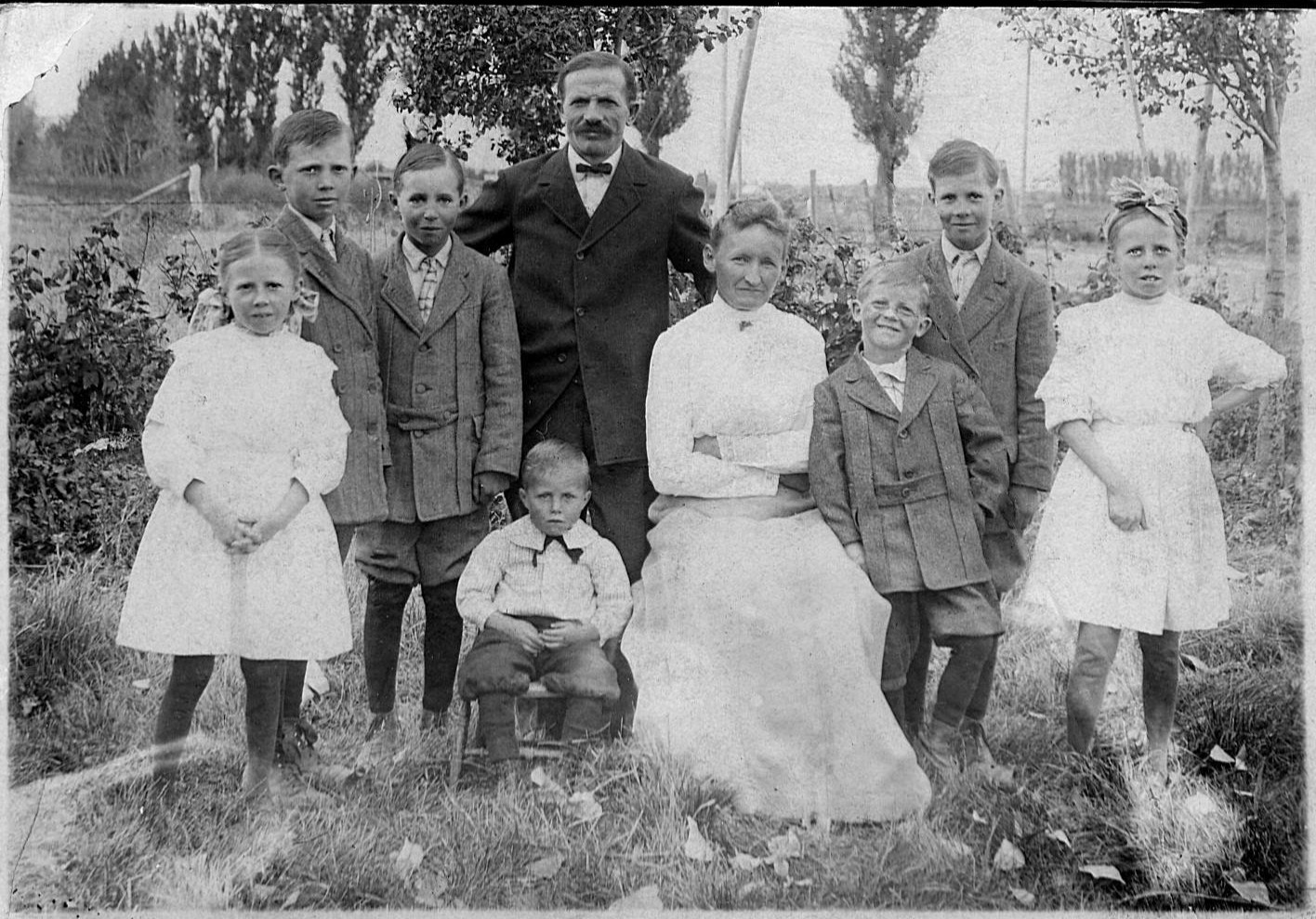
John George Wanner Jr Family abt 1912. (l-r): Eva, William, Golden, Serge (sitting), John, Regina, Rulon, Willard, Mary.
Our father, John George Wanner, Jr., was born in Holzgerlingen, Neckarkreis, Wuerttemberg 29 October, 1870. His parents were John George Wanner and Anna Maria Schmid. He was the oldest in the family of five boys and five girls.
His father had a small farm and some cattle. He was also a road overseer. So dad, his mother and brother and sisters did most of the farm work. They also got wood from the forest for winter fuel.
Dad’s parents were very religious people and belonged to the Lutheran church. They were very hard workers and tried to teach their children correct principles. Dad tried hard to follow in their footsteps.
His parents joined the Church of Jesus Christ of Latter-day Saints in 1891. They made sure all their children were baptized as they became of age. His parents could see that it was the only true church on the earth, and they wanted to go to America, where they could worship as they wished. They also felt it would give their children a better opportunity in life.
His parents were the only ones in their respective families who joined the LDS church. Our dad was baptized in July in 1891, and came to America with one of the missionaries – a brother Terrell who was from Providence, Utah. Brother Terrell took good care of him and helped find work for him to do and provide for himself.
Dad got a job working for brother Fred Nuffer in Glendale, Oneida County (now Franklin County), Idaho. In 1893 his father, mother, and his brothers and sisters came to Cache Valley from Germany. Dad and brother Nuffer met them with a wagon and buggy in Franklin, Oneida County, Idaho, June 18, 1893. I am sure he was happy to see his family again, as it had been almost two years since he had seen any of them.
Dad met a lovely girl from Providence, Utah, by the name of Eliza Sterling, and this relationship blossomed into marriage in 1894. They were blessed with two sons, George and Earl Wayne. This marriage was not a very happy one and they were divorced.
On the 31st of August 1898, dad married Regina Nuffer who was a sister of our uncle Charles August Nuffer. [Daughter of the marriage of Eva Katherine Greiner and Johann Christopher Nuffer] On 9 November 1899, they were blessed with twin boys, William and Willard. As time went on they were blessed with more children, a total of five boys and two girls.
John & Regina Wanner
Dad went on a mission to Germany in the fall of 1907, leaving a wife and six children. On March 8, 1908, their son Serge was born. Mother and the family were living in a home John Nuffer built for dad. It is a rock house on East Oneida Street in Preston, Idaho. This house is still standing and is in good condition at this writing – June 1979.
When Serge was a few months old, mother took all the children and had a picture taken and sent it to dad so he could see the new baby.
Regina with William and Willard in the back and then Golden, Mary in the middle, holding Serge, then Rulon, then Eva.
While Dad was in Germany, he met William Andra’s mother and family and baptized the eldest daughter Freda.
In 1910, Dad’s mother and father sold their home and farm in Whitney to Dad. This is the farm Lawrence Bodily now has. Dad built a red barn that is still in use on the farm. After grandpa and grandma sold their farm to dad, they moved to Logan, Utah.
In 1913 dad’s parents, brothers and sisters had a family reunion at their home in Whitney. There was a large crowd and we all had a good time.
We all had to work hard and dad relied on his daughter Mary for many hard farm jobs. However, on Saturday nights he would take us to the picture show and give us each 25¢ to spend on the show and treats.
In 1917, I begged to take the sewing class at the USAC in Logan, as I wanted to learn to sew. However, I was only there a short time when dad brought me home to work on the dry farm. I have always felt bad about this as I wanted to learn to sew.
My brother, William, enlisted in the Army on August 5, 1917. He was with the 145th Light Field Artillery, Battery C. He left Salt Lake City for Camp Kearney on October 11, 1917. He left for France August 2, 1918. William contracted the influenza and died December 1, 1918. His body was brought home November 11, 1920, and interred in the Whitney Idaho Cemetery.
Just a few days before they got the sad news of William’s death, their son, Golden, died November 26, 1918 in Salt Lake City from Influenza.
On January 8, 1921, dad sent his son Willard on a mission to New Zealand.
Dad and mother were to face still more sorrow when their son Rulon died February 26, 1924, in the Logan hospital.
Dad believed in missionary work with all his heart and soul and on December 15, 1925, he went to Tennessee on a six month mission.
In 1928, Serge went to New Zealand on a mission and died there October 5, 1929. His body was brought home for burial. The funeral was held in the old opera house in Preston, Idaho. These were trying times for our parents. Losing four sons, and all their bodies returned home in a box. This left them with only one son and two daughters.
On April 7, 1930, dad sent Eva on a mission to California. Dad was not a stranger to hard work. He raised crops and took good care of his farm animals. He took pride in having things looking neat and clean around the farm and yard.
When Dad operated his farm in Whitney, he was always up early in the morning and usually was the first to get to the beet dump in the morning. The story is told about some of his neighbors who decided to beat him to the dump. They got up extra early to get a head start. Before they got to the beet dump, they could hear George Wanner going down the road ahead of them. They could hear him saying to his horses, “Gid up–gid up–gid up.”
When dad sold his farm in Whitney, he purchased 40 acres nearer to Preston and built a beautiful home on it. Part of it is where the Oakwood School is now located. When he retired he sold his farm and home to his daughter Mary and her husband William Andra.
Dad was successful in the various undertakings he engaged in. He was one of the first in Preston to have an automobile. When he brought it home he did not know how to stop it. He yelled “whoa” when he got in the garage, but before he got it stopped he had gone through the end of the garage.
Dad built the two little homes on the west side of second east and first south in Preston, Idaho. He also built three homes on first south and the south side of the street in Preston. Dad and mother lived in one of them until she died in 1942. Mother was ill for quite a while before she passed away. Dad cared for her the best he could and would take her for little rides in the car. She was unable to walk and dad would carry her on his back from place to place as they went visiting.
As many of you will remember, there was a humble side to dad. I have seen him cry when bearing his testimony and when he was grieved over the death of a loved one, a relative, or friend. He wanted to leave this world a better place than he found it, and I feel sure he made some contributions and brought this desire to fulfillment.
After mother died, dad remarried and went to live in Salt Lake City, Utah. This marriage was not successful and they were divorced. Later on he remarried again and was living in Florida. He became ill and wanted to get back to Preston. My son William went to Florida to bring him home, but when they got to Chicago, he was too ill to go on. So, William put him in the hospital where he passed away on January 5, 1947.
Regina Nuffer was born January 26, 1869 at Neuffen, Germany, a daughter of Johann Cristoph and Eva Katharina Greiner, she came to Utah with her family after they were converted to the gospel. She married Jacob Scheibel July 15, 1889, in Pleasant Valley, Carbon County, Utah. Her first child, Alma Katherine Scheibel Naef, was born, September 27, 1889. When her child was six months old, she and her husband separated and she moved back to Mapleton, Idaho, where she stayed with her parents on their farm. During this period, she would help people when they were sick, and her mother would take care of her child.
In about 1893, after the death of her mother, she moved to Weber County, Utah, and worked for the Will Taylor family in Farr West and the Bowman family in Ogden. She again returned to her father’s farm. On her way home, she stopped in Logan and walked out to Providence to visit a friend. While eating lunch, she happened to think that she had left her new coat on the train. She went back to Logan to the train station and they sent out a tracer. In a few days she got her coat back. After returning to Idaho, she worked for several people in Franklin and Preston. She lived in one room of her brother John’s home in Preston. Her brother was on a mission in Germany at the time.
On August 31, 1898, she married John George Wanner in Logan, Utah. That winter she lived on his ranch in Worm Creek or Glendale, Idaho. In April she moved with her husband, daughter, and step son, Wayne, to the Bancroft flat, a little west of where Grace is now.
She was known as a fine, well mannered woman. Her niece, Athene Hampton, said that toward the end of her life her health was not very good and she had a hard time speaking. When Athene and Louisa Nuffer would visit, they would converse by writing notes to each other. She died on March 10, 1942, in Preston, Idaho. Her funeral in Preston was very well attended.
There was a time in the mission when I was really struggling with some things. It was not one thing in particular, but with a whole host of different little things combined. Add to that all the concerns and prayers for investigators and it can become a bit much at times. It was during one of these times I had a pretty significant experience.
We had been out tracting all morning. It was sometime probably about March of 1999. I am too lazy to go find the date in my journal. But it had been drizzling on and off all morning. We actually came back with a pretty good list of call backs but I still had a number of things weighing on my mind. There was one in particular with relation to my companion. I want to make it known we did not have any big issues, but some things he did brought out inadequacies in myself, I believe in no fault of his own. I was struggling how to overcome some of these feelings and disappointments.
The morning had been spent on exchanges with a Canadian, Elder Morton. We returned for lunch and I was so exhausted and stressed under the weeks of dealing with things I went upstairs and plopped on my bed to take a quick kip. However, as I laid there, I just keep rehashing things. It was then I just stopped, opened my eyes, and asked, “What am I supposed to do?”
There I laid pondering that phrase when I very distinctly heard a scripture pop into my mind. It was not an audible voice but I reopened my eyes to make sure nobody was there. I laid there alone on the bottom bunk wondering what in the world the scripture said.
The scripture was Mosiah 7:18.
My first reaction was, “What in the world is in chapter 7 of Mosiah?” I had no clue what was even going on in the chapter, which piqued my interest all the more.
I rolled out of my bed and located some scriptures to look up the verse.
“And it came to pass that when they had gathered themselves together that he spake unto them in this wise, saying: O ye, my people, lift up your heads and be comforted; for behold, the time is at hand or is not far distant, when we shall no longer be in subjection to our enemies, notwithstanding our many strugglings, which have been in vain; yet I trust there remaineth an effectual struggle to be made.”
It was absolutely powerful. Somehow, the words seem to answer exactly what it was I was asking. They hit me as they say, like a ton of bricks. Every single time I read this chapter I think of this experience. Every time when it seems difficulties just won’t go away, I seem to remember this scripture. This is my comfort scripture you can say. Regardless of what burdens we are under, lift up your head and be comforted. The time is not far ahead when these things will no longer be. Whether in death, release, or in the deliverance from the scenario, an end will come. Then a warning, a suggestion, a plea for endurance because still an effectual struggle is to be made.
It is not enough just to wait it out. A struggle must still be made. We must continue working through things, not just give up. The verses go on…
“Therefore, lift up your heads, and rejoice, and put your trust in God. In that God who was the God of Abraham, and Isaac, and Jacob; and also, that God who brought the children of Israel out of the land of Egypt, and caused that they should walk through the Red Sea on dry ground, and fed them with manna that they might not perish in the wilderness; and many more things did he do for them. And again, that same God has brought our fathers out of the land of Jerusalem, and has kept and preserved his people even until now; and behold, it is because of our iniquities and abominations that he has brought us into bondage.” (Mosiah 7:19-20)
The Lord has done so much good in our lives, don’t lose sight at the moment. God’s promises always come true. They will always ring in a new day, eventually.
Looking back, I can see how much this has come to pass. As I have made the eventual struggle ever since, I find my blessings are becoming greater and greater. I feel more and more in tune. I see miracles all about me in my life. Who really could ask for anything more? I haven’t really been through a whole lot in my life either. Some would disagree with me, but I keep pressing forward and making the effectual struggle. Somehow everything works out right. I have been fortunate it has all worked out for me in this life. I fear there are many who it does not work out for in this life.
Some of my blessings are being realized in the past week.
This past weekend, the effectual struggle of helping out friends, listening to friends, continuing to foster friendships in the difficulty of school and university, and especially with friends after marriage opened doors for me. I was invited to Vernal to spend time with three other friends who all lived on Darwin Avenue in Logan. Anna, Allen, and Brad. Anna, for all intents and purposes, is an old girlfriend. I certainly don’t see it that way with a negative connotation. However, both of us struggling through despite some awkward times, proved to be a foundation and grounding point where we can move on and have become great friends. Allen, another individual I got to know fairly well, but never as well as I would have liked, through the struggle of maintaining contact, proved to be a great deal of fun, mutual respect, and some business dealing. Brad, the struggle to maintain contact has turned into a bond and friendship I have never heard of between any other two missionary companions. That relationship has affected so much of our daily lives I am not sure I could even begin to define its influence.
We meet up for a weekend together in Vernal. It was a blast. We hiked canyons and climbed cliffs. We sought out petroglyphys and outlaws. We toured Ashley Valley’s water treatment facility. We enjoyed meals, told jokes, and explored museums. What a blast. All from the effectual struggle of not feeling adequate or capable of reaching out to effectively connect with others.
That commitment has gone even further. I have maintained relationships with parents of many friends I went to high school. Sometimes, I am not even in contact with the friend anymore, but am still with the parents. One such relationship was with a girl named Nicole. Again, a girlfriend by world standards, but we really just enjoyed ourselves. That ongoing friendship not only with Nicole, but with her parents may turn out to bring other opportunities (perhaps business too) now. Who would have ever thought that the parents who called every 10 minutes while we clasped to brick ledges holding on to our lives (all in complete safety) would become fast friends? Who would have thought the parents of a girl whose piano bench I would break early one morning by sharing it with my date would spend hours with me showing my photos of their safari to Africa and motorcycle trip through New Zealand?
These are just a couple of examples on my effectual struggle to be better at reaching out, maintaining relationships, and remembering others would have blessed me in so many ways. What is especially true is I am seeing some of these blessings while yet in mortality. That too, is probably another blessing of making the effectual struggle.























 Sagacity