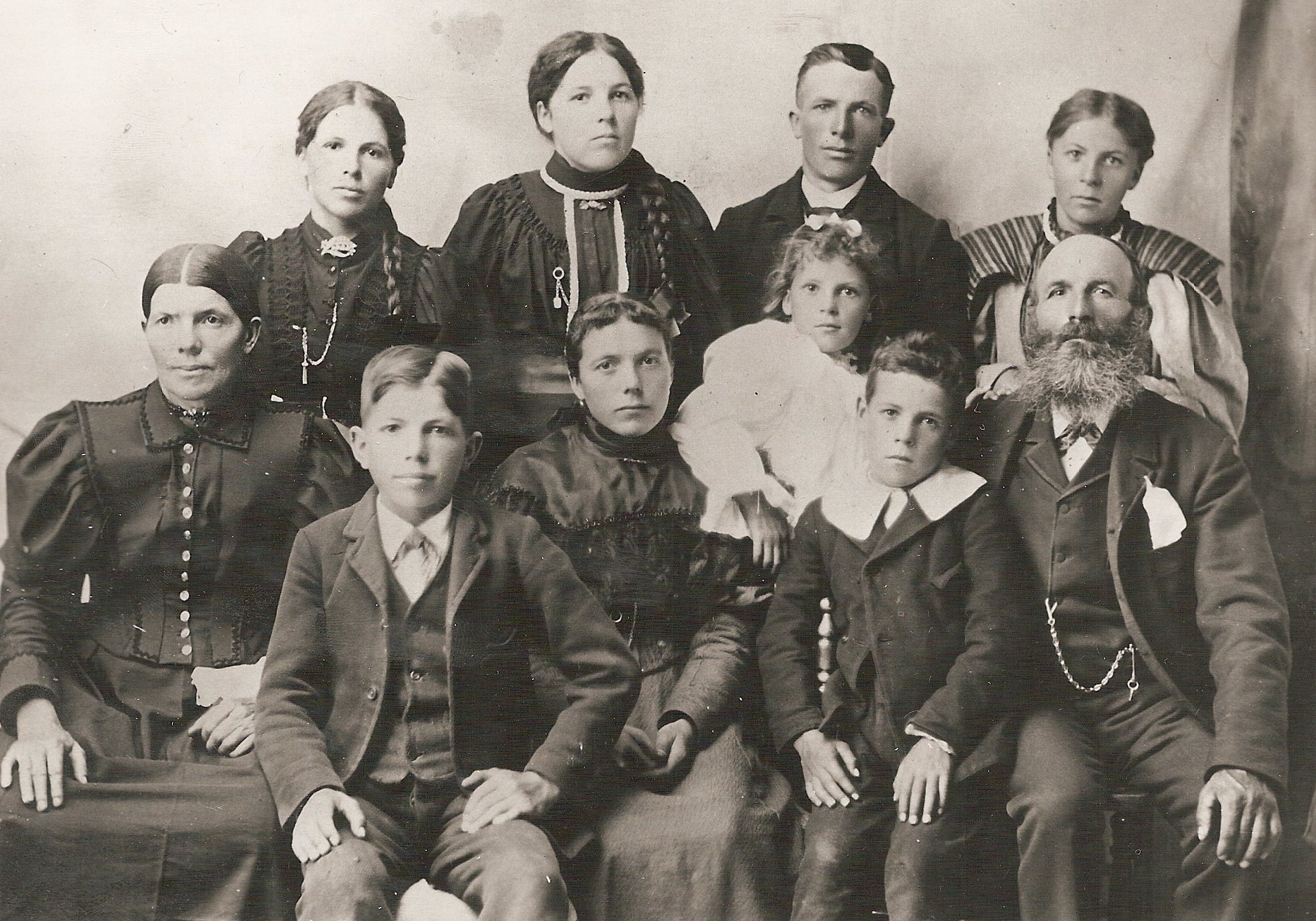
Back (l-r): Nellie Ward Neal, Carl Hodson, Kenneth Taylor, Paul Ross, Howard Singleton, June Etherington, Una Cottle, Hugh Taylor, Rex McEntire, Lyman Skeen, ?. Middle: Marguerite Maw, Lucille Maw, Ruth Hipwell, Frank Hadley, Kent Jenkins, ?, Golda Illum, Ruby Sharp, Lloyd Olsen. Front: Atholeen England, Alice Maw, Lucille Hadley, Myrine McFarland, Verla Lund, Ruth Carver, ?, Rae Knight.
Here is a class photo from what is believed to be a 2nd Grade Class taken outside the old Plain City School in Plain City, Weber, Utah. I have at least two family members in the photo, Paul Ross and Ruby Sharp. I have added family history to the individuals below, question marks either denote an unknown person or dates.
Another history in the records of Golden Rulon Andra.
“(Elsie Wagstaff Coleman read this history of Aunt Louise at our Reunion 21 June 1980)
“(Louise Sophie Wanner was born March 30, 1879.) I was born in Gruenkraut Germany. I can remember as little kids we stayed home. When we were I guess seven years old, we had to go to the Catholic school. There were no other schools around in those days. My Mother and Father didn’t always live in Gruenkraut. My father, John George Wanner was born in Hildritzhausen, Wuerttemburg, Germany, on October 18, 1845. His father was Johann Friederich Wanner, and his mother was Anna Maria Marquardt. My mother Anna Maria Schmid was born January 21, 1849 in Holzgerlingen, Wuerttemburg, Germany. Her father was Jacob Friederich Schmid and her mother was Salome Notter. In 1870 my father went to Russia to fight in the war. My parents were married the 6th. of June 1870. My Father died February 16, 1922 in Logan, Utah. My mother died December 9, 1929 in Logan Utah. The last days of their lives they lived in the 4th. Ward, and they are buried in the Logan Cemetery. My brother John George and sister Christena were born in Holzgerlingen, and my brothers, Johannes, Johannes Friederich, Frederich, Gottlob, and sisters Mary Magdalina, Pauline and Wilhelmina were all born in Gruenkraut, Germany.
Wanner Family about 1895, back (l-r): Mary, Christine, George, and Pauline; front: Anna, Fred, Louisa, Wilhelmina, Gottlob, and John Wanner.
“To continue with my story- – we did so many things in life. First of all we were poor and had not much to live on. The folks had to move from Holzgerlingen to the new place in Gruenkraut. I remember we didn’t have much land. Father got a job working on the street. The grass grew high on the side of the road and we had to help gather the grass for the cows. We had to do this everyday before father went to work.
“We were poor in those days. We had to be up at 5 o’clock in the morning when we were big enough to work for other people. We worked every day in our lives to make a dollar. I would go out and work for other people whenever there was work. Some people had lots of land and we got plenty work there. They would come and get us to work when I was seven years old. I remember we never wasted any time. I remember when we had to go to a place to get vaccinated. I know I sure suffered a long time because my arm was so sore. They do this so that it will last a lifetime in the old country against disease.
“I remember how we got warm for the winter. Father would buy a yard of wood in the forest and we had to cut it down ourselves and haul that wood home with the cows and wagon. Some were long trees too and we would haul all the limbs and everything home. I am telling you, we had the yard so full of wood that we had no room for anything else till we had it shaped down and sawed up and put in its place. You know that was a job and we had to do all this before winter set in. We had a little wagon and we went to the woods in the summertime too, to get some dry wood. We did this many times and would always take home a wagonfull.
“In the old country they had fences in the lucerne fields. We had to put them up so we could hing the hay on them to dry after it got wet from the rain, so it would not mold. When it was dry we hauled it home. I remember we did all the farming with cows, they had them work all day and then milk them at night. Father worked on the street job for many years and mother and us children did most of the farming and in the fall we went picking hops. We never failed to make a little money in them. They have fields of hops in the old country. We always earned our winter’s money there. They have acres of hops there. We never wasted our time in the field.
“Another thing we did was go to the forest and pick fruit and go and sell it in the city. The people would sure buy it because the city was a long ways from the country where we lived. We had to walk all the way to the city. We raised hemp and mother would spin half the night making it into balls. She would take it to the factory and they made clothes out of it. We used to have many yards and would stretch it out on the grass in the summertime. It would go white and thats the way mother made our sheets and everything. We have in the old country the shoemaker, and he come to the house and make shoes for us. We also had the dressmaker come to the house. Sometimes they would stay at the house a week or more.
“When the grain was but, we had to out and clean the heads of the wheat. We cleaned sacks full each day for flour and one time right in the middle of the summer, the soldiers came in with their horses on some maneuvers or something. The horses mashed the grain and trampled all our crops up. I knew there was a big field of grand and they went right through it. They stayed around about a month or more. It sure was terrible.
“After a few years father bought a new farm and house about two miles away from the old one. It was a bigger house and more land and that’s where we lived until we came to America. Our house was a long house. We had four rooms and an upstairs. In the farmhouses of the old country we had everything under one roof– the pig pen and the hay loft. There was a big place in the floor where we threshed the wheat and other grain and we pulled all the hay up in the loft towards the roof. For a long time we threshed the wheat on this hard floor below with a stick and using a big klap, four or five of us would thresh the wheat and then would sieve the wheat from the chafe. But later, I can remember that we hired a thashmachine and the cows pulled it after that.
“I remember one time a wagon run over me. I believe it went over my arm. I don’t know how bad I got hurt, but it was plenty bad enough.
“Well, later on in that place not far away they built a Lutheran church and a school, too; and there we learned to knit our own stockings and do all kinds of sewing and crocheting. Yes, they built a nice church and school. They were very strict in those schools. If you were late a few minutes you would have to hold out your hand and the teacher would hit you so hard that your hand could feel it for a long time. It was one of those hard wood sticks. It wasn’t always our fault because we had to take the milk to the creamery in the morning in the snow and ice, and we could not go very fast, but there was no excuse at all. We had a lot to do before school, and if we didn’t have the lesson ready we were scared to go to school, ’cause if we were late we would sure get hit, and when you held out your hand they would do just what they wanted to do and it didn’t hurt them any.
“In the old country they sure celebrated Christmas. We had two Christmas trees every year and nice ones at that. We had applies tied from the bottom to the top and the step and the tree sure looked pretty every year. We only had white bread for Christmas and Holidays. I can remember how good that white bread was. We never saw it very often. it was only the rich who could buy that. There was only one bakery in Gruenkraut that had good bread and cakes, but we could never buy any. This is how we made our bread: We had a box of wood. Of course, it was clean. Father worked the dough and made enough for two or three weeks. It was mostly rye bread. It was hard and dark but we had to eat it. When Valentine’s Day came around, Mother made up cakes and they sure tasted good.
“We all the time raised our own meat. We raised pigs and salted and smoked the meat. We had our own grease. Mother made her own noodles all the time. She used lots of eggs–they were sure good. We had our cellar so full of potatoes, apples of all kinds and barrels of cider and barrels of sauerkraut. I can remember our cellar was full of all kinds of good things to eat.
“Well, about our garden. We had the prettiest garden you ever saw in the old country. The garden was laid out in a square and we had a path around all over with the vegetables in the background and flowers in front and we could walk all over the paths with flowers on each side. We didn’t need any ditches, but had to pack water when it didn’t rain. We always had a beautiful garden with flowers of all kinds.
“On Saturday we always had to clean the shoes for the whole family — shine them up for Sunday. We always went to church on Sunday. We never worked on Sunday. We were not allowed to work on Sunday, because in those days they would fine you if you did. You could not even get your hay in on Sunday, even when you could see rain coming.
“Well, I guess about in the year 1890, in the summertime, the Lord sent a man along that street in Gruenkraut where my father worked, who was a missionary from the Church of Jesus Christ of Latter Day Saints. He talked to my father a long time and he told father of the new and true Gospel and about Joseph Smith and showed him the Book of Mormon. This man talked to my father in German as he was a missionary to German. Well, it was dinnertime and father took this missionary to our home and father told him–“We’ll see mother”–and from that very day on this missionary stayed at our place. His name was Zollinger from Providence, Utah. When his time came to go home, the missionary took my brother George to America with him. After that we had three more missionaries–one from Bear Lake, one from Providence, and another one from Salt Lake City, who couldn’t speak the language, so we helped him learn the language. He would tell us English words and we would tell him German words. There wasn’t anybody who would listen to the missionaries for miles around–just one other family from Ravensburg–and they were the only ones that believed the message like us. We had room for them everytime they came. There was no place else for them to go and we were glad to have them.
“The missionary from Salt Lake–his name was Hubbard–decided to go tracting one day. It was his first time tracting. He didn’t come home for so late that we thought maybe he fell into one of the wells with water that were here and there. It was late in the evening and dark, so mother decided to put a candle in the window. He soon came back and told us that he had been lost for a long time until he saw the light in the window. There weren’t many houses when I lived there, but in seventy years since, I guess it is built up all over.
“(About this same time Grandma was writing her history, Mrs. Herbert Wagstaff and son came to visit her from California. Herbert Wagstaff was the son of sister Mary Magdaline. The son had recently returned from a mission to Germany, where he had taken colored slides of the big house in Gruenkraut as it stands today. Of this evening of reminising Grandma said:) “It was sure nice to see my old home again and see it still stand in Gruenkraut. It was nice to see it again after seventy years.”)
“Well, I lived in that community for 14 years. That’s when I graduated. We started to this country when I was fifteen, in May of 1893, and got here the 15th of June, 1893. We came by ship and docked first in Amsterdam, Holland, and then in London, England. And then from London, to New York City, where we went to a big high hotel. WE were 12 days on the ocean. We had a good time on the ship where we danced. One day there was a terrible storm which throwed water up on the dock and nobody could dance after that. From New York we boarded the train for Idaho. We were 6 days on the train. On the train we sang all across the United States. We couldn’t speak any English then nor for a long time. We got off the train on the 15th of June, 1893, in Franklin, Idaho, and my brother George was there to meet us. He had a wagon with three spring seats. Well, we never were so worried on our whole trip as we were in that wagon. That day the road was so bad–open ditches with water in, and the horses danced around before they would cross. I never say such a rough road in my life–hills and hollows, and then we saw a bunch of Indians. They were hanging dead squirrels on a line to dry. That was something new to us. Well, we got to the place where we were to stay. But father was as worried that he got off the wagon and walked all the way back to Franklin. Mother and the rest of us were so worried, because he didn’t come back for a few days. We stayed with some folks for about two months, then father built a place in Glendale, Idaho, and there we lived the rest of the summer.
“Towards fall there was a man who wanted to sell his place in Glendale and father bought that place. My father farmed in Glendale. Glendale had only a little meetinghouse and also a school. I went to school there that winter to learn the English language. From then on I worked wherever I could get a job. I worked washing, cleaning house and tending children. In a place where I worked their children got mumps and I got mumps too, and I suffered so much that I could never get better for a long time. When I got better I went to work again. One time in the winter I rode a horse to Preston, and I got the toothache so bad that I had to have it pulled out right there. I soon learned to ride a horse a lot–something I’d never done in the old country.
“I worked for Matthias Cowley in Preston one winter. I guess it was the year 1895. He used to take trips and travel in a buggy–he helped organize the Northwestern States Mission. Then I worked in Whitney, Idaho. They had plenty of sickness in homes there. In 1897 we moved down to Logan and to the 5th Ward. Then I worked in Millville and went to school there at the same time learning the language. After that I went to work in Logan. It was in the 3rd Ward one night in church I met Jeffrey Bodrero. We were married in the Logan Temple, March 16, 1898. My sister Wilhelmina married Jeffrey’s brother, Moses Bodrero, December 18, 1907. Jeffrey’s father was Domenico Marsiano Bodrero, and his mother was Maria Caterina Margherita Frank Bodrero. After we were married I went to work for Dominic Bodrero that summer, who lived by the courthouse, where I walked everyday from the 9th Ward and did washing by hand on a board up until the time of my first child. Later that year I tended to beets, but they didn’t grow very well because of too many wild oats. Jeffrey went to the canyon about every day to get lumber and to make a dollar. These are the years when I lived: Gruenkraut, German: 14 years; Glendale, Idaho: 5 years; Logan 9th Ward: 30 years; Logan 4th Ward–where I became a relief society teacher. I also did a lot of temple work.
“In the old country we had known a family names Speth for a long time. We used to go back and forth to each others homes all the time. There was a big dark forest between our two places, and we were sometimes afraid to go through it because it was dark, even in the day time. Father would send us kids over in the evenings too. Sometimes we went twice a week to see them. We always had to walk of course. We had no car. I can see it now and I will never forget it. They were really friends to us. The old people never joined the church, but the boys came over to America and settled in Providence and then joined the church. My granddaughter married a Speth grandson.
“My children’s names are: [Rosalie] Marie, John George, David Wanner, Eva Margaret, William Jeffrey, Parley Lorenzo, Louise Mary, Edward Theodore, Llewellyn Grant and Evelyn Jane.
Bodrero Family (l-r): Louisa, Louise, John, Parley, Rosalie, Jeffery, Jeffery, David, Eva
“My folks went to conference everytime there was one. We never had the chance to go because children had to stay home and do the work. I remember it was in the winter once and it was so cold my parents couldn’t go to the conference. They sure liked this Mormon Gospel from the first day my father met the missionary.
Wanner Reunion, Anna Schmid Wanner sitting, standing (l-r) Mary Carter Wanner, Wilhelmina Wanner Bodrero, Mary Wanner Wagstaff, Regina Nuffer Wanner, Louisa Wanner Bodrero, Christine Wanner Nuffer, and Rebecca Hicks Wanner
“(Louise Sophie Wanner Bodrero died February 1, 1967 in Logan, Utah)
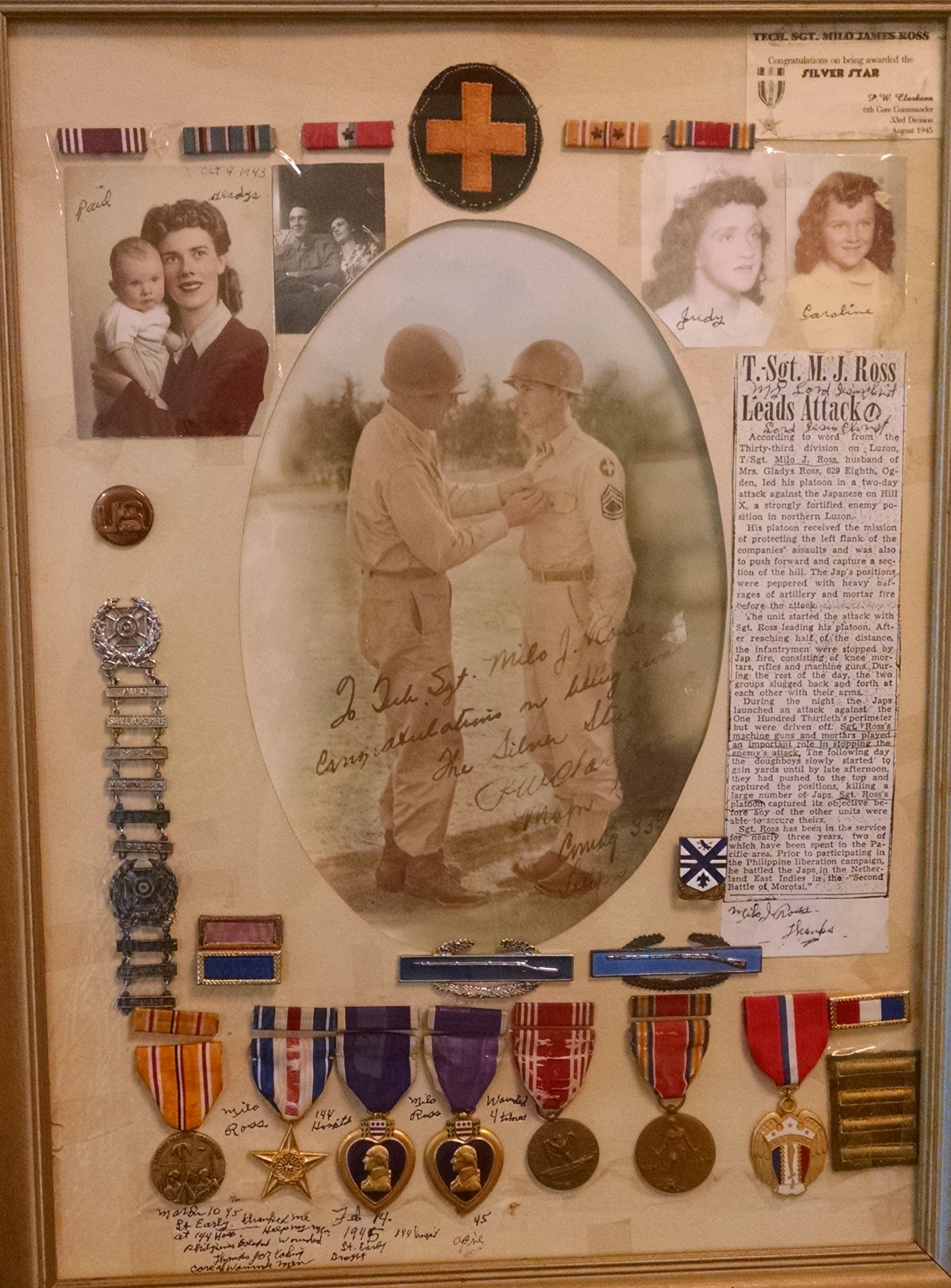
I previously wrote about the plaque that hung on my Grandparents’ wall in Plain City, Utah. The photo in the center of the plaque showed Milo James Ross receiving the Silver Star by Major General Clarkson.
Milo James Ross WWII medals, clippings, and photo
Before Grandpa passed away, the Army was gearing up to do a more formal presentation of his medals as some of them were just given to him without much fanfare. Apparently some of them deserved a bit more formal recognition. Initially, we were gearing up for Independence Day 2014. However, some things grind slowly forward. We were then talking about some dates in August 2014 and September 2014. Unfortunately, Grandpa passed away 17 July 2014.
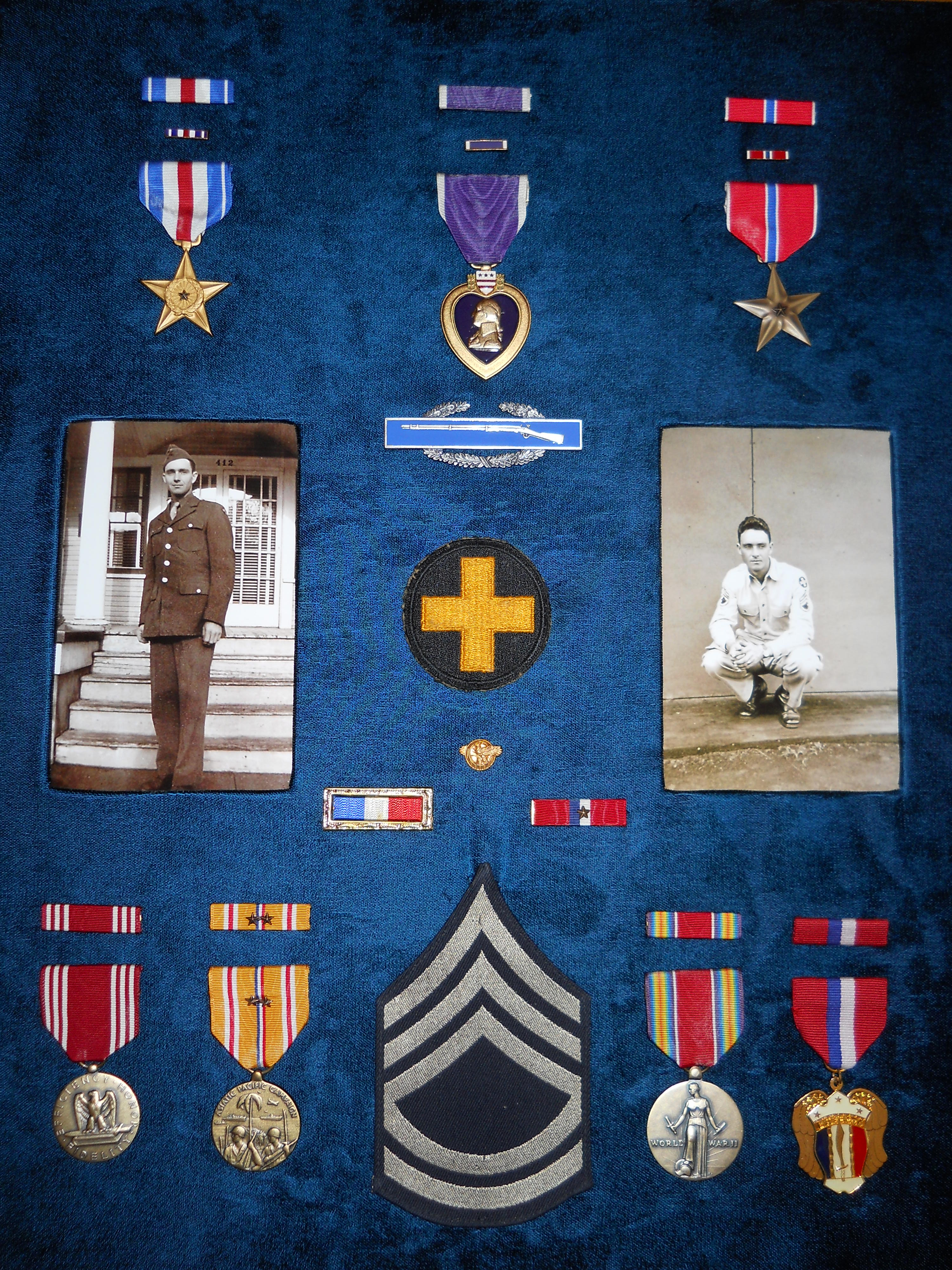
In preparation for the more formal presentation, the military gave new copies of some of the medals he had already received and the others he had not yet received. We took those and put them in a shadow box for his funeral. Here is a photo we took of the box before putting it behind glass.
I am not clear on the medals and what they each mean. His obituary lists a number of his medals that were awarded to him.
His obituary included this Army service information:
“Milo enlisted in the Army in October 1942. He served in the 33 rd Infantry Division, 130 th Regiment, Company C. He trained in weapons and earned his expert ranking. He arrived in Hawaii in July 1943 and received the announcement that his son, Milo Paul, had been born. He served as part of the Philippine invasion force and they fought through the jungles and liberated Baguio City. He was injured five times, one while tending to other soldiers awaiting medical attention.
“He was present at the Japanese surrender at Luzon as a Technical Sergeant in June 1945. He received two purple hearts and the Silver Star for his service at the end of World War II. His Company received a Presidential Citation for outstanding performance during armed conflict with the enemy in efforts to seize Hill X in Bilbil Mountain Province. At the time of Milo’s death, the military was preparing to award him another Purple Heart, another Silver Star, Bronze Star, Good Conduct Medal, Asiatic-Pacific Campaign Medal & Bronze Star, World War II Victory Medal, Combat Infantry Badge 1 st Award, Philippine Liberation Ribbon and Bronze Star, Honorable Service Button for World War II. He was also to be awarded the Philippine Liberation Medal and Republic of the Philippines Presidential Unit Citation Badge from the Philippine Government.
The UofU Commemoration placard for Grandpa in 2009
The 2009 University of Utah Veterans Commemoration included this excerpt about Grandpa:
“Milo James Ross was drafted into the army shortly after the attack on Pearl Harbor. He was sent to Fort Douglas and shipped out that same day to Fort Lewis, Washington. For the next two months, he went through a weapons platoon crash course. He trained on machine guns, mortars, and hand launchers. Ross quickly earned expert ranking on these weapons. Following basic training, Ross’s unit was sent to Barstow, California. Their training focused on digging fox holes.
“Ross soon shipped out to the Hawaiian Islands, leaving behind his young pregnant wife. As his unit landed on the big island of Hawaii on July 4, 1942, a voice on the loud speaker said, “Sergeant Ross, congratulations. Your wife and son are doing well, and, one more thing, before you get off the ship you and your men have guard duty for the next four hours. Welcome to Hawaii.”
“After a long training in Hawaii, Ross’s unit, “C” Company, 130 Infantry Regiment, 33rd Infantry Division, became part of the Philippine invasion force. They hit the beach in Lingayen Gulf and intensely fought their way through jungles and mountains to the inland city of Baguio.
“Ross was wounded while tending other soldiers who were awaiting medical attention. He spent two months in a hospital while recovering from shrapnel wounds all over his body.
“The day after Ross returned to his unit, they jumped into three months of fighting that only ended with the Japanese surrender at Luzon in June, 1945.
“Company C, 130th Infantry Regiment was awarded a Presidential Unit Citation for outstanding performance of duty and superb courage during armed conflict with the enemy in their efforts to seize Hill X in the Bilbil Mountain Province in the Philippines. For his service, Ross was awarded the Purple Heart and the Silver Star.
The same shadowbox on display at his funeral
BYU Library – Special Collections has this biography and reference citation of Grandpa:
“Milo James Ross (1921-2014) was a World War II veteran who fought in the Pacific battles.
“Milo Ross was born February 4, 1921 just north of Plain City, Utah to John Jack William Ross and Ethel Sharp Ross. When Milo was barely four, his mother passed away in childbirth. Milo and his siblings were cared for by their maternal grandparents until financial strains forced Milo to be raised by his uncle, Edward Sharp, in Plain City, Utah. He grew up farming with his cousins and attended the local schools, eventually graduating from Weber High in 1939. In 1940, at a Plain City celebration, Milo met Gladys Maxine Donaldson and two years later, on April 4, 1942, they were married in her parents’ home in Ogden, Utah. The October of that same year, Milo enlisted in the United States Army at Fort Douglas, Utah, becoming a member of the 33rd Infantry Division, 130th Regiment, Company C. After training they were sent to Needles, California handling freight, setting up tents and digging trenches and then on to Hawaii for further training. When they arrived in Hawaii, on July 4, 1943, Ross was informed his son, Milo Paul, had been born that very same day. Ross’s company was assigned to become part of the Philippine invasion force where they fought in New Guinea and Luzon. They fought through the jungles, liberated Baguio City, was present at the Japanese surrender in Luzon in June 1945, and left Ross injured on five separate occasions.
“Milo Ross was honorably discharged in September of 1945. He was honored with two Purple Hearts, the Silver Star, and the Presidential Citation for outstanding performance. Returning home, Milo worked remodeling homes. He also had two daughters: Judy Ethel and Caroline. Gladys and Milo solemnized their marriage July 2, 1976 in the Ogden Temple of the Church of Jesus Christ of Latter-day Saints. Gladys died in 2004.
“Milo James Ross died in Plain City, Utah on July 17, 2014 at the age of 93.
Citation:
“Standard examiner, via WWW, March 2, 2018 (Milo James Ross; born February 4, 1921 in a log cabin north of Plain City to John Jack William Ross and Ethel Sharp Ross; mother tragically died from childbirth in 1925; Milo and his siblings lived with Ross grandparents until the costs proved too great and his Uncle Edward Sharp raised Milo in Plain City until adulthood; He attended schools in Plain City and graduated from Weber High in 1939; farmed with sharp cousins; Gladys Maxine Donaldson at a Plain City celebration in 1940; married April 4, 1942 in her parent’s home on 8th Street in Ogden; enlisted in the Army in October 1942; 33rd Infantry Division, 130th Regiment, Company C; Philippine invasion force and they fought through the jungles and liberated Baguio City; injured five times; present at the Japanese surrender at Luzon as a Technical Sergeant in June 1945; two Purple Hearts and the Silver Star; Presidential Citation for outstanding performance; He returned home in 1945 and worked remodeling homes; children Milo Paul, Judy Ethel and Caroline; solemnized their marriage July 2, 1976 in the Ogden LDS Temple; died in Plain City on July 17, 2014)
“UPB files, March, 2, 2018 (Milo James Ross; born Feb. 4, 1921 in Plain City, Utah; Joined army Oct. 1942 at Fort Douglas, Utah; fought in new Guinea and Luzon; sent to Needles, California handling freight, setting up tents and digging trenches; sent to Hawaii and landed July 4, 1943 where he received news his son had been born that very same day; wife passed away in 2004 and daughter on 1998)
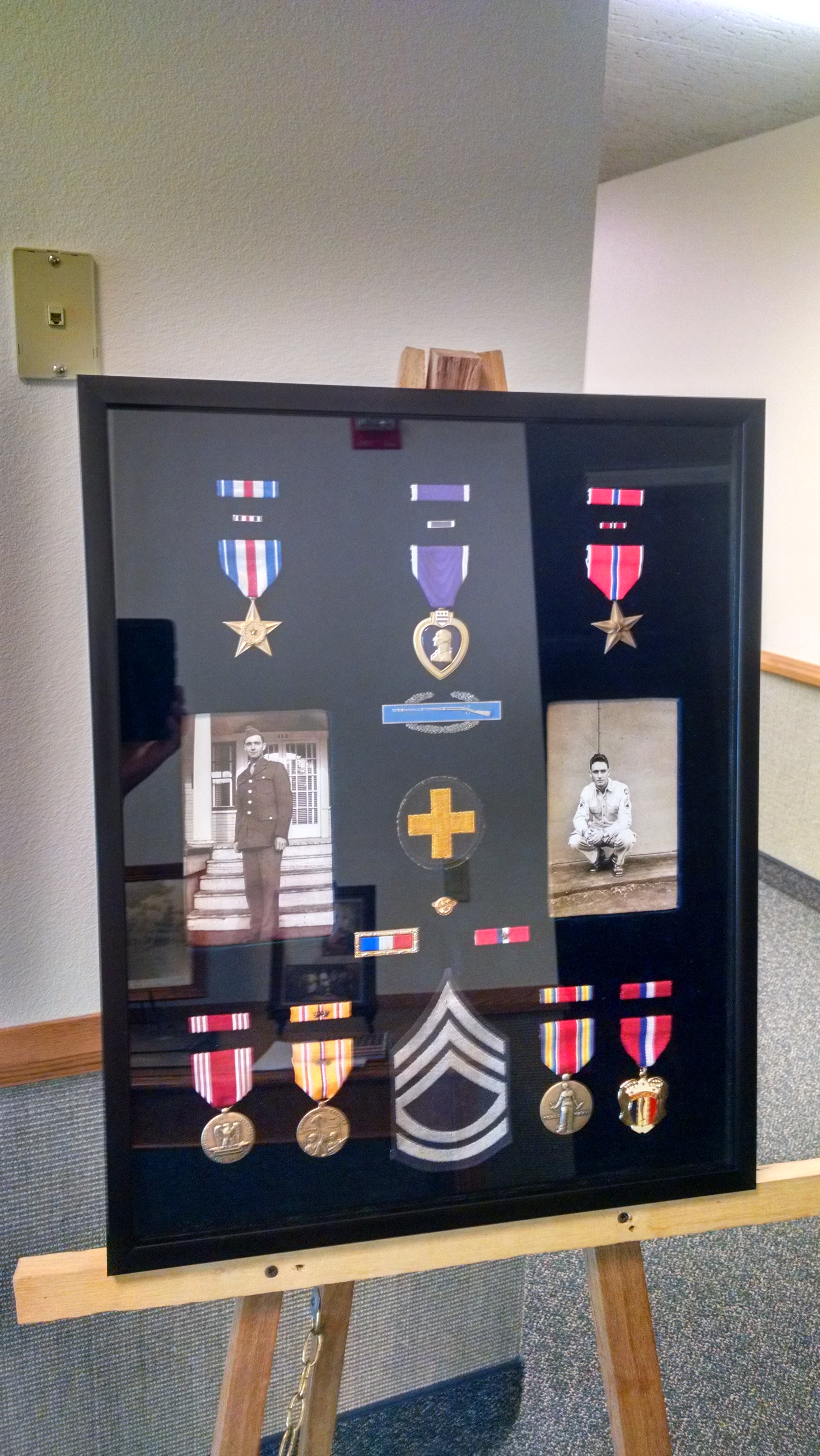
The new medals shadowbox on display at his funeral
Transcript for Housley, George Frederick, [Reminiscences], in Life histories of George Frederick Housley and Maria Christina Jacobsen Housley
“The Bishop of the Ward wanted George to talk in Church and tell of his coming across the plains, but George said he just could not speak in public so his wife’s brother-in-law, George Wood, who was a lawyer, came to his home and took his story down in short hand as George told the story to him. Then they had it read in a reunion. It was as follows:
“In the year of [1856], I with mother left our native land England, with about 600 others for our America “The Zion of Our God,” on the good ship “Horizon,” spending five weeks in our voyage to Boston. Where we took passage on a steamboat to Iowa. Awaiting there for three weeks for our hand-carts to be made that were to carry our “all” across the vast stretch of the plains to Utah. Each family supplying themselves with the necessary food for their journey if they were well. At Iowa City, where we were camped, a gentleman told me that we would starve to death if we went there at this season. One of our people and his family decided to stay over. I became tempted to do likewise and upon telling my mother that we better stay she became much depressed in spirit and told me to wait a little while. During the time she prayed to Our Heavenly Father for guidance. One fellow traveler, after deciding to stay, sent out one day in the woods to hunt for game, and while away was seized with fever and ague. He hurried home and upon entering the tent where mother I were awaiting him, he laid upon the cot and commenced singing in poetry and rhyme, telling mother to take me with her to the valley and that we should get through alright. Mother told me she had made it a matter of prayer and by this means her prayers were answered. I told her then that we would go to the valley at all hazards because I was satisfied all would be well.
“Upon the company starting we were in line with our cart and ready. All went well as we joyously sang, “For some must push and some must pull as we go marching up the hill. As merrily on the way we go, until we reach the valley, Oh!” As days wore on, our spirits lagged as we became weary. Some of our people became sick and were compelled to ride, thus compelling others to be more heavily loaded. Provisions commencing to get scarce as the days wore on, necessitating our captain to put us on shorter rations. Many dying by the wayside where they were buried each night where we camped and their graves were left unmarked except by our tears. At this season and at this part of the plains it commenced getting cold, and were again placed on shorter rations of 4 ounces of flour to each person per day. We traveled to the Sweet Waters River where we camped, being so weak and exhausted that it was almost impossible to move. Many of our people while there died of starvations while others froze to death by the wayside.
“A man from London by the name of Stone, while trying to get to an Indian camp was devoured by wolves; when found by some of our camp, nothing was left of him but his legs inside his boots.
“Receivers were sent out from the Valley to assist us in and could not find us, thinking we were lost on the plains the rescue party concluded to return to the Valley. But one of their number stated that he would go to the States but what he would find us. About noon a horseman was seen coming into our camp, and he looked like an angel to us poor starving emigrants who had eaten nothing but flour for three days. With words of encouragement he entreated us to make another start. But, many, while their will was good, their strength failed them and they dropped and froze to death by the way.
“The relief party returned and met us and assisted us with some provisions. But scores of our brethren and sisters died and were left in unmarked graves by the wayside. At this time I was permitted to sleep in a tent with two of my companions. Each of them dying by my side where I slept by them ’till morning when they were taken away and buried.” In a later trip across the plains to assist the emigrants at one of our camps I saw many of the bones of my companions that had been dug up by the wolves. At the time of my companions death I became despondent through weakness that I longed for death and tried to hide myself from the company that I might die, but one of the brethren returning back for something, found me sitting behind the rock where I had hoped to die. He took me along with him for a day before we caught up with the company. I was permitted to sleep in a wagon that night, where I slept with a dead man all night.
“The next day we were permitted to see and enter into the Valley (November 29, my birthday). Although I was too weak to walk, my feet being much swollen I wrapped them in my mother’s shaw until we were taken care of by kind friends who were awaiting us. But brother Slack, our kind friend, would not allow me only a limited amount of bread as he was afraid it would kill me. But after they had gone to meeting I finished up the whole pot pie which had been prepared for the family, and I am alive yet and I have been hungry to this day.”
“President Parkinson of the Hyrum Stake was present at the reunion and when he heard of the hardships, suffering and hunger George went through, he made arrangements with the Church authorities to grant this couple the privilege of receiving their second endowments. After they received theirs, Mary Ann stood proxy for George’s first wife, who received their second endowments of the 28th of July 1910. This is a privilege and blessing that only a few people have had since the Church was organized…. An addendum was added: “One time while visiting in Mapleton at his son Ben’s home, he and my Grandfather—Marshall Franklin Allen—were reminiscing over old times. Grandfather Allen told of one time when “Brother Brigham” had called him to accompany several other young men in going out to meet the Hand Cart Company, to take them some provisions and assist them into the Valley. As he knelt in prayer the evening before going, he said that he told the Lord that it was a foolish thing to do, going out in such weather and with no roads to follow. But while he was still in the act of prayer, it was made known to him that he should go. It was also made known that he would be able to save many of their lives. After search many hours the rescue party became discouraged. Thinking the Hand Cart Company had been lost on the plains, they decided to return to the Valley. Grandfather said, “I told them I would go ’til I reached the States but what I would find them” About noon they found a group of handcarts with their poor, starving people. Thinking there may be more farther back, he rode on for some distance. He saw a dark spot among some rocks. Upon investigating, he found it to be a young man. He wrapped his blankets around him and helped him onto his horse. Then Grandfather Housley spoke up and said—”The horse had one white leg, a white strip in it’s forehead and the rest of it was coal black.” Grandfather Allen said, “Yes.” Grandfather Housley said, “It was a bright plaid blanket.” Grandfather Allen asked, “How do you know?” Grandfather Housley said, “Because I was the one you found!” Then he stood up and said, “And I want to tell you, if it hadn’t been for the prayers of my mother and the faith of the Saints, I would not have lived ’till you found me and I never would have reached the Valley!”
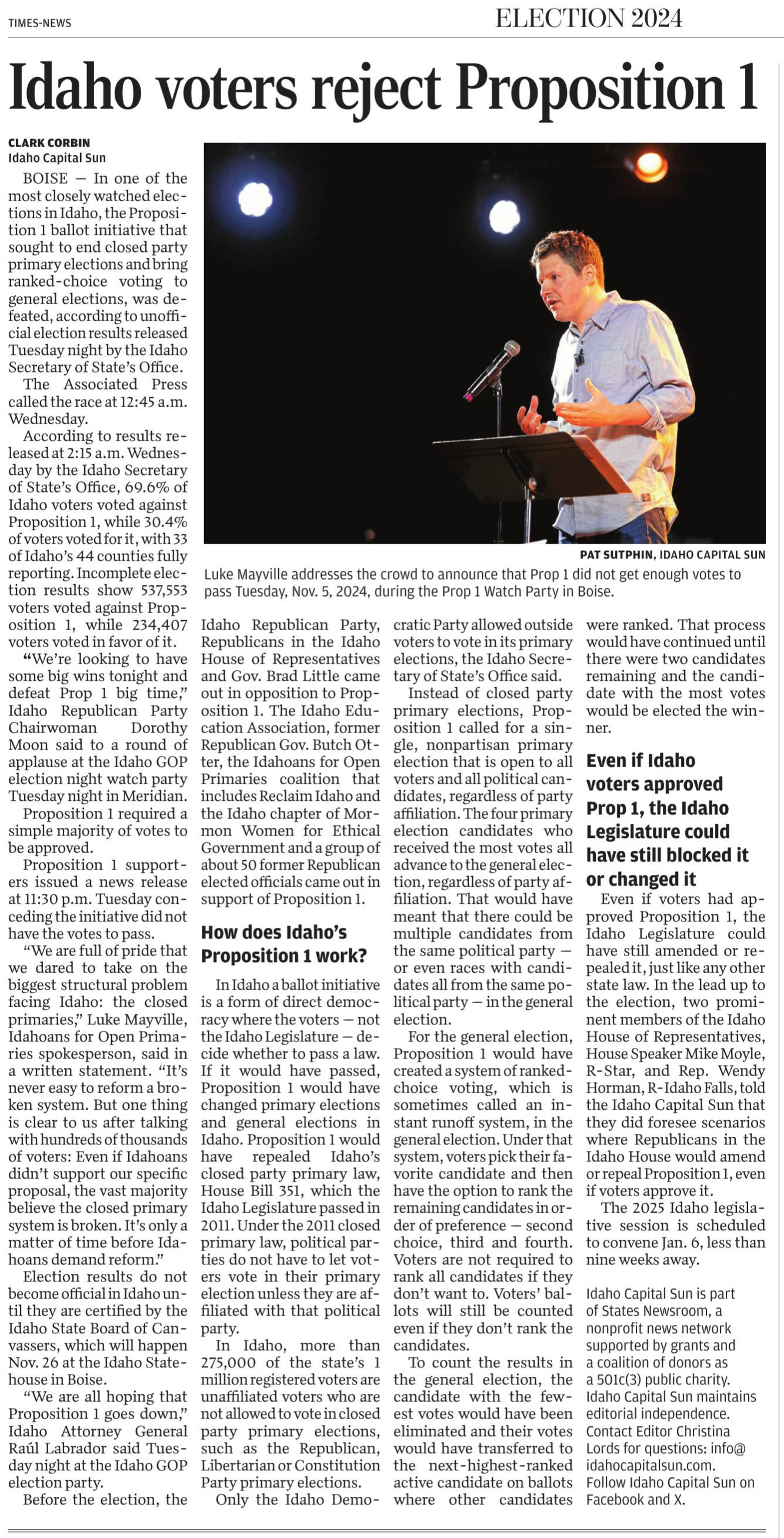
I am sharing this post by Jim Jones from his website. It posted on 27 October. Due to its proximity to the election, it did not show in the newspaper. I have been posting all articles from the Times-News, on both sides, related to the Proposition 1 Initiative in Idaho. While this one did not publish in the Times-News, I am sharing it because this website received an honorable mention.
“Extreme elements of Idaho’s Republican Party voted in 2011 to close the GOP primary election to purge party ranks of so-called moderates. The strategy has been remarkably successful. Each election since then has witnessed the defeat of reasonable Republicans who were intent on solving problems facing the Gem State. They were replaced by culture warriors, intent on punishing teachers, banning books, chasing away doctors, vilifying farm workers, and making the State a national laughingstock. That has been accomplished by preventing a wide range of Idahoans from voting in the low-turnout GOP primary. That makes it difficult for problem-solving Republicans to survive the primary.
“While Idaho’s independents can vote in the GOP primary if, and only if, they declare themselves to be Republicans, many chafe at being forced to affiliate with any group in order to exercise their right to vote. Forcing citizens to affiliate with, or to disavow, any group as a condition of voting in taxpayer-financed elections is contrary to the spirit of Idaho’s Constitution. That revered document says that all political power belongs to the people. Political parties have no power under our Constitution. Unfortunately, our legislators have an ugly history of playing politics with the voting rights of Idahoans.
“The most notorious example is an 1884 pre-statehood law specifically designed to deny voting rights to members of the Church of Jesus Christ of Latter-day Saints. The law did not require conviction of polygamy to deny voting rights, just belief or membership in a group that supported the practice. In effect, Mormons were required to disaffiliate from their church in order to vote. The Territorial Legislature passed that law to weaken the Democratic Party, which had the strong support of Mormon voters at that time.
“A friend, Paul Ross, just sent me an interesting historical recollection of how some church members skirted the law. They would sign an oath renouncing their church membership in order to vote, but then joined again soon after the election. That led to criminal charges against some, which resulted in the US Supreme Court upholding a conviction. Of course, that decision would not stand the test of time and reason.
“The anti-Mormon law was written into Idaho’s original Constitution in an 1889 election in which Mormons were not allowed to vote. That Constitution also denied voting rights to Native Americans “who have not severed their tribal relations.” Thankfully, most of that outright discrimination is behind us.
“Along a similar anti-voter track, successive Idaho Legislatures have repeatedly tried to kill or disable constitutional rights that voters gave themselves in 1912–to make laws with the initiative and to veto obnoxious legislative acts with the referendum. The Legislature did not take action to implement the initiative and referendum until the 1930s. The last legislative effort to essentially kill those rights was made in legislation passed by extremists in 2021, but that effort was slapped down by the Idaho Supreme Court that same year.
“The extremists, who have gained power by excluding voters from the closed GOP primary where most officials are selected, are feverishly working to defeat Prop 1. They claim it will infringe voting rights, when in fact it will enhance them. Everyone, regardless of party preference, will be able to take part in every tax-payer supported election. Voters will not be confined to just one party’s ticket but will be able to pick and choose among every candidate for every contested race in the primary election.
“Best of all, Prop 1 will make it possible for reasonable Republican candidates to make it to the general election ballot. That’s why so many traditional Republicans, like former Governor Butch Otter, are supporting Prop 1. Dorothy Moon and Raul Labrador will no longer be able to defeat civil, problem-solving Republicans in the closed GOP primary. Nor will voters be forced to affiliate, or disavow, any group as a condition of voting in any election financed by their tax money.







 Sagacity