Orwell’s 1984 and Today

United States Capitol

There have been many things on my mind lately. Watching the ongoing bickering in the District of Columbia for the past 20 years I often think of 1984, Brave New World, and Fahrenheit 451. The Trump world often made me thing of 1984 with the inability to rely on truth and the often shifting positions from day to day. The Democrats declare the need for truth, for which I agree. The Republicans declare the need for unity, again, I agree. Both are doing it for limited self-serving purposes though. While I am not that old, I long for the America I recall learning about in school and wonder if she will ever reappear. I weary of our rewriting history, not of addition or giving more context, but contriving it into something it is not. I love Thomas Jefferson and find great frustration in our undermining his phenomenal influence that continues to today. We are now seeing it also in the religious side with Brigham Young. Based upon those musings, I read this Imprimis talk and found it reiterating my thoughts of the past years in words. I could not help but share.

The following is adapted from a speech delivered by Larry Arnn at a Hillsdale College reception in Rogers, Arkansas, on November 17, 2020.

“On September 17, Constitution Day, I chaired a panel organized by the White House. It was an extraordinary thing. The panel’s purpose was to identify what has gone wrong in the teaching of American history and to lay forth a plan for recovering the truth. It took place in the National Archives—we were sitting in front of the originals of the Declaration of Independence and the Constitution—a very beautiful place. When we were done, President Trump came and gave a speech about the beauty of the American Founding and the importance of teaching American history to the preservation of freedom. 

“This remarkable event reminded me of an essay by a teacher of mine, Harry Jaffa, called “On the Necessity of a Scholarship of the Politics of Freedom.” Its point was that a certain kind of scholarship is needed to support the principles of a nation such as ours. America is the most deliberate nation in history—it was built for reasons that are stated in the legal documents that form its founding. The reasons are given in abstract and universal terms, and without good scholarship they can be turned astray. I was reminded of that essay because this event was the greatest exhibition in my experience of the combination of the scholarship and the politics of freedom. 

“The panel was part of an initiative of President Trump, mostly ignored by the media, to counter the New York Times’ 1619 Project. The 1619 Project promotes the teaching that slavery, not freedom, is the defining fact of American history. President Trump’s 1776 Commission aims to restore truth and honesty to the teaching of American history. It is an initiative we must work tirelessly to carry on, regardless of whether we have a president in the White House who is on our side in the fight. 

“We must carry on the fight because our country is at stake. Indeed, in a larger sense, civilization itself is at stake, because the forces arrayed against the scholarship and the politics of freedom today have more radical aims than just destroying America. 

***

“I taught a course this fall semester on totalitarian novels. We read four of them: George Orwell’s 1984, Arthur Koestler’s Darkness at Noon, Aldous Huxley’s Brave New World, and C.S. Lewis’s That Hideous Strength

“The totalitarian novel is a relatively new genre. In fact, the word “totalitarian” did not exist before the 20th century. The older word for the worst possible form of government is “tyranny”—a word Aristotle defined as the rule of one person, or of a small group of people, in their own interests and according to their will. Totalitarianism was unknown to Aristotle, because it is a form of government that only became possible after the emergence of modern science and technology.

“The old word “science” comes from a Latin word meaning “to know.” The new word “technology” comes from a Greek word meaning “to make.” The transition from traditional to modern science means that we are not so much seeking to know when we study nature as seeking to make things—and ultimately, to remake nature itself. That spirit of remaking nature—including human nature—greatly emboldens both human beings and governments. Imbued with that spirit, and employing the tools of modern science, totalitarianism is a form of government that reaches farther than tyranny and attempts to control the totality of things. 

“In the beginning of his history of the Persian War, Herodotus recounts that in Persia it was considered illegal even to think about something that was illegal to do—in other words, the law sought to control people’s thoughts. Herodotus makes plain that the Persians were not able to do this. We today are able to get closer through the use of modern technology. In Orwell’s 1984, there are telescreens everywhere, as well as hidden cameras and microphones. Nearly everything you do is watched and heard. It even emerges that the watchers have become expert at reading people’s faces. The organization that oversees all this is called the Thought Police. 

“If it sounds far-fetched, look at China today: there are cameras everywhere watching the people, and everything they do on the Internet is monitored. Algorithms are run and experiments are underway to assign each individual a social score. If you don’t act or think in the politically correct way, things happen to you—you lose the ability to travel, for instance, or you lose your job. It’s a very comprehensive system. And by the way, you can also look at how big tech companies here in the U.S. are tracking people’s movements and activities to the extent that they are often able to know in advance what people will be doing. Even more alarming, these companies are increasingly able and willing to use the information they compile to manipulate people’s thoughts and decisions.

“The protagonist of 1984 is a man named Winston Smith. He works for the state, and his job is to rewrite history. He sits at a table with a telescreen in front of him that watches everything he does. To one side is something called a memory hole—when Winston puts things in it, he assumes they are burned and lost forever. Tasks are delivered to him in cylinders through a pneumatic tube. The task might involve something big, like a change in what country the state is at war with: when the enemy changes, all references to the previous war with a different enemy need to be expunged. Or the task might be something small: if an individual falls out of favor with the state, photographs of him being honored need to be altered or erased altogether from the records. Winston’s job is to fix every book, periodical, newspaper, etc. that reveals or refers to what used to be the truth, in order that it conform to the new truth. 

“One man, of course, can’t do this alone. There’s a film based on 1984 starring John Hurt as Winston Smith. In the film they depict the room where he works, and there are people in cubicles like his as far as the eye can see. There would have to be millions of workers involved in constantly re-writing the past. One of the chief questions raised by the book is, what makes this worth the effort? Why does the regime do it?

“Winston’s awareness of this endless, mighty effort to alter reality makes him cynical and disaffected. He comes to see that he knows nothing of the past, of real history: “Every record has been destroyed or falsified,” he says at one point, “every book has been rewritten, every picture has been repainted, every statue and street and building has been renamed, every date has been altered. And that process is continuing day by day and minute by minute. . . . Nothing exists except an endless present in which the Party is always right.” Does any of this sound familiar?

“In his disaffection, Winston commits two unlawful acts: he begins writing in a diary and he begins meeting a woman in secret, outside the sanction of the state. The family is important to the state, because the state needs babies. But the women are raised by the state in a way that they are not to enjoy relations with their husbands. And the children—as in China today, and as it was in the Soviet Union—are indoctrinated and taught to spy and inform on their parents. Parents love their children but live in terror of them all the time. Think of the control that comes from that—and the misery.

“There are three stratums in the society of 1984. There is the Inner Party, whose members hold all the power. There is the Outer Party, to which Winston belongs, whose members work for—and are watched and controlled by—the Inner Party. And there are the proles, who live and do the blue collar work in a relatively unregulated area. Winston ventures out into that area from time to time. He finds a little shop there where he buys things. And it is in a room upstairs from this shop where he and Julia, the woman he falls in love with, set up a kind of household as if they are married. They create something like a private world in that room, although it is a world with limitations—they can’t even think about having children, for instance, because if they did, they would be discovered and killed. 

“In the end, it turns out that the shopkeeper, who had seemed to be a kindly old man, is in fact a member of the Thought Police. Winston and Julia’s room contained a hidden telescreen all along, so everything they have said and done has been observed. In fact, it emerges that the Thought Police have known that Winston has been having deviant thoughts for twelve years and have been watching him carefully. When the couple are arrested, they have made pledges that they will never betray each other. They know the authorities will be able to make them say whatever they want them to say—but in their hearts, they pledge, they will be true to their love. It is a promise that neither is finally able to keep. 

“After months of torture, Winston thinks that what awaits him is a bullet in the back of the head, the preferred method of execution of both the Nazis and the Soviet Communists. In Koestler’s Darkness at Noon, the protagonist walks down a basement hallway after confessing to crimes that he didn’t commit, and without any ceremony he is shot in the back of the head—eradicated as if he were vermin. Winston doesn’t get off so easy. He will instead undergo an education, or more accurately a re-education. His final stages of torture are depicted as a kind of totalitarian seminar. The seminar is conducted by a man named O’Brien, who is portrayed marvelously in the film by Richard Burton. As he alternately raises and lowers the level of Winston’s pain, O’Brien leads him to knowledge regarding the full meaning of the totalitarian regime.

“As the first essential step of his education, Winston has to learn doublethink—a way of thinking that defies the law of contradiction. In Aristotle, the law of contradiction is the basis of all reasoning, the means of making sense of the world. It is the law that says that X and Y cannot be true at the same time if they’re mutually exclusive. For instance, if A is taller than B and B is taller than C, C cannot be taller than A. The law of contradiction means things like that.

“In our time, the law of contradiction would mean that a governor, say, could not simultaneously hold that the COVID pandemic renders church services too dangerous to allow, and also that massive protest marches are fine. It would preclude a man from declaring himself a woman, or a woman declaring herself a man, as if one’s sex is simply a matter of what one wills it to be—and it would preclude others from viewing such claims as anything other than preposterous.

“The law of contradiction also means that we can’t change the past. What we can know of the truth all resides in the past, because the present is fleeting and confusing and tomorrow has yet to come. The past, on the other hand, is complete. Aristotle and Thomas Aquinas go so far as to say that changing the past—making what has been not to have been—is denied even to God. Because if something both happened and didn’t happen, no human understanding is possible. And God created us with the capacity for understanding.

“That’s the law of contradiction, which the art of doublethink denies and violates. Doublethink is manifest in the fact that the state ministry in which Winston is tortured is called the Ministry of Love. It is manifest in the three slogans displayed on the state’s Ministry of Truth: “War is peace. Freedom is slavery. Ignorance is strength.” And as we have seen, the regime in 1984 exists precisely to repeal the past. If the past can be changed, anything can be changed—man can surpass even the power of God. But still, to what end?

“”Why do you think you are being tortured? O’Brien asks Winston. The Party is not trying to improve you, he says—the Party cares nothing about you. Winston is brought to see that he is where he is simply as the subject of the state’s power. Understanding having been rendered meaningless, the only competence that has meaning is power. 

““Already we are breaking down the habits of thought which have survived from before the Revolution,” O’Brien says.

“”We have cut the links between child and parent, and between man and man, and between man and woman. No one dares trust a wife or a child or a friend any longer. But in the future there will be no wives and no friends. Children will be taken from their mothers at birth, as one takes eggs from a hen. The sex instinct will be eradicated. Procreation will be an annual formality like the renewal of a ration card. . . . There will be no loyalty, except loyalty toward the Party. There will be no love, except the love of Big Brother. There will be no laughter, except the laugh of triumph over a defeated enemy. . . . All competing pleasures will be destroyed. But always—do not forget this Winston—always there will be the intoxication of power, constantly increasing and constantly growing subtler. Always, at every moment, there will be the thrill of victory, the sensation of trampling on an enemy who is helpless. If you want a picture of the future, imagine a boot stamping on a human face—forever.

“Nature is ultimately unchangeable, of course, and humans are not God. Totalitarianism will never win in the end—but it can win long enough to destroy a civilization. That is what is ultimately at stake in the fight we are in. We can see today the totalitarian impulse among powerful forces in our politics and culture. We can see it in the rise and imposition of doublethink, and we can see it in the increasing attempt to rewrite our history.

***

““An informed patriotism is what we want,” Ronald Reagan said toward the end of his Farewell Address as president in January 1989. “Are we doing a good enough job teaching our children what America is and what she represents in the long history of the world?” 

“Then he issued a warning.

“Those of us who are over 35 or so years of age grew up in a different America. We were taught, very directly, what it means to be an American. And we absorbed, almost in the air, a love of country and an appreciation of its institutions. If you didn’t get these things from your family you got them from the neighborhood, from the father down the street who fought in Korea or the family who lost someone at Anzio. Or you could get a sense of patriotism from school. And if all else failed you could get a sense of patriotism from the popular culture. The movies celebrated democratic values and implicitly reinforced the idea that America was special. TV was like that, too, through the mid-sixties.

“But now, we’re about to enter the [1990s], and some things have changed. Younger parents aren’t sure that an unambivalent appreciation of America is the right thing to teach modern children. And as for those who create the popular culture, well-grounded patriotism is no longer the style. . . . We’ve got to do a better job of getting across that America is freedom—freedom of speech, freedom of religion, freedom of enterprise. And freedom is special and rare. It’s fragile; it needs protection.

“So, we’ve got to teach history based not on what’s in fashion but what’s important—why the Pilgrims came here, who Jimmy Doolittle was, and what those 30 seconds over Tokyo meant. You know, four years ago on the 40th anniversary of D-Day, I read a letter from a young woman writing to her late father, who’d fought on Omaha Beach. . . . [S]he said, “we will always remember, we will never forget what the boys of Normandy did.” Well, let’s help her keep her word. If we forget what we did, we won’t know who we are. I’m warning of an eradication of the American memory that could result, ultimately, in an erosion of the American spirit

“American schoolchildren today learn two things about Thomas Jefferson: that he wrote the Declaration of Independence and that he was a slaveholder. This is a stunted and dishonest teaching about Jefferson. 

“What do our schoolchildren not learn? They don’t learn what Jefferson wrote in Notes on the State of Virginia: “I tremble for my country when I reflect that God is just,” he wrote in that book regarding the contest between the master and the slave. “The Almighty has no attribute which can take side with us in such a contest.” If schoolchildren learned that, they would see that Jefferson was a complicated man, like most of us. 

“They don’t learn that when our nation first expanded, it was into the Northwest Territory, and that slavery was forbidden in that territory. They don’t learn that the land in that territory was ceded to the federal government from Virginia, or that it was on the motion of Thomas Jefferson that the condition of the gift was that slavery in that land be eternally forbidden. If schoolchildren learned that, they would come to see Jefferson as a human being who inherited things and did things himself that were terrible, but who regretted those things and fought against them. And they would learn, by the way, that on the scale of human achievement, Jefferson ranks very high. There’s just no question about that, if for no other reason than that he was a prime agent in founding the first republic dedicated to the proposition that all men are created equal. 

“The astounding thing, after all, is not that some of our Founders were slaveholders. There was a lot of slavery back then, as there had been for all of recorded time. The astounding thing—the miracle, even, one might say—is that these slaveholders founded a republic based on principles designed to abnegate slavery. 

“To present young people with a full and honest account of our nation’s history is to invest them with the spirit of freedom. It is to teach them something more than why our country deserves their love, although that is a good in itself. It is to teach them that the people in the past, even the great ones, were human and had to struggle. And by teaching them that, we prepare them to struggle with the problems and evils in and around them. Teaching them instead that the past was simply wicked and that now they are able to see so perfectly the right, we do them a disservice and fit them to be slavish, incapable of developing sympathy for others or undergoing trials on their own.

“Depriving the young of the spirit of freedom will deprive us all of our country. It could deprive us, finally, of our humanity itself. This cannot be allowed to continue. It must be stopped. 

More 8th Street in Ogden, Utah

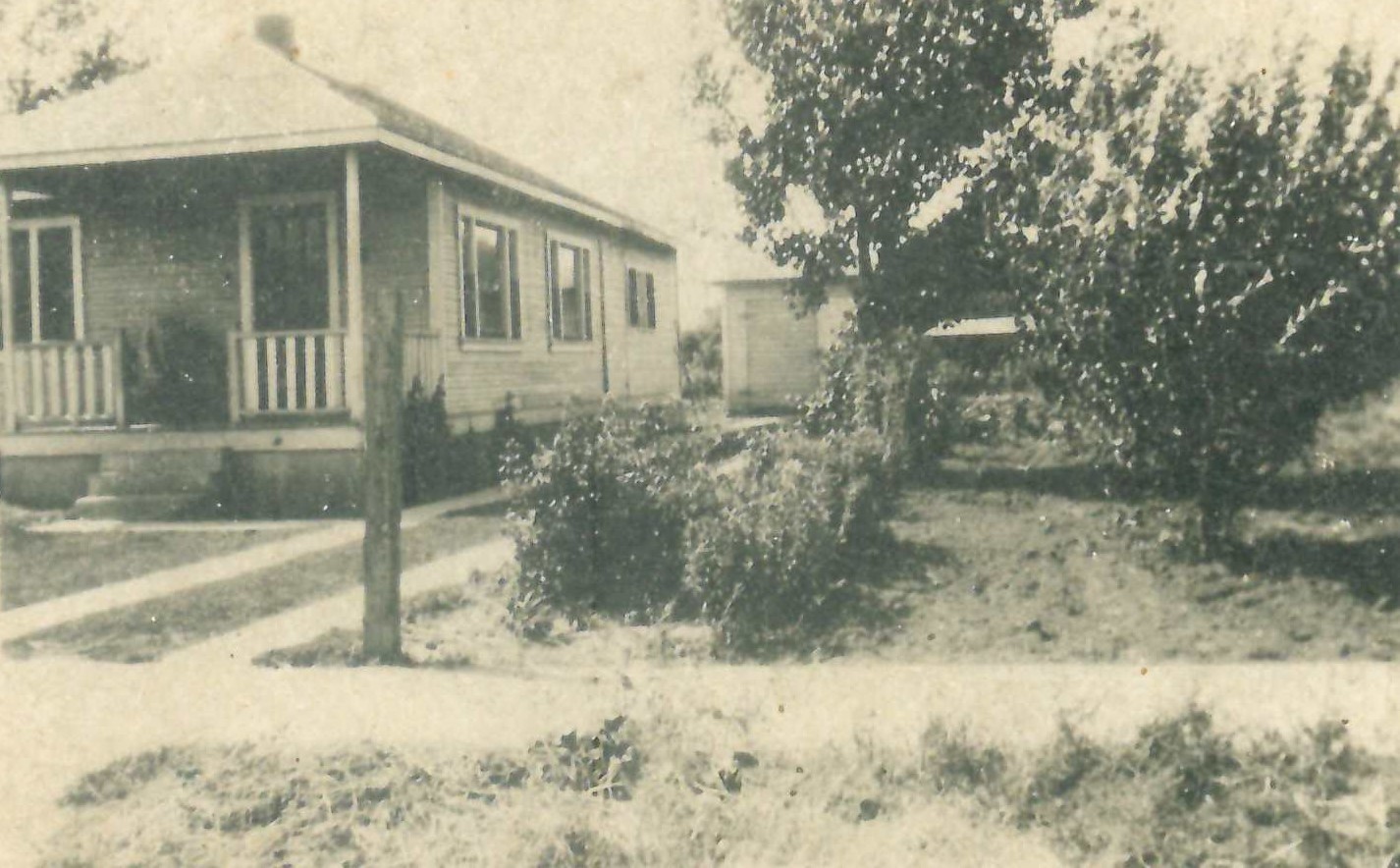
I previously wrote about pictures of my Great Grandparent’s home at 629 8th Street in Ogden, Utah. Recently, working through some of Dave and Betty Donaldson’s photos, these three appeared. I thought I would share these, even though I don’t think they add much more in explanation of the history.

629 8th Street, Ogden, Utah

David Delos and Berendena Van Leeuwen Donaldson lived in this home from the early 1920s, maybe even from construction, until after 1935. My Grandmother, Gladys Maxine Donaldson, was likely born in 1920 while the family lived in this home. At the post above, there is a photo of all 5 Donaldson children sitting on the front porch.

629 8th Street, Ogden, Utah

The home is still there and apparently updated and remodeled as of 2017. My Grandparents, Milo James Ross and Gladys were married in this home in 1942.

629 8th Street, Ogden, Utah (with trees and garden)

Welcoming Spring 2021

Hiram and James Ross, April 2021

I decided to post a little picture of my family this week. I spend quite a bit of time on family history and sometimes fear I do not preserve enough history of my own. On the other hand, we are in a world where identity theft is rampant and an issue. So I always delay posts to give enough separation in time, but also changes in circumstances.

Friday the kids wanted to go for a walk. Of all places, they wanted to walk to the school. We hoofed it down and played for over an hour and then worked our way back home. This is headed east on 27th Street, just east of Park Avenue in Burley. Sweet children.

Hiram was tired of his RipStik and James had lost his shoes and socks by this point. Aliza and Lillie were ahead of me. I looked back and thought to capture the moment. Temperature about 70. Sun setting. Everything is finally budding and greening. Spring is finally here.

James and Lillian Ross reading a book, April 2021

This is an evening shot. Bathed, getting ready for bed, Lillie was reading James a book. We won the kid lottery in that we have all great kids and they love to spend time with books. My 5 year old is reading the 4 year old a book. Despite all the fire in this little girl, and defiance, she is especially sweet as well. This photo captures some of their personality.

Dora Note

Phoenix, Arizona Tent City Auto Camp

Once again, a number of family history photos have found their way to my desk. This one doesn’t really give me anything to place it in context of anything else. What is written on the back is interesting to me.

“Dora”

“Dear baby all is Well with you Dear Dady and I am going to send you something nice soon now”

“your dear Dady”

I will post the back of the card so you can see the handwriting. This card/photo was in a stack of old photos that include teenager photos of my Great Grandfather, David Delos Donaldson, that I will share another time.

David Delos Donaldson (1894-1953) has a few undocumented parts in his life. In 1910 he was 16 and living in Ogden Utah. I have written more extensively regarding his life. He served in World War I, then married in 1919 with twins arriving 28 May 1920. One of those twins was Dora Donaldson. So at least those portions match with Delos and his daughter Dora.

I assume this must have been one of two cards that were sent home since Dena and Dora were twins. It seems strange to write a note to only one of them. I am unclear who wrote it as it states “you Dear Dady and I,” which would make it seem to be written by Dena and that she was present with him. One also gets the impression that this was written to a child, not anyone older. So I am guessing this is between 1924 and 1928.

We obviously do not know if Dena and Delos stayed in the Tent City Auto Camp. I assume they stayed there or at least visited someone there. What were they doing in Phoenix, Arizona? That is a long drive especially in those days. The card is not mailed, so it must have been sent as part of a package or other letter.

Why are the people standing around? Trying to look closely at the vehicles in the picture, they do appear to be early 1920s vehicles. This photo appears to have been a regular postcard that was available, not a photo taken by Delos or Dena. This website states the Tent City was located at 1850 East Van Buren Street in Phoenix. This website further talks about the auto camps and later motels that were common on Van Buren.

As mentioned in the last of the two websites linked on this auto camp, these auto camps became the forerunner of the classic American motel. Interesting to see Delos and Dena take advantage of what is so commonplace in our day yet so fundamentally different in its rudimentary state. What things do we do now that will be odd or so long ago in only a generation or two down the road?

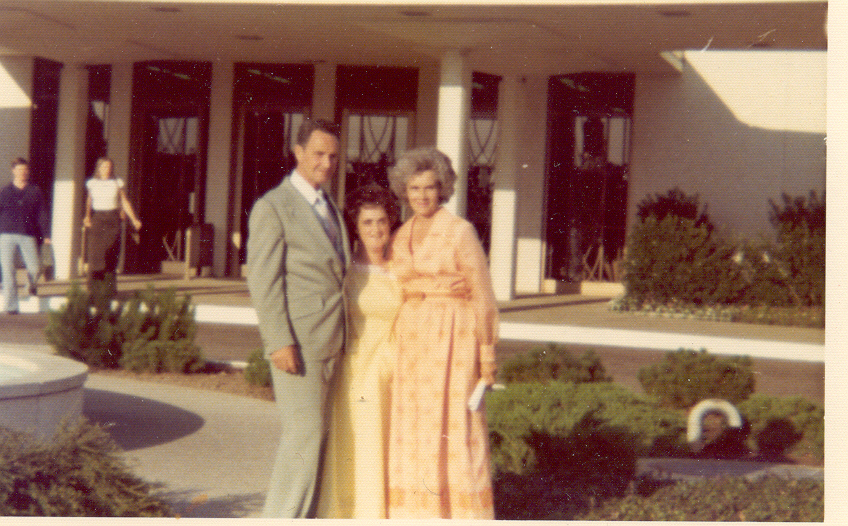
Ross at Ogden Utah Temple

1970

Working through a number of photos and other documents, I stumbled upon these photos I took of two cards that were glued into a scrap book my Grandma Ross had made. The first is a letter from my Grandma, Gladys Maxine Donaldson Ross, to my Grandpa, Milo James Ross. The handwriting is clearly my Grandma’s and it is as sweet as she ever was as I knew her.

There are so many things I want to read between the lines. But we will never know.

Grandma was baptized a member of The Church of Jesus Christ of Latter-day Saints on 30 August 1930 in Ogden, Weber, Utah. She was only weeks before she would turn 9. I don’t know when the letter above was written. I would imagine it was within a year or so of their attending the Ogden Utah Temple to do the temple Sealing.

Grandpa was baptized into the Church on 2 July 1939 in Ogden. He had turned 18 earlier that year. I recall Grandpa indicating that he did not have permission to get baptized so he had to wait until he was 18.

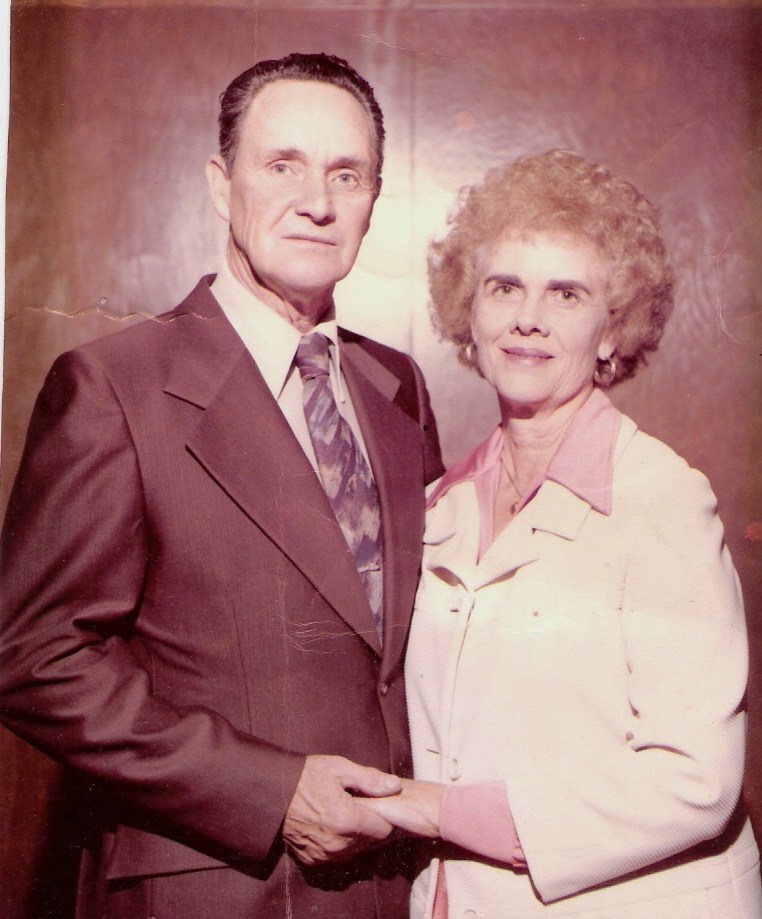
Grandpa and Grandma both received their washing, anointing, clothing, endowment, and sealing on 2 July 1976. Judy, their daughter, received the same ordinances at the same time, except she was sealed to her parents rather than to a spouse. I couldn’t help but notice that Grandpa’s baptism and confirmation are the same date as the other ordinances in the temple. Was that intentional or just coincidence?

Same day they were sealed, Caroline dated this card to her parents.

A few years later, Grandpa was sealed to his parents on 8 February 1980 in Ogden Temple. That, too, was the date Grandpa performed the temple ordinances on behalf of his father. Two days before, he had performed the ordinances for his brother Paul. After his parents were sealed, then Grandpa was sealed to them along with his brothers Paul and Earnest. Another special date in the Ogden Temple (Ethel’s ordinances were completed in 1978). The 2 July date did not carry over, so perhaps it was more coincidental above.

Milo, Judy, and Gladys Ross at Ogden Utah Temple

Caroline received her own blessings in the Ogden Temple and was sealed to her parents 25 October 1991 in Ogden. Years later, Grandma was sealed to her parents on 3 September 1998 in the Ogden Temple.

Grandpa and Grandma both worked as temple workers in the Ogden Temple too. They became pillars in the House of the Lord.

Milo Ross’ photo in the Ogden Temple Photo Album

The sealing of Grandma to her parents is curious to me. Dad and I received our own temple ordinances on 1 September 1998 in the Logan Temple. Two days later my Grandma was sealed to her parents, we were not present. Not that we needed to be, it was likely a personal private occasion with just Grandpa and Grandma present.

Dad was sealed to his parents 4 February 1999, Grandpa’s 78th birthday. I am certain he appreciated the birthday present.

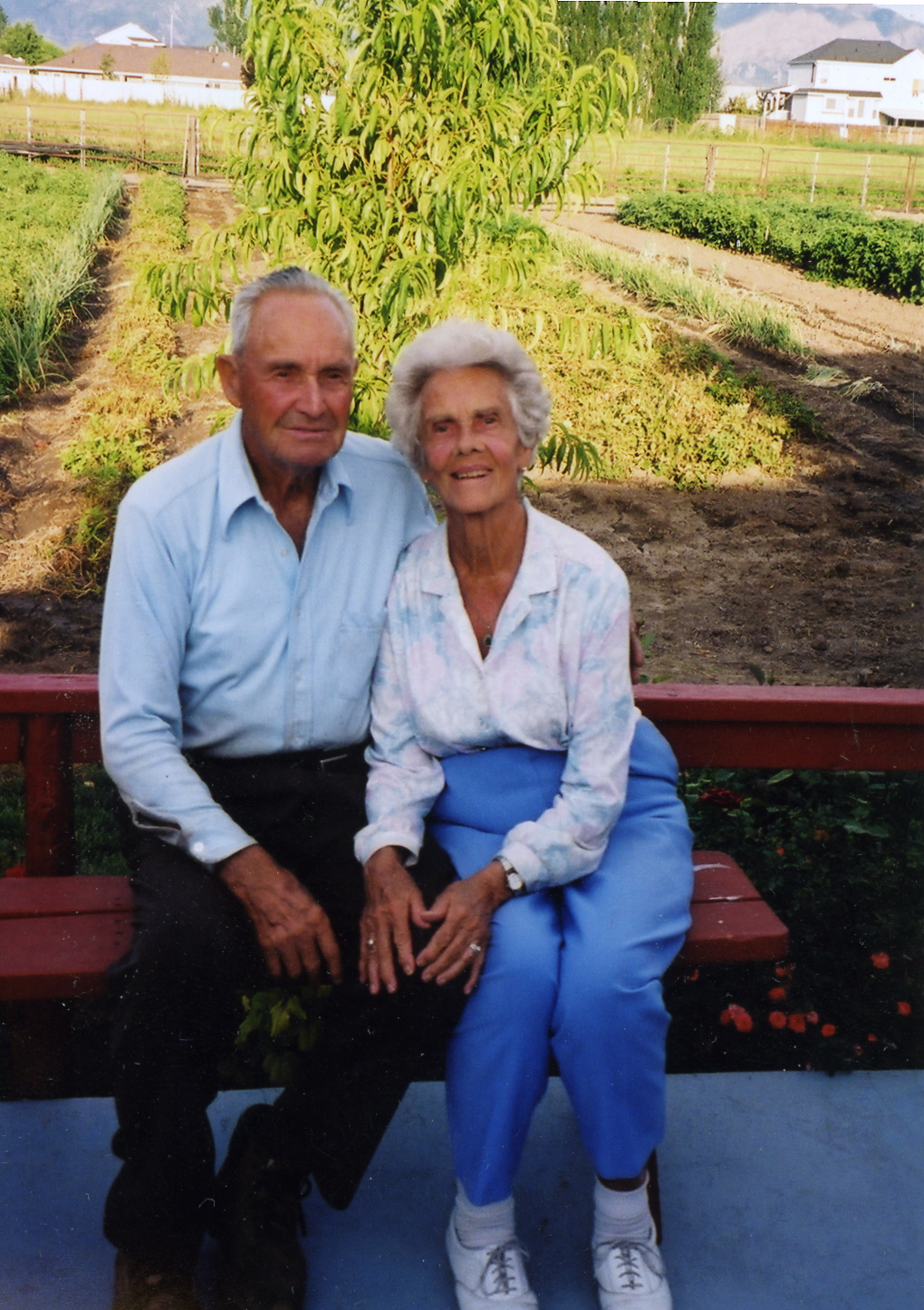
Milo and Gladys Ross, 2004

April 1961 Occasion

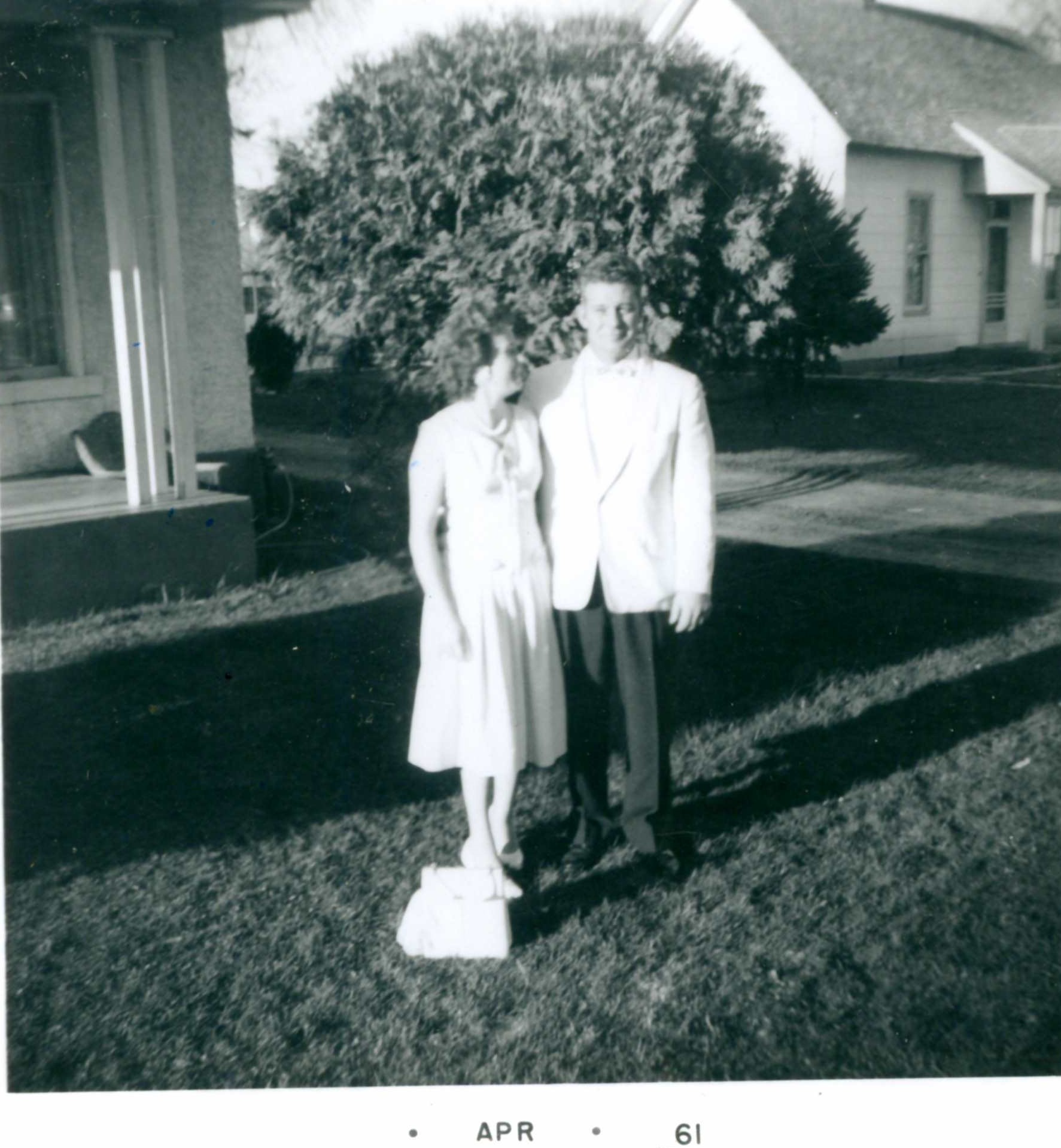
Norwood and Colleen Jonas in April 1961

I scheduled this in December 2018 to post in April 2021.  It is a few years in the future, but it would make it 60 years from the occasion.

This photo was in a stack of photos Jackie made available to me.  I don’t know what the occasion was, but I believe it is the only photo I have of my Grandpa looking this dapper in a bow tie and light-colored suit coat.

As I looked at the photo longer, it dawned on me I have that suit coat.  It is a light mint green color.  I wear it once in a while.  I called it my happy coat.  I am happy that I can wear a suit coat my Grandpa Norwood wore.  Now it seems I have a picture of my Grandpa wearing it.  I will have to wear it and get a picture of myself in it and share it here.

Isn’t it interesting how photos can help connect the generations?  I was born within 20 years of the picture, and then at 60 years after the picture I find myself transported by it.  This is a miracle of our generations that most of the history of the world never could have imagined.  Sure, there were paintings by those who could afford them, but their likeness and emotion probably doesn’t ooze out of those paintings like a photo can sometimes capture.

Despite what the future would hold for their relationship, I also see a happy couple.  An adoring wife with a proud husband.  They were married 15 years by this point and the fact is they still adored each other.  3 children were all in the picture and loved.  Within another 15 years it would be a broken marriage and his death.  I amcareful not to judge, but from my perception a few poor decisions created the damage.  What would happen if we could tweak or change just one decision in their lives?  Might I have known my Grandfather?  Might I have grown up in a different home?  All speculation, but our lives truly do turn on small hinges.

James Otis Ellis

James Otis Ellis (1872-1961)

Today I wanted to dedicate some time to James Otis Ellis. President Roosevelt signed the Reclamation Act on 12 June 1902. The Minidoka Project was established by the Secretary of the Interior on 23 April 1904. The Minidoka Dam and its related canals and laterals started shortly after. Delivery of water began in 1907.

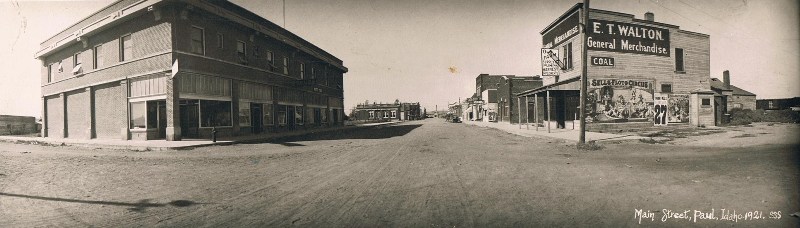
With the announcement of the Minidoka Project settlers flocked to the region. One of the four men who selected sites near what is now Paul, Idaho, was James “Jim” Ellis. These men struggled and barely survived the three years before the water finally starting flowing to Paul. In 1907, these men then incorporated the City of Paul. Jim Ellis hired an engineer and surveyed the town site and named it Paul after Charles H. Paul, the engineer in charge of the Minidoka Project. In 1910, the railroad was built across part of the land owned by Jim Ellis. He donated the land for the depot.

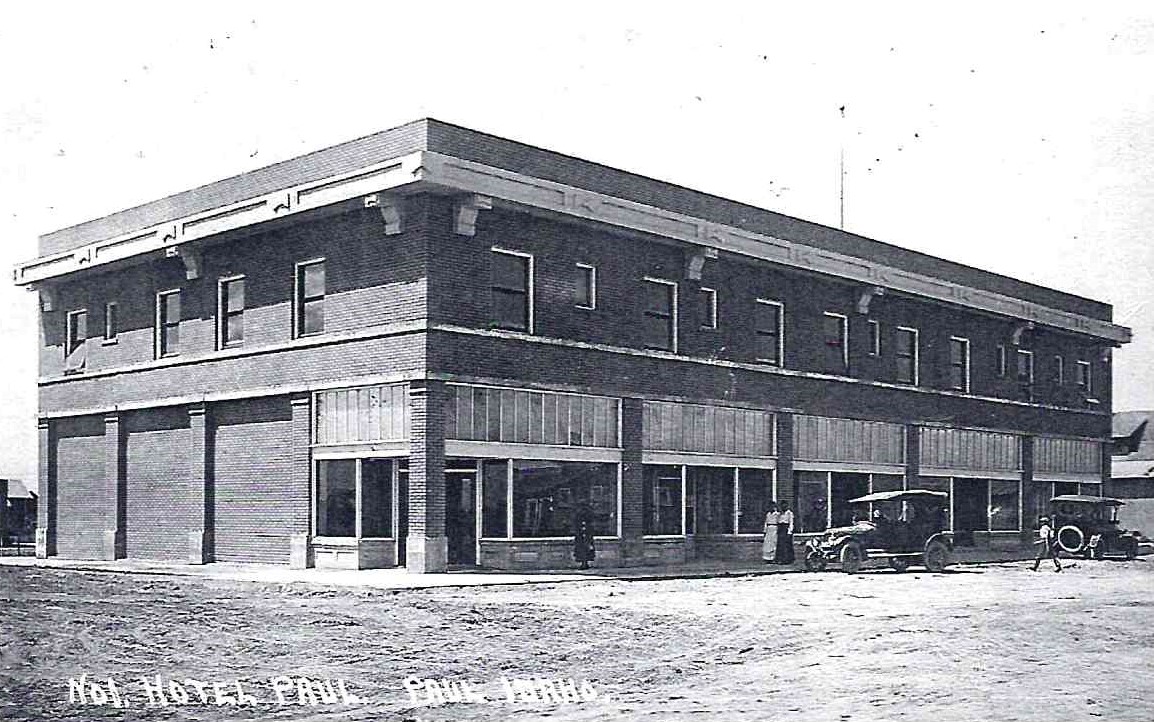
Jim donated part of his homestead to create much of the City of Paul. He was instrumental in bringing the railroad to town. He also donated lots for various entities to build and support the town including the Lutheran Church, the LDS Church, the Methodist Church, and Modern Woodmen of America. Jim helped found the first hotel in Paul and also helped establish some of the other first businesses.

Paul Hotel, Paul, Idaho

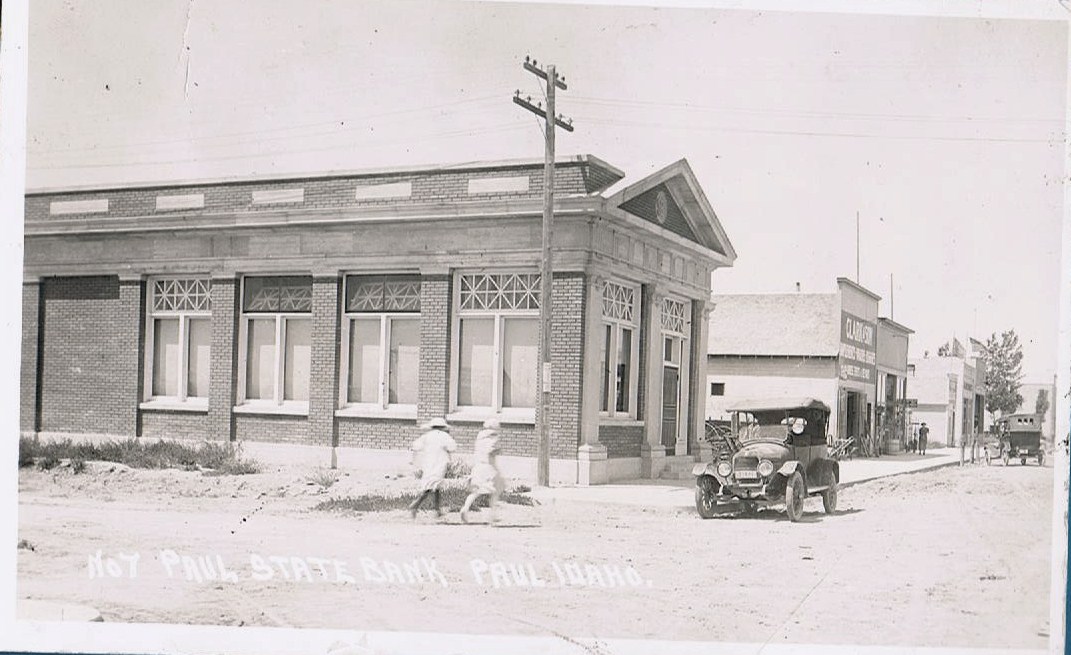
Jim also helped found the first bank in Paul, the Paul State Bank. This building still stands at its location a block west of the hotel.

Paul State Bank, Paul, Idaho

Much of Paul, Idaho, existed because of Jim Ellis. Hopefully at some point I can spend some time on the other three men, Tom Clark being the other to mention now.

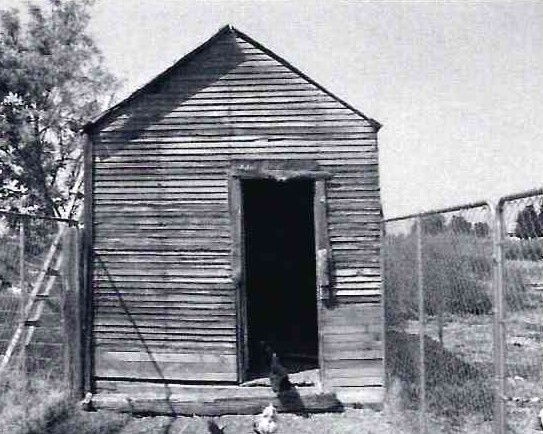
The last remaining original building on the Ellis homestead. This building is a one room shack with a window and smokestack. There is believe this was Jim’s home in the early days on Paul.

Ellis home at early homestead of Paul, Idaho.

Jim Ellis was born 10 February 1872 in Portia, Vernon, Missouri. All of his family stayed in Missouri so I don’t know how he ended up in Idaho. The opportunity to homestead with the knowledge of the Reclamation Act and Minidoka Project could very likely been the draw. In the 1900 Census he was still in Vernon County. But 4 years later he was in the flat desert sagebrush land of southern Idaho staking out claims.

Many of the homesteaders struggled and failed before the water finally arrived. Jim was able to hold out and make it work. He slaved away for years. He returned to Missouri to convince his childhood sweetheart to join him in Idaho. Elizabeth Emma Rexroad and her sister, Artie, made the trip out to southern Idaho. The Rexroads were still in Missouri for the 1920 Census, but Jim and Lizzie married 23 June 1921 in Pocatello, Bannock, Idaho. The two did not have children.

Whatever work he might have done in Missouri might not have gained much notoriety. But today the main route of Highway 25 through Paul, Idaho, bears, in his honor, the name of Ellis Street.

Bird’s Eye View of Paul, Idaho, about 1921. Looking up Idaho Street, the road parallel on the left is Clark Street.

Here is an article written about Lizzie Ellis after an interview about 1983. Elizabeth Rexroad was born 16 February 1889 in Adrian, Bates, Missouri.

“James Otis Ellis homesteaded where the City of Paul, Idaho now stands. He donated land for the first school in the city and also built the first hotel there, The Woodman.
The farm owned by Elizabeth Ellis and her late husband Jim Ellis stood on both sides of the main drain at Paul and included the land on which the railroad was built in 1910. As appreciation to these hardy pioneer couple and in recognition for their contribution to the community a street later to become Highway 25, was named Ellis Street.
Jim Ellis was one of four men who made their way from the railroad mainline at Minidoka to the present site of Paul in 1904, three years before water was delivered to the land. He cleared his land with a grubbing hoe.
Having moved from Missouri, Jim later went back and persuaded his sweetheart to join him. It was in 1920 that Elizabeth left her millinery business in Adrian, Missouri and moved to Idaho where she and Jim were later married following a ride on the railroad to Pocatello.
‘I loved hats,’ muses Elizabeth, who had worked as an apprentice and operator of the millinery shop for five years.
Though a city girl by trade, Elizabeth was raised on a farm at Liberty, near Kansas City, where she had learned what farm life was all about. Thus it was no problem for her to join her husband in the fields as he planted, irrigated and harvested his fields of wheat, oats and alfalfa. All the work was done with horses and by hand in those days and she learned to harness her animals, hitch them to the implements and do the field work right along with her husband. She could run the mower and pitch the hay right along with the men.
She remembers the first tractor they bought, but apparently neither she nor Jim was too thrilled with its performance as it soon found its way in a neighbor’s farm where it remained for an extended period of time while they continued to do the work with their horses.
Jim and Elizabeth had no children and she says she is ‘the last survivor’ of her large Missouri family of two boys and eight girls. One nephew shares the family home with her on the original homestead in Paul.
At 94, and with eyesight failing, she spends her time just waiting for another day to come around. She takes care of her own household chores but has little use for the television set in her living room.”

Jim passed 15 October 1961. Lizzie passed 21 September 1988. Both are buried in the Paul Cemetery.

History of Wilhelmina Wanner Bodrero

Another history given to me from the collection of Golden Rulon Andra. “History of Wilhelmina Wanner Bodrero” with the subheading “Our Mother” by Laura Bodrero Nungesser.

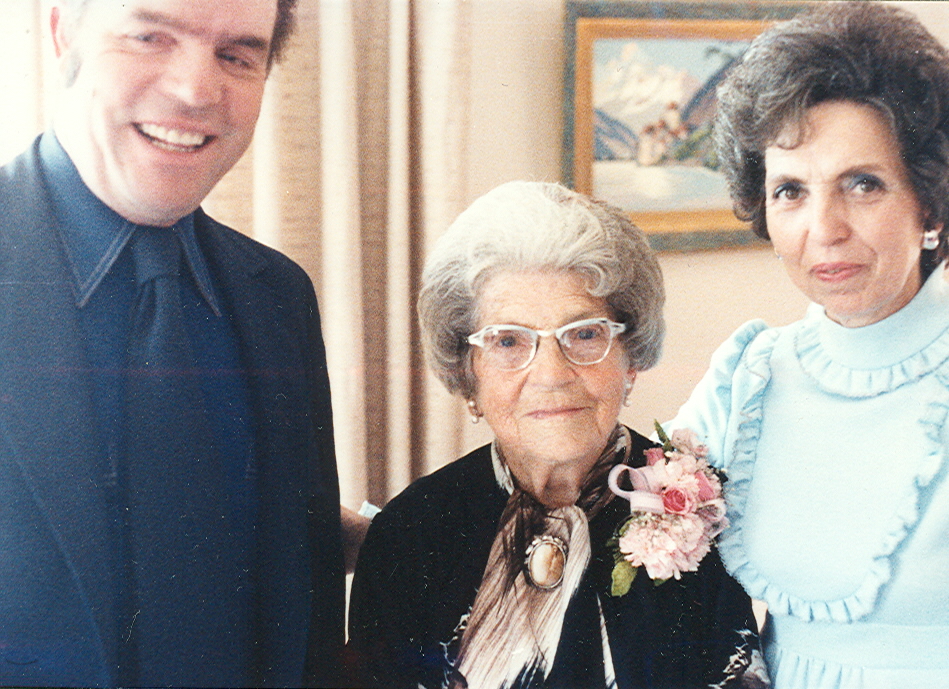
LaMont Call, Wilhelmina Wanner Bodrero, Barbara Bodrero Call

“Our mother, Wilhelmina Wanner Bodrero, was born in the last summer of 1887 on September 12th in Atzenweiler Neckarkreis Wuerttemberg, Germany.

“Wilhelmina is a daughter of Johann George Wanner and Anna Maria Schmid. Mother was the tenth child of the ten children born to the family of five boys and five girls.

Wanner Family about 1895, Wilhelmina is the youngest.

“A small baby, mother was told that during her first year of life she was continually sick. A neighbor lady also had a little girl about the same age as mother. Her baby was always healthy. Each day the neighbor lady would come to see how mother was doing and each visit she would tell mother Wanner that her baby would never live. But sadly, the neighbor’s child died when she was about a year old, while at this time mother is still well and healthy at the young age of ninety-five.

“It is difficult for mother to remember her life in Germany because she was very young, but she remembers what her mother has told her. Mother’s father was a road supervisor and owned a little land. He also acquired a few chickens and some cattle in which the whole family had to tend to. Their life in Germany was very hard, and they were also poor.

“Mother was nearly four years of age when the missionaries came to their small home in Germany one day. it was not too long after being taught by the missionaries that the family, grasping the truthfulness of the gospel, became converted. Her brother, George, was the first to be baptized and soon after came to America with two missionaries. Nearly two years later the rest of the family was able to come to America. Mother was baptized in America August 1896.

“Mother remembers the journey to America. The first experience was riding for some time on an open train, then boarding a small boat. This small boat transported their family and whatever few possessions they held with them to a large ship, accommodating a very large deck. During the long watery voyage, mother and a young brother, Gottlob, would play on the huge deck and one day they found big, heavy barrels filled with juicy cherries. These were the first cherries she remembers eating.

“Mother was told that the journey on the ship lasted two weeks before the shores of New York finally brimmed the horizon. They stayed in New York City two days and nights before boarding a train for Chicago. When they arrived in Chicago, they lodged for a day and night, then journeyed by train westward until they reached the small f arming community of Franklin, Idaho. It was at this place, the final end of their migration, where mother’s brother George, along with horse and buggy, met them at the train stop. Accompanied by George’s employer, Fred Nuffer, they loaded into the wagon and drove off toward the Idaho community known as Glendale. Since George knew a lot of people such as the Nuffer family in Glendale, they too decided to establish their residency there.

“Within a short time they were able to purchase a little land with a small rock home. The rock home had one large room. Adjoining the house was a root cellar with a floor on top of it. This is where the children slept under the roof made of dirt. The large room in the rock home served as living quarters for the family and also as a bedroom for mother and father Wanner. Mother’s brother George worked in the rock quarry and as time went on, he helped his father add two more rooms to the rock house. This was a welcomed addition indeed!

“As the youngest child in the family, mother had a lot of time to play for the first two or three years in Glendale. Gradually, though, she had to start helping more around the house and farm. Father Wanner would cut and rack the hay and afterwards mother would follow the wagon and gather up the hay that the rack hadn’t caught.

“Mother attended school in a one room school house in Glendale. As with many schools in the early 1900’s, children of many ages met together and were taught by one teacher. Very little individual help was given. Every day mother would walk to and from school. At times in the winter, her father would take her to school by horse and buggy. Mother and her family also attended school in Glendale.

“For a couple of years, mother helped her father trap squirrels. In the mornings, her father would set ten to twelve traps in the brush bordering the fields. The government, upon seeing the ears for proof, would pay so much per pelt. One year they made $14.00.

“Life was hard on the farm. They had no refridgerator so a small addition to the rock home was built for the purpose of keeping things as cool as possible. Water was packed from the spring nearby in every season. The milk was also carried into the house and poured into large pans. While other chores were attended to the milk would set and later the cream skimmed off and churned into butter. The butter and the eggs gathered from the hens, were taken tot he market store in Preston and exchanged for other food. Later, mother Wanner bought a separator to separate the milk and cream. The separator had to be turned by hand everytime the milking was done. It was mother’s job to help turn the separator and churn the cream into butter. Mother also picked red raspberries from their raspberry patch. These juicy, plump berries were also taken to market and sold for a dime a quart.

“When mother was eleven years old, her sister Christine gave birth to another baby. mother walked two miles every day to help care for Christine and the tiny newborn. She would bathe the baby as well as feed and tend the other children. Each day she recalls running fear past badger holes along side the road, for everyone she knew had said badgers were very mean. To her relief, the badgers remained in their deep, dark caves each time she quickly passed. For two weeks she cared for her sister Christine and her new baby. For this sweet service she was given a tiny china cup.

“Father Wanner bought a farm in Whitney, Idaho when mother was in her early teens. She rode a horse to Whitney from Glendale, a seven mile trip, to help in the sugar beets and to lead the horse on the hay derrick. Then she would return to Glendale to do her given chores. Once, while herding the cows, she was riding a bridled horse without a saddle. The horse jumped a big ditch and mother fell off, hitting the ground hard. She law there a long time before she could regain her strength. The horse, sensing her helplessness, did not move but stood by her side until she could manage to get up onto his back and ride him home. This terrible fall hurt her hip severely and has given her a lot of trouble and pain for many years.

“When mother was around seventeen her father sold the Glendale farm to her brother Fred and the Whitney farm to her older brother George. She and her family moved to Preston where her father had a new home built and waiting for them.

“While living in Preston, mother attended the Oneida Academy for one year and took a sewing class. Every Sunday, her family and other German families met in each other’s homes to hold their church meetings. During the week, mother did house work for several neighbors. She did her best and worked hard. Before too long, mother was asked by a certain man from Logan, who had helped plaster their new home in Preston, to come and care for his wife when their baby was born. She did; and also worked for Mrs. Beech, who had a grocery store on Center and 4th West (by the canal) in Logan. It was later known as the Canal Grocery.

“One day the circus was coming to Logan and father Wanner decided he would like to see it very much. So mother and her parents boarded the train and traveled to Logan to see the circus. It was during this holiday that she formally met Moses Bodrero, whom she had seen a couple of times, as her sister Louise was married to his brother Jeffery. Not until this time, however, had they been properly introduced. Moses went to the circus with mother and her family, and after this first meeting they began to date. Mother continued to live and work in Logan for two or three months until she was called home to Preston when mother Wanner became very ill and needed her. mother and Moses corresponded with each other. Moses even rode the Bamberger to Preston several times to see mother. Their courtship lasted almost a year, and then on a cold winter day, December 18, 1907, they were married for time and eternity in the Logan Temple.

“They established their home with father’s parents on 3rd North and 5th West in Logan. This home was very small. It did not have any electricity or indoor plumbing. It was hard work caring for father’s parents as well as her other household demands. A very special occasion was near that would also keep mother busier than ever. A year after their marriage, they were blessed with a newborn son. They named him Earl. Their next baby was a healthy girl and they decided to call her Mae. As years followed, they were again blessed with two more sons, Floyd and Kenneth. During this time, father and mother continued living in their father’s parents and taking care of them, but when Earl was a year old, Father’s dad passed away. This was a sorrowful event and mother Bodrero remained in the home with them for she needed special love and care.

“After living in the little old home for twelve years, father decided to tear the home down and build a larger one. Before the new home was finished, mother was expecting her fifth baby. Since the new home was not completed in time for her delivery, she gave birth to their little daughter int he shanty (a small shed). Father and mother named this new baby daughter, Hazel.

“This long-awaited new home was larger and modernized with electricity and indoor plumbing. Life was easier and better for mother and her growing family. Sometimes mother would have a neighbor, by the name of Millie Shaw, come and help her take care of the babies. Following her little girl, Hazel, two more daughters were born, Clara and Laura. And later still, another sweet daughter and son joined their family. They named this new baby girl Barbara and their son was blessed and given the name Ivan. This made a total of nine children they happily received into their loving care.

“In the year 1910, mother and father Wanner moved from their home in Preston, to a home in Logan. Mother was now able to see her parents more often and they, in turn, became better acquainted with their grandchildren. Sadly though, int he year 1922, during the cold month of February, father Wanner passed away.

“When our sister, Clara, was six years old, she came down with Diphtheria and was not expected to live. However, with the good, faithful love and care from mother and father, she overcame the disease. Meanwhile, the older children stayed with their grandmother Wanner so they could continue going to school.

“Mother and father were one of the first in Logan to purchase a table radio and it was enjoyed a lot by the family. Together they would sit at night listening to the programs and music.

“After working seventeen years at the sugar factory, father had acquired by this time some land. So he left the sugar factory and became dedicated to the farm with the help of mother and the children.

“Mother recalls having a couple of sleeping babies in the baby buggy and helping father in the farm when a loud whistle suddenly blew, announcing to everyone the end of World War I. It was a happy day for all!

“Mother worked very hard in those early years, helping on the farm, caring for the children, cooking meals and caring for the house and mother Bodrero. Mother Bodrero had lived with them for twelve years following the death of her husband but then decided to move in with father’s sister. She was cared for by father’s sister a few months and then quietly passed away.

“When the new home was built, chicken coops were also constructed and each spring mother and father would order hundreds of baby chicks. Often mother would be found late into the night and early morning caring for these little chicks. Mother also loved to work in the vegetable and flower garden. She would gain joy and satisfaction through bottling a lot of fruits and making jams and jellies. For many summers, she and father and the smaller children would pile into the Essex (the family car) and go to Honeyville or Deweyville to pick or purchase ripe melons and other fruits.

“Among the other activities mother loved doing were sewing strips of rags together and making throw rugs. She was constantly quilting in her spare moments. The quits were framed and set in the dining room ready for her eager handiwork throughout each day.

“Mother also had made many friends around the neighborhood and she would visit them often. One family in particular, by the name of Mr. and Ms. Fred Speth, had come from Germany and had settled in College Ward. Mother and father became close friends with them and would visit them frequently.

“Mother was a dedicated visiting teacher in the ward and she, father and the children would attend all meetings on Sunday. She and father also attended the temple periodically, doing the work for the dead.

“Mother remembers in those days there was not a variety of events to attend, but they did go to some silent movies and German socials. They would visit heir relatives as often as possible. Mother’s sister, Mary lived in Ogden, Louise resided in Logan, Fred in Glendale, George and Christine in Preston and her youngest brother, Gottlob, lived in Inkom, Idaho.

“These good years swiftly flew by and when Earl turned twenty-one, he was called on a mission to the mid-western states. He served three years in the mission field. Missionaries served two and a half years at the time he was called, but he was given the duties of District President, therefore he continued to serve an extra six months. When he was released, he wrote to mother and father asking them to arrange things so he could meet him in Denver, Colorado. From there they would take a little tour through the Black Hills of Dakota, and on through Yellowstone Park and then home. They were able to do this, taking their youngest child Ivan with them.

“Father was able to buy a piece of land two blocks north of their home on Fifth North and Fifth West. He began making plans to build a new home on part of this land. In the spring of 1942 this dream was accomplished and mother and father moved into their second new home. At the time of this move, most of the children were married and had moved into homes of their own.

“Mother had more time to do other things so she became interested in embroidery. She would spend many hours embroidering pillowcases, scarfs, and quit blocks and soon became very good at this hobby. The handiwork is beautiful, and much of the work has been given as gifts to her children and grandchildren.

“Inspite of the fact that mother was very sickly as a child, she has enjoyed a very healthy life. There was a time in her early sixties, however, that an operation was needed, and during this trying illness her life was nearly taken. Our comforting Lord was with her as well as the faith and prayers of her loved ones and her life was spared.

“A few years later, when most people mother and father’s age would be retiring, they instead decided to be adventurous and investigate the possibilities of buying some land in the state of Washington that the government was issuing. This territory is situated near a small rural community called George; also not far from the little town named Quincy.

“Taking along their son, Ivan, they took a trip to Washington and purchased enough land for a productive farm. During the next few years they would spend the summers in Washington and winters in Logan. This was a very happy time for mother and father. Suddenly though, during the winter of 1962, father became very ill and passed away on December 19, 1962, one day following their fifty-fifth anniversary.

Bodrero Family in 1957, Front (l-r): Moses, Wilhelmina, Clara; Back: Laura, Mae, Floyd, Kenneth Ivan, Earl, Hazel, Barbara

“Mother became very fond of the farm and land in Washington, and decided to continue the work there with the help of Ivan and Clara. A circumstance in the fall of 1967, however, took the life of Clara, another sorrowful event in mother’s life. To keep herself busy, she decided to stay on the farm in Washington and help Ivan around the home and care for a small garden. For the next few years she would occasionally visit her sons and daughters and their families in Utah. These visits were always a great pleasure for her and them as well.

“Fourteen years following the death of her dear mate and nine years after the passing away of Clara, she again bereaved the loss of her eldest son Earl, who was taken from this life on December 10, 1976. Because of her strong testimony in the Lord, Jesus Christ, and in the hereafter, she remained very faithful and upheld her strength during these difficult experiences, and therefore has continued with her life. Mother has had a very strong testimony of the Gospel and faith in the Lord, Jesus Christ, and in there hereafter all of her life.

“At this time, mother is fairly well. her interest in life never diminishing, she spends most of her time embroidering quilt blocks and has also joined a lapidary (rock collecting and polishing) club. The club has monthly meetings and annual festivals that she attends. She still gardens and cares for a thriving strawberry patch. These are a few of the activities she enjoys most.

“Mother still owns the home in Logan on 5th North and 5th West, but she spends more of her time in George, Washington. mother’s brothers and sisters have passed away many years ago, but she remembers them through her many nieces and nephews. Along with her 7 surviving children, she is a grandmother to 43 grandchildren, 110 great grandchildren, and 4 great great grandchildren.

“In loving tribute, Mother exemplifies in her pioneer spirit an indominable character who loves to be doing something all of the time. True to her faith, she honors the Lord and His commandments. Alert, busy, and enjoying the work she does; this is how we will always remember our Mother.

Mary Andra, Unknown Couple, Verna Wanner, Bill Andra, Willard Wanner, Norma and Kenneth Bodrero, Wilhelmina Bodrero