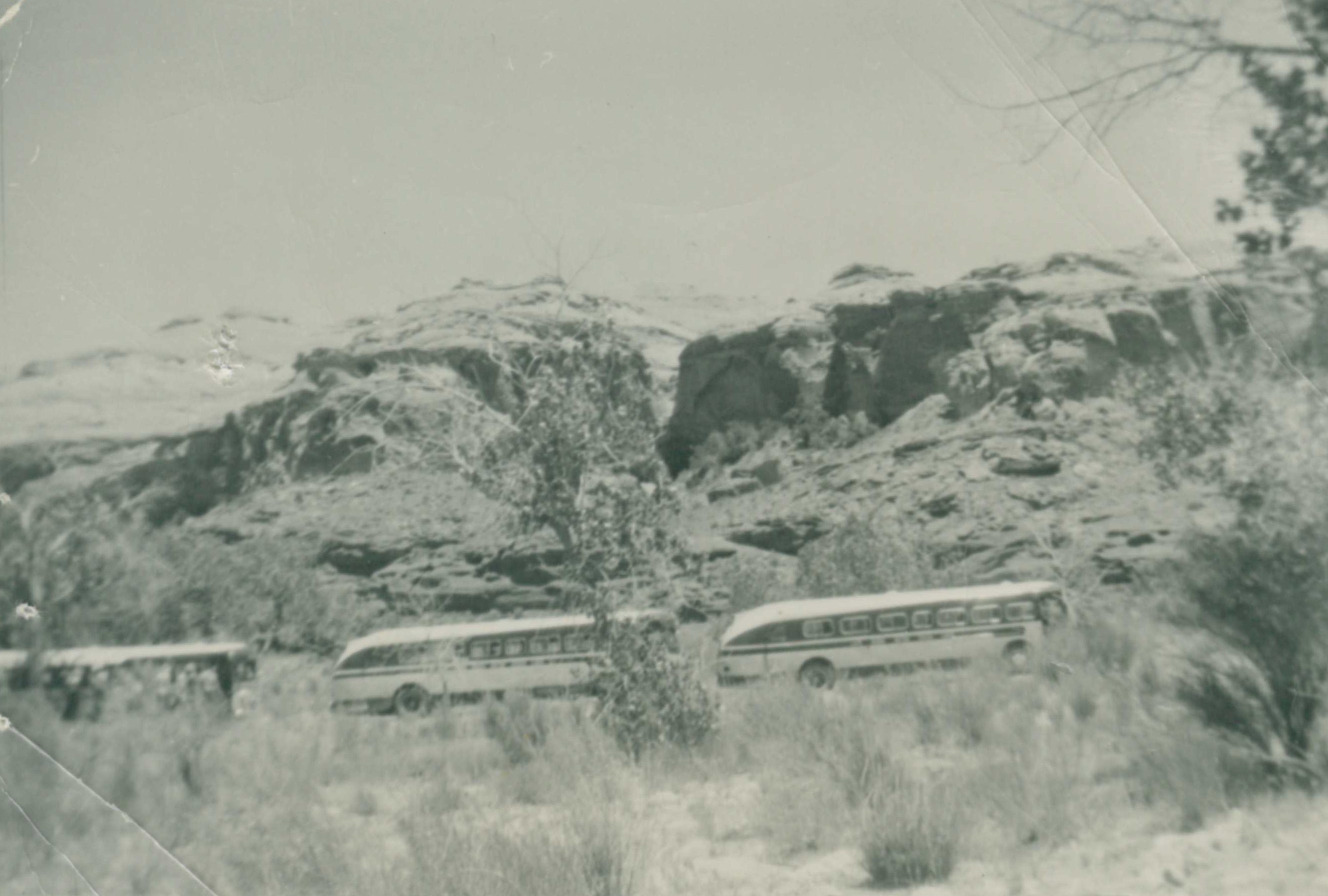
As I worked through the photos of Dave and Betty Donaldson, I stumbled on some pictures sent from Dad. Dad, Milo Paul Ross, attended the 1957 Boy Scout Jamboree in Valley Forge, Pennsylvania. I thought I would share those photos along with some other items I have scanned related to that trip. Since there were a couple of photos from the 1958 High Adventure Trip, I thought I would include those too.
First, be aware that the Great Salt Lake and Lake Bonneville Councils published a book about their trip. “Onward for God and My Country” was the motto. I have scanned the entire book – it is provided below.
The book says the trip occurred in July 1957. The book provides plenty of photos of the highlights. These few photos show what Dad thought was interesting enough to take pictures.
The trip took them east through a variety of states. Included was Chicago, Detroit, and Palmyra. Stops included the Sacred Grove and Smith Farm. Albany, Springfield, Boston, and New York City.
Dad does not recall the names or even knowing anyone in the photos at Jamboree.
I remember Dad talking about the Statue of Liberty. They climbed the stairs to the crown. He also indicated that at that time they let some of them climb to the torch. It was a very memorable experience. He also mentioned the Empire State Building and Independence Hall in Philadelphia. Vice President Nixon addressed the Scouts.
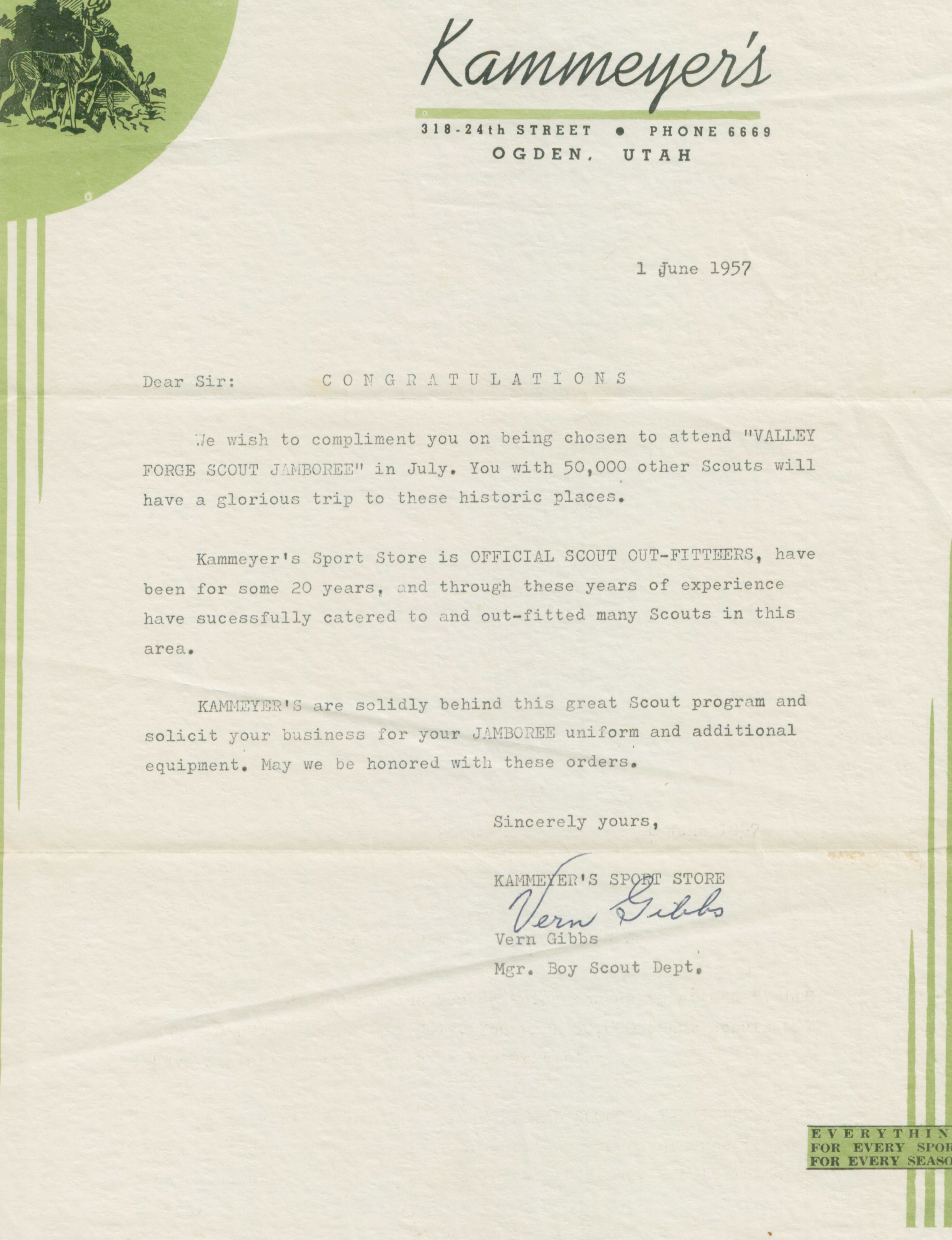
Kammeyer’s supported the Jamboree.
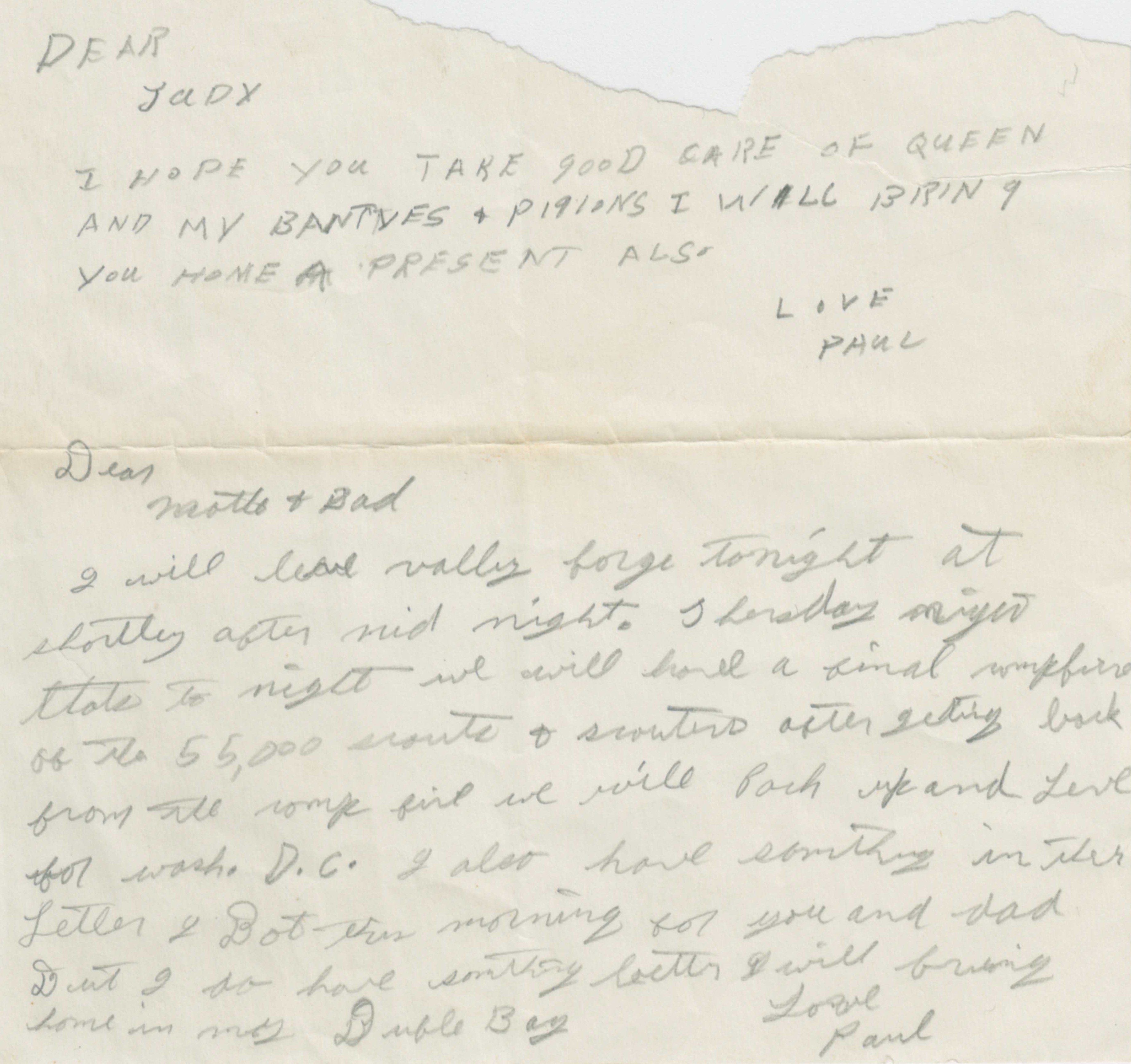
For those LDS Scouts, Harold B Lee and Delbert L Stapley spoke to the boys on Sunday. Here is a letter Dad wrote home while there.
I previously wrote about Dad and scouting. Here is his Eagle Scout picture.
Milo Paul Ross achieved Eagle Scout
Here is a note Grandpa made about this picture.
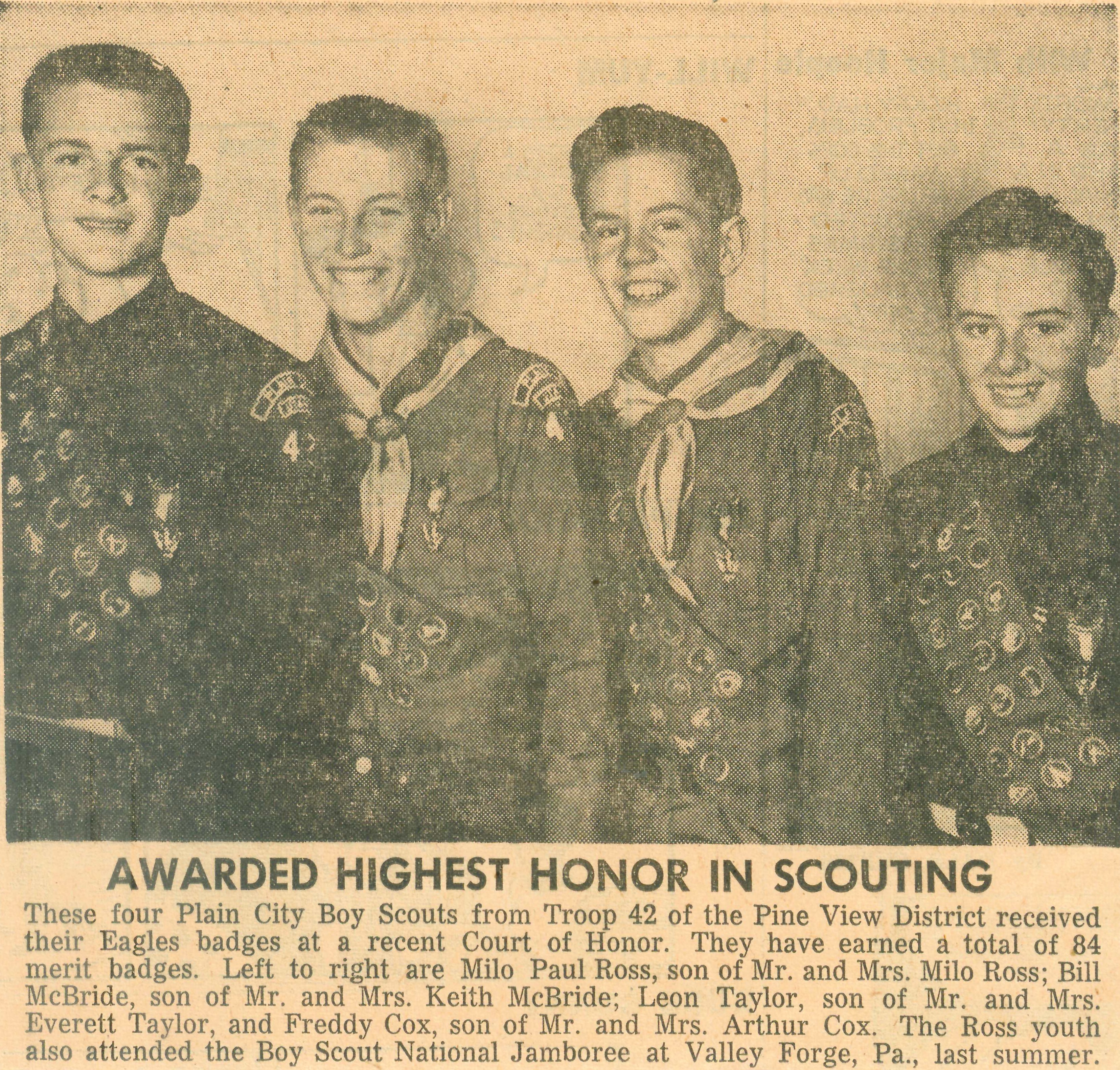
Milo Ross, Bill McBride, Leon Taylor, Freddy Cox Eagle Announcement
Milo James Ross commented about Milo Paul Ross receiving his Duty to God award on 27 April 1959
Duty to God Award
Letter from Church Headquarters
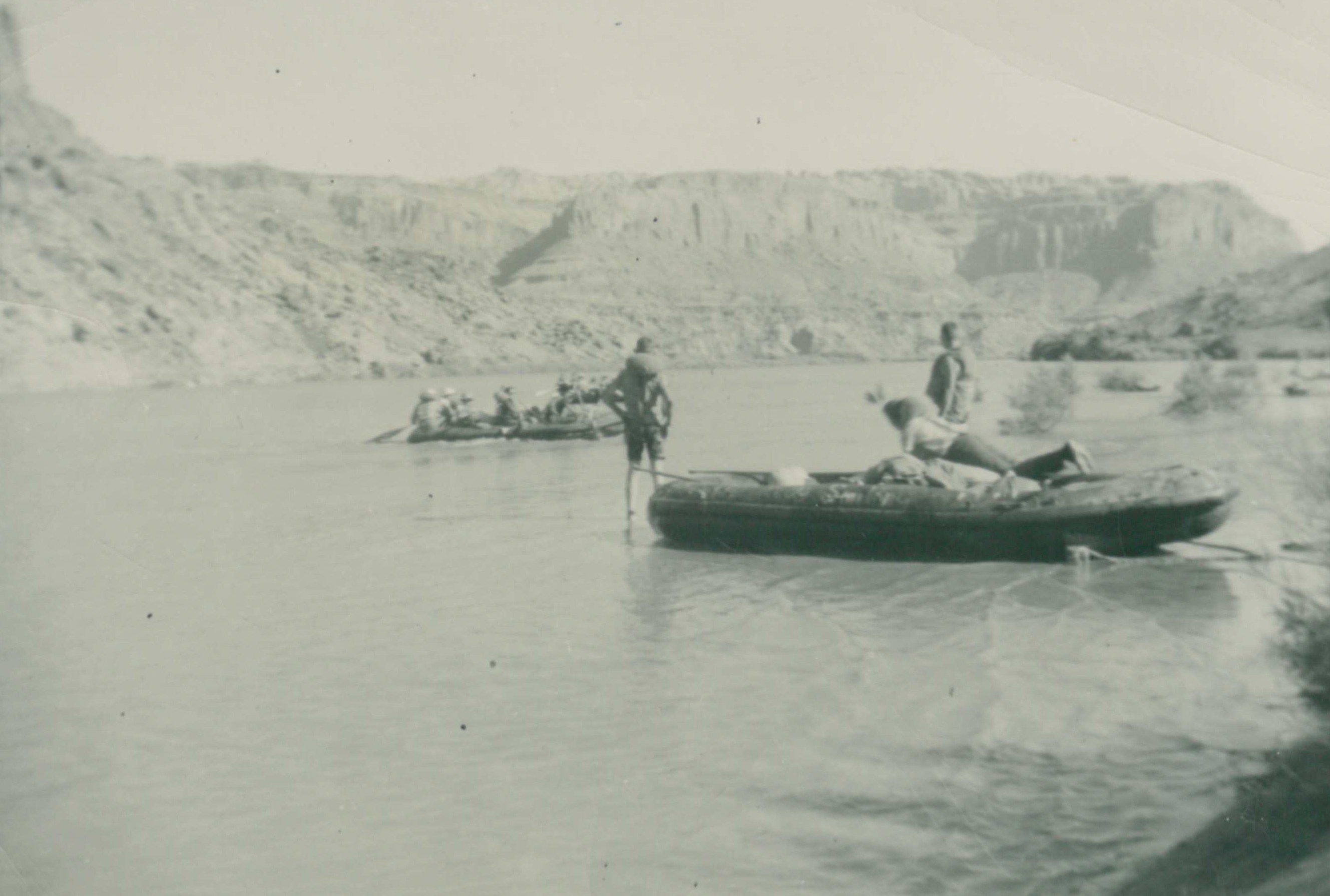
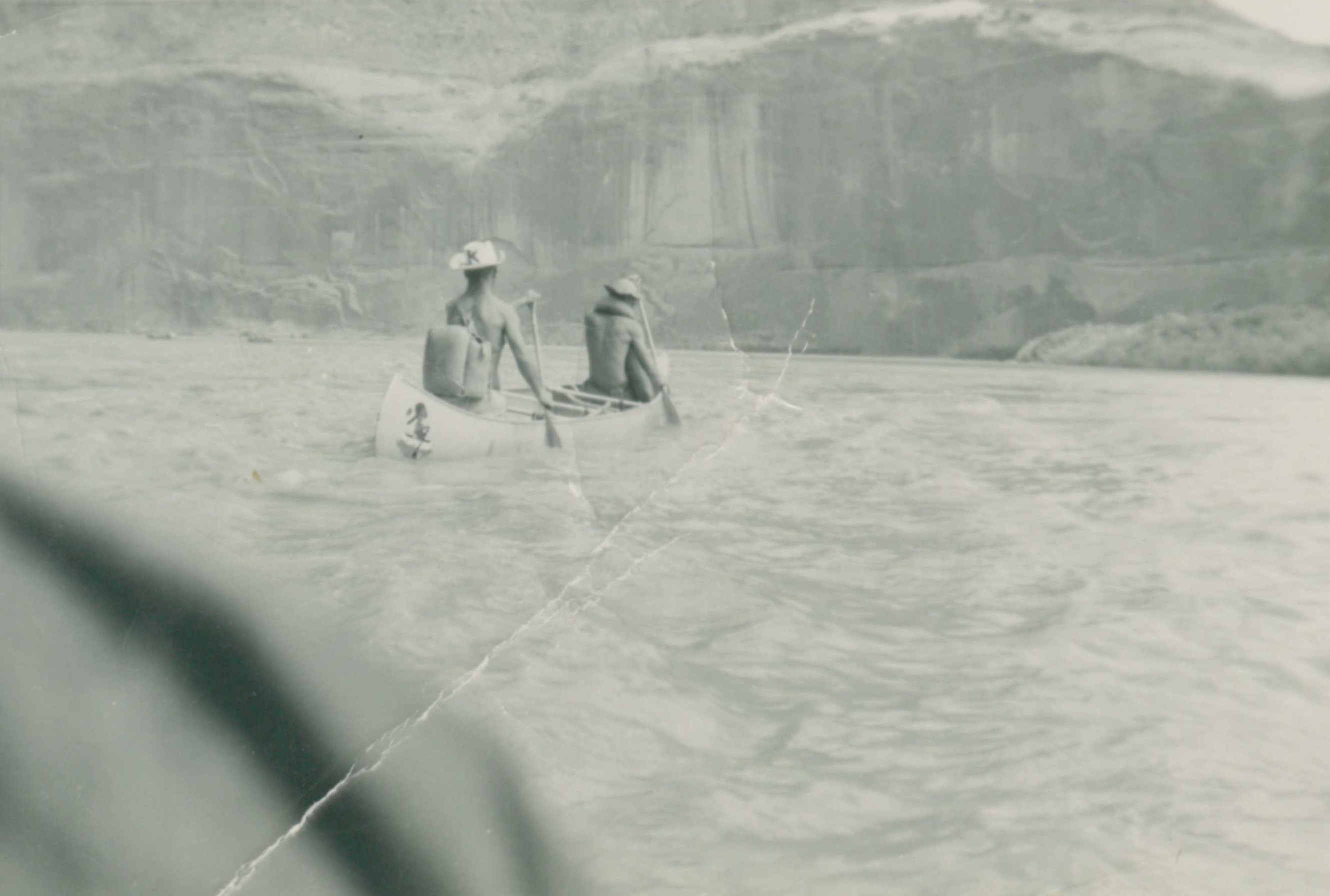
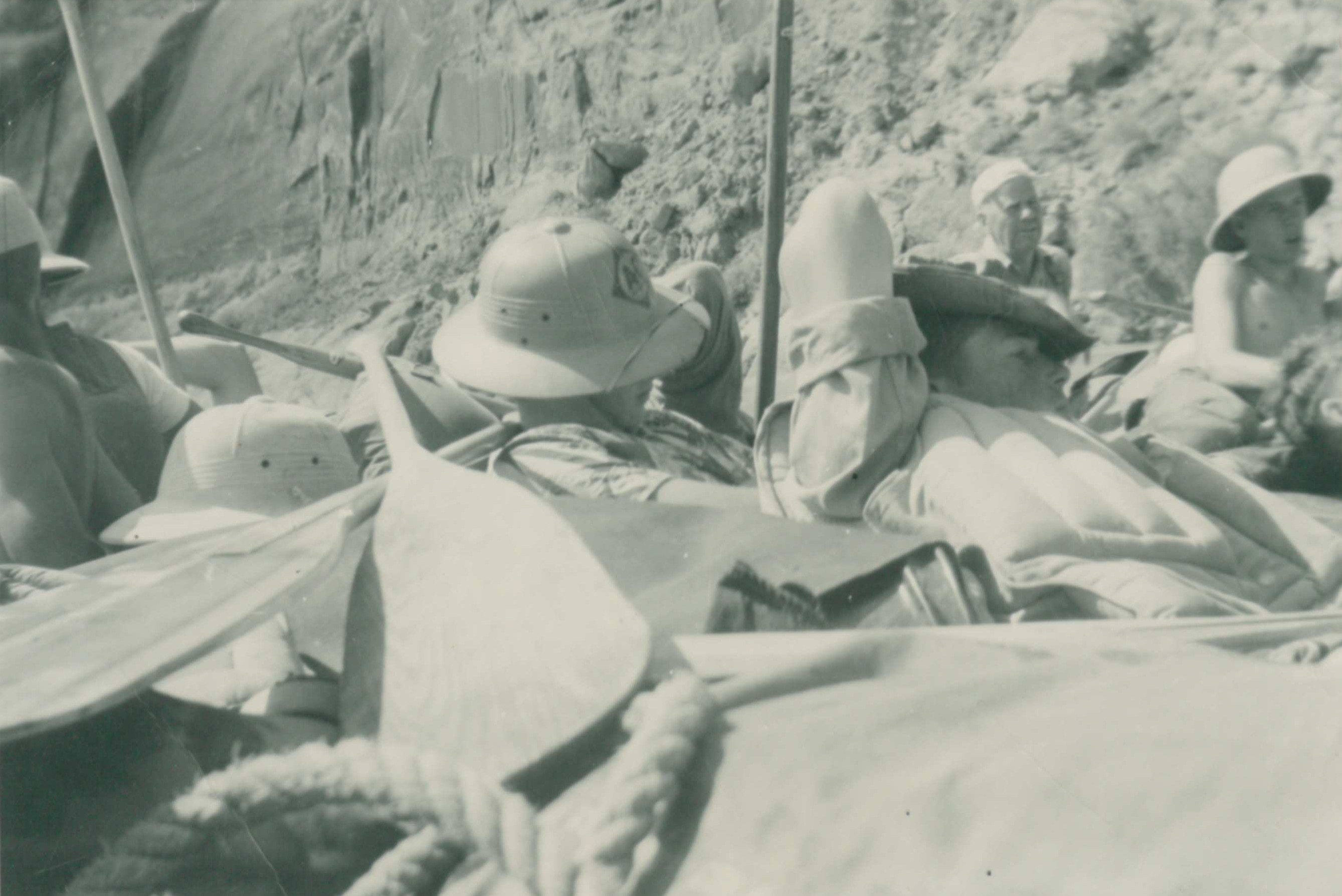
Here are a couple of the photos from the Colorado River rafting trip. Dad thinks there are more photos. He does not remember or recognize any of the individuals in the photos.
Dad remembered they had to pull out of the river to go around the Glen Canyon Dam construction.
~
~
~
~
Both of these were trips of a lifetime. Neither have been forgotten.
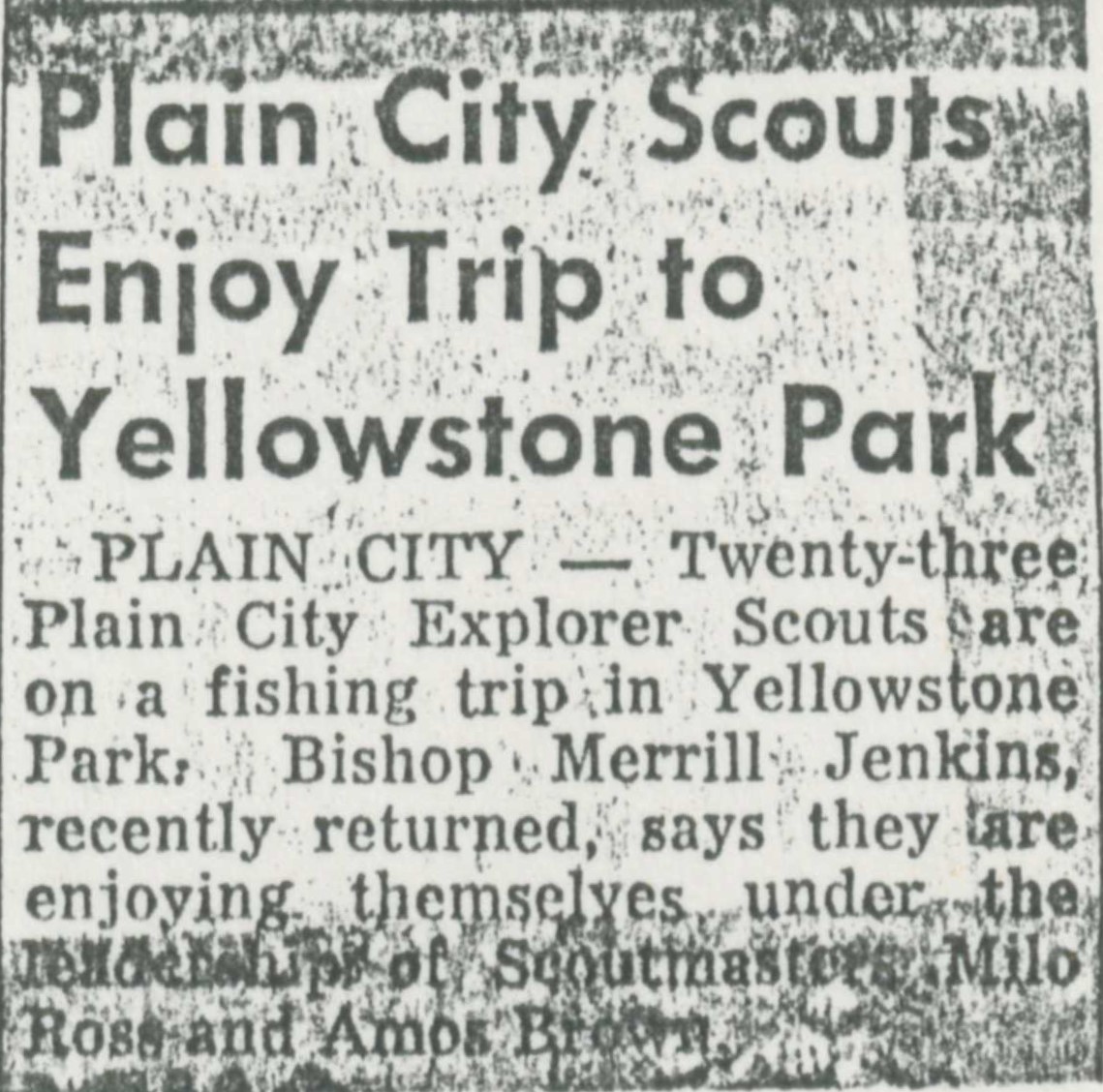
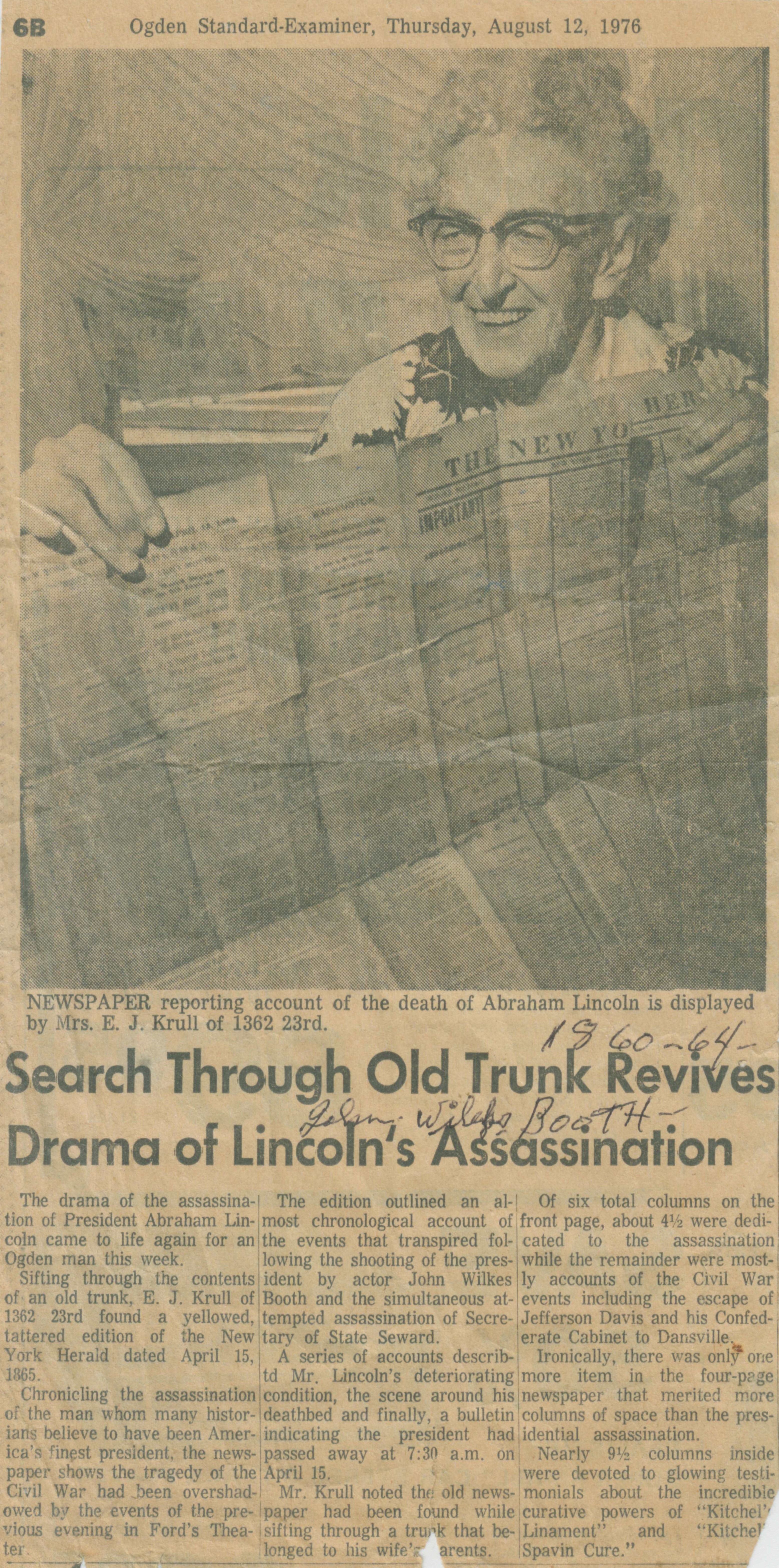
Another article clipped by my Grandparents, Milo and Gladys Ross. We do not know why this was clipped.
The top of the article shows it was published in the Ogden Standard-Examiner, Thursday, August 12, 1976.
“Newspaper reporting account of the death of Abraham Lincoln is displayed by Mrs. E. J. Krull of 1362 23rd.
Written by Milo Ross – “1860 – 64 – John Wileks Booth
“The drama of the assassination of President Abraham Lincoln came to life again for an Ogden man this week. Sifting through the contents of an old trunk, E. J. Krull of 1362 23rd found a yellowed, tattered edition of the New York Herald dated April 15, 1865.
“Chronicling the assassination of the man whom many historians believe to have been America’s finest president, the newspaper shows the tragedy of the Civil War had been overshadowed by the events of the previous evening in Ford’s Theater.
“The edition outlined an almost chronological account of the events that transpired following the shooting of the president by actor John Wilkes Booth and the simultaneous attempted assassination of Secretary of State Seward.
“A series of accounts describtd Mr. Lincoln’s deteriorating condition, the scene around his deathbed and finally, a bulletin indicated the president had passed away at 7:30 a.m. on April 15.
“Mr. Krull noted the old newspaper had been found while sifting through a trunk that belonged to his wife’s parents.
“Of six total columns on the front page, about 4 1/2 were dedicated to the assassination while the remainder were mostly accounts of the Civil War events including the escape of Jefferson Davis and his Confederate Cabinet to Dansville.
“Ironically, there was only one more item in the four-page newspaper that merited more columns of space than the presidential assassination.
“Nearly 9 1/2 columns inside were devoted to glowing testimonials about the incredible curative powers of “Kitchel’s Linament” and Kitchel’s Spavin Cure.”
I did some homework to find out more about Mr. & Ms. Krull.
Eielt J Krull was born 11 November 1900 in Clark County, South Dakota, and passed away 13 August 1987 in Ogden, Utah. He married Thelma Blaine, previously married as Nelson, in 1943. Thelma was born 29 August 1901 in Ohio and died 3 May 1991. Eielt is buried in South Dakota, Thelma is buried in Colorado.
Another history in the records of Golden Rulon Andra.
“(Elsie Wagstaff Coleman read this history of Aunt Louise at our Reunion 21 June 1980)
“(Louise Sophie Wanner was born March 30, 1879.) I was born in Gruenkraut Germany. I can remember as little kids we stayed home. When we were I guess seven years old, we had to go to the Catholic school. There were no other schools around in those days. My Mother and Father didn’t always live in Gruenkraut. My father, John George Wanner was born in Hildritzhausen, Wuerttemburg, Germany, on October 18, 1845. His father was Johann Friederich Wanner, and his mother was Anna Maria Marquardt. My mother Anna Maria Schmid was born January 21, 1849 in Holzgerlingen, Wuerttemburg, Germany. Her father was Jacob Friederich Schmid and her mother was Salome Notter. In 1870 my father went to Russia to fight in the war. My parents were married the 6th. of June 1870. My Father died February 16, 1922 in Logan, Utah. My mother died December 9, 1929 in Logan Utah. The last days of their lives they lived in the 4th. Ward, and they are buried in the Logan Cemetery. My brother John George and sister Christena were born in Holzgerlingen, and my brothers, Johannes, Johannes Friederich, Frederich, Gottlob, and sisters Mary Magdalina, Pauline and Wilhelmina were all born in Gruenkraut, Germany.
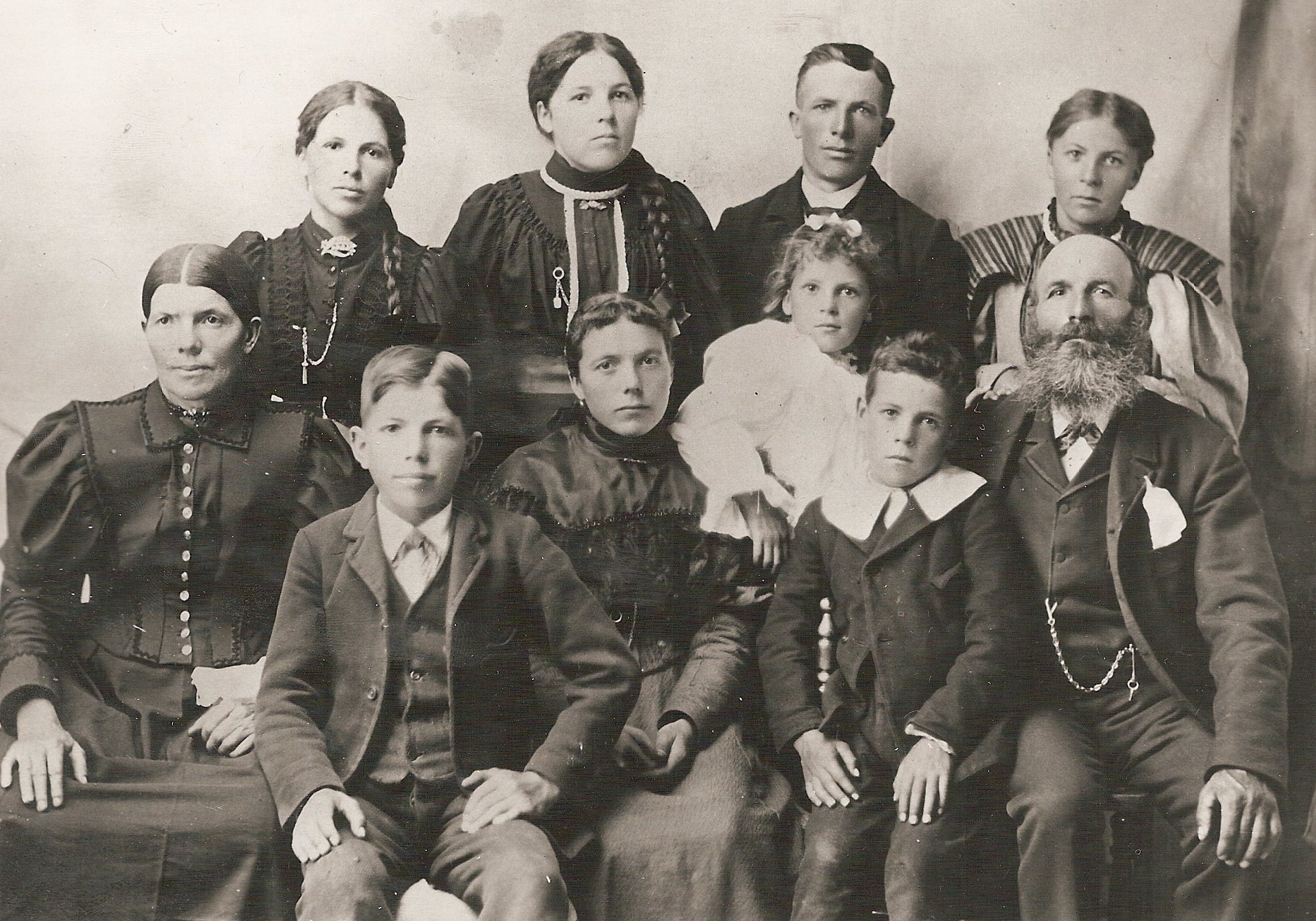
Wanner Family about 1895, back (l-r): Mary, Christine, George, and Pauline; front: Anna, Fred, Louisa, Wilhelmina, Gottlob, and John Wanner.
“To continue with my story- – we did so many things in life. First of all we were poor and had not much to live on. The folks had to move from Holzgerlingen to the new place in Gruenkraut. I remember we didn’t have much land. Father got a job working on the street. The grass grew high on the side of the road and we had to help gather the grass for the cows. We had to do this everyday before father went to work.
“We were poor in those days. We had to be up at 5 o’clock in the morning when we were big enough to work for other people. We worked every day in our lives to make a dollar. I would go out and work for other people whenever there was work. Some people had lots of land and we got plenty work there. They would come and get us to work when I was seven years old. I remember we never wasted any time. I remember when we had to go to a place to get vaccinated. I know I sure suffered a long time because my arm was so sore. They do this so that it will last a lifetime in the old country against disease.
“I remember how we got warm for the winter. Father would buy a yard of wood in the forest and we had to cut it down ourselves and haul that wood home with the cows and wagon. Some were long trees too and we would haul all the limbs and everything home. I am telling you, we had the yard so full of wood that we had no room for anything else till we had it shaped down and sawed up and put in its place. You know that was a job and we had to do all this before winter set in. We had a little wagon and we went to the woods in the summertime too, to get some dry wood. We did this many times and would always take home a wagonfull.
“In the old country they had fences in the lucerne fields. We had to put them up so we could hing the hay on them to dry after it got wet from the rain, so it would not mold. When it was dry we hauled it home. I remember we did all the farming with cows, they had them work all day and then milk them at night. Father worked on the street job for many years and mother and us children did most of the farming and in the fall we went picking hops. We never failed to make a little money in them. They have fields of hops in the old country. We always earned our winter’s money there. They have acres of hops there. We never wasted our time in the field.
“Another thing we did was go to the forest and pick fruit and go and sell it in the city. The people would sure buy it because the city was a long ways from the country where we lived. We had to walk all the way to the city. We raised hemp and mother would spin half the night making it into balls. She would take it to the factory and they made clothes out of it. We used to have many yards and would stretch it out on the grass in the summertime. It would go white and thats the way mother made our sheets and everything. We have in the old country the shoemaker, and he come to the house and make shoes for us. We also had the dressmaker come to the house. Sometimes they would stay at the house a week or more.
“When the grain was but, we had to out and clean the heads of the wheat. We cleaned sacks full each day for flour and one time right in the middle of the summer, the soldiers came in with their horses on some maneuvers or something. The horses mashed the grain and trampled all our crops up. I knew there was a big field of grand and they went right through it. They stayed around about a month or more. It sure was terrible.
“After a few years father bought a new farm and house about two miles away from the old one. It was a bigger house and more land and that’s where we lived until we came to America. Our house was a long house. We had four rooms and an upstairs. In the farmhouses of the old country we had everything under one roof– the pig pen and the hay loft. There was a big place in the floor where we threshed the wheat and other grain and we pulled all the hay up in the loft towards the roof. For a long time we threshed the wheat on this hard floor below with a stick and using a big klap, four or five of us would thresh the wheat and then would sieve the wheat from the chafe. But later, I can remember that we hired a thashmachine and the cows pulled it after that.
“I remember one time a wagon run over me. I believe it went over my arm. I don’t know how bad I got hurt, but it was plenty bad enough.
“Well, later on in that place not far away they built a Lutheran church and a school, too; and there we learned to knit our own stockings and do all kinds of sewing and crocheting. Yes, they built a nice church and school. They were very strict in those schools. If you were late a few minutes you would have to hold out your hand and the teacher would hit you so hard that your hand could feel it for a long time. It was one of those hard wood sticks. It wasn’t always our fault because we had to take the milk to the creamery in the morning in the snow and ice, and we could not go very fast, but there was no excuse at all. We had a lot to do before school, and if we didn’t have the lesson ready we were scared to go to school, ’cause if we were late we would sure get hit, and when you held out your hand they would do just what they wanted to do and it didn’t hurt them any.
“In the old country they sure celebrated Christmas. We had two Christmas trees every year and nice ones at that. We had applies tied from the bottom to the top and the step and the tree sure looked pretty every year. We only had white bread for Christmas and Holidays. I can remember how good that white bread was. We never saw it very often. it was only the rich who could buy that. There was only one bakery in Gruenkraut that had good bread and cakes, but we could never buy any. This is how we made our bread: We had a box of wood. Of course, it was clean. Father worked the dough and made enough for two or three weeks. It was mostly rye bread. It was hard and dark but we had to eat it. When Valentine’s Day came around, Mother made up cakes and they sure tasted good.
“We all the time raised our own meat. We raised pigs and salted and smoked the meat. We had our own grease. Mother made her own noodles all the time. She used lots of eggs–they were sure good. We had our cellar so full of potatoes, apples of all kinds and barrels of cider and barrels of sauerkraut. I can remember our cellar was full of all kinds of good things to eat.
“Well, about our garden. We had the prettiest garden you ever saw in the old country. The garden was laid out in a square and we had a path around all over with the vegetables in the background and flowers in front and we could walk all over the paths with flowers on each side. We didn’t need any ditches, but had to pack water when it didn’t rain. We always had a beautiful garden with flowers of all kinds.
“On Saturday we always had to clean the shoes for the whole family — shine them up for Sunday. We always went to church on Sunday. We never worked on Sunday. We were not allowed to work on Sunday, because in those days they would fine you if you did. You could not even get your hay in on Sunday, even when you could see rain coming.
“Well, I guess about in the year 1890, in the summertime, the Lord sent a man along that street in Gruenkraut where my father worked, who was a missionary from the Church of Jesus Christ of Latter Day Saints. He talked to my father a long time and he told father of the new and true Gospel and about Joseph Smith and showed him the Book of Mormon. This man talked to my father in German as he was a missionary to German. Well, it was dinnertime and father took this missionary to our home and father told him–“We’ll see mother”–and from that very day on this missionary stayed at our place. His name was Zollinger from Providence, Utah. When his time came to go home, the missionary took my brother George to America with him. After that we had three more missionaries–one from Bear Lake, one from Providence, and another one from Salt Lake City, who couldn’t speak the language, so we helped him learn the language. He would tell us English words and we would tell him German words. There wasn’t anybody who would listen to the missionaries for miles around–just one other family from Ravensburg–and they were the only ones that believed the message like us. We had room for them everytime they came. There was no place else for them to go and we were glad to have them.
“The missionary from Salt Lake–his name was Hubbard–decided to go tracting one day. It was his first time tracting. He didn’t come home for so late that we thought maybe he fell into one of the wells with water that were here and there. It was late in the evening and dark, so mother decided to put a candle in the window. He soon came back and told us that he had been lost for a long time until he saw the light in the window. There weren’t many houses when I lived there, but in seventy years since, I guess it is built up all over.
“(About this same time Grandma was writing her history, Mrs. Herbert Wagstaff and son came to visit her from California. Herbert Wagstaff was the son of sister Mary Magdaline. The son had recently returned from a mission to Germany, where he had taken colored slides of the big house in Gruenkraut as it stands today. Of this evening of reminising Grandma said:) “It was sure nice to see my old home again and see it still stand in Gruenkraut. It was nice to see it again after seventy years.”)
“Well, I lived in that community for 14 years. That’s when I graduated. We started to this country when I was fifteen, in May of 1893, and got here the 15th of June, 1893. We came by ship and docked first in Amsterdam, Holland, and then in London, England. And then from London, to New York City, where we went to a big high hotel. WE were 12 days on the ocean. We had a good time on the ship where we danced. One day there was a terrible storm which throwed water up on the dock and nobody could dance after that. From New York we boarded the train for Idaho. We were 6 days on the train. On the train we sang all across the United States. We couldn’t speak any English then nor for a long time. We got off the train on the 15th of June, 1893, in Franklin, Idaho, and my brother George was there to meet us. He had a wagon with three spring seats. Well, we never were so worried on our whole trip as we were in that wagon. That day the road was so bad–open ditches with water in, and the horses danced around before they would cross. I never say such a rough road in my life–hills and hollows, and then we saw a bunch of Indians. They were hanging dead squirrels on a line to dry. That was something new to us. Well, we got to the place where we were to stay. But father was as worried that he got off the wagon and walked all the way back to Franklin. Mother and the rest of us were so worried, because he didn’t come back for a few days. We stayed with some folks for about two months, then father built a place in Glendale, Idaho, and there we lived the rest of the summer.
“Towards fall there was a man who wanted to sell his place in Glendale and father bought that place. My father farmed in Glendale. Glendale had only a little meetinghouse and also a school. I went to school there that winter to learn the English language. From then on I worked wherever I could get a job. I worked washing, cleaning house and tending children. In a place where I worked their children got mumps and I got mumps too, and I suffered so much that I could never get better for a long time. When I got better I went to work again. One time in the winter I rode a horse to Preston, and I got the toothache so bad that I had to have it pulled out right there. I soon learned to ride a horse a lot–something I’d never done in the old country.
“I worked for Matthias Cowley in Preston one winter. I guess it was the year 1895. He used to take trips and travel in a buggy–he helped organize the Northwestern States Mission. Then I worked in Whitney, Idaho. They had plenty of sickness in homes there. In 1897 we moved down to Logan and to the 5th Ward. Then I worked in Millville and went to school there at the same time learning the language. After that I went to work in Logan. It was in the 3rd Ward one night in church I met Jeffrey Bodrero. We were married in the Logan Temple, March 16, 1898. My sister Wilhelmina married Jeffrey’s brother, Moses Bodrero, December 18, 1907. Jeffrey’s father was Domenico Marsiano Bodrero, and his mother was Maria Caterina Margherita Frank Bodrero. After we were married I went to work for Dominic Bodrero that summer, who lived by the courthouse, where I walked everyday from the 9th Ward and did washing by hand on a board up until the time of my first child. Later that year I tended to beets, but they didn’t grow very well because of too many wild oats. Jeffrey went to the canyon about every day to get lumber and to make a dollar. These are the years when I lived: Gruenkraut, German: 14 years; Glendale, Idaho: 5 years; Logan 9th Ward: 30 years; Logan 4th Ward–where I became a relief society teacher. I also did a lot of temple work.
“In the old country we had known a family names Speth for a long time. We used to go back and forth to each others homes all the time. There was a big dark forest between our two places, and we were sometimes afraid to go through it because it was dark, even in the day time. Father would send us kids over in the evenings too. Sometimes we went twice a week to see them. We always had to walk of course. We had no car. I can see it now and I will never forget it. They were really friends to us. The old people never joined the church, but the boys came over to America and settled in Providence and then joined the church. My granddaughter married a Speth grandson.
“My children’s names are: [Rosalie] Marie, John George, David Wanner, Eva Margaret, William Jeffrey, Parley Lorenzo, Louise Mary, Edward Theodore, Llewellyn Grant and Evelyn Jane.
Bodrero Family (l-r): Louisa, Louise, John, Parley, Rosalie, Jeffery, Jeffery, David, Eva
“My folks went to conference everytime there was one. We never had the chance to go because children had to stay home and do the work. I remember it was in the winter once and it was so cold my parents couldn’t go to the conference. They sure liked this Mormon Gospel from the first day my father met the missionary.
Wanner Reunion, Anna Schmid Wanner sitting, standing (l-r) Mary Carter Wanner, Wilhelmina Wanner Bodrero, Mary Wanner Wagstaff, Regina Nuffer Wanner, Louisa Wanner Bodrero, Christine Wanner Nuffer, and Rebecca Hicks Wanner
“(Louise Sophie Wanner Bodrero died February 1, 1967 in Logan, Utah)
I recently attended the National Association of Consumer Bankruptcy Attorneys (NACBA) annual conference in Tucson, Arizona at Starr Pass. The resort is secluded and away from downtown. From the resort there were a number of trails and my law school buddy, Andrew Curtis, and I took a few of them out to see the desert. We were also joined by Michael Wilder on our last evening in Tucson.
That last evening we hiked over to the Bowen House. There is an interpretive sign in the desert, a few articles online. Sherry and Ruby Bowen moved to Tucson in the 1920s from Rockford, Illinois. The change of climate was to help with her heart complications. He was a typesetter who eventually became the editor of the Arizona Daily Star. They moved to this location in 1931 and started this home while living in a cabin.
Michael Wilder and Andrew Curtis visiting in front of the Bowen House
The Bowens left Tucson in 1944 and moved to New York City where Sherry Bowen worked for the Associated Press.
Of course the genealogist in me was curious about the man and woman more than the house. I found this article from Alex Jay on the Stripper’s Guide.
View of Tucson from Starr Pass Marriott
“Sherry B. Bowen was born Sherry Bowen Krauskopf in Maywood, Illinois, on March 13, 1900, according to the Cook County, Illinois, Birth Certificates Index at Ancestry.com. His parents were Charles C. and Mary Hort. Bowen served in the Army during World War I and on his Report of Interment card, his birth surname was crossed out and “Bowen” was written above it. A note said he had legally changed his name but the date of the change was not recorded.
Starr Pass Marriott Resort
“The 1900 U.S. Federal Census said Bowen was the only child and his father was a school teacher. In the 1910 census, the family still resided in Maywood and their address was 900 8th Avenue. Bowen had a younger brother, Karl, and their father was a principal and teacher.
According to the Interment card, Bowen’s Army service started May 28, 1918. He was a private in Company B, 336th Battalion, Tank Corps. He was discharged July 18, 1919.
In 1920 Bowen was a university student and still lived with his parents at the same address. The Rochester Democrat and Chronicle (New York), August 5, 1956, said Bowen studied at the University of Illinois and then joined the Bloomington, Illinois, Pantagraph. Bowen’s move was reported in the Daily Illini, February 1, 1922.
Krauskopf Resigns Illini Position for Job on Pantagraph
Sherry B. Krauskopf ’23 has resigned as one of the news editors of The Daily Illini to accept a position on the editorial staff of the Bloomington Pantagraph. He will leave to assume his new duties Saturday.
Krauskopf will start as a reporter but will be given a taste of the mechanical side of newspaper work and will De training on the city editor’s desk as he intends to follow the editorial phases of newspaper work.
Beginning as a reporter in his freshman year Krauskopf has rounded out five semesters of work on the staff of The Daily Illini, two years as a reporter and thus far this year he has been one of the six news editors.
Ruby Butts Take Vows Of Marriage To S . B. KrauskopfAnother romance of The Daily Illini culminated in a wedding last night when Ruby D. Butts ’23 became the bride of Sherry Krauskopf ’23 at 7 o’clock in the home of the Rev. James C. Baker, 1209 West Green street, Urbana. Mr. Baker read the service before members of the immediate families.The date for the wedding had originally been set for June, but owing to the serious illness of the groom, the ceremony was performed last night. The bride wore a gown of black satin and Spanish lace and a corsage of American roses. Geraldine Hegit ’23, who was bridesmaid, wore blue taffeta and carried a shower bouquet of La France roses. Karl H. Krauskopf ’26, brother of the groom, acted as best man. Mrs. Krauskopf has been a member of the staff of The Daily Illini for the past three years and was society editor this year until forced to resign because of ill health. The groom was a reporter on The Daily Illini in his freshman and sophomore years and was a news editor last year.
According to the Democrat and Chronicle, Bowen moved on to the Springfield, Illinois, Register. In Tucson Arizona, Bowen was at the Independent and then worked 16 years at the Arizona Daily Star.
The 1930 census recorded Bowen, a newspaper reporter, and his wife, in Tucson on North 1st Avenue. The 1933 and 1934 Tucson city directories listed his address as Route 1, Box 399A. In 1935 he resided in the Tucson Mountains. Bowen’s address was Anklam Road in the 1936 directory.
Bowen brought his wife, Ruby, to Tucson from Rockford, Ill., in the late 1920s in hopes that the climate would improve her health. Bowen was a typesetter and later city editor at the Arizona Daily Star. The Bowens homesteaded in the Tucson Mountains and began living in a cabin there in 1931 while Bowen built the house of native stone. They expanded their claim to 2,000 acres. Ruby Bowen wrote for Desert Magazine of the Southwest. Her diary of her first year in the Tucson Mountains refers to the wildlife she saw, including javelina, deer and wild mountain sheep that came to the base of the cliffs nearly every evening to graze. She wrote that a mountain lion would pace about when she was cooking meat and once attempted to get in the window.
American Newspaper Comics (2012) said Bowen wrote The Story of Santa Claus which was drawn by Ed H. Gunder and ran from December 17 to 22, 1951. The strip was syndicated by the Associated Press.
Moving back to the Conference, it was a great chance to get reacquainted with my law school friend, Andrew Curtis. These conferences are good as I get continuing education credits for both Idaho and Utah. Nothing too earth-shattering learned, confirming much of what I knew or had forgotten. But a great opportunity to stay in a very nice resort and visit a new area.
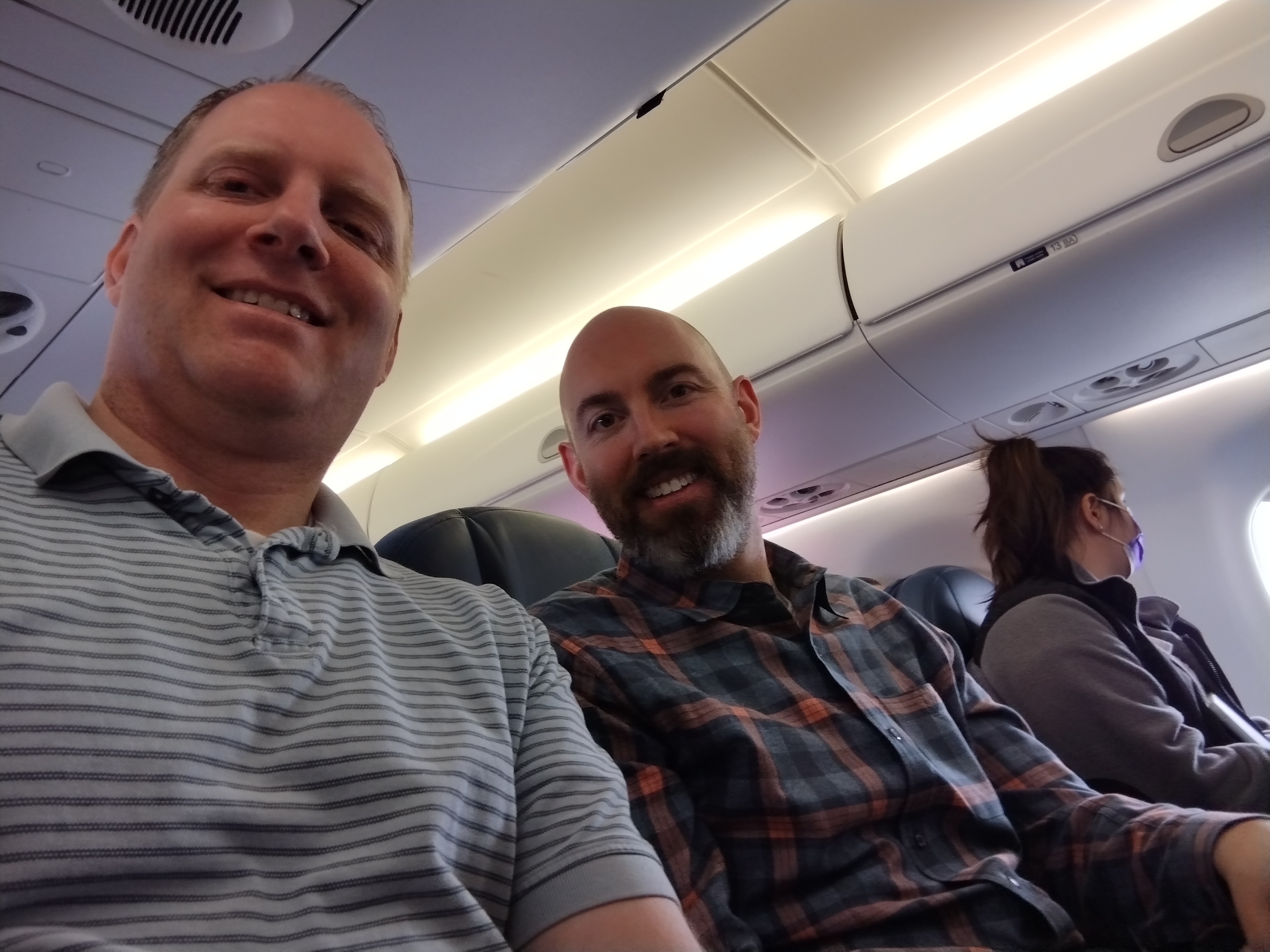
Paul Ross and Andrew Curtis flying to Tucson from Salt Lake City
I have previously written of George and Minnie Van Leeuwen. In that post, I shared a copy of the photo I received from the records of the Utah State Hospital. That photo was not dated, so I don’t know when it was taken. Here is the photo I received from their records. It was a photostatic copy and not very high quality.
Photo from George’s Utah State Hospital file
Now I am happy to report that a family member obtained access to the Utah State Hospital file directly and obtained a copy of the photograph in the file. As you can see, the quality is 100 times better than the photostatic copy of the photograph that was provided to me by mail. The personality, the life, the lines, are much more able to be seen than before.
Here is some of what I wrote before.
Gerhardus Hendrik Van Leeuwen (who went by George Henry in English) was born the fourth of nine children to Gerrit van Leeuwen and Elsebina Maria Catharina Weenig on 16 October 1856 in Oldenzaal, Overijssel, Netherlands. I have written of them at this link: Van Leeuwen-Weenig Wedding. He was a carpenter by trade, on the finishing side. He would also tune and service organs. After moving to the United States, he worked as a finishing carpenter.
You can read more of his family at the link above. But some additional notes.
Five children in back (l-r): Minnie, Annie, Elsie, George and Jane. Second row: George, Dena, Hermina. Front: Mary and Herman.
It was about 1885-1886 when George incurred a head injury. My Great Grandmother, his daughter Dena Donaldson, indicated he fell from a ladder. Other siblings reported to descendants that he was struck in the head with a board. This is believed to be the reason why the family moved back to Arnhem, that due to his inability to work, this may be the reason they returned to Arnhem to be near family and rely on them for help.
The family then moved back to Amsterdam perhaps in pursuit of employment again. It was in Amsterdam that the Van Leeuwens met with missionaries of The Church of Jesus Christ of Latter-day Saints. George and Minnie were both baptized 4 June 1887. The story goes that George saw some men running down the street with people chasing them. Concerned for their safety, he pulled them into his home. He learned they were Elders of The Church of Jesus Christ of Latter-day Saints. The missionaries taught the Van Leeuwen the gospel and helped them convert leading to their baptism.
A sponsor from Ogden, was to meet the family at the train depot in Ogden. But no one was there when they arrived. A man by the name of Mr. Dalbout, saw their plight, and he invited the family to go home with him. There was no place to stay for a long period, so they converted a chicken coop into living quarters. This is where the family waited until George could join them. She took in laundry from other families to support themselves until he arrived.
According to George’s 1932 death certificate, he suffered from epilepsy with psychosis for 45 years. That would predate his immigration to the United States. His mental health could have become an issue when immigrating, and it may have been easier if Minnie and the children had gone first and established their new home. That may have enabled George to follow the next spring without risk of having the family turned back. Epilepsy had a stigma of illness that the family had to deal with, everything from wickedness to a contagious disease. This way, only he could potentially be turned away from entering the county. The plan was that with the family already in Utah, he would be permitted to join them in Utah. George arrived 21 March 1889 in New York City, New York on the S.S. Veendam having left Rotterdam.
George’s head and mental injuries continued to worsen as the years passed. The family either had to keep him safe during a fit and keep him calm to keep from inducing a fit. By the time 1911 rolled around, the family could no longer deal with his mental condition on their own. Dena referred to her “Daddy” as tender and sweet and then at the switch he would become angry and threatening. He had made enough threats and raised enough raucous that neighbors called the police. George was committed to the Utah State Mental Hospital in Provo, Utah, Utah in 1911. The family tried to get him out and succeeded. Unfortunately, he lost control again and ended up spending the rest of his life in the mental hospital. The family would drive down nearly every weekend to pick up “Daddy” and keep him for the weekend before taking him back. By the mid 1920’s, they could not even take him home on the weekends his condition was that poor and uncontrollable.
George died 5 January 1932 in Provo, Utah, Utah. He was buried 3 days later beside his wife.
Ole and Constance Christiansen are pleased to announce the marriage of their daughter Martha to Herbert Coley, son of Stephen and Hannah Coley. They were married in 1874 in Norway. While I normally like to start these historical posts as a wedding announcement, I trip up there. We do not have any histories that give us an actual marriage date and location. Knowing the period, it is not imagined they were not actually married. Their first child was born in 1875. Curiously, after their immigration to the United States due to their conversion to The Church of Jesus Christ of Latter-day Saints, they not only went to the Logan Utah Temple to be sealed, but also applied to be married. As such, they were married and sealed in the Logan Utah Temple on 26 April 1893.
Martha was born the second of eleven children to Constance Josephine Eliza Jorgensen and Ole Christiansen on 16 April 1879 in Fredrickstad, Ostfold, Norway. I have not written their history yet, but as linked above, I wrote some limited information on Constance when we visited her grave first in 2018 and again in 2020. Ole was born in Trogstad, Norway and Constance in Drammen, Norway. Both Ole and Constance were baptized and confirmed into The Church of Jesus Christ of Latter-day Saints on 26 January 1876 in Norway.
What happens for the next few years is unclear on the reasons. Martha’s older sister, Walborg, was born 24 December 1875 in Fredrickstad, then Martha in 1879. We really have no records during this period and so I am unclear if there was another child, or two, in that period of time. Eivelda was born 20 October 1881 in Melbourne, Victoria, Australia. I have no clue why or what took the family to Australia. Their next child, Constance, was born 9 November 1883 also in Collingwood, then a suburb of Melbourne. Apparently Walborg and Martha were left in Norway while their parents went to Australia. Alice, Martha’s granddaughter recalls Martha telling of her sitting on the mountainside overlooking the fjord waiting for her parents to return and her missing them terribly. Martha’s first brother, Henry Owen, was then born 27 March 1887 back in Fredrickstag, Norway. Ole and Constance were back in Fredrickstag by March 1887.
I have been unable to find the immigration records for the Christiansen family between Norway to Australia and back. But the family was in Australia for at least 3 years, maybe as long as 6 years. They were not back in Norway very long as Rhoda was born in Richmond, Cache, Utah on 18 September 1890. Martha moved with her family to Richmond in the late 1880s. One record has it in 1887, another 1889, Martha was listed in the 1900 Census as immigrated in 1888. Either way, we now are in the vicinity of where she would have met Herbert Coley. Of Martha’s remaining 6 siblings, 5 were born in Richmond and 1 in Hyde Park.
Herbert was born the 5th of 9 known children to Hannah Maria Rogers and Stephen Coley on 12 February 1864 in Lutley, Worcestershire, England. It was while living in Lutley that the LDS missionaries first made a visit. We do not know the conversion story but Herbert and his siblings joined the church. Martha joined 23 August 1867, Herbert 1 June 1881, George 22 August 1881, and Frank 2 June 1882. The 1871 English Census has the family still living in Lutley and Herbert listed as a scholar. The call to gather in Utah was strong enough that these four children made the venture. We don’t know if Stephen and Hannah came begrudgingly or not, but they joined some of their children in Utah. Unfortunately, the other children left in England we do not know where they went or what happened to them.
Herbert shows on the 1881 English Census in Dudley, Worcestershire, England as farm labor for the Doorbar family. Herbert appears to have boarded the Nevada in Liverpool arriving 3 July 1882 in New York City, New York. I cannot see that any siblings went with him on the trip. Stephen, Hannah, and Martha all traveled in 1890 (with Letitia Lea Willetts and her daughter Clara, and two known Frank and Mary Coleys). Stephen Coley was baptized 5 January 1892 and Hanna 26 October 1892 (same day she was endowed in the temple, so either that date is wrong or the prior record could not be found and the ordinance was duplicated. Hannah died 22 October 1894 in Franklin, then Oneida County, Idaho and was buried in Lewiston.
I don’t know any of the details of how they met, but the stars seem to have aligned in Richmond. However it happened, Herbert and Martha were married and sealed 1 December 1896 in Logan at the Temple. Herbert was a diligent laborer who would acquire full ownership in their home by 1910. Martha was a strict and involved homemaker and mother.
Herbert and Martha maintained their home, large garden, and raised 10 children. Lillian was born 26 August 1898 in Lewiston (listed in the Coveville Precinct, which is now the area of Cove). The 1900 Census on 9 June 1900 lists Herbert as a farm laborer with his immigration in 1881 and Martha’s in 1888. By 1910, the Census finds the family in Wheeler (about six miles west of Lewiston) where the home was owned outright. We don’t know exactly where the family lived. Edna was born 23 November 1900, Wilford Herbert 1 Mar 1903, Carrie 20 April 1906, and Hannah Marie 3 June 1909. Ole Christiansen passed away 27 February 1900 in Richmond and was buried there. Carrie is listed as born in Richmond, but we do not know the circumstances how she was born there instead of Wheeler/Lewiston. Hannah’s birth certificate lists Herbert as a farmer and Martha as housewife. The 1910 Census on 26 May 1910 shows Herbert as a Laborer and that he “Works Out.” Whatever that meant in 1910.
All the remaining children were born in Richmond. As such, it is likely at this time the family moved to the cabin south and east of Richmond estimated about 2016 E and 9000 N. I have tried to pinpoint where the cabin remains are still located. Here is a photo of the cabin from the 1980s. The 1920 Census on 16 January 1920 lists Herbert as a Farmer and Teamster with the additional insight of “Hauls Milk & Farms.” This same Census also lists Wilford as having his own Farm, but still living with his parents.
Coley Cabin near Richmond, Utah
It was in this house that the remaining children were born. Ivan Stephan on 26 June 1912, Roland Charles on 20 July 1915, Oley Lloyd on 11 February 1918, Arthur Christiansen on 15 July 1921, and William Golden on 22 January 1924. In 2012 the home had collapsed to a pile of rubble. It was after Ellis Jonas’ funeral we visited as family (Ellis is Lillian’s son). Ellis had taken me there about 2002. Stephen Coley died 22 October 1913 in Lewiston and was buried by his wife.
The 1930 Census taker showed up 15 April 1930 and shows the family in Richmond with Roland, Lloyd, Art, and Golden still in the home. The 1940 Census on 8 April 1940 has the family still in Richmond with Art and Golden the only two remaining.
Herbert and Martha Coley in the garden
Over the years, the family kept busy with marriages. Lillian married Joseph Nelson Jonas on 6 September 1917 in the Logan Temple. Edna married Gerald Andrus 17 April 1921 in Richmond and after a short marriage, divorced, and remarried to Olof Alma Neilson 23 July 1923 in Logan, sealed 30 July 1924 at the Logan Temple. Wilford married Edith Dagmar Cammack 15 May 1924 in Logan, sealed 3 June 1946 in Logan Temple. Carrie married Joseph Lorus McMurdie 21 July 1924 in Logan, sealed 21 October 1926 in Logan Temple. Hannah married William Surgeoner Thomson 2 July 1927 in Logan, sealed 14 June 1972 in Salt Lake Temple. Ivan married Clara McMurdie 22 October 1930 in Buhl, Twin Falls, Idaho, sealed 10 February 1932 in Logan Temple. Joseph Jonas passed away 6 September 1932 in Ogden, Weber, Utah. Constance Christiansen passed away 10 December 1932 in Portland, Multnomah, Oregon and was buried there. Roland married Veda Anderson 5 May 1937 in Logan Temple. Lloyd married Verda Anderson (twin sister to Veda) 23 November 1938 in Logan Temple. Arthur married Gladys Bernice McMurdie (his niece!) 10 September 1940 in Preston, Franklin, Idaho, that marriage lasted a short time for hopefully obvious reasons. Arthur remarried to Mary Elizabeth Popwitz (his nephew’s WWII widow) 3 May 1946 in Evanston, Uinta, Wyoming. Golden married Shirley Mae Hall 15 March 1946 in Elko, Elko, Nevada, sealed 11 May 1965 in Logan. Many grandchildren were born in these years as well for Herbert and Martha.
Herbert and Martha Coley (I have the original of Martha, but not of Herbert, so I know it is still out there)
Recorded family stories are fairly scant. Nobody wrote much down and that generation was gone before many were asking questions. Ivan Coley told his daughter Colleen that Herbert was a short, very English man. Apparently Herbert met Wild Bill Hickok at one point and shared that fact regularly.
In 1942, Herbert went to visit Ivan and Clara in Buhl. I will have to find out if Martha was there as well. While out in the yard, I have been told by a well, or a trough, he slipped and broke his hip. There was not really much to do for someone in that condition then. He was in terrible pain. He was taken back to Richmond and passed away later of pneumonia. He died 7 September 1942 at age 78 (obituaries all have 75) and was buried in Richmond Cemetery 9 September 1942.
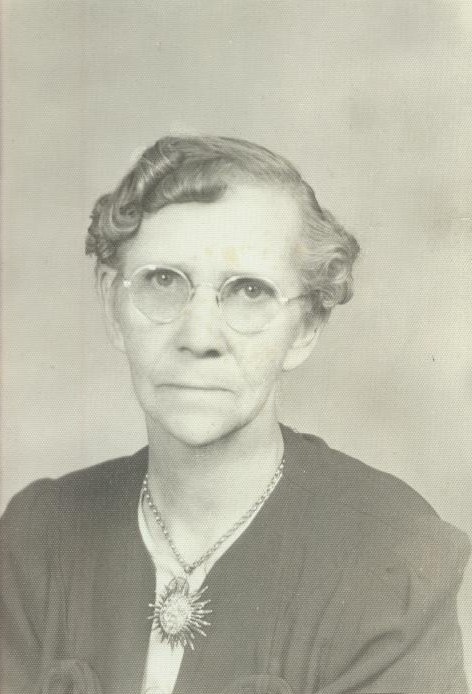
Martha Coley and Hannah Thomson in a garden, dresses and even a brooch
Martha moved into town shortly afterward. Various family members lived in the cabin when they started out their marriages. Martha’s new home was somewhere near 400 South and 200 East. With the new homes I cannot tell as well, but I have tried to pinpoint the spot. She lived in this home until she needed assistance and went to live with Lloyd and Veda in Salt Lake City. When they could not care for her any more, she then lived in a care facility in Logan the last months of her life.
5 generations about 1959, Lillian Coley Bowcutt, Martha Christiansen Coley, Joseph Hebert Jonas, Robert Lee Jonas, Joseph Leland Jonas.
In 1948, Martha was honored for successfully Relief Society Teaching for more than 40 years. Here is a photo from that occasion. You can find more detail here.
Back (l-r): Lydia Leavitt, Estella Blair, Sarah Preece, Susanna Allen, Livinia Wilcox, Clara Wheeler. Front: Lavina Poulsen, Christensia Hansen, Martha Coley, Martha Lewis, Sarah Snelgrove.
Unfortunately I do not have a many more stories. But I do have a few more photos. We have these two photos of a gathering about 1950.
Back(l-r): Doreen Neilson, Martha Coley, Golden Coley, Edna Neilson, Unknown, Gloria Neilson holding unknown child, Olof Neilson. Middle: Shirley Coley, Joy Coley (baby), Mary Coley,
Mary (holding Joy), Shirley, Doreen, Unknown, Martha, Edna, Gloria
This wonderful family reunion picture from 1955. I have linked the other post sharing the other photo. That link also names everyone in the photo. Martha is sitting surrounded by her grandchildren and children.
1955 Coley Reunion, Richmond, Utah
Herbert’s obituary in the Salt Lake Telegram on 8 September 1942 reads:
“Richmond, Cache County – Funeral Services for Herbert Coley, 75, who died at his home in Richmond Monday at 7:45 a.m. following a brief illness will be conducted Wednesday at 1:30 p.m. in the Richmond South L.D.S. ward chapel by E. M. Hicken, Bishop.
“Mr. Coley was born in England on February 12, 1867, a son of Stephen and Hannah Rogers Coley. In 1885, at the age of 16, he immigrated to the United States.
“On December 1, 1896, he married Martha Christiansen in the Logan L.D.S. temple. He was a prominent farmer in the Richmond district.
“Surviving are his widow of Richmond, 10 sons and daughters, Mrs. Lillian Jonas, Ms. Edna Nielsen and William Golden Coley of Richmond, Wilford Herbert Coley of Logan, Ms. Hannah Thomson and Lloyd Coley of Salt Lake City, Ms. Carrie McMurdie, Ivan, Roland and Arthur Coley, all of Buhl, Idaho, 37 grandchildren, three great grandchildren, and a sister, Mrs. Martha France of Richmond.
Lillian, Edna, Martha (sitting) Coley in the 1940’s
“Friends Pay Tribute to Richmond Man
“Funeral Services for Herbert Coley, 75, prominent Richmond farmer who died at his home in Richmond, Monday at 7:45 a.m. following a brief illness, were conducted Wednesday at 1:30 p.m. in the Richmond South ward chapel by Bishop E. M. Hicken.
The rest of the article follows nearly verbatim what the Salt Lake obituary listed, then this line.
“Burial was in the Richmond cemetery under direction of the W. Loyal Hall mortuary.
Martha Christiansen Coley very small picture enlarged
Martha Coley and Scotty
Martha Coley serious
Martha Coley smile
Martha passed away in Logan at age 82 on 14 August 1961. Here is the language from her obituary and an article of the funeral. She was buried in Richmond 17 August 1961.
“Richmond – Martha Christensen Coley, 82, died at a rest home in Logan Monday of causes incident to age. “She was born April 16, 1879 in Norway to Ole and Constance Josephine Eliza Jorgensen Christensen. When she was eight years old she came with her parents to America. “On December 1, 1896 in Logan she married Herbert Coley. The marriage was solemnized in the Logan LDS Temple in 1900. They made their home in Lewiston and Richmond. She was always active in the LDS church, especially as a Relief Society block teacher. Mr. Coley died September 7, 1942. “Surviving are Mrs. Lorenzo (Lillian) Bowcutt and Mrs. Edna Neilsen, Richmond; Wilford H. Coley, Logan; Mrs. William (Hannah) Thompson and Lloyd O. Coley, Salt Lake City; Mrs. Lars (Carrie) McMurdie and Ivan S. Coley, Buhl, Idaho; Roland Coley, Mesa, Arizona; Arthur C. Coley, Ogden; William G. Coley, Hyrum; a number of grandchildren and great grandchildren. “Funeral services will be held Thursday at 1 p.m. in the Richmond South Ward with Bishop Oral Ballam in charge. “Friends may call at Hall Mortuary in Logan Wednesday from 7 to 9 p.m. and at the South Ward chapel Thursday from 11:30 a.m. until time of services. Burial will be in the Richmond Cemetery.
“Funeral services were held in the Richmond South Ward chapel Thursday for Mrs. Martha C. Coley with Counselor Quentin Peart conducting. Lloyd Coley gave the family prayer. “Prelude and postlude music was played by Reese Murray. The ward chorus directed by Mrs. Florence Lewis with Mrs. Billie Lou Bagley as accompanist sang “The Lord’s Prayer.” Ila Rae Richman and company sang “That Wonderful Mother of Mine.” Mrs. Florence Lewis and Mrs. Rebecca Lewis sang “In the Garden,” and Ronnie Lewis sang “Beyond the Sunset.” “Prayers were by William Thomson and Larus McMurdie. Speakers were Mrs. Leona McCarrey who read the obituary, Noel Stoddard and Counselor Peart. Pallbearers were her six sons, Wilford, Ivan, Roland, Lloyd, Arthur and Golden Coley. The grave in Richmond Cemetery was dedicated by Joseph Jonas. Flowers were cared for by the Relief Society.
~
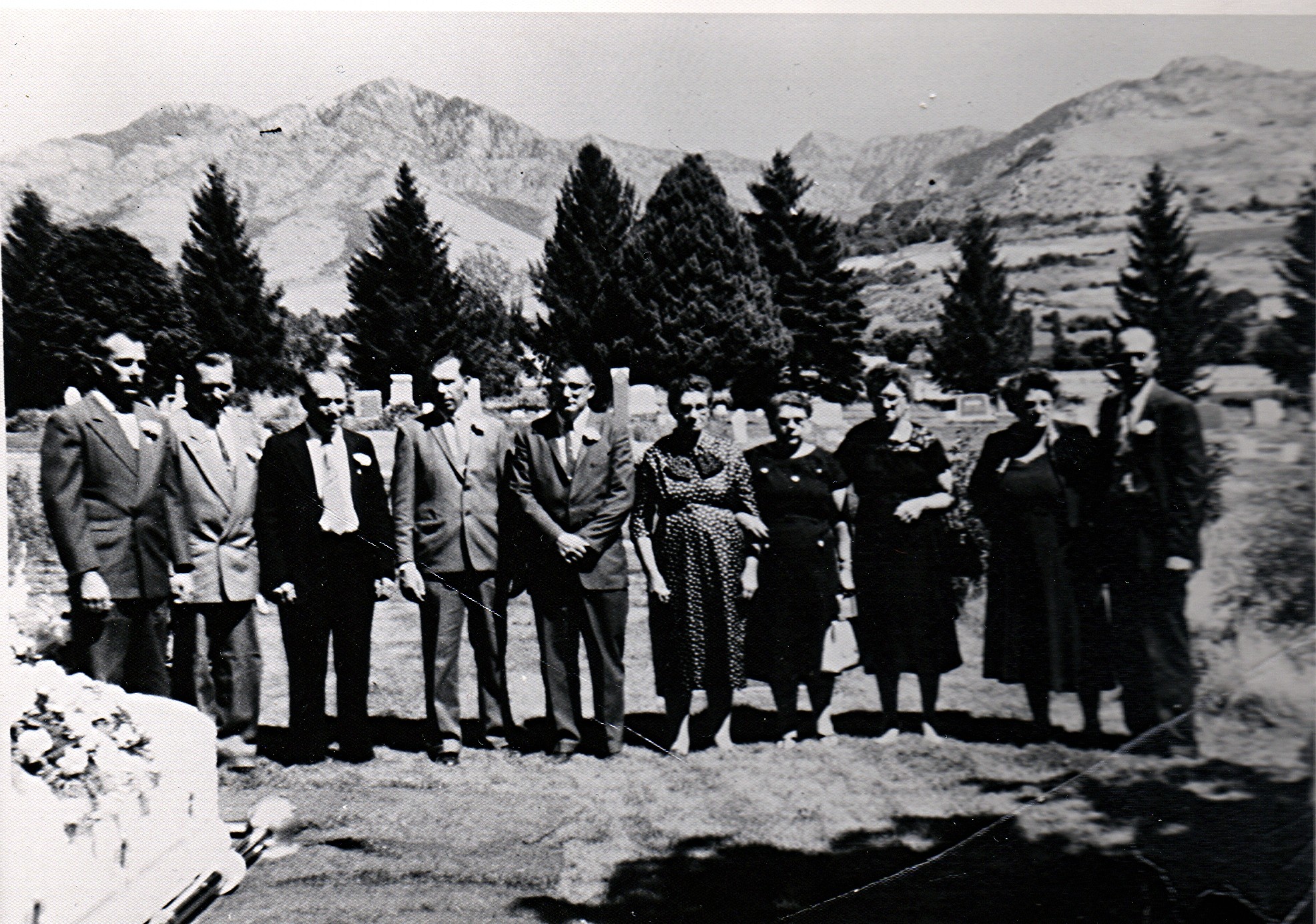
I have written previously about the video that came from the funeral and graveside service of Martha. In that post I walk through the video and the identified individuals. It also scans the 10 children standing in the cemetery. This photo below is of the same instant.
Art, Golden, Wilfred, Roland, Lloyd, Edna, Hannah, Carrie, Lillian, Ivan at their mother’s grave in Richmond, Utah
I hope some day I obtain more photos to share of Herbert and Martha.
Many are more eloquent than me. Many have shared their memories of that fateful day, where they were at, what they were doing, and how they felt. I wish to sing with that chorus.
9/11 2021 at the Ross home. My shadow, Lillie, Aliza, Hiram, James, and Amanda.
I am not really certain why I felt more sensitive or emotional today. There was really no change from the 15, 18, or 19 year anniversary. But I felt myself pondering and deliberating, moved to tears multiple times by music and commemorative videos. I honored the 20th anniversary in Burley, Idaho with my family. I pulled my journal from 2001 to see what I wrote then. Here are a couple of excerpts.
“The past days are days never to be forgotten. Shock, anguish, anger, and peace. Not only catastrophic terrorist attacks in New York City and Washington D.C. which I shall not rehearse. They leave me in such sorrow for those people. I have wept several times. My little heart strings are tried in many ways. Such loss of life. Also a sense of awe in the brute power this government has. The whole world is shuttering at the thought of America angry. Even Germany, England, and France are quick to say we are on your side more in fear than just loyalty. It looks as if we may go to war. Even Afghanistan is quick to say they will do what we want. A country not totally cooperative in the past.” Recorded 13 September 2001.
“It is strangely imaginable how much life can change in the space of a few days… I was impressed that Friday was a national day of prayer. I listened to a portion of the service at that National Cathedral in Washington D.C. I was very moved, especially with the Battle Hymn of the Republic. The church also had a service I saw a small part of. A service done by the church in the tabernacle. A very moving scene with the two huge flags draped behind the choir… Although I had to work Sunday I knew would be a hard day for me. I had high emotions and with the tragedy this week… Sacrament was amazing. I sat with Paul & Kathryn [England]. The Bishopric all spoke and several musical numbers. The Hughes brothers sang ‘Lord, Make Me an Instrument of they Peace.’ Kathryn sang ‘In My Father’s House There are Many Mansions.’ The Lowes did a medley with Bonnie of ‘Where can I turn for Peach, Abide with Me, and I need Thee Every Hour.’ One of the things that stuck out with the meeting was we need to forgive, but justice must be served. The opening hymn was ‘America.’ Powerful.” Recorded 17 September 2001.
I didn’t write as much as I thought I might have, especially with the vivid memories I have. 11 September 2001 was what 22 November 1963 was to my parents. 11 September 2001 was what 7 December 1941 was for my grandparents. So it is through the generations before. Where and what they were doing when they heard about x, y, or z. The assassination of Lincoln or Garfield or Ferdinand. The sinking of the Reuben James or the Bismarck. Or the surrender of Cornwall. I guess it depends on what generation or the incident.
Here is my story of 11 September 2001. I was living with Gary & Lena Hughes at 368 Santa Fe Ave, Branson, Missouri. I managed the dinner theater for the Hughes Brothers. As such, I worked late evenings and usually got up in the morning to an empty home. I often got up and prepared for the day, ate breakfast, and usually practiced the piano and singing. Most of the time the local radio was playing in the background, the station usually 1930s-1950s music.
This morning was different. I woke up and I remember thinking the day was heavy. The radio was not on, I did not practice. It was quiet and solemn. I ate and headed to the theater for the first show of the day. The drive to the theater was usually less than 10 minutes.
I turned on the radio half way to the theater. There was discussion about damage to a skyscraper and confusion on which of the buildings had been hit. I did not get enough information to know where or what had happened. But I understood there was a potential attack on the United States.
I arrived at the theater and I could sense the pandemonium. It was big, whatever had happened. But the buses were arriving and we needed to get the people seated and ready for the first show. Some of the people were just as unaware as me, others were visibly upset, others were just emotionless. As the time got closer there was a sense of panic of whether to cancel, how to alter the show, what to do moving forward. The information coming to us from the office was becoming more clear as to what had happened. The show started late. It was going to be mostly impromptu.
Elder Evan Wagley in front of the Hughes Brothers Theater, Branson, Missouri, I believe 2002.
I watched from the balcony as Jason Hughes welcomed the audience. He gave an update for everyone present. Asked whether the show could start with a prayer. A prayer was uttered. I don’t recall if it was first or not, but the Hughes Brothers sang their version of Secret Prayer. It still haunts me today, the memory, the song. We were communing in a theater church. There were hymns, patriotic music, and a smattering of other songs. It is all fuzzy to me now 20 years later, but Secret Prayer is the show for me. I was likely back and forth between the offices and the balcony of the theater. The response at intermission and afterward was extremely positive. Those people had been uplifted.
Here is a link to the Hughes Brothers singing the song.
As the day went on it was interesting to see the reactions of individuals. There was a general consensus we were headed to war. Some were so distraught that our nation and way of life was ending. Others were hopeful this was an isolated incident. There were many tears and emotions were high. One individual in the office was trying to figure out ways to avoid the draft that was sure to come. I was turning 22 that same month, prime age. Do we enlist or just wait it out. Others commented about their parents and the bombing of Pearl Harbor and how they mobilized.
My Grandfather Ross and Grandmother Jonas had both planted a seed in my heart and a desire to serve in the military. I looked forward to the opportunity and yet feared what might yet come. Too this day, I still wonder how I will yet serve and get that honorable flag on my casket.
As the days pressed forward we watched a revitalization of unity in faith and our nation. I do not believe it was the time I felt the strongest for my country, but it was the time when it was the most palpable.
That is all I recall of the day looking back. My journal helped me recall the international unity and coalescing against terror and evil. I do long for the days of trying to do what is right for the nation as opposed for the party or individual. May those days again return, but not due to some terrible tragedy. Unfortunately, that does not seem to be in the cards. But one can hope. Whether in this life of the next, it will come. “It’s the place where dreams come true.”
Elder Spencer Lewis and me at Mt. Vernon Missouri, I believe mid September 2001.
Biography of John George Wanner taken from a hand written history which was in a box of Genealogy material of Clara Bodrero, now in possession of Elaine Ricks (unknown dates), author unknown.. I have written a history of John George Wanner Sr previously. I updated location and names to their proper spelling.
“John George Wanner, son of John Frederick and Anna Maria Marquardt, was born Oct. 18, 1845, at Holzgerlingen, Germany. He had two brothers, namely Michal and Conrad. Grandfather was the youngest child. [He wasn’t a very large man about 5 feet 6 inches tall. He always looked well dressed, clean and very nice.]
“He was member of the Protestant Church. At this church the members graduated from Sunday School at the age of 18.
“In those days children didn’t get very much schooling and grandfather was no exception.
“Grandpa while in Germany worked on the roads and was the road overseer. he also worked in the Black Forest and fought in the Civil War in Germany in 1865 and the War of 1870-71.
“He was married to Anna Maria Schmidt on June 6, 1870. [She was about 5 feet 4 inches and had a good shape. She always fixed her hair so beautiful, she looked nice and well dressed. I can remember this beautiful black knit winter dress she had and she always wore gloves] From this union was born to them five sons and five daughters. Before his marriage he served in the Civil War in Germany and again after his marriage in 1870 & 71 for quite a while.
“After his marriage he worked in the woods. In 1873 they moved from Holzgerlingen to Gruenkraut, Wuerttemberg, where they bought a little home and farm. He also worked in the gravel and woods on this side. In 1880 he got a job on a big highway and worked on it until he came to America in 1893.
“In the month of May 1891 while working on the Highway two men came along and talked to him, giving him a Tract. They were members and missionaries of The Church of Jesus Christ of Latter-day Saints. They visited his home telling him and his family of the gospel and the Lord’s work. They made their visits often, and in July 1891, John George, the oldest son was baptized and came to America with a missionary by the name of Terrell from Providence, Utah.
“In October 1891, grandfather, his wife and some of their children were baptized by the Elders. (Grandfather was the only member of his father’s family that joined the Latter Day Saint church.
“In May 1893, they prepared to come to America. [They rode the train for a day and then got on a ship and went up the Rhine River. This took them three or four days. They then rode the train another day and got on a ship on the North Sea that took them to England; the sea was very turbulent and they had a rough voyage.
“They went to Liverpool, England from Germany on a small ship. From Liverpool to New York they came on a big ship and were on the ocean 13 days. They arrived at New York City and stayed in a Hotel 20 stories up for 1 or 2 nights. They took the train to Chicago where they stayed 1 or 2 nights. Then they took a train and came to Franklin, Idaho arriving on Sunday June 18, 1893. They were met by their son George and Brother Fred Nuffer, the man George was working for. They met them with a one seated buggy and a wagon. Grandfather Wanner asked for a drink of water after getting off the train. “You’ll have to be on your stomach by that stream”, George spoke up. This made Grandfather Wanner so discussed that he walked back to Logan over 20 miles, with a determination to go back to Germany if he had to drink from ditches. The next day he reconsidered and again returned to Franklin, Idaho. They went to Cub River to Fred Nuffer’s place where they stayed for almost one week Then they purchased the farm of John Nuffer in Glendale, Idaho. [It was during this week that Grandpa took his daughter Mary and they walked to Bear Lake County seeking a farm and a home and to see what was available there. They slept on the ground at nights and saved some of their read to feed the bears so they wouldn’t bother them. They had to take off their shoes as they forged streams. It as a rough trip.
“[The first Sunday they were in Glendale, Grandpa and Grandma went to church with these five beautiful daughters and two sons. One day, William Addison Wagstaff was the ward clerk and mother, Mary, had on a red dress; dad looked down at her and winked. You see, dad was well past 30 and not married. I bet he though here is my chance. Of course there were other nice gals available, but he hadn’t married and we were happy he chose mother.]
“[Grandma soon joined the Relief Society and in the minutes of the meetings that I have, tell of her bearing her testimony often and donating eggs, wheat, calico or whatever, when asked to do so. They had a strong testimony and remained true to the Church and were ardent Temple Workers till their last days on earth. ]
“John Wanner took up more land after a few years and built a log cabin to claim the land. Cleared quaken aspens from his farm to have more land. One day his All slipped from a stump and cut a deep space i his hand. It was necessary for the doctor to put in several ditches as the farm work advanced he built a barn and bought addition cows.
“Mother Wanner made and sold many pounds of butter a week to George Benson Store in Whitney, Idaho.
“The Wanners also picked and sold number quarts of currants, gooseberries and raspberries. Gooseberries were about 20 quarts for a dollar, the raspberries sold for about 10 or 12 quarts for a dollar. These were delivered price.
“About that time 2 additional rooms were added to a rock house that was on the place.
“They bought the John Nuffer’s farm at Glendale, Idaho, now Franklin County. Later he bought the Jed M. Blair farms in Whitney and started to raise sugar beets.
“[They later moved in 1910 to Logan, Utah and ] while living at Logan, Utah [to be near the Logan Temple where they could go often. In Logan, they lived at two or three different places, but I wasn’t able to find out for sure. The places I distinctly remember was their home on 3rd North and two or so blocks East and their last home in Logan was a lovely home they built located on 4th North and two blocks East. they did a great deal of Temple work for the dead having got many names from Germany. They also did a lot of work for other people. While in Logan, Grandpa always had a lively horse, a good looking single black buggy and a real snazzy buggy whip. This one place they lived on in Logan had an extra lot where he grew hay for his horse and he’d cut it with the scythe. They also always had a nice garden and beautiful flowers. As I remember this home was on 3rd North and a few blocks East.]
“[They were hard working, thrifty people and handled their affairs very well. They really made hay while the sun shone and were able to retire at a reasonable age and had enough to live on plus an estate they left. ]
“February 16, 1922 after a short illness of pneumonia he died and was buried in the cemetery at Logan, Utah.



















 Sagacity