We stopped to pay a visit at the Clarkston, Utah, Cemetery in 2021. We were in Cache Valley for the Jonas Reunion and I knew Amanda had some ancestors buried in Clarkston. Amanda did not recall ever seeing their graves. We had then also been talking about Martin Harris in our study of the Doctrine & Covenants. I surprised the family with a surprise stop on our way home from the Jonas Reunion in Hyrum. It was a hot, windy, and smokey day. We stopped again this year, 2026, for a follow up since I have been doing some research on these families and it is fun to update pictures with the kids. Most of this post I wrote in 2021, but have updated it with new research and photos.
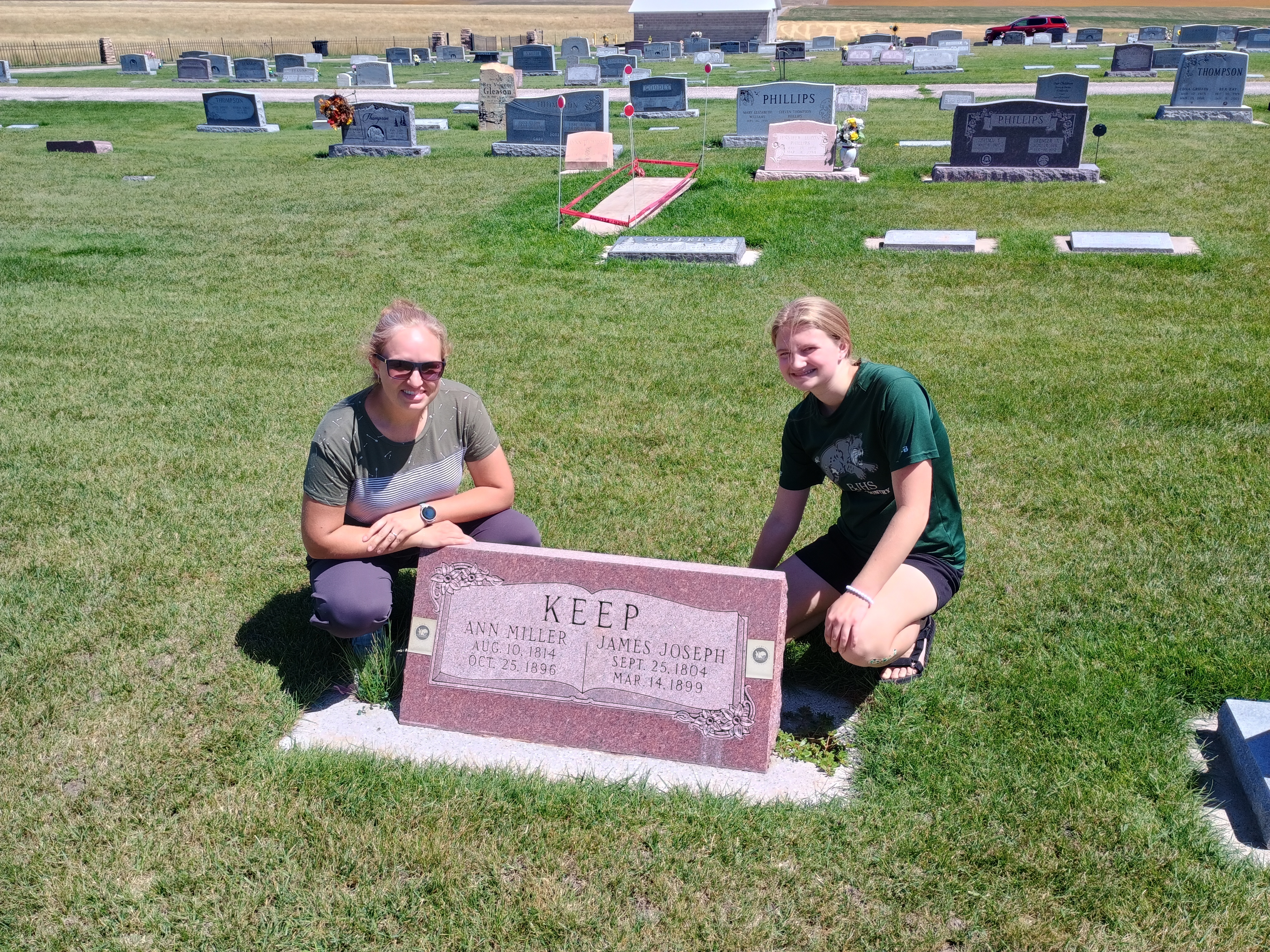
Amanda, Aliza, Hiram, and James Ross at graves of James & Ann Keep – 8 August 2021
Amanda and Aliza Ross – 16 August 2026 – Clarkston Cemetery
James & Ann Keep are Amanda’s 4th Great Grandparents. Amanda wasn’t very familiar with them so we had to do some homework.
James Joseph Keep was born 25 September 1804 to James Joseph and Ann Evans Keep. Family tradition, including his own later Church membership reporting, places his birth in Acton, Middlesex, England. He was christened 11 November 1804 in St. Nicholas Parish, Chiswick, about two miles away. His father died when James was 5, his father was 29 years old at death, and little James was raised for a time by his grandparents.
James married Elizabeth Parr on 15 June 1826 in Greenham, Berkshire, England. She was a widow, he a bachelor of 21. She died in 1836, confirmed by a probate record in Reading, although the exact date was not provided. James remarried to Ann Miller on 25 July 1836 in St. Mary’s, Reading, Berkshire, England. They joined the Methodists, then the Baptists, and then were Independents.
Two young Mormon men came near the house preaching the gospel and Ann told James to go out and hear them. They were preaching about baptism. He went into the house and searched his Bible to ascertain the truth of what they said. Here he found that baptism was to be born of the water and the spirit. When they came again to preach, James took a long bench for the people to sit on. That evening he went to the meeting house. There he heard the saints speak in tongues.
He and his family were baptized into The Church of Jesus Christ of Latter-day Saints. His own account, written decades later, states he joined 23 July 1848 and Ann soon after, with his baptism arranged secretly, before dawn, without his family’s foreknowledge. Such a secret baptismal services may explain why no official record of the baptism and confirmation appear to exist. Official Church membership records instead show a longer process: daughter Mary Elizabeth baptized 14 March 1846, Sarah on 10 January 1849, James and Ann together on 15 March 1857, daughters Ann and Lucy on 24 April 1857, Harriet on 18 June 1858, Ruth on 1 January 1862, and Maria Jane on 1 February 1865. Rather than one dramatic family conversion, the record suggests a longer, gradual process, perhaps beginning with Mary Elizabeth on her own. I don’t wish to undermine the baptismal story, it does not match official church records.
Ann Miller was born 10 August 1816 in Newbury, Berkshire, England to James and Ann Elkins Miller. She was christened 2 October 1816 at North Croft Lane Baptist Church in Newbury.
The 1841 and 1851 census both have the Keep family in Thatcham, Berkshire, England. He was a mason and bricklayer. It was during this time that Ann Miller had a miracle.
~
Kennett Place, Newbury, Berks, Sept. 30, 1850
Dear President Pratt,
We have recently been favored with a manifestation of the miraculous power of God; in this branch of the Church a sister, named Ann Keep, the wife of Joseph Keep, who is a deacon in the Church, had a cancer in her breast for some time; and it became so bad of late that she intended to have it cut out, and the time was appointed for it to be done. Three medical men were to be present at the operation. A brother named David Davis, an elder in the Church, called to see her, and she told him she was going to have the cancer taken out; and he said to her “have you got any faith in the power of God?” and she answered “yes:” and he said “so have I.” Accordingly he anointed her breast with oil, and laid hands upon her, and the pain left her there and then, and she never felt it any more; and from that time the cancer got less, until it disappeared; and the breast that had the cancer is as well as the other. This is known by many out of the Church.
Yours, &c.
Thomas Squires
President of the Newbury Branch
It was Ann’s daughters Mary Elizabeth and Sarah who ran to fetch the Elders that day, according to the family’s own retelling of the story, a detail Sarah herself would later recall in her own history.
~
James, Ann, and family left for the United States from London on 23 May 1866 on the ship American Congress arriving at Castle Gardens, New York, on 5 July 1866. They were in Wyoming, Otoe, Nebraska on 13 August 1866 traveling with the Abner Lowry Wagon Company arrving in Salt Lake City, Utah on 22 October 1866.
We later found a published account of that crossing by John Nicholson, the young elder appointed to lead the company of Saints aboard the American Congress. His company included James, Ann, and their daughters Ruth, Maria Jane, and Sarah Keep Francis with her baby, Lucy Ann.
~
As the ship neared Newfoundland, a thick fog closed in for several days. Captain Woodward, unable to see the sun, could not fix his position. On the quarterdeck, Nicholson’s counselor John Rider suddenly saw the fog lift and called out, “Captain, what is that?” Rocks and breakers lay dead ahead. Woodward sprang to the wheel and gave the order to come about just in time. Nicholson estimated that a few moments’ delay would have wrecked the ship, with few if any aboard surviving. At the captain’s request, most passengers, the Keeps among them, never knew how close the danger had come.
John Nicholson, “Saved by Providence,” Juvenile Instructor, 16:2 (15 January 1881), p. 19.
~
James was ordained a Deacon 5 August 1849, a Priest 19 January 1851, and an Elder 18 May 1851, all by Thomas Squires, and was set apart to travel and preach the Gospel in the open air throughout England. James and Ann received their endowments and were sealed to each other at the Endowment House in Salt Lake City on 6 June 1868. James was ordained a High Priest later that year, on 25 September 1868, his 64th birthday, by Edwin D. Woolley, bishop of Salt Lake City’s 13th Ward and Brigham Young’s business manager (and later grandfather to Spencer W. Kimball and J. Reuben Clark).
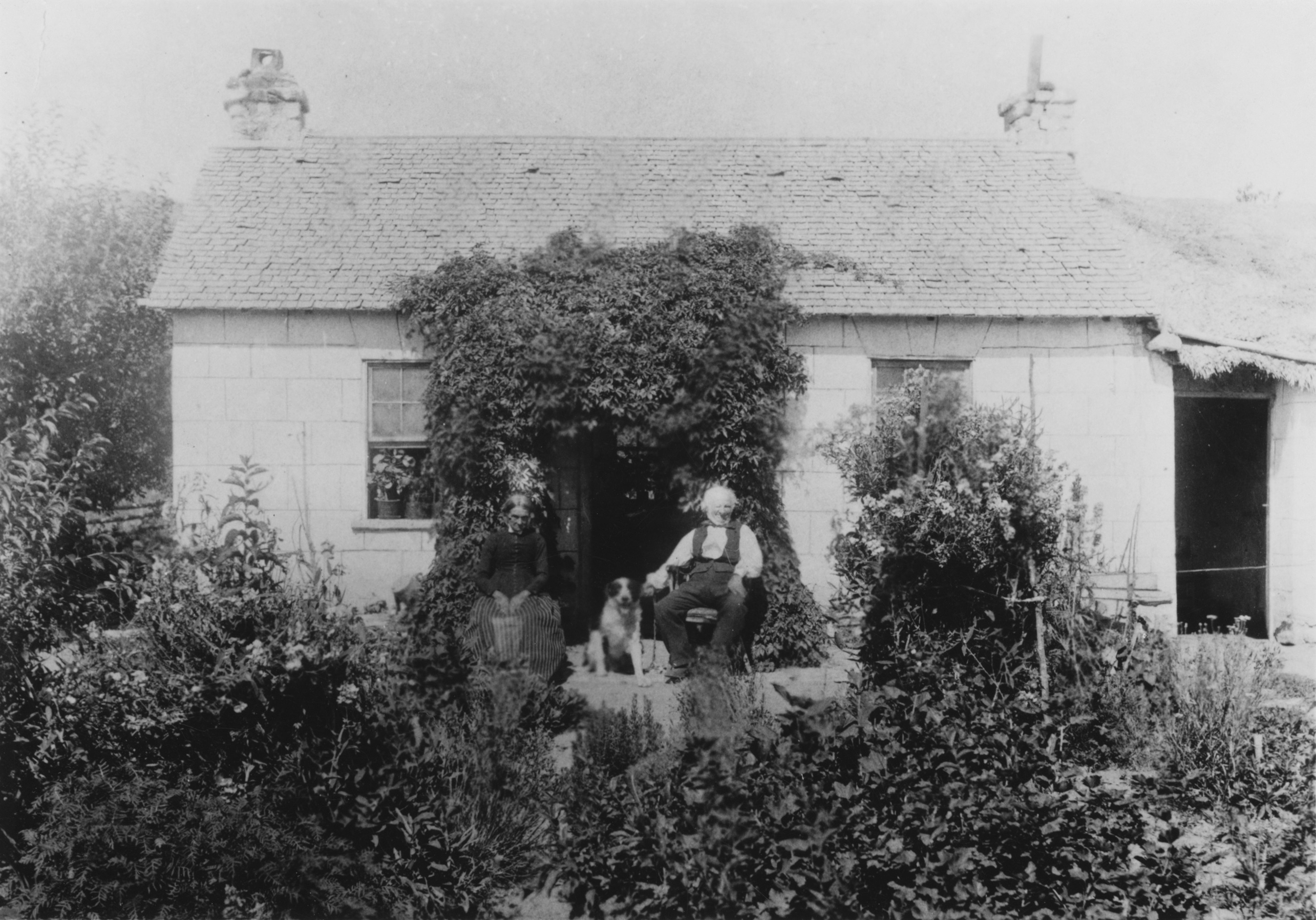
The 1870 Census places the James & Ann Keep in Newton, Cache, Utah with Maria. Shortly afterward they moved to Clarkston and James built a masonry home. The 1880 Census has them located in Clarkston. James was known for his masonry work and often built chimneys for individuals.
Ann helped in the fields with James to raise crops. They had oxen with which they did their farming. Sometimes she would be very tired when she got home. The oxen’s names were Jack and Jue. Ann called them by name and they would reply by their actions.
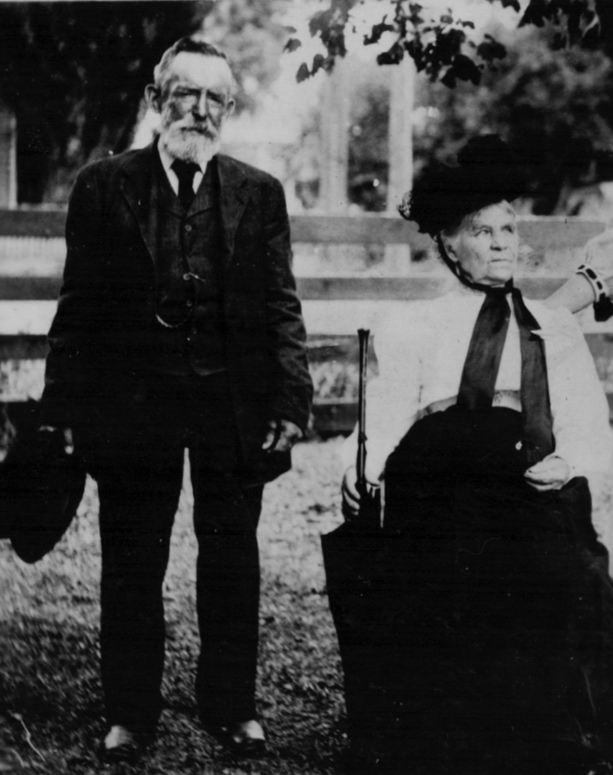
James & Ann Keep
Ann enjoyed her home and loved to make it look nice. She had flowers in the windows and all around the house and a fine orchard of apples, English currants, and gooseberries. All kinds of vegetables were grown in the garden. Her husband helped to care for it too. There was a small porch on the front of her house with a hop vine all around it which grew and ran all over the porch making a nice shade in the summertime. In the fall she would gather the hops and dry them and make yeast with them three times per week. The sisters in the town would send a cup of flour to trade for a cup of yeast to make their bread. In this way she kept herself in flour.
The house, located at about 53 West 200 South in Clarkston, was plastered white on the outside by their son-in-law, Morgan Davies, husband of their daughter Ann. Morgan was a professional plasterer who worked as a foreman on the Salt Lake Temple and helped finish several other prominent Salt Lake City buildings, including the Salt Lake Theater and the State Capitol.
Ann and James Keep at their home in Clarkston, Utah
She was called as first counselor to Mary Griffin in the Clarkston Relief Society on 12 January 1875, per a contemporaneous letter published in the Woman’s Exponent. She was released in 1885 as she and her husband were getting old and could not do their work so well. Ann was a very busy woman. When too old to do heavy work, she would sew quilt blocks for the Relief Society and for her grandchildren or anyone who would let her do it for them.
James and Ann decided to sell their house and property and live on the principle and interest. In 1890, they sold out and moved to Lehi, Utah for two years. They then returned to Clarkston for several years. Ann had a very bad sick spell and it took her a long time to recover. After she got well, they moved to Newton to live with a daughter, Ruth Griffin.
Just before her death Ann bore a strong testimony to the truth of the gospel, telling her daughters and families to hold fast to the end for this was the true Church of Jesus Christ and to do all they could for their dead. She told her nurse, Caroline Thompson, to hold her pocket book for her, then she took out a dollar and passed it to her daughter, Sarah Buttars and said, “Get my brother Joseph’s temple work done for he was a good man.” She passed away 25 October 1896 in Newton.
Nine days after Ann’s death, James wrote to his grandson, John Griffin, then serving a mission: “I can tell it is such a blow to me that it makes me feel so lost that I can hardly bear up with my spirit… after living with a good wife 60 years it is very hard to part with each other.” He wrote that Ann had told him not to pray for her life to be spared, “I want to die and I am going to die so give me up to the Lord.” She spent her final hours talking and praying, urging their children to “stand fast to this church, it is the true church.” James added that he had recently been to the temple, baptized eleven times for the dead, and sealed forty-one couples as man and wife since her passing.
Ann’s funeral was held in the Clarkston meeting house on 28 October 1896, with remarks by Thomas Griffin, John Griffin, Ole Peterson, Bishop W Griffin, Counselor A W Heggie, and Bishop John Jardine. A local correspondent noted that James, then 93, sat at the head of her coffin, “he has lost his right hand,” the account read. “He is deaf and can’t hear a sound but can walk around and converse with others and may yet live many years.”
James passed away while staying with his daughter Mary Turner in Lehi on 14 March 1899. His body was returned and buried in Clarkston.
James’s funeral was held in Clarkston on 17 March 1899, three days after his death; his body had arrived the day before, accompanied by his daughter and grandson, Mr. and Mrs. Turner of Lehi, and his grandson Mr. Davies of Salt Lake. By his own prior request, six friends spoke, including John E Godfrey, the same Godfrey who had stood beside him as a witness to Martin Harris’s testimony some 24 years earlier. Six of his grandsons served as pallbearers.
~
James Keep finds himself in history due to being present in the home of Martin Harris at the visit of Ole Jensen in July 1875. John Godfrey and James Keep both signed as witnesses to the statement of Ole Jensen, Clarkston Ward Clerk. This is from Jensen’s statement:
It was in Clarkston, Utah, July 1875. Early in the morning a thought came to my mind that I would go and see how Brother Martin Harris was feeling. It was only three blocks from my home. I heard he was not feeling well. People came from other towns to see Brother Harris and hear him bear his testimony on the Book of Mormon. When I arrived there were two men present. Brother Harris lay on his bed leaning on his elbow. I said, How are you? Brother Harris answered slowly, Pretty well.We came to hear your testimony on the Book of Mormon.
Yes, he said in a loud voice as he sat up in bed, I wish that I could speak loud enough that the whole world could hear my testimony. Brother stand over so I can see you. Then he stretched out his hand and said, Brother I believe there is an Angel to hear what I shall tell you, and you shall never forget what I shall say. The Prophet, Oliver Cowdery, David Whitmer and myself went into a little grove to pray to obtain a promise that we should behold it with our own eyes.
That we could testify of it to the world. We prayed two or three times and at length the angel stood before Oliver and David and showed them the plates. But behold I had gone by myself to pray and in my desperation I asked the Prophet to kneel down with me and pray for me that I may also see the plates. And we did so and immediately the Angel stood before me and said, Look and when I glanced at him I fell but I stood on my feet and saw the Angel turn the golden leaves over and I said, It is enough my Lord and my God.Then I heard the voice of God say the book is true and translate correctly!“
Martin Harris then turned himself as though he had no more to say and we made ready to go but he spoke again and said, I will tell you a wonderful thing that happened after Joseph had found the plates. Three of us took some tools to go to the hill and hunt for some more boxes of gold or something and indeed we found a stone box. We got quite excited about it and dug quite carefully around it and we were ready to take it up, but behold by some unseen power the box slipped back into the hill. We stood there and looked at it and one of us took a crowbar and tried to drive it through the lid and hold it but the bar glanced off and broke off one corner of the box.“
“Sometime that box will be found and you will see the corner broken off and then you will know I have told the truth again. Brother as sure as you are standing here and see me, just so sure did I see the golden plates in His hand and He showed them to me. I have promised that I will bear witness of this truth both here and hereafter.”
His lips trembled and tears came into his eyes. I should liked to have asked one more question but I failed to do so. But I refreshed myself and shook hands and thanked him and left. When I think of the day I stood before Martin Harris and saw him stretch forth his hand and raise his voice and hear his testimony, the feeling that thrilled my whole being, I can never forget. Nor can I express the joy that filled my soul. This is a true statement.
Sarah Keep later confirmed this in her own written history, noting that her father’s presence was recorded “in the presence of John Godfrey, Ole A. Jensen and James Joseph Keep, my father.”
~
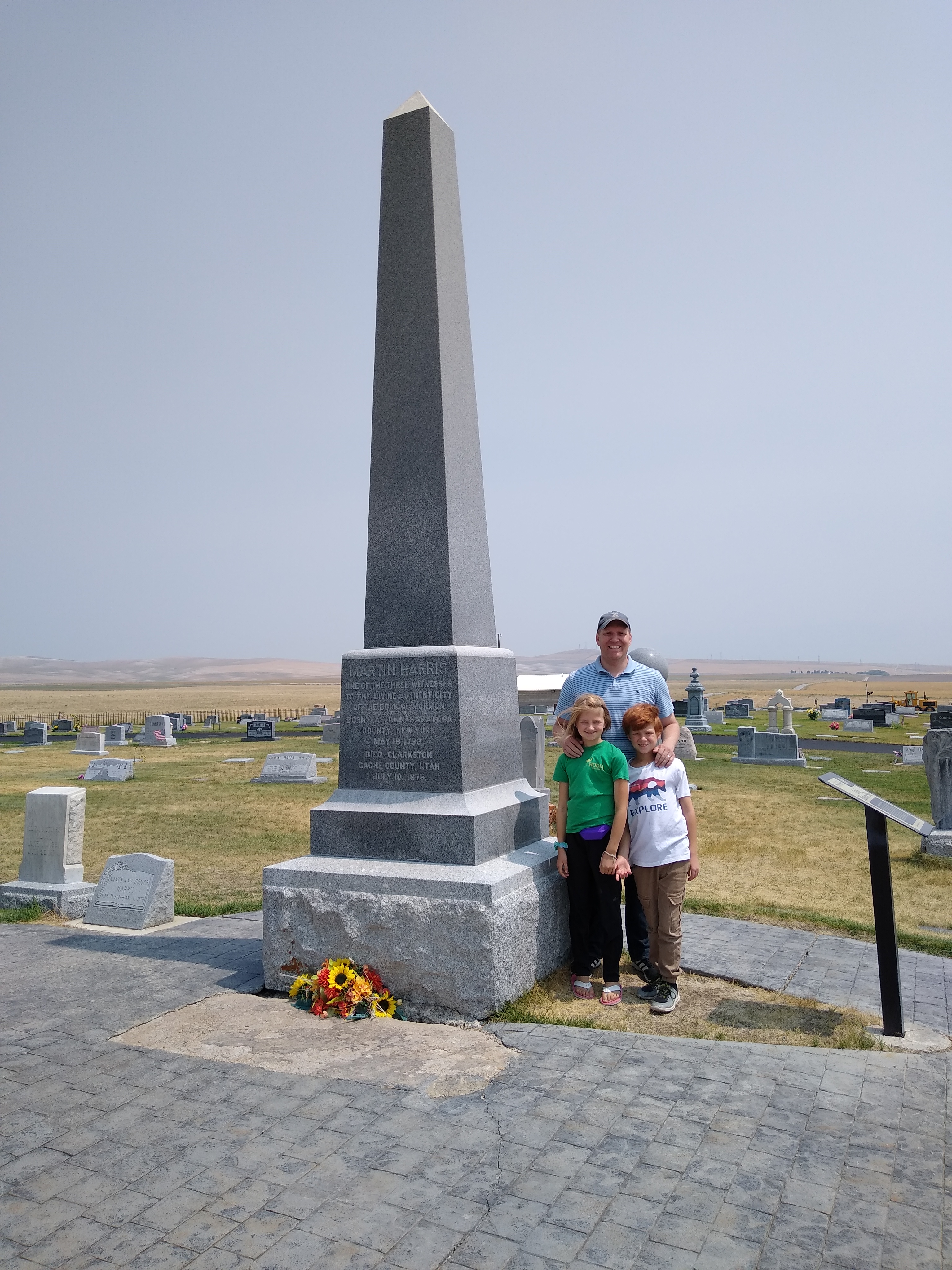
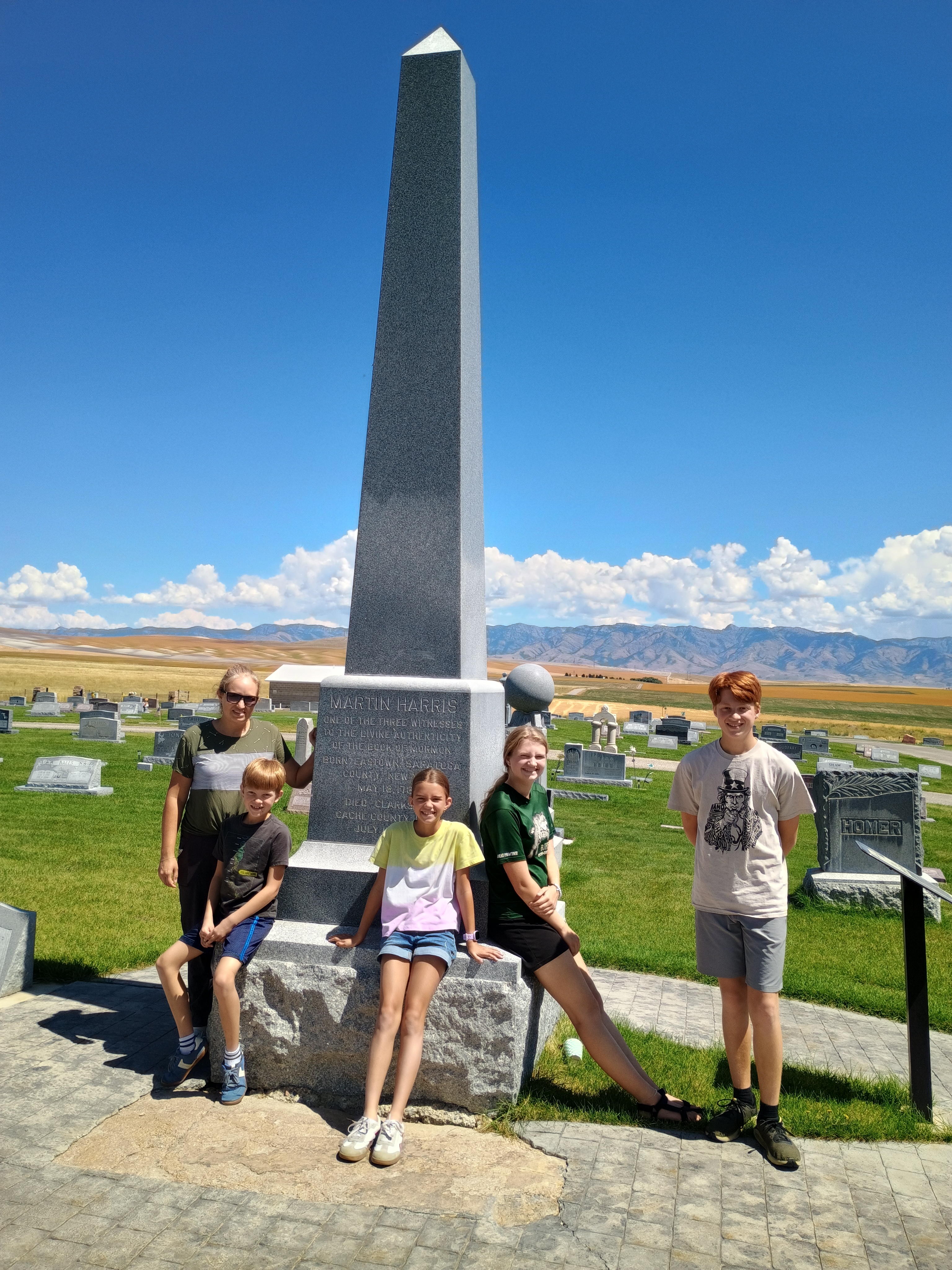
We also visited the grave of Martin Harris in the same cemetery at Clarkston.
Paul, Aliza, and Hiram Ross at the grave of Martin Harris on 8 August 2021
Amanda, James, Lillie, Aliza, and Hiram Ross at Martin’s grave – 16 August 2026
Thomas Squires (1811–1868), who ordained James and later served as President of the Newbury Branch, had followed a strikingly similar religious path of his own. A Wesleyan preacher from age fifteen, he later turned to the Baptists, and finding neither fully satisfying, began preaching what he considered an improved doctrine of his own. He first heard of the Latter-day Saints from two women he met after preaching in a village on a Sunday morning, tracked down and corresponded with an Elder in London, and was soon baptized, confirmed, and ordained an elder in a single day. He baptized many converts and established several branches of the Church.
When the Newbury Saints raised the means to send him to Zion, Thomas emigrated in 1854 with his large family, sailing from Liverpool to New Orleans on the Golconda. Cholera struck the company in St. Louis, killing his wife, Mary Ann, and all but a son and a daughter, Sarah Ann, among his children, along with the wife of his son-in-law John Green. Thomas himself was gravely ill but survived, arriving in Salt Lake City on 30 September 1854, where his brother John, who had emigrated a year earlier, nursed him back to health. Sarah Ann later married her brother-in-law, John Green, himself recently widowed in the same epidemic.
Thomas settled in Kaysville, mending shoes for a living, but never fully adjusted to life afterward. In the words of his brother, John Paternoster Squires, Thomas had been “almost worshipped” as a preacher in England, and mending and pegging old shoes “seemed too monotonous for him.” He grew discouraged, drifted from the Church, briefly joined the Josephites (the RLDS movement), then left Utah altogether for Denver and later Cañon City, Colorado, where he preached for the Baptists and was supported by the townspeople until his death on 18 May 1868, of paralysis.
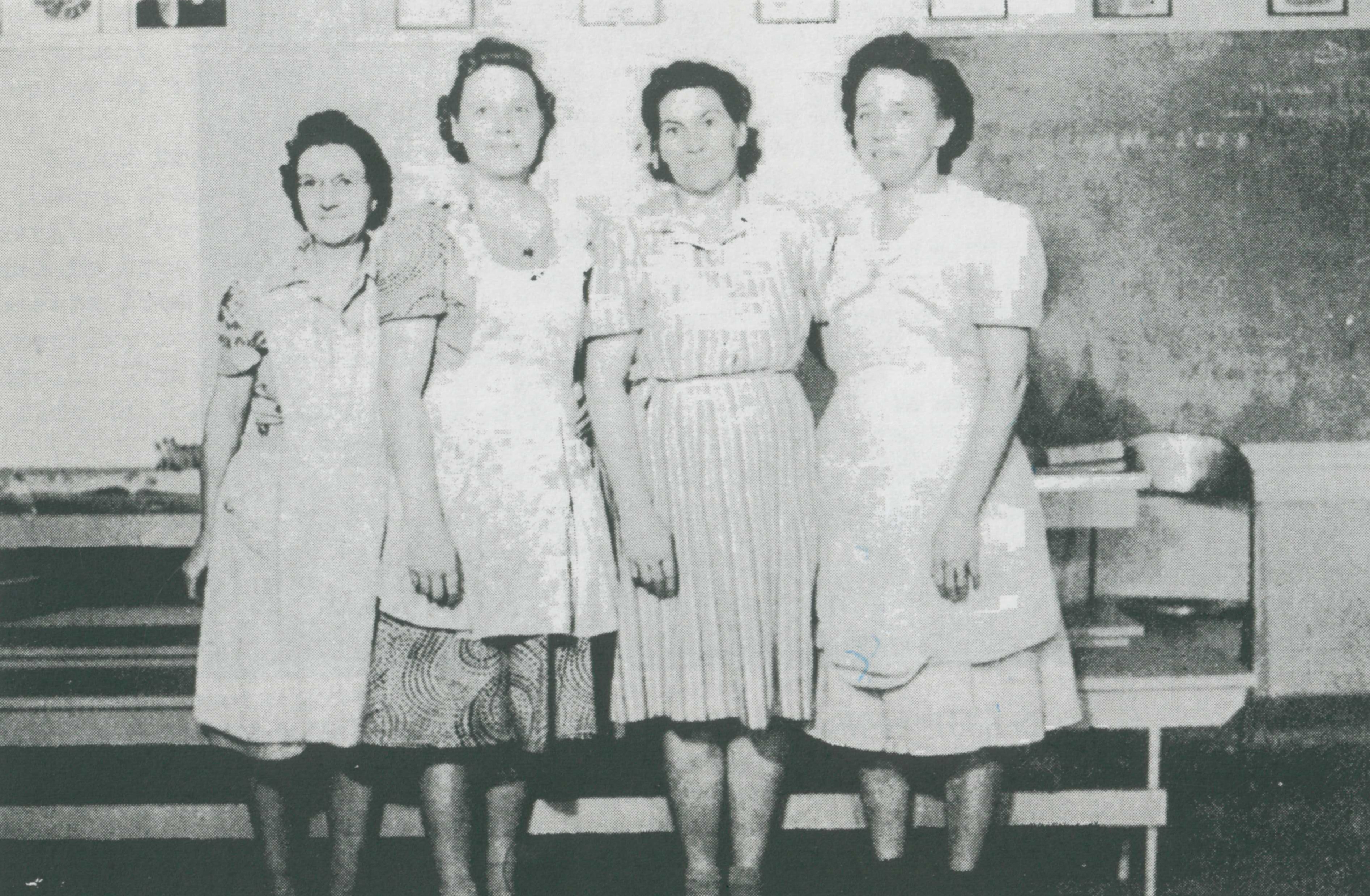
Milo Sharp, Archie Richardson, Mary Ann and Ethel Sharp, Roy Richardson
William Stoker and the late Emma Eames Stoker are pleased to announce the marriage of their daughter Mary Ann to Milo Riley Sharp, son of William Sharp and Mary Ann Sharp. They were married at the Episcopal Church in Plain City, Weber, Utah on 11 May 1879.
Milo is a farmer in Plain City. The couple will make their home in Plain City.
Just trying to write these first three paragraphs was not easy with this family. So many twists and turns with each individual name makes it difficult to find the proper wording and fashion to form the sentences. If you do not know the story of the names, it can be confusing. There are two Mary Ann Sharps in this family (Milo Riley’s mother, and his wife Mary Ann “Lillie” Stoker) and two Victorine Sharps a generation apart (Milo Riley’s sister, and his own daughter). I have tried to be careful throughout to distinguish them.
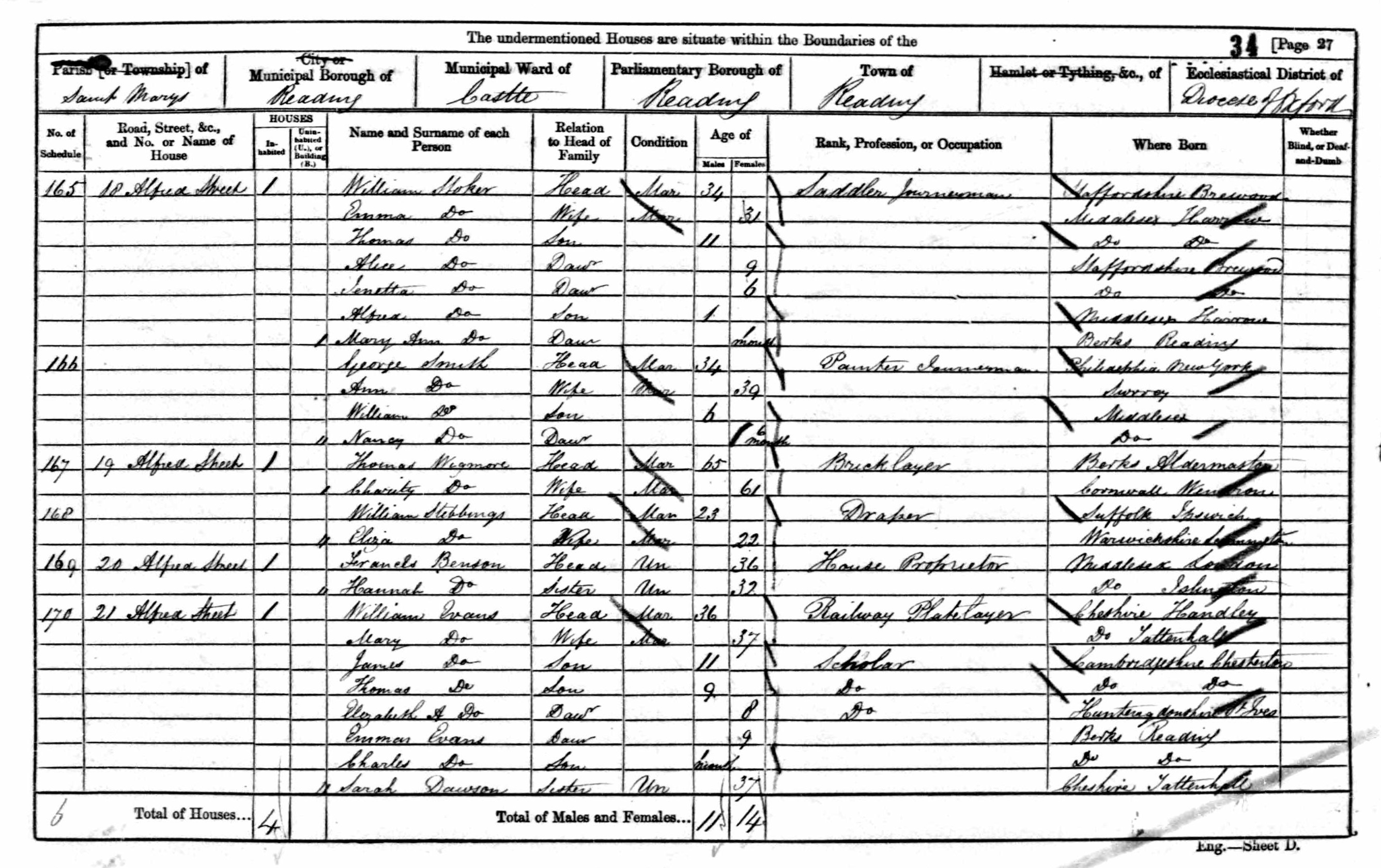
I struggled on whether to call Mary Ann by her other known name, Lillian “Lillie” Musgrave. After marriage, she was known as Lillie M Sharp, she is said to have signed her own name that way throughout her life. She was born 24 February 1861 as Mary Ann Stoker at 18 Alfred Street within St. Mary’s Parish in Reading, Berkshire, England. She was the fifth of six children of William Stoker, a journeyman saddler working in Reading, and Emma Eames. Her youngest sibling, an infant brother George, died in Reading in March 1863, just weeks before Emma herself died. Emma contracted tuberculosis (listed as phthisis on the death certificate) and passed away 28 April 1863 at the same address after a year struggle with the disease. Mary Ann never knew her mother or her baby brother. She was just two years old. Her older brother William Thomas, eleven years her senior, joined The Church of Jesus Christ of Latter-day Saints on 5 December 1860. Her father and older sister Alice joined on 27 May 1863. For the fuller story of the Stoker family in England, see Stoker-Eames Wedding.
1861 British Census, Stoker family at 18 Alfred Street, Reading, with infant Mary Ann
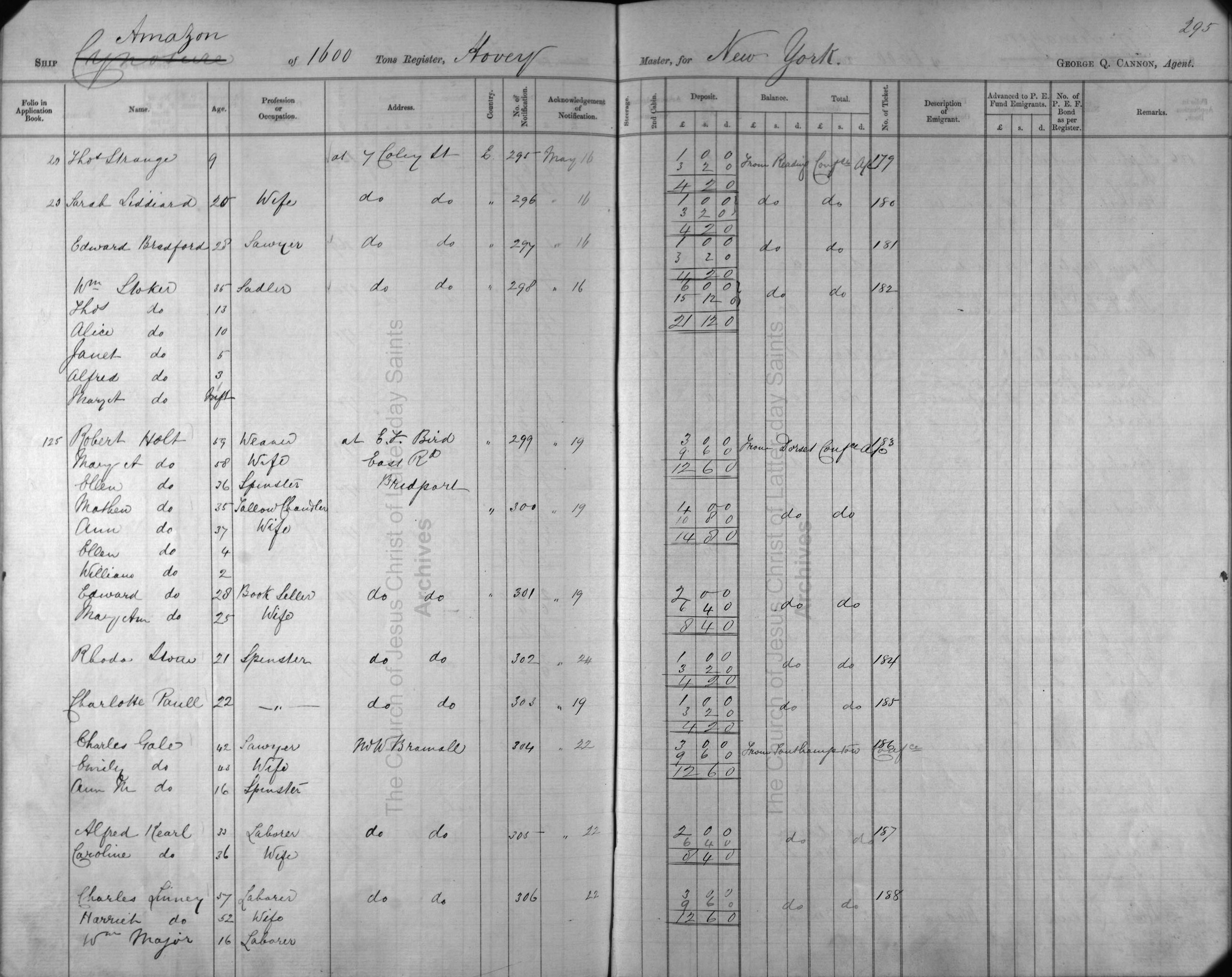
The family wasted no time in gathering to Zion. The Stoker family departed from London on the ship “Amazon” on 4 June 1863. George Q Cannon dedicated the ship which was entirely of Saints (880+) headed for Zion. It was this same ship that Charles Dickens wrote that the Mormons were not taking misfits and scoundrels, but the “pick and flower” of England. George Sutherland, future U.S. Supreme Court Justice, was also on this ship. Here is a link to the story by Charles Dickens: The Uncommercial Traveller. The LDS church also tells of the story that day at this link: Amazon Departure. The ship sailed to Liverpool before heading out for the United States. Elijah Larkin, who would help found Larkin Mortuary, noted that on the 16th and 20th of June, Thomas Stoker was administered to due to a sickness since leaving Liverpool.
Amazon emigration fund ledger — William Stoker (saddler) with Thomas (13), Alice (10), Janet (5), Alfred (3), and Mary A (infant)
The “Amazon” docked at Castle Gardens, New York on 18 July 1863. The Saints from there took rail to Albany, New York and then to Florence, Douglas, Nebraska through Detroit, Wayne, Michigan. From Florence they made their way by wagon train on to Salt Lake City, Utah Territory, arriving 3 and 4 October 1863 (depending on which of the two companies), just in time for General Conference. Several of the company wrote of Brigham Young coming out to greet them and giving them advice.
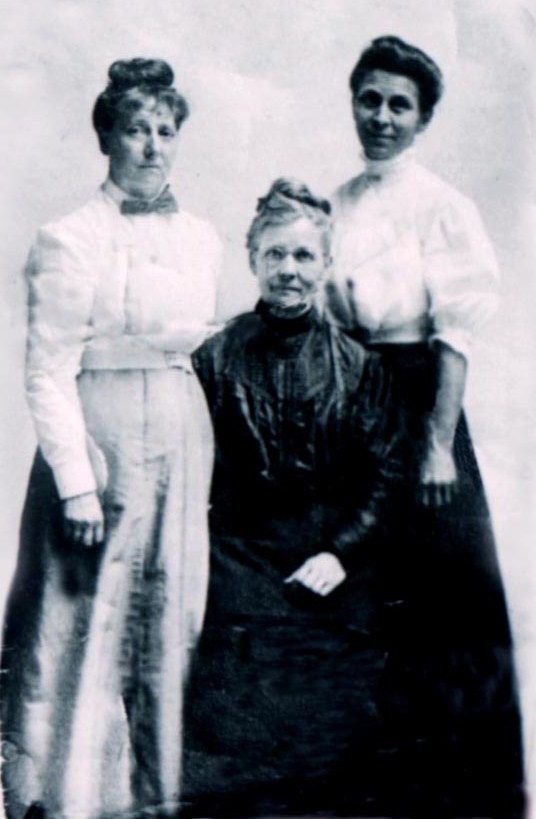
William moved to Ogden, Weber, Utah and set up shop working with leather. William remarried to Eliza Sinfield in Ogden 18 May 1864. While Mary Ann is listed as a child for William and Eliza on the 1870 Census, she was actually living with George Augustus and Victoreen Jane Dix Musgrave. She is listed with their family on the 1870 Census as well. Additionally, the other children from this first marriage were also being raised by other families. Family lore indicates that William and Eliza could not afford to raise these older children and farmed them out to families that could afford to take care of them. Other evidence points that they were not all that poor. Here are three of the sisters later in life. They still maintained their relationship despite being raised by separate families.
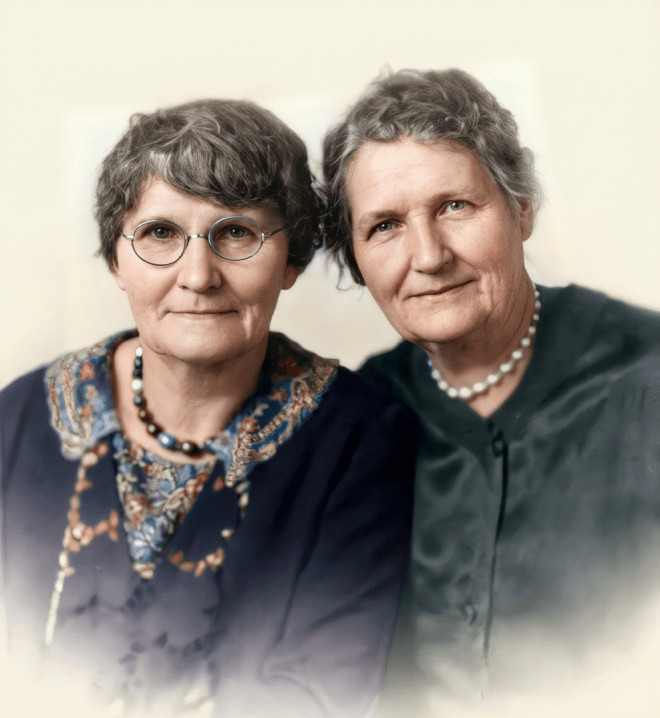
l-r: Mary Ann Stoker Sharp, Jeanette Stoker Rogers, Henrietta Stoker Weston
George Augustus Musgrave was born 22 October 1833 in Clerkenwell, London, the son of George Augustus Musgrave Sr. and Georgina Louisa Wheatley. He married Victoreen Jane Dix in St Pancras on 18 February 1855, and the two joined the LDS Church and emigrated to Utah in 1857, several years ahead of the Stoker family. Unable to have children of their own, they welcomed Mary Ann into their home. Victoreen was herself an adopted child. After George’s passing, she remarried to George’s brother, Thomas Henry Musgrave, also a resident of Plain City. Lillie later helped care for Thomas and Victoreen in their old age, repaying a debt of love within her adoptive family. George died 12 November 1903 in Plain City; Victoreen in 1921, Thomas also in 1921. You can read more of the Musgrave family’s role as the first teachers and choir leaders of Plain City in the History of Plain City.
Victoreen Dix Musgrave
While Mary Ann was raised by George and Victoreen Musgrave, she knew who her real father was, but had few, if any, childhood memories of him. George Musgrave was a school teacher and musician in Plain City. Although not formally adopted, George and Victoreen called her Lillian Musgrave, and she went by Lillie the rest of her life, taking the Musgrave as her middle name after she married. Her son Austin lists his mother’s name as Lillee Musgrave.
Victoreen Dix Musgrave and her second husband, Thomas Henry Musgrave
George and Victoreen knew music and taught school. Naturally, Lillie was taught the same. She ended up participating in the second dramatic association in Plain City. Some of their shows put on were, “Mistletoe Bough,” “Mickle Earl,” “Maniac Lover,” “Fruits of the Wind Cup,” “Streets of New York,” “The Two Galley Slaves,” “The Rough Diamond,” “Earnest Mall Travers,” and “Ten Knights in a Bar Room.”
All was not well in Zion during these years in Plain City. Family lore has it that when a Bishop (Lewis Shurtleff, Branch President 1870–1877, Bishop 1877–1883) extended himself beyond what the members felt was right, these families made sure it was known. The final straw came when Bishop Shurtleff started telling the members what they would give as tithing. These were not just fringe members, but good standing members of the church in the area. William Sharp (Lillie’s future father-in-law), the son of Thomas and Elizabeth Cartwright Sharp, began construction on St. Paul’s Episcopal Church in 1877 for many of these disaffected members. The building still stands today now owned by the Lions Club in Plain City. For whatever reason a significant group of members were excommunicated between 1877 and 1882. Many of Plain City’s leading members were excommunicated. Excommunicated on 31 January 1879 were William Sharp (the same who built the new church), Mary Ann Sharp (William’s ex-wife, divorced 19 May 1876, Lillie’s future mother-in-law), William Skeen, Edwin Dix, George Musgrave (Lillie’s adopted father), Thomas Musgrave, Thomas Singleton, Thomas Davis, George W Harris, Jonathan Moyes, John Moyes, Winfield Spiers, James Wadman, Robert Davis, John Davis, and Thomas Robson. These lists also have “and wife” as well as “and family” which seems to indicate that this list may have included spouses and families. Mary Ann Sharp (Lillie’s future mother-in-law) is the only woman listed separately, perhaps because with the recent divorce she was not represented by William. Many of these families returned to the church, some took generations, some never did.
While Lillie’s name is not on the list, she was probably classified with the Musgrave family. We do not have any record of her baptism, but she was with the Musgrave family attending the newly established St. Paul’s Episcopal Church. Although it seems Victoreen Musgrave was excommunicated, she continued active with LDS Relief Society (or she was not excommunicated). It was during this time that Lillie came to fall in love with Milo Riley Sharp. William Sharp, with the assistance of Milo, had also helped build the Musgrave’s new home. In St. Paul’s Episcopal Church, J. S. Gellogly married Milo and Lillie on 11 May 1879.
Milo Riley Sharp was born 23 July 1857 in Lehi, Utah, Utah. He was the fourth of six children born to William Sharp (1826–1900) and Mary Ann Bailey Sharp (1828–1913), English converts to the church. William is son of Thomas and Elizabeth Cartwright Sharp of Misson, Nottinghamshire, England. Mary Ann had a child, Lorenzo Padley, from a previous marriage in which she was widowed. William and Mary Ann Sharp immigrated to Utah in 1853 after joining The Church of Jesus Christ of Latter-day Saints in 1848 and 1846 respectively. At first they were sent to Lehi but had a number of issues with range for the cattle and other minor squabbles. Water was also not found to be very dependable in the Lehi area. William learned of land near Ogden that was going to be opened up from some of the Saints passing through Lehi (abandoning Salt Lake City before the arrival of Johnston’s Army). These Lehi Saints were told of ample land and good water that was available west of Ogden. A scouting expedition went to search out the area in the fall of 1858 and visited with Lorin Farr who told them of the available plain to the west.
The Sharp family left with other Lehi Saints on 10 March 1859 to travel to this new area. The group arrived 17 March 1859 at what is present day Plain City. William Sharp put his carpentry and masonry skills to work making adobe brick and helping build the first homes in Plain City. In one of these first adobe brick homes is where Milo Riley grew up. William served in the Plain City band, the Plain City Z.C.M.I. board, as a builder, and as a city leader. Milo’s little sister Evelyn is claimed to be the first white girl born in Plain City in October 1859.
Milo’s mother, Mary Ann Bailey Sharp, moved out on Christmas Eve 1875 and refused to go back to William. William sued for divorce and Franklin D. Richards granted the divorce (in probate court) on 19 May 1876.
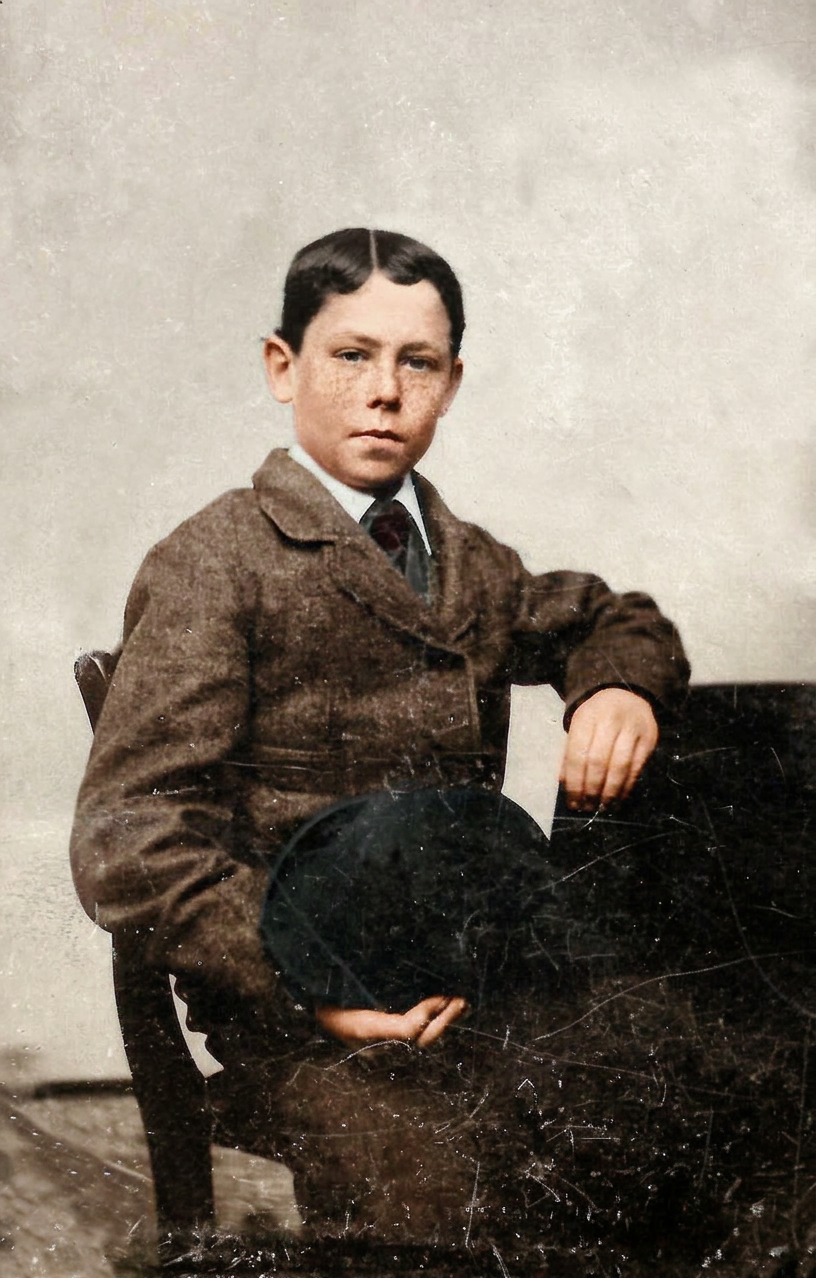
Milo Riley Sharp as a young man
Milo kept busy working with his father building homes and other masonry and carpentry work. He also had time to play first base on Plain City’s first baseball team. The team could beat all the other northern Utah teams except Salt Lake. He was elected a school trustee in 1897, alongside S. P. Draney.
The marriage of Milo and Lillie eventually produced a quiver of 12 children. Milo Ray was born 29 February 1880 and died 14 November 1946 in Ogden. George was born 2 August 1881 and passed the same day. Effie was born 6 June 1882 and died 6 September 1883. Delwin arrived 30 June 1884 and died 27 May 1969, having lived his whole life in Plain City. Ernest and Austin, twins, came 7 January 1886. Ernest contracted infantile paralysis as a small child; it left him crippled his whole life, and he never married, living with his mother and then remaining in the family home until his death 30 April 1967. Austin married Martha Hazel Howard and eventually settled in Prosser, Washington, where he died 26 August 1954. Edward William appeared 25 October 1887, married Lillie Elva East, and died 24 August 1962 in Othello, Washington. Victorine showed 23 November 1889 and married Fredrick Lawrence Hunt; she died 27 August 1987. Mary Irene materialized 26 June 1892 and married Oscar “Os” Child Richardson; she was the first of the twelve children to join The Church of Jesus Christ of Latter-day Saints in her own lifetime, being baptized in October 1931, and she died 11 September 1990. Edith dawned 4 February 1895, married Clements Richard Martin on her twentieth birthday; she died 15 September 1979 in California. Ethel was born 9 April 1898 and I have written of her before; she died 6 August 1925 in Ogden. Ethel is my great-grandmother. Emily appeared 5 April 1900 and quickly passed 31 July 1900. Nine of the children lived to adulthood and eight of those married.
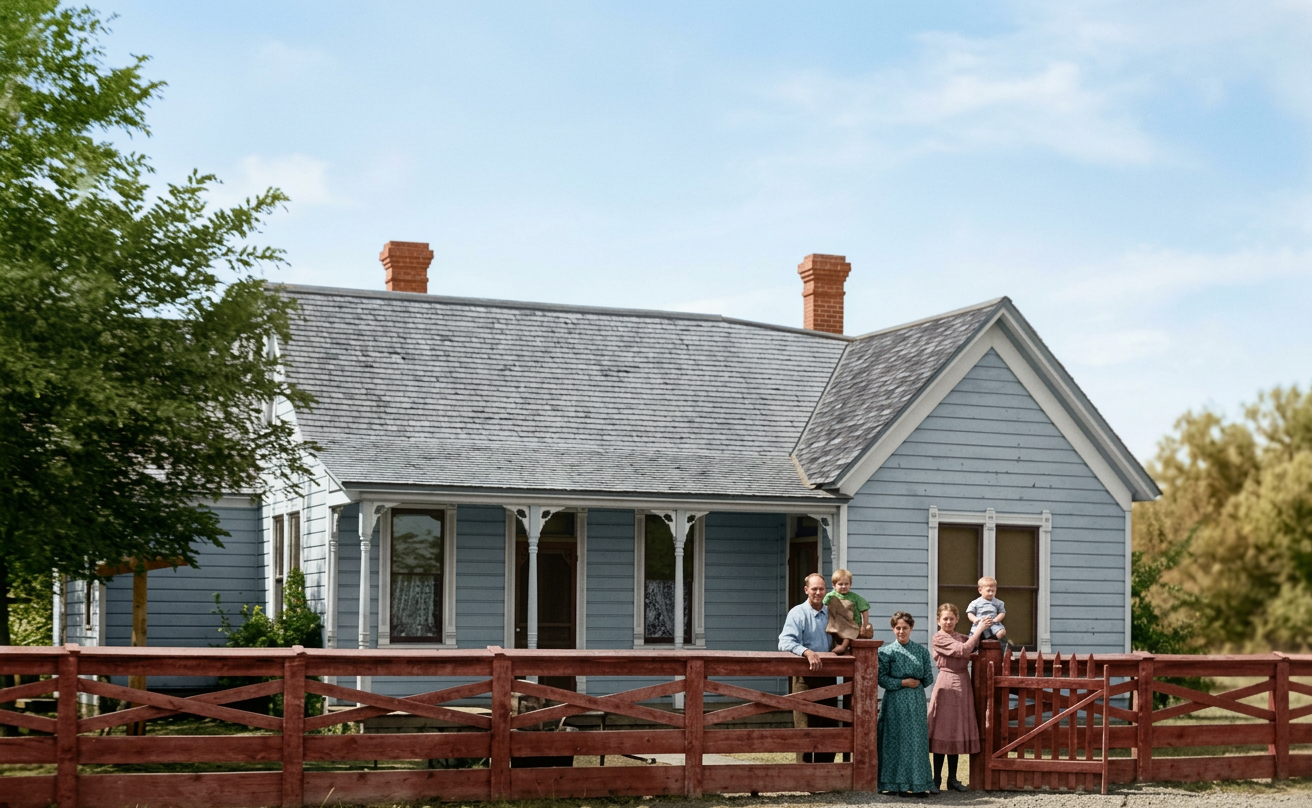
Milo built a new home for the family early on so the family had room to grow. He added to it as more room was needed as you can see in this photo. We do not know the year it was originally built, but we know the children after 1888 were born in this home. The home’s address is 2897 North 4200 West in Plain City. Before Milo died, he sold the farm and that home to his son Austin, and built a smaller brick home on a lot just south of the farm for himself and Lillie.
Milo and Lilly Sharp, Ethel, and Archie and Roy Richardson about 1912
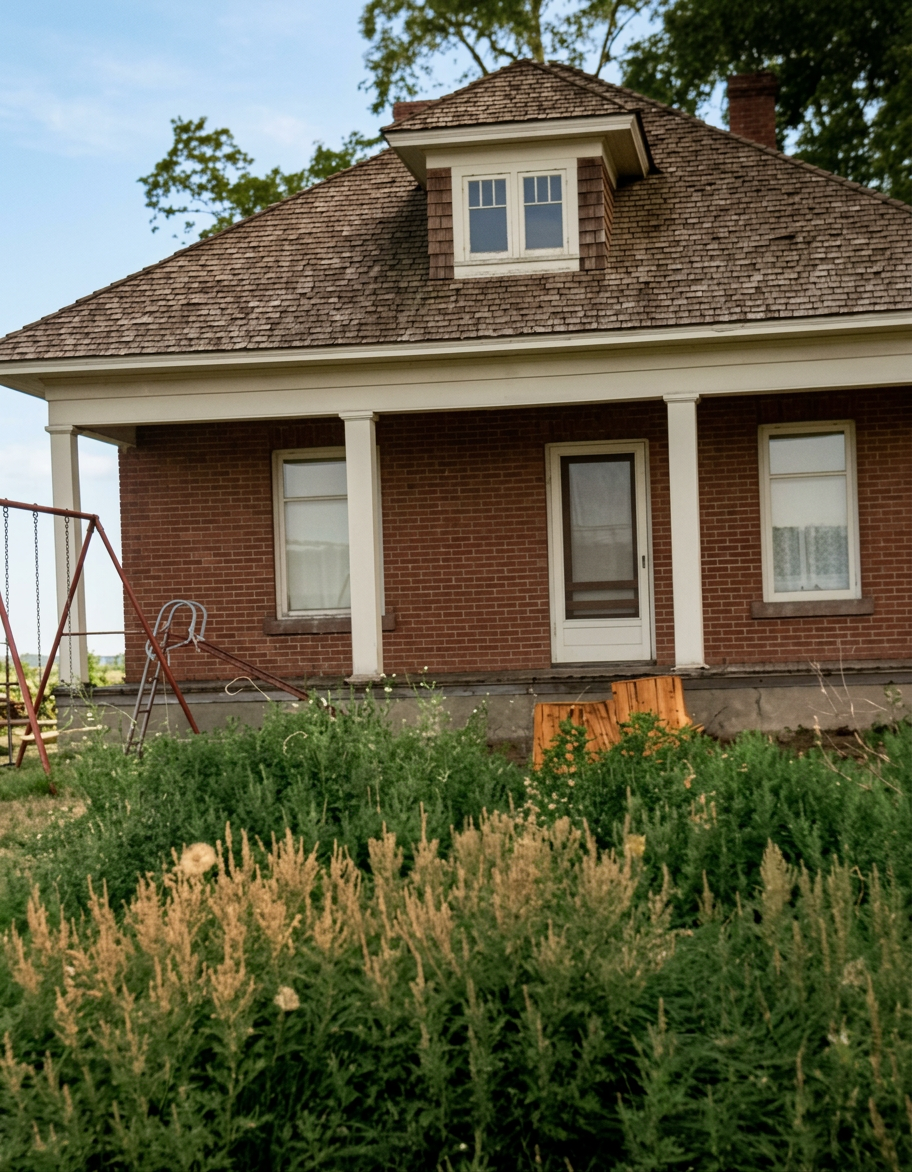
Milo successfully farmed all of these years. He kept busy with civic affairs. He was elected constable of Plain City on the Republican ticket in 1891. In 1893, he sat on a committee to investigate the incorporating of Plain City, although it was not incorporated until 1944 with grandson William Albert Sharp serving on the town board. Milo and Lillie were singers and continued to play in the Plain City bands. Lillie was also well-known for her poetry — I have shared a few of her poems, including Wash Day, Home Coming, and Old Folks Day. In 1911, Milo finished building the new home pictured below (address is 2771 North 4200 West in Plain City). Milo farmed hard until he caught influenza and eventually pneumonia, passing away at the early age of 59 at 9:30 a.m. 24 June 1916 at his sister’s home, Victorine Maw, who lived at 5 Warren Court in Ogden. His funeral was held in the little church he helped his father build, St. Paul’s Episcopal Church, on 27 June 1916.
Lillie lived in this home for the rest of her life. Her son Ernest, who had lived with a disability since contracting infantile paralysis as a child, helped take care of her and lived the rest of his life in the home, dying there in 1967. Milo James Ross, Lillie’s grandson, purchased the home at that time and later transferred it to his daughter Caroline.
Lillie kept a clean home. The grandsons were taught to stop by every time they passed, especially to and from school. This permitted dishes to be washed, wood to be hauled, and wood to be split. Lillie had a strict regimen for cleaning pots, dishes, and pans (especially bedpans). This included the outdoor pump station, even with lye to remove odors. The boys knew to take special care not to make a mess when carrying firewood or in any other way on entering the home. The gate was always to be closed, whether coming or going. While this might seem stern, she always opened the door for those coming and going and gave them a warm smile. My own grandfather, Milo James Ross, spoke fondly of these visits, of helping put the hooks through her shoe-lace holes, of pulling her girdle strings tight, and of the hearing horn she used in her last years, which he liked to tease her about. Lillie’s granddaughters had their own weekly errand, walking half a mile with a little jar of milk skimmed off the butter, trading it for the previous week’s empty jar with two pennies tucked inside, then running another half mile into town to spend them on all-day suckers.
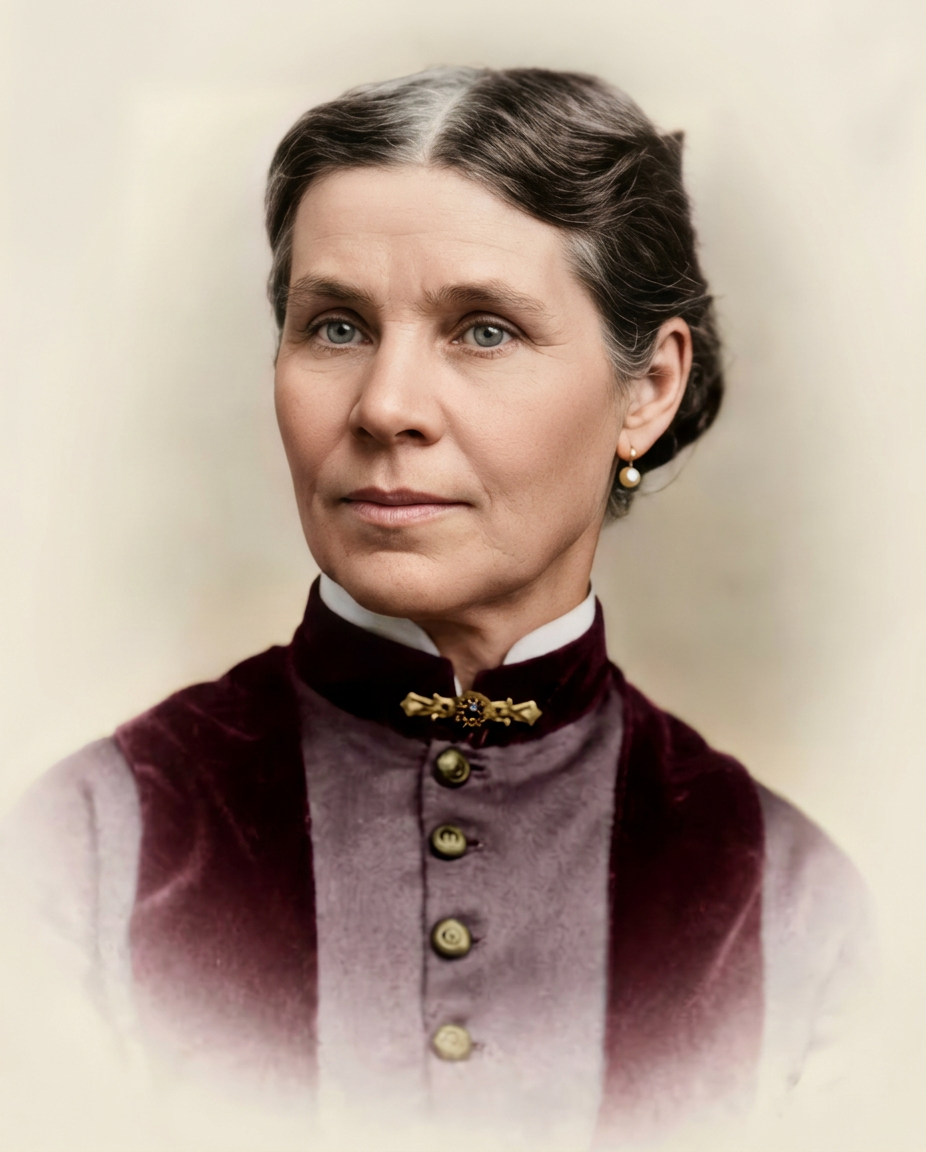
Mary Ann Stoker Sharp
Lillie often made bread, keeping her own live yeast, often from warm potato water. She had her own milk separator and used it. The boys helped make butter and she treated them to buttermilk and warm bread. She would also warm apples in the oven to share, or dried fruit. She kept a full root cellar with homemade cured meats, dried fruits, and bottled vegetables. The Sharp family had onions that could be used to flavor soups and other needs. Many of the family still grow these onions even today. Many mushrooms and watercress were gathered too.
Lillie often had kind words and a warm, gracious smile. She kept a small table in the pantry where she brushed her teeth with salt, baking soda, and a bar of soap. The bucket was always there with a drinking cup and a ladle to draw water. Her granddaughter Ruth Sharp Draper, who knew her well in those later years, remembered her as small — about 4 feet 10 inches, with black hair and dark eyes, wearing her hair in a roll on top of her head. Other family accounts describe her as thin and tall. I cannot say with certainty which description is more accurate; she was known to different grandchildren across different decades of her life. She wore long dresses from her neck to her feet with shoes that went up about six inches. If she was not thin enough, she wore a corset to make her look even smaller. She was very neat and proud in her appearance.
She kept a spinning wheel in the home for the times when she would spin wool into thread. She also had the grandsons help turn her mattress from time to time. She did not leave the house much in her later years unless she had a ride, but even then did not stay long before going home. It was clear she enjoyed watching her grandchildren. The last decade or so of her life, she had to use a hearing tube to hear. Some of her grandchildren joked that it was like using the telephone, just you could see who was on the other end. Ruth Draper recalled her father Milo Ray sometimes taking Lillie to get fitted with a hearing aid, but they did not work for her.
Lillie could never stand to see an animal mistreated. It is said that some men were working on the road by their place with horses tied up all day without being unharnessed. She went and told them if they didn’t treat those horses better she would turn them in.
Lillie M. Sharp obituary, Ogden Standard, May 1935
Lillie passed at 10:55 p.m. at her daughter’s home, Victorine Hunt, on 6 May 1935 of hypertension with chronic major carditis and pneumonia. She had remained faithfully active in the Episcopal Church until she could not get around very much. Later in life she needed assistance as she could not walk very far. Her funeral was held in the Plain City LDS chapel with Rev. John W. Hyslop officiating on 9 May 1935. She was buried with Milo in the Plain City Cemetery.
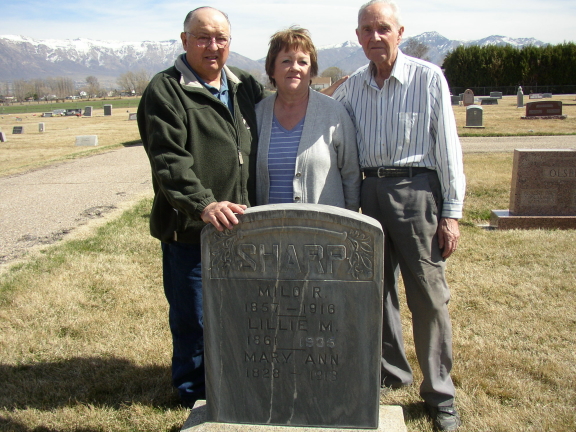
Raymond Draper, Caroline Ross Gallegos, Milo Ross; Grave marker for Milo Riley Sharp, Lillie Musgrave/Mary Ann Stoker, Mary Ann Bailey Sharp in Plain City Cemetery
Returning to the Church
Mary Irene Sharp was the first of Milo and Lillie’s own children to return to the church in her own lifetime, baptized in October 1931. Victorine followed in September 1975, baptized at age 85. Lillie’s own proxy baptism and confirmation were completed 4 June 1970, alongside three of her Stoker siblings in a single family effort at Idaho Falls. She was endowed 1 July 1970 and sealed to her parents 8 September 1970. Milo Riley himself was baptized and confirmed by proxy 17 November 1976 and the next day endowed and sealed to Lillie.
The largest single gathering came on 27 June 1978 at the Ogden Utah Temple, when eight of Milo and Lillie’s twelve children, George, Effie, Ernest, Delwin, Austin, Edward William, Ethel, and Emily, were all sealed to their parents in a single visit. My own grandfather, Milo James Ross, was present that day, watching his mother Ethel’s temple work completed more than fifty years after her death. He was sealed to Ethel and Jack Ross himself on 8 February 1980, the same day his parents were sealed to each other. The work continues today.
James and Sarah Goodlad Bailey are pleased to announce the marriage of their daughter Mary Ann Bailey to William Sharp, son of Thomas and Elizabeth Cartwright Sharp. William and Mary Ann were married at Loup Fork, Howard, Nebraska on 10 July 1853. (Loup Fork appears to have been a crossing of the Loup River, somewhere between Fullerton and Palmer Nebraska, in order to go turn south to rejoin trail along the Platte River.)
William is mason and farmer. They will make their home wherever they are called to settle once they arrive in the Utah Territory.
Due to the circumstances of this family, it is pretty unlikely an announcement would have ever been written. Everything about these families was in motion. Family members on both sides were strewn all over two continents and their lives were still recovering from a number of personal blows. While this was probably a high point, they knew there was a long road still ahead of them. All four of their parents had passed before their marriage.
William was born the third of eight children born to Thomas and Elizabeth Cartwright Sharp 10 December 1826 in Misson, Nottinghamshire, England. His baptism is recorded on 7 January 1827 at Misson Anglican church, confirmed by the Bishop’s Transcripts at Nottinghamshire Archives. He spent his life as a mason but kept a farm. We do not know where or how he learned how to be a mason. His father, Thomas, is listed as “Ag Lab”, which is probably an agricultural laborer on the 1841 English Census. Thomas died in 1841 after the census was taken.
In 1848, the LDS missionaries came to visit in Misson. William was the first in his family, that we know, to join the church on 20 June 1848. His mother followed 11 August 1849 and his sister Isabella 16 September 1849. The records available do not show that William’s siblings, Elizabeth and James joined the church, but they came with the family to the United States on their way to Zion. The family story tells the family was friendly and open towards the missionaries. One of the missionaries was a George Emery (the only potential George Emery I could find appears to have lived 1792 – 1867).
Elizabeth Sharp was determined to emigrate with her family to Utah. Her family attempted to discourage her by warning her about the dangers of the American Indians. Nevertheless, she departed with William, Isabella, Elizabeth, and James. The other four children had died as infants before leaving England. The family purchased tickets at 25 pounds sterling in Liverpool. The family set sail on the “James Pennell” on 2 October 1850 commanded by Captain James Fullerton. The LDS leaders on board were Christopher Layton (1821–1898) and William Lathrop Cutler (1821–1851) leading the company all the way to Zion. Right before hitting the waters of the Mississippi the ship encountered a storm where the masts were broken and the ship drifted for a couple of days. Luckily, a pilot boat found them and another ship (that left two weeks later from Liverpool) tugged them to New Orleans, Louisiana. The ship arrived at dock on 22 November 1850. The family struggled with sea sickness and chills and fevers that beset them in New Orleans and St. Louis. From there the entire group boarded the “Pontiac” and continued to St. Louis, Missouri where they found work and spent the winter. Despite having crossed the Atlantic, Elizabeth, the mother of the family, died 17 February 1851 in St. Louis and was buried in Bellefontaine Cemetery.
Among the fellow passengers on the James Pennell were the Singleton family of Misson. The Singletons were neighbors in Nottinghamshire. William Singleton (1793–1850) sailed with his children, including Thomas Singleton (1825–1885) and Charles Singleton (1838–1907). Tragically, William Singleton died in St. Louis on 16 December 1850, just three weeks after the ship docked. His son Thomas pressed on, becoming one of Plain City’s 1859 founding pioneers, where he worked as a carpenter and band leader alongside William Sharp. Thomas Singleton is listed among those excommunicated alongside William Sharp on 31 January 1879. Generations later, Thomas’s grandson Bert Elmer Singleton (1918–1995), born and raised in Plain City, became one of Utah’s most celebrated baseball players, pitching in the major leagues over 28 seasons. The Sharps and Singletons, neighbors in Misson, remained neighbors in Plain City across the generations.
Elizabeth’s death left the four siblings to fend for themselves. William and Isabella both still desired to move on with the Saints to Utah. William became fast friends with Mary Ann Bailey Padley, a widow who had lost her husband before leaving England. They were such good friends that Anne Elizabeth Padley (she went by Sharp her whole life though) was born 31 October 1852. Isabella married Joseph Carlisle, who had arrived two years earlier, 18 May 1853, in St. Louis. That same day the Moses Clawson Company, “St. Louis Company,” departed from St. Louis. Joseph and Isabella Carlisle, along with William Sharp and Mary Padley (with her son Lorenzo Padley and new infant Anne), left with the company. Joseph and William were well respected because they were apparently very good athletes and challenged anyone to a wrestling match.
The Sharps and Carlisles drove a wagon for William Jennings, a Salt Lake City merchant and freighter. The outfitting was done in Keokuk, Iowa. The company for traveling over the plains was formally organized in Kanesville, Iowa. On the trail, William and Mary Ann Padley were married 10 July 1853 in Loup Fork, Nebraska. The company arrived in Salt Lake City between the 15th and 20th of September the same year.
Mary Ann was born the first of seven children born to James and Sarah Goodlad Bailey on 28 November 1828 in Mattersey, Nottinghamshire, England. Her baptism is recorded on 8 December 1828 at Mattersey Anglican church, confirmed by the Bishop’s Transcripts at Nottinghamshire Archives. James was a blacksmith. The Bailey family were practicing members of the Church of England, described by a later family history as “very sincere and devout in their religion.” Mary Ann attended school and obtained training in millinery and sewing. Sarah died in 1843 and James remarried to a lady named Harriet. We don’t have a death date for James at this time.
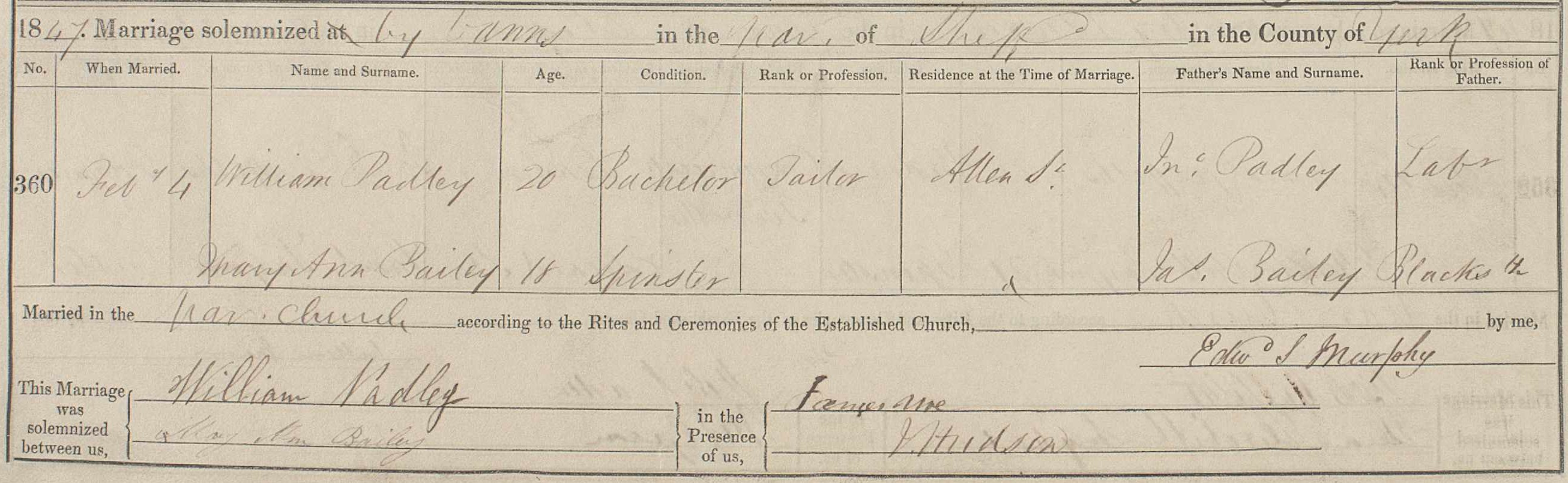
Shortly before her 18th birthday, Mary Ann met missionaries of The Church of Jesus Christ of Latter-day Saints and converted. She was baptized 20 October 1846. Her father and Harriet dismissed her from the home for becoming a Mormon. She soon met William Padley, another LDS member and a tailor who lived on Allen Street in Sheffield, and married him on 4 February 1847 at the Church of St Peter and St Paul (now a cathedral) in Sheffield.
Padley – Bailey marriage record
William Padley was born 22 September 1826 in Morton, Lincolnshire, just across the River Trent from Mattersey, and they may well have known each other from their home area before both moved to Sheffield. They had a son, Lorenzo Joseph Padley, born in December 1847. William became ill when Lorenzo was born and died 22 February 1850 in Morton, Lincolnshire. Left alone with a new son, Mary Ann went back to her parents, who would have nothing to do with her unless she gave up her religion. She would not, and instead decided to join the Saints in Utah.
Mary Ann and Lorenzo sailed from Liverpool on 8 January 1851 on the “Ellen” with James Willard Cummings (1819–1883) as the leader of the company. The ship had a difficult passage with measles and what others thought was whooping cough. She arrived in New Orleans 14 March 1851. On the 19th they left for St. Louis on the “Alleck Scott” and arrived on the 26th. Mary Ann and Lorenzo stayed in St. Louis while the company moved on, and it was there that she met William Sharp and his family.
William and Mary Ann grew close during their time in St. Louis. A daughter, Anne Elizabeth, was born to them on 31 October 1852. Both were still determined to join the Saints in Utah. They arranged to drive a freight wagon west for William Jennings, a Salt Lake City merchant and freighter, as the means of joining the Moses Clawson Company. On the trail, William and Mary Ann were married on 10 July 1853 at the crossing of Loup Fork in present-day Howard County, Nebraska. The company arrived in Salt Lake City between the 15th and 20th of September that year.
They settled in Lehi, Utah, Utah for a couple of years but had a number of issues with range for the cattle and some other minor squabbles. Water was also not found to be very dependable in the Lehi area. During this time, William and Mary Ann gave birth to two children, William and Isabella in 1854 and 1856, but both died as infants. Milo Riley was born in Lehi 23 July 1857. I have written of Milo and his family previously at this link: Sharp-Stoker Wedding.
William learned of land north near Ogden, Weber, Utah that was going to be opened up from some of the Saints passing through Lehi (abandoning Salt Lake City before the arrival of Johnson’s Army). These Lehi Saints were told of ample land and good water that was available west of Ogden. A scouting expedition went to search out the area in the fall of 1858 and visited with Lorin Farr (1820–1909) who told them of the available plain to the west.
The Sharp family left with other Lehi Saints on 10 March 1859 to travel to this new area. The group of about 100 arrived 17 March 1859 at what is present day Plain City, Weber, Utah. The company arrived at about 5 PM during the middle of a snowstorm. The company lined up the wagons to protect them from the wind and dug a hole in the ground for the campfire. Reports indicate that snow was deep and conditions uncomfortable. Plain City apparently lived up to its name with sagebrush that rose over 4 feet tall from the high water table beneath the soil.
William Sharp put his carpentry and masonry skills to work making adobe brick and helping build the first homes in Plain City. William and Mary Ann lived in one of these homes. William served in the Plain City band, on the Plain City Z.C.M.I. board, acting as a builder, and also serving as a city leader. William and Mary Ann’s daughter, Evelyn, was the first girl born in Plain City, on 12 October 1859. Victorine Mary was born 8 April 1862 and was their last child. Mary Ann kept busy sewing and making suits, coats, and other jobs. Each of her daughters learned to become dressmakers.
William and Mary Ann each received their initiatory and endowment on 17 August 1861 at the Endowment House. On the same day, Mary Ann was sealed by proxy to her deceased first husband William Padley, with William Sharp himself standing proxy for the man Mary Ann had first married. As a woman already sealed to another man, she could not be sealed to William Sharp during their marriage, as the church did not permit women to be sealed to more than one husband at that time. The Sharp children’s sealing situation caused considerable family angst as all children born to Mary Ann after the 1861 sealing were born in the covenant to William Padley rather than William Sharp.
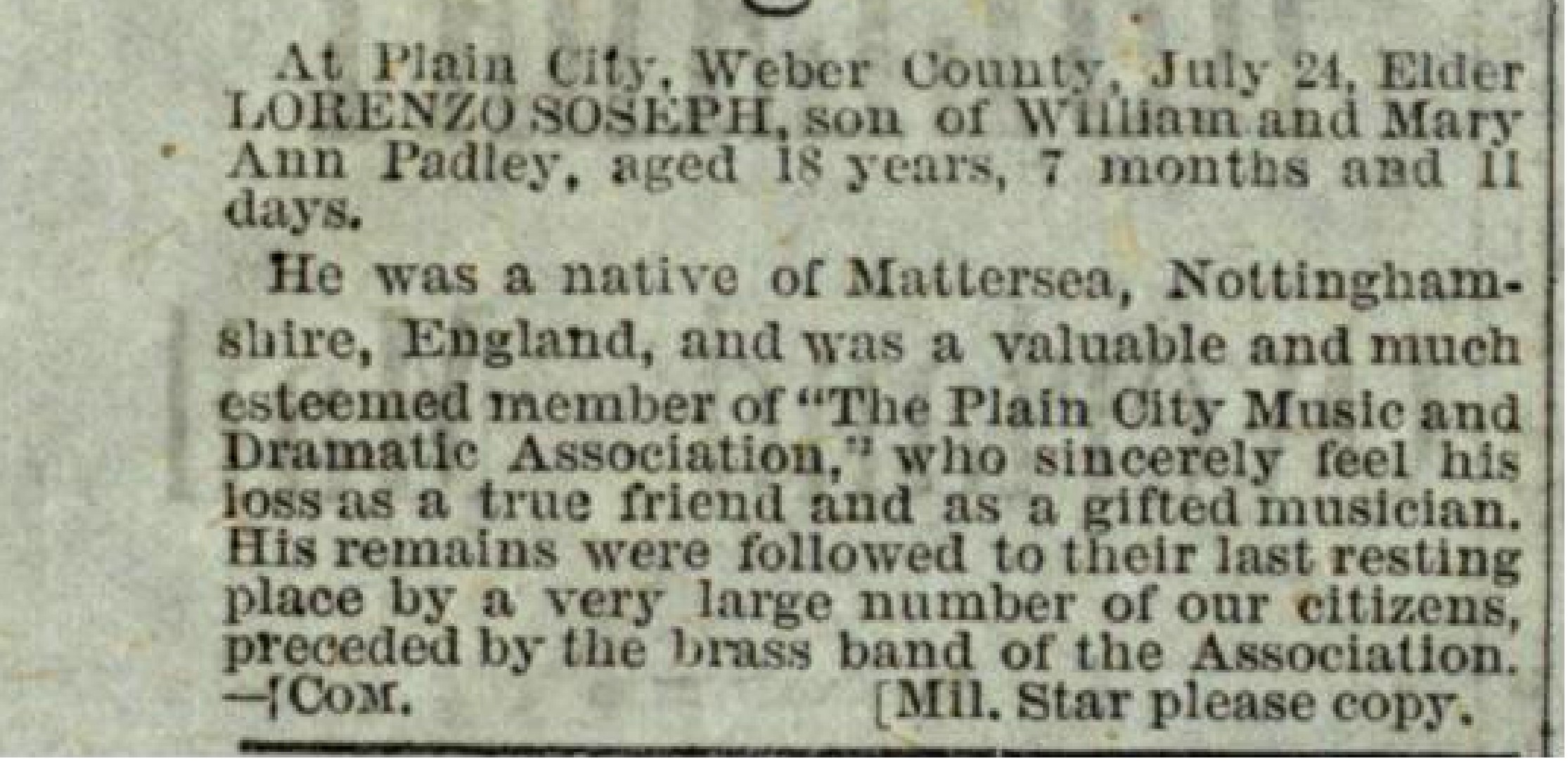
Lorenzo Joseph Padley died 24 July 1866 at Plain City, aged 18 years, 7 months and 11 days, putting his birth approximately 13 December 1847 in Mattersey, Nottinghamshire, England. He had grown up to become a valued member of the Plain City Music and Dramatic Association, which mourned him as a true friend and gifted musician. His remains were followed to their last resting place by a very large number of citizens, preceded by the brass band of the Association. The notice requested the Millennial Star in England to copy — a reminder that Mary Ann’s roots, and Lorenzo’s birthplace, lay in Nottinghamshire. The photo we have of him is pretty scratched, but here is a cleaned up photo, but it is not perfect. It is hard to tell what is his nose and what was deformities in the photo.
Anne Elizabeth married Daniel Claiborne Thomas Jr. on 29 January 1872 in Salt Lake City at the Endowment House, where they also received their initiatory, endowment, and sealing the same day. Daniel had been born 14 July 1850 on the Platte River in Nebraska on the trail to Utah. His father, Daniel Claiborne Thomas Sr., had been converted to the church by his brother Preston while on a mission to the Southern States, and the family had come to Utah in 1850, settling in Sulphur Springs (later named Lehi) among the earliest settlers there, before joining the Plain City founding group in March 1859. They settled in Plain City and had six children: Claiborne William (1872), Francis Milo (1875), LeRoy Bertrand (1878), Estella Inez (1884), Delbert (1888), and Elizabeth La Vieve (1889). Anne Elizabeth died 29 July 1891 in Plain City at thirty-eight, leaving six children ranging in age from two to nineteen. Daniel outlived her by thirty-eight years, dying in Ogden on 2 September 1929, and was buried beside her in Plain City Cemetery.
After several instances of desertion, Mary Ann moved out of their home on Christmas Eve 1875 and utterly refused to go back to William. William sued for divorce and Franklin Dewey Richards (1821–1899) granted the divorce (in probate court) on 19 May 1876.
At this time, it is possible that Bishop Lewis Warren Shurtleff (1835–1922), branch president 1870–1877, bishop 1877–1883, extended himself beyond what the members felt was right — going so far as to dictate how much everyone should pay in tithing — and some families were very vocal in expressing their discontent. William Sharp began construction on St. Paul’s Episcopal Church in 1877, and many disaffected members found a religious haven in this new faith. The building still stands today, owned by the Lions Club in Plain City. A significant group of members were excommunicated on 31 January 1879, including William Sharp, Mary Ann Sharp (listed separately because of the divorce), William Skeen, Edwin Dix, George Musgrave (father of their future daughter-in-law), Thomas Musgrave, Thomas Singleton, Thomas Davis, George W Harris, Jonathan Moyes, John Moyes, Winfield Spiers, James Wadman, Robert Davis, John Davis, and Thomas Robson. These lists also have “and wife” as well as “and family” which seems to indicate that spouses and families were included. Many of these families returned to the church after time away, some individuals never did. Milo Ross’s 1997 oral history interview offers one family perspective on the causes of the split.
This same year, William remarried to the widow of Charles McGary, Charlotte Elizabeth Earl, about 1879. We do not know exactly when or where.
Milo Riley married Mary Ann Stoker (aka Lillian or Lilly Musgrave) 11 May 1879 in Plain City in the little church William built. He died in 1916 in Plain City. Read about them here.
Evelyn Carlisle married James Henry Taylor 16 January 1881 in Plain City. She died in 1941 in Oregon.
Victorine Mary married Robert Edward Maw on 8 April 1883 in Plain City, her twenty-first birthday. Robert had been born in Plain City on 15 October 1859, the son of Robert Maw, one of Plain City’s founding pioneers who had consecrated his Lehi property in January 1857 and arrived in Plain City on 17 March 1859, the same day as the Sharp family. William Sharp had built the elder Robert Maw’s adobe house in those early Plain City years and had played cornet alongside Abraham Maw in Plain City’s first band. The marriage of Victorine Sharp and Robert Edward Maw united two of Plain City’s founding families. They had seven children: Ruby Ada (1884), Alice (1885), Jessie (1886), Florence Eveline (1888), Grace (1890), Edith Louise (1893), and Edward Clyde (1896). On the morning of 23 April 1897, a snow slide struck the Consolidated Mining and Smelting Company’s Garfield Mine in Gibbs Canyon, four miles north of Brigham City. Robert was killed. The Brigham City Bugler reported the disaster that week, noting that he was a married man who left a widow and seven children. Victorine was thirty-four years old. Her youngest child, Edward Clyde, was barely a year old. She did not remarry, living in Plain City and later Ogden until her death on 18 March 1945. She is buried in Plain City Cemetery.
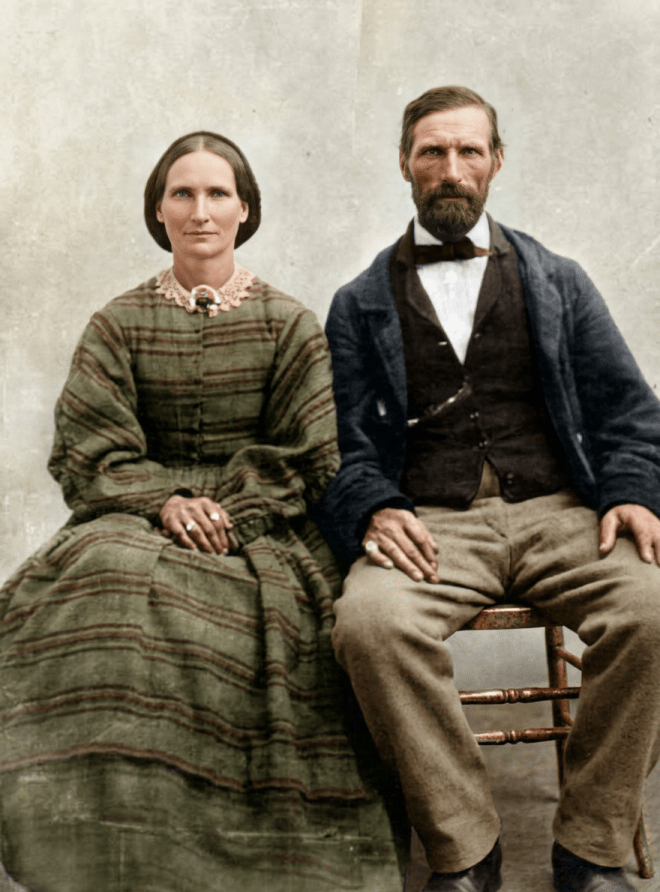
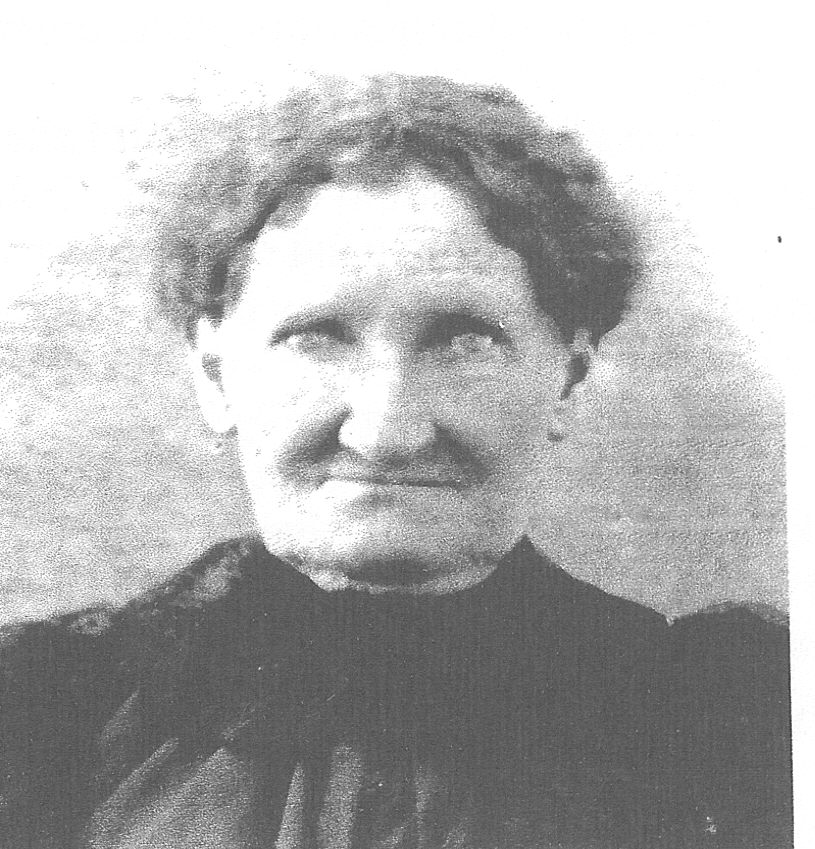
Mary Ann Bailey Sharp
Mary Ann continued to work as a dressmaker until she could not do so any more due to age. She lived with her Granddaughter Elizabeth Taylor from before 1900 and even moved with her to Baker City, Baker, Oregon. Mary Ann moved back to Plain City not long after Beth married.
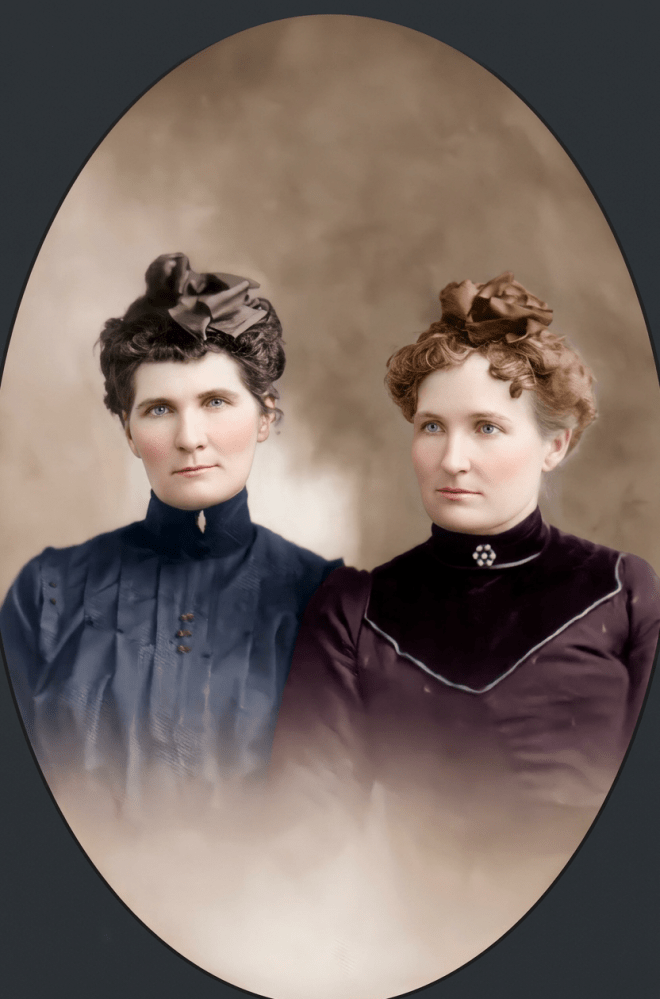
Evelyn & Victorine Sharp
~
Evelyn and Victorine Sharp
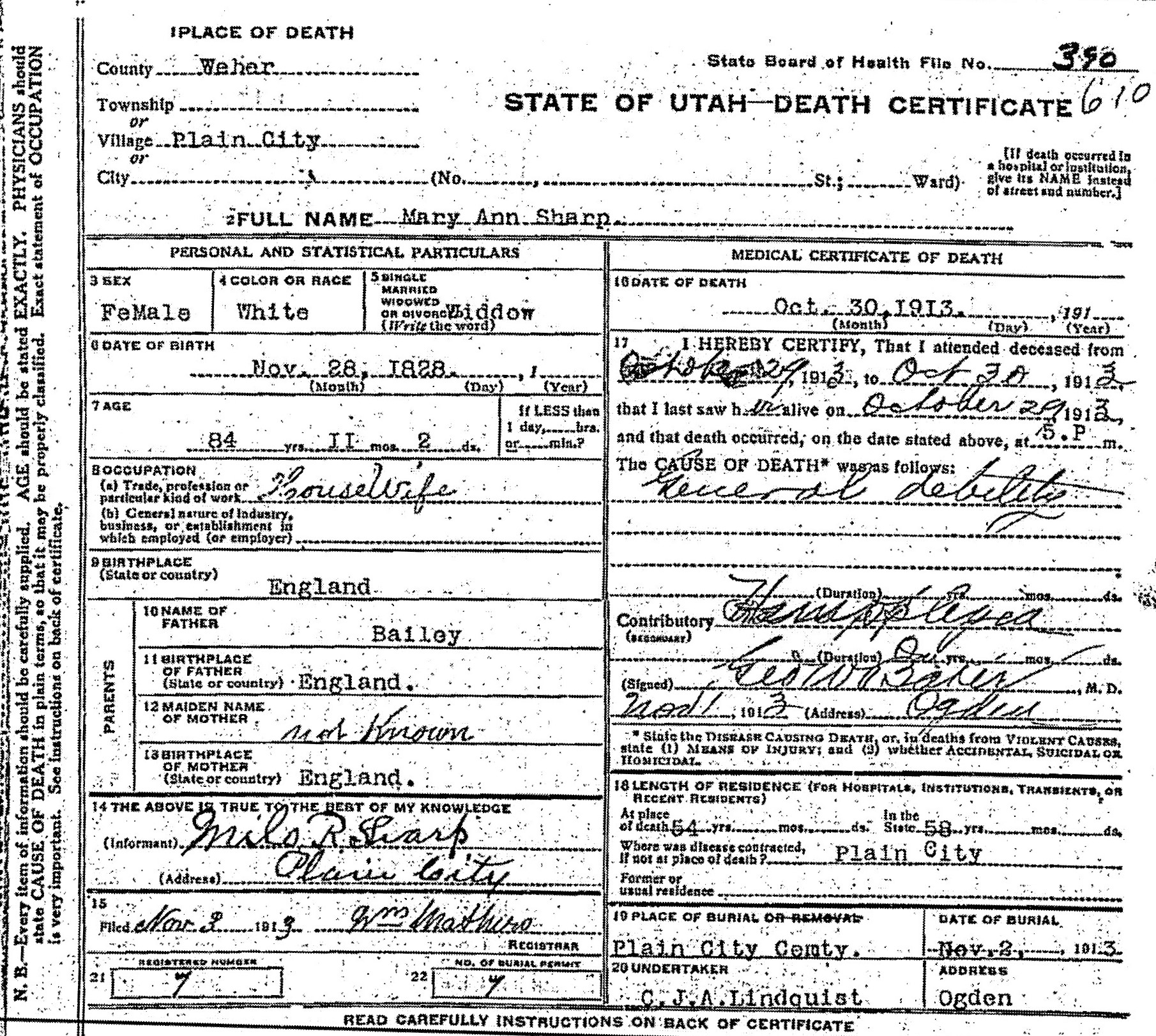
William died at 950 Washington Ave in Ogden on 22 December 1900 at 74 years and was buried two days later in the Ogden cemetery. Mary Ann died 30 October 1913 in Plain City at 84 years and was buried there three days later.
Mary Ann Bailey Sharp death certificate
William and Mary Ann both died outside the church.
In December 1933, fifty-four years after the excommunication, three of Isabella Sharp Carlisle’s sons — Joseph Carlisle, James Carlisle, and Harvey Carlisle — wrote to LDS Church President Heber J. Grant requesting proxy reinstatement for their Uncle William and his former wife Mary Ann. Their letter described William as “honest, virtuous and kind” and was addressed care of Mrs. James S. Thompson — Annie Thompson, who would later write the 1957 history of Elizabeth Cartwright Sharp, and who was the daughter of James Carlisle. The letter explicitly identified William as “born 10 Dec. 1826, Misson, Notts., England, and later settled in Plain City, Utah.”
President Grant responded on 16 December 1933, consenting to proxy baptism for both William and Mary Ann. He noted that since they had previously received their endowments on 17 August 1861, those ordinances would need to be restored by proxy as well, and authorized Elder George F. Richards, President of the Salt Lake Temple, to officiate. On 3 February 1934, proxy baptism and confirmation were performed for both William and Mary Ann at the Salt Lake Temple, with William’s sealing to parents following on 2 July 1934. The restoration of William Sharp and his wife to the church, by the hands of his sister Isabella’s sons, closed that chapter.
Decision:In re Jason Josue Lugo, Case No. 15-40121-JDP (Bankr. D. Idaho, 25 Jun. 2015) Judge: Honorable Jim D. Pappas, United States Bankruptcy Judge Counsel for Debtor: Paul Ross, Idaho Bankruptcy Law, Paul, Idaho Chapter 13 Trustee: Kathleen A. McCallister, Meridian, Idaho Trustee’s Counsel: Holly Roark, Office of Kathleen A. McCallister, Meridian, Idaho
Background
Jason Josue Lugo and his wife Lori married in 1996. In December 2003, Lugo acquired real property in Declo, Idaho, and in March 2004 conveyed it to himself and Lori by quitclaim deed. The couple built a home on the property that year and moved in with their family, establishing an automatic homestead exemption by virtue of their occupancy as a principal residence under Idaho Code § 55-1004(1).
In July 2012, Lugo moved out of the marital home due to irreconcilable differences. His family remained in the home. He did not record a declaration of non-abandonment. Under Idaho Code § 55-1006, six months of continuous vacancy creates a presumption of abandonment — meaning Lugo’s automatic homestead was presumed abandoned by January 2013. On 12 September 2013, a stipulated divorce decree was entered awarding Lori sole possession of the property, subject to the two existing mortgages and a $40,000 obligation to Lugo’s father. Under the decree, Lori was to refinance the mortgages within seven months and pay Lugo’s father in installments; if she could not refinance, the property was to be sold and the proceeds used to satisfy the parties’ debts. The decree did not expressly grant Lugo any continuing interest in the property. Pending refinance or sale, Lori was responsible for the first mortgage payments and Lugo for the second.
On 17 February 2015, before filing his bankruptcy petition later that same day, Lugo recorded a Declaration of Homestead on the Declo property with Cassia County. He then filed a Chapter 13 bankruptcy petition claiming the property exempt as his homestead in the amount of $49,401.93 — the estimated equity — under Idaho Code §§ 55-1001, 55-1002, and 55-1003. His Chapter 13 plan proposed to sell the property and pay the secured creditors, with any nonexempt proceeds distributed to unsecured creditors. Lugo acknowledged he could not afford to continue making the second mortgage payments.
The Trustee’s Objection
The Trustee objected to the homestead exemption claim on two grounds: Lugo did not reside at the property — his petition listed his residence in Rupert, Idaho — and his Chapter 13 plan proposed to sell it, which the Trustee argued evidenced a lack of any intent to reside there. The Trustee contended that Lugo therefore did not qualify for the homestead exemption under either Idaho’s automatic or declared homestead provisions, and that the claim should be disallowed in its entirety.
The Debtor’s Response
Debtor’s counsel filed a response arguing that the homestead exemption was valid and that the Trustee had not met the burden of proof required to overcome it.
Counsel acknowledged that Lugo had vacated the property in 2012 and had not filed a declaration of non-abandonment, which created a rebuttable presumption of abandonment of the automatic homestead under Idaho Code § 55-1006. Counsel argued, however, that Lugo had done precisely what Idaho law provides as an alternative: he recorded a Declaration of Homestead with Cassia County, invoking the second track of homestead protection under Idaho Code § 55-1004. That provision permits an owner who is not currently occupying a property as a principal residence to establish a homestead by recorded declaration, provided the declaration states an intent to reside there. Lugo’s declaration did so, and the technical requirements of the statute were met.
On the plan-to-sell issue, counsel argued that the Trustee’s position ignored Idaho Code § 55-1008, which exempts proceeds from the voluntary sale of a homestead for up to one year when the debtor intends to acquire a new homestead. Lugo wished to preserve the equity in the property for use in acquiring a new home, and the homestead exemption should follow the proceeds accordingly.
The Court’s Ruling
Judge Pappas sustained the Trustee’s objection and disallowed the homestead exemption.
The Court began by tracing the two tracks through which Idaho law permits a homestead to be established. The first — the automatic or “springing” homestead — arises by operation of law from the moment a debtor occupies property as a principal residence, without any filing or formality. Idaho Code § 55-1004(1). The second — the declared homestead — permits an owner who is not presently occupying property as a residence to establish a homestead by recording a declaration stating an intent to reside there. Idaho Code § 55-1004(2). Both tracks were relevant here.
Lugo had unquestionably established an automatic homestead when he moved into the Declo property in 2004. But he vacated in July 2012 without filing a declaration of non-abandonment, and under Idaho Code § 55-1006 that homestead was presumed abandoned by January 2013. No automatic homestead survived. Lugo therefore could not rely on the first track and turned to the second.
The recorded Declaration of Homestead was facially sufficient. It satisfied each technical requirement of Idaho Code § 55-1004(3): it stated an intent to reside on the property, included a legal description, and provided an estimated cash value, and it had been properly recorded before the bankruptcy petition was filed. Under normal circumstances, that would be enough. The declared homestead is a recognized and legitimate mechanism, and the Court acknowledged that recording a declaration before filing is a conventional and proper way to establish a homestead exemption.
But the Court held that satisfying the statutory checklist does not end the inquiry when the exemption is contested. When an objecting party challenges the declaration, the Court must look behind its face and assess the quality and genuineness of the proof supporting it — in particular, whether the stated intent to reside is real. Here, because the parties proceeded on stipulated facts alone, with no live testimony from Lugo, the record was fixed. And that record told a story that was flatly inconsistent with any genuine intent to reside at the Declo property.
The divorce decree, entered more than a year before the bankruptcy filing, awarded Lori sole possession of the property and contemplated only two outcomes: refinancing or sale. No scenario in the decree provided for Lugo’s return. His bankruptcy plan reinforced the same conclusion — it proposed to sell the property, and if the sale failed, to surrender it. Lugo acknowledged he could not afford the mortgage. Nothing in the record suggested any realistic pathway by which he could or would live at the Declo property again. The declaration’s statement of intent to reside, the Court concluded, was not supported by the facts.
The Court also rejected the § 55-1008 sale-proceeds argument. That provision exempts proceeds from the voluntary sale of a homestead for the purpose of acquiring a new homestead — but it presupposes a valid homestead exemption in the first place. Because no valid homestead had been established, there was nothing to carry forward into the proceeds. Moreover, the record contained no evidence that Lugo intended to use any sale proceeds to purchase a replacement homestead. The Court found his true aim was to preserve equity against distribution to unsecured creditors — an understandable goal, but not one the homestead statutes were designed to serve.
Why This Matters
Idaho’s two-track homestead system offers a genuine alternative to the automatic exemption. When an owner vacates a property and loses the automatic homestead through presumed abandonment, Idaho Code § 55-1004 provides a second path: recording a declaration of intent to reside. That mechanism is legitimate and used, and a properly recorded declaration ordinarily establishes the exemption. This case illustrates, however, that the declared homestead is not a rubber stamp. When the exemption is contested, the Court will look beyond the four corners of the declaration and assess whether the stated intent is genuine.
The divorce decree can be the most important document in the file. A stipulated divorce decree that awards possession of the property to the other spouse and contemplates only refinancing or sale effectively closes the door on any claimed intent to return. Where no scenario in the decree provides for the debtor’s residency, that decree will be powerful — perhaps decisive — evidence against the homestead claim. Counsel evaluating a client’s homestead position after a divorce should read the decree carefully before advising that a recorded declaration will succeed.
Failing to file a declaration of non-abandonment has lasting consequences. Idaho Code § 55-1006 gives a debtor who plans a long absence without intent to abandon the homestead a clear tool: record a declaration of non-abandonment. Lugo did not do so when he left in 2012, and by the time he filed for bankruptcy in 2015 the automatic homestead had been presumed abandoned for over two years. Practitioners advising clients who are leaving a marital home during separation or divorce proceedings should consider this step immediately.
Live testimony on intent may be essential. The Court explicitly noted that because the parties stipulated to the facts and no live testimony was offered, Lugo had no opportunity to address his subjective intent to return to the property. Stipulated facts are efficient but inflexible — they cannot be supplemented after the fact. Where a homestead exemption contest turns on intent, practitioners should consider whether proceeding by stipulation forecloses testimony that might have been outcome-determinative.
Idaho Code § 55-1008 requires both a valid underlying homestead and a genuine intent to acquire a replacement. The sale-proceeds exemption does not operate independently. It presupposes that the property being sold was validly exempt as a homestead. A debtor who cannot establish the underlying exemption cannot use § 55-1008 to protect sale proceeds. And even where the underlying exemption is valid, the proceeds exemption requires evidence of intent to use them to acquire a new homestead — a plan to sell, pay creditors, and retain equity does not qualify.
Full Decision: Available on PACER, Case No. 15-40121-JDP, Doc. 32 (Bankr. D. Idaho 25 Jun. 2015)
We took the opportunity to attend the Casper Wyoming Temple Open House on 31 August 2024. We planned the weekend to do some sightseeing and visit some church and family history sites. I am reposting as this has updates on 3 additional ancestors that also came through the Overland Trail.
We left on the Friday morning with the hope of making it all the way to Casper before nightfall. We took old US Highway 30 through Soda Springs and Montpelier. We made a stop to visit the grave of my Grandmother in Dingle.
Aliza, Lillian, Paul, James, and Hiram Ross at the graves of Bud and Colleen Lloyd
We drove through Cokeville and reminded the kids of the story of the Cokeville miracle. As we drove along the old highway, I pointed out the old railroad Y that used to go to the Stauffer mine that was located in Leefe, Wyoming. I spent the first summer or two of my life at Leefe while my dad was tasked with tearing down and removing the mine with Circle A Construction. We stopped in Kemmerer to refuel and also drive past the first J. C. Penney store. We made a quick stop at the Parting of the Ways along the California, Mormon, and Oregon trails.
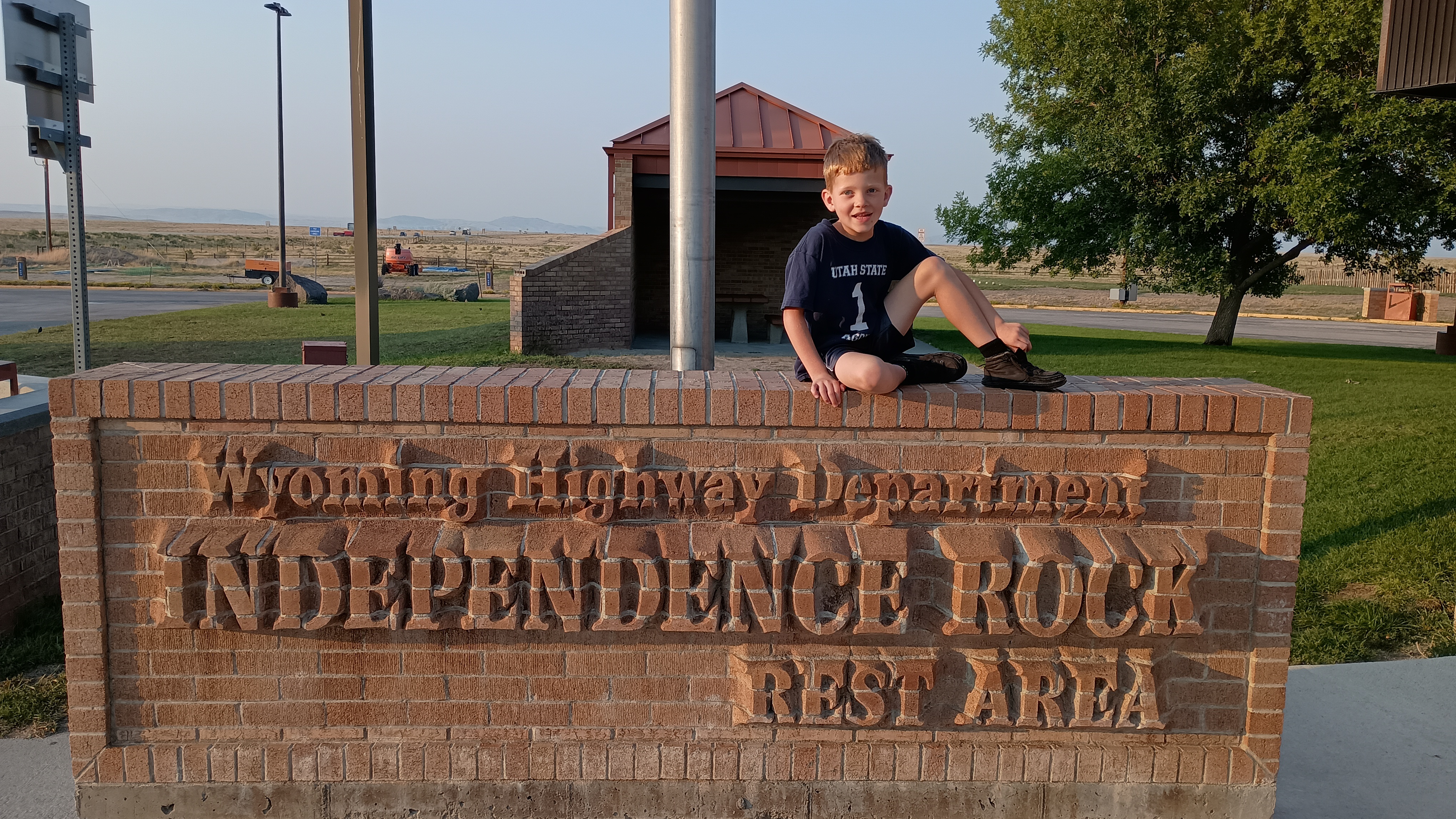
James Ross at Independence Rock
With four kids, we often stop at rest areas. As you can see above, we stopped at the one at Independence Rock. The rock is nearby and doubles as the parking location to visit the rock.
We finally made it to Casper about sunset. We ate an amazing Italian meal at Racca’s Pizzeria Napoletana and checked into our hotel.
Casper Wyoming Temple
We got up early, dressed appropriately, and headed out to visit the Casper Wyoming Temple. It was beautiful. Much smaller than I had anticipated. It is definitely one of the smallest temples, but that is because of the population and distance to other temples. It will supposedly have five stakes in its temple district, some of which will still come from a long distance to attend. Don’t let size fool you, it still has all the distinct parts of a temple and related quality. I think I may very much prefer the intimacy of the smaller temples. It actually reminded me of the Helena Montana Temple on size and flow.
Ross family at the Casper Wyoming Temple Open House
The temple does not have an adjoining chapel, but it does have a distribution/visitor center. We watched the video, enjoyed waiting in the line, and got to see the whole temple. If I were asked, there are a couple of design changes I would make for flow, but this temple will not regularly see these types of crowds or have those issues.
Ross family with the Casper Wyoming Temple
We hurried back to our hotel, changed, loaded up the car, checked out, and headed off to our next stop: The National Historic Trails Interpretive Center in Casper. I did not take any pictures there, but it was very well done. I enjoyed the visit, helped the kids with their junior ranger activities, and learned a few things. Part of the museum had its own little room and video dedicated to the Martin and Willie Handcart Companies.
We stopped at Independence Rock again on our way headed west. We walked around the massive rock and looked at a number of the signatures carved into stone from over 160 years ago. It was hot and we needed to get our little doggies along to Devil’s Gate.
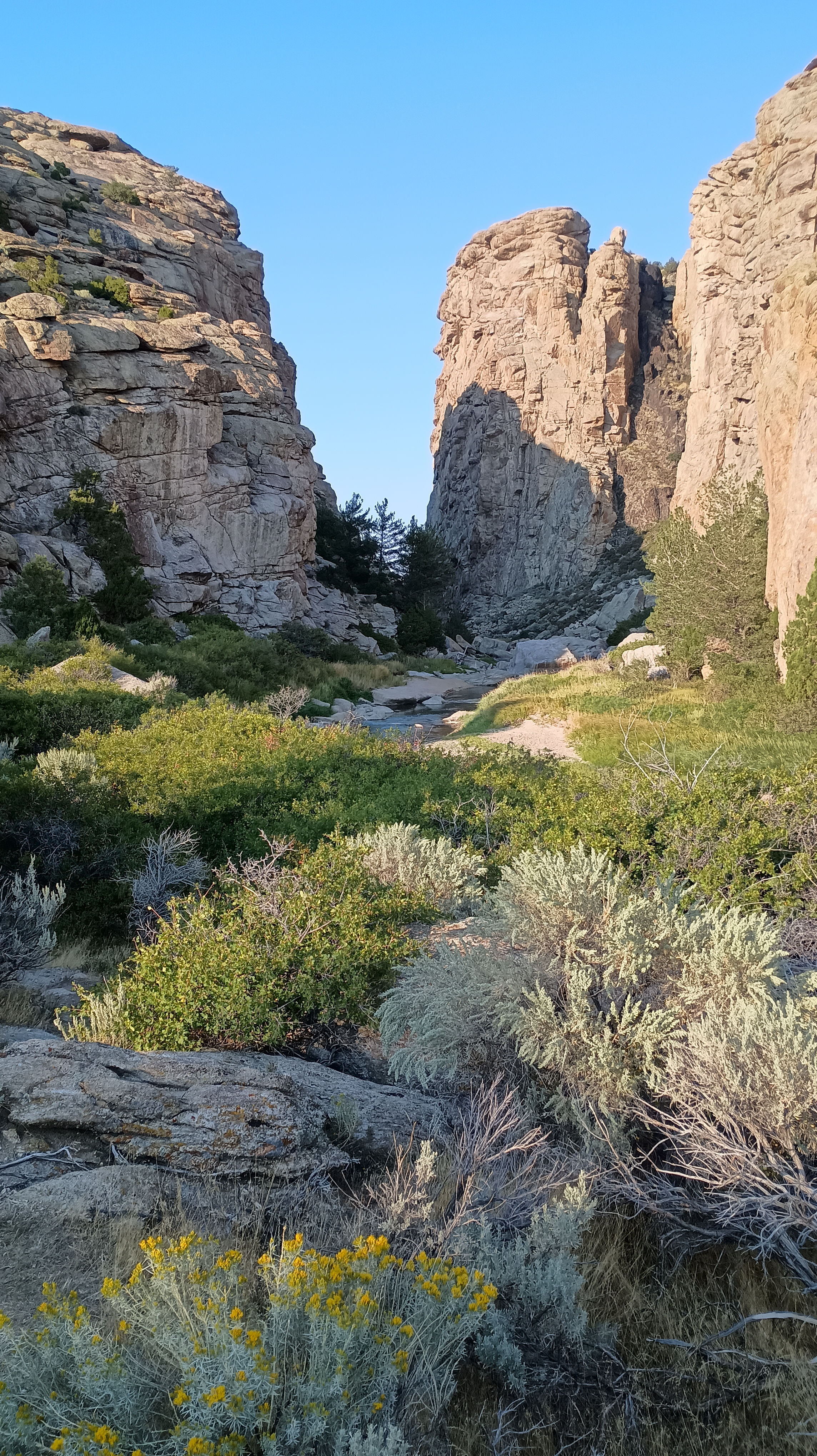
I will write about this more in a bit, but Devil’s Gate was a major landmark on the trail going west for all pioneers on the trails. But Devil’s Gate became more than a landmark and became a historical site in the tragic fall of 1856. Fort Seminoe was based there on the west side of Devil’s Gate, but it had been abandoned earlier that same year. It was that fall that the Martin Handcart Company found itself stranded in the snow. Days later the stranded handcart company moved into a nearby cove to get away from the wind, snow, and cold. That cove is now known as Martin’s Cove.
The Sun Ranch from Devil’s Gate, now The Martin’s Cove: Mormon Trail Site
We found the visitor’s center much more hospitable than some of our ancestors. As I worked through my family history, I had some of my own ancestors who passed through this very Devil’s Gate and area. Here are my ancestral lines that came across on the Mormon Trail. I had counted only 3 while in Casper, but hadn’t realized the Williams clan came over in two separate trips.
William and Mary Ann Sharp in 1853. Wagon train. Moses Clawson Company. William and Mary Ann met in the wagon train and married in Nebraska in 1853. William and Mary are my 3rd Great Grandparents.
John Williams in 1860. Wagon train. John Smith Company. John came over with his two sons John Haines (1829) and Richard (1838). I don’t know why his son David went separately in 1864. I am a descendant of John through David. John is my 4th Great Grandfather.
Johanna Benson in 1862. Wagon train. Joseph Horne Company. Johanna came over with some of her children and their families, her daughter Agneta, came over in 1864 with her family. Johanna is my 4th Great Grandmother.
William Edward Stoker in 1863. Wagon train. Unknown Company. William was traveling with his family, including the baby Mary Ann. William is my 3rd Great Grandfather, Mary Ann is my 2nd Great Grandmother.
John and Agneta Nelson in 1864. Wagon train. William Preston Company. Agneta is the daughter of Johanna Benson who came over in 1862. John and Agneta are my 3rd Great Grandparents.
David D and Gwenllian Williams in 1864. David is the son of John mentioned above. Wagon train. William S Warren Company. Gwenllian came with her sister Mary. Both married on the ship in Liverpool before setting sail for Utah. Gwenllian and Mary’s parents, David and Margaret Jordan, came over in 1872 crossing the plains by rail. David and Gwenllian are my 3rd Great Grandparents.
That gives me 10 ancestors that crossed the plains by wagon, none by handcart that I can tell. The unknown companies were all wagon trains as there were not handcarts those years.
Devil’s Gate – 2024
Every single one of these ten ancestors of mine who came west on the trail would have passed through Devil’s Gate. Here I stood on this sacred ground and snapped this photo of my daughter, my descendant and their descendant, at Devil’s Gate.
Aliza Ross at Devil’s Gate
It took me a bit more work, as I am not as familiar, to find those family lines of Amanda’s that also would have passed along the Mormon Trail to the west before the railroad made it much, much faster and safer. It took me several occasions over a couple of weeks to spend the time to research all these lines.
Henry and Ann Jackson in 1852. Wagon train. James C Snow Company. This is Amanda’s 4th Great Grandparents.
Regina Hansen in 1853. Wagon train. John E Forsgren Company. Her son, Hans Hansen, also accompanied her on the trip. Regina’s husband stayed behind. Regina is Amanda’s 4th Great Grandmother, Hans is Amanda’s 3rd Great Grandfather.
Grave of Hans Hansen in Plain City, Utah. Edith Sharp Ross’ stone is the stone at 10 o’clock from the top of this stone, my Great Grandmother.
David Buttar in 1854. Wagon train. William Empey Company. He appears to have traveled alone. Amanda’s 3rd Great Grandfather.
Birthe Jacobson in 1854. Unknown if wagon train or handcart company. Birthe’s daughter, Maria Jacobson, also accompanied her on the trip. Her husband Jorgen died in Missouri as part of the trip. Birthe is Amanda’s 5th Great Grandmother, Maria is Amanda’s 4th Great Grandmother.
Harriet Housley in 1856. Handcart company. Edward Martin Company. Harriet’s son, George Housley, also accompanied her on the trip. Two other children came later. Harriet is Amanda’s 5th Great Grandmother, George is Amanda’s 4th Great Grandfather.
Richard and Christine Hemsley (1836 – 1915) in 1857. Handcart company. Israel Evans Company. This is Amanda’s 4th Great Grandparents.
Ole and Anne Jensen in 1861. Likely wagon train. Unknown company. Amanda’s 5th Great Grandparents.
John Crompton in 1862. Wagon train. Joseph Horne Company. John also had his daughter, Hannah Crompton, with him. John is Amanda’s 4th Great Grandfather, Hannah is Amanda’s 3rd Great Grandmother.
Anna Nielsen in 1862. Wagon train. Christian Madsen Company. She traveled alone. Amanda’s 3rd Great Grandmother.
Joseph and Penelope Thompson in 1862. Wagon train. John Riggs Murdock Company. Their son, Joseph Thompson, also accompanied the family. Amanda’s 4th Great Grandparents, Joseph is Amanda’s 3rd Great Grandfather.
Joseph Wayment in 1863. Wagon train. Unknown Company. Appears to have come alone. Although his parents and most of his siblings would come later by rail. Amanda’s 3rd Great Grandfather.
Axel Boyer in 1866. Wagon train. Abner Lowry Company. Amanda’s 4th Great Grandfather. Also traveled with the Keeps, other ancestors of Amanda.
James and Ann Keep in 1866. Wagon train. Abner Lowry Company. Their daughter, Sarah Keep, also accompanied the family. James and Ann are Amanda’s 4th Great Grandparents, Sarah is Amanda’s third great Grandmother. Also traveled with Axel Boyer, other ancestor of Amanda.
Richard Hemsley (1801 – 1866) and his later wife Sarah in 1866. Wagon train. William Henry Chipman Company. Amanda’s 5th Great Grandfather.
Peter Peterson in 1866. Wagon train. Joseph Sharp Rawlins Company. Peter is Amanda’s 4th Great Grandfather.
That is the Hemsley line alone, Amanda’s Dad. I count 26 ancestors of Amanda’s Dad that came through Devil’s Gate.
James, Lillian, Hiram, and Aliza Ross at Devil’s Gate Mormon Handcart Visitor Center
Amanda’s Mom’s line, the Holden family, has the following:
Edwin and Ruia Holden in 1852. Wagon train. Uriah Curtis Company. Their son, Henry Holden, also accompanied the family. Edwin and Ruia are Amanda’s 4th Great Grandparents, Henry is Amanda’s 3rd Great Grandfather.
Jesse and Temperance McCauslin in 1851. Wagon train. Unknown Company. Temperance passed away in Council Bluffs, Iowa. She did not make the trail in Wyoming or Devil’s Gate. Their daughter, Louisa McCauslin, also accompanied the family. Jesse is Amanda’s 4th Great Grandfather, Louisa is Amanda’s 3rd Great Grandmother.
John and Adelaide Roberts in 1863. Wagon train. Thomas Ricks Company. Their son, Hyrum Roberts, also accompanied the family. John and Adelaide are Amanda’s 3rd Great Grandparents, Hyrum is Amanda’s 2nd Great Grandfather.
Thomas and Mary Ashton in 1851. Wagon train. Morris Phelps Company. Mary also passed away in Iowa. She did not make the trail in Wyoming or Devil’s Gate. Their son, Joseph Ashton, also accompanied the family. Thomas is Amanda’s 4th Great Grandfather, Joseph is Amanda’s 3rd Great Grandfather.
Sarah Jarvis in 1854. Wagon train. Job Smith Company. She came with some of her family, but not with her son, Amanda’s ancestor, George Jarvis. Sarah is Amanda’s 4th Great Grandmother.
George and Ann Jarvis in 1853. Wagon train. Unknown Company. George and Ann are Amanda’s 3rd Great Grandparents. George is the son of Sarah Jarvis mentioned above.
William and Rebecca Finch in 1854. Wagon train. Daniel Garn Company. William and Rebecca are Amanda’s 3rd Great Grandparents.
Joseph Finch in 1853. Wagon train. Joseph Young Company. Joseph is the son of William and Rebecca Finch mentioned above.
John and Hannah Davis in 1851. Wagon train. Eaton Kelsey Company. Their daughter, Mary Jane, also accompanied the family. The family also has Davies listed for their last name sometimes. John and Hannah are Amanda’s 4th great grandparents, Mary Jane is Amanda’s 3rd Great Grandmother.
John Evans in 1866. Wagon train. William Henry Chipman Company (same company as Amanda’s Richard Hemsley above). His wife, Sarah, died on the trip from the United Kingdom in New York. His son, John Evans, also accompanied his father and brother. John is Amanda’s 3rd Great Grandfather, John is Amanda’s 2nd Great Grandfather.
James and Elizabeth Boyack in 1855. Wagon train. Milo Andrus Company. James and Elizabeth are Amanda’s 4th Great Grandparents.
James Boyack in 1853. Wagon train. Appleton Harmon Company. James is Amanda’s 3rd Great Grandfather. James is the son of James and Elizabeth Boyack above that came in 1855 across the plains.
Margary Waterhouse in 1855. Wagon train. Milo Andrus Company. Margary is Amanda’s 3rd Great Grandmother. She came across with the same train as James Boyack’s parents, presumably that is how she met her future husband. The Company arrived 24 October 1855 in Utah, James and Margary married 23 November 1855 in Springville, Utah.
That is the Holden line alone, Amanda’s Mom. I count 26 of ancestors of Amanda’s Mom that came through Devil’s Gate. As an aside, I also looked at her biological line (as she is adopted), and not a single one of her biological ancestors passed through Devil’s Gate.
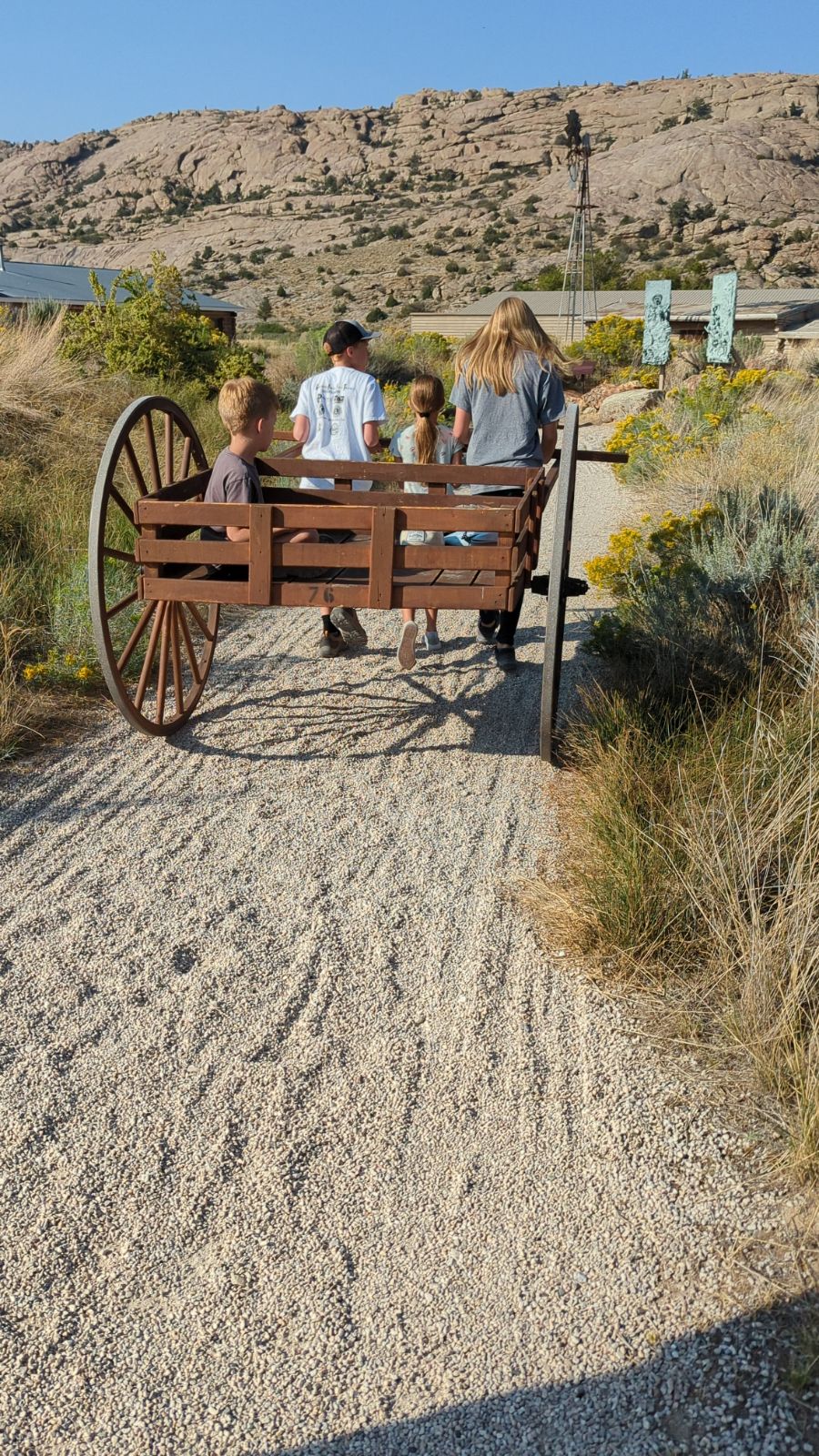
James riding while Hiram, Lillian, and Aliza Ross pull a handcart at Devil’s Gate Mormon Handcart Visitors Center
We also stopped and visited with the sixth crossing of the Sweetwater River. This was the location where, like the Martin Handcart Company, the Willie Handcart Company also got stuck in wind, snow, and cold in 1856. Their rescue occurred here.
The next day, on our way to Grand Teton National Park, we made a stop at Fort Washakie, Wyoming. This is one of the alleged graves of Sacagawea. We stopped and remembered her, whether her final resting place or not.
All in all, I was surprised by my own connection to the Mormon Trail. I had never considered that I have 10 ancestors who had literally came this way. Or that my children have 59 ancestors that literally come this way. They passed by Independence Rock, through Devil’s gate, and two of those 59 suffered with the Martin Handcart Company. I will write more on the Housleys later as there have been other interesting interactions with that clan since our marriage.
Another article clipped by my Grandparents, Milo and Gladys Ross. We do not know why this was clipped.
The top of the article shows it was published in the Ogden Standard-Examiner, Thursday, August 12, 1976.
“Newspaper reporting account of the death of Abraham Lincoln is displayed by Mrs. E. J. Krull of 1362 23rd.
Written by Milo Ross – “1860 – 64 – John Wileks Booth
“The drama of the assassination of President Abraham Lincoln came to life again for an Ogden man this week. Sifting through the contents of an old trunk, E. J. Krull of 1362 23rd found a yellowed, tattered edition of the New York Herald dated April 15, 1865.
“Chronicling the assassination of the man whom many historians believe to have been America’s finest president, the newspaper shows the tragedy of the Civil War had been overshadowed by the events of the previous evening in Ford’s Theater.
“The edition outlined an almost chronological account of the events that transpired following the shooting of the president by actor John Wilkes Booth and the simultaneous attempted assassination of Secretary of State Seward.
“A series of accounts describtd Mr. Lincoln’s deteriorating condition, the scene around his deathbed and finally, a bulletin indicated the president had passed away at 7:30 a.m. on April 15.
“Mr. Krull noted the old newspaper had been found while sifting through a trunk that belonged to his wife’s parents.
“Of six total columns on the front page, about 4 1/2 were dedicated to the assassination while the remainder were mostly accounts of the Civil War events including the escape of Jefferson Davis and his Confederate Cabinet to Dansville.
“Ironically, there was only one more item in the four-page newspaper that merited more columns of space than the presidential assassination.
“Nearly 9 1/2 columns inside were devoted to glowing testimonials about the incredible curative powers of “Kitchel’s Linament” and Kitchel’s Spavin Cure.”
I did some homework to find out more about Mr. & Ms. Krull.
Eielt J Krull was born 11 November 1900 in Clark County, South Dakota, and passed away 13 August 1987 in Ogden, Utah. He married Thelma Blaine, previously married as Nelson, in 1943. Thelma was born 29 August 1901 in Ohio and died 3 May 1991. Eielt is buried in South Dakota, Thelma is buried in Colorado.
I have two copies of the History of Plain City, Utah. The front indicates it is from March 17th 1859 to present. As far as I can tell, the book was written in 1977. At least that is the latest date I can find in the book.
One copy belonged to my Grandparents Milo and Gladys Ross. My Grandpa has written various notes inside the history which I intend to include in parenthesis whenever they appear. They add to the history and come from his own experience and hearing.
I will only do a number of pages at a time. I will also try to include scanned copies of the photos in the books. These are just scanned copies of these books, I have not tried to seek out originals or better copies.
History of Plain City March 17th 1859 to present, pages 166 through 184. That is the end of the Plain City History!
Can you Remember or Did you know?
By Lyman N Cook
The following articles are a collection of stories and events that have been a part of Plain City. These are in no way a complete list of the stories that could be told. We have older people who can remember the colorful events and stories, the eras of history, and they should be told and recorded. I hope these people will do so while they are here to tell them. I have touched upon a few. Whether the stories are good or bad, it has been my purpose or intent to have all the questions and answers, but merely to help your mind reflect upon the beautiful memories of Plain City.
Please, as readers, do not take any personal offense or injury to any of the stories. They were not written with any unkindness in mind, but hopefully you will enjoy them.
The stories are, in reality, a tribute and a compliment to the early settlers of Plain City. I cannot comprehend the magnitude of courage and strength, and the hardships those early pioneer men and women endured. How unselfishly they worked and planned for the betterment of Plain City to make it a better place for you and I to live today.
I have a deep personal feeling that we owe them everything.
The most interest and pleasure that the book has brought to me has been the fact that I have had an opportunity to visit in the homes of so many wonderful and interesting people. Compiling, reading, and writing the history has so fascinated and compelled me that I have stayed up all night, only to find in the morning that I am just as refreshed as if I had slept all night.
The following people have been so kind and helpful to me in writing the stories. They have told me stories, and refreshed my memory. I feel a deep appreciation for them, and I feel that they should be recognized. They are: Mrs. Lavina Thomas (on tape), Lyle Thomas, Byron Carver, Lee Carver, Laura Musgrave, George Knight, Clyde Hadley, Amy Robson, Harvey and Jennie Cook, Dick and Luella Skeen, Bill and Nonie Freestone, Irene Skeen, Ivy Skeen Marsden, and many others: Kris Ewert, for her printing. A special thanks to all. And also Ina Poulsen.
“TRUE STORIES AND COLORFUL EVENTS OF PLAIN CITY “
SLEIGH BELLS
One of the pleasant memories of a cold, crisp, clear pioneer winter night, was the jingling of sleigh bells as families made their way to church or to visit with friends or neighbors. The rich sound of their ringing through the hollow night air could be heard all over town. First starting out faintly and then increasing in volume as they approached their destination. It would seem that the still, peaceful night was just made for the ringing of the sleigh bells.
Almost all the families had a string of sleigh bells that were a prized possession, and a family treasure. Some of the larger strands would go across the back of the horses and around underneath the stomach, also a strand would fit on the hames. The quality of the workmanship that produced the full, rich tones will continue to enrich our memories of the past. Maybe if we lost our minds be calm and drift back through the years, we can still hear the tinkling of the sleigh bells.
PIONEER HOMES, WASH DAYS, FEATHER TICKS, COLD BEDROOMS, OLD COAL, OR WOOD STOVES
The pioneer home was usually built with two rooms, and as the family income and new family members came along, they would add an addition of bedrooms, and a dining room, parlor, or living room. There was usually a large cook stove for the parlor and dining room. The kitchen was the center of activity in the home, and only on special occasions, or when company came, would they build a fire in the other rooms. They would usually bank the stoves with wood or coal to last as long as possible. But by morning, the fire was always out. They would have two or three coal buckets, and a kindling box, and some member of the family had the chore to see what they were always full. It took a strong constitution to roll out of bed on a cold winter morning and make the fire, and wait for it to get warm.
Monday morning in the home was washday. It would start very early and last all day. They would heat the water in a copper-bottom boiler and would usually boil the clothes to help get them clean. They used a homemade lye soap. The women scrubbed the clothes on a scrub board usually placed in a metal washtub, and after scrubbing, would rinse the clothes two and three times. They would then be hung on the clothesline to dry. There was a special pride taken in the wash and to tell a woman that she hung out a pretty wash was to pay her a special tribute.
The pioneer families would usually wait until cold weather to kill meat. They would cure it, salt brine it, or dry it. For fresh meat, they would put it in a flour sack and hang it high on the north side of the house. When they wanted fresh meat they would go outside, climb the ladder, or use a pulley to bring the flour sack in. They would cut off what meat they wanted and return the flour sack out on the north side. It was not uncommon to see flour sacks hanging from the north side of most homes.
The bedrooms were usually located on the north side on the north side of the house, and were the furtherest from the stoves. It was like going into another world, or the north pole to go to bed. If you slept with a brother or sister, you would try to get them to go to bed first so they could warm the bed. The frost and ice crystals would collect on the window glass usually forming in the fall and never leaving until spring. It would usually be about a half-inch thick on the glass. The frost crystals would form in beautiful designs and patterns on the windows.
The straw tick or mattress was made with a cover and filled with straw. Each year they would empty the straw, wash the cover, and refill it with new straw when they thrashed in the fall. They would place a feather tick on top of the straw tick, and it was filled with feathers from geese and ducks. It was really warm and soft. The sheets, blankets, and quilts were piled on the bed until they were so heavy that it was hard to turn over. It was especially nice when the dog would sleep on your side of the bed, as he made an excellent footwarmer. What a breed of people to survive the cold, hard time of pioneer life.
INDIANS
There seems to be no evidence of any Indian violence or hostilities in Plain City. However, they would visit the homes of the early settlers and ask for food. As a sign of friendship to the Indians, they would always give them food. It was a very frightening experience for the pioneer women to have the Indians call when the men were in the field working and they were home alone. The children were especially scared, and were taught to be very careful when they were around.
There were people alive today in Plain City that can remember when Indians would come into town and camp. Some favorite campgrounds were across from Paul Costley’s garage, and across the street north of George Cook’s home. The white kids always played close to home when Indians were in town, and they never went anywhere at night.
The Indians squaws would go to every home and ask or beg for food. The homes that were generous would be visited several times. The Indians would stay for several days, and they would then load their treasures and leave and go north. The Indians must have liked the people of Plain City because they returned each year for many, many years.
PERRY BOAT
The ferry boat and landing was located near where the river bridge crosses the Weber River on the Plain City, West Weber road on 4700 West. It provided a river crossing for people, cattle, sheep, horses, and wagons. The ferry was made of logs tied together, and a large molasses boiler and pole was used to push the ferry across the river.
In the spring when the flood waters covered all of the low lands, the ferry would run from the hill on the north side near the Warren canal to the hill on the south as you enter West Weber. When the water receeded, the ferry returned to the channel. It has been said that in the spring the Indians would come to the hill and if the ferry was on the West Weber side, they would call across the river until the ferry came to get them. Sarah Richardson Hodson could imitate the Indian’s call for the ferry. She seemed to know more abut the ferry than anyone we knew of.
It might be important to include information about the times before all of the times before all of the reservoirs were built to hold back and store the early run-off water. Almost every spring the river would leave its channel and flood the low lands of Slaterville, Plain City, West Weber, Warren and West Warren. During some years the water would be so deep the road was closed. As a boy I can remember traveling 4700 West when the water would be up to the running boards of the Model A. The last year of excessive water was in 1952.
Not too much is known about the ferry, but it lends itself to another colorful era of interesting Plain City history.
POST OFFICE
The Plain City Post Office was located where Neta Charlton’s home is located, or one block North of the school on the northeast corner. It was run by Charlie Neal and his wife, Pussy Neal. He ran the Post office for 25 years from 1877 or 1878 until 1902 or 1903 when the government closed the Post Office, and the mail was brought into Plain city by Fred Kenley and delivered by horse and buggy.
Merl England has in his possession a letter that was postmarked Plain City, Utah, August 8, 1891.
Pussy Neal had, and kept a start of live yeast and would sell it to the women of the town to use in mixing bread. Annie Skelton would send her daughter, Nonie Skeen Freestone, down to the Neal’s for yeast. It didn’t take many trips before Nonie developed a real taste for live yeast. She would buy a three-pound lard bucket full, but by the time she walked five blocks home, she would have half of the bucket drank. She claims that it was quiet a tasty drink.
EARLY BAPTISMS
A very important date in the lives of young eight-year-old people was their baptism. Nowadays this ordinance is performed in a stake center with a very beautiful font. Before this time, this ordinance was performed in canals, rivers, lakes, and ponds. One of the most popular places to be baptized was the First Rock Crossing, or seck, as it was called. This was located on Center Street next to George West’s home, long before the canal was cemented. There was a row of poplar trees along the street, and the children would dress behind the trees. Some people would take their children up the street in the buggy and dress them, and then return for the baptism.
There were usually just two baptisms a year, one in the late spring and the other in the early fall. As a result, there were usually several children to be baptized at a time. The children would sit on a log and wait for their turn.
Some of the young people went down to the river and were baptized. The location on the river was near where the present bridge is located. They used willow trees to dress behind. Laura Musgrave and Royal Carver were tow that were baptized in the river.
George knight told me that he was baptized in the Warren Canal about where the present pump is located. This was a colorful era of the past and should help to rekindle some pleasant memories for those who participated.
THE PRIVY, CRANNY, ROOSEVELT, OR ALIAS, THE ONE-HOLER, OR THE TWO-HOLER
There was a great deal of social status involved and a real pride taken in building, caring for, and beautifying the outdoor privy. Some of the seats were made of select lumber and sanded and smoothed to the point where they were quite comfortable. And on the other extreme, some seats were rough and slivery. Some families were careful to make the privy weather proof, while others you could look out the cracks in every direction.
You could usually tell the size of the family in the house, whether it be large or small, by the size of the property. Is it a one or a two holer?
Some of the families, to prove to the world that their cranny was something special, and a respected place, would cut beautiful designs in the top of the door. I never quite figured out whether the hole in the door was for ventilation, or simply to study the wonders of the sky at night. Some of the designs were a half moon shape, a diamond shape, star, or just a round circle.
The Skeen girls, Ivy Skeen Marsden, Lenora Skeen Freestone, and Jennie Skeen Cook, still maintain to this day that their little brother, Dick Skeen, learned to throw the baseball so very well by practice throwing at the privy. He would wait until the girls would get inside and lock the door, then he would open up the rocks, clods, green pears, or anything to keep them pinned down. Dick’s favorite was the dirt clod. He would aim for the hole in the door and throw the clod through. The clod would hit the wall, break up and shower the girls with dust and dirt. He would then really laugh when the girls would cry, scream, and holler for their mother to come and rescue them from their brother.
Halloween was a risky time for outdoor privies. One of the favorite Halloween pranks for the kids was to spend the night tipping over crannies. The only thing that I would like to say on the subject now is that I am ashamed and sorry, and I must report that I am one of the parents who feel like the kids of today are going to the dogs.
During the depression and late thirties, and prior to World War II, the government had a P.W.A. and W. P. A. program. Workmen would come to your home and build outside crannies. They had a cement floor and a lid on the seat. They were weatherproof, and most people who owned one felt like that was the next best thing to running water. They were called “Roosevelts.”
Usually an old Sears catalog would act as a years supply of toilet tissue.
Some of the more discreet families would keep a pot, or thunderjug in the house for emergencies during the cold stormy winter nights. This fact was considered the family’s dark, deep secret, and was usually emptied before dawn.
With the exception of two years in the Navy, I used the outdoor privy for 26 years, and first four years after I was married. We sometimes hear it would be nice to go back to the good old days, but certainly not to the days of the outdoor privy.
SCHOOLS
The first school was in George Musgrave’s dugout. He later held school in a one-room adobe.
The first public school was built on the south of the square. It was built out of adobe. It was one room.
There was a school located on the northeast corner of the square. The town and ward used this building for some social functions. It was built of adobe in 1873 or 1874.
The North school was located where Walter Christensen now lives.
The South school is still standing and was remodeled by Harvey Cook into a home. It is located where Gordon Sorensen now lives, and across from Eldon Weston’s home. This home was built of brick.
The Poplar School was located across from Augusta Nash’s home.
I have been led to believe that there was school classes being held in all these four schools at the same time. This world be shortly before and after 1900.
EARLY STORIES
There have been at least ten stores and meat markets in Plain City up the present time. Some of the stores have stayed in the same place, but have had several different owners. I’ll just mention where the old stores were located. There were two Coy Stores. They were owned by Sarah Coy and Eliza Coy. One was across the street about where Mildred Sparks now lives. This is about 2200 North and 4650 West. The old ZCMI store was where B & C foods is now located. Garner’s store was where the pool hall is now. England’s store was where Merlin England’s now lives. McElroy’s store was where Jack’s Garage is now located. Stoker’s was located one block behind the school where Gordon McFarland lives. Maw’s was located just west of the bowery.
John Vause built and operated a meat market just north of Adela Carver’s home. Some of Steve Knight’s family operated a meat market about where White’s Café is today. Peter M. Folkman had a meat market across from the school on the east side.
Most of these early stores would trade merchandize for eggs and butter. This was especially nice for the kids of the town because they could take one egg or more and trade for candy. There wasn’t hen’s nest that was safe in Plain City. Laura Musgrave tells of how she would get Nonie Freestone and they would raid Nonie’s father’s chicken coop for eggs to go to the store for candy. There was real safety for Laura, as she always has been real sharp in having Nonie in her own father’s coop with her.
BLACKSMITH SHOPS
Christopher Folkman was the first one in Plain City. He learned his trade in Denmark. It was located near Leslie Maw’s home and Elmer Carver’s home.
Janus Lund’s Blacksmith shop was located near Dennis Lund’s home. He died in 1908.
Rall J. Taylor started his shop in 1908 and the building still stands just north of Kirt Knight’s garage.
Lew Ericson’s shop was located on the property of Neta Charlton.
George Davis’ shop was near Phil Alsup’s old home and across the street from Thomas.
Lee Gould’s shop was located near where Florence and Carl Hodson now live.
Farley’s shop was located near where Sterling Thompson now lives.
Lyman Skeen’s shop was located just south of his old home. The property is now owned by George Skeen Cook.
THE EARLY DENTIST
Lyman Skeen acted as the early dentist, and his only speciality was pulling teeth. He had a special pair of forceps which are still in the possession of the family.
People came from all of Plain City to have their teeth pulled. In those days they didn’t have any dental check-ups, or fill any decayed teeth. If a person got a cavity, they endured it until the tooth would ache and then Lyman Skeen would pull the tooth.
He was a large man and once he hooked onto the tooth, he had very little trouble getting it out.
Some of his children report that when anyone came to have their teeth pulled, they would run into the house and hide under the bed and hold their ears so they couldn’t hear the person holler or scream.
Lee Carver tells the story about as a boy going down to Lyman Skeen’s and having a tooth pulled. He was told if he would sit still and not holler to scream, and act like a man, that Lyman would pay him .25 cents. It certainly must be one of the rare cases of a dentist paying his patient.
George Knight told me he made a trip to Lyman Skeen’s home to have his tooth pulled. He was told that if he would take it like a man and not holler or yell, that he could drive the mules and wagons. After the tooth was out they went out and harnessed the mules and hooked them to the wagon and George drove the mules to his home. George said that there was nothing that Lyman could have done to make him feel more important and give him a bigger thrill than to sit on the seat with Lyman and drive those large mules home. He was so excited that he forgot what he had gone down there for.
Ina Poulsen tells the story of her toothache when she was a girl. It was a large double tooth, and it had ached for days. She finally decided that having it pulled couldn’t hurt any more than the ache, so she went to see Lyman Skeen. She walked down to his place in the evening and they were eating supper. She said he got right up from the table and didn’t even finish his meal to pull her tooth. Annie got the forceps and sat her in his large grandfather chair. Again, the Skeen kids scattered and hid from the noise. Ina did mention that she did holler and scream, but it was all over in a minute. She said he was really good at pulling teeth. It also gives some insight into the quality, character, and gentleness of Lyman Skeen.
ICE HOUSE
An Interesting part of the history of Plain City was the old ice house. It was located across from the school on the property where Clara Folkman now lives and sat behind the old home. In the winter when the Four Mile reservoir, river and other water would freeze hard enough, they would cut it with ice saws. They would then haul it by team and bobsleigh to the ice house for storage.
Peter M. Folkman owned and operated the ice house, and in the winter he would have as many as twenty men working for him. They would work through the winter and would fill a rather large building with ice. They would cover it with wild hay and sawdust so it wouldn’t melt so fast in the heat and it would last all summer.
They would sell it to the people of Plain City for their use in the old wooden ice chest, for making ice cream, mainly for parties, and for whatever else their need was.
MARTIN SMITH AND THE MEAT WAGON
One of the colorful characters that would come into Plain City was Martin Smith. He owned a team of skinny horses and a closed-in meat wagon, and peddled fresh meat from door to door. He would come into town two or three times a week. He always carried a green willow switch, and would open the meat box, and use the switch to chase the flies out.
The lady of the house would come out to the wagon and look over the variety of cuts, or I would imagine he would cut whatever they wanted. A favorite pass time of the kids of the days was to try and sneak weeneys when he was busy with their mother. He was a sharp enough businessman that he made sure he always got enough money to pay for the weiners.
It sounds rather primitive in todays worlds, but it filled a need and is another colorful chapter out of the past.
GEORGE MOYES AND HIS MILK TRUCK
George Moyes had the first milk truck in Plain City. He delivered the milk to some of the homes in Plain City. It was George that was coming home from the dairy and discovered the fire in the dummy had started and burned Charlie Taylor’s barn. He used his load of milk to help put out the fire. I don’t know of anyone today who wouldn’t like to own that little truck.
THE EARLY THRASHERS
A colorful time on the farm was thrashing time. The first machines were horse powered, and were a great improvement over the hand method. These colorful pictures are some of the early steam-powered thrashers. There were men who owned their own machines and would do custom work for their neighbors. When the thrashers would move onto a farm, it would usually take several days to complete the farmer’s field.
While the thrashers were at the farm, it was the responsibility if the farmer to feed the men three meals a day. This consisted of many of the neighbors who helped each other. They worked hard and they required large meals. The women worked all day long to prepare the meals. The phrase, “I have cooked enough food for the thrashers,” was probably coined during this era. The farmer had to take care of the horses also.
The men usually carried their own bedrolls and slept on the new fresh straw.
Arthur Skeen and Frances Thomas owned and operated thrashing machines that I remember.
THE GYPSY HORSE TRADERS
The horse trader would come into Plain City once or twice a year. They would arrive in large white-top wagons leading a large number of horses. Some of the camping areas where they would stay were; out by the beet dump, by the water tower, on the square, and in the lot across from the Lyman Skeen home where George Cook now lives. They would stay about a week and would camp or live in their wagons.
The kids were frightened at the sight of the traders and the week they were in town they placed close to home and never ventured far from home at night. The traders were famous for taking things that didn’t belong to them.
As a boy I can remember the trader camps and walking through them with my father. Because of the shady characters and the stories I had been told, I can remember of never letting go of my father’s hand. To see the people involved and the many horses there were, made a lasting impression upon my young mind.
If any of the townspeople needed a horse or team, or wanted to sell any horses, they would bring their horses, or come to the traders camp. They would barter, trade, or sell. In order to make a sharp deal they would dicker all day. There were many stories told of how sharp a deal they made or how badly they got stung by the horse traders.
LYMAN DUMP
There were two beet dumps in Plain City. One was located across from the water tower, the other was the Lyman Dump located one-half mile west of the canning factory where the railroad tracks crossed 5100 West. It was named after Lyman Skeen because of his work on the railroad to that plant, and on into Warren. John Vause was the weigh master and was more or less in charge of the dump. They would haul the beets with teams and wagons to the dump, where they would be loaded on to the rail cars and taken to Wilson Lane for processing. At times the cars were not available ad they would pile the beets by hand. The pile had to be six feet high and stacked just right. When cars were available, the factory would pay the farmers thirty cents a ton to load the beets by hand and then into the cars.
A story is told of a certain farmer that would bring beets to the dump. The drivers were supposed to stay on the wagon to weigh their beets over with the wagons loaded, and then back their wagons across empty. This farmer would get off the empty wagon, stay on the scales, but would reach up and take hold of a board on the scale house, and pull most of his weigh off the scales. John Vause used to say, “ Look at that fat old ____. He thinks he is fooling me, but I always take 200 pounds off whether he is on the scale or not,”
Mervin Thompson was there ad tells a story about Lyman Skeen hauling a large beet rack full of beets to the dump with a four-horse hitch. The lead team was fine large horses and the back team was large mules. The dump was elevated with a steep incline up to a platform where the wagon would stop and be unloaded. It was high enough to clear a rail car and the beets ran down into the car. The decline from the platform was steep. He made his approach with the team struggling to pull the heavy wagon up the incline. As the teams lunged forward down over the decline. Lyman sprang to his feet and held the mules back so the wagon rode up against the rumps of the mules, and he moved the lead horses out fast enough to keep out of the way. He never lost a sugar beet. It was truly a great display of fine horsemanship. It was truly his ability with the horses that saved him and his team from death or injury.
He calmly made a circle around to the approach incline and took the teams up the incline. This time he was ready for them and the mules and horses stopped where they were supposed to. As the teams came down off the decline, they knew they had been taught a valuable lesson by a skillful master.
THE SWIMMING HOLES
If anything in this world can turn a man into a boy again, it is the pleasant memories of the old swimming hole. The warm summer days with friends and the happy, carefree times are the most memorable in a life time. There seems to be a special magnetic force that pulls and draws boys to water. It is especially difficult to try and explain to parents that special force, and why it was so necessary to go swimming so much. We lived in the water and the longest part of the day was the one hour we had to wait for our dinner to digest before we could go in swimming again.
Every irrigation canal, pond, river, or creek had their favorite swimming hole. The favorite holes in Plain City were not by the First and Second Rock Crossing, the canal, but Four Mile, Draney headgates, and the Anderson hole in the river. The Anderson hole was located just below the Warren pump by the bend in the river and northeast of the bridges. One could tell by the number of ponies, wagons, and buggies, that there was always a large crowd, and from the laughter and the noise, you could tell they were having a great time. The Anderson hole was secluded enough, and no girls around. For the men and boys it was pure skinny dipping. If any boy had shown up with a swimming suit in those days, they would have laughed him out of town.
The Anderson hole was the place all of the men and boys took their Saturday night bath. George Knight tells the story that he counted 65 men and boys swimming at one time in the river. Sant Madsen was the oldest at 65, and there was a young boy of about 6 years of age.
Wilford, or “Wiff” Skeen was considered the most gifted and powerful swimmers around this country. During World War I he swam on a Navy swim team. Gordon Thompson and George Knight said that Wiff was the most beautiful swimmer they had ever seen. Fred Kenley, I think, was I the Navy and traveled throughout the world. He said in all his travels that Wiff was the best Swimmer he had ever seen. He would put his little brother, Dick Skeen, on his back and swim out into the middle of the river. Dick must have been real little then, but he would dump him off and make him swim to shore while he carefully watched. Someone lost a shovel in Anderson hole and Wiff dove down to the bottom and brought it up, supposedly the only man to ever touch bottom.
Ogden City, Swifts, and the By-Products, began to dump raw sewage into the river and ruined probably the greatest memory maker in all of Plain City. It just seems so strange that man has a habit of always destroying his own best things in life.
DRIVING THE COWS TO THE PASTURE
The people who milked cows for their own use or who later on milked cows to sell the milk to the creamery, would usually drive their own cows to pasture during the summer months. The pasture was located one, two, or three miles from home. It would require taking the cows out in the morning and returning them in the evening. This responsibility usually fell to the younger members of the family and required a cow pony. In those days everyone’s home, yard, and farm area were fenced so the cows traveling to and from the pastures did not create a problem. During the hot, dry summer weather, the roads and trails of the cows were very dusty. It was very difficult to follow the cows very closely as the dust was so heavy.
One of these pastures was called the West Pasture. It was located north and west from Ivan Moyes’ home. This pasture was owned by several different people. The number of cattle they would put in the pasture was based on the amount of the pasture that they owned. In the evening the first person to the gate would open it and let the cows out. The cows, from force of habit, would follow the same trail to the town park where they would feed. It was not uncommon to see twenty-five or thirty milk cows feeding on the square in the early evening. The farmers would go to the square, collect their cows, and take them home.
For those who played baseball, football, or just played on the square, there were some real hazards involved after the cows had been there.
Modern feeding and milking techniques have eliminated the need for the daily move to the pasture and also the need for the fenced-in yards.
CANNING FACTORIES
Another very important industry in Plain City was the growing and canning of tomatoes. The first factory built in Plain city was across the street from Loyd Olsen’s at 1900 North 4700 West. Laura Grieves Musgrave tells of working in this factory filling the cans with tomatoes. She was just a girl at the time, and expressed how happy she was to be able to earn money in those days. At that time there was no child labor laws.
Part of this factory was later moved near the square and used by the maw family for their store and other buildings.
The second canning factory still stands at 1975 North 4650 West, and was used for many years. The sandy loam soil of Plain City seemed to be ideal for the tomatoes to grow and helped to give them the flavor, quality, and yield that rarely can be equaled. Times were very tough to earn money in those days, and many men and women would work at the factory in the fall of the year to help supplement their income. This factory was built in 1925.
The empty cans would be shipped in by railroad and the processed tomatoes would be shipped out to the railroad.
The events that impressed my memories most about the factory, were the lines of loaded wagons and trucks waiting to be unloaded. While the farmers waited for boxes, or to be unloaded, or for their tomatoes to be graded, they would visit by the hour. The stories and the tall tales that would be told during that time will long be remembered. It used to fascinate me to watch the women peel the tomatoes. The full pans would be scalded and go around on a belt. The women would take a full pan, core and peel the tomatoes, and when the pan was full, they would put their number in the pan and return it to the belt. They were paid by the pan, and it amounted to five cents to ten cents a pan. In later years it raised from eight cents to ten cents a pan. The fastest peelers could peel about 60 pans a day.
Some of the fastest peelers were Dorothy Christensen, Thelma Hodson Wayment, Doris Hodson Chugg, and Ruth Arave Taylor, deceased. Whether peeling tomatoes, cutting potatoes, thinning beets, wall papering, or whatever, Ruth Taylor, as I remember her, had to be the hardest working woman I ever know. I always marveled at her ability.
Can your minds eye visualize the smoke coming from the tall stack, and the pleasant tomato odor that drifted along the air currents through the town of Plain City.
PEA VINERS – PEA WAGONS
One of the early industries, or cash crops of Plain City was from the raising of peas. It t must be remembered that in the very early times, the settlers were only interested and concerned about food to keep them through the winter. As they worked and improved their homes, the roads, and the irrigation system, their ability to products more and vary their crops increased. It was then that they branched out into the pea industry.
The main pea viner was located on 2200 north, about a half mile west of 4650 West, on the north side of the street. It provided work for some of the men of the community, to stack the pea vines. In the winter the farmers fed the vines to their cattle.
The farmers would plant the peas in the early spring, and the harvest would begin about the 4th of July. The pea vines would be out with a horse-drawn mower. They would pitch them on a wagon and haul them to the vines by a team of horses.
As young boys we would look forward to the horse-drawn pea wagons on their way to the viner. We would run out into the street and catch the wagon, pull off a big armful of peas, carry them into the shade, and eat peas all day long. I don’t believe that peas gave you as severe a belly ache as green apples, but it ran a close second. More important, we were ready to go after the first wagon the next day. As a young man, I pitched the peas on the wagon in the fields, and off at the viner.
Later, another viner was built out east. It was located about one-half mile east of the water tower.
In 1949, I was building my house and my friend and neighbor, Louis R. Jenkins, would come frequently and visit. He said, “You have a nice location, but when the wind is right you may be able to smell the pea viner, but you know, that’s a good smell.” I never forgot his statement though the pea industry lasted only a very few years after that date. But, who could ever forget the potent odor that came after the vines and the juices fermented. No wonder the people who hauled pea vines had very little, if any, sinus problems.
Epilogue: Included should be the smell and the people who would haul the feed fresh beet pulp.
TRAPPERS
The Plain City area is situated where there was many creeks, drains, sloughs, ponds, and water areas for the muskrats to live. It seemed to me at one time to another, about every young man was involved in trapping. This could have been an inborn spirit in each young boy to be a trapper or a mountain man. The season would usually start in the fall until the water froze, and then again in the spring when the ice left. It came at a time when jobs were hard to find for young men and provided spending money for them. Trapping provided a good source of money for me when I was going to high school. The hide buyers would usually pay from thirty-five cents to a dollar and a quarter, depending on the size of the hide.
A good trapper could usually catch around 100 rats a day. I know one trapper that brought and paid for a new car during one trapping season. Some of the better trappers in Plain City that I can remember were, Elwin Taylor, Everett Taylor, Lyman Thomas, and Joe Wheeler.
NICK NAMES
Practically no one grew up in Plain City without having a nick name tacked on to him or her, because of something they did, said, or the way they acted, or some mannerism. It was not all uncommon for a group of Plain City boys, just to impress a girl friend, to talk and call the individual by their nick name, and the girls never knew who they were talking about. On the other hand, someone may come into the town and ask for Don Singleton, Darrell Christensen, Boyce England, Elwin Taylor, Horace Knight, LaGrand Hadley, George Cook, Clair Folkman, Lynn Folkman, Eldon Weston, or Jay Freestone, only to be told that they didn’t know anyone living here by that name. But had they asked for “Seebo, ““Breezy,” “Buzz,” “Bunny,” “Skinner,” “Gandy Goose or Pety Hadley,” “Joe,” “Ober,” “Homer,” or “Grass,” the townspeople could tell them right away where they lived.
Some of these people whose names will be mentioned have passed away, and it is my purpose to pay tribute, and add to their good names, rather than take anything away from them. Some have also moved away, but they got their name in Plain City.
There are so many names that I simply can’t remember them all, but here are a few: “Buss” Lyman Skeen, “Rip” Ronald Skeen, “Geg” Garry Skeen, “Brig” Orson Knight, “Snide” Elmer Carver, “Suitcase” Blair Simpson, “Huss” Harold Hadley, “Tubby” Frank Hadley, “Duke” “ Frog” Kenneth Christensen, “Fooz” Grant Lund, “Hazel” Kenneth Lund, “Bud” Richard Dallinga, “Cirk” Keith Lund, “Sodie” Elmer Hipwell, “Diff” Jack Etherington, “Tiff” Clyde Skeen, “Taa” Jack Freestone, “Sunny” Lyman Freestone, “Bub” Howard Freestone, “Cork” Carl Hodson, “Tumbleweed” Don Van Sickle, “Red” Lyman Cook, “Chic” Dee Cook, “Heater” Bert Cook, “Beef” Wheat Taylor, “Big Chub” Charles Fulmer, “Little Chub” Robert Fulmer, “Buddles” Rulon Jenkins, “Curley” Quenten Jenkins, “Bun” Ray Hadley, “Weiny” Dwaine Hadley, “Mustard” Bill Hadley, “Napkin” Dennis Hadley.
“Punken” Elmer Ericson, “Eif” Kent Jenkins, “Perk” Ray Coy, “Bear” Ronald Hogge, “Stinne” Wayne Skeen, “Hinke” Verl Rawson, “Toad” Loyd Knight, “Tarzan” Thayne Knight, “Dob” Blaine Knight, “Ikee” Ivan Hodson, “Grit” Dean Moyes, “Bud” Knight, “Lym” Skeen, “Beaver” Gordon Hadley, “Trapper” Durland Hadley, “Deddy” Darrell Thompson, “Pubby” Vernal Moyes, “Sam” Lyle Thomas, “Gonnie” Kenneth Woods, “Jim” Theron Rhead, “Mag” Noel England, “Jim” Elwin Skeen, ‘Bones” Bob Folkman, “Swede” Brent Taylor, “Curly” Davis, “Mayor” Dean Baker. “Wimpy” Loren Facer, “Tooley” Louis Poulsen, “Dick” Elwood Skeen, “Mud” Claude Rhead, “Weeser” Gene Lund, “Fiddler” Elmo Rhead, “Hook” Harold Hobson, “Roan” Harold Ross, “Mike” Milo Ross, “Wheeler” Keith Blanch, “Luke” John Nash, “Tom” Vandel Maw, “Joe” John Maw, “Judge” Thayne Robson, “Bushy” Wayne Cottle, “Pickus” Paul Coy, “George” Cliff Folkman, “Willie” Warren Williams, “Wally” Wallace Knight, “Cruzz” Kent Robson, “Evert” Bill England, “Tom” Merrill Jenkins, “Aus” Bob Wade, “Cougar” Norman Carver, “English” Wayne Carver.
Something more interesting than the names is how each one got their nickname. You should ask some of them sometimes. We should announce from Plain city to the world that we have had for the last 55 years, the original ”Jaws” Paul Knight. It is very distressing and disturbing to read where some outsider has taken the name “Jaws” and capitalized on it, made a film, and grossed more than 25 million dollars, when the original “Jaws” had been in Plain City all along.
When we analize the personality, the good times, and especially the stories, I doubt that anyone in Plain City would take 25 million from our original “Jaws.”
THE PEST HOUSE OR PRIMITIVE HOSPITAL
The constant underlying fears that pioneers and early settlers lived with daily was the threat of disease, illness, or sickness. There just weren’t any doctors or medicine available, and if anyone got sick, they either got well on their own, or they didn’t make it.
If a dreaded disease, or plague, as it was called struck the early settlers, many of them felt like it was God’s way of punishing them for things they had done or for the things they had not done. There were so many mysteries and superstitions concerning that, that people acted and responded in what now might be considered strange ways. The people felt the best thing to do was to isolate the sick people, and as a result of this type of thinking, the pioneers built the Pest House. To make sure it was really isolated, the people went about a mile west of town on the bank of First Creek and built Pest house. The Pest House was located on the bank of the creek. There were some tall poplar trees surrounding the building, but have since been removed. Clyde tells me that information was handed down and told to him about the spot where the Pest House was located. Years ago there was some evidence of a building there.
When a person got sick, they would take him to the Pest house to get better. They were usually left alone to care for themselves. Someone from the town would take food and water, and provide some care, but for the most part, it was just a kill or cure method. In most cases the patients, if they died, expired from exposure or lack of care rather than from the disease because the building was poorly constructed.
During the Smallpox epidemic of 1871, or about then, there weren’t any public meetings held in Plain City from September until the next March. The people lived in total fear of the disease.
The William Skeen family was hit very hard with Smallpox and they lost four children. It has been told that while his family was very sick, he called for the church and they were fearful, they refused to go help. His friends also turned away. This good man was left to bury his four children all alone, and some of them at night. He was so disappointed in the Elders of the church and his friends, that he left the church and he named one of his sons that was born later “Frenz Denial.”
IMPORTANT FACTS
Ivan Skeen Marsden and Lona Ipson Watson were the first lady missionaries to leave from Plain City in 1914. They served in the Eastern States Mission.
The first car reported to be in Plain City was Dr. Rich, who drove out to treat a patient.
It mentions that Richie owned the first car. Some of the other early car owners were Tom England, John Maw, Lyman Skeen, and others. Later, Lyman Skeen owned an eight-passenger Chandler.
Sammy Sampson was one of the early barbers.
There are seven children of original settlers living today in1977 that we know about. There may be others. Four of them live in Plain City. They are:
Ada Skeen William Allred
Victoria Sharp Hunt
Mary Sharp Richardson
Ivy Skeen Marsden
Lenora Skeen Freestone
Jennie Skeen Cook
Elwood “Dick” Skeen
It is remarkable when you think after 118 years that there are still children of the first settlers still living.
Richard Lund was the early fiddle player in the town.
LYMAN SKEEN, OWNER OF GREAT HORSES
Lyman Skeen owned and loved great horses. He had two large barns full of fine Stallions, besides many work teams that he used in his construction business. He worked in Utah, Wyoming, and Idaho, on construction building canals, road beds, and whatever. He knew horses flesh and people would bring their horses from all over the country to have him doctor their horses.
Lyman made three trips to Europe to buy horses. On one occasion, he bought six head of Shire horses in England and brought them by ship to the United States, and by rail to Ogden. He also brought a little Englishman named Tommy ____ to take care of the horses and train them.
When they arrived in Ogden Lyman took Blaine Skeen, Elmer Skeen, Orson Knight, and others to help bring the horses home. Orson Knight tells before they brought them to Plain City, they paraded them down Washington Boulevard. He mentioned that no boy could have been prouder to lead those large horses down Washington. He said the little Englishman walked beside the horses with a whip, and he would crack the whip and the horses would rare up and prance and put on quite a display for the large horses.
Sline was probably the greatest Shire horse to ever come into the State of Utah, or the West. The little Englishman is holding Sline in the picture.
The Skeen kids can remember frequently someone yelling “Sline’s out.” and he would always prance up through the lot. Lyman would send his boys out to catch Sline, but they never could catch him. Lyman would sit back and watch his proud horse run and exercise, and when Lyman felt like he had enough, he would walk out and up to Sline and lead him to the barn. Whenever Sline had been he left hoof prints about a foot square through the garden.
“SLINE” – Importe I Three-year-old Shire Colt
L. SKEEN
LYMAN SKEEN WITH HIS SHIRE HORSE.
One of these big Shire horses died at the age of three days. It was raised on a bottle by Annie Skeen, wife of Lyman Skeen.
SAMMY SAMPSON THE BARBER
Sammy Sampson barbered in his home which was located across the street from Dell Sharp’s home. He was one of the early barbers. Byron Carver tells of getting his hair cut there when he was a boy. He said, “You could ask for any type of a cut you wanted, but you only got one cut, mostly bad,” I can see Byron chuckle ass a twinkle from the past came into his eyes. “Oh it was bad,” he said, “and as long as you had any hair left, Sammy would keep cutting.”
On one occasion he went to get his hair cut when it was hot and Sammy was cooking something that didn’t smell too good. Some of the men who had gathered were smoking El-rope-o cigars, and Byron was getting light headed as he sat in the chair. As Sammy worked him over he became more ill. Sammy soaped his neck and shaved it with a large thick, straight razor, that scraped more than it cut. Sammy kept a pan of hot water on the stove with a wash cloth on it that he used to wash the soap off. As he laid that hot cloth on Byron’s neck, Byron rolled off the chair and fainted dead away. When he came to, big Lafe Skeen was holding him on his lap. That was one hair cut Byron will always remember, and as long as he is alive the memory of Sammy Sampson the barber will live on.
Sammy charged 5 to 10 cents a haircut in those days, and trim and shave on the older men was 15 cents.
THE RACE TRACK, PLAIN CITY’S FIRST
William Skeen owned some very fine racehorses and he built a racetrack to train his horses. The neighbors would meet on occasion and race their horses to test the speed against their neighbors horses. Stories have been told that there were some very exciting races held at the track. It was located near four mile reservoir.
They tell the story of a man from Ogden, who was quite a footracer and he was supposed to have challenged and bragged that he could beat a horse in a certain distance. It was well talked up and word spread around, and the race was held. There was a little money that changed hands quite a crowd. But you know, no one can remember who won the race. It was another colorful time in early Plain City.
THE WEDNESDAY NIGHT SHOW
Growing up as a kid during the late twenties, thirties and into the early forties here in Plain City was quite an eventful time. It seemed that the world moved at a slower more relaxed pace and there was time to enjoy visiting and to crate your own entertainment and fun. Depression times were very hard for most families, with very little one and barely the necessities of life. There was very little money available for entertainment and if you had any entertainment, you created your own. They were carefree happy times. As a kid you were lucky if you got into Ogden once a month or even once during the summer. By comparison with today, all the entertainment seems to be provided for the young people and all they have to do is show up with money and everything is provided for them.
In the summer kids games and ball games were a very big thing and something was going on every day and night. Hide and seek, run sheepy run, kick the can, and whatever else anyone could think up were always popular. Skating and sleigh riding were the fall and winter games. You would skate all day and build fires at night so you could skate even longer.
Sometimes in the thirties the movies began to be very popular. Someone from Ogden would bring a movie out to Plain City every Wednesday night. It was held in the upstairs of the old church house and there would be two to three hundred people or more watching the show. The admission was ten cents and hardly anyone ever missed the Wednesday night movie. There was usually a serial episode before the regular movie and it would last for about weeks. It would lead you up to an exciting climax and then announce, “To be continued next week.” I can remember they would be the longest weeks ever, waiting to get back to the show to see what happened. Tail Spit Tommy always a big feature with the serials.
There were some very spooky shows and I can recall small kids screaming and crying, and they would have to leave the show. The shows were scary, but the spooky part was walking home at night after the show. You were always extra light on your feet, and with any strange sound out of the blackness of the night, you would be at a full gallop and double your stride. Ah, but they were good times.
The automobile and the war, and the latest movie hits in Ogden all led to the down fall of the Wednesday night show in Plain City. It was a colorful era in Plain City and one that everyone seemed to enjoy.
A TRIBUTE TO BETTY
Somehow the roads of Plain City look and seem a little different now days without the familiar figure of Betty. Her shopping bag in hand, her figure that time and age had bent a little, and limp that the years had brought on, headed up the road to Ogden. Time had also slowed her steps, but not her to walk to town.
Probably Betty was born fifty years too late to fit in well with a changing society. He life was the simple life, and her wants and needs were few. She was very string willed, proud, and stubborn in some regards. She was very determined not to be pressured into joining the modern world.
Some people say she was eccentric, old, strange, but she was a rugged individualist who refused to conform to anyones standards but her own. As a result of her ways the young people would sometimes tease and torment Betty. But in her own way she ignored them and went her way. Is it not strange that we from our own little worlds are so willing to unfairly judge other people by out own knowledge and standards. Especially if their standards and personality traits do not measure up or lower down to our own.
I wouldn’t begin to know how many thousands of times Betty walked to Ogden, and back with groceries, even after she was around seventy five years of age. I suppose before we could fairly evaluate Betty we should ask the women of Plain City how many times they have walked to Ogden, and back home. Their were many people who were good to Betty and wanted to help her, but she seemed determined and happy to do things her own way.
Betty was a hard worker and she worked for many people in Plain City. Later she worked in Ogden doing housework. I carried mail in Ogden for thirty years and would see Betty working at some of the finest homes in Ogden. Her family paid me a tribute when they asked me to speak at her funeral.
Betty will be remembered as one of Plain City’s remarkable characters. If we let our memories wander a little, and though our minds eye we might still catch a glimpse of a shadow of Betty walking to town.
I have two copies of the History of Plain City, Utah. The front indicates it is from March 17th 1859 to present. As far as I can tell, the book was written in 1977. At least that is the latest date I can find in the book.
One copy belonged to my Grandparents Milo and Gladys Ross. My Grandpa has written various notes inside the history which I intend to include in parenthesis whenever they appear. They add to the history and come from his own experience and hearing.
I will only do a number of pages at a time. I will also try to include scanned copies of the photos in the books. These are just scanned copies of these books, I have not tried to seek out originals or better copies.
History of Plain City March 17th 1859 to present, pages 107 through 122.
SCHOOLS
Early Plain City School
Poplar School
Submitted by Roxey R. Heslop
Poplar was a branch of the Plain City Ward and it received its name from the long rows of Poplar trees on both sides of the street.
The school district was organized in 1891. First school was held in the home of Peter McCue located about 3475 West 1975 North. James L. Robson was the first teacher followed by Mrs. W. Winslow and Myra Gray.
A room school house was built about 1894 at 3320 West 1975 North. This picture is not the Poplar school which had no windows in the front but on the west side and three was a wood shed at the back but it is very similar in many ways.
The teachers were Bessie Zinn, Blanch Bagley, Freed W. Dalton, Naomi Tracy, Emma Anderson, Sarah Stevenson, Etta Brow, Lottie Henigar, Minnie Rudiger, Melvina Wayment, Esther Steward, Welthy Lake, and Pearl Tracy.
The Poplar School House was the center of church and social activities. Sunday School was organized 3 Sept. 1894. Primary and Religion were held there.
Dances were wonderful. Everyone danced and the young folks were taught to waltz, two-step, quadrills, polkas, schottisches and others that were popular at that times. Richard Lund with his violin accompanied by his daughters, Annie or Alminda on the organ. Often lunch was served. Children’s dances were held.
The Poplar Lane people were like a united family. Everyone went to church and attended all social events. All the children played together.
Nearly all of the folks have gone but those who are left enjoy wonderful memories of the days of activity, associations and inspirations that was bought from the one-room school.
First consolidated public school. Built to replace the North, South, and Poplar Schools. It was built of adobe and located on the northeast corner of the square. It was used as a community and recreational center for many years after the second consolidated school was built.
Second public school after front door was sealed; new entrance was built on the east side when the gymnasium was added. Lunch room facilities were added to the west later.
Second public school after remodeling when front windows were bricked over but before later additions were made.
Interior of the second school, showing old wood and metal desks that were attached to long wooden planks.
CLASS PICTURE TAKEN IN THE POPLAR SCHOOL
Poplar school was a one room building. This picture was taken during the school term of 1901-1902 with Etta Brown as teacher. Later she married LeRoy E. Cowles who became the president of the University of Utah.
Top row: Emma Cottle, Elmer Robson, Ada Skeen, Williams Allred, Walter Cottle, Anzley Miller Luckart, Parley Taylor, Luella Cottle Stanger, Edmund Furnis, Alma Furnis, Laurence Cottle, Leslie Taylor, John Taylor.
Bertha Urry, Kate Urry East, Pearl Taylor Lund, Bertha Robson England, Alice Urry Wayment, Josephine Cottle Monroe, John Jackson, Elmer Taylor.
Roxey Robson Heslop, Manila Taylor Hancock, Emma Taylor Homer, Kate Kensley Nalder, Parley Stoker, Blanch Kenley, Drysdale, Unknown, Jessie Kenley Wayment, Evelyn Taylor Cottle, unknown, Martena Taylor Surrage, Merl Jackson, Zina Urry, Nellie Kenley Draney.
Some were too young to go to school and were brought for the picture.
Submitted by Roxey R. Heslop
This is the graduating class of 1907, Class of 1906-1907
Iris Poulsen, LaVerna Davis, Principal John C. Neal, Florence Singleton, Ruth Poulsen
Front Row:
Clifton Kerr, Marion Sneed, Arvilla Taylor, Ellis Giles, Margaret Hunt, Gilbert Taylor, Harold Carver
PUBLIC SCHOOL BUILT IN 1906
This is located on the site of the present Plain City Elementary School.
It included elementary through tenth grade in later years. The last year the tenth grade was held in the school was 1947. After that, it remained in use as an elementary school.
The front windows were bricked over and later the front doors were bricked when the gymnasium was added to the east.
Still later, a cafeteria was added to the west. The building was demolished in 1955, leaving the later additions and adding a new addition of classrooms to the east that same year.
The students pictured at the bottom of the picture are enlarged on the3 following pages.
Weber County School District was organized in 1906-07. Plain City was dedicated in September of 1906.
The teachers are: John Quincy Blaylock, Laura Lamon, Rosabell O’dell and Elda Cooley.
1909, 8TH Grade Graduation Class.
Back row L to R: John Taylor, Roxey Robson (Heslop), Easter Lund (Stevenson), Elvin Maw, Mildred England (Hart) (Robins).
Front row L to R: Lona Ipsen ( – ), Teacher John Q. Blaylock, Bertha Hodson (Bullock).
Enlargement of the students in the 1907-07 school picture on the preceeding pages, showing the center one-third of the students.
Early school buses were privately owned and used for summer vacations and school trips.
Enlargement of the students in the 1906-07 school picture on the preceeding page, showing the left one-third of the students.
L. Rulon Jenkins, teacher and Principal of the 1906 school during later years in the 30’s and 40’s.
Early classes held in the 1906 school during succeeding years. Dates and identities not known.
Early Plain City Class Picture Date and teacher unknown. We hope you can identify a parent or grandparent to make it more meaningful to you.
View of the 1906 school after the gymnasium had been added and more modern bus transportation used.
CLARA SKEEN THOMAS
SUBMITTED BY BEVERLY B EDDY
The Plain City School Hot Lunch Program was organized by Clara Skeen Thomas, wife of George Sidney Thomas. Clara Thomas was the first to start the Hot Lunch Program at the Plain City School 1923-1924.
She received $1.00 per day. She served vegetable and tomato soups, chip beef gravy on mashed potatoes and chili. These were purchased at the cost of three cents a bowl. With this money she received from the food, she would but the materials needed to prepare the next meal.
For years, she cooked and prepared the food at her home. She would have to take it up to the school each day. This would consist of three blocks each way. Later the school purchased a coal oil stove, which made it possible to prepare the food at the school. Each year the Hot Lunch program started in November and ended in March. Clara Skeen Thomas cooked and prepared the hot lunch at the Plain City School for eleven years and never missed a day.
SCHOOL LUNCH PROGRAM
L to R: Ivy Carver, Elizabeth Lund, Vacona Singleton, Tillie Moyes, Bell Woods.
SCHOOL BUS TRANSPORTATION
SUBMITTED BY ELMER ROSE
Oh what progress in education when in 1926, Weber High School opened its doors for County students. This high school is located on Washington Blvd. and presently occupied by the Adult Education Center.
Elmer Rose, of Warren, drove a bus to accommodate the northwest area of Weber County. Mr. Rose’s route covered several miles each day. He picked up all the high school students from Warren and both elementary and high school students from the south end of Plain City. He dropped the elementary students off at the Plain City elementary school. The student’s near the street car tracks were left to ride it to the high school.
Mr. Rose then continued his route through the North Plain City Road, back along highway 84 to within a reasonable distance from the car line. Then after passing the Harrisville along the route to Ogden limits.
On the route going to the high school, Mr. Rose picked up the Farr West Elementary students and delivered them to the Farr West School. He returned down the North Plain City Road picking up the elementary students for Plain City School.
The bus contracts to maintain and operate these units of transportation were awarded by bids. The lowest bidder getting the job if his outfit met the approval of the school board.
The inside of the bus had a bench on each side facing the center. The girls usually occupied these seats. In the center was a bench called a straddle seat. The boys were crowded together astraddle this bench.
The first bus was small and about 30 students were crowded into it. The students gave this bus the nickname of “Cracker Box”.
He often chartered his privately owned bus to take scouts, F.H.A. and other groups on excursions and other activities.
Mr. Rose removed the bus from its chassis during the summer so that he might use the truck for farm trucking.
This picture is of the second privately owned bus maintained and operated by Elmer Rose. This bus had a large capacity, accommodating about 50 students.
BUSSES LOADED IN FRONT OF WEBER HIGH SCHOOL IN 1926
The first buses to transport students to Weber High School in 1926 were operated and maintained by the individual owners. The contracts were let to the person whose bid was accepted by the Board of Education. Since these first buses were individually owned, the owners often used them for 4-H, temple, and various other excursions and activities.
Owners often used them for hunting trips. Family and friends slept in them overnight lodging away from home. The straddle bench was removed to make room for the bed.
Some owners removed the bus body from the chassis and placed another bed on the truck, so as to utilize it for farm trucking during the summer.
School transportation has evolved from the horse-drawn school wagon to the giant sized yellow school bus.
Today students ride to school fairly comfortable. The buses are warm, the seats padded, the radio plays popular music. These luxuries were undreamed of by the students who rode in the white top covered wagon, or the horse drawn sleigh in the midst of winter.
SUBMITTED BY RUTH FOWERS
SCHOOL LUNCH PROGRAM WORKERS
L to R: Hazel Kennedy, Mabel Moyes, Thelma H. Palmer, VaCona P. Singleton- Head Cook.
L to R: Principal Earl Cragun, Fern Hogge, Mabel Moyes, Norma Jensen, Hazel Kennedy.
Demolition in 1955 of the school building of 1906. This building had been in use continuously since that date. Many changes and additions had been added around it.
View of the new addition added in 1954-55 as seen through the rubble of the 1906 building and the construction equipment of the new building.
View of the Plain City Town Square from the roof of the school gymnasium.
Three view of the Plain City Elementary School as it stands today in 1977 with its many additions.