
Open primaries bill introduced in Congress


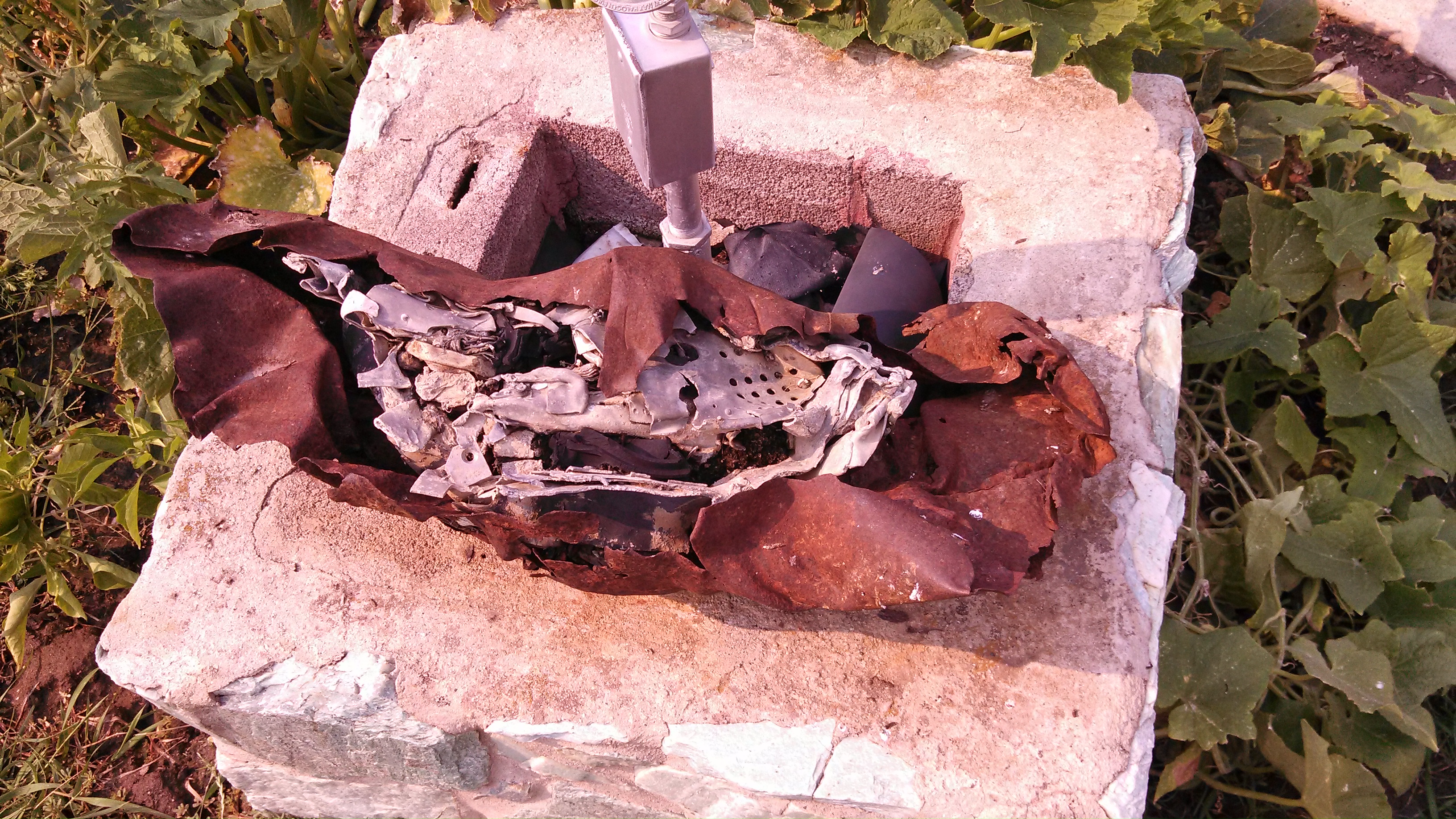
I previously wrote an article about the piece of airplane scrap Grandpa kept in his front yard. I referenced this newspaper article and that I would type it up and make it available. Here it is. Before, here is a picture of that piece of scrap Grandpa Ross picked up in Mike Pananzio’s garden.
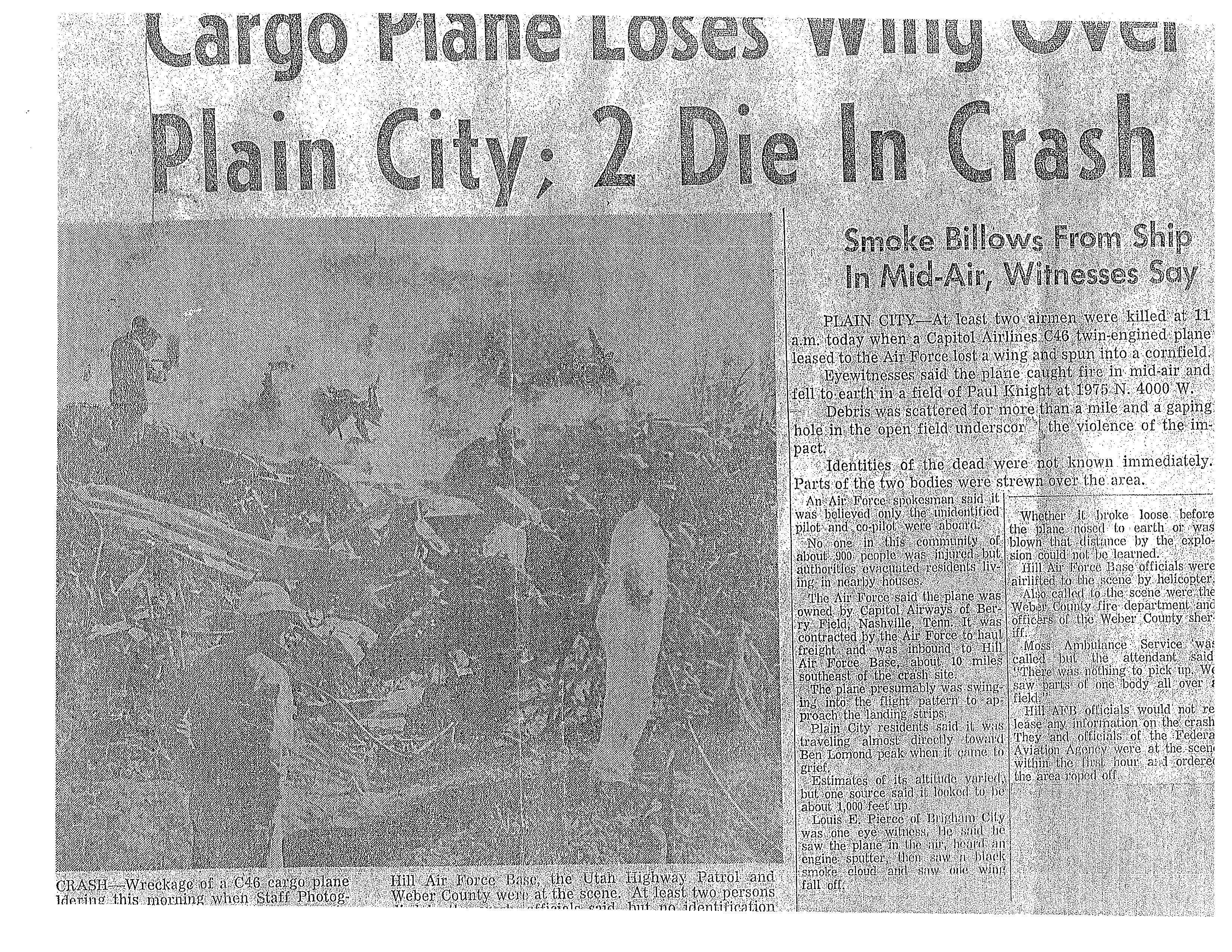
Cargo Plane Loses Wing Over Plain City; 2 Die In Crash
Ogden Utah, Saturday October 15, 1960
Smoke Billow From Ship In Mid-Air, Witnesses Say
EXport 4-7711 80th Year No. 269 5 Cents
Plain City – At least two airmen were killed at 11a.m. today when a Capitol Airlines C46 twin-engined plane leased to the Air Force lost a wing and spun into a cornfield.
Eyewitnesses said the plane caught fire in mid-air and fell to earth in a field of Paul Knight at 1975 N 4000 W.
Debris was scattered for more than a mile and a gaping hole in the open field underscored the violence of the impact.
Identities of the dead were not known immediately. Parts of the two bodies were strewn over the area.
An Air Force spokesman said it was believed only the unidentified pilot and co-pilot were aboard.
No one in this community of about 900 people was injured but authorities evacuated residents living in nearby houses.
The Air Forces said the plane was owned by Capitol Airways of Berry Field, Nashville, Tenn. It was contracted by the Air Force to haul freight and was inbound to hill Air force Base about 10 miles southeast of the crash site.
The plane presumably was swinging into the fight pattern to approach the landing strips.
Plain City residents said it was traveling almost directly toward Ben Lomond peak when it came to grief.
Estimates of its altitude varied, but one source said it looked to be about 1,00 feet up.
Louis E Pierce of Brigham City was one eye witness. He said saw the plane in the air and heard and engine sputter, then saw a black smoke cloud and saw one wing fall off.
Whether it broke loose before the plane nosed to earth or was blown that distance by the explosion could not be learned.
Hill Air Force Base officials were airlifted to the scene by helicopter.
Also called to the scene were the Weber County fire department and officers of the Weber County sheriff.
Moss ambulance Service was called, but the attendant said, “There was nothing to pick up. We saw parts of one body all over a field. Hill AFB officials would not release any information on the crash. They and officials of the Federal Aviation Agency were at the scene within the first hour and ordered the area roped off.
~
I found this article online from the Standard Examiner on the 17th, two days after the above article.
~
TRIO PROBING FOR REASON IN AIR CRASH.
A three-man investigating panel from the Federal Aviation Agency is probing today for the cause of a spectacular plane crash Saturday in Plain City which killed two civilians when the plane plummeted into a corn field minus a wing.
The crew from the FAA offices in San Francisco is headed by JACK BROWN and is headquartered at Hill Air Force Base.
Meanwhile, the scene of the crash, a corn field owned by PAUL KNIGHT of 1874 N. 400 W., is being guarded by members of the Weber County Jeep Patrol.
The wind that fell, carrying with it one of the plane’s two engines, completely blocked a road from the Plain City cemetery and created a serious fire hazard because of spilled fuel from the wing tanks.
The wing was removed from the highway by jeep patrol members.
FAA investigators are searching through a sea of charred and burned debris, scattered over a wide area extending in all directions from the 20 to 30-foot crater made when the plane hit the ground.
Enroute To Hill.
The plane, a C46, was enroute to Hill Air Force Base from Rapid City, S.D., carrying about 10,000 pounds of Air Force cargo and was under contract to the Air Force by Capitol Airways of Berry Field, Nashville, Tenn.
Killed instantly were the pilot and co-pilot, identified at REED A. BURT, 42, Salt Lake City, and Oliver N. CHADWELL, JR., Edmonton, Okla.
The crash and the movement of the plane moments before the crash took place place in full view of several eye witnesses.
The height of the plane and its apparent trouble drew the attention of several who said they saw the wing drop off and then saw the plane plunge to the ground, bursting into flames.
The intense heat of the fire made it impossible for anyone to attempt rescuing crew members and their bodies were so badly broken it was impossible for officials at the scene to determine the size of the crew.
Ogden Standard Examiner Utah 1960-10-17
Reed Allen Burt was born 30 September 1917 in Salt Lake City. He married Jewell Alma Butler (1920-2018) 16 February 1944 in Midland, Texas. His wife and three children survived him.
Oliver Henry Chadwell Jr was born in May 1929 in Oklahoma. I cannot see that he was married.

Sometimes something about a photo just captures something that makes you look closer. This is one of those photos. There is so much happening. Here is what I know.
Roy Elgin Davis was born 24 Dec 1888 in Drexel, Cass, Missouri and died 27 December 1957 in Twin Falls, Twin Falls, Idaho. 1895 found him in Lane, Franklin, Kansas; 1900 found him in Alamota, Franklin, Kansas; 1917-1918 also in Lane, Kansas; 1920 in Poplar Grove, Twin Falls, Idaho; 1930 in Rock Creek, Twin Falls, Idaho; 1940 in Kimberly, Twin Falls, Idaho.
I am not quite sure where Poplar Grove is. But he made it to Idaho in time to meet, court, and marry Joanna Virginia Angeline Todd (1898-1997) on 18 October 1919 in Twin Falls. She was the widow of James Ellsworth Murray (1895-1918), who had been married a whole 2 years, he was 23 when he passed of the dreaded influenza. She had a son, Marion Murray (1917-1997)(another little girl had passed at birth, Virginia). Marion likely did not have any memories of his father and only knew Roy.
This picture of a cold Marion is likely about 1930 when they were living between Rock Creek and Kimberly. The snow on the ground and jackets show it is frigid outside. Roy is holding a horse, unknown man behind them, with this dog in front with what appears a leash. A muscular, strong dog of a breed I do not see often.
Marion in 1935 is found in Hawaii; 1940 in Carey, Blaine, Idaho; drafted from Muldoon, Blaine, Idaho (presumably the mine); and dies near Creston, Cumberland, Tennessee in 1997.
Fast forward a dozen years or so, and we find a picture of Nevin Murray on a bike being held up by Roy Davis. Young Nevin appears to be about 4 or 5 in a dapper suit and hat. Nevin Wayne Murray was born 20 May 1939 in Twin Falls, Idaho. He changed his name to Nevin Wayne Gibson and died 20 November 2003 in Miles City, Custer, Montana.
I want to read into the dates and locations for Marion and Nevin, but it is purely speculation. I located another photo of Marion, Shirley, and Nevin and posted here. Doesn’t appear things went well where Marion’s wife, Shirley Isabelle Cate (1922-1995) remarried in 1944 in Elko, Nevada, and Nevin took on that new husband’s last name.
But like the first, this photo captures a piece of humanity.

Here is a history of Pet milk published in the Northside Journal in Jerome, Idaho. It provides some history of Pet Milk, aka Sego Milk. They also had a plant in Richmond, Utah, which is where my Grandfather, Norwood Jonas worked until it closed about 1967.
Pet Evaporated Milk
Buhl, ID
Compiled by Earl Gilmartin
Condensed History Pet Evaporated Milk Corporation
1885- It started with an idea of canning as a preservative in the small town of Highland, Illinois. After a $15,000 investment the Helvetia Milk Condensing Company was born (later to be renamed PET).
1895 – After overcoming a number of growing pains, more than half the company’s sales were in the West. The “Our PET” trademark is registered and becomes the official name for the company’s leading brand.
1898 – “Our PET” helps supply Teddy Roosevelt’s Rough Riders and other.
American fighting troops with a safe and convenient source of milk in Spanish-American War. At war’s end, the troops scattered home across the U.S. and many, remembering the high quality milk, brought it home to their families.
1914 – Once again, the U.S. government places large orders of PET to supply U.S. troops fighting overseas in World War I.
1929 – In the midst of the Great Depression PET becomes an important staple to American families and is able to expand its service to consumers with the creation of original recipes using PET products.
1941 – Again, PET is called upon to supply GIs fighting in World War II, as well as the citizens at home. More recipes, specifically designed with rationing limitations in mind are created to help families get a wholesome diet.
1950 – the combination of post-war prosperity and a baby boom result in more cans of PET Milk being sold than any other time in company’s 65-year history. PET also establishes its own test kitchens to develop and test new products and recipes.
1966 – PET began making “better for you” products including a Skimmed Milk and a 99% Fat Free Evaporated Skim Milk.
Today – PET Evaporated Milk continues to be a staple in millions of homes and is used in many different homes and is used in many different recipes, from main dishes, to soups, desserts and more.
We invite you to try the recipes on this site to create sensational food for your family!
Early History Pet Evaporated Milk
John Baptist Meyenberg (1847-1914) was an operator at the Anglo-Swiss milk condenser at Cham, Switzerland. Anglo-Swiss made sweetened condensed milk.
From 1866 through 1883, Meyenberg experimented with preservation of milk without the use of sugar. He discovered that condensed milk would last longer if heated to 120 C (248 F) in a sealed container, and hence could be preserved without adding sugar. When Anglo-Swiss declined to implement Meyenberg’s work, he resigned from the company and emigrated to the United States. John Meyenbert first moved to St. Louis, but soon transferred to Highland, Illinois , due to its large Swiss population. On 25 November 1884, U.S. Patents 308,421 (Apparatus for Preserving Milk) and 308,422 (Process for Preserving Milk) were issued to Meyenberg. Meyenburg associated with various local merchants, including John Wildi, Louis Latzer, Dr. Knoebel, George Roth and Fred Kaeser and, on February 14, 1885, organized the Helvetia Milk Condensing Company. In 1899, Meyenberg assisted Elbridge Amos Stuart in producing Carnation Evaporated Milk.
John Wildi was instrumental in marketing the product nationally and internationally, especially in areas where fresh milk or refrigeration were scarce. In 1895, the company registered the Pet trademark.
The Sterling company of Twin Falls leases the Buhl Creamery facility for one year. TFTN 11-11-1911
A transaction of importance to the dairymen of Buhl county was consummated on Saturday afternoon of last week when the Sterling Creamery Co of Twin Falls, secured by lease for a period of one year, the plant, business and good will of the Buhl Creamery, Milk Condensing, Cheese Manufacturing company of this city. The consideration was highly satisfactory and most remunerative to the local company, guaranteeing, as it does, a substantial market, paying a liberal consideration for the business and being in effect for a period of only one year.
Early History Pet Evaporated Milk
Funding universe
During the Spanish-American and First World wars, the U.S. government ordered huge supplies of evaporated milk, spurring Helvetia to build a second plant in Greenville, Illinois. By 1918 the company had a total of ten production sites in the Midwest, Pennsylvania, and Colorado. As World War I ended, Helvetia closed plants due to oversupply, reluctantly pulling out of western markets. Latzer sold the excess milk to St. Louis businessmen, who turned to him in 1920 when a strike by the local milk producers association limited the brokers’ supplies. The St. Louis strikers also convinced the Highland area farmers to strike, however , and Latzer was forced to close the plant.
By early 1921, Latzer’s son John ran Helvetia from its reestablied headquarters in nearby St. Louis. In 1923, Helvetica was renamed Pet Milk Company, after its best-selling evaporated milk brand.
Health & Home TFTN 7-3-1925
Many people are wont to confuse evaporated and condensed milk, but there is no similarity between the two. Condensed milk is a combination of sugar and milk and can be used only when both of these substances are desired. Evaporated milk is with about sixty per cent of the water removed and the nutrients content left intact.
Pet evaporated milk manufactured in Buhl, & other locations in the United States at the turn of the century.
Six Tons of Milk Received each day by Buhl Dairy Plant
TFDaily News 10-29-1927
About 12,000 lb of milk per day is being received at the Sego condenser which when evaporated makes 5760 tall cans. The product is being stored for the present at the plant.
Pet Milk became traded on the NY Stock exchange 1928
Funding Universe Our Dairy Industry TFIT 6-11-1929 aka Twin Falls Idaho Times
The phenomenal increase in dairying in Idaho is vividly set forth by figures just made public by Idaho Chamber of Commerce in its organization publication for June. Evaporated milk production in 1928 was 1,585,000 lbs, a gain of more then 4,000,000 lbs over 1927.
Employment for Additional 20 Seen; Better Times Indicated
TFIT 5-23-1933 aka Twin Falls Idaho Times
J Frank Smith field director and former manager of the Buhl plant, with E G Meyer production manager, have been supervising the overhauling of the machinery preparatory to opening the condensery. Floyd Englen, local manger, stated about 20 persons will be added to the pay roll.
The opening of the Buhl plant in addition to furnishing added employment will also serve as an outlet for the West End dairy products.
Pet Milk bought Sego Milk Products out of Salt Lake city in 1925, to expand it’s market.
Pet Evaporated Milk Peaked in 1950.
Funding Universe
After World War II Pet Milk began a slight movement into other markets. The company became the first to offer nonfat dry milk, and advance over the powdered milk developed in the 1920s. Sales soared due to the post-war baby boom, making 1950 the all-time-high sales year for Pet Evaporated Milk. Soon thereafter, fresh milk became readily available, however, and sales began a steady decline.
Pet Evaporated Milk diversifies in 1960’s
Funding Universe
Through restructuring, Pet Milk corporate reduced committee numbers, initiated a profit-centered divisional structure, and recruited marketing professionals. The company also planned new product development to wean itself from the declining milk market (as late as 1960, 95 percent of Pet Milk sales were in dairy products). By the early 1960s, diversification had begun in earnest.
Another of Pet Milk’s successful products at this time was Sego Liquid Diet Food, introduced in 1961. After competitors had opened up a market, Pet Milk brought in its own version, a thicker, high-protein drink available in variety of flavors. By 1965 Sego brought in $22 million to the company’s Milk Products Division sales.
In 1966, in order to reflect its enlarged and diversified product line, Pet Milk changed its name to Pet Incorporated.
Funding for these acquisitions came largely from a special credit Pet obtained through the sale of its portion of General Milk Co., a joint venture
Buhl Evaporated Milk to Close (1995 TFTN)
The bulk of this article is based on TFTN articles.
Buhl’s evaporated milk plant – which has provided Magic Valley jobs for 68 years will close June 20. Pillsbury Co executives told 64 workers Thursday morning that they’re shutting the plant which produces evaporated milk as a cost saving measure.
That means 300,000 fewer gallons of milk will be passing through Buhl each day. And a plant that each day produced 5000 cases of canned milk will be vacant. Eventually, the plant will be sold.
Evaporated milk production will shift to a company cannery in Greeneville, TN. But chances are slim that displaced workers will get to follow their jobs back East.
Many of you know I continue to roam the country looking for family photographs. I often whisk a photo album away from an owner for a week or two so I can hopefully preserve the photos digitally. As I do so, often those photo albums contain photos of other families not linked to my own, but linked to the individual who often begrudgingly allowed me to borrow a sacred treasure with a high degree of trust.
I borrowed an album from Colleen Coley Todd of Buhl, Twin Falls, Idaho. I have written of her parents, Ivan and Clara Coley and her relationship to me. Found within her photo albums are pictures of her husband, Melvin “Mel” George Todd, and his family.
This photo is of Mel’s grandfather AW Todd, Albert W (William?) Todd, born 8 October 1875 in Clarkrange, Fentress, Tennessee and died 27 September 1962 in Walla Walla, Walla Walla, Washington.

AW Todd
Click on the picture, I scanned it at a higher resolution. This photo tells us so very much, yet we know so little. That is a cow tied in the trailer, not just tied, but somehow loosely tied down. As if the cow was going to bounce out. A truck with a wagon behind it, extra length tongue. What model is the truck? Did he work for a dairy?
The back of the photo has this written, “George Todd, 441 Teton Drive, Jerome, ID 83338, Man by truck is AW Todd.” At least we know that was written after the early 1960s since that was when zip codes were put in place. George Todd is AW’s son.
At any rate, a fascinating find. Whether taken in Idaho or Washington, it tells its own story. I can saw that AW Todd lived in Tennessee in 1910 and in Twin Falls County in 1920 and 1930, which is the likely location of the photo.
Another couple of photos I found with some names on it. They are not related to me in any way that I can tell.

Dewey & Josephine Nipper with their son, 4 July 1943
Introducing Sterling Dewey Nipper and his wife Josephine Gurwell Nipper. He was born 12 March 1910 in Benton, Polk, Tennessee and died 1 April 1982 in Buhl, Twin Falls, Idaho. He is buried in Filer, Twin Falls, Idaho. She was born 7 January 1926 in Martinsburg, Audrain, Missouri and died 24 May 2004 in Buhl. She is also buried in Filer. Since this photo was in the collection of a family from Buhl, I assume I have the right Dewey and Josephine Nipper. The photo did not have the Gurwell name on it. I have no idea who the boy is, as far as I can tell the Nipper children are all still alive, however many there were.
Interesting my father was born the same day this photo was taken and Grandpa was preparing for war in Hawaii.
I don’t know that these children are related, but the photos have Nipper names on them. Therefore, I assume there is some relationship.

Ivan & Ivell Nipper
This following photo reads, “Jess Nipper’s children”. I don’t know if that is Josephine’s nickname or if Jess is short for Jesse or something else.
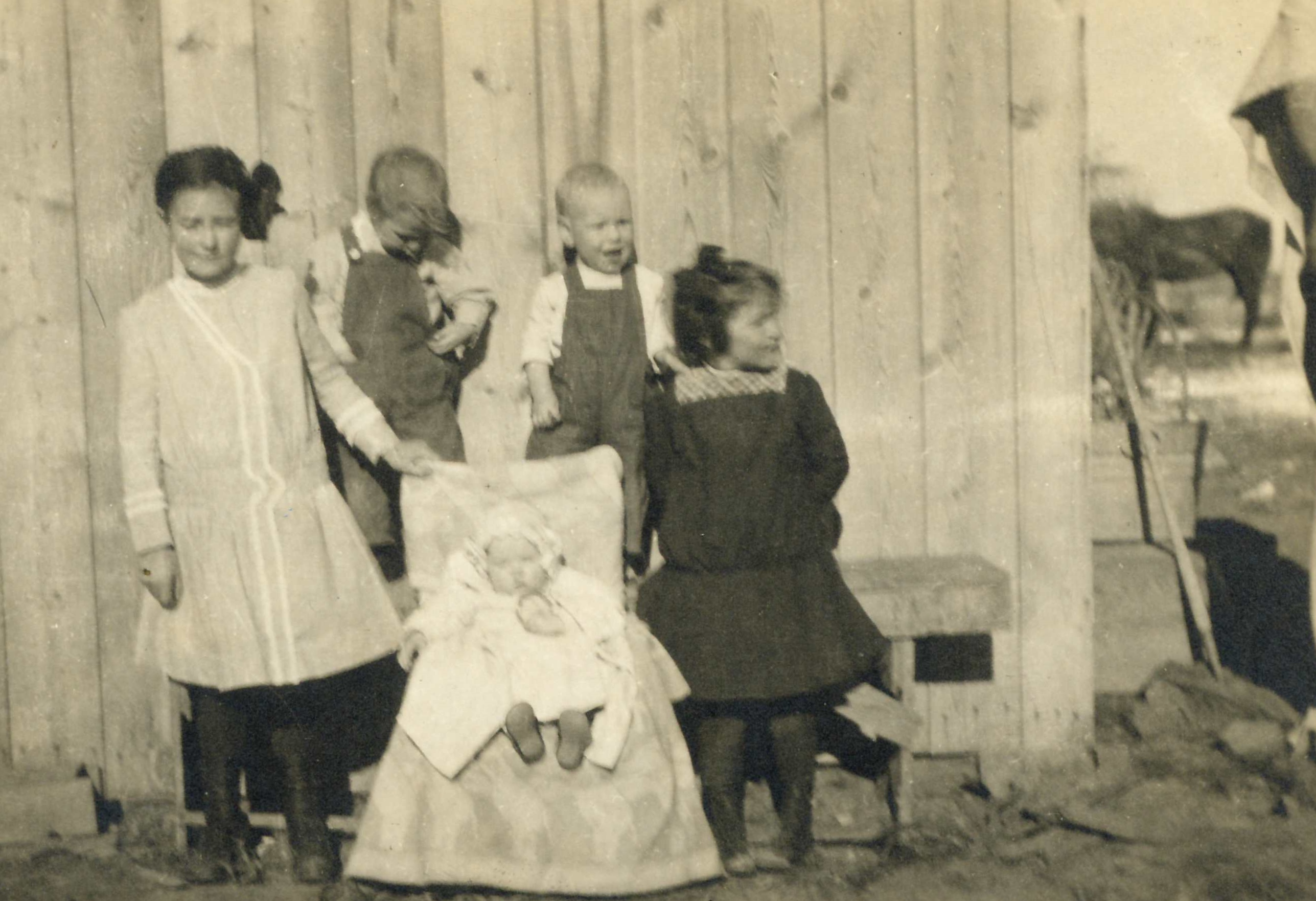
“Jess Nipper’s children”
However, this photo reads, “Jess Nipper’s Kids, he was married to Grandma Williams’ sister Pearl” and from that I conclude Jess is someone else. There is a Jesse Franklin Nipper, born 10 October 1887 in Cleveland, Bradley, Tennessee and died 8 January 1967 in Twin Falls, Twin Falls, Idaho. He is the uncle to Sterling Dewey Nipper. He married Pearl Lulu Ownbey, born 20 November 1887 in Custer County, Idaho and died 9 March 1930 in Buhl.
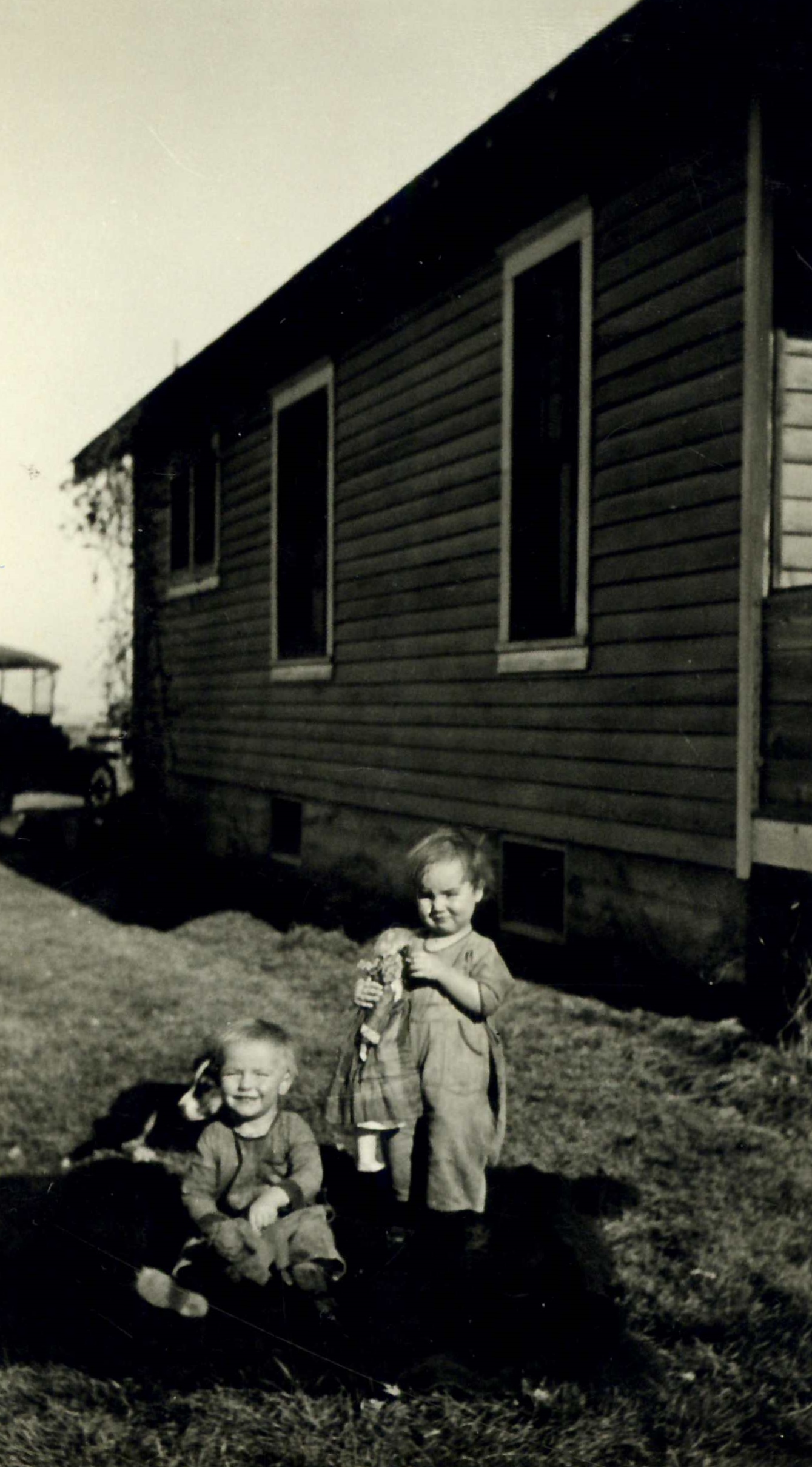
Jess Nipper’s kids
With the information on that photo, I found a sister to Pearl Lulu Ownbey named Ethel Gertrude Ownbey born 15 August 1886 in Green Forest, Carroll, Arkansas, and died 1 May 1967. She was married to Solomon Walker Williams born 27 October 1879 in Sevierville, Sevier, Tennessee, and died 22 April 1958. Therefore, all the names and references seem to add up so I am confident I have the right people. Unfortunately, none of the children are named and the records I am looking at do not show any deceased children. They could all very well still be alive out there in the world somewhere.
I thought I would write on my Great Grandfather’s brother in anticipation of his birthday, he would be 125 this year. Growing up, I never knew of Uncle John Nelson Jonas likely because nobody in my family ever knew him. He passed away at the ripe age of 30 in 1918, a victim of Influenza. The family knew of his widow as she lived on Main Street in Richmond, Cache, Utah and associated with their children. Since I have some pictures of his family, I thought I would make them available. My Great Grandfather Joseph Nelson Jonas did not live to be much older and so personal memories of him were lost many decades ago as well.
John Nelson Jonas was the fourth of seven children born in the marriage of Annetta Josephine Nelson and Joseph Jonas 14 August 1888 in or near Ellensburg, Kittitas, Washington. He was christened 10 September 1888 at St. Andrews in Ellensburg. About 1896, John’s mother, Annie, went to the Eastern Washington Hospital for the Insane in Fancher, Spokane, Washington (she is listed as Ann J Jonas). She was in and out of hospitals throughout her life but as John was one of the older children, he would have known his mother a little better.
Annie got out of the Eastern Washington Hospital 31 October 1899 and went home to Ellensburg and continued to be a handful for the family. The family on the 1900 Census was in Cle Elum, Kittitias, Washington. Although that census does not include Annie and the census that year has Joseph Sr in both Cle Elum and Spokane about two weeks apart in June 1900. Annie must have been back in Fancher. Annie’s sister, Charlotte, visited in 1901. Due to Annie’s mental and emotional state, and with Joseph’s approval, the Jonas family went to Utah to stay temporarily with Annie’s brother, Nels August Nelson. Uncle August lived in Crescent, Salt Lake, Utah and the Jonas party arrived 3 July 1901 from Washington.
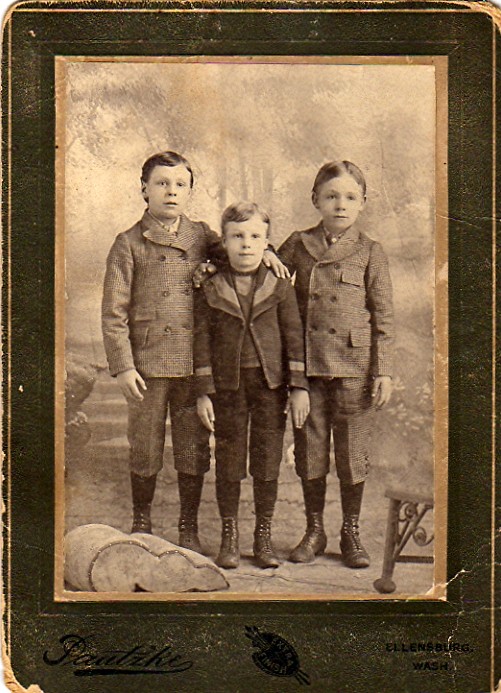
John, Joseph, and William Jonas probably right before moving to Utah in 1901. The photo is stamped with Ellensburg on the matting.
Joseph for one reason or another went back to Washington with the oldest child Margaret. Nels suggested it was legal issues; it might have just been the farm that needed attention. Annie’s issues were such that Nels and his wife, Fidelia, signed an affidavit of insanity and had her admitted to the Utah State Hospital 1 November 1901.
Joseph had been raised as a Catholic and Annie Nelson had been raised LDS. Annie decided she did not like LDS men and wanted to marry a Gentile and did so. The children were raised Catholic in Washington. Now in Utah, Uncle August made sure the children learned about the LDS faith. The three boys, John, William, and Joseph, elected to be baptized LDS on 10 January 1902 in Crescent by their Uncle August in an ice-covered Jordan River. All three were confirmed 12 January 1902 by Jaime P Jensen. Rosa joined 6 February 1902, also in Crescent under the hand of Uncle August in a hole chipped in the Jordan River. Margaret did not join as she stayed near her father in Washington.
In 1904, Rosa married a boy, Christian Andersen, from Richmond. They married in Salt Lake City, Salt Lake, Utah. They moved to 137 E 100 S in Richmond. John and his brothers resided with Uncle August until after their mother passed in 1907, then they would regularly and for prolonged periods stay with Rosa in Richmond. William and John were both ordained Elders 6 January 1908 in Crescent. In Richmond, both were again ordained Seventies 19 September 1909 by Charles Hart (1866 – 1934, 1st Council of Seventy). John was endowed in the Logan LDS Temple 1 October 1909 and left to serve in the Southern States Mission. He left 10 October 1909, arrived at Chattanooga, Hamilton, Tennessee 18 Oct, Montgomery, Montgomery, Alabama 21 Oct, and formally starting 25 October 1909. The 1910 Census lists John at home in Crescent.
I understand John attended Brigham Young College in Logan but I don’t know any of the details of when or if he graduated. Nellie told her nephew, Ellis Jonas, that John was the only one of the brothers who could keep a level head. Just remember the source of that compliment – his wife.
John met Nellie Armina Andersen, a cousin of Rosa’s husband Christian, while staying in Richmond. Nellie and John fell in love and were married 5 June 1912 in the Logan, Cache, Utah at the LDS Temple.

John and Nellie (Andersen) Jonas
The above photo indicates it was taken in Salt Lake City at Cusworth’s Studio. We don’t know the occasion, but it must have been something to dress up for, or just a sitting for a portrait. Either way, the photo was shared with my Great Grandmother.
The wedding announcement in the Logan Republican on 25 June 1925, “On June 5th Mr. John Jonas and Miss Nellie Anderson of this place were married in the Logan Temple. Mr. Jonas is managing his Uncle’s farm at Murray, Utah. After a family reception at the home of the bride’s mother, Mrs. Armina Anderson, the couple departed for Murray where they will make their future home.”
John and Nellie had three children.
Calvin Andersen Jonas born 6 August 1913 and died 17 June 1991 both in Richmond. He married Viola Florence Chapman (1921 – 2006) on 30 March 1957 in Elko, Elko, Nevada. Calvin lived in his mother’s home until he passed away and then Viola remained in the same home until her passing. It was Calvin who took the land and created a trailer park on the rest of the property to the welcome or chagrin of Richmond. Calvin and Viola did not have any children, although Viola brought children to the marriage from her previous marriage. I last visited Viola about 2005 and Viola had her daughter Dixie living with her to take care of her, the trailer park, and their ceramic store.
Melvin Andersen Jonas born 13 March 1917 in Richmond and drowned 16 Jul 1944 in San Marcos, Hays, Texas while he was in training at San Marcos Army Air Field. Apparently he had just married Doris Everts on 17 March 1944 somewhere in Texas. It is not believed they had any children. Melvin was a lieutenant in the Army.
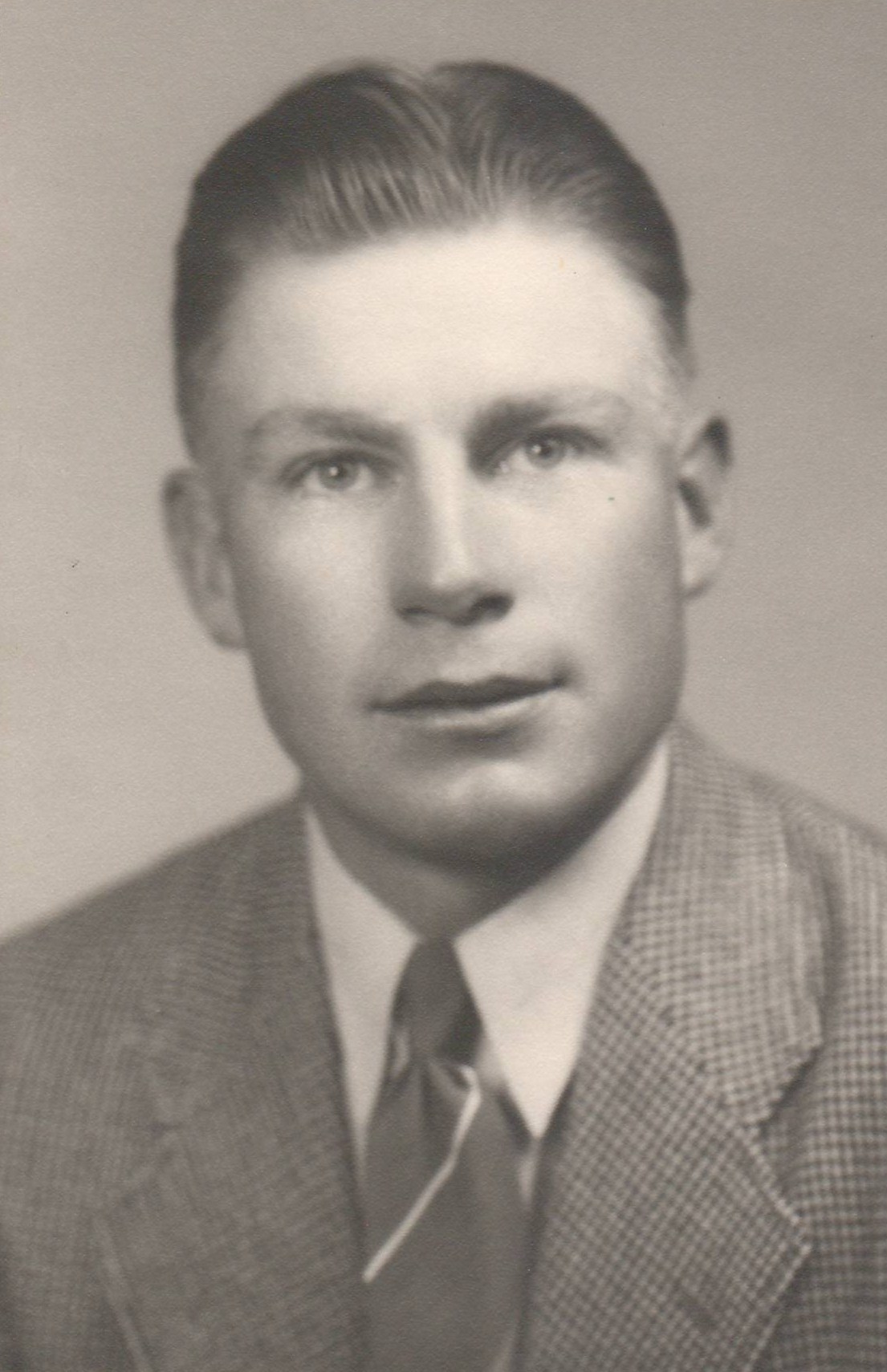
Melvin’s Portrait before leaving for the war
John and Nellie purchased a home 3 April 1917 on the corner of Main and 200 E in Richmond (now 195 E Main). The entire lot one, block 25 of Richmond City came with the home for $1,200.00. They moved in when Melvin was only a few days old. When John registered for the World War I Draft, he indicated he was a laborer at Utah Condensed Milk Company in Richmond.
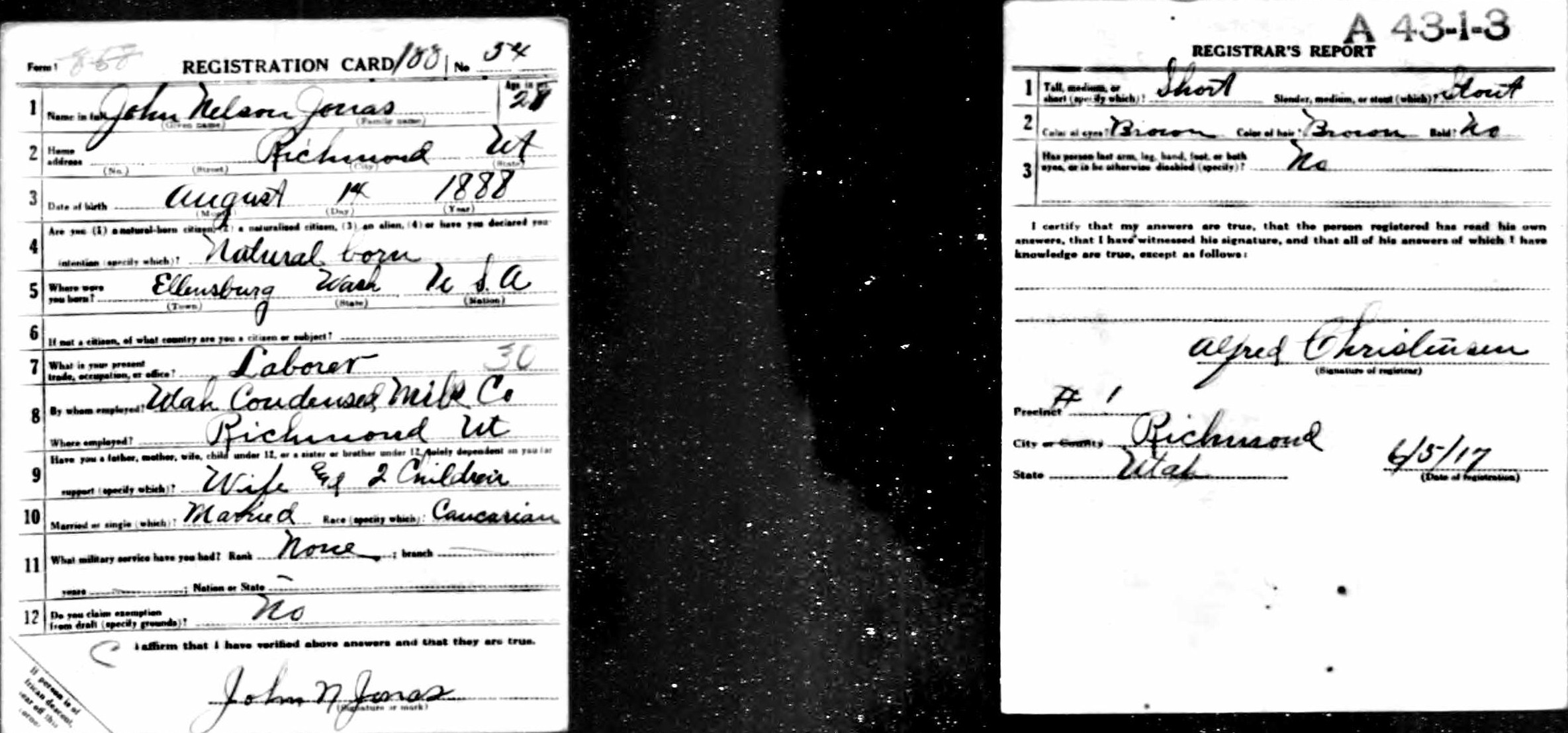
I have included a copy of the full Draft Registration. It is interesting to note John’s signature on the first page.
Nellie became pregnant and while with their third children tragedy struck. John caught the spreading Influenza virus in the epidemic of 1918 and passed away shortly before Christmas on 19 December 1918 at home in Richmond. Nellie gave birth to their last child months later.
Our cousin, Carvel Jonas wrote of John’s death, “‘Prior to 1974, 38 major flu outbreaks had been recorded, including the disastrous pandemic in 1918 which attached an estimated 500 million people, leaving 20 million dead,’ according to Science Digest March 1975. The severity of the 1918 pandemic was due to the fact that it lasted for more than 14 months; ordinary epidemics in the average community last no more than six weeks before running their course,’ quoted from ‘The Encyclopedia of Common Diseases, p 722; by the Staff of Prevention Magazine, co 1976’. Unfortunately John was one of the estimated 20 million who died.”
Carvel also writes, “Before John died he would play hide and seek with his two boys. After John died the boys thought that their father was still playing the game and would try to find him when Nellie would come home.”
His obituary in the Deseret News stated, “Funeral of John Jonas. Richmond, Dec 30 – Funeral services were held Sunday for John Jonas who died of Pneumonia, following influenza. Mrs. A. A. Thomas and W.J. Thomas of Salt Lake furnished music. The speakers were Bishop P.N. Nelson, Bishop J.L. McCarrey, and A.S. Schow. The deceased is survived by a wife and two small children and several brothers and sisters. The flu conditions have so well improved that the local health board has permitted the opening of places of amusement.”
Armina Andersen Jonas was born 5 March 1919 in Richmond and died 30 March 2011 in St. George, Washington, Utah. She married Don Farnes (1916 – 1978) 10 March 1937 in Logan. Don was gone by the time I was born, but I remember stopping to visit Armina at her home in Kimberly, Twin Falls, Idaho with my Grandma in the late 1980’s. I stopped the last time in Kimberly about 2008 shortly before she moved to live with her daughter in Southern Utah.
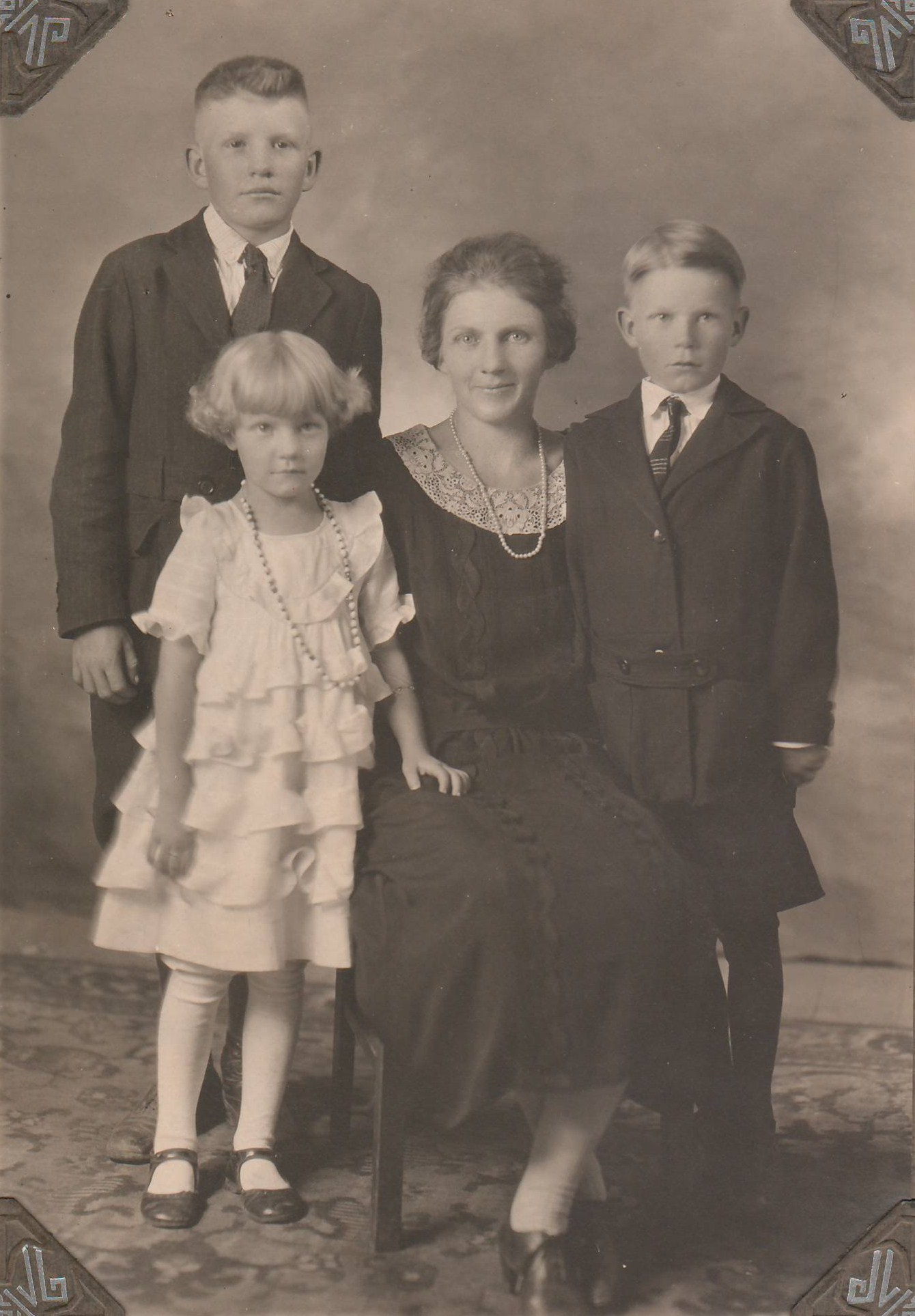
Calvin, Armina, Nellie, and Melvin Jonas about 1925
Nellie remarried to Arnold Thornley (1893 – 1969) on 14 April 1926 in Logan. It must not have been a very long marriage as very few seemed to remember him.
Nellie continued to live in their home until she passed away 11 December 1953 in Salt Lake City of myocarditis.
Her obituary stated, “Nellie A. Jonas – Richmond, Cache County – Mrs. Nellie Andersen Jonas, 64, died Friday night in a Salt Lake hospital after an operation. Born July 26, 1889 at Richmond, daughter of George and Armina Carson Andersen. Resident in Richmond entire life. Married to John N. Jonas in 1912, in Logan L.D.S. Temple. He died in 1918. Active in L.D.S. Church…” I need to get a copy of the full obituary to share it.
John and Nellie are buried together in the Richmond Cemetery. All three children are buried within a stone’s throw. John’s father and Nellie’s parents are also a stone’s throw away.
I found this biography written by Mary Louise Wanner Andra of her parents. I will write a separate history for them in the future, but I thought I would make this one available unadulterated by me (typed completely as written in the book, although I added the photo).
This biography was published in Whitney Centennial 1889-1989: Whitney’s First 100 Years. It was published in 1991 by the Whitney Ward, written and edited by the Whitney Ward Centennial Book Committee.

John George Wanner Jr Family abt 1912. (l-r): Eva, William, Golden, Serge (sitting), John, Regina, Rulon, Willard, Mary.
Our father, John George Wanner, Jr., was born in Holzgerlingen, Neckarkreis, Wuerttemberg 29 October, 1870. His parents were John George Wanner and Anna Maria Schmid. He was the oldest in the family of five boys and five girls.
His father had a small farm and some cattle. He was also a road overseer. So dad, his mother and brother and sisters did most of the farm work. They also got wood from the forest for winter fuel.
Dad’s parents were very religious people and belonged to the Lutheran church. They were very hard workers and tried to teach their children correct principles. Dad tried hard to follow in their footsteps.
His parents joined the Church of Jesus Christ of Latter-day Saints in 1891. They made sure all their children were baptized as they became of age. His parents could see that it was the only true church on the earth, and they wanted to go to America, where they could worship as they wished. They also felt it would give their children a better opportunity in life.
His parents were the only ones in their respective families who joined the LDS church. Our dad was baptized in July in 1891, and came to America with one of the missionaries – a brother Terrell who was from Providence, Utah. Brother Terrell took good care of him and helped find work for him to do and provide for himself.
Dad got a job working for brother Fred Nuffer in Glendale, Oneida County (now Franklin County), Idaho. In 1893 his father, mother, and his brothers and sisters came to Cache Valley from Germany. Dad and brother Nuffer met them with a wagon and buggy in Franklin, Oneida County, Idaho, June 18, 1893. I am sure he was happy to see his family again, as it had been almost two years since he had seen any of them.
Dad met a lovely girl from Providence, Utah, by the name of Eliza Sterling, and this relationship blossomed into marriage in 1894. They were blessed with two sons, George and Earl Wayne. This marriage was not a very happy one and they were divorced.
On the 31st of August 1898, dad married Regina Nuffer who was a sister of our uncle Charles August Nuffer. [Daughter of the marriage of Eva Katherine Greiner and Johann Christopher Nuffer] On 9 November 1899, they were blessed with twin boys, William and Willard. As time went on they were blessed with more children, a total of five boys and two girls.

John & Regina Wanner
Dad went on a mission to Germany in the fall of 1907, leaving a wife and six children. On March 8, 1908, their son Serge was born. Mother and the family were living in a home John Nuffer built for dad. It is a rock house on East Oneida Street in Preston, Idaho. This house is still standing and is in good condition at this writing – June 1979.
When Serge was a few months old, mother took all the children and had a picture taken and sent it to dad so he could see the new baby.
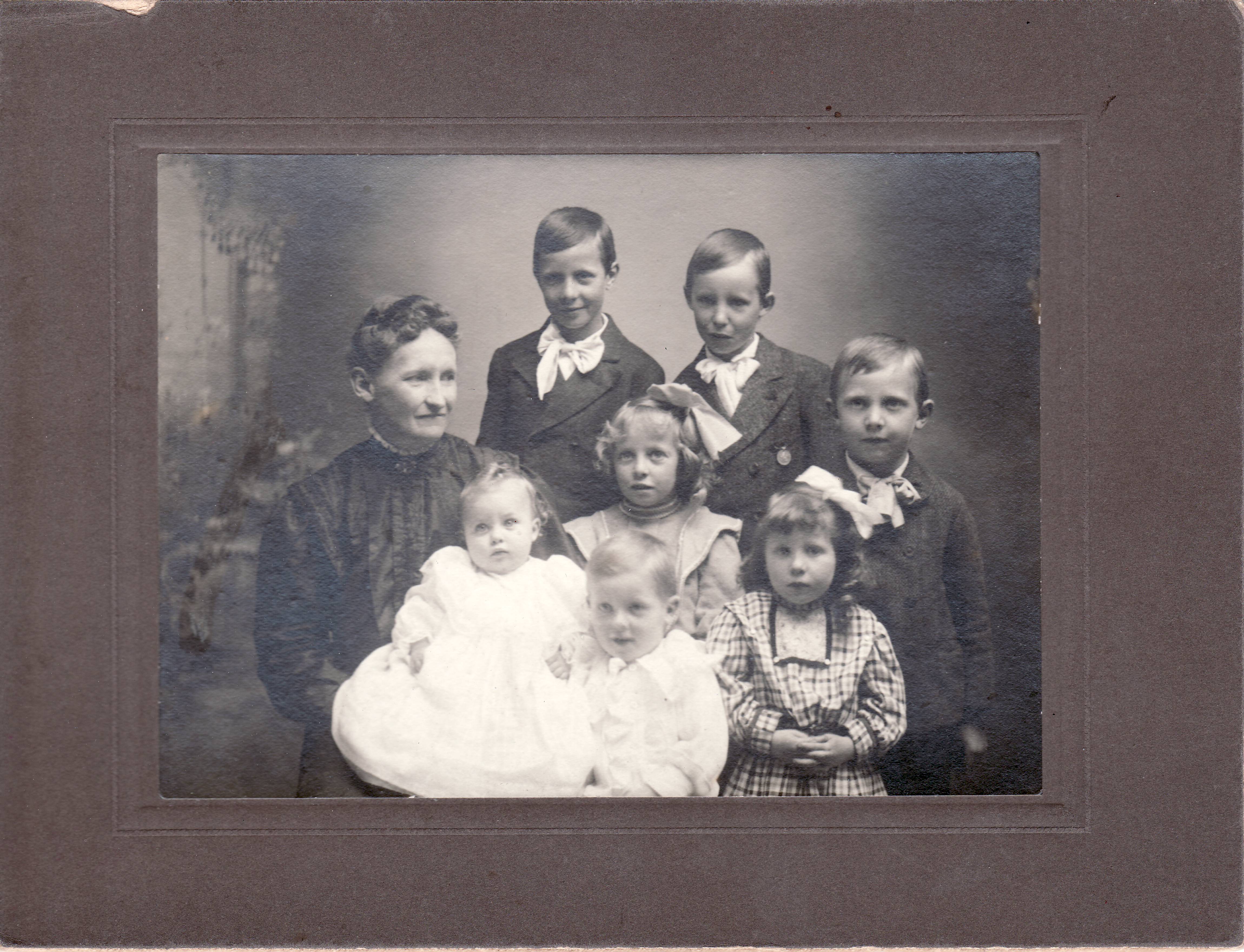
Regina with William and Willard in the back and then Golden, Mary in the middle, holding Serge, then Rulon, then Eva.
While Dad was in Germany, he met William Andra’s mother and family and baptized the eldest daughter Freda.
In 1910, Dad’s mother and father sold their home and farm in Whitney to Dad. This is the farm Lawrence Bodily now has. Dad built a red barn that is still in use on the farm. After grandpa and grandma sold their farm to dad, they moved to Logan, Utah.
In 1913 dad’s parents, brothers and sisters had a family reunion at their home in Whitney. There was a large crowd and we all had a good time.
We all had to work hard and dad relied on his daughter Mary for many hard farm jobs. However, on Saturday nights he would take us to the picture show and give us each 25¢ to spend on the show and treats.
In 1917, I begged to take the sewing class at the USAC in Logan, as I wanted to learn to sew. However, I was only there a short time when dad brought me home to work on the dry farm. I have always felt bad about this as I wanted to learn to sew.
My brother, William, enlisted in the Army on August 5, 1917. He was with the 145th Light Field Artillery, Battery C. He left Salt Lake City for Camp Kearney on October 11, 1917. He left for France August 2, 1918. William contracted the influenza and died December 1, 1918. His body was brought home November 11, 1920, and interred in the Whitney Idaho Cemetery.
Just a few days before they got the sad news of William’s death, their son, Golden, died November 26, 1918 in Salt Lake City from Influenza.
On January 8, 1921, dad sent his son Willard on a mission to New Zealand.
Dad and mother were to face still more sorrow when their son Rulon died February 26, 1924, in the Logan hospital.
Dad believed in missionary work with all his heart and soul and on December 15, 1925, he went to Tennessee on a six month mission.
In 1928, Serge went to New Zealand on a mission and died there October 5, 1929. His body was brought home for burial. The funeral was held in the old opera house in Preston, Idaho. These were trying times for our parents. Losing four sons, and all their bodies returned home in a box. This left them with only one son and two daughters.
On April 7, 1930, dad sent Eva on a mission to California. Dad was not a stranger to hard work. He raised crops and took good care of his farm animals. He took pride in having things looking neat and clean around the farm and yard.
When Dad operated his farm in Whitney, he was always up early in the morning and usually was the first to get to the beet dump in the morning. The story is told about some of his neighbors who decided to beat him to the dump. They got up extra early to get a head start. Before they got to the beet dump, they could hear George Wanner going down the road ahead of them. They could hear him saying to his horses, “Gid up–gid up–gid up.”
When dad sold his farm in Whitney, he purchased 40 acres nearer to Preston and built a beautiful home on it. Part of it is where the Oakwood School is now located. When he retired he sold his farm and home to his daughter Mary and her husband William Andra.
Dad was successful in the various undertakings he engaged in. He was one of the first in Preston to have an automobile. When he brought it home he did not know how to stop it. He yelled “whoa” when he got in the garage, but before he got it stopped he had gone through the end of the garage.
Dad built the two little homes on the west side of second east and first south in Preston, Idaho. He also built three homes on first south and the south side of the street in Preston. Dad and mother lived in one of them until she died in 1942. Mother was ill for quite a while before she passed away. Dad cared for her the best he could and would take her for little rides in the car. She was unable to walk and dad would carry her on his back from place to place as they went visiting.
As many of you will remember, there was a humble side to dad. I have seen him cry when bearing his testimony and when he was grieved over the death of a loved one, a relative, or friend. He wanted to leave this world a better place than he found it, and I feel sure he made some contributions and brought this desire to fulfillment.
After mother died, dad remarried and went to live in Salt Lake City, Utah. This marriage was not successful and they were divorced. Later on he remarried again and was living in Florida. He became ill and wanted to get back to Preston. My son William went to Florida to bring him home, but when they got to Chicago, he was too ill to go on. So, William put him in the hospital where he passed away on January 5, 1947.
Regina Nuffer was born January 26, 1869 at Neuffen, Germany, a daughter of Johann Cristoph and Eva Katharina Greiner, she came to Utah with her family after they were converted to the gospel. She married Jacob Scheibel July 15, 1889, in Pleasant Valley, Carbon County, Utah. Her first child, Alma Katherine Scheibel Naef, was born, September 27, 1889. When her child was six months old, she and her husband separated and she moved back to Mapleton, Idaho, where she stayed with her parents on their farm. During this period, she would help people when they were sick, and her mother would take care of her child.
In about 1893, after the death of her mother, she moved to Weber County, Utah, and worked for the Will Taylor family in Farr West and the Bowman family in Ogden. She again returned to her father’s farm. On her way home, she stopped in Logan and walked out to Providence to visit a friend. While eating lunch, she happened to think that she had left her new coat on the train. She went back to Logan to the train station and they sent out a tracer. In a few days she got her coat back. After returning to Idaho, she worked for several people in Franklin and Preston. She lived in one room of her brother John’s home in Preston. Her brother was on a mission in Germany at the time.
On August 31, 1898, she married John George Wanner in Logan, Utah. That winter she lived on his ranch in Worm Creek or Glendale, Idaho. In April she moved with her husband, daughter, and step son, Wayne, to the Bancroft flat, a little west of where Grace is now.
She was known as a fine, well mannered woman. Her niece, Athene Hampton, said that toward the end of her life her health was not very good and she had a hard time speaking. When Athene and Louisa Nuffer would visit, they would converse by writing notes to each other. She died on March 10, 1942, in Preston, Idaho. Her funeral in Preston was very well attended.
 Sagacity