I spent some time going through some old digital pictures. I stumbled upon a couple of these I thought I would share. I was still living in Springfield, Virginia, and working in Washington, District of Columbia, at the time. Amanda came out to visit early December. We were engaged to be married later that month back in Utah. I took her to a couple of the sites of the District while she was there.
U.S. Capitol, Dec 2005
Even today, these photos evoke the feelings that these buildings, symbols of our nation, laws, and republic, are designed to conjure from deep within the soul.
Amanda and Paul Ross at U.S. Capitol
We also made it over to visit the Lincoln Memorial.
Paul and Amanda Ross with Abraham Lincoln (in scaffolding) in 2005
The obligatory photo with the Washington Monument and U.S. Capitol in the background.
Amanda and Paul Ross with Washington Monument in background 2005 from Lincoln Memorial
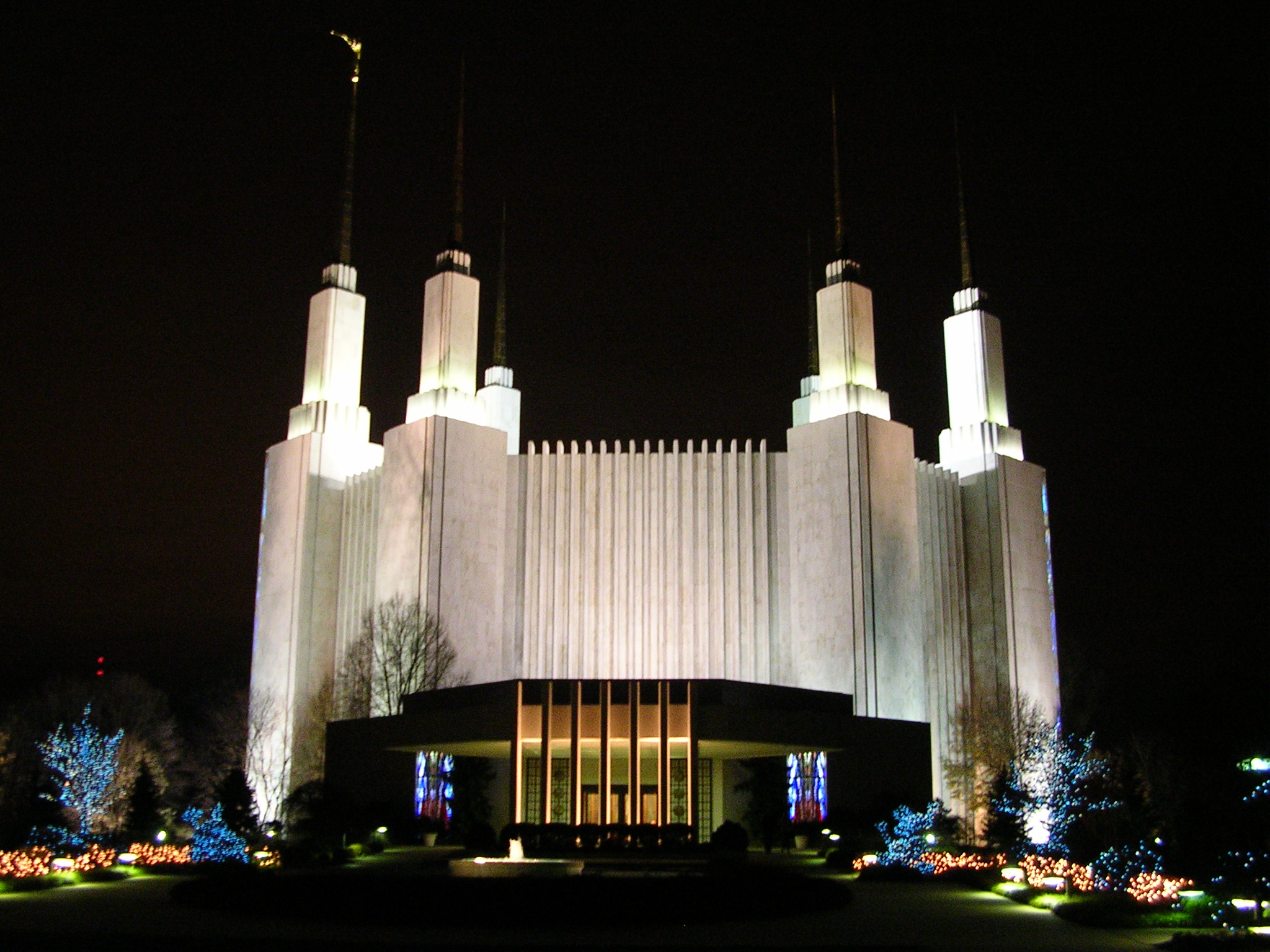
You cannot go to Washington in December and not stop and see some of the popular Christmas light destinations! The Washington D.C. Temple is one of those sites, but some of the lights shut off by the time we took our photo. It was getting late.
Amanda and Paul Ross at Washington D.C. Temple in Kensington, Maryland
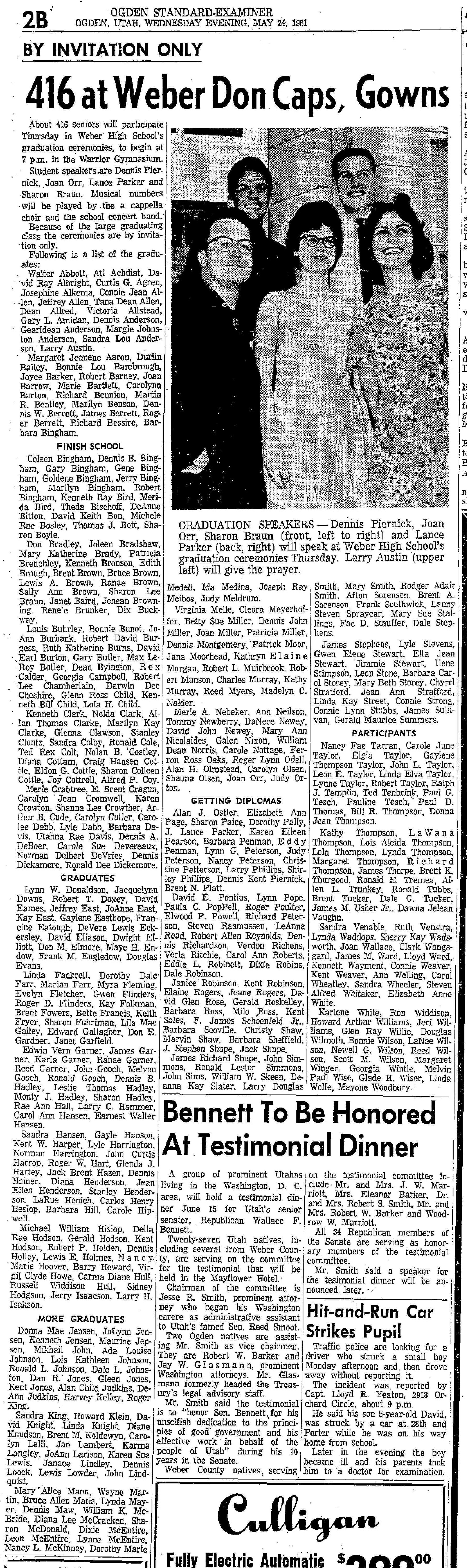
My father, Milo Paul Ross, graduated from Weber County High School 25 May 1961. A bond was passed in 1926 to build a county high school and construction began that same year and completed the next. The photo above is from 1927. The high school had an addition in 1953-1954. Weber County High School was located on the east side of Washington Boulevard between 11th and 12th Street. Weber County built a new high school in Pleasant View in 1972. The old building was abandoned and apparently tore down in the 1980s. Attached is the sketch that came with Dad’s Diploma.
West Weber County High School
Milo Ross Diploma from Weber County High School in Ogden, Utah
I will not be sharing his transcript as the Diploma indicates is/was attached. As Dad mentioned, he did not get to take any electives since he was retaking classes. GPA of 2.00, 359 of a class of 415. The newspaper indicated there were 416.
I am also attaching a copy of Dad’s Certificate of Graduation from Wahlquist Junior High School.
Milo Paul Ross Certificate of Gradulation from Wahlquist Junior High School in Ogden, Utah
Both Diplomas include the name of T. H. Bell, which caught my attention. Terrel Howard Bell (1921 – 1996) might ring familiar to some as he was an Education Secretary under President Reagan. Terrel graduated from Lava Hot Springs in 1940, from Albion State Normal College in 1946, and Superintendent of the Weber County School District from 1958 to 1962. Which is why his name shows on both of these Diplomas.
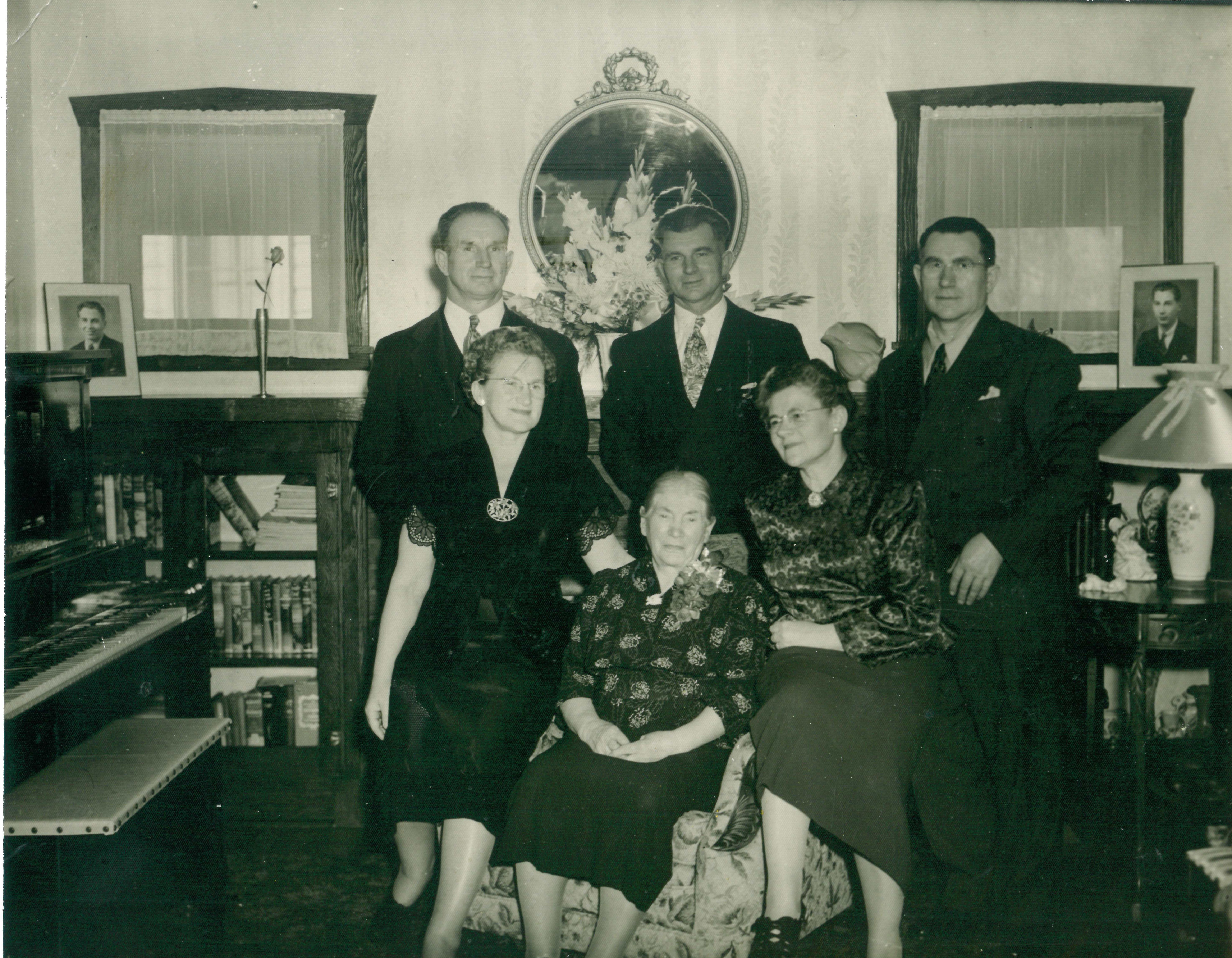
History written by Frieda Andra. I previously shared the history of coming to America compiled by Deanne Yancey Driscoll. I understand this is the Boettcher family, not the spelling Frieda uses in the history.
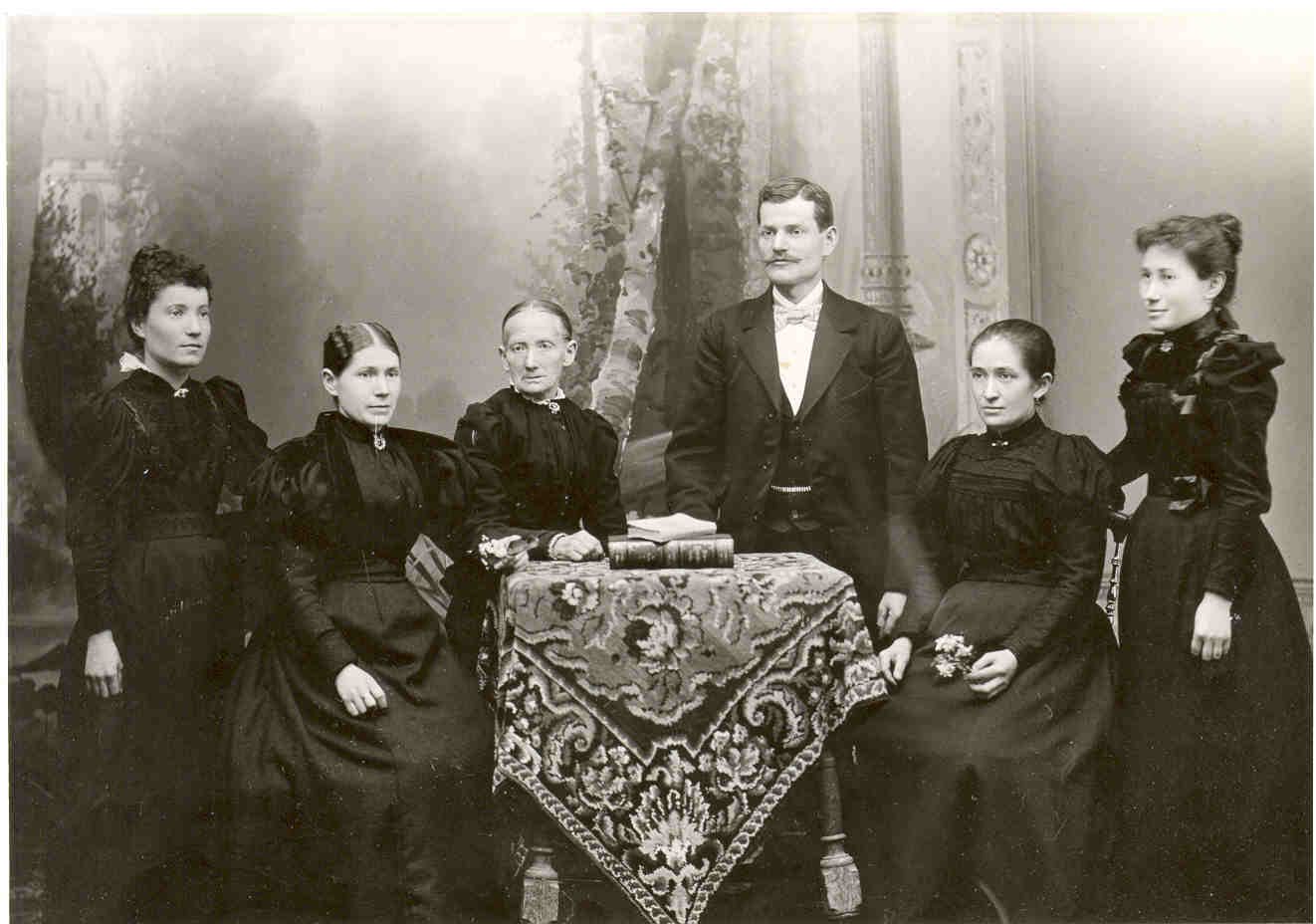
Otto, Wilhelmina, Walter, William, Frieda, Clara Andra in 1907
My story begins in the old country – in Germany. My father, Friedrich Theodor Andra, died November 23, 1902, in Meissen, Sachsen, Germany. Mother, Wilhelmine Christina Knauke Andra, was left with five children, ranging in age from six months to nine years. The children’s names were: Frieda Minna, Walter Theodore, Wilhelm Friedrich, Clara Anna, and Otto Carl. My poor mother had to struggle to support us. She did small jobs at home and we children helped. I worked here and there to help along.
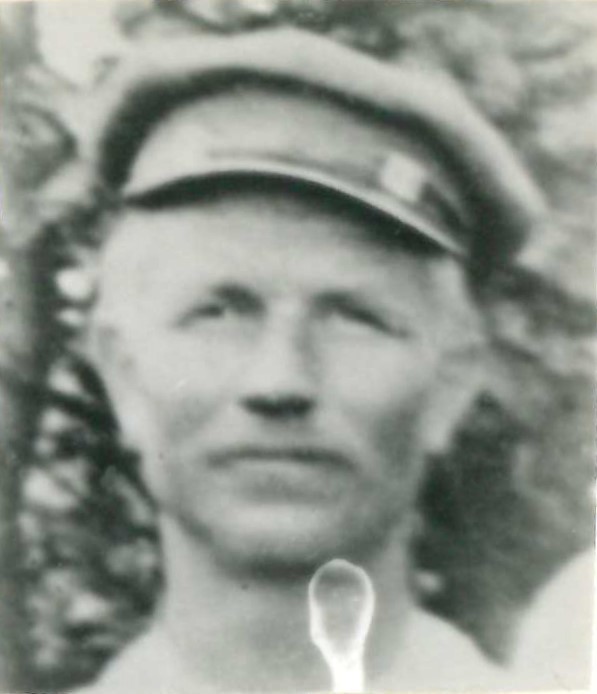
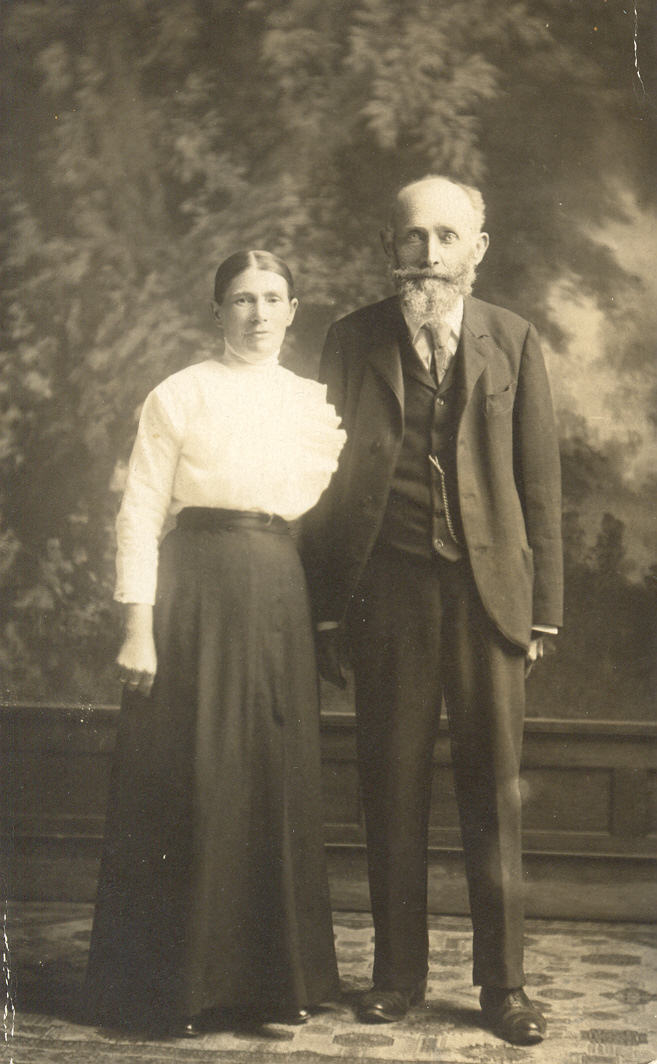
Theodor Andra
Three years later, while we were in the forest picking berries, Mother met a lady named Mrs. Bottcher. Mrs. Bottcher told her about some Mormon missionaries who were holding some meetings. So mother began attending the meetings. One by one we all joined the Church. Years later, after we were all baptized, mother invited the missionaries to our house. She fed them and let them hold their meetings there. However, the Lutheran pastor didn’t like it, particularly because Mother was a widow, and he gave her a very hard time.
Amalia, Christiana, Wilhelmina, Herman, Anna, and Klara Knauke
In 1909 the Bottcher family decided to go to America. Mother asked them if they would take her son, Willie. They agreed to do this. Mother gave them the money for Willie. When they arrived to Salt Lake City, they attended the German Meeting in the Assembly Hall. After they had been in America half a year, they sent Willie to do farm work for a man they had met at the German meeting. They didn’t even know where the farm was nor did they care. When they wrote to Mother, they said Willie was lost. When Mother told the people in Germany that her son was lost in America, they called her names and told her she was wicked to have let him go. But all the time God knew where Willie was. He was opening the way for us to go to America. Mother prayed to our Father in Heaven for her son’s safety and that she might be able to find him again. Her boss, Conrad Zinke, sent telegrams trying to locate Willie, but was unsuccessful.
Bill, Frieda, Otto, Christiana, and Walter Andra
One morning Mother was on her way to work when a light shone about her, and she heard a voice say “Go to America.” When she told her boss, he said he’d be glad to help her all he could. When he asked her if she had any money, she answered, “Very little.” He was so kind. He sent a man over to help pack, get the tickets, and get the money he’d given them exchanged for America currency. They gave us a big going-away party in the villa. The farewell dinner was held in their most beautiful room. They cried and hugged us as the said their good-bye. Our friends gave mother the rest of the money se needed to make the trip. Even my boyfriend, Mr. Knorr contributed. Grandmother Wilhelmine Richter Knauke and Aunt Augusta were at the depot to bid us farewell. They really thought Mother was foolish for going to America. They didn’t realize my mother had been inspired to go. She knew God would guide her if she were faithful. God in Heaven surely did guide us all the way to America. Glory be to him in the highest for all the wonderful blessings we have enjoyed.
William, Frieda, Christiana, Otto, Clara, and Walter Andra
Christiana Wilhelmina Knauke Andra Wendel
We left to America on the 5th of May in 1910. We traveled by train to Bremer Hafen. There we boarded a streamer: The north Deutcher Loyd. For two weeks I was terribly seasick. When we reached Philadelphia, the red salt was unloaded. Everybody was very kind to us there and people gave us money. The cook, who had become a good friend of mine, bought me a ring but my sister Clara insisted she wanted it, so I got the locket he had bought for her. Then we traveled to Galveston, Texas. When we arrived there, we freshened up and then my friend, the cook, showed us the town. He bought us some bananas, which we had never eaten before. We swallowed the chewing gun whole, as it was also strange for us, and then we all got stomach aches. We certainly enjoyed the cook. He was always kind to us and saw that we had good food to eat. Another fellow gave us a cake. When our train was due, we had to say our good-bye to these fine friends. It was quite rough on the train. We couldn’t talk much so we just enjoyed the scenery. Many funny things happened.
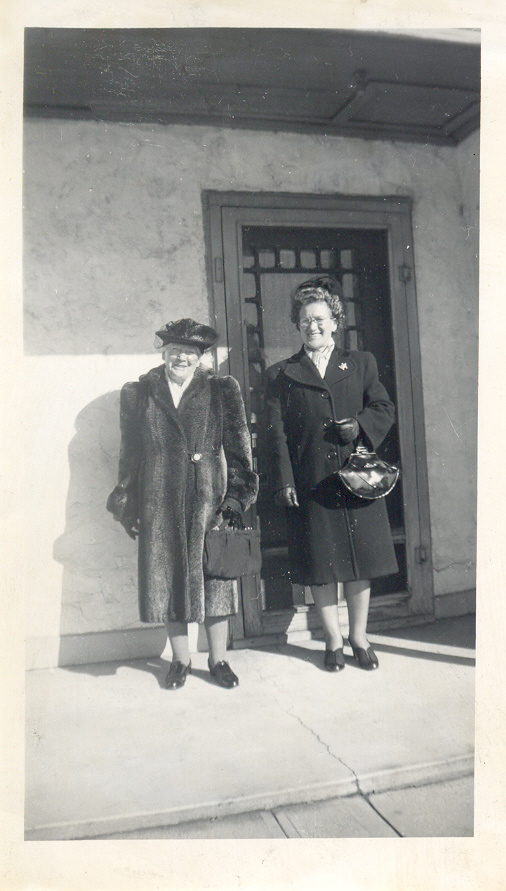
Wilhelmina Christiana Knauke Andra Wendel
After we arrived in Salt Lake City, we hired a hack, which is like a buggy but much nicer. The driver sits up very high. We couldn’t locate the Bottcher’s so we went to the L.D.S. President’s (John F. Smith) residence where their daughter Ida worked. Ida was so happy to see us. She sent us to her sister Clara’s. After visiting there, she gave us her mother’s address and we left to look for it as it was getting late.
Otto and William Andra, Unknown
Although we had come to America in the hopes of finding my brother, Willie, whom the lady had reported as lost, I know our coming to America was God’s plan. Our Father in Heaven works in a mysterious way, his wonders to perform. Our driver kept driving toward the address we had given him. As we came to 9 West and 4 North, he turned. This country was so different to us. Then Mother saw a little boy coming down the street and we stopped to ask him directions. Then Mother shouted, “That is my boy!” And sure enough, it was our brother. He couldn’t speak German. He just stood there trembling and pointing to where the place was. We all jumped out and hugged him. He had been on his way to the depot to meet our train. Mrs. Bottcher had told him we were coming when we had returned from Fairview where he had been working for that man. Two blocks away lived the lady we had been hunting. So we paid the driver $3 for driving us around all day. When we knocked at the lady’s house, she refused to let us in. For her excuse, she said, “Keep your things out there. I don’t want any lice in the house.” Of course, we knew we didn’t have lice, but we sat outdoors on some lumber, and she bought us a piece of bread and a drink of water. Her home was filthy. There was a pig in the house and the chickens were running in and out. What an awful place! When Mr. Bottcher came home, he invited us in and fed us.
John & Christiana “Mina” Wendel
Then the Sister Rigler came and said, “Come. There is an empty house you may stay in. I will give you a couple of blankets and a lantern.” It was about eleven o’clock by now and we were all very sleepy. We were even to tired to look around the house. We all slept soundly, grateful to have our brother Willie with us again. His hips were bleeding, and his feet were sore and bleeding also. He had not been cared for, only given a lot of cussing and lickings.
John & Christiana Wendel
In the morning we looked around the house. This house had been flooded during the time that the Jordan River had flooded this area. It had left dirt throughout the house. There were no windows. Outside there was a nig barn, and flowing well, and four large trees (Poplars). It was a beautiful day. Everything looked very green. Mother called us together to have our morning prayers. She thanked our Father in Heaven for all His goodness and for providing us with this home, which would be our paradise. We were so thankful to be in America. I have never heard a more inspiring prayer of life. The next morning Mrs. Rigler came back and told Mother who owned the house. We made arrangements to rent the house for $2.50 a month. Then Mrs. Rigler took Mother to town on a streetcar to buy a stove, just a small one, washboard, washtub, dishes, food, pans, and a dishpan. While Mother was gone, we scraped the dirt out. Sister Rigler bought glass for the windows and even helped Mother put them in. Walter made a cupboard from some lumber he found. We used orange crates for chairs. We were very busy that Saturday. Then on Sunday we attended Sunday School. The people were all very kind to us.
Christiana & John Wendel
We had arrived June 3. On June 5 I got a job for $5 a week plus rom and board at the boarding house. On June 6 Walter found a job at the flour mill (Hasler’s). He boarded with Mother. Willie worked at a slaughterhouse, so we were able to get meat to eat – tails, liver, etc. It was very good. Mother bought Willie a small red wagon which he took to market and bought home food we had never seen before. The cantalopes made us sick. We ate the corn raw, which didn’t make us feel any better. It wasn’t long before we learned which foods to cook and which food to eat raw.
Christiana and Frieda
Well, it wasn’t long before our little house was a cute little dream house, complete with furniture and curtains. Soon we had some baby chicks, a dog, and cat. Oh, those wonderful, happy days in a very wonderful country which was given to us by God. God Bless America.
Frieda Minna Andra
Christiana and John Wendel
P.S. On Sunday, June 20, 1965 we saw our old home – this very one we had immigrated to on June 4, 1910. The house had now been covered with shingles on the outside. The barn has been moved and the well is no longer there. It was such a joy to see this home we used to live in.
Salt Lake Temple, Revelations 14:6, And I saw another angel fly in the midst of heaven, having the everlasting gospel to preach unto them that dwell on the earth, and to every nation, and kindred, and tongue, and people,
This is an insightful article that came out with the Spring 2021 Clark Memorandum. I found myself enlightened by the introspection suggested. Enough that I was moved and want to share it with others. The author is Melissa Wei-Tsing Inouye, Senior Lecturer, University of Auckland, and Historian, Church History Department of The Church of Jesus Christ of Latter-day Saints.
Recently President Russell M. Nelson has called on the Latter-day Saints “to lead out in abandoning attitudes and actions of prejudice” and has pleaded with us “to promote respect for all of God’s children.” Additionally, President Dallin H. Oaks has challenged us to “root out racism.” These directives make some things very clear: We are part of the problem. We wouldn’t have to abandon “attitudes and actions of prejudice” if we didn’t have them already. And uprooting will be a long, hard project. I offer three perspectives I hope my fellow Church members will find helpful. First, the problem of racism is a social reality that affects all human beings. Second, the restored gospel provides us with tools and frameworks for dealing with racism: confess and forsake and turn weaknesses to strengths through humility. Third, we all need to ask the Lord, “What lack I yet?” How do we get to work?
1. We All Have Blind Spots
As an Asian American growing up in diverse Southern California, I rarely felt the sting of racism. Now that I live in Utah, I notice racism much more frequently. Some of my friends and family have experienced ugly, malicious barbs, but the racism I most frequently encounter in Utah is in the form of condescension. White people compliment me on my English. In other words, when they see me, they assume I am foreign and I don’t belong. Then they hear me, and they are surprised. Then they decide to tell me about this surprise: “Oh, you speak English very well!” They don’t say, “I hate Asians,” but their words say, “I consider people who look like me to be ‘normal’ and expect people who look like you to be ‘different than normal.’”
One BYU student, whose family emigrated from Uruguay and who, along with all of her siblings, has fair skin and blue eyes, reported that, in their new Utah ward, someone came up to her parents and said, “Oh, look, the Lamanite curse is already coming off from her! You must be blessed!” Sometimes the racism is about as explicit as it gets, like the swastika and racial slurs that appeared recently on a fence along the bike path my children ride to school.
Biologically speaking, racial categorizations have no basis in objective reality. They are figments of the human imagination and are an example of our weakness for sweeping generalities. Humans beings share 99.9 percent of their DNA with each other. Skin color, eye color, and hair texture and color are a pinch of that tiny 0.1 percent of difference that people arbitrarily use to make consequential guesses about each other’s hearts, minds, capacity, safety, and so on. We might as well link judgments about intelligence to people’s earlobe shape or language-learning ability to toe circumference. Yet over and over again, in every place, many people treading the same crooked ways for centuries creates ruts so deep and so wide it is hard for them to imagine other paths. As President Oaks has said, “Racism is probably the most familiar source of prejudice today, and we are all called to repent of that.” “All” means you and me. I have become increasingly aware of the perpetual need to work hard to not be inadvertently unkind as I have lived in places such as the United States, Germany, the People’s Republic of China, Taiwan, Hong Kong, and New Zealand. No one is immune to prejudice because no one can spend their life becoming embedded within every place and human circumstance in this wide world.
When I moved to New Zealand to take an academic position at the University of Auckland, I had some rough patches in my interactions with students and fellow professors. I discovered that the cultural traits Americans see in themselves of being friendly and optimistic can come off to New Zealanders as shallow and transactional, especially when the American (me) isn’t listening carefully to others around them. I remember sitting in my office when a Māori professor told me, kindly but candidly, how I had completely ignored his expertise and failed to acquire the level of cultural competence necessary for a university event I was planning. I remember thinking, “What do you mean I’m disrespecting people from marginalized groups? I’m Brown! I’m a woman!” Because of my past experiences receiving racism and ethnocentrism, I thought I was “exempt” from perpetuating them. But I was wrong.
Rooting out racism is a process of becoming aware of our blind spots and our great power to cause harm to others, especially to others on the margins. Unfortunately, unlike a pack of manufactured Toyotas and Fords on a highway, human blind spots are unique and change depending on who is around us. In the worst-case scenario, our cars are so big and heavy and fast that we don’t even notice when we knock small cars or pedestrians off the road.
Where are your blind spots? If you don’t know, you haven’t been looking.
2. The Racism in Our Past and Present Need Not Be in Our Future
Latter-day Saint theology explains that we came to mortal life, with its hardship and temptation, in order to learn and grow. Making mistakes and repenting is part of the plan. We have to be careful: a sin like racism is toxic enough to kill us spiritually. In the past, we have been affected by this illness. But if we heal from it, we can become stronger.
When I was experiencing cancer recurrence for a second time, some friends put me in touch with Dr. Mark Lewis. Even though he had never met me before, Dr. Lewis was kind enough to call to discuss my treatment. In the first few seconds of the call, he mentioned that he, too, was a cancer patient. He said, “I just had a scan the other day, and I’m waiting for the results.” In that moment, my confidence in Dr. Lewis took a giant leap.
No matter how knowledgeable, a doctor who has not had cancer cannot understand what it is like to feel in your body the pain, the shortness of breath, the needles and tubes and powerful medications, what it is like to walk past the open door of death on your way to the kitchen. Discovering Dr. Lewis was a cancer patient made me instantly trust him.
On a spiritual level, it is also true that some of the greatest healers are those who have known illness. Kylie Nielson Turley’s study of the Book of Alma points out that we have tended to see Alma’s story as the familiar tale of a rebellious teenager who eventually mellows out. However, the term “Alma the Younger” actually never appears in the Book of Mormon text. This label, along with some other things, has led us to believe he was young and rebellious. But Turley’s study shows it is actually probable that he was a mature adult, perhaps even in his 40s or 50s, when he repented and was born again. Alma may have been a full-fledged bad guy. But he became converted and began calling people to repentance. Because he had personally experienced the corrosive effects of sin, he had powerful authority to call others to repent.
This gives new meaning to Alma’s teaching about Christ: that He would
go forth, suffering pains and afflictions and temptations of every kind; and this that the word might be fulfilled which saith he will take upon him the pains and the sicknesses of his people. . . . [A]nd he will take upon him their infirmities, that his bowels may be filled with mercy, according to the flesh, that he may know according to the flesh how to succor his people.
According to this passage, Christ inhabited our infirmities in order to understand how to heal us. It wasn’t enough for Jesus to stop up others’ wounds and lift others’ sorrows. It was necessary for Him to feel wounds in His own flesh, to experience despair and injustice and life gone horribly wrong.
In summary, patients make trustworthy doctors. Repented sinners make compelling prophets. The experience of mortal weakness is what turned the popular rabbi Jesus into the Savior of all. We believe suffering from mistakes in mortality is necessary for growth and for becoming as God is.
Our imperfections on this issue of racism and prejudice are clear to anyone who studies Latter-day Saint history. The Church’s essay on race and the priesthood states:
In 1852, President Brigham Young publicly announced that men of black African descent could no longer be ordained to the priesthood. . . . Over time, Church leaders and members advanced many theories to explain the priesthood and temple restrictions. None of these explanations is accepted today as the official doctrine of the Church.
These “theories” and “explanations” by Latter-day Saint leaders and members included the idea that all Black people were descended from Cain and inherited the curse God placed upon him in the Book of Genesis; the teaching that interracial marriage was sinful, akin to letting a “wicked virus” into your system; and the notion that Black people were less valiant in the premortal life. Some who promulgated these theories also made other painful claims that Black people were “uncouth, uncomely, . . . wild,” and inferior to White people.
These statements, which sound so ugly to us today, reflect to a great extent the social and cultural assumptions with which these Latter-day Saint leaders were raised in 19th and 20th-century America. Comparable statements to those of Church leaders in the past were made by the great American president Abraham Lincoln and many others. In the same year that Bruce R. McConkie first published Mormon Doctrine, a popular book containing numerous theories and explanations, the Virginia couple Mildred and Richard Loving were arrested (and eventually sentenced to one year in prison) because their marriage violated a law banning interracial marriage in that state. At the time, similar laws existed in 24 other states, including Utah. No one is immune to culture. We must have empathy for those whom the passage of time turns into moral strangers, because someday, surely, those people will be us.
But significantly, as historian Paul Reeve has pointed out, throughout the 19th and 20th centuries there were people, including Latter-day Saints, who had done the intellectual and spiritual work to see beyond the evils of their day and cultivate knowledge of other people’s humanity and divinity. Over the course of his tenure as president of the Church, Joseph Smith evolved from supporting the enslavement of Black people based on Biblical passages about Canaan—a common Biblical interpretation of the day—to asking how the United States could claim “that all men are created equal” while “two or three millions of people are held as slaves for life, because the spirit in them is covered with a darker skin than ours.” During his presidency, Black men such as Elijah Able and Walker Lewis were ordained to the priesthood as elders and represented the Church as missionaries. In Nauvoo, Joseph and Emma developed a close relationship with Jane Manning, a Black Latter-day Saint. Jane lived and worked in their home, and at one point Joseph and Emma invited Jane to be eternally sealed to their family through adoption. Jane’s own words reflect her esteem for the Prophet, which must have in some part reflected his esteem for her. “I did know the Prophet Joseph,” she later testified. “He was the finest man I ever saw on earth.”
In the early 1850s, the apostle Orson Pratt opposed legalizing slavery in Utah and supported Black voting rights. “[T]o bind the African because he is different from us in color,” he said, “[is] enough to cause the angels in heaven to blush.”19 In May 1968, a month after the death of Martin Luther King Jr. sparked racial tensions around the United States, Hugh B. Brown of the First Presidency taught BYU students, “[A]void those who preach evil doctrines of racism. . . . Acquire tolerance and compassion for others and for those of a different political persuasion or race or religion.”
This gives us hope that we are not trapped in our cultures and times. It is possible to overcome the moral and cultural blinders of the societies in which we live. We will never escape them completely, but we can see more clearly.
Acknowledging the Latter-day Saints’ past racism is painful because it feels so wrong and because it did such harm. But, as laid out in Doctrine and Covenants 58:43, acknowledging wrongdoing is the first, essential step to leaving it behind: first, confess; then, forsake.
In this spirit, the Church’s essay on race and the priesthood declares:
Today, the Church disavows the theories advanced in the past that black skin is a sign of divine disfavor or curse, or hat it reflects unrighteous actions in a premortal life; that mixed-race marriages are a sin; or that blacks or people of any other race or ethnicity are inferior in any way to anyone else. Church leaders today unequivocally condemn all racism, past and present, in any form.
Our current Church leaders have taken increasingly bolder steps to lead out against racism. In 2018 they hosted the “Be One” celebration commemorating the 1978 end of the priesthood and temple ban and honoring the contributions of Black Latter-day Saint pioneers. In June 2020, President Nelson joined the national conversation on race in the wake of George Floyd’s death. He coauthored a joint op-ed with Derrick Johnson, Leon Russell, and the Reverend Amos Brown, three leaders of the National Association for the Advancement of Colored People (NAACP), calling for “government, business, and educational leaders at every level to review processes, laws, and organizational attitudes regarding racism and root them out once and for all.” This attention to “processes, laws, and organizational attitudes” called attention to the need for structural change.
In early October 2020, numerous speakers in general conference—including President Nelson, President Oaks, Sister Sharon Eubank, Elder Gerrit W. Gong, Elder Quentin L. Cook, and Elder Dale G. Renlund—condemned racism and presented the Latter-day Saints with a vision for a diverse, multiracial, multinational Church.
Finally, two weeks later in a BYU devotional, President Oaks delivered a comprehensive address on combating racism. Reiterating President Nelson’s recent charge to the Latter-day Saints to abandon “attitudes and actions of prejudice,” he said, “[W]e condemn racism by any group toward any other group worldwide,” and urged, “Now, with prophetic clarification, let us all heed our prophet’s call to repent, to change, and to improve.”
In asking us “to repent, to change, and to improve,” to “root out racism,” and to “clear away the bad as fast as the good can grow,” our current leaders are sending us a strong message: get rid of the bad stuff (i.e., do the work of anti-racism) and get on with the good stuff (i.e., work to establish Zion around the world).
Our leaders have made it clear that we each need to repent. Saying, “We are all good! No need for repentance here!” is disrespecting the Savior’s offer of atoning grace. We cannot “be saved in ignorance.” But if we humble ourselves and seek Christ’s help in moving forward, the errors and lack of knowledge in our past can turn to wisdom. Our stumbling because of racism in the past can be converted into eagerness to lead out in the future. Like Dr. Lewis, Alma, and Christ Himself, our memory of sickness can become a capacity to heal.
3. What Lack I Yet?
Here some might be thinking, “But I’m not racist. I don’t hate anyone.” It is a common misconception that racism means hate. Hate, along with fear, is a common symptom of racism, just like a cough or a sore throat is a symptom of covid-19. But hate is not all of what racism is.
At its core, racism is ignorance. It was ignorance that prompted those “You speak English so well!” people to say something to me—a stranger with brown eyes and dark skin—that they would not say to a stranger with blue eyes and light skin. It was ignorance that led Latter-day Saints in the past to find facile, speculative explanations for the priesthood and temple ban, like the “fence-sitters in the pre-existence” theory. The handy thing about this explanation was that it required no change in Church members’ existing worldview. The problem was that it also required ignoring Christ’s basic teachings, the second Article of Faith, the historical precedent set by Joseph Smith, and the fundamental implications of the phrase “children of God.”
Looking back at history, we wonder: How could a Latter-day Saint bishop like Abraham O. Smoot have enslaved Tom, a member of the Sugar House Ward over which he presided in Salt Lake City in the 1850s? How could the people of the United States in 1942 have approved of depriving my American-born grandparents Charles Inouye and Bessie Murakami of their civil rights, their property, and their livelihoods and imprisoning them behind barbed wire at Heart Mountain, Wyoming? In the UK, in Germany, in China, in Rwanda, in South Africa—throughout history, over and over again—we see people failing to see each other as fully human like themselves.
The frightening thing is that in all of these examples in the past, good-hearted people who strove to be morally upstanding were unaware of their stunning, reprehensible ignorance. How can we know we are not making the same mistakes?
On the score of racism, at least, history teaches us plenty of ways to avoid ignorance, if we are willing to put in the work. History can be our friend. If we study how ignorance looked in the past, we can better identify it in the present. If we can understand its potential to wound others and poison the worldviews of well-meaning people, we, as disciples of Christ, can develop the capacity and authority to heal.
Overcoming ignorance is not a simple matter of reading five blog posts and three conference talks and having a conversation with a Brown friend. We need to strive to know as God knows, see as God sees. Seeking learning that will show us the heart and mind of God involves hard work, radical humility, and perpetual self-improvement. But we believe in work, humility, and improvement. It is part of the plan.
If you do not have personal experience with how it feels to be regularly disrespected because of your skin color or how it feels to be constantly dismissed because you are a cultural minority, or if you don’t have peers outside your racial and cultural demographic, I humbly suggest you may lack wisdom.
I certainly know I do. Like me, you may need to ask for God’s help in filling this critical gap in your spiritual education. We, as Latter-day Saints around the world, have made sacred covenants to be one people, “bear[ing] one another’s burdens” and “mourn[ing] with those that mourn.” How can we keep these covenants if we ignore the burdens others bear or if we dismiss others’ mourning and deny that they have reason to grieve?
In a recent blog post, James C. Jones, a Black Latter-day Saint, explained that going out of our way for those “few” who are marginalized in society was what Jesus taught us to do. He wrote, “I’d like to go to church one day knowing that the people I worship Christ with—the same Christ who left the ninety-nine to find the one—won’t say ‘all sheep matter’ when I go to find the one.”
The fundamental equality of all before God the Creator dictates that Latter-day Saints do not dismiss others’ experiences of racism simply because we have not lived through these experiences ourselves. Jones also wrote:
Our very church is founded on the lived experience, revelatory as it is, of Joseph Smith. To devalue the lived experience of others is to desecrate the body-temple in which we all, prophet and prostitute alike, move about and understand this earthly life.
It is no sin to be born in a place where everyone looks the same, nor to be born into a culture in which certain assumptions about whole groups of people are taken for granted. But once we have grown to adulthood and come into the fold of God, which encompasses seven and a half billion sheep—all precious—we must put away the self-centered assumption that my view is always the best, my experience is universal, and it is only a problem if it is happening to me as one more childish thing.
If only I had joined the Church of Jesus Christ of Bald Generation X Asian Women Historians Raised in Orange County California, USA! How daunting is Christ’s charge in the great intercessory prayer, when He said that those who truly follow Him and testify of His divinity are those who will “be one” with each other! How daunting is the baptismal covenant given at the waters of Mormon to follow Christ! This covenant language wasn’t “we will bear the burdens of people in our neighborhood only” or “we will only bear burdens we, too, have personally experienced.”
Most people don’t think of it this way, but the most lasting outcome of successful missionary work is not having more people in the pews but inheriting more of the world’s thorniest problems. Missionary work is not about “claiming more people for our club” but about wiggling our shoulders into more yokes to pull many heavy loads.
The story of the young man in the gospels of Matthew and Mark is instructive. When the lifelong righteous, commandment-keeping, wealthy young man asked Jesus, “[W]hat good thing shall I do . . . ?” and “[W]hat lack I yet?” he was probably thinking Jesus would suggest another pious practice to slot into his “I’m-a-good-person” crown. Instead the Lord told him to give away all of his privilege. He asked the young man to seek parity with strangers at the very bottom rung of society. And the young man—who stood in front of the bona fide, miracle-working, in-the-flesh Jesus and in that instant received the Savior’s love—found he couldn’t do it. He didn’t want to do it.
The moral of the story is clear: no matter how awesome we think we are, the main question is still “What lack I yet?” (The more common question “What do they lack?” is beyond the scope of our agency.) Would we who yearn to see the Savior’s face be willing to literally stand before Him and hear Him say, “Come, follow me,” if it meant giving away our homes, our cars, our children’s college tuition fund, our dinner, our running water, our toothbrushes, and our family’s safety and becoming one with the poorest of the world’s poor? This is a troubling question. I am ashamed to say that I am not sure what I would do. But Jesus’s call to action is clear: even people who have eagerly kept the commandments all their lives may be holding something back. If we truly want to follow Him, we will dare ask, “What lack I yet?” and expect a difficult answer.
In the October 2020 general conference, Michelle D. Craig, first counselor in the Young Women General Presidency, cited the parable of the priest, the Levite, and the Samaritan (a classic blind spot story) and called on us to ask God for help overcoming our limited vision. She said: “Ask to see others as He does—as His true sons and daughters with infinite and divine potential. Then act by loving, serving, and affirming their worth and potential as prompted.”
In sum, we should stop thinking, “Racism is hate, and I don’t hate anyone, so I can sit this one out.” Instead, we should ask, “What lack I yet?” To root out racism, we must go beyond simply avoiding racial slurs or ignorantly repeating discredited theories and explanations. We must proactively seek opportunities to understand how our sisters and brothers have experienced racism and how we can start doing some things differently.
4. What Can We Actually Do?
The day after President Oaks called us to repent and do more to root out racism, I tried to think of something concrete that I could do immediately. I decided to find images of the Savior that do not depict Him with White, European features. Clearly, Jesus was a Middle Easterner; He looked like someone from the Middle East. He was a person of color. Over centuries, as Christianity spread to Europe, many European artists painted Jesus—quite understandably, as artists in Ethiopia and Japan and New Zealand and all places have done—as someone from their part of the world. They wanted to imagine a Savior who did not look like a foreigner (especially since for centuries many people from Europe feared and hated people from the Middle East). From a practical standpoint, the painters could only find local European models. One image I love, of Christ and the rich young man, was painted by German artist Heinrich Hofmann and has this European character.
In the globalized world of the 21st century, it is not difficult to imagine Jesus in His actual historical and geographic context. Now that I understand that the real Jesus looked like a Middle Eastern person, why would I want only images of Jesus as a White person of European descent? Therefore, the day after President Oaks’s talk, I went to Deseret Book and found an abundance of scenes of Jesus in the Bible and the Book of Mormon painted by Jorge Cocco Santángelo, a Latter-day Saint painter whose geometric, slightly abstract style depicts Christ without a specific set of “racial” features. Together, my family members picked out one of these beautiful images to display in our home. I subsequently came across a beautiful image of Christ and the rich young man painted by a Chinese artist in the first half of the 20th century and had it mounted on canvas. Now I am always on the lookout for other diverse ways artists have depicted the Savior of the world.
Here are some additional tips, developed in consultation with some fellow Latter-day Saints who have experienced racism in a Church setting.
5. Stop.
Please stop repeating harmful theories and explanations for the priesthood and temple ban that the Church has disavowed. If you are not sure what the Church’s current positions are, read the 2013 essay on race and the priesthood carefully; watch the First Presidency’s 2018 “Be One” celebration and pay attention to the history presented. Don’t invent new theories and explanations.
Please stop denying the racism of people in your family tree or national history who expressed racial supremacist views or enslaved others. Racism is a common historical detail, like the pattern of a bonnet or the construction of a wagon wheel. Whitewashing over this aspect of ancestors’ lives is refusing to accept them unless they conform to 21st-century expectations. I am sure all of these ancestors are now watching from the spirit world, having progressed beyond their mortal myopia, and rejoicing as their descendants use hindsight to avoid the same serious mistakes they made.
One beautiful example of “redeeming the dead” is the current work of Christopher Jones, a professor at BYU, to recover the history of Tom, the Black member of the Sugar House Ward in the 1850s. Tom was enslaved and brought to Utah by Hayden Thomas Church. Later, Church sold Tom to Abraham O. Smoot, Tom’s Bishop. Church is Jones’s ancestor. How better to participate in our ancestors’ salvation than to work on their behalf to repair broken things?
Please stop asking the question “Where are you from?” to people you have just met. Racial minorities get asked this question all the time by total strangers who are trying to figure out their ethnic and racial background because it seems so “different” and “unusual.” Know that if you ask this question right off the bat of someone from a racial minority group, you are presenting yourself as someone who is fixated on that person’s body as opposed to their character, experience, sense of humor, and so on. If you are curious about this question and get to know someone well, eventually they will tell you on their own.
6. Start.
Please start looking for the sin of racism in your life with the same eagle eyes you use to look out for pornography, violations of religious freedom, emergency preparedness situations, and other problems Church leaders have called to our attention. Apply the skill set you have already developed to spot problematic images, defend civil rights, and educate yourself about complex, largescale problems.
Please start speaking up without hesitation when someone uses racist, prejudiced, or ignorant speech, whether or not someone who will be personally hurt by this speech is in the room. Martin Luther King Jr. memorably pointed out the harm done by “the appalling silence of the good people.” In the case of racial slurs, of course, you would respond as with any foul and unacceptable language. To prepare for encountering racism in more general conversations, you can practice some ready responses ahead of time. For example:
“Whoa!” “That’s not funny.” “What point were you trying to make by saying that?” “Tell me what you mean by that?” “What I heard you say was _.”
Please start educating yourself about the experiences and viewpoints of people who are from a racial, ethnic, national, or class “group” with which you have little personal understanding. You can ask people to recommend resources that have been helpful to them or to their friends. The other day, for instance, I saw Isabel Wilkerson’s prizewinning books The Warmth of Other Suns and Caste on the shelves of Deseret Book. The digital Gospel Library on the Church’s website and app also has many resources.
Recently I heard the compelling interpretation that fasting is a form of collective mourning. By a little suffering and want in our bodies, we unite ourselves with those who experience suffering and want. By refusing self-satisfaction, we open ourselves to the experiences of those who do not have enough. As Jesus invited the rich young man to do, by giving away some of our power and security, we become closer to His people and therefore closer to Him.
Collective mourning is the work that lies ahead of us as Latter-day Saints as we seek to be one people—not just once a month but in everyday life. Perhaps in our daily study, or in a new five-minute “children of God” lesson segment of family home evening, we can grapple with the challenge of finding unity in diversity. For one great starting resource, see the rapidly expanding Global Histories page in the Church History section of the Gospel Library, which relates the stories of Latter-day Saints all over the world.
When we seek new light and knowledge, God will give liberally. May we heed our leaders’ calls to find unity with Saints around the world—not by expecting everyone “out there” to change their cultures to be like us but by realizing every one of us has a culture that is different from Christ’s “gospel culture” and that we are all shaped by assumptions indigenous to the neighborhood, county, and country in which we live. From Damascus to Draper, not one of us is “normal.” We are all deeply “ethnic,” with our own blind spots. We must all ask the Lord, “What lack I yet?” and step out to build the bridges of Zion.
This is a tall order, but this audacious, all-inclusive ambition to unite the whole human family in the present and in the past is what sets the Latter-day Saints apart. As we seek to honor our covenants, God will bear us up and make us equal to this task, I testify, in the name of Jesus Christ, amen.
Another one of those stories. Genealogy I am doing it. Due to my efforts, family and others dump other photos in my lap. Here is another one of those photos.
Scanning more photos that belonged to my Uncle and Aunt Dave and Betty Donaldson I stumbled upon this photo. I recognized Delos Donaldson and wondered about these other people. Who are/were they? Why a photo? Why a train car? Where?
Turn it over and someone felt to record the information, which is somewhat unusual.
Back of above photo
20 September 1916 – Green River, Wyoming
Mr. J. C. Bloomer Water Foreman U.P.
Miss Thelma Bloomer
Miss Annie Bloomer
Mr. David D. Donaldson
I did a little research to find these individuals and additional information.
John C Bloemer, born 30 December 1869 in Germany, died 9 January 1947 in Kansas City, Jackson, Missouri, buried St. Mary Magdalene, Omaha, Douglas, Nebraska. He was widower, met and married Annie Cecile Brass 5 August 1919 in Kansas City, Missouri. Interesting Delos would list her as Miss but with his last name. Were they holding out as husband and wife, then why the Miss? Annie was born 1870 in Missouri and died February 1938 in Kansas City.
Thelma Katherine Bloemer was born to John and Franciska 7 October 1903 in Cheyenne, Laramie, Wyoming and died in 2000 in Ogden, Weber, Utah. She married twice to Donald Doctor McGuire and later to Daniel George Thinnes.
I assume the U.P. above is Union Pacific, not clear what a Water Foreman does, if that was irrigation, city, or train related.
Here is another photo in the group. This appears to be the same day with the train and shirt. We now know it is likely Green River, Wyoming.
David Delos Donaldson
David Delos Donaldson, born 26 March 1894 in Evanston, Uinta, Wyoming, died 24 September 1953 in Salt Lake City, Salt Lake, Utah.
This photo I have sat on for a while. I simply did not know enough about it and probably won’t find out much more as time passes.
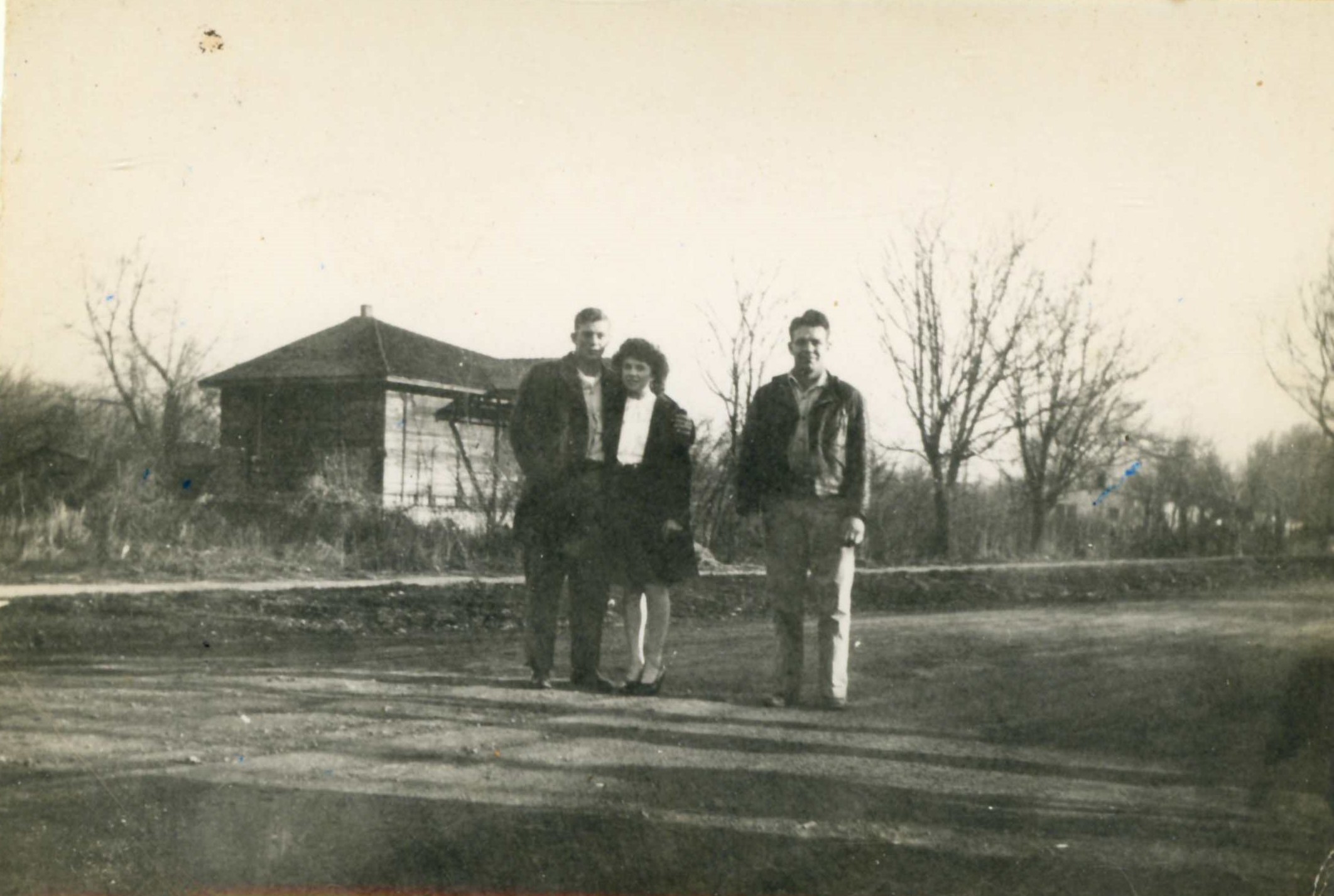
This is my Grandparents, Norwood and Colleen Jonas. I have been told the other man is Norwood’s brother, Joseph. I don’t dispute it, but I am just not certain.
I am told this photo is in Richmond, Utah, but nobody can quite pin down what the building is in the background or the road/grade in which they stand. The building does look like a granary, but seems too large. I wouldn’t think a granary would have a chimney. One told me there is a railroad track in the grade behind that I think simply looks like a great sidewalk next to an unpaved road. It is all a mystery.
Why would Grandpa and Grandma be out walking with brother Joe? Is this a new paving project? State Street? State Highway?
One year ago I took the four kids to go on a sightseeing tour. Amanda did not feel up to the trip and I just needed to get of town and reduce cabin fever. We went on a trip to various locations, but here are some pictures from 25 July 2020.
I had not been to Dingle, Idaho, where my Grandmother is buried for quite a while and none of my children had memories of being there, so that was our first stop.
One of our first stops was at Register Rock State Historic Park. It is located near Massacre Rocks State Park outside American Falls, Idaho.
Hiram and James Ross at Register Rock State Historic Site
On the way we stopped at Teuscher Square in Bancroft, Idaho.
Lillie, Aliza, and James Ross at Teuscher Square, Bancroft, Idaho.
We found our way to Dingle and took a picture with my Grandmother’s grave in Dingle, Idaho.
Lillian, Hiram, James, and Aliza Ross with tombstone of Colleen Mary Andra (1928-1999) and Ivan W Lloyd (1919-2011) on 25 July 2020.
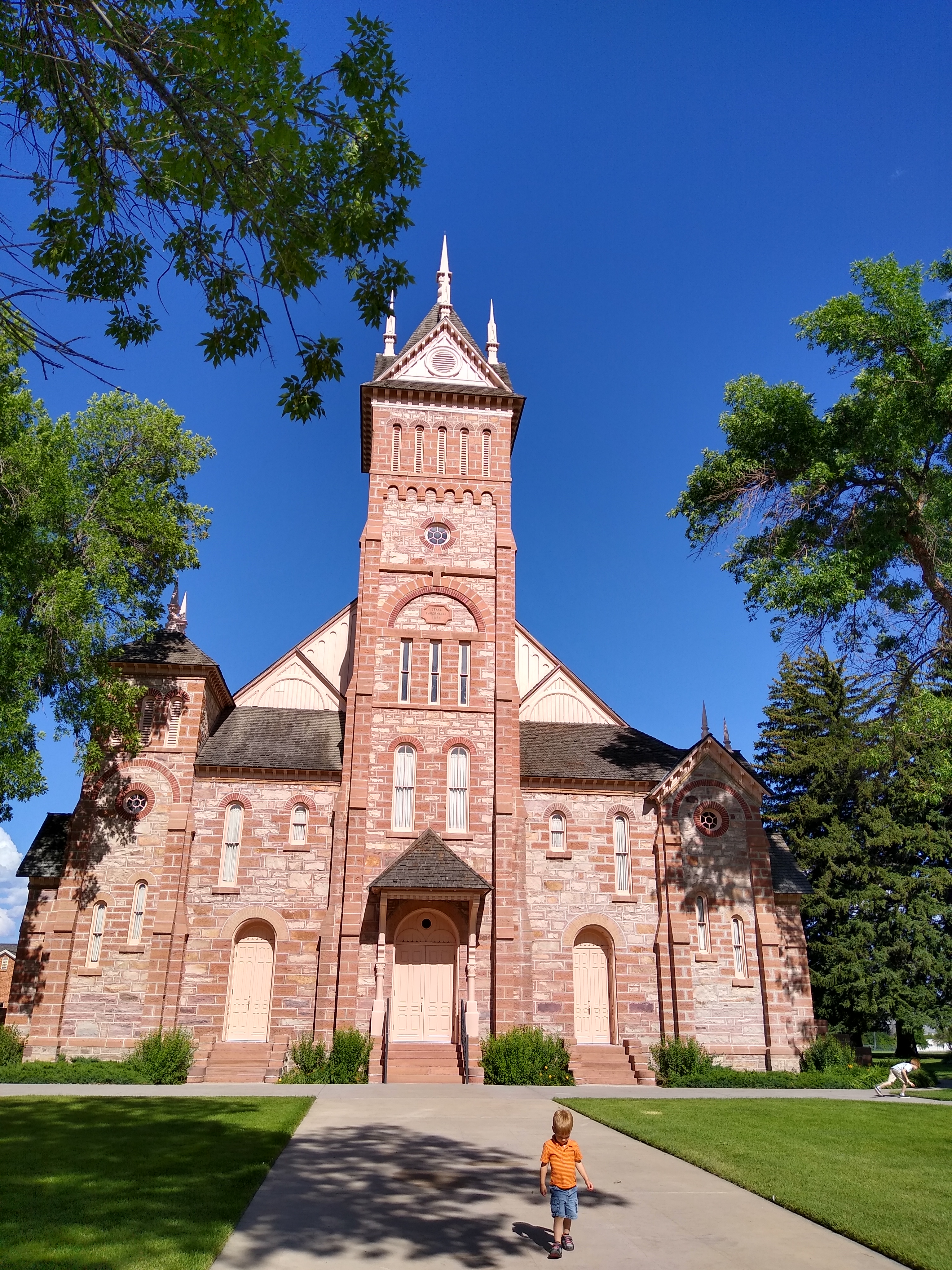
Then we stopped in Paris, Idaho. I took a picture of the Bear Lake Court House but apparently the photo didn’t save. I am disappointed as it has now been torn down. But we snapped some pictures with the Paris Tabernacle.
Lillie Ross beside Paris Tabernacle
James, Lillie, and Hiram Ross beside Paris Tabernacle.
James and Lillie Ross goofing off on north steps of Paris Tabernacle.
Afterwards, the kids had to play on the playground at the Paris Elementary School, just east of the Paris Tabernacle.
Hiram and James Ross at Paris Elementary playground.
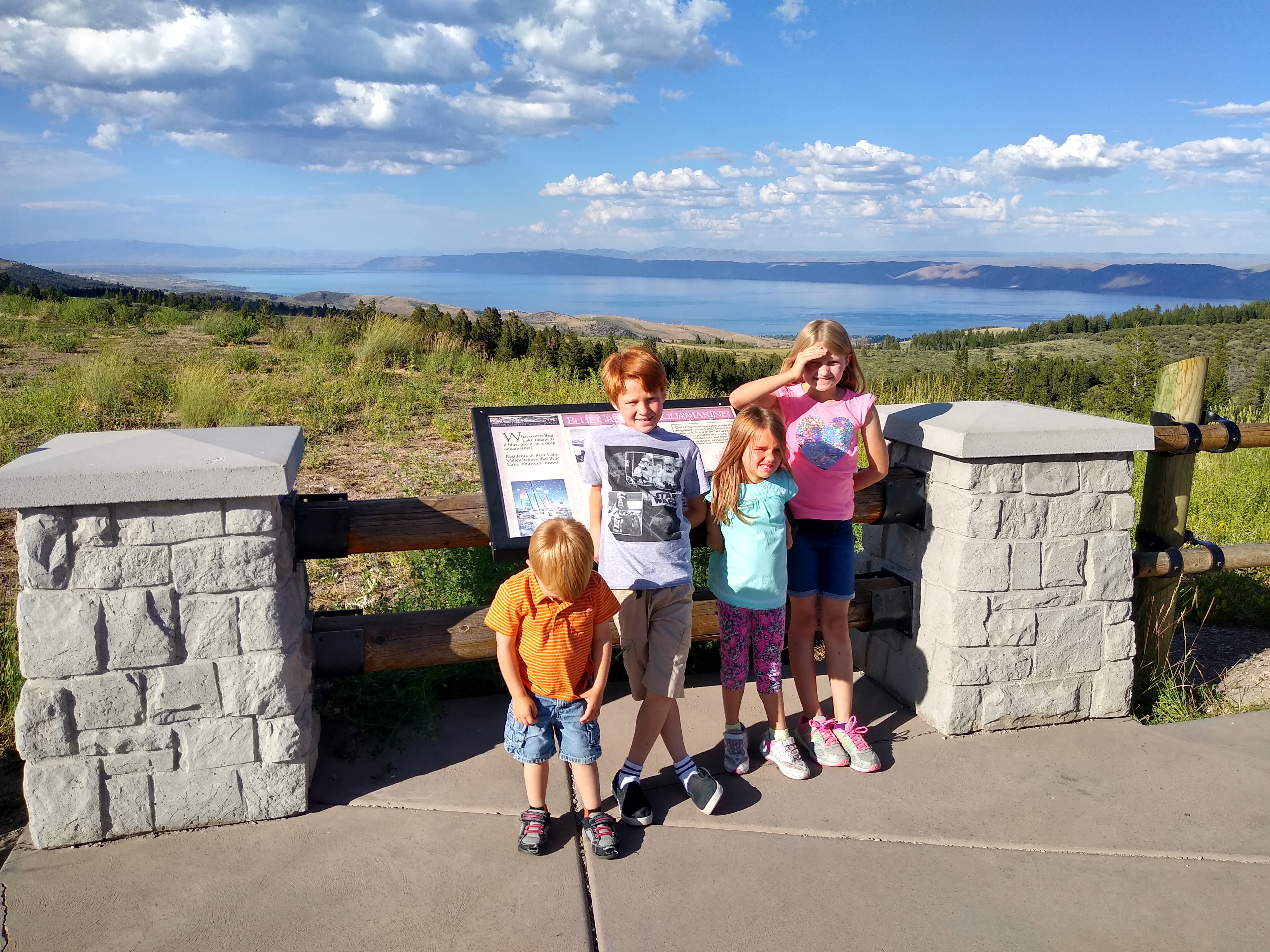
We traveled through Logan Canyon and stayed in Logan, Utah, that night.
James, Hiram, Lillie, and Aliza Ross at Bear Lake Overlook.
I previously wrote of our visits to the Logan Cemetery to visit family and notable graves. Those include our Nelson, Wanner, and Andra relatives. Also, graves of Benson, Thatcher, Nibley, Parker, and Maughan.
Then we bedded down for the night for the trip through Cache Valley and home on the next date.
Hiram, James, and Lillie Ross already fast asleep in Logan, Utah.
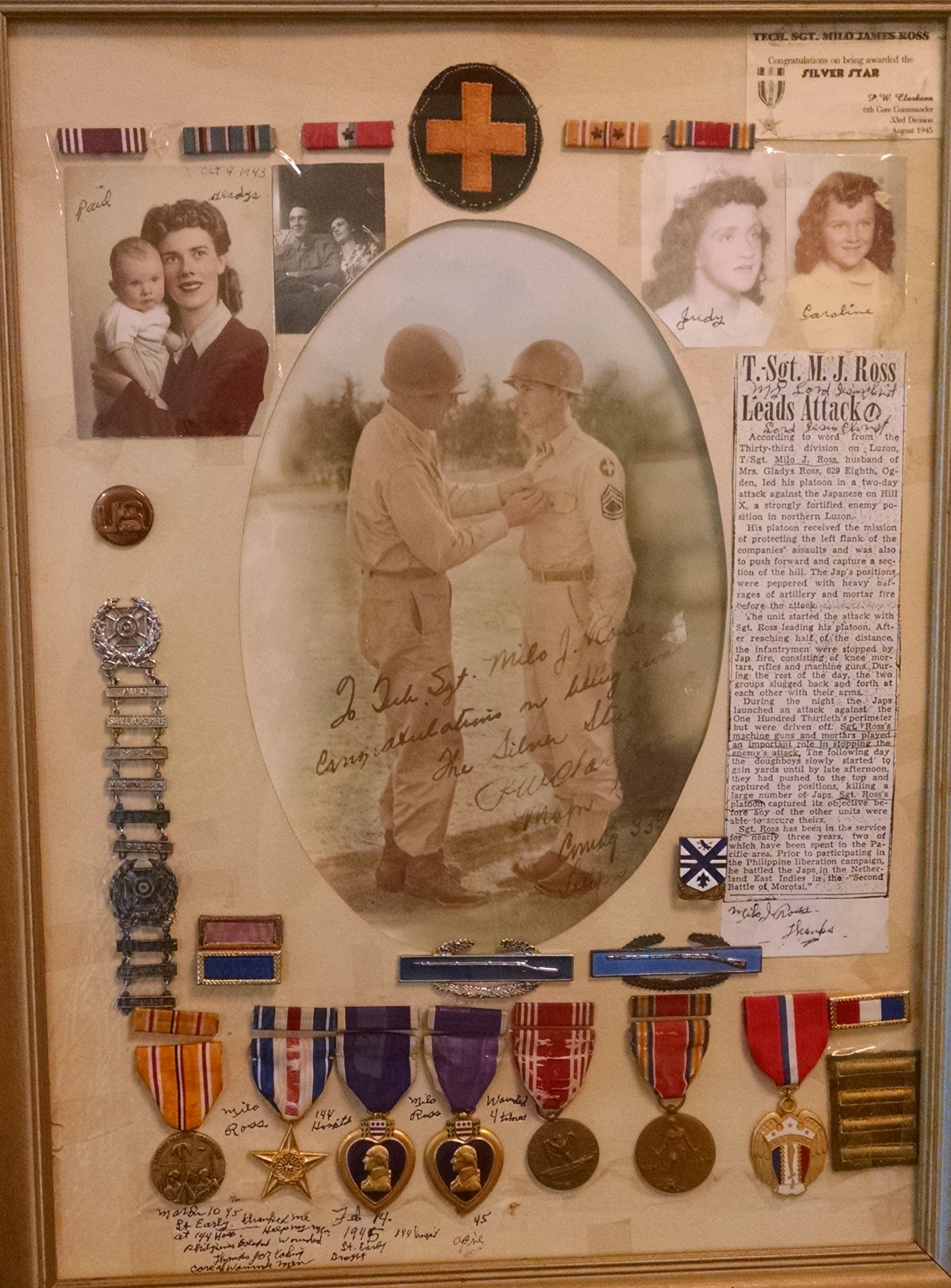
Milo James Ross Silver Star being awarded by Major General Clarkson
Above is the frame of Grandpa’s awards that hung on the wall in their living room. This is the only photo I have of his being awarded the Silver Star by Major General Clarkson.
Here is the language of the letter related to the incident.
~
Headquarters 33d Infantry Division
A.P.O 33
GENERAL ORDERS
NUMBER 204
SILVER STAR—…………..II
Section I
SILVER STAR — Awards. By direction of the President, the provision of the act of Congress approved 9 July 1918, (Bul 43 WD 1918), a Silver Star is awarded by the Commanding General, 33d Infantry Division, to the following-name officers and enlisted men:
Technical Sergeant Milo J Ross, 39 834 044, Infantry, United States Army. For gallantry in action in the vicinity of Galiabo, Mountain Province, Luzon, Philippines Islands, on 13 April 1945. Sargent Ross, weapons platoon sergeant, was attacking with his rifle company along a very narrow ridge when the enemy, holding the commanding ground, subjecting the leading elements to intense machine gun fire from four well camouflaged emplacements fifty to seventy-five yards distant. At the same time, enemy machine guns and mortars opened fire on the reminder of the company from the flank. Several men were wounded and the advance was halted. Sergeant Ross was called upon to place mortar fire on the enemy guns and silence then before further casualties were suffered. Recognizing that due to the proximity of our troops to the target it would endanger their lives to fire from his position because good observation was impossible, and being aware of the extreme danger of moving his men to a forward position, Sergeant Ross seized a mortar tube and several rounds of ammunition, and, alone unaided, worked his way forward in the face of intense enemy fire until he was within forty yards of the nearest enemy machine gun. Firing at point blank range, Sergeant Ross accurately placed fire against the enemy strong points until his ammunition was expended superbly covering the targets, forcing the enemy to seek cover and enabling the assault squad to close in and destroy the four machine gun nests, killing twenty-six enemy. Freed from this stubborn enemy opposition, the company moved forward to seize its objective. Sergeant Ross courage, fighting spirit and devotion to duty reflect great credit upon himself and the military service. Home address: Mrs. Gladys Maxine Ross ( wife, 620 5th Street, Ogden, Utah.)
BY COMMAND OF MAJOR GENERAL CLARKSON:
OFFICIAL: /S/ Anthony E Meehl, A. T. McAnsh
Anthony S Meehl, Colonel, G.S.C.,
Captain, A.G.D., Chief Of Staff
Actg. Adj. Gen,
Some additional information
Percy William Clarkson (9 December 1893 – 14 September 1962).
Andrew Thomas McAnsh (6 April 1905 – 4 February 1983).
Anthony E Meehl (15 August 1911 – 25 November 1988).
Copy of the Excerpt Grandpa kept of his Silver Star Award.