This is another story from the family history books of Golden Rulon Andra. This is the father of Annie Christine Petersen that I wrote about previously. This is an ancestor of Golden’s wife, Utahna Bird Andra.
Hans, Christian, and Kirsten Petersen
“Family History – HANS PETERSEN
“Born: 11 February 1837 at Salgelse, Sjaelland, Denmark
“Died: 7 July 1923 at Salt Lake City, Salt Lake, Utah
“Hans Petersen was born on February 11, 1837 at Slagelse, Sjaelland, Denmark, the son of Peter Jensen and Karen Jakobsen. His name became Petersen instead of Jensen, due to the Scandinavian custom that the child of a man should take that man’s first name and add the suffix “sen” so the son of a man named Peter became Petersen. Incidentally, the Danish law put an end to this custom during the life of Hans Petersen, so that he became the first Petersen in the Petersen genealogy of our family.
“Hans Petersen’s father, Peter Jensen, operated a small farm and it was the small farm house here in which Hans was born. The family belonged to the Lutheran Church, the state religion of Denmark. Peter Jensen, father of Hans, was a very short man in stature. Hans grew taller than his father, but was himself only a little over five feet tall. Then Han’s children grew taller than he himself and his grandsons are nearly all tall men.
“He went to the regular country elementary schools in Denmark in his youth and then worked on this father’s farm until he was 21 years of age, when he had to serve in the army according to the custom of the country. He was summoned to Copenhagen for training and it was there that he met Kirsten Jeppesen, who later became his wife. While still in his first year of army training, he married Kirsten. That was while he was still 21 years old. Incidentally, he was gray headed at that time, having gone gray early. As a boy his hair was black.
“Following his release from active army service, he and his wife went to the little tow of Lindeborg, Denmark, and there started burning charcoal for a living. After he had been married several years, and had three little children, a war broke out between Denmark and Germany, and since he was still a member of the reserve he was called into active service to fight Germany. Being a small man he was put into the front lines with all of the other small men, according to the custom. When his company was sent to the front he prayed to God that he would not have to shoot a man. When the battled started and he began to fire his gun, he noticed that it had jambed and would not fire. Then almost immediately he was shot through one side and fell, was taken with the other wounded soldiers, placed on a large lumber wagon with no springs (the only ambulance available) and taken to an old barn behind the lines which had been converted into a field hospital. He had only been there about ten minutes when German shells set fire to this improvised hospital and the doctors had to move all of the wounded 20 miles further black. They were again loaded on the lumber wagons and had to suffer the tortures of bad roads and the crude wagons during the journey.
“When the second hospital was reached and his wounds were examined by the doctors it was decided that an immediate operation was necessary to save his life. There was no anaesthetic of any kind and the patient just had to life and suffer during the operation. He afterward said that making the incision did not cause so much pain but while they were cleansing the wound and closing it, he chewed much of the sheet covering him into small bits the pain was so intensen. After he recovered, he was sent back to Copenhagen to recuperate and there he and the other wounded soldiers were highly feted by the populace.
“It was almost six months before he was released from the Army and permitted to return home. During most of this time, his wife knew nothing of his trouble but shortly before his return home, one of the family friends informed her that Hans had been killed in the war. It was a most joyous meeting when he returned home.
“In Lindeborg, where he armed and burned charcoal, he rented a home from a man named Sorensen, whose father was a Mormon elder laboring in that area. He had emigrated to America, and had been sent back to his native land as a missionary. The father’s name was Soren Christophersen. He had sought to hold a cottage meeting in his son’s home but was refused, although the son did permit his father to live at the home. While Elder Christophersen told Hans Petersen of his inability to find a place in which to hold a cottage meeting, Hans invited him to his own home, which was rented from around the area inviting people to the meeting.
“A large crowd gathered for the meeting, but in mob formation. They threatened to tar and feather Elder Christophersen. Hans nailed the front door and stood guard at the back door with a large club in his hand. He invited any of the mobbers to entered if they dared but none came. Instead, they remained outside shouting and hammering upon the doors and windows, saying they would get the Elder when he came out of the meeting. Hans told them that the missionary would remain in the house until the mob left if he had to remain all night. The mob did not leave until 2:00 a.m., and then Hans, armed with his club, accompanied the Elder to the Sorensen home where he was to spend the night. This affair started the Hans Petersen family to investigate Mormonism and was followed by subsequent cottage meetings. After much study and prayer, Hans and his wife decided to join the Church. His wife was especially well read in the Bible. The two were baptized in the middle of the night in a large hole which had been dug into the ground by farmers seeking rich soil to cover their land with. These holes filled with water, like wells, and it was in this water they were baptized by the Elder.
“Han’s wife became quite a preacher of Mormonism. Hans himself became president of the local branch and did much preaching although his wife did the scriptural speaking. They both gave freely of their time and means to the Church and often financially assisted the elders who traveled without purse or scrip. In those days they had to travel miles to attend each meeting because the area was sparsely settled.
“When the family decided to come to Utah to be with the Saints, transportation became a serious problem. The entire family could not come together so it was decided that the eldest daughter, Annie, should emmigrate first. She went to Arizona first, to the home of some other earlier emmigrants. Two years later the next sister, Minnie, went direct to Salt Lake City, and two years later again, Emma, the third daughter came to Salt Lake City. One year later the girls put their funds together for their sister Sophia to come. A little later Hans, his wife, and their only living son, Christian, came together, going first to Arizona to the home of George Hansen Newman. This man had taken the name of Newman after his arrival in America. The Arizona heat was too severe for the Petersens so they went by wagon team up through St. George to Salt Lake City where they made their home, first at 475 West Sixth South Street, in the old Fifth Ward and later moving to a house on Genesee Street, between Seventh and Eighth West, in what became the 26th Ward after the Fifth Ward was divided.
“Hans did labor work for a living, helping in the beautification of Liberty Park and in the construction of several canal systems. His wife died at the Genessee Street home on 20 November 1908, and was buried in the Salt Lake City Cemetery. Hans lived alone most of the time after this and he died in Salt Lake City 7 July 1923, and was buried at the side of his wife.
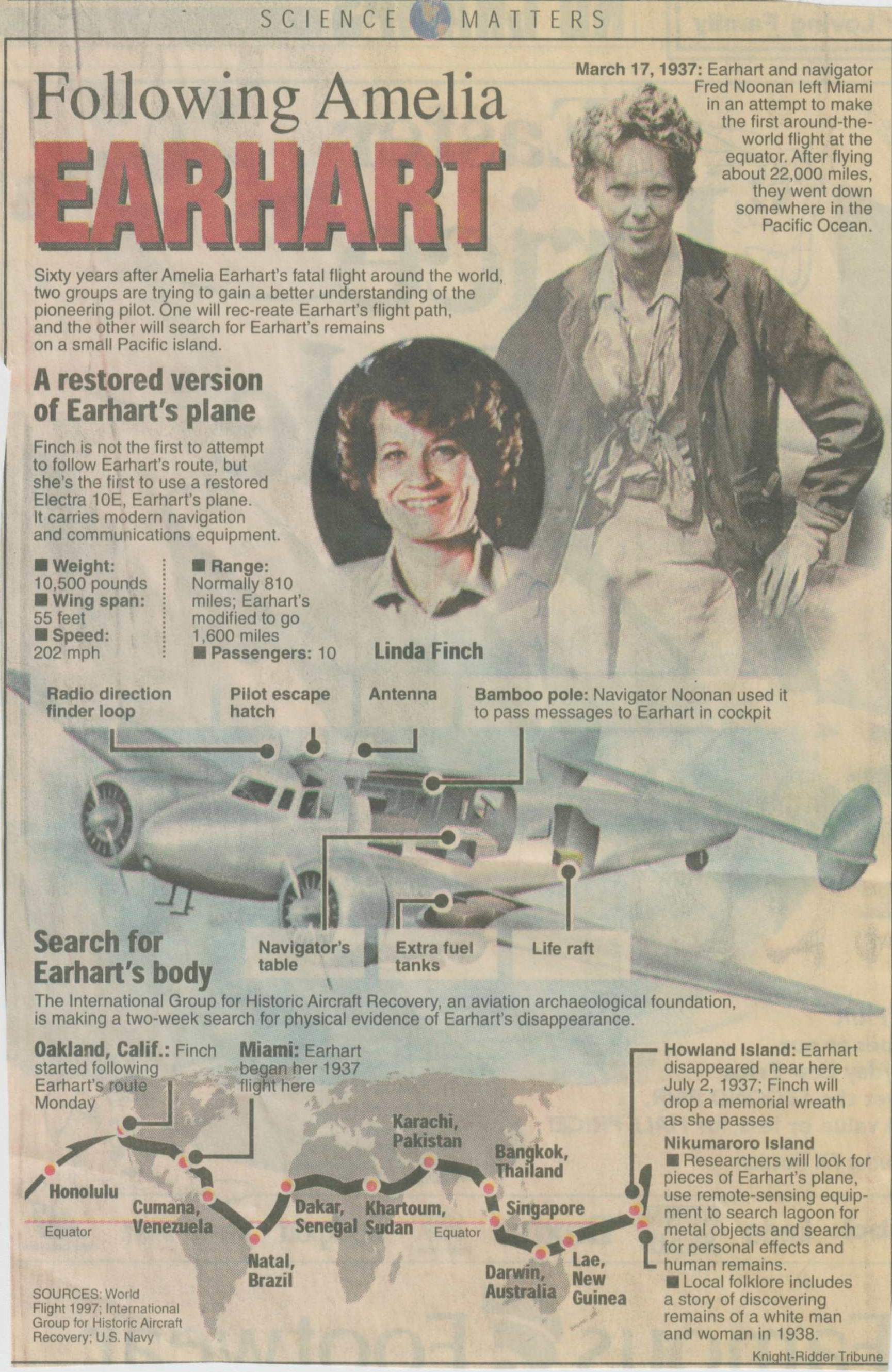
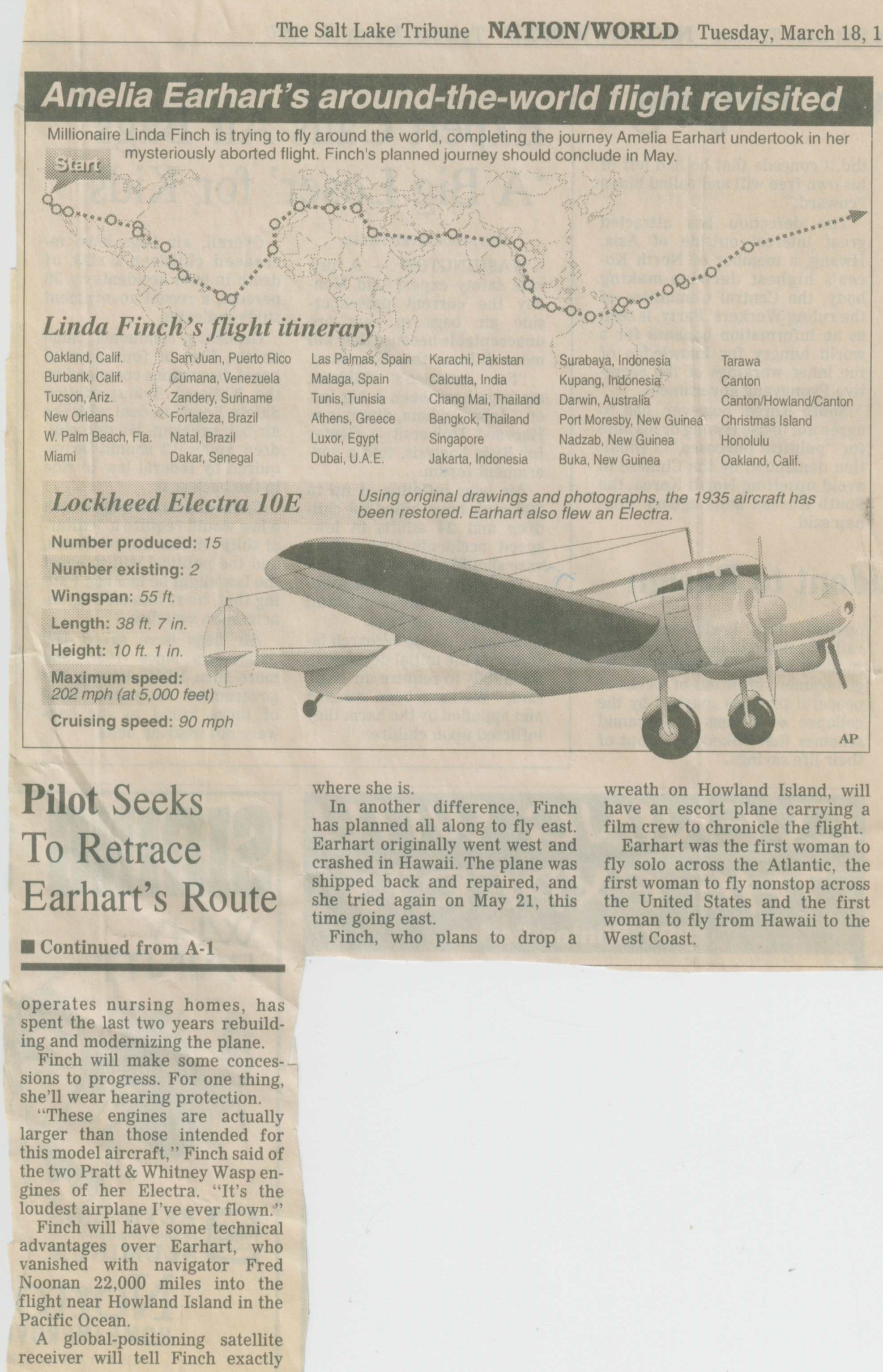
I wanted to share these clippings my Grandmother, Gladys Donaldson Ross. Not sure if they were all the same time, likely. I don’t know if Amelia was a role-model for my Grandmother. I do recall her mentioning Amelia Earhart in at least one conversation with her, but do not recall the context. Grandma would have been 15 at the time Amelia went missing. Whatever the reason, Grandma clipped these and kept them. I am posting these in honour of what would have been her 103rd birthday this week, 20 September 1921 to 20 September 2024.
I have two copies of the History of Plain City, Utah. The front indicates it is from March 17th 1859 to present. As far as I can tell, the book was written in 1977. At least that is the latest date I can find in the book.
One copy belonged to my Grandparents Milo and Gladys Ross. My Grandpa has written various notes inside the history which I intend to include in parenthesis whenever they appear. They add to the history and come from his own experience and hearing.
I will only do a number of pages at a time. I will also try to include scanned copies of the photos in the books. These are just scanned copies of these books, I have not tried to seek out originals or better copies.
History of Plain City March 17th 1859 to present, pages 141 through 149.
BONA VISTA IMPROVEMENT DISTRICT
SUBMITTED BY FLOYD PALMER
This most important new culinary water system has made life a little more pleasant in this community and surrounding areas. It was turned into the lines just a century after sturdy pioneer families first put together temporary shelters and tapped several sweet water springs which they found in the area.
It replaces old flowing wells, bringing precious waster from the depths of the earth. In early days many deep and surface wells dug, covered over, and fenced off to keep children from falling in. They were first fitted with “pitcher” pumps, a short-handled affair which were the “pumper” out in a short time. Even the farm animals had to depend on well water pumped to the surface by hand.
Later, the easier to work, long-handled pumps were installed. These were followed by power pumps connected to a small storage tank. This was the ultimate in a private water supply.
In 1955, a Weber County man, Linn C. Baker, was a member of the State legislature. He is the one who sponsored the bill to create special improvement districts. The reason he was the sponsor of this bill was due to his work in the Health Department for the State of Utah. As he studied samples of water sent to him from the outlying towns, he became aware of the amount of contamination there was in the drinking water in certain areas, Plain City was among the highest on the list. This was traceable to shallow surface wells being used, also septic tanks with poor drainage.
Soon after the Weber Basin Conservancy District was organized, Plain City wanted to purchase one-thousand-acre feet of water. Their request was held in abeyance until a line could be built from Ogden Canyon. This, however, was never done.
Elmer Carver was on the executive committee of Weber Basin Project. Through the encouragement of Commissioner Carver, Mr. Ezra Fjeldsted, manager of Weber basin Project, and Linn Baker, all met with the Plain City Town Board to get something started. Floyd A. Palmer, a member of the Town Board, was asked to represent Plain City on a committee of surrounding towns in Weber and Davis counties. Mr. Ezra Fjeldsted acted as chairman of this group and several meetings were held in both counties which Mr. Palmer attended.
Following this, a public meeting was held in Plain city. Farr West, and Harrisville were asked to join in. This was for the purpose of starting a culinary water system. The results of this meeting, from all groups attending, were to go ahead, also to contact other nearby towns and get their feelings about joining in.
A series of meetings were held in Farr West, Harrisville, Slaterville, Marriott, Wilson Lane, and Plain City. Other towns were invited to attend. Ezra Fjeldsted represented Weber Basin, Floyd A. Palmer represented Plain City, Dick Groberg represented Farr West, Kenneth Brown represented Harrisville, Clifford Blair represented Marriott and Slaterville, and Arthur W. Sorensen represented Wilson Lane. The meetings were all met with a great deal of enthusiasm and interest.
Plain City Town Board consisted of Lee Olsen, President, Floyd A. Palmer, Elvin H. Maw, Merrill Jenkins, Blair Simpson, as members. A culinary water system was a prime item of the agenda in 1956. The town board along with several local residents were well organized to promote the need for a water supply to replace the surface wells and pumps.
On July 19, 1956, Elmer Carver, Chairman of the Board of County Commissioners of Weber County, State of Utah, signed a certified documents that there be and is hereby created within Weber County, Utah, a Water Improvement District to be known and designated as the BONA VISTA WATER IMPROVEMENT DISTRICT, the same to embrace and include all real property lying within the following boundaries, to-wit: (SETS FORTH DETAILED LEGAL DESCRIPTION OF DISTRICT BOUNDARIES WHICH BOUNDARIES EMBRACE LANDS HEREIN ABSTRACTED – Abstracter)
That the following-named persons are appointed as the Board of Trustees of said Bon Vista Water Improvement District:
Floyd A. Palmer, Plain City
Richard Groberg, Farr West
Kenneth Brown, Harrisville
Clifford Blair, Marriott-Slaterville
Arthur Sorensen, Wilson Lane
This resolution shall take effect immediately and shall be recorded in the office of the Weber County Clerk. Recorded August 22, 1956.
Following this appointment from the Weber County Commission, the board held a short meeting. It was necessary to elect a chairman, after a discussion of each of the board members. Kenneth Brown was appointed as chairman.
The first order of business was to secure professional and legal help. Mr. Jack Richards was appointed attorney. Jack Reeves, of the firm of Nelson, Reeves and Maxwell, was appointed engineer. They were appointed to do the field work and present the plans and drawings back to the board.
When the plans were completed, the board spent much time deciding the most feasible and economical areas to run the lines in. Also, to give each town a fair share of the project. Following this, it was necessary to project estimated costs. The board spent many months getting costs and deciding on types and kinds of pipes and materials to use on the project. The overall plans had to look attractive and feasible in order to get a bonding company to handle the bonds.
The first step made to secure the bond issue was to get signed pledge cards with an agreement to pay $250.00 for a waster connection. This was a requirement. Committees were organized with Floyd A. Palmer, Richard Groberg, Kenneth Brown, Clifford Blair, and Arthur Sorensen acting as chairman in each of their respective towns. The result was very successful, all those serving on these committee are deserving of much credit for their untiring effort and accomplishments.
On August 20, 1957, a bond election was held to see if the residents would approve a $900,000.00 bond issue. The vote was 490 yes and 82 no. Edward L. Burton Company was retained as Fiscal Agent, and $698,000.00 was sold in General Obligation Bonds, and the system was under way.
On April 14, 1958, a contract was awarded to Smith-Scott Pipe Company to furnish cement mortar-lined steel pipe for the main lines.
Also, on April 14, 1958, a contract was awarded to Knudson Construction Company to install water mains in the Harrisville-Randall area which was Phase I of the project.
Also, on April 14, 1958, a contract was awarded to Chicago Bridge & Iron Company to furnish and erect a 250,000.00 gallon elevated storage tank in Plain City.
On April 28, 1958, Theron Palmer was hired as General Superintendent to oversee construction and to get it ready to serve and operated as a system.
On May 27, 1958, an office was rented from the E. B. Stone Estate on the corner of 9th and Washington. The district still maintains its offices here. The building was purchased by the district in 1969 and has been remodeled.
On May 27, 1958, negotiations were begun with the State Department of Welfare of obtain ownership of a spring located in Garner’s Canyon in North Ogden. The spring was used at the time by the welfare department at the Industrial School property for culinary use and irrigation use.
On May 27, 1958, Weber Basin let a contract to Statewide Construction Company to build the 16-inch transmission line from 4000 South on U-84, down into the district where Bona Vista could connect to it.
Also, on May 27, 1958, a piece of property located at 4100 West on 2200 North in Plain city, was purchased from Vern Palmer to construct the elevated tank.
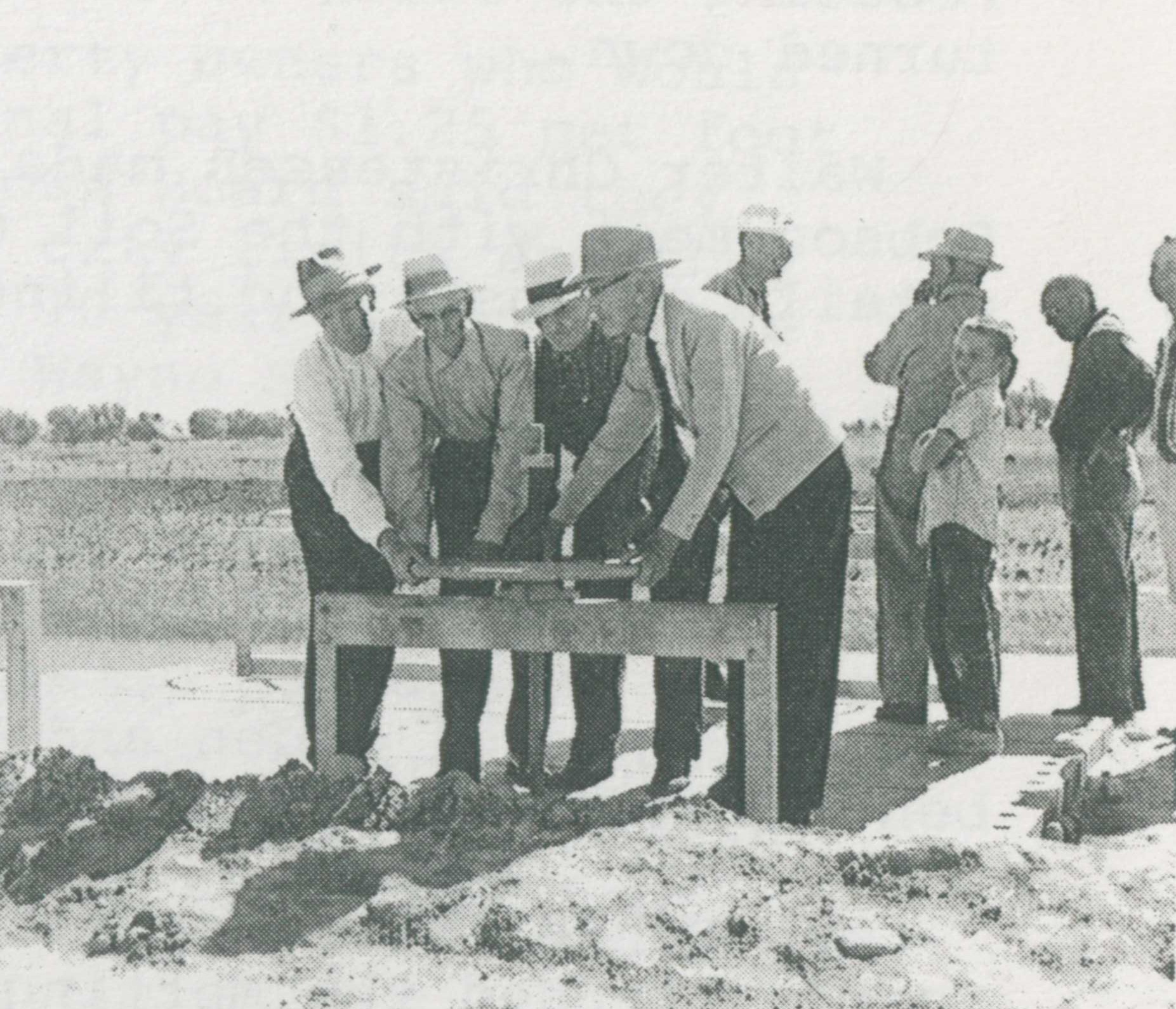
Bona Vista Water Storage Tank
Raymond Concrete Title Company moved in and drove concrete pilings 80 feet into the ground to support the tank.
Gerald Larkin was then awarded a contract to construct a foundation so Chicago Bridge and iron could begin erection.
On July 3, 1958, a contract was awarded to Bert Robinson Construction Company to build lines in the Farr West and Plain City.
Also, on July 3, 1958, Standard Plumbing Supply Company was awarded a contract to furnish materials for service lines.
On July 17, 1958, the Weber County Commission agreed to purchase 60 fire hydrants to go on the system to be located by the Weber County Fire Chief.
On July 17, 1958, Smedley construction Company was awarded a bid to construct lines in the Slaterville, Marriott, and Wilson area for $44,975.00. The same day Mac Construction Company of Salt Lake City was awarded the bid to construct our North Ogden Reservoir for $16,911.00. This is a concrete underground reservoir.
On August 11, 1958, an agreement was reached with the Welfare Department to obtain full use of the spring in North Ogden. Weber-Box Elder water was purchased to replace the Welfare Department’s share of the spring.
On February 11, 1959, work began on the plans and site for a reservoir in the Roy area.
On March 23, 1959, it was decided to run a line on the North Plain City Road.
On August 27, 1959, it was decided to either buy or condemn the Hansen property for a reservoir.
A bid to build a tank in Roy was awarded to Wehyer Construction Company for #31,403.80 on September 23, 1959.
Negotiations began to buy an eight-foot well from the Farr West Stake for $31,403.80 on September 23, 1959.
Linn C. Baker resigned as Secretary on January 1, 1961. He had been with the district since it began.
On December 6, 1961, it was decided to construct extensions to existing mains in the amount of $90,000.00 General Obligation Bonds were sold to finance these extensions. Waterfall Construction Company did the job.
All though the summer of 1961, the Farr West well was tested to see if it would hold up.
On February 28, 1962, President Wimmer signed the Warranty Deed on the Farr West well and property. On January 16, 1963, it was decided to put heat lights on our Roy tank. This was the first such installation in this area and it drew a lot of attention.
The Utah State Health Department studied the plans for use of the plans for use of the existing well in Farr West and decided against allowing it to be used because of its depth. A change application was then filled with the State Engineer to drill the well to a deeper depth.
On May 10, 1963, a contract with Wesley Stoddard was made to drill a well in Farr West for $21,632.00 plus $4,700.00 for the test hole to see how deep the well would have to go.
A meeting was held at the Farr West Pump House building on January 20, 1964. This building was contracted by the Bona Vista Water employees. The piping was also done by employees of Bona Vista.
R. W. Coleman Company was awarded a contract for $18,877.50 to change some lines under the interstate highway on November 22, 1965.
Negotiations began on March 28, 1966, with Weber Basin on the North Ogden Well, which was later drilled and is used in the system now.
Water meters were deemed necessary and were bought by bid from Waterworks Equipment Company and E. C. Olsen Company on October 28, 1968.
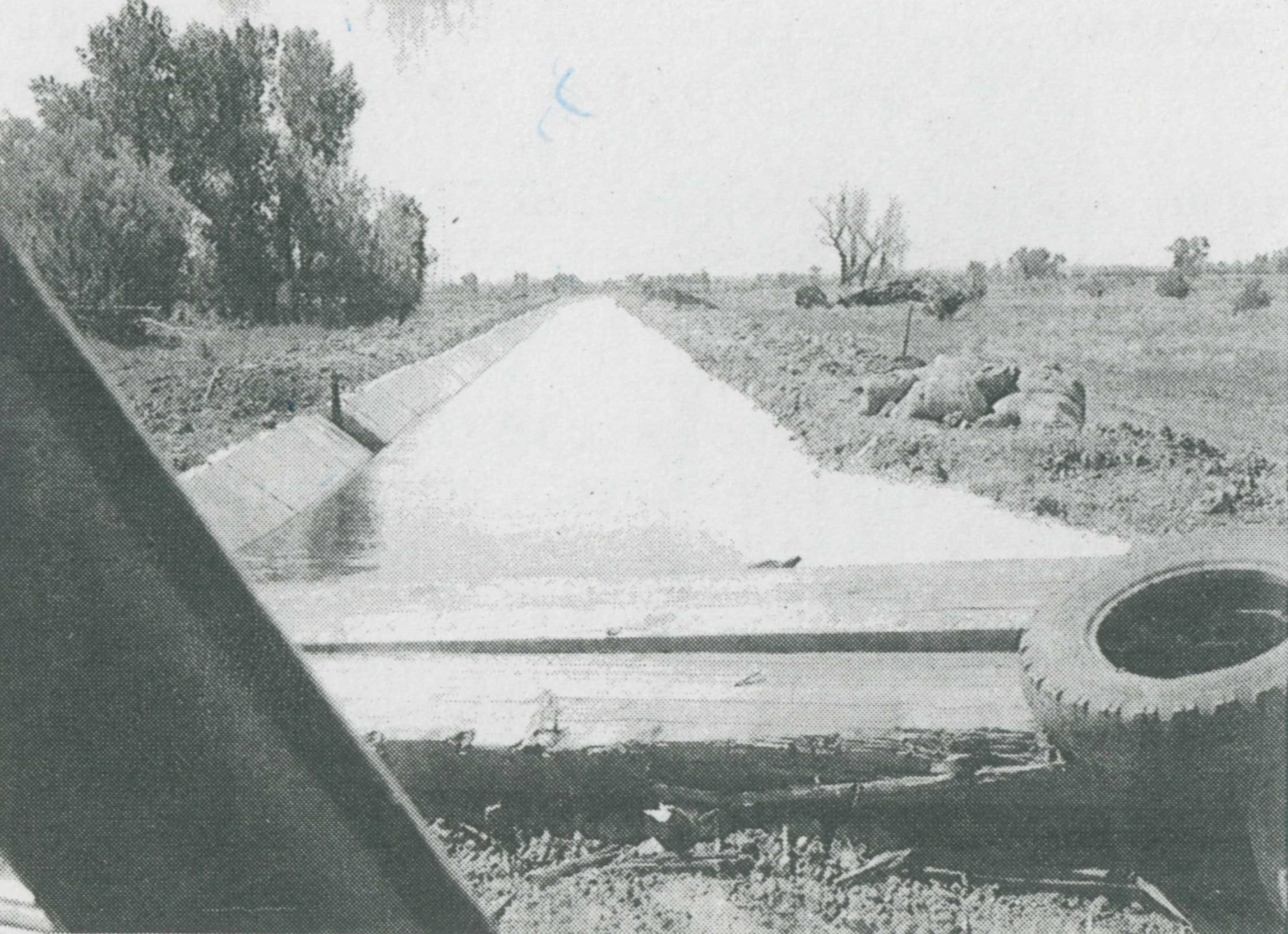
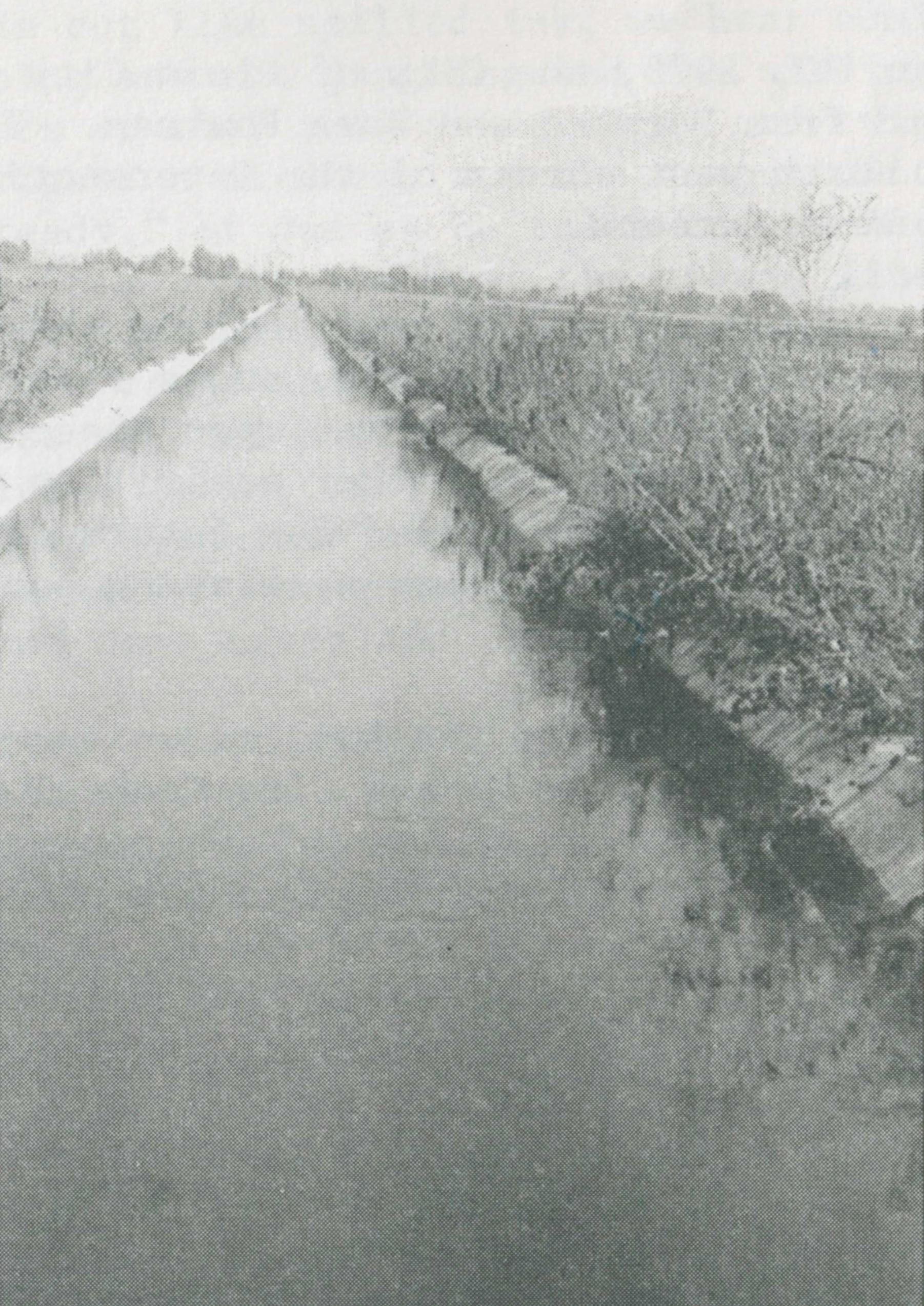
New Plain City Canal
BEGINNING OF PLAIN CITY IRRIGATION WATER
1859 Before the summer was over some water had been brought in their new ditch from Four Mile Creek to Plain City. In 1860, the Canal was completed to Mill Creek, the following year to Broom’s Creek and in 1862 to the Ogden River. The Right of Way in Weber River was purchased in 1873 at a cost of $2000.
In 1899 Samuel Wayment drilled an Artesian Well 249 feet deep producing additional water for the settlers. He also was in charge of the iron work and the building of the Chief Canning Factory in Plain City.
PLAIN CITY IRRIGATION-CEMENTING OF THE MAIN CANAL
SUBMITTED BY Wayne Skeen
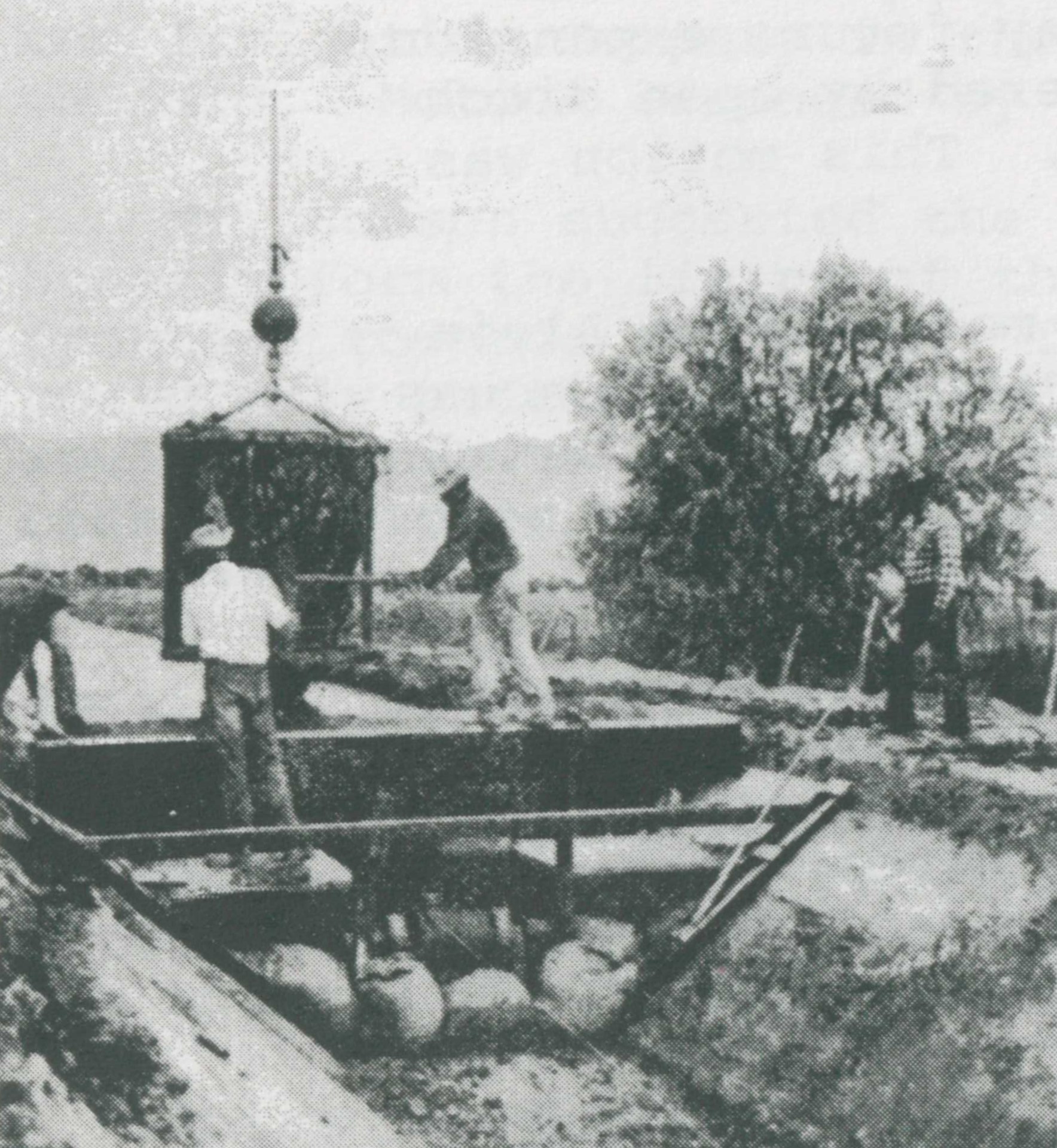
For many years the Plain City Irrigation Company received it’s water from the Weber River. The diversion point into the canal was just north of the old American Packing Plant that was later called the Swift Meat Packaging Plant. The Irrigation Company had a large Plank Head Gate in the Weber River that forced the water into the Plain City Irrigation Company Canal because of high waters in the spring this gate would wash out and it was necessary to make a gravel and dirt dam each year using horses, scrapers, and even large bulldozers. In recent years this became a major problem.
The government began planning the Willard Project in 1960. This project would interfere to a certain extent with the existing canal used by the Irrigation Company because big Willard Bay Canal would be built in part of our existing canal and would also cross it in part of our existing canal and would also cross it in other areas. The leaders of this project wanted to provide a turn out from the big canal into the Plain City Irrigation Canal. The corporation of our company was necessary to give them the right to use the area affected by the construction of the Willard Bay Canal. The logical point of diversion would be west of the Farr West Church House. This meant that some new construction would be necessary to get the water into the old canal. It was in need of some repairs and it was at this time that the idea of a new cement lined canal was entertained.
Directors who served during this period of construction were as followed:
President Abram Maw 1959-60
President Alvin J. Robson 1961-65
Vice President Walt Christensen 1959-64
Vice President Carl Taylor 1965
Bert Hunt
Charles Heslop
Keith Blanch
Mike Panunzio
Secretary Wayne Skeen 1959-65
High lights of the minutes of the meetings during the construction period are as follow:
August 11, 1959
Ogden City had extra water for sale this year which was allocated out to various canal companies. A motion was made by Alvin Robson that this water be purchased to see them through the current season. It would be paid by those stock holders who subscribed for the extra water.
April 4, 1960
The meeting was called to discuss the new canal. Charles Heslop was assigned to work on interested free money from the Utah Water & Power board for the construction. Alvin Robson was assigned to work with the Soil Conservation on the completion of the surveying of the canal, and additional monies.
July 12, 1960
A meeting was held to discuss a possible shortage of water for the remainder of the year. Time was changed from 20 shares per hour to 25 shares per hour.
January 9, 1961
A priority was established with the Utah Water an Power board for interest free money and application made for $100,000.00
A survey showed that there was a 10% loss of water between the River turn out and the Point of use.
March 8, 1961
The Irrigation Company received a $10,000.00 cash settlement for their rights in the old canal from the O.U.R.D. Railroad Company that passes through their yards.
Alvin Robson, Carl Taylor, and Walt Christensen was to secure information regarding tiling of the canal from Victor Lund’s corner up to the Jesse Singleton property where the canal leaves the road and runs back into the fields.
April 20, 1961
A report was given by Alvin Robson regarding the tiling of the lower part of the canal. There were mixed emotions about tiling this section of the canal because of the fall and the amount of water to be delivered. “Alvin Robson commented as the discussion went on concerning the piping verses the cement lining. The stockholders are residents of this town and should have some concern towards the improvements and beautification of the community and that an open cement lined canals to greet the people entering the town is not very inviting and once it was constructed it would never be changed in our life time.”
Keith Blanch speaking as a town board member expressed his opinion regarding the beautification and eliminating hazards in the community and felt that it was worth while and the tax payers should help with the construction of the Irrigation Company in piping this section of the canal.
Glen Charlton and Lee Olsen from the town board were present. An opinion was asked from the town board members. Mr. Charlton felt it was a worth while project as long as it was right. Mr. Olsen commented that it was a good thing as long as it was sufficient to meet the needs of the water users.
The town board members agreed to cover the pipe that was laid with dirt. It was agreed that 2880 feet of 36 inch tile would be laid this spring from the old beet dump corner to Victor Lund’s corner.
April 27, 1961
The Town board members present: Dee Cook, Glen Charlton, Kent Jenkins, and Lee Olsen. Mr. Covey from Utah State University was also present.
Further discussion concerning cost of construction of the concrete pipe continued. Keith Blanch made a motion that the town board and property owners should join with the Irrigation Company in the cost of the 36 inch tile to be laid. Motion seconded by Carl Taylor
Mr. Robson suggested the property owners who would benefit from the lining of the canal pay $1.25 per foot frontage towards the pipe. The Town Board said they could only participate within the city limits and they would contribute $4,000.00 over a 10 year period. The bids were to be sent to Secretary Wayne Skeen by March 30, 1961.
April 30, 1961
The purpose of this meeting was to open bids. Utah Concrete Pipe Company received bids for 36 inch concrete pipe at $8.75 per foot. Waterfall Construction Company was awarded the laying of the pipe at $1.55 per foot.
Abram Maw made the motion that the project not be stopped at the beet dump corner but continue up to the up to the weir east of the water tower (where the pipe portion of the canal now starts) if the property owners will contribute $1.25 per foot. Motion seconded by Keith Blanch.
Charles Heslop ad Elvin Maw were asked to approach these property owners and get their approval to pay the $1.25 and also contact all stock holders and get their signature for government participation thru the Soil Conservation.
Charles and Elvin were successful in getting all the names except Jesse Singleton who would not accept any government monies and would not pay the $1.25 per foot to tile in front of his property.
Alvin Robson contracted Howard Singleton, Jesse’s boy and he agreed to pay the $1.25 but only up to the old house that sat in the field and that is where the concrete pipe starts today. Alvin Robson tried to convince the Director’s that they should at the company’s cost tile the remainder of the ditch along the road because any future expansion of the community would by hampered by open ditch reducing the width of the road. This motion turned down.
Walter Christensen made the motion that Alvin Robson meet with the Soil Conservation to discuss details of cost and tiling and lining the canal.
April 31, 1961
Alvin East, Maurice Skeen, and Owen Wayment from the Warren Irrigation Company met with the directors to discuss details and sign a contract for the exchange of Ogden and Weber River which would benefit both companies. The contract was signed.
Mr. Daniel Lawrence from the Utah Water & Power Board attended the meeting. Keith Blanch made the motion that Alvin Robson and Wayne Skeen be given the power to enter into a contract with the Utah Water & Power Board for the total cost of $1,300.000.00 and formulate all details.
May 3, 1961
Junior Taylor was appointed as Water Master of the year.
May 15, 1961
The purpose of this meeting was to discuss the Weber Basin Project with E.J. Feldstead and commissioner Wilmer Carver. They needed additional votes to finish construction of the Willard Bay. A proposed addition would cost seventeen million dollars.
June 5, 1961
The purpose of the meeting was to see what should be done because it appeared that there would be a water shortage before the end of the year. It was proposed that we only run off water until the stream reached a point that we could not water properly and then start to use our shortage water and put turns on 1/3 basis.
September 27, 1961
The new project was discussed and it was recommended that the company hire an engineer and begin construction on the upper end of the new canal.
There were many problems that came out of the construction of this canal. It would be necessary to get some dirt to construct the pad for the canal. The company purchased some ground at the upper end of the canal from Max Stander. Then got the dirt that was necessary to build the upper end of the canal and then leveled the ground and gave it back to Mr. Stander. They also purchased additional dirt from Robert Penman. This dirt was trucked from his property just south of the Weber River and west of the main road. The dirt was hauled by farmers using their beet trucks, etc.. The new pad was made in the old canal banks where possible, but there was some trading of land etc. to straighten out the canal. There was also a problem in getting someone to dig out the canal to the size and shape required to allow 50 seconds feet of water at one time. The company asked for bids, but they only received one because the equipment needed to shape the canal was not available. In order to get the project moving Alvin Robson caught a bus on Ogden and went to the Fuller Forms Company in Arizona to see if they had some type of equipment that could be used. He purchased a right to one of their slip forms that could be used in forming and pouring the concrete. He returned to Ogden and worked with the Ogden Iron Works on 23rd Street and Grant Avenue where the construction of the slip forms took place. The next problem was to begin the construction of the project. Dean Hadley of Taylor was hired to do most of the big equipment work. Local farmers also helped with their equipment. The Soil Conservation furnished the engineering on the project. Herbert Issackson of Pleasant View was the surveyor. One of the major problems that existed and is still a yearly discussion is the amount of water delivered from the existing head gates. The government required that curtained head gates must be varied in size for them to participate financially.
Oct 1962
There was much contention and personal feelings during the construction of how it should be done. Some people left the jobs and never came back, but the project was finally finished. The construction created problems for some but most of the inconveniences were ratified by the Irrigation Company. New bridges were built, land was leveled, damages to property was crops were paid for during the construction. The Company paid for fencing materials with the property owners installing the fences. Cattle that used to walk across the stream would fall into the new lined canal and couldn’t get out. The Company paid for some of the cattle that were lost before the agreement to install fencing was made.
The total cost of the project was $199,754.08. The amount of $122,918.61 was borrowed from Utah Water & Power Board. This money was interest free if a yearly payment was made by November 30th each year. The last payment of $8.257.06 will be paid on November 30, 1977. Other cost not being paid by the stockholders come from the Soil Conservation and the sale of pieces of the old canal, and the town board. Vice President Bill Hatch of the First Security bank was also an asset in the financing of the canal.
We borrowed monies from the First Security Bank as construction went on to pay for cost on a daily basis. On December 31, 1974, the company owed the First Security bank $60,000.00 Alvin Robson and Wayne Skeen met with Mr. Hatch in May regarding this bill. Mr. Hatch said that the bank needed some type of security for this loan. There was nothing to give him because out rights to the canal had been given to the Utah Water and Power Board. Alvin Robson and Wayne Skeen then approached Mr. Lawrence of the Utah Water and Power Board asking them for more money for the project explaining the situation with the bank. Alvin Robson explained that they might just as well take over the ownership of the canal because the bill had to be paid. There was nothing to offer as security because the Utah Water and Power board had everything that the company owned. Later, Mr. Lawrence of the Utah Water and Power Board gave the Irrigation Company an additional $30,000 which helped to delete that note at the First Security Bank.
Maren Buttars, Jill Spackman, Lisa Webb, and Jackie Jonas in Richmond Community Center
This photo took a bit more work. This was taken in Richmond Utah at the Richmond Community Auditorium, which I believe is now called the Richmond Community Center. This photo was taken in 1967 or 1968.
The consensus is that these were likely students of Eve Reese, who taught in Logan and also at the Smithfield Armory. I found this obituary for her.
SMITHFIELD, UT– Eve J. Reese, 84, died Saturday, Feb. 26, 2000 in Casa Grande, AZ.
She was born June 17, 1915 in Smithfield, Utah a daughter of Thomas William and Louise Minard Jarvis. She married Bert D. Reese on May 23, 1934. Their marriage was later solemnized in the Logan LDS Temple. He pre-ceded her in death.She taught dancing for many years throughout Cache Valley and did the choreography for high school musical productions. She was a member of the LDS Church and with her husband was a longtime dance director in the Cache Stake. She was a member of the Smithfield Civic Club, Bridge Club, and a former member of the Logan Golf and County Club. Following her retirement, she spent her winters in Casa Grande, Arizona where she enjoyed golf, bridge and socializing with her many friends.
She is survived by her three sons, a daughter and their spouses, Daren and Melva Reese, Salt Lake City; Thomas and Dixie Reese, Smithfield; Nansi and Ralph Roylance, Smithfield; Michael and Ann Reese, Nampa, Idaho, nine grandchildren and ten great grandchildren. She will also be missed by her dear friend, Dareld Chamness, Casa Grande.
Funeral services will be held Friday, March 3, 2000 at 12 noon, in the Allen-Hall Mortuary chapel. Friends may call Thursday evening from 6-8 p.m. and one hour prior to services.
Interment, Smithfield City Cemetery.
Here is another photo of Jackie on the same stage in a different costume/outfit. I am posting this article just after Jackie’s 63 birthday.
Sarah Myler, Mary Mylder, Ruby Myler, and Leila Myler
I came upon a stack of Van Leeuwen and Bremer photos from my cousin Jennie Bremer Britzman’s estate.
I worked through all the photos, sorted and scanned them. The ones I recognized I uploaded to FamilySearch. The ones I did not, I shared with other Van Leeuwen family online. Nearly all of the photos were named. This one above was one that nobody seemed to recognize.
The back of it only said the following in four rows:
“top Sarah
“Mary
“bottom Ruby right
“Leila left
I presumably had 4 sisters, or closely related girls, with the names of Sarah, Mary, Ruby, and Leila.
Since these were of some relationship or linkage to the Bremer/Van Leeuwen families, I posted on an Ogden website. Almost immediately I had an obituary that was shared with me.
I started researching Mary Myler Standing and everything seemed to fall into place. Reviewed their profiles on FamilySearch confirmed it. They looked like these girls and were the right age. One of them even had a similar photo of the same age, probably the same dress and same day. Not only had I found the family, these four sisters are relatives of Amanda and my kids through the Buttar/Keep line.
I am still not clear on how or why the photo might have been in with the stack of photos. My only hunch is that these girls grew up in Clarkston, Utah and somehow knew the Bremer family of Richmond, Utah.
Here is the obituary:
WASHINGTON TERRACE – Our precious, courageous mother, Mary Myler Standing died at home, Thursday morning, October 31, 2002 of cancer, with her testimony of her Savior, Jesus Christ, and her membership in The Church of Jesus Christ of Latter-day Saints still strong. She was generous to those in need, the Church Missionary Program, Humanitarian Aid and Perpetual Education Fund. Mary Standing was born January 7, 1912, in Clarkston, UT to George Joseph Myler and Rachel Buttars Myler, the third of six children. She grew up in Clarkston, UT and graduated from North Cache High School. She worked on the family farm with her dad. She was a good horse rider and loved to race her horse with anyone willing. She always loved music. In her youth she would play the organ to accompany her dad playing the violin. She married Joseph Rulon Standing of Fielding, UT on January 21, 1933 and sealed in the Logan Temple December 16, 1937. They were blessed with six daughters. Mary always sewed for her daughters through the years, even though many of those years she had to use a treadle sewing machine late into the night. She provided an atmosphere of music in her home for her daughters. This required her working outside of the home part-time so that she could afford to have a piano and have them take music lessons. Later, when living in Denver, she gave free piano lessons to young people in her ward who could not afford lessons. She was famous for her wonderful home-made fudge and Boston Crème candy. Kids came from all over the Terrace on Halloween and asked, “Is this the place where you get the home-made candy?” (She also made “melt-in-your-mouth” pie crusts.) Mary always welcomed everyone, expected or not, into her home for meals or for just a place to spend the night. Everyone always felt welcome. During World War II, Mary and Rulon moved from Fielding, UT to Ogden so he could work at the Ogden Arsenal. Mary worked at the Washington Terrace Drug Store, Ballard & Carter Electronics, and eventually became a professional seamstress, both in the Ogden area and Denver, CO, for 11 years. Mary retired as a professional seamstress in Denver in 1974. When her husband retired from Chevron in 1975, they returned to Washington Terrace to live. Mary and her husband celebrated their Golden Wedding Anniversary in Ogden in 1983; they were one month short of their 66th anniversary at his death on December 15, 1998. Mary has served in numerous teaching and executive positions in The Church of Jesus Christ of Latter-day Saints. She and her husband served as ordinance workers in the Ogden Temple for a number of years. Mary always made the Savior and His Church her number one priority in her life. Her teachings and example of honesty, integrity, and testimony have been unwavering throughout her life. Her grandchildren and great-grandchildren loved her and visited her often. They felt the love and interest she had for each of them. She is survived by a sister, Vendalyn Apgood of Clarkston, UT and brother, George Blaine Myler of Mesa, AZ. She is also survived by five daughters: Lois Howell (Don), Centerville, UT; Doris Hancock (Harlen), St. George, UT; Linda Anderson Lucas (Gary), North Ogden, UT; Susan Rideout (Mack) and Retta James (Rick), both of Salt Lake City, UT, and 20 grandchildren and 46 great-grandchildren, numerous step-grandchildren and step great-grandchildren whom she loved with great devotion. She was preceded in death by her husband; daughter, Kathleen Standing; parents; and three sisters, Leila Thompson, Sarah Godfrey, Ruby Godfrey. The family wishes to thank Dr. Frank Haglund, McKay Dee Hospital Staff, and CNS Hospice staff, especially Michelle Miller, Doris Valentine, and Queenie Aydelott. Viewings will be held Sunday evening, Nov. 3rd, from 6 p.m. to 8 p.m. at Leavitt’s Mortuary, 836 36th St., in Ogden, UT, and Monday morning, from 10:45 a.m. to 11:45 a.m. at Washington Terrace Third Ward, 4900 S. 300 W. The services follow in the chapel at 12 noon. Burial will be at the Fielding, UT Cemetery.
MANY PEOPLE in Minidoka County aren’t aware of the large amount of construction projects going on but Evan Elliott, on right, isn’t one of them. He knows what the projects are, where they are and who is doing the work. The job of County Inspector is far from being a dull job. (SIP Photo)
Found this article about Evan Elliott, who I grew up calling Grandpa until they divorced.
Building inspector takes look at four walls from either side.
By Arvetta Savage
SIP Feature Writer
While some people find it difficult to cope with an “indoor” job, there are still others who fail to adjust to an “outdoor” job. But Evan Elliot, 41, Paul, figures he just about has his problem solved.
Evan has an “indoor-outdoor” job. He serves as Minidoka County building inspector and maintains an office at Rupert. However, whenever those four walls start closing i on him he can step outdoors and fulfill another facet in his profession.
Evan doesn’t consider his occupation the most fun-loving one in the Mini-Cassia area, but on the other hand it’s far from dull. He has the opportunity to meet a variety of personalities and characters, and according to Evan, there’s nothing dull about meeting or working with the general public. He describes it as a “challenge.”
Evan has been affiliated with construction most of his life. Born in Soda Springs and raised at Paul graduating from Paul High School in 1953, he served three years in the Marine Corps. He traveled around while serving his country, travels with his present occupation and plans to travel further as time progresses.
During his service in the Military, Evan was injured in the Korean conflict and was hospitalized in an Army hospital 10 months in Japan. During that period Evan utilized his time learning about that country and even tried his hand at the Japanese language. Right now, he enjoys going into a Japanese operated restaurant and surprising the owners by speaking to them in their native tongue.
Evan and his wife, the former Colleen Jonas, of Burley whom he married April 9, 1976, plan to travel to Japan next year. Evan has wanted to return to that country and renew his memories of the time he had spent there. He and Colleen traveled extensively on their honeymoon last month and have plans of including traveling in their future.
Besides traveling, Evan also hunts, fishes and recently has taken up the hobby of constructing cactus lamps out of cactus shipped here from Arizona. Constructing things has always interested him, which could be the reason he enjoys his present occupation so much; that of building inspector, which he has been since Jan. 1, 1975.
Purpose of inspecting buildings is to determine and make certain the building will be and is now, structurally sound. About eight inspections are made on each construction so that any changes needed can be made before the building is completed.
Evan knows that his job is controversial and is one position which many persons don’t approve of entirely, or is one which they would not want themselves.
He considers this job a challenge, one of necessity to the public, and in the long run, the duties of building inspector could even result in the saving of money for some individuals as well as saving lives of many.
I recently attended the National Association of Consumer Bankruptcy Attorneys (NACBA) annual conference in Tucson, Arizona at Starr Pass. The resort is secluded and away from downtown. From the resort there were a number of trails and my law school buddy, Andrew Curtis, and I took a few of them out to see the desert. We were also joined by Michael Wilder on our last evening in Tucson.
That last evening we hiked over to the Bowen House. There is an interpretive sign in the desert, a few articles online. Sherry and Ruby Bowen moved to Tucson in the 1920s from Rockford, Illinois. The change of climate was to help with her heart complications. He was a typesetter who eventually became the editor of the Arizona Daily Star. They moved to this location in 1931 and started this home while living in a cabin.
Michael Wilder and Andrew Curtis visiting in front of the Bowen House
The Bowens left Tucson in 1944 and moved to New York City where Sherry Bowen worked for the Associated Press.
Of course the genealogist in me was curious about the man and woman more than the house. I found this article from Alex Jay on the Stripper’s Guide.
View of Tucson from Starr Pass Marriott
“Sherry B. Bowen was born Sherry Bowen Krauskopf in Maywood, Illinois, on March 13, 1900, according to the Cook County, Illinois, Birth Certificates Index at Ancestry.com. His parents were Charles C. and Mary Hort. Bowen served in the Army during World War I and on his Report of Interment card, his birth surname was crossed out and “Bowen” was written above it. A note said he had legally changed his name but the date of the change was not recorded.
Starr Pass Marriott Resort
“The 1900 U.S. Federal Census said Bowen was the only child and his father was a school teacher. In the 1910 census, the family still resided in Maywood and their address was 900 8th Avenue. Bowen had a younger brother, Karl, and their father was a principal and teacher.
According to the Interment card, Bowen’s Army service started May 28, 1918. He was a private in Company B, 336th Battalion, Tank Corps. He was discharged July 18, 1919.
In 1920 Bowen was a university student and still lived with his parents at the same address. The Rochester Democrat and Chronicle (New York), August 5, 1956, said Bowen studied at the University of Illinois and then joined the Bloomington, Illinois, Pantagraph. Bowen’s move was reported in the Daily Illini, February 1, 1922.
Krauskopf Resigns Illini Position for Job on Pantagraph
Sherry B. Krauskopf ’23 has resigned as one of the news editors of The Daily Illini to accept a position on the editorial staff of the Bloomington Pantagraph. He will leave to assume his new duties Saturday.
Krauskopf will start as a reporter but will be given a taste of the mechanical side of newspaper work and will De training on the city editor’s desk as he intends to follow the editorial phases of newspaper work.
Beginning as a reporter in his freshman year Krauskopf has rounded out five semesters of work on the staff of The Daily Illini, two years as a reporter and thus far this year he has been one of the six news editors.
Ruby Butts Take Vows Of Marriage To S . B. KrauskopfAnother romance of The Daily Illini culminated in a wedding last night when Ruby D. Butts ’23 became the bride of Sherry Krauskopf ’23 at 7 o’clock in the home of the Rev. James C. Baker, 1209 West Green street, Urbana. Mr. Baker read the service before members of the immediate families.The date for the wedding had originally been set for June, but owing to the serious illness of the groom, the ceremony was performed last night. The bride wore a gown of black satin and Spanish lace and a corsage of American roses. Geraldine Hegit ’23, who was bridesmaid, wore blue taffeta and carried a shower bouquet of La France roses. Karl H. Krauskopf ’26, brother of the groom, acted as best man. Mrs. Krauskopf has been a member of the staff of The Daily Illini for the past three years and was society editor this year until forced to resign because of ill health. The groom was a reporter on The Daily Illini in his freshman and sophomore years and was a news editor last year.
According to the Democrat and Chronicle, Bowen moved on to the Springfield, Illinois, Register. In Tucson Arizona, Bowen was at the Independent and then worked 16 years at the Arizona Daily Star.
The 1930 census recorded Bowen, a newspaper reporter, and his wife, in Tucson on North 1st Avenue. The 1933 and 1934 Tucson city directories listed his address as Route 1, Box 399A. In 1935 he resided in the Tucson Mountains. Bowen’s address was Anklam Road in the 1936 directory.
Bowen brought his wife, Ruby, to Tucson from Rockford, Ill., in the late 1920s in hopes that the climate would improve her health. Bowen was a typesetter and later city editor at the Arizona Daily Star. The Bowens homesteaded in the Tucson Mountains and began living in a cabin there in 1931 while Bowen built the house of native stone. They expanded their claim to 2,000 acres. Ruby Bowen wrote for Desert Magazine of the Southwest. Her diary of her first year in the Tucson Mountains refers to the wildlife she saw, including javelina, deer and wild mountain sheep that came to the base of the cliffs nearly every evening to graze. She wrote that a mountain lion would pace about when she was cooking meat and once attempted to get in the window.
American Newspaper Comics (2012) said Bowen wrote The Story of Santa Claus which was drawn by Ed H. Gunder and ran from December 17 to 22, 1951. The strip was syndicated by the Associated Press.
Moving back to the Conference, it was a great chance to get reacquainted with my law school friend, Andrew Curtis. These conferences are good as I get continuing education credits for both Idaho and Utah. Nothing too earth-shattering learned, confirming much of what I knew or had forgotten. But a great opportunity to stay in a very nice resort and visit a new area.
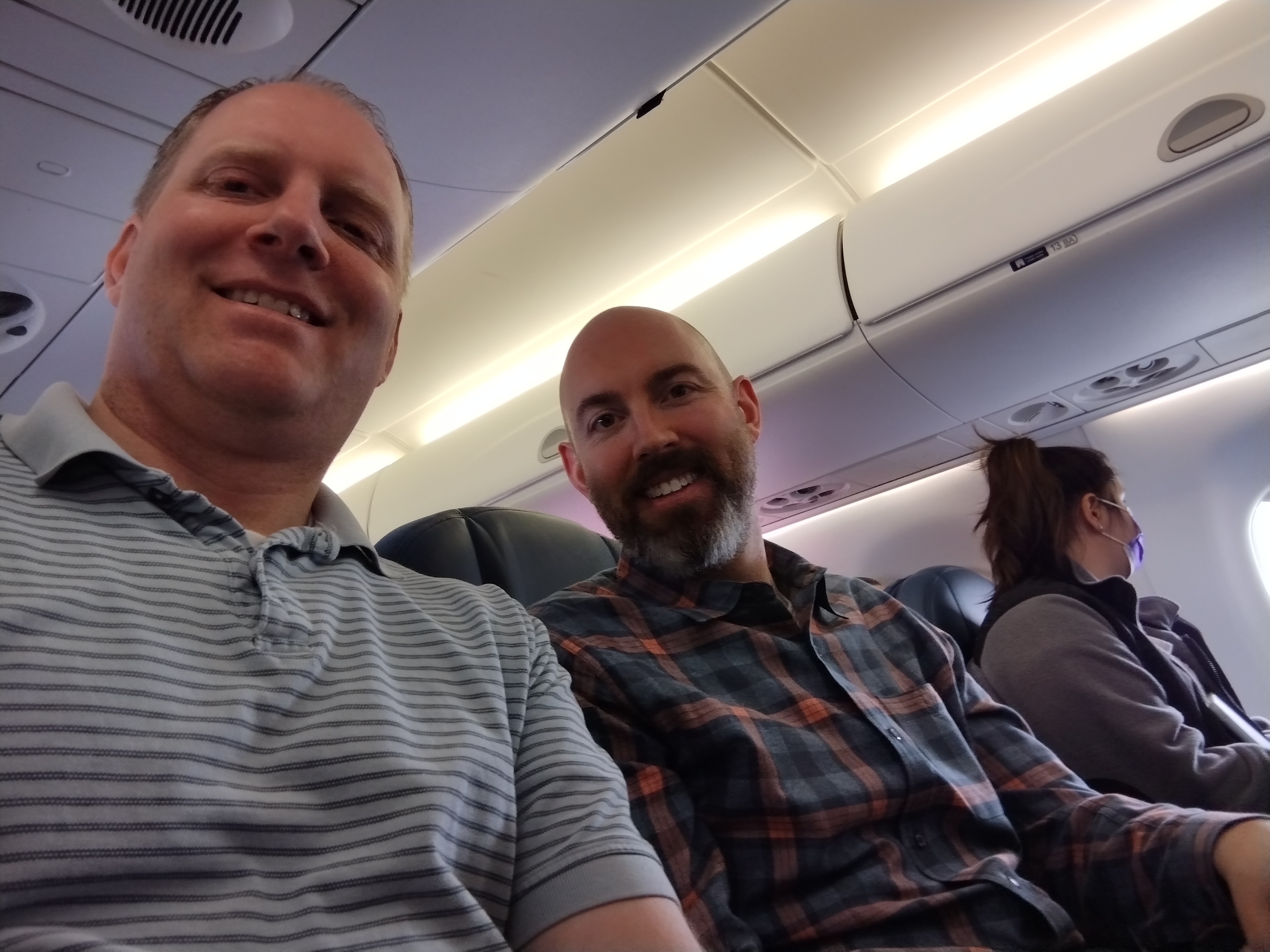
Paul Ross and Andrew Curtis flying to Tucson from Salt Lake City








 Sagacity