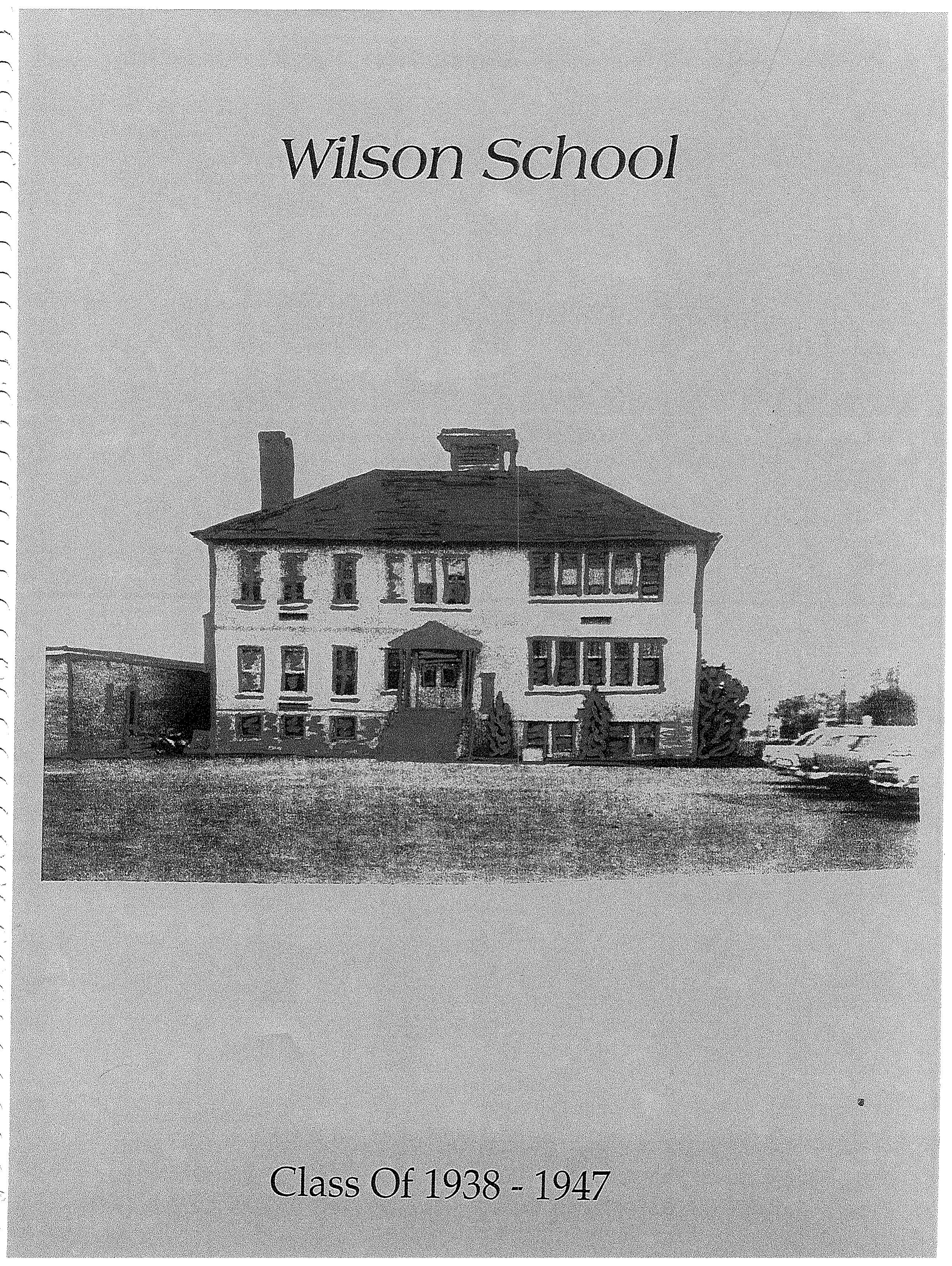
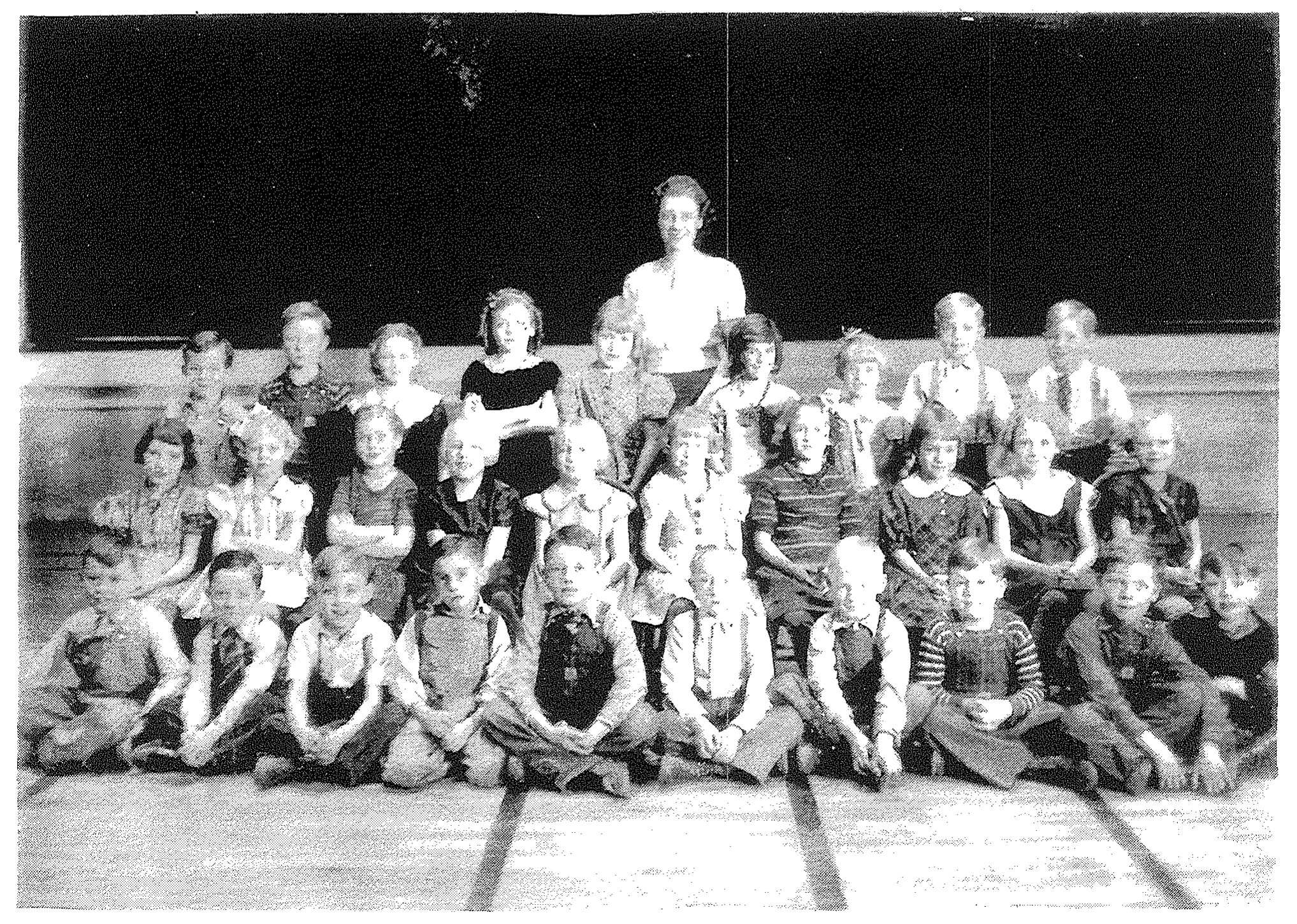
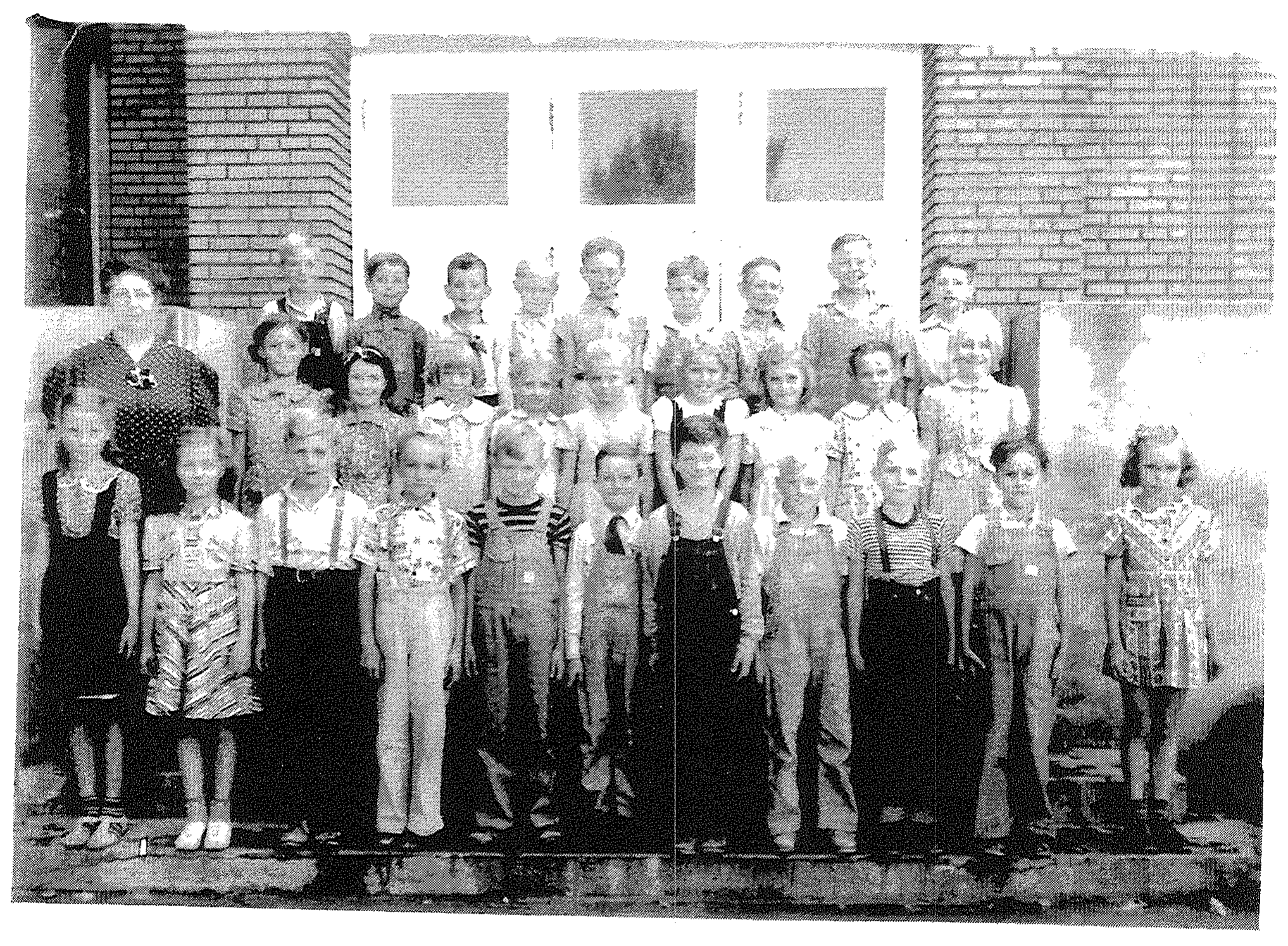
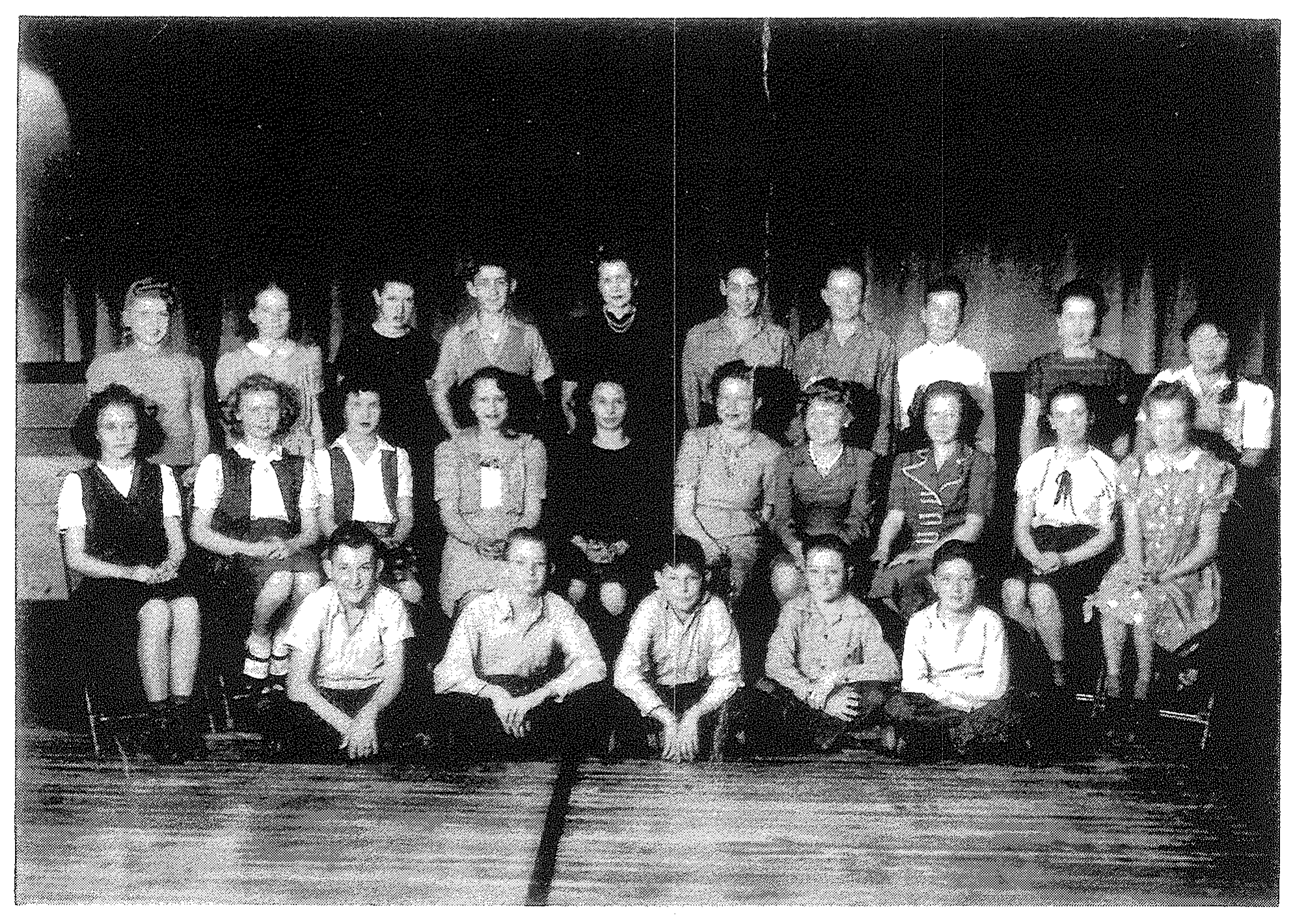
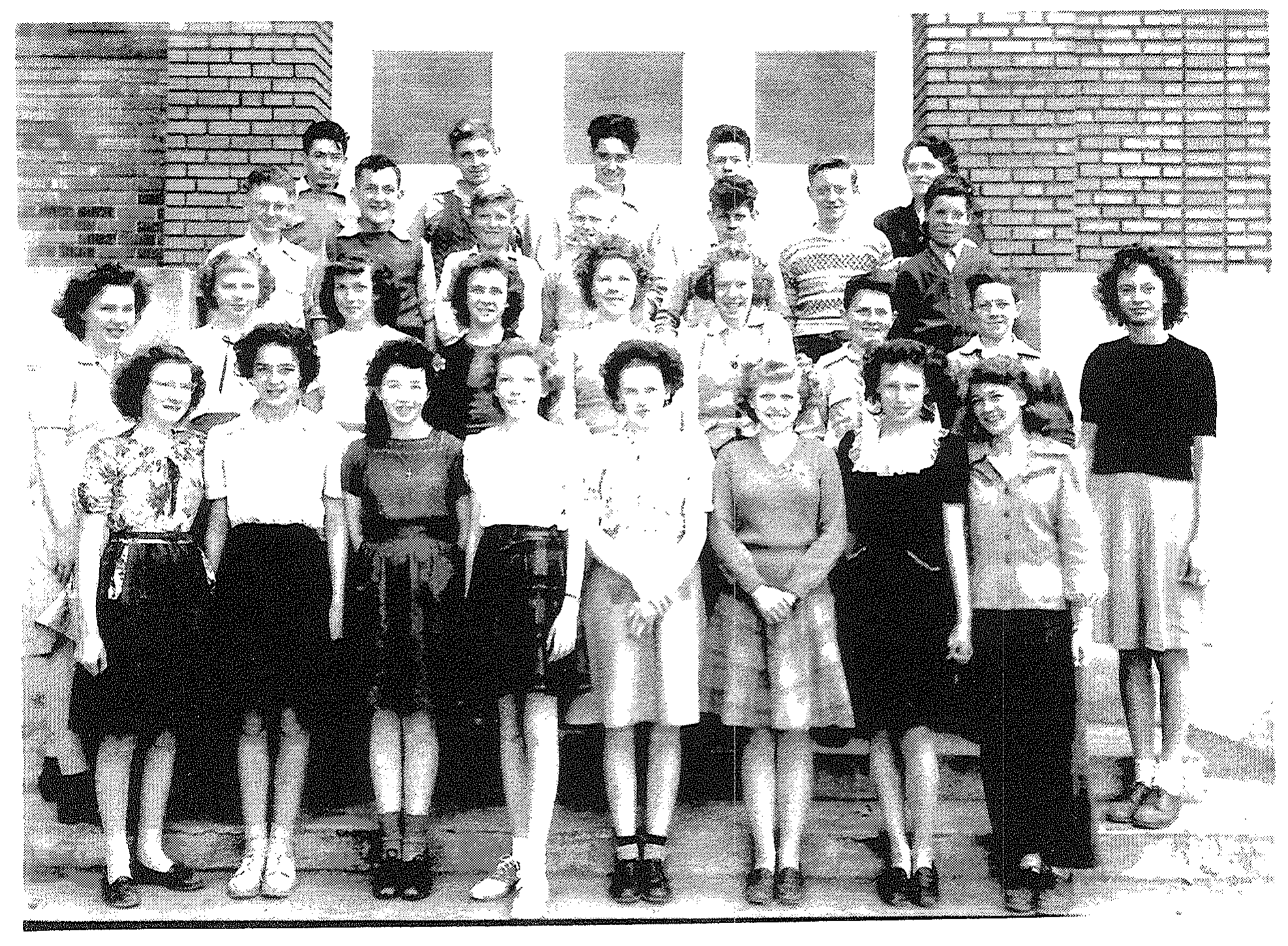
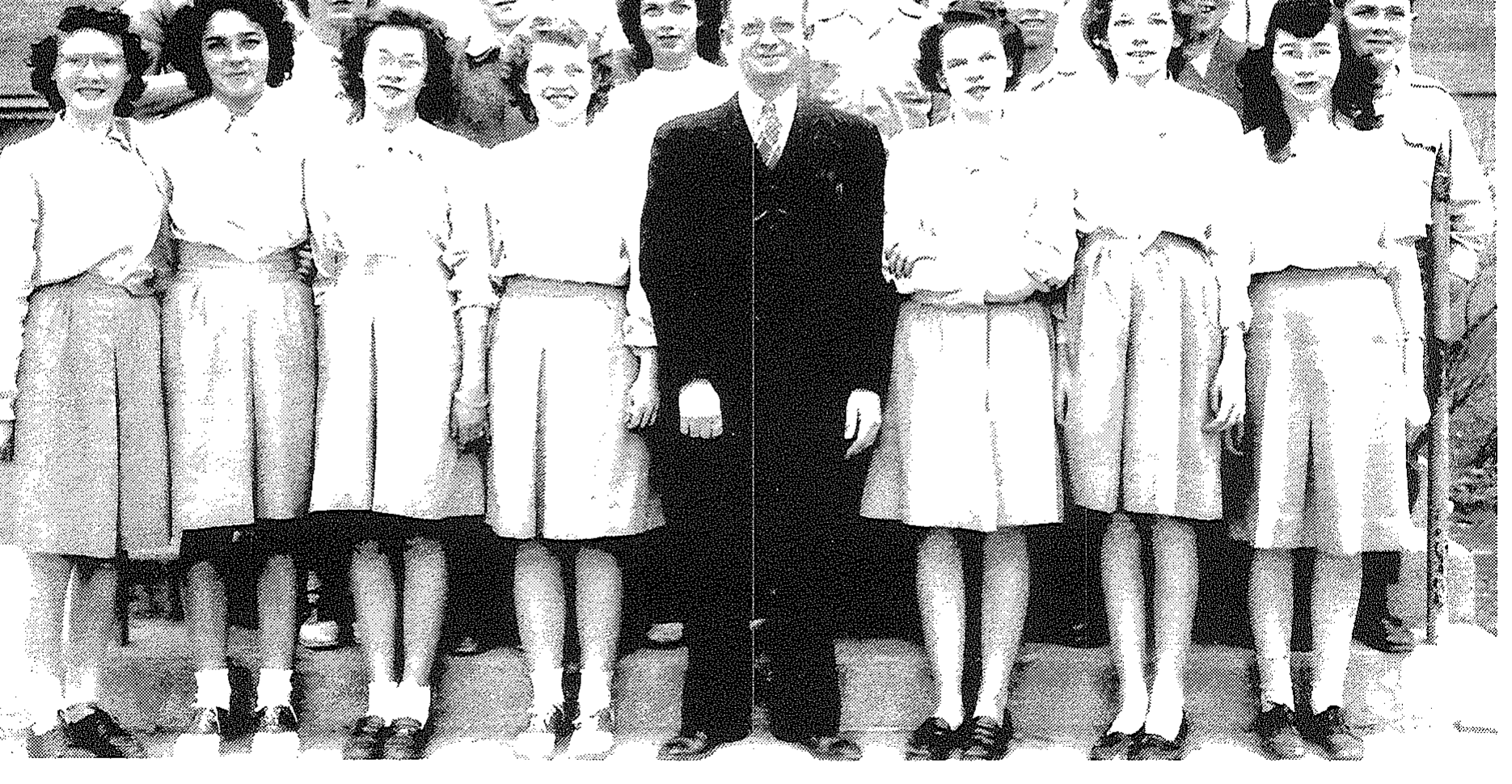
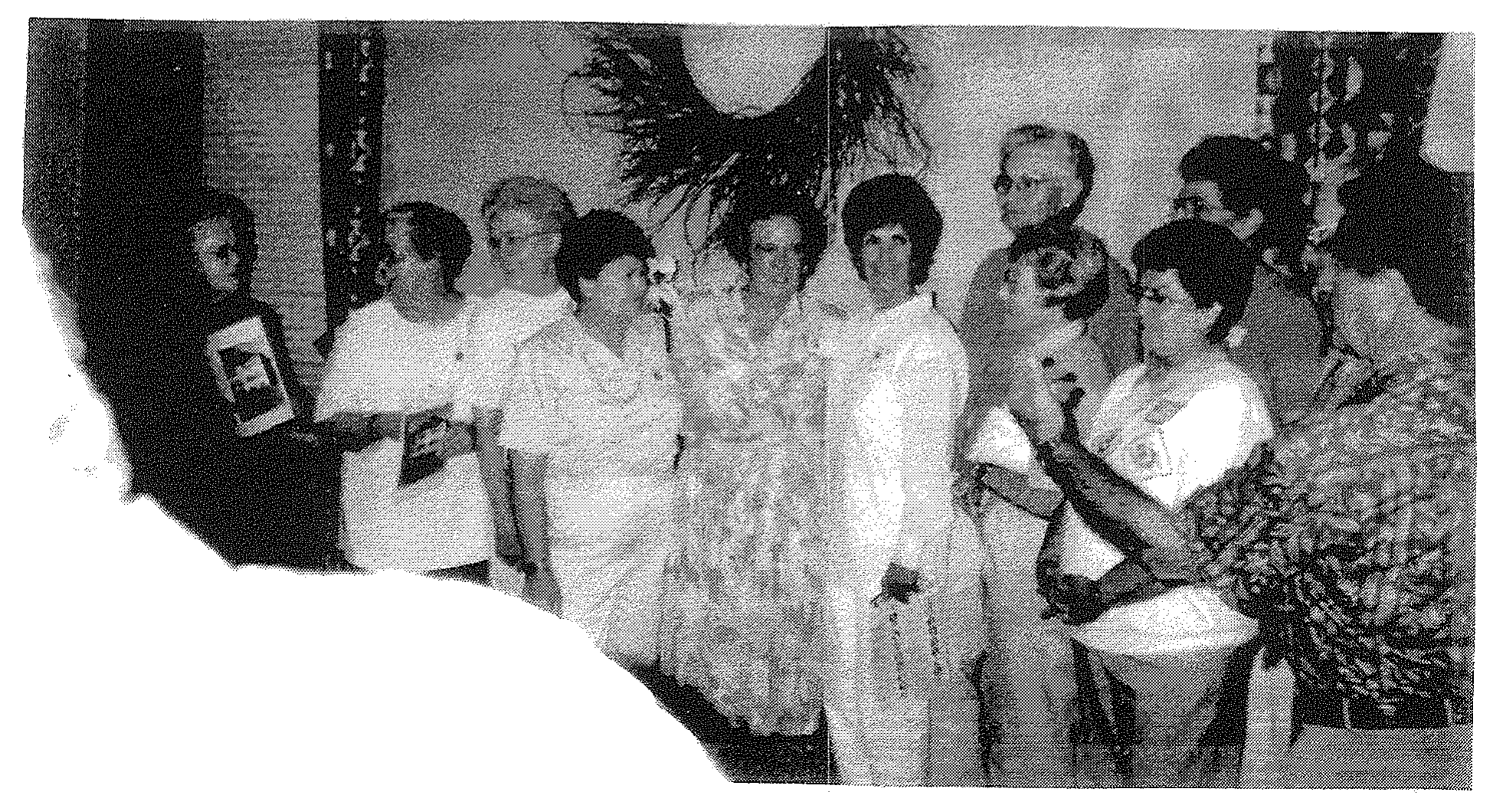
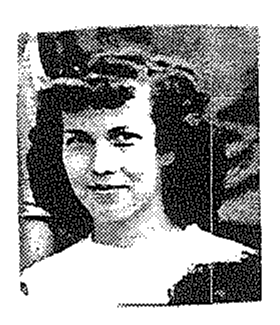
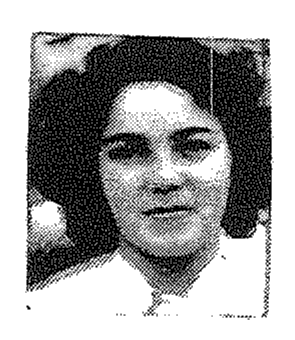
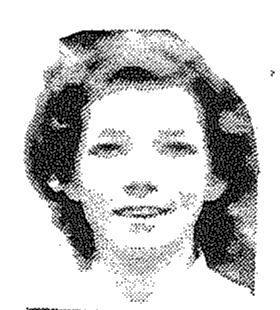
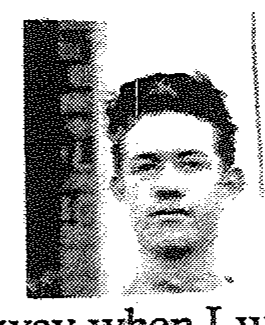
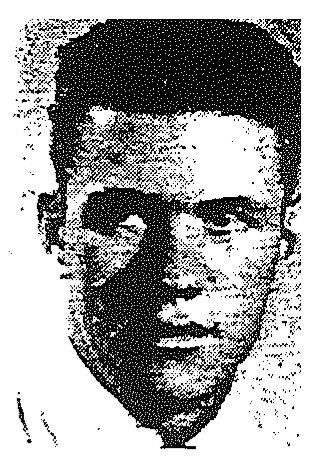
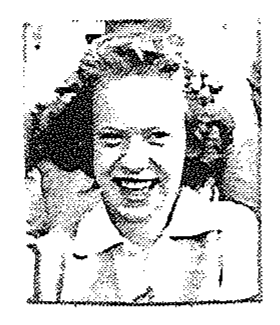
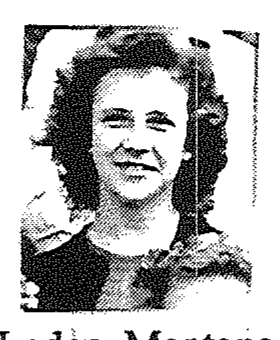
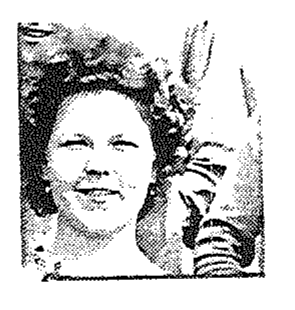
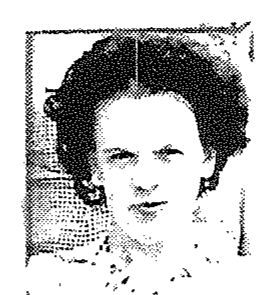
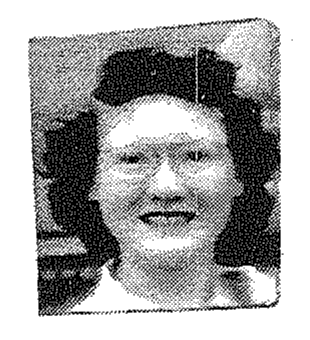
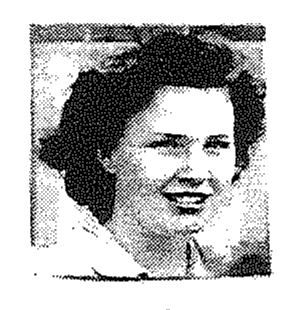
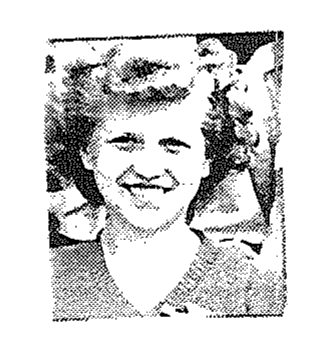
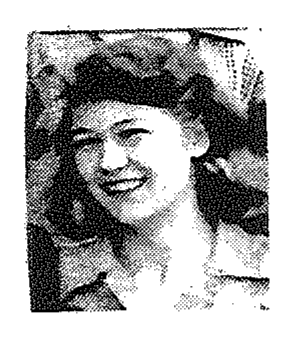
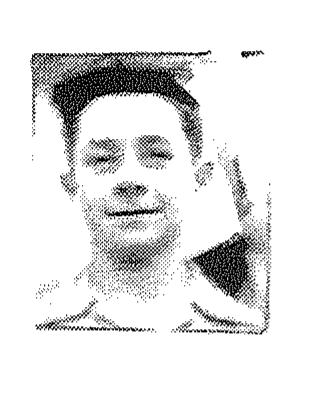
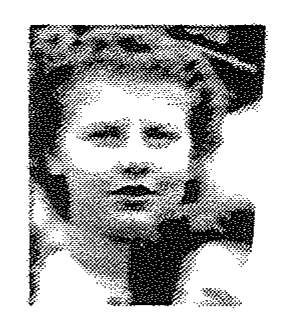
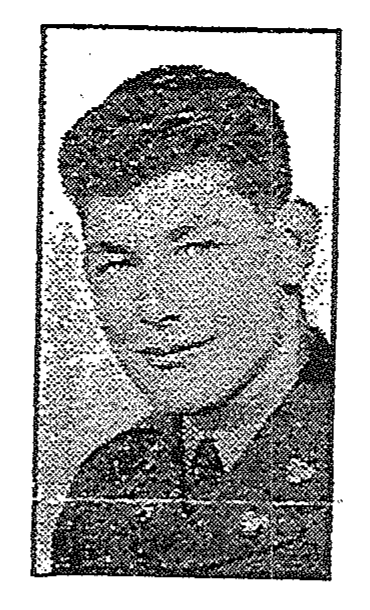
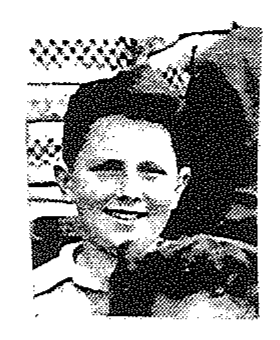
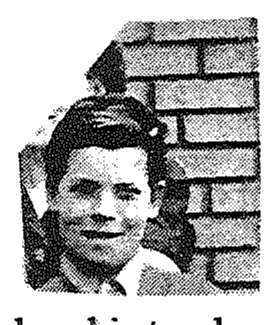
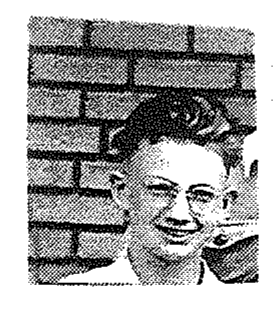
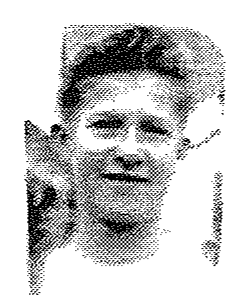
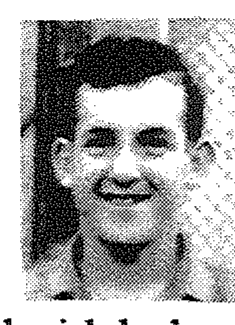
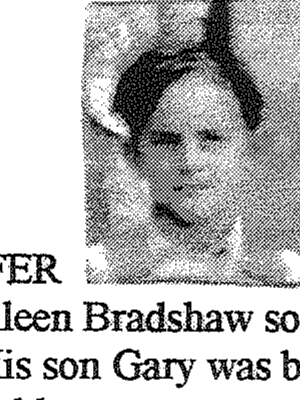
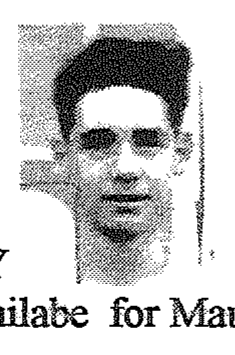
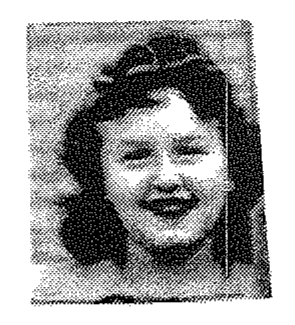
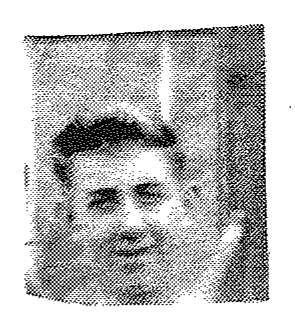
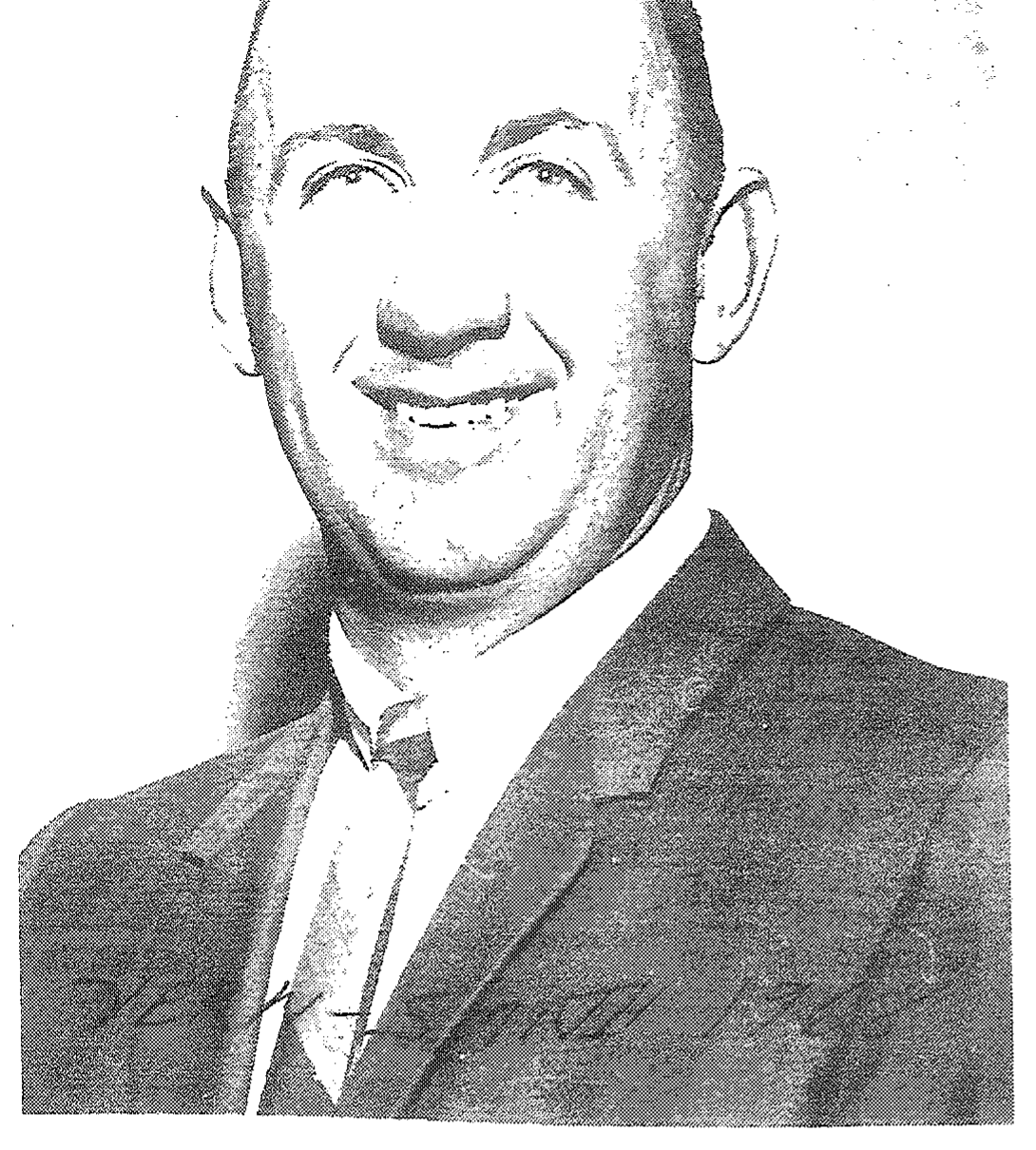
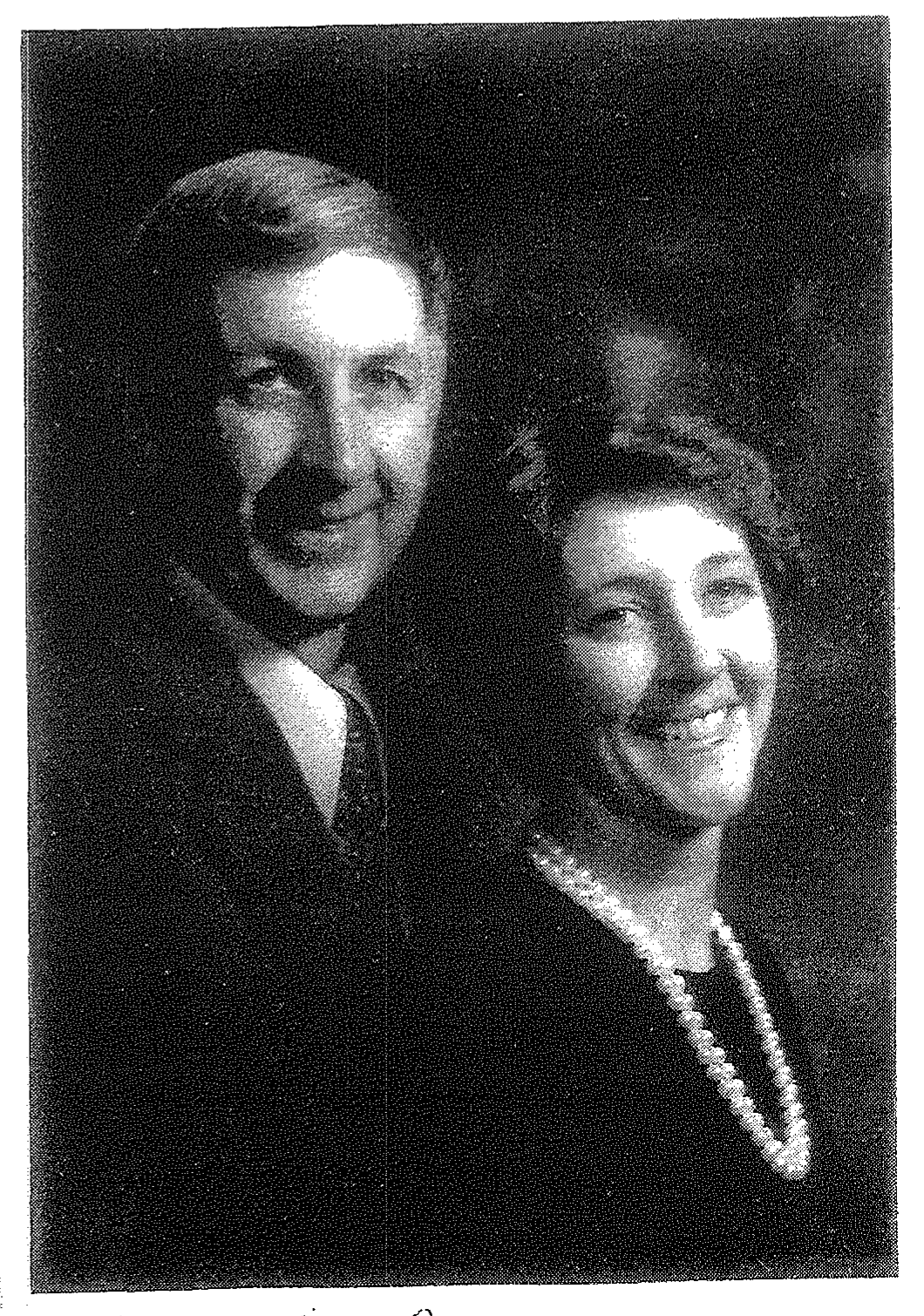
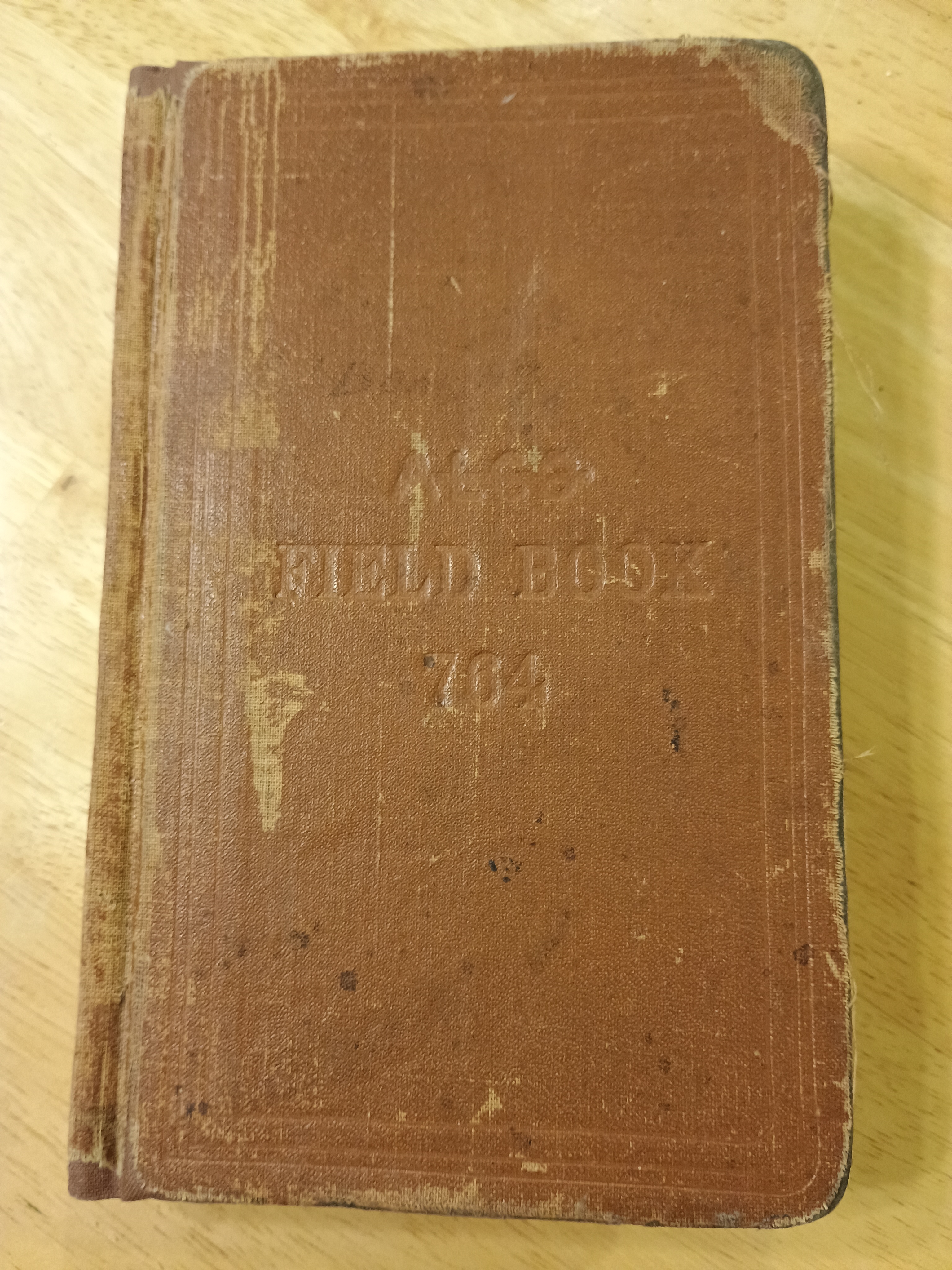
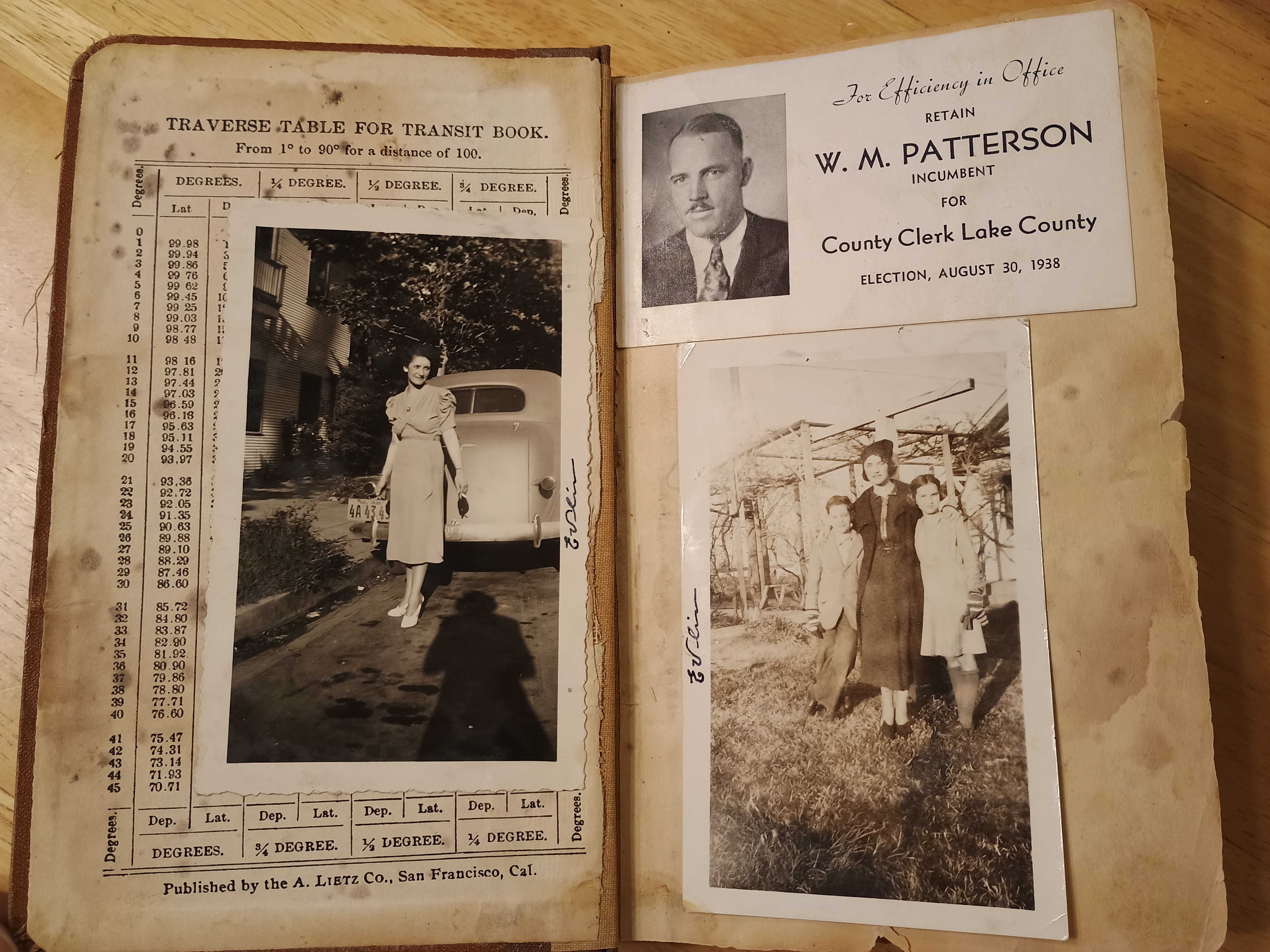
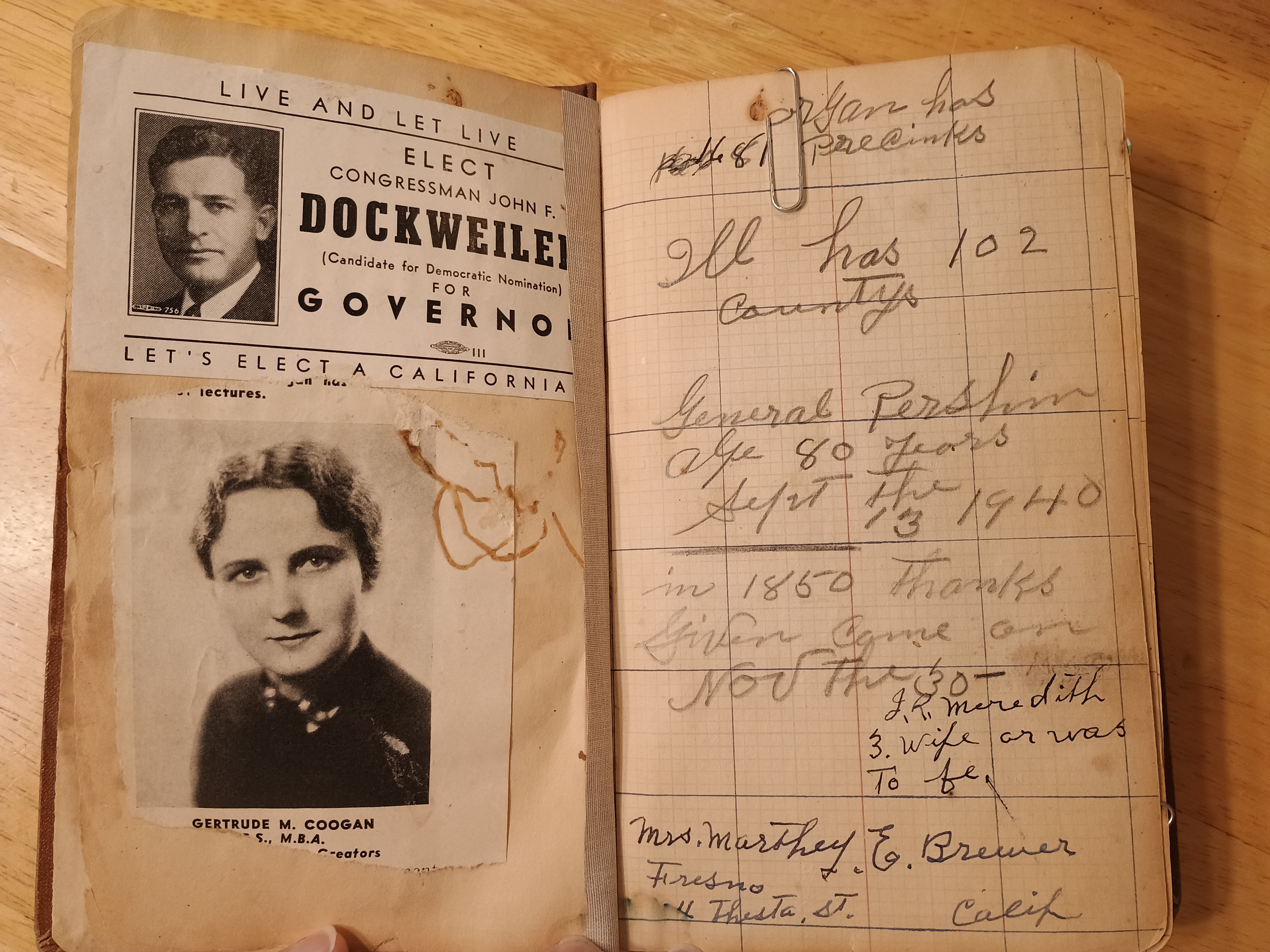
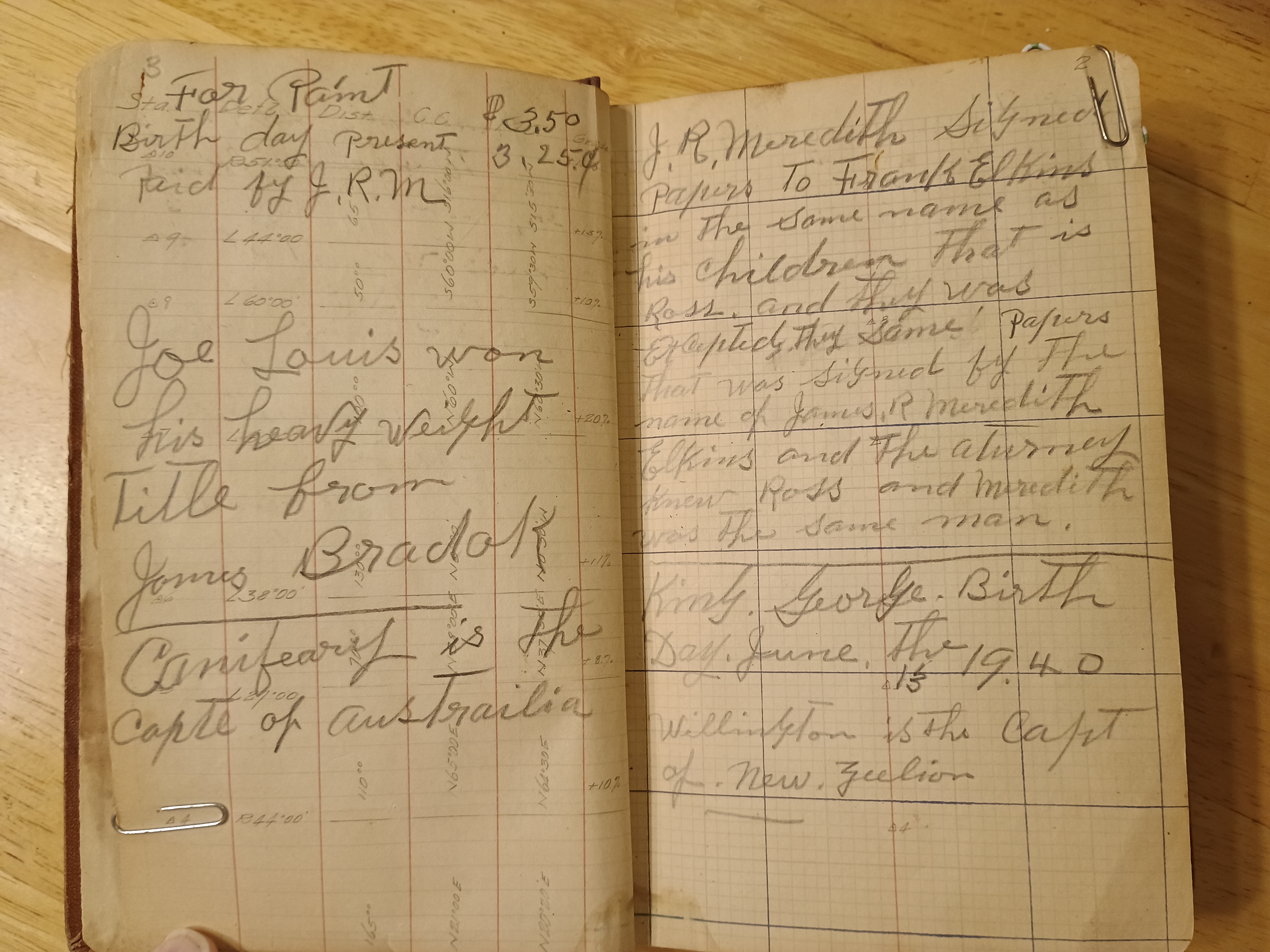
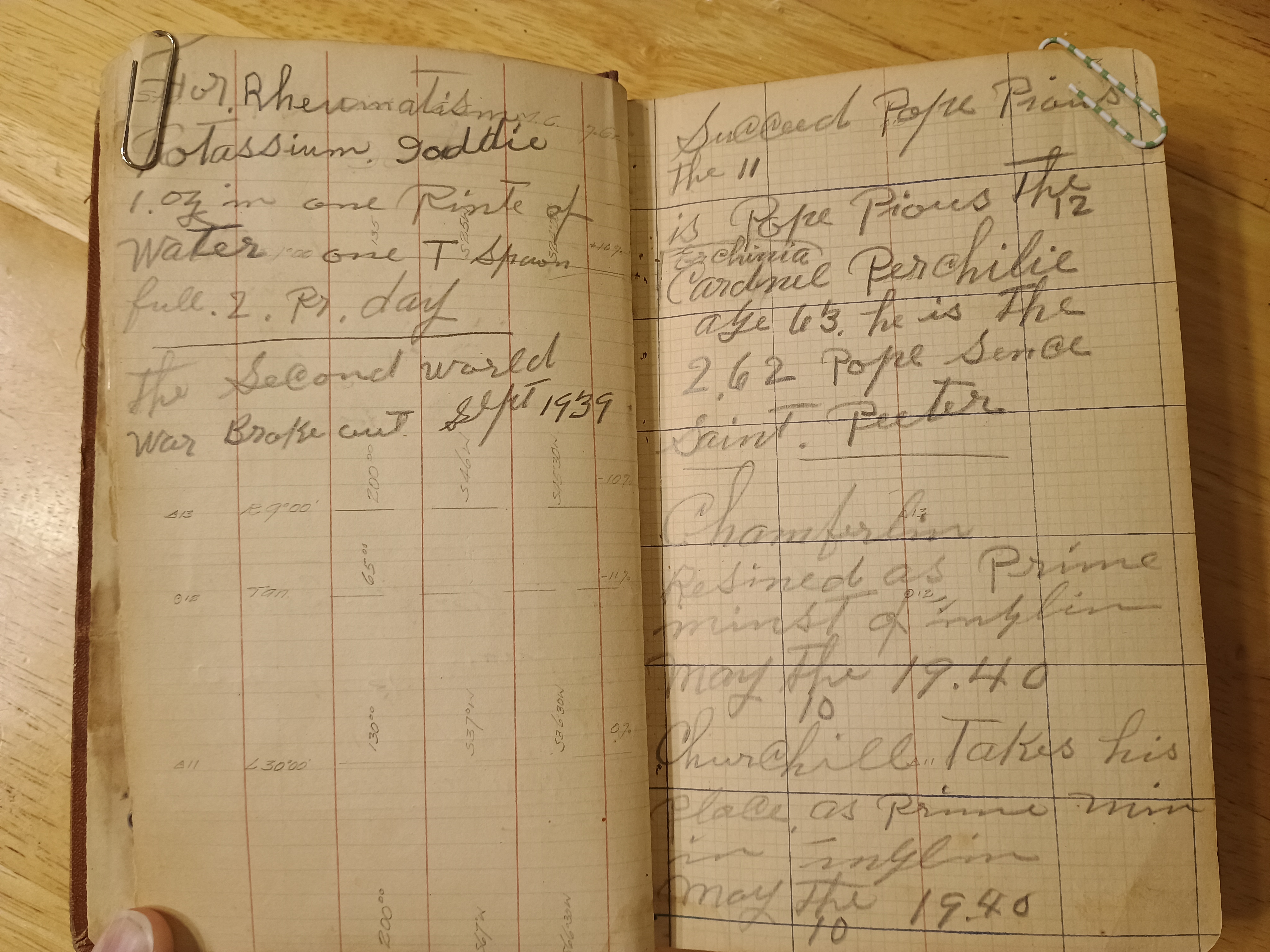
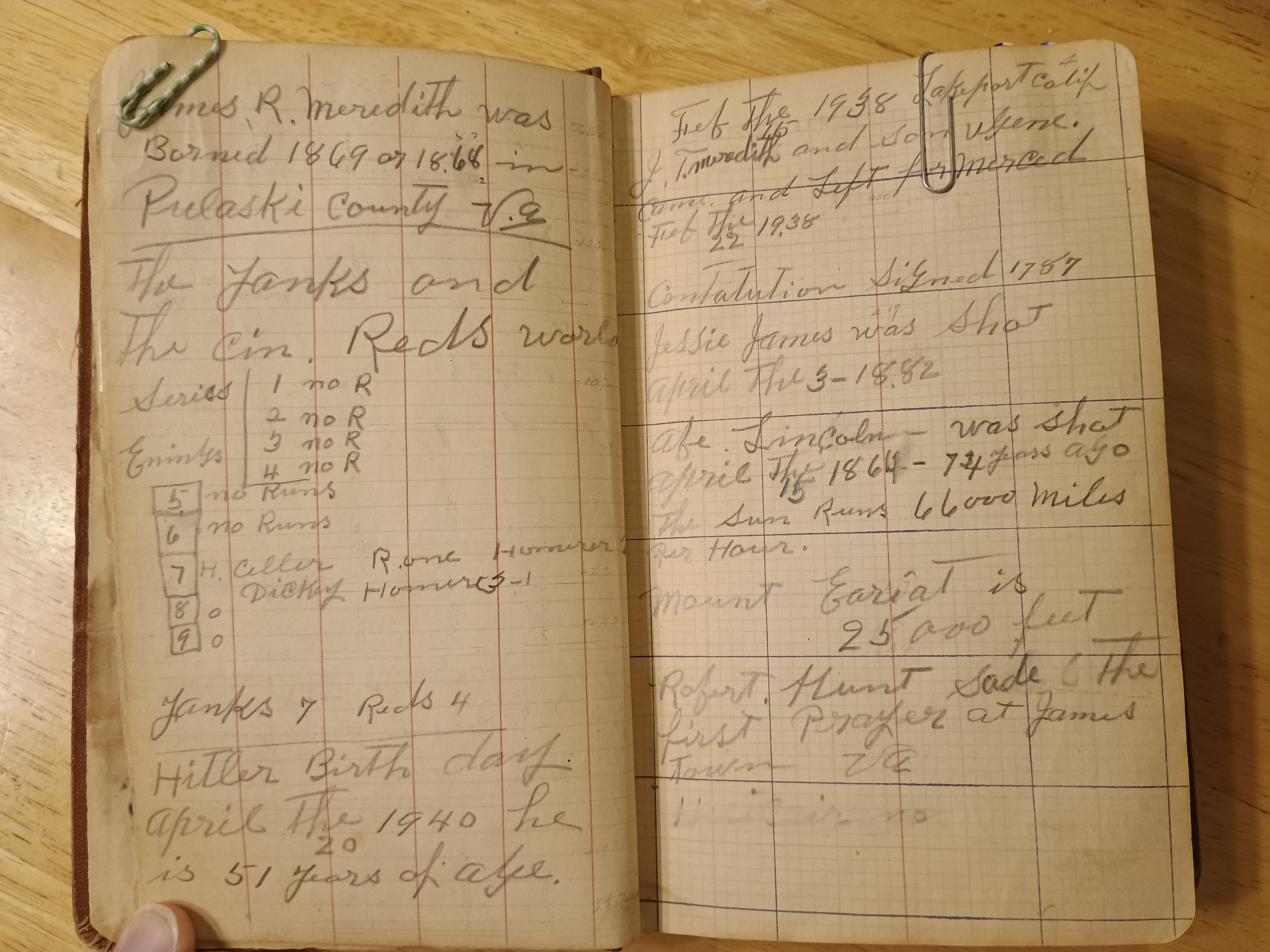
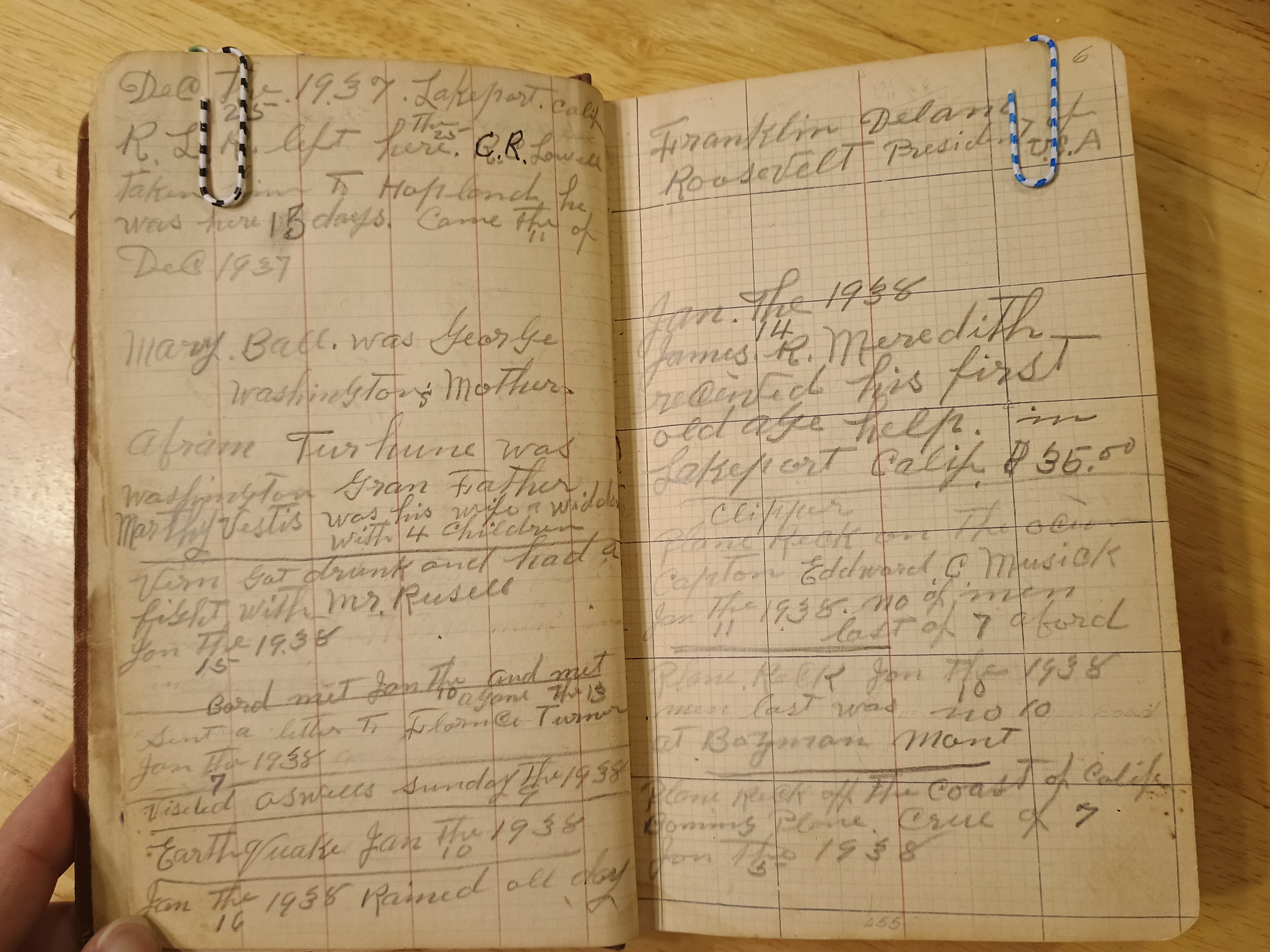
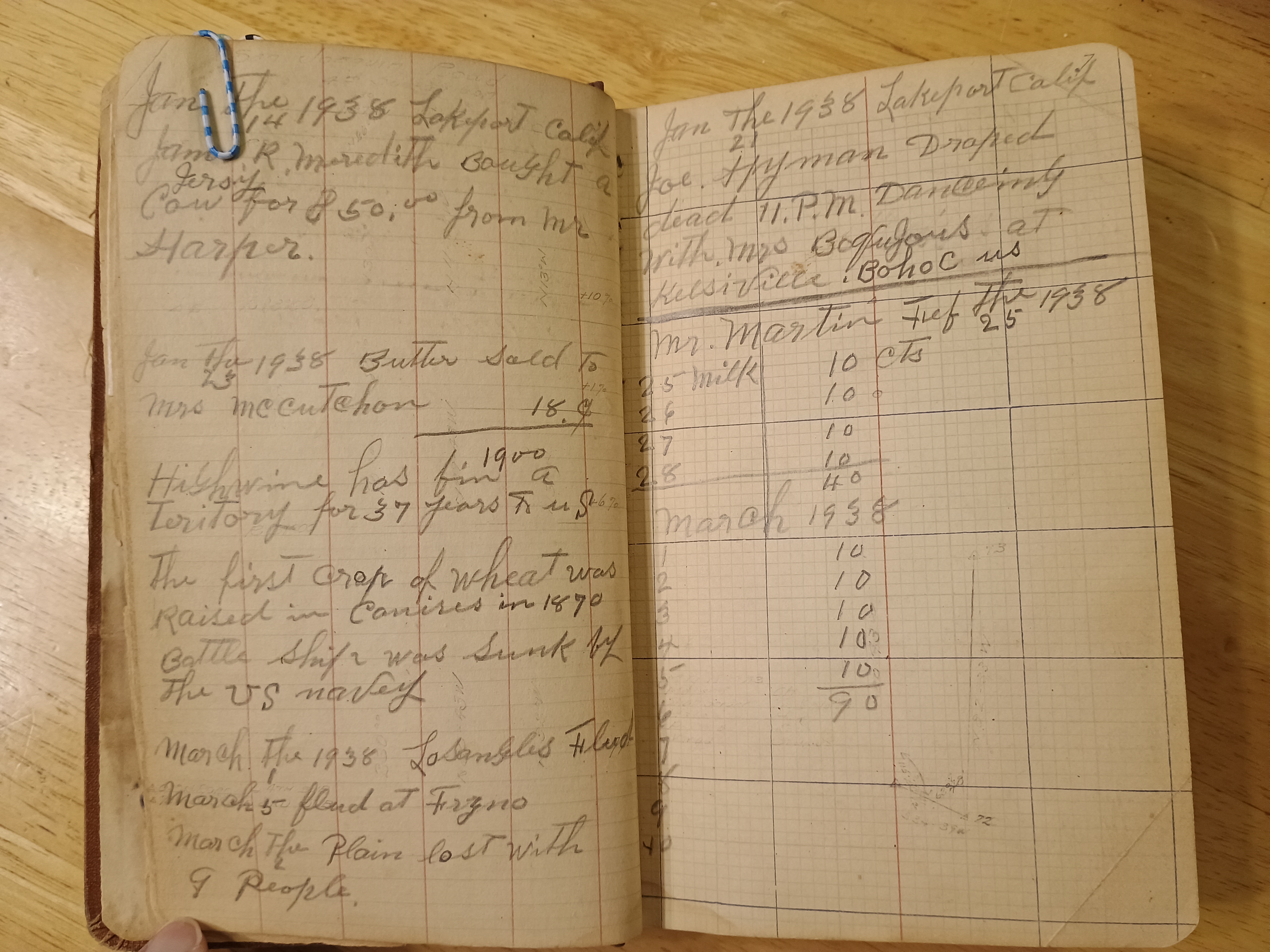
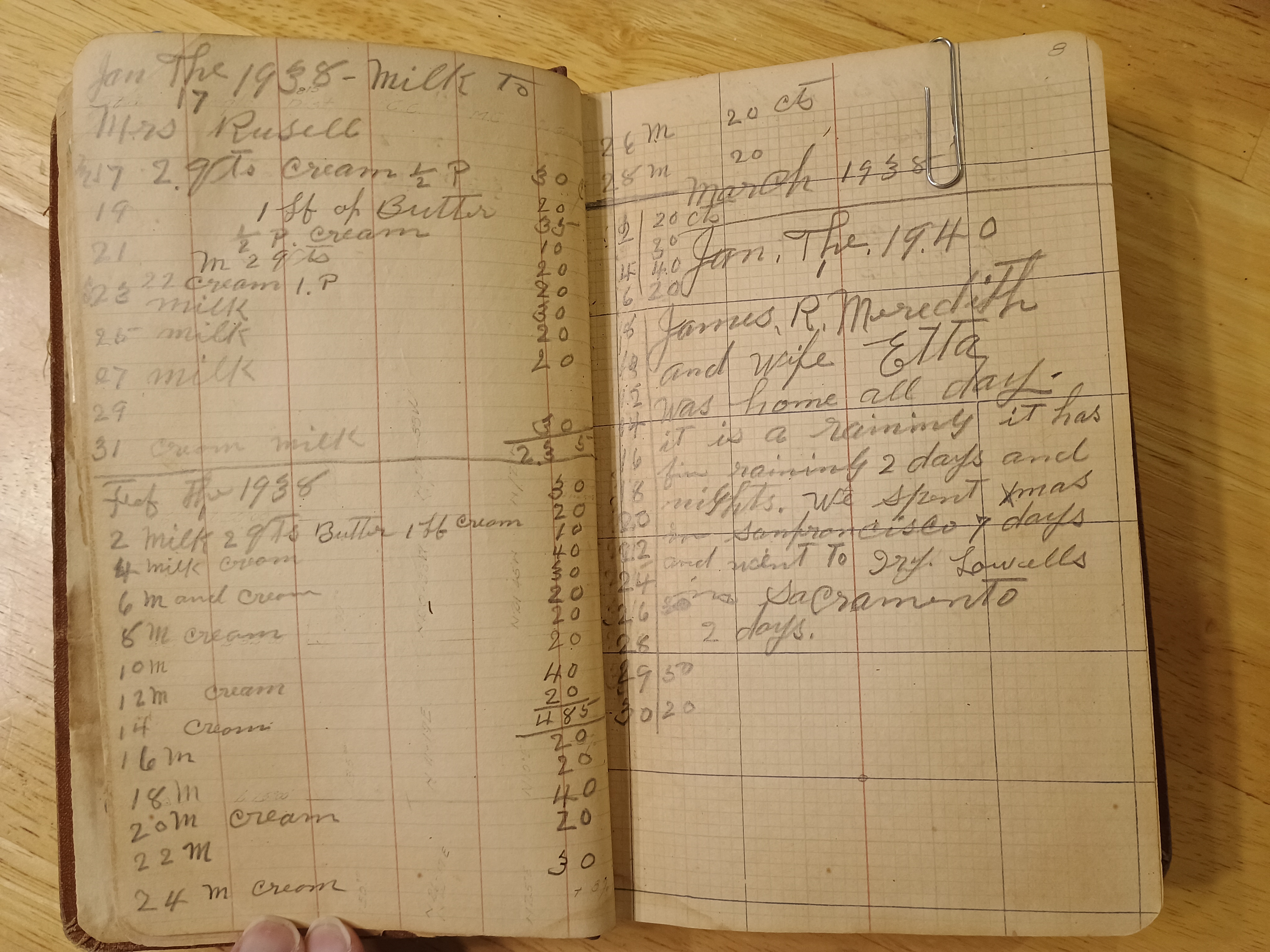
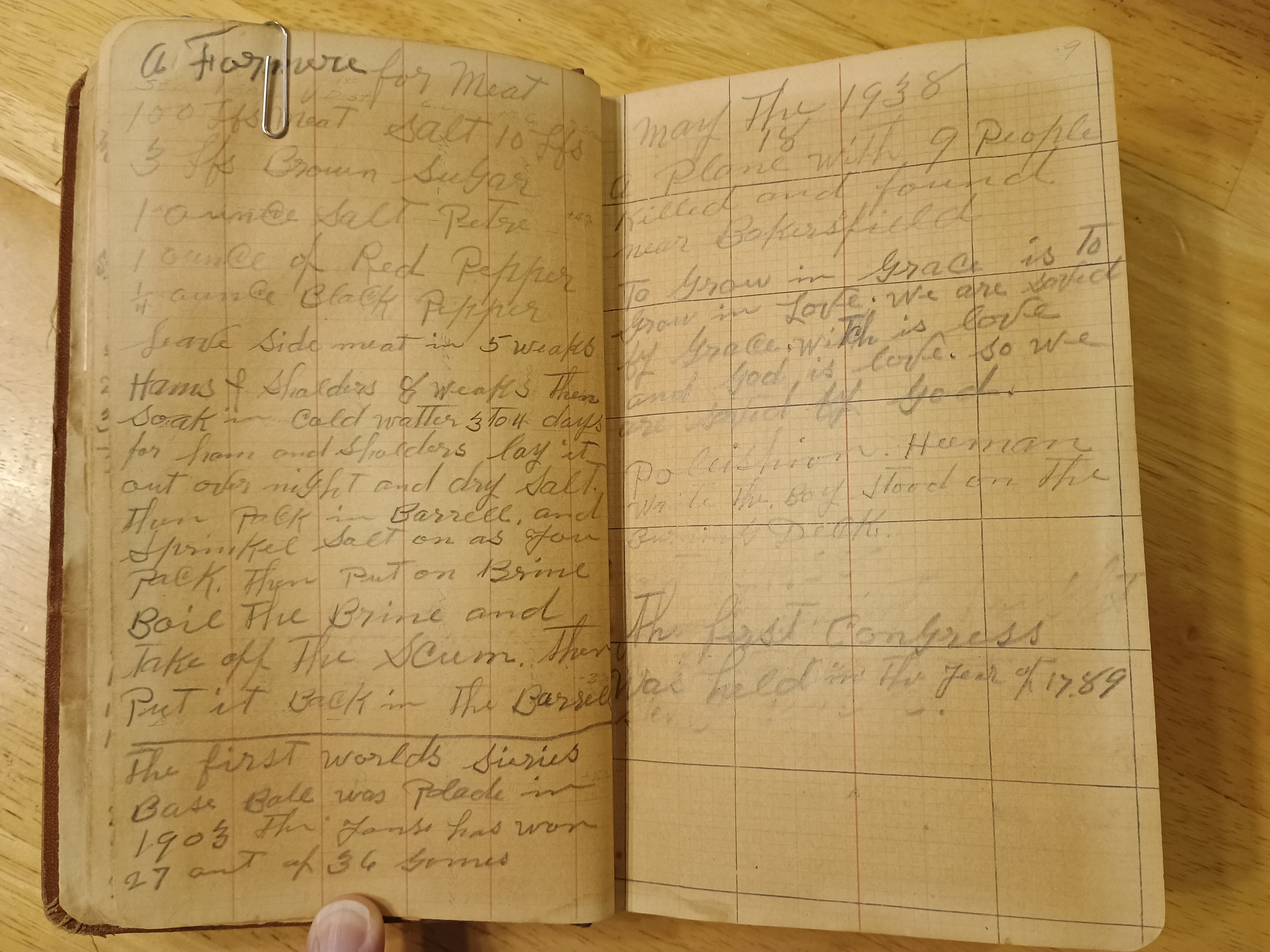
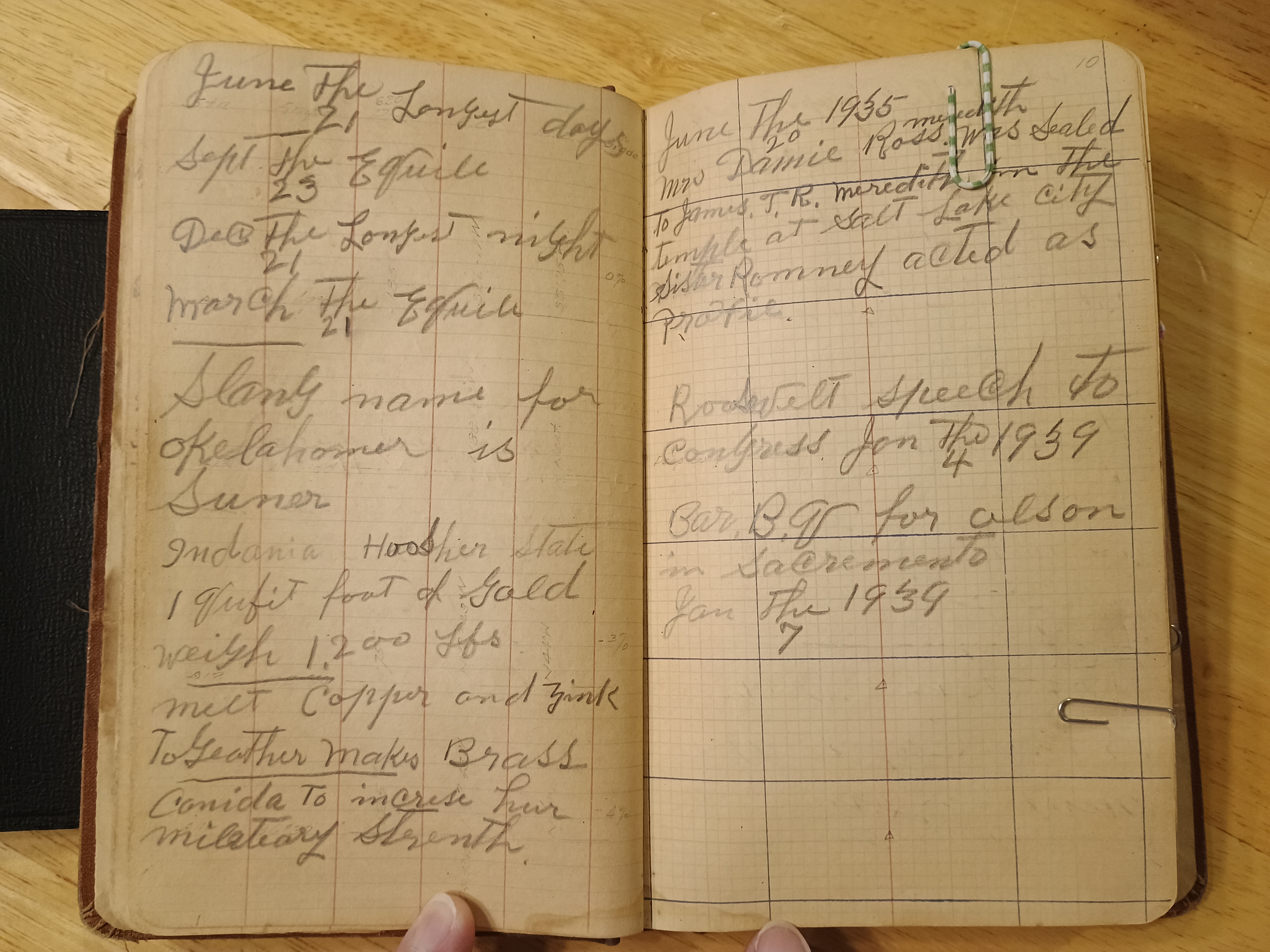
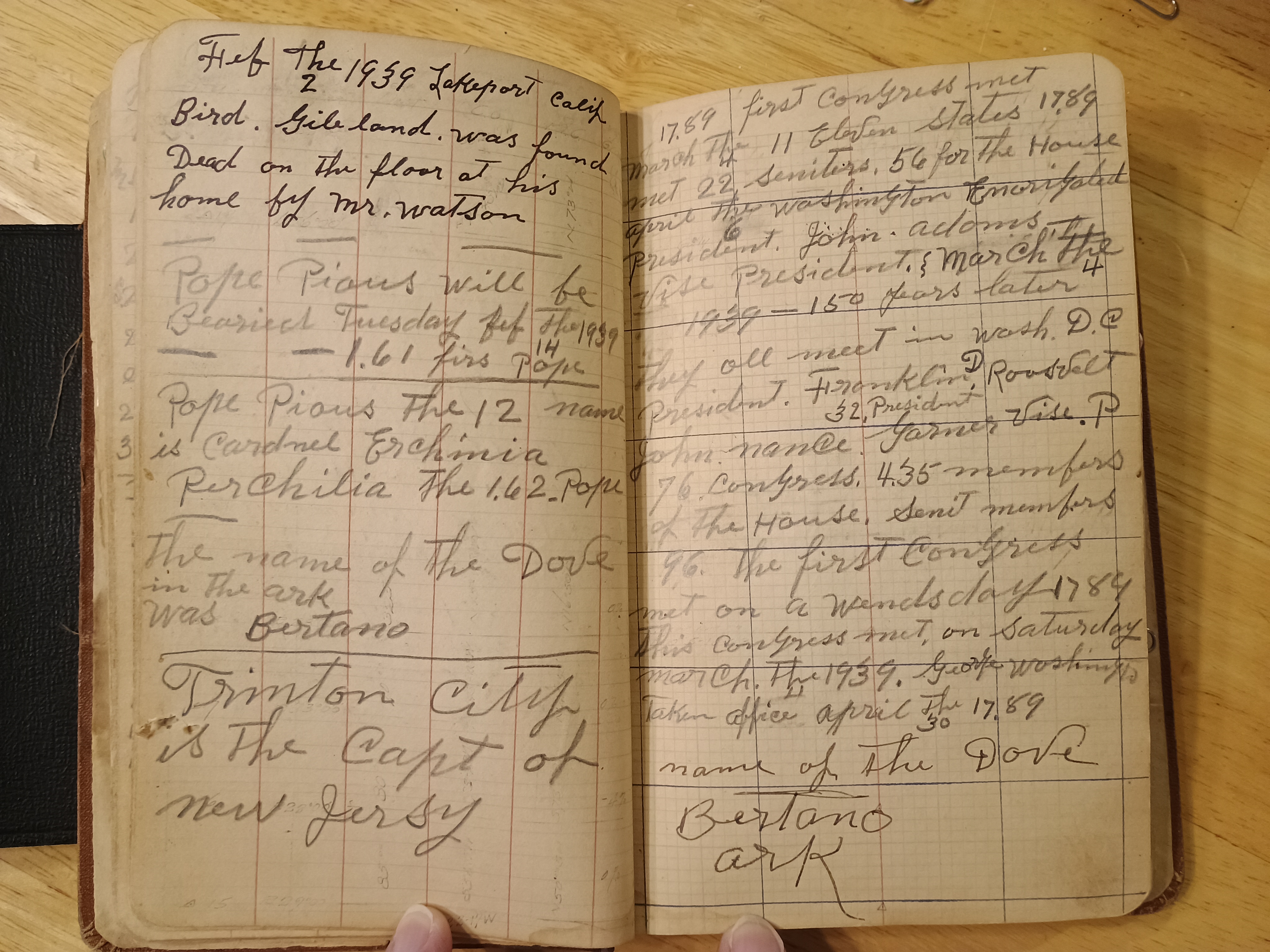
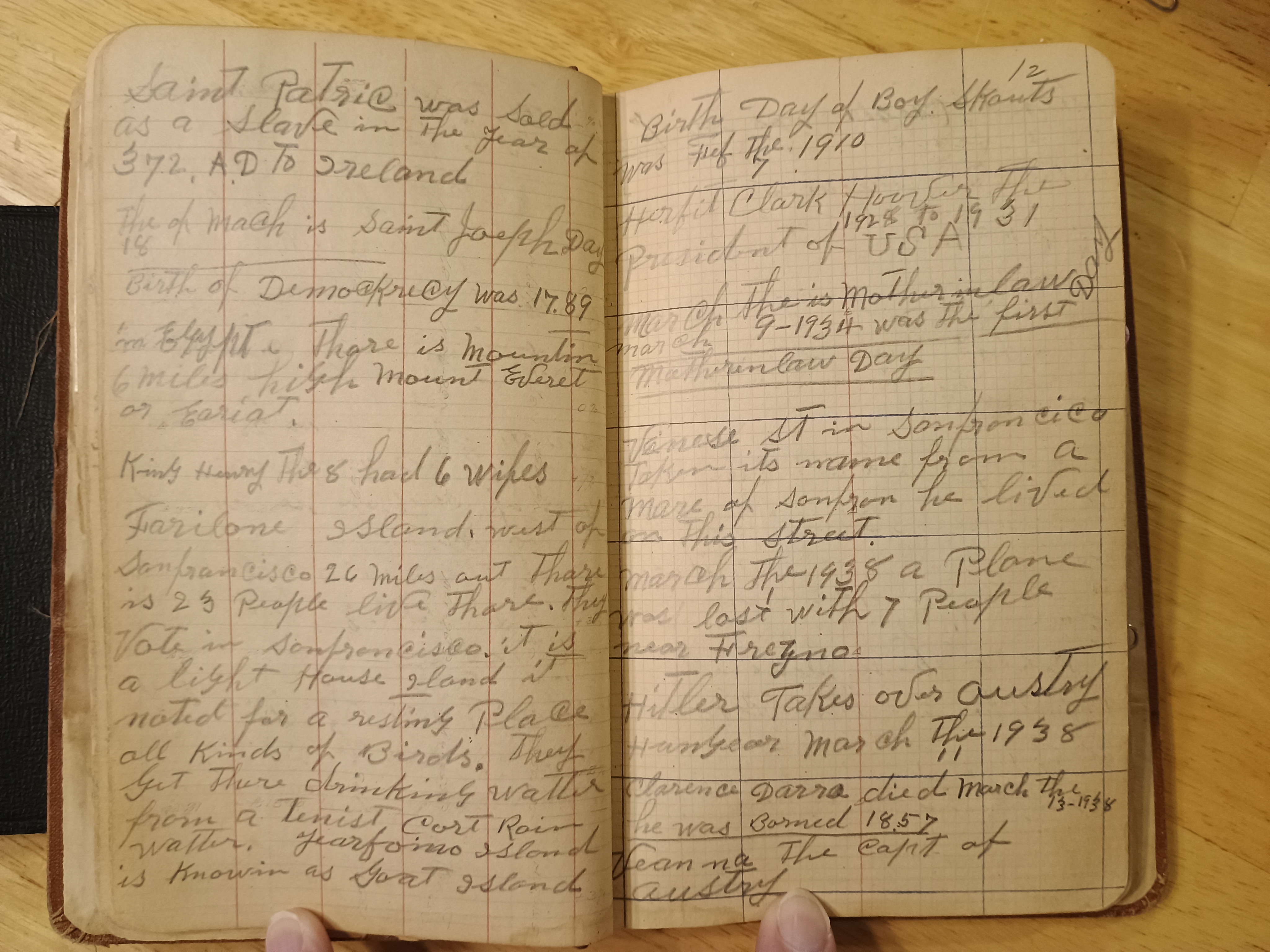
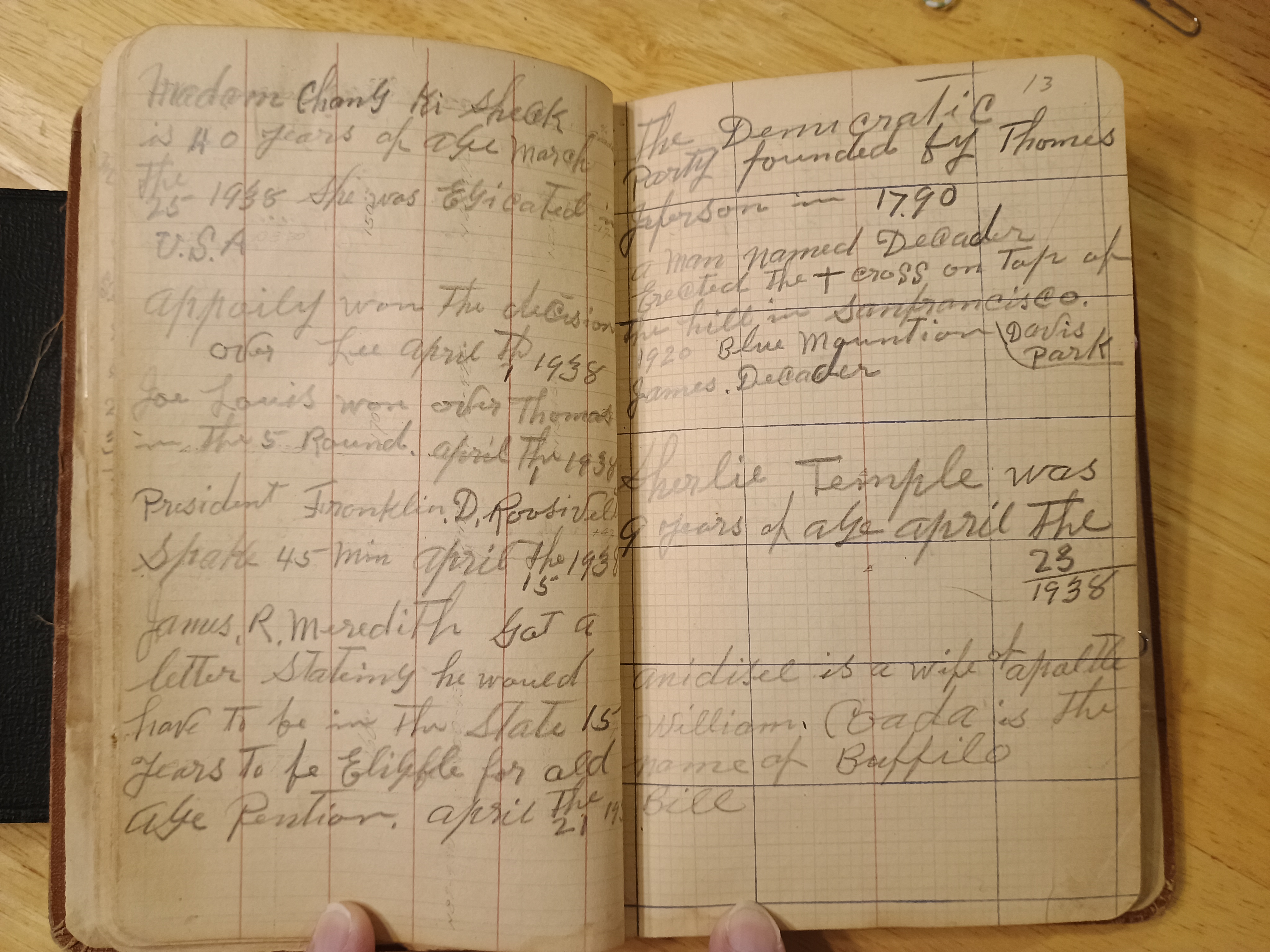
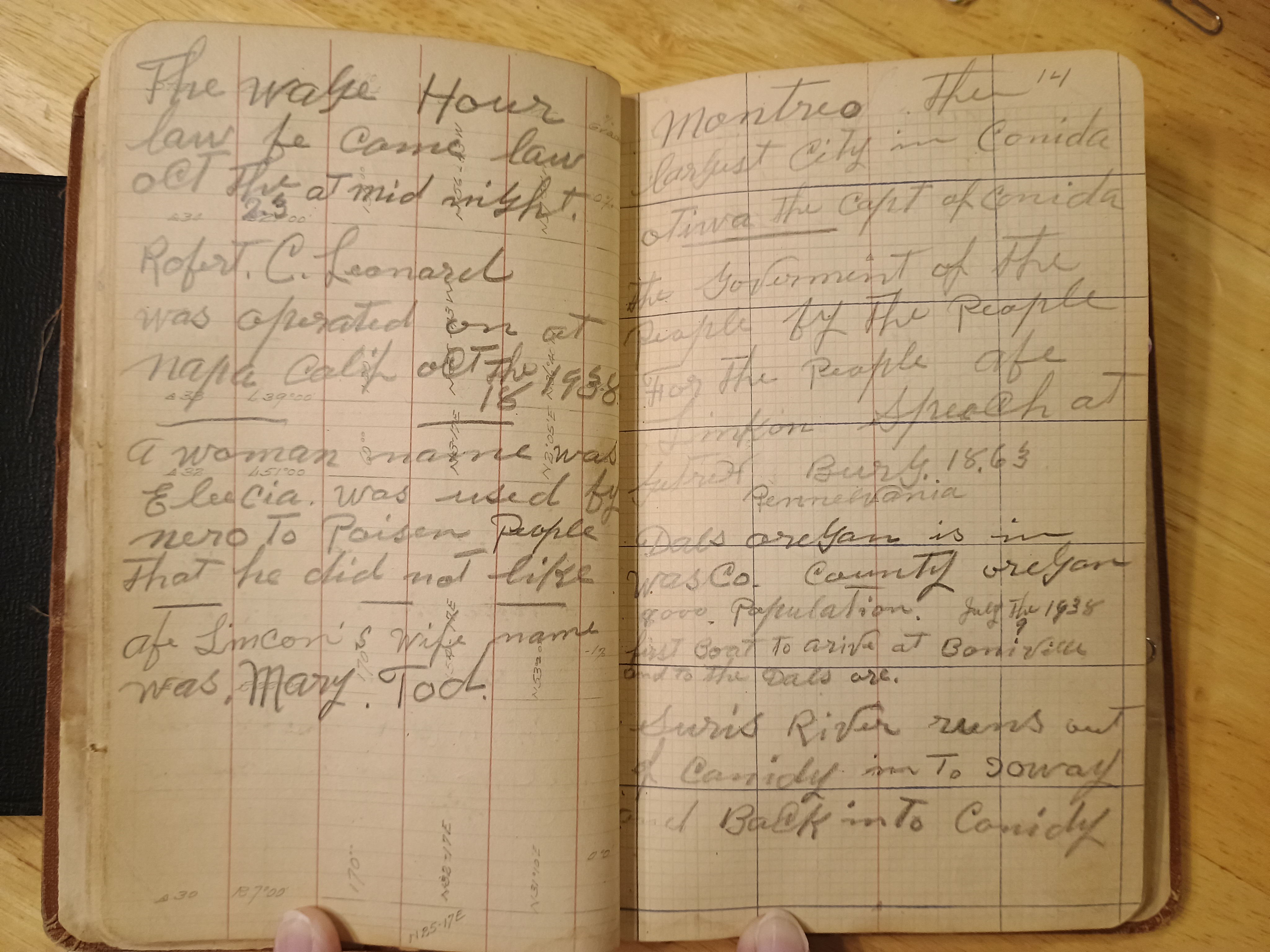
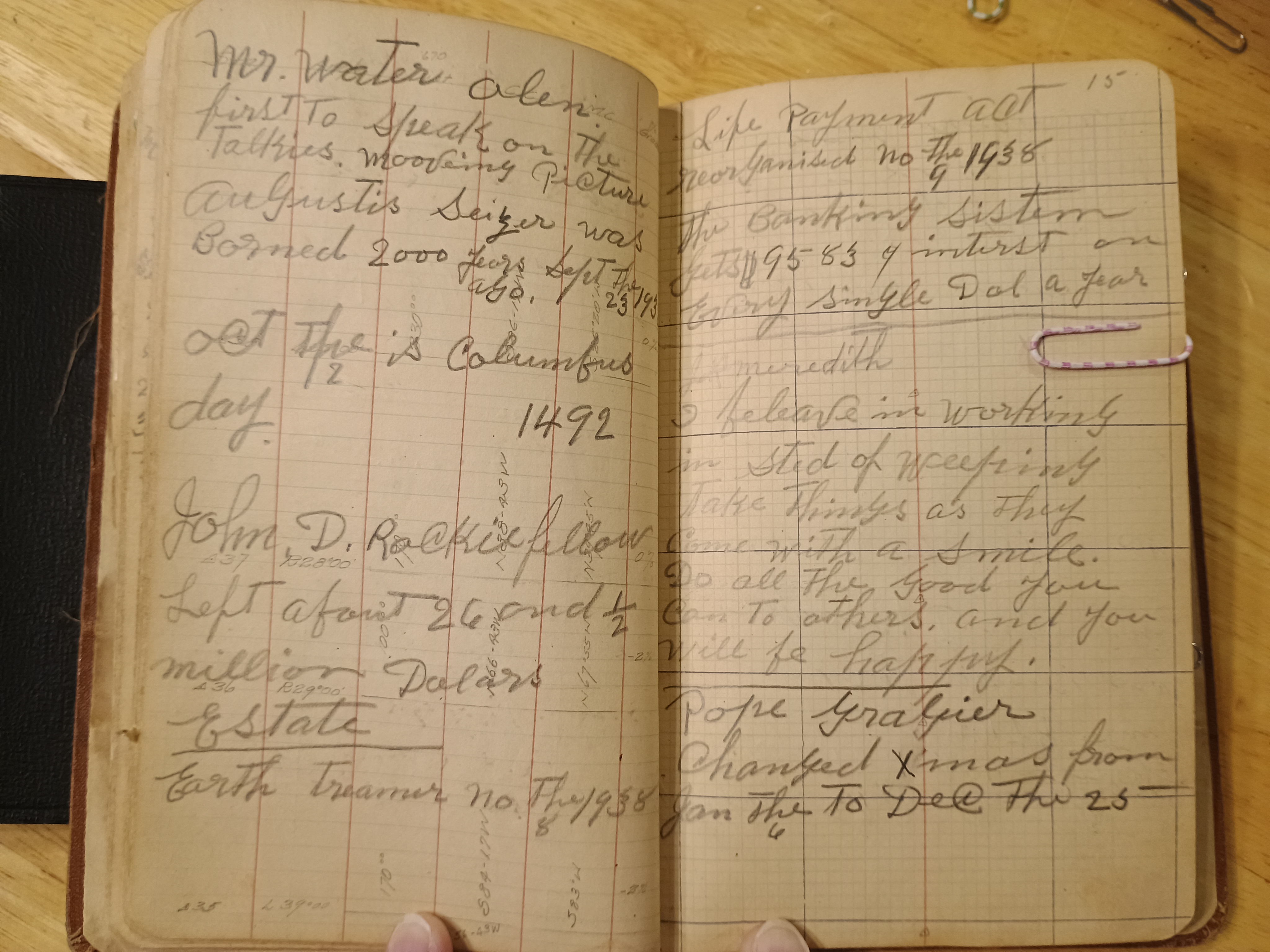
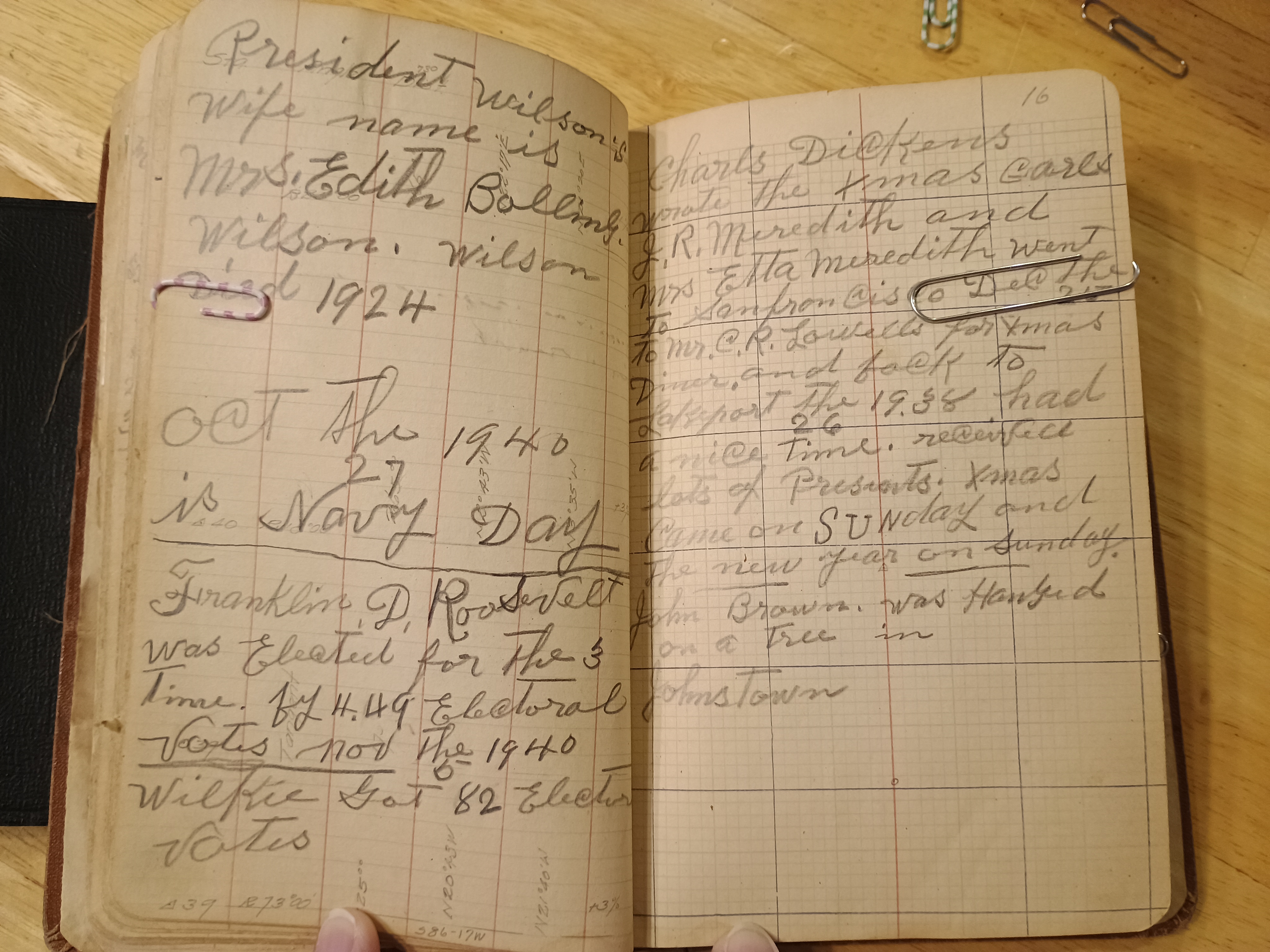
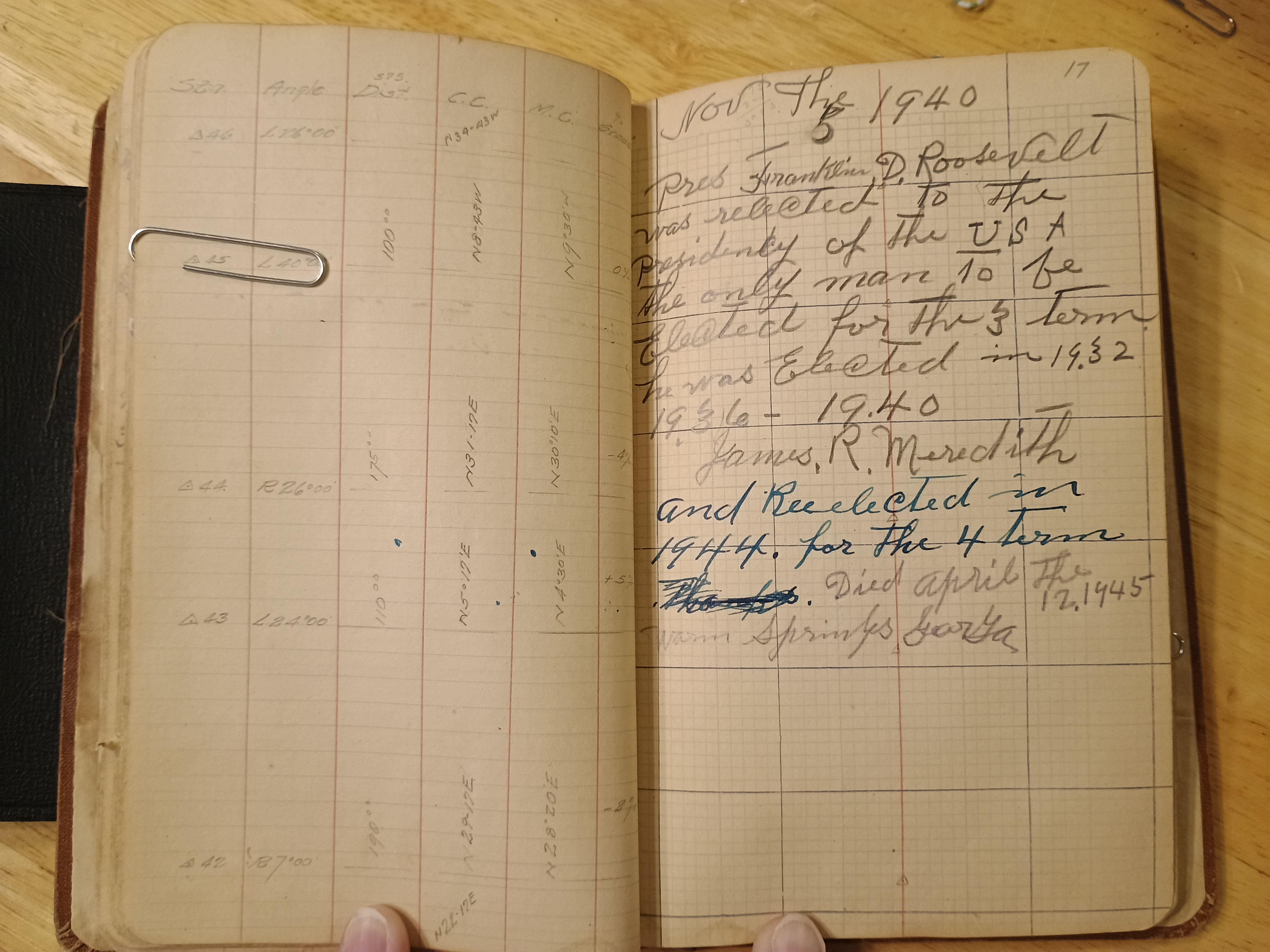
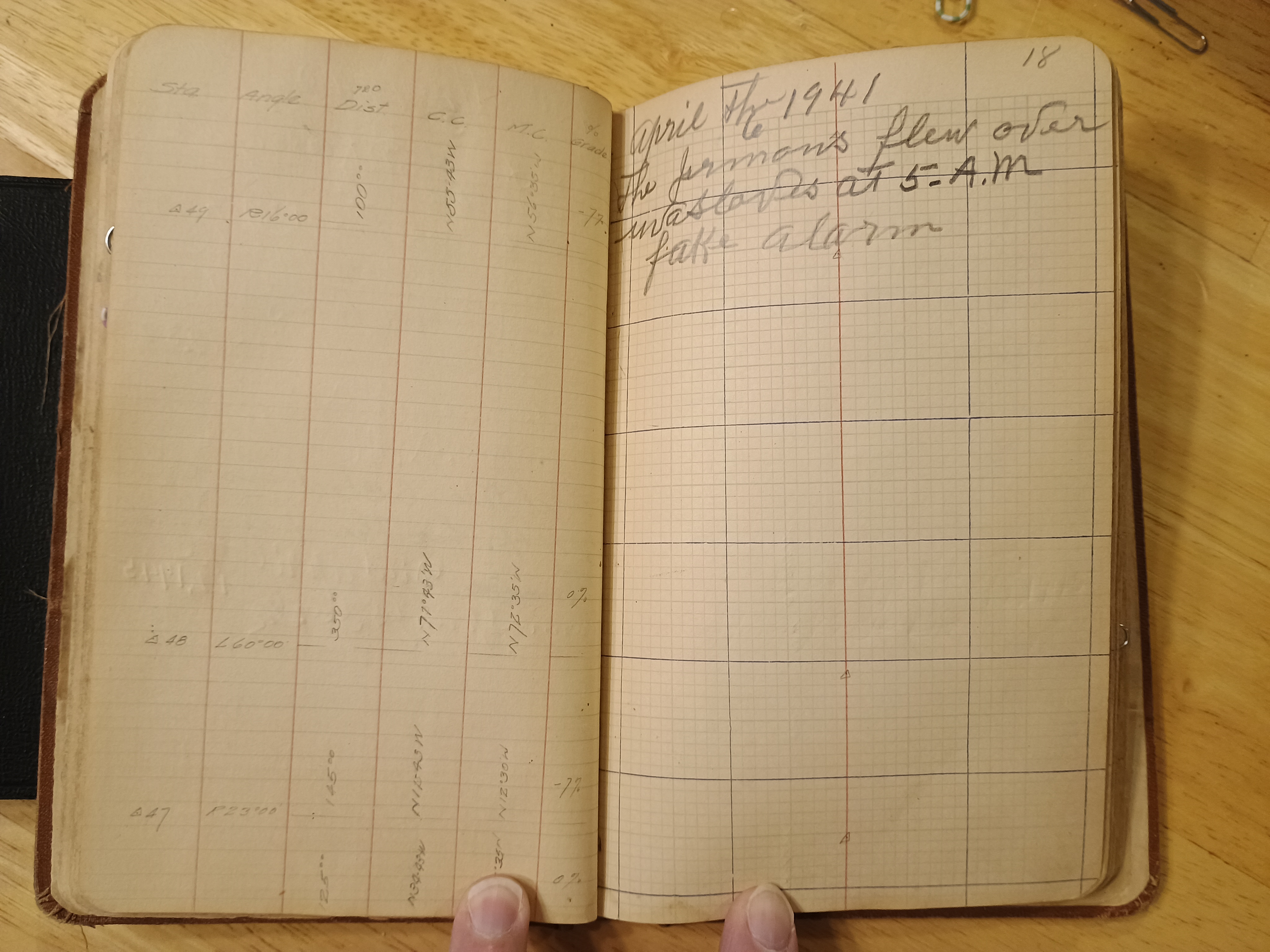
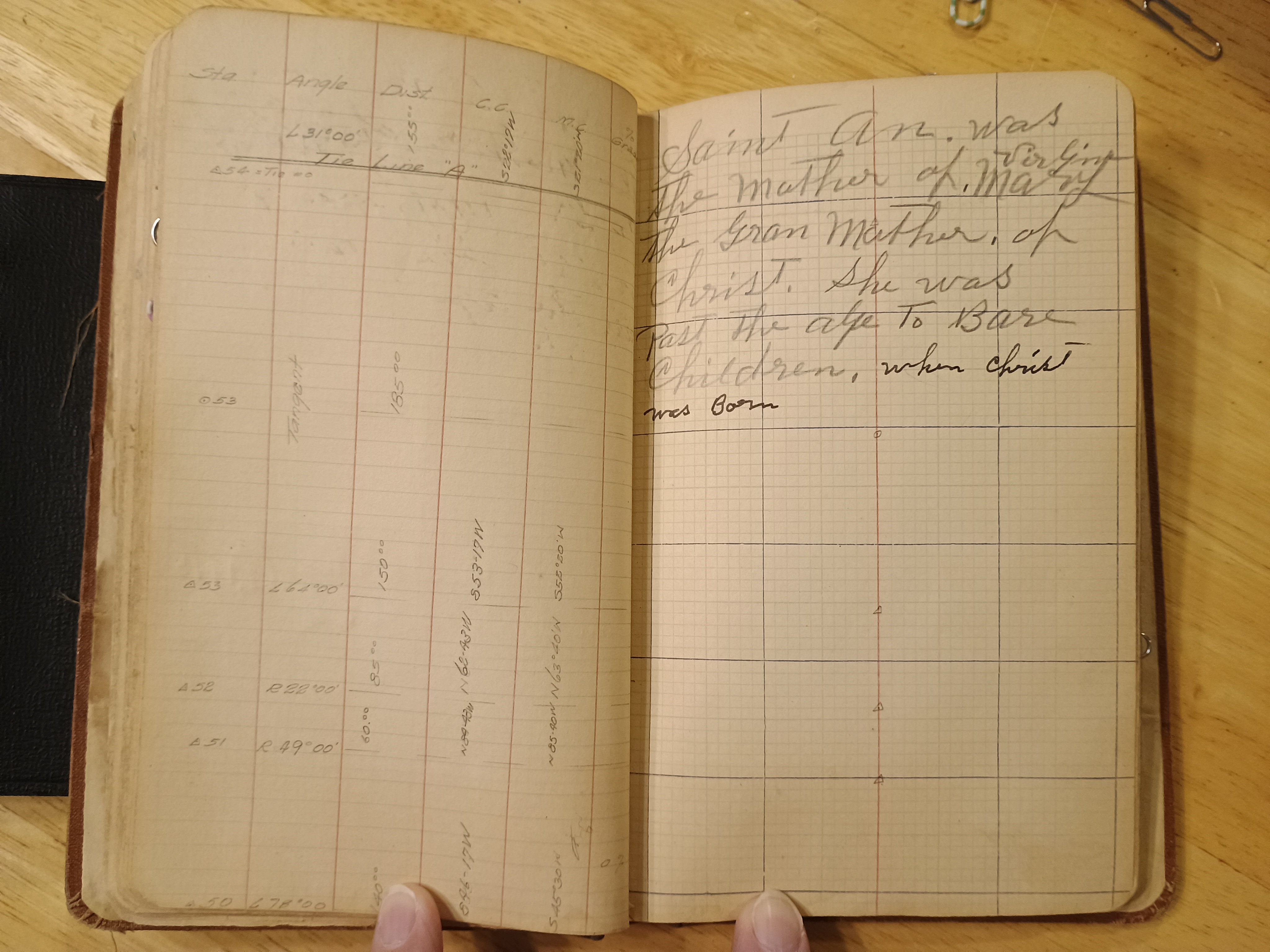
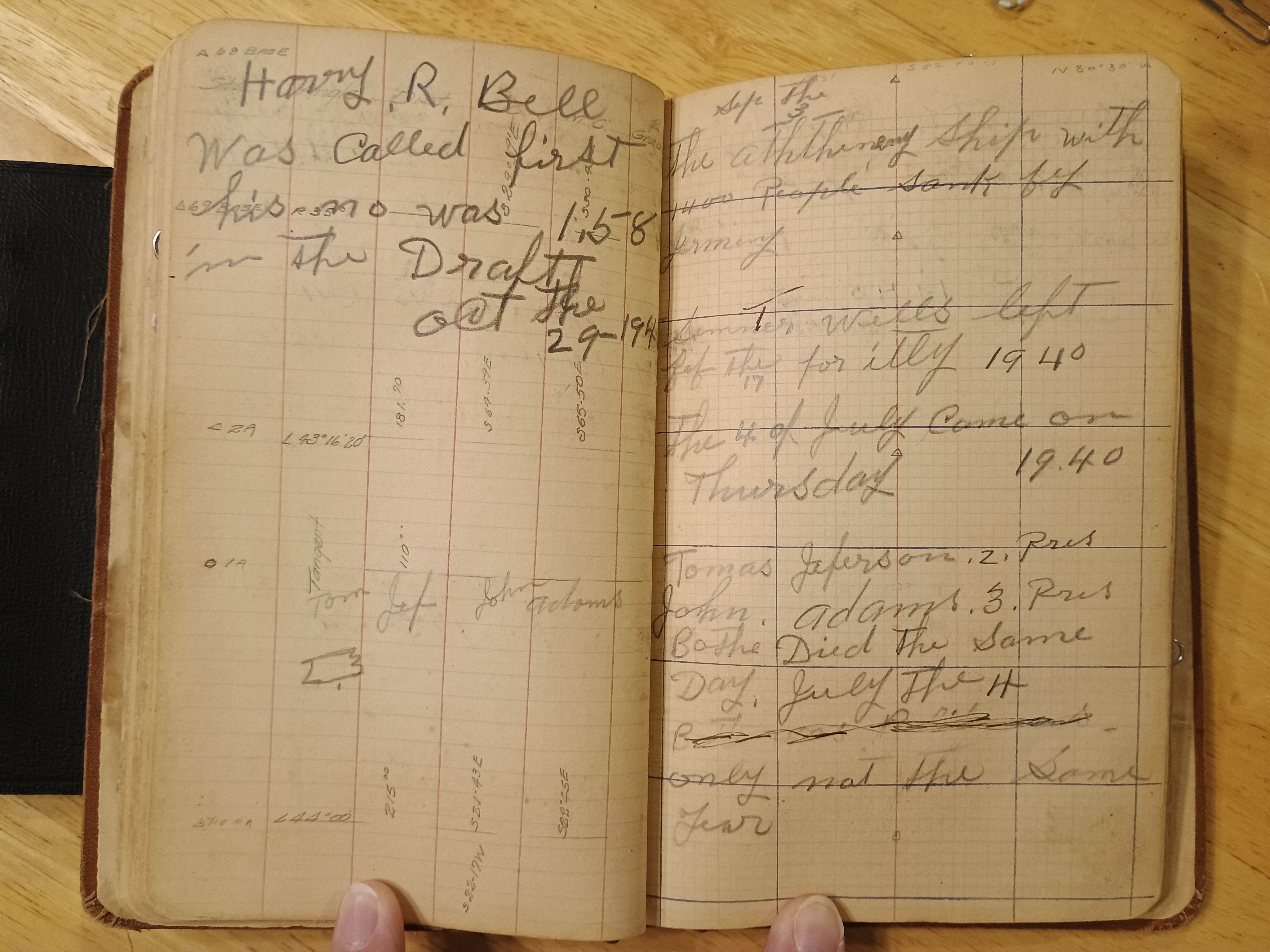
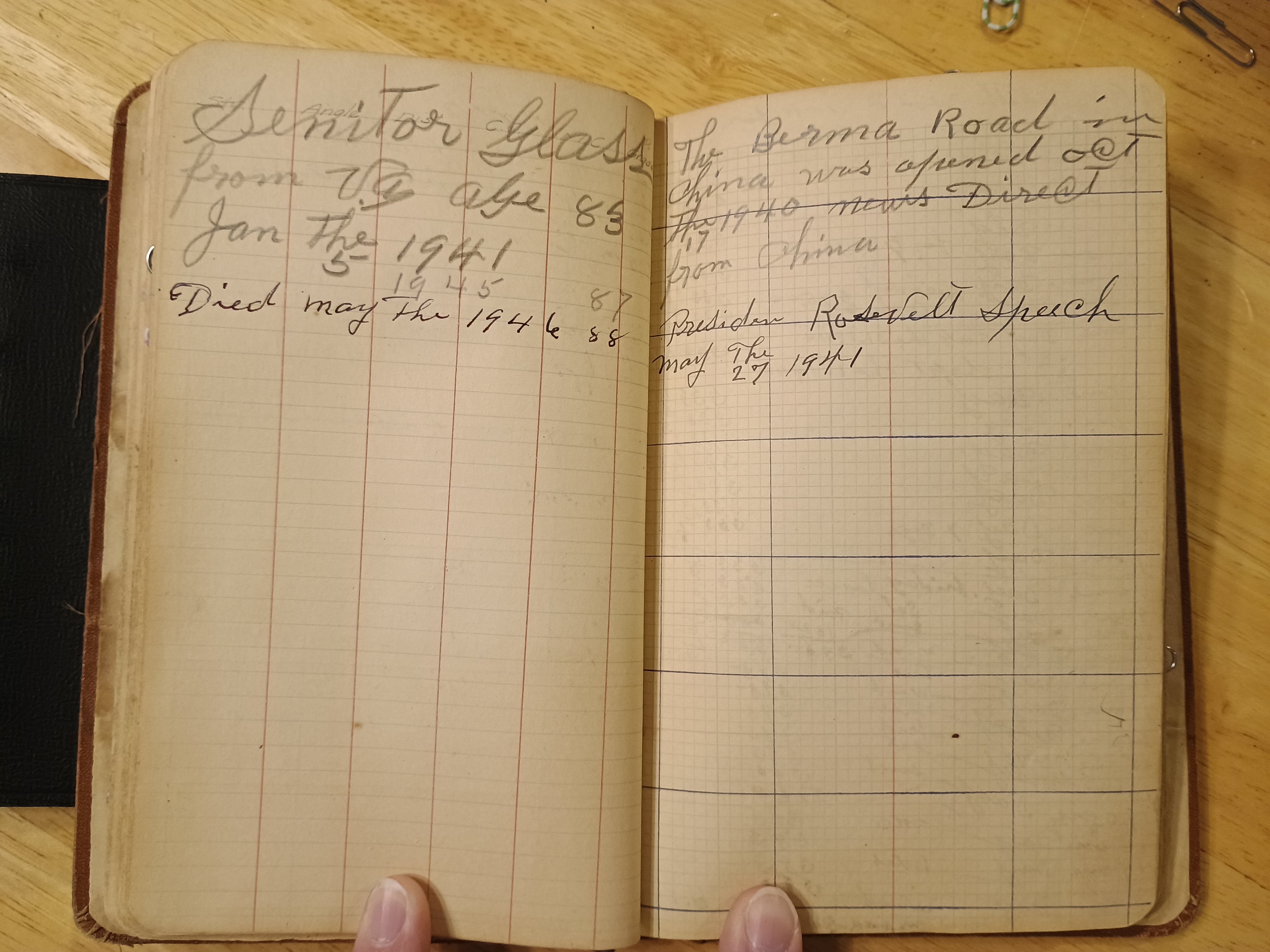
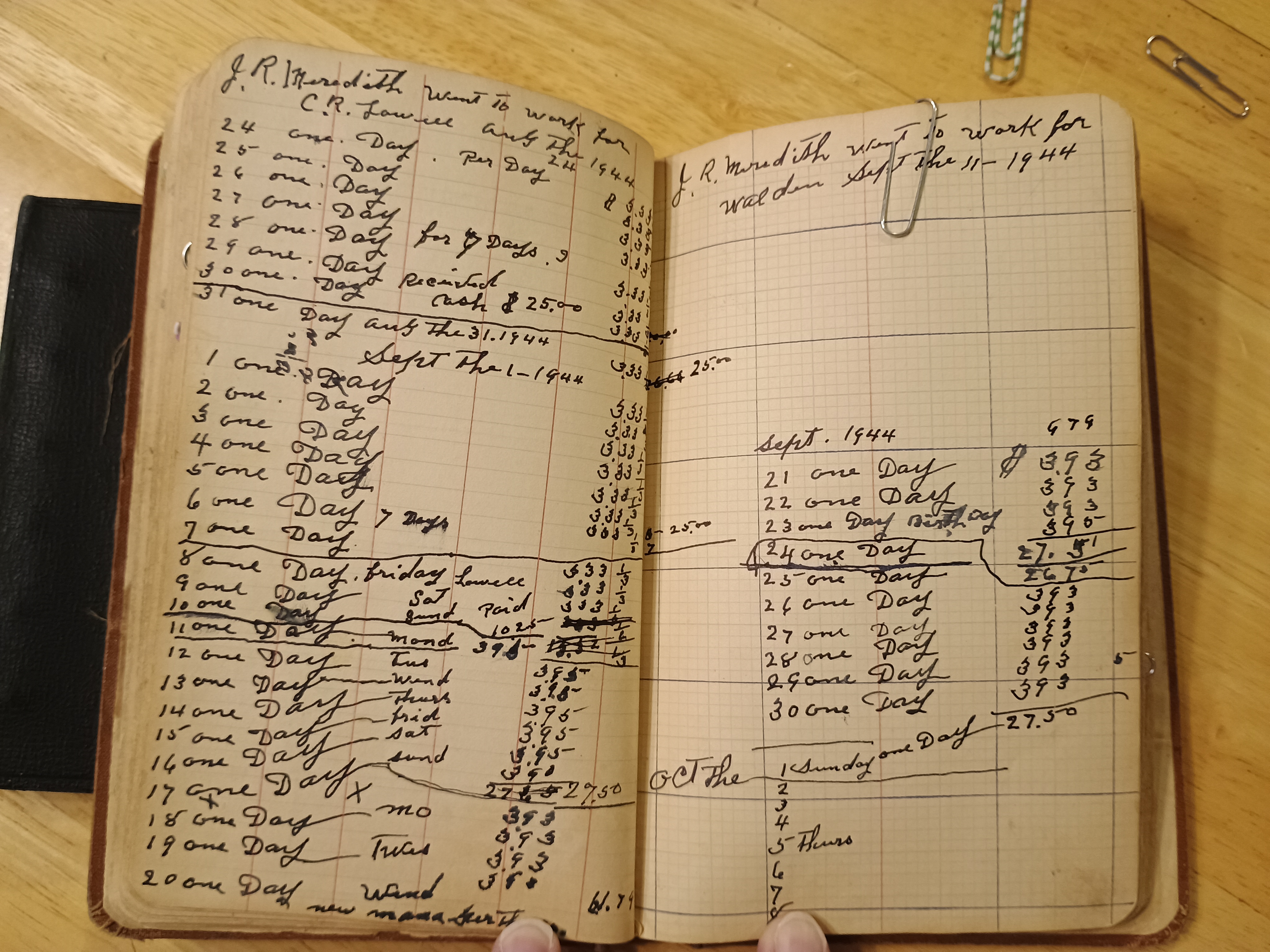
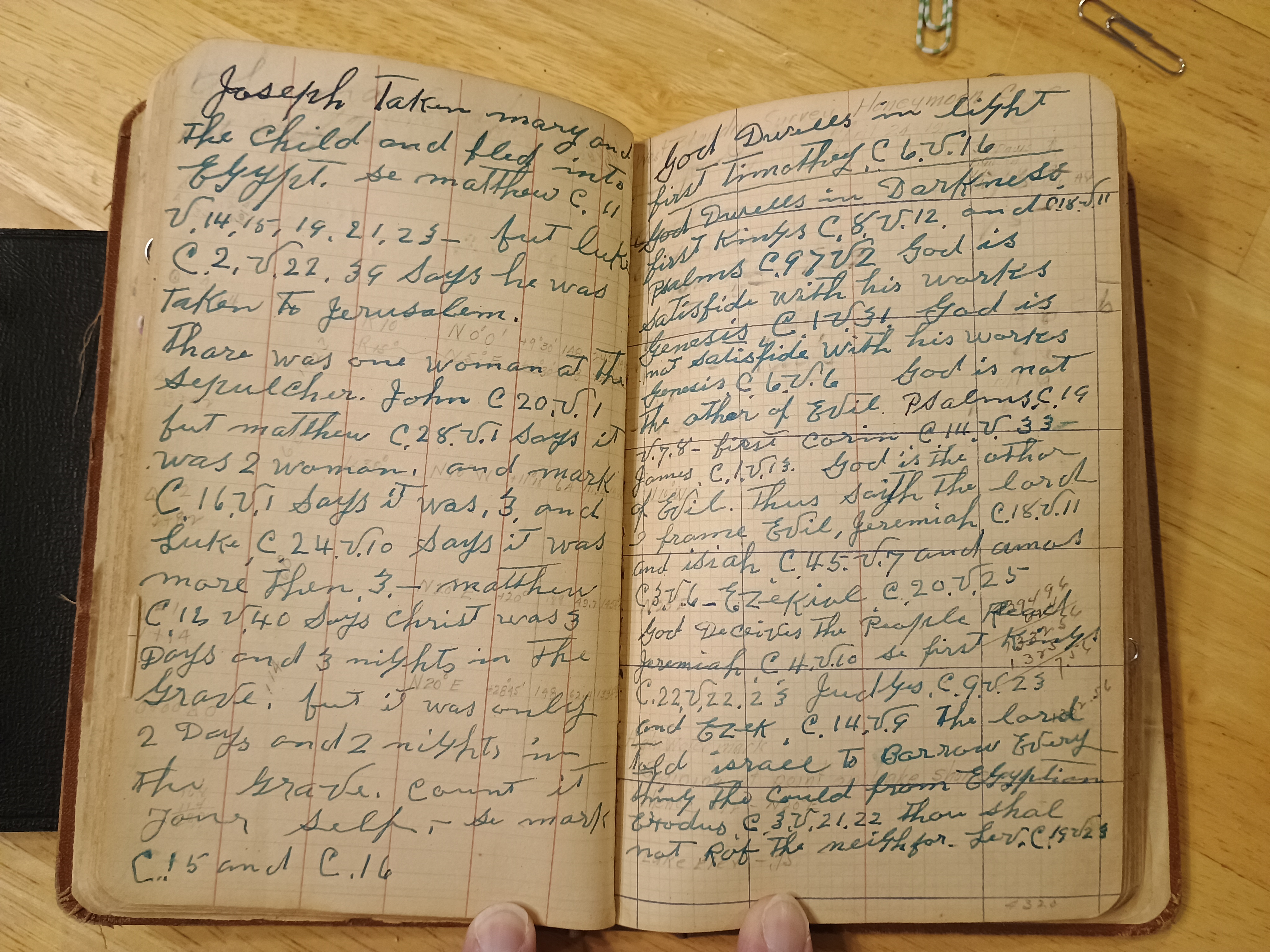
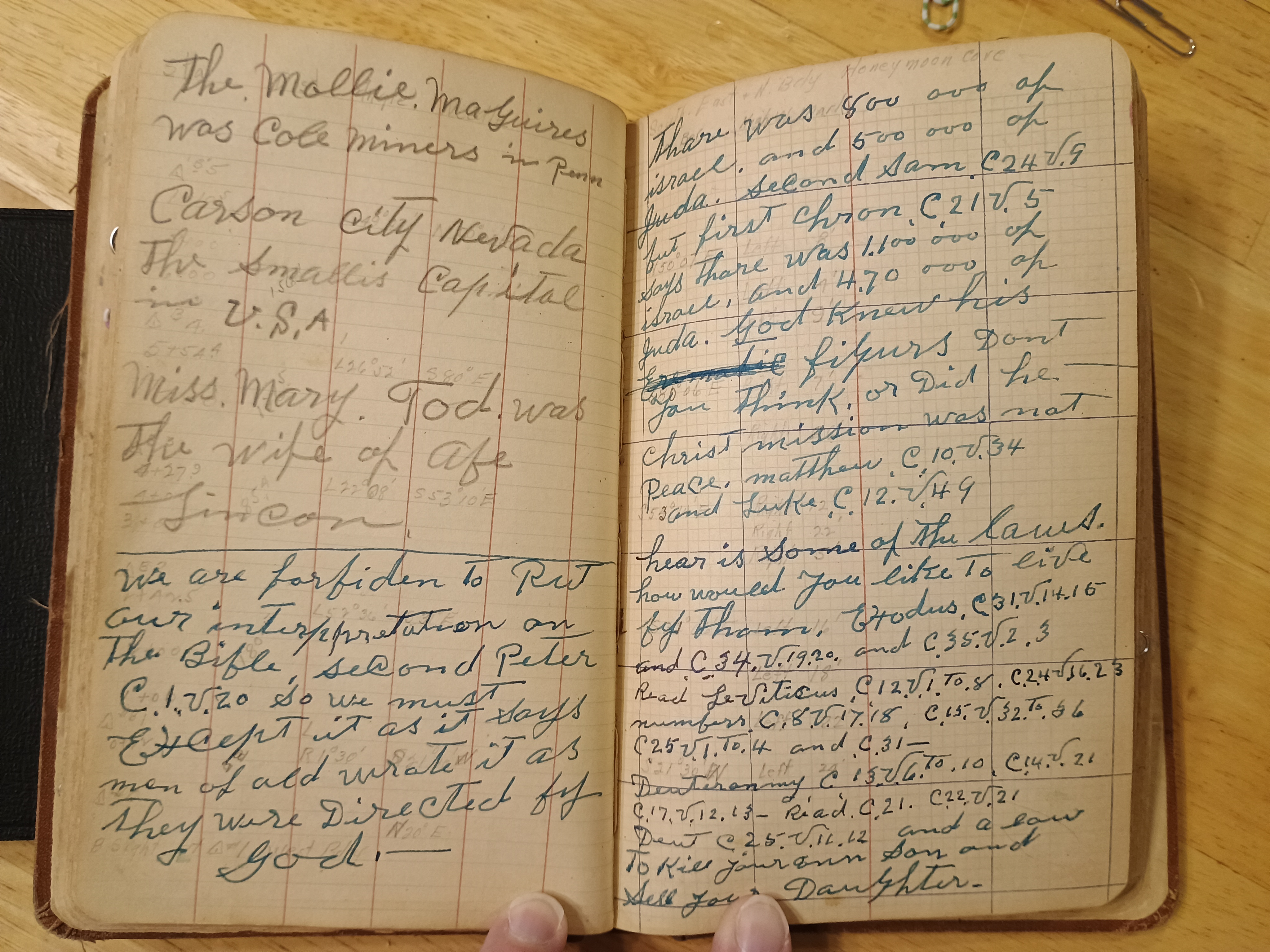
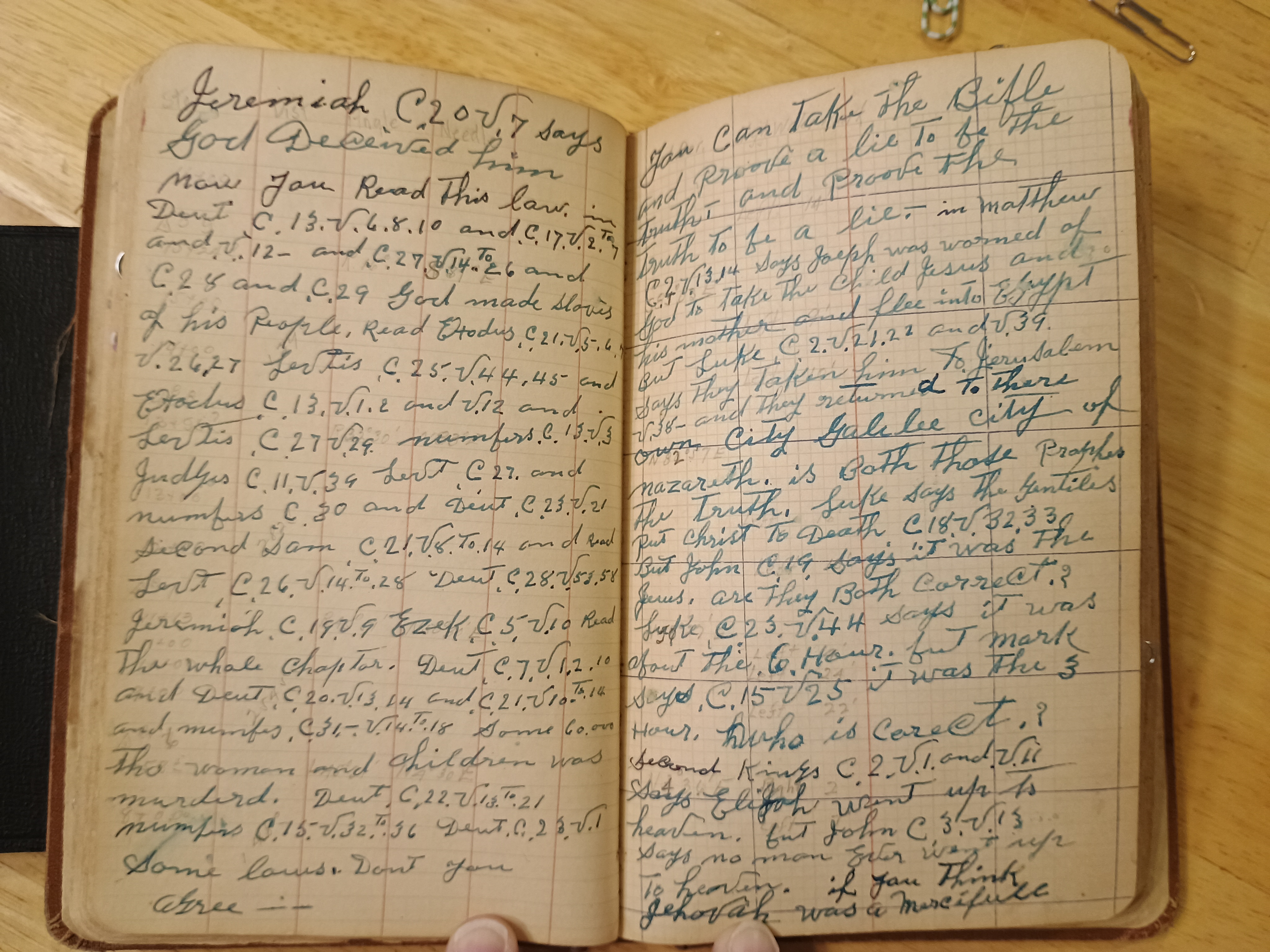
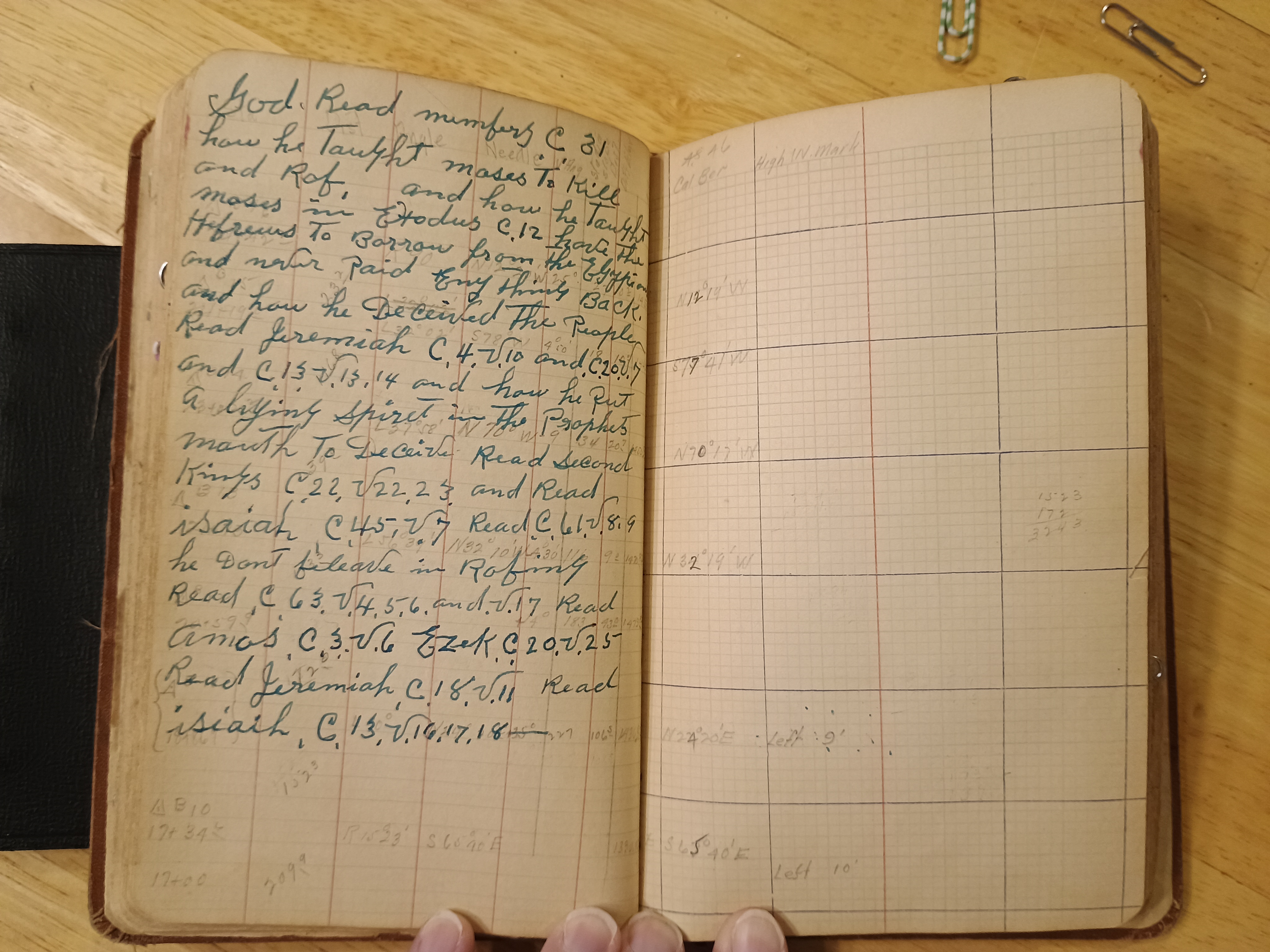
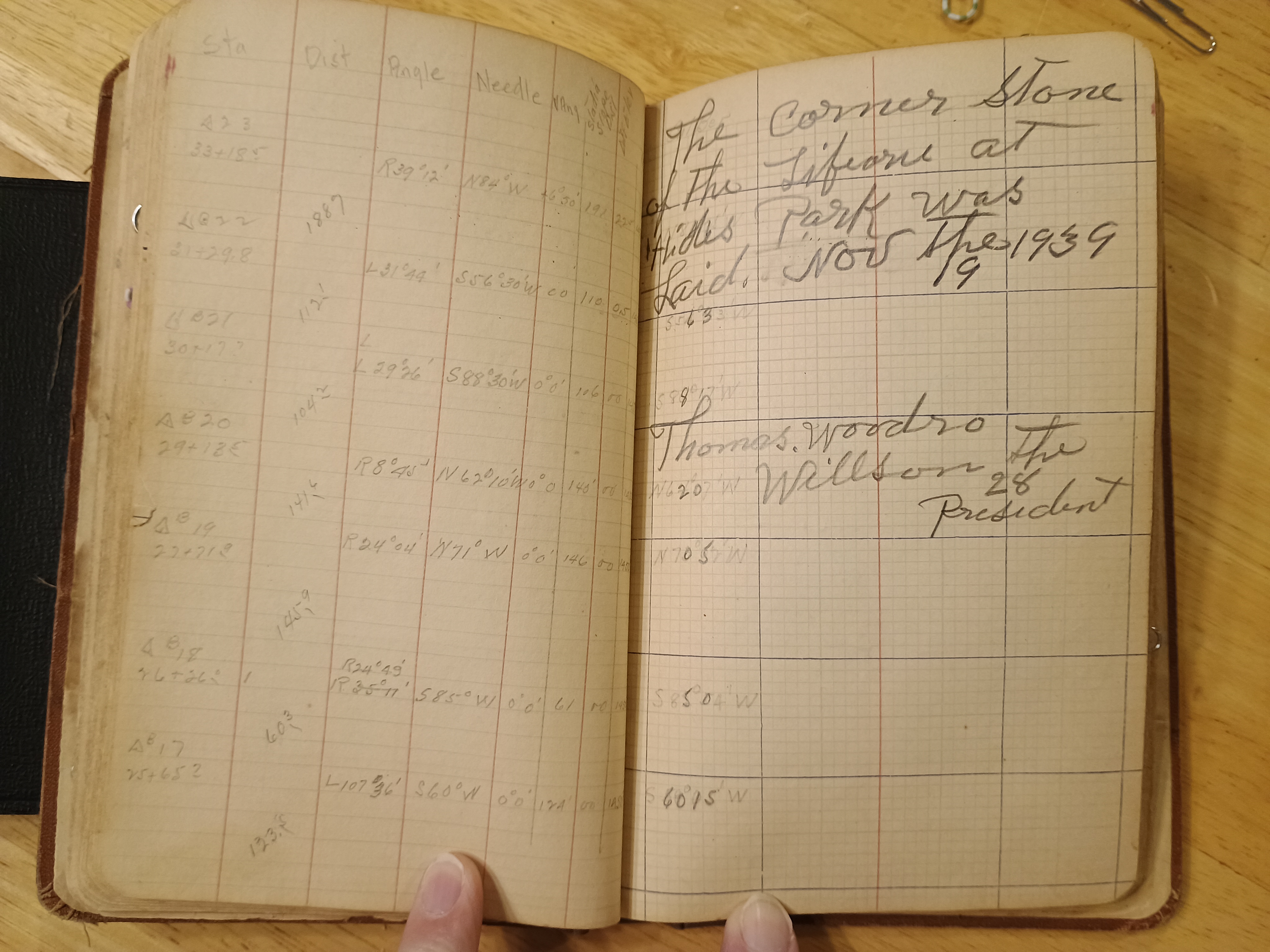
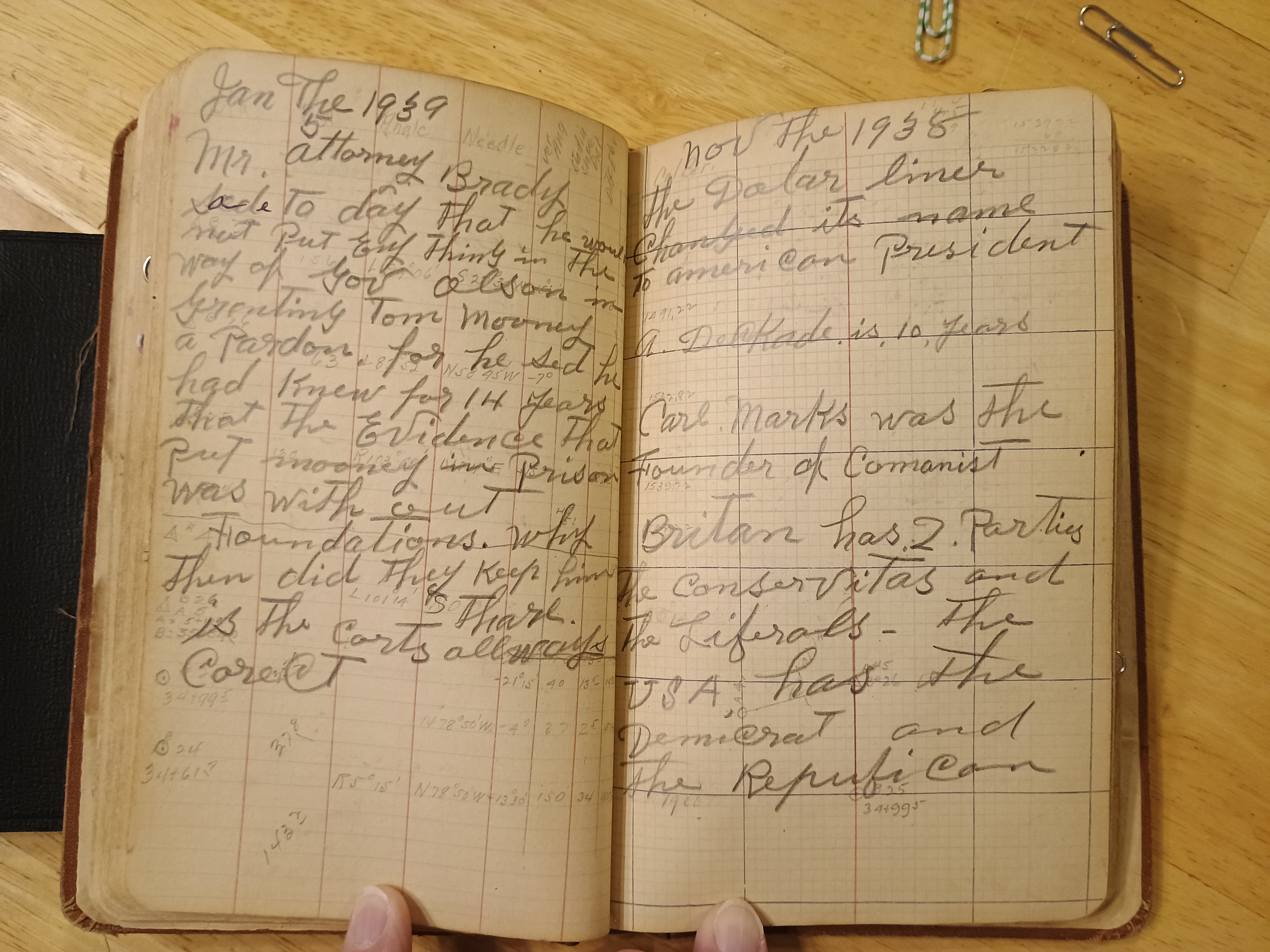
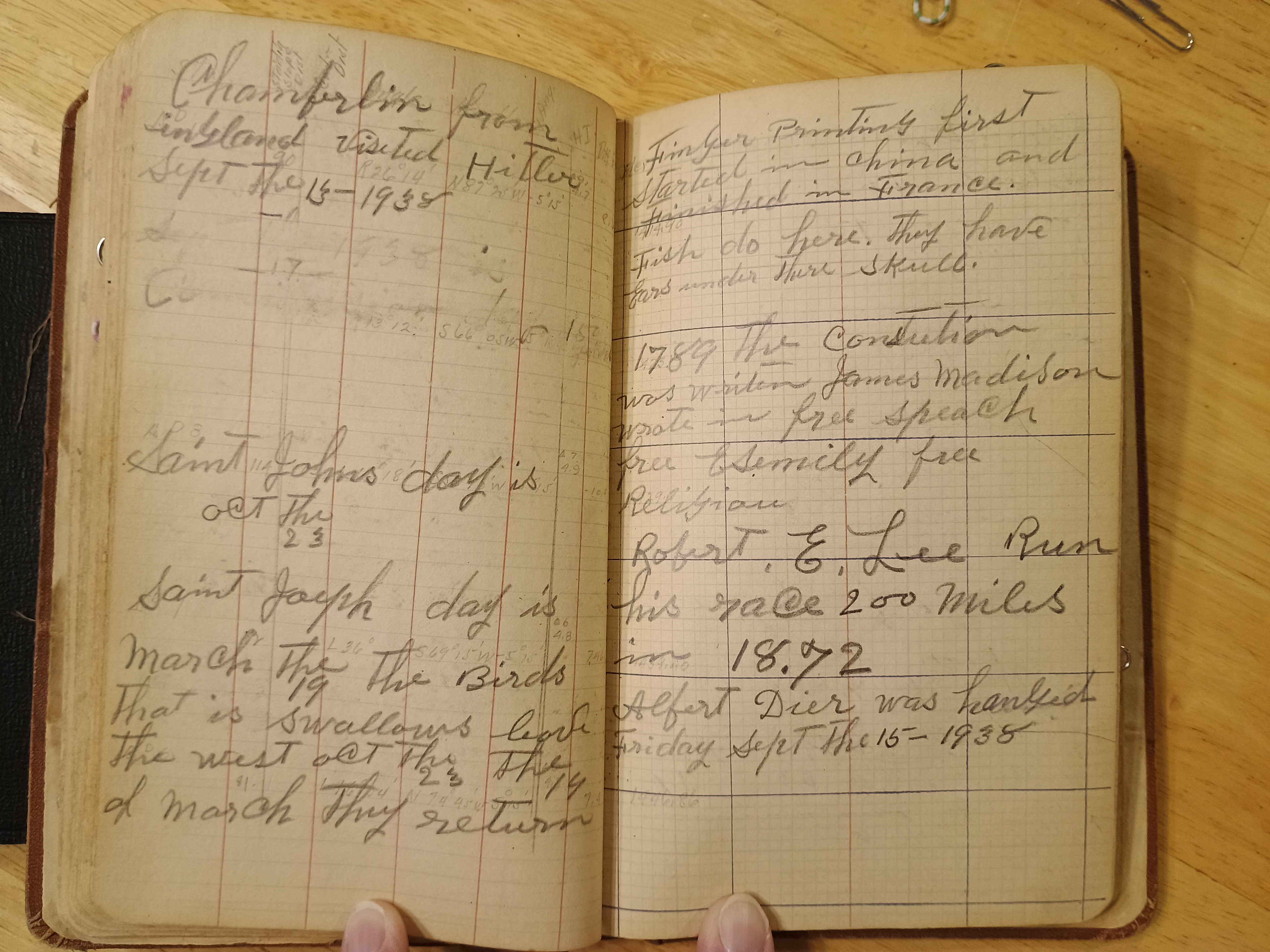
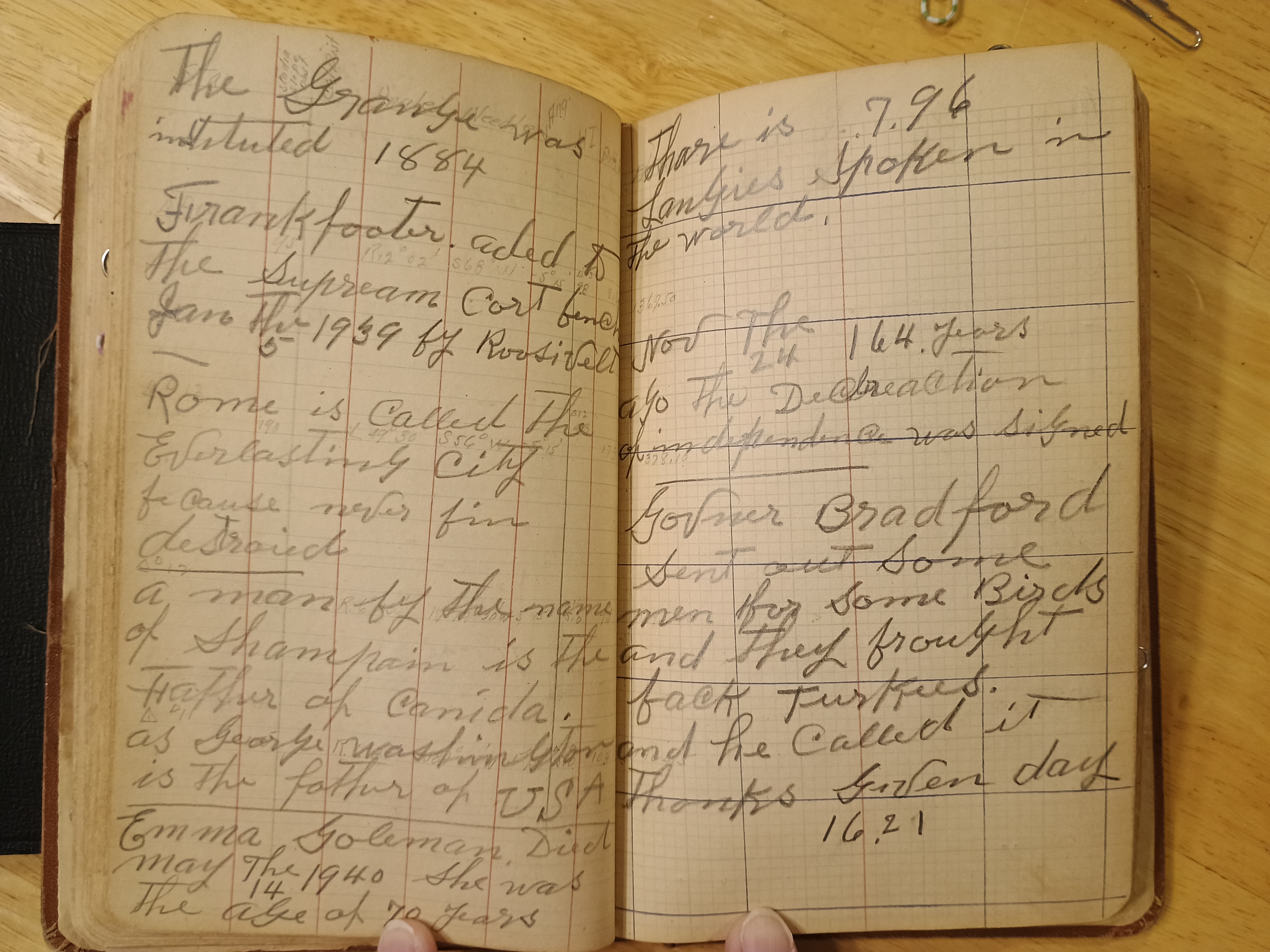
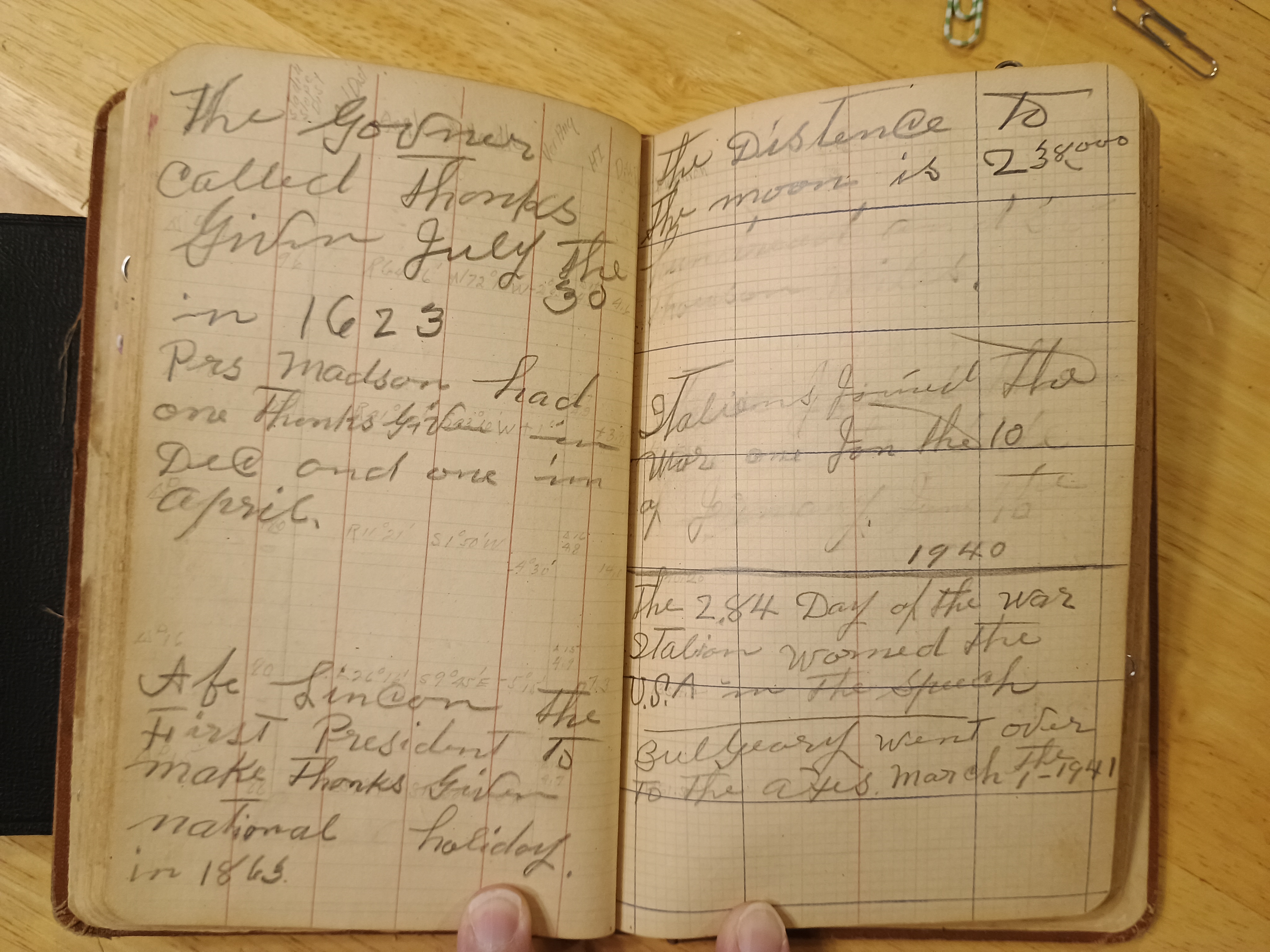
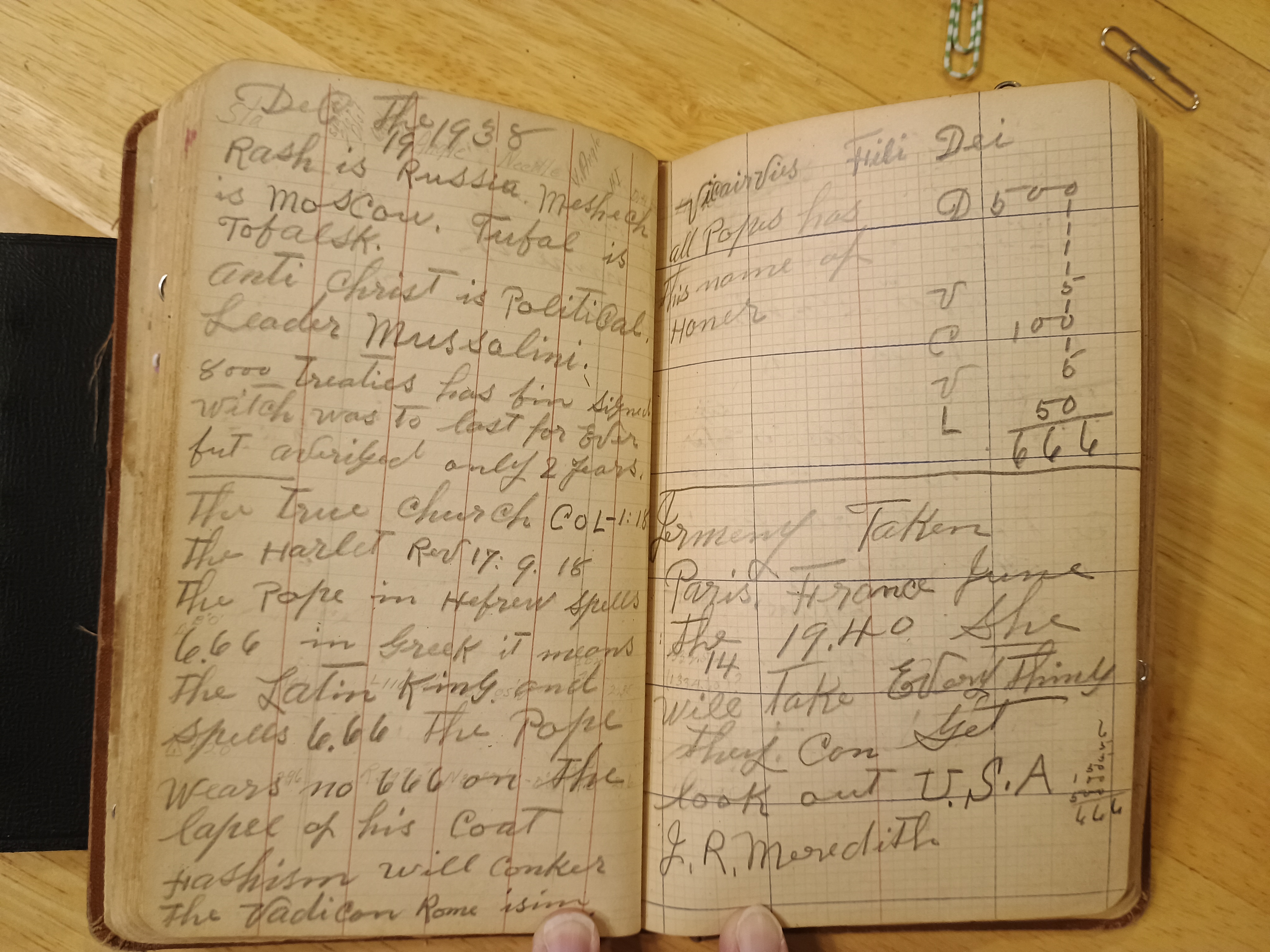
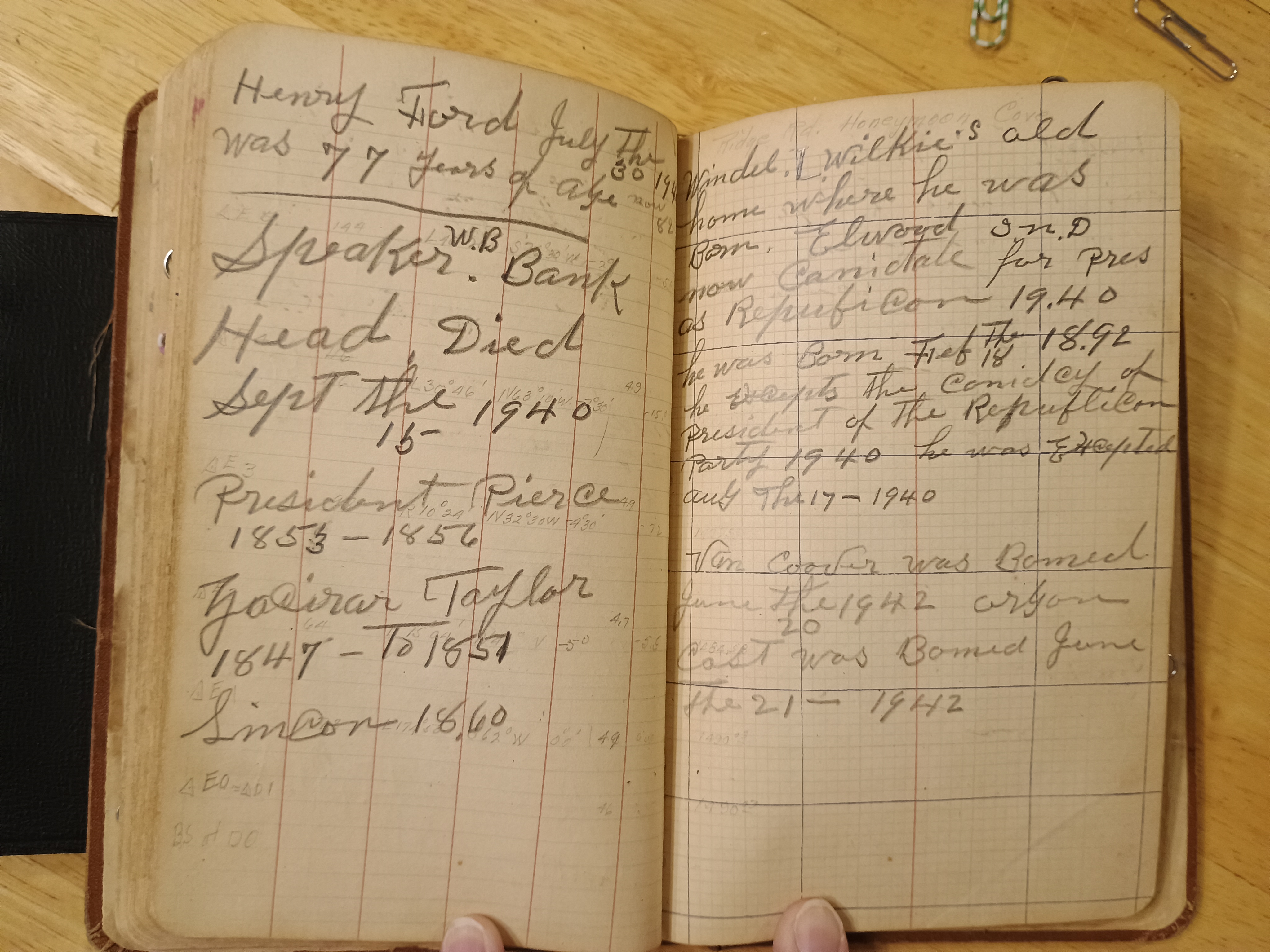
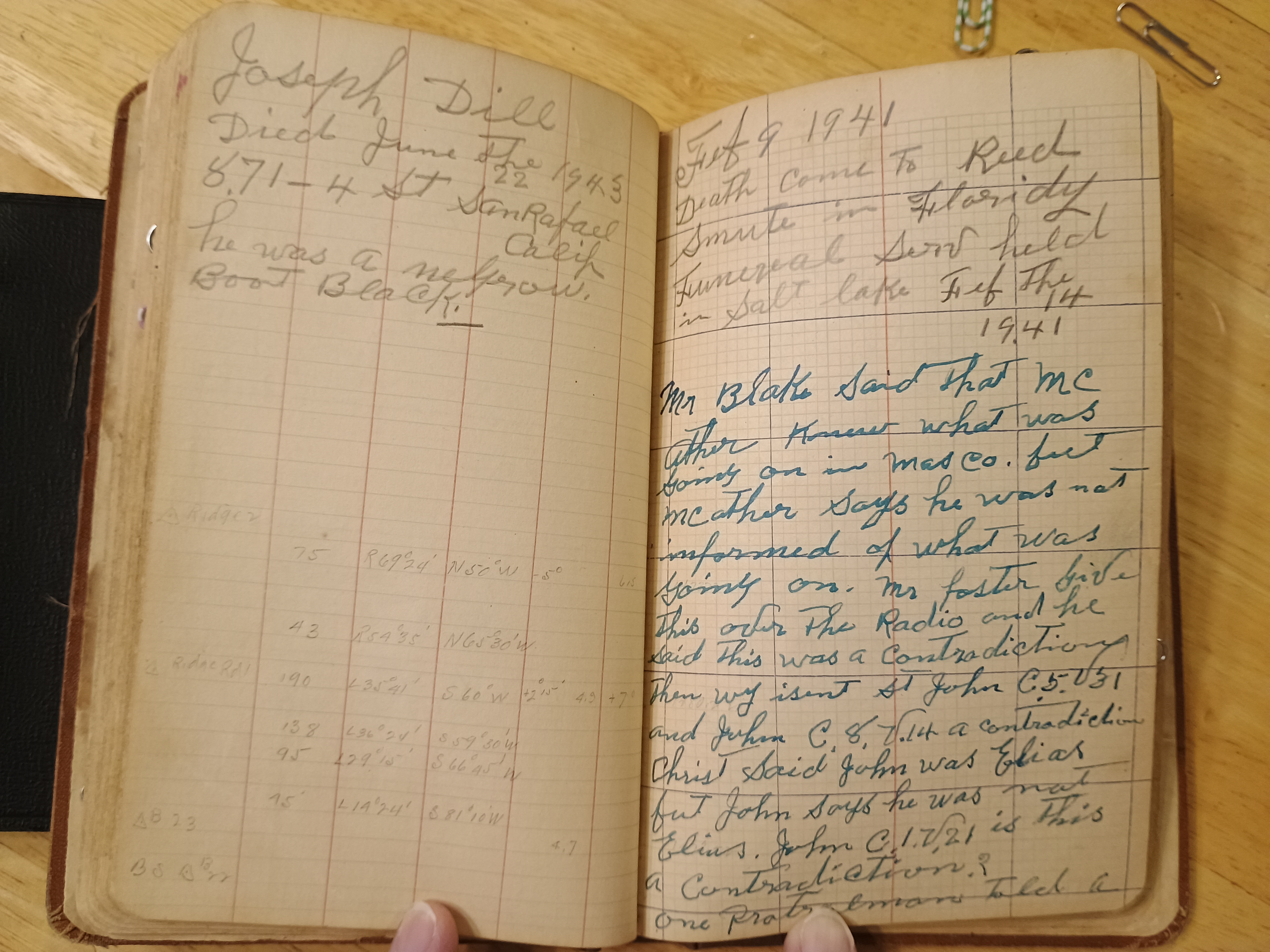
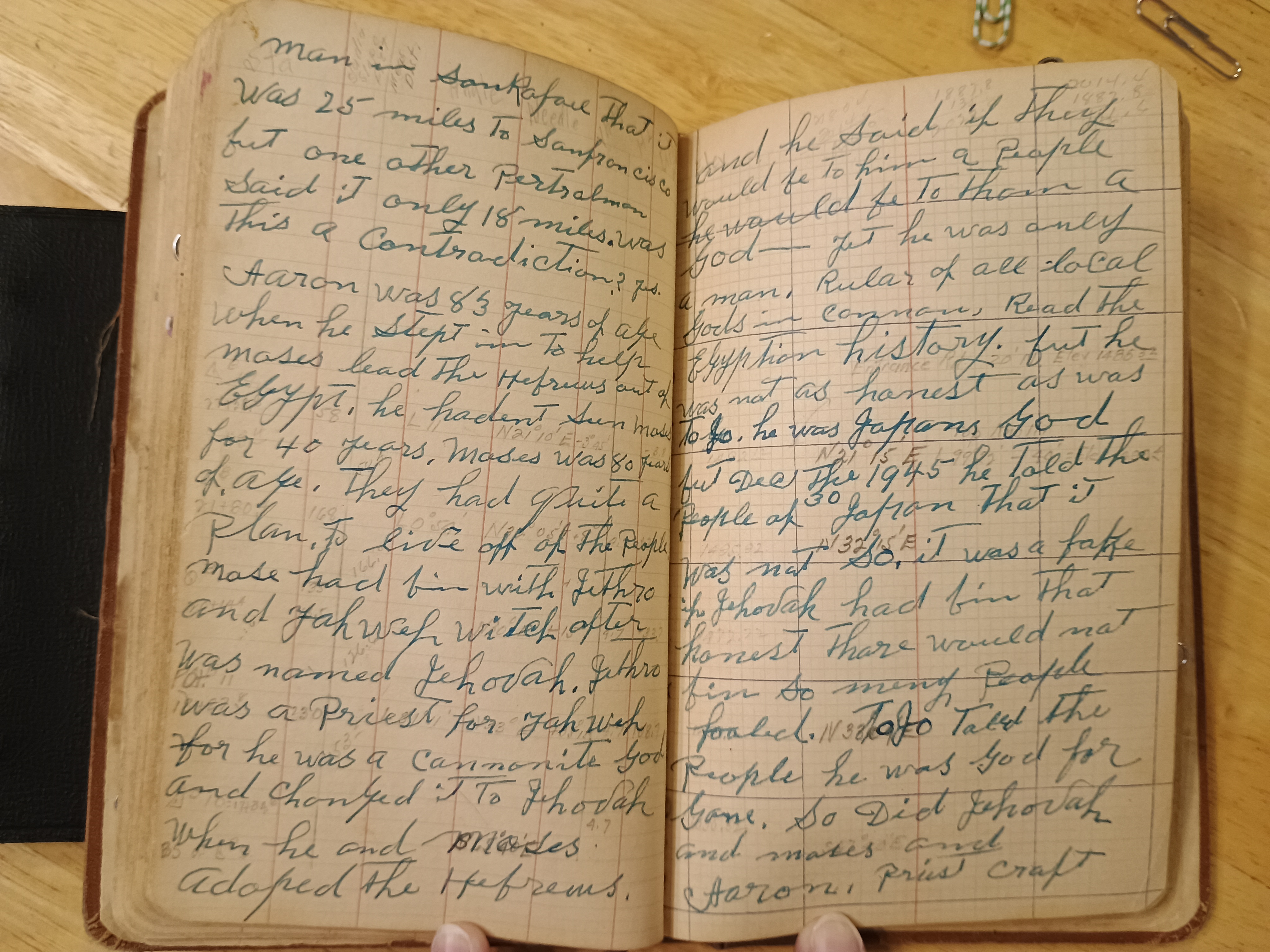
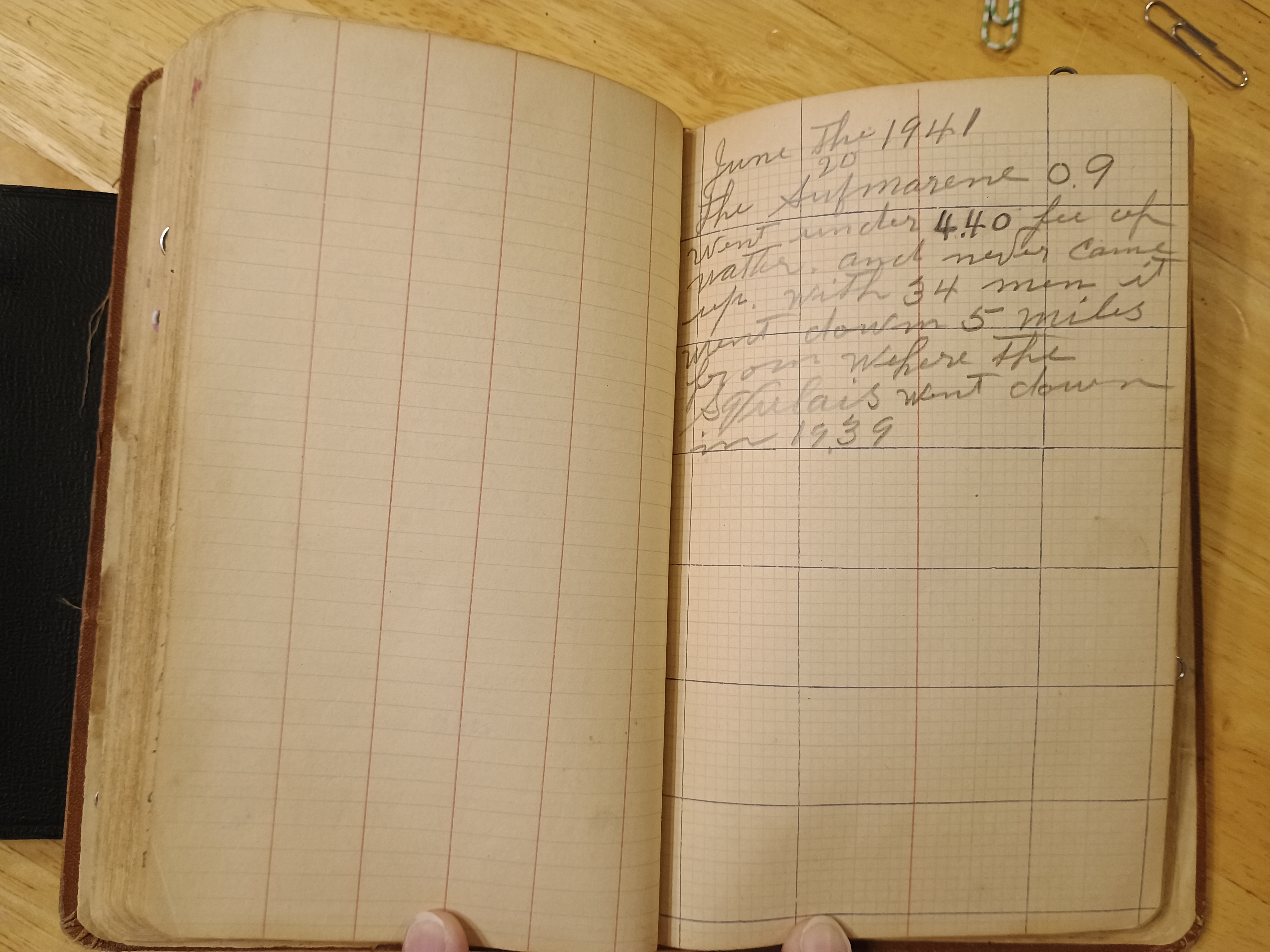
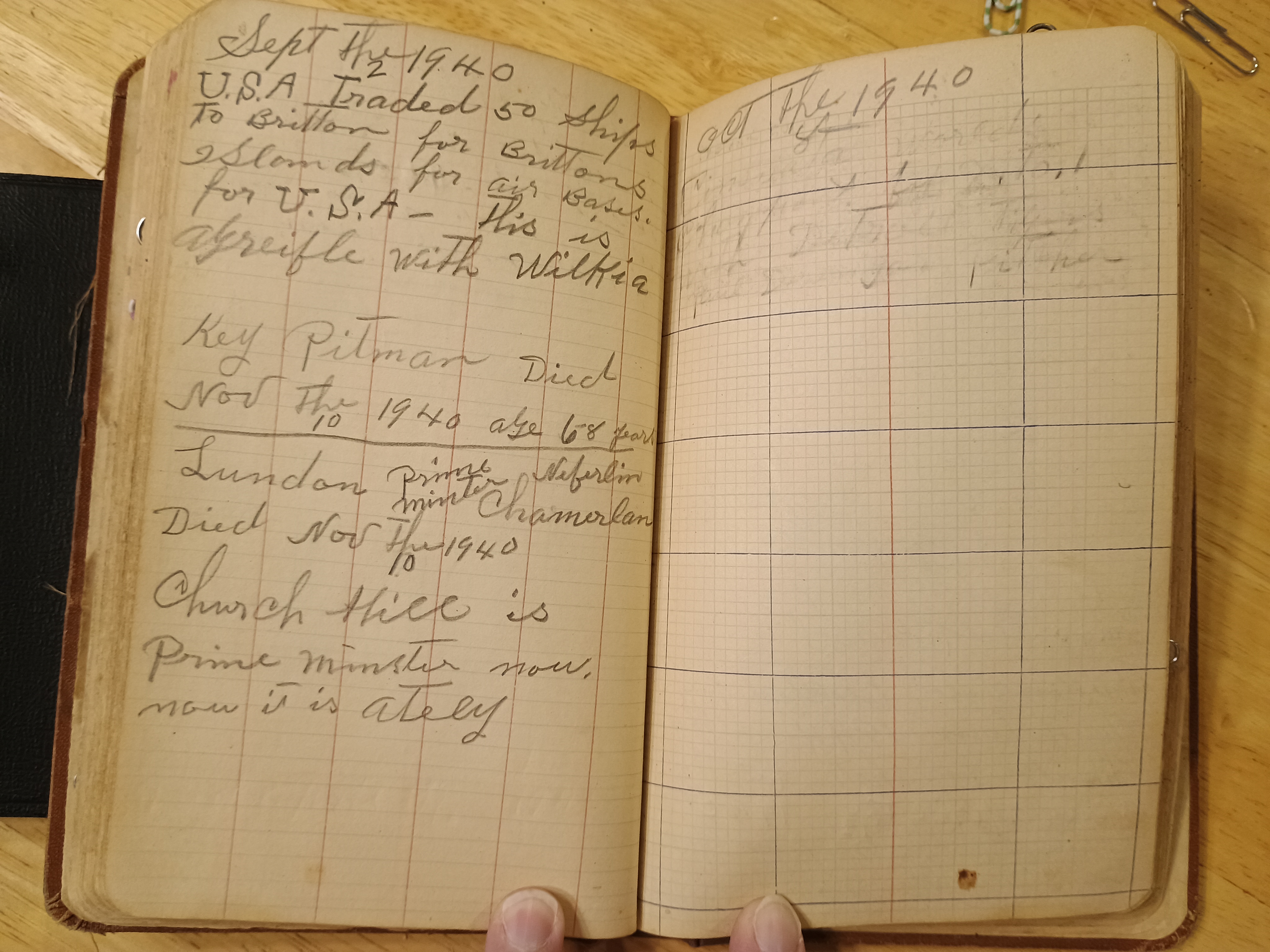
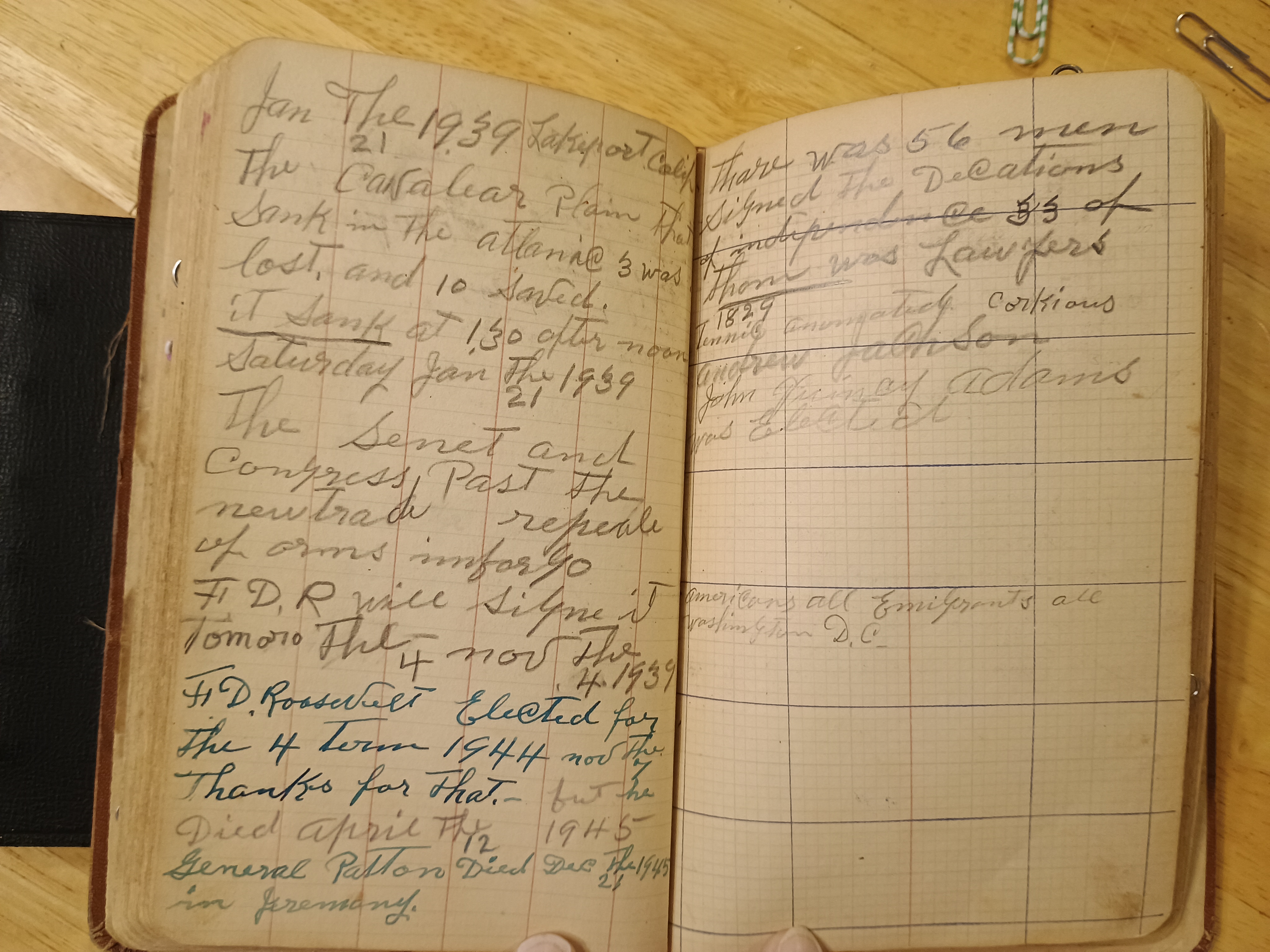
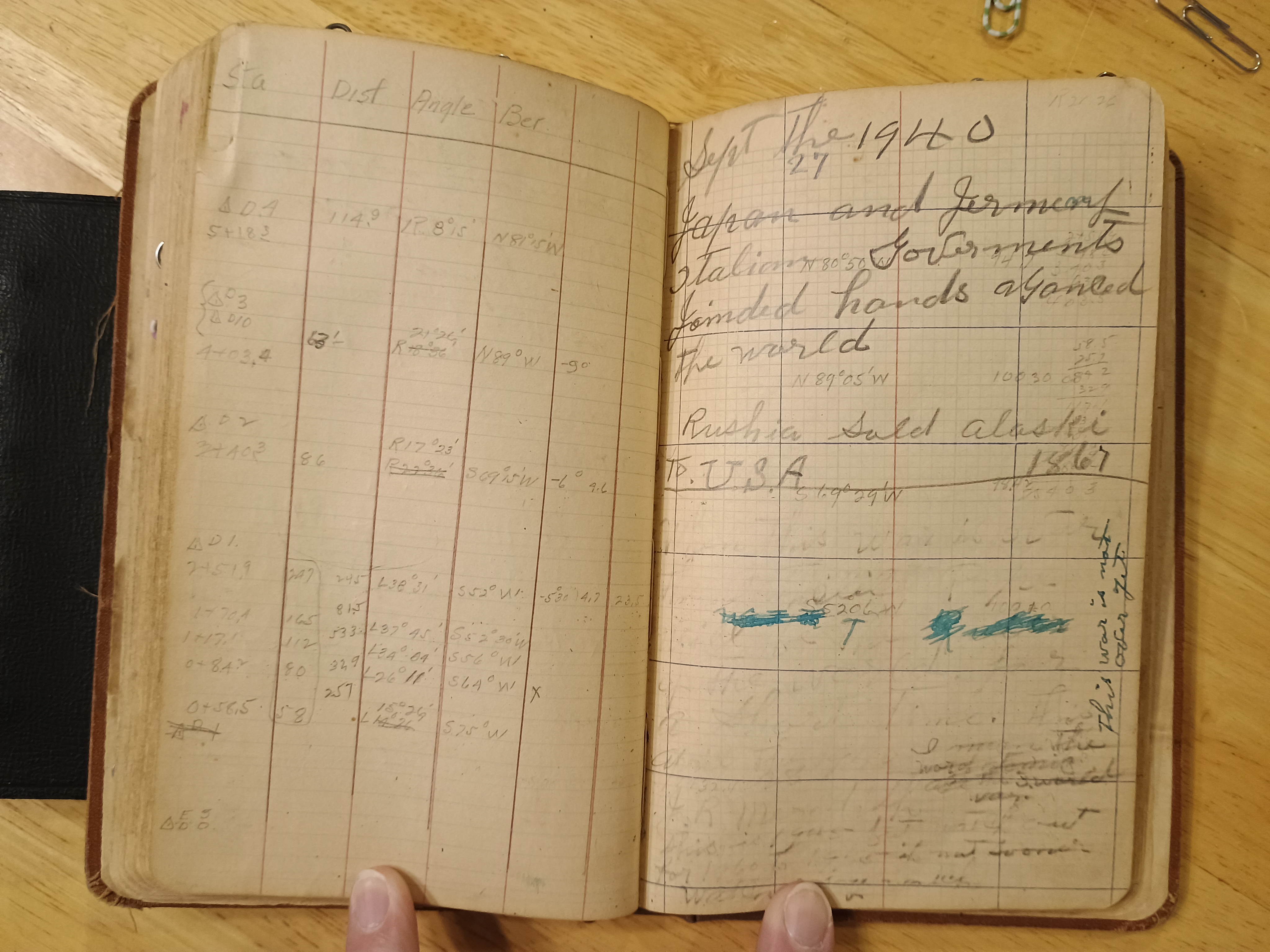
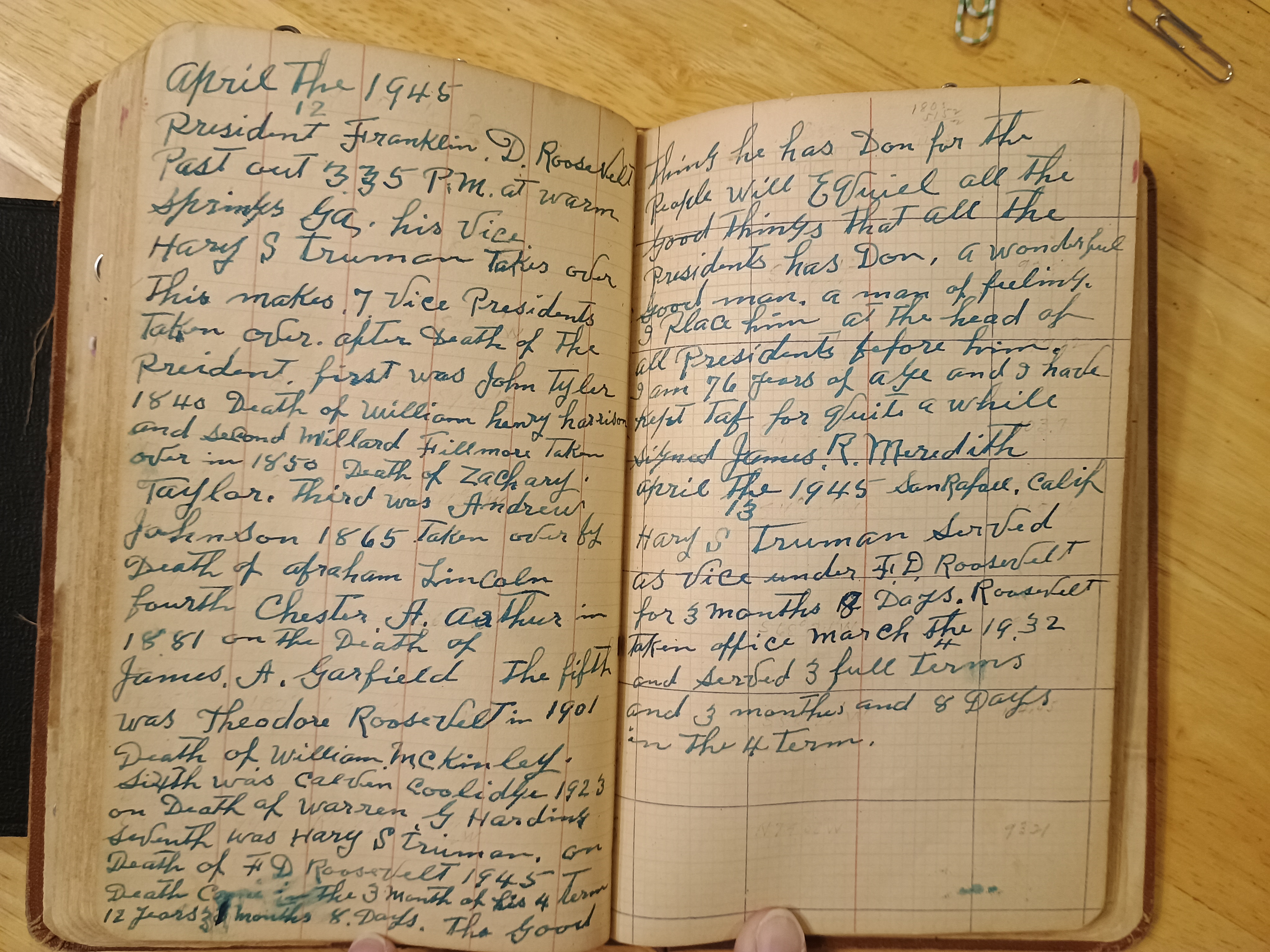
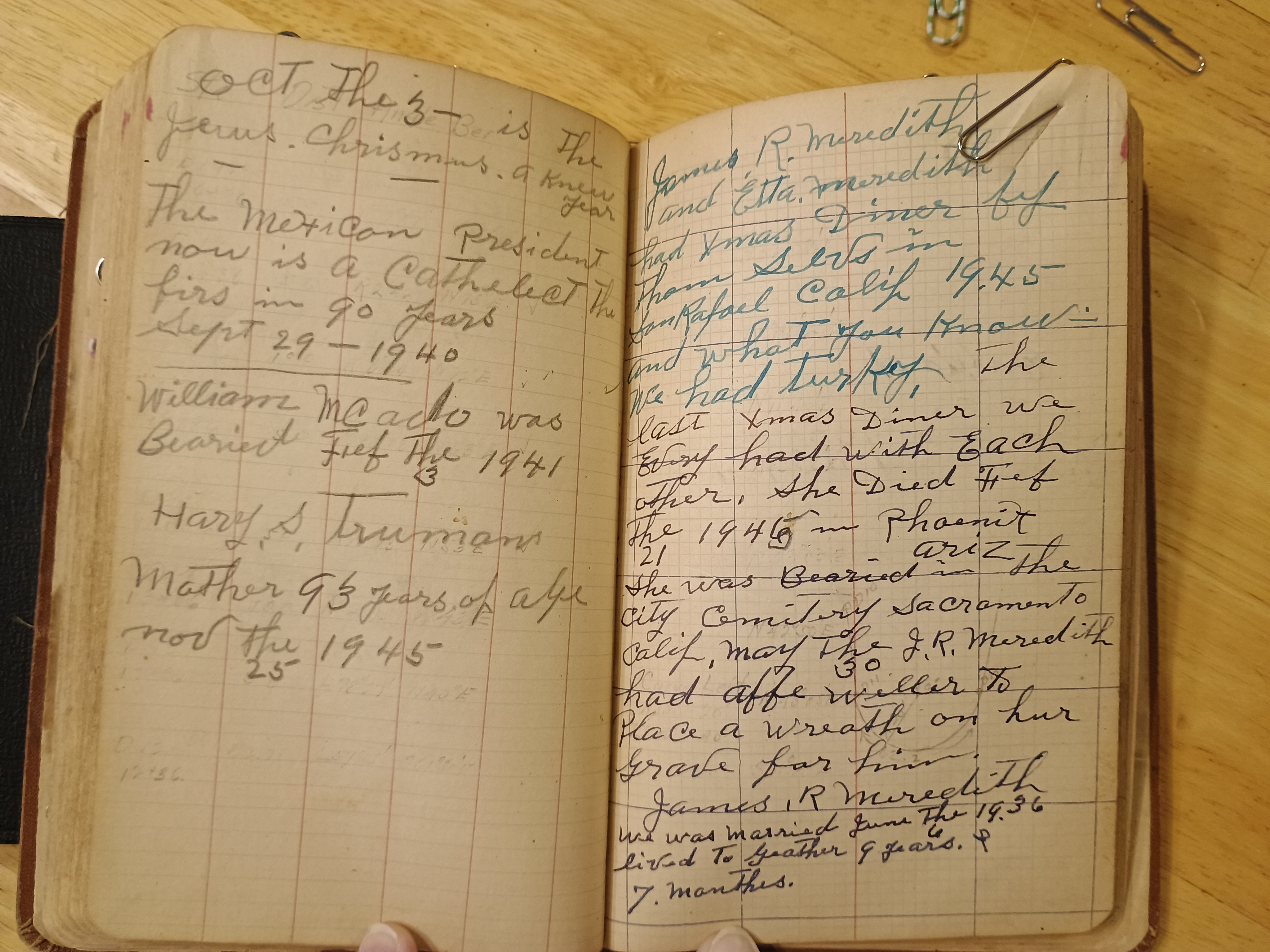
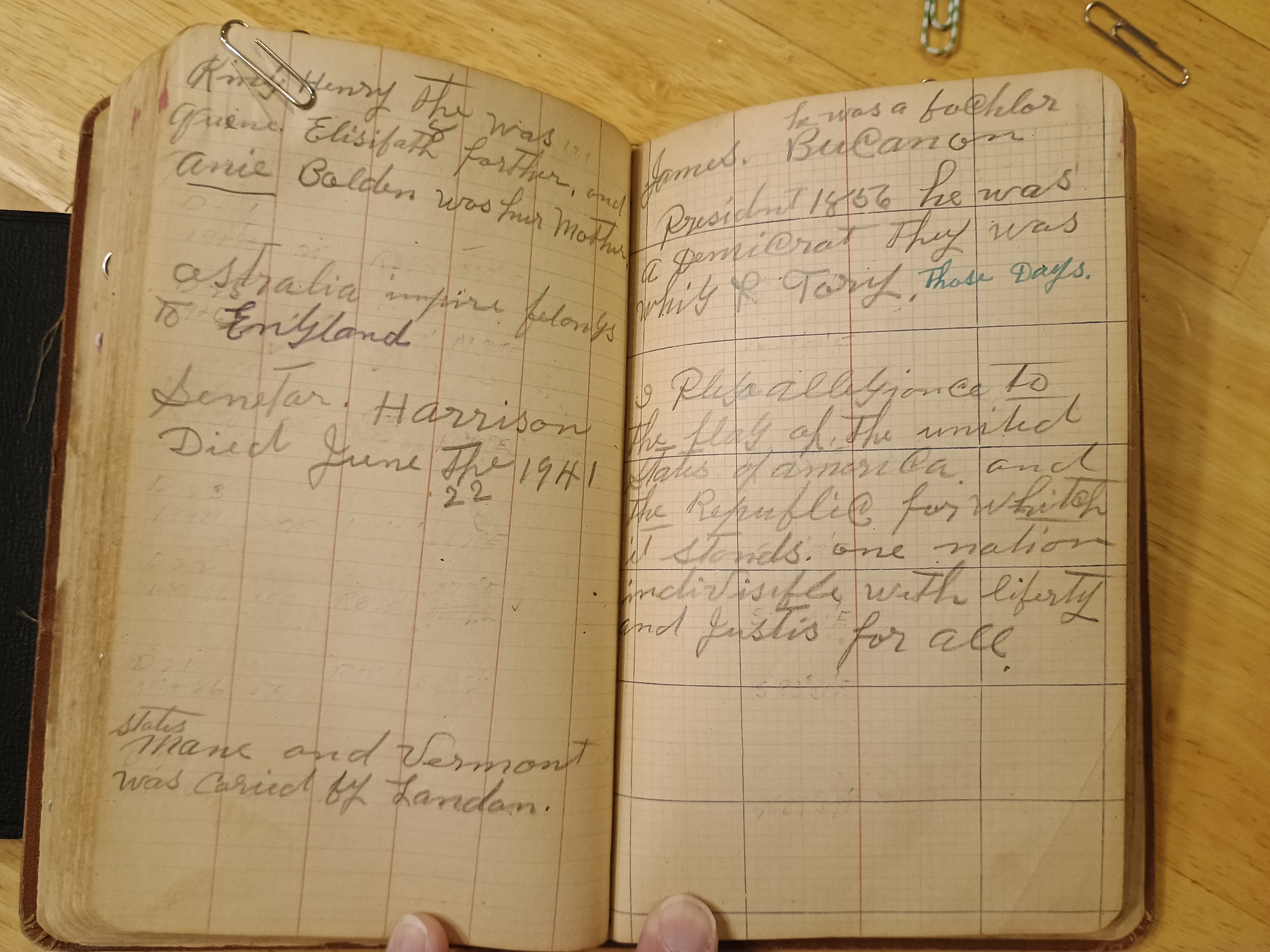
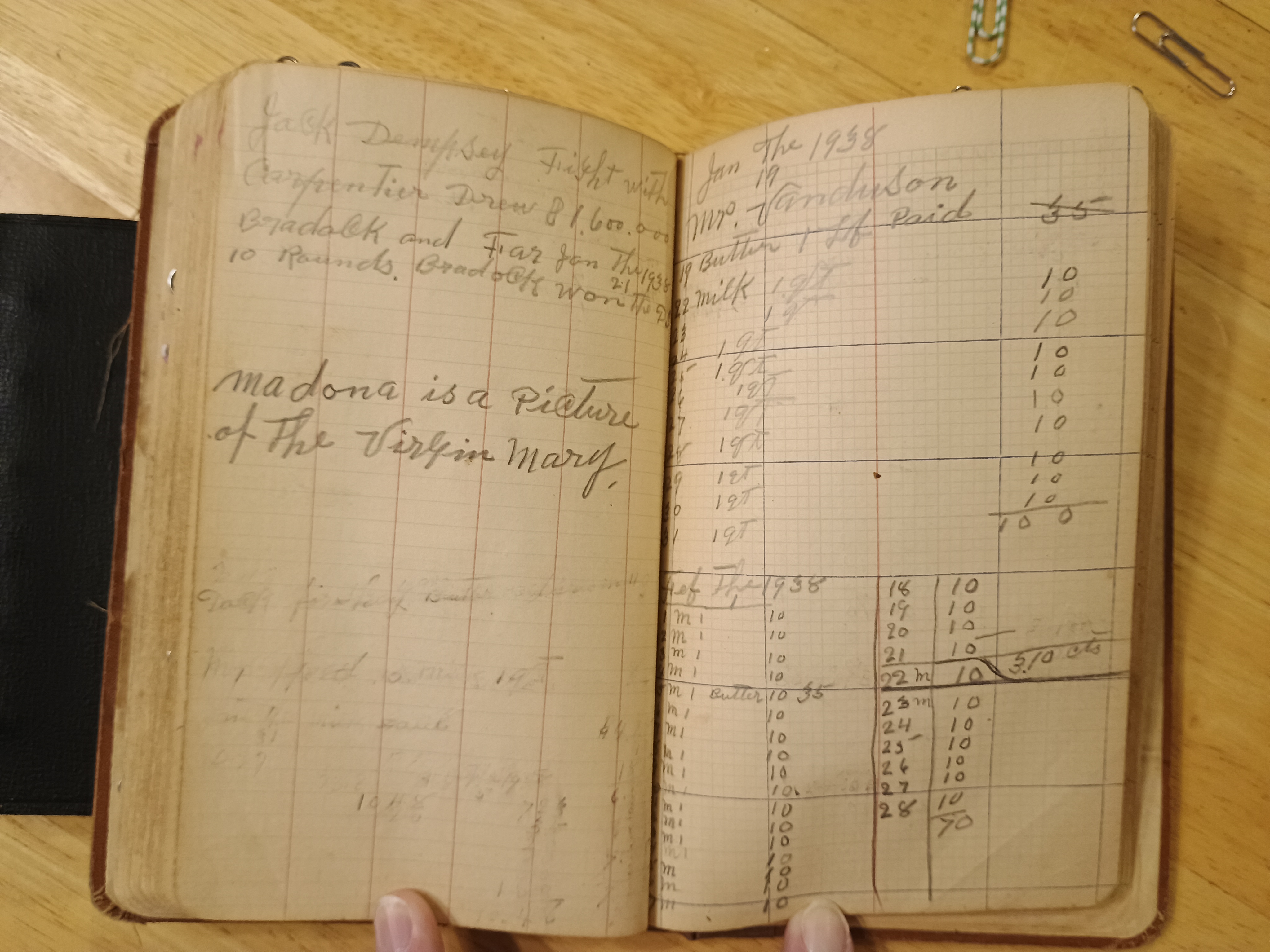
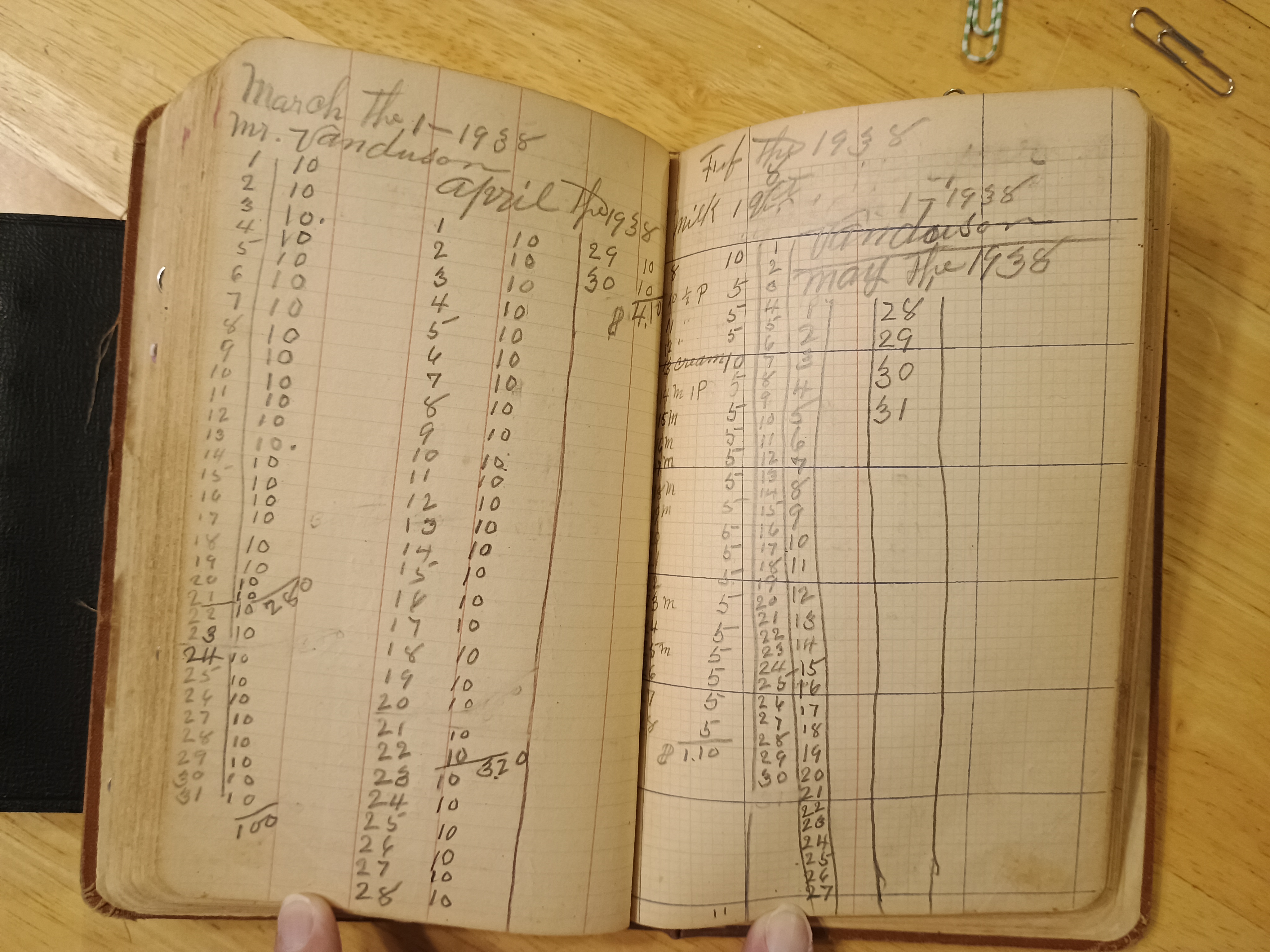
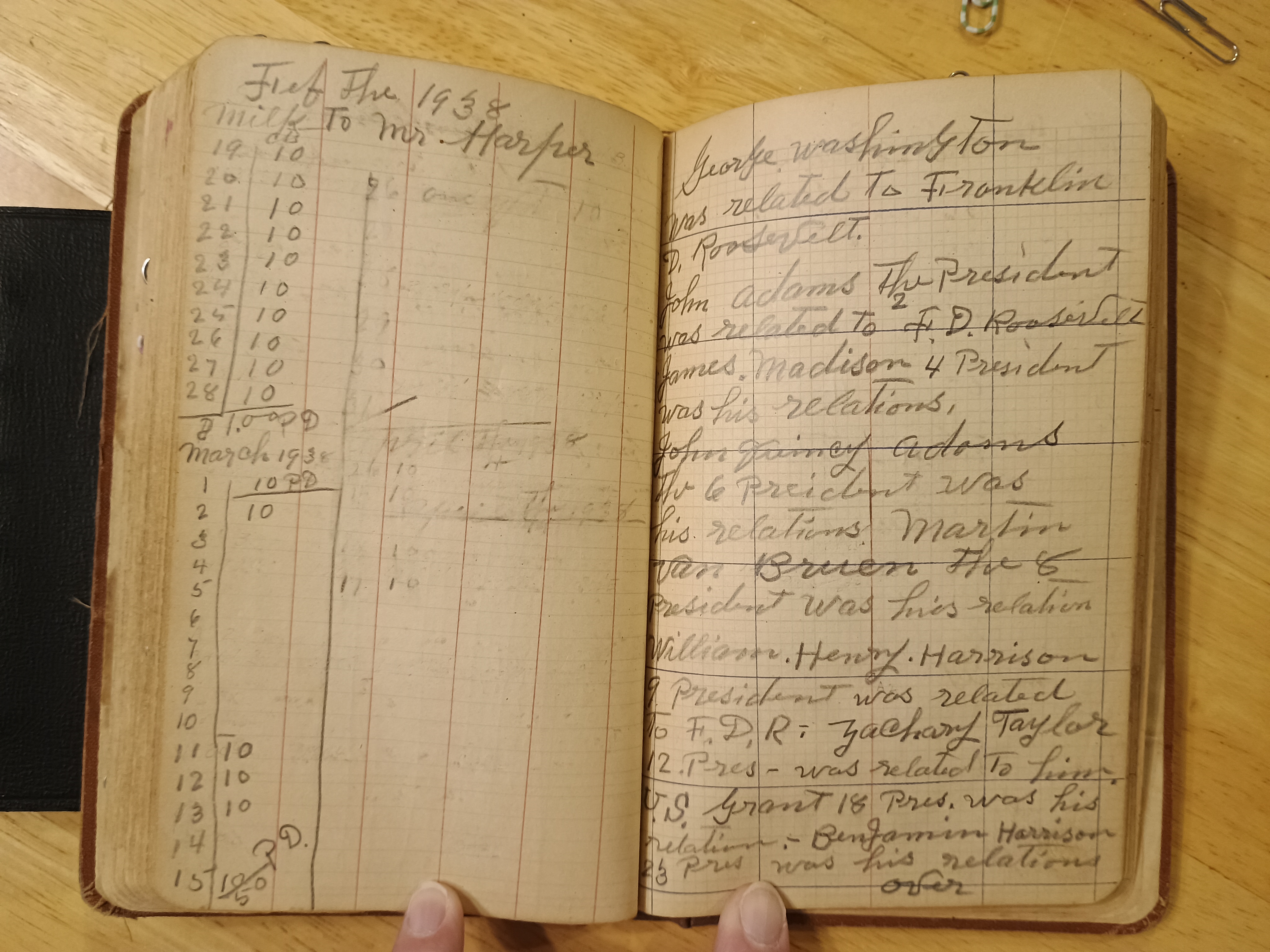
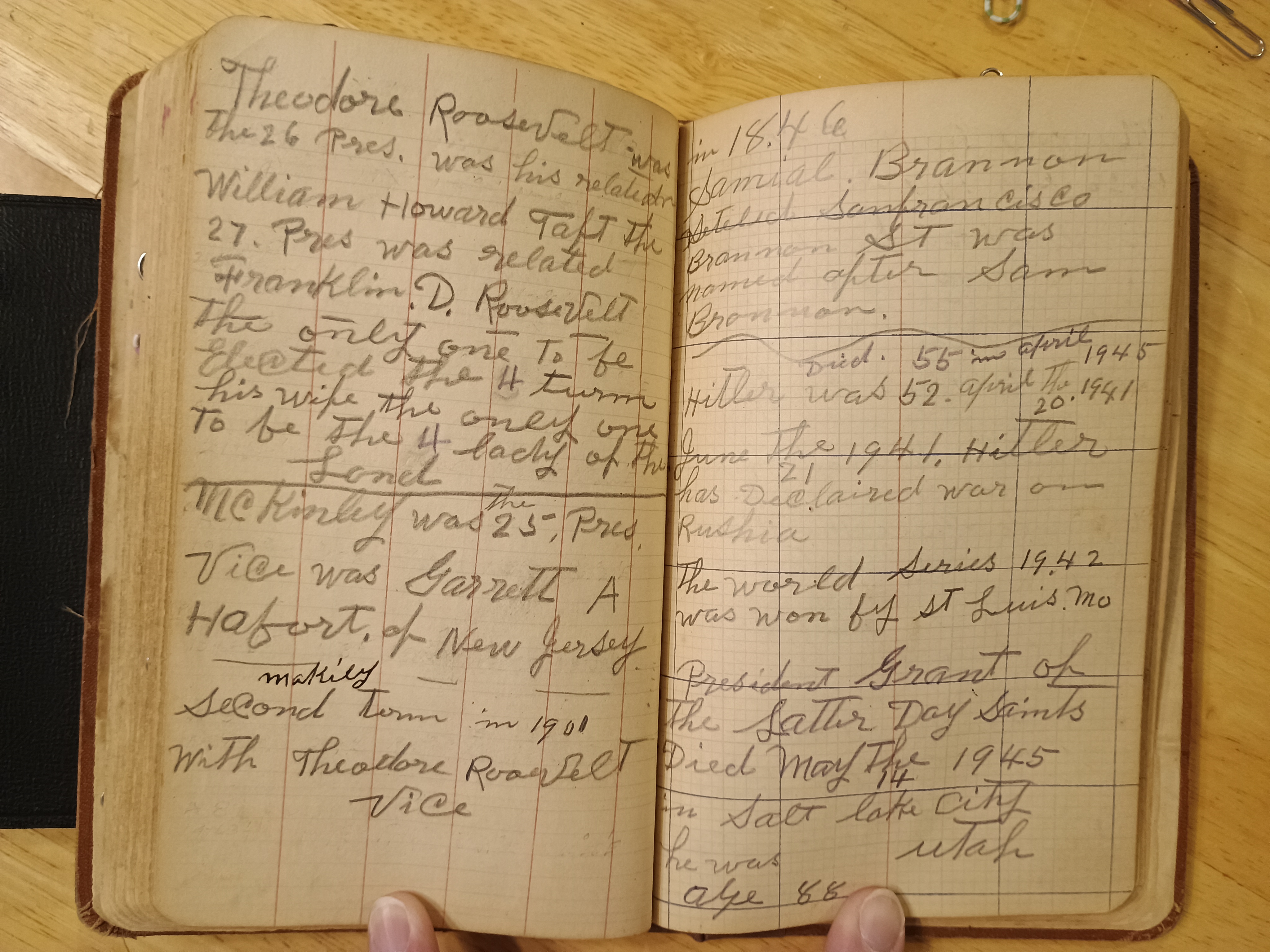
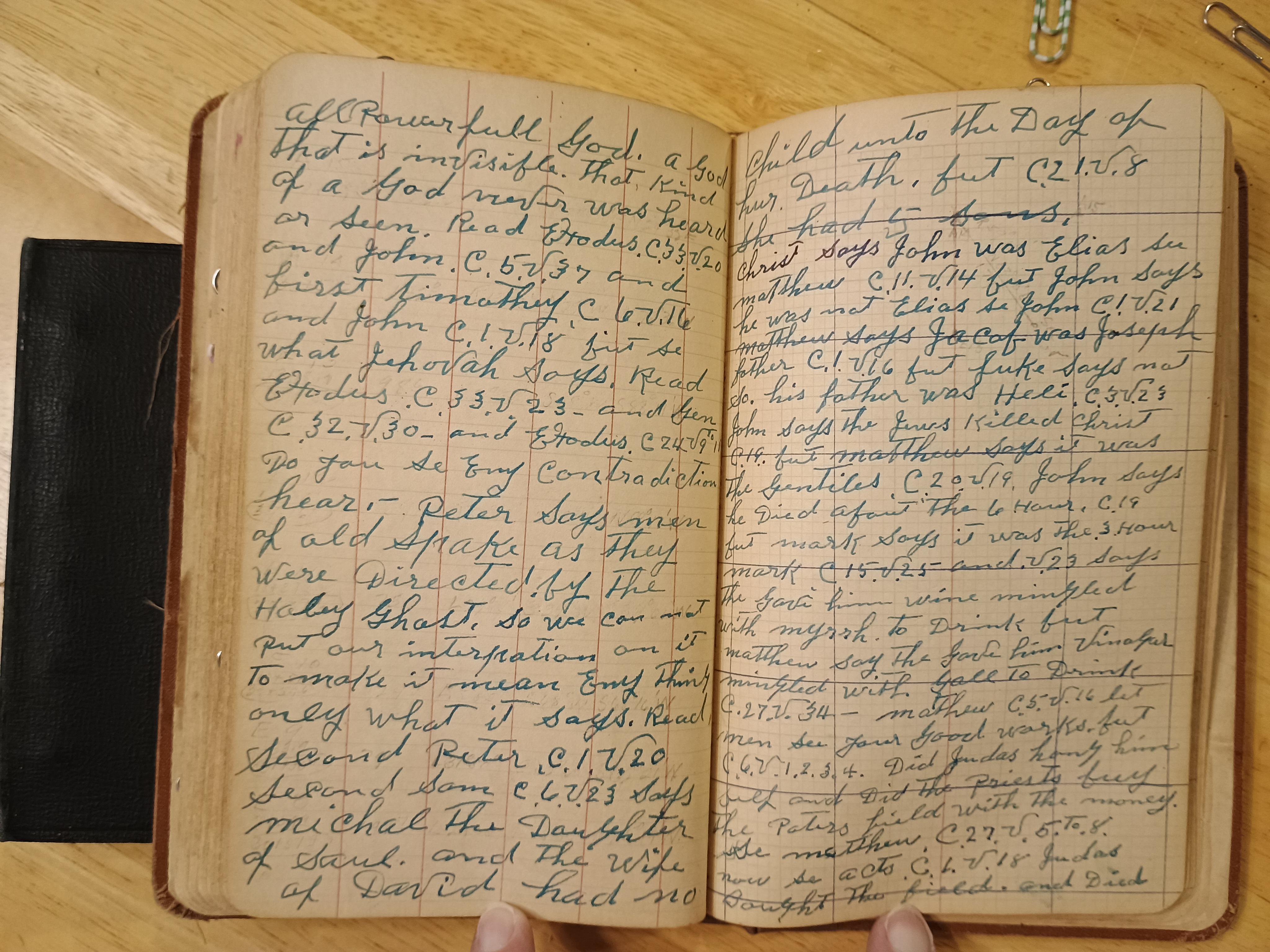
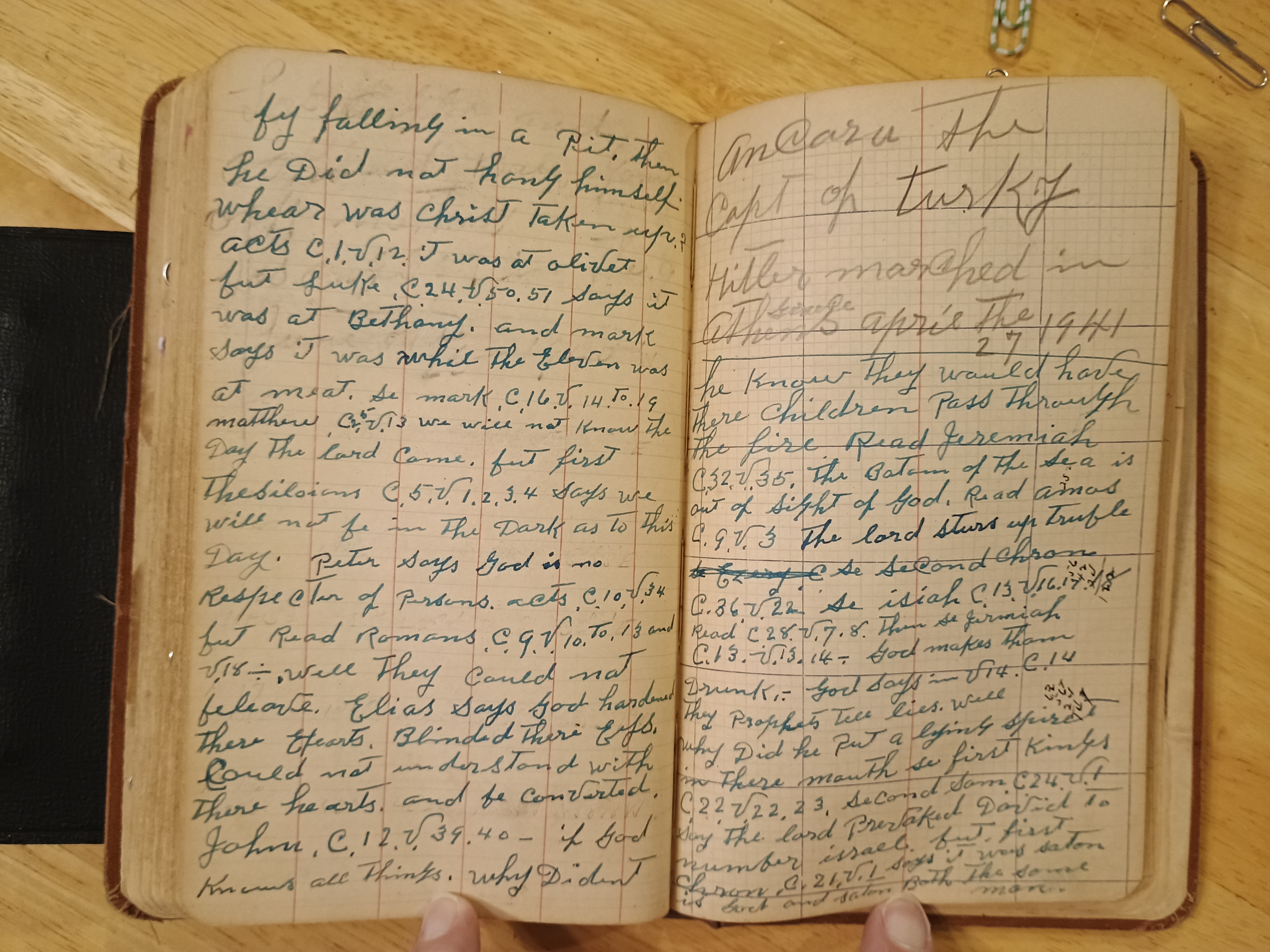
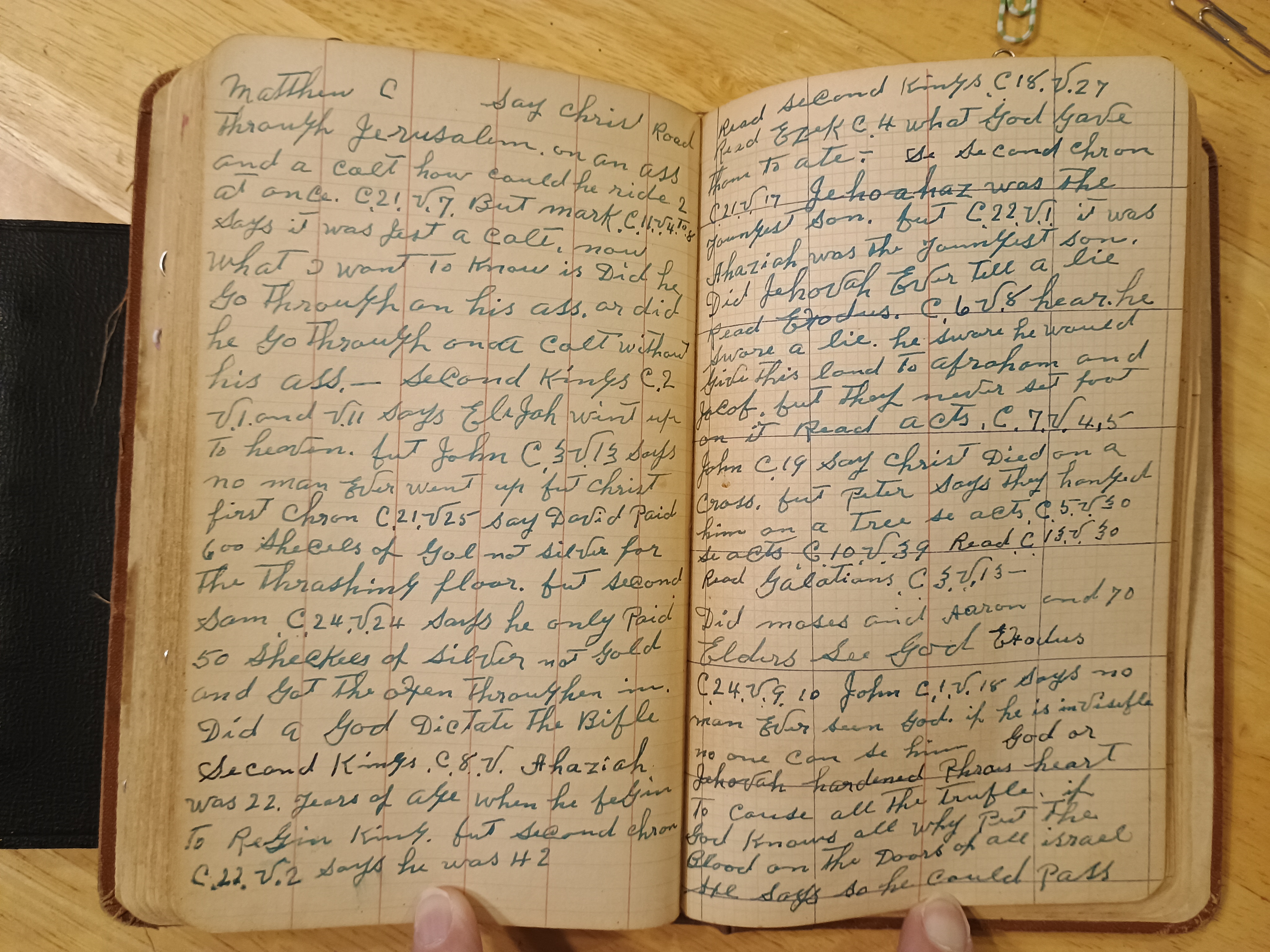
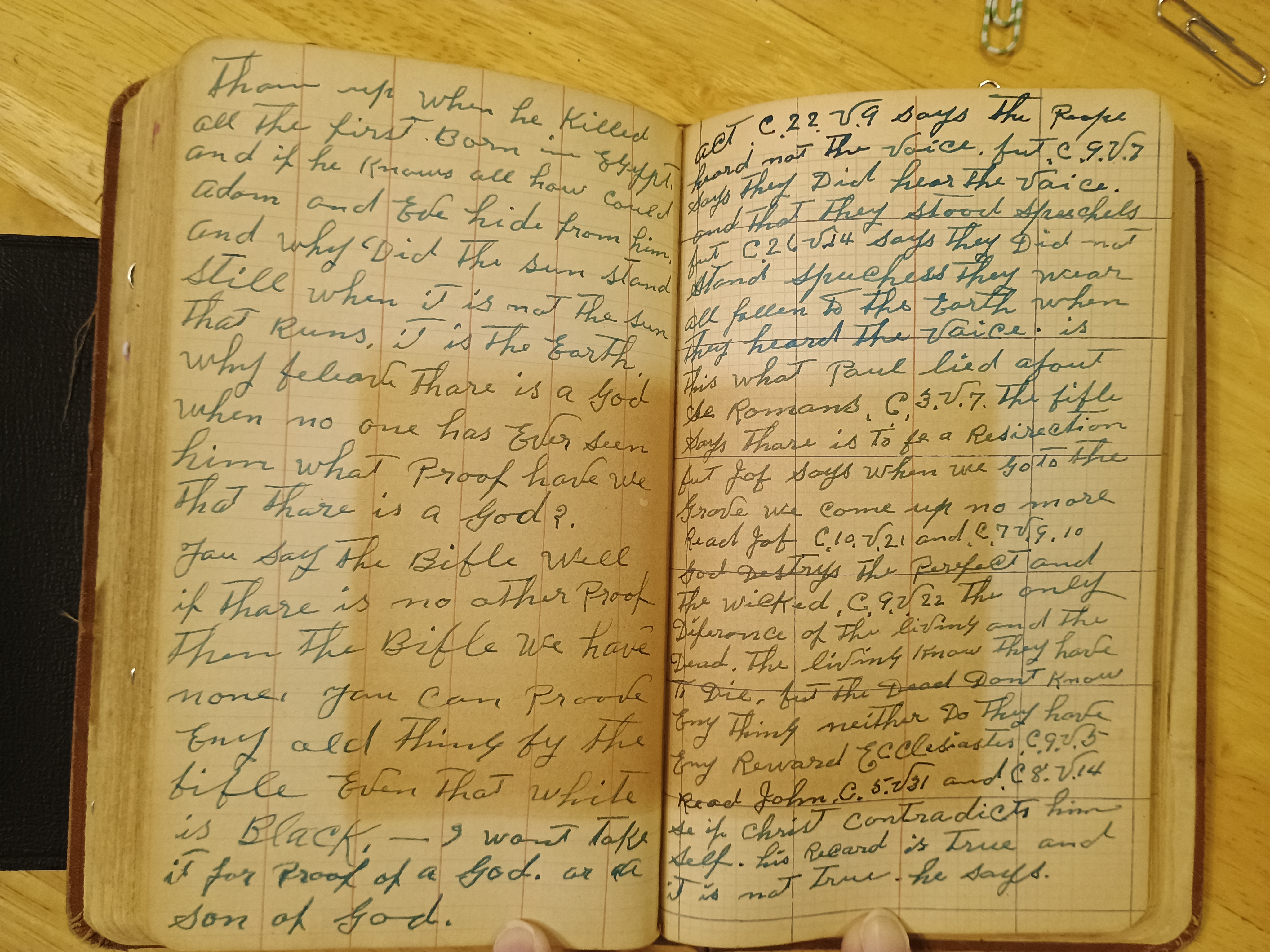
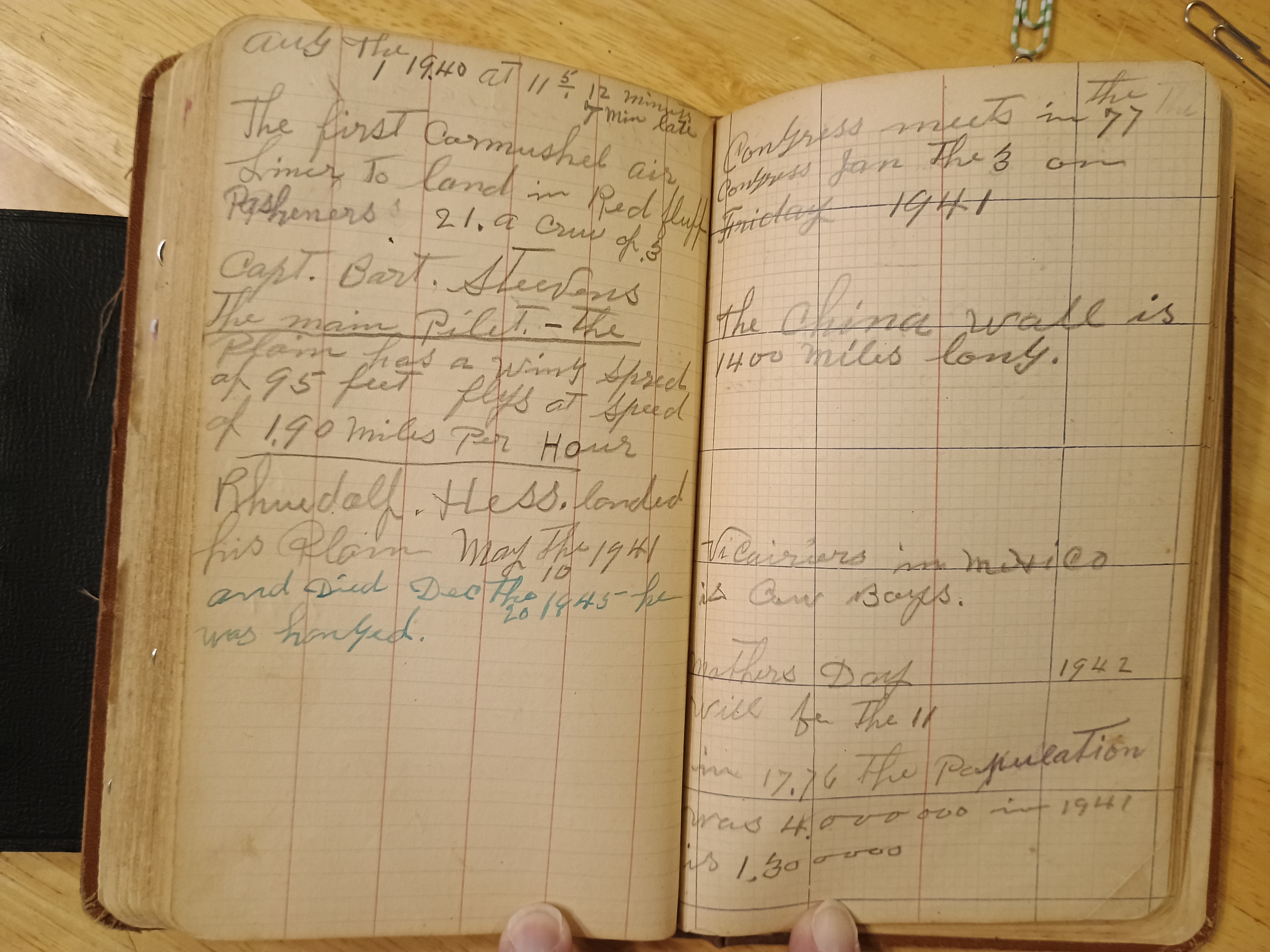
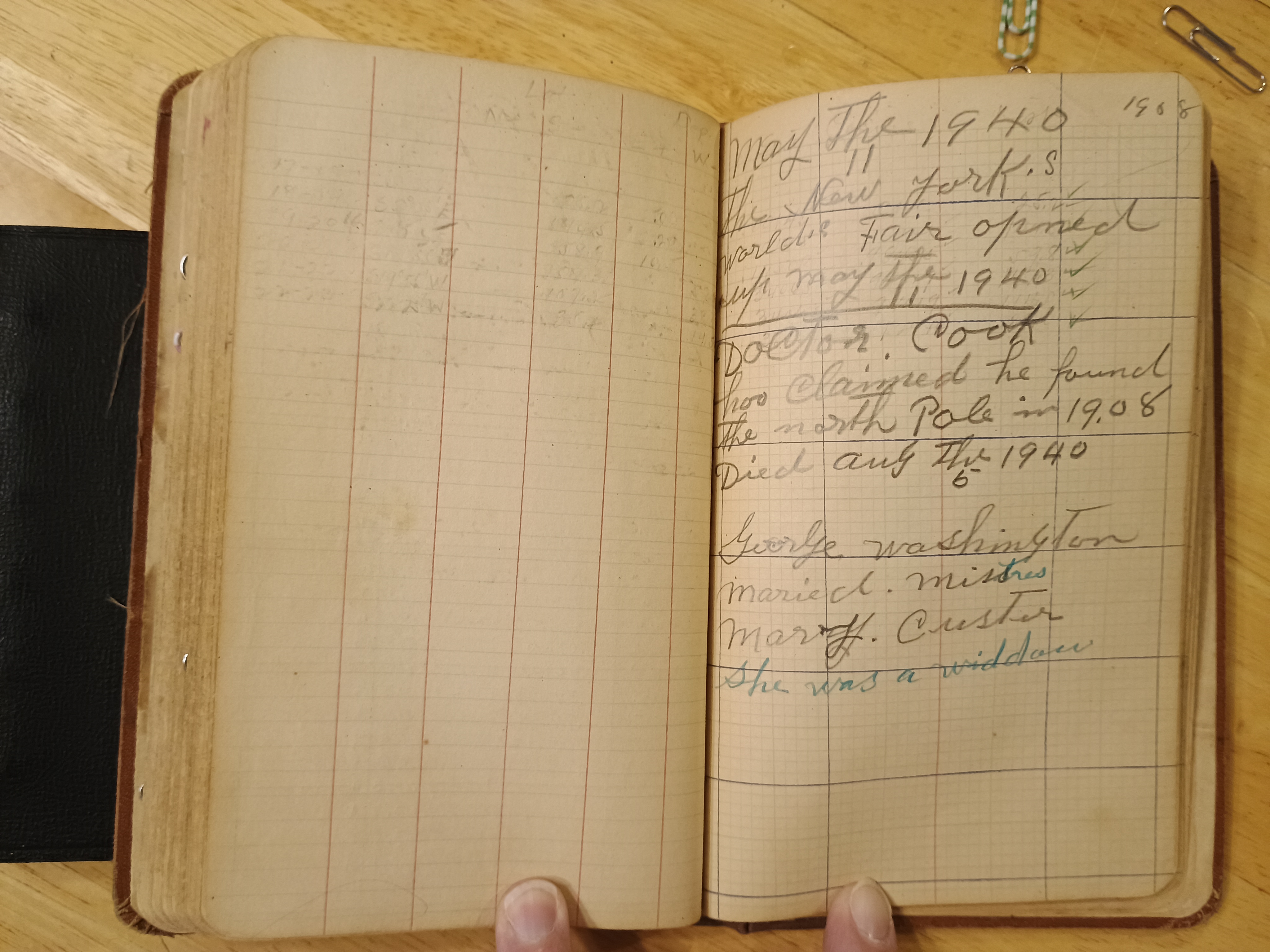
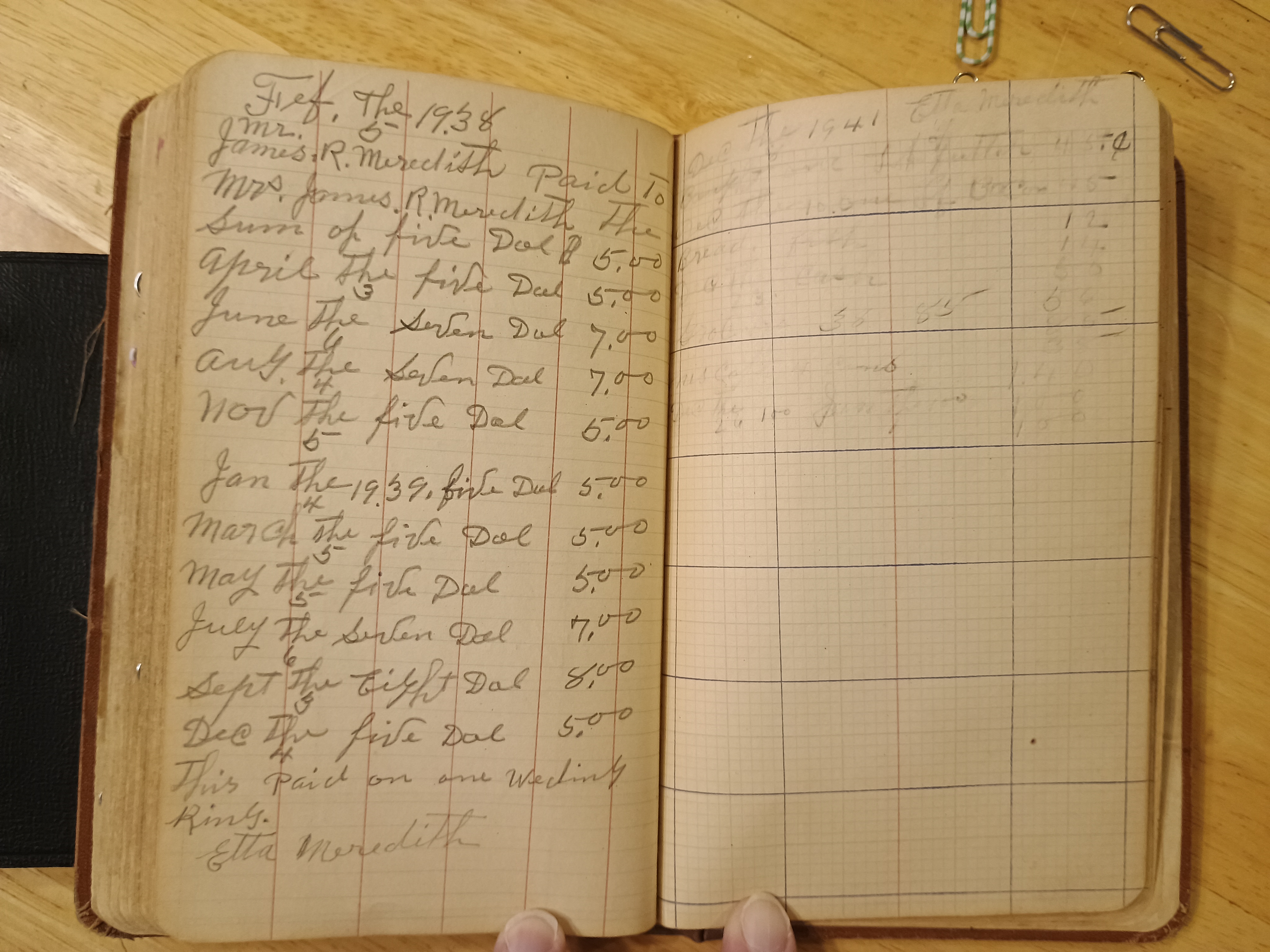
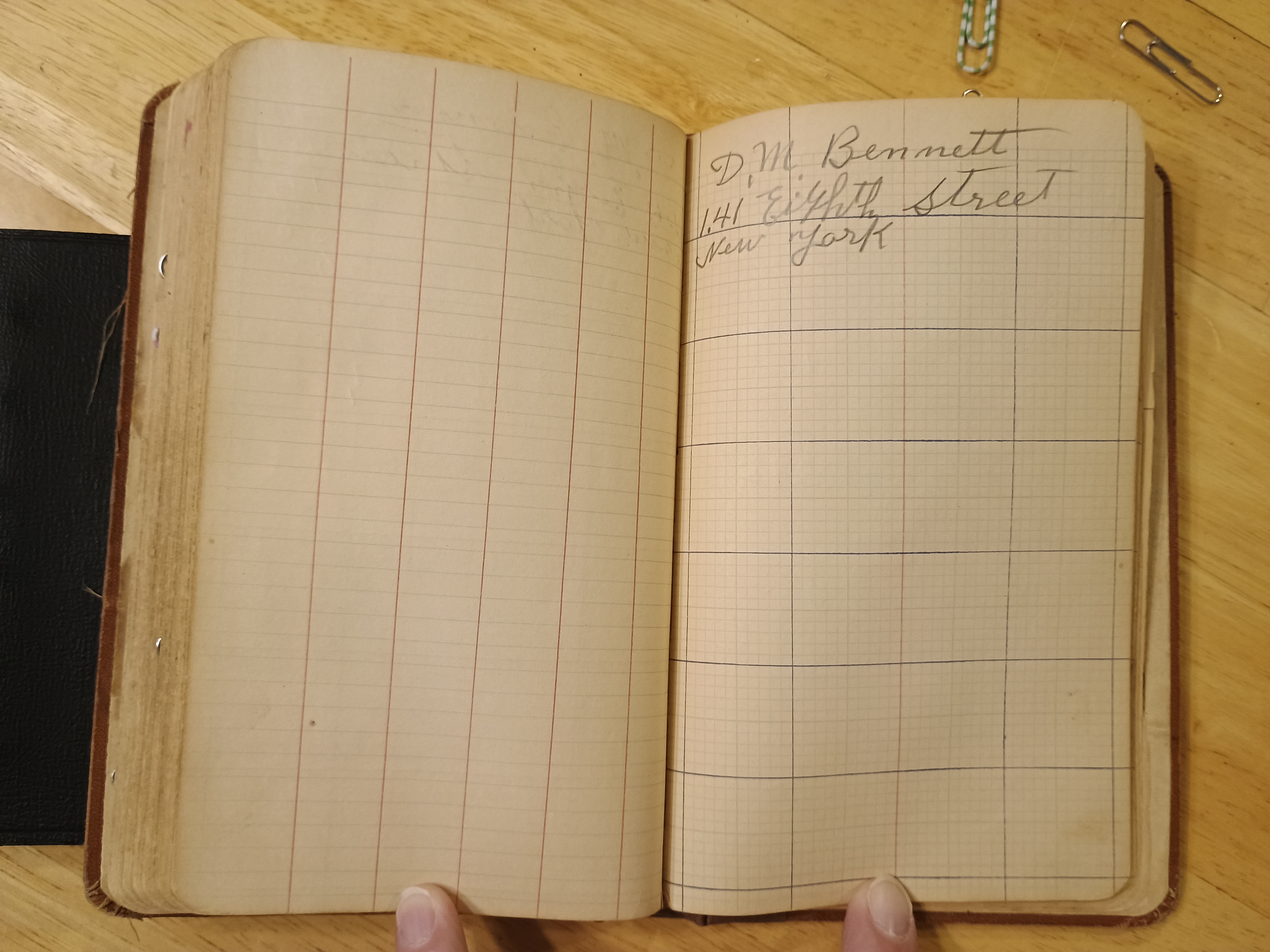
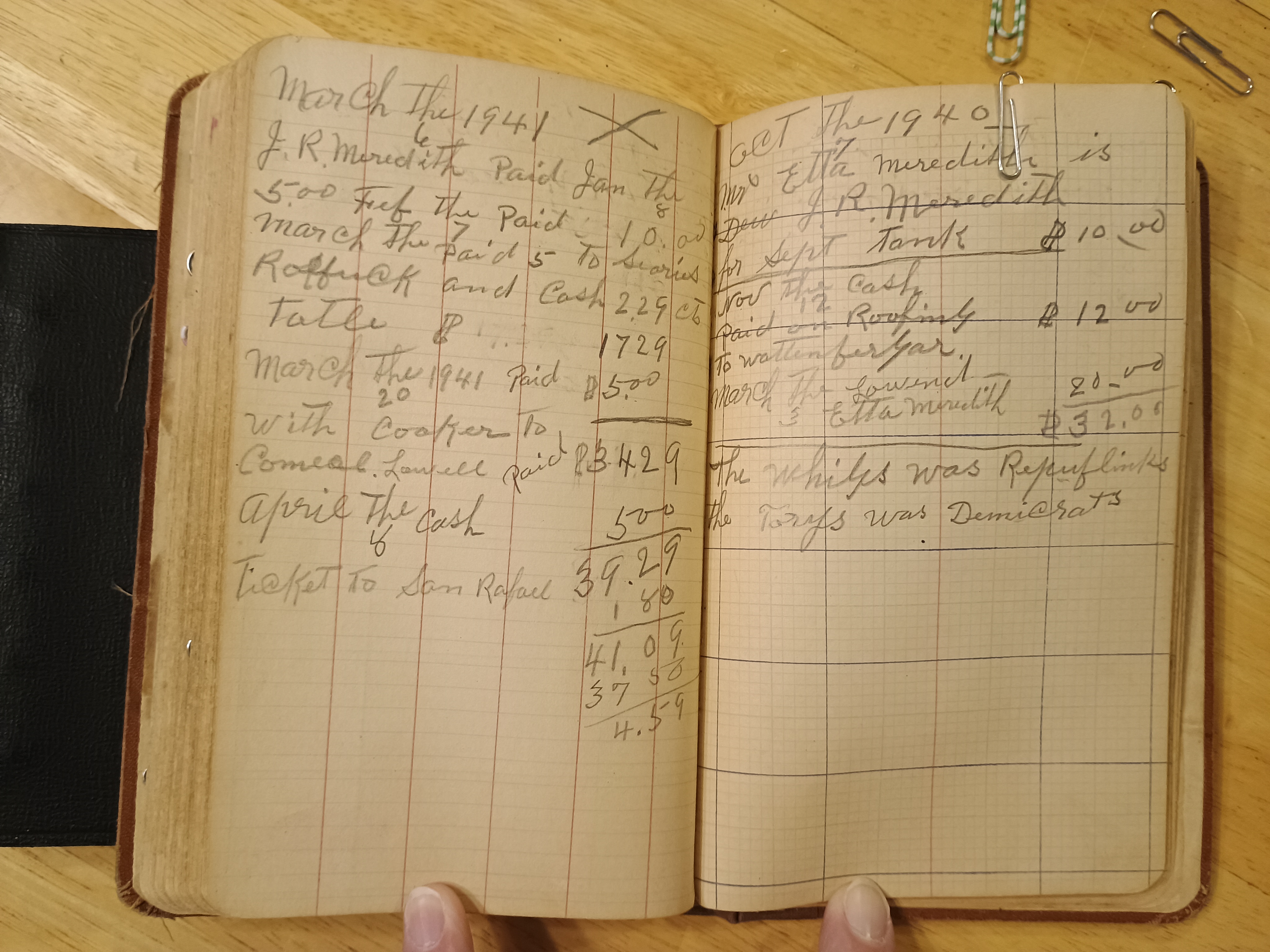
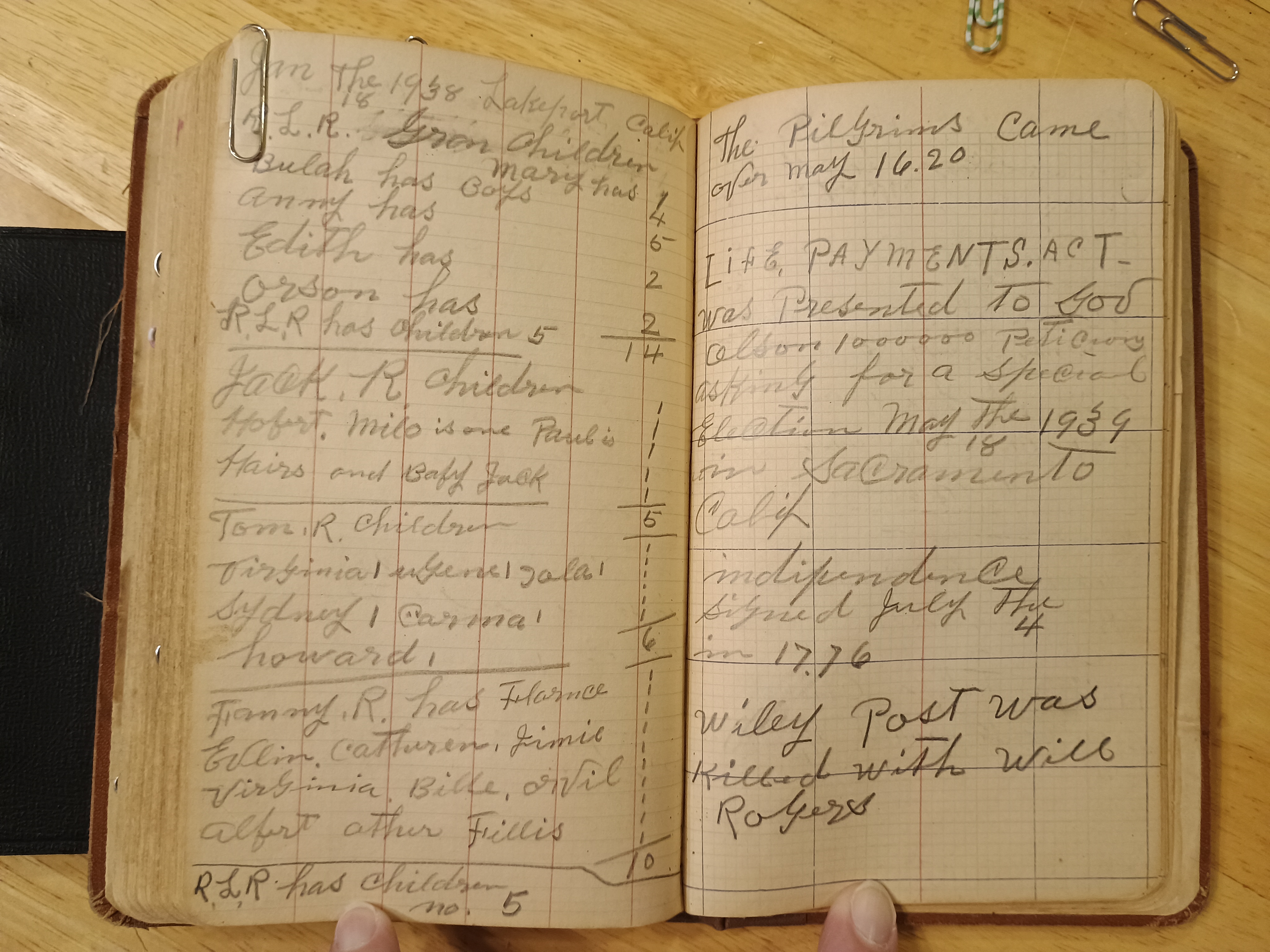
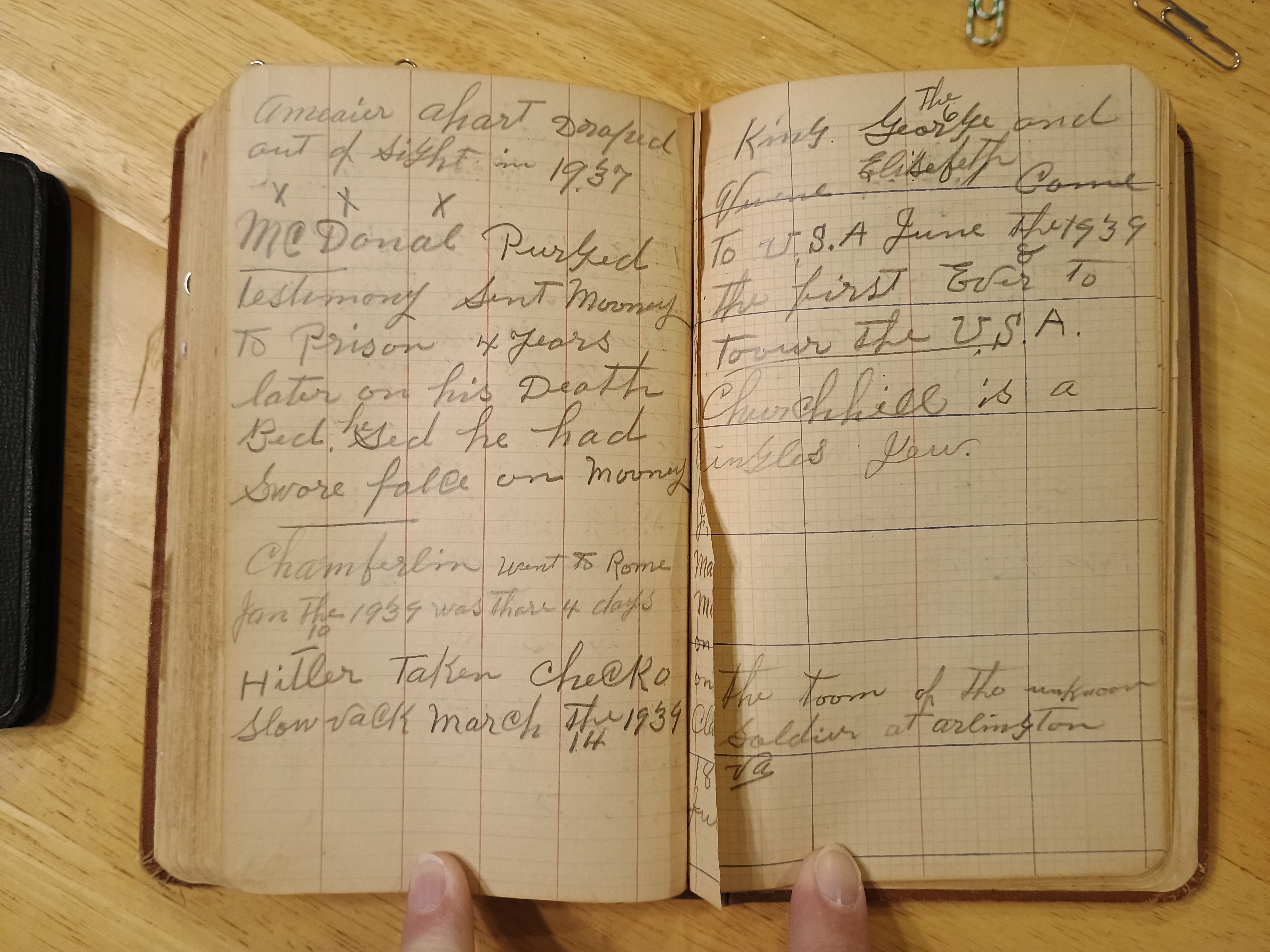
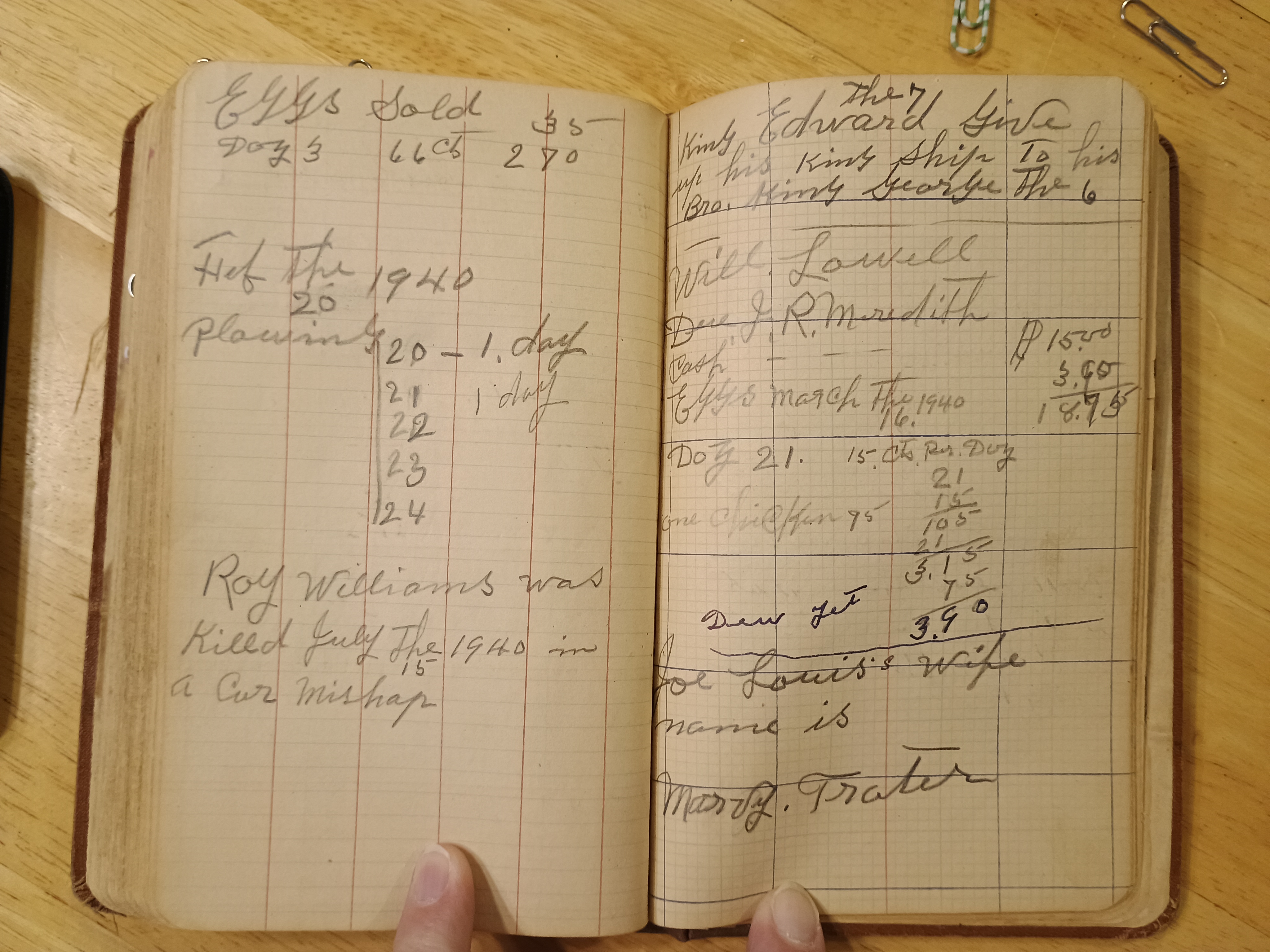
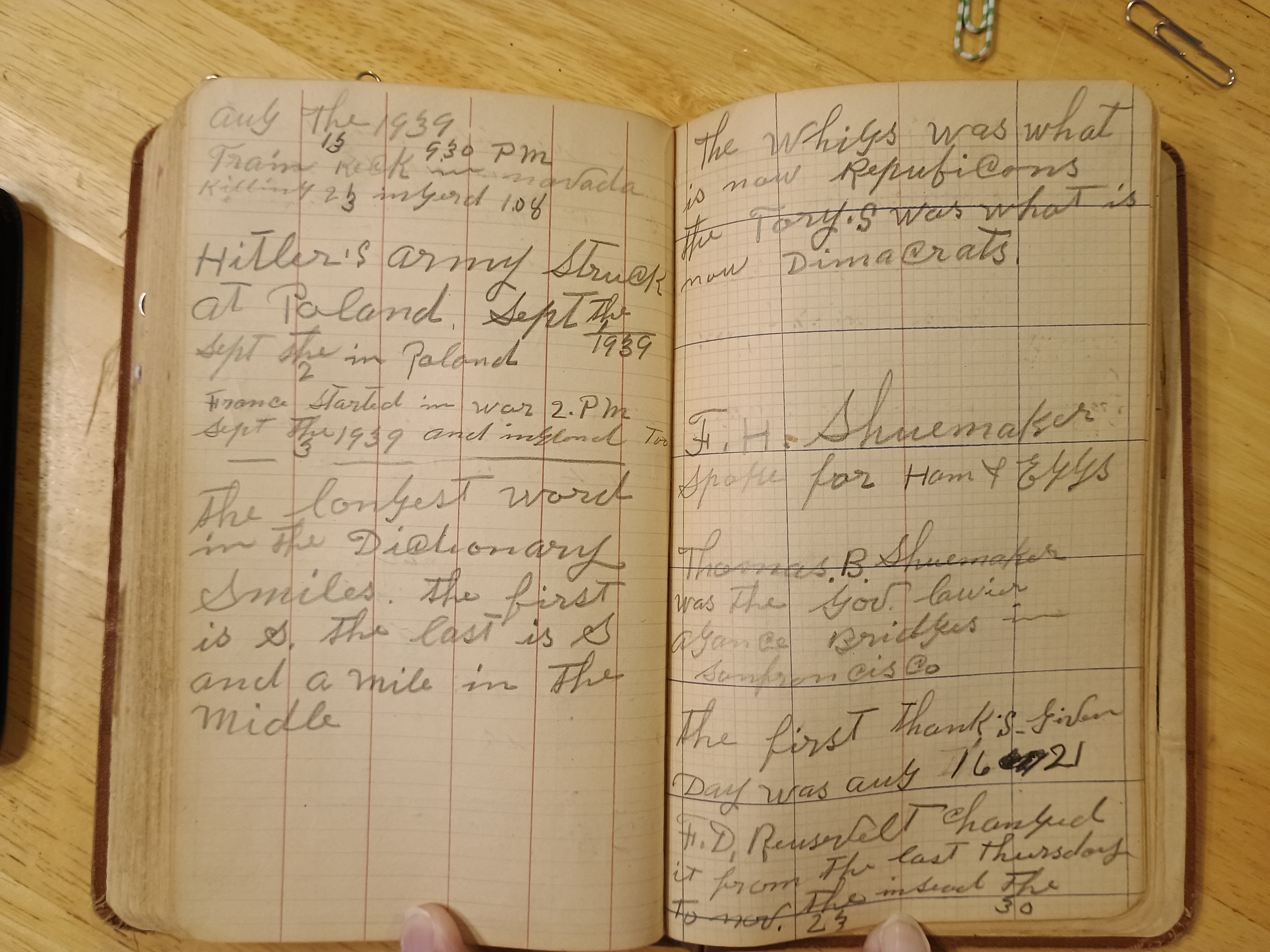
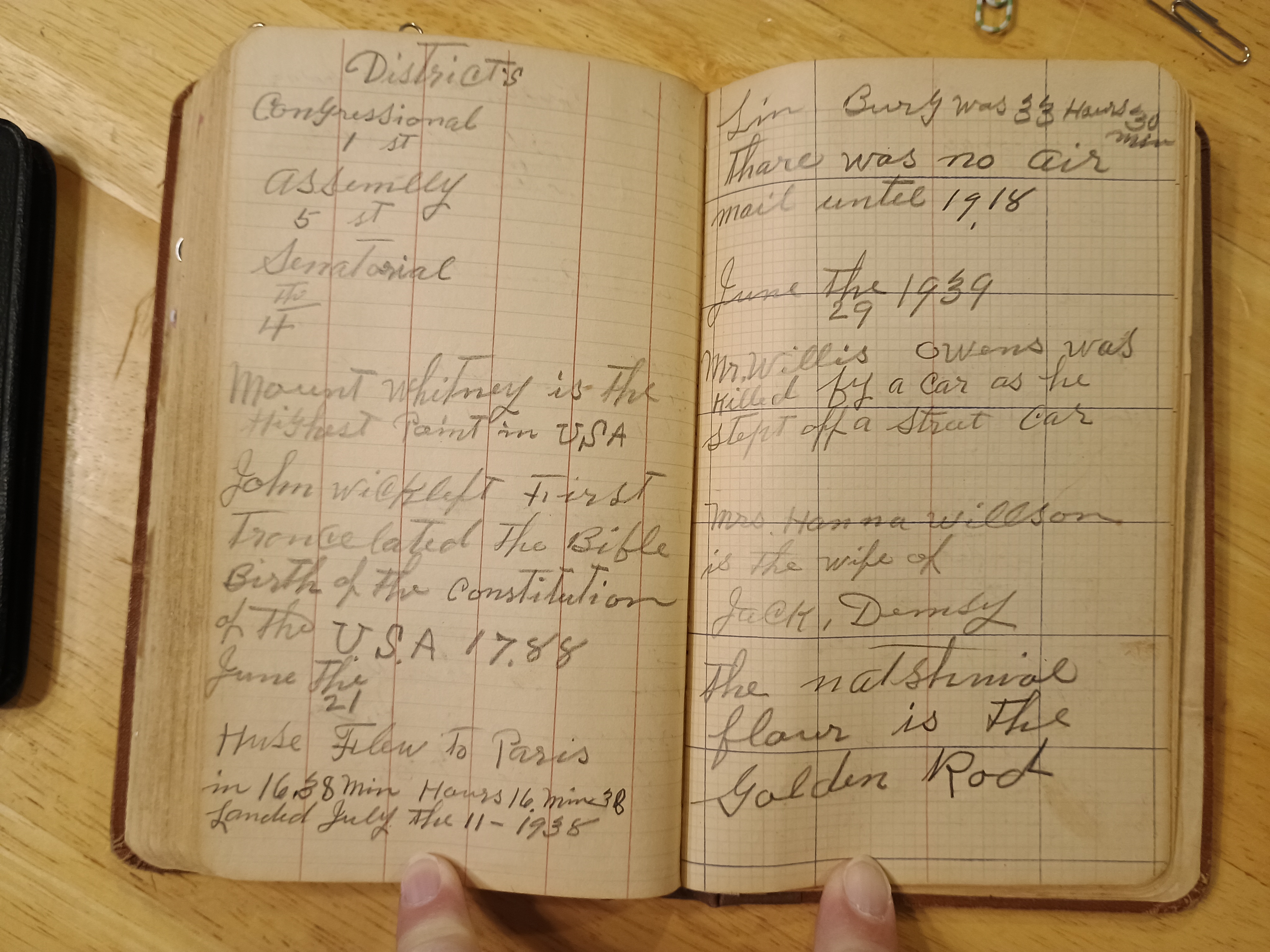
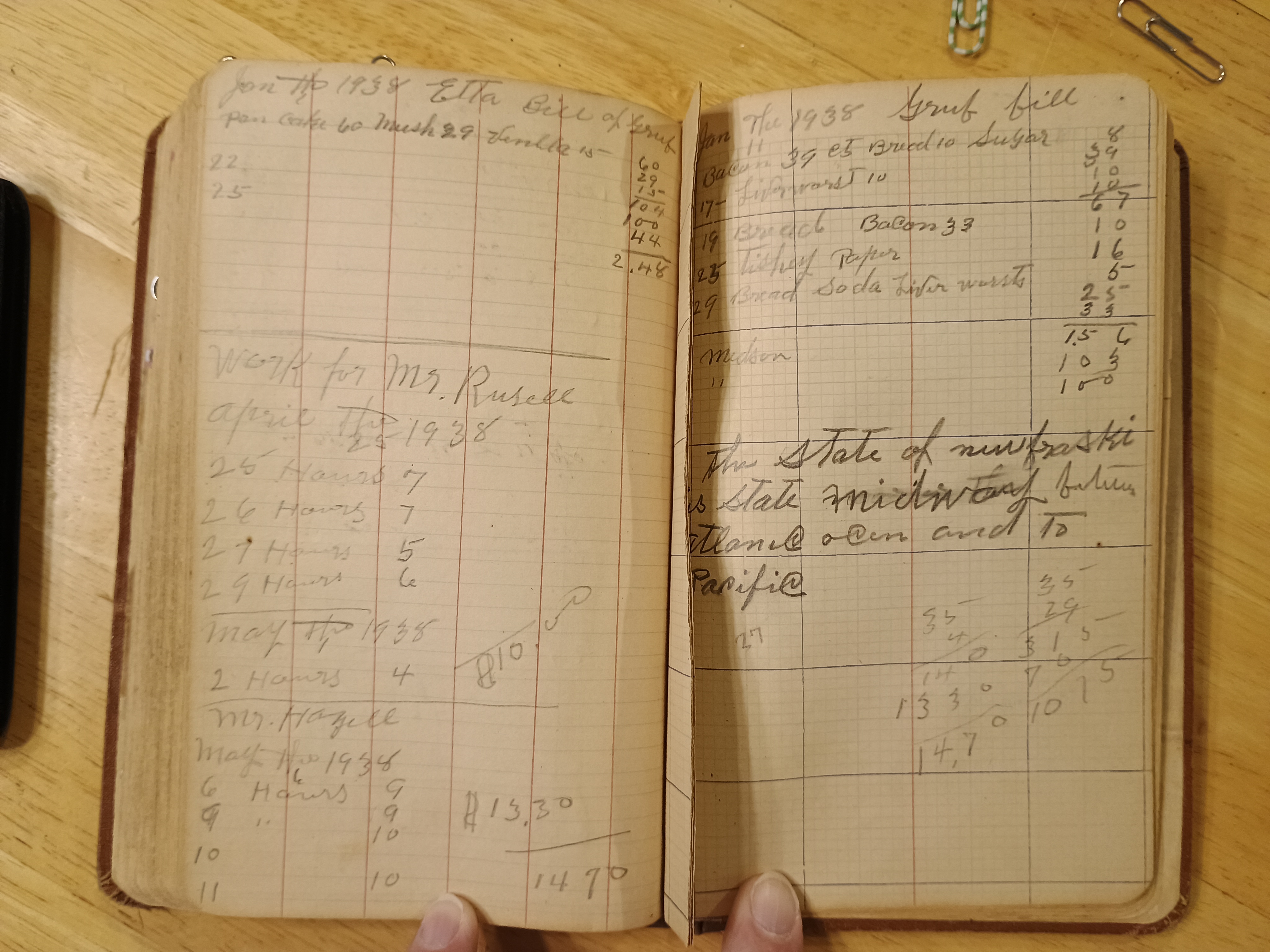
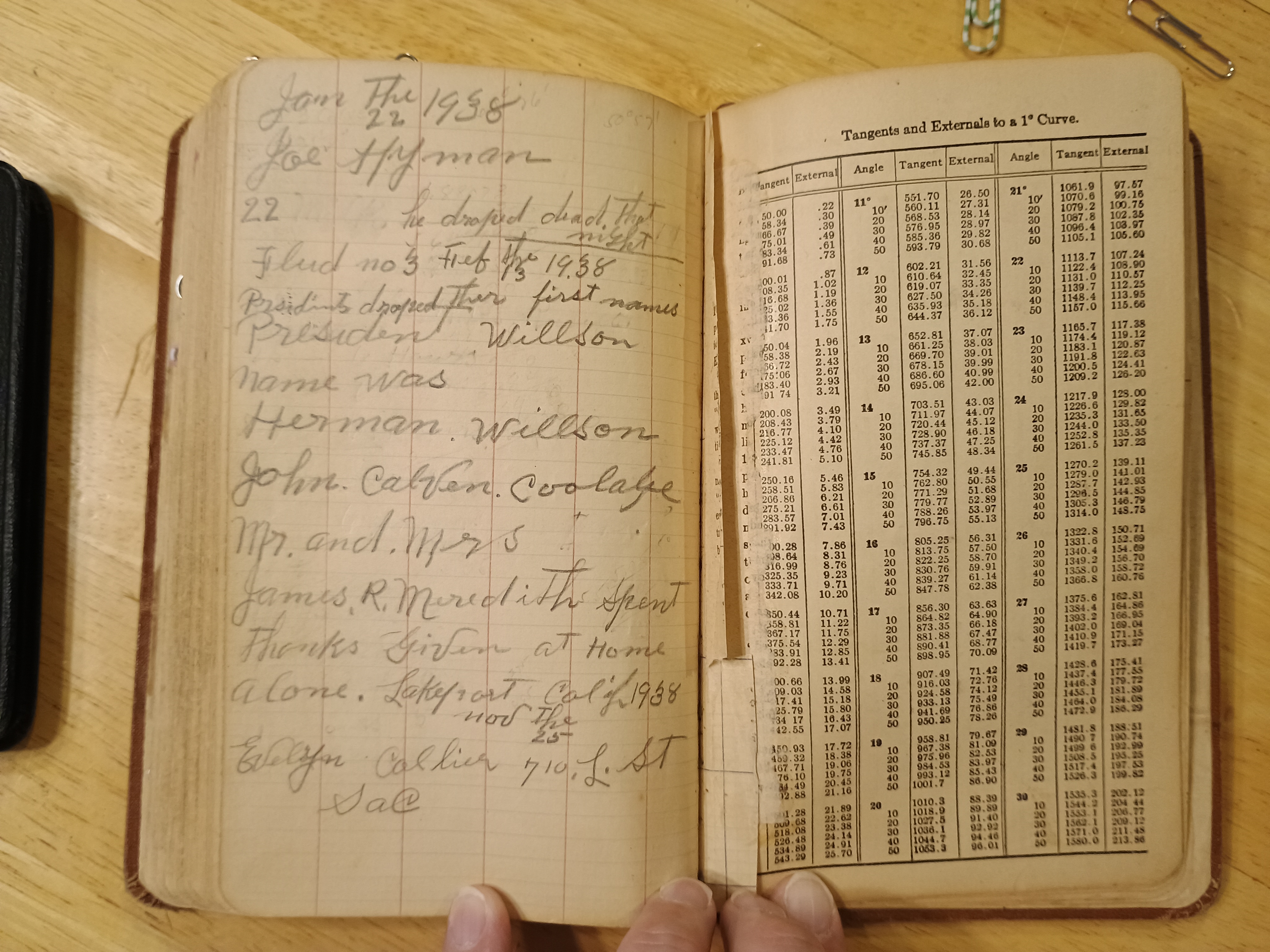
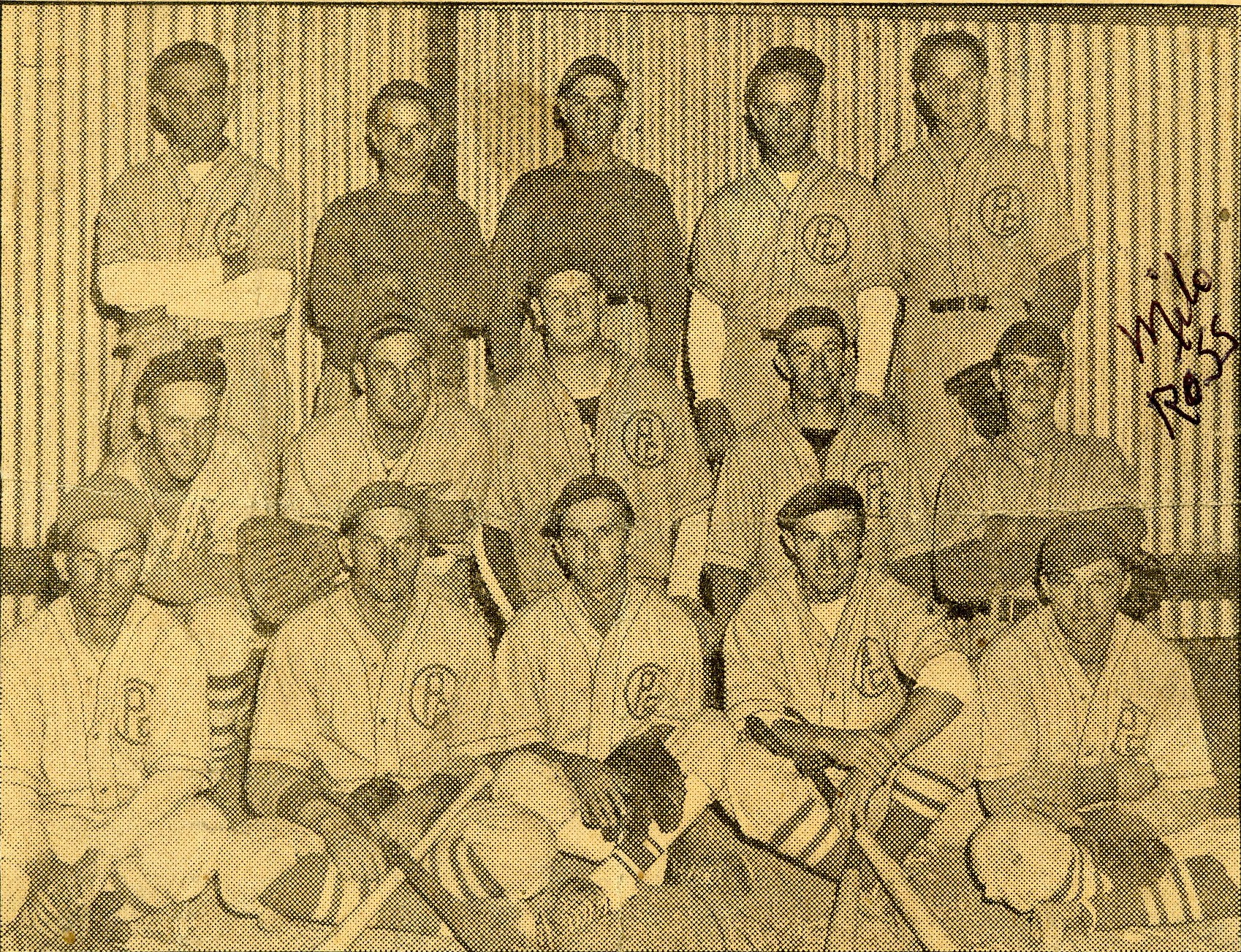
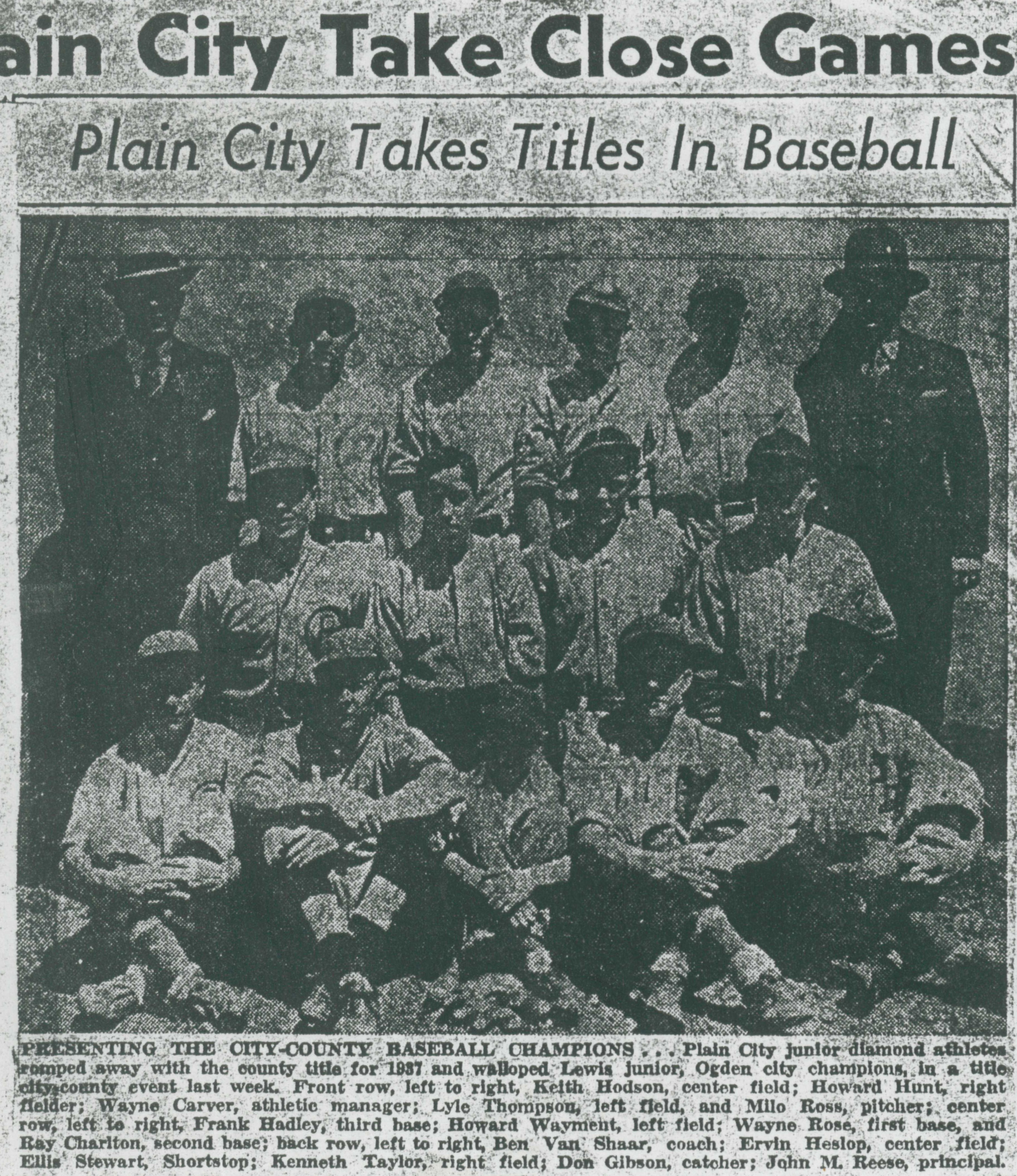
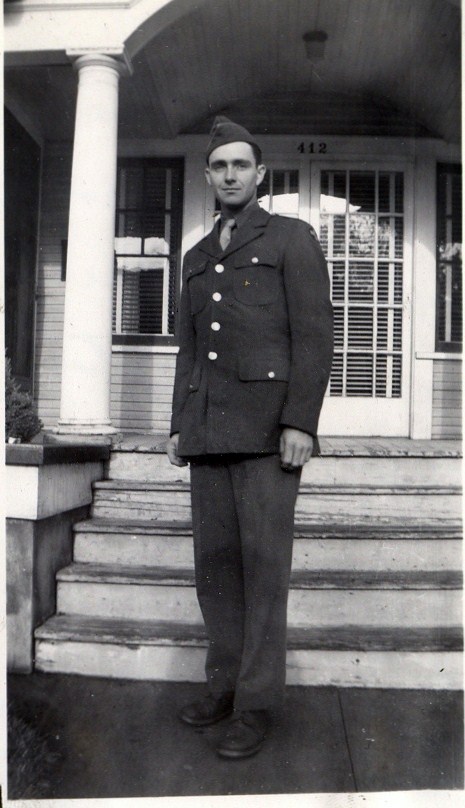
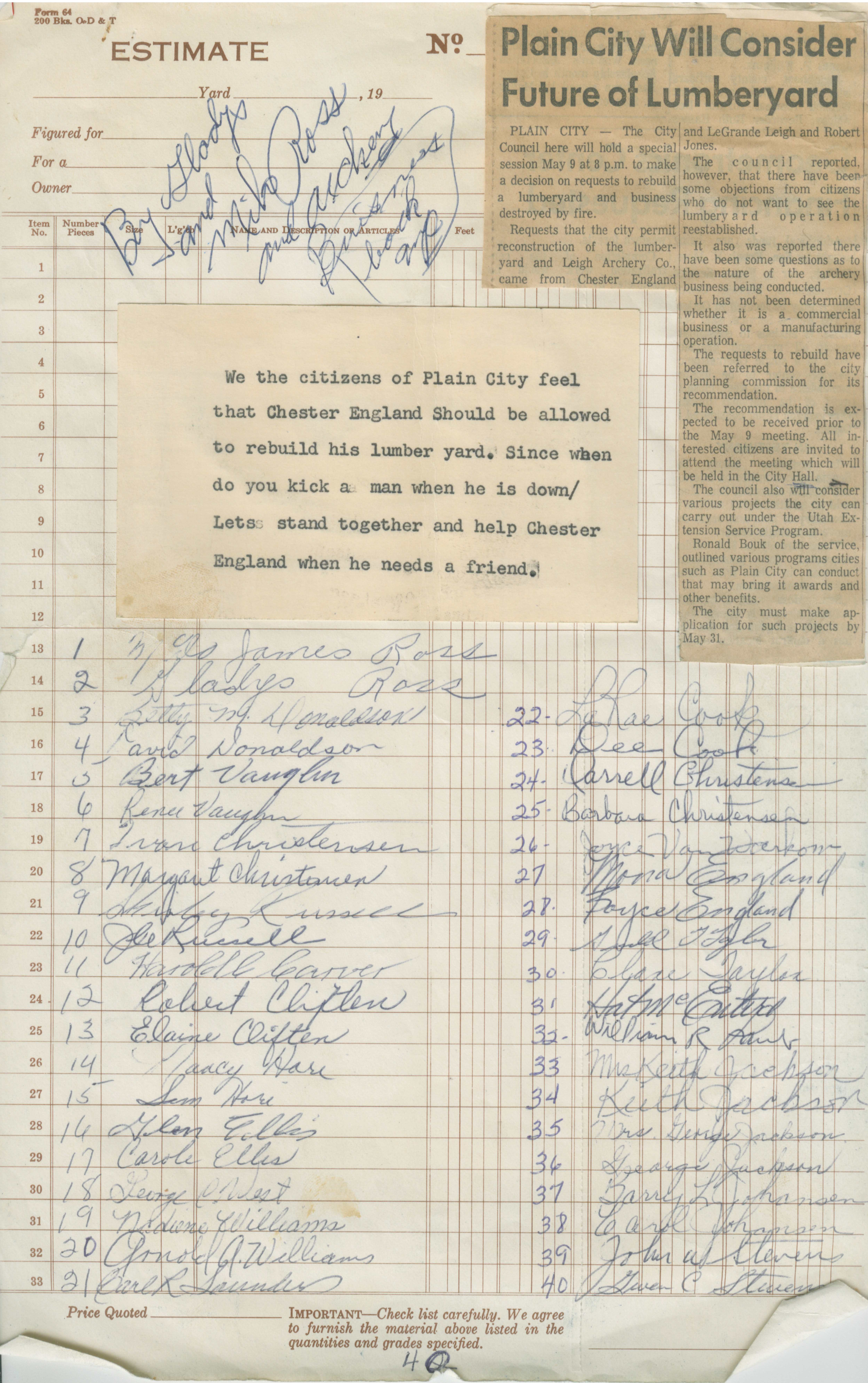
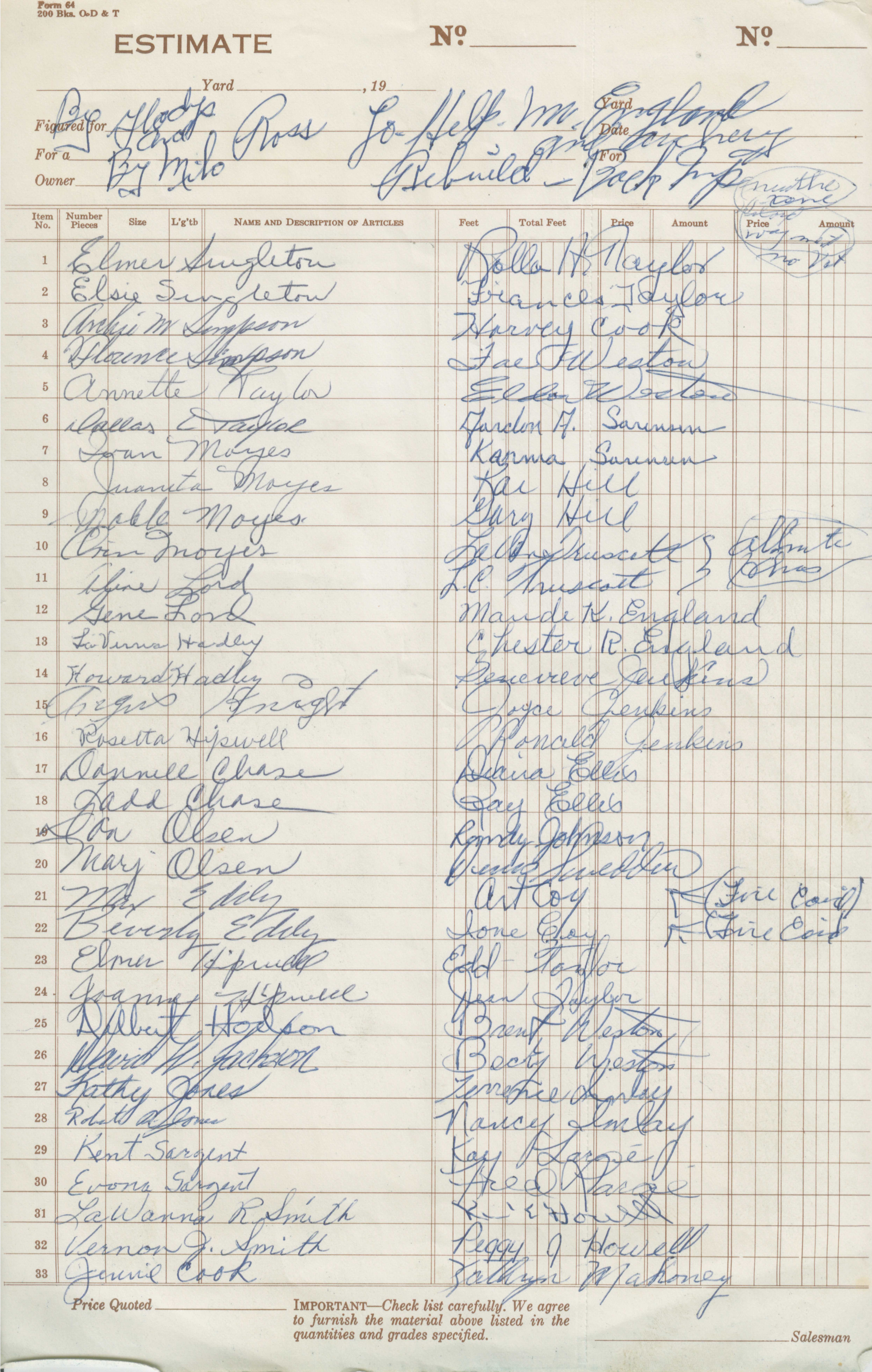
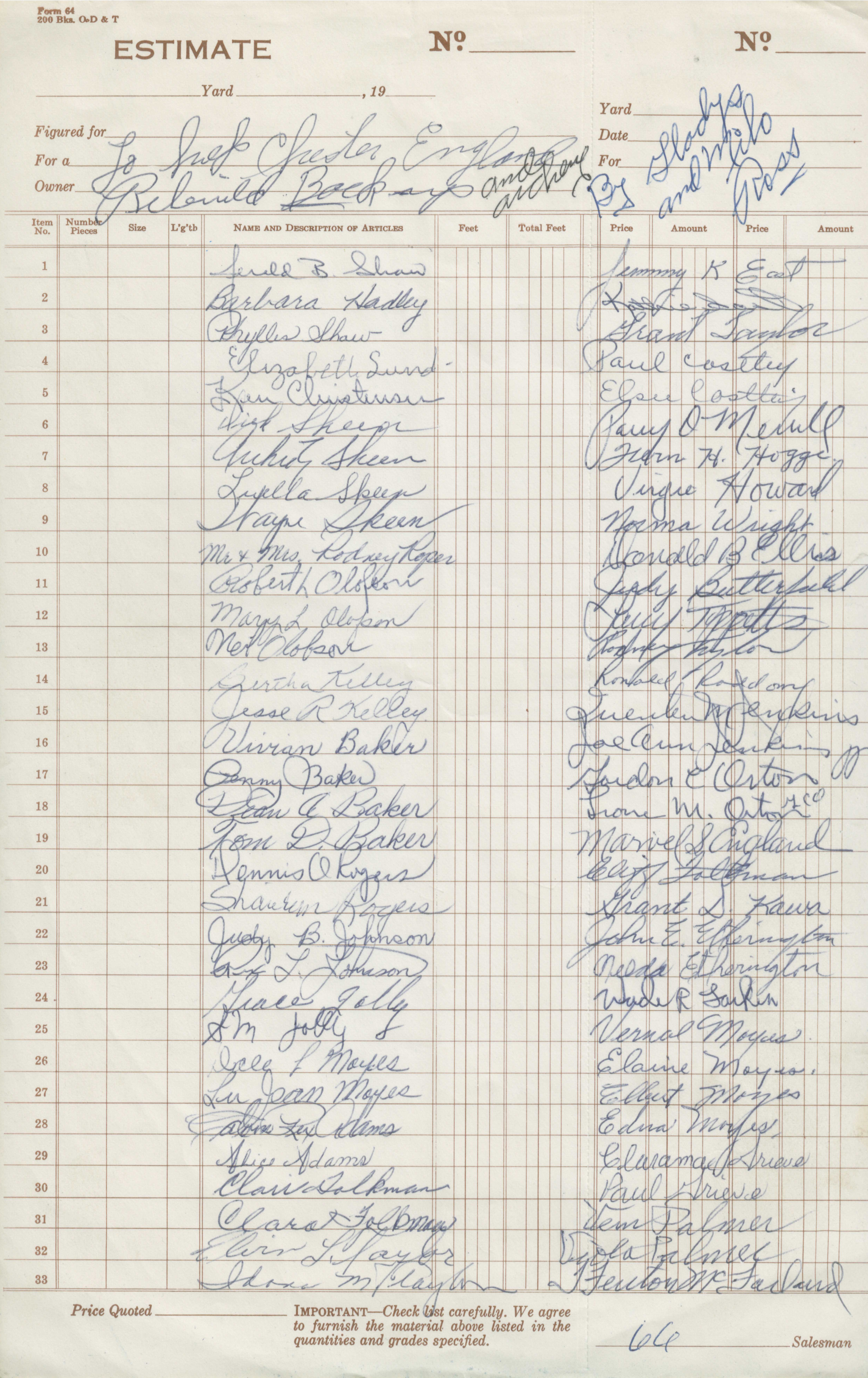
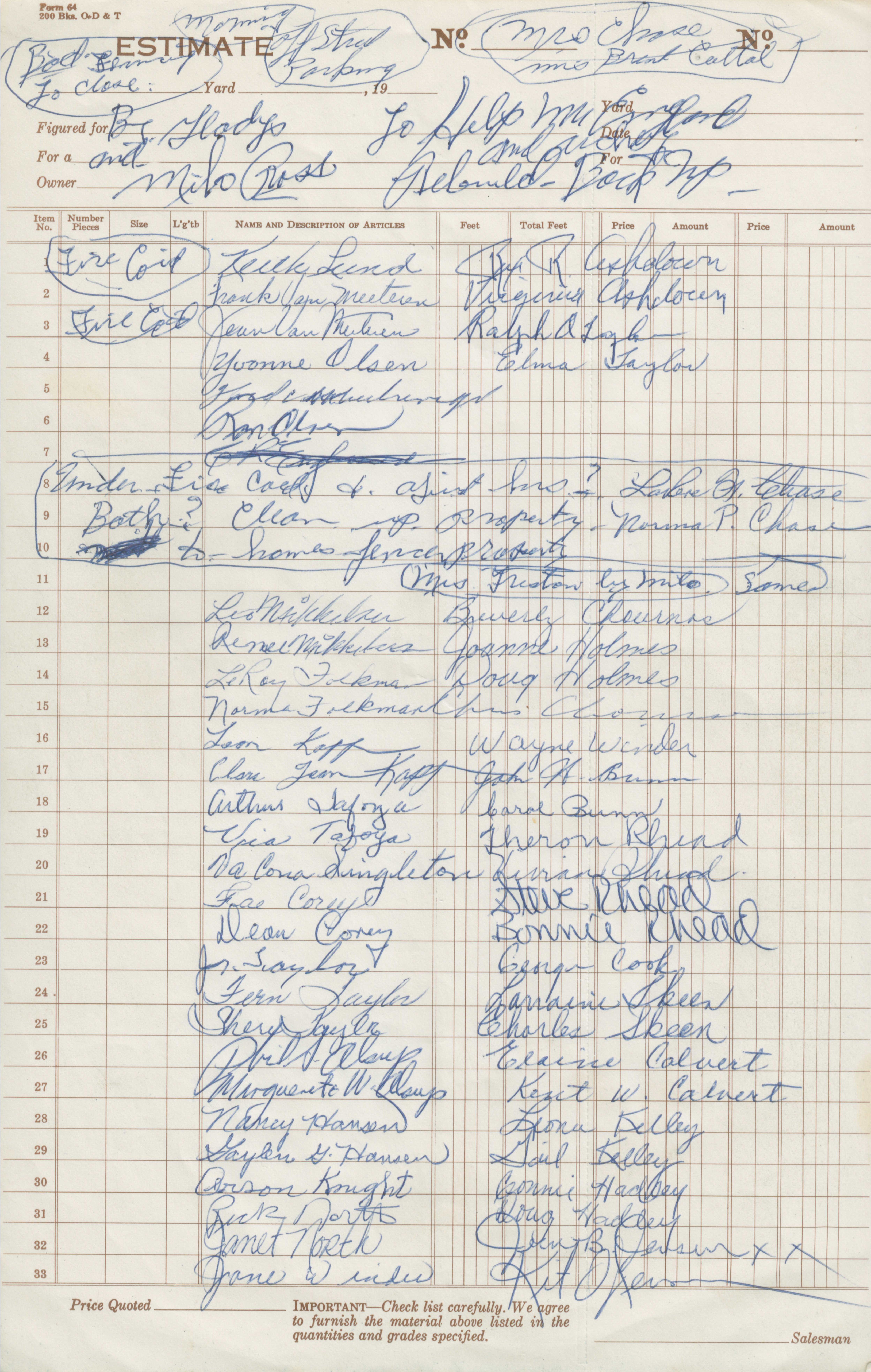
This is a book I received that belonged to my Great Aunt Betty Oram Donaldson. I was not sure exactly what to do with it, other than share it for family history purposes. The photos in the book were not very high quality, but I am replicating them here anyway. Hopefully this history is of value to someone else who has family in the book.
“It’s a Great Life”
It’s the time in life for all of the Wilson School Class of ’47 to stop for a moment and realize that “It is a Great Life.”
We are matured and “aged” to the point that we are willing to accept that we are what we are. We realize that all of us have talents and abilities and that no two of us are alike, but that’s what makes us successful and happy. We are happy when we use our abilities and develop our talents.
In sports and business they often refer to “a level playing field,” meaning that both sides of the competition have equal opportunities. Therefore I believe that in life competition, the only “level playing field” is when we compete with ourselves. Our goal should be to do the very best we can, because no one else has the same talents, or abilities, or past experiences that we as individuals have. It has been said that we are the sum total of our past experiences. I believe our religious freedom and our constitution give us the opportunity to pursue success and happiness.
At the reunion dinner it was noted that all of us were satisfied with our accomplishments in life and most of us were in the service of others by actively volunteering in our churches, schools, civic organizations or other needy causes. Yes! It is true that most of us are involved in golfing, traveling, or other hobbies that we have looked forward to doing while preparing for these Golden Years. The time and resources to pursue and enjoy these activities make it “a Great Life.”
I am proud and honored that I attended Wilson School and associated with all of you there. From that small class we have many success stories and important things that we have done. Each of us has his or her own success story to be proud of whether it’s related to our families, our friends, our activities in church, our civic involvement, our involvement in other special organizations, or our career successes.
It has been said that when we die if we have five close friends that we have been successful in life, If that is true, then all who were part of the Wilson School Class of ’47 are successful individuals because of the friendships that we share today.
May each and every one of us continue to be successful and happy in our daily life, and always remember that it is a Great Life.
— R. B. (Bud) Willey, Class of ’47 Student Body President
History of Wilson School Class, 1938 to 1947
Many of you attended your very first school years in another school. As each one came to Wilson we became friends and so your memories will begin where you started. For a few of us our total elementary school experience was in the old Wilson School and that is why we started this memory book with the first grade.
First Grade, 1938–39
Our first grade teacher was Miss Dorothy Poulsen. She was young and pretty and we loved her. Our first grade class room was upstairs on the southwest corner. It was large with windows on the south and had wood floors. We had tables and chairs, a playhouse, a sand table and a space for a reading circle. We read from Dick and Jane books. We carried our lunches to school and stored them in a screened cabinet in the hallway. Many of us had Snowdrift shortening buckets for lunch pails. That year the front entrance of the school faced north with steps going toward the road. There was no cafeteria. First and second grades were excused at 2:00 p.m. to go home. That year we had two age groups in our class. We met with the children a year older than us. A doctor visited our class and checked our ears and throats. There were about 29 children in our room.
Second Grade, 1939–1940
Our teacher was Miss Viola Poulsen. Our classroom was upstairs on the southeast corner with windows on the south and east and a fire escape outside. We had desks that year and reading circle space on the east. We learned reading, math and other subjects. The school district closed the Marriott-Slaterville School that year and those children came to our school, so we had one age group of children in our classroom. About this time in the second or third grade we began getting soup for school lunches. They brought buckets of soup to the classrooms and passed enamel bowls and spoons to each student and filled them with soup. That was the forerunner of school lunches. About this time the school was remodeled so that the entrance faced the east and the office was built where the north entrance had been. The bathrooms were downstairs in the basement.
Third Grade, 1940–41
Mrs. Folkman was our teacher. Our classroom was the upstairs northeast corner or the southwest corner. There were 29 children in the class.
Fourth Grade, 1941–42
These were the war years. Our teacher was Miss Chadwick. Our classroom was the upstairs middle room on the north. These war years were very hard. School was closed in the fall so the older school boys could help harvest farm crops. We went to school on Saturdays a while to make up the time. The older boys were soldiers and were drafted to fight Japan and Germany. Many of our brothers were soldiers. No school pictures were taken during our fourth, fifth and sixth grades because all resources were concentrated on helping the war effort.
Fifth Grade, 1942–43
Our teacher was Miss Vera Shaw. She was a superb teacher. Our classroom was the upstairs northeast corner. About the time of fifth or sixth grades they began school lunches and we had tables in the basement in the hallway. I don’t remember when the cafeteria was built.
Sixth Grade, 1943–44
Our teacher was Vera Shaw again. Our classroom was on the main floor southeast corner. As an activity one day we made butter by shaking cream in a bottle then we each had a cracker with butter on it. We learned reading, math, and spelling etc. It seems like part of this year we had Mrs. McGrath for a music teacher and we made a book of all the old music composers. We bought victory stamps and gave the government the money to help fight the war. A favorite game of the boys was marbles. Each boy took great pride in his collection of marbles and his skill at shooting. The girls played jacks. We had a rubber ball and a set of 12 or so jacks and we would sit on the floor in a circle or around a table and go clear through onseys, twoseys, downseys, under the bridge or over the bridge etc. Another favorite of the girls was jump rope. If you could do “Red Hot Pepper,” or “Double Dutch” without missing you could jump quite a while. To be able to run in and out without missing was a keen skill. The boys played baseball. Another favorite game was “Pop the Whip.” Boys and girls would hold hands “tight” and run in a snake line and try to pop the end person off. We took turns being on the end to be popped off. Another favorite was “Flying Dutchman”. We were in a circle and two people ran around the circle. If your hands were touched you ran to beat the other couple to the empty space. Another favorite in winter time in the gym was four-corner kick.
Seventh Grade, 1944–45
Miss Maude Holmes was our teacher. That year for a very short while we had a Mr. Carter who was unusual. He stole some of our lunch money. Our classroom was on the southwest corner of the main floor. Around this time the school district built the cafeteria on the south of the school. We blessed the food and everyone ate together and we learned dining etiquette. The mashed potatoes and hamburger gravy and chocolate cake were favorites.
Eighth Grade, 1945–46
Mrs. Woodward was our teacher. Our classroom was on the northwest corner of the main floor. There were 27 in our class. World War II ended and the United States began it’s healing process and the rebuild.
Ninth Grade, 1946–47
Mr. Leland Reese was our teacher and our classroom was on the northeast corner of the main floor. We were becoming sophisticated adolescents. Mr. Reese taught us first aid. Mr. Wheat Taylor was our principal. Mr. Pettigrew was the orchestra teacher and some of us played instruments. We had basketball and baseball games against the other schools on Fridays.
Wilson School was a safe and healthy environment for children to grow. The teachers respected our childhood and watched over us with kindness. Every year each class in the school participated in a school program. Mr. Arthur Taylor was our principal in the early years. A Mr. Chadwick was principal for a time. Wheat Taylor was principal in our later years and helped prepare us for high school. All in all we had a memorable early school experience and look back at those fun years with fondness.
Ninth Grade Class of ’47 Reunion in 2000
Drauca Marston Holmes, Lola Taylor Sheffield, Louise Holmes, Marilyn Bowman Garner, Betty Lou Buck Schulze, Emma Ropelato Walling, Nona Flitton Forsgren, Gladys Sorensen Gibson, Lila Stone Harwood, Robert Holmes, Gordon Belnap, Betty May Oram Donaldson, Rudell Willey, Jewel Checketts Atwell.
Where Are They Now
GORDON “DUTCH” BELNAP
Married Faye Robins in 1951. Three sons, Rob, Tim, Mike. Eight Grand kids. US Navy: Honorable Discharge. Weber Jr. College 2 years. Utah State: Grad 1958, Masters 1965. Coach, Utah State University 13 years. Athletic Director Weber State University. Faye passed away Aug. 1996. Married Karen Smith Sept. 1997. Hobbies: woodworking, golf, travel, volunteer 2nd grade teacher.
MARILYN BOWMAN GARNER
I’ve had a good life. I attended Weber College, married Don Butler and had 2 children, Kathy and Gary before leaving Ogden in 1956. We lived in Pocatello, Idaho before moving to Grand Jct. Colorado. During our 15 years in Colorado, I worked for a wholesale drug company and the last year as office manager, bookkeeper for an ophthalmologist. While living there Vickey and Jodi were born. Our son was killed in a car accident in 1968 and in 1971 Don and I were divorced. I moved with my girls to Salt Lake in 1973 where I spent the first 4 plus years as office manager/legal secretary for an attorney. Then I went to work for Salt Lake County. When I retired in 1999, I was fiscal manager for the SLC Public Works Department. I married Clair Garner in June of 2000. We plan to keep up the good life with travel, golf, volunteer work, genealogy and enjoying our 9 grandchildren.
BETTY BUCK SCHULZE
When I left high school, I married Marler Williams. A boy, Monte B. was born of that marriage. Marler died 8 months after Monte’s birth. I went to work at HAFB to support myself and Monte. While working at Hill, I completed my schooling at Utah State University. I married Willard Smith. One son, Donald was born of that marriage. After Donald’s birth I returned to work at Hill. I worked as a supervisor for several years, then selected to study under Dr. Fredrick Herzberg, Distinguished Professor of Management from University of Utah. Under Dr. Herzberg’s guidance I completed a Masters Degree Equivalent in Industrial Psychology then taught Organizational Development, Air Force wide. I retired from HAFB with 25 years service. Willard and I traveled for 8 years prior to his death from cancer. I am now married to Hugo Schulze. We are enjoying our children, grandchildren and great grandchildren. I love to golf and play every chance I get. I have played on bowling leagues in the past. I had a wonderful time golfing with my past friends, especially Dutch Belnap, at the Weber High Golf day in 2000.
JEWEL CHECKETTS ATWELL
I was engaged my senior year, and married Daryl Hendrick on June 19, 1950. We settled in Layton and had 4 girls and 2 boys. I played on the church softball team until I tore the cartilage in my knee, then I helped coach. We moved to Santa Fe, New Mexico and I started my dream of becoming a nurse. I worked 25 years in all areas of nursing, really enjoyed it, and learned a lot. Daryl passed away in June ’68. That was the year I met Gene. I married him in Nov. ’78. He is my best friend, lover and husband. He’s really been good through all the surgeries I’ve had. Gene had 4 children and our families are like one big family, all getting along well. These 21 years have been so happy! We have a total of 10 children, 26 grandchildren and 4 great grandchildren. Gene is now retired from US West [Quest] and we live in Roswell, New Mexico.
JOHN EILANDER [JACK]
Upon my graduation from high school, I married and went into the US Army. After my release from the Army, I went to work for 3 years at the Ogden Arsenal. Subsequently, I was hired by Weber State University, where I retired in 1992 after 38 years of service. I am the father of 6 children, grandfather of 11 grandchildren and great grandfather of 10 great grandchildren.
NONA FLITTON FORSGREN
After graduating from high school, I got a job at a 5 and dime store for a short time before the opportunity came for me to take employment at Hill Air Force Base as a sheet metal mechanic. I had met my husband, Judd, at a senoir class party. After dating for some time we were married in 1953. I quit work to have our family of 3 daughters. We lived in Ogden and Willard then back to the Ogden area of Kanesville, West Haven. About the time our girls were in school, I again had a chance to return to my old job of riveting. I worked on the F4’s and F16’s. After 22 years of enjoyable service at HAFB, I retired in 1987. I have been busy since, wondering how I had time to work. Judd and I have traveled long and short trips, taken cruises and just the summer of 2001 traveled to Sweden, my husbands long time desire. I have served as Relief Society President in our ward and am enjoying my grandchildren as well as all the family. We have much fun and enjoyment with them. They are the greatest.
ROBERT WILLIAM HOLMES — February 17, 1932
(“Where he’s at, there’s mischief” . . . “Bob” . . . likes any back seat . . . not a lone wolf . . . Windy’s always with him . . . they work together . . . that smile! . . . is the key to many locked doors . . . for Bob.)
Born and raised in Wilson, my Father passed away when I was 10, I was left to run the farm, which I did after school and during the summer months.
After graduating from High School I joined the Navy for a 4 year term. During the time I was in the Navy I was in several places in and around Formosa (Taiwan), Korea, Japan and China. It was very educational for me, seeing other countries and other cultures. In the Navy I was assigned to the aircraft carrier, USS BOXER, for eight months we cruised the seas patrolling the waters and land around the foreign countries. The rest of the time I spent in San Diego at Miramar Air Force Base and Point Mugu at Oxnard, California. I learned lots and seen lots during these eight years.
While in Point Mugu, I went a place called Jockey Meads, a resort between Oxnard and the San Fernando Valley, where I met Dorothy Lou Bates. I was invited to church in the Valley and stayed to a fireside at the Bishop’s house. My relationship with Dorothy continued and we were Married on July 17, 1953 in the Logan Temple. We have been blessed with five beautiful daughters, three son-in-laws and twelve grandchildren, six boys and six girls.
After my duty in the Navy, I enrolled in college at Utah State Agricultural College, halfway thru my years there they changed the College to a University, now called Utah State University. I graduated with a BS degree in Industrial Arts Education with a minor in Math after four years. The next summer I started my Masters Degree and a couple years later I finished my Masters in School Administration with a minor in Industrial Arts Education.
I was an Industrials Arts Teacher and taught wood shop for 35 years, retiring in June 1993. I was also a General Contractor for many years building houses and other structures.
I was the Chairman of the Wilson area planning committee for 14 years.
I was on the Weber County Board of Adjustments from 1988 until 1995, chairman of the board from 1990 until 1995. I also served on the Weber County Boundary Commission for one term.
I was the facilitator in organizing and establishing WEST HAVEN CITY – 1990. We became a city in July 1991 and I was the first Mayor serving for three years. While Mayor, I tried to get the city to agree to the sewer and secondary water but no one thought that was important and no one needed it, now, in the year 2001, it is needed and being put in the ground.
Keeping active in politics, I am currently the chairman of the WEST HAVEN SPECIAL SERVICE DISTRICT. Working with the city makes me feel like I have accomplished a great deal in my life and I enjoy what I am now doing. I am excited about every piece of pipe that is laid in the ground.
LOUISE HOLMES
I’m still Louise Holmes, having never changed my name. Following high school I attended Weber College and received an A.S. Degree. Then I attended USAC and received a B.S. Degree. After teaching school for 10 years I went back to what is now USU and received a Masters of Education Degree. After 33 years of teaching school I retired. I have spent part of my time volunteering as a tutor for children ages 6 through high school. I’m still recognized by many of my former students. They always stop for a visit. Traveling has always been fun for me. I’ve taken many tours and have met people who still remain my friends. For the past 23 years I’ve made my home at the Three Fountains Condominiums in North Ogden
JoANNE HOWE GEARY
Since graduation in 1950 my life has been pretty good. I got married in ’52 and had my first boy in ’53, another boy in ’55 and girls in ’59, ’60, and ’66. They are all grown now and in their own homes. We have 11 grandchildren, 6 girls and 5 boys. My husband and I took our children to Puerto Vallarta, Mexico in ’75. We’ve been to Catalina Island off California 4 times. We like to travel when we can to visit our daughter and her family. My husband and I, for the most part, live a very quiet life. Don, my husband, likes gardening and watching video movies. I like to cook, do puzzles and watch quiz shows and video movies, of which we have a large collection. My husband also likes to paint and sketch. Two years ago, after wearing glasses for 56 years, I had my eyes operated on and now I only need glasses for reading small print and driving. We’re going to California, San Bernardino to be exact, in April to see our youngest granddaughter get baptized. We like to travel when we can. We’ll be celebrating our 50th wedding anniversary before the Winter Olympics in 2002. It will be a family affair.
CARMA KLINKE POINDEXTER
I married Hugh H. Poindexter in Deer Lodge, Montana. He was a rancher and truck driver. I have three daughters, Denise, Kathy; and Ellie, six grandchildren and three great-grandchildren. I have lived in Ogden, Utah; Roy, Utah; Los Angeles, California; and Bountiful, Utah. My home has been in Bountiful, Utah for the past thirty-two years. My husband and I have drove truck together and traveled every state in the U.S. except the New England States and Hawaii. God has been good to me. We are retired Snowbirds now.
DRAUCA MARSTON HOLMES
Drauca and Wayne Holmes were married in October following our graduation. Drauca worked as a secretary while Wayne attended Weber College. They moved to Logan where Wayne graduated as an electrical engineer. Drauca was an Executive Secretary for the Cache Co. Dept of Public Welfare. Wayne was commissioned into the Air Force and they lived in California and New Mexico for the next four years. Drauca was a stay-at-home Mom. They moved to Brigham City in 1959. They have four children and 14 grandchildren. Drauca worked as an Executive Secretary for Thiokol, NASA and the Air Force, performed semi-professionally for six years, graduated from Weber State University in Theater and developed the Heritage Theatre in Perry, Utah, for which she was the Executive Director for 23 years. She and Wayne retired in 1994 and have served an LDS Mission to the Family History Library in SLC.
BETTY MAY ORAM DONALDSON
My name is Betty May Oram Donaldson. I have lived in the Honeyville and Ogden areas during my younger years. I attended the Honeyville Elementary School and the Wilson Lane School, then the Weber High and Box Elder High Schools. After school I worked as a dental assistant and then a medical assistant until retiring at 62. I married David W. Donaldson in 1953. We built a home in Plain City, Utah and have lived there for 49 years. My hobbies are cooking, working in my flower gardens, fly fishing and all other outdoor sports.
EMMA ROPELATO WALLING
After graduation I went to work for Hill Air Force Base where I met my husband Richard J. Walling. We married Aug. ’53 and I continued working until Dec. ’54 at the birth of our son Dean. Our daughter Terry arrived Jan. ’56. I was able to stay home to rear the children until ’64. Then I went to work at the I.R.S. seasonally until I retired in ’90. My husband passed away in 1972 and my son died in an auto accident in ’93. I sold my home and moved in with my aging parents to help care for them until their deaths in ’96 and ’00. I now plan to visit my family in California and will enjoy traveling to long dreamed of places and spending time with my six grandchildren.
PAUL STOKES
I married Mary Jean Miller June 1961 and we have two daughters, Julie Ann, 34 and Lisa Marie, 31. We have two grandchildren, Heather Lynn Beasley 8, and Nicholas Ryan Bronch 17 months. I graduated from Utah State University with a BS degree. I majored in education and minored in Psychology. I taught school for a total of seven years. I also was in the Air Force Reserve for seven years. We moved to Ward, Arkansas in 1965, where we owned and operated a dairy farm for 12 years, then went into the mobile home park business in Jacksonville, Arkansas, and have been renting mobile homes for the past 17 years. We are now semi-retired and have moved back to the farm in Ward. My hobbies are music, dancing and most of all watching the Arkansas Razorbacks football and basketball teams play.
LILA STONE HARWOOD
I married Jack Harwood 52 years ago. One year later we had our only child, a son, Keith Harwood. He gave us 4 wonderful granddaughters. Our 3 older girls blessed us with 6 great grandchildren, 3 more girls and 2 boys. My husband retired a few years ago, but still works part time, which is nice for both of us.
GLADYS SORENSEN GIBSON
After graduating from Weber College with an Assoc., I married Gary Gibson in the Logan Temple. Our 4 children were born in ’54, ’56, ’58, and ’59, two girls and two boys. Our oldest daughter passed away in June, 1995. Gary traveled for HAFB fixing missile test equipment and I stayed at home with our children. In 1966 I was hired at Pioneer Elementary as librarian, so I went to school with our children. I cataloged the books and set up the library. It was on the job training. I read stories to the school children and taught library science. I worked there 15 years. I love children’s literature. In 1977 I enrolled at Weber State once again and in 1982 graduated with a BS in Elementary Education with a Library Endorsement. I was hired as a teacher at Kanesville Elementary in 1982 and taught second grade 13 years and retired in 1995. I have worked in many chruch positions the most recent being an ordinance worker in the Ogden Temple. I’ve been a member of 3 musical groups and performed as soloist and alto. Gary passed away in Oct., 2001. Now I enjoy making quilts, reading and my family. We have 3 living children, 13 grandchildren, and 2 great grandchildren. I’m trying to keep busy and enjoy life..
LOLA TAYLOR SHEFFIELD
What Have I been doing the last 50 years? After I graduated from Ogden High School, I took the Cosmetology Course at Weber College and finished after a year. Then I worked at a salon in downtown Ogden. The money was sporadic so when another job offer came at McKesson-Robbins Wholesale Drug House, I took it.
My brother was on a mission in New York and he suggested I come back to Palmyra to see the pageant, which I did. Among the many missionaries involved in the production was one Grant Sheffield from Kaysville, who I met while at the pageant. When he returned from his mission in December he called and came to visit to ask me for a date for New Year’s Eve. We continued to date through the next few months and we were married in June. Shortly after our marriage, Grant was inducted into Uncle Sam’s Service at Fort Ord, California. Our first daughter of three, Vickie, was born while we were at Fort Ord, followed by two more girls, Debbie, and a year later, Sherrie. (Three years after Debbie.)
After Grant graduated from the School of Architecture at the University of Utah, he was hired at Thiokol in the design section. We bought a newly constructed home in Salt Lake- that was another story- commuting back and forth from Salt Lake to Brigham City. Everything went great for five or six years, then Thiokol went down the tube. We were the first wave of the unemployed.
Our neighbor had recently left Utah and went to Tempe, Arizona, and already had set up an interview for himself. So we packed up and went job hunting, hoping to have similar luck. But our trip continued on to California. Another friend we had been close to left a job in California and took a leave of absence when he went to Thiokol in Utah. He took his old job back, with Metropolitan Water District in California, as an engineer. He told us they were hiring and Grant was hired. He retired after 32 years. We bought a home in Brea, California, (Tar Town). Brea means tar in Spanish. (La Brea tar pits in Hollywood or Los Angeles County, not the same.) We lived in an old oil-producing town. Our son Jared was born ten years after our youngest daughter. It took all of us to raise him; he was one busy boy.
We have 8 grandchildren, 5 boys and 3 girls, one little great granddaughter. Most of the children and grandchildren live in Utah. The oldest and the youngest, with 6 of the grandchildren and the great grandchild, live in Utah. Our daughter Sherrie lives in Texas and we have one in California.
We have done a lot of traveling with our children. We have enjoyed traveling with our children to see aunts, uncles, cousins, who were living in Canada, and my sister and their children living in New York. We could travel the country and do lots of visiting and also Mexico was close by and fun to visit too. We continued our traveling after our children flew the nest. Also retiring gave us more time to travel the globe. We have enjoyed spending our vacations in many countries.
We have had a great 50 years and look forward to many more.
RUDELL WILLEY
Rudell married Barbara Hadley a few months after graduation on November 1, 1950. They have three children, one boy and two girls. They also have twelve grandchildren.
Rudell worked 35 years for the Southern Pacific Railroad as a brakeman-conductor traveling between Ogden and Carlin, Nevada. During those years Rudell was active in electrical contracting with a Master Electrician License. He was also involved in real estate development with a Real Estate Brokers License and a Commercial Property Managers License.
Rudell has enjoyed hunting in Alaska, Yukon Territories, Canada and the Western United States. fishing in Alaska and Mexico, flying his private airplane the past 34 years in Alaska (four times north of the Artic Circle) Mexico, Guatamala, Jamaica and the Caribbean Islands. Vern Smith accompanied him on many of these trips. Rudell is currently involved in activities in the L.D.S. Church, civic activities, The Quiet Birdmen (an international pilot organization) and Enable Industries, a handicapped facility. Rudell and Barbara now spend a lot of time traveling in their private plane and their motorhome.
In Memory of Our School Friends Who Are Gone But Not Forgotten
DOLORES HIPWELL CHARLTON
Dolores was married June 9, 1950 to Wayne Charlton from West Weber. They moved into a small home in West Weber. It caught fire and burned everything, wedding gifts, furniture and all. They then moved up to Wilson into a small home by her mother and dad on 2100. Later they built a nice brick home by her mother and dad. Wayne and Dolores had two children, Brent born in 1952 and LaRee born in 1954. Wayne worked at American Can and also became involved in race horses. He raised a very nice quarter horse from a colt and named her LaRee Bar and took her to Las Alemedas, California and won many races and made good money from her. A Dr. Allred helped Wayne get started in horse racing. They built another brick home on 2550 in Wilson with nice horse barns and then moved to California and raced horses. They did very well. Dolores loved Utah Noodle chow mein and ate a lot of it when they were in Ogden. They bought a ranch in California then sold it and moved to Oklahoma on a ranch. Their son Brent helped Wayne train race horses. Wayne is an expert on knowing the legs of race horses. Dolores was the bookkeeper. Late in 1992 the doctors discovered she had a cancer in her liver. Wayne had expert doctors attend to her but the cancer was too far advanced. They moved back to the house on 2550 and she died June 1, 1993 and was buried in West Weber Cemetery on June 5, 1993. Dolores and Wayne have five grandchildren.
LYNN JENSEN, 1932–1998
Lynn Jensen served in the U.S. Army for three years. Fifteen months of which he spent in Korea, where he saw combat and was awarded the Bronze Star with V device for valor. He also was awarded the Occ. Medal, a Korean Service Medal with five bronze stars, the Presidential Unit Citation, and the Meritorious Unit Commendation. Following his military service, Lynn spent time in California and Utah. He married Betty Jo and has a stepson, Butch. He divorced and moved to Alaska, where he lived in Chugiak and Eagle River. He had been through engineer and demolition school in Fort Belvoir, Virginia. He was a self-employed mechanic and machinist until he retired in 1996. He died December 2, 1998 from a stroke and was buried in Alaska. He was a very quiet man who would help anyone in need.
ROBERT WAYNE KIRBY
Robert Wayne Kirby was born in Brunswick, Missouri in 1932. In 1941 the family moved to West Ogden. He attended Wilson Elementary and Junior High School for 9 years. He graduated from Weber High School in May of 1950. Bob worked for the Union Pacific Railroad as a fireman/engineer for a period of time. He also worked as a cabinet maker before becoming involved in the drywall trade. In about 1970 he moved with his wife to Elko, Nevada to work in the construction trades. This was a period of increased construction in the Elko, Nevada area due to the newly found gold mines in the surrounding area that brought an influx of workers. Later on Bob worked at the Commercial Hotel in Elko maintaining the gaming machines in the casino there. Bob died in an accident in 1974 in the Elko area and is buried by his parents in the Centerville, Utah Cemetery. He left behind three daughters and one son. Bob will always be remembered for his infectious smile that was always on his face and will be noted among his family, classmates and co-workers for his happy-go-lucky attitude and good-natured personality.
ARTHUR KRANENDONK
Art died a very tragic death when his truck caught fire in an accident and burned. Art was married for a very short time and has one daughter. He worked for George Stratford and at the Sugar Factory. He was a very hard, steady worker.
FRANKLIN F. STANGER
Served lds mission to Uruguay. Married Mada Lurae Waldron from Malad, Idaho. Father of 7 children, 3 girls and 4 boys. Employed as a salesman. Loved to fly an airplane. Passed away May 8, 1990. Lived in Weber County area all his life.
RUSSELL PACKARD
When Russell was young, his dad owned the Oil Refinery in West Ogden. He was at the Ogden Rodeo when the announcer said his business was on fire. Everything was destroyed. The family moved to Astoria, Oregon. Russell went in the army and was assigned to guard duty on base in North Africa. His buddy was on guard duty. For a prank Russell kicked the guard shack. The buddy shot Russell dead without checking on who was kicking the shack.
JIM POULOS
Married a Greek girl, had one son and one daughter. He was office manager of Texaco Oil Co. in Salt Lake City until the company went out of business. He was stand offish and wanted nothing to do with his family. He was a bartender in Salt Lake City. He died about 15 years ago during open heart surgery, after having heart problems for several years.
SHELDON STAUFFER
Sheldon married Colleen Bradshaw sometime between 1952 and 1953. His oldest daughter, Beverly, was born in 1954. His son Gary was born in 1957 and a daughter Shelley was born about 1960. He worked at Hill Field. He died sometime between 1975 and 1985.
MAURICE CHENEY
No information is availabe for Maurice.
We could not find any information or the whereabouts of Vincent McEnerny or Rose Mary Ellsworth or Bill Saunders.
VERN H. SMITH, August 24, 1932 – February 28, 1981
Born in Wilson Lane on August 24, 1932, grew up in Wilson on a farm, attended Wilson School for 9 years, Weber High School for 3 years, attended Weber College from 1950 to 1954, bought first farm in the spring of 1953 in Warden, Washington, served a 2 years L.D.S. Mission in the southern states, starting January 6, 1954.
Vern started farming in the spring of 1956 in Warden, Washington. Met his wife Kay Pratt in Moses Lake, Washington (14 miles from Warden) in 1956. They were married August 15, 1957 in the Salt Lake Temple.
Vern served in the L.D.S. Church as a Bishop, on the High Council, and in the Stake Presidency.
Vern and Kay had 7 children. They had two boys and five girls.
In 1968–1969 Vern was chosen “The Outstanding Young Farmer” in the state of Washington. At the time of his death he was raising beef cattle and farming approximately 1,300 acres of land.
Vern loved to travel, especially in his private plane (Piper Cherokee six) to Mexico.
On February 28, 1981, on the return trip from Mexico, his plane crashed, on Parker Mountain, just north of Escalante, Utah. All aboard, six adults, were tragically killed.
It has been said that, “The common people of the earth are the great people of the earth.” If that is true, then Vern Smith was among the greatest.
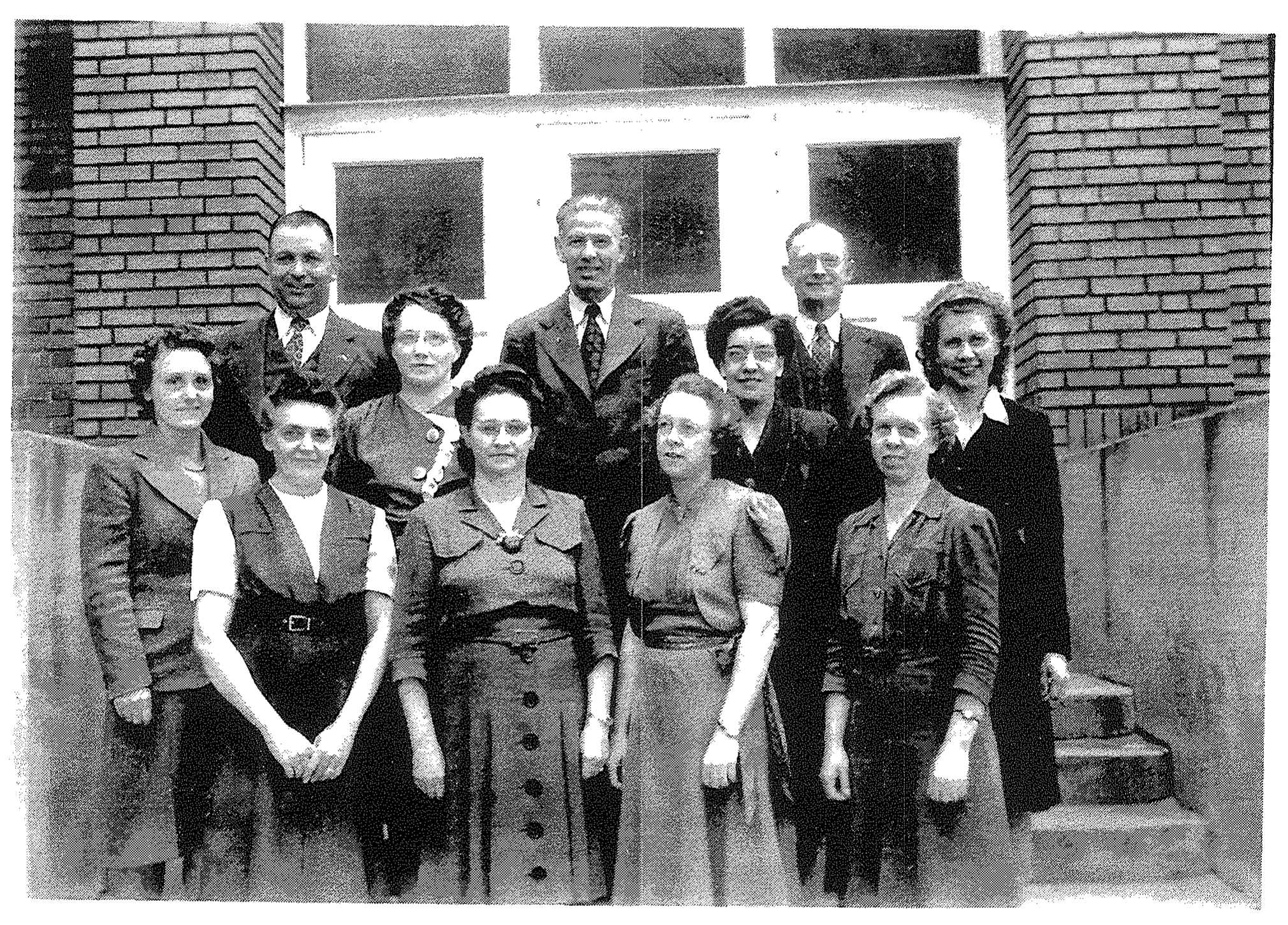
Wilson School Faculty
Row 1—Mrs. Stanford, Miss Shaw, Mrs. Barton, Mrs. Bouwhuis. Row 2—Mrs. Secrist, Mrs. Woodward, Mrs. Sorensen, Miss Holmes. Row 3—Principal, Wheat Taylor, Mr. Pettigrew, Mr. Rhees.
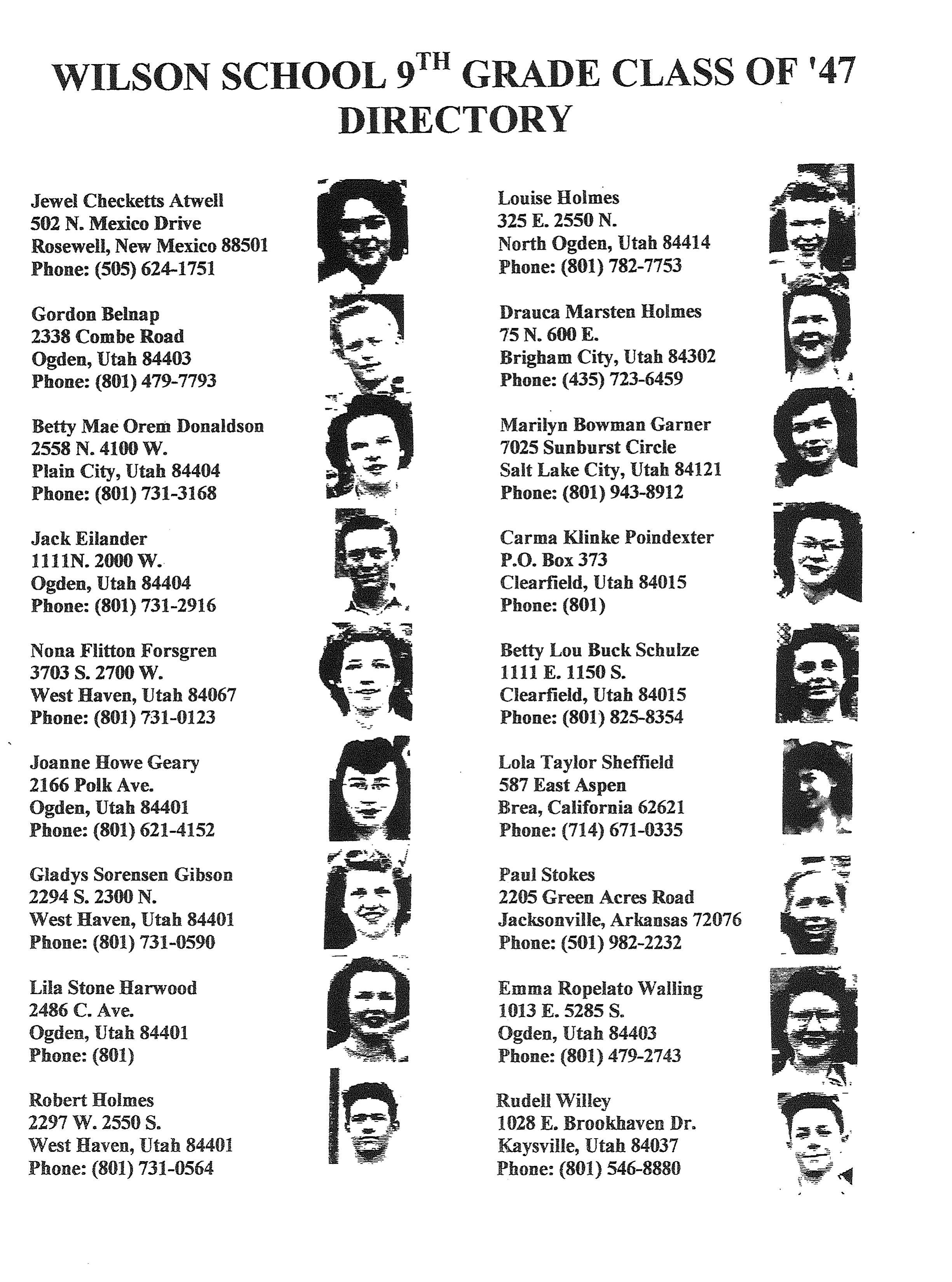
Wilson School 9th Grade Class of ’47 Directory
Name
Address
Phone
Jewel Checketts Atwell
502 N. Mexico Drive, Roswell, New Mexico 88501
(505) 624-1751
Gordon Belnap
2338 Combe Road, Ogden, Utah 84403
(801) 479-7793
Betty Mae Orem Donaldson
2558 N. 4100 W., Plain City, Utah 84404
(801) 731-3168
Jack Eilander
1111 N. 2000 W., Ogden, Utah 84404
(801) 731-2916
Nona Flitton Forsgren
3703 S. 2700 W., West Haven, Utah 84067
(801) 731-0123
Joanne Howe Geary
2166 Polk Ave., Ogden, Utah 84401
(801) 621-4152
Gladys Sorensen Gibson
2294 S. 2300 N., West Haven, Utah 84401
(801) 731-0590
Lila Stone Harwood
2486 C. Ave., Ogden, Utah 84401
—
Robert Holmes
2297 W. 2550 S., West Haven, Utah 84401
(801) 731-0564
Louise Holmes
325 E. 2550 N., North Ogden, Utah 84414
(801) 782-7753
Drauca Marsten Holmes
75 N. 600 E., Brigham City, Utah 84302
(435) 723-6459
Marilyn Bowman Garner
7025 Sunburst Circle, Salt Lake City, Utah 84121
(801) 943-8912
Carma Klinke Poindexter
P.O. Box 373, Clearfield, Utah 84015
—
Betty Lou Buck Schulze
1111 E. 1150 S., Clearfield, Utah 84015
(801) 825-8354
Lola Taylor Sheffield
587 East Aspen, Brea, California 62621
(714) 671-0335
Paul Stokes
2205 Green Acres Road, Jacksonville, Arkansas 72076
(501) 982-2232
Emma Ropelato Walling
1013 E. 5285 S., Ogden, Utah 84403
(801) 479-2743
Rudell Willey
1028 E. Brookhaven Dr., Kaysville, Utah 84037
(801) 546-8880
(Note: addresses/phone numbers as printed in the original memory book — likely out of date by now, but preserved as a record of where the class was circa 2001–2002.)
In recent discussions with some members from England, I shared a number of photos I had taken/received while serving in their Ward. It dawned on me and they supported the idea of writing some histories regarding each of the Wards I served in. Also, as time passes, my memory will not remember all the people or my interactions. This is the first of those posts.
This post turned out to be terribly time consuming. I pulled out my planners and worked through them week by week. I was interested in the addresses we visited and the people we taught. Interestingly, I can remember most of these streets, even tracting them. But unless the people advanced to our teaching pool, I don’t generally remember them. Which really is not surprising as many of them were one or two contacts. But, the planners told me who we had appointments with, including tea/dinner appointments. For being 1998-1999, I am astonished at how much I remember from day to day. Some were simply unforgettable, even now, like the young lady who answered the door nude (read below).
Also, as part of this process, I read through the related journal for the time period. I have quoted whole sections that I located related to this time and these people. On a personal note, this was a very trying companionship and district to serve in. Jet lag, sickness, frustration with the breakdown between mission ideals and what was actually happening, personality conflicts, and immaturity (very much on my side, but also other missionaries), 6 missionaries in a confined space, all contribute to the refiners fire Moreton Ward proved to be for me. I have mostly removed all the whining from the journal posts. As reading, don’t think I am a model of optimism or enthusiasm. I was more coy at the beginning of writing this post than I was later. I didn’t quote as much from the journal to begin with, but more and more as I got more comfortable in writing about weeks. At the beginning I give overviews, later I do more quoting and let the voice of the journal speak. Moreton ward covers 119 pages of my journal #5, 36 pages of my journal #6.
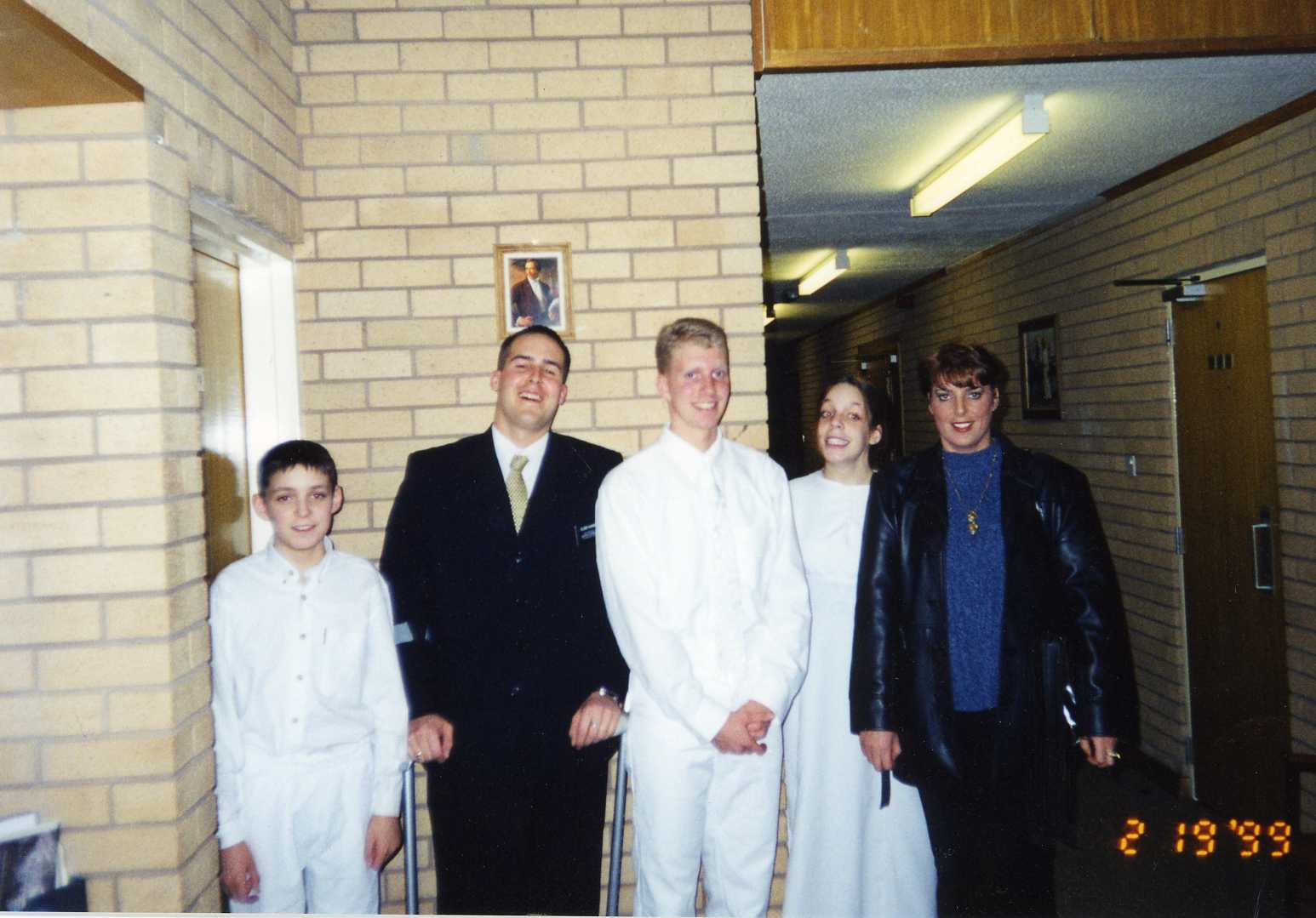
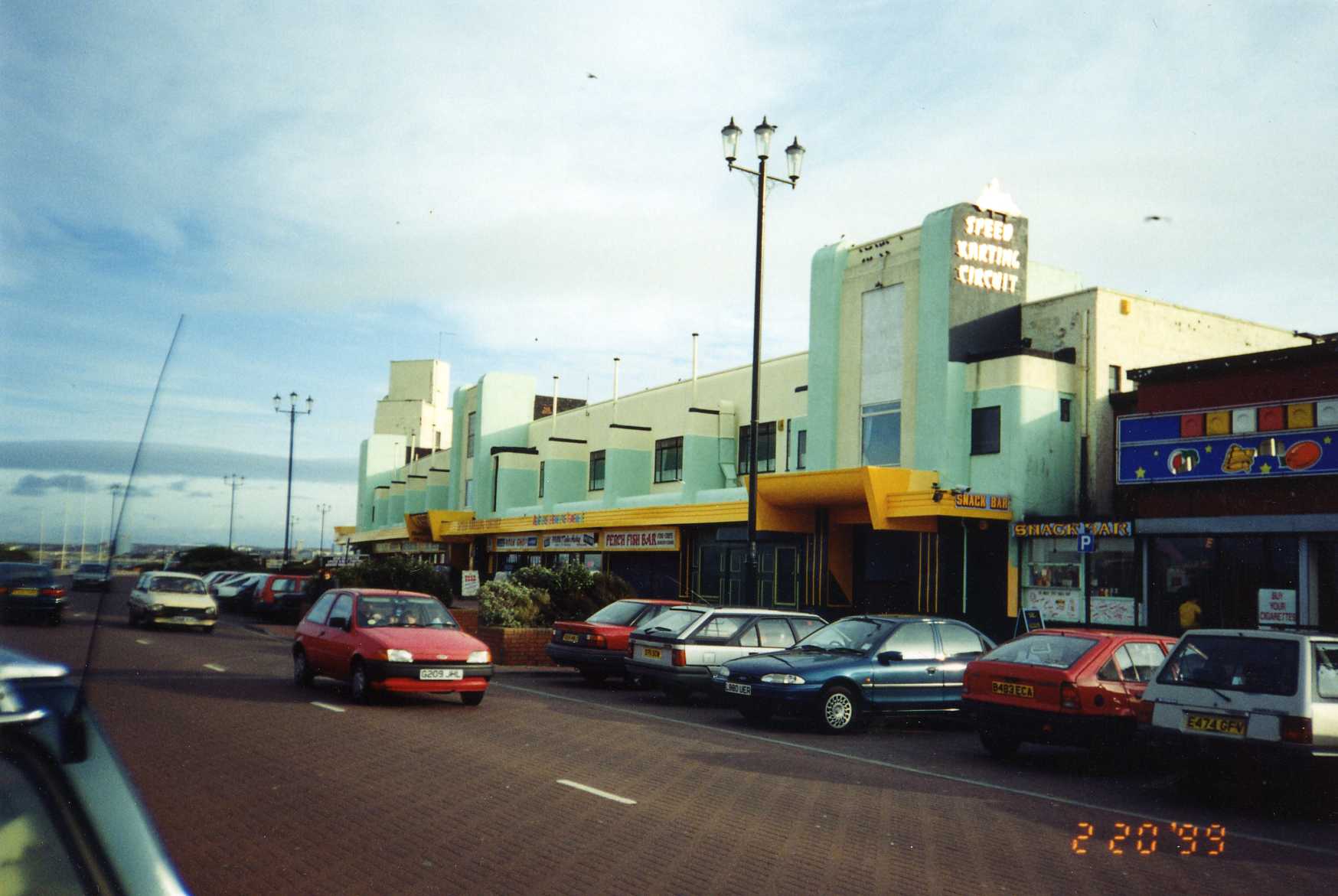
The first Ward I served in as a missionary was in the Moreton Ward of the Chester England Stake. I believe it was a newly created ward, only a few months old. At some point the Birkenhead Ward(s) were in the Liverpool Stake and I remember there being multiple ties and connections to Liverpool. I recollect Moreton was created from one or both of the Birkenhead Wards. We met in an old college bar pub, I recall, in West Kirby. We lived in Liscard. I wrote a post previously about the houses I lived in as a missionary. In those days cameras were clunky and still film, so you did not take many pictures. But I do have a few I attribute to the Moreton Ward. Six missionaries covered the Moreton Ward. A year or two later, the Ward received their own ward building. It is my understanding these ward still exists, but was merged with the two Birkenhead wards, now all just two wards.
Since this is my first area, I am also including some of the arrival in the mission from the Missionary Training Center, or MTC, and the mission home.
On 21 December 1998, I flew out from Salt Lake City to the England Manchester Mission, connecting through Atlanta, Georgia. I had just spent two and a half weeks in the missionary training center in Provo, Utah. On that flight I sat next to a woman named Madge Fillingim, age 79, from Vernal, Utah. I hadn’t caught the spelling of her name at the time, and wrote it in my journal as “Marge Flitteringum.” She was born in 1920 and passed away in 2023 at 102.5 years old! I linked her obituary.
As I wrote that day: “On the left was Marge Flitteringum or that last name is close. I don’t remember how she spelled it exactly. …Marge from Vernal at 79. Through our conversations Marge agreed to start taking piano lessons and to become active again in church. Am I a missionary or what? Her son wants her to start going to church again, and with the brand new temple in Vernal, she wants to get her endowment. We talked about music and told her about grandma’s start late in life. I got her to committ.”
In further research, three years later, on 29 December 2001, Madge received her endowment at the Vernal Utah Temple. I don’t know whether she ever picked up playing the piano.
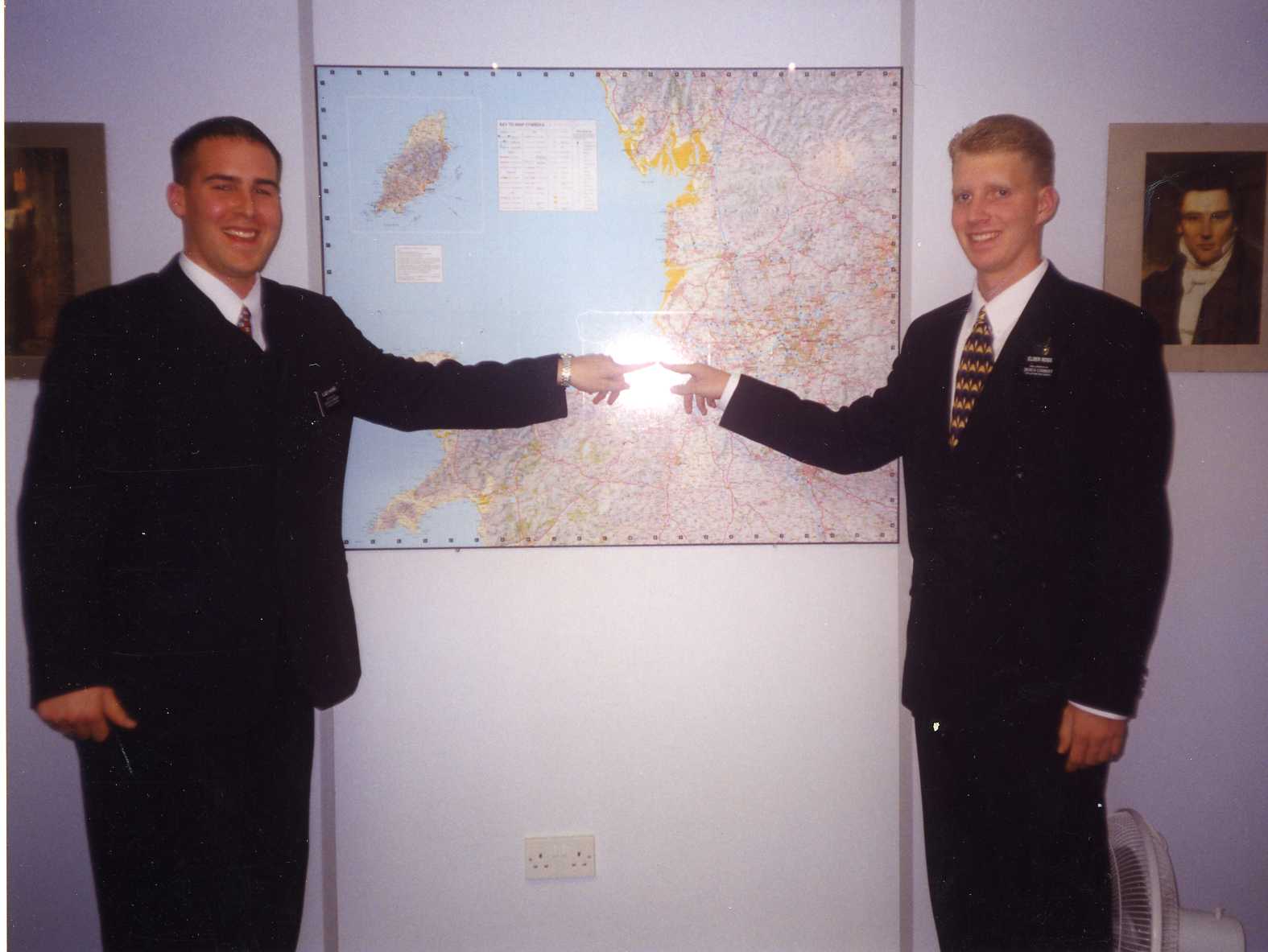
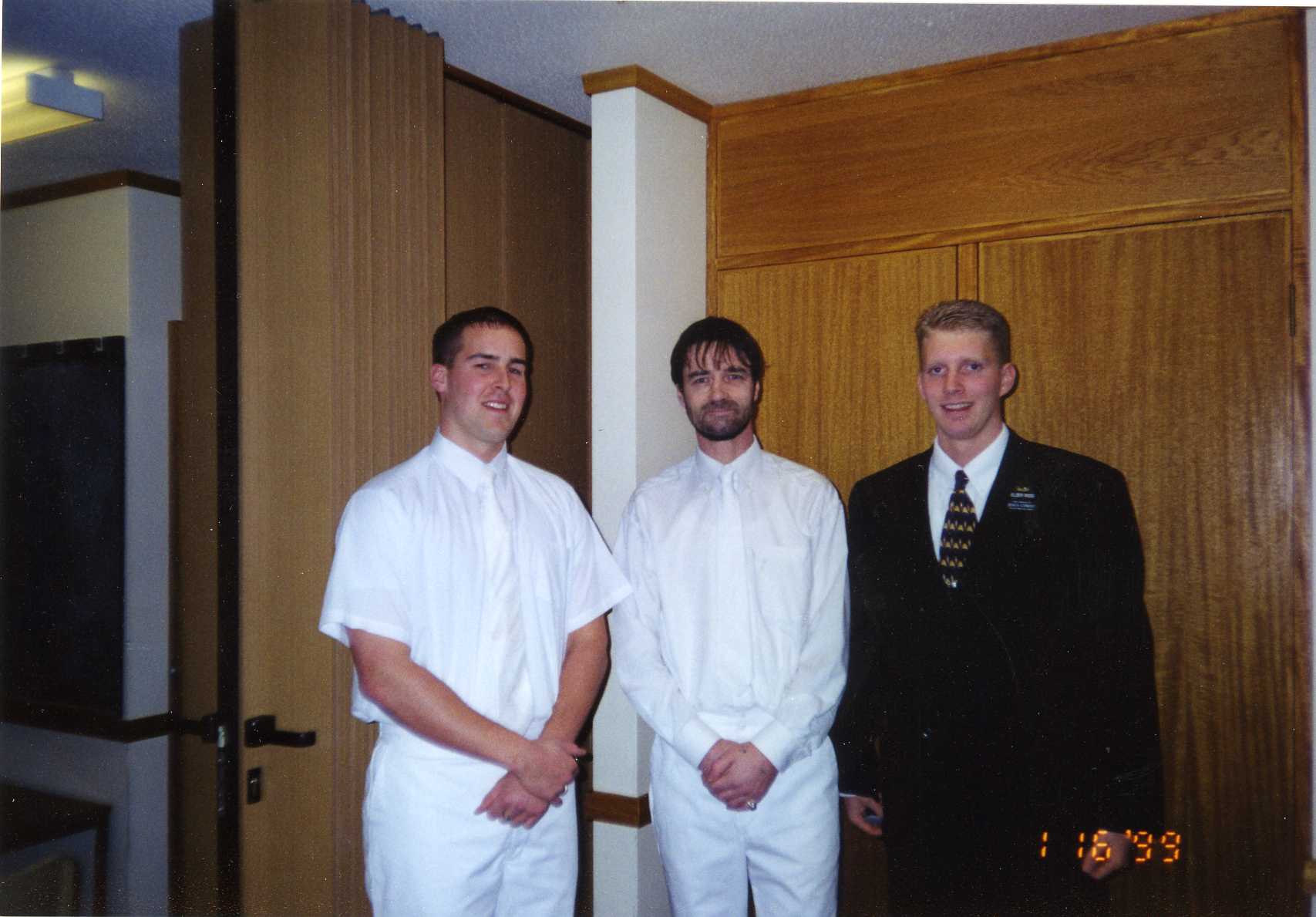
23 December 1998 – Elder Harris and Elder Ross assigned as companions at mission office, Altrincham, Cheshire
I arrived at Manchester airport on 22 December 1998. We stayed that night at the mission home in Altrincham. The next day, 23 December, I did my first street contacting in Altrincham not far from the mission home. That door is seared into my memory. I can still see it. After lunch that day, we were assigned missionary companions. Elder Jeremy Harris became my first companion in the mission field (Elder Kody Young had been my companion at the MTC). Elder Olson was assigned to Elder Paul Kelley that same day. Moreton wasn’t a surprise to Elder Harris, since he was already serving there.
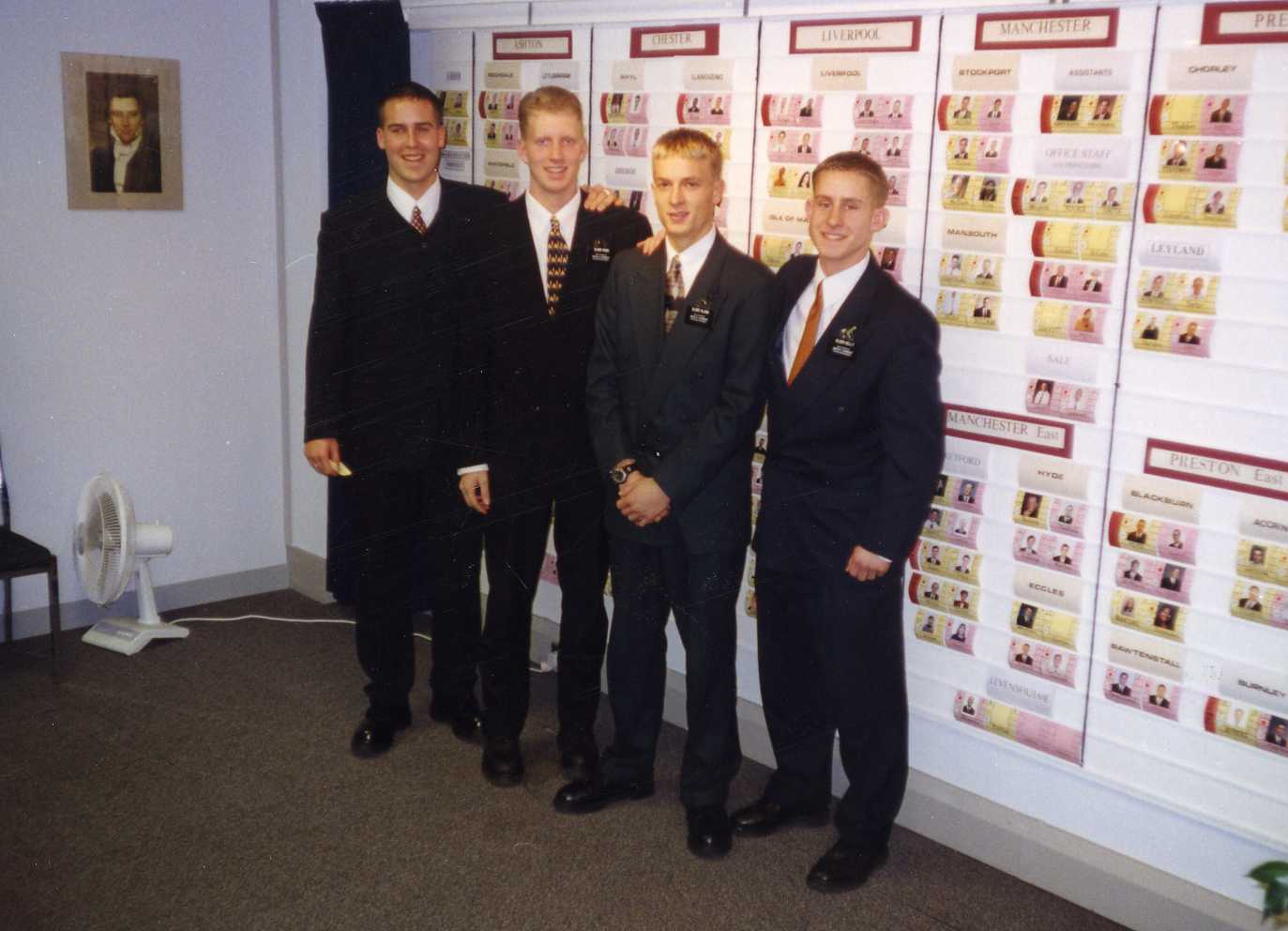
23 December 1998 – Newly assigned companionships – Elder Harris and Elder Ross, Elder Olson and Elder Kelley
That evening we did some tracting and went to the Counsells’ for dinner, which in England is called tea. Researching, this was Grant and Helen Counsell. Our flat address was 6 Belgrave Street, right on the corner of Trinity Road.
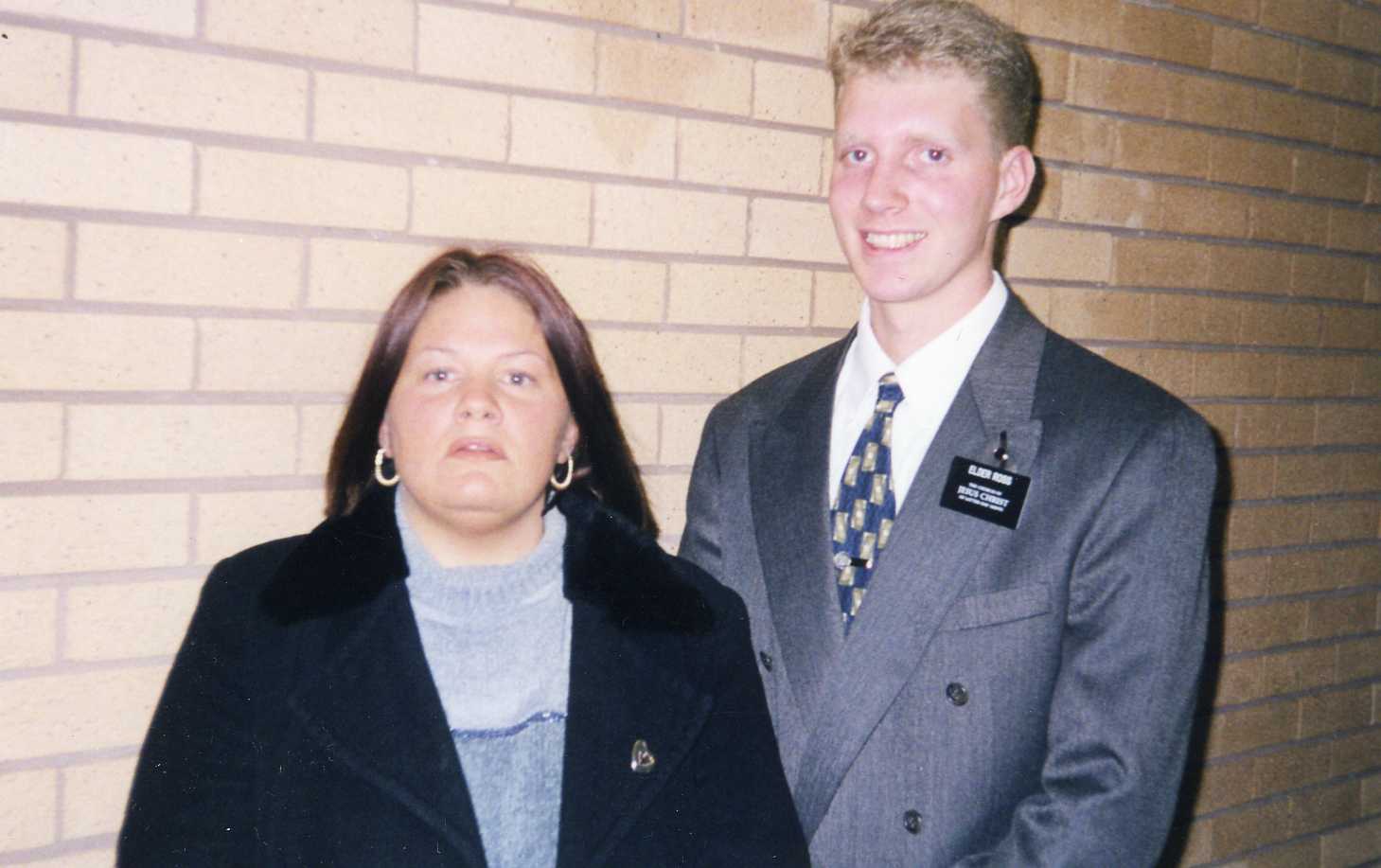
22 December 1998 – President H Bruce and Cheryl Stucki, and Elder Paul Ross
Writing the next day about that evening, I recorded: “We live in a 3 level flat on Trinity Street. So small and in great disrepair. Humble though. I am afraid the steps will break. We left and headed to our flat. Some guy ran up to us and pointed a gun directly at me. We drove off. It scared me to death. We come back to the flat and put on our whites and went and sang in the centre. I didn’t think we sounded good at all. Some members stopped by the flat when we got back. We received presents and 4 of us ran to do some street contacting while the rest went to deliver presents.”
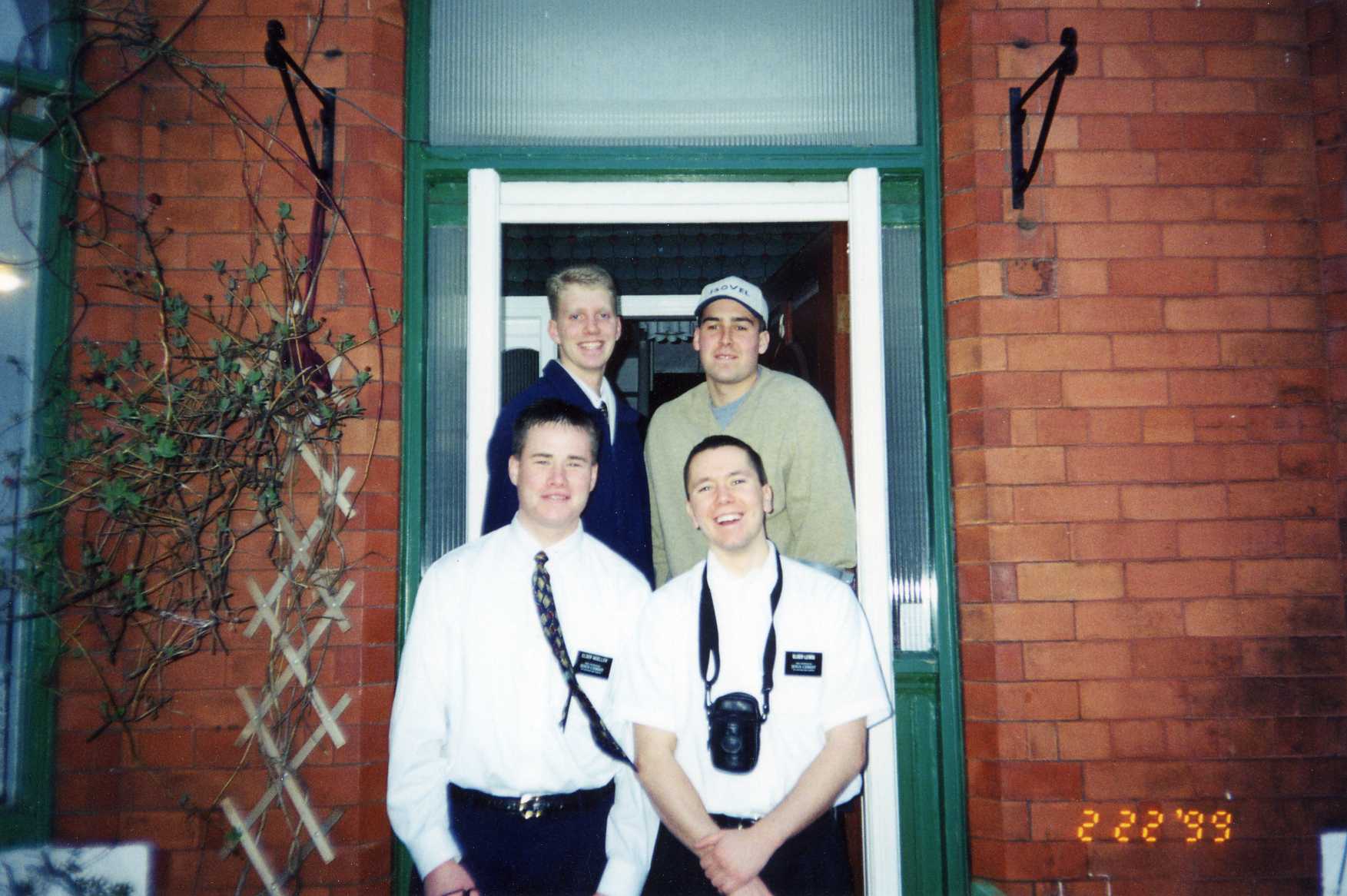
25 December 1998 – Christmas Eve caroling, Elders Llewelyn, Lewis, Harris, Mueller, Ross, Knight
On 24 December, we had dinner with the McKenna’s. In my records I record it as McKenna, McKinnon, and MacKinnon. I don’t know which is right and so far the two members I have contact with do not appear to remember this family. Oddly, I remember this meal. We sat at a little kitchen table for two in the kitchen itself. The McKinnon’s did not eat with us. It was fairly dark in the kitchen. The soup was a chicken, pea, carrot soup. It was not a creamy soup, but it was oily or something and was amazing. None of the rest of the home was heated except the front room with a little gas heater (where the coal fireplace once was). My first introduction to the idea that people would only heat one or two rooms of a home, not the whole house. We left a spiritual thought and left. I don’t know that they were elderly, maybe 70s. But my soul was warmed. I understand the McKinnons moved away from the area.
This highlights another surprise for me in England. Their latitude is considerably higher than that of most of the United States. As such, in winter time, the sun would disappear about 4 pm. It would reappear about 8 am. The days are short. So this dinner appointment at 6 pm would have been in the dark. Many missionaries struggled with depression due to shortened daylight hours. In the converse, summer would have the sun going down at like 9:30 pm and coming up at 5:00 am.
Christmas Day, the 25th, I wrote: “All of us went to play footy, or soccer. I am not a soccer fan anymore. Since I hurt my foot in high school I am not supposed to do any kicking with it… I sat watching them played and I read scriptures while there. I sat some time looking across the Mersey River at Liverpool. What an impressive sight. One building reminded me a ton of the Salt Lake Temple. Dingy white with the 6 big towers but the building was full of windows. It had a big clock in the one end. Instead of an angel Moroni on the end, it had giant pelicans on both center towers.”
That building was the Royal Liver Building. The “pelicans” were actually the famous Liver Birds. Built between 1908 and 1911 for the Royal Liver Assurance company, it was designed by local architect Walter Aubrey Thomas in the Edwardian Baroque style and was, for its time, one of the first large buildings anywhere constructed with a full reinforced-concrete frame, engineering that let it rise to 322 feet and briefly stand as the tallest building in Europe. Its twin clock towers carry two copper birds, nicknamed Bella and Bertie, one facing inland toward the city and the other out to sea. Legend holds that if they ever flew away, Liverpool itself would cease to exist. The birds themselves were carved by Carl Bernard Bartels, a German woodcarver. Along with the Cunard Building and the Port of Liverpool Building, the Royal Liver Building and others form Liverpool’s famous “Three Graces” on the Pier Head waterfront. All fully visible from across the Mersey in Seacombe and Wallasey.
That same day, I visited with family on the phone, including my Dad, sister, Grandma, and Duncan family.
I wrote about my Grandma: “She told me how bad she felt about missing me at the airport. I wished I could have seen her too. It was really good to talk to all of them again. We shall see each other soon enough.”
Grandma died the next year, sooner than either of us expected that Christmas Day. My flight was originally supposed to leave from one gate in Salt Lake City and that is where she went. Later they realized what was going on and they raced over to the new gate. They got there in time to get a package on the flight to me, but no opportunity to physically say good-bye as we were already loaded.
26 December 1998 – My end of the bedroom at Liscard flat, Merseyside
On 26 December, dinner was with Steve and Linda Pitt. That day I also wrote: “I found out that the river and docks I was talking about was where all the immigrants from England left.” At some point, I probably should do a post, like I did with the Mormon Trail, of all my ancestors who came through Liverpool.
27 December 1998 was my first time at church in Moreton. Attendance didn’t reach 100. I confirmed into The Church of Jesus Christ of Latter-day Saints Ann Marie Brumfitt that day. She’d been baptized the Sunday before I arrived. I don’t recall the Elder’s name I replaced. I wrote, “It was a cool experience.” I also gave a priesthood blessing that day to a young boy, Thomas Michael Plemford, Gaynor Plimley’s son. That same day, jet lag and the whirlwind of the first week were catching up with me.
I wrote: “I am having such a hard time. I am so dead tired it is pitiful. If only I could go to bed earlier but that really isn’t possible… I will finish my mission but I will sleep for a week when I return, I am sure of it. Help me endure. These 16 1/2 hour days are killing me. I hope p-day they let me sleep in. I think the jet lag is not helping.”
Even so, I closed the day looking forward rather than back: “There is so much to learn. If I have acquired a percent of a fraction, I will count my life as something more than a waste. I will know it wasn’t all at naught. So much to gain, so little to lose. I pray my senses be toughed, my facilities enlightened to gain but a portion of the awesome amount. I please to learn and not have any tolerance in ignorance. Whatever principle of intelligence we attain to in this life will rise with us in the resurrection. And if a person gains more knowledge and intelligence in this life through his diligence and obedience than another, he will have so much the advantage in the world to come. D&C 130:18-19.”
This picture of the house across the street is a mirror of the house we lived in. The bricked in window is the one I am looking out and taking the picture from in our flat.
27 December 1998 – House across the street from our flat, our room on 3rd floor, 6 Belgrave St, Liscard, Merseyside
28 December 1998 – 3 January 1999
This was my first week in the mission with a planner of my own. The week before, Elder Harris had kept track for the both of us while I was still finding my feet. P-day, 28 December, we went to West Kirby to play squash, my first time ever seeing or playing the game. I wrote: “It was great. It is alot like raquetball. I love it, I will have to do it more and when I get home.”
I’ve loved squash ever since. Roy McKee was a member there that day. His aunt and uncle, John and Audrey McKee, were also in the Ward. I can’t say for certain which McKee household we had tea with each week, Roy and Carol (who I recall held a US citizenship), or John and Audrey, unless a specific journal entry says so. But squash was my love in Richmond, Virginia; Oklahoma City, Oklahoma; Logan, Utah; I wish there was somewhere closer to play to Burley, Idaho.
We kept a heavy teaching schedule all week, working discussions in with Malcolm and Mrs Robson, Jeff and Allen, and Jocelyn and Jamie on P-day evening alone.
Tuesday, the 29th, brought a companionship exchange along with tracting and a discussion with Lisa and Thorn, and a follow-up visit with Ann Marie Brumfitt, whom we’d confirmed on Sunday. Later that day we went tracting and got some callbacks on Royston Road. After doing some running we went back to teach Bobby Topham, a new contact. Writing about it the next day, I recorded (which is overly personal to Bobby):
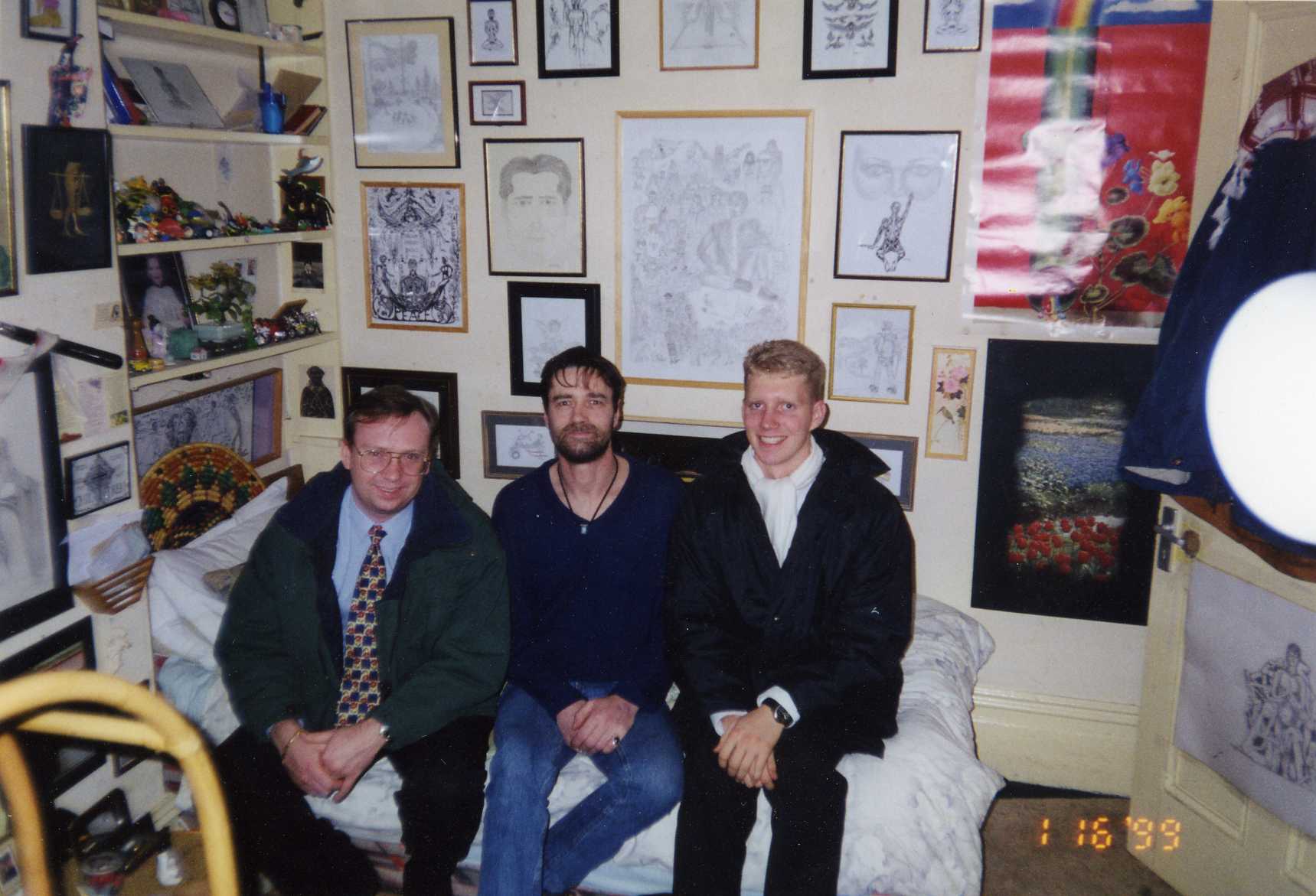
“He really listened. His one wife joined the church but died soon after so Robert never found out why she joined. He has been a drug addict to like cocaine and marijuana. Heroin, everything. He is an artist, wonderful, wasted all his money from it on drugs. He is wasting away. He has been legally dead 3 times. His out of body experiences sound much like the ones I have heard before from good righteous people. He won’t live probably over a year. He agreed to be baptized. He also wanted a blessing. He told us why he left the other churches. What a wonderful experience that was. I fell totally in love with missionary work. He will be baptized on the 10th. We need to finish all 6 discussions with him. How exciting. The Lord is wonderful.”
Wednesday was one of our fullest days of discussions: Sharon, Olga and Vernon, Chris, Karen and Carl, and Margaret and Carol all in a single day, wrapped up with tea at the Counsells’.
New Year’s Eve found us in service most of the morning, then more tracting and discussions with Carol and Lewis and Margaret and Jon. We also had to go find Bobby Topham for his appointment that day, and taught him the 2nd discussion.
As I wrote: “He really listens to all the message. He went from 80 cigarettes to having his 2nd all day right as we were leaving. He is a really good artist. He is going to do portraits of us. He is so excited to get baptized. He explained us as glowing. Also when we gave him a blessing, he said he saw light. This guy is really open to the Spirit. What a wonderful soul. Through him we could pull quite a few more people in. He has 6 children all but 2 by different mothers. Two of the mothers are mother and daughter themselves. If the daughter and him got married he would be a brother-in-law to his own child. What a lifestyle. No hope. All sorrow. He has found the light. It is so exciting. I hope I get the honor of baptizing him.”
We closed the night with tea at the Hankins’ and home on time. I understand this was Brenda Hankins with her daughters, Emma is the one I remember most.
New Year’s Day started with a moment of reflection. As I wrote:
“Oh, what a year. What tremendous strides in all aspects of life. One definitely for spirituality. Institute in Logan, a mission, trials over the summer. My life has been a great growing experience. Physically, I have gained around an inch or two. Now around 6’1″ or 6’2″ I stand. Probably 35 pounds heavier. I am now around 175. I am pretty healthy and have a high metabolism. Mentally, this grows with spiritual but also being in college broadened my horizons. I learned and try to learn from every aspect of life. Emotionally has been the same as the rest, leaps and bounds. Especially with Duncan’s and on the mission, much of my life is being healed. I can cry, feel joy, laugh, feel others sorry, and connect. I am much healthier as a being now. This year has been especially trying from all that I have endured. I pray that I will always progress in every aspect. I thank God for all the wonderful people I have met and pray that they count me as a blessing in their lives.”
The day continued with our District Development Meeting and closed with tea at Jackie Laing’s, a standing weekly Sunday appointment that would carry on for the time I was there.
Sunday closed the week with church. Elder Mueller and I walked to picked up Bobby Topham and a boy whose name I don’t recall, and walked them to church together. We arrived a quarter hour late, going in after the sacrament had already started, though we did still receive it. A baptism was held at 2:00 that day. That evening included tea at Jackie Laing’s, a 6:30 appointment with Sonya, and, in another companion exchange, this time with Elder Llewellyn, a stop by the Todd’s, where we played with the kids and gave a spiritual thought. I tried to answer some of his questions; he wouldn’t let the children be baptized, but I think we did some good that evening.
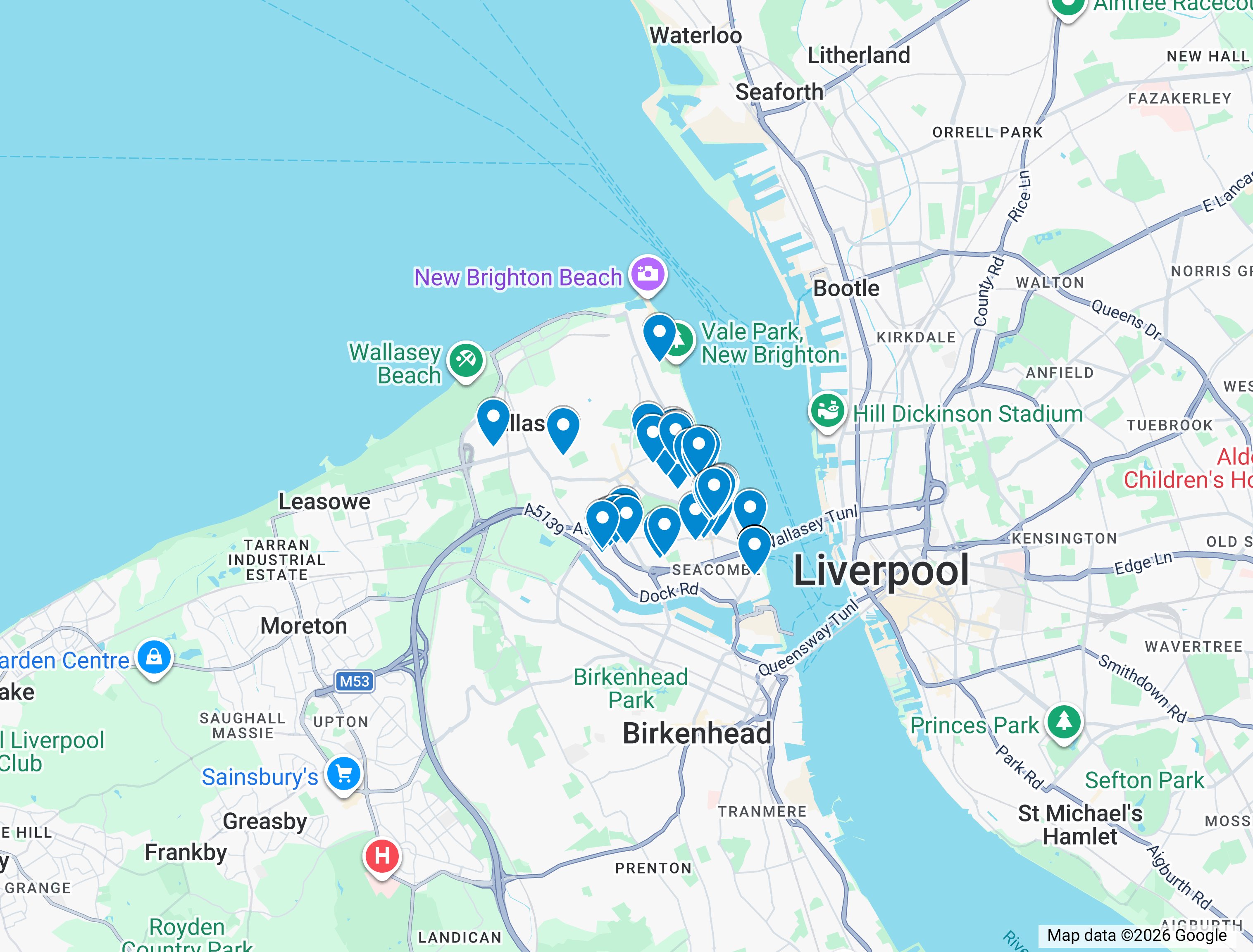
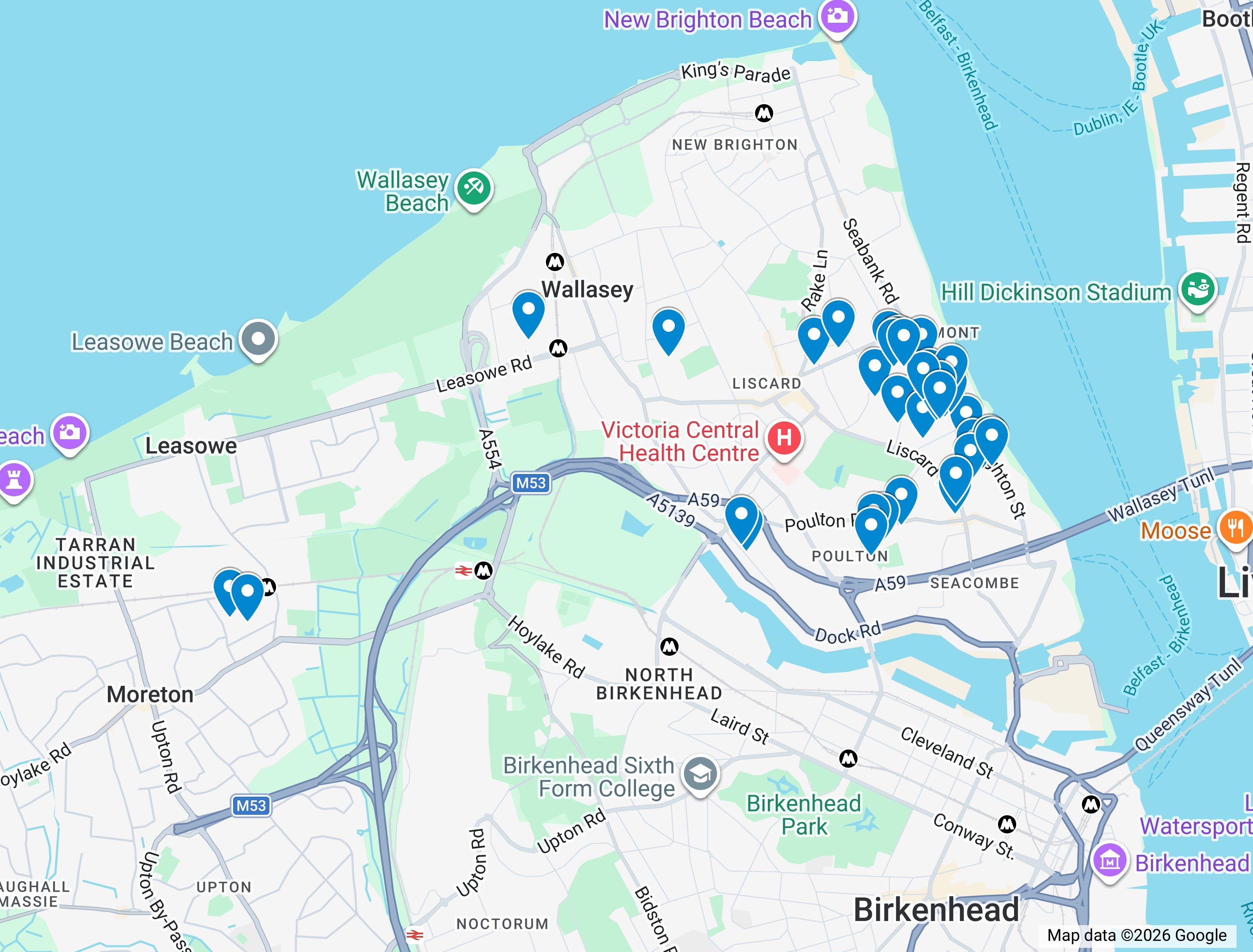
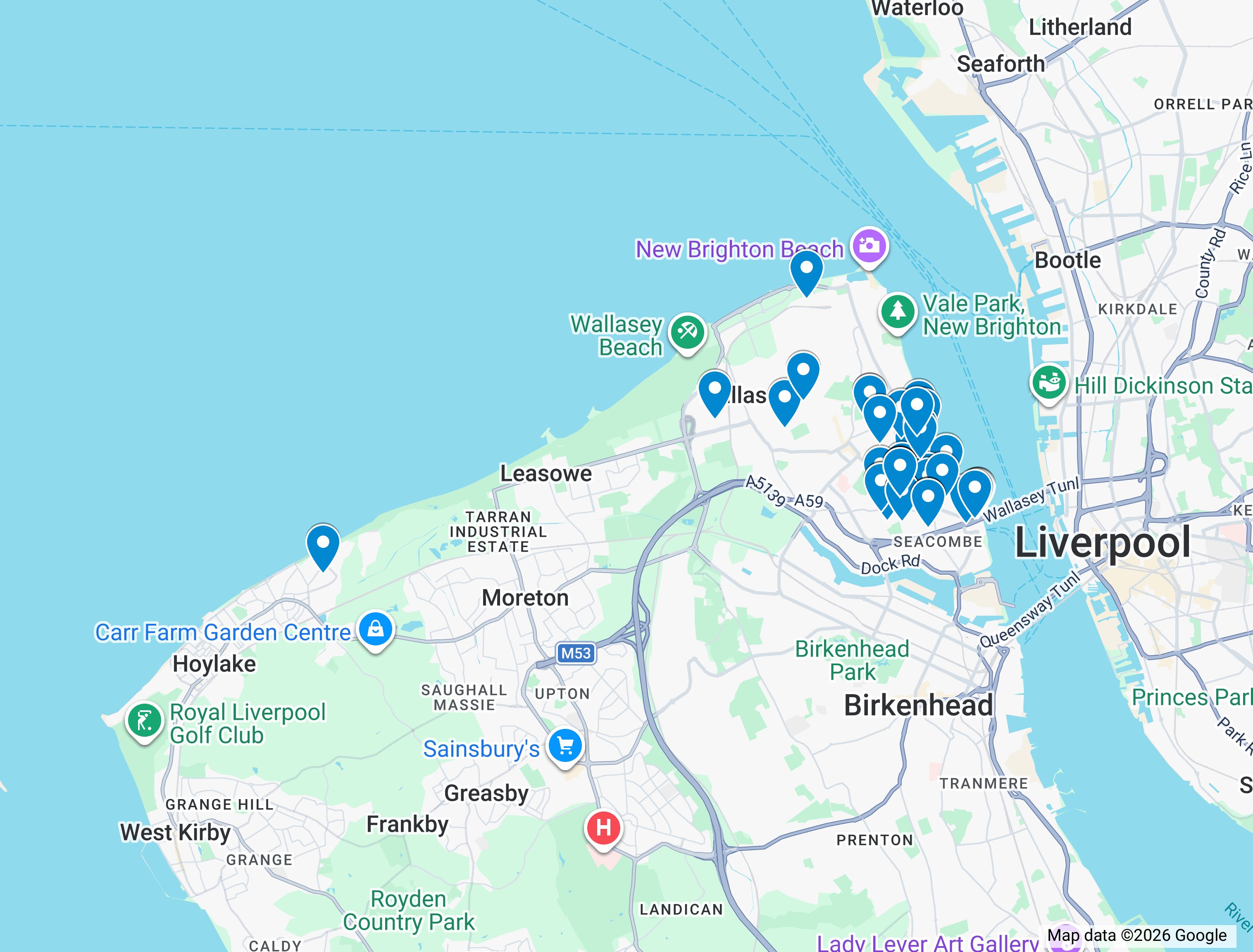
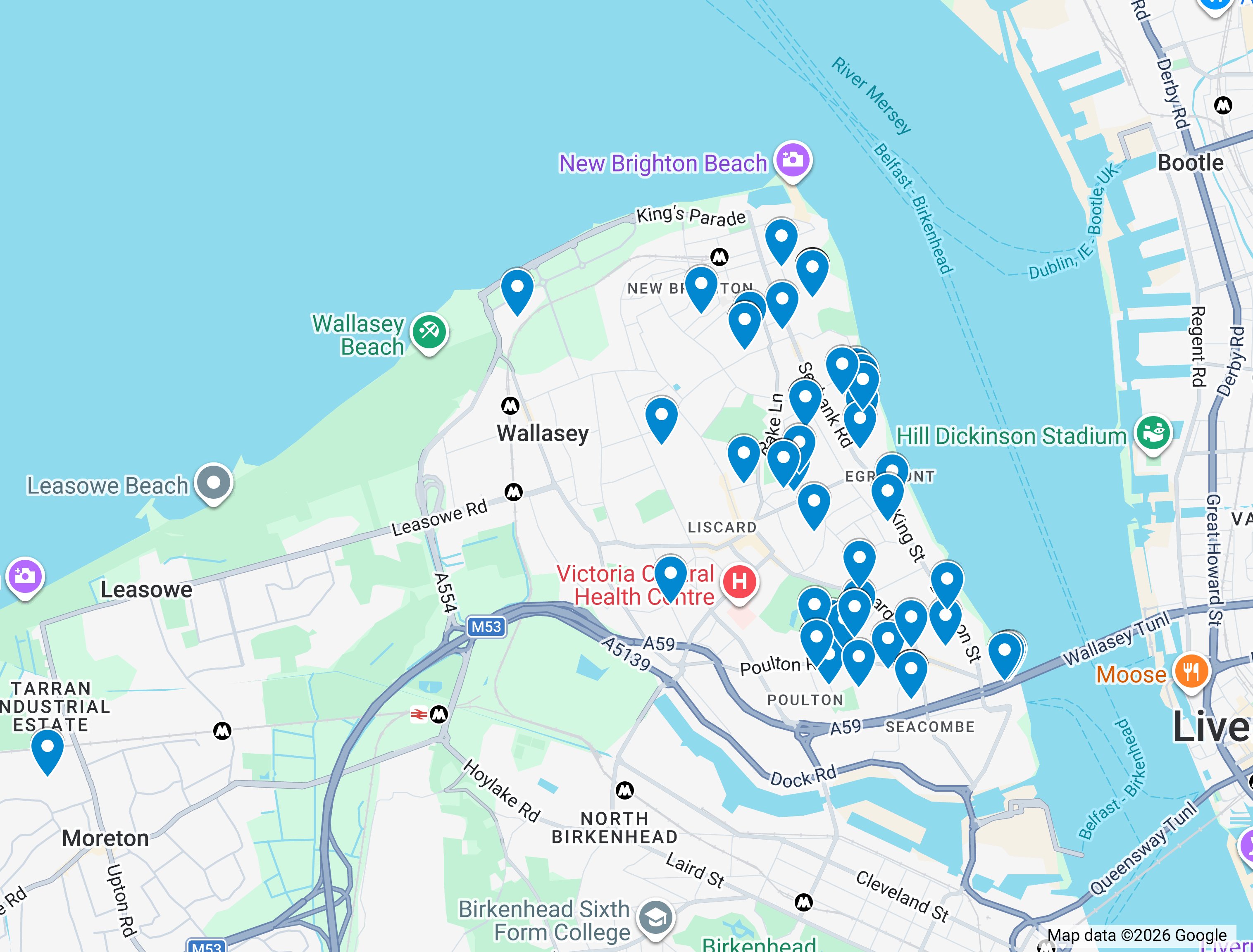
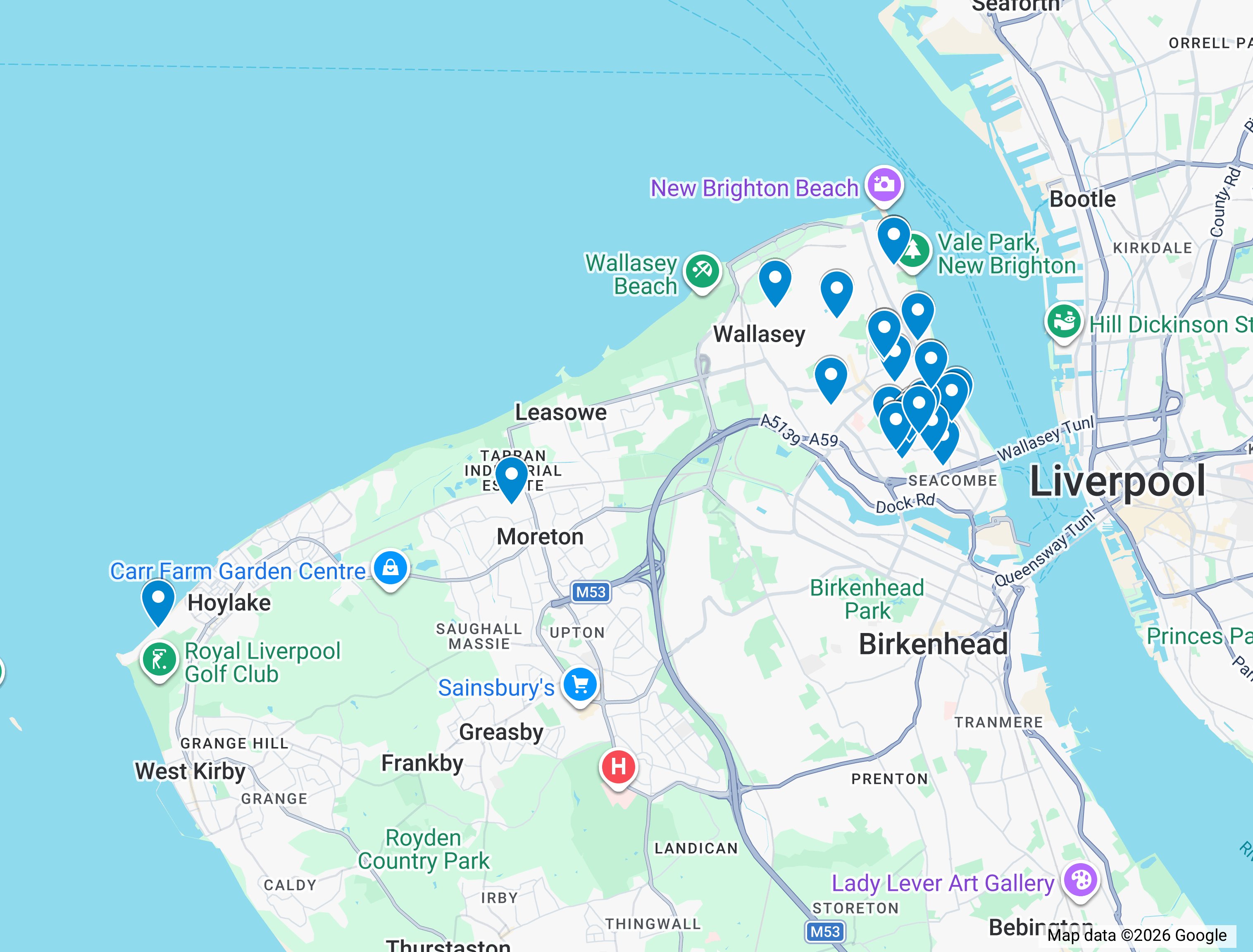
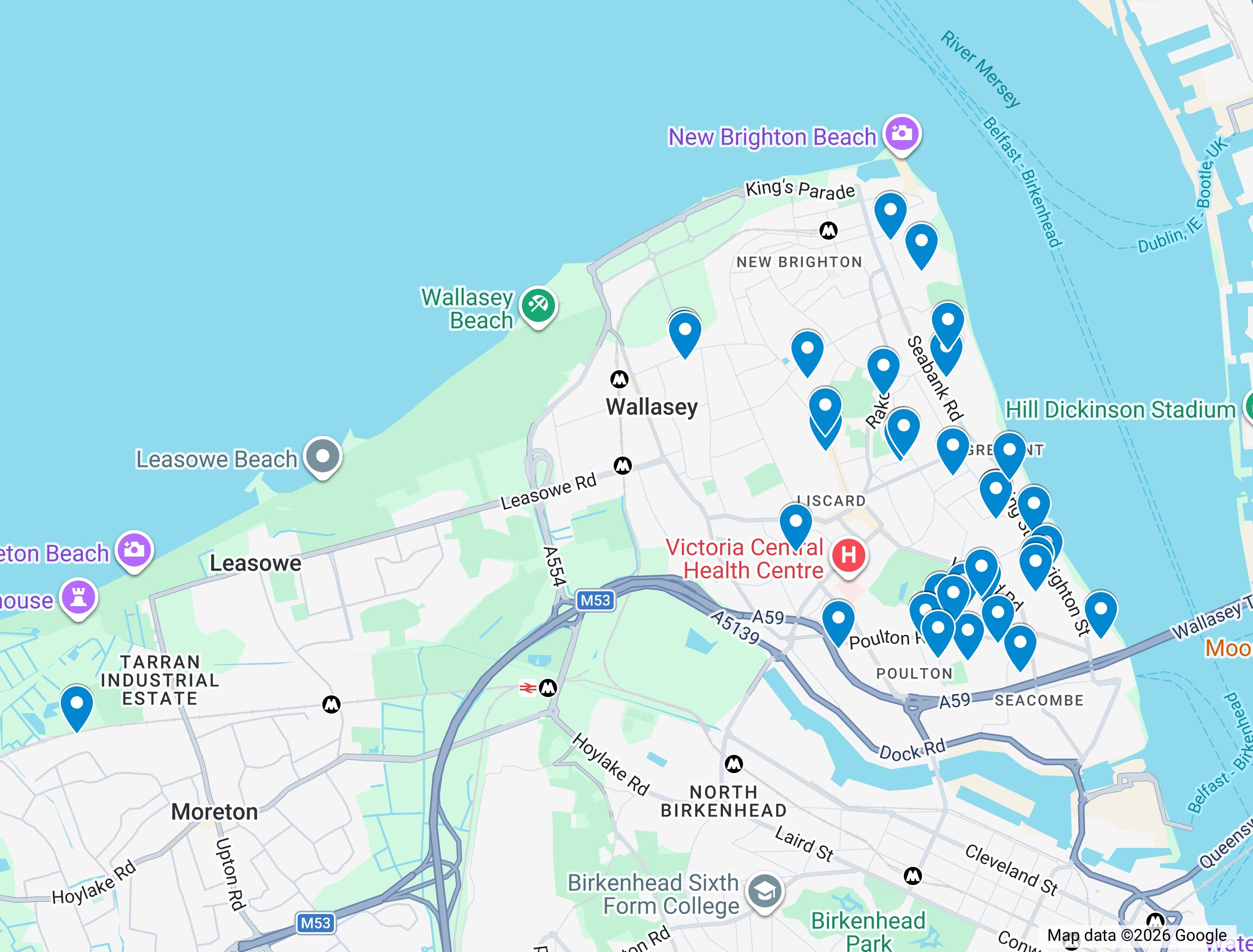
Below is a map of every home we visited, taught, or contacted that week, pulled from the Teaching Pool, Less Active list, Finding Pool, and Contacts recorded on the back of that week’s planner page.
Teaching appointments from 28 December 1998 to 3 January 1999
Teaching Pool
Karen Reeves & LeeAnn Reeves — 53 Limekiln
Reece Buck — 40 Greenwood
Pete Murray — 8/A Poulton
Less Active
June Oden — 25 Sedbergh Rd
Julie Patterson — Lancaster Ave
Finding Pool
Ean James — 21 Serpentine Rd
Sharon — 49 Oxford St
Olga & Vernon — 17C Rice Ln
Chris — 100 Woodland Dr
Louis Clarkson — 22 Sherlock Dr
Les — 38 Sherlock Ln
Malcolm Patterson — 20 Lancaster Ln
Ron Fugg — 8 Claughton Dr
Lee — Rice Ln
Mike — 61 Rice Ln
Mick — 14 Rice Ln
Contacts
Mohan — 7 Edisbury
Mr. Robbison — 13 Ivor
Jill — 24 Ivor
Sheila — 12 Ivor
Mr. Doulan — 12C Rice Ln
Carol — 2 Norwood
Dawn — 17 Sterling
Carl — 15 Kendal
Gwen Climo — 29 Priory
Chris & Daniel — Rycroft Rd
Tracy — 6 Beechcroft
Eric — 69A #3 Poulton Rd
Jon — 75 Rice Ln
Margaret — 8 Lynncroft
Dave — 6 York Ave
Helen — 35 Royston
Margaret — 26 Royston
(unnamed) — 10 Rice
Les — 9 Upper Rise
(unnamed) — 34 Rice
Mike & Tony — 11 Royston
Melissa — 3 Woodhall
Laura — 19 Bell Rd
Andrew — 27 Bell Rd
Yvonne — 35 Bell Rd
Bill & Sue — 67 Bell Rd
Kerwin — 94 Bell Rd
Jane — 84 Bell Rd
(unnamed) — 60 Bell Rd
Lisa — 15 Windham Rd
(unnamed, 9 addresses) — 48, 54, 58, 70, 72, 78, 82, 86, 90 East St
4 January 1999 – 10 January 1999
P-day, 4 January, we went to Birkenhead and did some shopping. I wrote: “We went to Birkenhead and shopping. I bought a suit jacket/coat. Double breasted with 4 buttons up the front. I like it. I felt bad pulling out 70 pound from home.”
I still have that jacket, and still wear it for special occasions.
That evening we taught Bobby a lesson. As I wrote: “We went and taught Bobby a lesson. We changed his baptism to the 17th of January.”
5 January, I wrote: “I was listening to Johann Liszt’s Die Forelle and was very moved. It is so beautiful.”
That afternoon: “This afternoon we saw a body being taken out of a home and put into a car in a body bag. So moving. Haunting, yet joyful; painful, yet wonderful. Death is the last great adventure. So much lies beyond. I wish I new a farthing of what lay beyond. To grasp a microscopic portion would be an achievement.”
Also that day: “We taught a gypsy today. If we treat it right he will come around.”
6 January, I wrote: “We went out and I got to drive to West Kirby. My first experience driving here. It was quite different. I did well. I drive better than Elder Harris.”
That evening: “We had tea at Counsels or the Bishop’s. They told me of all the great experiences in Rhodes, Athens, Greece, Tunsia, and in the Sahara. I wish to travel these places. I hope to learn so much.”
8 January, I wrote: “We went out to tea at the Hankins. It is such an honor to eat there. …Such love, respect, and honor towards the missionaries.”
9 January, I wrote: “Oh, we went and taught Bobbie the 4th discussion. We skipped the 3rd because Elder Harris felt it needed to be covered. The chastity part was mine and was not fun. He wouldn’t talk about it. We are going to talk about it where no one is around tomorrow. I hope he will live it, or get married.”
That same day: “We went and taught grandma after. …She is a miracle. Mrs. Walker is her name. She is mostly blind and mostly deaf but in really good shape for 93. At one point we read to her 2 Nephi 31. She will read it some more. At one point, I commented and was bearing my testimony to her, she stopped me and commented, I mistook you for Jesus. You are His messenger. I shed tears right then. She doesn’t feel baptism is right yet but she will through prayer. Her love is so great. She is so close to the Lord. She says she feels so close. She says the Book of Mormon has brought her closer to the throne. It has. I am so filled with joy. I love her. Absolutely astounding. …We suggested we get her a big huge print book, she thought we were going to take away the one she has till we got the other. The pain and fear she expressed through her looks wanted me to give her a 100 more.”
That evening: “We went to tea at Jackie’s again. Really good chicken curry.”
10 January, I wrote: “Church was great. I think that all the talks spoke directly to Bobbie. They talked on food storage and other important stuff. The hymns was better today. I felt the Spirit strongly today. We went to gospel principles after. I taught half the lesson with Gayna on keeping the Sabbath Day Holy. It was great. The church is so true. Bobbie, Elder Mueller, + I went to another room and discussed the law of chastity and other concerns he had. I said some stuff that I didn’t know where I was going. When I wrapped it up it made complete sense and I learned so much about baptism. Pure intelligence right then. I had no idea where I was going with the conversation, it turned out, I said exactly what he needed to hear. WE said a closing prayer and Bobbie + I shed tears.”
That evening: “We went to tea at Jackie’s.”
Also that day: “We gave a blessing on Elizabeth MacKinnon. She is ill.”
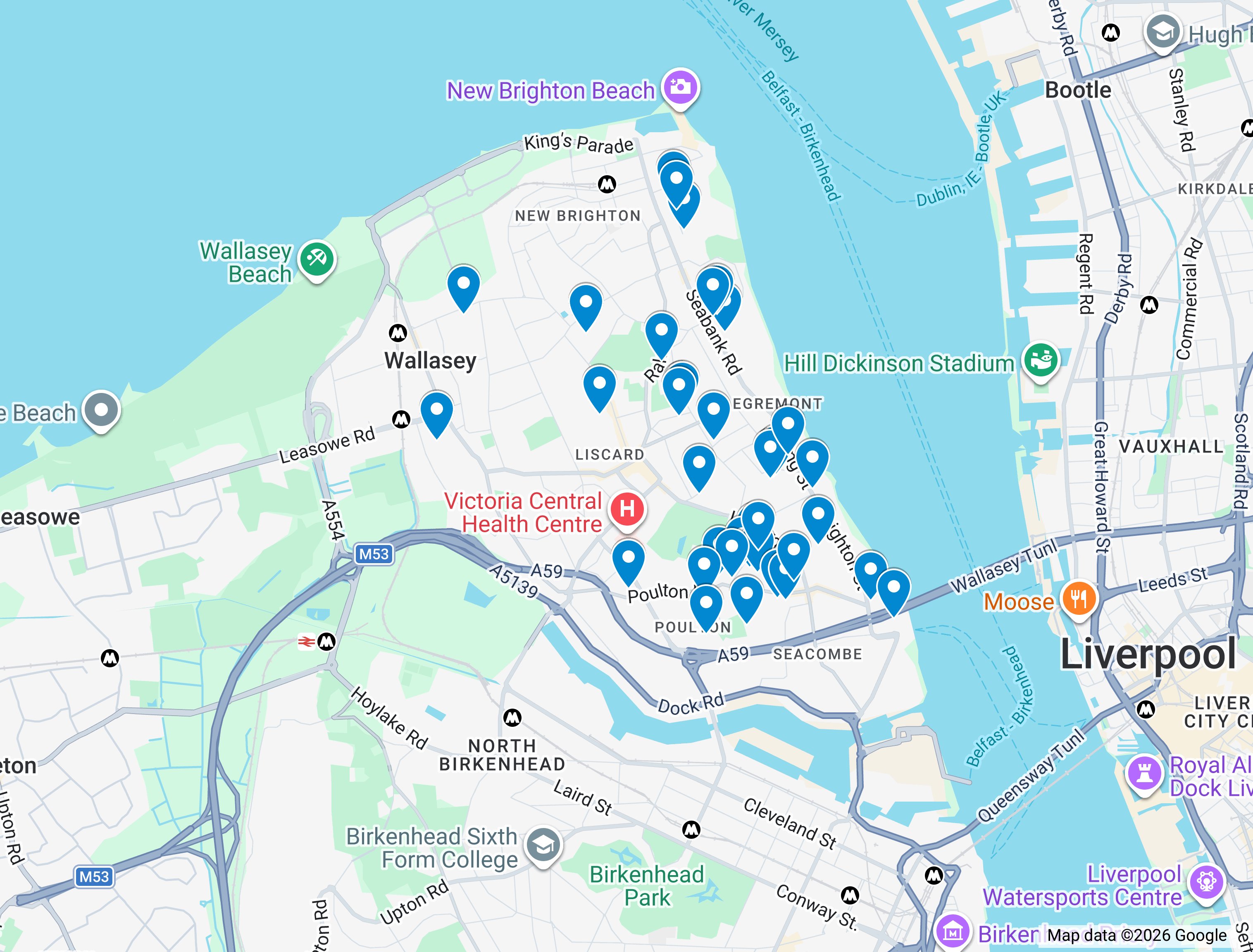
Below is a map of every home we visited, taught, or contacted that week, pulled from the Teaching Pool, Less Active list, Finding Pool, and Contacts recorded on the back of that week’s planner page.
Teaching appointments from 4 January 1999 to 10 January 1999
Teaching Pool
Bobbie Topham — 9 Royston
Mike — 35 Manor Rd
Karen Reeves & LeeAnn Reeves — 53 Limekiln
Rhys Buck — 40 Greenwood
Chris — 5a Rycroft
Danielle — St Rycroft
Robert — 4 Stourton St
Less Active
Joe — 23 Trafalgar
June Oden — 25 Sedbergh
Julie — (no address)
Finding Pool
Janet Jones — 22 Bell Rd
Sue — 1 Bell Rd
Tracy & Andrew — 23 Falkland Rd
Tony — 40 Buchanan Rd
Lee — 59 Rice Ln
Malcolm Patterson — 20 Lancaster Ln
Shanon — 49 Oxford St
Ean James — 21 Serpentine Rd
Mr. Addict — 36 Water St
Lisa — 15 Windham Rd
Skip — 28 Water St
Cliff — 44 Union St
Gene Lockley — 24F Union St
Jeff — 22 Union St
Steve — 4b Union St
Andy — 44 Eastcroft
Contacts
Paul & Tom — 4 Bell Rd
Paula — 65 Bell Rd
Vicki — 1 Bell Rd
John — 57 King St
Lizzie — 7 Ilchester Rd
Joe — 3 Ilchester Rd
Kathy — 28 Ilchester Rd
Melissa — 3 Woodhall Ave
Helen — 35 Royston Ave
Margaret — 8 Lynncroft
John — 75 Rice Ln
Jill — 24 Ivor
Sheila — 12 Ivor
Larry — 37 Limekiln
Shirley — 36 Union St
Betty — 34 Exeter Rd
Jill — Yew Tree Rd
Sam — 34 Saxon Rd
Stacey — 79 Robinson/Robbins St
11 January 1999 – 19 January 1999
12 January, I wrote: “Mail always makes my day.”
That same day, Carol and Tanya McKee, came up in conversation assisting the missionaries in many ways. Elder Harris and I went and helped Bobbie that day. I wrote: “Elder Harris + I went and helped Bobbie with troubles. Satan is working so hard on him. We taught him a 6th too. We will teach him the 5th later. Elder Harris said I will probably get to baptize him. Wow, what an honor.”
While tracting that same day: “We were walking down the street when I had a thought to go visit this one house. We went and she listened, took the Book of Mormon, and agreed to have us back. She is Jew too.”
That evening: “We had tea at the Counsell’s. It was good. We had a good productive conversation over dinner. It was really good cornbeef hash. He showed me Gospelink, it was on the computer. Looked interesting, I wanted to dig through it.”
Also that day, we visited Grandma Walker again. As I wrote: “Oh, we visited grandma today. She won’t be baptized because of what it would do to her family. She prayed and cried all night. She admitted she knew the church is true. If she continues to read the Book of Mormon, she will find that she and them will be blessed. I hope I get to see her enter the waters. It is just a matter of time now I believe. I don’t know but pretty sure.”
I have tried to hunt down and locate Grandma Walker’s first name and other information. No luck so far. 93 in 1999, born about 1903. Lived at 5 Stanford Avenue, New Brighton, Wallasey CH45 5AP. But without her first name or her husband’s name, I think I am at a dead end.
1999 – Elders Harris and Ross on Seacombe Promenade, Liverpool in background
14 January, I wrote: “Today had to be one of the longest days. So cold I haven’t felt my feet since 10:00 this morning. My eye is killing me. Swollen and every time I blink it hurts.”
Also that day: “I was so upset with Bobbie for having a cigarette. That is not me. Today the refiner fire has been hard to endure.”
15 January, I wrote: “At the mission office they sent me GQing with Elder Simion and Elder Wretham.” I would later serve with Elder Simion, in Wigan. I had to go to the mission office due to an eye infection. I had been sick for a while. As I continued: “We had a great time out even though we came back soaked. We were out for 2 hours in the rain. We come back and we ate. Dr. Turnbull saw me too. He looked at my eye and back. Eye is okay, just swollen from whatever was in it.”
14 January 1999 – Liverpool from Seacombe Promenade
Also that day: “We went to Bobbie’s and had his bishop’s interview and talk. The Spirit was so strong. We had pictures and first a great conversation.”
16 January, I wrote: “I am so excited for Bobby. I set him straight on prayer, no excuses for smoking or drugs after baptism, and so he must repent. I tried to set him straight on everything. Now, I can baptism him, now he cannot plead I haven’t done my job, I taught him. He accepted it all really well too. There is alot of good stuff going on too.”
Also that day: “We got our dinner cancelled yesterday so we got KFC. I got chicken strips. We come back here and some lady ragged out Elder Harris for parking in the way of the sidewalk. She asked him if he was just going to stand there looking stupid. His response was just that. He looked around, looked stupid, looked at her and said, ‘I am not looking stupid.’ I laughed and the lady walked on mad.”
At 9:00 that morning, District Development Meeting. As I wrote: “Now Birkenhead is doing great. They have 5 baptisms this Sunday.”
17 January, I wrote: “Elder Johnson and I went all over and absolutely no one was home. …We got back here at the flat at 12:30. We went with Elder Lewis to Bobbie’s house in Oxton. He wasn’t there. I called him and rescheduled for 7:00. We went to this family in Birkenhead and had a good conversation. They fed us some and then we had interviews in Pensley. The 5 they are going to baptize tomorrow. It took forever to interview them all.” I have no recollection or clue to who Elder Johnson is or why I was on exchanges with him.
That evening: “Elder Mueller and I ate at the Billington’s.” This was Lawrence “Lol” Billington (1928–2000) and Sheila Maureen Billington, née Connolly (1936–2020), both of Wallasey.
16 January 1999 – Bishop Grant Counsell, Robert “Bobby” Topham, Elder Ross
Sitting in sacrament meeting that same day, I wrote: “I am sitting in sacrament meeting here in the Moreton ward. They just finished talking on family history. I don’t think I have ever realized how important it really is. There is so much I have wanted to do. But that is one of the other things that will have to stay on hold till I return home. It is so exciting to do missionary work for the live, after my mission, I will get to do missionary work for the dead. Brother Cliff Roberts is a wonderful man. He gave the talk on family history. Many people joke that he is one of the three Nephites. I don’t think so, but I want to talk to him to make sure. Either way, there is a lot I can learn from him.”
I understand Cliff Roberts passed away from cancer a few years ago.
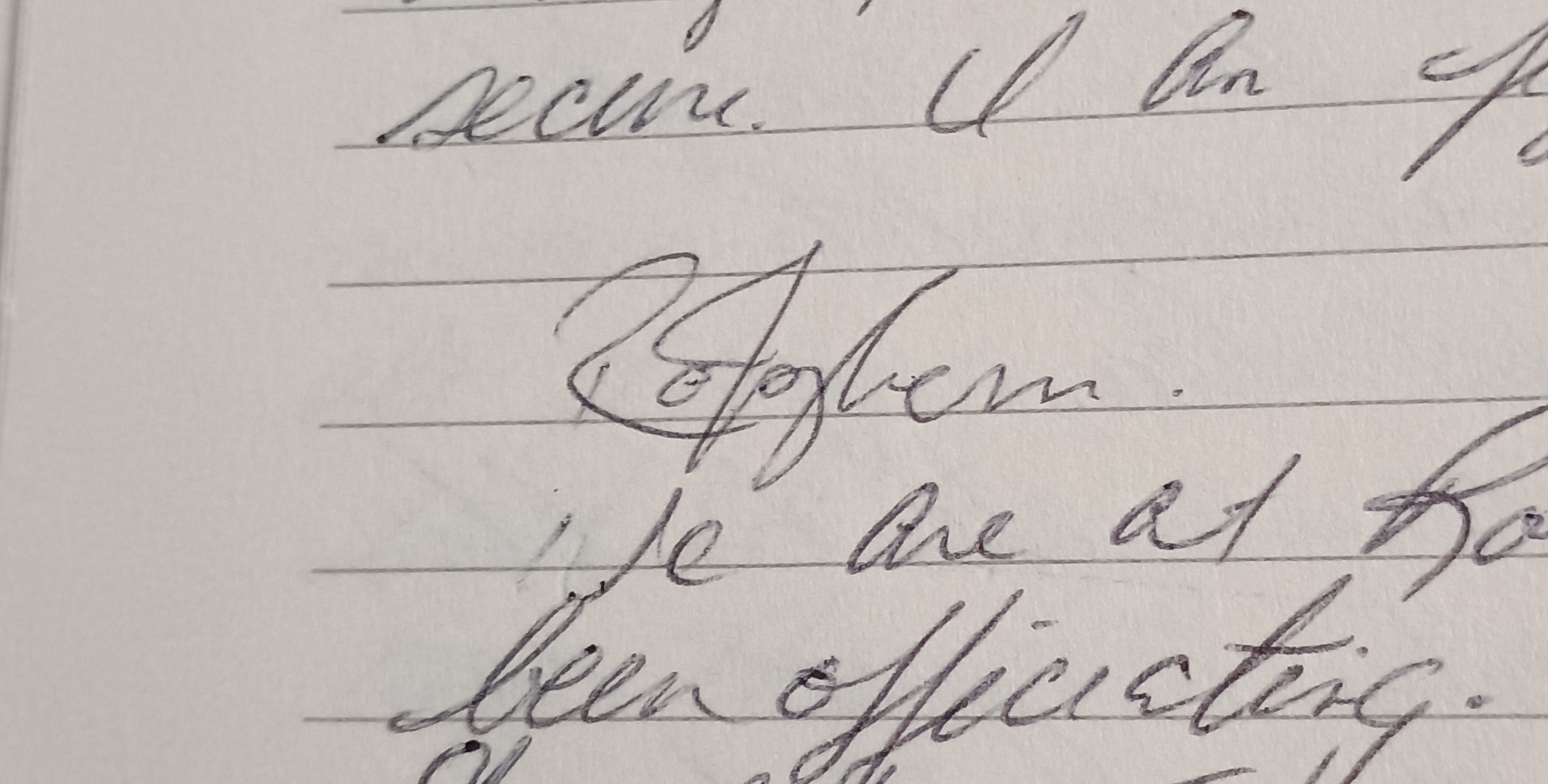
Also that day, at Bobby’s own baptism: “We are at Robert Topham’s baptism. Roy McKee has been officiating. Roy gave a great talk on Baptism. His daughter Tonya McKee gave a great talk on the Holy Ghost.” “Kathy Dunford gave the opening prayer.” “I now have a firm testimony of baptism. Not that I didn’t, it is just reaffirmed.” “Robert signed the other page. That is his signature. Bishop is talking on following the commandments. He is talking on how we need to endure.”
16 January 1999 – Baptism of Robert “Bobby” Topham with Elders Harris and Ross
18 January, morning, I wrote: “Elder Llewelyn and I walked to the McKee’s. Not Roy but his uncle. We had a great conversation. Very spiritually uplifting. I look forward to more.”
Robert “Bobbie” Topham’s signature in my journal
19 January 1999 – 25 January 1999
20 January, 6:10 AM, I wrote: “We met this other guy named mike. He was one of the first surfers in Great Britain. A great guy. That was during the late 60’s. He still travels to Australia every couple of years. Never surfed California or Hawaii. Great guy but he doesn’t believe in God at all.”
Also that day, tea with Roy and Carol McKee: “We went to tea at the McKee’s. She is a really good cook. We played piano some and some snooker. We ate a good dinner and had a good conversation.”
Also that day: “Even though another lady answered the door in the nude, we went back because she said we could. We taught her the first. I forgot her first name. I think she will accept the gospel.”
And: “We went and talked to Bobbie and we caught him smoke a cigarette. We talked to him and about smoking. He says he is trying. He needs to do.”
At 10:06 PM that same day, I wrote: “We got fish and chips for lunch. I got back and had 11 letters in the post. Yes, ELEVEN LETTERS. Can you imagine my joy. It took over an hour to read all of them. The fish and chips was great too. We had tea at Counsell’s. It was homemade pizza. It was really good. WE had a really good time. Oh last night we gave Isabell MacKinnon a blessing. I got to give it to her. It was exciting. I love this church.”
22 January, 6:11 AM, I wrote: “We went with Elder Knight + Llewelyn to see grandma. We gave her the 4th discussion. She is really torn between her family and joining. I hope her family will soften their hearts and tell her it would be okay to join. We don’t know how much time she has. It is so sad. She says her family is really upset with her. We taught a 1st to Bobby’s son, Steve. I hope his mother and him will come to embrace it. It will keep Bobby on his toes too. We had fish and chips for dinner because we didn’t have a tea scheduled. I went out with Victor Wise to do home teaching. We went from down by the church on Norwood Road to New Brighton on Wellington Road. And clear back. That was a long walk and Vic walks fast. He even keeps me on my toes. I talked to his wife and him for a while. Neither the people we went to visit were home. How sad. We have to try again.”
Victor Charles Wise (1923–2004) married Brenda Tingle (22 February 1933, Sheffield – 22 December 1999, Upton, Cheshire) on 9 December 1977; both have since passed.
23 January, 8:45 AM, I wrote: “One thing, grandma is having such a hard time choosing between family and faith. We had dinner at the Pitts. The bishop’s father-in-law died, another member of our ward. Hopefully it gets better for this ward.”
“Elder Knight + Elder Llewelyn are leaving us. It will become a 4 more flat. Elder L to Liverpool Elder Knight to Leland up by the temple.”
“Oh, the joy of giving truth.”
24 January, 6:10 AM, I wrote: “I cannot believe I have been in England a month already.”
“We went to do a street meeting after DDM. I thought it was quite unsuccessful. Everyone went to Burger King after. It felt good to eat a decent burger, but it wasn’t my way, right away. We don’t get options of what we get on the burger. Basically you get the burger or you don’t, that is the only options.”
“We went to Leasowe and nothing happened. We didn’t teach anyone and it went slow. We met at Jackie’s for tea but Elder Llewelyn + I were told to go to the Ryan’s. We went. It was a nice huge house. Dinner was great. We got on this joke that Sister Ryan is a translated being and she started Sara Lee and owned Standard Oil, Ford, and a ton of other things like that. It was such a blast.” This was Liz and Mike Ryan.
24 January, 2:12 PM, I wrote: “We are at Irene Jame’s baptism. We just sang hymn #300, Families Can Be Together Forever. I get to be the chorister, and Roy McKee is officiating. His daughter, Tonya McKee is the organist. Emma Hall is giving the 1st talk. It is on baptism. Baptism is such an important step. Gayna now, probably on Holy Ghost.”
Mary Irene Thomas (12 April 1930, Wallasey – 21 June 2014, Birkenhead) married Harry James (1923–1987) in March 1956, Wallasey.
“Now John McKee, Roy’s uncle. This should be good. I remember how he told me about the giardian angel at the foot of his bed in the hospital. We were told a story on how when a guardian angel wants you to know he is there he will leave a white feather.”
John Huddleston McKee (1928 in Liverpool to 2025 in Wallasey).
Writing early on the 26th about Sunday night, I recorded: “Sunday night we went to tea after the baptism and they had Elder Llewelyn and I walk back again. We walked all the way from Morton through Leasowe and to Wallasey. We stopped at John and Audry McKee. Elder Llewelyn and I had a really good conversation. We discussed Doctrine + Covenants section 4 verse 6. …John and Audry McKee are like my adopted grandparents. They are so wonderful. They gave us a ride to Irene James, the newly baptized lady. We talked there for quite a while and went over to Gayna’s. We talked for a while and ended up running all the way back to the flat. We got in at 10 seconds after 9:30. We were late.”
Monday, 25 January (P-day), I wrote: “We come back and changed and headed to Liverpool. I love Liverpool. It was all so big and beautiful. Huge but grand buildings. These buildings have class. It seemed like another country. The styles they wear and the music. The stores are so much different. We went to Pizza Hut and had the buffet. It was all you could eat. I love Pizza Hut. The pizza was better here than in America. The crust was so soft, greasy, and yet with that crunch. Elder Llewelyn and Elder Knight transferred away. …We walked through Liverpool town center and went to the car and come back to Wallasey. The Kingsman Tunnel is cool too.”
Below is a map of every home we visited, taught, or contacted that week, pulled from the Teaching Pool, Less Active list, Finding Pool, and Contacts recorded on the back of that week’s planner page.
Teaching appointments from 19 January 1999 to 25 January 1999
Teaching Pool
Bobby Topham — 8 Royston
Colin & Tracy — 28 Water
Sandra Corbert — 166 King
Less Active
Joe — 73 Trafalgar
June — 25 Sedbergh
Paul — 98 King
Mike — 1 Fell
Julie — 20 Lancaster
Ann Shane — 10 Tudor Ave
Brenda Reynolds — (no address)
Finding Pool
Chevon — 61 Hampstead
David Evans — 7 Annesley
Lisa — 15 Windham Rd
Stan & Helen — 42 Hampstead
Malcolm — 20 Lancaster
Andy — 44 Eastcroft
Veronica — 60 Harvest
Contacts
Emma — 7 Hampstead
Lynn — 1 Hampstead
Caroline — 27 Annesley
Jan — 53 Annesley
Sue — 1 Bell Rd
Kathy — 28 Ilchester
Joe — 3 Ilchester
Helen — 35 Royston
Maz — 15 Knowsley
Sue — 54 Albemarle Rd
Shirley — 36 Union
Jon — 17 Summit
Conesta — 35 Greencroft
Linda — 69 Rycroft
Sharon — 71 Rycroft
Margaret Quinn — 47 Rycroft
Anita — 35 Rycroft
Olwin — 46 Hampstead
Tim — 54 Hampstead
Chris Walsh — 62 Hampstead
Chris — 66 Hampstead
Gordan — 33 Greencroft
Wendy — 8 Tudor
Alan — 14 Tudor
Lawrence — 22 Tudor
Paula — 8 Lucerne
Teresa — 49 Lucerne
Mr. Partridge — 16 Centurion Close
Joyce — 11 Lucerne
Shelly Thomas — 20 Rudgrave Square
Enid Hill — 50 Wellington
26 January 1999 – 1 February 1999
27 January I wrote: “I am so tired. I hope one of these days I get over this feeling. We went to Birkenhead for service. We went to the chapel up there and the sisters made us breakfast. It was not good at all. We put all our plans together for flight 401. It will be the 4th discussion acted out by 12 missionaries. I get to be the missionary on the plan who tries to convert the high jackers. I spelled that wrong. They blow up the plane and they take the people through all the different glories and stuff like that. I get to play all the time on the piano in the chapel or celestial room. Missionary straight to celestial. That is cool, they didn’t mean to do that. We came back here and changed. I forgot my coat at Birkenhead so I don’t get any money till I get it back. Also, my letter home is sitting in the pocket. I might not get it back till Fri, Sat, or Sun. All those at home are going to have quite the wait. Unless the Birkenhead Elders took the coat with them and if they did, Elder Harris will have them mail my letter.”
1999 – Riding train to Birkenhead
Also that day: “We went out proselyting after in Elder Knight’s area. I like New Brighton more than Wallasey. I hope we work that alot. It rained hard the whole time. The coat of Elder Lewis I borrowed wasn’t rainproof so I got drenched. Even the stuff in my bag got pretty wet. We come back and dried out.”
Later that day: “We went back out and met a ton of people. We had tea at the McKee’s again. It was a good dinner like usual. We found out Carol plays the guitar. Roy has an office to die for. That thing is loaded with just about everything. Tonya is quite into music too.”
Also that day: “We went to Irene James or Clinton’s nan and she asked me to confirm her. This will be my 3rd Confirmation, no baptisms. I mean performed by me.”
28 January, 9:57 PM, I wrote: “I have to admit, these past few days have been different. I have gotten so into the other things that I have not had time to write. The Spirit has taught me much over the past day. I look forward with great anticipation to the future. I have become much more calm and open through the Spirit. Love has increased as has humility and insight. I do hope that it continues. I can tell now even in my writing a unworrisom feeling and appreciative attitude. Flowing and loveing, oh, how great is our Lord. For I do know that he lives. It was testified to me more.”
Also that day: “We had tea at the Wise’s where we were given many referrals. Things continue to lok up. Elder Harris + I are being blessed for enduring and continuing in diligence.”
Later that evening: “Later we watched Ensign to the Nations with Bobby at Gayna’s. So very moving it was. The last 15 minutes of the show moved me to my very core. It was once again reaffirmed to me by the Spirit of the truthfulness of this gospel. If only I had the words to describe it.” “Faith in Every Footstep with all the temples and angelic voices singing rocked my very core. Bobby too felt that presence.”
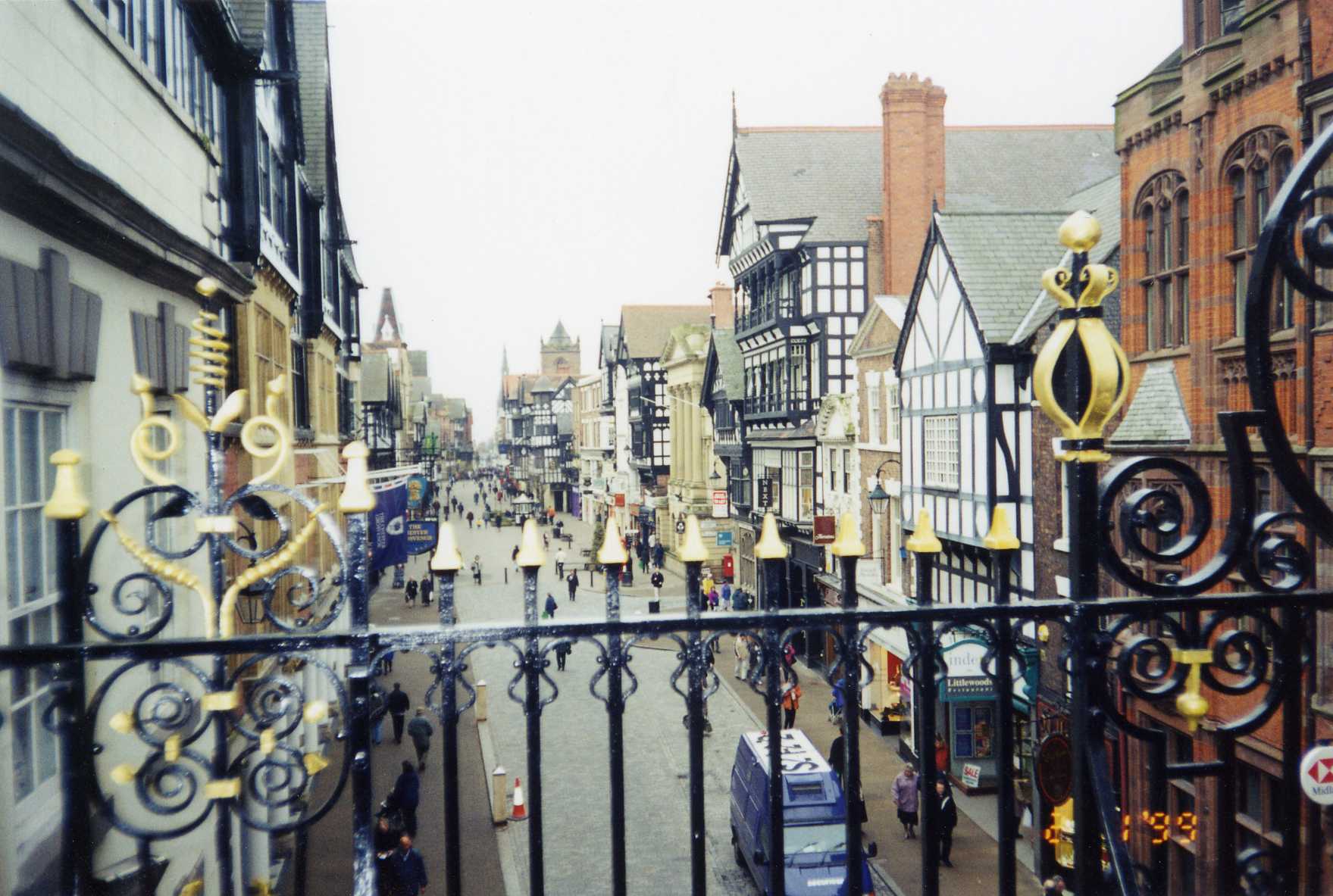
“We (Elder Harris + I) left and headed to Chester. We stayed the night and I went on splits with Elder Dixon. We tracted quite a bit and only got two call backs. Something was wrong. Elder Dixon seemed so unsure of the work. I hope he can become strengthened.” This visit to Chester was just overnight, and we didn’t even go downtown.
“We had tea at John McKee’s. Oh how great it is to share time with such righteous people. It is so exhilarating to the soul. It is so moving to be around them. Now I call them my adopted grandparents.”
“We had the flight 747 tonight. We act out a plane crash and then take all the people through the separate kingdoms. It worked out really well.”
I cannot imagine doing a Flight 401/747 post 9/11…
30 January, 9:50 PM, I wrote: “Today has been a phenomenal day. I started reading my book that dad sent to me. It is called Drawing on the Powers of Heaven. Wonderful book. I will be glad when I can understand all of it and apply it.”
“At 9:00 we left for the funeral of James Jones. That is Bishop Counsell’s father-in-law. James’ wife Audry was the one I thought made a perfect grandma. The funeral was absolutely stunning. Singing and the Spirit was great. Bishop Counsell got up and talked on [James’] life. This man was a perfect example of Christ. I hope to be like this man someday, who was so much like Jesus. …Bishop told of how when they found out he had cancer, that before returning to bed, the asked either to take him so he wouldn’t have to suffer or to let him endure happily. He now rests in peace. The Spirit touched me phenomenally strong. I cried. They sang O my father, I was streaming. Tonya McKee sat in front of us. She was sobbing. I was so touched by the Spirit. There was the closing prayer and we all went to the crematorium. There was a little service where The Stake President spoke, and we said our good-byes. I knew not this man but he has touched my life.”
Also that day: “After I talked to Cliff Roberts, the one everyone things is a Nephite, he isn’t. He did reveal some fantastic and great knowledge to me that I have been looking forward to. He was a 2nd witness today. I told him how he quickened and excited my soul by how great of an example and by his righteousness. He thanked me. I hope he remembers I look up to him.”
“The high point was we taught Bridgette tonight. The lady with green hair. She is so in tune with the Spirit. She taught us most of the plan of salvation but she knew not that it was divine. We explained the light of Christ. She totally accepted it all and agreed but she is so use to having herself. She finds it hard to acknowledge her conscience as the gift given from God. She uses cards for answers and prayers. Interesting. She totally believes in Spirits. She communicates through them. Dangerous, a bad one could get in there. I think she will come around.”
“A poem given today: ‘Time is, Too slow for those who wait, Too swift for those who fear, Too long for those who grieve, Too short for those who rejoice, But for those who love, Time is Eternity!’ So true.” The poem is “Time Is” by Henry Van Dyke, from his 1904 collection Music and Other Poems, originally written as an inscription for a sundial in a friend’s garden, and later read at Princess Diana’s funeral in 1997. Van Dyke’s original last line was “Time is not,” though the “Time is Eternity” ending recorded here has become the more commonly quoted version.
“I had a memory of a dream this summer. The entire dream followed tonights sequence of events at tea. Everything down to the number of donuts and the cool little fry fork. The past, present, and future are all one in the Lord. All present.”
31 January, 10:34 AM, I wrote: “We are now in Sacrament Meeting. It has been a great meeting so far. We started singing hymn #60. I love that hymn. His truth is marching on and I am helping that it goes forth. I confirmed Irene Mary James. What an honor to bestow the gift of the Holy Ghost, not just the gift but thee Holy Ghost. It was great.” “There was a talk given on the windows of light. She commented on how Joseph Smith looked for the light and found it.”
Also in that meeting: “Jackie Laing tells her conversion story. She was…searching for the truth. She said nothing captivated [her]. The Born-again Christians she went towards. She joined with them. She found a member and went to church. She later had the discussions. It is true, she could find no fault. She had an experience with the Book of Mormon.” “She commented on the excitement of hearing an answer for a prayer or having a revelation or inspiration. Such excitement.”
“We are now in combined Relief Society and Priesthood. Roy McKee commented that if anything goes wrong, we weren’t prepared. That is so true. Nothing can go wrong if we are prepared. We should be prepared for anything. That is one of the reasons we work and learn from the past.” “Cliff Robert commented to me that price is any opposition to that which is good. The father of all lies, the author of blackness, or the pride. We are all equal, God is no respecter of persons. What a thought.”
“We went to Moe Jones’ after. There were talked with Lois and Moe. Lois might get baptized.”
Written 2 February, relating to 1 February: “Yesterday was quite the interesting day. We went to Chester, walked the wall, pigged out at Pizza Hut, and came back. I got pictures and I wrote about it in the letter home.”
1 February 1999 – Chester Town Center from Wall
Scan of Chester Cathedral postcard
1 February 1999 – Falls on River Dee, Chester, Cheshire
1 February 1999 – Elder Mueller walking on Chester Wall
Below is a map of every home we visited, taught, or contacted that week, pulled from the Teaching Pool, Finding Pool, and Contacts recorded on the back of that week’s planner page. This week’s page had no separate Less Active section.
Teaching appointments from 26 January 1999 to 1 February 1999
Teaching Pool
Sandra Corbert — 166 King
Irene James — 6 York Ave
David Evans — 7 Annesley
Jamie — 5 Dalmorton
Joyce & Carol — 19 Caithness
Grandma Walker — 5 Stanford
Sandy & John — 5A Caithness
Debbie White — 35 Gorsehill
Finding Pool
Olive — 26 Lucring
Casgy — 42 Lucring
Veronica — 40 Harvest
Malcolm — 20 Lancaster
Stan & Helen — 42 Hampstead
Chevon — 61 Hampstead
Unis — 1A Dalmorton
Kevin Paul Shawn — 31 Dalmorton
Mrs. Williams — 34 Hereford
Jane & Fancie — 73 Dalmorton
Mike & Liz — 8 Imperial
Sue — 23 Imperial
Christine Walker — 14 Elgin
Sandra — 3 Grosvenor
Paul — 50 Radnor
Shic — 90 Liscard
Dennis — The Channel
Rhona — 12 Sutton
Joan — 5 Coronation
Andy — 44 Eastcroft
Roy — 78 Urmson
Pam — 81 Urmson
Ian — 4 Warwick
Contacts
Paul — 17 Dalmorton
Mrs. Kathrel — 25 Imperial
Mrs. Nuttal — 30 Elgin
Joe — 13 Denton
Ria — 5 Coronation
Mike — 13 Edinburgh
Terry McCormick — 13 Station
Daisy & Becky — 22 Beach
Sharon — 58 Lusging
Georgia — 51 Albemarle
Wendy — 8 Tudor
Alan — 14 Tudor
Lawrence — 22 Tudor
Gordon — 23 Greencroft
Kangsta — 35 Greencroft
Doug — 62 Lusging
Mrs. Williams — 35 (unclear)
John — 17 The Summit
Emma — 7 Hampstead
Jan — 53 Annesley
Sue — 1 Bell
Kathy — 28 Ilchester
Maz — 15 Knowsley
Conesta — 35 Greencroft
Margaret Quinn — 47 Rycroft
Chris Walsh — 62 Hampstead
Chris — 66 Hampstead
Paula — 8 Lucerne
Joyce — 11 Lucerne
Shelly Thomas — 20 Rudgrave
Angela — 25 Lancaster
Gordan — 75 Withers Ln
Mrs. Buely — 100 Urmson
Jackie — 77 Urmson
2 February 1999 – 9 February 1999
Written 3 February, about the night before: “Last night we had tea at the McKee’s again. It was a great dinner but afterwards, Carol, her mother, Elder Mueller, and I had a great conversation. I don’t remember all what about, but it was great.”
2 February 1999 – Elder Harris walking below promenade at New Brighton, Merseyside
Also that day: “We taught David Evans today. He is really intellectualizing all of it. I tried to explain it to him that way. The same was to Bridgette a couple of nights ago.”
Also that day: “Earlier today, we went to the Ryan’s. She took us to another house and wanted us to bless it. It has Poltergeists. Those are ghosts that move things. She showed us the rooms with the problems and when we walked in, it was so cold. I jumped when I walked in the room. Weird noises, weird feelings. I prayed, Elder Harris blessed it. I hope we did it right. We don’t have anything written on how we are supposed to do it. I felt better afterwards. Sister Ryan and the two of us talked for quite some time. We had tea at the Annals. It was a riot. It was absolutely great. They are a wonderful family.”
This was Mike and Liz Ryan.
Reading the letters I sent home to family, there is more detail there too. The first time we blessed the home, nothing happened. It went even more cold. Like they were staring at us. The second time we blessed the home, it was confrontational. Like they were staring us down and snickering at us. The last time we prayed again before we blessed the home. This time, everything was different. The light and warmth came back into the room and we were at peace. But after the second time, we were afraid and had to huddle in prayer before trying yet again. Very humbling.
4 February, I wrote: “I just realized that today is the day dad gets sealed to his parents in the Ogden Temple. A joyous day indeed. I believe that on the 7th Bud [Lloyd] gets the Priesthood. What joy and happiness have come into this family. I can say I had a small part in it. My joy will be full when mom comes around. We have all tasted such sorrow and bitter. Dad’s patriarchal states he will be sealed in the temple yet in this life.”
“My family, wife on down will be a eternal family. My children shall know the gospel and its divinity.”
“Bud and grandma will be sealed later this month or in March. Another outstanding year this will be. As was last, a year for the books.”
“President talked to me and gave some words and advice. He is most definitely a servant of the Lord. He told me that it is too bad we can’t put the head of a 40 year old on that of a 19 year old. But, we can’t so let them learn. Some are further than others.”
“He commented on the repentance process. We talked about rules, but a higher law. He commented on individuals not the law. The Lord cares on serving others, not keeping rules for self. Try to lead (live) the laws but put others first. He commented on sanctification and working towards perfection. Oh what joy. Righteous people invigorate and energize the soul. Follow the Spirit. It is so enlightening. You learn so much more on watching and seeing how it relates to the gospel. All things apply. Everything is of a spiritual sense. Such excitement in Christ.”
5 February, I wrote: “Yesterday was a phenomenal day for the Moreton Ward.”
“We had tea at the wises. It was good. Chips, pork, beans, with rhubarb crumble. We left the Wise’s and went to Jackie Brooks. There we all talked and had a really good time for a half hour. There were 8 people in the room, all of baptismal age. We Built Relationships of Trust and moved into the discussion. The Spirit was strong. Four of the Eight agreed to baptism and I believe all the other 4 will too. One of the 4 is Robert Topham’s son, Robbie Williams. I think he will come around. Alex, a friend of Cassie (one of Jackies) wants a book and I believe she will committ. Jackie didn’t say yes or no. The four committed are Jackie’s 4, Cassie, Rebecca, Gary, Mike. Jackie will if all four of her children do. Jackie’s friend Angela will too I believe and have faith in. Angela’s husband stole her book and is reading it. Angela has 5 children. I don’t know anything about Alex’s family, she could be the key there. Robbie + Robert could be the key to Robbie’s family. Robbie was amazed that it was Elder Harris and I that converted his father. It is a small world. Overall we are moving toward the goal…on the mission. This is a good start. All praise to God. What a privilege to be an instrument and in this work.”
Also that day: “We have been invited to teach at a mothers meeting at St. Joseph’s. If we can get the Spirit there and teach, this could swing a gate wide open. If one or two listen at the meeting today, it will be worth it. I hope so much we can see this to come to pass. I can hope so much that if this is a trap, we can still hold the honor and respect and catch them. All will go fine.”
“Oh, and a thing about Jackie Brooks. I had a ton of incidences there that I have seen before, de ja vous as they call it, but I can’t spell it. It is right we teach her. It is all so exciting. In my interview with President Stucki yesterday he commented, you watch the pennies and the dollars will take care of themselves. Take care of the details and there will be no problems.”
7 February, I wrote: “I have come to see that evil spirits exist so much more than ever expected. I am so grateful for the Priesthood and to be able to force them to leave but they must not return. What a blessing. The story of Elders in Barrow and having to cast out evil spirits. They did it wrong and they could hear all the laughter at them. Finally they got it right.”
“Sister Liz Ryan is great. The Ryan’s and I get along great.”
Writing on the 7th about the day before: “We taught the Brooks family and taught them a 3rd yesterday. We went bowling (10 pin) after. We had two games. I did horrible. Didn’t even break 100 either game. They are a great family. We had fun. We picked up the other Elders and went to tea at the Hankins. Elder Mueller and I ate there.”
“We taught Bridgett the rest of the 4th with Catchya. They refuse to live the law of chastity. We found out they are bi-sexual. We visited Fraziers and came home.”
7 February, I wrote: “Today I have to admit was a day full of new and exciting things. I awoke and read about 1/3 of 2 Nephi. Such exciting things in there. So much to be applied. It is definitely written for our day. Elder Mueller and I left. We walked Gayna, Irene, and Clinton all to church. It took a while but we arrived. The Moreton Ward had a full house today. It was good to see Jackie Brooks and all of her family there. It was fast and testimony meeting today. I got to bear my testimony. I love this church so much. I know it is true.”
“Gospel Principles was taught by Elder Mueller and I. It was great.”
“After was Priesthood… Mind maps. I never knew they existed… I use mind maps and associative reasoning all the time. Roy McKee is a genius. Oh, howe everything makes sense… Mind maps only work for the person who makes them.”
“Cliff Roberts constantly impresses me. He isn’t one of the Nephites but he might as well be. Priesthood was phenomenal. Robert Topham got the Aaronic Priesthood as a Priest. That was good too.”
“After, E Mueller and I walked Gayna and Clinton home. Gayna and I had a really good conversation.”
“E Mueller and I went to Clinton’s to offer his mom the Sacrament. She kicked out Clinton last Sunday. He has been living in a wayward home… We comforted her and went to tea.”
“We had a good tea at Jackie’s. We taught Jaime the 3rd. After we left and went to Gregory’s. We gave them the Sacrament. We were there about half an hour. After we went to the Wilson’s. We sat there and talked a while… Sister Wilson commented on Elder Mueller and my lesson. She said she really enjoyed it. I love the Spirit so much… Oh, Elizabeth Wilson has changed so much since I first got here. The gospel makes such a difference in peoples lives… We left there and went to Jones’. At Jones’ we had a good conversation with Moe and the family. Kelly is the one in love with Donny Osmond. She is a really good girl… After we came home.”
This entry also marks the end of Journal #5. Some closing quotes I’d recorded at the end of that journal:
“You can’t be brave if you’ve only had wonderful things happen to you.” — Mary Tyler Moore
“We are all in the gutter, but some of us are looking at the stars.” — Oscar Wilde (spoken by the character Lord Darlington, Act III of Lady Windermere’s Fan)
“Wisdom is knowing who you are. Once you know who you are, the rest just follows right after.” — Pam, in Saturday’s Warrior
“What you get in the Hereafter, depends on what you’re after here.”
“Keep your eye on the whole forest, not just the trees.”
9 February marks the first entry of Journal #6, which opens with a quote given to me by Tanya McKee:
“The gift of the Holy Ghost quickens all the intellectual faculties, increases, enlarges, expands, and purifies all the natural passions and affections, and adapts them, by the gift of wisdom, to their lawful use. It inspires, develops, cultivates, and matures all the fine-toned sympathies, joys, tastes, kindred feelings, and affections of our nature. It inspires virtue, kindness, goodness, tenderness, gentleness, and charity. It develops beauty of person, form and features. It tends to health, vigor, animation, and social feeling. It invigorates all the faculties of the physical and intellectual man. It strengthens and gives tone to the nerves. In short, it is, as it were, marrow to the bone, joy to the heart, light to the eyes, music to the ears, and life to the whole being.” — Parley P. Pratt, Key to the Science of Theology
I was very moved by it, kept it, and quoted from it the rest of my mission.
10 February, writing about Monday’s P-day, I recorded: “We went and played Squash for 2 hours that I loved. I played so hard my face went bright red. Now, every muscle in my body is sore. It was really good exercise. We played 2 on 2 which was an absolute riot. We went and got our groceries at ASDA and come home and showered – changed. We went to Birkenhead and looked around the market. It is just that, a ton of merchants have little shops up where you can by just about anything. We went and got fish and chips down by the bowling alley and promenade. We played some pool after too. My personal favorite is air hockey. We come back to the flat and I wrote my letters.”
“We got ready and Elder Harris and I went to Jackie Brooks. We talked for quite a while and and gave the 4th discussion. It went really well… But time went on and we got a story where Carrie had a dream a couple of months ago where she dreamed I had tried to kill her. Then they got out how they knew their were spirits in the house. One with dreams and visions that were not inspired of God. Another where Jackie’s ex-husband had a visitation and other stuff. Even Jackie didn’t think they were alone. Many people had also died in the home, all by heart attacks. I’ll bet it had to do with fright. One person hung themselves in the attic. Mike, the boy, has problems where he jumps up, does something, and returns to normal. He cut off his mother’s finger once, broke her toes, took a golf club to his sister, beats his head to a bloody pulp and sits down like nothing happened. Best of all, when asked why, he says, ‘God told him to.’ First thing that popped into my head was Moses 1:19. That is where Satan tries to deceive Moses and says he is God. I explained that verse and I was enveloped by a feeling of evil. I knew I was okay but what about them. I continued with the feeling that was so strong. I kept catching things out of the corner of my eye in the back room. I could tell something was there. We kept talking, I explained the blessing on the Ryans neighbors, I also explained on how baptism brought the Holy Ghost which would protect them from such events in the future. I kept catching glimpses of someone in the back room and when I would look, I couldn’t see them. We brought Bobbie to be there as a fellowshipper and because of his son Robbie who was there. We had to leave because we needed to get in. We left. I felt so sorry for that family because of experiences I had exactly like that when I was real young. Bobbie informed us right on the street before we parted. He told us of a gift he had to see Spirits. He told us there was someone back there. I wasn’t just imagining. That made missionary work so much more important to me. I have another mission, not only to convert, but to free from the bands of Satan’s army… I told [Elder Harris], ‘if we are real, so are they.’”
I have more I can share regarding this story. It is still vivid in my mind all these years later.
Below is a map of every home we visited, taught, or contacted that week, pulled from the Teaching Pool, Less Active list, Finding Pool, and Contacts recorded on the back of that week’s planner page.
Teaching appointments from 2 February 1999 to 8 February 1999
Teaching Pool
David Evans — 7 Annesley
Malcolm Patterson — 20 Lancaster
Jamie Laing — 102 Anlew
Less Active
Sheryl — 2 Keswick
Adam — (no address)
Elizabeth — 30 Kinnard
Cooles — (no address)
Finding Pool
Chris — 7 Devereux
Pam — 81 Urmson
Roy — 78 Urmson
Jackie — 77 Urmson
Angela — (no address)
Stan & Helen — 42 Hampstead
Veronica — 60 Harvest
Olive — 26 Lucerne
Kevin — 31 Dalmorton
Paul — 17 Dalmorton
Cain — (no address)
Frieda — Lincoln
Ian — 4 Warwick
Contacts
Becky — 7 Littledale
Tony — 40 Buchanan
Mrs. Stevenson — 26 Eastcroft
Emma — 7 Hampstead
John — 17 Summit
Mrs. Williams — 35 Marlowe
Kangsta — 35 Greencroft
Gordon — 23 Greencroft
Daisy — 22 Beach
Gena — 4 York
(unnamed) — 3 Rivington
Dave — 32 Barrington
Julie — 17 Mossy Bank
John — 1 Mossy Bank
9 February 1999 – 16 February 1999
Written 13 February about Wednesday (10 February), I recorded: “Wednesday, I spent the day with Elder Mueller. We didn’t have that much time in our area. We tracted a road in New Brighton and then went to Elder Mueller’s area. We did really quite well. We ran out of Book of Mormon’s. We taught some good people. Mueller and I had tea at Counsells. It was sweet and sour curry on rice. It was so good. Bishop and I had a really good conversation. We were there for two hours and really all of it was at the dinner table. It was a great conversation.”
Also written on the 13th, about Thursday (11 February): “One thing I remember is we met E. Lewis + E Mueller at the Billington’s. E Mueller and I went to the Ried’s for tea. …what an honor to be there. …cornbeef hash and beans, it was a sacrifice for them. That little girl told us how much she loves Elders and Jesus and Joseph Smith. …What an honor to eat in the home of such righteous people.” This was Judith and Tony Reid.
13 February, writing about the day before (Friday, 12 February), I recorded: “Yesterday was a great day. I loved all the time I had with Elder Olson. Elder Harris went with Elder Meehan to Altrincham so I got E. Olson till 2:00. We went down along the promenade and we just had a blast. We taught 4 and gave away 3 BOM. …Not only that, we fellowshipped 2 new-members, did two call-backs…and scheduled 2nd discussions, and got a few more call-backs. …The best thing, Elder Olson and I enjoyed it. We weren’t racing all over and even stopped to sit and talk a couple of times. We just had good conversations on how we could be better missionaries. We got out our gripes which was good. I did my complaining and he did his about our trainers. I am so excited for the work once again. Gayna even enjoyed Elder Olson. She commented on the temple made everything better for her. She said she felt much better after it.”
“I wish everyone understood how great this is. They wouldn’t take things so lightly, the would find less worldly fun. …My joy is full beyond measure. I can say I know god lives with full truth.”
On 13 February I wrote: “We have assembled for our weekly DDM. I am glad to have this opportunity to learn and see other people views. I learn so much, as I hope other people do at these DDM’s. The Spirit is so exciting.”
14 February I wrote: “We are now in church having a great feast. There was a talk on the divinity of our leaders. That is so true. It was good. She commented that we should always follow our leaders in the Spirit in which they acted. I think so many times that is forgotten.”
“We are now in gospel essentials talking on the Word of Wisdom. The Word of Wisdom is obviously inspired. It is hard for people. If people find the Spirit they can overcome it, the Lord will help us. Why do people always ask what is wrong with tea. It is a commandment from the Lord. It might be caffiene, tannin acid, or anything else, it is a commandment. Joseph Smith was a prophet of God. Don’t worry about decaffinated, just avoid all appearance of evil. Be an example. We are to eat healthy wholesome food. That is so true. There is a path, straight and narrow. Eat meat, but don’t eat alot or don’t eat it at all.”
“Gayna, just come in and told me that Elder Harris + Elder Mueller just went to the hospital. She thinks he broke his ankle. I hope not…”
“Priesthood now. Brother Pitt is teaching the lesson looks really good. But the soul that receives and relishes truth, the more noble a soul, the more noble, the more responsible and Christlike is the person overall.”
“We got to Arrow Park Hospital. Elder Harris leg or ankle was just sprained. Nothing serious.”
“We come back and went to Elizabeth’s after. We talked with her and she wanted a blessing. Elder Lewis gave her that. We come home and Elder Harris burn a pair of pants on the 18 month anniversary.”
15 February, in the evening, I wrote: “I am so excited for the next two years of my life. I am so happy to have a reconfirmation of the divinity of this church. I feel so calmed and serene. We left to go teach at the Brooks. We taught the 6th discussion. It went really well. I will hurry and learn and memorize the discussions. I feel so dumb looking out of the book. Oh well. Carrie + Michael we will baptize on Thursday, go to the temple on Friday, go bowling on Saturday, and confirm them on Sunday. It will be a busy week for them. I pray the Spirit will touch Jackie…, Rebecca and Gary. They are meeting alot of opposition. I hope things go better. I love this work.”
Below is a map of every home we visited, taught, or contacted that week, pulled from the Teaching Pool, Less Active list, Finding Pool, and Contacts recorded on the back of that week’s planner page.
Teaching appointments from 9 February 1999 to 15 February 1999
Teaching Pool
David Evans — 7 Annesley
Jamie Laing — 102 Curlew Way
Brooks — 77 Urmson
Less Active
Sheryl — 2 Keswick
Elizabeth — 30 Kinnard
Joe Wadron — 7 Hertford
Annal — (phone number only)
Finding Pool
Julie & Emma — 17 Mossy Bank
Mark Story — 11 Mossy Bank
Ron Cullinan — 20 Withington
Irene Lewis — 6 King
Frieda — Lincoln
Pam — 17 Dalmorton
Olive — 26 Lucerne
Stan & Helen — 42 Hampstead
Roy — 78 Urmson
Pam — 81 Urmson
Margaret — 42 Rycroft
Contacts
John Taylor — 1 Mossy Bank
Jaime — 40 Rivington
Gina — 2 York
Conesta — 35 Greencroft
Gordan — 23 Greencroft
Emma — 7 Hampstead
Becky — 7 Littledale
Tony — 40 Buchanan
Mrs. Williams — 35 Marlowe
Mrs. Stevenson — 26 Eastcroft
Laura — 5 Straughough
Scott — 46 Massey Park
Sue — 8 Keswick
Sue — 2 Holland
Cola — 33 Grosvenor
Dorothy — 44 Bell
Graham / Blu / Stewart / Chubb — 9 Demesne
(unnamed) — 10 Norwood
Mrs. Latham — 28 Seaview
John — 90 Greenwood
Alice — 83 King
Mrs. Parsons — 112 Rake Lane
Helen — 14 Longlane
Edward — 8 Arkle
16 February 1999 – 21 February 1999
16 February, I wrote: “This morning has been short and cold. Elder Mueller + I went out and taught but one. I just finished reading Gene R Cook’s book Receiving Answers to Our Prayers. It is a great book. Didn’t go into detail like I wished it to but I did learn from it.”
17 February, I wrote: “We are moving and assembling here in Birkenhead once again for Zone Conference. It doesn’t seem possible that I have been here for 2 months already. I hope I have one more month here in Moreton. I am so amazed at how full my joy is. It continues to grow and my bliss is complete. What more can I ask for. …I am so glad to be a part of this work. I am working on self-actualization in hope of becoming a better person. To be a blessing to everyone I come in contact to. I need to accept everyone for who they are and then will they change to become better. Love them is so important.”
“There will be an Easter Media Campaign.”
“Such a spiritual high today.”
“We blessed Gayna’s house. I did it and had the worst time.”
“They sent Elder Mueller + I out quite a bit. We worked wonders. We had tea at the Annals. It was good. It is a riot over there. We taught 6 and gave away 3 BOM’s in but 2 hours.”
Around this time, I recorded a few quotes I’d been reading, including several from Stephen R. Covey’s The 7 Habits of Highly Effective People, which I finished around this stretch of the mission:
“The inside-out approach says that private victories precede public victories, that making and keeping promises to ourselves precedes making and keeping promises to others. It says it is futile to put personality ahead of character, to try to improve relationships with others before improving ourselves.” — Stephen R. Covey, The 7 Habits of Highly Effective People
“That which we obtain too easily, we esteem too lightly. It is dearness only which gives everything its value. Heaven knows how to put a proper price on its goods!!!!!!!!”
That line originates with Thomas Paine, from The American Crisis, No. 1 (1776) — written to rally the Continental Army during the darkest days of the Revolutionary War — but I most likely encountered it secondhand through Covey’s book, which I’d just finished reading around this time.
“Reactive people are affected by their physical environment. If the weather is good, they feel good. If it isn’t, it affects their attitude and their performance. Proactive people can carry their own weather with them. Whether it rains or shines makes no difference to them. They are value driven… People (proactive) are still influenced by external stimuli whether physical, social, or psychological. But their response to the stimuli, conscious or unconscious, is a value-based choice or response… It’s not what happens to us, but our response to what happens to us that hurts us.” — Stephen R. Covey, The 7 Habits of Highly Effective People, pp. 71–72
“In the great literature of all progressive, love is a verb. Reactive people make it a feeling. They’re driven by feelings… If our feelings control our actions, it is because we have abdicated our responsibility and impowered them to do so. Proactive people make love a verb. Love is something you do: the sacrifices you make, the giving of self, like a mother bringing a newborn into the world.” — Stephen R. Covey, The 7 Habits of Highly Effective People, p. 80
“What lies behind us and what lies before us are tiny matters compared to what lies within us.” — attributed to Oliver Wendell Holmes (as commonly cited, including in Covey’s book), though the line most likely originates with Henry Stanley Haskins in his 1940 book Meditations in Wall Street
“People can’t live with change if there’s not a changeless core inside them. They key to the ability to change is a changeless sense of who you are, what you are about, and what you value.” — Stephen R. Covey, The 7 Habits of Highly Effective People, p. 108
20 February, I wrote: “I cannot believe I haven’t written since Wednesday night. I have been so into the Covey book because I have to finish it before Monday. Elder Harris did break his ankle. We went back in and it was broken. Plus, I have been waiting on him for everything so that doesn’t give me much time. Also, we had a baptism last night which has made me a slave to ironing and planning things out.”
“Thursday we had tea at Wise’s and I enjoyed it. …We had tea and I went home teaching with Victor Wise to Enid Hill. Enid is a great lady. She is an author of like 10 books and she had a manuscript to another.”
“I was with Elder Mueller Friday so we taught some. We had tea at the Billington’s and headed to the baptism. I got to baptize Carrie Ana and Michael Raymond Brooks. The Spirit was great. I stepped into the water and it was as if someone else took over. It was cool. I really enjoyed it. Elder Harris had his cast so he couldn’t do it. I enjoyed and loved it.”
19 February 1999 – Baptism of Michael and Kerry Brooks at Birkenhead Chapel with Elder Harris and Jackie Brooks
I am confused after this entry. Mom is Jackie Brooks. Kids are Carrie/Kerry, Rebecca (Becky), Gary, and Michael. Here and now I thought I had baptized Kerry and Gary, but this entry has Carrie and Michael. M Brooks wrote in my journal about me baptizing him below. Kerry also wrote in my book and signed Kerry. Not sure how that translates to Carrie. Maybe some day I can locate one of the Brooks family and flesh this out. I have tried to find one, but no luck to this point. I understand Kerry is a nurse/doctor not far from home, maybe in Chester?
“Oh, we got transfers last night. I am headed to Hyde and will be companions with Elder Peters. I guess Elder Peters is an army like man who served on the Isle of Mann. That is what Elder Harris said, so this could be really interesting.”
“I heard we are going out to breakfast with the Brooks so I can hope.”
21 February, my last night in Moreton, I wrote: “This is my last night in Moreton. I transfer to Hyde in the morning. I feel times march.”
“It is nearly impossible to imagine 3 months passage. Time is an interesting concept. It is relative only to those who focus on it. When you focus on the principles and values we embrace, life is easier, more laid back, and time disappears. When dwelling in the Spirit, being nearer to light in mortality truly does make time + space loose its grasp. Today will be remembered. Another day of good-byes. Another passage of time.”
“We went to church. Sacrament was great. We confirmed Kerry Brooks and Michael Brooks. Mike got the Priesthood in Elders quorum. Such an outpouring of love towards us.”
“Many expressing love, gratitude, and shedding tears. We said good-bye to Bobby and he was in tears. He cried fowl and it isn’t fair. Leaving the Wilsons is a scene to not forget. I standing at the end of the walk, the moon high. Their silhouettes, saying good bye and shaking hands. The spirit of love and tears not seen but felt. Going to Gayna’s and saying good-bye. She gave me an old copy of the Book of Mormon. It is timeless. Having tea at Jackie’s one last time. Going to the Jones. A good typical of Sunday but marked by tears. These are the days of mortality.”
“I will miss John + Audry McKee, Liz & Mike Ryan, Roy & Carol; and Tanya McKee. Cliff Roberts. Such a great ward. Tomorrow is another era of new sights, sounds. A new life. Great things lie in the future. Miracles are awaiting.”
Below is a map of every home we visited, taught, or contacted that week, pulled from the Teaching Pool, Less Active list, Finding Pool, and Contacts recorded on the back of that week’s planner page.
Teaching appointments from 16 February 1999 to 22 February 1999
Teaching Pool
Brooks — 77 Urmson
Jaime — (phone number only)
David — 7 Annesley
Less Active
Joe — 7 Hertford
Elizabeth — 30 Kinnard
Finding Pool
Dave Keatley — 8 Holland
Sue — 8 Keswick
Pam — 81 Urmson
Roy — 78 Urmson
Paul — 17 Dalmorton
Ron — 20 Withington
Mark — 11 Mossy Bank
Julie — 17 Mossy Bank
Laura — 5 Straighbargh
Scott — 46 Massey Park
Sue/Dorothy — 44 Bell
Graham — 9 Demesne
John — 1 Mossy Bank
Irene — 6 King
Stan — 42 Hampstead
Margaret — 42 Rycroft
Contacts
Nice Lady — 24 Martins
Alice — 83 King
Sue — 2 Holland
John — 90 Greenwood
Helen — 14 Long Lane
Michelle — 14 Park
Emma — 7 Hampstead
Conesta — 35 Greencroft
Gina — 2 York
Jamie — 40 Rivington
Cola — 33 Grosvenor
Mrs. Parsons — 112 Rake Lane
Tracy — 4 Beechcroft
Tunde — 49 Grosvenor
Laura — 18B Ferryside
Dave — 12 Clarence
Pat — 16 Bulkeley
Domini — 9 Claughton
Mr. More — 10 Russell
20 February 1999 – Arcade, West Kirby, Merseyside
20 February 1999 – Elders Mueller, Ross, Harris, and Lewis by River Mersey
22 February 1999 – Transfer day from Moreton to Hyde, Elders Ross, Harris, Mueller, and Lewis
Farewell
In my journal I kept a number of notes people wrote me as I prepared to leave Moreton. I’ve included them here, exactly as written. Elizabeth Cosgrove, whose note is first below, is now married and known as Liz Murphy.
“Elder Ross, hey you – I love you. I’ll never forget you + though I’ll miss you – I’ll think of you often + smile. Remember Prayer? Just do it! Ether 12:6. Hey face a fear and the death of that fear is certain! When people get you down or your past catches up with you remember – ‘Why should I pay for a debt that I never owed’ – helps leave the baggage behind dude. Hope you keep in touch when you finish your mission. Goodbye, Good luck till we meet again. Elizabeth Cosgrove. Matthew 7:7 It’s true!”
“Ross, I’m gonna miss you man! you baptized me and blessed me with the holy Spirit from God and I’ll never forget you. You gave me a gift that no-one else ever could! Your influence on me is unimaginable. I’ll love you always. Kerry Brooks. P.S. Please don’t forget me.”
“Hey Ross, I hope you wont forget me I am gonna Have to try and Be good on my own now. I now I will miss you and I will still pray for you I hope I can see you when you go home and write me and tell me when you leave cause I will see ya off OK Rember you always Clinton”
“hey man, I was the first person you’ve ever babtized so I sure hope you will remember me because I’ll sure remember you. M. BROOKS”
“Elder Ross, I can’t believe that you’re going I don’t fee like I got to know you well enough. I’ll write though. Be prepared because you know what I’m like I’ll just rabbit on about David. You be sure to tell him how great I am! I’m so humble aren’t I? Anyway thanks for everything! Kelly Jones.”
“Dear Elder Ross, Time has gone so fast, (too fast). I have learnt so much from you in such a short time, and I know that what I have learnt, I will apply it to my life. You have strengthned my testimony a great deal. I am eternally grateful for you! Carry on progressing the way you have been and carry on towards your eternal goal. You are a wonderful person, and never let anybody try to change you! I know that the church is true, even though I have been sent some trials I still know its true. I am grateful that I have had a chance to return into the fold. I know that the lord lives, and through him I know that we can return to live with him in great glory, love and fulness of joy. Amen. Thank you Elder Ross. Keep well have fun and smile always. Love you! and miss you! Gaynor”
Gaynor Plimley and Elder Ross
Gaynor came to visit after the mission. I drove to Salt Lake and picked her up and brought her to Idaho. We went and traveled and visited around. Something happened in church on Sunday. I just remember she sat with my Dad and I ended up in the back doing the doors. She was upset that I didn’t sit with her in Sacrament. The rest of the trip was a bit strained after that. Haven’t heard from her since. I am not sure what happened or why, I am sad about it.
“To, Elder Ross. Thanks for being a friend and I really am Glad I got the chance to meet a Good elder – You’ve alot of people Happy as always – I wish you could of stayed longer – But you must move on. Anyway, Hopefully you’ll have a Good laugh as much as You had here. Keep Smiling and I’ll always remember you. Love Emma Hankin (moreton Ward)”
“To Elder Ross, I’l like to wish you good luck on your next misson you’re a good elder I’ll miss you alot I’ll keep reading the b.o.m. so I can try + be good see ya Ann-Marie”
“Elder Ross – Too bad your going so soon! I think you’re a great missionary w/ lots of potential. Keep up the singing – you sound really good but I know you think you’ve got far to go. Maybe you’re closer than you think. Look out for Chris Devaney + Tim Preston from Ashton Stake – they rock too. I’m trying to think of original things here. Hmm… focus. There, that’s original. See you in the spirit world, if not before. love Tanya McKee.”
I will note that I think I referred to Tanya as Tonya throughout my journal entries. Since she signed it Tanya, joke is on me for using Tonya the whole time while in Moreton.
“Elder Ross, I can’t believe we’re all leaving. Time goes way, way too fast on a mission. It seems like I just met you, but 2 months have Gone by that Fast. I Really am Glad that I Got to Meet you, you have opened my Eyes to somethings. Elder Ross, I want to tell you that you’re going to be a dang good missionary. You are here for the right reasons, and you will be an amazing asset to the EMM. I just want to thank you for all that you’ve done for me. You Really have taught me alot & Given me alot to think about. You have helped me Realize the importance of Sincerety seeking out the Truth. Thanks For Putting Up with me. I hope you Know that I think you’re a good man & have so much to offer the Lord’s Kingdom. I know that the Church is True. The Book of Mormon has so much to teach us & I know it’s true. I love this work & I love being able to serve with missionaries like you! I’m sure I’ll see ya again. Take care of yourself & Always Be Yourself. Love ya Man, Elder Nate Mueller.”
“Dear Elder Ross, Wow son what I say, it’s been an amazing experience, we saw many mighty miracles in this land of Moreton, it was hard at first, but it turned out so good, I loved our last month together, the Brooks family is so cool, I really love them, it was so good to see you baptize Mike and Carry and hear you confirm all those people, it was great. I hope you enjoyed our little greenie joke also, thanks for everything it’s been so good getting to know you, ha mate I know this church is true, it is the kingdom of god on earth and I love it, I love you too man and I do respect you, so no hard feelings ha man. Remember Alma 43:32 and 1 Nephi 20:18 it’s time to labor and our rightousness will be as the waves of the sea. Take care, ha I’ll see you in Idaho sometime but California is the best. Adios Brother. Love Elder Jeremy R Harris.”
President H. Bruce Stucki (1 December 1937 – 29 May 2019) served as President of the England Manchester Mission from 1997 to 1999. Just a few months after this entry, he was called as a General Authority Seventy at the April 1999 General Conference, serving in that capacity until 2006. He later served as President of the Las Vegas Nevada Temple from 2006 to 2009. As a boy, he once lost an arrow while hunting rabbits near his childhood home in Santa Clara, Utah; unable to find it, he knelt to pray, and said he saw it the moment he opened his eyes — the first of what he described as many times the Lord answered his prayers. He is survived by his wife, Cheryl Cox Stucki, and their family.
I thought it would be important to share the story of one of the ships that traveled to America in 1863. Among the millions of family history records preserved of the LDS western migration is an entry for one family among the thousands who sailed for Zion that year.
William Stoker and children: Thomas Alice Janet Alfred Mary A. Sailed on the Amazon.
On 4 June 1863, the Amazon, a packet ship departed London with 895 Latter-day Saint emigrants, the 126 Company. William Edward Stoker, a journeyman saddler born in Crateford, Staffordshire, England, was 36 years old. His wife, Emma Eames Stoker, had died of tuberculosis just five weeks earlier, on 28 April 1863, at their home at 18 Albert Street, St. Mary’s Parish, Reading, Berkshire. Their youngest child, Mary Ann, had been born on 24 February 1863. Emma had lived only two months after her daughter’s birth. William boarded the Amazon as a widower with five children, the youngest not yet four months old.
William Edward Stoker
That infant, Mary Ann Stoker, later raised by an adopted family and known all her life as Lillie, grew up in Utah. She was raised by George and Victorine Musgrave of Plain City, and married Milo Riley Sharp on 11 May 1879 in the Episcopal Church in Plain City, Weber County, Utah. She is my 2nd great grandmother. William Edward Stoker is my 3rd great grandfather.
The Voyage
The Millennial Star, the official publication of the LDS Church’s British Mission, reported the Amazon’s departure as follows:
“The splendid packet ship “Amazon,” Captain H.K. Hevey, sailed from London, England June 4, 1863, with a company of 895 souls of Saints on board, under the presidency of Elder Wm. Bramwell, who acted with Elder Edward L. Sloan and Richard Palmer as counselors.
“On the 3rd the company passed the government emigration officer, who eulogized the order and general appearance of the emigrants. After this President George Q. Cannon, accompanied by other Elders from various parts of the British Mission, held a meeting in which the organization took place the officers of the ship. The cabin passengers and visitors on board listened with marked attention. A brass band from South Wales, the performers being members of the Church on their way to Zion on the “Amazon,” discoursed sweet music on the poop deck before and after the meeting. The Presidency having been appointed and Elder Wm. McLachlin nominated as clerk, President Cannon dedicated the ship.
“It is worth of note that the departure of the ship “Amazon” from London laden with Saints is another instance of the fulfillment, in some years ago, while Elder Eli B. Kelsey was laboring in London, he predicted in a public meeting in that city that the ships should yet leave that port filled with Saints emigrating to Zion. It was with no intention of bringing about the fulfillment of the prophecy that we chartered the “Amazon,” for we were entirely ignorant of the utterance of such a prediction until we heard it stated at a meeting of the Saints held on Sunday the first instructions three days before she sailed. Indeed the chartering of this vessel was not a matter of choice, but of necessity. We could not obtain a vessel in the port of Liverpool suitable to our purpose — vessels of this description being almost unprecedentedly scarce this spring, and we were therefore compelled to go to London. Thus were the circumstances over ruled to bring to pass the word of a servant of God.
“Of the Elders who sailed on the “Amazon” four were Utah Elders, namely Wm. Bramwell, Richard Palmer, Edward P. Edwards and A.W. Van Der Moulde. Among the Elders who emigrated to Zion as passengers were Edward L. Sloan, Thomas Crawley, John Berrett and Joseph Morgan.
“Before sailing from Liverpool the company was fully organized. The emigrants were divided into fifteen wards under the supervision of the following officers: 1— John Wells; 2— James Poulton; 3— Joseph Wilson; 4— A. Cox; 5— J. Kimber; 6— S. Liddiard; 7— S. Evans; 8— D. Williams; 9— A. Sutherland; 10— W. Fowler; 11— W. Van Der Moulde; 12— J.W. Morgan; 13— J. Berrett; 15— E.T. Edwards. E. Larkin was appointed Sergeant of the Guard and George Braithwaite, lamp lighter and trimmer.
The Ship and Its Passengers
George Q. Cannon, who dedicated the Amazon before departure, was at the time president of the British Mission. He would later serve as a counselor in the First Presidency under four Church presidents, one of the most influential figures in nineteenth-century Latter-day Saint history. His presence at the ship’s dedication was a mark of the importance the Church placed on the emigration program.
The Amazon carried some remarkable passengers. George Sutherland, later an Associate Justice of the United States Supreme Court, appointed by President Warren G. Harding in 1922, was among the emigrants. George William Larkin also traveled with the company; after arriving in Utah he was appointed by Brigham Young to oversee the Ogden cemetery, and in 1885 he began the family tradition that grew into Larkin Mortuary. Also aboard was Elijah Larkin, whose journal notes that on 16 and 20 June, Thomas Stoker, William’s eldest son, then thirteen years old, was administered to because of a sickness since leaving Liverpool.
The Amazon’s departure also caught the attention of Charles Dickens, who visited the ship before it sailed and wrote of the Mormon emigrants in his essay collection The Uncommercial Traveller. Dickens had expected to find the kind of misfit and desperate crowds he associated with emigrant ships, instead he found something that surprised him entirely. He described the Mormon emigrants not as misfits and scoundrels but as the “pick and flower” of England, orderly, healthy, purposeful people. William Stoker and his five children, traveling in grief just weeks after Emma’s death, were among those Dickens observed.
Stoker Sisters — l-r: Mary Ann Stoker Sharp, Jeanette Stoker Rogers, Henrietta Stoker Weston. Three of the five children who sailed on the Amazon.
The Journey West
The Amazon landed at Castle Gardens, New York, on 18 July 1863. From there the company traveled by rail to Albany, then through Detroit to Florence, Nebraska — the traditional jumping-off point for the overland journey to Utah. From Florence they traveled by wagon the remaining distance across the plains.
The company arrived in Salt Lake City on 3 and 4 October 1863 — just in time for General Conference. Several members of the company recorded that Brigham Young came out to greet them and offer counsel. The journey from London had taken exactly four months.
William moved almost immediately to Ogden, Weber County, Utah, where he set up his leather and saddlery trade. He remarried Eliza Sinfield in Ogden on 18 May 1864. The five children from his first marriage were distributed among other Plain City families. Mary Ann with George and Victorine Musgrave, who called her Lillian/Lillie and raised her as their own. It is through the Musgraves that she came to know the Sharp family, and through that connection to Plain City’s Episcopal congregation that she met Milo Riley Sharp.
Mary Ann Stoker Sharp
William, Mary Ann, and their overland journey through Devil’s Gate and Independence Rock are part of the larger story I told in Casper Wyoming Temple Open House — where I counted ten of my own ancestors who crossed the Mormon Trail through that same ground. William Edward Stoker and infant Mary Ann were among them.
For the full story of the Stoker family — William and Emma, the five children, and what became of each of them — see Stoker-Eames Wedding. For Lilly’s life in Plain City and her marriage to Milo Riley Sharp, see Sharp-Stoker Wedding. For Emma’s brother Thomas and the Eames family in Alperton, Middlesex, see T. Eames Grocery and Provision Store.
The morning of 29 November 2025 began at the Orem Utah Temple. That afternoon I visited Provo to document something Dr. James “Jim” T. Ross held in his possession I had never seen. Jim holds two journals that belonged to James Thomas Ross/Meredith, my Great Great Grandfather. On that Thanksgiving break afternoon I photographed all of those two books/journals. More than two hundred photographs in all. This post works through the first of those journals, page by page. Jim’s son, Dane, now holds the journals in his possession. Thank you to Jim and Dane for meeting with me on that occasion and letting me impose to document this important book.
A. Lietz Co. Field Book No. 704 — the journal cover
The journal is an A. Lietz Co. Field Book No. 704, a brown hardcover surveyor’s field book manufactured in San Francisco. It is worn at the corners, age-stained, and was a working document. The A. Lietz Company appears to have been the premier supplier of surveying instruments and field books in the western United States. James came upon one at some point and repurposed it as a personal journal and scrapbook during his later California years. The traverse data, angles, and station distances running down the margins of many pages almost certainly predate his use of the book. He appears to have acquired and repurposed it, writing his own notes in the spaces between and beside the pre-existing contents and data.
One essential note before turning the pages: this is not a sequential journal. James did not fill it page by page from front to back. He appears to have opened it wherever he found space and written whatever was on his mind that day — current events, family records, financial accounts, scripture, geography, obituaries, trivia. A single page spread may contain entries from five different years, written months or years apart. Some pages are pure pre-existing surveyor’s data that James left entirely untouched. Others carry his own entries on every available line. Reading the journal requires understanding that it does not move chronologically.
—
The story of how James Thomas Ross/Meredith came to live in Lake County, California, in the late 1930s has been told on this website across a number of posts. The short version: he was born in Pulaski County, Virginia in 1869, the son of Nancy Adelene Shepherd Ross and James Meredith. He spent his early adult years in West Virginia, married Damey Catherine Graham in 1893, and by 1917 had moved his family to the Snake River Plain in Idaho. He was in Paul Idaho in 1925 when their daughter in law, Ethel Sharp Ross died. Jack and Edith’s children, and Jim and Damey’s grandchildren, were with them in Paul until 1926. The attempts at farming and employment in Idaho failed. The 1930 Census shows they relocated to Bend, Oregon. Damey died 3 February 1933 in Marysville, Yuba, California. Jim remarried to Etta Fountain on 6 June 1936 in Sacramento, Sacramento, California. Etta died 21 February 1946 visiting Phoenix, Maricopa, Arizona. He remarried to Martha Elnora Brewer on 14 July 1947 in Fresno, Fresno, California. He died 13 April 1951 in Fresno. His death certificate reads James R. Meredith.
—
Jim Ross in Provo
Jim Ross is the son of Eugene Dale Ross Sr. (1915–1986) and the great-grandson of James Thomas Ross/Meredith. Jim is a retired podiatrist and longtime Provo resident. Eugene served in the 1st Cavalry Division in World War II. He worked as a lathing and plastering contractor in California for forty years. Jim has maintained the family records in FamilySearch for many years.
—
The Field Book:
Transit table page with Evlin photographs and Patterson campaign card tucked in
Transcription: Patterson campaign card: For Efficiency in Office — Retain W.M. Patterson Incumbent For County Clerk Lake County — Election August 30 1938. Written on photograph: Evlin.
Notes: Three photographs are tucked into this page showing Evelyn Adaway Phibbs Collier — James’s granddaughter, the daughter of Fanny Elizabeth Ross Phibbs. “Evlin” is James’s phonetic rendering. The Patterson campaign card places James in Lakeport during the August 1938 primary election, if he received it personally. William Merrol Patterson (1904–1977) served as Lake County Clerk.
Dockweiler campaign card and Gertrude Coogan portrait tucked in the field book
Transcription: Left page — Dockweiler campaign card: Live and Let Live — Elect Congressman John F. Dockweiler (Candidate for Democratic Nomination) For Governor — Let’s Elect a California Man. Left page — Coogan portrait label: Gertrude M. Coogan — B.S., M.B.A. — Money Creators. Right page — Oregon has 61 precinks — Ill has 102 Countys — General Pershin[g] Age 80 Years Sept the 13 1940 — in 1860 thanks Given came on Nov the 30 — J.R. Meredith 3. wife or was To be, — Mrs. Marthey E. Brewer Fresno 4 Thesta St. Calif
Notes: John Francis Dockweiler (1895–1943) sought the Democratic gubernatorial nomination in August 1938, losing to Culbert Olson. Gertrude Margaret Coogan (1898–1986) was best known for her 1935 book Money Creators. Her monetary reform arguments appear in James’s own handwriting later in the journal. The bottom entry records Martha Elnora Brewer’s address — James’s future third wife, whom he married 14 July 1947 in Fresno.
—
The Pages
Field Book No. 704, pages 1–2
Transcription: Left page — Lake View Road [surveyor’s header] — The first factory and where. ans is a Glass fact in James Town. in Va — Lincoln 16 President he Chose William H Seward as Secretary of State. Assassinated April the 15 1865 Vice Pres Johnson become President. — Robert R. Livingstone Swor in George Washing[ton] to US President. — Flag Day is June the 14 Right page — Fought in Court — Petioner is Miss Tess Maria Saline of Los Angeles She calles it a Trick. Pension Plan in July the 22 1938 in Chronicle on Page 2, Col 3 — James R. Meredith Put in 120 — hundred & Twenty dollars to buy a Car to Mrs Etta Meredith July the 1939
Notes: American history jottings on the left — Jamestown glassworks, Lincoln, Robert R. Livingston, Flag Day. The right page records a pension dispute in the San Francisco Chronicle on 22 July 1938, and James putting $120 toward a car for Etta in July 1939.
Field Book No. 704, pages 3–4
Transcription: Left page — For Paint — Birth day Present P 3.50 — Paid by J.R.M. — Joe Louis won his heavy weight Title from James Braddock — Canifear[r]y is the Capte of Austrailia Right page — J.R. Meredith Signed Papers To Frank Elkins in the same name as his children That is Ross. and they was Excepted the Same papers that was Signed by the name of James R. Meredith Elkins and the attorney Knew Ross and Meredith was the same man. — King George Birth Day. June the 15 1940 — Willington is the Capit of New Zeelion
Notes: The right page carries a legally significant entry in the journal: James records signing papers to Frank Elkins using the name Ross, and that those papers were accepted the same as papers signed James R. Meredith, because Elkins and the attorney knew Ross and Meredith were the same man. This is James himself documenting the dual-surname situation that has complicated the genealogical record.
Field Book No. 704, pages 5–6
Transcription: Left page — For Rheumatism — Potassium. Ioddie — 1. oz in one Pinte of Water and one T Spoon full. 2. Pr. day — the Second world War Broke out Sept 1939 Right page — Succed Pope Pius the 11 — is Pope Pius the 12 from China — Cardmel Perchilie age 63. he is the 2.62 Pope Sence Saint Peter. — Chamberlin Resined as Prime minst of Inglin May the 10 1940 — Churchill Takes his Place as Prime Min in Inglin May the 10 1940
Notes: A home remedy for rheumatism, then the Second World War broke out in September 1939. The right page tracks Pope Pius XII succeeding Pius XI, and Chamberlain resigning on 10 May 1940, the same day Churchill took his place.
Field Book No. 704, pages 7–8
Transcription: Left page — James R. Meredith was Borned 1869 or 1868 in Pulaski County V.a. — The Yanks and the Cin. Reds World Series — Enings: 1 no R / 2 no R / 3 no R / 4 no R / 5 no Runs / 6 no Runs / 7 H. Celler R. one Homer / Dickey Homer 3–1 / 8 0 / 9 0 — Yanks 7 Reds 4 — Hitler Birth Day. April the 20 1940 he is 51 years of age. Right page — Feb the 1938 Lakeport Calif — J. Meredith and Son Ugene. came. and left at Merced. Feb the 22 1938 — Contatution Signed 1787 — Jessie James was Shot April the 3 1882 — Abe Lincoln was shot April the 15 1864 — 74 years ago — The Sun Runs 66000 miles per Hour. — Mount Eariat is 25,000 feet — Robert Hunt Sade the first Prayer at James Town V.a.
Notes: A critical genealogical entry: James recording his own birth in 1869 or 1868 in Pulaski County, Virginia. Below that the 1939 World Series inning by inning, Yankees 7 Reds 4. The right page records Eugene Dale Ross Sr, Jim Ross’s father, visiting James in Lakeport in February 1938.
Field Book No. 704, pages 9–10
Transcription: Left page — Dec the 25 1937. Lakeport Calif — R.L.R. left here. C.R. Lowell Taken him to Hopland. he was here 18 days. Came the 11 of Dec 1937 — Mary Ball was George Washington’s Mother. — Afram Turhune was Washington Gran Father. Martha Vestis was his wife a widow with 4 Children — Vern got drunk and had a fight with Mr. Russell Jan the 15 1938 — Bord met Jan the 10 and met again the 13 — Sent a letter To Florence Turner Jan the 7 1938 — Visited as wells Sunday the 1938 — Earth Quake Jan the 10 1938 — Jan the 16 1938 Rained all day Right page — Franklin Delano Roosevelt President U.A. — Jan the 14 1938 James R. Meredith recieved his first old age help. in Lakeport Calif. $35.00 — Clipper plane took on the sea Captain Edward C. Musick Jan the 11 1938. No of men last of 7 aBoard — Plane Held Jan the 16 1938 men last was No 10 at Bozman Mont — Plane fell off the Coast of Calif Coming Clone. Crue of 7 Jan the 6 1938
Notes: Robert Leonard Ross, James’s oldest son, born 1888, left Lakeport on Christmas Day 1937 after an 18-day visit. Charles Raymond Lowell (24 May 1888 — September 1967) drove him to Hopland. Lowell was Etta Fountain’s son by her first husband Charles Henry Lowell, born in Sacramento, a traveling salesman in Chicago during World War I, moving through Seattle, Honolulu, and Ellis Island in the early 1920s, in San Francisco by 1935 and San Mateo County by 1940. James refers to him throughout this journal as Dr. C.R. Lowell. The December 1935 entry records James borrowing $125 from him. C.R. loaned money, hosted Christmas dinners, and employed James as a day laborer. When Etta died 21 February 1946 in Phoenix while visiting Charles Raymond, he returned her remains to Sacramento for burial in the Fountain family plot. James gave him money for a wreath. Charles Raymond died in Phoenix in September 1967.
The right page records James’s first old age assistance payment of $35 on 14 January 1938. The remaining entries track the loss of the Samoan Clipper, piloted by Captain Edwin C. Musick, which disappeared on 11 January 1938 near Pago Pago.
Field Book No. 704, pages 11–12
Transcription: Left page — Jan the 14 1938 Lakeport Calif — James R. Meredith bought a Jersey Cow for $50.00 from Mr. Harper. — Jan the 23 1938 Butter Sald to Mrs McCutchon 18¢ — Phillywine has bin a Teritory for 37 years to U.S. — The first Crop of wheat was Raised in Canires in 1870 — Cattle Ship was Sunk by the US navey — March the 1938 Los Angeles Flood — March 5 flood at Fresno — March the Plane lost with 9 People. Right page — Jan the 21 1938 Lakeport Calif — Hyman Droped Joe. at 11 P.M. Dancing with Mrs Bogudons. at Kelsivelle. Bohoc us — Mr. Martin Feb the 25 1938 — 25 milk 10 cts / 26 10 / 27 10 / 28 10 / 28 40 — March 1938: 10 / 10 / 10 / 10 / 10 — Total 90
Notes: James bought a Jersey cow for $50 from Mr. Harper on 14 January 1938 and ten days later was selling butter to Mrs. McCutchon for 18 cents. The March 1938 California flood entries. The right page records dancing at Mrs. Bogudons’ in Kelseyville and a milk account with Mr. Martin totaling 90 cents.
Field Book No. 704, pages 13–14
Transcription: Left page — Jan the 17 1938 milk to Mrs Russell — 17 2 qts cream ½ P 80 — 19 1 lb of Butter 20 — ½ P. cream 35 — 21 M 2 qts 10 — 22 Cream 1.P 20 — milk 20 — 26 milk 20 — 27 milk 20 — 29 20 — 31 Cream milk 80 — Total 23 5[0] — Feb the 1938: 2 milk 2 qts Butter 1 lb Cream 50 — 4 milk cream 20 — 6 M and Cream 20 — 8 M Cream 20 — 10 M 40 — 12 M cream 20 — 14 Cream 4 85 — 16 M 20 — 18 M 20 — 20 M Cream 40 — 22 M 20 — 24 M Cream 30 Right page — 26 M 20 cts — 28 M 20 — March 1938: 20 ct / 30 / 40 / 20 — Total 49 50 / 30 20 — Jan. The 1 1940 — James R. Meredith and wife Etta was home all day. it is a raining it has bin raining 2 days and nights. We spent Xmas in San Francisco 7 days and went to Dr. Lowells in Sacramento 2 days.
Notes: Detailed milk, cream, and butter sales to Mrs. Russell through January and February 1938. The right page jumps to New Year’s Day 1940: James and Etta home all day in the rain, having spent Christmas in San Francisco for seven days then two days at Dr. Lowell’s in Sacramento.
Field Book No. 704, pages 15–16
Transcription: Left page — A Formula for Meat — 100 lbs meat Salt 10 lbs — 3 lbs Brown Sugar — 1 ounce Salt Petre — 1 ounce of Red Pepper — ½ ounce Black Pepper — Leave Side meat in 5 weeks — Hams and Shoulders 6 weeks then Soak in Cold water 3 to 4 days — lay it out over night and dry Salt. Then Pack in Barrell. Sprinkle Salt on as you Pack. Then Put on Brine Boil the Brine and Take off the Scum. Then Put it back in the Barrell — The first worlds Series Base Ball was Played in 1903 The Yanks has won 27 out of 34 Series Right page — May The 15 1938 — A Plane with 9 People Crashed and found killed near Bakersfield — To Grow in Grace is To Grow in Love. We are saved By Grace. This is Love and God is Love. So we are saved by God. — Politician. Henman wrote the boy Stood on the Burning Deck. — The first Congress was held in the year of 1789
Notes: A full meat-curing formula — hog-butchering knowledge from his Virginia and West Virginia roots. The right page opens with the 15 May 1938 Bakersfield plane crash, then a passage of religious reflection. “The boy stood on the burning deck” is the opening line of Felicia Hemans’s 1826 poem Casabianca, misattributed by James to a politician named Henman.
Field Book No. 704, pages 17–18
Transcription: Left page — June the 21 Longest day — Sept the 23 Equile — Dec the 21 Longest night — March the 21 Equile — Slang name for Oklahoma is Suner — Indiana Hoosier State — 1 cubic foot of Gold weigh 1,200 lbs — melt Copper and Zinc Together makes Brass — Canada to increase her military Strength Right page — June The 20 1935 meredith — Mrs Damie Ross was Sealed to James T.R. meredith in the temple at Salt Lake City Sister Romney acted as Proxie. — Roosevelt Speech To Congress Jan the 4 1939 — Bar B.Q. for Olson in Sacramento Jan The 7 1939
Notes: Solstices, equinoxes, state nicknames, metallurgy, Canada’s military buildup on the left. The right page contains a significant genealogical entry: on 20 June 1935, James records that Damie Ross was sealed to him at the Salt Lake City Temple, with Sister Romney acting as proxy. FamilySearch confirms both James and Damey’s initiatory and endowment were performed the same day. The sealing was posthumous. Damey had died 3 February 1933. James was sixty-five and would marry Etta Fountain the following year, in June 1936.
Field Book No. 704, pages 19–20
Transcription: Left page — Feb the 2 1939 Lakeport Calif — Bird. Gileland. was found Dead on the floor at his home by Mr. Watson — Pope Pious will be Bearied Tuesday Feb the 14 1939 — 1.61 first Pope — Pope Pious the 12 name is Cardnel Erchinia Perchilia the 1.62 Pope — The name of the Dove in the ark was Bertano — Trinton City is the Capt of new Jersy Right page — 1789 first Congress met March the 11 Eleven States 1789 met 22 Seniters. 56 for the House — Washington Emourifated President. John Adams Vice President. March the 4 1939 — 150 years later they all meet in Wash. D.C. — President J. Franklin D Roosevelt 32 President. Vice P John. Nance. James Vice P — 76 Congress. 435 members of the House. Senit members 96 — the first Congress met on a Wedndsday 1789 this Congress met on Saturday March the 1939. Geo Washington Taken office april the 30 1789 — name of the Dove Bertano ark
Notes: Bird James Gilliland was found dead on the floor of his home by Mr. Watson on 2 February 1939 in Lakeport. Gilliland had been born 15 January 1873 in Mount Ayr, Iowa, and was buried in Lakeport on 8 February 1939. The right page compares the First Congress of 1789 with the 76th Congress of 1939 at the 150th anniversary.
Field Book No. 704, pages 21–22
Transcription: Left page — Saint Patric was Sold as a Slave in the year of 372. A.D. To Ireland — The 16 of March is Saint Joseph Day — Birth of Democracy was 1789 — In Egypt. There is Mountain 6 miles high Mount Everet or Eariat. — King Henry the 8 had 6 Wifes — Farilone Island. west of San Francisco 26 miles out There is 23 People live There. They Vote in San Francisco. it is a Light House Island noted for a resting Place all Kinds of Birds. They Get There Drinking water from a Tenist Court Rain water. Fearforino Island is Knowin as Goat Island Right page — Birth Day of Boy Skauts was Feb the 1910 — Hubert Clark Hoover 1928 to 1931 President of USA — March the 9 1934 is Mother inlaw Day was the first Mother in law Day March 1934 was the first Mother inlaw Day — Venise St in San Francisco Taken its name from a mare at Sampson he lived on This Street. — March the 9 1934 was the first Mother in law Day — March the 1938 a Plane was lost with 7 People near Frezno. — Hitler Takes over Austry Hungear March the 11 1938 — Clarence Darro died March the 13 1938 he was Borned 1857 — Vienna the Capit of Austry
Notes: The Farallon Islands 26 miles west of San Francisco, drinking water collected from a tennis court. Yerba Buena Island identified as Goat Island. Boy Scouts founded February 1910. Mother-in-Law Day on 9 March 1934 recorded twice. Venise Street in San Francisco named for a mare at Sampson’s. Hitler annexing Austria on 11 March 1938 with Hungary also noted. Clarence Darrow died 13 March 1938.
Field Book No. 704, pages 23–24
Transcription: Left page — Madam Chants Ki Sheck is 40 years of age March the 25 1938 She was Educated U.S.A. — Appaily won the decision over Lee April the 1 1938 — Joe Louis won over Thomas in the 5 Round. April the 1938 — President Franklin D Roosevelt Spoke 45 min April the 15 1938 — James R. Meredith Got a letter Stating he would have to be in the State 15 years to be Eligible for old age Pension. April the 21 1938 Right page — The Democratic Party founded by Thomas Jefferson in 1790 — a man named Decader Created the cross on Top of the hill in San Francisco. 1920 Blue Mountain Davis Park James. Decader — Cherlie Temple was 9 years of age April the 23 1938 — unidisit is a wife tapattle William. Bada is the name of Buffalo Bill
Notes: James received a letter in April 1938 stating he would need 15 years of California residency for the full old age pension. This explains the modest $35 assistance payment recorded earlier. Shirley Temple was 9 years old on 23 April 1938, James writes Cherlie.
Field Book No. 704, pages 25–26
Transcription: Left page — The Wage Hour law became law Oct the 25 at mid night. — Robert C. Leonard was operated on at Napa Calif Oct the 18 1938 — A woman named was Eleecia. was used by Nero to Poison People that he did not like — Abe Lincoln’s wife name was Mary Todd. Right page — Montreo the largest City in Conida — Otiwa the Capt of Conida — the Goverment of the People by the People For the People afe Speech at Linton Burg. 1863 Pennilvania — Dals Oregon is in Wasco County Oregon grove. Population. July the 1938 first Boat to arive at Bonivell and to the Dals are. — Suris River runs out of Conidy in To Iowa and Back into Conidy
Notes: The Fair Labor Standards Act became effective midnight 25 October 1938. The right page mixes Canadian geography with the Gettysburg Address paraphrased from memory, Oregon geography including The Dalles and Bonneville Dam, and the Missouri River running out of Canada into Iowa.
Field Book No. 704, pages 27–28
Transcription: Left page — Mr. Water Alen first To Speak on the Talkies. Moving Picture — Augustis Seizer was Borned 2000 years ago. Sept the 25 1938 — Oct the 12 is Columbus Day 1492 — John D. Rockerfellow left about 26 and ½ million Dolars Estate — Earth treamer No the 8 1938 Right page — Life Payment Act Reorganised No the 9 1938 — The Banking Sistem cuts 95 83 9 interest on Every single Dol a year — meredith I believe in working in Sted of weeping Take Things as they Come with a Smile. Do all the Good you Can to others. and you will be happy. — Pope Gragger Changed Xmas from Jan the 6 To Dec the 25
Notes: The right page contains a more personal entry in the journal, James writing in his own voice: I believe in working in Sted of weeping. Take Things as they Come with a Smile. Do all the Good you Can to others. and you will be happy. Seems like a good motto.
Field Book No. 704, pages 29–30
Transcription: Left page — President Wilson’s Wife name is Mrs Edith Bolling Wilson. Wilson died 1924 — Oct the 27 1940 is Navy Day — Franklin D. Roosevelt was Elected for the 3 Time. by 449 Electoral Votes Nov the 1940 — Wilftie Got 82 Electoral Votes Right page — Charls Dickens wrote the Xmas Carol — J.R. Meredith and Mrs Etta Meredith went To San Francisco Dec the 25 To Mr. C.R. Lowells for Xmas Dinner. and back to Lakeport the 26 1938 had a nice time. received lots of Presents. Xmas Came on Sunday and the new year on Sunday. — John Brown. was Hanged on a tree in Johnstown
Notes: Roosevelt’s third election with 449 electoral votes over Wendell Willkie’s 82. The right page records James and Etta traveling to San Francisco on Christmas Day 1938 to Charles Raymond Lowell’s for Christmas dinner, returning on the 26th. Christmas and New Year’s both fell on Sunday. This entry, combined with the New Year’s Day 1940 entry on pages 13–14, establishes a pattern of James and Etta spending Christmas with Charles Raymond Lowell each year. John Brown was actually hanged at Charles Town, Virginia in 1859, not Johnstown.
Field Book No. 704, pages 31–32
Transcription: Left page — [Surveyor’s data only] Right page — Nov the 5 1940 — Pres Franklin D. Roosevelt was reelected to the Presidency of the USA the only man to be Elected for the 3 term he was Elected in 1932 1936 — 1940 — James. R. Meredith — and Reelected in 1944. for the 4 term [crossed out]. Died April the 12 1945 Warm Springs Gorga
Notes: The left page is pure surveyor’s data. The right page tracks Roosevelt’s career across two writing sessions, November 1940 recording his third election, then in different ink his 1944 fourth-term reelection and death on 12 April 1945 at Warm Springs, Georgia.
Field Book No. 704, pages 33–34
Transcription: Left page — [Surveyor’s data only] Right page — April the 6 1941 — the Jermons flew over invasion at 5. A.M. fake alarm
Notes: On 6 April 1941, James recorded that the Germans flew over in an invasion at 5 A.M. — then added it was a false alarm. Almost certainly a reference to an air raid alert that swept the California coast during the anxious early months of American war preparedness.
Field Book No. 704, pages 35–36
Transcription: Left page — [Surveyor’s data only] Right page — Saint Ann. was the mother of. Mary The Gran Mother. of Christ. She was Past the age to Bare Children. when Christ was Born
Notes: James records the apocryphal tradition that Saint Anne was the mother of the Virgin Mary and grandmother of Christ, and was past childbearing age when Mary was born.
Field Book No. 704, pages 37–38
Transcription: Left page — Harry R. Bell Was Called first his no was 158 in the Draft Oct the 29 1940 Right page — Sep the 3 the Athenia Ship with 400 People Sank by Germany — Tom Wells left the the for Itly 1940 17 — the 4 of July Came on Thursday 1940 — Tomas Jeferson. 2. Pres John. Adams. 3. Pres Bothe Died the Same Day. July the 4 [crossed out] only not the Same Year
Notes: Harry R. Bell was called first in the draft, number 158 drawn on 29 October 1940, the first peacetime draft lottery in American history. The right page records the sinking of the Athenia on 3 September 1939; Tom Wells leaving for Italy on 17 July 1940; and Jefferson and Adams both dying on 4 July. James noting “only not the Same Year,” though they died the same year, 1826.
Field Book No. 704, pages 39–40
Transcription: Left page — Senitor Glass from Va age 83 Jan the 5 1941 Died may the 1945 87 of the 1946 88 Right page — The Berma Road in China was opened Oct the 17 1940 news Direct from China — Presiden Roosvelt Speech May The 27 1941
Notes: Senator Carter Glass of Virginia (1858–1946), a fellow Virginian James was tracking, noting his age as 83 in January 1941 and his death in 1946 at age 88. Carter Glass was a prominent Virginia Democrat and co-author of the Federal Reserve Act. The right page records the reopening of the Burma Road on 17 October 1940 and Roosevelt’s unlimited national emergency speech of 27 May 1941.
Field Book No. 704, pages 41–42
Transcription: Left page — J. R. Meredith went to work for C.R. Lowell Aug the 1944 — 24 one Day Per Day $3.33 — 25 one Day 3.33 — 26 one Day 3.33 — 27 one Day 3.33 — 28 one Day for 5 Days 3.33 — 29 one Day 3.33 — 30 one Day Received Cash $25.00 3.33 — 31 one Day Aug the 31. 1944 — Sept The 1 1944 $25.00 — [days 1–20 continuing at $3.33 then $3.95 then $3.93 per day with weekly totals] — new mana[gement] Right page — J. R. Meredith went to work for Walden Sept the 11 — 1944 — Sept. 1944 — 21 one Day $3.93 — 22 one Day 3.93 — 23 one Day Birthday 3.90 — 24 one Day 27.5[1] — [days 25–30 continuing] — OCT the 1 Sunday one Day [days trailing off]
Notes: These pages contain the most detailed employment record in the journal. In August 1944 James went to work for C.R. Lowell, at $3.33 per day, recording each day worked through the end of August and into September, receiving $25 cash on 31 August. The daily rate shifted to $3.95 and then $3.93, possibly reflecting a change in management noted at the bottom of the left page. Then on 11 September 1944 James went to work for someone named Walden, continuing the daily record through the rest of September. The 23 September entry is noted as his birthday. James was 74 years old in September 1944 and still working as a day laborer, recording each day carefully in his surveyor’s field book.
Field Book No. 704, pages 43–44
Transcription: Left page — Oct The 2 1944 — [dates 2–17 listed with no entries beside them] Right page — Galileiro invented the Penilum. Clock
Notes: The left page is a continuation of the October 1944 work record. James listing the days of the month but leaving the entries blank. The daily employment record simply stops. The right page holds a single isolated entry: Galileo invented the pendulum clock. James’s spelling is characteristic — Galileiro and Penilum. Galileo did discover the isochronous properties of the pendulum around 1602, and his work laid the foundation for the pendulum clock, though the first practical pendulum clock was built by Christiaan Huygens in 1656.
Field Book No. 704, pages 45–46
Transcription: Left page — Joseph Taken mary and the Child and fled into Egypt. be matthew C. 61 V. 14, 15, 19, 21, 23 — but Luke C. 2, V. 22, 39 Says he was Taken To Jerusalem. — There was one woman at the Sepulcher. John C 20 V. 1 but matthew C. 28. V. 1 Says it was 2 woman. and mark C. 16 V. 1 Says it was. 3. and Luke C. 24. V. 10 Says it was more Then. 3. — matthew C 12 V. 40 Says Christ was 3 Days and 3 nights in the Grave. but it was only 2 Days and 2 nights in the Grave. Count it your Self. — be mark C. 15 and C. 16 Right page — God Dwells in Light first Timothy. C. 6. V. 16 — God Dwells in Darkness first Kings C. 8 V. 12. and C. 18 V. 11 — Psalms C. 97 V. 2 God is Satisfide with his workes — Genesis C. 1 V. 31 God is not Satisfide with his workes — Genesis C. 6 V. 6 God is not the other of Evil. Psalms 5. 19 V. 7 8 — first Corin. C. 14 V. 33 — James C. 1 V. 13. God is the other of Evil. Thus Saith the Lord I frame Evil. Jeremiah C. 18 V. 11 and Isaiah C. 45. V. 7 and Amos C. 3 V. 6 — Ezekiel C. 20. V. 25 God Deceives the People — Jeremiah C. 4 V. 10 be first Kings C. 22 V. 22. 23 Judges C. 9 V. 23 and Ezek. C. 14 V. 9 The Lord Told Israel To Borrow Every thing the Could from Egyptian — Exodus C. 3 V. 21. 22 thou Shal not Rob the neighbor. Lev. C. 15 V. 2 3
Notes: These pages reveal a side of James not seen before in the journal, a biblical student working through apparent contradictions with chapter and verse. The left page examines the flight into Egypt versus Luke’s account of the presentation in Jerusalem, the number of women at the sepulcher across the four Gospels, and the calculation of days and nights Christ was in the grave. The right page lists contradictions about the nature of God, whether God dwells in light or darkness, is satisfied with his works or not, is the author of evil. Each claim paired with its citation. Serious theological inquiry, not casual note-taking.
Field Book No. 704, pages 47–48
Transcription: Left page — The Mollie. Maguires was Cole miners in Penn[sylvania] — Carson City Nevada The Smallis Capital in U.S.A. — Miss. Mary. Tod. was The wife of Abe Lincoln — We are forbiden to Put our interpretation on the Bible. Second Peter C. 1. V. 20 So we must Except it as it Says men of old wrote it as they were Directed by God. Right page — There was 800 000 of Israel. and 500 000 of Juda. Second Sam. C 24 V. 9 but first Chron. C. 21 V. 5 Says there was 1.100 000 of Israel. and 4.70 000 of Juda. God Knew his figures Dont you Think. or Did he — Christ mission was not Peace. matthew C. 10 V. 34 and Luke C. 12. V. 49 — hear is Some of the Laws. how would you like to live by Them. Exodus C. 31 V. 14 15 and C. 34. V. 19 20. and C. 35 V. 2. 3 Read Leviticus C. 12 V. 1 to 8. C. 24 V. 16. 23 Numbers C. 8 V. 17. 18. C. 15. V. 32 to 36 C. 25 V. 1 to 4 and C. 31 — Deuteronomy C. 13 V. 6 to 10. C. 14. V. 21 C. 17. V. 12. 13 — Read C. 21. C 22. V. 21 Dent C. 25. V. 11. 12 and a law to Kill your own Son and Sell your Daughter.
Notes: The Mollie Maguires were Irish-American coal miners in Pennsylvania, hanged in the 1870s. Carson City as the smallest state capital. Mary Todd Lincoln. James writes we are forbidden to put our own interpretation on the Bible (Second Peter 1:20), and must accept it as written by men directed by God. The right page lists Old Testament laws from Exodus, Leviticus, Numbers, and Deuteronomy, asking whether the reader would want to live by them. The tension with his left-page statement is worth noting: he insists the Bible must be taken as written, then works through passages that raise questions. He lets the citations speak for themselves.
Field Book No. 704, pages 49–50
Transcription: Left page — Jeremiah C. 20 V. 7 Says God Deceived him — Now you Read this law. Dent C. 13. V. 6. 8. 10 and C. 17. V. 2 to V. 12 — and C. 27 V. 14 to 26 and C. 28 and C. 29 God made Slaves of his People. Read Exodus C. 21 V. 3 6 V. 26 27 Levitus C. 25. V. 44. 45 and Exodus C. 13. V. 1. 2 and V. 12 and Levitus C. 27 V. 29 Numbers C. 13 V. 3 Judges C. 11. V. 39 Dent C. 27. and Numbers C. 30 and Dent C. 23. V. 21 Second Sam C. 21. V. 8 to 14 and Read Levit C. 26. V. 14 to 28 Dent C. 28. V. 53 58 Jeremiah C. 19 V. 9 Ezek C. 5. V. 10 Read the whole Chapter. Dent C. 7. V. 1. 2. 10 and Dent. C. 20. V. 13. 14 and C. 21. V. 10 to 16 and numbers C. 31. V. 14 to 18 Some 60.000 the women and Children was murdered. Dent. C. 22. V. 13 to 21 Numbers C. 15. V. 32 to 36 Dent C. 23. V. 1 Some laws. Dont you agree — Right page — you Can Take the Bible and Prove a lie to be the truth and Prove the truth to be a lie. in matthew C. 2 V. 13 14 Says Joseph was warned of God to Take the Child Jesus and his mother and flee into Egypt but Luke C. 2. V. 21. 22 and V. 39. Says they Taken him To Jerusalem V. 38 and they returned to there own City Galilee city of Nazareth. is Both those Prophes the Truth. Luke Says the Gentiles Put Christ to Death C. 18 V. 32. 33 but John C. 19 Says it was the Jews. are they Both Correct.? Luke C. 23. V. 44 Says it was about the 6. Hour. but mark Says C. 15 V. 25 it was the 3 Hour. Who is Correct.? Second Kings C. 2. V. 1 and V. 11 Says Elijah went up to heaven. but John C. 3. V. 13 Says no man Ever went up to heaven. if you Think Jehovah was a merciful
Notes: The left page is a dense catalogue of Old Testament passages, ending: Some laws. Dont you agree. The right page opens with: you Can Take the Bible and Prove a lie to be the truth and Prove the truth to be a lie. James works through contradictions, the flight into Egypt versus Jerusalem, who put Christ to death, what hour of crucifixion, whether Elijah ascended to heaven. The page ends mid-sentence, if you Think Jehovah was a merciful, concluded on the next page.
Field Book No. 704, pages 51–52
Transcription: Left page — God. Read numbers C. 31 how he Taught moses To Kill and Rob. and how he taught moses in Exodus C. 12 Isac the Hebrews To Borrow from the Egyptian and never paid any thing Back. and how he Deceived the People Read Jeremiah C. 4. V. 10 and C. 20. V. 7 and C. 13 V. 13. 14 and how he Put a lying Spirit in the Prophets mouth To Deceive Read Second Kings C. 22. V. 22. 23 and Read Isaiah C. 45. V. 7 Read C. 61. V. 8. 9 he Dont Believe in Robbing Read C. 63. V. 4. 5. 6. and V. 17 Read Amos C. 3. V. 6 Ezek C. 20. V. 25 Read Jeremiah C. 18. V. 11 Read Isaiah. C. 13. V. 16. 17. 18 Right page — [Surveyor’s data only]
Notes: The sentence from page 50, if you Think Jehovah was a merciful, is completed here with God. James continues his catalogue: God commanding Moses to kill and rob, teaching the Hebrews to borrow from the Egyptians without repaying, deceiving the people, putting a lying spirit in the mouths of prophets. He ends with Isaiah 13:16–18. This is the most intellectually sustained writing in the journal, seven pages of biblical inquiry. The right page is surveyor’s data only.
Field Book No. 704, pages 53–54
Transcription: Left page — [Surveyor’s data only] Right page — The Corner Stone of the Lifeone at Hides Park was Laid. Nov the 19 1939 — Thomas. Woodro the Willson 28 President
Notes: The right page records the laying of the cornerstone of the Roosevelt Library and Museum at Hyde Park, New York on 19 November 1939. James writing Lifeone for Library and Hides Park for Hyde Park. Roosevelt himself laid the cornerstone before nearly 1,000 people. The second entry notes Woodrow Wilson as the 28th President.
Field Book No. 704, pages 55–56
Transcription: Left page — Jan The 15 1939 Mr. attorney Brady Sade to day that he would not Put any thing in the way of Gov. Olson m[aking] granting Tom Mooney a Pardon. for he Sad he had Knew for 14 years that the Evidence that Put Mooney in Prison was with out Foundations. Why then did they Keep him Thare. is the Corts always Corect Right page — Nov the 1938 the Dolar liner Changed its name to American President — A Deckade is 10 years — Carl Marks was the Founder of Comanist — Britain has 2 Parties the Conservitas and the Lifeones. The USA has the Democrat and the Republican
Notes: The Tom Mooney case, one of the most famous wrongful convictions in American labor history. Mooney had been convicted of the 1916 Preparedness Day Bombing and imprisoned for over two decades. On 15 January 1939 attorney Brady stated he would not oppose Governor Olson granting a pardon, having known for 14 years the evidence was without foundation. Olson pardoned Mooney on 7 January 1939. James’s question is pointed: Why then did they Keep him Thare. is the Corts always Corect.
The right page notes the Dollar Steamship Line changing its name to American President Lines in November 1938. Karl Marx as founder of Communism, James writes Carl Marks and Comanist. Britain’s two parties, the Conservatives and the Liberals, James writing Lifeones for Liberals, the same phonetic rendering as Lifeone for Library on pages 53–54, compared with America’s Democrats and Republicans.
Field Book No. 704, pages 57–58
Transcription: Left page — Humidy is High Jan Swet the most Humidy is Judged by the moisture in the Air — Henry Ford was 75 yrs of age July the 29 1938 — Joe Rasen Brought Will Rogers and his Pardner Back to USA after the Crash 1935 — Will Rodgers was a indian Right page — [Surveyor’s data — Honeymoon Cove] — a Man Can Get on First base 4 diferent ways with out Hitting the Ball. first by a walk. Second Catcher. Enumerating the Strike. Third by a hit Ball. forth by a droped Ball. — in the White Cap Crime killing a man. Will Perso. was Convicted for a crime he never Commited. 2 years later the forman of the Jury Confest the Crime — California admitted to USA in 1850
Notes: Humidity measured by moisture in the air. Henry Ford turned 75 on 29 July 1938. Will Rogers, the Cherokee humorist and actor, died in a plane crash near Point Barrow, Alaska on 15 August 1935 along with aviator Wiley Post; James notes he was an Indian. The four ways a batter can reach first base without hitting the ball. The White Cap crime entry records a man named Will Perso convicted of a killing he never committed, with the jury foreman confessing two years later. California admitted to the USA in 1850.
Field Book No. 704, pages 59–60
Transcription: Left page — Chamberlin from Ingland visited Hitler Sept the 15 — 1938 — 17 — Saint Johns day is Oct the 23 — Saint Joseph day is March the 19 the Birds that is Swallows leave the west Oct the 23 the 19 of March they return Right page — Finger Printing first Started in China and finished in France. Fish do here. they have ears under there Skull. — 1789 the Contution was writen James Madison wrote in free Speech free Esemily free Religion — Robert E. Lee Run his race 200 Miles in 18.72 — Albert Dier was hanged Friday Sept the 15 — 1938
Notes: Chamberlain visited Hitler on 15 September 1938, the first of three meetings leading to the Munich Agreement. Saint John’s Day on 23 October and Saint Joseph’s Day on 19 March, with swallows leaving on 23 October and returning on 19 March. The right page covers fingerprinting originating in China, fish having ears under their skulls, the Constitution written in 1789 with James Madison credited for free speech, free assembly (James writes Esemily), and free religion. Robert E. Lee running a 200-mile race in 1872, details unclear. Albert Dier hanged on Friday 15 September 1938.
Field Book No. 704, pages 61–62
Transcription: Left page — The Grange was instituted 1884 — Frankfooter. aded to the Supream Cort bench Jan the 5 1939 by Roosevelt — Rome is Called The Everlasting City because never bin Destroied — a man by the name of Shampain is the Father of Canida. as George Washington is the Father of USA — Emma Goleman Died may the 14 1940 She was the age of 70 years Right page — There is 796 Langies Spoken in the world. — Nov the 24 164 years ago the Decleration of Independance was Signed — Gosnor Bradford Sent out Some men for Some Birds and they Brought back Turkeys. and he Called it Thanks Given day 16 21
Notes: The Grange instituted in 1884. Felix Frankfurter added to the Supreme Court bench by Roosevelt on 5 January 1939. Rome as the Eternal City. Samuel de Champlain as the father of Canada, paralleled with George Washington as the father of the USA. Emma Goleman died 14 May 1940 at age 70. The right page records 796 languages spoken in the world. The Declaration of Independence signed 164 years ago, placing this entry around 1940. Governor Bradford sent men for birds, they returned with turkeys, and he called it Thanksgiving Day in 1621.
Field Book No. 704, pages 63–64
Transcription: Left page — The Govner Called Thanks Givin July the 30 in 1623 — Prs Madison had one Thanks Givin in Dec and one in April. — Abe Lincoln the First President to make Thanks Givin national holiday in 1863. Right page — the Distance to the moon is 238000 — Italians Joined the War on Jan the 10 — 1940 — The 284 Day of the war Italion warned the USA in the Speech — Bulgeary went over to the Axes. March 1 — 1941
Notes: The left page continues the Thanksgiving origin story from pages 61–62. Governor Bradford called it Thanks Giving on 30 July 1623. President Madison had one Thanksgiving in December and one in April. Abraham Lincoln made Thanksgiving a national holiday in 1863. The right page records the distance to the moon as 238,000 miles. On the 284th day of the war, Italy warned the USA in a speech. Bulgaria went over to the Axis on 1 March 1941.
Field Book No. 704, pages 65–66
Transcription: Left page — Dec The 19 1938 — Rash is Russia. Meshech is Moscow. Tubal is Tofalsk. — Anti Christ is Political Leader Mussalini. — 8000 Treaties has bin Signed witch was to last for Ever but avarised only 2 years. — The True Church Col. 1.18 the Harlet Rev 17. 9. 18 the Pope in Hebrew Spells 6.66 in Greek it means the Latin King. and Spells 6.66 The Pope Wears no 666 on the Lapel of his Coat Has history will Conker the Vatican Rome is in Right page — Vaticins Fili Dei all Popes has D 500 this name of V 5 Honor C 100 V 5 L 50 666 — Germany Taken Paris France June the 14 1940 She will Take Every Thing they Can Get look out U.S.A. — J. R. Meredith
Notes: James identifies Rosh as Russia, Meshech as Moscow, and Tubal as Tobolsk, a dispensationalist reading of Ezekiel 38. He identifies the Anti-Christ as Mussolini, and notes 8,000 treaties signed to last forever but averaging only two years. The right page works out the calculation that the papal title Vicarius Filii Dei yields 666 in Roman numerals (D=500, V=5, C=100, V=5, L=50) — a common anti-Catholic argument in Protestant prophecy literature. Germany taking Paris on 14 June 1940 follows with, James’s warning: will Take Every Thing they Can Get. look out U.S.A. The page closes with his signature: J. R. Meredith.
Field Book No. 704, pages 67–68
Transcription: Left page — Henry Ford July the 30 was 77 years of age 1940 — Speaker. W.B. Bank Head Died Sept the 15 1940 — President Pierce 1853 — 1856 — Zachiran Taylor 1847 — To 1851 — Lincoln 1860 Right page — [Surveyor’s data — Honeymoon Cove] — Windel. Wilkie’s old home where he was Born. Elwood Ind. now Candidate for Pres as Republican 1940 he was Born Feb the 18 92 he Accepts the Candidacy of President of the Republican Party 1940 he was Excepted Aug the 17 — 1940 — Van Cooter was Bomed June the 20 1942 Oregon Coast was Bomed June the 21 — 1942
Notes: Henry Ford turned 77 on 30 July 1940. Speaker William Brockman Bankhead died 15 September 1940. Presidential terms: Franklin Pierce 1853–1856, Zachary Taylor 1847–1851, Lincoln elected 1860. Wendell Willkie’s birthplace, Elwood, Indiana, and his acceptance of the Republican presidential nomination on 17 August 1940, born 18 February 1892. Then two World War II entries: Vancouver bombed June 20 1942, and the Oregon Coast bombed June 21 1942, referring to the Japanese submarine shelling of Fort Stevens, Oregon on 21 June 1942, the only attack on a US military installation on the continental United States during the war.
Field Book No. 704, pages 69–70
Transcription: Left page — Joseph Dill Died June the 22 1943 6.71 — 4 St San Rafael Calif he was a nephew. Boot Black. Right page — Feb 9 1941 Death Come to Reed Smute in Floridy Funeral Serv held in Salt Lake Feb the 14 1941 — Mr Blake Said that MC ather Knew what was Going on in Mas Co. but MC ather Says he was not informed of what was Going on. Mr Foster give this over the Radio and he Said this was a Contradiction Then why isent St John C. 5. V. 31 and John C. 8. V. 14 a Contradiction Christ Said John was Elias but John Says he was not Elias. John C. 1. V. 21 is this a Contradiction.?
Notes: Joseph Dill was born 1 January 1899 in Spurger, Texas, to Nathaniel Ervin Dill and Leticia Barlow. He grew up in East Texas, lived in Louisiana in the 1920s, and settled in San Rafael, Marin County by 1935. He died 22 June 1943 at 671 4th Street, San Rafael, and was buried in Silsbee, Texas. He had registered for the military draft in San Rafael in February 1942. James notes he was a boot black and calls him a nephew — the nature of any connection is not established by available records.
The right page opens with the death of Reed Smoot on 9 February 1941 in Florida, the longtime Utah Senator and LDS apostle, with his funeral held in Salt Lake City on 14 February 1941. The remainder continues the biblical inquiry, using contradictory radio testimony about McArthur as a launching point for further scriptural contradictions about John and Elias.
Field Book No. 704, pages 71–72
Transcription: Left page — man in San Rafael that was 25 miles to San Francisco but one other Pertbalman Said it only 18 miles. was this a Contradiction? — Aaron was 83 years of age when he Stept in to help moses lead the Hebrews out of Egypt. he hadent Sun made for 40 years. Moses was 80 years of age. They had quite a Plan. to live off of the People mose had bin with Jethro and Yahweh Witch after was named Jehovah. Jethro was a Priest for Yahweh for he was a Canmonite God and Changed it to Jhodah When he and Moses Adopted the Hebrews. Right page — and he Said if they would be to him a People he would be To them a God — yet he was only a man. Ruler of all local Gods in Cannan. Read the Egyptian history. but he was not as honest as was To Jo. he was Japans God but Dec the 30 1945 he Told the People at Japan that it was not So. it was a fake if Jhodah had bin that honest There would not bin so many People fooled. No To Told the People he was God for Gone. So Did Jehovah and moses and Aaron. Pries Craft
Notes: The left page opens with another contradiction, two men giving different distances from San Rafael to San Francisco, then moves into an analysis of Moses and Aaron: their ages (Aaron 83, Moses 80), their plan to lead and live off the people, and the identification of Yahweh as a Canaanite god that Jethro, a Midianite priest, introduced to Moses, later renamed Jehovah when he and Moses adopted the Hebrews.
The right page continues: Jehovah promised to be their God if they would be his people, but James argues he was simply a man, ruler of local gods in Canaan. He draws a parallel with the Japanese Emperor Hirohito, who told the Japanese people on 30 December 1945 that he was not divine. Both Jehovah and Hirohito claimed divine status. He closes with Pries Craft, a term used in both Protestant and LDS traditions for the corrupt use of religion for personal gain.
Field Book No. 704, pages 73–74
Transcription: Left page — [Blank] Right page — June the 20 1941 — The Submarene 0.9 went under 440 fee of water. and never came up. with 34 men it went down 5 miles from where the Squalais went down in 1939
Notes: The USS O-9 (SS-70) sank during a test dive on 20 June 1941 off the Isle of Shoals, New Hampshire. James records 440 feet and 34 men, and notes it went down 5 miles from where the Squalus sank in 1939, the USS Squalus (SS-192) had sunk on 23 May 1939 during a test dive off Portsmouth, New Hampshire. James connecting the two disasters across two years.
Field Book No. 704, pages 75–76
Transcription: Left page — Sept the 2 1940 — U.S.A. Traded 50 Ships to Britton for Brittons Islands for Air Bases. for U.S.A. This is agreifle with Wilkia — Key Pitman Died Nov the 10 1940 age 68 years — Lundon Prime Minister Neferlin Chamberlan Died Nov the 10 1940 Church Hill is Prime Minster now. now it is ately Right page — Oct the [?] 1940 [faint/largely illegible entries]
Notes: The Destroyers for Bases Agreement of September 1940, the USA trading 50 destroyers to Britain in exchange for 99-year leases on British bases. James notes this was agreeable to Willkie, who had supported the deal. Key Pittman, Nevada Senator, died 10 November 1940 at age 68. Neville Chamberlain also died on 9 November 1940. Churchill is noted as Prime Minister, James writing Church Hill, followed by now it is ately, likely referring to Clement Attlee who became Prime Minister in July 1945, added later.
Field Book No. 704, pages 77–78
Transcription: Left page — Jan The 21 1939 Lakeport Calif — The Cavalear Plain Tha[t] Sank in the Atlantic 3 was lost. and 10 Saved. it Sank at 1.30 after noon Saturday Jan the 21 1939 — The Senet and Congress Past the new trade repele of arms imbar Go F.D.R. will Signe it tomoro the 4 Nov the 4 1939 — F.D. Rossevelt Elected for the 4 Term 1944 nov the Thanks for That. but he Died April the 12 1945 — General Patton Died Dec the 28 1945 in Jeremany. Right page — There was 56 men Signed the Declations of Independace 35 of Thom was Lawers — 1829 Denis notorious Contious Andrew Jackson John Quincey Adams was Elected — Americans all Emigrants all Washington D.C.
Notes: The Cavalier sinking in the Atlantic on 21 January 1939, 3 lost and 10 saved. The Senate and Congress passing the Neutrality Act revision on 4 November 1939. Later additions: Roosevelt elected to the 4th term in 1944, dying 12 April 1945. General Patton died 28 December 1945 in Germany. The right page notes 56 men signed the Declaration of Independence, 35 of them lawyers. The 1829 entry records the contested election between Andrew Jackson and John Quincy Adams as notorious and contentious. Americans are all emigrants, all Washington D.C.
Field Book No. 704, pages 79–80
Transcription: Left page — [Blank] Right page — A. Monyement on Saint Peters Cathendale. in Rome is an inCription it Reads as follows. Jesus Rules and Rains. So Doo the Catholick want to Doo — King Henry the 8 had 6 Wifes 3 of Thom. Given names was Catherine — J.R. Meredith. Gave Mrs Maple Root for Birth Day 1945 five Dolars Cash $5.00 one Dol for Xmas. 1945
Notes: A monument at Saint Peter’s Cathedral in Rome carries the inscription: Jesus Rules and Rains. So Do the Catholics want to Do. King Henry VIII had 6 wives, three of whom were named Catherine, Catherine of Aragon, Catherine Howard, and Catherine Parr. James gave Mrs. Maple a root for her birthday in 1945, five dollars cash, and one dollar for Christmas 1945.
Field Book No. 704, pages 81–82
Transcription: Left page — [Surveyor’s data only] Right page — [Surveyor’s data only]
Notes: Both pages are pure surveyor’s data, including a small sketch diagram showing traverse lines with elevations. James left these pages entirely untouched.
Field Book No. 704, pages 83–84
Transcription: Left page — [Surveyor’s data only] Right page — Feb The 1935 [largely illegible — faint pencil entries over surveyor’s data]
Notes: The right page has a date header of February 1935 with faint pencil entries largely illegible in this photograph. A February 1935 date would make this among the earliest dated entries in the journal, predating the first clearly legible entry of December 1935.
Field Book No. 704, pages 85–86
Transcription: Left page — Nov the 4 1937 — James. R. Meredith Turned in his old age Papers. They was Signed by George. Rusell. and by George. Held. Seald by Mr. Hazle. — I James. R. Meredith came to Lakeport Sept the 13 1936 from Merced County Calif — came to Calif Nov the 1930 — was borned and raised in Pulaski County. Va — was allways. Known as James. Ross. Meredith — my name at first was James Thomas. Ross — when I was adopted. To my Farther the cort made my name James. Ross. Meredith or James. R. Meredith Right page — I Think I is on reckard James. R. Meredith. but was after Known in as after James Ross. Every Body Called me. Ross. — My Fathers Name was. James. Meredith Borne 1803 Died Feb the 17 1889. Pulaski County. Va — my Mothers name was Nancy adline. Ross Born March the 27 1818 in Pulaski County Va Died the year of 1924 in Radford. Montgu mary County. Va at John Paines — Mary An Tod was afe Lincoln
Notes: These two pages are among the most genealogically significant in the entire journal. James writing his autobiography with his own hand. On 4 November 1937 he filed his old age papers, witnessed by George Russell and George Held, sealed by Mr. Hazle. He came to Lakeport on 13 September 1936 from Merced County; came to California in November 1930; born and raised in Pulaski County, Virginia. His name at birth was James Thomas Ross, and when adopted by his father, the court made his name James Ross Meredith or James R. Meredith. He was always known as James Ross Meredith, but everybody called him Ross.
His father’s name was James Meredith, born 1803, died 17 February 1889, Pulaski County, Virginia. His mother’s name was Nancy Adline Ross, born July 1843 in Newbern, Pulaski, Virginia, died in 1924 in Radford, Montgomery, Virginia at John Paine’s. The final entry, Mary Ann Todd was wife of Lincoln, is a stray trivia note on the same page.
Field Book No. 704, pages 87–88
Transcription: Left page — [Surveyor’s data only] Right page — Sept the 27 1940 — Japan and Jermony Italian Goverments Jinded hands aganced the world — Rushia Sold Alaska To U.S.A. 1867 — [several lines largely illegible] — this war is not over yet
Notes: The right page opens with the Tripartite Pact of 27 September 1940, Japan, Germany, and Italy joining hands against the world. Russia selling Alaska to the USA in 1867. The lower portion has faint entries largely illegible, with one readable phrase: this war is not over yet.
Field Book No. 704, pages 89–90
Transcription: Left page — April The 12 1945 — President Franklin D. Roosevelt Past out 3.35 P.M. at warm Springs Ga. his Vice Hary S Truman Takes over — This makes 7 Vice Presidents Taken over. after Death of The Prsident. first was John Tyler 1840 Death of William henry Harrison and Second Millard Fillmore Taken over in 1850 Death of Zachary Taylor. Third was Andrew Johnson 1865 Taken over by Death of Abraham Lincoln — Fourth Chester. H. Aarthur in 1881 on the Death of James. A. Garfield The fifth was Theodore Roosevelt in 1901 Death of William McKinley. Sixth was Calvin Coolidge 1923 on Death of Warren G Harding Seventh was Hary S Truman. on Death of F.D. Roosevelt 1945 — Death Came in the 3 month of his 4 term 12 years 3 months 8 Days. The Good Right page — thing he has Don for the People will EVriel all the good things that all the Presidents has Don. a wonderful good man. a man of feeling. I place him at the head of all Presidents before him. I am 76 years of age and I hade Prest Taft for quit a while — Signed James. R. Meredith April the 13 1945 San Rafael. Calif — Hary S Truman Served as Vice under F.D. Roosevelt for 3 months 8 Days. Roosevelt Taken office March the 19 32 and Served 3 full terms and 3 months and 8 Days in the 4 term.
Notes: On 12 April 1945 he records Roosevelt’s death at 3:35 P.M. at Warm Springs, Georgia, and Truman taking over. He lists all seven Vice Presidents who assumed the presidency on the death of the sitting president — Tyler, Fillmore, Johnson, Arthur, Theodore Roosevelt, Coolidge, and Truman — correctly in order.
The right page is a personal eulogy for Roosevelt, signed by James R. Meredith on 13 April 1945 in San Rafael, California. He was 76 years old. He places Roosevelt at the head of all presidents before him, calls him a wonderful good man, a man of feeling. He mentions having known President Taft for a while. The page closes with a careful accounting of Roosevelt’s time in office: three full terms and three months and eight days into the fourth.
Field Book No. 704, pages 91–92
Transcription: Left page — Oct The 3 — is the Jerus Christmas. a knew year — The Mexican President now is a Catheleck the first in 90 years Sept 29 — 1940 — William McAdoo was Bearied Feb the 3 1941 — Hary S. Trumans Mother 93 years of age Nov the 25 1945 Right page — James R. Meredith and Etta. Meredith had Xmas Diner by Thom Selves in San Rafael Calif 1945 and what you Know. We had Turkey. the last Xmas Diner we Every had with Each other. She Died Feb the 21 1946 in Phoenix Ariz — She was Bearied in the City Cemitory Sacramento Calif. may the 30 J.R. Meredith had affe willer to Place a Wreath on hur Grave for him. — James R. Meredith we was married June the 6 1936 lived to gather 9 years. and 7. Monthes.
Notes: 3 October as Jerusalem Christmas and New Year, the Jewish New Year (Rosh Hashanah) falls in late September or early October. The Mexican President becoming Catholic for the first time in 90 years on 29 September 1940. William McAdoo, California senator and son-in-law of Woodrow Wilson, buried 3 February 1941. Harry Truman’s mother was 93 years old on 25 November 1945.
The right page is one of the most moving in the journal. James records that he and Etta had Christmas dinner by themselves in San Rafael in 1945 and had turkey, then notes it was the last Christmas dinner they would ever have together. Etta died 21 February 1946 in Phoenix, Arizona, and was buried in the City Cemetery in Sacramento. James gave money to have a wreath placed on her grave. He closes with their marriage date, 6 June 1936, and notes they lived together 9 years and 7 months.
Field Book No. 704, pages 93–94
Transcription: Left page — King Henry the was Quene Elisifath farther. and Anie Balden was hur Mother — Astralia impire felonys to England — Senetar. Harrison Died June the 22 1941 — States Mane and Vermont was Carried by Landon. Right page — he was a batchlor James. Bucanon. President 1856 he was a Democrat Thy was a Whig and Tory. those Days. — I Pledge allegiance to the flag of the united States of america. and the Republic for whitch it Stands. one nation indivisible with liberty and Justis for all.
Notes: Queen Elizabeth’s father was King Henry VIII, and Anne Boleyn was her mother, correct for Elizabeth I. Australia’s imperial ties to England. Senator Harrison died 22 June 1941. Maine and Vermont were the only two states carried by Landon in the 1936 election. James Buchanan was a bachelor president, correct, the only US president never to marry. The parties of that era were Whig and Democrat. The page closes with James writing out the Pledge of Allegiance from memory, notably without under God, which was not added until 1954, more than a decade after James would have written this.
Field Book No. 704, pages 95–96
Transcription: Left page — Jack Dempsey Fight with Carpentier Drew $1.600.000 — Bradalk and Far Jan the 21 1938 10 Rounds. Bradalk won — Madona is a Picture of the Virgin Mary. [faint illegible entries below] Right page — Jan the 19 1938 Mr. Vanchuson Butter 1 ff paid $35 — [daily milk account entries at 10 cents] — Total 100 — Apr the 1938 [continuing daily entries through 28th] — Total 70
Notes: The Jack Dempsey vs. Georges Carpentier fight of 2 July 1921, the first million-dollar gate in boxing history, drawing $1,600,000. A fight involving Bradalk on 21 January 1938, 10 rounds, Bradalk winning. The Madonna entry: a Madonna is a picture of the Virgin Mary. The right page is a milk account with Mr. Vanchuson beginning 19 January 1938, recording daily milk and butter sales at 10 cents per day. This account runs parallel to the Mrs. Russell account on pages 13–14, confirming James was running a small dairy with multiple customers in early 1938.
Field Book No. 704, pages 97–98
Transcription: Left page — March the 1 — 1938 Mr. Vandudon — [daily 10-cent milk entries days 1–31] — Total 100 — April The 1938 — [daily 10-cent entries days 1–28] Right page — Feb the 8 1938 milk 1 qt — [daily entries] — 17 1938 Vandudon — may the 1938 — [continuing daily milk entries through May] — Total $1.10
Notes: Both pages continue the milk account with Mr. Vandudon, James’s phonetic spelling varying between Vanchuson and Vandudon, recording daily 10-cent milk sales through March, April, and into May 1938. The March account totals $1.00 for 31 days. This is an extensive daily financial record in the journal, confirming James was operating a consistent small dairy in Lakeport through the first half of 1938.
Field Book No. 704, pages 99–100
Transcription: Left page — Feb The 1938 Milk to Mr. Harper — [daily 10-cent entries days 19–28] — Total $1.00 Pd — March 1938 — [daily entries continuing through the month] Right page — George Washington was related To Franklin D. Rooservelt. — John Adams the President was related to F.D. Roosevelt — James. Madison 4 President was his relations. — John Quiney Adams the 6 President was his relations. — Martin Van Bruen the 8 President was his relation — William Henry Harrison 9 President was related to F.D.R. — Zachary Taylor 12 Pres. was related to him. — U.S. Grant 18 Pres. was his relation. — Benjamin Harrison 23 Pres. was his relations over
Notes: The left page continues the milk account with Mr. Harper, the same Mr. Harper from whom James bought his Jersey cow in January 1938, now also a milk customer. The right page lists presidents James believed were related to Franklin D. Roosevelt: Washington, John Adams, James Madison, John Quincy Adams, Martin Van Buren, William Henry Harrison, Zachary Taylor, Ulysses Grant, and Benjamin Harrison. Roosevelt did have documented connections to several of these families. The page continues onto the next.
Field Book No. 704, pages 101–102
Transcription: Left page — Theodore Roosevelt the 26 Pres. was his relation — William Howard Taft the 27. Pres was related Franklin. D. Roosevelt the only one to be Elected the 4 turn his wife the only one to be the 4 lady of the Land — McKinley was the 25. Pres Vice was Garrett A Hafort. of New Jersey making Second term in 1900 with Theodore Roosevelt Vice Right page — in 1946 Samial. Brannon Hotel San Francisco Brannon St was named after Sam Brannan. — Died. 55 in April 1945 — Hitler was 52. April the 20. 1941 — June the 21 1941. Hitler has Declaired war on Rushia — The world Series 1942 was won by St Luis. Mo — President Grant of the Latter Day Saints Died May the 14 1945 in Salt Lake City Utah he was age 88
Notes: The left page continues the Roosevelt family connections from page 100, adding Theodore Roosevelt (26th) and William Howard Taft (27th) to the list of presidents related to FDR. James notes Franklin D. Roosevelt as the only president elected to a fourth term, and his wife as the only woman to be First Lady four times. McKinley was the 25th president; his vice president was Garret Augustus Hobart of New Jersey for his first term, and Theodore Roosevelt for his second term in 1900, Roosevelt succeeding upon McKinley’s assassination in 1901.
The right page opens with a 1946 entry about the Samuel Brannon Hotel in San Francisco and Brannan Street being named after Sam Brannan, the prominent early California settler and first millionaire of the Gold Rush. Then Hitler turning 52 on 20 April 1941 and declaring war on Russia on 21 June 1941. The 1942 World Series was won by St. Louis. President Grant of the Latter Day Saints, Heber J. Grant, seventh President of the LDS Church, died 14 May 1945 in Salt Lake City at age 88.
Field Book No. 704, pages 103–104
Transcription: Left page — Mussoleni was Killed April 1945 — A. God — Christ Says he made Every Thing. Read John C. 1 and he Says he Gave the laws. Then he was Jehovah. if he made Every Thing. then he made Space. Then where was he before he made Space. There was no where for him to be. and at that time he was a Ghost. and I guess they Can be nowhere. So he made Every Thing out of nothing. all but man. and he made him out of Dust. and he found a God with all Power. but Still was Killed by man witch he made.<br>Right page — why Did he make man So bad and as he Says. So Sinfull. if you Think he is a Just God Read the laws he Gave in Exodus and Levit. and numbers C. 31 — well if he made Every Thing. he made Satan. What for. if he is all Powfull why Didont he Contrate Satan. or why Didnt he make all men Good and Keep Thom that way. Well Judges. C. 1 V. 19 Says he is not allpowerfull. he Cound not Drive out the People in the Valley. for they had Charets made of iron. it must Release the Bible. what about this. C. 1 V. 19. must we beleve it. That would Do away with
Notes: The left page opens with a brief news note, Mussolini was killed in April 1945, then returns immediately to theological inquiry. James works through a cosmological argument: if God made everything (John 1), then he made space; but where was he before space existed? He was a Ghost, and a ghost can be nowhere. So God made everything out of nothing, except man, whom he made from dust. And yet this all-powerful God was killed by the very man he made.
The right page continues the argument: if God made everything, he made Satan, so why did he not control Satan, or simply make all men good? Then James cites Judges 1:19, the passage recording that God could not drive out the people of the valley because they had chariots of iron, as evidence that God is not all-powerful. The page ends mid-sentence: “That would Do away with” continuing on the next page.
Field Book No. 704, pages 105–106
Transcription: Left page — all Powerfull God. a God that is invisible. That Kind of a God never was heard or seen. Read Exodus C. 33 V. 20 and John. C. 5 V. 37 and first Jimathey C. 6. V. 16 and John C. 1 V. 18 but Se what Jehovah Says. Read Exodus C. 33 V. 23 — and Gen C. 32 V. 30 — and Exodus C 24 V. 9 Do you Se Eny Contradiction hear. — Peter Says men of old Spake as they were Directed by the Haly Ghost. So we can not put our interpation on it To make it mean Eny Thing only what it Says. Read Second Peter C. 1 V. 20 — Second Sam C. 6 V. 23 Says Michal the Daughter of Saul. and the Wife of David had no<br>Right page — Child unto the Day of hur Death. but C 2 1 V. 8 hur had 5 Sons. — Christ Says John was Elias Se matthew C. 11. V. 14 but John Says he was not Elias Se John C. 1 V. 21 — matthew Says Jacob was Josephs father C. 1 V. 6 but Luke Says not So. his father was Heli. C. 3 V. 23 — John Says the Jews Killed Christ C. 11. but matthew Says it was the Gentiles C 2 0 V. 19. John Says he Died about the 6 Hour. C. 19 but mark Says it was the 3 Hour mark C. 15 V. 25 — and V. 23 Says the Gave him wine mingled with myrrh. to Drink but matthew Say the Gave him Vinager mingled with Gall to Drink C. 27 V. 34 — mathew C. 5 V. 16 let men see your Good workes. but C. 6 V. 1. 2. 3. 4. Did Judas keep the buch and Did the Priests buy the Peters field with the money. Se matthew C. 27 V. 5 to 8. Se matthew C. 1 V. 18 Judas now Se acts C. 1 V. 18 Judas bought the field. and Died
Notes: The left page continues from page 104, the argument that an all-powerful invisible God was never heard or seen, citing multiple scriptures supporting this, then contrasting them with passages where God is seen directly (Exodus 33:23, Genesis 32:30, Exodus 24:9). James asks: do you see any contradiction? He then returns to Second Peter 1:20, that men spoke as directed by the Holy Ghost so we cannot put our own interpretation on scripture, then closes with a contradiction: Second Samuel 6:23 says Michal daughter of Saul had no child unto her death, but the page ends mid-sentence.
The right page opens with the contradiction completed: 2 Samuel 21:8 says she had five sons. James then continues his list of Gospel contradictions, whether John was Elias, who was Joseph’s father (Jacob or Heli), who killed Christ (Jews or Gentiles), what hour Christ died (6th or 3rd), what he was given to drink (wine with myrrh or vinegar with gall), whether Judas kept the money or the priests used it to buy a field, and whether Judas bought the field himself. These are among the most frequently cited textual contradictions in Gospel scholarship. The page ends mid-sentence.
Field Book No. 704, pages 107–108
Transcription: Left page — by falling in a Pit. then he Did not hang himself. Whear was Christ taken up. acts C. 1 V. 12. it was at olivet but Luke C. 24 V. 50. 51 Says it was at Bethany. and mark Says it was Whil the Eleven was at meat. Se mark C. 16 V. 14 to 19 — matthew C. 9 V. 13 we will not Know the Day the Lord Came. but first Thesilions C. 5 V. 1. 2. 3. 4 Says we will not be in the Dark as to this Day. Peter Says God is no Respecter of Persons. acts C. 10 V. 34 but Read Romans C. 9 V. 10 to 13 and V. 18 — well They Could not beleve. Elias Says God hardened there Hearts. Blinded there Eyes. Could not understand with there hearts. and be Converted. John C. 12 V. 39. 40 — if God Knows all Things. why Didnt<br>Right page — Ancara the Capt of Turkey — Hitler marched in Athens April the 27 1941 — he Know they would have there Children Pass Through the fire Read Jeremiah C. 32 V. 35. the bottom of the Sea is out of Sight of God. Read Amos C. 9 V. 3 the Lord Sturs up Trouble — Se Second Chron C. 36 V. 22 Se Isaiah C. 13 V. 16. 17. 18 Read C. 28 V. 7. 8. Then Se Jirmiah C. 13 — V. 13. 14 — God makes Them Drunk. — God Says — V. 14 C. 14 They Prophets Tell lies. well why Did he Put a lying Spirit in there mouth Se first Kings C. 22 V. 22. 23. Second Sam C. 24 V. 1 Say the lord Provoked David to Say the number Israel. but first number Israel. but first number C. 21 V. 1 Says it was Satan — Second C. 21 V. 1 Says it was both the Same more.
Notes: The left page continues the biblical contradiction catalogue from page 106, completing the Judas entry, Judas died by falling in a pit, not hanging himself. Then the question of where Christ ascended: Acts says Olivet, Luke says Bethany, Mark says while the Eleven were at meat. Matthew 9:13 says we will not know the day the Lord came, but First Thessalonians says we will not be in the dark about it. God is no respecter of persons (Acts 10:34) but Romans 9 contradicts this. God hardened hearts so people could not believe — then why are they blamed for not believing? The page ends mid-sentence.
The right page opens with Ankara as the capital of Turkey and Hitler marching into Athens on 27 April 1941. James then returns to theology: God knowing children would be passed through fire yet allowing it; the bottom of the sea being out of God’s sight (Amos 9:3); God stirring up trouble; God making prophets drunk and causing them to tell lies, then why did he put a lying spirit in their mouths? The page closes with a contradiction between Second Samuel 24:1 (God provoked David to number Israel) and First Chronicles 21:1 (it was Satan), a classic biblical contradiction James noted earlier in the journal.
Field Book No. 704, pages 109–110
Transcription: Left page — matthew C. Say Christ Road through Jerusalem. on an ass and a colt how could he ride 2 at once. C. 21 V. 7. But mark C. 11 V. 4 to 8 Says it was Just a Colt. now What I want to know is Did he Go Through on his ass. or did he Go Through on a Colt without his ass. — Second Kings C. 2 V. 1 and V. 11 Says Elijah went up to heaven. but John C. 3 V. 13 Says no man Ever went up but Christ — first Chron C. 21 V. 25 Say David Paid 600 Shekels of Gold not Silver for the Thrashing floor. but Second Sam C. 24 V. 24 Says he only Paid 50 Shekels of Silver not Gold and Got the Open Thresher in. Did a God Dictate the Bible — Second Kings C. 8 V. Ahaziah. was 22. years of age when he began To Reign King. but Second Chron C. 22 V. 2 Says he was 42<br>Right page — Read Second Kings C. 18 V. 27 Read Ezek C. 4 what God Gave Them to ate. — Se Second Chron C. 21 V. 17 Jehoahaz was the youngest Son. but C. 22 V. 1 it was Ahaziah was the youngest Son. — Did Jehovah Ever tell a lie Read Exodus. C. 6 V. 8 hear. he Read Exodus. C. 6 V. 8 hear. he Swore a lie. he Swore he would Give this land to Abraham and Jacob. but they never Set foot on it Read acts. C. 7 V. 4. 5 — John C. 19 Say Christ Died on a Cross. but Peter Says they hanged him on a Tree Se acts C. 5 V. 30 Se acts C. 10 V. 39 Read C. 13 V. 30 Read Galatians C. 3 V. 13 — Did moses and Aaron and 70 Elders See God Exodus C. 24 V. 9 10 John C. 1 V. 18 Says no man Ever Seen God. if he is invisible no one Can Se him. God or Jehovah hardened Thoms heart To Cause all the Trouble. if God Knows all why Put The Blood on the Doors of all Israel He Says So he Could Pass
Notes: Both pages continue James’s sustained biblical inquiry. The left page focuses on contradictions about physical facts: how Christ rode both an ass and a colt simultaneously; Elijah ascending to heaven when John says no man ever went up; David paying 600 shekels of gold or 50 shekels of silver for the threshing floor; Ahaziah being 22 or 42 when he began to reign. Each contradiction is cited. James’s central question, did a God dictate the Bible, is stated plainly.
The right page continues with Jehoahaz versus Ahaziah as the youngest son; God swearing to give Abraham and Jacob the land of Canaan but they never set foot on it; Christ dying on a cross (John) versus being hanged on a tree (Peter/Acts/Galatians); Moses and Aaron and 70 elders seeing God (Exodus 24) versus no man ever seeing God (John 1:18). The page closes mid-sentence on one of the most famous questions in Exodus, if God knows all things, why did he need blood on the doors of Israel to know which houses to pass over?
Field Book No. 704, pages 111–112
Transcription: Left page — Thom up when he Killed all the first Born in Egypt. and if he Knows all how Could Adam and Eve hide from him. and why Did the Sun Stand Still when it is not the Sun that Runs. it is the Earth. Why beleve There is a God when no one has Ever Seen him what Proof have we That There is a God?. You Say the Bible Well if There is no other Proof Then the Bible we have none. you Can Proove Eny all Things by the bible Even That white is BLACK. — I wont Take it for Proof of a God. or a Son of God.<br>Right page — act C. 22 V. 9 Says The Peope heard not The Voice. but C. 9 V. 7 Says they Did hear The Voice. and That They Stood Speechless but C. 20 V. 14 Says they Did not Stand Speechless they were all fallen to the Earth when they heard the Voice. — is This what Paul lied about Se Romans. C. 3 V. 7. The fitle Says There is to be a Resirection but Job Says when we Go to the Grave we Come up no more Read Job C. 10 V. 21 and C. 7 V. 9. 10 God Destroys the Perfect and the wicked. C. 9 V. 22 The only Diference of the Living and the Dead. The Living know they have To Die. but The Dead Dont Know Eny Thing neither Do They have Eny Reward Ecclesiastes C. 9 V. 5 — Read John C. 5 V. 31 and C. 8 V. 14 Se if Christ Contradicts him Self. his Recard is True and it is not True. he Says.
Notes: The left page brings James’s extended biblical inquiry to its conclusion. The final question, if God knows all things, why did he need blood on the doors, is completed with: so he could pass over when he killed all the firstborn in Egypt. Then: if God knows all, how could Adam and Eve hide from him? And why did the sun stand still when it is the earth that moves, not the sun? The argument reaches its summit: what proof do we have that there is a God? If the only proof is the Bible, that proves nothing, you can prove anything by the Bible, even that white is black. James’s conclusion is stated plainly and without apology: “I wont Take it for Proof of a God. or a Son of God.”
The right page continues with Paul’s companions on the road to Damascus hearing or not hearing the voice (Acts 9:7 vs. 22:9), and standing speechless or falling to the earth (another contradiction). Paul lying about it (Romans 3:7). Whether there is a resurrection (the title says yes) but Job says when we go to the grave we come up no more (Job 10:21, 7:9-10). God destroying both the perfect and the wicked alike. The only difference between the living and the dead: the living know they will die, but the dead know nothing and have no reward (Ecclesiastes 9:5). The page closes with Christ contradicting himself, John 5:31 says his record is not true, John 8:14 says it is.
Field Book No. 704, pages 113–114
Transcription: Left page — July the 4 1941 — Senitor Repur and Senitor Wheear Spoke on the war. — President Franklin Roosevelt Speake at 1. oclock the 4 of July 1941<br>Right page — Bulgeary March the 4 of July 15 — X Fals Prophet — Burnard Shaw Saying Hitler would not atact Rushia he was a fals Prophet — Sen this in a morning Picture Show in San Francisco 1941 — Comele Said There was Prophet besides Joseph Smith — 7
Notes: The left page records the 4th of July 1941: two senators, Pepper and Wheeler, spoke on the war, and President Franklin Roosevelt spoke at 1 o’clock. Senator Claude Pepper of Florida was a strong interventionist; Senator Burton Wheeler of Montana was a prominent isolationist, two opposing voices on the war James was following.
The right page opens with Bulgaria and a date reference. Then a marked entry, James puts an X beside “Fals Prophet” recording that George Bernard Shaw had predicted Hitler would not attack Russia. Since Hitler invaded Russia on 22 June 1941, Shaw was proved wrong. James saw this in a morning picture show (newsreel) in San Francisco in 1941 and marked Shaw as a false prophet accordingly. The final entry records someone named Comele saying there was a prophet besides Joseph Smith, a reference to LDS prophetic succession or a discussion James had or heard. The number 7 at the bottom may be a page count or unrelated notation.
Field Book No. 704, pages 115–116
Transcription: Left page — Aug the 1 1940 at 11 5/12 min 7 min late — The first Carmushel air Liner to land in Red Bluff Passengers 21. a Crue of 5 — Capt. Cart. Stevens the main Pilot. — The Plain has a wing Speed of 95 feet flys at Speed of 190 miles Per Hour — Rhundalf. Hess. landed his Plain May the 10 1941 and Died Dec the 10 20 1945 he was hanged.<br>Right page — Congress meets in the 77 Congress Jan the 3 on Friday 1941 — The China wall is 1400 miles long. — Vicinitiers in Mexico is Cue Boys. — Mothers Day 1942 will be the 11 — in 17.76 The Population was 4.000.000 in 1941 is 1.30[0.000?]
Notes: The left page opens with a precise local entry: on 1 August 1940, the first commercial airliner landed in Red Bluff, California, 7 minutes late, at 11:05 A.M., with 21 passengers and a crew of 5, piloted by Captain Cart. Stevens. The plane had a 95-foot wingspan and flew at 190 miles per hour. James recorded this local aviation milestone with characteristic precision.
Then Rudolf Hess, James writes “Rhundalf Hess” who landed his plane in Scotland on 10 May 1941 in a solo unauthorized flight, apparently attempting to negotiate peace. James notes he died 10 December 1945 and was hanged, though Hess was actually sentenced to life imprisonment at Nuremberg and died in 1987. James may have confused him with other Nazi leaders executed at Nuremberg.
The right page records the 77th Congress convening on Friday 3 January 1941. The Great Wall of China is 1,400 miles long. Vaqueros in Mexico are cowboys. Mother’s Day 1942 will be the 11th. The US population was 4,000,000 in 1776 and 130,000,000 in 1941, James tracking the population growth of the nation across 165 years.
Field Book No. 704, pages 117–118
Transcription: Left page — [Surveyor’s data only], Right page — [Surveyor’s data only]
Notes: Both pages are dense surveyor’s data, station numbers, bearings, latitudes, departures, sines, cosines, and distances. James left these pages entirely untouched.
Field Book No. 704, pages 119–120
Transcription: Left page — [Surveyor’s data only — faint/largely illegible]<br>Right page — May the 11 1940 1938 — The New Yorks Worlds Fair opened may the 11 1940 — Doctor. Cook who Claimed he found the North Pole in 1908 Died aug the 6 1940 — George Washington maried. mistres Mary H. Cruster She was a widdow
Notes: The left page has faint surveyor’s data largely illegible in this photograph. The right page has three distinct entries. The New York World’s Fair opened 11 May 1940, this was actually the second season of the 1939–1940 World’s Fair, which reopened on 11 May 1940 after its inaugural 1939 season; the date at the top also shows 1938 which may be a separate earlier notation. Dr. Frederick Cook, who claimed to have reached the North Pole in 1908, a claim disputed by Robert Peary and largely discredited, died 6 August 1940. George Washington married widow Martha Dandridge Custis, James writes her name as Mary H. Cruster, a phonetic approximation of Martha Custis.
Field Book No. 704, pages 121–122
Transcription: Left page — Feb the 5 1938 — Mr. James R. Meredith Paid to Mrs. James R. Meredith the Sum of five Dol $5.00 — April the 3 five Dal $5.00 — June the 4 Seven Dal $7.00 — aug. the 4 Seven Dal $7.00 — Nov the 5 five Dal $5.00 — Jan the 4 1939. five Dal $5.00 — March the 5 five Dal $5.00 — May the 5 five Dal $5.00 — July the 6 Seven Dal $7.00 — Sept the 6 Eight Dal $8.00 — Dec the 4 five Dal $5.00 — This Paid on one Wedding Ring. — Etta Meredith<br>Right page — [1941 — Etta Meredith — faint account entries largely illegible — butter and cream entries] 12. / 12. / 60 / [further entries illegible]
Notes: The left page has personal financial records. Beginning 5 February 1938, James records installment payments to Mrs. Etta Meredith, his own wife, ranging from $5 to $8, made every two months through December 1939. The total comes to $64. The final line reveals the purpose: “This Paid on one Wedding Ring.” Signed Etta Meredith. James was paying for Etta’s wedding ring on an installment plan, recording each payment carefully in the surveyor’s field book, with Etta’s own signature as acknowledgment. They had married in June 1936; he was still paying for her ring two years later.
The right page has a 1941 account header for Etta Meredith with faint entries for butter and cream, suggesting Etta was keeping her own small dairy account in the same journal, but the entries are largely illegible in this photograph.
Field Book No. 704, pages 123–124
Transcription: Left page — [Blank]<br>Right page — D. M. Bennett — 141 Eighth Street — New York
Notes: The left page is blank. The right page has a single address entry: D. M. Bennett, 141 Eighth Street, New York. DeRobigne Mortimer Bennett (1818–1882) was a prominent American freethinker, publisher of the freethought journal “The Truth Seeker,” and founder of the National Liberal League. He was imprisoned under the Comstock Laws for distributing freethought literature. Given James’s sustained theological inquiry throughout the journal, his methodical questioning of biblical authority, divine omnipotence, and institutional religion, it is entirely possible he was familiar with Bennett’s freethought tradition. However, Bennett died decades before James would have been writing in this journal, so this may be a publisher’s address James copied from a publication rather than a personal contact.
Field Book No. 704, pages 125–126
Transcription: Left page — March the 6 1941 X — J. R. Meredith Paid Jan the 8 5.00 Feb the Paid 10.00 — March the 7 Paid 5 to Stores — Roffuck and Cash 2.29 cts — Tattle $. 1729 — March the 20 1941 Paid $5.00 with Cooper to Corneal. Lowell paid $B3429 — April the 6 Cash 500 — Ticket to San Rafael 39.29 — 1.80 — 41.09 — 37.58 — 4.59<br>Right page — Oct the 1940 — Mrs Etta Meredith is Mr J. R. Meredith — Dent for Sept Tanks $10.00 — Nov the Cash — Paid on Roofing $12.00 — To wattenberger. — March the 3 Lowell — Etta Meredith $20.00 — $32.00 — The Whilgs was Repuflints — the Torys was Democrats
Notes: The left page is a personal financial account from early 1941. James records payments through January, February, and March, to stores, to someone named Roffuck, and on 20 March 1941 paying $5 with Cooper to Corneal (Charles Raymond Lowell, paying $34.29 total). A ticket to San Rafael cost $39.29, with running totals showing James carefully tracking his finances. The page is marked with an X at the top, suggesting it was later reviewed or settled.
The right page opens with an October 1940 account in Etta’s name. Payments recorded include $10 for September tanks (likely fuel or water), $12 paid on roofing to someone named Wattenberger, and $20 to Lowell, total $32. The final two lines return to political history: the Whigs were Republicans, the Tories were Democrats, James noting the evolution of American party names from the colonial and early republic era.
Field Book No. 704, pages 127–128
Transcription: Left page — The Republican Party was Whig Party up to 1852 Then was James Bucanon the first Republican President — The Democrats was Known as Tory Party. — The Liberty Bell was made in London in the year of 1752 — William Boothe was the founder of the Salvation army in East End Lundon<br>Right page — James R. Meredith’s Father was Born in the year of 1803 in Shanicory Valy V.a his name was James. Meredith — 1941 finds me well and I am very Thankfull. I am in Lakeport Calif.
Notes: The left page continues the party history notes from page 126, the Republican Party was the Whig Party until 1852, with James Buchanan as the first Republican president (actually Buchanan was a Democrat; Abraham Lincoln was the first Republican president, but James may be conflating the transition period). The Democrats were known as the Tory Party. The Liberty Bell was made in London in 1752, correct, it was cast at the Whitechapel Bell Foundry in London. William Booth founded the Salvation Army in the East End of London, correct, in 1865.
The right page is one of the a revealing entry in the journal. James records his father’s birth in 1803 in Shanicory Valley, Virginia, his name was James Meredith, consistent with the autobiography recorded on pages 85–86. Then a quiet personal statement: “1941 finds me well and I am very Thankfull. I am in Lakeport Calif.” James writing in his seventies, in the middle of a world war, grateful to be alive and well.
Field Book No. 704, pages 129–130
Transcription: Left page — March the 1940 — Mrs Lowell is Due — J.R. Meredith Cash $15.00 — Eggs 21. Doz 16.75 — Chicken 6.00 — 75[cents] — Convention at Pa — Windel Louis Wilke was anominated for the Republican President in Chigo Ill The Democrat Convention anominated Pres Roosevelt for Pres. See walis for Vice July the 18 1940<br>Right page — Sacramento Calif one Hundred years old aug the 7 1939 — 17 of Sept 1787 Constitution — China’s 4 of July is Oct the 10 1940 — Old Xmas is Jan the 6 Comes on Sunday Jan the 5 1941
Notes: The left page opens with a March 1940 financial account: Mrs. Lowell is due, James received $15 cash, sold 21 dozen eggs for $16.75 and chicken for 75 cents. Then the 1940 Republican convention in Philadelphia nominated Wendell Lewis Willkie, while the Democratic convention in Chicago nominated Roosevelt for president with Wallace (James writes “walis”) for vice president on 18 July 1940.
The right page records Sacramento, California celebrating its centennial on 7 August 1939, the city was founded in 1839. The Constitution was signed 17 September 1787, correct. China’s national day is 10 October, the anniversary of the 1911 Wuchang Uprising that launched the Republic of China; James dates this to 1940. Old Christmas falls on 6 January, the traditional Epiphany date, and James notes it falls on Sunday in 1941.
Field Book No. 704, pages 131–132
Transcription: Left page — May the 23 1939 USA — Submarene went down and the Cause was a Stuck Valve. 59 men in it. The Squalais may the 24 first men Brought up 7 men — Second 9 — 3 — 9 — 48 Total Saved 33. Lost 26 — Britten sub went down lost 63 men — French Sub Frenett went down losing all men — This in Portsmouth New Hampshire in the Atlantic Ocean. the first Rescue from a Submareen. [bottom] 32 — 27 missing<br>Right page — Jan the 15 1938 Lakeport Calif — James R. Meredith has 4 Children — 27 Gran Children — 29 Grate Gran Children — Se on the other Side. — Langley the first to try a air Plain — the Write Boys first to fly in a motor Plane.
Notes: The left page records the sinking of the USS Squalus on 23 May 1939, the same disaster James referenced on pages 73–74 when recording the loss of the O-9. Here he gives the fuller account: the cause was a stuck valve, 59 men aboard, the first men brought up on the 24th, total saved 33, lost 26 — accurate figures. He also notes a British submarine losing 63 men and a French submarine (the Phenix) going down with all hands, all in Portsmouth, New Hampshire waters, though the British and French losses were separate incidents. James calls this the first rescue from a submarine, the Squalus rescue was indeed a landmark in submarine rescue history.
The right page is another significant personal entry dated 15 January 1938 in Lakeport: James R. Meredith has 4 children, 27 grandchildren, and 29 great-grandchildren. Then two aviation pioneers: Samuel Langley, who was first to attempt powered flight, and the Wright Brothers, who were first to successfully fly a motor plane, James correctly distinguishing between the attempt and the achievement.
Field Book No. 704, pages 133–134
Transcription: Left page — Jan the 16 1938 Lakeport Calif — R.L.R.’s Gran Children — Bulah has Boys Mary has 4 — anny has 6 — Edith has 2 — Orson has 2 — R.L.R has Children 5 — Total 14 — Jack. R. Children — Hobert. Milo is one Paul is Hairs and Baby Jack — 1 / 1 / 1 / 1 / 1 — Total 5 — Tom. R. Children — Virginia 1 Wborn 1 Jala 1 Sydney 1 Carma 1 Howard 1 — Total 6 — Fanny. R. has Florence Tillim. Cathuren. Jimmie Virginia. Billie. Arvil albert arthur Fillis — Total 10 — R.L.R. has Children no. 5<br>Right page — The Pilgrims Came over may 16.20 — Life PAYMENTS ACT — was Presented to God above 1000000 Peticions asking for a Special Election May the 18 1939 in Sacramento Calif — independence Signed July the 4 in 17.76 — Wiley Post was Killed with Will Rogers
Notes: The left page is a detailed family census in the journal, dated 16 January 1938. James is counting his grandchildren through his children Robert Leonard Ross (R.L.R.), Jack Ross, Tom Ross, and Fanny Ross. Bulah has boys, Mary has 4, Anny has 6, Edith has 2, Orson has 2, totaling 14 grandchildren through Robert’s line. Jack’s children include Hobert, Milo, Paul, and Baby Jack, 5 total. Tom’s children: Virginia, one born, Jala, Sydney, Carma, Howard, 6 total. Fanny’s children: Florence, Tillim, Catherine, Jimmie, Virginia, Billie, Arvil, Albert, Arthur, Fillis, 10 total. This cross-references the 27 grandchildren recorded on the previous page.
The right page notes the Pilgrims came over in May 1620. The Life Payments Act, the Townsend Plan, a Depression-era old age pension scheme, gathered over one million petition signatures calling for a special election on 18 May 1939 in Sacramento. Independence signed 4 July 1776. Wiley Post was killed with Will Rogers, in the plane crash at Point Barrow, Alaska on 15 August 1935, noted elsewhere in the journal.
Field Book No. 704, pages 135–136
Transcription: Left page — Amelia ahart dropped out of Sight in 1937 — X X X — McDonald Purgied testimony Sent Mooney to Prison 4 years later on his Death Bed. Said he had Swore falce on Mooney — Chamberlin went to Rome Jan the 10 1939 was there 4 days — Hitler Taken Che[c]ko Slovsack March the 14 1939<br>Right page — King. the George and Elisebeth Come Home to U.S.A June the 8 1939 the first Ever To tour the U.S.A. — Churchhill is a Singles Jew. — Ma[?] M[?] on the Toom of the unknown Soldier at Arlington Va
Notes: The left page opens with Amelia Earhart dropping out of sight in 1937, her disappearance over the Pacific on 2 July 1937 during her attempted circumnavigation. The three X marks suggest James found this entry significant. Then the McDonald/Mooney entry, connecting to the Tom Mooney case recorded on pages 55–56: McDonald purified his testimony, having sent Mooney to prison, and on his deathbed confessed he had sworn falsely against Mooney. Chamberlain went to Rome on 10 January 1939 and was there four days, one of his diplomatic missions. Hitler took Czechoslovakia on 14 March 1939, the occupation of the Czech state.
The right page records King George VI and Queen Elizabeth visiting the United States in June 1939, the first reigning British monarchs ever to tour the USA. Churchill is called a Singles Jew, James apparently heard or read a claim about Churchill’s ancestry. The bottom entries mention a tomb or ceremony at Arlington, Virginia, apparently at the Tomb of the Unknown Soldier, but the entries are partially cut off.
Field Book No. 704, pages 137–138
Transcription: Left page — Eggs Sold $3 — Doz 3 66cts 2.70 — Feb the 20 1940 — Plowing $20 — 1 day — 21 1 day — 22 — 23 — 24 — Roy Williams was Killed July the 15 1940 in a Car Mishap<br>Right page — the 7 King Edward Give up his King Ship To his Bro. King George the 6 — Will Lowell Due J.R. Meredith Cash — $15.00 — Eggs march the 16 1940 3.00 — Doz 21. 15 Ch. Ro. Doz 18.75 — one Chicken 75 — 21 / 15 / 105 / 215 / 3.15 / 75 — Due yet 3.90 — Joe Louis’s wife name is Marvy. Trater
Notes: The left page records egg sales, 3 dozen at 66 cents, total $2.70, and plowing work on 20 and 21 February 1940 at $20 per day. Roy Williams was killed in a car accident on 15 July 1940, a local community member James was tracking.
The right page opens with King Edward VIII abdicating, giving up his kingship to his brother King George VI. Then a financial account: C.R. Lowell owed James $15 cash, plus egg and chicken sales on 16 March 1940, with a running total showing $3.90 still due. The final entry records Joe Louis’s wife’s name as Marvy Trater, Joe Louis married Marva Trotter in 1935; James renders her name phonetically as Marvy Trater.
Field Book No. 704, pages 139–140
Transcription: Left page — Aug the 15 1939 9.30 PM — Train Reck in Nevada Killing 23 injured 108 — Hitler’s army Struck at Poland. Sept the 1 1939 — Sept the 2 in Poland — France Started in war 2 PM Sept the 3 1939 and England Too — The longest word in the Dictionary Smiles. the first is S. the last is S and a mile in the Middle<br>Right page — The Whigs was what is now Republicans — the Torys was what is now Democrats. — F. H. Shoemaker. Spoke for Ham and Eggs — Thomas B Shoemaker was the Gov. Lawyer against Bridges in San Francisco — The first Thanks Given Day was aug 16 1621 — F.D. Roosevelt Changed it from The last Thursday to nov. 23 30
Notes: The left page opens with a Nevada train wreck on 15 August 1939 at 9:30 PM, killing 23 and injuring 108. Then James records the opening of World War II in real time: Hitler struck Poland 1 September 1939, France entered the war at 2 PM on 3 September 1939, and England too. Then a well-known wordplay joke, the longest word in the dictionary is smiles because there is a mile between the first and last letter.
The right page continues the party history notes. F.H. Shoemaker spoke for Ham and Eggs, the California Ham and Eggs pension initiative that appeared on the 1938 and 1939 ballots. Thomas B. Shoemaker was the government lawyer against Harry Bridges in San Francisco, the longshore union leader whose deportation trial was a major labor and political event of the era. The first Thanksgiving was 16 August 1621, James has the date slightly off. Roosevelt changed Thanksgiving from the last Thursday to the 23rd or 30th of November, James recording the Thanksgiving date controversy of 1939–1941 when Roosevelt moved the holiday to the third Thursday to extend the Christmas shopping season.
Field Book No. 704, pages 141–142
Transcription: Left page — Districts — Congressional 1 st — Assembly 5 st — Senatorial the 14 — Mount Whitney is the Highest Point in USA — John Wickleft first Translated the Bible — Birth of the Constitution of the USA 1788 June the 21 — Huse Flew to Paris in 16 38 Min Hours 16 min 38 Landed July the 11 — 1938<br>Right page — Lin Burg was 33 Hours 30 min There was no air mail until 1918 — June the 29 1939 — Mr. Willis Owens was Killed by a Car as he Stept off a Street Car — Mrs. Hanna Willson is the wife of Jack. Dempsy — The natshinial flaur is the Golden Rod
Notes: The left page opens with James’s voting districts, Congressional 1st, Assembly 5th, Senatorial 14th, placing him in Lake County’s electoral precincts. Mount Whitney is the highest point in the USA, correct. John Wycliffe first translated the Bible, correct, in the 14th century. The Constitution was born 21 June 1788, the date New Hampshire became the ninth state to ratify, making it official. Then someone named Huse flew to Paris in 16 hours 38 minutes, landing 11 July 1938.
The right page notes Lindbergh’s transatlantic flight took 33 hours 30 minutes, and there was no airmail until 1918. On 29 June 1939, Mr. Willis Owens was killed by a car as he stepped off a streetcar, a local or regional news item James recorded. Mrs. Hanna Wilson is the wife of Jack Dempsey, Dempsey’s second wife was Estelle Taylor, and his third was Hannah Williams; James writes her as Hanna Willson. The national flower is the Golden Rod, goldenrod was a popular candidate for national flower in this era though never officially adopted.
Field Book No. 704, pages 143–144
Transcription: Left page — Jan the 1938 Etta Bill of Grub — pan cake 60 Mush 29 Tumble 15 — 22 — 25 — [totals] 60 / 29 / 15 / 104 / 100 / 44 — 2.48 — Work for Mr. Russell — April the 25 1938 — 26 Hours 7 — 26 Hours 7 — 27 Hours 5 — 29 Hours 6 — May the 17 1938 — 2 Hours 4 $10. — Mr. Hazle — May the 16 1934 — 6 Hours 9 — 9 Hours 9 / 10 — 10 — 11 Hours 10 — $13.30 — Total 14.90<br>Right page — Jan the 1938 Grub Bill — Jan the 11 Bacon 39 ct Bred 10 Sugar 8 — 17 — Lard 67 — 19 Bread Bacon 33 — 10 / 16 — 25 Tilley Paper — 6 — 29 Bread Soda buter warts — 25 / 39 — 1.56 — multon — 105 — 11 — 100 — The State of Nebraska is State midway between Atlantic ocean and To Pacific — [account totals] 35 / 29 / 40 / 315 / 1065 / 15 — 1330 / 10 15 — 147
Notes: The left page records Etta’s grocery bill from January 1938, pancakes, mush, and tumble (possibly a baked good) totaling $2.48. Then James’s work record for Mr. Russell in April–May 1938, logging hours each day at approximately $10 total. Then work for Mr. Hazle in May 1934, notably an earlier date, confirming James was using the book non-sequentially, logging hours from the 6th through the 11th, totaling $13.30 and then $14.90.
The right page is Etta’s detailed January 1938 grocery bill: bacon, bread, sugar, lard, bread, bacon again, toilet paper, bread, soda, butter, mutton, a window into their weekly household expenses in Lakeport. The total works out to approximately $1.56 plus additional items. Then a geographical fact: Nebraska is the state midway between the Atlantic and Pacific oceans, followed by more account totals.
Field Book No. 704, pages 145–146
Transcription: Left page — Jan the 22 1938 — Joe Hyman — 22 — he droped dead. That night — Flud no 3 Feb the 13 1938 — Presidents droped their first names — President Willson name was Herman. Willson — John. Calvin. Coolidge — Mr. and Mrs. James R. Meredith Spent Thanks Givin at Home alone. Lakeport Calif 1938 — Nov the 25 — Evelyn Collier 710 L St Sac<br>Right page — [Printed surveyor’s reference table — Tangents and Externals to a 1° Curve — pre-printed in the field book, not James’s writing]
Notes: The left page opens with Joe Hyman dropping dead on 22 January 1938, a local Lakeport community member. Flood No. 3 on 13 February 1938, the third in the series of California floods James tracked that winter. Then a note on presidents dropping their first names, Woodrow Wilson’s full name was Thomas Woodrow Wilson, and James correctly notes John Calvin Coolidge used his middle name Calvin. A personal entry: James and Etta spent Thanksgiving 1938 at home alone in Lakeport on 25 November, a quiet counterpoint to the Christmas entries showing them with C.R. Lowell. Finally Evelyn Collier’s address, 710 L Street, Sacramento, confirming the address recorded in the photographs tucked into the front of the journal.
The right page is the pre-printed Tangents and Externals to a 1° Curve reference table, printed in the field book by the A. Lietz Company. This is manufacturer’s content, not James’s writing.
James Thomas Ross/Meredith acquired a surveyor’s field book sometime in the mid-1930s and used it for the rest of his life. He was not a surveyor. The traverse data, bearings, and station distances already filling many pages when he got it were none of his doing. He simply opened the book wherever he found space and wrote whatever was on his mind. The result is one of the most complete portraits of a working-class American mind in the Depression and World War II era that a family archive is likely to yield.
The journal spans roughly 1934 to 1946, with the heaviest concentration of entries from 1937 to 1942. James was living in Lakeport, California for most of this period, having come to California in November 1930 after decades in West Virginia, Idaho, and Oregon. He was in his late sixties and seventies. He received his first old age assistance payment, $35, on 14 January 1938, the same month he bought a Jersey cow for $50 and began selling milk and butter to neighbors. He operated a small dairy with multiple customers through much of 1938, recording every transaction: 10 cents a quart to Mrs. Russell, 10 cents a day to Mr. Vandudon, butter to Mrs. McCutchon at 18 cents a pound. He worked as a day laborer for C.R. Lowell in August and September 1944 at $3.33 per day, recording each day in the same careful columns. He was 74 years old.
The journal is also a family record. On page 7 James wrote down his own birth year, 1869 or 1868, Pulaski County, Virginia, hedging even on that. Pages 85 and 86 contain his autobiography in miniature: his name at birth was James Thomas Ross; when adopted by his father James Meredith, the court made his name James Ross Meredith; everyone called him Ross. His mother was Nancy Adline Ross, born July 1843 in Newbern, Pulaski, Virginia, died 1924 in Radford, Montgomery County. His father James Meredith was born 1803 and died 17 February 1889. He confirmed the dual-surname situation that had puzzled the family genealogy for generations, recording that he signed papers as Ross and as Meredith and both were accepted, because the attorney knew the two names belonged to the same man.
The family entries accumulate across dozens of pages. On 16 January 1938 James counted: four children, 27 grandchildren, 29 great-grandchildren. He listed the grandchildren by family line, Robert’s five children had 14 grandchildren between them, Fanny’s ten children appear by name. He recorded Robert Leonard Ross leaving after an 18-day Christmas visit in December 1937, Eugene Dale Ross Sr. visiting in February 1938. He noted Evelyn Collier’s Sacramento address, 710 L Street, the same Evelyn whose photographs he had tucked into the front of the book. He paid for Etta’s wedding ring on installment, $5 to $8 every two months from February 1938 through December 1939, a total of $64, with Etta signing in acknowledgment. They had been married since June 1936. He was still paying.
The war years run through nearly every page. James followed the news with the attention of a man who had lived through the Spanish-American War, the First World War, and the Depression and knew that history happened to ordinary people. He recorded the sinking of the Squalus in May 1939, the fall of Poland in September 1939, the fall of France and Paris in June 1940, Hitler’s invasion of Russia in June 1941, Pearl Harbor implied in the shift in tone of subsequent entries, the shelling of Fort Stevens on the Oregon Coast in June 1942, the Italian armistice, Roosevelt’s death in April 1945, Patton’s death in December 1945, Hirohito’s renunciation of divinity on 30 December 1945. He tracked the Tripartite Pact, Bulgaria joining the Axis, the Destroyers for Bases Agreement, Wendell Willkie’s nomination, Roosevelt’s four elections and death. He noted Reed Smoot’s death in Florida in February 1941. He recorded his own age, 76, in his eulogy for Roosevelt, signed 13 April 1945 in San Rafael, California, calling him a wonderful good man, a man of feeling, and placing him at the head of all presidents.
The theological inquiry running from pages 45 through 113 is the most unexpected and sustained writing in the journal. James worked through the Bible the way he worked through everything, methodically, with citations, inviting the reader to draw their own conclusions. He catalogued contradictions between the Gospels on nearly every major event: the flight into Egypt versus the presentation in Jerusalem, the number of women at the sepulcher, the hour of the crucifixion, what Christ was given to drink, who killed him, where he ascended. He listed Old Testament laws on slavery, human sacrifice, and the killing of children and asked whether the reader would want to live under them. He argued that if God made everything he made Satan, and if he is all-powerful why did he not simply make all men good. He cited Judges 1:19, God could not drive out the people of the valley because they had chariots of iron, as proof that God is not omnipotent. He compared Jehovah to the Japanese Emperor Hirohito, who admitted his divinity was a fake. He closed with Pries Craft. And yet he had declared at the outset, on page 47, that we are forbidden to put our own interpretation on scripture, we must accept it as written by men directed by God. He was not rejecting the Bible. He was reading it exactly as written, and asking what it actually said.
The journal ends where it began, with pre-printed surveyor’s tables, the manufacturer’s content that gave the book its original purpose. In between are Etta’s grocery bills, a recipe for curing meat, the World Series inning by inning, the day Chamberlain flew to see Hitler, the day James first received his old age pension, his philosophy stated plainly: I believe in working in stead of weeping. Take Things as they Come with a Smile. Do all the Good you Can to others. and you will be happy. The last Christmas dinner he and Etta had together was in San Rafael in 1945. They had turkey. She died 21 February 1946 in Phoenix. They had lived together 9 years and 7 months.
It is a working man’s record. But it is his voice, in his hand, and it is more than this researcher has ever had before.
Decision:In re Johnathan Glen Maupin, Case No. 25-40104-BRW (Bankr. D. Idaho, 21 Nov. 2025) Judge: Honorable Brent R. Wilson, United States Bankruptcy Judge Counsel for Debtor: Paul Ross, Idaho Bankruptcy Law, Paul, Idaho Counsel for Trustee: Jeffrey P. Kaufman, Office of Kathleen A. McCallister, Meridian, Idaho Chapter 13 Trustee: Kathleen A. McCallister
Background
Johnathan Maupin filed a Chapter 13 petition on 19 February 2025. In amended schedules filed on 11 April 2025, he disclosed a prepetition legal malpractice claim arising from a divorce proceeding in 2023. The claim was listed as an asset of the bankruptcy estate. The Debtor requested that the Chapter 13 Trustee pursue the claim through counsel; the Trustee declined. Facing an approaching statute of limitations, the Debtor sought a path forward.
The Application
On 14 August 2025, the Debtor filed an Application to Employ Special Counsel under 11 U.S.C. § 327, seeking Court approval to retain Reed Larsen of Cooper & Larsen, Chartered, to prosecute the malpractice claim in state court. The proposed engagement was on a contingency fee basis of 40% of any recovery, whether by settlement or trial, with litigation costs to be paid from any recovery. Larsen filed a verified statement confirming no adverse interests with any creditors, the Trustee, or parties in interest.
The Objection
The Chapter 13 Trustee objected on 3 September 2025, advancing a straightforward textual argument: § 327 authorizes the trustee to employ professional persons with court approval — not the debtor. Because “trustee” and “debtor” are distinct terms of art throughout the Bankruptcy Code, it would be anomalous to read § 327 as extending to a chapter 13 debtor who holds no trustee powers. The Trustee cited In re Smith, 637 B.R. 758 (Bankr. S.D. Ga. 2022), and the Eleventh Circuit’s observation in In re Cumbess, 960 F.3d 1325 (11th Cir. 2020), that it is “exceedingly unlikely that Congress would have used the term ‘trustee’ … to mean ‘debtor.’”
The Debtor’s Reply
In a reply filed 24 October 2025, the Debtor acknowledged the split of authority on whether § 327 applies to chapter 13 debtors and engaged it candidly. The reply raised a separate concern arising from Idaho Supreme Court precedent — specifically Houpt v. Wells Fargo Bank Nat’l Ass’n, 370 P.3d 384 (Idaho 2016), and McCallister v. Dixon, 303 P.3d 578 (Idaho 2013) — suggesting that broad language in those cases might be read to mean the Trustee is the only party with standing to pursue claims belonging to the estate. Given that concern, the Debtor requested either an order approving the Application, or alternatively, an order denying it but expressly confirming the Debtor’s right to proceed independently. The practical urgency was underscored at the November 4 hearing, when the Debtor disclosed that proposed counsel had already filed the malpractice lawsuit due to the impending statute of limitations.
The Debtor’s amended Chapter 13 plan, confirmed on 18 November 2025, addressed the claim directly: Section 8.1 provided that the malpractice claim would remain property of the estate and any net proceeds would be paid to the estate. Section 7.1 provided for vesting of all estate property in the Debtor upon confirmation.
The Court’s Ruling
Judge Wilson denied the Application but did so in a way that resolved nearly every practical concern the Debtor had raised.
On § 327: The Court aligned with the majority of courts that have addressed the issue, concluding that § 327 and Rule 2014 authorize only a trustee to seek court approval to employ counsel — not a chapter 13 debtor. The statutory text is clear: a chapter 13 debtor does not hold the rights and powers of a trustee under § 1303, and the debtor-in-possession framework of chapter 11 (which does extend trustee powers to the debtor) has no counterpart in chapter 13. The Collier treatise confirms the conclusion: a chapter 13 debtor “does not need court approval before retaining counsel.” 3 Collier on Bankruptcy ¶ 327.01 (16th ed.).
The Court nonetheless surveyed the competing line of cases — including In re Goines, 465 B.R. 704 (Bankr. N.D. Ga. 2012), In re Jenkins, 406 B.R. 817 (Bankr. N.D. Ind. 2009), and others — which have read “trustee” in § 327(e) to encompass a chapter 13 debtor, often on the ground that the statutory scheme would otherwise be incoherent. The Court found those cases unpersuasive against the plain language of the statute.
On counsel’s obligations: Denial of the Application does not mean counsel operates free of any bankruptcy court oversight. The Court made clear that counsel for the Debtor remains governed by § 329 (requiring a statement of compensation paid or agreed to be paid, and subjecting that compensation to court review), Rule 2016 (disclosure and application for compensation), Rule 2017 (court examination of payments to counsel), and § 330(a)(4)(B) (requiring a compensation application for counsel representing a chapter 13 debtor). Counsel must also keep the Trustee apprised of litigation status, and any compromise must be brought before the Court under Rule 9019.
On Idaho standing law: The Court addressed the Debtor’s concern about Dixon, Mowrey v. Chevron Pipe Line Co., 315 P.3d 817 (Idaho 2013), and Houpt directly and carefully. Those cases arose primarily in the context of judicial estoppel — debtors who had failed to disclose claims in their bankruptcy schedules and were later barred from pursuing them in state court. The broad language in those opinions stating that “the trustee of the bankruptcy estate is the only party with standing to prosecute causes of action belonging to the estate” must be read against those specific facts and procedural postures, and against the fundamental distinction between chapter 7 liquidation cases and chapter 13 reorganization cases.
Under chapter 13, the debtor remains in possession of all property of the estate (§ 1306(b)), and upon plan confirmation, estate property vests in the debtor (§ 1327(b)). Federal courts have consistently recognized that a chapter 13 debtor has standing to prosecute prepetition claims — either concurrently with or independently of the chapter 13 trustee — precisely because chapter 13 is a reorganization proceeding in which the debtor retains control of estate assets. The Court cited DiSalvo v. DiSalvo (In re DiSalvo), 219 F.3d 1035 (9th Cir. 2000); Olick v. Parker & Parsley Petroleum Co., 145 F.3d 513 (2d Cir. 1998); and Maritime Electric Co. v. United Jersey Bank, 959 F.2d 1194 (3d Cir. 1991), among others. Here, the claim was properly disclosed, the plan acknowledged it as estate property and directed net proceeds to the estate, and the plan had been confirmed. The Debtor is unquestionably a real party in interest to pursue the claim.
The Court closed with a footnote acknowledging the pendency of Keathley v. Buddy Ayers Construction, Inc., No. 25-6 (U.S. 2025), in which the Supreme Court has granted certiorari to address judicial estoppel in the bankruptcy context — a case in which the Fifth Circuit had held that a chapter 13 debtor who failed to disclose a personal injury claim was judicially estopped from pursuing it. That issue is distinct from the facts in Maupin, where disclosure was timely and complete.
Why This Matters
1. A chapter 13 debtor does not need § 327 approval to retain counsel for estate litigation. The majority rule, now applicable in this district, is that § 327 applies only to trustees. A chapter 13 debtor may hire counsel to pursue a prepetition claim without court approval of the engagement itself — though counsel remains subject to disclosure and compensation review requirements under §§ 329, 330(a)(4)(B), and Rules 2016 and 2017.
2. Filing the application anyway was the right call. Given the split of authority, the approaching statute of limitations, and the Idaho standing questions raised by Dixon, Mowrey, and Houpt, bringing the matter before the Court at the earliest opportunity was sound practice. The Court said so explicitly in a closing footnote, noting it “appreciates the Debtor’s counsel’s thoughtful approach in bringing the issues before the Court at an early date, possibly preventing future difficulties related to this matter.”
3. Idaho’s standing cases must be read narrowly. The broad language in Dixon, Mowrey, and Houpt — suggesting the trustee is the “only party with standing” to pursue estate claims — was developed in the context of undisclosed claims and judicial estoppel. It does not foreclose a chapter 13 debtor from pursuing a properly disclosed claim as a real party in interest, particularly after plan confirmation has vested estate property in the debtor.
4. Disclosure is the linchpin. The contrast between Maupin and the Idaho judicial estoppel cases is stark. Where disclosure is timely, complete, and incorporated into a confirmed plan directing proceeds to the estate, the debtor stands on firm ground. The debtor who conceals a claim faces estoppel; the debtor who discloses one retains the right to pursue it.
5. Trustee coordination and Rule 9019 are not optional. Even where the debtor pursues the claim without trustee involvement, the claim remains property of the estate until vesting or abandonment. Counsel must keep the Trustee informed, and any settlement requires court approval under Rule 9019. Practitioners should build these procedural requirements into their engagement from the outset.
6. Watch Keathley. The Supreme Court’s forthcoming decision in Keathley v. Buddy Ayers Construction, Inc. may affect the judicial estoppel landscape in bankruptcy cases nationally. While the facts there involve an undisclosed claim — unlike Maupin — the decision could have downstream implications for how courts analyze debtor standing to pursue estate claims, particularly in states like Idaho whose supreme court has borrowed from federal estoppel doctrine.
Full Decision: Case No. 25-40104-BRW, Doc. 114 (Bankr. D. Idaho 21 Nov. 2025)
Plain City, Weber County, Utah is not a place that conjures images of billion-dollar industries. Its name suggests modesty, and its streets deliver on that promise — quiet fields, small farms, and houses set back from roads that run straight and flat through Weber County. There is substantial residential development in the past two decades. Even then, this small town produced a remarkable concentration of American transportation entrepreneurial energy. At the center of it stands one man: Chester Rodney England.
When a fire consumed Chester’s lumber yard on the evening of 6 April 1974, his neighbors rose to defend him to allow him to rebuild. Among those neighbors were my grandparents, Milo and Gladys Ross. What they did in the weeks that followed is documented below — eight pages of signatures collected on lumber yard estimate forms, a newspaper clipping, and a typed petition text. This post tells the story behind those pages.
Chester and Maude
Chester Rodney England was born 12 November 1896 in Plain City to William and Ismelda Thueson England. He grew up there, attended Weber Academy, and in 1916 married Maude Vivian Knight — a Plain City girl herself, born in August 1897. One month after their marriage, Chester received a mission call to the Southern States. He was set apart on 5 December 1916 by Apostle Anthony W. Ivins and left his new bride on 6 December 1916, serving for two years. He returned to find Utah in the grip of the 1918 influenza epidemic, his wife under quarantine, and her sister Elizabeth Knight Ericson dead. His mother was also ill, and he spent a week with his aunt Laura England before he could be with his family.
Chester wrote his own history late in life, and his voice is direct. After the mission he worked at the Amalgamated Sugar factory, farmed through the winters, bought a small Ford truck, and began hauling produce to the stores up through Cache Valley. “I found I could make more money doing this than farming,” he wrote, “so I turned the farm back to my father.” On 24 October 1919, his first son, Eugene Knight England, was born in Ogden. On 6 March 1923, his second son, William Knight England, followed. Two daughters, Rosemary and Carol, completed the family.
Milo James Ross (1921–2014)
In 1924 the Weber Central Dairy Association organized and asked for bids to truck milk from the dairymen into the dairy on 19 Washington Boulevard in Ogden. Chester submitted his bid, was accepted, and trucked the first load. He delivered milk in the morning and hauled potatoes up through Cache Valley in the afternoon. Gene and Bill grew up in the business. During summers Chester took them along on the long hauls, building a shelf of boxes out from the cab seat so they could nap on the road. He made sure they always had a bottle of pop at each stop.
During World War II, while Gene and Bill served in the military, Chester hauled Mexican bananas coming into the country at El Paso, Texas, distributing them throughout Utah. Gene served in the 77th Infantry Division at Okinawa, earning the Bronze Star for crawling under fire to drag a wounded soldier to safety — 129 men went up to the escarpment, 27 came back after 72 hours. Bill served in the Air Force in the Philippine Islands from 1943 to 1946. The two brothers found each other on Cebu using a coded letter — Gene had written his middle initial as “B” to signal his location — and Bill arrived with a mattress, making Gene the only man in his division sleeping on something other than a canvas cot. A letter written from the Hotel Keystone in San Diego in May 1946 — Chester on the road at age 49 — gives a picture of those years on the home front. He writes to his wife about a load of bananas, his plans to buy a semi-trailer, and his satisfaction that Gene and Bill are doing well.
Shortly after their return from service, Gene and Bill joined Chester hauling produce. Their first postwar hauls included lumber from Oregon back to Utah, and it was that trade that gave the family firsthand knowledge of the lumber market. The first diesel truck — a used 1940 Kenworth conventional — was purchased during this period. As the business grew, the company also ran two packing sheds and a storage facility for Idaho potatoes at its peak. Around 1957, an unforeseen change in the potato hauling market prompted Gene and Bill to file applications for ICC licenses to haul all kinds of freight, opening an entirely new range of products and geographic lanes. That same year, C.R. England offered 72-hour coast-to-coast service, the first such offering available to American shippers. The first trip east was made by driver Robert Gould in a new 1959 Kenworth, tractor number 17, hauling produce from California to Philadelphia.
In the 1950s Chester stepped back from trucking, leaving Gene and Bill to run what had become C.R. England & Sons. He returned his attention to Plain City. As he wrote: “Our sons retired me from C.R. England & Sons so I started building homes on our property in Plain City. I soon decided I needed a lumber yard if I was going to continue to build. In 1960 I built a lumber yard on the property just west of the home we had sold.” The family’s years hauling lumber from Oregon had given Chester intimate knowledge of the lumber trade, and that knowledge informed the decision. He built three homes on adjacent property and sold them to Keith Lund, Ray Cottle, and Blaine Gibson. He built 25 homes in Plain City and many others throughout Weber County. He built a 12-unit apartment complex in Roy. He took second mortgages from young couples who could not otherwise buy. “It was a great satisfaction to have young couples come and tell me they would never have bought their homes without my help,” he wrote.
Maude was with him through all of it. Born in Plain City in August 1897, she never really left. She served as president of the Plain City Primary, held positions in the Relief Society throughout her life, and attended the Ogden Temple with Chester twice a week when they could manage it. She died in Plain City on 12 February 1982, having lived there her entire 84 years. Chester moved to Salt Lake City after her death and died there on 5 January 1989. He is buried beside her in Plain City Cemetery.
The Sugar Factory
The sugar factory was woven into both families long before the fire. The Amalgamated Sugar Company plant at Wilson Lane, just south of Plain City, was one of the economic anchors of Weber County from the early twentieth century onward. Plain City farmers hauled beets to the rail dumps each fall for decades; the railroad that came to Plain City in 1909 arrived largely to move beet cars to that factory. Chester England worked at the sugar factory himself after returning from his mission in late 1918, spending two winters there before he turned to farming and then trucking.
Milo’s father, John “Jack” Ross, worked for Amalgamated Sugar much of his adult life, following the company between its Ogden, Burley, and Paul, Idaho plants as work demanded. That movement accounts for the geography of the Ross children: Milo was born in Plain City in 1921, his brother Paul born in the town of Paul, Idaho in 1922, and Harold born in Burley in 1924. Amalgamated Sugar built its Paul factory in 1917, and families from the Plain City area followed the work north. The factory experienced difficult early years — a postwar agricultural depression after World War I, and then the beet leafhopper blight that devastated crops through the 1920s and into the 1930s — but it survived to become, in time, the largest sugarbeet processing facility in the world. Chester England and Jack Ross were contemporaries who had worked for the same company in the same corner of northern Utah before either of them had settled into the lives their families would remember them by. For more on the sugar factory’s role in Plain City’s history, see History of Plain City Pt. 1.
The Cradle of American Trucking
Chester England’s 1920 Model T purchase was the seed of something considerably larger than one family’s business. Four major American trucking companies trace their origins directly to Plain City, and all four connect back to Chester. The Standard-Examiner and C.R. England’s own history have documented this story in detail.
C.R. England & Sons grew steadily through the postwar decades into one of the largest refrigerated carriers in the United States, eventually operating a fleet approaching 4,000 trucks and headquartered in Salt Lake City. Gene England served as president of the company well into his later years, still coming into the office daily at age 88. He died on 13 November 2024 at the age of 105. Bill England, who married Fern Hadley — a Plain City Hadley, the same family that signed the petition — died on 28 March 2018 at age 95. He spent his last ten years without sight but maintained, as his family recorded, an extraordinary optimism throughout. He entitled his life history “It Is As Good As It Gets.”
Carl Moyes had driven trucks for C.R. England in his younger years. In the late 1950s, Carl and his wife Betty started B&C Truck Leasing in Plain City. In 1966, when their son Jerry graduated from Weber State College, the family moved to Phoenix, Arizona and formed the company that would eventually become Swift Transportation — for many years the largest truckload carrier in the United States. Jerry Moyes later observed that he liked to say there was “diesel in the water” in Plain City, and that the people there were conceived in sleeper cabs.
In 1990, brothers Kevin and Keith Knight and their cousins Randy and Gary Knight left Swift to found Knight Transportation. All four had grown up in Plain City and gotten their start working for the Moyes family’s Swift Transportation. The Knights were also related to Maude Knight, who had married Chester England in 1916, making them family to the man who started the Plain City trucking tradition. Knight Transportation started with five trucks; four years after going public the company had between 250 and 300. Knight and Swift announced a merger in April 2017, creating Knight-Swift Transportation, valued at an estimated $5 billion with approximately 23,000 tractors and 77,000 trailers.
In 1976, Jeff England — Gene’s oldest son and Chester’s grandson — bought his first truck while still working at C.R. England as an owner-operator, initially under the name “Pride of England Enterprises.” In 1979, with three trucks and a haul contract moving produce from California to New York, he left the family firm to go fully independent. His wife Pat was his partner from the beginning. In the early 1980s he assembled a group of investors, purchased ten more trucks, and rebranded as Pride Transport Inc. By 2017 the company operated a fleet of 500 trucks. In 2012 Jeff passed ownership to his son Jay England. Jeff England said of his decision to leave: “I felt that I needed to do my own thing.” He was 76 at the time of that interview and still driving a truck a couple of times a month.
The fuel infrastructure serving these fleets also has roots in this region. O. Jay Call, who came to Willard, Utah in the mid-1960s, founded Flying J in 1968, naming it for his love of flying, and built it into the largest retailer of diesel fuel in North America. His uncle, Reuel Call, had founded Maverik convenience stores in 1928 in Afton, Wyoming. FJ Management acquired Maverik in 2012. The Call family’s fuel network and the England-Moyes-Knight trucking empire developed in the same northern Utah environment across the same decades.
In September 2022, representatives of all four trucking firms gathered at Peery’s Egyptian Theater in Ogden for the premiere of a documentary about their shared origins. Gene England, then 102 years old, was present on stage alongside Jeff and Dan England, Jerry Moyes, and Kevin Knight.
The Fire
On the evening of 6 April 1974, Chester England went over to open up the lumber yard. He was 77 years old.
He described what followed in his own autobiography:
As I opened the office door, the place exploded and was engulfed with flames. It had been smoldering during the night. We do not know what caused it but it burned everything. I ran in to get the invoices but the ceiling began falling and burned holes in my jacket so I could have lost my life. This was a terrible experience watching everything you have worked hard for go up in flames. I was down in bed for 10 days from shock. We had insurance on it but I had been buying so much merchandise that the insurance didn’t begin to pay for the loss. I appreciated the fire department and the ward members who worked so hard to help. It took many weeks after to clean up. My family thought I should retire and not build it up again. However, I knew I wouldn’t be happy without something to do so I started rebuilding as soon as I could.
The 1977 History of Plain City records the fire at “England Builder’s Lumber Company” and gives the date as April 6, 1975. That date appears to be a transcription error in the town history; Chester’s own autobiography gives 6 April 1974, and that account is the primary source. The fire also destroyed the adjacent Leigh Archery Company, operated by LeGrande Leigh and Robert Jones. The insurance fell short. Chester was 77 and his family urged him to retire. He refused.
Plain City Will Consider Future of the Lumberyard
A newspaper clipping, attached to the first petition page, reported what happened next:
PLAIN CITY — The City Council here will hold a special session May 9 at 8 p.m. to make a decision on requests to rebuild a lumberyard and business destroyed by fire.
Requests that the city permit reconstruction of the lumberyard and Leigh Archery Co. came from Chester England and LeGrande Leigh and Robert Jones.
The council reported, however, that there have been some objections from citizens who do not want to see the lumber operation reestablished.
It also was reported there have been some questions as to the nature of the archery business being conducted. It has not been determined whether it is a commercial business or a manufacturing operation.
The requests to rebuild have been referred to the city planning commission for its recommendation. The recommendation is expected to be received prior to the May 9 meeting. All interested citizens are invited to attend the meeting which will be held in the City Hall.
The council also will consider various projects the city can carry out under the Utah Extension Service Program. Ronald Bouk of the service outlined various programs cities such as Plain City can conduct that may bring it awards and other benefits. The city must make application for such projects by May 31.
Some citizens did not want Chester to rebuild. And so his neighbors organized.
Milo and Gladys Ross
Milo and Gladys Ross, 30 May 1942
Milo James Ross (1921–2014) was born 4 February 1921 in a log cabin just north of Plain City. His mother, Ethel Sharp Ross, died of puerperal septicemia in August 1925 when Milo was four years old, leaving three surviving boys. Milo went to live with his Uncle Ed Sharp, Harold with Uncle Dale Sharp. They were raised in separate homes within a few blocks of one another in Plain City, the extended Sharp family absorbing the loss. For more on the Sharp family’s tragedies, see Sharp Tragedies.
Milo grew up working Ed Sharp’s farm — tending onions, hauling salt from the flats at Promontory, doing whatever needed doing. He played baseball with the Plain City Farm Bureau team and attended Weber High School.
Plain City baseball team. Back (l-r): William Freestone (manager), Norman Carver, Glen Charlton, Fred Singleton, Elmer Singleton (1918–1996). Middle: Clair Folkman, Dick Skeen, Albert Sharp, Abe Maw, Milo Ross. Front: F. Skeen, Walt Moyes, Arnold Taylor, Lynn Stewart, Theron Rhead. See also: Plain City Hurler.
1937 Plain City Baseball Champions. Back (l-r): Ben Van Shaar, Ervin Heslop, Ellis Stewart, Kenneth Taylor, Don Gibson, John Reese. Middle: Frank Hadley, Howard Wayment, Wayne Rose, Ray Charlton. Front: Keith Hodson, Howard Hunt, Wayne Carver, Lyle Thompson, Milo Ross.
In 1940 Milo met Gladys Maxine Donaldson (1921–2004) at a Plain City celebration. They married on 4 April 1942. Six months later Milo enlisted in the Army. He served in the 33rd Infantry Division, 130th Regiment, Company C, trained in weapons and earned expert ranking. He arrived in Hawaii on 4 July 1943 — the same day his son, Milo Paul, was born in Utah, a son he would not meet for three years. He fought through the jungles of New Guinea and the Philippines and was present at the Japanese surrender at Luzon in June 1945. He received two Purple Hearts and the Silver Star. His company received a Presidential Citation for outstanding performance during the seizure of Hill X in the Bilbil Mountain Province. For more on Milo’s military service, see Milo James Ross Military Medals and his 1997 oral history interview.
Milo Ross in uniform at Fort Lewis, Washington
He came home and went to work as a contractor and builder, eventually building and remodeling hundreds of homes throughout Utah, mostly in Weber County. That work is why, when the time came to gather signatures for Chester England, he had a pad of lumber yard estimate forms at hand. They were his working tools. He pressed them into service as petition pages.
Milo knew Chester England personally. A childhood photograph survives showing Milo alongside Harold Ross, Howard Hunt, Josephine Sharp, and Janelle England on horseback — the England and Ross and Sharp children together in the neighborhood as naturally as their parents moved among one another. In his 1997 oral history interview, Milo recalled Chester among the Plain City men who had struggled during the Depression years, when banks failed and farms were lost. Chester was woven into Milo’s memory of Plain City going back to his earliest years.
On Horse l-r: Harold Ross, Howard Hunt, Milo Ross, Josephine Sharp (arm only), Janelle England, Eddie Sharp. In front l-r: Ruby Sharp, Lucille Maw, and Milo Riley Sharp.
The Petition
The typed text at the center of the petition read:
We the citizens of Plain City feel that Chester England should be allowed to rebuild his lumber yard. Since when do you kick a man when he is down/ Lets stand together and help Chester England when he needs a friend.
The headers on the petition pages identify the organizers: “By Gladys and Milo Ross — To Help Mr. England — Rebuild Back Up.” The forms were passed through the community in the weeks leading up to the May 9 city council meeting. One page was circulated by Joan Jenkins.
My father, Milo Paul Ross, had worked for Chester England as a teenager. He and his first wife, Victoria “Vicki” Feldtman (1945–2018) — married 5 March 1963 — both signed the petition. For more on Vicki, see Vicki’s Class Pictures. My grandfather Harold Ross also signed. The Sharp cousins — W.A. Sharp and Florence Sharp, children of the family that had raised Milo and Harold — signed as well. Maude K. England and Chester R. England signed the petition themselves.
Among the more than 340 signers, the connections to Plain City’s history run deep. The Moyes family signed in force — the same family whose son Carl had driven trucks for Chester England and whose grandson Jerry would found Swift Transportation. The Knights signed — relatives of Maude Knight England and future founders of Knight Transportation. Elmer Singleton (1918–1996), the Plain City baseball legend who pitched in the major leagues for five teams over fifteen years, signed with his wife Elsie. Cherrill Palmer Knight (1931–2021), who had served as Plain City City Recorder and was the daughter of Vern and Viola Palmer — also signers — added her name alongside her husband Thayne (1931–2018). Roxey R. Heslop, who contributed the school and cemetery histories to the 1977 Plain City history book, also signed. Hildor England (1896–1983), born Johnson, who married into the England family, signed as well. Gordon C. Orton (1924–2008), a Plain City general contractor and World War II veteran who served in the Philippines, New Guinea, and Okinawa, signed with his wife Leone. Vernal Moyes, who had served as a Plain City councilman, signed alongside his family.
The 1977 History of Plain City records the outcome: “Builders Bargain Center, formerly England’s Builders. This business was started and run by Chester England for many years.” Chester rebuilt. The community’s voice prevailed. For more on Plain City’s history, see the Plain City series on Sagacity.
Circle A Construction
Milo Paul Ross and Larry Aslett
My father’s career at Circle A Construction was built substantially on the same industry that had shaped the England and Ross families in Plain City. Circle A, founded in 1952 in Jerome, Idaho by Marvin Aslett, hauled sugar beets for Amalgamated Sugar for most of its operating history. For roughly 34 years, from around 1971 until Circle A transferred the Paul operations to AgExpress in 2004, my father supervised beet hauls across the Magic Valley, from the fields to the Amalgamated dumps at Paul and elsewhere across southern Idaho — the same plants Jack Ross had worked in a generation before.
Marvin Aslett and Milo Paul Ross at Milo’s 20-year service recognition, 1990. See: Circle A Construction Honors.
Marvin’s sons Larry and Steve Aslett ran the company alongside my father for decades. We called Larry “Uncle Larry” growing up. The Asletts took us to roundups in Mackay, to ranch country above White Knob. I worked for Circle A myself from 1993 through 1998. My first job in 1994 was washing and waxing trucks at the old Hynes beet dump in Paul after harvest. Jack Ross had worked for Amalgamated Sugar in Paul in the 1920s. My father hauled beets to Amalgamated in Paul for three decades. Circle A’s beet hauls fed the same company in the same town across three generations of this family’s working life.
Circle A Construction trucks in front of the Idaho State Capitol, 2000
The Petition Pages
Below are all eight pages of the petition as collected by Milo and Gladys Ross in the spring of 1974.
Complete List of Signers
Names marked with an asterisk (*) represent uncertain readings of the cursive originals. Dates are given where confirmed through research. This list was transcribed from handwritten signatures; corrections and additions are welcome.
Adams, Alice Adams, Allene C. Adams, Calvin Rex Allen, Jeanine Alsup, Marguerete W.* Alsup, Phil S. Amussen, Doris Maw Amussen, Richard W. Ashdown, Rex R. Ashdown, Virginia Bacon, R.A. Baker, Dean A. Baker, Penny Baker, Tom D. Baker, Vivian Beeler, Diana Beeler, Jack Beutler, Kandis C. Beutler, Lloyd J. Bingham, Dee Bingham, Evelyn Bingham, Farrell J. Bingham, Junior D. Bingham, Lorene Bingham, Zona F. Brown, Donna Brown, Robert Bullock, Duane Bullock, Joyce W. Bunn, Carol Bunn, John H. Burr, Adle R. Burr, Arnold K. Burr, Kenna F. Burr, Lester Burr, Roy D. Butler, Donnette R. Butler, Kenneth L. Butterfield, Judy* Calvert, Elaine Calvert, Kent W. Carver, Brent Carver, Harold C. Carver, Jane Carver, Liland Carver, Theone Chase, Dannell Chase, Ladd Chase, LaRene G. Chase, Norma P. Child, Melvin E. Chournas, Beverly* Chournas, Chris* Christensen, Barbara Christensen, Darrell Christensen, Ivan Christensen, Ken Christensen, Margaret Christensen, Ted Cliften, Elaine Cliften, Robert Close, Tom* Cook, Dee Cook, George Cook, Harvey Cook, Jennie Cook, LaRae Cook, Lyman H. Corey, Dean Corey, Fae Costley, Elsie Costley, Paul Cowell, Florence Crook, Carlene Crook, Lane Daley, Kenneth* Daley, Thora Dall, Kathie* Davidson, Donna Davidson, Kathy Davidson, Marland L. DeVries, Norm Donaldson, Betty M. Donaldson, David East, Ava M. East, Donald East, Jimmy K. Eddy, Beverly Eddy, Max Ellis, Carole Ellis, Diana Ellis, Donald B. Ellis, Glen Ellis, Janet Ellis, Lynn Ellis, Ray England, Boyce England, Chester R. (1896–1989) England, Hildor (1896–1983) England, Marvel S. England, Maude K. (1897–1982) England, Merlin England, Mona England, Orel W. Eskelson, David Lon Etherington, John E. Etherington, Nelda Fisher, Dorothy K. Fisher, Robert W. Folkman, Andrea Folkman, Carl Folkman, Clair Folkman, Clara Folkman, Cliff Folkman, Jim Folkman, LeRoy Folkman, Norma Folkman, Robert L. Folkman, Viola Foremaster, Bonne* Foremaster, Pete Fuller, Mary Lynn Fuller, Rex Fuhriman, Viola Gallegos, Edith Gee, Vilate Giles, Lewis Giles, Lucille Grieve, Claramae Grieve, Paul Haas, Julie Hadley, Barbara Hadley, Connie Hadley, Devaine Hadley, Doug Hadley, Gordon Hadley, Howard Hadley, Janet Hadley, Karma W.* Hadley, LaVirra* Hadley, Lenora Hadley, Mary Fee* Hamp, Beth Hansen, Gaylen G. Hansen, Loren M. Hansen, Nancy Havseler/Tesseder, Christine* Haws, Arlene Haws, Darwin C. Haws, Varnell Heslop, Roxey R. Higley, Shirley Higley, Willard J. Hill, Gary Hill, Kae Hipwell, Elmer Hipwell, Joanne Hipwell, Rosetta Hobson, Connie Hobson, Jack Hodson, Delbert Hodson, Lyle M. Hodson, Mr. Ivan Hodson, Ms. Ivan Holmes, Doug Holmes, Joanne Hori, Nancy Hori, Sam Howard, Virgie Howell, Kent* Howell, Peggy J. Hunt, Jan Hurst, Vick* Imlay, Nancy Imlay, Terrence Jackson, David W. Jackson, George Jackson, Mrs. George Jackson, Mrs. Keith Jackson, Keith Jenkins, Ellen W. Jenkins, Genevieve Jenkins, Joan Jenkins, JoAnn Jenkins, Joyce Jenkins, Quentin M. Jenkins, Ronald Jensen, Blaine R. Jensen, Joyce Jensen, June B.* Jensen, Kit O. Johansen, Barry L. Johansen, Carol Johnson, Judy B. Johnson, Randy Johnson, Rex L. Jolly, Grace Jolly, L.M.* Jones, Kathy Jones, Robert Kapp, Clara Jean Kapp, Leon Kawa, Grant D. Kelley, Bertha Kelley, Gail Kelley, Jesse R. Kelley, Leona Kennedy, Hazel Kishimoto, Lorn Knight, Argus* Knight, Arson* Knight, Cherrill (1931–2021) Knight, Thayne E. (1931–2018) Lakey, Dixie Lakey, Tom Large, Fred* Large, Kay* Larkin, Wade R. Laub, William R. Lord, Clarendon “Gene” (1929–2015) Lord, Cline Lund, Elizabeth Lund, Eugene Lund, Keith Lund, Pearl Mace, Rieths* Mahoney, Kathryn Mahnke, Eugene Mahnke, Laura Maw, Abram E. Maw, Floy A. Maw, Karen Maw, Monna B. Maw, Norma Jean Maw, R. John McFarland, Fenton McMillan, Nola L.* McMillan, Thomas A.* Merrill, Paul O.* Mikkelsen, Leo Mikkelsen, Renee Miller, Clarence Miller, Ranae Miller, Thomas A. Miller, Veda L. Moyes, Beverly Moyes, Dale L. Moyes, Edna Moyes, Elaine Moyes, Elbert Moyes, Fentis* Moyes, Ivan Moyes, Juanita Moyes, Kay H. Moyes, LuJean Moyes, Lynn V. Moyes, Mable Moyes, Orin Moyes, Vernal Nash, Augusta R. Neff, Mr. Wayne Neff, Ms. Wayne North, Janet North, Rick Olofson, Mary L. Olofson, Robert L. Olsen, Ian* Olsen, Mary Olsen, Ron Olsen, Yvonne Orton, Gordon C. (1924–2008) Orton, Leone Overman, Curt Painter, Cleo Painter, Lee Palmer, Douglas Palmer, Lawrence Palmer, Susanne Palmer, Thelma H. Palmer, Vern Palmer, Viola (1908–2009) Post, Bessie Post, Judy O. Poulsen, Bernard Poulsen, Nora Rasmussen, Don J. Rasmussen, MaryLynn Reese, J.D. Rhead, Bonnie Rhead, Steve Rhead, Theron Rhead, Vivian Ritz, Mark Robins, Jay* Robins, Mildred Robson, Amy Roddomy, Ronald* Rogers, Dennis O. Rogers, Shareen Roper, Mr. Rodney Roper, Mrs. Rodney Ross, Gladys (1921–2004) — organizer Ross, Harold Ross, Milo James (1921–2014) — organizer Ross, Paul M. Ross, Vicki (1945–2018) Russell, Joe Russell, Shirley Sargent, Evona Sargent, Kent Saunders, Carl R. Searcy, Hazel Searcy, Kenneth J. Seegmiller, Dale Seegmiller, Marie F. Sharp, Florence Sharp, Laurel Sharp, W.A. Shaw, Jerrell B. Shaw, Phyllis Simpson, Archie W.* Simpson, Florence Singleton, Elmer (1918–1996) Singleton, Elsie (–1988) Singleton, VaCona Skeen, Archie Skeen, Charles Skeen, Dick Skeen, Lorraine Skeen, Luella Skeen, Wayne Smith, LaWanna R. Smith, Vernon J. Sneddon, Dennis Sorensen, Gordon A. Sorensen, Karma Sparks, Mildred Stagge, Floyd Stagge, Myrle Statler, Lynda Statler, Richard Stevens, Debra Stevens, Gwen C. Stevens, John W. Tafoya, Arthur Tafoya, Via Taylor, Alice Taylor, Annette Taylor, Call Taylor, Clare Taylor, Edna Taylor, Elma Taylor, Elvin L. (1920–2004) Taylor, Elizabeth Taylor, Fern Taylor, Frances Taylor, Gerald J.* Taylor, Grant Taylor, Idona Maw Taylor, Jr.* Taylor, Kathlene Taylor, Kathy Taylor, Ralph A. Taylor, Rodney Taylor, Rolla H. Taylor, Ross M. Taylor, Sheri Taylor, Val Taylor, Valoy (1932–2024) Tesseder, Doug* Thomas, Duane F. Thompson, Gordon Thompson, Lavina Thompson, Margaret Thompson, Marvel Thompson, Merrvin* Tippetts, Larry* Truscott, L.C. Truscott, LaVona Valdez, Evelyn Valdez, Raymond J. Van Meeteren, Beth Van Meeteren, Frank Van Meeteren, Jean Van Meeteren, Ron Van Workom, Joyce* Vaughn, Bert Vaughn, Renee Wakefield, Marilyn Walton, Neale Walton, Rhea Weatherstone, Lorraine West, George C. West, Lillian Westbrook, Herman Weston, Becky Weston, Brent Weston, Eldon Weston, Fae Weston, Jae H. Williams, Arnold A. Williams, Charlotte Williams, Delbert Williams, F. LeRoy Williams, Karen A. Williams, Nadiene Winder, Jane Winder, Wayne Wright, Norma
ERIC GOODELL photos, TIMES-NEWS The open house for the recently completed Burley Temple will begin Thursday and run through Sept. 22, excluding Sundays.
BURLEY — The recently completed temple on the outskirts of the city is more than a beautiful building, church members say.
Even to youthful Sophia Silvaz, a sophomore at Burley High School, it means much more.
“It is a place where heaven feels close,” Silvaz said, “a place where you can find peace, love and guidance from Heavenly Father and Jesus Christ.”
Members of The Church of Jesus Christ of Latter-day Saints regard temples — almost 400 have either been completed or have been announced worldwide — as the most sacred places on earth. At an event for the media on Monday morning, members said anticipation of the Burley temple has been growing since it was announced in 2021.
People talk Monday outside The Church of Jesus Christ of Latter-day Saints Burley Temple.
Now that the granite-clad building has been completed, an open house will kick off Thursday and run through Sept. 22, excluding Sundays. About 100,000 people are expected to tour the temple during that time.
Jolene Graham, who lives down the street from the temple, has had a front-row seat to its construction.
“Sometimes it woke us up early in the morning,” Graham said of the construction.
She recounted that people would drive by the 10-acre site, and as they saw the steel frame gradually rise out from the ground and the exterior take shape, their focus seemed to change.
People began lingering around the site longer, staying in their cars or walking near the temple grounds, she said.
Church communication directors Dave and Heather Wilson remember when the temple’s steeple was delivered to the site and was hoisted on top of the two-story building.
An exterior photo of the Burley Idaho Temple. Each temple of The Church of Jesus Christ of Latter-day Saints is inscribed with the words, “Holiness to the Lord • House of the Lord.”
“Social media must have gone wild that day,” Dave Wilson said, as people started showing up, clogging the street.
“It was a winter day in December and lots and lots of little children touched that steeple as it lay on the trailer — I touched that steeple as it lay on the trailer,” Heather Wilson said.
The Wilsons had to be patient to see inside the temple. They first saw the 35,000-square-foot building about a week ago.
A temple in Twin Falls opened in 2008, and Elder Steven R. Bangerter, the church’s general authority, said it will allow more people in the Mini-Cassia area to attend more conveniently.
“The temple, for us, lies at the heart of our efforts to draw nearer to Christ,” Bangerter said. People will now be able to enjoy the blessings from temple attendance more regularly, he said.
Temples are different from meeting houses, which dot southern Idaho. In temples, people meet for regular Sunday worship and other church activities throughout the week.
Once the temple is dedicated on Jan. 11, only members of the church in good standing will be allowed to enter. There, they will perform ordinances not just for themselves but also on behalf of the dead who didn’t have the opportunity to receive them.
The Celestial Room of the Burley Idaho Temple of The Church of Jesus Christ of Latter-day Saints.
But the open house allows the public to see inside and view its beauty, from the stained-glass windows with a potato flower motif in tribute to the community’s agricultural roots to the baptistry, where members of the church will be baptized in behalf of the dead, and the sealing rooms, where couples, the church teaches, can be married not just until death but for eternity.
Many of the colors seen in the temple are meant to echo the local farmland and open skies.
The artwork in the temple depicts scenes from Jesus Christ’s life, and outdoor scenes are prevalent in the temple’s interior.
The Burley temple’s stained glass windows feature the potato plant blossom, tying local agricultural heritage into the temple’s design.
Bangerter said it was built from high-quality materials, as is expected for a building with the words “In Holiness to the Lord, House of the Lord” inscribed above its entrance.
The granite on the exterior and floor came from Italy. The area rugs are crafted from New Zealand wool.
Bangerter hopes the temple will be well-used, with high school students coming early before school to perform baptisms on behalf of the dead and church members attending “endowment sessions,” where they promise to obey God’s commandments.
Bangerter said the teachings in such sessions answer three big questions: where we came from, what is the purpose of earth life, and what will happen after we die.
The celestial room of the temple is meant to be a peaceful place, symbolizing heaven in God’s presence.
“It’s a place we go to pray and to feel close to God,” Bangerter said.
The baptistry of the Burley Idaho Temple of The Church of Jesus Christ of Latter-day Saints. In the temple, faithful Latter-day Saints can be baptized on behalf of their deceased ancestors.
He said ordinances for the dead are “an offering of service, an offering of love,” and people on the other side of the veil can accept or reject the temple work done on their behalf.
I have two copies of the History of Plain City, Utah. The front indicates it is from March 17th 1859 to present. As far as I can tell, the book was written in 1977. At least that is the latest date I can find in the book.
One copy belonged to my Grandparents Milo and Gladys Ross. My Grandpa has written various notes inside the history which I intend to include in parenthesis whenever they appear. They add to the history and come from his own experience and hearing.
I will only do a number of pages at a time. I will also try to include scanned copies of the photos in the books. These are just scanned copies of these books, I have not tried to seek out originals or better copies.
History of Plain City March 17th 1859 to present, pages 166 through 184. That is the end of the Plain City History!
Can you Remember or Did you know?
By Lyman N Cook
The following articles are a collection of stories and events that have been a part of Plain City. These are in no way a complete list of the stories that could be told. We have older people who can remember the colorful events and stories, the eras of history, and they should be told and recorded. I hope these people will do so while they are here to tell them. I have touched upon a few. Whether the stories are good or bad, it has been my purpose or intent to have all the questions and answers, but merely to help your mind reflect upon the beautiful memories of Plain City.
Please, as readers, do not take any personal offense or injury to any of the stories. They were not written with any unkindness in mind, but hopefully you will enjoy them.
The stories are, in reality, a tribute and a compliment to the early settlers of Plain City. I cannot comprehend the magnitude of courage and strength, and the hardships those early pioneer men and women endured. How unselfishly they worked and planned for the betterment of Plain City to make it a better place for you and I to live today.
I have a deep personal feeling that we owe them everything.
The most interest and pleasure that the book has brought to me has been the fact that I have had an opportunity to visit in the homes of so many wonderful and interesting people. Compiling, reading, and writing the history has so fascinated and compelled me that I have stayed up all night, only to find in the morning that I am just as refreshed as if I had slept all night.
The following people have been so kind and helpful to me in writing the stories. They have told me stories, and refreshed my memory. I feel a deep appreciation for them, and I feel that they should be recognized. They are: Mrs. Lavina Thomas (on tape), Lyle Thomas, Byron Carver, Lee Carver, Laura Musgrave, George Knight, Clyde Hadley, Amy Robson, Harvey and Jennie Cook, Dick and Luella Skeen, Bill and Nonie Freestone, Irene Skeen, Ivy Skeen Marsden, and many others: Kris Ewert, for her printing. A special thanks to all. And also Ina Poulsen.
“TRUE STORIES AND COLORFUL EVENTS OF PLAIN CITY “
SLEIGH BELLS
One of the pleasant memories of a cold, crisp, clear pioneer winter night, was the jingling of sleigh bells as families made their way to church or to visit with friends or neighbors. The rich sound of their ringing through the hollow night air could be heard all over town. First starting out faintly and then increasing in volume as they approached their destination. It would seem that the still, peaceful night was just made for the ringing of the sleigh bells.
Almost all the families had a string of sleigh bells that were a prized possession, and a family treasure. Some of the larger strands would go across the back of the horses and around underneath the stomach, also a strand would fit on the hames. The quality of the workmanship that produced the full, rich tones will continue to enrich our memories of the past. Maybe if we lost our minds be calm and drift back through the years, we can still hear the tinkling of the sleigh bells.
PIONEER HOMES, WASH DAYS, FEATHER TICKS, COLD BEDROOMS, OLD COAL, OR WOOD STOVES
The pioneer home was usually built with two rooms, and as the family income and new family members came along, they would add an addition of bedrooms, and a dining room, parlor, or living room. There was usually a large cook stove for the parlor and dining room. The kitchen was the center of activity in the home, and only on special occasions, or when company came, would they build a fire in the other rooms. They would usually bank the stoves with wood or coal to last as long as possible. But by morning, the fire was always out. They would have two or three coal buckets, and a kindling box, and some member of the family had the chore to see what they were always full. It took a strong constitution to roll out of bed on a cold winter morning and make the fire, and wait for it to get warm.
Monday morning in the home was washday. It would start very early and last all day. They would heat the water in a copper-bottom boiler and would usually boil the clothes to help get them clean. They used a homemade lye soap. The women scrubbed the clothes on a scrub board usually placed in a metal washtub, and after scrubbing, would rinse the clothes two and three times. They would then be hung on the clothesline to dry. There was a special pride taken in the wash and to tell a woman that she hung out a pretty wash was to pay her a special tribute.
The pioneer families would usually wait until cold weather to kill meat. They would cure it, salt brine it, or dry it. For fresh meat, they would put it in a flour sack and hang it high on the north side of the house. When they wanted fresh meat they would go outside, climb the ladder, or use a pulley to bring the flour sack in. They would cut off what meat they wanted and return the flour sack out on the north side. It was not uncommon to see flour sacks hanging from the north side of most homes.
The bedrooms were usually located on the north side on the north side of the house, and were the furtherest from the stoves. It was like going into another world, or the north pole to go to bed. If you slept with a brother or sister, you would try to get them to go to bed first so they could warm the bed. The frost and ice crystals would collect on the window glass usually forming in the fall and never leaving until spring. It would usually be about a half-inch thick on the glass. The frost crystals would form in beautiful designs and patterns on the windows.
The straw tick or mattress was made with a cover and filled with straw. Each year they would empty the straw, wash the cover, and refill it with new straw when they thrashed in the fall. They would place a feather tick on top of the straw tick, and it was filled with feathers from geese and ducks. It was really warm and soft. The sheets, blankets, and quilts were piled on the bed until they were so heavy that it was hard to turn over. It was especially nice when the dog would sleep on your side of the bed, as he made an excellent footwarmer. What a breed of people to survive the cold, hard time of pioneer life.
INDIANS
There seems to be no evidence of any Indian violence or hostilities in Plain City. However, they would visit the homes of the early settlers and ask for food. As a sign of friendship to the Indians, they would always give them food. It was a very frightening experience for the pioneer women to have the Indians call when the men were in the field working and they were home alone. The children were especially scared, and were taught to be very careful when they were around.
There were people alive today in Plain City that can remember when Indians would come into town and camp. Some favorite campgrounds were across from Paul Costley’s garage, and across the street north of George Cook’s home. The white kids always played close to home when Indians were in town, and they never went anywhere at night.
The Indians squaws would go to every home and ask or beg for food. The homes that were generous would be visited several times. The Indians would stay for several days, and they would then load their treasures and leave and go north. The Indians must have liked the people of Plain City because they returned each year for many, many years.
PERRY BOAT
The ferry boat and landing was located near where the river bridge crosses the Weber River on the Plain City, West Weber road on 4700 West. It provided a river crossing for people, cattle, sheep, horses, and wagons. The ferry was made of logs tied together, and a large molasses boiler and pole was used to push the ferry across the river.
In the spring when the flood waters covered all of the low lands, the ferry would run from the hill on the north side near the Warren canal to the hill on the south as you enter West Weber. When the water receeded, the ferry returned to the channel. It has been said that in the spring the Indians would come to the hill and if the ferry was on the West Weber side, they would call across the river until the ferry came to get them. Sarah Richardson Hodson could imitate the Indian’s call for the ferry. She seemed to know more abut the ferry than anyone we knew of.
It might be important to include information about the times before all of the times before all of the reservoirs were built to hold back and store the early run-off water. Almost every spring the river would leave its channel and flood the low lands of Slaterville, Plain City, West Weber, Warren and West Warren. During some years the water would be so deep the road was closed. As a boy I can remember traveling 4700 West when the water would be up to the running boards of the Model A. The last year of excessive water was in 1952.
Not too much is known about the ferry, but it lends itself to another colorful era of interesting Plain City history.
POST OFFICE
The Plain City Post Office was located where Neta Charlton’s home is located, or one block North of the school on the northeast corner. It was run by Charlie Neal and his wife, Pussy Neal. He ran the Post office for 25 years from 1877 or 1878 until 1902 or 1903 when the government closed the Post Office, and the mail was brought into Plain city by Fred Kenley and delivered by horse and buggy.
Merl England has in his possession a letter that was postmarked Plain City, Utah, August 8, 1891.
Pussy Neal had, and kept a start of live yeast and would sell it to the women of the town to use in mixing bread. Annie Skelton would send her daughter, Nonie Skeen Freestone, down to the Neal’s for yeast. It didn’t take many trips before Nonie developed a real taste for live yeast. She would buy a three-pound lard bucket full, but by the time she walked five blocks home, she would have half of the bucket drank. She claims that it was quiet a tasty drink.
EARLY BAPTISMS
A very important date in the lives of young eight-year-old people was their baptism. Nowadays this ordinance is performed in a stake center with a very beautiful font. Before this time, this ordinance was performed in canals, rivers, lakes, and ponds. One of the most popular places to be baptized was the First Rock Crossing, or seck, as it was called. This was located on Center Street next to George West’s home, long before the canal was cemented. There was a row of poplar trees along the street, and the children would dress behind the trees. Some people would take their children up the street in the buggy and dress them, and then return for the baptism.
There were usually just two baptisms a year, one in the late spring and the other in the early fall. As a result, there were usually several children to be baptized at a time. The children would sit on a log and wait for their turn.
Some of the young people went down to the river and were baptized. The location on the river was near where the present bridge is located. They used willow trees to dress behind. Laura Musgrave and Royal Carver were tow that were baptized in the river.
George knight told me that he was baptized in the Warren Canal about where the present pump is located. This was a colorful era of the past and should help to rekindle some pleasant memories for those who participated.
THE PRIVY, CRANNY, ROOSEVELT, OR ALIAS, THE ONE-HOLER, OR THE TWO-HOLER
There was a great deal of social status involved and a real pride taken in building, caring for, and beautifying the outdoor privy. Some of the seats were made of select lumber and sanded and smoothed to the point where they were quite comfortable. And on the other extreme, some seats were rough and slivery. Some families were careful to make the privy weather proof, while others you could look out the cracks in every direction.
You could usually tell the size of the family in the house, whether it be large or small, by the size of the property. Is it a one or a two holer?
Some of the families, to prove to the world that their cranny was something special, and a respected place, would cut beautiful designs in the top of the door. I never quite figured out whether the hole in the door was for ventilation, or simply to study the wonders of the sky at night. Some of the designs were a half moon shape, a diamond shape, star, or just a round circle.
The Skeen girls, Ivy Skeen Marsden, Lenora Skeen Freestone, and Jennie Skeen Cook, still maintain to this day that their little brother, Dick Skeen, learned to throw the baseball so very well by practice throwing at the privy. He would wait until the girls would get inside and lock the door, then he would open up the rocks, clods, green pears, or anything to keep them pinned down. Dick’s favorite was the dirt clod. He would aim for the hole in the door and throw the clod through. The clod would hit the wall, break up and shower the girls with dust and dirt. He would then really laugh when the girls would cry, scream, and holler for their mother to come and rescue them from their brother.
Halloween was a risky time for outdoor privies. One of the favorite Halloween pranks for the kids was to spend the night tipping over crannies. The only thing that I would like to say on the subject now is that I am ashamed and sorry, and I must report that I am one of the parents who feel like the kids of today are going to the dogs.
During the depression and late thirties, and prior to World War II, the government had a P.W.A. and W. P. A. program. Workmen would come to your home and build outside crannies. They had a cement floor and a lid on the seat. They were weatherproof, and most people who owned one felt like that was the next best thing to running water. They were called “Roosevelts.”
Usually an old Sears catalog would act as a years supply of toilet tissue.
Some of the more discreet families would keep a pot, or thunderjug in the house for emergencies during the cold stormy winter nights. This fact was considered the family’s dark, deep secret, and was usually emptied before dawn.
With the exception of two years in the Navy, I used the outdoor privy for 26 years, and first four years after I was married. We sometimes hear it would be nice to go back to the good old days, but certainly not to the days of the outdoor privy.
SCHOOLS
The first school was in George Musgrave’s dugout. He later held school in a one-room adobe.
The first public school was built on the south of the square. It was built out of adobe. It was one room.
There was a school located on the northeast corner of the square. The town and ward used this building for some social functions. It was built of adobe in 1873 or 1874.
The North school was located where Walter Christensen now lives.
The South school is still standing and was remodeled by Harvey Cook into a home. It is located where Gordon Sorensen now lives, and across from Eldon Weston’s home. This home was built of brick.
The Poplar School was located across from Augusta Nash’s home.
I have been led to believe that there was school classes being held in all these four schools at the same time. This world be shortly before and after 1900.
EARLY STORIES
There have been at least ten stores and meat markets in Plain City up the present time. Some of the stores have stayed in the same place, but have had several different owners. I’ll just mention where the old stores were located. There were two Coy Stores. They were owned by Sarah Coy and Eliza Coy. One was across the street about where Mildred Sparks now lives. This is about 2200 North and 4650 West. The old ZCMI store was where B & C foods is now located. Garner’s store was where the pool hall is now. England’s store was where Merlin England’s now lives. McElroy’s store was where Jack’s Garage is now located. Stoker’s was located one block behind the school where Gordon McFarland lives. Maw’s was located just west of the bowery.
John Vause built and operated a meat market just north of Adela Carver’s home. Some of Steve Knight’s family operated a meat market about where White’s Café is today. Peter M. Folkman had a meat market across from the school on the east side.
Most of these early stores would trade merchandize for eggs and butter. This was especially nice for the kids of the town because they could take one egg or more and trade for candy. There wasn’t hen’s nest that was safe in Plain City. Laura Musgrave tells of how she would get Nonie Freestone and they would raid Nonie’s father’s chicken coop for eggs to go to the store for candy. There was real safety for Laura, as she always has been real sharp in having Nonie in her own father’s coop with her.
BLACKSMITH SHOPS
Christopher Folkman was the first one in Plain City. He learned his trade in Denmark. It was located near Leslie Maw’s home and Elmer Carver’s home.
Janus Lund’s Blacksmith shop was located near Dennis Lund’s home. He died in 1908.
Rall J. Taylor started his shop in 1908 and the building still stands just north of Kirt Knight’s garage.
Lew Ericson’s shop was located on the property of Neta Charlton.
George Davis’ shop was near Phil Alsup’s old home and across the street from Thomas.
Lee Gould’s shop was located near where Florence and Carl Hodson now live.
Farley’s shop was located near where Sterling Thompson now lives.
Lyman Skeen’s shop was located just south of his old home. The property is now owned by George Skeen Cook.
THE EARLY DENTIST
Lyman Skeen acted as the early dentist, and his only speciality was pulling teeth. He had a special pair of forceps which are still in the possession of the family.
People came from all of Plain City to have their teeth pulled. In those days they didn’t have any dental check-ups, or fill any decayed teeth. If a person got a cavity, they endured it until the tooth would ache and then Lyman Skeen would pull the tooth.
He was a large man and once he hooked onto the tooth, he had very little trouble getting it out.
Some of his children report that when anyone came to have their teeth pulled, they would run into the house and hide under the bed and hold their ears so they couldn’t hear the person holler or scream.
Lee Carver tells the story about as a boy going down to Lyman Skeen’s and having a tooth pulled. He was told if he would sit still and not holler to scream, and act like a man, that Lyman would pay him .25 cents. It certainly must be one of the rare cases of a dentist paying his patient.
George Knight told me he made a trip to Lyman Skeen’s home to have his tooth pulled. He was told that if he would take it like a man and not holler or yell, that he could drive the mules and wagons. After the tooth was out they went out and harnessed the mules and hooked them to the wagon and George drove the mules to his home. George said that there was nothing that Lyman could have done to make him feel more important and give him a bigger thrill than to sit on the seat with Lyman and drive those large mules home. He was so excited that he forgot what he had gone down there for.
Ina Poulsen tells the story of her toothache when she was a girl. It was a large double tooth, and it had ached for days. She finally decided that having it pulled couldn’t hurt any more than the ache, so she went to see Lyman Skeen. She walked down to his place in the evening and they were eating supper. She said he got right up from the table and didn’t even finish his meal to pull her tooth. Annie got the forceps and sat her in his large grandfather chair. Again, the Skeen kids scattered and hid from the noise. Ina did mention that she did holler and scream, but it was all over in a minute. She said he was really good at pulling teeth. It also gives some insight into the quality, character, and gentleness of Lyman Skeen.
ICE HOUSE
An Interesting part of the history of Plain City was the old ice house. It was located across from the school on the property where Clara Folkman now lives and sat behind the old home. In the winter when the Four Mile reservoir, river and other water would freeze hard enough, they would cut it with ice saws. They would then haul it by team and bobsleigh to the ice house for storage.
Peter M. Folkman owned and operated the ice house, and in the winter he would have as many as twenty men working for him. They would work through the winter and would fill a rather large building with ice. They would cover it with wild hay and sawdust so it wouldn’t melt so fast in the heat and it would last all summer.
They would sell it to the people of Plain City for their use in the old wooden ice chest, for making ice cream, mainly for parties, and for whatever else their need was.
MARTIN SMITH AND THE MEAT WAGON
One of the colorful characters that would come into Plain City was Martin Smith. He owned a team of skinny horses and a closed-in meat wagon, and peddled fresh meat from door to door. He would come into town two or three times a week. He always carried a green willow switch, and would open the meat box, and use the switch to chase the flies out.
The lady of the house would come out to the wagon and look over the variety of cuts, or I would imagine he would cut whatever they wanted. A favorite pass time of the kids of the days was to try and sneak weeneys when he was busy with their mother. He was a sharp enough businessman that he made sure he always got enough money to pay for the weiners.
It sounds rather primitive in todays worlds, but it filled a need and is another colorful chapter out of the past.
GEORGE MOYES AND HIS MILK TRUCK
George Moyes had the first milk truck in Plain City. He delivered the milk to some of the homes in Plain City. It was George that was coming home from the dairy and discovered the fire in the dummy had started and burned Charlie Taylor’s barn. He used his load of milk to help put out the fire. I don’t know of anyone today who wouldn’t like to own that little truck.
THE EARLY THRASHERS
A colorful time on the farm was thrashing time. The first machines were horse powered, and were a great improvement over the hand method. These colorful pictures are some of the early steam-powered thrashers. There were men who owned their own machines and would do custom work for their neighbors. When the thrashers would move onto a farm, it would usually take several days to complete the farmer’s field.
While the thrashers were at the farm, it was the responsibility if the farmer to feed the men three meals a day. This consisted of many of the neighbors who helped each other. They worked hard and they required large meals. The women worked all day long to prepare the meals. The phrase, “I have cooked enough food for the thrashers,” was probably coined during this era. The farmer had to take care of the horses also.
The men usually carried their own bedrolls and slept on the new fresh straw.
Arthur Skeen and Frances Thomas owned and operated thrashing machines that I remember.
THE GYPSY HORSE TRADERS
The horse trader would come into Plain City once or twice a year. They would arrive in large white-top wagons leading a large number of horses. Some of the camping areas where they would stay were; out by the beet dump, by the water tower, on the square, and in the lot across from the Lyman Skeen home where George Cook now lives. They would stay about a week and would camp or live in their wagons.
The kids were frightened at the sight of the traders and the week they were in town they placed close to home and never ventured far from home at night. The traders were famous for taking things that didn’t belong to them.
As a boy I can remember the trader camps and walking through them with my father. Because of the shady characters and the stories I had been told, I can remember of never letting go of my father’s hand. To see the people involved and the many horses there were, made a lasting impression upon my young mind.
If any of the townspeople needed a horse or team, or wanted to sell any horses, they would bring their horses, or come to the traders camp. They would barter, trade, or sell. In order to make a sharp deal they would dicker all day. There were many stories told of how sharp a deal they made or how badly they got stung by the horse traders.
LYMAN DUMP
There were two beet dumps in Plain City. One was located across from the water tower, the other was the Lyman Dump located one-half mile west of the canning factory where the railroad tracks crossed 5100 West. It was named after Lyman Skeen because of his work on the railroad to that plant, and on into Warren. John Vause was the weigh master and was more or less in charge of the dump. They would haul the beets with teams and wagons to the dump, where they would be loaded on to the rail cars and taken to Wilson Lane for processing. At times the cars were not available ad they would pile the beets by hand. The pile had to be six feet high and stacked just right. When cars were available, the factory would pay the farmers thirty cents a ton to load the beets by hand and then into the cars.
A story is told of a certain farmer that would bring beets to the dump. The drivers were supposed to stay on the wagon to weigh their beets over with the wagons loaded, and then back their wagons across empty. This farmer would get off the empty wagon, stay on the scales, but would reach up and take hold of a board on the scale house, and pull most of his weigh off the scales. John Vause used to say, “ Look at that fat old ____. He thinks he is fooling me, but I always take 200 pounds off whether he is on the scale or not,”
Mervin Thompson was there ad tells a story about Lyman Skeen hauling a large beet rack full of beets to the dump with a four-horse hitch. The lead team was fine large horses and the back team was large mules. The dump was elevated with a steep incline up to a platform where the wagon would stop and be unloaded. It was high enough to clear a rail car and the beets ran down into the car. The decline from the platform was steep. He made his approach with the team struggling to pull the heavy wagon up the incline. As the teams lunged forward down over the decline. Lyman sprang to his feet and held the mules back so the wagon rode up against the rumps of the mules, and he moved the lead horses out fast enough to keep out of the way. He never lost a sugar beet. It was truly a great display of fine horsemanship. It was truly his ability with the horses that saved him and his team from death or injury.
He calmly made a circle around to the approach incline and took the teams up the incline. This time he was ready for them and the mules and horses stopped where they were supposed to. As the teams came down off the decline, they knew they had been taught a valuable lesson by a skillful master.
THE SWIMMING HOLES
If anything in this world can turn a man into a boy again, it is the pleasant memories of the old swimming hole. The warm summer days with friends and the happy, carefree times are the most memorable in a life time. There seems to be a special magnetic force that pulls and draws boys to water. It is especially difficult to try and explain to parents that special force, and why it was so necessary to go swimming so much. We lived in the water and the longest part of the day was the one hour we had to wait for our dinner to digest before we could go in swimming again.
Every irrigation canal, pond, river, or creek had their favorite swimming hole. The favorite holes in Plain City were not by the First and Second Rock Crossing, the canal, but Four Mile, Draney headgates, and the Anderson hole in the river. The Anderson hole was located just below the Warren pump by the bend in the river and northeast of the bridges. One could tell by the number of ponies, wagons, and buggies, that there was always a large crowd, and from the laughter and the noise, you could tell they were having a great time. The Anderson hole was secluded enough, and no girls around. For the men and boys it was pure skinny dipping. If any boy had shown up with a swimming suit in those days, they would have laughed him out of town.
The Anderson hole was the place all of the men and boys took their Saturday night bath. George Knight tells the story that he counted 65 men and boys swimming at one time in the river. Sant Madsen was the oldest at 65, and there was a young boy of about 6 years of age.
Wilford, or “Wiff” Skeen was considered the most gifted and powerful swimmers around this country. During World War I he swam on a Navy swim team. Gordon Thompson and George Knight said that Wiff was the most beautiful swimmer they had ever seen. Fred Kenley, I think, was I the Navy and traveled throughout the world. He said in all his travels that Wiff was the best Swimmer he had ever seen. He would put his little brother, Dick Skeen, on his back and swim out into the middle of the river. Dick must have been real little then, but he would dump him off and make him swim to shore while he carefully watched. Someone lost a shovel in Anderson hole and Wiff dove down to the bottom and brought it up, supposedly the only man to ever touch bottom.
Ogden City, Swifts, and the By-Products, began to dump raw sewage into the river and ruined probably the greatest memory maker in all of Plain City. It just seems so strange that man has a habit of always destroying his own best things in life.
DRIVING THE COWS TO THE PASTURE
The people who milked cows for their own use or who later on milked cows to sell the milk to the creamery, would usually drive their own cows to pasture during the summer months. The pasture was located one, two, or three miles from home. It would require taking the cows out in the morning and returning them in the evening. This responsibility usually fell to the younger members of the family and required a cow pony. In those days everyone’s home, yard, and farm area were fenced so the cows traveling to and from the pastures did not create a problem. During the hot, dry summer weather, the roads and trails of the cows were very dusty. It was very difficult to follow the cows very closely as the dust was so heavy.
One of these pastures was called the West Pasture. It was located north and west from Ivan Moyes’ home. This pasture was owned by several different people. The number of cattle they would put in the pasture was based on the amount of the pasture that they owned. In the evening the first person to the gate would open it and let the cows out. The cows, from force of habit, would follow the same trail to the town park where they would feed. It was not uncommon to see twenty-five or thirty milk cows feeding on the square in the early evening. The farmers would go to the square, collect their cows, and take them home.
For those who played baseball, football, or just played on the square, there were some real hazards involved after the cows had been there.
Modern feeding and milking techniques have eliminated the need for the daily move to the pasture and also the need for the fenced-in yards.
CANNING FACTORIES
Another very important industry in Plain City was the growing and canning of tomatoes. The first factory built in Plain city was across the street from Loyd Olsen’s at 1900 North 4700 West. Laura Grieves Musgrave tells of working in this factory filling the cans with tomatoes. She was just a girl at the time, and expressed how happy she was to be able to earn money in those days. At that time there was no child labor laws.
Part of this factory was later moved near the square and used by the maw family for their store and other buildings.
The second canning factory still stands at 1975 North 4650 West, and was used for many years. The sandy loam soil of Plain City seemed to be ideal for the tomatoes to grow and helped to give them the flavor, quality, and yield that rarely can be equaled. Times were very tough to earn money in those days, and many men and women would work at the factory in the fall of the year to help supplement their income. This factory was built in 1925.
The empty cans would be shipped in by railroad and the processed tomatoes would be shipped out to the railroad.
The events that impressed my memories most about the factory, were the lines of loaded wagons and trucks waiting to be unloaded. While the farmers waited for boxes, or to be unloaded, or for their tomatoes to be graded, they would visit by the hour. The stories and the tall tales that would be told during that time will long be remembered. It used to fascinate me to watch the women peel the tomatoes. The full pans would be scalded and go around on a belt. The women would take a full pan, core and peel the tomatoes, and when the pan was full, they would put their number in the pan and return it to the belt. They were paid by the pan, and it amounted to five cents to ten cents a pan. In later years it raised from eight cents to ten cents a pan. The fastest peelers could peel about 60 pans a day.
Some of the fastest peelers were Dorothy Christensen, Thelma Hodson Wayment, Doris Hodson Chugg, and Ruth Arave Taylor, deceased. Whether peeling tomatoes, cutting potatoes, thinning beets, wall papering, or whatever, Ruth Taylor, as I remember her, had to be the hardest working woman I ever know. I always marveled at her ability.
Can your minds eye visualize the smoke coming from the tall stack, and the pleasant tomato odor that drifted along the air currents through the town of Plain City.
PEA VINERS – PEA WAGONS
One of the early industries, or cash crops of Plain City was from the raising of peas. It t must be remembered that in the very early times, the settlers were only interested and concerned about food to keep them through the winter. As they worked and improved their homes, the roads, and the irrigation system, their ability to products more and vary their crops increased. It was then that they branched out into the pea industry.
The main pea viner was located on 2200 north, about a half mile west of 4650 West, on the north side of the street. It provided work for some of the men of the community, to stack the pea vines. In the winter the farmers fed the vines to their cattle.
The farmers would plant the peas in the early spring, and the harvest would begin about the 4th of July. The pea vines would be out with a horse-drawn mower. They would pitch them on a wagon and haul them to the vines by a team of horses.
As young boys we would look forward to the horse-drawn pea wagons on their way to the viner. We would run out into the street and catch the wagon, pull off a big armful of peas, carry them into the shade, and eat peas all day long. I don’t believe that peas gave you as severe a belly ache as green apples, but it ran a close second. More important, we were ready to go after the first wagon the next day. As a young man, I pitched the peas on the wagon in the fields, and off at the viner.
Later, another viner was built out east. It was located about one-half mile east of the water tower.
In 1949, I was building my house and my friend and neighbor, Louis R. Jenkins, would come frequently and visit. He said, “You have a nice location, but when the wind is right you may be able to smell the pea viner, but you know, that’s a good smell.” I never forgot his statement though the pea industry lasted only a very few years after that date. But, who could ever forget the potent odor that came after the vines and the juices fermented. No wonder the people who hauled pea vines had very little, if any, sinus problems.
Epilogue: Included should be the smell and the people who would haul the feed fresh beet pulp.
TRAPPERS
The Plain City area is situated where there was many creeks, drains, sloughs, ponds, and water areas for the muskrats to live. It seemed to me at one time to another, about every young man was involved in trapping. This could have been an inborn spirit in each young boy to be a trapper or a mountain man. The season would usually start in the fall until the water froze, and then again in the spring when the ice left. It came at a time when jobs were hard to find for young men and provided spending money for them. Trapping provided a good source of money for me when I was going to high school. The hide buyers would usually pay from thirty-five cents to a dollar and a quarter, depending on the size of the hide.
A good trapper could usually catch around 100 rats a day. I know one trapper that brought and paid for a new car during one trapping season. Some of the better trappers in Plain City that I can remember were, Elwin Taylor, Everett Taylor, Lyman Thomas, and Joe Wheeler.
NICK NAMES
Practically no one grew up in Plain City without having a nick name tacked on to him or her, because of something they did, said, or the way they acted, or some mannerism. It was not all uncommon for a group of Plain City boys, just to impress a girl friend, to talk and call the individual by their nick name, and the girls never knew who they were talking about. On the other hand, someone may come into the town and ask for Don Singleton, Darrell Christensen, Boyce England, Elwin Taylor, Horace Knight, LaGrand Hadley, George Cook, Clair Folkman, Lynn Folkman, Eldon Weston, or Jay Freestone, only to be told that they didn’t know anyone living here by that name. But had they asked for “Seebo, ““Breezy,” “Buzz,” “Bunny,” “Skinner,” “Gandy Goose or Pety Hadley,” “Joe,” “Ober,” “Homer,” or “Grass,” the townspeople could tell them right away where they lived.
Some of these people whose names will be mentioned have passed away, and it is my purpose to pay tribute, and add to their good names, rather than take anything away from them. Some have also moved away, but they got their name in Plain City.
There are so many names that I simply can’t remember them all, but here are a few: “Buss” Lyman Skeen, “Rip” Ronald Skeen, “Geg” Garry Skeen, “Brig” Orson Knight, “Snide” Elmer Carver, “Suitcase” Blair Simpson, “Huss” Harold Hadley, “Tubby” Frank Hadley, “Duke” “ Frog” Kenneth Christensen, “Fooz” Grant Lund, “Hazel” Kenneth Lund, “Bud” Richard Dallinga, “Cirk” Keith Lund, “Sodie” Elmer Hipwell, “Diff” Jack Etherington, “Tiff” Clyde Skeen, “Taa” Jack Freestone, “Sunny” Lyman Freestone, “Bub” Howard Freestone, “Cork” Carl Hodson, “Tumbleweed” Don Van Sickle, “Red” Lyman Cook, “Chic” Dee Cook, “Heater” Bert Cook, “Beef” Wheat Taylor, “Big Chub” Charles Fulmer, “Little Chub” Robert Fulmer, “Buddles” Rulon Jenkins, “Curley” Quenten Jenkins, “Bun” Ray Hadley, “Weiny” Dwaine Hadley, “Mustard” Bill Hadley, “Napkin” Dennis Hadley.
“Punken” Elmer Ericson, “Eif” Kent Jenkins, “Perk” Ray Coy, “Bear” Ronald Hogge, “Stinne” Wayne Skeen, “Hinke” Verl Rawson, “Toad” Loyd Knight, “Tarzan” Thayne Knight, “Dob” Blaine Knight, “Ikee” Ivan Hodson, “Grit” Dean Moyes, “Bud” Knight, “Lym” Skeen, “Beaver” Gordon Hadley, “Trapper” Durland Hadley, “Deddy” Darrell Thompson, “Pubby” Vernal Moyes, “Sam” Lyle Thomas, “Gonnie” Kenneth Woods, “Jim” Theron Rhead, “Mag” Noel England, “Jim” Elwin Skeen, ‘Bones” Bob Folkman, “Swede” Brent Taylor, “Curly” Davis, “Mayor” Dean Baker. “Wimpy” Loren Facer, “Tooley” Louis Poulsen, “Dick” Elwood Skeen, “Mud” Claude Rhead, “Weeser” Gene Lund, “Fiddler” Elmo Rhead, “Hook” Harold Hobson, “Roan” Harold Ross, “Mike” Milo Ross, “Wheeler” Keith Blanch, “Luke” John Nash, “Tom” Vandel Maw, “Joe” John Maw, “Judge” Thayne Robson, “Bushy” Wayne Cottle, “Pickus” Paul Coy, “George” Cliff Folkman, “Willie” Warren Williams, “Wally” Wallace Knight, “Cruzz” Kent Robson, “Evert” Bill England, “Tom” Merrill Jenkins, “Aus” Bob Wade, “Cougar” Norman Carver, “English” Wayne Carver.
Something more interesting than the names is how each one got their nickname. You should ask some of them sometimes. We should announce from Plain city to the world that we have had for the last 55 years, the original ”Jaws” Paul Knight. It is very distressing and disturbing to read where some outsider has taken the name “Jaws” and capitalized on it, made a film, and grossed more than 25 million dollars, when the original “Jaws” had been in Plain City all along.
When we analize the personality, the good times, and especially the stories, I doubt that anyone in Plain City would take 25 million from our original “Jaws.”
THE PEST HOUSE OR PRIMITIVE HOSPITAL
The constant underlying fears that pioneers and early settlers lived with daily was the threat of disease, illness, or sickness. There just weren’t any doctors or medicine available, and if anyone got sick, they either got well on their own, or they didn’t make it.
If a dreaded disease, or plague, as it was called struck the early settlers, many of them felt like it was God’s way of punishing them for things they had done or for the things they had not done. There were so many mysteries and superstitions concerning that, that people acted and responded in what now might be considered strange ways. The people felt the best thing to do was to isolate the sick people, and as a result of this type of thinking, the pioneers built the Pest House. To make sure it was really isolated, the people went about a mile west of town on the bank of First Creek and built Pest house. The Pest House was located on the bank of the creek. There were some tall poplar trees surrounding the building, but have since been removed. Clyde tells me that information was handed down and told to him about the spot where the Pest House was located. Years ago there was some evidence of a building there.
When a person got sick, they would take him to the Pest house to get better. They were usually left alone to care for themselves. Someone from the town would take food and water, and provide some care, but for the most part, it was just a kill or cure method. In most cases the patients, if they died, expired from exposure or lack of care rather than from the disease because the building was poorly constructed.
During the Smallpox epidemic of 1871, or about then, there weren’t any public meetings held in Plain City from September until the next March. The people lived in total fear of the disease.
The William Skeen family was hit very hard with Smallpox and they lost four children. It has been told that while his family was very sick, he called for the church and they were fearful, they refused to go help. His friends also turned away. This good man was left to bury his four children all alone, and some of them at night. He was so disappointed in the Elders of the church and his friends, that he left the church and he named one of his sons that was born later “Frenz Denial.”
IMPORTANT FACTS
Ivan Skeen Marsden and Lona Ipson Watson were the first lady missionaries to leave from Plain City in 1914. They served in the Eastern States Mission.
The first car reported to be in Plain City was Dr. Rich, who drove out to treat a patient.
It mentions that Richie owned the first car. Some of the other early car owners were Tom England, John Maw, Lyman Skeen, and others. Later, Lyman Skeen owned an eight-passenger Chandler.
Sammy Sampson was one of the early barbers.
There are seven children of original settlers living today in1977 that we know about. There may be others. Four of them live in Plain City. They are:
Ada Skeen William Allred
Victoria Sharp Hunt
Mary Sharp Richardson
Ivy Skeen Marsden
Lenora Skeen Freestone
Jennie Skeen Cook
Elwood “Dick” Skeen
It is remarkable when you think after 118 years that there are still children of the first settlers still living.
Richard Lund was the early fiddle player in the town.
LYMAN SKEEN, OWNER OF GREAT HORSES
Lyman Skeen owned and loved great horses. He had two large barns full of fine Stallions, besides many work teams that he used in his construction business. He worked in Utah, Wyoming, and Idaho, on construction building canals, road beds, and whatever. He knew horses flesh and people would bring their horses from all over the country to have him doctor their horses.
Lyman made three trips to Europe to buy horses. On one occasion, he bought six head of Shire horses in England and brought them by ship to the United States, and by rail to Ogden. He also brought a little Englishman named Tommy ____ to take care of the horses and train them.
When they arrived in Ogden Lyman took Blaine Skeen, Elmer Skeen, Orson Knight, and others to help bring the horses home. Orson Knight tells before they brought them to Plain City, they paraded them down Washington Boulevard. He mentioned that no boy could have been prouder to lead those large horses down Washington. He said the little Englishman walked beside the horses with a whip, and he would crack the whip and the horses would rare up and prance and put on quite a display for the large horses.
Sline was probably the greatest Shire horse to ever come into the State of Utah, or the West. The little Englishman is holding Sline in the picture.
The Skeen kids can remember frequently someone yelling “Sline’s out.” and he would always prance up through the lot. Lyman would send his boys out to catch Sline, but they never could catch him. Lyman would sit back and watch his proud horse run and exercise, and when Lyman felt like he had enough, he would walk out and up to Sline and lead him to the barn. Whenever Sline had been he left hoof prints about a foot square through the garden.
“SLINE” – Importe I Three-year-old Shire Colt
L. SKEEN
LYMAN SKEEN WITH HIS SHIRE HORSE.
One of these big Shire horses died at the age of three days. It was raised on a bottle by Annie Skeen, wife of Lyman Skeen.
SAMMY SAMPSON THE BARBER
Sammy Sampson barbered in his home which was located across the street from Dell Sharp’s home. He was one of the early barbers. Byron Carver tells of getting his hair cut there when he was a boy. He said, “You could ask for any type of a cut you wanted, but you only got one cut, mostly bad,” I can see Byron chuckle ass a twinkle from the past came into his eyes. “Oh it was bad,” he said, “and as long as you had any hair left, Sammy would keep cutting.”
On one occasion he went to get his hair cut when it was hot and Sammy was cooking something that didn’t smell too good. Some of the men who had gathered were smoking El-rope-o cigars, and Byron was getting light headed as he sat in the chair. As Sammy worked him over he became more ill. Sammy soaped his neck and shaved it with a large thick, straight razor, that scraped more than it cut. Sammy kept a pan of hot water on the stove with a wash cloth on it that he used to wash the soap off. As he laid that hot cloth on Byron’s neck, Byron rolled off the chair and fainted dead away. When he came to, big Lafe Skeen was holding him on his lap. That was one hair cut Byron will always remember, and as long as he is alive the memory of Sammy Sampson the barber will live on.
Sammy charged 5 to 10 cents a haircut in those days, and trim and shave on the older men was 15 cents.
THE RACE TRACK, PLAIN CITY’S FIRST
William Skeen owned some very fine racehorses and he built a racetrack to train his horses. The neighbors would meet on occasion and race their horses to test the speed against their neighbors horses. Stories have been told that there were some very exciting races held at the track. It was located near four mile reservoir.
They tell the story of a man from Ogden, who was quite a footracer and he was supposed to have challenged and bragged that he could beat a horse in a certain distance. It was well talked up and word spread around, and the race was held. There was a little money that changed hands quite a crowd. But you know, no one can remember who won the race. It was another colorful time in early Plain City.
THE WEDNESDAY NIGHT SHOW
Growing up as a kid during the late twenties, thirties and into the early forties here in Plain City was quite an eventful time. It seemed that the world moved at a slower more relaxed pace and there was time to enjoy visiting and to crate your own entertainment and fun. Depression times were very hard for most families, with very little one and barely the necessities of life. There was very little money available for entertainment and if you had any entertainment, you created your own. They were carefree happy times. As a kid you were lucky if you got into Ogden once a month or even once during the summer. By comparison with today, all the entertainment seems to be provided for the young people and all they have to do is show up with money and everything is provided for them.
In the summer kids games and ball games were a very big thing and something was going on every day and night. Hide and seek, run sheepy run, kick the can, and whatever else anyone could think up were always popular. Skating and sleigh riding were the fall and winter games. You would skate all day and build fires at night so you could skate even longer.
Sometimes in the thirties the movies began to be very popular. Someone from Ogden would bring a movie out to Plain City every Wednesday night. It was held in the upstairs of the old church house and there would be two to three hundred people or more watching the show. The admission was ten cents and hardly anyone ever missed the Wednesday night movie. There was usually a serial episode before the regular movie and it would last for about weeks. It would lead you up to an exciting climax and then announce, “To be continued next week.” I can remember they would be the longest weeks ever, waiting to get back to the show to see what happened. Tail Spit Tommy always a big feature with the serials.
There were some very spooky shows and I can recall small kids screaming and crying, and they would have to leave the show. The shows were scary, but the spooky part was walking home at night after the show. You were always extra light on your feet, and with any strange sound out of the blackness of the night, you would be at a full gallop and double your stride. Ah, but they were good times.
The automobile and the war, and the latest movie hits in Ogden all led to the down fall of the Wednesday night show in Plain City. It was a colorful era in Plain City and one that everyone seemed to enjoy.
A TRIBUTE TO BETTY
Somehow the roads of Plain City look and seem a little different now days without the familiar figure of Betty. Her shopping bag in hand, her figure that time and age had bent a little, and limp that the years had brought on, headed up the road to Ogden. Time had also slowed her steps, but not her to walk to town.
Probably Betty was born fifty years too late to fit in well with a changing society. He life was the simple life, and her wants and needs were few. She was very string willed, proud, and stubborn in some regards. She was very determined not to be pressured into joining the modern world.
Some people say she was eccentric, old, strange, but she was a rugged individualist who refused to conform to anyones standards but her own. As a result of her ways the young people would sometimes tease and torment Betty. But in her own way she ignored them and went her way. Is it not strange that we from our own little worlds are so willing to unfairly judge other people by out own knowledge and standards. Especially if their standards and personality traits do not measure up or lower down to our own.
I wouldn’t begin to know how many thousands of times Betty walked to Ogden, and back with groceries, even after she was around seventy five years of age. I suppose before we could fairly evaluate Betty we should ask the women of Plain City how many times they have walked to Ogden, and back home. Their were many people who were good to Betty and wanted to help her, but she seemed determined and happy to do things her own way.
Betty was a hard worker and she worked for many people in Plain City. Later she worked in Ogden doing housework. I carried mail in Ogden for thirty years and would see Betty working at some of the finest homes in Ogden. Her family paid me a tribute when they asked me to speak at her funeral.
Betty will be remembered as one of Plain City’s remarkable characters. If we let our memories wander a little, and though our minds eye we might still catch a glimpse of a shadow of Betty walking to town.