A Defense of the Imperial System of Measurement in Law

I read this article in the Utah Bar Journal. It struck me as accurate. Enough so that I wanted to share it with others! I thought the metric system in the United Kingdom was not intuitive, especially where most things had metric and imperial side by side.

In 1975, the United States enacted the Metric Conversion Act, amended by the Omnibus Trade Act of 1988, attempting to compel American citizenry to adopt the modern metric system as their official system of measurement (i.e., the International System of Units). The United States later directed all U.S. agencies to “take all appropriate measures within their authority” to convert to the metric system. Exec. Order No. 12770, 56 FR 35801, at 393 (July 29, 1991). Less than fifty years earlier, the consensus view of the U.S. Congress had been that “the metric system is inferior to the English.” Congressional Hearing Relative to the Compulsory Introduction of the Metric System, on H.R. 10, Cong. 237 (1926) (statement of Samuel S. Dale to the Committee on Coinage, Weights and Measures).

Questions about whether weights and measures should be expressed in the imperial system or the metric system in evidence, statutes, and case law have never been fully resolved. In many states, legislation arbitrarily reverts from the imperial system to metric system within subsections of the same statute. See, e.g., Utah Code Ann. § 58-37c-19 (outlawing distribution and possession of methamphetamines in ounces); id. § 58-37c-20.5 (outlawing purchase of pseudoephedrine in grams); see also, e.g., 18 V.S.A. § 4231(a)(3), (outlawing possession of cocaine measured in ounces); 18 V.S.A. § 4231(a)(2) (outlawing possession of cocaine measured in grams). The Supreme Court also appears to have vacillated about how best to express weights and measures. See, e.g., Whole Woman’s Health v. Hellerstedt, 579 U.S. 582 (2016) (expressing distance in miles using the imperial system); Massachusetts v. EPA, 549 U.S. 497 (2007) (converting evidence presented in the imperial system to metric system units). And although the U.S. Patent and Trademark Office (USPTO) technically requires applicants to use the metric system, it does not enforce this requirement.

Academics have long advocated for adoption of the metric system as a way of resolving this conflict, while blue-collar American works have resisted the same. Emerging evidence further discussed below appears supportive of the blue-collar workers’ reluctance.

Historical Controversy

Pressure from continental Europe to adopt the metric system began when the metric system was invented in 1791 during the French Revolution by Pierre-Simon Laplace. Thomas Jefferson rejected European pressure to convert, predicting the metric system would fail. U.S. Dep. Of Comm., A History of the Metric System Controversy in the United States, Nat’l Bur. Stand. Spec. Publ. 345–10. John Quincy Adams was forced to write a 117-page report in 1821 on weights and measures, concluding that the metric system was unnaturally contrived. He said, “[o]f all the nations of European origin, ours is that which least requires any change in the system of their weights and measures.” John Quincy Adams, Report Upon Weights and Measures, p. 93: U.S. Senate (1821). Even Napoleon himself ridiculed the metric system and prohibited its use in the First French Empire, which had created it. “Napoleon didn’t personally admire the metric system that Laplace invented, saying, ‘I can understand the twelfth part of an inch, but not the thousandth part of a metre.’” Andrew Roberts, Napoleon: A Life (Viking 2014). Following enactment of the Metric Conversion Act in the United States in 1975, the USPTO issued a directive requiring that weights and measures submitted in U.S. Patent applications be presented in the metric system and codified this directive in the Manual of Patent Examining Procedure § 608.01. As a result of these laws and regulations intended to “metricate” the American people, nothing changed. Patent attorneys simply ignored § 608.01 and courts in our system of jurisprudence have largely done the same.

Laymen across the country have resisted pressure to adopt the metric system whenever it is applied. The National Cowboy Hall of Fame director sued the National Bureau of Standards in 1981 for spending $2.5 million per year to promote the metric system but had certiorari denied by the U.S. Supreme Court when he lost the case on standing. The Supreme Court Today Rejected an Effort by Two Champions, U. Press Int’l (Nov. 30, 1981), available at https://www.upi.com/Archives/1981/11/30/The-Supreme-Courttoday-rejected-an-effort-by-two/8345375944400/ (commenting on case No. 81-780). The Ford Motor Company refused to switch to the metric system and authorized articles critical of the metric system. Henry Ford, Moving Forward (1931). Francis Dugan, representing the U.S construction industry on the U.S. Metric Board, promised that U.S. construction would “be the very last sector [in the U.S.] to implement conversion to metric measurement – if at all.” U.S. Metric Board, Summary Report (Jul. 1982). To counter the popular resistance to the metrification of the United States, the National Institute for Standards and Technology established the U.S. Metric Program and the U.S. Metric Board for metricating America in the 1970s. The U.S. Metric Board was disbanded by Ronald Reagan in 1982 while the U.S. Metric Program employed one person from 1982 until 2013. In 2013, when the sole employee of the U.S. Metric Program retired and was asked why nothing had been accomplished in thirty years, he blamed the failure of the U.S. to convert to the metric system on incorrigible semi-truck drivers whom he alleged were incapable of understanding overpass heights and prone to ramming their trailers into overpasses across the country. Carrie Swiggum, Meet the Sole Employee of the U.S. Metric Program, Mental Floss

(Mar. 20, 2013), https://www.mentalfloss.com/article/50160/years-ken-butcher-was-sole-employee-us-metric-program.

While singling out truck drivers for ridicule, actual confusion was taking its toll among America’s more educated demographics. NASA’s Mars Climate Orbiter was lost in 1999 because NASA scientists misconverted feet to meters. An Air Canada plane crashed in 1983 after its pilots misconverted pounds to kilograms, and a patient died in 1999 when given 0.5 grams of Phenobarbital instead of 0.5 grains.

Modern Chaos

Progressive thinkers continue to demand that the U.S. convert. Hollywood’s Cate Blanchet asked on Jimmy Kimmel live in 2018, “Explain to me how the country that can send a man to the moon is still in gallons and inches?” Jimmy Kimmel Live, Cate Blanchett Thinks Americans Should Use the Metric System, YouTube (Sept. 14, 2018), https://www.youtube.com/watch?v=f1FBYgk3svU.

In spite of the Metric Conversion Act and a directive in 1984 from the Department of Transportation that the Federal Aviation Administration (FAA) switch to the metric system, the FAA largely failed to transition, insisting pilots could estimate runway lengths and approach speeds better in customary imperial units. The National Transportation Safety Board switched to the metric system in the 1980s, then abruptly switched back – actually printing interstate speed limit signs in the metric system for several months. The FAA’s refusal to switch Federal Aviation Regulations, airworthiness directives, and traffic control practices to the metric system forced the rest of the world to switch their avionics and traffic control systems back to the imperial system and continue calculating altitude in feet, speed in knots, and distance in miles and knots, rather than in kilometers. To the chagrin of its detractors, the imperial system

is adopted by every country in the world for aviation-related functions as a result of U.S. dominance. Additionally, U.S. dominance in aviation resulted in the worldwide adaption of English as the exclusive language of communication between pilots and air traffic control towers.

Is the Imperial System Illogical?

What are we to make of this chaos? Is the United States acting illogically in resisting metrification that reformists insist is inevitable? The imperial system bases its units of measurement on organically evolved common artefacts thought to be common to human observation and intuitively understood, whereas the derived units of metric system are defined as arbitrary fractions of scientific constants. For instance, a foot in the imperial system is about the length of a human foot. The meter, on the other hand, is defined as being 1/299,792,458 of the distance light travels in a second. In the imperial system, a cup is about a cup. The volume of a barrel of oil is, it turns out, about a barrel. An acre is about the amount of land a farmer can till in a day using an ox. A mile is 2,000 paces (i.e., 1,000 left and right steps). An inch is the width of a human thumb. The same intuitive observations underlie the units of teaspoons, tablespoons, bushels, grains, lightyears, and candlepower. Even the Fahrenheit temperature scale of the imperial system was created roughly to define zero degrees as the freezing point of seawater and 100 degrees as body temperature (while Kelvin defines zero as the temperature at which molecular motion ceases for any adiabatic process). We must ask ourselves whether it is easier to understand the power of your car in horsepower or in kilogram force in meters per second.

Scientists say that the metric system has more “coherence” than the imperial system because the derived units of the metric system are directly related to the base units without the need for intermediate conversion factors. In layman’s terms, scientists say the metric units makes more sense because you simply multiply everything by ten. They do not think anyone can remember there are sixteen ounces in a pound or twelve inches in a foot. But if you times nonsense by ten, don’t you simply end up with ten times as much nonsense? Do we not use the imperial system of weights and measures for the same reason we speak an organically derived language? Despite its irregular verb conjugations and spelling, most of the world would consider English to be preferable to contrived languages such as Esperanto. Why are some units of measurement, common to both the imperial system and the metric system, indivisibly correlated to human observation – for instance measuring time using twelve months to a year and thirty days to a month, corresponding to the phases of the moon and seasons?

Evidence Supportive of American Claims

Preliminary results of studies being done for the first time only in 2022 seem to confirm that because the base units in the imperial system are intuitively derived, those who use the imperial system are better able to estimate distance, temperature, speed, volume, and weight than those who use the metric system. This finding holds true for layman and scientists alike. According to one study, even among those with degrees in hard sciences, baccalaurei educated using the imperial system were better able to estimate distance in feet than their counterparts educated using the metric system could in meters – by nearly an entire standard deviation. See Steven Rinehart, Cross-Sectional Study on the Ability of Those Educated Using the Imperial System of Measurement to Estimate Weights and Measures Relative to those Educations Using the Metric System, Auctores (Aug. 10, 2022), https://www.auctoresonline.org/article/cross-sectionalstudy-of-the-ability-of-those-educated-using-the-imperial-systemof-measurement-to-estimate-weights-and-measures-relative-to-those-educated-using-the-metric-system. Study participants were also better able to estimate temperature and speed in the imperial system. With the exception of physicians’ ability to estimate small units of volume, every demographic estimated weights and measures more accurately in the imperial system than the metric system. See id. This is of consequence in the law where juries are tasked with interpreting and understanding evidentiary data presented to them. It is also important where witnesses, such as law enforcement officers, are regularly tasked with estimating distance, speed, and other measurements in the courts of the land.

Metrification Justification

The two justifications perpetually advanced for 250 years for converting to the metric system have always been: (1) that because Europe, as the center of scientific and economic power in the Western world, uses it, the U.S. must also use it or fall behind economically and scientifically; and, (2) that the metric system is easier to understand for the unlearned masses because it defines every unit as consisting of exactly ten of the units smaller than it.

A review of editorial opinions published by major news outlines and scientific journals from 1996 to 2015 shows that of 1,110 cited publications during this period about metrification of the United States, essentially all advocated American transition to the metric system by relying on these two arguments. Published Articles about the Metric System, Metrication, and Related Standards, U.S. Metric Assoc. (Aug. 10, 2022), https://usma.org/publishedarticles-about-the-metric-system-metrication-and-related-standards.

Since the arguments upon which proponents of the metric system rely were originally formulated, however, America has grown to overshadow Europe in economic and scientific power; and emerging studies seem to support the claim that the imperial system may be the more intuitive and readily understood of the two systems. Consequently, rather than being moot, both arguments exclusively advanced over two centuries for converting to the metric system would appear now to prescribe the opposite course of action than that for which they were proposed (and Cate Blanchett has her answer). Is it possible that Jefferson, Adams, Reagan, and Napolean were right all along? Do the proponents of the metric system bely ulterior motives in their insistence the U.S. convert? Is there an element of academic snobbery in the hype about the metric system? Is it even possible that the metric system itself comes to us as some kind of political artifice born in protest of British imperialism? Has the time come to repeal the Metric Conversion Act?

Conclusions

There may be reason for judges and attorneys crafting local rules – or even the rules of civil procedure – to require that weights and measures in evidence be converted into customary units when supplied to juries. Could verdicts rendered by juries presented evidence in the metric system be collaterally attacked on the basis the metrics were not converted? In fact, it appears they have been. See Commonwealth v. Rivera, 918 N.E.2d 871, 874 (Mass. App. Ct. 2009) (finding non-harmless error where jury required to apply metric system without testimony about metric unit conversions). Despite all the advocacy over the years in favor of the metric system and denouncement of the imperial system as anachronistic, the belief in the superiority of the metric system might still be argued to be a large-scale example of groupthink. Perhaps there is still wisdom in the old Latin maxim, via antiqua via est tuta (the old way is the safe way).

STEVEN RINEHART is a patent attorney employed by the firm Vested Law LLP.

He regularly deals with questions of weights and measures in preparing patent applications.
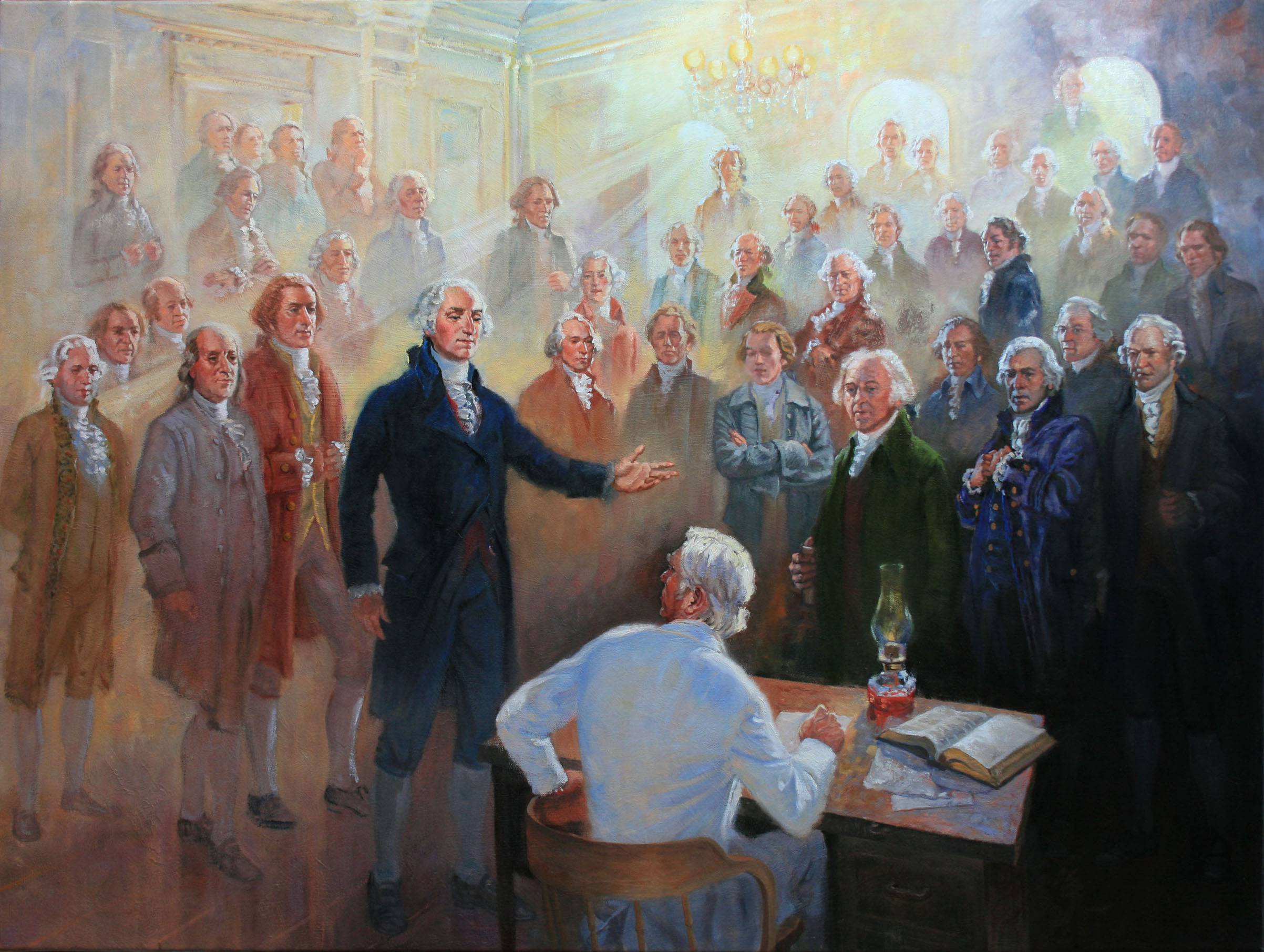
Wilford Woodruff and Founding Fathers

Wilford Woodruff’s vision of the Founding Fathers requesting Temple Ordinances

We are moving soon, but the Burley 11th Ward gave me another chance to address them. Since I received a number of requests for a copy of the talk, which is really just a collage of various items I could find online, the Journal of Discourses, the Saints second and third volumes, and other various histories. Here is the text of the talk I wrote, that does not mean it is the talk I gave…

I first addressed the freedoms we have as contrasted in the Saints third volume related to Germany. I said the word Jew and Israel from the stand and did not fear reprisal. I listen to free radio anytime I want and even seek out British radio from time to time and there is nothing illegal. Lastly, we could congregate without the worry of those in our midst about what was said or in the actual act of meeting.

Then to the following:

Declaration of Independence – We hold these truths to be self-evident, that all men are created equal, that they are endowed by their Creator with certain unalienable Rights, that among these are Life, Liberty and the pursuit of Happiness.

George Washington: “The success, which has hitherto attended our united efforts, we owe to the gracious interposition of Heaven, and to that interposition let us gratefully ascribe the praise of victory, and the blessings of peace.”

Alexander Hamilton: “The Sacred Rights of mankind are not to be rummaged from among old parchments or musty records. They are written . . . by the Hand of Divinity itself.” “For my own part, I sincerely esteem it a system, which without the finger of God, never could have been suggested and agreed upon by such a diversity of interests.”

Thomas Jefferson: “The God who gave us life gave us liberty at the same time.”

John Adams: “As I understand the Christian religion, it was, and is, a revelation.”

Benjamin Franklin: “The longer I live the more convincing Proofs I see of this Truth. That God Governs in the Affairs of Men!—And if a Sparrow cannot fall to the Ground without his Notice, is it probable that an Empire can rise without his Aid?—We have been assured, . . . in the Sacred Writings, that ‘except the Lord build the House, they labour in vain that build it.’ I firmly believe this;—and I also believe that without his concurring Aid we shall succeed in this political building no better than Builders of Babel.”

James Madison: “It is impossible for the man of pious reflection not to perceive in it a finger of that Almighty hand which has been so frequently and signally extended to our relief in the critical stages of the revolution.”

Samuel Adams: “Revelation assures us that ‘Righteousness exalteth a Nation’—Communities are dealt with in this World by the wise and just Ruler of the Universe. He rewards or punishes them according to their general Character.”

Charles Pinckney: “When the great work was done and published, I was . . . struck with amazement. Nothing less than that superintending hand of Providence, that so miraculously carried us through the war, . . . could have brought it about so complete, upon the whole.”

On May 4, 1842, he called to his side nine of the most faithful of his brethren—Hyrum Smith, Brigham Young, Heber C. Kimball, Willard Richards, Newell K. Whitney, and others—and later their wives came with them to the upper floor of the Red Brick Store in Nauvoo. 

Joseph was seeking to fulfill the promise from D&C 124, given in 1841, which the Lord would reveal to Joseph “all things pertaining to this house, and the priesthood thereof, and the place whereon it shall be built.” 

He had started, “If it should be the will of God that I might live.” Then he corrected and said, “It is not the will of the Lord that I should live, and I must give you, here in this upper room, all those glorious plans and principles whereby men are entitled to the fulness of the priesthood.” He proceeded in an improvised and makeshift way to do so.

We have from Brigham Young that after they had received these blessings the Prophet said: “Brother Brigham, this is not arranged right. But we have done the best we could under the circumstances in which we are placed, and I wish you to take this matter in hand and organize and systematize all these ceremonies.”

Brigham Young later said, “I did so. And each time I got something more, so that when we went through the temple at Nauvoo I understood and knew how to place them there. We had our ceremonies pretty correct.”

While the Nauvoo Temple was started in 1841, the first endowments were performed in the winter of 1845 and into 1846.  Baptisms had started in the Mississippi River prior to the temple and moved into the temple baptistery soon after it was completed and dedicated, well before the rest of the temple was done.  Brigham, leading the church, was personally overseeing the organization and perfection of the endowment and other ordinances that started in Nauvoo. 

After arriving in Salt Lake City, the church used the top floor of the Council House, starting in 1852 until the Endowment House was completed in 1855.  It was in this building that endowments, prayer circles, some missionary training, and some setting aparts were conducted.  The use of the Endowment House ended in 1877 with the completion of the St George Temple.  That building stood until Wilford Woodruff heard that unauthorized sealings were occurring there and ordered it razed in 1889. 

The St George Temple was the only one completed during Brigham Young’s 30 year tenure as President.  It was dedicated on 1 January 1877 in three dedicatory prayers under the direction of Brigham.  The baptistery by Wilford Woodruff, the main floor by Erastus Snow, and the sealing room by Brigham Young Jr.  Wilford Woodruff served as St George Temple President from 1877 to 1884.  Brigham had to be carried up the stairs, but he stood and spoke in the Assembly Room. 

“When I think upon this subject, I want the tongues of seven thunders to wake up the people,” he declared. “Can the fathers be saved without us? No. Can we be saved without them? No. And if we do not wake up and cease to long after the things of this earth, we will find that we as individuals will go down to hell.”

Brigham lamented that many Saints were pursuing worldly things. “Supposing we were awake to this thing, namely the salvation of the human family,” he said, “this house would be crowded, as we hope it will be, from Monday morning until Saturday night.”

On 9 January 1877, the first baptisms for the dead were performed in the St George Temple.  The first endowment for the dead was performed on 11 January 1877.  Brigham and Wilford personally oversaw the ordinances being performed.  Wilford began wearing a white suit, starting the trend that continues to this day. 

All endowments to this point had been done and passed by word of mouth.  It was in St George, far from Salt Lake City, that the ordinances were first written down.  Brigham also wanted to make sure the record was preserved and that they were standardized.  They were read to Brigham time and time again who would then approve or continue to revise the ordinances.  Brigham went home to Salt Lake City in April 1877.  He stopped and dedicated the spot for the Manti Temple on the way home.

Wilford Woodruff then wrote in his journal on Sunday 19 August 1877, “I spent the evening in preparing a list of the noted men of the 17 century and 18th, including the signers of the Declaration of Independence and presidents of the United States, for baptism on Tuesday the 21 Aug 1877.”

His journal entry for August 21 reads, “I, Wilford Woodruff, went to the temple of the Lord this morning and was baptized for 100 persons who were dead, including the signers of the Declaration of Independence. … I was baptized for the following names.” He then listed the names of one hundred men.

Elder Woodruff continued his journal entry: “When [John Daniel Thompson] McAllister had baptized me for the 100 names, I baptized him for 21, including Gen. Washington and his forefathers and all the presidents of the United States that were not on my list except Buchanan, Van Buren, and Grant.” (The work for these presidents has since been done.)

“It was a very interesting day,” Elder Woodruff continued. “I felt thankful that we had the privilege and the power to administer for the worthy dead, especially for the signers of the Declaration of Independence, that inasmuch as they had laid the foundation of our Government, that we could do as much for them as they had done for us.

“Sister Lucy Bigelow Young went forth into the font and was baptized for Martha Washington and her family, and seventy of the eminent women of the world. I called upon the brethren and sisters who were present to assist in getting endowments for those that we had been baptized for today.” (Wilford Woodruff’s journal, typescript, vol. 7, Church History Library; spelling and punctuation modernized.)

The first public mention of these events was made nearly a month after the baptisms were performed. In an address in the Tabernacle on Temple Square on 16 September 1877, Elder Woodruff first told publicly of the visitation of the signers of the Declaration of Independence.

“You have had the use of the Endowment House for a number of years, and yet nothing has ever been done for us. We laid the foundation of the government you now enjoy, and we never apostatized from it, but we remained true to it and were faithful to God. (Conference Report, April 10, 1898; Discourses of Wilford Woodruff, pp. 160-61)

During the 68th Annual General Conference of the Church which was held in April 1898, President Woodruff recounted the sacred experience:

I am going to bear my testimony to this assembly, if I never do it again in my life, that those men who laid the foundation of this American government and signed the Declaration of Independence were the best spirits the God of heaven could find on the face of the earth. They were choice spirits, not wicked men. General Washington and all the men that labored for the purpose were inspired of the Lord.

Another thing I am going to say here, because I have a right to say it.  Every one of those men that signed the Declaration of Independence, with General Washington, called upon me, as an Apostle of the Lord Jesus Christ, in the Temple at St. George, two consecutive nights, and demanded at my hands that I should go forth and attend to the ordinances of the House of God for them.  Men are here, I believe, that know of this, Brother John D. T. McAllister, David H. Cannon and James S. Bleak.  Brother McAllister baptized me for all those men, and then I told these brethren that it was their duty to go into the Temple and labor until they had got endowments for all of them.  They did it.  Would those spirits have called up on me, as an Elder in Israel to perform that work if they had not been noble spirits before God?  They would not. (Wilford Woodruff, Conference Report, April 1989, pp. 89-90.)

“They waited on me for two days and two nights,” he said,

“I thought it very singular, that notwithstanding so much work had been done, and yet nothing had been done for them.” (Journal of Discourses, 19:229.)

I was also present in the St. George Temple and witnessed the appearance of the Spirits of the Signers….the spirits of the Presidents….and also others, such as Martin Luther and John Wesley….Who came to Wilford Woodruff and demanded that their baptism and endowments be done. Wilford Woodruff was baptized for all of them. While I and Brothers J.D.T. McAllister and David H Cannon (who were witnesses to the request) were endowed for them. These men… laid the foundation of this American Gov., and signed the Declaration of Independence and were the best spirits the God of Heaven could find on the face of the earth to perform this work. Martin Luther and John Wesley helped to release the people from religious bondage that held them during the dark ages. They also prepared the people’s hearts so they would be ready to receive the restored gospel when the Lord sent it again to men on the earth.” (Personal journal of James Godson Bleak – Chief Recorder of the St. George Temple.)

In 1986, some of the staff of the Family History Library’s LDS Reference Unit were assigned to compile and computerize all the existing genealogical data on the founding fathers, to identify their families, and to document completed temple ordinances for each. For purposes of the project, a founding father was identified as one who had signed one or more of the following documents: the Articles of Association (1774), the Declaration of Independence (1776), the Articles of Confederation (1778), or the Constitution (1787).

The library study of 1986 revealed that there were no sealings of children to parents performed at the time the baptisms and endowments were performed. As a note, the ongoing revelation related to sealings to parents was not revealed until 1894.  It was then that the Law of Adoption, or sealing to prominent church leaders, was discontinued and we were encouraged to do genealogical work to compile the pedigree of the entire human family.  It was then that the Utah Genealogical Society was founded that has snowballed into the fantastic work of FamilySearch and all its appendages. 

He also recorded that George Washington, John Wesley, Benjamin Franklin, and Christopher Columbus were ordained High Priests at the time.

Temple work was performed on behalf of the following well-known and respected men and women in the St. George Utah Temple in August 1877.

Founding Fathers: William Hooper (NC), Joseph Hewes (NC), John Penn (NC), Button Gwinnett (GA), Lyman Hall (GA), George Walton (GA), Edward Rutledge (SC), Thomas Heyward Jr. (SC), Thomas Lynch (SC), Arthur Middleton (SC), Samuel Chase (MD), William Paca (MD), Thomas Stone (MD), Charles Carroll (MD), George Wythe (VA), Richard Henty Lee (VA), Thomas Jefferson (VA), Benjamin Harrison (VA), Thomas Nelson Jr. (VA), Francis Lightfoot Lee (VA), Carter Braxton (VA), Robert Morris (PA), Benjamin Rush (PA), Benjamin Franklin (PA), John Morton (PA), George Clymer (PA), James Smith (PA), George Taylor (PA), James Wilson (PA), George Ross (PA), Caeser Rodney (DE), George Read (DE), Thomas McKean (DE), Philip Livingston (NY), Francis Lewis (NY), Lewis Morris (NY), Richard Stockton (NJ), John Witherspoon (NJ), Francis Hopkinson (NJ), John Hart (NJ), Abraham Clark (NJ), Josiah Bartlett (NH), William Whipple (NH), Matthew Thornton (NH), Samuel Adams (MA), John Adams (MA), Robert Treat Paine (MA), Elbridge Gerry (MA), Stephen Hopkins (RI), William Ellery (RI), Roger Sherman (CN), Samuel Huntington (CN), William Williams (CN), and Oliver Wolcott (CN).

Note: Temple work was not done for John Hancock or William Floyd as it had already been completed previously.

Presidents of the United States: George Washington, John Adams, Thomas Jefferson, James Madison, James Monroe, John Quincy Adams, Andrew Jackson, William Henry Harrison, John Tyler, James Knox Polk, Zachary Taylor, Millard Fillmore, Franklin Pierce, Abraham Lincoln, and Andrew Johnson.  Temple work was not done for James Buchanan, Martin Van Buren, or Ulysses S. Grant.

Other eminent men baptized by Wilford Woodruff in the St. George Utah Temple in August 1877 include: Sir Edward Gibbon, Johann Wolfgang von Goethe, Oliver Goldsmith, Henry Grattan, Humboldt, Alexander von Irving, Washington Jackson, Thomas Jonathan “Stonewall” Johnson, Samuel Juarez, Benito Pablo Kemble, John Philip Liebig, Baron Justus von Livingstone, David Macaulay, Thomas Babington Nelson, Lord Horatio O’Connell, Daniel Peabody, George Powers, Hiram Reynolds, Sir Joshua Schiller, Johann Christoph Friedrich von Scott, Sir Walter Seward, William Henry Stephenson, George Thackeray, William Makepeace, Vespucci, Amerigo Webster, Daniel Wesley, John Wordsworth, William Parepa, Count Dimitrius, Martha Washington and her family, John Washington (Great Grandfather of George Washington), Sir Henry Washington, Lawrence Washington (Brother of George Washington), Augustine Washington (Father of George Washington), Lawrence Washington (Father of Augustine), Lawrence Washington, Daniel Park Custis, John Park Custis (Son of Daniel and Martha Parke Custis), and Martin Luther.

Eminent Women baptized include: Jean Armour (1767—1834) of Scotland, Jean Armour Burns (Wife of Robert Burns) (1759—1796), Jane Austen (1775—1817) of England, novelist, Mary Ball (1708—1789) of America, Mary Ball Washington (Mother of George Washington) (1732—1799), Sarah Bernard (1800—1879) of England, Sarah Barnard Faraday (wife of Michael Faraday (1791—1867), Charlotte Bronte (1816—1855) of England, novelist, Felicia Dorothea Browne (1793—1835) of England, Elizabeth Barrett Browning (1806—1861) of England, poet, (wife of Robert Browning) (1812—18?), Martha Caldwell Calhoun (d. 1802) of America (mother of John Caldwell Calhoun) (1782—1850), Martha Parke Custis (1755—1773) of America (Daughter of Martha Washington) (1732—1802), Martha Dandridge Washington (1732—1802) of America (wife of George Washington) (1732—1799),  Rachel Donelson Jackson (1767—1828) of America (wife of Andrew Jackson (1767—1845), and Abigail Eastman Webster (1737—1816) of America (mother of Daniel Webster (1782—1852), to name but a few. Temple work was performed for a total of 70 eminent women.

During most of our national history Columbus and the Founders were considered heroes with determination and foresight.  Cities, rivers, and many other places were named after them.  More recently there has been a wide spread effort, designed especially to indoctrinate young people, which slanders Columbus, the Founders and their accomplishments.  Columbus is held personally responsible for centuries of mistreatment of Native Americans.  The Founders are portrayed as being greedy and motivated by selfish interests. All of this is as astonishing as it is misleading.  

From the Lord’s perspective among the most important events of the history of the world was the discovery and founding of America.  1 Ne 11-14.  Nephi was referring to Columbus when he wrote:  “I looked and beheld a man among the Gentiles, who was separated from the seed of my brethren by the many waters; and I beheld the Spirit of God, that it came down and wrought upon the man; and he went forth upon the many waters, even unto the seed of my brethren, who were in the promised land” 1 Ne 13:12.  By the Founders “the Lord God will raise up a mighty nation…even on the face of this land.” 1 Ne 22:7.

Go on to life and history of George Ross of Pennsylvania, signer of Declaration of Independence.  

Orwell’s 1984 and Today

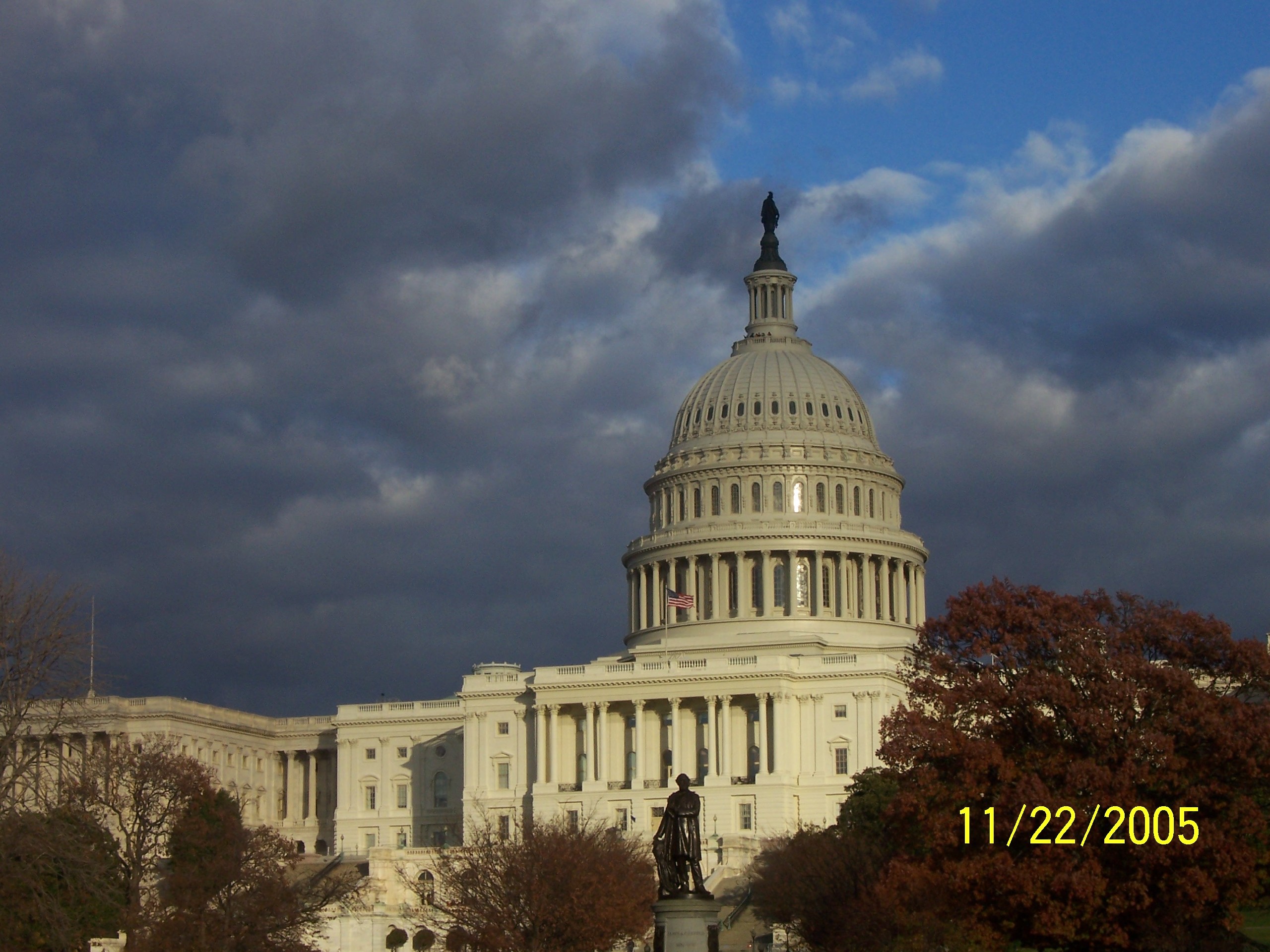
United States Capitol

There have been many things on my mind lately. Watching the ongoing bickering in the District of Columbia for the past 20 years I often think of 1984, Brave New World, and Fahrenheit 451. The Trump world often made me thing of 1984 with the inability to rely on truth and the often shifting positions from day to day. The Democrats declare the need for truth, for which I agree. The Republicans declare the need for unity, again, I agree. Both are doing it for limited self-serving purposes though. While I am not that old, I long for the America I recall learning about in school and wonder if she will ever reappear. I weary of our rewriting history, not of addition or giving more context, but contriving it into something it is not. I love Thomas Jefferson and find great frustration in our undermining his phenomenal influence that continues to today. We are now seeing it also in the religious side with Brigham Young. Based upon those musings, I read this Imprimis talk and found it reiterating my thoughts of the past years in words. I could not help but share.

The following is adapted from a speech delivered by Larry Arnn at a Hillsdale College reception in Rogers, Arkansas, on November 17, 2020.

“On September 17, Constitution Day, I chaired a panel organized by the White House. It was an extraordinary thing. The panel’s purpose was to identify what has gone wrong in the teaching of American history and to lay forth a plan for recovering the truth. It took place in the National Archives—we were sitting in front of the originals of the Declaration of Independence and the Constitution—a very beautiful place. When we were done, President Trump came and gave a speech about the beauty of the American Founding and the importance of teaching American history to the preservation of freedom. 

“This remarkable event reminded me of an essay by a teacher of mine, Harry Jaffa, called “On the Necessity of a Scholarship of the Politics of Freedom.” Its point was that a certain kind of scholarship is needed to support the principles of a nation such as ours. America is the most deliberate nation in history—it was built for reasons that are stated in the legal documents that form its founding. The reasons are given in abstract and universal terms, and without good scholarship they can be turned astray. I was reminded of that essay because this event was the greatest exhibition in my experience of the combination of the scholarship and the politics of freedom. 

“The panel was part of an initiative of President Trump, mostly ignored by the media, to counter the New York Times’ 1619 Project. The 1619 Project promotes the teaching that slavery, not freedom, is the defining fact of American history. President Trump’s 1776 Commission aims to restore truth and honesty to the teaching of American history. It is an initiative we must work tirelessly to carry on, regardless of whether we have a president in the White House who is on our side in the fight. 

“We must carry on the fight because our country is at stake. Indeed, in a larger sense, civilization itself is at stake, because the forces arrayed against the scholarship and the politics of freedom today have more radical aims than just destroying America. 

***

“I taught a course this fall semester on totalitarian novels. We read four of them: George Orwell’s 1984, Arthur Koestler’s Darkness at Noon, Aldous Huxley’s Brave New World, and C.S. Lewis’s That Hideous Strength

“The totalitarian novel is a relatively new genre. In fact, the word “totalitarian” did not exist before the 20th century. The older word for the worst possible form of government is “tyranny”—a word Aristotle defined as the rule of one person, or of a small group of people, in their own interests and according to their will. Totalitarianism was unknown to Aristotle, because it is a form of government that only became possible after the emergence of modern science and technology.

“The old word “science” comes from a Latin word meaning “to know.” The new word “technology” comes from a Greek word meaning “to make.” The transition from traditional to modern science means that we are not so much seeking to know when we study nature as seeking to make things—and ultimately, to remake nature itself. That spirit of remaking nature—including human nature—greatly emboldens both human beings and governments. Imbued with that spirit, and employing the tools of modern science, totalitarianism is a form of government that reaches farther than tyranny and attempts to control the totality of things. 

“In the beginning of his history of the Persian War, Herodotus recounts that in Persia it was considered illegal even to think about something that was illegal to do—in other words, the law sought to control people’s thoughts. Herodotus makes plain that the Persians were not able to do this. We today are able to get closer through the use of modern technology. In Orwell’s 1984, there are telescreens everywhere, as well as hidden cameras and microphones. Nearly everything you do is watched and heard. It even emerges that the watchers have become expert at reading people’s faces. The organization that oversees all this is called the Thought Police. 

“If it sounds far-fetched, look at China today: there are cameras everywhere watching the people, and everything they do on the Internet is monitored. Algorithms are run and experiments are underway to assign each individual a social score. If you don’t act or think in the politically correct way, things happen to you—you lose the ability to travel, for instance, or you lose your job. It’s a very comprehensive system. And by the way, you can also look at how big tech companies here in the U.S. are tracking people’s movements and activities to the extent that they are often able to know in advance what people will be doing. Even more alarming, these companies are increasingly able and willing to use the information they compile to manipulate people’s thoughts and decisions.

“The protagonist of 1984 is a man named Winston Smith. He works for the state, and his job is to rewrite history. He sits at a table with a telescreen in front of him that watches everything he does. To one side is something called a memory hole—when Winston puts things in it, he assumes they are burned and lost forever. Tasks are delivered to him in cylinders through a pneumatic tube. The task might involve something big, like a change in what country the state is at war with: when the enemy changes, all references to the previous war with a different enemy need to be expunged. Or the task might be something small: if an individual falls out of favor with the state, photographs of him being honored need to be altered or erased altogether from the records. Winston’s job is to fix every book, periodical, newspaper, etc. that reveals or refers to what used to be the truth, in order that it conform to the new truth. 

“One man, of course, can’t do this alone. There’s a film based on 1984 starring John Hurt as Winston Smith. In the film they depict the room where he works, and there are people in cubicles like his as far as the eye can see. There would have to be millions of workers involved in constantly re-writing the past. One of the chief questions raised by the book is, what makes this worth the effort? Why does the regime do it?

“Winston’s awareness of this endless, mighty effort to alter reality makes him cynical and disaffected. He comes to see that he knows nothing of the past, of real history: “Every record has been destroyed or falsified,” he says at one point, “every book has been rewritten, every picture has been repainted, every statue and street and building has been renamed, every date has been altered. And that process is continuing day by day and minute by minute. . . . Nothing exists except an endless present in which the Party is always right.” Does any of this sound familiar?

“In his disaffection, Winston commits two unlawful acts: he begins writing in a diary and he begins meeting a woman in secret, outside the sanction of the state. The family is important to the state, because the state needs babies. But the women are raised by the state in a way that they are not to enjoy relations with their husbands. And the children—as in China today, and as it was in the Soviet Union—are indoctrinated and taught to spy and inform on their parents. Parents love their children but live in terror of them all the time. Think of the control that comes from that—and the misery.

“There are three stratums in the society of 1984. There is the Inner Party, whose members hold all the power. There is the Outer Party, to which Winston belongs, whose members work for—and are watched and controlled by—the Inner Party. And there are the proles, who live and do the blue collar work in a relatively unregulated area. Winston ventures out into that area from time to time. He finds a little shop there where he buys things. And it is in a room upstairs from this shop where he and Julia, the woman he falls in love with, set up a kind of household as if they are married. They create something like a private world in that room, although it is a world with limitations—they can’t even think about having children, for instance, because if they did, they would be discovered and killed. 

“In the end, it turns out that the shopkeeper, who had seemed to be a kindly old man, is in fact a member of the Thought Police. Winston and Julia’s room contained a hidden telescreen all along, so everything they have said and done has been observed. In fact, it emerges that the Thought Police have known that Winston has been having deviant thoughts for twelve years and have been watching him carefully. When the couple are arrested, they have made pledges that they will never betray each other. They know the authorities will be able to make them say whatever they want them to say—but in their hearts, they pledge, they will be true to their love. It is a promise that neither is finally able to keep. 

“After months of torture, Winston thinks that what awaits him is a bullet in the back of the head, the preferred method of execution of both the Nazis and the Soviet Communists. In Koestler’s Darkness at Noon, the protagonist walks down a basement hallway after confessing to crimes that he didn’t commit, and without any ceremony he is shot in the back of the head—eradicated as if he were vermin. Winston doesn’t get off so easy. He will instead undergo an education, or more accurately a re-education. His final stages of torture are depicted as a kind of totalitarian seminar. The seminar is conducted by a man named O’Brien, who is portrayed marvelously in the film by Richard Burton. As he alternately raises and lowers the level of Winston’s pain, O’Brien leads him to knowledge regarding the full meaning of the totalitarian regime.

“As the first essential step of his education, Winston has to learn doublethink—a way of thinking that defies the law of contradiction. In Aristotle, the law of contradiction is the basis of all reasoning, the means of making sense of the world. It is the law that says that X and Y cannot be true at the same time if they’re mutually exclusive. For instance, if A is taller than B and B is taller than C, C cannot be taller than A. The law of contradiction means things like that.

“In our time, the law of contradiction would mean that a governor, say, could not simultaneously hold that the COVID pandemic renders church services too dangerous to allow, and also that massive protest marches are fine. It would preclude a man from declaring himself a woman, or a woman declaring herself a man, as if one’s sex is simply a matter of what one wills it to be—and it would preclude others from viewing such claims as anything other than preposterous.

“The law of contradiction also means that we can’t change the past. What we can know of the truth all resides in the past, because the present is fleeting and confusing and tomorrow has yet to come. The past, on the other hand, is complete. Aristotle and Thomas Aquinas go so far as to say that changing the past—making what has been not to have been—is denied even to God. Because if something both happened and didn’t happen, no human understanding is possible. And God created us with the capacity for understanding.

“That’s the law of contradiction, which the art of doublethink denies and violates. Doublethink is manifest in the fact that the state ministry in which Winston is tortured is called the Ministry of Love. It is manifest in the three slogans displayed on the state’s Ministry of Truth: “War is peace. Freedom is slavery. Ignorance is strength.” And as we have seen, the regime in 1984 exists precisely to repeal the past. If the past can be changed, anything can be changed—man can surpass even the power of God. But still, to what end?

“”Why do you think you are being tortured? O’Brien asks Winston. The Party is not trying to improve you, he says—the Party cares nothing about you. Winston is brought to see that he is where he is simply as the subject of the state’s power. Understanding having been rendered meaningless, the only competence that has meaning is power. 

““Already we are breaking down the habits of thought which have survived from before the Revolution,” O’Brien says.

“”We have cut the links between child and parent, and between man and man, and between man and woman. No one dares trust a wife or a child or a friend any longer. But in the future there will be no wives and no friends. Children will be taken from their mothers at birth, as one takes eggs from a hen. The sex instinct will be eradicated. Procreation will be an annual formality like the renewal of a ration card. . . . There will be no loyalty, except loyalty toward the Party. There will be no love, except the love of Big Brother. There will be no laughter, except the laugh of triumph over a defeated enemy. . . . All competing pleasures will be destroyed. But always—do not forget this Winston—always there will be the intoxication of power, constantly increasing and constantly growing subtler. Always, at every moment, there will be the thrill of victory, the sensation of trampling on an enemy who is helpless. If you want a picture of the future, imagine a boot stamping on a human face—forever.

“Nature is ultimately unchangeable, of course, and humans are not God. Totalitarianism will never win in the end—but it can win long enough to destroy a civilization. That is what is ultimately at stake in the fight we are in. We can see today the totalitarian impulse among powerful forces in our politics and culture. We can see it in the rise and imposition of doublethink, and we can see it in the increasing attempt to rewrite our history.

***

““An informed patriotism is what we want,” Ronald Reagan said toward the end of his Farewell Address as president in January 1989. “Are we doing a good enough job teaching our children what America is and what she represents in the long history of the world?” 

“Then he issued a warning.

“Those of us who are over 35 or so years of age grew up in a different America. We were taught, very directly, what it means to be an American. And we absorbed, almost in the air, a love of country and an appreciation of its institutions. If you didn’t get these things from your family you got them from the neighborhood, from the father down the street who fought in Korea or the family who lost someone at Anzio. Or you could get a sense of patriotism from school. And if all else failed you could get a sense of patriotism from the popular culture. The movies celebrated democratic values and implicitly reinforced the idea that America was special. TV was like that, too, through the mid-sixties.

“But now, we’re about to enter the [1990s], and some things have changed. Younger parents aren’t sure that an unambivalent appreciation of America is the right thing to teach modern children. And as for those who create the popular culture, well-grounded patriotism is no longer the style. . . . We’ve got to do a better job of getting across that America is freedom—freedom of speech, freedom of religion, freedom of enterprise. And freedom is special and rare. It’s fragile; it needs protection.

“So, we’ve got to teach history based not on what’s in fashion but what’s important—why the Pilgrims came here, who Jimmy Doolittle was, and what those 30 seconds over Tokyo meant. You know, four years ago on the 40th anniversary of D-Day, I read a letter from a young woman writing to her late father, who’d fought on Omaha Beach. . . . [S]he said, “we will always remember, we will never forget what the boys of Normandy did.” Well, let’s help her keep her word. If we forget what we did, we won’t know who we are. I’m warning of an eradication of the American memory that could result, ultimately, in an erosion of the American spirit

“American schoolchildren today learn two things about Thomas Jefferson: that he wrote the Declaration of Independence and that he was a slaveholder. This is a stunted and dishonest teaching about Jefferson. 

“What do our schoolchildren not learn? They don’t learn what Jefferson wrote in Notes on the State of Virginia: “I tremble for my country when I reflect that God is just,” he wrote in that book regarding the contest between the master and the slave. “The Almighty has no attribute which can take side with us in such a contest.” If schoolchildren learned that, they would see that Jefferson was a complicated man, like most of us. 

“They don’t learn that when our nation first expanded, it was into the Northwest Territory, and that slavery was forbidden in that territory. They don’t learn that the land in that territory was ceded to the federal government from Virginia, or that it was on the motion of Thomas Jefferson that the condition of the gift was that slavery in that land be eternally forbidden. If schoolchildren learned that, they would come to see Jefferson as a human being who inherited things and did things himself that were terrible, but who regretted those things and fought against them. And they would learn, by the way, that on the scale of human achievement, Jefferson ranks very high. There’s just no question about that, if for no other reason than that he was a prime agent in founding the first republic dedicated to the proposition that all men are created equal. 

“The astounding thing, after all, is not that some of our Founders were slaveholders. There was a lot of slavery back then, as there had been for all of recorded time. The astounding thing—the miracle, even, one might say—is that these slaveholders founded a republic based on principles designed to abnegate slavery. 

“To present young people with a full and honest account of our nation’s history is to invest them with the spirit of freedom. It is to teach them something more than why our country deserves their love, although that is a good in itself. It is to teach them that the people in the past, even the great ones, were human and had to struggle. And by teaching them that, we prepare them to struggle with the problems and evils in and around them. Teaching them instead that the past was simply wicked and that now they are able to see so perfectly the right, we do them a disservice and fit them to be slavish, incapable of developing sympathy for others or undergoing trials on their own.

“Depriving the young of the spirit of freedom will deprive us all of our country. It could deprive us, finally, of our humanity itself. This cannot be allowed to continue. It must be stopped. 

Presidents Day

In honour of Presidents Day this year I thought I would post a couple of pictures I have regarding Presidents of the United States.

Brad Hales, me, Anna Badger, and Jeana Stuart

Brad Hales, me, Anna Badger, and Jeana Stuart

Bush and Cheney Inauguration in 2008

Bush and Cheney Inauguration in 2008 in front of the US Capitol

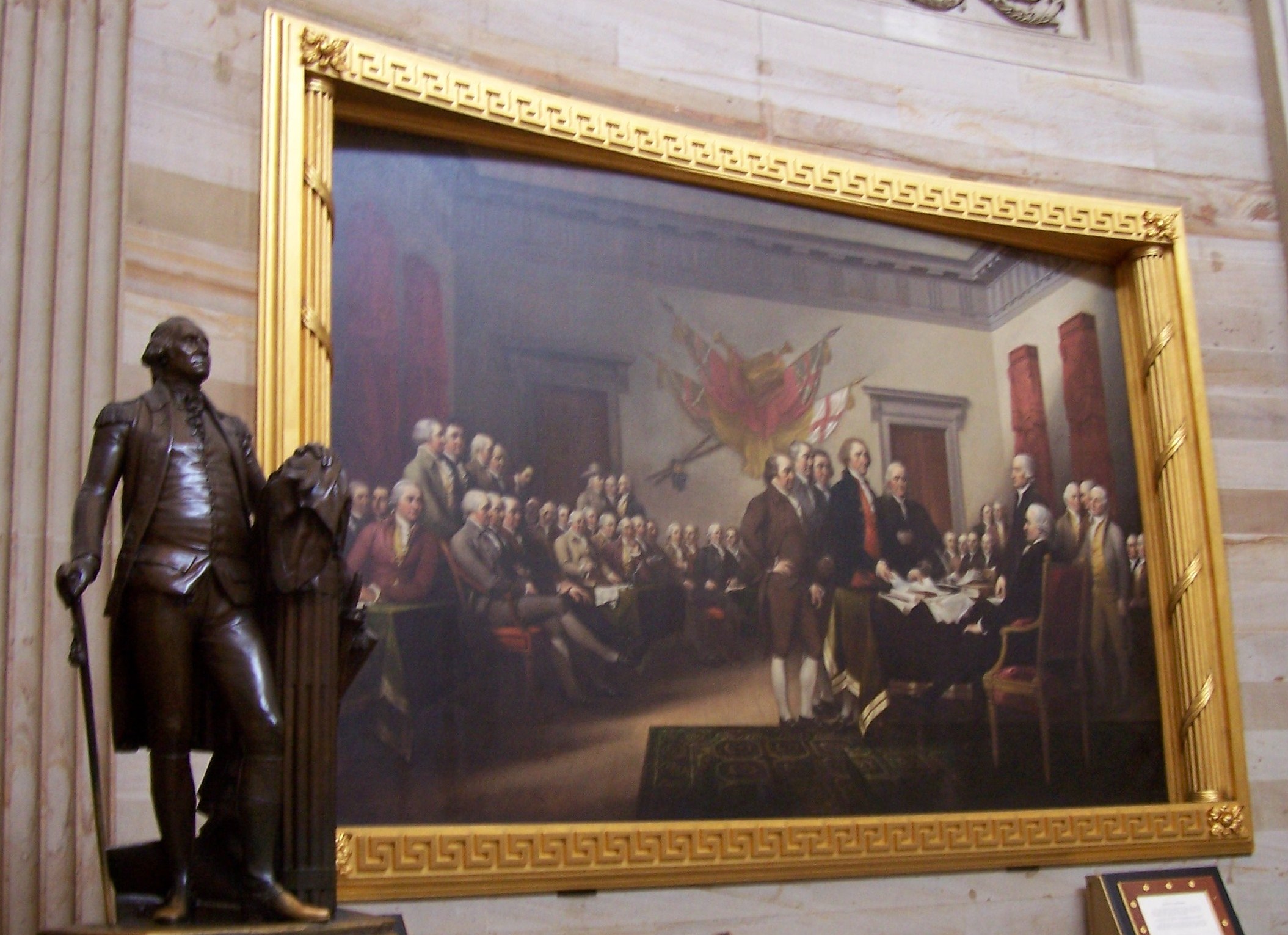
George Washington statute by the Turnbull Commission of Five.  Adams, Jefferson, Washington, all became Presidents.

George Washington statue by the Trumbull Declaration of Independence.  Adams, Jefferson, Washington, all became Presidents, in US Capitol, Washington, DC

Martha and George Washington tombs

Martha and George Washington tombs in Mt Vernon, Virginia

Washington Equestrian Statute with Jefferson standing in front

Washington Equestrian Statue with Jefferson standing in front in Richmond, Virginia

Washington as a Mason in Alexandria, Virginia

Washington as a Mason in Alexandria, Virginia

James Monroe tomb, Richmond, Virginia

James Monroe tomb, Richmond, Virginia

Plaque on James Monroe's tomb

Plaque on James Monroe’s tomb

John Tyler Grave

John Tyler Grave in Richmond, Virginia

John Quincy and Louisa Adams' tombs

John Quincy and Louisa Adams’ tombs in Quincy, Massachusetts

John and Abigail Adams' tombs

John and Abigail Adams’ tombs in Quincy, Massachusetts

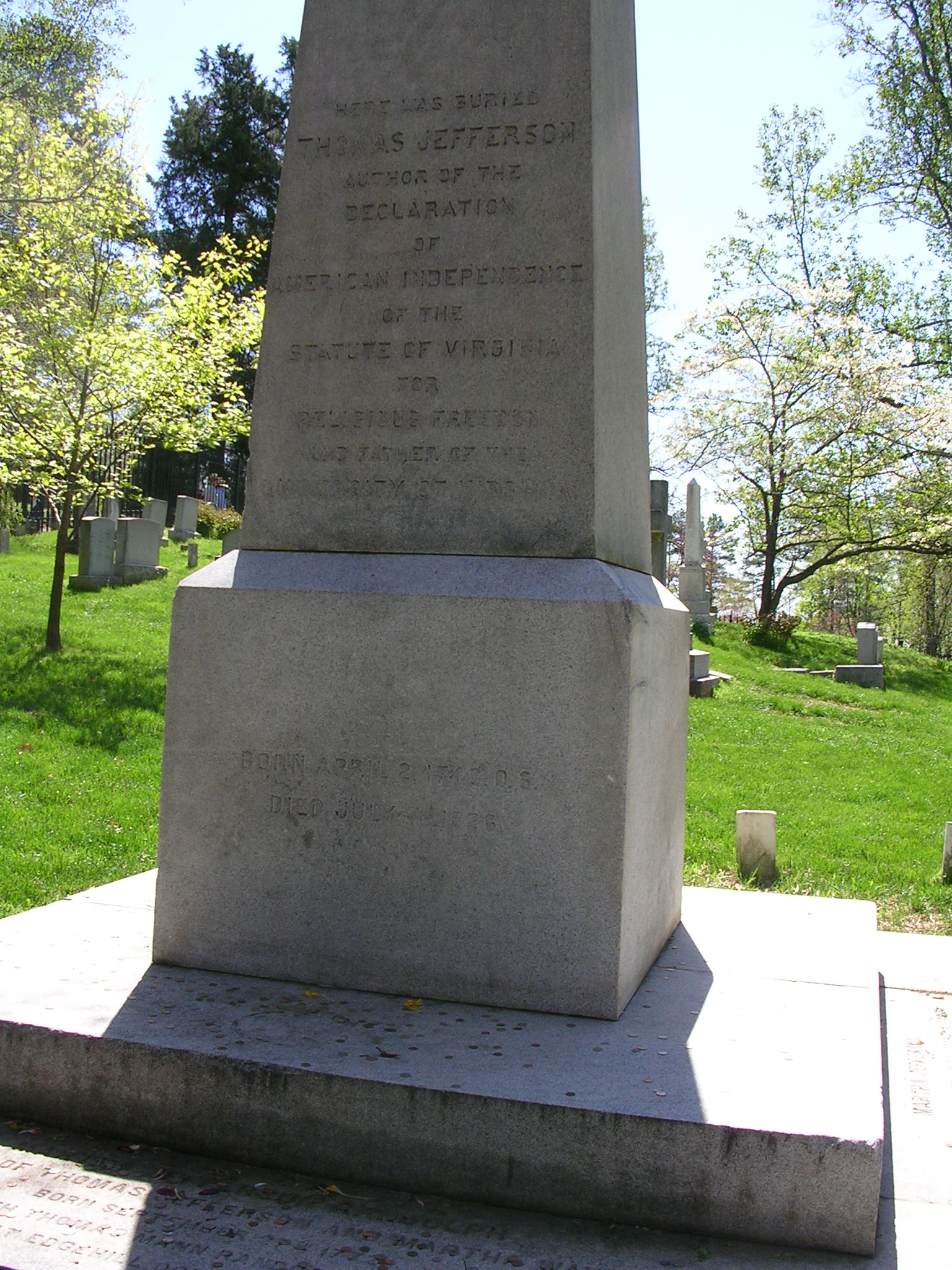
Thomas Jefferson's tombstone near Charlottesville, Virginia

Thomas Jefferson’s tombstone near Charlottesville, Virginia

That is pretty much the closest I got to any of these Presidents, that I can prove.  I have also been the resting spots of William Howard Taft, Harry S Truman, John F Kennedy.

Visiting Charlottesville

This morning we took a lovely drive for an hour to our west.  Our destination was lovely Charlottesville, Virginia.  Of course, as everyone knows, named after Queen Charlotte, the wife of the least favorite King in America, George III.  It is tied with Monticello, Ashlawn-Highland, and the University of Virginia.  It is also linked with Montpelier.

Our first photos are in relation to Monticello.  This was Amanda’s first trip, my second trip.  This time had much more green for me to see which was a pleasant surprise.  I will tell you now, the gardens are much more beautiful when they have something growing in them!  We parked, purchased our tickets, and headed up the hill.  We chose to walk rather than ride the shuttle.  We arrived first at the Jefferson Cemetery which continues to bury Jefferson descendents.  The next stop was the massive gardens.  The tour manual boasts over 1000 feet of them.  The Garden Pavilion you see in the photos is about half way.  There are some great views from the garden area over the local area.  Really quite beautiful.
We roamed up the hill and around the house.  You can see various pictures from around the property.  The striped fluffy tulips are something to mention.  We even took a picture.  We got some pictures from the well known Nickel view.  We went on the tour at 12:40.  I have always been impressed with Thomas Jefferson.  Nearly everything in my knowledge of Jefferson has been of great influence on me.  His focus of design in homes has been something that has impressed me since I started drafting in about 1992.  I remember almost instantly learning about Jefferson’s views probably in my first month of drafting.  I have been enamored every since.  Anyhow, I won’t do an opinion piece on Jefferson here…  The house is magnificent.
We came out, roamed some more and made our way back down the hill.  We drive just another mile or two away to James and Elizabeth Monroe’s home, Highland.  You will notice in the pictures that there is a yellow house attached to the white house.  The white house is the original Highland.  In later years the Victorian yellow house was added and the plantation came to be known as Ashlawn.  Thomas Jefferson convinced James Monroe to buy a plantation near him which he did.  It is important to mention Monroe owned several.  In his over 50 years of office, he spent only about 4 years all together at Highland.  His wife was frail in later years and they never made it back very often.  Plus towards the end to settle all his debts he sold Highland.  He died in New York City debt free.  There is a massive tree there in the yard I wanted Amanda to go take a picture with.  So we got to see one of her better sides in that photo.
We left our visit at Ashlawn-Highland to head back to Charlottesville.  We stopped at the Thomas Jefferson Museum and then went to the University of Virginia.  After a day at Monticello and hearing so much about it I had to see the original campus.  You can see pictures of the Rotunda which is the focal point of the campus.  You can see pictures from both sides of the Rotunda.  We also took pictures both east and west from The Lawn.  The Old Cabell building is seen to the west from The Lawn.
Lastly, I added a couple of pictures from our trip to Washington in March.  There are some pictures from late one night of the Washington Temple, Washington Monument, and Jefferson Memorial.
It was a busy day.  We even took a cooler of goodies to make ourselves lunch.  Next time we need to pack more water though.

Sordid thoughts on the lowly things

Here we are beginning another week.  I admit, I am torn in so many ways.  What to do?  Where to go?  These are questions that I suppose creep up in our lives when we are just not quite as sure of things as we would like.
My job has become just that.  I am not motivated by money and they keep trying to entice me with it.  Well, in the end, I find myself doing the same routine, with not much improvement.  Well, I lie.  Every week so far has been an improvement in my earnings.  This past week I made more than six hundred in a week, before taxes and all.  So I guess that is a good thing.  But that is not how I measure my effectiveness.  Never has been, never will be.  Why would I use Babylon’s measuring rod?  How many lives am I influencing?  Is my family the better for it?  Am I happy?  And then the answer comes in at a stark no.
I get to go around and meet a wide variety of people.  That is most definitely true.  However, while I do feel we have a valuable tool, and a good product for those who need supplemental insurance, I am finding many people who have this as their only insurance.  They are content to believe that this is going to cover their needs and that is not the truth.  I think most understand this is not major medical, but for the fact that these people are poor and paying for this bothers me.  Now for the craftsmen and heavy laborers who carry this, I most certainly think it is the best thing for them.  So I am touching these people’s lives, and getting to meet them.  But I am not convinced I am leaving them better off in the end.
It most certainly is a worthwhile time to visit and see all these places.  I have always been fascinated by geography and love to travel.  This job has catered to that desire.  I have been to the birthplace of Meriwether Lewis, William Clark, Thomas Jefferson, and James Monroe.  I have been to the place where John Wilkes Booth was hiding, found, shot, and killed.  The historic Northern Neck of Virginia, while slightly penetrated, has been interesting.  But all this traveling takes time and money.  By which I travel and find the homes of these people, which are literally everywhere, so the byproduct is I learn the territory.  However, I am finding that running a household, a wife in school, and other costs take one’s funds.  In the end, I can afford the $100-$130 I am spending on fuel.  But I am worried that by breaking even, I am not saving to replace or add to the vehicle that is being required to drive the minimum of 1,000 miles a week.  With 183,000 miles plus on the car, I should be saving or paying for another vehicle rather than running into the ground the only means of income and transportation, for two, I currently have.  That just seems dumb to me.  In the end, it is not making enough money to pay for a car payment a month, nor to save up for a new car at a later point.
What about the next point?  What about my family?  Well, the last week, I certainly made the most of what I have made yet with the company.  But having said that, I am leaving at 9 in the morning, and returning at 9 or 10 at night.  If I was single, that would not be so much the issue.  I have a wife that is at home.  She can surely spend the time studying or whatever else without my interference.  When I finally get home though, I am exhausted.  I need to eat and go to bed.  She is kind enough to provide the food.  By the time we read our scriptures, pray, get ready for bed, and make it in, I am beyond my bedtime.  We have spent little or no social time, and other events are just a pain.  That is fine for a little while, but it really starts to add up in the long run, and I am not willing to make that type of a sacrifice.  The job is on the altar before the wife.
Lastly, am I happy.  Well, I surely enjoy the traveling and people.  It does grow wearisome at times though.  I love meeting people, I love seeing these new places.  However, the chances of my meeting these people again are slim.  It was not like spraying lawns at all!  Many of them gripe and moan they have to pay this again, and the rest are just a pain to track down.  It wears on me.  What wears the most is that I don’t have time to do things I wish to do.  I take the LSAT this weekend and I have no time to really practice for it.  That bothers me.  What is worse that when I do get time to myself, I use it for other things than studying.  I have other things I place more importance on and since I never get to do them, then the lesser things don’t come up.  So now what?  I am not going to postpone it again.  I should have just taken it in June.
So, after seeing this whole thing now play out, I am not impressed with the fruits.  I planted the seeds, I have lingered, waited, and prayed long enough.  The fruits appear to be bitter and if I allow the tree to continue to grow, it will only grow more wearisome and bitter.
I don’t even think it is so much Combined that I am having the issues with.  I wonder how much more effective I could be if I were to be trained in how to sell.  Would that little extra bit every day make it more worth it?  Would I be able to stop earlier from working knowing I had met the monetary needs?  Who knows.  Probably.  If I could spend less time working to make the same amount, that would be good.  If I could lay some aside for other purposes, that would be helpful.  All I know, something has to change, now.
Having said all that, I wonder about the other side.  Could there be something more I am missing?
What about those who say stick with it?  Grin and bear it?  It will all work out in the end.  I have thought quite a bit about Joseph of old.  He was in prison and a very unlikeable position.  But he bore through it with faith and came out on top.  My leaders at work keep wanting to put me into executive training.  In fact, if I would have agreed, I would be in Virginia Beach all week for it.  (But what of the LSAT then?  Being gone all week seems to only compound the problems.  Best part, they don’t even pay for your being gone so I would sacrifice a week for no pay!)  So, do I endure, make my way to management, and then what?  Well, I will be expected to train.  How in the world can I train on something I have yet to learn to do?  Nobody seems to be willing to train me and I obviously have not worked it out yet.  As Marc says, I am making what money I am by pure hard diligence and work.  That is noble and all, but he makes the same I do with only half the hours.  Yet getting him to train me is like pulling teeth.  Endure….where is the line where you simply throw your hands in the air and say I am moving on?
Much on the mind lately is the thought that perhaps I am meant to be here for some reason or another.  Marc has accepted an invitation to attend General Priesthood with me on Saturday Night.  That is great news.  I would like to endure enough to see him read the Book of Mormon and join the church.  However, should I gain one soul for the kingdom and give up everything for that one?  Honestly, I don’t see anything breaking down in my relationship with Amanda, but do I want to take that chance?  It is hard to be a nice person when I am not completely satisfied with my job.  Amanda takes some of the brunt of that.  There are two reasons why I have stuck with the job so far.  Simply because I need some income to provide for those things that are essentials (granted this house is more than we need, but it is still inexpensive compared to renting an apartment).  Secondly, in the hope that Marc will feel of the Spirit and be converted.  With my being away from the company the chances of his keeping his commitments and being converted are greatly reduced.  He has no one else to challenge and teach.  I told the missionaries about him coming on Saturday.  I sure hope we can get his address and a commitment to take the missionary discussions.  That will sure take a load off of me!
Yes, I believe it is time for a change.  But where to?  What shall I do?  Where shall I go?

Mt. Vernon

Probably time for another little update. We have just returned from another weekend up in the bustling city of Washington. We went up last night, stayed with Dennis and Gwen Thompson, and had ourselves a great time. We attended the Washington Temple this morning. Amanda, Dennis, and Gwen all did a session while I did initiatory. It was a great, much needed, release from the week. I actually quite enjoyed myself.We had lunch with the whole Thompson Clan to celebrate Grandparent’s Day, and then they went off to a soccer game for Faith and Destiny. Amanda and I met up with Greg McNeill and headed to Mount Vernon. This was Amanda’s first visit, my third. We drove over separately and spent the time walking through the grounds. Amanda was already exhausted from the day, and seemed to be dragging the whole time. She says she enjoyed Mt. Vernon. I really liked sitting with Martha Washington and listening to her talk about Thomas Jefferson. She did not have much to say that she liked about him.

Greg and I had a great chat about a whole host of things. We discussed politics, Mormons, campaigns, Supreme Court rulings, and who knows what else. Poor Amanda was even more exhausted after hanging out with us. It was great to catch up with him though. He is a good man. He announced and gave us his wedding date for May 26th next year. I have put it on my calendar, we are planning to go, it is at Fort Belvoir at the officer’s club. That should be exciting.

The week went well. I worked my tail off some more and became pretty frustrated with things. I am supposed to have two full weeks of training, all day long. That is 10 days. So far, I have had a whopping 3 days I think, and then they tell me that they want me to do more sales or something. I honestly don’t have a clue about what I am doing with some stuff. For example, I collected premium from a lady this week for a policy that has been paid for up for 20 years. She was old and senile enough not to notice, and I had no clue. What the company will do with that is beyond me. The best part, it was life insurance premium I collected, and is technically illegal for me to do so. That is how green I am in many ways.

I did write three policies this week, but I need to learn how to do more. I want to, but I seem to be so very alone. Oh well, I will endure.

They made me go on a conference call this week. That will be the last time I do that. I spent a good 30 minutes listening to the sub-regional manager talk about all these little goals and that they have for us. They are not paying for my lost 30 minutes of cell phone time. Next, Mr Stone himself said that a goal that is not ours, does not have the power to motivate. Well, I will be making my own goals. I don’t care if I go to Nashville. I don’t care if I get some luxury spa set. Honestly, I don’t care if I have a big bonus at the end of the year. I want to feel my job is worthwhile, and that I am succeeding at it. That is hard to do sometimes when you have not a clue what is going on, and then some people start riding you for their goals. Well, I know where they can go. Back to that little throne that they think they are on, and live their little dream. I will do the work in my realm, and do what is necessary, with what capacity I have. I don’t know how they expect me to write 15 policies in a week when the three I had this week were in my estimation pure luck.

On top of all that Marc, tells me he wants me to be a Sales Manager. I cannot even get the training to sell, why in the world would I want to be a Sales Manager and oversee other’s selling. How can I train on something I have not yet figured out. Seeing as I won’t get the training just yet. Having said all that, I cannot expect them to do so, nor will I pass the buck. I will do my part, I will do what I can, and improve at my own pace. How they expect more, on my own, I have yet to figure out. If somebody can help me, I would appreciate the advice on how I can do more than I know how. Trial error is not the best way, but if that is all they leave me with, fine. I will work that method. I do have a great set of resources from Mr. Stone himself, but the LSAT takes precedence right now. Not that I am doing great in that either, but at least I have priority.

Well, time to prepare for the Sabbath. Lessons to review, read, and ideas to be familiar with. I hope this coming week will provide greater opportunities and I will keep my sight higher. I cannot let myself get weighed down by my inadequacies. ( I think I spelled that wrong, but I just don’t want to check….)


Thanksgiving

I know, I know, I have not been keeping this as up todate as I could.  Oh well, things are going very well.  I am enjoying life and have had a great refreshing break.  Just a few more weeks and then I am done and headed back to Utah for graduation, marriage, and happily ever after.
For Thanksgiving Break Anna Badger, Brad Hales, and Jeana Stuart all came to visit for the holiday.  It was great to have them here and I very much enjoyed their presence.  It was quite the adventure.  They arrived on last Friday and I took all of them back to the airport today for them to fly out.  I assume they made their flights and are all safely at home now.  With most of which I write, there will be photos to go along in the Thanksgiving Gallery.
In preparation for their coming, Genny in the office got them tours at the White House, Capitol, Library of Congress, National Cathedral, and the Bureau of Printing and Engraving.  They went and saw several other museums and various other things around Washington DC.  Last Friday night we went on a midnight visit of some of the monuments.  We went to the Jefferson, Lincoln, Washington, FDR, and other things around Washington.  I showed them the main buildings and gave them a sort of feel for the overall layout of the area.
Saturday we went to the Washington DC temple.  We also paid a little visit to Georgetown and went to Arlington National Cemetery.  Sunday we went to church and the Washington Memorial Masonic Lodge.  Monday through Wednesday they went on their tours.  Monday afternoon I met them at the Library of Congress and went on that tour with them.  It was amazing.  I really appreciated the beauty and time that obviously went into the building.  Very impressive building.  I took them back through the tunnels to Russell from the Library of Congress.  That was quite a bit of a walk through the house buildings, Capitol and back.  They enjoyed it.  Tuesday I gave them their tour of the Capitol and tried to sneak in some extra perks for them, however, with another couple on the tour we did not get to show as much as I could have.  Wednesday I got off work at noon and went and met them at the Museum of American History.  I enjoyed that.  I could have spent quite a bit more time there.  I enjoyed the science aspect, nuclear, transportation, First Lady, and Presidential exhibits.  I could have spent a few more hours in the building.  I will have to pay them another visit.  There are a few museums I still have not seen.  I want to see the Native American, Modern Art, Printing and Engraving, and spy museum.  Sometime I will have to pay them a visit.  I suppose there is always a time in the future.
Thanksgiving was great.  We enjoyed a trip to Mt. Vernon and had a great time.  You can see the pictures from that adventure.  Yesterday we trekked to Monticello and Montpelier, but due to circumstances and preference, we did not get into either.  At one it was “too cold” and the other we were “too late” so what was to be done.  However, I stumbled on another little town I would love to move to some day and spend the rest of my life.  Orange, Virginia, an amazingly beautiful little town.  There are a few of them in my life.  Ashland, Kansas; Blair, Nebraska; Quray, Colorado; and now Orange, Virginia.  It was amazingly beautiful.  I hope some day I can organized a piece of property into something so magnificent so as to add to the community to which I belong.  We all loved the beautiful well kept estates that lined the roads.  Orange was particularly beautiful.
We all come to understand each other a little more, we come to see and understand our weaknesses and strengths a little more, and hopefully we will have learned from our close interactions.  I sure enjoyed their company and the opportunity to entertain guests.  More importantly, it gave a little more initiative to get out and see some of what I am surrounded by.