If They Will But Serve the God of the Land

This is the year of the Semiquincentennial of the United States of America. I have wondered multiple times about this moment in time. I am fortunate to be alive to experience this year. I have heard others tell of their experiences with the Bicentennial and what a special occasion it was. I don’t recall reading much of the 1926, 1876, or 1826 celebrations. Although I know there were some in 1826, as there are references to them especially trying to get Thomas Jefferson and John Adams to attend events for that occasion.

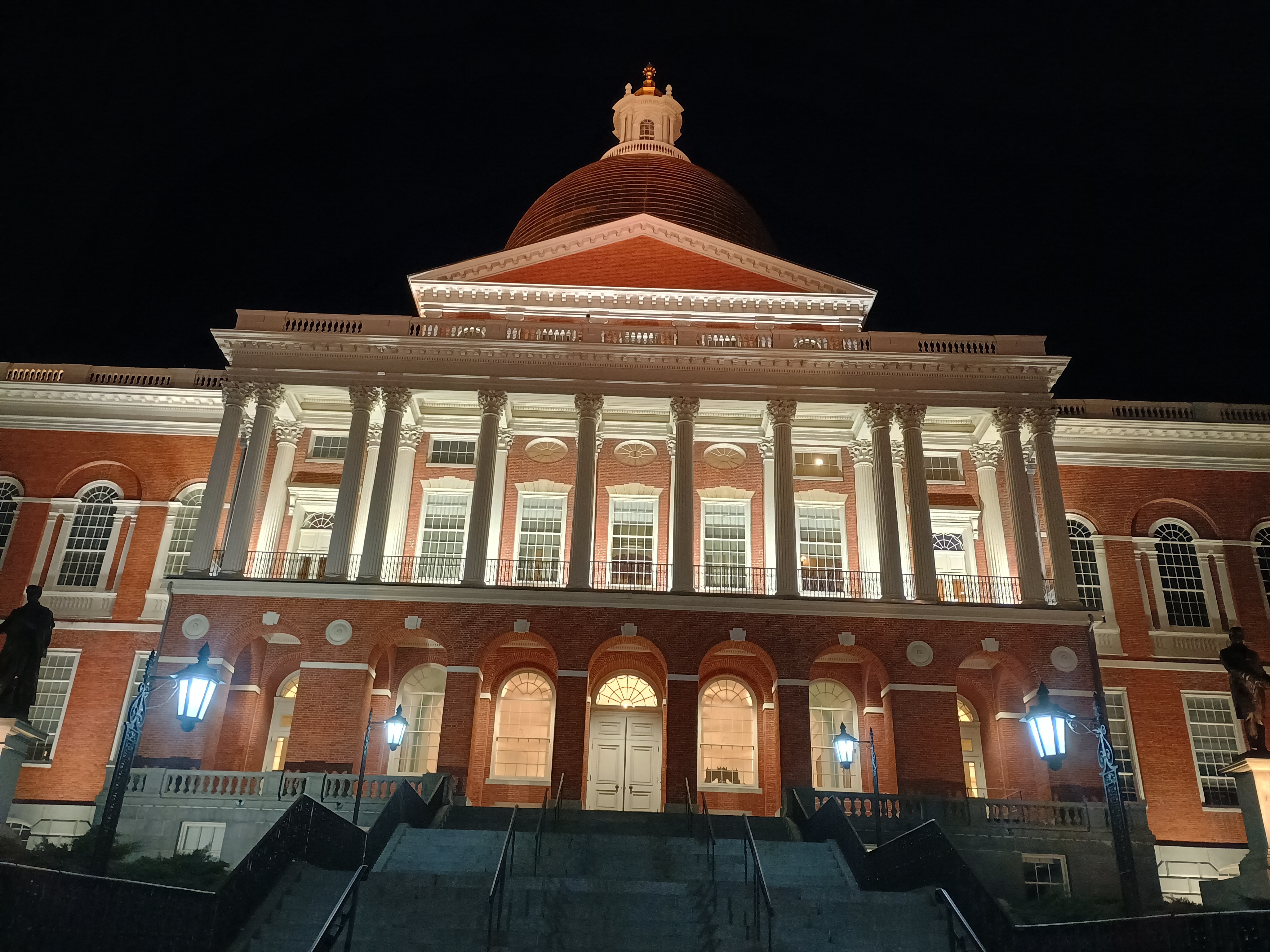
Massachusetts State House – April 2026

From all I have read and reviewed for this year, I have a profound sense of achievement and pride in how these things have come to be and how we mostly still are as we should be. I feel that much since Independence has also been inspired. Earlier this year, I was fortunate to go to Boston. For the Semiquincentennial, I was excited. In the evenings after classes, I would walk all over Boston, with friends, to see the sights.

It is with that, I share this address from the April 1976 General Conference. This was given by N. Eldon Tanner for the Bicentennial. What he spoke of on that date seems as timeless as it fully applies even today. He took his title from the Book of Ether, given to the Jaredites as they first reached this continent:

“Behold, this is a choice land, and whatsoever nation shall possess it shall be free from bondage, and from captivity, and from all other nations under heaven, if they will but serve the God of the land, who is Jesus Christ.” (Ether 2:12)

“This being the first general conference in the bicentennial year of the United States of America, I have been doing much pondering and contemplating of this event as it relates to the gospel and the great plan of life and salvation. We are all reading and hearing much concerning the events connected with the founding of this country, and with the modern devices available to us today, the news media reach throughout the world, and we are all aware of our interrelationship with one another’s countries.

“We would expect every man to be loyal to his native land—the land in which he was born, the land in which he lives, works, and rears his family. I think of the words of Sir Walter Scott in “The Lay of the Last Minstrel”:

“Breathes there the man, with soul so dead,

“Who never to himself hath said,

“This is my own, my native land!

“Whose heart hath ne’er within him burn’d

“As home his footsteps he hath turn’d

“From wandering on a foreign strand!

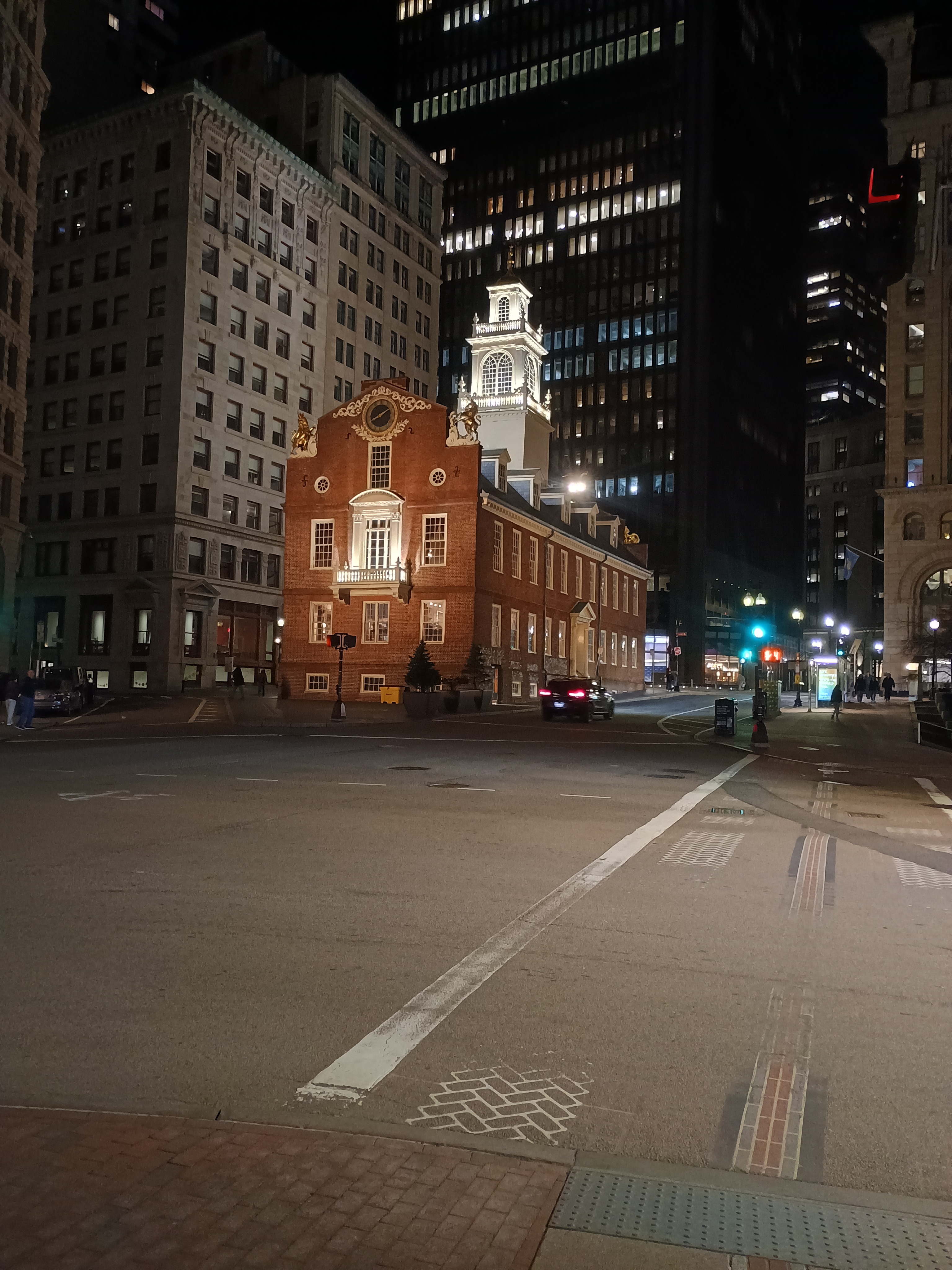
Old State House – Boston – April 2026

“During the last few weeks I, with President Kimball and others of the official party, have had the privilege of attending area conferences in New Zealand, Australia, and the beautiful islands of the South Seas. New Zealand claims to be a choice land and favored by the Lord, and the night before we left Tahiti, one of the Brethren said, “Well, tomorrow we will be driven out of the Garden of Eden.”

“We were most favorably impressed by the beauties of the countries wherever we went. Sister Tanner said, “We surely live in a beautiful world.” Yes, all countries are greatly blessed by the Lord, and each is uniquely different in its beauties, its people, customs, and traditions.

“Today, however, I should like to confine my remarks to a discussion concerning the Western Hemisphere, and particularly to the United States of America, and to point out the destiny of America in the Lord’s eternal plan. The discovery of the Americas was not an accident. The event had been foreordained in the eternal councils. The prophets of old had it in view. Jacob foresaw it when he blessed his son Joseph, calling him “a fruitful bough by a well, whose branches run over the wall … unto the utmost bound of the everlasting hills.” (Gen 49:22, 26.)

“Moses too made promises to the tribe of Joseph, whose land, America, was to be precious for the things of heaven and of earth, and who would “push the people together to the ends of the earth.” (See Deut 33:13-17.) These are just some of the biblical prophecies, and we have the Book of Mormon record which tells of the Jaredites who were the first to come to America. They came at the time of the confusion of languages during the building of the tower of Babel.

“Just as Noah was directed, these people too were instructed to build ships to carry them on the waters. When all was in readiness, they boarded their vessels and “set forth into the sea, commending themselves unto the Lord their God.” (Ether 6:4.)

“The account states, “And when they had set their feet upon the shores of the promised land they bowed themselves down upon the face of the land, and did humble themselves before the Lord, and did shed tears of joy before the Lord, because of the multitude of his tender mercies over them.” (Ether 6:12.)

“Then, six hundred years before the birth of Christ, a prophet by the name of Lehi, who had been crying repentance unto the inhabitants of Jerusalem, was commanded by the Lord to depart with his family into the wilderness. Because of the things which he had testified concerning the wickedness of the people and the pending destruction of Jerusalem, he was mocked and scorned, and the people sought to take his life. In obedience to the Lord’s instructions, he departed with his family and others, and after a period in the wilderness, they too were instructed to build a ship and sail for the promised land. We read, “And it came to pass that after we had sailed for the space of many days we did arrive at the promised land; and we went forth upon the land, and did pitch our tents; and we did call it the promised land.” (1 Ne. 18:23.)

“While in the wilderness Nephi, the son of Lehi, was permitted to see in vision the things that would transpire concerning the destiny of America—the promised land. He said, “And I looked and beheld a man among the Gentiles, who was separated from the seed of my brethren by the many waters; and I beheld the Spirit of God, that it came down and wrought upon the man; and he went forth upon the many waters, even unto the seed of my brethren, who were in the promised land.” (1 Ne. 13:12.)

“This, as we know, refers to Christopher Columbus, who was impelled by the Spirit of God to cross the ocean for the rediscovery of America, thus assisting in the furthering of God’s purposes.

“Columbus himself, in a letter to the Spanish hierarchy, wrote, “Our Lord unlocked my mind, sent me upon the sea, and gave me fire for the deed. Those who heard of my emprise called it foolish, mocked me, and laughed. But who can doubt but that the Holy Ghost inspired me?” (Quoted in Mark E. Petersen, The Great Prologue, Deseret Book Co., 1975, p. 26.)

“During the voyage, after weeks of sailing with no sign of land, mutiny raised its head. Finally, Columbus promised the captains of the Pinta and the Niña, both of whom wanted to turn back, that if no land was sighted in forty-eight hours, they would turn back. Then he went to his cabin and, in his words, “prayed mightily to the Lord.” On October 12, the very next day, they sighted land.

“Nephi saw in vision also the coming of the Pilgrims, who came to escape religious persecution. He foresaw the coming to America of peoples from many nations, their wars and contentions. As Nephi said, they did humble themselves before the Lord and “the power of God was with them, and also that the wrath of God was upon all those that were gathered together against them to battle.

““And I, Nephi, beheld that the Gentiles that had gone out of captivity were delivered by the power of God out of the hands of all other nations.” (1 Ne. 13:18-19.)

“Thus the American colonies attained their independence and set up the government of the United States, all under the divine intervention of God in preparing this land for its divine destiny.

“At this point we pay tribute to those great men who accepted and met the great challenge to establish a constitution for the government of this so-called new land. That this too was divinely inspired is attested by the word of the Lord when he said, “According to the laws and constitution of the people, which I have suffered to be established, and should be maintained for the rights and protection of all flesh, according to just and holy principles;

““That every man may act in doctrine and principle pertaining to futurity, according to the moral agency which I have given unto him, that every man may be accountable for his own sins in the day of judgment.

““Therefore, it is not right that any man should be in bondage one to another.

““And for this purpose have I established the Constitution of this land, by the hands of wise men whom I raised up unto this very purpose, and redeemed the land by the shedding of blood.” (D&C 101:77-80.)

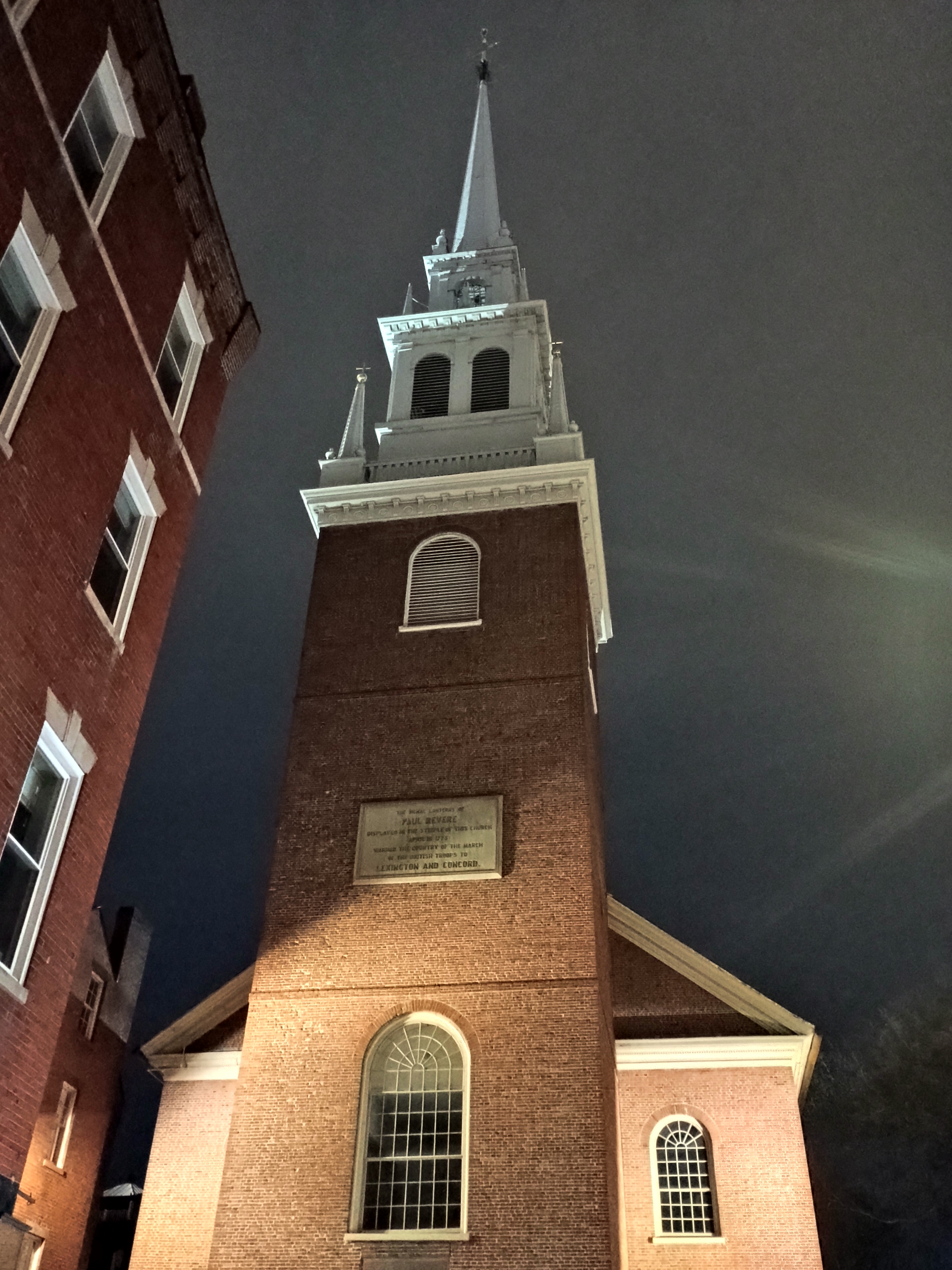
Old North Church – Boston – April 2026

“No constitution on earth has endured longer than this one. We seek, and usually find, the answers to today’s questions in this document of yesterday. It was and is a miracle. Both Washington and Madison referred to it as such. It is an inspired document written under the guidance of the Lord. James Madison, commonly called the father of the Constitution, recognized this inspiration and gave the credit to “the guardianship and guidance of the Almighty Being whose power regulates the destiny of nations, whose blessings have been so conspicuously dispensed to this rising republic.” (Petersen, Prologue, p. 95.)

“We believe that the Constitution was brought about by God to ensure a nation where liberty could abound and where his gospel could flourish. Joseph Smith said, “The Constitution of the United States is a glorious standard—it is founded in the wisdom of God—it is a heavenly banner.” (Petersen, Prologue, p. 75.)

“Among other things, the Constitution guaranteed the religious freedom that allowed the Reformation to continue and flourish. Many of these great reformers stated that their effort was to reassert the basic Christian teachings of the Bible—but they acknowledged that they possessed no authority to administer the ordinances of the Church, or to reestablish the original church of Jesus Christ. Luther said, “Christianity has ceased to exist among those who should have preserved it.”

“Roger Williams, founder of the Baptist Church in America, said, “There is no regularly constituted church on earth, nor any person qualified to administer any church ordinances.” (LeGrand Richards, A Marvelous Work and a Wonder, Deseret Book Co., 1973, p. 29.)

“We believe that both freedom and the continuing reformation that flourished here occurred in preparation for a restoration from heaven of the full gospel of Jesus Christ. That restoration began in the United States of America in the 1820s through the instrumentality of the Prophet Joseph Smith, who was chosen by the Lord and who, through personal manifestations from heavenly messengers, received pertinent records which contained the authentic record of early American peoples and God’s dealings with them. He received the priesthood and authority to reestablish the church of Jesus Christ in these latter days.

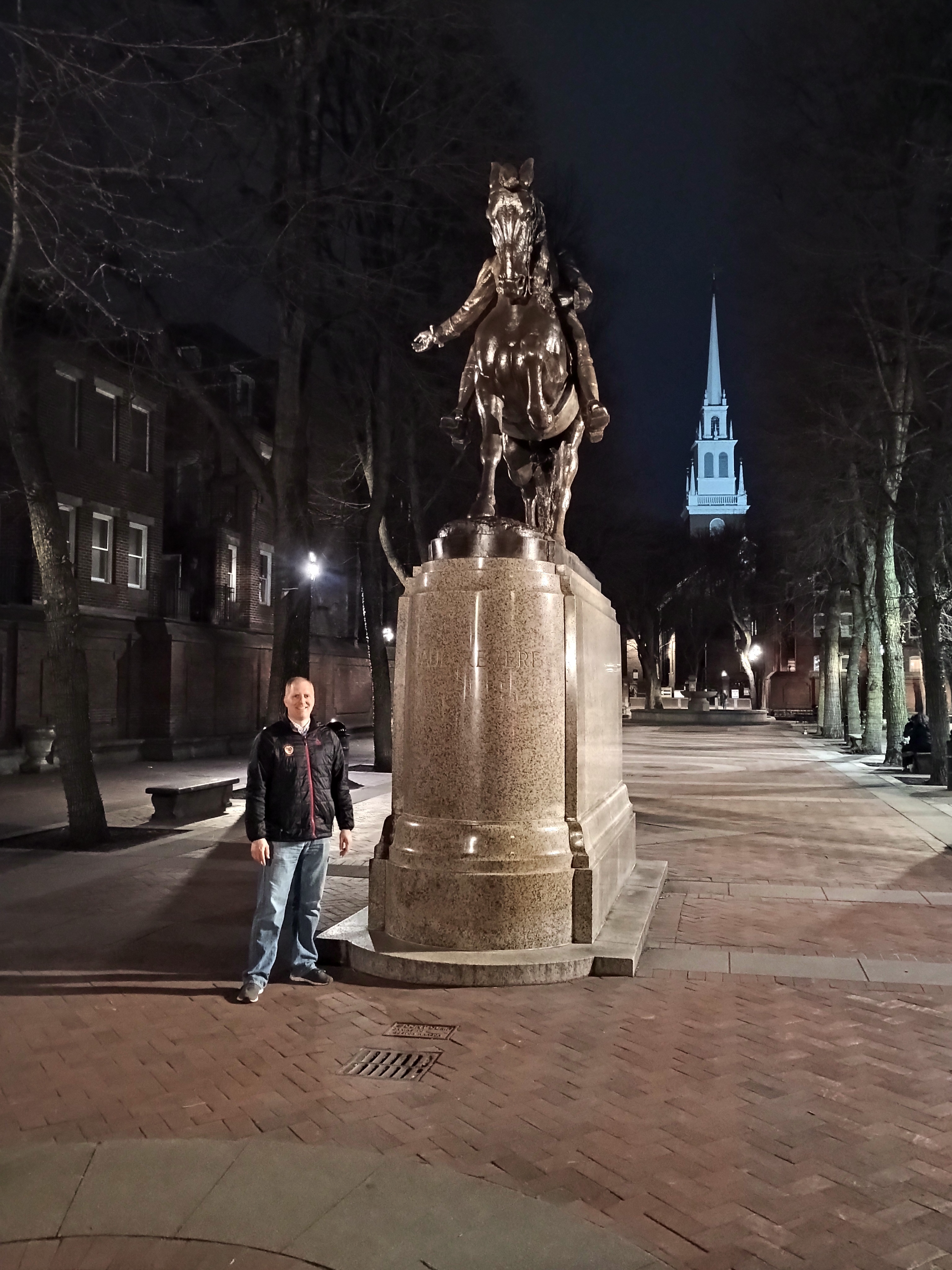
Paul Ross and Paul Revere statue – Boston – Old North Church in background – April 2026

“At the time of this restoration, God the Father and his Son Jesus Christ actually appeared to Joseph Smith, as they had appeared to leaders of previous dispensations. They announced to him that Christ’s church would be reestablished upon the earth, with a restoration of the same principles and ordinances and organization which existed in the primitive church, from which there had been an apostasy as documented by irrefutable evidence. This restoration was the greatest event in the history of mankind since the birth, death, and resurrection of our Savior, Jesus Christ.

“Significantly, the early Americans to whom we have referred were aware of the birth, death, and resurrection of the Savior because they saw the same signs and wonders as those in the Old World foretelling the coming of the Lord, his life, mission, and subsequent death and resurrection.

“Referring to these same early Americans, the Lord said, as recorded in the New Testament, “And other sheep I have, which are not of this fold: them also I must bring and they shall hear my voice; and there shall be one fold, and one shepherd.” (1 John 10:16.)

“In the Book of Mormon we have a beautiful account of Christ’s visit to these “other sheep” following his resurrection, when they heard his voice and recognized him as he showed the nail prints in his hands and feet. We know these were the “other sheep” because he said, “Ye are they of whom I said: Other sheep I have which are not of this fold.” (3 Ne. 15:21.) He taught them the gospel. He instituted the sacrament and ordained disciples. He gave authority to confer the Holy Ghost, healed the sick, and blessed the little children. He prayed unto the Father for them.

“We read, “The eye hath never seen, neither hath the ear heard, before, so great and marvelous things as we saw and heard Jesus speak unto the Father;

““… and no one can conceive of the joy which filled our souls at the time we heard him pray for us unto the Father.” (3 Ne. 17:16-17.)

“Now, what of America’s future? How can we best show our appreciation to God for these marvelous blessings of freedom, of a place where his true and everlasting gospel was restored, of the preparation and divine guidance in every event leading to that most significant event? We must remember what the Lord told the Jaredites when they were first brought to this land: “Behold, this is a choice land, and whatsoever nation shall possess it shall be free from bondage, and from captivity, and from all other nations under heaven, if they will but serve the God of the land, who is Jesus Christ, who hath been manifested by the things which we have written.” (Ether 2:12; italics added.)

“Many years ago in a volume entitled Beacon Lights of History, Dr. John Lord, referring to the discovery of America, said, after speaking of her great potential, “The world has witnessed many powerful empires which have passed away and left ‘not a track behind.’ What remains of the antediluvian world? … What remains of Nineveh, of Babylon, of Thebes, of Tyre, of Carthage—those great centers of wealth and power? What remains of Roman greatness even, except in laws and literature and renovated statues? … What is the simple story of all the ages?—industry, wealth, corruption, decay, and ruin. What conservative power has been strong enough to arrest the ruin of the nations of antiquity?

““Now if this is to be the destiny of America—an unbounded material growth, followed by corruption and ruin—then Columbus has simply extended the realm for men to try material experiments. Make New York a second Carthage, and Boston a second Athens, and Philadelphia a second Antioch, and Washington a second Rome, and we simply repeat the old experiments.

““But has America no higher destiny than to repeat the old experiments and improve upon them and become rich and powerful? Has she no higher and nobler mission? If America has a great mission to declare and to fulfil, she must put forth altogether new forces, and these not material. And these alone will save her and save the world. … The real glory of America is to be something entirely different from that of which the ancients boasted. And this is to be moral and spiritual—that which the ancients lacked.”

“We are all a part of America’s future. Our job is to learn and benefit from the past and to go forward in righteousness, keeping the commandments of God. In this connection the prophet Lehi said, “Wherefore, this land is consecrated unto him whom he shall bring. And if it so be that they shall serve him according to the commandments which he hath given, it shall be a land of liberty unto them; wherefore, they shall never be brought down into captivity; if so, it shall be because of iniquity; for if iniquity shall abound cursed shall be the land for their sakes, but unto the righteous it shall be blessed forever.” (2 Ne. 1:7.)

“As we pray daily to God for guidance, we should all make the same plea as George Washington did in his prayer for our country:

““Almighty God, who has given us this good land for our heritage, we humbly beseech Thee that we may always prove ourselves a people mindful of Thy favor and glad to do Thy will.

““Bless our land with honorable industry, sound learning and pure manners.

““Save us from violence, discord and confusion; from pride and arrogancy, and from every evil way.

““Defend our liberties, and fashion into one united people the multitudes brought out of many kindreds and tongues.

““Endue with the spirit of wisdom those whom in Thy name we entrust the authority of government, that there may be peace and justice at home, and that through obedience to Thy law, we may show forth Thy praise among the nations of the earth.

““In the time of prosperity, fill our hearts with thankfulness, and in the day of trouble, suffer not our trust in Thee to fail.

““All of which we ask through Jesus Christ, our Lord. Amen.”

“We encourage our people to be good, loyal, law-abiding citizens. “We believe in being subject to kings, presidents, rulers, and magistrates, in obeying, honoring, and sustaining the law.” (A of F 1:12.)

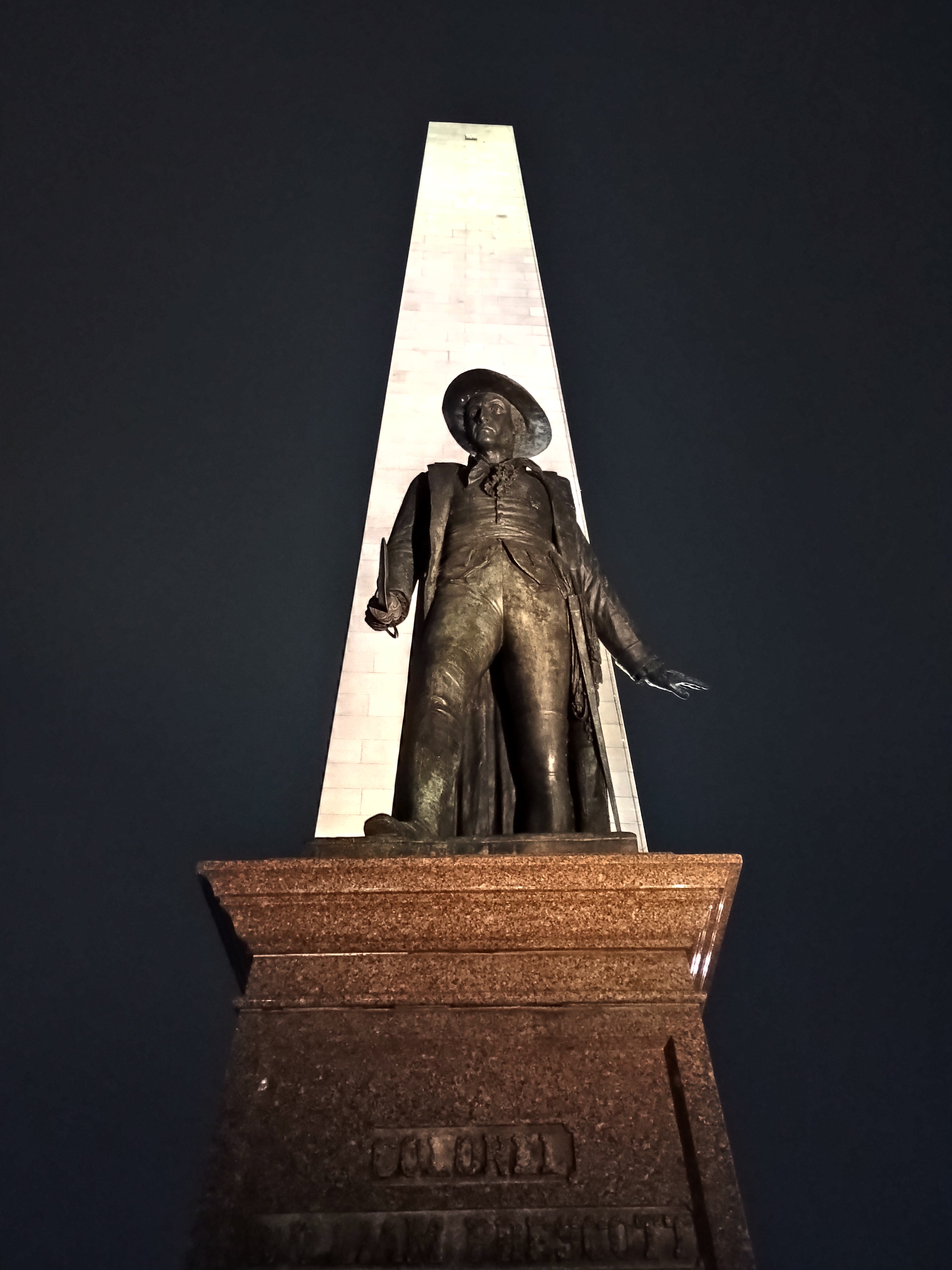
William Prescott statue – Bunker Hill Monument – April 2026

“Also, it is our duty to seek diligently for and support and uphold good, honest, honorable, and wise representatives to govern us. Let me reiterate the message left with the Saints nearly sixty years ago at the general conference in April 1917 when Elder Anthony W. Ivins, after discussing religious liberty and the Constitution, said, “I feel authorized to say, here this afternoon, that these liberties which have come to men, both religious and civil, have not been established by the Lord to be destroyed, but that they are here to remain until liberty shall prevail from the rivers to the ends of the earth, until God’s kingdom shall be established among men, and his will done upon earth as it is done in heaven. Until the universal Fatherhood of God, and brotherhood of man shall be recognized, and the kingdoms of this world become the kingdoms of Christ, who shall reign as Prince of Peace.” (Conference Reports, April 1917, pp. 54–55.)

“And I bear testimony that The Church of Jesus Christ of Latter-day Saints is the kingdom of God here upon the earth, with the Lord directing the work through our prophet, President Spencer W. Kimball. May I urge everyone everywhere to help bring to pass righteousness, in whatever country you may reside, by obedience to the laws and ordinances of the gospel. If you are active members of the Church you will know what they are. If you are not, may I invite you to avail yourselves of the opportunity to investigate and gain a knowledge and testimony for yourselves that the gospel in its fulness has been restored, with the authority to administer the ordinances thereof, and is here upon the earth.

“Only as we accept and live the teachings of the gospel can the destiny which God planned for America be realized and the world united in peace and brotherhood. That this may speedily come to pass I humbly pray in the name of Jesus Christ. Amen.

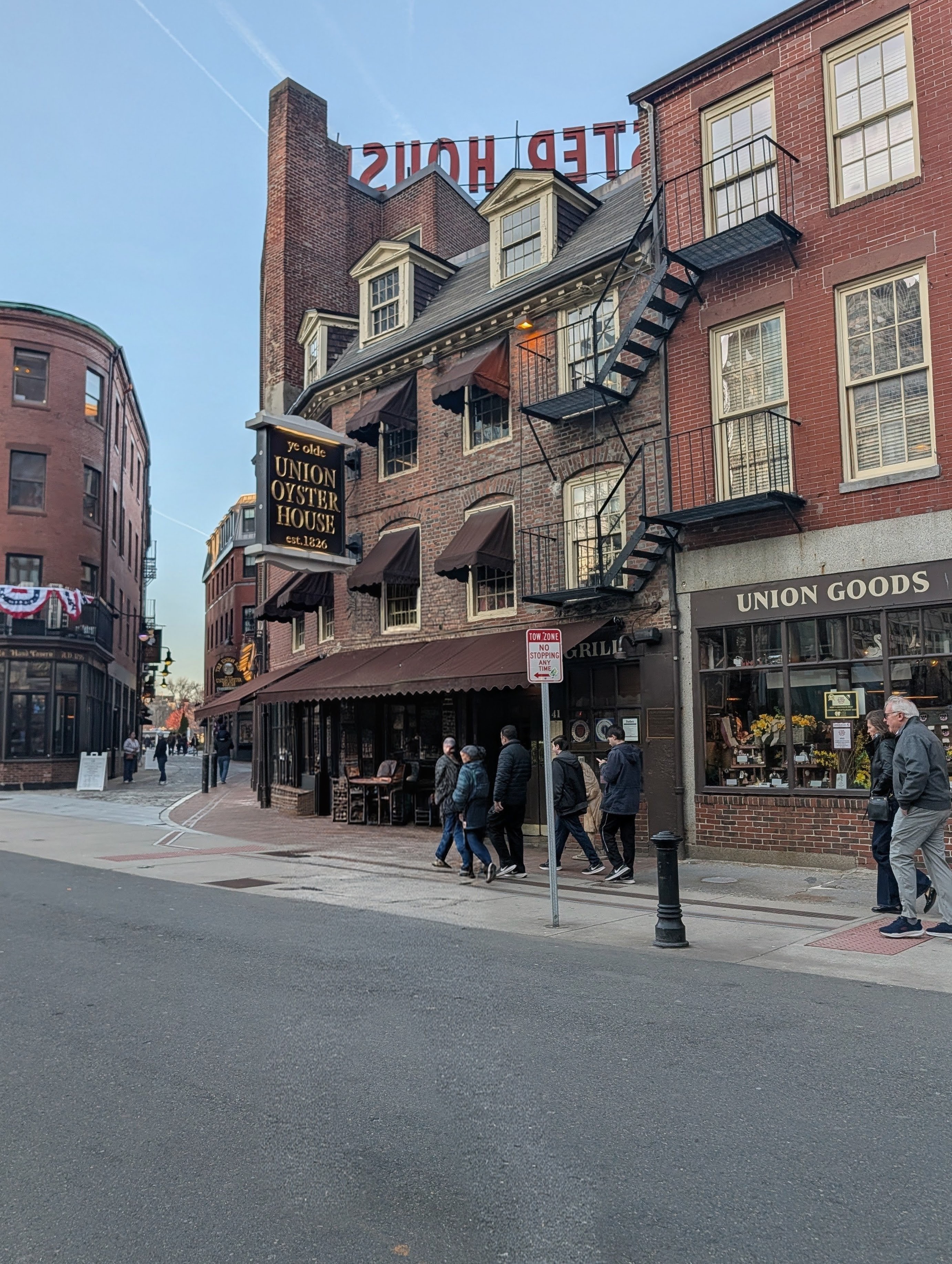
Union Oyster House – Boston – April 2026
Oysters at Union Oyster House – Boston – April 2026 – Holly Sutherland – Tecla Druffel

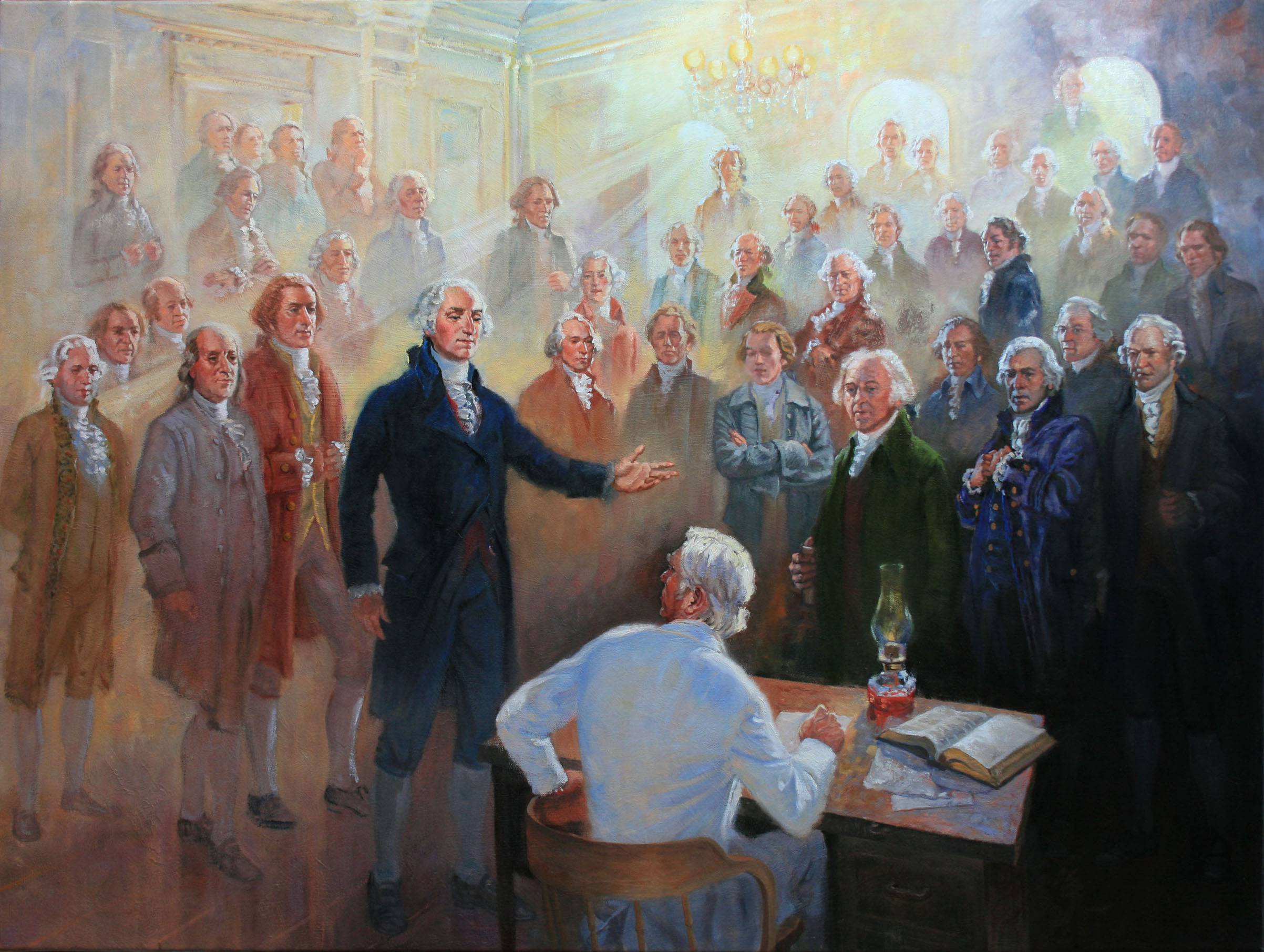
Wilford Woodruff and Founding Fathers

Wilford Woodruff’s vision of the Founding Fathers requesting Temple Ordinances

We are moving soon, but the Burley 11th Ward gave me another chance to address them. Since I received a number of requests for a copy of the talk, which is really just a collage of various items I could find online, the Journal of Discourses, the Saints second and third volumes, and other various histories. Here is the text of the talk I wrote, that does not mean it is the talk I gave…

I first addressed the freedoms we have as contrasted in the Saints third volume related to Germany. I said the word Jew and Israel from the stand and did not fear reprisal. I listen to free radio anytime I want and even seek out British radio from time to time and there is nothing illegal. Lastly, we could congregate without the worry of those in our midst about what was said or in the actual act of meeting.

Then to the following:

Declaration of Independence – We hold these truths to be self-evident, that all men are created equal, that they are endowed by their Creator with certain unalienable Rights, that among these are Life, Liberty and the pursuit of Happiness.

George Washington: “The success, which has hitherto attended our united efforts, we owe to the gracious interposition of Heaven, and to that interposition let us gratefully ascribe the praise of victory, and the blessings of peace.”

Alexander Hamilton: “The Sacred Rights of mankind are not to be rummaged from among old parchments or musty records. They are written . . . by the Hand of Divinity itself.” “For my own part, I sincerely esteem it a system, which without the finger of God, never could have been suggested and agreed upon by such a diversity of interests.”

Thomas Jefferson: “The God who gave us life gave us liberty at the same time.”

John Adams: “As I understand the Christian religion, it was, and is, a revelation.”

Benjamin Franklin: “The longer I live the more convincing Proofs I see of this Truth. That God Governs in the Affairs of Men!—And if a Sparrow cannot fall to the Ground without his Notice, is it probable that an Empire can rise without his Aid?—We have been assured, . . . in the Sacred Writings, that ‘except the Lord build the House, they labour in vain that build it.’ I firmly believe this;—and I also believe that without his concurring Aid we shall succeed in this political building no better than Builders of Babel.”

James Madison: “It is impossible for the man of pious reflection not to perceive in it a finger of that Almighty hand which has been so frequently and signally extended to our relief in the critical stages of the revolution.”

Samuel Adams: “Revelation assures us that ‘Righteousness exalteth a Nation’—Communities are dealt with in this World by the wise and just Ruler of the Universe. He rewards or punishes them according to their general Character.”

Charles Pinckney: “When the great work was done and published, I was . . . struck with amazement. Nothing less than that superintending hand of Providence, that so miraculously carried us through the war, . . . could have brought it about so complete, upon the whole.”

On May 4, 1842, he called to his side nine of the most faithful of his brethren—Hyrum Smith, Brigham Young, Heber C. Kimball, Willard Richards, Newell K. Whitney, and others—and later their wives came with them to the upper floor of the Red Brick Store in Nauvoo. 

Joseph was seeking to fulfill the promise from D&C 124, given in 1841, which the Lord would reveal to Joseph “all things pertaining to this house, and the priesthood thereof, and the place whereon it shall be built.” 

He had started, “If it should be the will of God that I might live.” Then he corrected and said, “It is not the will of the Lord that I should live, and I must give you, here in this upper room, all those glorious plans and principles whereby men are entitled to the fulness of the priesthood.” He proceeded in an improvised and makeshift way to do so.

We have from Brigham Young that after they had received these blessings the Prophet said: “Brother Brigham, this is not arranged right. But we have done the best we could under the circumstances in which we are placed, and I wish you to take this matter in hand and organize and systematize all these ceremonies.”

Brigham Young later said, “I did so. And each time I got something more, so that when we went through the temple at Nauvoo I understood and knew how to place them there. We had our ceremonies pretty correct.”

While the Nauvoo Temple was started in 1841, the first endowments were performed in the winter of 1845 and into 1846.  Baptisms had started in the Mississippi River prior to the temple and moved into the temple baptistery soon after it was completed and dedicated, well before the rest of the temple was done.  Brigham, leading the church, was personally overseeing the organization and perfection of the endowment and other ordinances that started in Nauvoo. 

After arriving in Salt Lake City, the church used the top floor of the Council House, starting in 1852 until the Endowment House was completed in 1855.  It was in this building that endowments, prayer circles, some missionary training, and some setting aparts were conducted.  The use of the Endowment House ended in 1877 with the completion of the St George Temple.  That building stood until Wilford Woodruff heard that unauthorized sealings were occurring there and ordered it razed in 1889. 

The St George Temple was the only one completed during Brigham Young’s 30 year tenure as President.  It was dedicated on 1 January 1877 in three dedicatory prayers under the direction of Brigham.  The baptistery by Wilford Woodruff, the main floor by Erastus Snow, and the sealing room by Brigham Young Jr.  Wilford Woodruff served as St George Temple President from 1877 to 1884.  Brigham had to be carried up the stairs, but he stood and spoke in the Assembly Room. 

“When I think upon this subject, I want the tongues of seven thunders to wake up the people,” he declared. “Can the fathers be saved without us? No. Can we be saved without them? No. And if we do not wake up and cease to long after the things of this earth, we will find that we as individuals will go down to hell.”

Brigham lamented that many Saints were pursuing worldly things. “Supposing we were awake to this thing, namely the salvation of the human family,” he said, “this house would be crowded, as we hope it will be, from Monday morning until Saturday night.”

On 9 January 1877, the first baptisms for the dead were performed in the St George Temple.  The first endowment for the dead was performed on 11 January 1877.  Brigham and Wilford personally oversaw the ordinances being performed.  Wilford began wearing a white suit, starting the trend that continues to this day. 

All endowments to this point had been done and passed by word of mouth.  It was in St George, far from Salt Lake City, that the ordinances were first written down.  Brigham also wanted to make sure the record was preserved and that they were standardized.  They were read to Brigham time and time again who would then approve or continue to revise the ordinances.  Brigham went home to Salt Lake City in April 1877.  He stopped and dedicated the spot for the Manti Temple on the way home.

Wilford Woodruff then wrote in his journal on Sunday 19 August 1877, “I spent the evening in preparing a list of the noted men of the 17 century and 18th, including the signers of the Declaration of Independence and presidents of the United States, for baptism on Tuesday the 21 Aug 1877.”

His journal entry for August 21 reads, “I, Wilford Woodruff, went to the temple of the Lord this morning and was baptized for 100 persons who were dead, including the signers of the Declaration of Independence. … I was baptized for the following names.” He then listed the names of one hundred men.

Elder Woodruff continued his journal entry: “When [John Daniel Thompson] McAllister had baptized me for the 100 names, I baptized him for 21, including Gen. Washington and his forefathers and all the presidents of the United States that were not on my list except Buchanan, Van Buren, and Grant.” (The work for these presidents has since been done.)

“It was a very interesting day,” Elder Woodruff continued. “I felt thankful that we had the privilege and the power to administer for the worthy dead, especially for the signers of the Declaration of Independence, that inasmuch as they had laid the foundation of our Government, that we could do as much for them as they had done for us.

“Sister Lucy Bigelow Young went forth into the font and was baptized for Martha Washington and her family, and seventy of the eminent women of the world. I called upon the brethren and sisters who were present to assist in getting endowments for those that we had been baptized for today.” (Wilford Woodruff’s journal, typescript, vol. 7, Church History Library; spelling and punctuation modernized.)

The first public mention of these events was made nearly a month after the baptisms were performed. In an address in the Tabernacle on Temple Square on 16 September 1877, Elder Woodruff first told publicly of the visitation of the signers of the Declaration of Independence.

“You have had the use of the Endowment House for a number of years, and yet nothing has ever been done for us. We laid the foundation of the government you now enjoy, and we never apostatized from it, but we remained true to it and were faithful to God. (Conference Report, April 10, 1898; Discourses of Wilford Woodruff, pp. 160-61)

During the 68th Annual General Conference of the Church which was held in April 1898, President Woodruff recounted the sacred experience:

I am going to bear my testimony to this assembly, if I never do it again in my life, that those men who laid the foundation of this American government and signed the Declaration of Independence were the best spirits the God of heaven could find on the face of the earth. They were choice spirits, not wicked men. General Washington and all the men that labored for the purpose were inspired of the Lord.

Another thing I am going to say here, because I have a right to say it.  Every one of those men that signed the Declaration of Independence, with General Washington, called upon me, as an Apostle of the Lord Jesus Christ, in the Temple at St. George, two consecutive nights, and demanded at my hands that I should go forth and attend to the ordinances of the House of God for them.  Men are here, I believe, that know of this, Brother John D. T. McAllister, David H. Cannon and James S. Bleak.  Brother McAllister baptized me for all those men, and then I told these brethren that it was their duty to go into the Temple and labor until they had got endowments for all of them.  They did it.  Would those spirits have called up on me, as an Elder in Israel to perform that work if they had not been noble spirits before God?  They would not. (Wilford Woodruff, Conference Report, April 1989, pp. 89-90.)

“They waited on me for two days and two nights,” he said,

“I thought it very singular, that notwithstanding so much work had been done, and yet nothing had been done for them.” (Journal of Discourses, 19:229.)

I was also present in the St. George Temple and witnessed the appearance of the Spirits of the Signers….the spirits of the Presidents….and also others, such as Martin Luther and John Wesley….Who came to Wilford Woodruff and demanded that their baptism and endowments be done. Wilford Woodruff was baptized for all of them. While I and Brothers J.D.T. McAllister and David H Cannon (who were witnesses to the request) were endowed for them. These men… laid the foundation of this American Gov., and signed the Declaration of Independence and were the best spirits the God of Heaven could find on the face of the earth to perform this work. Martin Luther and John Wesley helped to release the people from religious bondage that held them during the dark ages. They also prepared the people’s hearts so they would be ready to receive the restored gospel when the Lord sent it again to men on the earth.” (Personal journal of James Godson Bleak – Chief Recorder of the St. George Temple.)

In 1986, some of the staff of the Family History Library’s LDS Reference Unit were assigned to compile and computerize all the existing genealogical data on the founding fathers, to identify their families, and to document completed temple ordinances for each. For purposes of the project, a founding father was identified as one who had signed one or more of the following documents: the Articles of Association (1774), the Declaration of Independence (1776), the Articles of Confederation (1778), or the Constitution (1787).

The library study of 1986 revealed that there were no sealings of children to parents performed at the time the baptisms and endowments were performed. As a note, the ongoing revelation related to sealings to parents was not revealed until 1894.  It was then that the Law of Adoption, or sealing to prominent church leaders, was discontinued and we were encouraged to do genealogical work to compile the pedigree of the entire human family.  It was then that the Utah Genealogical Society was founded that has snowballed into the fantastic work of FamilySearch and all its appendages. 

He also recorded that George Washington, John Wesley, Benjamin Franklin, and Christopher Columbus were ordained High Priests at the time.

Temple work was performed on behalf of the following well-known and respected men and women in the St. George Utah Temple in August 1877.

Founding Fathers: William Hooper (NC), Joseph Hewes (NC), John Penn (NC), Button Gwinnett (GA), Lyman Hall (GA), George Walton (GA), Edward Rutledge (SC), Thomas Heyward Jr. (SC), Thomas Lynch (SC), Arthur Middleton (SC), Samuel Chase (MD), William Paca (MD), Thomas Stone (MD), Charles Carroll (MD), George Wythe (VA), Richard Henty Lee (VA), Thomas Jefferson (VA), Benjamin Harrison (VA), Thomas Nelson Jr. (VA), Francis Lightfoot Lee (VA), Carter Braxton (VA), Robert Morris (PA), Benjamin Rush (PA), Benjamin Franklin (PA), John Morton (PA), George Clymer (PA), James Smith (PA), George Taylor (PA), James Wilson (PA), George Ross (PA), Caeser Rodney (DE), George Read (DE), Thomas McKean (DE), Philip Livingston (NY), Francis Lewis (NY), Lewis Morris (NY), Richard Stockton (NJ), John Witherspoon (NJ), Francis Hopkinson (NJ), John Hart (NJ), Abraham Clark (NJ), Josiah Bartlett (NH), William Whipple (NH), Matthew Thornton (NH), Samuel Adams (MA), John Adams (MA), Robert Treat Paine (MA), Elbridge Gerry (MA), Stephen Hopkins (RI), William Ellery (RI), Roger Sherman (CN), Samuel Huntington (CN), William Williams (CN), and Oliver Wolcott (CN).

Note: Temple work was not done for John Hancock or William Floyd as it had already been completed previously.

Presidents of the United States: George Washington, John Adams, Thomas Jefferson, James Madison, James Monroe, John Quincy Adams, Andrew Jackson, William Henry Harrison, John Tyler, James Knox Polk, Zachary Taylor, Millard Fillmore, Franklin Pierce, Abraham Lincoln, and Andrew Johnson.  Temple work was not done for James Buchanan, Martin Van Buren, or Ulysses S. Grant.

Other eminent men baptized by Wilford Woodruff in the St. George Utah Temple in August 1877 include: Sir Edward Gibbon, Johann Wolfgang von Goethe, Oliver Goldsmith, Henry Grattan, Humboldt, Alexander von Irving, Washington Jackson, Thomas Jonathan “Stonewall” Johnson, Samuel Juarez, Benito Pablo Kemble, John Philip Liebig, Baron Justus von Livingstone, David Macaulay, Thomas Babington Nelson, Lord Horatio O’Connell, Daniel Peabody, George Powers, Hiram Reynolds, Sir Joshua Schiller, Johann Christoph Friedrich von Scott, Sir Walter Seward, William Henry Stephenson, George Thackeray, William Makepeace, Vespucci, Amerigo Webster, Daniel Wesley, John Wordsworth, William Parepa, Count Dimitrius, Martha Washington and her family, John Washington (Great Grandfather of George Washington), Sir Henry Washington, Lawrence Washington (Brother of George Washington), Augustine Washington (Father of George Washington), Lawrence Washington (Father of Augustine), Lawrence Washington, Daniel Park Custis, John Park Custis (Son of Daniel and Martha Parke Custis), and Martin Luther.

Eminent Women baptized include: Jean Armour (1767—1834) of Scotland, Jean Armour Burns (Wife of Robert Burns) (1759—1796), Jane Austen (1775—1817) of England, novelist, Mary Ball (1708—1789) of America, Mary Ball Washington (Mother of George Washington) (1732—1799), Sarah Bernard (1800—1879) of England, Sarah Barnard Faraday (wife of Michael Faraday (1791—1867), Charlotte Bronte (1816—1855) of England, novelist, Felicia Dorothea Browne (1793—1835) of England, Elizabeth Barrett Browning (1806—1861) of England, poet, (wife of Robert Browning) (1812—18?), Martha Caldwell Calhoun (d. 1802) of America (mother of John Caldwell Calhoun) (1782—1850), Martha Parke Custis (1755—1773) of America (Daughter of Martha Washington) (1732—1802), Martha Dandridge Washington (1732—1802) of America (wife of George Washington) (1732—1799),  Rachel Donelson Jackson (1767—1828) of America (wife of Andrew Jackson (1767—1845), and Abigail Eastman Webster (1737—1816) of America (mother of Daniel Webster (1782—1852), to name but a few. Temple work was performed for a total of 70 eminent women.

During most of our national history Columbus and the Founders were considered heroes with determination and foresight.  Cities, rivers, and many other places were named after them.  More recently there has been a wide spread effort, designed especially to indoctrinate young people, which slanders Columbus, the Founders and their accomplishments.  Columbus is held personally responsible for centuries of mistreatment of Native Americans.  The Founders are portrayed as being greedy and motivated by selfish interests. All of this is as astonishing as it is misleading.  

From the Lord’s perspective among the most important events of the history of the world was the discovery and founding of America.  1 Ne 11-14.  Nephi was referring to Columbus when he wrote:  “I looked and beheld a man among the Gentiles, who was separated from the seed of my brethren by the many waters; and I beheld the Spirit of God, that it came down and wrought upon the man; and he went forth upon the many waters, even unto the seed of my brethren, who were in the promised land” 1 Ne 13:12.  By the Founders “the Lord God will raise up a mighty nation…even on the face of this land.” 1 Ne 22:7.

Go on to life and history of George Ross of Pennsylvania, signer of Declaration of Independence.  

Plain City Cemetery Incident

I wanted to share this interesting little incident that happened on Friday.

Amanda and the rest of the kids went to Utah for the weekend.  Aliza stayed because she had school and rode down with me on Friday.

As we neared Plain City I asked if she remembered Great Grandpa Milo.  She said that she did.  She then asked if we could drive past his house.  (She often asks to drive past places.)

We drove past and I asked if she wanted to stop at the Plain City Cemetery.  She said yes.

We stopped and walked over to Grandpa and Grandma Ross’ grave stone.

Aliza with Milo & Gladys Ross tombstone

Aliza with Milo & Gladys Ross tombstone

I asked if she wanted to see Grandpa Milo’s mother’s grave.  She agreed and we walked over to the grave of Ethel Sharp Ross.

I also took her to the grave of Paul Ross, 1922-1932, and I explained my relationship to him.

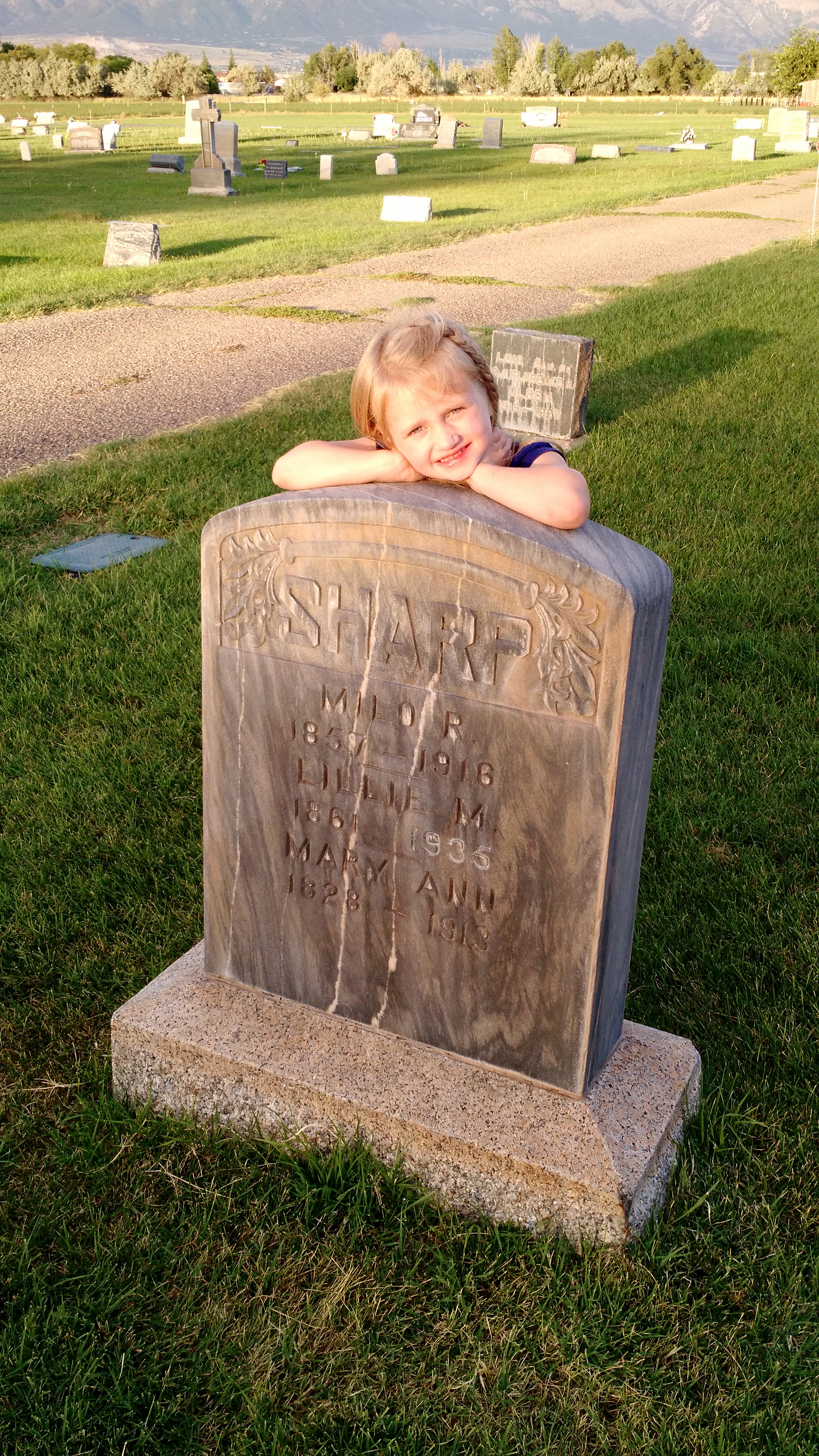
We then walked to the grave of Ethel Sharp Ross’ parents, Milo Riley and Mary Ann “Lillie” Stoker Sharp.

Aliza with Milo and Mary Ann "Lillie" Sharp, also Mary Ann Stoker.

Aliza with Milo and Mary Ann “Lillie” Sharp, also Mary Ann Sharp’s tombstone.

Aliza recognized the Lillie, although Lillian was only loosely named after this Lillie.  We use the Lillie spelling for her nickname based on this Lillie though.  I explained the Milo name, the relationships, and how Mary Ann on this stone is Mary Ann Bailey Sharp, Milo Riley’s mother.

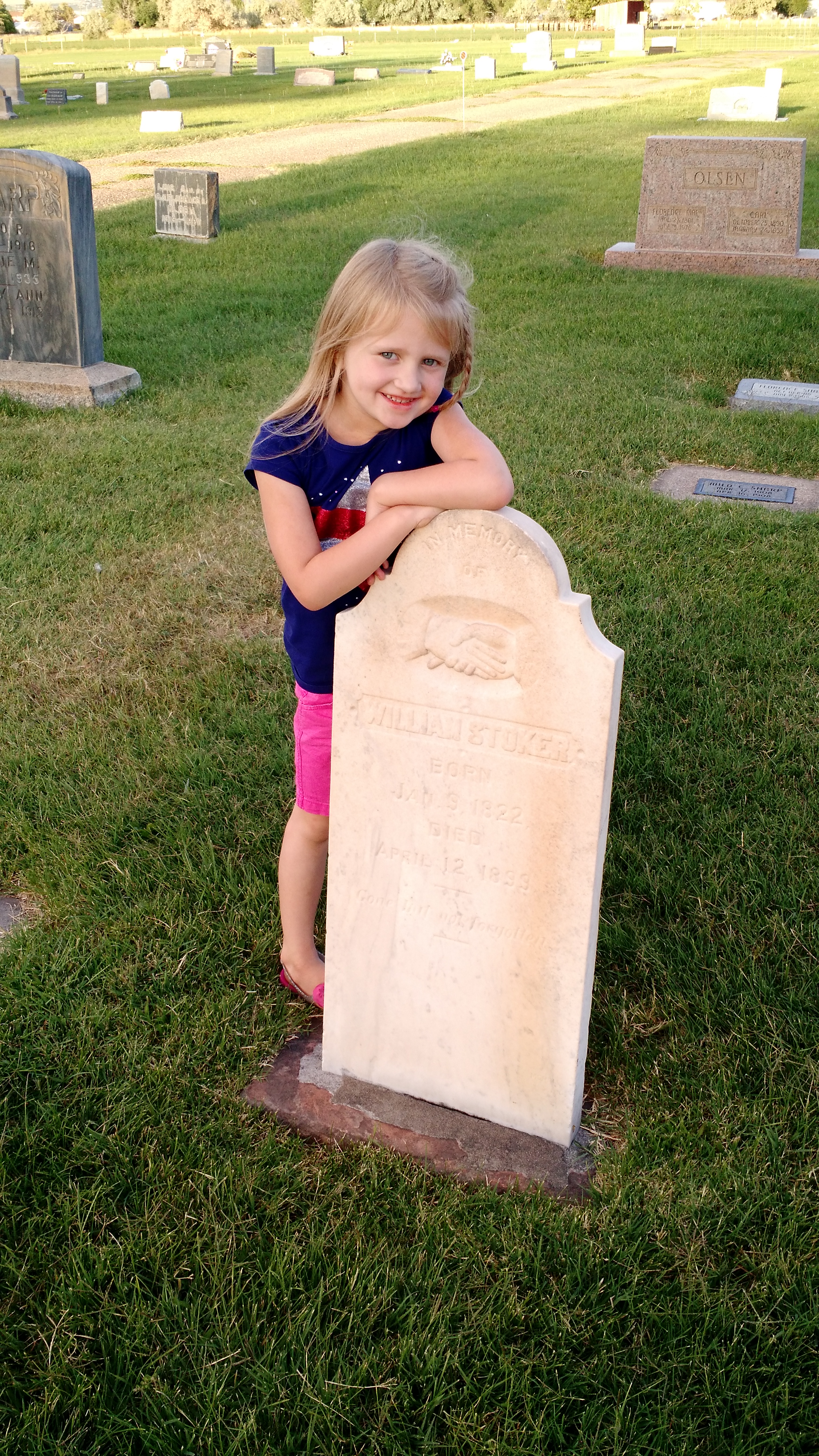
We then walked over to Lillie’s father, William Edward Stoker.  In this picture below, you can see Mary Ann or Lillie Sharp’s proximity to her father’s grave.  Her mother died in England before the family could immigrate to Utah.

Aliza with William Edward Stoker

Aliza with William Edward Stoker’s grave stone

Needless to say, being related to some of the older graves in the cemetery, we are related to a number of the other families in the graveyard.  We walked around for quite a while talking about names and how they are related.

I started walking back toward the car and Aliza wanted to go back over by William Stoker.  I told her we did not have any more family graves over in that part of the cemetery.  She insisted, “we didn’t stop at the other family tombstone for a picture.”  Knowing there was no other family over there, I followed her so she could see for herself.

She then stopped at another grave.  She wanted to take a picture of it.  I told her we were not related to them and she said, “Yes we are, I want a picture.”  Rather than have a battle in the cemetery over it, I took her picture.

Aliza with William and Martha Wayment tomb stone

Aliza with William and Martha Wayment tombstone

If you look closely, you can see William Stoker’s grave behind William Wayment’s grave marker, and the Sharp tombstone right above Aliza.  I took the picture and it dawned on me, Amanda’s Great Grandfather’s middle name was Wayment and his mother had been a Wayment.  I was not sure if these Wayments were related to Amanda’s Wayments or not.

Sure enough, Aliza was right.  While not related to me, these were her relatives!  These are her 5th Great Grandparents through Amanda’s line.

I was a bit struck by the determination she had that we had another family grave I had not taken her.  Dumbfounded that they were in fact her family, and not mine!  It inspired and spooked at the same time.

Amanda’s Great Grandfather is Walter Wayment Hansen, 1904 -1995.  His mother is Martha Ann Wayment Hansen, 1877-1908.  Her father is Joseph Wayment, 1844 – 1931.  His parents are William Wayment, 1822 – 1883, and Martha Brown, 1823 – 1905, the individuals whose graves Aliza wanted a picture.  My father-in-law, Bryan Hemsley, did not remember they were buried in Plain City.

Martha Brown and William Wayment's tombstone

Martha Brown and William Wayment’s tombstone

A quick internet search located this brief history of William and Martha Wayment.  In reading, the Stokers and Wayments came to America both on the same ship, the Amazon!  Multiple linkages in history between the two families.  I corrected a couple of spellings in the biography.

Martha Brown was born May 26, 1823 in Bassingbourne, Cambridgeshire, England to William Brown and Mary Wade. Cambridge is a flat coastal plain located in the southeast part of England. The climate is moderate with much rainfall which produces much vegetation. Martha met and married William Wayment on Christmas Day December 25, 1841 in the Bassingbourne Parish in Whaddon, Cambridgeshire, England. They both signed the certificate which seemed an unusual procedure to the clerk. William signed his name Whayment. He gave his age as 20 and was listed as a laborer. Martha gave her age as 19 and was listed as a spinster. William and Martha made their home with his widowed mother, Mary Rook Wayment. Several members of her family have told of this incident – “as a bride living in her mother-in-laws home”, Martha found that circumstances and conditions were not always pleasant. One stressful day Martha threatened to leave the home and her husband. She went into a small room (or a clothes closet) to get some of her things, her mother-in-law quickly closed and locked the door. There Martha was kept until she promised not to leave. Satisfactory adjustments were made and she kept her promise. Martha’s grandfather, William Brown of Whaddon has been described as a wealthy farmer. His son, Samuel, Martha’s father was disinherited after he married a servant girl, Mary Wade, who worked for his parents. He was a butcher by trade. He extended his business and it is said he became a well to do merchant. Martha had seven brothers and 1 sister all born in Bassingbourne. It is said the Browns were a family of large men, all of them being over 6 ft tall, and long lived. Martha was the only one to live to be over 80, however. Though a hard worker William, Martha father, never accumulated much wealth. Their modest home and limited circumstances was a source of embarrassment at times for Martha in England. William earning being sometimes about 8 shillings a week (about $2 in US dollars). But through careful management they were able to take care of their children as they came into the family. William and Martha had 6 boys and 2 girls, all born in Whaddon. Aaron, Joseph, Samuel, William Emily John Brown William Thomas, Martha. Seems as though it was necessary for them to come to America to develop their potential. The children hired out at an early age, working for farmers of the area. work included keeping birds out of the cherry trees and pulling poppies out of the grain fields. Often the children would leave home at 5:00 in the morning and work for 3 or 4 hours then they would be called in for breakfast. Some meals were very meager. The first missionaries of the Church of Jesus Christ of Latter-Day Saints arrived in Liverpool, England July 20, 1837. Having sailed on the ship “Garrick” under the leadership of Heber C Kimball. Later working their way to the Whaddon, Bassingbourne area. after William and Martha heard their messages they opened their home to the missionaries. Many people of the community stirred up others to try to stop the spread of the gospel. This made it necessary to hold meetings and baptisms services at night to avoid the mobs that were a continually threat to them. The Brown family were especially bitter against the church. This caused William and Martha to delay joining the church although they were convince of the truth. Finally in 1850 William and Martha decided to disregard the threats of the Brown family. William was baptized May 1850 a few months later Williams mother, Mary Rook Wayment was baptized in 1851. The three of them continued to support the missionaries. Martha was baptized 1 May 1857 in spite of her families wishes. When her father learned of her actions he disinherited her except for the benefit of a few shillings. All the children were each baptized into the church eventually. Joseph the oldest living son worked with his father fossil digging and earned enough money for his transportation to America. Joseph aged 19, 1863 booked passage on the “Amazon”. After Joseph left the family continued working together to meet their needs and maybe to emigrate? It took many years to reach their goal. by the spring of 1878 they were making final preparations to emigrate to Zion. They booked passage on the ship “Nevada” and sailed from Liverpool May 25, 1878. Travel was long and much seasickness. After arriving on the shores they rode west on Pullman cars to Philadelphia then changed here to “immigrant cars,” which were very uncomfortable. The east was beautiful but the farther west they came the habitation vanished and scenes about them were dry and barren. They arrived in Ogden, Utah Territory June 1878 the family was met by son, Joseph and Samuel and taken to Samuel’s home in Plain City, After living here a few months they settled in the Salt Creek area close to Joseph on land he had purchased in 1872. Their home was a log house. William applied for homestead rights to a quarter section of land. They planted cotton wood trees, yellow roses, tea vines and other fast growing plants. They all continued being active in the church and received their endowments in the Salt Lake Temple. Martha was not idle as she received her citizenship papers November 16, 1885. In 1886 Martha received the property deed William had applied for Signed by President Grover C Cleveland, President of the United States of America Oct 18,1886 Martha cared for most of her needs but over the years became very overweight. The story is told: April 12, 1905 at age 82, she saw the traveling grocer coming & hastened to arrive home before him. Arriving about the same time, she told him she would have to gather her eggs for his pay. The grocer said he would go to other places and come back later. When he returned he could not find her, over exertion had brought on a stroke and she died. Her survivors were, Joseph, Samuel, John, William Thomas, Emily and Martha, 46 grandchildren and 29 great grandchildren. Her service held in the Warren church was overflowing with family & friends. She is buried in the Plain City Cemetery next to her loving husband April 14, 1905


Samuel Deer Davis

Another family history story.  This one is interesting in that his Idaho case went before the United States Supreme Court in Davis v. Beason.  This is the biography of Samuel Deer Davis (1859-1923) written by Dean G Grow, his great-grandson.  Samuel Deer Davis married Mary Jane Williams, daughter of Sarah Jane Davis and John Haines Williams.  Mary is the sister to David Davis Williams who I also previously shared his biography.

~

“This is the history of my great-grandfather, who was instrumental in the legal attempts that The Church of Jesus Christ of Latter-day Saints undertook to counter the continuing political and legal assault against the Church due to the practice of polygamy in the late 1880’s not only in Utah but in Idaho where he lived.

“Samuel D. Davis was born in Salt Lake City on 22 July 1859 to David Woodwell Davies and Mary Deer.  Samuel’s father had been a missionary in his native Wales for seven years before coming to America.  Aboard ship, David met his bride-to-be, Mary Deer, also a native of Wales.  When they arrived in Kansas City, Missouri, it was too late in the year, creating a delay in getting to the Salt Lake Valley.  So they decided to marry.  This occurred on 25 November 1852, in Kansas City.  They most likely traveled across the plains with a group of Welsh immigrants in the summer of 1853.

ADB12440-4C65-4CDC-A7D2-9C499AA30087

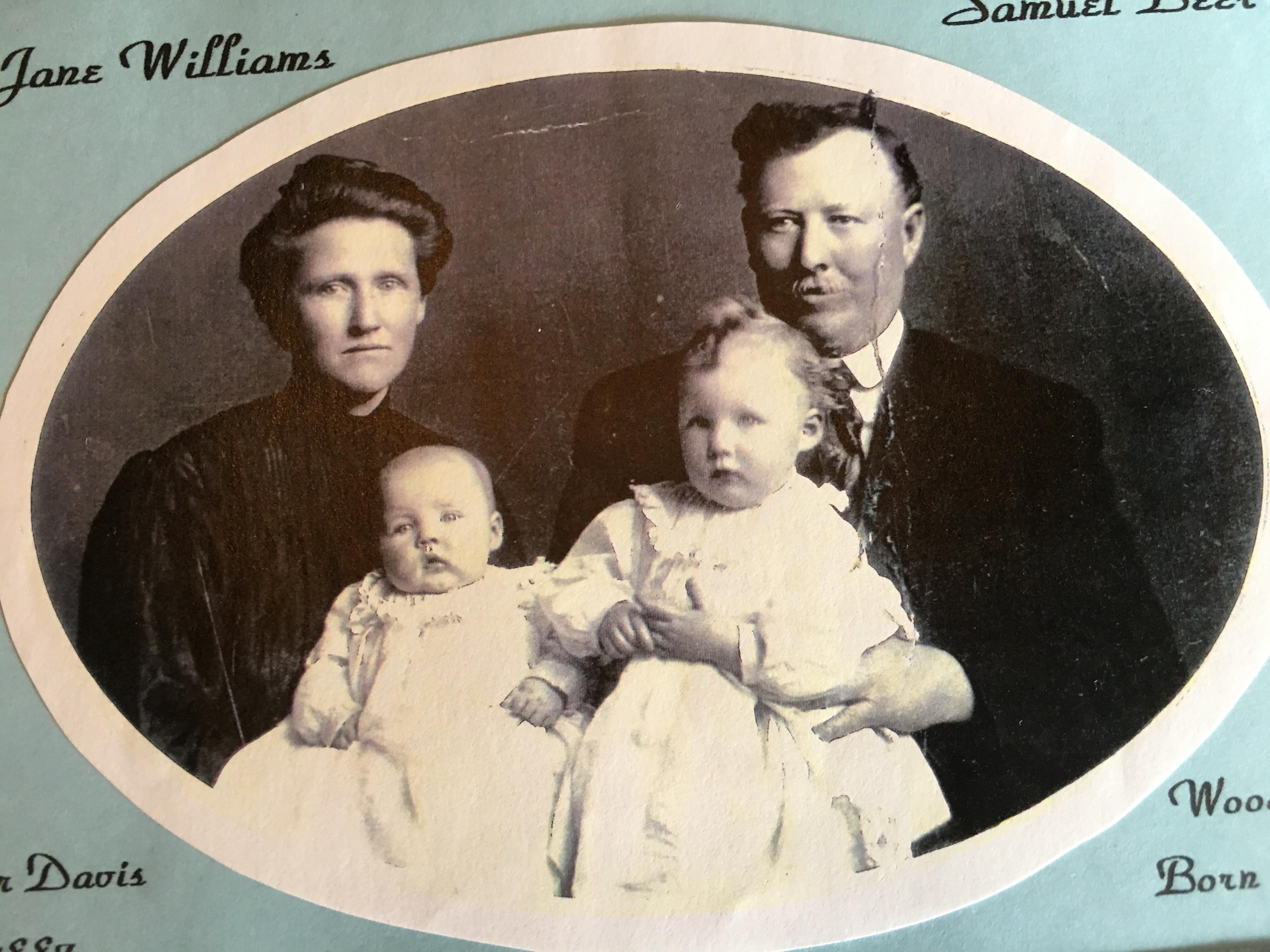
Samuel Deer Davis

“After arriving in Salt Lake Valley, David being a painter and a glazier, set up his home and they began their life there.  David and Mary’s first son, David Thomas was born on 4 March 1854 in Salt Lake City.  Their second son, Woodwell was born in 1856 in Salt Lake City.  David was sealed to Mary on 2 March 1856 in the Presidents office in Salt Lake City.  At the same time and place, he was sealed to Elizabeth Berry, thus becoming a polygamist.  Elizabeth being a native of Bath, Summerset, England.  Their third son, Samuel Deer as indicated earlier was born in 1859.  They were all shown on the 1860 U. S. Census, living in the 8th Ward in Salt Lake City.  It was soon after that, Woodwell died, date unknown.  Their fourth and fifth sons, twins, Hyrum Eynon and Joseph were born on 15 August 1862.  Joseph died as an infant, but Hyrum lived to adulthood.  Their last son, Septimus was born and died soon after in 1864, probably about the time that his father David Woodwell, died of consumption (Tuberculosis) on 20 March 1864.  Thus Mary was left with three boys ages 10, 5, and 2.  I was unable to determine what happened to Elizabeth Berry.

cabin

Davis cabin in Samaria

“In November of 1864, Mary married a man named George R. McLaughlin of whom we can find no record of birth, death or census information.  They had a son George R. Jr. who was born 27 August 1865.  Their second child, Mary Ellen was born about 1866 and died soon after.   Mary’s second husband, George treated her harshly and abandoned her many times.  One time for almost a year.  The last time, she heard he was living in Cheyenne, Wyoming and had no plans to return.  She divorced him on the 20th of January 1868.  Thus Mary was continuously left with four boys to feed and care for.  It was soon after this that she became seriously ill and the doctor told her she would soon die.  Her last son, George was a toddler at the time.  A neighbor, Charles and Jemima Walker offered to adopt George and Mary regretfully consented as she didn’t want to leave such a young child.  Not long after, Mary recovered and went back to the Walkers pleading with them to return her son, but they refused.  They were still neighbors in the 1870 Census with the Walkers showing George as their son at age 5.  George died 29 January 1889 at the age of 24 in a train accident returning to Sugar House, Utah from an outing with friends to Red Bluff Quarry.

“Toward the end of the year, Mary met John Evan Price, another Welshman and became a polygamous wife of his on 26 December 1870.  Mary was 39 years of age and 14 years his junior.  He was in good financial circumstances at this time according to their granddaughter.  He had settled in Samaria, Oneida, Idaho on April 16, 1868 with one other family, being one of the first.  He is also credited with giving Samaria it’s name.  Several others settled there the next month.  A branch of the Church was organized there in November of 1868.  Elder Lorenzo Snow, then of the Twelve Apostles, visited in July of 1869 and approved of the city plot, encouraging the settlers to continue to build and plant there.

“John brought Mary and her children to Samaria after their marriage.  Two additional children were born to this union, Margaret Ann Price on 10 January 1872 and Elizabeth Jane Price on 17 March 1875, both in Samaria.  Unfortunately, John died within a few years on 22 June 1878 in Samaria leaving Mary a widow again.  But this time she was left in good circumstances where she was able to sell off property to new immigrants to Samaria.  She reverted back to her Davis name after 1880.  Her sons were now getting older.  Her oldest, David Thomas was married in Samaria to Amy Ann Sawyer on 7 January 1879 just 6 months after John Evan Price died.  Mary was the postmistress of Samaria for many years and the Relief Society President for 17 years in Samaria.  Eliza R. Snow stayed in her home during a conference in Samaria.

“Her second son, the subject of this manuscript, Samuel D., had no formal education but only that which was from his mother, Mary.  He married Mary Jane Williams on 11 Oct 1882 in the Endowment House in Salt lake City.  Their first child, Sarah Jane, was born in August of 1883 and died the same month.  Their second child, Woodwell Williams was born 17 November 1884.  It was during this time that his wife encouraged him to get some formal education.  He started by attending the district school in Samaria.  Afterward he attended the James Chandler school in Washakie, Utah.  It was a great sacrifice and struggle as he continued to farm and support his family during that time.  He had so much success as a scholar in Washakie, that in 1886 he attended the Brigham Young College in Logan, Utah.  He also studied law during his evenings.  His third child, Edgar Williams was born on 1 March 1887.  He soon became a partner in a law firm in Malad, Idaho of Evans, Gibbs and Davis.

CE3C2ECA-B897-4F05-9255-E5423077950D

Mary Jane Williams and Samuel Deer Davis with Edgar and Woodwill Davis

“At this time there was much pressure on the local LDS communities by the Idaho politicians who were strongly anti-Mormon, about the Church practice of polygamy.  75% of the population lived in the eastern half of the state and about 20% of those were L. D. S. which meant that they represented a large voting block.

“These following steps were in relation to the 1884-1885 law, not the 1889 one which was taken to the Supreme Court.

“From E. Leo Lyman’s “Political Background of the Woodruff Manifesto”:  “William Budge, the leading spokesman for the Church in Idaho, tried to bring as much pressure as he could on the outcome of the case.  Budge used Utah Congressional delegate John T. Caine to generate pressures on the Judge Berry through political friends back home.  He also traveled to the Blackfoot judicial headquarters to confer with Berry before he rendered his decision.  The judge, who recorded the conversation as accurately as he could recall, claimed the Church leader first quoted U.S. Solicitor General Jenks as saying that if the test oath law was taken before the United States Supreme Court, “it would not stand for a moment.” Budge also stressed the crucial nature of the pending decision on the continued allegiance of the Idaho Mormons to the Democratic party (Berry 1888).

“Berry’s reply demonstrated considerable admiration for Mormon industry and economic accomplishments but firmly stated his intent to “administer the laws as they were.” He made it clear he could not allow political considerations to affect his decision and expressed regret that the Mormons could not bring their marriage relations into “regulation step” with the rest of American society (Berry 1888). The published decision {Idaho Daily Statesman, 17, 20 Oct. 1888; Wood River Times, 16, 17, 24 Oct. 1888) not only upheld the test oath but ruled the Mormon arguments that they no longer taught or practiced plural marriage were merely a temporary posture of no importance so long as the general Church had made no changes on the question. The kind of concession necessary to relieve the disfranchisement onslaught, Judge Berry stressed, was a formal renunciation of the doctrine at a Church general conference, not unlike what actually occurred several years later.”

“From the Encyclopedia Britannica: “They enacted a law in 1884-1885 that all county and precinct officers were required to take a test oath abjuring bigamy, polygamy, or celestial marriage; and under this law in 1888 three members of the territorial legislature were deprived of their seats as ineligible.  An act of 1889, forbade in the case of any who had since the 1st of January 1888 practiced, taught, aided or encouraged polygamy or bigamy, their registration or voting until two years after they had taken a test oath renouncing such practices, and until they had satisfied the District Court that in the two years after they had been guilty of no such practices.

“The earlier law had been tested by the Church in the territorial federal courts, but was unsuccessful.  This 1889 law, regarding voting, was commonly called “The Idaho Test Oath” which meant essentially that if you were a member of the Church, whether practicing polygamy or not, you could not vote and was retroactive to January 1 the year before.  It appears that the Church decided to test this law all the way to the United States Supreme Court.

“In Samaria on Oct 27, 1888, 26 men including Samuel D. Davis asked to have their names removed from the records of the Church with apparent approval of the Church leaders so that they could vote in the November 1888 election but primarily to provide a test case.  There were about 30 in Malad City who did the same thing.  The new law having been enacted after the men had voted, they were indicted almost a year later for conspiracy to break a law that wasn’t created until the following year.  The case became known as “Davis vs. Beason” and can still be found today by searching the internet.

“From the Deseret News on September 21, 1889:  “The perjury case against Mr. Evans of Malad having been disposed of in the District Court of that place, the next matters of importance tackled were the conspiracy cases. Indeed there was practically but one case, fifty six persons having been included in one indictment.

“The matter came up for trial before Judge Berry on Tuesday, Sept. 10th [1889]. There was much disappointment among the virulent anti-“Mormon” element over the result of the case of perjury against Mr. Evans and the officers said that in the conspiracy matter they would get a jury together that would convict this time.  For this purpose they scoured the country and imagined they had got what they wanted when the panel was completed.

“The charge preferred in the indictment against the fifty-six defendants was substantially that they had conspired together to break the laws of Idaho Territory, notably the Idaho test oath law, by agreeing to vote at an election when they knew that they had no right to do so.

“The case was tried and at 6 p.m. on Wednesday was given to the jury.  On Thursday the 12th at 2 p.m. the jury came into the court with a verdict, in which they found fifty-five of the defendants not guilty and one guilty.  The latter was Samuel D. Davis of Samaria.

“A new trial was asked for Mr. Davis by counsel for the defense and denied, and the  court sentenced him to pay a fine of $500.  The fine was not paid and Mr. Davis placed in jail for a maximum of 250 days [$2 a day].  Judge Berry was applied to for a writ of habeas corpus which was also denied, and an appeal from his action was taken to the Supreme Court of the United States.

“The matter is in the best possible shape it could possibly assume for final adjudication. None of the acquitted fifty-five defendants can be again placed in jeopardy on the same subject, either under the title of conspiracy or any other.  The appeal to the Supreme Court involves the validity of the infamous test oath law, which will therefore be decided one way or the other.

“The defense was conducted with marked ability, the attorneys being Mr. J. S. Rawlins of Salt Lake, and Mr. J. N. Kimball of Ogden.   Mr. Standrod and “Kentucky Smith” appeared on the part of the prosecution.”

“From the above article it is clear that it was “arranged” in advance that one person would be the focal point for the test case.  That person, having probably volunteered due to his legal schooling, was none other than Samuel D. Davis.  He obviously knew that he would spend some time behind bars, but was willing to do that for the Church.

“To give a better idea of the named individuals in this case, they are as follows:  Charles H. Berry, a former attorney general of Minnesota, later on, an associate justice of the Idaho Supreme Court who would have jurisdiction as the Judge in this case in Malad City.  Joseph S. Rawlins was a city attorney in Salt Lake City and worked with Brigham Young and following Church leaders on matters of law.  He later served in the Congress of the U. S. and assisted in gaining statehood for Utah.  He was also known as the “Red-headed Reactor of the Rockies” because he made such a fight about the confiscation of the Church property.  It was through his efforts that the property was eventually restored.  J. N. Kimball also served as a defense attorney for the Church in Ogden.  Drew W. Standrod came to Malad City, Idaho from Kentucky with his parents and took up the practice of law there.  He was elected as the prosecuting attorney there twice and later became a judge moving to Pocatello.  “Kentucky” Smith is actually H. W. Smith who was an anti-Mormon lawyer of prominence in Ogden, Utah and the author of the “Idaho Test Oath” law.  He also later became a judge in Idaho.  Sheriff Harvey G. Beason was an appointed sheriff who was just 29 years old at this time.  His was the other name in the test case.  He soon after moved to Montana and then to Gillette, Wyoming where he lived until his death in 1939.

“From another article in the Deseret News written in Samaria on September 30, 1889.

“”A very strange scene was witnessed here on the 25th inst. (Sept 1889)  It will be remembered that Mr. Samuel D. Davis of this place was found guilty not long since at the District Court held at Malad City, of voting at the election held here last fall contrary to the provision of the anti-Mormon Test Oath law, and that he was sentenced to pay a fine of $500 and costs, pending payment of which he was sent to the county jail.  He applied for a writ of habeas corpus which was denied by Judge Berry.  Application was then made direct to  Washington for a similar writ.  Here it was thought the matter would rest for the present. But not so; on Sept. 13, Sheriff Beason came to Samaria and levied an attachment on Mr. Davis’ property having an order from the court to sell at public auction enough to cover fine and costs.  On the  25th inst. said order was carried into effect.  Sheriff Beason, Attorney Standrod, Treasurer D. Tovey,  Commissioner P. Fredrickson and a few others came over.  The sale began at 2 o’clock.  Mr. Davis’ only horse was sold to Meyer Kohn of Malad, for $21.00. (Mr. Kohn has since offered to return the animal for the same price), which was about one-fifth his real value.  Mr. Davis interest in the firm of Evans, Gibbs, & Davis was knocked off to Standrod for $190.00.

“It was the Intention to sell the little home where Mrs. Davis and her two little children reside, but the title being defective it was abandoned. This was all that could be found to sell and the sale came to a close.

“The sheriff seemed very dry after his labors for he and his companions indulged quite freely.  They had apparently come over well prepared.”

“This article indicates that Samuel’s family also suffered because of the case.  The article was incorrect in that there were “two little children” in the home.  My grandfather, John Vincent “Vin” Davis was born on 6 July 1889 and was just a few months old when this took place, which means that there were two little children and one infant.  It also indicates that his fine was reduced almost 40% by the $211.00 amount recovered in the sale.  Therefore his sentence would be reduced by about 100 days, leaving 150 days remaining to be served.  From the Deseret News on 11 January 1890, it indicates that the hearing was held in the U. S. Supreme Court, probably a day or two earlier.  The hearing is several pages of arguments both for and against which I will not be discussing here.  It can also be found on the internet by searching “Davis vs. Beason”.  The ruling was handed down on 2 February 1890, upholding the Idaho law.  At this time Samuel had been in jail for 113 days.  I was unable to determine whether he remained the last 30 some days in jail or whether the Church paid the balance of the fine to release him or whether he was reimbursed for his personal losses.  During this era many members sacrificed much for their belief.

“President Wilford Woodruff issued the “Manifesto” a few months later on 24 September 1890, ending plural marriage in the Church.  The Idaho law was changed in 1893, the disqualification was made no longer retroactive, the two-year clause was omitted, and the test oath covered only present renunciation of polygamy, thus allowing members to vote once again.  It took until the 1980’s to get similar wording in the Idaho State Constitution removed.

“Samuel D. Davis continued in his practice of law and in 1899 he was appointed Probate Judge of Oneida County, Idaho.  He was twice elected to this office.  In 1901, after the formation of the Idaho State Bar, he took the examination for the bar and was admitted to practice in all the courts of the state.

“His wife of 21 years, Mary Jane Williams Davis died on 19 March 1903 in Samaria.  Later that year he moved his family of boys to Malad City to continue his practice and opened a new law office there.  His brother-in-law,  Isaac B. Evans, who had been on a mission in the south, introduced him to a woman in Salt lake City, whom he had known while on his mission.  She was Alice Godwin, daughter of Handy Haywood Godwin and Elizabeth Ann Naylor Godwin.  They were natives of Clinton, Sampson, North Carolina.  She was a true daughter of the old south.  Samuel was very interested and she was interested also, but I’m sure was concerned by the thought of finishing the raising of 7 boys.  But apparently she was up to the task as they were married in the Salt Lake Temple on 13 November 1905.  She bore him 3 more children.  First, Mary Naylor Davis, 13 September 1906, second, Alice Deer Davis, 18 January 1908 and Samuel Godwin Davis on 6 March 1911, all in Malad City, Idaho.

“He continued in Malad City until moving to Salt Lake City about 1918.  He was there in the January 1920 U. S. Census.  He probably moved to Twin Falls, Idaho in the summer of 1920 to accept employment as the City Attorney.  Two of his boys followed him there.  One, Eugene, who was still living with him and the other, John Vincent and his family, who was still living in Samaria.  In June of 1923, he was made the Twin Falls Police magistrate, but unfortunately, he died within 6 months on 13 December 1923.  After the funeral, his body was shipped back to Samaria to be buried.  His second wife, Alice moved to Salt Lake City, where she died 13 January 1945.  Her body was also returned to Samaria to be buried.

“From the Twin Falls Times News:  “Judge Davis was early admitted to the bar in Idaho, and served as county attorney and probate judge in Oneida county.  He attracted wide attention in the early days by his success as an irrigation and criminal lawyer.  It was his boast that some of Idaho’s best known attorneys had begun their legal training in his office.  He was an active and prominent member of the L. D. S. Church serving as member of the High Council in Malad and Twin Falls.”

“Thus ended a long legal career in the State of Idaho and the life of a man who was willing to stand for  his principles, even risking all his possessions at one time.  He died at the age of 64, which would be considered still young by today’s standards.  His part in the legal battle was apparently unknown to his children, grandchildren and their descendants.  My mother did mention many years ago that she had heard about the voting issue.  Those of his children as indicated earlier were very young and would not have known about the landmark legal case, unless he had related it to them.  He was a good man and his story needed to be told, so that all would be aware of his sacrifice during another time of great difficulty in the history of the Church.

Parley & Eliza Wagstaff

This is a bit of a peripheral line for me, but since a cousin made the information available, I am happy to share it here.  All the credit goes to Julee Hicks for this post.  Nearly everything in this post will be from the biographies and photos she forwarded.

Eliza and Parley Wagstaff

From the Autobiography of Parley:

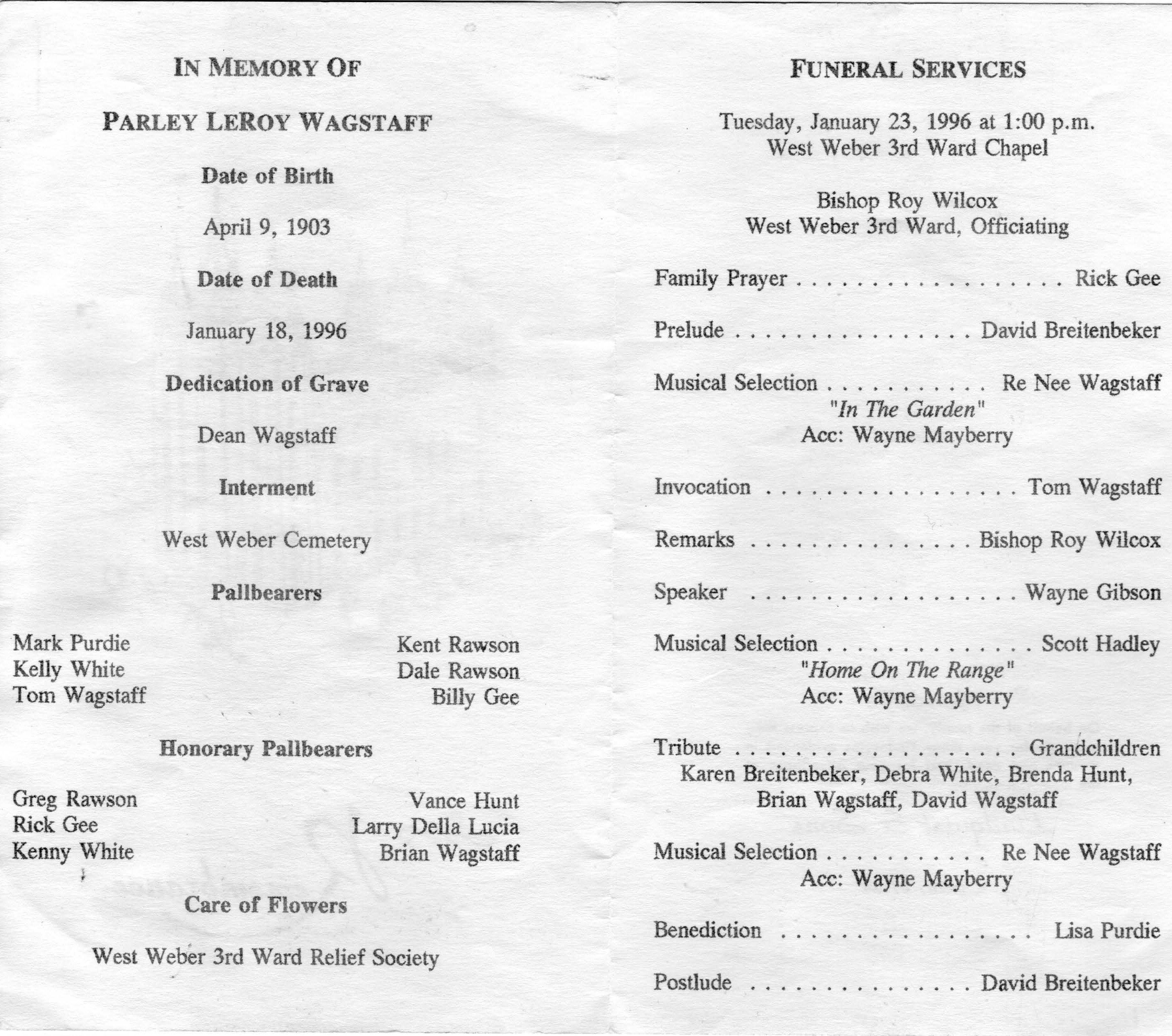
“I, Parley LeRoy Wagstaff was born April 9, 1903, in Glendale, Oneida (now Franklin) County, Idaho, to William Addison and Mary Magdalina Wanner Wagstaff.  The fifth child to join this union, I was blessed May 10, 1903.

“My earliest recollection was when I went to the Logan Temple to be baptized on April 18, 199 by Joseph M. Smith and confirmed April 18, 1911 by Thomas Morgan.  At the age of six I started school which was in a one-room building which served as a church and school with a black stove to keep it warm.  Father, being the custodial, it fell my lot and my brother Bill’s to go and build the fire in the mornings and at night we had to sweep and dust so it would be ready for school the next day.

“The school house being two and a half miles away we had to walk or ride a horse.  A horse fell on my leg and my Dad put a splint on it and I stayed in bed while it healed.

“At the age of 12, I was ordained a Deacon, May 3, 1914 by Joseph M. Smith.  I served as president for awhile.

“In the summers I worked for neighbors for very little money and my board.  In September 1919, we moved to West Weber; I and Bill drove a team of horses with our belongings from Idaho to West Weber.  In October or November, we were quarantined with a disease and didn’t start school until the first of 1920, then we went to Wilson, I graduated on May 29, 1920.

“I was ordained a priest March 1, 1925 by David Hancock.  I spent my time helping on the farm in the summer and running a grain binder all over Weber County.  In the winter I helped feed cattle for Lu Keller and helped Dad milk cows.

“On January 17, 1928, I was ordained an Elder by Francis F. Stratford Sr.

“On March 14, 1929, I was married to Eliza Blanch in the Salt Lake Temple.  We have been blessed with five children, two boys and three girls.  One passed away at birth.

“We have lived all our lives in West Weber, running a diary farm.  On January 5, 1964, I was ordained a Seventy by Spencer W. Kimball, and on August 9, 1970, I was ordained a High Priest by Francis E. Stratford Jr.”

This is all I have of Parley’s autobiography.  Here is his funeral program.

Here is the biography of Eliza:

“Eliza Dorthea Blanch Wagstaff was born August 2, 1908 in West Weber, Weber County, Utah.  She was one of nine children born to Joseph and Laura May Etherington Blanch.

“Like most young girls she attended school, participated in church activities and helped her parents on the farm.

“Eliza considered it a privilege to work in various homes before her marriage.  She says to know people is to love them.

“Her marriage to Parley L. Wagstaff took place in the Salt Lake Temple, March 14, 1929.  They moved several times; the last time into the old family home where she was born and reared.  They were the parents of five children, Duane LeRoy, Elelyn  W. (Purdy), LaNea W. (Rawson), Brent William and an infant daughter who died at birth.

“Before her marriage Eliza taught a Sunday School Class with Mary Penman for five years.  For 25 years she has been an ardent worker in the Primary; starting in 1933 as a teacher.  She was appointed second counselor to President Isabell Wagstaff in 1943.  Two years later she was released.  She held this same position twice under President Una C Greenwell; first, from March 1957 to August 1958 and from 1962 to 1964.  From 1949 to 1957 she helped the 11 year old Guide boys become second class scouts and graduate from Primary before they were ordained Deacons.  She was appointed by President Thomas O. Smith to work in the North Weber Stake Primary Board, February 3, 1958 and was assigned tot he Guide Patrol Department.  She was released August 20, 1962.

“Sister ELiza had the privilege of teaching Evelyn during her three years as Mother Bee Keeper, daughter Beehive girl.

“Sister Wagstaff was appointed second counselor to President Leila C. Heslop in the Ward Relief Socity January 3, 1965.  She was changed to first counselor September 12, 1965, and is currently working in this capacity.  She has been a visiting teacher for several years.

“Parley and Eliza were called to work on the Old Folks Committee in May 1955 and are still working on this assignment (1968).

“Eliza has been a member of the Daughters of Utah Pioneers since 1947 and has held the following positions in the organizations: Captain from 1953 to 1955 and Historial from 1961 to the present time (1968).

“The following quotation is from Sister Wagstaff:  “The crowning glory of my life came with motherhood.  Children of angels of God in disguise; they are idols of hearts and households.”

This photo was taken at a birthday party for Sarah Judkins in 1941.

Back (l-r): Eve Baxter Blanch(1904-1992), Voletta Belnap Blanch(1905-2000), Lee Stoker(1910-1998), Laura Blanch Hancock(1903-1963), Wilford Newell Judkins(1881-1956).  5th Row: Alta Bailey, Albert Bailey(1919-2009), Parley Wagstaff(1903-1996).  4th Row: Nina Judkins(1924-2010), Laura Mae Blanch(1873-1942), Eliza Blanch Wagstaff(1908-1992).  3rd Row: Lynn Judkins, Ruth Hancock(1922-1998), Ethel Blanch Stoker(1910-1987), Don Blanch(1913-1997), Heber Hancock(1902-1960).  2nd Row: Newell Judkins(1917-1979), Myreta Judkins, MaryBell Judkins(1919-2000), Sarah Judkins(1899-1974), Keith Stoker(1930-1990), Val Hancock(1929-2010), Gene Hancock.  Front: Bobbie Blanch, Jesse Stoker(1932-1997), Joyce Judkins, LaNae Wagstaff, Evelyn Wagstaff, Duane Wagstaff, Reed Hancock, Jerri Blanch.

Eliza died 12 March 1992 in West Weber.  She was buried 15 March 1992 in the West Weber Cemetery.  Parley died 18 January 1996 in Bountiful, Davis, Utah.  He was buried 22 January 1996 beside his wife.

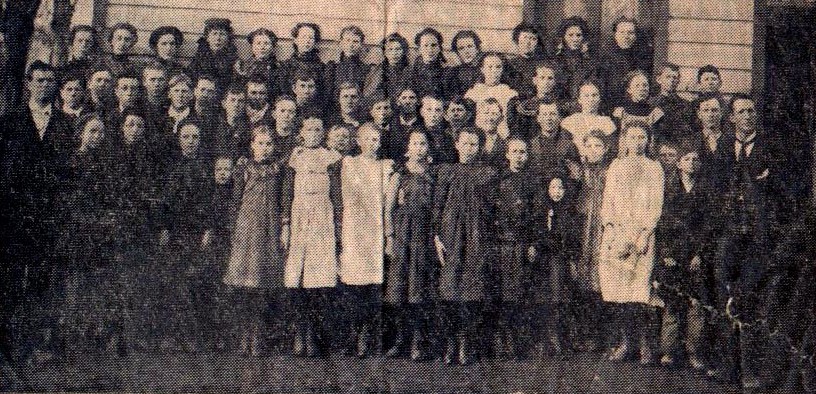
1895 Plain City Student Body

Back (l-r): Eva Edwards, Ada Skeen, Isabell Skeen, Unknown Rogers, Cecile Richardson, Grace Draney, Aseal Ipson, Beatrice Cottle, Ethel Garner, Josie Bramwell, Edna Garner, Unknown Rogers, Amanda Olsen, Rachel Garner, Freda Wheeler, Murald Hodson, Alfred Skeen. Middle: Frank Vause, William Knight, Clarence Richardson, Grant Hansen, James Hunt, Delwin Sharp, William Skeen, Chester Davis, Ace Draney, Lee Boyd, Eli Lund, Richard Bates, Alfred Coy, Parley Hansen, Edward Folkman, Jesse Lund, Charles Bramwell, Stella Hodson, Etta Lund, Ella Hodson, Luman Green, Walter Maw. Front: Charles Maw, Ruby Stoker, Annie Cottle, Edna Hansen, Susie Boyd, Gertrude Knight, Hazel Spiers, Rose Liljenquist, Nellie Maw, Martha Hansen, Mabel Ipsen, Maude Marriott, Daisy Coy, Alminda Lund, Joseph Skeen.

Here is a picture of the Plain City, Weber, Utah school student body in 1895.  Apparently this was the entire student body and this photo was reproduced in the 15 March 1959 copy of the Ogden Standard-Examiner.  I have a couple of relatives in the picture and that is probably why my Grandpa and Grandma Ross pulled it from the paper and have kept it with their possessions.  The names all come from that same paper caption although both of the unknown Rogers just have Miss.  If anyone knows where to get a clearer scan of the photo, I would appreciate it as this 60 year old paper isn’t the best version.  I do not think the school in Plain City had another name besides the Plain City School.

I looked up the information for each individual.  I found most of them, except for a couple whose names were just not in Plain City or they must have only been there a short time.  Sometimes with those old clippings whoever gave them the names might have put a married last name rather than a maiden.  Hopefully someone can correct the rest of the names.  The two principals I could not nail down because of the difference in age I could not define and there were so many with the same name within 30 years of the age of most of these students.  I put the one I think is most likely but welcome corrections.

Eva Edwards (?-?)

Ada Myrtle Skeen (1885-1977) married Daniel Popple Williams (1881-1919) and Edsin Byrum Allred (1881-1960).

Isabell Electa Skeen (1889-1963) married Thomas Etherington Charlton (1887-1956).

Unknown Rogers (?-?)

Cecile May Richardson (1888-1975) married Robert Clyde Hellewell (1887-1967).

Grace Elizabeth Draney (1887-1972) married James Burt Atkinson (1880-1935).

Aseal Andrew Ipson (1889-1981) married Lucy Isabell Knight (1883-1989).

Mary Lew Beatrice Cottle (1887-1971) married Claud Leslie Kimball (1885-1958).

Ethel Garner (1886-1968) married Ephraim William Manning (1884-1970).

Josephine “Josie” Trena Bramwell (1887-1973) married Joseph Herman McCowan (1886-1964).

Mary Edna Garner (1888-1948) married Horace William Wayment (1885-1969).

Unknown Rogers (?-?)

Amanda Christine Olsen (1888-1968) married George Daniel Moyes (1889-1958).

Rachel Ann Garner (1889-1980) married George Leo Sandberg (1887-1949).

Freda Wheeler (?-?)

Murald Vinson Hodson (1887-1970) married Elda Herriot Barnett (1895-1979).

David Alfred Skeen (1885-1969) married Bertha Kerr (1885-1976).

Francis “Frank” Freedom Vause (1883-1974) married Vera Jaquetta Child (1885-1961).

William Thomas Knight (1881-1973) married Eliza Alzina Taylor (1886-1963).

Clarence Richardson (1883-1976) married Louie Marie Rawson (1881-1982).

Martin Grant Hansen (1883-1925) married Alice Maud King (1881-1951).

James Hunt (?-?)

Delwin Sharp (1884-1969) married Violet Grieve (1881-1964).  Obviously related to my Sharp line.

William Delbert Skeen (1884-1940).  Not sure this is the right William Skeen, but pretty sure.

Chester Davis (1883-1948) married Nellie Clark (1891-1950).

William “Ace” Hamilton Draney (1885-1979) married Ethel Skeen (1883-1979) and Vera Ann Toombs (1895-1977).

Levi “Lee” Alfred Boyd (1883-1972).

Eli Edgar Lund (1884-1955) married Mary Millie Hutchins (1882-1947).

Thomas Richard Bates (1884-1969) married Dora Evaline Taylor (1885-1981)

Alfred Jonathan Coy (1882-1957) married Mabel Adella Ipsen (1885-1954).

George Parley Hansen (1886-1968) married Criesta Zenobia Anderson (1889-1979).

George Edward Folkman (1885-1914) married Florence Evaline Maw (1888-1969).  Florence’s mother was a Sharp.

Jesse Leander Lund (1886-1918) married Myrtle John Hawkley (1895-1960).

Charles Bramwell (1885-1971) married Annie Myrtle Shupe (1888-1968).

Estella Dora Hodson (1887-1981) married Parley Paul Taylor (1886-1974).

Etta Letitia Lund (1887-1968) married Robert Alfred Witten (1873-1937).

Ella Doris Hodson (1887-1968) married James Earl McFarland (1889-1951).

Luman Peter Green (1886-1980) married Veda Jane Walker (1888-1981).

Walter Maw (1887-1912) married Della Neal (1888-1961).

Charles Maw, I think this is Charles Edward Maw (1875-1950).  Principal.

Ruby Stoker (1885-1965) married George Angus Spears (1878-1943).  She is a relative through our Stoker line.

Annie Jane Cottle (1881-1974) married Joseph Pierce Stock (1878-1954).

Edna Rebecca Hansen (1884-1958) married John Elmer Robson (1884-1930).

Susan “Susie” Emma Boyd (1885-1969) married August Steiner (1874-1949).

Gertrude Knight (1886-1970) married Hyrum Ezra Richardson (1886-1962).

Hazel Spiers (1885-1941) married Austin Tracy Wintle (1884-1977).

Rose Liljenquist (?-?)

Millie Maw (1884-1951) married Charles Joseph Buckley (1884-1959).

Martha Catherine Hansen (1887-1963) married Henry Merwin Thompson (1885-1976).

Mabel Adella Ipsen (1885-1954) married Alfred Jonathan Coy (1882-1957).

Maude Marriott (1880-1972) married Wallace Ridgeway Bell (1881-1947).

Daisy Louise Coy (1884-1968) married Hyrum Parley Hogge (1883-1941).

Alminda Drucella Lund (1881-1966) married Harold Waldermar Johnson (1888-1967).

Joseph Skeen, I think this is Joseph Lawrence Skeen (1857-1915).  Assistant Teacher.

The Last Wagon

"To Them of the Last Wagon" by Lynn Fausett

In honor of Pioneer Day, here is a talk given in 1947 by J. Reuben Clark that has always touched me.  I think of it fairly regularly, especially when I find myself in a position of following others whose opinions or ideas just do not seem to make much sense to me.  I am reminded of my duty not to murmur and to do what I can and have the faith that the rest will just work out.  I just need to do the very best I can in the realm I life.  The caravan/wagon train moves on.

“At the near close of this one hundredth year of the entering into these valleys of your fathers and your mothers, some of yours and mine, I wish to speak a few further words of humble tribute and thanksgiving to them, and especially to the meekest and lowliest of them, those great souls, majestic in the simplicity of their faith and in their living testimony of the truth of the restored gospel, to those souls in name unknown, unremembered, unhonored in the pages of history, but lovingly revered round the hearthstones of their children and their children’s children who pass down from generation to generation the story of their faith and their mighty works, and the righteousness of their lives and living, those souls who worked and worked, and prayed and followed, and wrought so gloriously.

“I would not take away one word of praise or gratitude, honor or reverence from the great men who led these humble ones of ours. They were mighty men in brain and brawn, in courage and valor, in honesty and in love of truth, living near the Lord—Brothers Brigham and Heber and Wilford and Willard and Charles, the two Orsons and Parley, and John and George and Erastus and Lorenzo and Daniel and Joseph and Jedediah, and a host of other giants, each and all richly blessed with the Lord’s divine love and with that gift of the Holy Ghost that made them leaders truly like unto Moses of old. I yield, we yield, to no one in our gratitude for them and for their work of directing the conquest of the wilderness and of saving men’s souls. Their names shine lustrously on those pages of history which record only the doings of the makers of epochs—those choice spirits, chosen before the foundation of the world, to be the leaders and builders of dispensations of God’s dealings with men; and these leaders of ours to be the builders of that dispensation which of old was named the Dispensation of the Fulness of Time. Unnumbered eternities will remember and honor them.

“But I should like now and here to say a few words about those who trod after where those giants led, some in the same companies that the Brethren piloted, some in later companies following that year and the years after, some in the fateful handcarts with their unexcelled devotion, heroism, and faith, all trickling forward in a never-failing, tiny stream, till they filled the valley they entered and then flowed out at the sides and ends, peopling this whole wilderness-waste which they fructified, making it to fulfil the ancient prophecy that the desert should blossom as the rose.

I would like to say something about the last wagon in each of the long wagon trains that toiled slowly over the plains, up mountain defiles, down steep, narrow canyons, and out into the valley floor that was to be home—this last wagon: last, because the ox team that pulled it was the smallest and leanest and weakest, and had the tenderest feet of any in the train; it was slow starting, and slow moving; last, because worn and creaking, it took more time to fix and to grease, for young Jimmy generally had trouble in getting the wagon jack under the “ex”; last, because its wind-rent cover was old and patched and took hours to mend and tie up to keep out the storm; last, because the wife, heavy with child, must rest till the very moment of starting; last, because sickly little Bill, the last born, poorly nourished, must be washed and coaxed to eat the rough food, all they had; last, because with all his tasks—helping little Bill, cooking and cleaning up the breaksfast,—Mother was not able to help much—Father took a little longer to yoke his cattle and to gird himself for the day’s labor; last, because his morning prayers took a few more minutes than the others spent—he had so many blessings to thank the Lord for and some special blessings to ask the Lord to grant, blessings of health and strength, especially for his wife, and for little Bill, and for the rest, and then the blessings for himself that his own courage would not fail, but most of all for the blessing of faith, faith in God and in the Brethren who sometimes seemed so far away. For they were out in front where the air was clear and clean and where they had unbroken vision of the blue vault of heaven. The Brethren had really visioned the glory of the Lord, who walked near them, put his thoughts into their minds; his spirit guided and directed them, petitioned thereto by the thousands of Saints who were back in Winter Quarters, back in Iowa, back in the States, and beyond, even across the waters, for the faithful poured out their souls in fervent prayer to Almighty God that the Brethren should be inspired. The Saints buoyed up the Brethren out in front with encouragement, with praise, and sometimes even with adulation. Knowing the Brethren were prophets of God, the Saints gave them full confidence, daily, almost hourly, expressed. The Brethren lived in a world of commendation from friends and the tried and true Saints. Rarely was their word or their act questioned by the faithful Saints. This was as it should be and had to be to carry out the Lord’s purposes.

“But back in the last wagon, not always could they see the Brethren way out in front, and the blue heaven was often shut out from their sight by heavy, dense clouds of the dust of the earth. Yet day after day, they of the last wagon pressed forward, worn and tired, footsore, sometimes almost disheartened, borne up by their faith that God loved them, that the restored gospel was true, and that the Lord led and directed the Brethren out in front. Sometimes, they in the last wagon glimpsed, for an instant, when faith surged strongest, the glories of a celestial world, but it seemed so far away, and the vision so quickly vanished, because want and weariness and heartache and sometimes discouragement were always pressing so near. When the vision faded, their hearts sank. But they prayed again and pushed on, with little praise, with not too much encouragement, and never with adulation. For there was nearly always something wrong with the last wagon or with its team—the off ox was a little lame in the right front shoulder; the hub of the left front wheel was often hot; the tire of the hind wheel on the same side was loose. So corrective counsel, sometimes strong reproof, was the rule, because the wagon must not delay the whole train.

“But yet in the last wagon there was devotion and loyalty and integrity, and above and beyond everything else, faith in the Brethren and in God’s power and goodness. For had not the Lord said that “not even a sparrow falleth unnoticed by the Father, and were they not of more value than sparrows?” And then they had their testimony burning always like an eternal fire on a holy altar, that the restored gospel was true, and that Joseph was a prophet of God, and that Brigham was Joseph’s chosen successor.

“When the train moved forward in the early morning sun and the oxen with a swinging pull that almost broke the tongue got that last wagon on the move, the dust in the still morning air hung heavy over the road. Each wagon from the first stirred up its own cloud, till when the last wagon swung into line, that dust was dense and suffocating. It covered the last wagon and all that was in it; it clung to clothes; it blackened faces; it filled eyes already sore, and ears. The wife, soon to be a mother, could hardly catch her breath in the heavy, choking dust, for even in the pure air she breathed hard from her burden. Each jolt of the wagon, for those ahead had made wagon ruts almost “ex” deep, wrung from her clenched lips a half-groan she did her best to keep from the ears of the anxious, solicitous husband plodding slowly along, guiding and goading the poor dumb cattle, themselves weary from the long trek. So through the long day of jolting and discomfort and sometimes pain, sometimes panting for breath, the mother, anxious only that the unborn babe should not be injured, rode, for she could not walk; and the children walked, for the load was too heavy and big for them to ride; and the father walked sturdily alongside and prayed.

“When in the evening the last wagon creaked slowly into its place in the circle corral, and the Brethren came to inquire how the day had gone with the mother, then joy leaped in their hearts, for had not the Brethren remembered them? New hope was born, weariness fled, fresh will to do was enkindled; gratitude to God was poured out for their knowledge of the truth, for their testimony that God lived, that Jesus was the Christ, that Joseph was a prophet, that Brigham was his ordained successor, and that for the righteous a crown of glory awaited that should be theirs during the eternities of the life to come. Then they would join in the songs and dancing in the camp, making the camp’s gaiety their own, as much as Mother’s condition would permit.

“Then the morning came when from out that last wagon floated the la-la of the newborn babe, and mother love made a shrine, and Father bowed in reverence before it. But the train must move on. So out into the dust and dirt the last wagon moved again, swaying and jolting, while Mother eased as best she could each pain-giving jolt so no harm might be done her, that she might be strong to feed the little one, bone of her bone, flesh of her flesh. Who will dare to say that angels did not cluster round and guard her and ease her rude bed, for she had given another choice spirit its mortal body that it might work out its God-given destiny?

“My mother was one of those babes so born in 1848, ninety-nine years ago.

Another morning came, when courageous little Bill, who, with a hero’s heart, had trudged through long days of hot sun and through miles of soggy mud in the rain, his little body drenched, little Bill, weak and wan, must be crowded in to ride with Mother, for he was sick from a heavy cold. Months before, on that cold winter’s night when they had fled Nauvoo for their lives to escape the fiendish wrath of a wild mob, Bill became dangerously ill with pneumonia, which left him with weak lungs. This old illness now returned. He grew worse and worse. The elders came and prayed he might get well. But the Lord wanted little Bill with him. So a few mornings later a weeping mother and a grief-stricken father and that last wagon swung into place in the line, leaving beside the road, under some scrub brush a little mound, unmarked save for heaped-up rocks to keep out the wolves, a mound that covered another martyr to the cause of truth.

“So through dust and dirt, dirt and dust, during the long hours, the longer days—that grew into weeks and then into months, they crept along till, passing down through its portals, the valley welcomed them to rest and home. The cattle dropped to their sides, wearied almost to death; nor moved they without goading, for they too sensed they had come to the journey’s end.

“That evening was the last of the great trek, the mightiest trek that history records since Israel’s flight from Egypt, and as the sun sank below the mountain peaks of the west and the eastern crags were bathed in an amethyst glow that was a living light, while the western mountainsides were clothed in shadows of the rich blue of the deep sea, they of the last wagon, and of the wagon before them, and of the one before that, and so to the very front wagon of the train, these all sank to their knees in the joy of their souls, thanking God that at last they were in Zion. “Zion, Zion, lovely Zion, beautiful Zion, Zion, City of our God.” They knew there was a God, for only he could have brought them triumphant, militant, through all the scorn, the ridicule, the slander, the tarrings and featherings, the whippings, the burnings, the plunderings, the murderings, the ravishings of wives and daughters, that had been their lot, the lot of their people since Joseph visioned the Father and the Son.

“But hundreds of these stalwart souls of undoubting faith and great prowess, were not yet at their journey’s end.

“Brother Brigham again called them to the colors of the kingdom of God, and sent them to settle the valleys, near and remote, in these vast mountains of refuge. So again they yoked their oxen and hitched up their teams, and putting their all in the covered wagon, this time willingly, unwhipped by the threat of mob cruelty and outrage, they wended their slow way to new valleys, again trusting with implicit faith in the wisdom and divine guidance of their Moses. The very elements obeyed their faith, faith close kin to that which made the world.

“These tens of thousands who so moved and so built were the warp and the woof of Brother Brigham’s great commonwealth. Without them Brother Brigham had failed his mission. These were the instruments—the shovelers, the plowers, and sowers and reapers, the machinists, the architects, the masons, the wood-workers, the organ builders, the artisans, the mathematicians, the men of letters, all gathered from the four corners of the earth, furnished by the Lord to Brother Brigham and the prophet leaders who came after, that he and they might direct the working out of His purposes. These wrought as God inspired Brother Brigham and the other prophets to plan, all to the glory of God and the upbuilding of his kingdom.

“Upright men they were, and fearless, unmindful of what men thought or said of them, if they were in their line of duty. Calumny, slander, derision, scorn left them unmoved, if they were treading the straight and narrow way. Uncaring they were of men’s blame and censure, if the Lord approved them. Unswayed they were by the praise of men, to wander from the path of truth. Endowed by the spirit of discernment, they knew when kind words were mere courtesy, and when they betokened honest interest. They moved neither to the right nor to the left from the path of truth to court the good favor of men.

“So for a full hundred years, urged by the spirit of gathering and led by a burning testimony of the truth of the restored gospel, thousands upon tens of thousands of these humble souls, one from a city, two from a family, have bidden farewell to friends and homes and loved ones, and with sundered heartstrings, companioned with privation and with sacrifice even to life itself, these multitudes have made their way to Zion, to join those who were privileged to come earlier, that all might build up the kingdom of God on earth—all welded together by common hardship and suffering, neverending work and deep privation, tragic woes and heart-eating griefs, abiding faith and exalting joy, firm testimony and living spiritual knowledge—a mighty people, missioned with the salvation, not only of the living, but of the dead also, saviors not worshipers of their ancestors, their hearts aglow with the divine fire of the spirit of Elijah, who turns the hearts of the fathers to the children and of the children to the fathers.

“And thousands upon thousands of these tens of thousands, from the first till now, all the elect of God, measured to their humble calling and to their destiny as fully as Brother Brigham and the others measured to theirs, and God will so reward them. They were pioneers in word and thought and act and faith, even as were they of more exalted station. The building of this intermountain empire was not done in a corner by a select few but by this vast multitude flowing in from many nations, who came and labored and wrought, faithfully following their divinely called leaders.

“In living our lives let us never forget that the deeds of our fathers and mothers are theirs, not ours; that their works cannot be counted to our glory; that we can claim no excellence and no place, because of what they did, that we must rise by our own labor, and that labor failing we shall fail. We may claim no honor, no reward, no respect, nor special position or recognition, no credit because of what our fathers were or what they wrought. We stand upon our own feet in our own shoes. There is no aristocracy of birth in this Church; it belongs equally to the highest and the lowliest; for as Peter said to Cornelius, the Roman centurion, seeking him:

“… Of a truth I perceive that God is no respecter of persons: But in every nation he that feareth him, and worketh righteousness, is accepted with him.” (Acts 10:34-35)

“So to these humble but great souls, our fathers and mothers, the tools of the Lord, who have, for this great people, hewed the stones and laid the foundations of God’s kingdom, solid as the granite mountains from which they carved the rocks for their temple, to these humble souls, great in faith, great in work, great in righteous living, great in fashioning our priceless heritage, I humbly render my love, my respect, my reverent homage. God keep their memories ever fresh among us, their children, to help us meet our duties even as they met theirs, that God’s work may grow and prosper till the restored gospel of Jesus Christ rules all nations and all peoples, till peace, Christ’s peace, shall fill the whole earth, till “righteousness shall cover the earth even as the waters cover the mighty deep.” Let us here and now dedicate all that we have and all that we are to this divine work.

Procrastination??

One of the greatest defects of all mankind is that of procrastination.  Our propensity to give into it has been a struggle down through the ages.  Our day is no different, in fact, our comfortable and easy life probably makes it more likely.  There is the classic quote by Spencer W. Kimball about procrastination, but I am too lazy to look it up now.  I will do it later.
Fortunately, I have not been afflicted much with the dreaded disease.  I get a bit antsy if something needs to be done.  In fact, I would be one of those who would border on the workoholic side more.  Always something more to be done and just not enough time to do them all.
All I know is if I have the mentality that it doesn’t need to be done now, then I delay it.  If I can switch it in my mind to be done soon, then it will fall into a queue and I continue working until the queue is finished.  Somehow, I generally don’t tend to see things as being a ways off.  Which I think makes a marked difference between me and the next man.  I believe I can have a state now, and will work towards it.
The same applies for me in the gospel.  Many, many talk about when the Savior returns.  Then we will have to live the law of consecration.  Then we will get the temple work in full gear.  Then we will live all the celestial laws.  Then we will be more proactive in missionary work.  Then I will repent.  Then I will believe.  Then we will work on learning the scriptures more fully.  Then we will do this, then we will do that, then we whatever it is we will do.  In reality, it is a bunch of hokum.  The scriptures tell us so.
“And now, as I have said unto you before, as ye have had so many witnesses, therefore, I beseech of you that ye do not procrastinate the day of your repentance until the end; for after this day of life, which is given us to prepare for eternity, behold, if we do not improve our time while in this life, then cometh the night of darkness, wherein there can be no labor performed.”  (Alma 34:33)
Those who procrastinate will find themselves not knowing what they need to do.  Not having experienced what they will have need to experience.  They will be in darkness.  As Joseph Smith said, “Hell is not knowing.”  Don’t say you will change.  Why will you change then?  Why not now?  Remember Lazarus, even if one should come back from the dead, they will not believe.  Jesus already came back from the dead and yet we still don’t act, we still don’t live our faith, we still don’t believe.  Nothing will change then.
“Ye cannot say, when ye are brought to that awful crisis, that I will repent, that I will return to my God (or start coming closer to my God), Nay, ye cannot say this; for that same spirit which doth possess your bodies at the time that ye go out of this life, that same spirit spirit will have power to possess your body in that eternal world.”  (Alma 34:34).  Why would the millennium be any different?  If not doing it now, why then?
“But behold, your days of probation are past; ye have procrastinated the day of your salvation until it is everlastingly too late and your destruction is made sure; yea, for ye have sought all the days of your lives for that which ye could not obtain (Pleasure?  Comfort?  Relaxation?  Work is an eternal principle.  Rest is in the after life.  Joy is for this life.); and ye have sought for happiness in doing iniquity (Sin is waste.  Waste of time – killing time especially.  Waste of learning.  Waste of work.  Waste of intelligence.  Waste of eternity), which is contrary to the nature of that righteousness which is in our great and Eternal Head.” (Helaman 13:38)
Is it any wonder why the Lord makes the following statement?  “Hearken, O ye people of my church, and ye elders listen together and hear my voice while it is called today, and harden not your hearts.”  (D&C 45:6).  Today is the day of salvation.  Not tomorrow.  “Behold, now it is called today until the coming of the Son of Man, and verily it is a day of sacrifice, and a day of the tithing of my people; for he that is tithed shall not be burned at his coming.  For after today cometh the burning – this is speaking after the manner of the Lord – for verily I say, tomorrow all the proud and they that do wickedly shall be as stubble; and I will burn them up for I am the Lord of Hosts; and I will not spare any that remain in Babylon.  Wherefore, if ye believe me, ye will labor while it is called today.”  (D&C 64:23-25).
Wow, if that is not harsh and clear enough, we are certainly beyond feeling.  Very clearly the Lord states tomorrow is for the wicked.  Today, if we believe, we will labor.  There are no tomorrows in the Gospel.  Today we work.  Today we sacrifice.  Today we repent.  Today we build.  Today we lift.  Today we teach.  Today we convert.  Do not ever allow yourself to fall to the belief in tomorrow.  Those who look to tomorrow will be burned.
The probationary games goes forward.  Working today, with a hope in the mansions of the Father.  Tomorrow for all intents does not exist.  What we are going to do tomorrow doesn’t matter really.  Tomorrow may not arrive and today has been wasted.
Here is the verses that triggered this little soapbox.  I think it applies just as fully.
“Wherefore, the prophets, and the priests, and the teachers, (let’s include the deacons, the children, the Relief Society, the Apostles, the Seventies, the High Priests, and even those not in the church) did labor diligently, exhorting with all long-suffering the people to diligence; teaching the law of Moses, and the intent for which it was given;  persuading them to look forward unto the Messiah, and believe in him to come as though he already was.  And after this manner did they teach them.”  (Jarom 1:11)
“And the Lord God hath sent his holy prophets among all the children of men, to declare these things to every kindred, nation, and tongue, that thereby whosoever should believe that Christ should come, the same might receive remission of their sins, and rejoice with exceedingly great joy, even as though he had already come among them.”  (Mosiah 3:13)
We are to be acting as if he is already among us.  He has come, more than once.  Although not to the whole world in the big wrapping up scene yet, ye will.  But to us, he has already come and that is how we are to be acting.  We are to be keeping his commandments now.  We are to be living a Christian life now.  We are to be building Zion now.  As the scripture above stated, we are supposed to be coming out of Babylon now.  Not at some future time.  I made covenants in the temple to live the law of consecration now.  I have covenanted to live the laws of the celestial kingdom now.  Not at some future time when we imagine they will be dictated to us.  They already have.
“And Zion cannot be built up unless it is by the principles of the law of the celestial kingdom; otherwise I cannot receive her unto myself.”  (D&C 105:5)
We have to live the celestial laws to have Zion.  We have to have Zion for the King to take his throne to rule forever.  Zion will not be raised up and then we will try to live accordingly.  We have to be living accordingly to receive Zion.  Even the Lord said so.
“Behold, I say unto you, were it not for the transgressions of my people, speaking concerning the church and not individuals, they might have been redeemed even now.”  (D&C 105:2)
We may have already been redeemed if we were not procrastinating.  If were were living as if he were already here.  Let’s get to work.  Today.  With President Kimball, let’s DO IT!