In re Juarez

Decision: In re Miguel Juarez and Heidi Lizeth Juarez, Case No. 16-40560-JDP (Bankr. D. Idaho, 28 Mar. 2017)
Judge: Honorable Jim D. Pappas, United States Bankruptcy Judge
Counsel for Debtors: Paul Ross, Idaho Bankruptcy Law, Paul, Idaho
Counsel for Creditor Midland Funding LLC: Thomas D. Smith, Service & Spinner, Pocatello, Idaho; Ryan M. Fawcett, Skinner Fawcett LLP, Boise, Idaho
Chapter 13 Trustee: Kathleen A. McCallister, Meridian, Idaho


Background

Miguel and Heidi Lizeth Juarez filed a Chapter 13 petition on 24 June 2016. Their schedules listed a debt to Synchrony Bank, a CareCredit account ending in 5181, opened in March 2016, in the amount of $3,166, incurred to pay for dental services at Seasons Dental in Burley, Idaho. The account had been charged off in July 2016. The debt was not listed as contingent, unliquidated, or disputed.

On 5 October 2016, Midland Credit Management, Inc. filed a proof of claim as the authorized agent of Midland Funding LLC, asserting a claim of $3,166.09 acquired from Synchrony Bank on that account. The Debtors objected on 11 October 2016, arguing that the claim lacked documentation of the assignment and that Midland Credit was an improper party to collect.

Midland Funding responded by filing an amended proof of claim on 18 October 2016, adding monthly CareCredit/Synchrony Bank account statements, a bill of sale from Synchrony Bank transferring charged-off accounts to Midland Funding, and an affidavit from a Synchrony Bank documentation specialist attesting to the sale. The Debtors did not separately object to the amended claim but set the matter for an evidentiary hearing, held on 21 February 2017. Both parties filed post-hearing briefs.

Two issues were before the Court: whether a creditor affidavit submitted at the hearing should be admitted into evidence, and whether the Debtors’ objection to the amended proof of claim should be sustained.


The Schellig Affidavit

Before the hearing, Midland Funding filed an affidavit from Kelly Schellig, a bankruptcy operations manager at Midland Credit Management, Inc., describing the corporate relationship between Midland Funding and Midland Credit and Midland Credit’s authorization to service accounts on Midland Funding’s behalf. At the hearing, Midland Funding offered the affidavit into evidence. The Debtors objected on three grounds.

Hearsay. The Debtors argued the affidavit contained inadmissible hearsay. Midland Funding responded that the affidavit qualified as a business record under Federal Rule of Evidence 803(6). The Court agreed with the Debtors. Schellig was not present for cross-examination, her statements went directly to the contested facts, the connection between Synchrony and Midland Funding and between Midland Funding and Midland Credit, and Midland Funding had not shown the affidavit was prepared in the ordinary course of business rather than in response to the litigation. The business records exception did not apply.

Best Evidence Rule. The Debtors argued that Federal Rule of Evidence 1002 required production of the underlying documents, the purchase agreement and the servicing contract, rather than affidavit testimony describing them. The Court agreed. Schellig’s statements implied the existence of original records that were never produced, and the best evidence rule required either the originals or admissible duplicates, not testimony about what those documents said.

Rule 9017. The Debtors argued that Rule 9014(d) required witness testimony in contested matters to be taken in open court under Civil Rule 43(a), absent party agreement or specific authority otherwise. Midland Funding pointed to the Ninth Circuit’s decision in In re Adair, 965 F.2d 777 (9th Cir. 1992), which approved a local rule permitting direct testimony by affidavit. The Court distinguished Adair: the local rule in that case required the affiant to be available for live cross-examination, which Midland Funding did not offer here. With no agreement of the parties and no applicable rule or statute authorizing the procedure, submitting affidavit testimony without affording the Debtors an opportunity to cross-examine was impermissible.

The Court excluded the Schellig affidavit on all three grounds.


The Objection to the Amended Proof of Claim

The Debtors’ Position. The Debtors argued the amended proof of claim was not entitled to prima facie validity under Rule 3001(f) because it did not include writings required under Rules 3001(b), 3001(c)(1), and 3001(e)(1) to establish Midland Credit’s authority to file and collect on Midland Funding’s behalf. They further argued that their objection to the original claim constituted a written request under Rule 3001(c)(3)(B), and that Midland Funding’s failure to comply with that request within 30 days defeated any presumption of validity. Finally, even if the amended claim was presumptively valid, the Debtors contended that Miguel Juarez’s hearing testimony, that he had dealt only with Synchrony Bank and had no knowledge of Midland Funding or Midland Credit, was sufficient to rebut that presumption and shift the burden back to Midland Funding to prove its authority to collect.

Midland Funding’s Position. Midland Funding argued that because the claim arose from an open-end revolving consumer credit account, Rule 3001(c)(3) governed and displaced the documentation requirements of Rule 3001(c)(1). The amended proof of claim satisfied each element of the Rule 3001(c)(3)(A) statement: it identified Synchrony Bank as the entity from whom Midland Funding acquired the account, listed Synchrony Bank as the creditor at the date of the last transaction, stated the date of the last transaction as 3 July 2016, left the date of last payment blank as no payment was ever made, and identified 3 July 2016 as the charge-off date. As to rebuttal, Midland Funding argued that the Debtors’ hearing testimony, acknowledging the validity of the debt while offering only unfamiliarity with Midland as their objection, fell well short of raising a genuine factual dispute about who held the claim.

The Court’s Ruling. The Court denied the Debtors’ objection and allowed the claim.

On the documentation question, the Court held that Rule 3001(c)(3) expressly displaces Rule 3001(c)(1) for open-end and revolving consumer credit claims. No copy of any underlying writing is required. The 2012 Advisory Committee notes make this explicit: the five-element statement required by Rule 3001(c)(3)(A) is what enables a debtor to connect a proof of claim to a scheduled debt after the account has been sold, and that purpose is served without requiring assignment documentation. The amended proof of claim satisfied every element of that statement.

On the written request issue, the Court declined to treat the Debtors’ claim objection as the equivalent of a written request under Rule 3001(c)(3)(B). That provision contemplates a formal written demand made directly to the holder of the claim, not a pleading filed with the court. Other bankruptcy courts had consistently so held, and the Court agreed.

On rebuttal, the Court found that Miguel Juarez’s testimony failed to raise a genuine factual dispute about ownership of the claim. To overcome the presumption of prima facie validity, a debtor must allege that the debt is owed to someone else or is not owed at all, not merely that the debtor did not recognize the name of the entity that purchased the account after the petition was filed. Permitting that to suffice would render Rule 3001(c)(3) meaningless. The Debtors’ own schedules, identifying Synchrony Bank, the account number, and a balance of $3,166, constituted evidentiary admissions under Federal Rule of Evidence 801(d)(2) that further supported the claim’s validity. The Court noted that the Debtors’ proper avenue, had they genuinely doubted Midland Funding’s authority, was to make a formal written request under Rule 3001(c)(3)(B) for the underlying documentation; if Midland Funding had then failed to comply, that failure could have been offered as evidence to overcome the presumption. That did not happen here.


Why This Matters

1. Rule 3001(c)(3) displaces Rule 3001(c)(1) for revolving and open-end credit claims. A proof of claim for a credit card or revolving account need not attach the underlying credit agreement or assignment documentation. Compliance with the five-element statement in Rule 3001(c)(3)(A) is sufficient for prima facie validity. Objections resting solely on the absence of assignment papers will fail.

2. A claim objection is not a Rule 3001(c)(3)(B) written request. The mechanism for compelling production of underlying documentation is a formal written request made directly to the holder of the claim, not an objection filed with the court. Debtors who want the agreement must ask for it in writing. A creditor’s failure to respond within 30 days to such a request then becomes usable evidence at the objection hearing.

3. Rebutting prima facie validity requires more than unfamiliarity with the claimant. A debtor must raise a genuine factual dispute about who holds the claim, alleging the debt is owed to someone else or is not owed at all. Testimony that the debtor dealt only with the original creditor and does not recognize the debt buyer does not meet that standard.

4. Affidavits submitted in contested matters without the affiant available for cross-examination will be excluded. Rule 9014(d) requires testimony in contested matters to be taken in open court in the same manner as in an adversary proceeding. Without party agreement or specific rule authority, a creditor cannot establish contested facts through affidavit alone. In re Adair is not a refuge unless the affiant is made available for live cross-examination at the hearing.

5. The best evidence rule applies to claims about underlying documents. Where an affiant describes the contents of purchase or servicing agreements without producing them, that testimony will be excluded. The actual documents, or properly authenticated duplicates, must be in the evidentiary record.


Full Decision: Available on PACER, Case No. 16-40560-JDP, Doc. 87 (Bankr. D. Idaho 28 Mar. 2017)
Order Denying Objection: Doc. 88 (Bankr. D. Idaho 28 Mar. 2017)
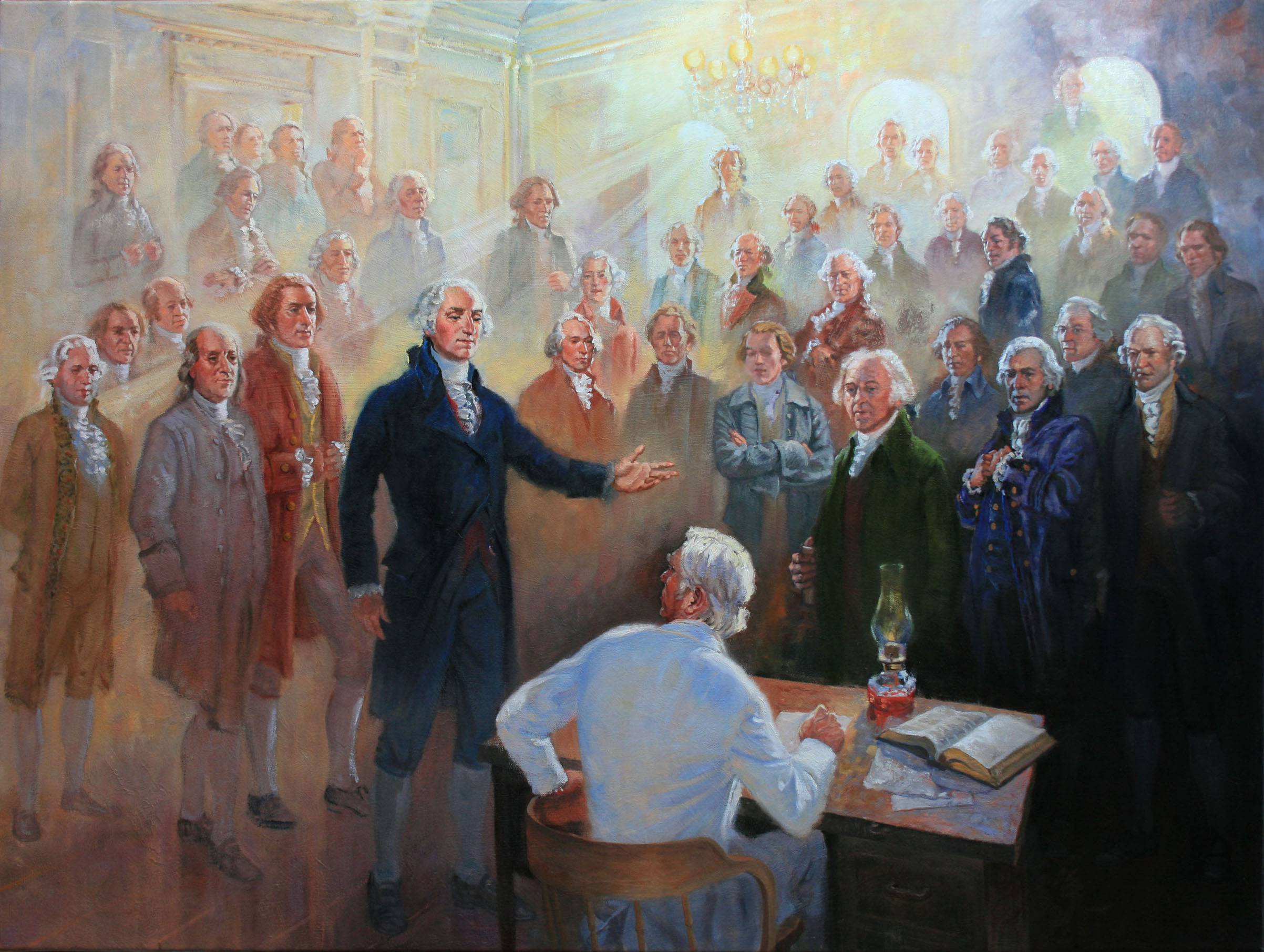
Wilford Woodruff and Founding Fathers

Wilford Woodruff’s vision of the Founding Fathers requesting Temple Ordinances

We are moving soon, but the Burley 11th Ward gave me another chance to address them. Since I received a number of requests for a copy of the talk, which is really just a collage of various items I could find online, the Journal of Discourses, the Saints second and third volumes, and other various histories. Here is the text of the talk I wrote, that does not mean it is the talk I gave…

I first addressed the freedoms we have as contrasted in the Saints third volume related to Germany. I said the word Jew and Israel from the stand and did not fear reprisal. I listen to free radio anytime I want and even seek out British radio from time to time and there is nothing illegal. Lastly, we could congregate without the worry of those in our midst about what was said or in the actual act of meeting.

Then to the following:

Declaration of Independence – We hold these truths to be self-evident, that all men are created equal, that they are endowed by their Creator with certain unalienable Rights, that among these are Life, Liberty and the pursuit of Happiness.

George Washington: “The success, which has hitherto attended our united efforts, we owe to the gracious interposition of Heaven, and to that interposition let us gratefully ascribe the praise of victory, and the blessings of peace.”

Alexander Hamilton: “The Sacred Rights of mankind are not to be rummaged from among old parchments or musty records. They are written . . . by the Hand of Divinity itself.” “For my own part, I sincerely esteem it a system, which without the finger of God, never could have been suggested and agreed upon by such a diversity of interests.”

Thomas Jefferson: “The God who gave us life gave us liberty at the same time.”

John Adams: “As I understand the Christian religion, it was, and is, a revelation.”

Benjamin Franklin: “The longer I live the more convincing Proofs I see of this Truth. That God Governs in the Affairs of Men!—And if a Sparrow cannot fall to the Ground without his Notice, is it probable that an Empire can rise without his Aid?—We have been assured, . . . in the Sacred Writings, that ‘except the Lord build the House, they labour in vain that build it.’ I firmly believe this;—and I also believe that without his concurring Aid we shall succeed in this political building no better than Builders of Babel.”

James Madison: “It is impossible for the man of pious reflection not to perceive in it a finger of that Almighty hand which has been so frequently and signally extended to our relief in the critical stages of the revolution.”

Samuel Adams: “Revelation assures us that ‘Righteousness exalteth a Nation’—Communities are dealt with in this World by the wise and just Ruler of the Universe. He rewards or punishes them according to their general Character.”

Charles Pinckney: “When the great work was done and published, I was . . . struck with amazement. Nothing less than that superintending hand of Providence, that so miraculously carried us through the war, . . . could have brought it about so complete, upon the whole.”

On May 4, 1842, he called to his side nine of the most faithful of his brethren—Hyrum Smith, Brigham Young, Heber C. Kimball, Willard Richards, Newell K. Whitney, and others—and later their wives came with them to the upper floor of the Red Brick Store in Nauvoo. 

Joseph was seeking to fulfill the promise from D&C 124, given in 1841, which the Lord would reveal to Joseph “all things pertaining to this house, and the priesthood thereof, and the place whereon it shall be built.” 

He had started, “If it should be the will of God that I might live.” Then he corrected and said, “It is not the will of the Lord that I should live, and I must give you, here in this upper room, all those glorious plans and principles whereby men are entitled to the fulness of the priesthood.” He proceeded in an improvised and makeshift way to do so.

We have from Brigham Young that after they had received these blessings the Prophet said: “Brother Brigham, this is not arranged right. But we have done the best we could under the circumstances in which we are placed, and I wish you to take this matter in hand and organize and systematize all these ceremonies.”

Brigham Young later said, “I did so. And each time I got something more, so that when we went through the temple at Nauvoo I understood and knew how to place them there. We had our ceremonies pretty correct.”

While the Nauvoo Temple was started in 1841, the first endowments were performed in the winter of 1845 and into 1846.  Baptisms had started in the Mississippi River prior to the temple and moved into the temple baptistery soon after it was completed and dedicated, well before the rest of the temple was done.  Brigham, leading the church, was personally overseeing the organization and perfection of the endowment and other ordinances that started in Nauvoo. 

After arriving in Salt Lake City, the church used the top floor of the Council House, starting in 1852 until the Endowment House was completed in 1855.  It was in this building that endowments, prayer circles, some missionary training, and some setting aparts were conducted.  The use of the Endowment House ended in 1877 with the completion of the St George Temple.  That building stood until Wilford Woodruff heard that unauthorized sealings were occurring there and ordered it razed in 1889. 

The St George Temple was the only one completed during Brigham Young’s 30 year tenure as President.  It was dedicated on 1 January 1877 in three dedicatory prayers under the direction of Brigham.  The baptistery by Wilford Woodruff, the main floor by Erastus Snow, and the sealing room by Brigham Young Jr.  Wilford Woodruff served as St George Temple President from 1877 to 1884.  Brigham had to be carried up the stairs, but he stood and spoke in the Assembly Room. 

“When I think upon this subject, I want the tongues of seven thunders to wake up the people,” he declared. “Can the fathers be saved without us? No. Can we be saved without them? No. And if we do not wake up and cease to long after the things of this earth, we will find that we as individuals will go down to hell.”

Brigham lamented that many Saints were pursuing worldly things. “Supposing we were awake to this thing, namely the salvation of the human family,” he said, “this house would be crowded, as we hope it will be, from Monday morning until Saturday night.”

On 9 January 1877, the first baptisms for the dead were performed in the St George Temple.  The first endowment for the dead was performed on 11 January 1877.  Brigham and Wilford personally oversaw the ordinances being performed.  Wilford began wearing a white suit, starting the trend that continues to this day. 

All endowments to this point had been done and passed by word of mouth.  It was in St George, far from Salt Lake City, that the ordinances were first written down.  Brigham also wanted to make sure the record was preserved and that they were standardized.  They were read to Brigham time and time again who would then approve or continue to revise the ordinances.  Brigham went home to Salt Lake City in April 1877.  He stopped and dedicated the spot for the Manti Temple on the way home.

Wilford Woodruff then wrote in his journal on Sunday 19 August 1877, “I spent the evening in preparing a list of the noted men of the 17 century and 18th, including the signers of the Declaration of Independence and presidents of the United States, for baptism on Tuesday the 21 Aug 1877.”

His journal entry for August 21 reads, “I, Wilford Woodruff, went to the temple of the Lord this morning and was baptized for 100 persons who were dead, including the signers of the Declaration of Independence. … I was baptized for the following names.” He then listed the names of one hundred men.

Elder Woodruff continued his journal entry: “When [John Daniel Thompson] McAllister had baptized me for the 100 names, I baptized him for 21, including Gen. Washington and his forefathers and all the presidents of the United States that were not on my list except Buchanan, Van Buren, and Grant.” (The work for these presidents has since been done.)

“It was a very interesting day,” Elder Woodruff continued. “I felt thankful that we had the privilege and the power to administer for the worthy dead, especially for the signers of the Declaration of Independence, that inasmuch as they had laid the foundation of our Government, that we could do as much for them as they had done for us.

“Sister Lucy Bigelow Young went forth into the font and was baptized for Martha Washington and her family, and seventy of the eminent women of the world. I called upon the brethren and sisters who were present to assist in getting endowments for those that we had been baptized for today.” (Wilford Woodruff’s journal, typescript, vol. 7, Church History Library; spelling and punctuation modernized.)

The first public mention of these events was made nearly a month after the baptisms were performed. In an address in the Tabernacle on Temple Square on 16 September 1877, Elder Woodruff first told publicly of the visitation of the signers of the Declaration of Independence.

“You have had the use of the Endowment House for a number of years, and yet nothing has ever been done for us. We laid the foundation of the government you now enjoy, and we never apostatized from it, but we remained true to it and were faithful to God. (Conference Report, April 10, 1898; Discourses of Wilford Woodruff, pp. 160-61)

During the 68th Annual General Conference of the Church which was held in April 1898, President Woodruff recounted the sacred experience:

I am going to bear my testimony to this assembly, if I never do it again in my life, that those men who laid the foundation of this American government and signed the Declaration of Independence were the best spirits the God of heaven could find on the face of the earth. They were choice spirits, not wicked men. General Washington and all the men that labored for the purpose were inspired of the Lord.

Another thing I am going to say here, because I have a right to say it.  Every one of those men that signed the Declaration of Independence, with General Washington, called upon me, as an Apostle of the Lord Jesus Christ, in the Temple at St. George, two consecutive nights, and demanded at my hands that I should go forth and attend to the ordinances of the House of God for them.  Men are here, I believe, that know of this, Brother John D. T. McAllister, David H. Cannon and James S. Bleak.  Brother McAllister baptized me for all those men, and then I told these brethren that it was their duty to go into the Temple and labor until they had got endowments for all of them.  They did it.  Would those spirits have called up on me, as an Elder in Israel to perform that work if they had not been noble spirits before God?  They would not. (Wilford Woodruff, Conference Report, April 1989, pp. 89-90.)

“They waited on me for two days and two nights,” he said,

“I thought it very singular, that notwithstanding so much work had been done, and yet nothing had been done for them.” (Journal of Discourses, 19:229.)

I was also present in the St. George Temple and witnessed the appearance of the Spirits of the Signers….the spirits of the Presidents….and also others, such as Martin Luther and John Wesley….Who came to Wilford Woodruff and demanded that their baptism and endowments be done. Wilford Woodruff was baptized for all of them. While I and Brothers J.D.T. McAllister and David H Cannon (who were witnesses to the request) were endowed for them. These men… laid the foundation of this American Gov., and signed the Declaration of Independence and were the best spirits the God of Heaven could find on the face of the earth to perform this work. Martin Luther and John Wesley helped to release the people from religious bondage that held them during the dark ages. They also prepared the people’s hearts so they would be ready to receive the restored gospel when the Lord sent it again to men on the earth.” (Personal journal of James Godson Bleak – Chief Recorder of the St. George Temple.)

In 1986, some of the staff of the Family History Library’s LDS Reference Unit were assigned to compile and computerize all the existing genealogical data on the founding fathers, to identify their families, and to document completed temple ordinances for each. For purposes of the project, a founding father was identified as one who had signed one or more of the following documents: the Articles of Association (1774), the Declaration of Independence (1776), the Articles of Confederation (1778), or the Constitution (1787).

The library study of 1986 revealed that there were no sealings of children to parents performed at the time the baptisms and endowments were performed. As a note, the ongoing revelation related to sealings to parents was not revealed until 1894.  It was then that the Law of Adoption, or sealing to prominent church leaders, was discontinued and we were encouraged to do genealogical work to compile the pedigree of the entire human family.  It was then that the Utah Genealogical Society was founded that has snowballed into the fantastic work of FamilySearch and all its appendages. 

He also recorded that George Washington, John Wesley, Benjamin Franklin, and Christopher Columbus were ordained High Priests at the time.

Temple work was performed on behalf of the following well-known and respected men and women in the St. George Utah Temple in August 1877.

Founding Fathers: William Hooper (NC), Joseph Hewes (NC), John Penn (NC), Button Gwinnett (GA), Lyman Hall (GA), George Walton (GA), Edward Rutledge (SC), Thomas Heyward Jr. (SC), Thomas Lynch (SC), Arthur Middleton (SC), Samuel Chase (MD), William Paca (MD), Thomas Stone (MD), Charles Carroll (MD), George Wythe (VA), Richard Henty Lee (VA), Thomas Jefferson (VA), Benjamin Harrison (VA), Thomas Nelson Jr. (VA), Francis Lightfoot Lee (VA), Carter Braxton (VA), Robert Morris (PA), Benjamin Rush (PA), Benjamin Franklin (PA), John Morton (PA), George Clymer (PA), James Smith (PA), George Taylor (PA), James Wilson (PA), George Ross (PA), Caeser Rodney (DE), George Read (DE), Thomas McKean (DE), Philip Livingston (NY), Francis Lewis (NY), Lewis Morris (NY), Richard Stockton (NJ), John Witherspoon (NJ), Francis Hopkinson (NJ), John Hart (NJ), Abraham Clark (NJ), Josiah Bartlett (NH), William Whipple (NH), Matthew Thornton (NH), Samuel Adams (MA), John Adams (MA), Robert Treat Paine (MA), Elbridge Gerry (MA), Stephen Hopkins (RI), William Ellery (RI), Roger Sherman (CN), Samuel Huntington (CN), William Williams (CN), and Oliver Wolcott (CN).

Note: Temple work was not done for John Hancock or William Floyd as it had already been completed previously.

Presidents of the United States: George Washington, John Adams, Thomas Jefferson, James Madison, James Monroe, John Quincy Adams, Andrew Jackson, William Henry Harrison, John Tyler, James Knox Polk, Zachary Taylor, Millard Fillmore, Franklin Pierce, Abraham Lincoln, and Andrew Johnson.  Temple work was not done for James Buchanan, Martin Van Buren, or Ulysses S. Grant.

Other eminent men baptized by Wilford Woodruff in the St. George Utah Temple in August 1877 include: Sir Edward Gibbon, Johann Wolfgang von Goethe, Oliver Goldsmith, Henry Grattan, Humboldt, Alexander von Irving, Washington Jackson, Thomas Jonathan “Stonewall” Johnson, Samuel Juarez, Benito Pablo Kemble, John Philip Liebig, Baron Justus von Livingstone, David Macaulay, Thomas Babington Nelson, Lord Horatio O’Connell, Daniel Peabody, George Powers, Hiram Reynolds, Sir Joshua Schiller, Johann Christoph Friedrich von Scott, Sir Walter Seward, William Henry Stephenson, George Thackeray, William Makepeace, Vespucci, Amerigo Webster, Daniel Wesley, John Wordsworth, William Parepa, Count Dimitrius, Martha Washington and her family, John Washington (Great Grandfather of George Washington), Sir Henry Washington, Lawrence Washington (Brother of George Washington), Augustine Washington (Father of George Washington), Lawrence Washington (Father of Augustine), Lawrence Washington, Daniel Park Custis, John Park Custis (Son of Daniel and Martha Parke Custis), and Martin Luther.

Eminent Women baptized include: Jean Armour (1767—1834) of Scotland, Jean Armour Burns (Wife of Robert Burns) (1759—1796), Jane Austen (1775—1817) of England, novelist, Mary Ball (1708—1789) of America, Mary Ball Washington (Mother of George Washington) (1732—1799), Sarah Bernard (1800—1879) of England, Sarah Barnard Faraday (wife of Michael Faraday (1791—1867), Charlotte Bronte (1816—1855) of England, novelist, Felicia Dorothea Browne (1793—1835) of England, Elizabeth Barrett Browning (1806—1861) of England, poet, (wife of Robert Browning) (1812—18?), Martha Caldwell Calhoun (d. 1802) of America (mother of John Caldwell Calhoun) (1782—1850), Martha Parke Custis (1755—1773) of America (Daughter of Martha Washington) (1732—1802), Martha Dandridge Washington (1732—1802) of America (wife of George Washington) (1732—1799),  Rachel Donelson Jackson (1767—1828) of America (wife of Andrew Jackson (1767—1845), and Abigail Eastman Webster (1737—1816) of America (mother of Daniel Webster (1782—1852), to name but a few. Temple work was performed for a total of 70 eminent women.

During most of our national history Columbus and the Founders were considered heroes with determination and foresight.  Cities, rivers, and many other places were named after them.  More recently there has been a wide spread effort, designed especially to indoctrinate young people, which slanders Columbus, the Founders and their accomplishments.  Columbus is held personally responsible for centuries of mistreatment of Native Americans.  The Founders are portrayed as being greedy and motivated by selfish interests. All of this is as astonishing as it is misleading.  

From the Lord’s perspective among the most important events of the history of the world was the discovery and founding of America.  1 Ne 11-14.  Nephi was referring to Columbus when he wrote:  “I looked and beheld a man among the Gentiles, who was separated from the seed of my brethren by the many waters; and I beheld the Spirit of God, that it came down and wrought upon the man; and he went forth upon the many waters, even unto the seed of my brethren, who were in the promised land” 1 Ne 13:12.  By the Founders “the Lord God will raise up a mighty nation…even on the face of this land.” 1 Ne 22:7.

Go on to life and history of George Ross of Pennsylvania, signer of Declaration of Independence.