Apostolic Brush

Ruby and David Haight, Paul Ross, Rose and John Byrom

Ruby and David Haight, Paul Ross, Rosie and John Byrom

I stumbled upon this picture the other day and thought maybe it was time to share it.  This picture has an interesting story behind it.

On the far right are John and Rosie Byrom.  Rosie is mostly in the shadow so it is difficult to make her out.  I served in the Runcord Ward from around December 1999 to around August 2000.  John served as Ward Mission Leader and Rosie as a Ward Missionary.  (The Byroms have since separated and divorced).  I served in the ward for a long time and they remained in their callings for the entire time, so we built a friendship which, I feign to believe, still exists to this day.

I returned home from my mission in December 2000.  It was not long into 2001 that I learned the Byroms were planning on visiting Utah.  Of course, I invited them to spend some time in Idaho.

During the majority of time I served in Runcorn I had a companion by the name of Brad Hales.  Also in our district was a senior sister companionship of Meriel Peterson and Patricia Kleinkopf.  We were all native Idahoans and were in close proximity of each other.  It was natural that the Byroms also wanted to visit each of them while they were in Idaho.

This particular day we drove to Oakley, Idaho to visit Sister Peterson.  We had an enjoyable breakfast and conversation.  Sister Peterson decided she wanted to give us the tour of Oakley because there were some architectural gems that she thought the Byroms would enjoy.  I grew up near Oakley so I was familiar with many of these local landmarks.

We all piled into my little Camry and away we drove.  We had not made it very far driving down some of the streets of Oakley when Sister Peterson announced, “Wait, David is home, he will want to meet you!”  She had me turn around and we pulled into a little home in Oakley.

I had no clue who David was and I was not familiar with the home we were now pulling into the driveway.  We all exited the car.  In the yard there was a man trimming his hedges with a large straw hat and a large set of sunglasses that you only see older people wear.

Since Sister Peterson indicated that David would want to meet the Byroms because they were from England, I remained at the front of my car in the driveway and leaned back against it in the hot, summer, morning sun.

I have to give a little bit of background on the month prior.  We are in the latter half of July 2001 at the point of this picture (I recollect it was the 21st, but may be wrong).  I had just spent considerable time in Hawaii with family at the beginning of the month.  During that time I picked myself up a shirt and a shell necklace among other items.  As you can see in the picture, I am wearing my red shirt (not the blatant Hawaiian design you regularly see).  For years I thought I was in a pair of board shorts too, but this picture corrects my memory on that tidbit.  But I had continuously wore my new puka shell necklace since the trip to Hawaii.

Back to the story, I am leaning on the front of my car watching the Byroms enter the back yard through the hedge and approach this old man in a large straw hat and holding an electric hedge trimmer.  The man stopped trimming and turned to greet his trespassers.  Curiously, after what was a short couple of moments, probably no more than 20 seconds of conversation, this man leaves the Byroms and Sister Peterson and headed my direction.

My first reaction was that I was doing something wrong so I looked around to see my misstep.  Alas, not seeing I had done anything wrong I waited and met the man within feet of my car.  He had set down his trimmer before arriving to me and he pulled his hand out of his glove to shake my hand.  I shook hands with him and with his free hand he reached up and took off his hat and glasses and asked me my name.

My first thought was something along these lines, “Boy, this David fellow sure looks familiar.”  He asked my name and I gave it.  He asked about my Ross name and whether or not it was Scottish.  I informed him it was my name but not the name of which my ancestors carried.  He then informed me that Ross was a common name in Scotland where he had served as a Mission President.

He then grew quiet and he sidled up closer to me and put the hand with the hat and glasses in the small of my back while still holding my other hand in a handshake.  He was now close enough that his face was in my shadow (and he was considerably shorter than me).  He then broke the handshake and with that hand reached up and touched my puka shell necklace.

“What is this?”

“My necklace?”

“I am disappointed that you have fallen from the principles of the gospel that we teach as missionaries.  We teach than men and women have separate and distinct roles and this is confusing the two.”

My first impression was, “How did you know I served a mission?”

This man then turned to walk away back to the Byroms and Sister Peterson.  As he walked away, the thought occurred, “You have just been rebuked by an Apostle.”

Then it dawned.  David was David B Haight, one of the twelve Apostles of The Church of Jesus Christ of Latter-day Saints.  This was an individual I recognized as a Priesthood Leader and on my first meeting with him, I had been rebuked.

I stood there reeling from what had just happened.  It stung.  David went to the back door of his house and summoned his wife Ruby.  Ruby appeared and they all stood 25 feet away from me chit chatting about England, Scotland, and whatever else they were talking about.

What seemed like an eternity was likely only several minutes or so, if that.  I remember reaching up and taking the puka shell necklace off and holding it in my hand.  I dwelt on what was really an unintended and probably unwanted visit that was a bother to me and this old man.  Sister Peterson just commented he was home and a few lines of dialogue just ended up potentially affecting my eternities.  According to him I was already on the path, so I guess it did not matter what he said except to correct my backsliding ways.

Next thing I knew, the distant conversation between the Haights and Byroms had stopped and this Apostle was returning to me.  He again held out his hand as if to invite another handshake. I held out my hand with the necklace in it and he cupped his hand to receive whatever I was offering.  I dropped the necklace into his hand and once he realized what it was he let it drop to the ground.

He held out his hand again inviting mine in a handshake and I clasped his again.  He sidled up close to me again, put his other hand in the small of my back, and was close enough to be in my shadow and that I could smell the salt in his old man sweat, and he continued…

“Where did you serve your mission?”  (I remember thinking that was an ironic question since the Byroms were from England, Sister Peterson served in England, and he asked where the fourth member of the party served his mission?)

“England Manchester Mission”

“How long have you been home?”

(After a quick mental tally) “Nine months”

“Elder, you hold the Priesthood.  You have a duty to uphold that Priesthood.  You should have been married by now.”

He released my hand, pulled his hand from the small of my back, turned, and walked away.  Maybe 4 steps later he turned around and said, “When it happens, I want to know about it.”

He returned to a conversation with Ruby, Sister Peterson, and the Byroms.

I stood there while they chatted for a few more minutes.  I do not recall hearing anything of the conversation between them, even if I was close enough to have heard.

Rosie had a picture taken of the occasion.  Sister Peterson sacrificed herself in the moment to take the photo that now memorializes this occasion.

I shook hands again with Elder David Haight and Sister Ruby Haight and we headed on down the road to see some other homes.  I ended up driving many more hours that day to Boise, Idaho City, Stanley, and elsewhere chauffeuring the Byroms through some of the sights of Idaho.  Rosie Byrom teased me about the moment the rest of the time I was with them.  After all, it is not every day that you get rebuked by an Apostle.  I cannot recall if they overheard the conversation or if I told them about it.  I cannot imagine that they overheard the conversation due to the close proximity in which David and I spoke that day.

Oddly enough, it weighed on me for a long time.  It became the butt of jokes as time went on, especially as David continued to age.  He was already over 95 at the time of my meeting him.  Roommates and friends would indicate that I better hurry or else I would not fulfill the rest of my duty to let David know when it happened.  I will not lie, it became a great story to tell people.  People loved to hear about my rebuke by an Apostle.

I regularly tell the story to individuals I am close to and that wear a necklace.  Missionaries I worked with I regularly told the story, especially if they wore a necklace.  I admit, I never wore a necklace or bracelet of any type since that date.  I know a number of missionaries who have “fallen from the principles we teach as missionaries” and forsaken their evil ways.  Honestly, I do not know that the story is one that should be heeded by others.  But for the deep effect it had upon me at the time and the power in which he spoke to me, I recognize it was for me.  Others should be careful about applying revelation of others to themselves.  But I do believe there is a principle here that we can learn, I just don’t know that I can very clearly articulate it.  I know the principle clearly for me, but don’t know how narrow or general to make it in application to others.

I remember Rosie reminding me that if I properly repent, I would be married within another 9 months.  Boy if that did not apply a little pressure!

As a side, I did pick up my little puka shell necklace and ended up giving it to a friend when I returned to Missouri later in August.  I don’t believe she has any clue what that little necklace meant to me.

There is more to the story.

On the following Monday, I believe 23 July 2001, I was in Salt Lake City with the Byroms.  After an endowment session, Rosie announced we were to go to the Church Administration Building.  She did not tell us why and I thought she just wanted to see the sights from the Church Office Building.  We walked in the Church Office Building and after Rosie talked to the man at the desk, she said we were in the wrong building and we needed to go to the Church Administration Building.  I informed her that the Church Administration Building was not really open to the public.  Rosie announced that we had an appointment.

In light of my experience a few days before, I was not really thrilled about our appointment in the Church Administration Building.  We walked around to the front door of the Church Administration Building and walked in.  As we approached the man at the security desk he asked,

“Are you the Byroms?”

Rosie responded, “Yes.”

“We have been waiting for you.”  (Never a very heartwarming phrase, whether the morgue, jail, CIA, bank, or Church Administration Building)

The man then responded, “You will need to leave your bags here, take the elevator to the fourth floor, take a right, and it is the last door on the left.  I will let them know you are coming up.”

We entered the elevator and headed to the fourth floor.  Rosie then turned and commented to me, “John helped provide security and drive for Elder Ballard while he (Elder Ballard) was in England for the Preston Temple Dedication.  He told us that if we were ever in Utah to stop and pay him a visit.”

Suddenly the realization came to me that I was going to visit with my second Apostle in less than a week.  I am a fairly laid back guy but felt some apprehension after the experience just days before.  We turned the corner and there stood M Russell Ballard in the doorway.  He invited us in to his office, introduced us to his secretary, and then ushered us into his office.  Across from his desk, I think, there were two nice wing-backed chairs.  Another chair was already there for me, or we pulled up a chair.  Elder Ballard left the office for a moment and then reappeared pushing an office chair toward me.  We were already all seated and he asked,

“Where is your wife?”

“I am not married.”

“Oh, that is something you will have to fix.”

He turned to push the little chair back out the door.  I heard Rosie chuckle and comment, “In the mouth of two or three witnesses…”

Elder Ballard returned and took his seat and we had a nice conversation that probably did not take more than 15 minutes.  Once again, Rosie had a picture taken.

Paul Ross, Rosie and John Byrom, Elder Ballard

Paul Ross, Rosie and John Byrom, M Russell Ballard

That was the extent of the interaction and I felt some sting from the second witness of my duty to uphold the Priesthood.  But it was a pleasant experience.  Rosie reminded me often after that, “In the mouth of two or three witnesses shall every word be established.”

Well, time passed and eventually Elder David B Haight did pass from this veil of tears at the end of July 2004, three years after our encounter.  Fortunately, Elder Haight and I did have an opportunity to talk again regarding our first interaction that lessened the blow of the occasion.  I was invited to drive him on an occasion.  Nevertheless, roommates and many friends called after Elder Haight’s passing to let me know how dire my situation was now that the revelator had passed and I had not fulfilled my duty.

Rosie commented to me that I could fulfill my duty by reporting my marriage to Elder Ballard when the time came.

Well, forward a few more years and I became enamored with a little red-headed girl from Kaysville, Utah.  She came to enjoy her time with me and after a while we would end our walks with a little dancing on the porch of the Alumni House at Utah State University.  It became a regular thing to end our walks and evenings out with a dance and closing conversation on the porch of the Alumni House.  I dare say we danced on the porch of that building more than 60 times.  It was on the porch of this little Alumni House that I made an unofficial proposal to Ms. Hemsley.  It just seemed like the right place.

Months later, Amanda and I returned to Logan under the guise of visiting some friends.  While on the campus I took her to that little porch of the Alumni House and there after midnight, now on 4 July 2005, I fell to my knee and proposed to her.  Of course she said yes and we danced and kissed there on the porch of the Alumni House.  Interestingly, before we left that night, I caught sight of a huge portrait hanging inside the doors that open to the porch that had become an important part of our courtship.  As I looked closer, I could see the familiar sight of a man whose face I knew.  As I got a little closer to see in the dark the portrait lit only by fire escape signs it dawned on me it was a portrait of David B Haight.

If that was not a little coincidental, and perhaps a little creepy, I do not know what is.  Elder Haight’s portrait had actually witnessed some of the most personal moments of my courtship.  The building I had only known as the Alumni House is properly named the David B Haight Alumni Center.  Somehow it seemed the whole experience had just came full circle.

We sent a wedding invitation to Elder M Russell Ballard with a short note explaining that due to Elder Haight’s passing I was sending the note and invitation to him to fulfill my duty.  He responded with a card thanking me for my note and invitation and suggested I consider my duty fulfilled.  He also apologized for not being able to attend our reception (which I am glad about, surely some further duty might have been laid upon me if he had!)

There is my story for the above photo with the Haights, E Ballard, and Byroms.  Maybe some day I will tell my story about Elder Hales (the Apostle, not my missionary companion)…

Edna Coley Neilson

With the recent passing of Ivan Blaine Neilson, I decided to prepare a history for his mother Edna Coley Neilson.  Especially since I just recently came in possession of a number of new photographs of the family.  Some day I will write a history of her parents, my Great Great Grandparents, but I am hoping some more photos of them will appear in the upcoming months.

Edna Coley was born 23 November 1900 in Lewiston, Cache, Utah.  She was the second of ten children, my Great Grandmother Lillian being the oldest, born to Martha Christiansen and Herbert Coley.

I don’t know much about Edna’s personality.  I have been told by numerous people that Edna was the preferred child of Martha and was often doted on to the the dismay of the siblings.  I don’t know that tells me much of her personality though.

Edna married Gerold Andrus (1903-1984) 17 April 1921 in Richmond, Cache, Utah.  The next month, 15 March 1921, Harold Christian Andrus was born.  Gerold and Edna were only married for a very short time, a shotgun wedding and a shotgun divorce.

Edna married Olof Alma Neilson (1891-1960) 23 July 1923 in Logan, Cache, Utah.  They were sealed 30 July 1924 in the Logan LDS Temple.  I don’t know if Harold was adopted legally or not, but Harold went by Harold Christian Neilson the rest of his life.  The only father he knew was Olof and Olof treated Harold as if he was his own son.

Olof and Edna would have what appears to be ten children together.  The records certainly show ten children, but I believe one of them is a duplicate, or mistakes in names leading to a duplicate child.  Nobody is alive to confirm either so I will list all ten but point out where I believe the duplication exists.

Alma Russell “Russell” Neilson born 23 Jun 1924 in Richmond.  He married Gloria May Olson on 9 Oct 1946 in the Salt Lake City LDS Temple.  He passed away 13 September 2017 in Washington Terrace, Weber, Utah and buried 19 September at Washington Heights.

Olga Helen “Helen” Neilson born 28 July 1926 in Richmond.  She married LeRoy “Roy” Hulse Draper 25 May 1943.  She passed away 4 March 2015 and was buried 9 March at West Point, Davis, Utah.

Olof and Edna, Harold, Helen, and Russell Neilson

Olof and Edna, Harold, Russell, and Helen Neilson (14 May 1927)

To Lillian and Joe, when she was 10 months old.

To Lillian and Joe, when she (Helen) was 10 months old

Olof and Edna Neilson holding Russell

Olof and Edna Neilson holding Russell

Martbamary Neilson born and died 2 July 1927 in Richmond.  He does not have a tombstone if he is buried in Richmond.

Hebert Neilson born 25 November 1928 and died 26 November 1928 both in Richmond.  He has a tombstone in Richmond.

Aenotta Neilson born and died 1 September 1929 in Richmond.  This and the next child were either twins or just variations on a name.  Only a documentation exists for the next child.

Jennetta Neilson was born 1 September 1929 and died 2 September 1929 in Richmond.  Jennetta also has a tombstone where Aenotta does not, you would expect Aenotta would since they were supposedly twins.

Ole Neilson was born and died 19 October 1932 in Richmond.  He was buried 20 October 1932 in the Richmond Cemetery and has a tombstone.

Russell Neilson

Russell Neilson

Ivan Blaine Neilson was born 26 April 1935 in Richmond.  He died 16 January 2013 in Yuma, Yuma, Arizona.  He was buried 25 January 2013 in Smithfield, Cache, Utah.  He married Gloria Gilgen 8 June 1954 in Salt Lake City, Salt Lake, Utah.  They were later divorced.  He remarried to Rebecca Anne Pitcher 4 September 1981 in Smithfield.

Ivan Blaine Neilson

Ivan Blaine Neilson

Lastly, Martha Mary Neilson was born and died 6 July 1937 in Richmond.  She is buried in Richmond.

Lillian, Edna, Martha (sitting) Coley in the 1940's

Lillian, Edna, Martha (sitting) Coley in the 1940’s

Russell Neilson

Russell Neilson

Harold Christian Neilson

Harold Christian Neilson

Nelen Neilson

Helen Neilson

Russell and Gloria Neilson

Russell and Gloria Neilson

1955 Coley Reunion, Richmond, Utah

1955 Coley Reunion, Richmond, Utah

I named the people in the reunion photo here.

Olof passed away of a heart attack at about 9:30 am 13 April 1960 at home in Richmond.  He died almost instantly.  He was buried in Richmond on 15 April 1960.

Edna’s mother passed away 14 August 1961.  The family gathered for the funeral 17 August 1961 for the funeral.  The photo below was taken that day in the Richmond Cemetery.

Art, Golden, Wilford, Roland, Lloyd, Edna, Hannah, Carrie, Lillian, Ivan Coley at their mother’s funeral in 1961

Edna, Will Thomson, Lillian

Edna, Will Thomson, Lillian in the mid 1960’s

Edna lived close to her sister, Lillian Jonas, now Bowcutt, and Lillian makes regular reference to Edna in her journals.  The thing that stands out to me is how close they were in that Edna would regularly aid or stay with Lillian.  Also, Lillian makes regular reference to Edna’s attending the temple in Logan.

Harold took his own life 9 March 1966 in Phoenix, Maricopa, Arizona.  His body was brought back to Richmond for burial.

Edna lived in Richmond until she passed away 6 April 1983 in Richmond.  Her funeral was held 9 April 1983.

Edna's funeral program

Edna’s funeral program

Biography of John Christoph Nuffer

I have updated this 2012 article because I recently came in possession of a photo of Eva Greiner Nuffer that we didn’t have before.  I left the old colored picture in to show the contrast.  How amazing is it to have an actual photo.  Plus you can contrast the imperfections and weaknesses of the colored photo as contrasted with the less than stellar photo copy, but it is so much better than we had before.

This is the biography of John Christoph Nuffer written by Alma Katherine (Kate) Scheibel Naef, granddaughter of John Christoph Nuffer.  Kate’s parents are Jacob Schiebel and Regina Friederike Nuffer.  I will type it exactly as it is found in the book, “We of Johann Christoph Nuffer, also known as: Neuffer, Nufer, Neufer,”  The book was published in April 1990 by Dabco Printing and Binding Co in Roy, Utah.

Johann Christoph Nuffer

“When grandfather Nuffer was still in Germany, he was a dress goods weaver, did truck gardening, and also had a grape vineyard.

“At that time his family consisted of my grandmother, Eva Katherina Griner Nuffer, his second wife, my mother, Frederika (Regina), her two brothers Charles August and Adolph, and two sons, Fred and John, from his first wife, Agnas Barbara Spring Nuffer, who died in Germany.

“Their home was on Main Street and was made of lumber and rock.

“They belonged to the Germany Lutheren Church, and were visited by mormon missionaries who came from America to preach the Gospel to them.  This made their hearts rejoice and in 1879 they were converted to the mormon church or Church of Jesus Christ of Latter-day Saints.  Elder John Theurer of Providence, Utah, U.S.A. was the Elder that preached the gospel to them and later baptized them.

“At the time there was a canal or mill race that ran close to the back row of houses.  They had planned to do the baptizing at night so they would ot cause any disturbance around the neighborhood.

“At the time there was a family who had an upstairs in their house and they watched through the upstairs window and saw grandfathers family go out the back way into the canal.  As soon as this family saw them, they rumored it around the neighborhood, and before morning the whole neighborhood knew that the Nuffer family had been baptized into the mormon church and of course, persecusion started.

“After having been baptized, they had the desire to come to America, the promised land, to be with the main body of Saints.

“My grandmother, Eva Katherina Griner Nuffer, was a woman of great faith as I have heard my mother and Uncle John Nuffer speak of many times.  Uncle Fred said in his history that she was a good woman as well as a good mother.

Eva Greiner

Eva Katharina Greiner Nuffer

Eva Kathrina Greiner

“They left Germany in 1880.  While coming across the ocean, the children had the measles so it was not a very pleasant journey.

“They arrived in Providence, Utah about 15, May, 1880 where they lived for three years.  It was while here that Mary (Maria) was born.

“Grandfather and family left Providence and moved to Mapleton or Cub River, which at that time was called St. Joseph.  At the time they put the Post Office in, there was already a St. Joseph in Idaho, so they had to give it a new name.  They named it Mapleton and it could well be called such for it was in the mist of so many beautiful maples.  The hills and canyons were loaded with these maples.

“The Nuffer ranch or homestead was located on the north-west of Mapleton which the Lord had well provided for the pioneers with black, furtile soil.

“Grandfather’s farm was cut in half by the main traveled road.

“On the east side was the land where his homes, stables, and orchards were located.

“The orchard was on a hill side a little north-west of the second house.  The orchard contained applies, different kinds of plums and prunes, cherries, pears, peaches, grapes, strawberries, raspberries, gooseberries, and currents.

“On the side there were also many shade trees which furnished shade in the summer months for the buildings.  Some of those trees are still standing and are about 80 years old or more.

“On the west side of the road was a meadow.  A creek ran through this area.  The creek was loaded with bushes and willows which were used in making the fence which surrounded the homestead.  Uncle Charles August ad Adolph helped Grandfather make these fences.  Also they would help Grandfather with his farming.

“Also on both sides of the creek grew Timothy and Red Top which Grandfather used for hay.

“On a steep hill side to the west of this hay was a grove of Quaken-asp trees which were used for making fence posts.

“To the south of this meadow land was a pasture.  Besides being covered with short meadow grass, it had many wild violets and Johnny Jumpups.

“The many colors of violets resembled a beautifully spread carpet.

“This farm from one end to the other was a beautiful place, but, as time went on the hand of man destroyed this beauty.

“The first winter they lived in an unfinished log house.  The floor joist was in the floor, but winter came before they could get the lumber to finish it.  This was a very uncomfortable winter, and they were snowed in many months at a time and could not get to town for supplies, so they had to live on what they raised on the farm.

“Many times when sugar was not available, Grandmother would roast sugar beets in the oven and squeeze the joice out of them for sugar to keep her yeast alive and also for other sweetening purposes.

“When flour was scarce, they would grind wheat in the coffee mills to make their bread.

“The Germany people liked hot drinks, so they would roast barley or wheat and grind it to use for hot drinks.

“Since bottles and sugar were so difficult to get, they would dry many of the fruits and vegetables which they raised and also wild fruits such as Chokecherries and Serviceberries.

“They would also use wild gooseberries which grew along the creek and sweet them with honey when they were in season.

“When coal oil was not available for lights, they would make a wick out of cloth and soak it up with grease and let it burn.

“Grandmother would catch rain water in a barrel and put wood ashes in it to make the water soft when ther wasn’t any soap for washing.

“They made brooms out of fine willows to clean their shoes off with.

“I remember seeing these willow brooms leaning against the door.

“They also made baskets from small willows for cloths baskets or for whatever the need would be.

“It was in the house by the orchard on 20, February, 1893, that my grandmother, Eva Katherine Griner Nuffer died of pneumonia.

“I don’t know just how long Grandfather lived in this house when he married his third wife, Anna Elisabeth Weirman Nuffer.  She had three children, Fred, Ida, and Jake Weirman.

“Later they moved back to the first house they built in Mapleton.

“Later Grandfather built a one room log house a few rods west of the first house.

“Grandfather sold his ranch to the Hull Brothers of Whitney and moved to Preston.

“The home in Preston was a two-room frame house west of Uncle John’s rock house which was located in the south-east part of town.  That house is still there, but has had more rooms built on to it.

“The next place he moved to was Logan, Utah.  It was here, 1, December, 1901, that his third wife, Anna Elisabeth Weirman Nuffer died.

“While still living in Logan, Grandfather married his fourth wife, Maria Alker Nuffer.

“After living in Logan for some time, they moved back to Mapleton where Uncle Charles August Nuffer built them a one-room log house in his orchard.

“Uncle Charles August’s house was just over the ridge and not far from the old Nuffer home.  His house could be seen from Grandfather’s orchard.

“I don’t remember just how long they lived there before they moved back to Preston.

“Uncle John Nuffer and some of his boys built them a two-room rock (or cement) house.  It was across the street, south, and a little east of Uncle John’s old frame house.

“It was here in this house that Grandfather died 12, April, 1908.

“Grandfather had poor health the later fifteen or more years of his life.  He had terrible headaches, kidney trouble, and other such ailments as stomach and liver.  All these and more made him suffer a great deal.  Just before his death, he was nearly blind.

“I am grateful for my pioneer grandparents and the heritage they have given me.

“Prepared and arranged June 1961 by Laurine and LaNada Hancock daughter and granddaughter of Katherine (Kate) Naef

I wanted to add a couple of notes.

There appears some debate who had the middle name of Christoph, some believe it was only Sr, others only Jr.

Eva Katherine Greiner is the proper spelling.

Anna Elizabeth Weirman is Anna Elizabeth Reber who was a widow of Gottfried Weierman (some sourches Weiermann).

Maria Alker is Maria Anna Alker who was a widow of Conrad Schaub.

William Mills

William Mills 1839 - 1910

William Mills 1839 – 1910

This is another photo that was recently provided to me by a cousin.  She did not know if we are related to him or not.  Here is the photo and I can indicate I am not related, and I do not believe she is directly either.  Since I did not see the photo available elsewhere, I thought I would make it available just in case it is a one of a kind.

William Mills was born 4 November 1839 in Spurstow, Cheshire, England.  The back of the photo has “Wm Mills 4 Nov 1839” written on the back.  He married Margaret Ann Hawkey on 1 June 1867 in Salt Lake City, Salt Lake, Utah.  After she died, he married Caroline Virginia Hughes 13 December 1883 in Salt Lake City.  He died 10 November 1910 in Paradise, Cache, Utah.  He was buried 14 November 1910 in the Paradise City Cemetery.
Wanner, John George, Jr. and Eliza Sterling/Regina Nuffer
I found this biography written by Mary Louise Wanner Andra of her parents.  I will write a separate history for them in the future, but I thought I would make this one available unadulterated by me (typed completely as written in the book, although I added the photo).

This biography was published in Whitney Centennial 1889-1989: Whitney’s First 100 Years.  It was published in 1991 by the Whitney Ward, written and edited by the Whitney Ward Centennial Book Committee.

John George Wanner Jr Family abt 1912. (l-r): Eva, William, Golden, Serge (sitting), John, Regina, Rulon, Willard, Mary.

Our father, John George Wanner, Jr., was born in Holzgerlingen, Neckarkreis, Wuerttemberg 29 October, 1870.  His parents were John George Wanner and Anna Maria Schmid.  He was the oldest in the family of five boys and five girls.

His father had a small farm and some cattle.  He was also a road overseer.  So dad, his mother and brother and sisters did most of the farm work.  They also got wood from the forest for winter fuel.

Dad’s parents were very religious people and belonged to the Lutheran church.  They were very hard workers and tried to teach their children correct principles.  Dad tried hard to follow in their footsteps.

His parents joined the Church of Jesus Christ of Latter-day Saints in 1891.  They made sure all their children were baptized as they became of age.  His parents could see that it was the only true church on the earth, and they wanted to go to America, where they could worship as they wished.  They also felt it would give their children a better opportunity in life.

His parents were the only ones in their respective families who joined the LDS church.  Our dad was baptized in July in 1891, and came to America with one of the missionaries – a brother Terrell who was from Providence, Utah.  Brother Terrell took good care of him and helped find work for him to do and provide for himself.

Dad got a job working for brother Fred Nuffer in Glendale, Oneida County (now Franklin County), Idaho.  In 1893 his father, mother, and his brothers and sisters came to Cache Valley from Germany.  Dad and brother Nuffer met them with a wagon and buggy in Franklin, Oneida County, Idaho, June 18, 1893.  I am sure he was happy to see his family again, as it had been almost two years since he had seen any of them.

Dad met a lovely girl from Providence, Utah, by the name of Eliza Sterling, and this relationship blossomed into marriage in 1894.  They were blessed with two sons, George and Earl Wayne.  This marriage was not a very happy one and they were divorced.

On the 31st of August 1898, dad married Regina Nuffer who was a sister of our uncle Charles August Nuffer.  [Daughter of the marriage of Eva Katherine Greiner and Johann Christopher Nuffer]  On 9 November 1899, they were blessed with twin boys, William and Willard.  As time went on they were blessed with more children, a total of five boys and two girls.

John & Regina Wanner

John & Regina Wanner

Dad went on a mission to Germany in the fall of 1907, leaving a wife and six children.  On March 8, 1908, their son Serge was born.  Mother and the family were living in a home John Nuffer built for dad.  It is a rock house on East Oneida Street in Preston, Idaho.  This house is still standing and is in good condition at this writing – June 1979.

When Serge was a few months old, mother took all the children and had a picture taken and sent it to dad so he could see the new baby.

Regina with William and Willard in the back and then Golden, Mary in the middle, holding Serge, then Rulon, then Eva.

While Dad was in Germany, he met William Andra’s mother and family and baptized the eldest daughter Freda.

In 1910, Dad’s mother and father sold their home and farm in Whitney to Dad.  This is the farm Lawrence Bodily now has.  Dad built a red barn that is still in use on the farm.  After grandpa and grandma sold their farm to dad, they moved to Logan, Utah.

In 1913 dad’s parents, brothers and sisters had a family reunion at their home in Whitney.  There was a large crowd and we all had a good time.

We all had to work hard and dad relied on his daughter Mary for many hard farm jobs.  However, on Saturday nights he would take us to the picture show and give us each 25¢ to spend on the show and treats.

In 1917, I begged to take the sewing class at the USAC in Logan, as I wanted to learn to sew.  However, I was only there a short time when dad brought me home to work on the dry farm.  I have always felt bad about this as I wanted to learn to sew.

My brother, William, enlisted in the Army on August 5, 1917.  He was with the 145th Light Field Artillery, Battery C.  He left Salt Lake City for Camp Kearney on October 11, 1917.  He left for France August 2, 1918.  William contracted the influenza and died December 1, 1918.  His body was brought home November 11, 1920, and interred in the Whitney Idaho Cemetery.

Just a few days before they got the sad news of William’s death, their son, Golden, died November 26, 1918 in Salt Lake City from Influenza.

On January 8, 1921, dad sent his son Willard on a mission to New Zealand.

Dad and mother were to face still more sorrow when their son Rulon died February 26, 1924, in the Logan hospital.

Dad believed in missionary work with all his heart and soul and on December 15, 1925, he went to Tennessee on a six month mission.

In 1928, Serge went to New Zealand on a mission and died there October 5, 1929.  His body was brought home for burial.  The funeral was held in the old opera house in Preston, Idaho.  These were trying times for our parents.  Losing four sons, and all their bodies returned home in a box.  This left them with only one son and two daughters.

On April 7, 1930, dad sent Eva on a mission to California.  Dad was not a stranger to hard work.  He raised crops and took good care of his farm animals.  He took pride in having things looking neat and clean around the farm and yard.

When Dad operated his farm in Whitney, he was always up early in the morning and usually was the first to get to the beet dump in the morning.  The story is told about some of his neighbors who decided to beat him to the dump.  They got up extra early to get a head start.  Before they got to the beet dump, they could hear George Wanner going down the road ahead of them.  They could hear him saying to his horses, “Gid up–gid up–gid up.”

When dad sold his farm in Whitney, he purchased 40 acres nearer to Preston and built a beautiful home on it.  Part of it is where the Oakwood School is now located.  When he retired he sold his farm and home to his daughter Mary and her husband William Andra.

Dad was successful in the various undertakings he engaged in.  He was one of the first in Preston to have an automobile.  When he brought it home he did not know how to stop it.  He yelled “whoa” when he got in the garage, but before he got it stopped he had gone through the end of the garage.

Dad built the two little homes on the west side of second east and first south in Preston, Idaho.  He also built three homes on first south and the south side of the street in Preston.  Dad and mother lived in one of them until she died in 1942.  Mother was ill for quite a while before she passed away.  Dad cared for her the best he could and would take her for little rides in the car.  She was unable to walk and dad would carry her on his back from place to place as they went visiting.

As many of you will remember, there was a humble side to dad.  I have seen him cry when bearing his testimony and when he was grieved over the death of a loved one, a relative, or friend.  He wanted to leave this world a better place than he found it, and I feel sure he made some contributions and brought this desire to fulfillment.

After mother died, dad remarried and went to live in Salt Lake City, Utah.  This marriage was not successful and they were divorced.  Later on he remarried again and was living in Florida.  He became ill and wanted to get back to Preston.  My son William went to Florida to bring him home, but when they got to Chicago, he was too ill to go on.  So, William put him in the hospital where he passed away on January 5, 1947.

Regina Nuffer was born January 26, 1869 at Neuffen, Germany, a daughter of Johann Cristoph and Eva Katharina Greiner, she came to Utah with her family after they were converted to the gospel.  She married Jacob Scheibel July 15, 1889, in Pleasant Valley, Carbon County, Utah.  Her first child, Alma Katherine Scheibel Naef, was born, September 27, 1889.  When her child was six months old, she and her husband separated and she moved back to Mapleton, Idaho, where she stayed with her parents on their farm.  During this period, she would help people when they were sick, and her mother would take care of her child.

In about 1893, after the death of her mother, she moved to Weber County, Utah, and worked for the Will Taylor family in Farr West and the Bowman family in Ogden.  She again returned to her father’s farm.  On her way home, she stopped in Logan and walked out to Providence to visit a friend.  While eating lunch, she happened to think that she had left her new coat on the train.  She went back to Logan to the train station and they sent out a tracer.  In a few days she got her coat back.  After returning to Idaho, she worked for several people in Franklin and Preston.  She lived in one room of her brother John’s home in Preston.  Her brother was on a mission in Germany at the time.

On August 31, 1898, she married John George Wanner in Logan, Utah.  That winter she lived on his ranch in Worm Creek or Glendale, Idaho.  In April she moved with her husband, daughter, and step son, Wayne, to the Bancroft flat, a little west of where Grace is now.

She was known as a fine, well mannered woman.  Her niece, Athene Hampton, said that toward the end of her life her health was not very good and she had a hard time speaking.  When Athene and Louisa Nuffer would visit, they would converse by writing notes to each other.  She died on March 10, 1942, in Preston, Idaho.  Her funeral in Preston was very well attended.

Bruderer

With a third photo identified with a Bruderer in it, I thought I would make these photos available.  From my understanding, the Bruderers were good friends of my grandparents, Norwood and Colleen (Andra) Jonas, when they lived in Richmond, Cache, Utah.  When my grandparents moved to Burley, Cassia, Idaho in 1968 the friends did not see each other as much.  Leonard and Donna (Andrus) Bruderer also eventually moved to Brigham City, Box Elder, Utah.  Leonard and Donna also lived next door to my Great Grandma Lillian Coley Jonas (Edna’s sister)(and across the street from the Dorney family).

I visited with Donna in 2007.  She is an Andrus and her father is Gerald Andrus(1903-1984).  Gerald married my Great Grand Aunt Edna Coley(1900-1983) on 17 April 1921 and had a son, Harold Christian Andrus(1921-1966).  Harold is my cousin and is an Andrus although raised as a Neilson.  Gerald and Edna were married less than a year or so and he remarried to Donna’s mother, Ida Christena Smith, in 1923.  Harold is Donna’s half-brother and I called to visit with her more regarding Harold than the Bruderer line.  I did mention I had a photo of Leonard and Donna from many years ago as well as a photo of their daughter Lola.  Leonard Bruderer passed away in 2006 (born in 1922).

(l-r): Sandy Jonas, Lola Bruderer, and Jane Robinson in August 1958

(l-r): Sandy Jonas, Lola Bruderer, and Jane Robinson in August 1958

Leonard Bruderer and Norwood Jonas

Leonard Bruderer and Norwood Jonas

Donna and Leonard Bruderer

Donna and Leonard Bruderer

Clara McMurdie Coley

With the passing of Clara Coley this week, I thought I would put together a quick little history with the photos I have of her.  A good portion of this is written around Clara’s obituary.  I have an autobiography of Ivan so I will create a separate post for him in the future.

Clara McMurdie was born 26 January 1914 in Paradise, Cache, Utah with a twin brother Clarance (1914-1919).  She was one of 11 children born to Sarah Amelia Checketts and Joseph Kay McMurdie.  She grew up in Cache Valley and her family moved to Richmond, Cache, Utah when she was a few years old.  It was while they lived in Richmond that she met Ivan Coley who was a few years older than her.  Clarance died and is buried in Richmond.  Her family moved to Buhl, Twin Falls, Idaho in 1928.

Joseph and Sarah McMurdie in 1960

Joseph and Sarah McMurdie in 1960

Ivan hitchhiked all the way from Utah to Idaho to be with Clara after her family moved to Buhl.  They were married 22 October 1930 in Buhl.  After marriage, they moved and lived at the Coley Ranch in Richmond.  They were later sealed 10 February 1932 in the Logan LDS Temple.  An interesting side note, the great grandson of the Bishop who married them presided as the Bishop over Clara’s funeral.

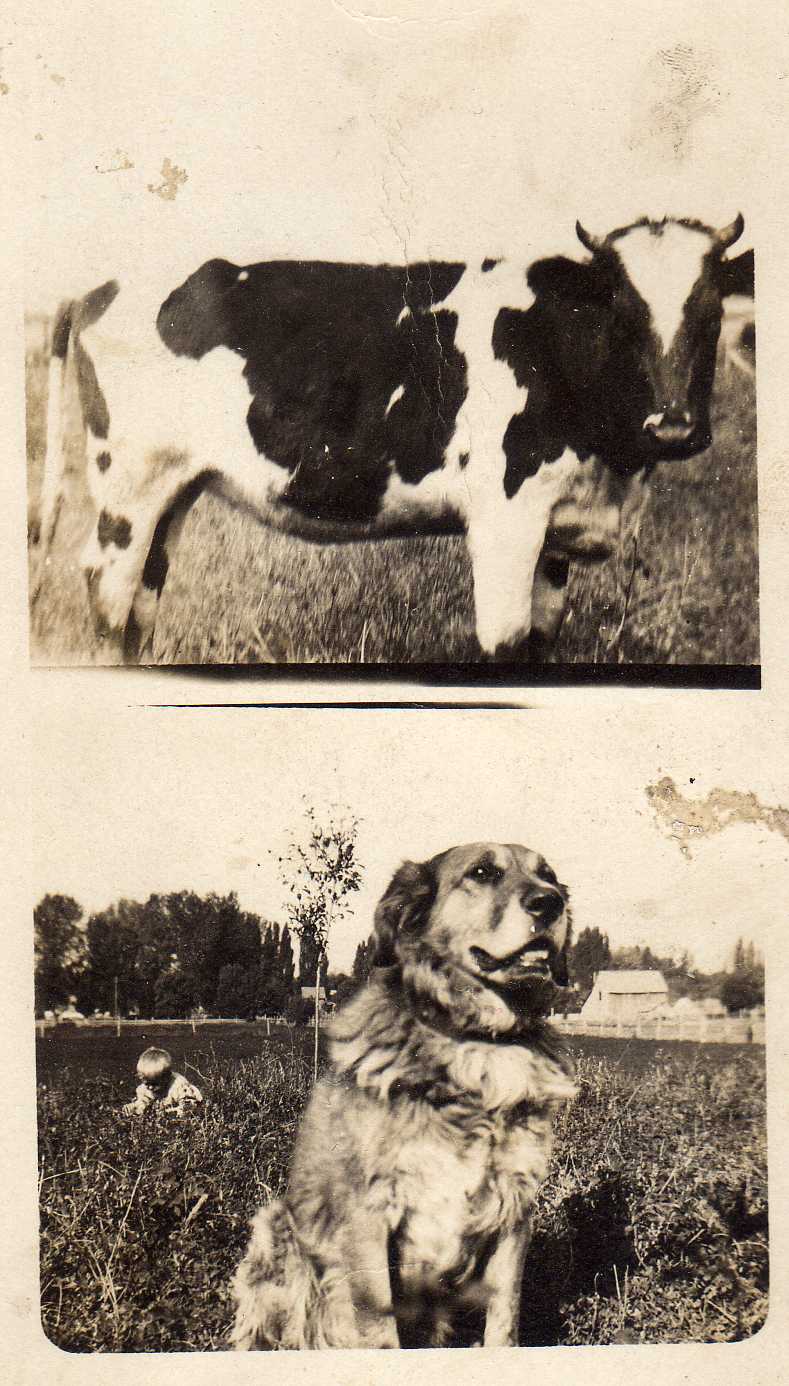
Ivan Coley and dog

Ivan Coley and dog

Ivan and Clara moved back to Buhl and survived the Great Depression there.  They purchased a 160 acre farm in Melon Valley in Buhl.  That farm was sold in 1961 and they purchased five acres just outside of Buhl and kept that property for 36 years.

Joseph McMurdie, Clara, RaNae (Cookie), and Ivan Coley about about 1964

Joseph McMurdie, Clara, RaNae (Cookie), and Ivan Coley about about 1964

I have in my records that there were five children born to Ivan and Clara although the obituary only has 4 listed.  I will have to determine which is correct.

Sarah Colleen Coley born in 1932 in Richmond.

An unnamed son was born 12 February 1934 in Buhl.  He died the same day.  If I understood it correctly, this little boy was stillborn.  Apparently he is buried on the McMurdie Farm in Buhl.  I wonder if the present owner is aware of the grave or if it is marked?

Lorus Ivan Coley (“Bud) was born 1 August 1936 in Buhl.  He died 23 October 1962 while on a hunting trip down near the Nevada border.  Initially reported to me as an hunting accident, I later learned it appears to have been a murder framed to appear as a suicide.  Apparently there is an open investigation ongoing at this time on this matter.  I will be interested to learn the outcome of the matter.

Clara, Colleen, and Bud

Clara, Colleen, and Bud

I was told there was an unnamed son born in 1938 who also died the same day who was stillborn.  I do not have an exact date for this one so I suppose what makes me question it is that Clara’s obituary does not mention him.  I will have to find out more from the family.

In 1942, Ivan’s father Herbert came to visit for part of the summer.  At Ivan and Clara’s home near the well, he fell and broke his hip.  This injury would lead to his death in September.

Lastly, Clarene RaNae Coley born in 1947 in Buhl.

Bud and RaNae

Bud and RaNae

Danny Todd, Ivan, Bud, and RaNae Coley

Danny Todd, Ivan, Bud, and RaNae Coley

Clara at a Coley Reunion in 1955

Clara at a Coley Reunion in 1955

Clara dedicated her life to love and care for her family and friends.  Even into her late 60’s she was known to outrun her grandchildren.  Ivan and Clara dedicated their lives to their grandchildren.  Grandchildren often spent many nights, or even weeks, on the farm.  Clara loved to quilt and made beautiful blankets.  She also made rugs from all the fabric scraps.  She was left-handed.  She worked at a number of jobs including bus driver.

Ivan and Art Coley (brothers) with Clara and Mary (Art's wife) in the mid 80's

Ivan and Art Coley (brothers) with Clara and Mary (Art’s wife) in the mid 80’s

Clara and Ivan in the early 80's

Clara and Ivan in the early 80’s

Ivan and Clara celebrated their 60th wedding anniversary in 1990.  It is about this time that I have my first memory visiting Ivan and Clara with my grandmother Colleen Jonas (technically a niece-in-law).

60th Wedding Announcement

60th Wedding Announcement

Cutting the cake at their 60th anniversary party

Cutting the cake at their 60th anniversary party

Here is a photo from May 2012.  She was 98 years old and looked to be in great shape and pretty classy.  I visited with her about this same time and she identified a number of individuals in photographs for me and still had a sense of humor.

Clara Coley May 2012

Clara Coley May 2012

Clara passed away on Christmas Day 2012 at the St. Lukes Regional Hospital in Twin Falls.  Her funeral was held 4 January 2012 in Buhl with the burial between her husband and son in the West End, Buhl, Idaho cemetery.

Clara Coley Funeral Program

Clara Coley Funeral Program

1952, 1957 Utah American Legion State Champions

1957 Utah State Baseball Champions

1957 Utah American Legion Baseball Champions. Back(l-r): Ellis Jonas, Lionel Benson, Jed Pitcher, Ken Chambers, Larry Federico, Bruce Pitcher, R.L. Pitcher, Joe Watts, Richard Lamb, George “Dutch” Reese. Front: John Hale, Glade Mather, Robert Eliason, Jim Mack, Doug Brinley, Vernon Rice, Brian Thornley, Lee Burke.

This is a photo that was handed out at Uncle Ellis Jonas‘ funeral.  I thought I would make it available.  The photo is of the 1957 Smithfield American Legion Team.  This photo was taken at the Regional Tournament in Winslow, Arizona. The 1957 Smithfield American Legion Team had won the Utah State Championship.

Ellis Jonas is listed as the manager and George Reese is the American Legion Representative.

Absent from the photo are Terry Griffen, Brian Toolson, Todd Peterson, Ferris Groll, Charles Wood, Mark McCraken, Ned Gylenskog, and Claire Nielsen.

The following photo is of the 1952 Smithfield American Legion Team.  This photo was taken at the National Tournament in Wichita, Kansas.  The 1952 Smithfield American Legion Team had won the Utah State Championship as well as the Regional Tournament.

L-R

1952 Utah American Legion Baseball Champions.  Back(l-r): DeVon Britenbeeker, Royce Lumberg, Jon Hyde, Erle Reese, Reese Naegle, Jerry Hansen, Richard Hodges, Hal Jensen, Ellis Jonas.  Front: Darold Whatcott, Ralph Tresedor, Cleon Hodges, Ross Godderidge, Jerry Coleman, Ferrell Karren, Ralph Roylance, Kay Inglet, Jack Reese.

Ellis Jonas is listed as the manager and Jerry Coleman as the bat boy.

Lastly, here is a little insert regarding Ellis as the coach.  I think it speaks for itself and his regard in Smithfield.

Ellis Commendation