Author: Sagacity
Can’t Loan Equipment for Cleanup
Another article clipped by my Grandmother, Gladys Donaldson Ross. This references a fire of a home that belonged to Harold and Jennie Ross. Jennie is a Van Leeuwen cousin of my Grandma, Harold is the brother to my Grandpa. Jennie told me at one point, she may have thought the fire was intentionally set to get back at her by Harold. She lost some of her prized Charlie Russell paintings in the fire.
“Pleasant View – Although they would have liked to, city officials here voted against loaning city equipment to help clean up after a recent house fire.
“City councilman and Mayor Richard Diamond said they feared such an act would set a precedent that may be difficult to live with as the years come and go.
“In addition, a group of citizens appearing before them on other matters felt the same way.
“Voiced Sympathy
“Mayor Diamond asked the group how they felt about granting such a request involving the home of Harold Ross at 975 W. 3800 N., that was gutted by fire.
“Several of the people responded. They also expressed sympathy for the cause, but said it would not be wise for the city to loan the front-end loader.
“A couple cited other examples in which such requests could have been made and said there would be no place to “draw the line.”
“Debris left over by the fire was being cleared by volunteers, mostly neighbors and friends.
“The front-end loader, it was explained, would have come in handy to scoop up the debris and load it into waiting trucks.
“In further illustrating the problem such an act would create, Councilman Leonard Cevering mentioned an experience at his own home.
“He said he came home at 10:30 one evening to find his basement half full of water.
“”I would have been great if I could have called the city and had them bring over a piece of equipment to dig down and drain the water out,” he said.
“As it was, he added, the task involved considerable time and expense on his part. He said there could be a number of such problems in the future.
“City officials, however, did not rule out the use of city equipment during emergency situations when lives or property might be threatened.
Jonas History: Gaylen, Melvin, and John Jonas
This is another chapter of the Jonas history book compiled by Carvel Jonas. “The Joseph Jonas clan of Utah (including – early Jonas family history; early Nelson family history)” This one is on Gaylen Thompson Jonas, Melvin Andersen Jonas, and John Irvin Jonas.
“Gaylen Thompson Jonas
“Melvin Andersen Jonas
“John Irvin Jonas [all my family history records show his name as Irwin John Jonas, not John Irvin]
“The above three Jonas boys were killed during World War 2 within two months and eight days of each other. Each was a grandson of Joseph and Annette Josephine Jonas, and each is a son with a different father. Melvin was a son of John Nelson and Armina Jonas. Gaylen was a son of William Nelson and Mary Jonas. Irvin was the son of Joseph Nelson and Lillian Jonas [I wrote about a post about Irwin exactly 10 years ago, then the 70th Anniversary of D-Day]. Gaylen never married. Melvin and Irvin married. Irvin was the only one of these three to have any children. He had one son, whose name was Irvin [Robert Irwin Jonas (1944-2019)], and only one grandson who was killed in a car accident when he was 16 years old [Robert Irwin Jonas II (1965-1983)]. Also, grandpa Joseph Jonas had a brother, William, who had a grandson who was also killed in the war [Melvin Paul Jonas (1917-1945)]. This grandson may have passed the Jonas surname had he lived, but with his death William Jonas had no great grand children who were boys. The war killed four of the Jonas sons.
“I wish that I had more information about Melvin and Irvin. I do have pictures which have been included in this history. If you (the reader) have any additional information please let me know so it can be included in a future edition.
“Melvin Andersen Jonas was born 31 March 1917 in Richmond, Cache County, Utah. He was given a priesthood blessing 1 July 1917. He was baptized a member of the Church of Jesus Christ of Latter-day Saints 31 August 1925. He was ordained a Deacon 3 December 1929; a Teacher 12 February 1933, and a Priest 21 June 1937. He married Doris Everts 17 March 1944 and died just over four months after he was married on 16 July 1944. The Deseret News – 20 July 1944 p. 14, has the following obituary. “Houstin Texas. Lt. Melvin Jonas. Richmond – Funeral services for Lt. Melvin Jonas, 27, who drowned Sunday in the San Marcus California River, Will be conducted Sat. at 2 P.M. in the Richmond tabernacle by Bishop Erastus Johnson.”
“John Irvin Jonas was born 2 September 1921 at Thatcher, Bannock [Franklin] County, Idaho. His first name was probably given to him in behalf of his uncle, John Nelson Jonas, who died about two years before Irvin’s birth. Irvin was given a priesthood blessing 5 February 1922 and was baprized a member of the Church of Jesus Christ of Latter-day Saints 19 February 1931, and confirmed the same day. He was ordained a Deacon 1 April 1934 and a Teacher 27 February 1938. He was married 17 June 1943 when he was 21 years old at Rochester, Minnesota. Their only son, Robert Irvin Jonas was born 12 February 1944 at Logan, Utah. His son was four month old, less one day, when John Irvin died. The Salt Lake Tribute 8 August 1944 p. 11, and the Deseret News 8 August 1944 p. 5 have the following information. “Sgt. Irvin Jonas, 22, Richmond. Husband of Mrs. Mary [Popwitz] Jonas and son of Mrs. Lillian C. Jonas died 11 July 1944. Died in action in France.
“Gaylen Thompson Jonas was born 14 March 1925 at Logan, Utah. He was 6′ 2” tall and weighed over 200 pounds when he enlisted in the US Marines 19 August 1942. He was just 17 years and 5 months old when he enlisted. He went to San Diego, California to be trained with the 2nd Mormon battalion. He went overseas Jan 1943. He died 19 September 1944 when he was 19 years, 6 months and 5 days old. He was buried overseas for four years and 4 days and then was reburied 23 September 1948 at the Elysian Burial Cemetery in Murray, Utah. Here his body was laid next to his youngest brother, William Thompson Jonas, and now his parents are there, too. The Deseret News – 24 October 1944 p. 5, has an obituary.
“Gaylen was given a priesthood blessing 5 July 1929 by his father. He was baptized a member of the Church of Jesus Christ of Latter-day Saints 25 November 1933. He was confirmed 3 December 1933 by his father. He was ordained a Deacon 4 July 1937 and a teacher 29 January 1940. Temple work was done for Gaylen by his father 8 March 1950. Gaylen had visited his father two different times after his death and asked for his temple work to be done.
“The following is quoted from the April 1943 edition of the Millcreek Courier, which was the ward paper for William and Mary Jonas. “Gaylen was born in Logan on March 14, 1925. He came so near being born on Friday 13th that Mrs. Jonas was on the verge of asking the President to set the clock ahead about 24 hours to insure for her son a lucky beginning. Gaylen enjoys fishing and riding horses. The horse however on one occasion became just a little peeved and didn’t enjoy one bit the caress bestowed upon it by our hero. Being kicked in the face by one of the beasties isn’t a pleasant experience as Gaylen will tell you. He is a member of the 2nd Mormon Battalion having enlisted July 6, 1942. He is the proud possessor of a medal for sharpshooting and is a private in the Marines. Since they entered the service, the paths of Gaylen and Maynard have crossed and they have spent some enjoyable moments together under the palms where Pacific breezes blow. We wish them many more such meetings whenever the opportunity arises.”
“Gaylen, before joining the Marines, had received a severe wound in his leg which could have kept him from military service. But Gaylen would volunteer even though his parents encouraged him to consider not going, he being only 17 years old.
“Two of the many letters that Gaylen wrote will now be included. Mailed 23 September 1943. “Little Brother, well here’s a letter all of your own. Well your eight years old now. Your getting to be a big boy now. When you get big you will make a good Marine. Be nice to your teachers and make good marks in school. Be good until I come home and I’ll bring you a nice, big present. Do you still have your rabbits I gave you? Tell me how many cows and calves we have now. I got to go to bed now. I’m still your pal, Buddy. Your big Brother, Gaylen.”
“This next letter was written 10 June 1944. “Dear Pap, I received four letters from you and ten from Mom. You can see our mail was held up for sometime. I don’t think I will be able to see Del for sometime as we are headed in different directions. Vaughn will sure snap out of it sometime. I was hoping he would get into the M. Marines. I guess it is just as well that he went into the Navy because he may learn a trade that will help him when he gets out sometime. Maynard is on a sub. he travels mostly between Pearl Harbor and Brestone. He doesn’t get much danger but his work is very important. Well pop that makes four of us in the service. I hope we are safely able to get out of this war okay. Tell mom, Grandma and little buddy hello. Love, Gaylen.”
“Two of the people Gaylen served with wrote home to the Jonas family to express their sympathy and to tell the history of Gaylen’s death. The first letter is from Richard B. Wentworth.
“Ebba Thompson, I have been trying to find out P.F.C. Jonas’ address ever since his death. I knew he lived in Salt Lake, but his correct home address I have been unable to obtain or I would have written sooner. I believe I knew Jonas longer than anyone else in the battery. I knew him when he was in the 155 M.M. Batt. and I am proud to say I am one of the many friends that he had while in the Marines. In all the time that (I) knew him I very seldom ever saw him without a smile and a good word for anyone. On Sept. 19th the regiment asked for volunteers to do stretcher bearer duty at the front. There were 9 of us who volunteered for this duty. On this island we knew full our odds of coming out were practically nill. I meant that we would all be exposed continually to enemy fire like ducks in a shooting gallery from the start. We all split up and worked pairs. Jonas and I carried three wounded and went back. A man had been shot in the chest just forward of the front lines after knocking out the pillbox. We went out after him and got caught in enemy machine gun crossfire. Jonas was killed immediately. You may be assured that he never suffered for a moment… I know that this is not in the smallest way adequate, these few words that I have written. So feel perfectly free to write me personally and ask any questions. You can always write my mother if I should change address and she will give it to you…
“This next letter was written by Sgt. L. E. Byington 20 January 1945. “Dear Mrs. Jonas, It sure was a pleasure to hear from you. I want you to know if there’s anything I can do please don’t hesitate to ask I’ll be only glad to help out in anyway I can. When I come home I sure will come and see you all. Gaylen often told me “Blondy I want you to meet my folks when we get a furlough, they are the best parents a guy could want.” He always called me Blondy. He sure thought a lot of his aunt Miss Thompson too. Most people don’t figure that letters from relations interest other people but he used to let me read some of her letters. He sure thought a lot of her. I took two pictures of Gaylen but one negative must have got lost in the mail when I sent it home. I’ve already sent Miss Thompson one picture of Gaylen and another fellow and I. And I told her if she wanted the negative she could write to my folks in Hooper and they’d sent it to her… Sgt. Rawlings and I and three other members of Gaylens platton and three Seabees were there at the dedication of Gaylens grave. Sgt. Rawlings said a wonderful prayer. Yes. I know Corp. Wentworth also. He told me how it happened. It wasn’t compulsory that they went, they asked for volunteers and well Gaylen was the kind of guy who lent a hand wherever a hand was needed regardless of danger. Why things like this happen to our closest friends I’ll never know but his name will never go unremembered. I had to stay on board ship to watch our galley equipment and when I reach camp I was told about him. At first I couldn’t believe it. I was just stunned. It’s just like losing a brother. Gaylen and I used to be in the mess hall together back in San Diego. We used to go on liberty together too. Every time I think about it I’d like to kill a dozen… Those that we’ve captured said they knew they’d lose. All they held out for was to kill. They said you’ll win the war but it will cost you… Well, Mrs. Jonas I’ve enjoyed your letter very much. I’m going to save it so I can always remember you folks and I’m going to try my best to meet you all some day soon. May God be with you always, a friend. Stf. Sgt. L. E. Byington.”
“The next letter is from the secretary of the Navy. “The President of the United States takes pride in presenting the Bronze Star Medal posthumously to PRIVATE FIRST CLASS GAYLEN T. JONAS, UNITED STATES MARINE CORPS RESERVE, for service as set forth in the following Citation: For heroic service while serving with the Twelfth Antiaircraft Artillery Battalion, Fleet Marine Force, in action against enemy Japanese forces on Peleliu, Palau Islands, 19 September 1944. Courageous in the fact of terrific fire from Japanese guns, Private First Class Jonas volunteered to serve as a stretcher bearer during the evacuation of the wounded from the front lines. After the establishment of a shuttle system, he operated between the high ground dominated by hostile enemy snipers and, having assisted in the successful removal of several wounded men, was returning to the front lines to render further assistance when mortally wounded by a Japanese sniper. By his self-sacrificing spirit and daring efforts to save the lives of others, Private First Class Jonas upheld the highest tradition of the United States Naval Service. He gallantly gave his life for his country.”
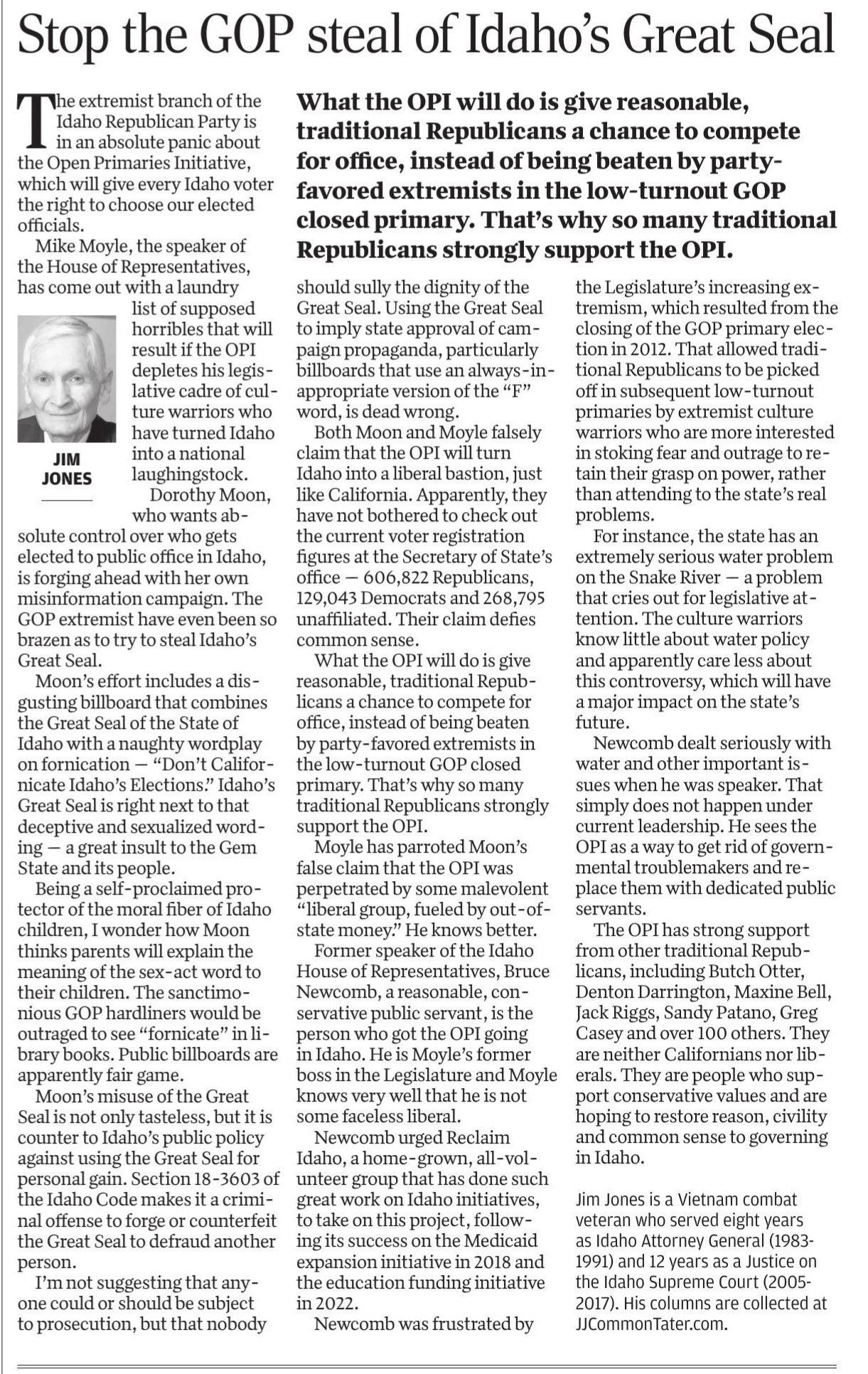
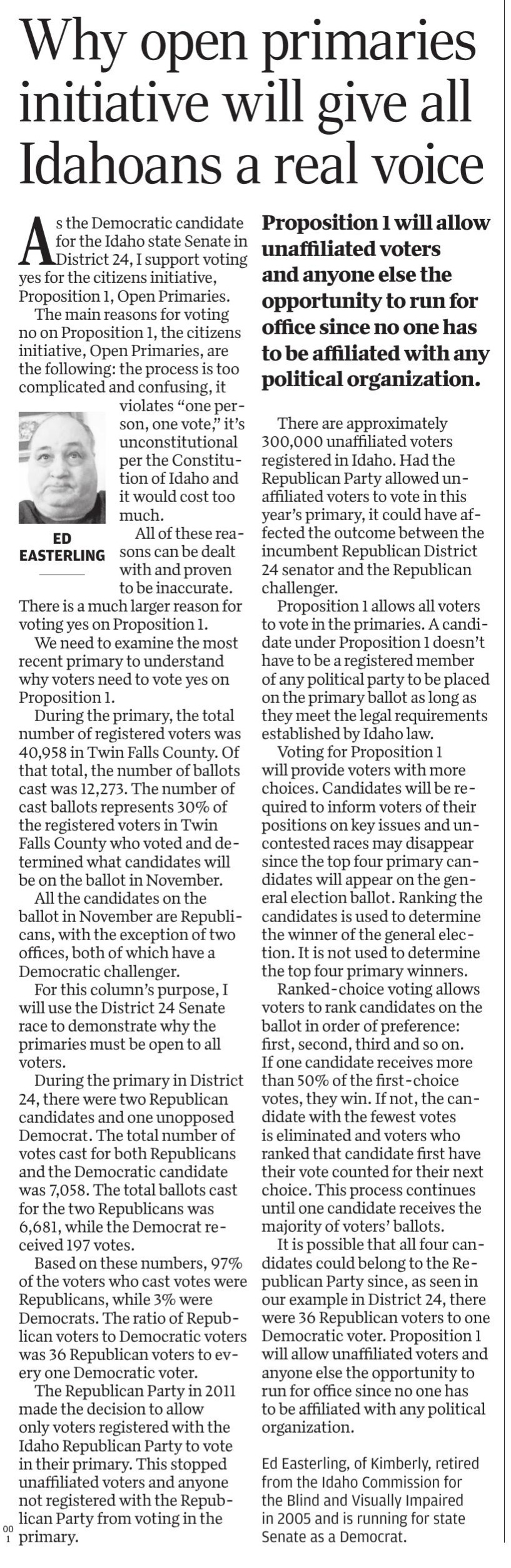
Open Primaries Initiative is voice of Idaho citizens, not ‘pernicious plot’
Secretary of State announces new open primary initiative
With election winner comes instant majority
History of Plain City Pt 9
I have two copies of the History of Plain City, Utah. The front indicates it is from March 17th 1859 to present. As far as I can tell, the book was written in 1977. At least that is the latest date I can find in the book.
One copy belonged to my Grandparents Milo and Gladys Ross. My Grandpa has written various notes inside the history which I intend to include in parenthesis whenever they appear. They add to the history and come from his own experience and hearing.
I will only do a number of pages at a time. I will also try to include scanned copies of the photos in the books. These are just scanned copies of these books, I have not tried to seek out originals or better copies.
History of Plain City March 17th 1859 to present, pages 141 through 149.
BONA VISTA IMPROVEMENT DISTRICT
SUBMITTED BY FLOYD PALMER
This most important new culinary water system has made life a little more pleasant in this community and surrounding areas. It was turned into the lines just a century after sturdy pioneer families first put together temporary shelters and tapped several sweet water springs which they found in the area.
It replaces old flowing wells, bringing precious waster from the depths of the earth. In early days many deep and surface wells dug, covered over, and fenced off to keep children from falling in. They were first fitted with “pitcher” pumps, a short-handled affair which were the “pumper” out in a short time. Even the farm animals had to depend on well water pumped to the surface by hand.
Later, the easier to work, long-handled pumps were installed. These were followed by power pumps connected to a small storage tank. This was the ultimate in a private water supply.
In 1955, a Weber County man, Linn C. Baker, was a member of the State legislature. He is the one who sponsored the bill to create special improvement districts. The reason he was the sponsor of this bill was due to his work in the Health Department for the State of Utah. As he studied samples of water sent to him from the outlying towns, he became aware of the amount of contamination there was in the drinking water in certain areas, Plain City was among the highest on the list. This was traceable to shallow surface wells being used, also septic tanks with poor drainage.
Soon after the Weber Basin Conservancy District was organized, Plain City wanted to purchase one-thousand-acre feet of water. Their request was held in abeyance until a line could be built from Ogden Canyon. This, however, was never done.
Elmer Carver was on the executive committee of Weber Basin Project. Through the encouragement of Commissioner Carver, Mr. Ezra Fjeldsted, manager of Weber basin Project, and Linn Baker, all met with the Plain City Town Board to get something started. Floyd A. Palmer, a member of the Town Board, was asked to represent Plain City on a committee of surrounding towns in Weber and Davis counties. Mr. Ezra Fjeldsted acted as chairman of this group and several meetings were held in both counties which Mr. Palmer attended.
Following this, a public meeting was held in Plain city. Farr West, and Harrisville were asked to join in. This was for the purpose of starting a culinary water system. The results of this meeting, from all groups attending, were to go ahead, also to contact other nearby towns and get their feelings about joining in.
A series of meetings were held in Farr West, Harrisville, Slaterville, Marriott, Wilson Lane, and Plain City. Other towns were invited to attend. Ezra Fjeldsted represented Weber Basin, Floyd A. Palmer represented Plain City, Dick Groberg represented Farr West, Kenneth Brown represented Harrisville, Clifford Blair represented Marriott and Slaterville, and Arthur W. Sorensen represented Wilson Lane. The meetings were all met with a great deal of enthusiasm and interest.
Plain City Town Board consisted of Lee Olsen, President, Floyd A. Palmer, Elvin H. Maw, Merrill Jenkins, Blair Simpson, as members. A culinary water system was a prime item of the agenda in 1956. The town board along with several local residents were well organized to promote the need for a water supply to replace the surface wells and pumps.
On July 19, 1956, Elmer Carver, Chairman of the Board of County Commissioners of Weber County, State of Utah, signed a certified documents that there be and is hereby created within Weber County, Utah, a Water Improvement District to be known and designated as the BONA VISTA WATER IMPROVEMENT DISTRICT, the same to embrace and include all real property lying within the following boundaries, to-wit: (SETS FORTH DETAILED LEGAL DESCRIPTION OF DISTRICT BOUNDARIES WHICH BOUNDARIES EMBRACE LANDS HEREIN ABSTRACTED – Abstracter)
That the following-named persons are appointed as the Board of Trustees of said Bon Vista Water Improvement District:
Floyd A. Palmer, Plain City
Richard Groberg, Farr West
Kenneth Brown, Harrisville
Clifford Blair, Marriott-Slaterville
Arthur Sorensen, Wilson Lane
This resolution shall take effect immediately and shall be recorded in the office of the Weber County Clerk. Recorded August 22, 1956.
Following this appointment from the Weber County Commission, the board held a short meeting. It was necessary to elect a chairman, after a discussion of each of the board members. Kenneth Brown was appointed as chairman.
The first order of business was to secure professional and legal help. Mr. Jack Richards was appointed attorney. Jack Reeves, of the firm of Nelson, Reeves and Maxwell, was appointed engineer. They were appointed to do the field work and present the plans and drawings back to the board.
When the plans were completed, the board spent much time deciding the most feasible and economical areas to run the lines in. Also, to give each town a fair share of the project. Following this, it was necessary to project estimated costs. The board spent many months getting costs and deciding on types and kinds of pipes and materials to use on the project. The overall plans had to look attractive and feasible in order to get a bonding company to handle the bonds.
The first step made to secure the bond issue was to get signed pledge cards with an agreement to pay $250.00 for a waster connection. This was a requirement. Committees were organized with Floyd A. Palmer, Richard Groberg, Kenneth Brown, Clifford Blair, and Arthur Sorensen acting as chairman in each of their respective towns. The result was very successful, all those serving on these committee are deserving of much credit for their untiring effort and accomplishments.
On August 20, 1957, a bond election was held to see if the residents would approve a $900,000.00 bond issue. The vote was 490 yes and 82 no. Edward L. Burton Company was retained as Fiscal Agent, and $698,000.00 was sold in General Obligation Bonds, and the system was under way.
On April 14, 1958, a contract was awarded to Smith-Scott Pipe Company to furnish cement mortar-lined steel pipe for the main lines.
Also, on April 14, 1958, a contract was awarded to Knudson Construction Company to install water mains in the Harrisville-Randall area which was Phase I of the project.
Also, on April 14, 1958, a contract was awarded to Chicago Bridge & Iron Company to furnish and erect a 250,000.00 gallon elevated storage tank in Plain City.
On April 28, 1958, Theron Palmer was hired as General Superintendent to oversee construction and to get it ready to serve and operated as a system.
On May 27, 1958, an office was rented from the E. B. Stone Estate on the corner of 9th and Washington. The district still maintains its offices here. The building was purchased by the district in 1969 and has been remodeled.
On May 27, 1958, negotiations were begun with the State Department of Welfare of obtain ownership of a spring located in Garner’s Canyon in North Ogden. The spring was used at the time by the welfare department at the Industrial School property for culinary use and irrigation use.
On May 27, 1958, Weber Basin let a contract to Statewide Construction Company to build the 16-inch transmission line from 4000 South on U-84, down into the district where Bona Vista could connect to it.
Also, on May 27, 1958, a piece of property located at 4100 West on 2200 North in Plain city, was purchased from Vern Palmer to construct the elevated tank.
Raymond Concrete Title Company moved in and drove concrete pilings 80 feet into the ground to support the tank.
Gerald Larkin was then awarded a contract to construct a foundation so Chicago Bridge and iron could begin erection.
On July 3, 1958, a contract was awarded to Bert Robinson Construction Company to build lines in the Farr West and Plain City.
Also, on July 3, 1958, Standard Plumbing Supply Company was awarded a contract to furnish materials for service lines.
On July 17, 1958, the Weber County Commission agreed to purchase 60 fire hydrants to go on the system to be located by the Weber County Fire Chief.
On July 17, 1958, Smedley construction Company was awarded a bid to construct lines in the Slaterville, Marriott, and Wilson area for $44,975.00. The same day Mac Construction Company of Salt Lake City was awarded the bid to construct our North Ogden Reservoir for $16,911.00. This is a concrete underground reservoir.
On August 11, 1958, an agreement was reached with the Welfare Department to obtain full use of the spring in North Ogden. Weber-Box Elder water was purchased to replace the Welfare Department’s share of the spring.
On February 11, 1959, work began on the plans and site for a reservoir in the Roy area.
On March 23, 1959, it was decided to run a line on the North Plain City Road.
On August 27, 1959, it was decided to either buy or condemn the Hansen property for a reservoir.
A bid to build a tank in Roy was awarded to Wehyer Construction Company for #31,403.80 on September 23, 1959.
Negotiations began to buy an eight-foot well from the Farr West Stake for $31,403.80 on September 23, 1959.
Linn C. Baker resigned as Secretary on January 1, 1961. He had been with the district since it began.
On December 6, 1961, it was decided to construct extensions to existing mains in the amount of $90,000.00 General Obligation Bonds were sold to finance these extensions. Waterfall Construction Company did the job.
All though the summer of 1961, the Farr West well was tested to see if it would hold up.
On February 28, 1962, President Wimmer signed the Warranty Deed on the Farr West well and property. On January 16, 1963, it was decided to put heat lights on our Roy tank. This was the first such installation in this area and it drew a lot of attention.
The Utah State Health Department studied the plans for use of the plans for use of the existing well in Farr West and decided against allowing it to be used because of its depth. A change application was then filled with the State Engineer to drill the well to a deeper depth.
On May 10, 1963, a contract with Wesley Stoddard was made to drill a well in Farr West for $21,632.00 plus $4,700.00 for the test hole to see how deep the well would have to go.
A meeting was held at the Farr West Pump House building on January 20, 1964. This building was contracted by the Bona Vista Water employees. The piping was also done by employees of Bona Vista.
R. W. Coleman Company was awarded a contract for $18,877.50 to change some lines under the interstate highway on November 22, 1965.
Negotiations began on March 28, 1966, with Weber Basin on the North Ogden Well, which was later drilled and is used in the system now.
Water meters were deemed necessary and were bought by bid from Waterworks Equipment Company and E. C. Olsen Company on October 28, 1968.
BEGINNING OF PLAIN CITY IRRIGATION WATER
1859 Before the summer was over some water had been brought in their new ditch from Four Mile Creek to Plain City. In 1860, the Canal was completed to Mill Creek, the following year to Broom’s Creek and in 1862 to the Ogden River. The Right of Way in Weber River was purchased in 1873 at a cost of $2000.
In 1899 Samuel Wayment drilled an Artesian Well 249 feet deep producing additional water for the settlers. He also was in charge of the iron work and the building of the Chief Canning Factory in Plain City.
PLAIN CITY IRRIGATION-CEMENTING OF THE MAIN CANAL
SUBMITTED BY Wayne Skeen
For many years the Plain City Irrigation Company received it’s water from the Weber River. The diversion point into the canal was just north of the old American Packing Plant that was later called the Swift Meat Packaging Plant. The Irrigation Company had a large Plank Head Gate in the Weber River that forced the water into the Plain City Irrigation Company Canal because of high waters in the spring this gate would wash out and it was necessary to make a gravel and dirt dam each year using horses, scrapers, and even large bulldozers. In recent years this became a major problem.
The government began planning the Willard Project in 1960. This project would interfere to a certain extent with the existing canal used by the Irrigation Company because big Willard Bay Canal would be built in part of our existing canal and would also cross it in part of our existing canal and would also cross it in other areas. The leaders of this project wanted to provide a turn out from the big canal into the Plain City Irrigation Canal. The corporation of our company was necessary to give them the right to use the area affected by the construction of the Willard Bay Canal. The logical point of diversion would be west of the Farr West Church House. This meant that some new construction would be necessary to get the water into the old canal. It was in need of some repairs and it was at this time that the idea of a new cement lined canal was entertained.
Directors who served during this period of construction were as followed:
President Abram Maw 1959-60
President Alvin J. Robson 1961-65
Vice President Walt Christensen 1959-64
Vice President Carl Taylor 1965
Bert Hunt
Charles Heslop
Keith Blanch
Mike Panunzio
Secretary Wayne Skeen 1959-65
High lights of the minutes of the meetings during the construction period are as follow:
August 11, 1959
Ogden City had extra water for sale this year which was allocated out to various canal companies. A motion was made by Alvin Robson that this water be purchased to see them through the current season. It would be paid by those stock holders who subscribed for the extra water.
April 4, 1960
The meeting was called to discuss the new canal. Charles Heslop was assigned to work on interested free money from the Utah Water & Power board for the construction. Alvin Robson was assigned to work with the Soil Conservation on the completion of the surveying of the canal, and additional monies.
July 12, 1960
A meeting was held to discuss a possible shortage of water for the remainder of the year. Time was changed from 20 shares per hour to 25 shares per hour.
January 9, 1961
A priority was established with the Utah Water an Power board for interest free money and application made for $100,000.00
A survey showed that there was a 10% loss of water between the River turn out and the Point of use.
March 8, 1961
The Irrigation Company received a $10,000.00 cash settlement for their rights in the old canal from the O.U.R.D. Railroad Company that passes through their yards.
Alvin Robson, Carl Taylor, and Walt Christensen was to secure information regarding tiling of the canal from Victor Lund’s corner up to the Jesse Singleton property where the canal leaves the road and runs back into the fields.
April 20, 1961
A report was given by Alvin Robson regarding the tiling of the lower part of the canal. There were mixed emotions about tiling this section of the canal because of the fall and the amount of water to be delivered. “Alvin Robson commented as the discussion went on concerning the piping verses the cement lining. The stockholders are residents of this town and should have some concern towards the improvements and beautification of the community and that an open cement lined canals to greet the people entering the town is not very inviting and once it was constructed it would never be changed in our life time.”
Keith Blanch speaking as a town board member expressed his opinion regarding the beautification and eliminating hazards in the community and felt that it was worth while and the tax payers should help with the construction of the Irrigation Company in piping this section of the canal.
Glen Charlton and Lee Olsen from the town board were present. An opinion was asked from the town board members. Mr. Charlton felt it was a worth while project as long as it was right. Mr. Olsen commented that it was a good thing as long as it was sufficient to meet the needs of the water users.
The town board members agreed to cover the pipe that was laid with dirt. It was agreed that 2880 feet of 36 inch tile would be laid this spring from the old beet dump corner to Victor Lund’s corner.
April 27, 1961
The Town board members present: Dee Cook, Glen Charlton, Kent Jenkins, and Lee Olsen. Mr. Covey from Utah State University was also present.
Further discussion concerning cost of construction of the concrete pipe continued. Keith Blanch made a motion that the town board and property owners should join with the Irrigation Company in the cost of the 36 inch tile to be laid. Motion seconded by Carl Taylor
Mr. Robson suggested the property owners who would benefit from the lining of the canal pay $1.25 per foot frontage towards the pipe. The Town Board said they could only participate within the city limits and they would contribute $4,000.00 over a 10 year period. The bids were to be sent to Secretary Wayne Skeen by March 30, 1961.
April 30, 1961
The purpose of this meeting was to open bids. Utah Concrete Pipe Company received bids for 36 inch concrete pipe at $8.75 per foot. Waterfall Construction Company was awarded the laying of the pipe at $1.55 per foot.
Abram Maw made the motion that the project not be stopped at the beet dump corner but continue up to the up to the weir east of the water tower (where the pipe portion of the canal now starts) if the property owners will contribute $1.25 per foot. Motion seconded by Keith Blanch.
Charles Heslop ad Elvin Maw were asked to approach these property owners and get their approval to pay the $1.25 and also contact all stock holders and get their signature for government participation thru the Soil Conservation.
Charles and Elvin were successful in getting all the names except Jesse Singleton who would not accept any government monies and would not pay the $1.25 per foot to tile in front of his property.
Alvin Robson contracted Howard Singleton, Jesse’s boy and he agreed to pay the $1.25 but only up to the old house that sat in the field and that is where the concrete pipe starts today. Alvin Robson tried to convince the Director’s that they should at the company’s cost tile the remainder of the ditch along the road because any future expansion of the community would by hampered by open ditch reducing the width of the road. This motion turned down.
Walter Christensen made the motion that Alvin Robson meet with the Soil Conservation to discuss details of cost and tiling and lining the canal.
April 31, 1961
Alvin East, Maurice Skeen, and Owen Wayment from the Warren Irrigation Company met with the directors to discuss details and sign a contract for the exchange of Ogden and Weber River which would benefit both companies. The contract was signed.
Mr. Daniel Lawrence from the Utah Water & Power Board attended the meeting. Keith Blanch made the motion that Alvin Robson and Wayne Skeen be given the power to enter into a contract with the Utah Water & Power Board for the total cost of $1,300.000.00 and formulate all details.
May 3, 1961
Junior Taylor was appointed as Water Master of the year.
May 15, 1961
The purpose of this meeting was to discuss the Weber Basin Project with E.J. Feldstead and commissioner Wilmer Carver. They needed additional votes to finish construction of the Willard Bay. A proposed addition would cost seventeen million dollars.
June 5, 1961
The purpose of the meeting was to see what should be done because it appeared that there would be a water shortage before the end of the year. It was proposed that we only run off water until the stream reached a point that we could not water properly and then start to use our shortage water and put turns on 1/3 basis.
September 27, 1961
The new project was discussed and it was recommended that the company hire an engineer and begin construction on the upper end of the new canal.
There were many problems that came out of the construction of this canal. It would be necessary to get some dirt to construct the pad for the canal. The company purchased some ground at the upper end of the canal from Max Stander. Then got the dirt that was necessary to build the upper end of the canal and then leveled the ground and gave it back to Mr. Stander. They also purchased additional dirt from Robert Penman. This dirt was trucked from his property just south of the Weber River and west of the main road. The dirt was hauled by farmers using their beet trucks, etc.. The new pad was made in the old canal banks where possible, but there was some trading of land etc. to straighten out the canal. There was also a problem in getting someone to dig out the canal to the size and shape required to allow 50 seconds feet of water at one time. The company asked for bids, but they only received one because the equipment needed to shape the canal was not available. In order to get the project moving Alvin Robson caught a bus on Ogden and went to the Fuller Forms Company in Arizona to see if they had some type of equipment that could be used. He purchased a right to one of their slip forms that could be used in forming and pouring the concrete. He returned to Ogden and worked with the Ogden Iron Works on 23rd Street and Grant Avenue where the construction of the slip forms took place. The next problem was to begin the construction of the project. Dean Hadley of Taylor was hired to do most of the big equipment work. Local farmers also helped with their equipment. The Soil Conservation furnished the engineering on the project. Herbert Issackson of Pleasant View was the surveyor. One of the major problems that existed and is still a yearly discussion is the amount of water delivered from the existing head gates. The government required that curtained head gates must be varied in size for them to participate financially.
There was much contention and personal feelings during the construction of how it should be done. Some people left the jobs and never came back, but the project was finally finished. The construction created problems for some but most of the inconveniences were ratified by the Irrigation Company. New bridges were built, land was leveled, damages to property was crops were paid for during the construction. The Company paid for fencing materials with the property owners installing the fences. Cattle that used to walk across the stream would fall into the new lined canal and couldn’t get out. The Company paid for some of the cattle that were lost before the agreement to install fencing was made.
The total cost of the project was $199,754.08. The amount of $122,918.61 was borrowed from Utah Water & Power Board. This money was interest free if a yearly payment was made by November 30th each year. The last payment of $8.257.06 will be paid on November 30, 1977. Other cost not being paid by the stockholders come from the Soil Conservation and the sale of pieces of the old canal, and the town board. Vice President Bill Hatch of the First Security bank was also an asset in the financing of the canal.
We borrowed monies from the First Security Bank as construction went on to pay for cost on a daily basis. On December 31, 1974, the company owed the First Security bank $60,000.00 Alvin Robson and Wayne Skeen met with Mr. Hatch in May regarding this bill. Mr. Hatch said that the bank needed some type of security for this loan. There was nothing to give him because out rights to the canal had been given to the Utah Water and Power Board. Alvin Robson and Wayne Skeen then approached Mr. Lawrence of the Utah Water and Power Board asking them for more money for the project explaining the situation with the bank. Alvin Robson explained that they might just as well take over the ownership of the canal because the bill had to be paid. There was nothing to offer as security because the Utah Water and Power board had everything that the company owned. Later, Mr. Lawrence of the Utah Water and Power Board gave the Irrigation Company an additional $30,000 which helped to delete that note at the First Security Bank.
*********
LD’s Cafe History
This comes from a history compiled and written by Jack Johnson as part of his Discovery Area Guides. Jack graduated from Burley High School with my Mom in 1972. He now lives in Hyrum, Utah. This article is in the 2022 Guide for North Cache County, including Smithfield, Richmond, and Lewiston. L.D. is loosely linked to me as I believe he is the nephew of Lorenzo Bowcutt, who married my Great Grandmother Lillian Coley Jonas in 1953 (Ren passed away in 1966).
“When Richmond was settled in the mid-1850’s, a locally-owned landmark business was still over a hundred years from being established. L.D.’s Cafe makes fascinating history live once more.
“Remnants of local history adorn L.D.’s dining area walls, including framed newspaper clippings, historical articles and an American flag. L.D. Bowcutt has been actively running the business since 1959, and loves to relate the history posted on his walls. Ask about his famous rodeo clown relative, or any one of the area’s veterans – each has a story that he’s anxious to tell.
“According to the Herald Journal newspaper article posted on its wall, “L.D.’s father bought this place in 1957. It started out as a poolroom. When the earthquake hit in 1961 this place rolled like a wave.” Wikipedia reports that the quake (it states as 1962) was a magnitude Mw5.9 the morning of August 30, 1962 at 6:35 am local time. With its epicenter just north of Richmond, this quake, Utah’s most costly , caused damages estimated then at $1-2 million dollars ($18.5-20 million in 2020 dollars.)
“L.D. remembers, “My father remodeled it and used some of the fixtures and furniture from the restaurant up the street that he bought because it was condemned by the damage from the earthquake.” Started initially as a bar and pool room, “since August 31, 1962, L.D.’s has served full meals. Before that it was strictly a sandwich and lunch menu.”
“”L.D. says that most of his customers are local people and repeat customers. This place isn’t commercialized or franchised. I can get to know my customers and they get to know me. People come her for sociability to be with their friends and neighbors. A log of business also gets transacted here. Based on comments from the lunch crowd, it would seem like L.D.’s customers return for more than just the comfortable, friendly atmosphere.”
“”He said one day the “champion cow” entered his cafe through the front door and paraded around the pool tables, but something like that only happens during Black and White Days, when the town is filled with horses and cows.”
“A lot of people don’t know that L.D.’s had a private meeting room upstairs. Bowcutt says that for a long time the area’s riding club would meet upstairs to shoot the bull and plan events.
“Serving two terms on the Richmond city council, L.D. Has been heavily involved in local interests. He tells how after the Richmond bank was robbed int he early 1960’s the bank manager had a buzzer installed to ring at the cafe. He’d return the call to the bank, whose employees knew when he asked, “Is L.D. there?” – a positive answer meant there was trouble, a negative meant all was well. His cafe also served as the communications center for the local volunteer fire department, sounding a warning siren whenever help was needed.
“L.D.’s daughter Lori, and grandson, J.R. Hoggan, are also actively involved, but J.R. is quick to point out that L.D. is really the heart of the business. Now in his eighties, L.D. still takes over at the grill quite often, filling every order the L.D.’s way – with healthy home-cooked meals. Hungry for meat and potatoes, burger, seafood of breakfast? You’ll find it all and a whole lot more – traditions of excellence and community involvement at L.D.’s Cafe in Richmond.
“L.D. states, “You need to be really sharp to compete with the big restaurant chains and stay open for business, and I think my cafe is the last of its kind.”
“Source: Conversation with L.D. Bowcutt Nov. 2, 2022, Wikipedia search “Earthquake – Logan, UT.