Early History of the Settlement of Lewiston

My grandfather, Wilburn Norwood Jonas, was born in Lewiston, Cache County, Utah on 15 May 1924. His great grandparents, Stephen and Hannah Coley are buried in Lewiston. When I stumbled on this short history, I thought I would share it. This history was compiled by M. R. Hovey for the Logan Chamber of Commerce in 1923, a year before Grandpa was born.

James and Aliza Ross at the grave of Hannah and Stephen Coley – 14 August 2026 – their fourth great grandparents

“After Richmond was settled in 1859, Franklin in 1860, and Clarkston in 1864, “All the most desirable locations on the streams in Richmond and in the other settlements of the Valley, had been taken. Naturally (the new settlers) were forced to take lands in the center of the Valley and get their irrigation water wherever they could. This was difficult to do.”

“In July 1870, a scouting party went out to locate some new lands for settlers. They searched the north end of Cache Valley from Oxford to Mink Creek. (When) “the scouting party returned (it was) decided that the ‘Flat’ where Lewiston is located, was the best place to locate..”

“Used by early Richmond settlers as a herding ground, “It was covered with buffalo and bluegrass. It had also been used in the past by the Indians as a place for their pow-wows, where they had horse races and other games. As there were no trees or vegetation the sand drifted considerably.”

“Houses were built of logs and lumber. Some made dugouts. The community grew. Among the first group of settlers were the families of P. N. Van Orden, Sr., Everett Van Orden, Robert Wall and John M. Bernhisel, Jr.” (When) “the townsite was staked out, it was decided to (make the blocks) a mile square. At first the settlement was called Cub Hill.”

“In 1872, William H. Lewis was sustained as the (LDS Branch’s) presiding elder and later, the bishop. The settlement was named “Lewiston” after Bishop William H. Lewis.

Bio of William H. Lewis

“William H. Lewis married Martha Petty in November of 1856. In 1858 his wagons left Fort Harrison, Utah, to settle in Cache Valley. The Lewises arrived in Richmond October 31, 1859, building a small cabin in an area known as “Poverty Flats.” In 1873 Brother Lewis was called as Presiding Elder of the fledgling Lewiston Branch at Poverty Flat. “After serving for a year, Lewis approached the Richmond Bishop, M.W. Merrill, asking to be released from the calling. He stated ‘he would not trade his small farm in Richmond for the whole of Lewiston.'”

“”Bishop Merrill informed him that it was the Lord that had called him to that position and he would not be a partner in releasing him. The bishop advised William to go back to Lewiston and the Lord would bless him on this land that looked so barren. He also told Brother Lewis that Brigham Young had said that Lewiston would be the granary of the valley and that the potential possibilities of that wasteland were many and great.” Staying in Lewiston, Lewis eventually became one of the wealthiest farmers in the area.

“After serving as Presiding Elder over the branch for five years, Lewis was named the Lewiston Ward’s first bishop. After serving for seven years, he was named Stake President of Benson Stake. The town was eventually named ‘Lewiston,’ after William H. Lewis.

“”In the beginning the little settlement had some serious handicaps. They had no irrigation water, no trees and very little vegetation. The sand drifted badly in places. The winters were severe and bad frosts were common. The drought brought many crickets, grasshoppers and other pests. The winter of 1871-1872 was very cold and severe. In November 1871, two feet of snow fell and it did not leave until April of the next year. At certain times during the winters the fences were covered with snow and the settlers traveled over the tops of the fences with their sleighs. During the summer time there were hot, dry winds, and killing frosts. For three successive years the grain was frozen in July. The settlement was referred to as ‘Poverty Flat,’ ‘Starvation Corner’ and ‘The Last Chance.'”

“When Church President Brigham Young visited Richmond, “the discouraged settlers reported these unfavorable conditions… the settlers (were advised) to return to their homes promising them that Lewiston should yet become one of the garden spots of Cache Valley & the Territory.”

“If the settlers were to remain they had to have irrigation water. “(Since) Bear River to the west was too low to take out a canal and bring it upon the flat…In 1873 a small irrigation ditch northeast of Lewiston was built from Worm Creek…In 1874 a site for a canal was located on Cub River in the Cub River Basin.” Though a tremendous undertaking… it saved the settlement. For drinking water, wells were used.” In later years, “a large irrigation company was formed and a pumping plant and its diversions was established on the Bear River.”

“Lewiston has continued to grow and is considered one of the best farming communities in the state. The promise made years ago by President Brigham Young, ‘that someday Lewiston would become one of the garden spots of the Valley and the Territory, has verily been fulfilled. In 1904, the town was incorporated by Brigham Pond, Lewiston’s first mayor.

Compiled by M. R. Hovey, Secretary, Logan Chamber of Commerce. January 1, 1923 to January 1, 1925. Also as printed in the Logan Journal, beginning August 4, 1923.


34 – 2024-2025 Discover North Cache • DiscoverAreaGuides.com Outdoor Recreation.” Thanks to Jack Johnson for the compiling of these DiscoverAreaGuides.

See More Historical Articles on www.discoverareaguides.com/blog
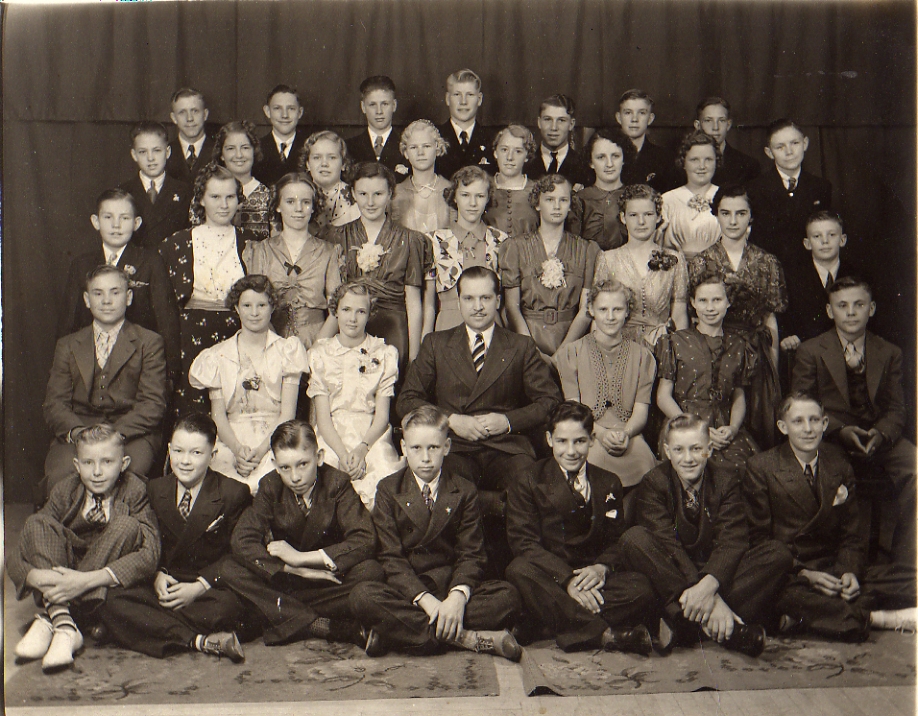
Glacus Merrill’s Class

Back(l-r): Ira Hillyard, Unknown, Bob Johnson, Junior Petterborg, Irwin Jonas, Unknown, Unknown.  2nd from Back: Unknown, Ruth Rich, Kaye Funk, Anna Lawrence, Joyce Larsen, Ruth Hutchinson, Nadine Johnson, Darrel Smith.  Middle Row: Unknown, Unknown, Eva Kershaw, Lyle Wilding, Unknown, Afton Sorensen, Dorothy Nielson, Unknown, Norwood Jonas.  2nd from Front: Alvin Spackman, Bernice Frandsen, Unknown, Glacus Merrill, Joy Erickson, Unknown, Allen Spackman.  Front: Garr Christensen, Oral Ballam Jr, LaMar Carlson, Unknown, Gail Spackman, Ivan Anderson, Warren Hamp.

This is Glacus Merrill’s class from what I believe is 1936.  He taught class at Park School in Richmond, Cache, Utah.  Several individuals have assisted me to name the individuals I have so far.  There are too many unknowns that I hope to clarify in the future.  If anyone can help, I would certainly appreciate it.  My Grandfather, Norwood, and his brother, Irwin, are both in the photo.  Irwin died in World War II, and I assume some of the rest did as well.

I have listed all the individuals below with some limited information I could find on them.  At the very bottom is Glacus’ obituary.

Ira William Hillyard (1924-2009)

Unknown

Robert “Bob” Jay Johnson (1924-2009)

Junior “Pete” Lee Petterborg (1923-1990)

Irwin John Jonas (1921-1944)

Unknown

Unknown

Unknown

Ruth Rich

Norma Kaye Funk (1924-2002)

Anna May Lawrence (1924-1988)

Joyce Larsen (1924-1968)

Ruth Hutchinson (1924-2002)

Nadine Johnson (1924-2005)

Darrel Wilmot Smith (1924-2008)

Unknown

Unknown

Eva Kershaw

Lyle Wilding (1924-2002)

Unknown

Mary Afton Sorensen (1923-2008)

Dorothy Nielson (1924-2019)

Unknown

Wilburn Norwood Jonas (1924-1975)

Alvin Chester Spackman (1923-1994)

Bernice Frandsen (1924-2002)

Unknown

Glacus Godfrey Merrill (1905-2002)

Joy Erickson (1924-2010)

Unknown

Allen Elijah Spackman (1923-1997)

Garr Dee Christensen (1923-2002)

Oral Lamb Ballam (1925-2016)

Victor LaMar Carlson (1923-2008)

Unknown

Harold Gail Spackman (1924-1991)

Ivan Carl Anderson (1923-2017)

Warren Thomas Hamp (1924-2009)

Here is a copy of the obituary I found for Glacus.  Wow, I wish my school teachers had been this amazing.

LOGAN – Glacus G. Merrill, 96, died of causes incident to age in Logan, Utah on Saturday, February 9, 2002.  He was born May 27, 1905 in Richmond, Utah to Hyrum Willard and Bessie Cluff Merrill.  He is a grandson of Marriner W. Merrill, a pioneer prominent in the settling of Cache Valley, an Apostle of the Lord Jesus Christ, and the first president of the Logan LDS Temple.  He married Constance B. Bernhisel in 1925, and they were later divorced.  He married Marie B. Bailey, March 24, 1945 in Washington D.C.  Their marriage was later solemnized in the Logan LDS Temple.

While attending school, he participated in track and football at North Cache and Brigham Young College, where he graduated in 1925.  Glacus graduated from Utah State University in 1935 and also attended the University of Utah and Chico State College in California.  He is a graduate of the REI Radio Engineering School in Sarasota, Florida.  He was the principal of the Richmond Park School for 11 years and served in the U.S. Navy for four years during World War II.  He served an LDS mission to California from 1954-1955.  While living in the East, he served as President of the West Virginia Farm Bureau and the State Black Angus Association.  He is an honorary Kentucky Colonel.  He also served as President and District Governor of Lions Clubs in Utah and West Virginia, and was a member of the Lions Club for 42 years.  Glacus was Vice President of the West Virginia Broadcasters Association, and is a member of the USU Old Main Society.  He established a Scholarship Fund in the Communications Department at USU.  The Montpelier, Idaho Jaycees presented him with their outstanding Citizen’s Award.  He was also a member of the Montpelier Rotary Club, Utah Farm Bureau, VFW and American Legion.  He is a member of the “Around the World Club” having traveled around the world with his son, Gregory.  He and his wife, Marie traveled extensively.  Merrill was a popular Rodeo announcer in his early days.  He authored the book “Up From the Hills” which was finished in 1988 and is available in area libraries.

Honored by the Utah Broadcasters as a pioneer in Radio Broadcasting, Merrill started his broadcasting career in 1938 as part owner and Program Director at KVNU Radio in Logan.  After serving four years in the Navy, he built his first radio station Clarksburg, West Virginia.  He owned and operated 11 other stations in West Virginia, Ohio, Maryland, Idaho and Utah, including stations in Montpelier, Idaho and Logan, Utah.  He was well known for his frank and outspoken editorials, news and comments on KBLW in Logan.  He has given over 7,000 newscasts and editorials always ending them with the saying, “Have Good Day Neighbor.”  In 56 years of radio broadcasting, he trained several young broadcasters who are now making good.

As a hobby, wherever he lived, he operated a cattle ranch and farm.  He served in many civic and church activities including counselor in the LDS Stake MIA, counselor in the East Central Stake Mission Presidency, 5 years as a Branch President and 11 years as District President in West Virginia.  He also served as Deputy Scout Commissioner in Idaho and for 12 years taught the High Priest Class in the Logan 3rd Ward and served for several years as the High Priest Group Leader.  He was an avid supporter of many missionaries in the area.

His wife, Marie preceded him in death on April 22, 1993, as well as six brothers and one sister.  He is survived by his two daughters, Darla D. (Mrs. Dennis Clark) of Logan; Madge (Mrs. Melvin Meyer) of Smithfield; one son, G. Gregory (Joan) Merrill of Logan; nine grandchildren, 22 great-grandchildren and 10 great-great-grandchildren.  Funeral services will be held at 12 Noon on Thursday, February 14, 2002, at the Logan 3rd Ward Chapel, 250 North 400 West, with Bishop Grant Carling conducting.  Friends and family may call Wednesday evening, February 13th, at the Nelson Funeral Home, 162 East 400 Norther, Logan from 6 to 8 p.m. and on Thursday at the church from 10:30 to 11:30 a.m.  Interment will be in the Richmond City Cemetery.