In re McGuire, Part I

Decision: In re Richard Michael McGuire and Dolores Sue McGuire, Case No. 12-41681-JDP (Bankr. D. Idaho, 4 Oct. 2013)
Judge: Honorable Jim D. Pappas, United States Bankruptcy Judge
Counsel for Debtors: Paul Ross, Idaho Bankruptcy Law, Paul, Idaho
Chapter 7 Trustee: Gary L. Rainsdon, Twin Falls, Idaho
Trustee’s Counsel: Brett R. Cahoon and Daniel C. Green, Racine, Olson, Nye, Budge & Bailey, Chtd., Pocatello, Idaho

Background

Richard and Dolores McGuire filed a Chapter 7 petition on 12 December 2012. Their schedules listed two vehicle deficiency debts: $24,265 to Chartway Federal Credit Union and $48,363 to Utah Central Credit Union, the latter being a division of Chartway. At the time of filing, the Debtors believed the collateral — a 2005 McKenzie Medallion trailer repossessed by Utah Central on 21 September 2012 — had long since been sold. In January 2013, having liquidated non-exempt assets of the estate (principally cash value from the Debtors’ life insurance policies), the Trustee filed a Notice of Assets directing creditors to file proofs of claim by 22 April 2013. The estate held approximately $13,951.

Utah Central filed its proof of claim on 3 June 2013 — forty-two days after the claims bar date — asserting a deficiency of $34,165.32 and attaching only an account printout to the filing. It was the only proof of claim filed in the case. When the Debtors received the claim documents, they discovered for the first time that Utah Central’s auction yard had sold the trailer on 27 December 2012 — eleven days after the Bankruptcy Noticing Center had mailed Utah Central and Chartway notice of the bankruptcy filing, and fifteen days after the automatic stay had taken effect.

The Debtors’ Objection

Debtors filed an objection to Utah Central’s proof of claim on 18 June 2013, raising three grounds for disallowance. First, the claim was tardily filed in violation of Federal Rule of Bankruptcy Procedure (“FRBP”) 3002(c), which stripped it of prima facie validity under FRBP 3001(f) and the analysis in In re Parrott Broadcasting Ltd. Partnership, 492 B.R. 35 (Bankr. D. Idaho 2013). Second, the claim lacked the written loan documents, security agreement, and UCC disposition notices required by FRBP 3001(c), further defeating any presumption of validity. Third, and most significantly, Utah Central had sold the collateral in violation of the automatic stay — an act that was void under In re Schwartz, 954 F.2d 569 (9th Cir. 1992) — and had done so without providing the Debtors with the notice of disposition required under Idaho Code § 28-9-611, rendering the sale commercially unreasonable and precluding any deficiency claim under Idaho Code § 28-9-626.

On that last point, Debtors relied on the presumption codified in Idaho Code § 28-9-626(c)–(d): where a secured creditor cannot establish that its disposition of collateral was commercially reasonable, the value of the collateral is presumed to equal the outstanding debt, eliminating the deficiency. In re Walter B. Scott & Sons, Inc., 436 B.R. 582 (Bankr. D. Idaho 2010). Because Utah Central’s sale was both void as a stay violation and deficient for lack of notice to the Debtors, the deficiency claim was unenforceable under § 502(b)(1) as a matter of applicable Idaho law. Debtors amended Schedules B, C, and F to reflect the claim as disputed and unliquidated in light of the post-petition sale.

The Trustee’s Response and the Standing Dispute

Utah Central filed no response to the Debtors’ objection. The Trustee, however, filed his own response on 25 June 2013, arguing that the claim should be allowed as a tardy general unsecured claim under § 726(a)(3) and that the Debtors were judicially estopped from contesting a debt they had sworn to in their schedules.

The Trustee also moved for a Rule 2004 examination of the Debtors, seeking testimony and documents to rehabilitate the claim. Debtors objected to both the Trustee’s response and the 2004 motion, filing a detailed Supplement on 22 August 2013 raising the Trustee’s lack of standing to defend a creditor’s proof of claim. At the 27 August 2013 hearing, Judge Pappas questioned the Trustee’s counsel directly from the bench: whether the Trustee had any legal authority to step into a creditor’s shoes and defend its proof of claim over the Debtors’ objection when the creditor itself had declined to respond. Unable to identify a statute or case squarely on point, Trustee’s counsel conceded that if other creditors were in the case, the Trustee would likely not be taking the same position. The Court ordered supplemental briefing on the standing issue.

Before briefing was complete, the Trustee negotiated a stipulation with Utah Central by which Utah Central agreed to turn over the $10,100 in post-petition sale proceeds to the Trustee in exchange for allowance of an increased unsecured claim of $44,265.32 — the original deficiency plus the proceeds returned. The Trustee moved to approve the compromise under Rule 9019, arguing the standing issue was now moot. The Trustee further argued that his expectation of a § 326 commission gave him a constitutionally protected property interest sufficient to confer standing, and that his authority under § 501(c) to file claims on a creditor’s behalf provided an analogous basis to defend them.

Debtors objected to both the standing argument and the proposed compromise. On standing, Debtors invoked Caplin v. Marine Midland Grace Trust Co., 406 U.S. 416 (1972), and its three-factor framework — lack of statutory authority, absence of a derivative estate right, and inconsistency with the creditor’s own interests — as well as Williams v. California 1st Bank, 859 F.2d 664 (9th Cir. 1988), and In re Folks, 211 B.R. 378 (B.A.P. 9th Cir. 1997), for the proposition that a trustee may not assert particularized creditor rights. On the compromise, Debtors argued that retroactive annulment of the stay was improper under In re Schwartz and In re Franck, 171 B.R. 893 (Bankr. D. Idaho 1994), that the Trustee lacked standing to seek stay relief belonging to Utah Central, and that even with annulment the claim remained independently defective on timeliness, documentation, and UCC notice grounds.

The Court’s Ruling

Judge Pappas issued an oral ruling on 4 October 2013, describing the case as “truly an extraordinary” one that “borders on the bizarre when it comes to the bankruptcy world.” The ruling resolved all pending matters against the Trustee.

On mootness. The Court rejected the Trustee’s argument that the stipulation mooted the standing dispute. Citing Powell v. McCormack, 395 U.S. 486 (1969), the Court found the Debtors retained a live, legally cognizable pecuniary interest in the outcome of their objection — specifically, the potential for a surplus return of the estate funds to them — that the contingent, unapproved stipulation did not extinguish.

On the Debtors’ standing. The Court confirmed that Debtors had standing to object. While Chapter 7 debtors ordinarily lack standing to contest creditor claims because they have no pecuniary interest in the outcome, the potential surplus here gave the Debtors a direct money interest, satisfying the requirements identified in In re Lona, 393 B.R. 1 (Bankr. N.D. Cal. 2008), and the Ninth Circuit’s analysis in Menick v. Hoffman, 205 F.2d 365 (9th Cir. 1953).

On the Trustee’s standing. The Court held the Trustee lacked both constitutional and prudential standing to defend Utah Central’s claim. The Trustee failed to establish injury in fact, as his expectation of a § 326 commission was an unvested property interest not protected by the Fifth Amendment under Board of Regents v. Roth, 408 U.S. 564 (1972). More fundamentally, the Trustee was asserting the individual rights of a creditor — not a right of the bankruptcy estate — in violation of the prudential standing requirement that a litigant assert only its own legal rights. In re Veal, 450 B.R. 897 (B.A.P. 9th Cir. 2011). The Court drew on the U.S. Trustee’s Handbook and its own decision in In re Wisdom, 478 B.R. 394 (Bankr. D. Idaho 2012), for the principle that a Chapter 7 trustee is a fiduciary for all estate beneficiaries — creditors and debtors alike — and may not advocate for a single creditor contrary to the debtors’ interests solely to generate a commission. The Court also followed In re Lyon, a 2011 Western District of North Carolina decision questioning a trustee’s standing to rehabilitate nonresponsive creditors’ claims, and In re Padget, 119 B.R. 793 (D. Colo. 1990), for the proposition that a trustee has no duty to protect creditors against the consequences of filing late or insufficient claims. Section 501(c), the Court held, was simply inapplicable: it permits a trustee to file a claim when a creditor does not, but Utah Central had filed its own claim, making the statute’s conditions inapplicable and its rationale impossible to extend by analogy. The Trustee’s response was stricken.

On the merits of the objection. With the Trustee’s response stricken and the creditor having filed none of its own, the Court turned to the merits. The claim was denied on two independent grounds. First, the post-petition sale of the collateral was void as a violation of the automatic stay. Because § 502(b)(1) disallows claims that are unenforceable under applicable law, and because a void sale cannot support a deficiency, the claim failed at the threshold. Second, Utah Central bore the burden under Idaho Code § 28-9-626 to demonstrate a commercially reasonable disposition, and it had supplied no proof — no loan documents, no security agreement, no UCC disposition notices — that its sale met that standard. The § 28-9-626 presumption therefore applied: the collateral was deemed worth the full amount of the debt, leaving nothing to support a deficiency.

On the Rule 2004 motion. Because the Trustee’s stated purpose for the examination was to gather evidence in support of Utah Central’s claim, and the claim had been disallowed, the motion lacked any valid basis. It was denied.

On the compromise. With the claim disallowed, the Court found the proposed arrangement — recovering $10,100 from Utah Central, taking a commission, and immediately distributing the proceeds back to that same creditor on an allowed claim — would generate no benefit for any party other than the Trustee. The Trustee was given seven days to either withdraw the motion or provide additional briefing showing good cause for approval; he subsequently filed additional briefing, which the Debtors opposed, and a final Order Denying the Motion to Approve Compromise was entered on 7 January 2014.

Why This Matters

  1. A Chapter 7 trustee lacks standing to defend a creditor’s proof of claim against a debtor’s objection. No statutory provision — not § 501(c), not § 704(a)(5), not FRBP 3007 — confers authority on a trustee to rehabilitate a creditor’s claim. The trustee’s duty runs to the estate as a whole, not to individual creditors. Defending a particular creditor’s claim is the mirror image of the trustee’s actual duty under § 704(a)(5): to examine claims and object to those that are improper.
  2. A trustee’s expectation of a § 326 commission is not a constitutionally protected property interest. An unvested expectation of future compensation does not satisfy the injury-in-fact requirement for constitutional standing and is not property protected by the Fifth Amendment. A trustee who accepts an appointment accepts the risk that distributions — and commissions — may be zero.
  3. A sale of collateral in violation of the automatic stay is void and cannot support a deficiency claim. Under In re Schwartz and its progeny, post-petition collection actions taken without stay relief are void ab initio. A deficiency claim premised on a void disposition is unenforceable under § 502(b)(1) and applicable state law regardless of whether the creditor received notice of the bankruptcy.
  4. Failure to provide UCC disposition notice to the debtor bars a deficiency claim. Idaho Code § 28-9-611 requires the creditor to send the debtor reasonable authenticated notification before disposing of collateral. Where the Debtors received no such notice and no post-default waiver existed, the § 28-9-626 presumption applied — the collateral was deemed worth the full outstanding debt — and the deficiency was eliminated.
  5. A tardily filed proof of claim lacking required documentation is not entitled to prima facie validity. FRBP 3001(f) affords prima facie effect only to claims filed in accordance with the applicable rules. A claim filed after the bar date and without the writings required by FRBP 3001(c) carries no presumption of validity, shifting the full burden to the claimant — a burden a nonresponsive creditor cannot meet.
  6. Debtors in a surplus estate have standing to object to creditor claims. Where disallowance of a claim would produce a surplus returned to the debtors, the debtors have a direct pecuniary interest sufficient to confer standing as parties in interest. Practitioners with asset Chapter 7 cases should evaluate whether surplus potential gives clients this otherwise-unavailable right.
  7. A Rule 9019 compromise that generates no net benefit to the estate should not be approved. A compromise that recovers funds from a creditor only to pay a trustee commission and distribute the remainder back to that same creditor on an allowed claim fails the In re A & C Properties, 784 F.2d 1377 (9th Cir. 1986), requirement that a compromise be fair and equitable and serve the paramount interest of creditors.

Full Decision: Oral ruling transcribed, Case No. 12-41681-JDP (Bankr. D. Idaho 4 Oct. 2013); Order Re Pending Matters, Doc. 57 (4 Oct. 2013); Order Denying Trustee’s Motion to Approve Compromise Under Rule 9019, Doc. 73 (7 Jan. 2014)

Evelyn Carlisle Sharp

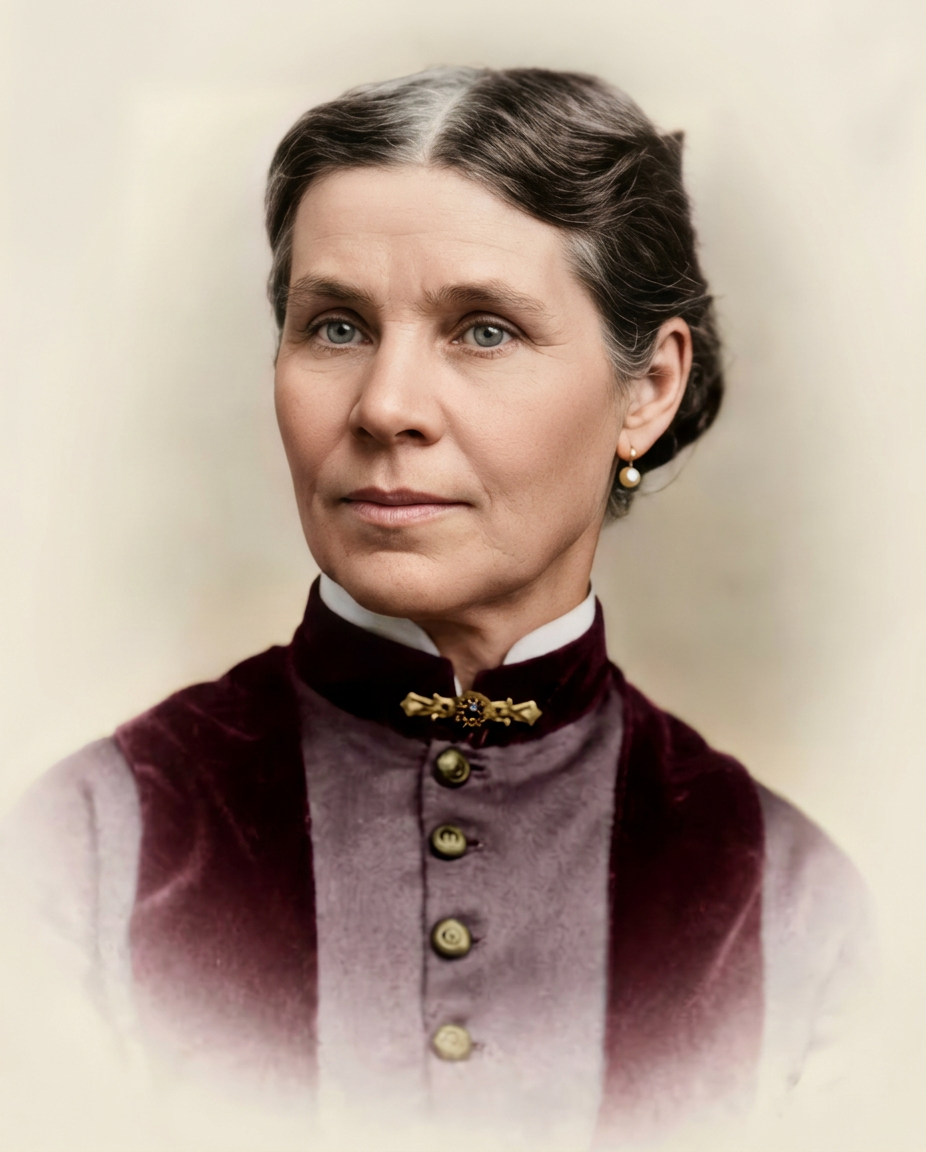
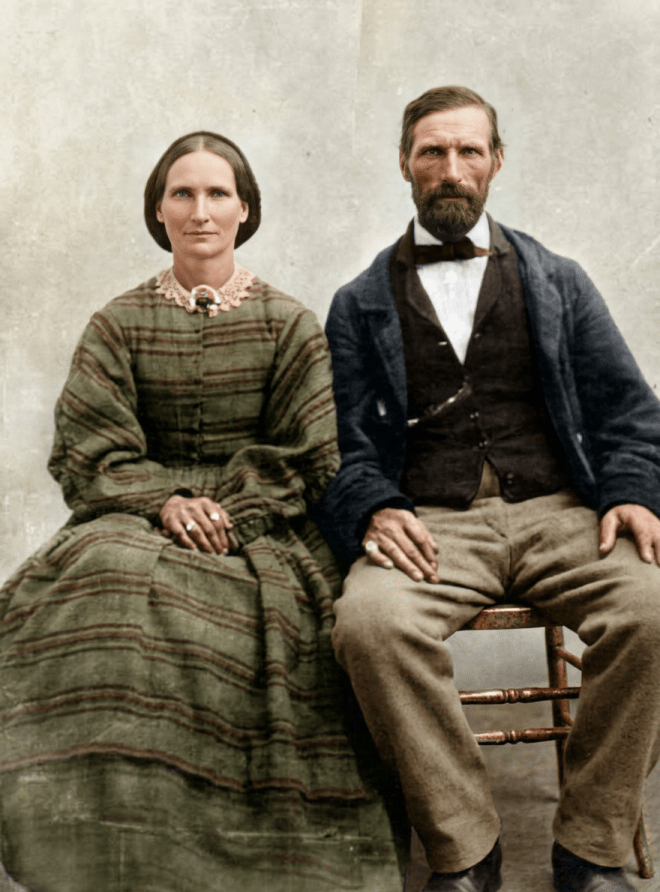
Several months after her parents arrived at the new settlement of Plain City, Weber, Utah, on 17 March 1859, Evelyn Carlisle Sharp was born in a wagon box on 12 October 1859. She always noted she was born on Columbus Day and the first white girl born in Plain City. Her father was William Sharp, stonemason and cornet player, one of the founders of Plain City. Her mother was Mary Ann Bailey Sharp, seamstress and dressmaker, who had crossed the plains with an ox team in the early 1850s.

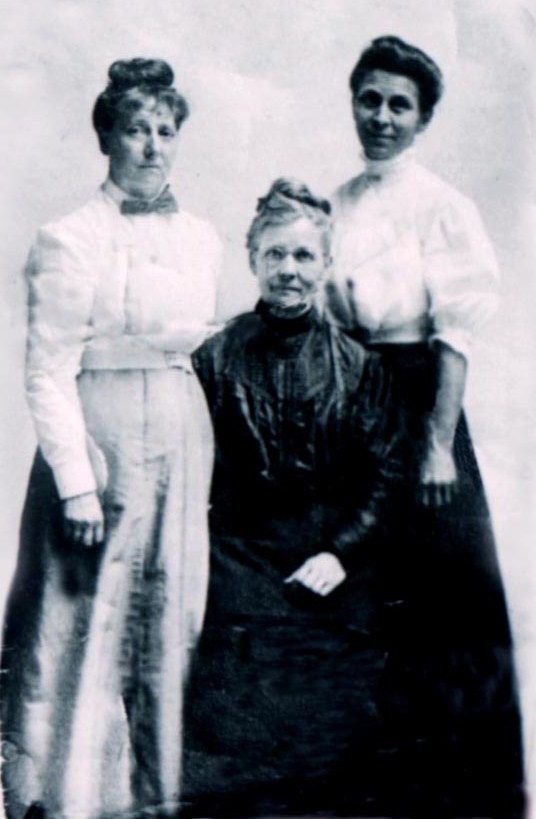
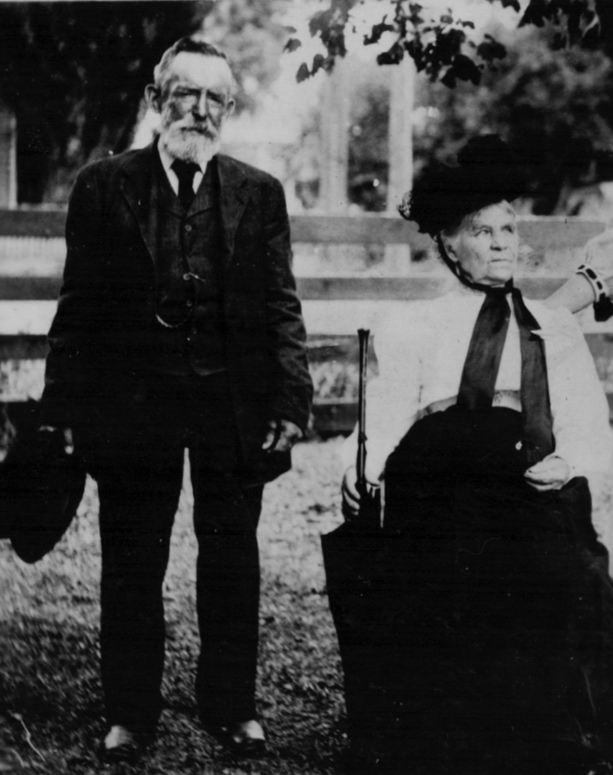
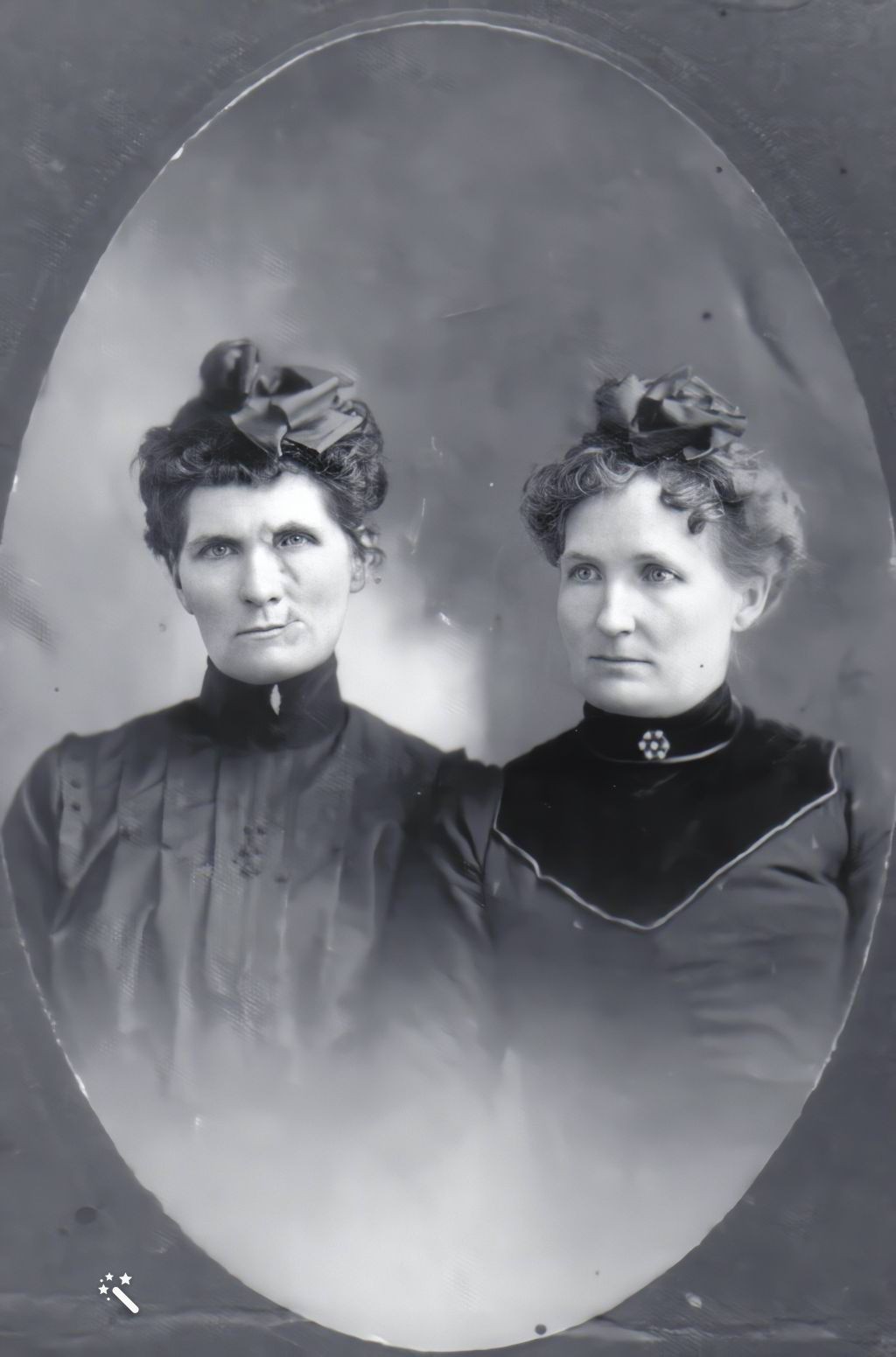
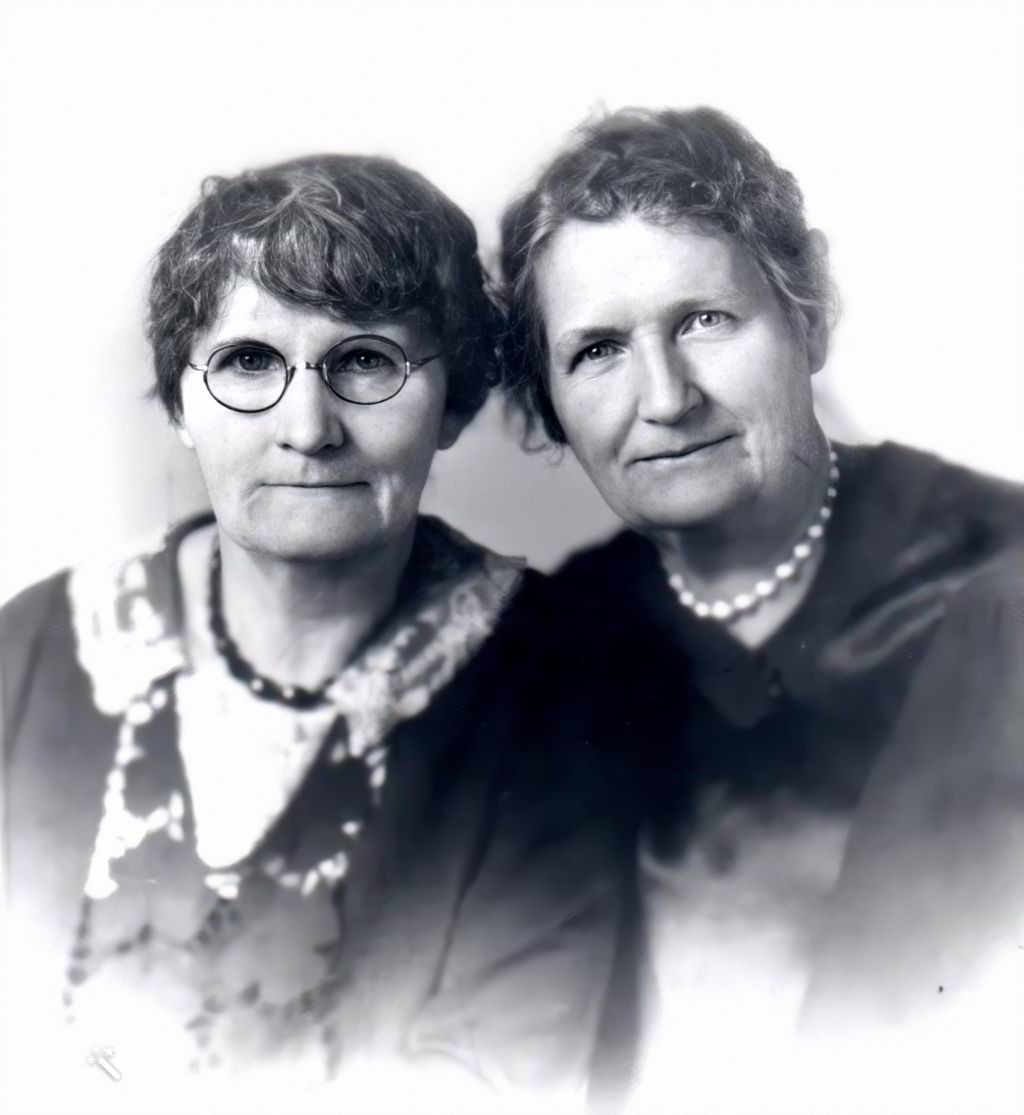
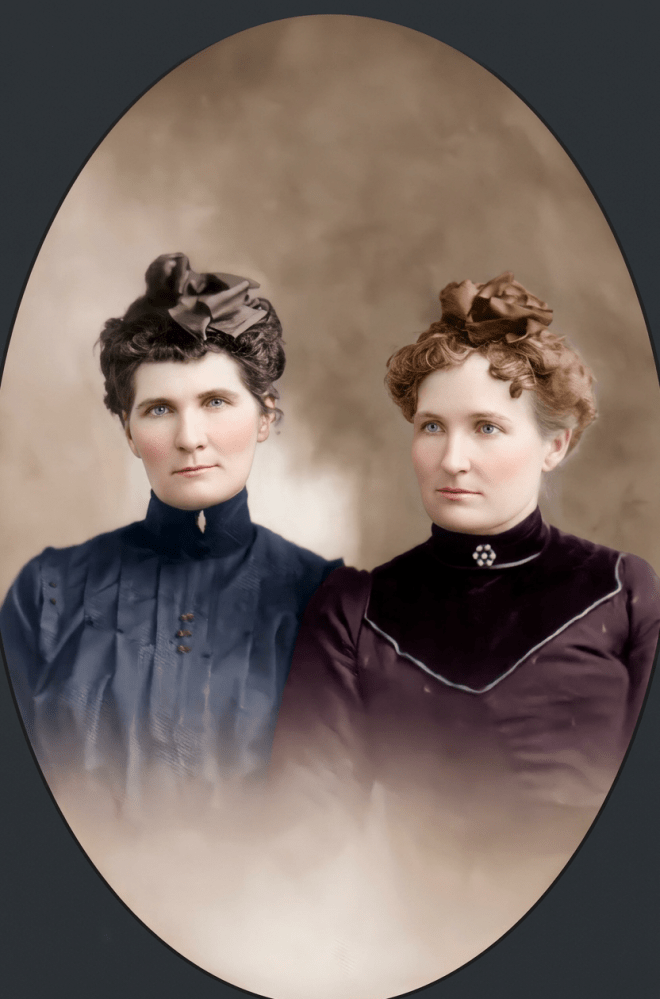
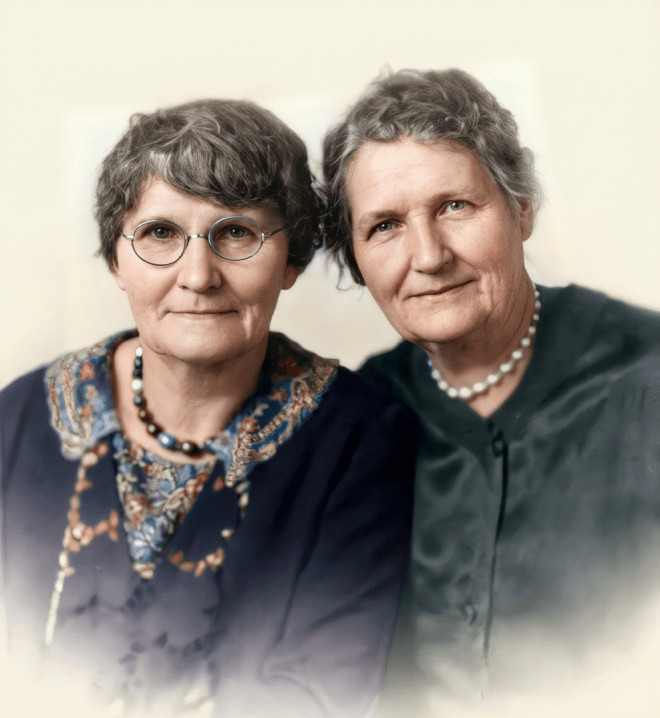
Evelyn Carlisle Sharp and Victorine Mary Sharp

Evelyn’s own account of her early life was preserved in the Utah Pioneers Biography, Vol. 28, Pages 6–7, copied by Maurice L. Howe of Ogden, Utah. It is nice to have some first-person voices from Plain City’s founding generation. The marriage notice from the Ogden Standard Examiner of 22 January 1881 and her Oregon death certificate of 19 April 1941 are limited records, in my possession, of her long life.

Evelyn Sharp Taylor and Victorine Sharp Maw

Pioneer Personal History of Mrs. Evelyn Sharp Taylor

Copied from Utah Pioneers Biography, Vol. 28, Pages 6–7, by Maurice L. Howe, Ogden, Utah.

Mrs. Evelyn Sharp Taylor, Widow of James Henry Taylor, has the distinction of being the first white girl born in Plain City. Her family was one of the early subscribers to the Standard Examiner and after her marriage she and her husband subscribed for many years before they moved from Ogden.

Mrs. Sharp Taylor is now a resident of Portland, Oregon. In relating some of the incidents of Pioneer days Mrs. Taylor said: “I was born on Columbus Day, October 12, 1859 in a wagon box in what is now Plain City — at that time it was just wilderness. My father was William Sharp and my mother was Mary Anne Bailey. They crossed the plains with an ox team in the fifties.

“When they moved up to Plain City, father set to work to build a log and adobe house and during that time the family lived in the wagon box placed in the ground. There were two white boys born previously in Plain City.

“I was the first white girl born there. After I grew up I married James Henry Taylor, who was one of the first white children born in old Binghams Fort on West Second Street at Five Points.

“My parents used to tell me about one of the first trips I ever made to Ogden. I was just a baby in arms and my mother and father went to town with their ox team and wagon. It was winter time and when they got home that night the sky was so dark and the roads so drifted over with snow that they lost their way when they were nearly home.

“Finally they discovered the wagon was on a big patch of ice where the river had overflowed. Try as they would they could not find their way so they unhooked the oxen and let them find their way the best they could. Father and Mother said I cried with cold. The wolves howled around the wagon all night while we were huddled there nearly frozen.

“When morning came my parents discovered we were only a short distance from our house. We used to see lots of Indians in those times.

“My family used to take the Ogden paper by mail in the early Seventies. I enjoy getting back to Ogden to meet my friends again.

“My husband in Weber Co. for a time, then we moved to Eureka, Utah where he worked in the mines. Later we moved to Baker City, Oregon and since his death lived in Portland.

“I am surprised at the mildness of the winters here in recent years. When I was young we never used to be able to see a fence for months because the snow covered them up. Snow 2 to 4 feet deep was not uncommon here in early days.”

The Taylor–Sharp Marriage

Evelyn married James Henry Taylor on Sunday, 16 January 1881, at the Taylor residence in Plain City. The ceremony was officiated by Rev. J. L. Gillogly. James Henry Taylor was the youngest son of John Taylor, and had himself been born in old Binghams Fort on West Second Street at Five Points in Ogden. About forty invited guests attended and partook of bountiful refreshments.

The notice in the Ogden Standard Examiner of 22 January 1881 — apparently updated or annotated years later — adds that Mr. and Mrs. Taylor were then nearly 70 years of age, “having reared and married off 12 children — and yet they both seem as full of life and viracity as ever.” Together they raised twelve children, eventually settling in Oregon.

Death and Survivors

Evelyn Sharp Taylor died on Saturday, 19 April 1941, at her home at 345 Third Avenue, Seaside, Clatsop County, Oregon, at 6:10 in the evening. She was 81 years, 6 months, and 7 days old. The cause of death was recorded as apoplexy, due to senile changes. She had lived in Oregon for 38 years.

Her obituary, headed “Weber Woman Dies in Oregon,” identified her as “the first white child born at Plain City.” She was survived by three sons and three daughters in Oregon, and by her sister Mrs. Victorine Maw of Ogden — Victorine Mary Sharp, born 8 April 1862 in Plain City, who had married Robert Edward Maw, son of Plain City pioneer Robert Maw. The last two surviving daughters of William and Mary Ann Sharp, separated by nearly three thousand miles.

Funeral services were held Wednesday in Portland. Evelyn was cremated at the Portland Crematorium; the funeral was conducted by E.B. Hughes Mortuary of Astoria, Oregon.

A Note on the Family

Evelyn was the sixth child of William Sharp and Mary Ann Bailey Sharp, and the first born in Plain City. Her brother Milo Riley Sharp — my great-great-grandfather — had been born two years earlier, on 23 July 1857, in Lehi, Utah, while the family still lived there before the move north. Younger sister Victorine Mary Sharp was born on 8 April 1862, also in Plain City.

The Personal History of William Sharp — a separate document in this family record — places the family’s arrival at Plain City on 17 March 1859, traveling with the large body of Lehi colonists who left on 10 March. It describes the journey vividly: seven days of cold, muddy travel, the wagons doubled-teamed through the muddy flats, arriving at about five o’clock in the afternoon with the ground covered in snow. The wagons were lined up and sagebrush piled behind them as a windbreak against the north wind. They dug a hole in front and built a campfire. This is the scene into which Evelyn was born seven months later.

William Sharp built the adobe home in Plain City that was later used by the Edward Sharp family — Dean Sharp lived in it as a child — and built the first Episcopal Church building, which still stands today as the Plain City Lions Civic Center, designated a historical site, its original bell refurbished and sitting atop the building. He played the cornet in Plain City’s first band. He served on the board of directors of the cooperative store organized at Plain City in 1869. He and Mary Ann divorced on 19 May 1876. William later married a widow named Charlotte Elizabeth Earl and moved to Ogden’s Mound Fort District, where he died on 22 December 1900 and was buried in the Ogden Cemetery.

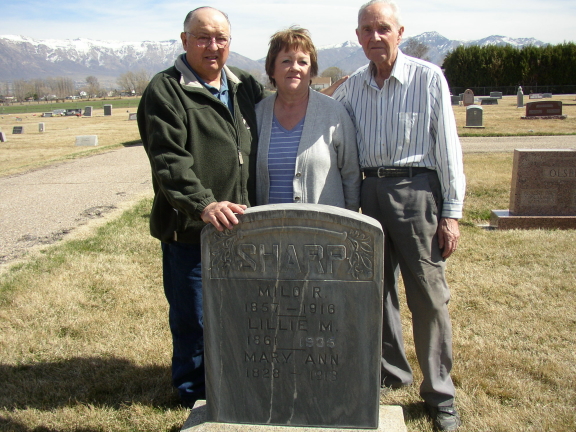
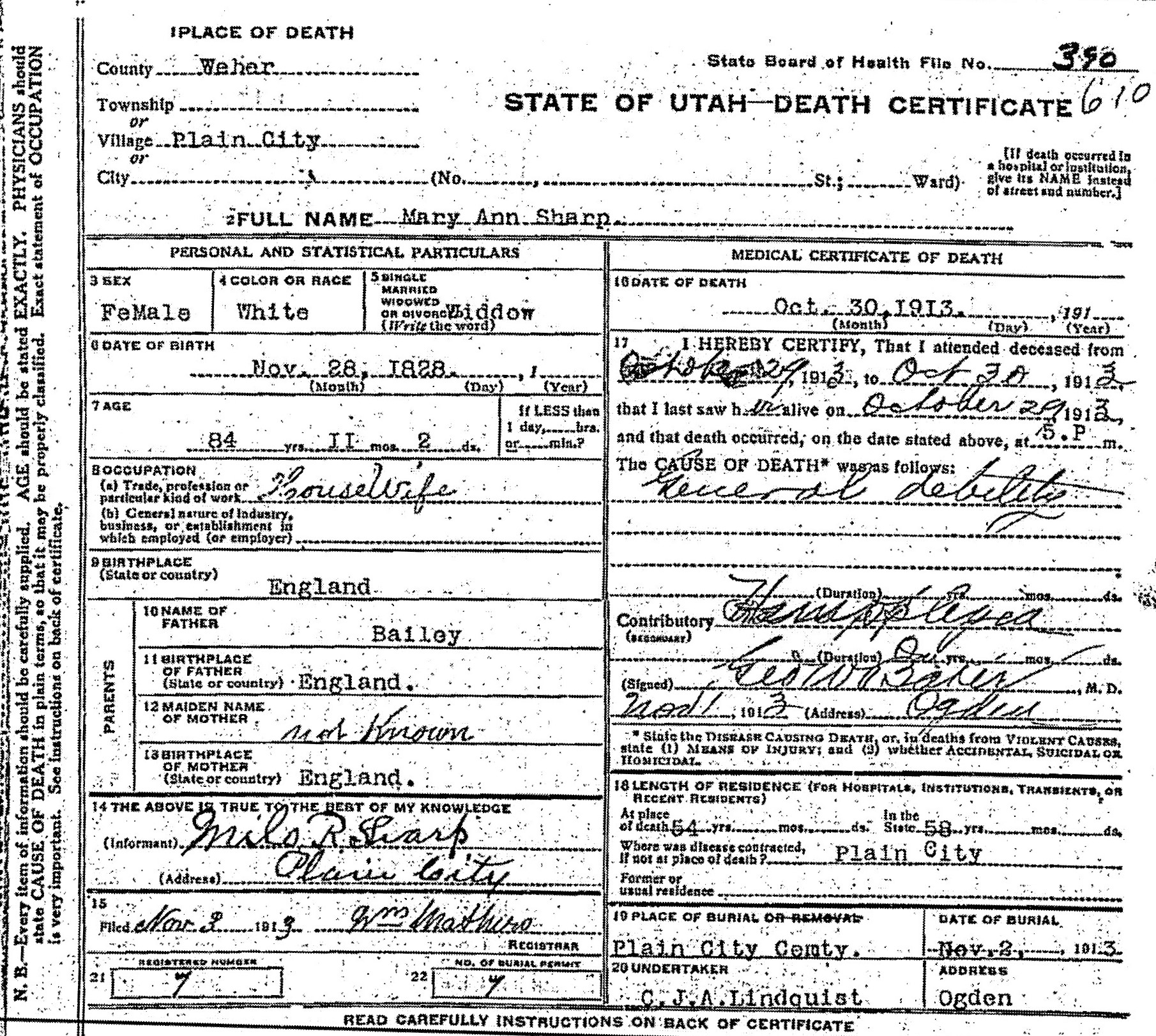
Mary Ann Bailey Sharp lived on in Plain City until her death on 30 October 1913, and was buried there. She had been born on 28 November 1828 in Mattersey, Nottinghamshire, England — a village less than ten miles from Misson, where William was born.

For more on the Sharp family and Plain City’s founding generation, see:

Early Settlers in Lehi, Utah, before Plain City, Utah — Wayne E. Clark’s 2017 research on the Lehi consecration deeds, including William Sharp (no. 68)
Sharp-Bailey Wedding — William and Mary Ann’s story
Sharp-Stoker Wedding — Milo Riley Sharp and Lillie Stoker
History of Plain City — a multi-part series on Plain City’s founding families
1895 Plain City Student Body — the founding generation’s children
Sharp Family History Outreach — the broader Sharp family connections

Sharp – Bailey Wedding

Mary Ann and William Sharp

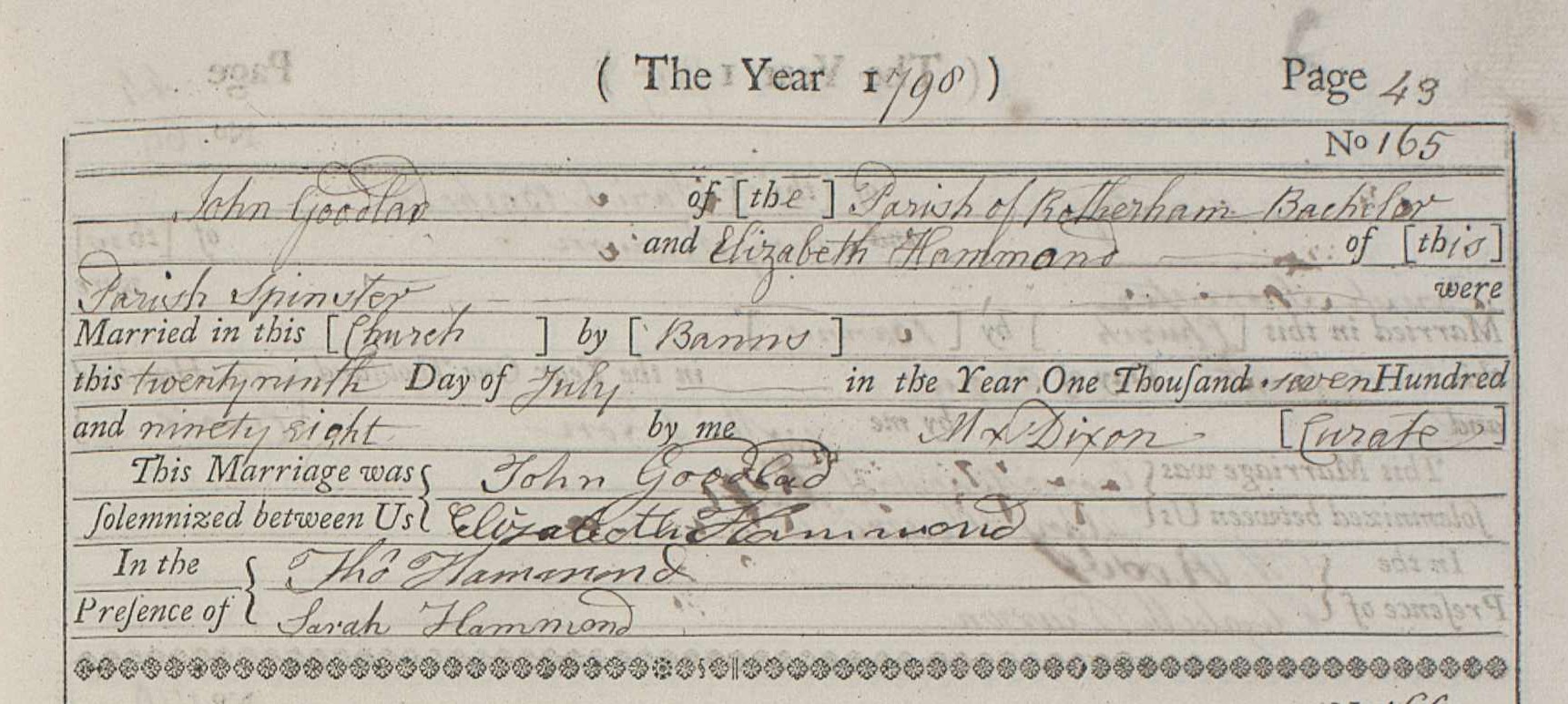
James and Sarah Goodlad Bailey are pleased to announce the marriage of their daughter Mary Ann Bailey to William Sharp, son of Thomas and Elizabeth Cartwright Sharp. William and Mary Ann were married at Loup Fork, Howard, Nebraska on 10 July 1853. (Loup Fork appears to have been a crossing of the Loup River, somewhere between Fullerton and Palmer Nebraska, in order to go turn south to rejoin trail along the Platte River.)

William is mason and farmer. They will make their home wherever they are called to settle once they arrive in the Utah Territory.

Due to the circumstances of this family, it is pretty unlikely an announcement would have ever been written. Everything about these families was in motion. Family members on both sides were strewn all over two continents and their lives were still recovering from a number of personal blows. While this was probably a high point, they knew there was a long road still ahead of them. All four of their parents had passed before their marriage.

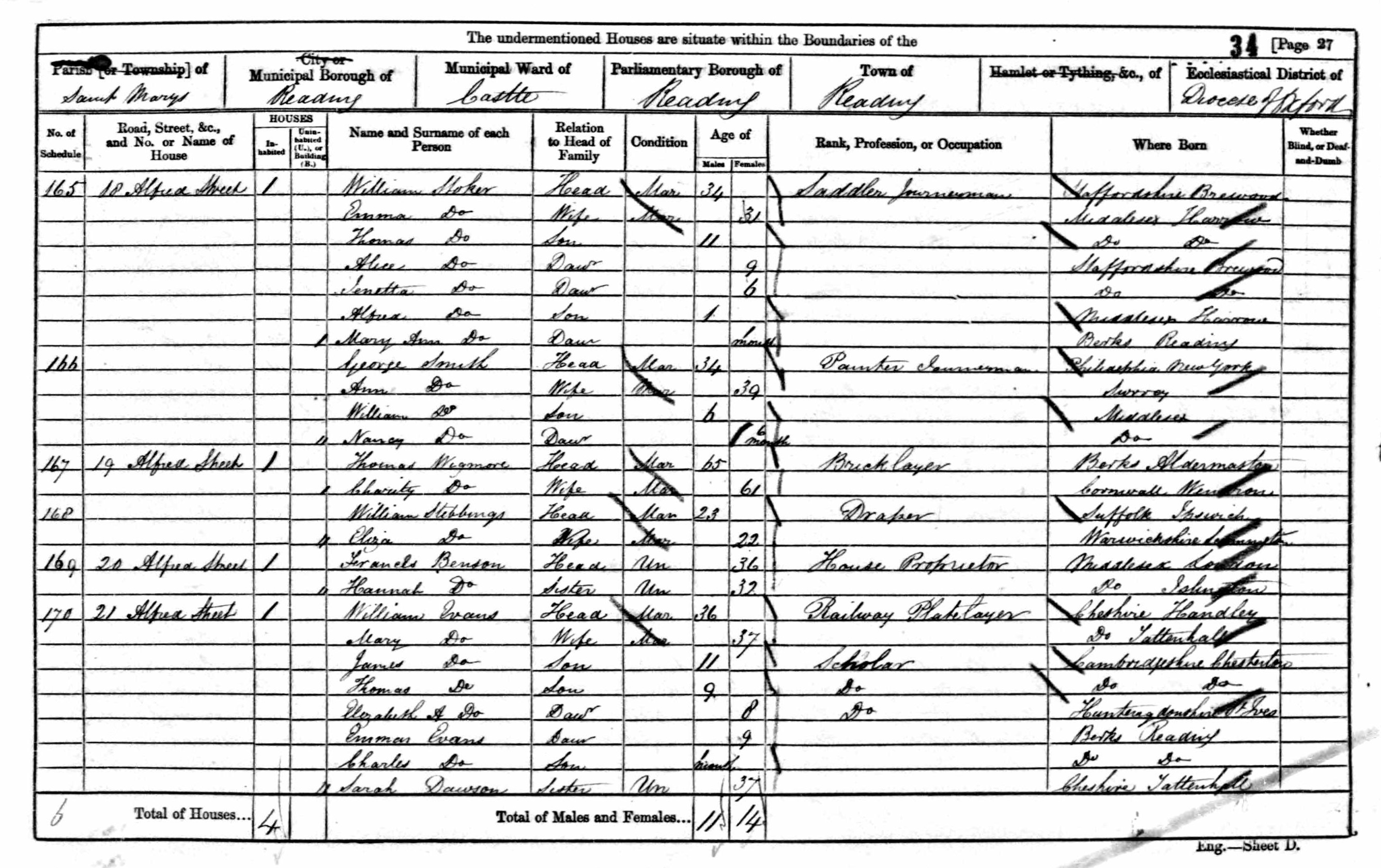
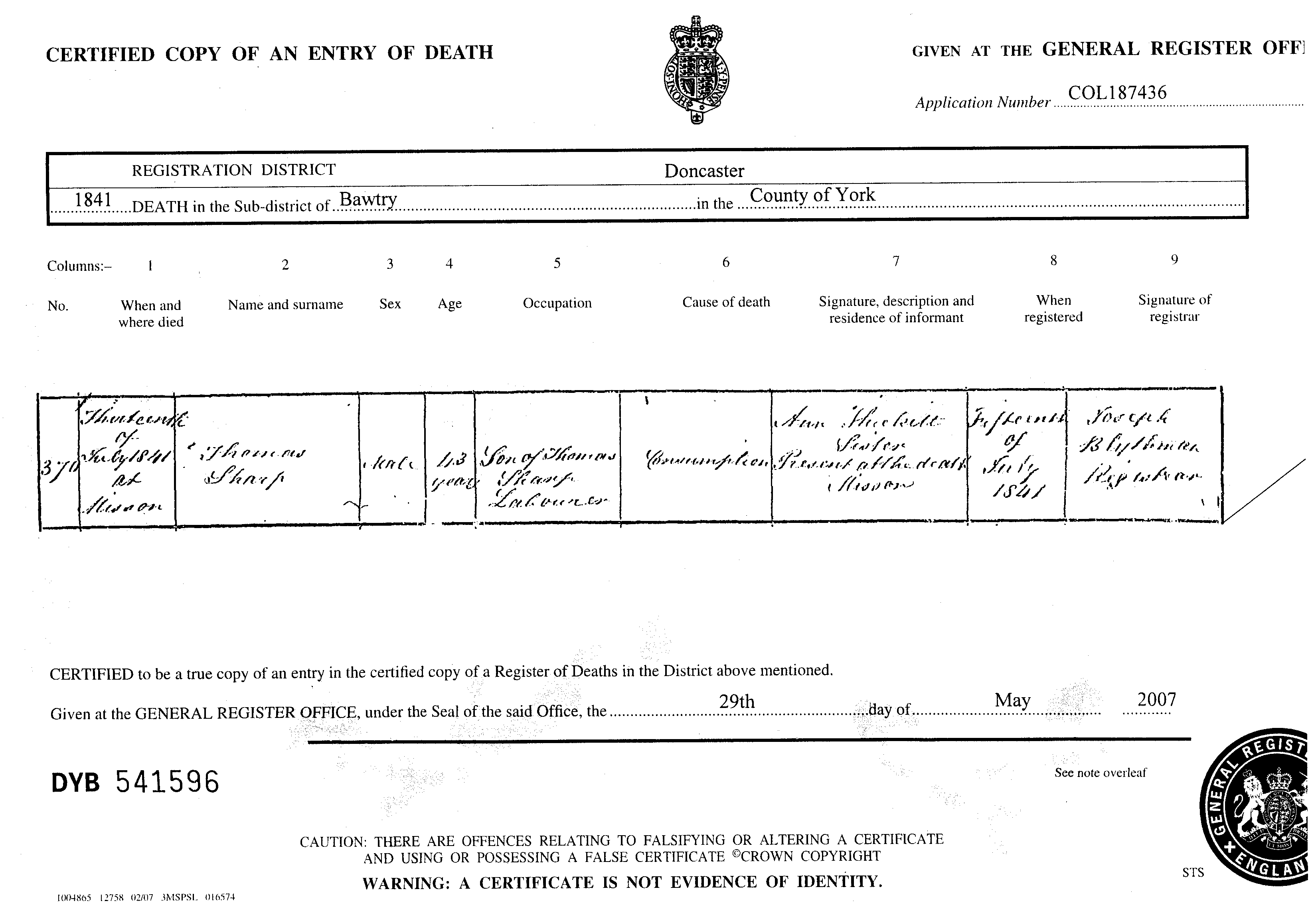
William was born the third of eight children born to Thomas and Elizabeth Cartwright Sharp 10 December 1826 in Misson, Nottinghamshire, England. His baptism is recorded on 7 January 1827 at Misson Anglican church, confirmed by the Bishop’s Transcripts at Nottinghamshire Archives. He spent his life as a mason but kept a farm. We do not know where or how he learned how to be a mason. His father, Thomas, is listed as “Ag Lab”, which is probably an agricultural laborer on the 1841 English Census. Thomas died in 1841 after the census was taken.

In 1848, the LDS missionaries came to visit in Misson. William was the first in his family, that we know, to join the church on 20 June 1848. His mother followed 11 August 1849 and his sister Isabella 16 September 1849. The records available do not show that William’s siblings, Elizabeth and James joined the church, but they came with the family to the United States on their way to Zion. The family story tells the family was friendly and open towards the missionaries. One of the missionaries was a George Emery (the only potential George Emery I could find appears to have lived 1792 – 1867).

Elizabeth Sharp was determined to emigrate with her family to Utah. Her family attempted to discourage her by warning her about the dangers of the American Indians. Nevertheless, she departed with William, Isabella, Elizabeth, and James. The other four children had died as infants before leaving England. The family purchased tickets at 25 pounds sterling in Liverpool. The family set sail on the “James Pennell” on 2 October 1850 commanded by Captain James Fullerton. The LDS leaders on board were Christopher Layton (1821–1898) and William Lathrop Cutler (1821–1851) leading the company all the way to Zion. Right before hitting the waters of the Mississippi the ship encountered a storm where the masts were broken and the ship drifted for a couple of days. Luckily, a pilot boat found them and another ship (that left two weeks later from Liverpool) tugged them to New Orleans, Louisiana. The ship arrived at dock on 22 November 1850. The family struggled with sea sickness and chills and fevers that beset them in New Orleans and St. Louis. From there the entire group boarded the “Pontiac” and continued to St. Louis, Missouri where they found work and spent the winter. Despite having crossed the Atlantic, Elizabeth, the mother of the family, died 17 February 1851 in St. Louis and was buried in Bellefontaine Cemetery.

Among the fellow passengers on the James Pennell were the Singleton family of Misson. The Singletons were neighbors in Nottinghamshire. William Singleton (1793–1850) sailed with his children, including Thomas Singleton (1825–1885) and Charles Singleton (1838–1907). Tragically, William Singleton died in St. Louis on 16 December 1850, just three weeks after the ship docked. His son Thomas pressed on, becoming one of Plain City’s 1859 founding pioneers, where he worked as a carpenter and band leader alongside William Sharp. Thomas Singleton is listed among those excommunicated alongside William Sharp on 31 January 1879. Generations later, Thomas’s grandson Bert Elmer Singleton (1918–1995), born and raised in Plain City, became one of Utah’s most celebrated baseball players, pitching in the major leagues over 28 seasons. The Sharps and Singletons, neighbors in Misson, remained neighbors in Plain City across the generations.

Elizabeth’s death left the four siblings to fend for themselves. William and Isabella both still desired to move on with the Saints to Utah. William became fast friends with Mary Ann Bailey Padley, a widow who had lost her husband before leaving England. They were such good friends that Anne Elizabeth Padley (she went by Sharp her whole life though) was born 31 October 1852. Isabella married Joseph Carlisle, who had arrived two years earlier, 18 May 1853, in St. Louis. That same day the Moses Clawson Company, “St. Louis Company,” departed from St. Louis. Joseph and Isabella Carlisle, along with William Sharp and Mary Padley (with her son Lorenzo Padley and new infant Anne), left with the company. Joseph and William were well respected because they were apparently very good athletes and challenged anyone to a wrestling match.

The Sharps and Carlisles drove a wagon for William Jennings, a Salt Lake City merchant and freighter. The outfitting was done in Keokuk, Iowa. The company for traveling over the plains was formally organized in Kanesville, Iowa. On the trail, William and Mary Ann Padley were married 10 July 1853 in Loup Fork, Nebraska. The company arrived in Salt Lake City between the 15th and 20th of September the same year.

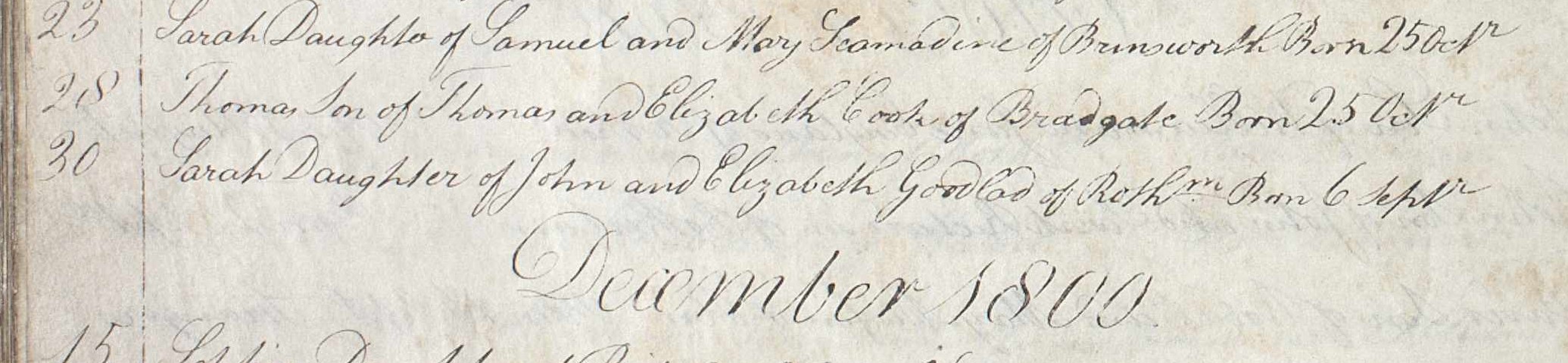
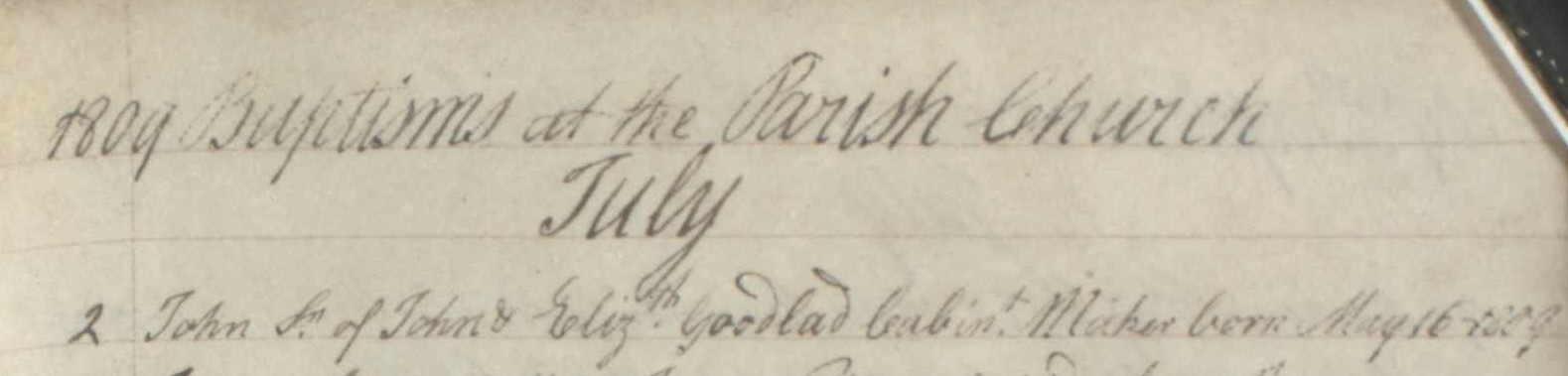
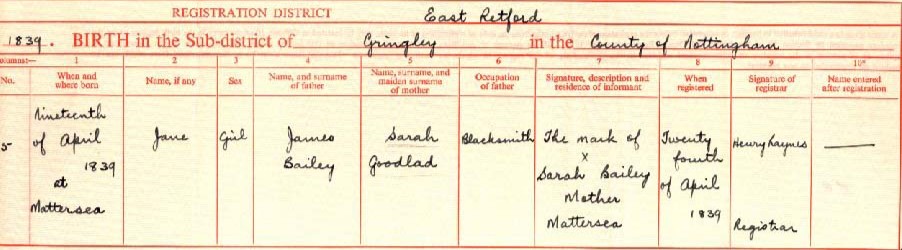
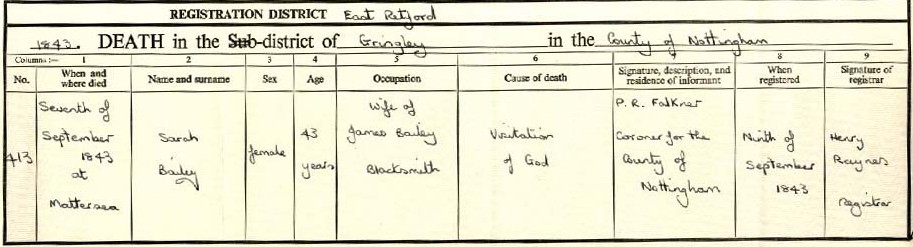
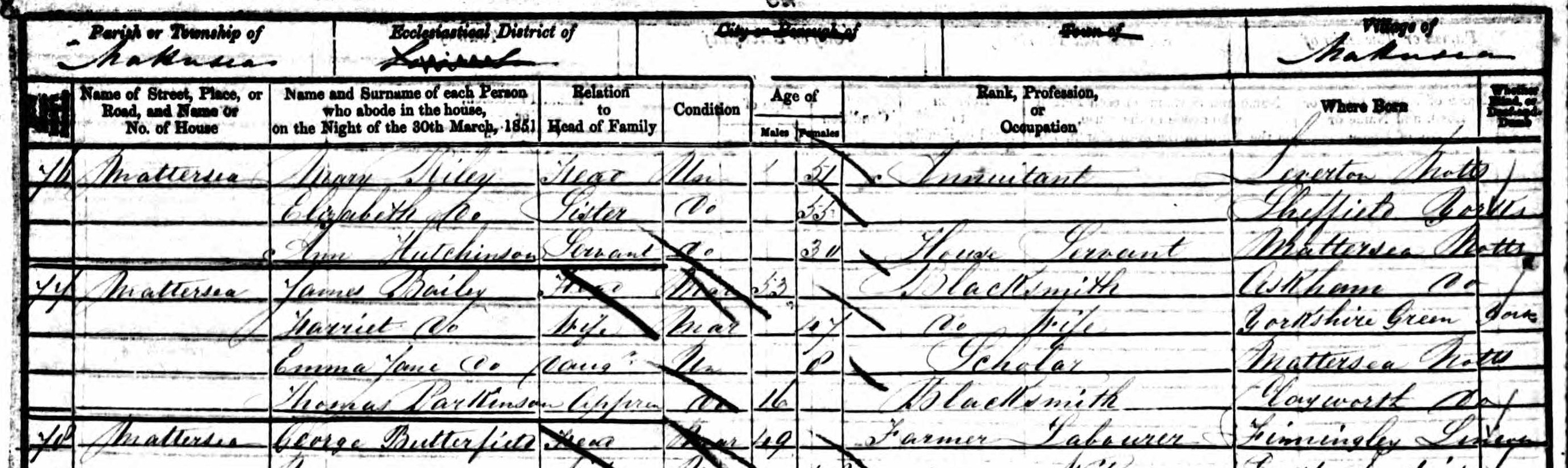
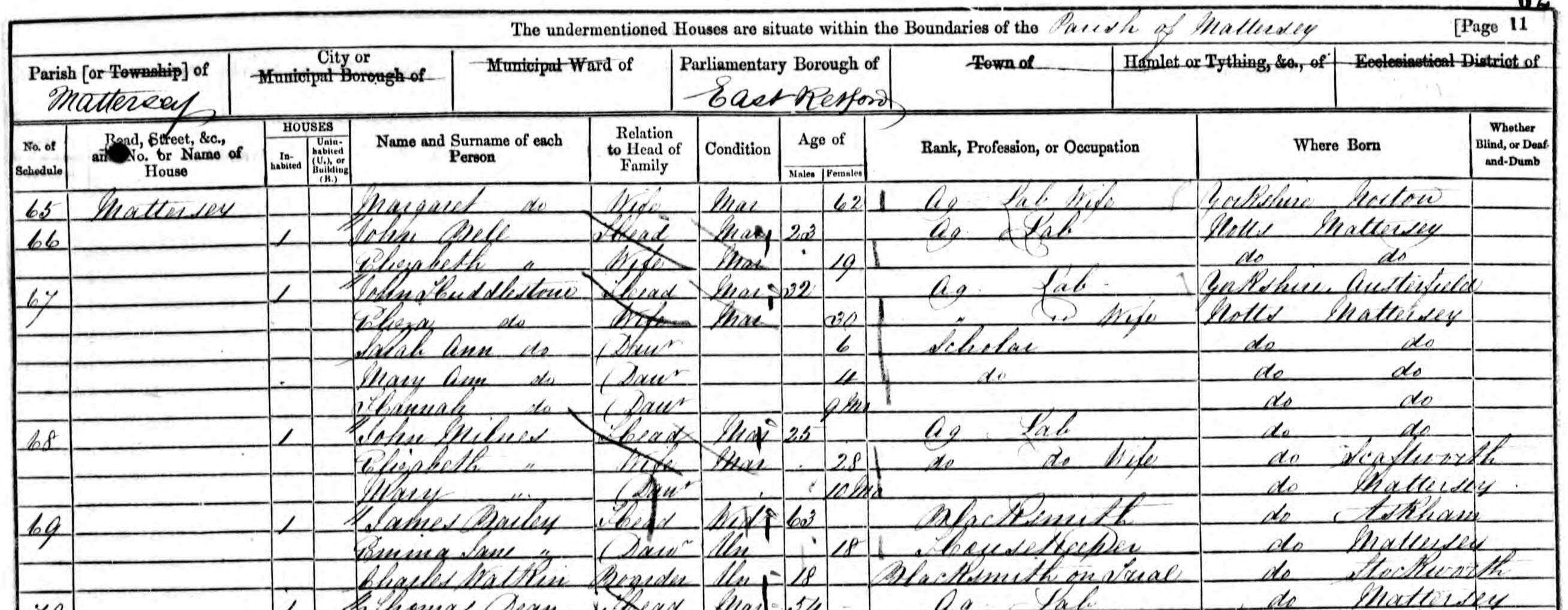
Mary Ann was born the first of seven children born to James and Sarah Goodlad Bailey on 28 November 1828 in Mattersey, Nottinghamshire, England. Her baptism is recorded on 8 December 1828 at Mattersey Anglican church, confirmed by the Bishop’s Transcripts at Nottinghamshire Archives. James was a blacksmith. The Bailey family were practicing members of the Church of England. Mary Ann attended school and obtained training in millinery and sewing. Sarah died in 1843 and James remarried to a lady named Harriet. We don’t have a death date for James at this time.

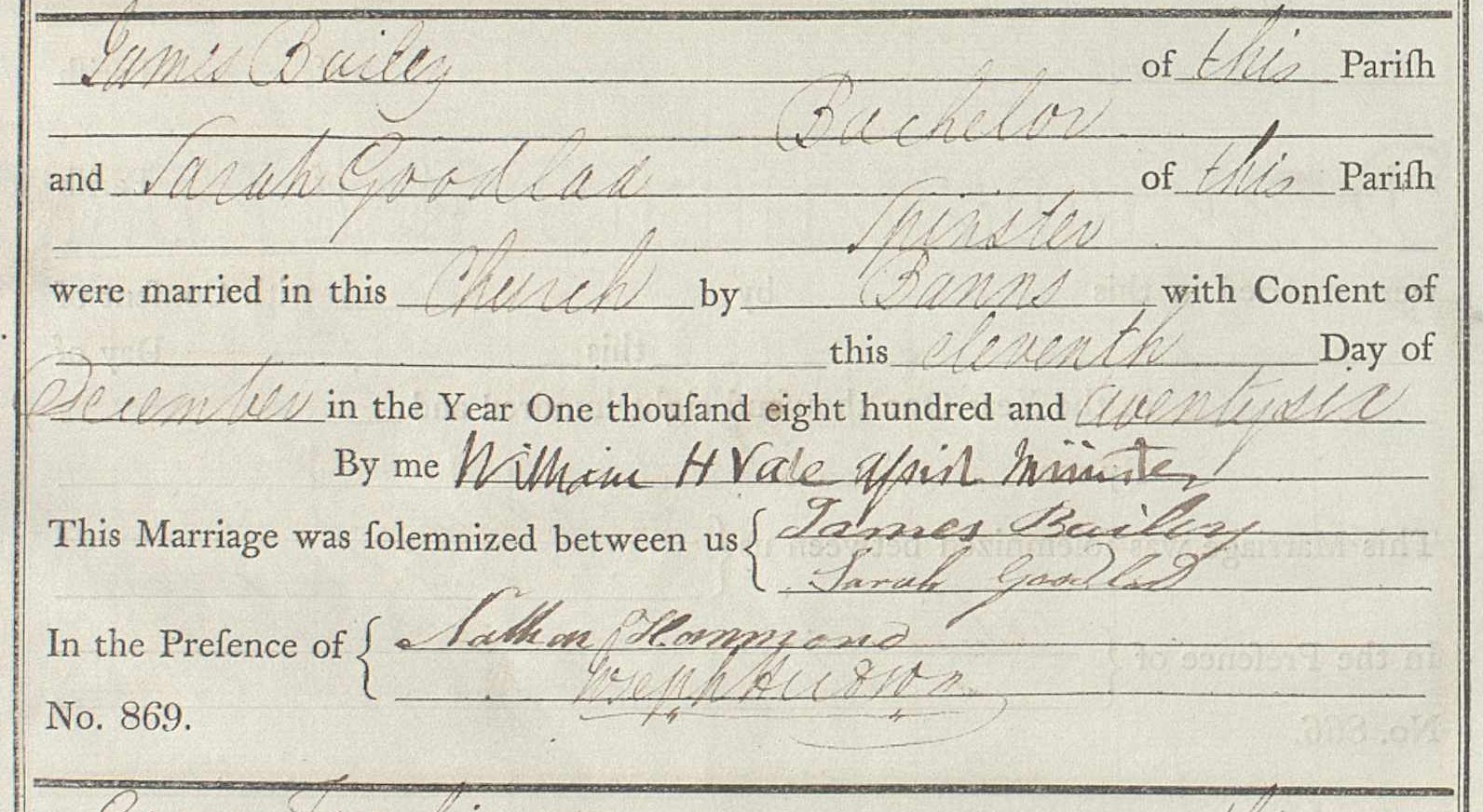
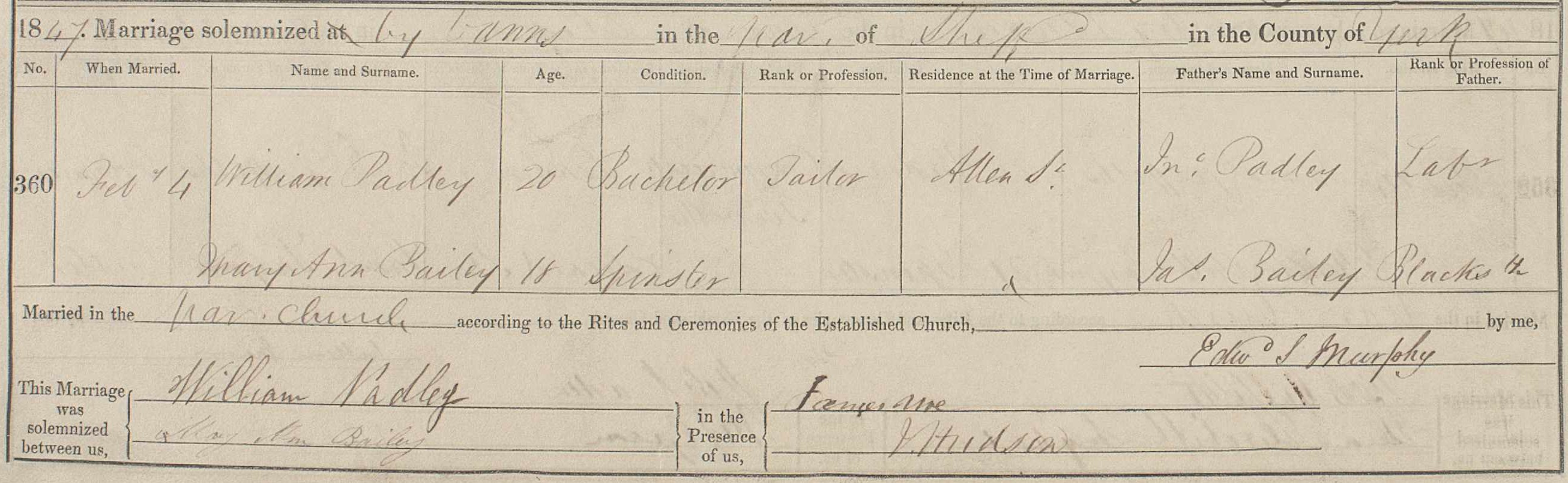
Shortly before her 18th birthday, Mary Ann met missionaries of The Church of Jesus Christ of Latter-day Saints and converted. She was baptized 20 October 1846. Her father and Harriet dismissed her from the home for becoming a Mormon. She soon met William Padley, another LDS member and a tailor who lived on Allen Street in Sheffield, and married him on 4 February 1847 at the Church of St Peter and St Paul (now a cathedral) in Sheffield.

Padley – Bailey marriage record

William Padley was born 22 September 1826 in Morton, Lincolnshire, just across the River Trent from Mattersey, and they may well have known each other from their home area before both moved to Sheffield. They had a son, Lorenzo Joseph Padley, born in December 1847. William became ill when Lorenzo was born and died 22 February 1850 in Morton, Lincolnshire. Left alone with a new son, Mary Ann went back to her parents, who would have nothing to do with her unless she gave up her religion. She would not, and instead decided to join the Saints in Utah.

Mary Ann and Lorenzo sailed from Liverpool on 8 January 1851 on the “Ellen” with James Willard Cummings (1819–1883) as the leader of the company. The ship had a difficult passage with measles and what others thought was whooping cough. She arrived in New Orleans 14 March 1851. On the 19th they left for St. Louis on the “Alleck Scott” and arrived on the 26th. Mary Ann and Lorenzo stayed in St. Louis while the company moved on, and it was there that she met William Sharp and his family.

William and Mary Ann grew close during their time in St. Louis. A daughter, Anne Elizabeth, was born to them on 31 October 1852. Both were still determined to join the Saints in Utah. They arranged to drive a freight wagon west for William Jennings, a Salt Lake City merchant and freighter, as the means of joining the Moses Clawson Company. On the trail, William and Mary Ann were married on 10 July 1853 at the crossing of Loup Fork in present-day Howard County, Nebraska. The company arrived in Salt Lake City between the 15th and 20th of September that year.

They settled in Lehi, Utah, Utah for a couple of years but had a number of issues with range for the cattle and some other minor squabbles. Water was also not found to be very dependable in the Lehi area. During this time, William and Mary Ann gave birth to two children, William and Isabella in 1854 and 1856, but both died as infants. Milo Riley was born in Lehi 23 July 1857. I have written of Milo and his family previously at this link: Sharp-Stoker Wedding.

William learned of land north near Ogden, Weber, Utah that was going to be opened up from some of the Saints passing through Lehi (abandoning Salt Lake City before the arrival of Johnson’s Army). These Lehi Saints were told of ample land and good water that was available west of Ogden. A scouting expedition went to search out the area in the fall of 1858 and visited with Lorin Farr (1820–1909) who told them of the available plain to the west.

The Sharp family left with other Lehi Saints on 10 March 1859 to travel to this new area. The group of about 100 arrived 17 March 1859 at what is present day Plain City, Weber, Utah. The company arrived at about 5 PM during the middle of a snowstorm. The company lined up the wagons to protect them from the wind and dug a hole in the ground for the campfire. Reports indicate that snow was deep and conditions uncomfortable. Plain City apparently lived up to its name with sagebrush that rose over 4 feet tall from the high water table beneath the soil.

William Sharp put his carpentry and masonry skills to work making adobe brick and helping build the first homes in Plain City. William and Mary Ann lived in one of these homes. William served in the Plain City band, on the Plain City Z.C.M.I. board, acting as a builder, and also serving as a city leader. William and Mary Ann’s daughter, Evelyn, was the first girl born in Plain City in October 1859. Victorine Mary was born 8 April 1862 and was their last child. Mary Ann kept busy sewing and making suits, coats, and other jobs. Each of her daughters learned to become dressmakers.

William and Mary Ann each received their initiatory and endowment on 17 August 1861 at the Endowment House. On the same day, Mary Ann was sealed by proxy to her deceased first husband William Padley. As a woman already sealed to another man, she could not be sealed to William Sharp during their marriage, as the church did not permit women to be sealed to more than one husband at that time. The Sharp children’s sealing situation caused considerable family angst as all children born to Mary Ann after the 1861 sealing were born in the covenant to William Padley rather than William Sharp.

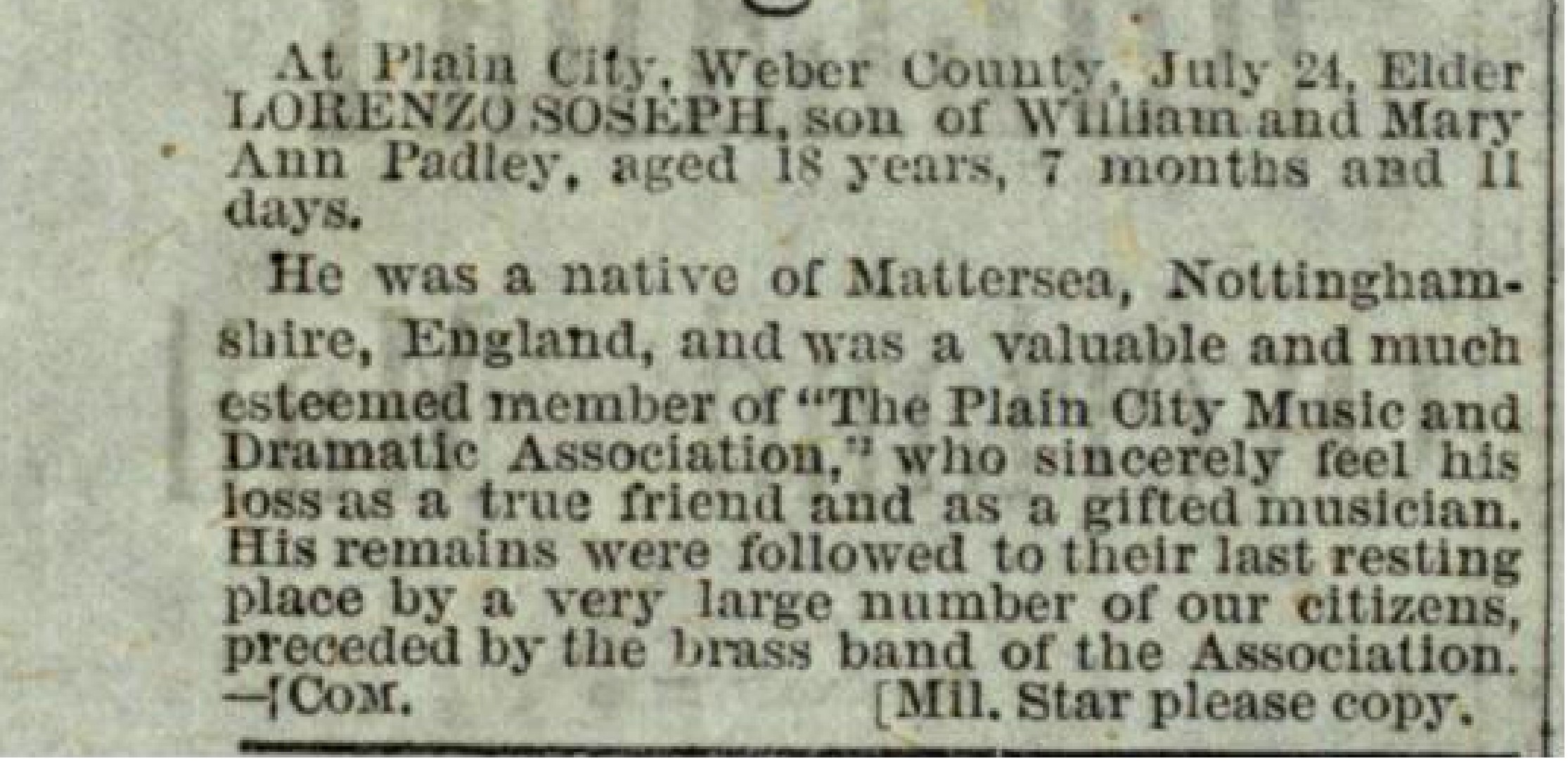
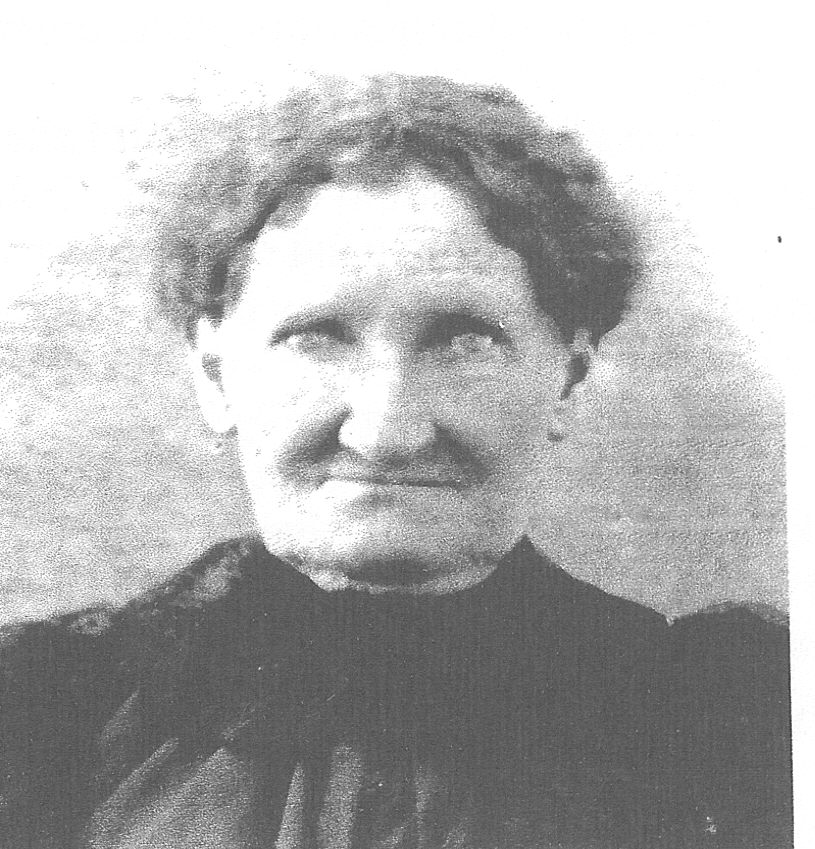
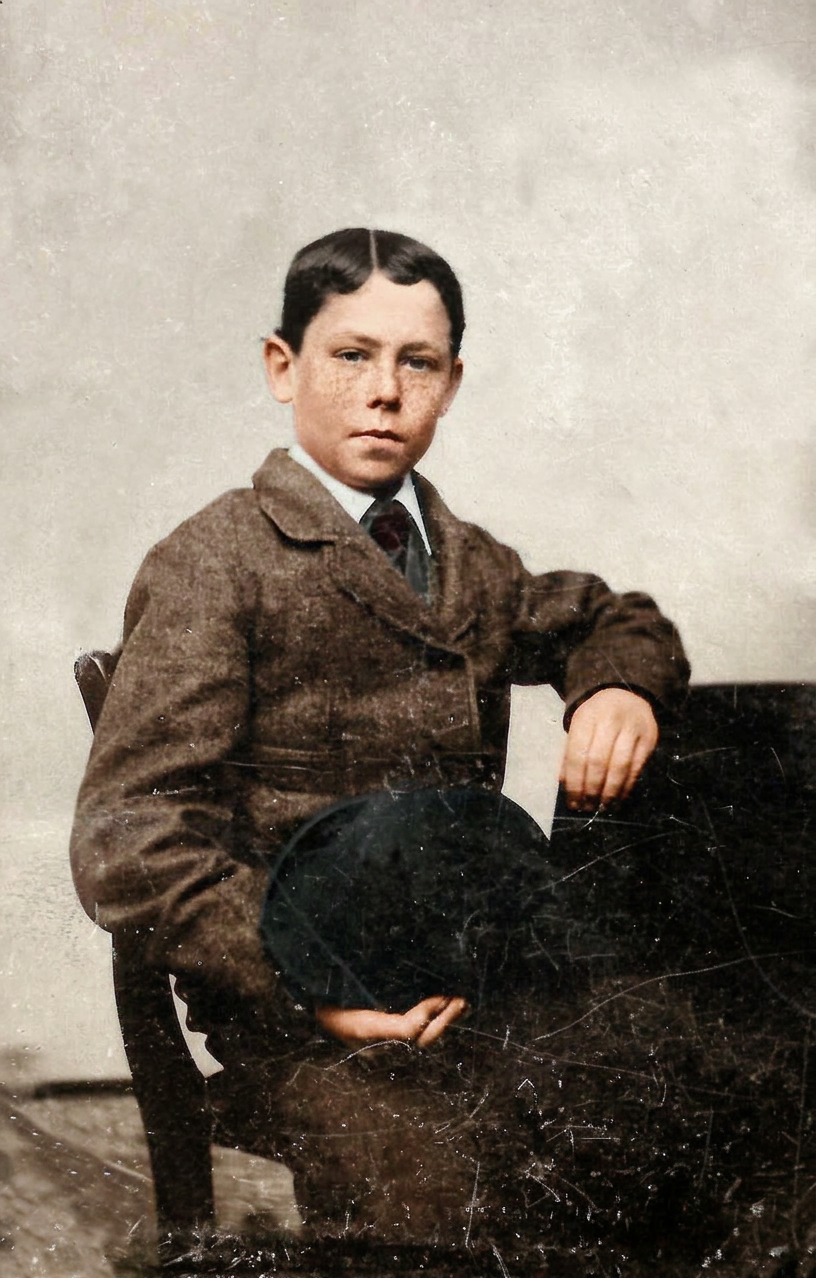
Lorenzo Joseph Padley died 24 July 1866 at Plain City, aged 18 years, 7 months and 11 days, putting his birth approximately 13 December 1847 in Mattersey, Nottinghamshire, England. He had grown up to become a valued member of the Plain City Music and Dramatic Association, which mourned him as a true friend and gifted musician. His remains were followed to their last resting place by a very large number of citizens, preceded by the brass band of the Association. The notice requested the Millennial Star in England to copy — a reminder that Mary Ann’s roots, and Lorenzo’s birthplace, lay in Nottinghamshire. The photo we have of him is pretty scratched, but here is a cleaned up photo, but it is not perfect. It is hard to tell what is his nose and what was deformities in the photo.

Anne Elizabeth married Daniel Claiborne Thomas Jr. on 29 January 1872 in Salt Lake City at the Endowment House, where they also received their initiatory, endowment, and sealing the same day. Daniel had been born 14 July 1850 on the Platte River in Nebraska on the trail to Utah. His father, Daniel Claiborne Thomas Sr., had been converted to the church by his brother Preston while on a mission to the Southern States, and the family had come to Utah in 1850, settling in Sulphur Springs (later named Lehi) among the earliest settlers there, before joining the Plain City founding group in March 1859. They settled in Plain City and had six children: Claiborne William (1872), Francis Milo (1875), LeRoy Bertrand (1878), Estella Inez (1884), Delbert (1888), and Elizabeth La Vieve (1889). Anne Elizabeth died 29 July 1891 in Plain City at thirty-eight, leaving six children ranging in age from two to nineteen. Daniel outlived her by thirty-eight years, dying in Ogden on 2 September 1929, and was buried beside her in Plain City Cemetery.

After several instances of desertion, Mary Ann moved out of their home on Christmas Eve 1875 and utterly refused to go back to William. William sued for divorce and Franklin Dewey Richards (1821–1899) granted the divorce (in probate court) on 19 May 1876.
At this time, it is possible that Bishop Lewis Warren Shurtleff (1835–1922), branch president 1870–1877, bishop 1877–1883, extended himself beyond what the members felt was right — going so far as to dictate how much everyone should pay in tithing — and some families were very vocal in expressing their discontent. William Sharp began construction on St. Paul’s Episcopal Church in 1877, and many disaffected members found a religious haven in this new faith. The building still stands today, owned by the Lions Club in Plain City. A significant group of members were excommunicated on 31 January 1879, including William Sharp, Mary Ann Sharp (listed separately because of the divorce), William Skeen, Edwin Dix, George Musgrave (father of their future daughter-in-law), Thomas Musgrave, Thomas Singleton, Thomas Davis, George W Harris, Jonathan Moyes, John Moyes, Winfield Spiers, James Wadman, Robert Davis, John Davis, and Thomas Robson. These lists also have “and wife” as well as “and family” which seems to indicate that spouses and families were included. Many of these families returned to the church after time away, some individuals never did. Milo Ross’s 1997 oral history interview offers one family perspective on the causes of the split.

This same year, William remarried to the widow of Charles McGary, Charlotte Elizabeth Earl, about 1879. We do not know exactly when or where.

Milo Riley married Mary Ann Stoker (aka Lillian or Lilly Musgrave) 11 May 1879 in Plain City in the little church William built. He died in 1916 in Plain City. Read about them here.

Evelyn Carlisle married James Henry Taylor 16 January 1881 in Plain City. She died in 1941 in Oregon.

Victorine Mary married Robert Edward Maw on 8 April 1883 in Plain City, her twenty-first birthday. Robert had been born in Plain City on 15 October 1859, the son of Robert Maw, one of Plain City’s founding pioneers who had consecrated his Lehi property in January 1857 and arrived in Plain City on 17 March 1859, the same day as the Sharp family. William Sharp had built the elder Robert Maw’s adobe house in those early Plain City years and had played cornet alongside Abraham Maw in Plain City’s first band. The marriage of Victorine Sharp and Robert Edward Maw united two of Plain City’s founding families. They had seven children: Ruby Ada (1884), Alice (1885), Jessie (1886), Florence Eveline (1888), Grace (1890), Edith Louise (1893), and Edward Clyde (1896). On the morning of 23 April 1897, a snow slide struck the Consolidated Mining and Smelting Company’s Garfield Mine in Gibbs Canyon, four miles north of Brigham City. Robert was killed. The Brigham City Bugler reported the disaster that week, noting that he was a married man who left a widow and seven children. Victorine was thirty-four years old. Her youngest child, Edward Clyde, was barely a year old. She did not remarry, living in Plain City and later Ogden until her death on 18 March 1945. She is buried in Plain City Cemetery.

Mary Ann Bailey Sharp

Mary Ann continued to work as a dressmaker until she could not do so any more due to age. She lived with her Granddaughter Elizabeth Taylor from before 1900 and even moved with her to Baker City, Baker, Oregon. Mary Ann moved back to Plain City not long after Beth married.

Evelyn & Victorine Sharp

~

Evelyn and Victorine Sharp

William died at 950 Washington Ave in Ogden on 22 December 1900 at 74 years and was buried two days later in the Ogden cemetery. Mary Ann died 30 October 1913 in Plain City at 84 years and was buried there three days later.

Mary Ann Bailey Sharp death certificate

William and Mary Ann both died outside the church.

In December 1933, fifty-four years after the excommunication, three of Isabella Sharp Carlisle’s sons — Joseph Carlisle, James Carlisle, and Harvey Carlisle — wrote to LDS Church President Heber J. Grant requesting proxy reinstatement for their Uncle William and his former wife Mary Ann. Their letter described William as “honest, virtuous and kind” and was addressed care of Mrs. James S. Thompson — Annie Thompson, who would later write the 1957 history of Elizabeth Cartwright Sharp, and who was the daughter of James Carlisle. The letter explicitly identified William as “born 10 Dec. 1826, Misson, Notts., England, and later settled in Plain City, Utah.”

President Grant responded on 16 December 1933, consenting to proxy baptism for both William and Mary Ann. He noted that since they had previously received their endowments on 17 August 1861, those ordinances would need to be restored by proxy as well, and authorized Elder George F. Richards, President of the Salt Lake Temple, to officiate. On 3 February 1934, proxy baptism and confirmation were performed for both William and Mary Ann at the Salt Lake Temple, with William’s sealing to parents following on 2 July 1934. The restoration of William Sharp and his wife to the church, by the hands of his sister Isabella’s sons, closed that chapter.

In re Lugo

Decision: In re Jason Josue Lugo, Case No. 15-40121-JDP (Bankr. D. Idaho, 25 Jun. 2015)
Judge: Honorable Jim D. Pappas, United States Bankruptcy Judge
Counsel for Debtor: Paul Ross, Idaho Bankruptcy Law, Paul, Idaho
Chapter 13 Trustee: Kathleen A. McCallister, Meridian, Idaho
Trustee’s Counsel: Holly Roark, Office of Kathleen A. McCallister, Meridian, Idaho


Background

Jason Josue Lugo and his wife Lori married in 1996. In December 2003, Lugo acquired real property in Declo, Idaho, and in March 2004 conveyed it to himself and Lori by quitclaim deed. The couple built a home on the property that year and moved in with their family, establishing an automatic homestead exemption by virtue of their occupancy as a principal residence under Idaho Code § 55-1004(1).

In July 2012, Lugo moved out of the marital home due to irreconcilable differences. His family remained in the home. He did not record a declaration of non-abandonment. Under Idaho Code § 55-1006, six months of continuous vacancy creates a presumption of abandonment — meaning Lugo’s automatic homestead was presumed abandoned by January 2013. On 12 September 2013, a stipulated divorce decree was entered awarding Lori sole possession of the property, subject to the two existing mortgages and a $40,000 obligation to Lugo’s father. Under the decree, Lori was to refinance the mortgages within seven months and pay Lugo’s father in installments; if she could not refinance, the property was to be sold and the proceeds used to satisfy the parties’ debts. The decree did not expressly grant Lugo any continuing interest in the property. Pending refinance or sale, Lori was responsible for the first mortgage payments and Lugo for the second.

On 17 February 2015, before filing his bankruptcy petition later that same day, Lugo recorded a Declaration of Homestead on the Declo property with Cassia County. He then filed a Chapter 13 bankruptcy petition claiming the property exempt as his homestead in the amount of $49,401.93 — the estimated equity — under Idaho Code §§ 55-1001, 55-1002, and 55-1003. His Chapter 13 plan proposed to sell the property and pay the secured creditors, with any nonexempt proceeds distributed to unsecured creditors. Lugo acknowledged he could not afford to continue making the second mortgage payments.


The Trustee’s Objection

The Trustee objected to the homestead exemption claim on two grounds: Lugo did not reside at the property — his petition listed his residence in Rupert, Idaho — and his Chapter 13 plan proposed to sell it, which the Trustee argued evidenced a lack of any intent to reside there. The Trustee contended that Lugo therefore did not qualify for the homestead exemption under either Idaho’s automatic or declared homestead provisions, and that the claim should be disallowed in its entirety.


The Debtor’s Response

Debtor’s counsel filed a response arguing that the homestead exemption was valid and that the Trustee had not met the burden of proof required to overcome it.

Counsel acknowledged that Lugo had vacated the property in 2012 and had not filed a declaration of non-abandonment, which created a rebuttable presumption of abandonment of the automatic homestead under Idaho Code § 55-1006. Counsel argued, however, that Lugo had done precisely what Idaho law provides as an alternative: he recorded a Declaration of Homestead with Cassia County, invoking the second track of homestead protection under Idaho Code § 55-1004. That provision permits an owner who is not currently occupying a property as a principal residence to establish a homestead by recorded declaration, provided the declaration states an intent to reside there. Lugo’s declaration did so, and the technical requirements of the statute were met.

On the plan-to-sell issue, counsel argued that the Trustee’s position ignored Idaho Code § 55-1008, which exempts proceeds from the voluntary sale of a homestead for up to one year when the debtor intends to acquire a new homestead. Lugo wished to preserve the equity in the property for use in acquiring a new home, and the homestead exemption should follow the proceeds accordingly.


The Court’s Ruling

Judge Pappas sustained the Trustee’s objection and disallowed the homestead exemption.

The Court began by tracing the two tracks through which Idaho law permits a homestead to be established. The first — the automatic or “springing” homestead — arises by operation of law from the moment a debtor occupies property as a principal residence, without any filing or formality. Idaho Code § 55-1004(1). The second — the declared homestead — permits an owner who is not presently occupying property as a residence to establish a homestead by recording a declaration stating an intent to reside there. Idaho Code § 55-1004(2). Both tracks were relevant here.

Lugo had unquestionably established an automatic homestead when he moved into the Declo property in 2004. But he vacated in July 2012 without filing a declaration of non-abandonment, and under Idaho Code § 55-1006 that homestead was presumed abandoned by January 2013. No automatic homestead survived. Lugo therefore could not rely on the first track and turned to the second.

The recorded Declaration of Homestead was facially sufficient. It satisfied each technical requirement of Idaho Code § 55-1004(3): it stated an intent to reside on the property, included a legal description, and provided an estimated cash value, and it had been properly recorded before the bankruptcy petition was filed. Under normal circumstances, that would be enough. The declared homestead is a recognized and legitimate mechanism, and the Court acknowledged that recording a declaration before filing is a conventional and proper way to establish a homestead exemption.

But the Court held that satisfying the statutory checklist does not end the inquiry when the exemption is contested. When an objecting party challenges the declaration, the Court must look behind its face and assess the quality and genuineness of the proof supporting it — in particular, whether the stated intent to reside is real. Here, because the parties proceeded on stipulated facts alone, with no live testimony from Lugo, the record was fixed. And that record told a story that was flatly inconsistent with any genuine intent to reside at the Declo property.

The divorce decree, entered more than a year before the bankruptcy filing, awarded Lori sole possession of the property and contemplated only two outcomes: refinancing or sale. No scenario in the decree provided for Lugo’s return. His bankruptcy plan reinforced the same conclusion — it proposed to sell the property, and if the sale failed, to surrender it. Lugo acknowledged he could not afford the mortgage. Nothing in the record suggested any realistic pathway by which he could or would live at the Declo property again. The declaration’s statement of intent to reside, the Court concluded, was not supported by the facts.

The Court also rejected the § 55-1008 sale-proceeds argument. That provision exempts proceeds from the voluntary sale of a homestead for the purpose of acquiring a new homestead — but it presupposes a valid homestead exemption in the first place. Because no valid homestead had been established, there was nothing to carry forward into the proceeds. Moreover, the record contained no evidence that Lugo intended to use any sale proceeds to purchase a replacement homestead. The Court found his true aim was to preserve equity against distribution to unsecured creditors — an understandable goal, but not one the homestead statutes were designed to serve.


Why This Matters

  1. Idaho’s two-track homestead system offers a genuine alternative to the automatic exemption. When an owner vacates a property and loses the automatic homestead through presumed abandonment, Idaho Code § 55-1004 provides a second path: recording a declaration of intent to reside. That mechanism is legitimate and used, and a properly recorded declaration ordinarily establishes the exemption. This case illustrates, however, that the declared homestead is not a rubber stamp. When the exemption is contested, the Court will look beyond the four corners of the declaration and assess whether the stated intent is genuine.

  2. The divorce decree can be the most important document in the file. A stipulated divorce decree that awards possession of the property to the other spouse and contemplates only refinancing or sale effectively closes the door on any claimed intent to return. Where no scenario in the decree provides for the debtor’s residency, that decree will be powerful — perhaps decisive — evidence against the homestead claim. Counsel evaluating a client’s homestead position after a divorce should read the decree carefully before advising that a recorded declaration will succeed.

  3. Failing to file a declaration of non-abandonment has lasting consequences. Idaho Code § 55-1006 gives a debtor who plans a long absence without intent to abandon the homestead a clear tool: record a declaration of non-abandonment. Lugo did not do so when he left in 2012, and by the time he filed for bankruptcy in 2015 the automatic homestead had been presumed abandoned for over two years. Practitioners advising clients who are leaving a marital home during separation or divorce proceedings should consider this step immediately.

  4. Live testimony on intent may be essential. The Court explicitly noted that because the parties stipulated to the facts and no live testimony was offered, Lugo had no opportunity to address his subjective intent to return to the property. Stipulated facts are efficient but inflexible — they cannot be supplemented after the fact. Where a homestead exemption contest turns on intent, practitioners should consider whether proceeding by stipulation forecloses testimony that might have been outcome-determinative.

  5. Idaho Code § 55-1008 requires both a valid underlying homestead and a genuine intent to acquire a replacement. The sale-proceeds exemption does not operate independently. It presupposes that the property being sold was validly exempt as a homestead. A debtor who cannot establish the underlying exemption cannot use § 55-1008 to protect sale proceeds. And even where the underlying exemption is valid, the proceeds exemption requires evidence of intent to use them to acquire a new homestead — a plan to sell, pay creditors, and retain equity does not qualify.


Full Decision: Available on PACER, Case No. 15-40121-JDP, Doc. 32 (Bankr. D. Idaho 25 Jun. 2015)

James Sharp

James Sharp

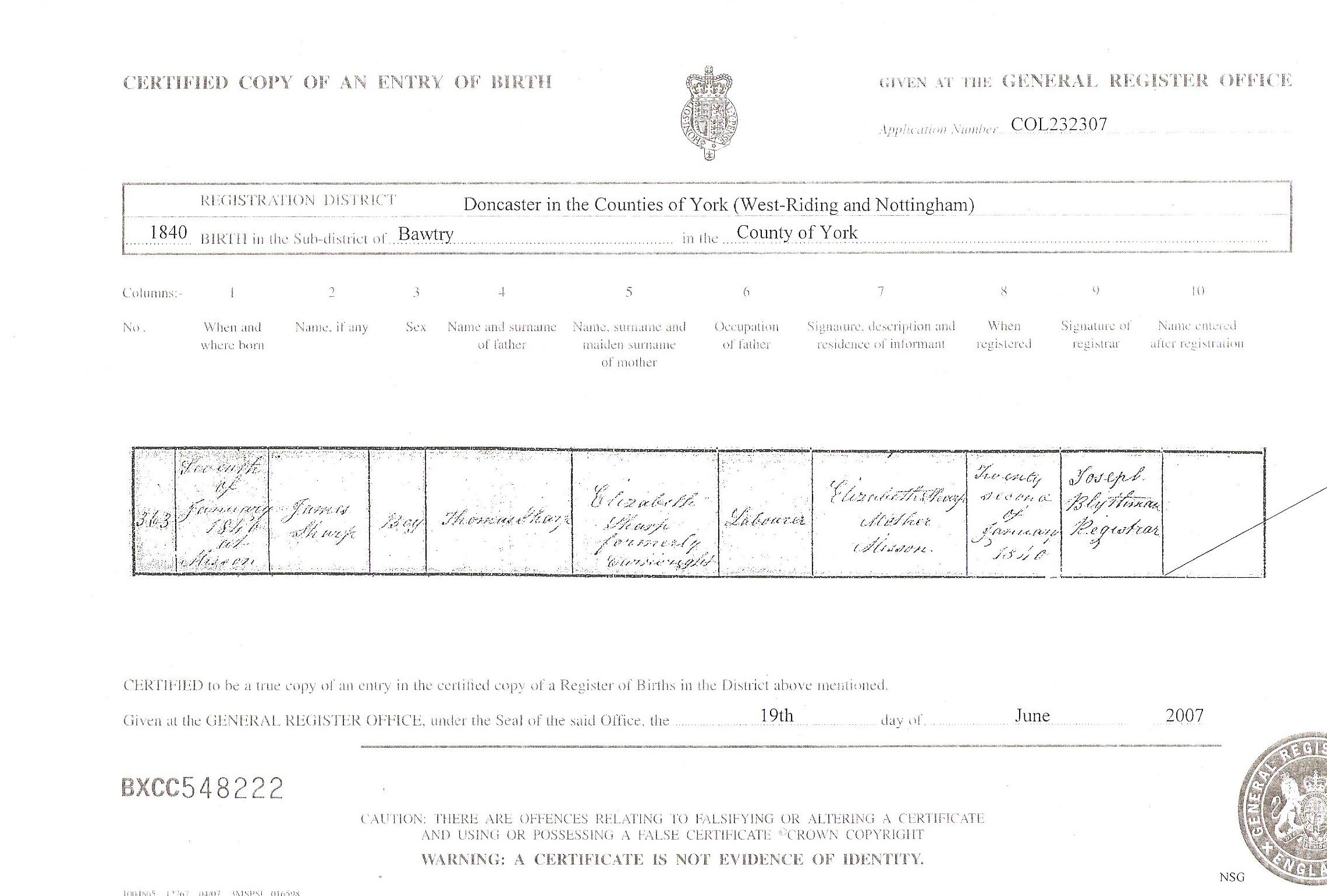
James Sharp was born 7 January 1840 in Misson, Nottinghamshire, England to Thomas Sharp and Elizabeth Cartwright Sharp. His birth is confirmed by a certified copy of his birth certificate from the General Register Office (BXCC548222). It records his birth on 7 January 1840 in Misson, Sub-district of Bawtry, Doncaster. His father is listed as Thomas Sharp, Labourer, and his mother as Elizabeth Sharp, formerly Cartwright — who was herself the informant, registering the birth on 22 January 1840. I wrote about James’ parents, the family’s conversion to the LDS faith, and the trip to America in his brother William’s biography, Sharp-Bailey Wedding.

Birth certificate of James Sharp, GRO certified copy, BXCC548222, Misson, 7 January 1840.

The Sharp family emigrated to America aboard the ship James Pennell, which sailed from Liverpool on 2 October 1850 under the direction of Christopher Layton and William L. Cutler, carrying 291 Latter-day Saint passengers. After a difficult voyage that included a severe storm near the mouth of the Mississippi that disabled the ship and nearly exhausted the provisions on board, the James Pennell arrived at New Orleans on 23 November 1850. The passengers continued up the Mississippi River to St. Louis, where they found employment and shelter. The passenger manifest lists James Sharp, age 10, traveling with his mother Elizabeth Cartwright Sharp (age 45), brother William (age 24), and sisters Isabella (age 19) and Elizabeth (age 26). Their mother died in St. Louis on 17 February 1851, just months after their arrival. The account of the voyage is preserved at Saints by Sea.

Siblings William and Isabella eventually continued west with the Moses Clawson Company in May 1853, while James stayed behind with his sister Elizabeth in St. Louis. (Read more about Elizabeth here.) James and Elizabeth did not join the LDS faith with their mother (Elizabeth), William, and Isabella.

James married Eudora Elvira Mann 3 March 1863 in Nashville, Davidson, Tennessee. Eudora “Dora” was born 1 May 1845 in Nashville. We do not know much of the life story, so how he met Dora and married her in Nashville we may never know. The two made their home in St. Louis though. James worked as a pork packer and initially started out in business with Patrick Muldoon around 1870. Here is the run down of the St. Louis directories.

1869 [FHL #980635] James Sharp with Muldoon and Sharp at 1612 Biddle.
1870 [Gould’s p. 797] shows the same.
1871 [Gould’s p. 601] the same, but also lists Sharp, James pork packer r[esident?] at 1119 N 17th. {FHL #980,636]
1872 shows Muldoon and Sharp at 1015 N 17th [N 17th goes from 1701 Market North to Angelica.]
1875 [p. 1171] Muldoon and Sharp, Pork Packers and Provision Dealers, 904 B’way.
1885 Sharp, James, Muldoon and Sharp 904 to 912 S 2d, r 2715 Mills. [There are now 7 pork packers listed, only 1 in 1875.]
1887, James C. Sharp is listed as a clerk at Muldoon and Sharp.
1888 is Sharp, James and Co., same address, te no. 2208.
1890 James Sharp and Co. now includes Sharp, James C. as cashier and Sharp, George as Clerk. All 3 at 3641 Finney Ave.
1895 Shows both James Sharp and James C. Sharp as packers, George W. Sharp as Manager and William M. Sharp as Clerk at James Sharp and Co., 904 S 2d. James C. now resides at 4354 Morgan, the other 3 still at 3641 Finney.
1896 and 1897 now show William M. as manager and George W. as supt.; James and James C. simply identified as with Co. 1898 directory is missing.
1899 Company not listed. James C. (same address) is broker; George W. is just listed, at 1811 Laflin; William M. and James are just listed, still living at 3641 Finney.
1900 James C. at Sharp and Westcott; George W., clerk at Manewal Lange Bakery, 3204 Morgan; William M. litho., at home.
1901 James Sharp now resident at 4573 Page boul; James C. com. mer. 736 Bayard av; George W. still clerk at Manewal-Lange Bakery, resident at 3009 Easton. [William M. not listed]
1902 James C. mngr. Sharp Mnfg Co., 411 Fullerton bldg., r. 736 Bayard av; George W. and William M. are both clerks, residing at 3156 Easton av.
1903 James still at 4573 Page boulevard; James C., ins., 721 Olive, r. 3732 Washington Boul.

Death notice of James Sharp, St. Louis Globe-Democrat, 24 February 1908.

As you can probably tell from the information above, James put his children to work and included them in the business. James retired at 55 and turned the business over to his boys. By 1898 they had run the business in the ground, supposedly because of their like for being horsey (horse-racing).

James and Dora had 5 children.

Eudora Mann Sharp born 13 January 1864 and died 11 January 1938, both in St. Louis. She married Alexander A Bryden, who worked in the coal business.

Ida Lee Sharp born 8 October 1866 and died 23 December 1946, both in St. Louis. She was unmarried. She worked as a school teacher.

James Carlisle Sharp born 26 December 1868 in St. Louis and died 4 November 1952 in Valley Park, St. Louis, Missouri. He married Emma Manewal (and divorced) and Madeline C Grimm. He had a department store. Emma was the daughter of August Manewal, one of the confederation of bakers who formed the National Biscuit Company (NABISCO).

George W Sharp born 10 March 1871 in St. Louis and died in 1964 in Sand Springs, Tulsa, Oklahoma. Apparently he married a lady named Effie Olive, but we know nothing more about his life or her. He was badly disfigured after being kicked in the head by a horse at 3 years old.

William Muldoon Sharp born 4 October 1874 and died 24 March 1915, both in St. Louis. He also remained unmarried.

Eudora died 3 March 1894 of cerebral meningitis. She was listed as living at 3641 Finney Avenue. She was buried in the Bellefontaine Cemetery 5 March 1894.

James died suddenly on Monday morning, 24 February 1908, at the residence of his son-in-law Alexander A. Bryden at 4573 Page Boulevard, St. Louis, at the age of 68. The St. Louis Post-Dispatch reported that he was a retired pork packer who was killed by a street car on Saturday night, 22 February 1908, at Page Boulevard and West End Avenue. He died two days later from his injuries. The funeral was held Wednesday afternoon from his late residence at 4582 Page Boulevard, conducted by Rev. Dr. William Elmer of St. Philip’s Episcopal Church — a further confirmation, alongside Annie Thompson’s account, that James never joined the LDS Church. He was interred at Bellefontaine Cemetery on 26 February 1908. The death notice in the same paper, published 24 February, gave his age as 68 years, consistent with his 1840 birth year confirmed by the birth certificate.

James was a founder of St. George’s Society and served as treasurer for several years. He was also a member of the Merchants’ Exchange and a veteran member of the St. Louis Lodge No. 5, I.O.O.F.

Funeral notice of James Sharp, St. Louis Post-Dispatch, February 1908.

For more on the Sharp family, see:

Elizabeth Cartwright Sharp — James’s mother, written by Annie Thompson
Sharp-Bailey Wedding — James’s brother William and Mary Ann Bailey
John and Elizabeth Quayle — James’s sister Elizabeth who also remained in St. Louis
Sons of Joseph and Isabella Carlisle — James’s sister Isabella who went on to Utah

In re Cantu

Decision: In re Rebecca Cherie Cantu and Alejandro Cantu, Case No. 14-40254-JDP (Bankr. D. Idaho, 26 Aug. 2014)
Judge: Honorable Jim D. Pappas, United States Bankruptcy Judge
Counsel for Debtors: Paul Ross, Idaho Bankruptcy Law, Paul, Idaho
Chapter 7 Trustee: Gary L. Rainsdon, Twin Falls, Idaho
Trustee’s Counsel: Brett R. Cahoon and Daniel C. Green, Racine, Olsen, Nye, Budge & Bailey, Chtd., Pocatello, Idaho


Background

Rebecca and Alejandro Cantu filed a Chapter 7 bankruptcy petition on 20 March 2014. In the months leading up to their filing, two creditors — NCO Financial and Bonneville Billing and Collections — had been garnishing their wages pursuant to state court judgments. NCO, collecting on student loans, garnished 15% of Ms. Cantu’s wages each pay period under federal law. Bonneville garnished an additional 10% under state law. Idaho only allows a maximum of 25% to be garnished from an individual’s wages. Over the 90-day preference period preceding the petition date, the two creditors combined had garnished a total of $1,536.93 from the Debtors’ paychecks.

On their amended Schedule B, Debtors listed the garnished funds as personal property and claimed $1,500 of that amount exempt under Idaho Code § 11-605(12) — a wage exemption statute enacted by the Idaho Legislature in 2010, and one that, as Judge Pappas noted, had never been interpreted by any court.


The Trustee’s Objections

The Chapter 7 Trustee filed two objections in sequence. The first, argued simply that the garnished funds were not “disposable earnings receivable” because they had already been paid to the creditors prior to the bankruptcy filing. When the Debtors amended their Schedule C to increase the claimed exemption from $1,086.53 to the statutory maximum of $1,500, the Trustee withdrew the first objection and filed a more detailed second objection through retained counsel.

The second objection raised two grounds. First, the Trustee argued the garnished funds were avoidable preferences under 11 U.S.C. § 547(b) — transfers made within 90 days of filing to specific creditors on account of antecedent debt — and that the Debtors were therefore barred from exempting them under § 522(g), which limits a debtor’s ability to exempt property recovered by the trustee to situations where the debtor could have exempted the property absent the transfer. Second, the Trustee contended that because the Debtors had received a benefit from the garnishments — reduction of their judgment debts — the funds had effectively been “paid” to them, and thus did not qualify as unpaid wages under Idaho Code § 11-605(12).


The Debtors’ Responses

This firm filed two responses on behalf of the Debtors, tracking the Trustee’s evolving objections.

On the statutory interpretation question, Debtors argued that Idaho Code § 11-605(12) means exactly what it says: the exemption applies to earnings that “have been earned but have not been paid to the individual.” The garnished funds were unquestionably earned by Ms. Cantu through her personal services, and they were never paid to her — they were diverted directly to her creditors via the sheriff. The statute does not require that funds be “receivable,” nor does it specify where the funds must be held. The Trustee’s position that the funds were “effectively paid” to the Debtors because they reduced outstanding debts stretched the statutory language beyond its plain meaning.

On the § 522(g) issue, Debtors argued that the garnishments were not voluntary transfers — they were compelled by court order — and that the funds had not been concealed, as they were fully disclosed on Schedule B and the Statement of Financial Affairs. Because the property could have been exempted under Idaho Code § 11-605(12) had it remained with the employer and not yet been paid, the Debtors were entitled to claim the exemption on any funds recovered by the Trustee under § 522(h).


The Court’s Ruling

Judge Pappas ruled in favor of the Trustee and sustained the objection, disallowing the exemption. The Court’s analysis turned entirely on the meaning of the phrase “have not been paid to the individual” in Idaho Code § 11-605(12).

The Court acknowledged that the statute had never been interpreted by any court since its enactment in 2010, and that the phrase “paid to the individual” was arguably ambiguous. However, the Court concluded that reading the statute in context — as required under Idaho rules of statutory construction — compelled the conclusion that the garnished wages had been paid.

The Court’s reasoning proceeded on several fronts:

From the employer’s perspective, the wages were indisputably paid. The employer transferred the full amount owed to Debtors — some directly to them, and the garnished portion to the sheriff on their account — satisfying its payroll obligation in full.

From the Debtors’ own perspective, the Court found the wages had likewise been paid. The garnished sums reduced the Debtors’ outstanding judgment debts, conferring a direct financial benefit. To hold otherwise, the Court noted, would potentially require employers to pay the garnished amounts twice — once to the sheriff, and again to the debtor following a successful exemption claim — a result the Idaho Legislature could not have intended.

The Court also rejected the Debtors’ reading as internally inconsistent with Idaho’s garnishment statutes. Idaho Code § 8-509(b) expressly directs an employer-garnishee to “pay” the earned wages to the sheriff for the creditor’s benefit. Treating those same wages as simultaneously “paid” for garnishment purposes and “unpaid” for exemption purposes would create an irreconcilable conflict between the two statutes. As the Court observed, while exemption statutes are to be construed liberally in favor of debtors, statutory language should not be “tortured” in the name of liberal construction.

Because it resolved the case on the § 11-605(12) issue, the Court declined to reach the Trustee’s alternative argument under § 522(g).


Why This Matters

1. A case of first impression on Idaho Code § 11-605(12). The Court explicitly noted that no prior case had interpreted this 2010 wage exemption statute. This decision remains the leading — and only — authority on its meaning and scope. Idaho practitioners advising debtors on wage garnishment situations should be aware of its limitations.

2. “Paid to the individual” means paid on the individual’s account, not just into their hands. The Court’s construction of the statute is broad: wages diverted to a creditor through garnishment are treated as paid for exemption purposes, even though the debtor never personally received them. Debtors who suffer pre-petition garnishments cannot use § 11-605(12) to recapture those funds in bankruptcy.

3. The interplay between § 547 preferences and § 522(g) exemptions is complex. Where a trustee seeks to avoid a pre-petition garnishment as a preference, the debtor’s ability to claim an exemption in the recovered funds depends on whether the property could have been exempted in the first instance. This case illustrates how critical it is to identify viable exemption authority before asserting the right to avoid a transfer under § 522(h).

4. Debtors should assert wage exemptions in state court before filing. The Court noted, in a footnote, that Idaho Code § 8-519 permitted the Debtors to have raised an exemption claim in state court at the time of the garnishment. No such claim was made. Practitioners should advise clients facing wage garnishment to promptly evaluate available exemptions under state law — before funds leave the employer’s hands.

5. Liberal construction has limits. Idaho courts construe exemption statutes in favor of debtors, but that principle does not authorize courts to rewrite statutory language. Where plain meaning and statutory context point clearly in one direction, liberal construction will not overcome them.


Full Decision: Available on PACER, Case No. 14-40254-JDP, Doc. 51 (Bankr. D. Idaho 26 Aug. 2014)

Circle A Construction 1990 Anniversary

Marvin Aslett and Milo Ross at 20 years service recognition party

Dad has these two photos sitting on his desk at home, they sat on his desk at work too. The one above is from the recognition party given for him and Mel Keyes in 1990. Dad still has the picture, one of the trucks on the cake, and the Traeger smoker. Circle A transferred Dad to AgExpress in about 2004 when AgExpress took over the Paul operations. Dad had roughly 34 years with Circle A Construction. I am posting this in honor of Mel and Dad for what is 55 years since they started for Circle A Construction!

This photo below is for a supervisor training get away some time in the 1990s. Dad could not remember the exact year.

Back (l-r): Jeff Herzinger, Jeff Mecham, Dave Dana, Ed Foreman, Milo Ross, Tom Schmidt, Lenny Aslett, Nick Stephens, Les Abbott; Middle: Jeff Stowell, Terry Vitek, Steve Aslett, Dale Keyes, Jay Simmons, DeLane Fetzer, Mel Keyes, Reece Garrow, Eli Calamantes: Front: Gradus Heeling, Sage Aslett, Boomer Bailey, Mike Ehrmantraut, Tom Ehrmantraut, Larry Aslett

Leslie Sanford Abbott (1953 – 2005)

Lenny Aslett

Larry Dean Aslett (1944 – 2022)

Marvin Bridges Aslett (1926 – 2022)

Sage Aslett

Steven Le Roy Aslett (1947 – 2021)

Clifford “Boomer” Bailey

Eli Calamantes

Dave Dana

Mike Ehrmantraut

Tom Ehrmantraut

DeLane Terry Fetzer (1947 – 2020)

Edward Lenn Foreman (1951 – 2015)

George Reece Garro (1947 – 2012)

Gradus Geert Heeling Jr (1951 – 2020)

Jeff Herzinger

Dale May Keyes (1947 – 2017)

Melvin Eddie Keyes (1943 – 2018)

Jeff Mecham

Milo Paul Ross (1943 – alive)

Tom Schmidt

Nick Stephens

Gerald Stowell

Terry Vitek

1972 Burley High School Commencement

I was trying to find some photos and stumbled upon my Mom’s graduation pamphlet I had scanned a few years ago. Thought maybe it was time to share it, especially where I have seen some of her classmates have passed away recently.

1972 Baccalaureate and Commencement – Burley High School – Burley Idaho

These programs courtesy of the following Public Spirited Business Concerns

Amalgamated Sugar Co.

Burley Processing Co.

Burley Reminder

Cassia National Bank

First Federal Savings & Loan Assn., Burley Branch

First Security Bank

Guys ‘N Dolls

Idaho Bank & Trust Co.

Idaho First National Bank Burley Office

McCaslins

Ponderosa Inn

J. R. Simplot Food Processing Division

South Idaho Press

Class Officers

President Garth Beck

Vice President Bud Hoffbuhr

Secretary Jill Hinz

Executives Peggy Wood, Peggy Larson, Kaye Dawn Larson, Jeananne Gruwell, Jean Graham

Class Adviser Mr. David Peck

Baccalaureate Sunday, May 21, 1972 2:30 P.M.

Mr. Tom Gruwell , Principal, Presiding

Processional High School Band Mike Chesley, Conducting

Welcome Garth Beck Class President

Invocation Bud Hoffbuhr

Special Number Bel Canto Choir Elden Wood, Conducting “Battle Hymn of the Republic”

Address Dr. Walter R. Peterson

Cherubim Song Senior Octet

Benediction Calvin Pearson

Recessional High School Band

Commencement Monday, May 22, 1972 8:00 P.M.

Mr. Tom Gruwell, Principal, Presiding

THEME: “I Dream Dreams that Never Were and I Ask, Why Not” – George Bernard Shaw

Processional – High School Band – Mike Chesley, Conducting

Invocation – Connie Smith

Welcome Address – Garth Beck, Class President

Greetings from Austria – Marianne Koch – Exchange Student

“Man and His World” – Senior Choir

Valedictorian – Julieann Kerbs

Trombone Solo – Doug Nichols

Salutatorian – Edi Lou King

“The Halls of Ivy” – Senior Sextet

Presentation of Diplomas – Mr. Norval Wildman, Mr. Albert Klink, Mr. Dave Peck, Mr. Tom Gruwell

Class Song “Crescent Moon” – Class of ’72 – Gwen Bowen, Conducting

Benediction – Wayne Johnson

Recessional – High School Band

Adams, David Ratelle

Allen, Kathryn Marie

Allred, Anthony Jon

Allred, Howard Lynn

Amen, Joanne Marie

Andersen, Debra

Anderson, Roxanne

Anderson, Jerald DeLayne (1954 – 2017)

Anderson, Jay S

Anderson, Todd Michael (1953 – 1972)

Angus, Joyce Ann

Baker, Cheryl

Baker, Rell Dean

Banner, Marc

Barkdull, Marlene

Bewan, Lynnette

Beard, Patrick Scott

* Beck, Garth Warren (1953 – 2002)

Beck, Reid Belliston

Beckham, George Benjamin

Bedke, Douglas Herman

Bell, Larry W

Bench, Michael R

Berkenmeier, JoAnn

Bishop, Gregory Lynn

Black, Don Reid

Bodily, Ted O (1954 – 2019)

Bowcut, Bruce V

Bowen, Gwen

Bowers, Gloria

Bradshaw, Bill A Jr

Breeding, SHelly Marie

Briggs, Larry

Brill, Russel Dean

Brown, Julieann

Burgi, Lysene (1953 – 2016)

Burton, Arlen Lynn (1954 – 2014)

Call, Milo Jay

Campbell, Debra “Debbie” Kay (1954 – 2019) Johnson

Cargill, Elwin Verl II

Carey, Mirian June

Castillo, Yolanda Hernandez

Christian, Debbie Lynn

Clark, Bradley Hales

Clark, Antone “Tony” Lee (1954 -2015)

Coleman, Rick Lynn

* Crane, RoZann

Cunnington, Gaylene

Darrington, Jerilyn

Davids, Michael Lynn (1953 – 2020)

Davis, Donna Emily

Day, Debra E

Dayley, LaNae

Dayley, Lee K

Delaney, William W

Dille, LuRene

Draney, Rex Leonard (1953 – 2007)

Duncan, Rocky Gale (1954 – 2020)

Dunn, Rodney K

Dunn, Roger

** Eames, Lou Ann

Eldredge, Debbie

Farwell, Albert Michael (1952 – 2023)

Fairchild, Aleta Ann

Fenton, Wayne J

Ferlic, Beth Anne

Ferlic, Robert James

Filger, Thomas W

Fillmore, Louise

Fletcher, William Kent

Forschler, Laura Lynn

Forschler, Melody

Frazier, Lon Mitchell

Frost, Verlynn

Funk, Barbara Elaine

Gallegos, Linda K

Garcia, Don J

Garrard, Vickie Lynn

Goodwin, Irene Cecilia

Goold, Gary

Graf, Becky Ann (1954 – 2011) Moats, Kloer

Grafft, Duane Brian (1953 – 2006)

Graham, Jean

Green, Michael Dan

** Green, Sharon

Gregersen, Denice

Gruwell, Jeananne

Guiles, Randy Andrew (1953 – 2015)

Gunnell, Brent Udell

Hanks, Gary Thomas

** Hansen, Rae

Hansen, Sondra

Harper, Leslie C

Hatch, Karol (1953 – 2004) Kerr

Haycock, Con D

Hazel, Stanley Jarvis (1953 – 2008)

Heiner, Paula Jean

Hepworth, Linda

Hess, Steven Lerlan

Heward, William Alex

Hill, Michael Gordon

Hinz, Jill Marie

Hinz, Kathleen Ann

Hobson, Sheryl

Hoffbuhr, Vernard “Bud” Standley Jr (1954 – 1997)

Holm, Steve D

* Holmes, Thomas J

Holt, Phillip L

Holyoak, Kenneth Reid

Hunt, Timothy Lynn

Hunter, Richard A

Jackson, Kelly Ann

Johnson, Becky A

Johnson, Jack Wesley

Johnson, Mary Beth

Johnson, Wayne Richard (1953 – 2008)

Jolley, Patricia

Jonas, Sandy (1954 – alive)

Jones, Steven

Judd, Rockland K (1953 – 2012)

Karlson, Kerry

Kawamoto, Becky

Keen, George E

Keen, Vickie Rae Funk

Kelly, Pat

** Kerbs, Julieann

Kidd, Cory Vaughn

** King, Edith Louise

King, Gary

Knight, Robin Daniel (1953 – 2014)

Kober, Glen R

Koch, Marianne

Koyle, Garth H

Koyle, Shanna

Kunau, Nancy Rae

* Lamb, DeEsta Marie

Larsen, Brent

* Larsen, Scott William

Larsen, Vickie Esther

Larson, Vickey Irene

Larson, Kaye Dawn (1954 – 2019) Silcock

Larson, Peggy (1954 – 2016) Stirland

Lee, Roxanne

Lopez, Manuel Campbell

Loveland, Cynthia (1954 – 1981)

Loveland, Kevin R (1954 – 2008)

Lynch, Gary D

McBride, Anita Marie

McMurray, Susan Mary

* Mackley, Sally Irene

Mai, Kelly

Malloy, Michael John

Manning, Roger D

Marston, Della Kathleen

Martin, Gregory Max (1954 – 1975)

Martin, Stephanie Lyn

Martin, Stephen William

Maselter, Denise Ann (1954 – 2022) Rollins

Matthews, Ennis Eugene

Merrill, Kaye Ellen

Miller, John Edward

Moore, Debra Lynn (1954 – 2002)

Moorman, David Edgar (1953 – 1997)

Navejar, Oscar

Newcomb, Kathy Lorene (1954 – 2020) Bailey

Nichols, Doulgas Arthur

Nielson, Alice Ann

Nielson, Allan (1954 – 2020)

Obermiller, Cynthia Jean

Olsen, Ricky Ross

Olson, Donna Gaye

Ostrander, Diane Kay

Ostrander, Greg

Osterhout, Rex Dale (1954 – 2017)

Otte, Royce Oliver

Page, Linda Marion

Patteron, Peggy Ann

* Pearson, Calvin H

Peterson, Edith Victoria

Pitchford, Debra Faye

Poulton, William Arthur

Powell, Leslie Dean (1953 – 2005)

Priest, Roger Kirk

Ramirez, Adelita

Ramsey, Glenn Douglas

Randall, Steven Grant

Redder, Karen Lea

Reedy, Pamela Hannah

Rehn, Scott Leonard (1954 – 1994)

Rendla, Gary M

Rich, Diane S

Richardson, LuAnn

Rickert, Janice Norene

Ritchie, Neil B

Roberts, Kelly Jo

Robinson, Beth

Ross, Norman Clyde

Russell, Patricia B

Sager, Kent Leslie

Sandmann, Michael Remund

Schorzman, Anne

Severe, Rhonda

Short, David G

Silcock, Richard Donald

Simcoe, Steve Bryan

Sivley, Mary

Smith, Connie Sue

Sowers, Bill A

Spann, Debora

Stephenson, Julia

Taylor, David A (1953 – 2009)

Taylor, Russell Price (? – alive)

Thaxton, Stephen Craig

Thompson, Carlene Diane

Thornburg, Deborah

Telley, Marsha Ann

Tolle, Kent Ray

* Tollefson, Kathryn M

Tracy, Perry Alan (1953 – 2005)

Vannatian, Frances Ruby

Vorwaller, Kristine

Wardle, Diane

Wardle, Pamela Kaye

Warr, Dee Ann (1954 – 2013)

Warr, Paul K

** Weirich, Yvonne Denese

West, Monte M

Wetzstein, Lynette Kay

White, Kristine

Whittle, Ferol Kristine

Wickel, Lee Roy

* Winward, Brenda Arlene

Wolf, Richard Patrick

Wood, Peggy Ann

Woodland, Kirk

Woolstenhulme, Steven Leo

Worman, Barbara Ann

Wright, Edward R

Wyant, Ronald Lee

Wyatt, Marla Jean

Young, Richard LeRoy (1953 – 2022)

Zollinger Janene

National Honor Society Members

** Gold Cord – with 3.8 average or above

* Blue Cords – with 3.5 average to 3.8

The sketch of the Burley High School on the front of the Diploma case.

Sandy Jonas Burley High School Diploma

Mom’s actual Diploma.

Burley High School – Burley, Idaho

This Certifies That Sandy Jonas has satisfactorily completed a Course of Study prescribed for Graduation from this School and is therefore awarded this Diploma.

Given in the month of May, nineteen hundred and seventy-two

Tom Gruwell – Principal

Harold W Blauer – Superintendent

W B Whiteley – Chairman Board of Education

Here is a copy of Mom’s Senior picture – 1972