George and Ann (Matthews) Cartwright of Misson, Nottinghamshire, and Thomas and Anne (Stennett) Sharp of Misson, Nottinghamshire, announce the marriage of their daughter Elizabeth Cartwright to Thomas Sharp on 29 December 1823 at the parish church of St John the Baptist, Misson. The witnesses were Sarah Hunt and John Parkin.
The Cartwrights and the Sharps were both Misson families. The Cartwrights had been there for generations, Elizabeth’s grandfather John Cartwright (1730–1814) and grandmother Mary Amcoats (1742–1790) had married in Misson in 1761. Her father George Cartwright was baptized there on 3 February 1774. Her mother Ann Matthews was christened 14 September 1783 in Everton, Nottinghamshire, a village approximately eight miles southeast of Misson. Ann was the daughter of Edmund Matthews of Everton and his wife Hannah Broads, a widow who had previously been married to William Wilson of Everton. Edmund and Hannah had married in Everton on 21 May 1782. George Cartwright was nine years older than Ann Matthews. Their marriage banns were published on 23 January 1803 and they married on 1 February 1803, Elizabeth was born and baptized ten months later, on 20 December 1803. Ann Matthews Cartwright does not appear in subsequent census or other records. Her death date and burial place remain unknown.
The ties between the Sharp and Cartwright families ran deep in Misson. On the same day Thomas married Elizabeth, his brother William Sharp married Mary Cartwright, Elizabeth’s first cousin. A week earlier, on 22 December 1823, their brother John Sharp had married Ann Rather. Three Sharp brothers married in the same month of December 1823, two of them to first cousins from the same Cartwright family, all in the village of Misson.
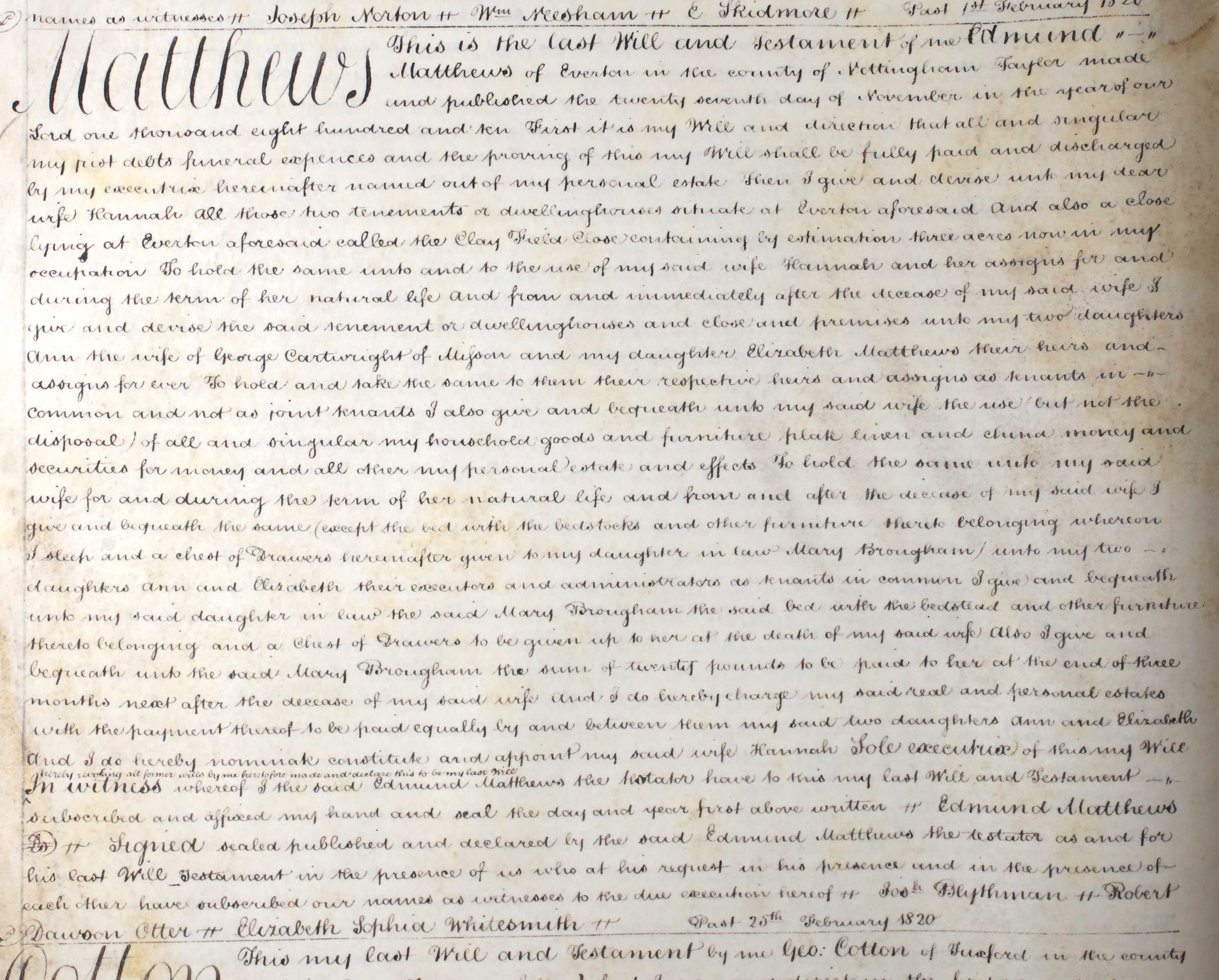
Edmund Matthews’s will, made 27 November 1810 and proved 25 February 1820, names “Ann the wife of George Cartwright of Misson” as one of his two daughters and heirs. The estate included two tenements and dwellinghouses at Everton and a close called the Clay Field Close of approximately three acres. The will also left twenty pounds and a chest of drawers to Mary Brougham, Hannah’s daughter from her first marriage to William Wilson and Ann Matthews’s half-sister, just two years her senior. Mary Wilson had been a witness at Ann’s marriage to George Cartwright on 1 February 1803, and had married John Brougham in the years between that wedding and the writing of Edmund’s will in 1810. Under the will, Hannah received the life interest in the property. Only after Hannah’s death in September 1835 would Ann and her sister Elizabeth Matthews inherit their shares. Elizabeth Matthews had married William Brown in 1814. When William Brown died in 1846, Elizabeth returned to Everton, and her children maintained connections between Misson and Everton across the following generations. Annie Thompson records that George Beighton, whom Ann married in June 1823, gambled away her money at the Doncaster races. The timing is suggestive: Ann’s inheritance from the Matthews Everton estate would have arrived in 1835, twelve years after the Beighton marriage. If Beighton dissipated that inheritance at Doncaster, Elizabeth Cartwright Sharp, then 31 years old, would have witnessed it directly. The will is the source of the “wealth and refinement” tradition in Annie Thompson’s account, the Matthews family owned real property in Everton, modest but substantial for a labouring community.
The Sharps had traveled a longer road to Misson. Thomas Sharp’s father, Thomas Sharp Sr., was born on 18 September 1768 in Armthorpe, Yorkshire, a village three miles east of Doncaster. Thomas Sr was the son of John Edward Sharp (1730–1806) and Frances Fretwell (1733–1809). He married Anne Stennett on 3 November 1788 at Ewerby, Lincolnshire, approximately thirty-five miles southeast of Armthorpe. Anne had been born there on 30 July 1769, the daughter of John Barber Stennett and Lettice Housley. The family’s first children were born in Lincolnshire: Elizabeth at Ewerby on 9 July 1790, and Ann at Ewerby on 13 May 1792. The family then moved northward toward Yorkshire at some point in the 1790s, with the next confirmed records placing them in Cantley, Yorkshire by 1799.
Some researchers have linked a Thomas Sharp christened 1 November 1794 and an Elizabeth Sharp christened 5 December 1795, both in Stamford, Lincolnshire, to this family. However the connection is uncertain and unlikely. Stamford is approximately 30 miles from Ewerby and 65 miles from Cantley, a significant distance for a labouring family to travel. The Stamford Thomas was buried just seven days after his christening, on 8 November 1794, and the Stamford Elizabeth died in Stamford on 23 October 1799, age 4. Multiple Sharp families lived in Stamford at this period, making misidentification likely. Researcher Leanne Maynes, who has examined these records carefully, has noted the timeline does not fit comfortably with the family’s confirmed movements and has not incorporated these children into the family line. The records are noted here but not included in the family line pending further research.
How Thomas Sharp Sr. came to be in Ewerby, Lincolnshire, fifty-four miles from Armthorpe, is an open question. Agricultural labourers typically found work through hiring fairs held at Martinmas in local market towns, where employers hired workers for the coming season. Movement of two to three miles between hirings was typical for a day labourer. A farm servant who lived in with his employer could travel further, up to thirty miles from his home parish, but fifty-four miles was exceptional. Whether Thomas traveled by foot, by water along the River Don and Trent, or through some family or employer connection to Lincolnshire is not known. One possibility worth noting is that Elizabeth Sharp, who married William Duffin in Ewerby in June 1788, just months before Thomas married Ann Stennett there in November 1788, was also described as of that parish. Whether Elizabeth was a relative of Thomas who had preceded him to Ewerby, and whether a family connection brought Thomas there, remains an open question that further research into Lincolnshire records may eventually resolve.
The Misson parish register notes local agricultural disasters that give context to labour movement in the region. In the 1740s the cattle herds in the area suffered severely from the cattle distemper, a murrain that ravaged England between 1745 and 1757 and killed at least half a million cattle nationally. Parliament passed multiple acts attempting to contain the outbreak, and preachers of the period described it as a national judgment. Repeated outbreaks followed in later decades, and in 1866 a cattle plague destroyed over 200 head of cattle in the Misson area alone. Whether this pattern of agricultural disruption influenced the Sharp family’s movement between Yorkshire, Lincolnshire, and Nottinghamshire is not documented, but the regional context is worth noting.
By approximately 1797 the family had returned northward toward Yorkshire. The Cantley parish register, held at Doncaster Archives, reference P12-1-A3, confirms Thomas Sharp Sr. and Anne in Cantley, Yorkshire by October 1799, when their daughter Mary was baptized there on 20 October 1799. Cantley lies five miles east of Doncaster, neighboring Armthorpe where Thomas Sharp Sr. had been born. George Sharp was born in Cantley on 9 May 1804 and baptized there on 22 July 1804. A Cantley christening of 5 March 1797 is almost certainly this Thomas. The family was in Cantley throughout this period, and the dates and geography align. By 1810 the family had settled in Misson, approximately ten miles south of Cantley, where Ann Sharp was baptized on 11 March 1810 and James Sharp on 7 March 1813.
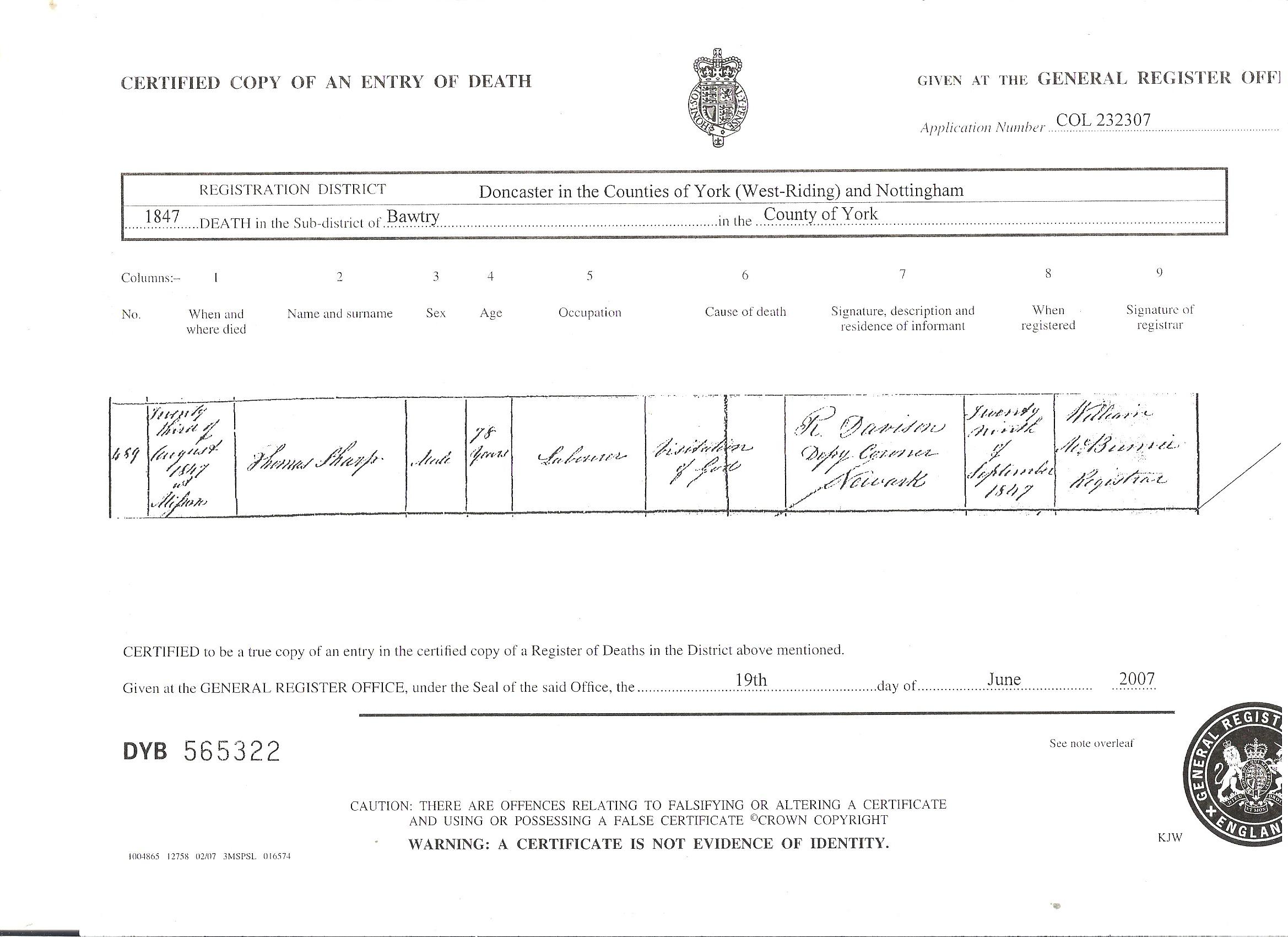
Thomas Sharp Sr. died in Misson on 23 August 1847, age 78, found lying in the street by a neighbor named Elizabeth Orton. She thought he was having a fit, obtained the assistance of William Mason and John Hobson, but he died immediately. The inquest verdict was visitation of God. The inquest notice appeared in the Lincoln Rutland and Stamford Mercury on 3 September 1847.
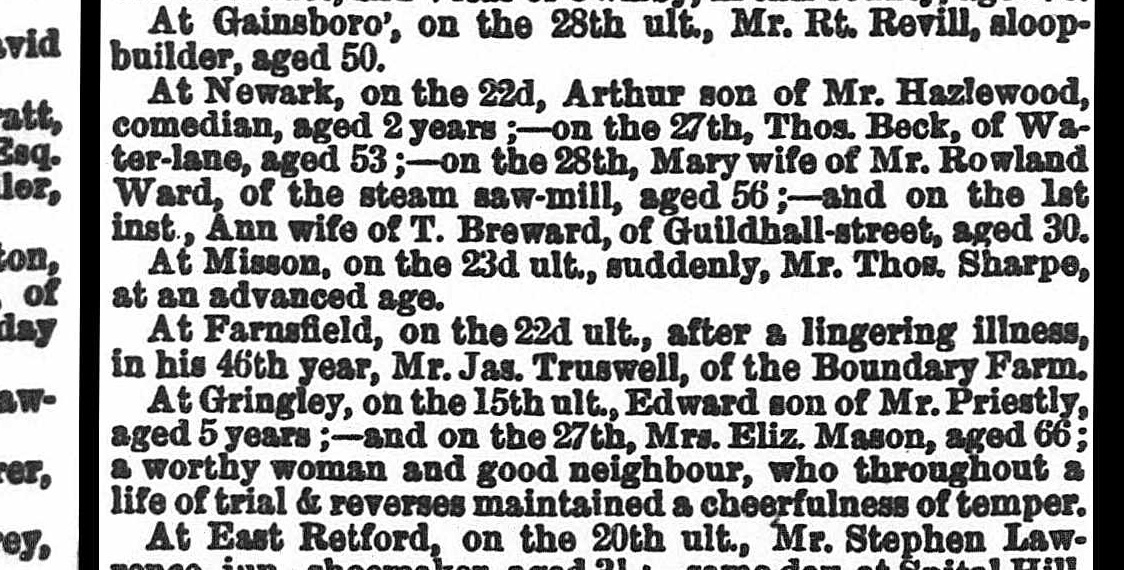
His wife Anne died in Misson on 10 December 1849, age approximately 79, from a fall, and was buried three days later. Their death notices appeared in the same Lincolnshire newspaper, the family had maintained connections across sixty years and three counties.
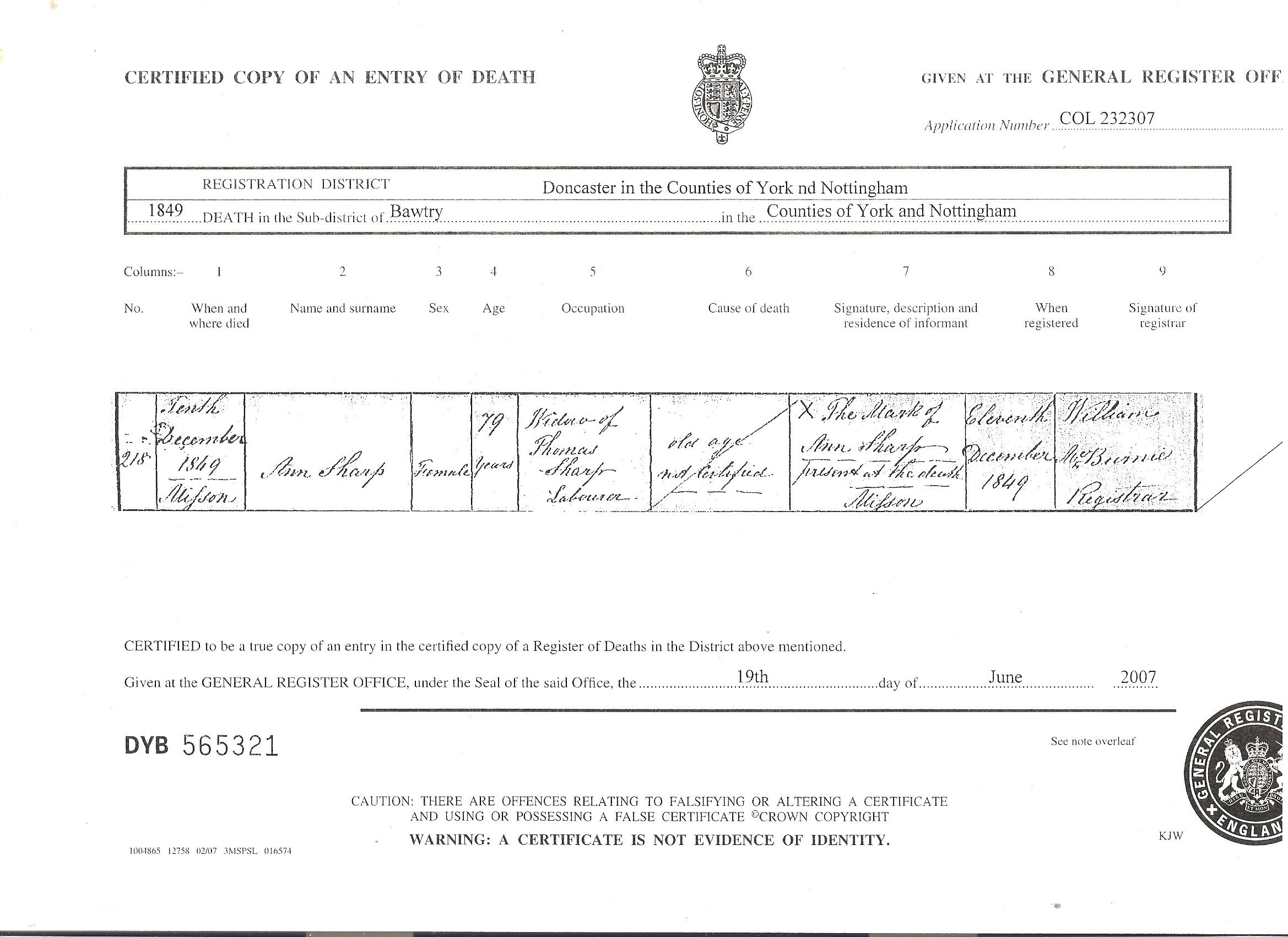
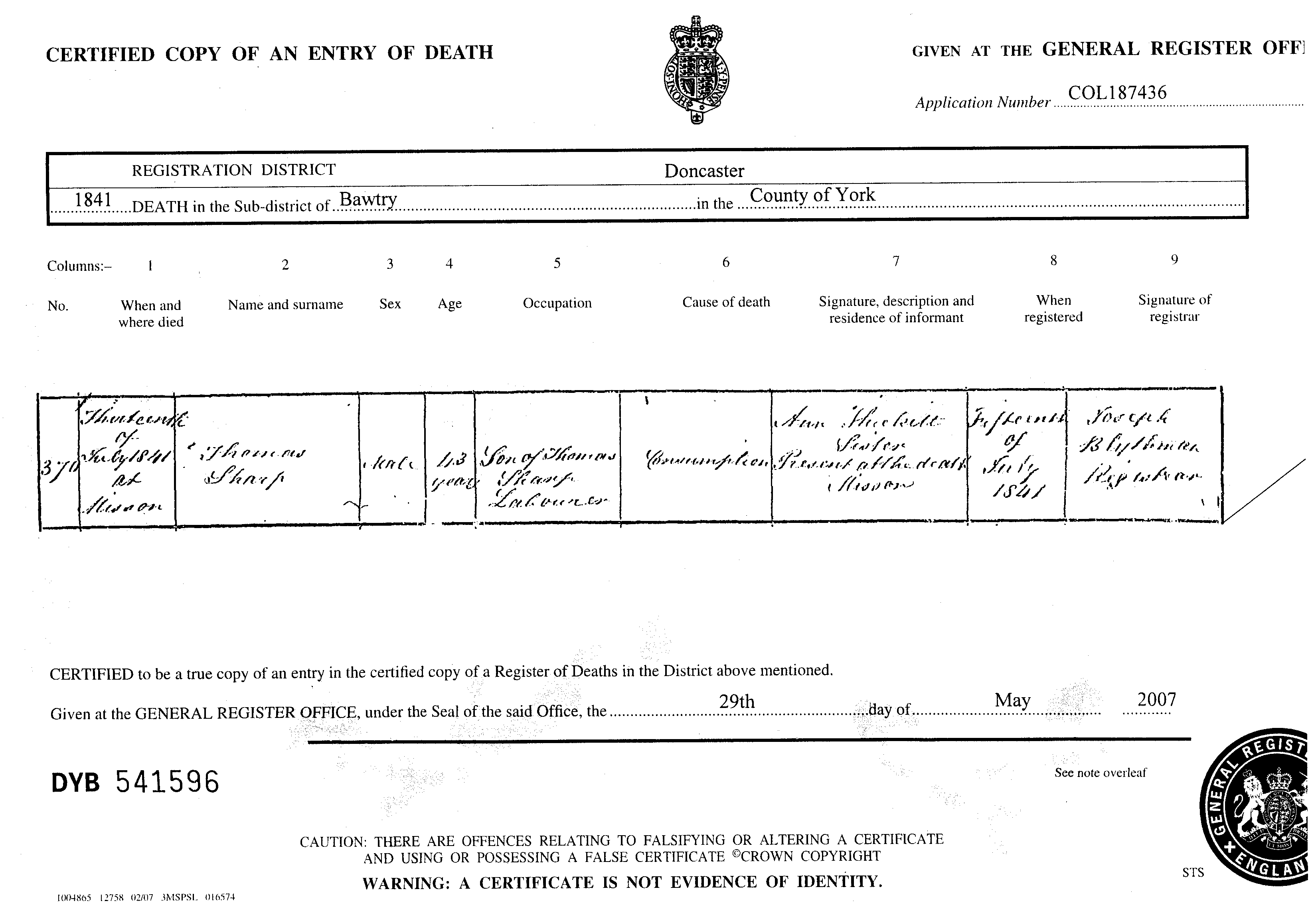
Thomas Sharp’s younger brother James had died of Consumption on 5 June 1839, with Elizabeth as the informant at his death. Six months later, on 7 January 1840, Thomas and Elizabeth named their newborn son James. Whether the name was chosen in memory of the brother lost that summer is not known, but the timing is suggestive. Consumption, known colloquially as the white death, is the historical name for tuberculosis, a contagious airborne disease caused by Mycobacterium tuberculosis. In 1815, one in four deaths in England was due to Consumption. In a labouring family’s small home in Misson, the disease would have moved freely through the household. Thomas Sharp, born approximately 1797, probably in Cantley, was a Labourer, as recorded on his children’s birth certificates and his own death certificate. The death certificate gives his age at death as 43 years, the burial record as 45. This two-year spread likely reflects the imprecision natural to a family where neither parent could write and where exact ages were not always known. Thomas died of the same Consumption that had killed his brother just two years before, on 13 July 1841 at Misson, just weeks after the June 1841 Census recorded him in the household. His sister Ann Thickett, wife of Thomas Thickett of Blyth, Yorkshire, four miles north of Misson, was present at his death and registered it. He was buried at Misson on 15 July 1841.
The disease continued through the family. Ann Thickett, who had been present at Thomas’s death in 1841, died of Consumption on 6 April 1846, age 36, just five years after registering her brother’s death from the same disease. George Sharp, another brother, died of Consumption on 8 August 1846, age 47, four months after Ann. Between 1839 and 1846, four of Thomas Sharp Sr. and Anne Stennett’s children died of tuberculosis. Thomas Sharp Sr. survived all four, dying in August 1847. Anne survived until December 1849. They outlived four of their children to the same disease.
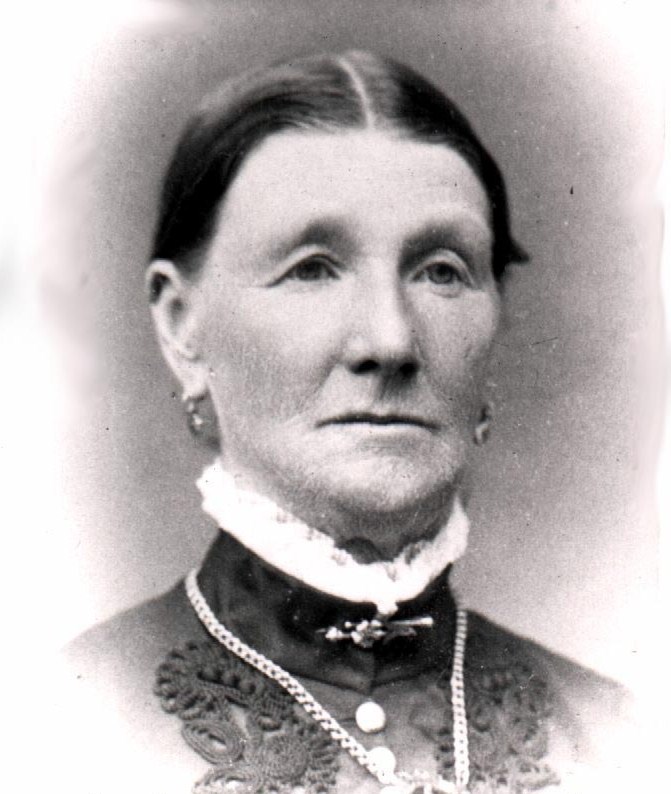
Annie Thompson, writing from family tradition in 1957, describes Elizabeth as having grown up “a tall young lady, reared in an atmosphere of wealth and refinement.” Her father George Cartwright was buried at Misson on 27 February 1820, age 46, when Elizabeth was sixteen years old. Three years later, on 4 June 1823, her mother Ann remarried a widower named George Beighton at the Misson parish church, by banns, witnessed by John Robinson and John Cartwright, confirmed in the Bishop’s Transcripts in the Nottinghamshire Archives. Six months after her mother’s remarriage, Elizabeth married Thomas Sharp.
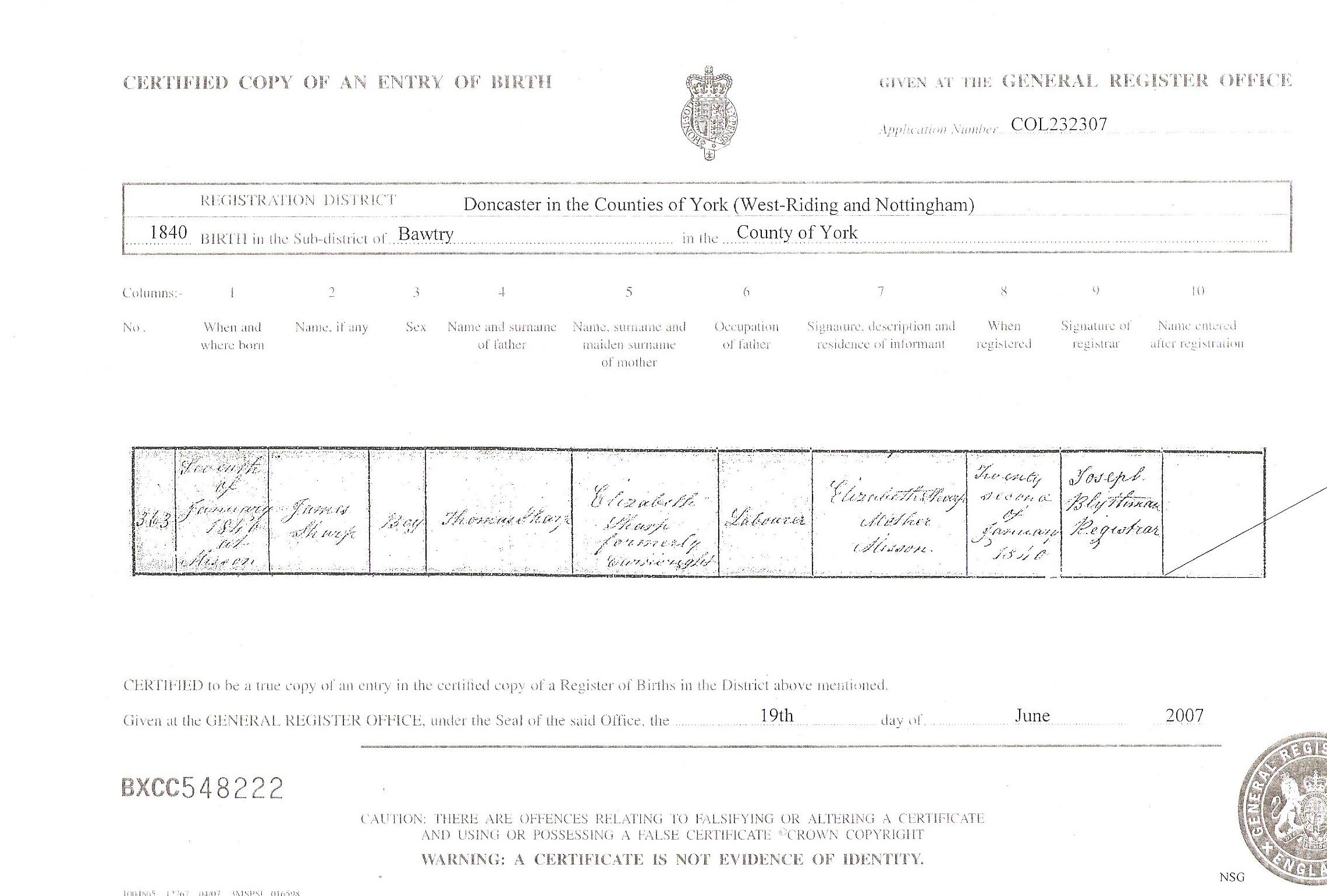
Elizabeth could not write. On both her daughter Ann’s birth certificate in 1838 and her son James’s birth certificate in 1840, she signed with an X mark.
Thomas and Elizabeth had eight children, all baptized in the Misson parish church and recorded in the Bishop’s Transcripts at the Nottinghamshire Archives. The dates below give the christening date from the Bishop’s Transcripts, the birth dates held in family tradition are noted separately where they differ, representing the difference between the event remembered by the family and the event recorded by the church.
George Sharp, christened 11 November 1824, died 15 November 1824, four days old.
Mary Sharp, baptized 27 November 1825, died in infancy and was buried approximately two days after her christening, as noted in the Misson Parish Register.
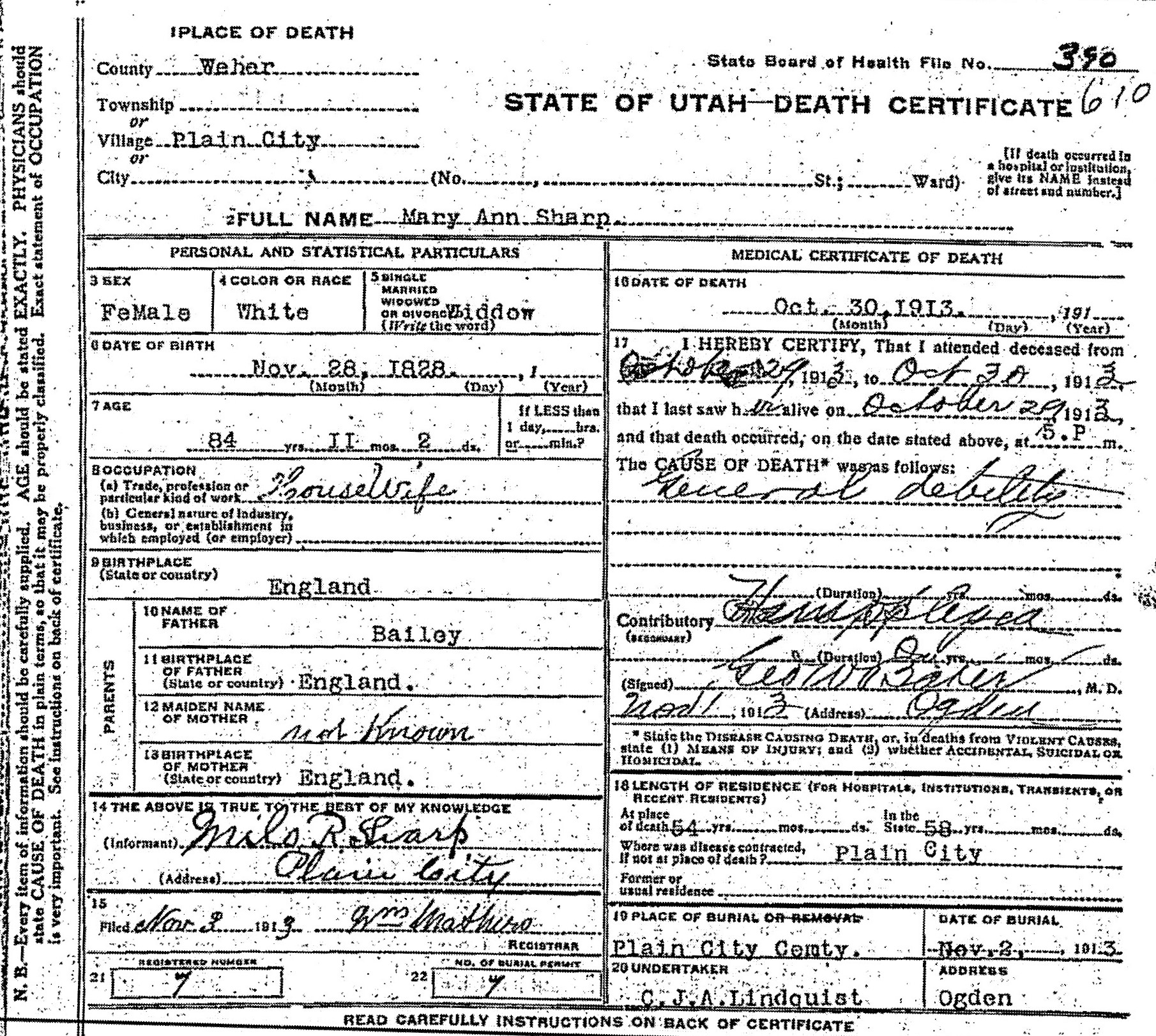
William Sharp, christened 7 January 1827, family tradition gives his birth as 10 December 1826. He would go on to help found Plain City, Utah. See Sharp-Bailey Wedding and the William Sharp Personal History.
George Sharp, baptized 13 May 1829, died 23 December 1833, age four years and seven months, buried at Misson. The Misson Parish Register notes his cause of death as burns. Burns were tragically common among small children in this period, when open hearths were the only source of heat and cooking in labouring family homes. Whether his clothing caught fire near an open flame or the death resulted from a structure fire is not known, and no newspaper account of the event has been located.
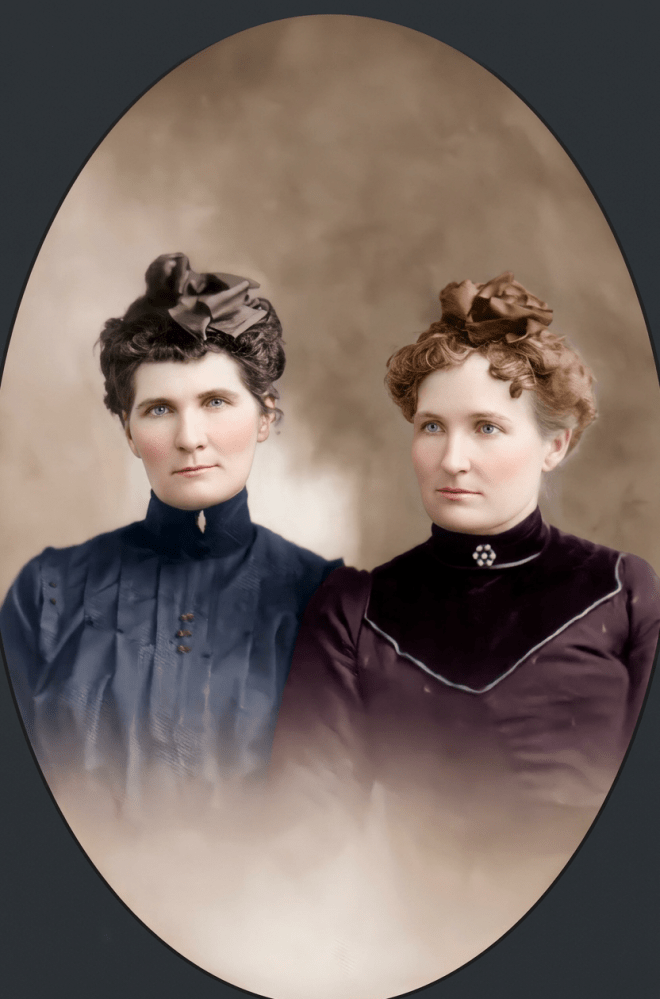
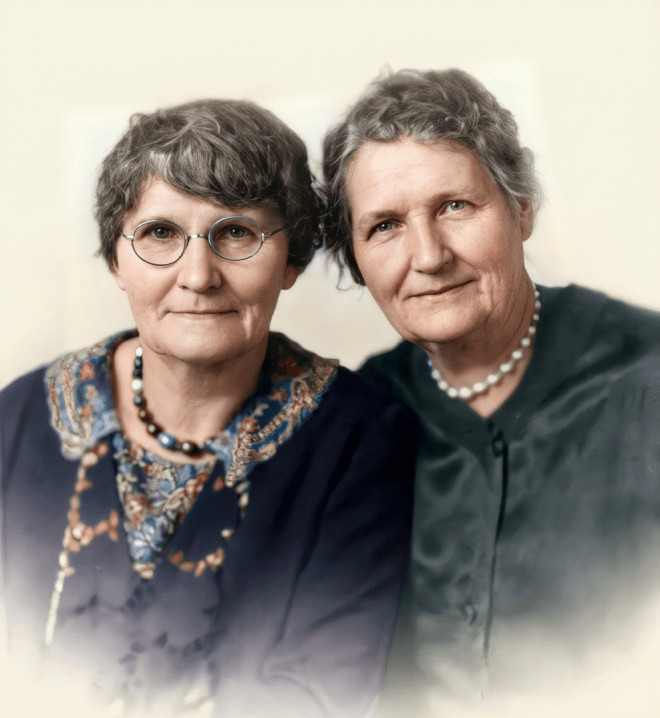
Isabella Sharp, christened 15 January 1832, family tradition gives her birth as 22 December 1831. She would emigrate with William to Utah and settle in Mill Creek, Salt Lake County. See Sons of Joseph and Isabella Carlisle.
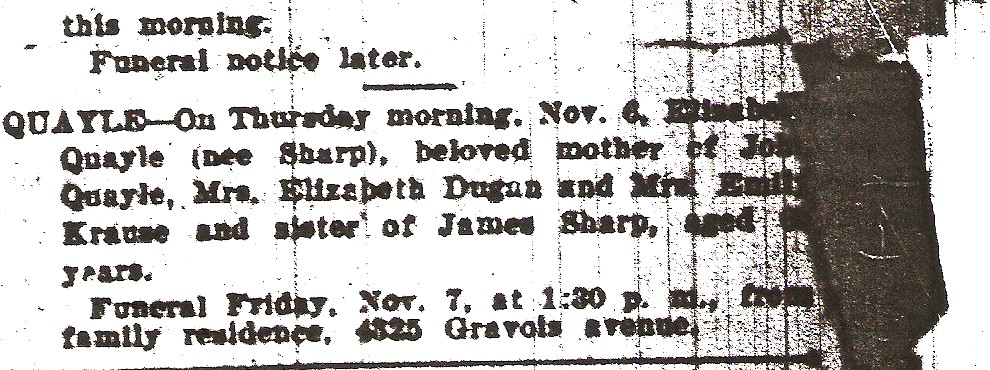
Elizabeth Sharp, baptized 11 June 1834, she remained in St. Louis and married John Quayle. See John and Elizabeth Quayle.
Ann Sharp, born 8 July 1838, baptized 29 July 1838, died 2 September 1838, eight weeks old, of convulsions. Convulsions in infants of this period were typically caused by uncontrolled fever from bacterial or viral infections, untreatable before the development of antibiotics and fever-reducing medications. Elizabeth registered her birth with an X mark on 10 July 1838. A neighbor, Mary Laister, registered her death, Elizabeth was not the informant.


James Sharp, born 7 January 1840, confirmed by GRO birth certificate (BXCC548222), with Elizabeth signing as informant with her X mark on 22 January 1840. See James Sharp.
By the time Thomas died in July 1841, the family had buried four children. George at four days, Mary in infancy, the second George at four and a half years, and Ann at eight weeks. The 1841 Census, taken just weeks before Thomas’s death, records the household: Thomas (40), Elizabeth (37), William (14), Isabella (9), Elizabeth (5), and James (1). Thomas Sharp Sr. was living just a few households away in the same village.

Conversion and Emigration
William Sharp was the first family member baptized into the LDS Church, or formally The Church of Jesus Christ of Latter-day Saints, on 20 June 1848. His mother Elizabeth followed on 11 August 1849, and Isabella on 16 September 1849. The Misson History Hub records that “In 1848 LDS Missionaries visited the village and several conversions apparently took place” and notes that the converted “travelled to the USA, crossed the continent and made new lives and families there.” Among the elders who lodged at Elizabeth’s home was Elder George Emery.
Elizabeth decided to emigrate with her family to Utah. Annie Thompson records the family’s resistance: “her folks tried hard to discourage her from taking the hazardous trip; they told her if you leave for the West, ‘A red Indian will eat ye.’” The ticket cost twenty-five pounds sterling. On 2 October 1850 Elizabeth (age 45), William (age 24), Isabella (age 19), Elizabeth (age 26), and James (age 10) sailed from Liverpool on the ship James Pennell, under the direction of Church leader Christopher Layton. There were 254 Latter-day Saint emigrants on board, the Fiftieth Company.
The voyage nearly ended in disaster. As the James Pennell approached the mouth of the Mississippi River, a terrible storm drove the ship back into the Gulf of Mexico, breaking the main and mizzen masts and washing part of the rigging overboard. The crippled vessel drifted for several days with provisions nearly exhausted before a pilot boat found it and guided it to the river mouth on 20 November. The Millennial Star reported simply that the James Pennell “had lost her main and mizen masts, which is all the information given of her.” The ship arrived in New Orleans on 22 November 1850, towed alongside the Joseph Badger, which had sailed from Liverpool two weeks after the Pennell. The full dramatic account is preserved in the William Sharp Personal History. The voyage is documented at Saints by Sea (BYU), where the Sharp family passengers are listed.
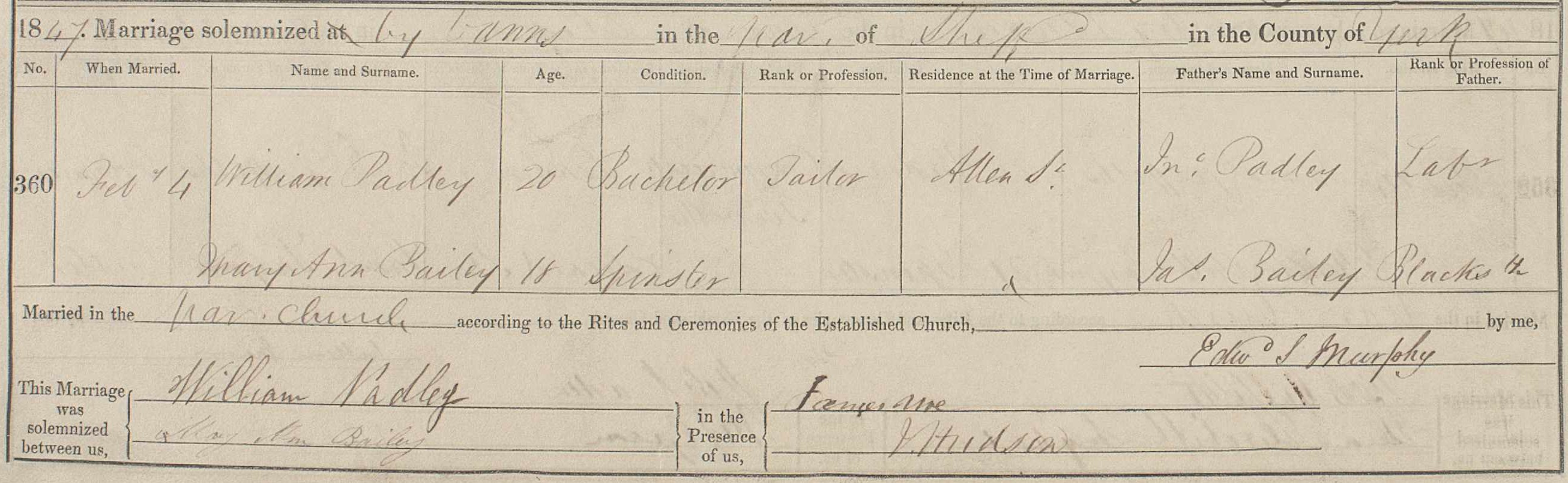
From New Orleans the family traveled by river to St. Louis, Missouri. Shortly after arriving, Elizabeth fell ill. She died on 17 February 1851 in St. Louis, never reaching Utah. She was 47 years old. Her burial place in St. Louis has not been located. Annie Thompson gives her death as “probably late in the year 1850.” The 17 February 1851 date comes from other sources and is consistent with a November 1850 arrival and a short illness through that winter. Her children were left on their own in an unfamiliar city. Elizabeth Sharp married John Quayle and remained in St. Louis. James, aged eleven, tried to arrange passage west but the company he was to travel with turned back; he stayed in St. Louis and eventually became a partner in a meat packing business. William married the widowed Mary Ann Bailey Padley in St. Louis, and in 1853 he and Isabella, now married to Joseph Carlisle, traveled west in the Moses Clawson Company, arriving in Salt Lake Valley between 15 and 20 September 1853.
Temple Work
In December 1881 Isabella Sharp Carlisle traveled from Mill Creek, Salt Lake County, to the St. George Utah Temple, at that time the only operating temple in the world, to perform proxy ordinances for her deceased daughter Elizabeth Ann Carlisle. While there, between 20 and 23 December 1881, ordinances were completed for her father Thomas Sharp and her paternal grandfather Thomas Sharp Sr., and the sealings of both men to their wives. Ordinances were also completed for her maternal grandmother Ann Matthews Cartwright, baptism, confirmation, and sealing to George Cartwright, with the St. George Temple record identifying Ann Matthews Cartwright by name and marriage details, confirming the family connection across three generations. Ordinances were completed for six people across four generations in four days.
Thomas Sharp’s sealing to Elizabeth Cartwright was completed 30 April 1920.
Of the children of Thomas Sharp Sr. and Anne Stennett who survived to adulthood, John Sharp died on 29 July 1866 in Misson of Bronchitis and Emphysema, the last of the siblings to remain in the village. William Sharp died on 27 October 1867 in Canada, having emigrated there with his family around the same time Elizabeth Cartwright Sharp, Thomas Jr.’s widow, left England for America in 1850. The emigrations of brother and sister in law, in the same decade, from the same small village, to different continents, closes the Misson chapter of the Sharp family story.
Sources
Primary documents: Thomas Sharp death certificate (GRO DYB541596, 13 July 1841); Thomas Sharp burial, Bishop’s Transcripts, Nottinghamshire Archives (15 July 1841); Elizabeth Cartwright baptism, Bishop’s Transcripts, Nottinghamshire Archives, FHL film #503793 (20 December 1803); Thomas Sharp and Elizabeth Cartwright marriage, Bishop’s Transcripts, Nottinghamshire Archives, page 14 (29 December 1823); Ann Sharp birth certificate (GRO, 8 July 1838); Ann Sharp death record (GRO, 2 September 1838); James Sharp birth certificate (GRO BXCC548222, 7 January 1840); 1841 Census of England and Wales, Misson, household 1612123; children’s christenings confirmed in Bishop’s Transcripts, Nottinghamshire Archives, pages 34 (George 1824), 37 (Mary 1825), 42 (William 1827), 50 (second George 1829), 60 (Isabella 1832), 69 (Elizabeth 1834); second George Sharp burial, Bishop’s Transcripts, Nottinghamshire Archives, page 32 (23 December 1833); Thomas Sharp Sr. christening, Bishop’s Transcripts, Borthwick Institute for Archives (18 September 1768, Armthorpe); Thomas Sharp Sr. death certificate (GRO DYB565322, 23 August 1847); Ann Sharp Sr. death certificate (GRO DYB565321, 10 December 1849); George Cartwright baptism and burial, Bishop’s Transcripts, Nottinghamshire Archives; Ann Matthews christening, Bishop’s Transcripts, Nottinghamshire Archives (14 September 1783); Will of Edmund Matthews of Everton, proved 25 February 1820; Death Duty Register IR27/174, The National Archives; Ann Matthews and George Cartwright marriage, Bishop’s Transcripts, Nottinghamshire Archives (1 February 1803); Ann Matthews and George Beighton marriage, Bishop’s Transcripts, Nottinghamshire Archives, page 13 (4 June 1823); Thomas Sharp Sr. christening (Armthorpe) and Thomas Sharp Sr. and Anne Stennett marriage (Ewerby, Lincolnshire), Lincolnshire Parish Registers; James Sharp (brother) death record, Misson Parish Register (5 June 1839); Mary Sharp burial, Misson Parish Register (approximately 29 November 1825); George Sharp (1829) cause of death, Misson Parish Register (burns, 23 December 1833); Ann Thickett death record, Misson area (6 April 1846); George Sharp death record (8 August 1846); John Sharp death record, Misson (29 July 1866).
Secondary sources: Annie Thompson, Life History of Elizabeth Cartwright Sharp, 27 August 1957; William Sharp Personal History; Kent Nielsen (1931–2020), a great grandson of Joseph and Isabella Sharp Carlisle and thus of Thomas Sharp and Elizabeth Cartwright, contributed extensive primary source research to the FamilySearch Collaborate record for this family between 2011 and 2014. His careful documentation of the Cantley, Yorkshire connection, the GRO certificates, and the census evidence forms the foundation of the genealogical record presented here. FamilySearch Collaborate notes on Thomas Sharp (KWJ5-679) and Thomas Sharp Sr. (KP7V-4HL), 2011–2014; Leanne Maynes, a great great granddaughter of Joseph and Isabella Sharp Carlisle and thus of Thomas Sharp and Elizabeth Cartwright, whose ongoing research into the Sharp and related families has contributed additional primary source analysis, including the Misson Parish Register details on infant burials and causes of death, the identification of the Stamford records as a likely misattribution, and the TB deaths among Thomas Sharp Sr.’s children in the 1840s; Saints by Sea, BYU, James Pennell voyage 2 October–23 November 1850; Misson History Hub, Written History.
For more on the Sharp family and Plain City’s founding generation, see:
Sharp-Bailey Wedding — William Sharp and Mary Ann Bailey
Sons of Joseph and Isabella Carlisle — Isabella Sharp and Joseph Carlisle
John and Elizabeth Quayle — Elizabeth Sharp and John Quayle
James Sharp — James Sharp in St. Louis
Early Settlers in Lehi, Utah, before Plain City, Utah — William Sharp (no. 68) on the Lehi consecration list
History of Plain City — the community William Sharp helped found
Sharp Family History Outreach — broader Sharp family connections