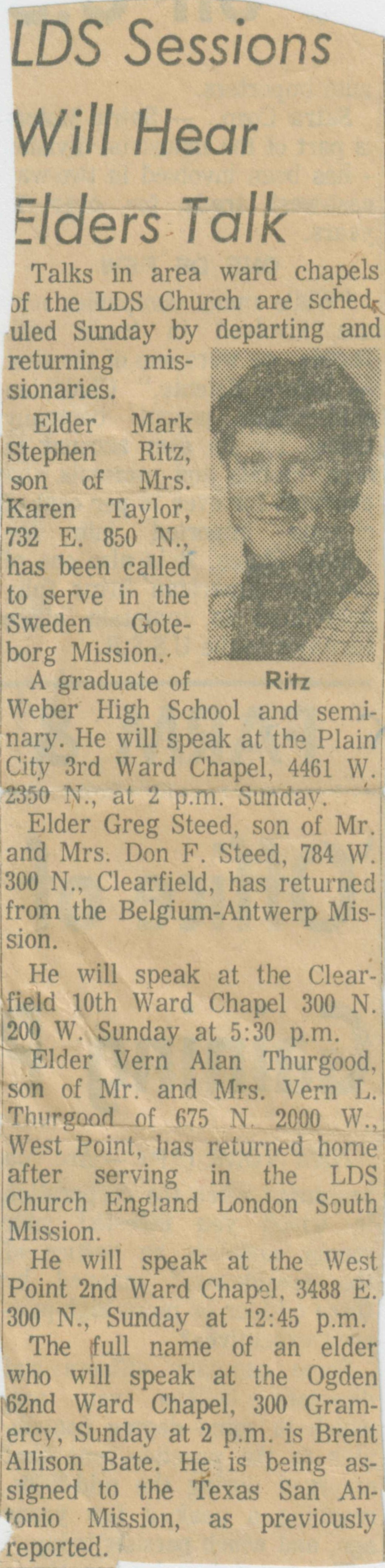
LDS Sessions Will Hear Elders Talk

Another random newspaper clipping from my Grandmother Gladys Maxine Donaldson Ross. I am not sure why this was clipped or what relationship or knowledge she had of anything in the article. I assume familiarity and connection with Elder Ritz.

Talks in area ward chapels of the LDS Church are scheduled Sunday by departing and returning missionaries.

Elder Mark Stephen Ritz, son of Mrs. Karen Taylor, 732 E. 850 N., has been called to serve in the Sweden Goteborg Mission.

A graduate of Weber High School and seminary. He will speak at the Plain City 3rd Ward Chapel, 4461 W. 2350 N., at 2 p.m. Sunday.

Elder Greg Steed, son of Mr. and Mrs. Don F. Steed, 784 W. 300 N., Clearfield, has returned from the Belgium-Antwerp Mission.

He will speak at the Clearfield 10th Ward Chapel 300 N. 200 W. Sunday at 5:30 p.m.

Elder Vern Alan Thurgood, son of Mr. and Mrs. Vern L. Thurgood of 675 N. 2000 W., West Point, has returned home after serving in the LDS Church England London South Mission.

He will speak at the West Point 2nd Ward Chapel, 3488 E. 300 N., Sunday at 12:45 p.m.

The full name of an elder who will speak at the Ogden 62nd Ward Chapel, 300 Grammercy, Sunday at 2 p.m. is Brent Allison Bate. He is being assigned to the Texas San Antonio Mission, as previously reported.

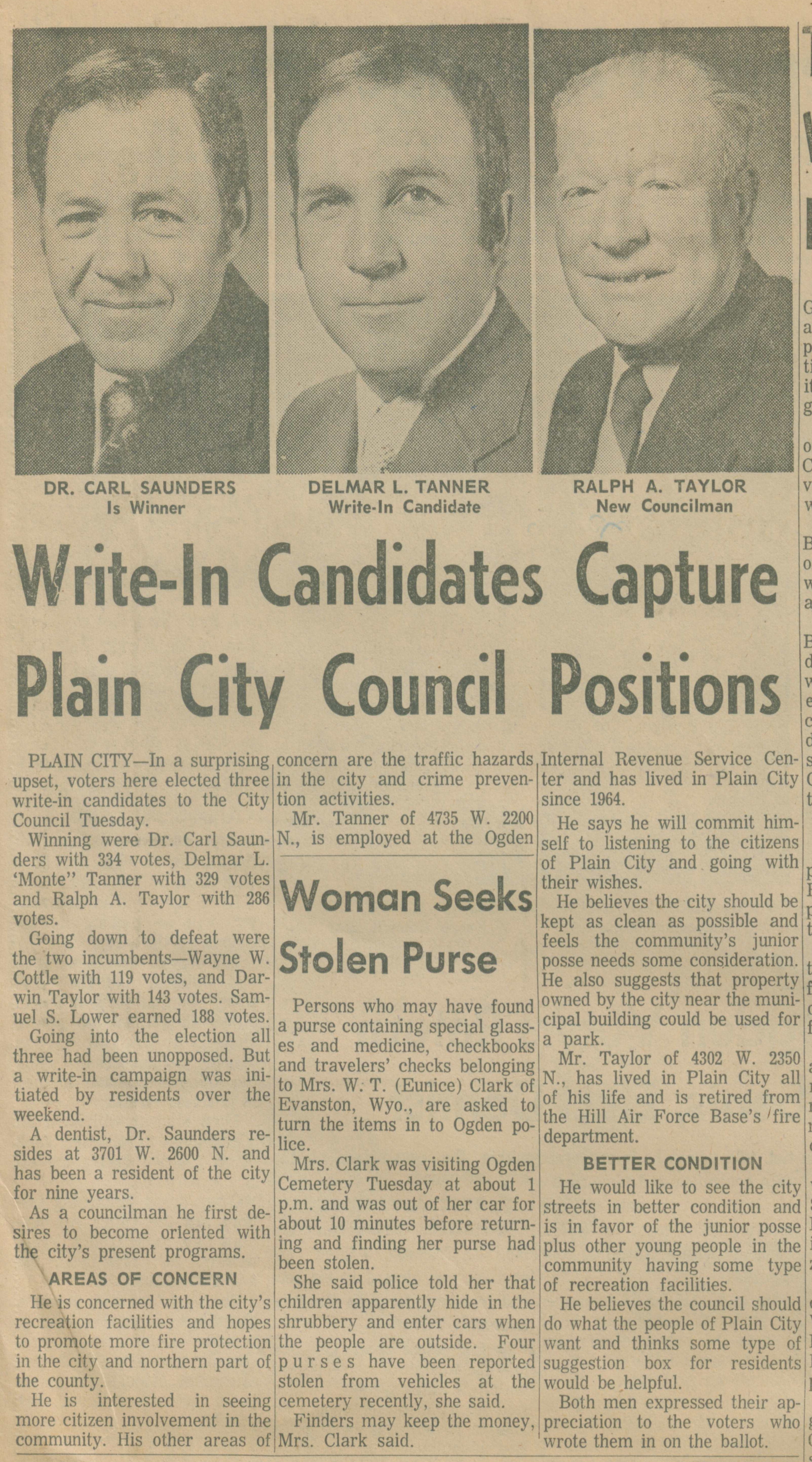
Write-In Candidates Capture Plain City Council Positions

Another clipping from my grandparents, Milo and Gladys Ross. Since they lived in Plain City, it makes more sense why this article was clipped from the Ogden Standard-Examiner. No date is found on the clipping.

“Plain City – In a surprising upset, voters here elected three write-in candidates to the City Council Tuesday.

“Winning were Dr. Carl Saunders with 334 votes, Delmar L. ‘Monte” Tanner with 329 votes and Ralph A. Taylor with 286 votes.

“Going down to defeat were the two incumbents – Wayne W. Cottle with 199 votes, and Darwin Taylor with 143 votes. Samuel S. Lower earned 188 votes.

“Going into the election all three had been unopposed. But a write-in campaign was initiated by residents over the weekend.

“A dentist, Dr. Saunders resides at 3701 W. 2600 N. and has a been a resident of the city for nine years.

“As a councilman he first desires to become oriented with the city’s present programs.

AREAS OF CONCERN

“He is concerned with the city’s recreation facilities and hopes to promote more fire protection in the city and northern part of the county.

“He is interested in seeing more citizen involvement in the community. His other areas of concern are the traffic hazards in the city and crime prevention activities.

“Mr. Tanner of 4735 W. 2200 N., is employed at the Ogden Internal Revenue Service Center and has lived in Plain City since 1964.

“He says he will commit himself to listening to the citizens of Plain City and going with their wishes.

“He believes the city should be kept as clean as possible and feels the community’s junior posse needs some consideration. He also suggests that property owned by the city near the municipal building could be used for a park.

“Mr. Taylor of 4302 W. 2350 N., has lived in Plain City all of his life and is retired from Hill Air Force Base’s fire department.

BETTER CONDITION

“He would like to see the city streets in better condition and is in favor of the junior posse plus other young people in the community having some type of recreation facilities.

“He believes the council should do what the people of Plain City want and thinks some type of suggestion box for residents would be helpful.

“Both men expressed their appreciation to the voters who wrote them in on the ballot.

~

I did a little research on all these individuals to flesh out more of the history.

Carl Richard Saunders was born 24 October 1928 in Ogden, Utah, and passed away 21 June 2009 in Ogden. Buried in Ogden.

Delmar Lamont Tanner was born 27 July 1935 in Ogden and passed away 12 September 2021 in Perry, Utah. Buried in Plain City.

Ralph Arlin Taylor was born 29 March 1912 in Plain City and passed away 25 December 1999 in Plain City. Buried in Plain City.

Wayne William Cottle was born 30 November 1928 in Ogden and passed away 31 October 2006 in Plain City. Buried in Plain City.

Samuel Steven Lower Jr was born 9 April 1936 in Lewiston, Utah, and passed away 27 November 2021 in South Weber, Utah. Buried in Plain City.

Darwin Taylor is still alive as far as I can tell.

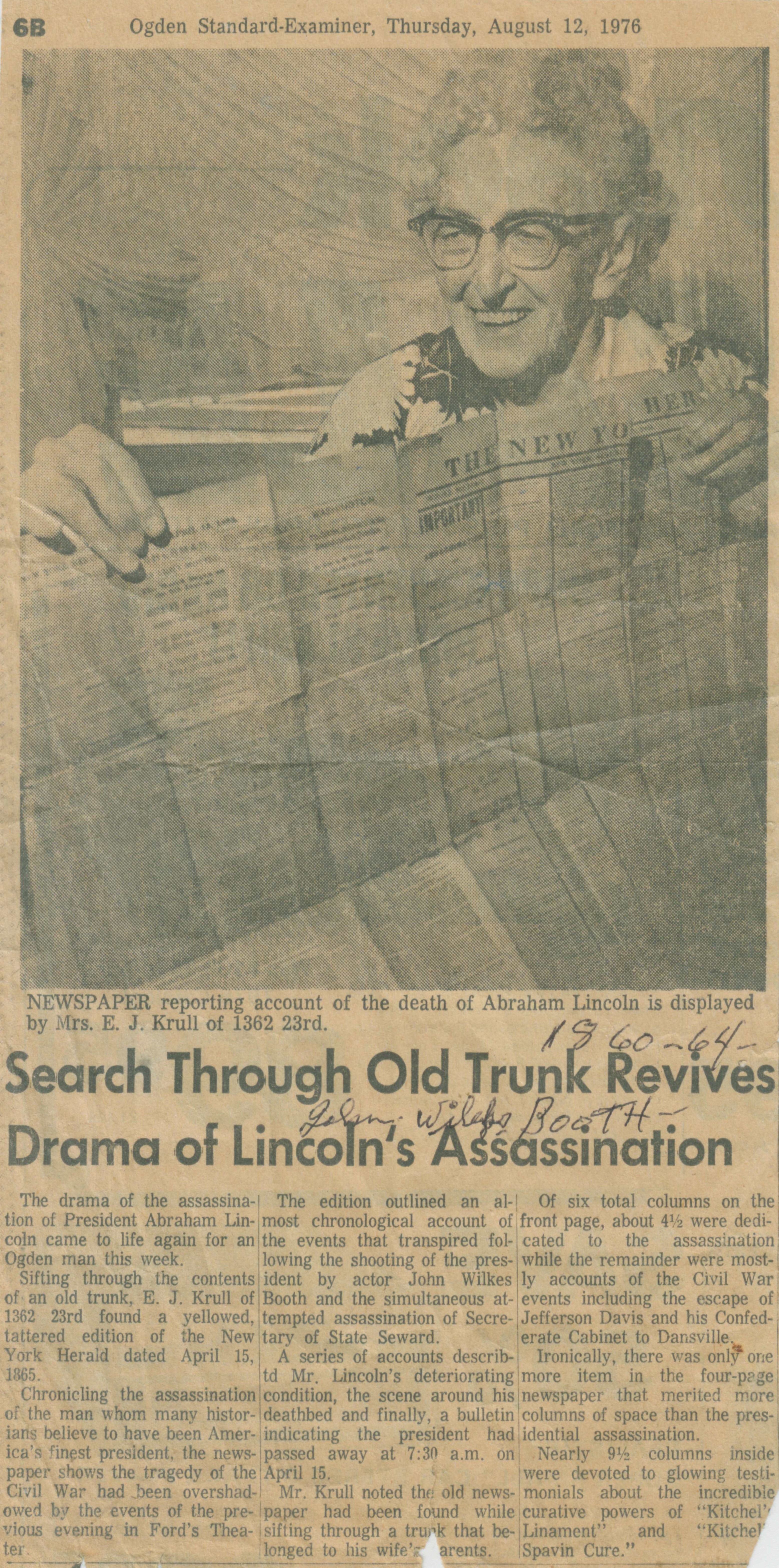
Search Through Old Trust Revives Drama of Lincoln’s Assassination

Another article clipped by my Grandparents, Milo and Gladys Ross. We do not know why this was clipped.

The top of the article shows it was published in the Ogden Standard-Examiner, Thursday, August 12, 1976.

“Newspaper reporting account of the death of Abraham Lincoln is displayed by Mrs. E. J. Krull of 1362 23rd.

Written by Milo Ross – “1860 – 64 – John Wileks Booth

“The drama of the assassination of President Abraham Lincoln came to life again for an Ogden man this week. Sifting through the contents of an old trunk, E. J. Krull of 1362 23rd found a yellowed, tattered edition of the New York Herald dated April 15, 1865.

“Chronicling the assassination of the man whom many historians believe to have been America’s finest president, the newspaper shows the tragedy of the Civil War had been overshadowed by the events of the previous evening in Ford’s Theater.

“The edition outlined an almost chronological account of the events that transpired following the shooting of the president by actor John Wilkes Booth and the simultaneous attempted assassination of Secretary of State Seward.

“A series of accounts describtd Mr. Lincoln’s deteriorating condition, the scene around his deathbed and finally, a bulletin indicated the president had passed away at 7:30 a.m. on April 15.

“Mr. Krull noted the old newspaper had been found while sifting through a trunk that belonged to his wife’s parents.

“Of six total columns on the front page, about 4 1/2 were dedicated to the assassination while the remainder were mostly accounts of the Civil War events including the escape of Jefferson Davis and his Confederate Cabinet to Dansville.

“Ironically, there was only one more item in the four-page newspaper that merited more columns of space than the presidential assassination.

“Nearly 9 1/2 columns inside were devoted to glowing testimonials about the incredible curative powers of “Kitchel’s Linament” and Kitchel’s Spavin Cure.”

I did some homework to find out more about Mr. & Ms. Krull.

Eielt J Krull was born 11 November 1900 in Clark County, South Dakota, and passed away 13 August 1987 in Ogden, Utah. He married Thelma Blaine, previously married as Nelson, in 1943. Thelma was born 29 August 1901 in Ohio and died 3 May 1991. Eielt is buried in South Dakota, Thelma is buried in Colorado.

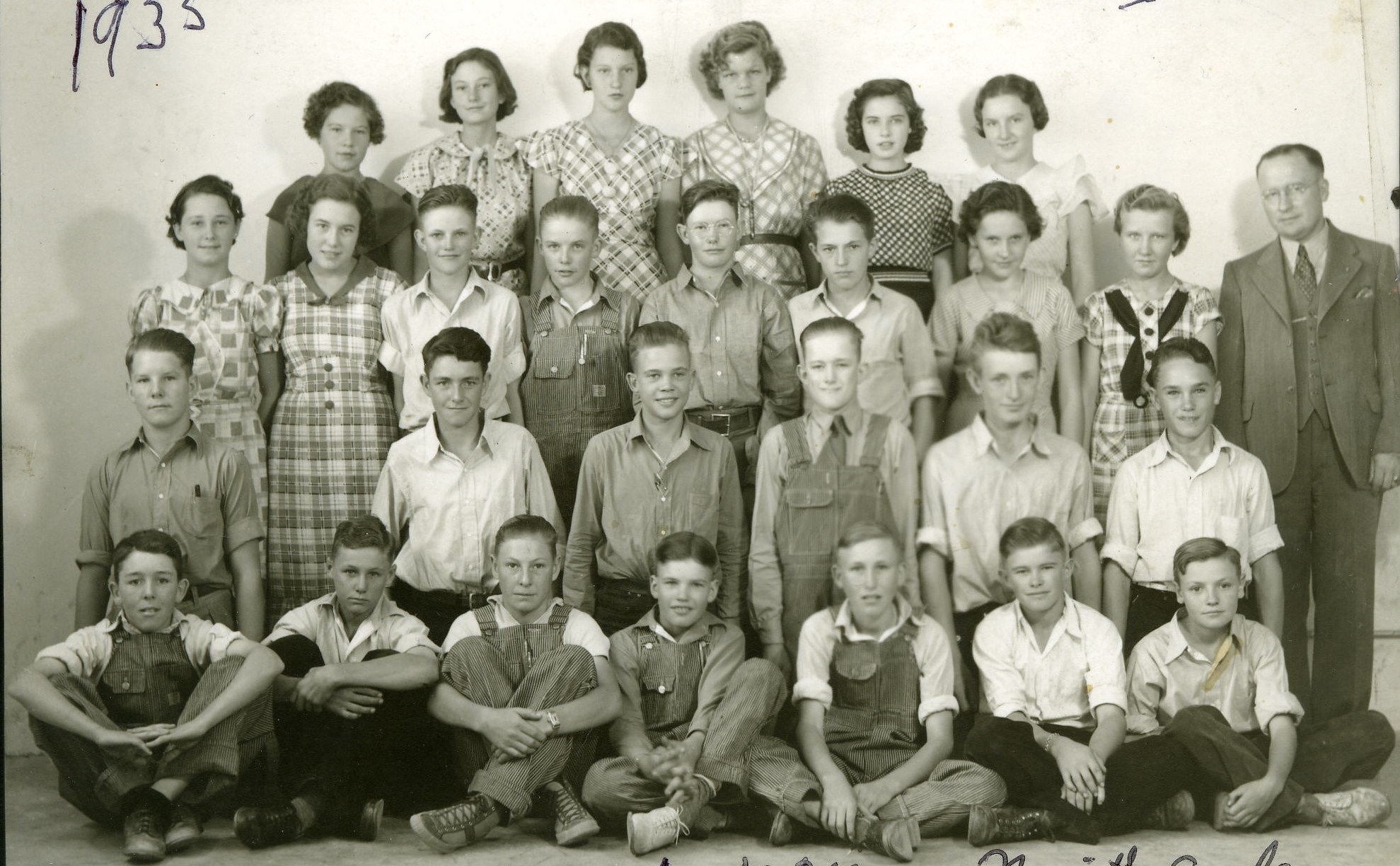
John Reese’s 9th Grade Class

Back (l-r): Cleone Carver, Vera Wayment, Margaret Freestone, Emza Musgrave, Jean Etherington, LauRene Thompson.  Third: June Wayment, Miriam Weatherston, Ellis Lund, Ray Charlton, Ivan Hodson, Warren Williams, Ruth Wade, Tamara East, John Reese.  Second: Lyle Thompson, Milo Ross, Eugene Maw, Earl Hipwell, Bill Hill, Keith Hodson.  Front: Ted Christensen, Wayne Rose, Howard Hunt, Orlo Maw, Owen Wayment, Ellis Stewart, Delmar White.

This my Grandpa Milo Ross’ 9th Grade class.  I believe this was at Weber High School, but I cannot confirm what grade year switched between Plain City School and Weber High School in Ogden.  Several of these boys died in World War II.

Mr. John Major Reese (1896-1976), teacher.

Cleone Carver (1921-1994)

Ray S Charlton (1920-1991)

Edwin “Ted” Daniel Christensen (1921-2005)

Talma Bernice East (1921-2006)

Vesey Jean Etherington (1921-2000)

Margaret Freestone (1921-2017)

John Earl Hipwell (1921-2000)

William Stanley Hill (1919-1945)

Benjamin Keith Hodson (1920-1970)

Ivan Alma Hodson (1919-1982)

Howard Hunt (1921-1944)

Ellis Marion Lund (1921-1984)

Orlo Steadwell Maw (1921-2004)

Wilmer Eugene Maw (1920-2009)

Emza Ameriam Musgrave (1922-2007)

Wayne East Rose (1921-2017)

Milo James Ross (1921-2014)

Ellis Wayment Stewart (1921-1940)

James Lyle Thompson (1921-1999)

LauRene Thompson (1921-2010)

Ruth Wade (1921-2012)

June Ellen Wayment (1920-2012)

Owen Urry Wayment (1921-2008)

Vera Mary Wayment (1921-1989)

Miriam Weatherston (1921-2001)

William Warren Williams (1921-1988)

Heber Delmar White (1921-2008)

Vicki’s Class Pictures

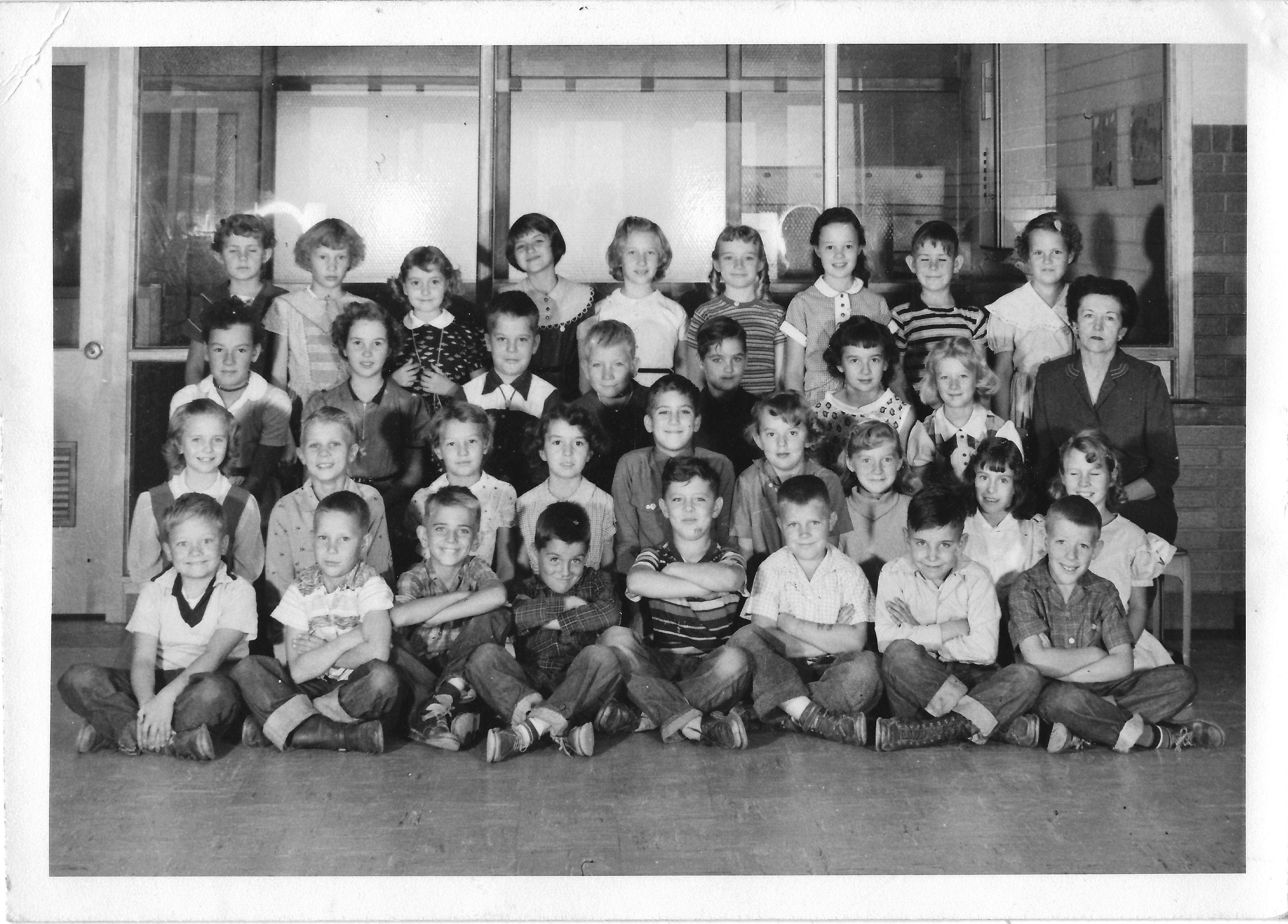
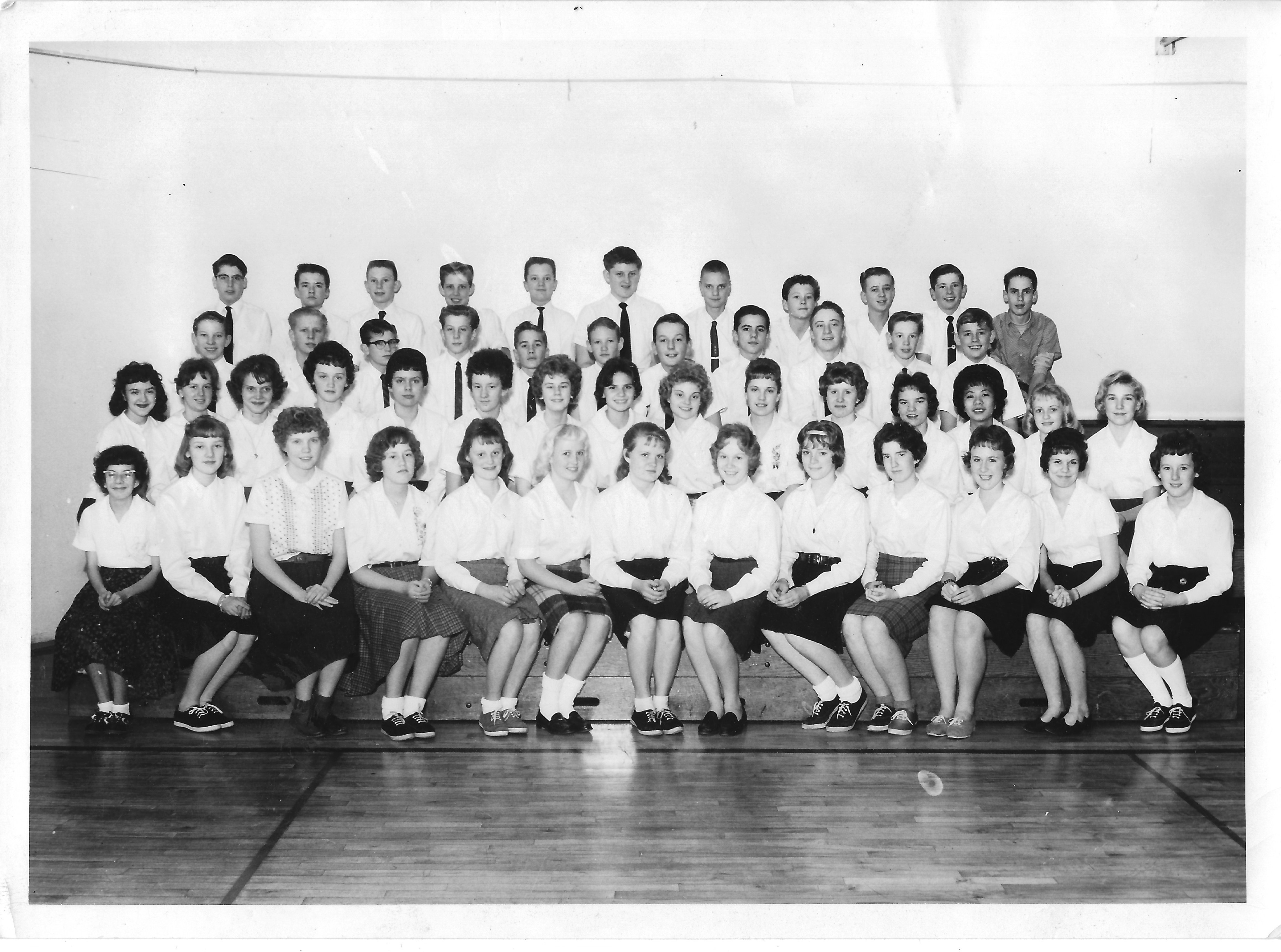
These are photos shared to me of Victoria “Vicki” Kay Feldtman Ross. I don’t know anything more than what I have listed on the photos. I believe she graduated from Weber High School in 1963, or would have graduated. She married Dad, Milo Paul Ross, 5 March 1963 in Ogden, Weber, Utah. She was born 23 December 1945 in Ontario, Malheur, Oregon and passed away 31 December 2018 in Twin Falls, Twin Falls, Idaho.

4th Grade Ms. Morby, Vicki is back row, fourth from the right
Vicki is middle row, sixth from the right
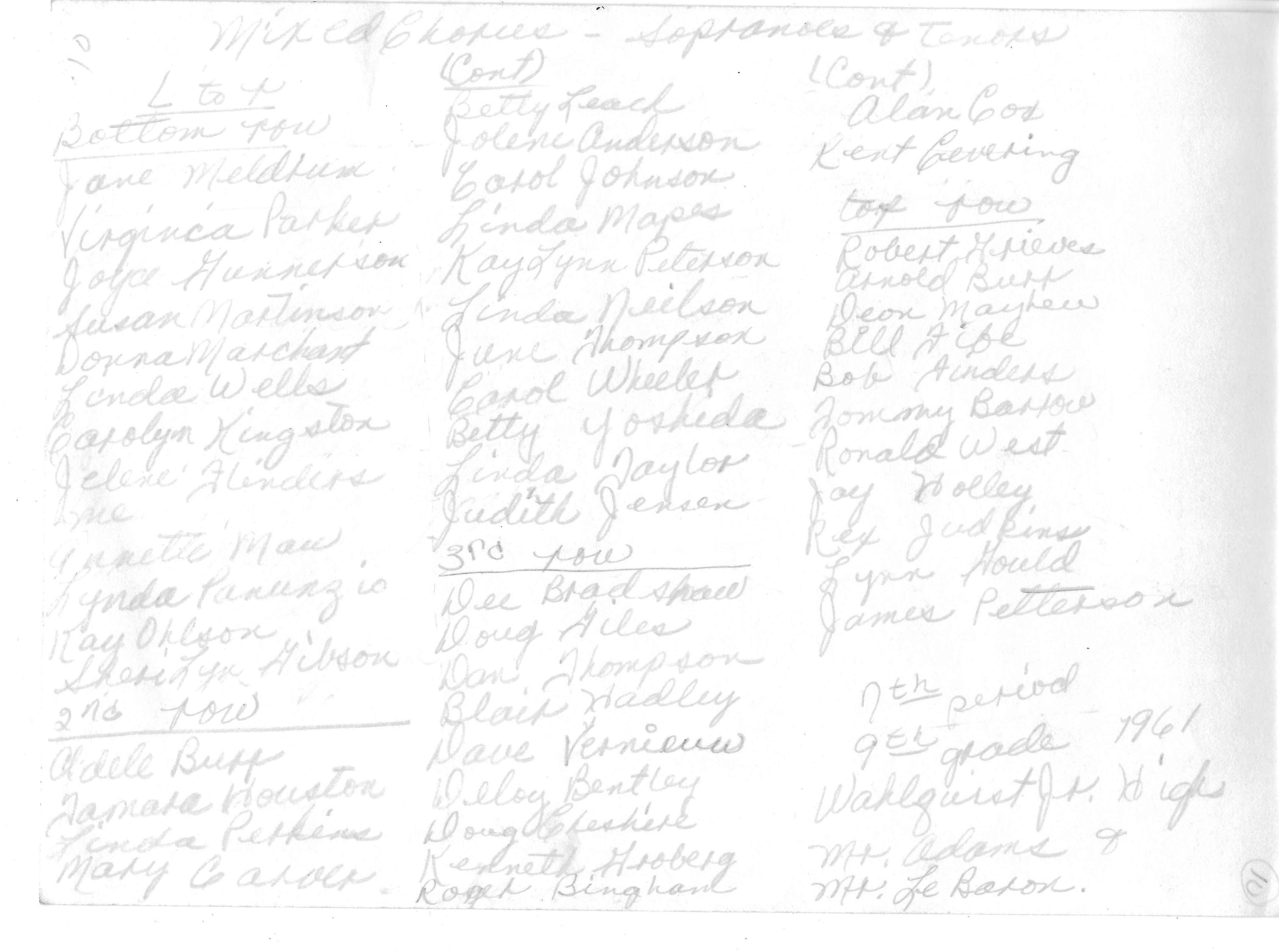
Mixed Chorus: Back row (l-r): Robert Grieves, Arnold Burr, Deon Mayhew, Bill Fife, Bob Findess, Tommy Bartow, Ronald West, Jay Holley, Rex Judkins, Lynn Gould, James Petterson; Third row: Dee Bradshaw, Doug Giles, Dan Thompson, Blair Hadley, Dave Vesnieuw, Deloy Bentley, Doug Cheshire, Kenneth Groberg, Roger Bingham, Alan Cox, Kent Cevering; Second row: Adele Buff, Tamara Houston, Linda Perkins, Mary Carver, Betty Leach, Jolene Anderson, Carol Johnson, Linda Mapes, KayLynn Peterson, Linda Neilson, June Thompson, Carol Wheeler, Betty Yoshida, Linda Taylor, Judith Jensen; Front row: Jane Meldrum, Virginia Parker, Joyce Gunnerson, Susan Martinson, Donna Marchant, Linda Wells, Carolyn Kingston, Jelene Flinders, Vicki Feldtman, Annette Maw, Lynda Panunzio, Kay Ohlson, SheriLyn Gibson

These names are taken from the back of the photo. Please correct if you think I have them wrong.

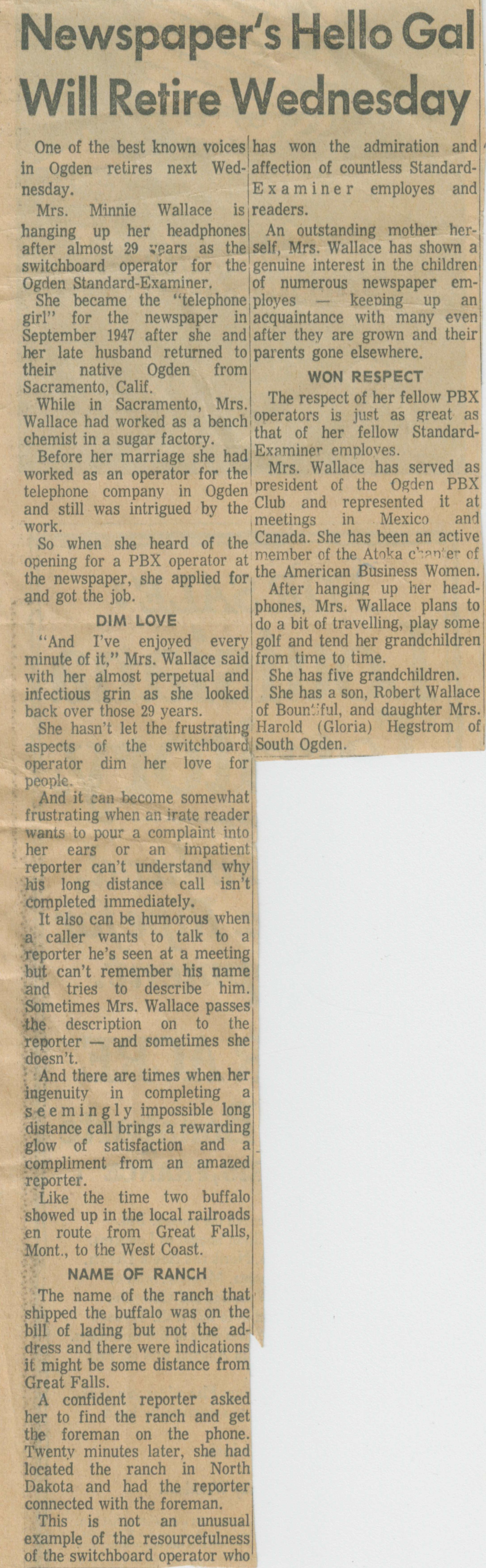
Newspaper’s Hello Gal Will Retire Wednesday

Another photo clipping from those of my grandmother, Gladys Maxine Donaldson Ross. This one is more apparent to me why it was clipped. Minnie Wallace is Glady’s first cousin. Minnie’s mother is Johanna Hermina Van Leeuwen Edsinga (1884-1958), sister to my Grandmother’s mother, Berendena Van Leeuwen Donaldson (1898-1959). Johanna Hermina also went by Minnie.

“The voice of Mrs. Minnie Wallace will be missing from the Ogden Standard-Examiner after the veteran PBX operator retires Wednesday. The date at the top shows 8 March 1976.

Minnie Van Leeuwen Edsinga

“One of the best known voices in Ogden retires next Wednesday.

“Mrs. Minnie Wallace is hanging up her headphones after almost 29 years as the switchboard operator for the Ogden Standard-Examiner.

“She becamse the “telephone girl” for the newspaper in September 1947 after she and her late husband returned to their native Ogden from Sacramento, Calif.

“While in Sacramento, Mrs. Wallace had worked as a bench chemist in a sugar factory.

“Before her marriage she had worked as an operator for the telephone company in Ogden and still was intrigued by the work.

“So when she heard of the opening for a PBX operator at the newspaper, she applied for and got the job.

DIM LOVE

“”And I’ve enjoyed every minute of it,” Mrs. Wallace said with her almost perpetual infectious grin as she looked back over those 29 years.

“She hasn’t let the frustrating aspects of the switchboard operator dim her love for people.

“And it can become somewhat frustrating when an irate reader wants to pour a complaint into her ears or an impatient reporter can’t understand why his long distance call isn’t completed immediately.

“It can also be humorous when a caller wants to talk to a reporter he’s seen at a meeting but can’t remember his name and tries to describe him. Sometimes Mrs. Wallace passes the description on to the report – and sometimes she doesn’t.

“And there are times when her ingenuity in completing a seemingly impossible long distance calls brings a rewarding glow of satisfaction and a compliment from an amazed reporter.

“Like the time two buffalo showed up in the local railroads en route from Great Falls, Mont., to the West Coast.

NAME OF RANCH

“The name of the ranch that shipped the buffalo was on the bill of lading but not the address and there were indications it might be some distance from Great Falls.

“A confident reporter asked her to find the ranch and get the foreman on the phone. Twenty minutes later, she had located the ranch in North Dakota and had the reporter connected with the foreman.

“This is not an unusual example of the resourcefulness of a switchboard operator who has won the admiration and affection of countless Standard-Examiner employes and readers.

“An outstanding mother herself, Mrs. Wallace has shown a genuine interest in the children of numerous newspaper employes – keeping up an acquaintance with many even after they are grown and their parents gone elsewhere.

WON RESPECT

“The respect of her fellow PBX operators is just as great as that of her fellow Standard-Examiner employes.

“Mrs. Wallace has served as president of the Ogden PBX Club and represented it at meetings in Mexico and Canada. She has been an active member of the Atoka chapter of the American Business Women.

“After hanging up her headphones, Mrs. Wallace plans to do a bit of travelling, play some golf and tend her grandchildren from time to time.

“She has five grandchildren.

“She has a son, Robert Wallace of Bountiful, and daughter Mrs. Harold (Gloria) Hegstrom of South Ogden.

History of Mary Magdalina Wanner Wagstaff

“Our Mother”

by Edna Leona Wagstaff Owen

Our mother, Mary Magdalena Wanner was born September 12, 1873 at Atzenweiler, Neckarkreis, Wuerttemberg. Wuerttemberg is one of the States in the divided German nation.

Mother is a daughter of Johann Georg Wanner and Anna Maria Schmid, and was given the name of Maria Magdalina. After the family came to the United States, mother adopted the American spelling of Mary Magdalina which she used the remainder of her life.

Our mother and her brothers and sisters were very fortunate to have parents who were honorable, upright hard working people who loved their children and worked very hard to see that they got the very best they could. Both parents believed in God and had a strong faith that their prayers would be answered in providing them with the blessings they needed. They belonged to the Luteran Church, and tried to teach their children correct principles.

Mother was the 3rd child in a family of 10 children – 5 boys and 5 girls; two of her brothers died at an early age in Germany.

Between the ages of 7 and 8, mother took care of her younger brothers and sisters while her mother and father were working in the fields. She was told to get the children to sleep; and when they woke up she would bring them to the fields to their parents. She was anxious for the children to settle down and get to sleep, so she would hold her finger tips over their eye lids thinking this would make them go to sleep but when she took her fingers off they would be wide awake.

Mother started school at the age of 8 years and graduated when she was 14. She did not go to school after that.

From the age of 10 until 13 she herded cows on a big hillside. The family lived on a farm and everyone had to help. Their father was gone a great deal of the time as a road overseer, or working in the Black Forest to make a little extra money to help increase the family income. Mother had to do a lot of hard work such as getting wood from the canyon to use for fuel to heat the house and to cook with.

Another of her jobs was to lead the cows that pulled the plow. She also piled hay and gathered grain in the fields. Most of the work was done by hand and much of the time the hay was piled on the fence so it would dry.

A 9 years of age she learned to knit and she became very proficient in this art. She knitted all her life supplying her own family with socks, etc. She knitted scarfs, caps, socks and sweaters for the soldiers during both World War 1 and 2. Among the things she knitted was a beautiful white shawl for my first baby. She also knitted two choice sweaters for my husband, one of which he has been wearing on many occasions for over 40 years and it is still in good condition. He still uses it and it has been very useful to him throughout these 40 years.

When she was 11 years of age, she could not walk for a time because of a problem with her leg. At this time, it was necessary that she be put in a baby buggy and pushed 5 or 6 miles to see the doctor.

She went to the city of Ravensburg to work when she was 15 years of age. She took care of children, did washings, ironing, helped with the cooking as well as other household tasks. While working at this job, mother developed a sore on her hand which required that she be hospitalized for two or three weeks.

During the year 1891, mother’s father brought some missionaries to their home. These missionaries were representing the Church of Jesus Christ of Latter-day Saints. These missionaries were Jacob Zollinger from Providence, Utah, John Hassenfritz of the Bear Lake area, and John Federley of Salt Lake City, Utah. Incidentally, I got to meet Jacob Zollinger, a very fine man. After my marriage, whenever I sent to the Temple, Brother Zollinger was there.

After the missionaries had been teaching them the gospel for some time, the family became very much interested and decided they would like to join the church. Some of the family that were old enough were baptized in October, 1891, and became members of the only True Church. This brought peace to their minds and joy to their hearts. It didn’t take long for this family to decide that they wanted to leave their native land and come to the United States where they could have religious freedom and better opportunities for their family to provide for their wants and needs. Not so long after this, the oldest son came to this country with some returning missionaries. This was Uncle George.

In the spring of 1893 her mother and father made preparations to take their family to America. When all was ready, they said good-bye to their relatives, friends, their home and native land.

They rode the train for one day after which they took a boat up the Rhine River. After being on the boat for 3 or 4 days, they took the train for another day which took them to the North Sea. At the north sea they got on a large boat to go to Liverpool, England. The Sea was very rough and stormy. It took them another day to reach Liverpool where they boarded a big ship and sailed for America. They were on the ocean about two weeks before they reached New York where they stayed for two or three days. Then they took the train and started across the continent for Salt Lake City, Utah. They stopped at Chicago, Illinois for one day and one night; then continued on their way. After they got to Salt Lake City, they continued on their journey to Franklin, Idaho, arriving there the 18th June 1893. After their long hard tedious journey, they were all happy and anxious to get settled in their newly adopted homeland.

They were met by their brother George and Fred Nuffer with a team of horses and a wagon. They also brought a buggy with horses. They went to Fred Nuffer’s place in Cub River where her brother George had been working. They stayed at Nuffer’s place about one week. Her father soon started to look for a place to buy and settle down. He decided to take a trip over to the Bear Lake side to see what he could find. Grandpa took mother with him on this trip. They walked across mountains and had to cross the Cub River which was very swift and difficult for them to wade across. They spent one miserable night in the mountains listening to the bears growling. They saved some of their bread to give the bears in case they bothered them.

The next Sunday after arriving in Franklin, they all went to church in Glendale and had their membership records moved to that ward. The Ward Clerk in Glendale was William Addison Wagstaff who later became mother’s husband. Grandpa Wanner soon bought the home and farm of John Nuffer in Glendale. Grandpa and Grandma lived there a number of years and then sold it to their son Fred. Later he sold it to his son Bertus.

In a short time Mrs. Fred Nuffer got mother a job in Logan, Utah, doing house work for a lady by the name of Robin. Mother could not speak the English language at this time but with the help of this good family she was able to understand and speak a little.

Mother worked for the Robin’s until 1894, at which time she went to work for a family by the name of Card. She worked at Card’s about six months. She then returned to her home in Glendale for awhile. After a short rest, she went to work at the Section House in Preston, Idaho, helping a lady cook.

In April 1895, she went to General Conference of The Church in Salt Lake City, Utah. While she was there, she found a job doing housework for a banker by the name of Shutler (we are not sure of the spelling). Mother stayed at this place until November and then went home again for a while. Some time later mother worked for some people in Preston, Idaho, by the name of Hale. In 1896 mother returned to Logan and worked for a family by the name of Bishop.

In the spring of 1896 her mother wrote her and told her that her sister Louise was going to be the “Queen of May Day” celebration to be held in Glendale and she would like her to come home and be there on this occasion. Mother decided it would be fun and decided to be there.

On the day of the celebration mother accepted the invitation of William Addison Wagstaff to have lunch with him which seems to have been a big turning point in mother’s life. After they had their lunch they went for a stroll together. It appears that it was at this time that he proposed marriage to mother.

In a few days mother returned to her job in Logan, Utah. On 11 June 1896 W. A. took Mary’s sister Louise to Logan to take over her job so she could come back to Glendale to make preparations to be married. The next day they went to Preston to pick out material for her wedding dress and selected a cream cashmere trimmed in white silk. Her Tiara had orange blossoms on it. Looking at her picture now I think it must have been just beautiful.

On 16 June W. A. and Mary went to Logan with a wagon load of grain to sell for her father. After they got to Logan they purchased a plain yellow gold wedding band. She stayed with her sister Louise that night and on Wednesday 17 June 1896, W. A. and Mary were married for time and eternity in the Logan Temple by Marriner W. Merrill, The President of the Logan Temple. They spent their wedding night in Logan and returned to Glendale the next day, June 18th. That night Mary’s father and mother gave them a wedding supper at their home.

James, Annie, and Mary Wanner Wagstaff

Then mother went to live in the home where her husband and his mother resided. It was a log house with a dirt roof. This home was located about 5 miles North East of Preston, Idaho, in an area that is commonly called Glendale Flat. Mother took charge of the house and cared for her mother-in-law who had very serious leg trouble.

Right from the start mother worked side by side with her husband getting in the hay and grain. All the water for washing, bathing, drinking, etc. had to be hauled as they had no water on their place. Their cattle were driven to Worm Creek to drink. This Creek was about a mile from their home.

26 January 1897 mother’s first child was born, a tiny premature son. He was named George William. Our Dad held this tiny infant on his lap and fed it with a medicine dropper. He did everything he could to save his life but he passed away after 9 days.

Their second son named James Addison was born 24 June 1898; and 28 December 1899 her first baby girl, Annie Eliza was born. Our Dad and Mom and Dad’s mother were so very happy to have a son and a daughter to bless their home.

Back row: Willard, William, Annie, Parley, Maria, Jesse. Front row: Elsie, Edna, Herbert.

During the early part of mother’s married life, she worked in the Relief Society. Mother loved working in the Relief Society and did her part to make it a success.

In 1900 they moved to a two-room log house with a dirt roof. This house was located one mile from their first home. This move was made so they could be where there was water. This was a big help as they now had water from a well for culinary use as well as other things. Here they were able to have a nice garden with currants, both black and red, as well as gooseberries and raspberries. They could also have shade trees and fruit trees. I am sure this was a great blessing to them.

August 28, 1901, a son Wilford John was born. This made four children for them including the one who died. Dad and Mother were happy to have a family and Dad’s mother was thrilled to think she was now getting some grandchildren. Our Dad’s mother had a very sad time raising her family; our Dad being the only one of 4 children who lived to maturity.

Our Mother and Dad gave Dad’s mother kind and loving care for many years. She continued to have poor health. She was especially afflicted with varicose veins. Those finally turned into ulcers on her legs which had to be bandaged. One of their old neighbors has told us that she had her legs bandaged each day for over 35 years. She finally passed away in the early morning hours of December 2, 1902, and was buried in the cemetery at Glendale, Oneida County, Idaho.

The 9th of April 1903 Parley Leroy was born; and on 23 June 1903, our 22 months old brother Wilford John was drowned in a ditch just north of the house. Many people came from all around to help them at this sorrowful time in their life.

Children continued to come to bless this humble home and 3 March 1905 Willard Lesley was born. On 9 January 1907 Jesse Oleen was born. The 11th of November 1908 Herbert Spencer was born. Mother had now given birth to 7 sons and 1 daughter. She was very busy caring for them, her husband and home, as well as participating in church activities.

During the summer of 1909, they built a new house which had two rooms down and two rooms upstairs. It had a singled roof and later on was pebble-dashed.

It was in this home on a beautiful Sunday morning, 10 July 1910, the next child, a girl with hazel eyes and blond hair Edna Leona was born. The family as well as the Glendale Ward were delighted to see this baby girl come to the home where there were 7 sons and only 1 girl. 7th of August 1912 another daughter, Elsie Magdalina came to bless this home.

On the 19th of March 1913, sorry struck this home when their son James who had been ill a lot of his life passed away and was buried in the Glendale Cemetery.
On the 25 of March 1913 Mother had a patriarchal blessing by Patriarch Wm. Daines. This was a big comfort and a joy to Mother in later years.

The 8th of July 1915 Mother had her last child, a son she named Albert Wanner. Mother had a very difficult time at this birth and she was ill a long time after.

After Mother’s parents moved to Logan in 1910, she frequently went to visit them and did Temple work.

Very often Dad and Mom would drive their team and wagon and later a buggy to Preston; leave them there in the tie-yard and catch the U.I.C. to Logan to do two sessions at the Temple; then back to Preston to get their team; drive home about 4 miles. After Mother was married, she took every opportunity that came her way to go to the Temple. She loved to do this and it brought her great joy to be engaged in the Lord’s work.

Mother loved the outdoors and kept a beautiful garden and flowers; tended chickens and worked with her husband and children in the fields.

September 1918 Dad and Mom took their 3 daughters and youngest son Albert to Brigham City, Utah on the U.I.C. for Peach Day. They all had a delightful time, and enjoyed the trip very much.

During the summer of 1919 Dad and Mom and their 3 daughters and Albert again went on a visit. This tie to see Mother’s sister Pauline, who lived in Gentile Valley. They went in the white top buggy, and followed the road through the Bear Rivers narrows. This was a very narrow road and there was only a few places where people with teams could pass. Our Mother was very nervous going through the narrows. Dangerous things always made Mother worried and nervous. Mother was frightened when thunder and lightning storms were close to us, where she could see and hear it.

September 1919 Dad and Mother again took their 3 daughters and baby son on a trip. This time they took the train and went to see and learn more about where our Dad and lived and worked. They first went to Evanston, Wyoming, then Almy, Croydon and Ogden. They visited with many relatives and friends in Evanston, Almy and Croydon. Dad lived at both Almy and Croydon before coming to Idaho in 1884. For many years Dad wanted to take Mother on this trip to show her where he had lived and to meet some of his relatives and friends he had made before going to Idaho. This trip was the happy fulfillment of that wish.

Ogden, Utah was our last stop and while there Dad and Mother purchased the farm and home of his cousin and her husband Albert Phipps. This farm is located in West Weber, about five miles west of Ogden. It is an 80-acre irrigated farm. Less than half of which turned out to be good farm land.

Soon after they returned home, the news spread around that the Wagstaff family would soon be moving. Many friends and neighbors came to help in preparation for the move.

Before leaving Glendale, Mother’s good friend and neighbor Elizabeth Owen gave our family a nice going away party. Also the Glendale Ward did likewise and gave the folks a rocking chair as a token of their love and appreciation. After my brother Herbert got married, Mother gave the chair to him.

Mother had now lived in Glendale for over 25 years. She had many friends and neighbors that she loved and appreciated so much. In some ways she did not like to leave all they had worked so hard and sacrificed so much to get. Mother loved her home which had 3 new rooms added. They were now quite comfortable.

I’m sure Dad and Mother had given great thought to this venture before making the final decision to go away and start over in a strange kind of farming and among people they did not know. On the other hand they had become convinced that the move would provide better opportunities for their children. They did have 8 living children they loved with all their heart and soul. They also had great love and respect for each other. These things together with their strong testimony that Heavenly Father would bless them if they did what was right. They put their trust in God and bravely faced the future in their new environment. Little did they realize just what trials they would have to go through — even before they completely settled in their new home.

So it was in October 1919, Dad, Parley and Willard headed from Glendale to Ogden, Utah, with teams, wagons, and white top buggy loaded with family possessions. Jesse and Herbert stayed home and did the milking and tended animals. Parley and Willard stayed in Ogden, and Dad came back to Preston on U.I.C. With the help of faithful neighbors, the rest of the family possessions, cattle, chickens and furniture were put on the freight train and Dad went with them on to Ogden. Mom, us girls, Jesse, Herbert and Albert went on U.I.C. Little did he realize that when he arrived in Ogden, the officials would not let him take his animals home but quarantined them. It was a great shock to Dad when he had to pay over $1,000.00 for feed and care before he could get his animals. It is laughable now, but it wasn’t then when somehow the chickens got loose and were running all over the railroad yard with people trying to catch them. It must have been quite a sight to watch people scrambling around chasing chickens.

Our Dad left a paper in his own hand writing describing a few of the experiences our family had after we got to Ogden. The paper stats that in November 1919, the next month after we got there, Annie and Elsie came down with the Small Pox. Shortly after all the other children also came down. Dad and Mother had all 8 of us in one room and gave us patient loving care. I am sure it taxed their strength and was a great cause for worry and anxiety for them.

We had scarcely got over the Small Pox when all the children, Mother and Dad got the Influenza. We were a very sick group and our Mother was especially bad as she had Asthma along with the flu. Dad also got it but stayed up on his feet, caring for the rest of us and doing the chores. Our sister Annie and Anna Gregersen were working at a cafe in Ogden and roomed together and both of them had the flu. Our Dad went over to Ogden in the buggy every other day to take care of Annie and Anna and take them food. It became evident to our Dad that Anna was getting worse so he sent word for her parents to come. Annie and Anna were great friends and it was a great loss to Annie when her dear friend passed away 14 February 1920. I sometimes wonder how our Dad held up to the terrible work load and responsibility that was placed upon him at this time. Mother was worried about our Dad through all this.

When we first got to Ogden, we joined the Wilson Ward and Mother was put in as Relief Society Teacher. In August 1921 we joined the West Weber Ward. Before we joined the West Weber Ward, the Wilson Ward gave Mother a party and a beautiful bouquet of flowers. Mother was soon put in as a Relief Society Teacher. She continued to be a teacher until she moved to Ogden in 1935.

In June 1921 Mother and her three daughters went on a trip to Logan, Preston, Glendale and McCammon. In McCammon we visited with mother’s brother Gottlob and family. In Glendale we visited with old friends and neighbors and in Logan with Mother’s sisters and her parents.

In December 1921 Mother’s sister Pauline passed away and left her little family without a mother.

In September 1922 Uncle Wills family all got Typhoid Fever. Our Mother believed in being her brothers keeper so she took this family into one room of her home and nursed them back to health, except Annie who was in the hospital. After they got over this terrible disease, Mother continued to take care of the baby boy for some time.

In the ensuing years Mother continued her activities in taking care of her family and supported her husband in his work, church, etc. Mother loved to have chickens and she usually had a flock — this enterprise besides furnishing eggs and meat for her family helped out in providing extra income. She was active in Relief Society and regular in her attendance at Church and in paying her dues.

In January 1931 her daughters Edna and Annie went to Logan to attend the Utah State Agricultural College. This meant that Dad and Mom were alone except for Elsie, Albert, Herbert and Jesse who had come home again. That winter they did considerable visiting of friends and neighbors and Dad helped them with their genealogy. It was during the winter and spring that three old friends passed away and mother and dad attended their funerals — John Dobbs in Logan, Henry D Auger in Lewiston, and Mother’s dear friend and neighbor in Glendale, Elizabeth Owen.

Mary Allsop Wagstaff (1826-1902) with William and Mary.

Little did Mother realize at the time that it would be less than a month when she would lose her devouted companion. Her husband had an operation for stomach ulcers in the Dee Hospital in Ogden the 29 May 1931 and passed away from Post Operative Pneumonia on 31 May. This was a terrible shock to Mother and she grieved very much. There was nothing for her to do except to go on alone without her companion. Life was hard for Mother at this time but she had all the loyal support her sons and daughters could give her. They all loved their Mother and did what they could do lighten the burden. Mother grieved long and hard over the loss of her dear husband but in time found her way to continue life and plan for the future.

Mother stayed on the farm and with the help of her children operated the farm the best they could. THe depression was on in full force and money was hard to come by. Through sheer frugality and wise management, they started to come out on top.

In January 1935, Mother, Annie and Elsie said good-bye to the farm and moved into Ogden. At first they moved into a rented house. They lived in two different rented houses.

In May 1939 Mother purchased a home at 2069 Jackson Ave in Ogden and this was her last home. Mother was comfortable in this home and she enjoyed having a little leisure time in which she could enjoy her flowers and listen to her favorite programs on the radio — Myrt and Marge was one of her specials — it all seemed so real to Mother.

20 December 1940 Mother’s oldest daughter Annie Eliza passed away. I am sure Mother missed Annie as Annie had been confined to the home with heart trouble for several years, during which time they had a lot of opportunity to enjoy each other.

In September 1941 Mother was honored on her birthday when her family gave her a dinner party at which time many of her children and grandchildren were present and Mother enjoyed it very much.

September 1943 an open house was held for her 70th birthday when many of her friends and relatives came.

April 1942 Mother had a serious operation from which she seemed to make a good recovery. FOr quite a few years after this Mother appeared to be in reasonably good health.

Time moved on for Mother as it does for us all. She had seen two world wars in which the people of her home land were heavily involved. I am sure Mother realized that many of her relatives were in action. She said little but seemed to think a lot about it. She had witnesses great changes in the lives of people including transportation, cars and trucks; telephones were beginning to gain in popularity and the radio was in almost every home. It was a thrill to Mother when she got her refrigerator. Tractors were in common use in farming and much of the back-breaking work was now done with machinery.

July 31, 1952 Mother had a mild stroke but was never confined to her bed completely. It did make a change in her life and I think she realized it. 23 of October 1952 after 3 months illness, Mother passed away at her home.

She had always been a hard working, devoted wife and Mother. She served as a Relief Society teacher for over 50 years. She paid her tithing, fast offerings and other donations. She kept her love for her family and her faith in God to the very end.

Her funeral was held 27 October at the Lindquist & Sons Mortuary in Ogden, Utah. It was a lovely funeral with lots of flowers and many friends and relatives attended. She was buried beside her dear husband in the cemetery at West Weber, Weber County, Utah.

THis little history of Mother was put together many years ago by her 3 daughters with her help in relating facts to us. Elsie brought it up to the time of Mother’s death.

I feel there is much more that could and should be said but I am sure each of her children have their own personal remembrances, as well as some of the grandchildren, but I would just like to add a little more that I don’t think has been mentioned.

I don’t remember a time when Mother did not have a lot of beautiful flowers. Geraniums that blossomed all winter long. She had morning glories, pansies, sweat peas, portulacas, pinks and others to mention a few.

Mother always made her laundry soap which was so good to use in cleaning the farm work clothes and so beautiful and white. She made many batches of soap for each of her married children as well as some of her neighbors.

When Dad and Mother killed a pig for home use, Mother worked so hard helping Dad cut it up, cure it and make delicious link sausages; and the head cheese she made was the best. There was always a piece of pork given to the neighbors.

She always churned her butter while on the farm and it was very good butter.

After we went to Ogden, Mother had a hot bed where she raised tomato and cabbage plants for themselves and others to plan in their fields.

Mother was a good cook and made the best bread, pies, rice pudding and soups. Oh! they were so good. When we had the threshers they always liked to be at our place for meals as they enjoyed the delicious meals Mother put on.

She loved to have her neighbors, friends and married children drop in for a good meal — and no one ever dropped in unexpected but that they were treated to a real meal or a snack.

After we moved to Ogden, it was the joy of her life to return to Preston to visit her dear friends, relatives and neighbors, and Dad somehow always found the necessary money so she could do that.

Mother was always clean and neat when she left home to go any place. She had beautiful long black hair that stayed dark until her death. She had a unique way of putting up her hair — hair styles changed but Mother’s never did. Many people commented on her lovely hair and the unique way she fixed it. Mother also had beautiful hats which she loved very much.

I would like to relate a little incident that happened in the summer of 1918. It was when we had a total eclipse of the sun. We did not have a radio or television and the paper hadn’t come. I guess Mother did not know the eclipse was coming. Dad had gone to town. I don’t know where the others were but Elsie, Albert, Jess and I were home with Mother. It started to get dark, then darker and darker. She became very excited and thought the end of the world was coming. She dashed out to gather the precious eggs — it was totally dark in the cop and the chickens had gone to roost. Mother was so relieved when it all passed over and the sun came out and best of all Dad came home.

One day during World War I, Dad was sitting at the breakfast table reading the paper. We knew, of course, about the German submarines sinking many of our food ships. Dad said rather nonchalantly, “Well, some more sugar has been sunk.” Mother became very excited and said, “Where?” Dad said, “In my postum,” and let out a roar.

Mother suffered with asthma most of her adult life and we all did everything we could to help out when she had a bad attack. Many mornings I remember Dad calling to us, “Come on and get up. Mother is sick.” We all rallied around and kept things going while she was down. If someone lit a match and let it burn, it would always bring on an attack of asthma. Many times when Mother was fighting for her breath we would all be frightened and I remember one time I ran to Bishop Ed. Bingham’s place to get him to come and administer to her.

Dad was always so kind, considerate and helpful to her especially when she was will; and her children were also.

Mother had a unique laugh and when something struck her as funny, she could really laugh. In a crowd you could always pick out Mother’s laugh. Several years at the July 24th celebration in West Weber she took the prize for laughing the longest and hardest. One year the prize was a leg of lamb; another time a beautiful Jordinere.

I remember that Mother had a pet lamb she loved and took very good care of it. She went to Logan for a few days to visit her mother. She wrote a letter home to use in English, but as a joke also wrote a note in Germany. We could not read the note so took it to a neighbor lady who could read German. The note said “Be sure and take good care of my lamb.” We all got quite a thrill out of this.

It was important to our Mother and Dad to see to it that each of their children were baptized in the Logan Temple. All their children were baptized except the last two. 30 March 1915 Dad and Mother took Jesse to Logan with the horse and buggy so he could be baptized. Then they stayed at grandpa’s and grandma’s home one night. When they couldn’t go they sent the children with Annie on the U.I.C. electric train.

At a George Washington party in the Glendale Ward, Vern Nelson tells this story. Mother was sitting on the front bench and Vern had to recite a poem. It was

Of all the girls in this world,

I’d marry none for riches,

I’d marry one six inches tall,

So she couldn’t wear my britches.

Vern changed the poem to read necktie instead of britches. Everyone expected him to say britches. He said Mother started to laugh and he had never seen anyone laugh so hard in his life.

A few years ago Meda Nelson Robinson told me as long as she lives she will never forget the blue and white granite kettle Mother used to make sandwiches in for us kids to eat between Sunday School and Sacrament Meeting when there was a little recess. They were usually just break and butter or sometimes a little sugar sprinkled on them, and always a cub cake with little currants in. She said that when Mother got the kettle out, that she and some of the ward kids would sally up to Mother hoping for at least a cup cake. She said sure enough Mother always had plenty and she would always get one, and how good they were.

Mother was kind and compassionate and believed that true happiness in life comes from serving others. Her friends and neighbors were often beneficiaries of her goodness, and if there was a new baby or sickness or sorrow in a home, she always found time to put on a clean apron and take a loaf of fresh baked bread, a pie, or fresh berries or something from her garden to cheer them.

She never lost sight of the purpose of life and the reasons for coming to America.

She abhorred cruelty to animals or humans.

She always had little sayings to put over a point such as “If a string is in a knot, patience will untie it. Patience can do many things; have you ever tried it.”; or “If there is a will, there is a way”; or “If at first you don’t succeed, try, try, again.”

When Mother passed away, she did not leave many possessions and no riches; but she did leave a legacy far superior to earthly things, and I’m sure we as a family appreciated that.

Mother had her dub of joy but she also knew sorrow. As I have raised my family, we had our share of sickness, accidents and near deaths and it has made me think about Mother. She must have been in great anxiety and pain over the loss of three of her children before they reached maturity.

Dad and Mother really loved each other and were always happy with each other. Dad got so much joy out of buying her special little things when she was ill such as oranges, or a can of oysters, or a bottle of soda water. They worked together as a team in whatever they did. Whether it was in the garden, cutting and curing meat or whatever, they enjoyed being together. They both enjoyed going in a cafe and having a snack like a hot beef sandwich or root beer and a sweet roll.

Mother really suffered and grieved deeply over the loss of her husband. Dad was just 70 and Mother 57 at the time. Many times we have found Mother out back of the house crying as if her heart would break — many times she was heard to say “If only papa was here.”

Mother is long since gone, but those of us who remember have a MEMORY that is SWEET and LASTING.

Former Cache Woman Taken

This is another clipping in the Hygiene and Sanitation book I previously shared. Since Ethel died in 1941, I presume the clipping was placed in the book by my Great Grandmother, Lillian Coley Jonas. I don’t know the connection, Richmond and Hyrum were not nearby each other.

“Ethel May Monson, wife of Mantell Monson and former resident of this valley, died last evening at the Dee hospital in Ogden following an illness of a year.

“Funeral services will be conducted Thursday at 2 p.m. in Hyrum Second ward chapel, with burial in that community’s cemetery. Friends may call at the Thompson Funeral Home in Hyrum Wednesday and Thursday until time of services.
“Mrs. Monson was born in Mess county, Kansas, December 3, 1887, a daughter of William F. Hulse and Elizabeth Munyon Hulse. The family joined the church and came to Hyrum in 1910. She married Mr. Monson September 20, 1911, in the Logan temple, and nine years later the couple moved to Idaho where they stayed for two years prior to their residence in Logan. They remained here until 1936 when they moved to Ogden.

“Surviving are her mother, her husband, six children: Harold Monson of San Francisco, Art Monson, Mrs. Anna Larsen and Mrs. June Schiffman of Ogden, Dale J. Monson of Long Beach, Cal., and Mrs. Carma Nielsen of Logan; six grandchildren and the following brothers and sisters: Mrs. C. L. Thomas of San Francisco, Eva Hulse of Tiajuana, Mex., Mrs. Lucille Richardson and George Hulse of Ogden, and Otis Hulse of San Francisco.

The article doesn’t provide the information, so I will flesh it out a bit more.

Ethel May Hulse Monson, born 3 December 1887 in Ness County Kansas, died 25 March 1941 in Ogden. Married Mantell Henry Monson, born 30 September 1890 in Hyrum, died 27 December 1953 in Hyrum.