Plain City, Weber County, Utah is not a place that conjures images of billion-dollar industries. Its name suggests modesty, and its streets deliver on that promise — quiet fields, small farms, and houses set back from roads that run straight and flat through Weber County. There is substantial residential development in the past two decades. Even then, this small town produced a remarkable concentration of American transportation entrepreneurial energy. At the center of it stands one man: Chester Rodney England.
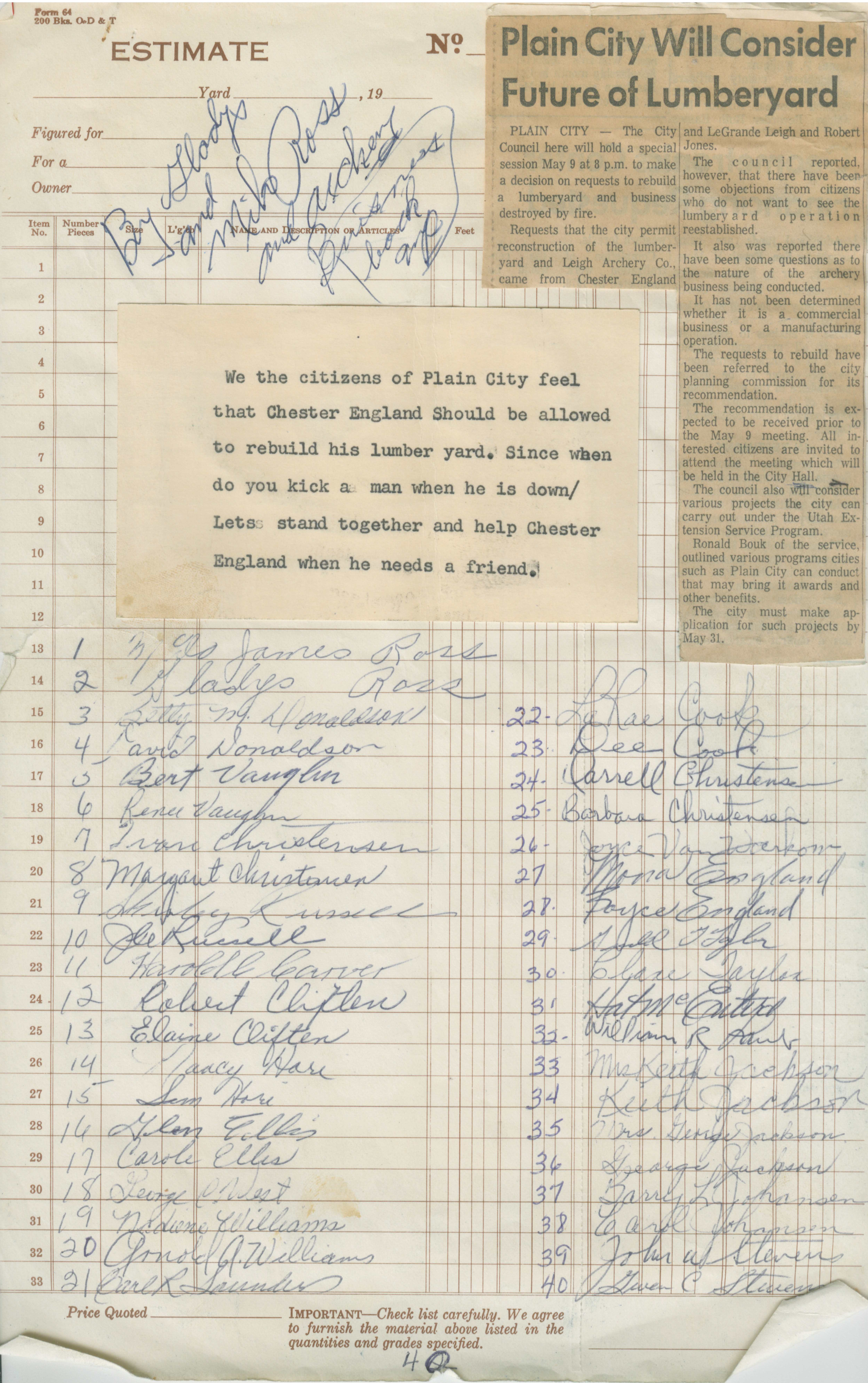
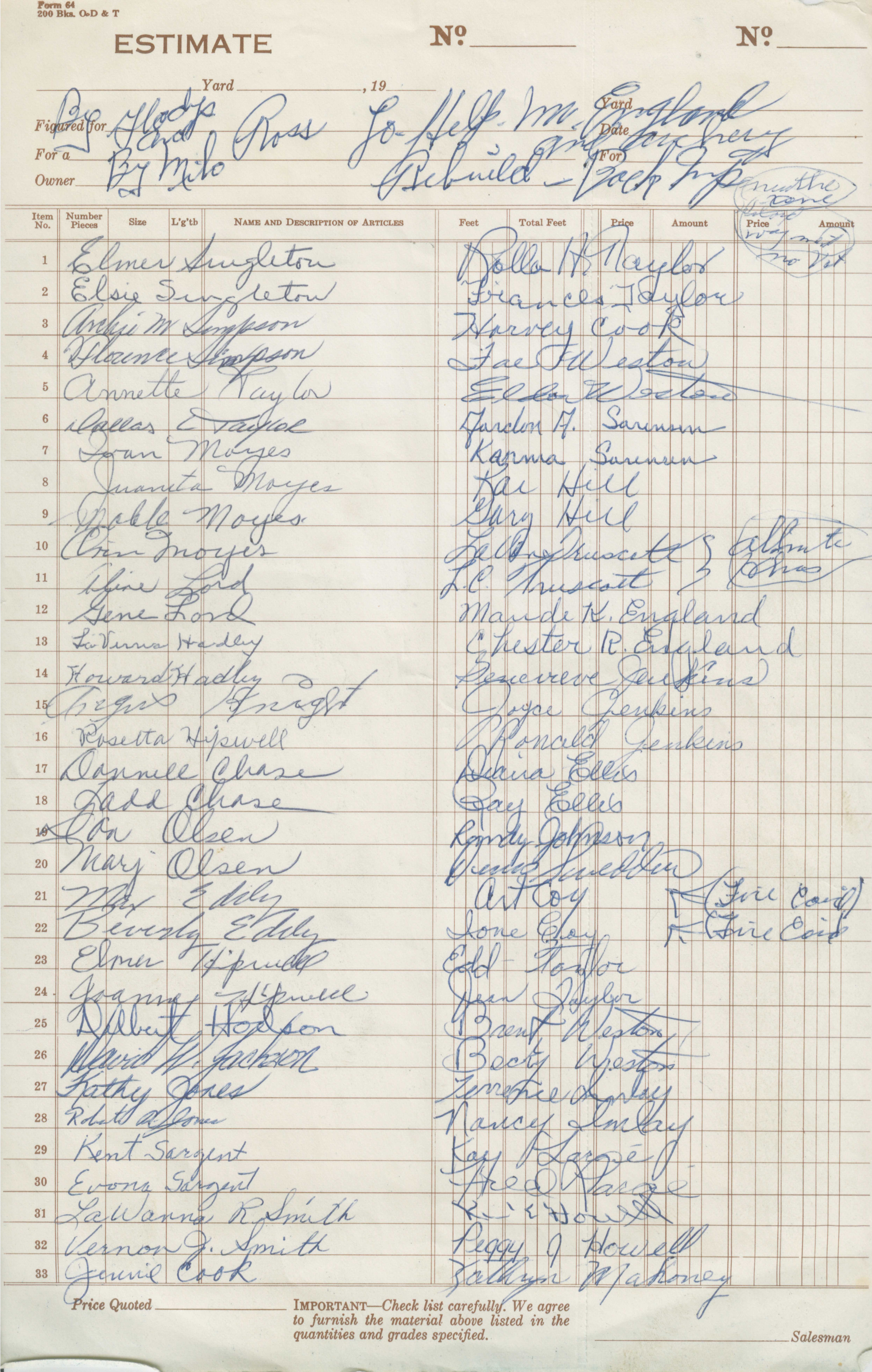
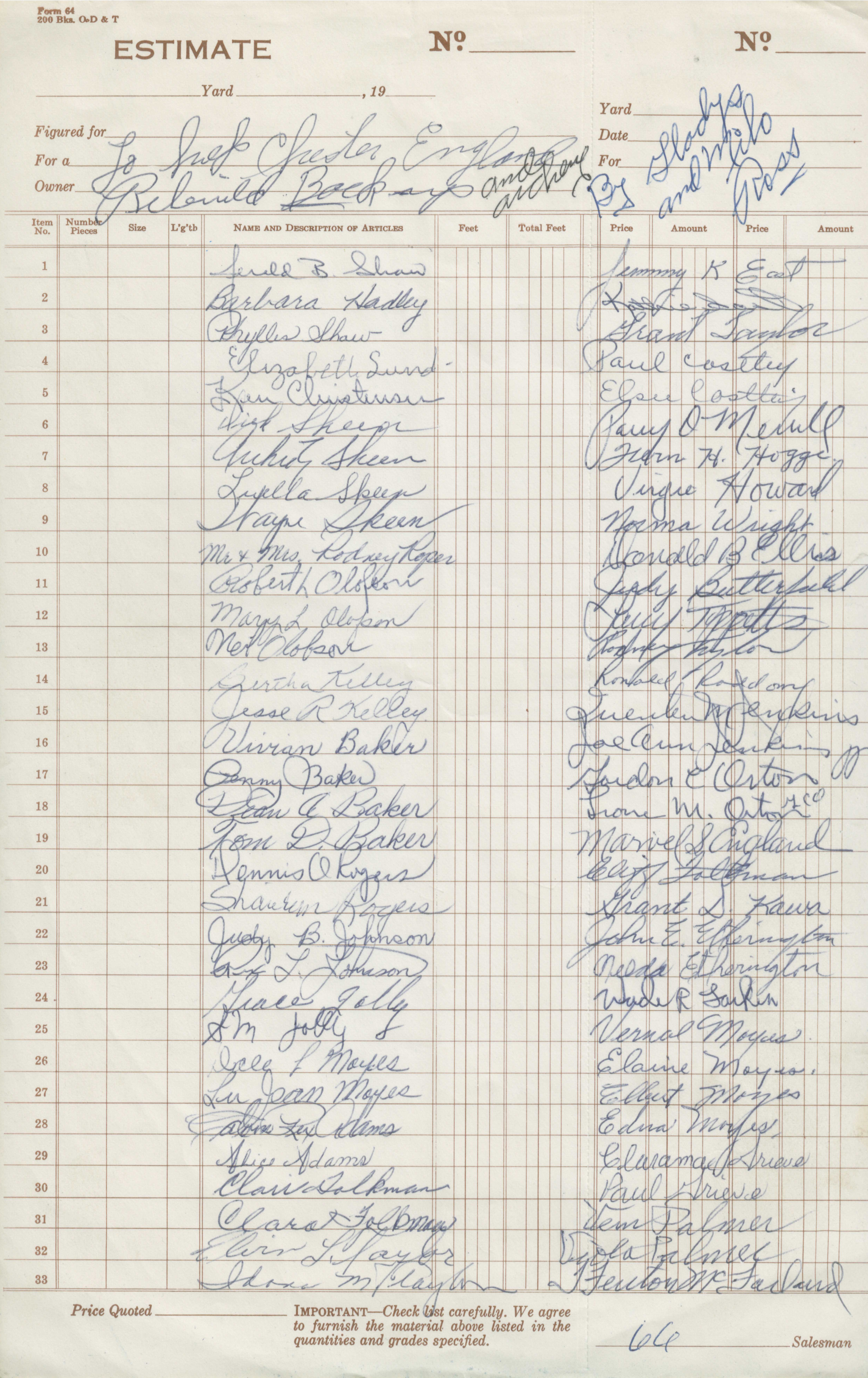
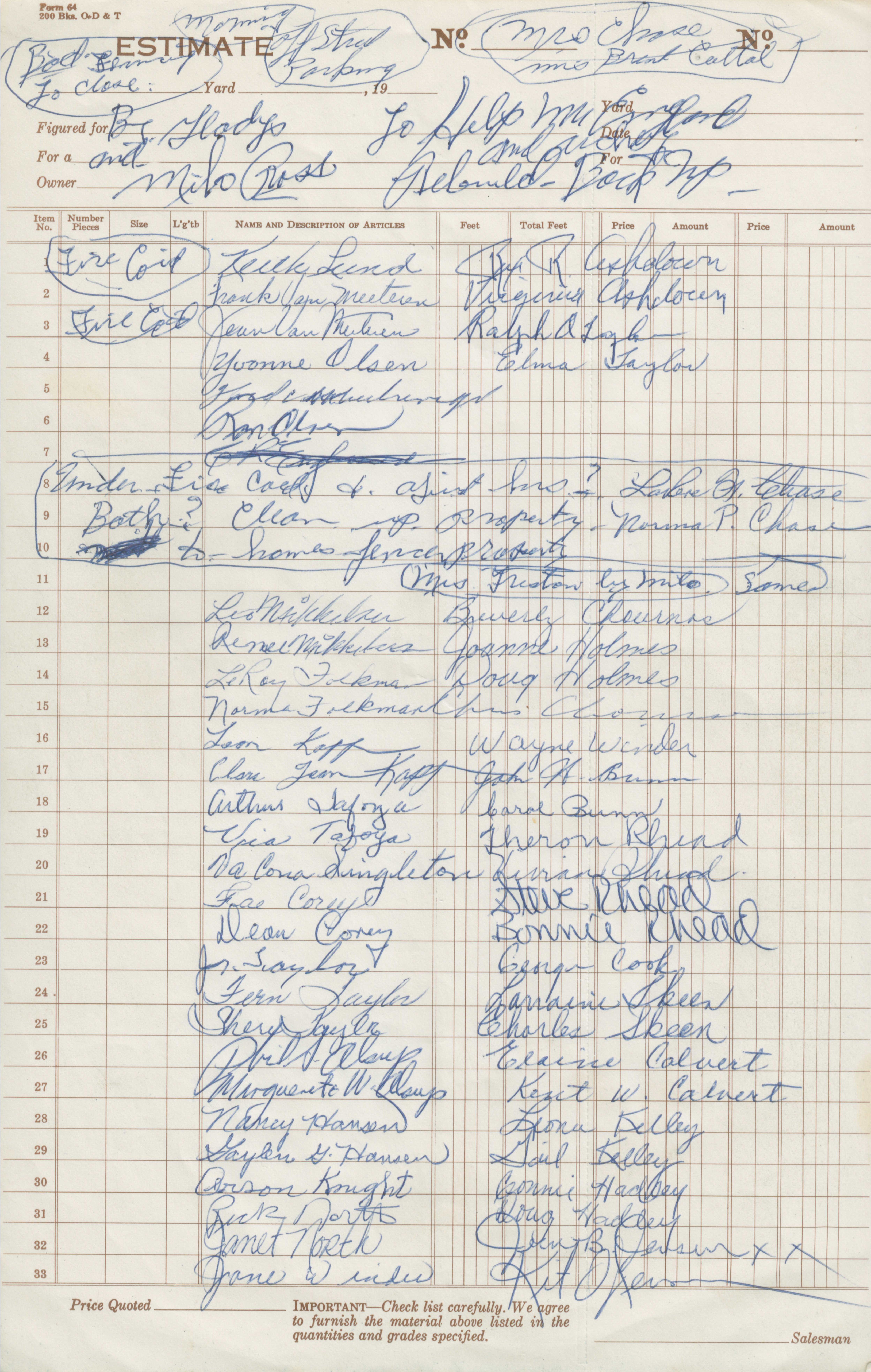
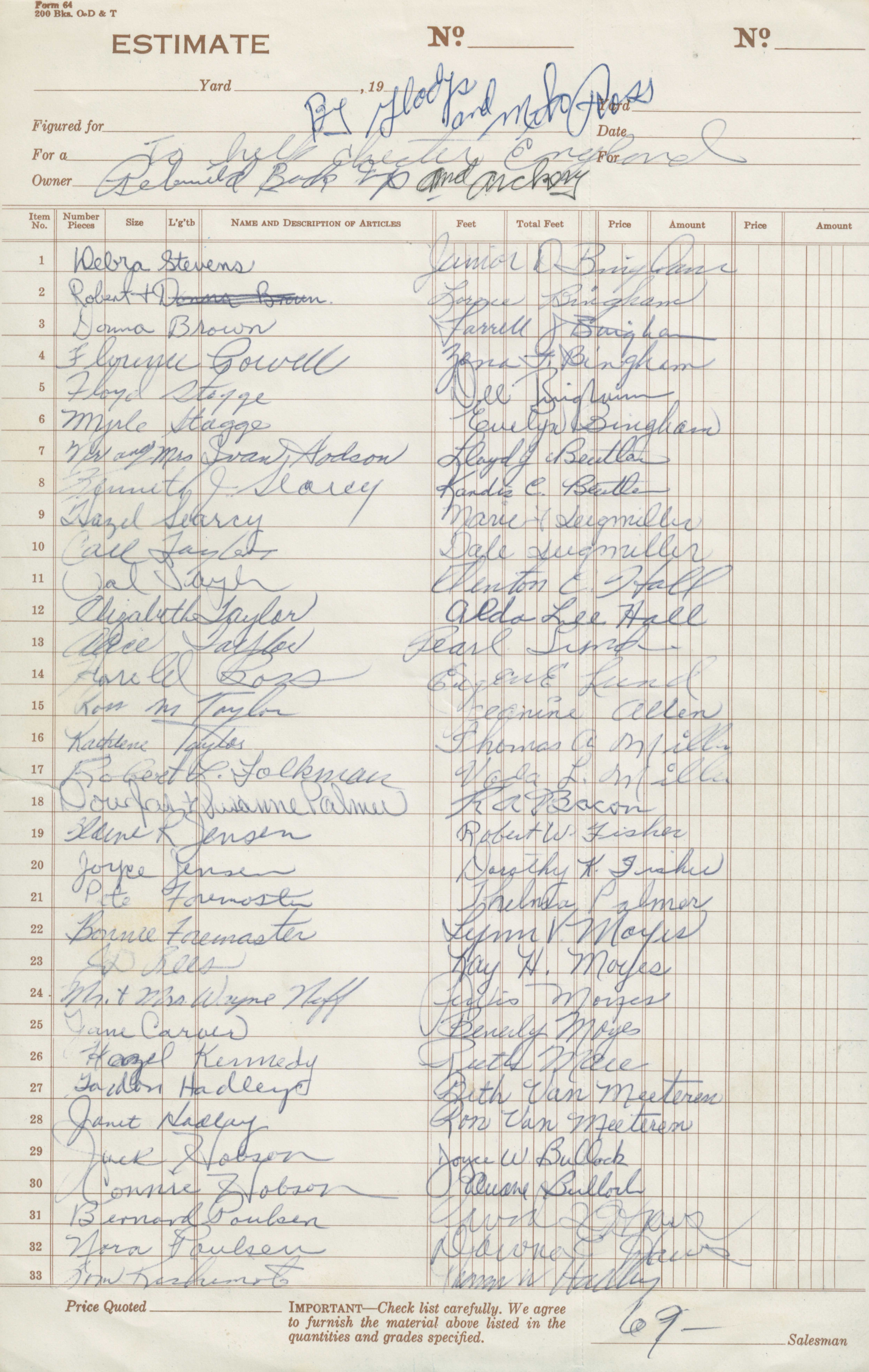
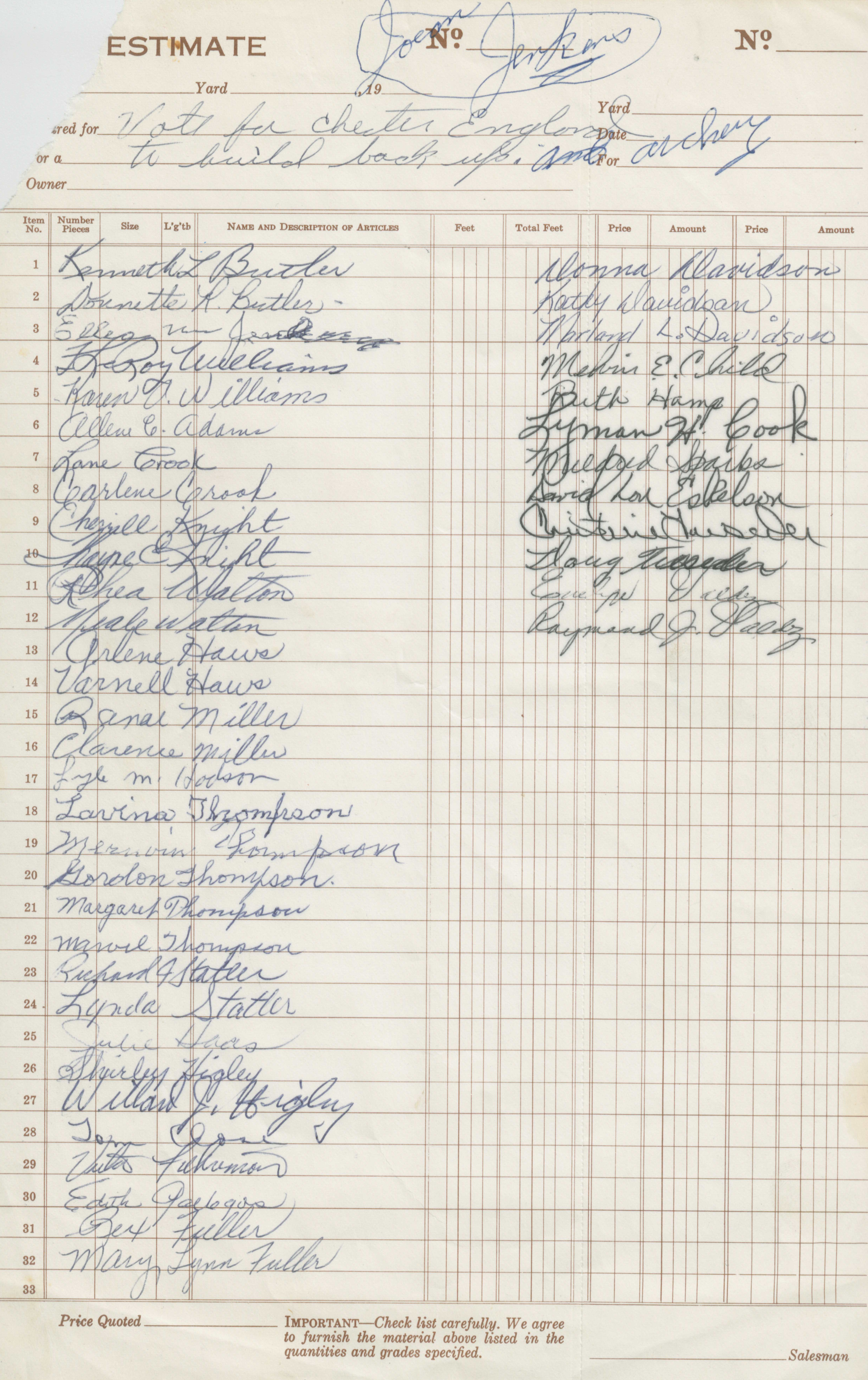
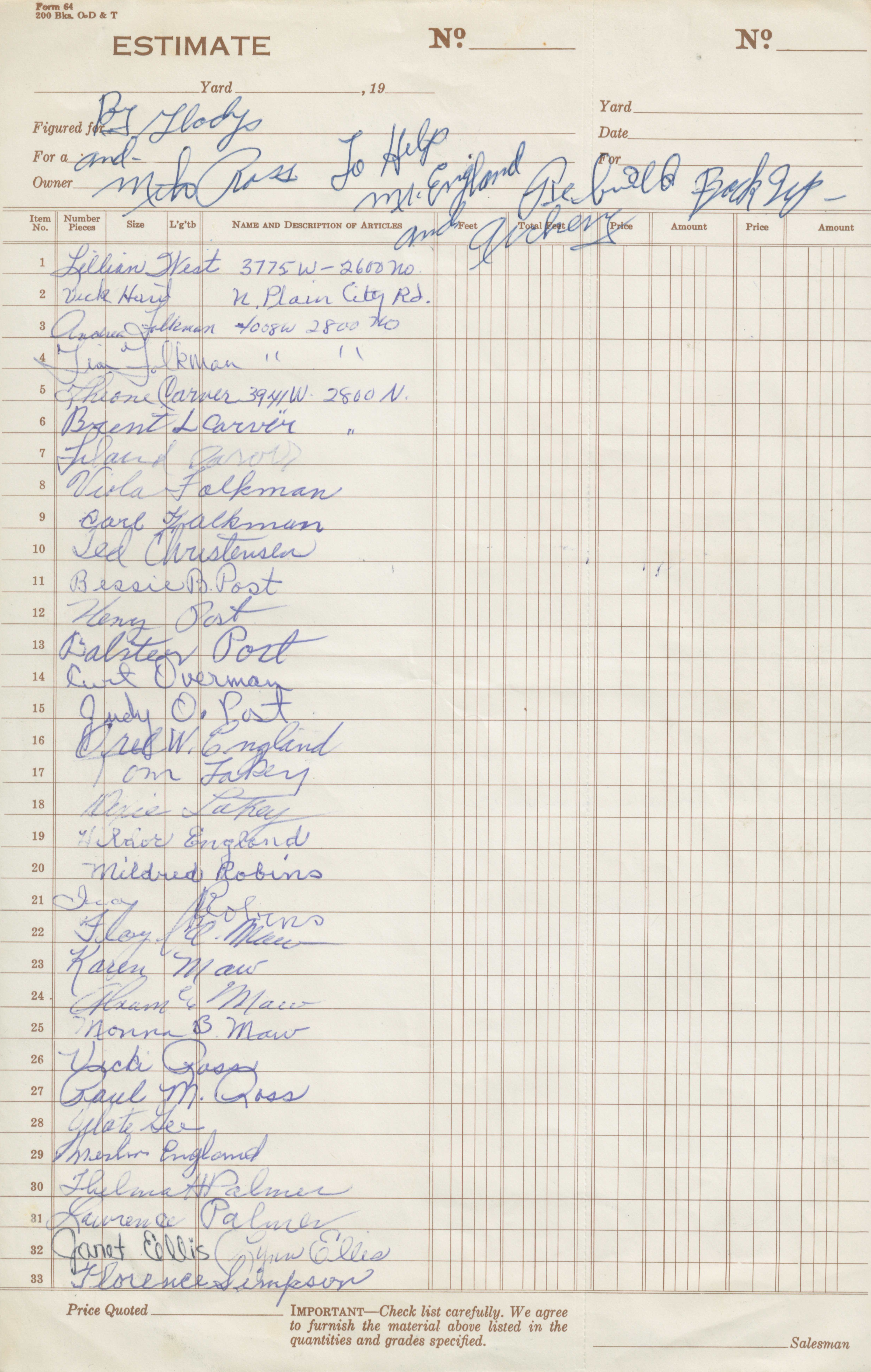
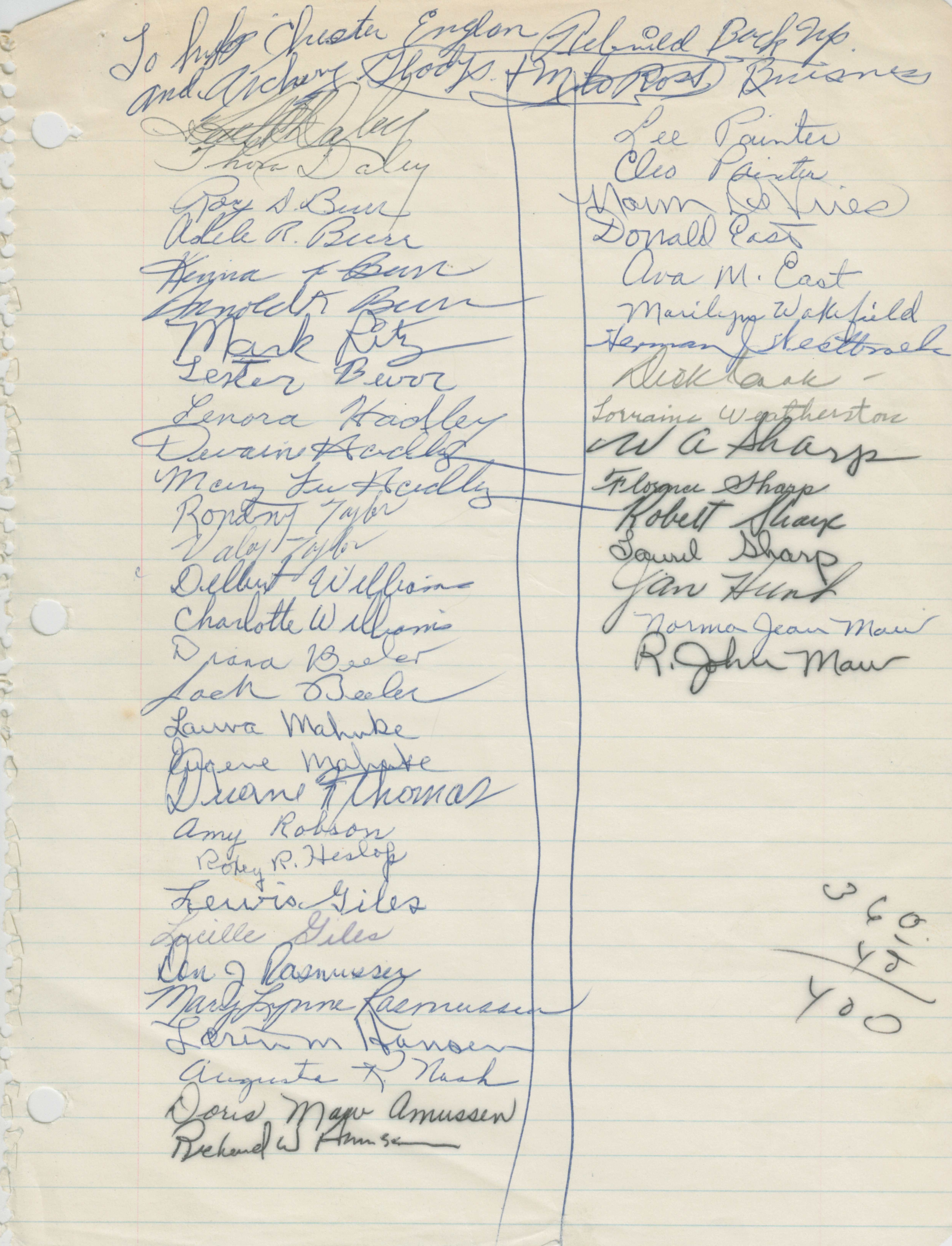
When a fire consumed Chester’s lumber yard on the evening of 6 April 1974, his neighbors rose to defend him to allow him to rebuild. Among those neighbors were my grandparents, Milo and Gladys Ross. What they did in the weeks that followed is documented below — eight pages of signatures collected on lumber yard estimate forms, a newspaper clipping, and a typed petition text. This post tells the story behind those pages.
Chester and Maude
Chester Rodney England was born 12 November 1896 in Plain City to William and Ismelda Thueson England. He grew up there, attended Weber Academy, and in 1916 married Maude Vivian Knight — a Plain City girl herself, born in August 1897. One month after their marriage, Chester received a mission call to the Southern States. He was set apart on 5 December 1916 by Apostle Anthony W. Ivins and left his new bride on 6 December 1916, serving for two years. He returned to find Utah in the grip of the 1918 influenza epidemic, his wife under quarantine, and her sister Elizabeth Knight Ericson dead. His mother was also ill, and he spent a week with his aunt Laura England before he could be with his family.
Chester wrote his own history late in life, and his voice is direct. After the mission he worked at the Amalgamated Sugar factory, farmed through the winters, bought a small Ford truck, and began hauling produce to the stores up through Cache Valley. “I found I could make more money doing this than farming,” he wrote, “so I turned the farm back to my father.” On 24 October 1919, his first son, Eugene Knight England, was born in Ogden. On 6 March 1923, his second son, William Knight England, followed. Two daughters, Rosemary and Carol, completed the family.
Milo James Ross (1921–2014)
In 1924 the Weber Central Dairy Association organized and asked for bids to truck milk from the dairymen into the dairy on 19 Washington Boulevard in Ogden. Chester submitted his bid, was accepted, and trucked the first load. He delivered milk in the morning and hauled potatoes up through Cache Valley in the afternoon. Gene and Bill grew up in the business. During summers Chester took them along on the long hauls, building a shelf of boxes out from the cab seat so they could nap on the road. He made sure they always had a bottle of pop at each stop.
During World War II, while Gene and Bill served in the military, Chester hauled Mexican bananas coming into the country at El Paso, Texas, distributing them throughout Utah. Gene served in the 77th Infantry Division at Okinawa, earning the Bronze Star for crawling under fire to drag a wounded soldier to safety — 129 men went up to the escarpment, 27 came back after 72 hours. Bill served in the Air Force in the Philippine Islands from 1943 to 1946. The two brothers found each other on Cebu using a coded letter — Gene had written his middle initial as “B” to signal his location — and Bill arrived with a mattress, making Gene the only man in his division sleeping on something other than a canvas cot. A letter written from the Hotel Keystone in San Diego in May 1946 — Chester on the road at age 49 — gives a picture of those years on the home front. He writes to his wife about a load of bananas, his plans to buy a semi-trailer, and his satisfaction that Gene and Bill are doing well.
Shortly after their return from service, Gene and Bill joined Chester hauling produce. Their first postwar hauls included lumber from Oregon back to Utah, and it was that trade that gave the family firsthand knowledge of the lumber market. The first diesel truck — a used 1940 Kenworth conventional — was purchased during this period. As the business grew, the company also ran two packing sheds and a storage facility for Idaho potatoes at its peak. Around 1957, an unforeseen change in the potato hauling market prompted Gene and Bill to file applications for ICC licenses to haul all kinds of freight, opening an entirely new range of products and geographic lanes. That same year, C.R. England offered 72-hour coast-to-coast service, the first such offering available to American shippers. The first trip east was made by driver Robert Gould in a new 1959 Kenworth, tractor number 17, hauling produce from California to Philadelphia.
In the 1950s Chester stepped back from trucking, leaving Gene and Bill to run what had become C.R. England & Sons. He returned his attention to Plain City. As he wrote: “Our sons retired me from C.R. England & Sons so I started building homes on our property in Plain City. I soon decided I needed a lumber yard if I was going to continue to build. In 1960 I built a lumber yard on the property just west of the home we had sold.” The family’s years hauling lumber from Oregon had given Chester intimate knowledge of the lumber trade, and that knowledge informed the decision. He built three homes on adjacent property and sold them to Keith Lund, Ray Cottle, and Blaine Gibson. He built 25 homes in Plain City and many others throughout Weber County. He built a 12-unit apartment complex in Roy. He took second mortgages from young couples who could not otherwise buy. “It was a great satisfaction to have young couples come and tell me they would never have bought their homes without my help,” he wrote.
Maude was with him through all of it. Born in Plain City in August 1897, she never really left. She served as president of the Plain City Primary, held positions in the Relief Society throughout her life, and attended the Ogden Temple with Chester twice a week when they could manage it. She died in Plain City on 12 February 1982, having lived there her entire 84 years. Chester moved to Salt Lake City after her death and died there on 5 January 1989. He is buried beside her in Plain City Cemetery.
The Sugar Factory
The sugar factory was woven into both families long before the fire. The Amalgamated Sugar Company plant at Wilson Lane, just south of Plain City, was one of the economic anchors of Weber County from the early twentieth century onward. Plain City farmers hauled beets to the rail dumps each fall for decades; the railroad that came to Plain City in 1909 arrived largely to move beet cars to that factory. Chester England worked at the sugar factory himself after returning from his mission in late 1918, spending two winters there before he turned to farming and then trucking.
Milo’s father, John “Jack” Ross, worked for Amalgamated Sugar much of his adult life, following the company between its Ogden, Burley, and Paul, Idaho plants as work demanded. That movement accounts for the geography of the Ross children: Milo was born in Plain City in 1921, his brother Paul born in the town of Paul, Idaho in 1922, and Harold born in Burley in 1924. Amalgamated Sugar built its Paul factory in 1917, and families from the Plain City area followed the work north. The factory experienced difficult early years — a postwar agricultural depression after World War I, and then the beet leafhopper blight that devastated crops through the 1920s and into the 1930s — but it survived to become, in time, the largest sugarbeet processing facility in the world. Chester England and Jack Ross were contemporaries who had worked for the same company in the same corner of northern Utah before either of them had settled into the lives their families would remember them by. For more on the sugar factory’s role in Plain City’s history, see History of Plain City Pt. 1.
The Cradle of American Trucking
Chester England’s 1920 Model T purchase was the seed of something considerably larger than one family’s business. Four major American trucking companies trace their origins directly to Plain City, and all four connect back to Chester. The Standard-Examiner and C.R. England’s own history have documented this story in detail.
C.R. England & Sons grew steadily through the postwar decades into one of the largest refrigerated carriers in the United States, eventually operating a fleet approaching 4,000 trucks and headquartered in Salt Lake City. Gene England served as president of the company well into his later years, still coming into the office daily at age 88. He died on 13 November 2024 at the age of 105. Bill England, who married Fern Hadley — a Plain City Hadley, the same family that signed the petition — died on 28 March 2018 at age 95. He spent his last ten years without sight but maintained, as his family recorded, an extraordinary optimism throughout. He entitled his life history “It Is As Good As It Gets.”
Carl Moyes had driven trucks for C.R. England in his younger years. In the late 1950s, Carl and his wife Betty started B&C Truck Leasing in Plain City. In 1966, when their son Jerry graduated from Weber State College, the family moved to Phoenix, Arizona and formed the company that would eventually become Swift Transportation — for many years the largest truckload carrier in the United States. Jerry Moyes later observed that he liked to say there was “diesel in the water” in Plain City, and that the people there were conceived in sleeper cabs.
In 1990, brothers Kevin and Keith Knight and their cousins Randy and Gary Knight left Swift to found Knight Transportation. All four had grown up in Plain City and gotten their start working for the Moyes family’s Swift Transportation. The Knights were also related to Maude Knight, who had married Chester England in 1916, making them family to the man who started the Plain City trucking tradition. Knight Transportation started with five trucks; four years after going public the company had between 250 and 300. Knight and Swift announced a merger in April 2017, creating Knight-Swift Transportation, valued at an estimated $5 billion with approximately 23,000 tractors and 77,000 trailers.
In 1976, Jeff England — Gene’s oldest son and Chester’s grandson — bought his first truck while still working at C.R. England as an owner-operator, initially under the name “Pride of England Enterprises.” In 1979, with three trucks and a haul contract moving produce from California to New York, he left the family firm to go fully independent. His wife Pat was his partner from the beginning. In the early 1980s he assembled a group of investors, purchased ten more trucks, and rebranded as Pride Transport Inc. By 2017 the company operated a fleet of 500 trucks. In 2012 Jeff passed ownership to his son Jay England. Jeff England said of his decision to leave: “I felt that I needed to do my own thing.” He was 76 at the time of that interview and still driving a truck a couple of times a month.
The fuel infrastructure serving these fleets also has roots in this region. O. Jay Call, who came to Willard, Utah in the mid-1960s, founded Flying J in 1968, naming it for his love of flying, and built it into the largest retailer of diesel fuel in North America. His uncle, Reuel Call, had founded Maverik convenience stores in 1928 in Afton, Wyoming. FJ Management acquired Maverik in 2012. The Call family’s fuel network and the England-Moyes-Knight trucking empire developed in the same northern Utah environment across the same decades.
In September 2022, representatives of all four trucking firms gathered at Peery’s Egyptian Theater in Ogden for the premiere of a documentary about their shared origins. Gene England, then 102 years old, was present on stage alongside Jeff and Dan England, Jerry Moyes, and Kevin Knight.
The Fire
On the evening of 6 April 1974, Chester England went over to open up the lumber yard. He was 77 years old.
He described what followed in his own autobiography:
As I opened the office door, the place exploded and was engulfed with flames. It had been smoldering during the night. We do not know what caused it but it burned everything. I ran in to get the invoices but the ceiling began falling and burned holes in my jacket so I could have lost my life. This was a terrible experience watching everything you have worked hard for go up in flames. I was down in bed for 10 days from shock. We had insurance on it but I had been buying so much merchandise that the insurance didn’t begin to pay for the loss. I appreciated the fire department and the ward members who worked so hard to help. It took many weeks after to clean up. My family thought I should retire and not build it up again. However, I knew I wouldn’t be happy without something to do so I started rebuilding as soon as I could.
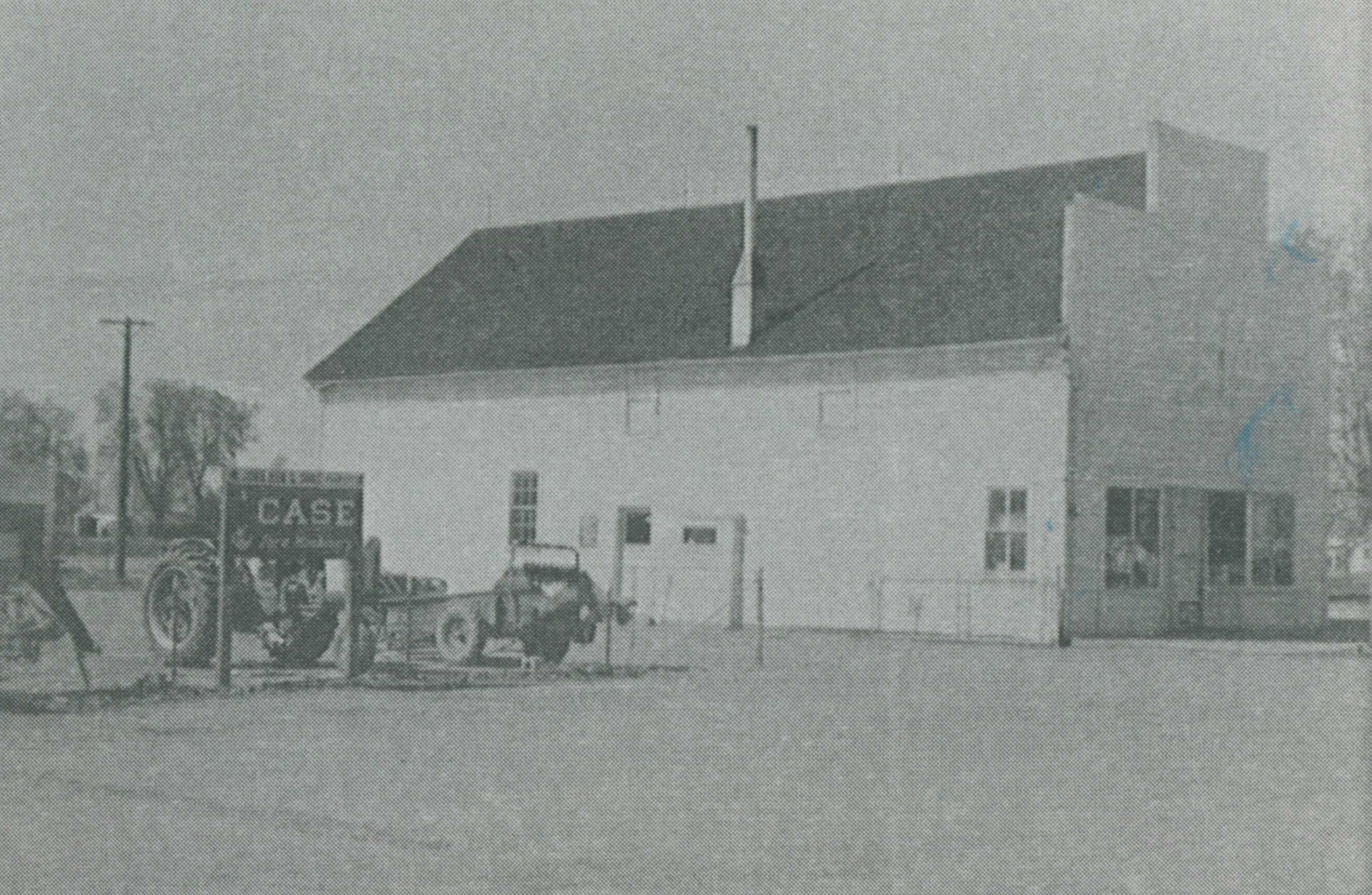
The 1977 History of Plain City records the fire at “England Builder’s Lumber Company” and gives the date as April 6, 1975. That date appears to be a transcription error in the town history; Chester’s own autobiography gives 6 April 1974, and that account is the primary source. The fire also destroyed the adjacent Leigh Archery Company, operated by LeGrande Leigh and Robert Jones. The insurance fell short. Chester was 77 and his family urged him to retire. He refused.
Plain City Will Consider Future of the Lumberyard
A newspaper clipping, attached to the first petition page, reported what happened next:
PLAIN CITY — The City Council here will hold a special session May 9 at 8 p.m. to make a decision on requests to rebuild a lumberyard and business destroyed by fire.
Requests that the city permit reconstruction of the lumberyard and Leigh Archery Co. came from Chester England and LeGrande Leigh and Robert Jones.
The council reported, however, that there have been some objections from citizens who do not want to see the lumber operation reestablished.
It also was reported there have been some questions as to the nature of the archery business being conducted. It has not been determined whether it is a commercial business or a manufacturing operation.
The requests to rebuild have been referred to the city planning commission for its recommendation. The recommendation is expected to be received prior to the May 9 meeting. All interested citizens are invited to attend the meeting which will be held in the City Hall.
The council also will consider various projects the city can carry out under the Utah Extension Service Program. Ronald Bouk of the service outlined various programs cities such as Plain City can conduct that may bring it awards and other benefits. The city must make application for such projects by May 31.
Some citizens did not want Chester to rebuild. And so his neighbors organized.
Milo and Gladys Ross
Milo and Gladys Ross, 30 May 1942
Milo James Ross (1921–2014) was born 4 February 1921 in a log cabin just north of Plain City. His mother, Ethel Sharp Ross, died of puerperal septicemia in August 1925 when Milo was four years old, leaving three surviving boys. Milo went to live with his Uncle Ed Sharp, Harold with Uncle Dale Sharp. They were raised in separate homes within a few blocks of one another in Plain City, the extended Sharp family absorbing the loss. For more on the Sharp family’s tragedies, see Sharp Tragedies.
Milo grew up working Ed Sharp’s farm — tending onions, hauling salt from the flats at Promontory, doing whatever needed doing. He played baseball with the Plain City Farm Bureau team and attended Weber High School.
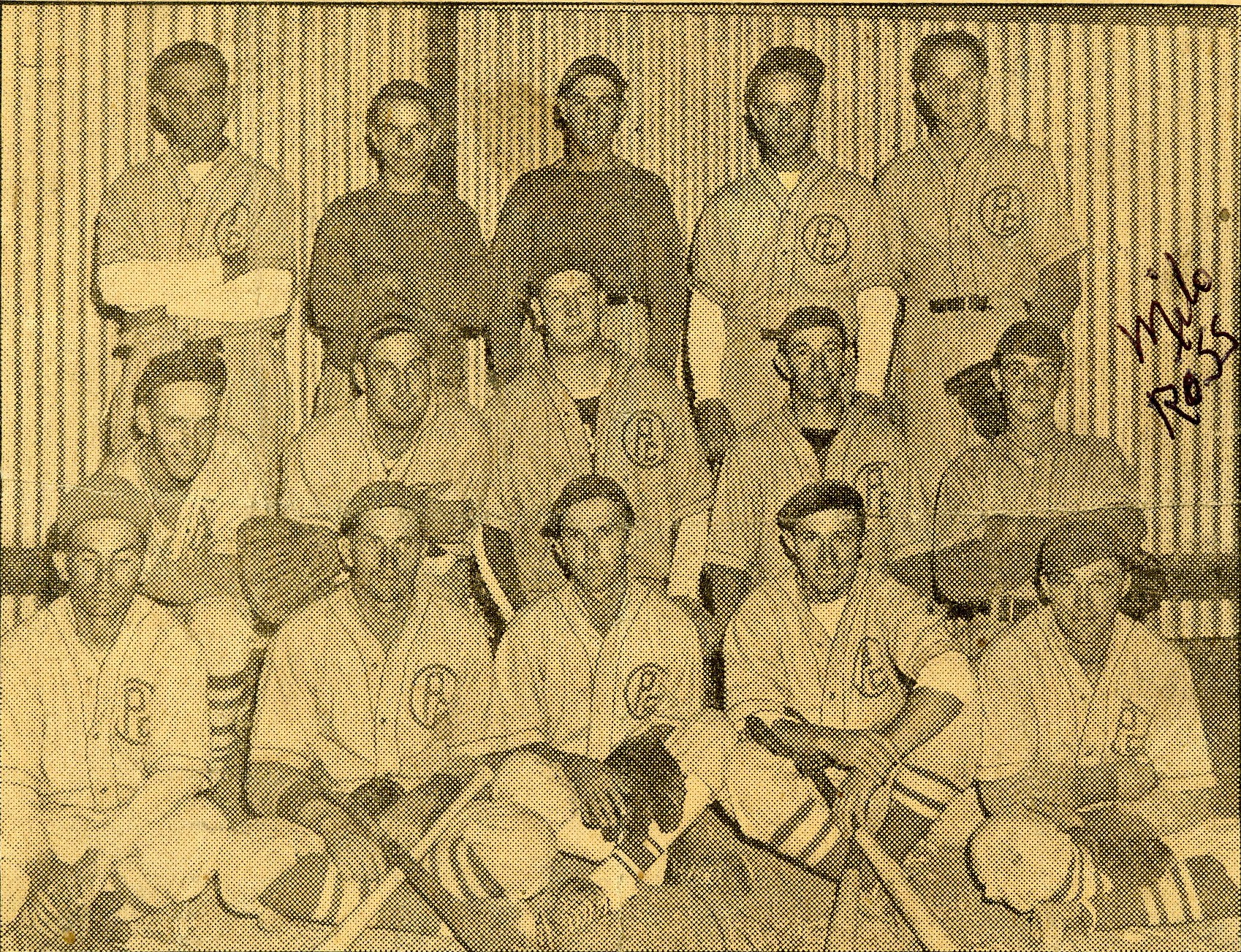
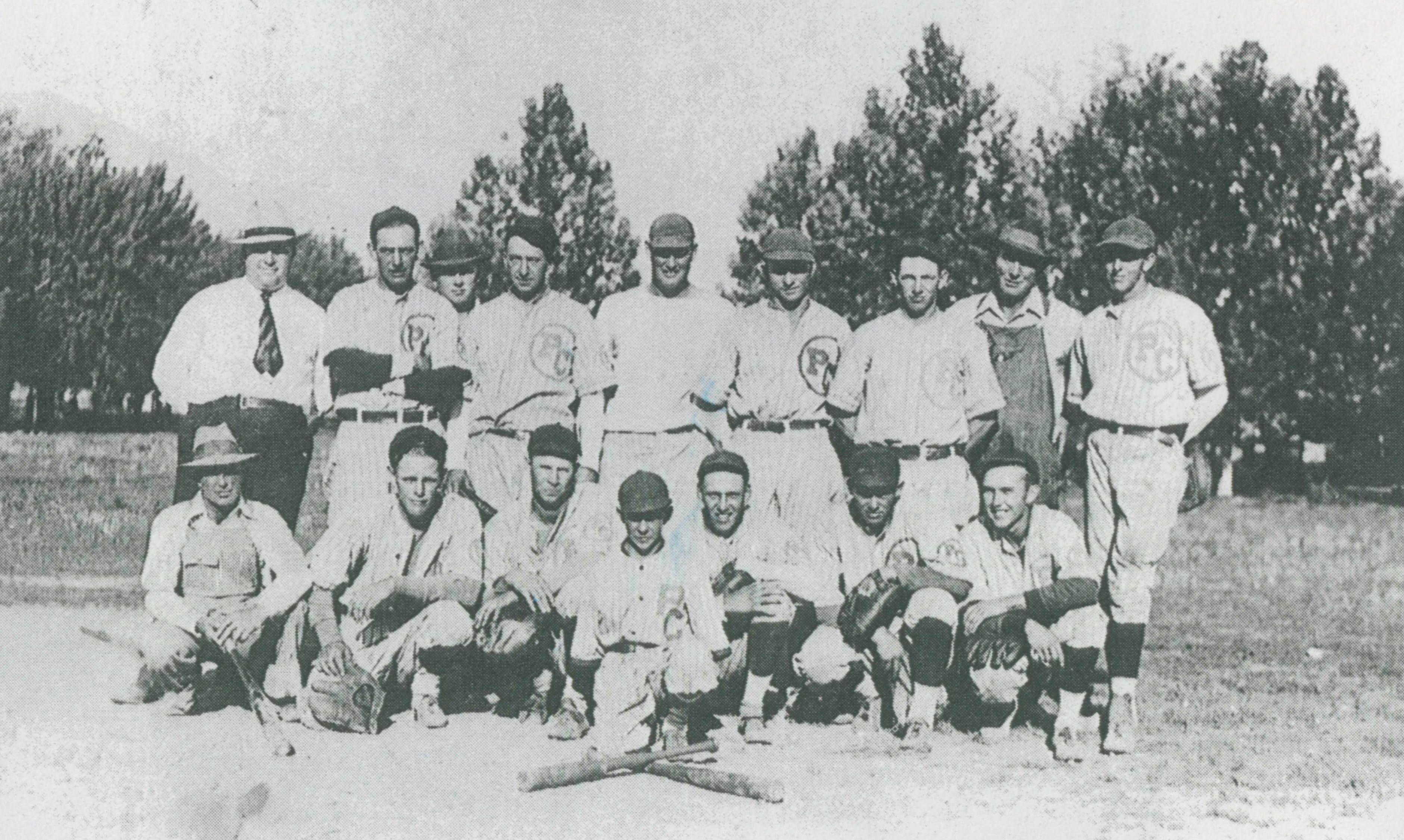
Plain City baseball team. Back (l-r): William Freestone (manager), Norman Carver, Glen Charlton, Fred Singleton, Elmer Singleton (1918–1996). Middle: Clair Folkman, Dick Skeen, Albert Sharp, Abe Maw, Milo Ross. Front: F. Skeen, Walt Moyes, Arnold Taylor, Lynn Stewart, Theron Rhead. See also: Plain City Hurler.
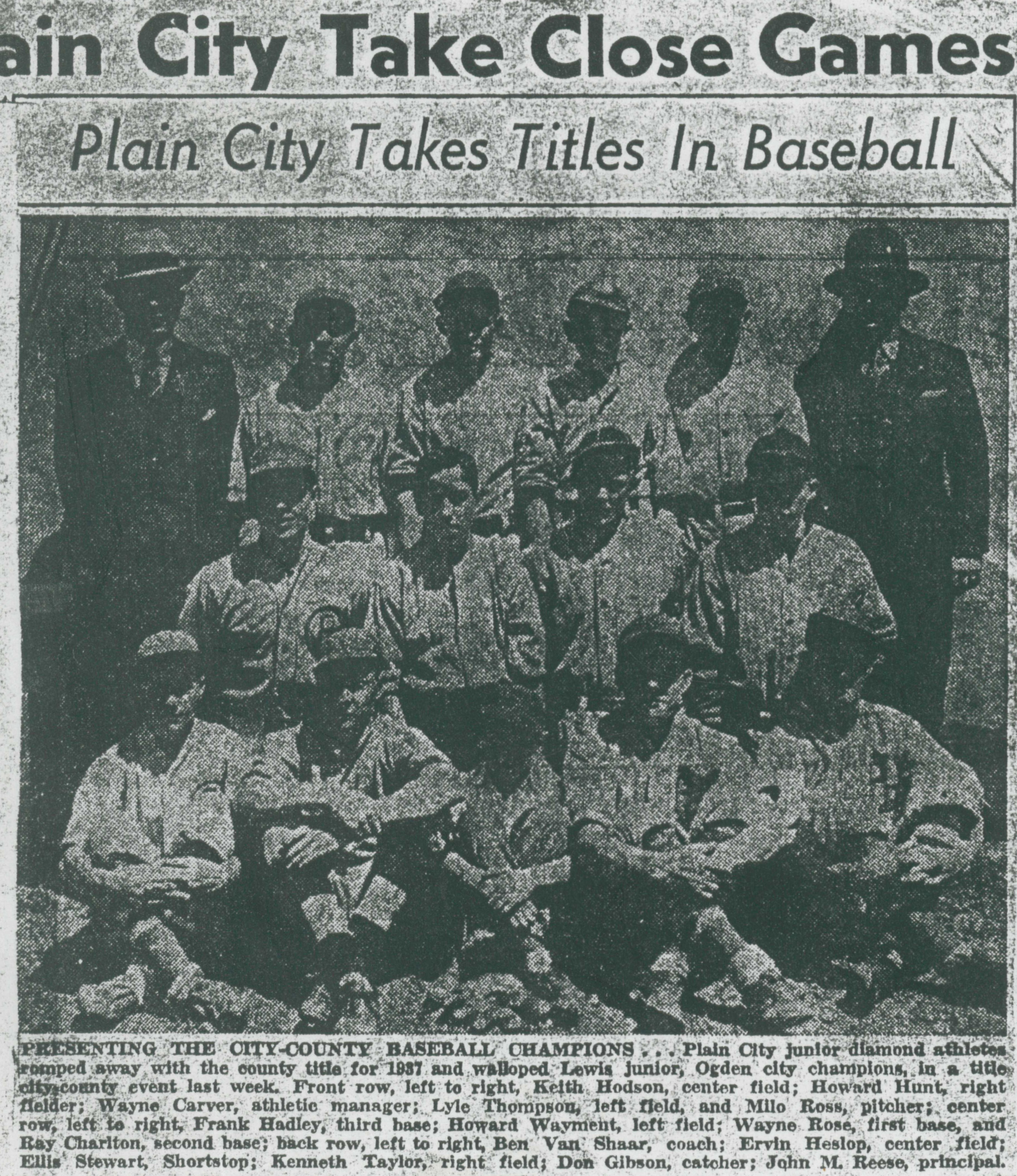
1937 Plain City Baseball Champions. Back (l-r): Ben Van Shaar, Ervin Heslop, Ellis Stewart, Kenneth Taylor, Don Gibson, John Reese. Middle: Frank Hadley, Howard Wayment, Wayne Rose, Ray Charlton. Front: Keith Hodson, Howard Hunt, Wayne Carver, Lyle Thompson, Milo Ross.
In 1940 Milo met Gladys Maxine Donaldson (1921–2004) at a Plain City celebration. They married on 4 April 1942. Six months later Milo enlisted in the Army. He served in the 33rd Infantry Division, 130th Regiment, Company C, trained in weapons and earned expert ranking. He arrived in Hawaii on 4 July 1943 — the same day his son, Milo Paul, was born in Utah, a son he would not meet for three years. He fought through the jungles of New Guinea and the Philippines and was present at the Japanese surrender at Luzon in June 1945. He received two Purple Hearts and the Silver Star. His company received a Presidential Citation for outstanding performance during the seizure of Hill X in the Bilbil Mountain Province. For more on Milo’s military service, see Milo James Ross Military Medals and his 1997 oral history interview.
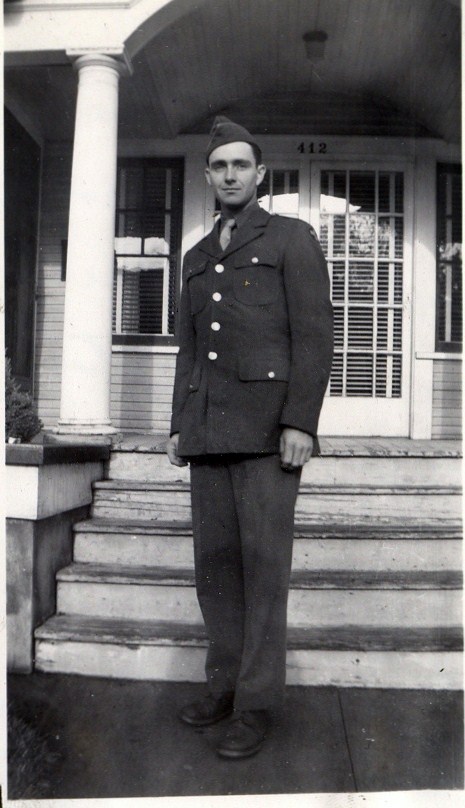
Milo Ross in uniform at Fort Lewis, Washington
He came home and went to work as a contractor and builder, eventually building and remodeling hundreds of homes throughout Utah, mostly in Weber County. That work is why, when the time came to gather signatures for Chester England, he had a pad of lumber yard estimate forms at hand. They were his working tools. He pressed them into service as petition pages.
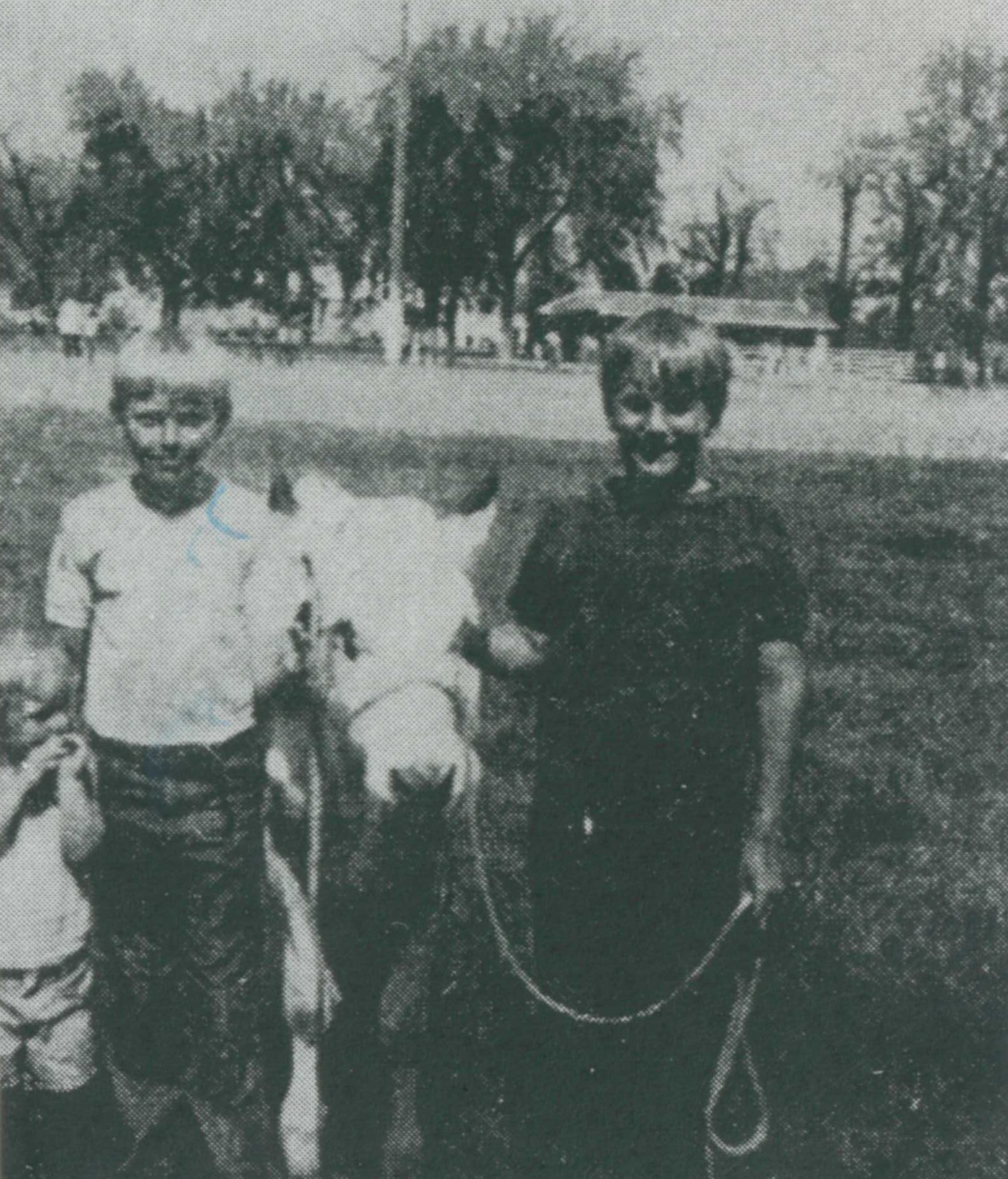
Milo knew Chester England personally. A childhood photograph survives showing Milo alongside Harold Ross, Howard Hunt, Josephine Sharp, and Janelle England on horseback — the England and Ross and Sharp children together in the neighborhood as naturally as their parents moved among one another. In his 1997 oral history interview, Milo recalled Chester among the Plain City men who had struggled during the Depression years, when banks failed and farms were lost. Chester was woven into Milo’s memory of Plain City going back to his earliest years.
On Horse l-r: Harold Ross, Howard Hunt, Milo Ross, Josephine Sharp (arm only), Janelle England, Eddie Sharp. In front l-r: Ruby Sharp, Lucille Maw, and Milo Riley Sharp.
The Petition
The typed text at the center of the petition read:
We the citizens of Plain City feel that Chester England should be allowed to rebuild his lumber yard. Since when do you kick a man when he is down/ Lets stand together and help Chester England when he needs a friend.
The headers on the petition pages identify the organizers: “By Gladys and Milo Ross — To Help Mr. England — Rebuild Back Up.” The forms were passed through the community in the weeks leading up to the May 9 city council meeting. One page was circulated by Joan Jenkins.
My father, Milo Paul Ross, had worked for Chester England as a teenager. He and his first wife, Victoria “Vicki” Feldtman (1945–2018) — married 5 March 1963 — both signed the petition. For more on Vicki, see Vicki’s Class Pictures. My grandfather Harold Ross also signed. The Sharp cousins — W.A. Sharp and Florence Sharp, children of the family that had raised Milo and Harold — signed as well. Maude K. England and Chester R. England signed the petition themselves.
Among the more than 340 signers, the connections to Plain City’s history run deep. The Moyes family signed in force — the same family whose son Carl had driven trucks for Chester England and whose grandson Jerry would found Swift Transportation. The Knights signed — relatives of Maude Knight England and future founders of Knight Transportation. Elmer Singleton (1918–1996), the Plain City baseball legend who pitched in the major leagues for five teams over fifteen years, signed with his wife Elsie. Cherrill Palmer Knight (1931–2021), who had served as Plain City City Recorder and was the daughter of Vern and Viola Palmer — also signers — added her name alongside her husband Thayne (1931–2018). Roxey R. Heslop, who contributed the school and cemetery histories to the 1977 Plain City history book, also signed. Hildor England (1896–1983), born Johnson, who married into the England family, signed as well. Gordon C. Orton (1924–2008), a Plain City general contractor and World War II veteran who served in the Philippines, New Guinea, and Okinawa, signed with his wife Leone. Vernal Moyes, who had served as a Plain City councilman, signed alongside his family.
The 1977 History of Plain City records the outcome: “Builders Bargain Center, formerly England’s Builders. This business was started and run by Chester England for many years.” Chester rebuilt. The community’s voice prevailed. For more on Plain City’s history, see the Plain City series on Sagacity.
Circle A Construction
Milo Paul Ross and Larry Aslett
My father’s career at Circle A Construction was built substantially on the same industry that had shaped the England and Ross families in Plain City. Circle A, founded in 1952 in Jerome, Idaho by Marvin Aslett, hauled sugar beets for Amalgamated Sugar for most of its operating history. For roughly 34 years, from around 1971 until Circle A transferred the Paul operations to AgExpress in 2004, my father supervised beet hauls across the Magic Valley, from the fields to the Amalgamated dumps at Paul and elsewhere across southern Idaho — the same plants Jack Ross had worked in a generation before.
Marvin Aslett and Milo Paul Ross at Milo’s 20-year service recognition, 1990. See: Circle A Construction Honors.
Marvin’s sons Larry and Steve Aslett ran the company alongside my father for decades. We called Larry “Uncle Larry” growing up. The Asletts took us to roundups in Mackay, to ranch country above White Knob. I worked for Circle A myself from 1993 through 1998. My first job in 1994 was washing and waxing trucks at the old Hynes beet dump in Paul after harvest. Jack Ross had worked for Amalgamated Sugar in Paul in the 1920s. My father hauled beets to Amalgamated in Paul for three decades. Circle A’s beet hauls fed the same company in the same town across three generations of this family’s working life.
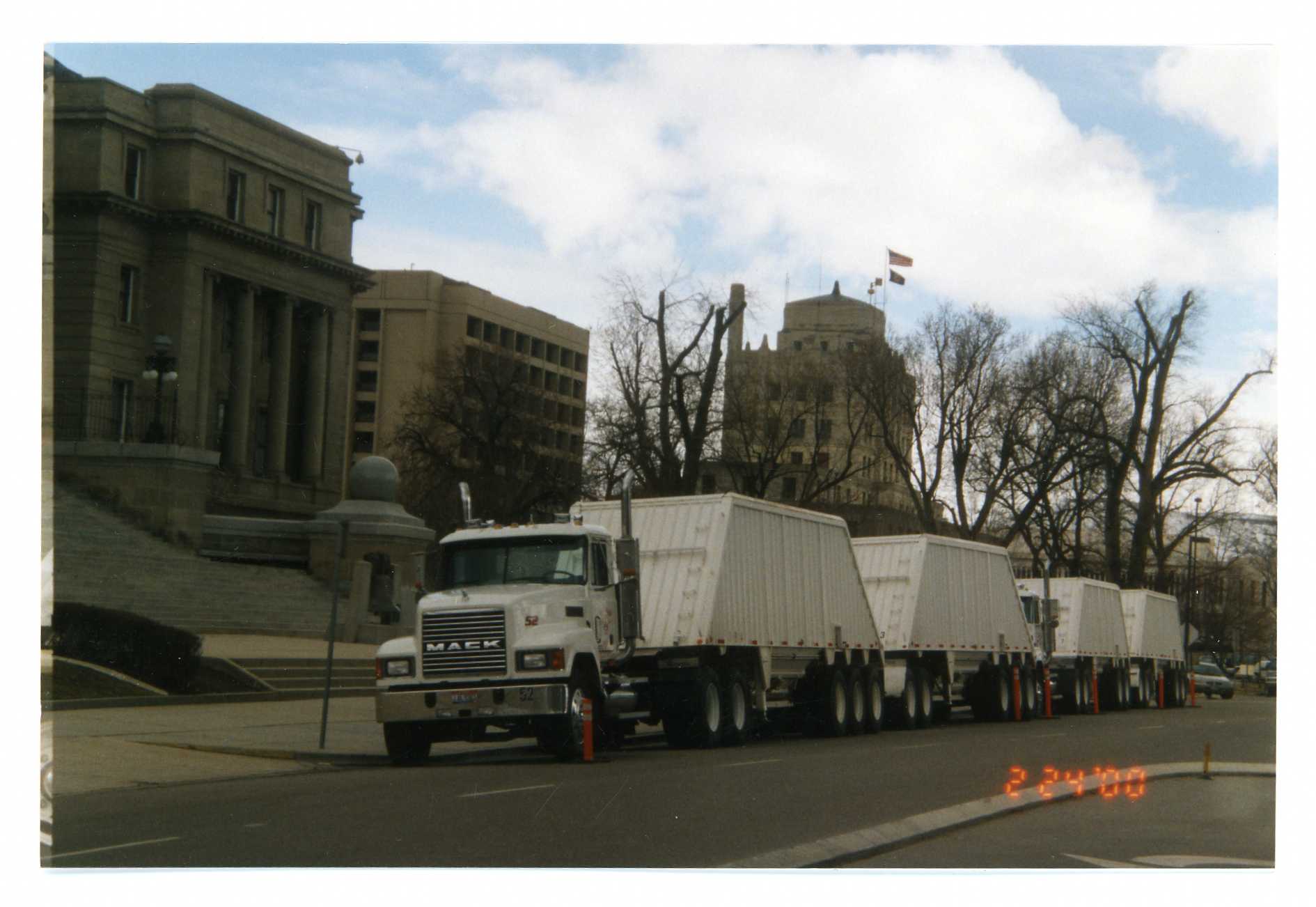
Circle A Construction trucks in front of the Idaho State Capitol, 2000
The Petition Pages
Below are all eight pages of the petition as collected by Milo and Gladys Ross in the spring of 1974.
Complete List of Signers
Names marked with an asterisk (*) represent uncertain readings of the cursive originals. Dates are given where confirmed through research. This list was transcribed from handwritten signatures; corrections and additions are welcome.
Adams, Alice Adams, Allene C. Adams, Calvin Rex Allen, Jeanine Alsup, Marguerete W.* Alsup, Phil S. Amussen, Doris Maw Amussen, Richard W. Ashdown, Rex R. Ashdown, Virginia Bacon, R.A. Baker, Dean A. Baker, Penny Baker, Tom D. Baker, Vivian Beeler, Diana Beeler, Jack Beutler, Kandis C. Beutler, Lloyd J. Bingham, Dee Bingham, Evelyn Bingham, Farrell J. Bingham, Junior D. Bingham, Lorene Bingham, Zona F. Brown, Donna Brown, Robert Bullock, Duane Bullock, Joyce W. Bunn, Carol Bunn, John H. Burr, Adle R. Burr, Arnold K. Burr, Kenna F. Burr, Lester Burr, Roy D. Butler, Donnette R. Butler, Kenneth L. Butterfield, Judy* Calvert, Elaine Calvert, Kent W. Carver, Brent Carver, Harold C. Carver, Jane Carver, Liland Carver, Theone Chase, Dannell Chase, Ladd Chase, LaRene G. Chase, Norma P. Child, Melvin E. Chournas, Beverly* Chournas, Chris* Christensen, Barbara Christensen, Darrell Christensen, Ivan Christensen, Ken Christensen, Margaret Christensen, Ted Cliften, Elaine Cliften, Robert Close, Tom* Cook, Dee Cook, George Cook, Harvey Cook, Jennie Cook, LaRae Cook, Lyman H. Corey, Dean Corey, Fae Costley, Elsie Costley, Paul Cowell, Florence Crook, Carlene Crook, Lane Daley, Kenneth* Daley, Thora Dall, Kathie* Davidson, Donna Davidson, Kathy Davidson, Marland L. DeVries, Norm Donaldson, Betty M. Donaldson, David East, Ava M. East, Donald East, Jimmy K. Eddy, Beverly Eddy, Max Ellis, Carole Ellis, Diana Ellis, Donald B. Ellis, Glen Ellis, Janet Ellis, Lynn Ellis, Ray England, Boyce England, Chester R. (1896–1989) England, Hildor (1896–1983) England, Marvel S. England, Maude K. (1897–1982) England, Merlin England, Mona England, Orel W. Eskelson, David Lon Etherington, John E. Etherington, Nelda Fisher, Dorothy K. Fisher, Robert W. Folkman, Andrea Folkman, Carl Folkman, Clair Folkman, Clara Folkman, Cliff Folkman, Jim Folkman, LeRoy Folkman, Norma Folkman, Robert L. Folkman, Viola Foremaster, Bonne* Foremaster, Pete Fuller, Mary Lynn Fuller, Rex Fuhriman, Viola Gallegos, Edith Gee, Vilate Giles, Lewis Giles, Lucille Grieve, Claramae Grieve, Paul Haas, Julie Hadley, Barbara Hadley, Connie Hadley, Devaine Hadley, Doug Hadley, Gordon Hadley, Howard Hadley, Janet Hadley, Karma W.* Hadley, LaVirra* Hadley, Lenora Hadley, Mary Fee* Hamp, Beth Hansen, Gaylen G. Hansen, Loren M. Hansen, Nancy Havseler/Tesseder, Christine* Haws, Arlene Haws, Darwin C. Haws, Varnell Heslop, Roxey R. Higley, Shirley Higley, Willard J. Hill, Gary Hill, Kae Hipwell, Elmer Hipwell, Joanne Hipwell, Rosetta Hobson, Connie Hobson, Jack Hodson, Delbert Hodson, Lyle M. Hodson, Mr. Ivan Hodson, Ms. Ivan Holmes, Doug Holmes, Joanne Hori, Nancy Hori, Sam Howard, Virgie Howell, Kent* Howell, Peggy J. Hunt, Jan Hurst, Vick* Imlay, Nancy Imlay, Terrence Jackson, David W. Jackson, George Jackson, Mrs. George Jackson, Mrs. Keith Jackson, Keith Jenkins, Ellen W. Jenkins, Genevieve Jenkins, Joan Jenkins, JoAnn Jenkins, Joyce Jenkins, Quentin M. Jenkins, Ronald Jensen, Blaine R. Jensen, Joyce Jensen, June B.* Jensen, Kit O. Johansen, Barry L. Johansen, Carol Johnson, Judy B. Johnson, Randy Johnson, Rex L. Jolly, Grace Jolly, L.M.* Jones, Kathy Jones, Robert Kapp, Clara Jean Kapp, Leon Kawa, Grant D. Kelley, Bertha Kelley, Gail Kelley, Jesse R. Kelley, Leona Kennedy, Hazel Kishimoto, Lorn Knight, Argus* Knight, Arson* Knight, Cherrill (1931–2021) Knight, Thayne E. (1931–2018) Lakey, Dixie Lakey, Tom Large, Fred* Large, Kay* Larkin, Wade R. Laub, William R. Lord, Clarendon “Gene” (1929–2015) Lord, Cline Lund, Elizabeth Lund, Eugene Lund, Keith Lund, Pearl Mace, Rieths* Mahoney, Kathryn Mahnke, Eugene Mahnke, Laura Maw, Abram E. Maw, Floy A. Maw, Karen Maw, Monna B. Maw, Norma Jean Maw, R. John McFarland, Fenton McMillan, Nola L.* McMillan, Thomas A.* Merrill, Paul O.* Mikkelsen, Leo Mikkelsen, Renee Miller, Clarence Miller, Ranae Miller, Thomas A. Miller, Veda L. Moyes, Beverly Moyes, Dale L. Moyes, Edna Moyes, Elaine Moyes, Elbert Moyes, Fentis* Moyes, Ivan Moyes, Juanita Moyes, Kay H. Moyes, LuJean Moyes, Lynn V. Moyes, Mable Moyes, Orin Moyes, Vernal Nash, Augusta R. Neff, Mr. Wayne Neff, Ms. Wayne North, Janet North, Rick Olofson, Mary L. Olofson, Robert L. Olsen, Ian* Olsen, Mary Olsen, Ron Olsen, Yvonne Orton, Gordon C. (1924–2008) Orton, Leone Overman, Curt Painter, Cleo Painter, Lee Palmer, Douglas Palmer, Lawrence Palmer, Susanne Palmer, Thelma H. Palmer, Vern Palmer, Viola (1908–2009) Post, Bessie Post, Judy O. Poulsen, Bernard Poulsen, Nora Rasmussen, Don J. Rasmussen, MaryLynn Reese, J.D. Rhead, Bonnie Rhead, Steve Rhead, Theron Rhead, Vivian Ritz, Mark Robins, Jay* Robins, Mildred Robson, Amy Roddomy, Ronald* Rogers, Dennis O. Rogers, Shareen Roper, Mr. Rodney Roper, Mrs. Rodney Ross, Gladys (1921–2004) — organizer Ross, Harold Ross, Milo James (1921–2014) — organizer Ross, Paul M. Ross, Vicki (1945–2018) Russell, Joe Russell, Shirley Sargent, Evona Sargent, Kent Saunders, Carl R. Searcy, Hazel Searcy, Kenneth J. Seegmiller, Dale Seegmiller, Marie F. Sharp, Florence Sharp, Laurel Sharp, W.A. Shaw, Jerrell B. Shaw, Phyllis Simpson, Archie W.* Simpson, Florence Singleton, Elmer (1918–1996) Singleton, Elsie (–1988) Singleton, VaCona Skeen, Archie Skeen, Charles Skeen, Dick Skeen, Lorraine Skeen, Luella Skeen, Wayne Smith, LaWanna R. Smith, Vernon J. Sneddon, Dennis Sorensen, Gordon A. Sorensen, Karma Sparks, Mildred Stagge, Floyd Stagge, Myrle Statler, Lynda Statler, Richard Stevens, Debra Stevens, Gwen C. Stevens, John W. Tafoya, Arthur Tafoya, Via Taylor, Alice Taylor, Annette Taylor, Call Taylor, Clare Taylor, Edna Taylor, Elma Taylor, Elvin L. (1920–2004) Taylor, Elizabeth Taylor, Fern Taylor, Frances Taylor, Gerald J.* Taylor, Grant Taylor, Idona Maw Taylor, Jr.* Taylor, Kathlene Taylor, Kathy Taylor, Ralph A. Taylor, Rodney Taylor, Rolla H. Taylor, Ross M. Taylor, Sheri Taylor, Val Taylor, Valoy (1932–2024) Tesseder, Doug* Thomas, Duane F. Thompson, Gordon Thompson, Lavina Thompson, Margaret Thompson, Marvel Thompson, Merrvin* Tippetts, Larry* Truscott, L.C. Truscott, LaVona Valdez, Evelyn Valdez, Raymond J. Van Meeteren, Beth Van Meeteren, Frank Van Meeteren, Jean Van Meeteren, Ron Van Workom, Joyce* Vaughn, Bert Vaughn, Renee Wakefield, Marilyn Walton, Neale Walton, Rhea Weatherstone, Lorraine West, George C. West, Lillian Westbrook, Herman Weston, Becky Weston, Brent Weston, Eldon Weston, Fae Weston, Jae H. Williams, Arnold A. Williams, Charlotte Williams, Delbert Williams, F. LeRoy Williams, Karen A. Williams, Nadiene Winder, Jane Winder, Wayne Wright, Norma
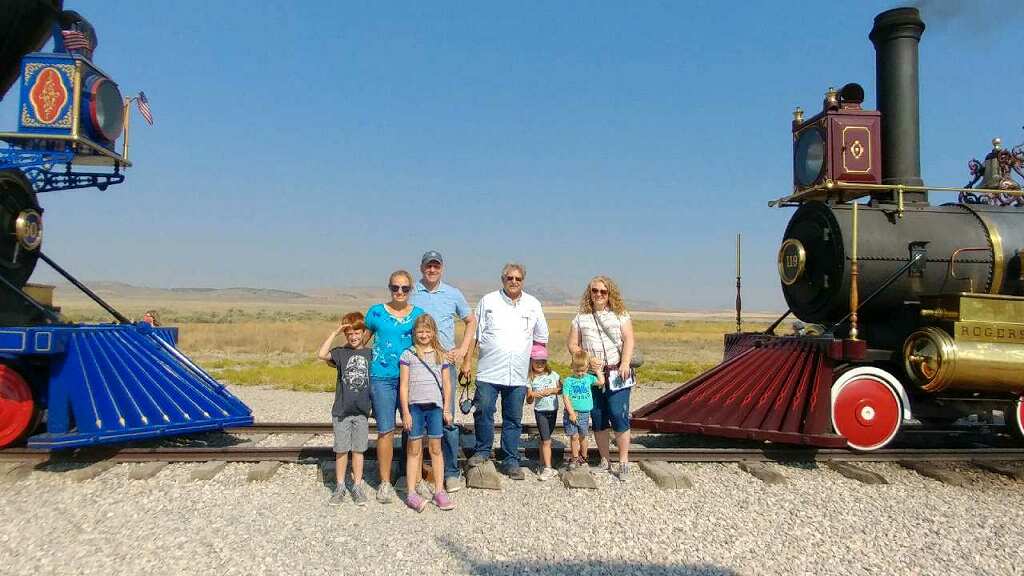
In September 2020, Amanda and I took our family out to Golden Spike National Historic Park at Promontory Summit, Utah. I have written about that visit previously. What drew us there, in part, was the knowledge that Amanda’s 3rd great-grandfather Joseph Wayment had been present on 10 May 1869 when the last spike was driven completing the transcontinental railroad — and that Andrew J. Russell’s famous photograph had captured him standing in the crowd. I promised in that post to tell more of Joseph and Ann Reed Wayment’s story another time. This is that time.
Hiram, Amanda, Aliza, and Paul Ross, Bryan Hemsley, Lillian and James Ross, and Jill Hemsley at Golden Spike National Historic Park, 7 September 2020.East and West Shaking Hands at the Laying of the Last Rail, Promontory Summit, Utah, 10 May 1869. Photograph by Andrew J. Russell. Joseph Wayment stands in the crowd on the left side of the image. Find the man standing below the Union Pacific’s No. 119 locomotive light with his jacket open and white shirt, then find the man whose head is in front of that man’s right thigh, behind the fellow with the partially raised hat. That is Joseph Wayment, age 25.
Andrew J. Russell, the official photographer of the Union Pacific Railroad who took this photograph, wrote of that moment: “The continental iron band now permanently unites the distant portions of the Republic, and opens up to Commerce, Navigation, and Enterprise the vast unpeopled plains and lofty mountain ranges that now divide the East from the West. Standing amid ‘The Antres vast and Desert wild,’ surrounded with the representative men of the nation, an epoch in the march of civilization was recorded, and a new era in human progress was ushered in.”
Joseph Wayment was one of the men in that crowd — a twenty-five-year-old English convert who had crossed the Atlantic seasick on the Amazon, walked the plains behind an ox team, survived Montana winters so cold the dishwater froze before it hit the snow, and was now building a life in a patch of Utah desert he would spend the next six decades transforming into a home, a farm, and a community. Would he have fathomed that 151 years later his great-great-great-granddaughter, and her children, would stand at that same spot.
Origins in Whaddon
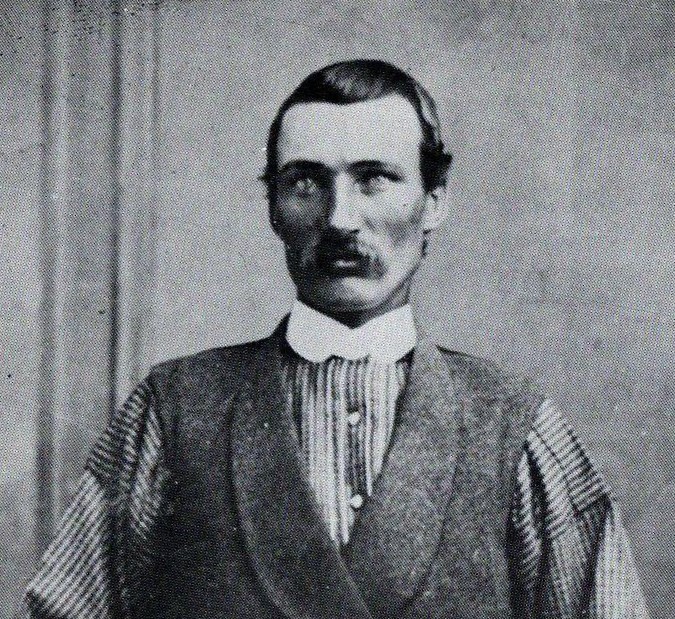
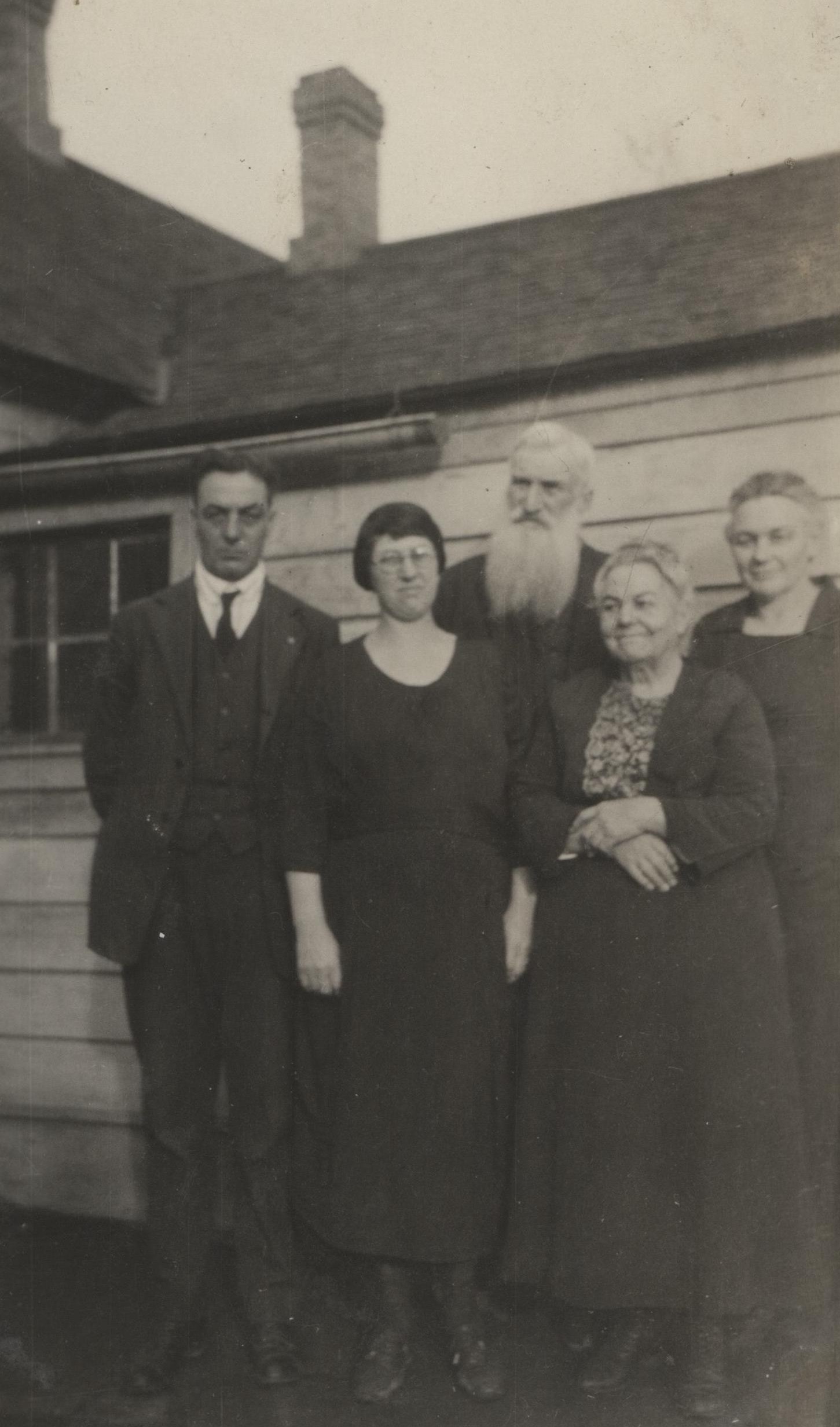
Joseph Wayment, circa 1874.
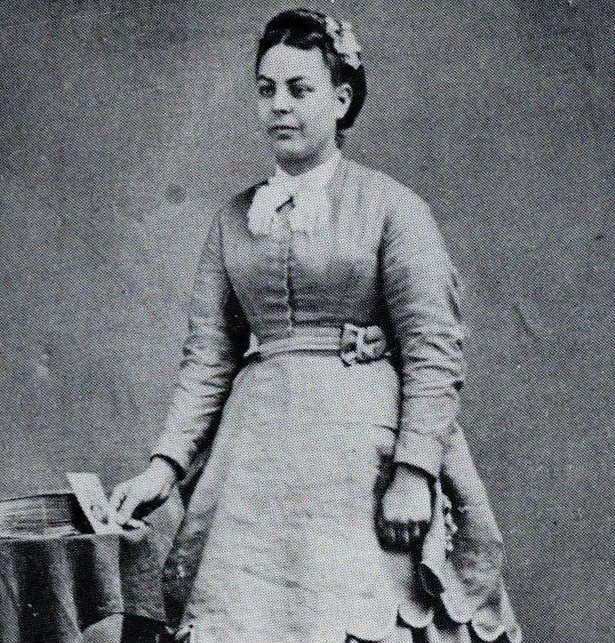
I used AI to colorize and sharpen the images. If you click on them, you should be able to see the original black and white. AI took a bit of liberty on the photos regarding clothes.
Ann Reed, circa 1874.
Joseph Wayment was born 7 February 1844 in Whaddon, Cambridgeshire, England, the second son of William and Martha Brown Wayment. His older brother Aaron had lived only one day, so as far as the family was concerned, Joseph was the eldest. I have written previously about his parents, William and Martha Wayment.
Ann Reed was born 1 January 1852 in the same small village — the fifth child and second daughter of James and Sarah East Reed. Whaddon was a tight community, a small village in the district of Royston, County of Cambridge, gathered around the ancient stone church of St. Mary the Virgin. Whaddon appears to have been somewhere around 400-500 people. The Wayments and the Reeds were neighbors in every sense of the word. Their children attended the same meetings, worked the same fields, and children would be baptized in the same river/brook.
Ann’s early life was marked by tragedy. When she was two years old, she slipped into a deep ditch near their home. No one else was nearby. Her mother, Sarah East Reed, then heavy with child, jumped in after her. Ann was saved, but the ordeal brought on labor. The baby girl was born 13 July 1854 and died the same day. Three days later, Sarah also died from complications, and mother and infant were buried together in the same casket. Ann’s father James Reed did his best to keep the family together, but he too died on 2 February 1858, leaving five orphans — the oldest fourteen, Ann just five years old.
Their mother’s sister, Hannah East, came to Whaddon to keep house for the children. Hannah was herself from Whaddon — born there on 24 August 1828, the sister of Sarah East Reed and of George East Sr., who would later become a familiar figure in Warren, Utah. Hannah was baptized LDS 3 June 1848. She stayed with the Reed orphans for several years before emigrating to Zion, where she eventually settled in Lehi, Utah, married Thomas Karren in 1865, and lived until 2 May 1907. It is a quiet thread of continuity that Hannah — who held Ann’s orphaned family together in Whaddon — ended her days in the same territory where Ann built her life, just a day’s journey away in Lehi.
After Hannah left England, the children were kept by the Parish until they could earn their own living. Ann went out to service at age eleven. She endured difficult conditions in several positions before finally working David and Mary Hide Grieg (the histories state it was Grigg), where she stayed nearly five years and carefully saved her wages toward passage to America. The Grieg family lived in nearby Melbourn, a family that was not LDS.
The Gospel Comes to Whaddon
I wrote how the William and Martha Wayment home had become a gathering place for LDS missionaries since William’s baptism in March 1850, how despite community hostility, meetings were held in different houses and baptisms conducted at night to avoid mobs. The gospel took hold in Whaddon. On the night of 7 May 1860, Joseph Wayment, age sixteen, was baptized in Whaddon Brook along with his brother Samuel and sister Emily. Ann Reed, age eight, was baptized and confirmed the same night.
They shared the same baptismal waters and would eventually share a life.
Joseph worked in the peat bogs with his father from his early teens, fossil digging to earn enough for his passage to Zion. He had one more memorable appearance in Whaddon before he left: shortly before his departure, he sang a solo at a church meeting that deeply impressed those present. His voice was described as a clear and beautiful bass. Ann Reed, then twelve years old, was in that congregation. Decades later she would tell her grandchildren with deep feeling how thrilled she had been sitting in that meeting listening to Joseph sing.
The Voyage of the Amazon, 1863
On 1 June 1863, Joseph left Whaddon for Liverpool. Three days later, on 4 June, he booked passage on the sailing vessel Amazon — listed on the manifest as “Joseph Waymound,” age 19 — and sailed from Liverpool with 881 fellow Saints bound for Zion. As I wrote in my Stoker family post, the Amazon was a famous voyage. It was this crossing that Charles Dickens observed and wrote about, describing the Mormon emigrants not as misfits and scoundrels but as the “pick and flower” of England. Future U.S. Supreme Court Justice George Sutherland was also aboard (whose family was LDS). George Q. Cannon dedicated the ship. My own Stoker ancestors were on this same vessel — an extraordinary coincidence that ties our two family lines together. Since Warren and Plain City were small communities, they likely knew each other.
Joseph was seasick nearly the entire six-week crossing. The Amazon landed in New York around the middle of July 1863. He traveled by train to a point on the Missouri River, then by boat up to Florence, Nebraska. From there he walked and drove an ox team across the plains in Captain Dan McCarty’s company — a new experience for him, as he later told his grandsons, having learned to handle horses in England but never oxen. He arrived in Salt Lake City on 3 October 1863, four months and two days after leaving his father’s home.
The very next day the October General Conference of the Church began, held in the Bowery. Joseph stood near the speakers’ platform. Brigham Young was one of the speakers, and Joseph later said it was one of the most inspiring sermons he ever heard — that Brigham Young seemed to be surrounded by a bright light. Part of that sermon Joseph remembered all his life.
The Freighting Years, 1864–1866
After a winter in Lehi, Joseph went to work in the spring of 1864 for a freighting company, probably the Toponce Freighting Company, hauling goods to Montana. He stayed with the outfit until the fall of 1866. Those were hard and consequential years.
The winter of 1864 was brutal. The freighters were snowbound on a Montana river for several weeks. Joseph served as camp cook. He later told his family that when he threw out the dishwater, it froze to ice before it hit the snow. Some of the cattle froze to death. One day the lot fell to Joseph to fetch wood. His hands were tender from cooking and dishwashing, but he went out and cut an armful. As he was picking up the last piece of wood, he felt his whole body beginning to freeze. He stumbled back toward the cabin, but before he reached it his whole body had gone numb. The men rubbed him with coal oil and did everything they could to revive him. One of them said, “Joe Wayment gets no more wood this winter — I’ll get it for him.”
During the freighting years two confrontations became family legend. In the first, a stranger from another company approached the camp and asked if there were any Mormons present. He was directed to Joseph. The man told him he had helped mob the Saints in Missouri and Illinois, then pulled open his shirt to his chest and said, “Now shoot me.” He had lived such a miserable life since helping the mob, he said, that he wanted a Mormon to shoot him. Joseph replied: “No Mormon will ever stain his hands with your blood.”
In the second, the freighters encountered soldiers who had been in Johnston’s Army making their way north into Washington. Learning that some of the freighters were from Utah, they asked to hear the song that had been made up about Johnston’s Army coming to Utah. Joseph was the best singer in camp. He refused at first, knowing it would anger them. When they promised not to get angry, he relented and sang. One soldier became so furious he drew his pistol and threatened to kill the singer. The captain of the soldiers, quick as a flash, drew his own pistol on the angry man and said he would kill him if he harmed the singer. The other soldiers took the man away.
A third incident, at a freighters’ stop near Oxford, Idaho, demonstrated that Joseph was a man of both faith and action. He and his longtime friend and fellow teamster William Butler had pulled in for the night after a long drive. Other freighters already there greeted them with jeers — “There’s those Mormons” — and tried to force them to move on. Joseph and Butler had weary teams and held their ground. When words grew heated, Joseph walked briskly to his wagon, took the green willow switch he used to urge his team, walked thirty paces to some soft ground, and with one swing left it standing upright. Then he walked back, drew his pistol, turned, and split the willow with one shot. The heckling stopped immediately.
In the fall of 1866 Joseph had a strong feeling come over him that he should return to Utah. The company he was working with was a rough and irreligious crowd. He found a secluded spot in the timber, knelt, and asked the Lord for guidance. The next morning his mind was made up. He saddled his horse, gathered his belongings — three buffalo robes and his working clothes — and started for Utah.
Settling Salt Creek
He came first to Layton or Kaysville, then went to Call’s Fort near present Honeyville where he worked for a man named Barnard and helped build the first schoolhouse there. He bought a piece of land at Call’s Fort but eventually sold it. In 1872 he moved to what was then called Salt Creek, southwest of Plain City, and bought the land he would own until his death — purchasing it from H. H. Wadman, making him the second family to settle on Salt Creek. He kept “Bachelor’s Hall” there for about two years. His brother John B. Wayment, who arrived from England in July 1873, lived with him for part of that time.
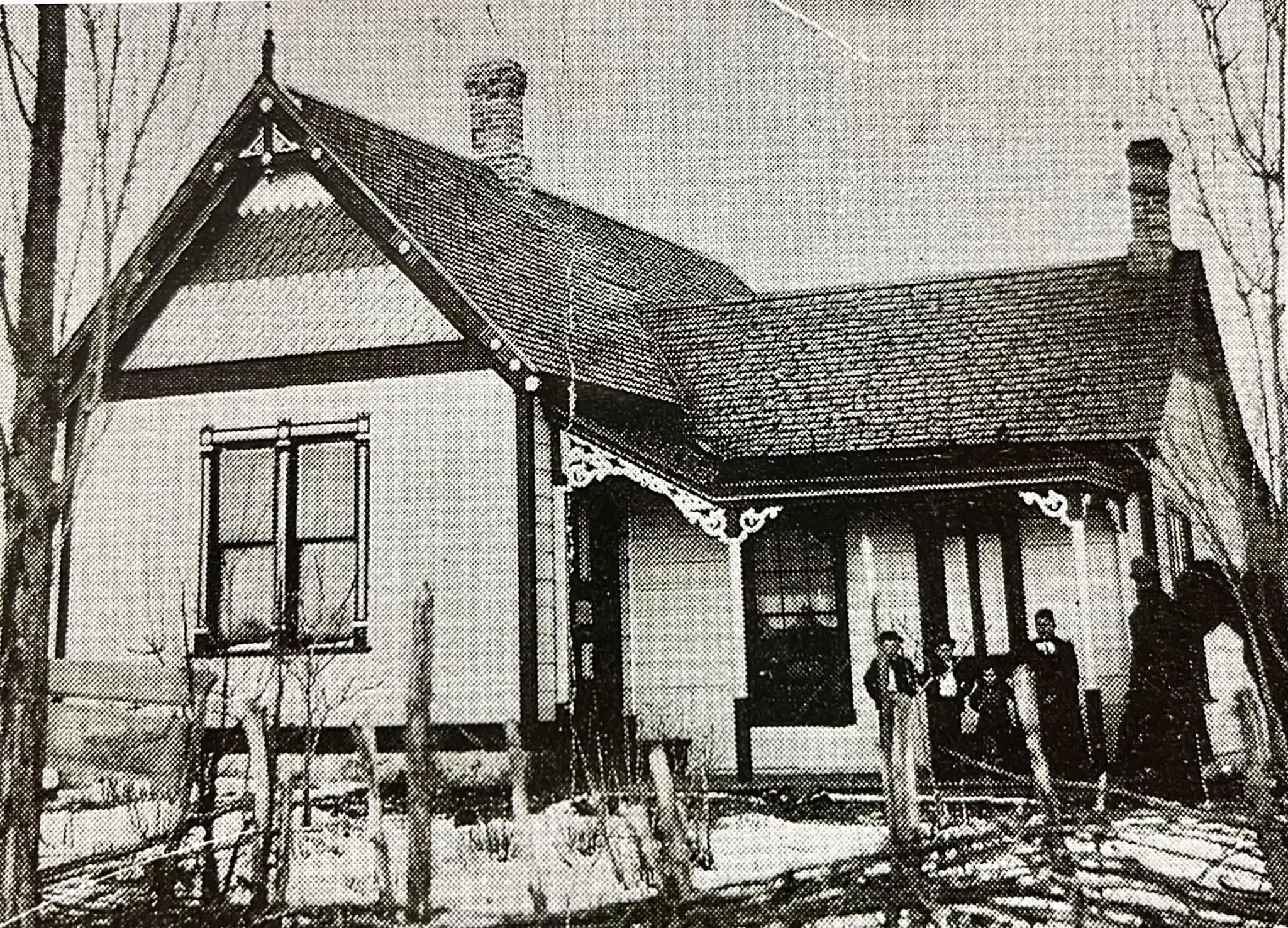
The home of Bishop William Thomas Wayment and his wife Maud at 662 N. 5900 W. in Warren. Joseph Wayment appears at far right with a horse.
About 1872, Joseph began writing letters to a young woman of his boyhood acquaintance back in Whaddon — Ann Reed. She had grown up, gone out to service, endured difficult years, and was now working for the Greig family, carefully saving her wages. She accepted his invitation to come to Utah and be his wife.
Ann Comes to America, 1874
Ann left her place of work on 2 June 1874 and sailed from Liverpool on 24 June 1874 aboard the steamship Idaho. The Idaho carried 903 passengers on that voyage, arriving in New York on 6 July 1874. Ann traveled overland by rail and arrived in Ogden about the middle of July.
Joseph met her in Ogden — likely taking her to his brother Samuel’s home. On the way they crossed a stream of clear running water. Joseph stopped the horses to let them drink, cupped his hat, dipped it in, and offered Ann the first drink. She couldn’t bring herself to drink water out of a hat from a river like that. Joseph enjoyed the cool drink regardless.
On 7 August 1874, Joseph Wayment and Ann Reed were married by Louis Warren Shurtliff at Joseph’s home in Salt Creek — ending, as Alma Hansen later wrote, the era of “Bachelor’s Hall.” On 29 June 1876, Joseph and Ann traveled to the Endowment House in Salt Lake City, where they were endowed and sealed to each other for time and all eternity. Joseph had been ordained an Elder by Alonzo Knight ten days earlier, on 19 June 1876, in preparation for that ordinance.
The First Years in Salt Creek
The Joseph and Ann Reed Wayment home in Warren, photographed June 1928. Joseph is likely the seated figure visible on the front porch.
Their first child, Sarah, was born 29 October 1875 — one of the first white children born in the Salt Creek area. In the spring of 1876 the Weber River overflowed its banks and covered much of the country where Warren now stands. The first time it came up, it stayed two weeks. The crops survived. But the river flooded again, higher than before, and stayed six weeks. The crops were completely destroyed. Joseph’s house was just high enough to keep the water from running under it — but it came right to the doorstep. He kept a rowboat in which he and Ann traveled to the sandhill in Plain City to do business. His horses broke loose just before the flood and were later found on meadows west of Brigham City. The other cattle and horses in the area lived on the high knolls until the water subsided.
Joseph planted the first fruit and shade trees in the Warren area. He watered them by hand from a well he dug himself, using a long pole with a hook and a bucket because he didn’t have a rope. Later he had a windmill built over the well and irrigated some of his crops with it. About 1880 the residents of Salt Creek organized together and built a ditch up to Four-Mile in the southern part of Plain City to run water to their crops. Part of that original ditch can still be seen near the north side of the bench in Warren.
In March 1881 Joseph was appointed secretary and assistant superintendent of the Salt Creek Sunday School, offices he held for many years. In 1883 he was chairman of the board of trustees for the first schoolhouse built in Warren — a one-room brick building on the bench. His sister Martha Wayment, now Mrs. David East, was the first teacher.
About 1877 Joseph was appointed the first road supervisor in the Warren district, a position he held for ten years. The road supervisor received no pay for his services other than to apply his labor toward his poll taxes, as did all the other men. About the first work done was to fill up some of the creek crossings. He also hauled salt from the creek banks west of Plain City up to the Hot Springs — a full day’s work per load for which he received fifty cents. The salt was used in the smelting of silver ore in Montana.
Six more children followed Sarah: Martha Ann (2 June 1877), Leonard Joseph (12 September 1878), Mary Jane (8 May 1880), Walter Hyrum (14 November 1881), Hannah Alberta (23 August 1883), and Amelia Brown (29 July 1890).
Back row, left to right: Sarah Wayment, Martha Ann Wayment, Leonard Joseph Wayment, Mary Jane Wayment. Middle row: Hannah Alberta Wayment, Joseph Wayment, Ann Reed Wayment holding Amelia Brown Wayment, Martha Brown Wayment (Joseph’s mother). Seated in front: Walter Hyrum Wayment. Photograph circa 1890–1891.
The family portrait above, taken around 1890–1891 when Amelia was an infant, captures all seven children in a single frame. Four generations are present — including Joseph’s mother Martha Brown Wayment at far right, who had herself made the journey from Whaddon in 1878. I wrote about her in the William and Martha Wayment post.
The Flood of 1884 and Ann’s Heroism
In the spring of 1884 the Weber River flooded again — not as severe as 1876, but severe enough to kill all the crops, many fruit trees, and berry bushes. Joseph moved his family into his brother John’s house on the brow of the hill north of the Arthur Marriott home — a one-room house, not large enough for all the family to sleep in. Some of the children slept in a wagon under the shed.
A day or two after they moved, a heavy rain set in. The children’s bedding became soaked. In trying to provide for his family, Joseph was exposed to the rain, cold, and mosquitoes, and he took down with malaria fever. The house was too small for any comfort, and some of the men of the locality moved the family back into their own house — even though it was surrounded by water.
For six weeks Joseph lay near death. Many did not expect him to recover. During this time Ann would walk — and sometimes wade, in water up to her knees — a quarter to half a mile west on the bench to where their cow was pastured. She milked the cow and carried the milk back to feed her husband. For a while he was so weak he could not feed himself, and Ann would have to feed him by hand. He sent for elders from Plain City to administer to him. While they were visiting, he asked to be propped up in bed and talked with them at length. From that time he continued to improve, though he was not entirely well for several years. That fall he was well enough to work on the threshing machine.
Of all the incidents in the long life of Joseph and Ann Wayment, this one — Ann wading flood water to milk the cow and hand-feed her dying husband — speaks most directly to the character of their partnership. The memorial card at their graves in West Warren says it plainly: “Ann Reed Wayment gave loyal and loving support to her husband. No problem arose that they did not find a place of adjustment and agreement.”
Firsts in Warren
The 1902 Portrait, Genealogical and Biographical Record of the State of Utah described Joseph as “one of nature’s noblemen” and enumerated his contributions to the community. He planted the first fruit and shade trees. He was the first road supervisor, serving ten years. When the first schoolhouse was built he served as school board chairman, assessor, and collector. He was one of the first stockholders and directors of the Slaterville Creamery. He raised one hundred tons of sugar beets annually for the Ogden sugar factory.
By 1888 Joseph had shifted his main occupation from general farming to dairying. He kept as many as fourteen milk cows at once. His children did much of the work — milking the cows, putting the milk in cans under cool water until the cream gathered to the top, then skimming and churning it to butter. They sold as many as 2,000 pounds of their own butter in a single year. Later the milk went to the Slaterville creamery, of which Joseph was a founding director.
Joseph’s brother Samuel Wayment was also a builder of the Plain City and Warren community. According to the Plain City history preserved by the Daughters of Utah Pioneers and now available at plaincityutah.gov, Samuel drilled an artesian well 249 feet deep that produced additional water for the early settlers, and he also oversaw the iron work and the building of the Chief Canning Factory in Plain City. Another Wayment, Owen, served as a representative of the Warren Irrigation Company in the 1961 negotiations to cement the main irrigation canal. The Wayment family’s contributions to the water and agriculture infrastructure of the Plain City and Warren area extended beyond Joseph’s own record.
In November 1910 Joseph was elected Justice of the Peace of the Warren Precinct — a fitting civic capstone for the man who had been among the first to settle Salt Creek and had spent decades building its institutions.
In 1896 Salt Creek was officially named Warren, after Lewis Warren Shurtliff, the stake president who organized the new ward — the same Louis Warren Shurtliff who had married Joseph and Ann in 1874.
Ann in Warren
Ann Reed Wayment.
Ann Reed Wayment at her home in Warren.
Ann Reed Wayment was a woman of quiet and enduring strength. Her daughter Mary Jane wrote of her: “She was an energetic worker in Relief Society, holding and filling many offices in it. She was very useful among the sick, exercising great faith as her best healing art. She was a kind, loving, very thoughtful mother to her family. She lived a useful life, impressing her children and those who mingled with her what a wonderful mother and woman she really was.”
The Warren Ward Relief Society was organized on 30 November 1902. Ann was sustained as its Treasurer, her sister-in-law Castina Wayment, wife of Joseph’s brother Samuel, served as First Counselor. Ann was not present at the organization meeting but was set apart as Treasurer on 5 February 1903. At the first Relief Society meeting held at the home of President Jane Stewart on 18 December 1902, Ann bore her testimony and gave the benediction. She served as Secretary and Treasurer of the Warren Relief Society from 1902 to 1916.
Alma Hansen, who knew both his grandparents personally and compiled their biography from firsthand family accounts, described Ann in a single memorable sentence: “She was short of stature but stood ten feet tall in her loving service.”
In February 1893, Joseph and Ann made an extended trip to the Logan Temple — a journey that had been years in the making. In careful sequence over eight days, they completed ordinance work for ancestors in their lineage and sealed their families together for eternity.
On 16 February 1893, Joseph was sealed to his parents, William and Martha Brown Wayment, in the Logan Utah Temple.
On 21 February, proxy baptism and confirmation were performed for James Reed and Sarah East Reed, Ann’s parents, in the Logan Temple.
On 22 February, the proxy endowment was performed for Sarah East Reed in the Logan Temple. Almost certainly the same was done for James Reed that day, though that record was later lost and the ordinance was repeated at the Manti Temple in 1938.
On 23 February 1893, Ann was sealed to her parents, James and Sarah East Reed, in the Logan Temple.
For a woman who had grown up an orphan at age five — whose mother died saving her life in 1854 and whose father died in 1858 — this February week in the Logan Temple completed a covenant that no earthly circumstance had been able to make. The parents she had barely known were now bound to her forever.
A Mission at Fifty-Six
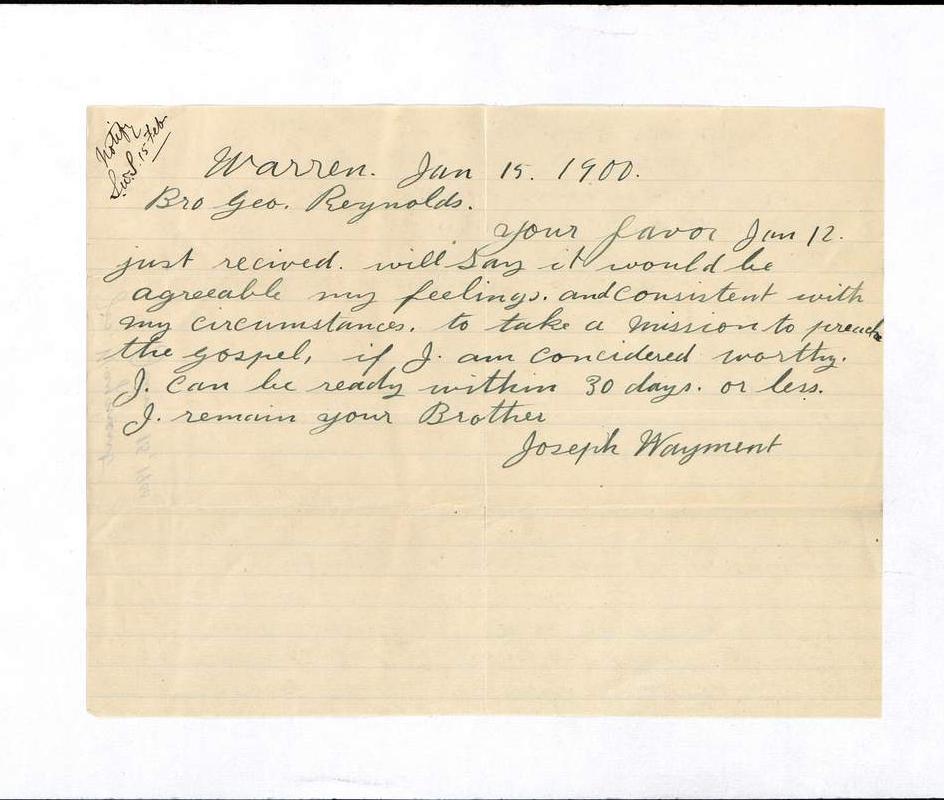
Joseph Wayment’s handwritten mission acceptance letter to Brother George Reynolds, Warren, 15 January 1900. “It would be agreeable my feelings, and consistent with my circumstances, to take a mission to preach the gospel, if I am considered worthy. I can be ready within 30 days, or less. I remain your Brother, Joseph Wayment.”
On Christmas Day 1899, Joseph was asked to fill a mission for the Church. He was fifty-five years old, a grandfather, and still carrying the kidney effects of a severe malaria attack from fifteen years earlier. His response, written in his own hand on 15 January 1900 to Brother George Reynolds of the First Council of the Seventies, occupies four plain lines: it would be agreeable to his feelings and consistent with his circumstances; he could be ready within thirty days, or less. He remained the reader’s Brother, Joseph Wayment.
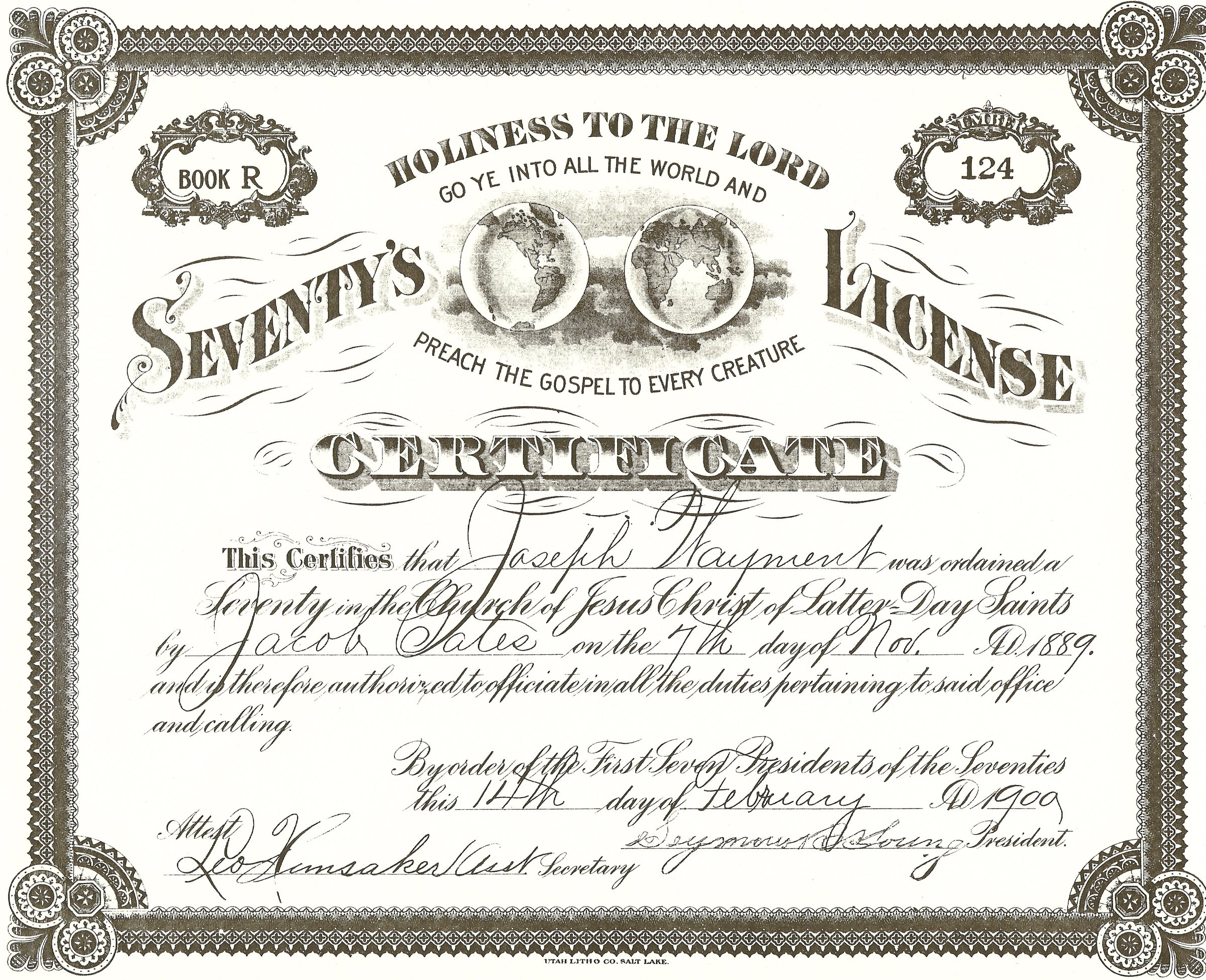
On 19 January 1900 he received his formal call from President Lorenzo Snow to labor in the Southwestern States. He was set apart on 14 February 1900 by Apostle George Teasdale in the Temple Annex in Salt Lake City — the same day his Seventy’s License was formally issued, signed by Seymour B. Young, President of the First Seven Presidents of the Seventies.
Joseph Wayment’s Seventy’s License Certificate, issued 14 February 1900, certifying his ordination as a Seventy by Jacob Gates on 7 November 1889. Signed by Seymour B. Young.
His Missionary Certificate bore the signatures of the entire First Presidency: President Lorenzo Snow, First Counselor George Q. Cannon, and Second Counselor Joseph F. Smith. That Joseph’s mission call passed through the hands of George Reynolds, historically notable as the defendant in the landmark U.S. Supreme Court case Reynolds v. United States (1879), places it in the living history of the Church.
He left the next day for Kansas, laboring first in Elk County under Elder H. E. Harrison, then for nearly four months in Greenwood County, until he was taken very sick with malaria again. In his own words: “I left my field of labor on the 4th of July for St. John and arrived home on the 7th, three days later. I was sick for three or four months.” The malaria affected his kidneys, an effect he felt until his death.
While Joseph was away on his mission and then ill at home, Ann kept the farm, the animals, and the household organized. When he returned, she nursed him back to health.
The Children
Of their seven children, three preceded them in death. Martha Ann, their firstborn daughter, married Louis Alma Hansen on 23 November 1898. She died on 19 October 1908 at age 31 of acute nephritis, leaving four children and her husband. Her loss was a grief Joseph and Ann carried quietly for the rest of their lives. Leonard Joseph married Sarah Naomi Hodson in 1902, was called to the British Mission in November 1915, labored in Belfast, Ireland, took sick, and arrived home 19 July 1916. He passed away the next morning, leaving a wife and three children.
The four who outlived their parents were Sarah (married Joseph Emelius Hansen), Mary Jane (married Samuel Bagley Willis, later Orson Francis Waldram), Walter Hyrum (married Iva Dell Wade), Hannah Alberta (married Thomas LeRoy White), and Amelia Brown (married George James Lythgoe).
The 70th Birthday, 1914
Family portrait honoring Joseph Wayment’s 70th birthday, 7 February 1914, Warren, Weber, Utah. Third row center: Ann Reed Wayment and Joseph Wayment, flanked by siblings John Brown Wayment and William Thomas Wayment and sister Martha East.
On 7 February 1914 the extended Wayment family gathered at the Warren home for Joseph’s 70th birthday. Included were children, grandchildren, siblings, their spouses and children, and young Alma Wayment Hansen himself, visible as a boy in the second row, who would later compile a biography of his grandparents. At the center of the third row sit Joseph and Ann, flanked by his brothers John Brown and William Thomas Wayment and his sister Martha East. By this gathering all the children had married.
The Grasshoppers
One incident from Joseph’s later years became a touchstone story in the family, attested to by his daughter Sarah. A summer or two after his first malaria attack, he had planted wheat in the field north of the house. The crop grew abundantly, had headed out full, and was beginning to turn yellow when the children noticed one evening that a great horde of grasshoppers had descended on the grain. They went in and told their father. He was not well, still weakened from the malaria. He arose, took his cane, and walked out into the field.
The grasshoppers were large and so thick they were bending the stalks almost to the ground. What once looked like a bounteous harvest now seemed doomed. Then right there in the midst of the grain and the grasshoppers, Joseph knelt and made a most fervent appeal to his Heavenly Father for aid. Night came on. The family retired, but not without family prayer. The next morning not a grasshopper could be found on the grain. There were no traces of where they had been.
The Golden Wedding, 1924
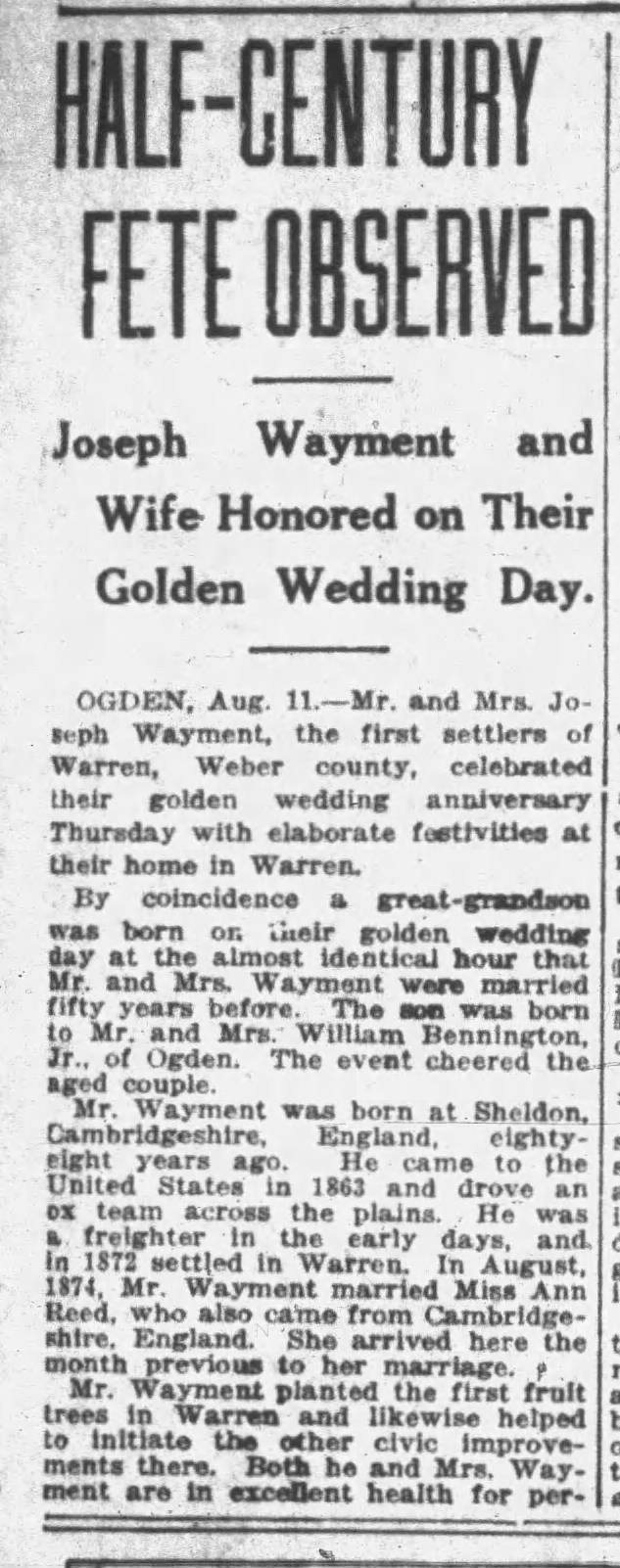
Salt Lake Tribune, 12 August 1924. Joseph Wayment and Wife Honored on Their Golden Wedding Day.
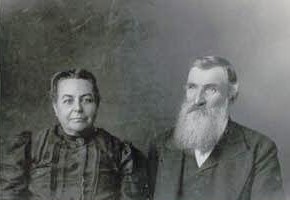
Left to right: Walter Hyrum Wayment, Amelia Brown Wayment Lythgoe, Joseph Wayment, Ann Reed Wayment, Sarah Wayment. Photograph taken at the Warren home, circa 1924.
On Thursday, 7 August 1924, Joseph and Ann celebrated their golden wedding anniversary with elaborate festivities at their Warren home. The Salt Lake Tribune reported the occasion. By remarkable coincidence, a great-grandson was born that same day at nearly the identical hour that Joseph and Ann had married fifty years before, a son born to Mr. and Mrs. William Bennington Jr. of Ogden. The event, as the paper noted, cheered the aged couple considerably.
The celebration drew family from across Weber County. Among those present were Joseph’s siblings, his sisters Mrs. Martha East of Warren and Mrs. Emily Mullen of Ogden, and his brother Bishop William T. Wayment of Warren, along with four daughters, one son, and twenty-six grandchildren.
The photograph captures something of what fifty years in Warren had built. Joseph stands center-rear, his great white beard the same beard his doctor had prescribed after the 1884 malaria, protection for his throat and chest from the cold. Ann stands center-front, hands folded, short of stature. Sarah, their eldest, the first white child born in Warren, stands at the right. Walter Hyrum, their only surviving son, is at the far left with his wife Amelia Lythgoe beside him.
Final Years
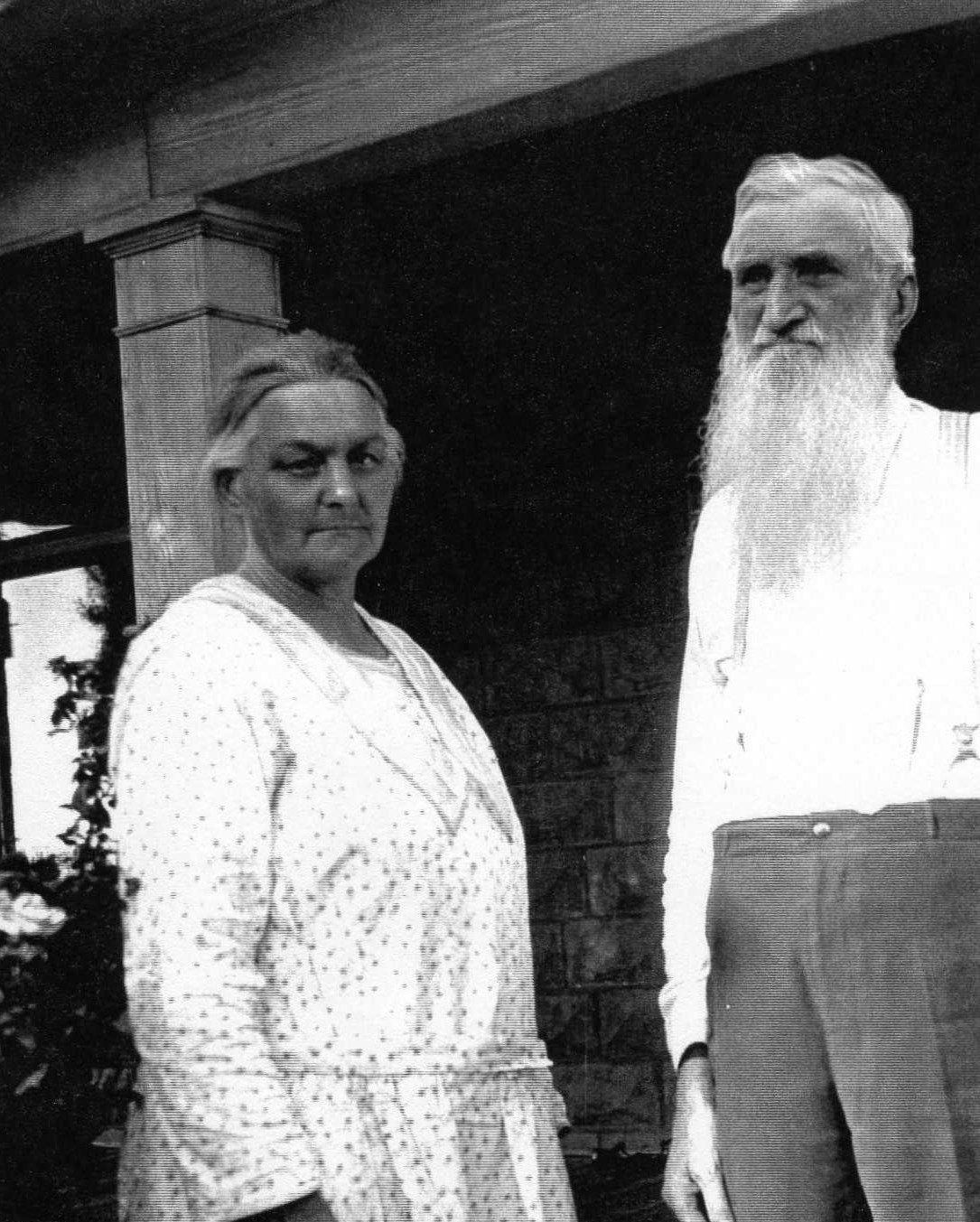
Ann Reed and Joseph Wayment.
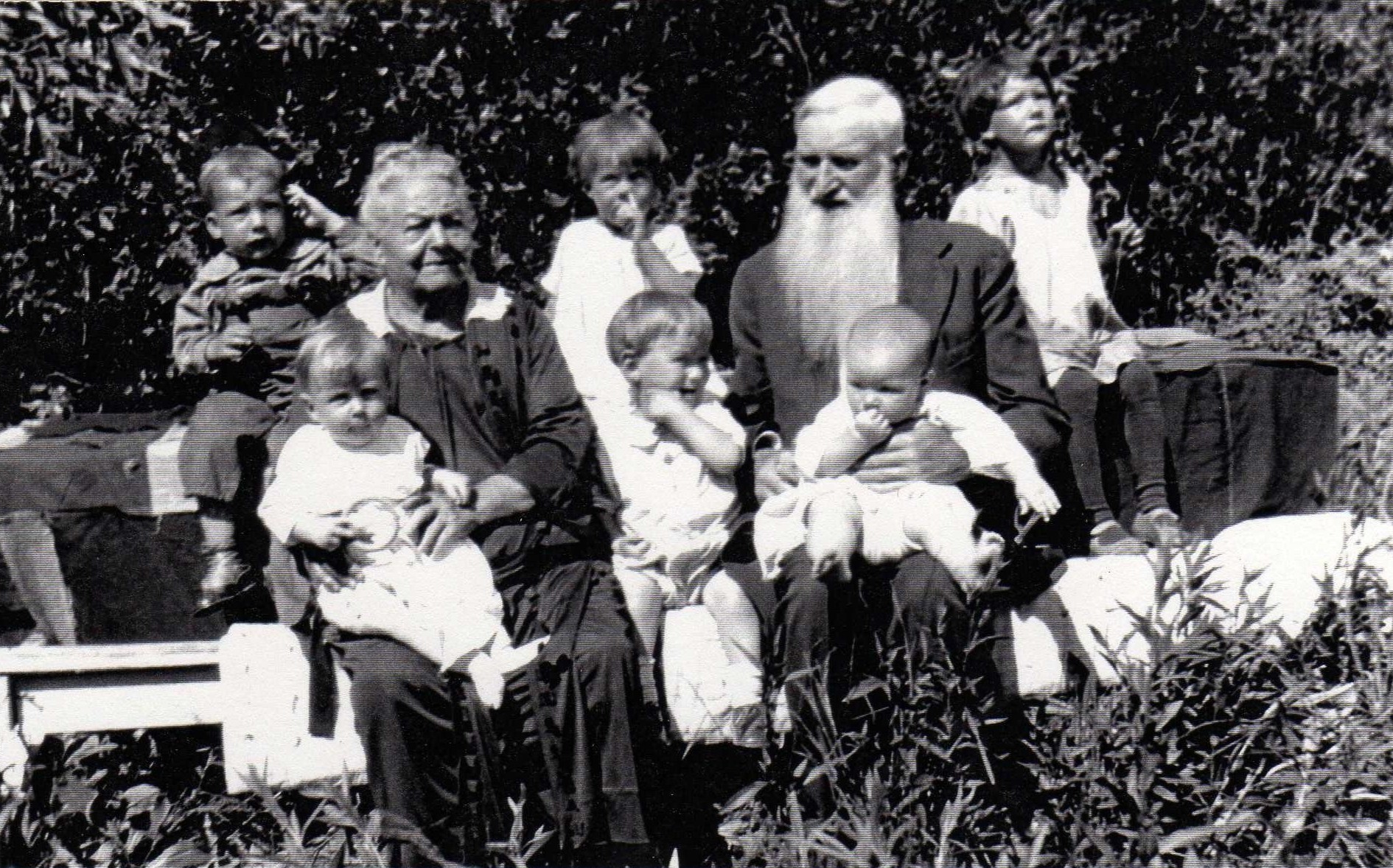
Left to right: Verlan Hansen, Ann Reed Wayment holding Donald Peterson, Eulail Peterson (back), Robert Hansen (front), Joseph Wayment holding Elaine Hansen, Irene Hansen. Joseph and Ann were the great-grandparents of the children in this picture.
Joseph bought his first automobile in 1912, just past his 68th birthday. About 1922 his eyesight became too poor to read. From that time until his death, someone had to read all news to him. He lived at his own home in Warren until the very end, cared for by his daughter Sarah. He delighted in bearing his testimony and seemed never to tire of talking about and explaining the principles of the gospel. His last public appearance was at a fast and testimony meeting on 11 October 1931, where he bore a strong testimony to the truthfulness of the Gospel and to the fact that Joseph Smith was a true prophet of God.
Ann did not live to see it. She died on the morning of 14 June 1931, at 8:10 a.m., at their Warren home after a three months’ illness — her cause of death recorded on her death certificate as chronic myocarditis with arteriosclerosis as a contributing factor. She had lived in Warren for 57 years without interruption. Her brother-in-law Bishop William T. Wayment was among the speakers at her funeral. A sextet of nephews and nieces sang. Mrs. Jessie Wayment sang a solo. Grandsons served as pallbearers. Granddaughters took charge of the flowers. She was buried in the Warren Cemetery on 17 June 1931.
Joseph took sick on the afternoon of Thursday, 17 December 1931. He passed away very peacefully on Sunday evening, 20 December 1931, at Dee Hospital in Ogden, of bronchopneumonia, the chronic malaria that had plagued him since 1884 listed as a contributing condition. He was 87 years old.
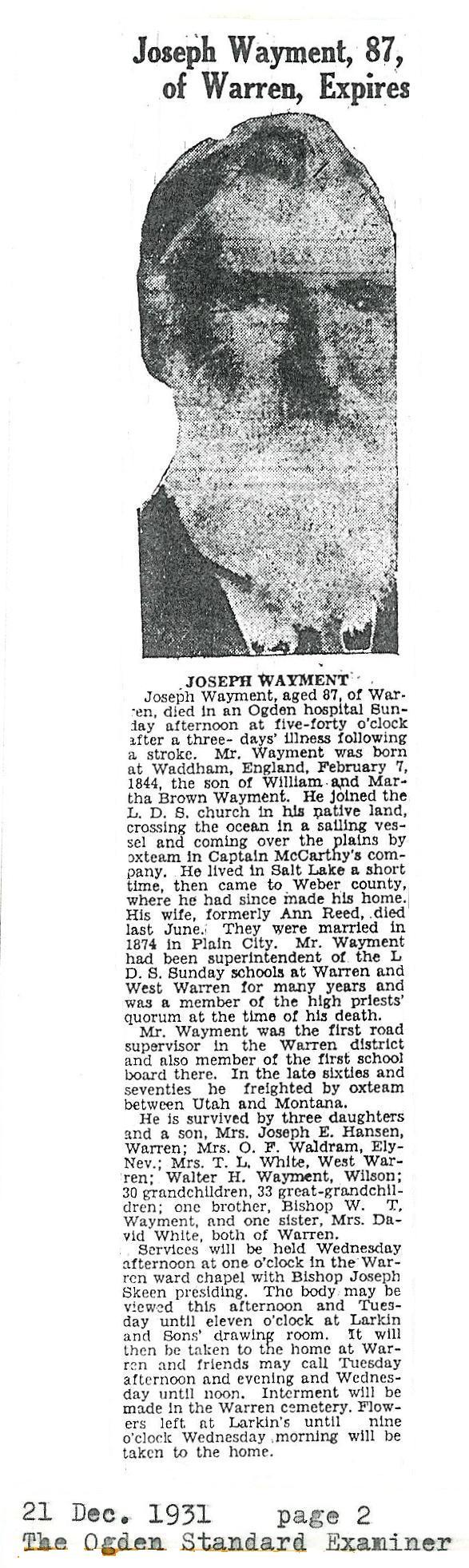
Obituary of Joseph Wayment, Ogden Standard Examiner, 21 December 1931.
He was buried on 23 December 1931 in the Warren Cemetery, beside Ann, who had preceded him six months and six days. They had been married 56 years, 10 months, and 7 days.
Legacy
Sarah Ann Wayment Hansen and her father Joseph Wayment in his final years. Sarah cared for Joseph at home until his death in December 1931.
When Joseph and Ann Wayment arrived in Salt Creek in the early 1870s, there was almost nothing there. When they died in 1931, Warren was a community with a church, a school, a creamery, roads, canals, orchards, many of the first of each having been planted, built, or organized by Joseph himself. They lived to see 32 grandchildren and 37 great-grandchildren. Two of their children served missions; one granddaughter and five grandsons also served missions, all returning safely.
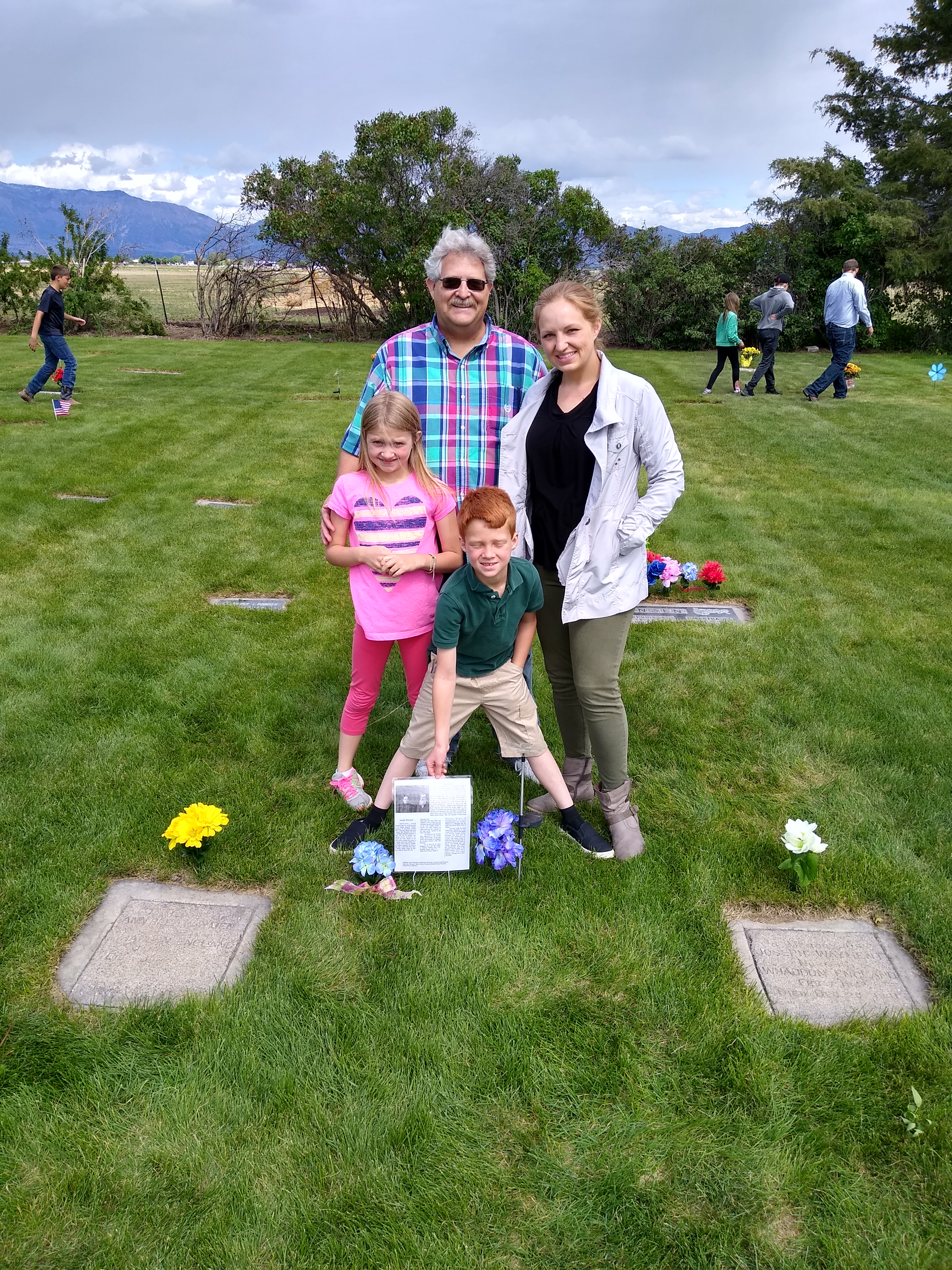
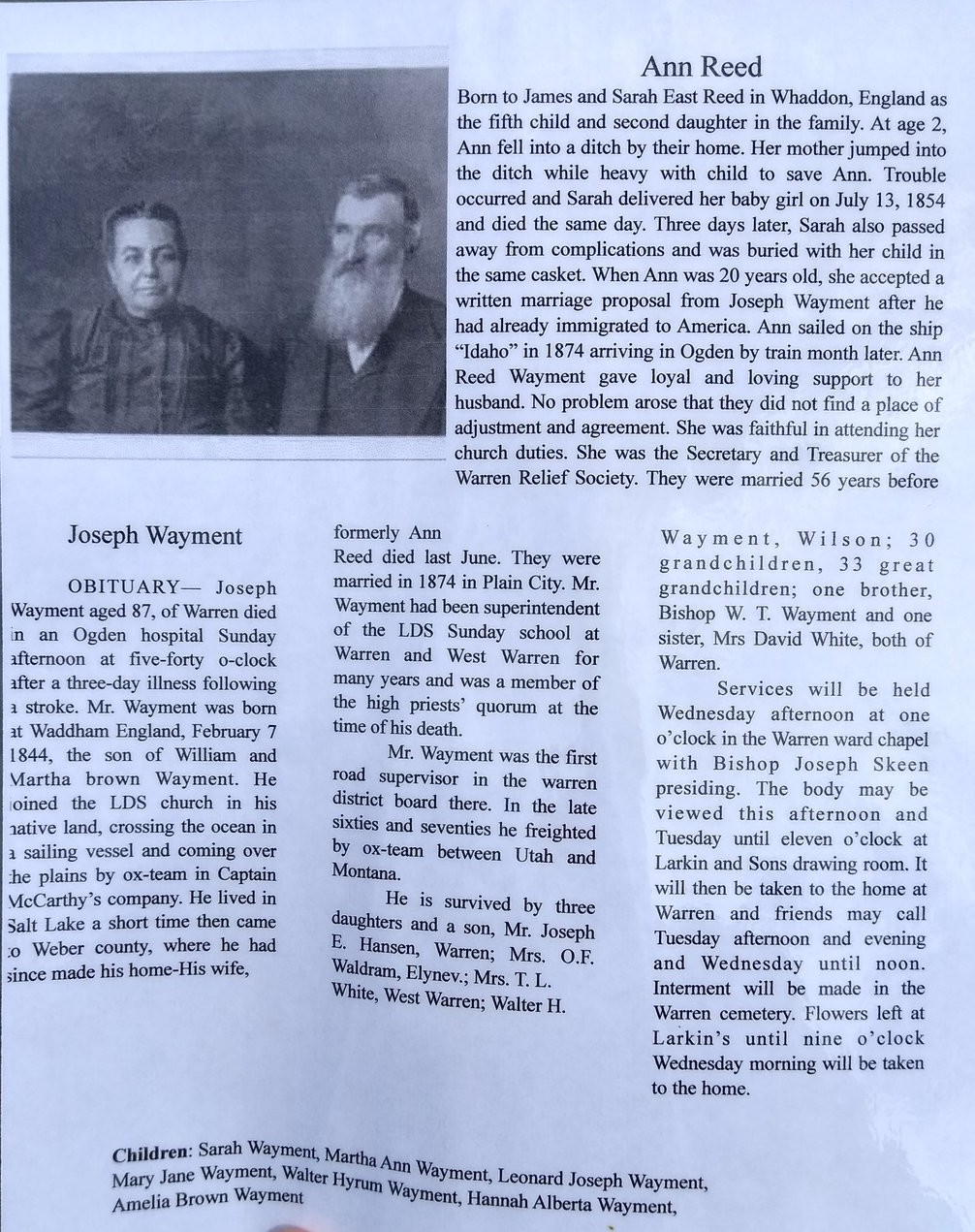
Amanda and I visited their graves in the West Warren Cemetery on 24 May 2020. The memorial card at their headstones, the laminated display that prompted this research, was photographed that day. Amanda is their 3rd great-granddaughter through the line: Joseph and Ann Wayment → Martha Ann Wayment Hansen → Walter Wayment Hansen → Bryan Hemsley → Amanda Ross.
Bryan Hemsley, Amanda, Aliza, and Hiram Ross with the tombstones of Ann Reed (1852–1931) and Joseph Wayment (1844–1931), West Warren Cemetery, 24 May 2020.
The memorial card displayed at the graves of Joseph and Ann Reed Wayment, West Warren Cemetery.
Source Documents
The following family histories are available for download:
Life Sketch of Joseph Wayment – copied from a record belonging to Ida H. Johnson (granddaughter), transcribed by Hollis R. Johnson, 1956
Emily Wayment and William Negus – compiled by Alma W. and Martha M. Hansen, 1979
John Brown Wayment and Sarah East – compiled by Alma W. Hansen, 1980
I hope some day to find a better copy of this newspaper clipping.
Back (l-r): Ben Van Shaar, Ervin Heslop, Ellis Stewart, Kenneth Taylor, Don Gibson, John Reese; Middle: Frank Hadley, Howard Wayment, Wayne Rose, Ray Charlton; Front: Keith Hodson, Howard Hunt, Wayne Carver, Lyle Thompson, Milo Ross
Presenting the City-County Baseball Champions… Plain City junior diamond athletes romped away with the county title for 1937 and walloped Lewis junior, Ogden city champions, in a title city-county event last week.
Wayne McLean Carver, athletic manager (1923 – 2015)
Here are four more clippings from my Grandparents, Milo & Gladys Ross. Grandpa talked quite a bit of baseball in Plain City from his youth. I have shared this photo too where he and Elmer played together on the same team. Visiting with Grandpa, multiple baseball players came up, but Elmer was the one that went on to some fame. Plain City’s history includes excerpts on Elmer.
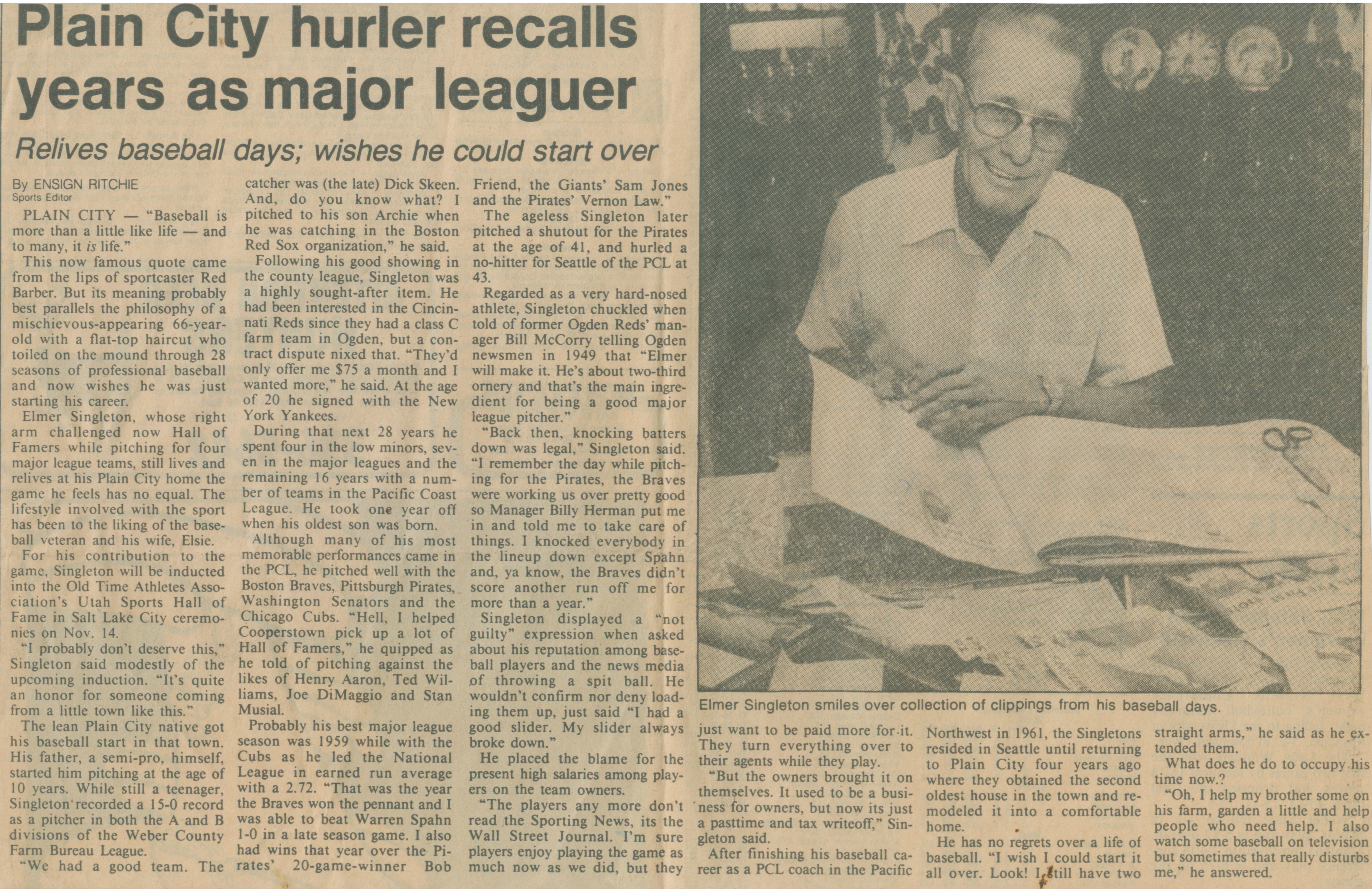
“Plain City hurler recalls years as major leager
“Relives baseball days; wishes he could start over
“PLAIN CITY – “Baseball is more than a little like life – and to many, it is life.”
“This now famous quote came from the lips of sportcaster Red Barber. But its meaning probably best parallels the philosophy of a mischievous-appearing 66-year-old with a flat-top haircut who toiled on the mound through 28 seasons of professional baseball and now wishes he was just starting his career.
“Elmer Singleton, whose right arm challenged now Hall of Famers while pitching for four major league teams, still lives and relieves at his Plain City home the game he feels has no equal. The lifestyle involved with the sport has been to the liking of the baseball veteran and his wife, Elsie.
“For his contribution to the game, Singleton will be inducted into the Old Time Athletes Association’s Utah Sports Hall of Fame in Salt Lake City ceremonies on Nov. 14.
“”I probably don’t deserve this,” Singleton said modestly of the upcoming induction. “It’s quite an honor for someone coming from a little town like this.”
“The lease Plain City native got his baseball start in that town. His father, a semi-pro, himself, started him pitching at the age of 10 years. While still a teenager, Singleton recorded a 15-0 record as a pitcher in both the A and B divisions of the Weber County Farm Bureau League.
“”We had a good team. The catcher was (the late) Dick Skeen. And, do you know what? I pitched to his son Archie when he was catching in the Boston Red Sox organization,” he said.
Following his good showing in the county league, Singleton was a highly sought-after item. He had been interested in the Cincinnati Reds since they had a class C farm team in Ogden, but a contract dispute nixed that. “They’d only offer me $75 a month and I wanted more,” he said. At the age of 20 he signed with the New York Yankees.
“During that next 28 years he spent four in the low minors, seven in the major leagues and the remaining 16 years with a number of teams in the Pacific Coast League. He took one year off when his oldest son was born.
“Although many of his most memorable performances came in the PCL, he pitched well with the Boston Braves, Pittsburgh Pirates, Washington Senators and the Chicago Cubs. “Hell, I helped Cooperstown pick up a lot of Hall of Famers,” he quipped as he told of pitching against the likes of Henry Aaron, Ted Williams, Jo DiMaggio and Stan Musial.
“Probably his best major league season was 1959 while with the Cubs as he led the National League in earned run average with a 2.72. “That was the year the Braves won the pennant and I was able to beat Warren Spahn 1-0 in a late season game. I also had wins that year over the Pirates’ 20-game-winner Bob Friend, the Giants’ Sam Jones and the Pirates’ Vernon Law.”
[Interesting side note, the 1959 National League pennant was actually won by the Los Angeles Dodgers, not the Braves. The Braves one it the previous two years, 1957 and 1958.]
“The ageless Singleton later pitched a shutout for the Pirates at the age of 41, and hurled a no-hitter for Seattle of the PCL at 43.
“Regarded as a very hard-nosed athlete, Singleton chuckled when told of former Ogden Reds’ manager Bill McCorry telling Ogden newsmen in 1949 that “Elmer will make it. He’s about two-third ornery and that’s the main ingredient for being a good major league pitcher.”
“”Back then, knocking batters down was legal,” Singleton said. “I remember the day when pitching for the Pirates, the Braves were working us over pretty good so Manager Billy Herman put me in and told me to take care of things. I knocked everybody in the lineup down except Spahn and, ya know, the Braves didn’t score another run off me for more than a year.”
“Singleton displayed a “not guilty” expression when asked about his reputation among baseball players and t news media of throwing a spit ball. He wouldn’t confirm nor deny loading them up, just said “I had a good slider. My slider always broke down.”
He placed the blame for the present high salaries among players on the team owners.
“”The players any more don’t read the Sporting News, its the Wall Street Journal. I’m sure players enjoy playing the game as much now as we did, but they just want to be paid more for it. They turn everything over to their agents while they play.
“”But the owners brought it on themselves. It used to be a business for owners, but now its just a pasttime and tax writeoff,” Singleton said.
“After finishing his baseball career as a PCL coach in the Pacific Northwest in 1961, the Singletons resided in Seattle until returning to Plain City four years ago where they obtained the second oldest house in the town and remodeled into a comfortable home.
“He has no regrets over a life of baseball. “I wish I could start it all over. Look! I still have two straight arms,” he said has he extended them.
“What does he do to occupy his time now?
“”Oh, I help my brother some on his farm, garden a little and help people who need help. I also watch some baseball on television but sometimes that really disturbs me,” he answered.
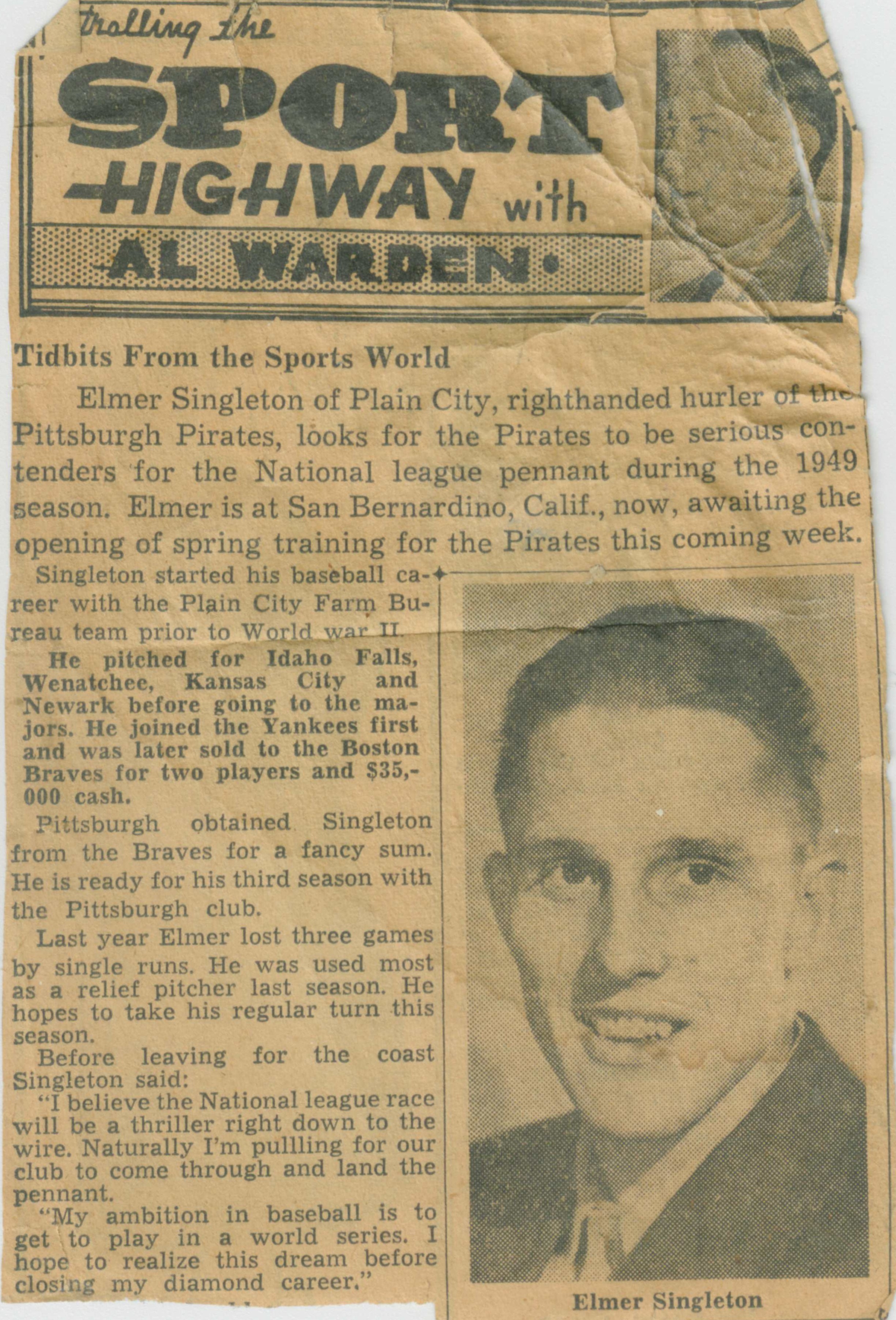
“Tidbits from the Sports World
“Elmer Singleton of Plain City, righthanded hurler of the Pittsburgh Pirates, looks for the Pirates to be serious contenders for the National league pennant during the 1949 season. Elmer is at San Bernardino, Calif., now, awaiting the opening of spring training for the Pirates this coming week.
“Singleton started his baseball career with the Plain City Farm Bureau team prior to World war II.
“He pitched for Idaho Falls, Wenatchee, Kansas City and Newark before going to the majors. He joined the Yankees first and was later sold to the Boston Braves for two players and $35,000 cash.
“Pittsburgh obtained Singleton from the Braves for a fancy sum. He is ready for his third season with the Pittsburgh club.
“Last year Elmer lost three games by single runs. He was used most as a relief pitcher last season. He hopes to take his regular turn this season.
“Before leaving for the coast Singleton said: “I believe the National league race will be a thriller right down to the wire. Naturally I’m pulling for our club to come through and land the pennant.
“”My ambition in baseball is to get to play in a world series. I hope to realize this dream before closing my diamond career.
“Elmer Singleton Rates Praise
“The “best pitched game” ever witnessed at Seals’ stadium went down in the record book as a defeat for Elmer Singleton, San Francisco right-hander, writes James McGee, San Francisco newspaperman.
“Singleton started his baseball career with Plain City in the Weber County Farm Bureau league back in 1938. Since that timehe has worn a number of major league uniforms.
“Writes McGee: “The big Seal righthander pitched 12 1/3 innings of no-hit ball against Sacramento, April 24, yet lost 1 to 0.
“”That was the best-pitched game I ever saw,” his manager, Tommy Heath, declared. But, as it turned out, it was not quite good enough. Singleton, who set a Seals stadium record and etched his name in Seal history, had the bad luck to meet a tough opponent, Jess Flores, Sacramento’s veteran righthander.
“Flores was effective. The Seals got to him for eight hits, compared to the three singles from Solons finally wrenched from the reluctant Singleton. But the three Solon hits came in succession in the first half of the thirteenth inning, Eddie Bockman, spelling Manager Joe Gordon at second base; Al White and finally Johnny Ostrowski did the damage, Bockman scoring.
“Singleton admitted he was tiring in the thirteenth.
“”It wasn’t that I pitched to so many hitters. It was the strain of the thing,” he said. “All through the early innings I knew I had a no-hitter going. I had to be careful with every pitch. I never pitched one before and I wanted it.”
“Umpire Don Silva vouched that Singleton was careful.
“”He had great stuff. His fast ball was good, but his curve was particularly good. And he was hitting the corners of the plate all the time,” said Silva. “His control was almost perfect.”
“Walked Four
“Singleton walked four men, one of them purposely. He retired the first 18 men to face him before he faltered and walked Bob Dillinger, first man to face him in the seventh.
“In the seventh, the Solons had him in jeopardy for the only time until they finally scored.
“Singleton was within one out of tying the Coast league record for no-hit innings when Bockman got the first hit, a sharp roller through the hole between third and short, in the thirteenth.
“Dick Ward, pitching for San Diego in 1938, went 12 and two-thirds innings of a 16-inning game against Los Angeles without a hit. He eventually won, 1 to 0.
“Ironically, the greatest game pitched at Seals stadium in its 22-year history was pitched in virtual privacy. Only 790 spectators were there at the start with about 1000 fans leaving the park before the end of the game.
“Sports Tid Bits
“Great Falls postmen have accepted the challenge of members of the Ogden post office and have wagered $125 that the Electrics finish ahead of the Reds in the 1952 Pioneer league race.
“Harold Stone of the Ogden post office department informed this corner of the acceptance Saturday night. Two years ago the Ogdenites lost a similar wager.
“George East, landowner of some of the finest duck shooting grounds of the area, is living like Noah of old at his home in West Warren. Genial George says that instead of duck problems, the trash fish from the lower Weber are visiting him and drinking out of his flowing well.
“The ducks have been winging their way annually in George’s direction for nearly four score years. Some years there has been so little water that the migratory birds have avoiding George’s feeding and nesting grounds. Not this year, however, George says as there is more water flooding the pasture lands than in many, many years.
“Herb Woods went out to look the situation over this week. George told Herb he could find his favorite blind by use of maps and a deep diving suit – but Herb did not want to get his nose wet.
“Hal Welch, our so-called game expert, says there is consternation among the sportsmen about the pheasants that will be lost because of their nests being destroyed by the floodwaters. He admits that there will be no shortages of mosquitoes for sportsmen, however.
“Screwy Situations
“The 1952 baseball season still is an infant but here are some of the crewy things that have taken place:
“An umpire – Scotty Robb – got fined, for pushing of all people, Manager Eddie Stanky, of the St. Louis Cardinals.
“Leo Durocher of the Giants protests Augie Guglielmo’s call of a third strike on one of his hitters but nothing happens. We thought questioning a third strike meant automatic banishment.
“A Phillie, Stan Lopata, fails to run from third base with two out, the batter reaches first on an error and Lopata is left stranded as the next batter is retired. And Manager Eddie Sawyer was coaching at third.
“”The Giants are leading the Braves by two runs in the eighth inning yet Leo Durocher lifts his number four hitters, temporarily Henry Thompson, for a pinch slugger. You don’t lift your number four batter in any situation, says wise baseball men, but then who says Thompson (not Bobby) is a number four hitter?
“Roy Campanella, a good number four hitter, bunts in a tie game. Another old baseball adage is that “you don’t bunt your number four hitter.” We disagree with that one. In this case Campy’s bunt paid off for the Dodgers as the next batter singled home the winning run.
“W.S.C. Loses
“PULLMAN (AP) – Idaho defeated Washington State 15-12 in Northern division gold matches Saturday.
“B. Elmer Singleton
“PLAIN CITY – Bert Elmer Singleton, passed away Friday, January 5, 1995 at his home in Plain City. He was born June 26, 1918 in Plain City, Utah, a son of Joseph and Sylvia Singleton.
“He married Elsie M. Wold January 20, 1939 in Ogden, Utah.
“He was a member of The Church of Jesus Christ of Latter-Day Saints.
“He played professional baseball for twenty-four seasons, originally signing with the New York Yankees Baseball Organization. His chosen vocation provided he and Elsie the opportunity to live in Pittsburgh, Pa., Boston, Mass., Chicago, Ill., Havana, Cuba, [Caracus, Venezuela], Seattle, Wash. and several other cities in the Midwest and on the West Coast.
“He retired from professional baseball in 1964 and returned to Plain City in 1980. Upon his return he actively lobbied for the Meals on Wheels program for Plain Cities Seniors. He helped with 4-H programs and worked with gifted children.
“He was chosen as Player of The Year for the State of Utah in 1939. He was inducted into the Utah Sports Hall of Fame in 1984. He was chosen as the Pacific Coast League most Valuable Player for years 1955 and 1956.
“Surviving are his sons, Joe F. of Chugiak, Alaska and Jerry E. of Tacoma, Washington and his brother, Don R. of Plain City. He has two grandchildren, Joe E and Shelby J., residing in Anchorage, Alaska.
“He was preceded in death by his loving wife Elsie on January 31, 1988 and brothers, Earl and Harold.
“Funeral services will be held Thursday, January 11th at 11 a.m. at Lindquist’s Ogden Mortuary, 3408 Washington Blvd.
Friends may call at the mortuary on Wednesday, January 10th from 6 to 8 p.m. and Thursday 10 to 10:45 a.m.
“Internment, Plain City Cemetery.
Back (l-r): William Freestone (manager), Norman Carver, Glen Charlton, Fred Singleton, and Elmer Singleton. Middle: Clair Folkman, Dick Skeen, Albert Sharp, Abe Maw, Milo Ross. Front: F. Skeen, Walt Moyes, Arnold Taylor, Lynn Stewart, Theron Rhead.
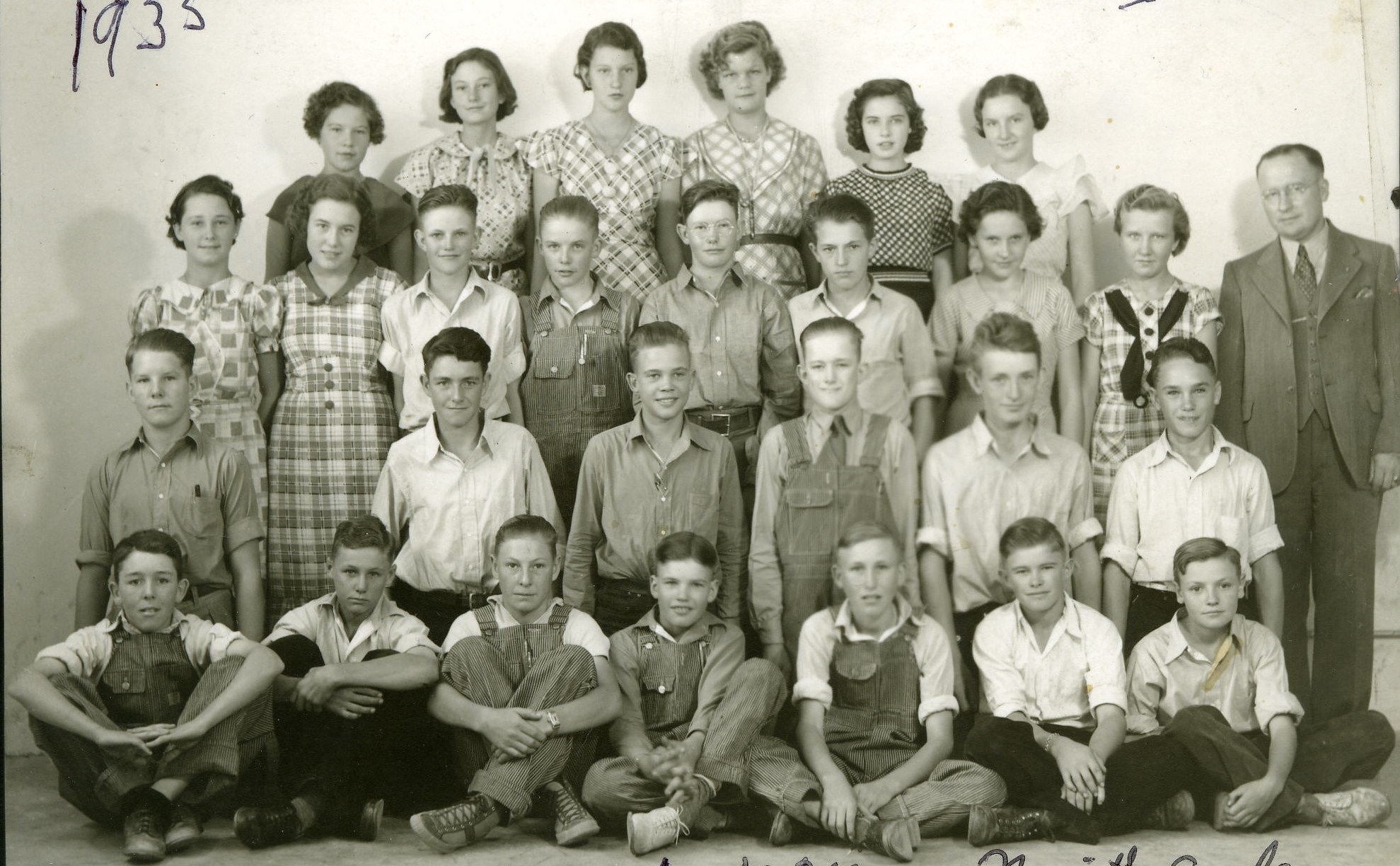
Back (l-r): Cleone Carver, Vera Wayment, Margaret Freestone, Emza Musgrave, Jean Etherington, LauRene Thompson. Third: June Wayment, Miriam Weatherston, Ellis Lund, Ray Charlton, Ivan Hodson, Warren Williams, Ruth Wade, Tamara East, John Reese. Second: Lyle Thompson, Milo Ross, Eugene Maw, Earl Hipwell, Bill Hill, Keith Hodson. Front: Ted Christensen, Wayne Rose, Howard Hunt, Orlo Maw, Owen Wayment, Ellis Stewart, Delmar White.
This is my Grandpa Milo Ross’ 9th Grade class. I believe this was at Weber High School, but I cannot confirm what grade year switched between Plain City School and Weber High School in Ogden. Several of these boys died in World War II.
I have two copies of the History of Plain City, Utah. The front indicates it is from March 17th 1859 to present. As far as I can tell, the book was written in 1977. At least that is the latest date I can find in the book.
One copy belonged to my Grandparents Milo and Gladys Ross. My Grandpa has written various notes inside the history which I intend to include in parenthesis whenever they appear. They add to the history and come from his own experience and hearing.
I will only do a number of pages at a time. I will also try to include scanned copies of the photos in the books. These are just scanned copies of these books, I have not tried to seek out originals or better copies.
History of Plain City March 17th 1859 to present, pages 76 through 106.
HISTORY OF THE OLSEN GROCERY STORE
Two of the earliest merchants in Plain City were A. M. Schoemaker and William Van Dyke. Mr. Shoemaker had a little store just east of the old adobe meeting house. Van Dyke’s store was just across the street from the southwest corner of the public square on the sight of the John Maw store where the Plain City bowery now stands.
The Cooperative Mercantile Institution was organized in 1869 with John Spiers as President, J. P. Green, C .O. Folkman, George Folkman and Andrew Ipson as directors, and George H. Carver and J. S. Carver as the managers.
In the early days of Utah, the L .D. S. Church organized cooperative stores in different places called “Zions Cooperative Mercantile Institutions.” One of these was organized in Plain City in Jens Peter Folkman’s home at 2480 N. 4350 W. in March of 1869. He was appointed manager by the directors.
The capitol stock was $500.00. Mr. Folkman continued as manager for several years. At a reorganization some time later, John Spiers was retained as president and John Carver was elected vice president of the board of directors, which was composed of Jeppe G. Folkman, William Sharp and Alexander Marian Shoemaker, with George Bramwell as secretary and William G. McGuire as secretary-treasurer.
Finally a corner was bought by the company from Mr. Hansen in 1889, where Carl Olsen’s store is now situated. (1959) A frame building was erected and here Jens Peter Folkman continued as manger until the store was closed by Z.C.M.I. on account of bankruptcy cause through too many bad debts.
It was reopened by the parent store in Ogden and was managed by George and James Carver but was closed again for the same reason as before.
George W. Bramwell and his brother, Henry, bought the stock of goods and ran the store as a private business. Z.C.M.I. took over once more and hired George W. Bramwell to run it as a branch of their store.
It was next sold to Henry J. Garner and Robert W. Maw. They sold it to Thomas England. Thomas England sold his store to Peter J. and Evelyn Christensen, who rented it out for a time, then later sold it to Carl Olsen in 1925.
In the early days of the Olsen stores Parvin Produce Company of Ogden established the business of shipping potatoes from Plain City. They were located at the Olsen store and when they discontinued business, Carl Olsen and Wilmer J. Maw started shipping potatoes. Mr. Olsen loaded his cars at the end of the railroad spur in front of Roll’s Garage, now Jack Etherington’s Garage at 2415 N. 4425 W. and Mr. Maw loaded his cars by the “John Maw & Sons” store where they bowery now stands.
Carl Olsen
Don Olsen
Lee Olsen
The above was taken from a Historical Study of Plain City, Weber County, Utah, by Fern Olsen Taylor. A thesis was submitted for her Master of Science Degree in 1959.
The Utah Oregon Lumber Company business was purchased by Carl Olsen from Wilmer L. Maw, and at this time Annie Knight Geddes came to work for Mr. Olsen. Coal was also sold. Many loads of potatoes, coal, etc., were weighed on the scales located just south of the store.
Oscar Richardson worked with Carl in the produce shipping and George Elvie Weatherston worked with him in the store for a short time.
Carl opened the store with the help of his family, Lucille, Lee, Fern, Don, and Loyd.
A beautiful ice cream fountain was purchased and installed in the northwest part of the store. There were marble counter tops, malt machines, syrup dispensers and necessary equipment to make malts, splits, sundaes and many, many hand-dipped ice cream cones. A half dozen stools lined the counter. The choice of flavors then were chocolate, vanilla, or strawberry. A popular item was the candy punch-board that was a temptation some had a hard time resisting.
In 1939 Carl remodeled the back of the store. The partition at the east end and the swinging doors were moved, making room for a meat counter and meat cooler. More shelves and more groceries were added. Heat was provided by a coal heaterola. A shed was built by the store about 1889 and was used until 1949 for various purposes, a lumber storage shop, a barber shop and also later for a meat market. It faced the road and was located just south of the store.
In March, 1941, cold storage lockers were installed. The store was enlarged and a full-time butcher, Ralph Vause, came to work to serve the locker patrons. Many deer at hunting time were cleaned and dressed, filling the meat coolers to overflowing.
Carl Olsen sold his store to two of his sons, Lee and Don in April 1947. The store became “I.G.A.” and then later “A.G.“ Lee and Don enlarged the store, adding the brick building extending the south wall to the confectionery. The frame shed was moved to the back of the store and connected to a metal storage shed connecting the back of the store.
On July 9, 1949, the grand opening was held. Children came to the store from near and far to buy penny candy, a special treat.
Mr. Carl Olsen passed away February 25, 1955.
The Olsen family owned and operated the store for half a century and enjoyed a wonderful association with Plain City and the neighboring communities.
On April 18, 1973, Don and marge Olsen, and Lee and Clara Olsen sold the store to Perry and Sonia Merrill of Pleasant View. They Operated the store for three years and sold it to Elliot and Gayle Casperson. It is now the “B and C Market.” May 24, 1976.
COPY OF DOCUMENT PLACED AT THE BASE OF MONUMENT HONORING SERVICEMEN
August 26, 1944
To whom so ever of the dim and distant future, may come in possession of these documents, let it be known that:
We, the people of Plain City, Utah through our Committee for the men in Service with the aid of the people in the community do erect and dedicated this memorial, of everlasting granite, to honor the memory of those who, from our community, were enlisted and served in the Armed Forces of these United States of America and fought for its principles of Freedom, Justice and Democracy in the Second Great World War, which we have faith will culminate as all our country’s war have, in victory.
Today, August 26, 1944, when hostilities have been raging for 32 months, as we solemnly and proudly honor all Servicemen and Women, especially those who left from our community, and whose names are cut and will be cut in this monument, this war, cruel and savage beyond description is being waged across the seas, gravely threatening to destroy our freedom.
May God and justice destroy the forces and the barbarious leaders of those aggressor nations before they make it necessary for this nation of ours to again, by force of its arms, defend itself and the principles on which it was founded.
We, as a people are deeply grateful for the services and sacrifices made, not only the men who served in the war, but all those who fought and for those who died to defend this great nation since the first clash of arms in the battles of Lexington and Concord, we honor and revere the memory of them all. So in the erection of an everlasting memorial those, who left this country beginning 32 months ago to serve in the Armed Forces of these United States, to keep alive the flame of liberty and pass on to our posterity the stories of their brave and noble deeds, even beyond the time that this granite shall have crumbles to dust obliterating the names carved here on.
May we never again be called to erect other similar memorials because our country was again at war.
But rather, would we as a people whole heartedly join together to sponsor a shaft to commemorate the beginning of an era of eternal lasting peace without the horrors of war.
A BRIEF HISTORY OF PLAIN CITY
A group of men from Lehi came in the fall of 1858 and looked over the town, they also made a preliminary survey for a canal site, using a sixteen foot two by four grooved out and set on a three-legged tripod, with water in the groove to act as a level. This preliminary survey was made to the big levee that fall of 1858, some work was done on the big levee that fall, until it was necessary for the men to return to their homes in Lehi.
On March 17, 1859, a company of about 100 people arrived in Plain City about 5 o’clock in the afternoon. They camped in a hollow in the south part which later became Samuel Draney’s lots. The wagons were lined up east and west for protection against the north winds. Although snow was deep, they soon dug a big hole and built a fire making it as comfortable as possible.
One of the first things to do after arrivals was to survey the townsite and assign lots to the settlers, so they could get some kind of shelter for their families. Joseph Grue states that John Spiers and others who surveyed Plain City had in mind their home, the city of Nauvoo, and followed the pattern as nearly as possible. They surveyed the town at night using the north star and three tall poles just below it, as a working guide. The measuring chain was a piece of rope which they dragged along over the deep snow through which they waded. The original plat was six blocks long and three blocks wide, running north and south. Each block contained five acres and is divided into four lots. Each settler was allowed some choice in the selection of his lot, and each shelter was allowed twenty acres of farm land on the out shirts.
The Plain City canal was commenced in May of 1859 shortly after part of the crops were planted and completed to four mile creel that first year and later to Mill Creek and then to Ogden River, which relieved the situation somewhat during seasons when water was plentiful, but was of little benefit in dry seasons, the Plain City irrigation company under the supervision from the beginning.
Mr. Rollett, a Frenchman, introduced the culture of asparagus to Plain City, the seed came from France in 1859. This became one of the leading industries of Plain City, as the soil and climate are especially adapted to its culture. Plain City asparagus had become known far and near, and at the present time the asparagus in handled by the Plain City Asparagus. They ship asparagus to all parts of the United States.
Early homes were dugouts, then log cabins and later adobe. The first stone house was built by William Skeen in 1862 or 1863, by hauling rock from Hot Springs, northeast of Plain City.
The first school and meeting house was built in 1859. It was of log and adobe and was located on the south side of the public square. This adobe building was used as a meeting house, school house, amusement and dance hall for a number of years.
George Musgrave was the first Plain City school teacher. His first school was held in his dugout on his lot.
The First Relief Society was organized January 3, 1868, with Almira Raymond President. The first Primary was organized in 1881 with Susannah Robinson President. The first Mutual Improvement Association was organized in 1876 with William England as President.
An Episcopalian Church was built in 1877, and was used as a school and church. At that time, it had about 75 members. The building is still standing and still in use (Lions Club House).
Evelyn Sharp was the first white baby girl to be born in Plain City, and Thomas Singleton was the first white boy. They were born in 1859.
People of Plain City have always fostered amusement and entertainment of various kinds. In the early days they always had a brass band, a choir, dramatic association, and a baseball team. Regardless of all the hardships endured by the early settlers, recreation was always enjoyed. Dances were held in the old adobe school house on the south side of the square in winter and in the bowery near it in summer. They danced on the hard dirt floor at first, many of them in their bare feet. Most of the dances were square dances, at various times music was furnished by comb bands.
The first real meeting house that was built expressly for ward purposes is the present brick structure commenced in 1884 and finished in 1889.
The following men have been Bishops of Plain City Ward since it was first organized in the order listed: W. W. Raymond, L. W. Shurtliff, George W. Bramwell, Henry J. Garner, Henry T. Maw, Gilbert Thatcher, Wilmer J. Maw, George A. Palmer, Charles Heslop and the present Bishop Elvin H. Maw.
Plain City is principally a farming and dairy community, with sugar beets, onion, tomatoes, potatoes, peas, grain, alfalfa and asparagus being grown as the principal crops.
A branch of the North Ogden Canning Factory is located in Plain City and tomatoes are grown and processed each year. The canning factory was completed in 1925.
Many of the men of the community have profitable dairy herds, and each year a “Dairy Day” is held on the town square, prize stock being shown. Stock is shown from all parts of the state.
A Junior High School is located in the center of town, where approximately 225 children attend. L. Rulon Jenkins is now the principal of the school.
At the present time, Plain City has a population of approximately 800 inhabitants.
Each year on March 17 a “homecoming” celebration is held to commemorate the settling of the town.
Plain City was incorporated this year of 1944 with the town board as follows: Dean Baker, Chairman, W. Albert Sharp, Fred L. Singleton, Floyd A. Palmer, L. Rulon Jenkins and Don E. Carver as Secretary.
**************
The committee for the servicemen was selected about one year ago, and appointed by the Ward Bishopric, for the purpose of paying tribute and honor to the fellows and girls who enter the service.
The first funds were collected through a scrap iron drive, which was initiated by Dean Baker. The support of all the people of Plain City was gained by soliciting, and many tons of irons was donated by members of the town.
The task of securing the names to be placed on the monument and helping to plan its erection was done by the Committee for the Men and Women in the Service with William Freestone as Chairman, Elbert J. Moyes, Elmer P. Carver, John A. Hodson, Dean Baker, Mrs. Frank V. Skeen, Mrs. W. Albert Sharp, and Mrs. Vern L. Palmer.
As the original plans for the erection of his memorial called for only those who had been honored at Plain City, we deeply regret that names of some of the fellows who are in the Service, who have been residents at some time previous to their entering the service, will not appear on this monument.
We, the Committee for Servicemen, representing the people of Plain City extend our thanks and heartfelt appreciation to all individuals whose combined efforts have made the erection of this monument possible. The primary objective of this committee is to uphold and defend the Constitution of the United States of America and be to service to the community, state and nation and to transmit to our posterity the principles of justice, freedom, and democracy.
This everlasting and beautiful monument is sturdy and tough and is truly symbolic of the sterling qualities and character of the men whose names it will bear until it shall have been worn away to dust by the elements of time and returned to mother nature from when it came.
As duly requested, this document was written and prepared by Mrs. Frank V. Skeen, Mrs. W. Albert Sharp, and Mrs. Vern L. Palmer, together with the aid of the other members of the committee, and whose sincerest hope and aim was that the full honor and credit due, is bestowed on the citizens of Plain City who form a part of the great until by which this nation was founded and is governed. May the heritage of these rights of quality and self government never be taken away from those to whom it rightfully belongs – the people.
Mothers or Fathers and Wives of Service Men whose names appear on the Monument. Picture taken August 26, 1944, at the dedication of the monument. [Gladys Donaldson Ross on the back row, fifth from the left.]
BEET GROWING IN PLAIN CITY
SUBMITTED BY RUTH K. FOWERS
The sugar beet industry was one of the early farming activities in Plain City.
The ground was prepared late in the fall and early spring for planting the seed much the same as it is today except horse drawn machinery was used instead of tractor operated ones.
After the seed sprouted and the young plants grew a few inches in height, the rows were cultivated, and a thinning of the plants was required since the seeds were drilled close together. Segregated seeds had not been developed at that time. This thinning process was that of spacing the beet plants several inches apart to allow the young plant to grow. This was usually done with a short handled hoe and hand labor. A good beet thinner might be able to cover an acre a day.
The best crop required another hoeing or two and cultivating to eliminate the weed growth. Regular irrigation was necessary to give moisture to the growing plants.
In October the beets were matured and ready for harvesting. Again this process required much manual labor and the use of horse powered machinery.
The beets were dug using a beet digger. The beet leaf was cut from the beet itself by hand using a long beet knife. Then the beets were thrown into rows or piles to be gathered up with a large beet fork to be placed on a specially built box on which they could be hauled to the beet dump.
Sometimes young members of the family, who were too young to lift the beet fork full of beets, could assist with the beet loading by grasping the tail of the beet and giving it just enough of a throw to allow to them to load in the beet box.
With a team and wagon they were then transported to the beet dump and emptied into either a railroad beet car or placed in the beet pile.
Double hitch teams and wagons load of beets ready to leave the field.
Unloading the wagon by means of a hand turned pulley which lifts one side of the wagon and dumps them into the hopper.
From the hopper the beets are elevated to be dropped into the railroad cars.
When the beets were brought in faster than the railroad cars could be loaded they were piled for later loading.
The beets were transported to the Amalgamated Sugar Factory where another process was utilized to manufacture refined sugar to be used in homes, industries, eating establishments or wherever possible.
In 1958, in Weber County, the average yield was 16.3 tons per acre. According to an article which appeared in the Ogden Standard Examiner on October 19, 1959, Mike Pannanzio averaged 28.8 tons per acre on a 13-acre piece. On a four acre piece, the yield was better than 30 tons per acre. This farm situated near the site of the Plain City beet dump which was located just north of 4100 West 1975 North.
The beet dump has since been removed and a modern housing development now occupied the site.
RALL TAYLOR’S OLD BLACKSMITH SHOP
He started his business in 1908, ad was still in business in the Forties. We understand this building was a part of the first canning factory in Plain City, and was moved to this location.
DAIRY DAYS
BY WILLIAM FREESTONE
The first Dairy Days held in Plain City was in May of 1926. The purpose was to finance the Plain City baseball team.
William Freestone was the manager for the team with Elmer Carver, finance, Angus Richardson was coach, Floyd Palmer and Byron Carver were score keepers, and Rufus Maw, umpire.
The general committee consisted of William Freestone, Chairman for the day, with Elmer Carver, Floyd Palmer, Merwin Thompson, Angus Richardson, Byron Carver, and Rufus Maw assisting. The entire team also worked hard to make a successful day.
The day was well organized. There was a big exhibit of cattle from all around the area, especially the Holstein Breeders Association. The local dairy men have full support to the day.
The afternoon programs consisted of a game between Plain City and Clinton. Horse racing and horse pulling contest were also on the program. The successful day ended in the evening with a big dance held in the town hall.
Dairy Days have continued to this day under various managements.
This information was obtained from William Freestone, Elwood Skeen, and Walter Christensen.
This picture is the baseball team that the first Dairy Days was organized to sponsor and finance.
Top Row L to R: Angus Richardson, Coach; Bill Freestone, Manager; Alf Charlton, Transportation; Horace Knight, Dick Skeen, Walt Moyes, Abe Maw, Tooley Poulsen, Clark Taylor
Bottom Row L to R: Rufus Maw, Umpire; Fred Singleton, Louie Giles, Clair Folkman, Frankie Skeen, Arnold Taylor, Wally Knight, bat boy
DAIRY DAYS
BY HAROLD THOMPSON
Merwin Thompson came to Plain City in 1907. He had lived briefly in Ogden during which time he worked on a big cattle and sheep outfit in Eden, Utah. Before that, he lived in Scipio, Millard County.
He ran the farm which was later owned by himself and his brother, Gordon. This farm was not very level when he and his brothers took it over, and they levelled it with horses and fresno Scrapers. They then established a fine irrigation system.
During the 1920’s Merwin acquire four fine registered Holstein heifers from Joseph Skeen of Warren. From his beginning, he developed a high producing registered milking herd.
In the late 1920’s he helped organized the Plain City Black and White Days and served for over forty years as a director of that exhibition. In the beginning, the show was for Holsteins-Friesias Cattle only. Later, it was expanded to include all dairy cattle.
At the time of his death, his dairy farm, dairy buildings and dairy was one of the best farms in Weber County.
The Ralph Robson family have participated in Dairy Days for many years. Shown are two animals they have shown.
DAIRY DAYS
BY FLOYD PALMER
This was first known as Plain City Black and White Days. It was sponsored by the Plain City Farm Bureau, as a fund-raising project for the baseball team. Later, it was sponsored by Holstein Breeders and the Plain City Farm Bureau. The financial help came from local people and business firms in the area.
Members of the Ogden Chamber of Commerce, along with the “Ogden Livestock Show” committee and the Weber County Commissioners, all became interested in lending their support tot eh growing need for an expanded show. These people were influential in getting the three-county shows (Jersey Show, Coliseum-Guernsey Show, Huntsville-Holstein Show, lain City) to combine their shows, and this is how it became known as the “Plain City Dairy Day.”
This move with the support of local people reaching out for help, was the means of getting the Weber County Commissioners and the State Legislature to give financial help for the show. It is also supported by many individuals and firms in a financial way. The officers now consist of the following:
Plain City has become the home of one of the largest Dairy Shows in the State of Utah. It is held annually around the middle of May and is open to all breeds of dairy cattle. The opening day is devoted to the Junior divisions. This is limited to bonafide 4-H Club members and F. F A. Future Farmers Only. The second day is designated for the Open division. It is also held under strict rules, such as, Registration Certificates, State Health Standards are required, including Health Certificates and blood tests.
The management is well planned and organized. It consists of General Management, Directors, Clerks, and special committees, Finance, Premiums and Entries, Junior Department, Junior Judging Classes, Publicity, Cattle Supervisor, Grounds and Dinner, Special Awards Committee, and Tractor Driving Contest.
Many of the very finest dairy herds in the United State of Utah are on exhibition here.
The judging is by top quality judges, usually out of state judges are used foe the open division. The junior department is also very selective to get the best judges possible. Rules adopted by the Purebred Cattle Association of Utah are strictly enforced for the Open Division. The Junior Division is placed according to the Danish System of judging.
The Junior Division exhibits 150 to 175 animals. The open Division exhibits 250 to 200 animals. The breeds are mostly Holstein, Jersey, Guernsey, and Brown Swiss. Cash rewards run from $1600 to $2000. Ribbons are also awarded in both Open and Junior Divisions. Special awards are given to the juniors in Fitting and Showmanship, Outstanding Exhibitor, Best Club Group of Animals, (five animals owned by at least three exhibitors.)
One of the outstanding special awards is the Frank M. Browning Memorial Award. A Swiss Cow Bell is given to the outstanding 4-H exhibitor. Other
Other special awards are: Lynn Richardson Award to the outstanding F.F.A Exhibitor; Smoot Dairy Award which is a special prize to the 2nd and 3rd place 4-H boy in fitting and showmanship; Five Points Drug Company which is a special prize to the 2nd and 3rd place F.F.A member in fitting the showmanship; Utah Holstein-Friesian Association Award, which is a trophy for the three best females bred and owned by exhibitor: Weber Chapter F.F.A. which is a belt to the F.F.A. exhibitor taking best care of his exhibits: Read Bros. Halter to the 4-H member under 13 years of age placing highest in fitting and showmanship: John Chugg Halter to the 4-H member placing highest in showmanship only: C. W. Cross Gift Certificate to the F.F.A. boy placing highest in fitting and showmanship: Curtis Breeding Service Halter to the 4-H club member over 13 years of age placing highest in fitting and showmanship: Federal Land bank Award to Grand Champion Cow: Commercial Security Bank: Production Class, 14 cash awards and ribbons.
Mr. Robert P. Stewart, Principal of the Plain City Elementary School takes very active part in the success of Dairy Days. For several years Mr. Stewart has organized a dairy class at the school. Paul Knight has furnished the facilities. The calves have been furnished by Paul Knight and Archie Hunt. The school instructors have been Ray Hull and Steven Gertsch. Both boys and girls have entered the Dairy Class activity. In addition to oral instructions, they feed, groom, care and prepare the calves to be shown in the ring to be judge. As many ass 25 very enthusiastic youth have taken part. The award money has been divided among the participants.
The Plain City School, under the direction of Principal Stewart, has served an annual Dairy Day Dinner. This has been an outstanding attraction to many state and local officials, business, and dairy people. The food is always delicious, and the service is excellent. French-grown Plain City asparagus is always included in the meal.
The faculty and P.T.A. operate the concession stand on the park for the two-day dairy show. This serves a worthwhile purpose for the school and those attending the day’s events. The school children have been good to help clean the grounds after.
Since this Dairy Days started, small dairy herds have almost become extinct. They have been forced to grow larger and develop better grades of producing animals. We now have dairy herds entering this show from Utah dairy farms that are recognized as top dairy herds of the nation. They also exhibit their cattle at national shows.
This Plain City Town Board takes an active part in helping to promote the success of Dairy Days. The last few years they have provided help to put up the tie racks, take them down, and clean up the grounds.
Over the years, the Dairy Days Committees have replaced the old pole fences with a new set of painted tie racks that can be moved after the show is over. They also have a moveable loading chute for the cattle.
The 1977 Plain City Dairy Days will be listed on the program as the Forty-Eight Annual Show. This takes it back to 1929 for the beginning of Plain City Black and White Days. It would seem appropriate to list and give credit to some of the management people that have served fifteen years or more. They include:
Ralph Robson Merwin Thompson
Clair Folkman Floyd A. Palmer
Lee Olsen John Chugg
J . W. Hatch Fay Boyer
Robert (Bob) Penman Edgar Smoot
Verl Poll Clifford Smout
Mary Papageorge Kogianes Burns Wangsgard
Lynn Richardson Byron Thompson
A L Christensen
Plain City has the largest all-breed dairy show in the State of Utah.
Plain City School Students take great pride in learning how to train and groom their loaned animals for the Dairy Days Show. For them it means a full day away from the books while they get the real learning of being part of a real livestock show.
PLAIN CITY CEMETERY
SUBMITTED BY Floyd Palmer
The old of the Plain City Cemetery grounds came about only once a year. This was when the tulips came into blossom for about two weeks. After this it was solid mass of tea vines and weeds.
A newspaper article that appeared in the Ogden standard Examiner in the spring of 1938 was submitted by Roxy Heslop.
Bloom Wave Will Appear No More
Spring of 1938 Roxey Heslop
BLANKET OF FLOWERS…. The field of varicolored tulips being admired by 14-year-old Idona Maw of Plain City will be dug up and replaced with grass and shrubbery as a part of the improvement program underway at the Plain City Cemetery. The tulips will be taken out as soon as they cease blooming, Wilmer J. maw announced. An elaborate sprinkling system fed by a 700-foot artesian well will be laid throughout the cemetery. The well recently completed, flows 40 gallons per minute. The blanket of blooms will be removed because of the short of tulip lives. Bulbs will be given free to persons interested in obtaining them for replanting. (Standard-Examiner photo)
The new beautification program started in the year 1937. It came about through Floyd A. Palmer and his affection for his mother, Emma Jane Carver Palmer, who had suffered a long illness. She had said to him many times that she hoped someone would keep the weeds and tea vines from growing on her grave in the Plain City Cemetery.
Following her death on May 26, 1937, Floyd went to Bishop Charles L. Heslop and asked of something could be done to improve the Cemetery grounds. Bishop Heslop was quick to say, “…yes, and I would like to make you the Chairman of a committee to start the project.” Following their conversation Walter J. Moyes and Art M. Simpson was called in by the Bishop to assist on the committee. The preliminary took several months of work and study to formulate a workable plan for the project.
It was decided to drive a flowing well for the water. Raising the necessary money was the next step. Local lot owners were contacted and letters were sent to those living in and out of the state. We asked for $5.00 per lot and stated we would drive a well large enough to handle all that participated. The response was good and very few questioned the feasibility of the project. A 2 ½ pipe was washed 730 feet deep for the well. It required continuous drilling and was necessary to haul water in to drill with. Wesley and Virgil Stoddard from West Point did the drilling. The well was flowing a beautiful stream of water in May, 1938. The people were happy to have water available for flowers on Memorial Day.
Pipe lines were laid to service each lot from stand pipes with a hose connection. Our Cemetery Sexton, Walter J. Moyes, agreed to care for the lots for $6.00 a season. The owners were to help prepare the lots for seeding. Much credit is due to Walter for the first lawn planted and their care. Some lots were seeded in the Fall, of 1938. Others, in the spring of 1939. As each lot was improved, it made a new appearance.
L-R: Floyd A. Palmer, Art M. Simpson, and Walter J. Moyes
This caretaker system continued to grow each year through 1934. Then the flow of water became inadequate to serve all desiring lawns. This, along with public interest, led to developing a way to extend caretaker service to all lots. Through the counsel and help of many interested town residents, it was decided that the best method would be to levied to finance the project on a sound basis. Rulon Jenkins gave much help and assistance to get things started for the Town Incorporation. It was necessary to raise money to finance the preliminary work of surveying, engineering fees, Attorney fees, etc. Our first annual Potato Day Celebration, July 4, 1943, was a financial success. Dean Baker was the Chairman of this and many others worked hard on the committee. The profit was used toward the Incorporation of the town.
Petitions were circulated through the town of Plain City and were presented to the Board of County Commissioners of Weber County on November 27, 1943, certified as follow:
“That they have read the said petition, including the names of signors thereof, and what they are acquainted with each of the signors whose names appear as following: L. Rulon Jenkins certifies to names appearing opposites the number 1 to 50, inc.; Dean Baker certifies to names appearing opposite the numbers 101 to 150, inc,; W.A. Sharp certifies to names opposites numbers 201 to 253, inc,; and they believe each of said respective signatures to be true and genuine.”
The board of Weber County Commissioner approved a RESOLUTION to take effect and be in force from and after 5 O’Clock P.M. on the 13th day of January, A. D 1944, creating the TOWN OF PLAIN CITY.
A Board consisting of a President and four Trustee was appointed by the County Commissioners. The following named persons were appointed, to-wit: Dean Baker, President, L. Rulon Jenkins, Fred L. Singleton, Albert Sharp, and Floyd A. Palmer Trustee, to hold office until the next municipal election. Bond was fixed at $500.00 each.
The Board then moved ahead with plans to complete the Cemetery improvement. Potato Day, July 4th, again brought some revenue and a one mill levy on property tax in November, 1944, was enough to purchase pipe and get it installed with mostly donated labor, in Fall, 1944. In the spring of 1945, the caretaker building was relocated on the west side of the cemetery for a pump house. A new pressure pump was purchased and placed in the building with a connection to the irrigation ditch. This furnished plenty of water to sprinkle the entire cemetery.
Walter Johnson was Sexton at this time and was employed on a full time scale. There was a big job to be done preparing the lots to be seeded. Many concrete coping, large trees, obnoxious weeds, fences, and undesirable shrubs had to be removed. After this, it was necessary to haul in some top soil, spade and level the lots to prepare them for seeding to grass. This took several months and required a lot of donated labor. Mr. Johnson is deserving of much of the credit for his extra efforts and hard work.
The next change came about through the action of our State Legislature. The 1945 Session made it possible to organized Cemetery Maintenance Districts throughout the State. A one mill Property tax levy can be levied. After a thorough investigation and holding public meetings, the Town Board and public favored creating a Cemetery District.
In pursuance to Chapter 17, Session Laws of Utah, 1945, property owners of Plain City, Utah, filed a petition with the Board of County Commissioners for organization of a Cemetery Maintenance District. The Board set Monday, June 11, 1945, at 11 O’Clock A.M. in the session room for the purpose of hearing objections of any taxpayer within the proposed District boundaries. No objections were recorded.
An election was held in Plain City, Tuesday, July 17, 1945, for the organization of the Plain City Cemetery District. There were 407 legal registered voters, less non-property owners, leaving a total of 310 legal registered voting taxpayers. The official canvas of votes cast were as follows:
Total Vores Cast 233
Yes 222
No 10
Spoiled 1
The Board if County Commissioners of Weber County, State of Utah, met pursuant to Chapter 17, Session Laws of Utah, 1945 at 10:30 A.M. on Thursday, July 19, 1945, in the session room and organized the Plain City Cemetery District, and that the following be recommended to the Governor of the State of the Utah, as the first Commissioners of said subdistricts:
Albert Sharp, District Number One
Floyd A. Palmer, District Number Two
Charles Helsop, District number Three
There being no further business the meeting adjourned.
(Signed) L . M. Hess, Chairman
At the next election LeRoy Folkman replaced Charles Heslop as a Commissioner. They are as follows:
Floyd A. Palmer, Chairman
Albert Sharp
LeRoy Folkman, Secretary
During 1952, a new brick building was constructed for the pump house and caretaker. A 60’ Flag Pole was installed. Memorial Day Services were held at the Cemetery on May 30th.
In the spring of 1953, Charles Telford was employed as a full time Sexton and Caretaker. Mr. Johnson had requested to be released because of health. Mr. Telford had great pride in his work and did an excellent job as caretaker. He always went the extra mile to help keep the grounds in beautiful shape. New chain link fencing and gates were installed at different times around the boundaries of the Cemetery.
It has been necessary to open new lots on the north side of the Cemetery. These have been seeded and made a part of the new area. There had been good planning for future growth when this extra land was purchased.
Charles Telford was stricken with a stroke while he was working at the Cemetery on June 9, 1963. He was found by a neighbor living by the Cemetery, after Lulu, had phoned her to tell Charles his dinner was ready. Mr. Telford never recovered from this. After going to the hospital he was taken to the Roy hospital where he passed away on September 25, 1967. The town of Plain City is very grateful to Charles and Lavina Telford for their faithful work.
The Sexton and Caretaker job was then taken over by Jerry Bradford and LeRoy Folkman. They have continued with very fine devoted service to the town.
In 1967, Floyd A. Palmer moved to Ogden and when the election came that fall, Abraham Maw was voted in to take his place on the Board. By then, Floyd had been helping with the Cemetery growth and improvement for 30 years. He is grateful for the opportunity to be a part of this excellent town and Church programs that has gone on. Also to work with so many fine people who will continue their service and may this responsibility be passed on to those who will have a desire to continue.
SERVICEMEN’S MONUMENT
This monument was built to honor the Servicemen who serve in World War II. Photo shows it as it stands today in front of the Town Bowery and Church parking lot.
THE FOLLOWING WAS TAKEN FROM DEEDS IN POSSESSION OF MRS. GEORGE WEATHERSTON:
The townsite of Plain City was established. An act of Congress April 24, 1820, entitled, “An Act Making Further Provision For The Sale Of The Public Lands, Etc.”
Six hundred forty acres of land were provided for people of this townsite.
“Now know ye that the United States of America, by these present, do give and grant unto the said Franklin D. Richards, Judge of Weber County, in trust as aforesaid, and this successor in said trust above described, the tract as described.”
Signed: Ulysses S. Grant, USA
Utah became a territory in 1872.
INCORPORATION AND GOVERNMENT OF PLAIN CITY
In Utah the community affairs were first conducted by the President Elder, and later by the Bishopric of the L.D.S. Ward.
As all community members wanted a voice in the governing of the town, it became necessary to formulate a system whereby elections could be held and others could be voted into office.
A group public-interested men spent many hours promoting the incorporation of Plain City. Petitions had to be formulated and circulated to gain interest and cooperation of the townspeople.
A Committee had been chosen to help beautify the Plain City Cemetery. They found that the only way service could be maintained was to incorporate and thereby secure money through a tax levy.
On January 13, 1944, the Articles of Incorporation for the town of Plain City were filed in the Weber County Clerk’s office in Ogden, Utah.
Adoption of a resolution designating Plain City as an incorporated town was made and action was taken by Weber County Commissioners, George F. Simmons, Lyman M. Hess and Joseph Peterson. Appointment of a “President of the Town Board” and four “Trustees” was made to serve as a governing body until the next municipal election two years later.
A nomination was made by L. Rulon Jenkins that Dean Baker serve as President. The following were appointed to serve:
The cemetery district was officially created on July 19, 1945.
Town board meeting were held in the Plain City School.
Formerly, the county had jurisdiction over road improvement. Now, the town board had to assume the responsibility or road upkeep and new construction. The state tax funds, based on the population of the town, could now be secured for improvement of roads and culverts. Later, it would be used law enforcement, public works, recreation, etc.
In November, 1945, the first municipal election was held in the plain City. In 1946, the following elected men took office:
In 1948, the town board directed a beautification project on the Town Square. The five-acre park was leveled and sodded in the spring of 1949. Dairy Days had to be held on the school grounds and on neighboring property.
A granite monument was erected on the Church ground honoring those who had served in World War II.
In November, 1948, President Elmer Carver was elected to the position of Weber County Commissioner. On April 12, 1949, the duties of President of the Town Board were taken over by Floyd A. Palmer, who was appointed to succeed Mr. Carver to the post. Meetings were held with three Trustees until a fourth could be appointed. They met in the home of President Palmer.
On January 1, 1950, the following men took the oath of office:
President of the Town Board . . . . . . . . Clair M. Folkman
Elvin H. Maw was appointed Town Clerk. Meetings were held at Clair Folkman’s home.
Plain City’s assessed valuation for 1950 was $390,220.00
An annual celebration was held each year on July 4th. It was called “Potato Day.” A queen and her attendants were chosen to reign over the day. The affair was sponsored by the Town Board and the Cemetery Committee to raise funds for the upkeep of the cemetery and other purposes.
Walter Johnson was employed as caretaker of the cemetery.
On October 2, 1950, Frank Anderson became the Town Marshall. He served until August of 1951.
In 1951, Plain city joined the Municipal League. It was made up of cities and towns in the State of Utah. Years later, the name was changed to “Utah League of Cities and Towns.”
The population of Plain “City in 1951 was 829. The elected men of Plain City would now hold office four years instead of two years.
In January, 1952, the Trustees elected to the Board were:
Trustees . . . . . . . . . . . . . Lee Olsen
Earl Hadley
Holdover Trustees. . . . . .Elvin H. Maw, Town Clerk
Lewis Vincenti
On April 7, 1952, Frank Hadley was appointed to fill the unexpired term of Earl Hadley, who passed away April 4, 1952.
On April 6, 1953, Rulon Chugg was appointed to fill the unexpired term of Lewis Vincenti, who passed away December 1, 1952.
In May 1953, a flagpole was installed at the Plain City Cemetery.
The Town Board discussed the possibility of bringing the following elected officers:
President of the Town Board . . . . . . . . Lee Olsen
Town Board meetings were now held at President Lee Olsen’s home and at the L.D.S Church.
Gordon Thompson was serving on the Mosquito Abatement District.
Plain City voted to have supervised control of the town dump. Victor Lund, Ezra Richardson, Elwin Taylor, Verl Stokes, and later Carston Illum have been employed as supervisors.
Plain City signed an application for culinary water.
Lights were installed on the town square for night games and recreation. A dedication ceremony was held and President Lee Olsen threw the switch for the first time on July 2, 1954.
On November 7, 1954, the new L.D.S Church was dedicated.
In 1955, public restroom were constructed on the north side of the recreation hall.
On October 25, 1955, the new addition to the Plain City School was dedicated.
A motion was made that the Town Board assist the Lion’s Club in building a water tower.
On January 2, 1956, Elvin H. Maw, Town Clerk, administered the Oath of Office to the following-elected trustees:
Trustees . . . . . . . . . . . . Floyd A. Palmer
Elvin Maw
Holdover Trustees. . . . Merrill Jenkins
Blair Simpson
The Town Board sponsors and assists the Plain City “Dairy Days” show each year.
Floyd A. Palmer was assigned to serve on the Board of Trustee in the Bona Vista Water District. Theron Palmer was Superintendent of Bona Vista.
The Town Board assisted the Lions Club and the Plain City Ward in building a bowery and fireplace south of the Town Square in 1957. This was completed in 1958.
Property was purchased from Llewellyn Hipwell, located west if the Lions Clubhouse for the purpose of building a Town Hall.
In January, 1958, Town Clerk, Elvin H. Maw, administrated the Oath of Office to the following elected officials:
President of the Town Board . . . . . . . . . Kent Jenkins
The Board signed an ordinance with Bona Vista Water District and construction of a culinary water system was begun. Surface wells and pitcher pumps would soon be a memory. The above information was taken from:
A book “ A Historical Study of Plain City “ by Fern Olsen Taylor.
Ogden Standard Examiner news clipping
Research by Clara Olsen
In 1958, Lee Carver contracted the building of the 20’ x 44’ Town Hall. In May, the new municipal building was completed to serve the Town of Plain City, under the direction of President Lee Olsen, Trustees: Floyd A. Palmer, Glen Charlton, Kent Jenkins, Elvin H. Maw, Town Clerk.
Zoning ordinances were passed.
Work on the Willard Bay was underway.
On March 17, 1959, Plain City celebrated its Centennial year. It was observed with a week of outstanding events. We wore pioneer clothing, walked to church and enjoyed many programs as we honored pioneer ancestors. One special feature was the presentation of a pageant written by a Plain City native, Mrs. Gwendolyn Jenkins Griffin, called “Sand In The Shoes.” A large cast of characters, choir, and band members participated. Wheatly and Fen Taylor were program chairmen.
A large water tower storage tank is now an important new part of the scenery in the Plain City area.
In May, 1959, letters were sent to all residents of Plain City, informing them that they were required to obtained building permits. Walter Moyes was assigned to be the building inspector.
On January 2, 1959, Theron Palmer reported that the water was turned into Plain City water lines.
In 1960, two newly-elected Trustee took Office:
Trustees . . . . . . . . . . . . . Keith Blanch
Dee Cook
Holdover Trustees . . . . .Kent Jenkins
Glen Charlton, Town Clerk
The Plain City Ward was divided June 12.
The Plain City Town Board is now working with Mountain Fuel Supply Company to have natural gas piped into the town. The project is to be completed in 1961.
Plain City board members are organized a “Zoning Board.”
Plain City Improvement Council for community development was organized with executive committee members as follow:
Mayor, Lee Olsen Merrill Jenkins
Rulon Chugg Carl Taylor
Lyman Cook Clair Folkman
Mrs. Rosella Maw
In 1961, it was decided that the 40-year-old Recreation Hall would be renovated. Many hours were spent by dedicated men and women on this project.
The Plain City Town Board considered purchasing property from Bernard Poulsen for a park. It was voted down.
The population of Plain City now is near 1,5000. (Standard Examiner)
The 1962 elected officials for this term were:
President of the Town Board . . . . . . . Kent Jenkins
Rulon Chugg was appointed to fill the unexpired term of Keith Blanch.
The Town Board is supporting the Summer Recreation Program, and junior Posse activities.
George Weatherston was the first Justice of the Peace in Plain City. He resigned in 1966, and Keith Daley was appointed to that office.
On June 3, 1967, Plain City received a proclamation signed by Governor Rampton:
“Where Govern Rampton did declare Plain City a City of the Third Class.”
The former title of “President of the Town Board” will now be changed to “Mayor”. Keith Blanch was the first to be officially called “Mayor of Plain City.”
The title of “Trustees” will be changed to “Councilmen”. There will now be five councilmen instead of four.
In April 1967, the recently renovated recreation hall was destroyed by fire.
In 1968, three new councilmen were elected and installed. The Oath of Office was administered by Keith Daley:
In November, 1968, Plain City approved the “Sewer Bond Issue” by a 228 to 69 vote. Plans for the project are underway with work to be completed in 1969.
Mayor Keith Blanch became the manager of the Plain City-Farr West Sewer System.
“Mans First Trip To The Moon” – July, 1969.
In January, 1970, the following officials took the Oath of Office:
Mayor . . . . . . . . . . . . . . Keith Blanch
Councilmen . . . . . . . . . .Kent Jenkins
Melvin Cottle
Vernal Moyes
Holdover Councilmen. . Lynn Folkman
Rulon Chugg
Cherrill Knight resigned her position as City Recorder and Lucille White took her place.
Plain City annexed 57 acres of land bordering on the South of the town to become “Pioneer Village.”
A Railroad line was constructed along the north side of Plain City extending to little Mountain where the Great Salt Lake Minerals and Chemical Corporation is located.
On November 27, 1971, the new Bank of Utah was dedicated in Plain City.
Two newcomers and one incumbent won elections in 1972. Keith Daley administered the Oath of Office to :
Councilmen . . . . . . . . . . . . .Darwin Taylor
Wayne Cottle
Lynn Folkman
Holdover Councilmen. . . . . .Vernal Moyes
Kent Jenkins
On October 23, 1973, the council asked for bids and plans for new restrooms to be constructed west of the concession stand on the Town Square. They accepted the bid of Verl Rawson for $5,000.00
In January 1974, Keith Daley, justice of the Peace, administered the Oath of Office to the following who were elected in November, 1973:
Councilmen. . . . . . . . . . . . . . . . David Thomas
William VanHulten
Holdover Councilmen. . . . . . . . Wayne Cottle
Darwin Taylor
Lynn P. Folkman
In 1974 Kelly Hipwell was hired as full-time “Public Works Director” for Plain City. Walter Johnson and Elbert Moyes have served as Public Works’ employees. Carson Illum is presently “Plain City Public Works” employee.
Lucille White resigned and Diane Taylor became the City Recorder.
Plain City endorsed the Mass Transit Proposition.
The new Weber High School was dedicated March 28, 1974, in Pleasant View. Plain City students attend Weber High School and Wahlquist junior High School.
England Builder’s Lumber Company was heavily damaged by fire on April 6, 1975.
The Lions building was restored by the Plain City Lion’s Club. The building was formerly the Episcopal Church built in 1877.
Residents of Plain City were asked to post “House Numbers”.
Ground breaking was held for the new “Pioneer Park” racetrack in the northeast part of Plain City, in 1975.
“The Bicentennial Year” – 1976 – three new councilmen were elected:
Councilmen . . . . . . . . . . . . . . . . . . . . . Ralph A. Taylor
In July, 1976, the assessed valuation of Plain City was $2,862.521.000.
New subdivision ordinances have been formed.
The property of Bernard Poulsen was purchased for a park. The 20 acres will be developed for posse drills and future recreation.
The Utah Transit Bus Service was initiated in Plain City in 1977.
The population in March of 1976, was approximately 2,300.
Those now serving on the Plain City Planning Commission are:
Boyd Parke, Chairman
Frank Hadley
Paul Knight
Darwin Taylor
Farrell Bingham
Those now serving on the Plain City Board of Adjustments:
Orlo Maw, Chairman Lee Painter
Garry Skeen Farrell Bingham
Archie Hunt
The above information beginning in 1959, was taken from the Ogden Standard Examiner newspaper articles and the Plain City Council minutes.
Clara Olsen
Dean Baker
Elmer Carver
Clair Folkman
Floyd Palmer
Mayors
Keith Blanch
Lee Olsen
Ball Park with Concession Stand built by the Town in the background
Town Hall erected in 1958
Bowery built by the Town and the Lions Club [Milo James Ross finished off cement on Bowery]
Dean A. Baker
Submitted By Beverly B. Eddy
The town of Plain City was incorporated, approved and effective January 13, 1944. Dean A. Baker worked many long hours helping to organize the Town Board when Plain City was incorporated and served as Plain City’s first mayor, January 13, 1944.
During World War II (with the help of scouts) Dean gathered scrap iron from all over the surrounding area, hauled it to Plain City and piled it in the town square, to help in the was effort. According to a letter he has from the Governor of Utah, Plain City collected more iron than any other community in the state of Utah. When the iron was sold, the money was used to help finance the incorporation of the town and to build a monument (located in the center of town) honoring all the Plain City men and women who served in the armed services.
Dean Baker helped organized the first Plain City cemetery District in the State of Utah, July 19, 1945.
The Plain City Lion’s Club was chartered May 11, 1948 with 65 charter members. Dean Baker was chosen for their charter president. The history of the Plain City Lion’s Club is an inspiring one of unselfish service to the community.
Some years ago, Dean was asked (in an interview concerning the Lion’s International) how he felt about his Lion’s Club activities? His answer was “I’ve enjoyed everything I have ever done in the Lion’s Club and was always well paid in the satisfaction that comes from doing something for others. But the Lion’s have done more for me that I ever did for them. When I was seriously ill and recovering at home after some major surgery, the Plain City Lion’s came down to my place and harvested over 20 acres of corn for me. They showed up here with over 20 trucks, tractors and corn Choppers, harvested my crop, hauled it to the pits and put it away. Then they all went home and harvested their own crops. But nine was the first crop harvested. You ask me what I think of the Lion’s Club? Mister, I love ‘em.” –and great big tears rolled unashamedly—the guy really meant it. The Lion’s Club has done this for many other people. The Lion’s Club is the largest service club in the world.
Some years ago Dean Baker acquired the old Episcopalian Church building (built in 1878) in Plain City. He offered this building to the Lion’s Club for a club house. In order for the club to finance the purchase (which would return only his investment in the property) he deeded the property to the club and allowed them to sell two-thirds of it. This raised part of the funds and the club put on queen contest and other promotions to raise the balance. Dean organized and helped with these promotions until the money was raised.
The Lion’s have completely remodeled the building several times. They now have a beautiful clubhouse, which they have turned over to the Town Board for use as a Civic Center available to all.
Dean Baker was an Air Raid Warden in Plain City and went to meetings every week. Just about the whole time of the war. Meetings were held at the City and County building in Ogden.
Dean was chairman of the first Potato Day Queen Contest Celebration, which was held for many years thereafter. At this celebration there were well over one hundred horses. They held horse shows, children’s races and parades. The celebration committee gave away horses and saddles and other prizes and still made $1,000 or more for the town. This was one of the biggest events of the year and everyone participated. There were wrestling matches. Flag raising ceremonies to start the day off. Later in the day, Dean held a Rodeo in his pasture just west of the town square by his barn. Many of the young boys and girls riding calves. Horse races were also held. Everyone had a great day.
The old Singleton Home, and is presently owned by a daughter, Art and Florence Singleton Simpson
Picture of Merlin England Milk Truck in front of the Cream O’ Weber Diary located between 25th and 26th Street on Ogden Avenue. He hauled milk for many, many years. Many people would ride into town and home with Merl England in those days.
It was nearly one hundred years ago that a small band of families broke away from the Mormon Church in Plain City, Utah, to once again embrace the Episcopal faith. That summer of 1876, representatives of these 13 families met with the Rev. James Gillogly to ask his help in forming a new congregation.
Rev. Gillogly encouraged the brethren by traveling to Plain City from Ogden, where the tiny congregation would hold church services in the public school house. The ten mile trip was made regularly, regardless of weather conditions.
Finally, an appeal was made through the “Spirit of Missions” asking church members in the east for money to build a church. A corner lot of one acre was purchased for $150, and another $100 was all it took for the people of Plain City to build their long-awaited church.
The resulting dusty red, adobe brick building is a monument to the perseverance of those early settlers. Erected in 1877, the building still stands today—and is in better shape than ever because of the recent Bicentennial efforts of the Plain City Lions Club. [Built by William Sharp]
The Lions actually took an active interest in the old church on 1952. Members needed a place to meet, but with no other space available, decided that the church was the most likely spot.
They intended to buy the building, but were hampered by the lack of funds in the club’s coffers. Turning down the offer of a loan from two businessmen in town, the club raised their funds through a Memorial Day celebration and the sale of two lots from the church’s one acre of ground.
The building was finally theirs. Members fixed it up, and even added a modern new kitchen, restrooms and a furnace room. By 1974, however, the old structure had nearly succumbed to weather, time and vandalism.
The Bicentennial restoration of the original church was voted to be a most appropriate way to celebrate America’s heritage. A new roof was put on. Double doors decorated the front entrance. Aluminum windows and screens were attached to keep the harsh weather out. Cement windows sills were built to replace the rotting wood. Inside, a new hardwood floor and draperies finished the church’s now-modern décor.
Wheatley Taylor, club president, took a personal interest in the church’s “memorial bell,” carted to the little western town in 1878 to sit atop the building’s belfry. “We believe it is the first church bell to ring in Plain City,” he said, adding, “When we took the bell down, the wood just came apart in our hands.”
Taylor scoured the state in search of a craftsman who could repair the cracks in the metal bell. While cleaning the bell, he found an inscription which explains the bell’s name. Engraved on the huge 500 pound bell is the inscription, “in Memorial Rev. James Lee Gillogly Obit XIV Feb. MDCCCLXXXI.”
The bell now sits atop the church, nestled in a new belfry.
Once again, the Lions Club coffers were exhausted. The club made application to the Bicentennial Committee for funds and also asked that the building be named a historical site. Cooperation was received on both counts, Lions report.
The building has turned into a true civic center for the 2,000 residents of Plain City. The Lions Club entertains townspeople by scheduling special programs in the completely-renovated building.
Other civic groups also use the center for their special purpose. When town meetings draw an overflow crowd, they are naturally moved next door to the larger quarters of the Lions Civic Center.
Clean, light and airy, with sparkling new metal chairs, the interior belies the building’s historic façade.
Although most of the work was done recently as part of the club’s Bicentennial efforts, members’ original restoration work back in the 1950’s has not been forgotten. In 1962, the Plain City Lions Club was presented with the state’s D. A . Skeen Award, in honor of the past International President who spent his childhood years in Plain City.
Through much hard work and effort by the Lions, not only is the building now restored, but so are the integrity and strength that forged it in the beginning a hundred years ago.
DAVID ALFRED SKEEN
Submitted by Roxy Heslop
David Alfred Skeen was the sponsor of the Plain City Lions Club. He was born 13 May 1885 in Plain City, the son of Lyman Stoddard Skeen and Electra Phelomila Dixon Skeen. His father came to Plain City with the first group that arrived 17 March 1959.
The family seemed to be very interested in education when few people thought of attending college. D. A. Skeen was an attorney in Salt Lake. His brothers, Jedidiah D. and W. Riley were also attorneys. His oldest brother Lyman, 14 years older, was a medical doctor who was very brilliant but passed away at the age of 35.
There were eleven children born in Plain City and were very progressive people. At thew death of their mother, their father married Annie Skelton and they had eight children all born in Plain City. Ivy Marsden, Leona Freestone, Jennie Cook and Elwood Skeen are living (1977) and are happy to claim Plain City is a choice place.
D. A. Skeen, founder of Lionism in Utah, charter member and first president in 1921 of the Salt Lake City Lion’s Club is a native Utah son. He was born at Plain City. Lion D. A. Skeen served as District Governor of District 28 in 1922. At that time District 28 included all of Utah and part of Idaho. He continued to be very active in Lionism and was elevated to the position of International President in 1944.
During the United Nations Conference held in San Francisco in 1945 he served with Melvin Jones, founder of Lionism, as a Consultant and Special Delegation. He was a Consultant and Special Delegate to the Paris Peace Conference in 1946. He was an ardent supporter if the United Nations and was a member of the Board of Directors of the American Association for the United Nations.
Past President Skeen has served with distinction and has witnessed the growth and development of Lionism throughout the World.
I have two copies of the History of Plain City, Utah. The front indicates it is from March 17th 1859 to present. As far as I can tell, the book was written in 1977. At least that is the latest date I can find in the book.
One copy belonged to my Grandparents Milo and Gladys Ross. My Grandpa has written various notes inside the history which I intend to include in parenthesis whenever they appear. They add to the history and come from his own experience and hearing. This one is fun as it includes the history of my Great Great Great Grandparents William and Mary Ann Sharp and also references my Great Great Grandfather Milo Riley Sharp.
I will only do a number of pages at a time. I will also try to include scanned copies of the photos in the books. These are just scanned copies of these books, I have not tried to seek out originals or better copies.
History of Plain City March 17th 1859 to present, pages 58 through 75.
William MATHERS
Submitted by Augusta Nash
William Mathers was born in Scotland and came here as a convert to the church. He was a sort of an eccentric man, but he had many special talents and hobbies. He had the finest gun collection for many miles around and loved to decorate the stock with designs of inlaid gold. He was very efficient in this. He also was a taxidermist and did beautiful work in this field. There were few who could match this hunting abilities and the days when few men had enough money to engage in the sport, he became the guide and leader for many well to do men from the city when they came out to hunt. He also was the quarantine official in the days when contagious diseases were quarantined, and he filled this capacity with the utmost integrity, believing absolutely in the law.
Mr. Mathers withi his bag of ducks in front of his shop where he displayed his guns and taxidermy
FRED J. KENLEY
SUBMITTED BY AUGUSTA NASH
Fred J. Kenley started working as a rural mail carrier in 1902, from the main Post Office on Twenty Fourth Street in Ogden. A branch was soon established at Five Points known as Station A. From there two rural Carriers (Routes 2 and 3) and one city carrier sorted their mail and left for their routes. Mr. Kenley’s route (2) consisted of delivery through Harrisville, Farr West, Plain City, Slaterville, and Marriott. A distance of about thirty miles. His first conveyance being a horse and cart, later a buggy and horse. In 1916 he purchased his first Model T Ford. There is much that could be written about the difficulties of delivering the mail; bad weather, bad roads, etc., but he never missed one day. I became his substitute for a long time. He was retired in 1933 by Pres. Roosevelt to help provide jobs to younger men.
Mr. Kenley served the community in other ways. He was a great lover of music and played the clarinet. He with his brother William, who played the violin, and a friend Seth Harper, who played the piano, played for dances all over Weber County. For m any years they entertained in activities all over. Then Mr. Kenley had a choir. In those years almost everyone belonged to the choir. Their weekly practices were held and nothing took place over them. They sang for church, and for entertainment all over Weber County. He took great delight in the accomplishments of this choir. It was second only to the Ogden Tabernacle choir. He was a great scholar and teacher and a Scout Master.
Fred J. Kenley-his first conveyance being a horse & cart
Fred J. Kenley-his later conveyance being a horse & buggy
HISTORY OF PLAIN CITY AS SEEN BY MERLIN ENGLAND
I was born on December 17, 1895, on the same lot that now live on, in a little adobe room. Walter Draney was born on the same day in Plain city. We went to school together and he was a very dear friend. When I was six years old the school was where Walt Christensen lives now. If memory serves me right, Elmer Carver and I are the only two left that attended that school. I can remember three of my teachers; one was Merrill Jenkins’ mother, one was Mae Stewart, who lived just across the road from where I live now. The other was Mrs. Skeen, Ivy Carver’s mother. I can remember Dad tell about the first school which was on the south side of the square. Every Monday morning each of the students took 25 cents to pay the teacher for her wages.
When I was a Deacon, our Quorum took care of the meeting house. There were two stoves, one on each side. It was the Deacon’s work to keep coal and wood for the fires in the wintertime. Richard Lund was the Quorum teacher. Our meeting was Monday night. He had a good singing voice and we had to sing or he wanted to know why. On Saturdays, we would take two horses, a hay rack and our lunch to the north range and cut sagebrush for all the windows in Plain City. The next Saturday we would go in groups and cut the sagebrush into kindling for these ladies. We had a lot of good times and as I remember, there was very little swearing or taking the Lord’s name in vain at any time.
When we went to school, a child’s birthday was celebrated by a surprise party. We had many good times together. Our parties usually broke up at no later than 9:30, I can remember when the dance hall stood where Lynn Folkman’s new home is now. Sometimes later a dance hall was built west of where the church now stands. It later burned down. Many people enjoyed good times at the old dance hall. We had a picture show on Saturday nights. Pete Poulsen and William Hunt took charge of the tickets.
In those days my Father ran a store on the lot where I now live.
It would take all day with team and wagon to bring the dry goods from Ogden. I can remember when the first telephone came to Plain City. My Father gave the telephone company permission to put the switchboard in the back of the store. They took two of my sisters to be switchboard operators. Father and Abram Maw’s grandfather owned the first two telephones. When the phone was put throughout the town, it cost $1.00 a month. Many the night my Father came and got me out of bed and I saddled my pony and delivered a telephone message of a death or of a sick friend to someone in Plain City at all hours of the night. If you needed a doctor, it would take an hour for him to get out this far because it was all horse and buggy. If he needed to stay into the night, it was up to the person who called him to see that his horse was taken proper care of.
Some of the women brought their butter to trade for groceries. Mostly it was a 20 cent a pound trade. Salmon was 10 cents and 15 cents a can. You could buy a work shirt for 65 cents, a pair of shoes for $2.00
The first job I had to earn money was driving cows. I had to drive Father’s cows, so William Hunt and James Stewart hired me to drive their cows. I received 50 cents a month from each of them.
At one time in Plain City there were many people orchards. A lot of the apples were hauled to Salt Lake by team and wagon. It would take three days to go. If you were lucky, you could sell the apples in one day at anywhere from 40 cents to 60 cents a bushel. It would taker a whole day to get home again.
I can remember the first canning factory. They had to haul the cans from Ogden by team and rig with canvas wrapped around them. After the tomatoes were canned, they had to haul to West Weber or Ogden by team to the railroad.
My father, Thomas England, John Maw, and Lyman Skeen were the three men appointed to the committee to bring the railroad from Harrisville to Plain City and Warren. That increased the sugar beets by many acres because the railroad would do the hauling out.
The first gravel roads we had in Plain City were made with rock that was crushed at the west end of Pleasant View, North Ogden, and Ogden, and was hauled to Plain City and Hooper by team and wagon. The men would do it in the winter when work was hard to find. One man would put in three days a week, and then another would work the other three.
I married Florence Taylor February 4, 1914, in the Logan Temple. In 1916, I bought the old Boyd place where the family then lived. There was no school bus at the time, so the children had to get to school the best way they could. Then they would hurry home from school to do their chores and help their mother with dinner. I spoke to the picture shows they had on Saturday nights. Our car would leave home with our girls in it. By the time we got there, the car was full with one or two on the running board besides.
I hauled milk by team and wagon to Farr West to the skimming station and then hauled the whey back to the farmers. The plant was located near where Ernie Jensen now lives. Two years later, Weber Central Dairy brought the ole Black and Griffin Building on 26th and Wall, and I hauled milk there for six years.
When I was hauling milk, George Palmer, who was crippled quite badly, was put in as Bishop. He didn’t have an automobile and so once a month when I would pick up his milk, he would put the Church money in three different money sacks to three different banks and give it to me. I would take the money to the banks and being the receipts and the sacks back to him. Bishop Palmer told me many a time that he didn’t know how he could have done that service.
I am 80 years old. I have a wonderful family and I think the world of them. I good health and I am thankful for my parents and my name. I have lived in Plain City all of my life and I have many wonderful friends.
The year 1905 is the date given that the first telephone came to Plain City. The first telephone switchboard was located in the store owned by Thomas England. There were three long-distance lines. A system of record keeping was to have twenty calls, then registered.
The first exchange was operated by the family of Mr. England. Lillian England was the chief operator. Her salary was $25.00 a month. Lester England, Wilford England, and Hazel Kennedy were relief operators. They were paid $15.00 a month for their services. Service was provided for Weber, Warren, Plain City, Farr West, and possibly Slaterville.
Later, the telephone company lent money to build a telephone exchange building on the spot where marvel England’s home now stands. It was dismantled when no longer needed.
Telephones were few and far between in early Plain City. Mr. Thomas Jenkins told of walking from his home to the home of Henry T. Maw to use the phone in the middle of the night.
Later on, more telephones were installed; party lines with 8 to 10 families were common. The telephones helped to bring the boundaries of the town closer together.
The box-on-the-wall type of telephone was later replaced with the more modern cradle-portable phone. Then, a great step was taken with a few people having private lines, and reduction of parties on a line. This really helped to have all those rings eliminated for every other party on the line. Then more recently, many homes have telephones in the various rooms of their homes.
In the summer and fall of 1973, the biggest change took place. The old telephone lines were replaced with an underground cable with many lines in it. This helped most families to now have a private line. This removal of the old poles and wires has added much to the appearance of the town.
On December 17, 1976, Merlin England said, “today is my eight-first birthday, and it’s the first day in my life I have ever known when there wasn’t a telephone pole one-third of the way through the lot on the east side. Other poles have replaced the original one during my life time, but today the telephone company came and finished putting our lines underground and removed that pole.”
There are a few places in Plain City where the cable is still in the air. The initial project for private line services with the cable placed underground was during the spring and summer of 1973. The completion date for the big push was October of 1973.
The first telephone switchboard for Plain City was located in the back of the store owned by Thomas England. It was located on the same lot where Merlin England was born and lives, 4275 W 2650 N. The store was just west of the England home. The first two telephones in Plain City were those of the Senior Abram Maw and Thomas England. The charge of service was $1.00 per month. If a connection was wanted outside of the Plain City area, Lillian England, the switchboard operator would connect with the Ogden operator who would make further connections. There was no dial system at that time.
The telephone office and switchboard was later moved to the location on the lot where Marvel England now lives.
Merlin England and his wife, Florence, lived in this telephone building part of 1914 and 1915.
Merlin England and his wife, Florence, lived in this telephone building part of 1914 and 1915.
William Dolby Skeen
WILLIAM DOLBY SKEEN
SUBMITTED BY BEVERLY B. EDDY
William Dolby Skeen and Mary Davis Skeen were among the first settlers of Plain City. William Skeen owned the first settlers of Plain City. William Skeen owned a race track in the south end of Plain City, which was then called four mile, now known as Pioneer Village. He owned two famous race horses, which he brought from Europe.
William Dolby Skeen also built the first rock house in Plain City. The rocks used to build this house were hailed from the Hot Springs Mountain area.
Old Rock House build by William Dolby Skeen as it appears today.
THE OLD ROCK HOUSE
SUBMITTED BY NELDA ETHERINGTON
William Dolby and Caroline Skeen’s log house was one of the early ones in Plain City. After living in it for a short time, he added an adobe section to it. In 1862 he erected a stone house securing his rock at the Utah Hot Springs and hauling it in by oxen. William Sharp, an early brick mason, laid the stones and helped Thomas Singleton in doing the carpenter work. Mary Anne Skeen Etherington was born in the log cabin and was one of the first babies in Plain City.
Ebenezer Clawson Richardson purchased the rock house from William Skeen in 1868 and it remained in the Richardson family for almost a hundred years. The rock house is now owned by John Etherington, a Great-Grandson of William Skeen.
Two of Ebenezer’s three wives shared the house. Polly Ann Child, wife #2, had the west three rooms and her sister wife #3 Phebe, had the east rooms, with the kitchen in the center. Both shared the “Front Room”. There had been a stairway in the Front Room, but, it was taken out to make more room so the boys had only a ladder to a small balcony on the south side to get to their bedrooms.
The Richardsons were noted for their hospitality, and many parties and dances were held in the big front room. Ebenezer played the fiddle and also played it for the community dances and entertainment. At one time the boys had no shoes, which was not unusual for that day, so they pooled their money and bought a pair of shoes and the boys took turns wearing them at the dances.
Ebenezer was forced to go to California to work in the gold mines in 1873. While he was there his foot was crushed by a falling rock. Infection set in and he died on September 27, 1874. Two sisters Polly and Phebe continued to share the home until 1905 when Polly Ann died and Phebe bought her share.
The children grew up and one by one left to make homes of their own. Some of the boys brought their brides home for awhile. While one of the boys and his wife were living there, they had a set of premature twins which were buried under the grape vines that used to be in the center of the lot.
In September, 1907, Phobe’s son Charlie, decided to buy the Old Rock House with his wife Amanda, and their six children Joe, Sarah, Mary Lodisa, Orpha, and Angeline. They left Pocatello, Idaho with all their worldly belongings in two covered wagons. The Old Rock House was alive again with the clatter and clamor of children after having stood empty for a few months.
They loved it there and soon had a lot of dear friends. The three Grieve girls, Laura, Emma, and Ellen, the three Mc Elroy girls, Zara, Vesey, and Helen, and the Richardson girls all grew up like one happy family, sharing fun times and sometimes some squabbles, but always making up like real sisters. The Grieves’ had three tots, Willie, Violet, and Pete, little cherubs, mothered by all the girls until they didn’t know which house was their home. It was a lot of fun to sleep in the spooky upstairs in the hayloft in Mc Elroy’s barn, while Mary and Zara competed in who could tell the scariest ghost stories.
Sometimes, Mr. Mc Elroy would bring his Edison Phonograph over and play records all evening. Amanda Richardson always found something to serve for refreshments and Charlie would bring in a long plank to place across two chairs to make seating room for the neighbors and children. One of the favorite records was “Wearing of the Green” by Henry Louder.
The first Richardson to live I the Old Rock House were Ebenezer and Polly. Their children were Warren, Ebenezer, Angeline, and Levi. Phebe’s children were Amanda, Charles, Franklin, Cornelius, Chancy, Alfred, Myron, William Ezra, and Joseph having been born in the rock house. Ebenezer C. Richardson was the father of 34 children, not all which lived to maturity.
The old Rock house has been a home to many people, its memory will live on for a long time.
Skeen Family, Back (l-r) Alex, Catherine, and Frenz Denial Skeen; Front: Clara Loretta, Mary Davis, and William Delbert
Mary Davis Skeen was born in Llanelly, Wales, and arrived in Salt Lake Valley, Christmas Day 1856. On March 17, 1859, she arrived in Plain City with the first settlers. She was then a girl of thirteen years and was one of two single girls in the entire company.
Mary Davis Skeen went through all the hardships incidents to a pioneer life, but always bore these hardships bravely.
During an epidemic of small pox, she buried her last child. Three boys in all. Two of these children died in the same night. They were all buried at night and through fear of the dreaded disease, friends dared not to go near to offer their sympathy, in this dark hour. Six children were born to her after this.
It is believed that Mary Davis’ mother, Mary Eyenon Davis, had the first flower garden in Plain City.
MARY ANN BAILY PADLEY SHARP
WILLIAM SHARP
William Sharp, born December 10, [1826], in [Misson], Nottingham, England, married Mary Ann Padley in St. Louis. She was born November 28, 1828, in [Mattersey], Nottingham, England. They came across the plains in the Moses Clawson Company arriving in Salt Lake on September 15, 1853. They went to Lehi but the land was not too good and there was no good grazing for their cattle, so they left with the main group that settled in Plain City, arriving March 17, 1859. The children that came with them were Lorenzo Padley, Annie Elizabeth, and Milo Riley. Their daughter, Evelyn was the first white baby girl born in Plain City on October 12, 1859.
The family lived in a wagon box while they built a log and adobe cabin. William Sharp was a carpenter and mason and made some of the first adobe. He helped build many of the first buildings in Plain City.
Submitted by Albert Sharp
JOHN MAW
SUBMITTED BY IRENE SKEEN AND
DOROTHEA DeYOUNG
Many many men did a great deal to make Plain City what it is today and one of these was John Maw.
He was born in Plain City, January 16, 1868, the second son of Abraham and Eliza Tripp Maw, who had migrated here from Root, Lincolnshire, England. He received his formal education in the Plain City Public School and the Weber State Academy.
He married Annie C. Poulsen, daughter of Andreas Peder and Hansene Hansen Poulsen, November 5, 1890, in the Logan Temple. From this union came eight children, Wilmer J., Abram, Irene, and Ira (twins), R. Rufus, Gilbert E., George C., and Dorothea.
Mr. Maw, soon after his marriage, was associated with ZCMI store in Plain City for five years, following which he spent many years in the sheep business, along with farming. He had a large farm and gave many young men, at that time employment. To some, it was a lifetime career. At that time John Maw was given credit for “having taught many young men in Plain City to work”, because he was such a hard worker himself, he expected an honest day’s work for an honest day’s pay from those who worked for him. It was often said, “We receive extra pay for working for John Maw because of the extra good food his good wife serves.”
Much of his farming during his lifetime also included truck gardening. He was also engaged in the cattle business which he remained active in until the time of his death. One unfortunate experience he had with cattle happened in 1932. The cattle were crossing Frist Creek, north-west of Plain City, when the ice broke. He lost 42 head of cattle. He made the statement “Well, those who have them have to lose them, because the ones that don’t have them can’t.”
In 1896, Mr. Maw, with others, was instrumental in building canning factory in Plain City. He was a member of the board and later was appointed manager. In the spring of 1920 he purchased the building and moved part of it to be used as the John Maw & Sons Store (later known as W.J. Maw & Sons). This store stood on the property west of the present bowery and extended back to the south end of the present church parking lot. As time went on the building was added on to. The store began as a grocery, hardware, lumber, coal, potato, and onion business. In 1928 the company became a Case Farm Machinery Dealer. After 1937 additional machinery lines were added and in 1948 the Surge Dairy Equipment line was taken over. In the early days of the store there was a wrestling ring in the upstairs of the store and wrestling and boxing matches were held. Roller skating also took place in the upstairs. The warehouse across the street was built in 1940 for potato, onion, and equipment storage. In 1963 the property was sold to the LDS Church and the buildings were later torn down. He also owned the store for some time that is now the Plain City Confectionery in which was sold mainly dry goods and confections and items not sold in the other store.
John and Annie Maw
In 1907 & 1908 John Maw, Lyman Skeen and Mr. Eccles, head of the Utah – Idaho Railroad Company, negotiated for a railroad to Plain City. On Nov. 15, 1909 the first railroad was built into Plain City. This made a great difference in the lives of people living in the town because goods could be brought in and sent out more rapidly and people had transportation. Mr. Maw traveled to the east each spring to buy and ship home seed potatoes for the farmers, so with the railroad they could be brought directly to Plain City.
He served as Sheriff of Plain City for 16 years. Along with others, he was involved with overseeing the building of the addition to the old church, and upstairs amusement hall and classrooms. Some years later he helped to raise the money and helped to oversee the construction of the old dance hall. It was known, at the time, as the open-air dance hall because so much of it was screen with drop shutters. It was later closed in and modernized some. Still later it was completely remodeled and used by the church for various reason, but later burned down.
At the time the Utah Power & Light Company was wiring the town of Plain City for electricity, in about 1912, four men lived at john Maw’s home while working here. They first wired the town and then began wiring the houses. They hadn’t planned to connect any homes to the main line until all the homes were wired, but the working men found out that it was Mrs. Maw’s birthday on June 13th and decided to surprise her with the first lights in Plain City. They completed the hookup, even installing the light globes, and while the family were eating their evening meal one of the men slipped away and pushed the switch that turned all the lights on, inside and out. Every room of the two story house was lit up. Also Mrs. Maw’s family presented her with an electric washing machine that night. Because everyone had looked forward a long time with anticipation to having electricity there were many visitors at the Maw home that night.
With all the many things John Maw was interested in and accomplished, one would have to say that his great love, his greatest concern and his ability to look into the future was with the irrigation work he did. He was connected with the Plain City Irrigation Company and the Weber River Users Association. He was president of the Plain City Irrigation Co. for about twenty-five years and a director of the Weber River Users Association, generally spoken of as Echo Project, for the most of thirty-five years. In this time, he served as vice president and also a member of the executive committee. He was greatly involved and worked on installation of siphons under railroad tracks and under the Ogden River, enabling farmers of the district to get their irrigation water direct from the Weber River. During this project, which was a tremendous one, he lost of one of his best horses in quicksand. In this association with the Echo Dam Project, he purchased much of the land for that project.
One of the highlights of Mr. and Mrs. Maw’s married life was their trip to Europe to meet their youngest son George as he was returning from a mission to South Africa. They were able to visit the native lands of their parents and many others. They were gone for three months.
Mr. Maw was a very thoughtful man and deeply concerned about the welfare of others. While in business, for Christmas he would deliver a ton of coal to the widows and needy families. He would also kill some of his beef cattle and take meat to those people. Of course, he didn’t limit this to only Christmas time but as he saw peoples need.
At the time of his illness, he was in the hospital in extreme pain but even then he was worried about the water situation. We had such a dry spring and the crops were not coming up, so everyone was praying for rain, and whenever anyone entered his room he would say “Is it raining?”
He passed away May 27, 1936, at the age of sixty-eight. His funeral was held May 31st in the old Ogden Tabernacle. It was very strange – whether it was I answer to people’s prayers, a coincidence that it happened at that time, or as many people thought a tribute to him for his great work in irrigation and his concern for other people, that the rain came down in torrents, before, during, and for some time after the funeral. It was like the very heavens had opened to let down rain.
One speaker at the funeral said in tribute to him, “I think I can properly say that John Maw is as near a human dynamo as I have ever met. He was full of energy and spent an unusual active life. He thrived on obstacles. It seemed no obstacle was too great for him to tackle, and he usually succeeded. It just seemed to whet his determination to be under difficulties, and he always wanted to carry his load.” He has been missed greatly by his family, his friends and associates.
Maw’s warehouse built in 1940
Maw’s confectionery
LYMAN SKEEN HOME
The home was built about 1870 and was added onto several times. It is still standing and is owned today by George and Charleen Cook.
Right to Left… Lyman S. Skeen (1850), Sabra Alice Skeen (1887-91), Electa P. Dixon (1852), Isabelle Skeen (Charlton) ( 1889), Lyman Skeen (1871)-away at medical school, Charles Skeen (1872), Joseph Skeen (1876), David Skeen (1885), Emma Jane Skeen (1881), Electa Skeen (Johnson) (1879), and Mary Ellen Skeen (Rawson) ( 1883). Picture was taken in the summer of 1889.
AUGUSTA K. KENLEY HOME
Augusta K Kenley Home
Augusta K. Kenley was born in Germany and came here as a convert to the church. On September 23, 1894 there was a small church located directly across the road from her home. It was called the Poplar Branch and Sunday School, primary, Religious Classes, as well as day school were held here. Room was scarce and so for many years she prepared two or three rooms of her home every Sunday morning for the smaller children who marched over and had their classes in her home. She had small benches made to fit her children and each Sunday as she cleaned her rooms the benches were put into another room to be kept clean and dry for the next week. They were never put outside. It is not known exactly how many years this was carried out, but the church did away with the Poplar Branch and was joined with the Plain City people. The picture shows Augusta K. Kenley and her home. It was later moved by Lynn Folkman to 2230 North 4350 West and is still owned by him.
EARLY HOMES
Home of Andrew Peter Poulsen. Karan Kirstina, Pedar, Annie, Petra, Sena, Andrew Peter, Hans P. Poulsen
Later the home of Hans Poulsen, and now the home of Bernard Poulsen. The home has been remodeled.
Home of Jens Peter Folkman
The addition on the north or left side was the store run by Jens P. Folkman, and later by Peter M. Folkman. Peter M. Folkman built an addition to the store with a meat market and cooler for the meat.
HENRY JAMES GARNER
SUBMITTED BY RULON B. GARNER
Henry James Garner was born June 9, 1855, in Ogden, Utah. He was the son of Henry Garner and Melvina M. Browning. Henry Garner Sr. was the son of Phillip Garner who was a member of the Mormon Batallion. When mustered out in California, he returned to Utah, bringing the first pound of alfalfa seed to Utah.
Henry J. Garner was married to Eliza Ann Ballantyne January 31, 1884. Eight children were born by this union.
In 1894, Henry J. Garner came to Plain City as store manager for Zion Cooperative, where he worked from 1884 to 1894. The Plain City store was located on the northwest corner of his block from the town square. Later he and Robert Maw bought the store together and operated it as a partnership. They also owned some sheep. About a year later, Henry J. Garner bought a farm and a house (the O. J. Swenson property). He operated this first store until he bought one of the old smelter buildings out near the Utah Hot Springs. This was about 1906. The building was too large to move in one piece, so he employed George Streeter, who sawed the building in half, and he put bob sleighs under each half and when the snow was sufficient, they moved the smelter building and set it up about a half block south of the first store. There it was set on a foundation and reconditioned as a General Merchandise Store. The name of the store was Henry J. Garner & Sons. He operated this store and farm until 1922, when he sold them, and retired. He then operated a chicken business until 1925. He then sold out in Plain City and bought a house in Ogden, Utah, at 3135 Ogden Avenue.
In 1897, he was elected school trustee with S. P Draney and Milo Sharp. He served four years. The school districts were then consolidated and one large school house was built. Prior to this time, school was conducted in three, one-room school houses. On June 16, 1901, the L.D.S. Sunday School was organized with Henry J. Garner, Superintended, O. C. Raymond, first Assistant. and L. R. Jenkins, Second Assistant, Clara Jenkins as Secretary, and George Hunt, Treasurer. He served as first counsel to Bishop George W. Bramwell, with Peter M. Folkman as second counselor. On June 28, 1906, Bishop Bramwell resigned, and Henry J. Garner was selected as Bishop to fill his vacancy. Peter M. Folkman was first counselor, Peter B. Green, second counselor. Stake authorities present were L. W. Shurtliff and C. F. Middleton.
Henry J. Garner’s wife Eliza died of an accident with an electric washing machine on October 23, 1916. He married Jane Liddle Warner, May 1, 1918, in the Salt Lake Temple.
After Henry J. garner was released from the Bishopric, he was a member of the North Weber Stake of the L.D.S. Church until he moved to Ogden in 1925.
Henry J. Garner died April 6, 1934 at the age of 79.
Henry James Garner when he moved to Plain City in 1894
Henry J. Garner and wife Jane L. Warner Garner, Milton Garner, Leona Warner
Henry J. Garner
LYMAN SKEEN CONSTRUCTION CAMP
Lyman Skeen construction camp
These are part of the men and women, teams of horses and equipment, that worked and built the railroad near the Hot Springs. Left To Right: The man holding the hand plow on the left is Sant Manson. Charles Skeen is holding the white team. Blaine Skeen is the boy in front. Lyman Skeen is the man standing in front. Louis Carver, a son-in law of Lyman Skeen. He also served as timekeeper for the company. We cannot identify any of the others.
THE MC ELROY STORE
George and Martha Mc Elroy moved to Plain City from Philadelphia, Pa., with their two sons, George Jr. and Bill. They purchased the land where the garage and the “Old Mc Elroy Home” stands, from William and Mina Gampton for $600.00 in September, 1903.
Mr. Mc Elroy was a cabinet maker and some of his original carpenter work is still found in the front of the garage. He was an inventor and had several of his inventions patented, he build several homes in the Plain City area, some of which are still in use.
The carpenter shop was in the rear of the building and they had a candy shop in the front. Helen, Vesey, and Zara Mc Elroy worked in the candy shop after school, but when “Mas Mac” was there, she gave the candy away. Mr. Mc Elroy liked to tease the youngsters from school and would nail pennies on-to the counters. One of the old displays counters is still in use in the front of the garage.
The Mc Elroy store was the first building in Plain City to have electric lights. Mr. Mc Elroy was an agent for Modern Electric Company of 2422 Hudson Ave. in Ogden (now called Kiesel Ave.).
The Mc Elroys lived in Plain City for 28 years before moving to California. Their Son-in -Law Roland Etherington bought the carpenter shop and turned it into a garage, building onto the original shop several times. It was known as Roll’s Garage until 1959 when Roland died and his son John Etherington took it over and the name was changed to Jack’s Garage.
George Mc Elroy in front of his store
ROLL’S GARAGE
Roland Etherington purchased the “Mc Elroy Store” from Geo. Mc Elroy and opened Roll’s Garage in 1931. Roll Graduated from the Sweeney Automotive School, Kansas City, Mo.,
Some of the people who have worked for Roll are:
Lawrence Carver
Clair Folkman
Homer Poulsen
Don Jensen, from 1939 to the present
John Young
Sam Hori
Elmer Ericson
Marshall Ericson
And many others.
Additions were made to the garage in 1938, 1944, and 1955. The bulk Gas and Oil Plant was started in 1951. It was known as Jack & Roll’s Gas & Oil Company.
Roland Etherington died in 1959 and his John Etherington took over the business and changed the name to jack’s Garage.
I have two copies of the History of Plain City, Utah. The front indicates it is from March 17th 1859 to present. As far as I can tell, the book was written in 1977. At least that is the latest date I can find in the book.
One copy belonged to my Grandparents Milo and Gladys Ross. My Grandpa has written various notes inside the history which I intend to include in parenthesis whenever they appear. They add to the history and come from his own experience and hearing.
I will only do a number of pages at a time. I will also try to include scanned copies of the photos in the books. These are just scanned copies of these books, I have not tried to seek out originals or better copies.
History of Plain City March 17th 1859 to present, pages 44 through 57.
THE LIFE STORY OF MARY ANN CARVER GEDDES
SUBMITTED BY HER GRANDDAUGHTER
SELMA GEDDES SUMMERS
“SAND IN HER SHOES”
This is a task I have always wanted to do yet now I sit down to write the facts of my Grandmother’s life, I feel quite inadequate to do justice to her story.
There are some things about her life that even she has forgotten. There are other things I am sure she would ask me not to write just now. There are many things that should be written but that are difficult to put into this account. I will do then the best I can from my memory of her stories and from accounts written by others who have seen fit to write of her life.
“It’s a good world, but it takes a lot of grit to get along in it. Sometimes you just have to put a little sand in your shoes.”
Have you ever had Aunt Min tell you this? Then you are one of the lucky ones, for that means you are one of the lucky ones whose paths has crossed the path of a woman whose influenced must have made you a little better.
Perhaps you were fortunate enough to spend some time in her friendly old kitchen. Were you tired when you came, or blue, or a little discouraged? Even the sight of the old adobe house with its trim neat lawns and bright flowers must have mad you feel a little better and when her white head appeared (it’s been white so long) and both hands were stretched out to greet you, whatever burden you were bearing must have felt a little lighter. And while you were rested or unburdened yourself, Aunt Min bustled about and soon you found yourself sitting at a table loaded down with large pink slices of the most delicious ham you ever tested, tiny new potatoes cooked in milk with sprinkles of parsley and crusty slices of bread fresh from the oven and juicy thick wedges of black currant pie. One’s troubles are never as bad when the stomach is full she often said. And then she listened if you wanted to talk or she told you of experiences that were similar to yours that would help solve your own problems, then she told you of God and you left with a loaf of warm bread under the other, knowing that truly you been helped by a good woman.
And when you had gone, more than likely, she out her old blue sun bonnet on her white head, tied a bucket round her waist and went out into the hot sun to pick more currants and strawberries or apples, so that the next time you came she would be ready for you.
This remarkable woman was born on October 2, 1857, in Kaysville, Davis County, a daughter of John and Mary Ann Eames Carver. Her parents were deeply religious who left England and came to America because of love of the Church of Jesus Christ of Latter-day Saints.
Her only recollection of her Kaysville home was her nightly prayer when she asked God to bless “the Weavers, the Carvers, and stubby legged Jones.”
When she was two years old, the family moved to Plain City. Here they lived in a dirt cellar furnished with furniture made by the father’s own hands—table, beds and even a little chair for little Minnie. The cupboards were a ledge dug in the dirt wall. At the side of a four-poster bed made of posts set upright and rawhide strips crosswise to support the tick was Minnies bed. Two poles placed horizontally one end resting on edge of Mother’s bed, one end driven in the dirt wall and rawhide strips on which the straw tick was placed. The blue and white calico valance was quite stylish as it hung in folds from the high posts and hid the boys’ trundle bed which was pulled out at night and hidden in the daytime.
She loves to tell the stories of her childhood, especially those she remembers of a beloved mother who passed away far too young. She tells of how her mother reared in England by parents who were considered in those days to be financially fairly well off, had the grit and determination to make a good life for her husband and children out in the wilderness. She likes to tell how her mother sold her beautiful dresses that she had brought from England to obtain food for her children and how her mother crawled to the cabin door to milk a cow to obtain milk for her children when she had a new baby, when the father had been delayed. Yet one of the strongest recollections in her life was the suffering of her mother during frequent child birth and it was one of the things which influenced her entire life.
Her early girlhood was spent much as all pioneer children. She helped make soap, starch, candles, she learned to spin cord and knit besides there was milking, churning, sewing, shoe making and cooking to be done. Most of the water was carried from the spring below the hill, but sometimes she would carry water from the well driven by Thomas Singleton because it made better tea than the spring water.
With the other children she helped gather greasewood for soap because ashes from this bush had more lye content that sagebrush.
From Aunt Rachel, her father’s second wife, she learned much of knitting and crocheting. Years later her children and many of her grandchildren’s clothes were made prettier and fancier by her spinner – it was always lumpy, but she knit her own stockings when she was ten years old. Her first crochet hook was made from the hard inner core of sagebrush, scraped with a piece of glass. Lucky too are her children and grandchildren who own one of the beautiful hand made quilts she has made.
Along with the other children she went to school under Mr. McQuire and took turns with what few books and smooth boards to write on that were available. In the winter there were shoes to wear made from leather from hides her father took to worn, but in the summer she and her brothers ad sisters went barefoot to save the shoes.
Her first pair of button shoes were purchased at a store owned by Jappa Folkman. It was in an adobe house that has since been destroyed. It was there too she tasted her first piece of peppermint candy which Mr. Folkman broke up and passed around for all to taste.
Some of her earliest recollections are of the days when the railroad first came in 1869. The school children saw the smoke rising from the engine stationed at the Utah Hot Springs. They mad one bound out of school, ran across to the Hansen’s and stood upon a shed to get a better view. On the way back, Mr. McQuire waited at the door and as the children filed past each received a crack on the hand. Next day, however, school was dismissed so that all could go to the Springs and see this new wonder.
Another exciting event was the day the smoke could be seen at Promontory where the railroads met and the golden spike driven.
She also likes to tell how the grasshoppers came and she says, “sharpened their teeth on the fence at night to be ready in the morning”. The grasshoppers plague lasted for about seven years. She says, “We drove grasshoppers when they were little, we drove them when they were big—from morning until evening with the exception of a few hours during the middle of the day at which time hoppers would rise, circle about in the air with a humming sound much like the noise of the airplanes you now hear overhead. They were in such numbers they shadowed the sun making a shady spot on the ground below. At night the group would light on fences covering boards until it looked black with their bodies. The settlers tried to plant fruit trees and bushes, currants, gooseberries and such to replace the natural shade the hoppers destroyed but it seemed almost a losing battle. She remembers covering a lone strawberry plant almost ready to bear in the morning the grasshoppers had crawled under the pan and eaten the entire plant. Broken-hearted she went to her mother who told her not to worry, God would take care of things and sure enough He did, she says.
When she was 12 years of age her mother died, leaving John, George, Minnie, Willard, Joseph, Parley and Nancy. Nancy passed away when she was 11 years old with inflammation of the bowels or appendicitis. Although Aunt Rachel was very good to the children it seemed that her brothers turned more and more to sister Minnie and continued to do so all the days of her life and she has lived to see them all pass to their reward.
At 15 years of age, she began her public career as a teacher in the Sunday School. John Spires was the First Superintendent, Mr. Boothe Assistant. The Bible, Testament, 1st and 2nd Reader were the text books used. She remembers her Father going to Salt Lake to buy books. He took with him a big barrel of molasses, corn and wheat which had been donated by townspeople to be exchanged for books. She taught Sunday School from 1872 until 1879, teach Book of Mormon and Arithmetic.
In 1875 the M.I.A. was organized in Plain City and she was among its first members. By this time she was a lovely young lady of 18 years and she had a great dramatic talent. The best entertainment of the day was the dramas enacted by the young people and in these she always had a leading part. Her eyes still sparkle when she gives small excerpts from these old plays. Another popular form of entertainment was the band concerts and the young neighbor of the Carvers, William Geddes took a leading part in these, William was a steady quiet boy who paid court to her in great seriousness. But there were other young men who took sought her hand and it wasn’t until she was almost 20 years old she decided that William was the man to whom she wanted to entrust her life. She married him in August of 1877 and went to live in Salt Lake where her husband was working as a stone cutter on the L.D.S. temple. This was a special mission and the men who received their call from President Brigham Young were required to stay there and only return home on special occasions. Her husband became an expert stone cutter. It was particular work done with a chopping knife and dust blown away until the desired shape was obtained. Some of the balls on the outside of the temple were made by William Geddes.
It was in Salt Lake that her first baby Elizabeth was born and in a few short months died. This too was another experience that was to have a direct influence on the activities of her entire life. Because of her mother’s difficulties in child bearing and her own difficult time at Elizabeth’s birth, she was always and forever trying to find ways and means of helping at the time of birth. It became a common thing in Plain City to “run for Aunt Min when a new baby was coming to town.” How many times she helped at the coming of a new life would be impossible to estimate. It has been said that she helped at the birth of children in practically every family in Plain City.
She was familiar to all the early doctors of Ogden and they came to rely on her to such an extent that many times before a doctor would make the long trip to Plain City from Ogden with horse and buggy, they would instruct patients to have Aunt Min come and see if the services of a doctor was necessary and then if she said it was essential, the doctor came.
After a short time in Salt Lake, she returned to Plain City to the two room adobe house her husband had built for her and here she has spent nearly three quarters of a century. Her home was built on the spot which had once been the camping ground of an Indian tribe, but the Indians gave them very little trouble now.
In 1879 she became Secretary of the Y.L.M.I.A. She was editor of the paper known as the “Enterprise” which was read at Conjoint meetings. After this position she became First Counselor in the same organization. In 1906 she became Superintendent of the Religion Class for one year and then became President of the Plain City Relief Society from September 5, 1907 until December 2, 1911.
At this time the Relief Society was an organization which was primarily interested in taking care of the sick and those unable to do for themselves. Aunt Min was one of the first women to see in this organization an opportunity for women to, as she said “improve their minds and further their education that they could become better wives and mothers”, and she was one of those who were instrumental in planning and beginning classwork in Relief Society.
In 1911, she was released from the Presidency of the Relief Society that she might spend more time with her ailing father.
In February 1912, she became an aid in the Stake Board of the North Weber Stake which position she held for 12 years.
In 1882 her husband was called to fulfill a mission for the church in Scotland. She was happy that he had this opportunity to serve the church and she took care of their home and little family while he was gone in cheerfulness and love. He returned in 1884.
If there were hardship in her married life or moments of discouragement, never have you heard her speak of them. Nothing but words of deep devotion, love and respect for every member of the entire family have ever passed her lips.
Fiercely loyal she has been to every one who bears the Geddes name, yet her own family would be the first to tell you that if they needed correction or chastisement they need look no further than home to receive it, for she has been one to council and advice, instruct and scold if need be, every member of her family even down to the third generation. Wise has been her council and direction. Never has she discussed the problems or imperfections of any member of her family with any other member.
She has had an almost Christ-life virtue of seeing some good in the worst of us. Intensely religious herself, she was always tolerant when she sought to understand the other fellows point of view.
After the death of her husband in 1891 leaving her five children and another little soul on the way, her need for the grit and determination she was born with was greater than ever, for it was not easy for a woman to make a living for a family in those early days.
She did much hard work and early trained her children that it was by the sweat of the brow that there was bread to be eaten. More and more she turned to the kind of work for which she was a natural and it became a common sight on the dusty roads of Plain City to see Aunt Min—in summer a blue sun bonnet on her head, in winter a knitted shawl around her shoulders—tramping from one end of town to the other, tending the sick, the dying, and the new born. Usually under one arm was a loaf of fresh bread, in her hand a pot of warm gruel, in her apron —– from a hot water bottle to a bottle of Castro Oil. Down the middle of the dusty road she trotted to bring comfort and aid to those who needed her. Morning, noon, or the dead of night, cold or heat, snow or rain made no difference to her and Aunt min became and “Angel of Mercy” to a whole community.
She labored long and hard to get the money necessary for her children’s living yet money for moneys’ sake has never meant a thing to her. She was as proud of the home her husband built her as had it been Buckingham Palace. The new things her children brought her in her later life meant more to her for the thoughtfulness in their hearts than the convenience it meant to her. She gave of her means as freely as she gave of her times and talents.
She has always been an admirer of others life herself who could take adversity and make of it a triumph, and she has always had an open heart and in any moral or spiritual sickness as well as physical illness.
Her natural sunny disposition has been lightened by a ready wit and a quick tongue. As a girl she was vivacious and her quick wit is best described by a story she tells of a conversation between she and her husband. He once said to her, “Minnie—You’ll have to admit I’ve been a good husband to you, I’ve never said a cross word to you in my entire life”. And then she answered, “Well, I’ve been a better wife than you have a husband then, for I’ve had to say lots of cross words to you”.
Nearly a century of living has dimmed her eyes and slowed her feet, but for you who would still find the time from the hectic living of this day and age to sit at her feet for but a few moments, you would find that you came away from her more akin with the Lamb for didn’t He say Himself, “Even as ye have done it unto the least of Mine, Ye have done it unto Me.”
So pause for a moment and lend an ear for there is much you can learn from she who has lived with—
Sand in her shoes,
Healing in her hands,
Wisdom in her head and
The love of God in her heart.
Second log cabin built in Plain City. Built by John Carver Sr. Restored [have to search for Carver Cabin in 1997 history] by Daughters of Utah Pioneers, Plain City Camp.
Andrew Peter Poulsen one of the early settlers of Plain City, Utah was born June 12, 1842 at Ronne, Bornholm, Denmark. In his late twenties, he was converted to the Church of Jesus Christ of Latter Day Saints and with his brother Hans left their beautiful land of Denmark and came to Utah in 1869.
They worked on the railroad from the mouth of Weber Canyon to Ogden and then on west of Hot Springs and north to Promontory Point.
Late in the fall of 1869, Andrew married Sena Henson and their first home was a sod hut at the northwest part of Plain City. They lived there until they bought land east of the center of town and built an adobe house. This was a project that relatives and friends helped with as all the adobe bricks were made by hand.
This house still stands today having been remodeled and extra rooms built after World War I by his son Hans Peter Poulsen. Today a grandson Bernard H. Poulsen lives in the home.
Andrew Peter Poulsen loved horses and took great pride in keeping them well groomed. He had two fine teams of horses, one a white team and the other one a dark pair. For years, he was active in church and community work and used his “long back” surrey and fine white team of horses to carry the deceased to the church and cemetery. He gave freely of his time and money for the building up of the church and the community. He died September 20, 1922 at his home of stomach cancer.
Andrew’s parents, Pedra Poulsen and his wife Karen Kirstine Rettrup also came to Utah from their native Denmark and settled in Plain City in the late fall of 1869. They brought their daughter Andrea Marie Poulsen with them. She later married Christine Olsen in 1872.
Andrew Peter Poulsen’s team of white horses pulling the “long-back” surrey.
Hans Peter Poulsen was born April 19, 1875, in Plain City, Utah a son of Andrew Peter Poulsen and Sena Benson. He was the second oldest and only son in a family of four children, three of whom lived to adulthood. He was educated in the Weber County schools and also attended Brigham Young Academy where he was on the first football team at that school. He fulfilled an L.D.S. mission to Denmark from June 26, 1901 to October 3, 1903. He left his wife and young son at home with her mother in Ogden, Utah.
Hans Peter or H. Poulsen, as he went by to distinguish himself from his Uncle Hans was a farmer and dairyman. He was one of the charter members and a director of the Weber Central Dairy Association. For years, he was a director in the Farm Bureau Association. Most of is life he was active in church and community work. He was a loving and devoted father and husband. For over 50 years, he was married to Ellen K. Maw and they were the parents of seven children.
Hans Peter Poulsen was the first constable of Plain City, from 1916 to 1920, and was also a Deputy Sheriff of Weber County. While he was constable one of his first jobs was to round up several young men for stealing cattle from the towns people and selling them to the slaughter house in West Ogden.
Traveling in those days by horse and buggy was much slower than the fast cars of today but within a short time, the young men were taken into custody and placed in the Weber County Jail which was located in Ogden between Washington Blvd. and Adams Avenue on 24th Street.
White team of horses owned by Hans’ father, Andrew Peters Poulsen
HISTORY OF THE DUMMY
Submitted by Ivy Skeen Carver
Between 1897 and 1910 one could buy a round-trip ticket from Ogden to hot Springs for 30 cents on a train called “The Dummy”. It left Washington Blvd. and 19th Street to Hot Springs via North Ogden.
This “Dummy” train line was extended to Plain City via Harrisville, in 1909. There was quite a celebration; Royal Carver remembered his uncle, Jim Carver, standing on the platform around the engine, pulling the whistle and ringing the bell. One of the engineers was William Clark, the conductor was “Moonie” Holmes, and other engineers were Charles Tracy of William Lane, Charles Lunt and others.
The “Dummy” would start grass fires along the line, with its twice a day trips. One fire was started in the grass on Charles Taylor’s home on the 4th of July, 1915, which burned his barn sheds, pig-pens the old sow and her brood. This disrupted the celebration in Plain City center as the ball team and other men went to Poplar Lane to fight the fire and save the house. The railroad was held negligent and they paid Charles Taylor $1500. After the fire in 1915, and before 1918, they electrified the “dummy” as a precaution to prevent other fires. One amusing tale of the Taylor fire was the Milkman, George Moyes, coming from the dairy with some of his cans full of sour milk and his using this milk along with water from the slough to pour on the fire.
Along the Railroad line from Harrisville to Plain City there were several wooden platforms for loading and unloading freight. There were two newspapers, Morning and Evening, which the “dummy” brought out to be delivered by boys on horses such as Royal Craver, Vern Palmer, Edward Kerr and Charles (Chuck) Skeen and others. The train was so slow that kids would out-run the train on their farm horses and even on foot, running until they gave out.
The “Dummy” worked as a freight engine. The road-bed was laid and rails set by residents along the line. They were paid by Script, which was good for a ride on the train.
More History of the “Dummy”
Submitted by Irene Skeen
In 1909 John Maw, Lyman Skeen and Mr. Skeen and Mr. Eccles, then head of Utah-Idaho Railroad company, negotiated for a railroad to Plain City. On Nov. 15, 1909, the first railroad was built into Plain City.
A big celebration was held in the adobe school, on the north east corner of the town square.
The tracks came along the side of the road through Harrisville and down Plain City to the cemetery, then north to the square. This railroad was used for produced, beet-hauling, lumber, coal and transportation. It was known as the “Dummy” by everybody in Plain City. It was one car pulled with the engine. The inside had a coal stove and kerosene lamps. The car was divided by a partition; one end for the men and the other for ladies. However, it was not restricted as such.
A foggy morning, in 1915, as they were on their way to Ogden and traveling on the old Harrisville road, the “Dummy” ran head-on into an engine pulling railroad cars full of coal. Naturally, everyone was thrown from their seats and some were injured, however, not seriously.
There were two houses nearly where the people went to keep warm. The ladies at the homes bandaged the cuts, where needed, and the people were returned to their homes on bob-sleighs.
Most of the passengers were students going to Weber Academy or to Ogden high School. The “Dummy” stopped at the depot located about one-half block west of the Post Office on 24th Street and the passengers walked to their destination or to Washington Blvd and caught a city street-car.
England’s Store
***
ENGLAND STORE
Merlin England’s grandfather, his mothers father, had a store in Logan. Mrs. Ellen England persuaded her husband to go into the business in Plain City. The store was located west of the England home. Mr. England left for L.D.S. Mission early in 1896, and left the store, coal-yard and farm for Mrs. England to supervise. Merlin England was 3 months at that time.
AGENDA OF THE 50TH CELEBRATION OF THE SETTLEMENT OF PLAIN CITY
MARCH 17, 1909
The citizens of Plain City met in the L.D.S. Church on March 17, 1909, at 10:00 am to celebrate the 50th anniversary of the settlement of Plain City.
Masters of ceremony: Bishop Henry J. Garner, Josiah B. Carver, James L. Robson
Singing by Choir: “Let the Mountains Shout for Joy”
Fred Kenley directing, Bertha Robson organist.
Prayer: Alonzo Knight
Ladies Quartet: Ruby Ipson, Pearl Taylor, Jessie Kenley, Sylvia Richardson
Speech: Lewis W. Shurtliff, First Bishop of Plain City
Song: Willard Lund
Reading of Poem: Peter M. Folkman, composed by David Booth
Speech: George W. Bramwell, Past Bishop
Josiah B. Carver announced that today work was begun on the railroad for Plain City.
Humor Speech: Charles H. Greenwell of Ogden
Singing by Choir:
Prayer: Charles Weatherston
All of the people went it the Adobe Hall to the banquet, the first day for the old people, and the second day for the children. About 1000 people were fed.
NEWSPAPER ARTICLE THAT APPEARED IN THE OGDEN STANDARD EXAMINER IN 1930 ENTITLED:
“HOMECOMING OF PLAIN CITY IS WELL ATTENDED”
ONLY SURVIVORS OF ORIGINAL SETTLERS IS GUEST OF HONOR
Twelve annual homecoming of Plain City, celebrating the seventy- first anniversary of the settlement of the town held Tuesday, proved to be a very enjoyable affair and was attended by a large gathering of residents and former residents from other Utah towns and Idaho and Oregon.
Lyman Skeen, 79, only survivor of the original settlers, was guest of honor and gave a brief talk. Mr. Skeen is a son of Joseph Skeen who built the first log cabin in Plain city. Other early residents of Plain City, now residents of Smithfield, who attended the celebration, were Mrs. Tillie Collette Merrill, 81, and her sister, Mrs. Julia Collette Cantrell, 79.
Plain City was founded on March 17, 1859, by a group of people from Lehi. A history of the founding of the town and many interesting incidents connected therewith were given by P.M Folkman.
A tribute to the pioneers of the town and to the pioneers of Utah was given by Miss May Taylor. A talk on community loyalty was given by Lawrence Jenkins. Wilmer Maw presided at the morning session. Invocation was given by Gilbert Thatcher.
March 17, the date on which Plain City was founded, was also the date on which the Relief Society of the L.D.S Church was organized in Nauvoo by the Prophet Joseph Smith and this subject was discussed by Mrs. Sarah Larkin of the North Weber Stake Relief Society Presidency.
Mayor Ora Bundy, City Commissioners Fred E. Williams and W. J. Rackham, and County Commissioners F. W. Stratford, Harvey P. Randell and I. A. Norris were among the distinguished guests.
Luncheon was served at noon. Dancing was enjoyed at night. Music and readings and other features were on the program which continued throughout the day.
Lyman Skeen
Lyman Skeen came to Plain City with his father Joseph Skeen with the original settlers on March 17, 1959 at the age of nine on his pony. He was the last living original pioneer of Plain City. He died in 1933.
ANNE CATHERINE HEDEVIG RASMUSSEN HANSEN
SUBMITTED BY HER GRANDDAUGHTER
LAVINA TELFORD THOMPSON
Anne Catherine Hedevig Rasmussen Hansen was the first wife of Hans Christian Hansen and was born October 1, 1823, in Millinge, Cavanninge, Svendborg, Denmark.
On October 7, 1849, she married Hans Christian Hansen in the Parrish of Horne.
Hedevig and her husband were among the first people in their community, Helsinger, to give willing ears to the gospel of Jesus Christ. They were baptized October 25, 1851. She supported her husband in preparation for leaving their homeland and families and their immigration to America. They left Demark, December 20, 1852, and sailed for Utah on January 16, 1853 on the “Forest Monarch”.
Pioneering in Utah was not easy, particularly to one who has experienced the upper middle class level of circumstances since her marriage. After living a pioneer life in Utah for a little over a year, Hedevig was thrilled with the birth of her child and first daughter, Josephine.
During the next three years, they moved several times, first in Ogden, then to Bingham’s Fort and finally to Harrisville. It was there that her third son, Nephi, was born.
August 28, 1857 became a special day in their lives. They were sealed together in the Endowment House. The first born in the covenant and her second daughter, Anne Margarethe, arrived April 6, 1859, in Harrisville.
Early in 1869, a great challenge came into the home, when Hedevig’s husband was called to fill a mission in his native Denmark. Hedevig made a shirt for her husband from material of one of her petticoats. She dyed it in juice from bark and roots, and Hans wore it as he left for his mission.
The following was taken from Josephine’s writing:
It was known that mother could wait upon women in confinement cases. It was a natural gift with her. They came for her to go to Plain City to care for a lady there. This was four miles away. She did her work so well that the woman paid her $2.00 in silver. Her career was established and they kept coming for her to go around nursing. Two bushel of wheat was the price usually charged. Then the Bishop came to our place from Plain City and wanted mother to move down there so she would be nearer to wait on women in their confinement cases. They tore our log house down, moved it to Plain City, and put it up again. They also built us a dugout, and now we lived in a settlement and could go to school. Two or more children blessed Hedevig’s home in Plain City. Hans Christian was born August 14, 1863, and Chauney Ephrian was born May 8, 1866.
Hedevig lived a full life and was taken in death March 31, 1899, being buried in Plain City.
HISTORY OF PLAIN CITY FROM THE LIFE OF
CHARLES NEAL
I, Charles Neal, son of Job Neal and Harriet Smith Neal, was born September 7, 1834, in Stratford-on-Avon, Warwickshire, England. I was baptized August 10, 1849, at Stratford-on-Avon by George Smith, and confirmed by Elder John Freeman. About 1853, I was ordained a Teacher by Elder Weeks.
I, with other immigrants left England on the 22nd day of March 1857 on the ship George Washington with Captain Cummings in command. We arrived in Boston about April 12, then proceeded on our journey to Iowa City, which was the Western terminus of the railroad. There we had to wait about three weeks for the handcarts to be finished before we could start our journey across the plains. There were about 125 handcarts and 275 men, women, and children in the company. Israel Evans was Captain, and Benjamin Ashley, Assistant Captain. I was teamster most of the way. After a long and tedious journey on the plains, our food supply became exhausted so that we had to live four days on buffalo meat without salt. We arrived in Salt Lake City on September 11, 1857, from which I further continued my journey to Lehi.
On the 24th of September I returned to Salt Lake City and found Miss Annie England who came across the sea and plains with me. We were married the same day by Elder Israel Evans., Captain of our company and then returned to Lehi and went to work for him.
On March 10, 1859, a small company left Lehi in search of a new home. We were in that company which settled in the place now known as Plain City.
Upon arriving on March 17, we took up the arduous labors of fencing in the Big Field and making Plain City Irrigation Canal, besides fencing in our own lots and planting them. Being of an ambitious character, I carried stakes from the Weber River and fenced in the first lot.
The first year we lost our crop. I then went in search of work and got a job from President Brigham Young on the wall around the Eagle Gate in Salt Lake City. Two weeks later, my wife, Annie England Neal, followed me on foot to Salt Lake, and learning I was working for President Young, she obtained work in the Lion House in Brigham Young’s family where she remained for eighteen months.
When we were about to return to Plain City, Sister Eliza R. Snow, recommended that we have our endowments. Accordingly, before leaving, we were endowed and sealed by President Brigham Young on October 24, 1860. On the same day I was ordained an Elder by Elders J. V. Long and George D. Watt.
We then returned to Plain City where I was appointed with a company of three to oversee the water ditches, in which capacity I served about three years. I was then appointed watermaster in Plain City. I served one year with credit and satisfaction.
I was one of the first appointed Sunday School teachers in Plain City, and at the Sunday School Jubilee held in Salt Lake City in 1899, I received my badge for having been a Sunday School worker for thirty-five years.
From 1864 to 1899, I served as organist in the Sunday School and Ward.
In 1860, I helped to build the first school house, which was adobe. I also helped to build the second school house which was fifty by twenty-five feet. I was Chairman of the committee to construct the present meeting house. I was one of the school trustees for eight years and road supervisor for about nine years.
In 1866, I was called to go to the Missouri River with four yolk of oxen to bring some immigrants, which made my third trip across the plains. While at the Missouri River I met the two orphan children of my sister, Ellen Eggerson, who died and was buried at sea on July 4. Her infant baby died on the 21st of July in Nebraska and was buried there. I returned and brought with me my sister’s little son, two and one-half year old. When about four days out from the Missouri River, I was taken very sick and was not expected to live; in fact Captain Harden was about to leave me there with provisions that should I recover, I would be brought in on the stage. But I begged the Captain to bring me along with them, telling him if he would, I should recover. So they brought me along and after traveling for about three hundred miles, with good care, I was able to drive my own team and get back all right.
When home again, I assisted in starting the first martial and brass band in Plain City. We purchased a second-hand set of brass band instruments from the old Camp Floyd Band in Salt Lake.
I was Postmaster in Plain City for many years. The following was published by the President of Ogden in 1903.
“Charles Neal, the retiring Postmaster of Plain City, has a most enviable record of service. The post office at Plain City was discontinued today and that town will be furnished with rural delivery. Charles Neal, who has been Postmaster in Plain City for the past twenty-five years, retires from service with an enviable record. He has served continuously under five Presidential administrations and that is sufficient evidence of his ability. He has a record in the Government of which he may feel proud”
My first wife, Annie England Neal, died November 5, 1900. She was a faithful and devoted wife, and endured many hardships and privations in our pioneer days in this, our mountain home. She was a true and faithful Latter Day Saint. Having no children of her own, she raised my sister’s child, Emily Neal Eggerson, from two and a half years old until about nineteen. We raised my brother, Willard, from eight years old until he married at the age of twenty, and Sophia England, her niece, from three months old to about fifteen years old; also Ella Jerimah Neal, my niece, from nine until she was about nineteen. We also raised William Neal, my nephew, from two and a half years to about twelve when he went away with his sister, Ella, who married Thomas H. Cottle.
In 1901, I married Miss Myra Swingwood. About 1907, my wife’s sister, Annie Swingwood Brown, died, leaving two children-a boy and an infant baby girl. We adopted Myra, the baby girl, who is now six years old.
At present, I am the oldest handcart pioneer in Weber County.
(Dictated shortly before his death)
Thomas Singleton’s home now owned by Elmer Singleton