The England Fire of 1974

Plain City, Weber County, Utah is not a place that conjures images of billion-dollar industries. Its name suggests modesty, and its streets deliver on that promise — quiet fields, small farms, and houses set back from roads that run straight and flat through Weber County. There is substantial residential development in the past two decades. Even then, this small town produced a remarkable concentration of American transportation entrepreneurial energy. At the center of it stands one man: Chester Rodney England.

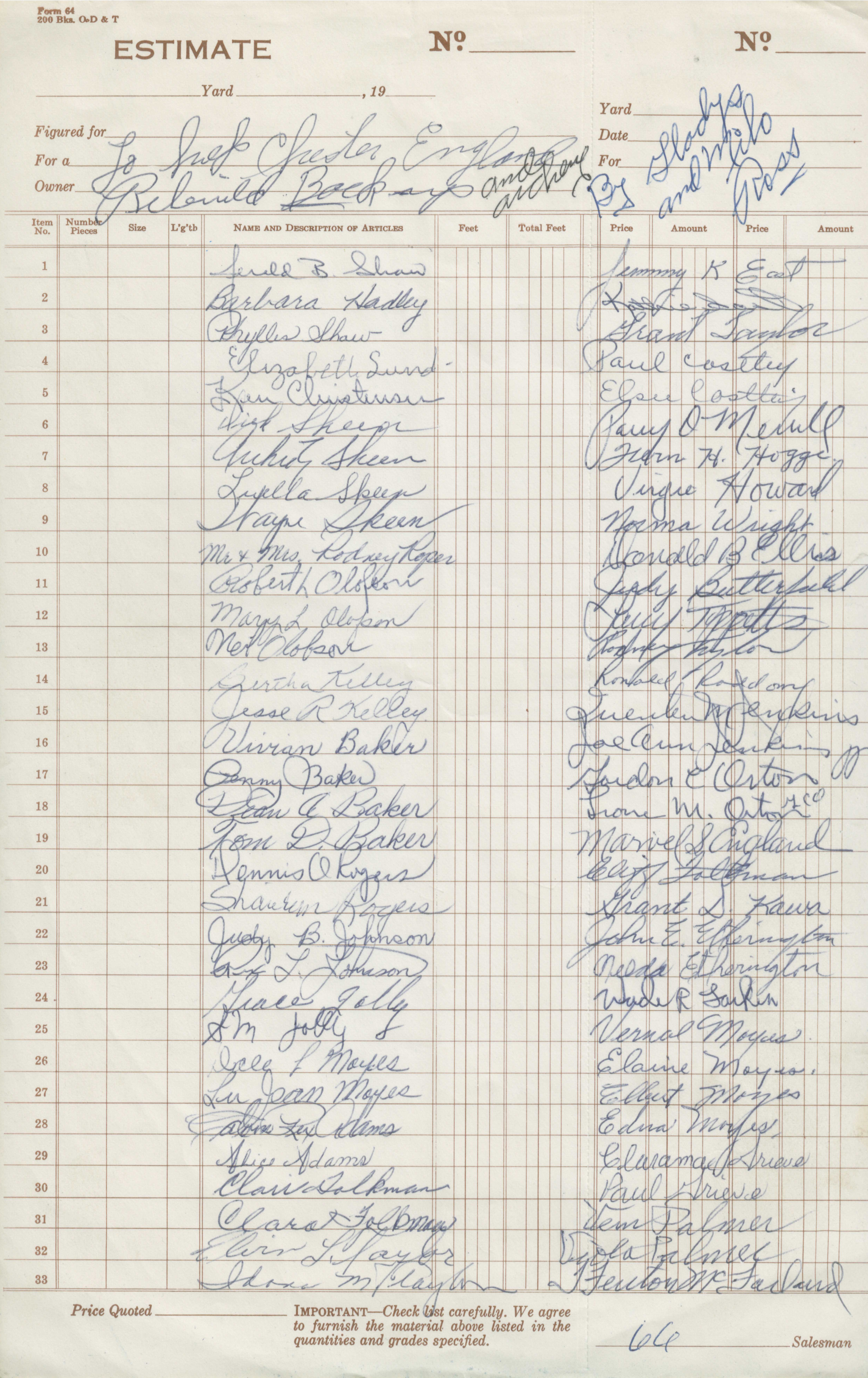
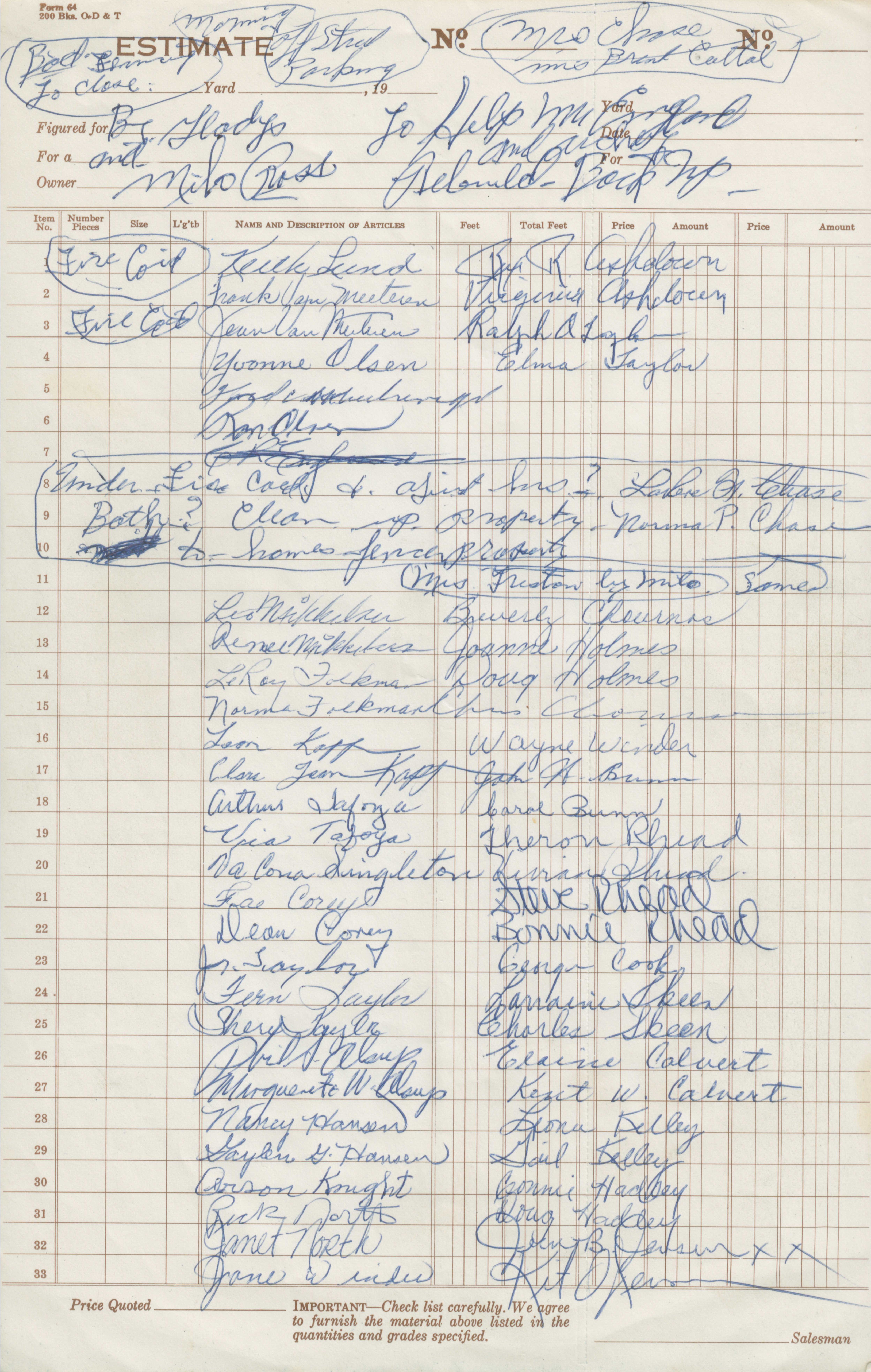
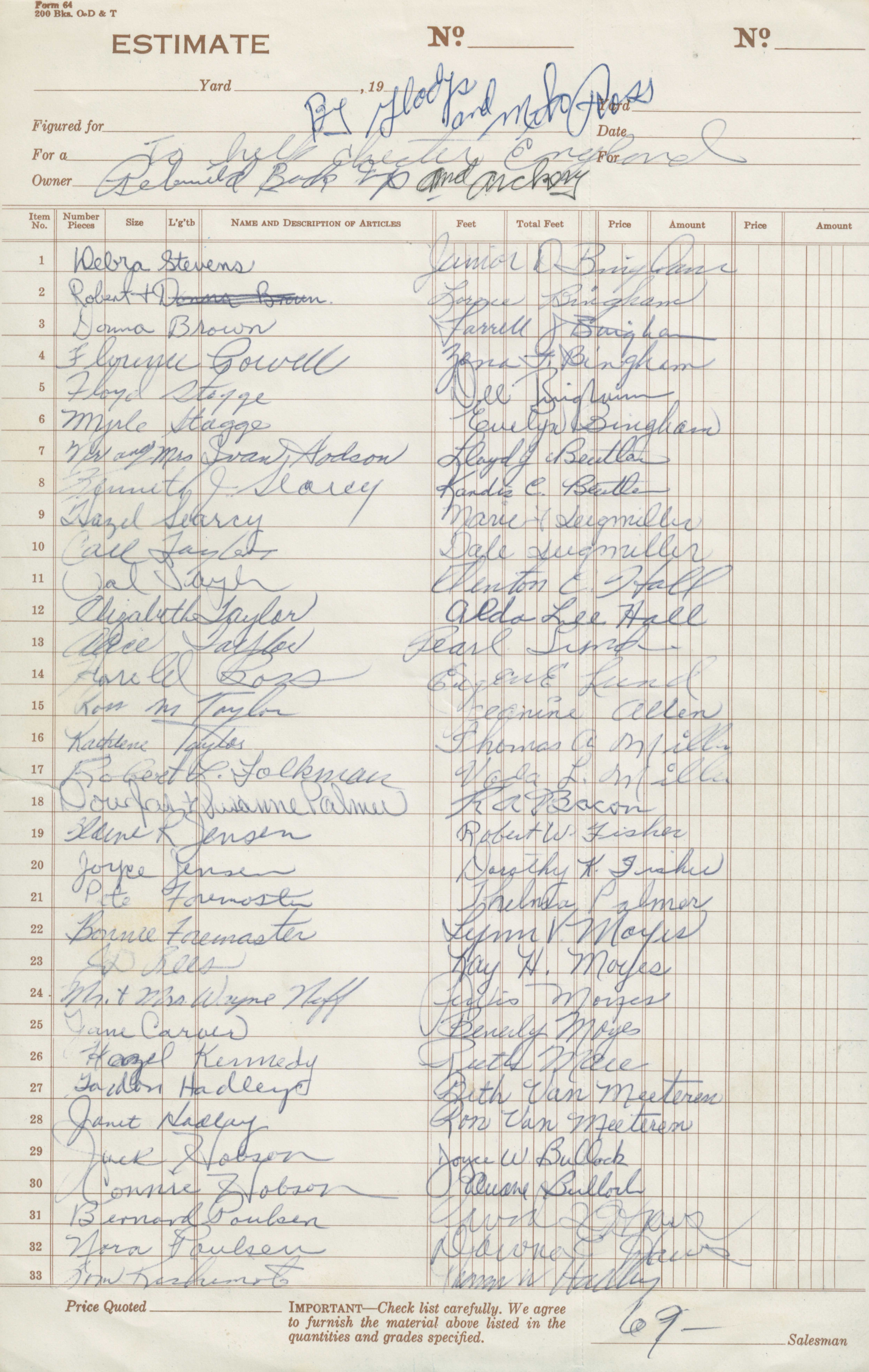
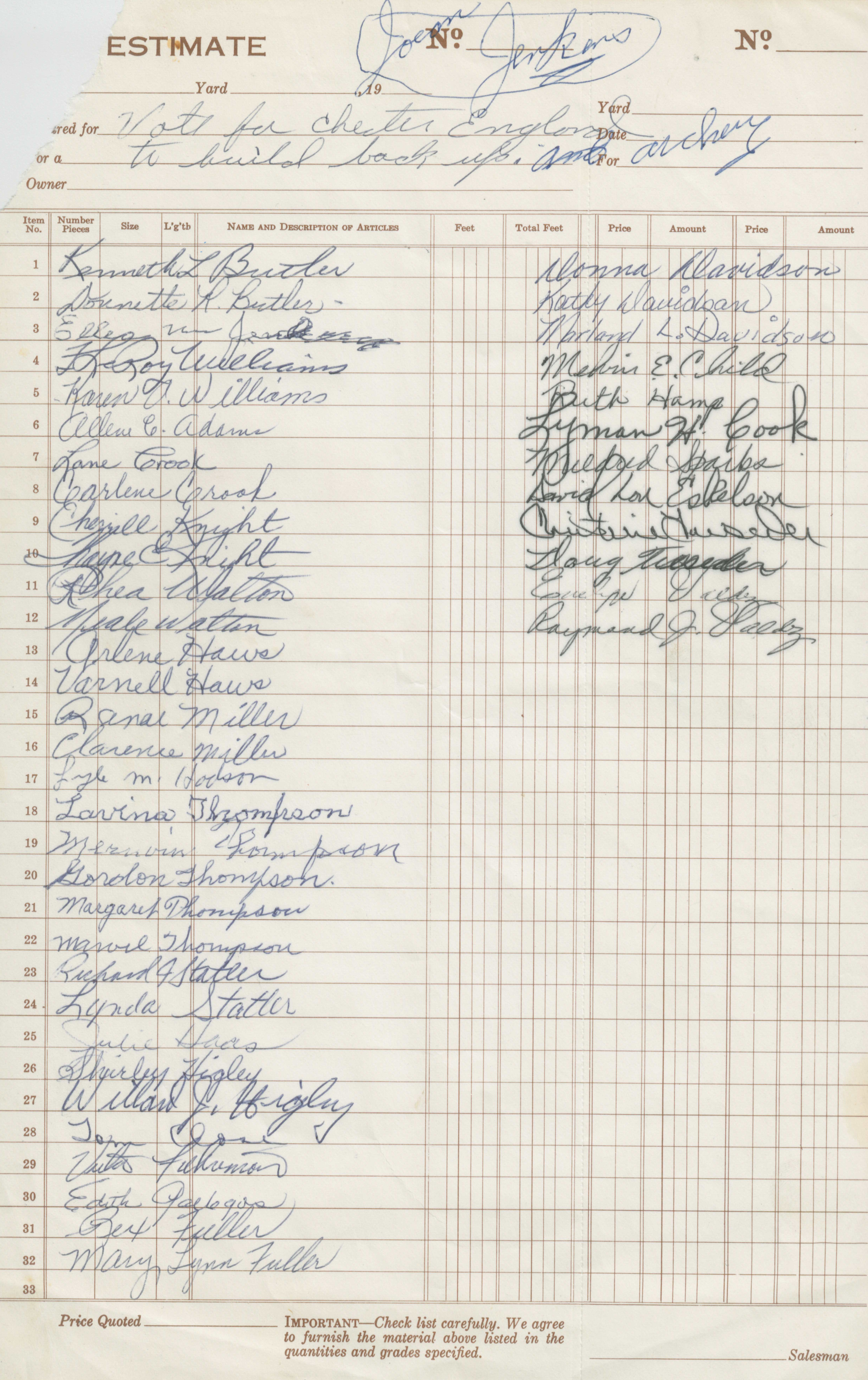
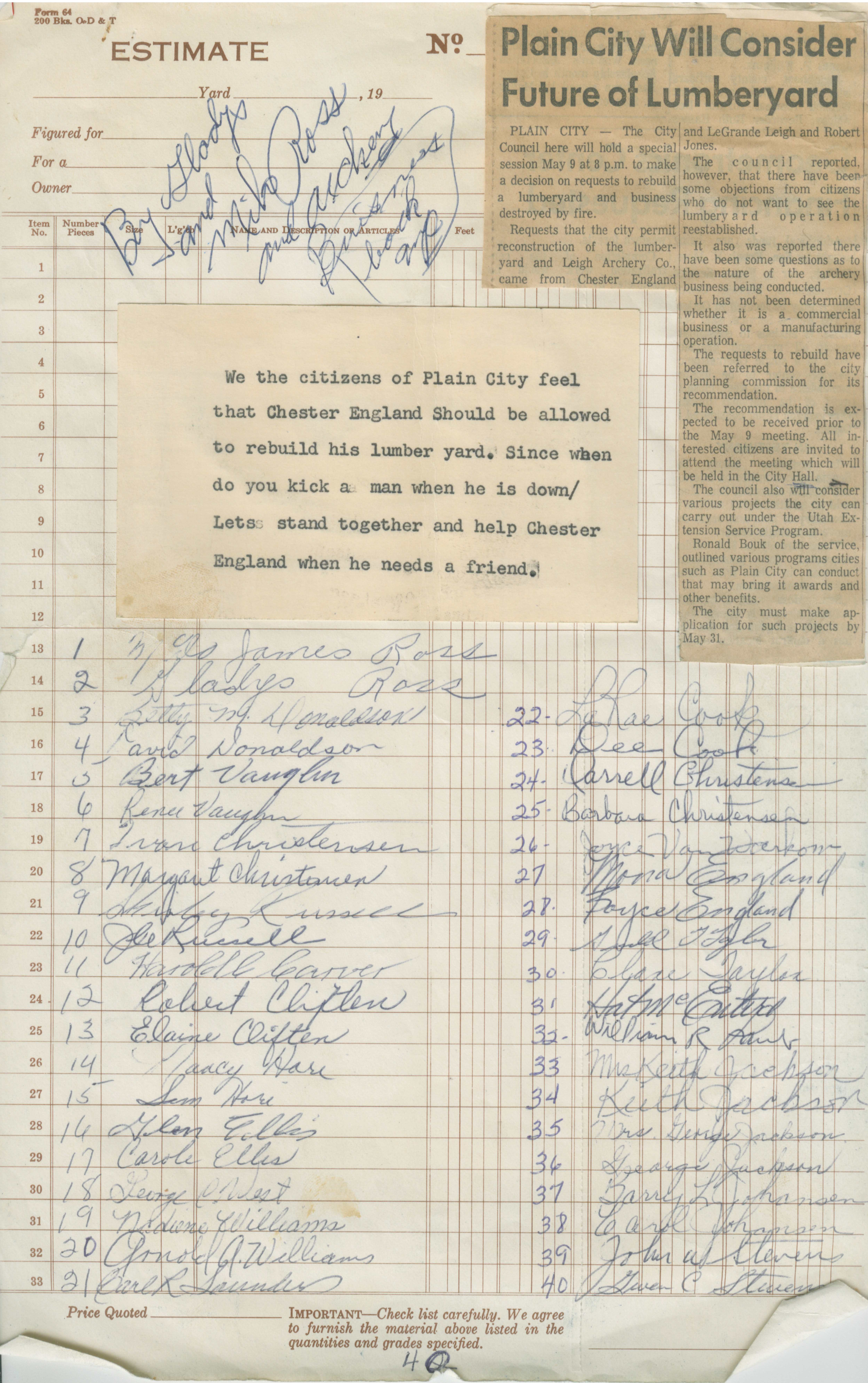
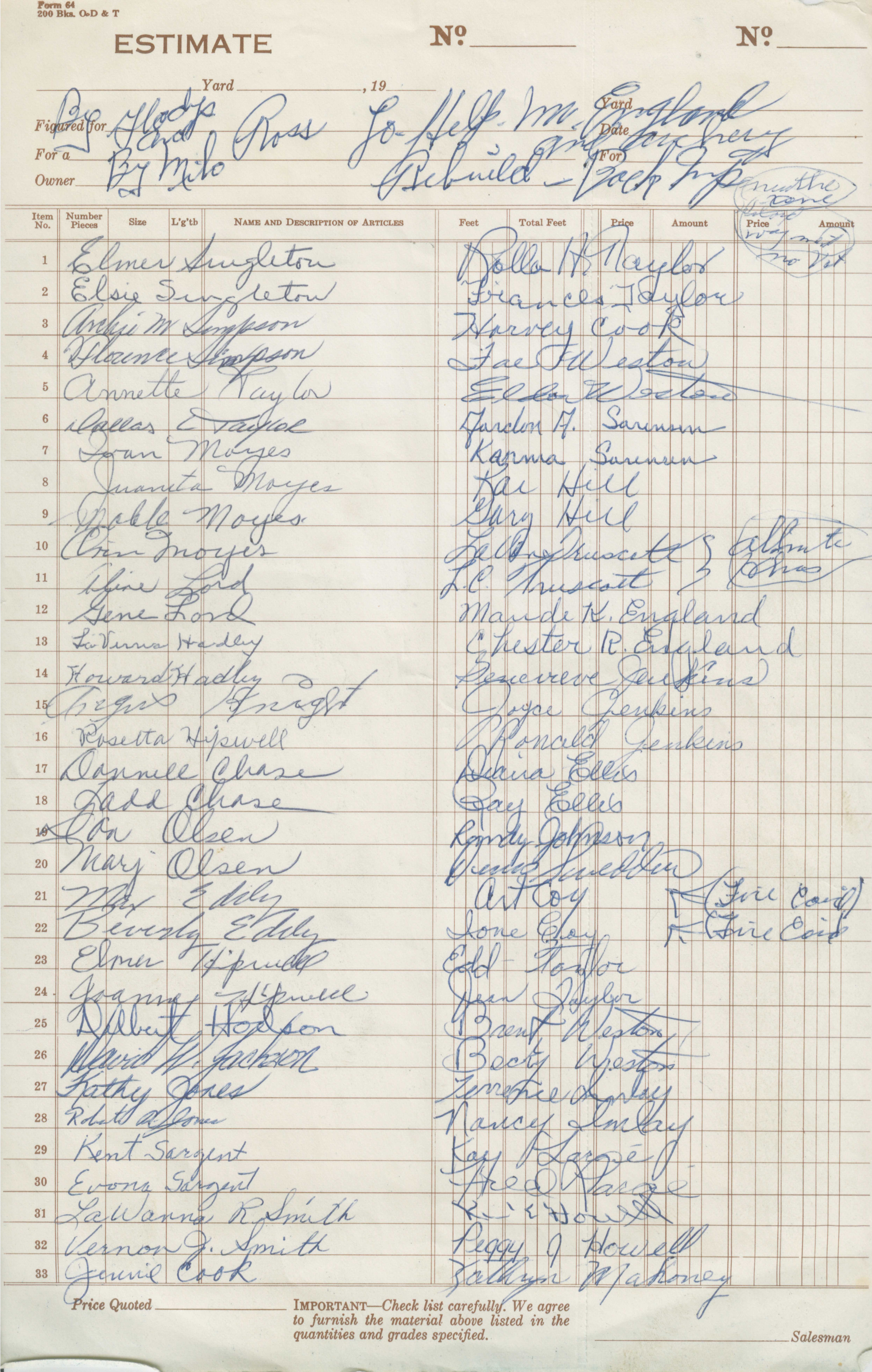
When a fire consumed Chester’s lumber yard on the evening of 6 April 1974, his neighbors rose to defend him to allow him to rebuild. Among those neighbors were my grandparents, Milo and Gladys Ross. What they did in the weeks that followed is documented below — eight pages of signatures collected on lumber yard estimate forms, a newspaper clipping, and a typed petition text. This post tells the story behind those pages.

Chester and Maude

Chester Rodney England was born 12 November 1896 in Plain City to William and Ismelda Thueson England. He grew up there, attended Weber Academy, and in 1916 married Maude Vivian Knight — a Plain City girl herself, born in August 1897. One month after their marriage, Chester received a mission call to the Southern States. He was set apart on 5 December 1916 by Apostle Anthony W. Ivins and left his new bride on 6 December 1916, serving for two years. He returned to find Utah in the grip of the 1918 influenza epidemic, his wife under quarantine, and her sister Elizabeth Knight Ericson dead. His mother was also ill, and he spent a week with his aunt Laura England before he could be with his family.

Chester wrote his own history late in life, and his voice is direct. After the mission he worked at the Amalgamated Sugar factory, farmed through the winters, bought a small Ford truck, and began hauling produce to the stores up through Cache Valley. “I found I could make more money doing this than farming,” he wrote, “so I turned the farm back to my father.” On 24 October 1919, his first son, Eugene Knight England, was born in Ogden. On 6 March 1923, his second son, William Knight England, followed. Two daughters, Rosemary and Carol, completed the family.

Milo James Ross
Milo James Ross (1921–2014)

In 1924 the Weber Central Dairy Association organized and asked for bids to truck milk from the dairymen into the dairy on 19 Washington Boulevard in Ogden. Chester submitted his bid, was accepted, and trucked the first load. He delivered milk in the morning and hauled potatoes up through Cache Valley in the afternoon. Gene and Bill grew up in the business. During summers Chester took them along on the long hauls, building a shelf of boxes out from the cab seat so they could nap on the road. He made sure they always had a bottle of pop at each stop.

During World War II, while Gene and Bill served in the military, Chester hauled Mexican bananas coming into the country at El Paso, Texas, distributing them throughout Utah. Gene served in the 77th Infantry Division at Okinawa, earning the Bronze Star for crawling under fire to drag a wounded soldier to safety — 129 men went up to the escarpment, 27 came back after 72 hours. Bill served in the Air Force in the Philippine Islands from 1943 to 1946. The two brothers found each other on Cebu using a coded letter — Gene had written his middle initial as “B” to signal his location — and Bill arrived with a mattress, making Gene the only man in his division sleeping on something other than a canvas cot. A letter written from the Hotel Keystone in San Diego in May 1946 — Chester on the road at age 49 — gives a picture of those years on the home front. He writes to his wife about a load of bananas, his plans to buy a semi-trailer, and his satisfaction that Gene and Bill are doing well.

Shortly after their return from service, Gene and Bill joined Chester hauling produce. Their first postwar hauls included lumber from Oregon back to Utah, and it was that trade that gave the family firsthand knowledge of the lumber market. The first diesel truck — a used 1940 Kenworth conventional — was purchased during this period. As the business grew, the company also ran two packing sheds and a storage facility for Idaho potatoes at its peak. Around 1957, an unforeseen change in the potato hauling market prompted Gene and Bill to file applications for ICC licenses to haul all kinds of freight, opening an entirely new range of products and geographic lanes. That same year, C.R. England offered 72-hour coast-to-coast service, the first such offering available to American shippers. The first trip east was made by driver Robert Gould in a new 1959 Kenworth, tractor number 17, hauling produce from California to Philadelphia.

In the 1950s Chester stepped back from trucking, leaving Gene and Bill to run what had become C.R. England & Sons. He returned his attention to Plain City. As he wrote: “Our sons retired me from C.R. England & Sons so I started building homes on our property in Plain City. I soon decided I needed a lumber yard if I was going to continue to build. In 1960 I built a lumber yard on the property just west of the home we had sold.” The family’s years hauling lumber from Oregon had given Chester intimate knowledge of the lumber trade, and that knowledge informed the decision. He built three homes on adjacent property and sold them to Keith Lund, Ray Cottle, and Blaine Gibson. He built 25 homes in Plain City and many others throughout Weber County. He built a 12-unit apartment complex in Roy. He took second mortgages from young couples who could not otherwise buy. “It was a great satisfaction to have young couples come and tell me they would never have bought their homes without my help,” he wrote.

Maude was with him through all of it. Born in Plain City in August 1897, she never really left. She served as president of the Plain City Primary, held positions in the Relief Society throughout her life, and attended the Ogden Temple with Chester twice a week when they could manage it. She died in Plain City on 12 February 1982, having lived there her entire 84 years. Chester moved to Salt Lake City after her death and died there on 5 January 1989. He is buried beside her in Plain City Cemetery.

The Sugar Factory

The sugar factory was woven into both families long before the fire. The Amalgamated Sugar Company plant at Wilson Lane, just south of Plain City, was one of the economic anchors of Weber County from the early twentieth century onward. Plain City farmers hauled beets to the rail dumps each fall for decades; the railroad that came to Plain City in 1909 arrived largely to move beet cars to that factory. Chester England worked at the sugar factory himself after returning from his mission in late 1918, spending two winters there before he turned to farming and then trucking.

Milo’s father, John “Jack” Ross, worked for Amalgamated Sugar much of his adult life, following the company between its Ogden, Burley, and Paul, Idaho plants as work demanded. That movement accounts for the geography of the Ross children: Milo was born in Plain City in 1921, his brother Paul born in the town of Paul, Idaho in 1922, and Harold born in Burley in 1924. Amalgamated Sugar built its Paul factory in 1917, and families from the Plain City area followed the work north. The factory experienced difficult early years — a postwar agricultural depression after World War I, and then the beet leafhopper blight that devastated crops through the 1920s and into the 1930s — but it survived to become, in time, the largest sugarbeet processing facility in the world. Chester England and Jack Ross were contemporaries who had worked for the same company in the same corner of northern Utah before either of them had settled into the lives their families would remember them by. For more on the sugar factory’s role in Plain City’s history, see History of Plain City Pt. 1.

The Cradle of American Trucking

Chester England’s 1920 Model T purchase was the seed of something considerably larger than one family’s business. Four major American trucking companies trace their origins directly to Plain City, and all four connect back to Chester. The Standard-Examiner and C.R. England’s own history have documented this story in detail.

C.R. England & Sons grew steadily through the postwar decades into one of the largest refrigerated carriers in the United States, eventually operating a fleet approaching 4,000 trucks and headquartered in Salt Lake City. Gene England served as president of the company well into his later years, still coming into the office daily at age 88. He died on 13 November 2024 at the age of 105. Bill England, who married Fern Hadley — a Plain City Hadley, the same family that signed the petition — died on 28 March 2018 at age 95. He spent his last ten years without sight but maintained, as his family recorded, an extraordinary optimism throughout. He entitled his life history “It Is As Good As It Gets.”

Carl Moyes had driven trucks for C.R. England in his younger years. In the late 1950s, Carl and his wife Betty started B&C Truck Leasing in Plain City. In 1966, when their son Jerry graduated from Weber State College, the family moved to Phoenix, Arizona and formed the company that would eventually become Swift Transportation — for many years the largest truckload carrier in the United States. Jerry Moyes later observed that he liked to say there was “diesel in the water” in Plain City, and that the people there were conceived in sleeper cabs.

In 1990, brothers Kevin and Keith Knight and their cousins Randy and Gary Knight left Swift to found Knight Transportation. All four had grown up in Plain City and gotten their start working for the Moyes family’s Swift Transportation. The Knights were also related to Maude Knight, who had married Chester England in 1916, making them family to the man who started the Plain City trucking tradition. Knight Transportation started with five trucks; four years after going public the company had between 250 and 300. Knight and Swift announced a merger in April 2017, creating Knight-Swift Transportation, valued at an estimated $5 billion with approximately 23,000 tractors and 77,000 trailers.

In 1976, Jeff England — Gene’s oldest son and Chester’s grandson — bought his first truck while still working at C.R. England as an owner-operator, initially under the name “Pride of England Enterprises.” In 1979, with three trucks and a haul contract moving produce from California to New York, he left the family firm to go fully independent. His wife Pat was his partner from the beginning. In the early 1980s he assembled a group of investors, purchased ten more trucks, and rebranded as Pride Transport Inc. By 2017 the company operated a fleet of 500 trucks. In 2012 Jeff passed ownership to his son Jay England. Jeff England said of his decision to leave: “I felt that I needed to do my own thing.” He was 76 at the time of that interview and still driving a truck a couple of times a month.

The fuel infrastructure serving these fleets also has roots in this region. O. Jay Call, who came to Willard, Utah in the mid-1960s, founded Flying J in 1968, naming it for his love of flying, and built it into the largest retailer of diesel fuel in North America. His uncle, Reuel Call, had founded Maverik convenience stores in 1928 in Afton, Wyoming. FJ Management acquired Maverik in 2012. The Call family’s fuel network and the England-Moyes-Knight trucking empire developed in the same northern Utah environment across the same decades.

In September 2022, representatives of all four trucking firms gathered at Peery’s Egyptian Theater in Ogden for the premiere of a documentary about their shared origins. Gene England, then 102 years old, was present on stage alongside Jeff and Dan England, Jerry Moyes, and Kevin Knight.

The Fire

On the evening of 6 April 1974, Chester England went over to open up the lumber yard. He was 77 years old.

He described what followed in his own autobiography:

As I opened the office door, the place exploded and was engulfed with flames. It had been smoldering during the night. We do not know what caused it but it burned everything. I ran in to get the invoices but the ceiling began falling and burned holes in my jacket so I could have lost my life. This was a terrible experience watching everything you have worked hard for go up in flames. I was down in bed for 10 days from shock. We had insurance on it but I had been buying so much merchandise that the insurance didn’t begin to pay for the loss. I appreciated the fire department and the ward members who worked so hard to help. It took many weeks after to clean up. My family thought I should retire and not build it up again. However, I knew I wouldn’t be happy without something to do so I started rebuilding as soon as I could.

The 1977 History of Plain City records the fire at “England Builder’s Lumber Company” and gives the date as April 6, 1975. That date appears to be a transcription error in the town history; Chester’s own autobiography gives 6 April 1974, and that account is the primary source. The fire also destroyed the adjacent Leigh Archery Company, operated by LeGrande Leigh and Robert Jones. The insurance fell short. Chester was 77 and his family urged him to retire. He refused.

Plain City Will Consider Future of the Lumberyard

A newspaper clipping, attached to the first petition page, reported what happened next:

PLAIN CITY — The City Council here will hold a special session May 9 at 8 p.m. to make a decision on requests to rebuild a lumberyard and business destroyed by fire.

Requests that the city permit reconstruction of the lumberyard and Leigh Archery Co. came from Chester England and LeGrande Leigh and Robert Jones.

The council reported, however, that there have been some objections from citizens who do not want to see the lumber operation reestablished.

It also was reported there have been some questions as to the nature of the archery business being conducted. It has not been determined whether it is a commercial business or a manufacturing operation.

The requests to rebuild have been referred to the city planning commission for its recommendation. The recommendation is expected to be received prior to the May 9 meeting. All interested citizens are invited to attend the meeting which will be held in the City Hall.

The council also will consider various projects the city can carry out under the Utah Extension Service Program. Ronald Bouk of the service outlined various programs cities such as Plain City can conduct that may bring it awards and other benefits. The city must make application for such projects by May 31.

Some citizens did not want Chester to rebuild. And so his neighbors organized.

Milo and Gladys Ross

Milo and Gladys Ross
Milo and Gladys Ross, 30 May 1942

Milo James Ross (1921–2014) was born 4 February 1921 in a log cabin just north of Plain City. His mother, Ethel Sharp Ross, died of puerperal septicemia in August 1925 when Milo was four years old, leaving three surviving boys. Milo went to live with his Uncle Ed Sharp, Harold with Uncle Dale Sharp. They were raised in separate homes within a few blocks of one another in Plain City, the extended Sharp family absorbing the loss. For more on the Sharp family’s tragedies, see Sharp Tragedies.

Milo grew up working Ed Sharp’s farm — tending onions, hauling salt from the flats at Promontory, doing whatever needed doing. He played baseball with the Plain City Farm Bureau team and attended Weber High School.
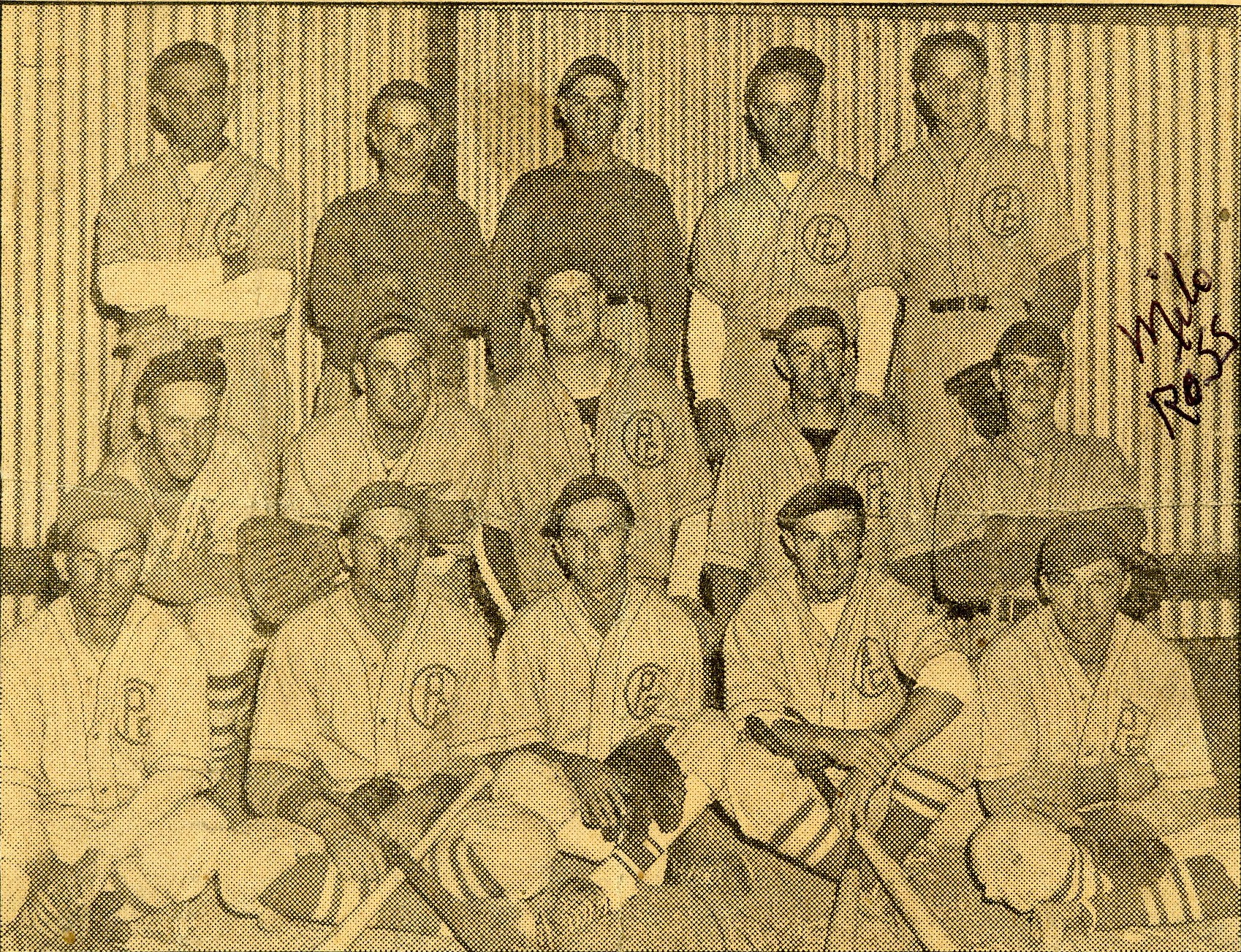
Plain City baseball team
Plain City baseball team. Back (l-r): William Freestone (manager), Norman Carver, Glen Charlton, Fred Singleton, Elmer Singleton (1918–1996). Middle: Clair Folkman, Dick Skeen, Albert Sharp, Abe Maw, Milo Ross. Front: F. Skeen, Walt Moyes, Arnold Taylor, Lynn Stewart, Theron Rhead. See also: Plain City Hurler.
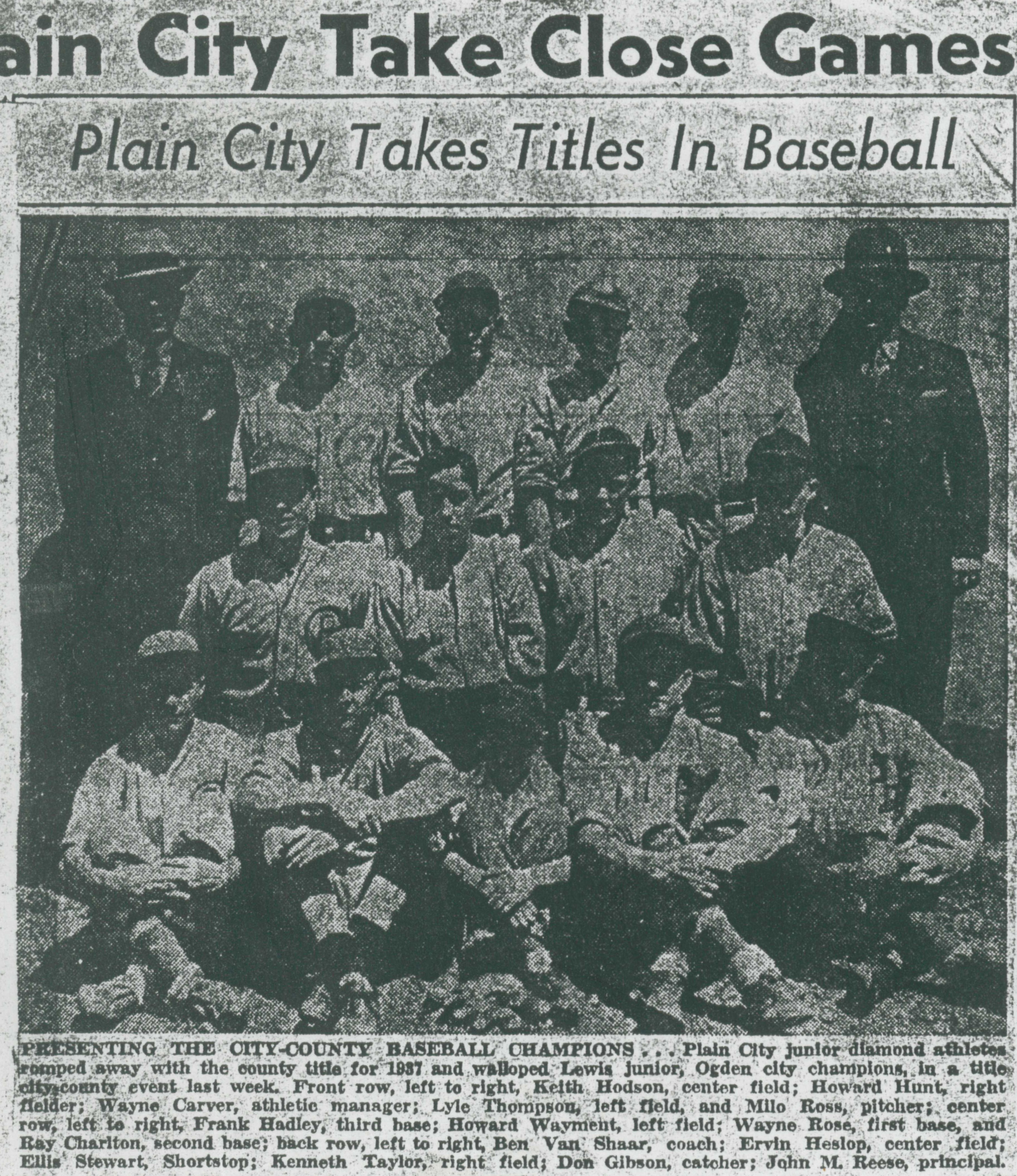
1937 Plain City Baseball Champions
1937 Plain City Baseball Champions. Back (l-r): Ben Van Shaar, Ervin Heslop, Ellis Stewart, Kenneth Taylor, Don Gibson, John Reese. Middle: Frank Hadley, Howard Wayment, Wayne Rose, Ray Charlton. Front: Keith Hodson, Howard Hunt, Wayne Carver, Lyle Thompson, Milo Ross.

In 1940 Milo met Gladys Maxine Donaldson (1921–2004) at a Plain City celebration. They married on 4 April 1942. Six months later Milo enlisted in the Army. He served in the 33rd Infantry Division, 130th Regiment, Company C, trained in weapons and earned expert ranking. He arrived in Hawaii on 4 July 1943 — the same day his son, Milo Paul, was born in Utah, a son he would not meet for three years. He fought through the jungles of New Guinea and the Philippines and was present at the Japanese surrender at Luzon in June 1945. He received two Purple Hearts and the Silver Star. His company received a Presidential Citation for outstanding performance during the seizure of Hill X in the Bilbil Mountain Province. For more on Milo’s military service, see Milo James Ross Military Medals and his 1997 oral history interview.
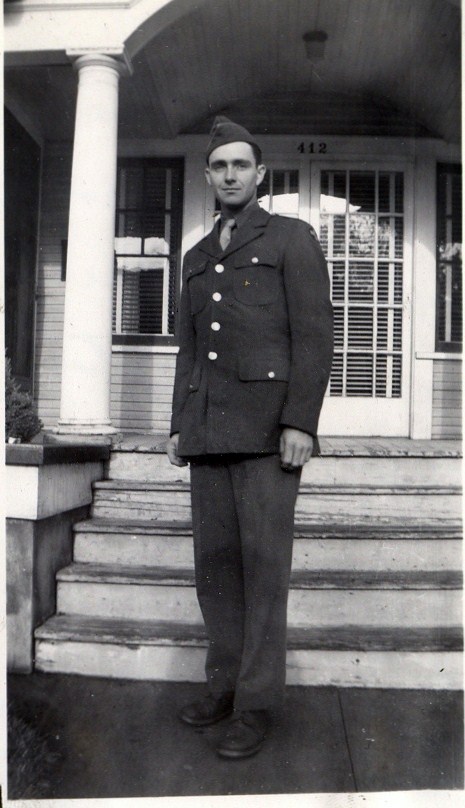
Milo Ross in uniform
Milo Ross in uniform at Fort Lewis, Washington

He came home and went to work as a contractor and builder, eventually building and remodeling hundreds of homes throughout Utah, mostly in Weber County. That work is why, when the time came to gather signatures for Chester England, he had a pad of lumber yard estimate forms at hand. They were his working tools. He pressed them into service as petition pages.

Milo knew Chester England personally. A childhood photograph survives showing Milo alongside Harold Ross, Howard Hunt, Josephine Sharp, and Janelle England on horseback — the England and Ross and Sharp children together in the neighborhood as naturally as their parents moved among one another. In his 1997 oral history interview, Milo recalled Chester among the Plain City men who had struggled during the Depression years, when banks failed and farms were lost. Chester was woven into Milo’s memory of Plain City going back to his earliest years.

On Horse l-r: Harold Ross, Howard Hunt, Milo Ross, Josephine Sharp (arm only), Janelle England, Eddie Sharp. In front l-r: Ruby Sharp, Lucille Maw, and Milo Riley Sharp.

The Petition

The typed text at the center of the petition read:

We the citizens of Plain City feel that Chester England should be allowed to rebuild his lumber yard. Since when do you kick a man when he is down/ Lets stand together and help Chester England when he needs a friend.

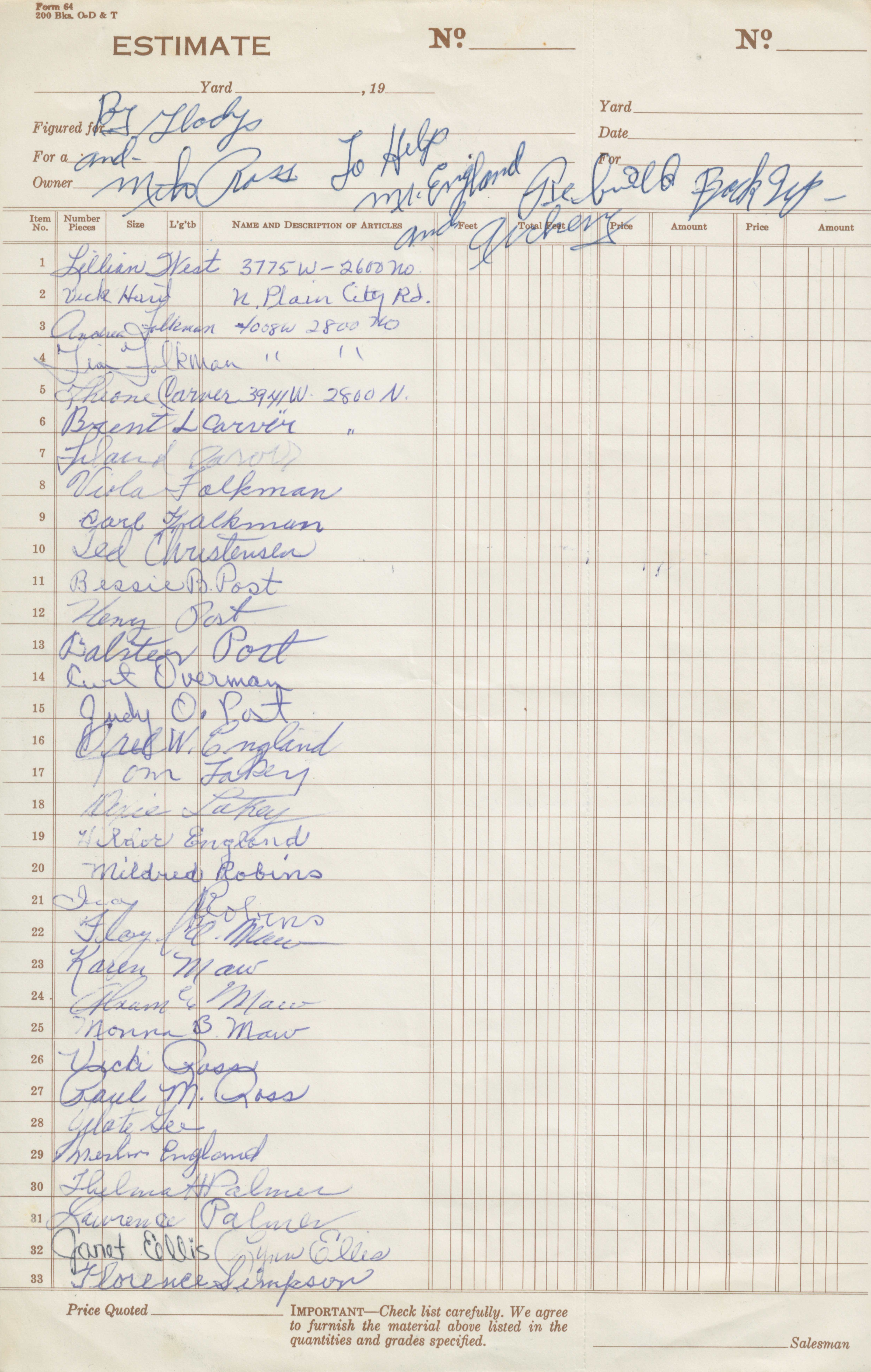
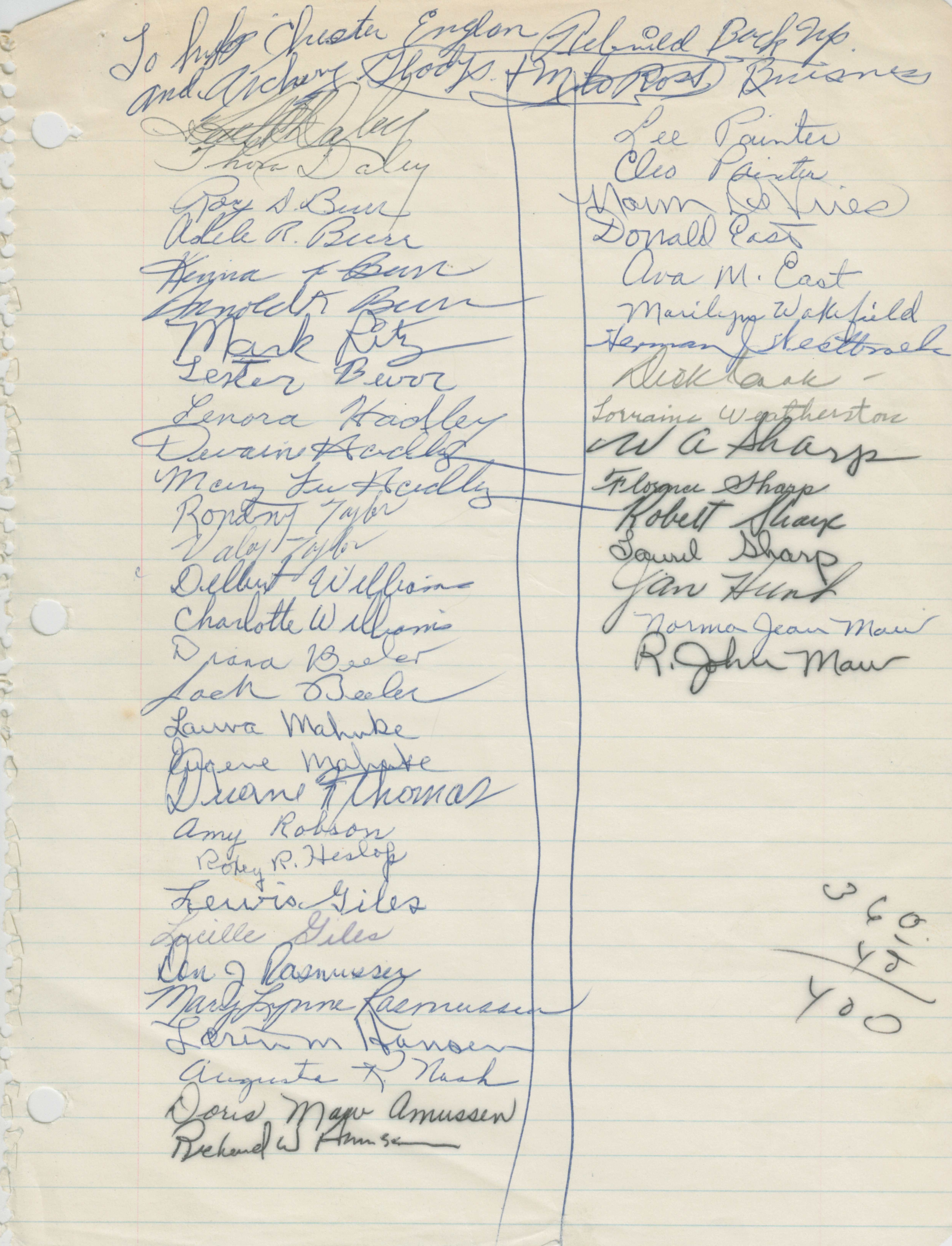
The headers on the petition pages identify the organizers: “By Gladys and Milo Ross — To Help Mr. England — Rebuild Back Up.” The forms were passed through the community in the weeks leading up to the May 9 city council meeting. One page was circulated by Joan Jenkins.

My father, Milo Paul Ross, had worked for Chester England as a teenager. He and his first wife, Victoria “Vicki” Feldtman (1945–2018) — married 5 March 1963 — both signed the petition. For more on Vicki, see Vicki’s Class Pictures. My grandfather Harold Ross also signed. The Sharp cousins — W.A. Sharp and Florence Sharp, children of the family that had raised Milo and Harold — signed as well. Maude K. England and Chester R. England signed the petition themselves.

Among the more than 340 signers, the connections to Plain City’s history run deep. The Moyes family signed in force — the same family whose son Carl had driven trucks for Chester England and whose grandson Jerry would found Swift Transportation. The Knights signed — relatives of Maude Knight England and future founders of Knight Transportation. Elmer Singleton (1918–1996), the Plain City baseball legend who pitched in the major leagues for five teams over fifteen years, signed with his wife Elsie. Cherrill Palmer Knight (1931–2021), who had served as Plain City City Recorder and was the daughter of Vern and Viola Palmer — also signers — added her name alongside her husband Thayne (1931–2018). Roxey R. Heslop, who contributed the school and cemetery histories to the 1977 Plain City history book, also signed. Hildor England (1896–1983), born Johnson, who married into the England family, signed as well. Gordon C. Orton (1924–2008), a Plain City general contractor and World War II veteran who served in the Philippines, New Guinea, and Okinawa, signed with his wife Leone. Vernal Moyes, who had served as a Plain City councilman, signed alongside his family.

The 1977 History of Plain City records the outcome: “Builders Bargain Center, formerly England’s Builders. This business was started and run by Chester England for many years.” Chester rebuilt. The community’s voice prevailed. For more on Plain City’s history, see the Plain City series on Sagacity.

Circle A Construction

Milo Paul Ross and Larry Aslett

My father’s career at Circle A Construction was built substantially on the same industry that had shaped the England and Ross families in Plain City. Circle A, founded in 1952 in Jerome, Idaho by Marvin Aslett, hauled sugar beets for Amalgamated Sugar for most of its operating history. For roughly 34 years, from around 1971 until Circle A transferred the Paul operations to AgExpress in 2004, my father supervised beet hauls across the Magic Valley, from the fields to the Amalgamated dumps at Paul and elsewhere across southern Idaho — the same plants Jack Ross had worked in a generation before.

Marvin Aslett and Milo Paul Ross
Marvin Aslett and Milo Paul Ross at Milo’s 20-year service recognition, 1990. See: Circle A Construction Honors.
Circle A truck in Paul parade
Circle A Construction truck in the Paul, Idaho parade, about 1985. See: Circle A Construction Trucks.

Marvin’s sons Larry and Steve Aslett ran the company alongside my father for decades. We called Larry “Uncle Larry” growing up. The Asletts took us to roundups in Mackay, to ranch country above White Knob. I worked for Circle A myself from 1993 through 1998. My first job in 1994 was washing and waxing trucks at the old Hynes beet dump in Paul after harvest. Jack Ross had worked for Amalgamated Sugar in Paul in the 1920s. My father hauled beets to Amalgamated in Paul for three decades. Circle A’s beet hauls fed the same company in the same town across three generations of this family’s working life.
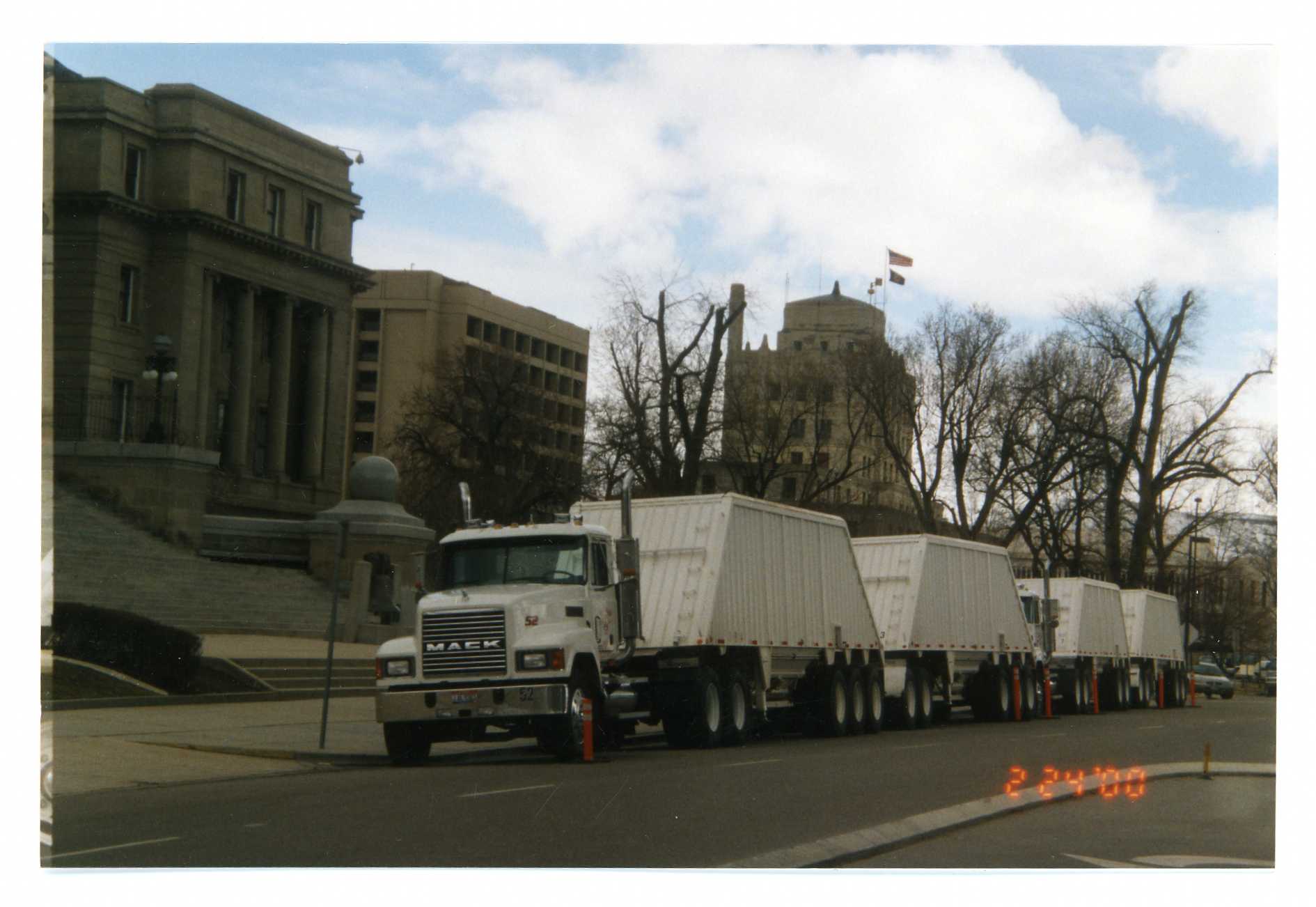
Circle A trucks in front of Idaho Capitol
Circle A Construction trucks in front of the Idaho State Capitol, 2000

The Petition Pages

Below are all eight pages of the petition as collected by Milo and Gladys Ross in the spring of 1974.
Complete List of Signers

Names marked with an asterisk (*) represent uncertain readings of the cursive originals. Dates are given where confirmed through research. This list was transcribed from handwritten signatures; corrections and additions are welcome.

Adams, Alice
Adams, Allene C.
Adams, Calvin Rex
Allen, Jeanine
Alsup, Marguerete W.*
Alsup, Phil S.
Amussen, Doris Maw
Amussen, Richard W.
Ashdown, Rex R.
Ashdown, Virginia
Bacon, R.A.
Baker, Dean A.
Baker, Penny
Baker, Tom D.
Baker, Vivian
Beeler, Diana
Beeler, Jack
Beutler, Kandis C.
Beutler, Lloyd J.
Bingham, Dee
Bingham, Evelyn
Bingham, Farrell J.
Bingham, Junior D.
Bingham, Lorene
Bingham, Zona F.
Brown, Donna
Brown, Robert
Bullock, Duane
Bullock, Joyce W.
Bunn, Carol
Bunn, John H.
Burr, Adle R.
Burr, Arnold K.
Burr, Kenna F.
Burr, Lester
Burr, Roy D.
Butler, Donnette R.
Butler, Kenneth L.
Butterfield, Judy*
Calvert, Elaine
Calvert, Kent W.
Carver, Brent
Carver, Harold C.
Carver, Jane
Carver, Liland
Carver, Theone
Chase, Dannell
Chase, Ladd
Chase, LaRene G.
Chase, Norma P.
Child, Melvin E.
Chournas, Beverly*
Chournas, Chris*
Christensen, Barbara
Christensen, Darrell
Christensen, Ivan
Christensen, Ken
Christensen, Margaret
Christensen, Ted
Cliften, Elaine
Cliften, Robert
Close, Tom*
Cook, Dee
Cook, George
Cook, Harvey
Cook, Jennie
Cook, LaRae
Cook, Lyman H.
Corey, Dean
Corey, Fae
Costley, Elsie
Costley, Paul
Cowell, Florence
Crook, Carlene
Crook, Lane
Daley, Kenneth*
Daley, Thora
Dall, Kathie*
Davidson, Donna
Davidson, Kathy
Davidson, Marland L.
DeVries, Norm
Donaldson, Betty M.
Donaldson, David
East, Ava M.
East, Donald
East, Jimmy K.
Eddy, Beverly
Eddy, Max
Ellis, Carole
Ellis, Diana
Ellis, Donald B.
Ellis, Glen
Ellis, Janet
Ellis, Lynn
Ellis, Ray
England, Boyce
England, Chester R. (1896–1989)
England, Hildor (1896–1983)
England, Marvel S.
England, Maude K. (1897–1982)
England, Merlin
England, Mona
England, Orel W.
Eskelson, David Lon
Etherington, John E.
Etherington, Nelda
Fisher, Dorothy K.
Fisher, Robert W.
Folkman, Andrea
Folkman, Carl
Folkman, Clair
Folkman, Clara
Folkman, Cliff
Folkman, Jim
Folkman, LeRoy
Folkman, Norma
Folkman, Robert L.
Folkman, Viola
Foremaster, Bonne*
Foremaster, Pete
Fuller, Mary Lynn
Fuller, Rex
Fuhriman, Viola
Gallegos, Edith
Gee, Vilate
Giles, Lewis
Giles, Lucille
Grieve, Claramae
Grieve, Paul
Haas, Julie
Hadley, Barbara
Hadley, Connie
Hadley, Devaine
Hadley, Doug
Hadley, Gordon
Hadley, Howard
Hadley, Janet
Hadley, Karma W.*
Hadley, LaVirra*
Hadley, Lenora
Hadley, Mary Fee*
Hamp, Beth
Hansen, Gaylen G.
Hansen, Loren M.
Hansen, Nancy
Havseler/Tesseder, Christine*
Haws, Arlene
Haws, Darwin C.
Haws, Varnell
Heslop, Roxey R.
Higley, Shirley
Higley, Willard J.
Hill, Gary
Hill, Kae
Hipwell, Elmer
Hipwell, Joanne
Hipwell, Rosetta
Hobson, Connie
Hobson, Jack
Hodson, Delbert
Hodson, Lyle M.
Hodson, Mr. Ivan
Hodson, Ms. Ivan
Holmes, Doug
Holmes, Joanne
Hori, Nancy
Hori, Sam
Howard, Virgie
Howell, Kent*
Howell, Peggy J.
Hunt, Jan
Hurst, Vick*
Imlay, Nancy
Imlay, Terrence
Jackson, David W.
Jackson, George
Jackson, Mrs. George
Jackson, Mrs. Keith
Jackson, Keith
Jenkins, Ellen W.
Jenkins, Genevieve
Jenkins, Joan
Jenkins, JoAnn
Jenkins, Joyce
Jenkins, Quentin M.
Jenkins, Ronald
Jensen, Blaine R.
Jensen, Joyce
Jensen, June B.*
Jensen, Kit O.
Johansen, Barry L.
Johansen, Carol
Johnson, Judy B.
Johnson, Randy
Johnson, Rex L.
Jolly, Grace
Jolly, L.M.*
Jones, Kathy
Jones, Robert
Kapp, Clara Jean
Kapp, Leon
Kawa, Grant D.
Kelley, Bertha
Kelley, Gail
Kelley, Jesse R.
Kelley, Leona
Kennedy, Hazel
Kishimoto, Lorn
Knight, Argus*
Knight, Arson*
Knight, Cherrill (1931–2021)
Knight, Thayne E. (1931–2018)
Lakey, Dixie
Lakey, Tom
Large, Fred*
Large, Kay*
Larkin, Wade R.
Laub, William R.
Lord, Clarendon “Gene” (1929–2015)
Lord, Cline
Lund, Elizabeth
Lund, Eugene
Lund, Keith
Lund, Pearl
Mace, Rieths*
Mahoney, Kathryn
Mahnke, Eugene
Mahnke, Laura
Maw, Abram E.
Maw, Floy A.
Maw, Karen
Maw, Monna B.
Maw, Norma Jean
Maw, R. John
McFarland, Fenton
McMillan, Nola L.*
McMillan, Thomas A.*
Merrill, Paul O.*
Mikkelsen, Leo
Mikkelsen, Renee
Miller, Clarence
Miller, Ranae
Miller, Thomas A.
Miller, Veda L.
Moyes, Beverly
Moyes, Dale L.
Moyes, Edna
Moyes, Elaine
Moyes, Elbert
Moyes, Fentis*
Moyes, Ivan
Moyes, Juanita
Moyes, Kay H.
Moyes, LuJean
Moyes, Lynn V.
Moyes, Mable
Moyes, Orin
Moyes, Vernal
Nash, Augusta R.
Neff, Mr. Wayne
Neff, Ms. Wayne
North, Janet
North, Rick
Olofson, Mary L.
Olofson, Robert L.
Olsen, Ian*
Olsen, Mary
Olsen, Ron
Olsen, Yvonne
Orton, Gordon C. (1924–2008)
Orton, Leone
Overman, Curt
Painter, Cleo
Painter, Lee
Palmer, Douglas
Palmer, Lawrence
Palmer, Susanne
Palmer, Thelma H.
Palmer, Vern
Palmer, Viola (1908–2009)
Post, Bessie
Post, Judy O.
Poulsen, Bernard
Poulsen, Nora
Rasmussen, Don J.
Rasmussen, MaryLynn
Reese, J.D.
Rhead, Bonnie
Rhead, Steve
Rhead, Theron
Rhead, Vivian
Ritz, Mark
Robins, Jay*
Robins, Mildred
Robson, Amy
Roddomy, Ronald*
Rogers, Dennis O.
Rogers, Shareen
Roper, Mr. Rodney
Roper, Mrs. Rodney
Ross, Gladys (1921–2004) — organizer
Ross, Harold
Ross, Milo James (1921–2014) — organizer
Ross, Paul M.
Ross, Vicki (1945–2018)
Russell, Joe
Russell, Shirley
Sargent, Evona
Sargent, Kent
Saunders, Carl R.
Searcy, Hazel
Searcy, Kenneth J.
Seegmiller, Dale
Seegmiller, Marie F.
Sharp, Florence
Sharp, Laurel
Sharp, W.A.
Shaw, Jerrell B.
Shaw, Phyllis
Simpson, Archie W.*
Simpson, Florence
Singleton, Elmer (1918–1996)
Singleton, Elsie (–1988)
Singleton, VaCona
Skeen, Archie
Skeen, Charles
Skeen, Dick
Skeen, Lorraine
Skeen, Luella
Skeen, Wayne
Smith, LaWanna R.
Smith, Vernon J.
Sneddon, Dennis
Sorensen, Gordon A.
Sorensen, Karma
Sparks, Mildred
Stagge, Floyd
Stagge, Myrle
Statler, Lynda
Statler, Richard
Stevens, Debra
Stevens, Gwen C.
Stevens, John W.
Tafoya, Arthur
Tafoya, Via
Taylor, Alice
Taylor, Annette
Taylor, Call
Taylor, Clare
Taylor, Edna
Taylor, Elma
Taylor, Elvin L. (1920–2004)
Taylor, Elizabeth
Taylor, Fern
Taylor, Frances
Taylor, Gerald J.*
Taylor, Grant
Taylor, Idona Maw
Taylor, Jr.*
Taylor, Kathlene
Taylor, Kathy
Taylor, Ralph A.
Taylor, Rodney
Taylor, Rolla H.
Taylor, Ross M.
Taylor, Sheri
Taylor, Val
Taylor, Valoy (1932–2024)
Tesseder, Doug*
Thomas, Duane F.
Thompson, Gordon
Thompson, Lavina
Thompson, Margaret
Thompson, Marvel
Thompson, Merrvin*
Tippetts, Larry*
Truscott, L.C.
Truscott, LaVona
Valdez, Evelyn
Valdez, Raymond J.
Van Meeteren, Beth
Van Meeteren, Frank
Van Meeteren, Jean
Van Meeteren, Ron
Van Workom, Joyce*
Vaughn, Bert
Vaughn, Renee
Wakefield, Marilyn
Walton, Neale
Walton, Rhea
Weatherstone, Lorraine
West, George C.
West, Lillian
Westbrook, Herman
Weston, Becky
Weston, Brent
Weston, Eldon
Weston, Fae
Weston, Jae H.
Williams, Arnold A.
Williams, Charlotte
Williams, Delbert
Williams, F. LeRoy
Williams, Karen A.
Williams, Nadiene
Winder, Jane
Winder, Wayne
Wright, Norma
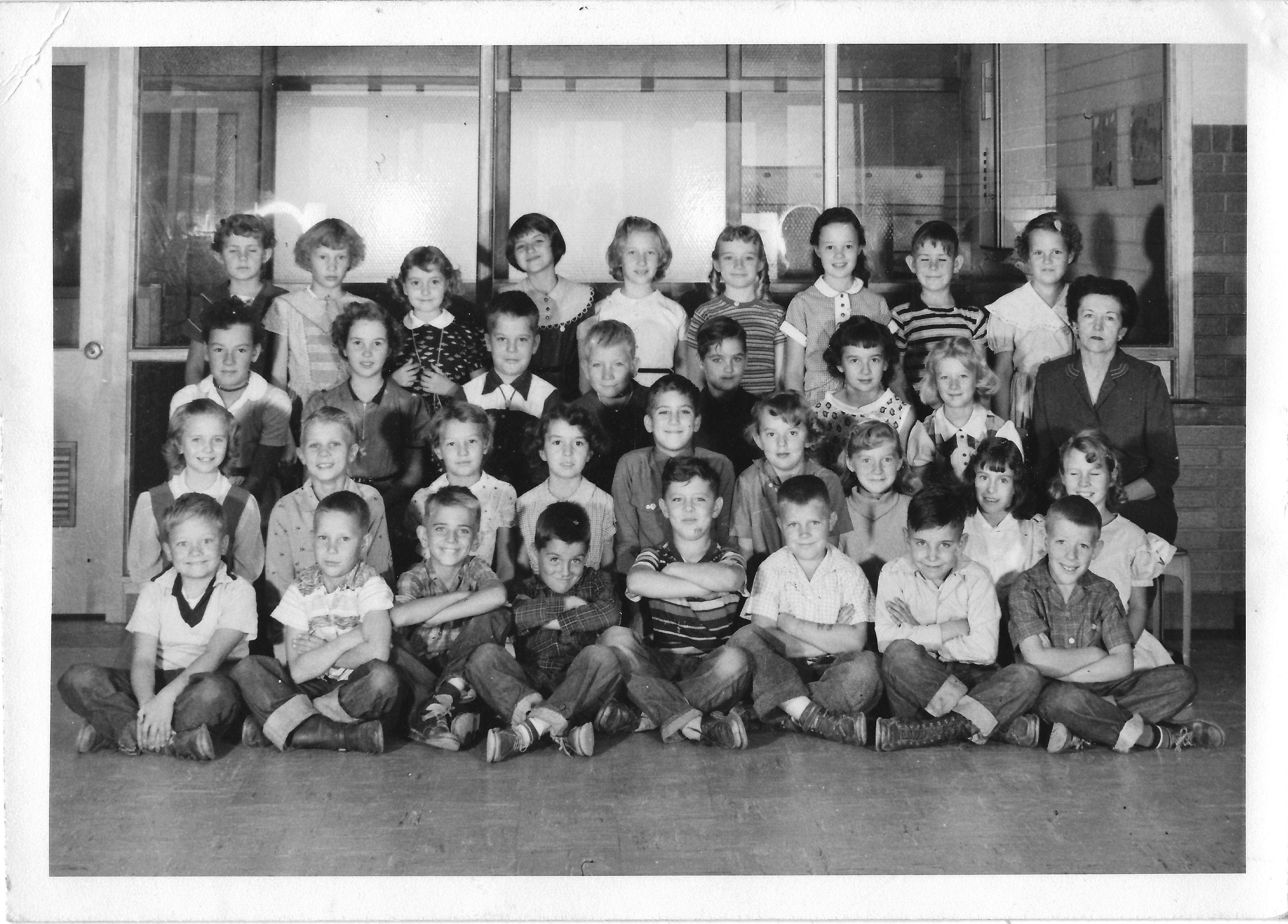
Vicki’s Class Pictures

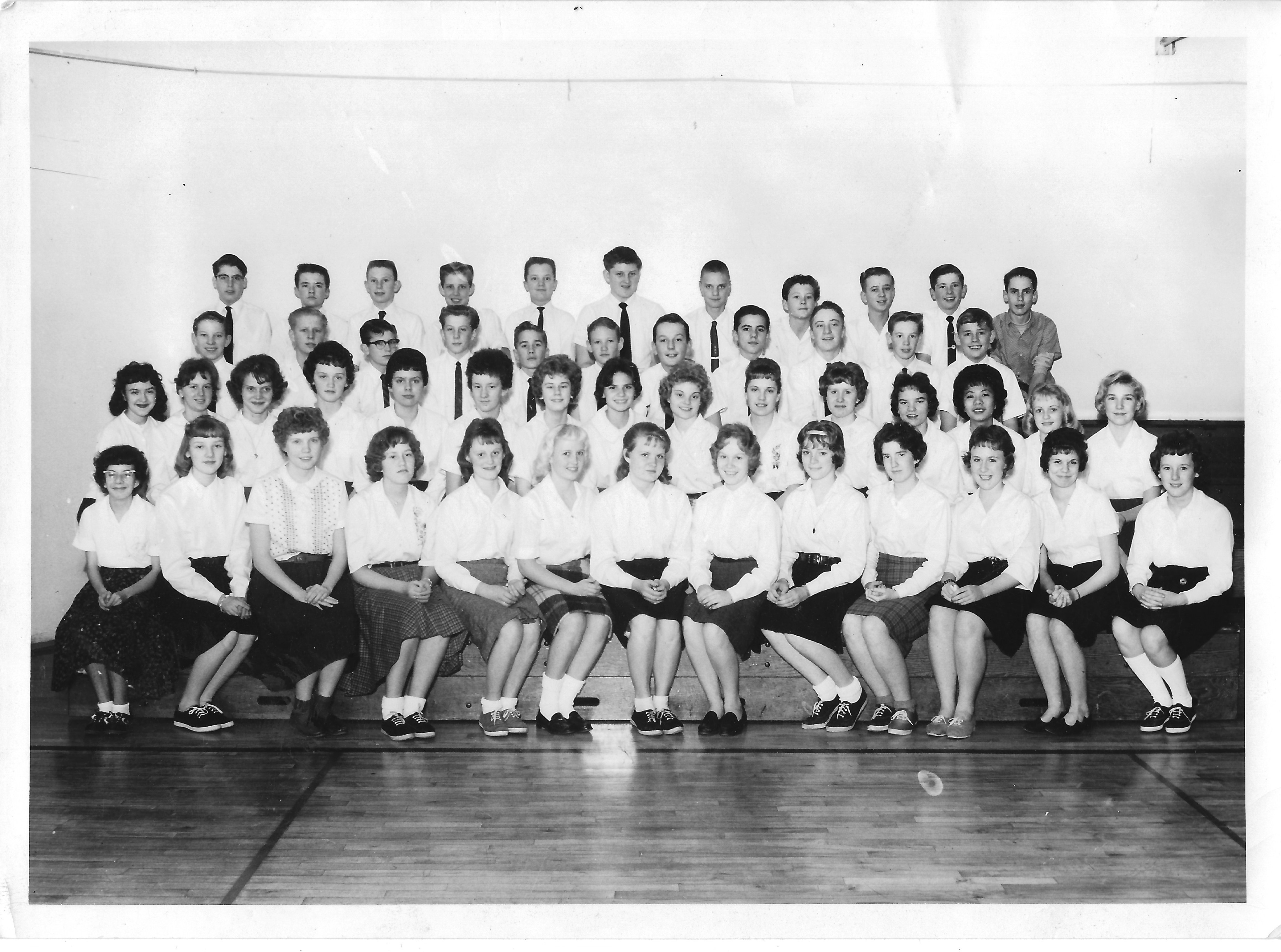
These are photos shared to me of Victoria “Vicki” Kay Feldtman Ross. I don’t know anything more than what I have listed on the photos. I believe she graduated from Weber High School in 1963, or would have graduated. She married Dad, Milo Paul Ross, 5 March 1963 in Ogden, Weber, Utah. She was born 23 December 1945 in Ontario, Malheur, Oregon and passed away 31 December 2018 in Twin Falls, Twin Falls, Idaho.

4th Grade Ms. Morby, Vicki is back row, fourth from the right
Vicki is middle row, sixth from the right
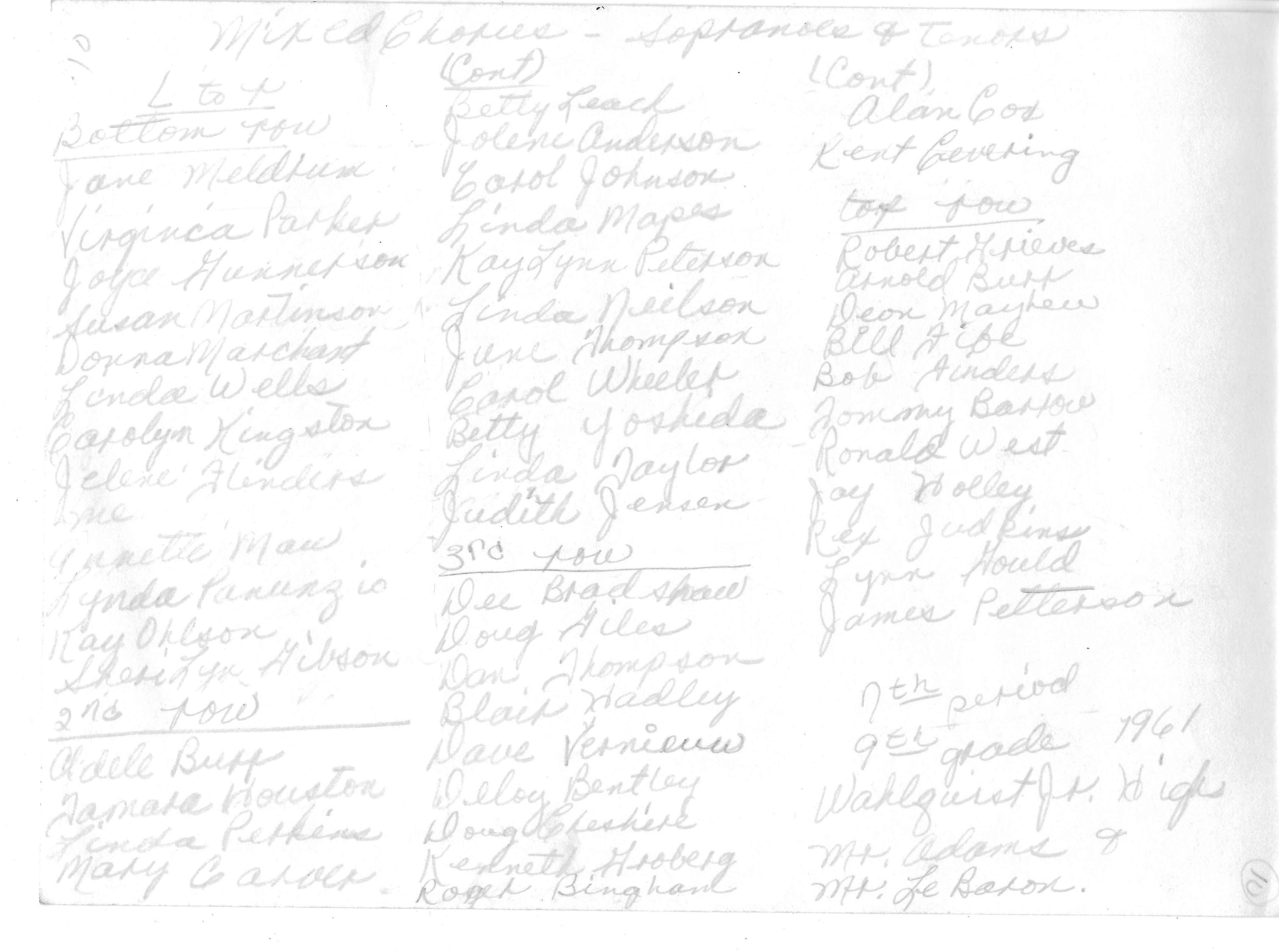
Mixed Chorus: Back row (l-r): Robert Grieves, Arnold Burr, Deon Mayhew, Bill Fife, Bob Findess, Tommy Bartow, Ronald West, Jay Holley, Rex Judkins, Lynn Gould, James Petterson; Third row: Dee Bradshaw, Doug Giles, Dan Thompson, Blair Hadley, Dave Vesnieuw, Deloy Bentley, Doug Cheshire, Kenneth Groberg, Roger Bingham, Alan Cox, Kent Cevering; Second row: Adele Buff, Tamara Houston, Linda Perkins, Mary Carver, Betty Leach, Jolene Anderson, Carol Johnson, Linda Mapes, KayLynn Peterson, Linda Neilson, June Thompson, Carol Wheeler, Betty Yoshida, Linda Taylor, Judith Jensen; Front row: Jane Meldrum, Virginia Parker, Joyce Gunnerson, Susan Martinson, Donna Marchant, Linda Wells, Carolyn Kingston, Jelene Flinders, Vicki Feldtman, Annette Maw, Lynda Panunzio, Kay Ohlson, SheriLyn Gibson

These names are taken from the back of the photo. Please correct if you think I have them wrong.

History of Plain City Pt 11

I have two copies of the History of Plain City, Utah. The front indicates it is from March 17th 1859 to present. As far as I can tell, the book was written in 1977. At least that is the latest date I can find in the book.

One copy belonged to my Grandparents Milo and Gladys Ross. My Grandpa has written various notes inside the history which I intend to include in parenthesis whenever they appear. They add to the history and come from his own experience and hearing. 

I will only do a number of pages at a time. I will also try to include scanned copies of the photos in the books. These are just scanned copies of these books, I have not tried to seek out originals or better copies.

History of Plain City March 17th 1859 to present, pages 166 through 184. That is the end of the Plain City History!

Can you Remember or Did you know?

By Lyman N Cook

            The following articles are a collection of stories and events that have been a part of Plain City. These are in no way a complete list of the stories that could be told. We have older people who can remember the colorful events and stories, the eras of history, and they should be told and recorded. I hope these people will do so while they are here to tell them. I have touched upon a few. Whether the stories are good or bad, it has been my purpose or intent to have all the questions and answers, but merely to help your mind reflect upon the beautiful memories of Plain City.

            Please, as readers, do not take any personal offense or injury to any of the stories. They were not written with any unkindness in mind, but hopefully you will enjoy them.

            The stories are, in reality, a tribute and a compliment to the early settlers of Plain City. I cannot comprehend the magnitude of courage and strength, and the hardships those early pioneer men and women endured. How unselfishly they worked and planned for the betterment of Plain City to make it a better place for you and I to live today.

            I have a deep personal feeling that we owe them everything.

            The most interest and pleasure that the book has brought to me has been the fact that I have had an opportunity to visit in the homes of so many wonderful and interesting people. Compiling, reading, and writing the history has so fascinated and compelled me that I have stayed up all night, only to find in the morning that I am just as refreshed as if I had slept all night.

            The following people have been so kind and helpful to me in writing the stories. They have told me stories, and refreshed my memory. I feel a deep appreciation for them, and I feel that they should be recognized. They are: Mrs. Lavina Thomas (on tape), Lyle Thomas, Byron Carver, Lee Carver, Laura Musgrave, George Knight, Clyde Hadley, Amy Robson, Harvey and Jennie Cook, Dick and Luella Skeen, Bill and Nonie Freestone, Irene Skeen, Ivy Skeen Marsden, and many others: Kris Ewert, for her printing. A special thanks to all. And also Ina Poulsen.

“TRUE STORIES AND COLORFUL EVENTS OF PLAIN CITY “

SLEIGH BELLS

            One of the pleasant memories of a cold, crisp, clear pioneer winter night, was the jingling of sleigh bells as families made their way to church or to visit with friends or neighbors. The rich sound of their ringing through the hollow night air could be heard all over town. First starting out faintly and then increasing in volume as they approached their destination. It would seem that the still, peaceful night was just made for the ringing of the sleigh bells.

            Almost all the families had a string of sleigh bells that were a prized possession, and a family treasure. Some of the larger strands would go across the back of the horses and around underneath the stomach, also a strand would fit on the hames. The quality of the workmanship that produced the full, rich tones will continue to enrich our memories of the past. Maybe if we lost our minds be calm and drift back through the years, we can still hear the tinkling of the sleigh bells.

PIONEER HOMES, WASH DAYS, FEATHER TICKS, COLD BEDROOMS, OLD COAL, OR WOOD STOVES

            The pioneer home was usually built with two rooms, and as the family income and new family members came along, they would add an addition of bedrooms, and a dining room, parlor, or living room. There was usually a large cook stove for the parlor and dining room. The kitchen was the center of activity in the home, and only on special occasions, or when company came, would they build a fire in the other rooms. They would usually bank the stoves with wood or coal to last as long as possible. But by morning, the fire was always out. They would have two or three coal buckets, and a kindling box, and some member of the family had the chore to see what they were always full. It took a strong constitution to roll out of bed on a cold winter morning and make the fire, and wait for it to get warm.

            Monday morning in the home was washday. It would start very early and last all day. They would heat the water in a copper-bottom boiler and would usually boil the clothes to help get them clean. They used a homemade lye soap. The women scrubbed the clothes on a scrub board usually placed in a metal washtub, and after scrubbing, would rinse the clothes two and three times. They would then be hung on the clothesline to dry. There was a special pride taken in the wash and to tell a woman that she hung out a pretty wash was to pay her a special tribute.

            The pioneer families would usually wait until cold weather to kill meat. They would cure it, salt brine it, or dry it. For fresh meat, they would put it in a flour sack and hang it high on the north side of the house. When they wanted fresh meat they would go outside, climb the ladder, or use a pulley to bring the flour sack in. They would cut off what meat they wanted and return the flour sack out on the north side. It was not uncommon to see flour sacks hanging from the north side of most homes.

            The bedrooms were usually located on the north side on the north side of the house, and were the furtherest from the stoves. It was like going into another world, or the north pole to go to bed. If you slept with a brother or sister, you would try to get them to go to bed first so they could warm the bed. The frost and ice crystals would collect on the window glass usually forming in the fall and never leaving until spring. It would usually be about a half-inch thick on the glass. The frost crystals would form in beautiful designs and patterns on the windows.

            The straw tick or mattress was made with a cover and filled with straw. Each year they would empty the straw, wash the cover, and refill it with new straw when they thrashed in the fall. They would place a feather tick on top of the straw tick, and it was filled with feathers from geese and ducks. It was really warm and soft. The sheets, blankets, and quilts were piled on the bed until they were so heavy that it was hard to turn over. It was especially nice when the dog would sleep on your side of the bed, as he made an excellent footwarmer. What a breed of people to survive the cold, hard time of pioneer life.

INDIANS

            There seems to be no evidence of any Indian violence or hostilities in Plain City. However, they would visit the homes of the early settlers and ask for food. As a sign of friendship to the Indians, they would always give them food. It was a very frightening experience for the pioneer women to have the Indians call when the men were in the field working and they were home alone. The children were especially scared, and were taught to be very careful when they were around.

            There were people alive today in Plain City that can remember when Indians would come into town and camp. Some favorite campgrounds were across from Paul Costley’s garage, and across the street north of George Cook’s home. The white kids always played close to home when Indians were in town, and they never went anywhere at night.

            The Indians squaws would go to every home and ask or beg for food. The homes that were generous would be visited several times. The Indians would stay for several days, and they would then load their treasures and leave and go north. The Indians must have liked the people of Plain City because they returned each year for many, many years.

PERRY BOAT

            The ferry boat and landing was located near where the river bridge crosses the Weber River on the Plain City, West Weber road on 4700 West. It provided a river crossing for people, cattle, sheep, horses, and wagons. The ferry was made of logs tied together, and a large molasses boiler and pole was used to push the ferry across the river.

            In the spring when the flood waters covered all of the low lands, the ferry would run from the hill on the north side near the Warren canal to the hill on the south as you enter West Weber. When the water receeded, the ferry returned to the channel. It has been said that in the spring the Indians would come to the hill and if the ferry was on the West Weber side, they would call across the river until the ferry came to get them. Sarah Richardson Hodson could imitate the Indian’s call for the ferry. She seemed to know more abut the ferry than anyone we knew of.

            It might be important to include information about the times before all of the times before all of the reservoirs were built to hold back and store the early run-off water. Almost every spring the river would leave its channel and flood the low lands of Slaterville, Plain City, West Weber, Warren and West Warren. During some years the water would be so deep the road was closed. As a boy I can remember traveling 4700 West when the water would be up to the running boards of the Model A. The last year of excessive water was in 1952.

            Not too much is known about the ferry, but it lends itself to another colorful era of interesting Plain City history.

POST OFFICE

            The Plain City Post Office was located where Neta Charlton’s home is located, or one block North of the school on the northeast corner. It was run by Charlie Neal and his wife, Pussy Neal. He ran the Post office for 25 years from 1877 or 1878 until 1902 or 1903 when the government closed the Post Office, and the mail was brought into Plain city by Fred Kenley and delivered by horse and buggy.

            Merl England has in his possession a letter that was postmarked Plain City, Utah, August 8, 1891.

            Pussy Neal had, and kept a start of live yeast and would sell it to the women of the town to use in mixing bread. Annie Skelton would send her daughter, Nonie Skeen Freestone, down to the Neal’s for yeast. It didn’t take many trips before Nonie developed a real taste for live yeast. She would buy a three-pound lard bucket full, but by the time she walked five blocks home, she would have half of the bucket drank. She claims that it was quiet a tasty drink.

EARLY BAPTISMS

            A very important date in the lives of young eight-year-old people was their baptism. Nowadays this ordinance is performed in a stake center with a very beautiful font. Before this time, this ordinance was performed in canals, rivers, lakes, and ponds. One of the most popular places to be baptized was the First Rock Crossing, or seck, as it was called. This was located on Center Street next to George West’s home, long before the canal was cemented. There was a row of poplar trees along the street, and the children would dress behind the trees. Some people would take their children up the street in the buggy and dress them, and then return for the baptism.

            There were usually just two baptisms a year, one in the late spring and the other in the early fall. As a result, there were usually several children to be baptized at a time. The children would sit on a log and wait for their turn.

            Some of the young people went down to the river and were baptized. The location on the river was near where the present bridge is located. They used willow trees to dress behind. Laura Musgrave and Royal Carver were tow that were baptized in the river.

            George knight told me that he was baptized in the Warren Canal about where the present pump is located. This was a colorful era of the past and should help to rekindle some pleasant memories for those who participated.

THE PRIVY, CRANNY, ROOSEVELT, OR ALIAS, THE ONE-HOLER, OR THE TWO-HOLER

                        There was a great deal of social status involved and a real pride taken in building, caring for, and beautifying the outdoor privy. Some of the seats were made of select lumber and sanded and smoothed to the point where they were quite comfortable. And on the other extreme, some seats were rough and slivery. Some families were careful to make the privy weather proof, while others you could look out the cracks in every direction.

            You could usually tell the size of the family in the house, whether it be large or small, by the size of the property. Is it a one or a two holer?

            Some of the families, to prove to the world that their cranny was something special, and a respected place, would cut beautiful designs in the top of the door. I never quite figured out whether the hole in the door was for ventilation, or simply to study the wonders of the sky at night. Some of the designs were a half moon shape, a diamond shape, star, or just a round circle.

            The Skeen girls, Ivy Skeen Marsden, Lenora Skeen Freestone, and Jennie Skeen Cook, still maintain to this day that their little brother, Dick Skeen, learned to throw the baseball so very well by practice throwing at the privy. He would wait until the girls would get inside and lock the door, then he would open up the rocks, clods, green pears, or anything to keep them pinned down. Dick’s favorite was the dirt clod. He would aim for the hole in the door and throw the clod through. The clod would hit the wall, break up and shower the girls with dust and dirt. He would then really laugh when the girls would cry, scream, and holler for their mother to come and rescue them from their brother.

            Halloween was a risky time for outdoor privies. One of the favorite Halloween pranks for the kids was to spend the night tipping over crannies. The only thing that I would like to say on the subject now is that I am ashamed and sorry, and I must report that I am one of the parents who feel like the kids of today are going to the dogs.

            During the depression and late thirties, and prior to World War II, the government had a P.W.A. and W. P. A. program. Workmen would come to your home and build outside crannies. They had a cement floor and a lid on the seat. They were weatherproof, and most people who owned one felt like that was the next best thing to running water. They were called “Roosevelts.”

            Usually an old Sears catalog would act as a years supply of toilet tissue.

            Some of the more discreet families would keep a pot, or thunderjug in the house for emergencies during the cold stormy winter nights. This fact was considered the family’s dark, deep secret, and was usually emptied before dawn.

            With the exception of two years in the Navy, I used the outdoor privy for 26 years, and first four years after I was married. We sometimes hear it would be nice to go back to the good old days, but certainly not to the days of the outdoor privy.

SCHOOLS

  1. The first school was in George Musgrave’s dugout. He later held school in a one-room adobe.
  2. The first public school was built on the south of the square. It was built out of adobe. It was one room.
  3. There was a school located on the northeast corner of the square. The town and ward used this building for some social functions. It was built of adobe in 1873 or 1874.
  4. The North school was located where Walter Christensen now lives.
  5. The South school is still standing and was remodeled by Harvey Cook into a home. It is located where Gordon Sorensen now lives, and across from Eldon Weston’s home. This home was built of brick.
  6. The Poplar School was located across from Augusta Nash’s home.

I have been led to believe that there was school classes being held in all these four schools at the same time. This world be shortly before and after 1900.

EARLY STORIES

            There have been at least ten stores and meat markets in Plain City up the present time. Some of the stores have stayed in the same place, but have had several different owners. I’ll just mention where the old stores were located. There were two Coy Stores. They were owned by Sarah Coy and Eliza Coy. One was across the street about where Mildred Sparks now lives. This is about 2200 North and 4650 West. The old ZCMI store was where B & C foods is now located. Garner’s store was where the pool hall is now. England’s store was where Merlin England’s now lives. McElroy’s store was where Jack’s Garage is now located. Stoker’s was located one block behind the school where Gordon McFarland lives. Maw’s was located just west of the bowery.

            John Vause built and operated a meat market just north of Adela Carver’s home. Some of Steve Knight’s family operated a meat market about where White’s Café is today. Peter M. Folkman had a meat market across from the school on the east side.

            Most of these early stores would trade merchandize for eggs and butter. This was especially nice for the kids of the town because they could take one egg or more and trade for candy. There wasn’t hen’s nest that was safe in Plain City. Laura Musgrave tells of how she would get Nonie Freestone and they would raid Nonie’s father’s chicken coop for eggs to go to the store for candy. There was real safety for Laura, as she always has been real sharp in having Nonie in her own father’s coop with her.

BLACKSMITH SHOPS

  1. Christopher Folkman was the first one in Plain City. He learned his trade in Denmark. It was located near Leslie Maw’s home and Elmer Carver’s home.
  2. Janus Lund’s Blacksmith shop was located near Dennis Lund’s home. He died in 1908.
  3. Rall J. Taylor started his shop in 1908 and the building still stands just north of Kirt Knight’s garage.
  4. Lew Ericson’s shop was located on the property of Neta Charlton.
  5. George Davis’ shop was near Phil Alsup’s old home and across the street from Thomas.
  6. Lee Gould’s shop was located near where Florence and Carl Hodson now live.
  7. Farley’s shop was located near where Sterling Thompson now lives.
  8. Lyman Skeen’s shop was located just south of his old home. The property is now owned by George Skeen Cook.

THE EARLY DENTIST

            Lyman Skeen acted as the early dentist, and his only speciality was pulling teeth. He had a special pair of forceps which are still in the possession of the family.

            People came from all of Plain City to have their teeth pulled. In those days they didn’t have any dental check-ups, or fill any decayed teeth. If a person got a cavity, they endured it until the tooth would ache and then Lyman Skeen would pull the tooth.

            He was a large man and once he hooked onto the tooth, he had very little trouble getting it out.

            Some of his children report that when anyone came to have their teeth pulled, they would run into the house and hide under the bed and hold their ears so they couldn’t hear the person holler or scream.

            Lee Carver tells the story about as a boy going down to Lyman Skeen’s and having a tooth pulled. He was told if he would sit still and not holler to scream, and act like a man, that Lyman would pay him .25 cents. It certainly must be one of the rare cases of a dentist paying his patient.

            George Knight told me he made a trip to Lyman Skeen’s home to have his tooth pulled. He was told that if he would take it like a man and not holler or yell, that he could drive the mules and wagons. After the tooth was out they went out and harnessed the mules and hooked them to the wagon and George drove the mules to his home. George said that there was nothing that Lyman could have done to make him feel more important and give him a bigger thrill than to sit on the seat with Lyman and drive those large mules home. He was so excited that he forgot what he had gone down there for.

            Ina Poulsen tells the story of her toothache when she was a girl. It was a large double tooth, and it had ached for days. She finally decided that having it pulled couldn’t hurt any more than the ache, so she went to see Lyman Skeen. She walked down to his place in the evening and they were eating supper. She said he got right up from the table and didn’t even finish his meal to pull her tooth. Annie got the forceps and sat her in his large grandfather chair. Again, the Skeen kids scattered and hid from the noise. Ina did mention that she did holler and scream, but it was all over in a minute. She said he was really good at pulling teeth. It also gives some insight into the quality, character, and gentleness of Lyman Skeen.

ICE HOUSE

            An Interesting part of the history of Plain City was the old ice house. It was located across from the school on the property where Clara Folkman now lives and sat behind the old home. In the winter when the Four Mile reservoir, river and other water would freeze hard enough, they would cut it with ice saws. They would then haul it by team and bobsleigh to the ice house for storage.

            Peter M. Folkman owned and operated the ice house, and in the winter he would have as many as twenty men working for him. They would work through the winter and would fill a rather large building with ice. They would cover it with wild hay and sawdust so it wouldn’t melt so fast in the heat and it would last all summer.

            They would sell it to the people of Plain City for their use in the old wooden ice chest, for making ice cream, mainly for parties, and for whatever else their need was.

MARTIN SMITH AND THE MEAT WAGON

            One of the colorful characters that would come into Plain City was Martin Smith. He owned a team of skinny horses and a closed-in meat wagon, and peddled fresh meat from door to door. He would come into town two or three times a week. He always carried a green willow switch, and would open the meat box, and use the switch to chase the flies out.

            The lady of the house would come out to the wagon and look over the variety of cuts, or I would imagine he would cut whatever they wanted. A favorite pass time of the kids of the days was to try and sneak weeneys when he was busy with their mother. He was a sharp enough businessman that he made sure he always got enough money to pay for the weiners.

            It sounds rather primitive in todays worlds, but it filled a need and is another colorful chapter out of the past.

GEORGE MOYES AND HIS MILK TRUCK

            George Moyes had the first milk truck in Plain City. He delivered the milk to some of the homes in Plain City. It was George that was coming home from the dairy and discovered the fire in the dummy had started and burned Charlie Taylor’s barn. He used his load of milk to help put out the fire. I don’t know of anyone today who wouldn’t like to own that little truck.

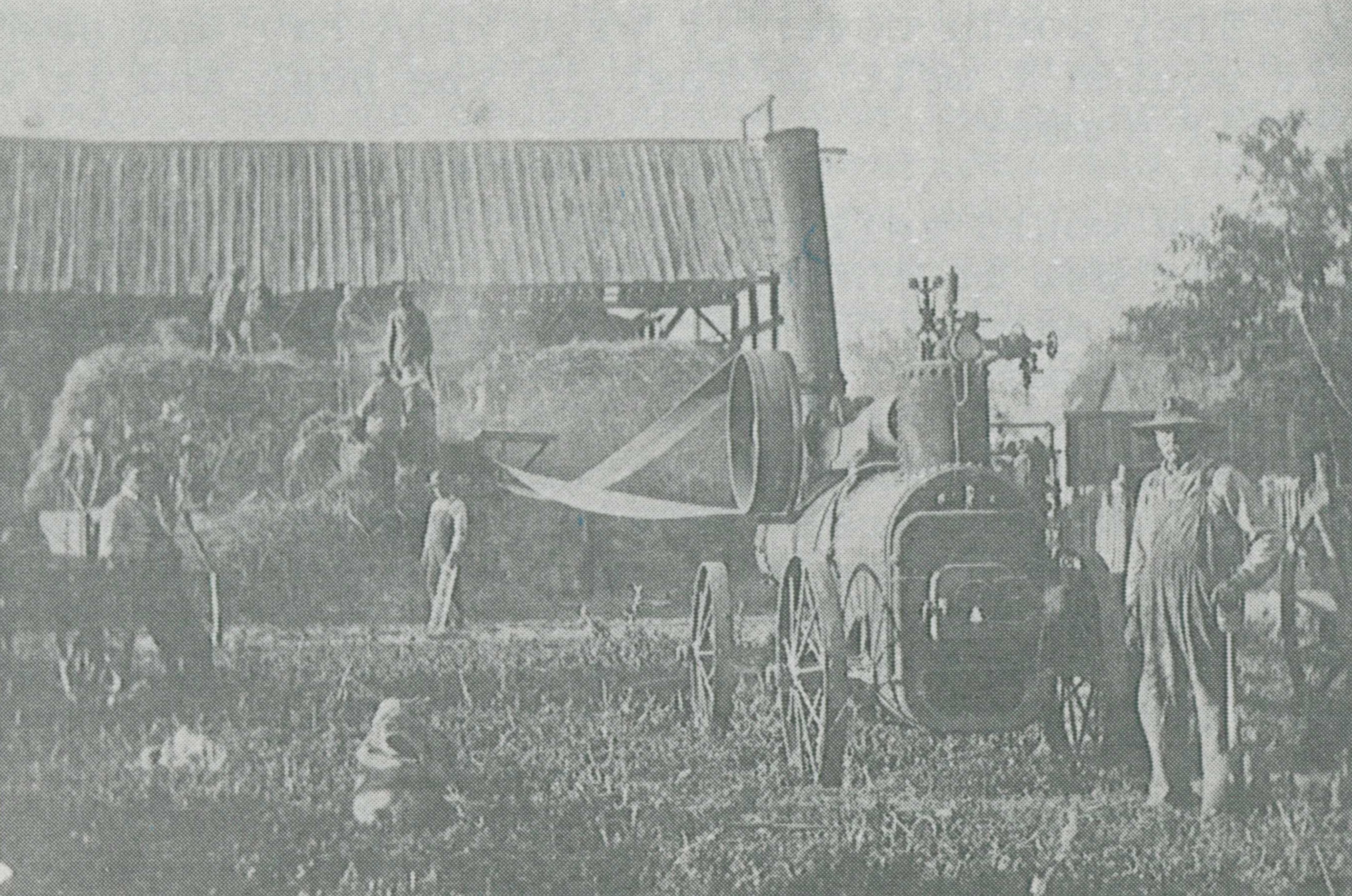
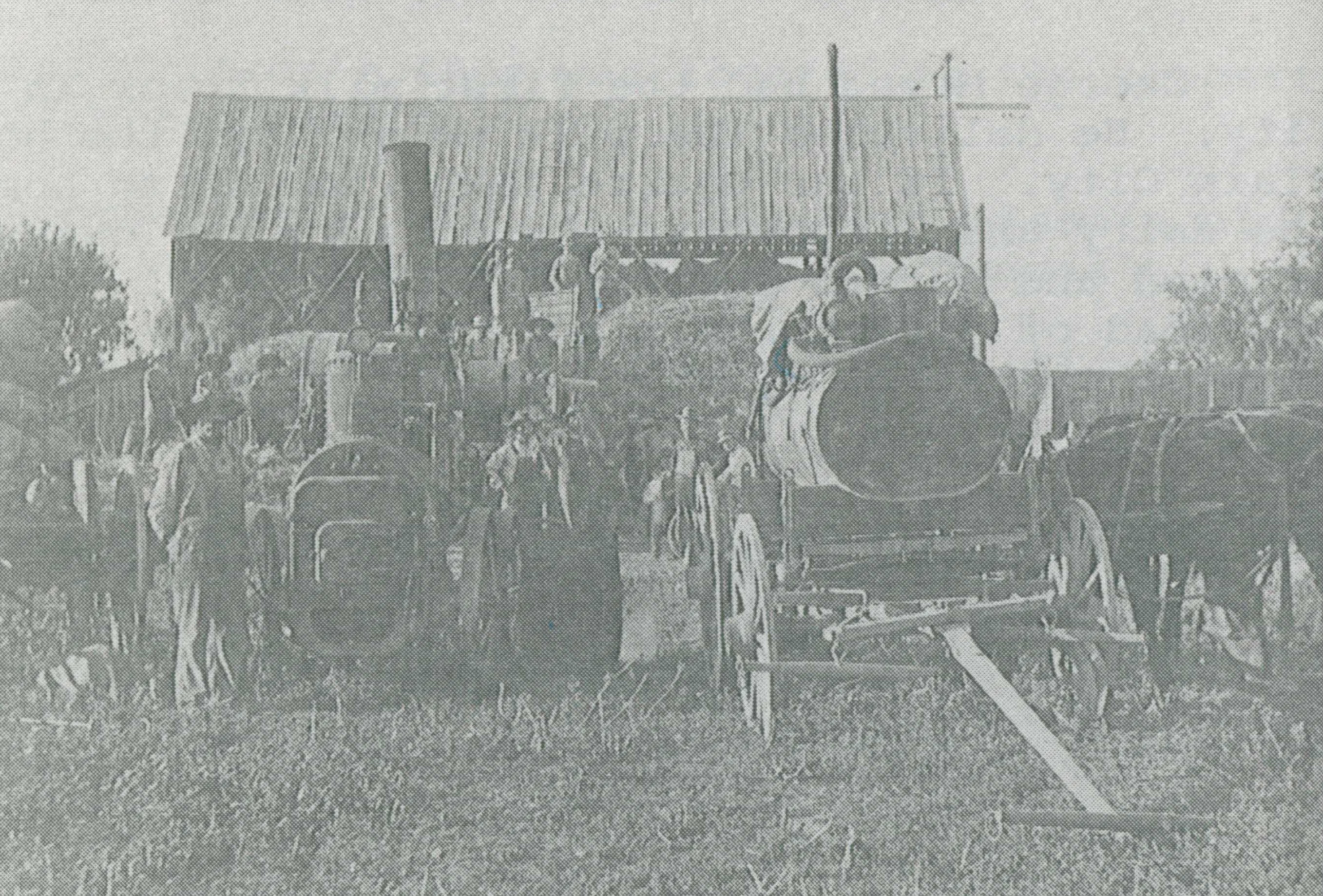
THE EARLY THRASHERS

            A colorful time on the farm was thrashing time. The first machines were horse powered, and were a great improvement over the hand method. These colorful pictures are some of the early steam-powered thrashers. There were men who owned their own machines and would do custom work for their neighbors. When the thrashers would move onto a farm, it would usually take several days to complete the farmer’s field.

            While the thrashers were at the farm, it was the responsibility if the farmer to feed the men three meals a day. This consisted of many of the neighbors who helped each other. They worked hard and they required large meals. The women worked all day long to prepare the meals. The phrase, “I have cooked enough food for the thrashers,” was probably coined during this era. The farmer had to take care of the horses also.

            The men usually carried their own bedrolls and slept on the new fresh straw.

            Arthur Skeen and Frances Thomas owned and operated thrashing machines that I remember.

THE GYPSY HORSE TRADERS

            The horse trader would come into Plain City once or twice a year. They would arrive in large white-top wagons leading a large number of horses. Some of the camping areas where they would stay were; out by the beet dump, by the water tower, on the square, and in the lot across from the Lyman Skeen home where George Cook now lives. They would stay about a week and would camp or live in their wagons.

            The kids were frightened at the sight of the traders and the week they were in town they placed close to home and never ventured far from home at night. The traders were famous for taking things that didn’t belong to them.

            As a boy I can remember the trader camps and walking through them with my father. Because of the shady characters and the stories I had been told, I can remember of never letting go of my father’s hand. To see the people involved and the many horses there were, made a lasting impression upon my young mind.

            If any of the townspeople needed a horse or team, or wanted to sell any horses, they would bring their horses, or come to the traders camp. They would barter, trade, or sell. In order to make a sharp deal they would dicker all day. There were many stories told of how sharp a deal they made or how badly they got stung by the horse traders.

LYMAN DUMP

            There were two beet dumps in Plain City. One was located across from the water tower, the other was the Lyman Dump located one-half mile west of the canning factory where the railroad tracks crossed 5100 West. It was named after Lyman Skeen because of his work on the railroad to that plant, and on into Warren. John Vause was the weigh master and was more or less in charge of the dump. They would haul the beets with teams and wagons to the dump, where they would be loaded on to the rail cars and taken to Wilson Lane for processing. At times the cars were not available ad they would pile the beets by hand. The pile had to be six feet high and stacked just right. When cars were available, the factory would pay the farmers thirty cents a ton to load the beets by hand and then into the cars.

            A story is told of a certain farmer that would bring beets to the dump. The drivers were supposed to stay on the wagon to weigh their beets over with the wagons loaded, and then back their wagons across empty. This farmer would get off the empty wagon, stay on the scales, but would reach up and take hold of a board on the scale house, and pull most of his weigh off the scales. John Vause used to say, “ Look at that fat old ____. He thinks he is fooling me, but I always take 200 pounds off whether he is on the scale or not,”

            Mervin Thompson was there ad tells a story about Lyman Skeen hauling a large beet rack full of beets to the dump with a four-horse hitch. The lead team was fine large horses and the back team was large mules. The dump was elevated with a steep incline up to a platform where the wagon would stop and be unloaded. It was high enough to clear a rail car and the beets ran down into the car. The decline from the platform was steep. He made his approach with the team struggling to pull the heavy wagon up the incline. As the teams lunged forward down over the decline. Lyman sprang to his feet and held the mules back so the wagon rode up against the rumps of the mules, and he moved the lead horses out fast enough to keep out of the way. He never lost a sugar beet. It was truly a great display of fine horsemanship. It was truly his ability with the horses that saved him and his team from death or injury.

            He calmly made a circle around to the approach incline and took the teams up the incline. This time he was ready for them and the mules and horses stopped where they were supposed to. As the teams came down off the decline, they knew they had been taught a valuable lesson by a skillful master.

THE SWIMMING HOLES

            If anything in this world can turn a man into a boy again, it is the pleasant memories of the old swimming hole. The warm summer days with friends and the happy, carefree times are the most memorable in a life time. There seems to be a special magnetic force that pulls and draws boys to water. It is especially difficult to try and explain to parents that special force, and why it was so necessary to go swimming so much. We lived in the water and the longest part of the day was the one hour we had to wait for our dinner to digest before we could go in swimming again.

            Every irrigation canal, pond, river, or creek had their favorite swimming hole. The favorite holes in Plain City were not by the First and Second Rock Crossing, the canal, but Four Mile, Draney headgates, and the Anderson hole in the river. The Anderson hole was located just below the Warren pump by the bend in the river and northeast of the bridges. One could tell by the number of ponies, wagons, and buggies, that there was always a large crowd, and from the laughter and the noise, you could tell they were having a great time. The Anderson hole was secluded enough, and no girls around. For the men and boys it was pure skinny dipping. If any boy had shown up with a swimming suit in those days, they would have laughed him out of town.

            The Anderson hole was the place all of the men and boys took their Saturday night bath. George Knight tells the story that he counted 65 men and boys swimming at one time in the river. Sant Madsen was the oldest at 65, and there was a young boy of about 6 years of age.

            Wilford, or “Wiff” Skeen was considered the most gifted and powerful swimmers around this country. During World War I he swam on a Navy swim team. Gordon Thompson and George Knight said that Wiff was the most beautiful swimmer they had ever seen. Fred Kenley, I think, was I the Navy and traveled throughout the world. He said in all his travels that Wiff was the best Swimmer he had ever seen. He would put his little brother, Dick Skeen, on his back and swim out into the middle of the river. Dick must have been real little then, but he would dump him off and make him swim to shore while he carefully watched. Someone lost a shovel in Anderson hole and Wiff dove down to the bottom and brought it up, supposedly the only man to ever touch bottom.

            Ogden City, Swifts, and the By-Products, began to dump raw sewage into the river and ruined probably the greatest memory maker in all of Plain City. It just seems so strange that man has a habit of always destroying his own best things in life.

DRIVING THE COWS TO THE PASTURE

            The people who milked cows for their own use or who later on milked cows to sell the milk to the creamery, would usually drive their own cows to pasture during the summer months. The pasture was located one, two, or three miles from home. It would require taking the cows out in the morning and returning them in the evening. This responsibility usually fell to the younger members of the family and required a cow pony. In those days everyone’s home, yard, and  farm area were fenced so the cows traveling to and from the pastures did not create a problem. During the hot, dry summer weather, the roads and trails of the cows were very dusty. It was very difficult to follow the cows very closely as the dust was so heavy.

            One of these pastures was called the West Pasture. It was located north and west from Ivan Moyes’ home. This pasture was owned by several different people. The number of cattle they would put in the pasture was based on the amount of the pasture that they owned. In the evening the first person to the gate would open it and let the cows out. The cows, from force of habit, would follow the same trail to the town park where they would feed. It was not uncommon to see twenty-five or thirty milk cows feeding on the square in the early evening. The farmers would go to the square, collect their cows, and take them home.

            For those who played baseball, football, or just played on the square, there were some real hazards involved after the cows had been there.

            Modern feeding and milking techniques have eliminated the need for the daily move to the pasture and also the need for the fenced-in yards.

CANNING FACTORIES

            Another very important industry in Plain City was the growing and canning of tomatoes. The first factory built in Plain city was across the street from Loyd Olsen’s at 1900 North 4700 West. Laura Grieves Musgrave tells of working in this factory filling the cans with tomatoes. She was just a girl at the time, and expressed how happy she was to be able to earn money in those days. At that time there was no child labor laws.

            Part of this factory was later moved near the square and used by the maw family for their store and other buildings.

            The second canning factory still stands at 1975 North 4650 West, and was used for many years. The sandy loam soil of Plain City seemed to be ideal for the tomatoes to grow and helped to give them the flavor, quality, and yield that rarely can be equaled. Times were very tough to earn money in those days, and many men and women would work at the factory in the fall of the year to help supplement their income. This factory was built in 1925.

            The empty cans would be shipped in by railroad and the processed tomatoes would be shipped out to the railroad.

            The events that impressed my memories most about the factory, were the lines of loaded wagons and trucks waiting to be unloaded. While the farmers waited for boxes, or to be unloaded, or for their tomatoes to be graded, they would visit by the hour. The stories and the tall tales that would be told during that time will long be remembered. It used to fascinate me to watch the women peel the tomatoes. The full pans would be scalded and go around on a belt. The women would take a full pan, core and peel the tomatoes, and when the pan was full, they would put their number in the pan and return it to the belt. They were paid by the pan, and it amounted to five cents to ten cents a pan. In later years it raised from eight cents to ten cents a pan. The fastest peelers could peel about 60 pans a day.

            Some of the fastest peelers were Dorothy Christensen, Thelma Hodson Wayment, Doris Hodson Chugg, and Ruth Arave Taylor, deceased. Whether peeling tomatoes, cutting potatoes, thinning beets, wall papering, or whatever, Ruth Taylor, as I remember her, had to be the hardest working woman I ever know. I always marveled at her ability.

            Can your minds eye visualize the smoke coming from the tall stack, and the pleasant tomato odor that drifted along the air currents through the town of Plain City.

PEA VINERS – PEA WAGONS

            One of the early industries, or cash crops of Plain City was from the raising of peas. It t must be remembered that in the very early times, the settlers were only interested and concerned about food to keep them through the winter. As they worked and improved their homes, the roads, and the irrigation system, their ability to products more and vary their crops increased. It was then that they branched out into the pea industry.

            The main pea viner was located on 2200 north, about a half mile west of 4650 West, on the north side of the street. It provided work for some of the men of the community, to stack the pea vines. In the winter the farmers fed the vines to their cattle.

            The farmers would plant the peas in the early spring, and the harvest would begin about the 4th of July. The pea vines would be out with a horse-drawn mower. They would pitch them on a wagon and haul them to the vines by a team of horses.

            As young boys we would look forward to the horse-drawn pea wagons on their way to the viner. We would run out into the street and catch the wagon, pull off a big armful of peas, carry them into the shade, and eat peas all day long. I don’t believe that peas gave you as severe a belly ache as green apples, but it ran a close second. More important, we were ready to go after the first wagon the next day. As a young man, I pitched the peas on the wagon in the fields, and off at the viner.

            Later, another viner was built out east. It was located about one-half mile east of the water tower.

            In 1949, I was building my house and my friend and neighbor, Louis R. Jenkins, would come frequently and visit. He said, “You have a nice location, but when the wind is right you may be able to smell the pea viner, but you know, that’s a good smell.” I never forgot his statement though the pea industry lasted only a very few years after that date. But, who could ever forget the potent odor that came after the vines and the juices fermented. No wonder the people who hauled pea vines had very little, if any, sinus problems.

Epilogue:         Included should be the smell and the people who would haul the feed fresh beet pulp.

TRAPPERS

            The Plain City area is situated where there was many creeks, drains, sloughs, ponds, and water areas for the muskrats to live. It seemed to me at one time to another, about every young man was involved in trapping. This could have been an inborn spirit in each young boy to be a trapper or a mountain man. The season would usually start in the fall until the water froze, and then again in the spring when the ice left. It came at a time when jobs were hard to find for young men and provided spending money for them. Trapping provided a good source of money for me when I was going to high school. The hide buyers would usually pay from thirty-five cents to a dollar and a quarter, depending on the size of the hide.

            A good trapper could usually catch around 100 rats a day. I know one trapper that brought and paid for a new car during one trapping season. Some of the better trappers in Plain City that I can remember were, Elwin Taylor, Everett Taylor, Lyman Thomas, and Joe Wheeler.

NICK NAMES

            Practically no one grew up in Plain City without having a nick name tacked on to him or her, because of something they did, said, or the way they acted, or some mannerism. It was not all uncommon for a group of Plain City boys, just to impress a girl friend, to talk and call the individual by their nick name, and the girls never knew who they were talking about. On the other hand, someone may come into the town and ask for Don Singleton, Darrell Christensen, Boyce England, Elwin Taylor, Horace Knight, LaGrand Hadley, George Cook, Clair Folkman, Lynn Folkman, Eldon Weston, or Jay Freestone, only to be told that they didn’t know anyone living here by that name. But had they asked for “Seebo, ““Breezy,” “Buzz,” “Bunny,” “Skinner,” “Gandy Goose or Pety Hadley,” “Joe,” “Ober,” “Homer,” or “Grass,” the townspeople could tell them right away where they lived.

            Some of these people whose names will be mentioned have passed away, and it is my purpose to pay tribute, and add to their good names, rather than take anything away from them. Some have also moved away, but they got their name in Plain City.

            There are so many names that I simply can’t remember them all, but here are a few: “Buss” Lyman Skeen, “Rip” Ronald Skeen, “Geg” Garry Skeen, “Brig” Orson Knight, “Snide” Elmer Carver, “Suitcase” Blair Simpson, “Huss” Harold Hadley, “Tubby” Frank Hadley, “Duke” “ Frog” Kenneth Christensen, “Fooz” Grant Lund, “Hazel” Kenneth Lund, “Bud” Richard Dallinga, “Cirk” Keith Lund, “Sodie” Elmer Hipwell, “Diff” Jack Etherington, “Tiff” Clyde Skeen, “Taa” Jack Freestone, “Sunny” Lyman Freestone, “Bub” Howard Freestone, “Cork” Carl Hodson, “Tumbleweed” Don Van Sickle, “Red” Lyman Cook, “Chic” Dee Cook, “Heater” Bert Cook, “Beef” Wheat Taylor, “Big Chub” Charles Fulmer, “Little Chub” Robert Fulmer, “Buddles” Rulon Jenkins, “Curley” Quenten Jenkins, “Bun” Ray Hadley, “Weiny” Dwaine Hadley, “Mustard” Bill Hadley, “Napkin” Dennis Hadley.

            “Punken” Elmer Ericson, “Eif” Kent Jenkins, “Perk” Ray Coy, “Bear” Ronald Hogge, “Stinne” Wayne Skeen, “Hinke” Verl Rawson, “Toad” Loyd Knight, “Tarzan” Thayne Knight, “Dob” Blaine Knight, “Ikee” Ivan Hodson, “Grit” Dean Moyes, “Bud” Knight, “Lym” Skeen, “Beaver” Gordon Hadley, “Trapper” Durland Hadley, “Deddy” Darrell Thompson, “Pubby” Vernal Moyes, “Sam” Lyle Thomas, “Gonnie” Kenneth Woods, “Jim” Theron Rhead, “Mag” Noel England, “Jim” Elwin Skeen, ‘Bones” Bob Folkman, “Swede” Brent Taylor, “Curly” Davis, “Mayor” Dean Baker. “Wimpy” Loren Facer, “Tooley” Louis Poulsen, “Dick” Elwood Skeen, “Mud” Claude Rhead, “Weeser” Gene Lund, “Fiddler” Elmo Rhead, “Hook” Harold Hobson, “Roan” Harold Ross, “Mike” Milo Ross, “Wheeler” Keith Blanch, “Luke” John Nash, “Tom” Vandel Maw, “Joe” John Maw, “Judge” Thayne Robson, “Bushy” Wayne Cottle, “Pickus” Paul Coy, “George” Cliff Folkman, “Willie” Warren Williams, “Wally” Wallace Knight, “Cruzz” Kent Robson, “Evert” Bill England, “Tom” Merrill Jenkins, “Aus” Bob Wade, “Cougar” Norman Carver, “English” Wayne Carver.

             Something more interesting than the names is how each one got their nickname. You should ask some of them sometimes. We should announce from Plain city to the world that we have had for the last 55 years, the original ”Jaws” Paul Knight. It is very distressing and disturbing to read where some outsider has taken the name “Jaws” and capitalized on it, made a film, and grossed more than 25 million dollars, when the original “Jaws” had been in Plain City all along.

            When we analize the personality, the good times, and especially the stories, I doubt that anyone in Plain City would take 25 million from our original “Jaws.”

THE PEST HOUSE OR PRIMITIVE HOSPITAL

            The constant underlying fears that pioneers and early settlers lived with daily was the threat of disease, illness, or sickness. There just weren’t any doctors or medicine available, and if anyone got sick, they either got well on their own, or they didn’t make it.

            If a dreaded disease, or plague, as it was called struck the early settlers, many of them felt like it was God’s way of punishing them for things they had done or for the things they had not done. There were so many mysteries and superstitions concerning that, that people acted and responded in what now might be considered strange ways. The people felt the best thing to do was to isolate the sick people, and as a result of this type of thinking, the pioneers built the Pest House. To make sure it was really isolated, the people went about a mile west of town on the bank of First Creek and built Pest house. The Pest House was located on the bank of the creek. There were some tall poplar trees surrounding the building, but have since been removed. Clyde tells me that information was handed down and told to him about the spot where the Pest House was located. Years ago there was some evidence of a building there.

            When a person got sick, they would take him to the Pest house to get better. They were usually left alone to care for themselves. Someone from the town would take food and water, and provide some care, but for the most part, it was just a kill or cure method. In most cases the patients, if they died, expired from exposure or lack of care rather than from the disease because the building was poorly constructed.

            During the Smallpox epidemic of 1871, or about then, there weren’t any public meetings held in Plain City from September until the next March. The people lived in total fear of the disease.

            The William Skeen family was hit very hard with Smallpox and they lost four children. It has been told that while his family was very sick, he called for the church and they were fearful, they refused to go help. His friends also turned away. This good man was left to bury his four children all alone, and some of them at night. He was so disappointed in the Elders of the church and his friends, that he left the church and he named one of his sons that was born later “Frenz Denial.”

IMPORTANT FACTS

  1. Ivan Skeen Marsden and Lona Ipson Watson were the first lady missionaries to leave from Plain City in 1914. They served in the Eastern States Mission.
  2. The first car reported to be in Plain City was Dr. Rich, who drove out to treat a patient.
  3. It mentions that Richie owned the first car. Some of the other early car owners were Tom England, John Maw, Lyman Skeen, and others. Later, Lyman Skeen owned an eight-passenger Chandler.
  4. Sammy Sampson was one of the early barbers.
  5. There are seven children of original settlers living today in1977 that we know about. There may be others. Four of them live in Plain City. They are:

                                          Ada Skeen William Allred

                                          Victoria Sharp Hunt

                                          Mary Sharp Richardson

                                          Ivy Skeen Marsden

                                          Lenora Skeen Freestone

                                          Jennie Skeen Cook

                                          Elwood “Dick” Skeen

      It is remarkable when you think after 118 years that there are still children of the first settlers still living.

  • Richard Lund was the early fiddle player in the town.

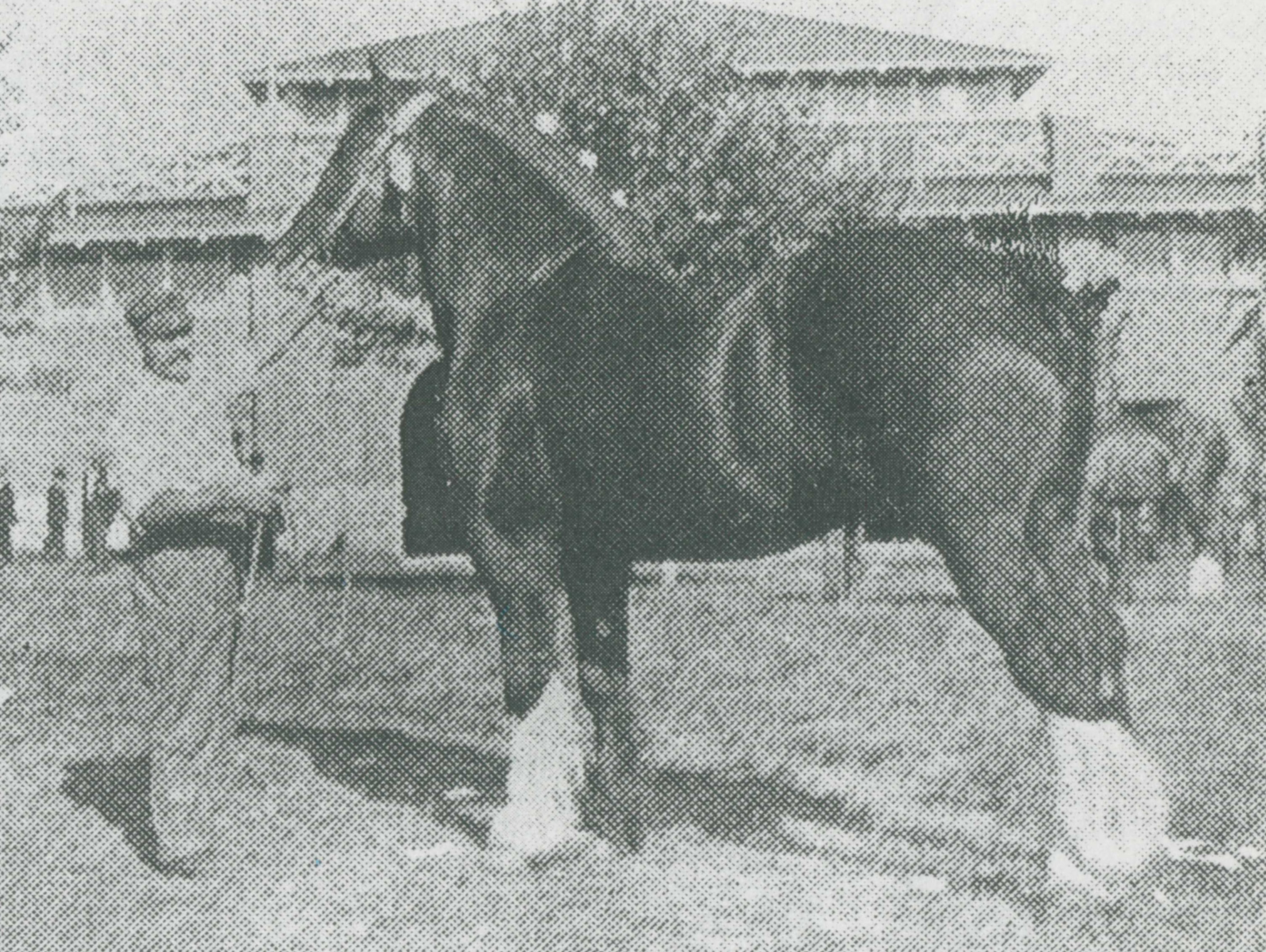
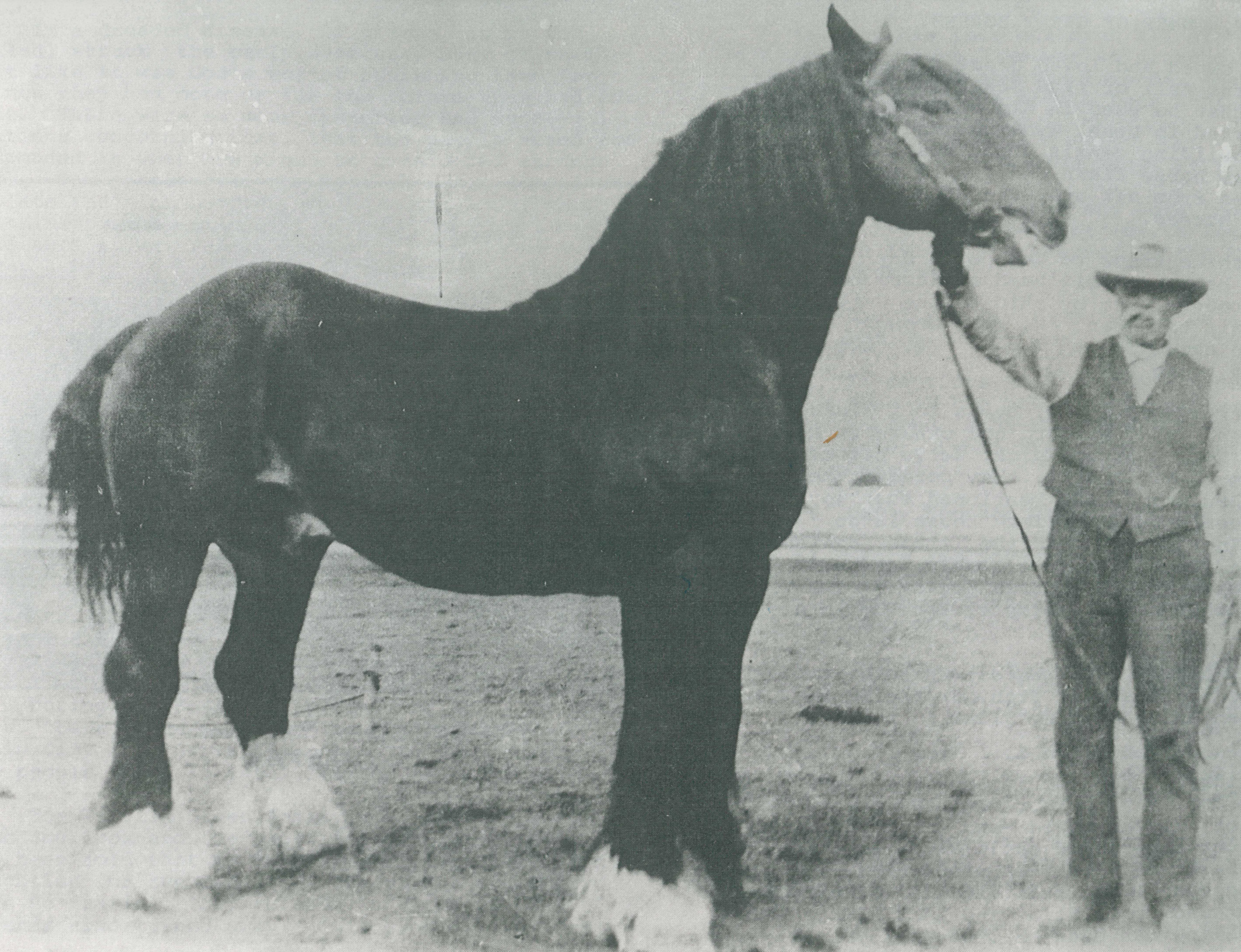
LYMAN SKEEN, OWNER OF GREAT HORSES

            Lyman Skeen owned and loved great horses. He had two large barns full of fine Stallions, besides many work teams that he used in his construction business. He worked in Utah, Wyoming, and Idaho, on construction building canals, road beds, and whatever. He knew horses flesh and people would bring their horses from all over the country to have him doctor their horses.

            Lyman made three trips to Europe to buy horses. On one occasion, he bought six head of Shire horses in England and brought them by ship to the United States, and by rail to Ogden. He also brought a little Englishman named Tommy ____ to take care of the horses and train them.

            When they arrived in Ogden Lyman took Blaine Skeen, Elmer Skeen, Orson Knight, and others to help bring the horses home. Orson Knight tells before they brought them to Plain City, they paraded them down Washington Boulevard. He mentioned that no boy could have been prouder to lead those large horses down Washington. He said the little Englishman walked beside the horses with a whip, and he would crack the whip and the horses would rare up and prance and put on quite a display for the large horses.

            Sline was probably the greatest Shire horse to ever come into the State of Utah, or the West. The little Englishman is holding Sline in the picture.

            The Skeen kids can remember frequently someone yelling “Sline’s out.” and he would always prance up through the lot. Lyman would send his boys out to catch Sline, but they never could catch him. Lyman would sit back and watch his proud horse run and exercise, and when Lyman felt like he had enough, he would walk out and up to Sline and lead him to the barn. Whenever Sline had been he left hoof prints about a foot square through the garden.

SLINE” – Importe I Three-year-old Shire Colt

L. SKEEN

LYMAN SKEEN WITH HIS SHIRE HORSE.

One of these big Shire horses died at the age of three days. It was raised on a bottle by Annie Skeen, wife of Lyman Skeen.

SAMMY SAMPSON THE BARBER

            Sammy Sampson barbered in his home which was located across the street from Dell Sharp’s home. He was one of the early barbers. Byron Carver tells of getting his hair cut there when he was a boy. He said, “You could ask for any type of a cut you wanted, but you only got one cut, mostly bad,” I can see Byron chuckle ass a twinkle from the past came into his eyes. “Oh it was bad,” he said, “and as long as you had any hair left, Sammy would keep cutting.”

            On one occasion he went to get his hair cut when it was hot and Sammy was cooking something that didn’t smell too good. Some of the men who had gathered were smoking El-rope-o cigars, and Byron was getting light headed as he sat in the chair. As Sammy worked him over he became more ill. Sammy soaped his neck and shaved it with a large thick, straight razor, that scraped more than it cut. Sammy kept a pan of hot water on the stove with a wash cloth on it that he used to wash the soap off. As he laid that hot cloth on Byron’s neck, Byron rolled off the chair and fainted dead away. When he came to, big Lafe Skeen was holding him on his lap. That was one hair cut Byron will always remember, and as long as he is alive the memory of Sammy Sampson the barber will live on.

            Sammy charged 5 to 10 cents a haircut in those days, and trim and shave on the older men was 15 cents.

THE RACE TRACK, PLAIN CITY’S FIRST

            William Skeen owned some very fine racehorses and he built a racetrack to train his horses. The neighbors would meet on occasion and race their horses to test the speed against their neighbors horses. Stories have been told that there were some very exciting races held at the track. It was located near four mile reservoir.

            They tell the story of a man from Ogden, who was quite a footracer and he was supposed to have challenged and bragged that he could beat a horse in a certain distance. It was well talked up and word spread around, and the race was held. There was a little money that changed hands quite a crowd. But you know, no one can remember who won the race. It was another colorful time in early Plain City.

THE WEDNESDAY NIGHT SHOW

            Growing up as a kid during the late twenties, thirties and into the early forties here in Plain City was quite an eventful time. It seemed that the world moved at a slower more relaxed pace and there was time to enjoy visiting and to crate your own entertainment and fun. Depression times were very hard for most families, with very little one and barely the necessities of life. There was very little money available for entertainment and if you had any entertainment, you created your own. They were carefree happy times. As a kid you were lucky if you got into Ogden once a month or even once during the summer. By comparison with today, all the entertainment seems to be provided for the young people and all they have to do is show up with money and everything is provided for them.

            In the summer kids games and ball games were a very big thing and something was going on every day and night. Hide and seek, run sheepy run, kick the can, and whatever else anyone could think up were always popular. Skating and sleigh riding were the fall and winter games. You would skate all day and build fires at night so you could skate even longer.

            Sometimes in the thirties the movies began to be very popular. Someone from Ogden would bring a movie out to Plain City every Wednesday night. It was held in the upstairs of the old church house and there would be two to three hundred people or more watching the show. The admission was ten cents and hardly anyone ever missed the Wednesday night movie. There was usually a serial episode before the regular movie and it would last for about weeks. It would lead you up to an exciting climax and then announce, “To be continued next week.” I can remember they would be the longest weeks ever, waiting to get back to the show to see what happened. Tail Spit Tommy always a big feature with the serials.

            There were some very spooky shows and I can recall small kids screaming and crying, and they would have to leave the show. The shows were scary, but the spooky part was walking home at night after the show. You were always extra light on your feet, and with any strange sound out of the blackness of the night, you would be at a full gallop and double your stride. Ah, but they were good times.

            The automobile and the war, and the latest movie hits in Ogden all led to the down fall of the Wednesday night show in Plain City. It was a colorful era in Plain City and one that everyone seemed to enjoy.

A TRIBUTE TO BETTY

            Somehow the roads of Plain City look and seem a little different now days without the familiar figure of Betty. Her shopping bag in hand, her figure that time and age had bent a little, and limp that the years had brought on, headed up the road to Ogden. Time had also slowed her steps, but not her to walk to town.

            Probably Betty was born fifty years too late to fit in well with a changing society. He life was the simple life, and her wants and needs were few. She was very string willed, proud, and stubborn in some regards. She was very determined not to be pressured into joining the modern world.

            Some people say she was eccentric, old, strange, but she was a rugged individualist who refused to conform to anyones standards but her own. As a result of her ways the young people would sometimes tease and torment Betty. But in her own way she ignored them and went her way. Is it not strange that we from our own little worlds are so willing to unfairly judge other people by out own knowledge and standards. Especially if their standards and personality traits do not measure up or lower down to our own.

            I wouldn’t begin to know how many thousands of times Betty walked to Ogden, and back with groceries, even after she was around seventy five years of age. I suppose before we could fairly evaluate Betty we should ask the women of Plain City how many times they have walked to Ogden, and back home. Their were many people who were good to Betty and wanted to help her, but she seemed determined and happy to do things her own way.

            Betty was a hard worker and she worked for many people in Plain City. Later she worked in Ogden doing housework. I carried mail in Ogden for thirty years and would see Betty working at some of the finest homes in Ogden. Her family paid me a tribute when they asked me to speak at her funeral.

            Betty will be remembered as one of Plain City’s remarkable characters. If we let our memories wander a little, and though our minds eye we might still catch a glimpse of a shadow of Betty walking to town.