Plain City Hurler

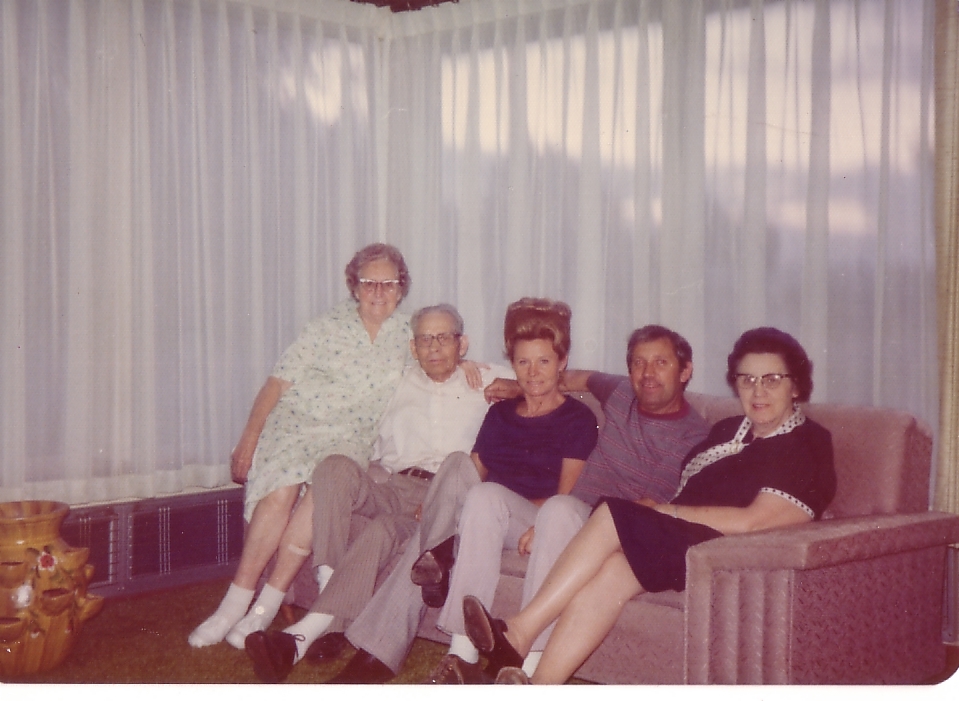
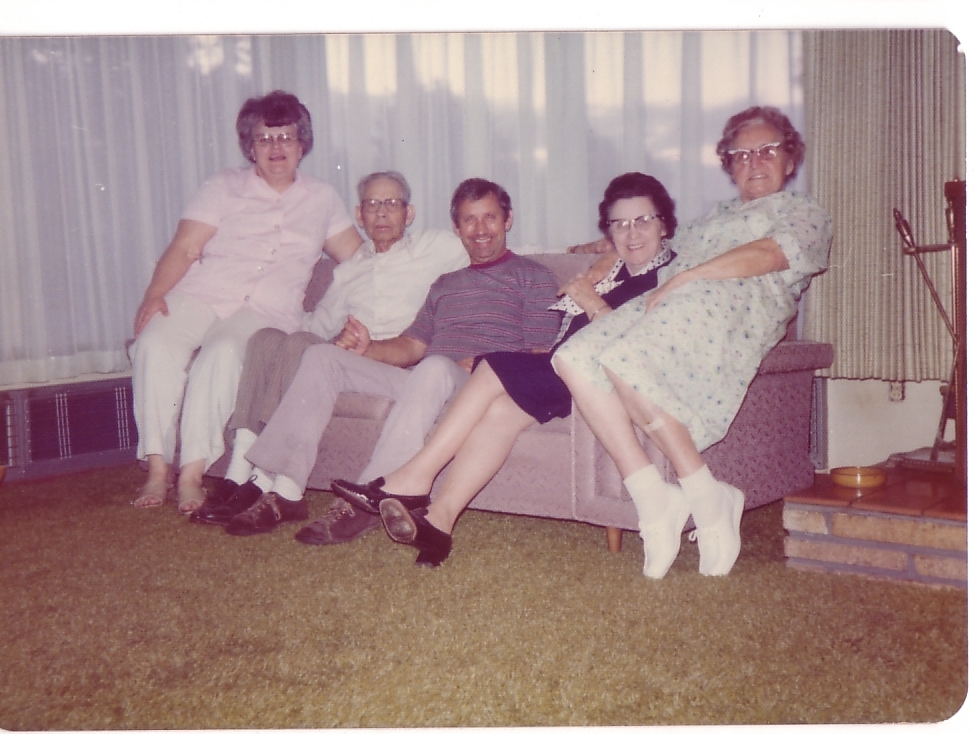
Here are four more clippings from my Grandparents, Milo & Gladys Ross. Grandpa talked quite a bit of baseball in Plain City from his youth. I have shared this photo too where he and Elmer played together on the same team. Visiting with Grandpa, multiple baseball players came up, but Elmer was the one that went on to some fame. Plain City’s history includes excerpts on Elmer.
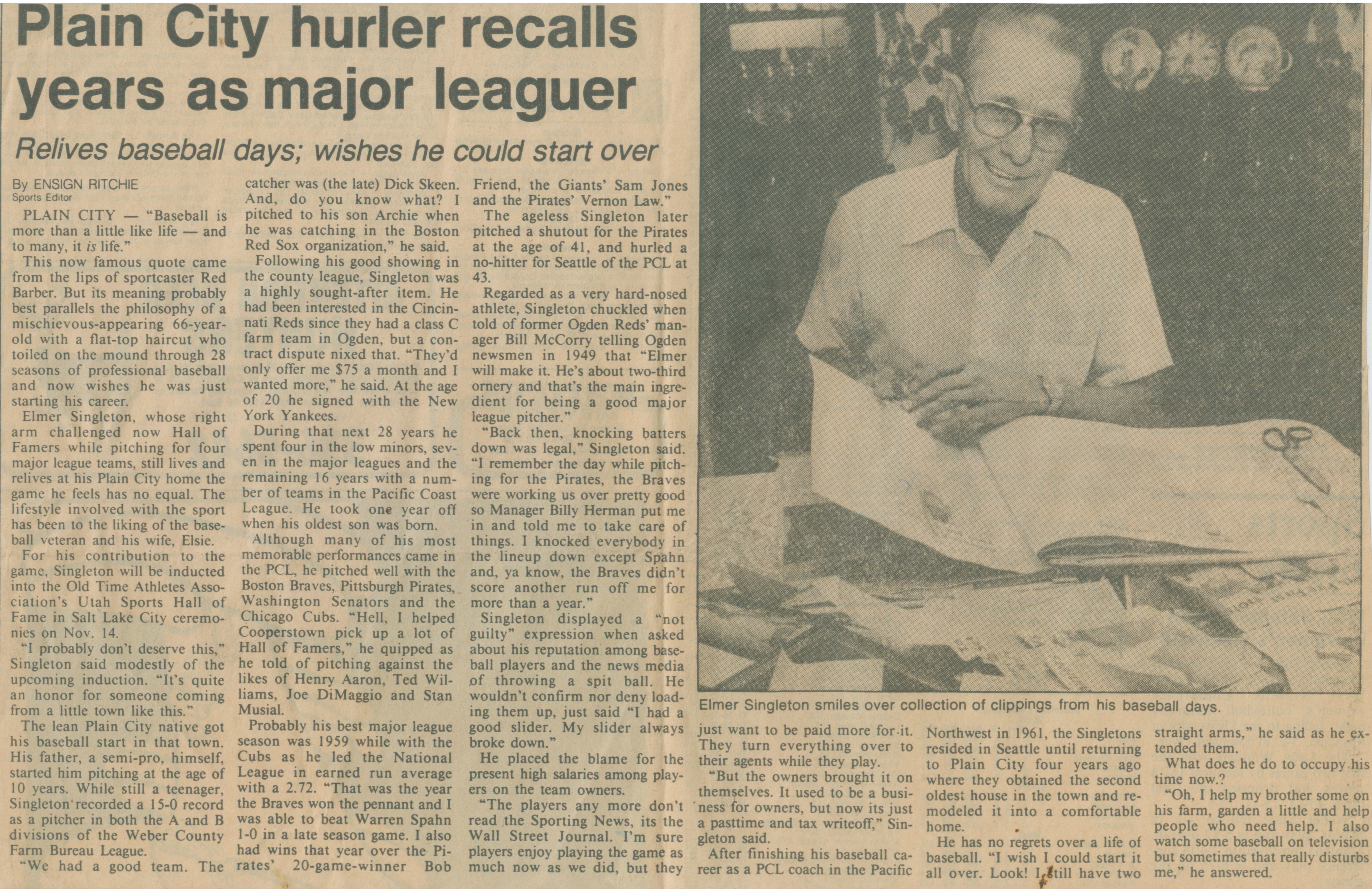
“Plain City hurler recalls years as major leager

“Relives baseball days; wishes he could start over

“PLAIN CITY – “Baseball is more than a little like life – and to many, it is life.”

“This now famous quote came from the lips of sportcaster Red Barber. But its meaning probably best parallels the philosophy of a mischievous-appearing 66-year-old with a flat-top haircut who toiled on the mound through 28 seasons of professional baseball and now wishes he was just starting his career.

“Elmer Singleton, whose right arm challenged now Hall of Famers while pitching for four major league teams, still lives and relieves at his Plain City home the game he feels has no equal. The lifestyle involved with the sport has been to the liking of the baseball veteran and his wife, Elsie.

“For his contribution to the game, Singleton will be inducted into the Old Time Athletes Association’s Utah Sports Hall of Fame in Salt Lake City ceremonies on Nov. 14.

“”I probably don’t deserve this,” Singleton said modestly of the upcoming induction. “It’s quite an honor for someone coming from a little town like this.”

“The lease Plain City native got his baseball start in that town. His father, a semi-pro, himself, started him pitching at the age of 10 years. While still a teenager, Singleton recorded a 15-0 record as a pitcher in both the A and B divisions of the Weber County Farm Bureau League.

“”We had a good team. The catcher was (the late) Dick Skeen. And, do you know what? I pitched to his son Archie when he was catching in the Boston Red Sox organization,” he said.

Following his good showing in the county league, Singleton was a highly sought-after item. He had been interested in the Cincinnati Reds since they had a class C farm team in Ogden, but a contract dispute nixed that. “They’d only offer me $75 a month and I wanted more,” he said. At the age of 20 he signed with the New York Yankees.

“During that next 28 years he spent four in the low minors, seven in the major leagues and the remaining 16 years with a number of teams in the Pacific Coast League. He took one year off when his oldest son was born.

“Although many of his most memorable performances came in the PCL, he pitched well with the Boston Braves, Pittsburgh Pirates, Washington Senators and the Chicago Cubs. “Hell, I helped Cooperstown pick up a lot of Hall of Famers,” he quipped as he told of pitching against the likes of Henry Aaron, Ted Williams, Jo DiMaggio and Stan Musial.

“Probably his best major league season was 1959 while with the Cubs as he led the National League in earned run average with a 2.72. “That was the year the Braves won the pennant and I was able to beat Warren Spahn 1-0 in a late season game. I also had wins that year over the Pirates’ 20-game-winner Bob Friend, the Giants’ Sam Jones and the Pirates’ Vernon Law.”

“The ageless Singleton later pitched a shutout for the Pirates at the age of 41, and hurled a no-hitter for Seattle of the PCL at 43.

“Regarded as a very hard-nosed athlete, Singleton chuckled when told of former Ogden Reds’ manager Bill McCorry telling Ogden newsmen in 1949 that “Elmer will make it. He’s about two-third ornery and that’s the main ingredient for being a good major league pitcher.”

“”Back then, knocking batters down was legal,” Singleton said. “I remember the day when pitching for the Pirates, the Braves were working us over pretty good so Manager Billy Herman put me in and told me to take care of things. I knocked everybody in the lineup down except Spahn and, ya know, the Braves didn’t score another run off me for more than a year.”

“Singleton displayed a “not guilty” expression when asked about his reputation among baseball players and t news media of throwing a spit ball. He wouldn’t confirm nor deny loading them up, just said “I had a good slider. My slider always broke down.”

He placed the blame for the present high salaries among players on the team owners.

“”The players any more don’t read the Sporting News, its the Wall Street Journal. I’m sure players enjoy playing the game as much now as we did, but they just want to be paid more for it. They turn everything over to their agents while they play.

“”But the owners brought it on themselves. It used to be a business for owners, but now its just a pasttime and tax writeoff,” Singleton said.

“After finishing his baseball career as a PCL coach in the Pacific Northwest in 1961, the Singletons resided in Seattle until returning to Plain City four years ago where they obtained the second oldest house in the town and remodeled into a comfortable home.

“He has no regrets over a life of baseball. “I wish I could start it all over. Look! I still have two straight arms,” he said has he extended them.

“What does he do to occupy his time now?

“”Oh, I help my brother some on his farm, garden a little and help people who need help. I also watch some baseball on television but sometimes that really disturbs me,” he answered.
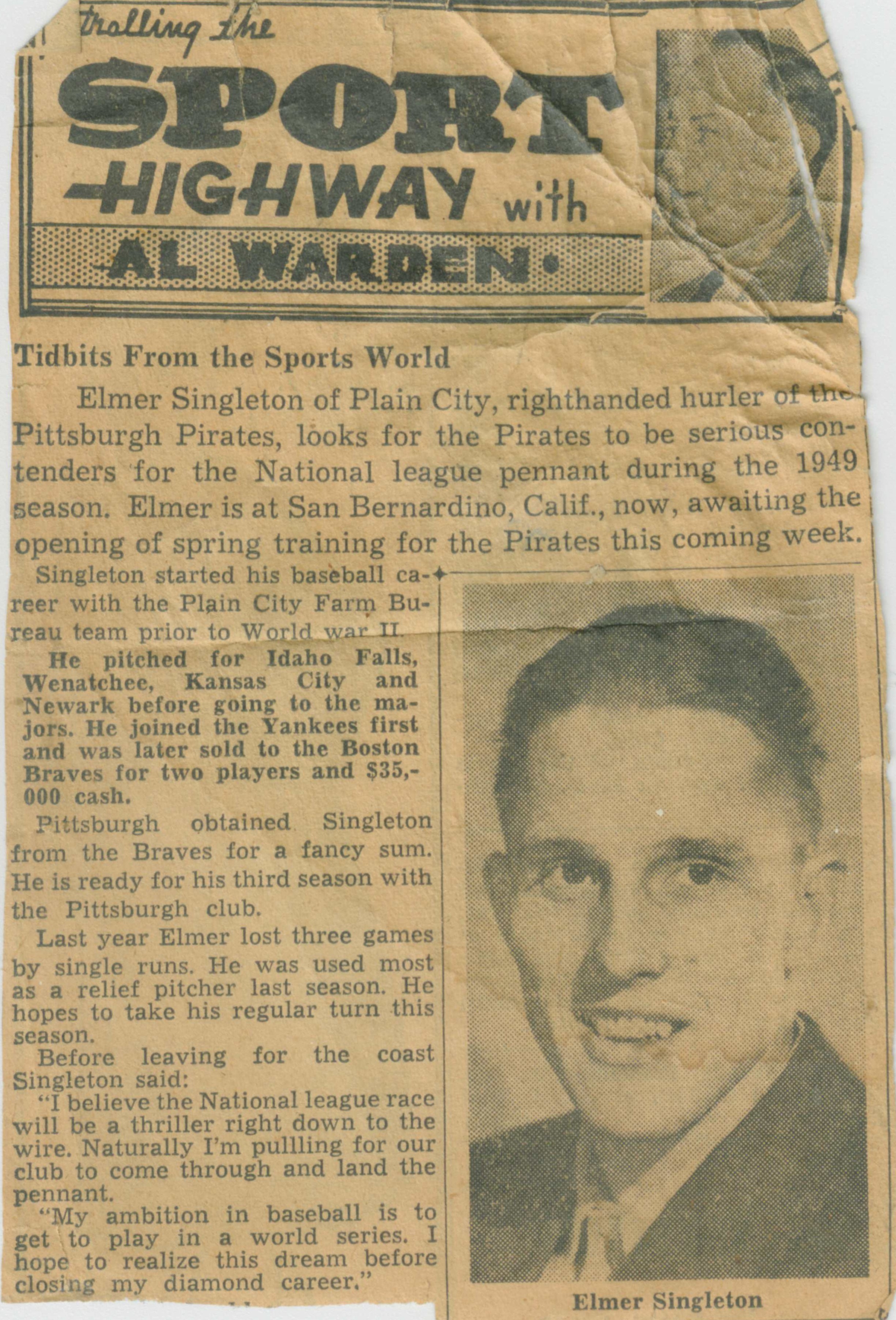
“Tidbits from the Sports World

“Elmer Singleton of Plain City, righthanded hurler of the Pittsburgh Pirates, looks for the Pirates to be serious contenders for the National league pennant during the 1949 season. Elmer is at San Bernardino, Calif., now, awaiting the opening of spring training for the Pirates this coming week.

“Singleton started his baseball career with the Plain City Farm Bureau team prior to World war II.

“He pitched for Idaho Falls, Wenatchee, Kansas City and Newark before going to the majors. He joined the Yankees first and was later sold to the Boston Braves for two players and $35,000 cash.

“Pittsburgh obtained Singleton from the Braves for a fancy sum. He is ready for his third season with the Pittsburgh club.

“Last year Elmer lost three games by single runs. He was used most as a relief pitcher last season. He hopes to take his regular turn this season.

“Before leaving for the coast Singleton said: “I believe the National league race will be a thriller right down to the wire. Naturally I’m pulling for our club to come through and land the pennant.

“”My ambition in baseball is to get to play in a world series. I hope to realize this dream before closing my diamond career.

“Elmer Singleton Rates Praise

“The “best pitched game” ever witnessed at Seals’ stadium went down in the record book as a defeat for Elmer Singleton, San Francisco right-hander, writes James McGee, San Francisco newspaperman.

“Singleton started his baseball career with Plain City in the Weber County Farm Bureau league back in 1938. Since that timehe has worn a number of major league uniforms.

“Writes McGee: “The big Seal righthander pitched 12 1/3 innings of no-hit ball against Sacramento, April 24, yet lost 1 to 0.

“”That was the best-pitched game I ever saw,” his manager, Tommy Heath, declared. But, as it turned out, it was not quite good enough. Singleton, who set a Seals stadium record and etched his name in Seal history, had the bad luck to meet a tough opponent, Jess Flores, Sacramento’s veteran righthander.

“Flores was effective. The Seals got to him for eight hits, compared to the three singles from Solons finally wrenched from the reluctant Singleton. But the three Solon hits came in succession in the first half of the thirteenth inning, Eddie Bockman, spelling Manager Joe Gordon at second base; Al White and finally Johnny Ostrowski did the damage, Bockman scoring.

“Singleton admitted he was tiring in the thirteenth.

“”It wasn’t that I pitched to so many hitters. It was the strain of the thing,” he said. “All through the early innings I knew I had a no-hitter going. I had to be careful with every pitch. I never pitched one before and I wanted it.”

“Umpire Don Silva vouched that Singleton was careful.

“”He had great stuff. His fast ball was good, but his curve was particularly good. And he was hitting the corners of the plate all the time,” said Silva. “His control was almost perfect.”

“Walked Four

“Singleton walked four men, one of them purposely. He retired the first 18 men to face him before he faltered and walked Bob Dillinger, first man to face him in the seventh.

“In the seventh, the Solons had him in jeopardy for the only time until they finally scored.

“Singleton was within one out of tying the Coast league record for no-hit innings when Bockman got the first hit, a sharp roller through the hole between third and short, in the thirteenth.

“Dick Ward, pitching for San Diego in 1938, went 12 and two-thirds innings of a 16-inning game against Los Angeles without a hit. He eventually won, 1 to 0.

“Ironically, the greatest game pitched at Seals stadium in its 22-year history was pitched in virtual privacy. Only 790 spectators were there at the start with about 1000 fans leaving the park before the end of the game.

“Sports Tid Bits

“Great Falls postmen have accepted the challenge of members of the Ogden post office and have wagered $125 that the Electrics finish ahead of the Reds in the 1952 Pioneer league race.

“Harold Stone of the Ogden post office department informed this corner of the acceptance Saturday night. Two years ago the Ogdenites lost a similar wager.

“George East, landowner of some of the finest duck shooting grounds of the area, is living like Noah of old at his home in West Warren. Genial George says that instead of duck problems, the trash fish from the lower Weber are visiting him and drinking out of his flowing well.

“The ducks have been winging their way annually in George’s direction for nearly four score years. Some years there has been so little water that the migratory birds have avoiding George’s feeding and nesting grounds. Not this year, however, George says as there is more water flooding the pasture lands than in many, many years.

“Herb Woods went out to look the situation over this week. George told Herb he could find his favorite blind by use of maps and a deep diving suit – but Herb did not want to get his nose wet.

“Hal Welch, our so-called game expert, says there is consternation among the sportsmen about the pheasants that will be lost because of their nests being destroyed by the floodwaters. He admits that there will be no shortages of mosquitoes for sportsmen, however.

“Screwy Situations

“The 1952 baseball season still is an infant but here are some of the crewy things that have taken place:

“An umpire – Scotty Robb – got fined, for pushing of all people, Manager Eddie Stanky, of the St. Louis Cardinals.

“Leo Durocher of the Giants protests Augie Guglielmo’s call of a third strike on one of his hitters but nothing happens. We thought questioning a third strike meant automatic banishment.

“A Phillie, Stan Lopata, fails to run from third base with two out, the batter reaches first on an error and Lopata is left stranded as the next batter is retired. And Manager Eddie Sawyer was coaching at third.

“”The Giants are leading the Braves by two runs in the eighth inning yet Leo Durocher lifts his number four hitters, temporarily Henry Thompson, for a pinch slugger. You don’t lift your number four batter in any situation, says wise baseball men, but then who says Thompson (not Bobby) is a number four hitter?

“Roy Campanella, a good number four hitter, bunts in a tie game. Another old baseball adage is that “you don’t bunt your number four hitter.” We disagree with that one. In this case Campy’s bunt paid off for the Dodgers as the next batter singled home the winning run.

“W.S.C. Loses

“PULLMAN (AP) – Idaho defeated Washington State 15-12 in Northern division gold matches Saturday.

“B. Elmer Singleton

“PLAIN CITY – Bert Elmer Singleton, passed away Friday, January 5, 1995 at his home in Plain City. He was born June 26, 1918 in Plain City, Utah, a son of Joseph and Sylvia Singleton.

“He married Elsie M. Wold January 20, 1939 in Ogden, Utah.

“He was a member of The Church of Jesus Christ of Latter-Day Saints.

“He played professional baseball for twenty-four seasons, originally signing with the New York Yankees Baseball Organization. His chosen vocation provided he and Elsie the opportunity to live in Pittsburgh, Pa., Boston, Mass., Chicago, Ill., Havana, Cuba, [Caracus, Venezuela], Seattle, Wash. and several other cities in the Midwest and on the West Coast.

“He retired from professional baseball in 1964 and returned to Plain City in 1980. Upon his return he actively lobbied for the Meals on Wheels program for Plain Cities Seniors. He helped with 4-H programs and worked with gifted children.

“He was chosen as Player of The Year for the State of Utah in 1939. He was inducted into the Utah Sports Hall of Fame in 1984. He was chosen as the Pacific Coast League most Valuable Player for years 1955 and 1956.

“Surviving are his sons, Joe F. of Chugiak, Alaska and Jerry E. of Tacoma, Washington and his brother, Don R. of Plain City. He has two grandchildren, Joe E and Shelby J., residing in Anchorage, Alaska.

“He was preceded in death by his loving wife Elsie on January 31, 1988 and brothers, Earl and Harold.

“Funeral services will be held Thursday, January 11th at 11 a.m. at Lindquist’s Ogden Mortuary, 3408 Washington Blvd.

Friends may call at the mortuary on Wednesday, January 10th from 6 to 8 p.m. and Thursday 10 to 10:45 a.m.

“Internment, Plain City Cemetery.
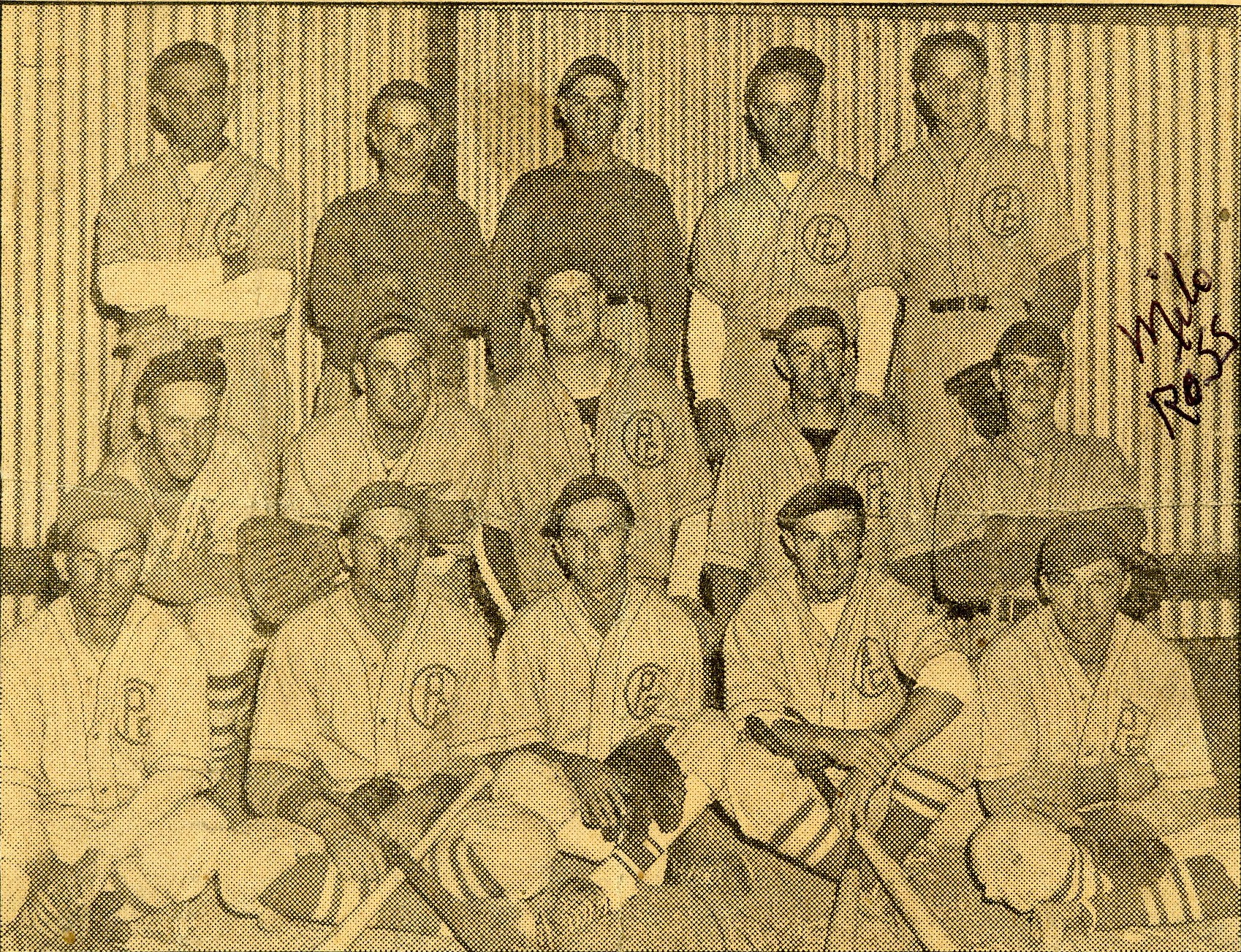
Back (l-r): William Freestone (manager), Norman Carver, Glen Charlton, Fred Singleton, and Elmer Singleton. Middle: Clair Folkman, Dick Skeen, Albert Sharp, Abe Maw, Milo Ross. Front: F. Skeen, Walt Moyes, Arnold Taylor, Lynn Stewart, Theron Rhead.

George Frederick Housley Transcript

George Frederick Housley

Transcript

Transcript for Housley, George Frederick, [Reminiscences], in Life histories of George Frederick Housley and Maria Christina Jacobsen Housley

“The Bishop of the Ward wanted George to talk in Church and tell of his coming across the plains, but George said he just could not speak in public so his wife’s brother-in-law, George Wood, who was a lawyer, came to his home and took his story down in short hand as George told the story to him. Then they had it read in a reunion. It was as follows:

“In the year of [1856], I with mother left our native land England, with about 600 others for our America “The Zion of Our God,” on the good ship “Horizon,” spending five weeks in our voyage to Boston. Where we took passage on a steamboat to Iowa. Awaiting there for three weeks for our hand-carts to be made that were to carry our “all” across the vast stretch of the plains to Utah. Each family supplying themselves with the necessary food for their journey if they were well. At Iowa City, where we were camped, a gentleman told me that we would starve to death if we went there at this season. One of our people and his family decided to stay over. I became tempted to do likewise and upon telling my mother that we better stay she became much depressed in spirit and told me to wait a little while. During the time she prayed to Our Heavenly Father for guidance. One fellow traveler, after deciding to stay, sent out one day in the woods to hunt for game, and while away was seized with fever and ague. He hurried home and upon entering the tent where mother I were awaiting him, he laid upon the cot and commenced singing in poetry and rhyme, telling mother to take me with her to the valley and that we should get through alright. Mother told me she had made it a matter of prayer and by this means her prayers were answered. I told her then that we would go to the valley at all hazards because I was satisfied all would be well.

“Upon the company starting we were in line with our cart and ready. All went well as we joyously sang, “For some must push and some must pull as we go marching up the hill. As merrily on the way we go, until we reach the valley, Oh!” As days wore on, our spirits lagged as we became weary. Some of our people became sick and were compelled to ride, thus compelling others to be more heavily loaded. Provisions commencing to get scarce as the days wore on, necessitating our captain to put us on shorter rations. Many dying by the wayside where they were buried each night where we camped and their graves were left unmarked except by our tears. At this season and at this part of the plains it commenced getting cold, and were again placed on shorter rations of 4 ounces of flour to each person per day. We traveled to the Sweet Waters River where we camped, being so weak and exhausted that it was almost impossible to move. Many of our people while there died of starvations while others froze to death by the wayside.

“A man from London by the name of Stone, while trying to get to an Indian camp was devoured by wolves; when found by some of our camp, nothing was left of him but his legs inside his boots.

“Receivers were sent out from the Valley to assist us in and could not find us, thinking we were lost on the plains the rescue party concluded to return to the Valley. But one of their number stated that he would go to the States but what he would find us. About noon a horseman was seen coming into our camp, and he looked like an angel to us poor starving emigrants who had eaten nothing but flour for three days. With words of encouragement he entreated us to make another start. But, many, while their will was good, their strength failed them and they dropped and froze to death by the way.

“The relief party returned and met us and assisted us with some provisions. But scores of our brethren and sisters died and were left in unmarked graves by the wayside. At this time I was permitted to sleep in a tent with two of my companions. Each of them dying by my side where I slept by them ’till morning when they were taken away and buried.” In a later trip across the plains to assist the emigrants at one of our camps I saw many of the bones of my companions that had been dug up by the wolves. At the time of my companions death I became despondent through weakness that I longed for death and tried to hide myself from the company that I might die, but one of the brethren returning back for something, found me sitting behind the rock where I had hoped to die. He took me along with him for a day before we caught up with the company. I was permitted to sleep in a wagon that night, where I slept with a dead man all night.

“The next day we were permitted to see and enter into the Valley (November 29, my birthday). Although I was too weak to walk, my feet being much swollen I wrapped them in my mother’s shaw until we were taken care of by kind friends who were awaiting us. But brother Slack, our kind friend, would not allow me only a limited amount of bread as he was afraid it would kill me. But after they had gone to meeting I finished up the whole pot pie which had been prepared for the family, and I am alive yet and I have been hungry to this day.”

“President Parkinson of the Hyrum Stake was present at the reunion and when he heard of the hardships, suffering and hunger George went through, he made arrangements with the Church authorities to grant this couple the privilege of receiving their second endowments. After they received theirs, Mary Ann stood proxy for George’s first wife, who received their second endowments of the 28th of July 1910. This is a privilege and blessing that only a few people have had since the Church was organized…. An addendum was added: “One time while visiting in Mapleton at his son Ben’s home, he and my Grandfather—Marshall Franklin Allen—were reminiscing over old times. Grandfather Allen told of one time when “Brother Brigham” had called him to accompany several other young men in going out to meet the Hand Cart Company, to take them some provisions and assist them into the Valley. As he knelt in prayer the evening before going, he said that he told the Lord that it was a foolish thing to do, going out in such weather and with no roads to follow. But while he was still in the act of prayer, it was made known to him that he should go. It was also made known that he would be able to save many of their lives. After search many hours the rescue party became discouraged. Thinking the Hand Cart Company had been lost on the plains, they decided to return to the Valley. Grandfather said, “I told them I would go ’til I reached the States but what I would find them” About noon they found a group of handcarts with their poor, starving people. Thinking there may be more farther back, he rode on for some distance. He saw a dark spot among some rocks. Upon investigating, he found it to be a young man. He wrapped his blankets around him and helped him onto his horse. Then Grandfather Housley spoke up and said—”The horse had one white leg, a white strip in it’s forehead and the rest of it was coal black.” Grandfather Allen said, “Yes.” Grandfather Housley said, “It was a bright plaid blanket.” Grandfather Allen asked, “How do you know?” Grandfather Housley said, “Because I was the one you found!” Then he stood up and said, “And I want to tell you, if it hadn’t been for the prayers of my mother and the faith of the Saints, I would not have lived ’till you found me and I never would have reached the Valley!”

History of Plain City Pt 9

I have two copies of the History of Plain City, Utah. The front indicates it is from March 17th 1859 to present. As far as I can tell, the book was written in 1977. At least that is the latest date I can find in the book.

One copy belonged to my Grandparents Milo and Gladys Ross. My Grandpa has written various notes inside the history which I intend to include in parenthesis whenever they appear. They add to the history and come from his own experience and hearing. 

I will only do a number of pages at a time. I will also try to include scanned copies of the photos in the books. These are just scanned copies of these books, I have not tried to seek out originals or better copies.

History of Plain City March 17th 1859 to present, pages 141 through 149.

BONA VISTA IMPROVEMENT DISTRICT

SUBMITTED BY FLOYD PALMER

              This most important new culinary water system has made life a little more pleasant in this community and surrounding areas. It was turned into the lines just a century after sturdy pioneer families first put together temporary shelters and tapped several sweet water springs which they found in the area.

              It replaces old flowing wells, bringing precious waster from the depths of the earth. In early days many deep and surface wells dug, covered over, and fenced off to keep children from falling in. They were first fitted with “pitcher” pumps, a short-handled affair which were the “pumper” out in a short time. Even the farm animals had to depend on well water pumped to the surface by hand.

              Later, the easier to work, long-handled pumps were installed. These were followed by power pumps connected to a small storage tank. This was the ultimate in a private water supply.

              In 1955, a Weber County man, Linn C. Baker, was a member of the State legislature. He is the one who sponsored the bill to create special improvement districts. The reason he was the sponsor of this bill was due to his work in the Health Department for the State of Utah. As he studied samples of water sent to him from the outlying towns, he became aware of the amount of contamination there was in the drinking water in certain areas, Plain City was among the highest on the list. This was traceable to shallow surface wells being used, also septic tanks with poor drainage.

              Soon after the Weber Basin Conservancy District was organized, Plain City wanted to purchase one-thousand-acre feet of water. Their request was held in abeyance until a line could be built from Ogden Canyon. This, however, was never done.

              Elmer Carver was on the executive committee of Weber Basin Project. Through the encouragement of Commissioner Carver, Mr. Ezra Fjeldsted, manager of Weber basin Project, and Linn Baker, all met with the Plain City Town Board to get something started. Floyd A. Palmer, a member of the Town Board, was asked to represent Plain City on a committee of surrounding towns in Weber and Davis counties. Mr. Ezra Fjeldsted acted as chairman of this group and several meetings were held in both counties which Mr. Palmer attended.

              Following this, a public meeting was held in Plain city. Farr West, and Harrisville were asked to join in. This was for the purpose of starting a culinary water system. The results of this meeting, from all groups attending, were to go ahead, also to contact other nearby towns and get their feelings about joining in.

              A series of meetings were held in Farr West, Harrisville, Slaterville, Marriott, Wilson Lane, and Plain City. Other towns were invited to attend. Ezra Fjeldsted represented Weber Basin, Floyd A. Palmer represented Plain City, Dick Groberg represented Farr West, Kenneth Brown represented Harrisville, Clifford Blair represented Marriott and Slaterville, and Arthur W. Sorensen represented Wilson Lane. The meetings were all met with a great deal of enthusiasm and interest.

              Plain City Town Board consisted of Lee Olsen, President, Floyd A. Palmer, Elvin H. Maw, Merrill Jenkins, Blair Simpson, as members. A culinary water system was a prime item of the agenda in 1956. The town board along with several local residents were well organized to promote the need for a water supply to replace the surface wells and pumps.

              On July 19, 1956, Elmer Carver, Chairman of the Board of County Commissioners of Weber County, State of Utah, signed a certified documents that there be and is hereby created within Weber County, Utah, a Water Improvement District to be known and designated as the BONA VISTA WATER IMPROVEMENT DISTRICT, the same to embrace and include all real property lying within the following boundaries, to-wit: (SETS FORTH DETAILED LEGAL DESCRIPTION OF DISTRICT BOUNDARIES WHICH BOUNDARIES EMBRACE LANDS HEREIN ABSTRACTED – Abstracter)

              That the following-named persons are appointed as the Board of Trustees of said Bon Vista Water Improvement District:

                               Floyd A. Palmer, Plain City

                               Richard Groberg, Farr West

                               Kenneth Brown, Harrisville

                               Clifford Blair, Marriott-Slaterville

                               Arthur Sorensen, Wilson Lane

              This resolution shall take effect immediately and shall be recorded in the office of the Weber County Clerk. Recorded August 22, 1956.

Following this appointment from the Weber County Commission, the board held a short meeting. It was necessary to elect a chairman, after a discussion of each of the board members. Kenneth Brown was appointed as chairman.

              The first order of business was to secure professional and legal help. Mr. Jack Richards was appointed attorney. Jack Reeves, of the firm of Nelson, Reeves and Maxwell, was appointed engineer. They were appointed to do the field work and present the plans and drawings back to the board.

              When the plans were completed, the board spent much time deciding the most feasible and economical areas to run the lines in. Also, to give each town a fair share of the project. Following this, it was necessary to project estimated costs. The board spent many months getting costs and deciding on types and kinds of pipes and materials to use on the project. The overall plans had to look attractive and feasible in order to get a bonding company to handle the bonds.

              The first step made to secure the bond issue was to get signed pledge cards with an agreement to pay $250.00 for a waster connection. This was a requirement. Committees were organized with Floyd A. Palmer, Richard Groberg, Kenneth Brown, Clifford Blair, and Arthur Sorensen acting as chairman in each of their respective towns. The result was very successful, all those serving on these committee are deserving of much credit for their untiring effort and accomplishments.

              On August 20, 1957, a bond election was held to see if the residents would approve a $900,000.00 bond issue. The vote was 490 yes and 82 no. Edward L. Burton Company was retained as Fiscal Agent, and $698,000.00 was sold in General Obligation Bonds, and the system was under way.

              On April 14, 1958, a contract was awarded to Smith-Scott Pipe Company to furnish cement mortar-lined steel pipe for the main lines.

              Also, on April 14, 1958, a contract was awarded to Knudson Construction Company to install water mains in the Harrisville-Randall area which was Phase I of the project.

              Also, on April 14, 1958, a contract was awarded to Chicago Bridge & Iron Company to furnish and erect a 250,000.00 gallon elevated storage tank in Plain City.

              On April 28, 1958, Theron Palmer was hired as General Superintendent to oversee construction and to get it ready to serve and operated as a system.

              On May 27, 1958, an office was rented from the E. B. Stone Estate on the corner of 9th and Washington. The district still maintains its offices here. The building was purchased by the district in 1969 and has been remodeled.

              On May 27, 1958, negotiations were begun with the State Department of Welfare of obtain ownership of a spring located in Garner’s Canyon in North Ogden. The spring was used at the time by the welfare department at the Industrial School property for culinary use and irrigation use.

              On May 27, 1958, Weber Basin let a contract to Statewide Construction Company to build the 16-inch transmission line from 4000 South on U-84, down into the district where Bona Vista could connect to it.

              Also, on May 27, 1958, a piece of property located at 4100 West on 2200 North in Plain city, was purchased from Vern Palmer to construct the elevated tank.

Bona Vista Water Storage Tank

              Raymond Concrete Title Company moved in and drove concrete pilings 80 feet into the ground to support the tank.

              Gerald Larkin was then awarded a contract to construct a foundation so Chicago Bridge and iron could begin erection.

              On July 3, 1958, a contract was awarded to Bert Robinson Construction Company to build lines in the Farr West and Plain City.

              Also, on July 3, 1958, Standard Plumbing Supply Company was awarded a contract to furnish materials for service lines.

              On July 17, 1958, the Weber County Commission agreed to purchase 60 fire hydrants to go on the system to be located by the Weber County Fire Chief.

              On July 17, 1958, Smedley construction Company was awarded a bid to construct lines in the Slaterville, Marriott, and Wilson area for $44,975.00. The same day Mac Construction Company of Salt Lake City was awarded the bid to construct our North Ogden Reservoir for $16,911.00. This is a concrete underground reservoir.

              On August 11, 1958, an agreement was reached with the Welfare Department to obtain full use of the spring in North Ogden. Weber-Box Elder water was purchased to replace the Welfare Department’s share of the spring.

              On February 11, 1959, work began on the plans and site for a reservoir in the Roy area.

              On March 23, 1959, it was decided to run a line on the North Plain City Road.

              On August 27, 1959, it was decided to either buy or condemn the Hansen property for a reservoir.

              A bid to build a tank in Roy was awarded to Wehyer Construction Company for #31,403.80 on September 23, 1959.

              Negotiations began to buy an eight-foot well from the Farr West Stake for $31,403.80 on September 23, 1959.

              Linn C. Baker resigned as Secretary on January 1, 1961. He had been with the district since it began.

              On December 6, 1961, it was decided to construct extensions to existing mains in the amount of $90,000.00 General Obligation Bonds were sold to finance these extensions. Waterfall Construction Company did the job.

              All though the summer of 1961, the Farr West well was tested to see if it would hold up.

              On February 28, 1962, President Wimmer signed the Warranty Deed on the Farr West well and property. On January 16, 1963, it was decided to put heat lights on our Roy tank. This was the first such installation in this area and it drew a lot of attention.

              The Utah State Health Department studied the plans for use of the plans for use of the existing well in Farr West and decided against allowing it to be used because of its depth. A change application was then filled with the State Engineer to drill the well to a deeper depth.

              On May 10, 1963, a contract with Wesley Stoddard was made to drill a well in Farr West for $21,632.00 plus $4,700.00 for the test hole to see how deep the well would have to go.

              A meeting was held at the Farr West Pump House building on January 20, 1964. This building was contracted by the Bona Vista Water employees. The piping was also done by employees of Bona Vista.

              R. W. Coleman Company was awarded a contract for $18,877.50 to change some lines under the interstate highway on November 22, 1965.

              Negotiations began on March 28, 1966, with Weber Basin on the North Ogden Well, which was later drilled and is used in the system now.

              Water meters were deemed necessary and were bought by bid from Waterworks Equipment Company and E. C. Olsen Company on October 28, 1968.

New Plain City Canal

BEGINNING OF PLAIN CITY IRRIGATION WATER

              1859 Before the summer was over some water had been brought in their new ditch from Four Mile Creek to Plain City. In 1860, the Canal was completed to Mill Creek, the following year to Broom’s Creek and in 1862 to the Ogden River. The Right of Way in Weber River was purchased in 1873 at a cost of $2000.

              In 1899 Samuel Wayment drilled an Artesian Well 249 feet deep producing additional water for the settlers. He also was in charge of the iron work and the building of the Chief Canning Factory in Plain City.

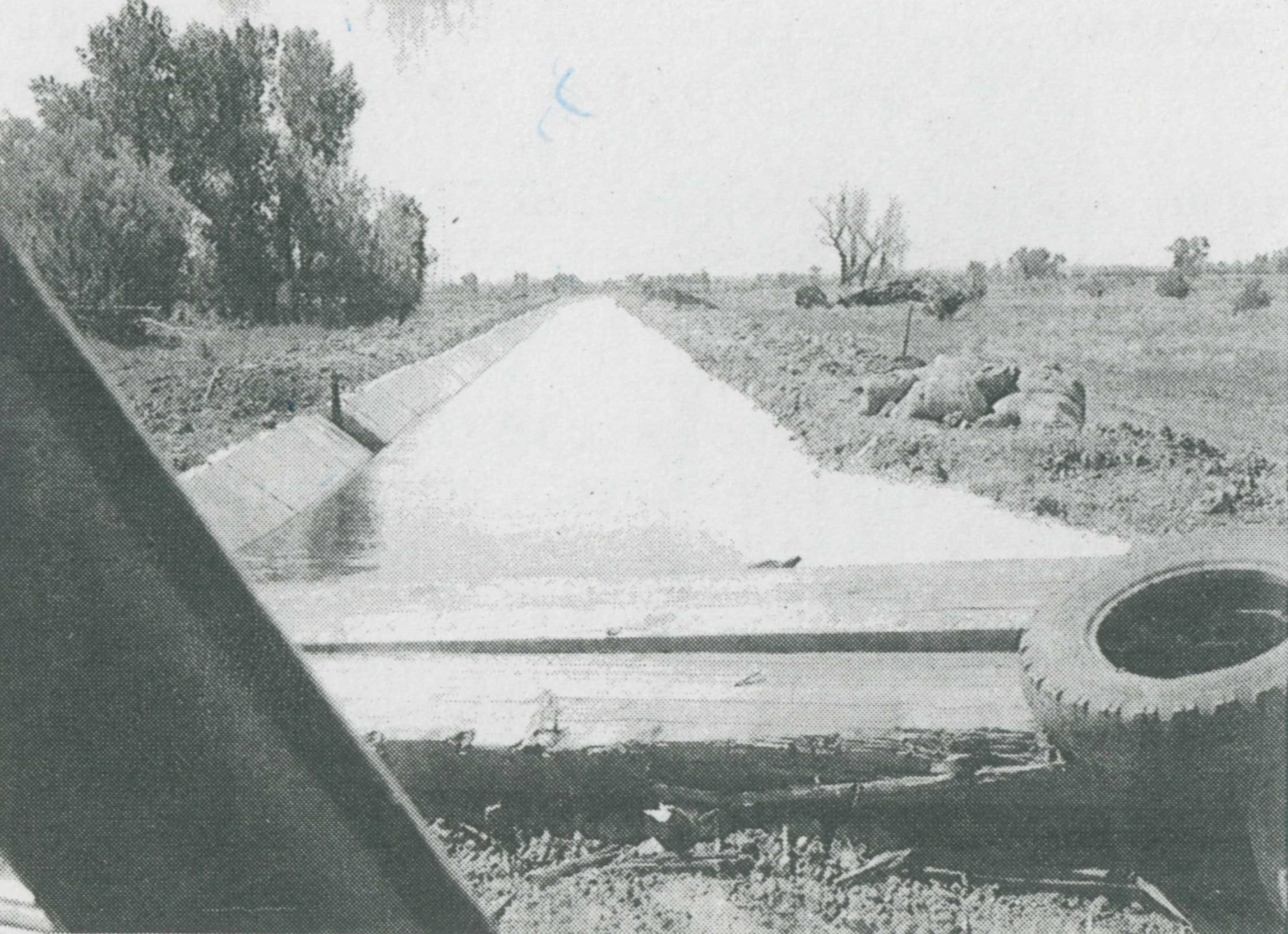
PLAIN CITY IRRIGATION-CEMENTING OF THE MAIN CANAL

SUBMITTED BY Wayne Skeen

              For many years the Plain City Irrigation Company received it’s water from the Weber River. The diversion point into the canal was just north of the old American Packing Plant that was later called the Swift Meat Packaging Plant. The Irrigation Company had a large Plank Head Gate in the Weber River that forced the water into the Plain City Irrigation Company Canal because of high waters in the spring this gate would wash out and it was necessary to make a gravel and dirt dam each year using horses, scrapers, and even large bulldozers. In recent years this became a major problem.

              The government began planning the Willard Project in 1960. This project would interfere to a certain extent with the existing canal used by the Irrigation Company because big Willard Bay Canal would be built in part of our existing canal and would also cross it in part of our existing canal and would also cross it in other areas. The leaders of this project wanted to provide a turn out from the big canal into the Plain City Irrigation Canal. The corporation of our company was necessary to give them the right to use the area affected by the construction of the Willard Bay Canal. The logical point of diversion would be west of the Farr West Church House. This meant that some new construction would be necessary to get the water into the old canal. It was in need of some repairs and it was at this time that the idea of a new cement lined canal was entertained.

              Directors who served during this period of construction were as followed:

              President                               Abram Maw                1959-60

              President                               Alvin J. Robson           1961-65

              Vice President                       Walt Christensen        1959-64

              Vice President                       Carl Taylor                  1965

                                                            Bert Hunt

                                                            Charles Heslop

                                                            Keith Blanch

                                                            Mike Panunzio

              Secretary                               Wayne Skeen              1959-65

              High lights of the minutes of the meetings during the construction period are as follow:

August 11, 1959

              Ogden City had extra water for sale this year which was allocated out to various canal companies. A motion was made by Alvin Robson that this water be purchased to see them through the current season. It would be paid by those stock holders who subscribed for the extra water.

April 4, 1960

              The meeting was called to discuss the new canal. Charles Heslop was assigned to work on interested free money from the Utah Water & Power board for the construction. Alvin Robson was assigned to work with the Soil Conservation on the completion of the surveying of the canal, and additional monies.

July 12, 1960

              A meeting was held to discuss a possible shortage of water for the remainder of the year. Time was changed from 20 shares per hour to 25 shares per hour.

January 9, 1961

              A priority was established with the Utah Water an Power board for interest free money and application made for $100,000.00

              A survey showed that there was a 10% loss of water between the River turn out and the Point of use.

March 8, 1961

              The Irrigation Company received a $10,000.00 cash settlement for their rights in the old canal from the O.U.R.D. Railroad Company that passes through their yards.

              Alvin Robson, Carl Taylor, and Walt Christensen was to secure information regarding tiling of the canal from Victor Lund’s corner up to the Jesse Singleton property where the canal leaves the road and runs back into the fields.

April 20, 1961

              A report was given by Alvin Robson regarding the tiling of the lower part of the canal. There were mixed emotions about tiling this section of the canal because of the fall and the amount of water to be delivered. “Alvin Robson commented as the discussion went on concerning the piping verses the cement lining. The stockholders are residents of this town and should have some concern towards the improvements and beautification of the community and that an open cement lined canals to greet the people entering the town is not very inviting and once it was constructed it would never be changed in our life time.”

              Keith Blanch speaking as a town board member expressed his opinion regarding the beautification and eliminating hazards in the community and felt that it was worth while and the tax payers should help with the construction of the Irrigation Company in piping this section of the canal.

              Glen Charlton and Lee Olsen from the town board were present. An opinion was asked from the town board members. Mr. Charlton felt it was a worth while project as long as it was right. Mr. Olsen commented that it was a good thing as long as it was sufficient to meet the needs of the water users.

              The town board members agreed to cover the pipe that was laid with dirt. It was agreed that 2880 feet of 36 inch tile would be laid this spring from the old beet dump corner to Victor Lund’s corner.

April 27, 1961

              The Town board members present: Dee Cook, Glen Charlton, Kent Jenkins, and Lee Olsen. Mr. Covey from Utah State University was also present.

              Further discussion concerning cost of construction of the concrete pipe continued. Keith Blanch made a motion that the town board and property owners should join with the Irrigation Company in the cost of the 36 inch tile to be laid. Motion seconded by Carl Taylor

              Mr. Robson suggested the property owners who would benefit from the lining of the canal pay $1.25 per foot frontage towards the pipe. The Town Board said they could only participate within the city limits and they would contribute $4,000.00 over a 10 year period. The bids were to be sent to Secretary Wayne Skeen by March 30, 1961.

April 30, 1961

              The purpose of this meeting was to open bids. Utah Concrete Pipe Company received bids for 36 inch concrete pipe at $8.75 per foot. Waterfall Construction Company was awarded the laying of the pipe at $1.55 per foot.

              Abram Maw made the motion that the project not be stopped at the beet dump corner but continue up to the up to the weir east of the water tower (where the pipe portion of the canal now starts) if the property owners will contribute $1.25 per foot. Motion seconded by Keith Blanch.

              Charles Heslop ad Elvin Maw were asked to approach these property owners and get their approval to pay the $1.25 and also contact all stock holders and get their signature for government participation thru the Soil Conservation.

              Charles and Elvin were successful in getting all the names except Jesse Singleton who would not accept any government monies and would not pay the $1.25 per foot to tile in front of his property.

              Alvin Robson contracted Howard Singleton, Jesse’s boy and he agreed to pay the $1.25 but only up to the old house that sat in the field and that is where the concrete pipe starts today. Alvin Robson tried to convince the Director’s that they should at the company’s cost tile the remainder of the ditch along the road because any future expansion of the community would by hampered by open ditch reducing the width of the road. This motion turned down.

              Walter Christensen made the motion that Alvin Robson meet with the Soil Conservation to discuss details of cost and tiling and lining the canal.

April 31, 1961

              Alvin East, Maurice Skeen, and Owen Wayment from the Warren Irrigation Company met with the directors to discuss details and sign a contract for the exchange of Ogden and Weber River which would benefit both companies. The contract was signed.

              Mr. Daniel Lawrence from the Utah Water & Power Board attended the meeting. Keith Blanch made the motion that Alvin Robson and Wayne Skeen be given the power to enter into a contract with the Utah Water & Power Board for the total cost of $1,300.000.00 and formulate all details.

May 3, 1961

              Junior Taylor was appointed as Water Master of the year.

May 15, 1961

              The purpose of this meeting was to discuss the Weber Basin Project with E.J. Feldstead and commissioner Wilmer Carver. They needed additional votes to finish construction of the Willard Bay. A proposed addition would cost seventeen million dollars.

June 5, 1961

              The purpose of the meeting was to see what should be done because it appeared that there would be a water shortage before the end of the year. It was proposed that we only run off water until the stream reached a point that we could not water properly and then start to use our shortage water and put turns on 1/3 basis.

September 27, 1961

              The new project was discussed and it was recommended that the company hire an engineer and begin construction on the upper end of the new canal.

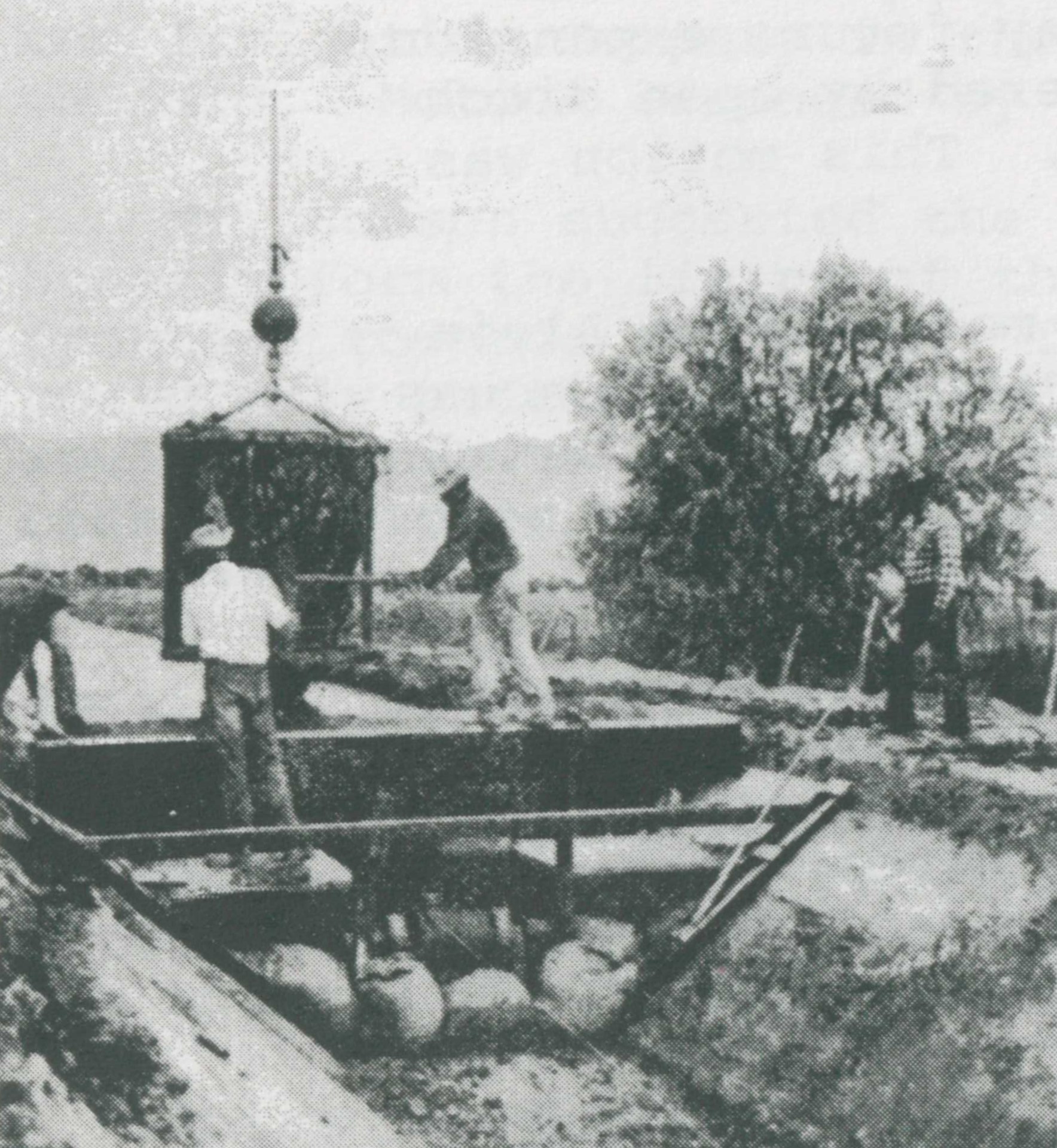
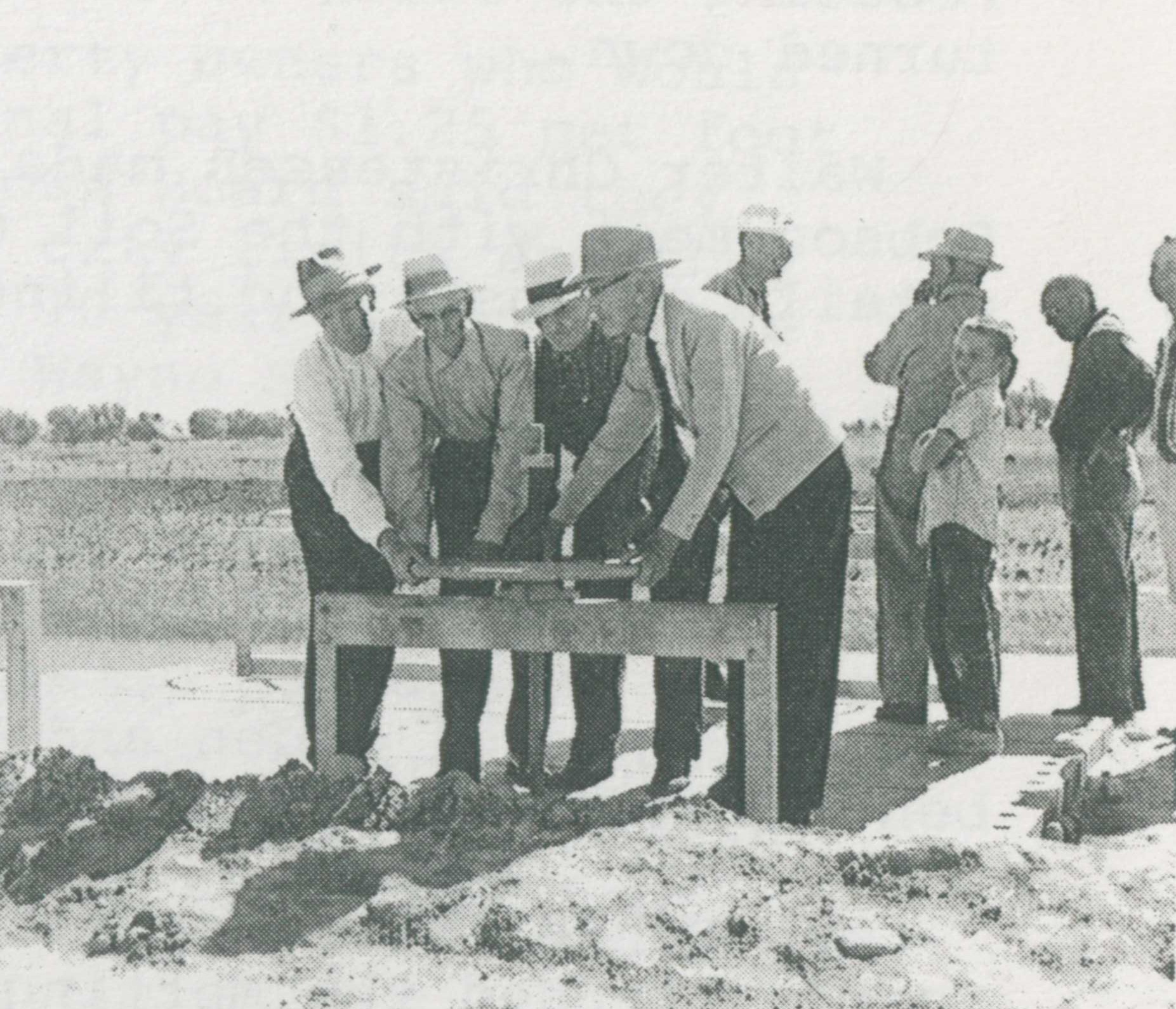
              There were many problems that came out of the construction of this canal. It would be necessary to get some dirt to construct the pad for the canal. The company purchased some ground at the upper end of the canal from Max Stander. Then got the dirt that was necessary to build the upper end of the canal and then leveled the ground and gave it back to Mr. Stander. They also purchased additional dirt from Robert Penman. This dirt was trucked from his property just south of the Weber River and west of the main road. The dirt was hauled by farmers using their beet trucks, etc.. The new pad was made in the old canal banks where possible, but there was some trading of land etc. to straighten out the canal. There was also a problem in getting someone to dig out the canal to the size and shape required to allow 50 seconds feet of water at one time. The company asked for bids, but they only received one because the equipment needed to shape the canal was not available. In order to get the project moving Alvin Robson caught a bus on Ogden and went to the Fuller Forms Company in Arizona to see if they had some type of equipment that could be used. He purchased a right to one of their slip forms that could be used in forming and pouring the concrete. He returned to Ogden and worked with the Ogden Iron Works on 23rd Street and Grant Avenue where the construction of the slip forms took place. The next problem was to begin the construction of the project. Dean Hadley of Taylor was hired to do most of the big equipment work. Local farmers also helped with their equipment. The Soil Conservation furnished the engineering on the project. Herbert Issackson of Pleasant View was the surveyor. One of the major problems that existed and is still a yearly discussion is the amount of water delivered from the existing head gates. The government required that curtained head gates must be varied in size for them to participate financially.

Oct 1962

              There was much contention and personal feelings during the construction of how it should be done. Some people left the jobs and never came back, but the project was finally finished. The construction created problems for some but most of the inconveniences were ratified by the Irrigation Company. New bridges were built, land was leveled, damages to property was crops were paid for during the construction. The Company paid for fencing materials with the property owners installing the fences. Cattle that used to walk across the stream would fall into the new lined canal and couldn’t get out. The Company paid for some of the cattle that were lost before the agreement to install fencing was made.

              The total cost of the project was $199,754.08. The amount of $122,918.61 was borrowed from Utah Water & Power Board. This money was interest free if a yearly payment was made by November 30th each year. The last payment of $8.257.06 will be paid on November 30, 1977. Other cost not being paid by the stockholders come from the Soil Conservation and the sale of pieces of the old canal, and the town board. Vice President Bill Hatch of the First Security bank was also an asset in the financing of the canal.

              We borrowed monies from the First Security Bank as construction went on to pay for cost on a daily basis. On December 31, 1974, the company owed the First Security bank $60,000.00 Alvin Robson and Wayne Skeen met with Mr. Hatch in May regarding this bill. Mr. Hatch said that the bank needed some type of security for this loan. There was nothing to give him because out rights to the canal had been given to the Utah Water and Power Board. Alvin Robson and Wayne Skeen then approached Mr. Lawrence of the Utah Water and Power Board asking them for more money for the project explaining the situation with the bank. Alvin Robson explained that they might just as well take over the ownership of the canal because the bill had to be paid. There was nothing to offer as security because the Utah Water and Power board had everything that the company owned. Later, Mr. Lawrence of the Utah Water and Power Board gave the Irrigation Company an additional $30,000 which helped to delete that note at the First Security Bank.

*********

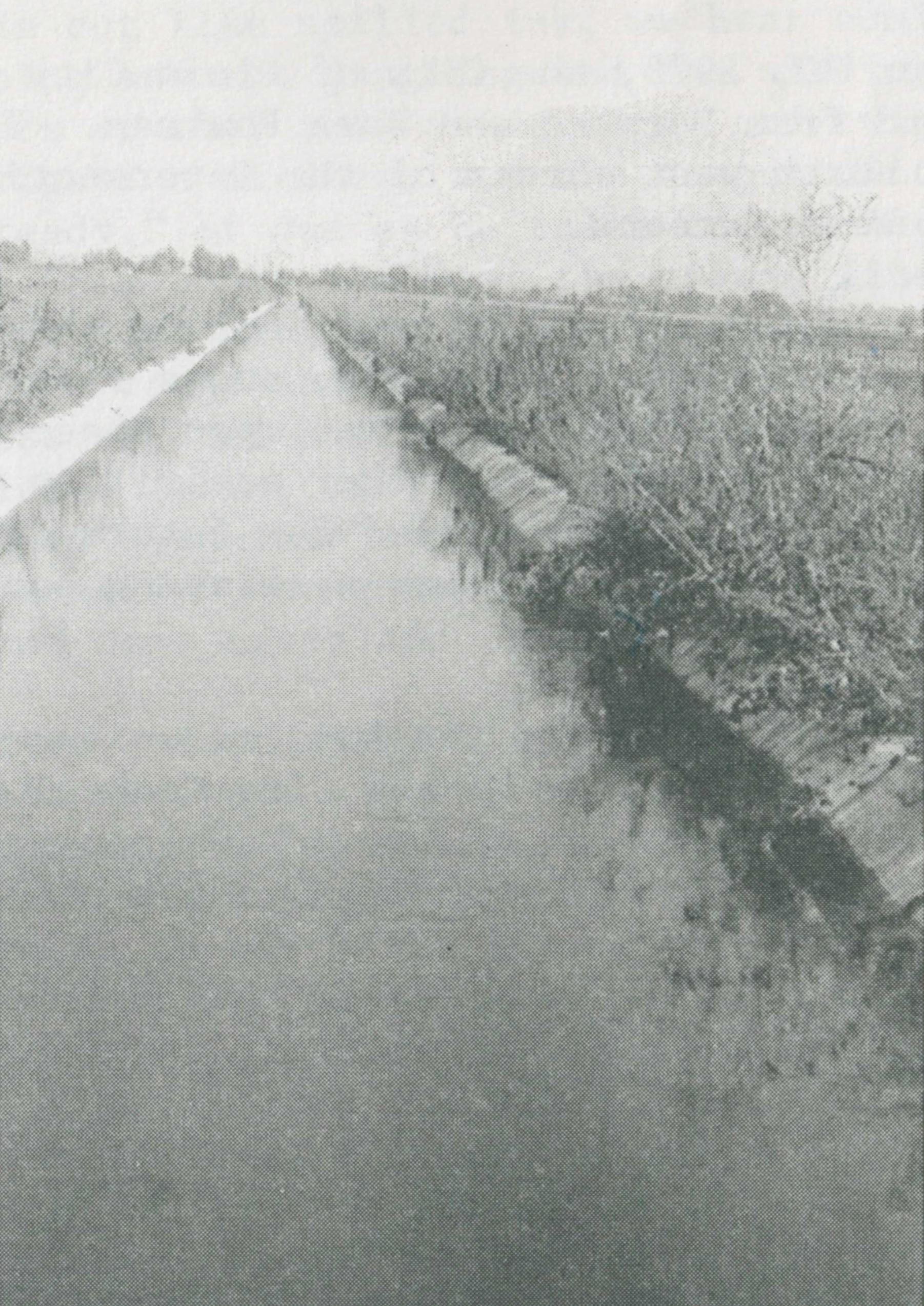
Canal after completion

Beulah Duncan and Damey Ross

Beulah and Damey Ross

I received this photo a few years ago.  It just has “Beulah” written on the back of it.  I asked the person who provided it to see if they could get a higher resolution scan of the photo.  I don’t have one yet, but I can always hope.

There is really only on Beulah Ross in the entire extended family I am aware.  That is Beulah Estell Ross.  She was born 26 March 1908 in Twin Branch, McDowell, West Virginia.  She was born to Robert Leonard Ross (1888-1944) and Minnie Belle Hambrick (1889-abt 1985).  There are many questions about her father Robert.  I have heard stories from West Virginia family that he was running from the law when he visited them in the 1930s.  Which might lead to some explanation on why he is hard to track and records seem to be scant.

We believe Robert and Minnie had 6 children, but only 3 of them have we really been able to find or track.  Beulah Estell Ross is one of those children.  She met and married William Jackson “Jack” Duncan on 20 September 1922 in Burley, Cassia, Idaho.  He was born 26 September 1901 in Clinton, Van Buren, Arkansas.  That would put her at 14 years of age when she married in Burley to Bill, who was 21.

I have written of her grandparents, James & Damey Ross, before.  They lived in and near Paul, Minidoka, Idaho until the late 1920s.  The 1930 census found them in Bend, Deschutes, Oregon.

Looking at the photo, I am guessing Beulah is about 12-14, which puts us in the early 1920s and in southern Idaho.

Beulah and Jack had 4 children that we know.  Jack died 11 July 1977 in Sunnyside, Yakima, Washington.  Beulah remarried to a Kenneth K Marshall.  She then passed away 5 March 2002 in Toppenish, Yakima, Washington.  Jack and Beulah are both buried in Zillah.

Read her obituary here.

I found this note from a 2007 post.  I recorded these notes from a conversation with granddaughter Carol Ann Stone.

“We visited for a few minutes; she told me what she knew of her grandmother, Beulah.  Their story goes something like this.  Robert was an alcoholic and his wife Minnie had some sort of Drug addiction.  All the children were farmed out to others.  Beulah was taken in by her grandparents, my great great grandparents James Thomas Meredith Ross and Damey Catherine Graham.  She was taken and raised near Rupert, Idaho.  But her strict Mormon grandparents was a bit much for her so she was anxious to get out.  That came when she met a Jack or Mack Duncan.  She was 14 and married him.  They moved to Zillah, Washington and lived out the remainder of their days.  He died in the late 70’s and she died in 2002 at about 96 years of age.  They had four children, two of which are deceased.”

The more I looked at the photo, it dawned on me that the lady was her grandmother, Damey Catherine Graham Ross.

Damey Catherine Graham Ross

Here is a photo of James Thomas and Damey Catherine Ross.

James & Damey Ross

Robert, Beulah’s father, is brother to my John “Jack” William Ross.

After I realized that this photograph was another of my Great Great Grandmother, I was pretty excited.  It makes me want to be more diligent in chasing down a better scan of the photo.

Here are a couple of other photos with Beulah and Jack in them.  I don’t know the other individuals.  Some day….

Jack and Beulah Duncan


Beulah and Jack Duncan with unknown


Beulah’s Son


Beulah’s Son Bob


Jack and family 1


Jack and family 2


Jack and Beulah Duncan Family


John “Jack” Ross and Beulah Duncan

Ross in Washington State

Ross in Washington State 

A few updates and ponderings.

As I finished going through the entire stack of papers that were the culmination of work for Howard Ross, I sensed a bit of frustration that I may have missed something.  Some note, hidden on the back of some page I forgot to turn over and examine.  Moreover, there are always the little nuances that a symbol or a phrase can bring back a memory for Howard, but does nothing for me.  It is part of deciphering the past and someone else’s research.  Looking at that, I realized what a great thing it is that I am putting these notes up on a blog.  Someday, there will probably be some form of this blog available and it is much easier to search a blog than going through a stack of papers.  Another good part is that I may die, my house may burn, and all I have may be lost, but this will give an extension to another dimension.  I am sure somebody is printing or copying the things I am putting up that is relevant to them.  So this is a mass sharing that is effective for saving.

Anyhow, having given my deep thoughts for the day, here is the latest news.

One of those papers in Howard Ross’ massive stack was an address for a Beulah Duncan in Zillah, Washington (The sheet it was on was dated 1972).  I knew I had a Beulah Ross who was the daughter of Robert Leonard Ross.  The rascal that disappeared and I have yet to catch up with him.  I knew she had married a Duncan but that was it.  Could she have really made it to Washington State?  I thought I might as well venture to find out.

I looked up Zillah, Washington on Google and found it is between Yakima and Sunnyside.  I searched Duncan in the phone book for Zillah and found a couple in Sunnyside and a couple in Toppenish both of which were nearby.  After about a half dozen phone calls, I found nobody home.  So I left it for a day or two.  I knew that she was probably not still alive, but a good chance a family member who knew of her would be able to lead me in the right direction.

I rang the numbers again last night to find some woman with what I believe was a Irish accent in Toppenish.  First strike.  The second call was a lady I had a devil of a time understanding.  But she assured me she was the daughter-in-law of Mrs. Beulah Duncan.  I thought she told me her name was Debra Lee.  We visited and she gave me the phone number of her daughter Terel Stan Stone.  I know, that is what I thought, a girl with a guys name!  I hung up and called Mrs. Stone and she thought I was crazy when I told her I had visited with her mother Debra Lee.  Come to find out, her mother’s name is Beverly and the lady I was talking to was Carol Ann Stone.  Wow, it is amazing how hearing can alter things.

We visited for a few minutes; she told me what she knew of her grandmother, Beulah.  Their story goes something like this.  Robert was an alcoholic and his wife Minnie had some sort of Drug addiction.  All the children were farmed out to others.  Beulah was taken in by her grandparents, my great great grandparents James Thomas Meredith Ross and Damey Catherine Graham.  She was taken and raised near Rupert, Idaho.  But her strict Mormon grandparents was a bit much for her so she was anxious to get out.  That came when she met a Jack or Mack Duncan.  She was 14 and married him.  They moved to Zillah, Washington and lived out the remainder of their days.  He died in the late 70’s and she died in 2002 at about 96 years of age.  They had four children, two of which are deceased.

Anyhow, I am excited to finally flesh out one of Robert Leonard Ross’ lines.  However, it will not be easy to get the rest of the siblings.  Carol did not know what happened for sure to her siblings and we will have to see what we can scrounge up.  It sounds like even Beulah herself did not know where some of her siblings ended up.

At least for now, we are one step closer to filling in some holes on the Robert Leonard Ross line.  I look forward to any information Carol has which may give clues to more.

See, one little note on a piece of paper has opened a door to an entire family line.  Carol was not aware of us and we were not aware of them.  Now we are.  Let’s see where family can take us.

Chapter notes

I wanted to add a few little notes to the closing chapter.  Since it is too late to enter the thoughts in the chapter, I can surely append them, can’t I?  Well, with permission or not, I am.
The last response on the blog was one a bit sober for me.  After all, I tend to take hard critical words that they hint at a grain of truth, if not more.  So, I attempt the thorough examination of whether or not that bit of truth was of size or consequence.
But first, I must recognize how prized some of your e-mails and comments have been to me.  Thank you for your support.  I love good people like you!
I must report that as I went back out into the field that day, to finish up my week, I felt that a whole burden had lifted.  Perhaps that is my whole qualm with the sales industry.  The pressure exerted on its sales people.
It must be reported that I very much enjoyed working with Marc Summers.  While he is cocky, certainly boastful, I found that he had an air about himself that I enjoyed.  Saying that, in his position he is dealing with increasing pressure from above.
That is what used to make Combined beautiful.  The people loved working there because it was fun and the job was great.  Combined Insurance Company of America has turned into an ugly monster.  Having gone the way of all Babylon, they now have retreated to force and pressure.  My Grandmother loved Mr. Clement Stone and the company because they had a product to sell, and according to your wishes and desires, you went and did what you wanted.  You were rewarded accordingly.  Now they have become another vicious machine, where it is no longer the individual that counts, but the program and results.
Mr. Neil Pehrson the Regional was of hope to me.  A relic of another age.  I sure like him, as I do Marc.  Both remind me of what the company used to be like.  But in company’s changes, they are exerting force down the line.  The change has increased even in the months since I have been present.  That is where I bucked.  I don’t allow for that force in my life, especially when it is voluntary.  The same reason I have some issues with the changes government is making, but that is another subject.
I even feel a bit of sadness tonight.  My heart aches for the loss.  Marc has taken this pretty hard.  He was very upset, but now I can sense a longing.  I admit, I became quite attached to the company as well.
At least once a week, I was reminded of a moment in my childhood in doing the travels with my Grandmother.  I miss her more than my heart could ever tell.  Even now I want to weep from the separation that seems to be present.  I think Combined has brought much of the past to life again for me.  I literally have relived the summers when I was growing up.  I think often of President Packer’s talk “In the light of thy childhood” and the pure chords it still resonates with me.  The classic line of Field of Dreams, heaven is where dreams come true….  Anyhow, I think I shall stop there, I don’t feel these are sentiments I should be sharing here.
Next, I had the opportunity of sharing the gospel with Mr. Marc.  He had questions.  He was curious.  I could not get him to keep his commitments, so I wonder his intentions, but I hope they were pure.  I sure enjoyed that experience.  It gave me a great measure of hope and that too provided a certain reliving of the mission.  The questions, the answers, the promptings of the Spirit.  Oh how much I loved those days.  It broke my heart for me to go into checkout today and he gave me back all the various things I had given him.  He gave me back the Book of Mormon, the Bible, the Restoration Video, and other various things.  That was hard for me.  Then again, I suppose a missionary is not totally surprised when this happens the rest of their life.
This job provided a reattachment to previous times in my life.  I don’t wish you to think I am surreal and living in the past.  I very much look forward to the future.  My past is past, but the foundation of my life must not be forgotten.  How can I hope a superstructure if I neglect the foundation.  Surely, these things must not be.
Somehow, despite the release of pressure, I feel a sad detachment.  It is like I am not only leaving my job, but my past.  I know this is not true.  There were attachments beyond just it being a ‘job’ for me.
I vow that if I ever come to lead an organization of any type, that pressure will not be the means.  People must find their own motivation.  They must be on board with the community, or business.  That motivation must come from within, from whatever source.  When it comes from without, it is so terrible and undermining.  Love unfeigned, hope, and pure knowledge are the keys to successful leadership.  Any organization would do well to take a page from the gospel of Christ.
Well, having now discarded the wagon I had for the moving of me and my family to Zion, I now have to find another means of moving through the next phase of travel.  After all, that wagon was too much of a struggle to drive.  We are now on foot, which is a terrible way to travel.  One can make out alright, but it sure makes it hard to help others.  The saddening part is those with autos don’t offer help.  Where will the means come?  Church?  I think family is too far to aid.  We will see what God will do to reveal his arm.  Until then, we wade on.
Shall we not go on in so great a cause?  Go forward and not backward.  Courage, brethren; and on, on to the victory!  Let your hearts rejoice, and be exceedingly glad.

Mt. Vernon

Probably time for another little update. We have just returned from another weekend up in the bustling city of Washington. We went up last night, stayed with Dennis and Gwen Thompson, and had ourselves a great time. We attended the Washington Temple this morning. Amanda, Dennis, and Gwen all did a session while I did initiatory. It was a great, much needed, release from the week. I actually quite enjoyed myself.We had lunch with the whole Thompson Clan to celebrate Grandparent’s Day, and then they went off to a soccer game for Faith and Destiny. Amanda and I met up with Greg McNeill and headed to Mount Vernon. This was Amanda’s first visit, my third. We drove over separately and spent the time walking through the grounds. Amanda was already exhausted from the day, and seemed to be dragging the whole time. She says she enjoyed Mt. Vernon. I really liked sitting with Martha Washington and listening to her talk about Thomas Jefferson. She did not have much to say that she liked about him.

Greg and I had a great chat about a whole host of things. We discussed politics, Mormons, campaigns, Supreme Court rulings, and who knows what else. Poor Amanda was even more exhausted after hanging out with us. It was great to catch up with him though. He is a good man. He announced and gave us his wedding date for May 26th next year. I have put it on my calendar, we are planning to go, it is at Fort Belvoir at the officer’s club. That should be exciting.

The week went well. I worked my tail off some more and became pretty frustrated with things. I am supposed to have two full weeks of training, all day long. That is 10 days. So far, I have had a whopping 3 days I think, and then they tell me that they want me to do more sales or something. I honestly don’t have a clue about what I am doing with some stuff. For example, I collected premium from a lady this week for a policy that has been paid for up for 20 years. She was old and senile enough not to notice, and I had no clue. What the company will do with that is beyond me. The best part, it was life insurance premium I collected, and is technically illegal for me to do so. That is how green I am in many ways.

I did write three policies this week, but I need to learn how to do more. I want to, but I seem to be so very alone. Oh well, I will endure.

They made me go on a conference call this week. That will be the last time I do that. I spent a good 30 minutes listening to the sub-regional manager talk about all these little goals and that they have for us. They are not paying for my lost 30 minutes of cell phone time. Next, Mr Stone himself said that a goal that is not ours, does not have the power to motivate. Well, I will be making my own goals. I don’t care if I go to Nashville. I don’t care if I get some luxury spa set. Honestly, I don’t care if I have a big bonus at the end of the year. I want to feel my job is worthwhile, and that I am succeeding at it. That is hard to do sometimes when you have not a clue what is going on, and then some people start riding you for their goals. Well, I know where they can go. Back to that little throne that they think they are on, and live their little dream. I will do the work in my realm, and do what is necessary, with what capacity I have. I don’t know how they expect me to write 15 policies in a week when the three I had this week were in my estimation pure luck.

On top of all that Marc, tells me he wants me to be a Sales Manager. I cannot even get the training to sell, why in the world would I want to be a Sales Manager and oversee other’s selling. How can I train on something I have not yet figured out. Seeing as I won’t get the training just yet. Having said all that, I cannot expect them to do so, nor will I pass the buck. I will do my part, I will do what I can, and improve at my own pace. How they expect more, on my own, I have yet to figure out. If somebody can help me, I would appreciate the advice on how I can do more than I know how. Trial error is not the best way, but if that is all they leave me with, fine. I will work that method. I do have a great set of resources from Mr. Stone himself, but the LSAT takes precedence right now. Not that I am doing great in that either, but at least I have priority.

Well, time to prepare for the Sabbath. Lessons to review, read, and ideas to be familiar with. I hope this coming week will provide greater opportunities and I will keep my sight higher. I cannot let myself get weighed down by my inadequacies. ( I think I spelled that wrong, but I just don’t want to check….)


Insurance

After two weeks in the field, I have some time to reflect.Insurance is more or less natural for me. My grandmother sold insurance for Combined for 30 years before she retired. She used to take me out for weeks at a time during the summer. I enjoyed our time together and enjoyed meeting people. Combined is very much a go out and visit the people type of insurance company. We go to the people’s homes and that has many bonus points for me. I get to see the territory and not sit in an office all day. Next, I get to know the places, history, and layout of what is around me and come to know and appreciate Virginia more. I love to meet and visit with people. This has been an eye opener in many ways to see how people live much more simply, and sometimes more dirty, than we do in the west, generally speaking. The past week or two a good majority of the homes I have gone into have been those of blacks. (I don’t wish to sound negative, I just know of no other way to describe them.) I have come to appreciate and love them since I never have really been around any. I found they are more inclined to laugh, more casual and easy going, and much more friendly than the white folk. (Saying all that, things I laugh at are not even understood here, the culture and background of these people are different too!)

The company visits every client in their home every 6 months. This is both to collect premiums for those who wish to pay it that way, and to answer any questions, help them file claims, and the like. Since we are constantly out among the people, we often sell more to their families or neighbors. That is our number one way. There are businesses who put a policy on each of their employees, so we do sell to individuals and employers. We don’t do the group thing, the policy is written on each individual. I can sell door to door if I wish, and I might take that up one day when I run low on things to do. In the last two weeks I probably have only had the possible time of about 2 hours to do so though. So, we do have to make cold calls once and a while.

Last week I made over $500, and this week over $600, so I have no complaints. That is doing basically all renewals. When I finally get comfortable with the selling, I can probably make more money. That is not my goal though. My goal is to be a professional at my job. In doing all these renewals, I still have questions that come to me that I am not able to answer. Plus some like Marc, can take the most angry customer, calm them down, and get them to keep their insurance. This I am not able to do. He was not happy with me since I lost about $300 in customers. I really did not know what to do with any of them. Two of them were due to Medicaid, which I understand that it is company policy to ask them to drop the policy. What good is it to pay for a policy which Uncle Sam gets the money from? Especially when he is already fitting the whole bill through Medicaid. I had another two who would not even let me in the door. One when I knocked again I thought would kill me when I asked for her signature for the cancellation. I have plenty to learn here. It just seems to me that if a customer is very clear that they don’t want it any more, you try to talk with them, but if there is no reasoning, you do what you need to and leave. I will see what Marc trains me on this week. Hopefully it is not feel wrong to me, for if it does, I will have to let him know so.

On the mission, I always struggled with knocking doors. Perhaps it is the old fashioned way I was raised. You speak and converse only after introductions. The current sales position ignores that. Tracting as a missionary was the same way. I understood I had to do it and it took the better part of two years to get over that. However, there is a certain dread that creeps into me now that I am back to that state. I will admit, I always wanted to knock alone on the mission, two at the door just seemed too much. Now that I have the opportunity, I have a fear. I don’t necessarily feel it is wrong, I just have this fear. I don’t know if it is rejection or the being intrusive. Who knows.I have to admit that I am impressed with the training of Combined in many ways. Primerica never helped me learn the material to get my license. Nor did they ever take me to sales training. One thing is sure though, once you get beyond that, it is scary though. I have spent 3 days with Ted Kelley in training, and I really did not learn that much. I can go and renew. The problems I have is when we have a customer that is concerned. I think it would be much more beneficial to just go and take me knocking doors for a few days. Those who are new are going to ask many more questions which will certainly apply to those who are also customers. Plus, quite honestly, I need training on sales. But Ted knocked one door with me, which is a credit to the company, that we can still make that much money and never do a sale. But on the other hand, renewals are only half my job. I know the area is a little behind right now because they have been short on workers, so there is plenty of renewing to do. What happens when we get caught up? I would prefer to get my training now while I can still make the money, than have to do a crash course because I have nothing else to do!

Sadly though, those above me seem to be more interested in their making money than in my training. I hope I don’t have to do this entirely on my own. It will be a long and painful process. I suppose if Mr. Stone can do it, then so can I. However, I thought he put the training apparatus in place so I would be able to learn it with help rather than trial and error.

All is not well in the Combined environment. If I ever get into leadership or training, one thing is certain, we will do as we did in the mission, and focus on training. Individuals before business.

Well, that is enough for now. Need to finish preparing for my talk tomorrow. Perfecting the Saints/Priesthood. So vague, so encompassing, how shall I speak with any specific purpose I don’t know. We will see what the Spirit directs.