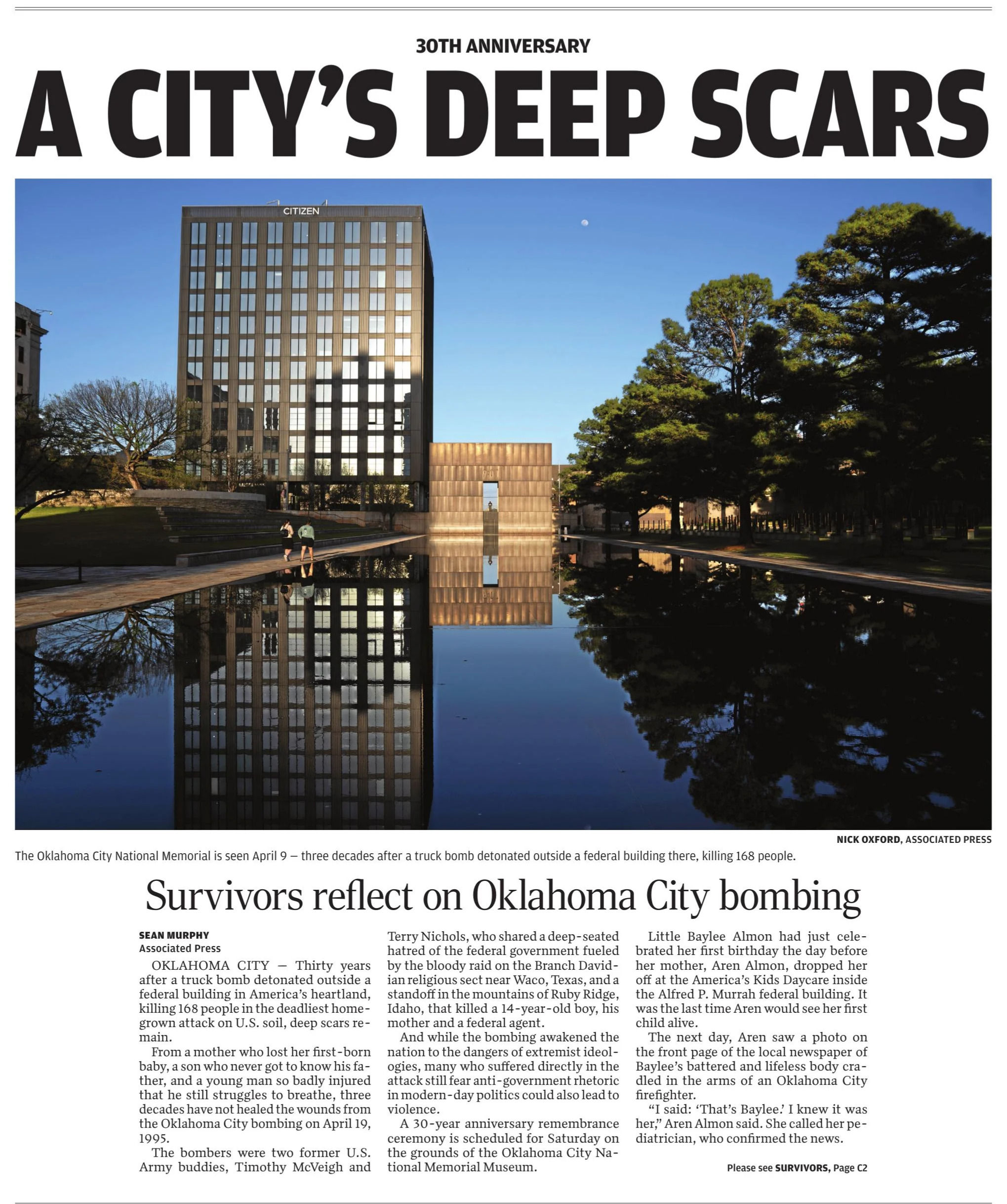
Since we lived in Oklahoma City for three years, we often visited downtown with visitors and on our own. I was not far from the Memorial at work. The bankruptcy court is only a block away and also received damage. I deeply feel what occurred that day.
“Ella Hitt, left, and Abigail Williams were presented their Cassia County Republican Central Committee scholarships by Chairman Paul Ross.
“Burley – Ella Hitt and Abigail Williams were recently named the winners of a pair of $1,000 scholarships awarded by the Cassia County Republican Central Committee.
“Scholarship application requirements included an interview with an elected official, attending a public meeting and writing a resolution. Finalists were interviewed by the Cassia County Republican Scholarship Committee.
“The winning students spoke at a committee meeting and presented their resolutions and answered questions.
This posted this week. Fun to have a reference in the paper that is positive.
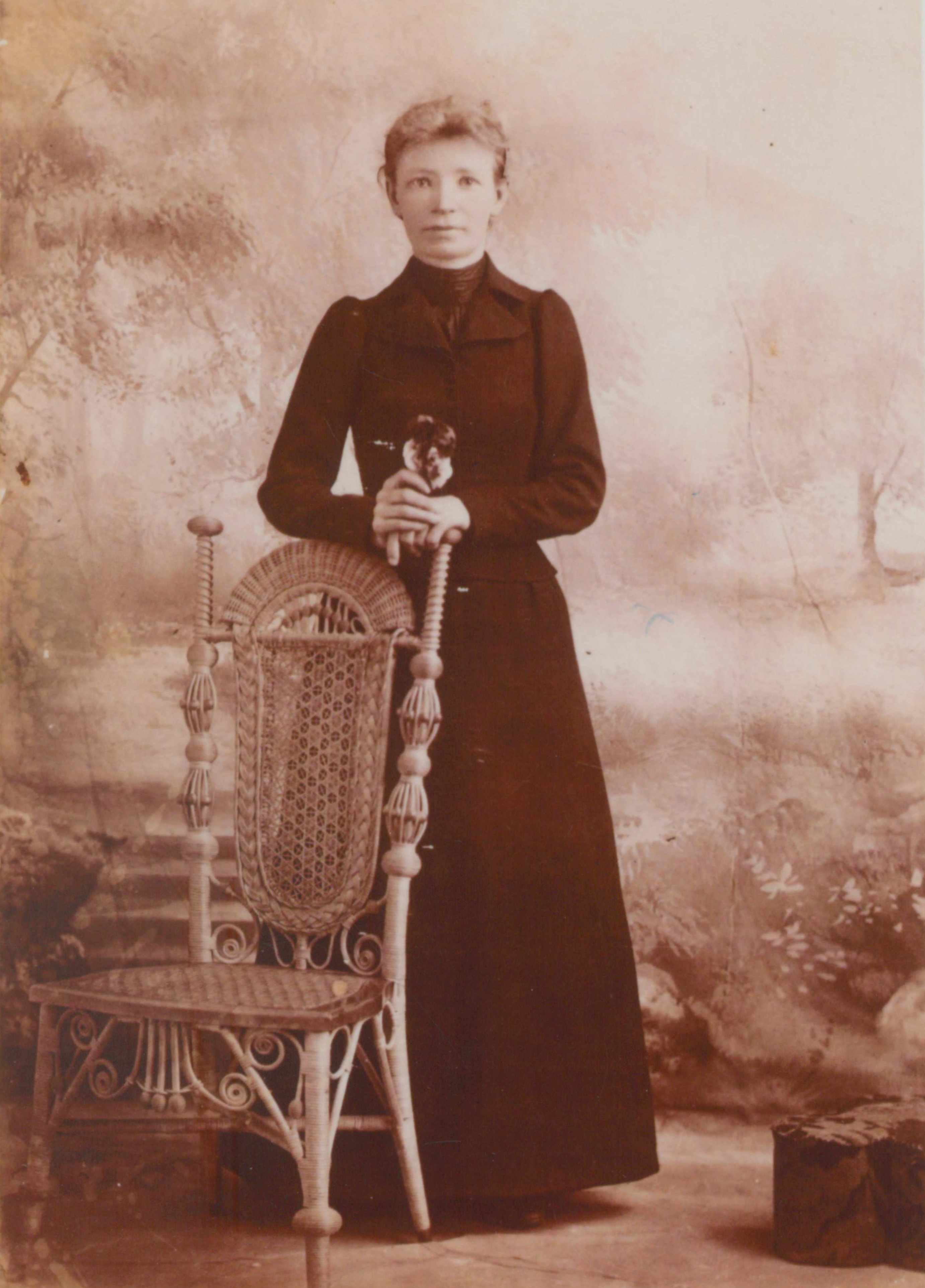
This article was provided to me related to my 3rd Great Grandmother Agneta Nelson. I have previously shared the history written by Carvel Jonas related to Agneta and John Nelson. I have also shared the Carvel Jonas history of their daughter, my 2nd Great Grandmother Annetta “Annie” Josephine Nelson Jonas. I also note that Agneta and John’s son, Nels, also wrote a lengthy autobiography that tells some of his parents’ history. Some of the parts of this history are likely using Nels’ autobiography, parts of it mirrors and quotes from it.
Pioneer Women of Faith and Fortitude was published by the International Society Daughters of Utah Pioneers in 1998. It is a four volume set, ISBN: 0-9658406-1-1. This biography starts on page 2121.
I note some revision of Agneta’s name over the last years. This article includes the Bengtsson/Nilsson last name. But as those familiar with Scandinavian naming protocols, Bengtsson/Benson was her father’s last name, but her early live documents reference her father’s first name, Nils. Hence her name in Sweden was Nilsdotter, not Nilsson or Bengtsson. With that, here is the language of the article.
This biography suggests that Agneta was married before and that marriage produced Bot[h]ilda and James. Curiously, James’ baptism record lists Johannes Nilsson as the father. Further, Nels, in his autobiography, indicates he was the third child of John and Agnetta Nelson. James appears to be John’s, but the baptism of Bothilda without a father suggests not John. I don’t know that we will know, and this biography shows unknown.
“BIRTHDATE: 9 Dec 1832 Oringe Hallands, Sweden
“DEATH: 4 Nov 1873 Logan, Cache Co., Utah
“PARENTS” Nils Bengtsson (Benson) – Johanna Johansson [Johansdotter]
L-R: Johanna Benson, Johanna Icabinda Benson, John Irven Benson, Nels Ernst Benson, Mary Ann Angel Works holding Merrill Lamont Benson.
“PIONEER: 15 Sep 1864 William Preston’s Wagon Train
“SPOUSE I: Unknown
“MARRIED: In Sweden
“DEATH SP:
“CHILDREN (Adopted and sealed to second husband):
“Botilda (Matilda), 31 Dec 1853 (died at age 11)
“James Peter, 13 Dec 1[8]55
“SPOUSE II: John / Johannes Nelson/Nilsson
“MARRIED: 17 Nov 1855 Veinge, Hallands, Sweden
“DEATH SP: 26 Nov 1902 Logan, Cache Co., Utah
“CHILDREN:
“Nels August, 18 May 1[8]57
“Josephine, 5 Feb 1860 (died as a child near Omaha, Nebraska)
“Amanda, 26 Dec 1862 (died as a child buried at sea)
“Annette Josephine, 18 Nov 1864
Annie Josephine Nelson Jonas
“Joseph Hyrum, 14 Jun 1868
“Jacob Nelson, 9 Dec 1870 (twin)
“Jacobina, 9 Dec 1870 (twin)
“Charlotte Abigail, 16 Dec 1872
“Moses, 25 Oct 1873
“Agneta was born on December 9, 1832 in Oringe Hallands, Sweden. Agneta was the oldest child in a family of eight children.
“On Thursday, April 28, 1864, with 973 emigrants aboard, the ship, “Monarch of the Sea,” sailed from Liverpool, England. Patriarch John Smith was President of the company. At Florence, Nebraska, they traveled by teams under the Company Captain William B. Preston, to Salt Lake City, arriving September 15, 1864.
Monarch of the Sea, 1020 LDS passengers on this voyage.
“The Gospel of the Church of Jesus Christ of Latter-day Saints came to their home in 1862, and Agneta, her mother and some of her brothers accepted the message gladly. But it wasn’t until the Spring of 1864, that Johannes and Agneta were ready to leave Sweden for America and the West.
Nilsson family on the Monarch of the Sea passenger list
“The voyage was long and stormy with much sickness aboard. The rations were meager; raw beef, lard, and hard crackers, water, mustard and salt. Many times they would wait all day for their turn to cook the meat, and sometimes the turn never came. Agneta saw several bodies being lowered into the deep ocean; and then it was her turn to watch eighteen month old with a rock tied to her feet, slipping into the ocean.
“Laying to rest little ones is unknown territory was to be Agneta’s experience two more times. Matilda, in New Jersey, near the Delaware River, and four year old Josephine near Omaha, Nebraska.
“During these trials, she valiantly went forward, giving birth to her sixth child in a cold, stark dugout in Logan, Utah.
“Arriving in late October, most homes in Logan that fall were underground, about five feet deep, with a rock chimney in corner. Fuel was willows from the Logan River bottom. It was quite warm, until spring thaw caused the room to fill with water about two feet. The cold of Cache Valley became known to all new settlers that winter.
“The next winter found John and Agneta in a snug log cabin, with cows, sheep, a yoke of steers, and 120 bushels of wheat raised on their six acres. Agneta also gleaned wheat from the field. She sheared the sheep, washed, carded, spun and wove the wool into clothing for her family; and with her gleaning, she was able to provide nice clothes for herself, and children.
“On October 4, 1867, three years after their arrival in Utah, John and Agneta traveled to Salt Lake City, to be sealed in the Endowment House. In the next six years she gave birth to five more children, with only two surviving beyond the age of accountability.
“Just nine years after her entering Utah, Agneta gave birth to her last child, Moses Nelson, born October 25, 1873; and she did not survive this birth. Moses died November 12, 1873. A mother had sacrificed for a child of God.
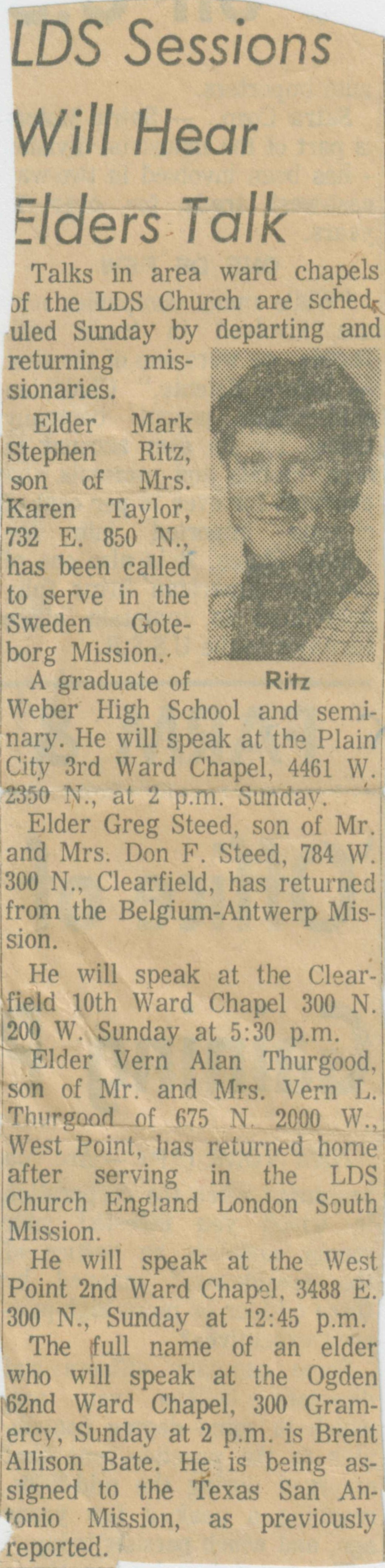
Another random newspaper clipping from my Grandmother Gladys Maxine Donaldson Ross. I am not sure why this was clipped or what relationship or knowledge she had of anything in the article. I assume familiarity and connection with Elder Ritz.
Talks in area ward chapels of the LDS Church are scheduled Sunday by departing and returning missionaries.
Elder Mark Stephen Ritz, son of Mrs. Karen Taylor, 732 E. 850 N., has been called to serve in the Sweden Goteborg Mission.
A graduate of Weber High School and seminary. He will speak at the Plain City 3rd Ward Chapel, 4461 W. 2350 N., at 2 p.m. Sunday.
Elder Greg Steed, son of Mr. and Mrs. Don F. Steed, 784 W. 300 N., Clearfield, has returned from the Belgium-Antwerp Mission.
He will speak at the Clearfield 10th Ward Chapel 300 N. 200 W. Sunday at 5:30 p.m.
Elder Vern Alan Thurgood, son of Mr. and Mrs. Vern L. Thurgood of 675 N. 2000 W., West Point, has returned home after serving in the LDS Church England London South Mission.
He will speak at the West Point 2nd Ward Chapel, 3488 E. 300 N., Sunday at 12:45 p.m.
The full name of an elder who will speak at the Ogden 62nd Ward Chapel, 300 Grammercy, Sunday at 2 p.m. is Brent Allison Bate. He is being assigned to the Texas San Antonio Mission, as previously reported.
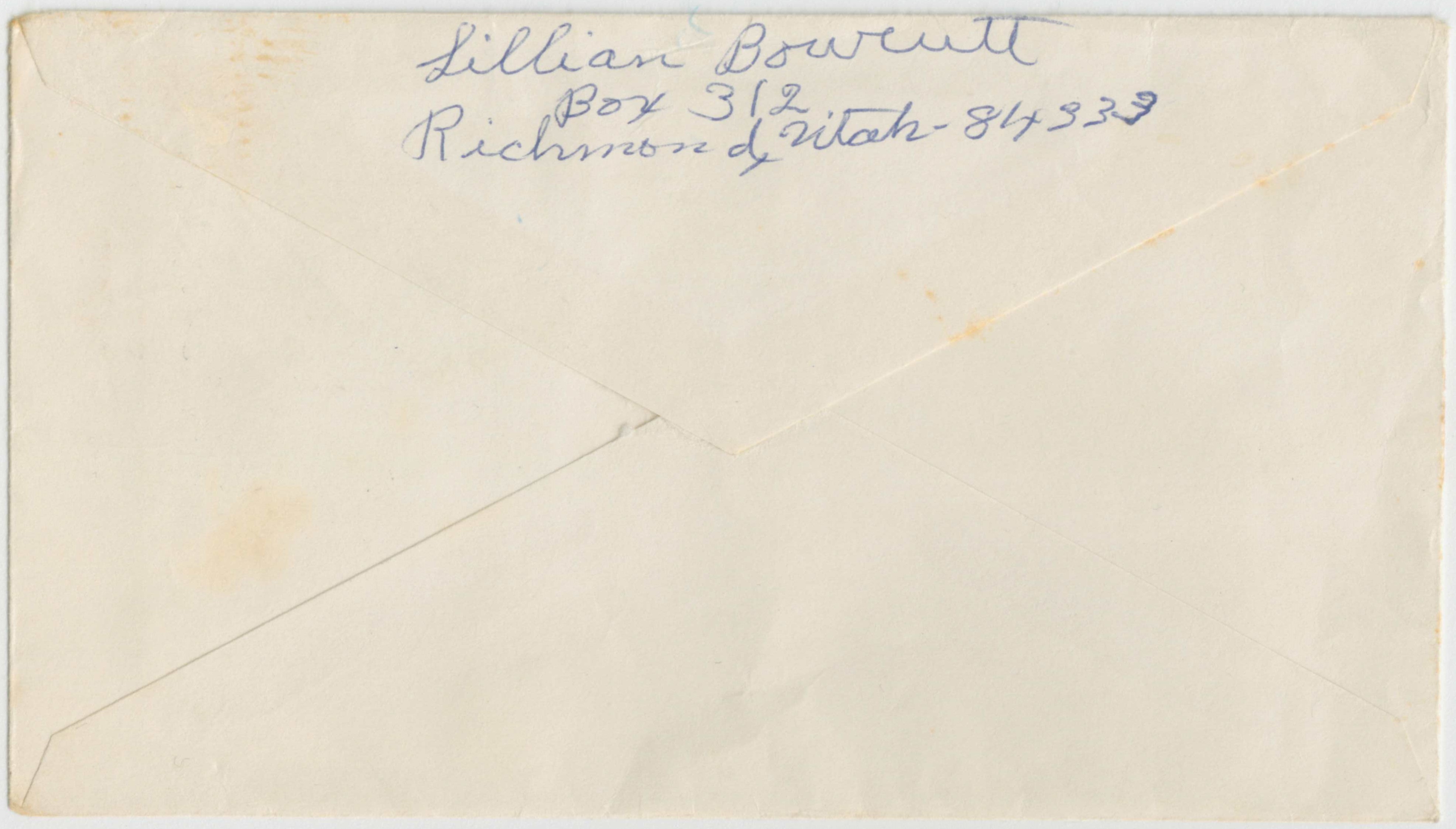
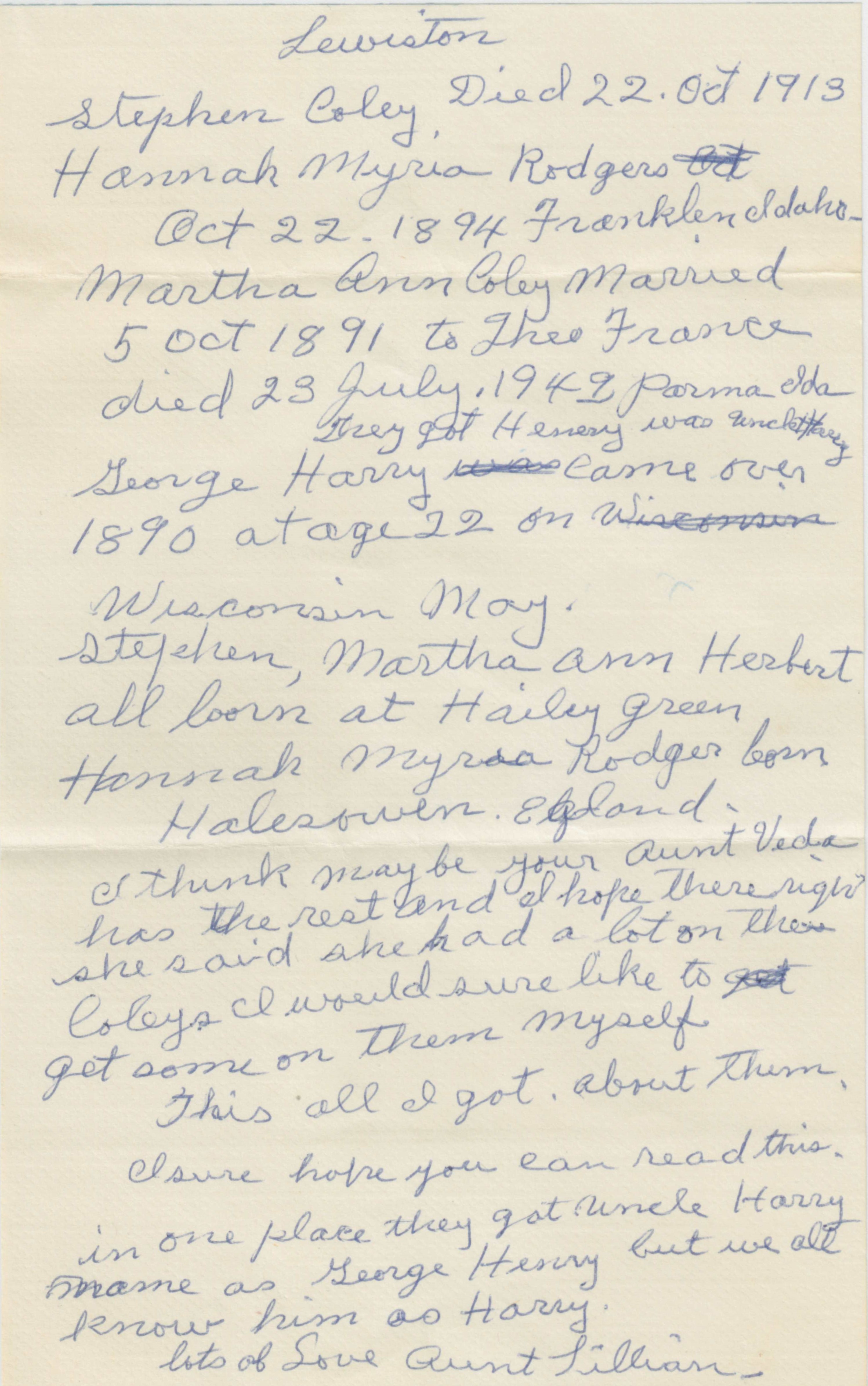
I received a letter from a first cousin, twice removed this past week. I was pretty excited about the letter and appreciate her thinking of me. Alice Coley Miller, daughter of Lloyd and Verda Coley. Lloyd is the brother to my Lillian Coley Jonas. The card and letter speak for themselves. As time passes, many of these types of documents are likely just trashed. This letter was somewhat difficult to type up and be loyal to what Great Grandma Lillian wrote. Having said that, I have made a number of corrections in brackets to be more accurate than what she had at the time of writing. The modern miracle of the internet, crowd-sourcing, and FamilySearch have completely changed this clunky process that Alice, Veda, and Lillian were engaged. I hope Great Grandma Bowcutt doesn’t mind my sharing her handwriting and grammar. I also linked the other pages and photos I have on this family, so you can go to those links to read the full information and histories that I have previously written.
February 26
Dear Paul
I have moved from Brooklyn, New York to Bountiful, UT. In going through stuff I found this letter written to me by your great grandmother Lillian Bowcutt (Jonas). Since it’s in her handwriting I thought you might like to have it.
I appreciate all the genealogical information you are gathering and that names on the Coley line are coming up for temple work to be done.
Enjoy the coming spring.
Alice Coley Miller
Mrs. Frank W. Miller, 1050 East 31 Street, Brooklyn, New York 11210.
Lillian Bowcutt, Box 312, Richmond, Utah 84333
Richmond UT, Febr. 6, 1976
Dear Alice Husband + family
Just haven’t been able to write and tell about the Coleys you see I haven’t been able to get much either. But aunt Veda has a lot she said write her and see if she can help you. I’ll send you what I have about them.
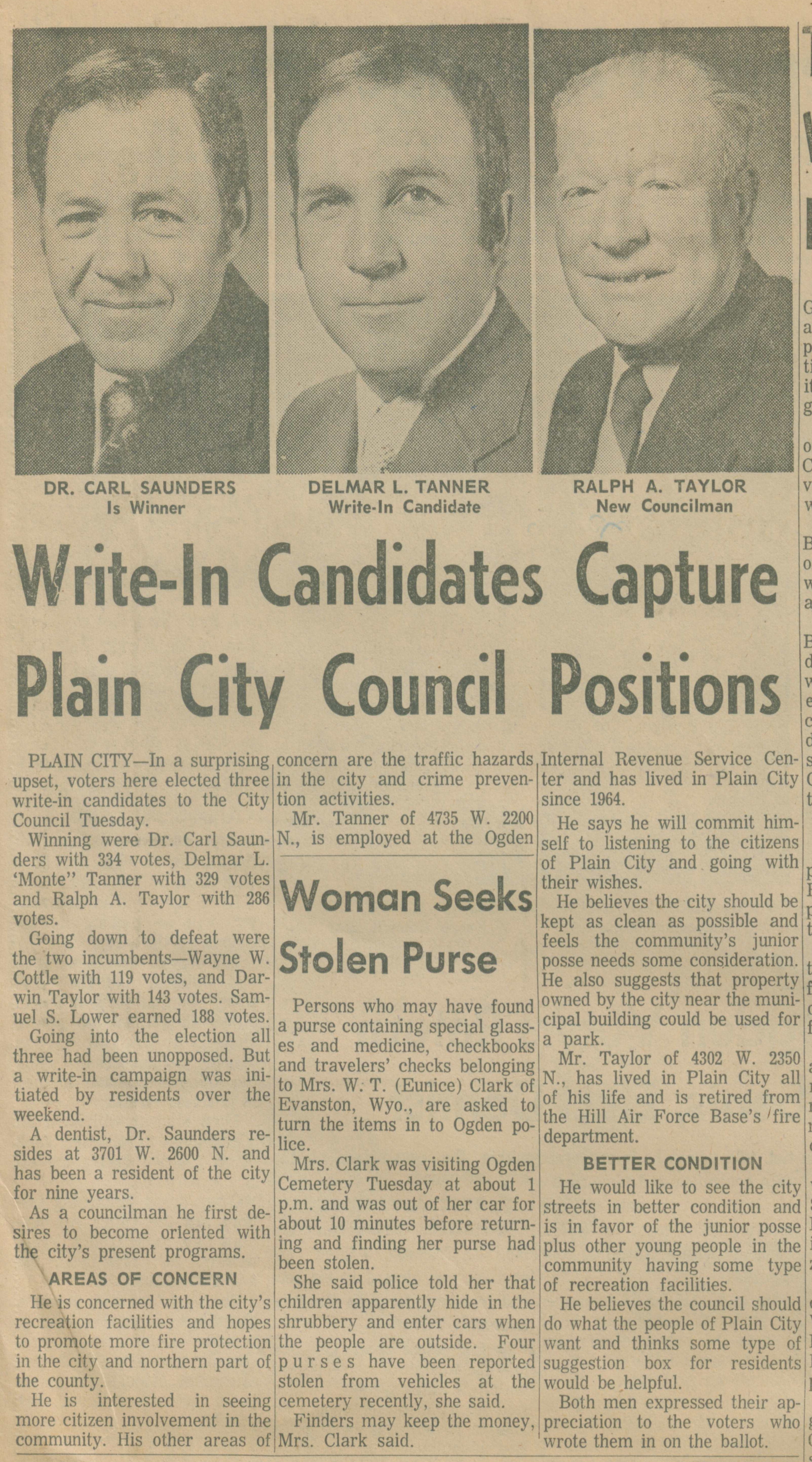
Another clipping from my grandparents, Milo and Gladys Ross. Since they lived in Plain City, it makes more sense why this article was clipped from the Ogden Standard-Examiner. No date is found on the clipping.
“Plain City – In a surprising upset, voters here elected three write-in candidates to the City Council Tuesday.
“Winning were Dr. Carl Saunders with 334 votes, Delmar L. ‘Monte” Tanner with 329 votes and Ralph A. Taylor with 286 votes.
“Going down to defeat were the two incumbents – Wayne W. Cottle with 199 votes, and Darwin Taylor with 143 votes. Samuel S. Lower earned 188 votes.
“Going into the election all three had been unopposed. But a write-in campaign was initiated by residents over the weekend.
“A dentist, Dr. Saunders resides at 3701 W. 2600 N. and has a been a resident of the city for nine years.
“As a councilman he first desires to become oriented with the city’s present programs.
AREAS OF CONCERN
“He is concerned with the city’s recreation facilities and hopes to promote more fire protection in the city and northern part of the county.
“He is interested in seeing more citizen involvement in the community. His other areas of concern are the traffic hazards in the city and crime prevention activities.
“Mr. Tanner of 4735 W. 2200 N., is employed at the Ogden Internal Revenue Service Center and has lived in Plain City since 1964.
“He says he will commit himself to listening to the citizens of Plain City and going with their wishes.
“He believes the city should be kept as clean as possible and feels the community’s junior posse needs some consideration. He also suggests that property owned by the city near the municipal building could be used for a park.
“Mr. Taylor of 4302 W. 2350 N., has lived in Plain City all of his life and is retired from Hill Air Force Base’s fire department.
BETTER CONDITION
“He would like to see the city streets in better condition and is in favor of the junior posse plus other young people in the community having some type of recreation facilities.
“He believes the council should do what the people of Plain City want and thinks some type of suggestion box for residents would be helpful.
“Both men expressed their appreciation to the voters who wrote them in on the ballot.
~
I did a little research on all these individuals to flesh out more of the history.
Carl Richard Saunders was born 24 October 1928 in Ogden, Utah, and passed away 21 June 2009 in Ogden. Buried in Ogden.
Delmar Lamont Tanner was born 27 July 1935 in Ogden and passed away 12 September 2021 in Perry, Utah. Buried in Plain City.
Ralph Arlin Taylor was born 29 March 1912 in Plain City and passed away 25 December 1999 in Plain City. Buried in Plain City.
Wayne William Cottle was born 30 November 1928 in Ogden and passed away 31 October 2006 in Plain City. Buried in Plain City.
Samuel Steven Lower Jr was born 9 April 1936 in Lewiston, Utah, and passed away 27 November 2021 in South Weber, Utah. Buried in Plain City.
Darwin Taylor is still alive as far as I can tell.
Earlier this year, the City of Minidoka had some big changes in leadership. Last year, Mayor Matthew Schaefer resigned for health reasons. Minidoka doesn’t have many registered voters as residents who are also interested in being involved in city government. Further, there are often conflicts where one of the Council is not able to be present. To maintain a full City Council, no action was taken that might remove a member of the Council without a potential replacement. Fortunately, some citizens show interest in getting involved and to assist the work of the City. With a potential to serve on Council, the City was ready to move forward.
On January 7, 2025, the Minidoka City Council appointed a new Mayor. She was sworn in at that time. Welcome to Mayor Julie Peterson!
Clerk Cindy Hruza swears in new Mayor Julie Peterson
Julie Peterson formally resigned her seat on the City Council. That left a vacancy for which she then appointed a new councilman. With that, she appointed Bridget Frost as a new Councilwoman. She was sworn in at that time. Welcome Councilwoman Frost!
Bridget Frost is sworn in by Cindy Hruza. Councilmen Bulmaro Paz (blue hat), Jim Cook (red hat), Mark Cartwright (black coat), and Mayor Julie Peterson watch
I don’t know how many Mayors or Councilman Minidoka has had since its incorporation in 1905, or how many informal Mayors it had from when it was first settled about 1884. Obviously the name of Minidoka was used for the Bureau of Reclamation Project signed by Theodore Roosevelt in 1902 which brought the Minidoka Dam and water to the whole area (but not the City of Minidoka). Minidoka County was created from Lincoln County in 1913. Part of that Reclamation Project also had the later World War II Japanese internment camp, Minidoka Relocation Camp (while not in Minidoka County, it was within the Minidoka Reclamation Project).
There is a new Mayor in Minidoka City. A full City Council too! Time to get down to business.
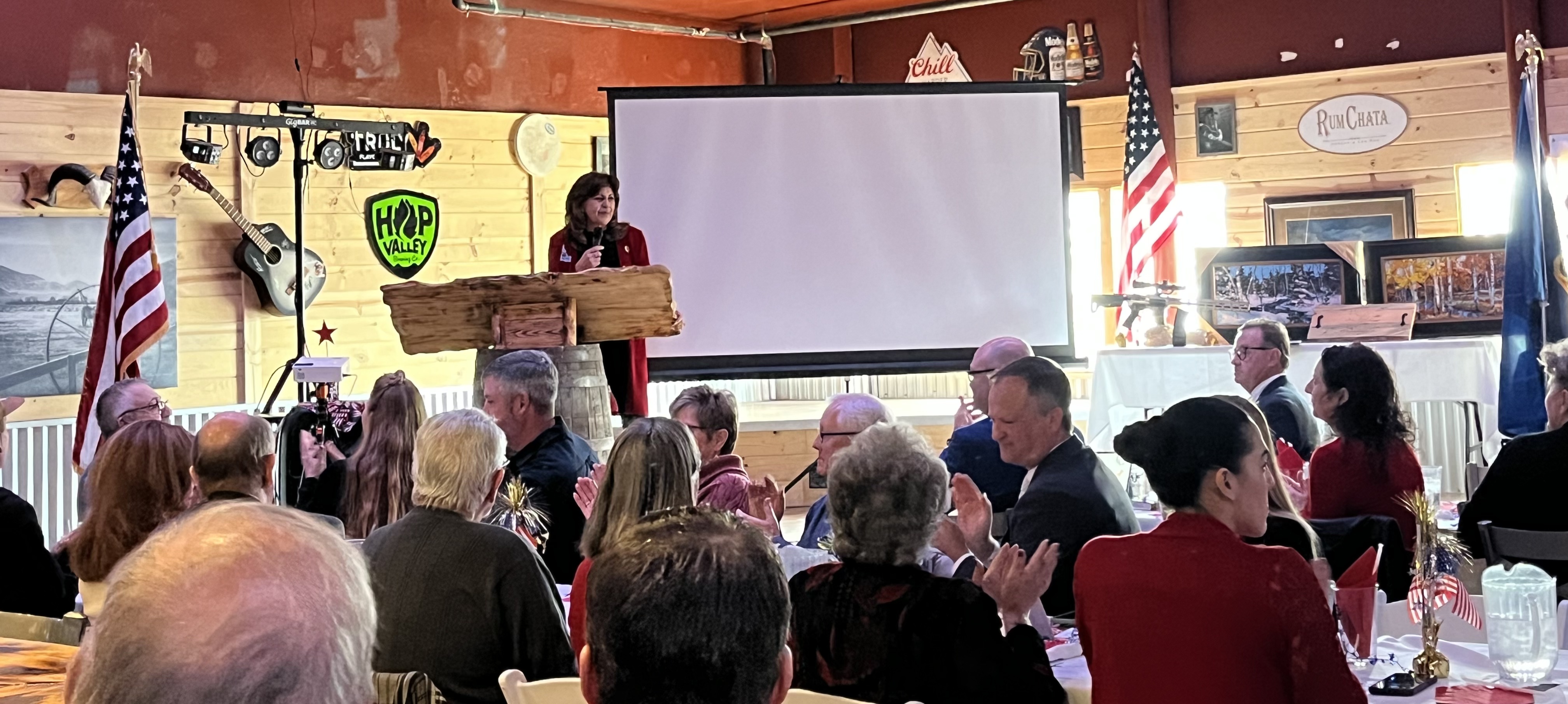
Minidoka and Cassia Counties celebrated their joint Lincoln Days this year on February 22. It was the first time held at Wick’s Steak Place in Declo. Minidoka County Republican Central Committee chaired the Lincoln Days Committee for the two counties. Many thanks to the committee members who organized and orchestrated the event, from the silent auction, donations, auction, meal, location, and more!
It was a great crowd for an election off-year. Denton Darrington, and Virgene, both attended this year. Denton is the longest serving Idaho Senator in Idaho History. Kelly Anthon, and Joelle, also attended and was one of our speakers. Kelly is currently the Senate Pro Tem and stands on the shoulders of Denton Darrington in the Senate.
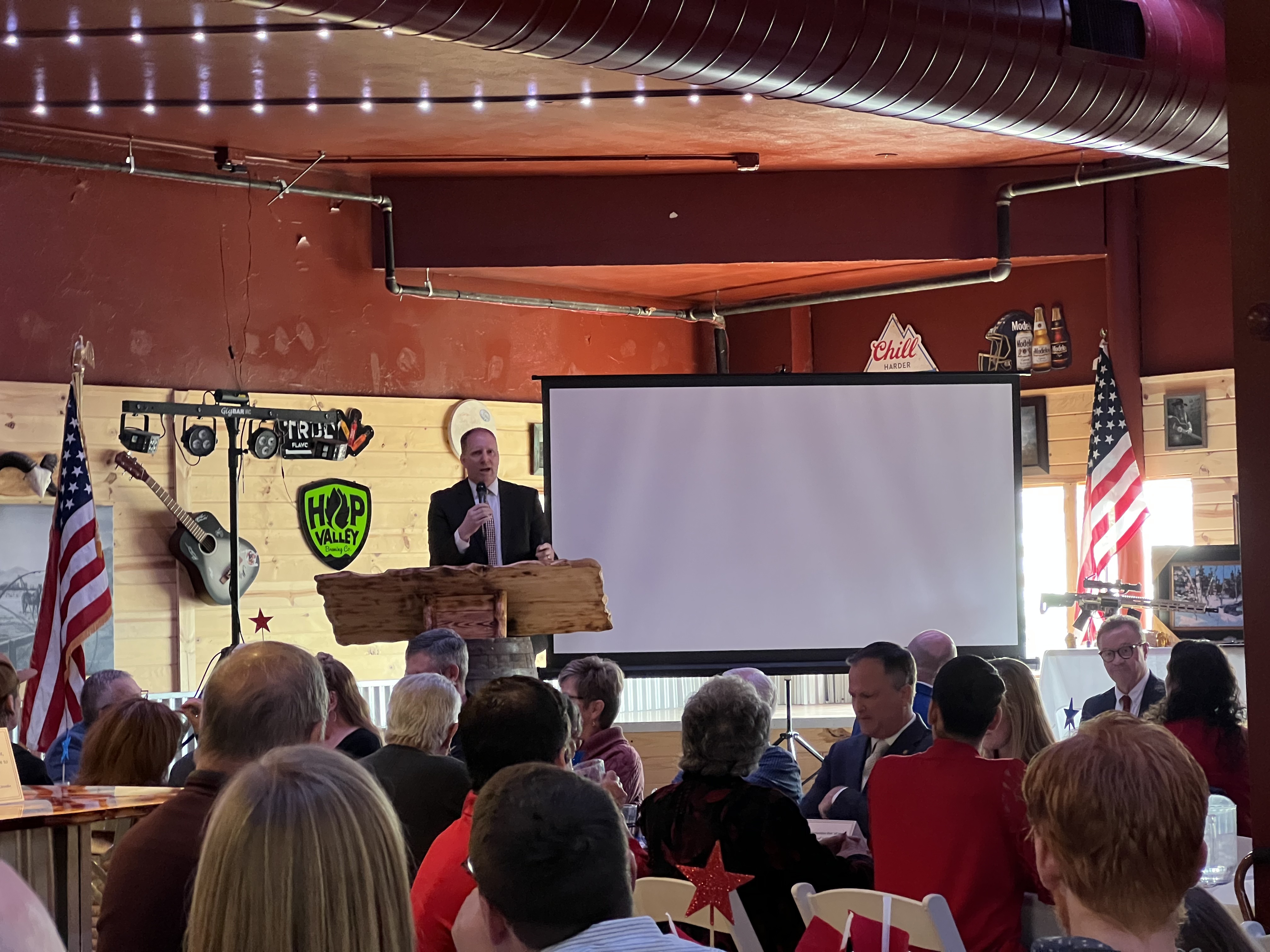
Here is a copy of the program I received. The final agenda had a change for the national anthem performer, I believe Kiya Fife. The lot fell on me to conduct. I made note that it was George Washington’s birthday. I brought to attention that he was born 11 February 1731, but with the change from the Julian to Gregorian calendars, it moved from 11 February 1731 to 22 February 1732. Imagine if government tried to do that now! How many people would refuse? How many would say it was a deep state secret agenda? How many decades afterward would we hear about it? What would you do if you lost over a year of your life due to a calendar change?
Many others attended the Minidoka – Cassia Lincoln Days. Some of them include Idaho’s Lieutenant Governor Scott Bedke, and Sarah; Idaho’s Secretary of State Phil McGrane; Idaho’s Comptroller Brandon Woolf; members of Senator Risch’s office including our Region Chairman Mike Mathews; members of Senator Crapo’s office; LD 27 Representative Clay Handy, and Kristine; all six county commissioners for Minidoka and Cassia (Jared Orton, Dan Schaeffer, Sheryl Koyle, Leonard Beck, Bob Kunau, and Kent Searle); and other local county elected officials.
Idaho’s Lieutenant Governor, Scott Bedke
Robert Moore was kind enough to donate a portion of the proceeds from the auction of two of his paintings at our Lincoln Days.
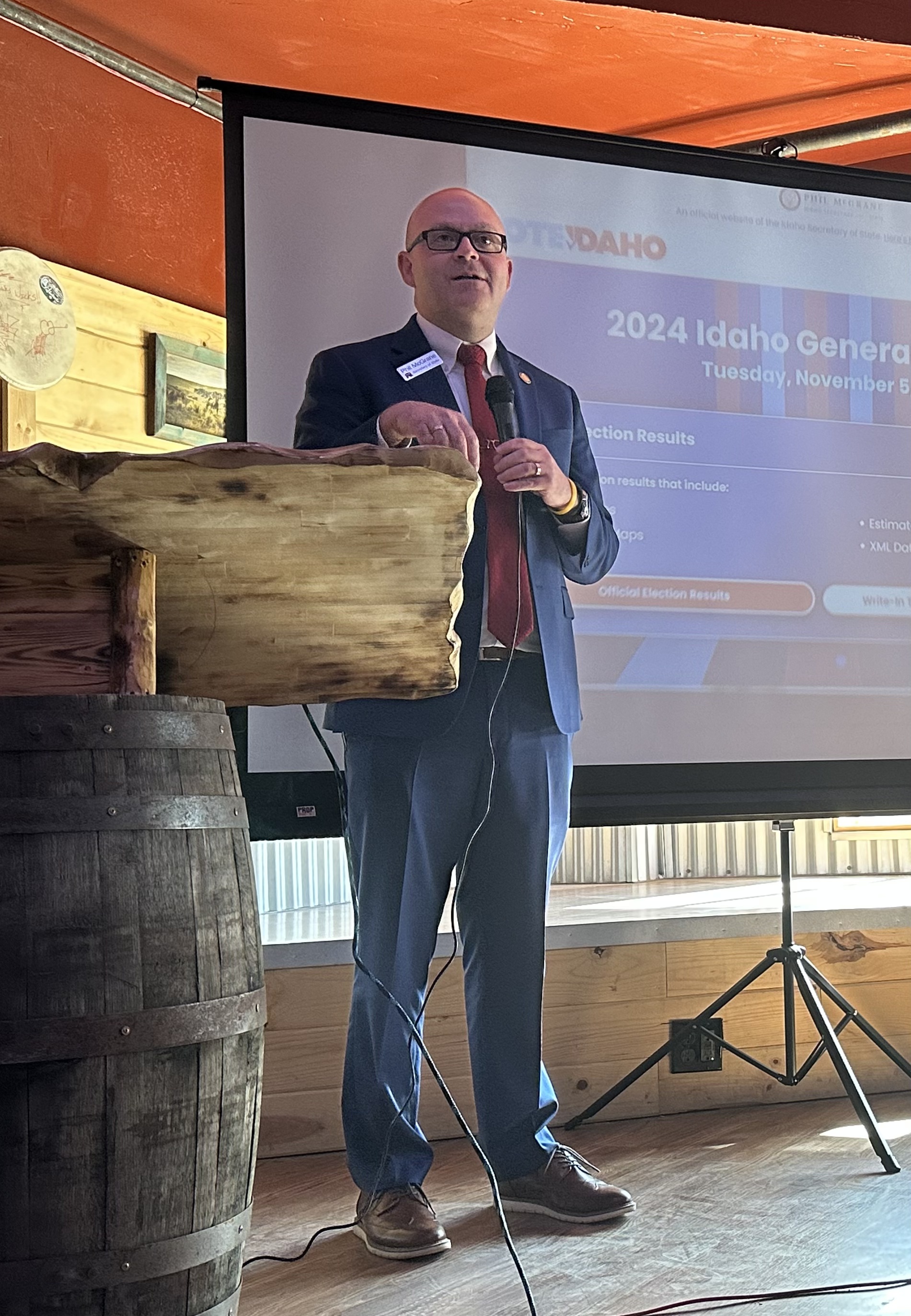
Idaho’s Secretary of State Phil McGrane
Idaho Republican Chairman Dorothy Moon, and Darr, were also in attendance representing the party. Locally Minidoka Chairman Jenny Bateman and Oneida Chairman Bryan Kerr were present (I serve as Chairman of Cassia County Republican Central Committee).
Idaho’s Senate Pro Tem, Senator Kelly Anthon representing Cassia, Minidoka, and Oneida Counties
Sen. Kelly Anthon spoke on the history and representation of Denton Darrington and his imprint/impression left on Idaho politics and history. He gave a brief overview of the current legislative session and the sausage being made in Boise.
Representative Clay Handy representing Cassia, Minidoka, and Oneida Counties
A note was made of the passing of former Cassia Chairman Tim Preston, also a native of Declo.
Idaho Republican Party Chairman Dorothy Moon
It was a successful Lincoln Days for the two counties. We will be headed over to Oneida County’s Lincoln Days on 15 February 2025. Looking forward to the trip and time associating with the good people of Malad.
I look forward to planning our Lincoln Days for 2026, which will be in honor of the Semiquincentennial (250th) of the Declaration of Independence.