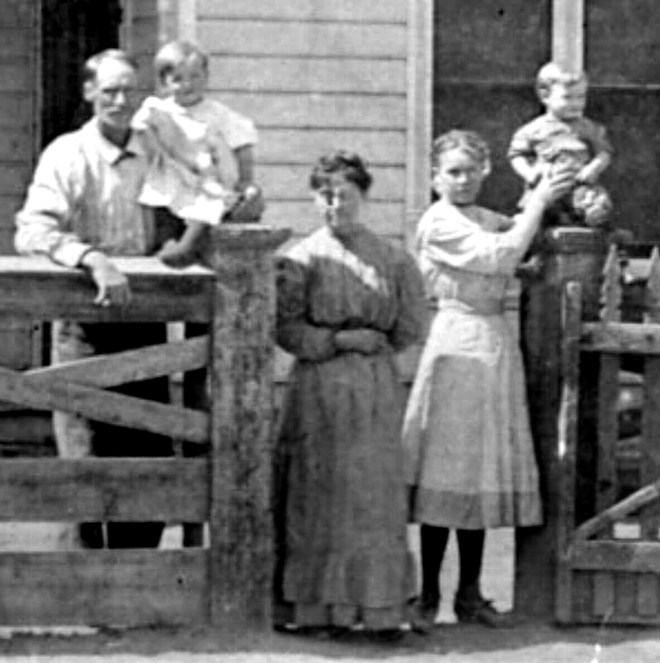
Jeanette Stoker Rogers

Since I just wrote about Milo Riley Sharp and Mary Ann Stoker (Lilly)(link here: Sharp-Stoker Wedding), I thought I would share a photo or two that surfaced in relation to Lilly’s sister, Jeanette.  Her name comes up in various forms Janetta, Jeanette, and Jeanetta.  However, her death certificate and other official documents all list Jeanette.

The 1861 census lists her as born in Brewood (pronounced Brood or Brude), Staffordshire, England.  The same place her father, William Stoker, was born.  Other individuals, their sources unknown to me, list her birth location as Kinver or Wolverhampton, both in Staffordshire, England.  Wolverhampton and Brewood are about 20 minutes away, so at least we know for sure which neck of the woods we are in.  Either way, she was born 3 February 1856.

I mentioned in the link mentioned above about how her family joined the LDS church, traveled to Utah, and how William Stoker farmed out the children from his first marriage to other families.  Jeanette was raised by Lewis and Catherine Garner in Plain City, Weber, Utah.  Jeanette is listed with both her father’s family and also the Garner family (as Janet) on the 1870 Census.

She married Charles David Rogers (17 March 1850 – 2 September 1914) on 22 December 1875 in Salt Lake City, Salt Lake, Utah.  To them were born 9 children: Charles David Rogers (1878 – 1880), Frank Rogers (March 1880 – 1900), Lawrence Edward Rogers (1 February 1882 – 29 May 1905), William Rogers (6 Dec 1884 – 27 July 1890), Agnes Delene Rogers (19 May 1886 – 22 March 1937), Catherine Hester Rogers (19 November 1887 – 7 February 1945), Maybelle Rogers (5 June 1890 – 4 February 1980), Louise Irene Rogers (24 April 1892 – 25 November 1956), and Loretta Camilla Rogers (7 June 1895 – 5 May 1985).

Charles passed away in 1914 and Jeanette remained a widow until she passed away 5 December 1941 in Sandy, Salt Lake, Utah.  She was buried 9 December 1941 next to her husband in the Sandy Cemetery.

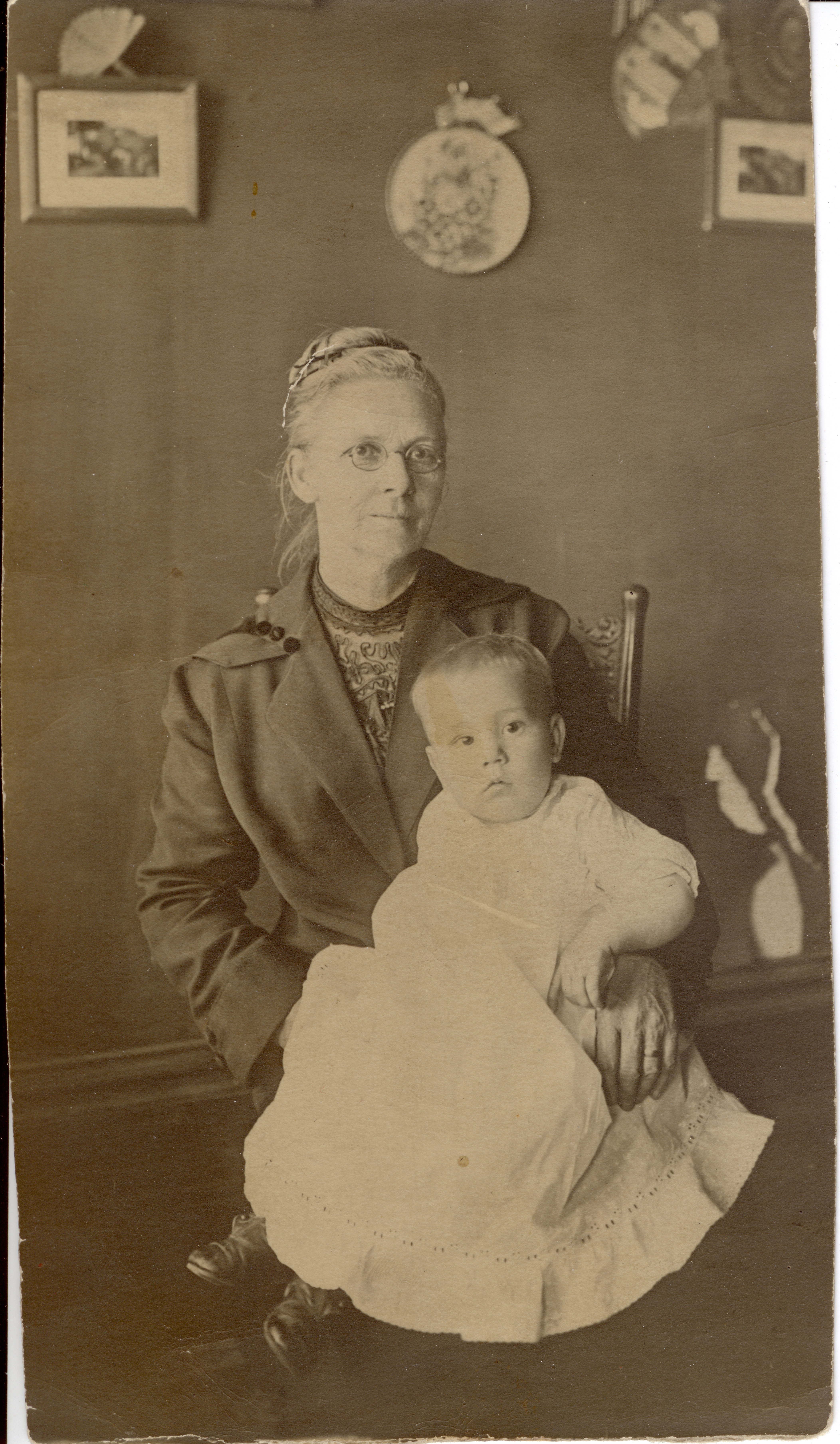
Here is a picture of Jeanette with her grandson Joseph Andrew Christopherson probably around 1917 or 1918.

Sharp-Stoker Wedding

Milo Sharp, Archie Richardson, Mary Ann and Ethel Sharp, Roy Richardson

William Stoker and the late Emma Eames Stoker are pleased to announce the marriage of their daughter Mary Ann to Milo Riley Sharp, son of William Sharp and Mary Ann Sharp.  They were married in at the Episcopal Church in Plain City, Weber, Utah on 11 May 1879.

Milo is currently a farmer in Plain City.

The couple will make their home in Plain City.

Just trying to write these first three paragraphs was not easy with this family.  So many twists and turns with each individual name makes it difficult to find the proper wording and fashion to form the sentences.

I struggled on whether to call Mary Ann by her other known name, Lillian Musgrave.  After marriage, she was known as Lilly M Sharp.  Mary Ann was born 24 February 1861 at in Reading, Berkshire, England.  The family was likely living at 18 Albert Street within St. Mary’s Parish.  She was the fifth and last child (some show her as the 6th of 7 children though) of William Stoker, a journeyman saddler working in Reading, and Emma Eames.  Emma contracted tuberculosis (listed as phthisis on the death certificate) and passed away 28 April 1863 at the same address after a year struggle with the disease.  Mary Ann never knew her mother.  Her father and older sister (Alice) joined the LDS church 27 May 1863.  Her older brother, William Thomas, eleven years her senior, had joined 5 December 1860.

The family wasted no time in gathering to Zion.  The Stoker family departed from London on a ship called “Amazon” 4 June 1863.  George Q Cannon dedicated the ship which was entirely of Saints (880+) headed for Zion.  It was this same ship that Charles Dickens wrote that the Mormons were not taking misfits and scoundrels, but the “pick and flower” of England.  Even George Sutherland, future U.S. Supreme Court Justice was on this ship.  Here is a link to the story by Charles Dickens: The Uncommercial Traveller.  The LDS church also tells of the story that day at this link: Amazon Departure.  The ship sailed to Liverpool before finally heading out for America.  Elijah Larkin, who would help found Larkin Mortuary, noted that on the 16th and 20th of June, Thomas Stoker was administered to due to a sickness since leaving Liverpool.

The “Amazon” landed at Castle Gardens, New York, New York on 18 July 1863.  The Saints took rail to Albany, Albany, New York and then to Florence, Douglas, Nebraska through Detroit, Wayne, Michigan.  From there they hoofed it on to Salt Lake City, Salt Lake, Utah Territory arriving 3 and 4 October 1863 (depending on which of the two companies), just in time for General Conference.  Several of the company wrote of Brigham Young coming out to greet them and giving them advice.

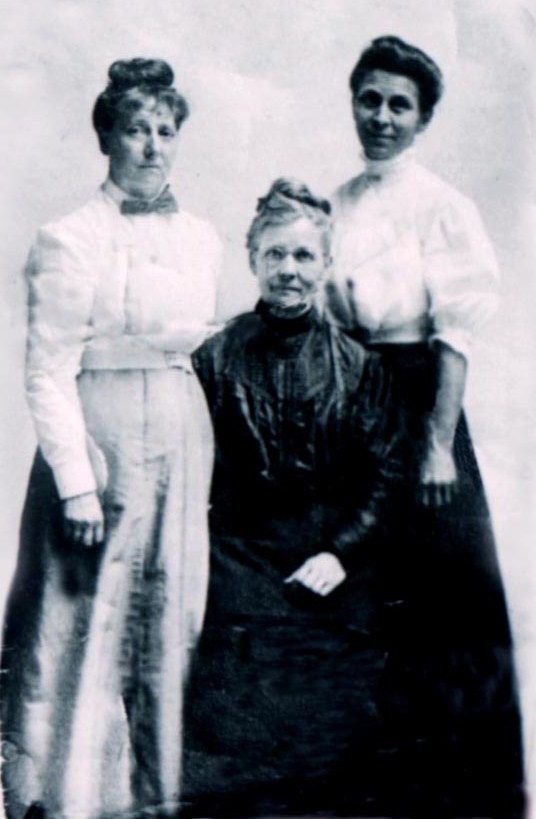
William moved almost immediately to Ogden, Weber, Utah and set up shop working with leather.  William wasted no time in remarrying to Eliza Sinfield in Ogden 18 May 1864.  While Mary Ann is listed as a child for William and Eliza on the 1870 Census, she was actually living with George Augustus and Victorine Jane Dix Musgrave.  She is listed with their family on the 1870 Census as well.  Additionally, the other children from this first marriage were also being raised by other families.  Family lore indicates that William and Eliza could not afford to raise these older children and farmed them out to families that could afford to take care of them.  Other evidence points that they were not all that poor, but it is not likely we will ever really know.  Here are three of the sisters later in life.

l-r: Mary Ann Stoker Sharp, Jeanette Stoker Rogers, Henrietta Stoker Weston

Mary Ann was raised by George and Victorine Musgrave.  She knew who her real father was, but had no real childhood memories of him.  George Musgrave was a school teacher and musician in Plain City.  George and Victorine were unable to have children and Mary Ann was probably a welcome addition in their home.  Victorine had also been adopted.  Although not formally adopted, George and Victorine called her Lillian Musgrave, but she grew nicknamed Lilly.  The rest of her life she went by Lilly and took the Musgrave as her middle name after she married with the obvious middle initial “M”.  Here is a picture of Victorine Jane Dix Musgrave.  Her son, Austin, even lists his mother’s name as Lillee Musgrave.

George and Victorine knew music and taught school.  Naturally, Lilly was taught the same.  She ended up participating in the second dramatic association in Plain City.  Some of their shows put on were, “Mistletoe Bough,” “Mickle Earl,” “Maniac Lover,” “Fruits of the Wind Cup,” “Streets of New York,” “The Two Galley Slaves,” “The Rough Diamond,” “Earnest Mall Travers,” and “Ten Knights in a Bar Room.”

All was not well in Zion during these years in Plain City.  Family lore has it that when a Bishop (Lewis Shurtleff, branch president 1870-1877, bishop 1877-1883) extended himself beyond what the members felt was right, these families made sure it was known.  The final straw came when Bishop Shurleff started telling the members what they would give as tithing.  These were not just on the fringe members, but good standing members of the church in the area.  William Sharp (Lilly’s future father-in-law) began construction on St. Paul’s Episcopal Church in 1877 for many of these disaffected members (Still standing today and owned by the Lions in Plain City).  For whatever reason a significant group of members were excommunicated between 1877 and 1882.  Many of Plain City’s leading members were excommunicated.  Excommunicated 31 January 1879 were William Sharp (the same who built the new church), Mary Ann Sharp (William’s ex-wife, divorced in 1876, Lilly’s future mother-in-law), William Skeen, Edwin Dix, George Musgrave (Lilly’s adopted father), Thomas Musgrave, Thomas Singleton, Thomas Davis, George W Harris, Jonathan Moyes, John Moyes, Winfield Spiers, James Wadman, Robert Davis, John Davis, and Thomas Robson.  These lists also have “and wife” as well as “and family” which seems to indicate that this list may have included spouses and families.  Mary Ann Sharp (Lilly’s future mother-in-law) is the only woman, but perhaps because the rest were representing their families, where with the recent divorce she was not represented by William.  Many of these families returned to the church after time away, some individuals never did.

While Lilly’s name is not on the list, she was probably classified with the Musgrave family.  We do not have any record of her baptism, but she was with the Musgrave family attending the newly established St. Paul’s Episcopal Church.  Although it seems Victorine Musgrave was excommunicated, she continued active with LDS Relief Society (or she was not excommunicated).  It was during this time, Lilly also come to fall in love with Milo Riley Sharp.  William Sharp, with the assistance of Milo, had also helped build the Musgrave’s new home.  In St. Paul’s Episcopal Church, J. S. Gellogly married Milo and Lilly on 11 May 1879.

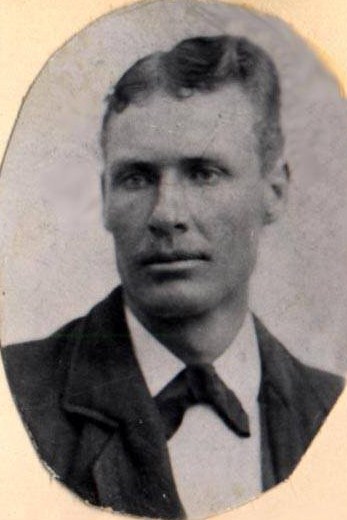
Milo Riley Sharp

Milo Riley Sharp was born 23 Jul 1857 in Lehi, Utah, Utah.  He was the fourth of six children born to William and Mary Ann Bailey Sharp.  Mary Ann did have a child, Lorenzo Padley, from a previous marriage in which she was widowed.  William and Mary Ann Sharp immigrated to Utah in 1853 after joining the LDS church in 1848 and 1846 respectively.  At first they were sent to Lehi but had a number of issues with range for the cattle and some other minor squabbles.  Water was also not found to be very dependable in the Lehi area.  William learned of land north near Ogden that was going to be opened up from some of the Saints passing through Lehi (abandoning Salt Lake City before the arrival of Johnson’s Army).  These Lehi Saints were told of ample land and good water that was available west of Ogden.  A scouting expedition went to search out the area in the fall of 1858 and visited with Lorin Farr who told them of the available plain to the west.  You can read more of his parents at: Sharp-Bailey Wedding.

The Sharp family left with other Lehi Saints on 10 March 1859 to travel to this new area.  The group arrived 17 March 1859 at what is present day Plain City.  William Sharp put his carpentry and masonry skills to work making adobe brick and helping build the first homes in Plain City.  In one of these first adobe brick homes is where Milo Riley grew up.  William served in the Plain City band, the Plain City Z.C.M.I. board, a builder, and a city leader.  Milo’s little sister, Evelyn, was the first girl born in Plain City in October 1859.

Milo’s mother, Mary Ann Bailey Sharp, moved out on Christmas Eve 1875 and refused to come back to William.  William sued for divorce and Franklin D. Richards granted the divorce (in probate court) on 19 May 1876.

Milo Riley Sharp as a young man

As mentioned earlier, the Sharp’s also had a falling out with the LDS church and were excommunicated the same day as the Musgrave family.  Since there were not loads of people in Plain City, Lilly and Milo knew each other.  The conditions in the community, their respective families excommunication, probably help to forge the commonalities they had and led to their marriage.

Milo kept busy working with his father building homes and other masonry and carpentry work.  He also had time to play first base at baseball and played on Plain City’s first baseball team.  The team could beat all the other northern Utah teams except Salt Lake.

The marriage of Milo and Lilly eventually produced a quiver of 12 children.  Milo Ray on 29 February 1880.  George was born 2 August 1881 and passed the same day.  Effie was born 6 June 1882 and died 6 September 1883.  Delwin arrived 30 June 1884.  Ernest and Austin came 7 Jan 1886.  Edward William appeared 25 October 1887.  Victorine showed 23 November 1889 and later married Fredrick Lawrence Hunt.  Mary Irene materialized 26 June 1892 and married Oscar “Os” Child Richardson.  Edith dawned 4 February 1895 and married Clements Richard Martin.  Ethel was born 9 April 1898 and I have written of her at this link: Ross-Sharp Wedding.  Emily appeared 5 April 1900 and quickly extinguished 31 July 1900.  Nine of the children lived to adulthood and 8 of those married and had children.
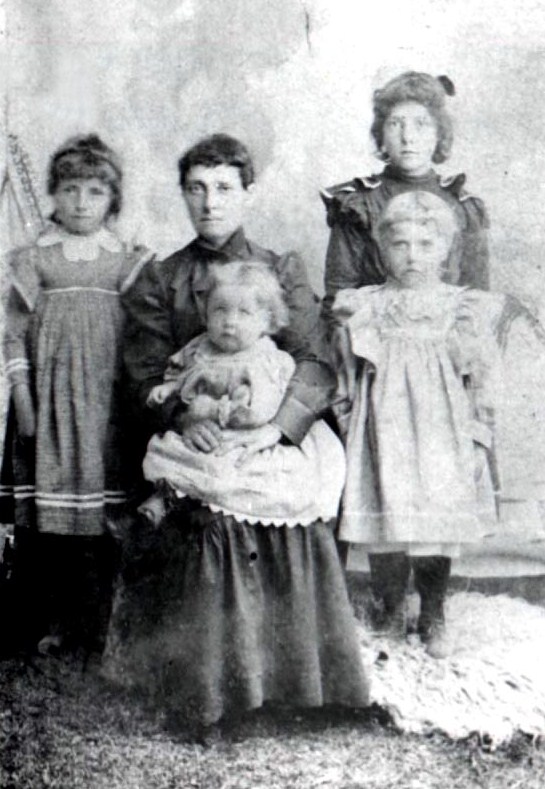
Mary, Lillie (Mary Ann), Ethel (baby), Victorine, Edith (in front) Sharp

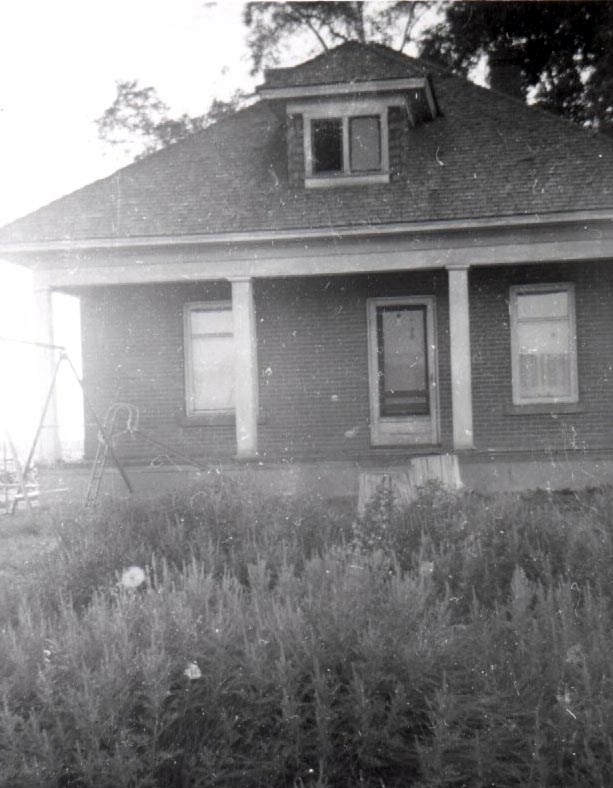
Milo built a new home for the family early on so the family had room to grow.  He added to it as more room was needed as you can see in this photo.  We do not know the year it was originally built, but we know the children after 1888 were born in this home.  The home’s address is 2897 N. 4200 W. in Plain City.

Milo successfully farmed all of these years.  He kept busy with civic affairs.  He was elected constable of Plain City on the Republican ticket in 1891.  In 1893, he sat on a committee to investigate the incorporating of Plain City, although it was not incorporated until 1944 with grandson William Albert Sharp serving on the town board.  Milo and Lilly were singers and continued to play in the Plain City bands.  Lilly was also well-known for her poetry.  In 1911, Milo finished building a new home, pictured below (address is 2771 N. 4200 W. in Plain City).  Milo farmed hard until he caught influenza and eventually pneumonia passing away at the early age of 59 at 9:30 a.m. 24 June 1916 at his sister’s home, Victoria Maw, who lived at 5 Warren Court (which I believe may now be Warren Row or Lane in Ogden).  His funeral was held in the little church he helped his father build, St. Paul’s Episcopal Church on 27 June 1916.

Lilly lived in this home until she passed away in 1935.  Her son, Ernest Sharp, never married and helped take care of her and then lived the rest of his life in the home (he died in 1967).  Milo James Ross, Lilly’s grandson, purchased the home at that time and later transferred it to his daughter, Caroline.

Lilly kept a clean home.  The grandsons were taught to stop by every time they passed, especially to and from school.  This permitted dishes to be washed, wood to be hauled, and wood to be split.  Lilly had a strict regimen for cleaning pots, dishes, and pans (especially bedpans).  This included the outdoor pump station, even with lye to remove odors.  The boys knew to take special care not to make a mess when carrying fire wood or in any other way on entering the home.  The gate was always to be closed, whether coming or going.  While this might seem stern, she always opened the door for those coming and going and gave them a warm smile.
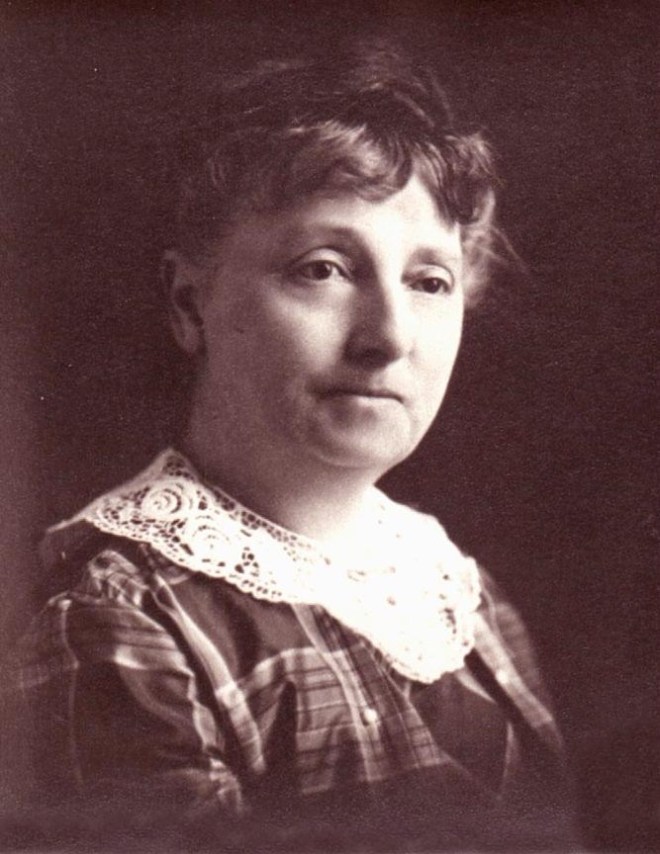
Mary Ann Stoker Sharp

Mary Ann Stoker Sharp

Lilly often made bread, keeping her own live yeast, often from warm potato water.  She had her own milk separator and used it.  The boys helped make butter and she treated the boys to buttermilk and warm bread.  She would also warm apples in the oven to share or dried fruit.  She kept a full root cellar with homemade cured meats, dried fruits, and bottled vegetables.  The Sharp family had onions that could be used to flavor soups and other needs.  Many of the family still grow these onions even until today.  Many mushrooms and water crest were gathered too.

Lilly often had kind words and a warm, gracious smile.  She kept a small table in the pantry where she brushed her teeth with salt, baking soda, and a bar of soap.  The bucket was always there with a drinking cup and a ladle to draw water.  She was thin and tall.  She wore long dresses from her neck to her feet with shoes that went up about six inches.  She kept her hair rolled in the back of her head held with a comb with long teeth.  If she was not thin enough, she wore a corset to make her look even smaller.  She was very neat and proud in her appearance.

She kept a spinning wheel in the home for the times when she would spin wool into thread.  She also had the grandsons help turn her mattress from time to time.  She did not leave the house much in her later years unless she had a ride, but even then did not stay long before going home.  It was clear she enjoyed watching her grandchildren.  The last decade or so of her life, she had to use a hearing tube to hear.  Some of her grandchildren joked that it was like using the telephone, just you could see who was on the other end.

Lilly passed at 10:55 p.m. at her daughter’s home, Victorine Hunt, 6 May 1935 of hypertension with chronic major carditis and pneumonia.  She had remained faithfully active in the Episcopal Church until she could not get around very much.  Later in life she needed assistance as she could not walk very far.  Her funeral was held in the Plain City LDS chapel with Rev. John W. Hyslop officiating on 9 May 1935.  She was buried with Milo in the Plain City Cemetery.

Raymond Draper, Caroline Ross Gallegos, Milo Ross

Timpooneke Trail

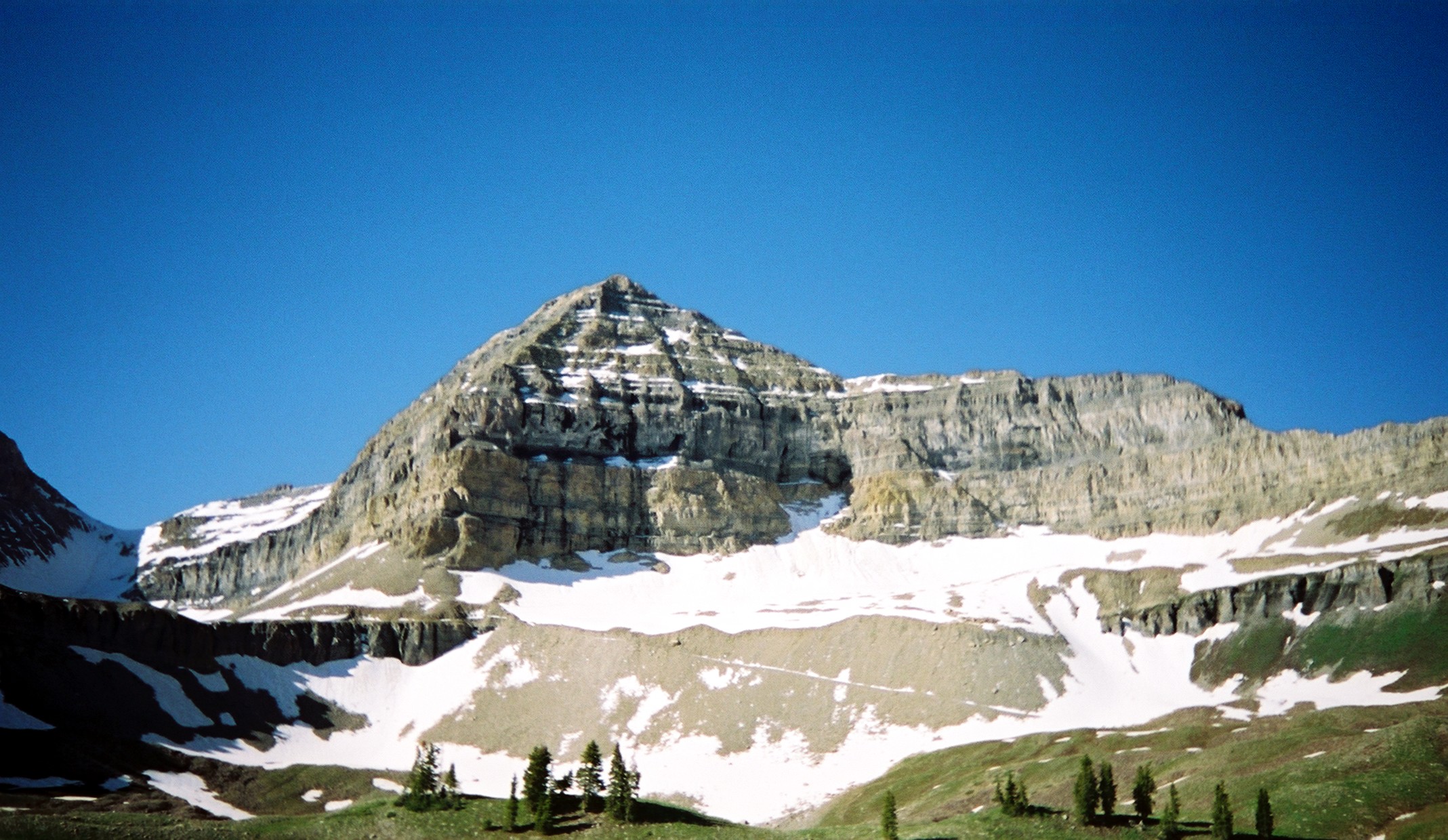
Here is a tribute to the first time I hiked the Timpooneke Trail with friends.  We celebrated Pioneer Day in 2003 (the day after) by hiking this trail with a phenomenal view of Utah Valley below.  The trail will take you to the triangulation station at the very peak of Mount Timpanogas located at 11,749 feet.  In the photo above, you can see the north face with a 1,500+ face.  (As always, click the photos to get a closer look)

Brad Hales, Marianne Hales, and Mark Morris and I started hiking around 6 A.M.  We made our way slowly through the day to the top.  We ended up taking about 7 hours to get to the very top.  It was quite the trail upward.  Other websites indicate the trail is 14 miles round trip and you gain 4,389 before descending.

The mountain is quite a fascinating climb if you like geology.  I had just completed my Geology class at BYU the year before and learned the appreciate the mountains near the Y.  By the time of this photo, I had repented of my ways and returned to USU, but still appreciated the geologic history so easily viewable on the way up (and down).

Here is a look back across the valley as you ascend the hill.  You start on the back side of the mountain and this is looking back (just like Lot’s wife).  You do not see Utah County until you are nearing the peak.

Here is a shot of Marianne, me, and Brad with Provo and Orem and Lake Utah in the background.  I was so exhausted at the top that I took a 30 minute kip in addition to lunch at the peak.

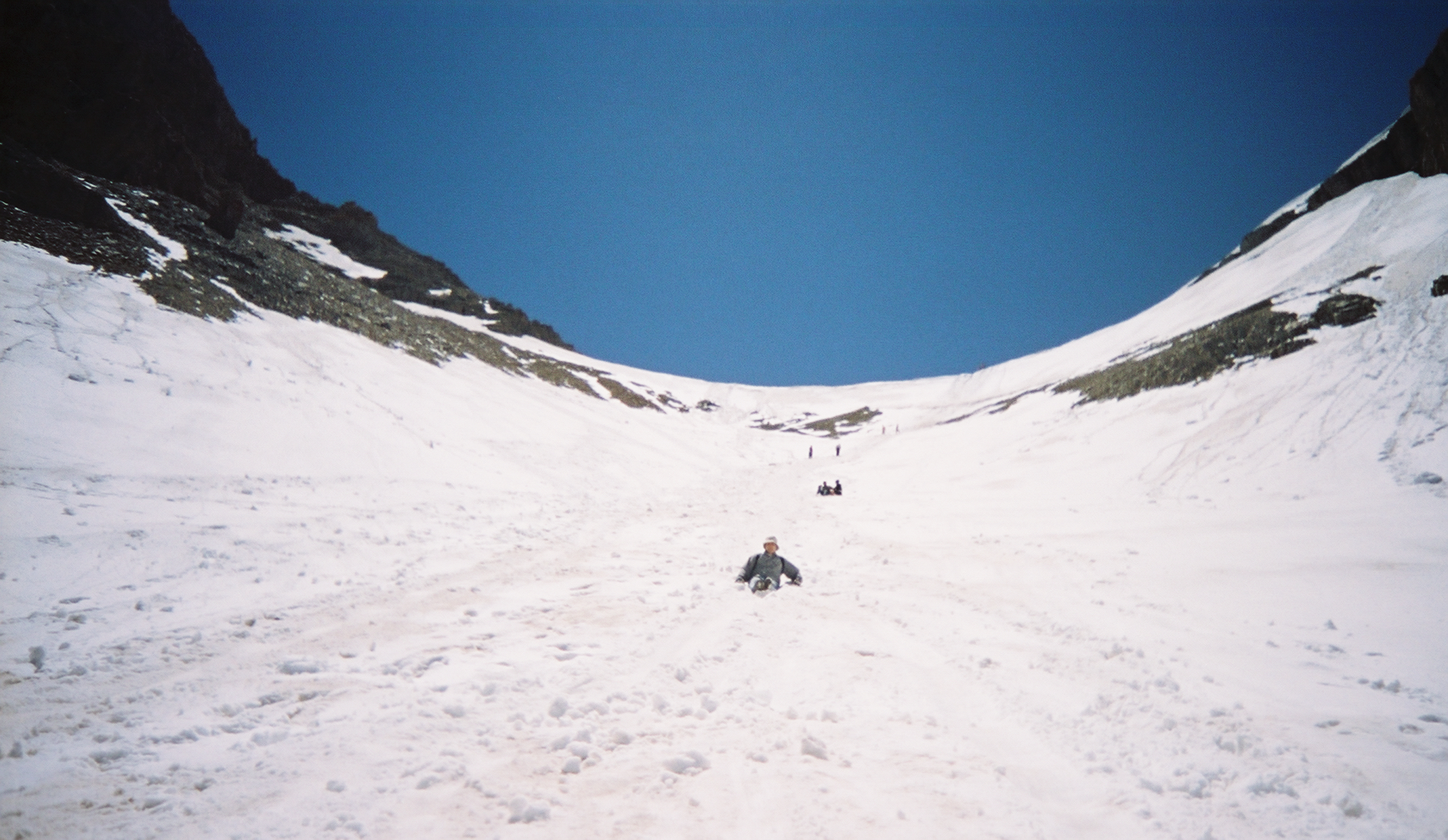
Here is a shot looking down at Emerald Lake below the peak.  We would ride our bags down the “glacier” that goes into the lake.  I have to admit, sitting at the top of the “glacier” looking down and the incline scared me to death.  Something about dropping a couple of thousand feet within a minute or two and the incline that scared me.

Here is a picture of me sliding on my bottom, probably around 3/4 of the way down.

If anyone needs a good trail to hike, I recommend this one.  Great views, good effort, and bring good company.  Do not forget a roll of TP in your backpack as the restrooms did not have any.

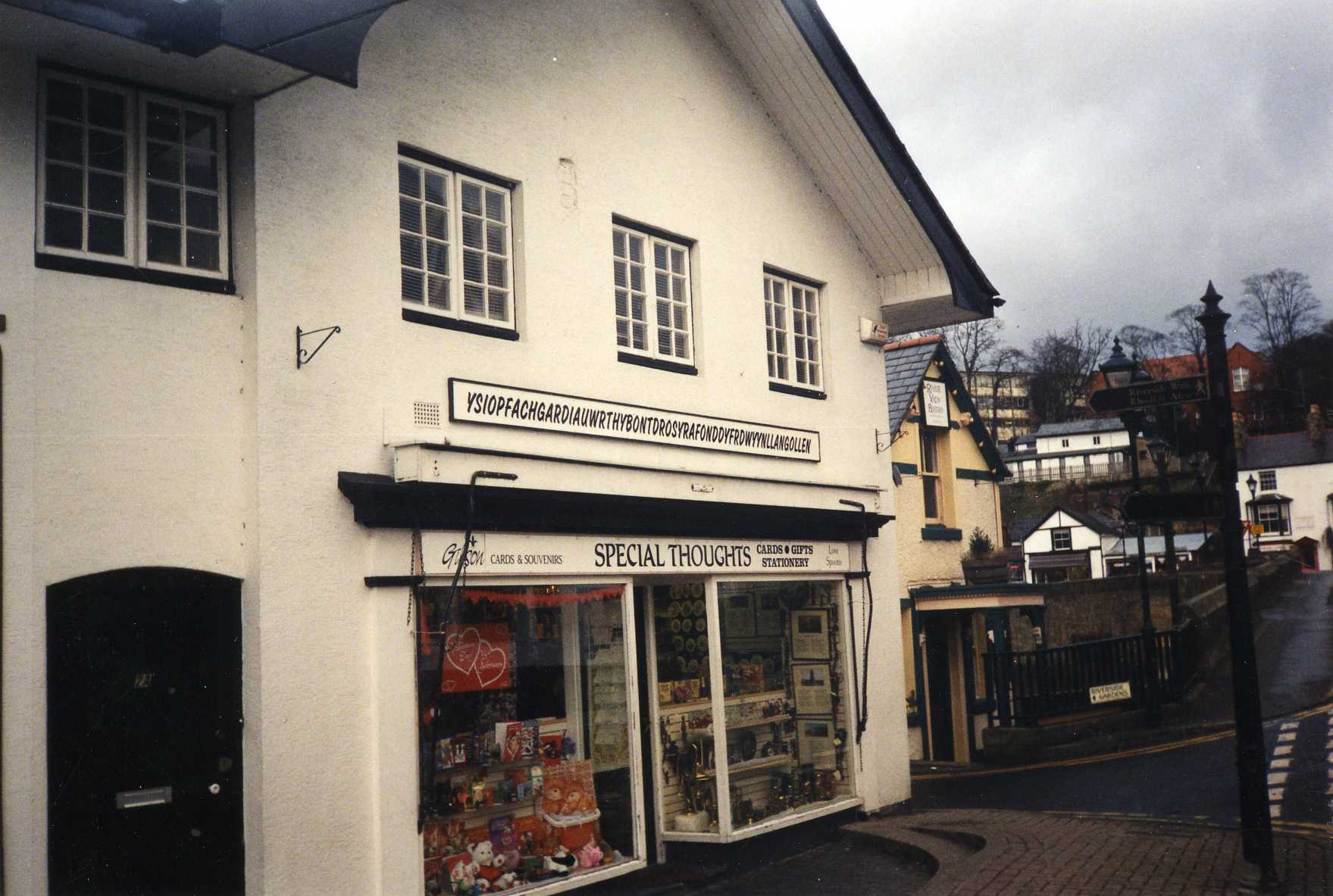
YSIOPFACHGARDIAUWRTHYBONTDROSYRAFONDDYFROWYYNLLANGOLLEN

I have told a number of people about this little shop in Llangollen, Wales over the years.  Nobody seems to believe me that this sign and place really exist.  Here, for all to see, is the photo.  It says, “YSIOPFACHGARDIAUWRTHYBONTDROSYRAFONDDYFROWYYNLLANGOLLEN.”  You will have to click on the picture to see it more clearly.

If you do a search by the name, you find only a few hits for it on the web.  I do not know why they placed it all as one word since Welsh does permit spacing when you write it.  Perhaps it was to create a novelty to attract tourists.  At any rate, it means something like “the card small shop by the bridge over the river Dee in Llangollen” and is to clarify just in case you should confuse it with other card shops in Llangollen.  My welsh was pretty weak as I learned some of it in Wales and is even worse these days, so I hope that is kinda close.

We visited one Preparation Day in early 1999.  I only lived and served in Wallasey, Liscard, Moreton, Seacombe, West Kirby, and New Brighton in the Wirral Peninsula from around the 23st of December 1998 to about the 19th of January 1999 before being assigned to Hyde.  We made my first trip to Chester in Cheshire and Wrexham and Llangollen in Denbighshire, Wales.  The Valentine’s Day decorations in the window would seem to hint at later January.  My journals would tell, but they are in Idaho.

Llangollen is a small town, probably not more than a few thousand people.  I really remember very little about it.  I remember seeing the Pontcysyllte Aqueduct on the drive down but not a whole lot more.  We drove down just to see this little store.  Which, now that I have posted the picture, everyone can rest assured it really does exist.

Perhaps some day I can return to Llangollen.  Maybe we can arrange it so it corresponds with the International Eisteddfod.  Or maybe some day I can visit Llanfairpwllgwyngyllgogerychwyrndrobwllllantysiliogogogoch.  Only time will tell.  Until then I will just have to make due with the Welsh Festival in Malad, Idaho.

FYI, I cannot pronounce either, so please do not ask.

My Blood Lineage

Walking and visiting with a professor today, she asked the name of my daughter.  I indicated it was Aliza and she stated, “A good English name.  You definitely look English, is it a family name?”  We chatted a little longer before we separated, but it left me thinking, “Exactly what are my proportions of nationality?”  Well, here they are.  Even though I had always thought I was more German, I was wrong.  I am more British.

Looking back 6 generations, I took each ancestor and assigned them 1/32 of my blood line (obviously).  I then assigned them the nation to which their ancestors came from.  Most of this generation were still in their native country so it was easy.  My “US” line is only those designated that I do not definitively know which mother country they came from because they are so long in Virginia (at least to 1780).  I debated about whether to lump the Saxon, Prussian, and Wuerttemberg lines because I am not lumping the Ireland, Wales, and English lines.  I have provided a separate indication of my “German” and “British” lines.

3/16 – England – Sharp, Bailey, Stoker, Eames, Coley, Rogers

1/8 – Netherlands – Van Leeuwen, Weenig, Janzen, Van der Meij

1/8 – Saxony – Schneider, Andra, Knauke, Richter

1/8 – Wuerttemberg – Wanner, Schmid, Nuffer, Greiner

1/8 – US – Meredith, Shepherd, Graham and Miles lines

1/16 – Ireland – Donaldson, Todd

1/16 – Norway – Christiansen, Jorgensen

1/16 – Prussia – Jonas, Schumacher

1/16 – Sweden – Nelson (Nilsson), Benson (Bengtsson)

1/16 – Wales – Williams, Jordan

All together

5/16 – British

5/16 – German

I am willing to bet all 4 of my US lines were Wales and England.  Therefore, 7/16 would be British.  This is the largest percentage of them all, almost 50% of me is British!  Maybe that is why I served a British mission (although none of my family came from within my mission).

Trifle Joy

Here is a picture of one of life’s little joys: food.  Not only food, but a dessert.  The happy tummy joy of trifle.  Actually, I think this trifle provides a bit of eye candy too.

With 6 of our family in town for the past week and the Christmas gift of a trifle dish, I could not resist making this happy treat.  Of course, the family all encouraged and helped me too.

While I lived in England for a couple of years I picked up a few recipes of British food that still remain with me.  The trifle is one of those that I have had to perfect with US measurements and ingredients.  I do cheat and use Bird’s Custard Powder because I have yet to perfect a custard worthy of a trifle.

It is not a perfect trifle, you can see the blemishes in the hastily made piece of art.  We whipped this thing out in about 2 days and unfortunately it shows.  We consumed it in less than an hour!

The bottom red layer is the classic sponge cake contained within cherry sugar-free gelatin.  I cheated and purchased the Angel food cake already cooked, so this is just cubed and smashed into the bottom layer.  I have found we are all happier after dessert if I use the sugar-free gelatin.  The whipped cream on top and the custard has about 6 tablespoons of sugar in this entire bowl.  Most of the sweetness actually comes from the fruit.

The next layer is the custard with mandarin oranges encapsulated.  You can see one on top of the custard above the yellow blemish in the custard lower custard layer on the right.

The next layer is orange sugar-free gelatin containing peaches topped with bananas.  All the fruit in this dish has come from a can, except the strawberries which were frozen and the fresh bananas.

The next layer is another custard with the strawberries on top.  Unfortunately family pressed the strawberries down into the custard so it is not as clean as I would have liked, but in the end, it is all about the taste anyhow.  The strawberries were halved while frozen but defrosted on top of the setting custard overnight.  That way I could avoid the little water pockets around them in the jello.

The next layer is of strawberry sugar-free gelatin poured over the strawberries.

The last layer is heavy whipped cream.  Like I mentioned earlier, each custard layer has two tablespoons of sugar.  I honestly think we could get away without sugar in those layers but I have not been so bold as to try.  The same speaks for the cream on top, it could probably go without sugar.  I may have to venture there on the next one.

The cream is formed with shaved mint chocolate on top.  The chocolate did not shave properly and more or less clumped together through the shaving so you see it in its pathetic form.

The trifle still tasted beautiful in all its wonder.  All 8 of us ate it mostly after a healthy dinner of potato soup, curry and rice, and na’an bread and rolls.  Talk about a mix of poor foods and then throw in the snobbish trifle.  Some day we will have to do a post about the curry and rice with na’an bread, another throwback from my years on British soil.

Donaldson – Williams Wedding

David and Gwenlliam Williams are pleased to announce the marriage of their daughter Mary Elizabeth to William Scott Donaldson, son of Joseph and Sarah Donaldson.  They were married in her parent’s home in Slaterville, Utah on 2 Oct 1890.  (I had a picture of David and Gwenlliam in this post, but found out it is actually of another couple.)

William is currently employed with Union Pacific Railroad as a conductor in Ogden.

The couple will make their home in Ogden.

The farther you get back on some of these family lines, the less we know about the individuals and their lives.  This really is unfortunate.  If they had kept journals, or recorded some of their thoughts and at least given us some history, how much the richer we would be.  Look at how much a few sentences written on the back of this old photograph tell us that we would not otherwise know!

The back of this photograph has the following written on it.  “[illegible] master (??) held this photo for about 46 or 48 years then gave it back to me for a keep sake.  when she left for California to make her home.  she was 70.  taken in 1891 we lived in Evanston Wyo.  Donaldson was Union Pacific Conductor.  Mary Elizabeth Williams Donaldson.  Born apr 7th 1869 on Wall ave. between 24th and 25th street.  Just South of the Brigham Hotel in the old home.  Daddy sold the old home to Barnard White.  William Scott Donaldson Born June 18 1865 Cape Vincent Jefferson county New York.”

I assume the writing is by Mary herself since there is a reference of the photo being given back (William died in 1913).  But then why would she refer to her husband as “Donaldson” in reference to his work?  The details given of the birth and its location with the references of “Daddy” selling the home makes me think it is safe to assume this is written by Mary herself and the language is probably a norm of the time.

The reference to the Brigham Hotel (called the New Brigham Hotel on the National Registry) is interesting because that building is still there at 2402-2410 Wall Ave.  No homes still exist in that block.  We knew she was born in Ogden, but from that little note, we now know which block of Ogden.  I have written about her parents at this link: Williams-Jordan Wedding.

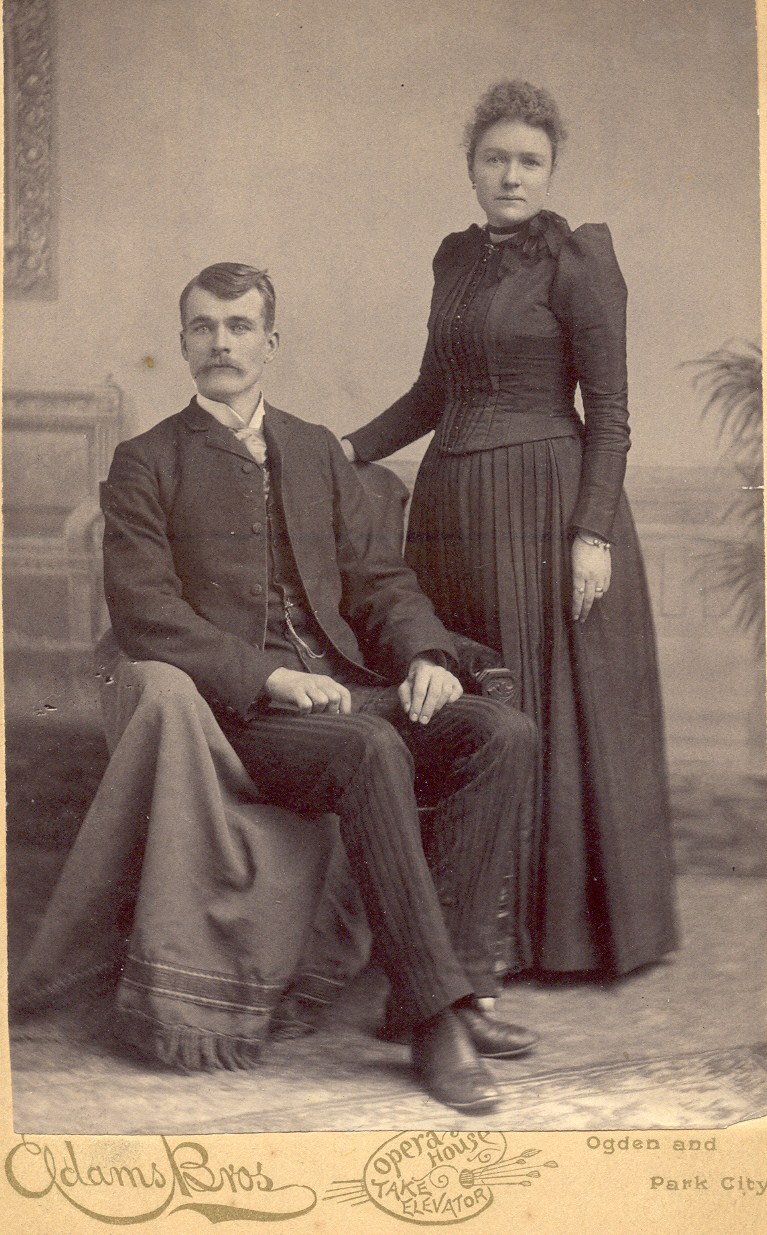
The writer on the photograph indicates that the Donaldson family lived in Evanston, Wyoming in 1891.  William George was born 23 Aug 1891 and David Delos 26 Mar 1894, both in Evanston.  (Read more about David’s family at this link: David Donaldson Family)  Mary may very well have been pregnant in the photo.  The photo was taken in Ogden or Park City as the bottom of the photo tells us that is where Adams Bros (and ride an elevator!) was located.  The family then moved to Park City, Utah where Joseph Ellis was born 28 Aug 1896 and Irvine Todd on 11 Jun 1898.

On 11 Jun 1900, the family lived at 2270 Moffatt’s Lane in Ogden.  Moffatt’s Lane is no longer the name of the street, it was renamed between 1910 and 1920 as Ogden Avenue.  William is still a conductor for the railroad.  On 20 Apr 1910, the family lives at the same address and William indicates to the census taker he is now a plumber and owns a shop.  William and David are both listed as apprentices, and I assume both are for their father. Somewhere in all this, he also had a confectionery store, of which we have one picture but little other information.  William was the proprietor of the Star Candy Company located at 2309 Washington Avenue in Ogden.  We don’t know how long it was open or when he opened it.

William Scott died 12 Sep 1913 of bladder cancer at Dee Hospital and was buried in the Ogden City Cemetery on the 14th.  He was barely over 48 years old.  The death certificate indicates William was the owner of a plumbing business.

William Scott was born 18 Jun 1865 in Joyceville, Frontenac, Ontario, Canada.  His mother was born in Cape Vincent, Jefferson, New York.  You can read more of his parents and siblings at this link: Donaldson-Todd Wedding.  As far as we can tell, all the children were born in Joyceville.  He did mention on both the 1900 and 1910 Censuses though that he was born in New York.  Maybe this was to claim his privileges as an a U.S. citizen.  Who knows.  He is not found on the 1880 Census presumably because he is in Canada.  Several of his siblings also finally show on the 1900 Census in New York and Ohio, but his father and mother lived their entire lives near Joyceville or Pittsburgh, Frontenac, Ontario, Canada.  His venture west most likely came with his employment by the railroads.  He did not join the LDS church until 1911.  His son John Edmund joined in 1910, Joseph Ellis the same day as his father, and William George and Samuel Alvin within the next 4 years.  The others did not join (although David Delos obituary says he did).

Back l-r: Todd, George, Mary, William. Front: Dave, Alvin, Ellis, Ed Donaldson.

Mary probably grew up near where she said she was born.  She was the oldest child (that lived) of 10 children.  The census taker in 1880 described the home as on the railroad grounds in Ogden.  The block where she said she was born is very near the Union Station and may have qualified as the railroad grounds.  The original station which was built in 1869.  No street or anything else, just on the railroad grounds.  The 1870 census does not give any indication where the family lived other than in Ogden.  The last two children were born in Slaterville (1881 and 1885).  The marriage record indicates in 1890 that Mary was a resident of “Slateville”.  The 1900 census records do not tell us where in Slaterville.  Mary’s mother, Gwenlliam Jordan Williams died there in 1900.  When David died in 1911, he was back in Ogden living at 3256 Wall Ave (this home is gone).

Mary remarried 11 Jul 1918 to Anthon Edward Peterson.  The family still lived at 2270 Ogden Ave in the 1920 census.  The four youngest still living at home.  By the time the 1930 census arrived, Anthon and Mary were living at 541 Washington Ave, which house I believe is still standing.  Anthon and Mary would remain together until he passed away in 1942.

All accounts of Mary is that she was stern and cold.  Her grandson, David William Donaldson (Dave), indicated that she was snooty, high-minded, and a brat.  Apparently she was very condescending and negative in every interaction.  After Anthon Peterson passed away, she sought to move in with her son, David Delos Donaldson and family.  The offer was apparently there to take her in for whatever years she had remaining.  However, Dave was not having any of that and indicated that if she moved in, he moved out.  This was between 1945 and 1948.  She ended up not moving in because of Dave.

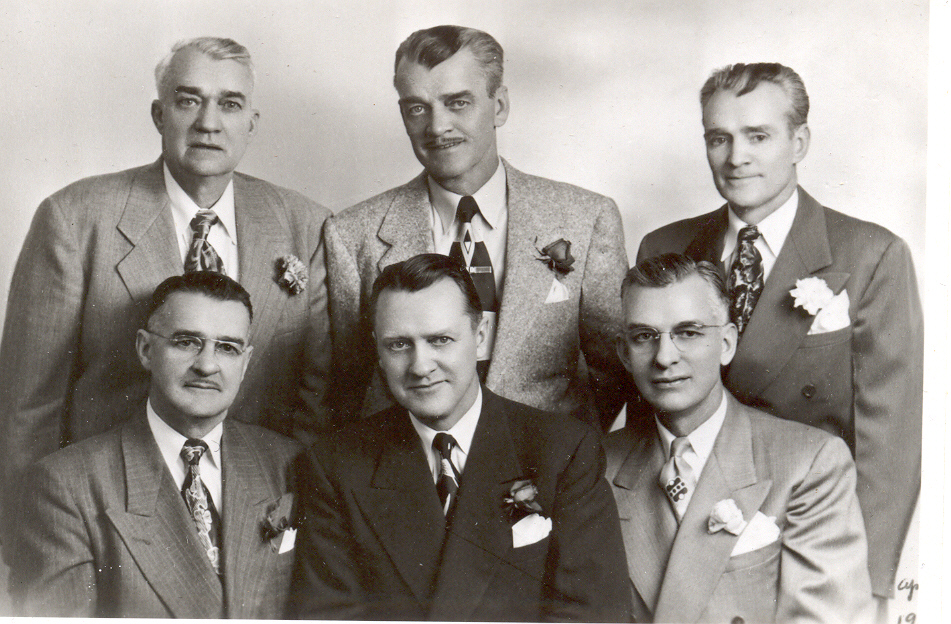
Back l-r: David, Ellis, Edmund. F: George, Todd, Alvin Donaldson

Mary remarried 20 Nov 1945 to Thomas William Stoker (a cousin of mine on a different line).  They remained together until she passed away of old age 29 Mar 1951 in Ogden, just shy of 82.  At the time, Thomas and her were living in Huntsville.

4 Generations: Jan (boy), Dora, Mary Donaldson, David Donaldson

3 Pics of my Christmas Past

Christmas is unique for a number of reasons.  Looking beyond what much of the world seems to focus on now, most of the holiday season is really about family.  Sure, Christ is preeminent in the festivities, but my most fond memories are of my family.  I also look forward to Christmas with some degree of food, friends, family, and the reason why we join together (to remember Christ).

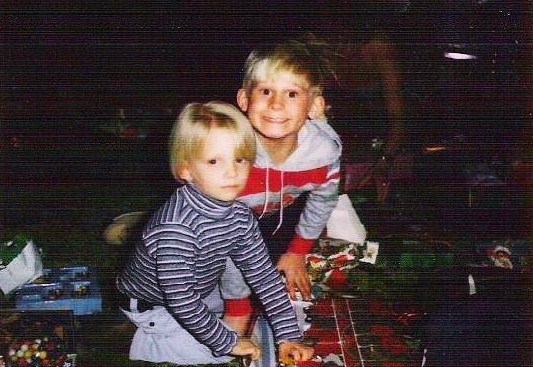
This is the earliest picture I have of a Christmas, probably around 1981, where I am just over 2 years old.

One of the miracles of a photograph is the memories it can conjure from the past.  I do not remember this Christmas, but so much of the picture is familiar to me.  I can see the shape of my Grandmother’s arm, jewelry, and hand in the background reaching from the couch in the darkened picture.  I do not look terribly happy, but then again, I am being stopped from unwrapping my Christmas present.  The candy and family are much of what I remember of those early Christmas years.  My cousin, Brook Jonas, is the one smiling in the background.  He must have already opened a present.

My first Christmas memory is in the same room, probably a year or two later.  I remember a huge number of presents, probably just because I was young, piled around the fireplace (which was not used).  I remember a disgust in opening a box of underwear.  The day went on and we had finished all our presents, but alas, we had not.  We were informed we were not and Evan told us he could still see some presents for us.  The hunt commenced.  Eventually, he had to show us where he had hidden some little boxes inside the actual Christmas tree.  Upon opening, Andra, Brook, and I were proud owners of some pretty nice harmonicas.  I believe I still have mine, but would have to rummage through my storage to make sure.  Maybe it is Andra’s.  One stayed in a drawer at my Grandma’s for many years until one year we discovered it was in pieces in the box.  Somebody had destroyed it.  We knew it was my cousin May probably 10 years later, but nobody said anything.

This next picture is the first picture I have of a Christmas at our home.

I am pretty sure it is before Christmas as my Mom is standing on the couch and is probably helping to decorate.  We probably just finished and I was anxious to plug in the tree.  I do remember this Christmas and had to be about 1984.  I think that is the year we moved into this house located on the frontage road just a few miles up the road from the house we would move in to in 1991.

A flood of memories and other ideas come from the picture.  The tree is obviously real and really kind of a Charlie Brown tree.  There are the massive lights that you can see a few of in the picture.  Then a few balls and quite a bit of tinsel which seems a little heavier towards the front.  Nothing like some of the pretty fancy trees you see now.

Notice we would hang the tinsel on the doorknob and pull off a few strands at a time for the tree.  The carpet would be torn up in a few years to expose the hardwood floor underneath.  Dad would put paneling halfway up the walls in years to come and that rattlesnake skin was hidden somewhere else in the house.  That door with the center doorknob would remain as long as we lived in the house.  I have never seen a center doorknob at any other time.  I do not know what Andra is doing with the tube, probably left over from wrapping paper.  One of the chains from the cuckoo clock are visible above the tree.

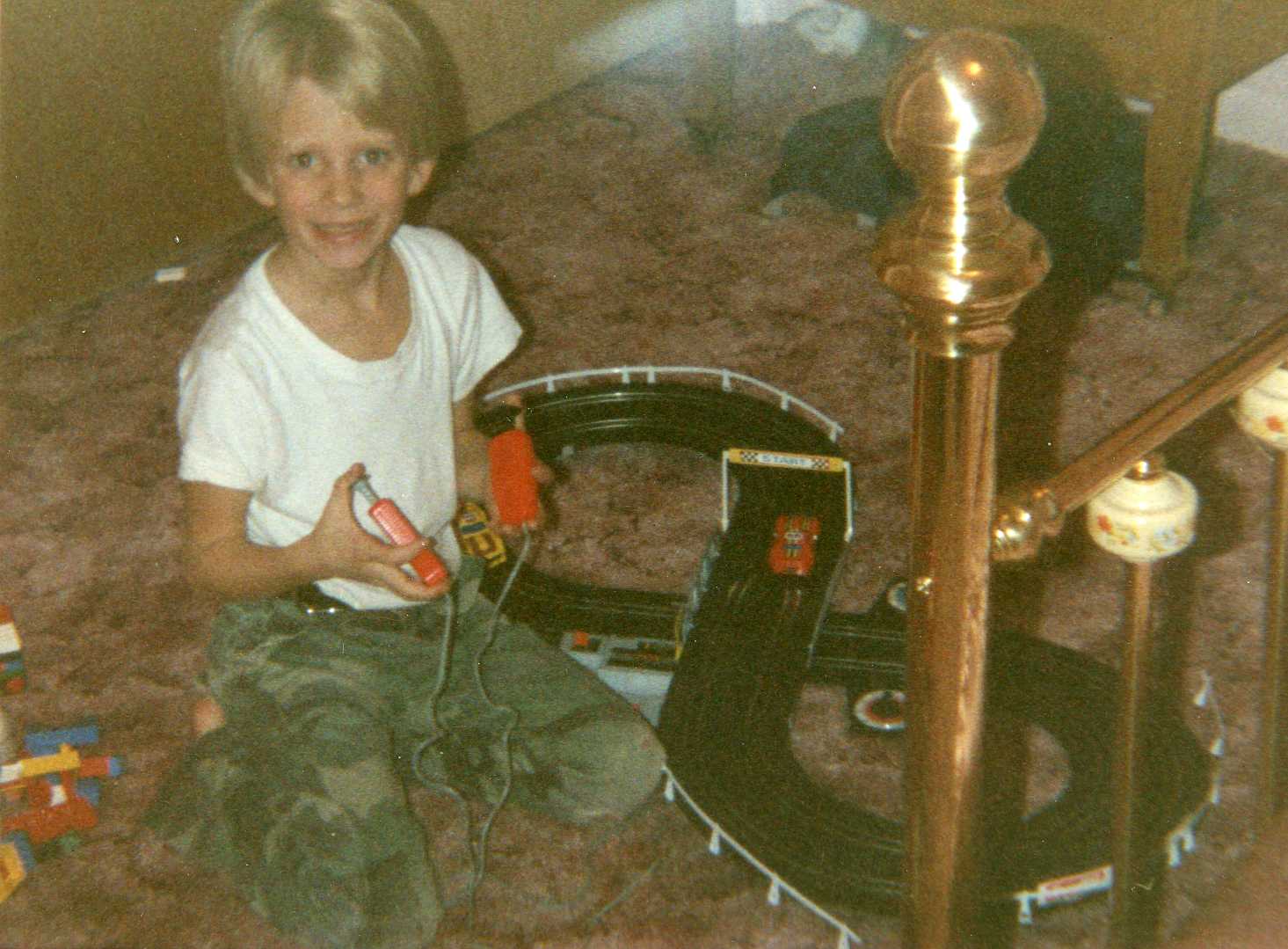
This next picture is from a Christmas about 1988, give or take a year.

This picture is taken in my sister’s bedroom with the pink carpet and brass bed.  This is probably a day or two after Christmas since I had moved the location of the track.  Notice the legos, probably a new addition as well.  The longer hair, the cargo pants, and a new racetrack, and I look like I am having a ball.  I remember loving that little track (and many years of legos) but my greatest memory of this Christmas is something else.

Somewhere I had picked up a bad habit.  Rather than saying something like, “I really like…” I would say, “Me likes…” and my Mom was not pleased.  Since I was home over the Christmas Break, my Mom caught me saying it multiple times and gave me some very stern warnings.  At some point, sitting somewhere on the floor near where I am, I remember saying the “me” language multiple times in a series of sentences and my Mom reaching out and knuckling me on the head so hard I cried.  From that point on, I got a knuckle on the head if I said it.  Within days the habit was broke and I am now a better man.  Unfortunately, Mom’s grammar has slipped where she is now, and I cannot help but shake my head at the knuckles I got over the years for the very same grammar mistakes she now makes; i.e. caint as opposed to cannot or can’t.

I have a couple of other pictures from this Christmas, most notably where I was given my first saddle.  But that one will have to wait before I share it (because I am in my underwear and a shirt and sitting on it).

At any rate, I miss the memories of Christmas past.  While I love my family now, I miss all the extended family being together, the massive Christmas meals, and listening to the stories of people chat after dinner while we played with toys.  Perhaps someday when I live closer to family, the new memories similar to those of mine in the past will be recreated for little Aliza.  Christmas is about family being together, not the gifts we give (and maybe even a lesson or two, perhaps even grammar).