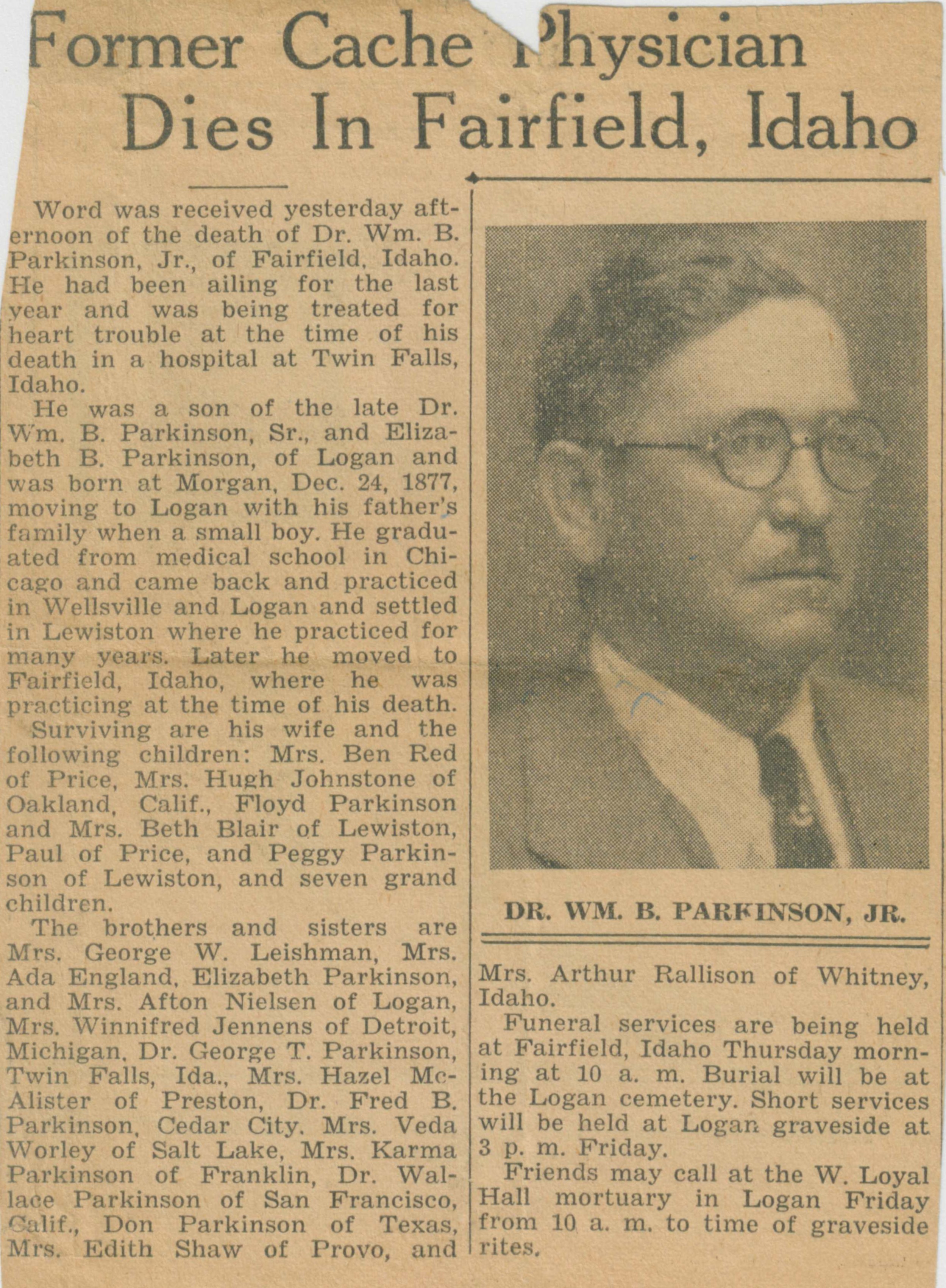
I wrote previously of a book I have that belonged to my Great Grandfather, Joseph Nelson Jonas. The book was given to me by Ellis Jonas along with a couple of others. Inside the book was this clipping, presumably put there by my Great Grandmother, Lillian Coley Jonas. I have no clue about its significance, if any. It was clipped and put there in the book for some reason.
“Word was received yesterday afternoon of the death of Dr. Wm. B. Parkinson, Jr., of Fairfield, Idaho. He had been ailing for the last year and was being treated for heart trouble at the time of his death in a hospital at Twin Falls, Idaho.
He was a son of the late Dr. Wm. B. Parkinson, Sr., and Elizabeth B. Parkinson, of Logan and was born at Morgan, Dec. 24, 1877, moving to Logan with his father’s family when a small boy. He graduated from medical school in Chicago and came back and practiced in Wellsville and Logan and settled in Lewiston where he practiced for many years. Later he moved to Fairfield, Idaho, where he was practicing at the time of his death.
“Surviving are his wife and the following children: Mrs. Ben Red of Price, Mrs. Hugh Johnstone of Oakland, Calif., Floyd Parkinson and Mrs. Beth Blair of Lewiston, Paul of Price, and Peggy Parkinson of Lewiston, and seven grand children.
“The brothers and sisters are Mrs. George W. Leishman, Mrs. Ada England, Elizabeth Parkinson, and Mrs. Afton Nielsen of Logan, Mrs. Winnifred Jennens of Detroit, Michigan. Dr. George T. Parkinson, Twin Falls, Ida., Mrs. Hazel McAlister of Preston, Dr. Fred B. Parkinson, Cedar City. Mrs. Veda Worley of Salt Lake, Mrs. Karma Parkinson of Franklin, Dr. Wallace Parkinson of San Francisco, Calif., Don Parkinson of Texas, Mrs. Edith Shaw of Provo, and Mrs. Arthur Rallison of Whitney, Idaho.
“Funeral services are being held at Fairfield, Idaho Thursday morning at 10 a. m. Burial will be at the Logan cemetery. Short services will be held at Logan graveside at 3 p. m. Friday.
“Friends may call at the W. Loyal Hall mortuary in Logan Friday from 10 a. m. to time of graveside rites.
I have two copies of the History of Plain City, Utah. The front indicates it is from March 17th 1859 to present. As far as I can tell, the book was written in 1977. At least that is the latest date I can find in the book.
One copy belonged to my Grandparents Milo and Gladys Ross. My Grandpa has written various notes inside the history which I intend to include in parenthesis whenever they appear. They add to the history and come from his own experience and hearing.
I will only do a number of pages at a time. I will also try to include scanned copies of the photos in the books. These are just scanned copies of these books, I have not tried to seek out originals or better copies.
History of Plain City March 17th 1859 to present, pages 141 through 149.
BONA VISTA IMPROVEMENT DISTRICT
SUBMITTED BY FLOYD PALMER
This most important new culinary water system has made life a little more pleasant in this community and surrounding areas. It was turned into the lines just a century after sturdy pioneer families first put together temporary shelters and tapped several sweet water springs which they found in the area.
It replaces old flowing wells, bringing precious waster from the depths of the earth. In early days many deep and surface wells dug, covered over, and fenced off to keep children from falling in. They were first fitted with “pitcher” pumps, a short-handled affair which were the “pumper” out in a short time. Even the farm animals had to depend on well water pumped to the surface by hand.
Later, the easier to work, long-handled pumps were installed. These were followed by power pumps connected to a small storage tank. This was the ultimate in a private water supply.
In 1955, a Weber County man, Linn C. Baker, was a member of the State legislature. He is the one who sponsored the bill to create special improvement districts. The reason he was the sponsor of this bill was due to his work in the Health Department for the State of Utah. As he studied samples of water sent to him from the outlying towns, he became aware of the amount of contamination there was in the drinking water in certain areas, Plain City was among the highest on the list. This was traceable to shallow surface wells being used, also septic tanks with poor drainage.
Soon after the Weber Basin Conservancy District was organized, Plain City wanted to purchase one-thousand-acre feet of water. Their request was held in abeyance until a line could be built from Ogden Canyon. This, however, was never done.
Elmer Carver was on the executive committee of Weber Basin Project. Through the encouragement of Commissioner Carver, Mr. Ezra Fjeldsted, manager of Weber basin Project, and Linn Baker, all met with the Plain City Town Board to get something started. Floyd A. Palmer, a member of the Town Board, was asked to represent Plain City on a committee of surrounding towns in Weber and Davis counties. Mr. Ezra Fjeldsted acted as chairman of this group and several meetings were held in both counties which Mr. Palmer attended.
Following this, a public meeting was held in Plain city. Farr West, and Harrisville were asked to join in. This was for the purpose of starting a culinary water system. The results of this meeting, from all groups attending, were to go ahead, also to contact other nearby towns and get their feelings about joining in.
A series of meetings were held in Farr West, Harrisville, Slaterville, Marriott, Wilson Lane, and Plain City. Other towns were invited to attend. Ezra Fjeldsted represented Weber Basin, Floyd A. Palmer represented Plain City, Dick Groberg represented Farr West, Kenneth Brown represented Harrisville, Clifford Blair represented Marriott and Slaterville, and Arthur W. Sorensen represented Wilson Lane. The meetings were all met with a great deal of enthusiasm and interest.
Plain City Town Board consisted of Lee Olsen, President, Floyd A. Palmer, Elvin H. Maw, Merrill Jenkins, Blair Simpson, as members. A culinary water system was a prime item of the agenda in 1956. The town board along with several local residents were well organized to promote the need for a water supply to replace the surface wells and pumps.
On July 19, 1956, Elmer Carver, Chairman of the Board of County Commissioners of Weber County, State of Utah, signed a certified documents that there be and is hereby created within Weber County, Utah, a Water Improvement District to be known and designated as the BONA VISTA WATER IMPROVEMENT DISTRICT, the same to embrace and include all real property lying within the following boundaries, to-wit: (SETS FORTH DETAILED LEGAL DESCRIPTION OF DISTRICT BOUNDARIES WHICH BOUNDARIES EMBRACE LANDS HEREIN ABSTRACTED – Abstracter)
That the following-named persons are appointed as the Board of Trustees of said Bon Vista Water Improvement District:
Floyd A. Palmer, Plain City
Richard Groberg, Farr West
Kenneth Brown, Harrisville
Clifford Blair, Marriott-Slaterville
Arthur Sorensen, Wilson Lane
This resolution shall take effect immediately and shall be recorded in the office of the Weber County Clerk. Recorded August 22, 1956.
Following this appointment from the Weber County Commission, the board held a short meeting. It was necessary to elect a chairman, after a discussion of each of the board members. Kenneth Brown was appointed as chairman.
The first order of business was to secure professional and legal help. Mr. Jack Richards was appointed attorney. Jack Reeves, of the firm of Nelson, Reeves and Maxwell, was appointed engineer. They were appointed to do the field work and present the plans and drawings back to the board.
When the plans were completed, the board spent much time deciding the most feasible and economical areas to run the lines in. Also, to give each town a fair share of the project. Following this, it was necessary to project estimated costs. The board spent many months getting costs and deciding on types and kinds of pipes and materials to use on the project. The overall plans had to look attractive and feasible in order to get a bonding company to handle the bonds.
The first step made to secure the bond issue was to get signed pledge cards with an agreement to pay $250.00 for a waster connection. This was a requirement. Committees were organized with Floyd A. Palmer, Richard Groberg, Kenneth Brown, Clifford Blair, and Arthur Sorensen acting as chairman in each of their respective towns. The result was very successful, all those serving on these committee are deserving of much credit for their untiring effort and accomplishments.
On August 20, 1957, a bond election was held to see if the residents would approve a $900,000.00 bond issue. The vote was 490 yes and 82 no. Edward L. Burton Company was retained as Fiscal Agent, and $698,000.00 was sold in General Obligation Bonds, and the system was under way.
On April 14, 1958, a contract was awarded to Smith-Scott Pipe Company to furnish cement mortar-lined steel pipe for the main lines.
Also, on April 14, 1958, a contract was awarded to Knudson Construction Company to install water mains in the Harrisville-Randall area which was Phase I of the project.
Also, on April 14, 1958, a contract was awarded to Chicago Bridge & Iron Company to furnish and erect a 250,000.00 gallon elevated storage tank in Plain City.
On April 28, 1958, Theron Palmer was hired as General Superintendent to oversee construction and to get it ready to serve and operated as a system.
On May 27, 1958, an office was rented from the E. B. Stone Estate on the corner of 9th and Washington. The district still maintains its offices here. The building was purchased by the district in 1969 and has been remodeled.
On May 27, 1958, negotiations were begun with the State Department of Welfare of obtain ownership of a spring located in Garner’s Canyon in North Ogden. The spring was used at the time by the welfare department at the Industrial School property for culinary use and irrigation use.
On May 27, 1958, Weber Basin let a contract to Statewide Construction Company to build the 16-inch transmission line from 4000 South on U-84, down into the district where Bona Vista could connect to it.
Also, on May 27, 1958, a piece of property located at 4100 West on 2200 North in Plain city, was purchased from Vern Palmer to construct the elevated tank.
Bona Vista Water Storage Tank
Raymond Concrete Title Company moved in and drove concrete pilings 80 feet into the ground to support the tank.
Gerald Larkin was then awarded a contract to construct a foundation so Chicago Bridge and iron could begin erection.
On July 3, 1958, a contract was awarded to Bert Robinson Construction Company to build lines in the Farr West and Plain City.
Also, on July 3, 1958, Standard Plumbing Supply Company was awarded a contract to furnish materials for service lines.
On July 17, 1958, the Weber County Commission agreed to purchase 60 fire hydrants to go on the system to be located by the Weber County Fire Chief.
On July 17, 1958, Smedley construction Company was awarded a bid to construct lines in the Slaterville, Marriott, and Wilson area for $44,975.00. The same day Mac Construction Company of Salt Lake City was awarded the bid to construct our North Ogden Reservoir for $16,911.00. This is a concrete underground reservoir.
On August 11, 1958, an agreement was reached with the Welfare Department to obtain full use of the spring in North Ogden. Weber-Box Elder water was purchased to replace the Welfare Department’s share of the spring.
On February 11, 1959, work began on the plans and site for a reservoir in the Roy area.
On March 23, 1959, it was decided to run a line on the North Plain City Road.
On August 27, 1959, it was decided to either buy or condemn the Hansen property for a reservoir.
A bid to build a tank in Roy was awarded to Wehyer Construction Company for #31,403.80 on September 23, 1959.
Negotiations began to buy an eight-foot well from the Farr West Stake for $31,403.80 on September 23, 1959.
Linn C. Baker resigned as Secretary on January 1, 1961. He had been with the district since it began.
On December 6, 1961, it was decided to construct extensions to existing mains in the amount of $90,000.00 General Obligation Bonds were sold to finance these extensions. Waterfall Construction Company did the job.
All though the summer of 1961, the Farr West well was tested to see if it would hold up.
On February 28, 1962, President Wimmer signed the Warranty Deed on the Farr West well and property. On January 16, 1963, it was decided to put heat lights on our Roy tank. This was the first such installation in this area and it drew a lot of attention.
The Utah State Health Department studied the plans for use of the plans for use of the existing well in Farr West and decided against allowing it to be used because of its depth. A change application was then filled with the State Engineer to drill the well to a deeper depth.
On May 10, 1963, a contract with Wesley Stoddard was made to drill a well in Farr West for $21,632.00 plus $4,700.00 for the test hole to see how deep the well would have to go.
A meeting was held at the Farr West Pump House building on January 20, 1964. This building was contracted by the Bona Vista Water employees. The piping was also done by employees of Bona Vista.
R. W. Coleman Company was awarded a contract for $18,877.50 to change some lines under the interstate highway on November 22, 1965.
Negotiations began on March 28, 1966, with Weber Basin on the North Ogden Well, which was later drilled and is used in the system now.
Water meters were deemed necessary and were bought by bid from Waterworks Equipment Company and E. C. Olsen Company on October 28, 1968.
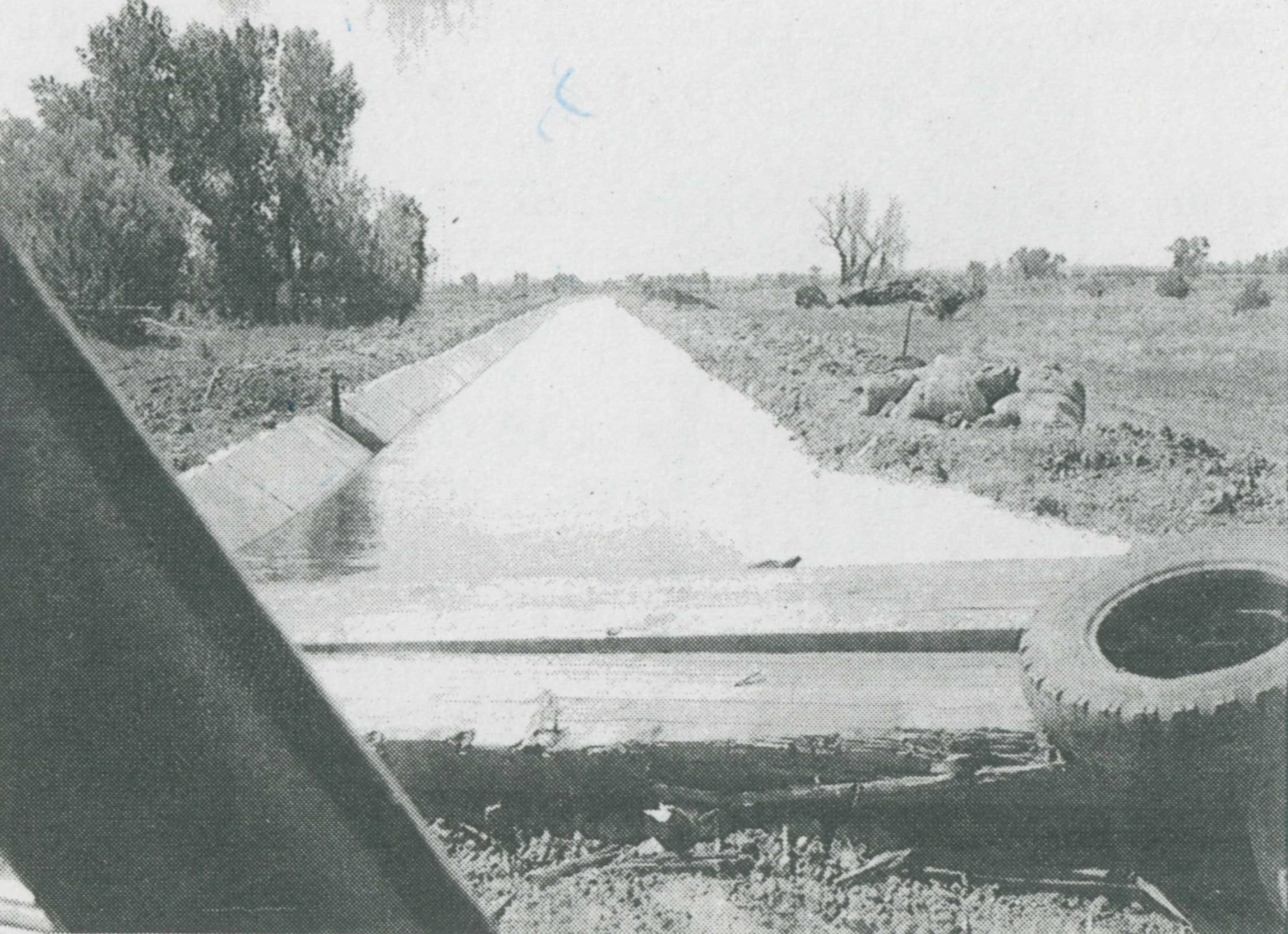
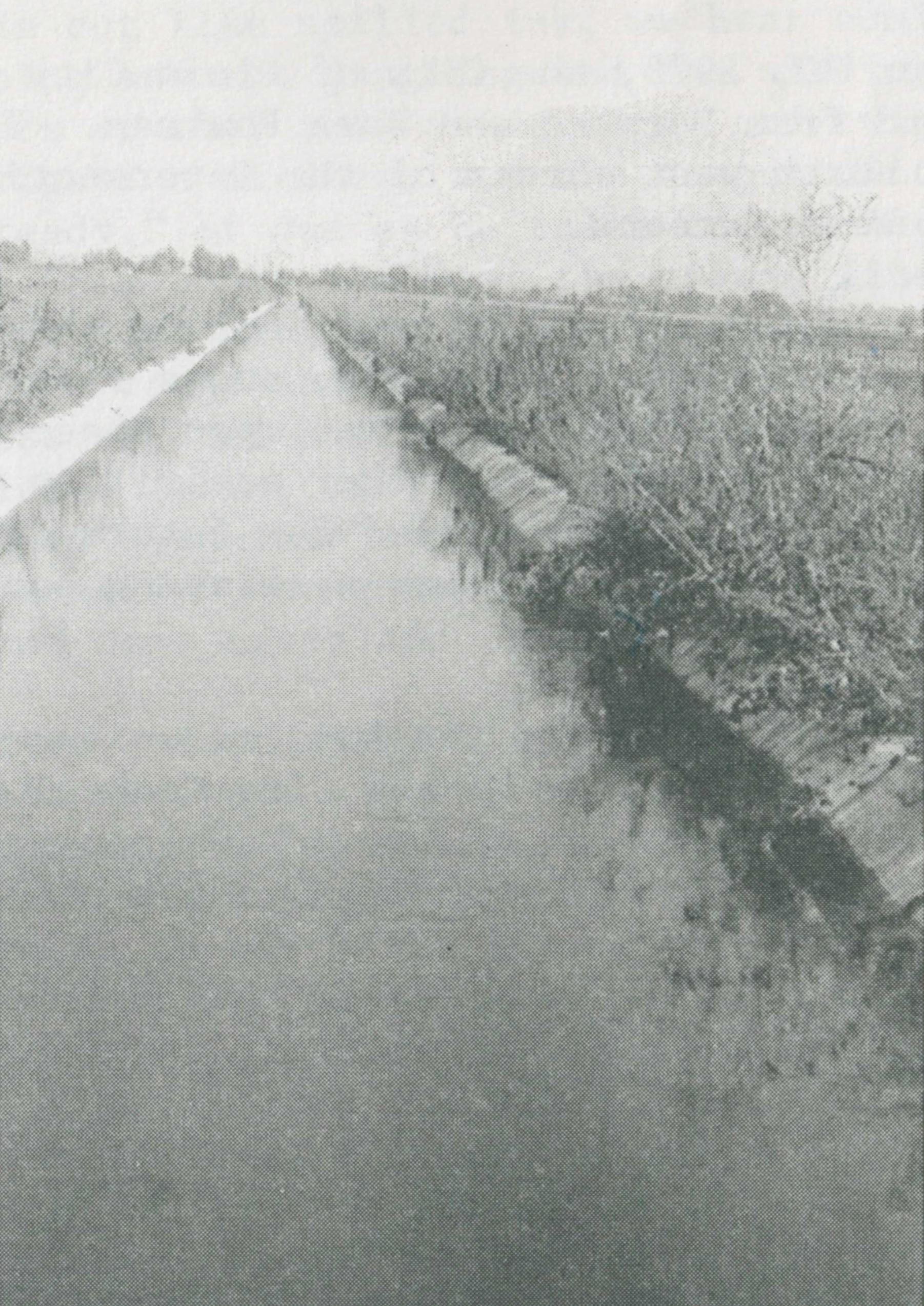
New Plain City Canal
BEGINNING OF PLAIN CITY IRRIGATION WATER
1859 Before the summer was over some water had been brought in their new ditch from Four Mile Creek to Plain City. In 1860, the Canal was completed to Mill Creek, the following year to Broom’s Creek and in 1862 to the Ogden River. The Right of Way in Weber River was purchased in 1873 at a cost of $2000.
In 1899 Samuel Wayment drilled an Artesian Well 249 feet deep producing additional water for the settlers. He also was in charge of the iron work and the building of the Chief Canning Factory in Plain City.
PLAIN CITY IRRIGATION-CEMENTING OF THE MAIN CANAL
SUBMITTED BY Wayne Skeen
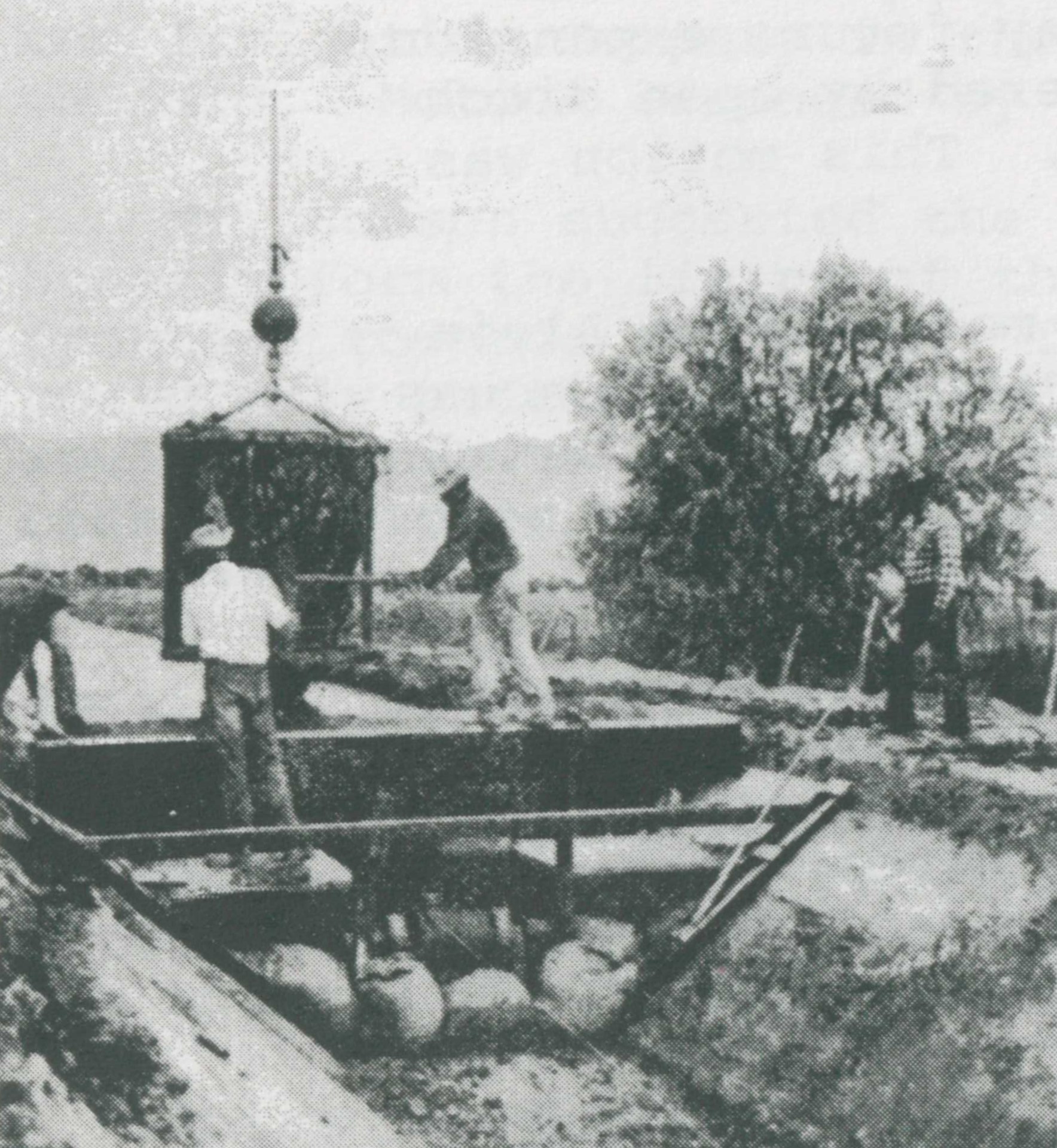
For many years the Plain City Irrigation Company received it’s water from the Weber River. The diversion point into the canal was just north of the old American Packing Plant that was later called the Swift Meat Packaging Plant. The Irrigation Company had a large Plank Head Gate in the Weber River that forced the water into the Plain City Irrigation Company Canal because of high waters in the spring this gate would wash out and it was necessary to make a gravel and dirt dam each year using horses, scrapers, and even large bulldozers. In recent years this became a major problem.
The government began planning the Willard Project in 1960. This project would interfere to a certain extent with the existing canal used by the Irrigation Company because big Willard Bay Canal would be built in part of our existing canal and would also cross it in part of our existing canal and would also cross it in other areas. The leaders of this project wanted to provide a turn out from the big canal into the Plain City Irrigation Canal. The corporation of our company was necessary to give them the right to use the area affected by the construction of the Willard Bay Canal. The logical point of diversion would be west of the Farr West Church House. This meant that some new construction would be necessary to get the water into the old canal. It was in need of some repairs and it was at this time that the idea of a new cement lined canal was entertained.
Directors who served during this period of construction were as followed:
President Abram Maw 1959-60
President Alvin J. Robson 1961-65
Vice President Walt Christensen 1959-64
Vice President Carl Taylor 1965
Bert Hunt
Charles Heslop
Keith Blanch
Mike Panunzio
Secretary Wayne Skeen 1959-65
High lights of the minutes of the meetings during the construction period are as follow:
August 11, 1959
Ogden City had extra water for sale this year which was allocated out to various canal companies. A motion was made by Alvin Robson that this water be purchased to see them through the current season. It would be paid by those stock holders who subscribed for the extra water.
April 4, 1960
The meeting was called to discuss the new canal. Charles Heslop was assigned to work on interested free money from the Utah Water & Power board for the construction. Alvin Robson was assigned to work with the Soil Conservation on the completion of the surveying of the canal, and additional monies.
July 12, 1960
A meeting was held to discuss a possible shortage of water for the remainder of the year. Time was changed from 20 shares per hour to 25 shares per hour.
January 9, 1961
A priority was established with the Utah Water an Power board for interest free money and application made for $100,000.00
A survey showed that there was a 10% loss of water between the River turn out and the Point of use.
March 8, 1961
The Irrigation Company received a $10,000.00 cash settlement for their rights in the old canal from the O.U.R.D. Railroad Company that passes through their yards.
Alvin Robson, Carl Taylor, and Walt Christensen was to secure information regarding tiling of the canal from Victor Lund’s corner up to the Jesse Singleton property where the canal leaves the road and runs back into the fields.
April 20, 1961
A report was given by Alvin Robson regarding the tiling of the lower part of the canal. There were mixed emotions about tiling this section of the canal because of the fall and the amount of water to be delivered. “Alvin Robson commented as the discussion went on concerning the piping verses the cement lining. The stockholders are residents of this town and should have some concern towards the improvements and beautification of the community and that an open cement lined canals to greet the people entering the town is not very inviting and once it was constructed it would never be changed in our life time.”
Keith Blanch speaking as a town board member expressed his opinion regarding the beautification and eliminating hazards in the community and felt that it was worth while and the tax payers should help with the construction of the Irrigation Company in piping this section of the canal.
Glen Charlton and Lee Olsen from the town board were present. An opinion was asked from the town board members. Mr. Charlton felt it was a worth while project as long as it was right. Mr. Olsen commented that it was a good thing as long as it was sufficient to meet the needs of the water users.
The town board members agreed to cover the pipe that was laid with dirt. It was agreed that 2880 feet of 36 inch tile would be laid this spring from the old beet dump corner to Victor Lund’s corner.
April 27, 1961
The Town board members present: Dee Cook, Glen Charlton, Kent Jenkins, and Lee Olsen. Mr. Covey from Utah State University was also present.
Further discussion concerning cost of construction of the concrete pipe continued. Keith Blanch made a motion that the town board and property owners should join with the Irrigation Company in the cost of the 36 inch tile to be laid. Motion seconded by Carl Taylor
Mr. Robson suggested the property owners who would benefit from the lining of the canal pay $1.25 per foot frontage towards the pipe. The Town Board said they could only participate within the city limits and they would contribute $4,000.00 over a 10 year period. The bids were to be sent to Secretary Wayne Skeen by March 30, 1961.
April 30, 1961
The purpose of this meeting was to open bids. Utah Concrete Pipe Company received bids for 36 inch concrete pipe at $8.75 per foot. Waterfall Construction Company was awarded the laying of the pipe at $1.55 per foot.
Abram Maw made the motion that the project not be stopped at the beet dump corner but continue up to the up to the weir east of the water tower (where the pipe portion of the canal now starts) if the property owners will contribute $1.25 per foot. Motion seconded by Keith Blanch.
Charles Heslop ad Elvin Maw were asked to approach these property owners and get their approval to pay the $1.25 and also contact all stock holders and get their signature for government participation thru the Soil Conservation.
Charles and Elvin were successful in getting all the names except Jesse Singleton who would not accept any government monies and would not pay the $1.25 per foot to tile in front of his property.
Alvin Robson contracted Howard Singleton, Jesse’s boy and he agreed to pay the $1.25 but only up to the old house that sat in the field and that is where the concrete pipe starts today. Alvin Robson tried to convince the Director’s that they should at the company’s cost tile the remainder of the ditch along the road because any future expansion of the community would by hampered by open ditch reducing the width of the road. This motion turned down.
Walter Christensen made the motion that Alvin Robson meet with the Soil Conservation to discuss details of cost and tiling and lining the canal.
April 31, 1961
Alvin East, Maurice Skeen, and Owen Wayment from the Warren Irrigation Company met with the directors to discuss details and sign a contract for the exchange of Ogden and Weber River which would benefit both companies. The contract was signed.
Mr. Daniel Lawrence from the Utah Water & Power Board attended the meeting. Keith Blanch made the motion that Alvin Robson and Wayne Skeen be given the power to enter into a contract with the Utah Water & Power Board for the total cost of $1,300.000.00 and formulate all details.
May 3, 1961
Junior Taylor was appointed as Water Master of the year.
May 15, 1961
The purpose of this meeting was to discuss the Weber Basin Project with E.J. Feldstead and commissioner Wilmer Carver. They needed additional votes to finish construction of the Willard Bay. A proposed addition would cost seventeen million dollars.
June 5, 1961
The purpose of the meeting was to see what should be done because it appeared that there would be a water shortage before the end of the year. It was proposed that we only run off water until the stream reached a point that we could not water properly and then start to use our shortage water and put turns on 1/3 basis.
September 27, 1961
The new project was discussed and it was recommended that the company hire an engineer and begin construction on the upper end of the new canal.
There were many problems that came out of the construction of this canal. It would be necessary to get some dirt to construct the pad for the canal. The company purchased some ground at the upper end of the canal from Max Stander. Then got the dirt that was necessary to build the upper end of the canal and then leveled the ground and gave it back to Mr. Stander. They also purchased additional dirt from Robert Penman. This dirt was trucked from his property just south of the Weber River and west of the main road. The dirt was hauled by farmers using their beet trucks, etc.. The new pad was made in the old canal banks where possible, but there was some trading of land etc. to straighten out the canal. There was also a problem in getting someone to dig out the canal to the size and shape required to allow 50 seconds feet of water at one time. The company asked for bids, but they only received one because the equipment needed to shape the canal was not available. In order to get the project moving Alvin Robson caught a bus on Ogden and went to the Fuller Forms Company in Arizona to see if they had some type of equipment that could be used. He purchased a right to one of their slip forms that could be used in forming and pouring the concrete. He returned to Ogden and worked with the Ogden Iron Works on 23rd Street and Grant Avenue where the construction of the slip forms took place. The next problem was to begin the construction of the project. Dean Hadley of Taylor was hired to do most of the big equipment work. Local farmers also helped with their equipment. The Soil Conservation furnished the engineering on the project. Herbert Issackson of Pleasant View was the surveyor. One of the major problems that existed and is still a yearly discussion is the amount of water delivered from the existing head gates. The government required that curtained head gates must be varied in size for them to participate financially.
Oct 1962
There was much contention and personal feelings during the construction of how it should be done. Some people left the jobs and never came back, but the project was finally finished. The construction created problems for some but most of the inconveniences were ratified by the Irrigation Company. New bridges were built, land was leveled, damages to property was crops were paid for during the construction. The Company paid for fencing materials with the property owners installing the fences. Cattle that used to walk across the stream would fall into the new lined canal and couldn’t get out. The Company paid for some of the cattle that were lost before the agreement to install fencing was made.
The total cost of the project was $199,754.08. The amount of $122,918.61 was borrowed from Utah Water & Power Board. This money was interest free if a yearly payment was made by November 30th each year. The last payment of $8.257.06 will be paid on November 30, 1977. Other cost not being paid by the stockholders come from the Soil Conservation and the sale of pieces of the old canal, and the town board. Vice President Bill Hatch of the First Security bank was also an asset in the financing of the canal.
We borrowed monies from the First Security Bank as construction went on to pay for cost on a daily basis. On December 31, 1974, the company owed the First Security bank $60,000.00 Alvin Robson and Wayne Skeen met with Mr. Hatch in May regarding this bill. Mr. Hatch said that the bank needed some type of security for this loan. There was nothing to give him because out rights to the canal had been given to the Utah Water and Power Board. Alvin Robson and Wayne Skeen then approached Mr. Lawrence of the Utah Water and Power Board asking them for more money for the project explaining the situation with the bank. Alvin Robson explained that they might just as well take over the ownership of the canal because the bill had to be paid. There was nothing to offer as security because the Utah Water and Power board had everything that the company owned. Later, Mr. Lawrence of the Utah Water and Power Board gave the Irrigation Company an additional $30,000 which helped to delete that note at the First Security Bank.
Ole and Constance Christiansen are pleased to announce the marriage of their daughter Martha to Herbert Coley, son of Stephen and Hannah Coley. They were married in 1874 in Norway. While I normally like to start these historical posts as a wedding announcement, I trip up there. We do not have any histories that give us an actual marriage date and location. Knowing the period, it is not imagined they were not actually married. Their first child was born in 1875. Curiously, after their immigration to the United States due to their conversion to The Church of Jesus Christ of Latter-day Saints, they not only went to the Logan Utah Temple to be sealed, but also applied to be married. As such, they were married and sealed in the Logan Utah Temple on 26 April 1893.
Martha was born the second of eleven children to Constance Josephine Eliza Jorgensen and Ole Christiansen on 16 April 1879 in Fredrickstad, Ostfold, Norway. I have not written their history yet, but as linked above, I wrote some limited information on Constance when we visited her grave first in 2018 and again in 2020. Ole was born in Trogstad, Norway and Constance in Drammen, Norway. Both Ole and Constance were baptized and confirmed into The Church of Jesus Christ of Latter-day Saints on 26 January 1876 in Norway.
What happens for the next few years is unclear on the reasons. Martha’s older sister, Walborg, was born 24 December 1875 in Fredrickstad, then Martha in 1879. We really have no records during this period and so I am unclear if there was another child, or two, in that period of time. Eivelda was born 20 October 1881 in Melbourne, Victoria, Australia. I have no clue why or what took the family to Australia. Their next child, Constance, was born 9 November 1883 also in Collingwood, then a suburb of Melbourne. Apparently Walborg and Martha were left in Norway while their parents went to Australia. Alice, Martha’s granddaughter recalls Martha telling of her sitting on the mountainside overlooking the fjord waiting for her parents to return and her missing them terribly. Martha’s first brother, Henry Owen, was then born 27 March 1887 back in Fredrickstag, Norway. Ole and Constance were back in Fredrickstag by March 1887.
I have been unable to find the immigration records for the Christiansen family between Norway to Australia and back. But the family was in Australia for at least 3 years, maybe as long as 6 years. They were not back in Norway very long as Rhoda was born in Richmond, Cache, Utah on 18 September 1890. Martha moved with her family to Richmond in the late 1880s. One record has it in 1887, another 1889, Martha was listed in the 1900 Census as immigrated in 1888. Either way, we now are in the vicinity of where she would have met Herbert Coley. Of Martha’s remaining 6 siblings, 5 were born in Richmond and 1 in Hyde Park.
Herbert was born the 5th of 9 known children to Hannah Maria Rogers and Stephen Coley on 12 February 1864 in Lutley, Worcestershire, England. It was while living in Lutley that the LDS missionaries first made a visit. We do not know the conversion story but Herbert and his siblings joined the church. Martha joined 23 August 1867, Herbert 1 June 1881, George 22 August 1881, and Frank 2 June 1882. The 1871 English Census has the family still living in Lutley and Herbert listed as a scholar. The call to gather in Utah was strong enough that these four children made the venture. We don’t know if Stephen and Hannah came begrudgingly or not, but they joined some of their children in Utah. Unfortunately, the other children left in England we do not know where they went or what happened to them.
Herbert shows on the 1881 English Census in Dudley, Worcestershire, England as farm labor for the Doorbar family. Herbert appears to have boarded the Nevada in Liverpool arriving 3 July 1882 in New York City, New York. I cannot see that any siblings went with him on the trip. Stephen, Hannah, and Martha all traveled in 1890 (with Letitia Lea Willetts and her daughter Clara, and two known Frank and Mary Coleys). Stephen Coley was baptized 5 January 1892 and Hanna 26 October 1892 (same day she was endowed in the temple, so either that date is wrong or the prior record could not be found and the ordinance was duplicated. Hannah died 22 October 1894 in Franklin, then Oneida County, Idaho and was buried in Lewiston.
I don’t know any of the details of how they met, but the stars seem to have aligned in Richmond. However it happened, Herbert and Martha were married and sealed 1 December 1896 in Logan at the Temple. Herbert was a diligent laborer who would acquire full ownership in their home by 1910. Martha was a strict and involved homemaker and mother.
Herbert and Martha maintained their home, large garden, and raised 10 children. Lillian was born 26 August 1898 in Lewiston (listed in the Coveville Precinct, which is now the area of Cove). The 1900 Census on 9 June 1900 lists Herbert as a farm laborer with his immigration in 1881 and Martha’s in 1888. By 1910, the Census finds the family in Wheeler (about six miles west of Lewiston) where the home was owned outright. We don’t know exactly where the family lived. Edna was born 23 November 1900, Wilford Herbert 1 Mar 1903, Carrie 20 April 1906, and Hannah Marie 3 June 1909. Ole Christiansen passed away 27 February 1900 in Richmond and was buried there. Carrie is listed as born in Richmond, but we do not know the circumstances how she was born there instead of Wheeler/Lewiston. Hannah’s birth certificate lists Herbert as a farmer and Martha as housewife. The 1910 Census on 26 May 1910 shows Herbert as a Laborer and that he “Works Out.” Whatever that meant in 1910.
All the remaining children were born in Richmond. As such, it is likely at this time the family moved to the cabin south and east of Richmond estimated about 2016 E and 9000 N. I have tried to pinpoint where the cabin remains are still located. Here is a photo of the cabin from the 1980s. The 1920 Census on 16 January 1920 lists Herbert as a Farmer and Teamster with the additional insight of “Hauls Milk & Farms.” This same Census also lists Wilford as having his own Farm, but still living with his parents.
Coley Cabin near Richmond, Utah
It was in this house that the remaining children were born. Ivan Stephan on 26 June 1912, Roland Charles on 20 July 1915, Oley Lloyd on 11 February 1918, Arthur Christiansen on 15 July 1921, and William Golden on 22 January 1924. In 2012 the home had collapsed to a pile of rubble. It was after Ellis Jonas’ funeral we visited as family (Ellis is Lillian’s son). Ellis had taken me there about 2002. Stephen Coley died 22 October 1913 in Lewiston and was buried by his wife.
The 1930 Census taker showed up 15 April 1930 and shows the family in Richmond with Roland, Lloyd, Art, and Golden still in the home. The 1940 Census on 8 April 1940 has the family still in Richmond with Art and Golden the only two remaining.
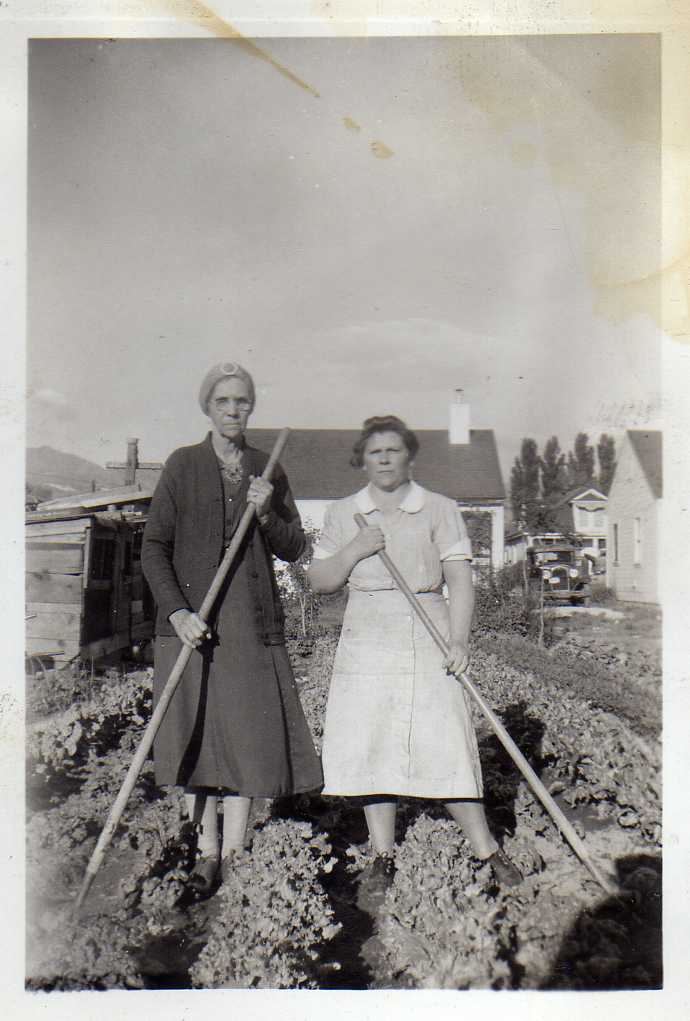
Herbert and Martha Coley in the garden
Over the years, the family kept busy with marriages. Lillian married Joseph Nelson Jonas on 6 September 1917 in the Logan Temple. Edna married Gerald Andrus 17 April 1921 in Richmond and after a short marriage, divorced, and remarried to Olof Alma Neilson 23 July 1923 in Logan, sealed 30 July 1924 at the Logan Temple. Wilford married Edith Dagmar Cammack 15 May 1924 in Logan, sealed 3 June 1946 in Logan Temple. Carrie married Joseph Lorus McMurdie 21 July 1924 in Logan, sealed 21 October 1926 in Logan Temple. Hannah married William Surgeoner Thomson 2 July 1927 in Logan, sealed 14 June 1972 in Salt Lake Temple. Ivan married Clara McMurdie 22 October 1930 in Buhl, Twin Falls, Idaho, sealed 10 February 1932 in Logan Temple. Joseph Jonas passed away 6 September 1932 in Ogden, Weber, Utah. Constance Christiansen passed away 10 December 1932 in Portland, Multnomah, Oregon and was buried there. Roland married Veda Anderson 5 May 1937 in Logan Temple. Lloyd married Verda Anderson (twin sister to Veda) 23 November 1938 in Logan Temple. Arthur married Gladys Bernice McMurdie (his niece!) 10 September 1940 in Preston, Franklin, Idaho, that marriage lasted a short time for hopefully obvious reasons. Arthur remarried to Mary Elizabeth Popwitz (his nephew’s WWII widow) 3 May 1946 in Evanston, Uinta, Wyoming. Golden married Shirley Mae Hall 15 March 1946 in Elko, Elko, Nevada, sealed 11 May 1965 in Logan. Many grandchildren were born in these years as well for Herbert and Martha.
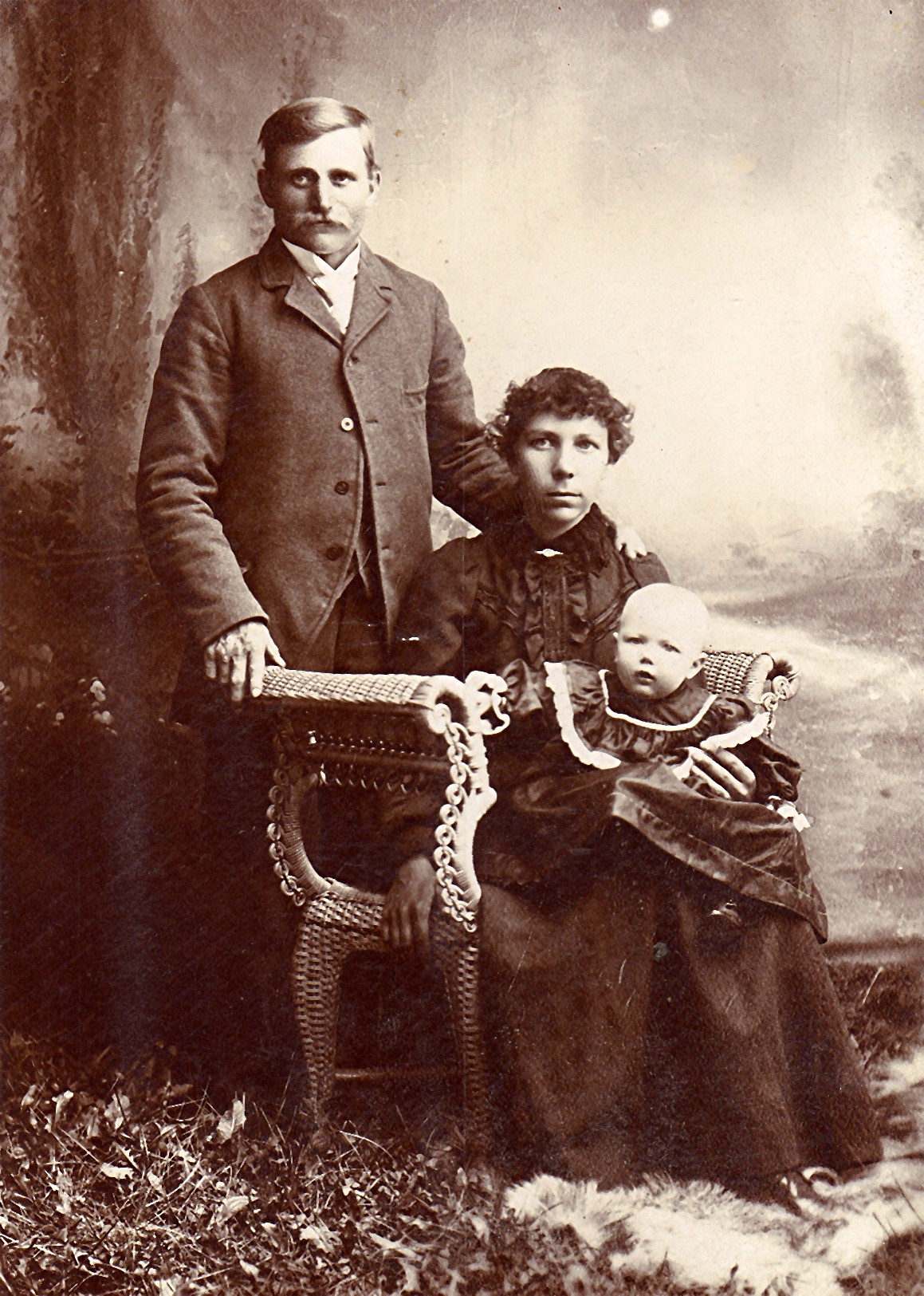
Herbert and Martha Coley (I have the original of Martha, but not of Herbert, so I know it is still out there)
Recorded family stories are fairly scant. Nobody wrote much down and that generation was gone before many were asking questions. Ivan Coley told his daughter Colleen that Herbert was a short, very English man. Apparently Herbert met Wild Bill Hickok at one point and shared that fact regularly.
In 1942, Herbert went to visit Ivan and Clara in Buhl. I will have to find out if Martha was there as well. While out in the yard, I have been told by a well, or a trough, he slipped and broke his hip. There was not really much to do for someone in that condition then. He was in terrible pain. He was taken back to Richmond and passed away later of pneumonia. He died 7 September 1942 at age 78 (obituaries all have 75) and was buried in Richmond Cemetery 9 September 1942.
Martha Coley and Hannah Thomson in a garden, dresses and even a brooch
Martha moved into town shortly afterward. Various family members lived in the cabin when they started out their marriages. Martha’s new home was somewhere near 400 South and 200 East. With the new homes I cannot tell as well, but I have tried to pinpoint the spot. She lived in this home until she needed assistance and went to live with Lloyd and Veda in Salt Lake City. When they could not care for her any more, she then lived in a care facility in Logan the last months of her life.
5 generations about 1959, Lillian Coley Bowcutt, Martha Christiansen Coley, Joseph Hebert Jonas, Robert Lee Jonas, Joseph Leland Jonas.
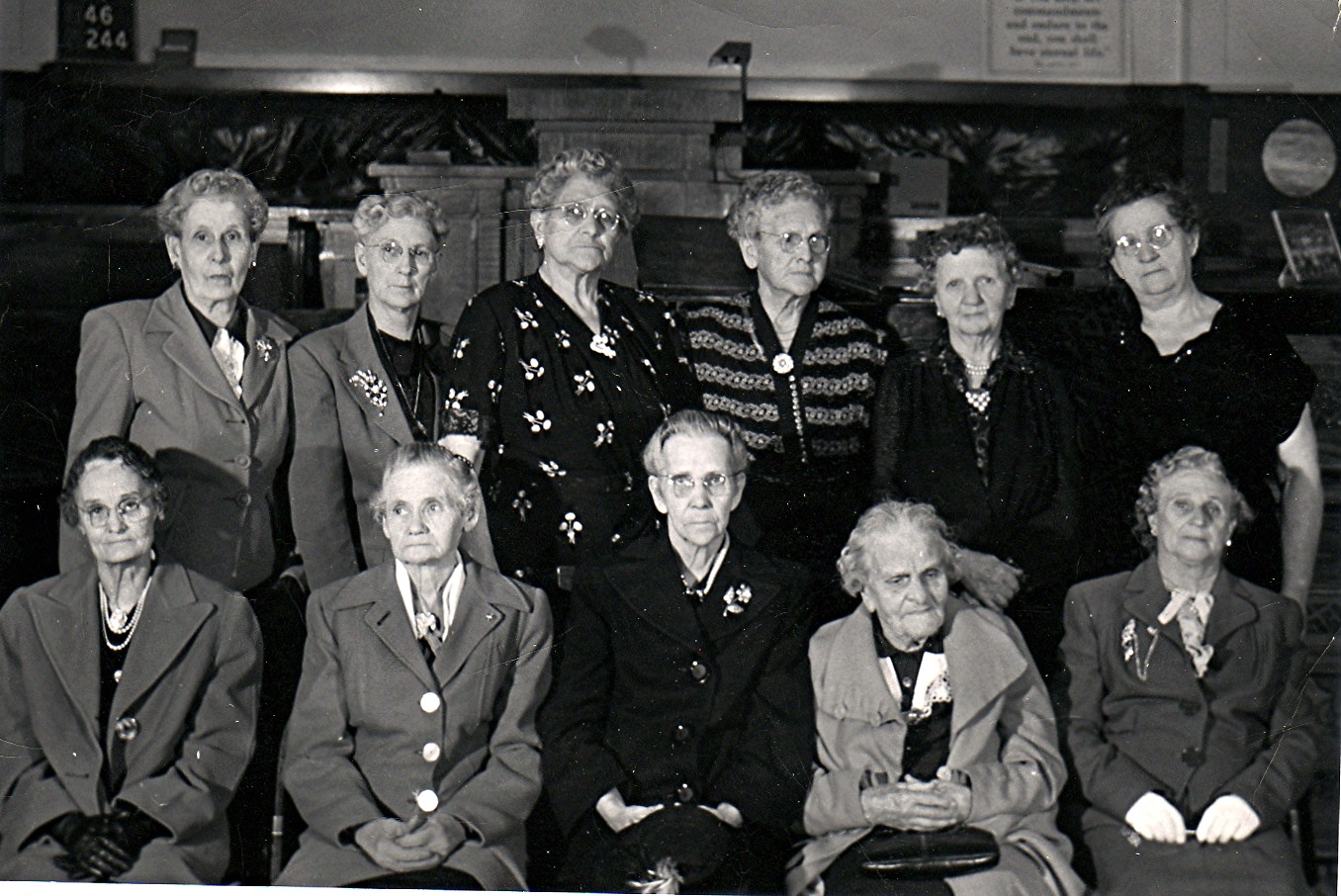
In 1948, Martha was honored for successfully Relief Society Teaching for more than 40 years. Here is a photo from that occasion. You can find more detail here.
Back (l-r): Lydia Leavitt, Estella Blair, Sarah Preece, Susanna Allen, Livinia Wilcox, Clara Wheeler. Front: Lavina Poulsen, Christensia Hansen, Martha Coley, Martha Lewis, Sarah Snelgrove.
Unfortunately I do not have a many more stories. But I do have a few more photos. We have these two photos of a gathering about 1950.
Back(l-r): Doreen Neilson, Martha Coley, Golden Coley, Edna Neilson, Unknown, Gloria Neilson holding unknown child, Olof Neilson. Middle: Shirley Coley, Joy Coley (baby), Mary Coley,
Mary (holding Joy), Shirley, Doreen, Unknown, Martha, Edna, Gloria
This wonderful family reunion picture from 1955. I have linked the other post sharing the other photo. That link also names everyone in the photo. Martha is sitting surrounded by her grandchildren and children.
1955 Coley Reunion, Richmond, Utah
Herbert’s obituary in the Salt Lake Telegram on 8 September 1942 reads:
“Richmond, Cache County – Funeral Services for Herbert Coley, 75, who died at his home in Richmond Monday at 7:45 a.m. following a brief illness will be conducted Wednesday at 1:30 p.m. in the Richmond South L.D.S. ward chapel by E. M. Hicken, Bishop.
“Mr. Coley was born in England on February 12, 1867, a son of Stephen and Hannah Rogers Coley. In 1885, at the age of 16, he immigrated to the United States.
“On December 1, 1896, he married Martha Christiansen in the Logan L.D.S. temple. He was a prominent farmer in the Richmond district.
“Surviving are his widow of Richmond, 10 sons and daughters, Mrs. Lillian Jonas, Ms. Edna Nielsen and William Golden Coley of Richmond, Wilford Herbert Coley of Logan, Ms. Hannah Thomson and Lloyd Coley of Salt Lake City, Ms. Carrie McMurdie, Ivan, Roland and Arthur Coley, all of Buhl, Idaho, 37 grandchildren, three great grandchildren, and a sister, Mrs. Martha France of Richmond.
Lillian, Edna, Martha (sitting) Coley in the 1940’s
“Friends Pay Tribute to Richmond Man
“Funeral Services for Herbert Coley, 75, prominent Richmond farmer who died at his home in Richmond, Monday at 7:45 a.m. following a brief illness, were conducted Wednesday at 1:30 p.m. in the Richmond South ward chapel by Bishop E. M. Hicken.
The rest of the article follows nearly verbatim what the Salt Lake obituary listed, then this line.
“Burial was in the Richmond cemetery under direction of the W. Loyal Hall mortuary.
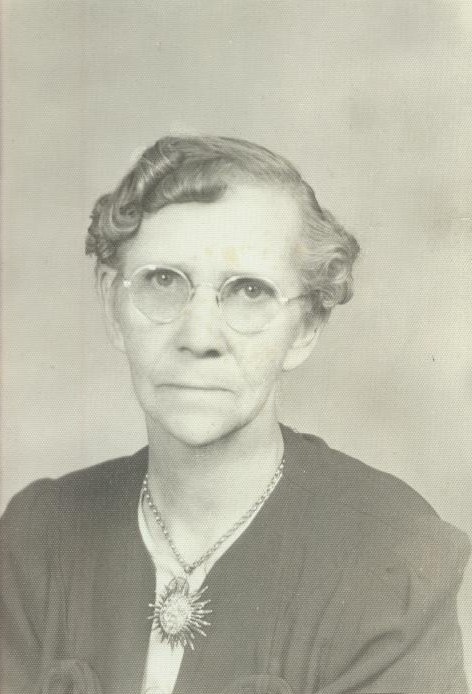
Martha Christiansen Coley very small picture enlarged
Martha Coley and Scotty
Martha Coley serious
Martha Coley smile
Martha passed away in Logan at age 82 on 14 August 1961. Here is the language from her obituary and an article of the funeral. She was buried in Richmond 17 August 1961.
“Richmond – Martha Christensen Coley, 82, died at a rest home in Logan Monday of causes incident to age. “She was born April 16, 1879 in Norway to Ole and Constance Josephine Eliza Jorgensen Christensen. When she was eight years old she came with her parents to America. “On December 1, 1896 in Logan she married Herbert Coley. The marriage was solemnized in the Logan LDS Temple in 1900. They made their home in Lewiston and Richmond. She was always active in the LDS church, especially as a Relief Society block teacher. Mr. Coley died September 7, 1942. “Surviving are Mrs. Lorenzo (Lillian) Bowcutt and Mrs. Edna Neilsen, Richmond; Wilford H. Coley, Logan; Mrs. William (Hannah) Thompson and Lloyd O. Coley, Salt Lake City; Mrs. Lars (Carrie) McMurdie and Ivan S. Coley, Buhl, Idaho; Roland Coley, Mesa, Arizona; Arthur C. Coley, Ogden; William G. Coley, Hyrum; a number of grandchildren and great grandchildren. “Funeral services will be held Thursday at 1 p.m. in the Richmond South Ward with Bishop Oral Ballam in charge. “Friends may call at Hall Mortuary in Logan Wednesday from 7 to 9 p.m. and at the South Ward chapel Thursday from 11:30 a.m. until time of services. Burial will be in the Richmond Cemetery.
“Funeral services were held in the Richmond South Ward chapel Thursday for Mrs. Martha C. Coley with Counselor Quentin Peart conducting. Lloyd Coley gave the family prayer. “Prelude and postlude music was played by Reese Murray. The ward chorus directed by Mrs. Florence Lewis with Mrs. Billie Lou Bagley as accompanist sang “The Lord’s Prayer.” Ila Rae Richman and company sang “That Wonderful Mother of Mine.” Mrs. Florence Lewis and Mrs. Rebecca Lewis sang “In the Garden,” and Ronnie Lewis sang “Beyond the Sunset.” “Prayers were by William Thomson and Larus McMurdie. Speakers were Mrs. Leona McCarrey who read the obituary, Noel Stoddard and Counselor Peart. Pallbearers were her six sons, Wilford, Ivan, Roland, Lloyd, Arthur and Golden Coley. The grave in Richmond Cemetery was dedicated by Joseph Jonas. Flowers were cared for by the Relief Society.
~
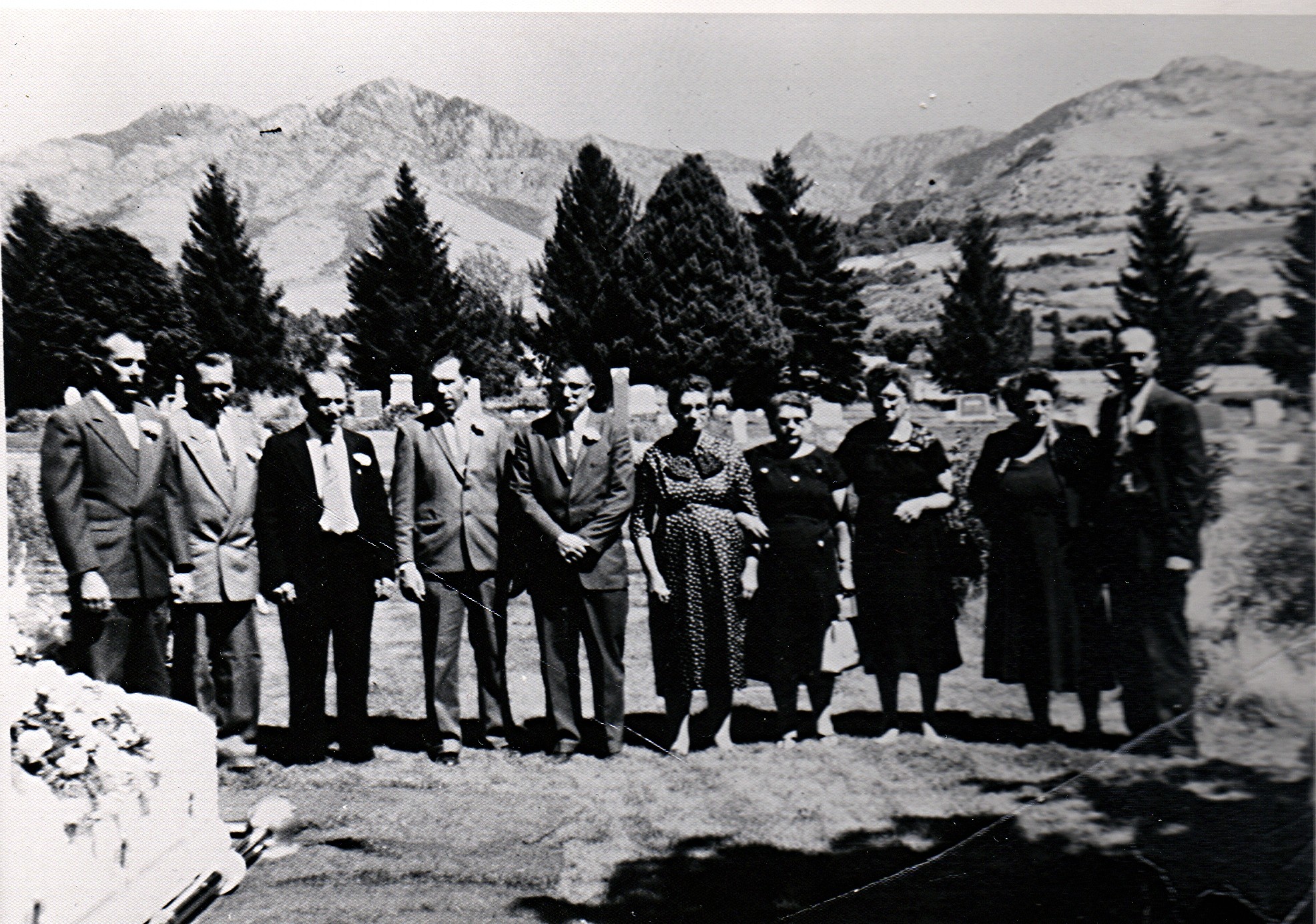
I have written previously about the video that came from the funeral and graveside service of Martha. In that post I walk through the video and the identified individuals. It also scans the 10 children standing in the cemetery. This photo below is of the same instant.
Art, Golden, Wilfred, Roland, Lloyd, Edna, Hannah, Carrie, Lillian, Ivan at their mother’s grave in Richmond, Utah
I hope some day I obtain more photos to share of Herbert and Martha.
Biography of John George Wanner taken from a hand written history which was in a box of Genealogy material of Clara Bodrero, now in possession of Elaine Ricks (unknown dates), author unknown.. I have written a history of John George Wanner Sr previously. I updated location and names to their proper spelling.
“John George Wanner, son of John Frederick and Anna Maria Marquardt, was born Oct. 18, 1845, at Holzgerlingen, Germany. He had two brothers, namely Michal and Conrad. Grandfather was the youngest child. [He wasn’t a very large man about 5 feet 6 inches tall. He always looked well dressed, clean and very nice.]
“He was member of the Protestant Church. At this church the members graduated from Sunday School at the age of 18.
“In those days children didn’t get very much schooling and grandfather was no exception.
“Grandpa while in Germany worked on the roads and was the road overseer. he also worked in the Black Forest and fought in the Civil War in Germany in 1865 and the War of 1870-71.
“He was married to Anna Maria Schmidt on June 6, 1870. [She was about 5 feet 4 inches and had a good shape. She always fixed her hair so beautiful, she looked nice and well dressed. I can remember this beautiful black knit winter dress she had and she always wore gloves] From this union was born to them five sons and five daughters. Before his marriage he served in the Civil War in Germany and again after his marriage in 1870 & 71 for quite a while.
“After his marriage he worked in the woods. In 1873 they moved from Holzgerlingen to Gruenkraut, Wuerttemberg, where they bought a little home and farm. He also worked in the gravel and woods on this side. In 1880 he got a job on a big highway and worked on it until he came to America in 1893.
“In the month of May 1891 while working on the Highway two men came along and talked to him, giving him a Tract. They were members and missionaries of The Church of Jesus Christ of Latter-day Saints. They visited his home telling him and his family of the gospel and the Lord’s work. They made their visits often, and in July 1891, John George, the oldest son was baptized and came to America with a missionary by the name of Terrell from Providence, Utah.
“In October 1891, grandfather, his wife and some of their children were baptized by the Elders. (Grandfather was the only member of his father’s family that joined the Latter Day Saint church.
“In May 1893, they prepared to come to America. [They rode the train for a day and then got on a ship and went up the Rhine River. This took them three or four days. They then rode the train another day and got on a ship on the North Sea that took them to England; the sea was very turbulent and they had a rough voyage.
“They went to Liverpool, England from Germany on a small ship. From Liverpool to New York they came on a big ship and were on the ocean 13 days. They arrived at New York City and stayed in a Hotel 20 stories up for 1 or 2 nights. They took the train to Chicago where they stayed 1 or 2 nights. Then they took a train and came to Franklin, Idaho arriving on Sunday June 18, 1893. They were met by their son George and Brother Fred Nuffer, the man George was working for. They met them with a one seated buggy and a wagon. Grandfather Wanner asked for a drink of water after getting off the train. “You’ll have to be on your stomach by that stream”, George spoke up. This made Grandfather Wanner so discussed that he walked back to Logan over 20 miles, with a determination to go back to Germany if he had to drink from ditches. The next day he reconsidered and again returned to Franklin, Idaho. They went to Cub River to Fred Nuffer’s place where they stayed for almost one week Then they purchased the farm of John Nuffer in Glendale, Idaho. [It was during this week that Grandpa took his daughter Mary and they walked to Bear Lake County seeking a farm and a home and to see what was available there. They slept on the ground at nights and saved some of their read to feed the bears so they wouldn’t bother them. They had to take off their shoes as they forged streams. It as a rough trip.
“[The first Sunday they were in Glendale, Grandpa and Grandma went to church with these five beautiful daughters and two sons. One day, William Addison Wagstaff was the ward clerk and mother, Mary, had on a red dress; dad looked down at her and winked. You see, dad was well past 30 and not married. I bet he though here is my chance. Of course there were other nice gals available, but he hadn’t married and we were happy he chose mother.]
“[Grandma soon joined the Relief Society and in the minutes of the meetings that I have, tell of her bearing her testimony often and donating eggs, wheat, calico or whatever, when asked to do so. They had a strong testimony and remained true to the Church and were ardent Temple Workers till their last days on earth. ]
“John Wanner took up more land after a few years and built a log cabin to claim the land. Cleared quaken aspens from his farm to have more land. One day his All slipped from a stump and cut a deep space i his hand. It was necessary for the doctor to put in several ditches as the farm work advanced he built a barn and bought addition cows.
“Mother Wanner made and sold many pounds of butter a week to George Benson Store in Whitney, Idaho.
“The Wanners also picked and sold number quarts of currants, gooseberries and raspberries. Gooseberries were about 20 quarts for a dollar, the raspberries sold for about 10 or 12 quarts for a dollar. These were delivered price.
“About that time 2 additional rooms were added to a rock house that was on the place.
“They bought the John Nuffer’s farm at Glendale, Idaho, now Franklin County. Later he bought the Jed M. Blair farms in Whitney and started to raise sugar beets.
“[They later moved in 1910 to Logan, Utah and ] while living at Logan, Utah [to be near the Logan Temple where they could go often. In Logan, they lived at two or three different places, but I wasn’t able to find out for sure. The places I distinctly remember was their home on 3rd North and two or so blocks East and their last home in Logan was a lovely home they built located on 4th North and two blocks East. they did a great deal of Temple work for the dead having got many names from Germany. They also did a lot of work for other people. While in Logan, Grandpa always had a lively horse, a good looking single black buggy and a real snazzy buggy whip. This one place they lived on in Logan had an extra lot where he grew hay for his horse and he’d cut it with the scythe. They also always had a nice garden and beautiful flowers. As I remember this home was on 3rd North and a few blocks East.]
“[They were hard working, thrifty people and handled their affairs very well. They really made hay while the sun shone and were able to retire at a reasonable age and had enough to live on plus an estate they left. ]
“February 16, 1922 after a short illness of pneumonia he died and was buried in the cemetery at Logan, Utah.
Back (l-r): Lydia Leavitt, Estella Blair, Sarah Preece, Susanna Allen, Livinia Wilcox, Clara Wheeler. Front: Lavina Poulsen, Christensia Hansen, Martha Coley, Martha Lewis, Sarah Snelgrove.
Here is a photograph I thought I would share. It tells its own story. This photo was taken on 25 April 1948 in the Benson Stake Tabernacle. The photo is honoring those Visiting Teachers who have been faithful in going out for 40+ years in the Benson Stake. The Benson Stake was headquartered in Richmond, Cache, Utah (later renamed to Richmond Stake), not Benson.
Mind you, at that time, this was not just an organization you automatically became a member of when you joined the church. This was a separate membership with dues requirements for the organization. You even received a membership card. Not only are these women faithful in Visiting Teaching for 40 years, but they had volunteered to be a member of the Relief Society for that many years and actively participated. Martha Coley in the front middle is my Great, Great Grandmother. How many Visiting Teachers today qualify for faithful Visiting Teaching for 40 years?
Here is Martha Christiansen Coley’s daughter’s Relief Society membership card. Lillian Coley married Joseph Nelson Jonas and after his death remarried to Lorenzo (Ren) Bowcutt.
Here is some more information I could find on the individuals in the photo.
Lydia Elnora Karren (1879-1959) married Edward Leavitt (1876-1957). They probably lived in Lewiston, Cache, Utah.
Estella Nora Glover (1883-1952) married Ephraim Isaac Blair (1882-1943). They probably lived in Lewiston.
Sarah () married Preece (). Cannot find records, either have the name wrong or she moved from Cache Valley.
Susanna “Susie” Elizabeth Preece (1863-1953) married Andrew Bickmore Allen (1859-1941). They probably lived in Cove, Cache, Utah.
Livinia Merriam Henson (1871-1950) married James Franklin Wilcox (1869-1951), previously married to an Levi Knapp Allen (1842-1928). They probably lived in Cove.
Clara Deseret Stephenson (1880-1951) married Joseph Henry Wheeler (1882-1963). They probably lived in Lewiston or Trenton, Cache, Utah.
Lavina Ellen Hawkeswood (1877-1954) married John James Poulsen (1871-1948). They lived in Lewiston. Interesting note, Martha Christiansen Coley’s husband, Herbert Coley, and Lavina are 1st cousins once removed! Do you think these two ladies sitting on the front row knew of that relationship?
Christensia () married Hansen (). Cannot find records, either have the name wrong or she moved from Cache Valley.
Martha Christiansen (1879-1961) married Herbert Coley (1864-1942). They lived in Richmond.
Martha Ann Kingsbury (1850-1950) married William Crawford Lewis (1830-1908). She was 98 years old in this picture! They probably lived in Richmond.
Sarah Ann Gaunt (1878-1963) married Owen Elmo Snelgrove (1880-1973). They probably lived in Richmond.
Here I write once again. Sometimes life seems so full of everything, and other times as if this broad expanse of nothingness. The variety of individuals I have the privilege of being with is amazing. Their view, their outlook, the goals, their aspirations, their weaknesses all seem to vary so much. The variety and style prompts me to proclaim how wonderful and amazing they are. The intelligence that is so encompassing held by just a dozen people is staggering. Yet, sometimes I wonder if they know one iota of anything concerning themselves and eternity. People seem to be so good, wonderful, and helpful and in the same breath so greedy, selfish, and conceited. What an education far beyond anything I could have ever imagined.
Sometimes I wonder about the words of C.S. Lewis about when one recognizes themselves, that becomes the basis of pride. Yet, one star is greater than another, one is always greater than another. Perhaps we can recognize our own individuality but should be highly cautious about setting ourselves up over other people. That is what the world is teaching. You are special, it doesn’t matter what anyone is or does, you are better than they are. That is false. We are special, we are individuals, but we are a part of the fabric and an essential player. We cannot be independent of all others. No man is an island. To think we are to be our own man, independent of the God who created us, and the fellow citizens of the earth only creates a bunch of insufferable show offs. It breeds relativism and more conflict in the world.
While I have no doubt of the place of America in the role of the world, I find it scary that we subscribe to the belief I just mentioned. I remember in England when an American could not understand one with the local dialect, they met it characteristically with talking a little louder and asking a question a little slower. It wasn’t them who had the problem, it ws the individual speaking! We expect the world to revolve around us and pay us all the respect we believe is our due. We claim the rest of the world has pride and arrogance, even ignorance; when I must admit I think we are the one guilty of the charge. Is it any wonder the French have problems with us? In their history individuals given power rather than a government has produced “The Terror”. Why wouldn’t we expect them to react the way they did when we gave more over arching powers to the executive? When the power of waging war and of going into battle was given in their country, it led to a man seeking to rule Europe. Add that to their condition of their neighbors who have taken them over because of what they deemed as right. Of course France is not supportive of our going into another country to further ideals of democracy. We can see why they don’t like capital punishment, the guillotine is a national symbol still to them. That is something they will forever buck at. What is more, we hover and watch them and give them the cold shoulder. Not as a brother in the world should do, but as a lesser creature. Someone who is to not be associated with on the playground. We act the bully, and then when they bristle or don’t fall in line, we scorn and mock them. Try and turn our friends against them to persuade them to be with us. Looking back, that bully did hold their power for time. What ever happened to the bully. I hope we became more mature, that we all become equal, but it isn’t true. I know of three who bullied me in elementary and junior school, and sadly they find themselves on the lower of the totem pole in life today. I do not know if this would be true generally or across the board, but it is in my life. Sadly, I expect the same thing will happen eventually to us as a nation.
Then I look at other nations who are different. Others with different goals and perspectives. We eye them with caution and expect they must have questionable motives. The uncertainty always creates fear doesn’t it? “I have often thought to myself, what is to be done?” Education is our only hope. Just like Thomas Jefferson I find myself thinking that our only hope would be education and the constant expansion of our understanding. It must be understood, retained, and constantly built upon. Just like Joseph Smith taught of the need for increasing light and knowledge, Thomas Jefferson admonished, and Allan Bloom admonishes we must find and constantly be analyzing. We find our beliefs, seek out further light, compare it to what we have, and throw away what doesn’t work. Leave it behind, keeping a faithful record of where we have been. Sadly, such a case does not seem to be on the books today. Like I mentioned the case of relativism seems to be taking hold with all its disastrous underpinnings. James Madison made it clear that without the moral compasses and moorings that come from religious principles, the looking out one for another, democracy would drift and fall. Without morality democracy will pass as all the others have before our time.
Odd isn’t it. We are so smart, yet we never counsel with history. Is it any wonder we are so seriously admonished to remember. Rather than condemning, let us seek. Rather than finding our lines and demanding nobody to cross over, why don’t we step over them ourselves and act as more faithful pilgrims and wanderers? The glory of God is intelligence isn’t it? When slapped, turn your cheek and move on. Service to your enemies and comfort to those who are weak. Revenge is never the order of the day.
It all starts with the individual. From there the example is powerful. There is great hope in the world. There is great possibility of potential. Why are we focused on fear? Why not look to the future? Fear only cripples.
Inside the world, in my own personal life, there is much to look forward to. I find in myself a growth and a bright outlook. It all comes in the name of Amanda Hemsley for me. Burton K Wheeler and Jared Diamond have been my meat recently. Not to mention the studies of Iranian business deals and American history that have been my research. There has been a constant barrage of information which have helped to temper me and my zeal. Somehow though, the introduction of another who is to be considered as yourself changes things drastically. My vision has expanded not only of the world from her eyes but the view from my own. It tempers the excitement of youth even more, but gives more drive for the future. Somehow the clutch of individualism is disengaged and one finds themselves propelled faster and further along the road of life. I am not even married yet! The walk continues, but it is taking on new vistas. I leave the Rocky Mountains with dizzying height and glamor to the more humble and open expanse of the plains. It is not that there is less to see, nor is there less to experience. It is just different. The ecosystem is just as open, but a new road. The anticipation is great. Where will it take us? How far will it take us? Shall we circle the earth or walk slowly to Blair, Nebraska? Either one, I am content.
She is most beautiful, captivating, and sublime. I have not potential to describe the connection in those eyes and how far the warmth of her body seems to penetrate. This world is definitely beyond the physical. We don’t even know all the aspects of the physical, but already many doors are open for emotional and spiritual travel.
I found one of her hairs today. It glistened and somehow represented something so far away. It was only a memento that was obviously manifesting of her presence. Yet she is so far away. This part is not even living, but yet it speaks of her. How many hairs in the world do I see, yet lose their true significance. I have eyes but do not see.
Life is more than just me. I focus on myself so much, everything revolves around my life, because that is me. It is unavoidable. But the greatest joys come in the life of others. Burton K Wheeler’s experiences are now a part of my own. His personality has become a part of mine. While the stories and the times may melt, I have been changed and can clearly link it to him. The same with Cecil D Andrus’ life. On and on and on. Oh if I could implore more people to record their lives and write their stories! What I would not give to read the same of my ancestors. My grandmother’s journal was a portal into another’s life. However, that life is an extension of me. While Brother Wheeler is far more removed, he is still a part of the country I now life, and that is part of me as well. I was so sure to go out and define the world and change it according to my view. I am coming to find out that the world has created much of what I am. It has changed me. It used to be such a negative view. I always knew what needed to change and what I was to do. Now it is the opposite. What can I learn from it to apply in life. I seek more and more. Dismissing those which are of lesser quality and holding to those which are more true.
Is it any wonder we are exhorted to seek out knowledge. It is the only thing that will save us. Especially that knowledge which is most important.
Amanda came to visit over last weekend. All my time with her is something to be cherished. We learn so much from each other. I learn so much from her. She amazes me. She is so pure and wonderful. She makes me wish I was better, glad I receive her love, and yet honoured. I love her and hope we will forever build upon that. We are both just humble enough to learn from each other and to walk the path together. As we grow, how much more sweeter can it possibly become?
Oh the nothingness of man. God rules the nations and the earth inasmuch as we let him. He oversees all and knows all things. May we learn of him rather than to pontificate to the world what they should know. There is so much to learn. May I always be learning and seeking? Rather than the one giving instruction. Reminds me of Socrates always asking the questions rather than giving the answers. Good night.
I know, I know, I have not been keeping this as up todate as I could. Oh well, things are going very well. I am enjoying life and have had a great refreshing break. Just a few more weeks and then I am done and headed back to Utah for graduation, marriage, and happily ever after.
For Thanksgiving Break Anna Badger, Brad Hales, and Jeana Stuart all came to visit for the holiday. It was great to have them here and I very much enjoyed their presence. It was quite the adventure. They arrived on last Friday and I took all of them back to the airport today for them to fly out. I assume they made their flights and are all safely at home now. With most of which I write, there will be photos to go along in the Thanksgiving Gallery.
In preparation for their coming, Genny in the office got them tours at the White House, Capitol, Library of Congress, National Cathedral, and the Bureau of Printing and Engraving. They went and saw several other museums and various other things around Washington DC. Last Friday night we went on a midnight visit of some of the monuments. We went to the Jefferson, Lincoln, Washington, FDR, and other things around Washington. I showed them the main buildings and gave them a sort of feel for the overall layout of the area.
Saturday we went to the Washington DC temple. We also paid a little visit to Georgetown and went to Arlington National Cemetery. Sunday we went to church and the Washington Memorial Masonic Lodge. Monday through Wednesday they went on their tours. Monday afternoon I met them at the Library of Congress and went on that tour with them. It was amazing. I really appreciated the beauty and time that obviously went into the building. Very impressive building. I took them back through the tunnels to Russell from the Library of Congress. That was quite a bit of a walk through the house buildings, Capitol and back. They enjoyed it. Tuesday I gave them their tour of the Capitol and tried to sneak in some extra perks for them, however, with another couple on the tour we did not get to show as much as I could have. Wednesday I got off work at noon and went and met them at the Museum of American History. I enjoyed that. I could have spent quite a bit more time there. I enjoyed the science aspect, nuclear, transportation, First Lady, and Presidential exhibits. I could have spent a few more hours in the building. I will have to pay them another visit. There are a few museums I still have not seen. I want to see the Native American, Modern Art, Printing and Engraving, and spy museum. Sometime I will have to pay them a visit. I suppose there is always a time in the future.
Thanksgiving was great. We enjoyed a trip to Mt. Vernon and had a great time. You can see the pictures from that adventure. Yesterday we trekked to Monticello and Montpelier, but due to circumstances and preference, we did not get into either. At one it was “too cold” and the other we were “too late” so what was to be done. However, I stumbled on another little town I would love to move to some day and spend the rest of my life. Orange, Virginia, an amazingly beautiful little town. There are a few of them in my life. Ashland, Kansas; Blair, Nebraska; Quray, Colorado; and now Orange, Virginia. It was amazingly beautiful. I hope some day I can organized a piece of property into something so magnificent so as to add to the community to which I belong. We all loved the beautiful well kept estates that lined the roads. Orange was particularly beautiful.
We all come to understand each other a little more, we come to see and understand our weaknesses and strengths a little more, and hopefully we will have learned from our close interactions. I sure enjoyed their company and the opportunity to entertain guests. More importantly, it gave a little more initiative to get out and see some of what I am surrounded by.












 Sagacity