Rights and Responsibilities

Of Rights and Responsibilities: The Social Ecosystem of Religious Freedom

Art and Golden Coley

Introduction

Distinguished guests, colleagues and friends, it is an honor to speak to you today. The subject of religious freedom continues to raise new questions. We have come to learn a little more from many of the most able minds and willing hearts in the field. If we listen to each other carefully, we will be better equipped to meet the challenges and opportunities of today and tomorrow.

Most of us drink from the waters of religious freedom without even knowing it. We think of it as a river that will always flow. But we might not recognize the risks to the tributaries that feed that river.

The perpetuation of religious liberty requires that it be understood and valued by the rising generations. There is a need for them to comprehend what religious freedom brings to society and what is lost when this liberty is eroded. When young people come to understand why this freedom is crucial to their own aspirations, welfare and happiness, they will feel inspired to act to strengthen and preserve religious freedom.

Community and Commitment

To better understand the freedoms we now enjoy, we can look to history. My parents came from what you in the United States call “the greatest generation.” They both served in the British armed forces in World War II — my father in the Royal Air Force, my mother in the Army as a nurse. Between them they served across Europe, North Africa, India and Burma. They fought for their neighbors, they fought in defense of their homeland and they certainly fought for religious freedom, but I don’t suppose that was a phrase they would have used at the time. With so many others, they warded off the tyranny of Nazism. So many freedoms were on the line, and that generation gave everything they had in their defense. Vast swaths of Europe were overrun, with massive casualties. Whole nations were subjugated by tyrants whose aim was to conquer and not only suppress freedoms, including religious freedom, but wipe out and destroy people of particular ethnic backgrounds, faith and belief. The generation which confronted these demonic threats did so with phenomenal courage. It took a society that possessed a highly developed social solidarity and mutual accountability to bring about such a moral achievement.

After six unspeakably harrowing years, the war was won. In the ensuing years, those who had experienced this conflict saw society through the lens of that experience. After a decade or two, they observed the next generation, which had not been where they had been nor confronted what they had seen. These young people became concerned with what in many cases the wartime generation regarded as lesser things. The cohesion that had come from shared hardship borne of an existential threat began to wear off. I was a child through part of this period. The protests of the 1960s found their way onto our television screen. What they exhibited in raw emotional power, they often lacked in sustained social commitment. These actions ranged from bus boycotts to opposition to the Vietnam War to campus protests over student fees. They were all motivated by worthy purposes, but on their own, these purposes were limited without the continuous obligations borne of shared vision and purpose. Of course, protest is a vital function in a democracy, and free people are free because they are able to challenge the status quo and those they have elected. But during those years, the youth of Britain sometimes appeared to protest for its own sake. My parents lamented the shift toward a mindset of rights with no apparent regard for, or reference to, responsibilities. The two must work together; passion and duty must connect. And that concept is what I would like to address — our rights and the responsibilities associated with those rights.

Today it might appear to some that rights just happen — that they are automatically inherited and perpetuated without thought or effort. We can forget the extraordinary struggle, resolve and sacrifice that went into protecting our abundance. We may rarely think about our obligations to keep those rights in place.

The Heart of Religious Freedom

For a time, I lived in a country that did not allow the free expression of religion. I witnessed how people who dared to stray from the official line could be punished. Unfortunately, this continues today in many nations across the globe. Violation of religious freedom is one of the main reasons why we see so many refugees and displaced people today. Religious differences become religious alienation, alienation turns into persecution, and persecution turns to conflict, war and mass flight. These crises happen when freedoms, including religious freedom and freedom of conscience, are not protected. Regimes target those who believe differently, force them from their homes and uproot them in terrifying ways. In 2015 and 2016, from one end of Europe to the other, I saw firsthand countless ordinary people driven from their homes and lands further to the east across countries and continents in search of safety and refuge. Often their beliefs were a factor in why they were displaced.

Hatred and terror drove these people from their homes. The world needs places of refuge from such extremism. Where liberty thrives, it flows almost invisibly. We experience the benefits of it all the time but rarely see how it actually works. Religious liberty acts as the heart of society, a key contributor carrying the lifeblood of all that is good to the whole community.

Healthy societies run on trust, confidence and a sense of safety. With freedom of religion and belief, people feel safe in their deepest convictions and can express and exercise them publicly. The great enemy of religious freedom is estrangement and alienation. When a society or government divides people based on what they believe, how they think, the words they say, whom they worship or the manner in which they worship, common ground is lost, and life together becomes a battle. The test of a pluralistic society is to achieve unity without diminishing the diversity within it.

Religious freedom means nothing if you protect your own religious practice while neglecting the practice of others, especially those who might be less secure and able to defend themselves. It only works if you protect the rights of everyone. As Elder D. Todd Christofferson, a member of the Quorum of the Twelve Apostles of The Church of Jesus Christ of Latter-day Saints, has said, religious freedom is important precisely because it gives everyone — religious or not — the “space to determine for ourselves what we think and believe.”[1] In terms of numbers and inherited culture, the United States has a Christian majority, but unless it honors the lawful practices of Hindus, Sikhs, Muslims, Jews, Buddhists, Native American religions and everyone else, including individuals and groups who profess no faith at all, it will fail to live up to its own ideals. [2]

We all need to be consistent in defending and respecting everyone. And doing so does not mean you have to diminish your own beliefs. That’s how all our rights will be taken seriously. We can’t pick and choose who gets what rights. Every religion is susceptible to the fluctuations of prominence and obscurity. The cultural group that enjoys privilege today may lose it tomorrow, even in nations where the rule of law and democratic principles have been enshrined for centuries.

Having a broad view of religious liberty helps us see that it is universal, not just the preserve of those who are powerful or popular. Religious freedom is suprapolitical, something that is part of our nature before politics declares it to be so. Every person, regardless of religion, race, gender, orientation or nationality, possesses fundamental rights simply by being human. They include the right to life, liberty, security, equal protection of the law and the freedom of thought, speech, and religion, as well as protection from political extremism. But we all must remember, be taught and pass on the responsibilities that come with these rights.

Rights are inscribed in laws, constitutions and charters the world over, but they were first imprinted in the human heart by a loving God. One of the founders of this nation, Alexander Hamilton, wrote, “The sacred rights of mankind are not to be rummaged for among old parchments or musty records. They are written, as with a sun beam, in the whole volume of human nature, by the hand of the divinity itself; and can never be erased or obscured by mortal power.”[3]

Though these inalienable rights come from above, they still have to be cultivated by human beings below. It is up to us — it is the responsibility associated with these rights — to implement, protect and anchor them in our daily life.

Two Sides of the Religious Freedom Coin

Rights and responsibilities can’t be separated without negative consequences. The symbiosis between rights and responsibilities is often forgotten in the rush to demand that something be given to us, while forgetting to foster the conditions in which that right can even be respected or have meaning.

Appropriately exercised, rights and responsibilities move in a virtuous circle. We are more inclined to honor the rights of people when we know them personally and feel a sense of responsibility for their well-being. Meaning in life comes from giving yourself to others, not demanding that others give to you. Author and commentator David Brooks has written that joy comes from commitment:

“In reality, the people who live best tie themselves down. They don’t ask: What cool thing can I do next? They ask: What is my responsibility here? They respond to some problem or get called out of themselves by a deep love. By planting themselves in one neighborhood, one organization or one mission, they earn trust. They have the freedom to make a lasting difference. It’s the chains we choose that set us free.”[4]

Important work in religious freedom is found in walking a mile with your brother and sister, listening to a stranger talk about their religious experience, and in the gentle efforts of dialogue and persuasion.

The study of religious liberty has so many facets and nuances it can be dizzying. The conversation often focuses on the law — what it is, what it should be, what it protects, what it should protect, how it sets boundaries and so on. Law is vital and is an essential part of a bigger picture. However, rights act more like habits than dry edicts. Law and custom must work together.

Behind every right, if we look closely enough, stand layers upon layers of social practices that regulate innumerable human interactions in societies, families, marriages, friendships and all human relationships. They are called “norms,” and they require innumerable transactions of give and take. The demands we make of the law only make sense when embedded in a web of countless norms that make our society possible. We need to keep finding ways to align what we demand with what we can contribute—to our families, workplaces, neighborhoods, churches, schools and communities.

Understanding and appreciation of religious freedom will need to move from the exclusive realm of specialists to a much broader audience, to include those who don’t grasp the intricacies of the law nor have the capacity to influence the law in conventional ways.

To do this, we will need to reframe our own understanding and more effectively articulate what this freedom means and the responsibility it brings. We have a particular obligation to carry this to a younger audience who will be charged to see these freedoms protected and responsibilities fulfilled in the coming years.

A Challenge to Embrace

Many in the rising generation today are concerned about serving those in need, making a difference, changing the world and helping their community. They seek morality and responsibility, and understand the language of universality. Our young people can be jaded by exclusion, inconsistent application of laws and entrenched interests of a few to the detriment of many. They are attuned to the authentic. They are outward-looking and deeply sensitive to treating people fairly and equally. Their yearning to serve is deep. All of this is wonderful and promising!

But on the whole, the religiosity of young people is shifting. They are much less inclined to identify with a particular religion, let alone attend church.[5] They can see religion as stifling their values of inclusion and tolerance. But it is not only the youth; the trend toward a secularized public life affects all ages.[6] One of the results is that our culture is fragmenting into cultural and ideological tribes.

President Gordon B. Hinckley, former president of The Church of Jesus Christ of Latter-day Saints, once said, “Men everywhere seem to be groping as in darkness, casting aside the traditions that were the strength of our society yet unable to find a new star to guide them.”[7]

Peter Beinart, a writer and political science professor at City University of New York, sees a connection between decreasing religious activity and increasing political conflict. He recently wrote, “Maybe religion builds habits and networks that help people better weather national traumas, and thus retain their faith that the system works. For whatever reason, secularization isn’t easing political conflict. It’s making American politics even more convulsive and zero-sum.”[8]

We can help fill this void with a positive message and constructive actions. There is a need, and a real opportunity, for religious freedom to be framed differently and be more clearly understood.

Be a Force in the World

Do we fear the world more than we shape it? Do we let our anxieties prevent us from making a difference? Do we spend more time hiding from society’s flaws than fixing its problems?

How we answer these questions determines what our social environment looks like. It is always changing, and improves or deteriorates depending on our actions. Society is not something that just happens to us; it is something we help shape.

The main thing is to engage, dialogue, bridge and interact with people of all sorts. Unless we participate, we lose our ability to both influence the world and learn from it. As British novelist E.M. Forster put it, “Only connect! … Live in fragments no longer.”[9]

We all have a stake in this debate. “No man is an island, entire of itself; every man is a piece of the continent, a part of the main.”[10] The poet John Donne wrote these words nearly 400 years ago, but they still resonate today.

Contributing to the good of society is part of our spiritual stewardship. Jesus taught his followers to be the light of the world and the salt of the earth. Let your light shine, he said, as a city on a hill. Salt was an ancient symbol of friendship and generosity. And like salt, we have a duty to savor person-to-person connections and nurture amity between adversaries. We must not cloister ourselves with others who think like us and congregations that believe like us. Jesus demonstrated how to lift society, moving deliberately to the despised, the diseased and the misunderstood, listening to and healing them.

I have been inspired by the goodness and selflessness of members of my own church who reach out to those in need. Wherever I have witnessed, in the course of my service, those afflicted by fire, flood or any manner of natural disaster or humanitarian crisis, our people have been there. When visiting such a location in California, I was asked if I knew what FEMA stood for. As I struggled with “Federal… Emergency…,” my friend said, “No, it’s ‘Find Every Mormon Available.’” It was said in jest, but more than once media has reported that the first two groups at the scene were the Mormons and the Latter-day Saints — reminding us of the uphill task we have to be known by our full name. The point is, our people do go out of their way, a very long way out of their way, to help in crises the world over. This isn’t only disaster response and assisting refugees. These devoted souls are there in those often invisible, private, chronic situations which can last a lifetime. And of course it’s not just our people; we work alongside representatives of numerous other faiths, often partnering with them in some of the most challenging parts of the world. There are certainly those involved doing extraordinary work for whom faith is not a driving force. But these contributions with our fellow believers are vast. And, importantly in today’s context, they are often overlooked. Part of that is our own fault, as we can have something of a tortured relationship with the idea of telling people about these good works. As a church, we are torn between having these efforts be private and letting that light shine in a way that will create awareness that we take our responsibility of contributing to society very seriously. We will probably need to talk more openly about these contributions, letting people know that at the heart of our faith is the desire to help our fellow human beings, wherever they are, people of faith and no faith at all. And that we do so without seeking converts in these most trying moments in people’s lives.

We need to help many more young people see the opportunities the free exercise of religion provides to serve others in need and unite communities in ways that benefit all people. And we need to help them understand that the expression of religious belief through community service is dependent on religious freedom. With this understanding, they will not only value religious freedom more deeply but will courageously act to strengthen and perpetuate it.

Influencing society always seems to be the job of someone else — someone with more power, more money, more time. Perhaps we expect some program or sponsor to take the lead. But when it comes to taking care of people, there is no “someone else”; there is only us. Civic engagement requires people to freely act on their beliefs and solve the problems of their communities. If the prevailing philanthropic desires of our rising generation are to be harnessed and maximized, our young people will need to come to the same conclusion as have so many of us here today. And that is, that this is the most worthy of causes — a spring which feeds so many others. It represents our highest and holiest beliefs, and at the same time, blesses individuals, families, communities of all descriptions and entire nations. How to unite these benevolent desires of the rising generation with the responsibility of preserving religious freedom, along with every other inalienable right, is the task before all of us, and I am so grateful that you have gathered in this way to address just that.

We have a responsibility to help and, as God told the Prophet Jeremiah, “seek the welfare of the city where I have sent you into exile, and pray to the Lord on its behalf, for in its welfare you will find your welfare.”[11]

Conclusion

Now to conclude, every society has a foundation of truths, rules, expectations and norms which guide their thinking and their actions every day. Many take them for granted. And like all things we suppose will simply always be there for us — like the air we breathe — we hardly notice them. That is, until they’re challenged. And then we have to look closely and really get to know them, as if discovering them for the first time. So it is with religious freedom.

The way we all as human beings form our deepest beliefs is perhaps life’s greatest journey of discovery. The freedom in which we do so is precious. Our ability to practice and share those beliefs as we learn of and come to understand the beliefs of others enriches us all, broadens our view and creates harmony. A climate in which we are free to believe and practice is also a climate in which we can contribute. Religious freedom demands both the universal right and the universal responsibility, and it is our turn to do our part.

As human beings and the children of divine creation, we all want to live by a moral vision and want to share it with others. In doing this, we enter the realm of both religion and politics. This can be messy and contentious, but we have reason to be optimistic. As Martin Luther King Jr. was so fond of saying, drawing from the abolitionist Theodore Parker, “The arc of the moral universe is long, but it bends toward justice.”[12]

We are in that arc, and God expects us to do our part in nudging it toward justice. This is our work. Thank you.

By Elder Patrick Kearon of the Presidency of the Seventy

This talk was a keynote address at the Religious Freedom Annual Review at Brigham Young University on June 19, 2019.

German Branch of Oneida Stake

Necia Seamons article at Oneida Stake Academy

In 2018, I took the kids over to Preston, Idaho because there was a display on some of our Nuffer ancestors at the Oneida Stake Academy.  Necia Seamons has been good to write history of the area and do various research projects.  The Academy continues to be restored and progress is being made.

I thought these pages deserved their own entry for the history as well as reference to family.

“On April 19, 1896, the Oneida Stake of The Church of Jesus Christ of Latter-day Saints organized a German speaking branch based in Glendale.  Both John Nuffer and Charles August Nuffer served int he branch’s leadership, as did Joseph Moser, Mr. Kern, Alma Moser and William Addison Wagstaff.

“The first branch president was Jacob (Ira) Naef, who was Swiss.

“They gathered every two weeks, at first in the homes of members, and sometimes traveled as many as 20 miles for services from the towns of Glendale, Preston, Mink Creek, Whitney, St. Joseph and Franklin.

“‘The branch existed for 20 years, until Oneida Stake President Joseph S Geddes, in 1916, asked Charles August Nuffer, then branch president, to not hold meetings due to contentious sentiments toward the German speaking people.’

“‘During the latter part of the war, some of the people of Preston made it very hot for the German-speaking people, yet most of them were Swiss but that did not make any difference.’

“‘After the war, many of the German people moved away, so we never started to hold meetings anymore,’ said Charles August Nuffer.

“At the end of WWI, Preston resident gathered outhouses into the town square, what is now Benson Park (above), and called it the ‘Schitty of Berlin.’  They whooped and hollered and burned the mock city down.

“Willard and Austin Nuffer sons of John and Louisa Zollinger Nuffer, served the U.S. in WWI.  Willard also registered for WWII.

Necia Seamons article at Oneida Stake Academy

Jonas History: Nilsson/Bengtsson

This is another chapter of the Jonas history book compiled by Carvel Jonas. “The Joseph Jonas clan of Utah (including – early Jonas family history; early Nelson family history)”   This one is on the Nilsson/Bengtsson line, which was anglicized to Nelson/Benson.  Reviewing this information in FamilySearch shows some changes and updates to some of the information presented.
   “Johannes Nilsson was born 4 Oct 1827 in Tonnersjo, Hallands, Sweden.  His parents were Nils Nilsson and Pernill Larsson.  He was the youngest of a family of four sons.  He married Agneta Bengtsson who was born 9 Dec 1832 in Oringe, Hallands, Sweden.   Her parents were Nils Bengst and Johanna Johansson.  She was the oldest child of eight children, having four sisters and three brothers.  They married 17 Nov 1855.
    “Agneta had two children by an unknown suitor who failed to post the necessary dowry.  They were Matilda, born 31 Dec 1853 and James Peter, born 13 Dec 1855.  Both children were born in Veinge, Hallands, Sweden.  James Peter was born less than a month after Johannes and Agneta were married.
    “In 1862, Elders from The Church of Jesus Christ of Latter-day Saints baptized Agneta’s mother, Johanna Bengtsson, her sister, Ingar, and her two brothers, Nils and John.  They immigrated to America in 1862 and settled in Sanpete County, Ephraim, Utah.  Agneta’s father never came to America and died in Sweden.  After this Agneta was baptized and the Johannes Nilsson family came to America in 1864.  About a month after they got to Logan, Utah, our great grandmother, Annette Josephine Nelson (Jonas) was born.  More details will be given in the following life story which was written by August Nelson, a brother of grandma Annie Jonas.  The author has quoted August’s story and has omitted genealogical family line.  Also, interesting facts have been added to this story to make it more complete.  These facts are included inside the brackets.

L-R: Johanna Benson, Johanna Icabinda Benson, John Irven Benson, Nels Ernst Benson, Mary Ann Angel Works holding Merrill Lamont Benson.

    “Nels August Nelson, third child of John and Agnetta Benson Nelson was born in Oringe, Hallands, Sweden, on May 18, 1857.  “My memory of the beautiful country around our home is still vivid even though I was not quite seven when we left.  In 1861 we moved to Tulap, near Marebeck, a Swedish mile from Halmstadt.  We had two wagons loaded with household goods, mother and the four children were on the second wagon which father drove.  I can still see the hayrack.  It had four poles tow in the standard of the wagon, with holes bored and sticks driven in them to keep them apart the width of the wagon.  Then there were holes in each pole on the upper side slanting outward so as to extend over the wheels gradually to about four or five feet high.  Finally the pole crossed the top on both sides and ends to keep it from spreading.  This is the pictures of it as I remember the morning we moved. 
    “Our new home consisted of two long buildings, I should judge considerably neglected because father was continually repairing them between the hours on the farm.  There was a peat bed some distance to the south of the house, a steep slope to the West, a small stream to the east, and cultivated land on the other side.  Father planted trees from the northeast corner of the dwelling due East some distance north and west to the northwest corner of the barn forming a beautiful hollow square.  My recollection is that the trees were birch.  A road ran due east to the nearest neighbors.  On the west a path ran to Marebeck.  A public highway went through our place and led to Halmstadt.  The village near had beautiful homes and churches.  A large bell rang out at twelve and six, possibly other times.  It seemed to say, “Vin Vellen, sure sell, some balhang, slink in”, translated, “Water gruel, sour fish, come gulpdog, tumble in.”
    “At the north end of the farm the stream turned east where the bridge was.  Just south of the bridge the slope was steep and below on the herded the cattle land sheep.  In the three years we lived there father broke up all the land except the meadow.  This was all done by man power.  A man would have a :shere chich” which he pushed with his body.  It cut a sod about two inches thick and eight or ten inches wide.  When the sods dried they were piled up and burned.  The women did most of the piling and burning.
    “We had such a heavy crop of potatoes on this new land that the land burst open along the rows and the potatoes could be seen on top of the ground from the road. 
    “Now a few incidents of child life in Sweden.  The school teacher boarded round at the different homes of the pupils.  I marvel now at the progress they made.  My sister, only ten knew most of the New Testament, and my brother attended only one winter when he learned to read and write. 
    “One of our cows swam the river while we were herding one spring.  When we drove her back she missed the ford and got her horns caught in the roots of the trees and drowned. 
    “Baking day was a big affair because mother baked enough bread to last a month.  It seemed to improve with age.  It took a lot of wood to heat the oven.  On these day sister and brother had to tend baby and I had to herd the cows alone.  One day I rebelled but it did no good.  I was about five years old.  James helped to drive the cows down to the pasture and about all I had to do was watch the path to prevent their return…After I got to Utah one fall a fox bit one of the lambs.  Father must have seen him catch it because he picked it up and brought it home before it died.  Oh how bad we felt.  All the animals on the farm were pets. 
    “One winter there was no snow on the ground but there was ice on the river.  Three of us went down to slide on the ice.  We were forbidden to slide with our shoes on because it wore them out.  At first we slid with our stockings on, then we took them off and slid barefoot.  The ice was so clear and smooth that we had a good time.  Then uncle Lars Benson came and helped put on our shoes and stockings.  I was the smallest so he carried me all the way home.
    “In the spring of 1862 mother went to the old home to bid her mother Johanna Bengtsson, her sister Ingar, and brothers Nels and John, good-bye before they started to America and Utah to live with the Mormons, she brought us all of Uncle John’s toys.  One I remember especially, was a little cuckoo.
    “It must not have been long after when the first Mormon Elders came to see us.  Andrew Peterson of Lehi was one.  Later Uncle Lars came to love the peace that entered our home.  We children would run up the road to look for the Elders.  I was five years old (if mother got baptized the same winter that we left in the spring then I was six) when the elders instructed father to get his family around the table and have family prayers.  I got up from that prayer with the light of the Gospel in my soul.  Everything had changed!  A new light and a new hope had entered my being.  Everything seemed joyous and more beautiful and even the birds sang sweeter.
    “After we joined the Church there were numbers of people young and old who came to visit us.  I remember Andrew Peterson, and the mother of the Lindquists who were undertakers in Ogden and Logan.  When we were getting ready to come to America the sisters would come to help mother sew and get ready.  The songs of Zion that they sang will ring in my ears and soul to the last moments of my life if I continue faithful to the end.  “Heavenly Canaan, Oh Wondrous Canaan, Our Canaan that is Joseph’s land, Come go with us to Canaan!” are some of the words one of the sisters sang.  Ye Elders of Israel and Oh Ye Mountains High were my favorites.  The Swedish Language seemed to give these songs more feeling than the English.  I had a Birdseye view of Zion and I longed to go there.
    “I well remember the morning mother had promised to go to Halmstadt to be baptized.  We all arose early and mother was undecided until father told her to go.  In the evening as father was walking back and carrying the baby, he stopped and said, “Now mother is being baptized,” we looked at the clock and when mother returned she said father was right.  The baptisms had to be done at night and a hole cut in the ice but mother felt not ill effects of the cold. 
    “We had a public auction and sold everything in the line of furniture and clothing that we could not take with us.  I remember two large oak chests and a couple of broadcloth suits and over coats.  One they brought with them and had it made over for me.
    “Father was a steady and prosperous young man, he worked seven years in a distillery and seven as a miller.  We had a small keg of whiskey every Christmas and the children could have what they wanted of it.  We often sopped our bred in it as a substitute for milk.  I never saw father drunk.
    “Now came the time to sell the home and farm.  The ground was all in crops and a rain made everything look good. Father said it was God who made it look so prosperous and we got a good price for it.  James, Matilda, and I with a big part of the baggage were left with friends in Halmstadt while father went back for mother and the younger children.  The morning we were to sail was a busy one.  We all did what we seldom did before, messed the bed.  Mother said, “The Devil cannot stop us,” and we were on deck in time.  It was a beautiful Friday morning, 10 Apr 1864, (They left at 5 p.m.) when the Johanns Nelson family hustled along the rock paved streets of Halmstadt to the docks.  The noise of the horses feet and the rumble of the vehicles drowned all the voices of the little ones who complained of the unceremonious departure.  Then all were safely on board, the gang planks withdrawn, and before we knew it we were out at sea and the men on shore became mere specks. 
    “Later we were all startled by the sound of a shot ringing out and we were ordered below deck.  When we could return to the deck we were told that a pirate crew had shot a hole in our ship just above the water line.  In return our ship shot off their main mast.  As we neared Denmark we saw all the ships in the harbor and could hear (cannon fire) as Denmark and Germany were at war.  We walked around in Copenhagen and saw the fine homes, lawns, statues, in the beautiful city.  This was the first time I had heard the Danish language.  We stopped at so many places that I cannot remember all of them.  Cattle and sheep were loaded on at one place.  We were seasick too, and so many crowded together.  Before we left Liverpool (Thursday April 21) we enjoyed watching the ships being loaded; fishing snacks came in and unloaded their cargo, and big English shire horses acted as switch engines.  There was a large ship about finished in the dry dock.  It must be a stupendous job to build a huge ship.  There seemed to be some leak at the gates because we saw a man with a diving outfit on go down and men were pumping air to him.  He was down for some time.
    “The beautiful green foliage and sward through England has always remained with me.  It passes into the sublime of my soul.
    “The ship which we boarded to come to America was a huge one.  (It was named Monarch of the Sea and there were 973 people on board.)  Before it was loaded it stood so high above the water, and we had to wait some time while the sailors loaded heavy freight into the hold. 

Monarch of the Sea, 1020 LDS passengers on this voyage.

    “I have always tried to forget the journey across the Atlantic.  Our rations were raw beef, large hard soda biscuits, water mustard, and salt.  Sometimes we would have to wait most of the day for our turn to cook our meat.  Brother James knew no sickness on the whole journey and was a favorite with the sailors.  On one occasion he was riding the loose timbers, that slid back and forth with the motion of the ship.  One time he went so dangerously near the railing that they sent him below.  The winds and waves were so high sometimes that the flag on the main mast touched the waves as it rolled.  Trunks and boxes had to be tied down.  The vessel had three decks and there were bunks all around the two lower decks.  I had seen several bodies go down the gangway into the deep.  Then came the day that baby Amanda’s little body with a rock tied to her feet was lowered into the water.  A little later it seemed as if it were my turn, I could not eat the crackers.  Mother tried everything, but I got worse.  Then she fed me the raw beef and I began to improve…We did see many varieties of fish.  Sometimes the passengers, men and women, helped bail out water, when it seemed the ship might sink.

Nilsson family on the Monarch of the Sea passenger list

    “Finally we reached New York, and the main body of the saints took steamer for Albany, New York.  (They reached New York the morning of Jun 3rd).  We crossed New Jersey by train to the Delaware River.  We had to wait a number of hours for the ferry, and when we got aboard it was so suffocating that sister Matilda succumbed.  Mother laid her out under some tree on a beautiful lawn.  The setting sun, and approaching dusk cast a hallowed gloom over the scene.  We sat silently watching by the side of mother, while father was off looking for a place to bury her.  It was a beautiful, and sad sight to see father and another man carrying her body away from her loved ones to be laid in an unknown grave.  The setting of clear, blue sky, and the twinkling of the stars overhead, shining down through the trees made a variegated carpet where we sat.  It would be impossible to describe mothers feelings as she was the guiding star of the family, and she knew we would meet Matilda again beyond the grave. 
    “We went by train from here, and the first incident of note was the crossing of a very high, and long bridge; large vessels with high masts could pass under it.  The train stopped on the bridge while another train passed us.  A few days later we were informed that the bridge had collapsed.  We saw much of the country that had been desolated by the Civil War.  Then we were joined by the group that went by way of Albany.  They were riding on boards in cattle cars. 
    “(Some time about this time in the story of Johannes Nilsson was baptized.  It was 25 Jun 1864.  He was confirmed the same day and later that year he was ordained an Elder)
    The car we rode in had no cushions on the seats.  Sister Josephine’s cheek began swelling; we thought from the jolting of the car.  Some people recommended a certain poultice which ate the flesh off her cheek.  Next we went aboard a steamer on a river.  It was restful for a few days.  All of us made our beds on the floor, starting in the center of the main mast or flag pole.  Then another circle started at the feel of the first.  Brother James and I slept on a board which formed a shelf on the side of the ship.  The space between each shelf was large enough for a full grown colored gentleman so there was plenty of room for us boys who were small for our ages.  There seemed to be two streams in the river, one quite clear, the other very muddy.  By this time we were getting tired with never any rest or change and the vermin were getting unbearable.  Josephine steadily got worse and mother realized that it was only a matter of time until she would go to join her sisters.  When we reached Omaha Josephine was a corpse.  With the dead child and the luggage to carry father and mother could not help me.  I remember that I crawled and walked alternately, with my parents waiting and encouraging me.  We finally go to the top of a hill where mother laid me on the grass among some shrubs while she and father went for more luggage.  When I became able to walk I went down by the river and watched the people do their washing, and try to get rid of the cooties before we started on the tip over the plains.  Several graves were dug in this place.  (The family reached Omaha in Jul.  They rode the steamer from St. Joseph, Missouri up the Missouri River to Wyoming.  They had taken a train from Albany, New York to St. Joseph Missouri.  LDS teams took them from Wyoming to the Salt Lake Valley)
    “In due time bays and wagons from Utah arrived and everything was loaded for the trip.  There was a stove and tent in each wagon.  Then the luggage and two families were piled in and we were off for Zion. 
    At first there was an abundance of grass.  I liked to watch the donkeys in the train.  Day after day we traveled and the only living thing of any size was an occasional stage coach and the station built along the way.  One day I got out of the wagon and ran ahead until noon.  After that I had to walk most of the way.  One day two young women sat down to rest.  All at once the screamed and jumped up.  Then a man killed a large rattler where they had been.  I have seen families take a corpse out of the wagon, dig a shallow grave and then hurriedly catch up to the train which did not stop.  Then we got a glimpse of the mountains in the distance.  We also saw large herds of buffalo.  While camping one night a herd was coming directly towards us.  Some men rode out and turned them.  To avoid a stampede of our oxen we started out and the teamsters were able to keep them under control.
    “The first Indians I saw was at the stage station.  There must have been several hundred of them and we could see their wigwams in the distance.  We were now getting into great sage brush flats and everybody was warned against starting fires.  One day at noon we joked up in a hurry because someone had let their fire get the best of them. 
    “Now we began to meet companies of soldiers.  They generally led horses with empty saddles.  Next we saw where a fire had burned some wagons in the company in which grandmother crossed in 1862.  The whole country round was black and the grass had not started.  When we crossed rivers they were not too deep, the men and women waded.  Two government wagons were caught in the quick sand near where we forded.  As we got into the hills there was a lot of elk, deer, and antelopes.  One man on a gray horse did the hunting for the group.  Several times the oxen tried to stampede.  On parts of the trail men had to hold the wagons to keep them from tipping over.  The most interesting of all to me was at Echo Canyon where they told how the Mormon scouts had marched round the cliff and made Johnston’s army believe there were a whole lot of them when in fact there were very few.  We found chokecherries along the road but they were too green.  The last hill seemed the longest and steepest and we did not reach the top until late in the evening.  Next morning everyone was happy.  Cherries were riper and so good to eat they failed to choke.  Happy beyond expression we hastened to get a view of Canaan and Joseph’s land, where the Elders of Israel resided and Prophet’s and Apostles to guide the Latter-day Saints.  (They arrived about the 15th of Sep in Salt Lake City)
    “Having seen some of the big cities of the world you may imagine our disappointment when we looked down from Emigration Canyon upon Great Salt Lake City by the Great Salt Lake.  We saw Fort Douglas where some of the soldiers were stationed.  One aged man exclaimed, “why the children cry here as they did at home!”
    “We entered the dear old tithing square and rested for noon.  Now it was for us to decide where we wanted to settle.  We decided to go to Logan and it happened that John, our teamster was going there too.  While in the yard Sister Lindquist who had visited us in Sweden brought us a large watermelon, the first I had seen in my life.  She was a beautiful young woman and I thought was very nice. 
    “We soon headed north with John driving the wagon and mother, father, James and I walking behind the wagon.  As we were nearing the outskirts of the city a good lady sent a little girl out to us with two delicious apples.  How good people were to us.  It would certainly be a pleasure to know these fine people.  It was about sundown when we passed the Hot Springs and we kept going until quite late.  When we got to the canyon above Brigham City we over took a number of wagons and Scandinavian Saints.  When we reached what was called Little Denmark, now Mantua, we were feted by these good saints, and given a new send off.  It seemed such a long trip through the canyons, but interesting as the teamsters had a number of bear stores it tell.  Later we learned that some people had been attacked by bear at this place.  We camped just below Wellsville near the bridge above Cub Creek. The people here gave us some potatoes.  They were boiled and their jackets all cracked open.  This was a treat I shall never forget.  We arrived at the Logan public square about noon.  There was a liberty pole in the center.  On one corner was a lumber shack where all our worldly good were put and the teams drove away.  Father located a short, robust Swede who hauled our wealth into his cow yard and we made ourselves comfortable.  We cooked over the fireplace in the log cabin.  For a few days father did not have work so all four of us went out gleaning.  When threshing began with the fall, father was in his glory and never lacked a job. 
    “The most important thing ahead was to prepare a shelter for the winter which was fast approaching.  Logan was planning to take care of the emigrants and her future by digging a canal north along the East bench.  All newcomers were given a city lot to be paid for by work on this canal.  At the same time the number of acres of farm land was apportioned with the number of cubic yards of dirt to be removed to pay for the land. 
    “The first homes were mostly dugouts in the side of the hill.  That first winter, Father carried willows from the Logan River bottom which was our fuel.  He cut some small green sticks short and buried a few of these in the ashes each night to start the fire with in the morning. 
    “We were just moved into our home when Annetta Josephine (Grandma Annie Jonas) was born on 18 Nov 1864.  She was the first child born in Logan Fifth Ward.  Mother was alone except for James and me.  James was sent to fetch father who was threshing wheat for John Anderson.  When he arrived with a sister, mother had already taken care of herself and the baby.
    “All went well until January when it began to thaw.  Soon our dugout was filling with water.  It was knee-deep when father made a path so we could get over to the neighbor’s cabin.  We carried water out all day, and the rest of the water soon soaked up.  So that by laying a few boards on the floor we were able to go back in the evening. 
    “It was the most severe winter.  The snow was deep and it drifted so that only the tops of the houses could be seen.  Thatcher’s mill, the only on one in town, was frozen up, and we had to get along on bran bread.  Father moved the cow to the side of the house that afforded the most protection from the wind. 
    “As soon as spring started, all hands set to work on the canal.  The men and boys had to pass our place on the way to work.  The boys seemed to delight in calling us “Danishmen.”  James and I carried the water from the old Fourth Ward canal down on the river bottom.  We always took a slide down the hill.  This was alright as long as the snow was on the ground, but as soon as it began to thaw, we got soaking wet, and we usually ended up sick with bad colds.  Poor mother had not time to be sick. 
    “The first Sunday School we attended was in the cabin of John Archibald.  Soon there were so many that we could not get in.  The Superintendent was Sandy Isaac, a fine young man. 
    “The summer was a happy one.  Father bought two ewes, and they each had a lamb.  This, with the cow, made a herd for me to care for.  Most of the town drove their sheep past our place up on the college hill to feed.  While we herded we also picked service berries.  The boys showed us where the best berries were over on Providence flat.  One day mother and two other women went with us…
    “This fall we were much better prepared for winter than we were a year ago.  We had two cows, four sheep and a yoke of steers.  There was a barn for the animals, and we had a log house.  We raised 120 bushels of wheat on six acres, and mother had done considerable gleaning.
    “When mother went gleaning, I had to stay with the baby.  One day I left her on the bed while I went out to play.  She rolled off the bed and got a big lump on her head.  She was still crying when mother came home.  Some days she took both of us with her.  When baby slept then I could help glean.  Mother would carry a two-bushel sack full of heads on her shoulder, and set the baby on top.  It surely looked like a load to carry.  James was with father.  He would rake the hay while father cut it with the scythe and snare.  Father did not like to have mother go gleaning, but the money she got from the wheat was her own, and she liked good clothes and to be dressed well.
    “In the fall the ward organized…The old meetinghouse had a fire place in the east end. and the door in the west.  We held school in the same building…Dances generally kept up until morning…They began around seven o’clock in the evening.  About nine there would be some singing…after singing, we had games of strength, wrestling, and boxing.  In the wee small hours we were ready to go home.  These dances were opened and closed with prayer…
    “I almost forgot one incident that happened in 1866.  Father turned his steers on the range in the spring.  One of these was to be given to the Indians to keep them friendly.  The other one Bill, could not be found.  Father located the first one in the Indians herd.  We went down and told them that this steer was his. “How can you prove it is your steer?”  Father went up to her, took hold of his horn and led him to the Indians.  They laughed and told him to take it.  He led the steer home, a mile away, by holding to the horn.  James hunted every where for Bill.  He searched in almost every cow herd in the valley.  In the anguish of his soul he knelt down and prayed.  As he arose a feeling of satisfaction entered his bosom.  He was soon rewarded by finding the long, lost steer.  He succeeded in driving him home, and all were joyful and recognized the hand of Providence in answering James’ prayer.
    “More and more people moved into the ward.  A great many of them were Scotch.  There was a sixteen year old girl who used to visit with mothers.One day she told mother she thought Mr. Nelson was a lovable man, and that she would like to be his second wife.  Mother was delighted and did everything to get father to accept her, but in vain…
    “(In 1867 they went about 90 miles and were sealed in the Endowment house in Salt Lake City.  The Endowment House records for 4 Oct 1867: Johannes Nilsson and Agneta Bengtsson Nelson received their endowment and were sealed.)
    “Father made a fish trap out of willows like the one mother’s family had in Sweden.  We had fish all of the time.
    “Every other week we herded cattle down in the fork of the Logan and Bear Rivers.  It was seven miles from Logan.  The banks of the river were covered with willows, where lived bars, wolves, snakes, skunks, and other pests.  James herded alone most of the time.  The Indians called him a hero.  I stayed with him one week.  The dog went home, and I was ready to leave.  The wolves looked defiantly at us, and at night the snakes crawled over our faces.  I was glad to stay home and herd the small herd near home, I had my prayers answered in finding sheep when they were lost…
    “On June 14, 1867, mother had a baby boy whom she named Joseph Hyrum.  That fall we moved into the Fourth Ward.  I soon learned to love Bishop Thomas X. Smith…
    “On Christmas and New Year’s Eve, we stayed up on Temple hill all night so we would be ready to serenade early in the morning…
    “Our grain completely taken by grasshoppers in 1867.  The sun was darkened by them they were so thick.  We had to sell our oxen, but got $175.00 for them when the usual price was only $125.00.  We had bought them four years before, and father always kept them butter fat.  We bought a pair of two years old steers for seventy five dollars, and grain with the other seventy five.  Then father worked on the railroad and James and I gleaned corn.  James traded a good pocket knife for corn.  Again we traded corn for shoes.  There wasn’t enough money for us to go to school that year, but father bought a large Bible, and the two of us read through to Chronicles the second time.  Here I gained the fundamental principles of the gospel which helped me throughout the rest of my life, and I always knew where to go for information, God and the Bible. 
    “Father traded his oxen for a team of young mules, very poor, but gentle.  The first time we tried to drive them was to a funeral.  On the way home a dog rushed out at us and the mules were off.  They ran home, and stopped at the corral.  We learned they had run away the first time they had been driven.  As long as we owned them we were in danger of our lives because they could not be handled.  Mother did a better job than any of us in driving them.
    “The year that the grasshoppers took our grain I furnished fish which I caught in the Logan River.  There were chubs and some trout.  The time when the hoppers were so thick I will never forget.  I was fishing down in the river, and an electric storm was over near Clarkston.  There seemed to be an air current in that direction and in a little while I could scarcely find any bait. 
    “I think it was in 1869 that we had a glorious 4th of July celebration.  A whole band of boys dressed as Indians and tried to pick a fight.  Some of us really thought they were Indians.  Then we saw President Brigham Young with mounted men riding along side his carriage.  Quickly we all formed in line along the main street, and as he came along he would bow to us bare foot children.  We really loved these men and rarely missed a chance to go to the Tabernacle to hear them talk.  One time he asked the grown ups to leave while the boys and girls gathered around the stand to hear Martin Harris bear his testimony about seeing the plates from which the Book of Mormon was taken.  We were told to never forget these things and to always tell the boys and girls during our lives this story.  I have sometimes forgotten to do this.  Martin Harris was a school teacher when a young man, and came to the assistance of the Prophet by giving the money necessary to get the Book of Mormon printed.  A short time before he died in Clarkston, he related the whole story of the part he played in the coming forth of the Book of Mormon.
    “This year (1868) we planted two acres of sugar cane on some new land up by college hill.  We hoed and petted that cane until it surpassed any thing around.  We barely took time out to eat our lunch.  Men working near said we were foolish to spend so much time on it.  James was a very good worker and a good leader for me.  In the fall he worked at the molasses mill down town, receiving a half gallon of molasses for twelve hours work.  Father hired a boy to help me hoe the cane at the same price.  He never came to work on time so I sent him home and did the work myself.  From one acres we got 175 gallons, and the other 225 gallons, a small fortune. 
    “The last spring that I herded, father had about 75 sheep and 50 cows.  There was no snow late in the fall and water was scarce.  When I started home at night the cows would almost run to get to Springs where Greenville now is.  Then before I could get them they were in somebodies field.  I usually had a lamb or two to carry and had to run till I was exhausted.  At last a small Swiss boy with only one cow to herd helped me out.  He soon got tired of mixing with me but I did not let him quit.  I have herded in the spring when it snowed so I could hardly see the animals.  All others had gone home, but I had to stay because we did not have fee feed at home.  My clothes would be soaking wet, and when a sharp wind blew, I got mighty cold.  One time two of the ewes got lost.  They had been shorn late so they could not stand the cold and I found their carcasses later.
    “Mother sheared the sheep, washed, carded, spun, and wove the cloth to make our clothes.  It was about 1870 (born 9 Dec 1870 and died the same day.  They were buried 10 Dec, 1870) when mother had the twins, Jacob and Jacobina.  They were very tiny and lived only four hours. 
    “Father was a hard worker.  He cut hay with a scythe and swath.  One time a neighbor was vexed because his five acres had not been cut.  Father went down on Sunday and did not come home until he had cut all of it on Monday.  The man could hardly believe that it could be done. 
    “Mother led the social set in this part of the Ward.  I would listen as she related different incidents told her at these parties.  One pertained to our friend…He married a young woman after his first wife had no children.  But after consenting to the new wife, she gave birth to a son and they very soon after two sweet girls.  Almost the same thing happened to a fine young Danishman who moved into the community….When his wife consented to give him a second wife she had a son herself.
    “In the fall of 1871 father bought ten acres of land planted to hay and right along side the other five.  I was sent out to drive a team making the road bed for the Utah Northern Railroad.  I was fourteen, weighed 75 pounds, and had never driven horses.  I was given a broken handled chain scraper and a balky team.  With these handicaps, and jeers from some of the men, it was a hard moth of two for me.  We had good food, so I gained in weight, strength, and experience.  With the money earned, father was able to bend the bargain on the land, and the fellow he had agreed to sell.
    “About this time we had a new baby sister come to our home.  (She was born 16 Dec 1872).  She was named Charlotte Abigail….to my mind the baby was a jewel.
    “I gave the money I earned herding cows to mother who bought all of her clothing, and always had a dollar or two on hand when it was needed most.  She always looked nice in her clothes, being very tall and slender, with beautiful golden hair.  At one time she weighed only 90 pounds.  She loved her children dearly, but required obedience, that we be neat and clean, and attend our church duties.  One morning before Sunday School she asked me to do some chore before I left.  I said “no” though I really wanted to do it.  Mother grabbed a strap lying on the floor, and hit me a smart rap across my shoulders.  A buckle on the strap cut my back and I yelled with pain and so did mother.  She washed my back quickly, and put a plaster on it, so it would not be seen through the thin shirt, which was all I had on my back.  Many times after in life I have thanked God for that blow.  It was just what I needed to get over being coaxed to do anything.  I also learned to love mother more if that were possible. 
    “Mother furnished the house and bought his tobacco with the butter and egg money.  Father was surely miserable at the end of the week when his weekly supply was gone.  When I was allowed to go to the store to buy tobacco, I would put it in my hands and hold it over my nose so I could get a good smell of it.  Father had quit the habit on the way to Utah, but some foolish men persuaded him to take a bite, and he never could quit again.  He tried one time, and was so sick he had to go to bed and get a doctor to bless him.
    “Brother James was quick to learn, and was especially good at entertaining and on the stage.  A Mr. Crowther from the Salt Lake Theatre gave him a part of a colored boy, and with only two rehearsals and no book, he made good, and people were wondering who the darky was.  Mother was proud of her boy…
    “All the boys in town received military training down on the tabernacle square…
    “About this time we had our last episode with the mules.  They tried to run from the start.  We boys got out of the wagon to fix the chin strap on one of them.  They leaped in the air, and as they came down they broke a line and away they ran.  One by one parts of the wagon were left behind.  Father was thrown out with the bed.  When we finally caught up with them, the tongue, one wheel, and a hub of the front axle was all there was attached to them.  We were grateful that no one was hurt.  We traded them off for a team of horses.  The man who bought them drove along the railroad through sloughs and no roads and beat the train. 
    “Mother made dances for us boys, and served refreshments to all who were present.  We had attended two terms at the dancing school the year we had so much molasses, and mother went with us the one term.  This made us the best dancers in Logan…
    “I found James working on a gravel train, and began working with him.  Two would load a car, each one his half.  George Watson, the boss, told me I could not shovel the gravel fast enough.  I told him I could do anything my brother did.  I almost failed the first few days.  We would load as fast as we could, then jump on the car and ride to Mendon, unload and back again.  When this job was completed James got work on the section at Hampton, and father and I on a railroad spur between Dry Lake, near Brigham City to Corinne.  When we reached Corinne we were treated to all the beer we wanted.  On the way back to Brigham City, the crew and all the workers were feeling the effects of the beer.  Father said, “you act as though you were drunk,”  I retorted, “I have never been drunk in my life.”  A man thirty five years old said, “That isn’t saying much for a boy.  If you can say that as a man of thirty five you will be saying something.”  Right then I made the resolution that I would never get drunk.  Now at sixty nine I can say that I have kept this resolution.
    “This was a prosperous year for our family.  (1873)  We bought a fine team of horses to do our farm work, and we had had work on the railroad.  In October, mother gave birth to a little boy, Moses Nelson.  (born 25 Oct 1873)  She was very sick, and we had a nurse to care for her.  I always felt inferior to James, but one day mother called me to her and said, “August, if I die I want you to care for the children.”  That had always been my job around the house.  Later one evening, mother kissed me and said, “You have been a good boy.  God bless you.”  With a smile she turned her head and breathed her last.  (died 4 Nov 1873)  God alone knows what little children lose when mother is gone.  While sick I had heard her say, “I do not want to leave my little children.”  Little did I know or realize what home would be without her.  She was more than ordinarily ardent and spiritually minded, with high ideals, and a comprehensive knowledge of the gospel.  (buried at Logan Cemetery 9 Nov 1873)
    “After mother was laid away, I was sent up to Richmond to work on the railroad.  The weeks passed in a whirl.  Soon baby Moses died, (died 12 Nov 1873 and buried 14 Nov 1873 in Logan Cemetery) and father came up to work with me.  James was with the children and took care of the things at home.  We soon returned and James started school.  I did all the house work except the starching and ironing.  I was 16, Annette 9, Joseph 5, And Charlotte 2.  The washing was a stupendous job.  The water was hard.  I tried putting the clothes in a sack when I boiled them to keep the hard water from forming on them.  If only some friend had called and told me how to break the water and to put a little soda in the bread when it soured, it would have been a God send.  It would have meant better bread and cleaner clothes for the next three years.  I also had to shear the sheep.  This had been mother’s job.  I managed for the first day, and in time finished in some fashion…
    “Sometime in January Uncles Lars and Nels Bengtsson came and took James with them to Spring City in Sanpete County.  I always loved that brother, the only one left who had come with me from Sweden.  We sometimes quarreled, but we were always together.  Now we had no work from him for over a year. 
    “The baby, Little Abigail, generally asked for milk during the night, but she would not accept it from me.  One night I told father to lie still and I would give it to her.  She refused to take it from me.  I went outside and cut a switch from a current bush.  When she called for milk again I held it out to her.  She refused.  I said to father, “Cover up,” and I struck the covers over him with considerable force.  I sat down and began reading.  Pretty soon she called for milk.  I said “Here it is Lottie,” she drank it and never said “no” to me again in my life.  She grew to be a tall and slender; had light golden hair and had a sensitive disposition with high ideals.  I have seen her swing on our gate most of a Sunday all alone, because she felt her clothes were not good enough to mingle with other children.  Before I left home in 1876, I could pick her up from the floor and dance with her.  She had perfect rhythm and enjoyed going to the dances to watch and oh how her little soul leaped with joy when she could get on the floor and dance.  (Charlotte Abigail died 23 Nov 1902.  She never married.  She missed her 31th birthday by a few weeks.  She is buried with Annette and August in the Crescent Cemetery.)
    “My soul cried out for a mother’s love and care.  I am very fearful that when mother sees me, she will say, “You have done tolerably well but you failed to care for the children.”  In my weak way I am still trying to care for children, everybody’s children, God’s children. 
    “I remember when father married again.  The woman had several children of her own.  It was a sad day for mother’s three little ones when step mother and her children moved into out home…
    “I had my try at tobacco too.  An exbartender from Salt Lake City was smoking a pipe.  I asked him to let me try it, and began puffing away.  Father called me to one side and said in an undertone with so much soul that it penetrated my very being, “Don’t be a slave, be a free man.  You have seen me try to quit the habit, even suffer because I couldn’t.”  His advice, I felt, was too good to discard, and I never took up the habit…
    “It was the 16 Oct 1876 when I and three other fellows started for the smelters in Sandy…  John Benson took his team and wagon and took James and me to Sanpete County.  We went to Ephraim to see grandma Johanson, who left Sweden several years before we did.  She was delighted with her grandsons.  She had told her neighbors what nice people were hers in Sweden, of course they thought she was boasting, but now they could see that it was the truth.  How nice it would be if we always lived to be a credit to our ancestors. 

Back (l-r): Virgil, Lawrence, Fidelia, Moses. Front: Paul, Nels, Fidelia, August

    “Uncle Nels had two little girls, one could not walk as the result of a fever.  I began to take part in the talk and general pleasure, and stood well with all.  Uncle lectured every evening on doctrinal subjects…a patriarch came to the home and every one had a blessing.  Uncle Nels, his wife Philinda, and her sister Fedelia, and their blessings John was promised a family; James, a stupendous power over the elements but no family….My blessing has come true as far as I have lived for it….(date of blessings 16 Sep 1890)
    “It is just possible that I shirked my duty and promise to mother to care for the children.  Father offered me my lot, home of the land, and would help build a house if I would take the children.  but I wanted to go and make money.  When I think of mother’s charge to me, and the sad life of the children, my whole soul weeps over my dereliction, but fate drew me to the south…
    “It is difficult to note details by memory, but I have this to record for 1893.  My sister Charlotte Abigail lived with us that summer.  When she went to Logan that fall she had the fever.  Later she went to Washington to visit my sister, Annie, wife of Joseph Jonas.  (Jul 1901)  Annie had been sick for a long time, but none of us knew the nature of her illness until Charlotte brought the whole family to Utah with her.  It turned out to be mental illness.  She kept running away so we finally had to put her in the institution at Provo, where she died a short time after…(She died 23 Dec 1907 and was buried Christmas Day)
    “…When Charlotte brought to Jonas family to us there were five children.  It was sad to see sister in her condition.  I had not seen her since 1873 (28 years).  The last letter I had written her was from Bristol, Nevada.  I suggested to her that she should marry a Mormon boy.  Her reply was that Mormon boys were not as genteel as Gentiles…  Her husband destroyed her letters to us, so we never knew what she was going through…  The Jonas children became ours.  My sister Lottie, worked in Logan until she became so sick and weak she came to our home where she died, 23 Nov 1902.  Father died 20 Nov 1902, and Annie was sent home from Provo a few years later (1907).  From father’s estate I received about $700.00 and the same amount as guardian of my sister’s children.  Mothers last instruction to me keeps running through my mind.  “August, you have been a good boy, God bless you.”  Oh, Father in Heaven, have I at least with all my weakness striven with a desire to do my duty to them and to my mother?” 
    “…I had three of my sister’s boys and two of my own to help (while two of his sons went of missions).  We put up as high 400 tons of hay and had at the ranch nearly two hundred head of cattle, and often over 200 head of hogs, besides the milk cows.  We had 160 acres on the State Road and rested 80 acres from Men Mill for many years.  There were two homes on the farm at that time two on the ranch.  Forty acres on the ranch were cultivated and irrigated, and the 1000 acres was divided into different sized pastures open at the top.
    “The work that my lads did seemed to others beyond their power.  I had some hired help most of the time.  The boys were generally out of school two months of the school year, but never lost a grade…
    “So ends Nels August Nelson’s history of his parents, siblings, aunts, uncle, and grandmother.  The following is an account of the voyage that Johannes Nilsson and Agnetta Bengtsson made.  It is recorded from the History of the Church.  “On 10 April 1864 at 5 pm the Swedish Steamer L. J. Bager sailed from Copenhagen, carrying 250 emigrants from Sweden and Norway and some from Frederica Conference, Denmark, in charge was J.P.R. Johansen.  This company of saints went by steamer to Libeck, then rail to Hamburg, thence by steamer to Hull, and thence by rail to Liverpool, where the emigrants joined the Company from Copenhagen on the 15th of April…”
    “On Thursday 28th of April, the above emigrants sailed from Liverpool, England, in the ship ‘Monarch of the Sea’, with 973 souls on board.  Patriarch John Smith was chosen President of the Company, with Elders John D. Chase, Johan P. R. Johansen, and Parley P. Pratt as counselors.  Elders were also appointed to take charge of the different divisions of the company.  During the voyage there was considerable sickness and several children died.  On the morning of June 3rd, the ship docked at New York where the landing of the passengers at once took place.
    That evening they were sent by steamer to Albany, New York, and from there by rail to St. Joseph, Missouri, thence up the Missouri River to Wyoming, from which place most of the Scandinavian saints were taken to the valley by the church teams of which 170 were sent out that year. 
    “Thus about 400 Scandinavians crossed the plains in Captain William B. Preston’s Company of about fifty church teams that left Florence Nebraska in the beginning of June and arrived in Salt Lake City on 15 September.
    “Agneta Bengtsson had blue eyes and reddish brown hair.  Her son, August, said she had golden hair, so it must have been a lighter shade.  We don’t know what color eyes and hair Johannes had, although he most likely took after the traditional Scandinavian.  After Agneta Bengtsson died Johannes married two different times.  One marriage took place about 1876, and the second sometime after 1884.  The county clerk of Cache County wrote the following when Johannes Nelson died in the death record p. 18, line 112, “Johannes Nelson died Nov 26, 1902 age 75.  He was a farmer, had lived in Cache County 38 years…He was a Caucasian, white male and lived in Logan.  The cause of death was General Debility.”  He is buried at the Logan City Cemetery and was buried Nov 30, 1902.  Johannes had given the church a donation of money which was considered a large sum in those days.  When hard times came Johannes asked for some of the money back.  Since there wasn’t a receipt made he wasn’t given the money, or a part of the money back.  Because of the money not being returned he decided not to pay his tithing to the Church the last years of his life. 

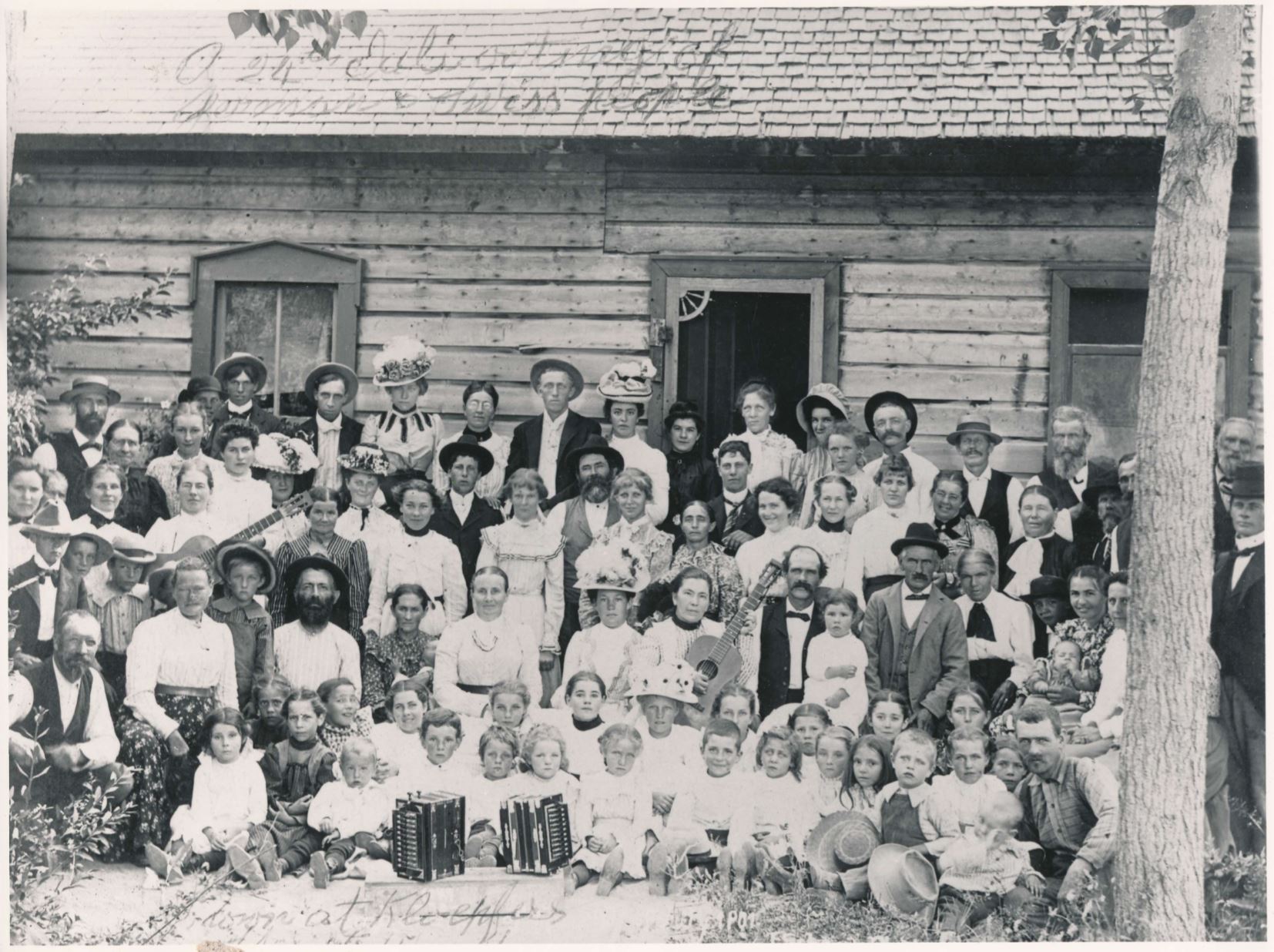
Swiss/German Pioneer Celebration, Logan, Utah, on 24 July 1899

B593C606-A6A2-47E5-A499-AB7420F4D228

Swiss/German Celebration 24 July 1899

This is a fascinating photo from Kelvin Wursten shared on FamilySearch.  It contains the only photograph I know of my Great Great Great Grandfather Johann Christoph Nuffer.  He is to the right of the tree, furthest back.  If you zoom in, it is a fairly good photo of him.  I wish I had the photo that all the paintings are of, but I guess this will have to do until it turns up somewhere.

This photo was taken a Swiss/German Celebration in Logan, Utah in what was known as the 7th Ward.  This party took place at the Kloepfer home on what is called The Island.  It was also referred to Polly Wog Town due to all the frogs.  This photo was taken by Eugene Schaub, who a few years later in 1902 would have Johann Christoph Nuffer for a step-father. The meetings of this Swiss/German group apparently helped in creating that relationship.

I have previously shared the biography of Johann Christoph Nuffer as told by his granddaughter, Alma Katherine Scheibel Naef.  There are a couple of others who are known in the photo.  You will have to go to FamilySearch to get the identification on lining the right face to the exact person.  But I recount the names and dates for your information below.

Maria Anna Alker (1847-1926), who married Conrad Schaub and later married Johann Christoph Nuffer.

Anna Brunner (1854-1938)

John Alfred Burgi (1852-1937)

Palmyra Anna Burgi (1882-1946)

Louise Rosalinda Clark (1963-1938)

Elizabeth Fluhmann (1841-1915)

Bertha Gilgen (1891-1979)

Friedrich Gilgen (1854-1954)

Lena Gilgen (1893-1990)

Margaritha Gilgen (1881-1965)

Mary Ann Gilgen (1882-1933)

Olena Hoth (1874-1962)

Julia Keller (1882-1973)

Philipp Kloepfer (1863-1940)

Marianna Krahenbuhl (1855-1940)

Louisa Amanda Lehman (1859-1947)

Magdalena Mosimann (1841-1914)

Anna von Niederhaeusern (1890-1975)

Rosina von Niederhaeusern (1883-1979)

Johann Christoph Nuffer (1835-1908)

Marie Emma Schaerer (1885-1972)

Lydia Seeholzer (1883-1954)

Theodore Martin Seeholzer (1877-1950)

Johannes Weber (1840-1923)

Anna Weyermann (1895-1977)

Gottfried Weyermann (1875-1935), whose mother had been married to Johann Christoph Nuffer but died prior to this photo.

John Weyermann (1899-1944), another step-son of Johann Christoph Nuffer.

Louis Edmund Wilhelm (1879-1940)

Adolph Wursten (1881-1952)

Aldine Wursten (1883-1976)

Clara Louise Wursten (1876-1946)

Johann Alfred Wursten (1875-1944)

Katherine Wursten (1887-1983)

Lena Hoefler Wursten (1880-1956)

Peter Zemp (1837-1909)

1899-07-24 Swiss German Celebration at Kloepfers in 7th Ward on the Island

Swiss/German Celebration, 7/24/1899


John George Wanner Jr Photo

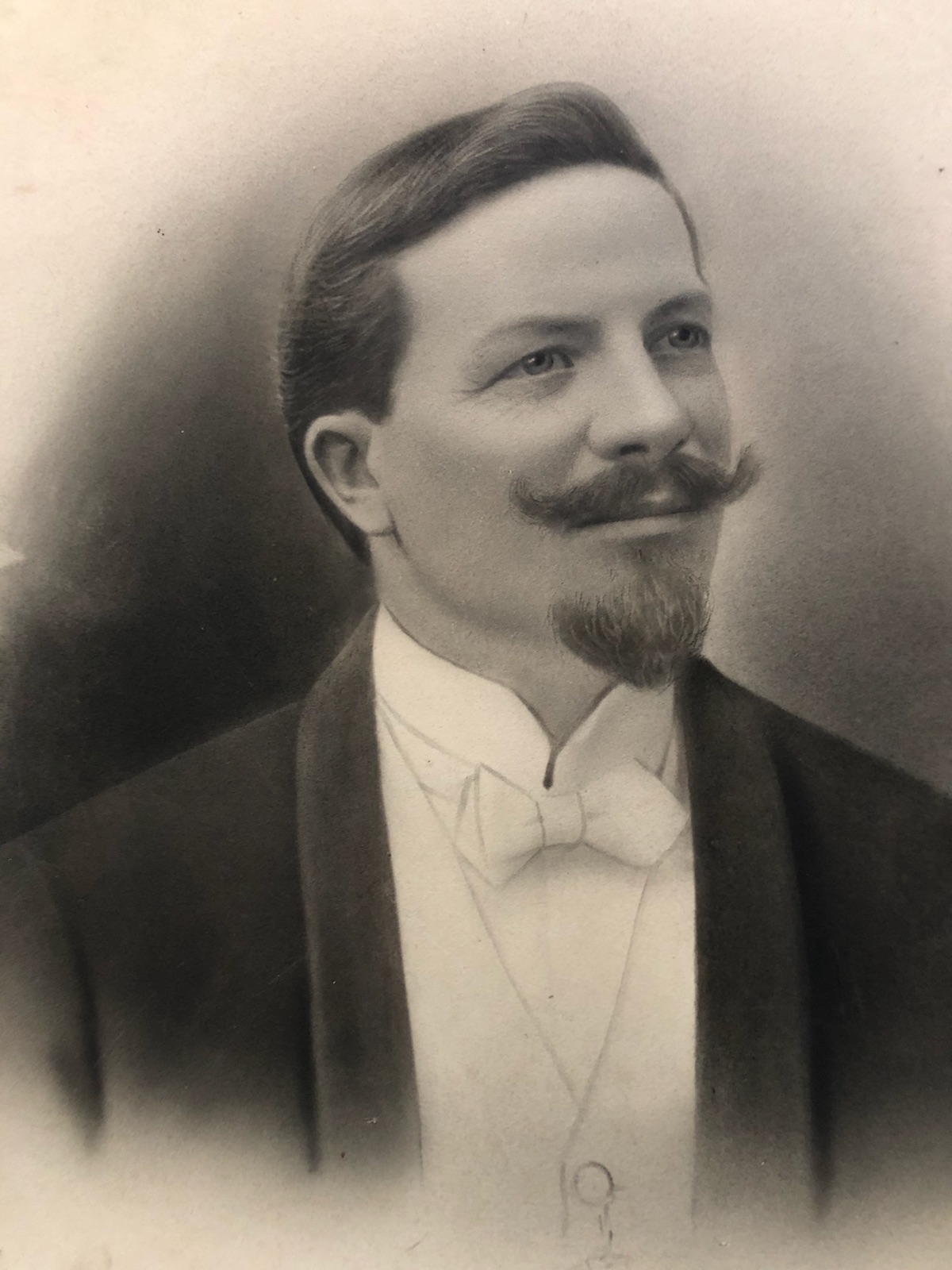
John George Wanner Jr

This is a picture of my Great Great Grandfather John George Wanner Jr.  His name in Germany was Johann Georg Wanner.  I have written a more thorough history of him before.  He went by George during his life since he was a Junior.

This large photo is in the possession of Karen Hodges of Preston, Idaho.  My Uncle Larry Andra was able to visit and get some pictures of the large photos.  I have already uploaded this to FamilySearch and linked him properly.  I recommend all go and see the free family history tree and related documents and memories/photos there.  http://www.familysearch.org

The photo, a painted picture, does create questions for me.  Why is he dressed up?  What was the occasion?  But the more interesting part of the photo is what is found on the back of the photo.

While the photo snapped by Larry cuts off some of the dates, it gives a great copy of his signature.  I don’t have the record of when he was ordained a High Priest, but he served as a missionary to California from 1 December 1933 to 6 April 1934.  He returned at age 63 so I don’t think this photo is of him at the same time, he just wrote the back of the photo over the age of 63.

Back of Picture of John George Wanner

It is nice to have a copy of his handwriting in addition to the photos we have of him.

Pleasant View School 1909-1910

Pleasant View School 1909-1910

This was an interesting find.  This was in a stack of photos I scanned related to the Andra family recently.  The interesting part is that it says Pleasant View School, which I am unable to locate.

In the middle of the photo is William Fredrick Andra (1898 – 1990) with the tie.  I cannot find the school, yet hope to get names of others in the photo.

Here is a snippet from Bill’s autobiography:

“I was baptized in the Elbe River in [16] April 1909; came to the United States in the following month of May.  Upon arriving here, I went to Fairview, Utah to work out my board and room from John R. Anderson, who was a former missionary in Germany.  After being in Fairview for one year, I went back to Salt Lake to meet the rest of the family when they arrived.  We had quite a struggle at first, but we made out when the rest had learned the language.”

I had always thought he meant Fairview, Idaho, which is just west of Franklin, Idaho, south of Preston, Idaho.  Since they spent and lived their lives in the Preston area, I just made that assumption.

However, in further research, there is a Fairview, Utah, in Sanpete County.  He also mentions a John R Anderson who was a missionary that served in Germany.  I found John Rees Anderson (1879 – 1954) who was born in Fairview, Utah, and called as a missionary from Fairview.  John was set apart as a missionary 21 June 1904 and released 20 April 1907.  Which is entirely in the time frames for which the Andra family was taught.  Bill’s mother was baptized 2 November 1906 and could certainly have been one who assisted in Christiana Wilhelmina Knauke Andra’s baptism.

According to Bill’s own record, he would have been in Fairview, Utah from summer 1909 for about a year, which puts this school somewhere near Fairview, Utah.  Guess that is the next step in the search.  If we can find records of the school, the class looks small we might be able to name classmates.


Jacob Friedrich Wanner

I received this history a few years ago.  I will provide it as it is written (only minor edits).  I have written before regarding Fred’s parents Johann George (John George) Wanner and Anna Maria Schmid.

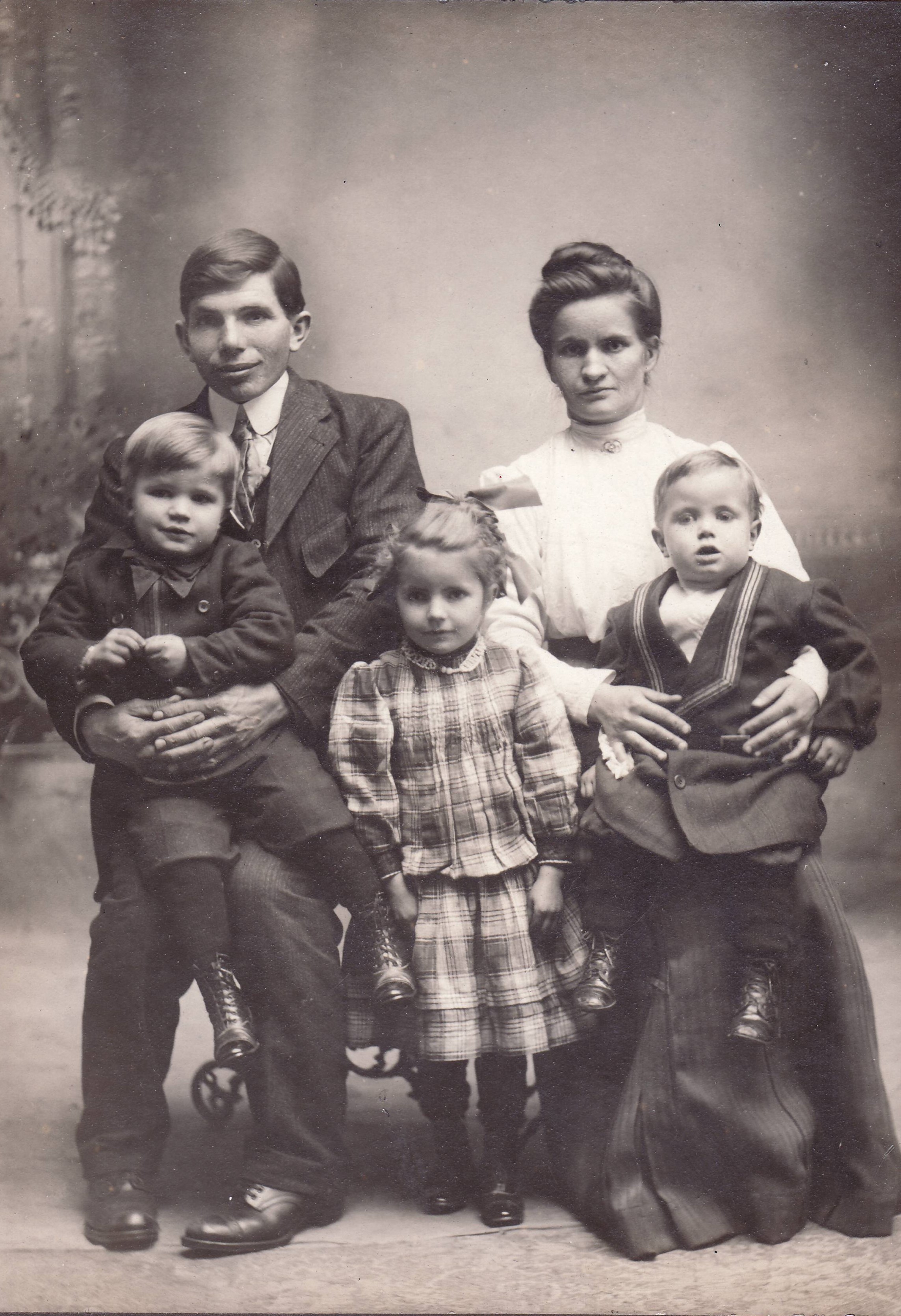
Back(l-r): Eva, Carma, Bert Wanner; Front: Lyman, Fred, Eva, Stanley Wanner

“(This History is written by Jacob’s daughter – Eva June Wanner Lewis – with the information sent in by Brother Fred, and Sister Mary Ann, and  her own sweet memories as well as information from Histories of Brothers and Sisters.)

“Jacob Friedrich Wanner was born January 14, 1881, in Gruenkraut, Germany, the 7th child of Johann Georg Wanner and Anna Maria Schmid.  They had a large family consisting of five boys and five girls.  They were quite poor so Grandfather went to work as a road overseer.  This left the farm work to Grandmother and the children.  They used the milk cows to do the farm work and then would milk them morning and night.  They also got wood from the forest for fuel.

Back(l-r): Mary, Christina, George, Pauline; Front: Anna, Fred, Louisa, Wilhelmina, Gottlop, John Wanner

“It rained a lot in Germany so the out buildings were connected to the house.  One time Grandma went downstairs to get some fruit.  She reached over and touched something hairy – she thought it was the devil!  It was a cow that had wandered down from the barn.

“Dad didn’t talk much about his life as a child but he did say he got a drum for Christmas and then it would disappear about New Year’s Day and he would get it for Christmas again the next year.  He may have been joking.

“The family belonged to the Lutheran Church and was very religious.

“In the summer of 1890 the Lord sent a man along the street in Gruenkraut where Grandpa worked.  He was a missionary from the Church of Jesus Christ of Latter-Day Saints.  He talked to Grandpa a long time and showed him the Book of Mormon.  He spoke in German.  When it came dinner time Grandpa took the missionary home and said,  “We’ll see Mother.”  From that day the missionaries stayed in their home and the family was soon converted.  They joined the church in 1891.

“Uncle George was baptized in July 1891 and went to America with one of the missionaries, Brother Terrell from Providence, Utah.  Brother Terrell helped him find a job to provide for himself.  He got a job with Fred Nuffer in Glendale.  Grandfather and Grandmother and the three oldest girls were baptized in October 1891.  Louise and Pauline were baptized in June 1894, Gottlob in June 1895 and Wilhelmina in August 1896.  Dad was baptized in Preston or Franklin, Idaho, on June 7, 1894, by Lars C. Larsen and confirmed a member of the church by Austin I. Merrill on June 7, 1894.  He was ordained an Elder by George C. Parkinson on September 27, 1903, and was married by Thos Morgan on September 30, 1903, at the Logan Temple.

“The family left Germany to come to America so they could worship the way the pleased.  It was a long, uncomfortable trip.  They took the train to the Rhine River and then boarded a boat and traveled up the Rhine, a journey of about 3 or 4 days.  Then another train took them to the North Sea where a ship sailed them to Amsterdam, Holland, and then on to England.  At Liverpool they boarded a ship and were on the ocean for 13 days.  Dad was 12 years old when they crossed the ocean and told us of the rough sea.  He had to hang on to his bunk with both hands to keep from being thrown to the floor.  He said he sure got sick of eggs.

“They arrived in New York and stayed there for 2 days.  Then they went to Chicago for a day and a night.  They then rode a train straight through to Franklin, Idaho, which took six days.  They arrived the 18th day of June, 1893.

“Uncle George and Fred Nuffer (the man he worked for) met them with a buggy and wagon and took them to Fred Nuffer’s place in Cub River.  They stayed for a while with the Nuffers and purchased a farm from John Nuffer in Glendale.

Gpa Wanner

“When Grandpa and Grandma moved to Whitney they sold the farm to Dad.  I don’t know if Dad or Grandpa build the sandstone house.  It had a kitchen, two bedrooms and a pantry.  It had a hand pump that pumped water from a spring.  Mary Ann and some of the children were born there.

“Dad met and married a lovely young girl, Mary Elizabeth Carter on September 30, 1903, in the Logan Temple.  They lived in Whitney, Idaho, until they bought the farm.  They worked hard to improve their farm and many times she helped him in the fields.  They built a three bedroom brick house that stood for many years until fire destroyed it years later.  Dad had a Delco generator in the garage so we had our own electricity.

Fred and Mary Elizabeth Wanner

“They had a lovely family, five girls and three boys:  Laverna C., Fredrick D., Lorin C., Florence E., Joseph J., Erma C., Mary Ann and Grace C.

“IN 1923 – Elizabeth died leaving seven children.  The youngest was almost 2 years old.  Laverna got married so that left Erma and MaryAnn to take care of the baby.  Erma would go to school one day and MaryAnn the next.  It was hard.  They tried to leave her with Aunt Ethel Barrington in Riverdale, but she got so lonely and cried all day so they went and got her.  Then Dad hired Eva Christensen to come and work as a housekeeper.  As time went on Dad and Eva (my mother) fell in love and was married June 26, 1925, in the Logan Temple. They had five children:  Carma C., L. Bertus, Eva June, Lyman G., and Stanley C.  We had a happy family life and dad always saw to it that we went to church and did what we were suppose to do.  He went when he could.  He always paid his tithing and other offerings.  He was honest in all his dealings.

Fred and Mary with (l-r) Laverna, Fred, Lorin.

“Dad was the first one in Glendale to buy a car.  We children were used to horses so we would say,  “Gid up, Gid up” when we got in the car.  About this time Dad was struck by lightening but was not harmed.

“Dad owned or had a share in the thrashing machine.  They would go around to all the farmers in Glendale and thrash the grain.  Then we would fix a big meal for all the men.   It was a real fun time for the children but a lot of work for the adults.  Dad worked as an oiler or on the thresher and had part of his finger taken off.  When we were little he told us a fox bit it off!

“Dad was a good farmer.  He took pride in all his work.  He raised hay, barley and wheat.  He always had 10 or 12 dairy cows.  He also had horses, pigs and chickens.  For many years we separated the cream from the milk in the old separator.  Then Dad took the cream to Preston to sell it along with the eggs.  In later years we had the milk truck come and pick up the milk so we didn’t use the separator anymore.  He also bought a grain chopper and prepared his own feed for the animals.  We had a big raspberry patch and used to sell raspberries for 8 quarts for a dollar.  Dad always had a big garden and a big potato patch.  He had a root cellar to keep potatoes, carrots, squash and apples over the winter.

“In the early 1930’s Dad bought silver foxes.  He built a high fence so they couldn’t get out.  He took great pride in his fox furs.  They were always excellent quality!  I remember watching him cure the furs and he took great care to make sure they were done right.  Dad always kept his barnyard as well as the rest of the farm in good repair and very neat.  His fences were always mended.

“Dad always took time out of his farm work to go to Franklin to celebrate Idaho Day on the 15th of June.  We would take a big picnic lunch and spend the day.  We rode the carnival rides and had a good time.  He always took us kids to Downata to go swimming when we finished first crop of hay.

“Dad liked a good joke… I remember how he would laugh.  He loved the radio and his favorite programs were Gang Busters, The Old Ranger and of course the news!  We all had to be quiet when the news came on.

“Dad was very active and was always working except on Sunday – there was never any work done on Sunday except chores.  He loved the Sunday paper.  He always bought the Denver Post.  It was a real shock to us when he had his heart attack because he was so active.  It happened one day when he was working in the barn.  We were all frightened and I called the neighbors to help us get him to the house.

“After that he had to be very careful so he sold the farm and moved to Preston.  They lived just down the street from MaryAnn.  He seemed to miss the farm and would putter around the yard.

“He died at the age of 74 on August 25, 1955.  He was buried in the Preston Cemetery.

Jonas History: Jonas/Schumacher

This is another chapter of the Jonas history book compiled by Carvel Jonas. “The Joseph Jonas clan of Utah (including – early Jonas family history; early Nelson family history)”

    “Our Jonas descendants from Utah can all trace their genealogy to the Rheinland in Germany to, so far, the early 1700’s.  This is the area where all of our great grandfathers and great grandmothers lived.  The Jonas last name can be traced to a little town called Kirchheim.  All the Jonas; we know of originated from Kirchheim, including Hubert Jonas who is the first, and as far as we know, the only member of the Jonas clan who sailed to America.  Hubert’s wife was born in Oberdrees, a little town near Kirchheim.  Her name was Maria Catharina Schumacher.  She went by the name of Mary.  Mary’s mother was also from Oberdrees, and her mother’s family as far back as we can go were also from Oberdrees.  Mary’s father was Johann Peter Schumacher.  The Schumacher’s came from Schweinheim, another town near Kirchheim.  Maria Catharina Schumacher was born 13 Sep 1815.  All of our ancestors from Joseph Jonas, born 10 Jan 1859, back to the early 1700’s belonged to the Roman Catholic Church, and were Prussian until they came to America.  Many of our records past the year 1800 come from parish records and give only christening dates instead of birthdays.  Mary is the only child we can find born to Johann Peter Schumacher, born 4 Jun 1793, and Anna Maria Schmitz born 1 Oct 1792.  Mary’s record of birth was not found under the Schumacher last name, but under her mother’s last name, Schmitz.  Mary’s parents were not married until she was 18 years old.  They were married 31 Jan 1834.  Fortunately they were married and left us a record, or our genealogical would end without knowing who Mary’s father’s family were.  Johann Petrus Schumacher’s parents were Hubert Schumacher, a farmer, and Elisabeth Nuecken.  They had three children.  Our great grandfather, John Peter, was the middle child.  Anna Maria Schmitz’s parents were Christian Schmitz and Anna Christina Siep.  They had two children, our great grandmother was the oldest. 
    “Joseph Jonas’ father was Hubert Jonas, born 8 Oct 1816 at Kirchheim, Rheinland, Germany.  Hubert’s parents were Wilhelm Jonas, Chr 23 Jul 1773 and died 27 May 1843, and Anna Catharina Breuer, Chr 21 Jun 1782 and died 5 Feb 1855.  Wilhelm and Anna were married 19 Jul 1802 in Kuchenheim.  They were parents of eleven children, 6 girls and 5 boys.  Our great grandfather, Hubert, was the fifth child and second son.  Wilhelm was a farmer and a weaver by trade.  Hubert was also a weaver, and mostly a farmer. 
    “Hubert Jonas was 43 years old when our great grandfather, Joseph was born.  Huber’s father, Wilhelm Jonas, was also 43 years old when Hubert was born.  Wilhelm’s father, another Hubert Jonas Chr 7 Nov 1728, was over 45 years old when Wilhelm was born.  So in our genealogy line about 131 years pass in time before a fourth generation was born, he being Joseph Jonas who was born 10 January 1859.  To continue the Jonas genealogy line Hubert Jonas, Chr 7 Nov 1728 and died Apr 1785 was married to a Gertrud Hartzheim.  They had five children, 2 boys and 3 girls.  Our great grandfather, Wilhelm, was their youngest child.  Huber’s father was Jacob Jonas.  We do not have Jacob’s birthday yet.  We do know that he married Catharina Zimmermann and they had seven children.  Jacob remarried and had two more sons.  A death date for Catharina Zimmermann has not been found, but we can assume it is between 14 Jun 1735, the birthdate of her last child, and 28 Nov 1741, the date Jacob remarried.  Records for a third man named Hubert Jonas were also found.  He was a few years younger than Jacob Jonas, and was also found on the same church records from Kirchheim.  It is the opinion of the author that these two were brothers.  Because of their similar last names, both living in the same small town, and Jacob was a witness to Huber’s first child’s baptism.  Also, the name Hubert was given to Jacob’s second child.  It is estimated that Jacob Jonas was born about 1699-1706.  The significance of finding these two brothers is that it assures us the Jonas last name continues back farther in time, even though known records may not.  Anna Catharina Breuer, Chr 19 Jul 1782, father’s name was Johannes Breuer.  He married Christina Neuenheim the 22 Jul 1777.  Both had been married before and had lost their first companions to death as both were widowed.  Johanne’s first wife, Margaretha Reuter, died Jan 1777 after almost twelves years of marriage.  Seven months later he married our great great grandmother, Christine Neuenheim.  Her first husband had died about nine years before she remarried.  They had two daughters, our great grandmother being the youngest.  Johannes Breuer had had three sons before his first wife died.  Johannes Breuer’s parents were Christian Breuer who died 7 Sep 1757, and Barbara Bessenich who died 16 Jul 1761.  Christian and Barbara had four children, two boys and two girls.  Johannes Breuer and his twin brother, Petrus, were the oldest children of the family. 
    “Now for the more specific history of Hubert Jonas, born 8 Oct 1816 at Kirchheim, Rheinland, Germany; his wife and children.  Hubert was the 6th child and second son of Wilhelm and Anna Jonas.  He was taught in the trade of a weaver as his father was, but records in America show that he mostly farmed.  He married Mary Catharina Schumacher 25 Jan 1844 at Rheinbach.  He was 27 years old when he married and she was 28 years old.  They had three children born to them in Germany.  They were all sons.  Peter Jonas born 13 Feb 1845; Johann Wilhelm born 24 Jun 1848; Johann born 17 Nov 1849.  They were all born in Rheinbach, and it is very likely that Hubert and Mary lived in Rheinbach after they were married.  All of these three sons died before marrying.  Our family didn’t have any knowledge of Johann Wilhelm, who must have died as a very young infant.  Since no record was found for his death in Germany he must have died sailing to America or shortly after arriving.  The only death record we have of these three son’s which has been found is for Johann Jonas.  He died 7 Aug 1870 at Frenchtown, Michigan.  He was a single, 20 year old who had worked as a farmer with his father.  He died of consumption, which is the archaic term for tuberculosis.  Peter, the oldest son is believed to have died from the same sickness.  According to cousin Verla both boys caught a disease from the horses they loved to work with.  The county records for Monroe county only go back to 1867, so it is believed that Peter died a few years before 1867.  Peter’s brother took his older brother’s name of Peter when he was confirmed at the local perish in 1866.  Peter’s name is recorded on the 1860 general census, but is missing on the 1870 general census.  So we can reasonable deduct that Peter died between 1860 and 1866.  This is consistent with what members of the family remembered.  Rosa told her daughter, Verla, that Peter and John were both in their early 20’s when they died. 
    “After arriving in America, Hubert and Mary had three more son’s born to them.  They were Wilhelm (William), who was most likely named after his grandfather.  William was born Sep 1851.  Francis, who was born to them about 1854.  Joseph who was born 10 Jan 1859.  The exact date of immigration is not know to date.  But we know they came between 17 Nov 1849 when Johann was born in Germany, and Sep 1851 when Wilhelm was born in America.  It is very likely they came during the summer month’s of either 1850 of 1851.  If they immigrated in 1850 Hubert would have been 33 years old and Mary would have been 34 years old, unless they left after Sep 1850.  If they left after Sep then we would need to add one more year to their ages.  Even though we don’t have the exact date of immigration we have it isolated to only two different years.  Also, Hubert and Mary never naturalized after coming to America according to the Michigan records.  Some speculation has been given by the author about the reason or reasons Hubert took his young children who were only about 6, 2, and 1 years of age across the Atlantic to America.  Hubert’s father had died before the immigration.  But his mother, and some of his brothers and sisters were still alive.  In researching it is noted that beginning in 1844 harvests were poor in Germany and business decreased  Many Germans were hungry and out of work.  There were also many revolts in almost all the German capitals in 1848 against the existing government and debate about the united Germany.  Perhaps these events influenced Hubert to leave and find new opportunities in America. 
    “Hubert and Mary first bought land on the 1 Mar 1858.  It was about 20 acres in Frenchtown, Monroe county, Michigan and cost them $300.00 dollars.  Frenchtown was in south east Michigan.  Hubert lived on land that is now called Woodland Beach.  They went to St. Michael’s parish, which is in Monroe City.  This was a parish organized specifically for the German immigrants.  The church has recorded on the death register Johannes Jonas in the year of 1870 which date matches the vital county records.  The county record has Hubert and Mary Jonas as parents.  The parish also has confirmation for Johannes Jonas the 26 May 1864.  He took the name Antonius.  They also have a confirmation of Johannes Jonas 16 Jun 1870 who took the name of Franciscus (Frances) which was one of the children of Hubert and Mary.  Also, the confirmation of Wilhelm Jonas 30 Sep 1866 who took the name of Peter-which was the name of the oldest child who died before 1867.  The second confirmation of Johannes Jonas was performed less than two months before his death. 
    “Hubert bought land for the second time 21 Jan 1865.  He bought about 40 acres for $800.00.  On 19 Nov 1867 he bought about 13 acres for $125.00.  28 Jul 1868 he bought one undivided 6th part of a certain piece of land for $200.00.  By 4 Mar 1871 Hubert and Mary sold all of their 46 acres in Frenchtown township for $1,000.00.  There may have been a transaction or two which we don’t know about because the acres don’t add up to 46.  These land records tell us a little about Hubert.  For example, the record of 1865 the clerk wrote Hubert Unos and that he was called Jonas.  The name was probabaly misspelled because Hubert would have said Jonas with the German pronunciation which give the letter J a Y sound as in the word you.  Also, when they sold all their land in Frenchtown they reserved the wheat now growing on said land, and privilege of harvesting and removing the same.  So we learn that Hubert grew wheat that year.  His son, Wilhelm, was growing wheat about 1900, so it is possible that wheat was the main crop Hubert grew during his farming career. 
    “On 4 Mar 1871, the same day Hubert sold his 46 acres for $1,000, he bought 72 acres for $1,000 in another town.  This time the family moved to Ash Township.  This new land was about 6 miles northwest of their land in Frenchtown.  On a 1876 atlas for Ash Township there is in sec 29, 70 acres for H. Jonas with the Little Swan Creek running thru the property at the north end.  On the other side of this creek is the village of Grafton, and it’s post office and store on the remaining 10 acres (which Hubert did not own).  The name of the owners around this area were mostly English and Irish.  The old Wayne and Monroe Railroad (now the Chesapeake and Ohio) formed the east border of the property.  The land to the south and west was farm land.  A Stoney creek was not on Hubert’s property, but ran westerly 1 mile or south of his land, and this same river was very close to his property in Frenchtown.
    “A land record recorded 4 Feb 1879 gives the date Hubert and Mary sold their 72 acres and moved from the state of Michigan.  Census records for 1860 and 1870 have been found for Hubert and Mary.  They show the family members names and indicate that Hubert and his son’s were all farmers.  The 1880 general census tell us that Hubert was living in Nebraska.  We learn that Hubert was 63 years and 10 months old when he first became a grandfather.  Hubert, his son Wilhelm, Wilhelm’s wife and their daughter, Anna, were living with another family whose surname was also Jonas.  Joseph, our great grandfather, was also found on the 1880 census, which was recorded Jun 23-24 of that year.  However Joseph was living in Columbus, Nebraska, working on the railroad.  It was first believed that this other Jonas family was a branch of our Jonas family.  But it proved incorrect.  It was coincidental that these two Jonas families met.  They belonged to the same religion, and were also Prussian.  The 1880 census also recorded the death of Hubert’s wife, Mary.  She died in Mar of 1880 of consumption.  This year coincides with the family history which was recorded in a history of Central Washington which states that Mary died in America in 1880.  The place that they lived at in Nebraska was called Pleasant Valley, which was in existence for only a year before our family arrived.  Today it is called St. Bernard, and was named after the parish that Hubert and Mary went to.  St. Bernard was a German settlement established in Jun 1878.  This is were our great grandmother, Mary, is buried, although the exact spot is not known.  The Platte County vital records have the marriage of Hubert’s oldest living son, Wilhelm.  When he was 26 years old he married Emma Schriber.  She was 22 years old.  They were married 20 May 1879.  It was only 11 months after Hubert sold his land in Michigan that his wife died in Nebraska.  Hubert stayed in Pleasant Valley from Feb or Mar of 1879 until a little after the 20 Jan 1883.  On this last date the following was reported in the local newspaper, “The Democrate”, under court proceedings.  Below will be found the disposition made in all the cases on the docket for the term just closed.  Hubert Jonas vs Peter Lonsbert passed.  This information lets us know that Hubert was still living in Pleasant Valley the first part of 1883.  Hubert stayed in this area for about 4 years.  Then the Jonas family moved west in 1883.  When the author was in Spokane, Washington doing some research he found a land record.  It was known that Huber’s son, Francis, lived in Spokane County, but no records were found of him.  Instead, a land record was found for Hubert Jonas.  bought 25 Sep 1883, 8 a.m. for $65.00, Hubert bought some land in the town of Sprague.  In the land record the words premises are used, and it is likely that Hubert bought a home and that Francis lived with him for a short time.  The selling of this property was not found.  Now the town of Sprague is in Lincoln County.  By 1885 Hubert and his two son’s William and Joseph were all found on the census in Ellensburg, Kittitas County, Washington.  Joseph and William had bought land together and all farmed for a while.  A census of 1887 shows Hubert still alive.  This same year all three of Huber’s son’s were living in Ellensburg.  Francis baptized a boy in the St. Andrew church in town who was born 5 Sep 1887.  At least for a little while Hubert had all three of his living children in one place living with him before his death.  There isn’t an official record of Hubert’s death do to poor record keeping at the local parish, and a fire which destroyed many of the civil records at the county building.  The Holy Cross Cemetery in Ellensburg is Hubert’s final resting place.  The church records only have record of where his body was buried, but not the exact date of death.  We believe it was in 1889.  Hubert’s granddaughter, Rosa, remembered that she was about 3 years old when he died.  So we estimated the year of death. 
    “An important article was discovered in the history of Central Washington from a book entitled “History of Klickitah, Yakima, and Kittitas counties.”  It is quoted here in it’s entirety.  Note that some of the information is incorrect and the correct information has been provided inside the brackets.  “William Jonas, one of Kittitas County’s successful farmers, lives two miles north and a mile and a quarter east of Ellensburg, Washington.  His father, Hubert Jonas, was born in Germany, in 1814 (8 Oct 1816), and came to the United States when thirty-six years old, and farmed in Michigan, Nebraska, and Washington.  His mother, Katherine Shoemaker (Maria Catharina Schumacher) Jonas, was born in Germany, in 1815 (13 Sep 1815), and died in America, in 1880 (Mar).  Their other sons are: Frank, who lives in Spokane County, and Joseph, a resident of Thorp, Washington.”
    “Mr. Jonas, of this articles, was educated in the schools of Michigan, and followed farming in that state until he was twenty-seven.  Then he operated a farm in Nebraska for five years and beginning in 1885, he was engaged in railroad work for one year.  In 1886 he came to Washington and took up one hundred and twenty acres as a homestead, and later bought one hundred and sixty acres, which he has since farmed.  He was married in Nebraska in March, (20 May), 1879, to Emma Schner (Schriber), who was born in Germany (Austria) in 1855.  She is now deceased.  The children which survive her are: Anna, born August 15, 1881 (1880); Hubert, born Nov 13 (4) 1883; Lizzie, born Apr 15 (3) 1885 (1886); Katie, born Jun 11 (6 Nov) 1892; George, born March 8 (3) 1898, all of whom are living at home.”
    “Mr. Jonas is a member of the Catholic church.  He takes an active interest in political affairs, affiliating with the Democratic Party.  His holdings consist of two hundred and eighty acres of land, which he farms admirably, forty-five head of cattle and five head of horses.  He devotes about twenty acres to clover, the rest of his cultivated land to grain.”  The above article was published in 1904.
    “On 22 Jul 1905 William sold some of his land to all his children for a dollar.  On 29 Jul 1905 he sold what was probably the rest of his land to a local company.  About three months later William died, 11 Oct 1905.  He is buried in the Holy Cross Cemetery, Ellensburg, in an unmarked grave near his wife who has a beautiful marker. 
    “It is not the intention of the author to give a life history of William and Emma’s nine children. Some information has been collected and will be given as a partial history.  Also, five of their children’s pictures are included in this history book.
    “After William died the children stayed on the family farm.  Many land records told how some land was sold and other parts of the land had an option to sell by a certain date.  By 19 Feb 1912 all the land was finally sold. 
    “Emma, who changed her name to Erma, William (Bill) Jr., Kate and Anna never had any children, although they had all been married at one time.  Elizabeth (Lizzie) had two girls, Clydeen and Francis.  Clydeen was killed in a car wreck and the family lost track of Francis.  Hubert had two children.  A boy who died in World War II, and a girl named Mabel.  Hubert and Elizabeth both had a daughter who made them grandparents.  Hubert’s and Elizabeth’s family lines continue today, but there are no Jonas last names passed on anymore from William and Emma’s side of the family. 
    “Emma or Erma died in her sleep on the Oregon Coast.  She and her husband retired there operating a motel and he did plumbing on the side.  Katherine (Katie) died in the fire.  The newspaper article is quoted here.  “Trapped by flames which swept swiftly through her small apartment at 311 Deermount, Mrs. Kate (Jonas) Helgeson and Gustav Remset, 63, fisherman, were burned to death early this morning as rescuers, beaten back by smoke and fire, attempted in vain to save them.”
    “Firemen, who said the cause of the fire has not been officially determined, reported the telephone alarm was turned in at 1:14 a.m..” 
    “Coast Guardsmen, William Kendred, machinist’s mate first class, driving by on their way to the bases when they noticed the fire.  Stopped they spoke to three women standing on the sidewalk and found no alarm had been turned in.  The Coast Guardmen broke in a window and discovered the man’s body, but efforts to pull him out were thwarted by flames and smoke.”
    “Mrs. Helgeson, wife of William Helgeson, fisherman now on the fishing grounds on the vessel Attu, occupied the upper apartment of the house.  Louis Jacobsen lives in the lower one.  Jacobsen told police he came home about 11 last night and everything was dark upstairs.”
    “The two-story frame house was shambles, firemen said, although the lower floor was still intact.  Damage is estimated at $3,500.00.  Coroner P. J. Gilmore ordered an autopsy performed this afternoon by Dr. Dwight Cramer to determine the cause of death of the woman and man.  Mr. Remset, a member of the Deep Sea Fishermen’s union, registered in Seattle, was a halibut fisherman.”
    “Mrs. Helgeson, at one time a resident of Petersburg, had lived here for many years, and at one time operated what is now the Up and Up cafe.”
    “Kates death record has the following information.  She was 5’6” tall 225 lbs, and had a ruddy complexion with dark hair.  Cousin Verla Lythgoe, who did the LDS Temple work for Katie, said that she couldn’t stop crying during the time she was in the temple.  She knew that Katie was overjoyed that her temple work was being done for her. 
    “A short note should be made for Frank or Francis Jonas, who was a brother to William and Joseph Jonas.  We do not have very much information about him..  Neither Joseph’s or William’s children know much about him or his possible children.  I was told that he was the “black sheep” of the family and moved away from his brothers and their families.  I discovered that he married a Louise Andrews and in 1887 baptized a son in Ellensburg.  He wrote to his brother, Joseph, before Joseph died in 1917, so he probably lived longer than any of his brothers.  Merlin Jonas Andersen met a son of Frank’s in Idaho in 1937, but he wouldn’t have anything to do with his Utah cousins.  One day we will be able to add Frank’s family to this history.